Homo Sapiens by Stanislaw Przybyszewski and translated by Joe E Bandel
IV.
When Falk stepped onto the street, he became very restless.
He began to walk quickly. Perhaps it would pass with physical exhaustion.
But it was as if something whipped him forward ever faster, until he almost started running.
It only got worse.
He clearly felt a wave of unease coiling deeper and deeper into his body; he felt something spinning faster and faster within him, pressing into every pore, every nerve with growing fury.
What was it?
He stopped abruptly.
Was it coming back? Danger?! He stood still.
It must be some primal animal instinct in him, the ancient warning voice of a foreign soul.
He felt a violent jolt.
Flee, yes—flee, it screamed within him. And suddenly, he saw himself as a fourteen-year-old boy, high up on the fourth floor. Two windows facing the courtyard. Below, the endless hammering of the coopers’ apprentices.
He had to memorize a large assignment, or a harsh punishment awaited him.
And he sat and studied, studied until hot tears rolled down his cheeks like peas.
But his mind was dull. No sooner had he memorized one verse than he forgot another.
And outside, yes, outside beyond the fortress walls, his friends were playing, and Jahns was there, of course, Jahns, whom he loved so much.
And the day drew to a close. He threw himself to his knees, gripped by a nameless fear, pleading to the Holy Spirit for the grace of enlightenment.
But nothing, nothing could he retain.
He grew dizzy with fear. He had to. He had to. And he beat his fists against his head; he repeated each word a hundred times; but it was no use.
He knew no way out. Then, suddenly, all at once: now he knew. He had to flee, far, far away to his mother…
He ran out into the night, ran, panted, fell. Every sound crept paralyzing through his limbs, every flash ignited a sea of light in his eyes, then he picked himself up and ran again, relentlessly, until he collapsed breathless in the forest.
And now he heard it again, that strong, commanding voice: Flee! Flee!
He reflected and smiled.
The beast had awakened. As if a conscious person had no other defense than cowardly flight? Why should he suddenly flee?
Then a longing rose in him, spreading like a cloud of steam over his mind, stifling all his brooding. He felt her hand on his lips. He felt her physical warmth seeping into his blood, the tone of her voice trickling along his nerves…
He shot upright. “No!” he shouted aloud.
That wonderful Mikita! How he must love her… He saw Mikita, trembling, watchful, constantly observing them both.
Was he not certain of her love? Then, suddenly:
Her?! Could she even love Mikita? No, ridiculous! I mean, just whether such a refined being… no, no… just whether this woman could find Mikita’s movements pleasing… Hmm, Mikita was a bit comical today with his hurried speech and fidgety…
No! No! Falk felt ashamed.
Of course, one must love Mikita. Yes, beyond question… she loved him, she had to love him.
Perhaps only his art?
Really? Or did it just seem that way? But didn’t he clearly see a hint of displeasure glide across her face when Mikita spoke of his love’s happiness? And didn’t she try to make up for it when she stroked his hand so unprompted?
With a jolt, he grew angry. Hadn’t he just caught himself feeling that Mikita’s love was unpleasant to him? Didn’t he clearly wish his doubts were true? No, that was despicable, that was ugly…
Ugly? From whom was it ugly? Ha, ha, ha; as if he could do anything about the foolish animal instincts awakening in him.
He stepped into a tree-lined avenue. He was astonished. He had never seen such magnificent trees. He studied them closely. He saw the mighty branches like gnarled spokes encircling the trunk, strangely branched, woven into nets… And he saw the network of branches outlined against the sky, a vast web of veins spanning the heavens, the sacred womb of light and seed-blessing.
How beautiful it was! And the March breeze so mild… He had to forget her. Yes, he had to.
And again, drowning out all his thinking and brooding, came that ancient cry: Flee! Flee! …
No, he didn’t need to flee. From what?
But the unease rose higher and higher within him. He braced himself against the growing torment that made his heart falter.
Who was this woman? What was she to him?
He had never felt anything like this before? No! Never! He examined himself, searched, but no! Never…
Was it love? He felt fear.
How was it that in one hour a woman had entered into a relationship with him, invaded his mind like a foreign body, around which his thoughts, his entire feeling now gathered, into which his blood poured…
No! He shouldn’t, he mustn’t think of her anymore.
Thou shalt not covet thy neighbor’s wife! No! He certainly didn’t want that. She was Mikita’s entire happiness. God, how that man glowed when he spoke of his love…
It was wonderful that Mikita should find this great happiness! How it would enhance his artistic potency, to create for and through this woman.
But again, he felt her slender, hot hand on his lips. She didn’t resist him. He saw her veiled smile and the swelling glow and radiance around her eyes… And with infinite delight, he felt a trembling warmth within him; his eyes burned. It became so hot, so oppressive.
He longed for someone to be near, someone to whom he could be very, very tender.
Janina!
Like a bolt, the thought shot through his mind.
She was so good to him. She loved him so much. It was, God knows, wonderful to be loved like that.
He cared for her too, more than he was willing to admit to himself.
He saw her clearly. Yes, years ago, when *Brand* still haunted his mind. He had kissed her, and she became so happy. He walked away but watched her secretly. He saw her searching fervently, eagerly. Then he saw her take a neighbor’s little girl into her arms and press her tightly.
Her love suddenly seemed so beautiful, so mysteriously beautiful to him. She gave him everything, thought of nothing, had no reservations, she was wholly, wholly his…
Strange that he was so near her now. What had brought him here?
Yes, just one more street…
The night watchman opened the gate for him. He flew up the stairs and knocked softly on her door.
“Erik, you?!”
She trembled violently and stammered with joy.
“Quietly… yes, it’s me… I was longing for you…” He groped his way into her room.
She clung passionately to his neck. How dear her passion was to him now.
“Yes, I was longing for you.”
And he kissed her and caressed her and spoke to her until she was dizzy with happiness.
“This happiness, this happiness…” she stammered incessantly.
He pressed her closer and closer to him, listening inward, and cried out to his conscience: Mikita! Mikita!
Yes, now forget—forget everything for Mikita’s sake… “Yes, Janina, I’m with you; I’ll stay with you…”
OD by Karl Hans Strobl and translated by Joe E Bandel
“Look here,” calls a woman with a small child in her arms, “this one’s wounded too!”
Reinhold looks down at himself in surprise; his right hand is covered in blood, blood drips from his fingertips onto the pavement; now he feels a dull pain in his armpit, a sticky warmth along the entire sleeve.
So, so! he thinks, now I’m wounded. I’m wounded, and now I’ll have to admit I was there. He slows his step; he’s suddenly very tired and wants to sit, but he keeps going. I should see a doctor, he tells himself, but to whom can I turn? To whom could I confide without the father finding out?
And then he suddenly stops before the wide gate of a long building; people go in and out; the caretaker stands amid a group of excited people, and Reinhold overhears him negotiating with them about stretchers and doctors. Yes, I’m at the right door, thinks Reinhold; here at the General Hospital, I can find Doctor Semmelweis—he’s an obstetrician, but surely he can also dress a wound. He stuffs his handkerchief into his sleeve to avoid leaving blood traces; no one pays attention to him, no one stops him. The way is familiar; often enough, his father sent him with messages to Semmelweis, and Reinhold has found in the doctor a deeply soulful, admirable humanity, a man passionately devoted to his task. The wish to open up to this man has come close, and only the “Pöbel, do you want to make common cause? Do you want to let bad people incite you?”
“Get rid of the military!”
A club swings; the blow knocks the old man’s feathered hat down, strikes his temple; beneath the white hair, dark blood wells up, dripping onto the white uniform coat.
Reinhold throws himself back into the crowd, works his way through, reaches the mouth of a side alley. He just sees a battalion of pioneers marching in from Freyung into Herrengasse, rank upon rank, filling the entire street width with leveled bayonets. It stamps the crowd into the street’s narrowness, crushing bodies to pulp; pain and rage howl. Reinhold stands as stones and wooden debris rise, and then a salvo roars.
Reinhold runs; behind him, a scattering crowd; behind the crowd, pioneers with leveled bayonets. Now and then, one of the soldiers stops and fires.
Reinhold runs; a blow hits his shoulder. He turns while running, but no one is close enough to have struck him. A few screaming women, groups of men, then the soldiers behind.
Reinhold runs, makes a sharp turn, reaches Schottentor. There’s no intent behind it; he has no definite plan; he just wants to escape the cauldron there and the father’s fixed stare. Through Schottentor, from the suburbs, more crowds of workers still approach. Fleeing people come toward them: “They’re shooting at us!” — “We’re being murdered!” — “Blood has been shed!”
“Look here,” calls a woman with a small child in her arms, “this one’s wounded too!”
Reinhold looks down at himself in surprise; his right hand is covered in blood, blood drips from his fingertips onto the pavement; now he feels a dull pain in his armpit, a sticky warmth along the entire sleeve.
So, so! he thinks, now I’m wounded. I’m wounded, and now I’ll have to admit I was there. He slows his step; he’s suddenly very tired and wants to sit, but he keeps going. I should see a doctor, he tells himself, but to whom can I turn? To whom could I confide without the father finding out?
And then he suddenly stops before the wide gate of a long building; people go in and out; the caretaker stands amid a group of excited people, and Reinhold overhears him negotiating with them about stretchers and doctors. Yes, I’m at the right door, thinks Reinhold; here at the General Hospital, I can find Doctor Semmelweis—he’s an obstetrician, but surely he can also dress a wound. He stuffs his handkerchief into his sleeve to avoid leaving blood traces; no one pays attention to him, no one stops him. The way is familiar; often enough, his father sent him with messages to Semmelweis, and Reinhold has found in the doctor a deeply soulful, admirable humanity, a man passionately devoted to his task. The wish to open up to this man has come close, and only the The fear of revealing his timid self has so far made it impossible for him.
Now he heads straight down the familiar path to the maternity ward, turns from the shared anteroom of the two departments into the first, along the long corridor where many doors open. From one of them comes a groaning and moaning, and two nurses stand there with outstretched necks and intently listening expressions. But they seem to be listening not to the moaning from the sickroom but to a noise at the end of the corridor.
Reinhold hides his bloody hand behind his back. “Can I speak to Assistant Semmelweis?”
One of the nurses points to the end of the corridor where the noise comes from. “He’s in his room, but—”
The noise indeed comes from Semmelweis’s room; it’s Semmelweis’s voice roaring: “You despicable, vile person, have you no conscience at all?”
A murmur responds, and Semmelweis interjects: “Don’t talk so stupidly. You know the linen must be changed; I’ve said it a hundred thousand times. Now the woman has a fever and won’t pull through. It’s outrageous.”
One of the two nurses approaches Reinhold cautiously as he hesitates at the door: “Go in, I beg you; otherwise, he might kill her.”
Reinhold knocks; he knocks again, but how can he be heard over this thunderstorm? So he opens the door and steps in. But if the nurse outside hoped that the presence of a stranger would end the distress of her colleague, she was mistaken.
Semmelweis doesn’t even see Reinhold; he stands before the nurse, tall and broad, with a contorted face, his fleshy hands balled into fists and raised as if to strike the woman: “What you’ve done is a crime, a murder—worse than any other murder, for you kill people not out of passion, love, or hatred, or greed, but out of sloppiness, laziness, and consciencelessness. You hear from me: cleanliness, cleanliness, cleanliness! And you give the poor woman dirty bed linen, with blood and filth and all sorts of things, so she must get infected with the mess.”
The nurse is a stout woman with a broad face where prominent cheekbones, swollen lips, and small, glittering pig-like eyes combine into an uninviting overall impression. One can imagine she handles her patients roughly and doesn’t fuss over them. She darts a sidelong glance at Reinhold and, drawing courage from the presence of a witness, tries to assert herself.
“Don’t you dare do anything to me, Herr Doctor,” says the nurse boldly, “everyone agrees that with your tricks, you annoy people. The other doctors say that too.”
Semmelweis turns pale; his fists sink. Yes, there grins at him again the unveiled envy and malice of his colleagues, the incomprehension and obstinacy of the staff against him; they form a closed battle line, undermining his reputation with jokes; the doctors’ smiles turn his orders into a mockery among the nurses. Yes, in this they are united, all united, that one must defend against these exaggerations. He rolls, like Sisyphus, an enormous boulder called the inertia of thought; he battles a superior enemy called convenience. And from inertia and convenience, young mothers die.
Semmelweis lets his hands drop. He says: “You can go. If you won’t follow my orders, you can go. You are dismissed. Immediately.”
Frau Rosine Knall laughs scornfully. Her insolence puffs up: “I’ll go! I’m glad to get out of this madhouse. If this keeps up, everyone will go crazy, and you first of all.” She turns away—oh no, this man shouldn’t think he’s subdued her; she must leave, fine, but she knows everyone is on her side, a satisfaction that turns her exit into a victory.
Semmelweis doesn’t look like he’s won a victory; on the contrary, as if he’s suffered a defeat. Only now does he notice Reinhold—the blood-soaked handkerchief around his wrist, the blood-crusted fingers. “What do you want here?” he asks irritably.
“There’s an uprising in the city. The soldiers shot at us.”
“So!” Semmelweis knows nothing of the uprising. It’s possible someone mentioned it, but Semmelweis has forgotten—what do revolutions and shootings matter to him? He had to perform an operation; his task is to prevent death. And he says gruffly, something seemingly unrelated: “Do you think because of your shootings, women will stop giving birth when their time comes?”
Then he adds: “You’re wounded?”
“Yes!”
“And I’m supposed to bandage you? Come here!”
It’s only a graze, leaving a flesh wound. After a quarter of an hour, Reinhold is washed and bandaged and can go. He had actually wanted to ask Semmelweis to keep quiet to his father; whatever troubles him, he’ll try to arrange it so it stays hidden at home. That’s what Reinhold wanted to say, but he couldn’t bring himself to do it. How could he confess to this man—yes, I was there, but I don’t want my father to know? He feels small and pitiful.
As he’s about to leave through the gateway, some stretchers are brought in. On one, Reinhold sees the bloodied face of a very young student; on another, that of an ancient little man, shriveled and wrinkled, nestled in a gray beard.
Someone says: “That’s the old Esterházy Prince, who brings Easter to the houses. He had nothing to do with it.”
Something in Reinhold cries out. There are the victims—God knows how many still lie on the street. And I ran away; my courage didn’t suffice; I’m like a coward who ran away. I am bent, crumpled; I can’t straighten up. What did that man at the country house say? ‘Whoever lacks courage on this day belongs in the nursery!’ I belong in the nursery; I’ve been cheated of everything that drives and inspires the others; I’ve never been young.
And a foaming, raging hatred rises in him against those clear, cold eyes that have made his youth geriatric.
At Schottentor stands a raging crowd of men. They demand entry, but the gate has just been closed. No influx from the suburbs is allowed; those outside are to stay outside. Good, thinks Reinhold, I can’t go home; let the father find out I was there. One must go straight ahead, straight like Semmelweis, without looking left or right.
OD by Karl Hans Strobl and translated by Joe E Bandel
It doesn’t look very good, thinks Reinhold, that these two suspicious fellows have pockets full of stones—what does the cause of freedom have to do with such questionable characters and stones in their pockets? Yet they walk alongside the procession as if they belong, and Reinhold looks around somewhat embarrassed, wondering if anyone among the onlookers on the street is someone who knows him and wonders how the students came to have such followers. But Futterknecht pulls him along, and they stride quickly to arrive in time.
They arrive in time; those from the university haven’t yet set off; there’s still a dense throng crammed into the small square in front of the lecture hall entrance. Everyone wants the same thing, but there’s a lack of an organizing and guiding spirit, the final spark of a word. Even a professor is still speaking, urging patience, awaiting the further noble resolutions of the monarch.
“We’ve waited enough now,” shouts Futterknecht, “up to the country house!”
Now Reinhold no longer marches at the front; he has managed to slip away from Futterknecht and blend into the crowd. No, he doesn’t have to march at the front; it’s not necessary, and it’s even embarrassing to have all eyes fixed on him as if he were a leader, when he knows he’s just going along. Yes, to be a leader, he might have had to do things quite differently at home—not always standing stiffly, not letting all growth be crushed under the yoke of blind obedience. And as long as it was just words, it was a good and beautiful cause; the words were pure and grand, spreading shining wings. But now the words have descended into reality; it seems they’re on the march toward action, and they have pockets full of stones and suddenly look entirely different.
The people in the windows call and wave, and many stand along the houses, calling and waving; at the corner of Herrengasse, Reinhold suddenly spots Verwalter Ruf, his father’s steward. He stands with some suspicious characters, gesturing wildly with his hands, his face bright red from wine and shouting, and the others gesture and shout too, and perhaps they’re all a bit drunk together. But Reinhold doesn’t take the time to look closer; a sudden fright strikes his heart; he ducks his head, makes himself small, and dives under. There stands Verwalter Ruf, and it could be that he might someday tell his father: “Yes, and our young master was among them too.”
Soon after, Reinhold is caught in a whirl and, with many others, is swallowed by the gate of the country house. So many people are crammed into the narrow courtyard that they can hardly move.
Above, the estates deliberate; below, the students rage. They hoist a speaker onto their shoulders, and he throws words like torches into the crowd. He says: “We must stand at the height of this day!” And he says: “Whoever lacks courage on this day belongs in the nursery!”
Next to Reinhold, a student asks: “Who is that? I don’t know him.”
The speaker himself answers, accompanied by a grand gesture: “The Damocles sword of the police hovers over my head, but I say like Hütten: I have dared! I am Doctor Fischhof!”
A note flutters out of one of the windows into the courtyard. The The estates have passed a resolution; a hundred hands reach for the note; someone climbs onto the fountain roof and waves the paper over the surging heads—a broad-shouldered, bearded Futterknecht.
“Read! Read it aloud!”
Futterknecht reads: “The estates have resolved to request His Majesty to deign to order that a statement on the bank and state budget be presented…”
“Ridiculous! Are they trying to make fools of us?”
And Futterknecht continues reading: “The estates have resolved to request His Majesty to deign to order that a provincial committee of all provinces be convened to discuss timely reforms…”
“That’s typical of the estates!” — “They want to stall us to betray us!” — “Away with this nonsense!”
Futterknecht folds the paper, tears it in half, then again, letting the scraps flutter away: “I solemnly declare, in the presence of those here and in the name of the Austrian people, that we have no use for such a scrap. We want freedom, not committees and statements.”
A bang cuts through the roar. “They’re shooting at us!”
“No, no, it’s just a door slamming shut!”
“Up! Up! We want to speak to the estates ourselves!”
In a frightful crush, the crowd presses into the house, up the stairs—yes, they want to speak to the estates themselves; the days of groveling are over; they must be told plainly what it’s about.
Reinhold is pushed along, but at that moment, he stands by a window where a man is present. The man stands about a step from the window, his back to the courtyard, apparently speaking to someone in the hallway, invisible from here. And the man—head, shoulders, posture—it can only be his father. At that same moment, all sense deserts Reinhold. He doesn’t ask how his father got here, what his father is doing in the country house. He thinks: The father is everywhere, even where one least expects him, and he thinks, if the father sees me here, if the father sees me here!
Reinhold braces against the push of the crowd; he struggles desperately—no, not that, not to be driven before those clear, cold eyes. He elbows his way around, ducks, charges headfirst into the crowd, ignoring angry and mocking shouts.
It works; he reaches the gate, but only to get stuck in another equally dire crush. Across, the bayonets of soldiers glint in the midday sun, blocking access to the Hofburg. An old man in a general’s uniform towers in the saddle of his horse above the human throng. He might want to calm things, perhaps means well, but he misjudges his tone. He barks at the people as a corporal might snap at recruits on the barracks square. “Do you want to The estates have passed a resolution; a hundred hands reach for the note; someone climbs onto the fountain roof and waves the paper over the surging heads—a broad-shouldered, bearded Futterknecht.
“Read! Read it aloud!”
Futterknecht reads: “The estates have resolved to request His Majesty to deign to order that a statement on the bank and state budget be presented…”
“Ridiculous! Are they trying to make fools of us?”
And Futterknecht continues reading: “The estates have resolved to request His Majesty to deign to order that a provincial committee of all provinces be convened to discuss timely reforms…”
“That’s typical of the estates!” — “They want to stall us to betray us!” — “Away with this nonsense!”
Futterknecht folds the paper, tears it in half, then again, letting the scraps flutter away: “I solemnly declare, in the presence of those here and in the name of the Austrian people, that we have no use for such a scrap. We want freedom, not committees and statements.”
A bang cuts through the roar. “They’re shooting at us!”
“No, no, it’s just a door slamming shut!”
“Up! Up! We want to speak to the estates ourselves!”
In a frightful crush, the crowd presses into the house, up the stairs—yes, they want to speak to the estates themselves; the days of groveling are over; they must be told plainly what it’s about.
Reinhold is pushed along, but at that moment, he stands by a window where a man is present. The man stands about a step from the window, his back to the courtyard, apparently speaking to someone in the hallway, invisible from here. And the man—head, shoulders, posture—it can only be his father. At that same moment, all sense deserts Reinhold. He doesn’t ask how his father got here, what his father is doing in the country house. He thinks: The father is everywhere, even where one least expects him, and he thinks, if the father sees me here, if the father sees me here!
Reinhold braces against the push of the crowd; he struggles desperately—no, not that, not to be driven before those clear, cold eyes. He elbows his way around, ducks, charges headfirst into the crowd, ignoring angry and mocking shouts.
It works; he reaches the gate, but only to get stuck in another equally dire crush. Across, the bayonets of soldiers glint in the midday sun, blocking access to the Hofburg. An old man in a general’s uniform towers in the saddle of his horse above the human throng. He might want to calm things, perhaps means well, but he misjudges his tone. He barks at the people as a corporal might snap at recruits on the barracks square. “Do you want to “Pöbel, do you want to make common cause? Do you want to let bad people incite you?”
“Get rid of the military!”
A club swings; the blow knocks the old man’s feathered hat down, strikes his temple; beneath the white hair, dark blood wells up, dripping onto the white uniform coat.
Reinhold throws himself back into the crowd, works his way through, reaches the mouth of a side alley. He just sees a battalion of pioneers marching in from Freyung into Herrengasse, rank upon rank, filling the entire street width with leveled bayonets. It stamps the crowd into the street’s narrowness, crushing bodies to pulp; pain and rage howl. Reinhold stands as stones and wooden debris rise, and then a salvo roars.
Reinhold runs; behind him, a scattering crowd; behind the crowd, pioneers with leveled bayonets. Now and then, one of the soldiers stops and fires.
Reinhold runs; a blow hits his shoulder. He turns while running, but no one is close enough to have struck him. A few screaming women, groups of men, then the soldiers behind.
Reinhold runs, makes a sharp turn, reaches Schottentor. There’s no intent behind it; he has no definite plan; he just wants to escape the cauldron there and the father’s fixed stare. Through Schottentor, from the suburbs, more crowds of workers still approach. Fleeing people come toward them: “They’re shooting at us!” — “We’re being murdered!” — “Blood has been shed!”
OD by Karl Hans Strobl and translated by Joe E Bandel
Chapter 11
Before the door on the third floor of the old house on Kohlmarkt, Ottane had to pause for a moment to catch her breath, so quickly had she run up the stairs. She always felt anxious when she came here, and today she had proof that her concern about being caught was not unfounded.
Was someone following her? She leaned over the stair railing and looked into the dark depth. On the first floor, two women stood in the hallway, talking loudly and excitedly. But no one followed her, and Ottane was just digging the key out of her little bag when the door opened, and a hand grabbed her arm, pulling her inside.
Kisses overwhelmed her—wild, famished kisses in the dark—as if she hadn’t been here three days ago but three years. The terror of the past minutes threw her into the passionate embrace like a refuge.
Inside the meticulously kept little room, Max Heiland helped her out of her coat and took off her hat.
“Imagine,” said Ottane, still distraught, “I ran into Frau Hofrätin Reißnagel. The Hofrat lives two houses over, and I’ve always thought I’d meet him or her someday, and they’d ask what I’m doing here.”
“Did she see you?” asked Max Heiland, concerned.
“I don’t think so. I suddenly stood before her; I couldn’t dodge anymore, but I think she didn’t notice me. She passed by stiffly and stared straight ahead.”
“Then it’s all right,” said the painter, quickly reassured. “You must have an excuse ready for all cases. Something to get rid of people, because if you ever kept me waiting in vain, I might lose my mind.”
“And there were so many people on the street. I think a lot of them were workers; they had angry, grim faces and carried sticks; they moved in groups, shouting and singing. It was hard to get through.”
“Yes, I believe they want something from the government. I passed by Stephanskirche; they posted a placard there last night, calling on the Viennese to free the good Emperor Ferdinand from the bonds of his enemies, and it says that whoever wants Austria’s rise must wish for the downfall of its state leaders. They mean Metternich. And it’s said the students want to move to the country house in Herrengasse and demand that their wishes be brought before the Emperor.” He laughed cheerfully and placed his hands on Ottane’s hips: “But what do we care about the Hofräte, the workers, the students, Metternich, and the addresses and placards? You’re with me, and now the world outside can go to ruin. How long can you stay?”
“Not long,” pleaded Ottane, “maybe an hour. I must be home soon; the father is in an increasingly bad mood.”
“Oh, what’s an hour after three days of longing?”
A small table stood there with a bowl of pastries and a bottle of Hungarian wine and two glasses. Max Heiland moved it close to the sofa, poured himself some in a picturesque manner, and pulled Ottane down beside him. He bent her body back, seized her mouth, and kissed her so long that she felt she was suffocating, and her vision darkened. She forgot everything; everything had sunk and vanished; she was only a part of the life force coursing through the universe, blissfully stolen from herself and swept into another.
Max Heiland had found this hideaway for their love hours since his atelier wasn’t safe enough. Strange women came there, and Therese made surprise, mistrustful visits. She had asked: “Are you meeting with Ottane? Where are you meeting with Ottane? I know you’re deceiving me, but watch out—I’m not one of those women who let themselves be cheated.” Max Heiland also had to be cautious; no one suspected this nest. The kind, deaf old woman who had rented him two rooms in her apartment made herself invisible; she didn’t want to risk losing the good pay.
“Take!” he said after releasing Ottane. He broke a piece of dry pastry in two and pushed half into Ottane’s mouth; he was an exuberant, reckless, boundless-in-love big boy. “Your father is still in a bad mood? Have you told Hermine anything yet?”
“I don’t know if it might not be better not to tell her. She keeps asking why Schuh doesn’t come. What should I say? I tell her he’ll come back eventually. Maybe Schuh was wrong, and Hermine cares for him more than he thinks. But she has a way of not showing it.”
“Thank God you can show it,” laughed the painter and kissed her.
“She’s closed off and completely unapproachable. But I think she’s tormented, suffering, unable to explain it. And Schuh doesn’t come. The father wrote him a letter. He wrote that Schuh isn’t suited for marriage, that he lacks the flexibility and suppleness needed for it, and that Hermine has a similar character—stubborn and unyielding—and that she has therefore turned down other proposals. He should not disturb Hermine’s peace and should be content with her respect and friendship. And he wrote that this is by no means a reason to avoid our house, and he should come and must come. But Schuh doesn’t come.”
Ottane raises her head; it feels to her as if a distant noise is pressing in—murmuring of many people, a clamor that a marching crowd pushes ahead of itself.
“If I imagine,” says Max Heiland, “that I should always be with you and not reveal with a single word that I love you… I couldn’t do that; I’m convinced it would be impossible for me. How can your father impose such a thing on Schuh? I find Schuh is right not to come. I, of course, might have done it differently.”
“Yes, you…” says Ottane, looking at the painter quite strangely. Then she adds: “Father is conducting experiments with the Hofrätin, and he probably needs Schuh to discuss the matter with him.”
“Egoist!” Heiland declares with great certainty.
Ottane wants to reply, perhaps that all people are more or less selfish, but her attention is drawn to the noise on the street. What is that? Step and tread, step and tread on the street—a vast crowd must be passing below.
Max Heiland and Ottane stand behind thick curtains, shielded from the view of people across who lean out of windows, looking at the street, waving handkerchiefs, and calling down. Below, a dense throng of young people, row upon row, linked arm in arm, marches—feather hats, caps, waves, and shouts back and forth between the street and the windows.
“They are the students,” explains Heiland, “heading to the country house in Herrengasse.”
Ottane lets out a cry: “Reinhold is among them!”
“Why shouldn’t he be there? The youth is making its voice heard; it wants to be listened to.”
“But the father? And if there’s a tumult, a rebellion? And how will I get home if the streets are so full? I must leave.”
Max Heiland has a cure-all for doubts and anxiety attacks. He takes Ottane wordlessly into his arms and kisses her. And Ottane instantly loses her senses. She knows nothing more of herself, floats between being and non-being in a rapture where all form dissolves into luminous ether.
Reinhold, on this March morning that anticipates a piece of May, went to the Polytechnic as usual. But there were no lectures today; the students stood in the hallways and around the building. It’s said those from the university mean to get serious today and force a decision. Yesterday, the lecture hall was locked, but the university students forced it open, drafted an address, signed it, and two professors had to deliver it to the Emperor. And it’s said that Count Kolowrat, who is usually very accommodating and seeks to balance opposites, even Count Kolowrat has said: “That’s just what’s missing—that the students should make splinters for us!”
But the Emperor gave an evasive and delaying response, and now those from the university want to make it happen. In the suburbs, there have been already been said yesterday: “It’s starting!” And the workers didn’t go to work today, and some masters even released their journeymen themselves so they could be part of it. In Reinhold, enthusiasm surges—yes, now freedom will finally come; he feels the breath of great events, what happiness to be able to throw himself into it. Bent, twisted, crushed all these years, but now he straightens up; somehow, the surge also crashes against the rigid bonds of his own life. All tyranny shall be shattered; it’s also against the tyranny of fathers—Reinhold has a very comprehensive concept of the freedom that is now coming.
A young student hurries up: “They’re already heading to the country house.”
“Comrades!” shouts a broad-shouldered, bearded man next to Reinhold, “are you servant souls? Do you want to remain slaves forever? Always just put off? Forward, we march with them!”
And the broad-shouldered, bearded man grabs Reinhold under the arm and pulls him along. This broad-shouldered, bearded figure was once a small, pitiful tutor and house steward, a poor wretch and hanger-on named Futterknecht; long ago, he also taught Reinhold and, through detours via other households and families, found his way back to being a student. With every house, every table, every bite of educator’s bread, every reprimand, and even every praise, a drop of hatred was added to his soul. The years since have thoroughly cleared away his humility and obsession; they have let him grow into a broad and bearded man, and freedom has stamped a daring hat with a feather on his head. Through his age, his enmity toward tyrants, and his relentlessness, he has gained respect and weight among his comrades; they follow him, and now he marches at the head of the procession with Reinhold under his arm. Reinhold is very proud to be so far forward, the confidant of the leader. Yes, now freedom comes; they are leading freedom.
The people join in, workers walking alongside, encouraging with shouts, shaking their fists. Reinhold stands next to a ragamuffin with a coat like a map of Germany, stitched a hundred times over, and a dirty cap. His pockets bulge wide, stuffed with something heavy. Beside him hobbles an old, greasy, stocky man, striving to keep pace; he wears a broad-brimmed hat and a coat much too large, with sleeves turned up, and something heavy must be in the long tails’ pockets, for they slap against his thin calves with each step. And now the ragged giant laughs, reaches into his pockets, and pulls out a fist-sized stone, showing it to the other; the greasy old man reaches into his coat tails and also pulls out a fist-sized stone, showing it to the ragged giant.
Now that she was calmer and accepted the situation, things went smoothly. He helped her go through her equipment and made sure she was wearing her med-alert bracelet. He explained about Sanctuary—the processing building where the Sanctuary Program, overseen by Heliopolis, processed newbies—mentioning only that the place was designed to push people out fast.
Tobal showed her the compass and map, pointing out which items were more important than others. He advised her to grab a couple extra blankets off the beds and showed how to pack everything tightly into a pack she could carry, the fabric rustling as she stuffed it in. Curious, she sipped the water from her canteen, grimacing at its metallic tang, then nibbled the food bar, spitting it out with a cough. “Ugh, that’s awful!” she exclaimed. Tobal chuckled. “Told you—it’s safe but nasty. Encourages us to move quick.”
He decided to wait out the rain. There was no sense traveling in such bad weather, and he spent one more day at Sanctuary getting to know Fiona and teaching her how to use the supplies. He explained about the maps and compass, tracing routes with his finger, and how to read them. On the morning of the second day, the rain had stopped, and it promised to be mild and clear. The sun was shining, its warmth seeping into his skin, the air fresh and crisp with the scent of wet earth. It was a perfect day for traveling, and he started by having her triangulate their location and finding it on the map, her focus sharpening with each step.
In high spirits, they headed cross-country to the southeast toward the lake where Tobal’s main camp was. Fiona was leading the way, marking knots in her cord every half-mile, her steady pace a reassuring rhythm. Since her steps were shorter than Tobal’s, she used a higher number of steps before tying the knot, but the principle was the same, her determination evident in her careful movements. As they walked, Tobal’s strange dark dreams grew stronger, the ghostly figures and slaughter haunting his sleep, and one night he woke Fiona from a nightmare, her voice trembling as she whispered, “I saw blood on the waterfall.” Her restless murmurs mirrored his own, deepening their shared unease.
As the first week progressed, things didn’t go as smoothly as they had when training with Rafe, especially since he had lost most of his emergency supplies in the flash flood. They relied heavily on the nasty-tasting Sanctuary food at first, its bitter aftertaste lingering. They spotted Federation drones sneaking around, one buzzing by a distant waterfall, its hum cutting through the trees, and once or twice, Tobal paused, feeling watched. “Did you see that?” he whispered, a shadow rustling at the forest’s edge. Fiona tensed. “Stay close,” she murmured, though he never found tracks, the sight sending a chill down his spine.
Fiona proved a quick student with an animal instinct toward self-preservation and survival. Tobal made a walking stick for her, its smooth wood fitting her grip, and showed her how to use it. As they traveled, he taught her many of the things Rafe had taught him—testing food to see if it was edible, the earthy scent of safe herbs guiding their choices, and collecting them as they went along. She caught on to snares with an uncanny sense of how animals thought and where they made their trails, her nimble fingers setting traps with ease. During one trek, Fiona slipped on a rock, Tobal steadying her as a sharp edge cut his hand slightly, blood mixing with mud, a stark reminder of nature’s unforgiving edge. Everything was backwards from how Rafe had taught him, a reversal that challenged his instincts.
More times than not, it was Fiona’s snare or trap that held the rabbit or quail, not Tobal’s, the snap of the catch a small victory. She turned out to be a much better trapper than he was. He comforted himself with the thought they had plenty of meat and spent a few days smoking jerky, the rich smoke curling around them, building up their emergency food supply.
Fiona proved to be a natural with a sling and said she played a lot of baseball as a kid, her aim sharp and confident. She was already skilled in archery, which she learned in high school, having been on the school archery team, her arrows finding their mark with practiced grace. As she threw her knife at the quail, Tobal noticed her focus, muttering, “Where’d you learn that?” She shrugged, “Survival back home,” her tone leaving it open-ended.
There were less than 24 days until the next gathering, and Tobal wondered if Fiona would be ready. He suspected she would, given how fast she caught on to things, her quick learning a quiet pride for him. He felt it didn’t matter that much because Fiona was ready to solo, and one or two days less than a month should not matter that much. He pushed the thought out of his mind, focusing on the path ahead.
After four days of travel, they reached the lake. Tobal looked around his main camp with a mixture of shock and grief, the charred remains stinging his eyes. There was nothing left standing. It had been vandalized and burned until nothing was left. Two of his food caches had been plundered, but luckily, they hadn’t found the third in a hollow spot of an old tree, sealed with rocks for protection from squirrels and other animals. As they opened the cache and divided the food, Fiona started a fire, the crackle a small comfort, and began making supper, the scent of cooking meat rising. Tobal wandered the ruins in stunned disbelief with tears stinging his eyes, wondering why anyone would have done this. Gradually, grief gave way to intense anger that rolled in his belly and glinted harshly in his eyes. He started looking around the camp for signs of who had done this thing.
He found some tracks and signs but wasn’t good enough at reading them to discern much about what had really happened. Obviously, three people had come along and destroyed the place. All of his hard work was gone, and his supplies ruined. It was hard to tell what was missing or just scattered. He was able to retrieve a few tools, their weight a faint consolation. Everything else was a loss.
The attackers left no trail to follow. Not wanting to stay in the remains of the camp, they set out around the shore of the lake. Tobal and Fiona sat by the water’s edge, the lapping waves a quiet backdrop. “What do you think happened here?” she asked, her voice soft. “Looks like someone didn’t want anyone staying,” Tobal replied, his tone heavy. “Maybe they’re hiding something.” She nodded, her eyes scanning the ruins. “It’s creepy—feels like we’re not alone.” They agreed to move on, the mystery lingering.
There was a waterfall at the far end of the lake where a mountain stream fed into it, and Tobal wanted to explore that. He had noticed it on his first trip around the lake, and something about it called to him, a pull he couldn’t ignore, especially since it haunted his dreams. Now he knew he wanted to explore it more later.
The country was rough, and they were careful to keep their own trail hidden, the crunch of gravel underfoot their only sound. The next camps Tobal and Fiona made were small and well-hidden, sheltered by rock overhangs or dense thickets. They now knew why no one else built anything on the lake. It was an obvious target for anyone going up or coming downstream. It was simply not safe and asking for trouble to build there permanently.
The end of the lake with the waterfall was very rocky and difficult to travel. There was no shore, and the rock simply dropped down into the water. What Tobal had in mind was finding some way to go upstream and explore with Fiona for a couple of weeks until the gathering. Perhaps he could find a better place to set up a main camp. With this goal in mind, they struggled through the maze of rock, boulders, and vegetation until reaching the edge of the water on the left side of the waterfall.
The waterfall was thirty feet high, and you could tell it was ancient since it had once been ten feet higher. Erosion by water in the streambed caused the rock on both sides of the stream to rise like stone pillars hidden by pine trees and forest vegetation. It was a small stream, only ten feet wide. The falling water arched over a narrow ledge that disappeared into a blank stone wall at the other end of the fall. Where they stood, the ledge opened into a small patio-like area that was flat and free of rock. It was less than a foot higher than the lake and formed a deep pool.
The water fell into the lake with a roar and violence that made the water churn and froth, but on the side where they were standing, the water was inviting and made just for swimming. There was a ledge slightly below the surface of the water, so a swimmer could easily climb back out after diving into the icy water. Tobal probed the hidden ledge with his walking stick, and the shock of discovery made icy chills explode at the base of his spine. It wasn’t a ledge at all. It was the first of at least three steps that had been deliberately carved into the rock, leading down into the pool of water. He felt a pull to dive, resisting it with effort, knowing this was something he needed to explore more later.
The discovery of the stone stairs made him more alert, and he carefully examined the small patio area where they stood. Fiona shared his excitement and enthusiasm, her eyes bright with curiosity. She finally found what they both were looking for. The cliff face jutted out in a rough and uneven manner. She had been following the cliff face and turned a sharp corner that couldn’t be seen from the patio area. In a small recess, there were distinct footholds and handholds carved into the face of the cliff, leading up where they seemed to disappear.
Tobal was first up the cliff and pulled himself onto a wide ledge that wasn’t visible from below. He helped Fiona over the edge, and they both looked around with interest. There was vegetation since topsoil had collapsed from above and fallen down. Trees, shrubbery, and vines found footholds in the small layer of topsoil and clung desperately to the rock.
Near the trees, a narrow crack in the cliff face formed a small chimney that could be climbed by pressing the body against one side and gradually working up the remaining fifteen feet to the top. They took off their packs and cut one blanket into strips, braiding it into a short rope they used to lift their packs up the chimney. Grabbing onto foliage and tree roots, Tobal pulled himself out of the rock chimney, helped Fiona out, and coiled the rope, putting it into his pack. At the top, the soil was heavier, and the foliage was more dense and almost impossible to get through. The ring of foliage gave way to pine trees, and the footing got easier. He could see what looked like a large camp ahead and started toward it.
They broke into the open and looked around in wonder at what had obviously been a large camp. There were the remains of permanent shelters and a kitchen area. Near the river was a large circle ringed with stone seats that must have been used for ceremonies and initiations. Further up a small hill were the remains of a sweat lodge, and beyond that, a patch of volunteer corn was still coming up in patches after all these years. It must have been fifteen or twenty years since anyone had visited or used the camp.
A large cairn of rocks dominated the middle of the site and was covered with offerings. They were a strange assortment of man-made objects, weathered and destroyed beyond recognition of what they once had been. As Tobal approached the cairn, a haunted energy emanated from it, a cold shiver running through him, and he instinctively knew it was the mass grave Adam had told him about. Even more strange was an offering of fresh flowers lying at its base, their sweet scent a stark contrast to the decay. “Someone else knows about this place,” he murmured, his voice tight. Fiona nodded, her eyes wide. “And they’ve been here recently—who could it be? Maybe they honor the dead?” They stood in silence, the mystery deepening their unease. “We need to get out of here, now,” Tobal said urgently. Fiona agreed, her voice low, “It feels wrong to stay.” With a shared glance, they gathered their gear and moved quickly, the weight of the secret pressing them to leave.
This was the place he had been dreaming about. People had once held gatherings here just as they did at circle. What had happened? How and why had they died? Had they known his mother and father? Was this the place Sarah’s mother and two brothers were buried? A certainty deep in his gut told him that it was. All these questions were turning in his mind, but even more forcefully was the instinctive knowledge that they needed to get out of here fast. They couldn’t be found in this place.
He knew with sick certainty this was why no one was allowed to build camps near the lake. There was some secret hidden here that was meant to remain hidden. It was dangerous to stay because they could be tracked by their med-alert bracelets. Medics would be coming soon by air sled to check on them unless they got out of the area quickly.
It was an hour later when the first air sled appeared and circled over them. By then, they were three miles away from the abandoned camp and heading upstream. They waved, but the medic didn’t wave back. After circling a few times, he simply left.
Tobal was feeling uneasy about the situation and knew continuing upstream was a mistake. It would give the impression they might follow the stream back down again to return to the forbidden area. With this in mind, he checked his location on the map and set out directly cross-country toward the gathering spot. Twice that day, air sleds checked on them but simply flew over without circling.
They made a few dry camps before reaching water again, and the going was extremely rough. The terrain was much more rocky with less vegetation and animal life. More than once, Tobal was grateful for Fiona’s prowess with snare and sling. Things would have been much more difficult if he had been on his own out here.
There were no more air sleds, and Tobal felt relief but remained careful. Camps he chose now were secret, hidden, and very hard to find, sheltered by rock overhangs or dense thickets. They built fires with dry wood that would not smoke and give away their location.
Fiona took to this new training like a duck takes to water. She was naturally secretive and suspicious of strangers. She moved so quietly with the ability to appear and disappear that she seemed like a ghost. She laughed when he told her that, though. Basically, Tobal was an even-tempered teacher, and she was quick and eager to learn. After one week of wandering, they had learned navigating by map and compass. While she was an expert with the sling, it took her a while to get her first deer with the bow, mainly because of the terrain they were traveling in. With time running short, they returned to Tobal’s main camp area, working to rebuild shelters and caches, the reversed methods from Rafe’s teachings challenging their efforts.
She was now providing the food for both of them and learning to construct various shelters. It was mid-July, and there were plenty of berries to eat as well. They saw larger animals like deer, bear, cougar, and mountain goats. It was certainly an area not occupied by anyone else.
After one week of wandering, they found a small hidden canyon with its own small waterfall and plenty of game. It was a box canyon with only one entrance that was a narrow crack in a rock face. They only found it by accident when Fiona was checking places to set out snares for the night.
It was in this remote little canyon that he decided to make his permanent base camp. They spent the remaining time building shelters, reinforcing Tobal’s main camp with new structures. He finished his teepee and used the blanket material they brought as outer covering. Together they built a permanent smoker and rack for sun-drying jerky in the hot summer sun and completed a sweat lodge they were both dying to try out.
One morning, Fiona came running to him, all excited. She had found a honey tree. It was a rare treat, and Tobal knew it would make a big hit at circle if they could find a way to get the honey without killing the bees. In the end, they covered themselves with poncho material and smoked the bees out, reaching into the tree with heavily protected hands and arms. They took two canteen cups full of the rich honeycomb and honey, leaving the rest for later. Tobal wanted the bees to survive and keep a constant supply of honey available.
Time passed quickly; it was almost the full moon, and they were far from the gathering spot. To make things even more complicated, they would be coming into the gathering spot from the valley and not from the cliff trail that most newbies entered on their first time into the area. He didn’t know how that was going to work out and decided to think about it later when they got closer to circle.
Uncertain how to bring Fiona into the camp, Tobal chose to remain hidden. With a smirk of satisfaction, he stepped around the boulder from the wide trail onto the narrow ledge and climbed to the top with Fiona following him, then instructed her to come back down the trail on her own. He figured the hidden guards would understand what was going on. He told her to wait five minutes before descending, then settled to watch. As he climbed, he hesitated, thinking, “Should I warn her about the guards?” but shook it off. He passed the area where they had taken him without incident and felt things were going all right. He was totally unprepared for the blood-curdling scream and sounds of struggle he heard coming from below. It was too late now.
Racing back down, he saw Fiona standing with her back to the cliff face, a bloody knife in her hand and a crazed look on her face. She saw Tobal and flung herself into his arms, sobbing hysterically and trembling violently.
“They attacked me,” she kept sobbing. “I didn’t mean to hurt anyone.”
One of the guards lay sprawled on the trail, bleeding fiercely from a gash in his shoulder. Tobal recognized him as a Journeyman named Dirk. The dark-haired girl was applying first aid to her fallen companion and ignoring Fiona as if she didn’t exist. The third guard was presumably running for assistance back to the camp.
Tobal held her shaking body, keeping her steady until she cried herself out. He didn’t know what to do. Other guards would be coming soon, and he was going to be in big trouble. He couldn’t think of anything to say and quietly led Fiona back down the trail. They heard the sound of running feet and moved quickly into the shadows as a group of six guards raced up the trail toward their fallen comrade.
Getting back on the trail, they entered the camp, and Tobal tried finding someone with a red robe that could straighten this whole mess out. He found Ellen, the High Priestess, by the circle and turned Fiona over to her. Fiona clung first to him as he tried to leave and then to Ellen for reassurance and safety after Ellen convinced her that everything was going to be all right.
Tobal explained the situation to Ellen, and Fiona was aghast and horrified to find out she had attacked and wounded someone who was only trying to initiate her into circle. She was furious at Tobal for setting the thing up, and Ellen had to forcibly restrain her from attacking Tobal in her fury. Ellen took it in stride and chuckled a bit.
“You certainly have what it takes to belong to our clan,” she said. “Things will be alright. Don’t worry about it.”
When the guards came to get her, Ellen suggested not to fight but go along with them peacefully for her initiation and entry into the clan. Tobal saw with amusement that Rafe was one of them and the dark-haired girl another. There were six guards coming over to where Ellen, Tobal, and Fiona were talking. Although some of the guards looked angry, Rafe was smiling. Tobal gave him a bear hug and couldn’t help but notice that Rafe flinched as if he were injured or hurt. “You okay?” Tobal asked quietly. Rafe deflected with a grin, “Just tired,” and gave no further sign anything was wrong. The guards took a peaceful and submissive Fiona to get ready for her initiation.
As they left, Ellen turned to him with a grim look on her face and said, “I think you’ve got a little explaining to do to Zee and Kevin. They were looking all over for you after circle last month. I’ll be wanting to talk with you a bit later myself, ok?”
“Oh, damn!” he said. “I forgot all about them! When do you want to talk with me?”
“Sometime after circle.”
Word soon spread that Tobal’s newbie had skewered one of the guards on the way into camp. The guard was doing fine and in no danger. Most clansmen treated it as something that was highly funny, but Tobal was not amused. Things had gone horribly wrong, and someone could have been hurt or even killed, and he felt responsible.
He was at the center of the circle proclaiming Fiona ready for her initiation when he noticed the red-haired girl, Becca, staring at him from the left side of the fire. Turning away, he continued talking and then resolutely returned to his sitting spot, determined not to look in her direction again. He had seen the wonder and astonishment on her face and knew she was as surprised to see him as he had been to see her.
Tobal’s situation was unique in that he was acting as a sponsor bringing a person into the clan for the first time. This was not a normal situation, and Fiona’s escapade with the guards made a lively buzz of conversation around the camp as people congregated before the circle and chatted together. To his relief, after her initiation, the elders approved her solo.
There were some farewells as some three-year Masters left to become citizens. August was hot, very hot even in the mountains. He was thirsty and walked over to the beer barrel.
“Hi Nikki,” he said.
“Oh,” she looked startled and turned around toward him. “Hi.”
“Congratulations on soloing.”
“Thanks.” She said and bit her lip. For some reason, she seemed a bit cool towards him. As she walked away, Tobal overheard her mutter, “Should’ve told us,” hinting at his sudden departure after circle.
“Is there anything wrong?”
“No,” she said, “I’ve just got to get going. I want to train a newbie and need to get my things ready to leave early.” She turned and walked away from him.
“Good luck,” he said to her back as she walked away. There was something definitely wrong, and it seemed to be him for some reason.
Moving over by the circle, he saw Angel dressed in a black robe and was surprised that she was a Journeyman with three chevrons.
“I thought you were an Apprentice,” he told her. “When I saw you in Sanctuary with your broken leg, you were dressed in gray.”
“That was because of my injury,” she told him. “When I went through processing for treatment, I was given the old gray stuff, and my other clothes were ruined.”
They chatted for a bit, and she was pleasant. It must just be the Apprentices that were pissed at him.
“Who is that dark-haired girl with Dirk?” he asked suddenly. “I’ve been meaning to find out her name for two months now.” He blushed a bit.
Angel laughed. “That’s Misty; she’s only got one more fight to win before she makes Master. Perhaps she can fight you, get you ready for being a real Journeyman?” She winked.
Tobal was embarrassed and changed the subject. He always had trouble with girls and didn’t really know how to take them.
OD by Karl Hans Strobl and translated by Joe E Bandel
“No, there’s nothing to be done with you,” sighed Reichenbach, “no more with you than with Hermine or Ottane. It clearly requires a special disposition.”
“It seems so!” said Schuh, concerned.
“You still haven’t fully grasped the importance of my experiments.” And now the Freiherr becomes solemn like a priest opening the innermost sanctuary: “It concerns, namely, a kind of rays, a radiant force, a dynamis emanating from people and things.”
“Indeed!” says Schuh, making a face like a schoolboy rascal.
“A new natural force, understand! Or rather an ancient one, but only now discovered by me. And its laws are already outlined in broad strokes before me. All people, all things emit rays, positive and negative, mostly bipolar, especially humans. They are charged with dynamis, unequally named left and right, top and bottom, front and back. And it’s like everywhere in nature—the unequally named dynamis of two people, even of the same person, attract each other; the similarly named repel. That’s why the Hofrätin finds the touch of her left with my right pleasant, the touch with my left repulsive. And vice versa. When she folds her hands or brings her fingertips together, the dynamis equalize, become similarly named, and that feels unpleasant. The sheet of paper on the fingertips is painful because it hinders the dynamis’s radiation. The water glass from the left hand or in the shade is positively charged, thus repulsive; that from the right hand or in the sunlight is negatively charged, thus cool and pleasant.”
“Aha!” says Schuh and feels compelled to offer a word of understanding. “Magnetism! Animal magnetism!”
“No,” Reichenbach shouted angrily, his face turning red, “not magnetism. Don’t talk such nonsense. You should finally understand that.”
“Dear Baron!” Schuh feels the need to intervene seriously now. “Dear Baron, I wouldn’t want to base new natural laws exclusively on the esteemed Frau Hofrätin Reißnagel.”
“She won’t be the only one, certainly not. Many people indeed drift along dimly and dully like you and Ottane and Hermine, but there must be a whole host of others with heightened sensitivity, sensible people. Where does it come from, that so many people can foresee the weather, why do some not tolerate the close proximity of many people and faint, where does the mysterious attraction between two people at first sight come from, or the equally baseless aversion to someone met for the first time? I will search; I will repeat my experiments with others, and you will see what meaning and connection emerges from it.”
“I’m afraid I won’t be able to witness your investigations,” says Schuh, “I must travel.” Yes, Schuh actually has no particular reason to be cheerful, not the slightest reason, and only the irresistible cheerfulness that seems to emanate from Reichenbach’s discovery has for a short time made him forget his dejection.
“So, you want to leave,” says Reichenbach reproachfully, “just now, when such great things are happening here? I won’t hold you back, of course, but I would have thought…”
“I must go to Brünn and Salzburg. I’ve been invited to demonstrate my gas microscope. I haven’t given up on it either; I’m working on improving it and want to have new lenses made. I don’t know how long I’ll be away.”
“Travel with God!” says Reichenbach curtly and turns away, as if dismissing a renegade and traitor.
Karl Schuh slowly descends the stairs to the music room. Ottane sits at the piano; one hand rests on the keys, the other hangs limply down; her face shows a glow and an inward listening.
“Where is Hermine?” asks Schuh.
Ottane returns from afar. “I believe Hermine is already back at her treatise on the thylli.”
“I must leave tomorrow and won’t be back for a while.”
“Yes, why? You want to leave? Must it be? You should know that the music lessons with you are Hermine’s only joy.”
“Are they? I always thought Hermine’s only joy was the thylli and the like.”
“What’s wrong with you? Why do you talk like that? What have you suddenly got against Hermine?”
Karl Schuh takes a nodding porcelain Chinese figure from the dressing table, turns it over, looks at it from underneath, and sets it back down.
“And why do you only now say you have to leave?” Ottane continues. “You haven’t mentioned a word about it until today. That’s a fine surprise. Hermine will be quite astonished.”
Ottane looks up, and Schuh realizes she wants to fetch Hermine. This wretched porcelain Chinese won’t stop nodding, and Schuh stops the annoying wobbling with his finger. “No, please, don’t fetch Hermine.”
“Don’t you want to say goodbye to her?”
“No, I don’t want to say goodbye to her. You will convey my greetings to her.”
It’s all so strange and incomprehensible, but suddenly it occurs to Ottane what Max Heiland had said about Hermine and Schuh. A suspicion, so remote and questionable, that it had completely slipped from Ottane’s memory. It’s perhaps also true that she, entirely absorbed in herself, hadn’t paid attention to anything else.
“Yes, if that’s it…” says Ottane anxiously, and suddenly she feels utterly disloyal and bad.
Schuh lowers his head; not a trace remains of his radiant mood, his boyish laughter. It’s almost unfathomable that he can stand there so serious and dejected. “Yes, you must see that. What am I supposed to do here? I am, after all, a decent person.”
Ottane’s breath catches for a moment, as if she had received a harsh blow.
“And your father wouldn’t want it. I think I know him well enough. He became a Freiherr, and if he’s to give Hermine to someone, it must be someone entirely different, not just some Herr Karl Schuh.”
He’s probably right about that, thinks Ottane; the father has his peculiarities. And when he’s not in a good mood, he puts Schuh down, speaks contemptuously of him, calls him a windbag, a drifter, and a schemer.
“But worse still,” says Schuh again, “is that Hermine herself doesn’t want it. If it were only the father—his authority doesn’t extend to dictating Hermine’s life. But Hermine herself probably has no idea.”
“I don’t know,” Ottane hesitates guiltily; she’s ashamed to know so little about her sister and not to have cared for her.
“You see, and that’s why I can’t come to your house anymore. I’m not really traveling, but I won’t come back. Should Hermine eventually notice and then let me know it’d be better if I stayed away? I don’t want it to come to that.”
“What should I tell Hermine now?” asks Ottane quietly.
“You should give her this letter. She has a right to know how things stand. Give her this letter.”
“Does anyone else know about it?” Ottane feels compelled to ask.
“I’ve spoken with Reinhold about it. And now you know. And through the letter, Hermine will know. No one else.”
“I think the father is coming,” whispers Ottane. Somewhere a door opens—yes, those are the father’s steps in the next room.
It’s a hasty farewell; Karl Schuh doesn’t want to meet Reichenbach again now, having lost all composure and unable to control himself. He must leave quickly; the Freiherr should least of all learn how things stand with him.
“Wasn’t that Schuh who just left?” asks Reichenbach. “What did he want again? He’s probably off on another art trip.”
Ottane realizes she still holds Schuh’s letter in her hand. She’s still dazed and unpracticed in secrecy, and so she makes the clumsiest move possible—she tries to slip the letter into her pocket unnoticed.
But Reichenbach did not miss the suspicious movement. “What kind of letter is that?” he asks.
“A letter?” Ottane feigns with even more suspicious nonchalance.
Reichenbach doesn’t waste much time; his mood is steeped in vinegar and gall, some of what Schuh objected to is churning within him. He approaches Ottane and takes the letter from her pocket.
“Father, it’s a letter for Hermine,” Ottane protests indignantly.
“I can see that.”
“You won’t take this letter away from Hermine.”
“I wish to know what Herr Schuh has to write to my daughter.”
But Ottane is outraged—outraged for her sister’s sake, no, perhaps even for the sake of justice and freedom. “Father… you have no right to open someone else’s letters; I find that…”
“I find… I find…” snorts Reichenbach grimly, “I find that I certainly have the right to know what’s going on in my house. I find that I don’t need to tolerate any secrets.”
For a moment, Ottane considers, come what may, snatching the letter from her father, but it’s too late—the Freiherr has already broken the seal. “Oh yes,” he says, pressing his lips together and then parting them with a snapping sound, “mm yes… so that’s it…” and as his eyes glide over the lines, he underscores Schuh’s words with various exclamations: “Now I understand… indeed… so Reinhold has known about it for some time… very nice!… so that’s why…”
Then he folds the letter together, and as Ottane reaches for it, he slips it into his breast pocket. “This is a whole conspiracy against me; Reinhold knows about it, this man didn’t think to inform me at once, and you certainly wouldn’t have told me either…”
Ottane gathers all her courage for one more attack: “Schuh acted entirely honestly. And you surely wouldn’t want to lay hands on someone else’s property.”
“What I want or don’t want, I decide myself. And I want Hermine not to receive this letter. And if it’s true that Schuh hasn’t declared himself to Hermine, then she shouldn’t learn anything about it. I derive great joy from my children, I must say. And this Schuh! Writes letters to my daughter behind my back and intends to stay away from my house. Doesn’t consider that people will ask: yes, what’s wrong with Schuh, why doesn’t he come to Freiherr von Reichenbach anymore? There must have been something! That people will poke around and gossip, of course, you don’t think of that.”
“You can’t expect him to come when he loves Hermine and sees no chance to win her, and when he also doesn’t want to deceive you.”
“He should control himself if he’s a man,” Reichenbach shouts, “and he shouldn’t bring my house into disrepute. But I will restore order, depend on it.”
Hermine will not receive this letter, and you will keep silent about it and everything Schuh told you—take my advice.”
Reichenbach leaves, slamming the doors of the music room and the next room forcefully behind him, unaware that something far more significant has shattered and fallen away than just the plaster around a doorframe.
Homo Sapiens by Stansilaw Przybyszewski and translated by Joe E Bandel
II.
“Mikita, my dear brother!” “Yes, it’s me.”
The two friends embraced warmly. Falk was deeply excited.
He rushed about, rummaging through all sorts of things, asking incessantly:
“Tell me—tell me, what do you want? Beer? Schnapps… Wait a moment—right! I have a splendid Tokay here—got it from Mother—you know, from Father’s time. He knew his way around these things.”
“Come on, enough already. Sit down. Let me see you.” Finally, Falk calmed down.
They gazed happily into each other’s eyes and clinked their glasses.
“Magnificent! But man, you look awful. You’ve been writing a lot, haven’t you… Good heavens! Your last book—you know, it threw me into such a frenzy… no, it was incredible! I buy the book, start reading it on the street, stop in my tracks, the book grips me so much that I have to finish it right there on the street, and I go half-mad. You’re a real man!”
Falk beamed.
“That gives me immense, immense joy. You’ve always had such terrifying expectations of me. So you really liked it?”
“Well, of course!”
Mikita made a wide circle in the air with his hand. Falk laughed.
“You’ve picked up a new gesture.”
“Well, you know, speaking just doesn’t cut it anymore. All these unbelievably subtle things can only be expressed with gestures.”
“Yes, you’re right.”
“It’s the grand line, you see, the great sweep, the hot undercurrent—few understand it. So, I went to one of the greats in Paris, you know, the leader of the Naturalists, or whatever they call themselves… He’s making money! Sure, the rabble’s starting to buy that *cinquième élément* Napoleon discovered in Poland—mud with a few potato stalks on it. Before, it was the gingerbread dolls of His Apostolic Majesty’s court upholsterer—Raphael, wasn’t that his name? Now it’s the potato painters…”
So I asked the leader why one would paint something that’s a thousand times better in nature and, in the end, has no meaning.
“Oh, nonsense! Meaning! It’s nature, you see…” Yes, I understood.
“Nature is meaning. But not the potato, surely?”
Now the potato painter got wildly enthusiastic.
“Yes, precisely the potato, that’s nature, everything else is rubbish! Imagination? Imagination? You know, imagination—laughable, a makeshift!”
Both friends laughed heartily. Mikita paused to think.
“But now they’ll see. Good Lord, my head’s bursting with ideas. If I had a thousand hands, I’d wave a thousand lines at you, then you’d understand me. You know, one forgets how to speak. I was with a sculptor—you’ll see his sketches at my place… I lay on my stomach before that man. I told him: that’s glorious! What? I described the thing. Oh, you mean this! And then he traced an unbelievably magnificent line in the air. That man got it… But good Lord, I’m talking till my mouth twists—how are you? Not great, huh?”
“No, not great. I’ve endured a lot of torment lately. These thousand subtle feelings for which there are no sounds yet, these thousand moods that flare up in you so fleetingly and can’t be held onto.”
Mikita interrupted him fiercely.
“Yes, exactly, that’s it. You see, that sculptor, that splendid fellow—you know what he said? He said it magnificently:
Look, here are the five fingers, you can see and touch them—and then he spread his fingers apart—but here, here, the space between the fingers, you can’t see it, you can’t touch it, and yet that’s the main thing.”
“Yes, yes, that’s the main thing, but let’s leave art aside. Are you a bit jaded?”
“Not that, but sometimes it gets a bit tedious. Not being able to enjoy life directly, always living with an eye to how to shape it, how to exploit it—and for what, really? It makes me sick to think that I’m barely capable of feeling pain or joy just as they are…”
“You need to fall in love.”
“Mikita, you? You’re saying that?”
“Yes, yes. Love. That’s something that doesn’t become ideal, that can’t be felt indirectly. If there’s happiness, you could leap to the heavens without worrying about breaking your legs; if there’s pain, it gnaws at you so tangibly, you know, you can’t write it away, you can’t file it under perspectives…”
Mikita smiled. “By the way, I’m engaged.” “You?! Engaged?!”
“Yes, and I’m unbelievably happy.”
Falk couldn’t get over his astonishment. “Well, to your fiancée’s health!”
They emptied the bottle.
“Look, Mikita, we’re staying together all day.” “Of course, naturally.”
“You know, I’ve discovered a wonderful restaurant…” “No, brother, we’re going to my lady.”
“Is she here, then?”
“Yes, she’s here. In four weeks, we’re getting married. First, just one more exhibition in Munich so I can get the funds for a proper wedding, yes, a celebration like no painter’s studio has ever seen.”
Falk resisted.
“I was so looking forward to today, just today, being alone with you. Don’t you remember those glorious *heures de confidence* with our endless debates…”
But Mikita insisted stubbornly on his plan. Isa was insanely curious about him. He had solemnly promised to present the wondrous creature that is Falk in the flesh. “No, it won’t do, we have to go to her.”
Falk had to give in.
On the way, Mikita spoke incessantly of his great happiness, gesticulating lively.
“Yes, yes, it’s remarkable how such a feeling can stir you up. Everything turns upside down, it’s as if unimagined depths unlock. Ten worlds fit inside. And then, all the strange, unknown things that stir… Feelings so intangible they barely flash in your mind for a thousandth of a second. And yet you’re under the influence of this thing all day. And how nature appears to you! You know, at first, when she resisted—I lay like a dog at her door, in the middle of winter, in the most fabulous cold, I slept outside her room all night—and I forced her. But I suffered! Have you ever seen a screaming sky? No! Well, you know, I saw it scream. It was as if the sky opened into a thousand mouths and screamed color out into the world. The whole sky an infinite series of streaks; dark red, fading into black. Clotted blood… no! A puddle reflecting the sunset, and then a filthy yellow! Ugly, repulsive, but magnificent… God, yes, man! Then the happiness! I stretched and stretched—upward, so I could light my cigarette on the sun!”
Falk burst out laughing.
Mikita, who barely reached his shoulders! The marvelous fellow… “Isn’t it? Funny idea. Me reaching the sun! You know, when I was in Paris, the French turned to look at me. I had a friend, you see, and next to him, I looked like a giant.”
They both laughed.
Mikita warmly squeezed his hand.
“You know, Erik, I don’t really know who I love more… You see, love for a woman, that’s something else, you want something, and in the end, don’t you? You love with a purpose… But now, you see, friendship—yes, you, Erik, that’s the intangible, the delicate, the thing between the fingers… And now, when you’re with a woman uninterruptedly for three months…”
Falk interrupted him.
“You can’t imagine how much I’ve longed for you sometimes. Here among this scribbling rabble, there’s not a single person…”
“I can imagine. Well, now let’s make the most of our time.” “Yes, we’ll always be together.”
They arrived.
“Look, Erik, she’s terribly excited to meet you. Just make yourself interesting, or you’ll embarrass me. Very interesting—you’re good at that, you devil!”
They entered.
A feeling came over Falk, as if he were surrounded by a vast, smooth mirror.
Then it seemed to him that he had to recall something he’d seen or heard long ago.
“Erik Falk,” Mikita introduced.
She looked at him, became very embarrassed, then extended her hand warmly:
“So it’s you.”
Falk came alive.
“Yes, it’s me. I don’t look *that* strange, do I? You must have expected some odd beast from Mikita’s description?”
She smiled.
Falk noticed something like a mysterious veil through which her strange smile shimmered.
“I was quite jealous of you. Mikita talked about you the whole time. He probably only came to Berlin because of you.”
Strange! The same veil in her eyes. A glimmer, as if from an intense light that had to break through heavy fog. What was it?
They sat down.
Falk looked at her. She looked at him too. Both smiled awkwardly.
“Mikita said you always need cognac. I bought a whole bottle, but he’s already drunk half of it… How much should I pour you?”
“Good Lord, enough!”
“Well, I don’t know… You’re from Russia, aren’t you? They say it’s the custom there to drink cognac from liter glasses.”
“She thinks,” Mikita explained, “that in Russia, bears come into houses to lick the scraps from the pots.”
They all laughed.
The conversation flowed back and forth. Mikita spoke incessantly, waving his hands.
“You see, Erik, we love each other to the point of madness…”
OD by Karl Hans Strobl and translated by Joe E Bandel
Chapter10
Freiherr von Reichenbach had made every effort to bring his thoughts into order. But before he could manage that, something had happened that renewed the confusion and only increased it further.
About two days after the visit to Frau Hofrätin Reißnagel, a sense of unease had come to his awareness. A dull feeling of fatigue at first, then dragging pains in the limbs, hammering in the temples, ringing in the ears, flickering before the eyes, scratching in the throat. And then the cold was there, with all that goes with it—sniffles, headache, and cough—the Freiherr had to take to his bed despite his resistance. Tea-drinking, sweating, and gargling.
There he lay over the Christmas holidays and had time to think further. So he had indeed become sick; he had caught the cold on the way to the Hofrätin, and she had foreseen that he would become ill. She had sensed it beforehand, at a time when he still believed himself completely healthy. How was that possible, what secret powers did this woman possess? And if she had correctly foreseen this, then all the other phenomena that Reichenbach had observed were likely neither conscious nor unconscious deceptions. One had to assume it was so, but where was the explanation for all this? Amid the swaying of considerations, the fleeting glimmer from back then held up the best. Were they on the trail of an unknown natural force, a kind of invisible rays?
Caught up in this mental work, Reichenbach was so gripped that he could hardly wait to test his thoughts. He had Eisenstein summoned; Eisenstein sat by his bed, but chatting with him didn’t help—Eisenstein had few ideas; he was too eager to agree with the Freiherr, making him only impatient. Reichenbach needed substantive objections to clarify his thoughts.
As soon as he was allowed to get up, he took Ottane aside. He didn’t say what it was about. He had Ottane stand, walked slowly toward her, circled her. He had her sit and stretched his hand toward her—the left, then the right; he touched her shoulder, her hips; he had her lie on a sofa and stood alternately at her head and her feet, asking in between: “Do you feel anything? Do you feel anything?” But Ottane felt nothing at all.
He locked himself and Ottane in a room, hung blankets over the windows and doors, extinguished the light. And after they had sat in the darkness for half an hour, he asked: “Do you see anything? Do you see anything?”
But Ottane laughed, saying she saw absolutely nothing—how could she see anything in this pitch darkness? Then he took Hermine aside and performed the same solemn, mysterious actions with her as with Ottane, asking in between: “Do you feel anything? Do you see anything?”
“No,” Hermine replied each time shyly and anxiously; she felt nothing and saw nothing.
“Naturally,” said the Freiherr angrily, “how could you feel or see anything other than the most ordinary?”
Afterward, the two sisters stood facing each other, and Hermine looked quite frightened, but Ottane also showed a concerned expression.
“What’s wrong with the father?” They exchanged their experiences—yes, yes, approaching and withdrawing, strokes with the hands, sitting in the darkness; the same for both—what could this be again?
Hermine began to cry.
“No, no,” Hermine comforted her, “you don’t need to be afraid that the father might—; no, that’s certainly not it. I think he has discovered something new; he looks just like someone who has made a new discovery.”
Ottane had something luminous in her nature, a radiant confidence that quickly made her victorious over all doubts. She held her head high and had a light, free step; she often smiled to herself without anyone knowing the reason; she tilted her head as if listening to an inner voice. Often she startled Hermine by suddenly pouncing on her and kissing her. Hermine found that her sister was somehow mysteriously elevated; Ottane said nothing, nor did she reveal where she sometimes went when she claimed she had errands to run. Oh yes, Ottane, she took everything lightly; when one is happy, one can take many things lightly that become a cause of worry and gloom for others.
When the Freiherr received the delayed permission to leave the house due to bad weather, his first visit was to Frau Hofrätin Reißnagel. He found her in relatively good health, a bit bloodless and weakened, but mentally alert and, though with some sighing, willing to undergo the experiments he had in mind.
Reichenbach had brought a system with him, a framework of thought built on provisional, bold, yet very astute assumptions. He saw much confirmed, had to discard some things, some hit the mark exactly, others remained unruly and enigmatic; overall, however, the basic outlines of a new understanding began to emerge more clearly from the mist. Only after hours of work did he relent from his subject when the Hofrätin, groaning, declared she could no longer continue, and finally a violent vomiting brought everything to an end. The Freiherr was dripping with sweat, his brain convolutions glowed; he assured the Hofrätin that her nausea was trivial and held no significance compared to the healing that had befallen her today: that she had, namely, entered the annals of science with this day.
“A new science, dear lady!” he said, beaming with joy, waving the black notebook in which he had meticulously recorded the course of his experiments. “Your name has become immortal today.”
For the time being, however, the Hofrätin felt so miserable that she had no real understanding of scientific fame and immortality, and her only wish was to see the Freiherr out the door from the outside.
Reichenbach staggered through the streets like a drunk, bumping into people, nearly getting under the horses of the princely Esterházy carriage; in one of the courtyards he passed through, he threw a handful of coins into a blind violinist’s hat; he felt the urge to grab some unknown person and say: “Do you know what has happened? I’ve made a discovery, an extraordinary discovery.”
When he returned home somewhat calmer, he heard four-hand piano playing from the music room. Schuh was there, thank God—a man with an understanding of the significance of the event. He opened the door and shouted into the middle of the Adagio of the Beethoven sonata: “Please, dear Schuh, come over to my room at once.”
After a while, Schuh came, more serious than usual but Reichenbach was incapable of making observations that didn’t connect with what consumed him.
“You shall be the first to hear it,” he said, “wait. Please, stretch out your hand and raise your spread fingers. Like this!” Reichenbach took a blank sheet of paper from the desk and placed it over the tips of Schuh’s outstretched fingers. “Now?” he asked, looking at Schuh with eager anticipation: “How do you perceive it? Pleasant or unpleasant?”
Aha, thought Schuh, now comes that thing Hermine and Ottane told me about. He couldn’t help but smile; a sheet of paper lay on his fingers—what of it? How could that be pleasant or unpleasant?
“Nothing?” asked Reichenbach, slightly disappointed. “Well, it doesn’t matter. You just don’t belong to the people sensitive enough to feel it.”
“How was I supposed to perceive it?”
“Unpleasant!”
Now Schuh couldn’t refrain from laughing outright: “Yes, why?”
Reichenbach was too elated to get angry; he took the paper and placed it back on the desk. “Yes, that’s it, that’s what it all revolves around. Frau Hofrätin Reißnagel perceives it as unpleasant.”
“So, Frau Hofrätin Reißnagel?” Schuh chuckled.
“Exactly, I’ve conducted a series of experiments with this lady that have shed some light on the matter. Pay attention! What happens when you rub your hands?”
“If I’m cold, I rub my hands, and they get warm.”
“Exactly, with you! With the Hofrätin, only the left hand gets warm, not the right. When the Hofrätin folds her hands as if in prayer, it soon becomes so unpleasant that she must separate them again. The same happens when she points her fingertips toward each other. She cannot place her hands on her hips; she cannot rest her head on her arm without feeling unease. What do you make of that?”
“Strange!” said Schuh, quite seriously.
“Wait. When the Hofrätin covers her right eye with her hand and looks into my left eye with her left, she is completely blind for a while afterward. If I take two glasses of water, one in my left hand and one in my right, and slowly turn them between my fingers, the Hofrätin finds the water from the left lukewarm and repulsive, and that from the right cool and pleasantly tingling. If I place two glasses of water on the table, one in the sunlight and one beside it in the shade, what happens?”
“Certainly something odd,” answered Schuh, without changing his expression.
“Quite right. The Hofrätin drinks the water from the sun with pleasure and says it’s cool, while the water from the shade is lukewarm and unpleasant. What do you say to that?”
“What I say? I personally esteem the Hofrätin highly, but there are coarse people who think she’s a crazy box.”
“Schuh, I beg you,” growled Reichenbach, annoyed, “I took you for a more serious thinker.” He suddenly stepped toward the disobedient disciple, grabbed his left hand with his own left hand, and pulled it sharply toward himself. “Stay like that—for a moment!” And he stretched out the index finger of his right hand and moved it close over Schuh’s wrist and across the palm in the direction toward the middle finger. “Now?” He almost pleaded, the tufts of hair, like gray, wild underbrush beside his bald forehead, seemed to crackle.
Schuh shook his head: “I’m supposed to feel something?”
“Isn’t it like a fine, cool wind drifting over your hand, as if… blown from a straw?”
“And even if you cut me up for goulash, I wouldn’t feel any wind or straw!”
Homo Sapiens by Stanislaw Przybyszewski and translated by Joe E Bandel
Yes, he must have exerted some kind of hypnosis over her. How else could it be that she ran away from home and followed him?
Unpleasant. He had never loved her, after all. He only wanted to observe how love develops in a girl. Yes, he wanted to write a biogenesis of love. Not a bad idea for an eighteen-year-old boy. Well, he had read Büchner and that “triste cochon” Bourget back then.
He ought to visit her sometime.
No, better not. If only she could forget him. Falk stood up and paced thoughtfully.
It’s shameful, really, to seduce her again and again and then, afterward, to take a superior stance and explain that love must be overcome, that it’s a rudimentary feeling, a kind of pathological rash in the spiritual life of modern man.
Yes, in that he was unmatched.
If only she could become a little happier.
He heard her voice, responding to his mocking explanations:
“I’d only wish one thing for you—that you fall in love yourself one day…” How naive she was. No—no…
Love?! Hmm… What was it, really?
That old gentleman in Königsberg, he saw through it. Love is surely a pathological expression… Yes, he must have known.
He lit a cigarette and stretched out on the sofa. What was Mikita painting now, he wondered?
There was an incredible strength in that man. To struggle through so laboriously and not deviate a single stroke from his path.
He could have become rich by now, if he’d done things like the others.
Those terrible university days. “Do you have ten pfennigs, Mikita?”
Mikita had nothing; he’d spent the whole morning turning everything upside down in a frantic search for the ten-pfennig coin that must have hidden itself somewhere.
“So we’ll go hungry.”
“Indeed.” Mikita didn’t let himself be distracted from his work. “By the way, money’s pretty cheap now. The Russian state has converted its debts.”
“Yes, yes—I know.”
“Well, then!” Mikita kept painting. And they went hungry. Horrible! Falk shuddered.
He’d gone half-mad. Strange that he didn’t lose it completely. How he once stood powerless on the street, nearly run over.
In the end, they had only one pair of trousers. Mikita had to paint in his underwear when Falk went to lectures.
Now Falk laughed out loud.
He remembered how his mother sent the estate manager with money to him. She had sold the forest. Then the three of them went to a tavern and stayed there from early morning until late at night. The manager crawled up the stairs on all fours. Mikita kept pulling him down by one leg until the manager, in his indignation, landed a hard blow with his heel right on the bridge of Mikita’s nose.
Oh God! How the manager tried to vomit and stuck his head through the windowpane because he couldn’t open the window…
And now Falk thought again of his hungry days and of his mother, who always helped.
A tender warmth came over him. Yes, yes, Mother, Mother…
Well, Mikita must have gone hungry in Paris. The poor pioneers!
He laughed scornfully.
But no! In defiance! Not yield a single line, better to starve. He reflected.
What was it, really? What kept him upright despite all the insults, all the failures?
He lay back down.
The great, the glorious art that seeks a new world, a world beyond appearances, beyond conscious thought, beyond every form of expression—a world so incomprehensibly delicate that its connections blur and flow into one another—a world in a glance, a gesture…
Glorious!
And the new symbols… Yes, yes—the new word, the new color, the new tone of mood…
“Everything’s been done before…”
“No, no, dear sir, not everything. Not the pain that transcends pain, not the joy that becomes pain, not the entire new realm of imagination where all senses merge into one… yes, yes… all those thousand shades of feeling that two, three, at most ten honest contemporaries can comprehend… That hasn’t been done before, or else the masses would already understand it, those who need a hundred years to chew through a morsel of thought.”
Well, in the end, it was good that not every hack journalist understood you, or you’d have to be ashamed of yourself…
He watched the wave of smoke that detached itself in a fine streak from the cigarette, winding upward in a strange curl.
He’d once seen a stream painted like that in a Chinese picture. Suddenly, it seemed he heard Mikita’s voice.
Yes, he remembered, he’d never again experienced that inexpressibly mystical mood. He was sick then, couldn’t open his eyes, his whole face swollen.
Mikita cared for him; oh, he knew how to handle him! Day and night, he watched over him. And when Falk couldn’t sleep, he read to him. Yes, he read Heine’s *Florentine Nights*.
And Falk heard a monotonous, soft singing—yes, singing… half like a prayer, fading more and more, like the last waves on the seashore when the sea calms—ever softer, ever more…
OD by Karl Hans Strobl and translated by Joe E Bandel
“It can’t go on like this,” says Reinhold, quite indignant. But then he startles and suddenly looks utterly helpless: “The father—”
“No, no,” Schuh reassures him, “he won’t find out.” And he adds with a sly wink: “We know how to keep quiet, Reinhold.”
Reinhold nods briefly to him and slips into the next booth alley, following his friends.
“They’ll keep trampling on Viennese good nature,” remarks Schuh, “until even that gets fed up with it.”
Shadows fall over the Christmas market. “We must go,” Hermine urges, “we must fetch Ottane. It’s getting dusky.”
It’s getting dusky, and Max Heiland lays down his brush.
“I must stop,” he says, “the colors and forms are blurring for me.”
Now Ottane can release the inner tension that is always in her while the master paints. A gentle weariness softens her, and a sweet anxiety comes over her. It’s sweet and unsettling; the blood sings; now things all draw closer and envelop her with their twilight folds.
“Where can Hermine and Schuh be staying so long?” Ottane says quietly, so as not to tear the delicate fabric. “They’ve never been away this long.”
“They have it good,” a bitterness sounds in Heiland’s voice, “they can go off together whenever and wherever they want. Tell me, Ottane, is Schuh courting your sister?”
Before this question, Ottane is startled. She has never thought about it—Hermine and Schuh, no, that seems unlikely to her; Hermine has other things on her mind, goodness knows, love stories don’t suit Hermine at all, not to mention the father. But actually, she hasn’t given it any thought at all.
“I don’t know,” she says anxiously. “I don’t think he’d have any luck.”
“It’s luck enough,” says Heiland harshly, “always being able to be with the woman one loves.”
He looks up, and Ottane thinks he will now light a lamp. But Heiland doesn’t light a lamp; he paces the room, stops suddenly with a jerk in front of Ottane, who sits on the Turkish divan, as if he wants to say something. He says nothing and wanders on silently, and this silence is oppressive. He bumps his foot against a breastplate lying in the way. With a kick, he sends it clattering aside, and a great two-handed sword leaning against the wall crashes down with a thud over it.
Ottane pulls a shawl shivering over her bare shoulders.
Perhaps Heiland noticed, for he takes a beech log, throws it into the flames of the open fireplace, and stokes the glow. Lights dance; Heiland stands dark against the fire, staring into it, one arm propped against the mantelpiece.
“Yes, I’m finished with your picture,” he says, “it can’t get any better now; I can only ruin it.”
Why does he say that so reproachfully, almost angrily? Whom is he accusing? Yes, now he is done with the picture, and Ottane can’t help it that a tender regret seeps into her soul. She must say something. “Are you satisfied with your work?” she asks.
Heiland spins around. “Satisfied? No, not at all. There’s something veiled in you, something unresolved, which I couldn’t capture. A—what shall I call it—a hidden treasure. I know of it, but it’s like with many treasure hunters. One reaches out, and it sinks back many fathoms deeper.”
He throws himself into an armchair and covers his face with his hands. Between his fingers, he peers sharply at Ottane, watching what she will do next. The flickering lights of the fireplace play on her features, and Heiland sees how tormented, uncertain, and unsettled Ottane is by his words. An uncontrollable hunger for this fresh, blooming girl is in him, a longing for her possession; Max Heiland almost believes he has never before been possessed by such a desire. But he also knows that the means he usually employs to win women must be used with the utmost caution here. Naturally, the surest way to success is to show passion to awaken passion. This time, however, it’s not enough with mere pretense; it’s not a matter of reaching a mutual agreement in the belief of passion to justify everything. He knows he must dig deeper within himself, draw more from himself; this time, his seductive arts must, so to speak, be in earnest.
He watches Ottane through his fingers and sees her rise and approach him.
“What’s wrong with you, Master?”
He gives no answer. Should he groan now? Yes, he groans softly.
“What’s wrong with you, Master?” Ottane asks again and places her hand on his shoulder.
Then he suddenly grabs that hand and pulls it to himself. “Don’t you know? Can’t you grasp it? Now your picture is finished, and now you won’t come here anymore. I won’t wait anymore to hear your step on the stairs; you won’t sit over there anymore, and I won’t be able to cast another glance at your face after every brushstroke.”
“Yes, the picture is finished…” stammers Ottane, confused by the fervor that rushes over her.
“It’s finished; they will come to fetch it and carry it to the exhibition, and then the emptiness will be complete. An icy emptiness, Ottane! Strange women will come again and want to be painted. And I won’t be able to turn them all away. They will come and sit where you sat, they will flirt and laugh and coquetry, and a hatred will rise in me because it’s not you sitting there. A hatred against this hypocrisy, because you are the truth; a hatred against this unnaturalness, because you are pure like nature. And despite all truth and openness, still a riddle I haven’t unraveled, while the others act mysteriously, yet with them, it’s all just surface.”
Everything wavers in Ottane; supports collapse; she is swept into a whirlpool, carried away by a wild torrent.
Can it be ventured now? Has it come so far that it can be ventured?
Max Heiland suddenly stands up. “Go,” he says through clenched teeth, “go!” And then he is suddenly at her feet, his arms around her knees, pressing his face into her skirts.
Ottane is beside herself. “I beg you… I beg you… I beg you…” She can say nothing else but this trembling, helpless “I beg you.”
No, not a word now, only no word, nothing but erupting, unrestrained feeling—hurricane, whirlpool, abyss, chaos. Only thus is it possible to cloud Ottane’s clarity, to switch off her resistances, to disarm her self-defense, to numb her vigilance, insofar as there is still something like vigilance in her subconscious. But seized by the well-considered fervor itself, Max Heiland truly flares up; the cool skill fizzles out; he puts on the spectacle of one completely overtaken by the divine intoxication of love; he groans, he burrows in, he clings to Ottane’s knees.
Ottane stands pale and trembling; her soul already lies defenseless in his arms. Max Heiland is a farmer’s son. He has made his way in the city with the tenacious stubbornness of his lineage; he exploits his powerful position at the top with peasant cunning—women perhaps love precisely this strange mix of earthiness and slyness. But Max Heiland also retains the sharpness of a nature-bound peasant’s senses.
And amid all the roaring and crackling of this fireworks art of passion, he does not overlook a light, fleeting step on the stairs.
He pulls himself up, hurriedly creates space between himself and Ottane—not a moment too soon, for now someone, after a brief hint of knocking, opens the door quickly and confidently.
“Ah,” says Therese Dommeyr, “I suppose I’ve come at an inconvenient time? I’m interrupting an intimate twilight hour.”
“You’re not disturbing us at all,” Max Heiland’s voice is very calm and controlled, “my eyes hurt from painting. But we can light a lamp now.”
He fumbles for light and a match, pretends not to find them, mutters irritably, knocks over a vase. It’s about giving Ottane time to compose herself.
Finally, the master can no longer delay.
“Wait, I know where the lamp is,” says Therese mockingly.
“I’ve got it,” and now it becomes light.
Max Heiland has given Ottane time to compose herself, but not enough. He himself shows not the slightest sign, but Ottane still glows and trembles a little. One wouldn’t even need Therese’s keen eye to see that a spring storm has passed over this young soul.
“It seems to me,” says Therese, “our new Paris already knows whom to give the apple to.” Behind the sharply curled mockery shines a threat of a storm.
Heiland ignores the mockery and the threat. “Yes, the picture was finished today.” A weather incantation, yes, the picture is finished, and with that, it’s probably over with the eye-sparkling, thread-weaving, twilight hours, and all that.
Incidentally, fortunately, Hermine and Schuh return from their walk just now. Both fresh and reddened by the cold, Hermine as quiet as ever, Karl Schuh a bit conspicuously noisy. Hermine feels a bit guilty; no, they don’t want to step far into the atelier; they have snow on their soles, and it’s gotten so late—oh, and the picture is finished, yes, a very beautiful picture, very lifelike, strikingly lifelike, but it’s late, one must hurry to get home; the father scolds if one stays out so long.


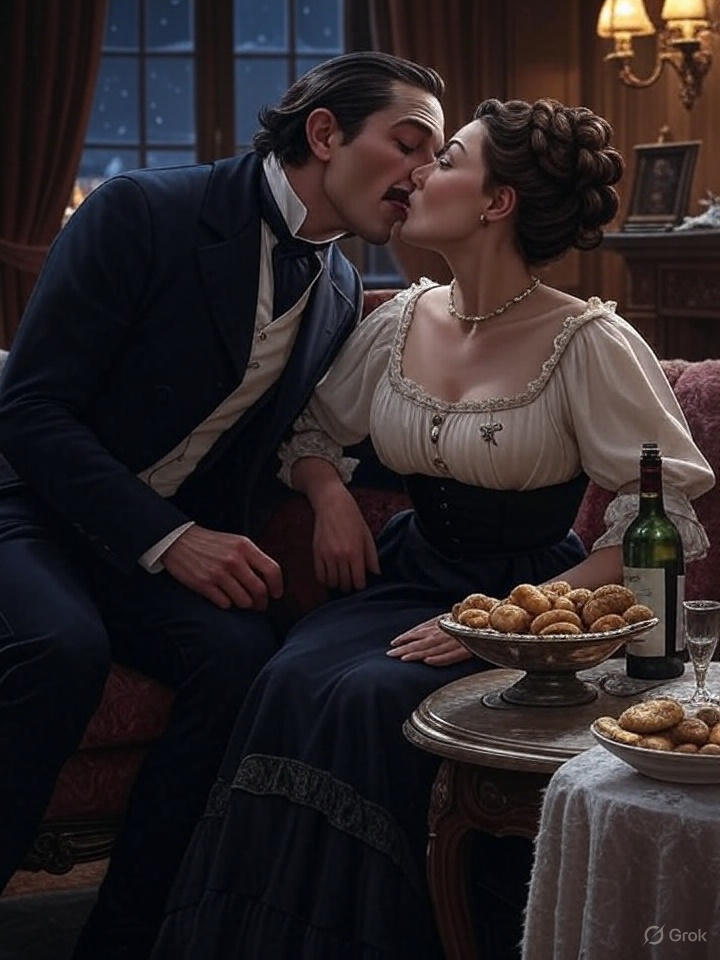


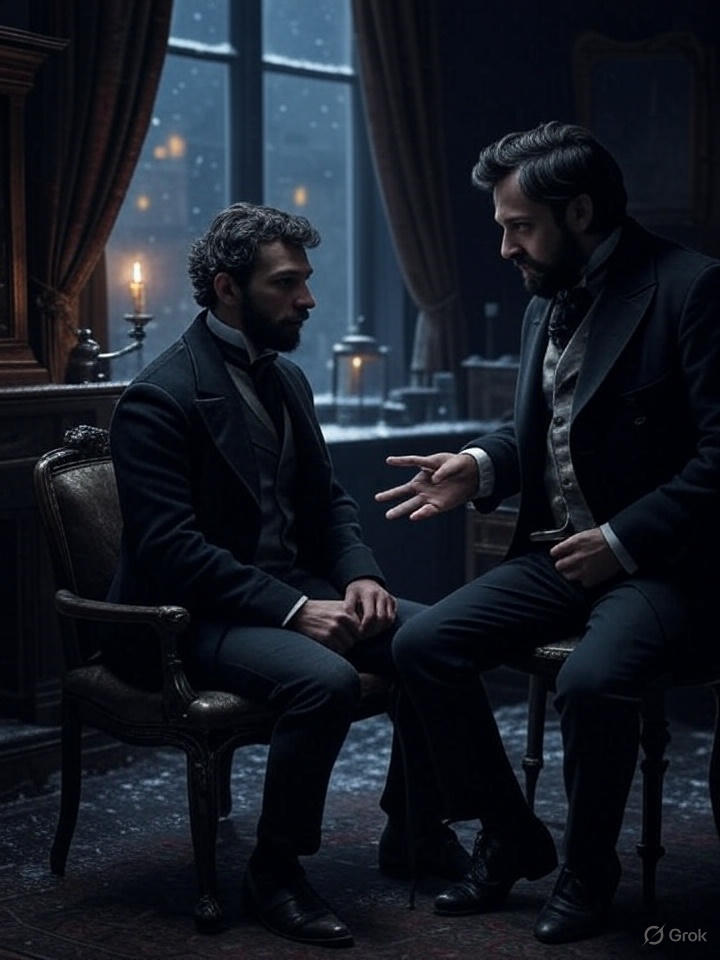



 Anarchistbanjo's World