Feeds:
Posts
Comments

Posts Tagged ‘writing’

by Karl Hans Strobl and translated by Joe E Bandel

“Beautiful lady,” says the man with the cap cheerfully, in his best high German, “it’s a great imprudence for Your Grace to wander alone like this. There are so many bad people down here in the Prater—a young, beautiful lady with so much jewelry, that doesn’t bode well. You can be glad you’ve met us, and we will permit ourselves to escort you.”

Since the woman still says nothing, the man takes her hand and pulls her deeper into the bushes, while the old man closes his shaded lantern and follows, watching to ensure she doesn’t suddenly run off.

And nearby, beyond the thicket, the stream roars in the darkness—

At first, the Hofrat had hoped his wife would return home, as she had on that March day, once she awoke from her state, and he had resolved to follow Doctor Eisenstein’s advice to send her to his brother-in-law’s estate near Graz. Country air, the doctor suggested, was what she needed—this noisy Vienna was unsuitable for her, and he hinted it was especially important to shield her from the experiments with which Reichenbach further disrupted her weakened nervous system. He was now quite opposed to these experiments, stating as her family physician he could no longer endorse them.

The Hofrat waited, inwardly indignant but not overly alarmed, until the evening of the next day. Then fear overtook him, and he reported his wife missing to the police.

From Ottane, they learned the Hofrätin had been at the hospital, leading them to conclude she had wandered toward the Alservorstadt and prompting a search of the city’s west side.

When the rumor of the Hofrätin’s disappearance spread through the city, people came forward claiming to have seen her on the street. The statements contradicted each other, offering no clear picture; the poor woman seemed to have wandered aimlessly. It was Reinhold who insisted on searching the Prater. A chestnut vendor at the end of Jägerzeile had given a description that seemed to match Frau Pauline. Had she gone there? A hunch had led him to Jägerzeile, and the vendor’s account deepened his fears. Reinhold took leave from the factory, scoured the entire Prater, and kept returning to the Danube, its yellow, muddy waters swollen with meltwater, its roar seeming to drown out a beloved voice.

On the fifth day, the Hofrätin’s body was pulled from the stream.

The police doctor noted signs of assault, with strangulation as the likely cause of death; the commissioner confirmed the jewelry she was known to have taken was missing.

Yes, yes, it was clearly a robbery-murder, no doubt about it.

The fishermen, with their dripping waders and long poles used to probe the riverbed, stood around the body. Year in, year out, they A multitude of bodies from the Danube was nothing new to them; they were hardened to death. But a Hofrätin had never been among them, let alone a murdered one! Yes, there she lay, looking no different from the other waterlogged corpses that had spent five days in the Danube.

Reinhold walked away; what came next was a matter for the police—he had no further business here. He didn’t want the image he carried within him to be destroyed as well. That image lived in him, and he wanted to keep it alive.

He went to Ottane at the hospital, and Ottane knew at a glance at his face that something terrible had happened. Still, she asked, “What has happened?”

“The Hofrätin has been murdered and thrown into the Danube.”

“So that’s what had to happen!” Ottane had sensed how things stood with her brother; now it became certainty as she saw his haggard features and noticed the trembling of his hands. She wanted to comfort him, taking those trembling hands gently and tenderly between her own.

But Reinhold only shook his head, withdrew from her, and left.

The Freiherr was at home. Reinhold entered the study without knocking, unaware that he still had his hat on.

Reichenbach looked up from his work on the book about the sensitive human with disapproval. The written pages had accumulated into a considerable stack; the desk was covered with countless notes, excerpts from the diary, hasty remarks, and nearly every one bore the Hofrätin’s name.

“The Hofrätin has been murdered and thrown into the Danube,” Reinhold repeated.

“Murdered? That’s horrific!” Reichenbach exclaimed.

“And you are her murderer,” said Reinhold in the same calm, toneless voice.

“What are you saying?”

“You are to blame for her death. You’ve only ever thought of your Od. You shouldn’t have misused her for your experiments; she perished because of it. Her delicate health couldn’t withstand it; her condition worsened since you tormented her with these things.”

Reichenbach stood up and stepped threateningly toward Reinhold: “Have you gone mad? Where do you get these insane accusations? I’ll have you locked up.”

But threats and intimidation no longer worked on Reinhold. He didn’t lower his gaze or crumple to stand at attention afterward; he looked his father in the eyes and said, “You won’t do that. I’m not a schoolboy anymore, and I want nothing more to do with you. Our paths are parted from today onward.”

“Go to the devil for all I care!” shouted Reichenbach, throwing himself into the armchair at the desk, scattering the notes in a whirl. He paid no further attention to Reinhold—let him do as he pleased; he was done with him.

Toward evening, Severin entered the study and announced that the meal was served; after some hesitation, he added that the young master had left and ordered his belongings prepared in his room to be sent to the factory.

Reichenbach sat at the desk, head in his hands, not looking up or turning around. “Very well!” he said wearily.

It seemed, however, as if Reinhold had at least voiced part of public opinion. Initially, people had watched the Freiherr’s endeavors with smiling disbelief; then his Od became a veritable fad. Now, it was almost falling into disrepute. While some continued to smile or resumed doing so, voices emerged claiming that the case of Frau Hofrätin Reißnagel showed the matter wasn’t so harmless or safe, and that the police should actually intervene. Hofrat Reißnagel himself wasn’t among those voicing such opinions; he displayed a dignified and appropriate mourning expression, as befitted a man so heavily struck by misfortune, and he continued to associate with the Freiherr. After all, he was in a business partnership with Reichenbach—one hopefully profitable—and he didn’t hold the rumors blaming Od against the Freiherr. However, while the Hofrat remained silent, the deceased’s family physician, Doctor Eisenstein, openly admitted that Reichenbach’s experiments had adversely affected the poor woman’s soul, hastening her tragic end—and as the family doctor, who else would know better?

Among Reichenbach’s neighbors on Kobenzl—the small farmers and vintners—a wariness toward the Freiherr spread. They had never understood what he was trying to do; he locked people in a pitch-black chamber, engaged in the oddest practices with magnets and hand-laying. No one knew what good it served. He had always seemed strange to them; now he became eerie. They called him the Wizard of Kobenzl, avoided passing his castle at dusk or night, and crossed themselves when they saw light in his study.
Read Full Post »

Homo Sapiens by Stanislaw Przybyszewski and translated by Joe E Bandel

XI.

Isa and Falk sat in the same wine restaurant as the previous evening. Only now they were completely alone, in a *chambre séparée*. 

Never had she enjoyed being alone with someone so much. 

Falk had ordered champagne, counted the bottles, and calculated whether he had enough to pay. 

Yes, it was enough—for much more. Strange that he had to think of that. 

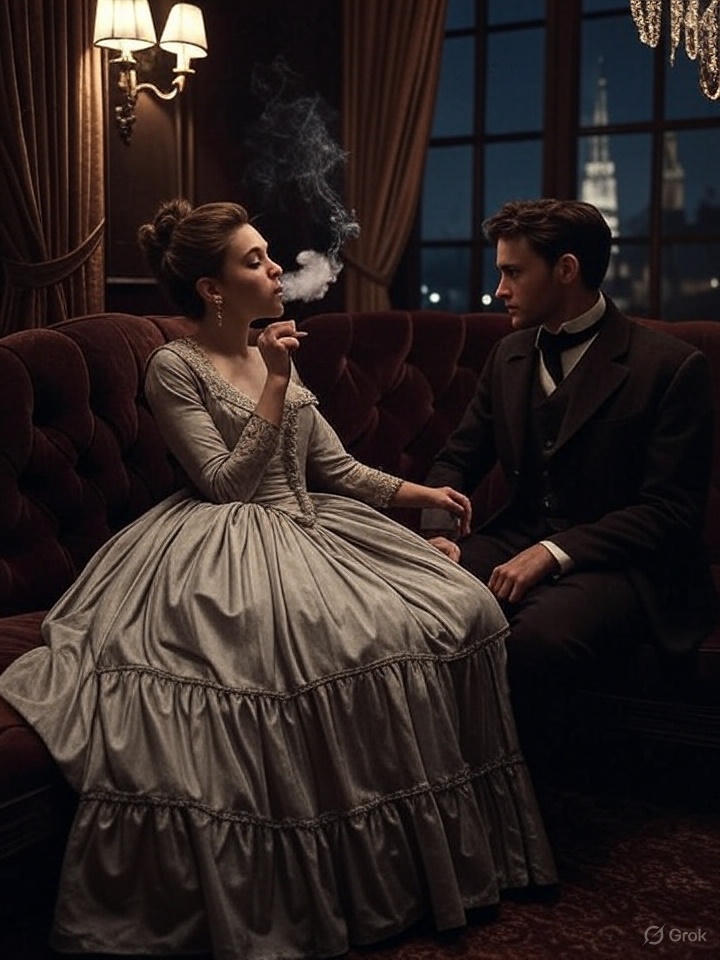
She lay half-reclined on the sofa, blowing rings of cigarette smoke into the air. 

She had completely forgotten Mikita. When she occasionally thought of him, she saw him as a twitching, blustering mass, a sort of goblin. 

Yes, how malicious he could be! Those veiled jabs in the sausage story. 

Falk watched her. 

Sometimes he was surprised that her face flushed with crimson, and that she shuddered violently. 

And each time, he saw her sit up hastily and down a glass. 

How he loved her! How he wanted to press that slender body into his, to stroke that fine blonde head and hold it to his chest. 

Why didn’t he do it? Why? 

He felt, he knew, that she loved him; so why not? 

Pity for Mikita? Didn’t he suffer just as much, perhaps even more… 

He thought of the awkward scene at Mikita’s. How strange that he felt joy in it. What kind of devil in him took pleasure in that? He recalled how he once got a girl’s fiancé completely drunk and felt a diabolical joy when the girl was mortified by her lover’s indecent drunkenness, even began to hate him. 

What could that be? 

A nervous, pained smile played around the corners of his mouth. 

She looked at him. How beautiful he was! She could look at him for hours, yes, look at how his eyes, large, sparkling, feverish, stared at her… and when he occasionally paced back and forth: those supple movements of a panther. 

And again, she felt the flush of shame flood her face and a dark hatred rise within her… 

That was crude of Mikita—brutal! She drank hastily. 

They no longer spoke. 

He had already said so much; now he wanted to sink into himself, to drink in what was around him, within him, to savor it, to absorb it into every pore… 

And she heard his voice with its soft, hoarse tone… There was something compelling in that voice, lulling her will, hypnotizing her. 

She thought of when she heard *Tristan and Isolde* at the opera. It was exactly the same feeling. She saw herself in the box, forgetting where she was… oh, it was glorious, that half-awake state… she heard the music pouring into her with a longing, with… ah… 

She sank back into the sofa and closed her eyes. It was so good here with him… 

Falk stood up, paced a few times, then sat beside her. 

He took her hand. He looked into her eyes. It was like a hot phosphorescence all around. He saw a glow trembling in hers, a hot, alluring glow… yes, that’s how she looked at him the first time. 

They smiled at each other. 

“Now I’ll speak again.” “But don’t forget.” 

“Forget what?” 

“The condition…” 

“I’ve forgotten the condition.” “You mustn’t.” 

“No, no!” He kissed her hand. 

How she lured him, how she drew him in with those eyes. Did she know it? 

“Where are you from, Isa?” 

“Isn’t it more important where I’m going?” She smiled. 

“Yes, yes… You shame me, because you’re right… And your hand is so beautiful, so beautiful; I’ve never seen such a wonderful hand…” 

She looked at him. 

Suddenly, it overcame him. He sank beside her and passionately kissed her hand. He buried his lips in that hand. 

Then she gently withdrew her fine, slender, long hand. “Don’t do it, Falk! It hurts so much, so much…” 

She spoke softly, hesitantly, with a veiled voice.  

Falk sat back. He rubbed his forehead, drank, trembled with excitement, and fell silent. 

A long pause. 

Then he began, calmly, quietly, with a sad smile. 

“It’s been two, three days since I met you… Yes, I can’t comprehend it, there’s nothing to comprehend, it’s a fact… Be kind, let me say everything, it calms me… I have to talk about it… You probably can’t understand, but I’m loving for the first time in my life.” 

He drank hastily. 

“Yes, you don’t know, but it’s something terrible, to love for the first time at my age. It uproots the whole soul, it creates chaos in the mind… You became my fate, you became my doom…” 

He grew agitated. 

“I know, yes, I know I shouldn’t speak to you like this, yes…” he choked down Mikita’s name—“I don’t know why I’m talking to you like this. It’s a terrible mystery… I’m a different person today than I was three days ago—I don’t understand what’s happened in me… well, yes… I can talk like this: I want nothing from you, I have you in me… I’ve carried you my whole life as a great, painful longing, and so… Yes, I’ve already told you the same thing a hundred times, but—” it burst out of him—“I’m tormenting myself so unbearably, I’m falling apart, I’m so insanely restless… No, no—I’m not crazy, I know, I know well what I’m doing and saying, I also know I have the strength to tear myself away… Yes, I’ll go and carry you in me, drag this eternal longing with me, and let my soul crumble…” 

Again, he sank before her. Everything went black before his eyes. He felt two hearts rubbing against each other. 

“Just love me, say, say you love me…” 

He embraced her and felt her body yield, he pressed her to him… 

“Mine, mine…” She pulled away. 

She didn’t know why she resisted; she only felt a sudden wild hatred for Mikita, who had defiled her. 

Falk looked at her. 

Her eyes were large and filled with tears. She looked away and gripped the sofa’s armrest convulsively. 

He controlled himself. 

“Yes, you’re right!” He spoke tiredly, a bit coldly… “Yes, that wasn’t nice of me. Forgive me. You’re too tired to love.” 

She looked at him for a long time with a quiet, sad reproach. 

“And then… it’s really so beautiful to sit side by side like this, without demanding anything… Yes, let’s be comrades… right?” 

Falk grew cheerful. But he felt miserable and sick. He couldn’t mask his pain well. Why bother? Yes, why? He grew angry and felt a hard, stubborn defiance. He almost wanted to slam his fist on the table. He never did that otherwise. 

Again, he stood, walked around the table, and sat beside Isa on the other side. 

“No, it would be too ridiculous to play a comedy with you. I won’t do that. I have to tell you. Yes, I must… You could be my greatest happiness, yes, you… no, you! You! Let me call you that. I have nothing in the world. It’s already an inexpressible happiness for me to feel you as mine with the word ‘you,’ it’s a happiness to scream this ‘you’ from my heart, this one ‘you’… You…” 

He felt dizzy. He saw nothing more. And he buried his face in her lap. And she took his head in her hands, and he felt her kiss him… shyly, then fiercely, in short bursts one after another. And he trembled and burrowed into her… 

Then suddenly he heard her speak in a choked, breathless, broken voice… 

“I followed him, I thought I could love him because he loves me so much… 

You don’t know how tired I am… You, you I’ve loved for a long time—long… Since he started talking about you… I made him come here… When I saw you the first time—I trembled as if I’d collapse… But I mustn’t, I mustn’t… I don’t want to go from one to another… Let me go, let—” 

But he heard nothing more, he pressed her to him, he burrowed his lips into hers, he clasped her head and pressed and pressed it to his face with frenzied passion. 

Finally, she tore herself free and sobbed loudly. 

“Let me go. Don’t torment me. I—I can’t!” 

He stood up, and an infinite sadness filled his soul. 

Then he took both her hands, they looked at each other silently and held on tightly, for a long, long time. 

“So we part?” “Yes…” 

“And we won’t see each other again?” 

She was silent. Tears ran silently down her cheeks. 

No more! Falk trembled violently. Now he would hear his death sentence. “No…”

Read Full Post »

OD by Karl Hans Strobl and translated by Joe E Bandel

Chapter 16

Reichenbach has paid little attention to his large ironworks in Ternitz, just as little as to the one in Eaja, and since the estate on Reisenberg is in poor shape and the other holdings in Galicia and Moravia—where the stewards have also lined their own pockets—are no better, the Freiherr is very grateful to Hofrat Reißnagel for a hint concerning the ironworks.

Hofrat Reißnagel works in the state property administration, mockingly called the State Domain Squandering Office by malicious tongues. There are very sharp minds in this office—men who understand business and get wind of many things before others, making them able to offer valuable tips.

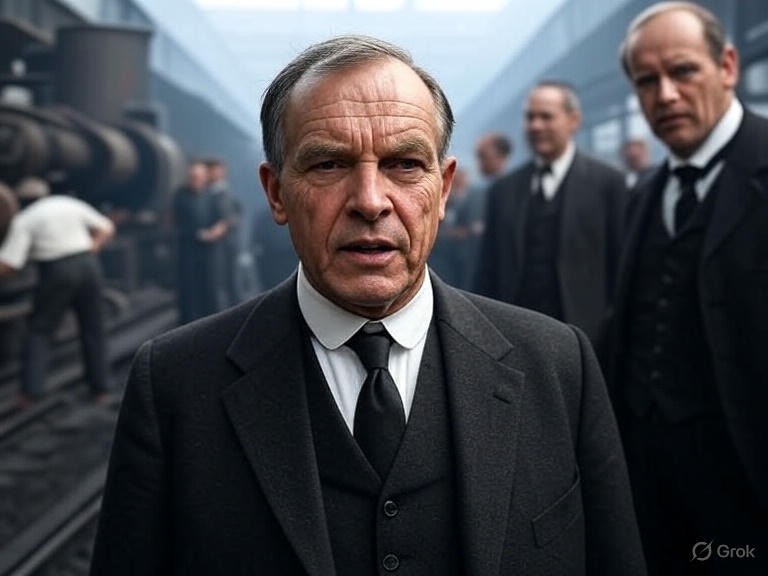
“The railway system is now to be expanded with all urgency in Austria,” hints the Hofrat. “Numerous new lines are planned. Nothing is more timely today than producing railway tracks—a business, dear Baron, that will yield a secure profit, an extraordinary profit. Nothing is better today than producing railway tracks.”

It’s a tip that could mean a fortune, one that could restore a faltering fortune.

The Hofrat has taken a few days’ leave and traveled with the Freiherr to Ternitz to inspect the ironworks, and Reichenbach has taken up the matter with fiery zeal and his old vigor, completely restructuring the operation and converting it entirely to railway track production.

Now they are heading home, and Reichenbach has been very silent for the last stretch of the journey. He makes mental calculations about the cost of the conversion. It will require an enormous sum of money, and the estates are in the red, the bank accounts exhausted—they will need to borrow. Mortgages will have to be placed on the estates, but it’s such a sure venture that everything must be done to get it going.

The carriage stops before the Hofrat’s house on Kohlmarkt to drop him off. “Come up to my place,” says Reißnagel. “Let’s go over the matter again.”

Reißnagel wants to discuss the matter again, particularly to find out how much the tip he gave Reichenbach is actually worth to him—expressed as a percentage of the net profit.

On the stairs, they encounter Reinhold, who greets the Hofrat politely but only nods casually to his father. Reinhold has taken a position as a chemist in a factory; he now lives year-round in Bäckergasse. He and his father rarely see each other, meeting most often at Hofrat Reißnagel’s, where they pass each other with stiff legs. The father finds Reinhold’s visits to Frau Hofrätin too frequent—much too frequent—and Reinhold secretly accuses his father of harming Frau Pauline’s fragile health and mental state with his Od experiments.

Even today, the Hofrätin sits beside him distracted and absent-minded, and Reinhold has failed to draw her out of the gloom of her mood.

She remains distracted and absent-minded during Reichenbach’s greeting, giving incoherent answers to his questions. In the midst of reorganizing his ironworks, some new experimental setups have occurred to Reichenbach, and now, sitting across from the Hofrätin, they suddenly seem so important that he wants to start immediately.

But Frau Pauline is not in the mood to engage with this.

“She has a fiery ball in her head,” she complains of herself in the third person, “she has waterfalls in her ears.”

After watching for a while, the Hofrat remarks that the Freiherr will likely struggle in vain today and invites him over to discuss the matter.

The Hofrätin is left alone; she sits idly in the growing darkness, staring at a distant point. The fiery ball spins faster and faster, and the waterfalls roar. Then a moan rises from her chest; her limbs stretch and stiffen, the sparking in her brain fades, the water’s rush ceases, and nothingness takes over—the great darkness.

The woman stands up; her movements are strangely angular. She walks through the dark room without bumping into anything, opens a wardrobe, and takes out a dress. It’s a black mourning gown from her father’s death, which she puts on. From a jewelry box, she retrieves a pearl necklace, a gold brooch, a cross on a chain, and a bracelet. She adorns herself as if for a celebration, though she wears a mourning dress, and leaves the house silently, unnoticed and unstopped by anyone.

She walks through the streets, somewhere, passing many people, one or two of whom glance at her curiously because something about her gait and posture strikes them, though they can’t quite pinpoint what it is. The Herrengasse, the Freyung, the Schottentor—ever onward—until she reaches a large building with a wide, open, illuminated gate, into which she enters.

The hospital porter sees a slender woman in mourning clothes; it’s evening now, not visiting hours, and he should technically ask her destination, but he refrains. The woman is in mourning attire, without a coat—odd enough for a chilly early spring evening. So many people in mourning pass through this gate; the porter has a kind heart and can’t bring himself to stop her.

A dark courtyard, then another, a staircase, bare, whitewashed corridors with many doors—and then one opens, and Ottane, propelled by the momentum of her professional zeal, nearly collides with the Hofrätin.

“What’s wrong with you, gracious lady?” asks Ottane.

The Hofrätin appears ill; she has an immobile, almost fixed stare in her eyes that seems to see nothing.

“Are you looking for our Doctor Semmelweis?” Ottane asks again. It could be that Frau Hofrätin has something to ask Doctor Semmelweis; many women arrive here so distraught, with such a glassy gaze, that The birth of a new person sometimes has a strange effect, heralding doom like an omen.

“Come to my room,” says Ottane. “I’ll notify Doctor Semmelweis right away.”

It’s a simple room into which Ottane leads the Hofrätin—a metal bed, a washstand, a wardrobe, a chair, a picture of the young emperor, and a crucifix on the wall, nothing more.

Ottane seats the Hofrätin on the chair and hurries off to fetch Semmelweis.

But when she returns with Semmelweis after barely a quarter of an hour, the chair is empty, the room is empty—the Hofrätin is gone. She’s already wandering back into the descending night, heading further into the suburbs. Trees trap clumps of darkness in their bare branches, forming avenues, then the woman leaves the wide paths, wandering along narrow trails through thickets.

A stream rushes nearby.

The Prater is very lonely at this hour and in this remote area.

But then, suddenly, two shadows appear—one large and stocky, the other small and hunched—emerging from the bushes to block her path. In better light, one might have seen that the large, broad shadow belongs to a man with a cap and a heavily embroidered jacket resembling a fantastical map, and that the other shadow is a stooped old man with a floppy hat, his coat so long it flaps around him, forcing him to roll up the sleeves. But even the brightest light wouldn’t have helped the woman; she sees nothing, driven forward by some force, and now she can’t proceed because the man with the cap has grabbed her elbow and holds her fast.

“Beautiful lady,” says the man in forced high German, “why so alone?”

He gets no response. “Don’t be afraid,” he continues, “we won’t harm you. We’re from the police.” Then both men laugh at the well-executed joke.

But when the woman still gives no answer and doesn’t move, the man with the cap grows irritated. Does she think she can plant herself like some Urschel? He, Ferdl Latschacher? “Come on, shine some light here,” he orders, and the hunched old man pulls something from his oversized coat, flipping open a small lantern. Suddenly, there’s light, and the old man raises the shaded lantern, illuminating the woman’s face.

“Well,” he crows gleefully, “this is an old acquaintance. It’s the Princess Metternich from Mariahilferlinie.”

Now the man with the cap recognizes her too—yes, it’s the woman from Mariahilferlinie who slipped through their fingers back then. But today is different; she won’t escape them again. She’s adorned with a lot of jewelry again, and if not for the black dress, one might think she’s heading to a court ball, perhaps one down at Praterspitz—haha! And besides, she’s a still-young, pretty woman; she seems only mute, since she says nothing— all the better, all the better.

Read Full Post »

Homo Sapiens by Stanislaw Przybyszewski and translated by Joe E Bandel

“You, what’s wrong with you?” he asked hoarsely. 

“Nothing, nothing!” She tried to smile, but it failed. “What… what… what’s wrong with you?” He began to understand. 

At that moment, the bell rang sharply. 

He flinched, unable to comprehend what the sound was. “You, it’s ringing. Don’t open it, don’t open it,” she pleaded fearfully. But he ran out. 

She groaned. Now he was coming, she knew it. It was him. Now… oh God, it was all the same. 

“Oh, this is wonderful, simply splendid, we were just about to write to you.” Mikita could hardly contain himself. “Now, Isa, Falk is finally here.” He tried desperately to control himself. 

“I’m glad; believe me, I’m glad. Well, you know, Erik… this is nice… 

We’ll have a cozy evening… What do you want? Wine, schnapps, beer… Hey? You can have anything…”

“Do you want to see my paintings?… Good God—the stupid paintings—what’s there to see? Go out into life—yes—go out on the street, those are paintings! … What’s the point of this stupid daubing… Oh God, what’s it all for? … Didn’t you say yesterday that you can’t attract a woman with it?… Yes, yes, go out on the street, no! go to a night café, there are paintings! Splendid, you know… a painting like the one I saw yesterday, no one could paint that… Do you know what I saw?… I was in a restaurant, yes, a restaurant, not a café, by the way… and, yes, there I sat. Across from me, a man with two women. He was courting one of them and doing telegraphic exercises with his feet under the table. He was eating sausages, you know, Jauer sausages, I think… Then suddenly: it was a moment…” 

Mikita laughed hoarsely, barely intelligible. “A moment! You rarely see something like that. 

Listen: one of the girls…” Mikita kept interrupting himself with nervous, unpleasant laughter… “grabs the plate of sausages and throws it in the guy’s face… That was a sight, worth a hundred of my paintings… The sauce dripped down… you know, that chocolate-brown slop they pour over every dish here in Berlin… The sausages flew everywhere… What a sight that guy was!…” Mikita doubled over with laughter… “That was a painting!” 

Falk couldn’t understand what was wrong with Mikita. He looked at Isa, but she was lying on the chaise lounge, staring at the ceiling. 

Probably another intense jealousy scene. 

“Do you know what the guy did?” Mikita nervously twisted the buttons on Falk’s coat. “Nothing! Absolutely nothing! He calmly wiped the sauce off his face… Yes, that’s what he did… But the woman he’d been playing footsie with laughed herself half to death… Her erotic feelings were done for… Do you know why? – Do you know?” Mikita let out a short scream. 

“Because he became comical, comical! And when you become comical to a woman, it’s over…” 

Falk felt uneasy. He thought of his farewell yesterday. 

“Do you understand what it means to become comical to a woman?… But, but…” Mikita stammered… “you don’t become that for everyone… There are some for whom you don’t, women who love, who love!…” He calmed down… “You see, those women forget themselves and everything around them; they don’t see that you’re comical—they don’t think, they don’t observe…” He flared up again… 

“Hey, Isa? Am I not right? You’re a woman!” 

Isa tried to salvage the situation; it was outrageously awkward. He was completely crazy… She laughed. 

“Yes, you’re probably right… the sausage story is quite amusing. What happened next?” 

Mikita stared at her piercingly. 

“Yes, next—right. So the comical man was completely calm, even though everyone was collapsing on the tables with laughter… His fine high collar had turned into a dishrag, and his stiff dress shirt could’ve been wrapped around a matchstick… 

The culprit, you know—the woman for whom you can never become comical—was pale, and I noticed she was trembling. She looked just like a dog. That’s how Goya saw people—yes, the magnificent Goya, the only psychologist in the world. He saw only the animal in people, and animals they all are: dogs and donkeys… 

But that girl had temperament, she had sexual verve, she loved him, yes, she loved him…” 

“What? That doesn’t interest you? That doesn’t? Doesn’t a jealous feeling that turns you into a criminal interest you? One throws Jauer sausages at his head, another becomes a vitrioleuse. But it’s the same feeling! It’s strong, it’s powerful, it’s life and love! Huh?… For one, it comes out this way, for another, differently… My mother had a maid who read novels day and night… Don’t you think a colossal Bertha von Suttner was lost in that girl? Right? Right?” 

Falk grew restless; what was wrong with him? 

“You see, man, why bother looking at paintings?…” 

“Yes, right, the punchline… The guy left the restaurant with the women, calm and dignified. But suddenly on the street… you should’ve seen it… that’s the stuff of sensations… with a jolt, the girl flew into the gutter from a hefty slap… But she got up, went to him, and begged for forgiveness… He pushed her away, but she ran after him, wailing and pleading.” 

Mikita grew more and more agitated. 

“Do you know what I did? 

I went up to him, took my hat off to the ground, and said: Allow me, sir, to express my highest admiration.” 

Yes, you know—Mikita was disturbingly excited… 

“But what’s wrong with you, for God’s sake, you’re sick… what’s the matter?” Mikita interrupted Falk sharply. 

“Me? Sick?… Are you crazy? But you see, that man did it right! Didn’t he? You have to subdue the woman, with your fist, with the whip… Force, you have to force love…” 

He stammered and suddenly fell silent. An awkward silence followed. 

Falk grew restless. His eyes darted back and forth between Mikita and Isa. But deep down, he had to admit the scene pleased him. Shameful! 

Isa suddenly sat up and said slowly: 

“You could’ve quoted Nietzsche perfectly here: ‘Don’t forget the whip when you go to a woman!’ Otherwise, what you said sounds almost like plagiarism.” 

There was something deeply dismissive in her voice. 

Falk looked at her, astonished. Was it a break?—with Mikita?… This hatred… 

Mikita snapped out of it and laughed suddenly. 

“Damn, Nietzsche said that well, devilishly well… But what’s with you two?… You’re getting downright solemn… I’m completely crazy too.” 

He became very friendly. 

“Don’t hold it against me that I’m so worked up, but I really think I’m delirious—I was drinking with that guy all night… It doesn’t do me good… My uncle died of the finest delirium specimen that can grow in a human brain. His delirium was lush like a palm tree, like a great palm tree, under which you can’t walk unpunished, as our intellectual heroes like to sing.” 

He wandered around, fiddling with the paintings. 

“Good God, what are paintings? A man who has enough of himself and the whole world should be content with that and not daub… 

So you want to see paintings… well, you’ll have to come back tomorrow when there’s light… Yes, I need light, millions of square miles of light in each eye, to see what no one sees. Yes, no one… what I haven’t seen… what I still have to see, yes, must!…” 

Falk had never seen Mikita like this. This wasn’t normal… “But what’s wrong with you? Why are you playing this comedy with me?” 

“What’s wrong with me? What’s wrong with me? I’m happy! Happier than ever!” “Then you don’t need to scream!” 

“Yes, damn it, I have to scream, because sometimes you get a funny look around your mouth, as if you don’t believe me… What, Isa? Aren’t we happy?!” 

But Isa had had enough. Now he’s prostituting their entire relationship… No, it was too much… 

She stood up, got dressed, and without a word, left the studio. 

Mikita watched her, uncomprehending. 

He was shattered. Then he turned to Falk. 

“You go too! Go, go! I’m too worked up, I need to be alone… Go, go!” he screamed at him. 

Falk shrugged and left. Downstairs, he caught up with Isa. 

When Mikita was alone, he bolted the door, stood in the middle of the studio, and suddenly ran his head into the wall. 

The pain sobered him. 

So I’m really going mad. 

He staggered to the sofa. His head ached. Suddenly, everything went black before his eyes, a dizziness seized him. 

It was horrific! He had violated the defenseless woman, taken her against her will. She gave herself because she had to, out of duty, out of… out of… 

And he screamed with all his strength: “Pig, you!” 

His unrest grew beyond him. He felt every fiber in him trembling, a growing rage built up inside; he felt as if he were falling apart, as if everything in him was dislocated, and a terrible fear gripped him. 

Things are bad with you, things are bad with you, he repeated incessantly. 

He clutched his chest with both hands. 

A defenseless woman violated, one who felt only disgust for him! Why did she give in? Because he asked her? Because—because… Good God! She gave in out of kindness. 

And a thought shot through his brain: Now she’s giving herself to Falk because he’ll ask her, because she wants to see him satisfied, because—because… 

He whinnied with laughter, writhed on the chaise lounge, and then suddenly broke into convulsive weeping. 

He heard himself crying. 

And again, the unrest surged into his brain, he gathered himself, he had to bring her back so Falk wouldn’t take her. 

Mechanically, he grabbed his cap, tore open the door, rushed down the stairs, ran through the streets to her house, and then inside: racing, trembling… 

“Is Fräulein Isa at home?” “No!” 

He stood outside the house. Everything collapsed within him. He wanted to go, but his feet wouldn’t carry him. 

He surely couldn’t take a single step. What now, what now? he repeated mechanically. He stood there, unable to think of anything. 

Then he read across the street: Restaurant-Café… 

Aha! Café… Yes, into the café—then sit, right?… Sit on the sofa, drink coffee… read newspapers…

Read Full Post »

OD by Karl Hans Strobl and translated by Joe E Bandel

“Think it over,” the Freiherr pleaded humbly. “The advantages for you are obvious.”

“There’s nothing to think over,” said Therese without hesitation. “Every word is pointless. Let’s stick to friendship, Baron!” She interrupted again, calling into the bedroom: “Come on, Rosa, hurry up with it?”

The hammer blow of disappointment pushed Reichenbach back a step; he leaned against something, and a tower of boxes crashed noisily behind him. Then Rosa returned with the blue hat in hand, and an eager consultation began about fitting this airy fairy-tale creation of straw and ribbons.

Reichenbach stood silently in the way for a while, gradually realizing he was entirely superfluous here and that his reproachful silence made no impression on the busy artist. He composed himself, masking his inner turmoil, but he couldn’t entirely hide a faint trembling in his voice, which he couldn’t prevent as he now explained that he wouldn’t disturb her any longer and wished her a happy journey and tremendous success.

“Yes, yes,” Therese thanked him offhandedly, “and if I ever have time, I’ll write to you.”

It was an awkward farewell. Reichenbach carried his shattered heart to the carriage waiting in the street—no, he felt it, there was nothing more to hope for, and he could bury his aspirations. He had to give up on Therese; she had slipped from him, despite seeming so close, with a sudden turn he couldn’t explain.

He drove home, sat at his desk, and tried to force himself to resume work on his great book. The proven remedy failed; his mind had revoked its obedience. He sat there, pen in hand, but he didn’t write; he only saw Therese’s violet petticoat before him and heard her say: it’s all pointless.

When Doctor Eisenstein was announced that afternoon, he still hadn’t fully subdued his emotions. A more perceptive soul-reader than the doctor would surely have noticed the ominously threatening tension and postponed his fateful question to a more opportune moment.

But the doctor isn’t one of those who see into others—a highly skilled physician, certainly, a popular one, always advancing with the latest, but not particularly insightful when it comes to his own affairs. He believes he can’t delay any longer; Schuh is now coming and going in the house again, and Hermine has suddenly found an unusual amount of time for music.

No, it can’t be postponed further; the doctor has resolved to approach it from another angle this time—through the father, to whom he is indebted. Eisenstein is inwardly prepared with solemn resolve and won’t be deterred from posing his fateful question.

And he is utterly baffled when Reichenbach’s only response is laughter. It’s a bitter, mocking laugh, a laugh with hail and whirlwind, mowing down all the green seeds of the soul in an instant. Isn’t it also absurd, outrageously comic, that the suitor rejected just a few hours ago now faces another suitor?

Doctor Eisenstein dares to point out that it was he who set the Freiherr on the path to Od. But Reichenbach remembers nothing of that; it’s the height of impudence for this man to make such a claim on top of everything else.

And then Doctor Eisenstein exits in a grand arc, with a magnificent bow of unusual force and clean execution.

The Freiherr, however, calls it quits for today on his futile attempts to work on his book. He sets the manuscript aside, grabs a walking stick, and heads into the forest. He can do nothing better than go to his woods; it’s been God knows how long since he was last there. A frosty winter fog has cloaked the trees and shrubs are adorned with hoarfrost, so that the tiniest twigs bear a heavy white fur trim. From the still, moisture-laden air, the down grows, turning the forest into an adventure. As Reichenbach pushes through the underbrush, he brushes off the fragile decoration, and with a soft, rustling sound, it rains down around him in snow crystals.

He has left the paths and walks straight through the forest, between the trunks on crackling leaves, stepping into clearings he doesn’t recognize. The Freiherr grows attentive; an alarming amount of his forest has been felled—entire slopes have been logged. He marvels, his wonder increasing; someone has cut down half his forest.

Then he hears the crunch of saws and the dull thud of axes somewhere. This gives direction and purpose to his steps in the fog, and soon he sees ghostly shadows moving in the thick white vapor. Unexpectedly, he stands among the lumberjacks.

He doesn’t know these men; they aren’t Reichenbach’s forest workers, but perhaps they seem unfamiliar only because they’re newly hired—he hasn’t paid attention to such matters for a long time.

“Who are you working for?” he asks one of the lumberjacks.

The man spits, then grabs one end of a dirty, blood-stained bandage wrapped around his left thumb with his teeth and tightens the knot. Only then does he reply. He says they work for Moritz Hirschel.

“So, for Moritz Hirschel!” the Freiherr retorts. “And who owns this forest?” The man doesn’t know; it’s none of his concern.

“And who pays you?”

Who pays? Moritz Hirschel, of course. Then the man spits into his hands and resumes sawing, where his partner had paused.

Reichenbach watches thoughtfully for a while longer and then heads home.

In the manor house belonging to Kobenzl, there’s a small room where a frail young man sits beside a glowing iron stove, poring over the account books. At the Freiherr’s entrance, he looks up shyly and awkwardly; he knows the landowner, of course, but Reichenbach is a stranger to the man who keeps his books.

“Since when have you been here?” asks Reichenbach.

“Since half a year,” answers the young man in a hoarse voice. He’s always hoarse and always cold, even beside the glowing stove; he comes from poverty, and death rattles in his lungs. He’s grateful to have found this refuge; he doesn’t ask questions—he does what the steward Ruf orders.

The Freiherr sees this at first glance. “You can leave now; I want to look at the books… and send Ruf to me.”

“I don’t know where the steward is…” the young man hesitates.

“Then find him,” thunders Reichenbach. He already knows the steward isn’t home; he searched for him on his rounds through the stables and barns, finding him nowhere.

Now the Freiherr dives into the books; he compares, he checks, he pulls out invoices, calculates, sweats beside the glowing stove, peels back layer after layer, and his anger swells ever higher. Only after hours, quite late at night, there’s a stomp at the door. It has begun to snow; the steward Ruf shakes the snow off his soles before opening the door.

Ruf has been down in Grinzing at the wine taverns, coming straight from heuriger music and revelry, but the news that the Freiherr has been poring over the books is enough to blow all the merry vapors from his brain.

“Why did you dismiss Dreikurs?” asks the Freiherr after a while, without looking up from the books.

Ruf considers his response; one must be cautious and weigh every word carefully: “Dreikurs was an old man; his eyes had grown weak, and he kept making mistakes with the calculations…”

“And why wasn’t I informed?”

“I didn’t want to trouble the Herr Baron with such matters. The Herr Baron always has so much else to do.” Yes, Ruf had relied on the Freiherr being absorbed in his experiments and thinking of nothing else, but he had relied on it too much—that’s clear now. And now Ruf stands there, a noose around his neck, and it’s eerie how calm the Baron is; it’s downright terrifying.

“I’ll tell you why you dismissed Dreikurs, Ruf. He didn’t suit you because he was an honest man who wouldn’t have tolerated your dirty dealings. That’s why you brought in this starving wretch who doesn’t dare contradict you and does whatever you want.”

“Herr Baron…” Ruf tries to protest.

But a swift glance from the Freiherr warns him, and Reichenbach’s hand falls like a stone onto the columns of the open book, teeming with false figures. “I could hand you over to the police on the spot, Ruf, and that would be no more than you deserve. You’re a vile, treacherous fraud! But you stood by me at Salm’s, and then—I won’t do it to your daughter. But by noon tomorrow, you’re gone, understood!”

Now something happens that the Freiherr never would have expected from Ruf. The large, heavy man falls to his knees, stretches out his arms, clasps his hands, and whimpers: “Herr Baron! Herr Baron! Jesus in heaven! … Jesus in heaven!” It’s true, he’s a scoundrel, a cheat; the money slipped through his fingers—he got nothing out of it, a few drunks, that’s all—those beastly women took everything. But are those excuses? They’re not excuses; he can only beg the Herr Baron for forgiveness.

He crawls on his knees after the Freiherr, who steps back from him; he weeps, beats his head against the ground, pounds his chest with his fists. But today there is no mercy or leniency in Reichenbach; today is a day of unrelenting severity—today, everyone must bear the fate allotted to them. Today, someone told him: It’s all pointless! And it’s only fitting that he repeats it with unyielding hardness: “Don’t bother, Ruf, it’s all pointless.”

Broken, with dragging feet, Ruf slinks out.

The Freiherr stares at the fateful book for a while longer, wipes his forehead, feeling the hot dampness. He opens the window to the night’s breath, but a gust of wind yanks the sash from his hand, for at that same moment, the door opens, and Friederike stands there.

He needs only to look at the girl to know why she has come.

“No,” says the Freiherr, “it’s too much. He has abused my trust too greatly. I couldn’t even uncover everything at once; it’s likely far worse than I can determine now. Everything has gone into his pockets; he’s squandered the entire estate, ravaged my forests… this Hirschel! has stripped everything bare…”

Friederike finds no words of defense; she lowers her head and remains silent, but her entire demeanor radiates unspeakable sorrow—a mute despair that spreads before Reichenbach like a dark lake. Suddenly, he feels very uneasy; he clears his throat, embarrassed by this misery. A sudden realization shakes his angry self-righteousness—that he has taken revenge. Revenge on a guilty man, yes, but still, he has sought revenge rather than justice.

“Must we leave tomorrow?” says Friederike at last, looking at the Freiherr. The eyes he meets are like a sad fairy tale of outcast children wandering hopelessly through the world. My God, how beautiful this girl has become—it has escaped the Freiherr’s notice lately; she hasn’t pressed herself on him, has stood quietly aside and waited, surely she has waited and, in the meantime, matured into a gentle sweetness. She has quietly awaited a word of recognition, and now the first word is a judgment that shatters her life. A melancholic familiarity stirs Reichenbach from these features; he doesn’t know what to do with it, but all this plunges the Freiherr into a heart-wrenching distress.

He must free himself from this distress; there’s no other way. “For your sake…,” he murmurs, “for your sake! I’ll try once more with him.”

A light illuminates the troubled eyes from within. Friederike becomes almost transparent with joy, as Od light might glow for those gifted to see it.

She takes Reichenbach’s hand and showers it with a torrent of kisses.

“Now, now,” smiles the Freiherr, withdrawing his hand to caress her soft cheeks, “now, now, girl, what kind of business is this, what kind of business?”

He speaks Swabian with her again; he speaks Swabian—she may stay—and now everything is good again.

Read Full Post »

Homo Sapiens: Overboard by Stanislaw Przybyszewski and translated by Joe E Bandel

X.

“Why didn’t you come to Iltis’s yesterday?” Isa was a bit uncertain. 

“What was I supposed to do there? I assumed you could have fun without me.” 

“That’s ugly of you; you know how happy I am when we go to gatherings together.” 

“Are you?” 

Mikita looked at her suspiciously. “What do you mean?” 

She grew sullen. But suddenly, she saw his sleepless, pale face twitching. She knew that look. 

“No, that’s very ugly of you.” She took his hand and stroked it. 

Mikita gently pulled his hand away. He paced back and forth. “But what’s wrong with you?” 

“With me? Nothing, no, absolutely nothing.” 

She looked at him. A feverish unease twitched more and more violently in his face. Something was simmering in him, ready to erupt any moment. 

“Won’t you come to me?” He approached her. 

“What do you want?” 

“Sit next to me, here, close.” He sat down. She took his hand. “What’s wrong with you, Mikita? What?” 

“Nothing!” 

“Have I hurt you?” “No!” 

“Look, Mikita, you’re not being honest with me. You won’t tell me, but I know you so well: you’re jealous of Falk…” 

Mikita tried eagerly to interrupt her. 

“No, no; I know you too well. You’re jealous, and that’s terribly foolish of you. Falk is only interesting, perhaps the most interesting person next to you, but I could never love him, no, never. You see, when you didn’t come yesterday, I knew very well you were sitting at home tormenting yourself with jealousy. I asked myself the whole evening, what reason do you even have? Have I given you any cause for jealousy?” 

Mikita felt ashamed. 

“You mustn’t be jealous. It torments me. I get so tired of it. In the end, I won’t even dare to speak a word with anyone, afraid you’ll take it badly. You mustn’t. I simply can’t bear it in the long run. You have no reason for it. You’re only destroying our love.” 

Mikita softened completely and kissed her hand. 

“You humiliate me with your constant mistrust. You must consider that I’m a person too. You can’t torment me endlessly like this. You were so proud of my independence, and now you’re trying to destroy it and make me a slave. In the end, you’ll want to lock me up…” 

Mikita was utterly desperate. 

“Isa, no, no! I’m not jealous. But you don’t know what you mean to me. I can’t live without you. I’m rooted so completely—completely in you… You are…” 

He made a wide, comical hand gesture. 

“You don’t understand, you don’t have that raging temperament—this… this… well, you know, you can’t feel how it burns and torments, how it shoots into your eyes and blinds you to the whole world…” 

She stroked his hand incessantly. 

“No, you don’t know what you are to me. I’m not jealous. I only have this raging fear of losing you. I can’t comprehend that you can love me—me…” 

“You know, you know—” he straightened up. “Just look at little, comical Mikita, you’re taller than me…” 

“Let it go, let it go; I love you; you’re the great artist, the greatest of all…” 

“Yes, you see, you only love the artist in me, you don’t know the man. As a man, I’m nothing to you, nothing at all…” 

“But the man and the artist are one in you! What would you be without your art?” 

“Yes, yes; you’re right. No, Isa, I’m crazy. Don’t hold it against me, no, for God’s sake, don’t. I’ll be reasonable now. But I can’t help it. You must understand. I—I live in you… if I lose you, then… then—I have nothing—nothing…” 

Tears ran down his cheeks. She embraced him. 

“My dear, foolish Mikita. I love you…” 

“You do, don’t you? You love me? Don’t you? You… You…” 

He ran his trembling hands over her face, pressed her to him. “You’ll never leave me?” 

“No, no.” 

“You love me?” “Yes.” 

“Say it, say it again, a thousand times… You, my only one… You—You can’t comprehend how I tormented myself, yes, yesterday; I thought I’d lose my mind. I wanted to run there and couldn’t… I couldn’t sit, couldn’t stand… You, Isa, you’ll never leave me? No, no! Then I’d fall apart… Then—then, you know…” 

The painter’s small, frail body trembled more violently. 

“You see, I’ll paint—you don’t know what I can do… I’ll show you what I can do. I’ll paint you, only you, always you… I’ll force the whole world to bow before you… Everything, everything I can paint—thoughts, chords, words… and you, yes, you… You’ll be so proud of me, so proud…” 

He knelt before her, his words tumbling over each other, he stammered and clasped her knees. 

“You, my—You…” 

She grew restless. It was embarrassing for her. If only he would calm down. 

“Yes, yes… You’re my great Mikita. I’m all yours, all… but you mustn’t be so ugly anymore…” 

“No, no; I know you love me. I know you’re mine… Forgive my ridiculousness… I’ll never do it again… You’ve forgotten it?” 

“Yes, yes…” 

He pressed her so tightly that she could hardly breathe. 

A dark unease grew and grew within her. She felt it coming, and a shudder of fear ran through her. She wanted nothing more than to run away… 

She pulled away. 

But he seemed to notice nothing. The wild, long-pent-up passion now broke free and erupted suddenly. 

“I’m so happy, so infinitely happy with you. You’ve given me everything, everything…” He stammered, and a hot greed came over him. 

“I’m nothing, nothing without you. I felt that yesterday, I fall apart without you…” 

He pressed her ever more tightly. “You… You…” He panted hotly. 

She felt his hot breath burning her neck. Her insides shrank like an empty sponge. Fear surged within her, paralyzed her, confused her… Oh God, what should she do? She saw Falk before her eyes. Something rose up in her, resisting in wild, desperate outrage. 

“Be mine!” He begged… “Show me you love me…” She saw Mikita’s eyes, the eyes of a madman, seeing nothing. 

Oh God, God… Once more, she gathered herself. She wanted to push him away and run, never see him again… never endure this disgust again… but the next moment, she collapsed. A sick sadness came over her. She couldn’t resist… she had to… 

“I love you… I’m sick for you…” he stammered like a child. And disgust rose in her. A rancid feeling of disgust, she shuddered—but she couldn’t resist, she had no strength left. She only heard Falk’s voice, saw his eyes… no, she had no strength left… She closed her eyes and let it happen… 

“You’ve made me so happy…” 

Happiness contorted Mikita’s nervous, gaunt face into a grimace. 

But she felt disgust, a choking disgust that pierced every nerve with growing outrage, with a hatred she hadn’t known until now. Yet a mechanical, charming smile played around her mouth. 

And again, she let her hand glide over his. 

She fought with herself. Everything went black before her eyes with shame and outrage. She struggled to hold back a word she wanted to hurl in his face for so brutally violating her. And the thought of Falk gnawed at her, gnawed. A furious pain tore her head apart… 

“Oh, Isa, I’m so happy, so unbelievably happy, today…” 

She controlled herself and smiled. But the disgust filled her relentlessly… Everything became disgusting to her, his words, his hand… 

But Mikita thought only of his happiness. The woman was his, wholly his. His head grew hot with joy and strength. 

She didn’t want to think anymore, but she couldn’t hold back the thought of Falk. The thought pained her, bit her, poured hate and shame into her heart. She breathed heavily. If only he wouldn’t come. Oh God, if only he wouldn’t come… 

“Will Falk come to you today?” Mikita looked at her, taken aback. “Who? Falk?” 

She gathered herself. 

“I’d love for him to see your paintings. He hasn’t seen them yet; he’s the only one who can understand them.” 

Mikita breathed a sigh of relief. 

“You know, Isa; I’ll write to him now to come right away.” 

She flinched. 

“No, no, not today.” “Why not?” 

“I want to be alone with you today.” 

He kissed her hand fervently and looked at her gratefully. 

There was something doglike in his submissiveness. She thought of the big dog in her hometown that loved her so much and she could never shake off. 

It had grown dark meanwhile. 

What right did he have to violate her so brutally… so… no… don’t think, don’t think… But yes—she felt defiled, he had defiled her… 

She suddenly felt his hand around her wrist. 

She shrank back. His touch was repulsive to her. “Turn on the light!” 

Mikita stood up and lit the lamp. Then he fixed his eyes on her intently. 

She no longer had the strength to control herself. Everything crashed over her: Falk, Mikita, the disgust… this terrible disgust… Suddenly, there was fear in him, a fear that momentarily paralyzed his mind. 

She saw his face twitch, his eyes widen immeasurably. 

Read Full Post »

OD by Karl Hans Strobl and translated by Joe E Bandel

Chapter 15

Max Heiland had actually felt a troubling premonition all day, and it was foolish of him to stubbornly suppress and dismiss it.

This premonition warned him against visiting his lodgings on Kohlmarkt today, and he would have been wise to heed it.

For when he heard Ottane’s light step on the stairs and then her signal at the door, and when he—now with some difficulty—assumed the face of the delighted lover and opened the door, there stood Therese Dommeyer before him.

Damn it all, how could his sharp hearing have deceived him so—now the reckoning was at hand.

“Quite cozy you’ve got it here,” said Therese, stepping in and closing the door behind her.

“Who: we?” asked the master, rather lacking in wit.

Therese went further; she removed the key and tucked it into her fold-up purse. Then she said, “Well, you and your lover.”

Max Heiland deemed it appropriate to react gruffly: “What kind of foolish talk is this?”

“So is this perhaps your new studio? I don’t know much about it, but it seems the light isn’t great. I think I’ll have to shed some light on this for you.”

“So what do you want here?”

“I’d like to meet your lady.”

There was nothing to do but give in a little. “I beg you, Therese, surely you don’t want to cause a scandal!”

“I’m just curious about who comes to see you.”

“Very well… but you must give me your word of honor to cause no scandal.” He choked out the name as an honorable man yielding only to necessity. “It’s Frau Oberstin Arroquia!”

He breathed a sigh of relief. “You understand… a Spaniard like that… what can one do? It’s practically a business matter. Frau Arroquia has connections to court circles, the best connections, and if she ends our friendship and turns the entire nobility against me—well, I’d look pretty foolish. One can’t afford to offend a woman like that.”

Therese hadn’t been listening to the master and was sniffing around the room. “Yes, one mustn’t offend a Spaniard like that,” she said, continuing to sniff. She picked up a silk scarf from an armchair and examined it: “This shawl looks familiar, but I think I’ve seen it with someone else.”

Yes, there hung Ottane’s shawl, and on the dresser stood a prominent, unmistakable picture—Ottane’s daguerreotype, taken by Schuh, with a small vase of roses before it, like a household altar of love. Therese stood reverently before the image and said, “But the Frau Oberstin has changed remarkably lately.”

Good heavens, Max Heiland realized everything was lost—Ottane’s picture was there, and on top of that, he had placed roses before it out of exaggerated chivalry.

“So it’s Ottane,” Therese turned around, “this little game with Ottane, with whom you’ve been cheating on me. Is this also because of court circles and business considerations?”

Now further denial would be pointless, mere waste of time, and there was no time to lose. Ottane’s moment was at hand; she could arrive at the door any second, and what might follow was unthinkable. A confrontation must be avoided at all costs. Max Heiland gave himself a shake and stood up straight: “I’ll tell you the truth. It really is Ottane. And what do you intend to do now?”

“I’ll wait here until she comes,” said Therese, settling broadly into a chair with rustling skirts.

“You won’t do that, my dear.”

“Don’t call me ‘my dear’!” Therese flared up angrily. “You know I can’t stand that.”

“You won’t do that because you don’t need to. It’s entirely unnecessary for you to make a scene. You’ve discovered this… well, this affair at a time when it’s nearly resolved for me. You’ve only hastened its natural end. In a few days, I would have broken with Ottane. I’ve had enough of her.”

Therese raised heavy eyelids with a look that suggested little trust. “Is that true?”

Heiland nodded affirmatively. He had spoken the truth—at least a kind of truth; he had indeed grown somewhat weary of Ottane. Her passion no longer swept him away; he remained more out of politeness and favor than from an inner urge as a tender lover. He had other life goals, other women, and his work; in truth, he was already bored, and Therese’s intrusion into the fading love idyll merely provided the external push to end it. It excused the violent act, to which he hadn’t yet been able to resolve himself out of pity and consideration.

“If I’m to believe you,” said Therese, “then write a farewell letter to her right now.”

“I’m ready to do that,” Heiland conceded, with the seriousness befitting such a moral turn. He sat at the small desk, took paper and pen, and began to write.

“And to make it easier for you,” Therese continued, twirling Ottane’s shawl in the air until it formed a rope, “you’ll come away with me now.”

Heiland looked up in surprise.

“Yes, I’ve been granted leave; I must make a guest performance tour in Germany, and you’re coming with me.”

All respect, one had to give Therese credit—when she did something, she did it thoroughly. “Very well,” said the master after a brief reflection, “I’ll go with you. It might do me good to take a break for a while. I don’t know what’s wrong with my eyes; sometimes it’s like a veil over them, and then I can hardly see nearby things. It will benefit my eyes to not paint for a few weeks.”

He wrote a few more lines and then asked over his shoulder, “And your old man?”

“My old man?” Therese wrinkled her nose. “The Reichenbach? Yes, he’ll have to manage without me.”

Now Heiland even managed his captivating smile again: “But you must tell me how you found out… that we were here…?”

“You’d like to know, you sly one!?” Therese laughed, half-reconciled. “I just have very good connections with the police. The police know everything, and it was an honor for the Hofrat to oblige me.”

Heiland hurried to finish his letter, for now there was no minute to spare.

“Show me!” Therese commanded as he sprinkled sand over the ink. She read it, nodded, was satisfied; and then they didn’t linger any longer. Heiland felt the ground burning beneath his feet—my God, only not another encounter at the last moment on the stairs, in the stairwell, or on the street, an open confession. Heiland wasn’t fond of awkward confrontations; his quota was fully met by Therese. He breathed a real sigh of relief only when they turned the next street corner.

Ottane arrived quite flushed; an urgent operation that Semmelweis wouldn’t perform without her had caused the nearly half-hour delay. As she entered the house, the curtain at the caretaker’s window moved, and then the caretaker emerged, holding a letter.

“Herr Heiland just left with a lady… and I’m to give you this letter.” Rarely had Frau Rosine Knall carried out an errand with such satisfaction. The foolish Doctor Semmelweis had dismissed her—that was an outrage—and her disposition toward him hadn’t improved with the neighborhood joke that she’d been fired on the spot. She knew this young lady was, so to speak had taken her place—this person who took bread from poor women and, of course, indulged Semmelweis in his madness. She included Ottane with fervor in her resentment; it had been a delight to provide information to the police spy when he came to inquire, and now she had lurked behind the curtain of her door window like a hunter on the lookout.

The arrow had been loosed—this letter, she knew, was a poisoned dart. Ottane realized it the moment she received the letter.

“Thank you!” said Ottane and walked away. Only don’t let this woman notice anything, only don’t give those greedy, hateful eyes a spectacle. She walked a few houses down and stepped into a wide gateway.

She knew what the letter contained; she had sensed it coming. Max Heiland’s arts hadn’t been enough to deceive the feeling that something dreadful approached; the hours of passion had been followed by bitterness, a gaze into emptiness, a rise of fear.

Now Ottane held the letter in hands that trembled as they broke the seal.

She read: “My conscience can no longer allow…”

She read: “I cannot bring myself to involve a girl from a first family, so pure and blameless…”

She read: “Under this conflict, my art and the noble purpose of my existence suffer…”

She read: “Though my own heart bleeds from a thousand wounds…”

She read: “And so I depart alone…”

Ottane leaned against the wall; her legs stood in a mire into which they sank. The view of the street through the gateway swung in pendulum motions left and right. Then she heard voices from above; footsteps clattered down the wooden stairs, a child crowed with delight.

No, only don’t let anyone notice, for God’s sake, don’t let anyone notice.

She pushed off from the wall, staggered a little, but then walked out into the life of the street.


“Are you packing?” said Freiherr von Reichenbach, surprised, as he entered Therese Dommeyer’s room.

She stood with her maid amid piles of clothing and feminine accessories, wrestling with a stubborn suitcase.

“Are you traveling?” the Freiherr asked again, faced with these unmistakable preparations.

“Yes, I’m traveling,” laughed Therese. “I’m going to Germany—Dresden, Leipzig, Berlin, and so on, a big guest performance tour…”

“You must be very excited about it?” the Freiherr remarked, distressed.

Therese, with the maid’s help, had subdued the unruly suitcase. She jumped onto the lid and held it down with the sweet weight of her body while the maid quickly fastened the straps.

“I’m overjoyed. A chance to get out of the Viennese sausage kettle, see new faces, and earn a bit of money!”

Therese was evidently not the least bit saddened by the farewell; she sat soulfully delighted on the lid, drumming the sides of the suitcase with the heels of her cute shoes.

A shadow of melancholy darkened Reichenbach’s features: “I came to invite you to a session, but…”

“Yes, with the sessions, that’s over now,” Therese waved off. “Now you’ll have to sit without me. And I’m not sensitive anymore.” She leaped off the restrained suitcase and dove into a pile of clothes. “Jesus, Rosa, where’s the blue hat? Haven’t you seen the blue hat? It was still in the bedroom a moment ago.”

The maid slipped out; they were alone for a short while, perhaps only minutes, as Rosa would return soon. Reichenbach hadn’t come solely for the session—the matters needed clarification, and with no time for slow deliberation, a bold move was needed to force a decision.

“And I had thought—” said the Freiherr, looking at Therese with heartfelt emotion.

“Well, man proposes, and God and the theater agent dispose.”

“You can’t be in doubt,” Reichenbach pressed on resolutely, “about what I mean, can you? You must have noticed it yourself long ago. I came here today with a specific intention. I… I had hoped to take your ‘yes’ home with me today, that you… well, that you would become mine.”

Therese was neither surprised nor overwhelmed by the great honor; she had no time to feign surprise or emotion, nor to artfully soften her rejection. “Look, dear Baron,” she said, digging a violet petticoat from a stack of clothes and tossing it onto a nearby pile, “look, dear friend, you must get that idea out of your head. That’s just not possible. How do you even imagine it? There’s no question of it. I don’t suit you, and you don’t suit me. We get along well enough, but as your wife—no, that won’t do. So, what about the hat, Rosa?”

Read Full Post »

By Stanislaw Przybyszewski and translated by Joe E Bandel

IX.

They stood at the front door. 

Falk opened it. It was so hard to find the keyhole. Finally!  

She stepped into the hallway. He followed her. They stopped again. What did he want? 

“Good night, Falk.” 

He held her hand tightly, his voice trembling. 

“It feels like we should part more warmly.” 

The door was half-open. The lantern light fell in a broad strip across her face. 

She looked at him so strangely, so strangely astonished. He felt shame. “Good night…” 

He heard the key rattle from inside. He listened. She climbed the stairs lightly and quickly. 

He walked a short distance. 

Suddenly, he screamed involuntarily with all his might. What was that? 

Did he want to release his strength in human impulsiveness? Splendid! He was a splendid ass. Unpleasant! How clumsy that “warmer farewell” was! 

No, how comical, how infinitely comical she must find him. 

He, the great, mocking scorner, suddenly in love like a little schoolboy. 

God, that was embarrassing, and then that memory, too, which suddenly became so painful. 

He was a full thirteen years old when he felt his first erotic impulse. He thought himself so grand! Those deep, witty conversations he had with the girl about Schiller and Lenau. And the yellow kid gloves he got himself… 

Then, one evening, the headmaster caught him in a tête-à-tête. 

And the next day… marvelous! The bell rang. It was the ten o’clock break. Everyone rushed out. 

“Falk, you stay here.” Yes, now it was coming. 

“Come here!” 

He went to the lectern. 

“Take the chair down!” He took it down. 

“Lie down!” He lay down. 

And then the sturdy cane swished through the air, whirring and whistling, faster and faster, more and more painful… 

That hurt! 

“Why are you laughing, dear sir! That’s a great tragedy. I’ve rarely suffered so much emotionally as I did then… It’s utterly foolish of you to laugh. Don’t you understand that this is life? The ridiculous beside the tragic, the gold in the filth, the ineffably holy in the trivial—yes, you see, you don’t understand that.” 

Hegel, the old Prussian philosopher Hegel, he was a wiser man. Do you even know Hegel? Yes, you see, his entire philosophy is just the question of why nature uses such unaesthetic means for its grandest purposes, like the sexual organ, which serves both for procreation and the excretion of metabolic waste. 

Of course, it’s infinitely comical, ridiculously comical, disgustingly comical, but that’s always how the holiest things are. 

Falk grew furious. 

So let’s make this clear: Love, oh yes, love: First a strangely confused face, then glowing faun’s eyes, then trembling hands as if telegraphing mile-long dispatches… Then: dips and rises in the voice like scanning Horatian odes, now hoarse, now squeaky… Then a host of involuntary movements: grasping and stumbling back, not quite steady on the feet, panting and puffing… isn’t that ridiculous? Isn’t that ridiculously absurd? 

And there sits Fräulein Isa across from me with her charming, knowing smile, with her strange gaze, encouraging me. 

Well, I’m excellent at playing the mime. Didn’t I mime well today? 

Exactly, because I’m a so-called “differentiated” person, everything in me flows together, intention and genuineness, conscious and unconscious, lie and truth, a thousand heavens and a thousand earths merge into one another, but still, I’m ridiculous. 

There’s nothing to be done about it, absolutely nothing. It’s an “iron” law, one of the most ironclad, that a man, before he achieves his comical purpose, must be found ridiculous a thousand times by the woman he loves… 

He stopped abruptly. 

So he felt shame… Yes, yes, just like little schoolboys. They feel embarrassed too when they fall off their horse in front of their flame. 

But this woman was a stranger to him, utterly, utterly strange. He knew nothing about her. Not a single line could he penetrate into the mystery of that veiled smile, that knowing, charming essence. 

And he had fallen in love with a strange woman, about whom he knew nothing. 

Suddenly. With a jolt. In a second. 

Hey! A thousand experimental psychologists, come here! You who know everything, you soul anatomists, you pure and dry analysts, come, make this clear to me… 

So the fact: I fell in love with a woman in a second, in love for the first time. 

“Because my sensual instinct awakened?” You’re mistaken; that was awake long ago. 

Because I wanted to tell myself something? I didn’t tell myself anything. My brain had nothing to do with it. I had no time to reflect. By the way, shame on you. You, who wrote a physiology of love, such a splendid physiology, should know that the sexual instinct doesn’t reflect. It’s a dumb, deaf animal. Narrow-minded, boorish, and comical. 

Anyway, it’s completely, completely indifferent to me. When you’re about to turn twenty-six in June, you no longer ask for causes, the why doesn’t hurt anymore. You take everything as a given fact. Yes, that’s what you do. 

He looked around. He had meanwhile reached a public square he didn’t recognize. 

Very nice. 

He sat on a bench, his head a bit heavy, probably from drinking too much, but he had no peace. 

Something had been working in him all evening. An unspeakably painful thought that he kept pushing back, but it rose more forcefully and now burst out with full strength. 

Mikita! 

Falk stood up restlessly, walked a little, and sat down again. Look, Mikita, don’t hold it against me, I absolutely can’t help it. Why did you drag me to her? I wanted to drink wine with you and talk with you. I didn’t want to go to her. You don’t drag your friends to your brides. 

That’s the most important rule in the code of love. 

Absolutely not, no matter how splendid the brides are, like your Isa. 

Now, Mikita, don’t be so damn sad. That hurts me terribly. I love you infinitely, you know. 

A great tenderness came over Falk. 

I really can’t help it. Just imagine. I step into the room. A marvelous red. And that red flows around a woman in a hot wave of surf, around a woman who was so familiar to me, yes, more than you, though I’d never seen her. 

Was it the red? You’re a painter, damn it. You must know how such a red affects your soul. 

Now comes the respectable pseudo-psychologist Mr. Du Bois-Reymond and says: Red consists of waves making five hundred trillion vibrations per second. The vibrations cause vibrations in the nerves, and so I vibrate. 

Do you understand now why I fell in love? Because I vibrate! Well, there you go! Falk stood up and wandered aimlessly forward.

The streets were desolate. Only now and then did he hear a soft, squeaky woman’s voice: 

“Hey, darling, coming with me?” 

No, he absolutely didn’t want that. What would he do with a woman? He wasn’t a Berlin romance writer who needed discreet petticoat moods to write novels. No, he hated all women, all of them, and most of all her, her who had so cunningly crept into him and now whipped him into this damned unrest. 

No, Mikita, you mustn’t hold it against me. No, no… You can’t imagine how I’m suffering. Something choking sits in my throat; all day long… I haven’t eaten anything, just drunk and drunk… 

Do you know what I dreamed? I fell from a high mountain. I sat on a glacier that hurtled forward with furious speed; could I do anything about it? Could I resist? The glacier carried me, the glacier was vast, it raced and raced relentlessly… 

Can I rearrange the molecules of my nerves? Can I shut off the current in my brain? Huh? Can I do that? Can you? 

The glacier carries me—I fall and fall until it spits me into the sea. 

That’s the iron law! Falk almost screamed it. 

Well, yes; I’m a bit drunk, and control is hard then. No, Mikita, no; you’re so infinitely dear to me. I didn’t do anything, nothing at all. Suddenly, he grew furious. 

Didn’t you provoke her, dear Falk, didn’t you stir her curiosity with a thousand tricks? 

Splendid, this sudden guilty conscience! Yes, I take my guilt-laden conscience and shake its contents before the Almighty, who didn’t create me like those four-legged beasts without reason, but as a two-legged individual, endowed with mind and reason, so that it may distinguish between good and evil and, by the *quinta essentia*, namely willpower, calculate and guide its actions. 

Yes, dear Mikita; *mea maxima culpa*! I have sinned against you! On the way, he saw a night café open. 

Oh, he was so terribly tired. 

He entered and sat on a sofa off in a corner. 

Around him, he heard shouting and screeching, cursing and haggling. He looked to see if a Berlin romance writer was taking notes. A colleague from the same faculty, no doubt. 

Disgusting! How much does five minutes of flesh cost per pound? 

He leaned back and stared into the large, white electric light lamp. 

It flickered in his eyes. Around the white, round light, he clearly saw hot mists trembling. 

And faster and faster, he saw the haze circling the lamps, more violently, hotter. 

And he felt her in his arms, her cheek pressed to his, her movements gliding up and down his nerves, and he saw the world dancing around him as a red ring of sun. 

That was the great problem. He sat up straight. 

The problem of his love. Isa was born from him, or he from her. She was the most perfect correlate to him. Her movements were so attuned to his spirit that they sent him into the highest ecstasy, the sound of her voice unleashed something in his soul, something of the mystery where his soul’s secret rested. 

Foolish brain, how do you know this so surely? He laughed scornfully. 

But suddenly, he paused. He saw himself and her in a strange image. 

They sat across from each other, completely indifferent. They looked coldly into each other’s eyes, yes, they were entirely indifferent. 

Yes, he was a demoniac, he saw her and himself transparent, and he saw something in him and something in her rise up, how the two subterranean selves drew closer and looked at each other so questioningly, so longingly. 

No! They were sitting at the table, indifferent, talking about trivial, meaningless things. But the Other in him and the Other in her were so infinitely close, they embraced, they poured into each other. 

The Other, dear Mikita, the thing I don’t know, because it’s suddenly there without reason, loved her before I even noticed. 

You see, Mikita, my foolish brain can only at best register that something is happening, at best note a completed fact. 

Yes, dear Mikita, it’s a completed fact: I love her! 

That I made myself interesting? That I lured her and drew attention to my depths? – But good God, Mikita, be reasonable! The great Agent has set the wheels to run inevitably in this direction and no other. 

That you don’t understand! 

“Why didn’t Mikita come?” 

Oh, gracious Fräulein, you know him poorly! Mikita has instincts with mile-long hands that grasp the intangible: Mikita sees a tone turn into color. He’s painted chords that would drive you mad if you heard them, but the brutal eye, of course, can take anything. Mikita sees the grass grow and the sky scream. Mikita sees all that—Mikita is a genius! 

What am I? What have I done? Nonsense, Falk! Are you really drunk? 

No, I’m a psychologist, currently busy cleanly dissecting Mikita’s soul. 

Hah, Mikita doesn’t let it show, he lets the lye sink into his deepest shafts until everything is dissolved and corroded, then comes the break. 

What’s the harm? Good God, a man overboard! He’s not the first. 

The screeching and laughter around Falk grew louder and more unbearable. 

He stood up furiously and practically roared: “Quiet!” 

Then he sat down. The damned gnats that always had to disturb him. 

Now he grew very restless. 

He had to see Mikita. He absolutely had to see what he was doing now. Yes, he’d go to him: Who’s there? I’m working. – It’s me, Erik Falk. – He opens the door. Looks at me sideways, with, of course, terribly wild eyes. 

What do you want? 

“What do I want? Well, I want to make it clear that *I* don’t love, but the Other does. I want to explain how it happened. I sat with her at a table—completely cold and indifferent, but while I spoke, the Other acted on its own, tugged at her, lured her until she gave in. No! Not her; she mocks me and finds me comical because my Other wanted a warmer farewell. You see, she’s a stranger to me, absolutely a stranger. But the Others in both of us, they know each other so well, they love each other so infinitely, so powerfully, so inseparably. 

Almighty Creator, I thank you for making me a two-legged being, endowed with reason and mind, so that I may distinguish between good and evil, so that I don’t desire Isa when Mikita had the fortune to meet her first.” 

And there—there sits the young rascal next to a hundred kilos of flesh, he has no reason, he can’t distinguish between good and evil either. 

You see, foolish rascal, what are you compared to me? You reasonless, will-less subject. 

Falk laughed heartily. 

Now he had to leave the café for improper behavior—the phrase pleased him immensely. 

That suited him just fine. 

In this pestilent, sweat-and-flesh-reeking dive, a man of the species *Homo sapiens*, gentlemen, couldn’t stand it. 

Outside, it was starting to get light. 

Above the black rooftops, he saw the deep blue in an inexpressible, quiet, holy majesty. 

The majesty of the sky over Berlin… he laughed scornfully—that’s just how nature is…

Read Full Post »

OD by Karl Hans Strobl and translated by Joe E Bandel

“It’s like this,” explains Reichenbach, not the least bit offended, “that every emotion—sorrow, anger, laughter, all things of the soul—produces changes in human Od light and intensifies the glow. Can you also see what I’m doing?”

“You have something curved in your hands,” says Frau Pfeinreich, “from whose free end a luminous smoke rises.”

“It must be the horseshoe magnet,” adds Frau Kowats.

“Correct, I have the horseshoe magnet, and you see the Od streams from its poles.”

Schuh’s laughter has faded since he no longer feels protected by the darkness. How can the women have seen that he laughed, and how can they see what Reichenbach holds in this hellish blackness?

“And what do I have now?” Reichenbach continues.

“Something round, in which the Od light from your left hand converges into a red glow.”

Important—it’s the large lens that collects the Od light. “And now?”

The two women fall silent; they have no answer.

“Do you see it, Frau Hofrätin?” Reichenbach asks again.

The Hofrätin’s dull voice, which had not been heard until now, emerges slowly from the depths of the darkness. “You have dipped your right hand into the water basin; the goldfish are swimming excitedly around your fingers.”

“The odic forces are not the same in all people,” the Freiherr explains, “Frau Hofrätin is my strongest sensitive.”

It’s strange, more than strange, what’s happening here. How can Schuh explain that these women see things in the dark that remain hidden from him? If it’s not an outrageous fraud, then It seems we are evidently standing before a hitherto undiscovered mystery of nature. But can Reichenbach be trusted to confirm the statements of his sensitives if they aren’t truly as they describe? Schuh notes to himself that he feels excited.

The experiments continue. Schuh learns that human fingertips emit Od light; when two hands approach each other, the Od beams first lengthen and narrow. As they come even closer, the flames retreat from each other, widen, and are pushed back around the fingertips by mutual repulsion. When Reichenbach rubs one piece of wood against another, Od light flashes. Schuh learns what the Heliod is—it’s the Od light of the sun, conducted into the darkroom via a wire from outside, making its end in the darkness so transparently clear, as if it were made of glowing glass.

“And do you see any of this yourself?” Schuh can’t help but ask.

Reichenbach hesitates with his answer for a while. “No,” he finally says, distressed, “I’m unfortunately not the least bit sensitive.”

He wants to resume the experiments, but the Hofrätin has begun to moan and requests the session’s end; she is too overwhelmed, already suffering from stomach cramps and chest tightness.

“Very well,” says Reichenbach, “that may be enough for the first time to form a judgment.”

And then a miracle occurs, a true miracle. Suddenly, Schuh sees too—he perceives a glimmer, a fine, bluish glow above his head, a pure ray of light, calm, blissful, refreshing, fragrant. The darkness brightens; the room fills with silver dust. Schuh glimpses the outlines of the Freiherr, the three ladies, the room, the equipment present. He sees the potted plants in the corner, the aquarium with the goldfish—everything merely suggested and blurred, yet bathed in this inexplicable, magical sheen.

“What is that?” he asks, baffled. “I can see now.”

“Oh,” replies the Freiherr with a hint of mockery, “that’s not Od light you’re seeing now. I’ve opened the ventilation flap in the ceiling.”

It’s the return of daylight that has caused the miracle that has enchanted Schuh.

They leave the darkness, and Schuh stands utterly dazed in the jubilant roar of the cascading light masses, which almost painfully overwhelm him.

“Well, what do you say?” asks Reichenbach, his gaze anxiously and eagerly probing Schuh’s eyes.

Schuh examines himself carefully. He checks whether, in what he feels compelled to say, he might be speaking to please Reichenbach. Whether, perhaps because Reichenbach is offering him money, he feels obliged to be dishonest. But no, setting all that aside, complete honesty of conviction forces him to a confession.

“I don’t know if one can accept your explanations,” he says, “but there do seem to be real facts at hand.”

“Seem?” the Freiherr rears up abruptly. “No, they are facts, dear Schuh. You will have to admit that. And one more thing… do you think this… these phenomena could be daguerreotyped?”

“Let’s at least try the experiment,” Schuh agrees.

The conversion isn’t complete, but one thing is certain: Saul is on the path to becoming Paul.


And then something entirely unforeseen happens. It happens that Hermine suddenly stands before Schuh.

The Freiherr has withdrawn with his three sensitives to the study to record the protocol of today’s session in his diary.

Schuh has settled into the golden evening sunlight on the terrace in front of the garden hall, on the bench beside the cast-iron dog, trying to make sense of his impressions from the darkroom.

And now Hermine suddenly stands before him.

Something has driven her home. She has suddenly become restless and abandoned her work at the Schönbrunn Palm House. Upon arriving home, she has only thrown off her coat and hat; she hasn’t even taken the time to change her dress. She moves through the house like in a dream, stepping out onto the garden terrace—

“Good day, Hermine!” says Schuh, rising. He extends his hand and then pulls it back. Then he says something utterly foolish: “Are you back already?”

“I finished my work earlier than I expected,” Hermine claims.

“Oh… oh! Still botany. Still so diligent?”

“I, I have worked hard,” says Hermine casually, “my treatise on the thylli is nearly complete.”

Schuh keeps looking at Hermine. She seems less burdened and timid than before; it strikes Schuh that she appears stronger, as if her nature has hardened—perhaps she has endured something internally that has burned away her softness.

Schuh glances toward the house. “I’d like to suggest,” he says hesitantly, “that we take a walk. The evening is so beautiful.”

Hermine understands immediately. The father could come out of the house, and then it would be over; then they couldn’t speak freely—assuming there can be any talk of ease with the inner pressure each of them feels. Hermine grasps this very well, and she agrees without hesitation—yes, it’s necessary for them to be alone for a while now.

They walk the forest paths toward the Agnesbrünnl. The setting sun lies on the forest clearings; it looked different here not long ago—much has been logged recently. But that has its advantages; they walk in the sun, and it flows like wine into their blood.

“Your father showed me his experiments in the darkroom today,” says Schuh.

He feels the need to justify his presence, Hermine thinks. And she asks: “And what do you think of it?”

“I’m not yet sure what to think. There are certainly astonishing things. The consistency of the statements is remarkable. Perhaps they really are natural forces we’ve known nothing about until now.” Hermine shrugs. That’s all she offers for her father’s Od research—a doubtful shrug. Yes, something must have happened to Hermine; her unconditional devotion to her father’s superiority seems shaken. They fall silent for a while. Then Schuh asks, “Where is Ottane?” “Don’t you know? Ottane has left the house. There were certain… well, she disagreed with some things the father intends to do. And she has taken up a profession. She’s become a nurse. At Doctor Semmelweis’s clinic, whom you likely know. He’s making quite a name for himself.” She adds with a slight mockery, “Almost as much as the father.” “And your father?” Schuh marvels. “You can imagine: he raged.” Yes, Hermine said her father raged—she said it explicitly, and Schuh couldn’t have misheard. “He was furious; he finds Ottane has disgraced the house, that she has dishonored his name. He thinks it shameless for a girl from a good family to stoop to the level of the common folk, utterly improper to take on work suited only for lowly women. But Ottane wants to stand on her own feet; she says there’s nothing shameful, but rather honorable, in helping poor, sick women, and it would be good if all girls thought that way. She believes women have been kept like slaves or harem ladies long enough and have a right to shape their own lives, and a time will come that recognizes this right. Yes, Ottane has courage.” Admiration shines through these words, mixed with a faint sigh. They have reached a height from which a straight path leads down the slope, and at the end of this path, framed like a picture, lies the valley and a few houses of the village Weidling. They stop before this pleasant sight; Hermine gazes down into the valley and speaks, not to Schuh but beside him, into the landscape, into the evening: “Why have you been away so long?” Schuh takes his time with his reply. “How could I have come? I’ve always waited for your answer to my letter.” “Your letter?” “Didn’t I explain everything? You must have understood me.” Now Hermine slowly turns to Schuh, looking straight into his face; she is completely pale: “I never received a letter from you.” “Never received a letter? But I gave Ottane a letter for you!” “Ottane had a letter for me? Ah… yes, now I understand…” Hermine’s face hardens and stiffens; Schuh never imagined he could see such an expression of cold anger on Hermine. It always seemed as if Ottane carried a secret, as if she wanted Hermine wants to say something, and now she understands what it might have been.

Schuh also begins to suspect: “Do you think your father…?” he stammers, alarmed.

“Yes,” says Hermine firmly, “he probably took the letter from Ottane. He suppressed your letter to me.”

“Is that… is that…?” stammers Schuh, “but surely he must have realized something like this would come out eventually. And he invited me himself… a question to you would have brought it to light.”

“My father overlooks that. He considers his power so great that no one would dare confront him, and that everything must simply be accepted. Surely he also forbade Ottane to mention a word about the letter, and you see she didn’t dare defy him. He’s grown accustomed to despising and belittling people.”

“And he wrote to me that you are so entirely intellect, that your heart has become a secondary matter. That you are wholly masculine in nature, that I shouldn’t bring confusion into your life—I had to assume all this was your opinion…”

A small, sobbing sound interrupts Schuh, but it’s a sound that crashes over him like thunder. Hermine has turned her head away, and her shoulders shake. Something terrible, world-shaking is happening—something unbearable and yet immensely blissful. And Schuh can’t help himself; he puts his arm around her trembling shoulders, and his lips feel that Hermine’s face is wet, and the twilight aids all these overwhelming emotions.

“Didn’t you know it?” sobs Hermine. “Didn’t you know it?”

No, Schuh didn’t know it, but now he does; he holds Hermine in his arms and knows it as an indescribable bliss, and his longing has been so great that he can’t be satisfied immediately.

It’s almost completely dark when they near the castle again. They’ve discussed what to do next and agreed not to reveal everything at once.

The deception perpetrated against them empowers them—indeed, it almost demands caution and cunning. Schuh wants to stand on solid ground with his own affairs first; he wants to show successes, life securities—I ask, that’s how it is, and besides, we are of one mind.

But as they see the lights from the garden hall through the trees, Schuh suddenly stops. “But now I can’t accept the money from him,” he says sadly.

“He offered you money?”

“Yes… to complete my work. I’ll have to give that up. With the money, I could have expanded my device…”

Hermine notices how hard it is for him to abandon this hope; she thinks intently. “You can take it!” she says. “Take it!”

“That we don’t immediately confront him with our love after what’s happened is only natural. But my pride forbids me…”

“What does your pride have to do with our love? Should love have any pride other than fulfilling itself? And does the father give money to Karl Schuh, who loves his daughter against his will? No—he gives it to his work, from which he expects something for science.”

It’s truly strange how Hermine has transformed; she’s become quite a sharp-witted sophist, but her arguments are convincing, and one can accept them—especially when one’s own desires and needs become advocates, and God knows, Schuh doesn’t want the money for himself.

The Freiherr von Reichenbach has been working on his protocol with the ladies until now; he has just escorted them to the carriage and now intends to present his report to Schuh for signature. In the garden hall, he encounters Hermine, who is coming in from outside.

“Have you spoken with Schuh?” he asks.

“Yes, he couldn’t stay longer. He’s gone home. And he asks you to send him the money tomorrow.”

The Freiherr looks at Hermine suspiciously, but her upright, calm gaze makes him look away again, perhaps even with some embarrassment.

Read Full Post »

Homo Sapiens by Stanislaw Przybyszewski and translated by Joe E Bandel

VIII.

They stepped out the door. 

“Shall I get a cab?” “No, no; let’s walk!” 

That was very inconsiderate of Mikita. He had promised her for sure that he would come. Why didn’t he come? What was he jealous of this time? No, it was too tedious. She suffered under it. She felt bound. She hardly dared speak to anyone. She constantly felt his watchful eyes on her. 

And that incident in Frankfurt! No, he went too far, he tormented her too much. Couldn’t he understand the joy of suddenly meeting a compatriot in a foreign city? But he went into the next room and wrote letters to hide his anger. 

They walked through the Tiergarten. 

The mild March air gradually calmed her. 

Now he’ll surely resent her for not waiting hours for him at Iltis’s. 

“Can you understand, Mr. Falk, why Mikita didn’t come?” “Oh, he’s probably having one of his moods again…” 

The next moment, Falk felt ashamed… 

“He’s probably struggling with his work, then he doesn’t want to see anyone, least of all go to a party.” 

They fell silent. 

It was eerily quiet. A faint feeling of fear crept into her soul. 

How good that he was with her! 

“May I offer you my arm?” She was almost grateful to him. 

Now they walked more slowly. 

She thought of the evening, of the dance, but she felt no shame anymore, no unease, no—on the contrary, a soft, pleasant sensation of warmth. 

“Why are you so quiet?” Her voice sounded soft, almost tender. 

“I didn’t want to be intrusive. I thought it might be unpleasant for you.” 

“No, no, you’re mistaken. The company just made me so nervous, that’s why I got so restless; I’m so glad we left.” 

She had spoken unusually warmly and heartily. 

“Yes, you see, Fräulein Isa,” Falk smiled quietly, “I really have reason enough to reflect deeply on myself…” 

He sensed her listening intently. 

“You see—this strangeness—this peculiarity… You mustn’t misunderstand me—I’m speaking about it as if it were a riddle, yes, a mystery, as if a dead man had returned…” 

Falk coughed briefly. His voice trembled slightly. 

“When I was still in school, I was very fond of an idea from Plato. He holds that life here on earth is only a reflection of a life we once lived as ideas. All our seeing is just a memory, an anamnesis of what we saw before, before we were born. 

You see—back then, I loved the idea for its poetic content, and now I think of it constantly because it has realized itself in me. 

I’m telling you this fact—purely objectively, as I spoke yesterday about the invulnerability of fakirs. Don’t misunderstand me… I’m really a complete stranger to you…” 

“No, you’re not a stranger to me…” 

“I’m not? Really not? You don’t know how much that delights me. To you, to you alone, I don’t want to be a stranger. You see, no one knows who I am; they all hate me because they don’t know how to grasp me; they’re so uncertain around me… only to you would I open my entire soul…” 

He faltered. Had he gone too far? She didn’t reply, she let him speak. 

“Yes, but what I meant to say… yes, yesterday, yesterday… strange that it was only yesterday… When I saw you yesterday, I already knew you. I must have seen you somewhere. Of course, I’ve never actually seen you, but you were so familiar… Today, I’ve known you for a hundred years, that’s why I’m telling you everything; I have to tell you everything… 

Yes, and then… I can usually control myself well, but yesterday in the cab—it overcame me; I had to kiss your hand, and I’m grateful that you didn’t pull your hand away… 

I don’t understand it… I usually see all people outside, yes, somewhere far outside; my inner self is virginal, no one has come close to me, but you I feel within me, every one of your movements I feel flowing down my muscles—and then I see the others dancing around me like a ring of fire…” 

Isa was spellbound. She shouldn’t hear this. She felt Mikita’s eyes on her. But this hot, passionate language… no one had ever spoken to her like this… 

Falk was seized by a frenzy. He no longer cared what he said. He stopped trying to control himself. He had to speak to the end. It was as if something had burst open in his soul, and now the blaze poured out uncontrollably. 

“I demand nothing from you, I know I mustn’t demand it. You love Mikita…” 

“Yes,” she said harshly. 

“Yes, yes, yes, I know; I also know that everything I’m saying to you is foolish, utterly foolish, ridiculous; but I have to say it. This is the greatest event in my life. I never loved; I didn’t know what love was, I found it ridiculous; a pathological feeling that humanity must overcome. And now, with a jolt, it was born… In a moment: when I saw you in that red light, when you said to me with that enigmatic, veiled voice: It’s you… 

And your voice was so familiar to me. I knew you had to speak like that, exactly like that, I expected it. I also knew that the woman I could love had to look like you, only like you… Everything in my soul has been unleashed, everything that was unknown to me until now, the deepest, most intimate…” 

“No, Mr. Falk, don’t speak further; I beg you, don’t do it. It pains me, it hurts me so much that you should suffer because of me. I can give you nothing, nothing…” 

“I know, Fräulein Isa, I know only too well. I demand nothing. I just want to tell you this…” 

“You know, Mr. Falk, that I love Mikita…” 

“And if you loved a thousand Mikitas, I’d have to tell you this. It’s a compulsion, a must…” 

Suddenly, he fell silent. What was he doing? He laughed. 

“Why are you laughing?” 

“No, no, Fräulein Isa, I’ve come to my senses.” He grew serious and sad. 

He took her hand and kissed it fervently. 

He felt only the hot fever of that long, slender hand. 

“Don’t hold it against me. I forgot myself. But you must understand me. I’ve never loved in my entire life. And now this new, unknown thing surges over me with such force that it completely overwhelms me. Just forget what I said to you.” 

He smiled sadly. 

“I’ll never speak to you like this again. I’ll always love you, because I must, because you are my soul, because you are the deepest and holiest thing in me, because you are what makes me me and no one else.” 

He kissed her hand again. 

“We’ll stay friends, won’t we? And you’ll have the beautiful awareness that you are my greatest, my most powerful experience, my…” 

His voice broke; he only kissed her hand. She was silent and squeezed his hand tightly. 

Falk calmed himself. 

“You don’t hold it against me?” “No.” 

“You’ll stay my friend?” “Yes.” 

They remained silent for the rest of the way. 

Across from Isa’s apartment was a restaurant that was still open.

“We are comrades now, Fräulein Isa; may I ask you to drink a glass of wine with me? Let’s seal our camaraderie.” 

Isa hesitated. 

“You’d give me great happiness by doing so. I’d love so much to talk with you as a good comrade.” 

They went inside. 

Falk ordered Burgundy. 

They were alone. The room was separated by a curtain. 

“Thank you, Fräulein Isa, I’ve never had anyone…” Isa had Mikita on the tip of her tongue, but she remained silent. It was awkward to say his name. 

The wine was brought. “Do you smoke?” 

“Yes.” 

Isa leaned back on the sofa, smoked her cigarette, and blew rings into the air. 

“To the health of our camaraderie.” He looked at her with such heartfelt warmth. 

“I’m so happy, Fräulein Isa, you’re so good to me, and then—aren’t we?—we have nothing to demand from each other; we’re so free…” He saw again that hot glow around her eyes… No! He didn’t want to see it. He hastily drank his glass, refilled it, and stared at the red surface of the wine. He thought about the meniscus; it must be convex… 

“Yes, yes, the soul is a strange riddle…” Silence. 

“Do you know Nietzsche?” He looked up. “Yes.” 

“And that one passage from Zarathustra: The night is deeper than the day ever thought…” 

She nodded. 

“Hmm, isn’t it?” He smiled at her. “The soul is also deeper than it reflects in that foolish consciousness.” 

They looked at each other. Their eyes sank into one another. Falk looked back into his glass. 

“I’m a psychologist by trade, you know. By trade. That means I’ve measured sound velocities, determined the time it takes for a sensory perception to enter consciousness, but I’ve learned nothing about love… Then suddenly… Well…” He raised his glass. “To your health!” 

He drank. 

“No, no, nothing came of all those measurements. Last night, I learned far more about my soul than in the four or five years I wasted on so-called psychology… I had a dream…” He looked up. “But aren’t you bored?” 

“No, no.” 

They smiled at each other. 

“Yes, I dreamed today that I was on a sea journey with you. 

It was dark, a heavy, thick fog lay over the ship, a fog you could feel deep inside, heavy as lead, oppressive, suffocating with fear… 

I sat with you in the salon and spoke—no, I didn’t speak. Something in my soul spoke—silently, and the voice was bodiless, but you understood me. 

And then we stood up. We knew it, we knew exactly that it was coming—the terrible thing… 

And it came. 

A horrific crash, as if a sun had plummeted, a hellish scream of fear, as if glacier masses suddenly crashed onto the earth: a steamer had rammed into ours. 

Only we two had no fear. We only felt each other, we understood each other, and held hands tightly. 

Then suddenly, you were gone. 

I found myself in a lifeboat, the sea tossing it to the heavens and then plunging it into an endless abyss. 

I didn’t care what happened to me. Only a horrific, maddening fear of what had happened to you split my skull. Then all at once: I saw the mighty steamer sinking with incredible speed, I saw only a massive mast rising, and there, there at the top, I saw you clinging… And in that same moment, I plunged into the sea, I grabbed you, you let me carry you limply, and you became so infinitely heavy. I couldn’t hold on any longer, one more moment and I’d have sunk into the sea with you. 

Then suddenly, the fog and clouds gathered into a giant figure. Across the entire sky, cruel, cold, indifferent… 

Falk smiled with a strangely embarrassed smile. 

It was the sea and the sky, it was you and me, it was everything: fate, Fräulein Isa.” 

She grew frightened. He looked at her so eerily. Suddenly, he shifted. 

“Strange dream, isn’t it?” he smiled. 

She tried to seem indifferent and didn’t answer. 

He looked at her for a while with large, feverish eyes. Then he looked back into his glass. 

“That was the first revelation of fate in my life.” His voice sounded monotonous, even, with a nuance of casual indifference. It provoked her, it had something unspeakably hypnotic. She had to listen to him. 

“I didn’t know what fate was either. But now I do. You see, Fräulein Isa, I go around, clueless; I held my mind so firmly in my hands; there was no feeling I couldn’t subdue; yes… and now suddenly you come in the way, you, the strange archetype of my soul, you, the idea I gazed upon in another existence, you, who are really the entire mystery of my art… Do you know my work?” 

“I love it above all else.” 

“Have you found yourself in it?” “Yes.” 

“Now you see, I was so firm and hard, and now you cross my path, and my entire life is enclosed in this one experience. You gain this power over me that I can think of nothing else, you become the content of my mind…” 

“No, Falk, don’t speak of it. I grow so weary at the thought that you should feel unhappy because of me…” 

“No, Fräulein Isa, you’re mistaken. I’m happy, you’ve made me a new person, you’ve given me an unheard-of richness—I demand nothing from you, I know you love Mikita…” 

Isa felt the unease surge within her again. She had completely forgotten Mikita. No! She couldn’t stay here any longer. She couldn’t hear any more. She stood up. 

“Now I must go.” 

“Stay, stay just a moment longer.” 

There was something that held her down, but she had to think of Mikita. The fear and unease grew. She gathered herself. 

“No, no, I must go now; I can’t stay any longer, I must, I must—I’m so tired…” 

Falk suppressed a nervous laugh with difficulty.

Read Full Post »

« Newer Posts - Older Posts »