Feeds:
Posts
Comments

Posts Tagged ‘writing’

The Rebirth of Melchior Dronte by Paul Busson and translated by Joe E Bandel

“Mean -, that’s what they call the fifth container in the
salt ponds into which the sea water flows for the extraction of
the salt.”
“Good,” nodded the teacher, smiling mischievously. “He
himself knows it, but as an appendage of the Noblesse in this
school I call him sot, paresseux et criminel! Get him out of the
seat, so that he gets what he deserves as the representative of
the ignorant noblesse!”
I turned pale with rage. This excess of injustice against
the poor boy, the only one who knew the rare and hardly used
word, seemed to me outrageous. I nudged Sassen, but he only
shrugged his shoulders, and Phoebus looked up in the air as if
it were none of his business.
Hesitantly, Klaus Jägerle emerged from the bench. Thick
tears stood in his eyes. Glowing red with shame, he fiddled
with his waistband….
“Faster! Expose his derriere!” screeched the school fox
and bobbed with the square ruler, “so that in place of nobility
he gets his proper Schilling!”
Horrified, I saw Klaus drop his trousers. Two poor,
skinny legs appeared beneath a gray, frayed shirt. The teacher
grabbed him with a splayed claw.
That’s when I jumped out of my bench.
“You’re not going to hit Jägerle, Monsieur!” I shouted. “I
won’t permit it…”
“Ei, ei!” laughed the man, “this will immediately show
you…”
He pressed down the willing head of the poor boy and
struck a blow.
Then I jumped at the teacher’s throat. He cried out with a
gasp and kicked at me with his feet. We fell to the floor. The
bench toppled over, and ink flowed over us. The other students
whooped with joy and stomped their feet. I suddenly felt a
sharp pain in my right hand. He had bitten me, with his ugly,
black tooth stumps. I hit him in the face with my fist. Blood
and saliva spurted from his mouth.
A hand grabbed me by the collar and pulled me up into
the air. I looked into a coarse, good-natured face under a
chubby gray wig.
The principal.
“Have you gone mad, Domine? – Rise, Herr!” he shouted
at the bleeding teacher.
“He wants to kill me!” screeched the latter.
“Baron Dronte, you will leave the school immediately!”
The principal said, pointing to the door.
Klaus Jägerle still stood humbly with his head bowed and
his thin, trembling legs, not daring to pull up his pants without
permission.

It went badly for me when father kicked the groom with
his foot and hit him, who was writhing and whimpering on the
ground. In pity, I tore the whip out of my father’s hand and
flung it far away. Instead, I was now sitting in an attic of our
house with water and bread. In the chamber was nothing but a
pile of straw in the corner and a stool on which I could sit.
Every day my father came, slapped me hard across the face and
forced me to speak a Bible verse in a loud voice:
“For the wrath of man strives and spares not in the time
of vengeance. And look to no person to make reconciliation, or
to receive it, even if you want to give it.”
When I had spoken the verse, I received a second slap in
the face. I let it all wash over me and was full of hatred. Today
was the fifth and last day of punishment.
Quietly a key turned in the door lock. I knew that it could
not be my father.
It was Aglaja. My defiance against the world prevented
me from giving in to the sweet joy that I felt at the sight of her.
Lovely and blushing, she stepped in her white, blue-flowered
dress over the threshold of the gloomy and dusty attic room.
Her face was childlike and of indescribable charm. Her spotless
skin shone milky white, lifted by the copper red of her hair. I
knew well how dearly she loved me, and in my solitude and
distress I too thought only of her, day and night. But there was
enough evil in me to make me want to plunge her into suffering,
too.
“What do you want here?” I growled. “Why don’t you go
to my Lord father – make yourself a dear child with him! You
can just beat it, go away, you!”
Her eyelashes trembled, and her little mouth began to
quiver.
“I just wanted to bring you my cake…” she said softly,
holding out a large piece of cake to me.
I snatched it out of her hand, threw it on the ground and
stepped on it with my foot.
“So!” I said. “Go and tell Frau Muhme, or my father, if
you like!”
She stood quite motionless, and I saw how slowly two
tears ran from her beautiful gray eyes. Then she went to the
corner, sat down on the straw bed and wept bitterly.
I let her cry, while my own heart wanted to burst in my
chest. But then I could not stand it any longer. I knelt down to
her and stroked her hair.
“Dear, dear Aglaja…” I stammered, “forgive me – you are
the only one here whom I love…”
Then she smiled through her tears, took my right hand in
hers and brought it to her young breast. And I thought of how
once at night, in a dark, fearful urge, I had crept into her room
and, by the light of the night lamp, I had lifted her blankets to
see her body just once. She had awakened and had looked at
me fixedly until I had crept out of the room, seized by remorse
and fear.
As if she had guessed what I was thinking about, she
suddenly looked at me and whispered:
“You must never do that again, Melchior!”
I nodded silently, still holding one of her small breasts.
My blood surged in pounding waves.
“I want to kiss you with pleasure -” she said then and
held out her sweet, soft lips to me.
I kissed her clumsily and hotly, and my hands strayed.
“Don’t – oh don’t -” she stammered, and yet she nestled
tightly in my arms.
Then somewhere in the house a door opened and
slammed shut with a bang. Spurs clanked. We moved apart.
“Will you always love me, Aglaja?” I begged.
“Always,” she said, looking me straight in the eyes.
And suddenly she began to cry again.
“Why are you crying?” I urged her.
“I don’t know – maybe it’s because of the cake -” she said,
smiling to herself.
I picked up the trampled and soiled pastry from the floor
and ate it.
“Maybe it’s also because I won’t be with you for long.”
The words came out of her mouth like a breath. I looked
at her in dismay. I did not understand her.
“Don’t pay any attention to me,” she laughed suddenly.
“Even if it’s true, I’ll always come back to you!”
She pressed a quick kiss on my mouth, smoothed her
clothes and quickly ran out of the attic room.
“Aglaja! Stay with me!” I cried in sudden fear.
I was suddenly so afraid. But I heard only the hard clatter
of her high heels on the stairs.
An autumn fly buzzed on the small, cobweb-covered
window restlessly. In the sooty, torn nets hung decomposed
beetles, empty butterflies, and insect corpses of all kinds. – The
fly wriggled. The buzzing sound became high. Slowly, out of a
dark hole crawled a hairy spider with long legs, grasped the fly,
and lowered its poisonous jaws into its soft body. – The
buzzing became very high – the death cry of a small creature.
Suddenly I saw that the spider had a terrible face.
I ran to the door and banged on the wood with both fists.
“Aglaja!,” I screamed. “Aglaja!”
No one heard me.

We had been working under the blue sky, in the warm,
deep sunshine; we had been helping to harvest the fruit from
the big field behind the house. The plums were dripping with
sweetness. They tasted like wine. We could not get enough.
The greengage that we touched were even more delicious.
They melted in the mouth.
In the evening Aglaja cried out in pain.
At midnight she was dead.
The house was filled with cries of lamentation. Father
locked himself in his study. The maids were wailing in their
aprons.
Aglaja was dead.
I was just walking back and forth, picking up things
without knowing what I had picked up; I leaned for a long time,
without thinking about anything, with my head against a carved
doorpost until the pain woke me up, drank water from a
watering can.
The days, the days went by. Without beginning or end.
Crying everywhere. I watched them clearing out the chamber
in the corridor and bring out the black cloths. How they cut
asters and autumn roses and made wreaths, sobbing and
smearing their wet faces with their earthy hands. I stroked the
handle of the chamber, a handle that had been worn thin from
much use, and you hurt yourself on it if you were careless. But
when they were inside nailing the cloths to the walls and
brought the candlesticks from out of the silver chamber, as the
footsteps of people carrying something heavy, came down the
stairs, I ran in the fallen leaves of the garden.
Mists were drifting and it was dripping. The beautiful
time was gone. The last day was over. I saw a blue ground
beetle and stepped on it. Yellowish intestines spilled out of its
small body, the legs twitched, contracted silently and stiffly. So
I did no differently than my father did when he beat people. I
had to cry, all alone on a bench of cold stone. Once in the
summer the stone had been so hot that Aglaja and I had tried to
see who could keep their hand on it longer. Her white hand had
been so delicate that she got a blister. – A cold drop fell from
the sky onto my forehead.

Read Full Post »

Alraune by Hanns Heinz Ewers and translated by Joe E Bandel

They swam around–Then he went into the house, brought her a
cloak. And when they turned to go back, hand in hand, under the
copper beeches she said:
“I thank you, my love!”
They lay naked in the red afterglow. Their bodies, that had been
one through the hot afternoon hours, fell apart–Broken and crushed by
their caresses, their fondling and sweet words, like the flowers, like
the tender grass, over which their love storm had broken. The
firebrand lay dead, had devoured itself with greedy teeth. Out of the
ashes grew a cruel, steel hard hatred.
They looked at each other–now they knew that they were mortal
enemies. The long red lines on her thighs now seemed disgusting and
unseemly to him, the spittle ran in his mouth as if he had sucked a
bitter poison out of her lips. The little wounds that her teeth and her
nails had torn hurt and burned, swelling up–
“She has poisoned me,” he thought. “Like she once did Dr.
Petersen.”
Her green gaze smiled over at him, provoking, mocking and
impudent. He closed his eyes, bit his lips together, and curled his
fingers into fists. Then she stood up, turned around and kicked him
with her foot, carelessly and contemptuously.
He sprang up at that, stood in front of her, their glances crossed–
Not one word came out of her mouth, but she pouted her lips, raised
her arm, spit at him, slapped him in the face with her hand.
Then he threw himself at her, shook her body, whirled her
around by her hair, flung her to the ground, kicked her, beat her,
choked her tightly by the neck. She defended herself well. Her nails
shredded his face, her teeth bit into his arm and his chest. And with
blood foaming at their mouths, their lips searched and found each
other, took each other in a rutting frenzy of burning desire and pain–
Then he seized her, flung her several meters away, so that she
fainted, sinking down onto the lawn. He staggered a few steps further,
sank down and stared up into the blue heavens, without desire,
without will–listening to his temples pound–until his eyelids sank–
When he awoke, she was kneeling at his feet, drying the blood
out of his wounds with her hair, ripping her shift into long strips,
bandaging him skillfully–
“Let’s go, my love,” she said. “Evening falls.”
Little blue eggshells lay on the path. He searched in the bushes,
found the plundered nest of a crossbill.
“Those pesky squirrels,” he cried. “There are far too many in the
park. They will drive out all of our song birds.”
“What should we do?” she asked.
He said, “Shoot a few.”
She clapped her hands.
“Yes, yes,” she laughed. “We will go on a hunt!”
“Do you have some kind of a gun?” he asked.
She considered, “No, –I believe there are none, at least none that
we can use–We must buy one–But wait,” she interrupted herself,
“The old coachman has one. Sometimes he shoots the stray cats when
they poach.”
He went to the stables.
“Hello Froitsheim,” he cried. “Do you have a gun?”
“Yes,” replied the old man. “Should I go get it?”
He nodded, then he asked, “Tell me old man. Do you still want
to let your great-grandchildren ride on Bianca? They were here last
Sunday–but I didn’t see you setting them on the donkey.”
The old man growled, went into his room, took a rifle down from
the wall, came back, sat down quietly, cleaning it and getting it ready.
“Well?” he asked. “Aren’t you going to answer me?”
Froitsheim chewed with dry lips.
“I don’t want to,” he grumbled.
Frank Braun laid a hand on his shoulder, “Be reasonable old
man, say what is on your heart. I think you can speak freely with me!”
Then the coachman said, “I will accept nothing from the
Fräulein–don’t want any gifts from her. I receive my bread and
wages–for that I work. I don’t want any more than that.”
Frank Braun felt that no persuasion would help getting through
his hard skull. Then he hit upon an idea, threw in a little bait that the
old man could chew on–
“If the Fräulein asked something special of you, would you do
it?”
“No,” said the stubborn old man. “No more than my duty.”
“But if she paid you extra,” he continued. “Then would you do
it?”
The coachman still didn’t want to agree.
“That would depend–” he chewed.
“Don’t be pig headed, Froitsheim!” laughed Frank Braun. “The
Fräulein–not I–wants to borrow your gun to shoot squirrels–That has
absolutely nothing to do with your duty, and because of that–do you
understand, in return–she will allow you to let the children ride on the
donkey–It is a trade. Will you do it?”
“Yes,” said the old man grinning. “I will.”
He handed the rifle over to him, took a box of cartridges out of a
drawer.
“I will throw these in as well!” he spoke. “That way I’ve paid
well and am not in her debt–Are you going out riding this afternoon,
young Master?” he continued.
“Good, the horses will be ready around five-o’clock.”–Then he
called the stable boy, sent him running out to the cobbler’s wife, his
granddaughter, to let her know that she should send the children up
that evening–
Early the next morning Frank Braun stood under the acacia that
kissed the Fräulein’s window, gave his short whistle. She opened,
called down that she would be right there. Her light steps rang clearly
on the flagstones, with a leap she was down from the terrace, over the
steps, into the garden and standing in front of him.
“Look at you!” she cried. “In a kimono? Do people go hunting
like that?”
He laughed, “Well, it will do just fine for squirrels– But look at
you!”
She was dressed as a Wallenstein hunter.
“Holk Regiment!” she cried. “Do you like it?”
She wore high yellow riding boots, a green jerkin and an
enormous grayish green hat with waving plumes. An old pistol was
stuck into her belt and a long sabre beat against her leg.
“Take that off,” he said. “The game will be terrified of you if you
go hunting like that.”
She pouted her lips.
“Aren’t I pretty,” she asked.
He took her into his arms, quickly kissed her lips.“You are
charming, you vain little monkey,” he laughed. “And your Holk
hunting outfit will do just as well as my kimono for squirrels.”
He unbuckled the sabre and the long spurs, laid her flintlock
pistol aside and took up the coachman’s rifle.
“Now come, comrade,” he cried. “Tally ho!”
They went through the garden walking softly, peering through
the bushes and into the tops of the trees. He pushed a cartridge into
the rifle and cocked it.
“Have you ever shot a gun before?” he asked.
“Oh yes,” she nodded. “Wőlfchen and I went together to the big
church fair in Pützchen. We practiced there in the shooting gallery.”
“Good,” he said. “Then you know how you must hold it and aim
it.”
There was a rustling over them in the branches.
“Shoot,” she whispered. “Shoot! There is one above us!”
He raised the rifle and looked up, but then let it down again.
“No, not that one,” he declared. “That is a young one, scarcely a
year old. We will let it live for a while longer.”
They followed the brook until it came out of the birch trees into
the meadow. Fat June bugs buzzed in the sun, yellow butterflies
swung over the daisies. Whispering sounds were everywhere, crickets
chirping, bees buzzing, grasshoppers jumped at their feet in giant
leaps. Frogs croaked in the water and above–a little lark rejoiced.
They walked across the meadow to the copper beeches. There, right
on the border, they heard a frightened chirping, saw a little hen flutter
out of the bushes.
Frank Braun crept quietly ahead, looking sharply.
“There is the robber,” he murmured.
“Where?” she asked. “Where?”
But his shot already cracked–a heavy squirrel fell down from the
tree trunk. He raised it up by the tail, showed her where the bullet had
hit.
“It won’t plunder any more nests!” he said.
They hunted further through the large park. He shot a second
squirrel in the honeysuckle leaves and a third gray squirrel in the top
of a pear tree.
“You always shoot!” she cried. “Let me have the gun once!”
He gave it to her, showed her how to carry it, let her shoot into a
tree trunk a few times.
“Now come!” he cried. “Let’s see what you can do!”
He pushed the gun barrel down.
“Like this,” he instructed. “The muzzle always points toward the
ground and not into the air.”
Near the pool he saw a young animal playing in the path. She
wanted to shoot right away, but he called for her to sneak up a few
more steps.
“Now you’re close enough, let him have it.”
She shot–the squirrel looked around in astonishment, then
quickly sprang up a tree trunk and disappeared into the thick
branches. A second time didn’t go much better–She was much too far
away. But when she tried to get closer, the animals fled before she
could get a shot off.
“The stupid beasts,” she complained. “Why do they stand still for
you?”
She appeared charming to him in her childish anger.
“Apparently because they think I am their friend,” he laughed.
“You make too much noise in your leather riding boots, that’s what it
is! Just wait, we will get closer.”
Right by the mansion, where the hazel bushes pressed against the
acacias, he saw another squirrel.
“Stay here,” he whispered. “I will drive it out to you. Only look
there into those bushes and when you see it, whistle so I will know. It
will turn when you whistle–then shoot!”
He went around in a wide arc, sneaking through the bushes.
Finally he discovered the animal on a low acacia, drove it down, and
chased it into a hazel thicket. He saw that it was going in the right
direction toward Alraune so he backed up a little and waited for her
whistle. But he didn’t hear it. Then he went back in the same arc and
came out on the wide path behind her. There she stood, gun in hand,
staring intently into the bushes and a little off to her left–scarcely
three meters away, the squirrel merrily played in the hazel thicket.
“It’s over there,” he called out softly. “Over there, up a little and
to the left!”
She heard his voice, turned quickly around toward him. He saw
how her lips opened to speak, heard a shot at the same time and felt a
light pain in his side. Then he heard her shrill despairing scream, saw
how she threw the gun away and rushed toward him. She tore open
his kimono, grabbed at the wound with both hands.
He bowed his head, looked down. It was a long, but very light
surface wound that was scarcely bleeding. The skin was only burned,
showing a broad black line.
“Get the hangman!” he laughed. “That was close!–Right over the
heart.”
She stood in front of him, trembling, all of her limbs shaking,
scarcely able to stand up. He supported her, talked to her.
“It’s nothing, child. Nothing at all! We will wash it out with
something, then moisten it with oil–Think nothing of it!”
He pulled the kimono still further back, showed her his naked
chest. With straying fingers she felt the surface wound.
“Right over the heart,” she murmured. “Right over the heart!”
Then suddenly she grabbed her head with both hands. A sudden
fear seized her, she looked at him with a horrified gaze, tore herself
out of his arms, ran to the house, sprang up the stairs–

Read Full Post »

Alraune by Hanns Heinz Ewers and translated by Joe E Bandel

“How do you like it?” she asked him.
“Why should the little man be there?” he retorted.
She said, “He belongs there!–I didn’t like the golden Cupid–That
is for all the other people–I want to have Galeotto, my root manikin.”
“Why do you call it that?” he asked.
“Galeotto!” she replied. “Wasn’t it him that brought us
together?–Now I want him to hang there, to watch over us through the
night.”
Sometimes they went out riding in the evenings or also during
the night if the moon was shining. They rode through the Sieben
Gerberge mountain range or to Rolandseck and into the wilderness
beyond.
Once they found a she-donkey at the foot of Dragon’s Rock in
the Sieben Geberge mountain range. People there used the animal for
riding up to the castle at the top. He bought her. She was a young
animal, well cared for and glistened like fresh snow. Her name was
Bianca. They took her with them, behind the horses on a long rope,
but the animal just stood there, planting her forelegs like a stubborn
mule, allowing herself to be choked and dragged along. Finally they
found a way to persuade her. In Kőnigswinter he bought a large bag
full of sugar, took the rope off Bianca and let her run free. He threw
her one piece of sugar after the other from out of the saddle. Soon the
she-donkey ran after them, keeping itself tight to his stirrup, snuffling
at his boots.
Old Froitsheim took the pipe out of his mouth as they came up,
spit thoughtfully and grinned agreeably.
“An ass,” he chewed. “A young ass! It’s been almost thirty years
since we’ve had one here in the stable. You know, young Master, how
I used to let you ride old gray Jonathan?” He got a bunch of carrots
and gave them to the animal, stroking her shaggy fur.
“What’s her name, young Master?” he asked.
Frank Braun told him her name.
“Come Bianca,” spoke the old man. “You will have it good here
with me. We will be friends.”
Then he turned again to Frank Braun.
“Young Master,” he continued. “I have three great-grandchildren
in the village, two little girls and a boy. They are the cobbler’s
children, on the road to Godesberg. They often come to visit me on
Sunday afternoons. May I let them ride the ass?–Just here in the
yard?”
He nodded, but before he could answer the Fräulein cried out:
“Why don’t you ask me, old man? It is my animal. He gave it to
me!–Now I want to tell you–you are permitted to ride her–even in the
gardens, when we are not home.”
Frank Braun’s glance thanked her–but not the old coachman. He
looked at her, half mistrusting and half surprised, grumbled something
incomprehensible and enticed the donkey into the stable with the
juicy carrots.
He called the stable boy, presented him to Bianca, then the
horses, one after the other–led her around behind the farmyard,
showed her the cow barn with the heavy Hollander cows and the
young calf of black and white Liese. He showed her the hounds, both
sharp pointers, the old guard dog and the cheeky fox terrier that was
sleeping in the stable. Brought her to the pigs, where the enormous
Yorkshire sow suckled her piglets, to the goats and the chicken coop.
Bianca ate carrots and followed him. It appeared that she liked it at
the Brinken’s.
Often in the afternoons the Fräulein’s clear voice rang out from
the garden.
“Bianca!” she cried. “Bianca!”
Then the old coachman opened her stall; swung the door open
wide and the little donkey came into the garden at an easy trot. She
would stop a few times, eat the green juicy leaves, indulge in the high
clover or wander around some more until the enticing call rang out
again, “Bianca!” Then she would search for her mistress.

They lay on the lawn under the ash trees. No table–only a large
platter lay on the grass covered with a white Damascus cloth. There
were many fruits, assorted tid-bits, dainties and sweets among the
roses. The wine stood to the side.
Bianca snuffled, scorned the caviar and no less the oysters,
turned away from the pies. But she took some cake and a piece of ice
out of the cooler, ate a couple of roses in between–
“Undress me!” said Alraune.
Then he loosened the eyes and hooks and opened the snaps.
When she was naked he lifted her onto the donkey. She sat astride on
the white animal’s back and held on lightly to the shaggy mane.
Slowly, step by step, she rode over the meadow. He walked by her
side, lying his right hand on the animal’s head. Bianca was clever,
proud of the slender boy whom she carried, didn’t stop once, but went
lightly with velvet hoofs.
There, where the dahlia bed ended, a narrow path led past the
little brook that fed the marble pool. She didn’t go over the wooden
bridge. Carefully, one foot after the other, Bianca waded through the
clear water. She looked curiously to the side when a green frog
jumped from the bank into the stream. He led the animal over to a
raspberry patch, picked the red berries and divided them with
Alraune, continued through the thick laurel bushes.
There, surrounded by thick elms, lay a large field of carnations.
His grandfather had laid it out for his good friend, Gottfried Kinkel,
who loved these flowers. Every week he had sent the poet a large
bouquet for as long as he lived. There were little feathery carnations,
tens of thousands of them, as far as the eye could see. All the flowers
glowed silver-white and their leaves glowed silvery green. They
gleamed far, far into the evening sun, a silver ground.
Bianca carried the pale girl diagonally across the field and then
back around. The white donkey stepped deeply through the silver
ocean; the wind made light waves that kissed her hoofs.
He stood on the border and watched her, drank in the sweet
colors until he was sated. Then she rode up to him.
“Isn’t it beautiful, my love?” she asked.
And he said sincerely, “–It is very beautiful–ride some more.”
She answered, “I am happy.”
Lightly she laid her hand behind the clever animal’s ears and it
stepped out, slowly, slowly, through shining silver–

“Why are you laughing?” she asked.
They sat on the terrace at the breakfast table and he was reading
his mail. There was a letter from Herr Manasse, who wrote him about
the Burberger mining shares.
“You have read in the newspapers about the gold strike in the
Hocheifel,” said the attorney. For the greatest part the gold has been
found on territory owned by the Burberger Association. It appears
very doubtful to me that these small veins of ore will be worth the
very considerable cost of refining it. Nevertheless, your shares that
were completely worthless four weeks ago, now, with the help of the
Association’s skillful press release have rapidly climbed in value and
have been at par for a week already.
Today, I heard through bank director Baller that they are
prepared to quote them at two hundred fourteen. Therefore I have
given your stocks over to my friend and asked him to sell them
immediately. That will happen tomorrow, perhaps they will obtain an
even higher rate of exchange.”
He handed the letter over to Alraune.
“Uncle Jakob himself, would have never dreamed of that,” he
laughed. “Otherwise he would have certainly left my mother and me
some different shares!”
She took the letter, carefully read it through to the end. Then she
let it sink, stared straight ahead into space. Her face was wax pale.
“What’s wrong?” he asked.
“Yes he did–He did know it,” she said slowly. “He knew exactly
what he was doing!”
Then she turned to him.
“If you want to make money–don’t sell the shares,” she
continued and her voice rang with conviction.
“They will find still more gold–Your shares will climb still
higher–much higher.”
“It’s too late,” he said lightly. “By this hour the shares have
probably already been sold! Besides, are you all that certain?”
“Certain?” she repeated. “Certain? Who could be more certain
that I?”
She let her head sink down onto the table, sobbed out loud, “So it
begins–so–”
He stood up, laid his arm around her shoulder.
“Nonsense,” he said. “Beat that depression out of your brain!–
Come Alraune, we will go swimming. The fresh water will wash the
foolish cobwebs away. Chat with your mermaid sisters–they will
confirm that Melusine can bring no more harm once she has kissed
her lover.”
She pushed him away, sprang up, stood facing him, and looked
him straight in the eyes.
“I love you,” she cried. “Yes, I do–But it is not true–the magic
does not go away! I am no Melusine, am not the fresh water’s child! I
come out of the earth–and the night created me.”
Shrill tones rang from her lips–and he didn’t know if it was a sob
or a laugh–
He grabbed her in his strong arms, paid no attention to her
struggling and hitting. He held her like a wild child, carried her down
the steps and into the garden, carried her screaming over to the pool,
threw her in, as far as he could with all her clothes on.
She got up and stood for a moment in amazement, dazed and
confused. Then he let the cascades play and a splashing rain
surrounded her. She laughed loudly at that.
“Come,” she cried. “Come in too!”
She undressed and in high spirits threw her wet clothes at his
head.
“Aren’t you ready yet?” she urged. “Hurry up!”
When he was standing beside her she saw that he was bleeding.
The drops fell from his cheek, from his neck and left ear.
“I bit you,” she whispered.
He nodded. Then she raised herself up high, encircled his neck,
and drank the red blood with ardent lips.
“Now it is better,” she said.

Read Full Post »

The Rebirth of Melchior Dronte by Paul Busson and translated by Joe E Bandel

Then I screamed so loudly that my father let go of him.
“The toad can’t stand it, if I chastise the scoundrel,” he
said angrily, he will never be a right fellow in his day!”
Spurs clanking he went out. I was more afraid of this
clink than of anything else.
Then they gave me sweets and stroked me.
A young maid kissed my bare calves.
“Sweet boy!” she said.
In a mirror they showed me how a piece of glass had hit
me on the root of my nose and tore a small cut between my
eyebrows.
A scar remained from it.


I was playing in the garden with my little cousin Aglaja,
whom I loved very much. I had woven a wreath from black,
shiny ball berries, which I placed in her copper-colored hair,
which shone golden in the sun. She was the king’s daughter,
enchanted in thorny hedges, and I set out to save her. The
dragon that guarded her had to be played by black Diana. With
clever eyes the dog waited for the new game.
Then, accompanied by a maid, the barber came hurriedly
through the garden with a brass basin, and a servant appeared
at the door of the house, it was Stephan, who shouted at him to
hurry.
Aglaja threw her wreath of berries to the ground, and the
two of us both ran behind her to grandfather’s room,
which we were usually only allowed to enter with his special
permission. Such visits were always very solemn and only took
place on the big holidays of the year or on birthdays, when we
had to recite little poems and were given sweets in return.
It seemed to both of us a great dare, to go uninvited into
the room of the stern old man, but curiosity drove us forward.
Grandfather was sitting quietly in his sleeping chair. He
wore, as always, a gray-silk sleeve vest with embroidered
bouquets of roses, black pants, white stockings and shoes with
wide silver buckles. On his watch chain hung a bundle of
golden, colored and glittering things, cut things, cut gemstones,
corals and seals, which I had sometimes been allowed to play
with.
In front of him stood my father with bowed head and he
did not notice us children at all. When the gaunt barber, dressed
in a patched jacket stepped closer, he grabbed him by the arm,
his face turned red and he said half aloud:
“Next time run faster, damned Kujon, when you do him
the honor!”
The miserable barber stammered a little, and with his
hands flying grabbed his red bandages and switchblade, and
pushed grandfather’s sleeve up into the air, touched the eyelids
of the upturned eyes with his finger, then felt around on the
arm, while he held the basin under it. Thus he waited a while,
and then he said shyly:
“It is of no use, free- glorious graces – the blood will
never flow again!”
Then father turned around and stood with his face to the
wall. Stephan gently pushed Aglaja and me out the door and
whispered, “His Grace has gone to his fathers.”
And when we looked at him questioningly, since we
could not understand this, he said, “Your grandfather is dead.”
We went back into the garden and listened to the noise
that soon started in the house. To the right of the hallway was a
spacious room in which, as a very small child I remembered
seeing my mother being laid out between many candles. This
chamber, in which otherwise all sorts of equipment stood, they
now cleared out and dragged in large bales of black cloth,
which smelled nasty.
Grandfather had preferred Aglaja to me, and had given
her treats and candy more often than he had given to me. He
had kept these good things in a turtle box, which smelled of
cinnamon and nutmeg. She cried a little, Aglaja, because she
was thinking that it would all be over now, when grandfather
would go away. But then we both remembered the other box he
had, which we were only allowed to look at very rarely. That
was his golden snuff box, given to him by the Duke of
Brunswick. But on this beautiful, sparkling box, on its lid, there
was a second little lid and when this popped open, a very small
bird appeared, flashing with green, red and violet stones, which
bobbed with the wings and trilled like a nightingale. We could
hardly get enough of seeing and hearing it, but grandfather
slipped it into his pocket as soon as, after a short while, the lid
closed by itself, and told us to be satisfied.
I said to Aglaja that now we could look closely at the bird
and even feel it, since grandfather was dead. She was afraid to
go up, but I took her by the hand and pulled her behind me.
No one was in the corridor, and the room was empty.
Empty stood the wide armchair in which grandfather had spent
his last nights. On the little table next to it were still the bottles
with the long notes.
We knew that grandfather had always taken the can from
the middle drawer. This drawer was made of colored wood
decorated with ships, cities and warriors from the old times and
on the drawer, which we tried to open, there were two fat
Dutchmen who were smoking pipes and being served by
kneeling Moors. I pulled at the rings; but not until Aglaja
helped me, did we manage to open the drawer.
There lay Grandfather’s lace jabots and handkerchiefs, a
roll of gold ducats, a large pistol inlaid with gold, and many
letters in bundles, shoe buckles and razors, and also the box
with the bird.
I took it out, and we tried to make the lid jump. But we
did not succeed. But while we were working around, the big lid
came off, and a thin plate detached itself from it, which
concealed something. It was a small picture, which was painted
in fine enamel colors. A picture which made us forget the little
bird completely.
On a small sofa lay a lady with her skirts pushed up, and
right next to her was a gentleman with sword and wig, whose
clothes were also in strange disorder. They were doing
something that seemed to us as strange as it was weird. In
addition, the man was being attacked by a little spotted dog,
and the lady lying down seemed to laugh. We also laughed. But
then we argued very excitedly about what this was.
“They are married,” said Aglaja, blushing.
“How do you know?” I asked, my heart pounding hard.
“I think they are gods…” whispered Aglaja.
“I saw a picture, where the gods were like that. But they
didn’t have any clothes on.”
All of a sudden it was as if in the next room where our
dead grandfather lay, the floorboard creaked. We shrunk back,
and Aglaja cried out. Then I quickly threw the can into the
drawer, pushed it closed and pulled my cousin out of the room.
We slid into the garden.
“Aglaja…” I said, grabbing her hand. “Are we going to
get married like that…?”
She looked at me, startled, tore herself away and ran back
into the house. Confused and bewildered I went to Stephan,
who was cutting roses from the stalks and gathering them in a
basket.
“Yes, young Herr!” he said. “So it goes with all of us!”

Next to me sat Phöbus Merentheim and Thilo Sassen. We
three were the most distinguished. Behind us squatted Klaus
Jägerle, the whipping boy. He was allowed to study with us,
was given food, and if we didn’t know something, punishment
was carried out on him. His mother was a washerwoman and
his father wove baskets, although he only had one arm. The
other arm was cut by an enemy horseman, when he was
protecting Thilo’s severely wounded father with his body. In
return Klaus was allowed to study with us and to come to the
table at noon. Klaus was very industrious, shy and depressed,
and had to put up with everything that his classmates cooked
up when they were in an exuberant mood. He was almost
worse off than the hunchback son of the grocer Isaaksohn, they
had once put him at the door and spat in his face one after the
other, so that the disgusting juice, mixed with his tears, ran
down his new gentleman’s sport coat.
I was in great fear because I had learned nothing. For
before me stood the small, poisonous teacher of French in his
inky, tobacco-colored jacket with the bent lead buttons, the
goose quill behind his ear, talking through his Spaniol-filled
nose. His pale face was full of freckles and twitched incessantly.
In his left hand he held a book, and he waved the black-rimmed
knotted index finger of his right hand in front of my face.
He always did it that way. All of a sudden, after he had
studied our faces maliciously for a while, he would go after one
of the students like a vulture and always found the most
insecure out. It was his habit, to vocabulaire at the beginning of
the lesson, that is to say, he threw a few French words in the
victim’s face, which had to be translated immediately.
This time he had chosen me.
“Allons, monsieur-,” he hissed. “Emouchoir-. Tonte-
Mean. – At once! Quickly!”
I was startled and stammered:
“Emouchoir – the fly tonguing, tonte – the Sheep shearing – mean… mean, that is – that is -“
He neighed with delight.
“Ah – you don’t know, Cher Baron?”
“Mean -, that is –“
“Assez! Sit down!”
He bleated, and his little black eyes sparkled with
amusement. Slowly he took a pinch from his round horn can,
ran back and forth with two fingers under his pointed nose and
then poked the can at my neighbor.
“Herr Sassen! – Not either? – Merentheim? Also not? –
Jägerle, stand up and say it!”
Poor Klaus jumped up as if like a feather and said in a thin
voice:

Read Full Post »

The Rebirth of Melchior Dronte by Paul Busson and translated by Joe E Bandel


The magician: “O Sheikh, I am going to the other world;
procure for me a right in the hereafter!”
The Sheikh: “I can give you one piece of advice; If you
follow it, it will be for your salvation.”
Turkish legend
“When the angel of death touches your heart, the soul
leaves its narrow house, faster than lightning. If it can take its
memory along with it, it remains aware of its sins. This is the
path to purity and that of the entrance to God.”
Secret Doctrine of the Beklashi

What I am writing down here, hoping that it will fall into
the right hands according to the will of God I, Sennon Vorauf,
have experienced in that physical existence which preceded my
present life. These memories have come to me by a special
grace beyond that transformation which is called death.
Before I realized this, I suffered from them and thought
they were inexplicable, agonizing kinds of dreams. Besides,
however, I also had to go through all kinds of shocks of an
unusual kind. It happened, for example, that the striking of an
old clock, the sight of a landscape, a fragrance, the melodies of
a song, or even a mere association of words would assail me
most violently with the thought, that I would have quite
certainly already once heard, seen, breathed in, or somehow
experienced it before. I was in this or that place, which I saw in
my present life for the first time, and already had once been
there. Yes, often enough, in conversation with new
acquaintances, I was struck by the idea that I had already been
in very special relations with them. Since it was impossible for
me to understand before the onset of this realization, it was also
impossible for me to provide explanations for the indescribably
exciting movements of my mind and emotions, much to the
grief of my parents, which often led into hours of brooding, the
unknown cause of which disturbed them not a little. But
through frequent repetition and the ever sharper imagery of the
story I became aware, even as a boy, that they were nothing
more than reflections of fates which my soul had suffered in
another body, namely before the birth of my present body;
moreover, these “Dreams” represented experiences that were
completely alien to my current circle of experiences and
frighteningly distant from my present circle of thoughts. I had
never heard of such things or even read about them somewhere
or otherwise experienced them. I began to record these
“dreams” of my own accord and thereby achieved that from
then on in certain favorable moments I had the so-called
wakefulness to remember such memories with extraordinary
accuracy.
More and more clearly and coherently from these “lucid
dreams” (as I called them in my case) the overall picture of a
life emerged that I had lived before this under the name of a
German nobleman (I will call him here Baron Melchior von
Dronte), had lived and ended, when his body fell to the
transformation of death and then became free to be my soul as
Sennon Vorauf.
In the peaceful and blessed life filled with inner peace,
which I lead, the retrospective view of the wild and
adventurous existence of Melchior von Dronte broke through in
a disturbing, confusing and frightening way. What he was
guilty of was my guilt and if he atoned, he atoned for the soul
that came back, for his and therefore my soul.
I am fully aware that many people will read this book
with incredulous smiles, and perhaps in some places at times
with disgust and revulsion. But at the same time I hope that the
number of people of deeper feeling will be large enough not to
let this writing perish. To those who are able to remember
details from previous forms of existence, who are conscious of
a previous life, I would like to dedicate this book to them; I
would like to make this book their own.
Just as I have replaced the real name I had with “Dronte”,
I have replaced those of various persons, whose descendants
are still alive, with invented names. Moreover I touch here the
fact that I have called people “Dronte” in this life, whom I
knew from the time before my death. Most of them were not at
all aware of a previous existence. Nevertheless, there were
moments and occasions with them, in which clearly
recognizable flashes of memory flared up in them in a flash of
recognition, without them having succeeded in determining the
source of such disturbing feelings or having the ability to hold
on to them. I am certainly not saying anything new to those
who, like me, have brought parts of an earlier consciousness
into the new life.
The raw, crude and often coarse nature of the following
biography of a life, I could not in truth love, as unpleasant and
hurtful some of it may seem. I was not to embellish and smooth
out the terrible clarity with which the memories surfaced in me,
and thus to write a pleasantly readable book. Everything had to
remain the way it was as it formed from a time whose spirit
was different from ours.
However, from the deepest, most personal feeling this
book should speak to the immortality of the soul, and this
confession is to possibly awaken this confession in others.
Above all, I am inspired by the hope that those who believe in
the wandering of the soul after the death of the body will not be
given completely worthless indications in this book. Others
who have not yet progressed on the path that I have walked,
may still at least read it for the sake of its colorful content.
I remember very clearly an incident from my fifth year of
life.
I had been undressed, as always, and lay in my pink
lacquered, shell-shaped child’s bed. The warm summer evening
wind carried the chirping of many insects into the room, and
the wax candle in a silver candelabra flickered. It stood on a
low cabinet next to the glass lintel, under which the “Man from
the East”, or the “Ewli”, as he was also called, was located.
This was a span-high, very beautifully formed figure,
which a relative, who was in the service of a Venetian, had
brought from there as a gift from the nobility.
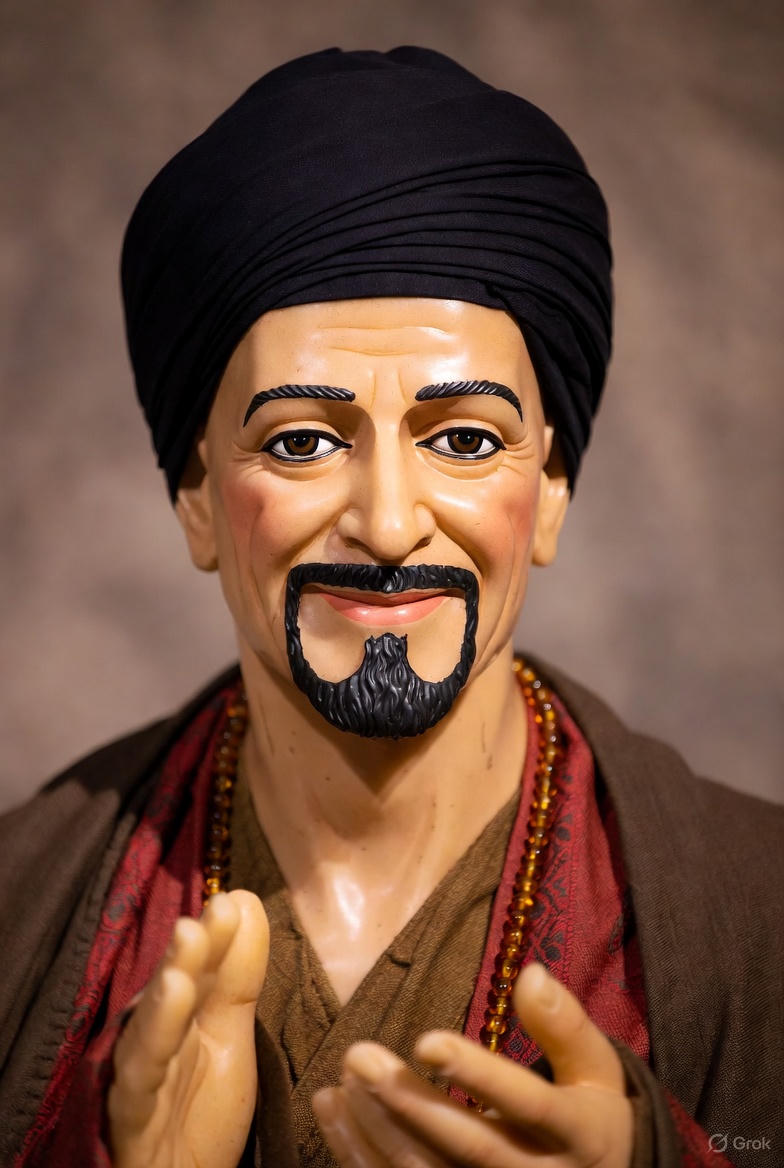
It was the figure in wax of a Mohammedan monk or
dervish, as an old servant often told me. The face had the
sweetest expression for me. It was completely wrinkle-free,
light brownish and with gentle features. Two beautiful dark
eyes shone under a jet-black turban, and around the softly
curved lips a small black beard could be seen. The body was in
a brown-red robe with long sleeves, and around the neck the
dervish wore a necklace of tiny amber beads. The two fine wax
hands were on arms hanging down with the palms turned
forward, equal-ready to receive and welcome anyone who
should approach. This immensely delicate and artistically
executed piece in wax and fabrics was highly valued in my
family, and for that reason alone, it had been placed under a
glass dome to protect it from dust and unskilled hands.
I often sat for hours in front of this expensive figurine for
unknown reasons, and more than once I had the feeling as if
the dark eyes were animated by being alone with me, as if there
was a faint trace of a gentle, kind smile around its lips.
That evening I could not fall asleep. From the fountain in
the courtyard came the sound of water splashing and the
laughter of the maids washing and splashing each other and
with similar shenanigans teasing each other. Also the cicadas
and crickets in the meadows surrounding the mansion were
making noise. Between all that sounded the muffled sounds of
a French horn, on which one of the forest boys was practicing a
call.
I climbed out of bed and walked around the room. But
then I began to be afraid of the moment when old Margaret
came into my room every night to put out the light in case I fell
asleep with it on, and I went back to my bed. Just as I was
about to climb over the edge of the bed shell with my bare legs,
it was as if a voice softly called my name. I looked around
frightened. My eyes fell on the man from the Orient. I saw very
clearly how he raised one arm under the glass bell and
beckoned to me.
I began to cry with fright, looking steadfastly at the little
figure.
Then I saw it very clearly for the second time: he waved
his hand at me very hastily and commandingly.
Trembling with fear, I obeyed; in the process tears
streamed unstoppably down my face.
I would have loved to scream out loud. But I didn’t dare,
for fear of frightening the little man, who was now very much
alive and waving more and more fiercely, in anger, such as my
father, whose short one-time wave was not only for me, but for
all the inhabitants of the house, an order that had to be obeyed.
So I went, crying silently, towards the cabinet on which
the waving dervish stood. I had almost reached him, despite my
anxious hesitant steps, when something terrible happened. With
a horrible roar and in a cloud of dust, debris and splinters, the
ceiling of the room collapsed over my shell bed.
I fell to the floor and screamed. Something flew whizzing
through the air and smashed the glass dome and the waving
man made of wax into a thousand shards and pieces. A brick
that had flown over me.
I screamed at the top of my lungs. But there was
screaming all over the house, outside at the well and
everywhere, and the dogs in the kennel howled.
Arms grabbed me, pulled me up from the earth. Blood
was running into my eyes, and I felt a cloth being pressed
against my forehead. I heard the scolding, agitated voice of my
father, the wailing of old Margaret and the moaning of a
servant. My father hit him with a with a stick and shouted:
“You donkey, why didn’t you report that there were
cracks in the ceiling? I’ll beat you crooked and lame…!”

Read Full Post »

Alraune by Hanns Heinz Ewers and translated by Joe E Bandel

Chapter Fifteen
Tells how Alraune lived in the park.

HE didn’t write his mother on that day, or the next, pushed it
off for another week and further–for months. He lived in
the large garden of the Brinkens, like he had done when he
was a boy, when he had spent his school vacations there.
They sat in the warm green houses or under the mighty cedars,
whose young sprouts had been brought from Lebanon by some pious
ancestor, or strolled under the Mulberry trees, past a small pool that
was deeply overshadowed by hanging willows.
The garden belonged to them that summer, to them alone,
Alraune and him. The Fräulein had given strict orders that none of the
servants were permitted to enter, not by day or by night. Not once
were the gardeners called for. They were sent away into the city,
charged with the maintenance of her gardens at her villas in Coblenz.
The renters were very happy and amazed at the Fräulein’s
attentiveness.
Only Frieda Gontram used the path. She never spoke a word
about what she suspected but didn’t know. But her pinched lips and
her evasive glance spoke loudly enough. She avoided meeting him on
the path and yet was always there as soon as he was together with
Alraune.
“What the blazes,” he grumbled. “I wish she was on top of
mount Blocksberg!”
“Is she bothering you?” asked Alraune.
“Doesn’t she bother you?” he retorted.
She replied, “I haven’t noticed. I scarcely pay any attention to
her.”
That evening he encountered Frieda Gontram by the blossoming
blackthorns. She stood up from her bench and turned to go. Her gaze
held a hot hatred.
He went up to her, “What is it Frieda?”
She said, “Nothing!–You can be satisfied now. You will soon be
free of me.”
“Why is that?” he asked.
Her voice trembled, “I must go–tomorrow! Alraune told me that
you didn’t want me here.”
An infinite misery spoke out of her glance.
“You wait here, Frieda. I will speak with her.”
He hurried into the house and came back after a short time.
“We have thought it over,” he began, “Alraune and I. It is not
necessary that you go away–forever. Frieda, it’s only that I make you
nervous with my presence–and you do the same for me, excuse me for
saying it. That’s why it would be better if you go on a journey–only
for awhile. Travel to Davos to visit your brother. Come back in two
months.”
She stood up, looked at him with questioning eyes that were still
full of fear.
“Is that the truth?” she whispered. “Only for two months?”
He answered, “Certainly it’s true. Why should I lie Frieda?”
She gripped his hand; a great joy made her face glow.
“I am very grateful to you!” she said. “Everything is alright
then–as long as I am permitted to come back!”
She said, “Goodbye,” and headed for the house, stopped
suddenly and came back to him.
“There is something else, Herr Doctor,” she said. “Alraune gave
me a check this morning but I tore it up, because–because–in short, I
tore it up. Now I will need some money. I don’t want to go to her–she
would ask–and I don’t want her to ask. For that reason–will you give
me the money?”
He nodded, “Naturally I will–Am I permitted to ask why you
tore the check up?”
She looked at him, shrugged her shoulders.
“I wouldn’t have needed the money any more if I had to leave
her forever–”
“Frieda,” he pressed, “where would you have gone?”
“Where?” A bitter laugh rang out from her thin lips. “Where?
The same place Olga went! Only, believe me, doctor. I would have
achieved my goal!”
She nodded lightly to him, walked away and disappeared
between the birch trees.
Early, when the young sun woke him, he came out of his room in
his kimono, went into the garden along the path that led past the trellis
and into the rose bed. He cut white Boule de Neige roses, Queen
Catharine roses, Victoria roses, Snow Queen roses and Merveille de
Lyon roses. Then he turned left where the larches and the silver fir
trees stood.
Alraune sat on the edge of the pool in a black silk robe, breaking
breadcrumbs, throwing them to the goldfish. When he came she
twined a wreath out of the pale roses, quickly and skillfully making a
crown for her hair.
She threw off her robe, sat in her lace negligee and splashed in
the cool water with her naked feet–She scarcely spoke, but she
trembled as his fingers lightly caressed her neck, when his soft breath
caressed her cheek. Slowly she took off the negligee and laid it on the
bronze mermaid beside her.
Six water nymphs sat around the marble edge of the pool pouring
water out of jugs and urns, spraying thin streams out of their breasts.
Various animals crept around them, giant lobsters, spiny lobsters,
turtles, fish, eels and other reptiles. In the middle of the pool Triton
blew his horn as chubby faced merfolk blew mighty streams of water
high into the air around him.
“Come, my friend,” she said.
Then they both climbed into the water. It was very cold and he
shivered, his lips became blue and goose bumps quickly appeared on
his arms. He had to swim vigorously, beat his arms and tread water to
warm his blood and get accustomed to the unusual temperature.
But she didn’t even notice, was in her element in an instant and
laughing at him. She swam around like a little frog.
“Turn the faucet on!” she cried.
He did it. There, near the pool’s edge, by the statue of Galatea,
light waves came from the water as well as three other places in the
pool. They boiled up a little, growing stronger and higher, climbing
higher and higher, until they became enormous sparkling cascades of
silvery rain, higher than the spouting streams of the mermen.
There she stood between all four, in the middle of a shimmering
rain, like a sweet boy, slender and delicate. His long glance kissed
her. There was no blemish in the symmetry of her limbs, not the
slightest defect in this sweet work of art. Her color was in proportion
as well, like white marble with a light breath of yellow. Only the
insides of her thighs showed two curious rose colored lines.
“That’s where Dr. Petersen perished,” he thought.
He bent down, kneeled and kissed the rosy places.
“What are you thinking about?” she asked.
He said, “ I’m thinking that you are the fairy Melusine!–See the
little mermaids around us–they have no legs, only long, scaly fish
tails. They have no souls, these nymphs, but it is said that sometimes
they love a human, some fisherman or wandering knight.
They love him so much that they come out of the water at high
tide, out onto the land. Then they go to an old witch or shaman–that
brews some nasty potion they have to drink. Then the shaman takes a
sharp knife and begins to cut into the fish tail. It is very painful–very
painful, but Melusine suppresses her pain. Her love is so great that
she doesn’t complain, doesn’t cry out, until the pain becomes so great
she loses consciousness. But when she awakes–her little tail is gone
and she goes about on two beautiful legs–like a human–only the scars
where the shaman cut are still visible.”
“But wasn’t she always still a nymph?” she asked. “Even with
human legs?–And the sorcerer could never create a soul for her.”
“No,” he said. “He couldn’t do that, but there is something else
they say of nymphs.”
“What do they say?” she asked.
He explained, “She only has her strange power as long as she is
untouched. When she drowns in the kisses of her lover, when she
looses her maidenhood in her knight’s embrace–then she looses her
magic as well. She can no longer bring river gold and treasures but
the black sorrow that followed her can no longer cross her threshold
either. From then on she is like any other child of man–”
“If it only was!” she whispered.
She tore the white crown from her head, swam over to the
mermen and Triton, to the water nymphs and threw the rose blossoms
into their laps–
“Take them, sisters–take them!” she laughed. “I am a child of
man–”
An enormous canopy bed stood in Alraune’s bedroom on low,
baroque columns. Two pillars grew out of the foot and bore shelves
that shown with golden flames. The engraved sides showed Omphale
with Hercules in a woman’s dress as he waited on her, Perseus kissing
Andromeda, Hephaestus catching Ares and Aphrodite in his net–
Many tendrils of vines wove themselves in between and doves played
in them–along with winged cherubs. The magnificent ancient bed,
heavily gilt with gold, had been brought out of Lyons by Fräulein
Hortense de Monthy when she became his great-grandfather’s wife.
He saw Alraune standing on a chair at the head of the bed, a
heavy pliers in her hand.
“What are you doing with that?” he asked.
She laughed, “Just wait. I will soon be finished.”
She pounded and tore, carefully enough, at the golden figurine of
Amor that hovered at the head of the bed with his bow and arrow. She
pulled one nail out, then another, seized the little god, twisted him this
way and that–until he came loose. She grabbed him, jumped down,
laid him on top of the wardrobe, took out the Alraune manikin,
clambered back up onto the chair again with it and fastened it to the
head of the bed with wire and twine. Then she came back down and
looked critically at her work.

Read Full Post »

Madame Bluebeard by Karl Hans Strobl and translated by Joe E Bandel

Taking leave of his mother the evening before
departure—he planned to stay at a hotel to avoid
disturbing her at night—she looked into his eyes.
“What’s wrong, Ernst?” she asked. “I think you’re
deeply in love…”
“Nonsense, Mother,” he replied.
She shook her head. “No, dear, you can’t deny
it… I see it. You’re changed. Why tell me nothing?”
Ernst Hugo felt it might’ve been better to confide
in her about his doom. But it was too late. He denied
it and tore himself away. On the journey, his unrest
grew worse. This passion had seized him like fate,
roaring through him, tearing him along, gnawing his
core with a vulture’s greedy beak. He yearned for
something good, wise, calm, but knew it was a land
he’d never reach. The train’s rattling rhythm fused
with him; he felt one with this raging beast, yet it
seemed they didn’t move, trapped in an endless
screw.
He traveled half the night.
Early morning brought him to Sankt Pölten. The
summer sun had risen, peering over the station’s
shoulder. Ernst Hugo paced, shivering. He glanced at
the officials’ apartment windows. A curtain stirred. A
hand with a watering can appeared, tending
flowerpots by an open window. He pictured a
bedroom filled with fresh night air, a bed of white
linen and lace, a blue silk coverlet. He clenched his
teeth, fists balled.
The express to Salzburg–Munich pulled in,
panting on the tracks. Doors clattered open and shut;
conductors scurried; sleepy waiters carried breakfast
coffee along the cars. Ernst Hugo ignored the bustle,
ensnared in his thoughts, wrestling them, unable to
break free. They attacked like wolves.
The station’s tumult ebbed. Conductors closed
doors, signaling each other… then three people burst
from the first-class waiting room, racing across the
tracks to the train. A broad-shouldered giant led,
carrying two bags, followed by a lady and a
gentleman… Ernst Hugo caught a fleeting glimpse.
An eternity later, a jolt: it was Helmina… Lorenz
ahead… and the man beside her, Fritz Gegely,
dressed as an Englishman in proper travel attire.
Later, studying psychology, Ernst Hugo saw this
moment as a case of delayed action between decision
and execution.
He lunged too late. A conductor had opened a
carriage door; the three boarded in frantic haste, and
the train began to move. It glided past Ernst Hugo, a
gray, blurring ribbon… a vast emptiness remained
where he stood. It heated from within, radiating
white-hot fury… seeping into him, swelling into
boundless rage.
So, Frau Helmina had run off with Herr Gegely,
poet of Marie Antoinette, the Heidelberg manuscript
thief. Splendid. What else could he think? They’d
boarded at the last moment to avoid interception.
Good that he’d seen them; he could at least tell
Ruprecht Helmina looked lively and eager. That was
all left for him to do.
Soon, his train departed. Ernst Hugo sat in his
corner, brimming with hate, fury, outrage, and
despair. Like a Leyden jar charged with electricity,
sparking at the slightest touch.
At Gars station, he asked two men who’d wired
for a carriage to let him ride to Vorderschluder. They
were taciturn, silently smoking, watching blue smoke
trails flutter into the kind summer morning. Ernst
Hugo squeezed into the opposite corner, hat over his
eyes, pretending to sleep.
At the Kamp bridge, he alighted, thanked them
hastily, and raced up the castle hill. He hurled his
question like a stone at the first person he met. Yes,
of course… the mistress had left… the Baron was in
the village. Ernst Hugo laughed scornfully and ran
back down. He kept seeing a bedroom filled with
fresh night air… Now he must find Frau Gegely,
fling his news in her face. Someone should writhe…
The Red Ox’s plump landlady filled the doorway
pleasantly. Nearby, three men conversed quietly.
Ernst Hugo recognized his carriage companions
and the Celt scholar he’d seen with Ruprecht. He
charged at the landlady.
“Is Frau Gegely upstairs?” he asked.
“Yes!” she replied, not budging from the door, as
if planted to guard.
“I must speak with her. I have to tell her
something.” He moved to rush past.
Schiereisen approached with a polite greeting. “I’d
ask you, Herr Secretary, not to go up now. The poor
woman…” That was the spark nearing the Leyden
jar. The discharge followed.
“I know… I know,” Hugo screamed, “but I must
tell you I saw them together. I saw them, understand?
It’ll please her when I tell them.”
Schiereisen gripped Hugo’s wrist firmly.
“Where?” he asked urgently.
“Where? Sankt Pölten… Salzburg express… and
so on… who knows… they’re off into the world.”
Ten clear chimes rang from the church tower.
Schiereisen released Hugo’s wrist and turned to his
companions. “Let’s go… to the telegraph office…”
His blue eyes gleamed like iron; his face, every
muscle, pulsed with resolve. “Now we’ll show what
we can do.”
As the three hurried off, Ernst Hugo collapsed,
shrinking… his fingers fumbled beside him; then he
turned, drifting slowly through a fog.
Ten days later, Schiereisen returned from his hunt
to Vorderschluder. His first stop was the castle. He
found Ruprecht with Hedwig in the garden. Her
wheelchair stood under a wild vine arbor.
Maurerwenzel slept in the arbor’s shade. Frau
Hedwig walked, leaning on Ruprecht’s arm and a
cane, slowly in bright sunlight. Two rose hedges
lined their path.
A miracle had occurred.
Schiereisen honored it by not mentioning it. He
doffed his hat, waiting until they turned and saw him.
Hedwig started… Schiereisen saw her grip
Ruprecht’s arm tighter.
“Herr Schiereisen is back,” Ruprecht murmured.
“Herr Schiereisen… will you hear him, Hedwig? …
It’s better…”
“No… no… I’ll hear him now. I must know.
Mustn’t I?” She put on a brave, resolute face.
“Well, then… if she wishes… You can speak,
Schiereisen. I’ve told her everything; she knows all.”
Schiereisen still held his hat. His broad skull
arched powerfully, eyes shadowed under strong
brows.
“Have you found a trace…?” Ruprecht asked, as
Schiereisen didn’t speak at once.
“They’re not yet caught, but they’re ours. They’re
still on the Atlantic.”
“And how did you…? Speak. See, we’re prepared
and can hear it all.”
“It wasn’t entirely easy… though they clearly
didn’t expect pursuit. They’d have been more
cautious otherwise. Why bore you with details? They
headed to Le Havre, after various zigzags that cost us
some effort.”
“And then they boarded a ship?”
“Yes… we arrived too late to stop them. But it’s
hard to hide today… wireless telegraphy, you know?
We sent a Marconi telegram at once, and they’ll
return on the next steamer.”
“Him too? Have you had him arrested as well?”
Schiereisen donned his Panama hat, his face now
shadowed. “No…” he said hesitantly, “not him…
why? We… please, stay calm, gracious lady. We
were too late… for your husband. It’s not our fault.”
“My God… what are you saying… he’s…”
“Yes… he met with misfortune, gracious lady. In
his hotel… they weren’t staying together, and
Helmina… likely to mislead any pursuers, if
followed… he took his own life in his room…
poisoned.”
Hedwig let out a soft cry and closed her eyes. So
this was the end.
“You don’t believe it, Schiereisen!” Ruprecht said
after a pause. He’d reflected, feeling unvarnished
truth would heal more than this notion, which he saw
spawning subtle torments of conscience for Hedwig.
“Tell us honestly what you think.”
“You’re right, Herr Baron! I don’t believe it. It
was all cleverly done. But Fritz Gegely had no reason
to kill himself. And… we know he withdrew nearly
his entire fortune from his Vienna bank. He carried it,
not wanting to transfer it to America and betray
himself. Well… all the money’s gone…”
Hedwig, shuddering with horror, threw herself
against Ruprecht’s chest. He stood still, his arms
gently, protectively around her neck. A freeing sob
rose from her depths, a releasing weep… her
trembling fingers calmed, nestling trustingly against
his shoulders. He looked straight ahead… gravely
into the future.
“Now we must face the trial…” he said softly,
“the trial and all that. We must…” He turned his gaze
to Schiereisen. “Tell Herr von Zaugg I’m ready to
vacate the castle anytime. Anytime! His claims are
sacred to me. I’ve always seen myself as a steward
here. I’ll stay as long as he wishes… to hand over the
estate in good order. Meanwhile, I’ll find something
in my homeland… ground that’s mine…” He bent to
Hedwig again.
She raised her head. Fear and horror lingered on
her pale face, but Schiereisen saw a timid tenderness
in Ruprecht’s gaze soften it all.
He turned and walked slowly from the castle
garden, past where Jana was found, through the gate
Helmina had fled. A certainty flowed in him like a
broad, calm river: these two were good and tightly
bound; no turmoil or pain, no upheaval ahead, could
shake their happiness, radiant with the future.
He paused on the bridge beside the stone John,
gazing into the water. And smiled…
One could forgo the bit of thanks perhaps earned.

Read Full Post »

Alraune by Hanns Heinz Ewers and translated by Joe E Bandel

He nodded, but she fell silent again.
“So,” he began, “did you read the leather bound volume?”
“Yes,” she said.
She took a deep breath, looked at him.
“So, am I only a joke that you once made, Frank Braun?”
“A joke?” he returned. “–An–idea, if you will–”
“And I suppose it was funny enough,” she laughed out loud. But
that’s not why I waited here for you. I want to know something
entirely different. Tell me. Do you believe it?”
“Do I believe what?” he answered. “If everything happened like
Uncle relates in the leather bound volume? Yes, I believe that.”
She shook her head impatiently. “No, that’s not what I mean.
Naturally that is true–why would he lie in his book?–I want to know
whether you also believe–like my–my–that is–your uncle did–That I
am a different type of creature, different from other people, that I–am
now, that I am, what my name implies?”
“How shall I reply to your question?” he said. “Ask any medical
doctor–he will certainly say that you are just as good a human being
as anyone else in the world, even if your first appearance was a little
unusual–He would add, that all the other details are pure coincidence
and unimportant, the–”
“That means nothing to me,” she interrupted.
“For your uncle these little details were most important.
Basically it doesn’t matter if they are or not. I want to know if you
share his opinion? Do you believe as well that I am a strange
creature?”
He remained silent, searched for a reply, didn’t know how he
should respond. He did believe it–and then again he didn’t–
“You see–” he began finally.
“Speak,” she urged. “Do you believe that I am your insolent
joke–that took form? Your idea, which the old Privy Councilor threw
into his crucible, which he cooked and distilled, until something came
out that now sits before you?”
This time he didn’t hesitate, “If you put it that way, yes, that’s
what I believe.”
She laughed softly, “I thought so–and that’s why I waited up for
you tonight, to cure you of this vanity as soon as possible. No, cousin,
you didn’t throw this idea into the world, not you–not any more than
the old Privy Councilor did.”
He didn’t understand her.
“Then who did?” he asked.
She reached under the pillow with her hand.
“This did!” she cried.
She lightly tossed the little alraune into the air and caught it
again, caressed it lovingly with nervous fingers.
“That there? Why that?” he asked.
She gave back, “Did you think about it earlier–before the day the
Legal Councilor celebrated the communion of the two children?”
“No,” he replied. “Certainly not.”
But then this thing fell down from the wall, that was when the
idea came to you! Isn’t that true?”
“Yes,” he confessed. “That is how it was.”
“Now then,” she continued, “so the idea came from outside
somewhere and entered into you. It was when Attorney Manasse gave
his lecture, when he recited like a school book and explained to all of
you what this little alraune was and what it meant–That’s when the
idea grew in your brain. It became so large and so strong that you
found the strength to suggest it to your uncle, to persuade him to carry
it out, to create me.
Then, if I am only an idea that came into the world and took on
human form, it is also true that you, Frank Braun, were only an agent,
an instrument–no more than the Privy Councilor or his assistant
doctor. No different than–”
She hesitated, fell silent, but only for a moment. Then she
continued–
“than the prostitute, Alma and the rapist-murderer whom you all
coupled–you and Death!”
She laid the little alraune on the silk cushions, looked at it with
an almost loving glance and said,” You are my father: You are my
mother. You are what created me.”
He looked at her.
“Perhaps it was so,” he thought.
Ideas whirl through the air, like the pollen from flowers and play
around before finally sinking into someone’s brain. Often they waste
away there, spoil and die–Only a few find good rich soil–
“Perhaps she is right,” he thought.
His brain had always been a fertile planting place for all kinds of
foolishness and abstruse fantasies. It seemed the same to him, whether
he was the one that once threw the seed of this idea into the world–or
whether he was the fertile earth that had received it.
But he remained silent, left her with her thought. He glanced
over at her, a child, playing with her doll. She slowly stood up, not
letting the little manikin out of her hands.
“There is something else I want to tell you,” she spoke softly.
“But first I want to thank you for it, for giving me the leather bound
volume and not burning it.”
“What is it?” he asked.
She interrupted herself.
“Should I kiss you?” she asked. “I could kiss–”
“Was that all you wanted to say, Alraune?” he said.
She replied, “No, not that!–I only thought I would like to kiss
you once. Just in case–But first I want to tell you this, why I waited.
Go away!”
He bit his lips, “Why?”
“Because–because it would be better,” she answered, “for you–
perhaps for me as well. But it doesn’t depend on that–I now know
how things are–am now enlightened, and I think that things will
continue to go as they have–only, I will not be running around blindly
anymore–Now I see everything. Soon–soon it will be your turn, and
that’s why it would be better if you left.”
“Are you so certain of this?” he asked.
“Don’t I need to be?”
He shrugged his shoulders, “Perhaps, I don’t know. But tell me,
why do you want to do this for me?”
“I like you,” she said quietly. “You have been good to me.”
He laughed, “Weren’t the others as well?”
“Yes,” she answered. “They all were. But I didn’t see it. And
they–all of them–they loved me–you don’t–not yet.”
She went to the writing desk, took a postcard and gave it to him.
“Here is a postcard from your mother. It came earlier this
evening; the servant brought it up with my mail by mistake. I read it.
Your mother is ill–She very much begs you to come back to her.”
He took the postcard, stared in front of him undecided. He knew
that they were right, both of them, could feel it, that it was foolishness
to remain here. Then a boyish defiance seized him that screamed out,
“No! No!”
“Will you go?” she asked.
He forced himself, spoke with a determined voice, “Yes,
cousin!”
He looked at her sharply, watched every line of her face
searching for some movement, a little tug at the corners of her mouth,
a little sigh would have been enough, some something that showed
him her regret. But she remained quiet and serious. No breath moved
on her inflexible mask.
That vexed him, wounded him, seemed like an affront and an
insult to him. He pressed his lips solidly together.
“Not like this,” he thought. “I won’t go like this.”
She came up to him, reached out her hand to him.
“Good,” she said. “Good–Now I will go. I can give you a
goodbye kiss if you want.”
A sudden fire flickered in his eyes at that.
Without even wanting to, he said, “Don’t do it Alraune. Don’t do
it!”
And his voice took on her own tone.
She raised her head and quickly asked, “Why not?”
Again he used her words, but she sensed that it was on purpose.
“I like you, Alraune,” he said. “You have been good to me
today–many red lips have kissed my mouth–and they became very
pale. Now–now, it would be your turn. That is why it would be better
if you didn’t kiss me!”
They stood facing each other; their eyes glowed hard as steel.
Unnoticed, a smile played on his lips. His weapon was bright and
sharp. Now she could choose. Her “No” would be his victory and her
defeat–then he could go with a light heart. But her “Yes” would mean
war and she felt it–the same way he did. It was like that very first
evening, exactly the same, only that time was the beginning and
opening round. There had still been hope for several other rounds in
the duel. But now–it was the end. He was the one that had thrown the
glove–
She took him up on it.
“I am not afraid,” she spoke.
He fell silent and the smile died on his lips–Now it was serious.
“I want to kiss you,” she repeated.
He said, “Be careful! I will kiss you back.”
She held his gaze–“Yes,” she said–Then she smiled.
“Sit down, you are a little too tall for me!”
“No,” he cried out loudly. “Not like that.”
He went to the wide divan, laid down on it, buried his head in the
cushions, stretched his arms out wide on both sides, closed his eyes.
“Now, come Alraune!” he cried.
She stepped closer, kneeled by his hips, hesitated, looked at him,
then suddenly threw herself down onto him, seized his head, pressed
her lips on his. He didn’t embrace her, didn’t move his arms. But his
fingers tightened into fists. He felt her tongue, the light bite of her
teeth.
“Kiss harder,” he whispered. “Kiss harder.”
Red fog lay before his eyes. He heard the Privy Councilor’s
repulsive laugh, saw the large piercing eyes of Frau Gontram, how
she begged little Manasse to explain the little alraune to her. He heard
the giggling of the two celebrants, Olga and Frieda, and the broken,
yet still beautiful voice of Madame de Vére singing “Les Papillons”,
saw the small Hussar Lieutenant listening eagerly to the attorney, saw
Karl Mohnen, as he wiped the little alraune with the large napkin–
“Kiss harder!” he murmured.
And Alma–her mother, red like a burning torch, snow-white
breasts with tiny blue veins, and the execution of her father–as Uncle
Jakob had described it in his leather bound volume–Out of the mouth
of the princess–And the hour, in which the old man created her–and
the other, in which his doctor brought her into this world–
“Kiss me,” he moaned, “Kiss me.”
He drank her kisses, sucked the hot blood from his lips, which
her teeth had torn, and he became intoxicated, knowingly and
intentionally, as if from champagne or his oriental narcotics–
“Enough,” he said suddenly, “enough, you don’t know what you
are doing.”
At that she pressed her curls more tightly against his forehead,
her kisses became hotter and more wild. Now the clear thoughts of
day lay shattered, now came the dreams, swelling on a blood red
ocean, now the Maenad swung her thyrsos and he frothed in the holy
frenzy of Dionysus.
“Kiss me,” he screamed.
But she released him, let her arms sink. He opened his eyes,
looked at her.
“Kiss me!” he repeated softly.
Her eyes glazed over, her breath came in short pants. Slowly she
shook her head. At that he sprang up.
“Then I will kiss you,” he cried.
He lifted her up in his arms, threw her down struggling onto the
divan, knelt down–there, right where she had knelt.
“Close your eyes,” he whispered and he bent down–
Good, his kisses were good–caressing and soft, like a harp
played on a summer night, wild too, yes, and raw, like a storm wind
blowing over the North sea. They burned red-hot like the fiery breath
out of mount Aetna, ravishing and consuming like the vortex of a
maelstrom–
“It’s pulling me under,” she felt, “pulling me into it.”
But then the spark struck and burning flames shot high into the
heavens, the burning torch flew, ignited the altar, and with bloody
jowls the wolf sprang into the sanctuary.
She embraced him, pressed herself tightly to his breast–I’m
burning–she exalted–I’m burning–at that, he tore the clothes from her
body.
The sun that woke her was high in the sky. She saw that she was
lying there completely naked, but didn’t cover herself. She turned her
head, saw him sitting up right next to her–naked like she was.
She asked, “Will you be leaving today?”
“Is that what you want, that I should leave?” he gave back.
“Stay,” she whispered. “Stay!”

Read Full Post »

Madame Bluebeard by Karl Hans Strobl and translated by Joe E Bandel

Eighteenth Chapter
Ruprecht woke with uneasy feelings. The joyful
uplift of yesterday’s afternoon and evening had given
way to deep despondency. A heavy weight pressed
on him again. His talk with Schiereisen had rolled
boulders over his soul, blocking light and air. He saw
it was impossible to live alongside Helmina any
longer. Something must be done… but the worst was
not knowing what. Should he warn Helmina about
Schiereisen? That would make him complicit in her
crimes. Could he let Schiereisen continue his probe
and catch her unawares…? Should he let events
unfold, taking their outcome as divine judgment?
Tormented and drained, he went to breakfast.
Only the children and Miss Nelson were there. Sitting
across from the Englishwoman, he had a strange
sensation. As she sat—black, slender, composed,
ever equable—she seemed the axis of all events in
the castle. A link between poles, unmoving yet the
spine of all motion around her. With a surge, he
resolved to regain his composure.
He pushed back his chair and left to speak with
Helmina. The chambermaid said the mistress hadn’t
called for her. It was nearly eight; she should be up.
His knocks went unanswered. The door was locked.
Suddenly, as he stood with his ear to the wood, a
wedge drove into his mind. Ah… she played me, saw
through Schiereisen, knew of my talk with the
detective yesterday—she’s fled! He stood motionless
a moment, then called old Johann, ordering a
crowbar, pickaxe, or similar tool.
Until the servant returned, Ruprecht stood like a
sentinel before the door. His composure returned; his
nerves relayed clear sensations, his thoughts focused
on the immediate.
Johann brought a pickaxe. Ruprecht wedged its
blade into the door’s lower gap, pressed it firm, and
with one heave, tore the door from its hinges,
crashing it into the room. Johann followed, horrified.
Helmina was gone. Her bed untouched. The
window open, morning sunlight on white pillows and
blue silk coverlet. Ruprecht searched the room… no
letter, no explanation.
Behind him stood an old man, broken, swaying,
crushed by a temple’s sudden collapse.
Schiereisen entered. Ruprecht turned, and one
glance at the detective’s face grasped the event’s
meaning. “You can go, Johann,” he said. “Tell the
staff the mistress has left.”
When Johann was gone, Ruprecht approached
Schiereisen. “You already know what’s happened?”
The detective nodded. “Yes… I know. I was
present at your wife’s departure. Uninvited, of
course.”
“You saw Helmina? You were there? I don’t
understand… and you didn’t arrest her? Why didn’t
you stop her? You suspect her gravely…”
“Yes… you see, Herr Baron, I could’ve detained
her. Perhaps! Certainly! I was about to… but I didn’t.
Why? I’m proud to be your friend, Herr Baron.”
“For my sake?”
“Yes… it wasn’t entirely dutiful… but perhaps
aligns with my duty. I’m here on behalf of Herr Peter
Franz von Zaugg, the late Herr Dankwardt’s brother-
in-law. His main concern is proving Frau Helmina
seized the deceased’s assets through a crime, to
renew certain inheritance claims. I’ve fulfilled that
commission as far as possible. But I also have a duty
to the public—to neutralize dangerous criminals like
your wife and Lorenz. I’ll fulfill that too. But for you,
I delayed it.”
“Delayed? You’ll still pursue Helmina?”
“Yes. I’ve given her a head start. By ten, two of
my agency’s men arrive. At ten, I’ll take up Frau
Helmina’s trail. Chance, luck, or my skill will decide.
I’ll do everything to apprehend her then.
Relentlessly! But I had to give her that head start… I
owed it to our friendship… I know you love this
woman.”
“You’re mistaken,” Ruprecht said calmly. “I no
longer love her. But I couldn’t betray her. You’ll
agree…”
Schiereisen studied Ruprecht’s face. “So,” he said
slowly, “you don’t love Helmina anymore… well,
then…”
“Did you know of her escape plan?”
“No… it was an intuition. I hear a noise in the
night, like someone rattling a door. My senses are
sharp in such hours. I hear it, leap to the garden
door… I see someone tampering with the small tower
gate… my instinct was to seize them. I creep along
the walls, but before I reach it, the door opens…
someone slips out. I rush forward… it’s Helmina.”
“You were in the castle last night?”
“Yes… I was in the castle.”
Before Ruprecht’s eyes flickered a
cinematograph’s chase again. He steadied himself,
adjusted a lever, and focused. “You searched?”
“And found,” Schiereisen replied calmly.
Ruprecht flinched.
“Yes… I got to the secret’s core,” Schiereisen
continued. “I finally did the obvious, what I
should’ve done long ago. The simplest, most
necessary things come last. Last night, I entered the
old tower, where all events pointed.”
Ruprecht gripped the bedpost’s knob with an iron
fist, silent.
“I see you know what I found,” Schiereisen said.
“It wasn’t easy. Jérome Rotrehl helped mightily. You
may know there’s an opening high in the tower. We
climbed in. It was fascinating. The tower’s filled with
rubble, always risking being crushed. Recently, many
obstacles were added. We crawled under a stone slab
balanced on its edge. A fingertip’s touch, and it falls.
A perfect mousetrap. But we pressed deeper. Finally,
we reached a vault far below. Nothing there. I wasn’t
fooled. We searched on, finding the hiding place—
carefully crafted, like Egyptian kings’ tomb
chambers… Yes, there were bodies to hide. Three.
You understand. Caustic lime was used, recently…
well, let’s leave it. We know why Jana ‘met with
misfortune,’ don’t we? I’d reached my goal. Then…
discovering Helmina’s flight… was a bonus.”
“And you let her escape… what can I say…” The
bedpost creaked in Ruprecht’s grip.
Schiereisen placed a hand on his shoulder, his
gaze kind and concerned. “You know,” he said with a
half-smile, “at first I thought… well, I wouldn’t have
been surprised if you’d warned Helmina.”
“I said nothing of our talk.”
Schiereisen nodded. “I know. It was clear the
moment I reached the gate. You told her nothing! Her
flight was long planned. A stranger waited for her
outside.”
“Lorenz!”
“No! Lorenz was below, with a car. It was
another.”
Ruprecht stood firm, his gaze steady. He asked
sharply, demandingly.
“I hope you’re not mistaken, that you no longer
love Helmina,” Schiereisen said. “If that’s true, it’s
good for you. The man who waited was Fritz Gegely.
He fled with her—”
“Fritz Gegely!” Ruprecht said. The connection
eluded him at first, then one thought pushed through
the chaos… “I must go to her… he’s gone… I must
go to her…” He ran off, grabbed his hat, and raced
down the stairs.
Schiereisen kept pace. Ruprecht’s sudden
unraveling, his composure shattered, made the
detective feel he couldn’t leave him alone. He had no
explanation.
Halfway, on the bridge, a messenger met
Ruprecht, summoning him to Hedwig. The Red Ox
chambermaid was distraught, stammering her
message. Her outrage matched her pity for the
abandoned woman, knotting within her. Men were
such vile scum, and Schorsch would hear it today.
Hedwig lay pale in her wheelchair by the open
window, bathed in morning sunlight, her hands
covering a paper. She turned toward the door, a halo
around her light hair.
Ruprecht seized her hand. “Hedwig!” he said,
voice trembling from deep within.
“Yes!” she replied, no further words needed
between them. She handed him the letter Fritz Gegely
had left.
Ruprecht read: “I may bring grief and pain upon
you, my Hedwig, yes, I know, but I cannot do
otherwise. Don’t judge me; try to understand. A new
love has entered my life, a new sun has risen, I must
chart a new course. I must… it’s more compelling
than death. I find it unworthy of an honest man to
hide what the brutality of events makes all too clear: I
could no longer bear life with you. I loved you, you
know that. But now life tears me from you. Life and
my great duty to myself. I am an upright man, great
strength is in me, but by your side, I couldn’t stay
upright, my flight couldn’t soar. I feel my creative
force fading. My Marie Antoinette would’ve been my
only work. I can’t endure that. Your presence is a
constant reminder of humiliation. I must find another
world, free of these reminders. I must fly again. I’ve
been told you’ve rekindled an old friendship. That
eases my parting. I know you have solace. Farewell.”
Ruprecht placed the letter back on the blanket over
Hedwig’s knees. She looked up at him, resigned to
her fate, more bewildered than outraged or sad.
Schiereisen quietly left the room. He knew enough
now; a great relief washed over him. The plump
landlady stopped him outside with indignant
questions and exclamations. Word had spread that
Helmina had vanished, and wild speculations raced.
A carriage rolled down the village street, stopping at
the Red Ox. Two strangers alighted and greeted
Schiereisen. “You’re punctual, thank you,” the
detective said. “We’ll begin at once.”
Ernst Hugo had rushed through his visit to his
elderly mother in Linz. She found little joy in her son
this time. He was restless, irritable, his thoughts
elsewhere.
Her small concerns—Linzer
acquaintances, relatives—were mere annoyances, and
he struggled to feign interest in her tales of
engagements, financial losses, and wayward sons.
What was happening in Vorderschluder? He’d left
the field to another for forty-eight hours. A few
vacation days remained, then duty’s jaws would
swallow him. He couldn’t imagine how he’d cope,
already losing his mind after two days away. He and
Helmina must reach a decision before he returned to
Vienna. Fritz Gegely was an intruder on prior claims,
shifting love’s boundaries. He had to be neutralized.
Ernst Hugo resolved to cast aside decorum and
expose the Heidelberg theft.

Read Full Post »

Alraune by Hanns Heinz Ewers and translated by Joe E Bandel

Chapter Fourteen
Describes how Frank Braun played with fire and how Alraune
awoke.

THAT evening the Fräulein didn’t come to dinner, only
allowed Frieda Gontram to bring in a little tea and a few
cakes. Frank Braun waited awhile for her, hoping that
perhaps later she would come down. Then he went to the
library and reluctantly took up the documents from the writing desk.
But he couldn’t bring himself to read them, put them down again and
decided to drive into the city.
Before he left he took the last little mementos from out of the
desk drawer, the piece of silk curtain cord, the card and four-leaf
clover with the bullet holes through them and finally the alraune
manikin. He packed everything together, sealed the brown paper
package and had it sent up to the Fräulein. He attached no written
explanation to it–
Everything would be explained to her inside the leather bound
volume that bore her initials.
Then he rang for the chauffeur and drove into the city. As he
expected, he met Herr Manasse in the little wine pub on Cathedral
Square. Stanislaus Schacht was with him. He sat down with them and
began to chat.
He got into a deep discussion with the attorney about legal
questions, debating the pros and cons of this and that lawsuit. They
decided to turn a few of the doubtful cases over to the Legal
Councilor for him alone. He would bring them to some acceptable
compromise. Manasse believed that a victorious settlement could be
reached with the others.
In some of the cases Frank Braun calmly suggested they simply
acknowledge the claim, but Manasse refused.
“Never acknowledge–even if the opponent’s demands are as
clear as day and justified a hundred-fold!”
He was the straightest and most honest attorney in the county
courthouse, one that always told his clients the truth, right to their
face. In front of the bar he might remain completely quiet but he
would never lie–and yet he was way too much a lawyer not to have an
innate hatred of recognizing an opponent’s claim.
“It only costs us more,” Frank Braun objected.
“So what!” barked the attorney. “What does that have to do with
it?–I tell you, one never knows–there is always a chance…”
“A legal one–perhaps–” answered Frank Braun. “–but–”
He fell silent. There was no other way for the attorney. The
Court determined justice–what ever it said was just, even how it
decided. Today it would be just–and totally different after a couple of
months in the higher courts. Nevertheless, the Court gave the final
decision and it was sacred–not the parties involved.
To recognize a claim yourself, without such a decision, was
usurping the right of the Court. As an attorney Manasse was partial to
his own clients. He desired the judge to be impartial, so it was an
abomination to him to make such a decision for his own party.
Frank Braun smiled.
“As you wish,” he said.
He spoke with Stanislaus Schacht, listened as this friend of Dr.
Mohnen talked of all the others that had been there as students with
him.
“Yes, Joseph Theyssen has been a Government Advisor for some
time now and Klingel Hőffer is a professor at Halle–he will be the
new chair for Anatomy, and Fritz langen–and Bastian–and–”
Frank Braun listened, turned the pages of this living directory of
German nobility that knew everyone.
“Are you still enrolled?” he asked.
Stanislaus fell silent, a little offended.
But the attorney barked, “What! Didn’t you know? He passed his
doctoral exam–five years ago.”
“Really–five years ago!”
Frank Braun calculated backward, that must have been in his
forty-fifth, no, forty-sixth semester.
“Well,” he said.
He stood up and reached out his hand, which the other heartily
shook.
“Allow me to congratulate you, Herr Doctor!” he continued.
“But–tell me–what are you doing now?”
“Yes, if he only knew!” cried the attorney.
Then chaplain Schrőder came. Frank Braun stood up to greet
him–
“Back in the country again?” cried the black suited priest. “We
must celebrate!”
“I am the host,” declared Stanislaus Schacht. “He must drink to
my doctor’s degree.”
“And with me to my newly becoming a vicar,” laughed the
priest. “Let’s share the honor then, if it’s alright with you, Dr.
Schacht.”
They agreed and the white haired vicar ordered a 93
Scharzhofberger, which the wine pub had placed in stock on his
recommendation. He tested the wine, nodded with satisfaction and
toasted with Frank Braun.
“You have it good,” he said, “sticking your nose into every
unknown place on land and sea. Yes, we can read about them in the
newspapers–but we must sit at home and console ourselves with the
fact that the Mosel still always produces a good wine–You certainly
can’t get this label out there!”
“We can get the label,” he said, “but not the wine– Now Herr
Reverend, what have you been up to?”
“What should I be up to?” replied the priest. “One just gets
themselves angry. Our old Rhine is always becoming more Prussian.
But for relaxation one can write rotten pieces for the Tűnnes,
Bestavader, Schâl, Speumanes and the Marizzebill. I have already
plundered Plautus and Terence in their entirety for Peter
Millowwitsch’s puppet theater in Cologne–Now I’m doing it to
Holberg. And just think, that fellow–Herr Director, he calls himself
today–now pays me royalties–Another one of those Prussian
inventions.”
“Be happy about it!” growled Attorney Manasse. “By the way,
he’s also published on Iamblicos.”
He turned to Frank Braun, “And I tell you, it is a very
exceptional book.”
“Not worth talking about,” cried the old vicar.
“Only a little attempt–”
Stanislaus Schacht interrupted him.
“Go on!” he said. “Your work lays out the foundation of the very
essence of the Alexandrian school. Your hypothesis about the
Emanation Doctrine of the Neo-Platonists–”
He went on, lecturing like an argumentative Bishop at the high
council. Here and there he made of few considerations, gave his
opinion, that it wasn’t right the author based his entire work on the
three cosmic principles that had been previously established. Couldn’t
he have just as well successfully included the ‘Spirit’ of Pophyrs?”
Manasse joined in and finally the vicar as well. They argued as if
there was nothing more important in the entire world than this strange
monism of Alexander, which was based on nothing other than a
mystical annihilation of self, of the “I”, through ecstasy, asceticism
and theurgy.
Frank Braun listened silently.
“This is Germany,” he thought. “This is my country–”
It occurred to him that a year ago he had been sitting in a bar
somewhere in Melbourne or Sidney–with him had been a Justice of
the Supreme Court, a Bishop of the High Church and a famous doctor.
They had disputed and argued no less ardently than these three that
were now sitting with him–But it had been about whom was the better
boxer, Jimmy Walsh of Tasmania or slender Fred Costa, the
champion of New-South Wales.
But here sat a little attorney, who was still being passed over for
promotion to Legal Councilor, a priest that wrote foolish pieces for a
puppet theater, that had a few titles of his own, but never a parish, and
finally the eternal student Stanislaus Schacht, who after some fourteen
years was happy to have his doctor’s degree and now didn’t know
what to do with himself.
And these three little poor wretches spoke about the most
abstract, far-fetched things that had nothing at all to do with their
occupations. And they spoke so easily, with the same familiarity as
the gentlemen in Melbourne had conversed about a boxing match. Oh,
you could sift through all of America and Australia, even nine-tenths
of Europe–and you would not find such an abundance of knowledge–
only–it was dead.
He sighed, it was long dead and reeked of decay–really, the
gentlemen didn’t even notice!
He asked the vicar how it was going with his foster son, young
Gontram. Immediately Attorney Manasse interrupted himself.
“Yes, tell us Herr Reverend–that’s why I came here. What does
he write?”
Vicar Schröder unbuttoned his jacket, pulled out his wallet and
took a letter out of it.
“Here, read for yourself,” he said. “It doesn’t sound very
encouraging!”
He handed the envelope to the attorney. Frank Braun threw a
quick glance at the postmark.
“From Davos?” he asked. “Did he inherit his mother’s fate as
well?”
“Unfortunately,” sighed the old priest. “And he was such a fresh,
good boy, that Josef, absolutely not meant for the priesthood though.
God only knows what he would have studied, or I would have
allowed him to study if I didn’t wear the black robe. But I promised
his mother on her deathbed. By the way, he has already gone as far in
his studies as I have–I tell you–he passed his doctoral exam–summa
cum laude! I obtained a special dispensation for him through the
ArchBishop, who has always been very benevolent towards me
personally.
He helped me a lot with the work about Iamblichos–yes, he
could really become something! Only–unfortunately–”
He hesitated and slowly emptied his glass.
“Did it come so suddenly, Herr Reverend?” asked Frank Braun.
“You could say that,” answered the priest. “It first started with
the psychological shock of the sudden death of his brother, Wolf. You
should have seen him outside, at the cemetery. He never moved from
my side while I gave my sermon, stared at the enormous garland of
blood red roses that lay on the coffin. He held himself upright until
the ceremony was ended, but then he felt so weak that Schacht and I
had to downright carry him.
In the carriage he seemed better, but at home with me he once
more became entirely apathetic–The only thing I could get out of him
at all that entire evening was that now he was the last of the Gontram
boys and it was his turn next. This apathy would not yield and from
that hour he remained convinced that his days were numbered, even
though a very thorough medical examination gave me a lot of hope in
the beginning. But then it went rapidly. From day to day you could
see his decline–now we have sent him to Davos–but it appears that his
song will soon be over.”
He fell silent, fat tears stood in his eyes–
“His mother was tougher,” growled the attorney. “She laughed in
the Reaper’s face for six long years.”
“God grant her soul eternal peace,” said the vicar and he filled
the glasses. “We will drink a silent toast to her–in her memory.”
They raised the glasses and emptied them.
“The old Legal Councilor will soon be entirely alone,” observed
Dr. Schacht. “Only his daughter appears to be completely healthy–
She is the only one that will survive him.”
“The attorney grumbled, “Frieda?–No, I don’t believe it.”
“And why not?” asked Frank Braun.
“Because–because–” he began, “–well, why shouldn’t I say it?”
He looked straight at Frank Braun, cutting, enraged, as if he
wanted to take him by the throat.
“You want to know why Frieda Gontram will never grow old?–I
will tell you. Because she is now completely caught in the claws–of
that damned witch out there!–That’s why–Now you know!”
“Witch,” thought Frank Braun. “He calls her a witch, just like
Uncle Jakob did in his leather bound volume.”
“What do you mean by that, Herr Attorney?” he asked.
Manasse barked, “Exactly what I said. “Whoever gets to close to
the Fräulein ten Brinken–gets stuck, like a fly in syrup. And whoever
is once caught by her–stays there and no amount of struggling will do
any good!
Be careful, Herr Doctor, I’m warning you! It is thankless
enough–to give warnings like this. I have already done it once–
without any success–with Wölfchen–now it is you–flee while there is
still time. What do you still want here?–It seems to me exactly as if
you are already licking at the honey!”
Frank Braun laughed–but it sounded a little forced.
“Have no fear on my account, Herr Attorney,” he cried–But he
didn’t convince the other–and even less, himself.
They sat and drank, drank to Schacht’s doctoral degree and to the
Priest’s becoming a vicar. They drank as well to the health of Karl
Mohnen, of whom no one had heard since he had left the city.
“He is lost,” said Stanislaus Schacht.
Then he became sentimental and sang melancholy songs. Frank
Braun took his leave, went out on foot back to Lendenich–through the
fragrant trees of spring – like in the old times.
He came across the courtyard, then saw a light in the library. He
went in–Alraune sat on the divan.
“You here, little cousin?” he greeted.
She didn’t answer, waved to him to take a place. He sat across
from her, waiting. But she remained silent and he didn’t press her.
Finally she said, “I wanted to speak with you.”

Read Full Post »

« Newer Posts - Older Posts »