Chapter 101: Assertiveness Training – Projecting Your Image and Mastering Body Language for Confident Presence
Have you ever walked into a room feeling like an outsider, your body tense and your words stumbling, only to notice how others seem to command respect effortlessly through subtle cues—the way they stand tall, make steady eye contact, or project an aura that invites positive stereotypes—leaving you wondering if you could harness similar non-verbal power to shape how people perceive and treat you? What if “miracles” of social empowerment and self-assurance arose from deliberately crafting your projected image to align with your goals, while decoding body language to read and influence interactions, turning vulnerable moments of misjudgment into assertive mastery where you control the narrative of how others see you? In this advanced segment of assertiveness training, we challenge the assumptions we make about people based on limited glimpses—do we know how a colleague acts at home or a child behaves away from us?—revealing how stereotypes form from partial knowledge, often surprising us when reality diverges. To counter this, we learn to project a recognizable general image (e.g., professional, approachable) that draws desired treatment, then layer in unique sub-categories to reveal your true self, all while being authentic to avoid self-fulfilling pitfalls. Central to this is body language, estimated at 90% of communication, with practical cues like crossed legs (tension) or preening (nervousness), and partner exercises for eye contact, handshakes, postures, proximity, and more to build awareness and control. This isn’t superficial posturing; it’s empowered presence, where understanding and shaping non-verbals complements verbal assertiveness, fostering deeper connections and goal-aligned perceptions.
This image and language mastery subtly reflects a balanced dynamic: The expansive projection of self-image (outward, generative influence like branches displaying leaves to attract pollinators) aligns seamlessly with the grounding awareness of body cues (inward, stabilizing signals like roots sensing environmental vibrations for stability), creating harmony without facade. Like an oak tree, whose “image” (majestic canopy) draws admiration while its “language” (subtle sways and creaks) communicates strength and adaptability, miracles of confidence emerge from aligned presentation. In this chapter, we’ll embody these techniques into assertive wisdom, covering assumptions’ pitfalls, stereotype formation and surprises, projecting general/unique images, authenticity in self-fulfillment, body language’s dominance, observational cues, and partner exercises for eye contact, handshakes, postures, proximity, standing/sitting dynamics, and turned-away positions, all linked to your OAK Matrix as throat-level expression (projected image) resonating with root physicality (body language). By the end, you’ll have tools to craft your image, read cues, and turn non-verbal awareness into “superhuman” assertiveness, transforming misperceived interactions into purposeful influence. Let’s project your presence and uncover how mastery unlocks miracle-level empowerment.
Assumptions’ Pitfalls: Limited Knowledge Leading to Surprises
We often judge people on fragments—your text questions if we know a person’s home behavior from work demeanor, or a child’s actions away from us, highlighting how partial views create surprises when complexities emerge.
Why miraculous to question? It prevents misjudgments, fostering empathy and adaptability. Common trait: Fragmented; non-complete.
Dynamic balance: Assumptions’ inward limit (stabilizing partial) aligns with surprises’ outward reveal (generative full), blending assume with adapt.
In OAK: This third-eye assumption integrates with heart empathy for open perceptions.
Empowerment: Observe someone in one context—imagine alternate behaviors to challenge assumptions.
Stereotype Formation: Images from Partial Data and Their Impacts
Limited info breeds stereotypes—your text explains we form mental shortcuts based on glimpses, which surprise when contradicted, necessitating re-evaluation and adjusted treatment.
Why superhuman? It allows intentional reshaping of how others see us. Common: Snap-formed; non-accurate.
Dynamic: Formation’s inward shortcut (stabilizing image) aligns with impact’s outward adjust (generative re-eval), blending fix with flex.
In OAK: Mental stereotype resonates with throat projection for influential images.
Practical: Note a stereotype you hold—seek new info to refine it, note shifted interactions.
Projecting General Images: Creating Recognizable Stereotypes for Desired Treatment
Shape how others perceive you—your text advises projecting a general, recognizable image (e.g., confident professional) to elicit treatment aligning with goals, as unrecognized images lead to unwanted labels like “loser” or “freak.”
Why miraculous? It influences responses, turning projections into self-fulfilling positives. Common: Clued; non-random.
Dynamic: Projecting’s outward create (generative elicit) aligns with treatment’s inward desire (stabilizing align), blending shape with seek.
In OAK: Throat image integrates with heart desire for goal-tuned perceptions.
Empowerment: Define a goal-image (e.g., “leader”)—dress/act accordingly, observe shifted treatment.
Unique Sub-Categories: Layering Personal Truth into General Images
Build on general with unique layers—your text urges creating sub-categories revealing inner self, ensuring authenticity to avoid negative self-fulfillment.
Why superhuman? It balances conformity with individuality, fostering genuine respect. Common: Layered; non-generic.
Dynamic: Sub’s inward unique (stabilizing true) aligns with general’s outward recognize (generative broad), blending self with social.
In OAK: Third-eye unique integrates with root authentic for balanced presence.
Practical: Add a “unique” to your image (e.g., “creative leader”)—express it, note enriched connections.
Authenticity in Self-Fulfillment: Being True to Projected and Inner Selves
Projections must match core—your text warns mismatched images self-fulfill negatively, emphasizing truth to self and stereotype for positive reinforcement.
Why miraculous? It harnesses collective expectations for empowerment. Common: Aligned; non-false.
Dynamic: Authenticity’s inward true (stabilizing core) aligns with fulfillment’s outward project (generative reinforce), blending inner with image.
In OAK: Heart true integrates with throat project for fulfilling presence.
Empowerment: Audit image-self match—if off, tweak for authentic alignment.
Body Language’s Dominance: Non-Verbal Cues Communicating 90%
Body language conveys most messages—your text estimates 90% non-verbal, urging awareness of signals like crossed legs (tension) or preening (nervousness).
Dynamic: Language’s outward cue (generative signal) aligns with dominance’s inward read (stabilizing interpret), blending send with sense.
In OAK: Root body integrates with throat communicate for non-verbal mastery.
Practical: Observe someone’s cues (e.g., fidgeting)—mirror/adjust for rapport test.
Observational Cues: Reading Tension, Movement, and Posture
Key signals include: crossed legs/ankles (tension), preening/straightening (self-conscious), constant movement (ill-at-ease), hand gestures (clenched/open/hidden), nervous tics (tapping), toward/away leans, crossed arms (defensive), relaxed/tense stance—your text lists these for insight into others’ states.
Dynamic: Cues’ inward state (stabilizing feel) aligns with observation’s outward read (generative respond), blending detect with direct.
In OAK: Third-eye observe integrates with emotional read for intuitive understanding.
Empowerment: In interaction, note 2-3 cues—adjust approach (e.g., relax if tense detected).
Partner Exercises: Practicing for Awareness and Control
Train with a partner—your text provides role-plays: eye contact/avoid, firm/finger/two-handed/limp handshakes, slumped/erect postures, too close/far proximity, standing/sitting at desk/chair, turned away—exploring feelings and effects.
Why superhuman? It builds self-discovery, turning unconscious signals into deliberate tools. Common: Played; non-solo.
Dynamic: Exercises’ stabilizing feel (grounding in body) aligns with control’s outward aware (generative use), blending explore with empower.
In OAK: Root posture integrates with heart partner for embodied assertiveness.
Empowerment: Partner-practice one exercise—discuss feelings, refine for confident use.
Shared Traits: Image Projections, Body Signals, and Assertive Mastery
These elements unite: Assumption pitfalls, stereotype formation, image projection, unique layers, authenticity fulfillment, body dominance, observational cues, partner exercises—your text ties them to assertiveness’s non-verbal core, where projecting aligns with reading for full presence.
Why? Misperception hinders; mastery empowers. Dynamic: Images’ inward true (grounding in self) aligns with language’s outward cue (generative read), merging project with perceive.
In OAK: Throat (image) resonates with root (body) for miracle presence.
Empowerment: Spot mismatched image/cue—realign with traits for holistic assertiveness.
Cultivating Presence: Training for Image-Body Harmony
Presence is trainable: Project images, read cues, practice exercises—your text implies awareness of vulnerability in practice eases it, building to competent fun.
Why? Facade weakens; harmony empowers. Dynamic: Cultivation’s stabilizing project (grounding in image) aligns with presence’s outward read (generative cue), fusing craft with control.
In OAK: Throat (project) integrates with root (body).
Practical: Weekly partner session—combine image with cue practice for habitual harmony.
Practical Applications: Projecting and Reading Daily
Make presence miracles confident:
Cue Journal: Note a body signal (male path: generative project; female path: stabilizing read). Reflect dynamic: Grounding image + outward cue.
Partner Presence Share: Discuss a “cue surprise” with someone (men: outward adjust; women: grounding authentic). Explore seamless integration. Alone? Affirm, “Image and cue align in me.”
Cue Exercise: Weekly, practice handshake/posture—observe influence on perceptions.
These awaken power, emphasizing seamless dynamic over misperception.
Conclusion: Unlock Miracles Through Projected Presence
Assertiveness training—assumption surprises, stereotype impacts, image projection, unique authenticity, body dominance, cue observations, partner exercises—masters non-verbal for empowered presence and connections. A balanced dynamic unites grounding with expansion, turning fragments into superhuman wholeness. Like an oak’s canopy projecting majesty while roots ground truth, embrace this for influential living.
This isn’t glimpsed—it’s projected. Project boldly today, read wisely, and feel the miracle. Your life awaits—imaged, cued, and assertively yours.
Homo Sapiens by Stansislaw Przybyszewski and translated by Joe E Bandel
Author’s Preface
Dedicated to the sculptor Gustav Vigeland
Due to various circumstances, I was compelled to tear apart what organically belongs together and to publish the three parts of *Homo Sapiens* separately. Thus, it came about that the first part appears last, but it is obvious that those who do not intend to misunderstand me from the outset will now read the *Homo Sapiens* novel series in its entirety and judge it as a whole, not as individual parts.
Chapter I.
Falk leapt up in a rage. What was it now?
He didn’t want to be disturbed in his work, especially now, when he had finally resolved to start working again.
Thank God! Not a friend. Just a postman.
He meant to toss the card aside. It could wait. But then, suddenly: Mikita! A flush of heat surged through him.
Mikita, my dear Mikita.
He skimmed the card: “Be at home tomorrow afternoon. I’m back from Paris.”
That was probably the most he’d written in ages, since that famous essay he’d indulged in years ago.
Falk burst into hearty laughter.
That marvelous essay! That he wasn’t expelled back then… New Year’s impressions, penned in the form of a New Year’s greeting in the most extravagant phrases; every sentence two pages long.
And then—no, wasn’t that glorious? Old Fränkel… how he ranted! Well, the affair was dicey…
Falk recalled how he’d persuaded Mikita to write an apology, in which a splendid pun ran as the underlying theme: What is permitted to a Schiller shouldn’t be permitted to a student?
And then, the next day. They wrote the apology through the entire night, went to sleep in the early morning, and sent an excuse letter to Fränkel.
Falk still couldn’t fathom how they got away with it. That splendid excuse: It was obvious that one couldn’t attend school after working all night on an apology.
Twenty pages long… Now, though, he had to work.
He sat back down, but the mood for work had vanished. He tried to force himself, fishing for thoughts, chewing on his pen, even scribbling a few lines that were utterly banal: no, it wouldn’t do.
Another time, he’d surely have fallen into one of those familiar funereal moods that he had to drown in alcohol. This time, he was glad.
He leaned back in his chair.
Vividly, he saw the dreadful garret where they’d both lived during their final year at the gymnasium. Three windows in one wall, never to be opened lest the panes fly out. Every wall covered top to bottom with mold. And cold, God have mercy.
How one early morning they awoke and looked around the room in astonishment:
“Remarkably fresh air in here,” said Mikita. “Yes, remarkable.”
And it was a wonder without bounds over this strange phenomenon.
Yes, it became clear later. It was so cold that birds froze and fell from the sky.
Falk stood up. Yes, those were his fondest memories.
And that lanky fellow who always lent them books—what was his name again?
He couldn’t recall the name for a long time. Then, at last: Longinus.
A peculiar man.
Falk thought back to how Mikita had secretly gained access to Longinus’s always-locked room and taken a book he wouldn’t lend.
Suddenly, one Sunday—yes, there must have been fresh air in the room again… He woke up. A strange scene: Mikita in his shirt, key in hand, Longinus utterly outraged, trembling with rage.
“Open the door!” Longinus hissed with theatrical pathos. “Put the book back, then I’ll open it for you.”
Longinus, in a heroic pose, pacing back and forth, back and forth, in great cothurnus strides.
“Open the door!” he roared hoarsely. “Put the book back!”
Longinus was foaming. Suddenly, he approached Falk.
“You’re a fine, educated man. You can’t tolerate my rights being infringed in any way.”
Yes, Longinus always spoke in very refined and well-composed phrases.
“Well, I’m sorry, Mikita has the key.”
Now Longinus solemnly advanced to Mikita’s bed: “I deny you any form of education.”
That was the gravest insult he’d ever uttered.
“Open the door! I’ve been violated and yield the book to you.” God, how they laughed! And it was Sunday. They were supposed to be in church. They always skipped church. They were far too committed atheists.
But it was risky. The fanatical religion teacher prowled about the church…
Ha, ha, ha.
Falk recalled how he once sat in church opposite his “flame”—yes, he sat on the catafalque, wanting to appear properly graceful and intriguing, and remained through the entire endless mass in a rather uncomfortable pose, one he’d seen in a depiction of Byron at Shelley’s grave.
What a scandal that caused!
Now he tried to muster himself for work again, but he couldn’t gather his thoughts. They all flitted and buzzed in his mind around that glorious time.
He chewed absently on his pen and repeated: What a glorious time!
How they’d suddenly discovered Ibsen, how *Brand* turned their heads.
All or nothing! Yes, that became their motto.
And they sought out the dives of the poor and gathered the proletarian children around them.
Again, Falk saw himself in the garret.
Five in the morning. A clatter of wooden clogs on the stairs, as if someone were dragging a cannon upstairs.
Then the door opened, and in marched, single file: a boy, a girl—two boys—two girls, the whole room full.
All around the stove, gathered at the large oak table. “Mikita, get up! I’m insanely tired.” Mikita cursed.
He couldn’t get up. He’d worked all night on a Latin essay.
With a jolt, they both sprang up, furious and full of hatred toward each other.
The chattering of teeth in that cold!
And now: he at the stove, puffing and cursing because the wood wouldn’t catch fire, Mikita at the large milk kettle, warming it with methylated spirits.
Gradually, they softened.
The children fell upon the milk and bread like young beasts of prey—Mikita, watching from the side, beaming, happy.
And then: Children, out!
Now they looked at each other amicably as usual. Falk felt a warmth around his heart.
He’d long forgotten that. There was, God knows, a great, beautiful meaning in it.
Then, usually, shame for catching themselves in sentimentality—no, they called it aesthetics—and, finally, a quarrel.
“The *Nibelungenlied* is really just empty, foolish drivel.” Mikita knew Falk’s weak spots well.
Of course, he wouldn’t admit that. He argued with incredible zeal and sliced the breakfast bread.
Mikita was cunning. He always entangled Falk in a dispute and let him cut the bread, because Falk, in his fervor, never noticed how tedious it was.
And suddenly: Good Lord, two minutes past time. Books snatched up and off to school in a frantic gallop. He in front, Mikita limping behind. Had he cured that bunion by now?
Now Falk usually noticed he was hungry—Mikita had eaten all the bread, the splendid fellow.
Then… Falk faltered.
*Brand* transposed onto the erotic. All or nothing… He faltered again.
He had, in truth, destroyed Janina’s entire future. Hmm, why couldn’t she just let go of him? And how he had tormented her with *Brand*’s demands and *Brand*’s harshness.
OD by Karl Hans Strobl and translated by Joe E Bandel
Chapter 9
Ottane’s picture, which is to become Max Heiland’s masterpiece, still stands on the easel.
A layman might perhaps say that it is finished, but the master still finds something to improve; it is to be his masterpiece, and that must not be given up so carelessly.
“Any random lady from society can be painted down as fast as the hands can manage. There sits the model, and there is the canvas. Stroke, stroke, stroke—one only needs to paint what one sees. That’s mass-produced goods, what one gets before the brush. With you, it’s different, Ottane! You are unique in the world, Ottane!”
And: “You mustn’t grow impatient with me, Ottane! You pose the greatest challenge to my art. With you, Ottane, I must also paint what one cannot see—the soul.”
When Max Heiland says “Ottane,” it’s always like music; it flatters the ear like an Italian aria. And one becomes just a little dizzy in the head from it, and the heart beats a bit stronger too.
It also beats stronger when one enters Heiland’s atelier. Not only because it lies so heavenward under a glass roof in Spiegelgasse and one must climb many stairs, but perhaps also because it has, so to speak, something exciting about it. All painters like to surround themselves with beautiful, rare, and gleaming things; all would gladly elevate their outward existence into the extraordinary—if only they had the means. But few have them. Max Heiland, of course, need deny himself nothing; the women crowd to him to be painted, money plays no role—perhaps because he despises it. His atelier, therefore, is no bare hole like that of a colleague who paints animal pieces or still lifes, bought by petty bourgeois and officials, or who sits with his easel outside before the landscape.
When one enters Max Heiland’s studio, it’s as if one steps into the splendid chamber of a Venetian noble. Persian carpets and animal pelts, Italian glassware, weapons, armors, embroideries on the walls, church vestments thrown over inlaid chairs and Turkish divans, carved cabinets and chests stand about. Vases of man-height, in which dry grasses, thistles, peacock feathers, and artificial flowers are united into bouquets. East and West seem to have poured their treasures over the master; the past and the new age have heaped their precious items here. And amid all this clutter, absorbed by him, sprayed over it, is the scent of women, of many women who were here, some of whom were shameless enough to offer their naked bodies to the painter. Art, they say, art is the justification for that, but Ottane couldn’t bring herself to do it, no, she would be incapable of it.
Now no other women come here except Ottane. Max Heiland says so at least; he has had a barrier put up at the entrance, he turns everyone away to concentrate all his energy on Ottane’s picture. Only Hermine comes with her to the sessions; she doesn’t pay, she is the chaperone, as Heiland calls her; she doesn’t disturb much, for most of the time Karl Schuh comes along. Then they stand by the window or sit in a corner, behind a brocade curtain, and speak quietly with each other.
And sometimes Therese Dommeyr also sweeps in. She certainly disturbs a bit more; she laughs a lot, peeks curiously into every corner, lifts all the cloths as if she is looking for someone hidden underneath, throws herself onto a divan, and drinks a sweet liqueur that Heiland pours for her from a cut-glass carafe. But she seems to have a kind of house right here, which she exercises without hesitation; there’s nothing to be done about it, even if it’s sometimes annoying. The master himself occasionally grows impatient when she behaves so unruly and expressive, as if to suggest that the others were merely tolerated by her and as if she were the main figure. He frowns, becomes taciturn, whistles between his teeth, and deliberately overlooks her.
But she pays little heed to that, continues to laugh, and finds it immensely entertaining to watch the master paint. Her quick little eyes dart between the model and the painting, she praises both, the original and the copy, but sometimes, when Ottane unexpectedly casts a glance at her, she has the impression that a hostile malice darkens in those eyes. And if only she would at least stop her often rather embarrassing jokes. What, for example, is the meaning of her saying one day: “So, Maxi, that would have been a fine embarrassment for you if you had to give one of us a golden apple as a new Paris. I think you’d know even less than he what to do with it.” Isn’t that really malicious, to ask such questions? The master looks very annoyed and clearly doesn’t know what to say.
It’s only a stroke of luck that Karl Schuh is there; he has such a bright, cheerful voice and calls from the window: “Well, we’ve had an Athena, but a Juno is still missing us, and for that we have Venus twice!” With that, he makes his cheekiest rogue face, winks with his eye, and dangles his legs like a street urchin while sitting on the windowsill. Then everyone laughs, and the mythological embarrassment is over.
Overall, though—aside from Therese Dommeyr, as mentioned—these are the most beautiful hours Ottane has ever lived. She has nothing to do but sit quietly and chat with Max Heiland. He questions her about everything—her youth in Blansko, Reinhold, her father—and then he holds up his own grand life against her small, confined one, telling stories from Rome, Paris, Naples, Venice. He has been everywhere; he truly knows the whole world; he mentions the names of crowned heads, prominent figures, as if they were as familiar to him as the grocer downstairs in the neighboring house.
But it’s most beautiful when they are completely alone, for Karl Schuh thinks it’s by no means necessary for Hermine and he to sit up here the whole time; they could just as well go for a walk in the meantime; he finds that Hermine’s face has a pallor from staying indoors; he finds that exercise could only be beneficial for her. Even today, he persuaded her after a bit of coaxing to leave Ottane and the master with his art alone and go out with him onto the street.
It is the week before Christmas; much snow has fallen in the last few days, and narrow paths have had to be shoveled, narrow paths between towering snow walls. If one doesn’t want to walk single file, one must press close together. The clear, calm cold colors Hermine’s face red, which only now reveals how pretty she really is with her beautifully arched brows and the wonder of her eyes beneath them.
Schuh also keeps talking nonstop; he has a lot to report. He has given up Daguerreotypy now—a good business, but in the long run boring, always bringing the faces of indifferent people onto the plate; besides, there are now quite a few people in Vienna doing the same and making a living from it. Now Schuh has turned to galvanoplasty, a new process that utilizes electricity to produce small metal art objects.
At the “Hof,” the Christmas market is set up. Booths are lined up into alleys, filled with apples and nuts, toys for children—jumping jacks, dolls, nutcrackers, balls—a world of colorful things. Heavily wrapped women sit in the booths and at the stalls, warming pans between their legs, red noses frozen under watchful little eyes.
“Look at the children,” says Schuh, “isn’t that adorable?”
Children swarm around in groups, led by their mothers, crowding before the mountains of fruit and toys; but there are also many among them who are alone with their longing and their pitiful, daring Christmas hope. A tiny tot in a thin little coat stands before a mountain of apples, a mix of red, golden yellow, and wine green, his gaze unable to move away—hungry, captive looks.
Karl Schuh buys a few apples, a handful of nuts, stuffs everything into the tot’s pocket: “There you go! Run!”
The tot stares, doesn’t understand, looks at the strange man, and then suddenly sets off at a trot—the strange man might change his mind.
“Don’t you love children?” asks Schuh. “I think it would be so nice to have children of my own. As a child, things didn’t go well for me; I always wished a strange man would come and stuff apples into my pocket. I thought, perhaps the dear God might once walk the market in disguise and stop by me, giving me a jumping jack or a sheep made of red sugar.” Oh yes, Hermine probably loved children too, but in her heart something is buried, something living is entombed there; it dares not emerge, it doesn’t even venture to stir, for fear of sinking even deeper.
Otherwise, though, Schuh is very absorbed with his galvanoplasty. He begins talking about it again and again, then interrupts himself, laughing, shows Hermine a group, a whole regiment of little Krampuses with small wooden ladders and hats made of black paper, and then returns to galvanoplasty.
As they are now pressed even closer together by the crowd, he gently slips his hand into Hermine’s muff, where it’s warm and cozy, and tries to grasp her hand. But then Hermine pulls her fingers away; she makes a small turn, taking the muff with her and depriving Schuh’s hand of its shelter.
Athena! thinks Schuh, disappointed, always only Pallas Athena—cool, chaste, devoted only to science—her soul locked, surrounded by thick walls through which no heartbeat from next door can be heard.
A group of young people pushes past, students; they force their way ruthlessly through the crowd; the bustle of the Christmas market is merely an obstacle on their path—no, they aren’t here for the children’s toys; their expressions are full of bitterness, their gestures speak of rebellion.
“Reinhold!” calls Hermine.
Yes, Reinhold is among them; he heard his sister, detaches himself from the group, and approaches the two hesitantly and embarrassedly.
“What’s wrong with them?” asks Schuh, looking after the students. “What’s gotten under their skin?”
Reinhold pulls them into a narrow side alley between the booths. “We want,” he whispers, “to go to Haidvogel’s inn in Schlossergäßchen. The police are said to have disbanded the Ludlamshöhle.”
“The Ludlamshöhle,” says Schuh, “that’s that society of writers and actors… what does it have to do with politics?”
“Nothing, not the slightest bit. That’s just it. But the police found a poster saying: ‘This time Saturday is on a Sunday!’ Because this time the meeting is on Sunday instead of Saturday.”
“Oh dear, and the police can’t figure that out,” laughs Schuh. “And so it’s suspicious.”
OD by Karl Hans Strobl and translated by Joe E Bandel
“Tell me,” the sick woman’s voice complained, “what is that over there? I’ve been seeing it all this time.”
“What do you see?” asked Reichenbach.
“It’s like a large five of cards, four spots arranged in a square and a fifth in the middle, all faintly glowing. What is that?”
Reichenbach looked around; his eyes tried to pierce the darkness; he saw no glowing five of cards, nowhere in the pitch blackness even a hint.
“Where do you see the glow?” Reichenbach took a few steps at random, bumped into something, changed direction, and groped further.
“How do you feel, gracious lady?” asked Eisenstein.
“It cools me,” said the sick woman quietly, “that feels good; the Baron is coming toward my bed.”
“Do you feel that?” And Reichenbach pressed on in the direction he had taken.
“No, please,” cried the Hofrätin in distress, “stop, stay where you are. Don’t go further. Now a warm breeze comes from you. I feel sick; I believe you are ill, Baron.”
“You’re mistaken there,” laughed Reichenbach, “I’m not the slightest bit unwell.”
“How do you perceive that?” asked Eisenstein.
“I don’t know, I can’t say. But I believe the Baron is sick or will become sick.”
“I can reassure you, Frau Hofrätin, you are certainly mistaken.”
One could hear that the sick woman moved restlessly in the bed. “I want to know what this five means. It frightens me when I don’t know.”
“One must bring light…” Eisenstein considered, “the Baron and I see nothing.”
“Let light come for a moment,” the Hofrätin groaned, “I want to know.”
Eisenstein, after some searching, found the door, opened it, and called for the maid. Although the anteroom was unlit, a faint twilight already penetrated the deep darkness. And after a while, the maid came with the lamp.
The Hofrätin lay pale, with wide eyes in the bed, staring at the opposite wall. “There… over there,” she said, and a faint hand rose.
“Where did you see the five?” Reichenbach asked again, for there was nothing but a wall with a small chest of drawers, a little bookcase, and then a double door leading to the next room. “Where… there? There?”
He pointed to the chest of drawers, the bookcase, to the pictures on the wall.
“No, much larger, as big as the door and right in the middle.”
It suddenly occurred to Reichenbach that there was the double door, and it had a hinge fitting on each side and the lock and handle in the middle—together five metal spots, a large five of cards.
“Were the spots that high?” asked Reichenbach, stretching toward the top edge of the door.
“Yes… they may have been there.”
“It’s the door,” Reichenbach turned to Eisenstein, “the fittings are brass.”
They were brass, fine, but did brass glow in the darkness? What peculiar ability did this woman possess that she saw metal glowing in the blackness?
“May I,” said Eisenstein quickly, “since we now have light, I would like to show the Baron Reichenbach something, gracious lady.” He pulled something from his pocket, a piece of iron, red-painted at one end—a magnet, a common bar magnet.
The sick woman turned restlessly; she wanted to be alone again at last, but the men were seized by the ruthless zeal of science. “We’ve already tried it. Please close your eyes.” And Eisenstein comes slowly toward the bed and places the red end of the magnet rod into the Hofrätin’s left hand.
She lies with closed eyes, and her fingers clasp the iron; her features smooth out a little. “Please, how do you feel the touch?”
“Cool.”
Eisenstein takes the magnet from her hand, turns it around, and places it back into her left hand.
“How do you feel that?”
The sick woman groans; her face expresses disgust: “Warm! Repulsive!”
Eisenstein looks up at the Freiherr, who stands there shaking his head. A silent question: What do you say now? The doctor removes the magnet, gives it back to the patient, now with one end, now with the other, then two, three, four times in a row with the same end, in random alternation; whenever the Hofrätin grasps the north pole, she feels the iron cool and soothing; when she has the south pole between her fingers, it feels warm and unpleasant. She obediently keeps her eyes closed, but her answers remain certain; she doesn’t err a single time.
“Is it for this reason that you spoke of a kinship with magnetism?” Reichenbach asks finally.
“Wait?” And now Eisenstein places the magnet in the patient’s right hand.
She twists her face and breathes in gasps. “How do you perceive that?”
“Warm and repulsive.”
It is the north pole that she now holds in her right hand. With with wide-open eyes, Reichenbach stares at the slender fingers trembling around the iron. Reversed? The opposite effect from the left? Yes, by God, exactly reversed—what was soothing on the left is tormenting on the right, what was painful on the left is pleasant on the right. Eisenstein continues his experiments—ten times, twelve times—checking the phenomenon on the left hand in between; no error blurs the picture.
Then the sick woman impatiently opens her eyes, gasping: “Leave me alone at last. I can’t anymore. I cannot tolerate the light any longer.”
“Yes, yes, gracious lady,” Eisenstein soothes, “we are finished. We’ll leave now. Drink the tea I prescribed, and try to sleep. I’ll see you again tomorrow.”
Then the men stand outside the door; Eisenstein’s looks ask clearly: Well, did I exaggerate? Did I call you here for nothing? Am I now also a man or not? A man like Schuh, eh?
Reichenbach’s eyes burn inwardly. “What interpretation do you have for that… for all these phenomena?”
Eisenstein has no interpretation; he shrugs his shoulders: “The key eludes me for now. But I believe this is a matter that concerns not only the physician but also the physicist, and that’s why I asked you to come.” Eisenstein has played a trump card; he feels it, he knows that Reichenbach is gripped by the problem. Eisenstein has become an important figure. He has unleashed the passion of thought in the Freiherr, his only passion; he has shown him something new, and forced his way into the fortified house and to Hermine; oh ho, what this Schuh can do, Eisenstein can do too—make himself indispensable—and now he will surely succeed in making up for the lead that Schuh has.
The men trudge wordlessly side by side through the dark streets in slushy snow. Under a streetlamp, Reichenbach stops, seized by a thought. “Perhaps they are rays… a kind of rays emanating from things…”
He breaks off, overwhelmed by his thoughts, and Eisenstein eagerly confirms: “It could also be, in a way, a kind of rays…”
He feels with satisfaction how furiously his companion’s mind is working. In this head, it’s now a wild tumult. It’s a volcano, a sea of flames, a tumbling chaos, a roaring, a battling, a hissing of blazing thoughts; the skull walls stand under a pressure as if they must burst; the Blansko furnace, all the blast furnaces of the world, are mere panting kettles compared to it; their glow is a pitiful little fire.
OD by Karl Hans Strobl and translated by Joe E Bandel
He projected images onto a light-sensitive plate with a lens; everyone was talking about it, everyone flocked to the young man; all of Vienna wanted to stand before his lens—it had become a lucrative business, Schuh had money in abundance. He had also made pictures of the entire Reichenbach family, each one individually and all together with the Freiherr in the middle—no doubt, it was living reality, so vivid and faithful as no painter could reproduce.
Thus, it was by no means the Freiherr’s intention to completely fall out with Schuh, and the neglect of Hermine’s botanical work wasn’t so serious either, since Schuh helped her with it too. When Reichenbach expressed his dissatisfaction, it was probably more because he had grown accustomed to occasionally picking at her to spur her on to higher achievements.
Reinhold also provided ample occasion for disapproving criticism. Although they now lived in the city, he sometimes stayed out in the evenings and excused himself with his studies, but then he was surely huddled with the other students in some back room, holding conversations about “freedom” and “people’s wishes.” Over this part of his life, he spread deliberate obscurity. How much he had been incited to defiance was shown by the fact that he dared to retort to his father that he was no schoolboy, that rascal, and that one had to rebuke him sternly to make him crumple and then stand at attention again.
Even with Ottane’s household management, Reichenbach had much to criticize. His reproaches brought forth tears.
“And how long are these sessions with this Herr Heiland supposed to last?”
“Heiland says my picture will be the best he’s ever painted.”
“Nonsense, this picture-painting! Look at Schuh, you step in front of his apparatus and in a few hours have a picture, more similar than any painter could ever make.”
“Heiland says that Daguerreotypy will never be able to replace painting. Daguerreotypy is mechanics, but painting is art.”
“Briefly,” the Freiherr cut off Ottane’s thread, “I want this matter to come to an end once and for all.”
Perhaps Reichenbach’s mood would have been considerably better if he had come to a more intimate understanding with Therese Dommeyr. The fame of the actress was still on the rise; her star shone over the Viennese theater sky; so many people took an interest in her art and her existence; ultimately, it was no wonder if little was left for the individual. She also came to Bäckergasse, fluttered through the rooms, had pastries and a glass of Spanish wine served, rang out with her bell-like laughter, told theater stories, rearranged the knick-knacks on the dressers and cabinets, moved the embroidered and crocheted covers from one place to another, and then vanished again.
As soon as she was gone, Ottane, who never showed herself during such visits, reappeared, sniffed with a wrinkled nose at the foreign scent, put the table runners and sofa covers back in their original places, and also returned the knick-knacks to their spots.
Sometimes Therese came laden with bile and on the verge of bursting. “I beg you, Baron, have you any idea? This rabble at the theater, such a bunch! By my soul, I’ll pull myself together and run away from them.” They had annoyed her; they didn’t appreciate her enough, things didn’t always go her way; the colleagues were full of envy and spun intrigues, the male colleagues were after her, but Therese didn’t care about them, let them go, and then they switched to the enemy side. She wept a little, she scolded like a magpie, she called down God’s judgment on the whole theater gang, she screamed and shook herself, and in all that commotion, she was as charming as ever.
“Yes, the theater is hot ground,” Reichenbach said cautiously, “ultimately, you’ll get tired of it and want to flee into a bourgeois existence.”
“Do you think so?” Therese let the handkerchief sink, which she had stuffed into her mouth to stifle her crying fit. “Oh,” and she made sorrowful innocent eyes, the expression of a deeply wronged child, “I think, after all, I’m lost for that. A bourgeois existence… and married, ultimately a comedienne?” And the look of those innocent eyes became so penetrating that it sent a shiver, hot and cold, down Reichenbach’s back.
Yes, she offered, so to speak, samples of her iridescent, light-hearted personality and left behind an increased appetite for more after every visit. But before any grasping or holding, she slipped away smoothly and agilely like a glittering little fish.
On a winter evening, Severin announced Doctor Eisenstein.
Reichenbach was just in his laboratory, engaged in investigations on magnetism, prompted by Schuh. Eisenstein? What reason had Eisenstein to seek him out? For if he thought that Reichenbach had changed his mind and now thought differently about his suit, he wanted to thoroughly dispel that misconception. Reichenbach stiffened, and as the doctor entered, he saw the Freiherr armored in icy inaccessibility before him.
“I come,” the doctor began at once, “to ask for your advice.”
“What is your pleasure?”
“You see me somewhat embarrassed… it is namely a case in which I’ve reached the end of my art. I have a patient.”
“I am no physician, Herr Doktor; turn to a colleague.”
Eisenstein shook his head: “That wouldn’t help me. The colleagues don’t think beyond the tips of their noses. I need a man who has an unprejudiced eye for the new, who looks beyond the obvious, who at the same time masters the entire field of physics—in short, a man like you.”
“Very flattering,” said Reichenbach, buttoned up to the top.
“It concerns, namely, phenomena that seem to have a certain similarity to magnetic facts.” Yes, Eisenstein paid no attention to Reichenbach’s mockingly dismissive tone; he seemed so filled with the matter that he had no ear for it. It might be animal magnetism, as Mesmer and his pupils had taught, and yet much was different again; one was compelled to consider purely magnetic phenomena in physics, and since the Freiherr was precisely in this field—Eisenstein cast a quick sidelong glance at the apparatus—possessed of experience like no other… One couldn’t very well go to someone else with these enigmatic matters. Reichenbach was no ossified scholar; he wasn’t bound by prejudices; he had even advocated for Semmelweis; he was equipped as a researcher with the superiority of a sage.
“Who is your patient?” asked Reichenbach.
“Frau Hofrätin Reißnagel.”
“Very well,” said the Freiherr after a moment’s reflection, “I will accompany you.”
They walked through the snow flurry the short distance to Kohlmarkt, where the Hofrätin lived. He didn’t want to prejudge the examination, said Eisenstein; the Freiherr might form his own judgment about the phenomena. Only with the case history must he familiarize him in outline. About two years ago, the Hofrätin had been seized by the illness that was, so to speak, fashionable back then. The Freiherr might perhaps recall—symptoms of a cold, sniffles, cough, headaches, high fever, nothing otherwise extraordinary; the distressing thing, however, were the consequences. After a duration of a few days of the cold subsiding, but then came the most unpleasant surprises. Lung inflammations, joint inflammations, leg inflammations, heart diseases, some of them with fatal outcomes. It seemed some kind of poison had remained in the body, which then chose an organ to lodge in and wreak havoc. In the case of Frau Hofrätin Reißnagel, it was as if the poison had struck the head, at least since then those strange states had set in, a lapse of consciousness for certain durations. It had occurred particularly often in recent times that she had undertaken things of which she later could not remember, she had left the house and stayed away without afterward being able to say where she had been. Her soul would occasionally fall, so to speak, into a twilight, from which she returned dazed and without memory of what had happened. Added to this, and alongside it, was that heightened sensitivity, of which the Freiherr would now be able to convince himself.
They had meanwhile arrived in front of the old house where the Hofrat lived, climbed the stairs, the old maid opened the door, and Eisenstein led the Freiherr, after he had taken off his coat, straight into the sick woman’s room.
Upon entering, Reichenbach found himself in such complete darkness that he dared not take a step. He stood still, but from the depths of the impenetrable blackness came a sound and then a faint voice: “Is that you, Baron Reichenbach?”
“It is I, gracious lady. Has Eisenstein told you—?”
“Eisenstein has told me nothing. I know it’s you; I felt you coming before the door.”
If Eisenstein had said nothing, how could the Hofrätin know who had stepped into the dark room, and what did it mean that she had felt him before the door?
“Why is it so dark here?” asked Reichenbach.
“I cannot tolerate the light,” came the faint reply.
“The windows are draped with cloths; opposite, a streetlamp is burning.”
“The Frau Hofrätin cannot sleep if the moon shines into the bedroom,” Eisenstein added from the darkness, with conscientious matter-of-factness. “Is this the bedroom?”
“Not really,” said Eisenstein, “it is the Frau Hofrätin’s room. But she sleeps here. She cannot tolerate the proximity of another; confinement is oppressive to her. You will recall that she became unwell at your place back then, and then she wanted to lie with her face to the wall, which she cannot do over there.”
Nerves, thought Reichenbach, what beyond nerves, as is so common with women, or could the Hofrätin perhaps even—? But Eisenstein should have known that.
The next day continued at a luxurious pace, the soft rustle of leaves and distant bird calls weaving a tranquil rhythm. For the first time, there was no hurry or pressing matter. He indulged in curiosity and took exploratory hikes away from the stream, the cool earth beneath his boots and the faint scent of wildflowers drawing him to interesting and promising areas that from time to time caught his attention.
There was plenty of small game, and he was always able to knock down some bird or animal for a quick meal, the crackle of its cooking flesh a comforting sound. He never thought about using his bow. He had no need for that much meat and didn’t want to waste the time curing and drying it into jerky.
As long as he was following the stream, he didn’t have to worry about getting lost or even using the map and compass. All he had to do was keep going downstream, the water’s gentle murmur guiding him. There were actually a few times when it was raining, the patter on his shelter a soothing lullaby, that he would set up camp for a few days in the same spot and just sit out the bad weather. It was so peaceful and beautiful, with golden sunlight filtering through the trees, that one day led to the next. There was no pressure to perform and no Rafe to challenge him or push him harder.
He loved setting his own pace and being his own boss, the freedom swelling in his chest. He moved as the spirit moved him, and his solo was more like a vacation than actual work.
When he arrived at the lake, he made one spot a semi-permanent base and spent two weeks there, just fishing, exploring, and working on his clothing and equipment. The lake was good-sized and fed by several mountain streams, its surface reflecting the fiery hues of colorful sunsets that painted the evening sky. But nights were not restful. His dreams turned horrifying—vivid scenes of people being slaughtered, their screams echoing, and ghostly figures drifting among mass graves, their hollow eyes pleading. The Lord and Lady never came to him; it seemed the dead walked in his dreams instead of the living, a chilling weight settling on his soul. One night, a low hum from a Federation drone sliced through the silence, its cold metallic glint passing overhead, startling him awake, heart pounding, as it vanished into the dark.
Game was plentiful, and he started a permanent camp similar to Rafe’s. No one seemed to be at this particular location, but he did run across the remains of old campfires and a few shelters. There was nothing recent. He saw many deer with young, and the bear had come out of hibernation. He saw one mother bear with cubs and gave it a wide berth, the musky scent of her fur lingering in the air. Spring was the natural time for most wild species to give birth and nourish their young. Many of them at one time or another came down to the lake for water, usually in the early morning or late evenings just before sunset. One morning, he even saw a cougar or mountain lion on the opposite shore of the lake, its stealthy grace sending a shiver down his spine.
It seemed like birds were everywhere, and he learned to listen to the forest and what it was telling him—their songs a lively chorus at times, or an eerie quiet that raised the hairs on his neck. At night, the trees would creak and sway in the wind, and he would hear night creatures prowl around the camp in the darkness, their rustling footsteps a stark contrast to Rafe’s reassuring voice. Being alone in the woods was a lot different than being with someone, and he thought that maybe his dark dreams and that drone’s intrusion were getting to him.
Tobal thought about the time that he would need to teach six other people to solo just like Rafe had done. He didn’t know if he wanted to teach anyone yet. It would be much more fun to explore and develop a permanent camp. Perhaps he would take his newbies down into this area. With that in mind, Tobal began building his own teepee-shaped structure. He could get the blanket material from Sanctuary later after the framework was completed.
He began setting up things he had seen at Rafe’s—a smokehouse, a rack for drying jerky, a sweat lodge, and several traps for fish and for quail. These were spares for later in the winter months since he didn’t need them right now. It didn’t take him long to realize that he needed more cord and string. He also wished he had something heavier than a knife to cut wood with. A good axe would come in handy. He remembered the one he had seen at the store in Old Seattle and tried making one like it. It turned out better than he had expected, and he used it to chop smaller trees for his shelters.
The days passed, and once or twice he reflected it was strange he wasn’t missing human companionship. He wasn’t even feeling lonely, just surrounded by a deep peaceful feeling, the warmth of the sun on his face a balm—at least during the daytime. Before he knew it, the month was almost up, and it was time to head for the gathering spot once more. It was almost full moon. The clan would be having circle, and they would be expecting him back.
He gathered enough smoked fish, rabbit, and venison jerky to last several weeks. He could supplement that with anything fresh he found along the trail. He hated to leave the lake, the gentle quacking of ducks and the splash of beavers tugging at his heart. He loved to watch the ducks, geese, beaver, muskrats, and all the other animals that visited the lake and called it home. He even toyed with the idea of staying, but it was time to go, and he knew he would be back.
As Tobal neared the gathering spot, he saw others heading toward the circle. When they waved, he felt like he was indeed coming home, a surge of belonging warming his chest. Nobody else whistled as they approached the camp, and they laughed at him. He asked why and was told there were no guards except on the trail that led from Sanctuary. Newbies were only to come into camp from that path. After they had joined the clan, there was no need for a guard. It was just part of the initiation. Tobal felt silly and wondered why Rafe had never told him that part of it. He remembered Rafe laughing at him the last time they had come to circle when he had been constantly whistling. It was so like Rafe to let him figure things out for himself.
He was in high spirits as he helped set up the structures and gather firewood for the bonfire, the crackle of logs and chatter of clansmen lifting his mood. He was enjoying being treated as an equal and kept busy throughout the day. He was feeling good when his friends showed up, congratulating him on his solo. He talked with Nikki; she had completed her training with Zee, and the Elders approved her for soloing this month. She was excited about it. Tobal made sure to give her a kiss for good luck. Nikki was a stocky, well-built brunette with an infectious sense of humor and an impulsiveness that got her into trouble at times, but she always managed to get out of it just as quickly.
“Hey, don’t I get one too?” Zee asked, pouting and tossing her braided raven hair back over her shoulder, her voice a playful challenge that hung in the air, a moment heavy with the promise of their shared journey.
Tobal moved over and gave her a big hug and a kiss. “How have you been?” he teased, his grin widening.
“I’ve been doing quite well, thank you,” she laughed, her eyes sparkling. “I’m heading out for Sanctuary in the morning. You want to come along? It’s always more fun traveling together than alone.” Her smile was warm, carrying a hint of anticipation that lingered, a decision point that would shape their next steps.
“That sounds like a good idea,” he said, considering the journey ahead. “How early are you planning to start out?”
“The sooner the better,” she replied, her tone firm yet inviting. “How about sunrise?”
“I’ll see if I can get up that early,” he griped, and they both smiled, the moment sealing their plan with a shared lightness.
He walked over and found out Kevin was going to try for a newbie and hoped there would be enough newbies for everyone. They congratulated each other on their solos and told stories about how it had gone. Kevin was pretty excited.
When Rafe showed up, it was kind of odd because he was alone and didn’t have anyone with him. After a warm hug, Rafe explained he’d been visiting others and taking it easy since his last training stint. He mentioned earning his sixth chevron at the upcoming awards and his initiation as a Journeyman in two weeks, a mix of nerves and excitement in his voice as he looked forward to the ceremony.
Later at the afternoon assembly, introductions were made for Tobal, Kevin, and the four other newly soloed Apprentices. They were brought out in front of the circle to the sound of cheering, good-natured applause, and joking.
The next to be brought forward was Rafe. Alongside Kevin’s teacher, Rafe was eligible for the Journeyman degree. They were called to the front as the sixth chevron was sewn onto their sleeves amidst joking and laughter. The Journeyman degree initiation was set for the new moon in two weeks at a secret location, marked on their maps but unknown to Apprentices.
He chatted with Wayne and Char for a bit before sunset. They were building a permanent base camp and planned on spending the winter together. That got Tobal thinking about the coming cold weather and how he needed to get prepared, resolving to pick up his winter gear cached at Rafe’s on the way back to circle next month. He figured he’d be okay for this month since the furs weren’t prime yet.
He visited with Tara for a while. She was concentrating on building a base camp and getting ready for the coming winter, hoping to find someone to share it with. She was disappointed when Tobal said he was planning to train during the winter.
The bonfire was lit, and word came around that there would be several Apprentice initiations. Ellen wanted to start early, reminding Tobal about the small meditation group the next morning to explore the Lord and Lady’s mysteries—a detail he barely registered in the moment. He almost forgot about it until he heard one of the guards boom out, “Becca Morgan is welcomed into our clan as a new member.” Along with the others, he was caught up in the shouting, applause, and craning his neck to get his first view of this new member of the clan.
As the High Priestess and High Priest began the initiation ceremony, Tobal found himself remembering parts, though some things seemed reversed. Then he realized the High Priest was doing the initiating, not the High Priestess, because Becca was female. It seemed the High Priestess only initiated male candidates, and the High Priest initiated female ones.
Tobal was admitted into the circle by the High Priestess with a hug and a kiss and found a place to sit on the northern side of the circle. He sat with others as the circle was purified and made ready for the candidate.
Everyone sat back in anticipation as Becca was led out, hoodwinked with both hands tied behind her back. Her guide was the same dark-haired girl that had been his guide, and he still didn’t know her name. He was going to have to ask someone. As Becca was initiated, Tobal found himself staring at her. Her tunic had been cut so short he could almost see where her slender white legs joined together beneath the cloth, and he found them incredibly attractive. The air buzzed with a rising energy, a warm current that pulsed through him, stirring a mix of awe and anticipation as the Lord and Lady’s presence began to form above the central fire.
He was watching the candidate—or rather, watching her legs—as the charge was read, reliving his own initiation in his mind. The energy built, a tingling wave that coursed through his body, heightening his senses with a vibrant hum. When the drums started and it was time to move around the circle and build the cone of power, he found himself dancing clockwise with the others. As he touched her shoulder and gently turned her, a spark raced up his arm and down his spine, a surge of electric thrill mingling with discomfort. What was going on? He was obviously aroused and attracted by this unknown girl, and he could even feel how she must feel as the focus of all this energy, her presence amplifying the circle’s power.
His elation turned to shock and horror as the Priest took the hoodwink off Becca, and her face was exposed to the firelight of the circle. As she blinked, he saw it was the girl who almost clawed his eyes out a year ago. An energy backlash hit him, a sharp jolt that twisted his stomach and sent a cold shiver through his frame, as if the circle’s power turned against him. She was being initiated into his clan and his circle as a sister. The realization unleashed a powerful emotional reaction—rage, betrayal, and fear crashing over him, his breath catching as his hands clenched, the weight of her presence unbearable.
Stunned and hurt, he got through the rest of the ceremony by retreating so deeply into his own thoughts and inner anguish that he hardly realized what was going on within the circle. He sat through three other initiations in a stupor, the meditation group forgotten in his turmoil. Later, when the party started, Tobal made a pretense of having a good time but soon slipped away, and nobody seemed to notice he was gone.
Tobal didn’t know if anyone had missed him. Overwhelmed, he left that evening and struggled his way up the cliff leading back to Sanctuary, forgoing safety precautions in his haste. He was well on his way along the narrow cliff ledge as the sun came up and shed its light into the valley, but the terrain was treacherous, and his mind was elsewhere. His gut churned with a mixture of raw emotions—anger at Becca, confusion about the circle, and a desperate need to escape.
It wasn’t fair. This was his clan, his circle, his people, and his friends. For Goddess’ sake, he was in the middle of the wilderness attempting to become a citizen of a Forbidden City. What was the likelihood she would be doing the same thing? The world simply wasn’t that small.
He was in a numbed state as he made his way toward Sanctuary for the first time. The trip was a blur, and he didn’t remember much. He ate from his own food supplies and didn’t bother hunting for anything but water for his two canteens, his focus shattered.
The cheerful, easy peace of mind he had experienced during his solo was gone, and he stumbled blindly along. The connection he had formed with nature was temporarily forgotten as the sun beat mercilessly down on him during the day, and he slept on the hard, unforgiving ground during the night. The next two days, it rained mercilessly, and he narrowly avoided a flash flood that swept his camp away, losing most of his supplies. The roaring water nearly took him too, a close brush with death that left him shaken. Nature’s unforgiving power was a stark lesson.
Luckily, he still had his map and compass in a pouch around his neck and was able to triangulate his position. He was wet, cold, tired, and hungry as he trudged across a muddy terrain made slick in spots by red clay that clung to his shoes, making every step a grueling challenge. The water had filled his shoes and sloshed between his toes, and he could feel blisters beginning to form on his heels from the chafing, each step a painful reminder of his recklessness.
When he arrived at Sanctuary—the processing building for the Sanctuary Program, overseen by Heliopolis with an unknown connection to the local Federation outpost—nobody was there. He was disappointed but also very humbled that he had lost most of his supplies in the flash flood, including his jerky. As he chewed down some of the nasty-tasting stuff from the machine, he resolved to wait right there until someone did show up. There were usually several new people each month that somehow arrived at Sanctuary from wherever they came from. Remembering Rafe’s advice, he stripped completely, leaving his gear in a corner, and went through the medical exam again, getting a new set of robes, pack, and med-kit, and most importantly, fresh socks and a new pair of hiking boots.
Tobal thought about using the new robe as a raincoat or slicker and grabbed several blankets to take back to the lake as a covering for his teepee. He went through the contents of the new pack and med-kit, finding another knife, razor, and toothbrush to replace those he had lost in the flood. He looked at his old wet hiking boots, wondering whether he should keep them or not. Besides being soaked, they were almost worn out from the rugged lifestyle of the past two months. He decided to hang onto them anyway. Boots were hard to come by in the wilderness, and homemade ones just didn’t have the comfort of these heavy-duty hiking boots.
He was feeling satisfied with his pack and starting to feel better in general when he heard footsteps entering the building and a timid “Hello.”
He froze in the darkness, waiting. There was a short silence, and the footsteps continued until he heard the familiar mechanical voice saying, “Do you seek sanctuary in the city of the sun?”
A timid female voice answered weakly, “Yes, I do.”
Tobal moved silently to the edge of the dark archway and looked into the other room. He saw a slight figure with her back toward him. She was entering the sliding door into the exam area.
Yesterday, he had gone through the exam wearing his med-alert bracelet, and it had been nothing like the two-day processing he had gone through the first time. It had only taken about 3 hours before he emerged with his new clothing and gear. He knew it would be two days for this newbie to finish processing, so he settled down to wait.
The pouring rain continued, and he assumed Zee and Kevin had decided not to travel in the storm and would be coming later after the weather had cleared.
It was around noon on the second day that a sure-footed hulk came through the door dressed in the gray tunic of an Apprentice. It was a boy Tobal had seen at circle briefly but hadn’t talked to. He felt this hulking boy had been hostile toward both him and Rafe. Tobal remembered the boy’s name was Victor, but most people called him Ox, probably because he was so slow and big. Ox stopped and grinned when he saw Tobal.
“Anyone come in yet?” he asked.
“Yeah, someone’s processing right now,” Tobal replied.
Ox padded over to him, his bulk towering over Tobal in a menacing way. He could see the five chevrons on Ox’s sleeve and knew Ox intended to claim this newbie for himself.
“You’d better run along little boy,” Ox told him. “I’ll take care of this one.”
An icy feeling settled into Tobal’s gut. He felt sick and powerless to stop what was happening. Ox was too big for him to take in a fight. He sat back on one of the cots without saying anything. A small flicker of triumph gleamed in Ox’s eyes as he turned and went outside for his pack.
Moments later, Tobal heard a door slide open, and the girl, now dressed in a gray robe and carrying a bundle, stepped into the darker room where he sat waiting. As if on cue, Ox came stomping in and walked up to her. He roughly grabbed her arm.
“Come on, I’m your new teacher,” he growled. “Let’s get going.”
She shrank back, obviously terrified, and Tobal instinctively stood up without thinking.
“Wait a minute, Ox,” he said. “I’ve been waiting here three days, and I think you’re rushing things a little bit. She might prefer to go with me than with you.”
His challenge stopped Ox in his tracks.
“You still here, scarface?” he asked. “You’d better run back to Rafe before I mess you up.”
“Why don’t we just explain the situation to the newbie,” said Tobal reasonably. “We can both talk to her, and she can make her own decision about who she wants as a teacher.”
Ox didn’t even wait. He spun and lurched over to where Tobal was standing, grabbed him by the tunic, and threw him down on the floor. In disbelief, Tobal narrowly missed being kicked in the face by a huge boot. This guy was really trying to hurt him! He rolled hastily to his feet and watched Ox with fear in his eyes. There had been no real warning. Tobal was caught completely off guard by the viciousness of the attack and had no idea what to expect next. Ox was obviously used to getting his own way and was coming around the end of the cot to close with him and give him a real pounding that could involve serious injury.
Instinctively, Tobal’s hand went to his knife, and he held it in front of him protectively with the edge upward. Ox halted, shock registering on his face. He was obviously not used to being threatened with knives and didn’t know what to do about it.
Sensing an advantage, Tobal took a quick step toward Ox, waving the knife slightly.
“I said let’s talk to her. Let’s explain things to her, and then let her decide.”
Ox stood still, not moving, a nervous tick showed on his left cheek, and his eyes were bulging. Like most bullies, Ox was a coward at heart. He was clearly unprepared for any of this and didn’t know what to do. The silence built until his nerve broke, unwilling to challenge Tobal any further; he spun away with a dangerous glint in his eye.
“I’ll remember this,” he said and stalked heavily out of the room.
Tobal turned toward Fiona, who was shrinking from him in fear. Then it occurred to him that he was still brandishing the knife in a threatening way. He put the knife away, blushing.
“Sorry about that,” he said in an embarrassed way. He felt a red flush creeping up his face, making the muscles go tight and pulling the scar tissue, making it stand out in the dim light. He was uncomfortably aware of how he must appear to this frightened girl.
“Sorry,” he said again weakly and sat down on the edge of a cot.
As Fiona stepped into the room, Tobal’s eyes widened in recognition. “Fiona!” he exclaimed, a rush of relief and surprise breaking through his exhaustion. She froze, her dark brown eyes meeting his, then softened into a faint, tearful smile as her blonde hair caught the dim light. “Tobal, I found you!” she whispered, clutching her bundle. “They stole all my things!”
She burst into tears, unable to take more, and Tobal’s heart softened, a chuckle escaping at the irony. He lay back on the uncomfortable cot, looking her over with a mix of concern and nostalgia. She was taller than he’d first thought in Chapter 1, reaching his shoulder, her blonde hair now stringy from the journey, her thin, long face marked by a black eye and yellowing bruise. Her shoulders shook, an ordeal etched into her frame.
“Why did you come here?” he asked gently, leaning forward.
Gradually, her story spilled out. She had missed him back home, asking around until she heard about Sanctuary—the processing building for the Sanctuary Program, overseen by Heliopolis with an unknown connection to the local Federation outpost. Wild stories of time travel, witches’ circles, and magick had reached her, but she hadn’t really believed them. Determined to find him, she’d run from an abusive home, only to arrive scared and lost, the reality far from her expectations.
“It’s not at all like I thought it would be,” she confessed tearfully.
“You ran away from home?” Tobal asked, noting her blush and the bruises.
She nodded, her face reddening to her roots, and Tobal shuddered, imagining her with Ox. Her sanctuary was a refuge from violence, unlike his search for parental clues.
Not quite knowing how to begin, “This is kind of complicated,” he said at last. “Sanctuary isn’t that easy, and becoming a citizen takes a long time.” He began lamely. “You see, they don’t just let people into Heliopolis….”
She started to clench up and quiver, fighting back tears, and he motioned her to keep quiet and let him finish. He tried a kindly smile, seeing her flinch.
“Heliopolis only grants citizenship to those who’ve proven themselves worthy. Claiming sanctuary means you’re applying and willing to prove your worthiness.”
He stopped, realizing she didn’t understand, and tried again.
“You just had a medical exam, right?” She nodded. “You’ve also taken tests and been given a pack with clothing and a sleeping bag, right?” She nodded again.
“What you’re expected to do is prove you can live off the land alone for a month.”
She looked at him in shocked disbelief, her eyes widening in horror.
“You mean there’s no sanctuary here?” she asked.
His face relaxed into a grin as he sat up. “There is safety and sanctuary in a way. A group of us live outside the city in the wilderness. We’ve all claimed sanctuary, even Ox, whom you met. We’re proving ourselves worthy of Heliopolis citizenship. It requires three degrees of work and study. The Apprentice degree is learning to survive alone for a month, or 28 days—the moon cycle—without help. Once you solo, you train six others. Mastering that earns you the Journeyman degree, which we can discuss later.”
“Ox has trained five, but I haven’t yet. I just finished my solo three days ago and came hoping to find someone to teach.”
She grew curious, attentive.
“Ox came for the same, and we clashed, as you saw,” he grinned ruefully. “I’m alive, though! He’s too rough for me.” He looked at her solemnly. “I’d be glad to teach you survival skills for the Apprentice degree if you’d like.”
She smiled lightly, humor glinting. “I’d like that very much, Tobal.”
“Tobal,” he said.
“Tobal,” she said, “I like your style.”
They laughed, the sound carrying a weight of their shared history—Fiona, having tracked Tobal here, rekindled their bond with a knowing glance.
OD by Karl Hans Strobl and translated by Joe E Bandel
And I myself,” Semmelweis clutched both hands around Reichenbach’s right arm, his face contorted in pain, “I myself, imagine it, I myself for years as an assistant dissected corpses every morning before visiting the clinic. For years. How many women might I have brought death to? Unknowingly! Isn’t that terrible? One washes one’s hands before the examination, of course, with soap and water one washes. But one can’t get rid of the corpse smell. One must wash the hands with chlorinated water to kill the germs.”
He fell silent, exhausted, and the Freiherr said: “That is truly a great matter.”
Semmelweis laughed: “A great matter! You say that. But our wise gentlemen think otherwise.”
Severin brings the coffee in, and since there’s no other place, he pushes a stack of books and notebooks aside on the desk and sets down the tray. Reichenbach pours the steaming black and white into a light brown mixture and makes an inviting gesture. But Semmelweis doesn’t sit; standing, he takes a cup and brings it to his mouth; the coffee is scalding hot, he spurts it out again over the books and notebooks. And while he pulls out his handkerchief and dabs at the coffee stains, he says grimly: “Yes, our noble professors, these old fogeys… There’s Professor Klein. His predecessor was the great Boer. Emperor Joseph II knew what kind of man he was. But precisely for that reason, he was a thorn in the side of his successors, the priests, and Metternich. They deposed him and gave Klein the position as his successor. Why? Because Boer expressly said that Klein was the dumbest among his students. Just to annoy Boer one last time. We are in Austria, understood! Skoda wrote a textbook on percussion and auscultation. They got upset that he was only burdening the patients with all that tapping and listening, and they sent him to the insane asylum. Yes, we are in Austria.”
He pauses and stirs his coffee cup angrily with the spoon.
“One would think,” says Reichenbach, “such a simple matter…”
“Exactly, simple matters,” nods Semmelweis eagerly, “one just washes one’s hands with chlorinated water, that’s it! And the result is immediate—the mortality rate almost drops to zero. But the gentlemen have their theories. They insist that childbed fever is an epidemic; they believe in a genius epidemicus, they talk of an accumulation of impure humors in the blood and of erysipelas-like inflammation of the intestines… they close their eyes to avoid seeing what admits no doubt. Are those criminals or not?”
“You should write about it in detail,” says Reichenbach, “publish your discovery for the whole world.”
Semmelweis starts, like a sleepwalker who has heard the cry that brings a fall. One notices that it was a soliloquy he had been conducting, perhaps he wouldn’t have spoken so openly about Austria and Metternich and the professors otherwise. Now he stands dazed and intimidated. “Write,” he sighs, “oh, if only I could write. I went to a school in Pest, German and Hungarian, and now I can’t write either German or Hungarian properly. But don’t you believe that the truth must prevail even so?”
“One must also help the most obvious truths to their feet,” Reichenbach remarks, “few can walk on their own.” Reichenbach is quite stirred by what he has heard, but he still doesn’t know what to do with it. “I am unfortunately not a physician—”
Semmelweis wipes his damp forehead with the back of his hand, sinks back into the chair at the desk, and draws the coffee cup toward himself with a trembling hand. Yes, now one can finally drink; he sips the coffee in small gulps. “Forgive me,” he says. “You still don’t know why I’ve come to you! It’s not for my sake, but the many women I may have killed in my ignorance demand it of me… I’d rather leave Vienna, but I must try; I’d like to apply for a privatdozent position. Skoda, Hebra, even Klein’s own son-in-law Chiari are for me, but Klein and the other fogeys and the ministry… You have connections with the ministry…”
“Do not overestimate my influence,” says Reichenbach, nonetheless flattered by a trust that seeks to make him an ally in an important matter, “in Liebig’s case, I couldn’t enforce anything either.”
A sincere look pleads for his assent: “If you believe in me, then you must at least try.”
“Very well,” says Reichenbach, won over by the complete devotion of this man to his one radiant thought, “I will see what I can do.”
Chapter 8
The days have grown short; rain and autumn wind sweep the forests around Kobenzl bare. It is time to move back to the city; the crates stand around in the garden hall and are being loaded onto the wagon by Severin and the old servants.
The Freiherr goes through the castle once more to check if anything has been left behind that might be needed in the city. He also casts a glance into the silkworm room, though there is nothing to see there. But there is something to see; someone stands at the window and is crying.
“Must you cry again, Friederike?” asks Reichenbach. It is unmistakable that her eyes are moist, but she pulls herself together, for she knows the Freiherr does not like such letting go.
“It will be so sad in the castle now,” she says, “when everyone is gone.”
The care for the silkworms has come to an end since the last animals perished and Reichenbach has for the time being given up dealing with the ungrateful creatures. Friederike is a good child; she always wants to make herself useful somehow and bring the Freiherr some joy.
“You must take good care of the father,” Reichenbach says soothingly. Oh God, certainly that would be the next thing, to take care of the father, but Friederike would much rather be truly useful to the Freiherr. She pities him, quite indescribably so, and yet she couldn’t say why. The father goes to the tavern, is grumpy because there’s never enough money in the house, and when he’s really drunk, he sometimes even strikes Friederike!—but she says nothing of this to Reichenbach, or he would surely give the father a stern talking-to. The Freiherr, however, has always been good to her; her entire childhood was one of looking up to him, and it seems to her as if things aren’t quite going for him as he deserves.
“So keep a good watch on the little castle,” Reichenbach jokes, “and if robbers come, you shoot them dead for me.”
Then he goes out in front of the castle; the carriage is already ready, the Freiherr climbs in, and Friederike waves with her handkerchief, and then she can cry to her heart’s content, since no one sees her anymore.
Friederike, yes, Friederike, thought Reichenbach as his carriage drove toward the city, she had something so loving and attractive in her nature that she was never overlooked when she happened to cross a guest’s path at Kobenzl. Everyone turned to look at her and asked: “Who is she, then?” She looked so delicate and refined that, dressed in fine clothes, she could quite well have denied her origins from the Blansko forest lodge. From her father, she had certainly inherited nothing—not the somewhat bulbous nose, nor the receding chin, nor the watery-blue eyes. She must owe most of it to her mother, but Reichenbach could no longer quite recall her; he only remembered that people had said she was an exceptionally beautiful woman, despite the many children. That was probably also the reason why the Altgräfin later no longer allowed her to come to the castle, after she had been called in as a helper for several years.
Things might also have turned out somewhat differently for the girl if her mother had remained alive. But she had to die because back then no one had any inkling of the causes of childbed fever, because every doctor was a murderer, unwittingly and guiltlessly, yet still an assistant to the strangling angel of mothers.
There the Freiherr was again with the thoughts that had occupied him incessantly in these last weeks. Chemistry and geology and metallurgy and astronomy and all the rest—those were certainly respectable sciences! Ironworks and sugar factories and—if only those treacherous silkworms hadn’t been so sensitive—silk mills, all very fine, profitable, and incidentally honorable. One could even become a Freiherr that way. But what was all that compared to the science of man? There were hours when Reichenbach wrestled with the fact that it had not destined him for the career of a physician. To heal sick people! To prevent diseases! Jenner had invented the cowpox vaccination; this German-Hungarian Semmelweis, who couldn’t even write properly, would undoubtedly become the savior of countless mothers. How would it have turned out if, say, a Reichenbach had mastered cholera? Was there a more enticing riddle, a more alluring mystery than the still-unrevealed nature of man?
Stoked by these thoughts, Reichenbach’s discontent grew, and even the move to the city did nothing to change it. It was hard to please him. Hermine neglected her scientific work, and why? She suddenly developed such a zeal for singing and music that everything else fell short.
“You do value it,” Hermine objected, “you yourself invited Schuh.”
“But it’s not necessary for him to come daily.”
“He doesn’t come daily,” Hermine resisted with gentleness, “he comes once or twice a week.” “So not daily, but still too often. He’s drawing you away from science.” Still, Reichenbach didn’t want to issue an outright ban; this Schuh was a useful fellow, one could talk with him about all sorts of things; now he was occupied with Daguerre’s process.
OD by Karl Hans Strobl and translated by Joe E Bandel
Chapter 7
The carriage stopped, and Reichenbach ordered the coachman to drive up the road to Kobenzl; he himself took to the forest paths.
He had been with Liebig at the naturalists’ convention in Graz, had accompanied the famous friend to Munich, had been able to convince himself everywhere that his reputation held not only among specialist colleagues but had also penetrated into the consciousness of the other contemporaries, insofar as they concerned themselves with science at all. One could have spoken of a height of life; the sum of what had been achieved was great. One was a Freiherr, people looked up to one, intellectual Vienna streamed to Reichenbach’s evenings, everyone considered himself fortunate to be invited, one had really become something like the successor to Baron Jacquin, that ambitious wish too had been fulfilled; one had one’s hands in a dozen enterprises, one scattered inspirations in abundance, the working power was equal to the unheard-of demands on capacity, resistances were crushed with unrelenting force.
The Freiherr climbed the forest path upward, the foot sank into autumn leaves, the October day rejoiced in colorfulness; gold-gilded, the unfolded landscape stretched out to the one looking back.
He had made the journey from Linz by steamboat, the carriage had waited in Nussdorf, and now Reichenbach walked through his forest, after which he had longed and which now denied him the longed-for.
Yes, yes, yes, yes, one could be satisfied; one ruled fate, people were subjects, and another might have been content to know his barns were full. But Reichenbach was incapable of stopping, of basking, of resting; an insatiable urge drove him forward; it all lay so plainly, on the plain of ordinariness; emptiness yawned at him. He feared this feeling of desolation and loneliness amid the tumult of work. A friend was lacking, as the late Altgraf had been one. A woman might still have been found, not a Friederike Luise to be sure, but something living, something sparkling with mood, that would have brought a different movement into the monotony of his existence, other than the rise and fall of burden and relief.
Blows resounded through the forest, then came the cracking of branches and a crash that shook the ground. Somewhere trees were being felled; Reichenbach followed the sound, broke through a thicket, and came to a clearing. Trunks lay crisscross; the woodcutters were at work, and on a beech sat the steward Ruf, smoking his pipe. It was a new, silver-mounted pipe; Ruf went to great expense with pipes—he might have about fifty, by rough estimate, which Friederike had to clean and maintain.
He had soon after Reichenbach’s departure given up his position in the Salm service and followed Reichenbach to his estate Reisenberg. Moved by his devotion, Reichenbach had made him steward. That was a different sphere of influence than in Blansko, where the The young prince counted the trees and went after the old women if they gathered kindling in the forest. Here one could act with great liberality and had a free hand in everything. They had done Reichenbach a favor; he made no secret of his pleasure at being able to employ a deserter from the enemy’s camp. He would gladly have taken the old Johann too, but he was probably long since driving some heavenly cloud chariot.
When the steward Ruf saw the Freiherr climbing over the tree trunks, he tucked the pipe into his pocket, stood up, and took a few steps toward him: “The Herr Baron…” he said, “the Herr Baron is back already?”
His eyes glittered moistly in somewhat swollen lids; a faint, sweetish smell hung about the man. And on top of that, he smelled of pipe, and Reichenbach detested the dirty and vulgar habit of smoking.
“You yourself sent the carriage to Nussdorf, Ruf! I came on foot through the forest.”
“Certainly, Herr Baron!” said Ruf, showing an uncertain smile.
“Are the trees here already ripe for felling?” The Freiherr did not recall having heard that felling was to take place here. He gave his steward free rein, but he wanted to know what was going on in his forest.
“Ripe for felling,” said the steward, striking one of the trunks with his stick; indeed, they were ripe for felling—not all, but most of them; the forest was, in this spot, namely too dense, much too dense; it was necessary to thin it.
“And who buys the wood then?”
Well, the wood is bought by Morris Hirschel, a timber merchant; the Herr Baron had surely heard of him—he had trees felled all over the Vienna Woods, even in the state forests, but he paid decent prices.
Reichenbach walked on. This position had clearly gone to Ruf’s head; he perhaps led a somewhat too lively life, he had little friends with whom he played cards through the nights; recently, Reichenbach had seen him down in Grinzing, a woman on the left, a woman on the right, and in an advanced tipsy mood. This Vienna—how had that always grumpy Grillparzer called it! Capua of the spirits. The best principles wavered, and if one didn’t keep a firm hand on the purse, the money slipped away. Was it really for this reason that the girl, Friederike, sometimes had tearful eyes? But apart from that, Ruf was still a capable fellow and knew his business.
On the terrace, Ottane and Hermine were waiting and greeted their father, and then Ottane said that the father should go straight to his study, where Doctor Semmelweis was sitting. She had told him that the father wouldn’t be long.
“The Semmelweis? What does he want?”
Ottane didn’t know, but he had been there twice already, and she hadn’t wanted to send him away again today.
Doctor Semmelweis had taken a book from the cupboard and was leafing through it. When Reichenbach entered, he pushed it back and said: “Your treatise in the last Yearbook for Chemistry and Physics is excellent! If only I could write like that!”
Reichenbach acknowledged the praise with a dismissive hand gesture; oh, such things were really of no importance, one wrote them down in a few hours when the material was ready in one’s head. And wouldn’t the doctor like to have a cup of coffee with him? Perhaps over there with the children.
“Forgive me… I forgot, you’re coming from a journey. No, not over there… rather here, if it suits you. I’m troubling you… but it’s an urgent matter.”
Reichenbach pulled the embroidered cord of the bell and ordered coffee from Severin.
Semmelweis had thrown himself into a chair so forcefully that it rolled back a piece and bumped against a table, on which a rack of reagent vials teetered with a clinking sway. He noticed none of it; his gaze went out the window, his fingers drumming a stormy general march on the armrest.
“The scoundrels won’t let me get ahead,” he muttered to himself.
At the time when Reichenbach had met Doctor Semmelweis in the salon of Baron Jacquin, the young physician had been a self-satisfied, balanced man. Now he was consumed by bitterness and sorrow, like by a malignant ulcer; his soul was filled with .the leprosy of bitterness had struck, and the wrinkles of misanthropy were etched into his face.
“Tell me yourself,” Semmelweis continued, “aren’t those criminals who resist saving people? Doctors who would rather let thousands of women die than admit that Doctor Semmelweis is right. Blockheads, fools who refuse to see the proof that lies plain before them!”
Reichenbach knew something of the battle that Doctor Semmelweis was waging, but not enough to take any definite stance on it. It was some kind of feud among the doctors at the university and the clinics; this German-Hungarian Semmelweis had caused an uproar, and Hebra had hinted at something about it.
Cautiously probing, Reichenbach said: “One always has the closed majority against oneself when one dares something new. I know that well—they came down on me when I dealt with the meteorite fall in Hungary—”
Flushing red with anger up to his thinning hair, Semmelweis interrupted the Freiherr: “Oh, come off it. Meteorites… that squabbling could go on for ten years; here it’s about living people, about putting an end to a crime against poor women!”
Reichenbach grew somewhat stiff and aloof; after all, the cosmic origin of meteorites was not such a completely trivial matter. Somewhat coolly, he watched as his agitated visitor sprang from the chair and paced between the tables and apparatus. There wasn’t much space for it, and there was a danger that he might knock something over.
“There the women,” Semmelweis continued, “are being carried off like flies by childbed fever on our obstetric clinics. Sometimes the mortality is terrifying; entire rows of beds next to each other empty out within a few days. And do you know what the cause of childbed fever is?”
Now Reichenbach recalled that this was the discovery about which Hebra had spoken as a great matter. It suddenly occurred to him that the poor Frau Ruf had also lost her life to this disease back then. He gave no answer, but he looked at Semmelweis intently; yes, if he had really figured out how to protect the young mothers from it!
Semmelweis stopped in front of Reichenbach and fixed his gaze on him threateningly. “Do you know what the cause is? Corpse poison! The cadaver particles sticking to the hands of the doctors. But also filth from living organisms. Why is the mortality so high at the first obstetric clinic and so low at the second? Because at the first, the women are examined by young doctors who come from the dissection rooms and other patients, and at the second only by midwife trainees who have nothing to do with corpses. And why do even the women who are surprised by labor on the street or in house entrances come through happily? They come through happily if they are taken home, and they die on us at the clinic.”
“Yes, if it is so,” Reichenbach said hesitantly. “It is so, you can rely on it. It’s as clear as day. I had a friend, a professor of state medicine; a doctor cut him with a scalpel during a dissection, and my friend died of corpse poisoning. And it’s the same finding as with childbed fever. Why? Because the cause is the same.
OD by Karl Hans Strobl and translated by Joe E Bandel
“Now only the Schuh with his pictures remains for us,” the baron growls grimly, “a stroke of luck that we still have him.”
The Schuh leans over there against the wall, legs crossed, head propped against his arm, in a challengingly picturesque pose. He takes no notice of the glances …drawing attention to himself, and when the people ask: “Who is that?” then one or the other will say: “Don’t you know him? That’s the Schuh, the Karl Schuh, the one with the gas microscope and the camera obscura, who’s making such a sensation in Vienna now. He gave demonstrations in the university hall and in the Theresianum in the Society of Physicians and even before the Imperial Family in Schönbrunn. The Baron von Reichenbach met him through the late Baron Jacquin, and he knows why he invited him. Just wait and see what we’ll get to see.”
“I beg you, dear Herr Schuh,” says the baron, “are you ready now to present your pictures?”
Karl Schuh bows: “Certainly, Herr Baron. But you promised that your gracious Fräulein daughter would sing. Everyone is tense, everyone full of joyful anticipation for a refined artistic enjoyment.”
Reichenbach makes a contemptuous hand gesture. “Hermine’s singing master has fallen ill, and there’s no one to accompany her.”
“Is that all?” says Schuh, as a modest self-confidence swells his chest, “I dare to take on the accompaniment.”
“Are you musical too, you jack-of-all-trades?” Reichenbach marvels.
“A little. As I said, if the gracious Fräulein will do me the honor…”
“Come,” and the baron pulls the young man by the hand toward Hermine, who is still desperately rummaging through the sheet music and doesn’t know how she should manage it, to retreat without causing a stir. “Here is the rescuer in need,” says Reichenbach, “Herr Schuh will accompany you.”
Hermine glances shyly up at the young man; this stranger is to accompany her, the risk only grows greater thereby, and a ghastly catastrophe will be the inevitable end. But the young man nods to Hermine with a laugh; he has a merry, good-natured, confident face; he winks roguishly, is not in the least intimidated by the crowd of people in the garden hall, and says: “It’ll be fine. What do you have there?”
A quick glance through the sheet music; “ta-ta … ta-ta-ta-ta,” he hums and takes a few grips on an invisible keyboard: “Well then, if you want to venture it… that’s no witchcraft at all.”
Something of his nonchalance and daring flows invigoratingly over to Hermine. It is no small thing to sing, worn down by the conversation with Doctor Eisenstein and the scene with her father, and in the uncertainty of whether she will find accord with this strange man.
But after the first bars, it becomes lighter in Hermine, a timid glimmering of hope for a happy outcome. At first she had sung as if in a stupor, the notes dancing before her eyes, scarcely hearing herself, crushed by the consciousness of having to sacrifice herself to the Moloch who sat there with fifty heads and gawked at her. But her accompanist masters the piano; he commands it more freely, less pedantically than her teacher, and yields to her in all things. Now Hermine sees the notes again and hears herself and overcomes her uncertainty and sings songs by a half-forgotten Viennese musician named Franz Schubert, of whom the old Meisenbiegel thinks highly.
The Moloch applauds, naturally, how could it do otherwise when the daughter of the house sings? There is no enthusiasm in it, however; this music goes too little into the ear—who is this Franz Schubert, after all?
But then the arias come. From Norma, from The Sleepwalker, there the audience roars, and the applause rages so genuinely and persistently that Hermine must encore “The White Lady.” It is a great success, almost as great as that of Dommeyr, and everyone claps, and Dommeyr embraces the singer, kisses her on the forehead, and says: “It is a crime, my child, if you do not go on the stage.”
Hermine stands radiant, and there is an infinite gratitude in her for the young man who has helped her to this triumph. She would gladly say a good word for him, but he is already away from the piano, for now he comes to his true domain.
The Baron von Reichenbach announces that Herr Karl Schuh will demonstrate his gas microscope and his camera obscura.
“Naturally, in the house of the scholar, science cannot be absent,” remarks the great Liebig to his neighbor, the dermatologist Hebra.
It turns out, however, to be more entertaining than most guests expect. Some preparations are necessary; a white screen is stretched, Schuh sets up an apparatus, and then the candles are extinguished.
Max Heiland uses the opportunity to lean over Dommeyr, as if whispering something in her ear, and kisses her bare shoulder.
The limelight hisses on, and then a bright circle appears on the stretched screen. Into it, the young man now conjures all sorts of strange things: the dotted canals of the conifers, the spiral air vessels of insect larvae, the Purkinje sweat canals, the vascular branchings on the hair bulb, the structure of bones, the enamel substance of the tooth, even the blood corpuscles of the frog.
A thoroughly serious matter, but Karl Schuh handles it wittily and entertainingly. He says: “So that the esteemed ladies know what their enchanting alabaster teeth really look like.”
Or: “Not just with beets and radishes, but also with the most beautiful women’s hair, it depends on healthy roots.”
They are all otherwise invisible things, unveiled secrets of nature, a penetration into the realm of the smallest and most inconspicuous, into a world of overwhelming wonders that the researcher alone normally enters, but which is here brought before all eyes.
No one, however, is so captivated by all of this as Hermine. She sits, surrounded by darkness, all eyes, spellbound by the light circle on the screen. What she wrests from nature through laborious work at the microscope is here laid out before her with seemingly playful ease. Everything this young man tackles seems to yield to him, to submit to his will; one has to do with a person whom life offers no resistances. It is sunshine over him, while one oneself sits on the shady side, oppressed by the heaviness of the blood, incapable of the élan and speed of existence. But there are bridges, airy bridges of double commonality between her and him, not only music, but also science.
And now Karl Schuh is finished and explains only that he is striving with all zeal to further perfect his apparatus and that it is merely a matter of producing an even more light-strong objective, upon which quite different results would then be showable.
And then he too reaps the applause of his very stimulated and satisfied audience. The professors Schrötter, Hebra, and Unger draw near in conversation; Count Coronini and Señor Cevallos y León, attaché at the Spanish embassy, express themselves very approvingly; even the great Liebig honors him with a few words.
Suddenly a commotion arises in the middle of the hall, an unrest, a pressing toward a point; a clump of people balls itself together. It has the appearance as if someone is unwell; certainly someone has become ill; yes, Frau Hofratin Reißnagel has just fainted from her chair.
The attending doctors busy themselves about her, but the young Doctor Eisenstein takes command: “It is nothing… I know it… the Frau Hofratin often suffers under such attacks… it is the heat, the many people, the closed windows… I beg you, make way.”
The Frau Hofrätin is carried into the Chinese room, where it is airier; she is laid on the sofa and washed with ether from Reichenbach’s laboratory. While she slowly revives, the guests depart; they have really stayed too long, and the way back to the city is far, but it has been an exceedingly beautiful evening, successful in every respect, except for the little incident with the Hofrätin, but now it is time to go.
Reichenbach shakes hands, smiles, and lets no one notice that he has a disappointment to overcome, because no one has come forward to point out in a little speech that this festival actually had a special occasion underlying it. It would have been fitting to say something comparable, for example, that one had gathered for the first time today in the house of a Freiherr von Reichenbach or something like that. In any case, it is his wish that no fuss be made of it; but it is certainly not his wish that the painter Heiland takes the Dommeyr’s cloak from the servant’s hand and drapes it over her shoulders himself, and that they then go off together, as if they were glad of their escape.
Karl Schuh stands before him and bows: “Will you be so kind as to have my apparatus returned to me tomorrow?”
“May I keep it for two more days? I would like to examine it more closely. In general, dear friend, I have much to discuss with you. You are a bright mind and a skilled practitioner, from whom even I can still learn a thing or two. And your piano playing—my utmost respect!”
“Won’t you occasionally make music with Hermine here and there? With the old Meisenbiegel, it’s no longer the right thing. Come, you will always be welcome to the father and the daughter.”
“If I may?” Karl Schuh beams with obvious delight, “Nothing could please me more.”
Now everything is gone; even the Frau Hofrätin has been stowed in the carriage and driven home with her husband and Eisenstein. The servants begin to clear up; Reichenbach wanders with hands clasped behind his back, sullenly through the discomfort of the ruins that remain after a festival. In front of the buffet in the rose room, Reinhold siphons remnants from the destroyed bowls and heaps them on a plate.
“Where were you?” asks Reichenbach, “I didn’t see you the whole evening?”
Reinhold startles at the sudden address. He hadn’t heard his father coming and had thought Reichenbach had already withdrawn. One is never safe from the father; he ambushes one often from behind, as if he were always lying in wait. It is vexing to feel caught and to stand there like a schoolboy.
“I could only come late,” says Reinhold with rising defiance, “Schuh was just showing his pictures.”
“Where were you?” asks Reichenbach, “it is strange that you seem to place no value on participating in your father’s gatherings. It was downright embarrassingly noticeable that you were absent.”
Naturally, no one noticed, but for educational reasons it is always appropriate to bring the criminal’s sin to his consciousness. “And I ask you,” the Freiherr continues, “put down the plate when you speak to me. It is not fitting that you stand there with the plate in your hand when you speak to your father.”
Reinhold folds and quickly sets the plate down among the cleared bowls. Yes, the father knows how to deal with budding disobedience in the twinkling of an eye.
“I was in the city,” Reinhold stammers, “in the Chemical Society. We have…”
“I will tell you where you were. You were with your big-mouth heroes, those students whose second word is freedom, those people’s benefactors who only stoke discontent and want to turn everything upside down. Those people are no company for you; remember that, you must take care that you are the son of the Freiherr von Reichenbach. A son of the Freiherr von Reichenbach must not associate with revolutionaries. Understood!”
Reinhold stands at attention, and after Reichenbach has sent a long, stern, threatening gaze after his words, he lets the chastened one go, to look once more at his silkworms before going to sleep.
OD by Karl Hans Strobl and translated by Joe E Bandel
“Certainly, certainly,” Reißnagel assured him eagerly, “your attacked honor has been restored spotless. The opponents had to admit that you were falsely accused of not having made your inventions yourself, and that you had proceeded honestly and conscientiously in the conduct of business. But there is still this second lawsuit regarding the final accounting…”
He paused regretfully, deeply saddened by the wickedness of the world in withholding what was due to a man like Reichenbach.
“Well,” said Reichenbach, carefully concealing his triumphant feelings behind an air of equanimity, “just today, Doctor Neumann wrote to me that he has reached a settlement with the Salm heirs.”
“Well, and?” burst forth the Privy Councillor, in utmost tension of his entire being.
“I will be paid out one hundred forty-nine thousand gulden in Convention currency, in cash!” It gave him immense satisfaction to lay this out so calmly in front of this witness.
“Children!” screamed the actress, kicking her legs, “and this man hasn’t said a word about it until now. Wins such a monstrous lawsuit… a hundred, forty-nine… Children, help me, I’m getting dizzy, I can’t even pronounce such a huge amount of money…”
“I had more coming to me,” Reichenbach interjected, “it was a settlement. I only got a portion of it.”
“Oh come on, settlement this, settlement that… a chunk of money like that doesn’t come into the house every day. And here we are drinking Nussberger. You’re a cheapskate, dear Baron. There ought to be champagne for that.”
This exuberant, whirling, uninhibited creature enchanted Reichenbach precisely through such outbursts of playful high spirits. Art, duty, profession—that was one side of life; why shouldn’t one, detached from them, be merry and bold and wild? Reichenbach couldn’t do it, and neither the tender, clinging Ottane nor the serious, somewhat plaintive Hermine could draw such laughter from him. But a spitfire like Therese went bustling through everyday life, sparkling and fizzing like fireworks.
Reichenbach looked at the exuberant tragedienne with a smile: “Your wish, Your Highness, is my command.” And he bowed.
“Bravo! Very good!” Therese called after him, “for court chamberlain roles, I could recommend you to the Burgtheater.”
In the Chinese room, Reichenbach encountered Ottane. She came toward him with quick steps, a bright, cheerful expression on her face, inwardly elated. “Well, Father?”
“You’ve done splendidly,” Reichenbach praised, taking her hand, “one wouldn’t even notice that the lady of the house is actually missing.”
A faint shadow of disappointment darkened the young face: “Aren’t you satisfied with me?”
Ottane’s task was to oversee the household; she took her duties seriously, attending to everything, and she believed that even today she had omitted nothing to make the festival worthy and splendid. What did her father find to criticize? Or was there something to the malicious hissing of some older ladies, that her father was paying conspicuous attention to the beautiful Dommeyr?
“Not satisfied?” said Reichenbach, laughing a bit awkwardly and forcedly, “very satisfied, in fact. You’re my little housewife, my sunshine. But isn’t the burden a bit too heavy for such young shoulders?”
Ottane straightened her young shoulders: “I can bear it, if you have trust in me.”
“Yes, yes… then it’s all right.”
The youthful buoyancy overcame the small discomfort, and perhaps now, since she could credit herself with a little slight, she might boldly bring up the great request.
“May I… I have a favor to ask, Father,” said Ottane hesitantly, slipping her arm caressingly into her father’s.
“What is it, my child?”
“I would like… oh, I don’t dare.”
“Out with it. Am I such an ogre?”
“Well—” and now the timid face flushed, “—well, Max Heiland, the great painter, would like to make a portrait of me. May I…?”
“Heiland? Well, Heiland, he is a great artist, after all…”
“All the ladies from the first circles are having themselves portrayed by him,” Ottane continued quickly.
Reichenbach did not particularly like the painter; rumors whispered of certain relations between him and Dommeyr, and he had actually only been invited on Therese’s account, but the circumstances were such that one could not well say no.
“In God’s name,” Reichenbach decided with fatherly mildness, “let yourself be painted by him too. But let Hermine accompany you to the sittings!”
“Father!” Ottane took his face between her hands and kissed him on the forehead.
“Are you so delighted because you’re entering art history? Well! And now, please, have the champagne brought.”
The champagne had of course been chilling for a long time, and its appearance had only awaited the cue.
Therese Dommeyr had spoken the monologue of the Maid of Orleans. It was remarkable what a change came over the woman as soon as she stepped onto a stage, even if it was only a small wooden scaffold covered with a carpet. All exuberance fell away from her; she became the high priestess of art entirely, standing before the red velvet curtain, regal. Inaccessible, transported above all that is common, and she spoke the verses like long-rolling waves, like song.
The people were enraptured, enchanted, felt themselves gifted and graced.
Therese Dommeyr had already drunk six glasses of champagne beforehand; no one could tell.
But as the applause crashed over her, a gentle intoxication came over her. She slipped behind the curtain into the cabinet that lay next to the small stage, through a door into the corridor and into the blue room, where Max Heiland was waiting.
“Servus, Max!” she said and gave him a smack on the cheek.
“Excellent! Unsurpassable!” the painter praised, “that’s how I’d like to paint you once, in stage ecstasy!”
“If one can’t paint the other ecstasies well,” Therese laughed.
“And how’s your old man doing?”
“I believe, if I offered him the little finger, he’d take my whole hand.”
The painter suddenly grabbed her hips and wanted to pull her to him.
“No kissing!” the actress warded him off, “the people are coming.”
The admirers pressed in, surrounded Therese and hung on the hands that she had to let them have, several on each hand.
“Like leeches,” Therese laughed.
And now Hermine is to sing.
Hermine is very excited. Despite her evasion, the young Doctor Eisenstein has managed to corner her, outside on the terrace, as it grew dark and everyone was just going into the garden hall to hear Dommeyr. She had only wanted to catch a bit of fresh air and gather herself after all the hustle, prepare inwardly; he must have lain in wait for her exactly, and it is right into the conversation she wanted to avoid, and she had to say all the embarrassing things that her father had charged her with.
“How can your father demand that you sit at the microscope your whole life?” Eisenstein asks.
And: “Your father is a tyrant!” Eisenstein says bitterly.
One can think that; one has often said it to oneself; but one cannot admit it when another says it aloud, and so the conversation took a quite bitter, harsh end. No, Hermine certainly does not love Doctor Eisenstein, no question of it, but he is after all a young man who is courting a young girl’s hand—no small thing in the life of a young girl. And if one is not exactly pretty, my God, not exactly ugly, but also not pretty, by no means as pretty as Ottane… and with time one will get a crooked back from the microscopicing and the eyes will lose their sparkle.
And now Hermine is to sing, still stirred up from this conversation.
The great excitement after Dommeyr’s monologue has subsided, everyone has taken their places again, everyone is tense, the father makes an impatient face.
He comes up to Hermine, who still makes no move to mount the podium. “What are we waiting for?” he asks impatiently.
“Meisenbiegel isn’t here yet!” Hermine answers nervously.
“Isn’t the carriage back?”
“He hasn’t come back yet.”
Ah, Hermine’s teacher, the singing master Meisenbiegel, is an old gentleman; gout nests in his bones, asthma rattles in his chest, and in his head, the throbbing rages all too often. A good teacher, an excellent teacher, but frail, blown about by every draft. Two days ago, at the last singing lesson, he had complained of a cold; certainly a cough or sniffles has come of it.
“Nothing else will remain,” Reichenbach considers, “but to ask the Schuh to show his gas microscope first, and you sing afterward.”
But then the baron catches sight of Severin, who stands at the door and makes signs to him. “Well, there we have it,” he says after listening to the servant, “your Master Meisenbiegel is lying in bed, making his reckoning with heaven and sweating. Such an old ram… lays himself down to die every two weeks. Who is to accompany you now?”
He looked at Hermine angrily, as if she were somehow complicit in the poor old Meisenbiegel lying in bed and sweating. She could certainly not help it, but in any case, the program was in question; who was to accompany her now—a bitter embarrassment, no doubt.
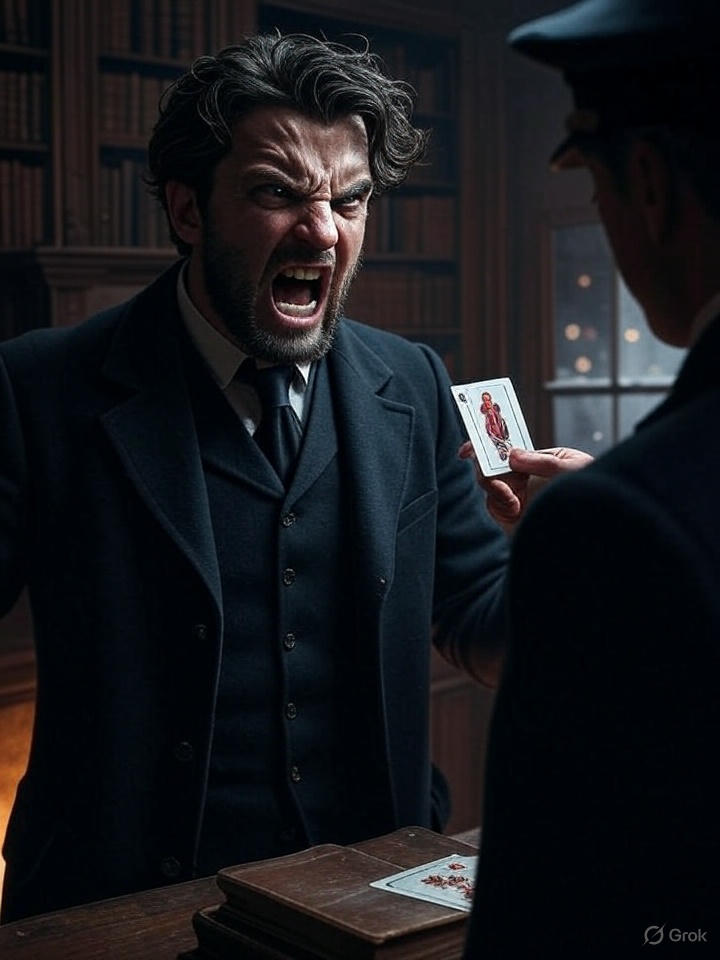
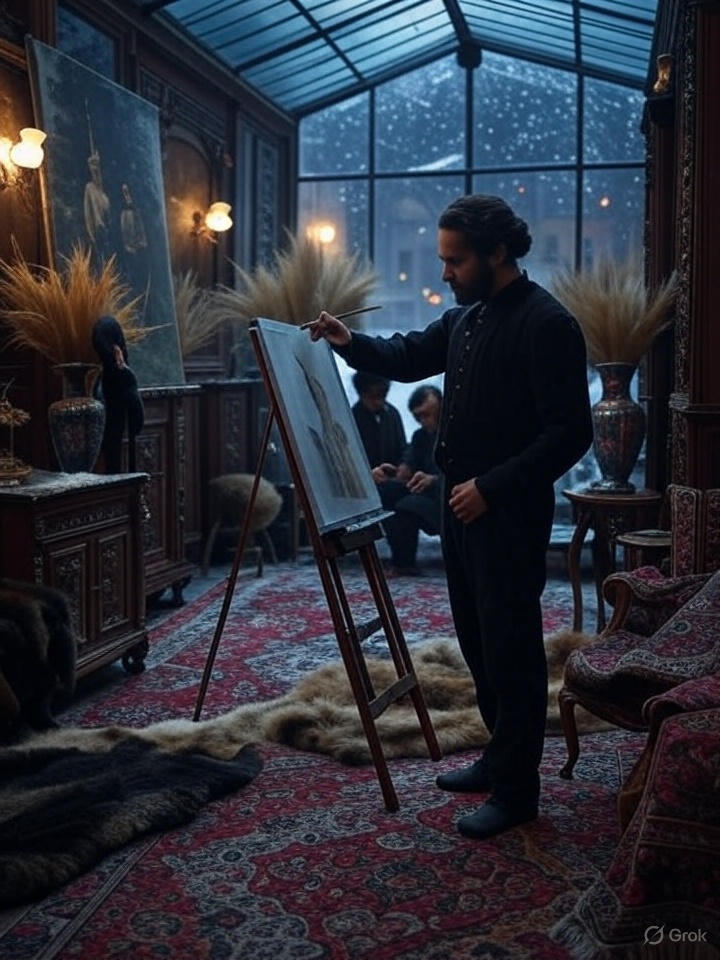







 Anarchistbanjo's World