Feeds:
Posts
Comments

Posts Tagged ‘writing’

Homo Sapiens: Under Way by Stanislaw Przybyszewski and translated by Joe E Bandel

“No, she wouldn’t want that either. In the end, he was right too; but the mother…” 

“Yes, yes… the mother; it’s beautiful to have a mother.” Falk kissed both her hands. 

“By the way, Mama, do you have some cognac?” 

“Yes, she has it. But why does he want to drink so much? It’s terrible to get used to it. Doesn’t he remember the shepherd’s wife who got delirium?” 

Falk laughed. 

“No, he doesn’t want to get used to it; he just has a bit of a fever and wants to lower the temperature a little.” 

The mother fetched cognac. Falk thought meanwhile. Suddenly, he stood up; a decision flashed through his mind. 

“Yes, Mama; I want to tell you something. I’ve kept it from you so long, but it’s started to torment me. You must promise to listen calmly and not cry.” 

Falk drank a glass of cognac. His mother looked at him, anxious and surprised. 

“Yes, she promises him that.” 

“Well, Mama; I’m married.” 

The old woman sat perfectly still for a moment; a flash of fear sparked in her large, wise eyes. 

“You, Erik, you mustn’t play such nonsense with me.” 

“It’s as certain as I’m sitting here. I got married because I loved the girl, no, she’s a lady from a noble family—and so we went to the registry office and made a marriage contract.” 

“Without a church?!” 

“Yes, of course; why did we need a church? You know my views, Mama, I’ve never hidden them; besides, my wife is a Lutheran.” 

“Lutheran!” The old woman clapped her hands together, and large tears welled in her eyes. 

But Falk took the old woman’s hands, kissed them, and spoke of his happiness and his wife’s beauty and kindness. He spoke quickly, haltingly; in the end, he didn’t know himself what he was saying, but the old woman gradually calmed down. 

“Why didn’t he tell her earlier?” 

“Why bother? Marriage has no religious meaning for him; it’s only the meaning of a business contract to secure the woman’s economic position, and, well, to satisfy the police.” 

“Does he live with his—” the word wouldn’t pass her lips—“his so-called wife?” 

“So-called?!” 

Falk grew very irritated… 

Of course. His mother must get used to respecting state institutions just as much as church ones. Besides, he earnestly begged her to tell no one, absolutely no one, about it; he absolutely didn’t want that. He didn’t want any interference in his private affairs; he’d take it very badly from Mama. 

“Yes, she promises him that for sure; for her own sake, she wouldn’t. What would people say! She wouldn’t dare show her face on the street… a Lutheran!” 

“Yes, yes, people! Now Mama must go to bed; I’ll be as careful with the lamp as a hypochondriac. Good night, Mama.” 

“Good night, my child.” 

Now Falk began to think again. He sat down. His mind worked with unusual vivacity. 

What drove him with such terrible force to Marit? Was it just sexual desire? 

But then there were a thousand more beautiful women. He himself had seen far more beautiful women; many who should’ve stirred his sexual sphere far more than this pure, sexless child. 

Yes, sexless; that was the right term. 

Was it really love? A love like he felt for his wife, like he first learned through his wife? 

That was impossible. 

Falk stood up and paced the room. He had to finally make this clear. 

He tried to think very, very cleanly. 

My God; he had gone through this train of thought so often. Always anew, always with new arguments, new psychological subtleties. 

Yes, well! First… 

He laughed heartily. He had to think of a schoolmate who, no matter what you asked him, always started with “First,” but could never get beyond it. 

No, nonsense! 

Yes, yes, that first time he saw Marit. How strange was that hallucination of rose scent and something immensely mystical. 

With frantic speed, a memory unrolled in his mind back then, one he’d never thought of before. He saw a room, a coffin in the center, candles, large yellow candles around the coffin, and the whole room full of white roses, emitting a stupefying scent. 

Then he saw a funeral procession moving to the church on a beautiful summer evening. Everyone carried candles, flickering restlessly… Yes, he saw it: his neighbor’s candle was blown out by the wind. Then the coffin was laid out on a large black catafalque, eight priests in white robes, black vestments, and black dalmatics stood around, and everywhere the strong, mystical rose scent followed him. 

He heard Marit speak back then, she came and went, but he couldn’t shake the hallucination. 

Finally, he realized: Marit had white roses in her hair. Falk mused. His thoughts circled around this one experience. 

Was it the white roses? Was it the memory they triggered? Why had Marit made such a strong impression on him from the start? 

How was sexual feeling intertwined with this memory? 

What did one have to do with the other? 

The second he understood much better. There was a sexual impression from the start, somewhere in the depths of his slumbering subconscious, and it was stirred by Marit’s appearance. 

Yes, yes, quite by chance; or perhaps not… Not by chance? 

So were there a thousand connecting impressions between the first conscious impression and the second that he wasn’t aware of? 

Hmm, hmm; but that’s irrelevant, it’s only about the conscious. 

Their hands had met: he had the impression of something naked, the feeling of a completely naked girl’s body pressing against his chest: a feeling that flowed over his whole body with a faint, tingling pleasure. 

He could pinpoint exactly where it came from: he was barely twelve and swam with a girl. 

That’s what all the children did here in his homeland. 

The esteemed public, to whom he might one day tell this, mustn’t think there was anything indecent in it. 

No, absolutely not; you don’t have to sniff out indecency everywhere. 

Falk grew quite angry. 

What does Hamlet say? The leper itches… Who’s the leper now? Me or the public? Obviously them—quos ego: 

Now he laughed heartily: Why had he gotten so angry? Well… The girl fell into the hole. 

Unconsciously, he thought of the many holes and whirlpools in the local lake. 

His thoughts grew more and more fleeting. He noticed it suddenly and tried to focus them on one point. 

He grabbed the girl and carried her, tightly pressed, out of the water. 

Again, he felt that hot trembling in him: that’s when his sexuality was born. 

Falk thought with strange tenderness of the girl who had awakened the man in him. 

Strange! Yes, yes. But how was it that with Marit—yes, really, with Marit—for the first time in many, many years, he felt this sensation? Why not with other women? Why not with his own wife? 

He couldn’t understand it; there was probably nothing to understand. 

Yes, right, that was very interesting: They talked a lot together, she had just come from the convent and spoke a lot about religion and asceticism. Yes, about asceticism and the instruments for flagellation that could be bought at the market. 

With what devotion he had listened to her voice, constantly thinking of a wonderfully soft, inexplicable organ tone in the local church. The tone was produced when the organist pulled two stops; he had often pulled them, he loved them. What were they called? 

Falk couldn’t recall, no matter how much he thought. 

His heart grew very soft. He clearly heard that one combined tone, which eventually became something flowing. Yes: a silky, flowing mass. 

He distinctly felt the sensation of silky-soft hair in which he buried both hands. He saw Marit before him. 

No, no! He had to finish thinking. This was the case, the important, interesting case. 

So, from three foolish impressions that he could have received from a thousand other women, his love was born?! 

He couldn’t understand that. Impossible. The reason must lie deeper. 

Marit must have something about her that reached into his innermost being, into something where the whole riddle and mystery of his nature lay. 

Suddenly, he knew it. Absolutely. It was his homeland… Yes, for sure. 

Marit had something of his homeland; something expansive in the shape of her forehead. Yes, there was something in those forms of the austere flatland he loved so infinitely. 

This ridiculous homeland that an idiot could sketch with a few strokes! 

Why did his finest, purest feelings pour into these forms? Why did he love her so, this forehead with the blonde, rich hair, parted so simply, so un-Europeanly simply? 

What was happening in him? Was it really love? 

No, nonsense! He loved only one woman: his wife, his splendid, wonderful wife, who had become a part of him: soul of his soul, spirit of his spirit. 

So was it just sexuality? 

Yes, my God, then that idiotic sexuality could have turned to a thousand other women; there were hundreds of thousands of that commodity in Paris alone. 

Read Full Post »

OD by Karl Hans Strobl and translated by Joe E Bandel

Chapter 21

The sun had melted the last remnants of snow and streamed unrestrained over the steaming spring earth. Liverworts and primroses dotted the ground beneath the beeches in blue and yellow, and Friederike had intended to go into the forest to pick a bouquet for Reichenbach’s desk. But a dull unease had plagued her since the previous evening; she could find no explanation for why she wasn’t cheerful amid so much sun, light, and vibrant color in the world. Several times, despite the heavy pressure in her temples and the sluggishness of her legs, she had started out, but each time she turned back, as if she weren’t allowed to leave the dairy today. Something was approaching, compelling her to stay.

While she was in the milk room, a young man limped through the courtyard gate. He was about twenty-five, crippled in both legs; his left foot was a shapeless lump, and his right knee was bent and drawn up, so he touched the ground only with his toes, using a stick for support. He had a slightly crooked nose and a wide mouth; his face was scarred by smallpox, and behind the humble demeanor of a beggar lurked something indefinable. He was anything but handsome, so wretched and dirty that one had to pity him, though it was a pity mixed with revulsion.

As he took a few steps into the courtyard, Friederike emerged from the milk room, carrying a large pot of milk in her hands.

She had to watch the pot to avoid spilling, unaware of what else was happening in the courtyard, until a shadow suddenly fell before her feet.

She cried out, and the pot slipped from her hands. There, there was the man she had encountered twice before in Sievering. He had stared at her with cold eyes, and it felt as if a veil had been cast over her. She had prayed God would spare her from meeting this man again. And now he had come to the courtyard, standing before her, grinning, gesturing mockingly at the broken pot’s shards and the large puddle of spilled milk.

Friederike didn’t understand him. But then he pointed to his mouth and ear, then made a scooping motion with his hand, as if tossing invisible bites into his mouth.

Now Friederike understood—he was deaf-mute and hungry. Fine, he would get food; he shouldn’t think they’d drive him away from this farm out of disgust or fear. Friederike lowered her head and walked toward the steward’s quarters, the beggar limping behind her.

She signaled him to wait, took another pot from the kitchen shelf, and headed back to the milk room. In the courtyard, she thought the only thing left was to run to the Freiherr and ask for help. But then she told herself it wouldn’t do to leave the man waiting if he was hungry—God knows how many doors had already turned him away.

He stood before the pipe collection when Friederike returned with the milk, expressing lively admiration for the large, finely tinted meerschaum heads with vivid gestures. Friederike set a glass on the table and was about to fill it with milk, but he held her hand back, made the sign of the cross over the empty glass, crossed himself over mouth and chest, and then nodded for her to pour.

Friederike sat by the window while the man ate. She saw his large, red, freckled hands with broken nails, the grime around his neck, the matted hair with bald patches. He was hungry and poor, my God, yes, but her dread of him was so great that she could only wish he’d leave soon.

After the man drank the milk and ate the large piece of black bread, he leaned back, blinking at Friederike, sated and content. She thought hard about how to make him understand he could now go. He seemed in no hurry to leave, making no move to do so; he sat there, apparently quite comfortable, grinning. Friederike was at a loss for what to do with him and couldn’t immediately grasp what he wanted when he reached across the table and mimed writing.

She tried offering ink and a pen, and indeed, that was exactly what he wanted. After slowly scrawling a few lines on the paper, he handed it to Friederike, and she read: “I am the Son of God, come from heaven, and my name is: Our Lord God! You see my small wonders and will soon see my great ones. Do not fear me, for God has sent me to you.”

What did that mean? Was she dealing with a madman? But the man sat calmly, his face solemnly serious, his eyes glinting so sharply that Friederike could hardly look away. A while later, as dusk began to fall, he pointed to his feet, likely indicating he was tired, then folded his hands, raised them to his cheek, and tilted his head against them.

He wanted to go to sleep. Friederike was startled; she didn’t immediately know where to put the man, but she was also unable to turn him away.

Finally, she decided to offer him a bed in the hay and led him to the barn. To the stable hand Franz, who asked in astonishment what sort of suspicious fellow she was letting onto the farm, she replied almost irritably that he was a poor wretch, and it was a Christian duty to grant him a roof for the night.

But when she went to bed herself, such fear overcame her that she dressed again and ran to the castle. She wanted to see and speak to Reichenbach, to beg him to let her sleep at the castle that night, where she’d feel safe. It struck her like a misfortune when Severin told her the Freiherr was in the city and wouldn’t likely return before tomorrow or even the day after.

With drooping arms, weary and disheartened, Friederike returned, as if surrendering to an inevitable fate. She bolted her bedroom door and lay on the bed fully clothed, beside herself with terror at the thought that the dreadful man was lying in the hay nearby. And she felt distinctly that a foreign will was relentlessly fixed on her.

But nothing further happened; the night passed quietly, save for a chaotic flurry of dreams in which the image of enormous pincers kept recurring, their jaws opening to seize Friederike’s head.

In the morning, as she stood at the stove cooking milk soup, she sensed the man behind her. He stood in the open doorway, grinning at her, and made a scooping gesture with his hand, as if tossing invisible bites into his mouth. Friederike set a plate before him, but the beggar pointed to the seat opposite, signaling with gestures that he wished her to eat with him. Fine, that too, thought Friederike; she’d do his bidding, but then she’d make it clear he must leave the farm.

As she raised the spoon to her mouth, the man made a lightning-fast motion, as if tossing something into her plate. The spoon fell from her hand, clattering against the plate’s rim, and Friederike was instantly paralyzed throughout her body. She hadn’t lost consciousness but was defenseless; she saw the man rise with a nod and a grin, limping around the table toward her. An immense scream of mortal terror remained silent within her. The man grabbed her around the waist, dragged her to the bedroom, threw her onto the bed, and pressed his body into hers.

Around nine in the morning, the stable hand Franz saw the stranger stagger across the courtyard and head toward the forest path. A few minutes later, Friederike appeared, a bundle under her arm and her headscarf pulled low over her face, as if heading to a distant field. Franz intended to ask where she was going, but a commotion broke out in the stable—the gray stallion and the chestnut were fighting, as they never got along, and he had to rush to intervene.

No one stopped Friederike; she reached the forest’s edge, where the beggar waited under the first trees. They wandered all day and spent the night in a hayloft.

The next evening, they stopped at a remote farmhouse near Heiligenkreuz, and the man asked for lodging.

Yes, he spoke—he was not deaf-mute at all—making a humble face and begging for shelter. Had he been alone, the farmer would have turned him away, but the delicate, quiet girl with him, who looked so utterly miserable, stirred pity in the farmer and his wife, and they allowed the two to stay. They even permitted them to sleep in their son’s room, as he was at the livestock market in Sankt Pölten.

After supper, as they prepared for bed, the strange girl suddenly fell to her knees before the farmer’s wife and cried out, “Help me… for God’s sake, help me… save me from this man; he forced me to follow him… I can’t… help me. He forced me… I’ll throw myself into the water.”

This wasn’t immediately clear to the simple folk, but something was certainly amiss. The farmer glared threateningly at the beggar.

The man grinned and tapped his forehead. “This is my bride,” he said in a tone that brooked no interference, “no one has any say in this. She’s just not right in the head sometimes.”

“He pretended to be deaf-mute…” Friederike wailed, “he wrote that he’s the Son of God. Help me. Let me sleep with you, not with him. Not with him.”

“Shut your mouth!” the man snapped at her. “Watch, she’ll follow me in a moment.” He stood in a corner of the room, whistled as one might to a dog, and pointed to the floor. And the girl, whimpering and whining, began crawling on her knees toward him.

“Good, very good,” he praised, “and now you’ll go up and climb the stairs.”

Friederike stood and began ascending the wooden stairs from the room to the son’s chamber, counting, “One, two, three, four, five…” Suddenly, she broke into laughter that made her sway, nearly falling from the steep steps. The man nodded to the farmer’s wife, as if to say, “See, what did I tell you?” and drove the girl ahead of him into the bedroom.

The household didn’t know what to make of it all. The farmer seemed reluctant to get further involved, but his wife insisted something was amiss, and the two maids and the farmhand sided with her.

Finally, the farmer grudgingly agreed to go to the village the next day and report it, to ease their conscience.

But the next morning, nothing stirred in the bedroom, and when the farmer’s wife went upstairs, she found the strangers had already left. They must have departed the house together before dawn.

Read Full Post »

Homo Sapiens: Under Way by Stanislaw Przybyszewski and translated by Joe E Bandel

III.

Erik Falk didn’t go into the city. 

He turned off the country road and walked along the lake. Across the water, the forest faded into deep darkness, and the lake lay clear and soft, filled with the calm reflections of the evening glow. 

Falk stopped. 

How could he have forgotten so quickly what he said yesterday; the whole story had become a ridiculous comedy; yes, a foolish, boyish, clumsy comedy. 

But Marit, hmm, trusted him blindly; no, she hadn’t noticed anything, she believed everything he said: No, she wouldn’t suspect the slightest deliberate intent. 

Falk calmed down again. He lay down by the shore and gazed thoughtlessly at the lake. 

In his mind, a dark mass of thoughts fermented; only now and then did single associations, images, or fragmented slogans flash up in him. 

And again, he began to walk, slowly, laboriously; he wanted to recall something, he had to rouse himself to think about something, yes, to make something perfectly clear. 

It grew dark. Tiny lights shimmered from the nearby villages. Now and then, he heard the clatter of a cart on the country road, then he listened to the chirping of crickets and the croaking of frogs in the ponds. 

Yes, what did he actually want? 

He wasn’t a professional seducer. He had never sought the ridiculous fame of seducing a woman just to possess her. No, that wasn’t it. 

His thoughts refused to move further; he sat down on the grass and looked across to the black forest edge. 

Something dawned in his soul, and gradually an image rose within him, the image of a woman, with her grace, the refined grace of dying noble families; it was as if she extended her slender, long hand to him and looked at him so lovingly, so kindly with her eyes. 

Yes, that was his wife. Fräulein Perier. Falk smiled, but immediately grew serious again. 

He loved her. She had the great masculine intelligence that understood everything, that even understood him. She had the great, refined beauty he had searched for so long, so long. 

There she stood. Falk recalled her movement: that first time, the room in dim red twilight—God, how beautiful she was! He had understood at once that he had to love her, and he loved her. 

Yes, absolutely. Now he longed for her. Now he wanted to sit in the big armchair at his desk, hold her on his lap, and feel her arms around his neck. 

How was it that he could never forget Marit? 

In the wildest bliss of love, he suddenly saw his wife’s face transform into another, into a small, narrow child’s face; he saw it gradually change until he suddenly recognized it. That was Marit. 

And then he could stare endlessly at that little face, feeling his hands go limp, his thoughts drifting back to the past, to the time he spent with Marit when he had come home just a year ago and met her for the first time. 

And again, he clearly felt the slackening in his limbs, and again he felt that strange longing for this love that could only bring pain, this unbearable torment of desiring a woman and not possessing her. 

How happy he had been with his wife before he saw Marit. And now she stood between them, making him sad and angry because he always had to overcome her, kill her in himself anew to reach his wife. 

Why had he come back here? 

What did he want from Marit? Why did he lie to her, why did he torment her, why did he play this whole comedy? 

Yes, if only he could understand that! 

He did want something. He must have a purpose. Somewhere behind all consciousness, behind all logic, there must lie the hidden purpose, set out for his will in the unconscious. 

Was it sexuality, lurking in secret for a new victim? No, that was impossible. No! It would be an outrageous villainy to destroy a child, to defile this pure dove’s soul. No, he would never do that. 

Yes: doubly, a thousand times impossible. In two weeks, he would return to his wife; otherwise, he’d fall into the most hideous conflicts with his conscience. 

Yes, that wretched conscience. To sit in Paris and constantly think: now she lies prostrate on the floor, writhing and begging God for mercy. No, he wouldn’t have a minute’s peace. No, that would be too terrible: a whole life with this one image, this one thought, this eternal unrest of a tormenting conscience. 

He stood up and walked slowly on. 

It had grown dark meanwhile, and glowing mists rose over the meadows like mighty smoke clouds, steaming and billowing upward. 

Falk stopped, looked into this sea that flooded everything, and mused over something he couldn’t recall; he felt paralyzed in his mind. 

He couldn’t get past the one question: what did he actually want? 

Suddenly, he saw Marit before him. Yes, she looked splendid, sitting there on the stone with the marvelous red glow from the brim of her large summer hat. So slender, so delicate… 

A hot trembling began in his soul: he heard the faint stammering of sexuality. 

No: the conscience! My God—Falk had to smile: The great Übermensch, the strong, mighty one without conscience! No, Herr Professor had forgotten culture, the thousand centuries that labored to produce it. With reason, of course, you could argue anything away; with reason, logically speaking, you should be able to overcome everything, even conscience. But you couldn’t. 

What good was all his reason; behind every logic lurked the terribly illogical, which ultimately triumphed. 

And again, Falk thought of Marit and his love for her. Yes, in the end, that was all that interested him: this case of his. This case of double love was truly fascinating. 

It was clear to him: he loved both. Yes, undoubtedly. He wrote the most passionate love letters to his wife and didn’t lie to her, and two hours later he told Marit he loved her, and, God knows, he didn’t lie to her either. 

Now Falk began to laugh. 

But behind the laughter, he felt a biting pain, a strangely venomous anger. 

Of course, he had the right to love Marit; why not, who forbade him? Who had the right to forbid him anything? Should moral laws, made by crude people from stupid, unpsychological perspectives, be more binding than the power of his feelings? 

Why shouldn’t he seduce her if he desired her? Why shouldn’t he possess her if he loved her and she loved him? 

Yes, she did love him. So what forbade his will? Morality? Good heavens, what is morality? 

He knew no morality except that of his feelings; and in those feelings, there wasn’t a single law meant to govern the will of others. 

He started. A dog barked from a nearby farm, louder and fiercer. 

Stupid, idiotic beast! 

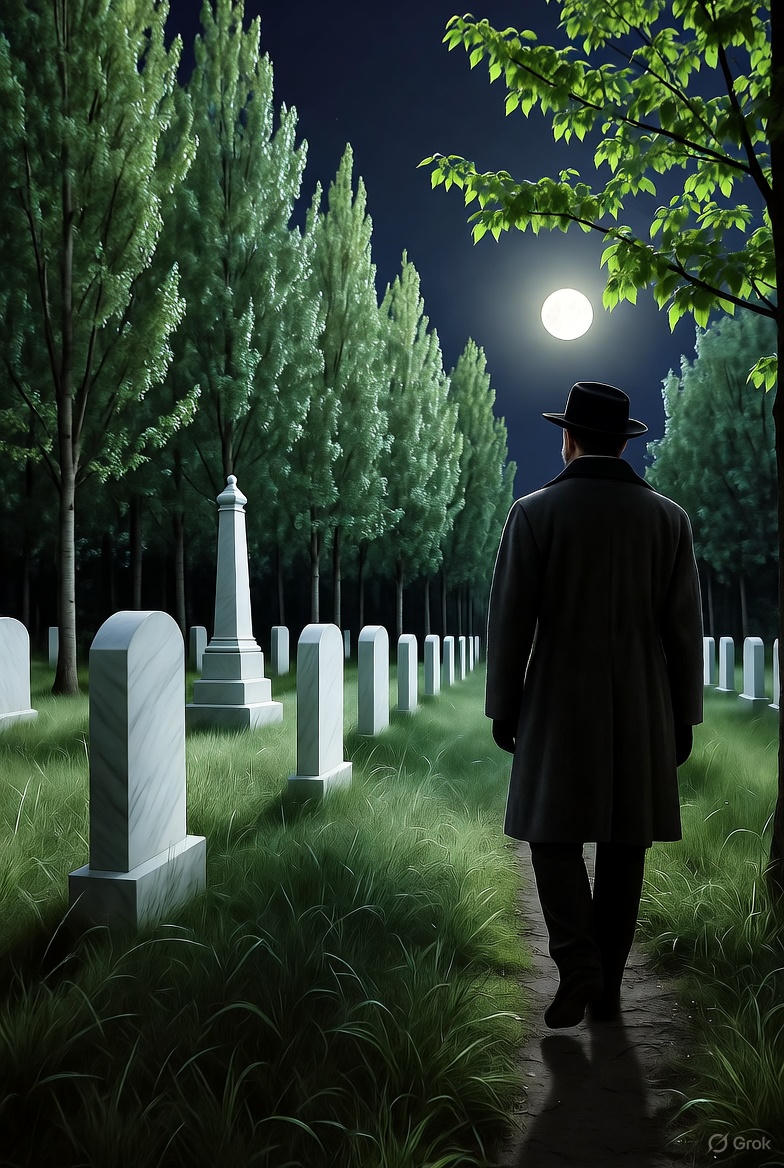
Falk turned onto a meadow path that passed by the cemetery. 

In the cemetery, the leaves of the silver poplars rustled with their eerie solemnity. White marble tombstones stood out from the darkness like ghosts. It was so terribly solemn, this eerie rustling of the trees. There was a sound that reminded him of the rattling of skeletons. He felt very uneasy. 

Ridiculous that these idiotic folk tales about the lives of the dead could still affect his mind. Yes—well, he was so nervous. 

His thoughts grew more and more confused. No, he was too tired. He couldn’t follow a single thought logically to its end; why bother? 

Yes, why this foolish logic? What was active in his soul, what lay behind all consciousness and what he didn’t know, that had its own logic, so fundamentally different from this stupid conscious logic, and it overthrew it. 

The white walls of the monastery now loomed before him; he stopped and stared at them. There was a strange poetry in there; he thought of the gruesome stories he’d been told as a child about the Cistercians who once owned the monastery. 

Yes, last year she came from a convent too; that’s where she was raised. Raised! Ha, ha, ha… 

Falk grew angry. 

The convent women destroyed her! Yes: Destroyed! Now she walks around in iron swaddling bands! Now her soul is tangled in the umbilical cord of Catholicism, strangling itself, the poor, misbegotten child. 

Why didn’t she have the will: look here, I love you! Take me! Yes, yes, yes; again the foolish logic of reason. 

And yet: he would be stronger than all her religion. He would root out this poisonous weed of Christian morality from her imagination. He would force her; she must obey him. He would make her free, yes, free; and himself too. 

Wasn’t he a slave? Yes, a foolish slave to his wife, his conscience, stupid old prejudices that now crawled out of their holes like earthworms in spring, tormenting him… 

Oh, she would see who was mightier: him or the crucified Rabbi! 

Falk felt an immense energy swelling in his brain. He quickened his steps. Eventually, he was almost running. 

Drenched in sweat, he arrived home. His mother was still waiting for him. 

“But good, dear, precious Mother, why are you still up?” 

“Yes, she’s always so afraid when he puts out the lamp. So many accidents happen with it. She’d rather do it herself.” 

“But you can’t possibly come to Paris every evening to put out my lamps.” 

Read Full Post »

OD by Karl Hans Strobl and translated by Joe E Bandel

Reichenbach asks, and Friederike answers; she has taken his hand and leads him among the graves, sure-footed, while Reichenbach stumbles in the deepest darkness.

Only when the Sievering church tower strikes two does Reichenbach regain a sense of time. It has started to rain; the wind lashes water curtains around their faces and shoulders—they must go.

Back in Friederike’s room, the light burns, and the modest space envelops the two intimately. Friederike looks exhausted, her face pale with dark circles under her eyes. Reichenbach sits in a high-backed grandfather chair, takes Friederike’s hands, draws her close so she stands between his knees, and fixes a steady gaze on the bridge of her nose.

At once, as she stands there, Friederike falls asleep.

Yes, there lie the mounds of the dead, and Od light rises from them, though many are completely dark. Reichenbach is strangely shaken. It’s all physically and chemically determined, of course—a natural law, so far explored only by him; everything is interconnected through Od. Only ignorant people, unaware of Od, might turn it into ghostly apparitions. It’s all physics and chemistry; some mounds glow, others are dark, and far from here, in the Blansko cemetery, there’s a mound long since dark. And one has children who have turned away and pursue their father, and how long will it be before one lies under such a mound, sending Od light through the earth until it too fades.

“Can you tell me, Friederike,” asks Reichenbach, “what Hermine is doing?”

Friederike knits her brows: “Hermine is asleep.”

“Not now. What she does otherwise, when she’s awake.”

“Hermine thinks a lot about the child she’ll soon have.”

Oh God, Hermine is to have a child—well, she’s married, it’s part of it, having children. “And do you also see Ottane?”

Friederike frowns: “I see Ottane too. She’s in another land, with great churches with shining domes, streets filled with fragrance. The sea with reddish-brown and yellow sails. And there’s a man with her. But I see a shadow over her.”

So there’s a man with Ottane—a man. Well, what does that matter to Reichenbach? What concern is it of his what his children do? They don’t care about him. “And you?” he asks further, “can you tell me something about yourself?”

Friederike’s lips press together; a twitch flickers around her mouth, her answer comes reluctantly and haltingly: “I will soon have to leave you.”

What does that mean? That Friederike must leave him must? How could that be imposed on him, when he now has nothing but Friederike and is on the verge of penetrating the final secrets with her help? No, for now, he wants to know nothing more; it’s perhaps presumptuous to go so far, an abuse of her gifts. One must always stay grounded in physics and chemistry, not plunge headlong into the unknown. Reichenbach thinks that Friederike should now awaken.

Friederike blinks and opens her eyes. Her gaze returns from afar, adjusts to her surroundings, and then she smiles: “My God, am I tired!”

“It’s gotten late, my child,” says Reichenbach. “Let’s go to sleep now.”

Read Full Post »

Homo Sapiens: Under Way by Stanislaw Przybyszdski and translated by Joe E Bandel

No, please, you must let me finish, I have to talk about this… 

“No, not at any price; I can’t bear scenes like yesterday. Be reasonable, you’re so nervous.” 

Falk fell silent, Marit choked back her tears. They walked a while in silence. 

“You asked me for friendship yesterday, so as a friend, I have certain rights.” 

“Yes, of course you do.” “Are you really married?” 

“No, I’m not. I only have a child, whom I love beyond measure; and I want to go back to him now and live with him, somewhere in Upper Italy—yes, that’s really my plan. I love the child so infinitely; I don’t know anything I love as much.” 

Marit grew nervous and silent. 

“The child is really quite wonderful…” 

And now Falk began to talk about the child with an unusual warmth and tenderness, all the while fixing his eyes sharply on Marit. 

Marit visibly suffered. 

“By the way, you probably don’t know: I was very ill in Paris, poisoned by nicotine, yes, nicotine. I would’ve probably gone to ruin if I hadn’t had excellent care.” 

“Who cared for you?” 

“Well, she’s a very remarkable lady. She’s very intelligent and plays the piano wonderfully. Oh yes, she has the mind of a man.” 

“Is that the child’s mother?” 

“Oh no, I have nothing to do with the mother.” Marit looked up at him, astonished. 

“But you said yesterday that you couldn’t get rid of the lady? You said she clung to you like a burr.” 

Falk grew confused. 

“Did I really say that?” 

“Yes, you said that; you even said that’s why we couldn’t be happy.” 

Falk thought. 

“Then I must’ve really been drunk. No, I don’t understand…” 

He acted as if he were utterly shocked at himself. Marit had to recount yesterday’s conversation in detail. 

“Yes, yes; I was really drunk. No, you mustn’t put any stock, absolutely none, in what I say in that state; I tend to make things up then.” 

Marit looked at him suspiciously. 

“You have to believe me; when I’m drunk, I tend to tell the wildest stories. No: the mother’s gone. I think she’s a model now, or something like that, living with a sculptor.” 

Marit grew very happy; she smiled. 

“So the whole story from yesterday was a comedy?” 

“Yes, yes,” Falk hurried to reply, “but it was a comedy I performed in good faith; I believed everything I said.” 

Marit still couldn’t understand, but she stayed silent. Falk grew restless. 

“No, no, I have nothing to do with the mother anymore. The lady who cared for me is entirely different; her name is Fräulein… Perier. For two weeks, she sat by my bed, endured my terrible moods with angelic patience, and played the most wonderful stories for me; day and night, she was there.” 

“Did she live with you?” 

Falk made a surprised face. 

“Yes, what’s wrong with that? In Europe—” he emphasized the word—“there’s great freedom in the interactions between men and women. There aren’t the foolish prejudices like here. Here, a lady can be officially engaged to someone in front of the whole world, and still the mother and two aunts have to trail behind. No, in Europe, there are no religious or conventional rules in matters of love. There, everyone is their own rule and law. 

Yes, yes, it’s so free there, so free. Good God, how narrow, how unbearably narrow it is here. 

There are laws and barriers and police measures; people are so confined—in a thousand idiotic: you may do this, you may not do that!” 

Falk thought. 

“Why did you pull away so violently yesterday? Can’t you kiss a sister or a friend, what’s wrong with that?” 

“No, I couldn’t do that. I’d have to despise myself. I wouldn’t be able to look you in the face freely. And would you have even a trace of respect for me?” 

Falk laughed loudly with open scorn. 

“Respect? Respect?! No, where did I lose that word, what is it even? No, I don’t know the word or such a concept at all. I only know free women who are their own law, and then I know women who are slaves, pressing their instincts into idiotic formulas. And among these slaves, I distinguish women with strong instincts, with enough power, beauty, and splendor to tear apart the foolish ropes with proud, victorious majesty, and then women with weak instincts—in a word: the livestock that can be sold like any other commodity, obedient like any other household animal.” 

“So you must highly esteem the woman who bore your child and then ran off to another?” 

“No, because I don’t know esteem. She only went where her instincts drew her, and that’s surely very beautiful.” 

“No, that’s ugly, despicable!” “Hmm, as you wish.”  

Marit grew very irritated. 

“And that Fräulein—what’s her name?—Perier.” 

“Yes, then you’d have to see Fräulein Perier as the highest ideal; why don’t you love her then?” 

“Of course, in fact, Fräulein Perier is the most intelligent woman I’ve met—” 

Marit flinched. 

“That I don’t love her is only because the sexuality with which you love is completely independent of the mind. In love, the mind isn’t usually consulted.” 

“So those are the women you like!” 

Marit was nearly crying. This Fräulein Perier was a bad person! Yes, she knew it for sure. 

“Yes, yes, yes; that’s how you judge from the standpoint of formulas and Catholicism.” 

Both fell silent. Falk was stiff and curt, making it clear that further talk was pointless. 

Marit suffered. She felt only one question: why had he told her all those stories yesterday about the woman who clung to him like a burr. 

“So the mother ran off from the child? Falk, be open! I tormented myself all night over this; I beg you.” 

“Why must you know that?” “Yes, I must, I must.” 

Falk looked up at her, surprised. 

“Yes, I told you. Besides, how could another woman care for me if she were with me?” 

Marit calmed down. So he had no woman with him. She was almost grateful to him. From time to time, she looked at him; there was something in her gaze, like a child who wants to apologize but is too proud. 

Falk stared stubbornly at the ground. They reached the garden gate. 

“Won’t you stay for dinner? Papa would be very pleased. Papa asked me to keep you. He has so much to discuss with you.” 

But Falk couldn’t possibly stay; he was very polite, but icy cold. 

Then he left, after bowing very correctly. 

Marit watched him for a long time: now he must turn back to her. Falk walked on and didn’t look back. 

My God, my God, Marit sighed in agony; what have I done to him? 

She went up to her room and lit the oil lamp before the image of Mary; then she knelt and threw herself on the floor before the gentle, smiling face of the miraculous Virgin.

Read Full Post »

OD by Karl Hans Strobl and translated by Joe E Bandel

“Does he know yet?” whispered Ottane, gesturing toward Schuh.

“Not yet.”

Ottane pulled her sister into a warm, tender embrace. Ah yes, that was reason enough to smile—when such an oblivious man voiced longings for Italy, doomed to fail by such tiny things.

With the discovery that Reichenbach loved Friederike, a new phase of his Od research began. He forgot everything else and didn’t even feel the full weight of the blow that shattered his hopes for the railway tracks. The world sank away for him; he lived with Friederike as if on a lonely island amid an empty ocean.

Friederike moved quietly around him, tending to all his needs without fuss. Reichenbach didn’t even realize it was thanks to her that warmth returned to his life. He had his men create hidden paths through the forest, cutting straight through the underbrush where he met no one. There he wandered, hands behind his back, pondering his grand problems; he believed he noticed that thinking was sharper and clearer while marching about. When he reached the farthest point and turned back toward the castle, he felt joy. He rejoiced at returning from solitude to the warmth of human presence, though he didn’t dwell on the reasons.

Friederike submitted willingly to all the experiments he conducted with her. She was happy when Reichenbach told her he had found no other sensitive like her. In her, all the qualities he’d found separately in others were united. He told her this, and she took pride in it, unaware of the latent powers within her that Reichenbach had unlocked. Only about her somnambulistic abilities did he say nothing, lest it cloud her innocence. She falls asleep at a glance from him and awakens at his command, unaware of what transpired.

“Would you go with me to the cemetery?” Reichenbach asked one day after a long forest walk that brought him new ideas.

Friederike looked a bit surprised but nodded.

“At night? Won’t you be afraid?”

Even at night! Why should she be afraid with Reichenbach beside her? His word is Friederike’s gospel; she sees him reign over her, walking resolutely and devotedly in his grace. In the darkroom, she sees the Freiherr in the glow of Od light as a radiant, white giant, immensely magnified, head and heart in brighter light than the rest—yes, that’s his true form and appearance, elevated above other humans. All should see him as she does and bow before him.

It’s a windy early spring night with mild clouds against a deep dark sky. Reichenbach has donned a weather cloak and given Friederike a man’s coat as well. They walk side by side down through the forest toward the Sievering cemetery.

Reichenbach had instructed the gravedigger to leave the cemetery gate open. The iron grille clangs back, and now the man and the girl walk among the molehills of death. The wind howls, the trees rustle in the darkness—everything is present to make a nighttime cemetery eerie. But how could anything be eerie for Friederike with Reichenbach at her side? External things can’t reach her directly; they must pass through Reichenbach and are transformed by him.

“You mustn’t think,” says the Freiherr, “that I intend to conjure spirits.”

No, Friederike doesn’t believe that, since Reichenbach says so.

“It’s like this…” he continues, “that all living things are permeated by Od and odically influence everything else in a specific way. All living things are od-negatively charged, and a sensitive can distinguish them from the dead by sensation alone, even if the living seems dead. I know a case… there was a young girl who fell into illness from great heartache and died. She was about to be buried, but the doctor wouldn’t allow it. After three weeks, she awoke from her apparent death and later married that same doctor out of gratitude. I believe that man must have been unconsciously a sensitive. And my friend, the Old Count Salm, told me that a seemingly dead countess was interred in the Salm crypt. But it didn’t go well for her; she had to perish.”

“Terrible,” says Friederike, now gripped by a shudder.

“And the painter Anschütz told me that while studying anatomy, he once, with the prosector, cut open a man’s abdomen. They stepped out for a moment to light a cigar, and when they returned, the man was sitting on the dissection table, looking at his opened belly. He too was only apparently dead and revived by the cut. It’s a dreadful matter, this apparent death, because doctors have no means to distinguish the apparently dead from the truly dead. But a sensitive knows instantly whether a person is dead or still alive, and thus Od could become a remarkable blessing for humanity. But of course, those blockheads wouldn’t admit it.”

Friederike presses anxiously closer to the Freiherr. She truly doesn’t know why he brought her to the cemetery—should she perhaps detect the apparently dead here?

“No,” says the Freiherr, having guessed Friederike’s thoughts, “those here are likely all truly dead. But even chemical processes are accompanied by Od light. You’ve seen the rotting herring glowing down in the cellar, haven’t you? Fermentation, decay, putrefaction—there’s always something odic involved. A person is dead, but as long as they haven’t fully decomposed, they must still emit an odic light. And now I want to know if you can see any of it.”

They stand by the stone cross in the center of the cemetery, surrounded by graves in the darkness of the stormy night. Friederike can’t help but cling to Reichenbach, and he places his arm around her shoulders.

She strains to pierce the darkness, eager to obey and confirm the Freiherr’s assumptions. The wind howls around them, tugging at their coats, sometimes billowing them over their heads; the trees sigh and creak. Amid all the danger, it’s a wondrous bliss to stand there, united against all waves on this side and beyond the grave.

After a long, silent wait, Reichenbach says with a hint of disappointment, “Well, it’s probably not dark enough for it.”

But just then, Friederike feels as if her eyes can catch a glimmer of light. She doesn’t know if it’s near or far, but it grows clearer. “There’s something there,” she whispers anxiously, “it’s like individual threads rising from the ground—greenish threads, swaying back and forth, and then… yes, higher up, they merge into a greenish haze.”

Yes, that’s exactly what Reichenbach expected. Through the loose earth, Od light emerges in individual threads, converging into a luminous cloud.

“Wait!” he says, pulling out his pocket lantern and letting Friederike guide him.

“There it is!”

After a fierce struggle against the wind, he lights it, illuminating the mound. A plaque on the iron cross bears a name and a death date. The woman died less than four weeks ago.

Reichenbach extinguishes the lantern again, and they must stand in the dark for a full hour before the external light stimulus fades from Friederike’s eyes. But then the entire cemetery comes alive with the ghostly light of the dead. It rises from the earth, emerges from the mounds, floats in greenish or yellowish clouds over the graves, pressed down by the wind then torn upward. The shapes of the graves stand out clearly; some show two brighter spots, likely corresponding to the head and chest of the deceased. It undulates with torches; whitish smoke swirls, pools of Od light are scattered, wisps of light are whipped away and swallowed by the night. Many graves remain dark; some barely shimmer, while others ceaselessly exude a network of light, its threads intertwining—the light the dead still send to the upper world as their last share of life.

Read Full Post »

Homo Sapiens: Under Way by Stanislaw Przybyszewski and translated by Joe E Bandel

II.

The next day, Falk returned to Elbsfeld. 

He was friendly, acted as if he were very happy, but could only poorly conceal a nervous irritability. 

“Isn’t that right? Nothing happened, did it? You’ve forgotten everything, surely forgotten. I don’t remember a thing.” 

Marit lowered her eyes to the ground. 

“Yes, sometimes it happens to me that for hours I lose consciousness, no, just the ability to remember, without actually being drunk. Of course, I drank a lot yesterday; but I didn’t seem drunk, did I? Or did I?—Well, then I just acted that way to say everything without consequence. I do that often, you know.” 

Falk spoke excessively and quickly; he was very cheerful. Marit looked at him, astonished. 

“What’s happened to make you so happy?” 

“Oh, I got very good news from abroad; my book has been translated into French and received very favorably. And I’m genuinely delighted about it. I don’t admire the French at all, but Paris is the only cultural hub in Europe and the supreme tribunal in matters of taste…” 

Yes, and then, you can’t imagine how unbelievably funny it was; I have to tell you. 

Marit looked at him again; her astonishment grew. What was wrong with him? 

“Did you know that Papa had me driven home in his carriage yesterday? Of course you know. So we’re driving, and driving very fast. 

Suddenly, the horses stop, they rear, buck, and whinny like the stallions in fairy tales that suddenly get human voices. The driver whips them, but it only gets worse. He climbs down from the box, I crawl out of the carriage, we grab the horses by the reins and try to move them forward. It doesn’t work; the horses go wild, and the driver redundantly states that they won’t move. What in heaven’s name happened? It was so dark you could’ve slapped someone without being seen. Well, I gather my courage, groping cautiously along the road with hands and feet, and—believe me, I have enough personal courage to stir up the strangest scandals, but this time my heart just stopped. I tripped over a coffin and fell with my knees onto a corpse.” 

Marit flinched. 

“No, that’s not possible.” 

“Yes, truly. In my fear, I yell for the driver, and in the same instant, of course, I’m ashamed of my human reflex, then I get another terrible jolt: I hear a clear, agonizing groan. I don’t remember ever feeling such a primal, unthinking shock.” 

“But my God, you’re turning pale. No, calm down; the incredibly funny thing about the whole story is that it wasn’t a corpse, but a real live person who, drunk, came from the city with a coffin. Being drunk and very sleepy, he’d dragged the coffin off the cart, let the horse go, and lay down in the coffin to sleep off his drunkenness in style.” 

Marit laughed heartily. 

“That was really funny.” 

“God, how it delights me that I made you laugh. No; you must laugh, laugh all day; yes, we’ll both be like children, and I’ll stay good, like now. Or am I not good? Yes, I am. Good; I’ll stay this good all day, never again as nasty as yesterday.” 

Falk laughed at her, then grew serious; he looked at her deeply. God, how beautiful this human child was! 

“Marit, my darling, I’d like to lay myself like a carpet under your feet, I’d like to…” 

No, no; I won’t talk about these things anymore. 

Falk’s eyes grew moist. Marit looked at his face with unspeakable love. 

“He shouldn’t torment himself. No, she couldn’t bear to see that. It would make her sick. Did he want her to suffer?” 

“No, no, Marit; I’m cheerful again.” Both fell silent. 

“Would he like to take a walk along the lake?” “Yes, I’d love that.” 

It was a glorious spring day. 

A few days ago, everything had suddenly turned green. The trees sprouted leaf buds, the crops grew visibly, and the hills on the other side of the lake rose in the lush splendor of their young grass. 

They walked, their feet sinking into the soft, damp sand. 

Falk was silent; from time to time, he gathered stones from the shore and skipped them across the lake’s surface. His face grew graver and graver, like that of a man harboring deep sorrow. 

He walked, staring ahead, then gathered flat pebbles again and threw them onto the water. 

Marit looked at him, increasingly sad. 

“No, he shouldn’t torment her like this. Why wouldn’t he speak? She couldn’t stand these dreadful pauses.” 

“Yes, yes, yes…” Falk seemed to wake up. “Yes; right away, at once! Now, I’ll tell you wonderful things…” 

He laughed exaggeratedly cheerful. 

“So, about Paris, right? I met great people there. Do you even know what a great person is? You do? Well, then you probably don’t need explanations. 

Great people are funny, Fräulein Marit, believe me; I’ve met a lot of them. Especially one, oh! He was remarkably peculiar. He hated women because he loved them so excessively. He was, forgive my expression, but it’s so apt, he was like a mad stallion.” 

No, no, she shouldn’t hear such words from him anymore. No, not these stories. He knew: she was a good, devout Catholic, and that expression certainly didn’t come from the holy fathers. 

“So, this great man—wait a moment, I won’t say anything bad; these things are just part of his psychology. He was remarkably paradoxical. He wanted to do everything differently from other people. So he said to himself: why look at the moon with a telescope, I can just as well do it with a microscope. 

No, what a wonderful dress you’re wearing; oh, I love it so much; yes, remember, I loved it last spring too. 

So, this great man takes a microscope, drips a drop of mercury on it, and looks at the moon. Now, the remarkable thing: the moon appears to him, naturally, in a strange, blurry form. But good God, the great man suddenly says: that spot there, isn’t that Europe? And that square thing, that’s Australia itself. 

God, how wonderfully you laugh! You know, you get such a wonderful, delicate dimple around your eyes…” 

No, you’re right: I’ll finish the story. So, this great man, with his characteristic genius, draws the following conclusion: the moon has no craters… You know the moon is supposed to have volcanoes? Well, this great man says there are no craters, no volcanoes: the moon is simply covered with a smooth layer of gravel, and our Earth is reflected in it.” 

Marit laughed like a child. 

“No, how funny you are about great people; don’t you have any respect for great people?” 

“No, I truly don’t. I’ve seen them all, in tails and in their most intimate negligée, they’re always so endlessly ridiculous. They take themselves so terribly seriously and solemnly, strutting with the stiff grandeur of Gothic architecture. I always think of the ridiculous ape-men that the God of Herr Professor Nietzsche created to have fun at their seriousness.” 

Falk mused… Only once had he seen a great man: one he bowed to. 

“Oh, you absolutely have to tell me; it’s remarkably fascinating that you, Herr Erik Falk, were impressed by someone.” 

“Yes, yes, that’s truly remarkable. I really don’t have megalomania—not yet; but I haven’t met anyone who could measure up to me. But this man was great. I met him in Kristiania. He looked small; he had an immensely quiet, shy, awkward manner and eyes, large, peculiar eyes. They didn’t have the obligatory probing, spying quality of other great people’s eyes. There was something in them of a bird’s broken wings, a great royal bird. He had a violin, and we went to an acquaintance’s together. There we drank Pjolter, a lot of Pjolter, as we, yes, we good Europeans usually drink. And then he started playing, in complete darkness; he had the great shyness of refined feeling. I’ve never heard such naked music. It was as if I had a trembling pigeon’s heart before me, warm, cut from the chest. There was something in the music of an unheard-of lament, tearing at the lungs and choking the throat. Marit, sweet, good Marit: and then you rose before me; from this lament of notes: you, you were this pigeon’s heart, this one vibrating note that cried for happiness and died in agony…” 

Read Full Post »

By Karl Hans Strobl and translated by Joe E Bandel

Chapter 20

Women who excel in certain sciences or one field often fail in the most important feminine science.

But Hermine is an exception in this regard as well. She has written treatises on botany and was well on her way to becoming a recognized figure in her field. Yet she knows how to arrange and manage her home so that it is exceptionally cozy. She has indeed hung up her botany, but no one has noticed her particularly mourning its loss. The treatise on thylli, left unfinished, has been bound between two sturdy cardboard covers resembling tombstone slabs, and Hermine has inscribed on it: “Satis superque satis!”—”Enough and more than enough!” It seems these are the last Latin words Frau Hermine has written.

Hard to believe how happy one can be when there’s no more microscope to deal with, and the day passes with dusting, cooking, embroidery, and other domestic tasks, with nothing left of past glory except perhaps a bit of music in the evening’s quiet hours.

The Schuhs’ apartment in the Alservorstadt is small but comfortable. Schuh is already talking about moving to a larger place; he’s progressing, has truly become a partner in the galvanoplastic institute. The debts to Reichenbach are repaid; Schuh daydreams of three rooms, a kitchen, and perhaps even a study. It might become necessary, Hermine thinks, but for now, two rooms suffice.

They don’t entertain much; the Schuhs lead a rather secluded life, but visitors feel at ease and leave without taking the peace with them. For Reinhold, staying with the Schuhs is a warm haven in his solitary bachelor existence. He’s very quiet and serious, does his work, reads books and chemical journals, and otherwise knows little what to do with himself. Some families had nurtured false hopes of directing his attention to their daughters, but they soon recognized the futility of their efforts. When Reinhold visited his sister for a while, he would leave again; her home was truly just a soul-warming refuge for him.

Ottane also often came over from the hospital. Lately, however, she was no longer a nurse—something must have happened with Semmelweis’s successor, though Ottane didn’t elaborate. Like Reinhold, she declined the suggestion to live with Hermine. No, she preferred to remain unencumbered; if her father paid her the share of the maternal inheritance due to her, she could live carefree. For now, her savings from her nursing days were enough. And perhaps she’d take a trip someday—she was still considering it.

Sometimes Herr Meisenbiegel, Hermine’s former singing teacher, also visited. He had become a frail old man, never removing his winter coat even in a heated room, scattering snuff tobacco on the floor so that Hermine had to sweep up after he left. He always said only, “Who would have thought it?” By this, he meant who could have imagined that Hermine would become such a capable housewife, for he too had found that his best pupils often failed to shine in this area.

Finally, Doctor Promintzer, Schuh’s lawyer handling the lawsuits against Freiherr von Reichenbach, also came by. He had his apartment in the suburbs and his office on Freyung, and whenever he was nearby, he couldn’t resist climbing the two flights to the Schuhs’ apartment.

Doctor Promintzer was no longer a young man, though he hadn’t lost any of his vigor. Over the years, he had gained a small paunch and a bald spot, which glistened with large sweat beads after climbing the stairs. There he sat, wiping his scalp and offering Hermine pleasantries.

He couldn’t hide from himself that he greatly enjoyed seeing Hermine, who went about her domestic tasks undisturbed by him. His own wife—my God, best not to mention her! Hermine, however, was less fond of Doctor Promintzer. Not that she felt threatened by him, but he was too sharp a tool, too keen a weapon in Schuh’s battle against her father. This feud, dragging on endlessly, was Hermine’s secret sorrow.

The father had started it, of course—he was to blame. Why had he spread that unfortunate, shameful, mad letter back then? Hermine understood Schuh’s need to defend himself against the attack. The father was abrupt, self-righteous, stubborn, unpredictable, deeply irritated by his failures, embittered by his children’s defection and his loneliness. Schuh had countered with a counterblow—fair enough—but he might not have needed to defend his position as ruthlessly as the father did his own; he could have considered mitigating circumstances. Hermine had done so herself; she thought calmly and reconciliatory about the past. She remained silent about it but imagined how lovely it would be if it could all be settled, if the father might one day come through that door and say, “You’ve made it cozy here, children!” or perhaps, “One can really rest here with you.”

It was particularly embarrassing that Schuh had chosen Doctor Promintzer as his lawyer—the very Promintzer who had represented the opposing side in the case with Prince Salm. This was something bound to infuriate the father, who would see it as a deliberate malice that this man was set loose on him again. Promintzer believed he served his client by harassing Reichenbach with every legal trick, and it was Promintzer who had persuaded Schuh to start the pitiful squabble over the maternal inheritance.

And now Promintzer sat there, saying, “Do you know… no, you couldn’t know yet… well, the government has suddenly slashed import duties on iron to speed up railway expansion.”

“Hm!” said Schuh, perking up.

Promintzer sat there, having removed his glasses, wiping them with a handkerchief and squinting nearsightedly at Hermine. “Do you understand what that means? Pay attention! So, the price of iron domestically will take a steep dive. And all those who switched to producing railway tracks will have to wipe their noses. Do you get it now? Freiherr von Reichenbach miscalculated. He was led astray by that Hofrat Reißnagel… and now he’ll have to sell. We must ensure we get our money.”

He had thought this would be welcome news for the Schuhs—yes, now the Freiherr would be humbled and forced off his high horse, and the young couple would have the satisfaction of seeing their adversary crushed by a divine judgment in the form of new tariff rates.

But Schuh only said, “Hm!” again and offered no opinion. And Hermine said nothing at all. She sat with her sewing by the window, her heart tightening.

Doctor Promintzer continued for a while, talking about the economic impacts of the new tariff and such, then had to leave, greatly puzzled that he hadn’t achieved the expected effect. He couldn’t comprehend a state of mind that didn’t rejoice in the downfall of an enemy—even if it was one’s own father.

He might have been on the street when Ottane, who was visiting, said, “You should put an end to this ugly business. As for me, I renounce my share of the maternal inheritance… I don’t want it to come to the worst.”

Hermine looked up from her sewing, her gaze seeking Schuh. He sat with his back to the room at his desk, rummaging through papers. She said, “That fellow Ruf seems to have run off with a lot of money too. The father is so alone now.”

“There’s Friederike,” Schuh grunted without turning around, “she’s a decent woman. She’ll take care of him.”

“As for me,” Ottane began again after a pause, “I’m happy to renounce it. I’ll manage anyway.” Then she added hesitantly, “By the way, I’ll finally start my trip next week.”

“You’re really going to travel?” asked Hermine, surprised, for Ottane had talked about this trip for so long that no one believed it would actually happen.

Schuh gave his chair a spin and turned his face to Ottane: “Really? And where are you going?”

“I’d like to go to Italy,” Ottane’s delicate nose quivered as if already scenting the fragrances of the promised southland, and her eyes gleamed with a steadfast gaze into the distance. “I’ve put it off long enough… but now it must be.”

“Well, Italy,” said Schuh, turning back to his desk on his chair. “I’d like to go there someday too.”

Hermine smiled and gave Ottane a nod. As Ottane stood by the window seat, Hermine lifted the item she was working on with the same smile and showed it to her sister. It was a tiny crocheted bonnet, and Hermine was just sewing blue silk ribbons onto it.

She nodded in response to Ottane’s silent question: “Yes!”

Read Full Post »

Homo Sapiens: Under Way Chapter 1 by Stanislaw Przybyszewski and translated by Joe E Bandel

Under Way

Dedicated to my friend Julius Meier-Graefe

I.

Fräulein Marit Kauer sat and rejoiced. 

So, finally. She had completely given up hope of ever seeing him again. At least ten times he had written to his mother that he would come: tomorrow, the day after. Then he was so terribly busy that he could only come the next month. Then another month passed, and another. But finally: now for real. 

Today, her little brother had come home from school and, among a thousand silly things, told her that Herr Falk, yes, definitely Herr Erik Falk, was here. Yes, absolutely certain: he was here. He sent greetings to the parents and would allow himself to visit them in the afternoon. 

Fräulein Marit was speechless for a few seconds; no, she could hardly believe it. 

God, how she had suffered! She had nearly lost her mind during that dreadful time when he couldn’t or wouldn’t come. She had sacrificed all her virginal dignity; she had lowered herself so far as to write letters to him, fervent pleas to him. 

Of course, she had only done so on his mother’s behalf, but was he so foolish that he didn’t understand the longing trembling in every word? 

Did he not want to understand? Could it be true? 

No, for God’s sake, no. It was a lie, a shameless lie. Those horrible, nasty stories: that he had a son, that he had secretly married, entered a civil marriage with a Frenchwoman. 

No! He was so honest, so sovereign. He would surely have written something about it; he couldn’t deceive her like that. Hadn’t he spoken of love to her? 

Hadn’t he assured her that she alone, only she, could give him great happiness? 

No, it was a lie; he was so infinitely noble and refined… 

Her heart began to beat strongly. She breathed deeply. Her eyes started to tear. A wild surge of joy rose within her: perhaps in a quarter of an hour, she would see him, look into his enigmatic eyes, and listen to his peculiar words. How she loved him, how unspeakably she loved him… 

God had heard her. She had paid for three masses to bring him back to her. Like a poor animal, she had lain at the feet of the Crucified, pleading, crying, and praying. Would the heavenly Father not hear her? Had she offended Him? 

And yet she fasted every Friday and Saturday to atone for sins she didn’t know. But even the righteous sin seven times a day. And perhaps: wasn’t her love a sin? But no: now Falk was here! God had heard her… 

She stood up. It was so oppressive under the veranda. The whole garden was so sultry. She stepped onto the country road leading to the nearby town. That’s where Falk would come from. 

Suddenly, a jolt ran through her body; she felt her blood surge to her heart. She trembled. 

Yes, she saw him clearly. It was definitely him. 

She clung to the fence. It urged her to run to him, to throw herself into his arms. 

No, no, not that! Just show him how infinitely she rejoiced. Yes, she wouldn’t hide her joy; he should see how she rejoiced. 

No: not that either! She couldn’t, she mustn’t. She turned back, returning to the veranda. 

No, it wouldn’t do; she couldn’t greet him here either. She felt fire in her temples, the hot glow in her eyes. She couldn’t speak a word now; she couldn’t even keep her composure. 

She ran up to her room, threw herself on the bed, and buried her sobbing face in the pillows… 

Falk was warmly greeted by Herr Kauer. 

“That you still exist! It’s nice of you to remember your homeland again. We’ve been waiting for you in vain for so long.” 

Falk made himself very charming. 

“Of course, of course! I’ve thought a lot about home; but this immense workload! Even in the last few days, I had to go through 30 sheets of proofs for my latest novel, and that’s the most dreadful thing there is. Now I’m immensely glad, I feel so expansive in the countryside, I feel love around me; there’s surely something beautiful about home.” 

“It was really necessary for me. I’m very nervous and quite foolish, but with Mother, it’ll soon, very soon be better. Mother is, after all, next to the art of printing, the most wonderful invention.” 

Herr Kauer was overjoyed to see him again; he’d truly longed to talk to him. In the provinces, the world was boarded up; you didn’t know what was happening out there. Now he had to know everything, Falk should tell him all. 

Wine was served. 

“Herr Falk must drink a lot; you probably can’t get such wine in Paris. By the way, it’s quite wonderful to drink with such an intelligent companion.” 

They soon lost themselves in a deep conversation about asparagus cultivation. 

“Herr Kauer must absolutely try the new method, namely leaving about a meter of soil for each asparagus root, then digging around it…” 

The door opened, and Marit entered. She was pale, looked freshly washed, and very embarrassed. 

Falk jumped up and extended both hands. 

“No, it’s wonderful to see you. Good God, how long it’s been!” 

“We didn’t expect you anymore…” she turned suddenly and began searching for something on the windowsill. 

Falk continued talking about asparagus but was restless. 

Kauer was very engaged, constantly expressing his joy. He hadn’t had much luck; it had been a bad harvest. His wife had been ill for a year, now she was at a spa, where she’d spend the whole summer. Now he had to manage the household with Marit as best he could. Yes, and Falk mustn’t mind if he disappeared for an hour; he had some arrangements to make. 

Falk was left alone with Marit. 

She looked out the window; he took a strong gulp from his glass. Then he stood up. 

She trembled, turning alternately red and pale. “Well, Fräulein, how have you been?” 

Falk smiled kindly. “Very well; very well…” 

She lowered her eyes to the floor, then looked at him strangely. 

“It’s remarkable that you came after all; what actually brought you here?” 

“Well, good God, you know, when you’ve wandered a lot and become very nervous, you get this peculiar feeling of weakness; you get so soft, and then you have to go to your mother, just like a child to its mother.” 

It grew quiet. Falk paced thoughtfully. 

“Yes, I love my mother. But I couldn’t come. There were very important things holding me back; very peculiar circumstances.” 

He fixed his eyes on her, as if probing her. She suddenly became stiff and aloof. 

“Yes, right, I’ve heard a lot about it; about those strange, peculiar circumstances.” 

She spoke with ironic emphasis. 

Falk looked at her, surprised; he seemed prepared for it, though. 

“God, well, yes: people tell a lot of foolish things, that’s obvious. It’s terribly indifferent to me what they say about me.” 

It grew quiet again. Falk poured himself another glass and emptied it. 

She looked at him harshly. His face was pale and sunken, with a feverish, peculiar glint in his eyes. 

He must have suffered a lot! Her pity stirred. 

“Oh, you must forgive me. No, I didn’t mean to throw those unpleasant stories about you in your face right away. I have no right to do that either. Of course, it must be indifferent to me.” 

“Yes, yes…” 

Falk seemed tired. 

“It’s peculiar… Hmm, I traveled two days, didn’t sleep a wink all night, but I had no rest: I had to go to her, had to see her…” 

The spring day was over. Dusk began to fall. They both stood at the window. They looked at the river and beyond to the wooded hills. Mist rose from the river, spreading over the hills and creeping into the forest, as if the river had overflowed its banks and wanted to flood the whole world. Gradually, the hills and forest vanished, and the wide, shimmering mist merged with the horizon. 

A message came from Herr Kauer that the hour would stretch another hour, and Falk must stay at all costs. 

They remained alone. Falk drank incessantly. Now and then, he spoke a casual word. 

“She shouldn’t mind that he drank so much; it was really necessary for him now. He was very run-down; a delirium wasn’t to be feared, though. By the way, it was all terribly indifferent. Oh, she shouldn’t think he’d become sentimental; no. But you could objectively state, quite simply, as an established fact, that you’re not happy. She shouldn’t take it personally; or—perhaps she should. But it was all so foolish and indifferent; she needn’t put any weight on it.” 

Marit suddenly stepped toward him. 

“You know, Herr Falk, let’s not play a comedy! No, let’s speak openly. A year ago, when you were here, do you remember: when we met? Back then, you told me you loved me. You wrote it to me too. I have all your letters; they’re my great treasure. Now, you know how I feel about you; yes. You know it exactly. You must be kind. I trusted you. I gave myself entirely to the feeling of love for you. I tried to suppress this love at first. I knew it was aimless. You told me so often that you love only for the sake of love. 

You told me openly that you couldn’t promise me anything, that our love had no future. I didn’t want promises either. I expected nothing from you. I loved you because I had to love you—” 

Marit grew more and more confused. She wanted to say so much, but now everything compressed, piled up, and pushed forward, disordered, incoherent. 

“Yes, good God, no! That’s not what I meant to say. I just want you to speak openly to me, to tell me the whole truth. I’ve tormented myself so unspeakably, I’ve suffered so much…” 

Falk looked at her, surprised. What did she want to know? 

“Oh, you know already; there’s so much talk about you in the whole area, and all these stories must have some basis. Yes: tell me: is it all true? That—that with the Frenchwoman—and—no—it’s impossible…” 

“What then?” 

“I mean… the child.” “Child? Hmm…” 

Falk paced with long strides. A painful silence fell. From the courtyard, a servant’s voice was heard. Suddenly, Falk stopped before her. 

“Well, I’ll tell you the whole brutal truth; everything, everything I’ll tell you; completely open. Yes, I’ll be completely open, even at the risk that you won’t want to hear me and show me the door. Of course, I have a child; the child was alive before I met you. Yes, the child is a wonderful thing; it saved me, this child. It was like a strong spine that put me back together. I was falling apart, I was already a wreck. I was worse than the worst. No, you must listen calmly. I was a man, a little man, and as such, I had the right to father children… 

Now, if you can’t shed your foolish prudery, you shouldn’t provoke confessions.”  

Marit had tears in her eyes. 

“Forgive me, Fräulein, but I’m very nervous.” Tears streamed down her face. 

“Good, dear Marit! Be kind, Marit! Listen to me as only a wise sister can. Even if you don’t understand half of it, listen to me… 

Good God, does she want to keep playing blind man’s buff and stumble in the dark? I can’t allow that, she’s too refined and intelligent for that. 

Of course, I have a son, and I love him. His mother, no, I don’t love her. When she crossed my path back then, I was in complete ruin; she was good to me, we lived together, and so we had a son.” 

“My God, my God, how is that possible?” “Yes, many things are possible.” 

Falk spoke in a tired voice and drank again. He paced a few times, then took her hand… 

“Marit! Now I’ll tell you completely openly. Marit: you mustn’t love me. I was a wretch. Yes, I craved your love, I begged and pleaded for your love, but back then I believed I could make you happy. I believed in it, I wanted to make you my wife, and you would have loved my son. But that woman clung to me like a burr. A hundred times I tried to shake her off, but I couldn’t, and I probably won’t be able to.” 

Falk seemed very agitated; Marit tried to interrupt him. 

“No, no, let me finish. Yes, I believed I’d make you happy. That’s why, only why, I nurtured your love; you mustn’t think I’m a scoundrel. But now, now it’s all over. Now I mustn’t demand this love anymore; no, it’s impossible. Not an ounce of happiness can I give you; that’s completely out of the question. Only one thing: be my friend, my sister.” 

Marit sat as if faint. 

Falk knelt before her and grasped her hands. 

“You, be kind, be my friend. You can’t be my beloved. No, not even a friend—no; I’m going, I’m going now. Answer me; you mustn’t see me anymore, not anymore. So, you: goodbye, I’m going.” 

Falk rose unsteadily. 

But at that moment, Marit sprang up desperately. 

“No, stay! Stay! Do what you want; but I must see you, or I’ll get sick. Oh God, God, this is terrible!” 

Falk suddenly fell upon her. 

“No, for heaven’s sake, no!” She pushed him away and ran out of the room. 

Falk sat at the table, drank the bottle empty, and stared ahead. The darkness felt good to him. 

Suddenly, he started. 

“It’s remarkable how you can be startled by a lamp. I’m really very nervous.” 

Marit smiled wearily; she placed the lamp on the table. 

“Papa must come soon; you’re staying for supper, aren’t you?” 

“Yes, I’ll do that. I’m a good man. I’m a gentleman. I mustn’t expose you to Papa’s suspicions.”

Read Full Post »

OD by Karl Hans Strobl and translated by Joe E Bandel

“Yes… and this time for good, Ottane!” Max Heiland made a small hand motion over his eyes, as if wiping away a veil—a thin, annoying wisp like a spiderweb.

Perhaps it was this small gesture that left Ottane utterly defenseless. Yes, it was still the same graceful, skilled, beautiful hand that had once unraveled her with tender caresses—a hand whose imagined touch in sleepless nights still set her body ablaze. And now that life-giving hand passed over Max Heiland’s eyes, brushing away an invisible spiderweb. Ottane stood before Max Heiland, trembling to the roots of her being, to the last drop of her blood.

“When do you plan to travel?” she asked finally.

“I think in two to three weeks I’ll be ready; I still have some things to arrange. I’d like to go to Italy—Venice, Florence, Rome… one wants to see something yet…”

“Yes… certainly!” said Ottane, and her heart tore at the dreadful conclusion she drew from Max Heiland’s final sentence.

“May I come to bid you farewell before I leave?” Max Heiland hesitated.

“Come!” said Ottane firmly, extending her hand.

“You must have patience,” Hofrat Reißnagel consoled Freiherr von Reichenbach. “In Austria, everything always takes three times as long as elsewhere. But suddenly the railway construction will take off here too, and then you’ll have the advantage. The capital you’re now pouring into the tracks will yield a hundred percent return.”

Hofrat Reißnagel spoke easily, but the capital in question wasn’t something to be brushed aside. It was high time to see some of the promised returns. Meanwhile, Reichenbach had to pile mortgage upon mortgage, and it still wasn’t enough; overdue bills occasionally caused trouble.

Ruf had gone to the city to collect money that had to be sent out today. He was expected back by noon, but it turned to afternoon and evening, and Ruf still hadn’t appeared at Kobenzl. Ruf had reformed his lifestyle, performing his duties conscientiously; the reinstated accountant Dreikurs kept a close watch on him. But today, Dreikurs had traveled to Krems for the baptism of his third grandchild, so Ruf had to be sent to the bank instead. Could it be that he had succumbed to a relapse into his former recklessness on the way? The Freiherr grew uneasy; sitting at a heuriger with a bag of money—God knows in whose company—was risky. Besides, there were rumors that a vagrant had been spotted lurking in the woods around Kobenzl, frightening the market women.

Early the next morning, the Freiherr went to the dairy himself to inquire at Ruf’s lodging. “The father hasn’t come home,” said Friederike, looking at the Freiherr as if the Last Judgment stood before the door.

Reichenbach rushed to the city and to the bank. Yes, the steward Ruf had been there yesterday morning and withdrawn the money—fifteen thousand gulden. They took the liberty of informing the Freiherr that this exceeded his account, and they requested new collateral. The Freiherr’s knees began to wobble; a sudden roar filled his ears, as if he stood amid his Ternitz ironworks.

“Fifteen thousand gulden?” he asked.

Yes, fifteen thousand, confirmed by the Freiherr’s authorization. They recalled it clearly—Ruf had been in a hurry and left with a woman who had come with him and waited.

“Very well,” said the Freiherr, “I will arrange for the collateral.”

“Have you seen Baron Reichenbach?” the procurator asked the cashier after the Freiherr had left. “He doesn’t look well at all. I believe this scandal has affected him more than he lets on. Have you read that Reckoning by this Herr Schuh against Reichenbach? What do you think of it? And now Reichenbach and Schuh are in a lawsuit with each other. Let’s hope our settlement with the Baron doesn’t turn into a lawsuit too!”

The procurator enjoyed such jests, but the Freiherr felt no amusement as he drove home from the police. They had asked if he had any idea where the steward might have gone with the embezzled money. The Freiherr had no clue; he only suspected Ruf might have a woman with him. Perhaps that offered a lead. They promised to do their utmost but didn’t hide that it would be challenging with the twenty-four-hour head start the swindler had.

When the Freiherr re-entered Ruf’s lodging, Friederike immediately knew what had happened. “Yes,” said Reichenbach, “he took a draft for fifteen thousand gulden; he must have added a one and fled with fifteen thousand.”

Friederike backed against the wall where her father’s prized pipe collection hung, pressing her clenched fists to her mouth. She stifled a scream, forcing it back into her chest, but the innate cry raged like a wild beast within her.

“He’s being sought by the police,” the Freiherr added.

“And I… and I,” Friederike finally managed to say, “it was I who begged you to overlook it for him.”

“I shouldn’t have put him to the test,” Reichenbach remarked.

He genuinely reproaches himself. Naturally, he can’t spare Friederike’s feelings; he must state the truth, but seeing the girl in her utter misery, he can’t help but take some of the blame upon himself to lessen the blow for her.

He steps to the window and gazes into the courtyard, where the maid is mucking out the pigsty. A farmhand passes with a pair of horses, and the pigeons, vying for the chickens’ feed, flutter up with clattering wings. In the bare top of the chestnut tree sits a large black raven—the bird of death, the omen bird—already surveying the yard.

He’ll likely have to sell all this soon, just as he sold his estates Nißko and Goya. Where will he find the collateral? The beams are already creaking under the mortgages.

Not a sound comes from Friederike; it’s as if she’s left the room.

But as Reichenbach turns back, he sees her collapsing against the wall.

She grasps for support, pulling down one of her father’s large meerschaum pipes, its gold-brown smoked head shattering on the floor. Reichenbach arrives just in time to catch the girl before she falls.

He lifts her and carries her to the bed; spasms ripple across her body, her hands clench into fists then relax, her legs stiffen, and her mouth trembles with pain. Yet amid all this, the girl’s face holds a delicate, touching beauty—touching especially for that mysteriously familiar quality Reichenbach can’t name. Reichenbach is deeply dissatisfied with himself for blurting it out so harshly; he feels as if he’s trampled young crops with waders. There lies the girl, looking at him like her executioner yet with such submission, as if he couldn’t possibly hurt her.

He places his left hand on her head and strokes her forehead with his right. “Now, now,” he says, “it’s not so bad that it can’t be made right again.”

After the third stroke across Friederike’s forehead, she closes her eyes, and her body loses all spasmodic rigidity. She seems to have fallen asleep, lying with closed eyes, breathing calmly; her misery is at least lifted for a time. And Reichenbach thinks he could now slip away.

But then Friederike says softly, yet perfectly clearly: “No, please, don’t go!” What’s this? Is Friederike not asleep? Or is she asleep and speaking from that state? And how could she know he was about to leave, how could she know before he betrayed it with a movement? Is this no ordinary sleep into which he inadvertently plunged her? Reichenbach pulls himself together—no fantastical speculations now; it’s time for precise observation. He will think of something specific; he will, for example, think that Friederike should ask for a glass of water.

At that moment, Friederike’s lips move as if sensing the discomfort of thirst, and then she says, “Please, give me a glass of water.”

By God, it’s true—the girl can pluck unspoken thoughts from Reichenbach’s mind; it’s no ordinary sleep, it’s a somnambulistic state in which she lies before him. Friederike is odically linked to him; the Od developing the processes in his brain has penetrated her and conveys to her somnambulistic consciousness the knowledge of his thoughts. It’s as he said—the Od also explains the phenomena of thought-reading.

Reichenbach reaches into his coat pocket and grasps a key. “Do you know what I’m holding?” he asks breathlessly, without pulling it out.

“You have a key in your hand,” says Friederike.

The Freiherr has never pursued these matters before; he had classified them theoretically among Od’s effects but hadn’t yet approached them with experiments. New territory opens before him—he has had a girl beside him for years who surpasses all other test subjects in sensitive powers, and precisely Friederike he never drew in or tested for her odic abilities. He hadn’t the slightest thought of it, and it’s as if she had hidden from him, as if she had avoided him.

Read Full Post »

« Newer Posts - Older Posts »