Feeds:
Posts
Comments

Posts Tagged ‘writing’

Madame Bluebeard by Karl Hans Strobl and translated by Joe E Bandel

“He’s still very young,” Helmina replied
carelessly, brushing her lips with a tiny batiste
handkerchief, “and very much in love.”
Helmina and the children accompanied Ruprecht
by carriage to the train, a two-hour journey to the
next station. From the forested basin cradling
Vorderschluder, the road wound between mountain
spurs to the high plateau. Each loop, each turn
seemed like the forest had thrown up barriers to
hinder the road’s climb and block the world’s path to
the secluded village.
Ruprecht walked arm-in-arm with Helmina across
the Gars platform. The stationmaster, in his red cap,
passed by, saluted, and stole a glance. He leaned to
the open window of the telegraphist’s office,
whispering, prompting the young clerk to crane his
neck and roll his eyes. The girls had found the
stationmaster’s old dog in a corner, tugging its long
black tufts, but darted to Ruprecht every moment.
“You must come back soon, Papa!” “What will you
bring me, Papa?” “Will you race down the castle hill
with us, Papa?”
“That’s him, then. Must be fabulously rich,” the
stationmaster muttered, picturing a roasted peacock
and an automobile—his symbols of vast wealth.
The young telegraphist sighed. In dreams, he’d
embraced this young widow, claiming her by the
poet’s right, his desk drawer stuffed with a half-kilo
of tender verses. Done! Finished! The world’s
brutality had won.
The train approached. The stationmaster scurried
from one end of the platform to the other, as if
restraining a frantic crowd. He was thrilled to wear
his new trousers with crisp creases. If only his wife
would leave her window post, he’d have seized the
chance to offer Frau Dankwardt—still Frau
Dankwardt—some respectful homage. One must
make an impression. Perhaps an invite to the wedding
feast…
Ruprecht took his leave. Two children’s kisses,
then a red, full, fragrant mouth. All aboard!
Oh, it was only for a few days… A grating screech
jolted the train, rattling teeth. Then, farewell!
Two heron feathers nodded. A luxurious blue-gray
fur glimmered softly around her lovely shoulders…
the train rounded the castle hill…
Ruprecht von Boschan dove into work. There was
plenty to do. First, he gathered all papers needed for
the wedding. He loathed bureaucracies—offices,
waiting rooms, clerks, petitions, stamps. He’d lived
as if such things didn’t exist. Now, he needed them
all, a humbling crawl. Each errand required
overcoming inner resistance.
He also wanted to finish a project. With the clear,
untheorized gaze of a traveler, he’d formed
judgments on economic conditions. Many differed
from common assumptions. It would benefit his
homeland to learn where it lost or gained. He’d
begun a book on these matters and now aimed to
complete it, writing late into the night. Looking up
from his manuscript, he saw two white heron feathers
and a softly shimmering blue-gray fur.
Finally, his financial affairs needed settling.
He visited his bank, requesting a meeting with the
director. Sunk in a gray leather club chair, he outlined
his plan to Herr Siegl, who sat opposite. Siegl’s short,
stout, bowed legs formed an O wide enough to roll a
barrel through. A black-rimmed pince-nez quivered
on his thick nose’s tip, dangling as if begging to fall,
saved by its cord. His bulging belly rippled in his
white vest.
Above them, electric light burned in a milky tulip,
iron tendrils hanging down. Outside was bright day,
but here, year-round, this flame glowed. One might
think it an underground vault. With iron shutters and
padded doors, the room seemed built to guard secrets.
A faint metallic clink hummed—gold coins rubbing
together or stacked in rolls.
“Well, Herr von Boschan,” Siegl said after
Ruprecht explained his financial strategy, “I’d
recommend a marriage contract stipulating complete
separation of assets.”
“Why? Doesn’t that seem mistrustful? Have you
specific reasons for this suggestion?”
“Why? What can I say, Herr von Boschan? Better
safe than sorry! Frau von Dankwardt plays the stock
market.”
“Does she? And you think? With what success?”
Siegl rocked his head, his pince-nez dancing, the
ripple in his vest disrupted.
“Well… as one does on the market. You win, you
lose!”
“You may be right, Director,” Ruprecht said
thoughtfully.
“Right? Of course I’m right!” Siegl leaned
forward, placing a plump hand on Ruprecht’s knee.
“And then—someone inquired about your finances
here. Twice, Herr von Boschan!”
“Who?”
“I don’t know. Not the one who asked, at any
rate.”
“What did you say?”
“What did we say? Are we an inquiry bureau for
our clients? We said, ‘The man’s solid.’ What more
needs knowing?”
Ruprecht decided to follow Siegl’s advice.
Every other day, a fragrant letter arrived from
Vorderschluder. The one responding to his request
for asset separation smelled less sweet. The beautiful
writer was hurt, indignant. “Oh, that leaves a sting!”
Helmina wrote. Ruprecht wanted no thorn in his
bride’s soul. He replied that, while insisting on
separation, he was open to mutual inheritance
provisions.
“Let’s not overvalue such things,” Helmina wrote
back. “Have it your way. I agree. The date nears. We
have more pressing matters.”
The date arrived.
Ruprecht reached Vorderschluder the evening before the wedding.
Jana, the Malay, managed the luggage. Village
youths gaped, awestruck. They’d never seen such a
figure. “Well, there’s all sorts in the world,” said the
Red Ox’s kindly landlady, and even the headmaster
had to agree.
The bachelor party was intimate—the estate
manager, head forester, priest, factory director, and
bookkeeper attended, along with the notary who’d
witnessed the marriage contract’s signing. Baron
Kestelli, invited, had excused himself but would
attend the ceremony. That relatives of Helmina’s last
husband stayed away was understandable.
The next morning, Ruprecht’s witnesses arrived:
Ernst Hugo, the court secretary, and another old
friend, Wetzl, a quiet, dark chemist famed for radium
experiments.
Hugo flung his arms like windmill blades,
enveloping Ruprecht. “Man,” he shouted, “all I’ll say
is: when a man’s lucky, he’s lucky!”
Turning to Frau Helmina, he placed a hand on his
impeccable frock coat’s left flap. “If you knew,
madam… I admired you in Abbazia. I was promised
an introduction the next day. The next day, you were
gone.”
Helmina, in a simple gray dress, smiled and
offered her hand. “My husband’s friends are mine.”
God! Hugo thought. That look. I’m lost. I’ll dream of
her.
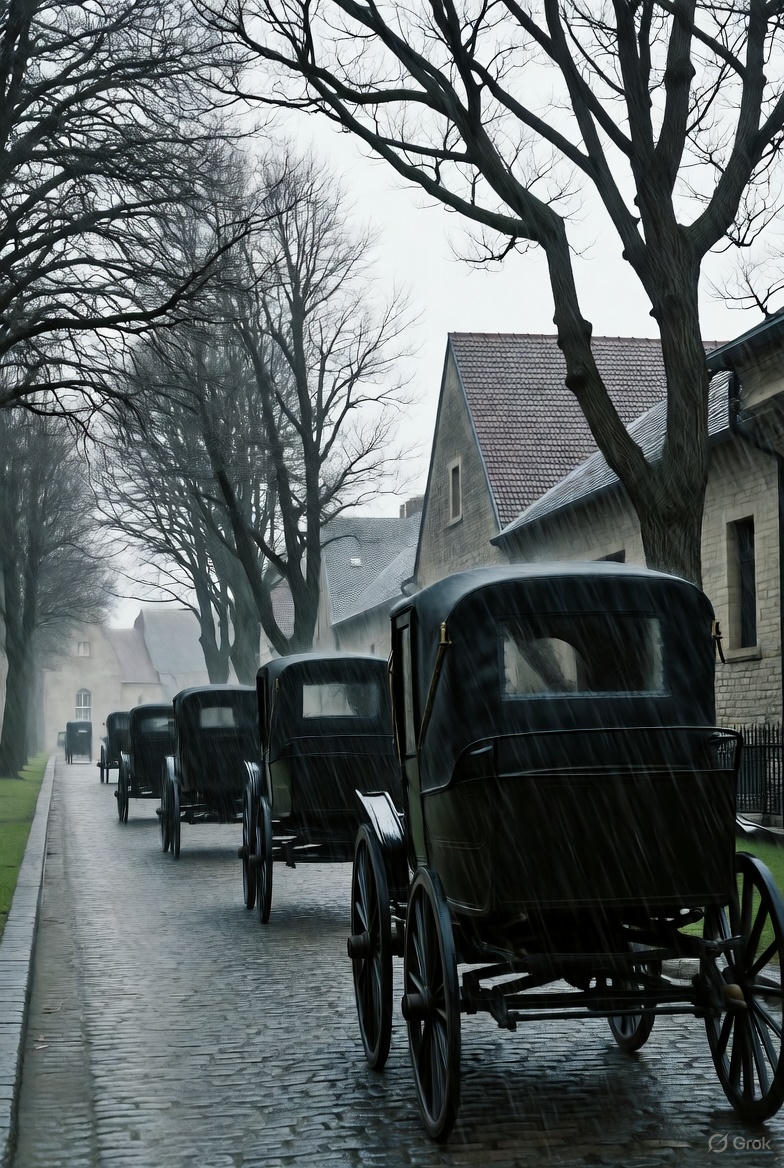
Carriages waited in the courtyard. They drove
slowly, brakes grinding, between bare chestnut trees
down the castle hill. The weather was unkind. A cold
November wind raged in the forested basin, plunging
from a gray sky, whipping rain showers. Castle
weathervanes shrieked, naked branches clashed.
The peasants stood before their houses, straining
to peer into the closed carriages. No cheers, no
greetings, nothing… they wore dark, hostile scowls.
“Your honeymoon’s to the south, naturally,” Hugo
said to Ruprecht.
“We’re not taking a honeymoon. We’re staying
home.”
“Oh!” Hugo pictured warm, cozy rooms, crackling
fires, shrieking weathervanes, humming teakettles,
and soft, flowing silk-and-lace nightgowns. Good
heavens!
Ruprecht sensed his friend’s envy. He felt it like a
cloud over the congregation in the church. The
guests’ strained postures, their polite smiles, were
mere grimaces, hiding nothing from him. Yet, from
this, he drew strength to prevail. Calmly, confidently
smiling, he led Helmina to the altar. She turned her
face to him. Her eyes shimmered with iridescent
brilliance. Oh, this danger—this wondrous, blissful,
sweet danger of the love-battle he was entering!
What is life without this danger?
The priest delivered his words, binding them in an
unbreakable union.
Then they received congratulations. First, Baron Kestelli, Helmina’s
witness, approached. His face was contorted. He
could say nothing.


Read Full Post »

Alraune by Hanns Heinz Ewers and translated by Joe E Bandel

But the overseer of the prison was not satisfied. “What! To the
commander? But Herr Doctor, you have no leave of absence to go
down to the city, and you still want to go to the commander?”
Frank Braun laughed, “Yes indeed. Straight to him! Namely, I
must go to the commander and pump some money out of him.”
The Sergeant-major didn’t say another word. He stood there not
moving with a wide-open mouth, completely petrified.
“Give me ten pennies, boy,” Frank Braun cried to his valet, “for
the toll bridge.”
He took the coins and went with quick strides across the yard,
into the officer’s garden and from there onto the slope leading up to
the ramparts. He swung up onto the wall, grabbed the bough of a
mighty ash tree on the other side and climbed down the trunk. Then
he pushed through the thick underbrush and climbed down the rocks.
In twenty minutes he was at the bottom.
It was the route they always took for their nightly escapades. He
went along the Rhine to the toll bridge and then across to Coblenz. He
learned where the commander lived and hurried there.
He showed the general the telegram and said that he came on
very urgent matters. The general let him in and he put the telegram
back in his pocket.
“How can I help you with this?”
Frank Braun said, “I need a leave of absence your Excellency. I
am a prisoner at the fortress.”
The old general stared at him unkindly, visibly annoyed at the
intrusion.
“What do you want? By the way, how did you get down into the
city? Do you have a pass?”
“Certainly, Your Excellency,” said Frank Braun. “I have church
leave.”
He lied, but knew very well the general only wanted an answer.
“I came to Your Excellency to ask for a three day pass. My uncle is in
Berlin and dying.”
The commander blurted out, “What is your uncle to me? It’s
entirely out of the question! You are not sitting up there at your
convenience. It’s because you have broken the law, do you
understand? Anyone could come to me with a dying uncle or aunt. If
it’s not at least a parent I deny such a pass strictly on principle.”
“I remain dutiful, your Excellency,” he replied. “I will inform
my uncle, his Excellency, the Privy Councilor ten Brinken,
immediately by telegraph that unfortunately his only nephew is not
allowed to hasten to his deathbed for his weary eyes to look upon.”
He bowed, turned toward the door, but the general held him back
as he had expected.
“Who is your uncle?” he asked in hesitation.
Frank Braun repeated the name and the beautiful title. Then he
took the telegram out of his pocket and handed it over.
“My poor uncle has one last chance for deliverance in Berlin but
unfortunately the operation is not successful very often.”
“Hmm,” said the commander. “Go my young friend. Go
immediately. Perhaps it will be helpful.”
Frank Braun made a face, lamented and said, “Only God knows–
Perhaps my prayers can do some good.”
He interrupted himself with a beautiful sigh and continued, “I
remain dutiful, your Excellency. There is just one other thing I have
to ask.”
The commander gave him the telegram back. “What?” he asked.
Frank Braun burst out, “I have no travel money. May I ask your
Excellency to loan me three hundred Marks.”
The general looked suspiciously at him. “No money–Hmm–so
no money either–But wasn’t yesterday the first? Didn’t your money
come?”
“My money came promptly, your Excellency,” he replied
quickly. “But it was gone just as quickly that night!”
The old commander laughed at that.
“Yes, yes. That is how you atone for your crimes, your
misdeeds! So you need three hundred Marks?”
“Yes, your Excellency! My uncle will certainly be very happy to
hear how you have helped me out of this predicament, if I am
permitted.”
The general turned, went to the writing desk, opened it and took
out three little pieces of paper and a moneybox. He gave the prisoner
quill and paper and told him what to write down on the receipt. Then
he gave him the money. Frank Braun took it with a light easy bow.
“I remain dutiful, your Excellency.”
“Think nothing of it,” said the commander. “Go there and come
back right away–Give my compliments to yours truly, his
Excellency.”
“Once again I remain dutiful, your Excellency.”
One last bow and he was outside. He sprang over the six front
steps in one leap and had to restrain himself not to shout out loud.
That was great!
He called a taxi to take him to the Ehrenbreitstein train station.
There he leafed through the departure times and found he still had
three hours to wait. He called to the valet that was waiting with his
suitcase and commanded him to quickly run over to the “Red Cock”
and bring back the ensign from Plessen.
“But bring the right one boy!” he said sharply. “The young
gentleman that just got here not to long ago, the one that wears No.
six on his back. The one that–Wait, your pennies have earned
interest.”
He threw him a ten Mark piece. Then he went into the wine
house, considered carefully, ordered a select supper and sat at the
window looking out at the Sunday citizens as they wandered along the
Rhine.
Finally the ensign came. “What’s up now?”
“Sit down,” said Frank Braun. “Shut up. Don’t ask. Eat, drink
and be merry!”
He gave him a hundred Mark bill. Pay my bill with this. You can
keep the rest–and tell them up there that I’ve gone to Berlin–with a
pass! I want the Sergeant-major to know that I will be back before the
end of the week.”
The blonde ensign stared at him in outright admiration, “Just tell
me–how did you do it?”
“My secret,” said Frank Braun. “But it wouldn’t do you any
good if I did tell you. His Excellency will only be good-natured
enough to fall for it once. Prosit!”
The ensign brought him to the train and handed his suitcase up to
him. Then he waved his hat and handkerchief.
Frank Braun stepped back from the window and forgot in that
same instant the little ensign, his co-prisoners and the fortress. He
spoke with the conductor, stretched out comfortably in his sleeper,
closed his eyes and went to sleep. The conductor had to shake him
very hard to wake him up.
“Where are we?” he asked drowsily.
“Almost to Friedrichstrasse station.”
He gathered his things together, climbed out and went to the
hotel. He got a room, bathed, changed clothes and then went down for
breakfast. He ran into Dr. Petersen at the door.
“Oh there you are dear Doctor! His Excellency will be
overjoyed!”
His Excellency! Again his Excellency! It sounded wrong to his
ears.
“How is my uncle?” he asked. “Better?”
“Better?” repeated the doctor. “What do you mean better? His
Excellency has not been sick!”
“Is that so,” said Frank Braun. “Not sick! That’s too bad. I
thought uncle was on his deathbed.”
Dr. Petersen looked at him very bewildered. “I don’t understand
at all–”
He interrupted him, “It’s not important. I am only sorry that the
Privy Counselor is not on his deathbed. That would have been so
nice! Then I would have inherited right? Unless he has disowned me.
That is also very possible–even more likely.”
He saw the bewildered doctor standing before him and fed on his
discomfort for a moment.
Then he continued, “But tell me doctor, since when has my uncle
been called his Excellency?”
“It’s been four days, the opportunity–”
He interrupted him, “Only four days! And how many years now
have you been with him–as his right hand?”
“Now that would be at least ten years now,” replied Dr. Petersen.
“And for ten years you have called him Privy Councilor and he
has replied back to you. But now in these four days he has become so
completely his Excellency to you that you can’t even think of him any
other way than in the third person?”
“Permit me, Herr Doctor,” said the assistant doctor, intimidated
and pleading. Permit me to–What do you mean anyway?”
But Frank Braun took him under the arm and led him to the
breakfast table.
“Oh, I know that you are a man of the world doctor! One with
form and manners–with an inborn instinct for proper behavior–I know
that–and now doctor, let’s have breakfast and you can tell me what
you have been up to in the meantime.”
Doctor Petersen gratefully sat down, thoroughly reconciled and
happy that was over with. This young attorney that he had known as a
young schoolboy was quite a windbag and a true hothead–but he was
the nephew–of his Excellency.
The assistant doctor was about thirty-six. He was average and
Frank Braun thought that everything about him was “average”. His
nose was not large or small. His features were not ugly or handsome.
He was not young anymore and yet he wasn’t old. The color
of his hair was exactly in the middle between dark and light. He
wasn’t stupid or brilliant either, not exactly boring and yet not
entertaining. His clothes were not elegant and yet not ordinary either.
He was a good “average” in all things and just the man the Privy
Councilor needed. He was a competent worker, intelligent enough to
grasp and do what was asked of him and yet not intelligent enough to
know everything about this colorful game his master played.
“By the way, how much does my uncle pay you?” Frank Braun
asked.
“Oh, not exactly splendid–but it is enough,” was the answer.
“I’m happy with it. At New Years I was given a four hundred Mark
raise.”
The doctor looked hungrily as the nephew began his breakfast
with fruit, eating an apple and a handful of cherries.
“What kind of cigars do you smoke?” the attorney inquired.
“What I smoke? Oh, an average kind–Not too strong–he
interrupted himself. But why do you ask doctor?”
“Only because,” said Frank Braun, “it interests me–But now tell
me what you have already done in these things. Has the Privy
Councilor shared his plans with you?”
“Certainly,” the doctor nodded proudly. “I am the only one that
knows–except for you of course. This effort is of the highest scientific
importance.”
The attorney cleared his throat, “Hmm–you think so?”
“Entirely without a doubt,” confirmed the doctor. “And his
Excellency is so extremely gifted to have thought it all out, taking
care of every possible problem ahead of time. You know how careful
you have to be these days. The foolish public is always attacking us
doctors for so many of our absolutely important experiments. Take
vivisection–God, the people become sick when they hear the word.
What about our experiments with germs, vaccines and so on? They
are all thorns in the eyes of the public even though we almost always
only work with animals. And now, this question of artificial
insemination of people–
His Excellency has found the only possibility in an executed
murderer and a paid prostitute. Even the people loving pastor would
not have much against it.”
“Yes, it is a splendid idea,” Frank Braun confirmed. “It is well
that you can recognize the capacity of your superior.”
Then Dr. Petersen reported how his Excellency had made several
attempts in Cologne with his help. Unfortunately they had not had any
success in finding an appropriate female. It turned out that these
creatures in this class of the population had very different ideas about
having to endure artificial insemination. It was nearly impossible to
talk to them about it at all, much less persuade one to actually do it. It
didn’t matter how eloquent his Excellency spoke or how hard he tried
to make them understand that it would not be dangerous at all; that
they would earn a nice piece of money and be doing the scientific
community a great service. One had screamed loudly that she would
rather service the entire scientific community–and made a very rude
gesture.
“Pfui!” Frank Braun said. “If only she could!”
It was a very good thing that his Excellency had the opportunity
to travel to Berlin for the Gynecological Conference. Here in the
metropolis there would no doubt be a much wider selection to choose
from. The women in question would not be as stupid as in the
province, would have less superstitious fear of the new and be more
open and practical regarding the money they could make and the
important service they could provide to the advancement of science.
“Especially the last!” Frank Braun emphasized.
Dr. Petersen obliged him with:
“It is unbelievable how old fashioned their ideas are in Cologne!
Every Guinea pig, yes, even every monkey is infinitely more
insightful and reasonable than those females. I almost lost my faith in
the towering intellect of humanity. I hope that here I can regain that
shaken belief and make it solid once more.”
“There is no doubt about it,” the attorney encouraged him. “It
would be a real shame indeed if Berlin’s prostitutes couldn’t do any
better than Guinea-pigs and monkeys!
By the way, when is my uncle coming? Is he up already?”
“Oh, he’s been up for a long time now,” declared the assistant
doctor zealously. “His Excellency left immediately. He had a ten
o’clock audience at the Ministry.”
“And after that?” Frank Braun asked.
“I don’t know how long it will last,” reasoned Doctor Petersen.
“In any case his Excellency requested I wait for him in the auditorium
at two o’clock. Then at five o’clock his Excellency has another
important meeting with a Berlin colleague here in the hotel and
around seven his Excellency is invited to eat with the university
president.
Herr Doctor, perhaps you could meet in between–”
Frank Braun considered. Basically he was in favor of his uncle
being occupied the entire day. Then his uncle wouldn’t be around to
interfere with his day.
I want you to deliver a message to my uncle,” he said. “Tell him
we will meet up downstairs in the hotel around eleven o’clock.”

Read Full Post »

Homo Sapiens: Under Way by Stanislaw Przybyszewski and translated by Joe E Bandel

XII.

Falk woke around noon. He couldn’t lift his head from the pillows; it was heavy like a lead ball, and sparkling sparks danced before his eyes. 

With difficulty he adjusted the pillows, finally sat up, and tried to fix an object in his gaze. 

It worked. 

But a terrible compulsion laid itself on his organism. He was as if hypnotized: he had to say something to Marit. 

What? 

He didn’t know. 

But it was something; he had to go to her at any price, he had to say something to her. 

With superhuman effort he crawled out of bed. Yes, he had to say something. 

He checked himself. 

That was certainly a compulsion. Yes. But still: he had to go to Marit. 

He stood up, but had to sit again. 

The soles touched the floorboards. A soothing, almost painful cold prickled through his body. 

Oh, how good that was! 

He needed a little more air, a little morning air. Yes, what time was it actually? 

“So late, so late; but it will probably be cool outside. Was there really a storm? or did he only dream it?” 

His clothes lay in a puddle of water on the floor. A great fear seized him. 

“No, no: Mother can’t have seen it, otherwise the things wouldn’t be lying here.” 

He felt stronger, went to the wardrobe and changed the suit. 

God, God, how his head hurt. With difficulty he dressed. 

Like a thief he crept to the door of the room his mother occupied. 

She wasn’t there! 

Falk breathed a sigh of relief. It hurt him. 

“Only say that one thing… say to Marit… then I’ll crawl back into bed… then I can be sick. But only say it.” 

He went out. 

When Marit saw him, she jumped up in alarm. Falk smiled forcedly. 

“No; it’s nothing; I only caught a little cold in the night. I have a little fever. By the way, I should have stayed home. But I absolutely had to come to you. I don’t know why. Just quickly give me some cognac…” 

He hastily drank a large glass of cognac. 

“You see; I got up; it was so terribly hard. But if I lay on my deathbed, I would have had to come to you. Oh: The cognac did very well. It lowers the temperature. That’s namely my standing phrase. I just don’t understand: why not lying?” 

Falk began to babble, but controlled himself again. Marit looked at him in horror. 

“No, no, leave me; you see, it’s so terribly uncanny what an animal such an overman is. For I am an overman. You understand that? There I suddenly get, probably in sleep, such inspirations. I wake: I know nothing of the whole story; I remember only the final result. No; I don’t remember; for I don’t know if I dreamed something similar; but I know that I had to come to you. I am sick; very sick. But I had to come to you.” 

Again his strength left him. 

He saw a fire-garland before his eyes, a reddish-green fire-garland; it split into seven lightnings and tore a willow apart. 

Marit stared at him, in growing despair. 

“Erik my God, what is it with you? You are sick—you must go home—oh God, God, why do you stare at me so horribly?” 

“No, just leave it. On the way stands a willow; it is split in two parts; when I went—to you—yes, to you—wasn’t I with you? Yes right: when I went to you, there I examined the willow and searched in the trunk for the thunderbolt. I always did that as a child.” 

A lightning, a thousand lightnings killed the little dove. 

“But what I wanted to say to you. For I must say something to you. Pour me more cognac.” 

“Erik, for heaven’s sake, you must go home! I will immediately have the carriage hitched. I will bring you home.” 

Marit ran out… 

“What he had to say… had to?!” 

Little dove and lightnings… then house, dream… life… destruction… Yes! Destruction! He—a hurricane—an overman—who strides over corpses—and begets life. 

Yes, yes: destroy… Destroy! 

A wild, jubilant cruelty grew up in him; a joyful, mad lust for torment. He had to see that! yes: that, how the frog writhed under his scalpel, how it slid up the four nails to the nail heads. Then cut out the heart… How it twitches on the table, how it jumps! 

Before Falk’s eyes the objects began to dance. Marit stood before him, ready for travel, in helpless fear. 

“Come, Erik; come! my only one, come!” She kissed his eyes. 

“Still… still once…” He begged like a small child. “Come now! Come, my sweet, only man you.” 

“No—still—let! I must say something to you. There sit down—opposite me—on the chair.” 

So, Marit, listen: I am not your husband at all, I am married. Yes, really: married. My wife is in Paris. Yes right: Fräulein Perier is my wife. She really is. Don’t you believe it? No, wait, my marriage contract… 

He began nervously searching in his pockets. Suddenly he came to his senses. 

He smiled idiotically. 

“No you, what black holes do you have in your head? You look like a skull. No, don’t look at me like that—don’t look at me—no, let—let—I go—I go.” 

Falk ducked in growing fear. 

“I go, I go already…” He whimpered like an animal, “I go—yes—yes…” 

He ran out. 

“No, get in here!” called the coachman. “I’ll drive you!” 

“Get in? Yes, get in…” Falk climbed into the carriage that was waiting. 

“Where is my hat? No, the hat isn’t there…” Falk held it in his hands… “But that’s strange! – –” 

Marit sat in the room with the hat on her head; she was completely paralyzed. 

There he drove, yes. Really? No. Yes; yes. Yes. 

Not a single thought! So she was dead. No, she dreamed. No, she didn’t dream. 

And again she saw clearly, as once before, Falk’s face: it bit her with sucking vampire eyes, it gnawed at her soul with grinning scorn… Liar… 

She knew, she saw it: now finally he had told the truth. So she sat probably an hour long. 

So he was married! 

“Married—” she repeated coldly and harshly. 

She felt how her interior froze to ice; everything crawled in her together to one point; the warmth ebbed and ebbed. Everything shrank to the one, small, tiny point: Married… 

She saw his uncannily glowing eyes. Her head grew confused. 

She jumped up.  

No, how could she have forgotten that! She quickly undressed; her gaze fell into the mirror. 

No, with the hat on her head she couldn’t possibly go to the kitchen; that would be droll. 

She smiled dully to herself. 

She went to the kitchen; bread was to be baked. She ordered it. 

She was active with feverish unrest. Then she came back to the room. 

Above the sofa hung a picture that consisted only of letters; there in such strange flourishes and with glaring Byzantine initials the Lord’s Prayer was printed. 

She examined it attentively. 

“How hideous this dragon around the U…” She read: And forgive us our sins… 

“No, wait, Marit…” She sat on the chair. 

“Yes, there sat Falk. Now he said…” 

Married! it sounded steel-hard in her ears. “Yes really: married to Fräulein Perier.” She went to the window and looked out. 

“How the day drags. Yes! until June 21 the days get longer.” 

She looked at the clock. It was five in the afternoon. 

Now the brother would soon come from gymnastics: she had to get him coffee. 

A carriage rolled into the yard… 

“You, Marit, Falk is terribly sick…” 

The brother told hastily, tumbling over himself… When Hans brought him home, he had to be lifted from the carriage; he couldn’t recognize any person. His mother cried terribly, and then came the district physician… 

“So, Falk is sick…” 

Marit wanted to tell the brother that Falk was married, but she controlled herself. 

Now his wife will come, and will nurse the poor, nicotine-poisoned man, and bear his moods like an angel… yes… 

She went up to her room. 

One should not disturb her; she would lie down a little to sleep… Falk is terribly sick… he had to be carried… his mother

cried… 

Marit walked restlessly back and forth… I must go to him… immediately… he will die. 

Her head was bursting; she grasped high with both hands. Married! Married! it droned continuously. 

“I will make you so happy, so happy, and will never leave you!” 

A weeping rage rose choking in her throat: God! God! How he had lied! 

And a shame and foaming indignation. 

Good Lord: had it really happened? Yes… oh yes… happiness. 

She felt how he gently rocked her body; back and forth. She felt his hot, greedy lips; on her whole body. She saw herself undressed; he embraced her… And from all corners hideous ghosts emerged, wild, laughing, distorted mask-faces that grinned at her and spat at her. 

She crawled into herself; she threw herself on the bed, buried herself in the pillows. 

With her own nails dig herself a grave! Oh shame… shame… On the misery of the human child the Madonna stared with stupid smile… 

It grew dusk… 

Beyond the lake the sun disappeared behind the peaks of the forest and poured blood-red lights over the treetops. 

Marit listened. 

She heard the clatter of the stork and the laughter of the maids who below in front of the house peeled potatoes for supper. 

Then she heard singing. It was her brother. Then she fell asleep…  

When she woke, it was night. 

She sat on the edge of the bed; thought. But the thoughts kept scattering. She stared thoughtlessly into the room. 

She was damned; cast out by God. Now everything was indifferent. Everything. 

She thought what might not be indifferent? No, there was nothing. 

“Falk is sick; but Falk betrayed her. He promised her happiness, endless happiness, and he was married. Now his wife comes and will nurse him; his Marit is damned. If she goes to him, she will be driven away. And then she will stand outside like a dog in the rain, crouched before the door. No, she had no right to him—nothing, nothing at all in the world. 

Now everything is gone. Father gone, mother gone; God doesn’t exist. Yes, Falk said that. Falk is right. Otherwise God couldn’t torment his child so terribly. Everything gone…” 

Finally she stood up. She made light; she wanted to arrange her hair. She stepped before the mirror. 

Oh God, how she looked… No, how thin; how thin… oh, it’s indifferent… 

The whole house slept. 

“The happiness… the endless happiness… Yes: he gave it to me…” She took hat and coat and went to the lake. 

She sat on the stone: “Cape of Good Hope” she had called it when she waited here day in, day out for Erik. 

In the forest opposite stood the little fisherman’s cottage. A light, a tiny dot, crawled out the window and sank strangely torn in the trembling waves of the lake… torn… 

She stared at the light and at the black water… How it pulled… how the water pulled at her… 

Everything, everything is indifferent. 

She was alone; no person her own. She was driven out into wind and weather like a dog before the door… 

Yes, now the wife comes; she takes him away; and I remain alone! Almighty, merciful God: alone… No, no, no! Enough! Finished! 

He drives away. No father. No mother. No God… 

Her fear grew and grew. She feverishly fumbled at her dress. Suddenly a terrible thought rose in her: 

The world is going under! Everything, everything will go under! The flood! 

She jumped up abruptly: 

There was a whirlpool… there it is deep… a farmhand drowned there last year… with both horses. 

She ran there. In her head it droned and roared. She saw nothing; she heard nothing. 

Something was in her that drove her. She only needed to run. She ran. “Yes, here!” 

“No, still the little bend there… there!” 

She screamed shrilly in the water… wildly… she struggled. Life! The whirlpool… Bliss…

XIII.

After a week Falk regained consciousness. At his bedside sat his wife, asleep. 

He was not at all astonished. He looked at her. 

It was her. 

He sank back into the pillows and closed his eyes. Now everything was good. A reddish fire-garland he suddenly saw, which split into seven lightnings; then he saw a willow by the road fall apart. Marit was probably dead. 

He fell asleep again.

End

Kongsvinger (Norway), June 1894.

Read Full Post »

Alraune by Hanns Heinz Ewers and translated by Joe E Bandel

Chapter Four
Gives the particulars of how they found Alraune’s mother

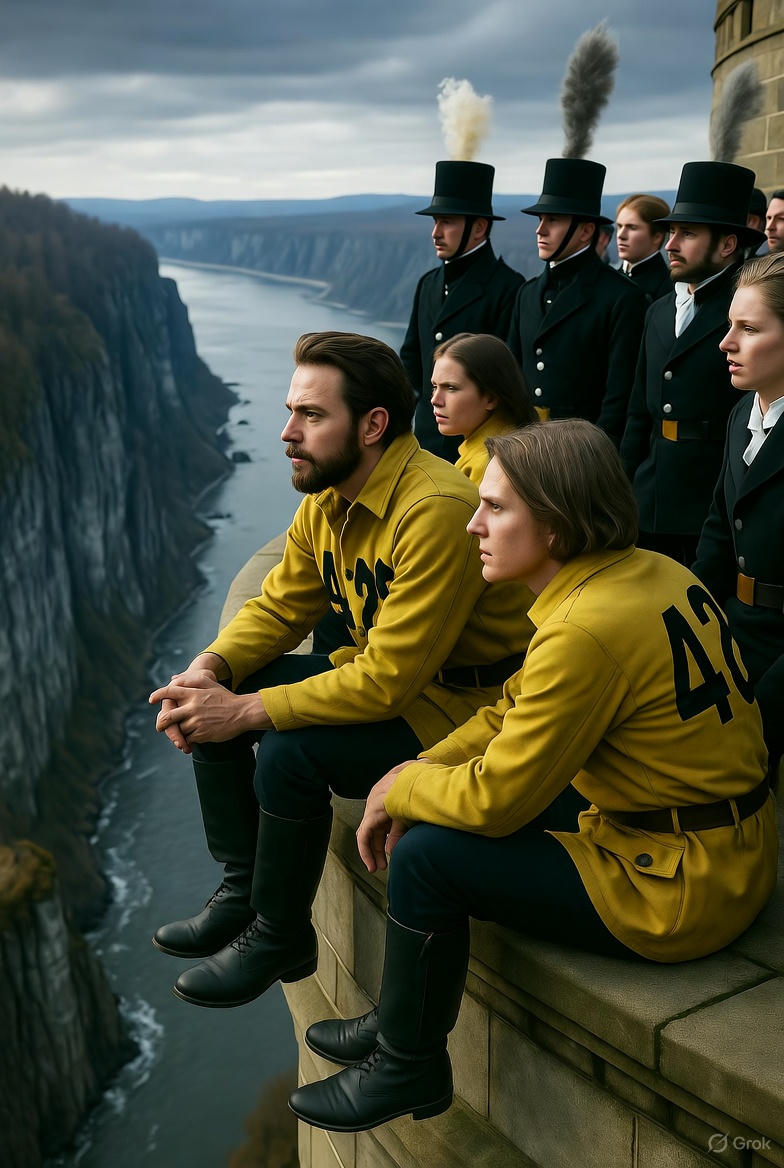
FRANK Braun sat above on the ramparts of Festung
Ehrenbreitstein, a fortified castle overlooking Koblentz. He
had sat there for two months already and still had three
more to sit, through the entire summer. Just because he had
shot a hole through the air, and through his opponent as well.
He was bored. He sat up high on the parapet of the tower, legs
dangling over the edge looking at the wide broad view of the Rhine
from the steep cliffs. He looked into the blue expanse and yawned,
exactly like his three comrades that sat next to him. No one spoke a
word.
They wore yellow canvas jackets that the soldiers had given
them. Their attendants had painted large black numbers on the backs
of their jackets to signify their cells. No.’s two, fourteen and six sat
there; Frank Braun wore the number seven.
Then a troop of foreigners came up into the tower, Englishmen
and Englishwomen led by the sergeant of the watch. He showed them
the poor prisoners with the large numbers sitting there so forlorn.
They were moved with sympathy and with “oohs” and “ahs” asked
the sergeant if they could give the miserable wretches anything.
“That is expressly forbidden,” he said. “I better not see any of
you doing it.”
But he had a big heart and turned his back as he explained the
region around them to the gentlemen.
“There is Koblenz,” he said, “and over there behind it is
Neuwied. Down there is the Rhine–”
Meanwhile the ladies had come up. The poor prisoner stretched
out his hands behind him, held them open right under his number.
Gold pieces, cigarettes and tobacco were dropped into them,
sometimes even a business card with an address.
That was the game Frank Braun had contrived and introduced up
here.
“That is a real disgrace,” said No. fourteen. It was the cavalry
captain, Baron Flechtheim.
“You are an idiot,” said Frank Braun. “What is disgraceful is that
we fancy ourselves so refined that we give everything to the petty
officers and don’t keep anything for ourselves. If only the damned
English cigarettes weren’t so perfumed.”
He inspected the loot.
“There! Another pound piece! The Sergeant will be very happy–
God, I made out well today!”
“How much did you lose yesterday?” asked No. two.
Frank Braun laughed, “Pah, everything I made the day before
plus a couple of blue notes. Fetch the executioner his block!”
No. six was a very young ensign, a young pasty faced boy that
looked like milk and blood. He sighed deeply.
“I too have lost everything.”
“So, do you think we did any better?” No. fourteen snarled at
him, “And to think those three scoundrels are now in Paris amusing
themselves with our money! How long do you think they will stay?”
Dr. Klaverjahn, marine doctor, fortress prisoner No. two said, “I
estimate three days. They can’t stay away any longer than that
without someone noticing. Besides, their money won’t last that long!”
They were speaking of No.’s four, five and twelve who had
heartily won last night, had early this morning climbed down the hill
and caught the early train to Paris–“R and R”–a little rest and
relaxation, is what they called it in the fortress.
“What will we do this afternoon?” No. fourteen asked.
“Will you just once think for yourself!” Frank Braun cried to the
cavalry captain.
He sprang down from the wall, went through the barracks into
the officer’s garden. He felt grumpy, whistled to get inside. Not
grumpy because he had lost the game, that happened to him often and
didn’t bother him at all. It was this deplorable sojourn up here, this
unbearable monotony.
Certainly the fortress confinement was light enough and none of
the gentlemen prisoners were ever injured or tormented. They even
had their own casino up here with a piano and a harmonium. There
were two dozen newspapers. Everyone had their own attendant and all
the cells were large rooms, almost halls, for which they paid the
government rent of a penny a day. They had meals sent up from the
best guesthouses in the city and their wine cellar was in excellent
condition.
If there was anything to find fault with, it was that you couldn’t
lock your room from the inside. That was the single point the
commander was very serious about. Once a suicide had occurred and
ever since any attempt to bring a bolt in brought severe punishment.
“It was idiotic thought,” Frank Braun, “as if you couldn’t commit
suicide without bolts on your door!”
The missing bolt pained him every day and ruined all the joy in it
by making it impossible to be alone in the fortress. He had shut his
door with rope and chain, put his bed and all the other furniture in
front of it. But it had been useless. After a war that lasted for hours
everything in his room was demolished and battered to pieces. The
entire company stood triumphant in the middle of his room.
Oh what a company! Every single one of them was a harmless,
kind and good-natured fellow. Every single one–to a man, could chat
by themselves for half an hour–But together, together they were
insufferable. Mostly, it was their comments, that they were all
depressed. This wild mixture of officers and students forgot their high
stations and always talked of the foolish happenings at the fortress.
They sang, they drank, they played. One day, one night, like all the
rest. In between were a few girls that they dragged up here and a few
outings down to the town below. Those were their heroic deeds and
they didn’t talk about anything else!
The ones that had been here the longest were the worst, entirely
depraved and caught up in this perpetual cycle. Dr. Burmüller had
shot his brother-in-law dead and had sat up here for two years now.
His neighbor, the Dragoon lieutenant, Baron von Vallendar had been
enjoying the good air up here for a half year longer than that. And the
new ones that came in, scarcely a week went by without them trying
to prove who was the crudest and wildest–They were held in highest
regard.
Frank Braun was held in high regard. He had locked up the piano
on the second day because he didn’t want to listen any more to the
horrible “Song of Spring” the cavalry captain kept playing. He put the
key in his pocket, went outside and then threw it over the fortress
wall. He had also brought his dueling pistols with him and shot them
all day long. He could guzzle and escape as well as anyone up here.
Really, he had enjoyed these summer months at the fortress. He
had dragged in a pile of books, a new writing quill and sheets of
writing paper, believing he could work here, looking forward to the
constraint of the solitude. But he hadn’t been able to open a book, had
not written one letter.
Instead he had been pulled into this wild childish whirlpool that
he loathed and went along with it day after day. He hated his
comrades–every single one of them–
His attendant came into the garden, saluted:
“Herr Doctor, A letter for you.”
A letter? On Sunday afternoon? He took it out of the soldier’s
hand. It was a special express letter that had been forwarded to him up
here. He recognized the thin scrawl of his uncle’s handwriting. From
him? What did his uncle suddenly want of him? He weighed the letter
in his hand.
Oh, he was tempted to send the letter back, “delivery refused”.
What was going on with the old professor anyway? Yes, the last time
he had seen him was when he had traveled back to Lendenich with
him after the celebration at the Gontrams. That was when he had tried
to persuade his uncle to create an alraune creature. That was two years
ago.
Ah, now it was all coming back to him! He had gone to a
different university, had passed his exams. Then he had sat in a hole
in Lorraine–busy as a junior attorney–Busy? Bah, he had set out in
life thinking he would travel when he got out of college. He was
popular with the women, and with those that loved a loose life and
wild ways. His superior viewed him very unfavorably.
Oh yes, he worked, a bit here and there–for himself. But it was
always what his superior called public nuisance cases. He sneaked
away when he could, traveled to Paris. It was better at the house on
Butte Sacrée than in court. He didn’t know for sure where it would all
lead. It was certain that he would never be a jurist, attorney, judge or
other public servant. But then, what should he do? He lived there, got
into more debt every day–
Now he held this letter in his hand and felt torn between ripping
it open and sending it back like it was as a late answer to a different
letter his uncle had written him two years ago.
It had been shortly after that night. He had ridden through the
village at midnight with five other students, back from an outing into
the seven mountains. On a sudden impulse he had invited them all to
a late midnight meal at the ten Brinken house.
They tore at the bell, yelled loudly and hammered against the
wrought iron door making such a noise that the entire village came
running out to see what was happening. The Privy Councilor was
away on a journey but the servant let them in on the nephew’s
command. The horses were taken to the stable and Frank Braun woke
the household, ordered them to prepare a great feast. Frank Braun
went into his uncle’s cellar and brought out the finest wines.
They feasted, drank and sang, roared through the house and
garden, made noises, howled and smashed things with their fists.
Early the next morning they rode home, bawling and screaming,
hanging on to their nags like wild cowboys, one or two flopping like
old meal sacks.
“The young gentlemen behaved like pigs,” reported Aloys to the
Privy Councilor. Yet, that wasn’t it. That wasn’t what had made his
uncle so angry. He didn’t say anything about it.
On the buffet there had been some rare apples, dew fresh
nectarines, pears and peaches out of his greenhouse. These precious
fruits had been picked with unspeakable care, wrapped in cotton and
laid on golden plates to ripen. But the students had no reverence at all
for the professor’s loves, were not respectful of anything that had
been there. They had bitten into these fruits, then because they were
not ripe, had put them back down on the plates. That was what he was
angry about.
He wrote his nephew an embittered letter requesting him to never
again set foot in his house. Frank Braun was just as deeply hurt over
the reason for the letter, which he perceived as pathetically petty.
Ah yes, if he had gotten this letter, the one he was now holding,
while living in Metz or even in Montmartre–he wouldn’t have
hesitated a second before giving it back to the messenger. But he was
here–here in this horrible boredom of the fortress.
He decided.
“It will be a diversion in any case,” he murmured as he opened
the letter.
His uncle shared with him that after careful consideration he was
willing to follow the suggestions his nephew had given him to the last
letter. He already had a suitable candidate for the father. The stay of
execution for the murderer Raul Noerrissen had been denied and he
had no further appeals possible. Now his uncle was looking for a
mother.
He had already made an attempt without success. Unfortunately
it was not easy to find just the right one but time pressed and he was
now asking for assistance in this matter from his nephew.
Frank Braun looked at his valet, “Is the letter courier still here?”
he asked.
“At your command Herr Doctor, ” the soldier informed him.
“Tell him to wait. Here give him some drink money.”
He searched in his pockets and found a Mark piece. Then he
hurried back to the prisoner’s quarters letter in hand. He had scarcely
arrived at the barracks courtyard when the wife of the Sergeant-major
came towards him with a dispatch.
“A telegram for you!” she cried.
It was from Dr. Petersen, the Privy Councilor’s assistant. It read:
“His Excellency has been at the Hotel de Rome in Berlin since
the day before yesterday. Await reply if you can meet. With heartfelt
greetings.”
His Excellency? So his uncle was now “ His Excellency” and
that was why he was in Berlin–In Berlin–that was too bad. He would
have much rather traveled to Paris. It would have been much easier to
find someone there and someone better as well. All the same, Berlin it
was. At least it would be an interruption of this wilderness.
He considered for a moment. He needed to leave this evening but
didn’t have a penny to his name and his comrades didn’t either. He
looked at the woman.
“Frau Sergeant-major–” he began. But no, that wouldn’t work.
He finished, “Buy the man a drink and put it on my tab.”
He went to his room, packed his suitcase and commanded the
boy to take it straight to the train station and wait for him there. Then
he went down. The Sergeant-major, the overseer of the prison house,
was standing in the door wringing his hands and almost broken up.
“You are about to leave, Herr Doctor,” he lamented, “and the
other three gentlemen are already gone to Paris, not even in this
country! Dear God, no good can come out of this. It will fall on me
alone–I carry all the responsibility.”
“It’s not that bad,” answered Frank Braun. “I’m only going to be
gone for a few days and the other gentlemen will be back soon.”
The Sergeant-major continued to complain, “It’s not my fault,
most certainly not! But the others are so jealous of me and today
Sergeant Bekker has the watch. He–”
“He will keep his mouth shut,” Frank Braun replied. “He just got
over thirty Marks from us–charitable donations from the English–By
the way, I’m going to the commander in Coblenz to ask for a leave of
absence–Are you satisfied now?”

Read Full Post »

Madame Bluebeard by Karl Hans Strobl and translated by Joe E Bandel

Chapter Four
After dinner, Ruprecht wandered into the castle
garden. Frau Helmina, weary, had asked to retire
early. But Ruprecht wasn’t sleepy. Everything in him
was alert, poised, expectant.
The autumn evening was cool, dry leaves rustling
on the paths. This old castle had its romance. It must
once have been vast, for the garden was laid over a
field of ruins. Crumbling walls enclosed it; fragments
of ramparts stood among trees and shrubs. Ruprecht
passed pointed door arches or windows framed by
massive stones, upright amid rubble heaps. Near one
wing, linked by a covered wooden passage, stood a
stout tower, less decayed than the rest. Squat and
solid, it rose in a small birch grove, their white trunks
like shivering skeletons. Ruprecht pushed to the
round tower wall, spotting high above a black
opening—one of those inaccessible tower doors
reachable only by ladder.
It wasn’t exactly cozy here. The waning moon’s
light was pale and mournful, shrinking shyly from
darker shadows. Squinting, leaving only a narrow
slit, it seemed as if everything—ruined walls, trees,
shrubs—swam in a phosphorescent haze, the air of a
distant, alien star.
Ruprecht thrust his hands into his pockets, puffed
his cigar, and turned back toward the castle. Yellow-
red lights glowed in a few windows. Perhaps one was
Helmina’s bedroom. Yes—it was time to clarify
everything. Ruprecht wasn’t one for lingering
indecision. He knew Helmina drew him like no
woman since… since that one—oh, enough! He
pushed back old, painful memories. What use were
they now? A decision was needed.
Let’s be honest, dear fellow, he told himself.
We’ve already decided. Helmina retired to give you
time to think. It’s superfluous. Tomorrow, I’ll ask her
to be my wife. Oh—how beautiful she is, how
dangerous. I readily believe she killed her three
husbands—the mountaineer, the stroke candidate, the
bookworm. Cripples of life, poor devils, no match for
this splendid beast. But we, Frau Helmina, we have
fists and teeth. I’m eager to show you, lovely lady.
She’s cruel as a tigress. How she dismissed that poor
baron today—one, two, three, a stab to the heart. No
sentimentality to fear from her. I doubt she has tear
ducts. At dinner tonight, for instance. I ask, “Baron
Kestelli’s your neighbor, isn’t he?” She replies, “Oh,
he passes my time now and then.” Her teeth flashed
like a toothpaste ad, her words dripping venomous
scorn, a ruthless slaughter. Oh… I believe her soul
has regions like… like this garden—dark, filled with
secrets, whispering shadows, perhaps ruins of the
past. Let’s enter this garden… something new
awaits.*
His cigar had gone out. Striking a match, he saw
his cupped hands, shielding the flame, glow red
briefly, then darkness returned. Only the cigar’s
ember pulsed near his mouth. He walked slowly to
the castle, climbed the narrow, winding stair to his
room, and began undressing. Both windows stood
open. As he was about to lie down, a strange howling
began—starting low, rising to a high, thin quiver, like
vocal cords stretched to their limit. It was followed
by empty jabbering, clearly a prayer, words hopping
like peas on tin. Ruprecht peered out. In the servants’
wing below, a lit room glowed. Leaning forward, he
glimpsed part of it. A woman with gray, tangled hair
knelt at a table, head pressed to its edge. The
jabbering and clattering gave way to howling, now
weaving through varied modulations. Ruprecht found
it intriguing but unsettling. It didn’t last. Footsteps
crossed the courtyard. A broad back blocked the
window. “This whining again?” growled a muffled
bear’s voice. It was Lorenz, the robust valet, a mix of
sailor and masseur. A window slammed, glass
rattling.
Ruprecht withdrew. The castle fell silent, and
sleep drifted from the ceiling’s beams and the thick
Persian prayer rugs on the walls.
In the morning, Ruprecht met the castle’s mistress
in the breakfast room. The balcony door was open, a
crisp breeze wafting from the steaming meadows
around the castle. Mist prickled damply on the skin.
From the balcony, one looked down on the courtyard,
the ancient linden, and beyond the castle wall, the
chestnut treetops lining the path in double rows.
Helmina wore a wide kimono of green silk,
adorned not lavishly but tastefully with gold
embroidery. Ruprecht loved such loose, comfortable
garments. He smiled. As if she knew, he thought.
“How did you sleep?” Helmina asked.
“So well, I wish I could always sleep somewhere
not too far from you.” Ruprecht looked straight at
her. She lowered her eyes, but not fast enough to hide
a glint of triumph. No doubt—she reveled in her
victory.
“I hear,” Helmina said after a brief pause,
preserving the weight of his words, “our old
Marianne had another fit last night. I hope it didn’t
disturb you too long. I can’t turn the old woman out.
She’s served me for years. Some religious mania
grips her. She must atone for our sins, so she prays
and sings in the night.”
“Nothing could spoil my stay with you.”
Helmina raised her head. Morning sunlight, soft
and golden, slid across her brow. “Thank you for
your kindness, Herr von Boschan. But please, no
such talk before others. Young widows are too easily
slandered.”
“Listen, madam, I’m independent. My wealth lets
me live as I please. I’ve no relatives, no one with
claims on me.”
With soft steps, Helmina moved to the balcony.
Ruprecht followed. They sat in low, deeply curved
wicker chairs, facing each other. Helmina leaned
back, hands clasped behind her head. “Why tell me
this, Herr von Boschan?” she asked. Her mouth
twitched with lively muscle play, shifting its
expression constantly.
“Can’t you guess?”
“Let me tell you something: I’ve been married
three times.”
“I hope that won’t stop you from trying a fourth.”
“I know you’re restless. You’ve traveled far.
Soon, that urge will return. You’ll want to leave,
unhappy if you can’t. I’m quite comfortable,
disinclined to great exertions.”
“That’s your guarantee. I’m done with it. I want to
take root somewhere. Have a purpose. The land calls
to hold me fast. I regret selling my estates when I set
out to see the world—a castle in Styria, a farm in
Upper Austria. Now my wealth sits in a bank. I’d be
happy to become a farmer again.”
“Oh! You’d have to forgo living on your estates. I
can’t leave this old nest.”
Ruprecht took her hand. “That’s half a yes,
Helmina,” he said.
“Take it as a full one, Ruprecht,” she replied. She
rose, and he stood too. They faced each other, chest
to chest. “I’m young. I’m tired of widowhood.” Her
eyes burned. He raised his arms, embraced her, and
kissed her. They trembled with fierce desire.
Two children’s voices squealed in the courtyard.
“Mama!” Lissy called.
Helmina leaned over the balcony railing. “Come
up,” she said. “You’ll find the Papa you wished for.”
Ruprecht settled into his new role with happy
ease, noting without regret that he was engaged.
Sometimes he smiled, imagining his friends’
reactions. They’d soon be surprised. In a month,
Helmina’s mourning year would end, and the
wedding would proceed without delay.
Helmina allowed Ruprecht only eight more days
at the castle. Propriety demanded the groom be kept
from the bride. Jana, his Malay servant, was
summoned from Vienna with suitcases. During those
days, Ruprecht rode with Helmina across the fields.
He found them poorly managed—much work needed
here. He resolved to oversee it himself. “What do you
expect?” Helmina laughed. “My stewards are useless.
I know it. They’re all too in love with me to run my
estate properly.”
She was right. Her stewards fumed seeing her with
Ruprecht, even before learning he was her fiancé.
The paper factory clerks glared too. Ruprecht was the
intruder, shattering a host of rapturous hopes. Despite
Helmina’s ban, news of her engagement leaked from
the castle, turning anger into silent, envious hatred.
The day before his departure, returning from a
morning forest walk, Ruprecht found Baron Kestelli
with Helmina. His entrance cut their talk short. The
baron rose, bowed to Ruprecht, and left. His face
showed he couldn’t bear the groom’s presence.
“He must be deeply in love,” Ruprecht said,
unable to suppress the victor’s thrill, despite a twinge
of pity for the young man. “He looks tortured, unable
to control himself.”

Read Full Post »

Homo Sapiens: Under Way by Stanislaw Przybyszewski and translated by Joe E Bandel

“Doesn’t she have a lampshade? He couldn’t stand the brutal light.” 

Marit brought the shade. 

The conversation kept stalling. 

“You mustn’t mind, Marit, if I stay longer with you today. I can’t sleep anyway; and then, you know, when I am so alone… hm… I don’t disturb you?” 

Marit’s face colored with hectic red. She couldn’t speak; she only nodded to him. 

They sat silently for a while. The whole village slept. The big house was as if extinct. The servants had already gone to rest. The sultriness was almost unbearable. A stuffy calm weighed on both, the dull air outside pressed into the room, and the regular ticking of the clock caused almost physical pain. 

“It’s strange how lonely one is here; it’s uncanny. Don’t you sometimes have fear when you are so completely alone in this big house?” 

“Oh yes, I feel it terribly strongly. Sometimes I feel so lonely and abandoned here, as if I were completely alone in the world. Then I get such a horrible fear that I want to bury myself in the earth.” 

“But today you don’t feel abandoned?” “No!” 

Again a pause occurred; a long, heavy-breathing pause. 

“Listen, Marit, do you still have the poems I wrote for you last spring? I would so like to read them again.” 

“Yes, I have them in my room; I will fetch them immediately.” 

“No, Marit; I will go up with you. It is much cozier in your room; so wonderfully cozy. Here it is so uncanny, and I, you see, am very, very nervous.” 

“Yes, but someone could hear that you go with me; that would be terrible for me.” 

“Oh, he would go quite quietly, quite softly; no person should hear him. Besides, the whole house is asleep.” 

She still resisted. 

“Sweet little dove, you really need have no fear. I will do nothing to you—nothing, nothing at all. I will sit quietly beside you and read the poems.” 

It thundered. 

“Yes, quite quietly; and when the storm is over, I will go home calmly…” 

They entered Marit’s room; they felt as if rooted to the spot. There was an atmosphere between them that seemed to live. 

Suddenly Marit felt herself embraced by him. Before her eyes fiery bubbles swirled, again she saw the hot jubilation dancing over the abyss, she wove her arms around him and plunged headlong into the gruesome happiness. 

Suddenly she started up. 

“No, Erik! only not that… Erik, no! No!” She gasped. 

Falk let her go. 

He mastered himself with difficulty. A long pause. 

“Listen, Marit—” his voice sounded rough and hard—”now we must part. You see, you are cowardly. You are a little dove, a rabbit; and I am a good man. I am the good, dear Erik. Well, Marit, you don’t have the courage to say to me: Go, leave me my pure conscience, leave me the idiotic virginity. You don’t have this courage. Well, I am a man; and so I go; let come what will.” 

“Yes, I go. I leave you your morality, I leave you your religious conscience, I leave you your virginity, and spare you the so-called sin. Now be happy; very, very happy…” 

The storm grew louder; in the window green furrows of lightning were seen. 

Falk turned to the door. 

“Erik, Erik, how can you be so cruel, so bestially cruel?!” 

The whole laboriously suppressed misery of her soul broke forth. She writhed in pain. 

“Erik! Erik!” she whimpered. 

Falk got a mad fear. 

He ran to her, took the twitching girl’s body in his arms. 

“No, Marit, no; it’s madness. I stay with you. I will never leave you. I can’t go away from you. You see, I thought I could. But I can’t. I must be with you; I must. I will never leave you. No, Marit; you my only happiness.” 

The thunder rolled ever closer. 

“I stay always with you. Always. Eternally. You are my wife, my bride, everything, everything.” 

A wild passion began to whirl in his head. 

And he rocked her in his arms back and forth and spoke incessantly of the great happiness, and forgot everything. 

“Yes, I will make you happy… so happy… so happy…” A cloudburst wave splashed against the windowpanes. 

Now they were really alone in the world. The rain, the lightning fenced them in. 

Marit embraced him. 

“Erik, how good, how good you are! Yes: not away! We stay always together. We will be so happy.” 

“We stay always together!” repeated Falk, as if absent. Suddenly he came to his senses. Again he felt the hard, cruel

in himself, the stone that falls into abysses. He pressed her tighter and tighter. 

They heard not the thundering, saw not the fire of heaven. Everything spun, everything melted into a great, dancing fireball. 

Falk took her… 

The storm seemed to want to move away. It was three in the morning. 

“Now you must go!” “Yes.” 

“But not on the country road. You must go along the lake and then climb over the monastery fence. Otherwise someone could see you, and tomorrow the whole town would talk about it.” 

When Falk came to the lake, a new storm drew up. 

He should actually take shelter somewhere. But he had no energy for it. Besides, it was indifferent whether he got a little wet. 

The sky covered itself with thick clouds; the clouds balled together visibly into black, hanging masses. 

A long, crashing thunder followed a lightning that tore the whole sky apart like a glowing trench. 

Again a lightning and thunder, and then a downpour like a cloudburst. 

In a moment Falk felt streams of water shooting over his body. But it was no particularly unpleasant feeling. 

Suddenly he saw an enormous fire-garland spray from the cloud heap; he saw it split into seven lightnings and in the same moment a willow stand in flames from top to bottom. It was torn from top to bottom and fell apart. 

“Life and destruction!” 

The shock had roused his logic; he also had to calm the fear-feeling that wanted to rise in him again. 

“Yes, of course, hm: destruction must be. Marit… Yes… destroyed…” 

Falk suddenly had this clear, lightning-bright, visionary consciousness that he had destroyed Marit. 

“Why not? I am nature and destroy and give life. I stride over a thousand corpses: because I must! And I beget life upon life: because I must! 

I am not I. I am You—God, world, nature—or what you are, you eternal idiocy, eternal mockery. 

I am no human. I am the overman: conscienceless, cruel, splendid and kind. I am nature: I have no conscience, she has none… I have no mercy, she has none…” 

“Yes: the overman am I.” Falk screamed the words. 

And he saw himself as the deadly fire-garland that had sprayed from the black vault: into seven lightnings he had split and torn a little dove by the wayside. Into a thousand lightnings he must still split and tear a thousand little doves, a thousand rabbits, and thus he would go eternally and beget and kill. 

Because it is necessary. Because I must. 

Because my instincts want it. 

Because I am a non-I, an overman. Does one need to torment oneself for that? Ridiculous! 

Does the lightning know why it kills? And has it reason, can it direct its lust? 

No! Only constate that it struck there and there. Yes: constate, protocol—like you want, Herr X. 

And I constate and protocol that today I killed a little dove… 

The atmosphere was so overloaded with electricity that around him a sea of fire seemed to sway. 

And he walked, enveloped in the wild storm; he walked and brooded. 

And in the middle of this wrath of heaven he himself walked as a wrathful, uncanny power, a Satan sent to earth with a hell of torments to sow new creative destruction over it. 

Suddenly he stopped before the ravine. 

It was completely filled with water. A torrent seemed to have sprung up and streamed rushing to the lake. 

He couldn’t go around it; there he would come to the cursed country road. 

Besides, it’s indifferent: a bit more water, a bit more chills and fever: no, that does nothing. 

That does nothing at all. Everything is indifferent; quite, quite indifferent. 

And he waded through the torrent. 

The water reached above his knees. 

When Falk came home and lay down in bed, he fell into a violent delirium; all night he lay and tossed back and forth in the wildest fever phantasies.

Read Full Post »

Madame Bluebeard by Karl Hans Strobl and translated by Joe E Bandel

Third Chapter
The Lower Austrian Waldviertel is for the
contemplative. It offers no surprises for restless
travelers who need a new sensation at every bend to
stave off boredom. One shouldn’t expect the dramatic
tension of towering rock formations, soaring peaks,
or dark gorges, nor the infinite feelings stirred by the
sea. But it holds a wealth of subtle, enchanting
beauties—the grace of gently rolling forested hills,
the charm of winding rivers dotted with ancient
castles and small towns, dusty and seemingly
forgotten by history.
A railway runs through the Kremstal. Every half-
hour, the train stops, huffs briefly, disgorges a few
passengers who disembark slowly, dawdle across the
platform, and drift into the dusty towns.
Ruprecht von Boschan stood on a forested hill,
gazing into the valley where a little train was stirring
again, groaning as if pleading for pity. He sought a
phrase for this landscape. “It sings the green forest
tune,” he thought. “It’s like a folk song—intimate, as
if known forever. You hear a heart beating.” He
turned from the clearing he’d entered and continued
through the woods. He wore tourist garb. “For I am a
seeker,” he said to himself, “a seeker with staff in
hand.”
With this staff, he occasionally struck tree trunks,
the sound echoing through the forest. He loved such
noises—trees calling to one another, the echo racing
deeper into the green darkness. From time to time, he
pulled out his map to check his route.
Ahead walked a peasant.
“Hey, cousin!” Ruprecht called. The man didn’t
turn. After a while, Ruprecht caught up. “Hey,
cousin!” he said again. “Heading to Vorderschluder?”
When the peasant still didn’t reply, Ruprecht
bellowed, “Are you deaf?”
The man looked at him. “No need to shout,” he
said with a faint dialect twang. “I hear you fine. I just
don’t always fancy answering. In the woods, I prefer
my own company.”
A peculiar one, Ruprecht thought. The man’s
appearance was odd too. His head and stocky peasant
frame didn’t match. That wasn’t a peasant’s face,
with its sharp nose, shrewd eyes, and curious French-
style mustache. A resemblance to Napoleon III made
Ruprecht smile. But the eyes were sky-blue. A
Napoleonic head with blue eyes on a peasant body—
nature loves its grotesque games, he concluded.
“You could be alone if you wanted,” Ruprecht
said.
They walked on silently. After a while, the peasant
spoke, having covertly studied Ruprecht from the
side. Ruprecht had passed muster, deemed worthy of
conversation. Was he going to Vorderschluder, and
what was his business there?
“Just a tourist,” Ruprecht said. “Here for the
scenery.”
“Aye, we’ve got scenery,” the man said, pointing
his pipe stem ahead, where a tower and a fiery red
church roof peeked through a gap in the trees,
vanishing behind the green forest wall. “There’s the
village.”
What’s the village like? Ruprecht asked.
Just a village, like any other.
Nothing special?
What’s special? A castle, a factory, that’s it.
Who owns the castle?
Frau Dankwardt. Now Ruprecht had reached his
goal. He’d hidden his purpose for visiting
Vorderschluder to learn more. But here, progress
stalled. A barrier seemed to rise. When he asked who
Frau Dankwardt was, a wary glance met him. The
peasant puffed furiously on his long-cold pipe, then
produced a tobacco pouch and an ancient lighter,
restuffing and relighting it. “Well, then!” he muttered
into the first blue clouds.
From his experience with peasants, Ruprecht
deduced Frau Dankwardt wasn’t much loved in the
village.
“Know her, maybe?” the man asked, peering
through his pipe smoke with eyes like blue sky
behind clouds.
Time to lie. “No,” Ruprecht said.
“Well… she’s beautiful, mind. Very fine. Plenty
fell for her. Her three men were fools for her. The
factory clerks, too—all of ’em—and that Baron
Kestelli rides over from Rotbirnbach every other day.
Right beautiful.”
Ruprecht, who’d built an altar to her beauty,
worshipping in awe, knew this best. He understood
why men loved her. But he wanted the “but” lurking
behind the praise.
“But…” the peasant continued after a silent puff,
“she’s no good soul. Not that she skips church—she’s
there every Sunday. Gives the priest money for the
poor at Christmas, too. But it’s all show. No one
trusts her. I’d not want her as my wife.”
Ruprecht smiled, picturing this Napoleonic
peasant beside the lovely, lithe, witty woman, but
stifled it to avoid suspicion. “Why not?” he asked
innocently.
“Well…” Three large blue-gray smoke balls
drifted from the peasant’s mouth corner. “Stay
longer, and you’d know.”
Fair enough—hard to dispute.
“They say she’s a trud,” the man said. “You know,
a witch who comes at night, sucking folks’ blood.
Nonsense, no such thing. Though Maradi, the
Weißenstein innkeeper, swears he saw her naked in
the woods one night, like witches are. But Maradi
also saw a water sprite once… turned out to be an
otter. Still, it’s true her men had no good life with
her. The last, Herr Dankwardt, such a fine man—
quiet, decent, all for books and family. A model for
anyone. The first two were good men, too. And she
killed all three…”
He stopped, startled at confiding so much to a
stranger. The word seemed cloaked in a red, bloody
mantle, hovering before them like an ominous bird.
“Killed?” Ruprecht asked, uneasy, struck by the
man’s convinced tone.
The peasant smoked like an engine hauling a fleet
of wagons. “Well, aye,” he muttered in the cloud.
“Folks talk… not meant like that. She drove her men
to death with endless nagging and strife, that’s what’s
meant. The first fled to Tyrol, never returned. The
second had a stroke after a row. The third, he took it
all so hard, he wasted away, like he was draining
out… always headaches, then suddenly dead. That’s
how it was.”
The men emerged from the woods, the village
below. Across the river, spanned by an old stone
bridge, stood the castle, aloof from the village houses
like a lord keeping the rabble at bay. On one side, just
below the last houses, squatted the square, ugly,
yellow paper factory. Forested hills ringed a basin, its
floor traced by a silver snake of a river. The basin
brimmed with sunlight, the rustle of hillside woods,
and a hum from the village.
“Well, goodbye!” the peasant said. “You head to
the village; I’m over there. My cottage’s by the
woods. I’m Rotrehl, the violin-maker, so you know,
if you ever want a fine fiddle. My violins are right
famous.” His blue eyes gleamed with an artist’s
pride.
“Rotrehl?” Ruprecht said. “Tell me, wasn’t there
once a Frenchman in your family?”
A solemn smile spread across the violin-maker’s
face. “Aha… you mean the resemblance! You think
so too? Yes, everyone says it!” He stroked his French
mustache. “A Frenchman? Frenchmen passed
through here once. Must be nigh on a hundred years
ago… it’s in my books. I do look like Napoleon,
don’t I? In the village, they call me ‘Krampulljon’—
the fools don’t know better. So, goodbye!” With that,
he turned to go, but after a few steps, glanced back.
“Head to the Red Ox in the village. They’ve got wine
worth drinking.” It was his thanks for Ruprecht
noting the likeness.
Ruprecht did stop at the Red Ox, finding a warm-
hearted landlady who served him a slice of sausage
and a glass of wine with a smile that could make even
a poor vintage palatable. Fortified, he crossed the
stone bridge. Four baroque barons, two at each end,
gazed down at him. He whistled a tune, passing
between them, and climbed toward the castle. Its
massive gate bore a wooden snout above the arch.
The structure showed its modern walls grafted onto
ancient ruins. The courtyard blended old and new—
Romanesque double windows in the upper story
contrasted with contemporary renovations. A fine,
ancient linden shaded a well; beneath it, a bright
dress. Ruprecht’s heart raced. But it was only Miss
Nelson, the governess.
As he approached, hat in hand, two little girls
rushed over, clinging to him. Touched, he realized
they recognized him, remembered him. He lifted and
kissed them.
Had he stayed long in Abbazia, they asked, and
what had he done since? They’d often told Mama
about him.
Hoisting three-year-old Lissy onto his shoulder,
Ruprecht danced in a circle, singing to a childish
melody:
“Ha! Ha! Ha! Where’s your Mama? Isn’t your
Mama here? Ha! Ha! Ha!”
“Yes… Mama’s gone out,” five-year-old Nelly
answered for her giggling sister. “She’s with Uncle
Norbert in the carriage. But we can meet her—I
know the way she’ll return.”
“Hurrah, we’ll meet her! Just us three! Miss must
stay home.”
The governess protested it was too much trouble
for Herr von Boschan. Overruled, she was hissed at
and forcibly reseated by the girls. Straw hats were
donned, and with Uncle Ruprecht between them, they
descended the castle hill. They ran to the brook,
where Ruprecht feigned plunging into the water. The
girls squealed, but he halted, tucked one under each
arm, and leapt across. What an adventure! On the
meadow, they raced on, heedless of shoes squelching
in mud. At the forest’s edge, they stopped, laughing,
flushed, and took the footpath to the road curving
around a wooded hill to the river bridge.
“Who’s Mama with? Oh, Uncle Norbert! What
kind of uncle is he?” Ruprecht felt a twinge of shame,
prying through the girls, but he needed to know his
rival.
Nelly’s blonde head pondered. “Uncle Norbert…
he’s a baron uncle…”
Kestelli, Ruprecht thought. “Do you love Uncle
Norbert dearly?” he pressed.
Both girls chimed in unison, “No—not at all!”
“Why not?”
“He never plays with us,” they said. “He ignores
us, just makes big eyes at Mama, like he wants to eat
her.”
Let’s arm for battle with this Kestelli, Ruprecht
vowed. He won’t devour your Mama.
They hadn’t gone far when Frau Dankwardt’s
carriage rounded the bend. “Mama! Mama!” the girls
cried. Ruprecht stood roadside, waving his hat.
“My God, it’s you—how lovely!” Frau Dankwardt
said, leaning over the carriage door to offer her hand.
Her eyes said: You found me? I know you’ve been
searching. Ruprecht kissed her gray glove. That scent
again—rotting fruit, hay, drying blood. That
bewildering, dangerous aroma. He had to stay
composed, cautious, treading a narrow ledge above
an abyss, pulled by a thousand sacred-unholy forces.
“I was wandering near your castle,” he said. “It’s a
magnet mountain, drawing my ship.”
A veiled homage.
Frau Dankwardt introduced them. To Baron
Kestelli’s name, she added, “A good acquaintance!”
Ruprecht called himself, “An old friend!” An old
friend trumps a good acquaintance, he thought. Let’s
see, Baron, let’s see.
They climbed in. Ruprecht sat opposite Frau
Dankwardt, Lissy on his lap. Nelly perched on the
driver’s seat. In a surge of joy, Ruprecht felt every
pulse of energy alive within him. He recounted his
doings since Abbazia—business matters first, as his
long travels had left urgent cases with his lawyer. Old
friends needed signs of life. Finally, he’d felt the urge
to refresh himself with an autumnal hike. Sitting still
wasn’t for him; limbs needed stirring.
Frau Helmina’s eyes, fixed on his face, repeated: I
understand—you’ve always sought me.
Meanwhile, Baron Kestelli felt a fist at his throat.
A wild chant roared in his head: A bond, surely; this
man aims to displace me.
At the castle courtyard, Ruprecht leapt out,
helping Helmina down. Miss Nelson rustled over in
black silk, taking the girls. While Helmina spoke
with her, Ruprecht turned to the baron. God—this
callow youth with sparse white-blonde hair on a long
skull, wrinkled yellow skin at the nape! High-born,
clearly, but utterly insignificant. He won’t devour
Frau Helmina.
They exchanged pleasantries.
“You’re my guest, of course,” Helmina said to
Boschan. “No fuss.”
Ruprecht made none. “I expected no less,” he said,
“…among such dear old friends…” He smiled.
Helmina smiled. Their gazes locked. The baron
paled.
“You may use my carriage, Herr Baron,” Helmina
said. “Your coachman’s late again, as usual.
Goodbye! Come, Herr von Boschan. The valet will
show you to your rooms.”
Alone with the girls and Miss Nelson, Helmina
knelt, pulling Lissy between her knees. Nelly leaned
on her shoulder. “Tell me,” she asked, “would you
like a new Papa?”
“Oh, yes!” Lissy cried eagerly, but Nelly said
thoughtfully, “Not Uncle Norbert!”
“Who, then?”
“Uncle Ruprecht!” Lissy and Nelly shouted
together.
Helmina turned to the governess. “Hear what the
children say!”

Read Full Post »

Alraune by Hanns Heinz Ewers and translated by Joe E Bandel

You know better than I what happens then, how to bring about
with humans what you have already done with monkeys and guinea
pigs. Get everything ready, ready for the moment when the
murderer’s bleeding head springs into the basket!”
He jumped up, leaned over the table, looked across at his uncle
with intense forceful eyes. The Privy Councilor caught his gaze,
parried it with a squint like a curved dirty scimitar parries a supple
foil.
“What then nephew?” he said. “And then after the child comes
into the world? What then?”
The student hesitated, his words dripped slowly, falling, “Then–
we–will–have–a–magickal–creature.”
His voice swung lightly, yielding and reverberating like musical
tones.
“Then we will see what truth there is in the old legend, get a
glimpse into the deepest bowels of nature.”
The Privy Councilor opened his lips to speak but Frank Braun
wouldn’t let him get a word in.
“Then we can prove whether there is something, some
mysterious power that is stronger than all the laws of science that we
know. We can prove whether this life is worth the trouble to live–
especially for us.”
“Especially for us?” the professor repeated.
Frank Braun said, “Yes Uncle Jakob–especially for us! For you
and for me–and the few hundred other people that stand as Masters
over their lives–and then prove it even for the enslaved, the ones on
the street, for the rest of the herd.”
Then suddenly, abruptly, he asked, “Uncle Jakob, do you believe
in God?”
The Privy Councilor clicked his lips impatiently, “Do I believe in
God? What does that have to do with it?”
But his nephew pressed him, wouldn’t let him brush it away,
“Answer me Uncle Jakob, answer. Do you believe in God?”
He bent down closer to the old man, held him fast in his gaze.
The Privy Councilor said, “What do you mean boy? According
to the understanding that everyone else uses, what I recognize as true
and believe is most certainly not God. There is only a feeling–but that
feeling is so uncontrollable, something so–”
“Yes, yes, uncle,” cried the student. “What about this feeling?”
The professor resisted like always, moved back and forth in his
chair.
“Well, if I must speak candidly–there are times–very rare–with
long stretches in between–”
Frank Braun cried, “You believe–You do believe in God! Oh, I
knew it! All the Brinkens do–all of them up to you.”
He threw up his head, raised his lips high showing rows of
smooth shiny teeth, and pushed out every word forcefully.
“Then you will do it Uncle Jakob. Then you must do it and I
don’t need to speak with you any more about it. It is something that
has been given to you, one out of a million people. It is possible for
you–possible for you to play at being God!
If your God is real and lives he must answer you for your
impertinence, for daring to do such a thing!”
He became quiet, went back and forth with large strides through
the long room. Then he took up his hat and went up to the old man.
“Good night Uncle Jakob,” he said. “Will you do it?”
He reached out his hand to him but the old man didn’t see it. He
was staring into space, brooding.
“I don’t know,” he answered finally.
Frank Braun took the alraune from the table, shoved it into the
old man’s hands. His voice rang mocking and haughty.
“Here, consult with this!”
But the next moment the cadence of his voice was different.
Quietly he said, “Oh, I know you will do it.”
He strode quickly to the door, stopped there a moment, turned
around and came back.
“Just one more thing Uncle Jakob, when you do it–”
But the Privy Councilor burst out, “I don’t know whether I’ll do
it.”
“Ok,” said the student. “I won’t ask you any more about it. But
just in case you should decide to do it–will you promise me
something?”
“What?” the professor inquired.
He answered, “Please don’t let the princess watch!”
“Why not?” the Privy Councilor asked.
Frank Braun spoke softly and earnestly, “Because–because these
things–are sacred.”
Then he left. He stepped out of the house and crossed the
courtyard. The servant opened the gate and it rattled shut behind him.
Frank Braun walked down the street, stopped before the shrine of
the Saint and examined it.
“Oh, Blessed Saint,” he said. “People bring you flowers and
fresh oil for your lamps. But this house doesn’t care for you, doesn’t
care if your shelter is preserved. You are regarded only as an antique.
It is well for you that the folk still believe in you and in your power.”
Then he sang softly, reverently:
“John of Nepomuk
Protector from dangerous floods.
Protect my house!
Guard it from rising waters.
Let them rage somewhere else.
John of Nepomuk
Protect my house!”
“Well old idol,” he continued. “You have it easy protecting this
village from dangerous floods since the Rhine lays three quarters of
an hour from here and since it is so regular and runs between stone
levies.
But try anyway, John of Nepomuk. Try to save this house from
the flood that shall now break over it! See, I love you, Saint of stone,
because you are my mother’s patron Saint.
She is called Johanna Nepomucema, also called Hubertina so she
will never get bitten by a mad dog. Do you remember how she came
into this world in this house, on the day that is sacred to you? That is
why she carries your name, John of Nepomuk! And because I love
her, my Saint–I will warn you for her sake.
You know that tonight another Saint has come inside, an unholy
one. A little manikin, not of stone like you and not beautifully
enshrined and dressed in garments–It is only made of wood and
pathetically naked. But it is as old as you, perhaps even older and
people say that it has a strange power. So try, Saint Nepomuk, give us
a demonstration of your power!
One of you must fall, you or the manikin. It must be decided who
is Master over the house of Brinken. Show us, my Saint, what you can
do.”
Frank Braun bowed, paid his respects, crossed himself, laughed
shortly and went on with quick strides through the street. He came up
to a field, breathed deeply the fresh night air and began walking
toward the city. In an avenue under blooming chestnuts he slowed his
steps, strolled dreamily, softly humming as he went along.
Suddenly he stopped, hesitated a moment. He turned around,
looked quickly both ways, swung up onto a low wall, sprang down to
the other side and, ran through a still garden up to a wide red villa.
He stopped there, pursed his lips and his wild short whistle
chased through the night, twice, three times, one right after the other.
Somewhere a hound began to bark. Above him a window softly
opened, a blonde woman in a white nightgown appeared. Her voice
whispered through the darkness.
“Is that you?”
And he said, “Yes, yes!”
She scurried back into the room, quickly came back again, took
her handkerchief, wrapped something in it and threw it down.
“There my love–the key! But be quiet–very quiet! Don’t wake up
my parents.”
Frank Braun took the key out, climbed the small marble steps,
opened the door and went inside. While he groped softly and
cautiously upward in the dark his young lips moved:
“John of Nepomuk
Protector from dangerous floods.
Protect me from love!
Let it strike another
Leave me in earthly peace
John of Nepomuk
Protect me from love!”

Read Full Post »

Homo Sapiens: Under Way by Stanislaw Przybyszewski and translated by Joe E Bandel

XI.

Falk and Marit stood facing each other, embarrassed. He had seen her walking along the lake from the country road and caught up with her. 

“I really have incredibly sharp eyes,” he said, extending his hand. 

“Yes, you do; it was quite hard to spot me here.” Silence. 

The afternoon was turning to evening; the sky was overcast, the air oppressive. 

They sat on the shore; Falk looked at the lake. 

“Strange how deeply still the water is today. You know: this calm, this heavy calm that lies beyond all calm, I have seen only once in my life.” 

“Where was that?” 

“Yes, when I was in Norway, at some fjord; I forgot the name. Oh, it was uncannily beautiful.” 

Silence fell again. Marit grew restless. 

“How did you get home yesterday?” “Oh, very well, very well.” 

The conversation wouldn’t move forward. 

“No, Fräulein Marit, it’s too sultry here; in the room it’s a thousand times better.” 

And they went home. Falk tried to become intimate. 

“That was yesterday the most splendid evening I ever experienced.” Marit was silent, looked at him anxiously. 

Falk understood her. This mute resistance disturbed him to the highest degree. He had to bring the story to a conclusion today; he felt it as an unavoidable doom. But he was limp; he didn’t feel the energy to break her resistance. 

He needed some stimulant. Yes, he knew it; after the second glass it always began to ferment and work in him, then came the intoxicating power that knows no obstacles. 

“Marit, do you have anything to drink? I swallowed a lot of dust.” Marit brought wine. 

Falk drank hastily. 

Then he sat in the armchair and stared at her fixedly. Marit lowered her eyes to the floor. 

“But what is it with you, Fräulein Marit? I don’t recognize you at all. Have you committed a crime? or what…” 

Marit looked at him sorrowfully. 

“No, Falk, you will be good. You won’t do that again. All night I tormented myself unheard-of. You are a terrible man.” 

“Am I?” asked Falk drawlingly; “no, what you’re saying.” 

“Yes, you don’t need to mock. You took everything from me. I can no longer pray. Continuously I must think of the terrible words you said to me. I can no longer think, always I hear you speaking in me. Look: You took my religion, you took my shame…” 

“Well, then I can probably go…” 

“No, Erik, be good, don’t do it anymore; it torments me so terribly. Do what you want; mock, scoff; only not that anymore—don’t demand it anymore from me.” 

The small child’s face was so grief-stricken; a heavy sorrow spoke from it, that Falk involuntarily felt deep pity. 

He stood up, silently kissed her hand, and walked up and down the room. 

“Good, Marit; I will be good. Only the one, single thing: call me *du*. You see, we are so close to each other; in the end we are like brother and sister to each other—you will do it, won’t you?” 

Falk stopped before her. 

“Yes, she would try if she could manage it.” 

“For you see, Marit: I really can’t help myself: I love you so that I am completely out of my senses. You see, all day I walk around only with the thought of you. At night I can’t

sleep. Yes, I walk around like a dizzy sheep. Well, and then: what should I do? I must of course go drinking to calm myself. Then I sit among these idiotic people in the pub and hear them talk the stupid stuff until I feel physical pain, and then I go away, and then again the same torment, the same unrest… 

No, my little dove, you can’t help it; I know. I don’t blame you either; but you simply destroy me. 

Yes, I know. I know you could give me everything; everything. Only the one, single thing that makes the greatness of love, that is at all a pledge of love: only that not. 

Yes, you see, you can say what you want, but we simply stand here before the single dilemma: If love is not great, then it naturally has reservations, conditions, prerequisites. If love is great, i.e. if it is really love—for the other is no love: an affair, an inclination, what you want, only no love—well, I mean: if love is love, then it knows no reservations, no scruples, no shame. It simply gives everything. It is reasonless, scrupleless. It is neither sublime nor low. It has no merits nor flaws. It is simply nature; great, mighty, powerful, like nature itself.” 

Falk got into the mood. 

“Yes, I infinitely love these natures, these bold, mighty violent natures that tear down everything, trample it, to go where the instincts push them, for then they are really human; the innermost, the great sanctuary of humanity are the strong, mighty instincts. 

Oh, I love these noble humans who have courage and dignity enough to follow their instincts; I infinitely despise the weak, the moral, the slaves who are not allowed to have instincts!” 

He stopped before her; his face clothed itself in a mocking, painful smile. 

“My good, dear child; an eagle female I wanted to have, with me up into my wild solitude, and got a little dove that moreover has rusty idiotic moral foot-chains on; a lioness I wanted and got a timid rabbit that constantly acts as if it sees the gaping maw of a giant snake before it.” 

“No, my little dove, my rabbit—” Falk laughed mockingly—”have no fear; I will do nothing to you.” 

Marit broke into a convulsive sobbing. 

“Marit! for God’s sake, don’t cry! Good God, don’t cry! I will go completely mad if you keep crying like that! I didn’t want to hurt you, but everything trembles, groans in me—for you, for you, my sweet, holy darling.” 

Marit sobbed incessantly. 

“No, Marit, stop! I will tell you such wonderful things. I will give you everything. I will now be so good, so good.” 

Falk knelt down; he kissed her dress, her arms, he took her hands from her face, passionately kissed her tears from her fingers. 

“Don’t cry—don’t cry!” 

He embraced her, pulled her to him, kissed her eyes, pressed her face into his arms, stroked and kissed her blonde head. 

“My dear, sweet child—my only darling—my…” 

She pressed herself against him; their lips found each other in a long, wild, gasping kiss. 

Finally she tore herself free. Falk stood up. 

“Now everything is good! Smile a little for me! smile, my darling, smile.” She tried to smile. 

Falk seemed very cheerful; he told a lot of anecdotes, made good and bad jokes, suddenly a pause occurred. A sultry unrest swelled like an air wave and seemed to fill the whole room. Both looked shyly into each other’s eyes and breathed heavily. 

It grew dark. A maid came and called Marit away. Falk stared after her. 

In his soul he suddenly felt a greedy cruelty. There was something hard, dogged; there was a stone that rolled, that knew it falls into an abyss, but that knew it must fall. 

It grew darker and darker in the room; the short twilight colored everything around with heavy, swimming shadows. 

The sky was overcast; it was unbearably sultry. 

Falk stood up and walked restlessly up and down. Marit stayed away so long! “Dinner, please!” 

Falk started. In the middle of his brooding the voice had fallen, as if torn from the body; a voice floating in the air and suddenly audible. 

“No, you mustn’t frighten me like that, dear Marit… yes, I am almost too nervous.” 

He took Marit’s arm and pressed it to him; they kissed. “Ssh… My brother is there too.” 

At table Falk told stories again; neither he nor Marit could eat anything. All the more eagerly the little brother ate, completely absorbed in his catechism. They soon left him alone. 

They returned to the salon. On the table the lamp burned and filled the room with light. 

Read Full Post »

Madame Bluebeard by Karl Hans Strobl and translated by Joe E Bandel

Not a single false tooth, Ruprecht thought. How
graceful she is, younger than I, her cheeks smooth
and soft, the dimple in her chin like a flower’s calyx.
Resolute, he said, “No, no, I want to discuss this.
Will you grant me the pleasure of calling on you
tomorrow?”
“Does it matter so much to you?”
“Yes!”
“Daytime’s packed—every hour’s booked. But…
evening, around eight, when it’s dark, come to the
small park behind the Nordstern Hotel.”
Evening, when it’s dark, Ruprecht thought. She
smiled once more and left. How slender she is, how
she moves, echoed in him. It’s the music of motion,
harmony of the outer self. If she walked over a
gravestone, the dead below would feel their heart
beat.
The door clicked shut. Ruprecht stared at the
garish patterns a well-meaning painter had added to
the walls. Only with her gone did he realize how
much she’d swayed him. She’d truly unsettled his
composure. That perfume still roiled his senses. By
Saint Pachomius! It hit him—what that elusive note
in her scent recalled. It was—God, what a thought—
the smell of dried blood, mixed with rotting fruit and
steaming hay. Such fancies people have. Yet it was a
strange perfume, sparking such thoughts. So,
tomorrow evening… in the park behind the
Nordstern… Ah, this woman was a danger! Now,
with her gone, it was clear. A danger… all the better.
Let a battle replace a flirtation. Ruprecht relished
testing his strength. God—a danger, coursing through
veins, washing over muscles. Let’s see, little lady,
what comes of this… I’ve never fled danger, little
lady!
He’d missed the table d’hôte. Dining in his room,
he drank a whole bottle of white Bordeaux. Then,
needing action, he went to the hotel garden, stood
before a thick plane tree, gripped his walking stick
like a saber, and slashed at the groaning trunk with
thirds, fourths, and thrusts until little remained but
the handle.
The next morning, Ruprecht received an
anonymous letter. In scrawled script, it read: “Well,
you’ve fallen for it, dear sir! You’ve chosen the
worthiest of your suitors. Frau Dankwardt was seen
visiting you yesterday. So, Frau Dankwardt is the
favored one! You’re too new here to know what’s
said of Frau Hermina Dankwardt. She’s been married
three times, and it’s rumored she killed all three
husbands. We call her nothing but Madame
Bluebeard. She’s the greatest coquette for twenty
miles around, juggling twenty men at once, all fools
like you, stringing them along with her wiles. We
wish you fine entertainment. Dance well on her
string. Three friends who mean you well.”
Three friends, Ruprecht thought, tossing the letter
into the wastebasket. Three of those Jana told I
wouldn’t come. So, they know she visited. All the
better; if she’s compromised herself, it binds her to
me more.
Today, Ruprecht swam farther into the sea than
usual, letting waves carry him, lying on his back,
watching white clouds, then hiked the hills, returning
refreshed and limber. At dusk, he entered the small
park behind the Nordstern Hotel and sat on a bench.
He thought of nothing, waiting patiently, time
passing like a gentle wing’s brush.
Children’s voices came through the dark… a small
laugh. Ruprecht looked up. Stars gleamed above the
palms, large and bright, and streetlamp light broke
through the rough, hairy trunks, casting jagged
yellow patches on the shadowed paths. He rose. Frau
Dankwardt rounded the corner, two little girls and a
young lady trailing her. The children held hands; the
governess carried their cloaks.
Frau Dankwardt greeted Ruprecht with an
unselfconscious handshake. “These are my two little
misses… Miss Nelson! They were at Arbe, only
arriving tonight.”
No—this wasn’t the meeting Ruprecht had
imagined. They walked side by side, the children
chattering freely about their myriad adventures. Now
one, now the other clung to their beautiful mother’s
arm, and more incessant than the children’s prattle
was the governess’s measured silence. Had Ruprecht
not loved children, he might’ve been furious. But
soon the girls ensnared him, weaving him into their
secrets. After an hour, they parted as fast friends.
Frau Hermina offered her hand, gazing at him with
the same expression as her daughters. Ruprecht
poured a swarm of feelings into his handshake. She
didn’t return the pressure, her eyes widening in
surprise, withdrawing her fingers.
It had been a disappointment, Ruprecht thought, if
not an outright defeat. He paced his bedroom.
Where’s your composure? something within him
chided. Silence! he snapped at himself. I expected a
wrestling match, and it turned into an idyll. What
kind of woman is this? Her perfume carries the scent
of blood, yet she’s the mother of two charming little
girls. I’ll visit her tomorrow—I must understand her.
Very well—tomorrow, then.
The next afternoon, Ruprecht went to the Hotel
Royal, where Frau Dankwardt was staying. The
porter, in a tone of polite regret, informed him that
the lady and her two girls had departed at noon.

Read Full Post »

« Newer Posts - Older Posts »