Feeds:
Posts
Comments

Posts Tagged ‘travel’

The Rebirth of Melchior Dronte by Paul Busson and translated by Joe E Bandel

Tiredly I groped behind the others, who had the bunch of
keys from the innkeeper’s belt and now climbed into the cellar.
In the hallway lay, big as a calf, the dog shot by Garnitter.
Behind empty wine barrels and other junk we found an iron
door, discovered the key on the key ring and opened it – rusty
dust flew into our eyes – but, good heavens! What was this?
All four of us jumped back in horror.
There were probably twenty corpses, brown, dried up,
withered, eaten by rats, stripped of all their clothes. And on
their shoulders they carried wide-squeezed disks with mouth
gaps, hair tangles, jumbled white teeth. One could see an ear, a
lower jaw, which was pressed up to the empty eye sockets, a
worm-like black tongue that stretched sideways, clenched
hands, blood crusts, splintered bones —
We rumbled up the stairs, ran out of the house and sat
down on the mossy stone balls, breathing deeply, and the rain
trickled down on us.
In the east it shone drearily. When it became quite light,
we fed the fat horse of the innkeeper with oats and hay, and
then harnessed him.
Before that, Hoibusch had looked in on the girl. She hung
with twisted eyes as if fainted in the ropes. – Then they climbed
up into the innkeepers’ bedroom, rummaged in cupboards and
chests and found a whole hoard of gold and silver coins,
jewelry, precious garments, fine linen and weapons of all kinds.
In the meantime, I crept into the chamber of horror. The
girl was awake, and her face was shining with tears. Silently I
went there and cut the ropes with the landlady’s knife, which I
had picked up, cut the ropes in such a way that she herself
could untie herself.
“Wait until you hear us leave,” I said, “and then see to it
that you save yourself -.”A glow of hope passed over her
decayed face, in which, despite all the depravity, showed the
harmless child of old.
“Gracious Herr-” she stammered.
“Be silent and do not stir until we are gone. Perhaps that
you may become honest again, girl. I dare on it!”
“Every day I will pray to God for thee, Lord,” she
whispered, “that he may have mercy on you as you have had on
Bärbel -“.
Quickly I went out.
I asked the three boys, as they came out of the house to
leave me out of the game, since I had important things to do at
Krottenrieder castle and the court could ruin all my plans.
It was all right with them, and since the way to the town
would certainly pass by the castle, we traveled with each other
through the dull morning toward the army road, the shivers of
the night in all our limbs.
“With all my heart I pity the young blood on the
column,” said Garnitter after a while. “She is not at all guilty of
any serious crime, and even if she came to listen, because she
had to, and one or the other prey fell into her lap.
“What are you babbling about?” Hoibusch said and he
struck at the lame gray horse. “One can see that you are a
windy philosopher and know nothing of legal matters. I know
the Roman law as well as the famous Carpzov enough to
already know today the judgment that she will and must be
given. And besides, I know myself to be of one mind with
Baron Dronte and the Sollengau -“.
“There is also a jus divinum, and of that you are
obviously ignorant. Of course, it has nothing to do with
scholarship, and has no paragraphs and subtleties and is better
to be found in simple-minded people than in those who, like
peacocks, have a green-gold wheel to beat, but have a nasty,
inhuman voice,” Garnitter replied.
“Are you trying to cheat me?” asked Hoibusch and pulled
back on the reins.
“No fighting, gentlemen,” I admonished. “Let us rather
be grateful to Providence, which has saved us from death.”
“This is also my opinion!” agreed the squire.
Thus peace was restored, and the Philosopher shook
hands with the jurist.
But no matter how often we tried to turn the conversation
to more pleasant things, again and again the terrible night came
to our minds and the danger from which we had escaped, but
from which the unfortunates in the cellar and our companion,
Haymon, the last Baron of Treidlsperg, had fallen victim to.
Around noon we met on a heath, which lost itself into the
forest, an old shepherd with his herd and asked for the way that
led to Krottenriede castle.
“The gentlemen have to drive far around there,” said the
old man and stroked his wolfhound. “Or else get down from
the wagon and take the narrow forest path on the right hand. It
goes straight to the castle, whose sheep I herd.”
Then I quickly climbed down from the wagon, took my
coat bag and shook hands with the good fellows who had
brought me this far, wishing them all the best in their lives.
Garnitter, however, I looked especially into the eyes; at first I
liked Hoibusch the best when I entered the Ball Mill, but now
because of the kindness of his heart, I was sorry that I had not
talked to him a few more times.
Once again, I asked them to let me, who had neither had
to make use of a gun nor had I been harmed, keep silent to the
courts, that I was involved in other matters that were extremely
important to me.
They promised me cordially and then drove on and went
to fetch the courtiers, to clean out the robber’s nest and to
arrange for Christian burials for the lamentable corpses in the
cellar, and also to redeem Haymon from the death stone and
bury him as well.
As I turned to go, Hoibusch stood up in the carriage and
shouted:
“Baron Dronte, I have sensed that you are on the side of
the philosopher, and that out of love for you, I want to turn it so
that Bärbel gets away from the tower and keeps her life!”
I waved back at him and slowly went my way.
But then I had to sit down under the trees and cry. I cried
for the Bavarian Haymon and about our young years–.
The path I had taken on the advice of the shepherd was
an old, dilapidated horse path, which led quite steeply uphill. In
places, falling water and landslides had torn away many meters,
and I had to, badly hindered by the coat bag, climb over the
steep clay slopes. But the higher I got, the better the climb
became, because all kinds of bushes and alluvial forest
strengthened and thus protected the path from destruction. The
hike lasted long enough, and it was getting late when I reached
the uppermost part of the moderately high castle. After a bend
in the path I stood unexpectedly before castle Krottenriede,
where I longingly hoped, I would finally be granted an
audience with Ewli.
But if there was something even sadder, neglected and
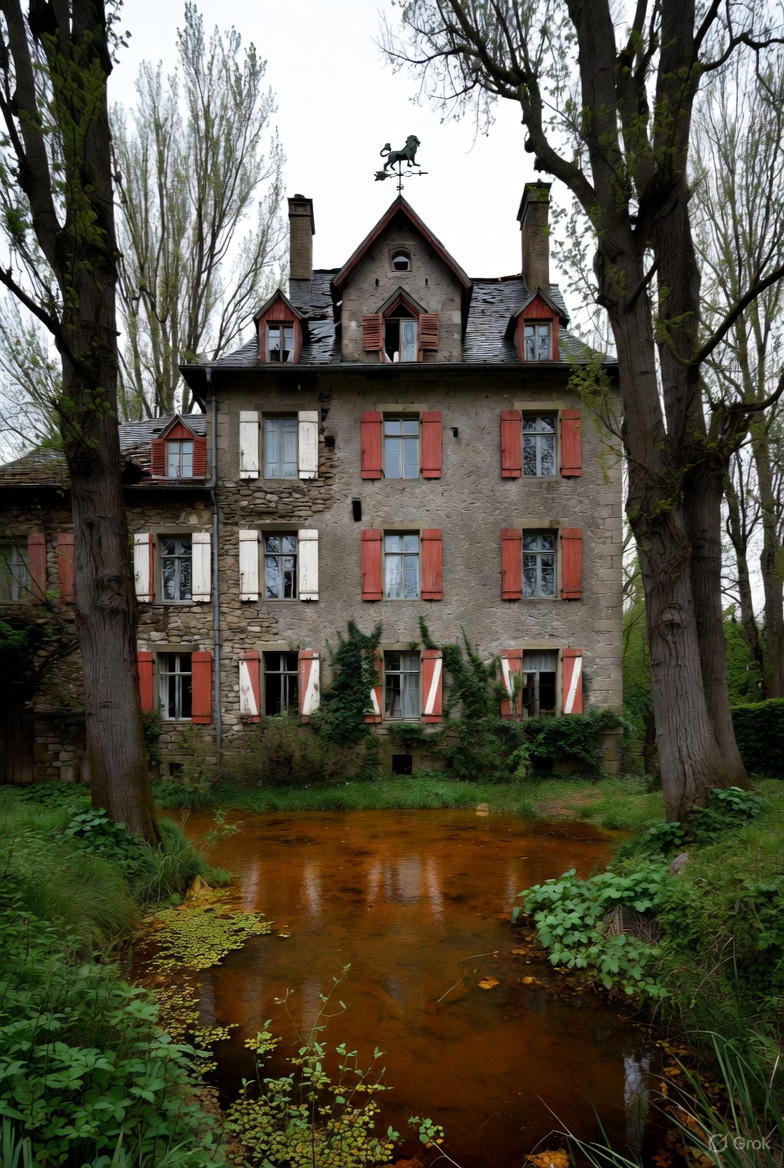
gloomier than the Ball Mill, it was this castle. A monstrous,
gray stone box with formerly red-white-red shutters, now faded,
peeled off and crooked on their hinges, it stood between
disheveled, thorny, mighty poplars and two ponds with brown,
putrid water, which was overgrown by poison-green lentils. On
the steep, damaged roof was a weather vane bent by the storms
and eaten by verdigris- representing an upright lion. Part of the
window panes were gray with dust, other parts had only jagged
shards in the rotten frames. A large pile of garbage, in which
broken bottles, scraps of clothing, rags, bones and ashes were
mixed together, piled up not far from the main entrance, a
pointed arched gate, over which a Moor’s head was carved as a
coat of arms, in one eye of which was an arrow. Since no one
was to be seen, I entered the castle courtyard and was
immediately attacked by a pack of spotted hounds. But before
the wild males could quite snap at me a silent young man with
a sullen wrinkled face appeared and whipped them into their
stone kennel, whose torn down iron grille had been replaced
and strengthened with a couple of heavy stones leaning against
it. I saw that both of his ears had been smoothly cut from his
head.
I was about to turn to him, but out of a gate a huge, fat,
white-haired man with a red face and a glowing nose
approached me and gruffly asked for my name and desire.
I named myself, and his face became immediately
cheerful. He held out his hand to me and shouted loudly while
he shook my right hand:
“What?”How? A Dronte? Melchior Dronte, perhaps even
the son of my old crony and Willow comrade?”
When he then learned the name and last place of
residence of my dead father, he embraced me, blew his warm,
wine-scented breath into my face and shook me by the
shoulders.
“My lord Baron, I rejoice to the depths of my eighty-
year-old hunter’s soul to get to know you. Your godly father
was a hunter comme il faut, and there will not be many more
like him in these shitty times. Ei, how the time goes by, and
now I get to know Melchior, whose birth we celebrated with
champagne from the big ducal silver cup, called the
“Sauglocke”, and look, this child, whom I saw with wet panties
already has gray hair at the temples. But what is the reason?
Has the skinny hunter already put the bullet in the barrel, in
order to lay an old deer on my blanket? So let’s be happy my
Lord Baron, and commemorate the knightly days of which
your name reminds me so fiercely.”
I thanked him, strangely and not pleasantly moved by the
fact that he had been my father’s friend. Even the morose man
who was missing his ears and who was now ordered to find a
place for me to stay somewhere in the castle, did not make me
feel very cheerful.
“But now I want to introduce myself formally,” said the
old gentleman and stood up straight in his green coat. “I am the
Master of the Hound of the erstwhile Duke of Stoll-
Wessenburg, Eustach von Trolle und Heist, and I have been
sitting here for twenty years among crows and owls, with a
small salary on Krottenriede. We hadn’t a thought at the time
squire, not a single thought, your Herr Father and I, as we held
Serenissimo’s head when the wine was about to run out for
those at the top.”

Read Full Post »

Alraune by Hanns Heinz Ewers and translated by Joe E Bandel

Intermezzo
All sins, my dear girl, are brought here by the hot south wind
from out of the desert. Where the sun burns through endless centuries
there hovers over the sleeping sands a thin white haze that forms itself
into soft white clouds and floats around until the desert whirlwinds
roll them and form them into strange round eggs that contain the
sun’s blazing heat.
There the basilisk slinks around through the pale night. In a
strange manner the moon, the eternally infertile moon, fathered it. Yet
its mother, the desert sand, is just as infertile as the other is. It is the
secret of the desert. Many say it is an animal but that is not true. It is
a thought that has grown where there is no soil or no seed. It sprang
out of the eternally infertile and took on a chaotic form that life can
not recognize. That is why no one can describe this creature. It is
fashioned out of nothingness itself.
But what the people say is true. It is very poisonous. When it eats
the blazing eggs of the sun that the whirlwinds create in the desert
sands purple flames shoot out of its eyes and its breath becomes hot
and heavy with horrible fumes.
But the basilisk, pale child of the moon, does not eat all of the
vapory eggs. When it is sated and completely filled with hot poison it
spits green saliva over the eggs still lying there in the sand and
scratches them with sharp claws so the vile slime can penetrate
through their soft skin.
As the early morning winds arise a strange heaving like moist
violet and green colored lungfish can be seen growing under the thin
shells.
Throughout the land at noon eggs burst as the blazing sun
hatches crocodile eggs, toad eggs, snake eggs and eggs of all the
repulsive lizards and amphibians. These poisonous eggs of the desert
also burst with a soft pop. There is no seed inside, no lizard or snake,
only a strange vapory shape that contains all colors like the veil of the
dancer in the flame dance. It contains all odors like the pale sanga
flowers of Lahore, contains all sounds like the musical heart of the
angel Israfael and it contains all poisons as well like the basilisk’s
own loathsome body.
Then the south wind of mid-day blows in, creeping out of the
swamps of the hot jungles and dances over the desert sands. It takes
up the fiery creatures of the sun’s eggs and carries them far across
the blue ocean. They move with the south wind like soft vapory
clouds, like the loose filmy night garments of a priestess.
That is how all delightful, poisonous plagues fly to our fair
north–
Our quiet days are cool, sister, like the northland. Your eyes are
blue and know nothing of hot desire. The hours of your days are like
the heavy blue clusters of wisteria dropping down to form a soft
carpet. My feet stride lightly through them in the glinting sunlight of
your arbor.
But when the shadows fall, fair sister, there creeps a burning
over your youthful skin as the haze flies in from the south. Your soul
breathes it in eagerly and your lips offer all the red-hot poisons of the
desert in your bloody kisses–
Then it may not be to you that I turn, fair sister, sleeping child of
my dreamy days–When the mist lightly ripples the blue waves, when
the sweet voices of the birds sing out from the tops of my oleander,
then I may turn to the pages in the heavy leather bound volume of
Herr Jakob ten Brinken.
Like the sea, my blood flows slowly through my veins as I read
the story of Alraune through your quiet eyes in unending tranquility. I
present her like I find her, plain, simple, like one that is free of all
passions–
But then I drink the blood that flows out of your wounds in the
night and it mixes with my own red blood, your blood that has been
poisoned by the sinful poisons of the hot desert. That is when my
brain fevers from your kisses so that I ache and am tormented by your
desires–
Then it might well be that I tear myself loose from your arms,
wild sister– it might be that I sit there heavily dreaming at my window
that looks out over the ocean while the hot southerly wind throws its
fire. It might be that I again take up the leather bound volume of the
Privy Councilor, that I might once more read Alraune’s story–
through your poison hot eyes. Then the ocean screams through the
immovable rocks– just like the blood screams through my veins.
What I read then is different, entirely different, has different
meaning and I present her again like I find her, wild, hot–like
someone that is full of all passions!

Read Full Post »

Chapter 106: Knowing Your Own Anger and How You Respond to It – Self-Assessment for Safe Expression and Emotional Freedom

Have you ever snapped at a loved one over a minor annoyance, only to later realize it was a buildup of unaddressed frustrations exploding unexpectedly, leaving you regretting the outburst and wondering if recognizing your anger patterns earlier could have channeled that energy into something constructive instead of destructive? What if “miracles” of emotional control and relational harmony arose from deeply understanding your unique anger profile—viewing it not as a flaw to hide but as a vital signal to interpret and manage—where self-assessment reveals if you’re a “stuffer” bottling up until depressed, a “withdrawer” gossiping passive-aggressively, a “blamer” attacking to avoid responsibility, a “triangler” rallying others against targets, or an “exploder” unleashing violence unpredictably, empowering you to replace these unsafe responses with guilt-free acceptance and assertive release? In this crucial self-reflection chapter on anger management, we emphasize the importance of knowing when you’re angry to act safely, exploring a detailed list of unsafe patterns: stuffers who avoid conflict at the cost of health, withdrawers who sabotage connections through subtlety, blamers who erode esteem in self and others, trianglers who breed hidden tension, and exploders who risk harm and fear. Building on previous insights (e.g., anger as somatic energy from Ch105 or a “gift” to channel from Ch104), this isn’t shaming suppression; it’s empowered awareness, where identifying your style prevents escalation, fosters healthier outlets, and transforms anger from a chaotic force into a catalyst for positive change, ensuring it serves your will to live rather than disrupting it.

To fully appreciate the transformative potential of this self-assessment, let’s explore anger’s psychological and physiological underpinnings: anger is an evolutionary adaptation, a survival response that floods the body with hormones like adrenaline for quick energy, but in modern life, mismanaged patterns can lead to chronic stress, as Harvard Health reports, increasing risks of heart disease, anxiety, and depression. Unsafe responses like stuffing or exploding often stem from childhood modeling (e.g., parents who avoided conflict or raged uncontrollably), perpetuating cycles that sabotage relationships and self-esteem. In assertiveness training, recognizing these is the first step to breaking them: for instance, a stuffer might learn “I statements” (Ch103) to voice needs without fear, while an exploder practices “Clouding” to de-escalate. Neuroplasticity research (e.g., from UCLA) shows repeated self-assessment rewires the brain, reducing amygdala reactivity (anger’s trigger) and strengthening prefrontal control (reason’s seat), allowing guilt-free acceptance (Ch104) and turning anger into an ally for boundary-setting or motivation. This chapter expands the list into detailed profiles with signs, impacts, and antidotes, encouraging honest reflection to map your anger, ensuring it enhances rather than hinders your primal drive for growth and connection. By owning your patterns, you reclaim power, fostering the resilience to navigate life’s injustices with assertive grace.

This anger awareness subtly reflects a balanced dynamic: The expansive flare of anger’s signal (outward, generative alert like branches flaring in wind to warn of storm) aligns seamlessly with the grounding self-assessment (inward, stabilizing profile like roots mapping soil threats for secure hold), creating harmony without chaos. Like an oak tree, whose “anger” at intruders (unreasoning gales) prompts somatic adaptations (tensed form for endurance), miracles of control emerge from recognized patterns. In this chapter, we’ll profile these responses into empowering truths, covering anger’s importance for safety, stuffers’ avoidance, withdrawers’ passivity, blamers’ attacks, trianglers’ tension, exploders’ violence, and self-assessment questions, all linked to your OAK Matrix as lower emotional centers (anger patterns) resonating with solar plexus will (safe channeling). By the end, you’ll have tools to assess your style, adopt healthier alternatives, and turn anger recognition into “superhuman” mastery, transforming unsafe outbursts into purposeful power. Let’s map your anger and uncover how awareness unlocks miracle-level resilience.

Anger’s Importance: A Vital Signal for Safe Action and Self-Protection

Knowing your anger is essential—your text stresses recognizing it to act safely, as unaddressed anger can escalate unpredictably, harming self or others.

Why miraculous? It turns blind reactions into conscious choices, preventing regret. Common trait: Signal; non-ignored.

Expanding, anger serves as an evolutionary “smoke alarm,” alerting to threats or injustices for protective action, as psychologist Steven Pinker notes in “The Better Angels of Our Nature.” In assertiveness, this signal prompts boundary-setting (“I’m angry; let’s discuss”), but unrecognized, it festers into resentment or explosion. Studies from the National Institute of Mental Health show self-aware individuals (via journaling or therapy) reduce anger episodes by 40%, as awareness allows guilt-free acceptance (Ch104) and redirection (Ch79). In relationships, it fosters intimacy: sharing “I’m angry because…” builds trust, per John Gottman’s research. Suppression, however, leads to “anger-in” (internalized harm like ulcers) or “anger-out” (external harm like violence), eroding the will to live healthily. Cultivate by daily check-ins: “Am I angry? Why?”—turning vague tension into actionable insight. This foundation empowers the assessment list, ensuring anger serves as ally, not adversary.

Dynamic balance: Importance’s inward signal (stabilizing alert) aligns with action’s outward safe (generative do), blending warn with wield.

In OAK: Third-eye know integrates with emotional anger for signaled safety.

Empowerment: Daily anger check—rate 1-10, note triggers for proactive awareness.

Stuffers: Conflict Avoiders Who Bottle Up and Burst Inwardly

Stuffers evade confrontation at all costs—your text describes them as easy targets for aggressors, internalizing anger leading to depression or physical ailments like stomachaches/headaches, finding “relief” only in total collapse.

Why superhuman to reform? It prevents self-stunting, enabling assertive voice. Common: Avoidant; non-confronting.

To expand, stuffers often stem from environments where anger was punished (e.g., “nice” families suppressing emotions), leading to passive compliance but chronic stress, as cortisol builds without release (APA research). This pattern sabotages the will to live actively, as unexpressed anger turns inward, causing psychosomatic illnesses or emotional numbness. In assertiveness, antidote is gradual exposure: start with “Negative Declarations” (Ch103) to voice small grievances without fear. Therapy like EMDR can process “stuffed” traumas, freeing energy for healthy expression. Signs include frequent “fine” responses amid tension or somatic complaints without cause. Practice: role-play low-stakes conflicts, building tolerance for confrontation without collapse. Over time, this shifts from inward burst to outward assert, restoring vitality and relationships.

Dynamic: Stuffers’ inward bottle (stabilizing avoid) aligns with reform’s outward voice (generative confront), blending hide with heal.

In OAK: Emotional stuffer integrates with throat voice for expressed release.

Practical: Simulate conflict—practice voicing “I’m angry because…,” note reduced internal pressure.

Withdrawers: Passive-Aggressive Withholders Who Sabotage Connections

Withdrawers express indirectly—your text notes they gossip or rumor-spread, feeling guilty for uncontrollable things, missing deeper relationships by fearing control loss.

Why superhuman? It reclaims directness, turning isolation into intimacy. Common: Subtle; non-open.

Expanding, withdrawers often learn this from environments where direct anger was unsafe (e.g., volatile homes), leading to “safe” sabotage like silent treatment, which erodes trust and the will to live connectedly. Psychologically, it’s “anger-out” disguised, causing anxiety/guilt cycles (Beck’s cognitive therapy). In assertiveness, antidote is “I Statements” to voice needs openly, reducing passive aggression. Signs include withdrawal during stress or misplaced responsibility. Practice: express “I feel angry” instead of withdrawing, building confidence in control without harm. Long-term, this fosters the primal drive for community, as social bonds enhance survival.

Dynamic: Withdrawers’ inward passive (stabilizing fear) aligns with reclaim’s outward direct (generative connect), blending hide with honest.

In OAK: Heart withdraw integrates with solar plexus direct for bonded assert.

Practical: In tension, practice “I feel…” instead of silence—note improved connections.

Blamers: Attackers Who Deflect Responsibility and Erode Esteem

Blamers externalize fault—your text describes name-calling or put-downs, avoiding ownership, lowering others’ esteem (and potentially their own through isolation).

Why superhuman? It promotes accountability, breaking blame cycles. Common: Deflective; non-owning.

To expand, blamers often model from critical upbringings, using attacks to mask insecurity, but this undermines the will to live collaboratively, as resentment builds. In assertiveness, antidote is “Compromise without Loss” (Ch103), focusing on behaviors not character. Signs include constant “you always” accusations. Practice: rephrase blames as “I needs” (“I feel hurt when…”), fostering empathy. Research from the Gottman Institute shows blame as a “Four Horsemen” predictor of divorce, but replacing with gentle startups reduces it by 80%.

Dynamic: Blamers’ inward deflect (stabilizing avoid) aligns with account’s outward own (generative share), blending blame with balance.

In OAK: Third-eye blame integrates with heart empathy for responsible relations.

Practical: Role-play blame—reframe to “I feel,” note de-escalated esteem preservation.

Trianglers: Rallying Others to Amplify Tension Indirectly

Trianglers indirect anger by enlisting allies—your text notes getting others mad at the target, creating unseen tension for the victim.

Why superhuman? It reclaims directness, preventing divisive harm. Common: Indirect; non-alone.

Expanding, trianglers avoid confrontation by proxy, often in families or workplaces, fostering paranoia and weakening the will to live trustingly. In assertiveness, antidote is “Repeat Technique” to address directly, bypassing triangles. Signs include gossip recruitment. Practice: confront source instead of allies, building courage for open dialogue. Family therapy (Bowen) views triangulation as differentiation failure, but breaking it enhances autonomy and bonds.

Dynamic: Trianglers’ inward rally (stabilizing indirect) aligns with direct’s outward face (generative resolve), blending enlist with engage.

In OAK: Heart triangle integrates with throat direct for unified confront.

Empowerment: Spot triangulation urge—redirect to direct talk, note reduced tension.

Exploders: Violent Outbursts and Unpredictable Harm

Exploders unleash physically—your text warns of pushing/shoving/kicking/slapping/beating/killing, creating fear and low esteem in victims, with unpredictability heightening danger.

Why superhuman? It demands intervention, protecting self/others. Common: Uncontrolled; non-safe.

To expand, exploders often from volatile backgrounds, where anger modeled as violence, risking legal/health consequences and isolating the will to live socially. In assertiveness, antidote is professional help (e.g., CBT or anger classes) plus “Side Tracking” for de-escalation. Signs include sudden flares. Practice safe outlets (exercise) to channel (Ch79), but seek therapy if violent. APA stats show domestic violence affects 1 in 4 women, underscoring urgency; recovery involves rebuilding esteem through non-violent assertiveness.

Dynamic: Exploders’ outward violence (generative harm) aligns with control’s inward intervene (stabilizing safe), blending erupt with end.

In OAK: Lower emotional explode integrates with solar plexus control for harm-free channel.

Empowerment: If exploder tendencies, seek help—practice pause techniques for safety.

Self-Assessment Questions: Building Your Anger Profile

Reflect on: Clench jaw? Stomachache? Raise voice? Refuse speak? Hurt urge? Escape want? Abusive? Sweat/red? Sarcastic? Tone change? Cry? Shake? Procrastinate? Late? Sadistic humor? Sarcastic/cynical? Sigh? Over polite? Smile hurting? Bad dreams? Insomnia? Bored fun? Tired usual? Picky/irritable? Guilty/anxious/ashamed/withdrawn? Know angry? Duration/frequency/suppression/quick fade? Impacts jobs/relationships/physical/accidents/legal?

Why superhuman? It creates a roadmap for tailored management. Common: Profiled; non-blind.

Expanding, these build on Ch105, categorizing somatic/behavioral/internal/impacts for comprehensive view. Use as weekly journal: rate frequency, link to patterns (e.g., sighing = suppressed), plan antidotes. This fosters guiltless acceptance, turning anger from foe to informant.

Dynamic: Questions’ inward profile (stabilizing map) aligns with management’s outward tailor (generative use), blending know with navigate.

In OAK: Third-eye reflect integrates with emotional anger for profiled mastery.

Empowerment: Answer 10 questions—identify 3 patterns, create antidote plan.

Shared Traits: Warning Signals, Unsafe Patterns, and Empowered Profiles

These elements unite: Importance signals, unsafe styles (stuffers to exploders), assessment questions—your text ties them to anger’s value when known and managed for safety.

Why? Unrecognized harms; profiled empowers. Dynamic: Anger’s inward warn (grounding in signal) aligns with management’s outward master (generative safe), merging feel with focus.

In OAK: Lower root (somatic) resonates with higher unity for anger miracles.

Empowerment: Build anger “profile”—realign with traits for holistic harnessing.

Cultivating Anger Awareness: Training for Somatic Recognition and Response

Awareness is trainable: Map cues, intervene early—your text’s questions guide self-discovery, turning somatic into assertive tools.

Why? Ignorance escalates; knowledge empowers. Dynamic: Cultivation’s stabilizing map (grounding in cue) aligns with awareness’s outward respond (generative master), fusing detect with direct.

In OAK: Third-eye (reflect) integrates with root (somatic).

Practical: Weekly somatic scan—link cue to response (e.g., red face = pause), build habitual control.

Practical Applications: Managing Anger Daily

Make control miracles responsive:

  • Cue Journal: Note a somatic sign (male path: generative channel; female path: stabilizing accept). Reflect dynamic: Grounding body + outward action.
  • Partner Anger Share: Discuss a “cue impact” with someone (men: outward intervene; women: grounding map). Explore seamless integration. Alone? Affirm, “Signal and response align in me.”
  • Response Ritual: Visualize cue; practice counter (e.g., clench = unclench/breathe). Act: Use in real anger, note positive release.
  • Profile Exercise: Weekly, answer 3 questions—update plan, observe reduced impacts.

These awaken power, emphasizing seamless dynamic over eruption.

Conclusion: Unlock Miracles Through Somatic Mastery

Knowing your anger and responses—vital signals, unsafe patterns (stuffers to exploders), self-questions—turns warnings into empowered miracles of safety and control. A balanced dynamic unites grounding with expansion, transforming somatic flares into superhuman responses. Like an oak sensing storm’s shake for rooted strength, embrace this for mastered living.

This isn’t erupted—it’s empowered. Recognize cues today, respond boldly, and feel the miracle. Your life awaits—aware, controlled, and assertively yours.

Read Full Post »

OD by Karl Hans Strobl and translated by Joe E Bandel

Chapter 3, pages 33-38

“Where are the gentlemen headed?” Friederike Luise asks, brushing past the reproach.

Reichenbach mumbles something about inspecting the forest, then they shake hands and go their separate ways. The old count is silent for a moment, then says, “She has such a beautiful confidence. Maybe she’s right—how could something like that touch her? Wouldn’t it make you despair of God? But you shouldn’t let her.”

Reichenbach grumbles about allowing or not allowing and not letting anyone interfere, and how stubborn she can be, but deep down, he’s glad he saw Friederike Luise and held her warm, firm hand in his for a moment.

They stride out briskly now, and Reichenbach shifts the conversation to the damned furnace, still burning, which must be extinguished before they can build a new one. It’s the same path they took that moonlit night of the meteor fall, passing the hunting lodge and entering the Od Valley, always upstream along the Punkva, which they plan to tackle today. They reach the spot where the Punkva emerges from the rock a second time, and then it grows quiet beside them; the living water now flows within dead stone. And now they’re at the place where the little river vanishes into the cliff, and the narrow valley feels livelier again, with that voice of the water beside them. At last, they reach the spot where the Punkva first emerges from the rock, out of a wide, dark cave, its stone vault dipping low to the water’s surface.

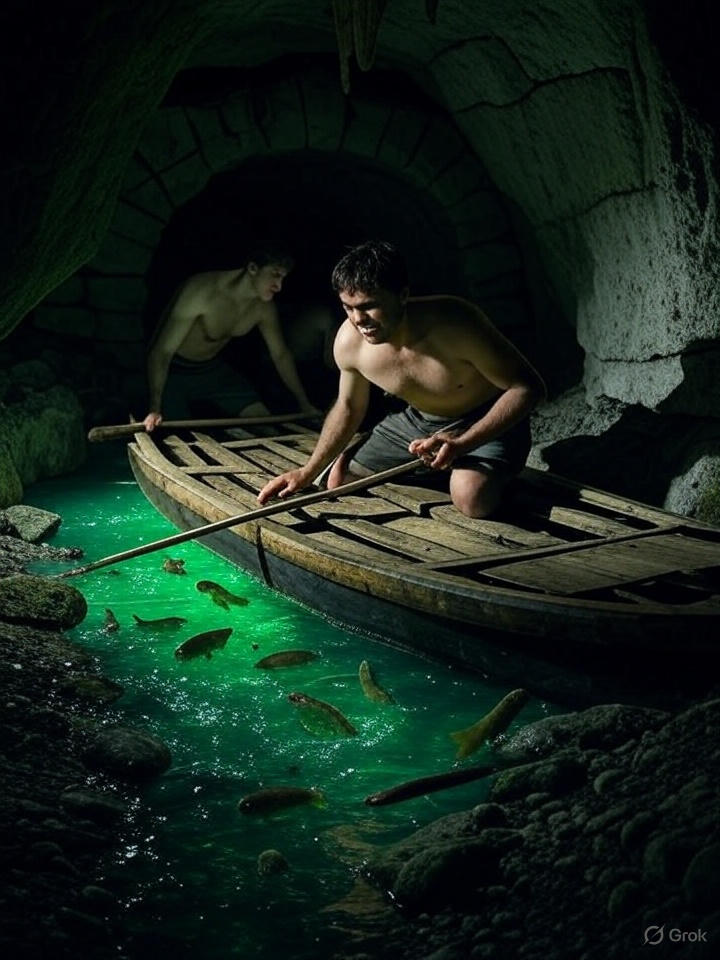
The miners Franta and Hadraba are already waiting with two rafts, ropes, lamps, and all the gear for a journey into the underworld. The rafts are simple—each made of two planks, cross-latticed, with two more planks on top, just wide and long enough for a man to lie on and use his hands as paddles.

“Has the water level dropped?” Reichenbach asks.

“About a foot and a half, please, sir!” Franta replies.

Franta and Hadraba, the two miners from Willimowit, had to clear stones and boulders from the outlet on Reichenbach’s orders. They also dug a deep channel in the streambed to speed the water’s flow. And now the water has indeed dropped—perfectly, by about a foot and a half. Last week, when Reichenbach tried alone, the water in the first cave was too high to go further.

Reichenbach and the old count exchange a glance, reading readiness in each other’s eyes. They shed their clothes, tie ropes around their waists, and, in shirts and underdrawers, carefully slide onto the wobbly planks, still held at the shore by the helpers. At the front of each raft, a small oil lamp smokes in a glass tulip on a short stem, A waterproof pouch with tinder is nailed to the planks.

Reichenbach turns his head. Beside him lies the old count, arms spread, hands dangling in the water, smiling at him.

“Go!” Reichenbach commands. Franta and Hadraba give the rafts a push, and hands paddle on either side of the planks. Man and craft become flat fish with two short fins and a murky red, smoldering, stalked light organ at the head.

Dark, eerily quiet, the waterway emerges from under the stone arch, leading into the earth’s belly. The countercurrent is barely felt; the wooden fish paddle forward. It grows dim, the anxious red light pushing against rock that sinks, dipping into the flood. The water path turns left, daylight fades behind them, rock and water nearly touch.

“At this spot,” Reichenbach says, “last week I had to push the raft under the water. Not needed today. Just keep paddling behind me.” His voice rings painfully loud, as if through a megaphone. He shouldn’t speak, the old count thinks—no, the human voice shouldn’t sound so bold here, where something might sleep that’s better left undisturbed. Here, one should only whisper.

Cautiously, the men inch forward, one behind the other, through the low entrance, the lamp’s glass tulip nearly scraping the ceiling. But then the stone canopy above their heads recedes, the light breathes freely, stretching toward the ceiling of a cave polished smooth by spring floods and thunderstorms.

Dark openings in the walls lead onward. Reichenbach paddles toward the largest, his compass before him. “We’re heading straight for the Macocha. Maybe this is the same water as at its bottom,” he says.

He’s talking again, the old count thinks, feeling they should be silent here, like fish.

They glide into a second, roomier cave. Stalactites hang from the ceiling, large and small, snowy white. At the tip of each clings a tiny water droplet. For the first time, human eyes behold this marvel of millennia. A cold droplet falls on the old count’s shirt, stinging like a needle between his shoulder blades.

The vault sinks toward the water again. “Will we make it through?” Reichenbach asks before the narrow gap. “We’ve got to try.” He pushes the raft to the wall, wedges it under the rock, arches his back, presses against the ceiling, forcing himself and the frail planks underwater, keeping only the light—the searching, forward-probing eye—above, unextinguished.

How long is this perilous passage? Will their breath hold? A gamble with little chance of turning back. For the old count, left behind, it’s a painful wait, an almost unbearable strain on his soul. Fear? Hardly, but a sudden realization of the reckless audacity of their venture grips him. Something unknown glares from the darkness and solitude. He pushes away troubling thoughts, silences his conscience to stay strong. All reproaches must fall silent now; he thinks only of Friederike Luise, her eyes, the pressure of her hand that sent a spark through his veins, like dwelling on the eyes and hands of a sacred icon.

Then a voice comes from the crevice, a strained sound: “Keep going. It’s alright!”

Without hesitation, the old count pushes his raft underwater, feels the icy flow envelop him, shoves with his back, paddles with his hands, holds his breath tight in his compressed chest. Just when he thinks he can’t bear it any longer, the raft surfaces, air rushing back.

The two rafts float in a hall, its vault soaring beyond the reach of their light, lost in darkness above their heads.

“This is as far as we go!” Reichenbach says. They paddle along the walls, encrusted and coated with limestone, sloping into the water everywhere except the entry point. A white curtain of rippling folds hangs from the darkness to the water’s surface. As Reichenbach passes, he raps his knuckle against the stalactite. It rings like a bronze bell—music of the underworld.

“We’d need a very dry year,” Reichenbach says. “Maybe then it’d work. Today, we turn back.”

They squeeze through the passage into the second cave, where stalactites hang. Take one, the old count thinks, for Friederike Luise—a trophy from the underworld.

He kneels on the raft, eyes searching for the finest, largest stalactite, reaching out, but the planks slip from under him. He stumbles, grasps for support, and plunges thrashing into the water. A spray shoots up, falls back, dousing both lamps. Reichenbach clings to his rocking raft, seeing a struggling body in glassy green, wild, frantic, aimless movements stirring air bubbles. This isn’t the steady confidence of a swimmer at ease in water—it’s a desperate fight against death. A moment’s hesitation, then he tears the rope from his waist, ties a loop, and as the sinking man’s flailing brings him briefly to the surface, throws the line over his head and arms.

“Calm! Stay calm!” Reichenbach urges, pulling the old count close and paddling with one hand to the drifting raft. “Try to climb up now!”

Obediently, the old count grabs the planks, slides them under himself, rolls his body onto them, and scrambles aboard. Then he lies still, exhausted, surrendering to the reclaimed sense of life.

“You can’t even swim, can you?” Reichenbach asks reproachfully.

“I can swim,” the old count gasps, “swim well, just as I can ride, shoot, and fence. But I don’t know what happened. A paralysis… like a stone around my body… I was pulled down…” He adds, “If it weren’t for you…”

Reichenbach doesn’t reply, his attention now wholly captured by something else. He only now realizes why, despite the lamps going out, they aren’t in darkness. Light radiates from the depths, the water glowing in emerald green, like liquid bottle glass flecked with gold, so clear you can see the rocky bottom, every stone, and the trout standing still or flashing their white bellies in swift turns—green stars, meteors of the deep.

The walls, ceiling, and stalactites shimmer in this green reflection, drawn under the rocks. Waves stirred by paddling hands cast their glimmer onto the stone, bringing it to life. When you scoop water and pour it out, a spray of sparkling gems falls back. It’s daylight’s light, the green forest light of trees, absorbed by the water and carried beneath the rocks—a fairy-tale harmony of elements: water, stone, and light.

The feeble human wit of the lamps had hidden this wonder; now, with them extinguished, it shines in unveiled splendor. They need no further light, finding their way through this green enchanted realm back through the cave’s mouth to the miners Franta and Hadraba, who are a bit worried, and to old Johann, who has arrived with the carriage as the old count ordered.

Soaking wet, the two men lie in the grass to dry off a bit before diving into the basket old Johann brought. As they clink their first glasses, the old count furrows his brow, turning serious: “Do you think thoughts can weigh like stones, stopping you from swimming?” For a moment, it seems he wants to say more, but seeing Reichenbach’s skeptical face, he suppresses the urge and forces his old smile. “And now, on top of everything, you’re my lifesaver! Cheers!”

“Oh, don’t talk about it,” Reichenbach grumbles. But deep down, it’s not unpleasant to be his master’s lifesaver, all else aside. There are still a few things he’d like to see settled his way.

After a pause, the old count adds, “You know what I thought when I suddenly couldn’t swim?”

Read Full Post »

Chapter 56: Family and Love: The Power of Supportive Bonds for Lifelong Success

Have you ever faced a daunting goal—like starting a business or overcoming a health challenge—and felt an unbreakable surge of strength because your family rallied behind you, their belief turning your solo effort into a shared triumph? Or, in contrast, struggled alone when loved ones doubted, making every step feel heavier and victory hollow? Family and love form life’s strongest bonds, providing energy that propels us to miracles or, when absent, drains our vitality, leaving us isolated. In your essay “Family and Love,” you emphasize that supportive loved ones are the greatest asset for success, enabling dynasties and shared achievements, while disbelief creates serious barriers that may cost relationships. Yet, even without initial support, demonstrating ability can win it over time. This isn’t about dependence; it’s recognizing that true winning often requires standing with others, not alone.

This dynamic of family support embodies duality as a loving embrace: The containing skepticism or conflict from loved ones (feminine, grounding us in relational realities like a nurturing yet challenging soil) harmoniously partners with the expansive energy of belief and involvement (masculine, generative drive like sunlight fueling growth), creating balance without codependence. Like an oak tree, whose roots draw sustenance from family soil (support) to withstand storms and bear acorns (dynasties), family bonds become the foundation for personal and collective flourishing. In this chapter, we’ll expand these ideas into empowering insights, exploring the strength from supportive family, the drain of disbelief, involving loved ones in goals, and overcoming lack of support through demonstration. Tied to your OAK Matrix, we’ll see family love as heart/upper emotional energy (compassion and joy) fueling solar plexus will for unity. By the end, you’ll have practical tools to cultivate and gain family support, turning potential isolation into a powerful alliance for a life of miracles and shared success. Let’s nurture these bonds and discover how they make the impossible achievable.

The Strength of Supportive Family: Energy for Miracles

When family—parents, spouse, children, relatives—believes in us, we gain unmatched vitality. Your essay illustrates: Their love and support provide the “energy to do miracles,” like Jesus healing through faith. With this backing, troubles become surmountable; goals feel within reach because we’re not alone.

Why so powerful? Disbelief drains, but belief amplifies—turning individual effort into collective force. Successful people often create “dynasties,” involving family in achievements (e.g., family businesses), making personal goals family ones. This shared vision multiplies motivation, as love fuels persistence.

Duality as loving embrace: Family’s containing intimacy (grounding in emotional security) lovingly meets goal’s expansive pursuit (generative ambition), harmonizing personal with relational without sacrifice. Without support, energy wanes; with it, miracles unfold.

In OAK: This heart energy—love’s flow—resonates root stability for higher unity.

Empowerment: In goals, involve family early—share vision; feel the surge from their belief.

The Drain of Non-Support: When Doubt Creates Barriers

Lack of family support isn’t neutral—it’s a “serious problem,” your essay warns. Skepticism drains energy, making goals harder and risking relationship loss. Conflict turns pursuit into choice: Goals or family?

Why severe? Without belief, we work “much harder,” resolve weakening. Success may “cost” bonds—loved ones see misalignment, withdrawing. Yet, demonstrate ability (achieve despite doubt), and they may support future goals, recognizing your competence.

Duality embraces: Doubt’s containing drain (grounding in realism) lovingly meets demonstration’s expansive proof (generative validation), harmonizing tension with reconciliation. Initial alone stand tests will, but persistence wins allies.

In OAK: Lower emotional drain (solar plexus fear) fuels heart’s compassion for rebuilding.

Practical: In non-support, affirm: “I demonstrate to inspire belief.” Share small wins; rebuild gradually.

Involving Loved Ones: From Personal to Family Goals

Greatest asset? Family support—your essay notes: Make goals family ones for dynasties. Involve them—share vision, seek input—turning skeptics into partners.

Why effective? Shared stakes multiply energy; success becomes collective joy. Family businesses exemplify: Personal ambition aligns with familial legacy.

Duality: Individual goal (containing self) lovingly expands to family (generative shared), harmonizing alone with allied without loss.

Empowerment: In planning, ask: “How does this benefit family?” Involve early; watch support grow.

Overcoming Isolation: Demonstrating Ability for Future Support

Even without initial backing, persist—your essay assures: Success demonstrates competence, winning over doubters for future goals. This “proves” your path, turning drain into flow.

Duality embraces: Isolation’s containing test (grounding in resolve) lovingly meets demonstration’s expansive validation (generative belief), harmonizing doubt with trust.

In OAK: Solar plexus persistence bridges to heart’s unity.

Practical: In doubt, focus small achievements; share progress. Turn “alone” into “inspired allies.”

Practical Applications: Nurturing Family Support Daily

Make bonds actionable:

  • Support Builder Journal: List goal; note family role (support/doubt). Reflect duality: Containing conflict + expansive harmony. Track “wins” turning doubt to belief.
  • Family Sync Share: Discuss goal with loved one (men: expansive vision; women: containing emotional need). Explore loving integration. Alone? Affirm, “Personal and family embrace in me.”
  • Dynasty Ritual: Visualize family as oak grove; share goal story. Act: Involve one (e.g., joint task); journal energy boost.
  • Demonstration Exercise: Weekly, achieve small goal; share with family. Note support shift.

These cultivate support, emphasizing loving duality over isolation.

Conclusion: Harness Family Love for Miraculous Success

Family love’s bonds—strongest for energy and miracles—demand demonstration if doubted, turning isolation into dynasties through involvement. Duality’s loving embrace unites personal ambition with relational support, harmonizing goals with bonds. Like an oak drawing from family soil to bear fruit, nurture these for empowered life.

This isn’t dependence—it’s empowerment. Involve family in a goal today, feel the strength, and watch miracles unfold. Your supported life awaits—loved, shared, and triumphant.

Read Full Post »

Chapter 24: The Upper Emotional Plane – Realm of Joy and Vitality

Have you ever felt a burst of pure joy, like discovering a hidden path in a forest that opens to breathtaking views, filling you with excitement and love for life? That’s upper emotional energy at play—the vibrant force making existence worth savoring. In your essay “Upper Emotional Energy,” you celebrate happy emotions like joy, love, and thrill as life’s essence, developed through risk and success. This chapter explores the Upper Emotional Plane as the expansive heart of emotions, rooted in your OAK Matrix and chaos theory. Like an oak’s branches swaying freely in the wind, radiating vitality without the weight of roots, this plane fosters bliss and pride, embracing duality as the loving interplay of adventure and fulfillment.

We’ll trace its structure, its duality of expansion and harmony, and how developing it rekindles the “inner child” through discovery. The oak, its canopy alive with light and breeze, symbolizes this: upper emotions as the joyful reach toward beauty and connection.

The Upper Emotional Ring: Eighteen Bits of Blissful Awareness

Your essay frames upper emotional energy as the astral body of positive feelings—joy, love, excitement—tied to the fourth electron ring (18 bits) in the atom metaphor. Accessed via the Heart Chakra, it’s the domain of emotional richness without lower turmoil. We feel alive here, savoring fine arts, music, nature’s beauty, and profound bliss.

We develop this through risks: trying new things, succeeding, expanding our world. Joy of winning, pride in fairness, honor—all build it, like chaos theory’s leaps: novelty stresses complacency, birthing vitality. At first, we forget this as adults, losing childlike wonder; reclaim it by pursuing passions—adventures, pleasures, thrills.

The astral body here is vibrant, expansive, emotion-pure yet higher than mental detachment—radiating satisfaction. In magick, it’s the heart’s will, manifesting harmony. Like an oak’s branches absorbing sunlight to energize the tree, upper emotions fuel life’s beauty.

Duality in the Upper Emotional Plane: Adventure and Harmony

This plane embodies duality: expansive adventure (male, thrill-seeking) vs. containing harmony (female, blissful fulfillment). Curiosity drives outward, discovering joys; satisfaction contains them in pride and love, resolving risks into growth. Your essay notes its magnetic charm: radiant vitality attracts, making one the “life of the party”—humorous, popular, fun. But overdevelopment risks recklessness; balance with lower emotions grounds it.

In chaos, duality embraces lovingly: new experiences build chaotically, leaping to stability through success—reawakening the “inner child.” Integration with concrete mental (sensory grounding) prevents isolation, turning bliss into shared magick. The Heart Chakra channels it, expanding emotional awareness outward, but without lower integration, it’s fleeting ecstasy.

Like an oak’s branches balancing wild sway (adventure) and leaf harmony (fulfillment), this plane mediates mental reason and lower passion, fostering emotional mastery.

Integration: Rediscovering Joy Through Risk

Integrating upper emotional fragments develops a radiant astral body—joyous, loving, vital—for navigating lower planes with positive insight, gaining harmonious balance. Your essay emphasizes development: pursue passions, embrace discovery—risks expand, successes integrate. The ego strengthens, becoming honorable and fair, learning life’s beauty through arts and nature.

In magick, this is heart-centered intent—unswayed by fear, manifesting fulfillment. Duality resolves: embrace chaos of novelty lovingly, leaping to blissful power. The oak’s canopy, integrating wind’s thrill to nourish leaves, exemplifies this: upper emotions as life’s exuberant core.

Practical Applications: Igniting Your Inner Child

To engage the Upper Emotional Plane:

  • Joy Journal: Reflect on a thrilling discovery or loving moment. Journal its vitality. Meditate under an oak, visualizing canopy as radiant bliss.
  • Partner Adventure: Share a joyful risk with a partner. Men: Expansive thrill; women: Containing harmony. Hold hands, breathe, feeling merge. If alone, balance both within.
  • Oak Joy Ritual: Touch an oak’s leaves, ask: “What joy awakens me?” Visualize energy as canopy’s sway, echoing Golden Dawn’s heart harmony.

These tools rekindle upper emotions.

Conclusion: Emotions as Life’s Spark

The Upper Emotional Plane radiates joy and vitality, like an oak’s canopy in sunlight. In The OAK Magus, it’s duality’s expansive embrace. This empowers emotional heights; next, lower emotional energy grounds it in depth.

Read Full Post »

Ideas Become Emotions; Emotions Become Actions – Forge Goals into Steel

Think it, feel it, do it—ideas spark, emotions blaze, actions strike. The OAK Matrix fuels your arc: opposites (dream/deed) grind, awareness (your fierce flow) wakes, kinship (shared push) binds. Crack an orb with a gym grind or gut surge? Hell yes—drive it. This is survivalism’s chain—here’s how to hammer it and win.

What’s This About?

Dwell hard—thoughts brew, emotions boil—push deep, action erupts. Mind’s work—college, taxes—drains, tires—grind it, muscles grow—competence blooms, esteem rises—feelings spill. Emotions kick—fear bolts, rage fights—high enough, body moves, stress cracks.

Flip it—goals need this—think ‘til it burns, feel ‘til it drives—dry spots fade, others catch fire—action seals it. Toddler stumbles—falls, walks—same here: try, flop, try—skill stacks, easy hits—success lands when you push, not wish.

Why It Matters

It’s your warrior’s forge. Opposites clash—think stalls, do lands—and awareness wakes: you’re not dreaming, you’re building. Kinship hums—your fire lifts others, echoes their grit. I’ve felt it: gym grind, breath deep—second wind cracked an orb, wrote fierce—lived bold, real. Wishing fades—action’s your steel, forged hot.

That second wind—lifting, acting—splits the astral. That’s your drive’s forge.

How to Forge It

No drift—here’s your steel:

  • Flood the Arc: Gym—lift ‘til second wind cracks—breathe deep, flood sexual/bio-electric energy—charge your grit. Think hard—goals burn, emotions flare—stack drive. If an orb cracks—a surge—ride it; you’re forging action.
  • Crack the Stall: Mind lags? Push—gym grind or goal shove—same forge, feelings snap—action flows, flops fade. Practice builds—competence holds—grit wins.
  • Track the Flow: Log dreams—wish turns will, you rule. Flat or lost? Up the grind—your arc lags. Do dreams mean you’re live—force hums.
  • Radiate Push: Live it—think fierce, act bold. Your charm’s a steel roar—others feel it, they rise. Goals land—you lead.
  • Cycle Tie: Lunar full moon? Flood it—drives peak. Solar summer? Forge high—win big. Daily noon? Grind fierce—own the now.

My Take

I’ve mused—thoughts stalled—‘til I hit the gym, felt it—cracked orbs, acted fast—lived fierce, free. You’ve got this—flood it, feel it, rule it. This ain’t soft—it’s fierce steel, survival’s chain. Strike bold, warrior-driven.

Read Full Post »