Feeds:
Posts
Comments

Posts Tagged ‘short-story’

Alraune by Hanns Heinz Ewers and translated by Joe E Bandel

“How do you like it?” she asked him.
“Why should the little man be there?” he retorted.
She said, “He belongs there!–I didn’t like the golden Cupid–That
is for all the other people–I want to have Galeotto, my root manikin.”
“Why do you call it that?” he asked.
“Galeotto!” she replied. “Wasn’t it him that brought us
together?–Now I want him to hang there, to watch over us through the
night.”
Sometimes they went out riding in the evenings or also during
the night if the moon was shining. They rode through the Sieben
Gerberge mountain range or to Rolandseck and into the wilderness
beyond.
Once they found a she-donkey at the foot of Dragon’s Rock in
the Sieben Geberge mountain range. People there used the animal for
riding up to the castle at the top. He bought her. She was a young
animal, well cared for and glistened like fresh snow. Her name was
Bianca. They took her with them, behind the horses on a long rope,
but the animal just stood there, planting her forelegs like a stubborn
mule, allowing herself to be choked and dragged along. Finally they
found a way to persuade her. In Kőnigswinter he bought a large bag
full of sugar, took the rope off Bianca and let her run free. He threw
her one piece of sugar after the other from out of the saddle. Soon the
she-donkey ran after them, keeping itself tight to his stirrup, snuffling
at his boots.
Old Froitsheim took the pipe out of his mouth as they came up,
spit thoughtfully and grinned agreeably.
“An ass,” he chewed. “A young ass! It’s been almost thirty years
since we’ve had one here in the stable. You know, young Master, how
I used to let you ride old gray Jonathan?” He got a bunch of carrots
and gave them to the animal, stroking her shaggy fur.
“What’s her name, young Master?” he asked.
Frank Braun told him her name.
“Come Bianca,” spoke the old man. “You will have it good here
with me. We will be friends.”
Then he turned again to Frank Braun.
“Young Master,” he continued. “I have three great-grandchildren
in the village, two little girls and a boy. They are the cobbler’s
children, on the road to Godesberg. They often come to visit me on
Sunday afternoons. May I let them ride the ass?–Just here in the
yard?”
He nodded, but before he could answer the Fräulein cried out:
“Why don’t you ask me, old man? It is my animal. He gave it to
me!–Now I want to tell you–you are permitted to ride her–even in the
gardens, when we are not home.”
Frank Braun’s glance thanked her–but not the old coachman. He
looked at her, half mistrusting and half surprised, grumbled something
incomprehensible and enticed the donkey into the stable with the
juicy carrots.
He called the stable boy, presented him to Bianca, then the
horses, one after the other–led her around behind the farmyard,
showed her the cow barn with the heavy Hollander cows and the
young calf of black and white Liese. He showed her the hounds, both
sharp pointers, the old guard dog and the cheeky fox terrier that was
sleeping in the stable. Brought her to the pigs, where the enormous
Yorkshire sow suckled her piglets, to the goats and the chicken coop.
Bianca ate carrots and followed him. It appeared that she liked it at
the Brinken’s.
Often in the afternoons the Fräulein’s clear voice rang out from
the garden.
“Bianca!” she cried. “Bianca!”
Then the old coachman opened her stall; swung the door open
wide and the little donkey came into the garden at an easy trot. She
would stop a few times, eat the green juicy leaves, indulge in the high
clover or wander around some more until the enticing call rang out
again, “Bianca!” Then she would search for her mistress.

They lay on the lawn under the ash trees. No table–only a large
platter lay on the grass covered with a white Damascus cloth. There
were many fruits, assorted tid-bits, dainties and sweets among the
roses. The wine stood to the side.
Bianca snuffled, scorned the caviar and no less the oysters,
turned away from the pies. But she took some cake and a piece of ice
out of the cooler, ate a couple of roses in between–
“Undress me!” said Alraune.
Then he loosened the eyes and hooks and opened the snaps.
When she was naked he lifted her onto the donkey. She sat astride on
the white animal’s back and held on lightly to the shaggy mane.
Slowly, step by step, she rode over the meadow. He walked by her
side, lying his right hand on the animal’s head. Bianca was clever,
proud of the slender boy whom she carried, didn’t stop once, but went
lightly with velvet hoofs.
There, where the dahlia bed ended, a narrow path led past the
little brook that fed the marble pool. She didn’t go over the wooden
bridge. Carefully, one foot after the other, Bianca waded through the
clear water. She looked curiously to the side when a green frog
jumped from the bank into the stream. He led the animal over to a
raspberry patch, picked the red berries and divided them with
Alraune, continued through the thick laurel bushes.
There, surrounded by thick elms, lay a large field of carnations.
His grandfather had laid it out for his good friend, Gottfried Kinkel,
who loved these flowers. Every week he had sent the poet a large
bouquet for as long as he lived. There were little feathery carnations,
tens of thousands of them, as far as the eye could see. All the flowers
glowed silver-white and their leaves glowed silvery green. They
gleamed far, far into the evening sun, a silver ground.
Bianca carried the pale girl diagonally across the field and then
back around. The white donkey stepped deeply through the silver
ocean; the wind made light waves that kissed her hoofs.
He stood on the border and watched her, drank in the sweet
colors until he was sated. Then she rode up to him.
“Isn’t it beautiful, my love?” she asked.
And he said sincerely, “–It is very beautiful–ride some more.”
She answered, “I am happy.”
Lightly she laid her hand behind the clever animal’s ears and it
stepped out, slowly, slowly, through shining silver–

“Why are you laughing?” she asked.
They sat on the terrace at the breakfast table and he was reading
his mail. There was a letter from Herr Manasse, who wrote him about
the Burberger mining shares.
“You have read in the newspapers about the gold strike in the
Hocheifel,” said the attorney. For the greatest part the gold has been
found on territory owned by the Burberger Association. It appears
very doubtful to me that these small veins of ore will be worth the
very considerable cost of refining it. Nevertheless, your shares that
were completely worthless four weeks ago, now, with the help of the
Association’s skillful press release have rapidly climbed in value and
have been at par for a week already.
Today, I heard through bank director Baller that they are
prepared to quote them at two hundred fourteen. Therefore I have
given your stocks over to my friend and asked him to sell them
immediately. That will happen tomorrow, perhaps they will obtain an
even higher rate of exchange.”
He handed the letter over to Alraune.
“Uncle Jakob himself, would have never dreamed of that,” he
laughed. “Otherwise he would have certainly left my mother and me
some different shares!”
She took the letter, carefully read it through to the end. Then she
let it sink, stared straight ahead into space. Her face was wax pale.
“What’s wrong?” he asked.
“Yes he did–He did know it,” she said slowly. “He knew exactly
what he was doing!”
Then she turned to him.
“If you want to make money–don’t sell the shares,” she
continued and her voice rang with conviction.
“They will find still more gold–Your shares will climb still
higher–much higher.”
“It’s too late,” he said lightly. “By this hour the shares have
probably already been sold! Besides, are you all that certain?”
“Certain?” she repeated. “Certain? Who could be more certain
that I?”
She let her head sink down onto the table, sobbed out loud, “So it
begins–so–”
He stood up, laid his arm around her shoulder.
“Nonsense,” he said. “Beat that depression out of your brain!–
Come Alraune, we will go swimming. The fresh water will wash the
foolish cobwebs away. Chat with your mermaid sisters–they will
confirm that Melusine can bring no more harm once she has kissed
her lover.”
She pushed him away, sprang up, stood facing him, and looked
him straight in the eyes.
“I love you,” she cried. “Yes, I do–But it is not true–the magic
does not go away! I am no Melusine, am not the fresh water’s child! I
come out of the earth–and the night created me.”
Shrill tones rang from her lips–and he didn’t know if it was a sob
or a laugh–
He grabbed her in his strong arms, paid no attention to her
struggling and hitting. He held her like a wild child, carried her down
the steps and into the garden, carried her screaming over to the pool,
threw her in, as far as he could with all her clothes on.
She got up and stood for a moment in amazement, dazed and
confused. Then he let the cascades play and a splashing rain
surrounded her. She laughed loudly at that.
“Come,” she cried. “Come in too!”
She undressed and in high spirits threw her wet clothes at his
head.
“Aren’t you ready yet?” she urged. “Hurry up!”
When he was standing beside her she saw that he was bleeding.
The drops fell from his cheek, from his neck and left ear.
“I bit you,” she whispered.
He nodded. Then she raised herself up high, encircled his neck,
and drank the red blood with ardent lips.
“Now it is better,” she said.

Read Full Post »

Alraune by Hanns Heinz Ewers and translated by Joe E Bandel

Chapter Fifteen
Tells how Alraune lived in the park.

HE didn’t write his mother on that day, or the next, pushed it
off for another week and further–for months. He lived in
the large garden of the Brinkens, like he had done when he
was a boy, when he had spent his school vacations there.
They sat in the warm green houses or under the mighty cedars,
whose young sprouts had been brought from Lebanon by some pious
ancestor, or strolled under the Mulberry trees, past a small pool that
was deeply overshadowed by hanging willows.
The garden belonged to them that summer, to them alone,
Alraune and him. The Fräulein had given strict orders that none of the
servants were permitted to enter, not by day or by night. Not once
were the gardeners called for. They were sent away into the city,
charged with the maintenance of her gardens at her villas in Coblenz.
The renters were very happy and amazed at the Fräulein’s
attentiveness.
Only Frieda Gontram used the path. She never spoke a word
about what she suspected but didn’t know. But her pinched lips and
her evasive glance spoke loudly enough. She avoided meeting him on
the path and yet was always there as soon as he was together with
Alraune.
“What the blazes,” he grumbled. “I wish she was on top of
mount Blocksberg!”
“Is she bothering you?” asked Alraune.
“Doesn’t she bother you?” he retorted.
She replied, “I haven’t noticed. I scarcely pay any attention to
her.”
That evening he encountered Frieda Gontram by the blossoming
blackthorns. She stood up from her bench and turned to go. Her gaze
held a hot hatred.
He went up to her, “What is it Frieda?”
She said, “Nothing!–You can be satisfied now. You will soon be
free of me.”
“Why is that?” he asked.
Her voice trembled, “I must go–tomorrow! Alraune told me that
you didn’t want me here.”
An infinite misery spoke out of her glance.
“You wait here, Frieda. I will speak with her.”
He hurried into the house and came back after a short time.
“We have thought it over,” he began, “Alraune and I. It is not
necessary that you go away–forever. Frieda, it’s only that I make you
nervous with my presence–and you do the same for me, excuse me for
saying it. That’s why it would be better if you go on a journey–only
for awhile. Travel to Davos to visit your brother. Come back in two
months.”
She stood up, looked at him with questioning eyes that were still
full of fear.
“Is that the truth?” she whispered. “Only for two months?”
He answered, “Certainly it’s true. Why should I lie Frieda?”
She gripped his hand; a great joy made her face glow.
“I am very grateful to you!” she said. “Everything is alright
then–as long as I am permitted to come back!”
She said, “Goodbye,” and headed for the house, stopped
suddenly and came back to him.
“There is something else, Herr Doctor,” she said. “Alraune gave
me a check this morning but I tore it up, because–because–in short, I
tore it up. Now I will need some money. I don’t want to go to her–she
would ask–and I don’t want her to ask. For that reason–will you give
me the money?”
He nodded, “Naturally I will–Am I permitted to ask why you
tore the check up?”
She looked at him, shrugged her shoulders.
“I wouldn’t have needed the money any more if I had to leave
her forever–”
“Frieda,” he pressed, “where would you have gone?”
“Where?” A bitter laugh rang out from her thin lips. “Where?
The same place Olga went! Only, believe me, doctor. I would have
achieved my goal!”
She nodded lightly to him, walked away and disappeared
between the birch trees.
Early, when the young sun woke him, he came out of his room in
his kimono, went into the garden along the path that led past the trellis
and into the rose bed. He cut white Boule de Neige roses, Queen
Catharine roses, Victoria roses, Snow Queen roses and Merveille de
Lyon roses. Then he turned left where the larches and the silver fir
trees stood.
Alraune sat on the edge of the pool in a black silk robe, breaking
breadcrumbs, throwing them to the goldfish. When he came she
twined a wreath out of the pale roses, quickly and skillfully making a
crown for her hair.
She threw off her robe, sat in her lace negligee and splashed in
the cool water with her naked feet–She scarcely spoke, but she
trembled as his fingers lightly caressed her neck, when his soft breath
caressed her cheek. Slowly she took off the negligee and laid it on the
bronze mermaid beside her.
Six water nymphs sat around the marble edge of the pool pouring
water out of jugs and urns, spraying thin streams out of their breasts.
Various animals crept around them, giant lobsters, spiny lobsters,
turtles, fish, eels and other reptiles. In the middle of the pool Triton
blew his horn as chubby faced merfolk blew mighty streams of water
high into the air around him.
“Come, my friend,” she said.
Then they both climbed into the water. It was very cold and he
shivered, his lips became blue and goose bumps quickly appeared on
his arms. He had to swim vigorously, beat his arms and tread water to
warm his blood and get accustomed to the unusual temperature.
But she didn’t even notice, was in her element in an instant and
laughing at him. She swam around like a little frog.
“Turn the faucet on!” she cried.
He did it. There, near the pool’s edge, by the statue of Galatea,
light waves came from the water as well as three other places in the
pool. They boiled up a little, growing stronger and higher, climbing
higher and higher, until they became enormous sparkling cascades of
silvery rain, higher than the spouting streams of the mermen.
There she stood between all four, in the middle of a shimmering
rain, like a sweet boy, slender and delicate. His long glance kissed
her. There was no blemish in the symmetry of her limbs, not the
slightest defect in this sweet work of art. Her color was in proportion
as well, like white marble with a light breath of yellow. Only the
insides of her thighs showed two curious rose colored lines.
“That’s where Dr. Petersen perished,” he thought.
He bent down, kneeled and kissed the rosy places.
“What are you thinking about?” she asked.
He said, “ I’m thinking that you are the fairy Melusine!–See the
little mermaids around us–they have no legs, only long, scaly fish
tails. They have no souls, these nymphs, but it is said that sometimes
they love a human, some fisherman or wandering knight.
They love him so much that they come out of the water at high
tide, out onto the land. Then they go to an old witch or shaman–that
brews some nasty potion they have to drink. Then the shaman takes a
sharp knife and begins to cut into the fish tail. It is very painful–very
painful, but Melusine suppresses her pain. Her love is so great that
she doesn’t complain, doesn’t cry out, until the pain becomes so great
she loses consciousness. But when she awakes–her little tail is gone
and she goes about on two beautiful legs–like a human–only the scars
where the shaman cut are still visible.”
“But wasn’t she always still a nymph?” she asked. “Even with
human legs?–And the sorcerer could never create a soul for her.”
“No,” he said. “He couldn’t do that, but there is something else
they say of nymphs.”
“What do they say?” she asked.
He explained, “She only has her strange power as long as she is
untouched. When she drowns in the kisses of her lover, when she
looses her maidenhood in her knight’s embrace–then she looses her
magic as well. She can no longer bring river gold and treasures but
the black sorrow that followed her can no longer cross her threshold
either. From then on she is like any other child of man–”
“If it only was!” she whispered.
She tore the white crown from her head, swam over to the
mermen and Triton, to the water nymphs and threw the rose blossoms
into their laps–
“Take them, sisters–take them!” she laughed. “I am a child of
man–”
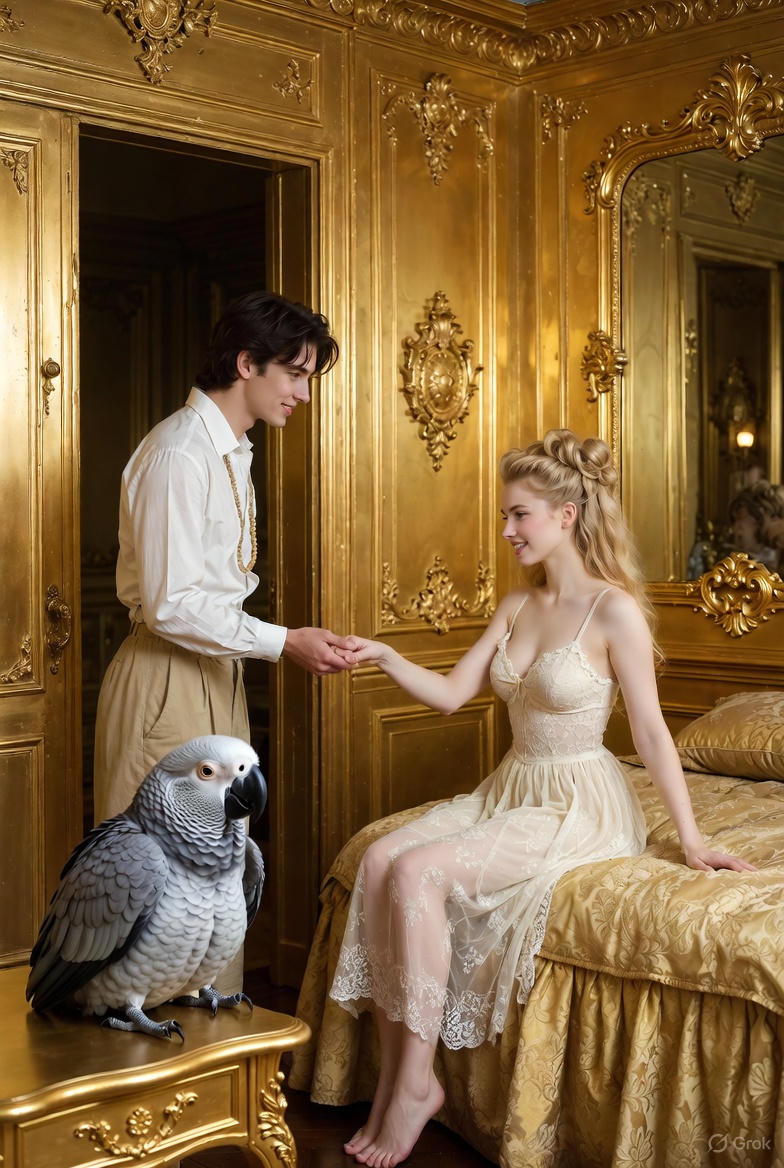
An enormous canopy bed stood in Alraune’s bedroom on low,
baroque columns. Two pillars grew out of the foot and bore shelves
that shown with golden flames. The engraved sides showed Omphale
with Hercules in a woman’s dress as he waited on her, Perseus kissing
Andromeda, Hephaestus catching Ares and Aphrodite in his net–
Many tendrils of vines wove themselves in between and doves played
in them–along with winged cherubs. The magnificent ancient bed,
heavily gilt with gold, had been brought out of Lyons by Fräulein
Hortense de Monthy when she became his great-grandfather’s wife.
He saw Alraune standing on a chair at the head of the bed, a
heavy pliers in her hand.
“What are you doing with that?” he asked.
She laughed, “Just wait. I will soon be finished.”
She pounded and tore, carefully enough, at the golden figurine of
Amor that hovered at the head of the bed with his bow and arrow. She
pulled one nail out, then another, seized the little god, twisted him this
way and that–until he came loose. She grabbed him, jumped down,
laid him on top of the wardrobe, took out the Alraune manikin,
clambered back up onto the chair again with it and fastened it to the
head of the bed with wire and twine. Then she came back down and
looked critically at her work.

Read Full Post »

Madame Bluebeard by Karl Hans Strobl and translated by Joe E Bandel

Taking leave of his mother the evening before
departure—he planned to stay at a hotel to avoid
disturbing her at night—she looked into his eyes.
“What’s wrong, Ernst?” she asked. “I think you’re
deeply in love…”
“Nonsense, Mother,” he replied.
She shook her head. “No, dear, you can’t deny
it… I see it. You’re changed. Why tell me nothing?”
Ernst Hugo felt it might’ve been better to confide
in her about his doom. But it was too late. He denied
it and tore himself away. On the journey, his unrest
grew worse. This passion had seized him like fate,
roaring through him, tearing him along, gnawing his
core with a vulture’s greedy beak. He yearned for
something good, wise, calm, but knew it was a land
he’d never reach. The train’s rattling rhythm fused
with him; he felt one with this raging beast, yet it
seemed they didn’t move, trapped in an endless
screw.
He traveled half the night.
Early morning brought him to Sankt Pölten. The
summer sun had risen, peering over the station’s
shoulder. Ernst Hugo paced, shivering. He glanced at
the officials’ apartment windows. A curtain stirred. A
hand with a watering can appeared, tending
flowerpots by an open window. He pictured a
bedroom filled with fresh night air, a bed of white
linen and lace, a blue silk coverlet. He clenched his
teeth, fists balled.
The express to Salzburg–Munich pulled in,
panting on the tracks. Doors clattered open and shut;
conductors scurried; sleepy waiters carried breakfast
coffee along the cars. Ernst Hugo ignored the bustle,
ensnared in his thoughts, wrestling them, unable to
break free. They attacked like wolves.
The station’s tumult ebbed. Conductors closed
doors, signaling each other… then three people burst
from the first-class waiting room, racing across the
tracks to the train. A broad-shouldered giant led,
carrying two bags, followed by a lady and a
gentleman… Ernst Hugo caught a fleeting glimpse.
An eternity later, a jolt: it was Helmina… Lorenz
ahead… and the man beside her, Fritz Gegely,
dressed as an Englishman in proper travel attire.
Later, studying psychology, Ernst Hugo saw this
moment as a case of delayed action between decision
and execution.
He lunged too late. A conductor had opened a
carriage door; the three boarded in frantic haste, and
the train began to move. It glided past Ernst Hugo, a
gray, blurring ribbon… a vast emptiness remained
where he stood. It heated from within, radiating
white-hot fury… seeping into him, swelling into
boundless rage.
So, Frau Helmina had run off with Herr Gegely,
poet of Marie Antoinette, the Heidelberg manuscript
thief. Splendid. What else could he think? They’d
boarded at the last moment to avoid interception.
Good that he’d seen them; he could at least tell
Ruprecht Helmina looked lively and eager. That was
all left for him to do.
Soon, his train departed. Ernst Hugo sat in his
corner, brimming with hate, fury, outrage, and
despair. Like a Leyden jar charged with electricity,
sparking at the slightest touch.
At Gars station, he asked two men who’d wired
for a carriage to let him ride to Vorderschluder. They
were taciturn, silently smoking, watching blue smoke
trails flutter into the kind summer morning. Ernst
Hugo squeezed into the opposite corner, hat over his
eyes, pretending to sleep.
At the Kamp bridge, he alighted, thanked them
hastily, and raced up the castle hill. He hurled his
question like a stone at the first person he met. Yes,
of course… the mistress had left… the Baron was in
the village. Ernst Hugo laughed scornfully and ran
back down. He kept seeing a bedroom filled with
fresh night air… Now he must find Frau Gegely,
fling his news in her face. Someone should writhe…
The Red Ox’s plump landlady filled the doorway
pleasantly. Nearby, three men conversed quietly.
Ernst Hugo recognized his carriage companions
and the Celt scholar he’d seen with Ruprecht. He
charged at the landlady.
“Is Frau Gegely upstairs?” he asked.
“Yes!” she replied, not budging from the door, as
if planted to guard.
“I must speak with her. I have to tell her
something.” He moved to rush past.
Schiereisen approached with a polite greeting. “I’d
ask you, Herr Secretary, not to go up now. The poor
woman…” That was the spark nearing the Leyden
jar. The discharge followed.
“I know… I know,” Hugo screamed, “but I must
tell you I saw them together. I saw them, understand?
It’ll please her when I tell them.”
Schiereisen gripped Hugo’s wrist firmly.
“Where?” he asked urgently.
“Where? Sankt Pölten… Salzburg express… and
so on… who knows… they’re off into the world.”
Ten clear chimes rang from the church tower.
Schiereisen released Hugo’s wrist and turned to his
companions. “Let’s go… to the telegraph office…”
His blue eyes gleamed like iron; his face, every
muscle, pulsed with resolve. “Now we’ll show what
we can do.”
As the three hurried off, Ernst Hugo collapsed,
shrinking… his fingers fumbled beside him; then he
turned, drifting slowly through a fog.
Ten days later, Schiereisen returned from his hunt
to Vorderschluder. His first stop was the castle. He
found Ruprecht with Hedwig in the garden. Her
wheelchair stood under a wild vine arbor.
Maurerwenzel slept in the arbor’s shade. Frau
Hedwig walked, leaning on Ruprecht’s arm and a
cane, slowly in bright sunlight. Two rose hedges
lined their path.
A miracle had occurred.
Schiereisen honored it by not mentioning it. He
doffed his hat, waiting until they turned and saw him.
Hedwig started… Schiereisen saw her grip
Ruprecht’s arm tighter.
“Herr Schiereisen is back,” Ruprecht murmured.
“Herr Schiereisen… will you hear him, Hedwig? …
It’s better…”
“No… no… I’ll hear him now. I must know.
Mustn’t I?” She put on a brave, resolute face.
“Well, then… if she wishes… You can speak,
Schiereisen. I’ve told her everything; she knows all.”
Schiereisen still held his hat. His broad skull
arched powerfully, eyes shadowed under strong
brows.
“Have you found a trace…?” Ruprecht asked, as
Schiereisen didn’t speak at once.
“They’re not yet caught, but they’re ours. They’re
still on the Atlantic.”
“And how did you…? Speak. See, we’re prepared
and can hear it all.”
“It wasn’t entirely easy… though they clearly
didn’t expect pursuit. They’d have been more
cautious otherwise. Why bore you with details? They
headed to Le Havre, after various zigzags that cost us
some effort.”
“And then they boarded a ship?”
“Yes… we arrived too late to stop them. But it’s
hard to hide today… wireless telegraphy, you know?
We sent a Marconi telegram at once, and they’ll
return on the next steamer.”
“Him too? Have you had him arrested as well?”
Schiereisen donned his Panama hat, his face now
shadowed. “No…” he said hesitantly, “not him…
why? We… please, stay calm, gracious lady. We
were too late… for your husband. It’s not our fault.”
“My God… what are you saying… he’s…”
“Yes… he met with misfortune, gracious lady. In
his hotel… they weren’t staying together, and
Helmina… likely to mislead any pursuers, if
followed… he took his own life in his room…
poisoned.”
Hedwig let out a soft cry and closed her eyes. So
this was the end.
“You don’t believe it, Schiereisen!” Ruprecht said
after a pause. He’d reflected, feeling unvarnished
truth would heal more than this notion, which he saw
spawning subtle torments of conscience for Hedwig.
“Tell us honestly what you think.”
“You’re right, Herr Baron! I don’t believe it. It
was all cleverly done. But Fritz Gegely had no reason
to kill himself. And… we know he withdrew nearly
his entire fortune from his Vienna bank. He carried it,
not wanting to transfer it to America and betray
himself. Well… all the money’s gone…”
Hedwig, shuddering with horror, threw herself
against Ruprecht’s chest. He stood still, his arms
gently, protectively around her neck. A freeing sob
rose from her depths, a releasing weep… her
trembling fingers calmed, nestling trustingly against
his shoulders. He looked straight ahead… gravely
into the future.
“Now we must face the trial…” he said softly,
“the trial and all that. We must…” He turned his gaze
to Schiereisen. “Tell Herr von Zaugg I’m ready to
vacate the castle anytime. Anytime! His claims are
sacred to me. I’ve always seen myself as a steward
here. I’ll stay as long as he wishes… to hand over the
estate in good order. Meanwhile, I’ll find something
in my homeland… ground that’s mine…” He bent to
Hedwig again.
She raised her head. Fear and horror lingered on
her pale face, but Schiereisen saw a timid tenderness
in Ruprecht’s gaze soften it all.
He turned and walked slowly from the castle
garden, past where Jana was found, through the gate
Helmina had fled. A certainty flowed in him like a
broad, calm river: these two were good and tightly
bound; no turmoil or pain, no upheaval ahead, could
shake their happiness, radiant with the future.
He paused on the bridge beside the stone John,
gazing into the water. And smiled…
One could forgo the bit of thanks perhaps earned.

Read Full Post »

Alraune by Hanns Heinz Ewers and translated by Joe E Bandel

He nodded, but she fell silent again.
“So,” he began, “did you read the leather bound volume?”
“Yes,” she said.
She took a deep breath, looked at him.
“So, am I only a joke that you once made, Frank Braun?”
“A joke?” he returned. “–An–idea, if you will–”
“And I suppose it was funny enough,” she laughed out loud. But
that’s not why I waited here for you. I want to know something
entirely different. Tell me. Do you believe it?”
“Do I believe what?” he answered. “If everything happened like
Uncle relates in the leather bound volume? Yes, I believe that.”
She shook her head impatiently. “No, that’s not what I mean.
Naturally that is true–why would he lie in his book?–I want to know
whether you also believe–like my–my–that is–your uncle did–That I
am a different type of creature, different from other people, that I–am
now, that I am, what my name implies?”
“How shall I reply to your question?” he said. “Ask any medical
doctor–he will certainly say that you are just as good a human being
as anyone else in the world, even if your first appearance was a little
unusual–He would add, that all the other details are pure coincidence
and unimportant, the–”
“That means nothing to me,” she interrupted.
“For your uncle these little details were most important.
Basically it doesn’t matter if they are or not. I want to know if you
share his opinion? Do you believe as well that I am a strange
creature?”
He remained silent, searched for a reply, didn’t know how he
should respond. He did believe it–and then again he didn’t–
“You see–” he began finally.
“Speak,” she urged. “Do you believe that I am your insolent
joke–that took form? Your idea, which the old Privy Councilor threw
into his crucible, which he cooked and distilled, until something came
out that now sits before you?”
This time he didn’t hesitate, “If you put it that way, yes, that’s
what I believe.”
She laughed softly, “I thought so–and that’s why I waited up for
you tonight, to cure you of this vanity as soon as possible. No, cousin,
you didn’t throw this idea into the world, not you–not any more than
the old Privy Councilor did.”
He didn’t understand her.
“Then who did?” he asked.
She reached under the pillow with her hand.
“This did!” she cried.
She lightly tossed the little alraune into the air and caught it
again, caressed it lovingly with nervous fingers.
“That there? Why that?” he asked.
She gave back, “Did you think about it earlier–before the day the
Legal Councilor celebrated the communion of the two children?”
“No,” he replied. “Certainly not.”
But then this thing fell down from the wall, that was when the
idea came to you! Isn’t that true?”
“Yes,” he confessed. “That is how it was.”
“Now then,” she continued, “so the idea came from outside
somewhere and entered into you. It was when Attorney Manasse gave
his lecture, when he recited like a school book and explained to all of
you what this little alraune was and what it meant–That’s when the
idea grew in your brain. It became so large and so strong that you
found the strength to suggest it to your uncle, to persuade him to carry
it out, to create me.
Then, if I am only an idea that came into the world and took on
human form, it is also true that you, Frank Braun, were only an agent,
an instrument–no more than the Privy Councilor or his assistant
doctor. No different than–”
She hesitated, fell silent, but only for a moment. Then she
continued–
“than the prostitute, Alma and the rapist-murderer whom you all
coupled–you and Death!”
She laid the little alraune on the silk cushions, looked at it with
an almost loving glance and said,” You are my father: You are my
mother. You are what created me.”
He looked at her.
“Perhaps it was so,” he thought.
Ideas whirl through the air, like the pollen from flowers and play
around before finally sinking into someone’s brain. Often they waste
away there, spoil and die–Only a few find good rich soil–
“Perhaps she is right,” he thought.
His brain had always been a fertile planting place for all kinds of
foolishness and abstruse fantasies. It seemed the same to him, whether
he was the one that once threw the seed of this idea into the world–or
whether he was the fertile earth that had received it.
But he remained silent, left her with her thought. He glanced
over at her, a child, playing with her doll. She slowly stood up, not
letting the little manikin out of her hands.
“There is something else I want to tell you,” she spoke softly.
“But first I want to thank you for it, for giving me the leather bound
volume and not burning it.”
“What is it?” he asked.
She interrupted herself.
“Should I kiss you?” she asked. “I could kiss–”
“Was that all you wanted to say, Alraune?” he said.
She replied, “No, not that!–I only thought I would like to kiss
you once. Just in case–But first I want to tell you this, why I waited.
Go away!”
He bit his lips, “Why?”
“Because–because it would be better,” she answered, “for you–
perhaps for me as well. But it doesn’t depend on that–I now know
how things are–am now enlightened, and I think that things will
continue to go as they have–only, I will not be running around blindly
anymore–Now I see everything. Soon–soon it will be your turn, and
that’s why it would be better if you left.”
“Are you so certain of this?” he asked.
“Don’t I need to be?”
He shrugged his shoulders, “Perhaps, I don’t know. But tell me,
why do you want to do this for me?”
“I like you,” she said quietly. “You have been good to me.”
He laughed, “Weren’t the others as well?”
“Yes,” she answered. “They all were. But I didn’t see it. And
they–all of them–they loved me–you don’t–not yet.”
She went to the writing desk, took a postcard and gave it to him.
“Here is a postcard from your mother. It came earlier this
evening; the servant brought it up with my mail by mistake. I read it.
Your mother is ill–She very much begs you to come back to her.”
He took the postcard, stared in front of him undecided. He knew
that they were right, both of them, could feel it, that it was foolishness
to remain here. Then a boyish defiance seized him that screamed out,
“No! No!”
“Will you go?” she asked.
He forced himself, spoke with a determined voice, “Yes,
cousin!”
He looked at her sharply, watched every line of her face
searching for some movement, a little tug at the corners of her mouth,
a little sigh would have been enough, some something that showed
him her regret. But she remained quiet and serious. No breath moved
on her inflexible mask.
That vexed him, wounded him, seemed like an affront and an
insult to him. He pressed his lips solidly together.
“Not like this,” he thought. “I won’t go like this.”
She came up to him, reached out her hand to him.
“Good,” she said. “Good–Now I will go. I can give you a
goodbye kiss if you want.”
A sudden fire flickered in his eyes at that.
Without even wanting to, he said, “Don’t do it Alraune. Don’t do
it!”
And his voice took on her own tone.
She raised her head and quickly asked, “Why not?”
Again he used her words, but she sensed that it was on purpose.
“I like you, Alraune,” he said. “You have been good to me
today–many red lips have kissed my mouth–and they became very
pale. Now–now, it would be your turn. That is why it would be better
if you didn’t kiss me!”
They stood facing each other; their eyes glowed hard as steel.
Unnoticed, a smile played on his lips. His weapon was bright and
sharp. Now she could choose. Her “No” would be his victory and her
defeat–then he could go with a light heart. But her “Yes” would mean
war and she felt it–the same way he did. It was like that very first
evening, exactly the same, only that time was the beginning and
opening round. There had still been hope for several other rounds in
the duel. But now–it was the end. He was the one that had thrown the
glove–
She took him up on it.
“I am not afraid,” she spoke.
He fell silent and the smile died on his lips–Now it was serious.
“I want to kiss you,” she repeated.
He said, “Be careful! I will kiss you back.”
She held his gaze–“Yes,” she said–Then she smiled.
“Sit down, you are a little too tall for me!”
“No,” he cried out loudly. “Not like that.”
He went to the wide divan, laid down on it, buried his head in the
cushions, stretched his arms out wide on both sides, closed his eyes.
“Now, come Alraune!” he cried.
She stepped closer, kneeled by his hips, hesitated, looked at him,
then suddenly threw herself down onto him, seized his head, pressed
her lips on his. He didn’t embrace her, didn’t move his arms. But his
fingers tightened into fists. He felt her tongue, the light bite of her
teeth.
“Kiss harder,” he whispered. “Kiss harder.”
Red fog lay before his eyes. He heard the Privy Councilor’s
repulsive laugh, saw the large piercing eyes of Frau Gontram, how
she begged little Manasse to explain the little alraune to her. He heard
the giggling of the two celebrants, Olga and Frieda, and the broken,
yet still beautiful voice of Madame de Vére singing “Les Papillons”,
saw the small Hussar Lieutenant listening eagerly to the attorney, saw
Karl Mohnen, as he wiped the little alraune with the large napkin–
“Kiss harder!” he murmured.
And Alma–her mother, red like a burning torch, snow-white
breasts with tiny blue veins, and the execution of her father–as Uncle
Jakob had described it in his leather bound volume–Out of the mouth
of the princess–And the hour, in which the old man created her–and
the other, in which his doctor brought her into this world–
“Kiss me,” he moaned, “Kiss me.”
He drank her kisses, sucked the hot blood from his lips, which
her teeth had torn, and he became intoxicated, knowingly and
intentionally, as if from champagne or his oriental narcotics–
“Enough,” he said suddenly, “enough, you don’t know what you
are doing.”
At that she pressed her curls more tightly against his forehead,
her kisses became hotter and more wild. Now the clear thoughts of
day lay shattered, now came the dreams, swelling on a blood red
ocean, now the Maenad swung her thyrsos and he frothed in the holy
frenzy of Dionysus.
“Kiss me,” he screamed.
But she released him, let her arms sink. He opened his eyes,
looked at her.
“Kiss me!” he repeated softly.
Her eyes glazed over, her breath came in short pants. Slowly she
shook her head. At that he sprang up.
“Then I will kiss you,” he cried.
He lifted her up in his arms, threw her down struggling onto the
divan, knelt down–there, right where she had knelt.
“Close your eyes,” he whispered and he bent down–
Good, his kisses were good–caressing and soft, like a harp
played on a summer night, wild too, yes, and raw, like a storm wind
blowing over the North sea. They burned red-hot like the fiery breath
out of mount Aetna, ravishing and consuming like the vortex of a
maelstrom–
“It’s pulling me under,” she felt, “pulling me into it.”
But then the spark struck and burning flames shot high into the
heavens, the burning torch flew, ignited the altar, and with bloody
jowls the wolf sprang into the sanctuary.
She embraced him, pressed herself tightly to his breast–I’m
burning–she exalted–I’m burning–at that, he tore the clothes from her
body.
The sun that woke her was high in the sky. She saw that she was
lying there completely naked, but didn’t cover herself. She turned her
head, saw him sitting up right next to her–naked like she was.
She asked, “Will you be leaving today?”
“Is that what you want, that I should leave?” he gave back.
“Stay,” she whispered. “Stay!”

Read Full Post »

Madame Bluebeard by Karl Hans Strobl and translated by Joe E Bandel

Eighteenth Chapter
Ruprecht woke with uneasy feelings. The joyful
uplift of yesterday’s afternoon and evening had given
way to deep despondency. A heavy weight pressed
on him again. His talk with Schiereisen had rolled
boulders over his soul, blocking light and air. He saw
it was impossible to live alongside Helmina any
longer. Something must be done… but the worst was
not knowing what. Should he warn Helmina about
Schiereisen? That would make him complicit in her
crimes. Could he let Schiereisen continue his probe
and catch her unawares…? Should he let events
unfold, taking their outcome as divine judgment?
Tormented and drained, he went to breakfast.
Only the children and Miss Nelson were there. Sitting
across from the Englishwoman, he had a strange
sensation. As she sat—black, slender, composed,
ever equable—she seemed the axis of all events in
the castle. A link between poles, unmoving yet the
spine of all motion around her. With a surge, he
resolved to regain his composure.
He pushed back his chair and left to speak with
Helmina. The chambermaid said the mistress hadn’t
called for her. It was nearly eight; she should be up.
His knocks went unanswered. The door was locked.
Suddenly, as he stood with his ear to the wood, a
wedge drove into his mind. Ah… she played me, saw
through Schiereisen, knew of my talk with the
detective yesterday—she’s fled! He stood motionless
a moment, then called old Johann, ordering a
crowbar, pickaxe, or similar tool.
Until the servant returned, Ruprecht stood like a
sentinel before the door. His composure returned; his
nerves relayed clear sensations, his thoughts focused
on the immediate.
Johann brought a pickaxe. Ruprecht wedged its
blade into the door’s lower gap, pressed it firm, and
with one heave, tore the door from its hinges,
crashing it into the room. Johann followed, horrified.
Helmina was gone. Her bed untouched. The
window open, morning sunlight on white pillows and
blue silk coverlet. Ruprecht searched the room… no
letter, no explanation.
Behind him stood an old man, broken, swaying,
crushed by a temple’s sudden collapse.
Schiereisen entered. Ruprecht turned, and one
glance at the detective’s face grasped the event’s
meaning. “You can go, Johann,” he said. “Tell the
staff the mistress has left.”
When Johann was gone, Ruprecht approached
Schiereisen. “You already know what’s happened?”
The detective nodded. “Yes… I know. I was
present at your wife’s departure. Uninvited, of
course.”
“You saw Helmina? You were there? I don’t
understand… and you didn’t arrest her? Why didn’t
you stop her? You suspect her gravely…”
“Yes… you see, Herr Baron, I could’ve detained
her. Perhaps! Certainly! I was about to… but I didn’t.
Why? I’m proud to be your friend, Herr Baron.”
“For my sake?”
“Yes… it wasn’t entirely dutiful… but perhaps
aligns with my duty. I’m here on behalf of Herr Peter
Franz von Zaugg, the late Herr Dankwardt’s brother-
in-law. His main concern is proving Frau Helmina
seized the deceased’s assets through a crime, to
renew certain inheritance claims. I’ve fulfilled that
commission as far as possible. But I also have a duty
to the public—to neutralize dangerous criminals like
your wife and Lorenz. I’ll fulfill that too. But for you,
I delayed it.”
“Delayed? You’ll still pursue Helmina?”
“Yes. I’ve given her a head start. By ten, two of
my agency’s men arrive. At ten, I’ll take up Frau
Helmina’s trail. Chance, luck, or my skill will decide.
I’ll do everything to apprehend her then.
Relentlessly! But I had to give her that head start… I
owed it to our friendship… I know you love this
woman.”
“You’re mistaken,” Ruprecht said calmly. “I no
longer love her. But I couldn’t betray her. You’ll
agree…”
Schiereisen studied Ruprecht’s face. “So,” he said
slowly, “you don’t love Helmina anymore… well,
then…”
“Did you know of her escape plan?”
“No… it was an intuition. I hear a noise in the
night, like someone rattling a door. My senses are
sharp in such hours. I hear it, leap to the garden
door… I see someone tampering with the small tower
gate… my instinct was to seize them. I creep along
the walls, but before I reach it, the door opens…
someone slips out. I rush forward… it’s Helmina.”
“You were in the castle last night?”
“Yes… I was in the castle.”
Before Ruprecht’s eyes flickered a
cinematograph’s chase again. He steadied himself,
adjusted a lever, and focused. “You searched?”
“And found,” Schiereisen replied calmly.
Ruprecht flinched.
“Yes… I got to the secret’s core,” Schiereisen
continued. “I finally did the obvious, what I
should’ve done long ago. The simplest, most
necessary things come last. Last night, I entered the
old tower, where all events pointed.”
Ruprecht gripped the bedpost’s knob with an iron
fist, silent.
“I see you know what I found,” Schiereisen said.
“It wasn’t easy. Jérome Rotrehl helped mightily. You
may know there’s an opening high in the tower. We
climbed in. It was fascinating. The tower’s filled with
rubble, always risking being crushed. Recently, many
obstacles were added. We crawled under a stone slab
balanced on its edge. A fingertip’s touch, and it falls.
A perfect mousetrap. But we pressed deeper. Finally,
we reached a vault far below. Nothing there. I wasn’t
fooled. We searched on, finding the hiding place—
carefully crafted, like Egyptian kings’ tomb
chambers… Yes, there were bodies to hide. Three.
You understand. Caustic lime was used, recently…
well, let’s leave it. We know why Jana ‘met with
misfortune,’ don’t we? I’d reached my goal. Then…
discovering Helmina’s flight… was a bonus.”
“And you let her escape… what can I say…” The
bedpost creaked in Ruprecht’s grip.
Schiereisen placed a hand on his shoulder, his
gaze kind and concerned. “You know,” he said with a
half-smile, “at first I thought… well, I wouldn’t have
been surprised if you’d warned Helmina.”
“I said nothing of our talk.”
Schiereisen nodded. “I know. It was clear the
moment I reached the gate. You told her nothing! Her
flight was long planned. A stranger waited for her
outside.”
“Lorenz!”
“No! Lorenz was below, with a car. It was
another.”
Ruprecht stood firm, his gaze steady. He asked
sharply, demandingly.
“I hope you’re not mistaken, that you no longer
love Helmina,” Schiereisen said. “If that’s true, it’s
good for you. The man who waited was Fritz Gegely.
He fled with her—”
“Fritz Gegely!” Ruprecht said. The connection
eluded him at first, then one thought pushed through
the chaos… “I must go to her… he’s gone… I must
go to her…” He ran off, grabbed his hat, and raced
down the stairs.
Schiereisen kept pace. Ruprecht’s sudden
unraveling, his composure shattered, made the
detective feel he couldn’t leave him alone. He had no
explanation.
Halfway, on the bridge, a messenger met
Ruprecht, summoning him to Hedwig. The Red Ox
chambermaid was distraught, stammering her
message. Her outrage matched her pity for the
abandoned woman, knotting within her. Men were
such vile scum, and Schorsch would hear it today.
Hedwig lay pale in her wheelchair by the open
window, bathed in morning sunlight, her hands
covering a paper. She turned toward the door, a halo
around her light hair.
Ruprecht seized her hand. “Hedwig!” he said,
voice trembling from deep within.
“Yes!” she replied, no further words needed
between them. She handed him the letter Fritz Gegely
had left.
Ruprecht read: “I may bring grief and pain upon
you, my Hedwig, yes, I know, but I cannot do
otherwise. Don’t judge me; try to understand. A new
love has entered my life, a new sun has risen, I must
chart a new course. I must… it’s more compelling
than death. I find it unworthy of an honest man to
hide what the brutality of events makes all too clear: I
could no longer bear life with you. I loved you, you
know that. But now life tears me from you. Life and
my great duty to myself. I am an upright man, great
strength is in me, but by your side, I couldn’t stay
upright, my flight couldn’t soar. I feel my creative
force fading. My Marie Antoinette would’ve been my
only work. I can’t endure that. Your presence is a
constant reminder of humiliation. I must find another
world, free of these reminders. I must fly again. I’ve
been told you’ve rekindled an old friendship. That
eases my parting. I know you have solace. Farewell.”
Ruprecht placed the letter back on the blanket over
Hedwig’s knees. She looked up at him, resigned to
her fate, more bewildered than outraged or sad.
Schiereisen quietly left the room. He knew enough
now; a great relief washed over him. The plump
landlady stopped him outside with indignant
questions and exclamations. Word had spread that
Helmina had vanished, and wild speculations raced.
A carriage rolled down the village street, stopping at
the Red Ox. Two strangers alighted and greeted
Schiereisen. “You’re punctual, thank you,” the
detective said. “We’ll begin at once.”
Ernst Hugo had rushed through his visit to his
elderly mother in Linz. She found little joy in her son
this time. He was restless, irritable, his thoughts
elsewhere.
Her small concerns—Linzer
acquaintances, relatives—were mere annoyances, and
he struggled to feign interest in her tales of
engagements, financial losses, and wayward sons.
What was happening in Vorderschluder? He’d left
the field to another for forty-eight hours. A few
vacation days remained, then duty’s jaws would
swallow him. He couldn’t imagine how he’d cope,
already losing his mind after two days away. He and
Helmina must reach a decision before he returned to
Vienna. Fritz Gegely was an intruder on prior claims,
shifting love’s boundaries. He had to be neutralized.
Ernst Hugo resolved to cast aside decorum and
expose the Heidelberg theft.

Read Full Post »

Alraune by Hanns Heinz Ewers and translated by Joe E Bandel

Chapter Fourteen
Describes how Frank Braun played with fire and how Alraune
awoke.

THAT evening the Fräulein didn’t come to dinner, only
allowed Frieda Gontram to bring in a little tea and a few
cakes. Frank Braun waited awhile for her, hoping that
perhaps later she would come down. Then he went to the
library and reluctantly took up the documents from the writing desk.
But he couldn’t bring himself to read them, put them down again and
decided to drive into the city.
Before he left he took the last little mementos from out of the
desk drawer, the piece of silk curtain cord, the card and four-leaf
clover with the bullet holes through them and finally the alraune
manikin. He packed everything together, sealed the brown paper
package and had it sent up to the Fräulein. He attached no written
explanation to it–
Everything would be explained to her inside the leather bound
volume that bore her initials.
Then he rang for the chauffeur and drove into the city. As he
expected, he met Herr Manasse in the little wine pub on Cathedral
Square. Stanislaus Schacht was with him. He sat down with them and
began to chat.
He got into a deep discussion with the attorney about legal
questions, debating the pros and cons of this and that lawsuit. They
decided to turn a few of the doubtful cases over to the Legal
Councilor for him alone. He would bring them to some acceptable
compromise. Manasse believed that a victorious settlement could be
reached with the others.
In some of the cases Frank Braun calmly suggested they simply
acknowledge the claim, but Manasse refused.
“Never acknowledge–even if the opponent’s demands are as
clear as day and justified a hundred-fold!”
He was the straightest and most honest attorney in the county
courthouse, one that always told his clients the truth, right to their
face. In front of the bar he might remain completely quiet but he
would never lie–and yet he was way too much a lawyer not to have an
innate hatred of recognizing an opponent’s claim.
“It only costs us more,” Frank Braun objected.
“So what!” barked the attorney. “What does that have to do with
it?–I tell you, one never knows–there is always a chance…”
“A legal one–perhaps–” answered Frank Braun. “–but–”
He fell silent. There was no other way for the attorney. The
Court determined justice–what ever it said was just, even how it
decided. Today it would be just–and totally different after a couple of
months in the higher courts. Nevertheless, the Court gave the final
decision and it was sacred–not the parties involved.
To recognize a claim yourself, without such a decision, was
usurping the right of the Court. As an attorney Manasse was partial to
his own clients. He desired the judge to be impartial, so it was an
abomination to him to make such a decision for his own party.
Frank Braun smiled.
“As you wish,” he said.
He spoke with Stanislaus Schacht, listened as this friend of Dr.
Mohnen talked of all the others that had been there as students with
him.
“Yes, Joseph Theyssen has been a Government Advisor for some
time now and Klingel Hőffer is a professor at Halle–he will be the
new chair for Anatomy, and Fritz langen–and Bastian–and–”
Frank Braun listened, turned the pages of this living directory of
German nobility that knew everyone.
“Are you still enrolled?” he asked.
Stanislaus fell silent, a little offended.
But the attorney barked, “What! Didn’t you know? He passed his
doctoral exam–five years ago.”
“Really–five years ago!”
Frank Braun calculated backward, that must have been in his
forty-fifth, no, forty-sixth semester.
“Well,” he said.
He stood up and reached out his hand, which the other heartily
shook.
“Allow me to congratulate you, Herr Doctor!” he continued.
“But–tell me–what are you doing now?”
“Yes, if he only knew!” cried the attorney.
Then chaplain Schrőder came. Frank Braun stood up to greet
him–
“Back in the country again?” cried the black suited priest. “We
must celebrate!”
“I am the host,” declared Stanislaus Schacht. “He must drink to
my doctor’s degree.”
“And with me to my newly becoming a vicar,” laughed the
priest. “Let’s share the honor then, if it’s alright with you, Dr.
Schacht.”
They agreed and the white haired vicar ordered a 93
Scharzhofberger, which the wine pub had placed in stock on his
recommendation. He tested the wine, nodded with satisfaction and
toasted with Frank Braun.
“You have it good,” he said, “sticking your nose into every
unknown place on land and sea. Yes, we can read about them in the
newspapers–but we must sit at home and console ourselves with the
fact that the Mosel still always produces a good wine–You certainly
can’t get this label out there!”
“We can get the label,” he said, “but not the wine– Now Herr
Reverend, what have you been up to?”
“What should I be up to?” replied the priest. “One just gets
themselves angry. Our old Rhine is always becoming more Prussian.
But for relaxation one can write rotten pieces for the Tűnnes,
Bestavader, Schâl, Speumanes and the Marizzebill. I have already
plundered Plautus and Terence in their entirety for Peter
Millowwitsch’s puppet theater in Cologne–Now I’m doing it to
Holberg. And just think, that fellow–Herr Director, he calls himself
today–now pays me royalties–Another one of those Prussian
inventions.”
“Be happy about it!” growled Attorney Manasse. “By the way,
he’s also published on Iamblicos.”
He turned to Frank Braun, “And I tell you, it is a very
exceptional book.”
“Not worth talking about,” cried the old vicar.
“Only a little attempt–”
Stanislaus Schacht interrupted him.
“Go on!” he said. “Your work lays out the foundation of the very
essence of the Alexandrian school. Your hypothesis about the
Emanation Doctrine of the Neo-Platonists–”
He went on, lecturing like an argumentative Bishop at the high
council. Here and there he made of few considerations, gave his
opinion, that it wasn’t right the author based his entire work on the
three cosmic principles that had been previously established. Couldn’t
he have just as well successfully included the ‘Spirit’ of Pophyrs?”
Manasse joined in and finally the vicar as well. They argued as if
there was nothing more important in the entire world than this strange
monism of Alexander, which was based on nothing other than a
mystical annihilation of self, of the “I”, through ecstasy, asceticism
and theurgy.
Frank Braun listened silently.
“This is Germany,” he thought. “This is my country–”
It occurred to him that a year ago he had been sitting in a bar
somewhere in Melbourne or Sidney–with him had been a Justice of
the Supreme Court, a Bishop of the High Church and a famous doctor.
They had disputed and argued no less ardently than these three that
were now sitting with him–But it had been about whom was the better
boxer, Jimmy Walsh of Tasmania or slender Fred Costa, the
champion of New-South Wales.
But here sat a little attorney, who was still being passed over for
promotion to Legal Councilor, a priest that wrote foolish pieces for a
puppet theater, that had a few titles of his own, but never a parish, and
finally the eternal student Stanislaus Schacht, who after some fourteen
years was happy to have his doctor’s degree and now didn’t know
what to do with himself.
And these three little poor wretches spoke about the most
abstract, far-fetched things that had nothing at all to do with their
occupations. And they spoke so easily, with the same familiarity as
the gentlemen in Melbourne had conversed about a boxing match. Oh,
you could sift through all of America and Australia, even nine-tenths
of Europe–and you would not find such an abundance of knowledge–
only–it was dead.
He sighed, it was long dead and reeked of decay–really, the
gentlemen didn’t even notice!
He asked the vicar how it was going with his foster son, young
Gontram. Immediately Attorney Manasse interrupted himself.
“Yes, tell us Herr Reverend–that’s why I came here. What does
he write?”
Vicar Schröder unbuttoned his jacket, pulled out his wallet and
took a letter out of it.
“Here, read for yourself,” he said. “It doesn’t sound very
encouraging!”
He handed the envelope to the attorney. Frank Braun threw a
quick glance at the postmark.
“From Davos?” he asked. “Did he inherit his mother’s fate as
well?”
“Unfortunately,” sighed the old priest. “And he was such a fresh,
good boy, that Josef, absolutely not meant for the priesthood though.
God only knows what he would have studied, or I would have
allowed him to study if I didn’t wear the black robe. But I promised
his mother on her deathbed. By the way, he has already gone as far in
his studies as I have–I tell you–he passed his doctoral exam–summa
cum laude! I obtained a special dispensation for him through the
ArchBishop, who has always been very benevolent towards me
personally.
He helped me a lot with the work about Iamblichos–yes, he
could really become something! Only–unfortunately–”
He hesitated and slowly emptied his glass.
“Did it come so suddenly, Herr Reverend?” asked Frank Braun.
“You could say that,” answered the priest. “It first started with
the psychological shock of the sudden death of his brother, Wolf. You
should have seen him outside, at the cemetery. He never moved from
my side while I gave my sermon, stared at the enormous garland of
blood red roses that lay on the coffin. He held himself upright until
the ceremony was ended, but then he felt so weak that Schacht and I
had to downright carry him.
In the carriage he seemed better, but at home with me he once
more became entirely apathetic–The only thing I could get out of him
at all that entire evening was that now he was the last of the Gontram
boys and it was his turn next. This apathy would not yield and from
that hour he remained convinced that his days were numbered, even
though a very thorough medical examination gave me a lot of hope in
the beginning. But then it went rapidly. From day to day you could
see his decline–now we have sent him to Davos–but it appears that his
song will soon be over.”
He fell silent, fat tears stood in his eyes–
“His mother was tougher,” growled the attorney. “She laughed in
the Reaper’s face for six long years.”
“God grant her soul eternal peace,” said the vicar and he filled
the glasses. “We will drink a silent toast to her–in her memory.”
They raised the glasses and emptied them.
“The old Legal Councilor will soon be entirely alone,” observed
Dr. Schacht. “Only his daughter appears to be completely healthy–
She is the only one that will survive him.”
“The attorney grumbled, “Frieda?–No, I don’t believe it.”
“And why not?” asked Frank Braun.
“Because–because–” he began, “–well, why shouldn’t I say it?”
He looked straight at Frank Braun, cutting, enraged, as if he
wanted to take him by the throat.
“You want to know why Frieda Gontram will never grow old?–I
will tell you. Because she is now completely caught in the claws–of
that damned witch out there!–That’s why–Now you know!”
“Witch,” thought Frank Braun. “He calls her a witch, just like
Uncle Jakob did in his leather bound volume.”
“What do you mean by that, Herr Attorney?” he asked.
Manasse barked, “Exactly what I said. “Whoever gets to close to
the Fräulein ten Brinken–gets stuck, like a fly in syrup. And whoever
is once caught by her–stays there and no amount of struggling will do
any good!
Be careful, Herr Doctor, I’m warning you! It is thankless
enough–to give warnings like this. I have already done it once–
without any success–with Wölfchen–now it is you–flee while there is
still time. What do you still want here?–It seems to me exactly as if
you are already licking at the honey!”
Frank Braun laughed–but it sounded a little forced.
“Have no fear on my account, Herr Attorney,” he cried–But he
didn’t convince the other–and even less, himself.
They sat and drank, drank to Schacht’s doctoral degree and to the
Priest’s becoming a vicar. They drank as well to the health of Karl
Mohnen, of whom no one had heard since he had left the city.
“He is lost,” said Stanislaus Schacht.
Then he became sentimental and sang melancholy songs. Frank
Braun took his leave, went out on foot back to Lendenich–through the
fragrant trees of spring – like in the old times.
He came across the courtyard, then saw a light in the library. He
went in–Alraune sat on the divan.
“You here, little cousin?” he greeted.
She didn’t answer, waved to him to take a place. He sat across
from her, waiting. But she remained silent and he didn’t press her.
Finally she said, “I wanted to speak with you.”

Read Full Post »

Alraune by Hanns Heinz Ewers and translated by Joe E Bandel

She looked at him sharply.
“Really?” she said, drawing each word out slowly. “And just
what is it that you think would be worth my effort?”
He didn’t respond–Didn’t have any answer at the moment.
He stood up, shrugged his shoulders and went into the garden.
Her laughter sounded behind him.
“In a bad mood, Herr Guardian?”
That afternoon he sat in the library. Some documents lay in front
of him that Attorney Manasse had sent over yesterday. But he didn’t
read them. He stared into the air, hurriedly smoking one cigarette after
the other.
Then he opened a desk drawer and once more took out the Privy
Councilor’s leather bound volume. He read slowly and carefully,
considering every little incident.
There was a knock; the chauffeur quickly stepped inside.
“Herr Doctor,” he cried. “Princess Wolkonski is here. She is very
upset, screamed for the Fräulein while she was still in her carriage.
We thought that perhaps it might be better if you received her first–So
Aloys is bringing her here right now.”
“Well done!” he said. He sprang up and went to meet the
princess. With great effort she squeezed through the narrow door and
waltzed her heavy masses into the half darkened hall, which was lit
only by the sparse sunlight that came through the green Venetian
blinds.
“Where is she?” she panted. “Where is the Fräulein?”
He took her hand and led her over to the divan. She recognized
him immediately and called him by name, but had no intention of
getting into a conversation with him.
“I want to see Fräulein Alraune,” she cried. “Bring the Fräulein
here!”
She would not calm down until he rang the servant and
instructed him to announce the visit of the princess. Then, for the first
time, she consented to listen to him.
He asked after the health of her child and the princess related to
him, in an immense flood of words, how she had met with her
daughter. Not once had she recognized her own mother, had simply
sat by the window looking out into the garden, passive and listless.
It had been in the old Privy Councilor’s clinic, that fraud, which
Professor Dalberg had now turned into an insane asylum, the same
building where–
He interrupted her, cutting short her flood of words. He quickly
grabbed her hand, bent over it and looked with simulated interest at
her rings.
“Excuse me, your Highness,” he cried quickly. “Where did you
ever get this marvelous emerald? Definitely a showcase piece!”
“It was a button from the Magnate’s beret of my first husband,”
she replied. “It’s an old heirloom.”
She prepared to continue her tirade, but he didn’t let her get a
word in.
“It is a stone of uncommon purity!” he affirmed. “And of
remarkable size! I only once saw a similar one, in the royal stud of the
Maharajah of Rolinkore–He had it set into his favorite horse’s left
eye. For the right it carried a Burmese ruby that was only a little
smaller.”
Then he told of the hobby of Indian princes, how they gouged
out the eyes of their beautiful horses and replaced them with glass
eyes or large round highly polished stones.
“It sounds cruel,” he said. “But I assure you, your Highness. The
effect is amazing when you see such a magnificent animal, when they
stare at you with Alexandrite eyes, or glance at you out of deep blue
sapphires.”
Then he spoke of precious stones, remembering from his student
days that she knew quite a bit about jewels and pearls. It was the only
thing she was really interested in. She gave him answers, at first
quickly and briefly, then became calmer with every minute.
She pulled off her rings, showed them to him one after the other,
telling him a little story about each one. He nodded attentively.
“Now let my cousin come,” he thought. “The first storm is over.”
But he was wrong. Alraune had soundlessly come through the
door, walked softly across the carpet and set herself down in the easy
chair right across from them.
“I am so happy to see you, your Highness,” she piped.
The princess cried out and gasped for breath, crossed herself,
then a second time, in the Orthodox manner.
“There she is,” she moaned. “There she sits!”
“Yes,” laughed Alraune, “alive and breathing!”
She stood up and reached her hand out to the princess.
“I am so sorry,” she continued. “My sympathies, your
Highness!”
The princess didn’t take her hand. She was speechless for a
minute, struggled for composure–Then she found herself again.
“I don’t need your sympathy!” she cried. “I have something to
say to you!”
Alraune sat back down, waved lightly with her hand.
“Please speak, your Highness.”
The princess began. Did the Fräulein know that she had lost her
fortune through the machinations of his Excellency? But yes,
naturally she knew. The gentlemen had explained every detail to her,
explained what she had to do–But she had refused to fulfill her
obligation.
Did she know what had happened to her daughter? She explained
how she had found her in the asylum and what the doctor’s opinion
was. She became more excited, her voice swelled, becoming higher
and more shrieking.
She knew all of that, declared Alraune calmly.
The princess asked, what was she now intending to do? Did she
intend to walk in the same dirty footsteps of her father? Oh, there was
a fine scoundrel. You couldn’t find a finer or more cunning
blackguard in any book. Now he had his just reward.
She continued screaming and yelling about his Excellency,
saying everything that came to her tongue–She screamed that Olga’s
sudden attack had been because of the failure of her mission and not
wanting to come back. Alraune had made things worse by enticing
her friend of many long years away from her.
She believed that if the Fräulein would now help, not only would
her fortune be saved, but her child as well, when she heard the news.
‘I’m not asking,” she screamed. “I’m demanding! I demand what
is rightfully mine. You have done this wrong, you, my own Godchild,
and your father. Now make it right again, as much as you possibly
can–It is a shame that I must be the first to tell you this–But you will
have it no other way.”
“What is there left to save?” Alraune said softly. “As far as I
know, the bank collapsed three days ago. Your money is gone, your
Highness!”
She stressed the ‘gone’–You could hear the bank notes fluttering
in all directions.
“That doesn’t matter,” declared the princess. “The Legal
Councilor told me that almost twelve million of my money was
invested into that rotten bank. You will simply give me those twelve
million out of your own money. That will be nothing to you–I know
that very well!”
“Is that all?” said Fräulein ten Brinken. “Are there any more
commands, your Highness!”
“Many more,” cried the princess. “You will inform Fräulein
Gontram that she is to leave your house immediately. She will go with
me to my poor daughter. I promised to bring her along the next time I
came. Especially now, so she can share the news that this sad
misfortune has been made right. It will have a very good effect on the
countess–Perhaps a sudden recovery.
I won’t reproach Fräulein Gontram in any way over her
ungrateful behavior or continue pointing out your own behavior to
you. I only wish this affair to be settled immediately.”
She fell silent, took a deep breath after the tremendous exertion
of her long speech. She took her handkerchief, fanned herself, and
wiped the thick drops of sweat that beaded on her bright red face.
Alraune stood up briefly, made a slight bow.
“Your Highness is too gracious,” she piped.
Then she remained quiet.
The princess waited awhile, then finally asked, “Well?”
“Well?” the Fräulein came back in the same tone of voice.
“I’m waiting, –” cried the princess.
“So am I, – ” said Alraune.
Princess Wolkonski moved back and forth on the divan, whose
old springs sagged heavily under her weight. The way she was
pressed into her mighty corset, which even now formed the huge
masses into some type of shape, made it difficult for her to breath or
even move. Her breath came short and unconsciously her thick tongue
licked her dry lips.
“May I be permitted to have a glass of water brought for you,
your Highness?” twittered the Fräulein.
She acted as if she had not heard.
“What do you intend to do now?” she asked solemnly.
Alraune spoke with infinite simplicity, “Absolutely nothing.”
The old princess stared at her with round cow eyes, as if she
could not comprehend what the young thing meant. She stood up,
confused, took a few steps, looked around as if she were searching for
something.
Frank Braun stood up, took the carafe of water from the table,
filled a glass and gave it to her. She drank it greedily.
Alraune stood up as well.
“I beg to be excused, your Highness,” she said. “May I be
permitted to convey your greetings to Fräulein Gontram?”
The princess went up to her, seething, full of repressed anger.
Now she is going to burst, thought Frank Braun.
But she couldn’t find the words, searched in vain for a
beginning.
“Tell her,” she panted. “Tell her that I never want to lay eyes on
her again! She is no better a woman than you are!”
She stamped with heavy steps through the hall, gasping,
sweating, and waving her mighty arms in the air. Then her glance fell
on the open drawer. She saw the necklace that she had once given her
Godchild, a gold chain with pearls and set with diamonds around the
fiery lock of the mother’s hair. A triumphant look of hatred flew over
her bloated features. She quickly tore the necklace out of the drawer.
“Do you know what this is?” she screamed.
“No,” said Alraune calmly. “I’ve never seen it before.”
The princess stepped up right in front of her.
“So that scoundrel of a Privy Councilor embezzled it from you–
just like him! It was my present to you, Alraune, as my god-child!”
“Thank you,” said the Fräulein. “The pearls are very pretty, and
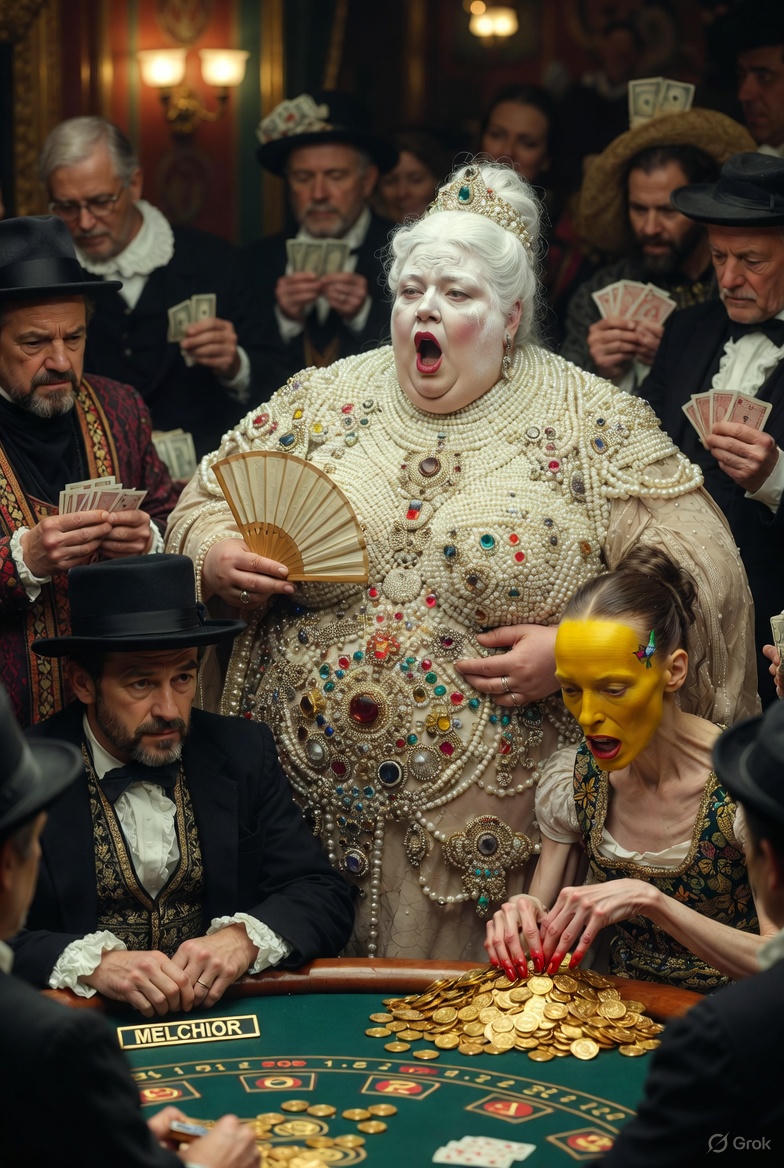
the diamonds too–if they are real.”
“They are real,” screamed the princess. “Like this hair that I cut
from your mother!”
She threw the necklace into the Fräulein’s lap. Alraune took the
unusual piece of jewelry, weighed it thoughtfully in her hand.
“My–mother?” she said slowly. “It appears that my mother had
very beautiful hair.”
The princess placed herself solidly in front of her, putting both
hands solidly on her hips. She was matter of fact, like a
washerwoman.
“Very beautiful hair,” she laughed. “Very beautiful! So beautiful
that all the men ran after her and paid an entire Mark for one night’s
sleep with her beautiful hair!”
The Fräulein sprang up. The blood drained out of her face in an
instant, but she quickly laughed again and said calmly and scornfully:
“You are getting old, your Highness, old and childish.”
That was the end. Now there was no going back for the princess.
She broke loose with ordinary, infinitely vulgar language like a
drunken Bordello Madam. She screamed, howled and obscene filth
poured out of her mouth.
Alraune’s mother was a whore, one of the lowest kind, who gave
herself away for a Mark and her father was a miserable rapist and
murderer whose name was Noerrissen. She knew all about it. The
Privy Councilor had paid the prostitute money and purchased her for
his vile experiment, had inseminated her with the semen of the
executed criminal. That was how Alraune had been created and she,
herself, had injected the loathsome semen into Alraune’s mother.
She, Alraune, the stinking fruit of that experiment, was sitting
there now–right in front of her!–A murderer’s daughter and a
prostitute’s child!
That was her revenge. She went out triumphant, with light steps,
swollen with the pride of a victory that made her ten years younger.
She slammed the door loudly as she closed it.
Now it was quiet in the large library. Alraune sat in her chair, a
little pale. Her hands played nervously with the necklace, faint
movements played around the corners of her mouth. Finally she stood
up.
“Stupid stuff,” she whispered.
She took a few steps, then calmed herself and stepped back up to
her cousin.
“Is it true, Frank Braun?” she asked.
He hesitated a moment, stood up and said slowly:
“I believe that it is true.”
He stepped over to the writing desk, took up the leather bound
volume and handed it to her.
“Read this,” he said.
She didn’t speak a word, turned to go.
“Take this too,” he cried after her and handed her the dice cup
that had been fashioned out of her mother’s skull and the dice that had
been created out of her father’s bones.

Read Full Post »

Madame Bluebeard by Karl Hans Strobl and translated by Joe E Bandel

Waking in a glorious resolve, sweat-soaked, he heard
fists pounding his door.
He stood in the doorway, shirt flapping, blinded
by a lantern’s glare. Someone ordered him to rise
quickly, speaking of a ladder, ropes, a pickaxe, and a
shovel from the tool shed behind the house. It
might’ve been Schiereisen. He had to dress; it
seemed urgent. When Rotrehl was ready and
Schiereisen explained the task, he wasn’t overly
surprised. It felt like a continuation of his
adventurous dreams, his mind brimming with
Cossacks and battle scenes, making him eager to
follow. Soon, they descended the hill, armed with
ladder, ropes, pickaxe, and shovel, like treasure
hunters or conjurers, cloaked in night’s mantle.
Stars began to adorn that mantle. Clouds had
cleared, and the night grew bright. Warm mist rose
from wet grass, spreading a thin, white fog over the
meadows. Midnight had long passed; in the east,
night’s veils thinned, stars peering large and anxious
through dawn’s weave. Light welled from the earth.
At her bedroom window, Helmina stood in a gray
travel dress, a small handbag ready. She sometimes
brushed her forehead, turning to check if the sounds
she heard were in her ears and blood or from outside.
At times, she thought someone approached along the
corridor, pausing at her door. Then she heard
breathing—the breath of sleepers, a whole castle
asleep while she alone watched, ready to flee. Short,
quick breaths stood out, those of children in their
beds. For a moment, Helmina distinguished them,
then they merged back into the collective slumber’s
weave. She made no effort to hear them again.
Motherly tenderness was alien to her; her soul knew
nothing of it. She preferred solitude, connected to
others only through her senses. She stared into a new
world, seeking the extraordinary. Was it power, a
searing, ruinous, blissful passion? She didn’t know. It
flowed darkly within her, driving her, and she yielded
without resistance. Sometimes, she felt not herself
but part of a cruel force spilling over the world…
She stood thus for two hours, staring at the bridge
deep in shadow, awaiting the signal. Her mocking
lips grew thinner, pressed tighter. Perhaps Fritz
Gegely wouldn’t come. Maybe he’d only boasted,
shirking the deed, and she’d have to leave without
him. He was merely a bridge, but if he failed her,
after so many defeats, she’d be utterly crushed. This
waiting was unbearable. Lorenz would be furious.
Time slipped away; they could’ve been far gone.
Half an hour more. Then Helmina must leave,
with or without Gegely.
But the signal came. On the bridge, an electric
lighter flashed thrice, three seconds each, like a
firefly. Helmina grabbed her bag, glancing around the
room. She left not as a victor… only her hate
remained.
Cautiously, she stepped out, unlocked a secret
door in the corridor, and descended a narrow, musty
staircase to the forecourt. It was safer; someone
might be on the main stairs. She crept across the
courtyard to the gate tower, opening the small door in
the large gate. It wouldn’t budge at first, rarely used
and swollen. She yanked the lock with all her
strength, tearing her delicate gloves.
Finally, she slipped out, leaving the door ajar.
Gegely stood under the chestnut trees.
“Where were you so long?” she asked, furious.
“Forgive me… she couldn’t sleep… I had to
wait… only a quarter-hour ago…”
“Forward!”
They were halfway down the castle hill when the
gate was flung open. Schiereisen leapt out, followed
by Jérome Rotrehl, clutching rope and spade as if
someone had thrust them into his hands and fled.
Both men’s faces, hands, and clothes were smeared
with mud, crusted with clay, speckled with white
patches of lime or mortar.
Schiereisen saw the two figures vanish into the
early morning’s dusk at the chestnut alley’s end.
They ran along the road, and soon he heard a
sound—a nerve-shredding, whipping noise, the
sputter of a car readying to drive. It drummed into the
dawn’s silence, like handfuls of peas hurled against
this glassy hour.
Schiereisen gauged the distance from the alley’s
mouth. He sprinted down the hill, first driven to
pursue, to halt the fugitives. Near the bottom, he
stopped abruptly, planting his feet, fists in his
pockets. No—she should flee.
The car’s starting roar sounded. Good… it’s
right… He finished his descent slowly, regulating his
breath with closed lips. On the bridge, the car was
gone. He broke into a trot, wanting to confirm who
Helmina fled with. The road stretched through the
valley, rising in wide curves to the highlands. A
steep, direct climb could cut off its loops.
Schiereisen plunged into the woods, scrambling
between trees, hooking from one to another at steep
spots. His lungs expanded, filling his chest, pushing
his heart to his throat. Sweat poured from his brow,
carving furrows through mud and grime, mixing a
sticky paste that tightened his skin. Several times, he
felt he couldn’t go on. But his immense resilience
drove him, making the impossible possible.
He reached the forest’s edge, where he’d first met
Helmina, standing in dense shrubs, their dampness
cloaking his steaming body. For a moment, all was
still, branches swaying softly. Seconds passed. Then
the car’s sputter burst in, sudden, as it rounded a
sound-catching forest bend.
Schiereisen knew he could’ve stopped it—
stepping into the road, Browning raised, an effective
warrant. But he stayed hidden.
The car roared up, shooting around the final curve,
snorting, racing uphill at full power… gone ten
heartbeats later. Schiereisen saw its occupants
clearly: Helmina, Herr Gegely—husband of the sick
woman—and Lorenz at the wheel.
The detective began his return. Near the house, he
met Rotrehl, lugging the gear alone. Seeing his
summer guest, the violin-maker stopped, staring. His
mind was saturated with the past hours’ events,
unable to grasp more. Bewilderment wrapped him in
soft veils. He could only shake his head.
“Come, Napoleon,” Schiereisen said, taking the
ladder. “Don’t think we’ve lost the battle. We’ll sleep
a little now. Later, I’ll explain everything.”

Read Full Post »

Madame Bluebeard by Karl Hans Strobl and translated by Joe E Bandel

What should Ruprecht reply? Her words didn’t
wound him, for he knew Hedwig was on the path to
health. That was a secret for him alone. So he only
nodded to Helmina and left the room.
Schiereisen had spent the afternoon on the small
bench outside Rotrehl’s house. He’d spread out all
his notes, reviewing his reasoning. When the rain
began, he gathered his papers and wrapped himself in
his waterproof loden coat. He let the water stream
down, only retreating to his room when the coat’s
hems grew heavy with damp.
What would happen now? The decision loomed. If
Ruprecht spoke, all efforts might be for naught. It
was almost certain he would. Lorenz had already
slipped away; Helmina would likely try to escape too.
Could he allow that? His duty was to detain her, but
he lacked direct evidence against her. Still, this night
must be used. He wrote a detailed letter to Herr Peter
Franz von Zaugg, delivered it to the post himself that
evening, and sent two coded telegrams—one to the
prosecutor’s office, one to his agency. Then he dined
at the Red Ox. The landlady mentioned Fritz Gegely
and his wife had been invited to the castle. That was
the poet with the sick wife, whose connection to the
castle lords he’d observed before leaving.
Pensively picking his teeth, he walked the village
street. The ground was soft from rain. At a large
puddle, Mathes Dreiseidel stood with the head
teacher, discussing politics sagely. Schiereisen saw
Dreiseidel’s urge to draw him in and kept to this side
of the water. He crossed the bridge and climbed the
castle hill under the deep shade of chestnut trees. The
rain had stopped, but drops fell from the branches,
some sliding coldly down his collar, jarring his
nerves.
The castle windows still glowed. Schiereisen
decided to wait. He wore his yellow overcoat, the
winter one being damp, and buttoned up, leaning
against a tree trunk. Two hours passed. Schiereisen
waited calmly, unsure what for. At career peaks, after
completing preparations, he surrendered to intuition.
A voice must call, a light must flare, illuminating his
path. Impatience was foreign to him.
When voices and a carriage’s rumble sounded in
the courtyard, he retreated deeper into shadow. The
heavy gate opened, clanging against the wall. A
carriage emerged, brakes grinding down the hill.
Three people sat within—the Gegelys and another,
perhaps the Major, part of their circle.
The gate closed, but Schiereisen didn’t hear it
lock. The sleepy gatekeeper, loath to rise again when
the carriage returned, left the task to the driver.
Schiereisen waited, then opened the gate a crack
and slipped inside. The outbuildings were dark; only
the overseer’s apartment showed light, now
extinguished. Only the main building stayed awake.
Above dark roofs, the sky slowly brightened.
Schiereisen crossed the courtyard silently, senses
sharp, each impression vivid and swiftly processed.
Sleeping and waking people, stone blocks, courtyard
walls—they merged into his being, parts of his skin.
He passed under the main building’s archway to
the inner courtyard. Below were the servants’
quarters. There was Lorenz’s former room. Opposite,
a dim light burned where old Marianne, the
madwoman who spent nights praying and singing,
was housed. She was awake. A murmur crept across
the courtyard, simmering around Schiereisen’s ears.
He decided to see what the old woman was doing.
Suddenly, he froze.
How could all his cunning, experience, and
caution have overlooked this? How far was he from
mastery in his craft, neglecting such a crucial detail?
He’d searched everywhere, yet ignored this old
woman. Now, intuition struck. Hadn’t Johann said
she was a Moreno heirloom, inherited by Helmina’s
first husband? She’d lived here since Helmina
arrived, witnessing all events. Her madness emerged
under Dankwardt. How had Schiereisen failed to
probe its roots? She’d once been quiet, content with
small chores for the modest keep the last Moreno
secured her. What if her simple mind was later
shattered by something horrific, a dread, an unwitting
knowledge of a secret too heavy?
A shrill scream burst from the window, followed
by babbling clamor. Schiereisen hurried over. Red
curtains covered the lower window, but on tiptoe, he
could peer inside. Old Marianne knelt before her
table, her headscarf slipped back, gray-yellow hair
tangled, strands writhing like battling snakes. She
struck her forehead against the table’s edge, crying,
“Oh, Lamb of God, who takes away the world’s
sins!”
On the table stood a crucifix and three burning
candles, their flames flinching and flaring with each
forehead strike.
“Oh, Lamb of God, who takes away the world’s
sins!” she repeated countless times. Then she calmed,
murmuring softly. Her forehead rested on the table’s
edge, her arms, once flailing beneath, now crossed
over her chest. She rose, lifting one knee, then the
other, pulling herself up by the table.
Schiereisen saw her face for the first time. It
wasn’t contorted but wholly consumed by one
thought. This poor, muddled mind held room for
nothing else. She took the three candles and moved to
the door.
Schiereisen hurried behind a pillar to hide. He
watched her emerge and cross the courtyard, carrying
the candles in her left hand, her right shielding the
flames. Silently, he followed through the archway,
along the main building’s wall to the park gate. The
rusty grille creaked like night birds with sharp beaks
eyeing living prey. The candles’ glow dazzled,
revealing only path fragments. They passed rubble
and wet shrubs. Schiereisen couldn’t avoid rustling
bushes or snapping twigs, but the old woman seemed
deaf, pressing forward. Massive stone blocks loomed
from the dark. The tower… Schiereisen thought. She
stopped, shone the light up the wall, and crouched
before a flat stone, fixing her candles to it. She
poured melted wax onto a smooth spot, pressing each
candle’s base into it. Clumps of wax showed this
stone had often served this strange rite.
She knelt before the burning candles, seeming to
pray. Her back hunched, head bowed low, the dirty
yellow-brown pattern of her jacket lit by the glow.
Schiereisen stood behind her, part of the
darkness—formless, chaotic, lingering in torpid
waiting, indifferent to time and space. But the old
woman stayed motionless; nothing more happened.
He spurred himself; the night couldn’t be wasted.
Stepping forward, he touched her shoulder.
“What’re you doing, little mother?”
She turned, unstartled, only peeved at the
interruption. “Be quiet… the three are inside. They
don’t sleep. They wander, banging their heads on the
wall. Three candles: one for each. Three candles for
the poor souls in purgatory.”
“Who’s inside?” Schiereisen asked kindly, patting
her back.
“Oh, no, I won’t tell you,” she replied earnestly.
“No one must know who they are. If I speak, they’ll
come out, eat and drink as if nothing happened, and
live again. That mustn’t be. She won’t allow it.”
“Yes, the gracious lady is strict. We mustn’t do
what she forbids.”
With a look of great fear, the old woman spread
her thin arms. “No… no… she won’t allow it, they
must stay there. Otherwise, Lorenz comes and beats
me. He has a rubber stick; he hits my head with it. I
must watch and pray.”
“You’re right,” Schiereisen said. “Keep praying.”
“Prayer can do all. Prayer seals the hole so they
can’t get out. Prayer is the wax of the pious, sealing
entrance and exit.” She lifted her head, gazing at the
damp stone blocks.
Schiereisen saw, above, between treetops at the
edge of the candlelight, a dark hole in the tower.
Good, he thought, this night must be used.
The old woman had lowered her head again,
resuming her prayers. Schiereisen left her
undisturbed, crashing through the bushes. He
followed the garden wall until he reached a spot
where elderberry shrubs and rubble made climbing
possible. He slid down the outer side, heedless of his
yellow overcoat, its buttons tearing off. Then he
raced down the castle hill, across the bridge, and up
the slope to Rotrehl’s house.
Rotrehl was dreaming of crossing the Beresina,
fleeing in a sleigh from a horde of Cossacks with
long lances and blood-red tongues lolling like
hunting dogs. His sleigh wouldn’t budge; leaning
forward, he saw its runners were cardboard, softened
and collapsing in the snow. Cannon booms thundered
ahead—boom, boom, boom! The enemy had cut him
off, guns ready. Nothing remained but to die a hero.

Read Full Post »

Chapter 21 Tyrone

Somehow Tobal didn’t feel that optimistic about the planned expedition but didn’t have any right or authority to stop them. Perhaps Crow was right. Perhaps the village did need some form of protection. He was feeling moody as he walked away from the group. Becca came with him.

“I’m not very good company right now,” he warned.

“I’ll risk it,” she said.

Neither one said much as they watched the preparations for the three newbies that were going to be initiated that evening and got something to eat. It was so cold windbreaks had been set up around the fires to bounce the heat back. Most people seemed to either stay inside or near the fire pits used for cooking. They ate by one of the cooking pits.

“May I ask something?” He finally said.

“Sure,” Becca answered through a mouthful of tasty stew.

“Why last month?” He asked. “Why did you come to me like that?”

“Was it wrong?” She asked wiping her mouth clean with her hand and looking up at him with those green eyes.

“No,” he whispered. “It was exactly right. I just don’t know if I could have ever come to you that way. I was too messed up or afraid or something.”

“I was afraid too,” she said thoughtfully. “Then when we kissed it was so good and later you gave me that present. Look,” she said. “I’m still wearing it. She pulled the carved owl out from where it had been hiding within her parka. It was Anne that really helped. She read my palm that day and told me I would loose the one I loved unless I acted immediately to keep him from leaving.”

“Really?” He asked curiously. “Where would I have gone?”

“To Fiona,” was her simple reply. “This has been kind of hard on her cause she really likes you too.”

Tobal flushed, “You and Fiona talk about this stuff?”

She put her bowl down and came over to him, pinning him back against a windbreak. She laughed.

“We women talk about everything.”

“Everything?”

“Everything!”

“Well then, I’m going to keep my mouth shut around all of you.”

She set his bowl down and kissed him. “It won’t do any good. We’ll just tell stories then.”

“What kind of stories,” he undid some of the buttons on her parka and reached inside. She gasped in pleasure and their embrace was much longer than the last one. No thought of continuing the conversation. They were lost in the moment and in each other.

“Hey, some of us are trying to eat around here.” Nikki and Fiona had brought their own bowls of stew to eat by the fire.

“Becca, are you saving any for us?” Nikki quipped.

Tobal flushed.

Becca just nuzzled closer, “No, you’ve got to get your own.”

Together all four cleaned the dishes and moved toward the circle where the initiations were about to begin. It was cold and they took up positions next to a windbreak that shielded one of the signal fires. As long as they stayed out of the wind it was all right.

Misty was High Priestess that night and both she and the High Priest wore furs. The circle seemed much smaller than usual. There was a strong wind with drifting snow even in the sheltered valley and no one seemed anxious to dance around the fire clothed or not.

Tobal felt sorry for the new initiates that had to stand blindfolded in such a wind with shortened tunics even if they were right next to the bon fire. To his relief they were wrapped in blankets to prevent over exposure to the bitter cold. In all things safety was the over riding concern of the medics and Masters. Living in harsh conditions made one strong. Being foolish killed you.

They watched together as Nikki’s, Fiona’s, and Becca’s newbies were initiated. Afterward Tobal was introduced to Cheryl, Loki, and Bran, the new initiates.

“If you are not careful we will catch up to you,” Fiona warned. “Cheryl, Loki and Bran make three newbies apiece for each of us. You have only trained one more than us.”

“I know.” Tobal frowned. “Why rub it in?”

The girls laughed and hugged him. “We’re just teasing. Don’t be so serious all the time.”

Tobal had gotten his fourth chevron that morning and was eager to get training. He had tried working on the meditations and exercises Crow had taught him but it had been hard to focus and concentrate alone. His mind drifted to the cave’s glowing altar, where Ron and Rachel’s voices had urged him onward, a stark contrast to the solitude that muddled his focus. Much of the time his thoughts had kept going back to Becca and their growing involvement with each other. Somehow it seemed to push everything else away. He didn’t know what had happened to his self-discipline.

Immediately after circle things were moved inside one of the permanent shelters and continued out of the bad weather. This had happened a few other times during heavy rain but was unusual. Clansmen believed in having circle outside rain or shine, hell or high water. They spent so much time in the elements it didn’t bother them much and they were dressed for it.

They found a warm corner and started to gather. By the time Ellen got there ten people were sitting around waiting to hear what she had learned. Needless to say, Ellen was not happy with everyone knowing about the rogues or about Crow taking an entire group to the village for a visit.

Finally she gave in and sat with them and talked about what she had found out in her research.

“I was able to tap into the city’s data base and look into the historical archives and records.” She began. ” Ron and Rachel Kane were scientists that lived in the city and developed the sanctuary training system.” She looked around the group. “Those are Tobal’s parents, for those of you that don’t already know.”

The look of surprise on a few faces told Tobal that at least a few hadn’t known.

Ellen continued her story. “The sanctuary program was originally a social experiment designed to create a utopian community of specially trained and competent individuals. It was a personality-modifying program to create physically, emotionally and mentally healthy individuals with strong will power and high creative ability. It was highly successful in creating individuals that seemed to be more highly motivated and competent than the norm found within the Federation itself. The graduates showed scores that were mentally, emotionally and physically superior to non-graduates and it was no surprise when the military got involved and the project became classified. Heliopolis became a natural recruiting ground for highly competent leaders and soldiers. It was a city-state devoted to the development of the Ubermench or super human and the main recruiting ground for Federation Special Forces.

As time went on the graduates gained political power within Heliopolis itself and voted for political changes that challenged the values and life styles of the older citizens that had not participated or agreed with the social experiment. The citizenry split along lines that supported the social experiment and those that were against it.”

Here Ellen stopped and said thoughtfully, “There is a saying that old timers never change their minds, they just die off and the younger generation outlives them. That was not the case in Heliopolis. The changes were so fast and radical there was not enough time for mediation. The hostilities and tensions became so great it resulted in a massacre of several students and families living at the main Apprentice gathering spot and the deaths of Ron and Rachel Kane whose bodies were found floating in the lake nearby.”

Ellen broke off from her story to look around at the group. “It seems not only Tobal lost his parents then but Crow lost both parents and Sarah lost her mother. This was not in the official report but in what I have learned personally.”

Sarah was white faced and her fists were tightened. There were murmurs within the group until Crow stopped them.

“Let her finish.”

“These multiple murders created a military emergency and the entire city fell under martial law directed by the Federation and Tobal’s Uncle Harry Kane who was the commander in charge at the time. It was under his command that any of those connected with the murders were eliminated or deported and Heliopolis became a secret classified program controlled by Federation military.”

Tobal started. His uncle had said he was in charge of security, not that he had been Commander in charge of the entire project. There was obviously a lot his uncle had known about and not shared with him.

Ellen continued, “The military created a new program that allowed no children or elderly unless they were physically fit enough to make it through the three degree system. It was simply a system designed to create recruits for the Federation military. The thought was that it created better soldiers.

The city of Heliopolis became a city of the elite ruled by the military, a city of supermen and superwomen if you will. The graduates were still human but something about the training eliminated dysfunctional areas and built strong healthy individuals that could out compete the average person in all areas.

This continued several years until enough data was available to compare the graduates of the sanctuary program with special military forces. It was here that they showed radical differences. The graduates of the sanctuary program did not do well in the normal military. Studies confirmed that military training suppressed the individual and forced conformance to a rigid authoritarian structure that was simply not endurable to the average graduate. The graduates of the sanctuary program were individuals and not team players.

It was at this point the Federation lost much of its interest in the project and turned it back to civilian control. The Federation continued to recruit graduates for field operative positions and kept a mountain complex manned with military personnel for special training. They also agreed to share medical resources with the medics as they needed them.

Ellen stopped and looked around, “That was when the city was granted the right of self government. But only those that had completed the restructured Sanctuary training were considered citizens with the right to vote. They voted to adopt the military’s program in favor of the earlier program run by Ron and Rachel Kane. The earlier program had consisted of the creation of a village with children and old people as an important part of the social research that was going on. There was no more interest in the creation of another ‘village’ in the wilderness. It was felt there were too many ‘Safety’ concerns.

The Citizens of Heliopolis maximized individual qualities under a loose structure of cooperative effort. The city itself gained in political power and influence even as it remained closed to normal trade and commerce. Its citizenry were active in the outer world owning companies and making directives that influenced world politics. They formed an elite pool of superior resources that fought for its own place in world politics. It was whispered that government research continued at the nearby secret mountain complex where Special Ops field agents were trained.”

“The rest was classified and I couldn’t get into it,” Ellen said. She hesitated as if with an internal struggle.

“Our Medic base is part of the secret mountain complex. We are only allowed to use the emergency room and some nearby areas. It is under high security with lots of armed guards. There are field operatives that come and go from the complex all the time. I shouldn’t be telling you this so please keep it to yourselves.”

“Wow,” you’ve certainly given us something to think about,” Rafe shook his head. “This doesn’t sound good to me. There is something wrong, especially if the rogues are really field operatives. Why would field operatives attack us?”

“And attack the Village,” Crow spoke up. “There have been several incidences of villagers being attacked by rogues and we always believed it was clansmen that attacked us. It is beginning to sound like someone wants the clansmen and the villagers to hate each other. Perhaps someone is trying to provoke conflict between us. We need to go to the village and prove we are not attacking them. Too many people have died already.”

“Yeah, and my parents were right in the middle of it,” Tobal said bitterly. “It killed them and it might kill us if we are not careful. He turned to Crow who had been listening intently to Ellen’s story.

“What can you tell us about any of this? It sounds like your grandfather, Howling Wolf was as much in the middle of this as my parents and he is the only one still alive that I know of except Sarah’s father.”

“This is all new to me,” he said. But I will talk with him about it. I will return with any information I feel is important. More than ever I feel there is danger to my village and they need to be warned.”

Tobal was thankful Crow never mentioned the special training on bi-location and the secret meeting place under the waterfall. He was certain that Ellen was too.

“I’m concerned about Apprentices leaving the area and visiting the village.” Ellen told them. “We will be ordered to stop you from going there even though there are no specific guidelines preventing it. Crow seems to have found a loophole in the system only because he is from the village himself and because it is within our area of coverage. Our orders don’t contemplate such unlikely scenarios. You need to travel as fast as you can.”

She continued, “As long as the air sleds continue to monitor your med-alert bracelets you should be alright.” She paused, “That does mean we will need to patrol further to the west then we have in the past,” she looked straight at Crow. “They are going to try to stop you from reaching the village you know.”

“I know,” he said. “It will be alright. Grandfather is expecting us.”

They left things at that and the conversation moved on. The group gradually broke up and began talking about other things. Tobal and Becca stayed together holding hands as they wandered around the group chatting with other clansmen. They slowly made their way to the beer keg where Rafe had rejoined Dirk.

Rafe and Dirk were both still on the beer task force and grumbling because they had twice the beer to brew since the reserves had been consumed at the Yule party last month. Still they were good-natured about it and said they were trying a new recipe that should be quite interesting. It was just as well there was only a small group that month though. They wouldn’t be drinking that much.

Becca hadn’t heard about the special brew Dirk and Rafe were cooking up and didn’t know what to think.

“When will this new beer be ready to drink?” She asked doubtfully.

“Sometime this April probably,” said Dirk chuckling. “Rafe and I both plan on being medics by then. We can administer first aid to anyone that needs it. Pump their stomach or something.”

Tobal snorted and blew beer all over.

“Hey, watch it,” Rafe complained. “It’s not that funny.”

Tobal turned to Dirk, “How did that sure thing match go?”

Dirk turned red, “Not so well.”

“He got his ass kicked.” Rafe chuckled and proudly displayed his own fifth chevron. “Some people actually win once in a while.”

Rafe ducked a playful fist that Dirk threw at him. “Now we get to see who the best man is. We’ve got a bet going on who is going to get their sixth chevron first.”

“You still fighting the girls,” Becca kidded, “or have you gotten to the big boys yet?”

Dirk got a little red but Rafe took it in stride. “I don’t have to worry about it. Everyone is still challenging me. I haven’t gotten to challenge anyone yet.” He grinned at Becca, “I would challenge you if you hurry up and train some more newbies.”

She grinned back. “Perhaps we can always arrange something unofficial.”

This was a side to Becca that Tobal hadn’t really seen before, it interested him and disturbed him at the same time. They filled their mugs and rejoined the crowd. There was a drum circle forming and the sound was deafening in the small building.

Tobal and Becca slept together that night. They cuddled for a long time and shared stories about things that they had done and things they wanted to do. The energy between them was different and when Tobal asked about having sex Becca murmured “not tonight. All I really want to do is just hold you and sleep with you.” Her voice trembled slightly, a hint of vulnerability he hadn’t noticed before, as if the weight of their connection pressed on her too.

With that cryptic answer circling in his brain they kissed, embraced and fell asleep entwined in each other.

The next morning was bright and cold and there were sundogs circling the sun promising even colder weather. They joined their friends for breakfast and soon Becca was on her way to base camp to continue training with Loki, her third newbie and Tobal set out on the trail toward Sanctuary.

As he snow-shoed toward Sanctuary and pulled his sled he wondered at the strangeness of how things had been with him and Becca last night. He had certainly not been prepared for it and didn’t really understand it. It seemed things had been all right, but then again it seemed there had been something wrong.

He hoped she hadn’t changed her mind. Perhaps she was sleeping with Loki, the newbie. He instantly crushed that thought. He knew it was not true, but he just didn’t understand and because he didn’t understand he felt a little hurt. He had been expecting something like last month and it had not happened.

As he neared Sanctuary his thoughts turned to the subject at hand. He now had four chevrons with only two more before he was eligible for the Journeyman degree. As he headed toward sanctuary he felt kind of strange because Sarah had really been the last person he had trained and that had been in September and October.

He didn’t really count Crow since Crow had taught him much more than he had taught Crow. That meant he hadn’t been doing much training in four months and he was determined to get going on it again. He wanted to get this training over with and be partnered with Becca more permanently if she was still interested.

He thought of the ways he had changed in the past years and the things he had done. He had gained a reputation as a very good trainer. None of his students had any trouble soloing and their students didn’t seem to have much trouble either. At gathering and circle people came to him with questions on the best way to do things. His opinion was respected. He was also gaining a reputation as someone that kept to himself and was hard to get to know. His closest friends continued to be Rafe, Crow, Ellen, Sarah, Melanie and now of course Becca. People liked him, his friends liked him, he was companionable but in a quiet sort of way. He didn’t have anything to prove and he didn’t show off. He was just comfortable and at ease with the situation, any situation. People respected that.

Tyrone was Tobal’s fifth trainee and the month of late January and early February went by fairly fast and uneventfully. Tyrone was a tall, wiry farm boy from the Appalachian Mountains of all places, a real honest to God hillbilly complete with a Southern accent and an engaging smile that would drive the girls wild at circle. His drawl carried the scent of pine and coal smoke as he unpacked a worn satchel, a grin breaking through like sunlight on frost. The training came easy to him since he was already an accomplished hunter and trapper.

The nights were long and Tyrone spent many evenings carving a fiddle and later practicing with it. He had learned the skill from his grandfather back home and Tobal watched in fascination at the precision with which the fiddle was created piece by piece and then lashed together and sealed with pitch. He had never seen anything like it and was appalled at the terrible noise it made, at least until he got used to it.

He used to laugh when Tyrone would pull out the fiddle and start to play because the wolves would start howling to keep company. All in all Tyrone was good company and the month went rapidly. Tyrone was a natural storyteller, knew how to make people laugh and Tobal laughed often. Tyrone was like the brother Tobal had always wanted.

Once Tobal asked him how he had heard of “Heliopolis” way in hillbilly country and Tye had thrown back his head and laughed and laughed. He stretched his long legs and shrugged.

“I never heard of it before,” he admitted. “I was trying for a city named Minneapolis and got my ticket wrong. My head never was that good with names. I knew it was cold there and didn’t give it much thought until we had to start hunting our own meat and making our own clothes. It was so much like back home that I figured something was wrong but thought I’d study on it for awhile.”

Tobal had been drinking tea and it exploded from his mouth and nose as he doubled up in laughter.

“Stop, You’re killing me,” he waved weakly at Tyrone who was doubled over laughing too.

There were melancholy times when Tobal thought back over the past year and how much he had changed. He was more resourceful and inclined to do things by himself or on his own. He didn’t care much about what other people thought. He had learned to judge people not by their appearances, but by what they did and even as important by what they didn’t do.

Almost in spite of himself he found his feelings about Becca were deepening. She down played what she did and seemed to have a quiet competence that went un-remarked. She had just a hint of melancholy that matched his own. There was an emotion in his heart that stirred and sang when he was around her. As spring drew closer he found himself thinking about her more and knew he was in love.

Late February came around as Tobal and Tyrone snowshoed their way to the gathering spot. He dropped Tyrone off with the guards to be prepared for his initiation. There were going to be three initiations that night.

Nikki had proclaimed her newbie, Bran, as ready to solo and he, along with Loki and Cheryl had been examined and approved to solo by the elders. Nikki was ecstatic because the winter training had gone pretty well. She was looking forward to training her next newbie.

“Hey Tobal,” she asked, “Think I can get my six trained by mid summer? This winter training isn’t really that bad.”

“That might be cutting it kind of close,” he considered, “but go for it. I’m hoping to get mine done by May if I can.”

“By May?”

“Yeah, when the weather gets warmer I can speed the training up a bit. Or at least I hope I can. Next month will be one year for me. Rafe was finished in one year. I thought I could too, but I don’t think I will be able to.”

“It’s more important to do a good job and teach properly than get done quickly,” she said.

He nodded, “I did need to spend some extra time before winter with Fiona and Sarah. I will just see how the last one goes.”

“See you later at circle?”

“Sure,” I’ll probably be with Becca if I can find her.”

He waved and headed for the food area. A quick lunch seemed in order and then helping out with some of the shelters. There were a lot more people this month and the weather was milder even though the snow was deeper.

There were some minor frostbite cases for the medics to treat but not as many as last month. It seemed people were learning they had to be careful. On the down side one of the clansmen had fallen through the ice on one of the creeks. He had managed to get out but not been able to get a fire going. He had frozen to death before the medics got to him. Angel had found him and been unable to help. It was already too late. Angel’s tear-streaked face lingered in Tobal’s mind, a silent echo of the Wild’s harsh lessons, stirring a quiet resolve to honor the fallen.

The incident served to remind everyone just how fragile and dangerous it really was in the wilderness even with all the safeguards that were in place. The death put a damper on things and people were quiet. Tobal’s thoughts flickered to Ellen’s words about the mountain complex, wondering if the rogues’ shadow stretched even here, a chill beyond the frost.

Read Full Post »

« Newer Posts - Older Posts »