Feeds:
Posts
Comments

Posts Tagged ‘short-story’

Chapter Three
Informs how Frank Braun persuaded the Privy Councilor to
create Alraune


THEY sat in the carriage, Professor Ten Brinken and his
nephew. They didn’t speak. Frank Braun leaned back
staring straight ahead, sunk deeply into his thoughts. The
Privy Councilor was observing, squinting over at him
watchfully.
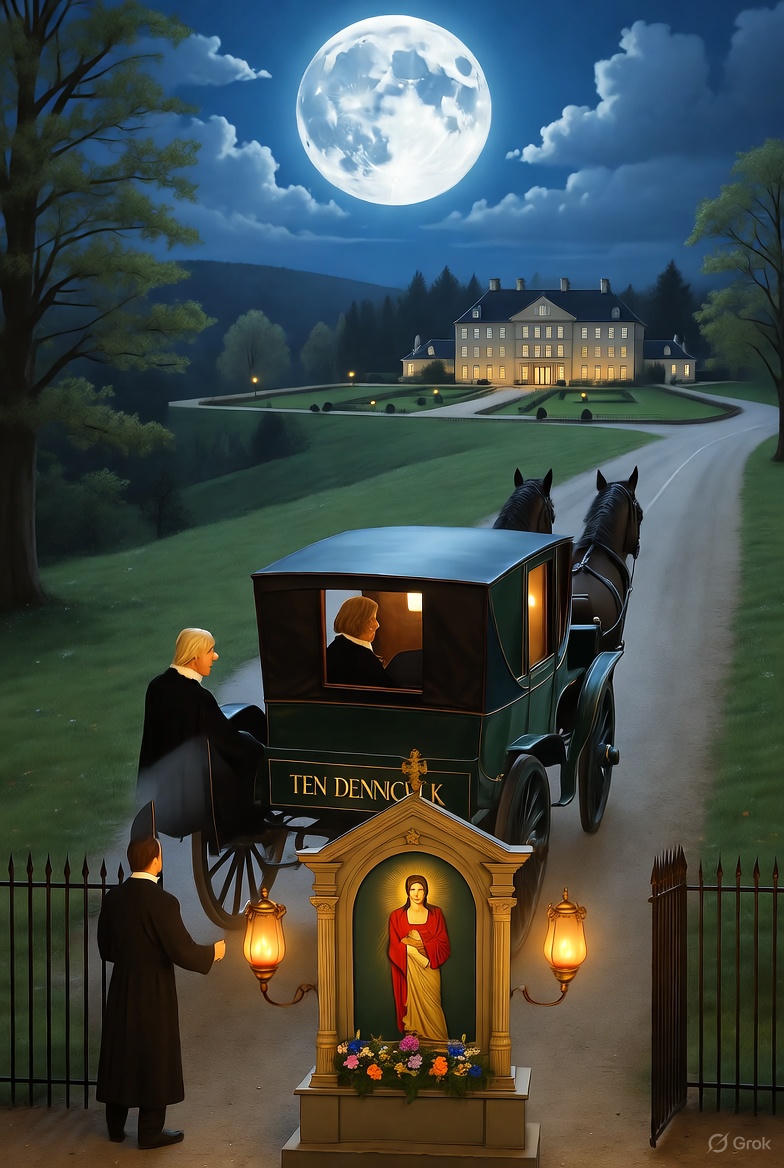
The trip lasted scarcely half an hour. They rolled along the open
road, turned to the right, went downhill over the rough road to
Lendenich. There in the middle of the village lay the birthplace of the
Brinken family.
It was a large, almost square complex with gardens and a park.
Back from the street stood a row of insignificant old buildings. They
turned around a corner past a shrine of the patron Saint of the village,
the Holy Saint John of Nepomuk. His statue was decorated with
flowers and lit with two eternal lamps that were placed in niches by
the corners.
The horses stopped in front of a large mansion. A servant shut
the fenced gate behind them and opened the carriage door.
“Bring us some wine Aloys,” commanded the Privy Councilor.
“We will be in the library.”
He turned to his nephew. “Will you be sleeping here Frank? Or
should the carriage wait?”
The student shook his head, “Neither, I will go back to the city
on foot.”
They walked across the courtyard, entered the lower level of the
house at a door on the right hand side. It was literally a great hall with
a tiny antechamber and a couple of other small rooms nearby.
The walls were lined with long immense shelves containing
thousands of books. Low glass cases stood here and there full of
Roman artifacts. Many graves had been emptied, robbed of their
cherished and carefully preserved treasures. The floor was covered in
thick carpet. There were a couple of desks, armchairs and sofas that
stood scattered around the room.
They entered. The Privy Councilor threw his alraune on a divan.
They lit candles, pulled a couple of chairs together and sat down. The
servant uncorked a dusty bottle.
“You can go,” said his master. “But don’t go too far. The young
gentleman will be leaving and you will need to let him out.”
“Well?” he turned to his nephew.
Frank Braun drank. He picked the root manikin up and toyed
with it. It was still a little moist and appeared to be almost flexible.
“It is clear enough,” he murmured. “There are the eyes–both of
them. The nose pokes up there and that opening is the mouth. Look
here Uncle Jakob. Doesn’t it look as if it is smiling? The arms are
somewhat diminutive and the legs have grown together at the knees.
It is a strange thing.”
He held it high, turned it around in all directions.
“Look around Alraune!” he cried. “This is your new home. You
will be much happier here with Herr Jakob ten Brinken than you were
in the house of the Gontrams.”
“You are old,” he continued. “four hundred, perhaps six hundred
years old or even more. Your father was hung because he was a
murderer or a horse thief, or else because he made fun of some great
knight in armor or in priestly robes.
The important thing is that he was a criminal in his time and they
hanged him. At the last moment of his life his seed fell to the earth
and created you, you strange creature. Then your mother earth took
the seed of this criminal into her fertile womb, secretly fashioned and
gave birth to you.
You the great, the all-powerful–Yes you, you miserable ugly
creature!–Then they dug you up at the midnight hour, at the
crossroads, shaking in terror at your howling, shrieking screams.
The first thing you saw as you looked around in the moonlight
was your father hanging there on the gallows with a broken neck and
his rotting flesh hanging in tatters.
They took you with them, these people that had tied the noose
around your father. They held you, carried you home. You were
supposed to bring money into their house. Blood money and young
love.
They knew well that you would bring pain, misery, despair and
in the end a horrible death. They knew it and still they wanted you,
still they dug you up, still they took you home, selling their souls for
love and money.”
The Privy Councilor said, “You have a beautiful way of seeing
things my boy. You are a dreamer.”
“Yes,” said the student. “That’s what I am–just like you.”
“Like me?” the professor laughed. “Now I think that part of my
life is long gone.”
But his nephew shook his head, “No Uncle Jakob. It isn’t. Only
you can make real what other people call fantastic. Just think of all
your experiments! For you it is more like child’s play that may or may
not lead to some purpose.
But never, never would a normal person come up with your
ideas. Only a dreamer could do it–and only a savage, a wildman, that
has the hot blood of the Brinkens flowing through his veins. Only he
would dare attempt what you should now do Uncle Jakob.”
The old man interrupted him, indignant and yet at the same time
flattered.
“You crazy boy!–You don’t even know yet if I will have any
desire to do this mysterious thing you keep talking about and I still
don’t have the slightest idea what it is!”
The student didn’t pause, his voice rang lightly, confidently and
every syllable was convincing.
“Oh, you will do it Uncle Jakob. I know that you will do it, will
do it because no one else can, because you are the only person in the
world that can make it happen. There are certainly a few other
professors that are attempting some of the same things you have
already done, perhaps even gone further.
But they are normal people, dry, wooden–men of science. They
would laugh in my face if I came to them with my idea, would chide
me for being a fool. Or else they would throw me completely out the
door, because I would dare come to them with such things, such
thoughts, thoughts that they would call immoral and objectionable.
Such ideas that dare trespass on the craft of the Great Creator and play
a trick on all of nature.
You will not laugh at me Uncle Jakob, not you! You will not
laugh at me or throw me out the door. It will fascinate you the same
way it fascinates me. That’s why you are the only person that can do
it!”
“But what then, by all the gods,” cried the Privy Councilor,
“what is it?”
The student stood up, filled both glasses to the rims.
“A toast, old sorcerer,” he cried. “A toast! To a newer, younger
wine that will flow out of your glass tubes. Toast, Uncle Jakob to your
new living alraune–your new child!”
He clinked his glass against his uncle’s, emptied it in a gulp and
threw it high against the ceiling where it shattered. The shards fell
soundlessly on the heavy carpet.
He pulled his chair closer.
“Now listen uncle and I will tell you what I mean. I know you
are really impatient with my long introduction–Don’t think ill of me.
It has helped me put my thoughts in order, to stir them up, to make
them comprehensible and tangible.
Here it is:
You should create a living alraune, Uncle Jakob, turn this old
legend into reality. Who cares if it is superstition, a ghostly delusion
of the Middle Ages or mystic flim-flam from ancient times?
You, you can make the old lies come true. You can create it. It
can stand there in the light of day tangible for all the world to see–No
stupid professor would be able to deny it.
Now pay attention, this is what needs to be done!
The criminal, uncle, you can find easily enough. I don’t think it
matters if he dies on a gallows at a crossroads. We are a progressive
people. Our prisons and guillotine are convenient, convenient for you
as well. Thanks to your connections it will be easy to obtain and save
the rare seed of the dead that will bring forth new life.
And Mother Earth?–What is her symbol? What does she
represent? She is fertility, uncle. The earth is the feminine, the
woman. She takes the semen, takes it into her womb, nourishes it, lets
it germinate, grow, bloom and bear fruit. So you take what is fertile
like the earth herself–take a woman.
But Mother Earth is the eternal prostitute, she serves all. She is
the eternal mother, is always for sale, the prostitute of billions. She
refuses her lascivious love to none, offers herself gladly to anyone
that will take her. Everything that lives has been fertilized in her
glorious womb and she has given birth to it. It has always been this
way throughout the ages.
That is why you must use a prostitute Uncle Jakob. Take the
most shameless, the cheekiest one of them all. Take one that is born to
be a whore, not one that is driven to her profession or one that is
seduced into it for money. Oh no, not one of those. Take one that is
already wanton, that learns as she goes, one whose shame is her
greatest pleasure and reason for living. You must choose her. Only
her womb would be like the mother earth’s. You know how to find
her. You are rich–You are no school boy in these things.
You can pay her a lot of money, purchase her services for your
research. If she is the right one she will reel with laughter, will press
her greasy bosom against you and kiss you passionately–She will do
this because you have offered her something that no other man has
offered her before.


Read Full Post »

Madame Bluebeard by Karl Hans Strobl and translated by Joe E Bandel

The beach grew livelier, so after a brief
continuation of the conversation, which turned to
other topics, Ruprecht invited his friend for a walk.
They strolled along the shore, then climbed toward
the heights between villas and hotels. Sky and sea
shimmered in boundless clarity. The setting sun
seemed to conjure all the sea’s gold from its blue
depths. A refreshing coolness rose from below,
mingled with the scents of myriad blossoms and
fruits, woven into a dense garland around the coast.
The summer was wondrously beautiful, blessed with
constant sunshine yet tempered by a lively, cooling
breeze that prevented scorching heat. No one wanted
to leave this shore. The season stretched far beyond
its usual end, into a time when all would typically
have fled.
Ruprecht and Hugo reached a rocky outcrop
offering a clear view of the coast and sea. Before the
low sun hung a narrow cloud, like a knife poised over
an orange. The sea was calm, bearing fishing boats
with a willing smile.
“There’s the scene of your heroics,” Hugo said,
pointing to the two white stone cubes among the
vineyards where Ruprecht had lassoed Mr. Müller.
“What made you get involved? It was decidedly
original, but… one doesn’t just help the police like
that, do they?”
“You can imagine I found Mr. Müller more
likable than the helpless police commissioner. Still—
why? The bit of danger intrigued me. I think danger’s
one of the sweetest pleasures life offers.”
“You find too little of it in our quiet Europe.
That’s why you roam the world, seeking wilder
places. God, you’ve got it good! No one to answer to,
money like hay, doing as you please. I’d love to
travel too—not like you, but with pleasant company,
under Cook’s care, so I don’t wake up in a Papuan’s
stomach.”
Ruprecht smiled, gazing silently at the sea. Then,
with a sweeping half-circle of his arm, he
encompassed the beauty spread before them. “Only
those who know struggle,” he said, “can truly
appreciate peace. How glorious this is. How the soul
simplifies, how wings grow.”
A faint chime rose over sea and land. Like a
delicate, firm web, the peals of church bells, ringing
the evening blessing, stretched through the clear air.
The friends sat silently for a while. Then Hugo
reminded them to head back to avoid missing dinner
at the hotel. They descended quickly through the
twilight, past orchards and vineyards, and at the
Kaiser von Österreich, Hugo parted with a promise to
visit again tomorrow.
Reaching his room, Ruprecht began changing. He
was in high spirits. The evening’s colors and sounds
had sunk into him, filling him with joy. He always
felt this way on the eve of new adventures, brimming
with expectation and eager energies. Yet he knew
only months of quiet country life awaited,
somewhere with few people and no events.
As he donned his dinner jacket, his Malay servant
entered the dressing room, standing erect by the door.
“What is it?” Ruprecht asked.
“Sir, a woman wishes to speak with you. She’s
waiting in the salon.”
Somewhat surprised, Ruprecht followed. Before
entering, he placed a hand on the Malay’s shoulder.
“Wait! Is she one of those you visited on my behalf?”
“Yes, sir.”
Well, by all the gods of Hindustan, she was
persistent! That was something! A strange way to
approach a stranger. Smiling, Ruprecht entered the
salon.
Under the chandelier stood the young widow who
enchanted all, the woman who sat front-row at the
Emperor’s celebration. She smiled too. Ruprecht
bowed.
She took a few steps toward him. Silk skirts
rustled, a faint cloud of perfume wafted over. A
peculiar scent—dried fruit, hay, and something else
Ruprecht couldn’t pinpoint.
“You thought, on your way here, that I’m
persistent,” she said. “You found it odd to answer a
refused meeting with a visit.”
“You’re very perceptive, madam!” Ruprecht
replied.
“Oh, come, that hardly takes perception—it was
clear in your smile. Well, see, I’m smiling too. And
do you know what my smile says? It expresses my
pleasure in proving you wrong.”
Ruprecht met her eyes—green, with narrow
pupils, seeming to drink in light and scatter it in a
thousand rays, as if dissecting it. Cat’s eyes, he
thought. They held that indefinable expression,
neither clearly friendly nor hostile.
“I’m no starry-eyed schoolgirl,” she continued,
“nor an adventure-seeking woman. I’m not after a
flirt or a fleeting resort acquaintance. I simply want
to meet you, exchange a few words, to know what to
make of you.”
The perfume, seeping from her exquisite lace
gown and soft brown hair, unsettled Ruprecht. He,
who’d studied the Orient’s delicate, provocative
scents, was uneasy at failing to identify this elusive
note.
“Forgive me,” he said slowly, “your letter was one
among many. It didn’t stand out.”
She laughed. “Then your perception failed you.
You should’ve seen at once I’ve no intention of
throwing myself at you with loving gestures.”
What does she want, then? Ruprecht thought. Her
gaze, accompanying those words, didn’t align with
them. It didn’t contradict, but clung to him—a
promise given and withdrawn, a granting that was
also a retreat.
“I could do so more easily than others,” she said,
“for I answer to no one. You’d only have to fight two
or three duels with my ardent admirers. That
wouldn’t trouble you, would it? But truly, I only wish
to know if you’re as vain as they say.”
Ruprecht flinched. The word stung. He
straightened slightly and said, “Madam…”
She smiled again. “Hold on… I find it improper to
parade in costume as a wild man before a respectable
audience, shooting holes in cards and shattering glass
balls. Isn’t that a far worse surrender of one’s person
than other artistic pursuits, which are already
deplorable prostitutions? My late husband studied
Indian philosophers. He called the arts silver
embroidery on Maya’s veil—something special,
glittering, yet part of the web of illusions. You know
Schopenhauer thought differently. But I believe my
husband was right.”
Ruprecht stood dumbfounded. What did this
woman want, with her odd jumble of “personality,”
“Maya’s veil,” and Schopenhauer? Was this an
original worldview or mere confusion? He grasped
only that she presumed to judge him, acting as if she
had a right to challenge him, which irked him all the
more since he hadn’t fully shaken the shame of his
performance.
“Forgive me,” he said, mustering a blunt defense,
“I believe I’ve proven vanity has no hold over me.”
“Oh, certainly,” she laughed, “you didn’t attend
the rendezvous. But… isn’t that a ploy? Perhaps
you’re spoiled. Who knows? In my presence, a bet
was made that you’re not vain. I judged from your
sharpshooting display and took the wager. Now, I
must admit—you didn’t come, and it seems I’ve lost.
Yet I’d like to know if I haven’t won precisely
because of that. I suspect you aim to stand out in a
unique way.”
“I’ve no such intention,” Ruprecht said, annoyed.
“It was a favor for my friend. I was persuaded. And
before… the lasso affair was just for the thrill of
it…”
At that moment, the dinner gong clanged in the
hall below—a long, wild peal, a hideous noise
piercing every corner of the hotel, even through the
salon’s heavy curtains, drowning all other sounds.
Three single strikes followed.
“You’re summoned to dine,” the widow said. “I’ll
go. Well… I must accept my bet is lost. What else
can I do? Thank you for listening so kindly.”
She offered her slender hand freely, meeting his
eyes with equal ease.
“Let the gong make its racket,” Ruprecht said,
agitated. “You come here, insult me with your
suspicions… yes, forgive me, I find that offensive.
Let me explain… I was deeply vexed at getting
involved. No… please, I don’t care about being late
for dinner.”
But the young widow insisted she couldn’t bear
the guilt, nor did she wish to draw attention at her
hotel by arriving late to table. Yet her eyes said
something else: Oh, foolish man, happiness stands
before you, just reach out.

Read Full Post »

Alraune by Hanns Heinz Ewers and translated by Joe E Bandel

It was a brown dusty thing made of rock hard wooden root. It
looked like an ancient wrinkled man.
“Oh, it’s our alraune!” Frau Gontram said. “It’s just as well that
it fell on Sophie, she has a hard skull!–When Wölfchen was born I
gave that disgusting manikin to him. I was certain he would be able to
break it to pieces but he couldn’t.”
The Legal Councilor explained, “This has been in our family for
over two hundred years now. It has done this once before. My
grandfather told us that once in the night it sprang off the wall and fell
on his head–He was completely drunk when it happened though–He
always liked having a few drops to drink.”
“What is it really?” the Hussar lieutenant asked.
“Well, it brings gold into the house,” answered Herr Gontram.
“It is an old legend–Manasse can tell you all about it–Come over here,
Herr Colleague, tell us, Herr History–What is the legend of the
alraune?”
But the little attorney didn’t want to, “Why? Everyone knows it
already!”
“No one knows it, Herr Attorney,” the lieutenant cried at him.
“No one. Your learning greatly overshadows that of modern
education.”
“So tell us, Manasse,” said Frau Gontram. “I always wanted to
know what that ugly thing was good for.”
He began. He spoke dryly, matter of factly, as if he were reading
some piece out of a book. He spoke unhurried, scarcely raising his
voice while swinging the manikin root back and forth in his right
hand like a baton.
“Alraune, albraune, mandragora–also called mandrake–
mandragora is its official name, a plant belonging to the Nightshade
family. It is found around the Mediterranean, Southeast Europe and
Asia up to the Himalayas. Its leaves and flowers contain a narcotic
that was used in ancient times as a sleeping potion and during
operations at the illustrious medical college in Salerno, Italy. The
leaves were smoked and the fruit made into a love potion. It
stimulates lust and increases potency. The plant is named Dudaim in
the Old Testament where Jacob used it to increase Labaan’s flock of
sheep.
The root plays the leading role in the saga of the alraune because
of its strange resemblance to an old male or female figurine. It was
mentioned by Pythagoras and already in his time believed capable of
making a person invisible. It is used for magic or the opposite, as a
talisman against witchcraft.
The German alraune story began in the early Middle Ages in
connection with the crusades. Known criminals were hung stark
naked from a gallows at a crossroads. At the moment their neck was
broken they lost their semen and it fell to the earth fertilizing it and
creating a male or female alraune. It had to be dug out of the ground
beneath the gallows when the clock struck midnight and you needed
to plug your ears with cotton and wax or its dreadful screams would
make you fall down in terror. Even Shakespeare tells of this.
After it is dug up and carried back home you keep it healthy by
bringing it a little to eat at every meal and bathing it in wine on the
Sabbath. It brings luck in peace and in war, is a protection against
witchcraft and brings lots of money into the house. It is good for
prophecy and makes its owner lovable. It brings women love magic,
fertility and easy childbirth. It makes people fall madly and wildly in
love with them.
Yet it also brings sorrow and pain where ever it is. The house
where it stays will be pursued by bad luck and it will drive its owner
to greed, fornication and other crimes before leading him at last to
death and then to hell. Nevertheless, the alraune is very beloved,
much sought after and brings a high price when it can be found.
They say that Bohemian general Albrecht Wallenstein carried an
alraune around with him and they say the same thing about Henry the
Eighth, the English King with so many wives.”
The attorney became quiet, threw the hard piece of wood in front
of him onto the table.
“Very interesting, really very interesting,” cried Count
Geroldingen. “I am deeply indebted to you for sharing that bit of
information Herr Attorney.”
But Madame Marion declared that she would not permit such a
thing in her house for even a minute and looked with frightened,
believing eyes at the stiff bony mask of Frau Gontram.
Frank Braun walked quickly back to the Privy Councilor. His
eyes glowed; he gripped the old gentleman on the shoulder and shook
it.
“Uncle Jakob,” he whispered. “Uncle Jakob–”
“What is it now boy?” The professor asked. He stood up and
followed his nephew to the window.
“Uncle Jakob,” the student repeated. “That’s it!–That’s what you
need to do! It’s better than making stupid jokes with frogs, monkeys
and little children! Do it Uncle Jakob, go a new way, where no one
has gone before!”
His voice trembled; in nervous haste he blew a puff of smoke out
from his cigarette.
“I don’t understand a word you are saying,” said the old man.
“Oh, you must understand Uncle Jakob!–Didn’t you hear what
he said?–Create an Alraune, one that lives, one of flesh and blood!–
You can do it Uncle, you alone and no one else in the world.”
The Privy Councilor looked at him uncertainly. But in the voice
of the student lay such certainty, conviction and belief in his skill that
he became curious against his will.
“Explain yourself more clearly Frank,” he said. “I really don’t
know what you mean.”
His nephew shook his head hastily, “Not now Uncle Jakob. With
your permission I will escort you home. We can talk then.”
He turned quickly, strode to the coffeepot, took a cup, emptied it
and took another in quick gulps.
Sophia, the other girl, was trying to evade her comforter and Dr.
Mohnen was running around here and there hyper as a cow’s tail
during fly season. His fingers felt the need to wash something, to pick
something up. He took up the alraune and rubbed it with a clean
napkin trying to wipe the dust and grime away that clung to it in
layers. It was useless; the thing had not been cleaned for over a
century and would only get more napkins dirty. He was filled with the
sense that something was not right. He swung it high and skillfully
threw it into the middle of the large wine bowl.
“Drink alraune,” he cried. “You have been treated badly in this
house and must certainly be thirsty!”
Then he climbed up on a chair and delivered a long solemn
speech to the white robed virgins.
“I hope you can stay eternally as pure as you are tonight,” he
finished.
He lied, he didn’t want that at all. No one wished that, much less
the two young ladies, but they clapped with the others, went over to
him, curtsied and thanked him.
Chaplain Schröder stood next to the Legal Councilor
complaining powerfully that the date was nearing when the new Civil
Law would go into effect. Less than ten more years and the Code of
Napoleon would be gone and people in the Rhineland would have the
same civil rights as over there in Prussia! It was absolutely
unthinkable!
“Yes,” sighed the Legal Councilor, “and all the work! A person
has to learn everything all over again, as if they don’t have enough to
do as it is.”
He was completely indifferent on the basis that it would not
affect him very much since he had studied the new laws already and
had passed the exam, thank God!
The princess left and took Frau Marion with her in her carriage.
Olga stayed over with her friend again. They stood by the door and
said goodbye to the others as they left, one after the other.
“Aren’t you going too, Uncle Jakob?” the student asked.
“I must wait a bit,” said the Privy Councilor. “My carriage is not
here yet. It will be here in a moment.”
Frank Braun looked out the window. There was the little widow,
Frau Von Dollinger, going down the stairs nimble as a squirrel in
spite of her forty years, down into the garden, falling down, springing
back up. She ran right into a smooth tree trunk, wrapped her arms and
legs around it and started kissing it passionately, completely drunk
and senseless from wine and lust.
Stanislaus Schacht tried to untangle her but she held on like a
beetle. He was strong and sober in spite of the enormous quantity of
wine that he had drunk. She screamed as he pulled her away trying to
stay clasped to the smooth tree trunk but he picked her up and carried
her in his arms. Then she recognized him, pulled off his hat and
started kissing him on his smooth bald head.
Now the professor was standing, speaking some last words with
the Legal Councilor.
“I’d like to ask a favor,” he said. “Would you mind giving me
the unlucky little man?”
Frau Gontram answered before her husband could, “Certainly
Herr Privy Councilor. Take that nasty alraune along with you! It is
certainly something more for a bachelor!”
She reached into the large wine bowl and pulled out the root
manikin but the hard wood hit the edge of the bowl, knocking it over,
and it rolled to the floor with a loud crash that resounded through the
room. The magnificent old crystal bowl broke into hundreds of crystal
shards as the bowl’s sweet contents spilled over the table and onto the
floor.
“Holy Mother of God!” she cried out. “It is certainly a good
thing that it is finally leaving my house!”

Read Full Post »

Homo Sapiens: Under Way by Stanislaw Przybyszewski and translated by Joe E Bandel

Well, soon more new senses will be found, such as for example a individual-sense that smells and hears what you yourself cannot smell or hear.

You don’t believe that?

Yes, then explain the following fact to me. I dream, the door is ripped open, a man steps in. I jump frightened from the bed: no person in the room. Only after about three minutes does my acquaintance really come. Now consider: the house I lived in then was 100 meters away from the next house.

In front of my house was a meadow that made all steps almost inaudible. And yet something in me heard my acquaintance’s steps at a distance of three minutes; therefore, sir, a distance at which a person in waking state can absolutely impossibly even vaguely hear anything.

So something hears in me that *I* do not hear. Right?

Yes, but the non-existence—please, please; I am quite impatient. Look, that you cannot prove to me; but comfort yourself, you are still a great man, you can calmly serve our dear Lord God as a shovel with which he shovels understanding into people’s heads.

Falk grew tired; in his brain everything began to confuse. He only repeated himself, repeated his own words and sentences.

Suddenly he saw the monastery before him.

Strange that he hadn’t seen the cemetery before. Marit! – Marit…

Good God, how did he now come to think of Marit?

He became nervous. Why did he suddenly remember Marit!

He thought, stopped, walked in a circle; noticed it, walked again, became angry; became more eager in thinking, sweat broke out on his forehead, suddenly he had it.

He was completely happy.

‘Look, Herr Editor, you all-knower, you third eye of our dear Lord God, just look at this case. I ask you, in what relation does Marit stand to this monastery?’

Yes, of course, she was raised in a monastery; I thought of that earlier, not today. But tell me, how did the relation now come into my soul?

You don’t know; well, I’ll tell you.

Look, I have a great rage against monasteries in general because a monastery botched my Marit for me. And now I only need to see a monastery, and immediately I think of Marit. And if I saw a hundred thousand monasteries, I would always and every time think of Marit.

There in that amazing wonder-sense an indissoluble connection was immediately formed. Understand?

And then I walked, as I thought about it, completely unconsciously in a circle here on the path, until I noticed it. Do you know why?

Because I am accustomed to walk around in the room when thinking, and I almost always think in the room.

Look, sir, go to the physiological laboratory and pay attention. I take a rat here, now I remove whole brain parts from it up to the bridge; naturally you don’t know again what bridge in the brain means. Yes, that must a person know who claims education. Now look, the rat is completely dumb; it feels nothing, hears nothing; it perceives nothing; it is simply mentally dead. Now you shall see a miracle. I take a cat and beat it: the cat meows. Look, look: how the rat becomes restless, how it wants to run away!

Now do you know what the amazing wonder-sense, the individual-sense, is?

By the way, you are the most indifferent person in the world to me, understand? That is, you are an ass!

But Falk could speak what he wanted, think what he wanted, to distract and intentionally scatter himself: through everything shimmered a hot undercurrent: Marit – Marit…

Suddenly he felt a violent jerk: Does a normal person think like that? He walked in fever shudders. Fear rose in him. It seemed to him as if he rolled

into a barren abyss and everything would be swept away from the world. Now thinking stopped, and only the terrible feverish fear-feeling became ever wilder. – Everything black, barren, desolate. Then light came again into his head; the life that now should come, with this unrest, this eternal torment and longing, unrolled before his eyes.

Yes, why then? why?

Why all that. Why do I torment myself. Why all this effort, this whole running back and forth, only to satisfy the ridiculous lust of sex?! He laughed scornfully.

Isn’t it idiotic?

But again he felt the fear, an unheard-of, mad fear such as he had never felt before, and with staring, wide-open eyes he gasped out:

Why? Why?

He jumped over the ditch with a sudden jerk, and came to his senses. It seemed to him as if he were hunted by beasts.

Now he had to think, quite rationally and logically think; that would calm him.

But always the terrible “Why?” grabbed through all his thinking.

He tried to imagine it to himself.

So he was an instrument in the hand of a thing that he didn’t know, that was active in him, that did what it wanted, and his brain was only a quite ordinary handyman.

If he now seduced Marit, it wouldn’t be his fault. No, absolutely not. He had to do it; it was his fixed idea.

Right, Herr Falk? There is a quite firmly ring by ring chained chain, to which always new rings necessarily attach.

Some psychic spiral spring, a psychic clockwork was wound up, wound up by a thousand external circumstances, and now the rings and wheels of my action must simply turn!

Good: I resist, I fight against it. But even this resistance is predetermined from the beginning. And since I succumb, I simply succumb. I must.

Yes: he was actor and spectator at once, was at once on the stage and sat in the orchestra. No: he sat above himself and noted with a kind of super-brain that something was happening in his ordinary brain.

A terrible sadness overcame Falk. No, why did he torment himself?

He couldn’t fight anyway, he had to fold his hands in his lap, he had to let everything go as it wanted, no, as it *must*.

Yes, *must*, *must*…

Falk was very exhausted.

Like a rainbow after a thunderstorm suddenly appeared to him the face of a boy. A feeling of longing overwhelmed him, a choking pity for himself, a longing for people.

So he came to the city. He had to pass the district commissioner’s house. Just then the editor and the young doctor stepped out the door.

“Where did you disappear to so suddenly?” Falk became a little confused.

“He had accompanied Fräulein Kauer home; for the coachman had namely been senselessly drunk, and so it wouldn’t have been advisable to entrust the young girl to him.”

“Wouldn’t he like to take a nightcap punch at Flaum’s?”

Falk considered. Again he felt the lurking fear. Only not be alone; no, for God’s sake not.

“Yes, I would very much like to.”

Read Full Post »

Madame Bluebeard by Karl Hans Strobl and translated by Joe E Bandel

Second Chapter
The Emperor’s celebration was a downright
glorious triumph. It was a fairy-tale success for all
participants and the instigator-organizer, above all for
Baron Boschan, who, as a sharpshooter in both
senses, scored a victory.
The grand ballroom of the Hotel Royal was nearly
too small for the guests. The men’s black tailcoats
and the women’s vibrant gowns were so tightly
packed that, from the gallery, the hall resembled a
giant box of finely assorted bonbons—a mix of
chocolate and perfumed sugar. The walls gleamed
white, gold, and red. The mirrors were freshly
washed, and even the great chandelier had been freed
from years of dust.
Before this audience—the crème de la crème of
Abbazia society—the program unfolded flawlessly.
Everyone claiming talent was present, except the
Italians, who held a barge picnic on the sea that
evening.
After a young actress delivered Bystritzky’s
prologue, which outlined the festivity’s purpose in
iambic pentameter, a colorful array of music and
song followed. Isolde Lenz looked enchanting and
sang ravishingly. The concert harpist was a king on
his instrument. Richard Bergler sang like a god. The
general played the flute superbly. The audience was
enraptured, applauding furiously. It was uplifting.
Ruprecht von Boschan opened the program’s
second half. He wore his Inxa costume—wide leather
trousers with fringed seams, a massive belt, a red
shirt, and an open jacket. A colossal sombrero
crowned his head. The stage boards thundered under
his swift steps as he strode forward to bow to the
audience.
“He looks like Roosevelt,” Hofrätin Kundersdorf
said to Bystritzky.
“Yes, as tactless and tasteless as an American,”
the prologue’s poet confirmed spitefully. “It’s
stylistic posturing. He wants to flaunt his travels.
Roosevelt’s in vogue, so he plays the ‘Rough
Rider.’” Bystritzky sensed someone overtaking him.
“Will he shoot?” a small, hunchbacked lady from
a noblewomen’s convent asked the Statthaltereirat
from Graz, her neighbor. Her yellow, withered face
looked distraught, like a frightened mummy.
“Oh, he will,” the Statthaltereirat replied grimly.
“Count on it. I don’t see how he’d perform as a
sharpshooter without shooting.”
“Let me out!” the lady squealed, but stayed,
staring at the Inxan as if hypnotized.
Beside the Statthaltereirat sat a full-blonde
conservatory student. She felt a pleasant shiver. “Are
those fringes human hair?” she whispered.
The Statthaltereirat glanced down. She was too
foolish. “I can’t stand circus tricks,” he grumbled.
“They don’t belong in a proper program. Shows who
arranged this.”
These minor objections couldn’t stem the tide of
interest. Most ladies shared the conservatory
student’s thrill. An exotic aura enveloped the hero.
Ruprecht von Boschan, however, felt uneasy. He
was vexed. What are you doing up here? he asked
himself. What do these people matter? Why expose
yourself to them? Had it been possible, he’d have fled
the stage. He was especially annoyed at yielding to
Hugo’s urging and donning this costume. Never
again! he vowed. Turning, he took his weapon.
Considerately, he used a silent air rifle, easing
nervous ladies. The hunchbacked lady found Boschan
cut a fine figure, erect, rifle to cheek. His calm poise,
flawless technique, acted as aesthetic virtues. The
audience witnessed a body working with marvelous
precision, wholly commanded by will. The beauty of
unmarred purpose gripped their subconscious.
“Extraordinary,” said Hofrätin Kundersdorf.
“Skill, not art,” Bystritzky resisted, unwilling to
yield, though secretly he admired this unadorned
skill. He couldn’t cling to his artistic prejudices.
There was something in a man so perfectly mastering
hand and eye, each movement confident and
powerful, each stance natural and harmonious—like
living sculpture.
Boschan, starting irritated, now shot with pleasure,
forgetting the audience and costume, delighting in
each hit. The thrill of sport surged—the tension and
playful release of all faculties. Here was the
wondrous magic of bodily health, its rhythmic flow,
mastery over matter’s limits.
Finishing his set routine, he recalled the audience.
He had to take leave. Stepping forward, he bowed
briefly, genuinely surprised by the roaring applause.
Then annoyance returned—this clapping reminded
him he’d offered his skill as a program number.
Standing there, he felt a gaze detach from the crowd
below, enveloping him, questioning. He peered
sharper, seeking it. In the front row sat the lady Hugo
mentioned—the elegant widow who passed the
terrace that morning, loved by half Abbazia.
Was this gaze hostile or friendly?
For a second, Ruprecht met it. Then he turned
away, unsettled by those cold, yet promising eyes.
The applause was sincere, convinced.
The Statthaltereirat, that sarcastic fool, conceded
defeat. Ernst Hugo’s triumph was sealed.
After Boschan’s impact, the following acts—
charming amateur efforts—failed to captivate. The
audience mustered applause to avoid offense. The
finale was a traditional apotheosis: a laurel-wreathed,
Bengal-lit Kaiser bust, surrounded by children in
Austrian folk costumes, overshadowed by a white-
robed Peace Angel with a palm branch.
When the curtain fell, Hugo sought his friend, but
Boschan had left for his hotel post-performance.
Hugo delayed thanks until the next day, but first had
to tend to sensitive artists, especially those
overshadowed by Boschan, soothing them with
fervent gratitude. Official dignitaries also demanded
attention, where Hugo humbly accepted praise,
noting he’d only done his patriotic duty. Only on the
third day did he meet Boschan, who lay on the beach
sand, watching children build castles, dig moats, and
channel seawater into their play.
“Servus, Ruprecht!” Hugo called. “What’s up?
How’s it going?”
“Philosophizing. Beach philosophy. These kids
play—that’s life! They call it castle-building. Names
don’t matter; we name our games differently but play
the same as these kids. The big wave comes, erasing
our efforts.”
“That’s resigned wisdom. Pick that up in Inxa?”
“I’m not resigned at all. No way. Our games are
too fun and varied. I join the castle-building
wholeheartedly, thrilled when I outdo others.”
Hugo settled in a folding chair beside Ruprecht,
stretching his legs. “I’d have thanked you sooner, but
I’ve been swamped. You get it, right? So, old pal—
heartfelt, devoted, humble thanks, and so on. Ready
for any favor in return. It was spectacular. We netted
a tidy sum for the seamen’s home. The
Statthaltereirat’s dead—he’s not twitching. Honestly,
that evening: non plus ultra! You nailed it
phenomenally. I barely saw, stuck backstage, but the
women are smitten. You’ve bewitched them.
Hofrätin Kundersdorf says you’re her vision of
Roosevelt.”
Ruprecht laughed, burying his hand in the soft
sand. “Yes—the success you predicted hasn’t failed
to materialize.”
“You’ve surely received a flood of enthusiastic
letters,” Hugo said.
“Not quite a flood, but about twenty-five.”
The court secretary drew his legs in, sitting up
with interest. “Rendezvous, eh? Requests for
autographs, assurances of heartfelt admiration?”
“Yes, quite a few rendezvous.”
“Well… and… did you go?”
“I sent my Malay servant to tell the ladies I don’t
attend rendezvous.”
“Oh! Oh! That’s hardly tactful,” Hugo exclaimed.
“How could you! Unfortunate man, you’ve missed
twenty-five chances to meet beautiful, charming,
sociable women and made twenty-five merciless
enemies. You’ll face a barrage of furious glares, be
watched everywhere, ambushed by arrows of malice
and universal scorn, a cloud hanging over you.”
“All the better—I’ll find peace in their shadow.”
“Inconceivable,” Hugo said, shaking his head. “If
such an opportunity came my way…”
“You’d have gone to every single meeting.”
“Absolutely!” the court secretary declared with the
conviction of a man defending a core tenet of his
worldview.

Read Full Post »

Alraune by Hanns Heinz Ewers and translated by Joe E Bandel

The student looked across, she always looked good, this old,
well-formed lady. He believed she really had all the adventures that
she related. At one time she had been the fiery Diva of Europe. Now
she lived in this city that was still stuck back in the fourth century in
her little villa. She took long walks through her gardens every
evening, put flowers on the graves of her dead hounds and cried for a
half-hour.
Now she sang. She had lost her magnificent voice years ago, but
there was still a rare magic in her performance, out of the old school.
The smile of the conqueror lay on her rouged lips and the thick face
paint attempted to capture the former sweetness of her features. Her
thick sweaty hands played with her ivory fan and her eyes searched
the room as if trying to scratch and pull the applause out of the
audience.
Oh yes, she certainly fit in here, Madame Marion Vère de Vère,
fit in this house, like all the others that were guests. Frank Braun
looked around. There sat his dear uncle with the princess and behind
them leaning against the door stood Attorney Manasse and Chaplain
Schöder. The long, gaunt, dark chaplain was the best wine
connoisseur on the Mosel and the Saar. It was nearly impossible to
find a wine cellar that he had not gone into and sampled. Schröder
had written a never-ending clever book about the abstruse philosophy
of Plotinus and at the same time had written the skits for the Puppet
Theater in Cologne. He was particularly enthusiastic about the first
Napoleon. He hated the Prussians and anyone that spoke of the
Kaiser. Every year on the fifth of May he traveled back to Cologne
and the Minority Church where he celebrated a High Mass for the
tormented dead of the “Grand Army”.
There sat large, gold spectacled, Stanislaus Schacht, candidate
for a degree in Philosophy, in his sixteenth semester, too fat, too lazy
to get off his chair. For years he had lived as a lodger at the widow of
Professor Dr. von Dollinger’s house. For a long time now he had been
installed as the new master of the house. She was that little, ugly, over
thin woman sitting beside him, always filling his glass and loading his
plate with heaping portions of food. She didn’t eat anything–but she
drank as much as he did and with every new glass her ardor grew. She
laughingly caressed his huge meaty arm with her bony finger.
Near her stood Karl Mohnen, Dr. jur and Dr. phil. He was a
schoolmate and chess player. It was through chess that they had met
and become great friends. By now he had studied almost as long as
Stanislaus, only he was always taking exams, always changing his
major. At the moment it was Philosophy and he was studying for his
third exam. He looked like a clerk in a department store, quick,
hurried and always moving.
Frank Braun always thought that he should go into business as a
merchant. He would certainly be happy running a confectionery
where he would have women to serve him. He was always looking for
a rich party–on the street–large window promenades too. He had an
aptitude for meeting new people and making new friends, especially
traveling English women. He clutched onto them gladly–but sadly
they had no money.
There was still another person there, the small Hussar lieutenant
with the little black mustache that was chatting with the girls. He, the
young Count Geroldingen, could always be found back stage in every
theater performance. He painted the sets, was talented with the violin
and the best horse racer in the regiment. He was now telling Olga and
Frieda something about Beethoven that was horribly boring. They
were only listening because he was such a handsome little lieutenant.
Oh yes, they all belonged here without exception. They all had a
little gypsy blood–despite titles and orders, despite tonsures and
uniforms, despite diamonds and golden spectacles, despite all the
civilized posturing. Some were devouring food; others were making
small detours away from the path of civilized decency.
A roar resounded and merged with Frau Marion’s singing. It was
the Gontram rascals fighting on the stairs. Their mother went up to
quiet them down. Then Wölfchen screamed in the next room and the
girls had to carry the child up into the attic. They took Cyclops along,
putting both to bed in the narrow child’s wagon.
Frau Marion began her second song, “The Dance of Shadows”
from the opera “Dinorah”.
The princess asked the Privy Councilor about his latest
endeavors and if she could come once more to see the remarkable
frogs, amphibians and cute monkeys. Yes, she could certainly come.
There was a new species of rose that she should really see. It was at
his Mehlemer castle. He also had large white camellias that his
gardener had planted; she would be interested in them as well.
But the princess was more interested in the frogs and monkeys
than the roses and camellias so he related his endeavors to transfer
eggs from one frog to another and artificially inseminate them. He
told her that he had already produced a beautiful female frog with two
heads and another with fourteen eyes on its back.
He would dissect one and remove the eggs from it and fertilize
them before transferring the little tadpoles to another frog and just like
that, the cells would merrily divide and develop into new life with
heads and tails, eyes and legs.
Then he told her about his efforts with monkeys, relating that he
had two young long tailed monkeys that were being suckled by their
virgin mother–She had never even seen a male monkey!
That interested the princess the most and she asked for all the
details. She had read something about it but didn’t understand all the
Greek and Latin words. Maybe he could explain it to her in perfect
German so she could understand?
The obscene cliches and behaviors dripped out of the Privy
Councilor as he explained in anatomical detail just what he did.
Spittle drooled down from the corners of his mouth and ran down his
heavy, hanging lower lip.
He enjoyed this game, this obscene chatter, watching her
voluptuously slurp up every shameful word. Then when he was close
to saying an especially repulsive word, he would throw in “Your
Highness” and savor with delight the titillation of the delicious
contrast.
And how she listened to him! Her face was becoming flushed,
excited, almost trembling, sucking this Bordello atmosphere in with
all of her pores, as he unveiled what really went on behind the thin
scientific banner.
“Do you only inseminate monkeys, Herr Privy Councilor?” she
asked breathlessly.
“No,” he said, “also rats and Guinea pigs. Would you like to
watch, Your Highness, when I–”
He lowered his voice, almost whispered.
She cried, “Yes, yes! I must see it! Gladly, very gladly! When?”
Then she added with a slow, almost evil dignity. “Did you know,
Herr Privy Councilor, that nothing interests me more than the study of
medicine. I believe I would have been a very talented doctor.”
He looked at her and grinned widely, “No doubt, Your
Highness.”
And he thought, that she certainly would have been a much
better Bordello Mother. But he was satisfied; he had his little fish
hooked safely on his line.
Then he continued again about his new breed of rose and the
camellias at his castle on the Rhine. It was so troublesome for him,
and he had only taken possession of it as a favor. The location was
such an excellent one and the view–Perhaps when her Highness
finally decided to buy a place she might–
Princess Wolkonski decided herself, without any hesitation at all.
“Yes, certainly Herr Privy Councillor, yes, certainly, naturally I
will take your castle!”
She saw Frank Braun going past and called out to him, “Hey,
Herr Studious! Herr Studious! Come over here! Your uncle has
promised that I can observe one of his experiments. Isn’t that
delightfully charming? Have you already seen what he does?”
“No,” said Frank Braun. “I’m not at all interested.”
He turned to go away but she grabbed him by the arm and
stopped him.
“Give me a cigarette! Oh, and, yes, a glass of champagne
please.”
She shivered in hot desire, beads of sweat crept over her massive
flesh. Her crude senses had been whipped to a frenzy from her
shameless talk with the old man. Her passion needed a goal, a target,
and it broke over the young fellow like a huge wave.
“Tell me, Herr Studious,” her breath panted, her mighty breasts
threatened to leap out of her dress. “Tell me, do you believe that–
that–Herr Privy Councilor–his science–his experiments with artificial
insemination–does he do it with people as well?”
She knew very well that he didn’t, but she needed to say it before
she could get to what she really wanted with this young, fresh and
handsome student.
Frank Braun laughed, instinctively understanding what she had
in mind.
“But of course, Your Highness,” he said lightly. “Most certainly!
Uncle is already working on it, has discovered a new procedure so
refined that the poor woman in question is not even aware of it. Not at
all–until she wakes up one beautiful day and discovers that she is
pregnant, probably in the fourth or fifth month!
Be very careful Your Highness, keep a watchful eye on Herr
Privy Councilor. Who knows, you might already be–”
“Heaven Forbid!” screamed the princess.
“Yes, it could happen,” he cried. “Wouldn’t it be very
unpleasant? When you have done absolutely nothing to make it
happen!”
Crash! Something fell off the wall, fell on Sophia, hitting the
housemaid right on the head. The maid screamed out loud and in her
fright dropped the silver tray she had been serving coffee on.
“A shame about the beautiful silver service,” said Frau Gontram
calmly. “What happened?”
Dr. Mohnen immediately took a quick look at the crying
housemaid, cut a strand of hair away, washed the gaping edges of the
wound and stopped the bleeding with a yellow Iron Chloride wad. He
didn’t forget to pat the beautiful girl on the cheeks and furtively
squeeze one of her firm breasts. Then he gave her some wine to drink,
spoke to her, lightly in her ear.
The Hussar lieutenant stooped, picked up the thing that had
caused the damage, raised it high and looked at it from all sides.
There were all kinds of remarkable things hanging on the wall.
There was a Kaneka Idol, half male and half female, colorfully
painted with yellow and red stripes. Two old heavy and deformed
riding boots hung there complete with impressive Spanish spurs.
There were all sorts of rusty weapons as well.
On the gray wall was also pressed the Doctorate Diploma of
some old Gontram from a Jesuit College in Seville. Near it hung a
wonderful ivory crucifix inlaid with gold. On the other side was a
large heavy Buddhist cross with a rose in the center carved out of
green Jade. Right above that you could see the large tear in the
wallpaper where a nail had torn its way out of the brittle plaster.

Read Full Post »

Homo Sapiens: Under Way by Stanislaw Przybyszewski and translated by Joe E Bandel

IX.

Falk walked.

He stopped on the path.

Shouldn’t he turn back, take her in his hands and carry her up to her room?

Yes: beg her, only be allowed to kneel before her bed, stammer wild prayers together with her!

Suddenly he examined himself whether this was really an insurmountable desire in him or only the intention to give Marit new suggestions of his great passion.

Yes: did he really have this desire? Or was it even only an autosuggestion?

He examined himself and examined, but he really couldn’t distinguish. He had devised so many plans of how he could conquer her, spoken so many words to himself, fabricated and lied so many feelings, that he could no longer distinguish what was real about it and what—hm, yes, how should he call it—was artificial growth.

The suggestions with which he wanted to influence her became realities, or at least took the forms of real feelings. The words that he had earlier invented with his brain now received sexual warmth: he had played feelings so often until he actually generated them in himself.

It seemed to him as if certain brain regions had created a new blood circulation for themselves. Why then did his heart go into these throbbings when he now repeated love words that he had earlier spoken coldly a hundred times without the slightest trace of spiritual excitement?

Falk lost himself in psychological investigations about the form of a love generated by autosuggestion.

He thought about how he would describe it. Yes, he could think of nothing else, he had to calm his brain.

So: he had an assignment from a psychological journal, yes. *Journal for Scientific Psychology*. How would he now make it clear?

Well: a frequently repeated, in the brain repeated state has linked itself with new blood vessels, acted on them so long that a regular blood circulation arose, and thus the thought-state became a sensual state.

Yes so; that would probably be correct. A sensual effect was generated through pure thought-suggestion.

He heard a carriage roll past close to him. Lanterns burned on the sides, and he saw how the carriage turned at a sharp road curve. Then he saw only the lights move on in rapid course; he followed them until they disappeared in the woods. Involuntarily he had to think of the peat cutter’s will-o’-the-wisps.

Then he looked around. There lay Marit’s house. Yes, he could go in. Perhaps she expected him. Perhaps she would be very happy if he appeared so suddenly now. Perhaps she was walking in the park to cool off. Or had gone to the lake to sit on the big stone where they both had sat together so often, yes; right by the ditch, by the ravine, where the ground all around was so deeply torn open.

Strange this ravine; could it perhaps be an old riverbed? Now he walked; stopped; walked again. His brain was very fatigued;

and yet this peculiar tendency to brood! Again he thought of the psychological essay.

No, that could probably be better used for a novella. So: the man has this autosuggestive love. Bien, good! But now he also has a real love beside it, which he constantly feels, yes quite as one feels a sick organ in one’s body.

So he loves simultaneously, that means he loves both. Only: the one first entered the individual and later the brain, the other took the reverse path, and the eternal in our hero gradually begins to react violently.

Yes, Falk felt clearly how it reacted; but at the same time he felt a great, sated tiredness.

Now Marit was completely indifferent to him again; only a foretaste of sex, and he was already sated.

Tomorrow of course a reintegration would occur; but it was an undeniable fact that he felt sated this evening, yes, this evening of April 28.

So he didn’t love Marit, for he had never felt this with his wife. No; never.

Yes, and the whole time after the embrace just now: He had clearly felt how a kind of hatred, shame, yes, shame, like after a crime, shame before himself and before her, waved back and forth between them.

Was it happiness? No!

Was it pain?

Yes, certainly: Pain and shame! But the real, the non-suggested love, the love that arises because it must arise, the love that has no brain, no thinking organ, only two heart-sacks and an aorta, this love knows no shame.

No, certainly not! He thought of his love affair with his wife. They took each other because they had to take each other, and were happy. – So what is it?

Yes, what is it?

Well, please, Herr Erik Falk: You are accused and accuser at once. You are Herr Falk and Herr X.

So, Herr X, you accuse me that I seduced a girl and thus destroyed her.

Now listen: You are an intelligent man, and I can drive up before you with an arsenal of reasons.

So: *Hors la méthode point de salut*. Methodically and systematically, Herr X!

*Primo* arose in me the suggestion that I must possess this girl. Since a similar suggestion never arose in me before, I must say: This suggestion is extraordinary, and consequently deserves quite special attention.

Falk pedantically examined whether he hadn’t specified something exactly enough.

Yes, so it is an extraordinary suggestion. How it arose, I don’t know. For I can name a thousand things that may have generated it; I sometimes name them too, but I know that my brain lies to me, that I am so to speak the cuckold of my brain, and so I say: the origin of this suggestion I don’t know. I can only recognize its character: it is a sexual suggestion. It was that from the beginning…

Falk thought of a series of feeling-experiences that lay in this direction.

First on the third day of their acquaintance: She had been to the station to throw an urgent letter into the train’s mailbox. He had met her in the city, yes, at the corner house where the watchmaker lives. She became embarrassed and he too. Why did he become embarrassed? He had immediately asked himself astonished. Then he accompanied her and spoke much; yes, what did he speak about exactly? Right, about religion.

‘Halt, there lies an important argument!’

Herr X, please, can you tell me why right from the beginning, without a clear consciousness of the final purpose, I fixated on destroying her religious dogmas?

Yes, please very much, you know me and know that it is absolutely indifferent to me whether a person believes or not. You also know that I rarely speak of my ideas because I consider it unrefined to force suggestions.

Now look, Herr X, before I was conscious of it, my sex already worked in me with consistent logic and argued thus: As long as she has religion, I will never possess her, consequently the religious in her is the first and most important point of attack.

You can really believe me, Herr X, I can assure you that I didn’t think for a moment of possessing the girl before I heard the voice of the blood on that day.

Look, it was right at the cemetery, close under the birch tree whose branches hang over the fence, there I suddenly noticed—something personal may have come into my speech—that my voice got a strange tendency to tip into whispering, into confidential murmuring, and then I felt a peculiar glow around my eyes, and the skin under the eyes I felt lay in little wrinkles, whereby the expression of my eyes gets something faun-like.

I felt this last clearly because I first saw these wrinkles on my father when he fell in love with our governess. Then I completely forgot them, until suddenly three years ago in a kind of vision I saw them clearly before me again. Since then I always think of them.

Yes, now I knew definitely: it is sex.

And now it grew in me and grew incessantly and gave me no rest, and now I must; yes, I must! why? I don’t know.

Yes, yes, I know you, Herr X: The topic interests you. You want to make your wisdom shine, solve the question and substantiate with reasons.

*Bien*; is good. For I can argue as follows: The woman’s period is dependent on the influence of the moon.

How so? you will ask astonished.

Listen then. The first living being was a sea creature; the moon is known to have a great influence on water, and naturally the influence that acts on the medium will also extend to the living being that lives in this medium. The living being now bequeaths this regularly recurring influence to its descendants as a fully organized property: *quod erat demonstrandum*.

Yes, good, very good. I know that you by no means need to drag such distant reasons… ‘by the hair’ you say? well good, so don’t need to drag by the hair; but even the nearest reasons have the same value.

Falk turned around. It seemed to him as if he heard the editor grinning behind his back: So in the end you believe in the fourth dimension?

‘Yes, you know, Herr Editor, you are a man of positive ideas and positive life course. You are a rationalist and materialist. I honor you and value you very highly; but as long as you can’t prove to me the non-existence of three beings between Us Two—”Us” capitalized because we value each other mutually—yes, as long as you can’t prove that, I also won’t stop admitting the possibility of such a dimension. Because you don’t see it, nor smell, nor hear it? Well, that’s no proof. For one can have a hundred senses in latent state that will later develop in the human race. Do you know, for example, that recently a new sense was found that is titled organ-sense?

Read Full Post »

Madame Bluebeard by Karl Hans Strobl and translated by Joe E Bandel

“Before, I was a worker in the Simplon Tunnel.”
“Not bad, but grueling.”
“One must do something for one’s health.”
“You made a dazzling entrance yesterday. You’re
the darling of Abbazia’s young ladies. If the fervor
grows, you’ll get a torchlight parade tonight. That
lasso throw was magnificent.”
“Why else would I have spent two years in South
America if not to learn such tricks?”
Hugo settled at the small table between the
petrified rolls, tipping his chair on two legs toward
Boschan, arm draped over his friend’s seat. “Listen,”
he said, “you owe me a favor. You won’t refuse me
in the joy of our reunion. You’re moved, I can see it.
How long has it been? Shameful, isn’t it? Not even a
postcard from the Himalayas.”
“It must be something dire you want,” Ruprecht
said, “with such a preamble.”
“Don’t say no, don’t break your friend’s hopeful
heart. Here’s the deal: I’m organizing an Emperor’s
celebration tomorrow, August 18. Can’t skip it. If I
don’t do it, someone else will. Better me, since I’ve
got taste. Big program: Isolde Lenz will sing, Bergler
will sing, Walterskirchen will play. I’ve got a court
concertmaster too. Andresen from the Burgtheater
will recite modern poems. A retired general will play
flute, thinking he owes it to Frederick the Great’s
memory, as fine a soldier as he. But this program
lacks a cornerstone.”
“I’m the cornerstone?”
“Yes! The World-Tree Ygdrasil of my program.
Peter, the rock on which… and so forth. Please, no
refusals. The other acts are solid, but you’re
something unique, a rare spectacle. I’d be a poor
planner to let you slip.”
“I’m not keen, my dear.”
Ernst Hugo laid a hand on Ruprecht’s knee,
overflowing with charm, dripping eloquence,
weaving wreaths of flattery. “I won’t let you go till
you bless me. If you’re stumped on what to do, I’ll
tell them about your Himalayan treks or whatever.
Just take the stage. Success is guaranteed. I promise
every girl and young woman will fall for you.”
“You know that doesn’t tempt me. Women are
usually dull.”
“Still an ascetic desert saint? Still St. Anthony
resisting all temptations?”
“Ridiculous—you don’t think I practice
abstinence for glory. I had a serious affair with a
Japanese girl for a while. And as a Simplon Tunnel
worker, I lived with an Italian woman, fighting knife
duels over her every other day. That’s something. But
your society ladies…! You must slog through flirting
first. Flirting’s endlessly tedious.”
“If women won’t sway you, do it for me. Years
apart, we finally meet, and I’m shamed if my friend
denies a small request. Truly, it’s an insult.”
“Would it really mean so much if I agree?”
“An extraordinary favor.” Hugo paused, eyeing a
woman passing below on the promenade. He leaned
over the balustrade, clearly trying to catch her notice.
“A regal woman,” he murmured, “look at that attire.
A little Paris on her. Good Lord! Know her?”
“No,” Boschan said, finishing his morning cognac.
“She’s a widow, fabulously rich. Half Abbazia’s
in love with her. Born to conquer, her specialty’s the
demonic, or so say those lucky enough to know her.
I’m not among them yet. But back to business: you’d
do me a huge favor by joining. There’s a
Statthaltereirat from Graz with big ambitions, my
serious rival. He nearly beat me to hosting the
celebration. You’ll see, that won’t do. I’m up for
promotion. Patriotic efforts impress higher-ups. So I
outmaneuvered him. But he’ll be a harsh critic. If it’s
not tip-top, he’ll flash his ironic smile… make witty
jabs… that sarcastic fool!”
Before Ruprecht’s eyes, the sea spun, rising in the
sun’s climbing glare, shimmering like a vast
turquoise, magically binding souls, drawing them in,
dissolving petty drives and miseries into great joy.
But this planner of patriotic fêtes felt none of it.
Ruprecht leaned against a pillar, turning from Hugo.
“What a dire conflict,” he said, “what a dramatic
tangle! Oh, clashing forces—a struggle for lofty
prizes! And all the while, you have the sea before
you, in its full splendor, blessed by its beauty.”
“How do you mean?” Hugo asked, fixing his
water-blue eyes on the sea in surprise.
“Well—you’ve invoked our friendship. I suppose
I must help you skewer this hostile Statthaltereirat.”

Read Full Post »

Chapter Two
Explains how the idea for Alraune came about.
THE sun had already set and the candles were burning on the
chandelier in the Festival room as Privy Councilor ten
Brinken entered. He appeared festive enough in his dress
suit. There was a large star on his white vest and a gold
chain in the buttonhole from which twenty small medals dangled.
The Legal Councilor stood up, greeted him, and then he and the
old gentleman went around the room with threadbare smiles, saying
kind words to everyone. They stopped in front of the celebrating girls
and the old gentleman took two gold rings out of a beautiful leather
case and formally presented them. The one with a sapphire was for
blond Frieda and the ruby was for dark Olga. Then he gave a very
wise speech to both of them.
“Would you like to sit for a spell?” asked Herr Sebastian
Gontram. “We’ve been sitting over there for four hours. Seventeen
courses! Isn’t that something! Here is the menu, is there anything you
would like?”
The Privy Councilor thanked him, but he had already eaten.
Then Frau Gontram came into the room in a blue, somewhat old-
fashioned silk gown with a train. Her hair was done up high.
“I can’t eat anymore ice cream,” she cried. “Prince Puckler had
Billa put all of it on the cinnamon noodles!”
The guests laughed. They never knew what to expect in the
Gontram house.
Attorney Manasse cried, “Bring the dish in here! We haven’t
seen Prince Puckler or fresh cinnamon noodles all day!”
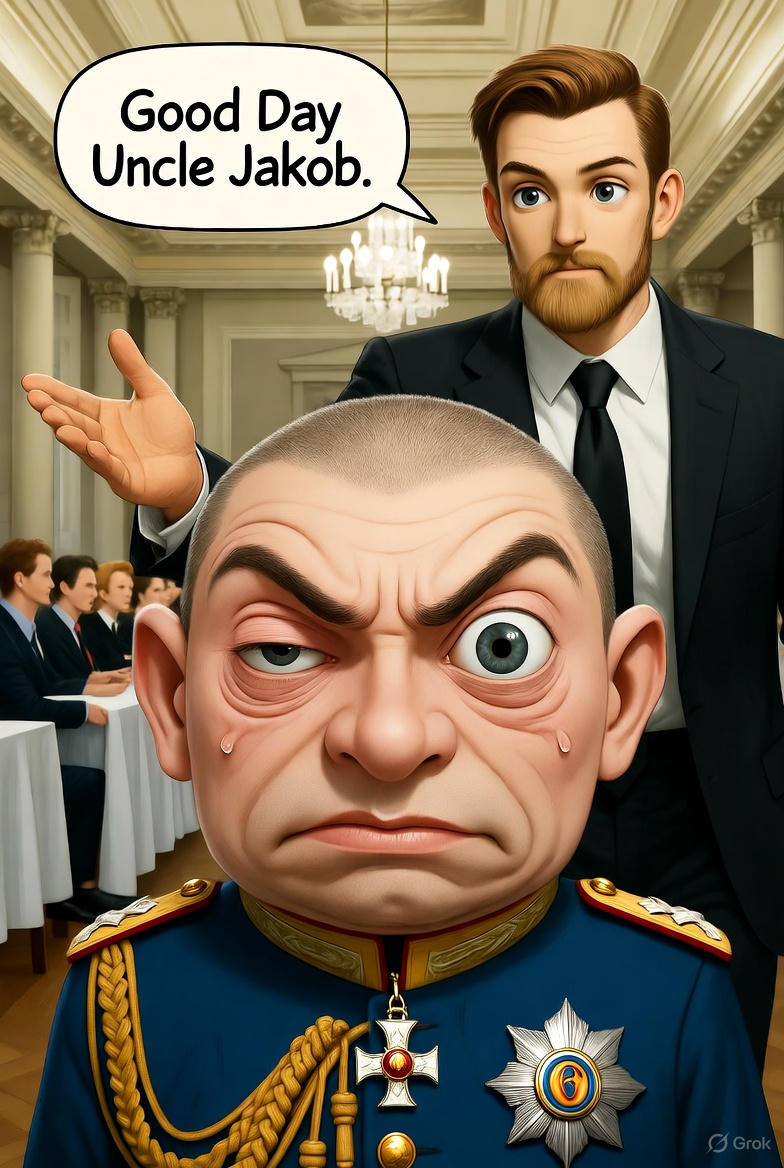
Privy Councilor ten Brinken looked around for a chair. He was a
small man, smooth shaven, with thick watery bags under his eyes. He
was repulsive enough with swollen hanging lips, a huge meaty nose,
and the lid of his left eye drooped heavy but the right stood wide
open, squinting around in a predatory manner. Someone behind him
said:
“Good Day Uncle Jakob.”
It was Frank Braun. The Privy Councilor turned around; it was
very unusual to see his nephew here.
“You’re here?” he asked. “I can only imagine why.”
The student laughed, “Naturally! But you are so wise uncle. You
look good by the way, and very official, like a university professor in
proud dress uniform with all your medals. I’m here incognito–over
there with the other students stuck at the west table.”
“That just proves your twisted thinking, where else would you be
sitting?” his uncle said. “When you once–”
“Yes, yes,” Frank Braun interrupted him. “When I finally get as
old as you, then I will be permitted–and so on–That’s what you would
tell me, isn’t it? All heaven be praised that I’m not yet twenty Uncle
Jakob. I like it this way much better.”
The Privy Councilor sat down. “Much better? I can believe that.
In the fourth Semester and doing nothing but fighting, drinking,
fencing, riding, loving and making poor grades! I wrote your mother
about the grades the university gave you. Tell me youngster, just what
are you doing in college anyway?”
The student filled two glasses, “Here Uncle Jakob, drink, then
your suffering will be lighter! Well, I’ve been in several classes
already, not just one, but an entire series of classes. Now I’ve left and
I’m not going back.”
“Prosit!”
“Prosit!” The Privy Councilor said. “Have you finished?”
“Finished?” Frank Braun laughed. “I’m much more than
finished. I’m overflowing! I’m done with college and I’m done with
the Law. I’m going to travel. Why should I be in college? It’s possible
that the other students can learn from you professors but their brains
must then comply with your methods. My brain will not comply. I
find every single one of you unbelievably foolish, boring and stupid.”
The professor took a long look at him.
“You are immensely arrogant, my dear boy,” he said quietly.
“Really?” The student leaned back, put one leg over the other.
“Really? I scarcely believe that. But if so, it doesn’t really matter. I
know what I’m doing. First, I’m saying this to annoy you a bit–You
look so funny when you are annoyed, second, to hear back from you
that I’m right.
For example, you, uncle, are certainly a shrewd old fox, very
intelligent, clever and you know a multitude of things–But in college
weren’t you just as insufferable as the rest of your respected
colleagues? Didn’t you at one time or another say to yourself that you
wanted to perhaps just have some fun?”
“Me? Most certainly not!” the professor said. “But that is
something else. When you once–Well, ok, you know already–Now
tell me boy, where in all the world will you go from here? Your
mother will not like to hear that you are not coming home.”
“Very well,” cried Frank Braun. “I will answer you.”
“But first, why have you have rented this house to Gontram? He
is certainly not a person that does things by the book. Still, it is
always good when you can have someone like that from time to time.
His tubercular wife naturally interests you as a medical doctor. All the
doctors in the city are enraptured by this phenomenon without lungs.
Then there’s the princess that you would gladly sell your castle in
Mehlem to.
Finally, dear uncle, there are the two teenagers over there,
beautiful, fresh vegetables aren’t they? I know how you like young
girls–Oh, in all honor, naturally. You are always honorable Uncle
Jakob!”
He stopped, lit a cigarette and blew out a puff of smoke. The
Privy Councilor squinted at him poisonously with a predatory right
eye.
“What did you want to tell me?” he asked lightly.
The student gave a short laugh, “Oh, nothing. Nothing at all!”
He stood up, went to the corner table, picked up a cigar box and
opened it. They were the expensive cigars of the Privy Councilor.
“The smokes, dear uncle. Look, Romeo and Juliet, your brand.
The Legal Councilor has certainly not spared any expense for you!”
He offered one to the Privy Councilor.
“Thank you,” growled the professor. “Thank you. Now once
again, what is it that you want to tell me?”
Frank Braun moved his chair closer.
“I will tell you Uncle Jakob. But first I need to reproach you. I
don’t like what you did, do you hear me? I know myself quite well,
know that I’ve been wasting my life and that I continue–Leave that.
You don’t care and I’m not asking you to pay any of my debts.
I request that you never again write such a letter to our house.
You will write back to mother and tell her that I am very virtuous,
very moral, work very hard and that I’m moving on and such stuff.
Do you understand?”
“Yes, that I must lie,” said the Privy Councilor. “It should sound
realistic and witty, but it will sound slimy as a snail, even to her.”
The student looked at him squarely, “Yes uncle, you should even
lie. Not on my account, you know that, but for mother.”
He stopped for a moment gazing into his glass, “and since you
will tell these lies for me, I will now tell you this.”
“I am curious,” said the Privy Councilor a little uncertainly.
“You know my life,” the student continued and his voice rang
with bitter honesty. “You know that I, up until today, have been a
stupid youth. You know because you are an old and clever man,
highly educated, rich, known by all, decorated with titles and orders,
because you are my uncle and my mother’s only brother. You think
that gives you a right to educate me. Right or not, you will never do it.
No one will ever do it, only life will educate me.”
The professor slapped his knee and laughed out loud. “Yes, life!
Just wait youngster. It will educate you soon enough. It has enough
twists and turns, beautiful rules and laws, solid boundaries and thorny
barriers.”
Frank Braun replied, “They are nothing for me, much less for me
than for you. Have you, Uncle Jakob, ever fought through the twists,
cut through the wiry thorns and laughed at all the laws? I have.”
“Pay attention uncle,” he continued. “I know your life as well.
The entire city knows it and the sparrows pipe their little jokes about
you from the rooftops. But the people only talk to themselves in
whispers, because they fear you, fear your cleverness and your
money. They fear your power and your energy.
I know why little Anna Paulert died. I know why your handsome
gardener had to leave so quickly for America. I know many more
little stories about you. Oh, I don’t approve, certainly not. But I don’t
think of you as evil. I even admire you a little perhaps because you,
like a little king, can do so many things with impunity. The only thing
I don’t understand is how you are successful with all the children.
You are so ugly.”
The Privy Councilor played with his watch chain. Then he
looked quietly at his nephew, almost flattered.
“You really don’t understand that?”
The student replied, “No, absolutely not at all. But I do
understand how you have come to it! For a long time you’ve had
everything that you wanted, everything that a person could have
within the normal constraints of society. Now you want more. The
brook is bored in its old bed, steps here and there over the narrow
banks–It is in your blood.”
The professor raised his glass, reached it out to him.
“Give me another, my boy,” he said. His voice trembled a little
and certainly rang out with solemnity. “You are right. It is in the
blood, my blood and your blood.”
He drank and reached out to shake hands with his nephew.
“You will write mother like I want you to?” asked Frank Braun.
“Yes, I will,” replied the old man.
The student said, “Thank you Uncle Jakob.”
He took the outstretched hand and shook it.
“Now go, you old Don Juan, call the Communicants! They both
look beautiful in their sacred gowns, don’t they?”
“Hmm,” said the uncle. “Don’t they look good to you?”
Frank Braun laughed. “Me? Oh, my God! No, Uncle Jakob, I am
no rival, not today. Today I have a higher ambition–perhaps when I
am as old as you are!–But I am not the guardian of their virtue. Those
two celebrating roses will not improve until they have been plucked.
Someone will, and soon–Why not you? Hey Olga, Frieda! Come on
over here!”
But neither girl came over. They were hovering around Dr.
Mohnen, filling his glass and listening to his suggestive stories. The
princess came over; Frank Braun stood up and offered her his chair.
“Sit down, sit down!” she cried. “I have absolutely nothing to
chat with you about!”
“Just a few minutes, your Highness. I will go get a cigarette,” the
student said. “My uncle has been waiting all night for a chance to give
you his compliments. He will be overjoyed.”
The Privy Councilor was not overjoyed about it. He would have
much rather had the little princess sitting there, but now he
entertained the mother–
Frank Braun went to the window as the Legal Councilor and
Frau Marion went up to the Grand Piano. Herr Gontram sat down on
the piano bench, turned around and said.
“I would like a little quiet please. Frau Marion would like to sing
a song for us.”
He turned to the Lady, “What would you like after that dear
Frau?–Another one I hope, perhaps ‘Les Papillions’? or perhaps ‘Il
Baccio’ from Arditti?–Give me the music for them as well!”

Read Full Post »

Homo Sapiens: Under Way by Stanislaw Przybyszewski and translated by Joe E Bandel

VIII.

When they both stepped out the door, Falk became a little uneasy. 

“He had sent the coachman home. The night was so splendid; he would so like to accompany her home on foot. It would also be good for her to refresh a little from the stupid society in the open air.” 

Falk’s voice trembled slightly. 

Marit spoke no word; a dark oppression almost took her breath away. 

They stepped onto the open field; both thoughtful, silent. 

Now the moment had come when one can look into the soul of the being one loves as into one’s own. Falk felt her soul like a roulette ball rolling from one boundary wall of his suggestions to the other: 

“Wouldn’t she like to take his arm? 

The path was very bad; it had many holes, one could easily sprain one’s foot.” 

She took his arm silently. He pressed it very firmly to his chest and felt her tremble. 

Falk knew that he couldn’t speak now; his voice would break. 

He fought against this excitement; but his unrest grew and grew. 

No, he gathered himself. No, not now! 

That reminded him of the way peasants clumsily grab with both hands right away. 

The moon poured pale streams of light on the meadows; in the distance one saw high-piled black heaps of peat. 

Falk tried to master himself. He wanted to postpone the happiness he could now enjoy; he wanted to enjoy it slowly. 

They stopped and contemplated the landscape. 

Then they walked again, but didn’t look at each other; it was as if they felt a kind of shame before one another. 

Now Falk stopped again. 

“Strange: every time I see the peat heaps, I always have to think of a peculiar man from my home village. 

He was a peat cutter for my father; naturally he drank, like almost all our farmhands, and had a great fixed idea.” 

Falk instinctively sought to loosen and scatter the sexual concentration through stories; then he could overwhelm the girl all the more surely afterward. 

“You know, from the peat bog at times will-o’-the-wisps rise, which move back and forth with fabulous speed. 

The man now got it into his head that the will-o’-the-wisps were souls of deceased Freemasons; at that time the famous papal encyclical also appeared, in which it is written that the Freemasons are possessed by the evil one. 

Now the man ran around all night and shot at the will-o’-the-wisps with an old pistol. With somnambulistic certainty he jumped over the widest peat ditches, crawled through the mud and densest undergrowth like a swamp animal, sometimes sank up to his neck in the marsh, worked himself out again and shot incessantly. 

There lay a terrible tragedy in it. I saw him once after such a night. His eyes were bulging and bloodshot, the mud sat finger-thick on his clothes, he was completely soaked, the thick swamp water dripped from him; his hair was glued together into strands by the mud, but he was happy. 

He swung the pistol back and forth and jumped and cried out with joy. For in this night he had shot a Freemason soul with a twenty-pfennig piece; as he watched, only a little heap of tar remained of the will-o’-the-wisp. 

The pistol was his sanctuary from then on. But once he was locked in prison because he didn’t send his son to school. The boy stayed home alone—the mother had long since run away—and tended the goat on the peat meadows, the peat cutter’s only wealth. 

Yes; now it occurred to the boy to fetch the pistol to frighten the neighbor’s child, whom he was also supposed to watch. He turned the pistol with the muzzle toward his mouth and held a burning match near the pan. 

‘Watch out, now I’m shooting dead!’ He held the match ever closer. The child gets frightened, starts screaming, and in that moment 

the pistol discharges: the boy gets the whole charge in his mouth. I had just come from school and was witness to the scene that I will never forget in my life. 

The boy ran around in mad fear, blood gushed from his nose and mouth, and with every death scream the foam shot and gurgled forth in dark stream. 

The child understood nothing and laughed heartily at the crazy jumps. Only the goat seemed to have understood it. In wild fear it had 

torn itself from the stake to which it was tied; it jumped—no, you really can’t imagine it—it jumped over the long, skinny boy, and then over a wide ditch, and back again… it was terrible. 

Marit was completely excited. 

“That must have been gruesome! Did the boy die?” “Yes, he died.” 

Again they walked silently side by side; they were quite, quite close. 

“Good God, you looked wonderful today! You had an expression on your face, you know, an expression that I had seen on you only once before; yes, once a year ago. We were as happy as children and so happy; God knows, it was beautiful. And then we stood in the evening on the veranda. In the distance we heard the monastery bells ringing for the Ave Maria, and you stood there and looked ahead with the expression of unspeakable intimacy and bliss; it was like a sea of bright gold around you—and today I saw it again.” 

Falk trembled. 

“I looked at you the whole evening, I admired you and was happy and felt you quite close to me… to me.” 

He pressed her even tighter to himself, his voice almost gasped. “Marit, I love you; I…” 

His hand encircled hers. He felt how hot streams flowed into her. 

“I came only because of you; I lay there in Paris and longed for you like mad; I had to come. And now you know; now I have a morbid desire to take you in my hands and press you so wild, so wild to my heart and breathe your breast against mine, hear your heart beat against mine. 

Look, Marit, my gold, my everything; I will do everything, everything for you; you mustn’t resist; you give me an unnameable happiness; you give me everything by it; look, I have suffered so; my sweet girl, my sun, give me the happiness!” 

Around them both, the hot, sexual atmosphere wove tighter and tighter. She could hardly breathe. 

“I was so immeasurably unhappy all the time because I love you so endlessly; never have I loved a being as I loved you before.” 

She felt above her two abyssal eyes shining like two stars; her head grew confused, she couldn’t think, understood only his hot, gasping words, which fell like hot blood drops into her soul, and above her she saw two abyssal stars that guided and pulled and tore at her. 

She felt how he embraced her, how he sought her mouth, and felt his hot, feverish lips as they sucked into her lips. 

She no longer resisted; her whole soul threw itself into the one kiss, she embraced him. It was like a jubilation that dances with wild leaps over an abyss. She kissed him. 

Falk had not suspected this wild passion in her. A hot gratitude rose in him. 

“You will be mine, Marit; you will be… will…” 

Yes, that had to be… she felt it, that had to be… the eyes, the terrible eyes above her… and the voice… it sounded like a command. 

Just let me—now—let me—to my senses—let… 

Again they walked silently side by side, trembling, with bated breath. 

“You will be mine?” “How, how? What?” 

Falk was silent. 

For the rest of the way, they spoke no word. 

At the garden gate, they silently shook hands.

Read Full Post »

« Newer Posts - Older Posts »