Feeds:
Posts
Comments

Posts Tagged ‘short-story’

Alraune by Hanns Heinz Ewers and translated by Joe E Bandel

Chapter Five
Informs about her father and how Death stood as Godfather
when Alraune came to life.

DR. Karl Petersen brought the Privy Councilor a large
beautifully bound book that he had prepared especially for
this project. The old ten Brinken family crest showed on
the upper left corner of the red leather volume. In the
middle glowed the large golden letters ATB.
The first page had been left blank. The professor had reserved it
to write some early history himself. The next page began with a
paragraph in Dr. Petersen’s hand. He wrote of the short and simple
life history of the mother and of her character and demeanor.
He had asked the prostitute to tell her life story and then quickly
wrote it down. Even her previous convictions were mentioned. Alma
had been sentenced twice for vagrancy; five or six times due to
violations of police regulations concerning her profession and once
because of theft–Yet, she maintained that she was innocent of the
theft–the gentleman had given her the diamond pin.
Further down in the second paragraph Dr. Petersen had written
down things about the presumptive father, the unemployed miner,
Peter Weinland Noerissen, who had been condemned by a court and
jury and sentenced to death in the name of the King.
The public prosecutor had presented the facts in an amiable,
charming fashion. It appeared that P. Noerissen had been predestined
to such a fate from infancy. His mother had been a notorious drinker.
His father, an occasional worker, had been previously convicted
because of frequent crude misdemeanors. One of his brothers was
even now serving ten years in prison on similar grounds.
Peter Weinland Noerissen had become apprenticed to a
blacksmith after he finished school. This had played an important part
in the proceedings because of the skill and strength that had been
displayed in the murder. Many witnesses gave evidence of his
displays of unusual strength. He had a history of pushing himself on
females even when they said they were not interested.
He had been released from military service because of a
congenital defect. He was missing two fingers on his left hand. He
worked in several diverse factories before finally coming to the
Phoenix mine in the Ruhr industrial district. He was not a member of
any trade union, not the old socialist union, the Christian or the
mysterious Elks.
He was fired from the mine when he pulled a knife on an
overseer. This was a serious violation and he received his first
sentence of a year in jail. He was released after his counsel for the
defense argued during appeal that the conviction was only based upon
the word of the overseer with no real evidence that it was attempted
manslaughter.
After that he was on the road, had crossed over the Alps twice
and fought his way from Naples to Amsterdam. While he did work
occasionally, he spent most of his time as a vagabond or hobo and
was further convicted of a few other petty crimes. It was enough for
the public prosecutor to assume that in the course of seven or eight
years he had become a hardened criminal with no conscience.
The crime that he was now condemned for was not that clear
either. It was still not entirely certain if it had been a robbery gone
wrong or an intentional sex murder. The defense tried to portray it as
if the accused had only intended to rape the well dressed and well
endowed nineteen year old daughter of the home owner, Anna Sibilla
Trautwein, when he encountered her in the Ellinger Rhine meadow
that fateful evening.
That when he tried to rape the strong and vigorous girl she
started screaming and he pulled his knife only to threaten her into
silence. It didn’t work and she fought back more vigorously and in the
struggle was stabbed. He only finished her off out of the fear of
discovery. It was then only natural that he take her petty tip money
and jewelry to help him make good his escape.
This account did not match the condition of the corpse itself. It
was established that the terrible dismemberment of the victim’s vitals
was most skillfully done and the cut almost workman like. The public
prosecutor ended with a plea that the appeal to the Imperial court be
refused, that there was no need for further reprieve and that the
execution take place early in the morning on the following day at six
o’clock.
In conclusion the book stated that the delinquent did agree to Dr.
Petersen’s request on the condition that he be brought two bottles of
whiskey that evening around eight o’clock.
The Privy Councilor finished reading and then gave the book
back.
“The father is cheaper than the mother!” he laughed.
“You will attend the execution as well. Don’t forget to bring the
common salt solution and other things you will need. Hurry back as
soon as possible. Every minute counts, especially in a situation like
we have here. There will scarcely be enough time. I will expect you at
the clinic early in the morning. Don’t bother finding an attendant. The
princess will assist us.”
“Princess Wolkonski, Your Excellency?” Dr. Petersen asked.
“Certainly,” nodded the professor. “I have my reasons for
bringing her into this little operation–Besides, she is very interested in
such things. By the way–how is our patient today?”
The assistant doctor said, “Ah, your Excellency. It is the same
old story, always the same now for the two weeks that she has been
here. She cries, screams and raves–In short, she wants out. Today she
smashed a couple of wash basins to pieces.”
“Have you seriously tried to talk with her again?” asked the
professor.
“I tried, but she scarcely let me get a word out,” answered Dr.
Petersen. “It is fortunate that tomorrow is finally almost here–How we
can ever keep her here until the child comes into the world is a puzzle
to me.”
“That won’t be your problem Petersen,” the Privy Councilor
clapped him benevolently on the shoulder. “We will find a way–Just
do your duty.”
The assistant doctor said, “Your Excellency can count on me for
that.”
The early morning sun kissed the honeysuckle leaves in the arbor
and clean gardens where the Privy Councilor’s white women’s clinic
lay. It lightly fondled the many colored dahlias in their dew fresh beds
and caressed the large deep blue clematis on the wall.
Many colored finches and large thrushes ran across the smooth
path, scurried through the evenly mown lawn and quickly flew off as
eight iron hoofs struck sparks as they lightly hit the cobblestones of
the street.
The princess climbed out of the carriage and came with quick
strides through the garden. Her cheeks glowed, her strong bosom
breathed heavily as she climbed the high steps up to the house. The
Privy Councilor came up and opened the door for her.
“Come in, I’ve just had some tea made for you.”
She said–in a panting and hurried voice–“I just came from–there.
I saw it. It–it was fabulous–exciting.”
He led her into the room. “Where have you just come from, your
Highness? From the– execution?”
“Yes,” she said. “Dr. Petersen will be here soon–I received a
ticket–just last night. It was intense–very intense.”
The Privy Councilor offered her a chair. “May I pour for you?”
She nodded, “Please, your Excellency. Very kind of you! A pity
that you missed it! He was a splendid fellow–tall–strong.”
“Who?” He asked, “The delinquent?”
She drank her tea, “Yes, certainly, him! The murderer! Muscular
and strapping–a powerful chest–like a boxer. He wore some kind of
blue sweater–it was open at the neck. No fat, only muscle and sinews.
Like a bull.”
“Could your Highness see the execution clearly?” asked the
Privy Councilor.
“Perfectly, your Excellency!” she cried. “I stood at the window
in the hall. The guillotine was right in front of me. He swayed a bit as
he stepped up. They had to support him.”
“Please, another piece of sugar, your Excellency.”
The Privy Councilor served her. “Did he say anything?”
“Yes,” said the princess. “Twice, but each time only one word.
The first time as the attorney read the sentence. That’s when he cried
out half-loud–but I can’t really repeat it–”
“But your Highness!” The Privy Councilor grinned and patted
her lightly on the hand. “You certainly don’t need to get embarrassed
in front of me.”
She laughed, “No, certainly not. Well then–but reach me another
slice of lemon. Thank you. Put it right there in the cup! Well then–he
said, no–I can’t say it.”
“Highness,” said the professor with mild reproof.
She said, “You must close your eyes first.”
The Privy Councilor thought, “Old monkey!” but he closed his
eyes. “Now?” he asked.
She still hesitated, “I–I will say it in French–”
“That’s fine–in French then!” he cried impatiently.
Then she pressed her lips together, bent forward and whispered
in his ear, “Merde!”
The professor bent backward, the princess’s strong perfume
bothered him. “So that’s what he said?”
“Yes,” she nodded. And he said it as if he was indifferent to it
all. I found it very attractive, almost gentleman like.”
“Certainly,” confirmed the Privy Councilor. “Only a pity that he
didn’t say it in French as well. What was the other word he said?”
“Oh, that was bad,” the princess sipped her tea, nibbled at a
cookie. It completely ruined the good impression he had made on me!
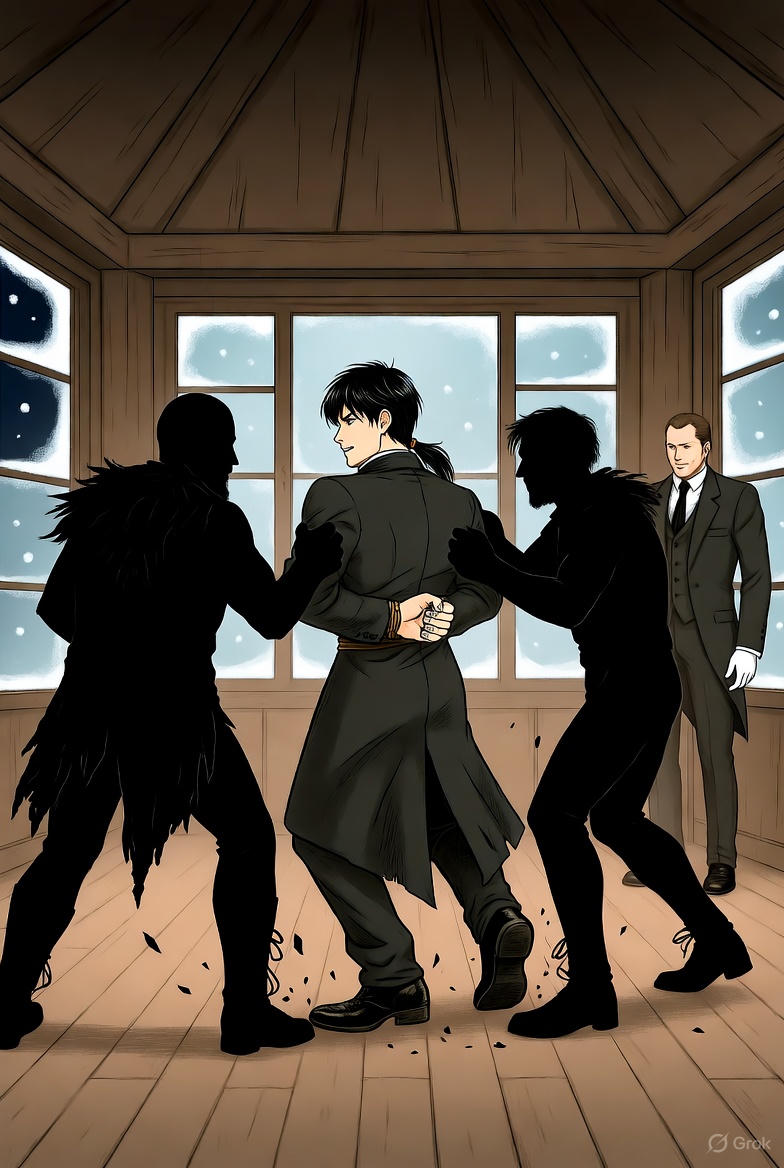
Just think, your Excellency, just as the executioner’s assistants seized
him, he suddenly began to scream and cry like a little child.”
“Well,” said the professor. “Another cup, your Highness?–And
what did he scream?”
“First he defended himself,” she explained. “The best he could,
silent and powerfully even though both hands were tightly tied behind
his back. There were three assistants and they threw themselves on
him while the executioner stood there watching quietly in his dress
suit and white gloves. At first it pleased me, how the murderer threw
off the three butchers, how they tore at him and pushed without
bringing him one step closer. Oh, it was terribly exciting, your
Excellency.”
“I can only imagine, your Highness,” he blurted out.
“But then,” she continued. “Then it all changed. One grabbed his
leg while another pushed his bound arms high and he stumbled
forward. At that moment he must have felt his resistance was useless,
that he was lost. Perhaps–Perhaps he had been a little drunk–and was
now suddenly very sober –Pfui–That’s when he screamed.”
The Privy Councilor smiled, “What did he scream? Must I close
my eyes again?”
“No,” she cried. “You can leave them open, your Excellency–He
became a coward, a pathetic coward, full of fear. He screamed,
‘Mama!–Mama!–Mama!’ dozens of times while they had him on his
knees, dragged him to the guillotine and pushed his head into the
circular opening of the board.”
“Was he still crying for his mama at the last moment?” asked the
Privy Councilor.
“No,” she answered. “Not at the very last. After the hard board
was locked firmly around his neck with his head sticking out the other
side he became very quiet. Something seemed to be going on inside of
him.”
The professor became very attentive, “Could you see his face,
your Highness? Could you guess at what was going on inside him?”
The princess said, “I could see him just as clearly as I see you
right now sitting in front of me–What was going on inside him–I
don’t really know–there was just an instant–After the executioner
looked around one last time to see that everything was ready–when
his hand pressed the button that released the blade. I saw the eyes of
the murderer, they stood wide open, with insane passion, saw his
mouth panting and his features contorted with desire–”
She stopped.
“Was that all?” inquired the Privy Councilor.
She finished, “Yes, then the guillotine fell and his head sprang
into the sack that one of the assistants held open- Please, reach me the
marmalade, your Excellency.”
There was a knock at the door. It opened and Dr. Petersen
stepped inside. In his hand swung a long glass tube, tightly corked
and wrapped in wadding.
“Good morning, your Highness,” he said. “Good morning, your
Excellency–Here–here it is.”
The princess sprang up, “Let me see–”
But the Privy Councilor held her back. “Slow down, your
Highness. You will see it soon enough. If it is all right with you, we
will get right to work.”
He turned to the assistant doctor, “I don’t know if it will be
important, but just in case it would be a good idea if you–”
His voice sunk as he put his lips to the ear of the doctor.
He nodded, “Very well, your Excellency. I will give the orders
immediately.”
They went through the white corridors and stopped just in front
of No. seventeen.
“Here she is,” said the Privy Councilor as he carefully opened
the door.
The room was entirely white, radiant with sunlight. The girl lay
deeply asleep in bed. A bright ray scurried in from the tightly barred
windows, trembled on the floor, clambered up a golden ladder, darted
across the sheets and nestled lovingly on her sweet cheek, plunging
her red hair into glowing flames. Her lips were moving–half-open–as
if she were lightly whispering words of love.
“She’s dreaming of her prince,” said the Privy Councilor.
Then he laid his cold, moist hand on her shoulder and shook it.
“Wake up Alma.”
Read Full Post »

Madame Bluebeard by Karl Hans Strobl and translated by Joe E Bandel

“I’ll come,” he said. “You don’t think I’m above
such things. A warm, bright ballroom, festive
women, soft music—there’s much life and splendor
in that.”
He only wished she’d broached it another time.
Helmina watched, knowing his thoughts. It was like
preparing for a wrestling match. They faced off,
probing for weaknesses, ready to seize any opening
with a firm grip. But when evening fell, when will’s
weariness set in and night loomed, their senses
stirred. The urge of their bodies surged, forging peace
to wage battle on another field.
One evening in late January, when Lorenz was
briefly alone with Helmina, he said, “Brother writes.
He won’t wait longer. You must act.”
Helmina paused. “Fine—tomorrow!” she said
decisively. The next morning brought a glorious
winter day. As she sat with the children at breakfast,
she heard snowshoes clatter in the antechamber.
Ruprecht entered, early from outdoors, brimming
with youthful vigor, master of the world’s riches.
“Coming along later?” he asked. “Perfect ski weather
today.”
Helmina agreed, changed quickly after breakfast,
and plunged with Ruprecht into winter’s wonders.
Fresh snow had fallen, its surface crusted by swift
frost. They glided with a bird’s speed, transcending
flaws, reveling in the joyous outpour of strength, the
rushing motion.
Ruprecht let Helmina lead. Her red knitted jacket
sang against the white snow. She leapt down a slope,
legs tight, knees bent, and sped on below. They
climbed a gentle hill. At the forest’s edge, blue
shapes jutted from the snow. “Soldiers,” Ruprecht
said, his eyes honed on South America’s vast
pampas. Indeed, soldiers—four men and a volunteer,
72freezing on outpost duty. All five gaped as Helmina
zoomed past. The volunteer’s awe crystallized into a
cry: “Sapperment!”
But the pair was already gone, vanishing among
the trees.
“Must be a winter maneuver,” Ruprecht guessed.
In the valley furrow beyond the forest, they met
another outpost. Footprints led up the far slopes.
Helmina followed them. Atop the high plain, a
village lay at the end of a rutted, brownish hollow
way. Huddled against the cold, its cottages seemed
baked together for warmth, buried to their windows
in snow. On either side of the hollow way, a blue-
black swarm stirred—an ant-like frenzy. Ruprecht
and Helmina glided along the path’s edge, where
snow was less trampled. Below, troops marched.
They passed countless upturned faces, a river of
gazes. Then came a wide, empty gap, followed by a
knot, a jam. The hollow way was clogged with
soldiers, murmuring, pressing forward. Something
had happened.
Soldiers lined the path’s rims, peering in, making
it hard to pass. Something had happened. At a gentler
slope, Helmina pushed down into the hollow.
Soldiers glanced back, startled. A sharp revolver
crack burst from the dense crowd ahead. Helmina
shoved soldiers aside, thrusting forward with her ski
pole, wading through the throng. A fierce craving
drove her, blazing on her face.
She nearly collided with a tall major. He stared,
surprised, at the lady emerging among the rabble,
then recognized her, saluting with utmost courtesy.
Helmina knew him too—Major Zivkovic, from her
Abbazia entourage.
“What’s happened?” she asked urgently. The
major positioned himself to block her view. “Nothing
for ladies! No—please, don’t look. It’s not pretty…
you might have nightmares.”
A wild glee lit Helmina’s face. “An accident?”
“Yes—a regrettable mishap… no, really, madam,
please don’t look… I couldn’t take responsibility…”
Helmina laughed. “Who do you take me for, dear
Major? Think I’ll faint… or have fits?”
“You’d need strong nerves, madam.”
“I believe you know from Abbazia I’m not
nervous. Let me through…”
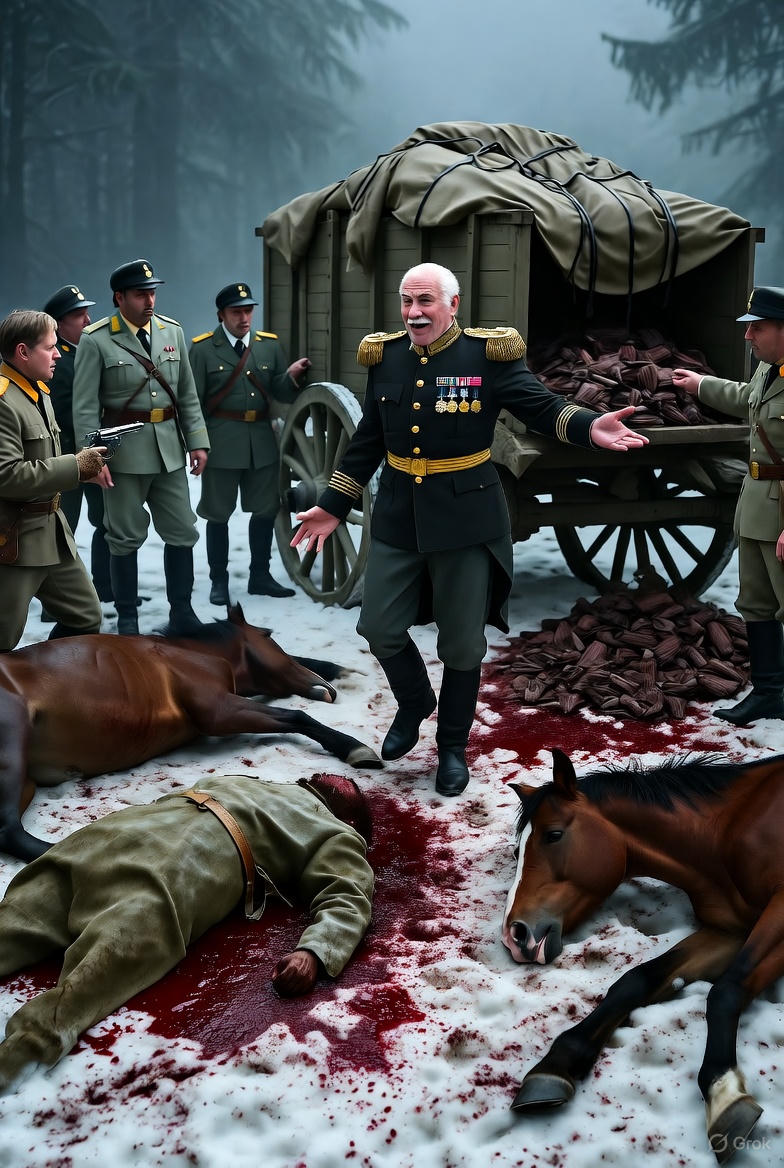
Shrugging, the major stepped aside. Amid the
soldiers lay an overturned, heavily laden supply
wagon, shattered. The surrounding snow was
trampled, mixed with mud, streaked red in places.
Nearby, under coarse wagon tarps, two bodies lay in
a blood pool. The three horses were horribly
mangled, legs broken. Two were dead; one still lived,
thrashing so wildly no mercy shot could be fired. A
lieutenant stood by with a revolver, vainly seeking a
clear moment.
The major explained the wagon had been driven
carelessly, too close to the path’s edge, and plunged.
The drivers were crushed instantly, the horses lost.
Helmina unstrapped her skis and approached the
lieutenant. “Give me the revolver,” she commanded.
Ruprecht saw relentless cruelty on her face, a raging
urge to kill. A barbaric instinct erupted from her core.
Stunned, the lieutenant resisted. “But madam
surely doesn’t…”
“Give me the revolver,” she ordered again. The
beardless young man dared no further objection,
handing her the weapon. Horror crept into his eyes.
Helmina gripped the revolver, stood tall, and stepped
smiling toward the horse. That smile was terrifying.
She stood, staring sharply at the animal. Slowly, she
raised the weapon, aimed calmly, and fired the
moment the horse jerked its head toward her, straight
between its eyes. It twitched, convulsed, then
stretched out, dead.
“Thank you, Lieutenant,” Helmina said, smiling as
she returned the weapon.
“You’re a daring Amazon, madam,” the major
said, paling, his voice dry. He cleared his throat, a
pun surfacing to save the moment. “Truly valiant…
ha… ha!” He was known as an aging wit.
“Christian duty, dear Major,” Helmina replied.
“One can’t let the creature suffer so long.”
“Unlike a man,” the major added, with a gallant
flourish he prided himself on. Helmina introduced
Ruprecht—her retort.
“So you’ve been merciful to at least one man,” the
major said, then inquired with utmost charm about
Ruprecht’s health. Ruprecht smiled. This tall man,
with his habitual gallantries and incorrigible knightly
minstrelsy, harmless as a child, amused him. He
invited him to visit Schloss Vorderschluder.
Helmina strapped on her snowshoes, bid the
officers farewell, and skied ahead of Ruprecht up the
slope they’d descended. The blue swarm of soldiers
soon fell behind. Across the Kamp, the pilgrimage
church of Dreieichen gleamed in the sunlight.
Neither spoke.
Only the soft scrape of snowshoes and the caw of
a large crow, startled from a furrow, broke the
silence. After a while, Helmina stopped, bent, and
scooped a handful of snow. She hadn’t yet replaced
the sturdy ski glove she’d removed. A faint blood
spatter marked her left hand. She rubbed it with
snow, tinging the soft white mass a pale red.
Ruprecht recalled the day Helmina stood by Baron
Kestelli’s corpse, her fingers also stained with blood.
“Oh, yes!” Helmina said, drying her hand with a
handkerchief. “It just occurred to me—I’ve been
meaning to discuss a business matter with you. It’s
rather urgent. You should join a venture I’m
planning. I’m certain Galician petroleum can make a
fortune. The issue is capital. Those oil and naphtha
wells are exploited primitively. A smarter hand could
turn it around. You could double your wealth
overnight.”
“I must tell you, I’ve no entrepreneurial spirit.
You know I prefer safe investments.”
“You’re such a coward in this. To win, you must
risk. I’ve enough enterprise for both of us. You can
trust me when I say it’s a good deal.” Helmina laid
out details, displaying such understanding and
expertise one might think she’d studied for years. She
grew animated, persuading, coaxing, enticing.
The talk clashed with the landscape. Dreieichen’s
tower shimmered across the valley. Below, the Kamp
traced a silver arabesque through blue-black forests.
And Helmina spoke of Galician petroleum.
Ruprecht admired her. She was wholly herself in
all she did—a multifaceted gem, each facet blazing
with different fire. He might’ve been swayed, but
then he recalled her demanding the revolver from the
lieutenant, standing cold-blooded and smiling by the
writhing horse.
“No,” he said calmly, “I’d rather not invest.”
“Oh! You’re not the least bit gallant.”
“Gallantry in money matters, dearest? No! Must I
remind you of our agreement? We’re to keep our
independence, even in this.”
Helmina shrugged. “Your loss if you don’t.”
Ruprecht tried to meet her gaze, but she was
skiing down a slope, ahead of him.
“By the way,” he said, catching up, “I’ll at least
ask Siegl—to show my good faith.”
Siegl, however, had no intention of encouraging
the venture. Reading the banker’s letter, Ruprecht
saw him vividly—the paper’s watermark, firm
letterhead, and florid signature conjured a dancing
pince-nez on a thick nose, a rippling belly in a white
vest, the elegant curve of bowed legs. Siegl wrote:
“Keep your hands off such things. What’s Galician
petroleum to you? How do you get such outlandish
ideas? It’s not for you.” The letter wasn’t typed but
penned by Siegl’s own hand, private and intimate, as
if he spoke with thumbs in his waistcoat pockets.
“You see, Helmina,” Ruprecht said after reading
her the letter, “Siegl’s against it. He’s my oracle. I
must heed him.”
“Then I’ll invest alone,” Helmina replied. “I won’t
let such a chance slip. I’ve had a very attractive
offer.”
“I wish you every success. I won’t envy your
fortune.”
After dinner, when the children were taken away
and Ruprecht had stepped out briefly, Lorenz, serving
tea, whispered, “What did he say?”
“He won’t.”
“Then he’s got to go.”
“I’m just worried it’ll cause a stir this time. We
should wait…”
“We don’t have time.”
“Then at least three days…” Helmina interjected.
“You mean three nights,” Lorenz murmured. “I
said you’re in love.”

Read Full Post »

Madame Bluebeard by Karl Hans Strobl and translated by Joe E Bandel

Seventh Chapter
When Ruprecht returned from Krems at noon,
Helmina informed him that Herr Anton Sykora had
visited—an old friend of her late husband. He’d
regretted missing Ruprecht, but business had forced
him to leave early that morning.
Ruprecht listened half-heartedly, murmuring, “Is
that so?” His mind was brimming with agricultural
matters. He’d thrown himself into work with fervor.
There was much to do. Herr Augenthaler soon
realized the new master held the reins tightly. The
golden age was over; the iron one began. Ruprecht
was everywhere, impossible to deceive. He lifted
every lid to see what lay beneath. Even in winter, he
tolerated no idleness. He’d found gaps in his
stewards’ theoretical knowledge, which he meant to
fill. From Krems, he brought a stack of farming
books and pamphlets, distributing them among his
staff.
Sighing, the manager lugged a pile of scholarship
across the courtyard. The assistant sat in the office,
rolling a cigarette, gazing at Helmina’s window row,
hoping she’d appear.
When the manager handed him his assigned
books, the assistant tossed them on the table and
slammed his fist down. “Ridiculous!” he shouted.
“To cram this into your head… as a grown man—I’m
no schoolboy!”
“Don’t yell,” the manager said. “What’s gotten
into you? And don’t speak so disrespectfully of our
master.” Secretly, though, he relished the assistant’s
outburst, echoing his own thoughts.
Helmina cared little for her husband’s efforts.
Such matters were alien to her. The land held no life
or meaning. Growth, decay, bloom, and fruit were
self-evident, unremarkable. When Ruprecht sat in his
study, she wandered from room to room, played with
the children, chatted with Miss Nelson, or sang in a
not-unpleasant but untrained voice. Deep down, she
was bored. She sometimes thought of Dankwardt,
who’d been no different—immersed in Indian
philosophy while Ruprecht tackled plant physiology,
agricultural chemistry, audited accounts, or drafted
estate plans. Occasionally, he retreated to the Indian
temple, a room Dankwardt had furnished with
mementos from an Indian journey. Between painted
lotus columns, a mural depicted palms and a distant
broad river. A small library held travelogues and
India’s literary treasures on fragrant cedar shelves.
Ornate lamps hung from the ceiling. In corners,
Buddha statues gazed at their navels. When the door
opened, a prayer wheel, tied to the handle by a cord,
clattered.
In that Indian temple, any difference between
Ruprecht and Dankwardt vanished. Helmina passed
the door, casting venomous glances. He’d better not
leave her to boredom. This man was no wiser than
the others. Sometimes, his gaze seemed to pierce her
depths, unearthing hidden truths, sending shivers
through her. Did he truly touch her secrets, strip away
her veils? After passionate nights, a strange urge
gripped her—to shed her mask, confess everything,
stand bare-souled before him. Let him prove if his
love could follow her into the realm of horrors. In
those moments, silence was heavy.
When Ruprecht returned to work, she
congratulated herself on her resolve. Her scornful
smile mocked her own fervor and him, dutifully
fulfilling his self-imposed tasks like an iron
necessity.
“It’s a need,” Ruprecht said, sensing her subtle
derision. “I can’t help it. I can’t lie idle on a bearskin.
I need motion, work. Before, I roamed the world,
busy with sights and vivid experiences, claiming all
there was. Now I’m rooted in one place. I must be all
the busier. It’s the law of energy conservation.”
Helmina delighted in breaching Ruprecht’s
fortified camp. She tore him from work, besieged
him, and triumphed when she toppled his idol, Duty.
Then she let out a wicked laugh. Ruprecht noticed,
calling it a mermaid’s laugh.
The Christmas holidays approached. Snow lay
thick on the mountains, fitting for the season. In the
valley, black wagon tracks ran beside the frozen
river, among groaning firs trembling before their
killers. Peasants trudged through forests, saws and
axes in thick mittens, shaking snow from firs and
pines. They sought Christmas trees. Finding a victim,
iron teeth bit through bark and frozen pith. Axes
struck the trunk, and its fall drew a fearful sigh from
the surrounding woods.
Ruprecht and Helmina skied over steep slopes. He
showed her tricks learned from Norwegian hunters,
teaching her to leap, delighted by her fearlessness.
She kept her legs tight and jumped, her short skirt
flapping around ankles and knees. When she fell, she
rose before he could help, laughing as she brushed
snow from her red jacket. In those moments, he
forgot her wicked smile, unmindful of danger.
From Amnisbühel, a splendid sledding run
descended. Ruprecht and Helmina zoomed down on a
two-seater, black firs blurring into a solid wall. Snow
sprayed, stinging their faces in wild sparks, trailing a
white cloud. The children had a small sled and were
allowed to ride. They tipped over, tumbling downhill,
68piling atop their sled. Squeals and laughter erupted.
Crashing was the best part of sledding.
Two days before Christmas, the children saw a
large sleigh piled with young firs and pines on the
road below. Its runners crunched over hard snow,
horse harnesses jingled, and the driver, in high boots
and short fur, strode alongside, puffing bright blue
smoke balls.
“Where are all those little trees going?” Nelly
asked.
“To the cities… maybe even Vienna, so the Christ
Child can decorate them for children. Every good
child gets a Christmas tree.”
Nelly looked down sadly, then said shyly, “The
Christ Child never decorated a tree for us.”
Ruprecht lifted the girl, kissing her. He knew the
children had never known true, bright Christmas
joy—the wonder of a tree, worth more than any gift.
Helmina hadn’t wanted it. “I’ve spoken to the Christ
Child,” he said. “This time, you’ll surely get one.”
That evening, he and Miss Nelson began
decorating the tree. He was bustling, childishly
gleeful, with the earnestness a proper game demands.
Glittering ornaments lined the branches.
Helmina sat at the room’s rear, watching idly with
cold eyes, a wicked smile curling her lips. Her brow
flickered with storm clouds. How Miss Nelson came
alive at work, shedding all stiffness and reserve. She
stretched to reach higher branches, bent for lower
ones, her slim body tracing graceful lines. She was all
zeal, neither she nor Ruprecht heeding Helmina,
acting as if no one else were present. They debated
earnestly where to place a chain or glass bell.
“Oh, how long since I’ve had a Christmas,”
Ruprecht said, “a true German Christmas. It’s unique.
No other people has its like. These past years, I was
always in the south. The longing was fierce. I’d have
given anything to peek through a window at a
glowing Christmas tree.”
Miss Nelson shared tales of English Christmases,
climbing a chair to fasten a porcelain angel with
tinsel wings high up.
My God, she’s speaking, Helmina thought. A
miracle. She speaks unprompted. Good. Let Ruprecht
try to betray me with her. At the first sign, he’s lost.
What holds him still? What do we share beyond those
fevered nights? Do I love him?
It always began this way for her—a sense of
superiority, as if she need only reach out to toy with a
man. Ah—how exquisite. Years ago, someone gave
her white mice. She’d cared for them well for weeks.
One twilight evening, she opened their cage and let
the yellow cat in.
Ruprecht turned, playfully tossing a chenille
monkey into Helmina’s lap. She disliked such jests.
Her face didn’t change; she said nothing. It was an
insult to offer her such harmlessness. Ruprecht met
her eyes sharply, probing. She returned the gaze.
Fine—let him at least suspect her thoughts. As he
turned back to the tree, she crushed the poor chenille
monkey between her fingers.
On Christmas Eve, the tree blazed in radiant
splendor—a winter fairy tale. Yet the children shone
brighter. They ignored their gifts, standing in shy
reverence. Four tiny Christmas trees sparkled in four
childish eyes. Four small fists clenched tight with
bliss.
Ruprecht, too, stood reverent before the tree,
bathed in light, feeling weightless, soaring, complete.
Meanwhile, Helmina drifted to her gift table.
Carelessly, she sifted through the items—every
fleeting wish fulfilled: the amethyst set, the Lalique
brooch, two Tiffany vases, all there. At the bottom
lay a heavy, angular package. She unwrapped it—a
book: Economic Studies in the Orient by Ruprecht
von Boschan. Its first page bore her name: “To my
beloved wife, Helmina!”
Ruprecht approached. “I know these things don’t
interest you. Still—it’s a memento of our
engagement. I finished it then, giving it your name as
a talisman, calling you my wife in advance. It came
out just in time for Christmas.”
“Thank you for everything,” Helmina said,
offering a cool hand. Oh, Ruprecht piled sentiment
upon sentiment—the Christmas tree, the dedication
from their betrothal! What next?
He’d said his book wouldn’t interest her, but
having written it, he’d joined the guild whose
compass swings toward praise or blame. When
Helmina, well into mid-January, hadn’t mentioned
his Economic Studies, Ruprecht grew impatient.
Dawn’s glow of fame crowned his head, yet Helmina
acted oblivious.
One day, in a measured tone, he said, “I got a
letter from Professor Zwicker today… from Vienna
University, economics. He finds my book
significant.”
“Oh?” Helmina replied indifferently. Let him
stew. Then she added, “I’m not sitting in this
wilderness all Carnival. We’ll go to Krems a few
times when something’s happening. And to Vienna—
at least once or twice. The Vienna City Ball… and
the Concordia Ball.”
“As you wish,” he said, irritated.
She scraped her fork across the plate, a squealing
screech she knew he loathed. “If it doesn’t suit you,
stay home.”

Read Full Post »

Alraune by Hanns Heinz Ewers and translated by Joe E Bandel

Frank Braun said, “Uncle, I’m going down. Do it–For the first
time in you life do it–what I ask of you–I know how it seems–and I
will never go against you again. What do you want me to do?–Should
I grovel even more before you?–Come, let this be enough–Give me
the money.”
Then the Privy Councilor spoke, “I will make you a proposition,
nephew. Do you promise to listen quietly? To not bluster and roar
again like you always do?”
He said firmly, “Yes, Uncle Jakob.”
“Then listen–You shall have the money that you need to get you
out of trouble. If you need more, we will have to talk a little about the
amount later. But I need you–need you here at home. I will have it
arranged for you to be placed there under house arrest for the duration
of your sentence–”
“Why not?” Frank Braun answered. “It doesn’t matter to me if I
am here or there. How long will you need me?”
“Around a year, not quite that long,” answered the professor.
“I agree,” said the attorney. “What do I need to do?”
“Oh not much,” replied the old man. “Just a little employment
that you are already accustomed to and very good at!
You see, my boy,” the Privy Councilor continued. “I need a little
help with this girl that you have arranged for me. You are entirely
correct. She will run away from us, will become unspeakably bored
during her pregnancy and certainly try to abort the child.
I want you to watch over her and protect our interests, prevent
her from doing any of these things. Naturally it is a lot easier to do in
a prison or workhouse where guards can continually watch. But
unfortunately we are not equipped for that. I can’t lock her up in the
terrarium with the frogs or in a cage like the monkeys or guinea pigs
can I?”
“Certainly not, uncle.” the attorney said. “You must find some
other way.”
The old man nodded, “I have found another way. We need
someone that will keep her contented right where she is. Now it
appears to me that Dr. Petersen is completely unsuitable to hold her
interest for a long time. He could scarcely satisfy her for one night.
But it needs to be a man. I was thinking about you–”
Frank Braun pressed the chair arms as if he would break them.
He breathed deeply.
“Of me–” he repeated.
“Yes, of you,” the Privy Councilor continued. “It is one of the
little things that I need you for. You can keep her from running away,
tell her some new nonsense. Put your fantasies to some useful purpose
and in the absence of her prince, she can fall in love with you. You
will be able to satisfy her sensual and sexual requirements. If you are
not enough for her, I’m sure you certainly have friends and
acquaintances enough that would be glad to spend a few hours with
such a beautiful creature.”
The attorney gasped, his voice rang hot. “Uncle,” he spoke. “Do
you know what you are asking? You want me to be the lover of this
prostitute while she is carrying the murderer’s child? I should
entertain her and find new lovers for her every day? Be her pimp–”
“Certainly,” the professor interrupted him quietly. “I know very
well what I’m doing. It appears to be the only thing in the world that
you are very good at, my boy.”
He didn’t answer, felt this stroke, felt his cheeks become bright
red, his temples glow hot. He felt the blows like long stripes from a
riding whip cutting across his face and he understood quite well that
his uncle was having his revenge.
The Privy Councilor knew it too, a satisfied grin spread across
his drooping features.
“You can be grateful boy,” he said slowly. “We don’t need to
deceive each other, you and I. We can say things the way they really
are. I will hire you as a pimp for this prostitute.”
Frank Braun felt as if he was lying on the floor helpless,
completely unarmed, miserably naked and could not move while the
old man stepped on him with his dirty feet and spit into his gaping
wounds with his poisonous spittle–He could not find a word to speak.
Somehow he staggered dizzily down the stairs and out into the street
where he stood staring into the bright morning sun.
He scarcely knew that he left, felt like he had been mugged,
dropped by a frightful blow to the head and left lying in the gutter. He
scarcely knew who he was any more, wandering through the streets
for what seemed like centuries until he stood in front of an
advertisement pillar. He read the words on the poster but only saw the
words without understanding them. Then he found himself at the train
station, went to the counter and asked for a ticket.
“To where?” the attendant asked.
“To where?–Yes–to where?”
He was amazed to hear his own voice say, “Coblenz.”
He searched in all his pockets for money. “Third Class,” he
cried.
He had enough for that. He climbed up the steps to the platform.
That was when he first realized that he was without a hat–He sat
down on a bench and waited.
Then he saw her carried in on a stretcher, saw Dr. Petersen come
in behind her. He didn’t move from his place, it felt as if it had
absolutely nothing at all to do with him. He saw the train arrive,
watched how the doctor opened a cabin in First Class and how the
bearers carefully placed their burden inside. Then in back, at the end
of the train, he climbed inside.
He clenched his jawbone as hysterical laugher convulsed him. It
is so appropriate–he thought. Third class– This is good enough for the
menial–for the pimp. Then he forgot again as he sat on the hard bench
pressed tightly into his corner and stared down at the floorboards.
The gloomy fog would not leave his head. He heard the names of
the stations called one after another and it seemed to him as if they
were like sparks flowing through a telegraph wire. At other times it
seemed like an eternity between one station and another.
In Cologne he had to get out and change trains. He needed to
wait for the one going to the Rhine. But it was no interruption; he
scarcely noticed the difference, whether he was sitting on a hard
bench there or in the train.
Then he was in Coblenz, climbed out and again wandered
through the streets. Night was falling when it finally occurred to him
that he needed to get back to the fortress. He went over the bridge,
climbed up the rocks in the dark and followed the narrow footpath of
the prisoners through the underbrush.
Suddenly he was up above, in the officer’s courtyard, then in his
room sitting on his bed. Someone came down the hall and stepped
into the room, candle in hand. It was the strong marine medic, Dr.
Klaverjahn.
“Well hello,” he cried in the doorway. “The Sergeant-major was
right. Back so soon brother? Then come on down the hall. The
cavalry captain has a game going.”
Frank Braun didn’t move, scarcely heard what the other was
saying. The doctor grabbed his shoulder and shook it heartily.
“Don’t just sit there like a log. Come on!”
Frank Braun sprang up swinging something else high as well. It
was the chair that he had grabbed.
He moved a step closer, “Get out.” he hissed, “Get out,
you scoundrel!”
Dr. Klaverjahn looked at him standing there in front of him. He
looked into the pale, distorted face, the intent threatening eyes. It
awoke the medical professional that was still in him and he
recognized the condition instantly.
“So that’s how it is,” he said quietly–“Please excuse me.”–
Then he left.
Frank Braun stood for awhile with the chair in his hand. A cold
laugh hung on his lips but he was thinking of nothing, nothing at all.
He heard a knock at the door, heard it like it was far off in the
distance. When he looked up–the little ensign was standing in front of
him.
“You are back again, what happened?” he asked and startled a bit
when the other didn’t answer.
Then he ran out and came back with a glass and a bottle of
Bordeaux.
“Drink, it will be good for you.”
Frank Braun drank. He felt how the wine made his pulse race,
felt how his legs trembled, threatening to buckle underneath him. He
let himself fall heavily onto the bed.
The ensign supported him.
“Drink,” he urged.
But Frank Braun waved him away. “No, no,” he whispered. “It
will make me drunk.”
He laughed weakly, “I don’t think I’ve had anything to eat
today–”
A noise rang out from down the hall, loud laughing and yelling.
“What’s going on?” he asked indifferently.
The ensign answered, “They are playing. Two new ones came in
yesterday.”
Then he reached into his pocket, “By the way, this came for you
this evening. It’s a money dispatch for a hundred Marks. Here.”
Frank Braun took the paper, but had to read it twice before he
finally understood what it said. His uncle had sent him a hundred
Marks and wrote along with it:
“Please consider this as an advance.”
He sprang up with a bound. The fog rose as a red mist in front of
his eyes–Advance! Advance? Oh, for that job the old man wanted him
for–for that!
The ensign held the money out to him, “Here’s the money.”
He took it and it burned the tips of his fingers and this pain that
he felt as a physical pain almost did him in completely. He shut his
eyes, letting the scorching fire in his fingers climb into his hands and
up into his arms. He felt this final insult burn deeply down into his
bones.
“Bring me–” he cried. “Bring me some wine!”
Then he drank and drank. It seemed to him that the dark wine
extinguished the sizzling fire.
“What are they playing?” he asked, “Baccarat?”
“No,” said the ensign. “They are playing dice, Lucky Seven.”
Frank Braun took his arm, “Come on. Let’s go.”
They stepped into the casino.
“Here I am!” he cried. “One hundred Marks on the eight” and he
threw his money on the table. The cavalry captain shook the cup. It
was a six–

Read Full Post »

Alraune by Hanns Heinz Ewers and translated by Joe E Bandel

She spread her arms out wide reaching into the air. “Soldiers–”
she screamed. “I want an entire regiment.”
“Shame on you,” said Dr. Petersen. “Is that any way for a
prince’s bride to act?”
But his gaze lingered greedily on her firm breasts.
She laughed. “It doesn’t matter–prince or no prince! Anyone that
wants me can have me! My children are whore’s children whether
they be from beggar or from a prince.”
Her body became aroused and her breasts extended towards the
men. Hot lust radiated from her white flesh, lascivious blood streamed
through her blue veins–and her gaze, her quivering lips, her
demanding arms, her inviting legs, her hips, and her breasts screamed
out with wild desire, “Take me. Take me!”
She was not a prostitute any more–The last veils had been
removed and she stood there free of all fetters, the pure female, the
prototype, the ideal, from top to bottom.
“Oh, she is the one!” Frank Braun whispered. “Mother Earth–she
is Mother Earth–”
A sudden trembling came over her as her skin shivered. Her feet
dragged heavily as she staggered over to the sofa.
“I don’t know what’s wrong with me,” she murmured.
“Everything is spinning!”
“You’re just a little tipsy,” said the attorney quickly. “Drink this
and then sleep it off.”
He put another full glass of cognac up to her mouth.
“Yes, I would like to sleep,” she stammered. “Will you sleep
with me, youngster?”
She threw herself down onto the sofa, stretched out both legs into
the air, laughed out lightly, then sobbed loudly and wept until she was
still. Then she turned onto her side and closed her eyes.
Frank Braun pushed a pillow under her head and covered her up.
He ordered coffee, went to the window and opened it wide but shut it
again a moment later as the early morning light broke in. He turned
around.
“Now gentlemen, are you satisfied with this object?”
Dr. Petersen looked at the prostitute with an admiring eye.
“I believe she will do very well,” he opinioned. “Look at her
hips, your Excellency, it’s like she is predestined for an impeccable
birth.”
The waiter came and brought coffee. Frank Braun commanded
him, “Telephone the nearest ambulance. We need a stretcher brought
in here for the lady. She has become very sick.”
The Privy Councilor looked at him in astonishment, “What was
that all about?”
“That is called–” laughed his nephew. “hitting the nail on the
head. It’s called that I am thinking for you and that I am more
intelligent than you are. Do you really think that when the girl is sober
again she would go one step with you? Even as long as I kept her
drunk with words and with wine I still needed to come up with
something new to keep her interest. She would run away from both of
you heroes at the nearest street corner in spite of all the money and all
the princes in the world!
That is why I had to take control. Dr. Petersen, when the
ambulance comes you will take the girl immediately to the train
station. If I’m not wrong the early train leaves at six o’clock, be on it.
You will take an entire cabin and put your patient into bed there. I
don’t think she will wake up, but if she does give her some more
cognac. You might add a couple drops of morphine as well. That way
you should be comfortably in Bonn by evening with your booty–
Telegraph ahead so the Privy Councilor’s carriage is waiting for you
at the train station. Put the girl inside and take her to your clinic–Once
she is there it will not be so easy for her to escape–You have your
ways of keeping her there I’m sure.”
“Forgive me, doctor.” The assistant doctor turned to him, “This
almost appears like a forcible kidnapping.”
“Yes it does,” nodded the attorney. “Salve your citizen’s
conscience with the knowledge that you have a contract!–Now don’t
talk about it, do it!–Do what you are told.”
Dr. Petersen turned to his chief, who was quiet and brooding in
the middle of the room and asked whether he could take first class,
which room at the clinic he should put the girl in, whether they
needed a special assistant and–
During all this Frank Braun stepped up to the sleeping prostitute.
“Beautiful girl,” he murmured. “Your locks creep like fiery
golden adders.”
He pulled a narrow golden ring from his finger, one with a little
pearl on it. Then he took her hand and placed it on her finger.
“Take this, Emmy Steenhop gave me this ring when I magically
poisoned her flowers. She was beautiful, strong, and like you, was a
remarkable prostitute!–Sleep child, dream of your prince and your
prince’s child!”
He bent over and kissed her lightly on the forehead–The
ambulance orderlies came with a stretcher. They took the sleeping
prostitute and carefully placed her on the stretcher, covered her with a
warm woolen blanket and carried her out. Like a corpse, thought
Frank Braun. Dr. Petersen excused himself and went after them.
Now the two of them were alone.
A few minutes went by and neither of them spoke. Then the
Privy Councilor spoke to his nephew.
“Thank you,” he said dryly.
“Don’t mention it,” replied his nephew. “I only did it because I
wanted to have a little fun and variety. I would be lying if I said I did
it for you.”
The Privy Councilor continued standing there right in front of
him, twiddling his thumbs.
“I thought as much. By the way, I will share something that you
might find interesting. As you were chatting about the prince’s child,
it occurred to me that when this child is born into the world I should
adopt it.”
He laughed, “You see, your story was not that far from the truth
and this little alraune creature already has the power to take things
from you even before it is conceived. I will name it as my heir. I’m
only telling you this now so you won’t have any illusions about
inheriting.”
Frank Braun felt the cut. He looked his uncle straight in the eye.
“That’s just as well Uncle Jakob,” he said quietly. “You would
have disinherited me sooner or later anyway, wouldn’t you?”
The Privy Councilor held his gaze and didn’t answer. Then the
attorney continued.
“Now perhaps it would be best if we use this time to settle things
with each other–I have often angered you and disgusted you–For that,
you have disinherited me. We are quit.
But I gave you this idea and you have me to thank that it is now
possible. For that you owe me a little gratitude. I have debts–”
The professor listened, a quick grin spread over his face.
“How much?” he asked.
Frank Braun answered, “–Now it depends–twenty thousand
ought to cover it.”
He waited, but the Privy Councilor calmly let him wait.
“Well?” he asked impatiently.
Then the old man said, “Why do you say ‘well’? Do you
seriously believe that I will pay your debts for you?”
Frank Braun stared at him. Hot blood shot through his temples,
but he restrained himself.
“Uncle Jakob,” he said, and his voice shook. “I wouldn’t ask if I
didn’t need to. One of my debts is urgent, very urgent. It is a
gambling debt, on my honor.”
The professor shrugged his shoulders; “You shouldn’t have been
gambling.”
“I know that,” answered his nephew, exerting all of his nerves to
control himself. “Certainly, I shouldn’t have done it. But I did–and
now I must pay. There is something else–I can’t go to mother with
these things. You know as well as I do that she already does more for
me than she should–She just a while ago put all my affairs in order for
me–Now, because of that she’s sick–In short, I can’t go to her and I
won’t.”
The Privy Councilor laughed bittersweet, “I am very sorry for
your poor mother but it will not make me change my mind.”
“Uncle Jakob,” he cried into the cold sneering mask, beside
himself with emotion. “Uncle Jakob, you don’t know what you are
saying. I owe some fellow prisoners at the fortress a thousand and I
must pay them back by the end of the week. I have a few other
pathetic little debts to people that have loaned me money on my good
face. I can’t cheat them. I also pumped money out of the commander
so that I could travel here–”
“Him too!” the professor interrupted.
“Yes, him too!” he replied. “I lied to him, told him that you were
on your death bed and that I had to be near you in your final hours.
That’s why he gave me leave.”
The Privy Councilor wagged his head back and forth, “You told
him that?–You are a veritable genie at borrowing and swindling–But
now that must finally come to an end.”
“Blessed Virgin,” screamed the nephew. “Be reasonable Uncle
Jakob! I must have the money–I am lost if you don’t help me.”
Then the Privy Councilor said, “The difference doesn’t seem to
be that much to me. You are lost anyway. You will never be a decent
person.”
Frank Braun grabbed his head with both hands. “You tell me
this, uncle? You?”
“Certainly,” declared the professor. “What do you throw your
money away on?–It’s always foolish things.”
“That might well be, uncle,” he threw back. “But I have never
stuck money into foolish things the way you have!”
He screamed, and it seemed to him that he was swinging a riding
whip right into the middle of the old man’s ugly face. He felt the sting
of his words–but also felt how quickly they cut through without
resistance–like through foam, like through sticky slime–
Quietly, almost friendly, the Privy Councilor replied. “I see that
you are still very stupid my boy. Allow your old uncle to give you
some good advice. Perhaps it will be useful sometime in your life.
When you want something from people you must go after their
little weaknesses. Remember that. I needed you today. For that I
tolerated all the insults you threw at me–But you see how it worked.
Now I have what I wanted from you–Now it is different and you
come pleading to me. You never once thought it would go any other
way–Not when you were so useful to me. Oh no! But perhaps there is
something else you can do. Then you might be thankful for this good
advice.”

Read Full Post »

Madame Bluebeard by Karl Hans Strobl and translated by Joe E Bandel

No one knows about it. We’ve a
cracking tip. You take a 33⅓ percent stake.”
Helmina had returned to her tabouret, sitting
higher than the men, sunk in soft cushions. She
looked down at them. “I’ve no money. How am I to
invest?” she said mockingly.
“What’s your divine husband for?”
“You know, Anton, we agreed on separate assets.
He covers the household, gives me a monthly sum for
clothes and trifles. But otherwise, we each do as we
please. There’s no joint purse.”
“You’ll bring him around.”
“You think it’s easier than it is. He’s stubborn. He
took it badly, for instance, that I’m fighting for
Kestelli’s inheritance.”
“Idiot!” Sykora muttered into his cognac.
A white cuff flashed as he swirled the cognac with
a connoisseur’s steadiness.
“Ruprecht’s a peculiar man. Catching him was
hard. He’s not as dumb as the others. I wrote him in
Abbazia, invited him to a rendezvous. He sent his
servant to say he wouldn’t come. I realized I had to
approach him differently.”
“You got him in the end.”
“Yes… but it was tough. Not a cookie-cutter job. I
had to get psychological.”
Sykora roared with laughter. “Oh… that
psychology… it’s simple… all nature’s built on it…”
He downed a cognac, shaking. “By the way, this
cognac’s truly excellent—yes!”
He rose, lumbering across the Afghan rug, arms
dangling. “Well—if he won’t give in willingly…
we’ve got the mutual inheritance clause, thank
goodness.” The stove drew him. He pushed aside the
screen, yawned, and warmed his back.
Helmina stared ahead. “He’s the fourth,” she said.
“Yes, yes!” Sykora smiled genially. “The fourth,
not counting the others—the ones no one knows
about.”
Lorenz removed the Havana from his teeth, half-
opening his eyes. “Helmi’s in love with him.”
Helmina snapped at him. “That’s not true. It’s
absurd. I wouldn’t dream of falling for a man.” Her
green eyes flashed.
“Now, now,” Sykora soothed. “You like him,
that’s plain. But we’ve given you enough time. You
might be tired of this new wedded bliss. You didn’t
make such a fuss before when we asked you to finish
things. I repeat, we need money. And another thing—
I’ve got a hunch. I’m worried the ground’s getting
too hot here. That Dr. Edelstein acts like he knows
something. He supplied some of your candidates
back then. Must’ve noticed they vanished, never
resurfaced. Now he’s getting nosy.”
Lorenz opened his eyes fully. “Then it’s time to
move on. Diamant’s useful, but not trustworthy. The
Galician petroleum deal must be our last here. We
agreed, in that case, we’d go to America. You’re only
getting lovelier, Helmi; your best years are ahead. In
America, we can run the game on a grander scale.
They don’t pry into your business or homes there.”
As Lorenz spoke, Sykora nodded approvingly,
beaming with paternal pride. He swept his broad
hand through the air, as if drawing a thick line under
a ledger. “Quite right,” he said. “You must decide,
Helmi. Time’s short. Herr von Boschan’s hurt
himself with that marriage contract. His caution’s his
worst enemy. Why give us such a golden opportunity
upon his death? The others had it better, especially
Dankwardt, who prolonged his life, as if he knew his
will was his death sentence… Well, am I getting no
food today?”
“I’m going,” Lorenz said, pulling in his legs,
slapping his knees, and rising. “Let’s see what’s
cooking.” With a self-assured lackey’s poise, he left.
Sykora watched with a fond, amused smile. “Hear
that, Helmi: ‘Let’s see what’s cooking’… like the
German chancellor… sapperment… the lad’s come
into his own… a real joy. He knows what he wants
and can do it… ‘Let’s see’… that’s a tone that says
you’re dealing with someone. A fine fellow. You two
show what upbringing can do. He was such a frail
child… a breeze could’ve toppled him. Now he’s a
bear. I reckon he’s almost as strong as I was. His
sailor years did him good, the weak little brother.”
Sykora rambled on, praising Lorenz like a smitten
lover—his courage, resolve, demeanor, wit. Helmina,
meanwhile, toyed with the gold-embroidered cloth’s
fringes on a fauteuil’s armrest, silent.
He paused, chewed his massive jaws, snorted, and
asked, “So, Helmi, when do we start with the
Galician petroleum?”
Helmina shrugged.
“It’s up to you. You must get us the money. Don’t
forget, I made you what you are. You’d have rotted
in the gutter if I hadn’t found you. I think I can count
on gratitude. You’re a landowner now, a ‘von.’ Who
knows what awaits across the ocean?”
A bell shrilled. Helmina rose. “No need to remind
me. I know we’re bound for life and death. It’ll be
done as you wish. But I’ll try first to persuade him to
part with the money willingly. How much do you
need?”
“Half a million.”
“A tidy start. I’ll try. But you must give me time.”
“Not too long… please. Let’s go. My stomach’s
rebelling.”
Before the castle’s lady and her guest, Lorenz slid
open the dining room door, standing in haughty
deference as a flawless lackey until they passed.
Neither glanced at him. He closed the door and
joined Johann to serve. The leisurely table talk,
dominated by Sykora, first touched on Helmina’s late
husband. Herr Dankwardt had been Sykora’s friend.
With deep emotion, the survivor recounted his
nobility, warmth, and philosophical calm.
Mentioning a line from Dankwardt’s last letter, his
voice broke, unable to continue.
Old Johann’s tears streamed down his cheeks,
dripping into the mayonnaise he served. He longed
for a handkerchief, a need growing urgent.
The conversation then turned elsewhere. The Karl
Borromaeus Society in Vorderschluder planned to
dedicate a new church banner. Collection lists
circulated through the countryside; donation baskets
jingled at doorsteps. One had to contribute to the
good cause. Frau Helmina recounted how resistance
had arisen in Vorderschluder itself. The paper factory
workers, stirred by a rebellious spirit, had been
roused by Social Democratic agitators. They’d
organized, aiming to push through a socialist rag’s
editor at the next provincial election. Meanwhile,
they took pleasure in railing against those rallying
around the Karl Borromaeus Society. Anton Sykora
pledged to bolster their efforts from Vienna.
After the third glass of Gumpoldskirchner, as his
cigar burned low, the guest rose, kissed the hostess’s
hand, and took his leave with heartfelt thanks.
Lorenz led the way with a candlestick.
On the second-floor corridor, a brown-skinned
man passed them. A white turban and belt gleamed
briefly before a door clicked shut.
“Who’s that?” the Fortuna chief asked.
“A Malay servant of Herr von Boschan.”
“Dangerous?”
“I doubt it. He can be handled.”
Entering his bedroom, Sykora paused, listening. A
howling chant rose from the courtyard, like the voice
of a darkness filled with terrors, a voice from the
depths. “That old hag still alive?” he asked, irritated.
Lorenz set down the candlestick, drawing back the
tulle curtain from the guest bed. “Helmi says she’s
harmless,” he replied.
“And what do you think of her—of Helmi?”
“I said it already… she’s in love. Won’t last long,
I hope.”
“We don’t have much time. You’ll need to nudge
things along.”
“Once he becomes a nuisance, he’s done for. But
you can’t push her too hard.”
“Working with women…” Sykora grumbled,
“always a risky business. Go now, Lorenz—people
will wonder why you’re lingering. Good night.”
The two giants shook hands, the floor trembling
faintly. Sykora undressed slowly, sat pensively on a
chair, and, feeling the chill, climbed into bed. He
extinguished the light, chewed contentedly, and fell
asleep.

Read Full Post »

By Stanislaw Przybyszewski and translated by Joe E Bandel

III.

When Falk came home, Isa sat half-undressed on her bed and read. “Finally you have come!” She came toward him. “Oh, how I have longed for you.” 

Falk kissed her and sat in the rocking chair. “Oh, how tired I am!” 

“Where were you?” 

“I was with Iltis.” “Did you hear anything new?” “No, nothing of importance.” “You are so pale, Erik?” 

“I have a little headache.” 

Isa sat beside him on a chair, took his head in both hands and kissed him on the forehead. 

“You stay away so long now, Erik. It is so unpleasant to sit alone all evening.” 

Falk looked at her and smiled. 

“I must gradually emancipate myself from you.” “Why?” 

“Well, if you should suddenly run away from me…” “Oh, you!” She kissed him even more violently. 

Falk stood up, walked thoughtfully up and down the room, then stopped before her and looked at her smiling. 

“What are you thinking about so much?” “You are very beautiful, Isa.” 

“Didn’t you see it before?” 

“Yes, of course. But it is strange that after a four-year marriage I still find you as beautiful as on the first day.” 

Isa looked at him happily. 

“You, Isa, we have lived very happily together.” 

“Oh, I was so happy, and I am so happy, I have such a strong, such a joyful consciousness of happiness… Sometimes I get fear that this great happiness should not last long… But that is naturally ridiculous, such a female superstition… I know that you will always love me, and then I need nothing more, then I can never feel unhappy. Even if you are so nervous now, and stay away whole days, it doesn’t matter… It is actually so beautiful to sit like this and think of our love.” 

She was silent for a moment. Falk walked around and looked at her from time to time restlessly. 

“And your love is so beautiful, so beautiful… I think so often that I am the first you loved, I also know that no other woman exists for you, and that makes me so proud, you perhaps don’t understand this feeling…” 

“Yes, yes, I can imagine it.” She looked at him smiling. 

“Isn’t it true, Erik, you have never, since you met me, looked at a woman so…” 

“How?” 

They both laughed at each other. 

“Well so, as I believe it says in the New Testament of the look that can desire more eloquently than words… Ha, ha, the gentlemen of the New Testament were experienced… But why do I ask you, I know it.” 

“Are you so sure?” 

Falk put on a mysterious expression. “Yes, nothing is so sure for me.” 

“Hm, hm… You must have an incredible trust in me.” “Yes, I have, otherwise I couldn’t be so happy.” 

Falk looked at her attentively. 

“But what would you say if I had betrayed you after all?” She laughed. 

“You can’t.” 

“But if I had done it?” “No, you haven’t.” 

“But let us assume I had done it under quite special circumstances, under circumstances for which no person is responsible.” 

She became a little restless and looked at him. 

“Strange how you can assume such a thing.” Falk laughed. 

“Of course I didn’t do it. But we can take such a case purely psychologically. I thought a lot about it today. It interests me.” 

“Well yes.” 

“So you see, Isa, I can hate you at times. I have often told you that. I can hate you so intensely that I am completely out of my senses. I hate you because I must love you so, because all my thoughts refer to you, because I cannot go anywhere without having you constantly before my eyes.” 

“But that is precisely so beautiful!” She kissed his eyes. 

“No, just leave it, Isa. Listen further. I hate you at times and love you simultaneously with such unrest that I can become quite sick from it. I try to get rid of you. It is no happiness to love like that…” 

Falk stood up and talked himself more and more violently into it. 

“Now you see, one gets such a purely physical longing to forget this unrest, this torment. One longs for a resting pillow… He, he—resting pillow, that’s the right word…” He smiled with a peculiarly crooked grimace. “Now one knows a woman from earlier. A woman who has gone up so in her love that she lives only for this love. One goes to her without thinking anything about it, one goes quite mechanically because one suddenly remembers that the woman must still exist. Yes: she is there and is mad with happiness… Ha, ha, ha… You get such a strange line around your mouth when you listen so tensely, just like little girls in school when they are very attentive. But just listen. Yes, right… Iltis, you know, he understands it. He once said that there is a moment when every woman becomes beautiful. And he is right. Now imagine: the woman becomes quite transfigured, she becomes so new, so strangely beautiful, she has ceased to be herself, something of the eternity of nature’s purpose shines in her…” 

Falk suddenly broke off and looked at her searchingly. “Well and?” 

“And? Hm, you know what can happen in a person without one being quite conscious of it…” 

He stood up again and spoke very seriously: 

“The human has gone so little beyond the animal. The little bit of consciousness is only there to constate something that has happened… It can be such a small sensation, such a tiny dot in the soul. One knew nothing of it before, nothing at all. But so this sensation, this tiny, detached sensation wakes. With a jerk it can grow into a huge, maniacal idea… It is perhaps the sensation of a drop of blood, isn’t it? Under some circumstance one can get the longing to see blood, no, not more blood, a sea of blood, a puddle of torn, ripped-apart limbs, God knows what all…” 

He suddenly looked at Isa and laughed. “You are probably afraid, Isa?” 

“No, no, but you have become so serious, and when you speak, your eyes widen as if you yourself had fear.” 

“Fear?… Yes, I have fear of this foreign person in me… But just listen: one sees the woman suddenly in this transfigured beauty. In this moment something like curiosity arises, a burning curiosity, a greed to grasp the woman in her primal ground.” 

“And?”  

“Yes, one forgets everything, one no longer belongs to oneself. Something works quite spontaneously in the soul, it does everything on its own. One takes the woman. Isn’t it terrible?” he asked suddenly. 

“Yes, terrible.” 

“What would you now say if something like that had happened to me?” 

“No, Erik, don’t speak like that. I don’t want to hear anything about it. I once thought about it…” 

Falk looked at her in astonishment. 

“When did you think about it?” 

“No, no, I didn’t really think. It just suddenly flew through my head once.” 

“When, when?” 

“When you were with your mother and got sick. You know, just then the girl drowned. But you are so pale and your eyes are getting so big. Strange how big your eyes are.” 

Falk looked at her fixedly. “What did you think then?” 

“I suddenly got such a painful jerk of fear.” Falk pulled himself together and tried to smile. 

“We are telling each other such beautiful horror stories… But what did you think then?” 

“I sat beside your bed, I was so tired and fell asleep. When I woke, your eyes were wide open and stared at me quite uncannily.” 

“I know nothing of that.” 

“No, of course not. I am also not sure if it wasn’t all a dream. But then it shot through my head like a lightning: God, if the girl had gone into the water because of you!” 

“What do you mean? She drowned in the bath. How did you get the idea…?” 

“I don’t know how I got it, I was so nervous and so overtired, and then your mother told that you were very much together with her.” 

Falk became restless. 

“Strange what ideas you get.” 

“I couldn’t get rid of these thoughts. I suffered so terribly because I knew that I would then have to leave you immediately, at once. Not a second would I then stay with you.” 

Falk stared at her: 

“It became infinitely clear to me in a moment that you would then go. Wouldn’t you? Immediately…” 

“Yes.” 

“Yes, yes, one understands such a thing in a second. There was something so uncanny in the way you spoke…” 

“What do you mean?” 

“Just don’t be so anxious.” Falk smiled. “But it seemed to me as if my fate had spoken.” 

“Your fate?” 

“Yes, you see, you don’t actually need to say what you mean… Yes, just look: At first you never told me that you loved me, we were still quite strangers, but I heard it in your voice. For you speak quite differently than all other people. Now I have heard it again, I mean, I now know so surely what would then

come. I don’t know where I get this certainty from… But what are we talking about… How is my big son?” 

“He was very restless today. Ran and screamed, and when I asked him why he screamed so, he answered: I must, I must!” 

“Strange!” Falk walked thoughtfully up and down. “The child is quite remarkably nervous. Yes, he will surely become a genius; all geniuses have hot heads and cold feet… Ha, ha, ha. Probably a small brain part should be cut out for him too… I believe every person has such a part that should be removed, yes, yes—then we would all become like God… But tell me, Isa: such a genius is a strange animal, like me for example. Just look at me: am I not a genius? He, he, he… Now the human race is so degenerated, out of five hundred million there are four hundred ninety-nine cretins and idiots. Shouldn’t a genius then have the obligation to improve the race?” 

“By what?” 

“Well naturally by begetting as many children as possible with as many women as possible.” 

“But you said that the children of geniuses become idiots.” Falk laughed. 

“Yes, you have a fabulous memory, but it would be interesting for our Janek to study later on living specimens the qualities that his magnificent Lord Papa had. In the possible hundred children that I could have in the possible hundred places, the hundred lovable qualities that I enjoy would have to be inherited.” 

“Now you are babbling, dear Erik.” 

Isa slowly undressed and did her hair. “Well good night, Isa. I want to work some more today.” 

“Erik, I am afraid. Don’t go yet.” 

“Don’t be a child… I only spoke about it because I will perhaps write it. Think of me, then you will forget the fear.” 

“Come, kiss me.” 

“No, I don’t want to kiss you. You are so confusingly beautiful, and I must work… Good night.”

Read Full Post »

Madame Bluebeard by Karl Hans Strobl and translated by Joe E Bandel

Sixth Chapter
In one of the few Viennese alleys that hasn’t yet
surrendered all its past to the present, stands the
house of the marriage bureau “Fortuna.” A narrow
building, no wider than two windows. Above the
dark entrance, in a small niche, is a Mother of God
with the infant Jesus. The little Madonna wears a silk
dress, changed twice yearly. The Jesus child, perched
on her right arm, reaches eagerly for the orb of the
world, which his mother playfully holds out. Before
the glass shielding the figures from street dust, a
flame burns year-round in a red chalice. Passing
under the Madonna’s blessing, one enters the house,
climbs a dim staircase, and may knock at the first-
floor door bearing a tin sign inscribed “Fortuna.”
Here, the Madonna yields to the pagan goddess of
luck.
The “Come in!” answering the knock booms like a
shotgun blast. Entering, one finds Herr Anton
Sykora, and the shotgun makes sense. Clearly,
Sykora was once an athlete. His shoulders could still
bear a piano with two players; his neck is a bulging
ridge; his arms, swollen with muscle, strain his black
frock coat. Clean-shaven, he peers cheerfully through
gold-rimmed glasses, chewing constantly. His lips
are lush—the upper starts near his nose, the lower
curls toward a massive, blunt chin. When Sykora
moves, chewing, jutting his jaw, arms dangling, he
resembles a great ape. Such giants are always good-
natured. Kindness and joviality are the first traits a
stranger notices in him. But these don’t hinder his
business acumen. On the contrary, he’s highly skilled
in his trade. He boasts a fine clientele, with
connections across all social strata. His stock is well-
assorted. Through “Fortuna,” one can enter any
marriage—dowries of any size, various ranks, titles,
even the best-preserved characters in rich variety.
The bureau’s chief is convinced of his profession’s
importance. He often says, “Matchmaking is one of modern life’s most
ingenious institutions. Marriages are no longer made
in heaven but through the classifieds. This has
practical and moral advantages. The practical are
obvious—you know where you stand, no time
wasted. The moral are equally clear. How degrading
for parents to parade their daughters through balls
and socials for years. It’s against human dignity,
leaving moral scars. Self-esteem springs a leak. It’s
different with us. We’re true benefactors of
humanity.”
In his long dealings with all classes, Sykora has
gained great eloquence and a wealth of terms and
phrases, deployed with full effect. He can speak for
hours, adorning his speech or punctuating it with
quips.
Sykora is immensely popular with the tax
authority. He submits to assessments without protest,
never appealing. He greets his district’s tax
administrator with a hat swept to the ground.
Among the pious of his neighborhood, Sykora
enjoys great esteem. He doesn’t hoard what the pagan
Fortuna brings. He gives to churches, charitable
foundations, youth groups, and the poor. No plea for
a worthy cause goes unanswered.
On a December day, shortly before Christmas, he
received a telegram from Vorderschluder: “Buy
Südbahn shares immediately per H’s order.”
Sykora smoothed the telegram with a bone folder,
correcting the “n” in “Südbahn” that looked like a
“u” with his pencil—he valued order and couldn’t
abide postal sloppiness—then rose from his swivel
chair. The ring-shaped rubber cushion sighed back
into shape. He tapped the adjacent glass partition.
Behind it sat Herr Moritz Diamant, Sykora’s
secretary, the bureau’s second-in-command.
Diamant, once a medical student, abandoned his
studies upon realizing most human ailments stem
from the wallet’s state and are best cured there. He’d
become an expert diagnostician in this field, his
therapies highly effective. In good spirits, he’d say,
“A marriage bureau is the best sanatorium.” A small,
wiry man with a bushy mop of hair falling in two
tufts to his temples, he looked like David beside
Sykora’s Goliath. He had to look up to his boss,
always with a mischievous twinkle, as if saying,
“Comrade, we know each other.”
Diamant emerged from his cubicle, gazing
absently at Sykora. “Listen, Edelstein,” the chief said,
“I’m traveling this afternoon.”
Diamant’s distraction vanished. He was all
attention. “Aha! Vorderschluder!”
“Don’t be cheeky, Doctor; it’s none of your
business.”
Diamant twinkled at him. “Comrade, we know
each other!”
“Fine, I’m off this afternoon. Everything’s in
order, right? Have you written to young Kanitz,
Früchtel, about Margarete Schweigel?”
“It’s being typed.”
“And the Statthaltereirat from Graz?”
“That… what’s her name? The Prague
manufacturer’s daughter won’t have him. Too old.”
“For a miss with her fifty thousand, we’ll find
something special. What these women fancy! Send
him another selection. Anything else?”
“No—that is, I’d like another small advance.”
Sykora clapped a paw on Diamant’s shoulder.
Diamant stood firm, unflinching. “Let me tell you,
Jewel, you’re asking for advances a bit too often!”
“Well—given the Vorderschluder deal…”
“You, Crown Jewel, the Vorderschluder deal’s
mine alone. Besides, what deal’s there? You
know…”
David twinkled up at Goliath. “Comrade, we
know each other.” Goliath withdrew his paw,
grumbling, “We’ll talk when I’m back.”
Sykora donned his winter coat, raised the fur
collar, and stepped into a light snowfall turning
Vienna’s streets to coffee-brown slush. He visited his
lawyer for a meeting with the owner of the
“Misericordia” funeral parlor, discussing a
partnership stake. Then he attended a board meeting
of the League of Christian Progress Friends, recently
elected its honorary chairman. After lunch at his
regular tavern with a bank clerk, two tax officials,
and a prosecutor’s deputy, he headed to the station.
Soon after dusk, the carriage sent to meet him
rolled into Vorderschluder’s castle courtyard. Snow
fell thicker here than in the city, blanketing the yard
an inch deep. Between the stables and servants’ wing,
a groom swept a path, his broom flinging powder left
and right. Across the yard, the overseer stood in his
open doorway, warm yellow-red light behind his
shoulders, curious about the station visitor.
In the vestibule, Lorenz awaited, taking Sykora’s
fur with the haughty deference of a lackey. They
ascended the stairs, Sykora leading, Lorenz trailing
with the coat. Cozy warmth enveloped them; below,
logs crackled in the hall’s fireplace.
On the first floor, Lorenz opened the door to the
mistress’s rooms, ushering the guest in. They entered
58an octagonal, blue-papered chamber. “Servus!”
Sykora said.
“Servus!” Lorenz replied.
They laughed, shaking hands. Matched in size and
strength, they shared similar noses and foreheads,
their faces strikingly alike. But Lorenz’s expression
leaned toward guarded vigor, Sykora’s toward genial
affability.
“Well, then,” the Fortuna chief said, rubbing his
hands, “here we are again. Where’s Helmina?”
“She’s waiting—come!”
Frau Helmina sat in her boudoir on a tabouret
inlaid with mother-of-pearl and ivory, a gift from
Herr Dankwardt’s oriental travels. She turned,
offering Sykora her hand.
“God greet you, Helma,” he said. “How’s it going,
what’re you up to? Sapperment, it always smells
divine here.” He thrust his short nose forward, lips
parting, inhaling deeply. “Nowhere smells as good as
your place. You’ve got a knack, I’ll give you that. So,
the loving husband’s away?”
“Yes, he’s in Krems. There’s a stallion show
tomorrow. He wants to buy something…”
“Bravo, tending to the estate. He’s capable. Happy
with him? Doing his duty at home and hearth?”
Sykora shook with good-natured laughter.
Helmina rose, standing between the two burly
men, slender and supple, like a fine steel blade
between two wooden clubs.
“Well, then, got nothing for me?” Sykora said, his
laughter subsiding into a chuckle. “A decent cognac
or something? That trip here’s a fair haul. Got a weak
spot in my stomach from it. The lord husband’s got
something in the house, I hope. No matter—Lorenz’ll
fetch it. Grab a cigar too, Lorenz. Right… now let’s
settle for a cozy chat.”
Lorenz nodded and left. As Helmina crossed the
black Afghan rug to lock the antechamber door,
Sykora sank with a contented sigh into a wide
cushioned chair behind a small, round Indian brass
table. His hand covered a quarter of its surface.
“You kept me waiting long for news, Helmina,”
he said, chewing with his massive jaws, puffing.
Helmina stood before him. “What was there to
write? Nothing important happened.”
“How’s the inheritance from the baron going?”
Helmina glared, annoyed. “What? Well… I don’t
know. We’re litigating. The relatives won’t yield,
claiming he was incompetent. They’re a vile lot. I
don’t know how it’ll end.”
“It’d be nice to have Rotbirnbach. But if it falls
through, it won’t kill us. We’ve got other irons in the
fire.”
Lorenz returned from the bedroom with a cognac
bottle, two glasses, and a cigar box. He poured a
glass, drank it, and nodded to Sykora, as if
confirming the cognac’s quality. Refilling both
glasses, he sat beside the guest on a low divan,
stretched his legs, and closed his eyes.
“Here’s the thing,” Sykora said after a sip, “we
need money. A lot of it.”
“I can’t give you anything,” Helmina said firmly.
“I’ve had bad luck lately. Struck out three times.”
“Yes, yes… it happens. Our bicycle and car
factories aren’t doing as well as they should either.
Lorenz must’ve mentioned, right?”
Lorenz nodded, eyes shut, a long, thin Havana
dangling from his teeth.
“But now we’ve got something new… something
splendid. I’ll say just this: Galician petroleum.
Galicia’s our European America. There’s still a
fortune to be made.

Read Full Post »

Alraune by Hanns Heinz Ewers and translated by Joe E Bandel

He interrupted her, “It doesn’t matter where you live, come with
me.”
In the meantime back in the café the Privy Councilor offered the
women something to drink. They wanted sherry brandy and asked if
he could possibly pay their other tab, two beers, pancakes and a cup
of coffee. The Privy Councilor paid, then tried his luck. He had a
proposal to make and they might be interested he said. But only one
of them could accept his very profitable offer and they would have to
throw dice to see who got it.
Thin Jenny laid her arm on his shoulder. “We better roll those
dice quick old man, that’s for sure! The ladies and I–we want to know
what an old goat like you can teach us in bed that we don’t already
know!”
Elly, a petite doll headed blonde seconded her.
“What my friend means is don’t waste our time. Bring on the
money!”
She sprang up and got some dice. “Now children, let’s find out
who gets to accept the old man’s proposal.”
But fat Anna, the one they called “The Hen”, protested.
“I always lose at dice,” she said. “Won’t you pay some
consolation money, uncle, for the ones that don’t win?”
“Certainly,” said the Privy Councilor. “Five marks for each of
you.”
He laid three fat pieces of silver on the table.
“You are swell!” Jenny praised him and confirmed it by ordering
another round of Sherry-Brandy. She was also the winner. She took
the three pieces of money and handed them to the others.
“There, you have your consolation money. Now open up you old
rascal and tell me all of the shameful things that you want me to do. I
am prepared.”
“Then listen dear child,” began the Privy Councilor. “It concerns
some very unusual things–”
“You are a man, aren’t you?” the prostitute interrupted him. “I’m
not a virgin anymore and haven’t been one for a long time. Our dear
God has some strange beasts running around in his zoo and I’ve
picked up a few things along the way. It will be hard to show me
something new.”
“But you don’t understand me at all, dear Jenny,” said the
Professor. “I demand nothing like that of you at all. I want you to take
part in a scientific experiment.”
“I knew it,” Jenny blurted out. “I knew it–You are a Doctor
aren’t you old man?–I had a Doctor once that always began with
scientific experiments–He was the greatest pig of them all!–Now
Prosit, uncle. That’s fine with me. I will fulfill all of your delightful
fantasies.”
The Privy Councilor toasted and drank to her.
“We shall see soon enough how free from prejudice you really
are–To make it short, this concerns an experiment with artificial
insemination.”
“A what?” the girl started. “Artificial–insemination? What’s the
need for that?–The common way seems to work well enough!”
The dark haired Clara grinned.
“I think it would be better to have an experiment to prevent
pregnancy.”
Dr. Petersen came to his master’s aid.
“Will you permit me to try and explain to them?”
When the Privy Councilor nodded he gave a little lecture about
the basic concept, the results that had been obtained so far and the
possibilities for the future. He stressed sharply that the procedure was
completely painless and that all the animals they had worked with up
to now had remained completely healthy.
“What kind of animals?” Jenny asked.
The assistant doctor answered, “Up until now only rats, monkeys
and guinea-pigs – ”
That set her off, “Guinea-pigs!–I might be a pig–I’ve been called
an old sow! But no one has ever called me a Guinea pig! And you,
you fat headed old hedgehog, want me to allow you to treat me like a
Guinea pig?–Never, do you understand! That is something Jenny
Lehman will not do!”
The Privy Councilor tried to calm her down, gave her another
schnapps.
“You don’t understand dear child–” he began.
But she wouldn’t let him finish.
“I understand well enough,” she said. “I should give myself up to
some greasy beast–or be inoculated with some filthy serum–or germ–I
might even end up on your vivisection table.”
She was getting into it now, becoming overcome with anger and
passion.
“Or I should bring some monster into this world that you can
show at the circus! A child with two heads and a rat’s tail or one that
looks half Guinea pig–I know where they abort such monstrous
things–and you want to breed them. I should give myself up for that?
Let you artificially inseminate me?–Look out old pig–here is what I
think of your artificial insemination.”
She sprang up, bent over the table and spit into the Privy
Councilor’s face. Then she raised the little glass, quietly drank it,
turned quickly around and proudly walked away.
At the same moment Frank Braun appeared in the door and
waved for them to come outside.
“Come here Herr Doctor, come here quick!” Dr. Petersen called
out to him as he was trying to wipe the Privy Councilor clean.
“Now what’s going on?” the attorney asked as he stepped up to
the table.
The professor squinted at him. He appeared to be bitter and
angry. The three prostitutes were shouting in confusion as Dr.
Petersen explained what had happened.
“What should we do now?” he finished.
Frank Braun shrugged his shoulders, “Do? Nothing at all. Pay
and go–nothing else–By the way, I’ve found what we need.”
They went out. The red haired prostitute stood in front of the
door waving down a taxi with her parasol. Frank Braun pushed her
inside, then let the Privy Councilor and his assistant climb in. He
called out the address to the coachman and climbed in with the others.
“Permit me to make introductions,” he cried. “Miss Alma–his
Excellency Privy Councilor ten Brinken–and the good doctor Herr
Karl Petersen.”
“Are you crazy?” The professor began.
“Not at all Uncle Jakob,” said the attorney quietly. “Fräulein
Alma will learn your name anyway if she stays for a long time at your
home or your clinic whether you like it or not.”
He turned to the prostitute, “Excuse me, Fräulein Alma. My
uncle is a little old!”
He couldn’t see the Privy Councilor in the dark but he could
clearly hear how his uncle pressed his wide lips together in impotent
rage. It pleased him and he thought that his uncle would finally loose
it but he was wrong. The Privy Councilor remained calm.
“So have you already told the young lady what this is about?
Does she understand?”
Frank Braun laughed in his face. “She has no idea! I have not
spoken a word about it, have only been with Fräulein Alma scarcely a
hundred steps from across the street–I’ve scarcely spoken ten words
with her–but I have seen how she dances–”
“But Herr Doctor,” the assistant doctor interrupted him. After
what we have just experienced wouldn’t it be better to let her know?”
“Dear Petersen,” the attorney said arrogantly. “Calm down. I am
convinced that this is just the girl we need and I think that is enough.”
The coach stopped in front of a wine locale and they entered.
Frank Braun asked for a private room in the back and the waiter led
them to one. Then he looked at the wine selection and ordered two
bottles of Pommery and a bottle of cognac.
“Hurry up!” he cried.
The waiter brought the wine and left. Frank Braun closed the
door. Then he stepped up to the prostitute.
“Please Fräulein Alma, may I take your hat?”
She gave him her hat and her wild, unpinned hair cascaded down
and curled around her forehead and cheeks. Her face was clear with
just a few freckles and her green eyes shimmered. Small rows of
bright teeth shone out between thin pale lips and she was surrounded
by a consuming, almost unnatural sensuality.
“Take off your blouse,” he said.
She obeyed quietly. He loosened both buttons of her shift at the
shoulders and pulled it down to reveal two almost classically formed
breasts that were only a little too firm. Frank Braun glanced over at
his uncle.
“That will be enough,” he said. “The rest will look just as good.
Her hips certainly leave nothing more to desire.”
Then he turned back to the prostitute. “Thank you Alma. You
may get dressed again.”
The girl obeyed, took the cup that he offered and emptied it.
During that hour he made sure that her cup never stood empty for
more than a minute. Then he chatted with her. He talked about Paris,
spoke of beautiful women at the de la Galette in Moulin and at the
Elysée in Montmartre. He described exactly how they looked,
described their shoes, their hats and their dresses. Then he turned to
the prostitute.
“You know Alma, it is really a shame to see you running around
here. Please don’t think badly of me but haven’t I seen you before
somewhere else? Were you ever in the Union Bar or the Arcadia?”
No, she had never been in them or in the Amour Hall. Once she
had gone with a gentleman to the old Ballroom but when she went
back alone the next night she was turned away at the door because she
wasn’t dressed properly.
“Of course you need to be dressed properly,” Frank Braun
confirmed. “Do you think you will ever again stand all dressed up in
front of that ballroom door?”
The prostitute laughed, “It doesn’t really matter–a man is a
man!”
He paid no attention and told her fabulous stories of women that
had made their fortunes in the great ballrooms. He spoke of beautiful
pearl necklaces and large diamonds, carriages and teams of white
horses. Then suddenly he asked.
“Tell me, how long have you been running around here?”
She said quietly, “It’s been four years since I ran away from
home.”
He questioned her, pulled out of her bit by bit what he wanted to
know. He drank with her, filling her glass and pouring cognac into her
champagne without her noticing. She was almost twenty years old and
had come from Halberstadt. Her father was an honest Baker,
honorable and distinguished like her mother and like her six sisters.
She had first lain with a man a few days after her confirmation.
He was an associate of her father’s. Had she loved him? Not at all–
well only when–yes and then there was another and then another.
Both her father and her mother had beaten her but she would still run
off and stay out all night. It went on like that for a year – until one day
her parents threw her out. Then she pawned her watch and traveled to
Berlin. She had been here ever since–
Frank Braun said, “Yes, yes. That is quite a story.” Then he
continued, “But now, today is your lucky day!”
“Really,” she asked. “Why do you say that?”
Her voice rang hoarse like it was under a veil, “One day is just a
good as another to me–All I need is a man, nothing else!”
But he knew how to get her interest, “But Alma, you have to be
contented with any man that wants you! Wouldn’t you like it if it
were the other way around?–If you could have anyone that you
wanted?”
Her eyes lit up at that. “Oh yes, I would really like that!”
He laughed, “Well have you ever met anyone on the street that
you wanted and he wouldn’t give you the time of day? Wouldn’t it be
great if you could choose him instead?”
She laughed, “You, my boy. I would really like to–”
“Me as well,” he agreed. “Then and any time you wanted. But
you can only do that when you have money and that is why I said that
today is your lucky day because you can earn a lot of money today if
you want.”
“How much,” she asked.
He said, “Enough money to buy you all the dresses and jewelry
that will get you into the finest and most distinguished ballrooms.
How much?–Let’s say ten thousand–or make it twelve thousand
Marks.”
“What!” gasped the assistant doctor.
The professor, who had never even considered such a sum
snapped, “You seem to be somewhat free with other people’s
money.”
Frank Braun laughed in delight. “Do you hear that Alma, how
the Privy Councilor is beside himself over the sum that he should give
you? But I must tell you that it is not free. You will be helping him
and he should help you as well. Is fifteen thousand alright with you?”
She looked at him with enormous eyes.
“Yes, but what do I need to do for it?”
“That is the thing that is so funny,” he said. “You don’t need to
do anything right now, only wait a little bit. That’s all.”
She drank, “Wait?” She cried gaily, “I’m not very good at
waiting. But if I must for fifteen thousand Marks I will! Prosit boy!”
and she emptied her glass.
He quickly filled it up again.
“It is a splendid story,” he declared. “There is a gentleman, he is
a count–well, really a prince, a good looking fellow. You would really
like him. But unfortunately you can’t see him. They have him in
prison and he will be executed soon. The poor fellow, especially since
he is as innocent as you or I. He is just somewhat irascible and that’s
how the misfortune happened. While he was intoxicated he got into a
quarrel with his best friend and shot him. Now he must die.”
“What should I do?” She asked quickly. Her nostrils quivered.
Her interest in this curious prince was fully aroused.
“You,” he continued. “You can help him fulfil his last wish–”
“Yes,” she cried quickly. “Yes, yes!–He wants to be with a
woman one more time right? I will do it, do it gladly–and he will be
satisfied with me!”
“Well done, Alma,” said the attorney. “Well done. You are a
good girl– but things are not that simple. Pay attention so you
understand.
After he had stabbed–I mean shot his friend to death he ran to his
family. They should have protected him, hid him, helped him to
escape but they didn’t do that at all. They knew how immensely rich
he was and thought there was a good possibility that they would
inherit everything from him so they called the police instead.”
“The Devil!” Alma said with conviction.
“Yes, they did,” he continued. “It was frightfully mean of them.
So he was imprisoned and what do you think he wants now?”

Read Full Post »

Madame Bluebeard by Karl Hans Strobl and translated by Joe E Bandel

Her large earrings, unforgotten, sparkled, casting long, needle-sharp
blue-green rays across the room. What’s in her mind?
Ruprecht wondered. What does she feel, seeing a
man who died for her? Stronger than pity, horror, or
feminine fears seemed a pride—perhaps satisfaction
in her vanity—that she’d been his doom. She stood,
staring at the corpse. The sight of that shattered head
seemed a pleasure. What had the peasant said? They
called her a trud—a vampire…
Ruprecht glanced around the room. The walls
displayed a series of daring paintings, frivolous nudes
reflecting the baron’s taste. Against the backdrop of
that bloody head, they struck with grotesque horror.
Most pitiful was the empty space under the silk
canopy where the bed had stood. The floor and wall
bore clear marks of its place—a dusty, gray rectangle
on the dirty parquet, proof of neglectful cleaning.
That was the impression the entire castle left on
Ruprecht.
Helmina replaced the sheet’s corner over the
corpse’s head. A faint bloodstain marked her middle
finger. She drew a handkerchief and rubbed off the
sticky red.
“Have the relatives been notified?” she asked the
servant.
“We’ve telegraphed the uncle and his sister.
They’re expected this afternoon.”
“Did the baron leave anything written? A letter,
or… a sealed package?”
“We found nothing. But the gracious lord wrote
something last night. It’s likely locked in the desk.
The mayor took the key until the commission
arrives.”
“Let’s go,” Helmina said to Ruprecht. They
descended the stairs, where workers were draping
walls with black cloth. In the hall below, two women
in coarse sackcloth aprons prepared to scrub the
floor. Outside in the courtyard, the slightly drunk
coachman clutched a village policeman’s uniform
button, speaking earnestly. “See here, what’s a man?
I’ve been around, know the whole world. What’s a
man? A bit of powder, a bullet—and he’s gone!
Gone! Gone! What’s a man? Nothing! Nothing! Ask
me—I know the world…”
On the ride home, Helmina spoke of the baron’s
manner of death. She thought shooting oneself was,
all things considered, the best way to exit the world.
She described the bullet’s destruction in detail, as if
relishing the recollection of each particular. Strange
talk for a wedding morning, Ruprecht thought. He
couldn’t resist asking if the event left no unpleasant
impression on her.
Helmina studied him. “Of course, it’s dreadful.
But what’s done is done.”
No, it truly didn’t touch her deeply. He must’ve
been a nuisance, Ruprecht thought. A woman feels no
pity for a pest.
The funeral proceeded in foul weather. The uncle,
a retired general with white hair and red face, and the
sister, an elegant, slender woman behind a thick
black veil, followed the coffin. Landowners from the
region gathered. Ruprecht noticed a cool, refined
reserve toward him and his wife. Clearly, Helmina
wasn’t absolved of blame. He realized, too, that no
local gentry had attended his wedding. Defiantly, he
mirrored their aloofness. Fine—no tedious visits or
obligations.
Two days after the funeral, Helmina received a
summons from the notary in Gars. “Something
business-related,” she said, “though I’m not sure
what.” Her manner suggested she had a guess.
Ruprecht let her go alone, staying with the children to
build a toy theater. Crafting such childhood relics
brought him new joy.
Helmina returned at dusk.
“Imagine,” she said, breathless upon entering,
“Baron Kestelli named me his heir.”
Ruprecht set down pliers and hammer. “His heir?”
“Yes! It’s not much—the estate’s heavily
mortgaged. But with some capital to clear the debts
and rational management, it could yield something.
You just need money.”
Ruprecht pondered, then sent the children out.
“You’re seriously considering accepting this
inheritance?”
“Why not? The relatives will contest the will—the
notary warned me. There’ll be a lawsuit. But I’ll win.
The will seems legally sound. Rotbirnbach isn’t
entailed; the baron could dispose of it freely.”
She stood before the grand Venetian mirror, her
figure framed by a semicircle of electric flames.
Ruprecht held a paper Samiel from Der Freischütz,
studying the wild hunter’s features.
“I can’t allow you to accept it,” he said, tossing
Samiel into the box with Agathe and Kaspar.
“Oh!” Her tone was mocking.
“Yes!” Ruprecht stepped closer. “Forgive me, but
I must ask—were you ever intimate with the baron?”
Helmina turned, her smile cold and superior.
“That’s a strange question.”
“Don’t misunderstand. I’m not reproaching you. I
find it absurd to be jealous of a wife’s past. But I
need clarity here.”
With a dismissive flick, she scattered the paper
figures. “I could refuse to answer. But you’ll have
clarity. There was nothing between us. Nothing. You
52believe I’m telling the truth, don’t you? I owe you no
account of what came before.”
Nothing, then. Good—despite his open-
mindedness, Ruprecht found this reassuring. He
softened. “I believe you. But people won’t hesitate to
assume he was your lover. You must admit, it looks
that way.”
“Oh, your lofty spirit can’t bear that? You care
what people say?”
Irritated, he snapped, “Nonsense, I don’t usually
care. People—ridiculous. But it irks me that they
might think I’m complicit in something… not
entirely clean.”
“Let’s talk of other things!”
No—Helmina was resisting, rebelling. The
rebellion had to be crushed. “No,” he said, “we won’t
change the subject. I won’t allow it.”
“You’ll have to, dear. You wanted our assets
separate. You manage yours; I’m responsible for
mine. The baron loved me unhappily, killed himself,
and left me his castle to remember him. Simple. I set
aside sentiment, treat it as a financial matter, a
business operation. I’m as detached as can be.”
She broke off, laughing brightly, a clear sound
filling the room like light. She rushed to Ruprecht,
kissing away his retort. “Our first quarrel!” she cried.
“What’s it to you? Why meddle in my affairs? Isn’t it
ghostly? The baron’s dead, yet stirs strife between us.
We won’t tolerate ghosts. Perhaps that was his
intent? We’re fighting! The living man never
could’ve done this… So, away with it…!”
She laughed again, throwing herself back, head
tilted, arms falling, forcing Ruprecht to catch her to
keep her from collapsing. He felt her body’s weight.
She laughed like a bacchante, her hair loosening, a
dry, brittle lock curving like a writhing snake. She
grew heavy in his arms. He pulled her close, feeling
her hot body… what were scruples, considerations,
against this raw beauty and boundless pleasure…
That evening, Ruprecht nursed a hangover of
regret. He faced a danger, and for the first time, he
lacked absolute confidence in mastering it.

Read Full Post »

« Newer Posts - Older Posts »