Feeds:
Posts
Comments

Posts Tagged ‘love’

The Rebirth of Malchior Dronte by Paul Busson and translated by Joe E Bandel

In an intemperate fury, unable to speak a word, I pointed
at the devastation.
The gnome spat at the maltreated flowers and struck at
them with his foot.
“This is for you and la putana – you understand me?” he
shouted. “O Dio, Dio! I am ruined. You have caused me to lose
twenty thousand ducats!”
“You bawdy dog!” I snorted at him and raised my hand
again.
He quickly drew his lancet from his pocket and flashed it
in the sun.
“Next time it will not be good for your arm,” he
threatened. “Pay attention! You will not have any fun with me!
But take a seat, my Herr of Dronte! “
I sat down and listened in mute rage to the whining
conversation he was now starting. It was a vile outrage that he
had been accused of playing matchmaker of the girl to Count
Korony. Have I never heard of King David’s virgin bedfellows?
Was it unknown to me that in England Doctor Graham
discovered a rejuvenation cure for old men, who are treated
with virgins in the same bed, so that the withered body can be
renewed by the youthful aura of the girls? And did I not know
that for such a curative every conceivable precaution is taken,
so that the honor of the girl remains unharmed! Who could dare
to confuse such a medically proven healing method with the
shameful expression “matchmaking”? And who finally would
give him the twenty thousand ducats that I had deprived him of
by kidnapping Zephyrine. Hey?
I answered him with great self-control, that his efforts
were in vain. I was gladly prepared to pay him compensation of
five hundred gold pieces. The money exceeded my assets by a
significant amount.
He rolled his eyes, wrung his hands and renewed his
attempts. He began to haggle, and when he realized that his
efforts were in vain, he declared himself satisfied with a sum of
one thousand ducats. That was his last word.
With a heavy heart I went into the house and fetched the
money, the loss of which hit me hard. But for Zephyrine’s
peace of mind, this sacrifice was not too great.
When I went back to him with two hundred ducats and a
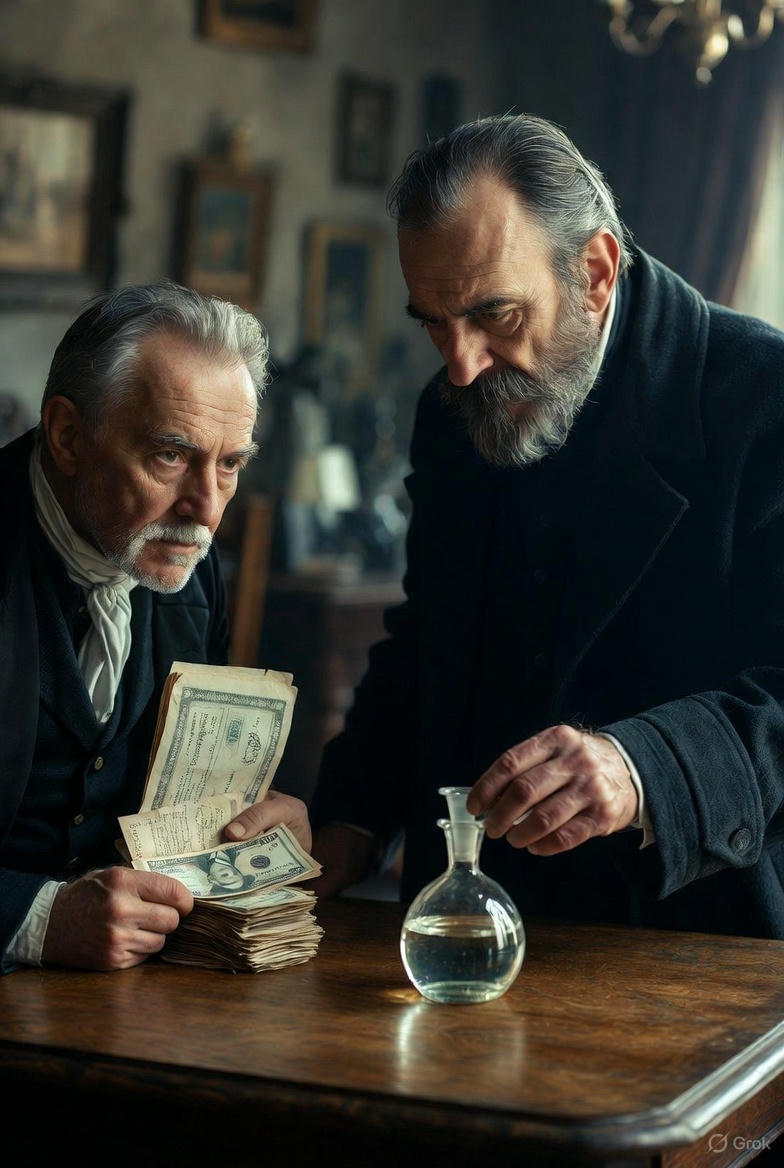
bill of exchange for my banker, he had placed a small crystal
flask on the table, in which there was an oily clear liquid.
“Here’s the money -,” I said, pushing the gold rolls and
the paper toward him. He sniffed them most carefully and
shoved everything into the pockets of his coat.
“And now -!” I said, pointing to the path that led to the
garden door.
“Wait! Wait!” he cackled and pointed to the vial. “A little

how do you say? – Gift. Give every day’ three drops to the
Mother, and you will have a bello ragazzo – a son – and also, se
volete, a little girl -“
I pointed again.
“Va bene,” he murmured. “Addio, Barone!.”
Slowly he shuffled down the path, his hump dragging
like a snail its house. I followed him slowly, until the garden
door had closed behind him and the furious barking of the dogs
in the kennel had slowly died away. Through the bushes of the
fence, however, I could clearly see how he with a grisly
grimace, his lips moving in inaudible words, shook both fists
against our house.
When I returned, the flask was still on the table. I made a
movement to throw it in the bushes. But then I took it in my
hand, pulled out the glass stopper and smelled it. Again, the
smell of bitter almonds that seemed to cling to everything that
was in its vicinity.
I didn’t smash the shiny thing against a stone, did not
pour its oily contents onto the earth. Some curiosity drove me
to take it with me and to tell Zephyrine about it.
“Three drops a day, and a son is sure for us,” said the
villain. And, if we want, a girl, too!” I tried to laugh.
“Do you wish so much for a son, my dear?” breathed
Zephyrine, and a fine blush passed over her pale, poor face.
“Oh, yes,” escaped me, as I took her in my arms.
What did I care about the money? Everything I had, I
would have given for her, the only one, and with pleasure I
would have, like countless ones in the shadow of life earn
bread for her and me with my hands.
The flowers had long since faded, red and yellow leaves
danced from the trees, and the icy Boreas drove the first flakes
against the windows of the parlor where Zephyrine lay in pain.
Fever had set in during the night; the quickly summoned
midwife shook her head and said:
“The woman does not please me at all; a doctor must
come and come quickly! She is also too weak to get down on
the chair.”
There was only one competent doctor in the vicinity, the
white-haired Doctor Anselm Hosp, and I hurriedly sent for him.
While I waited in the next room and covered my ears to
not hear the shrieking cries and the confused moaning of my
wife, my hope for a good outcome darkened more and more.
The pain and labor had lasted for days; the poor body of
Zephyrine was terribly distended, and convulsions passed over
it. There was no doubt that an obstacle stood in the way of the
simple and natural course of the birth, the nature of which even
the wise woman could not discern. Then I noticed that the odor
of bitter almonds, which I detested still lingered in the house.
Zephyrine, to whom I had given the vial with the drops of
Postremos right after the ugly scene in the garden, claimed at
that time to have knocked it over and broken the crystal vial,
which is why the smell of almonds would not go away. Why
did the thought of the gift of the hunchback suddenly seem so
frightening?
The old doctor came with a big black bag in which
instruments clinked. This sharp clinking went through my
marrow and legs. I stepped quietly with him to the bed of the
woman in labor and was startled when I saw the distorted,
dilapidated, face of my Zephyrine covered with cold sweat, in
which her large, bright eyes wandered and flickered. Sharp
dark red spots stood out from the bloodless cheeks.
“You -” she sighed barely audibly.
I stepped close to her and whispered:
“Dearest, confess the truth – have you tasted of the
hunchback’s potion?”
A faint smile flitted across her suffering face.
“Only three drops -every day-“
“Why did you do it?” I snapped at her. “Why did you tell
a lie, when I asked for the poisoner’s bottle?”
“You -wanted- a- son- so – badly.”
Like a breath, the words came to me. Then an expression
of agony came into the wide-open eyes, the body stretched, the
hands reached for the knotted cloths that had been tied to the
bedposts for support. And how she cried out -!
The doctor made a brief examination and then beckoned
me into the next room.
“Baron,” said the doctor, “I am sorry to have to tell you
that it is a case of displacement of the child and therefore the
necessity of sectio caesarea has occurred.”
I staggered back.
“A Caesarean section?” I stammered.
The doctor looked down at the floor.
“This bloody procedure, which, properly performed, is
usually survived by strong and healthy women, but in our case,
because of the terrible weakness of the Baroness and especially
in the case of the high fever, the cause of which must be an
external poisoning of the blood, it is a dangerous and uncertain
operation. I cannot conceal this from you. Besides, I must
operate immediately and only with the help of the midwife,
although a second doctor would normally be necessary. But I
don’t dare wait any longer until a carriage can go to the city
and back.”
I felt as if I had been struck hard on the forehead. What,
Zephyrine in mortal danger? That wasn’t possible. That was
nonsensical. What would become of me? Where was the
meaning of life? Had the man from the Orient, whom I thought
of every day with great gratitude, with his appearance in the
Greeks’ alley brought the highest happiness of my life, so that I
would now lose it so cruelly and be pushed into the abyss of
nameless pain? No, that could not be, that was impossible. If
she died, I would die too.
A cry of the most terrible pain tore me out of my
contemplations. I wanted to follow the doctor into my wife’s
room, but he beckoned me sternly and resolutely to go outside
and await the outcome of his terrible undertaking. I let myself
fall down on a chair, bare of all will and looked dully into the
flakes outside. A bell called with a deep sound in the sinking
glow of the autumn day, and a dog began to howl. I recognized
him by the voice. His name was Amando and he was
Zephyrine’s favorite. This high, drawn howl made me almost
insane and increased my fear, since I was well aware of the
foreboding of loyal animals. In between came sobbing sounds,
suppressed cries from the next room. I heard the doctor
groaning in some strenuous activity, giving half-loud orders,
hearing the plaintive exclamations of the midwife, the clinking
of vessels and metallic things, the splashing of water and the
moving of chairs. Terrible things were going on in there.
Then a woman cried out. But it was not Zephyrine who
screamed. It was the wailing midwife. Why did she scream?
Clearly was to be heard, as the doctor rebuked her in an angry,
suppressed voice.
I held on to the back of my heavy chair, my whole body
shaking.
Then it was quiet inside, dead quiet.
The doctor stepped out and looked around confusedly. In
the light of the wax candles that I had lit, I noticed that his face
was dripping. His hands showed reddish marks.
Wordlessly I looked at his mouth.
“You need inner strength,” he said slowly, and a solemn
glow spread over his face.

Read Full Post »

The Rebirth of Melchior Dronte by Paul Busson and translated by Joe E Bandel

The accursed bird intervened with a wild laughter
between them.
“Apollonius sees through you.”
Laurette let out a small reproachful sigh.
“You’ve always been a lover of youth and innocence,
Baron Dronte.”
“That remark touches something in me that is
unforgettable and valuable enough to shine like a bright star for
my entire life.”
“Oh – you are gallant!” She offered me her hand to kiss,
and stood up, excited and glowing, as it seemed to me.
I rose and resolved to leave her now- constrained by
conflicting and peace less feelings.
“How will I fare?” I addressed the bird once again.
“Since I did not succeed in winning your friendship -?”
“Off with his head! Off with his head!” the beast
screamed shrilly and looked at me with devilish joy.
I paid no more attention to the parrot and left.
Laurette accompanied me to the yellow room. The
curtain had hardly been drawn when I perceived a sudden
pallor in her, and just in time I was able to save her from falling
by taking her in my arms. I laid her quickly on a small sofa and
looked around. On a table stood a golden flask. I pulled the
stopper and rubbed the strongly scented essence on her temples.
She slowly opened her eyes.
“The abominable one frightened me so”, she flirted and
wrapped her arms around my neck.
Gently, I pulled free.
“I am a captive,” she lamented softly, “the satanic beast
guards me better than humans have been able to do. Do you
hear how it screams and beats with its wings? That is the signal
for the paid maid to come in and look after me. But she is not
here, I sent her to him with a note — we are alone -.”
Again her soft arms wrapped around my neck, and before
I knew it her hot red lips were sucking at my mouth.
Lorle-poor Lorle-, I thought, and then the most burning
longing for Zephyrine, whom I hoped to find in the
hunchbacked doctor’s house.
Tenderly I loosened her arms and looked into her eyes:
“Forget me, Lorle,” I admonished softly. “Don’t put your
happiness at risk for the sake of a fleeting minute.”
A flame flashed in her eyes.
“I thank you for your concern for me,” she said harshly.
“Now I know that you love another. And that I am nothing to
you anymore!”
“Lorle -!” I stammered.
“Go! Go!” she said, and tears stood in her eyes. “Why are
you trying to lie?”
Then I walked slowly through the yellow room and
closed the door between me and the sobbing woman.
I passionately pursued my research. The house “Zum
Fassel” was soon found, but it seemed foolish to enter Doctor
Postremo’s apartment under any pretext. I certainly would not
have succeeded in entering his mansion with the fair Zephyrine
in his presence, and even if this could have happened by
chance, not a word between us would have remained unheard.
That the doctor must have had a bad memory of me from the
gambling house was another factor.
It was therefore necessary to find a time in which either
the doctor was away from home and the niece was in the
apartment, or hope for the luck to see Zephyrine on one of her
exits.
But although I spent all my time on such scouting, and
opened the door of the spacious house, which was inhabited by
many people, neither the one nor the other opportunity
presented itself.
Then something happened to me, which newly shook me
and tormented me with puzzling questions and, strange as it
sounds, at the same time filled me with confidence.
I was walking through the nearby Greeks alley, to take a
quick meal in an inn. Groups of Greek and Turkish merchants
were plying their business on the street, according to the
custom of the Orient transplanted here, and it sometimes took
patience to get through the obstacle of those eagerly talking
and absorbed in their trade. Just now I was about to look for a
way through such a crowd of people, when I saw an apparition
at the end of the narrow alley, which put me in great excitement.
A man with a black turban, his bright eyes fixed on me, and
seemed to want to meet me. I saw clearly his pure features, the
amber necklace around his neck, the reddish-brown robe. This
time I had to get close to him. I forcefully made my way
through the astonished merchants, and I had to take my eyes
off the man in the robe for only a second and when I looked in
that direction again, he had disappeared, as he had every time I
was close to reaching him. I hurried as fast as I could to the
exit of the narrow alley, but it was in vain. Neither to the right
nor to the left, my eyes saw nothing but indifferent people who
slowly or quickly made their way. Desperate and with the
feeling that the sight of the unusual man meant something
important and decisive, which must be imminent, I came up
with the idea of the Levant merchants who had just been
pushed aside, in the hope that a person living in Vienna, who
walked along in oriental costume, must be known to them.
So I went back the way I came and spoke to an old Turk
with a good-natured face and a long white beard, who, despite
the warmth, was wearing a precious coat, trimmed with sable
fur, and seemed to be very respectable, judging by the behavior
of the bystanders.
With polite words, I asked him to forgive me for the
nuisance, and immediately added my inquiry about the man
who had disappeared from me. The Turk touched his forehead
and mouth with his right hand and replied to me in fairly good
German exceedingly politely that he did not know this man and
that he had never seen him. At the same time his eyes were
fixed with a strange expression on the small red scar, which I
owed to the fall of broken glass, when I, still a child, escaped
the collapsing ceiling of my room, and said with a peculiar
expression of reverence:
“You, Lord, who bear the mark of Ewli, ask questions of
me?”
I did not understand what he meant, and described the
turban and the robe of the stranger.
“It is the clothing of the Halveti dervishes”, said the Turk,
bowing to me. “Grant me your goodwill, Effendi!”
He stepped back, and I saw the others pestering him with
questions, to which he answered quietly. What he said seemed
to have been about me, because when I passed through the
crowd once more, they all bowed to me and voluntarily formed
a kind of trellis, through which I strode half ashamedly.
I took a simple meal in a restaurant with uneasy feelings
and thoughts of the stranger, whom I could not approach. Then
I wanted to return to my post opposite the house “Zum Fassel”.
On the way I passed by the Greek coffeehouse and
involuntarily took a quick glance through the windows.
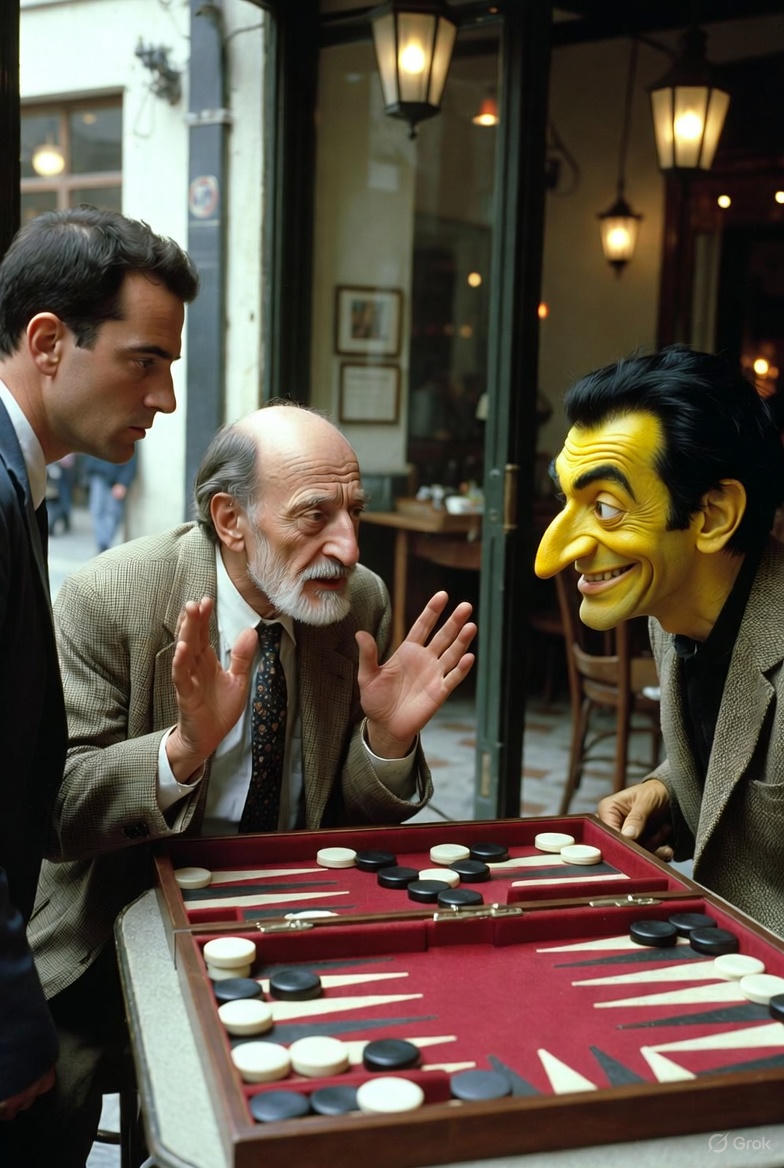
There I saw to my joyful astonishment the hunchbacked
figure of Doctor Postremo. He was sitting bent over a
Backgammon board, on which the stones were jumbled, and
talked with waving hands to a mockingly smiling, black-haired
and yellow-skinned man with long, crooked nose, whose
behavior had obviously infuriated him. I stopped and noticed
that the stones were immediately again in position and a new
game began.
Thus the house had still another exit, which had escaped
my attention and which the Italian used.
Now or never I had to dare. I quickly entered the building
and asked the first person who met me on the dark stairs, for
the doctor’s apartment. Sullenly I was given the information
that it was located on the second floor.
I effortlessly found the door with the name and a bell pull,
with the figure of a yellow hand pointing to it.
Just as I reached out my fingers for it, a shadowy gray
woman came scurrying up the stairs, slipped past me and
inserted a key into the door lock. When she entered and looked
at me questioningly, I quickly pushed past her and said:
“Don’t be alarmed, good woman. I must speak to the
Demoiselle Zephyrine at once -.”
At the same time I pressed a prepared number of imperial
ducats into her withered hand.
That seemed to do the trick. The ugly hag grinned and
pulled me through a gloomy corridor into a half-dark chamber,
which, like the whole apartment was filled with the smell of
bitter almonds.
“Wait here!” she hissed and scurried out.
Not without uneasiness and expecting an ambush I let my
eyes wander around the eerie room. In one corner stood two
human, gruesomely bent over skeletons, where one could see
that the curved spine and the arched shoulder blades during life
had formed a hunchback, like the one Postremo himself had on
his back. Perhaps he had wanted to study his own mutated limb
structure.
On a rack, whose green curtain was only half drawn, blue,
brown and yellowish organs floated in large glass vessels in
clear liquid. A dried brain lay like the core of a giant nut on a
table, whose top was formed from some type of polished rock
that was unknown to me. Gray, greenish blue and rose-colored
snake-like figures with white angular spots in them and dark
red, sharply bordered sections – was this colored marble?
I ran my fingers over the greasy, egg-round slab and
suddenly realized with disgust that here was the smoothed cut
surface of a fossilized corpse before me, as they knew how to
make in Bologna. In a glass box at the window sat a
completely twisted, misshapen chameleon, which I at first
thought was dead, until it slowly turned its protruding eye on
me and turned its gray color into a dirty red.
Then a curtain rustled in the background. A white figure
stood motionless, with half-closed eyes.
“Zephyrine!”
I enfolded her in my arms, and sung a thousand tender
words into her little ear, drank in the heady scent of her hair
and covered her white face with kisses.

Read Full Post »

The Rebirth of Melchior Dronte by Paul Busson and translated by Joe E Bandel

And when I thought of it, it shook me coldly. I quickly
went up to the sleeping mortuary attendant, grabbed him by the
shoulder and called out:
“Wake up, man! Robbers are outside –“
The peasant, who was wearing a coarse shillelagh,
jumped up and looked at me in alarm.
“Where?” he slurred.
“Outside,” I said again and closed the door behind me. I
heard him quickly slam the heavy latch shut.
As soon as I stood outside in the breeze, crooked fingers
clawed at my tattered coat, two eyes shone like brass, and from
a black gaping mouth he bleated:
“Throw them away; throw them away from you all at
once!”
“What do you mean, cursed one, that I should throw
them away?” I shouted in his face.
“Our Lord Christ’s cross -?”
Fangerle bent back as if I had struck him in the face,
twisted and turned like a worm and began to run, cross-country.
The wind raced behind him, whistling and whirled up his
coattails, and as he was carried away into the twilight, it
seemed to me as if instead of him a giant bird with black wings
soared over the furrows, just as owls fly. I stood without money,
abandoned and damp from the dew on the lonely road.
But then I remembered the satchel with the soul mice.
Who was screaming so miserably in the hunting bag of the evil
one -? The evil one!
A paralyzing fright crept into my legs. Calling on the
name of God a hundred times, I went towards the next place
and did not dare to look around.

The gypsies, with whom I had long been walking, the
brown Romi, as they called themselves, had wandered back
across the border, and I had to separate from them, if I did not
want to be married by the provost to the rope maker’s daughter.
My misery was boundless. Here and there I found some
work and food in the farms, I even received a damaged piece of
clothing that was even better than my rags, but most of the time
I was starving and freezing to death. One day I was lucky and
found half a loaf of bread on a country lane, which had been
lost from a cart. And when I saw the ruins of a castle on a
mighty, wooded hill, I decided to light a fire in a hidden place
in the walls, so that I would not have to spend the icy winter
night without the comfort of close warmth.
After some climbing around in the rocks I soon found a
still fairly preserved vault, on the whitewashed wall of which
still the remains of Al Fresco paintings could be seen. Among
other paintings also the wedding of Cana was depicted (as I
could see from the remains of clothing and heads, as well as
the large, ancient wine jugs), and when I saw the mural, which
was in a bad state of disrepair, I noticed that one of the wine
jugs bore the barely legible inscription:
“Hic jacet”, or “Here it lies”.
Perhaps it was a joke that the painter made for himself,
telling the thoughtful observers that in these jugs and in the
wine that fills them, in fact something lies and rests, namely
the spirit that enters into the body of man with the drink and
gradually unleashes all passions, which overwhelms and rapes
the mind, through intoxication; but perhaps it was also said that
all gaiety slumbers in the round belly of the pitcher and after
drinking the drink, it would froth up in laughter, cheerfulness
and songs. About this and the like, I pondered until the lack of
the warming fire made itself violently known and forced me to
tramp up and down in the spacious vault for a while, in order to
warm myself and to let my stiff hands be used for starting the
fire.
When passing the unfortunately only painted brown jug,
I could not help but tap the thick belly of the vessel with a bent
forefinger, even though its rounded appearance was only the
skill of the painter, who through the distribution of light and
color had achieved a high degree of plasticity. But when I
playfully tapped at the seemingly round curvature of the
drinking vessel, I felt as if it had a dull, wooden, and hollow
space. I knocked again, and two or three more times. The
sound gave way at the place where the Latin words were
written; it differed from the sound of the walled environment.
Following a sudden impulse, I peeled off the paint and
the lime with my blunt knife, dug a little and immediately came
to a wide, rotten storage cache. I increased my efforts, and soon
the old wood was crumbling away in brown flour and damp
splinters, exposing a small niche in which lay a round,
greenish-white mold covered sphere.
After some hesitation, in which I saw that the object was
a decomposed human head, I plucked up my courage, reached
in and pulled out a completely decomposed leather sack, which
made a fine sound when I lifted it out. It was heavy with
metallic contents.
Then I made a fire, probably also for this reason, to calm
my hammering heart by doing an indifferent work. When the
little fire was burning and flickering merrily, I proceeded to
examine the leather container, which the inscription on the
wine urn had advised. Those, to whom this sign had once been
made because of the danger of forgetfulness, had been dead
and gone for many years, perhaps buried under the rubble of
the castle.
The bag offered little resistance. It fell apart as I carried it
to my fire, and its contents rolled ringing on the damaged stone
floor.
My breath was taken away by the sheer joy of it.
Doubloons, sun-crowns, guilders rolled out of the greasy,
wet bag and flashed in the glow of the dancing flames.
I laughed, shouted, and leapt around the fire. I let the
blessing run through my unwashed fingers, shook the coins
into my hat, stroked them, and twisted individual pieces
between thumb and forefinger so that they reflected the embers,
paving the floor with them and throwing ducats in the air to
catch them again or to search for the unrolled ones among the
debris.
But then reason prevailed. How easily the firelight, my
foolish shouting and stamping could attract passersby and
betray me and my refuge! In great haste and yet cautiously I
tore my sweat-glued shirt and produced by knotting and
folding a kind of money bag in which I concealed the not
inconsiderable number of gold pieces and hid them on my bare
body. When I was finished with everything, I pulled the
smoldering wood apart and thoughtfully descended the hill of
ruins to reach the next town in broad daylight. This I succeeded
in doing and after a short time of sneaking, searching and
cautious questioning, I found the store of a junk dealer.
I told him that I was a runaway soldier and that I needed
clothes, linen, shoes and a warm coat. Fortune demanded that I
had come across a reasonably honest man, who, though not
cheaply, did not cheat me for inordinate profit, and even had a
bath prepared for me against good money and an ointment that
freed me from the torment of the vermin. The only thing that
bothered me was the hurry, with which all this had to proceed,
and the visibly growing restlessness of the man, as daylight
gradually began to fade.
At last, however, his insistence became tiresome to me,
and I asked him gruffly whether the chosen people practiced
hospitality in such a way, and how he seemed to hold it in low
esteem that I had willingly let him earn a nice piece of money.
For I was well aware of the price at which worn clothes and
worn linen and clothes were traded. Nevertheless, I would have
paid what I had received without question as if it had just come
out of the workshop of the tailor and garment maker. Then the
Jew laughed and said:
“The gentleman has probably also been rendered a
service so that he may have cleaned and equipped himself in all
secrecy, so that the bailiff does not even look after him, when
he crosses the street. If the gentleman were a Ben Yisroel, one
of my people, it would be a pleasure for me to house him. But
because the gentleman is from the others, it must not be so.
Because it is Friday evening, which we Jews call Eref Shabbiss
and it is against our custom, to suffer strangers in our festive
house. May the Lord forgive; I know well that he is a Purez, a
distinguished man, who has suffered from the Balmachomim,
and may he go his way in peace and forgive that it cannot be
otherwise!”
Thereby with a deep bow he tore open the iron door of
his store and politely beckoned me to leave.
Only when I was standing outside on the street did it
occur to me that in his way he had acted honestly toward me.
For it would have been easy for him to keep me in his house
and betray me to the king’s troops lying not far away in their
winter quarters. Despite the armistice, they could have picked
me out and abducted me, and with some skill the Jew would
have not only had a reward, but also the money hidden on my
person, which would have not gone unnoticed to his quick eyes.
Thus it was not by my cleverness, but by my good fortune, that
I had escaped the greatest danger to my life.
For the sake of safety, I decided to wander deeper into
the country and far away from the border to make use of a mail
coach.
So I trudged on my way in the thick snow and strove
towards a village in which I intended to spend the night.
At the entrance of the respectable and, judging by the
clean houses that were spared from the war, prosperous
location stood an artwork, the sorrowful mother with her son in
her lap. The base of the sandstone had been freshly plastered,
and so I immediately noticed a few figures and strokes on the
white surface drawn with charcoal which I knew as “marks”, as
the country and traveling thieves call their secret signs. When I
was with the gypsies I had learned such science, which is
useful for everyone to understand.
But these signs on the wayside shrine were about murder
and burning and I shuddered when I deciphered their meaning.
Undecided what to do with them, by no means to
carelessly disregard the threatening message for other people I
stopped.

Read Full Post »

A Modern Inquiry into the Hermetic Mystery

Appendix: Table Talk and Memorabilia of Mary Anne Atwood, Part 2

Introduction: Mary Anne Atwood’s reflections deepen the Hermetic art’s spiritual essence, guiding the soul to divine unity through alchemical transformation. This section explores the interplay of will, light, and regeneration, unveiling the path to universal wisdom.

The Threefold Life and Divine Regeneration

Atwood describes three modes of consciousness—sensible (animal), perceptive (vegetable), and powerful (mineral)—within humanity, with the Hermetic art perfecting the lowest, mineral life to mirror Christ’s divine unity, as Khunrath suggests. This process reverses the soul’s “inversion,” raising it through the celestial life to divine consciousness, as Boehme’s Signature Rerum illustrates: “The soul perceives the Universal through its essence.”

The adept, through disciplined fermentation, transforms the “dark vapour” of the mineral life into a radiant essence, purifying the will to align with divine love, as seen in the Golden Treatise’s cyclical process.

The Alchemy of Will and Light

The Hermetic art, as Atwood explains, is a “magnetism of Light,” where the will, the “Universal Loadstone,” becomes a creative force when aligned with divine wisdom. The “Walls of Troy,” built by Apollo’s harmony, symbolize the soul’s lower life, dissolved through alchemical processes to release the “Mercurius” of divine sound. This transformation, as Haly notes, involves a “terrible sound” of liberation, aligning the soul with its eternal source.

The adept’s will, purified of “false sulphurs” (selfish desires), becomes a vessel for the “Philosophic Matter,” a radiant light born through contrition and divine alignment, as St. Martin’s teachings echo.

The Path to Universal Truth

Atwood emphasizes that true knowledge is an “experimental contact” with the divine, where the soul, freed from sensory chains, merges with the Universal Spirit. The Chaldaic Oracles and Boehme’s descriptions of emanation—where will transforms from “Nothing” to “Something”—mirror this process, as the adept’s consciousness returns to its “First Cause.” This sacred art, requiring purity and reverence, transcends physical science, offering a path to immortality through divine unity, as OAK’s meditations suggest.

Closing: This appendix unveils the Hermetic art’s transformation of will and light into divine unity. The journey into further insights deepens in our next post, unveiling more secrets of this sacred art.

Read Full Post »

The Rebirth of Melchior Dronte by Paul Busson and translated by Joe E Bandel

She pressed her hot, wet mouth on my hand, but I tore
myself away and went swiftly and quietly down the stairs.
When I was in the hallway, the Dutch clock struck
midnight. The closet creaked.
I stopped.
“Why don’t you come out?” I said, banging my fist
against the closet. But everything remained silent.
Only from above came a wailing, pounding sound, as if
someone were crying into their pillows.

On Good Friday, I passed by the Catholic Church and
peered on all sides, to see whether Lorle was there.
But all I saw were people going to church, men, women
and children, and every time the gate opened, sad deep sounds
blew out.
Lorle was the daughter of saddler master Höllbrich, very
young, and I had lured her into our park. She wanted to see the
tame deer and the fallow deer. And in the feeding hut was
where it happened.
I had learned many things in the last time, could swallow
wine like water, ride behind the hounds and throw girls into the
grass. There were some who wept bitterly. Lorle laughed and
said, “There had to be a first time-“
While I was waiting, a small and very ragged boy came,
looked at me with cunning little eyes and asked, “Are you
Baron Dronte?”
And when I said yes, he quickly pulled a small violet
paper from out of his shirt and slipped it to me. Then he
quickly ran away.
I was very angry that she had kept me waiting and I
remembered that she had also made her little eyes at Thilo, too,
when he passed by the workshop. But since I did not want
anyone to watch me reading the letter, I went into the church.
It was half-dark, and the candle flames sparkled. In front
on a triangular candelabra stood many lights, and just as I
entered, one was extinguished. And just then they were singing
in Latin the crying notes of a psalm, which I understood. It was
called:
“Jerusalem Jerusalem – return to the Lord your God”.
Then I knew that it was the lamentations of the prophet
Jeremiah, which I knew from the Scriptures.
Motionless, the canons sat in their carved chairs on both
sides of the violet-covered altar, and I recognized the cousin of
the Sassen, Heinrich Sassen, among them and wondered at how
haggard and austere his face looked in the restless glow of the
candles and the golden gleam of the ornaments on the walls.
There was a whistling beside me, like mice whistling.
There were two old women praying, bent low. And again they
began to sing up in the choir with the Hebrew letter that is
called Ghimel or the camel. But then the sweet sadness of the
pleading song penetrated deeply into my heart and made it
open up before God. I thought of how mangy and rejected I
must be before the Savior, who had also taken upon himself the
bitter agony of death for me, been scourged, spat upon,
crowned with thorns, stripped of his poor clothes and nailed
naked to the cross. And what was I? In my pocket crackled the
letter of a girl whom I had put on the bad road, and in my
mouth was the sour taste of yesterday’s wine. I was getting
worse and worse, and I already understood it well, to strike a
defenseless servant across the face with a riding crop and to
chase the old servants up and down the stairs. But then Lorle’s
laughing face with its snub nose intervened again between the
remorseful thoughts, and in my ear hummed the solemn sounds
that came from above, her cheeky little song:
“Phillis has two white doves and a golden bird’s nest…”
But out of the saucy face of the little girl grew another
face, pale and pure, with golden red hair like a halo, and with a
fierce, never before felt homesickness, I thought of my dead
cousin, Aglaja, whose memory I had held so miserably that
now any one was right for me. Then it was suddenly as if dark
rays were pressing into my eyes.
Slowly, from out of the crowd that was devoutly praying
in the nave in front of me, a man approached. It flashed
through me as if a glowing drop ran from the top of my head
down through my body. The man, who was coming closer and
closer, looked at me…
His face was without any wrinkles, brownish and
beautiful, his eyes deep and dark, of unimaginable goodness.
Between the brows there was a horizontal, fine, red scar, like
the one I had…in the same place. A small black beard
shadowed the upper lip of the soft, noble-cut mouth. A reddish
brown robe fell in heavy folds around his slender body. He
wore a black turban wound around his head, and a necklace of
amber beads. No one seemed to pay attention to him except me.
Nobody turned to look at him, and yet everyone avoided him,
as if they saw him.
“The Lord Jesus,” I stammered, reaching for my heart,
which threatened to stand still. I felt as if I had to weep and lie
down on this breast, hand myself over to him, to him who
knew everything that pushed and drove me, so that he could
save me. He knew the way, his feet had walked it.
But he passed me by with a look in which was something
like sorrow. He passed me by!
I stood for a while and could not move. Far out in the
room sounded singing and the roar of an organ.
Then I got hold of myself, turned around and ran after
him, causing enough annoyance among those praying, because
my haste had disturbed them from their devotion.
But when I stepped out of the gate, the place lay empty.
Nobody was to be seen. Only the tobacconist stood next
to the wooden Turk in front of the door to his store and looked
at me in amazement.
I hurriedly asked him about the man in the brown robe.
He made a face and said that the incense in the church
must have made me dizzy. I was unaccustomed to such
Catholic incense. And one who honors the pure gospel should
beware of the dazzling works of gold, lights and blue vapor,
which they have in such churches of Baal. Let every man
beware lest he stumble, even if he is of noble birth.
Angrily, he threw his lime pipe onto the pavement, so
that it broke, turned his back on me and went into his store.
But I walked around the alleys that led to the square and
asked about the man. No one knew anything about him.
Suddenly I felt as if a bolt of lightning had struck in front
of me. I remembered the wax figure that had saved me in my
earliest childhood, when the falling ceiling in my room buried
my bed.
The man from the Orient, Ewli.
I pulled Lorle’s letter out of my pocket and tore it into a
thousand pieces.

I drifted with Phoebus and Thilo Sassen and we hunted
everywhere for women and adventures. Since I spoke to them
about the apparition, they laughed at me and teased me for days.
They called me the brown monk, as they called the man from
the Orient. I had fallen back into my old way of life and was
ashamed every time they came at me with their jokes and snide
remarks.
That day black Diana was barking and full of joy with
me being at home and whatever I did, I did not succeed in
shooing her away. Because the dog loved me more than
anything, no matter how well I treated her.
Above the vineyards we knew a house, in which an old
tusker lived, feared for his coarseness. He had two young and
beautiful daughters, and it was said that they spent the money
for their pretty dresses and shoes by being kind to the
gentlemen. The boys had often put a straw man on their roof,
and the girls in the city pulled their skirts to themselves when
they passed by, so as not to touch.
But there was also talk that the old man, on days, when
he had time to look after the prostitutes, would teach the rude
rascals, the beaus of his daughters a lesson. Thus it was said
that he had once caught Fritz, the mayor, a real dandy and a
womanizer and apron sniffer, with the two of them in the tool
shed and had so brutalized him that the young gentleman had
spent four days in bed groaning and smeared with lime
ointments. Others again thought that it was not so much the
beating of the old man, which had made a cure with ointments
necessary, but rather a disease of the nobles that Fritze had
contracted when he was traveling with an actress in the mail
coach.
Surely we had not the slightest desire to collide with the
foul-mouthed tusker, and all the less so because the house was
outside our jurisdiction and the archbishop, to whose property
the vineyards belonged, had great affection for the tusker and
was only happy when he heard from his little pieces.
So we wanted to approach the house unnoticed in the
manner of a creeping patrol, to know for the time being how
things stood there. Thereby the dog, which could not be
removed in any way, was a hindrance and a nuisance. Because
in the joy of being able to be with me, Diana jumped around us
in great leaps and bounds, and when I was not always paying
attention to, she made me by barking loudly at me, which
annoyed Thilo and Phoebus beyond all measure.
So it happened that our approach completely failed.
When we were already close to the house and our eyes on the
windows, the bitch made a noise and lured not only the girls
but also the old man, who soon realized what kind of polecats
were creeping on his hens. He called us whoremongers and
good-for-nothings, day thieves, country bumpkins, and knights
of the shrubbery and promised to serve us with such unburnt
ashes, that our lackeys and chamber pot carriers would have to
deal with us for a full week.
So we crept down the mountain full of anger and rage.
“Next time we will try it without you and that dog-beast
of yours, Melchior!” said Thilo.
“One who doesn’t even know how to master such a lousy
four-legged beast belongs in the children’s room!” added
Phoebus.

Read Full Post »

The Rebirth of Melchior Dronte by Paul Busson and translated by Joe E Bandel

“Mean -, that’s what they call the fifth container in the
salt ponds into which the sea water flows for the extraction of
the salt.”
“Good,” nodded the teacher, smiling mischievously. “He
himself knows it, but as an appendage of the Noblesse in this
school I call him sot, paresseux et criminel! Get him out of the
seat, so that he gets what he deserves as the representative of
the ignorant noblesse!”
I turned pale with rage. This excess of injustice against
the poor boy, the only one who knew the rare and hardly used
word, seemed to me outrageous. I nudged Sassen, but he only
shrugged his shoulders, and Phoebus looked up in the air as if
it were none of his business.
Hesitantly, Klaus Jägerle emerged from the bench. Thick
tears stood in his eyes. Glowing red with shame, he fiddled
with his waistband….
“Faster! Expose his derriere!” screeched the school fox
and bobbed with the square ruler, “so that in place of nobility
he gets his proper Schilling!”
Horrified, I saw Klaus drop his trousers. Two poor,
skinny legs appeared beneath a gray, frayed shirt. The teacher
grabbed him with a splayed claw.
That’s when I jumped out of my bench.
“You’re not going to hit Jägerle, Monsieur!” I shouted. “I
won’t permit it…”
“Ei, ei!” laughed the man, “this will immediately show
you…”
He pressed down the willing head of the poor boy and
struck a blow.
Then I jumped at the teacher’s throat. He cried out with a
gasp and kicked at me with his feet. We fell to the floor. The
bench toppled over, and ink flowed over us. The other students
whooped with joy and stomped their feet. I suddenly felt a
sharp pain in my right hand. He had bitten me, with his ugly,
black tooth stumps. I hit him in the face with my fist. Blood
and saliva spurted from his mouth.
A hand grabbed me by the collar and pulled me up into
the air. I looked into a coarse, good-natured face under a
chubby gray wig.
The principal.
“Have you gone mad, Domine? – Rise, Herr!” he shouted
at the bleeding teacher.
“He wants to kill me!” screeched the latter.
“Baron Dronte, you will leave the school immediately!”
The principal said, pointing to the door.
Klaus Jägerle still stood humbly with his head bowed and
his thin, trembling legs, not daring to pull up his pants without
permission.

It went badly for me when father kicked the groom with
his foot and hit him, who was writhing and whimpering on the
ground. In pity, I tore the whip out of my father’s hand and
flung it far away. Instead, I was now sitting in an attic of our
house with water and bread. In the chamber was nothing but a
pile of straw in the corner and a stool on which I could sit.
Every day my father came, slapped me hard across the face and
forced me to speak a Bible verse in a loud voice:
“For the wrath of man strives and spares not in the time
of vengeance. And look to no person to make reconciliation, or
to receive it, even if you want to give it.”
When I had spoken the verse, I received a second slap in
the face. I let it all wash over me and was full of hatred. Today
was the fifth and last day of punishment.
Quietly a key turned in the door lock. I knew that it could
not be my father.
It was Aglaja. My defiance against the world prevented
me from giving in to the sweet joy that I felt at the sight of her.
Lovely and blushing, she stepped in her white, blue-flowered
dress over the threshold of the gloomy and dusty attic room.
Her face was childlike and of indescribable charm. Her spotless
skin shone milky white, lifted by the copper red of her hair. I
knew well how dearly she loved me, and in my solitude and
distress I too thought only of her, day and night. But there was
enough evil in me to make me want to plunge her into suffering,
too.
“What do you want here?” I growled. “Why don’t you go
to my Lord father – make yourself a dear child with him! You
can just beat it, go away, you!”
Her eyelashes trembled, and her little mouth began to
quiver.
“I just wanted to bring you my cake…” she said softly,
holding out a large piece of cake to me.
I snatched it out of her hand, threw it on the ground and
stepped on it with my foot.
“So!” I said. “Go and tell Frau Muhme, or my father, if
you like!”
She stood quite motionless, and I saw how slowly two
tears ran from her beautiful gray eyes. Then she went to the
corner, sat down on the straw bed and wept bitterly.
I let her cry, while my own heart wanted to burst in my
chest. But then I could not stand it any longer. I knelt down to
her and stroked her hair.
“Dear, dear Aglaja…” I stammered, “forgive me – you are
the only one here whom I love…”
Then she smiled through her tears, took my right hand in
hers and brought it to her young breast. And I thought of how
once at night, in a dark, fearful urge, I had crept into her room
and, by the light of the night lamp, I had lifted her blankets to
see her body just once. She had awakened and had looked at
me fixedly until I had crept out of the room, seized by remorse
and fear.
As if she had guessed what I was thinking about, she
suddenly looked at me and whispered:
“You must never do that again, Melchior!”
I nodded silently, still holding one of her small breasts.
My blood surged in pounding waves.
“I want to kiss you with pleasure -” she said then and
held out her sweet, soft lips to me.
I kissed her clumsily and hotly, and my hands strayed.
“Don’t – oh don’t -” she stammered, and yet she nestled
tightly in my arms.
Then somewhere in the house a door opened and
slammed shut with a bang. Spurs clanked. We moved apart.
“Will you always love me, Aglaja?” I begged.
“Always,” she said, looking me straight in the eyes.
And suddenly she began to cry again.
“Why are you crying?” I urged her.
“I don’t know – maybe it’s because of the cake -” she said,
smiling to herself.
I picked up the trampled and soiled pastry from the floor
and ate it.
“Maybe it’s also because I won’t be with you for long.”
The words came out of her mouth like a breath. I looked
at her in dismay. I did not understand her.
“Don’t pay any attention to me,” she laughed suddenly.
“Even if it’s true, I’ll always come back to you!”
She pressed a quick kiss on my mouth, smoothed her
clothes and quickly ran out of the attic room.
“Aglaja! Stay with me!” I cried in sudden fear.
I was suddenly so afraid. But I heard only the hard clatter
of her high heels on the stairs.
An autumn fly buzzed on the small, cobweb-covered
window restlessly. In the sooty, torn nets hung decomposed
beetles, empty butterflies, and insect corpses of all kinds. – The
fly wriggled. The buzzing sound became high. Slowly, out of a
dark hole crawled a hairy spider with long legs, grasped the fly,
and lowered its poisonous jaws into its soft body. – The
buzzing became very high – the death cry of a small creature.
Suddenly I saw that the spider had a terrible face.
I ran to the door and banged on the wood with both fists.
“Aglaja!,” I screamed. “Aglaja!”
No one heard me.

We had been working under the blue sky, in the warm,
deep sunshine; we had been helping to harvest the fruit from
the big field behind the house. The plums were dripping with
sweetness. They tasted like wine. We could not get enough.
The greengage that we touched were even more delicious.
They melted in the mouth.
In the evening Aglaja cried out in pain.
At midnight she was dead.
The house was filled with cries of lamentation. Father
locked himself in his study. The maids were wailing in their
aprons.
Aglaja was dead.
I was just walking back and forth, picking up things
without knowing what I had picked up; I leaned for a long time,
without thinking about anything, with my head against a carved
doorpost until the pain woke me up, drank water from a
watering can.
The days, the days went by. Without beginning or end.
Crying everywhere. I watched them clearing out the chamber
in the corridor and bring out the black cloths. How they cut
asters and autumn roses and made wreaths, sobbing and
smearing their wet faces with their earthy hands. I stroked the
handle of the chamber, a handle that had been worn thin from
much use, and you hurt yourself on it if you were careless. But
when they were inside nailing the cloths to the walls and
brought the candlesticks from out of the silver chamber, as the
footsteps of people carrying something heavy, came down the
stairs, I ran in the fallen leaves of the garden.
Mists were drifting and it was dripping. The beautiful
time was gone. The last day was over. I saw a blue ground
beetle and stepped on it. Yellowish intestines spilled out of its
small body, the legs twitched, contracted silently and stiffly. So
I did no differently than my father did when he beat people. I
had to cry, all alone on a bench of cold stone. Once in the
summer the stone had been so hot that Aglaja and I had tried to
see who could keep their hand on it longer. Her white hand had
been so delicate that she got a blister. – A cold drop fell from
the sky onto my forehead.

Read Full Post »

The Rebirth of Melchior Dronte by Paul Busson and translated by Joe E Bandel


The magician: “O Sheikh, I am going to the other world;
procure for me a right in the hereafter!”
The Sheikh: “I can give you one piece of advice; If you
follow it, it will be for your salvation.”
Turkish legend
“When the angel of death touches your heart, the soul
leaves its narrow house, faster than lightning. If it can take its
memory along with it, it remains aware of its sins. This is the
path to purity and that of the entrance to God.”
Secret Doctrine of the Beklashi

What I am writing down here, hoping that it will fall into
the right hands according to the will of God I, Sennon Vorauf,
have experienced in that physical existence which preceded my
present life. These memories have come to me by a special
grace beyond that transformation which is called death.
Before I realized this, I suffered from them and thought
they were inexplicable, agonizing kinds of dreams. Besides,
however, I also had to go through all kinds of shocks of an
unusual kind. It happened, for example, that the striking of an
old clock, the sight of a landscape, a fragrance, the melodies of
a song, or even a mere association of words would assail me
most violently with the thought, that I would have quite
certainly already once heard, seen, breathed in, or somehow
experienced it before. I was in this or that place, which I saw in
my present life for the first time, and already had once been
there. Yes, often enough, in conversation with new
acquaintances, I was struck by the idea that I had already been
in very special relations with them. Since it was impossible for
me to understand before the onset of this realization, it was also
impossible for me to provide explanations for the indescribably
exciting movements of my mind and emotions, much to the
grief of my parents, which often led into hours of brooding, the
unknown cause of which disturbed them not a little. But
through frequent repetition and the ever sharper imagery of the
story I became aware, even as a boy, that they were nothing
more than reflections of fates which my soul had suffered in
another body, namely before the birth of my present body;
moreover, these “Dreams” represented experiences that were
completely alien to my current circle of experiences and
frighteningly distant from my present circle of thoughts. I had
never heard of such things or even read about them somewhere
or otherwise experienced them. I began to record these
“dreams” of my own accord and thereby achieved that from
then on in certain favorable moments I had the so-called
wakefulness to remember such memories with extraordinary
accuracy.
More and more clearly and coherently from these “lucid
dreams” (as I called them in my case) the overall picture of a
life emerged that I had lived before this under the name of a
German nobleman (I will call him here Baron Melchior von
Dronte), had lived and ended, when his body fell to the
transformation of death and then became free to be my soul as
Sennon Vorauf.
In the peaceful and blessed life filled with inner peace,
which I lead, the retrospective view of the wild and
adventurous existence of Melchior von Dronte broke through in
a disturbing, confusing and frightening way. What he was
guilty of was my guilt and if he atoned, he atoned for the soul
that came back, for his and therefore my soul.
I am fully aware that many people will read this book
with incredulous smiles, and perhaps in some places at times
with disgust and revulsion. But at the same time I hope that the
number of people of deeper feeling will be large enough not to
let this writing perish. To those who are able to remember
details from previous forms of existence, who are conscious of
a previous life, I would like to dedicate this book to them; I
would like to make this book their own.
Just as I have replaced the real name I had with “Dronte”,
I have replaced those of various persons, whose descendants
are still alive, with invented names. Moreover I touch here the
fact that I have called people “Dronte” in this life, whom I
knew from the time before my death. Most of them were not at
all aware of a previous existence. Nevertheless, there were
moments and occasions with them, in which clearly
recognizable flashes of memory flared up in them in a flash of
recognition, without them having succeeded in determining the
source of such disturbing feelings or having the ability to hold
on to them. I am certainly not saying anything new to those
who, like me, have brought parts of an earlier consciousness
into the new life.
The raw, crude and often coarse nature of the following
biography of a life, I could not in truth love, as unpleasant and
hurtful some of it may seem. I was not to embellish and smooth
out the terrible clarity with which the memories surfaced in me,
and thus to write a pleasantly readable book. Everything had to
remain the way it was as it formed from a time whose spirit
was different from ours.
However, from the deepest, most personal feeling this
book should speak to the immortality of the soul, and this
confession is to possibly awaken this confession in others.
Above all, I am inspired by the hope that those who believe in
the wandering of the soul after the death of the body will not be
given completely worthless indications in this book. Others
who have not yet progressed on the path that I have walked,
may still at least read it for the sake of its colorful content.
I remember very clearly an incident from my fifth year of
life.
I had been undressed, as always, and lay in my pink
lacquered, shell-shaped child’s bed. The warm summer evening
wind carried the chirping of many insects into the room, and
the wax candle in a silver candelabra flickered. It stood on a
low cabinet next to the glass lintel, under which the “Man from
the East”, or the “Ewli”, as he was also called, was located.
This was a span-high, very beautifully formed figure,
which a relative, who was in the service of a Venetian, had
brought from there as a gift from the nobility.
It was the figure in wax of a Mohammedan monk or
dervish, as an old servant often told me. The face had the
sweetest expression for me. It was completely wrinkle-free,
light brownish and with gentle features. Two beautiful dark
eyes shone under a jet-black turban, and around the softly
curved lips a small black beard could be seen. The body was in
a brown-red robe with long sleeves, and around the neck the
dervish wore a necklace of tiny amber beads. The two fine wax
hands were on arms hanging down with the palms turned
forward, equal-ready to receive and welcome anyone who
should approach. This immensely delicate and artistically
executed piece in wax and fabrics was highly valued in my
family, and for that reason alone, it had been placed under a
glass dome to protect it from dust and unskilled hands.
I often sat for hours in front of this expensive figurine for
unknown reasons, and more than once I had the feeling as if
the dark eyes were animated by being alone with me, as if there
was a faint trace of a gentle, kind smile around its lips.
That evening I could not fall asleep. From the fountain in
the courtyard came the sound of water splashing and the
laughter of the maids washing and splashing each other and
with similar shenanigans teasing each other. Also the cicadas
and crickets in the meadows surrounding the mansion were
making noise. Between all that sounded the muffled sounds of
a French horn, on which one of the forest boys was practicing a
call.
I climbed out of bed and walked around the room. But
then I began to be afraid of the moment when old Margaret
came into my room every night to put out the light in case I fell
asleep with it on, and I went back to my bed. Just as I was
about to climb over the edge of the bed shell with my bare legs,
it was as if a voice softly called my name. I looked around
frightened. My eyes fell on the man from the Orient. I saw very
clearly how he raised one arm under the glass bell and
beckoned to me.
I began to cry with fright, looking steadfastly at the little
figure.
Then I saw it very clearly for the second time: he waved
his hand at me very hastily and commandingly.
Trembling with fear, I obeyed; in the process tears
streamed unstoppably down my face.
I would have loved to scream out loud. But I didn’t dare,
for fear of frightening the little man, who was now very much
alive and waving more and more fiercely, in anger, such as my
father, whose short one-time wave was not only for me, but for
all the inhabitants of the house, an order that had to be obeyed.
So I went, crying silently, towards the cabinet on which
the waving dervish stood. I had almost reached him, despite my
anxious hesitant steps, when something terrible happened. With
a horrible roar and in a cloud of dust, debris and splinters, the
ceiling of the room collapsed over my shell bed.
I fell to the floor and screamed. Something flew whizzing
through the air and smashed the glass dome and the waving
man made of wax into a thousand shards and pieces. A brick
that had flown over me.
I screamed at the top of my lungs. But there was
screaming all over the house, outside at the well and
everywhere, and the dogs in the kennel howled.
Arms grabbed me, pulled me up from the earth. Blood
was running into my eyes, and I felt a cloth being pressed
against my forehead. I heard the scolding, agitated voice of my
father, the wailing of old Margaret and the moaning of a
servant. My father hit him with a with a stick and shouted:
“You donkey, why didn’t you report that there were
cracks in the ceiling? I’ll beat you crooked and lame…!”

Read Full Post »

Alraune by Hanns Heinz Ewers and translated by Joe E Bandel

She excused herself primly; it had only been a thought of her
mother’s. There was no need for the Fräulein to trouble herself over
it. She only hoped that the unpleasant incident hadn’t brought any
stormy clouds into their friendship–She chatted on without stopping
to think, senseless and pointless. She didn’t catch the severe glance of
her friend and crouched warmly under the green glowing eyes of
Fräulein ten Brinken, like a wild forest rabbit in a cabbage patch.
Frieda Gontram became restless. At first she was angered at the
immense stupidity of her friend, then found her manner tasteless and
laughable.
“No fly,” she thought, “ever flew so clumsily to the poisoned
sugar.”
But finally, the more Olga chatted under Alraune’s gaze, the
more quickly her own sulking feelings awoke under their normal
covering of snow and she tried very hard to repress them. Her gaze
wandered across, fastened itself passionately on the slender body of
Prince Orlowski.
Alraune noticed it.
“I thank you, dear Countess,” she said. “What you’ve told me
relieves me very much.”
She turned toward Frieda Gontram, “The Legal Councilor has
told me such horror stories about the certain ruin of the princess!”
Frieda searched for a last reserve and gave herself a violent
shake.
“My father is right,” she declared bluntly. “Naturally the collapse
is unavoidable–The princess will have to sell her little castle–”
“Oh, that doesn’t matter,” declared the countess. “We are never
there anyway!”
“Be quiet,” cried Frieda. Her eyes clouded, she felt that she was
entirely, without a doubt, fighting for a lost cause.
“The princess will have to rent out rooms in her household, will
have difficulty adjusting to her new life style. It is doubtful if she will
be able to keep her car, most likely not.”
“What a shame!” piped the black prince.
“She will also have to sell her horses and carriages,” Frieda
continued. “Most of the servants will have to be let go–”
Alraune interrupted her, “What will you do Fräulein Gontram?
Will you stay with the princess?”
She hesitated at the question, it was totally unexpected.
“I,” she stammered, “I–but most certainly–”
At that Fräulein ten Brinken piped up, “Of course it would make
me very happy if I were permitted to invite you to my house. I am so
alone. I need company–come to me.”
Frieda fought, wavered a moment.
“To you–Fräulein–?”
But Olga stepped between them, “No, no! She must stay with
us!–She is not allowed to leave my mother now.”
“I was never at your mother’s,” declared Frieda Gontram. “I was
with you.”
“That doesn’t matter!” cried the countess. “With me or with her–
I don’t want you to stay here!”
“Oh, pardon me,” mocked Alraune. “I believed the Fräulein had
a will of her own!”
Countess Olga stood up, all of the blood drained from her face.
“No,” she screamed. “No, no!”
“I take no one that doesn’t come of their own free will,” laughed
the prince. “That is my mark. I will not even urge–Stay with the
princess if you really want to Fräulein Gontram.”
She stepped up closer to her, grasped both of her hands.
“Your brother was my good friend,” she said slowly, “and my
playmate–I often kissed him–”
She saw how this woman, almost twice her age, dropped her
eyes under her gaze, felt how her hands became moist under the
lightest touch of her fingers. She drank in this victory. It was
priceless.
“Will you stay here?” she whispered.
Frieda Gontram breathed heavily. Without looking up she
stepped over to the countess.
“Forgive me Olga,” she said. “I must stay.”
At that her friend threw herself onto the sofa, buried her face in
the pillows. Her body was wracked with hysterical sobbing.
“No,” she lamented. “No, no!”
She stood up, raised her hand as if to strike her friend, then burst
out into shrill laughter. She ran down the stairs into the garden,
without a hat, without a parasol, across the courtyard and out into the
street.
“Olga,” her friend cried after her. “Olga!–Listen to me! Olga!”
But Fräulein ten Brinken said, “Let her be. She will calm down
soon enough.”
Her haughty voice rang–
Frank Braun breakfasted outside in the garden under the elder
tree. Frieda Gontram gave him his tea.
“It is certainly good for this house,” he said, “that you are here.
One never sees you doing anything, but everything runs like
clockwork. The servants have a strange dislike of my cousin and have
fallen into a passive resistance. The people have no idea of class
warfare, but they have already reached a point of sabotage. An open
revolution would have broken out long ago if they didn’t have a bit of
love for me. Now you are in the house–and suddenly everything runs
by itself–I give you my compliments Frieda!”
“Thank you,” she replied. “I am happy that I can do something
for Alraune.”
“Only,” he continued, “you are missed all the more over there.
Everything has gone topsy-turvy since the bank has stopped
payments. Here, read my mail!”
He pushed a few letters over to her. But Frieda Gontram shook
her head.
“No– excuse me–I don’t want to read, don’t want to know
anything about it.”
He insisted, “You must know, Frieda. If you don’t want to read
the letters, I will give you the short version. Your friend has been
found–”
“Is she alive,” whispered Frieda.
“Yes, she’s alive!” he declared. “When she ran away from here
she got lost and wandered around through the entire night and the
next day. At first she must have gone inland toward the mountains,
then curved back to the Rhine.
People on a ferryboat saw her not far from Remagen. They
watched her and stayed nearby. Her behavior seemed suspicious and
when she jumped from the cliff they steered over to her and fished her
out of the river after a few minutes. That was about noon, four days
ago. They brought her struggling and fighting to the local jail.”
Frieda Gontram held her head in both arms.
“To jail?” she asked softly.
“Certainly,” he answered. “Where else could they have taken
her? It was obvious that she would immediately try to commit suicide
again if they let her go free–So she was taken into custody.
She refused to give any information and remained stubbornly
silent. She had long since thrown away her watch, purse and even her
handkerchief–No one could make any sense out of the crown and the
initials in her linen undergarments. It was only when your father
reported her missing to the authorities that they were able to figure it
out and establish her identity for certain.”
“Where is she?” asked Frieda.
“In the city,” he replied. “The Legal Councilor picked her up
from Remagen and brought her to Professor Dalberg’s private insane
asylum. Here is his report–I fear that Countess Olga will need to stay
there for a very long time. The princess arrived yesterday evening–
Frieda, you should visit your poor friend soon. The professor says that
she is quiet and calm.”
Frieda Gontram stood up.
“No, no.” she cried. “I can’t.”
She went slowly down the gravel path under the fragrant lilacs.
Frank Braun watched her go. Her face was like a marble mask, like
fate had chiseled it out of hard stone. Then suddenly a smile fell on
that cold mask, like a ray of sunshine reaching deep into the shadows.
Her eyelids raised, her eyes searched through the red beech lined
avenue that led up to the mansion–Then he heard Alraune’s clear
laughter.
“Her power is strange,” he thought. “Uncle Jakob really had it
right in his leather bound volume of musings.”
He thought about it. Oh yes, it was difficult for Frieda to be away
from her. No one knew what is was, and yet they all still flew into her
hot burning flame–What about him? Him as well?
There was something that attracted him, that was certain. He
didn’t understand how it worked, on his senses, on his blood or
perhaps on his brain–But it did work, he knew that very well. It was
not true that he was still here because of the lawsuits and settlements
alone. Now that the case of the Mühlheim bank had been decided, he
could easily finish everything up with the help of the attorney–
without personally being here.
And yet he was here–still here. He was pretending, lying to
himself, skillfully creating new reasons, protracting the lengthy
negotiations as much as possible, in order to put off his departure.
And it seemed that his cousin noticed it as well. Yes, even as if her
quiet influence made him act that way.
“I will go back home tomorrow,” he thought.
Then the thought sprang out from the nape of his neck, “Why
should he? Was he afraid of something? Did he fear this delicate
child? Was he infected by the foolishness that his uncle had written
down in his leather bound volume? What could happen? In the worst
case a little adventure! Certainly not his first–and scarcely his last!
Was he not an equal opponent, perhaps even superior? Didn’t bodies
lie along the life’s path that his feet had trod as well? Why should he
flee?
He created her once, he, Frank Braun. It had been his idea and
his uncle had only been the instrument. She was his creation–much
more than she was that of his Excellency. He had been young at the
time, foaming like new wine, full of bizarre dreams, full of heaven
storming fantasies. He had played catch with the stars and from them
had captured this strange fruit from out of the dark, wild primeval
forest of the inscrutable where his steps had led him.
He had found a good gardener that he had given the fruit to. The
gardener had planted the seed into the earth, watered it, looked after
the seedling and tended the young little tree. Now he was back and
there shone his blossoming tree.
Certainly, it was poisonous; whoever rested under it encountered
its toxic breath. Many died of it–many that strolled in its sweet
fragrance–the clever gardener that cared for it as well.
But he was not the gardener that loved this strange blossoming
little tree more than anything else, not one of the unknowing people
that wandered into the garden by chance. He was the one that had first
plucked the fruit that contained the seed from which it grew.
Since then he had ridden many days through the savage forest of
the inscrutable, waded deeply through the sweltering, fever infested
swamp of the incomprehensible. His soul had breathed many hot
poisons there, been touched by pestilence and the smoke of many
cruel burning sins.
Oh yes, it had hurt a lot, tormented him and ripped open puss
filled ulcers–But it didn’t throw him. He always rode away healthy
under heaven’s protection–Now he was safe, as if wearing armor of
blue steel.
Oh, certainly he was immune–There would be no battle, now it
appeared to him more like a game. But then–if it was only a game–he
should go–wasn’t that true? If she was only a doll that was dangerous
for all the others, but a harmless plaything in his own strong hands–
Then the adventure would be too cheap. Only–if it really were a
battle, one with equally powerful weapons–only then would it be
worth the effort.
Fraud! He thought again. Who was he really kidding about his
heroic deeds? Hadn’t his victories often enough been easy and
certain?–More like episodes? No, this was not any different than it
always was. Could you ever know the real strength of your opponent?
Wasn’t the sting of the poisonous little wasp far more dangerous than
the crocodile like jaws of the caiman that goes up against the certainty
of his Winchester rifle?
He found no way out, ran around in circles, getting himself
confused as well. But he always came back to the same point, stay!
“Good morning, cousin,” laughed Alraune ten Brinken.
She stood right in front of him, next to Frieda Gontram.
“Good morning,” he answered curtly. “Read these letters here–It
won’t do you any harm to think about what you have been the cause
of–It’s time to stop this foolishness, do something sensible, something
worth the effort.”

Read Full Post »

Homo Sapiens: In the Maelstrom by Stanislaw Przybyszewski and translated by Joe E Bandel

IV.

Falk entered his study, sat down at the desk, propped his head in both hands and groaned loudly. 

All the calm he had so laboriously maintained with Isa was gone and again he felt the throbbing and drilling of his torment. The unrest coiled like a pointed sharp funnel into his spinal cord, a feeling as if he must now fall apart, grew foaming up in him; he jumped up, sat down again, he knew no way out. 

It seemed to him as if everything around him must now collapse, break down, sink in; he felt an orgy of destruction and downfall ecstasy around him. 

And the sultry heat of the summer night crushed him, spread stiflingly in his lungs, he became so sensitive that he could hardly breathe. 

He tore open the window and almost recoiled in horror. 

The sky! The sky! He had never seen it like that. It was as if he had suddenly perceived the astronomical distance. He saw the stars as if they had been moved a million times further away, larger, fierier, like huge, gangrenous burn spots. And the sky seemed so terribly alive to him… Sweat broke out on his forehead, and he felt his eyes painfully bulge. 

Then he pulled himself together again. 

And in a moment his whole life crashed down on him with visionary clarity. One period unrolled after another with raging speed. All the terrible, horrific of his life: one downfall after another, one destruction after another… He had seen his life like this only once, yes, back then when he destroyed the poor child, this dove-soul of Marit… ugh, Marit, that was the most hideous. This pointless destruction, this murder… 

He suddenly came to consciousness and laughed maliciously. 

To the devil! Am I going senile? What does a murder concern me that nature commits? Ha, ha, ha… That she had the kindness to use my humble self as a murder instrument by chance, for that I should now suffer!? No! no! that won’t do. 

He got heated. 

Esteemed and by me especially highly valued audience—by the way, I wouldn’t mind spitting on all your heads, but I may only do that in parentheses—God how tasteful! So incredibly highly honored audience: I teach you a new trick, an extremely useful trick… It is an unmasking, a disavowal, a new testament, a new salvation… In the beginning was the cunning, malicious, devilish nature… You have been told she is mighty, unconcerned, cold and proud, she is neither good nor bad, she is neither dirt nor gold… Lie, esteemed audience, infamous, ridiculous lie! Nature is malicious, refinedly malicious, lying, insidious… that is nature! He, he, he… Naturally the esteemed audience opens its chewing tools as if a four-horse hay wagon should drive in… A slick smart aleck is nature, a malicious, villainous devil… What am I? Do you know? Does he know? Naturally! The individualists, the clever people who throw out their chests and shout: I am I! Oh, they know… the individualists! 

Falk laughed scornfully. 

I am nothing, I know nothing either! Oh! it is terrible! Terrible it is! Isn’t it, Isa? You are the only one who can appreciate the terrible… I see my movements combine into actions, I hear myself speak, I feel certain processes in the sexual organs, and an act is accomplished! What happened? A misfortune happened! Hi, hi, hi, do you hear the devil grin? Who did it? I?! I?! Who am I? What am I? 

He fell into a despair fever. 

I didn’t do it! My God, how can I prevent something that was… that was prepared in me long ago and only waited for an opportunity to break out and bury everything under its lava! Did I know anything about it? Can I prevent a glance sinking into my soul and calling forth forces there, forces of whose existence I had no idea? And for that, that something unknown in me instigated a misfortune, I should atone, for that I should be tortured by my conscience? 

Dear nature, try your malicious, insidious tricks on other people; I know your tricks and wiles too well—no! to torment me, you will never succeed—never! 

He poured himself a large glass of cognac and emptied it in one gulp. 

How wonderfully He had figured out the thing! He will go to my Isa and simply say: Gracious lady, your husband is a scoundrel, he has with a foreign woman given the impetus to a new genealogical line, to an illegitimate Falk line. You, gracious lady, will naturally divorce him so that your husband can marry the girl, whereby both lines attain a genealogical unity. Ha, ha, ha… 

But, dear Czerski, I have no intention of having two legitimate lines. 

Well, then I will tell your wife anyway, for I want to free you from the lie, I am a Tolstoy, a Björnstjerne-Björnson, I fight for truth… 

But, dear Czerski, don’t you understand that the two gentlemen are senile philosophers, don’t you understand that truth becomes an idiotic lie as soon as it destroys people? Don’t you understand that it would be infinite happiness for me to go to Isa and tell her everything, don’t you understand that this lie causes me infinite torment, but truth would cause me a thousand times greater, and besides destroy Isa? Don’t you understand that truth in this case would be an idiocy, a nonsense, a disgusting cruelty? 

These narrow brains naturally don’t understand that. And the disaster will come. Isa? Yes, Isa will go. That is certain. She will simply disappear… no, she will still shake my hand in farewell, no—perhaps not, because I have soiled her with the other. Yes, that’s exactly how she will say it… But what then, what then? 

He racked his brain as if he had to necessarily find the philosopher’s stone. 

His knees had grown weak, he fell exhausted onto the sofa. 

It was undoubted. The Other in him had ruined him. He felt endlessly slackened, weak and powerless: 

The power of circumstances has destroyed the knowing Herr Falk, precisely because he was knowing. But when Herr Falk goes under, it is quite different from when, for example, little Marit throws herself into the water because she didn’t want to become mother of a Falk side line. It is thought crudely, very crudely, but this crudeness hurts, and that is a pleasure… But yes, when Falk goes under, he can control it, follow the collapse from stage to stage, note, register… 

He, he, he… he had now thoroughly unmasked nature. He had also completely overcome conscience… 

Do you want to know why, you truth-fanatics? Just open your ears well so you can at least somewhat survey the unspeakable extent of your stupidity… Just listen to my reasons, the reasons of the knowing one who has unmasked nature. 

Nature destroys. Good, very good! To destroy, she uses various means, namely first the so-called forces of nature. In this category fall her moods in the form of lightning, storms, water and wind spouts etc., etc. 

Second, she has chosen the bacilli as an outstandingly effective murder tool, a splendid and unbelievably villainous invention… 

Third, no! no third! I am no classifier, I am philosopher, consequently I skip a cute number of the cutest murder and torture tools against whose most convulsive inventiveness the Inquisition must appear tame and pleasing to God, and go immediately to the human… 

The human! Just allow me to take a deep breath, refresh my dry throat with cognac and feed my stomach a little nicotine. 

So the human! Homo sapiens in Linnaean systematics: a self-acting apparatus equipped with a registration and control clock in the form of the brain! 

Wonderful! 

Now, please, just listen well. I continue my gospel, my great work of salvation. 

Nature was ashamed of her eternal, pointless murders. Nature is lying and cowardly, she wanted to shift the guilt for her pointless murders from herself and gave the human a brain. 

Do you know what a brain is?  A very bad, discarded, unusable apparatus. Imagine a poorly functioning blood wave recorder. It will of course record the rise and fall of the pulse, but wrong, quite wrong. One will only see from it that a sinking and falling is present, but nothing more. See, in this way the brain also learns that something is happening in the soul, but what? it learns nothing about that.

Read Full Post »

By Stanislaw Przybyszewski and translated by Joe E Bandel

III.

When Falk came home, Isa sat half-undressed on her bed and read. “Finally you have come!” She came toward him. “Oh, how I have longed for you.” 

Falk kissed her and sat in the rocking chair. “Oh, how tired I am!” 

“Where were you?” 

“I was with Iltis.” “Did you hear anything new?” “No, nothing of importance.” “You are so pale, Erik?” 

“I have a little headache.” 

Isa sat beside him on a chair, took his head in both hands and kissed him on the forehead. 

“You stay away so long now, Erik. It is so unpleasant to sit alone all evening.” 

Falk looked at her and smiled. 

“I must gradually emancipate myself from you.” “Why?” 

“Well, if you should suddenly run away from me…” “Oh, you!” She kissed him even more violently. 

Falk stood up, walked thoughtfully up and down the room, then stopped before her and looked at her smiling. 

“What are you thinking about so much?” “You are very beautiful, Isa.” 

“Didn’t you see it before?” 

“Yes, of course. But it is strange that after a four-year marriage I still find you as beautiful as on the first day.” 

Isa looked at him happily. 

“You, Isa, we have lived very happily together.” 

“Oh, I was so happy, and I am so happy, I have such a strong, such a joyful consciousness of happiness… Sometimes I get fear that this great happiness should not last long… But that is naturally ridiculous, such a female superstition… I know that you will always love me, and then I need nothing more, then I can never feel unhappy. Even if you are so nervous now, and stay away whole days, it doesn’t matter… It is actually so beautiful to sit like this and think of our love.” 

She was silent for a moment. Falk walked around and looked at her from time to time restlessly. 

“And your love is so beautiful, so beautiful… I think so often that I am the first you loved, I also know that no other woman exists for you, and that makes me so proud, you perhaps don’t understand this feeling…” 

“Yes, yes, I can imagine it.” She looked at him smiling. 

“Isn’t it true, Erik, you have never, since you met me, looked at a woman so…” 

“How?” 

They both laughed at each other. 

“Well so, as I believe it says in the New Testament of the look that can desire more eloquently than words… Ha, ha, the gentlemen of the New Testament were experienced… But why do I ask you, I know it.” 

“Are you so sure?” 

Falk put on a mysterious expression. “Yes, nothing is so sure for me.” 

“Hm, hm… You must have an incredible trust in me.” “Yes, I have, otherwise I couldn’t be so happy.” 

Falk looked at her attentively. 

“But what would you say if I had betrayed you after all?” She laughed. 

“You can’t.” 

“But if I had done it?” “No, you haven’t.” 

“But let us assume I had done it under quite special circumstances, under circumstances for which no person is responsible.” 

She became a little restless and looked at him. 

“Strange how you can assume such a thing.” Falk laughed. 

“Of course I didn’t do it. But we can take such a case purely psychologically. I thought a lot about it today. It interests me.” 

“Well yes.” 

“So you see, Isa, I can hate you at times. I have often told you that. I can hate you so intensely that I am completely out of my senses. I hate you because I must love you so, because all my thoughts refer to you, because I cannot go anywhere without having you constantly before my eyes.” 

“But that is precisely so beautiful!” She kissed his eyes. 

“No, just leave it, Isa. Listen further. I hate you at times and love you simultaneously with such unrest that I can become quite sick from it. I try to get rid of you. It is no happiness to love like that…” 

Falk stood up and talked himself more and more violently into it. 

“Now you see, one gets such a purely physical longing to forget this unrest, this torment. One longs for a resting pillow… He, he—resting pillow, that’s the right word…” He smiled with a peculiarly crooked grimace. “Now one knows a woman from earlier. A woman who has gone up so in her love that she lives only for this love. One goes to her without thinking anything about it, one goes quite mechanically because one suddenly remembers that the woman must still exist. Yes: she is there and is mad with happiness… Ha, ha, ha… You get such a strange line around your mouth when you listen so tensely, just like little girls in school when they are very attentive. But just listen. Yes, right… Iltis, you know, he understands it. He once said that there is a moment when every woman becomes beautiful. And he is right. Now imagine: the woman becomes quite transfigured, she becomes so new, so strangely beautiful, she has ceased to be herself, something of the eternity of nature’s purpose shines in her…” 

Falk suddenly broke off and looked at her searchingly. “Well and?” 

“And? Hm, you know what can happen in a person without one being quite conscious of it…” 

He stood up again and spoke very seriously: 

“The human has gone so little beyond the animal. The little bit of consciousness is only there to constate something that has happened… It can be such a small sensation, such a tiny dot in the soul. One knew nothing of it before, nothing at all. But so this sensation, this tiny, detached sensation wakes. With a jerk it can grow into a huge, maniacal idea… It is perhaps the sensation of a drop of blood, isn’t it? Under some circumstance one can get the longing to see blood, no, not more blood, a sea of blood, a puddle of torn, ripped-apart limbs, God knows what all…” 

He suddenly looked at Isa and laughed. “You are probably afraid, Isa?” 

“No, no, but you have become so serious, and when you speak, your eyes widen as if you yourself had fear.” 

“Fear?… Yes, I have fear of this foreign person in me… But just listen: one sees the woman suddenly in this transfigured beauty. In this moment something like curiosity arises, a burning curiosity, a greed to grasp the woman in her primal ground.” 

“And?”  

“Yes, one forgets everything, one no longer belongs to oneself. Something works quite spontaneously in the soul, it does everything on its own. One takes the woman. Isn’t it terrible?” he asked suddenly. 

“Yes, terrible.” 

“What would you now say if something like that had happened to me?” 

“No, Erik, don’t speak like that. I don’t want to hear anything about it. I once thought about it…” 

Falk looked at her in astonishment. 

“When did you think about it?” 

“No, no, I didn’t really think. It just suddenly flew through my head once.” 

“When, when?” 

“When you were with your mother and got sick. You know, just then the girl drowned. But you are so pale and your eyes are getting so big. Strange how big your eyes are.” 

Falk looked at her fixedly. “What did you think then?” 

“I suddenly got such a painful jerk of fear.” Falk pulled himself together and tried to smile. 

“We are telling each other such beautiful horror stories… But what did you think then?” 

“I sat beside your bed, I was so tired and fell asleep. When I woke, your eyes were wide open and stared at me quite uncannily.” 

“I know nothing of that.” 

“No, of course not. I am also not sure if it wasn’t all a dream. But then it shot through my head like a lightning: God, if the girl had gone into the water because of you!” 

“What do you mean? She drowned in the bath. How did you get the idea…?” 

“I don’t know how I got it, I was so nervous and so overtired, and then your mother told that you were very much together with her.” 

Falk became restless. 

“Strange what ideas you get.” 

“I couldn’t get rid of these thoughts. I suffered so terribly because I knew that I would then have to leave you immediately, at once. Not a second would I then stay with you.” 

Falk stared at her: 

“It became infinitely clear to me in a moment that you would then go. Wouldn’t you? Immediately…” 

“Yes.” 

“Yes, yes, one understands such a thing in a second. There was something so uncanny in the way you spoke…” 

“What do you mean?” 

“Just don’t be so anxious.” Falk smiled. “But it seemed to me as if my fate had spoken.” 

“Your fate?” 

“Yes, you see, you don’t actually need to say what you mean… Yes, just look: At first you never told me that you loved me, we were still quite strangers, but I heard it in your voice. For you speak quite differently than all other people. Now I have heard it again, I mean, I now know so surely what would then

come. I don’t know where I get this certainty from… But what are we talking about… How is my big son?” 

“He was very restless today. Ran and screamed, and when I asked him why he screamed so, he answered: I must, I must!” 

“Strange!” Falk walked thoughtfully up and down. “The child is quite remarkably nervous. Yes, he will surely become a genius; all geniuses have hot heads and cold feet… Ha, ha, ha. Probably a small brain part should be cut out for him too… I believe every person has such a part that should be removed, yes, yes—then we would all become like God… But tell me, Isa: such a genius is a strange animal, like me for example. Just look at me: am I not a genius? He, he, he… Now the human race is so degenerated, out of five hundred million there are four hundred ninety-nine cretins and idiots. Shouldn’t a genius then have the obligation to improve the race?” 

“By what?” 

“Well naturally by begetting as many children as possible with as many women as possible.” 

“But you said that the children of geniuses become idiots.” Falk laughed. 

“Yes, you have a fabulous memory, but it would be interesting for our Janek to study later on living specimens the qualities that his magnificent Lord Papa had. In the possible hundred children that I could have in the possible hundred places, the hundred lovable qualities that I enjoy would have to be inherited.” 

“Now you are babbling, dear Erik.” 

Isa slowly undressed and did her hair. “Well good night, Isa. I want to work some more today.” 

“Erik, I am afraid. Don’t go yet.” 

“Don’t be a child… I only spoke about it because I will perhaps write it. Think of me, then you will forget the fear.” 

“Come, kiss me.” 

“No, I don’t want to kiss you. You are so confusingly beautiful, and I must work… Good night.”

Read Full Post »

Older Posts »