Homo Sapiens: Under Way by Stanislaw Przybyszewski and translated by Joe E Bandel
“Doesn’t she have a lampshade? He couldn’t stand the brutal light.”
Marit brought the shade.
The conversation kept stalling.
“You mustn’t mind, Marit, if I stay longer with you today. I can’t sleep anyway; and then, you know, when I am so alone… hm… I don’t disturb you?”
Marit’s face colored with hectic red. She couldn’t speak; she only nodded to him.
They sat silently for a while. The whole village slept. The big house was as if extinct. The servants had already gone to rest. The sultriness was almost unbearable. A stuffy calm weighed on both, the dull air outside pressed into the room, and the regular ticking of the clock caused almost physical pain.
“It’s strange how lonely one is here; it’s uncanny. Don’t you sometimes have fear when you are so completely alone in this big house?”
“Oh yes, I feel it terribly strongly. Sometimes I feel so lonely and abandoned here, as if I were completely alone in the world. Then I get such a horrible fear that I want to bury myself in the earth.”
“But today you don’t feel abandoned?” “No!”
Again a pause occurred; a long, heavy-breathing pause.
“Listen, Marit, do you still have the poems I wrote for you last spring? I would so like to read them again.”
“Yes, I have them in my room; I will fetch them immediately.”
“No, Marit; I will go up with you. It is much cozier in your room; so wonderfully cozy. Here it is so uncanny, and I, you see, am very, very nervous.”
“Yes, but someone could hear that you go with me; that would be terrible for me.”
“Oh, he would go quite quietly, quite softly; no person should hear him. Besides, the whole house is asleep.”
She still resisted.
“Sweet little dove, you really need have no fear. I will do nothing to you—nothing, nothing at all. I will sit quietly beside you and read the poems.”
It thundered.
“Yes, quite quietly; and when the storm is over, I will go home calmly…”
They entered Marit’s room; they felt as if rooted to the spot. There was an atmosphere between them that seemed to live.
Suddenly Marit felt herself embraced by him. Before her eyes fiery bubbles swirled, again she saw the hot jubilation dancing over the abyss, she wove her arms around him and plunged headlong into the gruesome happiness.
Suddenly she started up.
“No, Erik! only not that… Erik, no! No!” She gasped.
Falk let her go.
He mastered himself with difficulty. A long pause.
“Listen, Marit—” his voice sounded rough and hard—”now we must part. You see, you are cowardly. You are a little dove, a rabbit; and I am a good man. I am the good, dear Erik. Well, Marit, you don’t have the courage to say to me: Go, leave me my pure conscience, leave me the idiotic virginity. You don’t have this courage. Well, I am a man; and so I go; let come what will.”
“Yes, I go. I leave you your morality, I leave you your religious conscience, I leave you your virginity, and spare you the so-called sin. Now be happy; very, very happy…”
The storm grew louder; in the window green furrows of lightning were seen.
Falk turned to the door.
“Erik, Erik, how can you be so cruel, so bestially cruel?!”
The whole laboriously suppressed misery of her soul broke forth. She writhed in pain.
“Erik! Erik!” she whimpered.
Falk got a mad fear.
He ran to her, took the twitching girl’s body in his arms.
“No, Marit, no; it’s madness. I stay with you. I will never leave you. I can’t go away from you. You see, I thought I could. But I can’t. I must be with you; I must. I will never leave you. No, Marit; you my only happiness.”
The thunder rolled ever closer.
“I stay always with you. Always. Eternally. You are my wife, my bride, everything, everything.”
A wild passion began to whirl in his head.
And he rocked her in his arms back and forth and spoke incessantly of the great happiness, and forgot everything.
“Yes, I will make you happy… so happy… so happy…” A cloudburst wave splashed against the windowpanes.
Now they were really alone in the world. The rain, the lightning fenced them in.
Marit embraced him.
“Erik, how good, how good you are! Yes: not away! We stay always together. We will be so happy.”
“We stay always together!” repeated Falk, as if absent. Suddenly he came to his senses. Again he felt the hard, cruel
in himself, the stone that falls into abysses. He pressed her tighter and tighter.
They heard not the thundering, saw not the fire of heaven. Everything spun, everything melted into a great, dancing fireball.
Falk took her…
The storm seemed to want to move away. It was three in the morning.
“Now you must go!” “Yes.”
“But not on the country road. You must go along the lake and then climb over the monastery fence. Otherwise someone could see you, and tomorrow the whole town would talk about it.”
When Falk came to the lake, a new storm drew up.
He should actually take shelter somewhere. But he had no energy for it. Besides, it was indifferent whether he got a little wet.
The sky covered itself with thick clouds; the clouds balled together visibly into black, hanging masses.
A long, crashing thunder followed a lightning that tore the whole sky apart like a glowing trench.
Again a lightning and thunder, and then a downpour like a cloudburst.
In a moment Falk felt streams of water shooting over his body. But it was no particularly unpleasant feeling.
Suddenly he saw an enormous fire-garland spray from the cloud heap; he saw it split into seven lightnings and in the same moment a willow stand in flames from top to bottom. It was torn from top to bottom and fell apart.
“Life and destruction!”
The shock had roused his logic; he also had to calm the fear-feeling that wanted to rise in him again.
“Yes, of course, hm: destruction must be. Marit… Yes… destroyed…”
Falk suddenly had this clear, lightning-bright, visionary consciousness that he had destroyed Marit.
“Why not? I am nature and destroy and give life. I stride over a thousand corpses: because I must! And I beget life upon life: because I must!
I am not I. I am You—God, world, nature—or what you are, you eternal idiocy, eternal mockery.
I am no human. I am the overman: conscienceless, cruel, splendid and kind. I am nature: I have no conscience, she has none… I have no mercy, she has none…”
“Yes: the overman am I.” Falk screamed the words.
And he saw himself as the deadly fire-garland that had sprayed from the black vault: into seven lightnings he had split and torn a little dove by the wayside. Into a thousand lightnings he must still split and tear a thousand little doves, a thousand rabbits, and thus he would go eternally and beget and kill.
Because it is necessary. Because I must.
Because my instincts want it.
Because I am a non-I, an overman. Does one need to torment oneself for that? Ridiculous!
Does the lightning know why it kills? And has it reason, can it direct its lust?
No! Only constate that it struck there and there. Yes: constate, protocol—like you want, Herr X.
And I constate and protocol that today I killed a little dove…
The atmosphere was so overloaded with electricity that around him a sea of fire seemed to sway.
And he walked, enveloped in the wild storm; he walked and brooded.
And in the middle of this wrath of heaven he himself walked as a wrathful, uncanny power, a Satan sent to earth with a hell of torments to sow new creative destruction over it.
Suddenly he stopped before the ravine.
It was completely filled with water. A torrent seemed to have sprung up and streamed rushing to the lake.
He couldn’t go around it; there he would come to the cursed country road.
Besides, it’s indifferent: a bit more water, a bit more chills and fever: no, that does nothing.
That does nothing at all. Everything is indifferent; quite, quite indifferent.
And he waded through the torrent.
The water reached above his knees.
When Falk came home and lay down in bed, he fell into a violent delirium; all night he lay and tossed back and forth in the wildest fever phantasies.
Madame Bluebeard by Karl Hans Strobl and translated by Joe E Bandel
Third Chapter The Lower Austrian Waldviertel is for the contemplative. It offers no surprises for restless travelers who need a new sensation at every bend to stave off boredom. One shouldn’t expect the dramatic tension of towering rock formations, soaring peaks, or dark gorges, nor the infinite feelings stirred by the sea. But it holds a wealth of subtle, enchanting beauties—the grace of gently rolling forested hills, the charm of winding rivers dotted with ancient castles and small towns, dusty and seemingly forgotten by history. A railway runs through the Kremstal. Every half- hour, the train stops, huffs briefly, disgorges a few passengers who disembark slowly, dawdle across the platform, and drift into the dusty towns. Ruprecht von Boschan stood on a forested hill, gazing into the valley where a little train was stirring again, groaning as if pleading for pity. He sought a phrase for this landscape. “It sings the green forest tune,” he thought. “It’s like a folk song—intimate, as if known forever. You hear a heart beating.” He turned from the clearing he’d entered and continued through the woods. He wore tourist garb. “For I am a seeker,” he said to himself, “a seeker with staff in hand.” With this staff, he occasionally struck tree trunks, the sound echoing through the forest. He loved such noises—trees calling to one another, the echo racing deeper into the green darkness. From time to time, he pulled out his map to check his route. Ahead walked a peasant. “Hey, cousin!” Ruprecht called. The man didn’t turn. After a while, Ruprecht caught up. “Hey, cousin!” he said again. “Heading to Vorderschluder?” When the peasant still didn’t reply, Ruprecht bellowed, “Are you deaf?” The man looked at him. “No need to shout,” he said with a faint dialect twang. “I hear you fine. I just don’t always fancy answering. In the woods, I prefer my own company.” A peculiar one, Ruprecht thought. The man’s appearance was odd too. His head and stocky peasant frame didn’t match. That wasn’t a peasant’s face, with its sharp nose, shrewd eyes, and curious French- style mustache. A resemblance to Napoleon III made Ruprecht smile. But the eyes were sky-blue. A Napoleonic head with blue eyes on a peasant body— nature loves its grotesque games, he concluded. “You could be alone if you wanted,” Ruprecht said. They walked on silently. After a while, the peasant spoke, having covertly studied Ruprecht from the side. Ruprecht had passed muster, deemed worthy of conversation. Was he going to Vorderschluder, and what was his business there? “Just a tourist,” Ruprecht said. “Here for the scenery.” “Aye, we’ve got scenery,” the man said, pointing his pipe stem ahead, where a tower and a fiery red church roof peeked through a gap in the trees, vanishing behind the green forest wall. “There’s the village.” What’s the village like? Ruprecht asked. Just a village, like any other. Nothing special? What’s special? A castle, a factory, that’s it. Who owns the castle? Frau Dankwardt. Now Ruprecht had reached his goal. He’d hidden his purpose for visiting Vorderschluder to learn more. But here, progress stalled. A barrier seemed to rise. When he asked who Frau Dankwardt was, a wary glance met him. The peasant puffed furiously on his long-cold pipe, then produced a tobacco pouch and an ancient lighter, restuffing and relighting it. “Well, then!” he muttered into the first blue clouds. From his experience with peasants, Ruprecht deduced Frau Dankwardt wasn’t much loved in the village. “Know her, maybe?” the man asked, peering through his pipe smoke with eyes like blue sky behind clouds. Time to lie. “No,” Ruprecht said. “Well… she’s beautiful, mind. Very fine. Plenty fell for her. Her three men were fools for her. The factory clerks, too—all of ’em—and that Baron Kestelli rides over from Rotbirnbach every other day. Right beautiful.” Ruprecht, who’d built an altar to her beauty, worshipping in awe, knew this best. He understood why men loved her. But he wanted the “but” lurking behind the praise. “But…” the peasant continued after a silent puff, “she’s no good soul. Not that she skips church—she’s there every Sunday. Gives the priest money for the poor at Christmas, too. But it’s all show. No one trusts her. I’d not want her as my wife.” Ruprecht smiled, picturing this Napoleonic peasant beside the lovely, lithe, witty woman, but stifled it to avoid suspicion. “Why not?” he asked innocently. “Well…” Three large blue-gray smoke balls drifted from the peasant’s mouth corner. “Stay longer, and you’d know.” Fair enough—hard to dispute. “They say she’s a trud,” the man said. “You know, a witch who comes at night, sucking folks’ blood. Nonsense, no such thing. Though Maradi, the Weißenstein innkeeper, swears he saw her naked in the woods one night, like witches are. But Maradi also saw a water sprite once… turned out to be an otter. Still, it’s true her men had no good life with her. The last, Herr Dankwardt, such a fine man— quiet, decent, all for books and family. A model for anyone. The first two were good men, too. And she killed all three…” He stopped, startled at confiding so much to a stranger. The word seemed cloaked in a red, bloody mantle, hovering before them like an ominous bird. “Killed?” Ruprecht asked, uneasy, struck by the man’s convinced tone. The peasant smoked like an engine hauling a fleet of wagons. “Well, aye,” he muttered in the cloud. “Folks talk… not meant like that. She drove her men to death with endless nagging and strife, that’s what’s meant. The first fled to Tyrol, never returned. The second had a stroke after a row. The third, he took it all so hard, he wasted away, like he was draining out… always headaches, then suddenly dead. That’s how it was.” The men emerged from the woods, the village below. Across the river, spanned by an old stone bridge, stood the castle, aloof from the village houses like a lord keeping the rabble at bay. On one side, just below the last houses, squatted the square, ugly, yellow paper factory. Forested hills ringed a basin, its floor traced by a silver snake of a river. The basin brimmed with sunlight, the rustle of hillside woods, and a hum from the village. “Well, goodbye!” the peasant said. “You head to the village; I’m over there. My cottage’s by the woods. I’m Rotrehl, the violin-maker, so you know, if you ever want a fine fiddle. My violins are right famous.” His blue eyes gleamed with an artist’s pride. “Rotrehl?” Ruprecht said. “Tell me, wasn’t there once a Frenchman in your family?” A solemn smile spread across the violin-maker’s face. “Aha… you mean the resemblance! You think so too? Yes, everyone says it!” He stroked his French mustache. “A Frenchman? Frenchmen passed through here once. Must be nigh on a hundred years ago… it’s in my books. I do look like Napoleon, don’t I? In the village, they call me ‘Krampulljon’— the fools don’t know better. So, goodbye!” With that, he turned to go, but after a few steps, glanced back. “Head to the Red Ox in the village. They’ve got wine worth drinking.” It was his thanks for Ruprecht noting the likeness. Ruprecht did stop at the Red Ox, finding a warm- hearted landlady who served him a slice of sausage and a glass of wine with a smile that could make even a poor vintage palatable. Fortified, he crossed the stone bridge. Four baroque barons, two at each end, gazed down at him. He whistled a tune, passing between them, and climbed toward the castle. Its massive gate bore a wooden snout above the arch. The structure showed its modern walls grafted onto ancient ruins. The courtyard blended old and new— Romanesque double windows in the upper story contrasted with contemporary renovations. A fine, ancient linden shaded a well; beneath it, a bright dress. Ruprecht’s heart raced. But it was only Miss Nelson, the governess. As he approached, hat in hand, two little girls rushed over, clinging to him. Touched, he realized they recognized him, remembered him. He lifted and kissed them. Had he stayed long in Abbazia, they asked, and what had he done since? They’d often told Mama about him. Hoisting three-year-old Lissy onto his shoulder, Ruprecht danced in a circle, singing to a childish melody: “Ha! Ha! Ha! Where’s your Mama? Isn’t your Mama here? Ha! Ha! Ha!” “Yes… Mama’s gone out,” five-year-old Nelly answered for her giggling sister. “She’s with Uncle Norbert in the carriage. But we can meet her—I know the way she’ll return.” “Hurrah, we’ll meet her! Just us three! Miss must stay home.” The governess protested it was too much trouble for Herr von Boschan. Overruled, she was hissed at and forcibly reseated by the girls. Straw hats were donned, and with Uncle Ruprecht between them, they descended the castle hill. They ran to the brook, where Ruprecht feigned plunging into the water. The girls squealed, but he halted, tucked one under each arm, and leapt across. What an adventure! On the meadow, they raced on, heedless of shoes squelching in mud. At the forest’s edge, they stopped, laughing, flushed, and took the footpath to the road curving around a wooded hill to the river bridge. “Who’s Mama with? Oh, Uncle Norbert! What kind of uncle is he?” Ruprecht felt a twinge of shame, prying through the girls, but he needed to know his rival. Nelly’s blonde head pondered. “Uncle Norbert… he’s a baron uncle…” Kestelli, Ruprecht thought. “Do you love Uncle Norbert dearly?” he pressed. Both girls chimed in unison, “No—not at all!” “Why not?” “He never plays with us,” they said. “He ignores us, just makes big eyes at Mama, like he wants to eat her.” Let’s arm for battle with this Kestelli, Ruprecht vowed. He won’t devour your Mama. They hadn’t gone far when Frau Dankwardt’s carriage rounded the bend. “Mama! Mama!” the girls cried. Ruprecht stood roadside, waving his hat. “My God, it’s you—how lovely!” Frau Dankwardt said, leaning over the carriage door to offer her hand. Her eyes said: You found me? I know you’ve been searching. Ruprecht kissed her gray glove. That scent again—rotting fruit, hay, drying blood. That bewildering, dangerous aroma. He had to stay composed, cautious, treading a narrow ledge above an abyss, pulled by a thousand sacred-unholy forces. “I was wandering near your castle,” he said. “It’s a magnet mountain, drawing my ship.” A veiled homage. Frau Dankwardt introduced them. To Baron Kestelli’s name, she added, “A good acquaintance!” Ruprecht called himself, “An old friend!” An old friend trumps a good acquaintance, he thought. Let’s see, Baron, let’s see. They climbed in. Ruprecht sat opposite Frau Dankwardt, Lissy on his lap. Nelly perched on the driver’s seat. In a surge of joy, Ruprecht felt every pulse of energy alive within him. He recounted his doings since Abbazia—business matters first, as his long travels had left urgent cases with his lawyer. Old friends needed signs of life. Finally, he’d felt the urge to refresh himself with an autumnal hike. Sitting still wasn’t for him; limbs needed stirring. Frau Helmina’s eyes, fixed on his face, repeated: I understand—you’ve always sought me. Meanwhile, Baron Kestelli felt a fist at his throat. A wild chant roared in his head: A bond, surely; this man aims to displace me. At the castle courtyard, Ruprecht leapt out, helping Helmina down. Miss Nelson rustled over in black silk, taking the girls. While Helmina spoke with her, Ruprecht turned to the baron. God—this callow youth with sparse white-blonde hair on a long skull, wrinkled yellow skin at the nape! High-born, clearly, but utterly insignificant. He won’t devour Frau Helmina. They exchanged pleasantries. “You’re my guest, of course,” Helmina said to Boschan. “No fuss.” Ruprecht made none. “I expected no less,” he said, “…among such dear old friends…” He smiled. Helmina smiled. Their gazes locked. The baron paled. “You may use my carriage, Herr Baron,” Helmina said. “Your coachman’s late again, as usual. Goodbye! Come, Herr von Boschan. The valet will show you to your rooms.” Alone with the girls and Miss Nelson, Helmina knelt, pulling Lissy between her knees. Nelly leaned on her shoulder. “Tell me,” she asked, “would you like a new Papa?” “Oh, yes!” Lissy cried eagerly, but Nelly said thoughtfully, “Not Uncle Norbert!” “Who, then?” “Uncle Ruprecht!” Lissy and Nelly shouted together. Helmina turned to the governess. “Hear what the children say!”
Alraune by Hanns Heinz Ewers and translated by Joe E Bandel
You know better than I what happens then, how to bring about with humans what you have already done with monkeys and guinea pigs. Get everything ready, ready for the moment when the murderer’s bleeding head springs into the basket!” He jumped up, leaned over the table, looked across at his uncle with intense forceful eyes. The Privy Councilor caught his gaze, parried it with a squint like a curved dirty scimitar parries a supple foil. “What then nephew?” he said. “And then after the child comes into the world? What then?” The student hesitated, his words dripped slowly, falling, “Then– we–will–have–a–magickal–creature.” His voice swung lightly, yielding and reverberating like musical tones. “Then we will see what truth there is in the old legend, get a glimpse into the deepest bowels of nature.” The Privy Councilor opened his lips to speak but Frank Braun wouldn’t let him get a word in. “Then we can prove whether there is something, some mysterious power that is stronger than all the laws of science that we know. We can prove whether this life is worth the trouble to live– especially for us.” “Especially for us?” the professor repeated. Frank Braun said, “Yes Uncle Jakob–especially for us! For you and for me–and the few hundred other people that stand as Masters over their lives–and then prove it even for the enslaved, the ones on the street, for the rest of the herd.” Then suddenly, abruptly, he asked, “Uncle Jakob, do you believe in God?” The Privy Councilor clicked his lips impatiently, “Do I believe in God? What does that have to do with it?” But his nephew pressed him, wouldn’t let him brush it away, “Answer me Uncle Jakob, answer. Do you believe in God?” He bent down closer to the old man, held him fast in his gaze. The Privy Councilor said, “What do you mean boy? According to the understanding that everyone else uses, what I recognize as true and believe is most certainly not God. There is only a feeling–but that feeling is so uncontrollable, something so–” “Yes, yes, uncle,” cried the student. “What about this feeling?” The professor resisted like always, moved back and forth in his chair. “Well, if I must speak candidly–there are times–very rare–with long stretches in between–” Frank Braun cried, “You believe–You do believe in God! Oh, I knew it! All the Brinkens do–all of them up to you.” He threw up his head, raised his lips high showing rows of smooth shiny teeth, and pushed out every word forcefully. “Then you will do it Uncle Jakob. Then you must do it and I don’t need to speak with you any more about it. It is something that has been given to you, one out of a million people. It is possible for you–possible for you to play at being God! If your God is real and lives he must answer you for your impertinence, for daring to do such a thing!” He became quiet, went back and forth with large strides through the long room. Then he took up his hat and went up to the old man. “Good night Uncle Jakob,” he said. “Will you do it?” He reached out his hand to him but the old man didn’t see it. He was staring into space, brooding. “I don’t know,” he answered finally. Frank Braun took the alraune from the table, shoved it into the old man’s hands. His voice rang mocking and haughty. “Here, consult with this!” But the next moment the cadence of his voice was different. Quietly he said, “Oh, I know you will do it.” He strode quickly to the door, stopped there a moment, turned around and came back. “Just one more thing Uncle Jakob, when you do it–” But the Privy Councilor burst out, “I don’t know whether I’ll do it.” “Ok,” said the student. “I won’t ask you any more about it. But just in case you should decide to do it–will you promise me something?” “What?” the professor inquired. He answered, “Please don’t let the princess watch!” “Why not?” the Privy Councilor asked. Frank Braun spoke softly and earnestly, “Because–because these things–are sacred.” Then he left. He stepped out of the house and crossed the courtyard. The servant opened the gate and it rattled shut behind him. Frank Braun walked down the street, stopped before the shrine of the Saint and examined it. “Oh, Blessed Saint,” he said. “People bring you flowers and fresh oil for your lamps. But this house doesn’t care for you, doesn’t care if your shelter is preserved. You are regarded only as an antique. It is well for you that the folk still believe in you and in your power.” Then he sang softly, reverently: “John of Nepomuk Protector from dangerous floods. Protect my house! Guard it from rising waters. Let them rage somewhere else. John of Nepomuk Protect my house!” “Well old idol,” he continued. “You have it easy protecting this village from dangerous floods since the Rhine lays three quarters of an hour from here and since it is so regular and runs between stone levies. But try anyway, John of Nepomuk. Try to save this house from the flood that shall now break over it! See, I love you, Saint of stone, because you are my mother’s patron Saint. She is called Johanna Nepomucema, also called Hubertina so she will never get bitten by a mad dog. Do you remember how she came into this world in this house, on the day that is sacred to you? That is why she carries your name, John of Nepomuk! And because I love her, my Saint–I will warn you for her sake. You know that tonight another Saint has come inside, an unholy one. A little manikin, not of stone like you and not beautifully enshrined and dressed in garments–It is only made of wood and pathetically naked. But it is as old as you, perhaps even older and people say that it has a strange power. So try, Saint Nepomuk, give us a demonstration of your power! One of you must fall, you or the manikin. It must be decided who is Master over the house of Brinken. Show us, my Saint, what you can do.” Frank Braun bowed, paid his respects, crossed himself, laughed shortly and went on with quick strides through the street. He came up to a field, breathed deeply the fresh night air and began walking toward the city. In an avenue under blooming chestnuts he slowed his steps, strolled dreamily, softly humming as he went along. Suddenly he stopped, hesitated a moment. He turned around, looked quickly both ways, swung up onto a low wall, sprang down to the other side and, ran through a still garden up to a wide red villa. He stopped there, pursed his lips and his wild short whistle chased through the night, twice, three times, one right after the other. Somewhere a hound began to bark. Above him a window softly opened, a blonde woman in a white nightgown appeared. Her voice whispered through the darkness. “Is that you?” And he said, “Yes, yes!” She scurried back into the room, quickly came back again, took her handkerchief, wrapped something in it and threw it down. “There my love–the key! But be quiet–very quiet! Don’t wake up my parents.” Frank Braun took the key out, climbed the small marble steps, opened the door and went inside. While he groped softly and cautiously upward in the dark his young lips moved: “John of Nepomuk Protector from dangerous floods. Protect me from love! Let it strike another Leave me in earthly peace John of Nepomuk Protect me from love!”
Homo Sapiens: Under Way by Stanislaw Przybyszewski and translated by Joe E Bandel
XI.
Falk and Marit stood facing each other, embarrassed. He had seen her walking along the lake from the country road and caught up with her.
“I really have incredibly sharp eyes,” he said, extending his hand.
“Yes, you do; it was quite hard to spot me here.” Silence.
The afternoon was turning to evening; the sky was overcast, the air oppressive.
They sat on the shore; Falk looked at the lake.
“Strange how deeply still the water is today. You know: this calm, this heavy calm that lies beyond all calm, I have seen only once in my life.”
“Where was that?”
“Yes, when I was in Norway, at some fjord; I forgot the name. Oh, it was uncannily beautiful.”
Silence fell again. Marit grew restless.
“How did you get home yesterday?” “Oh, very well, very well.”
The conversation wouldn’t move forward.
“No, Fräulein Marit, it’s too sultry here; in the room it’s a thousand times better.”
And they went home. Falk tried to become intimate.
“That was yesterday the most splendid evening I ever experienced.” Marit was silent, looked at him anxiously.
Falk understood her. This mute resistance disturbed him to the highest degree. He had to bring the story to a conclusion today; he felt it as an unavoidable doom. But he was limp; he didn’t feel the energy to break her resistance.
He needed some stimulant. Yes, he knew it; after the second glass it always began to ferment and work in him, then came the intoxicating power that knows no obstacles.
“Marit, do you have anything to drink? I swallowed a lot of dust.” Marit brought wine.
Falk drank hastily.
Then he sat in the armchair and stared at her fixedly. Marit lowered her eyes to the floor.
“But what is it with you, Fräulein Marit? I don’t recognize you at all. Have you committed a crime? or what…”
Marit looked at him sorrowfully.
“No, Falk, you will be good. You won’t do that again. All night I tormented myself unheard-of. You are a terrible man.”
“Am I?” asked Falk drawlingly; “no, what you’re saying.”
“Yes, you don’t need to mock. You took everything from me. I can no longer pray. Continuously I must think of the terrible words you said to me. I can no longer think, always I hear you speaking in me. Look: You took my religion, you took my shame…”
“Well, then I can probably go…”
“No, Erik, be good, don’t do it anymore; it torments me so terribly. Do what you want; mock, scoff; only not that anymore—don’t demand it anymore from me.”
The small child’s face was so grief-stricken; a heavy sorrow spoke from it, that Falk involuntarily felt deep pity.
He stood up, silently kissed her hand, and walked up and down the room.
“Good, Marit; I will be good. Only the one, single thing: call me *du*. You see, we are so close to each other; in the end we are like brother and sister to each other—you will do it, won’t you?”
Falk stopped before her.
“Yes, she would try if she could manage it.”
“For you see, Marit: I really can’t help myself: I love you so that I am completely out of my senses. You see, all day I walk around only with the thought of you. At night I can’t
sleep. Yes, I walk around like a dizzy sheep. Well, and then: what should I do? I must of course go drinking to calm myself. Then I sit among these idiotic people in the pub and hear them talk the stupid stuff until I feel physical pain, and then I go away, and then again the same torment, the same unrest…
No, my little dove, you can’t help it; I know. I don’t blame you either; but you simply destroy me.
Yes, I know. I know you could give me everything; everything. Only the one, single thing that makes the greatness of love, that is at all a pledge of love: only that not.
Yes, you see, you can say what you want, but we simply stand here before the single dilemma: If love is not great, then it naturally has reservations, conditions, prerequisites. If love is great, i.e. if it is really love—for the other is no love: an affair, an inclination, what you want, only no love—well, I mean: if love is love, then it knows no reservations, no scruples, no shame. It simply gives everything. It is reasonless, scrupleless. It is neither sublime nor low. It has no merits nor flaws. It is simply nature; great, mighty, powerful, like nature itself.”
Falk got into the mood.
“Yes, I infinitely love these natures, these bold, mighty violent natures that tear down everything, trample it, to go where the instincts push them, for then they are really human; the innermost, the great sanctuary of humanity are the strong, mighty instincts.
Oh, I love these noble humans who have courage and dignity enough to follow their instincts; I infinitely despise the weak, the moral, the slaves who are not allowed to have instincts!”
He stopped before her; his face clothed itself in a mocking, painful smile.
“My good, dear child; an eagle female I wanted to have, with me up into my wild solitude, and got a little dove that moreover has rusty idiotic moral foot-chains on; a lioness I wanted and got a timid rabbit that constantly acts as if it sees the gaping maw of a giant snake before it.”
“No, my little dove, my rabbit—” Falk laughed mockingly—”have no fear; I will do nothing to you.”
Marit broke into a convulsive sobbing.
“Marit! for God’s sake, don’t cry! Good God, don’t cry! I will go completely mad if you keep crying like that! I didn’t want to hurt you, but everything trembles, groans in me—for you, for you, my sweet, holy darling.”
Marit sobbed incessantly.
“No, Marit, stop! I will tell you such wonderful things. I will give you everything. I will now be so good, so good.”
Falk knelt down; he kissed her dress, her arms, he took her hands from her face, passionately kissed her tears from her fingers.
“Don’t cry—don’t cry!”
He embraced her, pulled her to him, kissed her eyes, pressed her face into his arms, stroked and kissed her blonde head.
“My dear, sweet child—my only darling—my…”
She pressed herself against him; their lips found each other in a long, wild, gasping kiss.
Finally she tore herself free. Falk stood up.
“Now everything is good! Smile a little for me! smile, my darling, smile.” She tried to smile.
Falk seemed very cheerful; he told a lot of anecdotes, made good and bad jokes, suddenly a pause occurred. A sultry unrest swelled like an air wave and seemed to fill the whole room. Both looked shyly into each other’s eyes and breathed heavily.
It grew dark. A maid came and called Marit away. Falk stared after her.
In his soul he suddenly felt a greedy cruelty. There was something hard, dogged; there was a stone that rolled, that knew it falls into an abyss, but that knew it must fall.
It grew darker and darker in the room; the short twilight colored everything around with heavy, swimming shadows.
The sky was overcast; it was unbearably sultry.
Falk stood up and walked restlessly up and down. Marit stayed away so long! “Dinner, please!”
Falk started. In the middle of his brooding the voice had fallen, as if torn from the body; a voice floating in the air and suddenly audible.
“No, you mustn’t frighten me like that, dear Marit… yes, I am almost too nervous.”
He took Marit’s arm and pressed it to him; they kissed. “Ssh… My brother is there too.”
At table Falk told stories again; neither he nor Marit could eat anything. All the more eagerly the little brother ate, completely absorbed in his catechism. They soon left him alone.
They returned to the salon. On the table the lamp burned and filled the room with light.
Madame Bluebeard by Karl Hans Strobl and translated by Joe E Bandel
Not a single false tooth, Ruprecht thought. How graceful she is, younger than I, her cheeks smooth and soft, the dimple in her chin like a flower’s calyx. Resolute, he said, “No, no, I want to discuss this. Will you grant me the pleasure of calling on you tomorrow?” “Does it matter so much to you?” “Yes!” “Daytime’s packed—every hour’s booked. But… evening, around eight, when it’s dark, come to the small park behind the Nordstern Hotel.” Evening, when it’s dark, Ruprecht thought. She smiled once more and left. How slender she is, how she moves, echoed in him. It’s the music of motion, harmony of the outer self. If she walked over a gravestone, the dead below would feel their heart beat. The door clicked shut. Ruprecht stared at the garish patterns a well-meaning painter had added to the walls. Only with her gone did he realize how much she’d swayed him. She’d truly unsettled his composure. That perfume still roiled his senses. By Saint Pachomius! It hit him—what that elusive note in her scent recalled. It was—God, what a thought— the smell of dried blood, mixed with rotting fruit and steaming hay. Such fancies people have. Yet it was a strange perfume, sparking such thoughts. So, tomorrow evening… in the park behind the Nordstern… Ah, this woman was a danger! Now, with her gone, it was clear. A danger… all the better. Let a battle replace a flirtation. Ruprecht relished testing his strength. God—a danger, coursing through veins, washing over muscles. Let’s see, little lady, what comes of this… I’ve never fled danger, little lady! He’d missed the table d’hôte. Dining in his room, he drank a whole bottle of white Bordeaux. Then, needing action, he went to the hotel garden, stood before a thick plane tree, gripped his walking stick like a saber, and slashed at the groaning trunk with thirds, fourths, and thrusts until little remained but the handle. The next morning, Ruprecht received an anonymous letter. In scrawled script, it read: “Well, you’ve fallen for it, dear sir! You’ve chosen the worthiest of your suitors. Frau Dankwardt was seen visiting you yesterday. So, Frau Dankwardt is the favored one! You’re too new here to know what’s said of Frau Hermina Dankwardt. She’s been married three times, and it’s rumored she killed all three husbands. We call her nothing but Madame Bluebeard. She’s the greatest coquette for twenty miles around, juggling twenty men at once, all fools like you, stringing them along with her wiles. We wish you fine entertainment. Dance well on her string. Three friends who mean you well.” Three friends, Ruprecht thought, tossing the letter into the wastebasket. Three of those Jana told I wouldn’t come. So, they know she visited. All the better; if she’s compromised herself, it binds her to me more. Today, Ruprecht swam farther into the sea than usual, letting waves carry him, lying on his back, watching white clouds, then hiked the hills, returning refreshed and limber. At dusk, he entered the small park behind the Nordstern Hotel and sat on a bench. He thought of nothing, waiting patiently, time passing like a gentle wing’s brush. Children’s voices came through the dark… a small laugh. Ruprecht looked up. Stars gleamed above the palms, large and bright, and streetlamp light broke through the rough, hairy trunks, casting jagged yellow patches on the shadowed paths. He rose. Frau Dankwardt rounded the corner, two little girls and a young lady trailing her. The children held hands; the governess carried their cloaks. Frau Dankwardt greeted Ruprecht with an unselfconscious handshake. “These are my two little misses… Miss Nelson! They were at Arbe, only arriving tonight.” No—this wasn’t the meeting Ruprecht had imagined. They walked side by side, the children chattering freely about their myriad adventures. Now one, now the other clung to their beautiful mother’s arm, and more incessant than the children’s prattle was the governess’s measured silence. Had Ruprecht not loved children, he might’ve been furious. But soon the girls ensnared him, weaving him into their secrets. After an hour, they parted as fast friends. Frau Hermina offered her hand, gazing at him with the same expression as her daughters. Ruprecht poured a swarm of feelings into his handshake. She didn’t return the pressure, her eyes widening in surprise, withdrawing her fingers. It had been a disappointment, Ruprecht thought, if not an outright defeat. He paced his bedroom. Where’s your composure? something within him chided. Silence! he snapped at himself. I expected a wrestling match, and it turned into an idyll. What kind of woman is this? Her perfume carries the scent of blood, yet she’s the mother of two charming little girls. I’ll visit her tomorrow—I must understand her. Very well—tomorrow, then. The next afternoon, Ruprecht went to the Hotel Royal, where Frau Dankwardt was staying. The porter, in a tone of polite regret, informed him that the lady and her two girls had departed at noon.
Chapter Three Informs how Frank Braun persuaded the Privy Councilor to create Alraune
THEY sat in the carriage, Professor Ten Brinken and his nephew. They didn’t speak. Frank Braun leaned back staring straight ahead, sunk deeply into his thoughts. The Privy Councilor was observing, squinting over at him watchfully. The trip lasted scarcely half an hour. They rolled along the open road, turned to the right, went downhill over the rough road to Lendenich. There in the middle of the village lay the birthplace of the Brinken family. It was a large, almost square complex with gardens and a park. Back from the street stood a row of insignificant old buildings. They turned around a corner past a shrine of the patron Saint of the village, the Holy Saint John of Nepomuk. His statue was decorated with flowers and lit with two eternal lamps that were placed in niches by the corners. The horses stopped in front of a large mansion. A servant shut the fenced gate behind them and opened the carriage door. “Bring us some wine Aloys,” commanded the Privy Councilor. “We will be in the library.” He turned to his nephew. “Will you be sleeping here Frank? Or should the carriage wait?” The student shook his head, “Neither, I will go back to the city on foot.” They walked across the courtyard, entered the lower level of the house at a door on the right hand side. It was literally a great hall with a tiny antechamber and a couple of other small rooms nearby. The walls were lined with long immense shelves containing thousands of books. Low glass cases stood here and there full of Roman artifacts. Many graves had been emptied, robbed of their cherished and carefully preserved treasures. The floor was covered in thick carpet. There were a couple of desks, armchairs and sofas that stood scattered around the room. They entered. The Privy Councilor threw his alraune on a divan. They lit candles, pulled a couple of chairs together and sat down. The servant uncorked a dusty bottle. “You can go,” said his master. “But don’t go too far. The young gentleman will be leaving and you will need to let him out.” “Well?” he turned to his nephew. Frank Braun drank. He picked the root manikin up and toyed with it. It was still a little moist and appeared to be almost flexible. “It is clear enough,” he murmured. “There are the eyes–both of them. The nose pokes up there and that opening is the mouth. Look here Uncle Jakob. Doesn’t it look as if it is smiling? The arms are somewhat diminutive and the legs have grown together at the knees. It is a strange thing.” He held it high, turned it around in all directions. “Look around Alraune!” he cried. “This is your new home. You will be much happier here with Herr Jakob ten Brinken than you were in the house of the Gontrams.” “You are old,” he continued. “four hundred, perhaps six hundred years old or even more. Your father was hung because he was a murderer or a horse thief, or else because he made fun of some great knight in armor or in priestly robes. The important thing is that he was a criminal in his time and they hanged him. At the last moment of his life his seed fell to the earth and created you, you strange creature. Then your mother earth took the seed of this criminal into her fertile womb, secretly fashioned and gave birth to you. You the great, the all-powerful–Yes you, you miserable ugly creature!–Then they dug you up at the midnight hour, at the crossroads, shaking in terror at your howling, shrieking screams. The first thing you saw as you looked around in the moonlight was your father hanging there on the gallows with a broken neck and his rotting flesh hanging in tatters. They took you with them, these people that had tied the noose around your father. They held you, carried you home. You were supposed to bring money into their house. Blood money and young love. They knew well that you would bring pain, misery, despair and in the end a horrible death. They knew it and still they wanted you, still they dug you up, still they took you home, selling their souls for love and money.” The Privy Councilor said, “You have a beautiful way of seeing things my boy. You are a dreamer.” “Yes,” said the student. “That’s what I am–just like you.” “Like me?” the professor laughed. “Now I think that part of my life is long gone.” But his nephew shook his head, “No Uncle Jakob. It isn’t. Only you can make real what other people call fantastic. Just think of all your experiments! For you it is more like child’s play that may or may not lead to some purpose. But never, never would a normal person come up with your ideas. Only a dreamer could do it–and only a savage, a wildman, that has the hot blood of the Brinkens flowing through his veins. Only he would dare attempt what you should now do Uncle Jakob.” The old man interrupted him, indignant and yet at the same time flattered. “You crazy boy!–You don’t even know yet if I will have any desire to do this mysterious thing you keep talking about and I still don’t have the slightest idea what it is!” The student didn’t pause, his voice rang lightly, confidently and every syllable was convincing. “Oh, you will do it Uncle Jakob. I know that you will do it, will do it because no one else can, because you are the only person in the world that can make it happen. There are certainly a few other professors that are attempting some of the same things you have already done, perhaps even gone further. But they are normal people, dry, wooden–men of science. They would laugh in my face if I came to them with my idea, would chide me for being a fool. Or else they would throw me completely out the door, because I would dare come to them with such things, such thoughts, thoughts that they would call immoral and objectionable. Such ideas that dare trespass on the craft of the Great Creator and play a trick on all of nature. You will not laugh at me Uncle Jakob, not you! You will not laugh at me or throw me out the door. It will fascinate you the same way it fascinates me. That’s why you are the only person that can do it!” “But what then, by all the gods,” cried the Privy Councilor, “what is it?” The student stood up, filled both glasses to the rims. “A toast, old sorcerer,” he cried. “A toast! To a newer, younger wine that will flow out of your glass tubes. Toast, Uncle Jakob to your new living alraune–your new child!” He clinked his glass against his uncle’s, emptied it in a gulp and threw it high against the ceiling where it shattered. The shards fell soundlessly on the heavy carpet. He pulled his chair closer. “Now listen uncle and I will tell you what I mean. I know you are really impatient with my long introduction–Don’t think ill of me. It has helped me put my thoughts in order, to stir them up, to make them comprehensible and tangible. Here it is: You should create a living alraune, Uncle Jakob, turn this old legend into reality. Who cares if it is superstition, a ghostly delusion of the Middle Ages or mystic flim-flam from ancient times? You, you can make the old lies come true. You can create it. It can stand there in the light of day tangible for all the world to see–No stupid professor would be able to deny it. Now pay attention, this is what needs to be done! The criminal, uncle, you can find easily enough. I don’t think it matters if he dies on a gallows at a crossroads. We are a progressive people. Our prisons and guillotine are convenient, convenient for you as well. Thanks to your connections it will be easy to obtain and save the rare seed of the dead that will bring forth new life. And Mother Earth?–What is her symbol? What does she represent? She is fertility, uncle. The earth is the feminine, the woman. She takes the semen, takes it into her womb, nourishes it, lets it germinate, grow, bloom and bear fruit. So you take what is fertile like the earth herself–take a woman. But Mother Earth is the eternal prostitute, she serves all. She is the eternal mother, is always for sale, the prostitute of billions. She refuses her lascivious love to none, offers herself gladly to anyone that will take her. Everything that lives has been fertilized in her glorious womb and she has given birth to it. It has always been this way throughout the ages. That is why you must use a prostitute Uncle Jakob. Take the most shameless, the cheekiest one of them all. Take one that is born to be a whore, not one that is driven to her profession or one that is seduced into it for money. Oh no, not one of those. Take one that is already wanton, that learns as she goes, one whose shame is her greatest pleasure and reason for living. You must choose her. Only her womb would be like the mother earth’s. You know how to find her. You are rich–You are no school boy in these things. You can pay her a lot of money, purchase her services for your research. If she is the right one she will reel with laughter, will press her greasy bosom against you and kiss you passionately–She will do this because you have offered her something that no other man has offered her before.
Several hours later the sun was coming up. There was a fire blazing in the fireplace of one of the log buildings at the gathering spot and two Masters were standing guard outside the door as Ellen finished questioning Tobal. She absentmindedly pushed his parent’s things toward him and indicated that he should pick them up.
“I don’t know what to do,” she murmured softly. “There is no doubt in my mind that these things truly belong to you and that you should have them. If they had belonged to my parents I know I would want to have them. I am now also inclined to believe the rogues were somehow able to follow you. Perhaps they do have monitors. That would explain why we rarely see any of them. They would know when we are in the area and would hide.”
She turned a puzzled expression toward Tobal, “But that would also mean they are not from the village to the west of here. That village is totally primitive and has no technology. These rogues must be coming from somewhere else and they are interested in what you found at the lake. This might be very dangerous and your life might be in danger, all our lives might be in danger and we don’t know from whom. I suggest we keep this quiet for now and don’t talk to anyone else about it.”
“I need to talk with Rafe about it,” Tobal protested. “He already knows something is out there and so does Fiona. She was with me when we first found the gathering spot at the waterfall. I don’t want them to be in danger too!”
Ellen sighed, “Well, I will have to trust your judgement in this. Don’t talk to anyone unless you really trust them ok?”
Tobal nodded, “I wasn’t going to anyway” He chuckled. “I wasn’t even going to tell you until you cornered me about it.” He didn’t mention the slender silvery wand that was hidden safely in his pack.
Both Ellen and Tobal decided it would be a good idea for him to stay close to the gathering spot and around other people in case the rogues had specifically targeted him. So he spent most of the month helping Dirk and Rafe working up wood for circle.
Rafe asked him about his trip and was very interested but Dirk was always around and Tobal felt he needed to talk with Ellen first so he told Rafe to wait till circle. Rafe’s eyes narrowed a bit eyeing the amber and jade necklace. He didn’t ask anything more about the trip.
They were trying to get wood ahead so there would be an ample supply during a snowstorm or blizzard. There was already one foot of snow and travel was getting difficult. With Tobal’s help Rafe and Dirk got a lot of wood brought into camp. Rafe was becoming more confident and sure of himself. He was also growing taller and filling out. The constant backbreaking work of chopping wood with stone axes seemed to be putting muscle on him too. The Chevrons on his sleeve proclaimed he had won three fights and he was learning how to take care of himself.
The first week, exhaustion pulled Tobal into a restless sleep after a long day of chopping. A stormy dream gripped him—Rachel lunged through the mist, her chains clanking as she grabbed his arm, her tear-streaked face glowing faintly. “Harry’s searching for you—stay hidden!” she cried, the air thick with damp stone and rust. He thrashed awake, sweat soaking his furs, clutching the medallion as it pulsed with a warm, frantic beat.
By the second week, the medallion’s weight grew heavier as Tobal dozed under a ledge. Ron strode through a misty vision, his hands slamming against a shimmering force field, its blue light crackling as he pushed Tobal toward it. “The cave hides a secret—find it!” he roared, the ground trembling under Tobal’s feet. Tobal jolted up, heart pounding, gripping the medallion as its pulse quickened, the air heavy with ozone.
Late in the fourth week, after a grueling day, Tobal’s sleep turned dark. Ron and Rachel staggered toward him in a dim, echoing cave, their chains dragging with a metallic screech as they pulled him into the shadows. “The Nexus calls, their souls can’t rest!” they wailed, their ghostly hands brushing his face with a cold sting. He woke, gasping, the medallion pulsing rapidly, its heat searing his palm.
Tobal wore the jet and amber necklace around his neck and kept the ceremonial dagger in the sheath strapped to his ankle. Each day he took them out and looked at them. They were the only things he had that came from his parents. He wanted to go back to the cave but knew it was more dangerous than ever. He put the two plastic hospital bracelets in his medicine bag and carried it on a leather thong around his neck. He snuck away from Rafe and Dirk for a few hours to be alone, saying he wanted to go hunting for venison.
It was the wand that he didn’t know what to do with. It was about a foot long and one inch in diameter. He had examined it more completely and still didn’t know much about it. There were five buttons on the thing. He had tried the first and second buttons in the cave. Outdoors they worked much the same. The first button made the wand act as a light. When he activated the second button it melted a circle of snow about fifteen feet in front of where he was pointing. It seemed to have a range of about fifteen feet and the heat kept increasing as long as he held the button down. The third button caused a blade of light to extend out of the wand about two inches. This was some type of laser used for cutting. He tried it on a few rocks and cut deeply into them without melting the rock. The fourth button acted as a sighting device shining a point of red light on anything it was pointed at without apparent harm to the object. The fifth button however, would flash a pulse of light burning a hole through whatever it hit. The fifth button could only be pushed at the same time the fourth one was pushed and needed to be re-pushed for each new pulse of light.
It apparently acted as some type of safety device limiting the damage that could be done with the wand. He tried it once killing a deer at twice the normal bow range. The deer dropped without a sound. Close examination showed a hole that went completely through the deer.
As he butchered the deer and brought it back into camp he reflected on the nature of the wand itself. It was obviously a tool or a weapon using pulsed energy of some type he had never seen or heard about. That meant it was probably part of some secret military technology his parents had been involved in. In any case it was extremely dangerous and even more dangerous to be caught with. On the other hand he didn’t want to loose it or have it stolen. He guessed he might have to talk with Ellen about it sometime. In the meantime he made a sheath for it on his other leg and kept it on his person.
As the month waned, Samhain’s festivities began. Tobal was surprised at how many showed up for it. It started different from the other celebrations with Ellen saying, “This is a three-day celebration, Tobal—Samhain’s too big. We will have the meditation group day after tomorrow in the morning after everything is done and people are leaving.” Then she continued with proclaiming newbies ready to solo. Nikki and Char both proclaimed their newbies ready to solo. There were several initiations scheduled.
Wayne’s newbie wasn’t ready yet but was going to be initiated. The same thing happened with Zee’s newbie and Kevin’s newbie. They were going to be initiated into the clan but they needed another month of training. With the advent of cold weather the training was taken seriously by all clan members.
Most clansmen had already partnered up for the winter and would not be doing anymore training till next spring or they would partner up at this circle. He thought about Tara and Zee. They had both asked him about partnering up for the winter. Now they both had partners selected even if Zee and Kevin still had one more month of training till their newbies soloed.
Soon there would be no one to ask or partner up with unless it was a newbie. Was he really being so different in not partnering up with anyone? Rafe had trained newbies all winter long. He caught Char a bit later and talked with her about it.
“I notice your newbie is soloing this month,” he congratulated her. “What are you going to do now?”
“Well, I was going to see if Wayne wanted to partner back up for the winter,” she said bitterly. “But he is not speaking to me and in the middle of training his newbie. If he is training her like he trained me, she will probably be spending the winter with him. I hate that man!” She started crying and Tobal put an arm around her shoulder to comfort her. He felt her shoulders shaking against him.
“He’s just training newbies like you are Char, what are you mad at him for?”
“He’s not talking to me or looking at me, that’s why,” she snapped at him. “All he does is spend time with her.”
Tobal sighed and wished he were anywhere else. “You sound just like he did last month when I was talking to him. Don’t you remember how jealous he was? You were afraid he was going to pick a fight with Rory. Look, this will make one chevron for you and two for him. What are you going to do now? Try training another newbie or wait out the winter? You can’t control what he does. You can only control what you do. What is it that you really want to do?”
“Become a citizen and get a real life.”
“Ok, so what do you need to do?”
“I guess I’m going to train one more newbie this winter. Thanks Tobal,” she told him. “I know that I need to move ahead but it’s hard sometimes. These old habits are so hard to break. It’s easy to get depressed about things.”
“Let me know if you need any help,” he told her. “I’m planning on training newbies all winter myself. It’s kind of strange but I’m a little afraid of partnering up with anyone for the entire winter.”
“Why would you feel that way Tobal?” She asked curiously.
“Well partnering up with a girl for the winter kind of implies a sexual relationship,” he flustered.
“What’s wrong with a sexual relationship?” She asked. “You do want sex with girls don’t you?”
Now he was red and embarrassed, “Wanting sex and having sex are two different things Char. At least for me they are. I don’t want to hurt anyone and what if it doesn’t work out between us. What if she gets pregnant or something.”
Char laughed. “You are taking this much too seriously Tobal. For one thing, no one is going to get pregnant out here. Once a year we get birth control shots that last the entire year. In fact, we get them during Samhain, which is this month. The medics will make sure we get our shots if we want to continue in the Apprentice program. I thought you knew that.”
Tobal looked confused.
She continued, “It might not be a good idea for two Apprentices to get together like Wayne and I did. It is really hard having a permanent love relationship with someone when you need to train and live with other people like Wayne and I need to do. But it is normal to be sexual with others. Having sex is a form of sharing and a way of deepening a relationship. It is no big deal really. None of us are experts at love. We all need to have experiences and learn from those experiences. Our love partners help us and we teach each other about what pleases us.”
“Tobal,” she looked at him intently and unfastened her robe. “Do you want to have sex with me?”
He found himself staring at her body. Her soft breasts and the mound of blonde pubic hair stirred something inside him. Tobal found himself uncomfortable with the subject and with his own feelings. She had a good-looking body.
“I think I will wait until I get to Journeyman before I worry about it too much,” he said awkwardly.
She laughed. “Well at least give me a hug and a kiss then.” She moved closer so her bare body was against him as they hugged. It was a long hug and a long kiss.
It took a while to recover and Tobal wandered around the gathering spot trying to collect his wits together. He thought about what Char had said and wondered if she was right. Maybe he was making too big of a thing about it. Maybe sex could be as casual as shaking hands for some people but he knew it was not that way for him. For one thing there were a lot of attractive girls around the camp and only one or two had ever really drawn his eye.
He thought of Fiona, yes, he was sexually attracted to Fiona. Then Becca came unbidden into his mind and he hastily pushed her back out. He didn’t know what was going on between him and Becca but it was more like electric shock therapy than sexual attraction.
Sarah, Mike and Butch had all completed their solos and were talking together when he came up to them. They were going to take this month off and work on their own base camps, getting prepared for winter. It seemed most clansmen were either doing that or had already done that. None of them were talking about partnering up for the winter but they were thinking about working together setting up winter camps. Once their winter camps were set up they would decide if they were going to do any training or not.
Fiona, Becca, Nikki and he were the only ones interested in newbies this month. They each received a new chevron except Nikki. Her first newbie was going to solo that month. That made three for him, and one each for Becca and Fiona.
“You’re going to travel with us to sanctuary after the meditation group aren’t you?” Nikki asked. “It will be a blast.”
“I might,” he said evasively. “I need to talk with Ellen first though and I might be running later than usual. If I’m not around just take off without me and I’ll catch up with you.”
“What do you need to talk with Ellen about?” Nikki asked.
“She wants to know more about when my base camp got burned by rogues.” He evaded by giving a simple answer.
“I remember that,” Fiona exclaimed. “That’s when we found the waterfall by the lake and that weird abandoned gathering spot. Tell her she can talk to me too if she wants. Say, have you ever gone back there like you said you were going to?”
“That’s one of the things I’m going to talk with Ellen about,” Tobal said. It’s pretty bad weather to go there now though. Too easy to get snowed in.”
“Maybe we can all go there this spring some time,” Becca said. “I love swimming and there isn’t a really good swimming spot around here.”
“That’s a great idea!” Nikki said enthusiastically.
“Well just let me know so I can go with you,” Tobal said. “It might be dangerous and there should be enough of us going so no one will attack us.”
“Why would anyone want to attack us?” Nikki laughed. “You have something in mind handsome?”
The other two laughed and Tobal turned away with a dark shadow on his face. He couldn’t tell them the entire story or it would be all over camp and Ellen would have his head. It was better just to leave things the way they were for now. Misty was again High Priestess and did a nice job. Ellen was there and said she needed to talk with him later after circle. Angel was also helping out in the circle. There was a new High Priest too but Tobal didn’t remember his name.
Dirk was there along with Rafe on wood patrol keeping the fires going. There were several Journeymen Tobal recognized and many more he didn’t. This was the largest circle he had ever been too. Ox had even shown up for the party strutting three chevrons on his black tunic.
It was the end of the harvest cycle and the last time many of them would see each other until next spring so they were determined to have a good time. After the initiations the party really began. At drum circle the drumming and dancing went long into the night as people laughed leaping among the flames individually and together. The festivities lasted three days with the last two days reminding Tobal of a flea market and county fair. People brought items to sell or trade especially beautiful handcrafted garments and tools. The most interesting were winter garments that made Tobal’s efforts seem crude in comparison. He examined them carefully and took mental notes so he could duplicate the work later. He did the same with other tools and items that caught his interest.
This was the time clan members would show off their creativity and individual talents. There was music, hand made stringed instruments and wooden flutes. There were of course the drums that beat out a steady rhythm deep into the night for all the dancers.
The second day was reserved for games and competitions. During a break Tobal approached Rafe near the wood pile. “Watch this,” he said, drawing the silver wand from its sheath and pointing it at a patch of snow. A red light flashed, and with the fifth button, a pulse melted a fifteen-foot circle, steam rising. Rafe’s eyes widened. “Holy shit! Put that away—do you want us killed?” Tobal sheathed it quickly. “I found a secret cave—my parents’ things, this wand. Air sleds tracked me, Ellen was furious but checked my camp. It’s forbidden—rogues are after it.” Rafe nodded, stunned. “Does Ellen know?” Tobal shook his head. “Not yet—I’m figuring it out.”
He was not surprised when Fiona won a knife-throwing contest but he gaped in envy at the prize. It was a hand-forged axe one of the third degree members had somehow created. With an axe like that work would go much more quickly than with stone axes and knives. It would help not only with firewood but also in the creation of bigger and more permanent shelters like log cabins.
It was also on the second day when female clan members got their annual birth control shot to prevent pregnancies. There were lots of sexual jokes going round the camp and open invitations. Tobal wondered more about this and asked one of the medics. The medic told him the city felt it was too dangerous to have children or raise children under these harsh survival conditions. People were free to have children once they became citizens but not before.
This was a rule that was strictly enforced and medics would fly their air sleds out to those females that had not attended this gathering. If they refused the shot, they were disqualified. This did happen, the medic told him. There were always 2nd degree couples content living as they were and wanting to raise families out here in the wilderness. In fact, there were enough of them that they had formed their own family type gathering spot two hundred miles to the West.
When Tobal tried asking more questions the medic shut up like he had already said too much and that he needed to be going. There was certainly a lot Tobal didn’t understand. He wondered if the dead camp at the lake had been a family one. He hoped not because the thought of dead children lying in that cairn made him feel sick. Still, in his heart he knew it had been a family camp because his own hospital bracelet proved he had been there just as Adam Gardner had said. The old man had talked about other children that had been murdered too. There were secrets out there, secrets he intended to find out.
It was on the last day the medics handed out special supplies and medicines like salt, wine, vitamins and medical gear scavenged from old med-kits. Needles, hair brushes, combs, string and things like that were very welcome. So were scissors and razors, not to mention toothbrushes and other items that could be gotten at sanctuary.
The next morning, after the three-day celebration, the meditation group gathered in the clearing as people began to leave. Fiona approached Ellen, her voice trembling. “I can’t get it out of my mind… Tobal and I found that lake, the burned village. I’ve dreamed of ghosts, blood—we need to go there in our meditation.” Her eyes glistened, her fear swaying the group. Becca gripped her arm. “I’ve heard those tales—let’s face it!” Nikki nodded, “If Fiona’s in, I’m curious—what if it’s real?” Rafe added, “I’ve felt something odd—count me in.” Others murmured agreement, pressure mounting.
Ellen frowned, crossing her arms. “This could draw danger—rogues, worse. But with so many… fine, 20 minutes, and we stay cautious.”
They settled, the medallion pulsing against Tobal’s chest. Closing their eyes, they linked and visualized, a rift pulling them through. They materialized above the lake, the waterfall ahead. A shimmering force field blocked their path, unseen by Fiona and Tobal before when they passed through. A glowing light—Arthur—challenged, “Who seeks this truth? Prove your hearts!” Tobal thought, “Arthur? It’s OK, they’re with me,” and the light softened. “Follow me—see the truth,” Arthur telepathed to all, his voice warm yet urgent.
They drifted to the village—burned huts, ghosts wailing, blood pooling as massacre replays flashed: a mother shielding a child, screams piercing the smoky air, figures fleeing. Tobal froze, heart racing, the medallion’s pulse quickening. Fiona sobbed, “I saw the fire again—those children!” Becca trembled, “The screams—too real!” Nikki gasped, “A child called my name!” Rafe clenched his fists, “This isn’t just history.” Ellen’s face paled, “This isn’t natural—someone’s meddling.”
Arthur’s light pulsed. “The force field protects—Reptilians hunt beyond. Beware the Federation.”
Ellen snapped, “Enough! We need to leave. This isn’t safe—keep it quiet, or we’re targets.” The group returned, shaken, whispers spreading about Tobal’s lake secret.
Madame Bluebeard by Karl Hans Strobl and translated by Joe E Bandel
The beach grew livelier, so after a brief continuation of the conversation, which turned to other topics, Ruprecht invited his friend for a walk. They strolled along the shore, then climbed toward the heights between villas and hotels. Sky and sea shimmered in boundless clarity. The setting sun seemed to conjure all the sea’s gold from its blue depths. A refreshing coolness rose from below, mingled with the scents of myriad blossoms and fruits, woven into a dense garland around the coast. The summer was wondrously beautiful, blessed with constant sunshine yet tempered by a lively, cooling breeze that prevented scorching heat. No one wanted to leave this shore. The season stretched far beyond its usual end, into a time when all would typically have fled. Ruprecht and Hugo reached a rocky outcrop offering a clear view of the coast and sea. Before the low sun hung a narrow cloud, like a knife poised over an orange. The sea was calm, bearing fishing boats with a willing smile. “There’s the scene of your heroics,” Hugo said, pointing to the two white stone cubes among the vineyards where Ruprecht had lassoed Mr. Müller. “What made you get involved? It was decidedly original, but… one doesn’t just help the police like that, do they?” “You can imagine I found Mr. Müller more likable than the helpless police commissioner. Still— why? The bit of danger intrigued me. I think danger’s one of the sweetest pleasures life offers.” “You find too little of it in our quiet Europe. That’s why you roam the world, seeking wilder places. God, you’ve got it good! No one to answer to, money like hay, doing as you please. I’d love to travel too—not like you, but with pleasant company, under Cook’s care, so I don’t wake up in a Papuan’s stomach.” Ruprecht smiled, gazing silently at the sea. Then, with a sweeping half-circle of his arm, he encompassed the beauty spread before them. “Only those who know struggle,” he said, “can truly appreciate peace. How glorious this is. How the soul simplifies, how wings grow.” A faint chime rose over sea and land. Like a delicate, firm web, the peals of church bells, ringing the evening blessing, stretched through the clear air. The friends sat silently for a while. Then Hugo reminded them to head back to avoid missing dinner at the hotel. They descended quickly through the twilight, past orchards and vineyards, and at the Kaiser von Österreich, Hugo parted with a promise to visit again tomorrow. Reaching his room, Ruprecht began changing. He was in high spirits. The evening’s colors and sounds had sunk into him, filling him with joy. He always felt this way on the eve of new adventures, brimming with expectation and eager energies. Yet he knew only months of quiet country life awaited, somewhere with few people and no events. As he donned his dinner jacket, his Malay servant entered the dressing room, standing erect by the door. “What is it?” Ruprecht asked. “Sir, a woman wishes to speak with you. She’s waiting in the salon.” Somewhat surprised, Ruprecht followed. Before entering, he placed a hand on the Malay’s shoulder. “Wait! Is she one of those you visited on my behalf?” “Yes, sir.” Well, by all the gods of Hindustan, she was persistent! That was something! A strange way to approach a stranger. Smiling, Ruprecht entered the salon. Under the chandelier stood the young widow who enchanted all, the woman who sat front-row at the Emperor’s celebration. She smiled too. Ruprecht bowed. She took a few steps toward him. Silk skirts rustled, a faint cloud of perfume wafted over. A peculiar scent—dried fruit, hay, and something else Ruprecht couldn’t pinpoint. “You thought, on your way here, that I’m persistent,” she said. “You found it odd to answer a refused meeting with a visit.” “You’re very perceptive, madam!” Ruprecht replied. “Oh, come, that hardly takes perception—it was clear in your smile. Well, see, I’m smiling too. And do you know what my smile says? It expresses my pleasure in proving you wrong.” Ruprecht met her eyes—green, with narrow pupils, seeming to drink in light and scatter it in a thousand rays, as if dissecting it. Cat’s eyes, he thought. They held that indefinable expression, neither clearly friendly nor hostile. “I’m no starry-eyed schoolgirl,” she continued, “nor an adventure-seeking woman. I’m not after a flirt or a fleeting resort acquaintance. I simply want to meet you, exchange a few words, to know what to make of you.” The perfume, seeping from her exquisite lace gown and soft brown hair, unsettled Ruprecht. He, who’d studied the Orient’s delicate, provocative scents, was uneasy at failing to identify this elusive note. “Forgive me,” he said slowly, “your letter was one among many. It didn’t stand out.” She laughed. “Then your perception failed you. You should’ve seen at once I’ve no intention of throwing myself at you with loving gestures.” What does she want, then? Ruprecht thought. Her gaze, accompanying those words, didn’t align with them. It didn’t contradict, but clung to him—a promise given and withdrawn, a granting that was also a retreat. “I could do so more easily than others,” she said, “for I answer to no one. You’d only have to fight two or three duels with my ardent admirers. That wouldn’t trouble you, would it? But truly, I only wish to know if you’re as vain as they say.” Ruprecht flinched. The word stung. He straightened slightly and said, “Madam…” She smiled again. “Hold on… I find it improper to parade in costume as a wild man before a respectable audience, shooting holes in cards and shattering glass balls. Isn’t that a far worse surrender of one’s person than other artistic pursuits, which are already deplorable prostitutions? My late husband studied Indian philosophers. He called the arts silver embroidery on Maya’s veil—something special, glittering, yet part of the web of illusions. You know Schopenhauer thought differently. But I believe my husband was right.” Ruprecht stood dumbfounded. What did this woman want, with her odd jumble of “personality,” “Maya’s veil,” and Schopenhauer? Was this an original worldview or mere confusion? He grasped only that she presumed to judge him, acting as if she had a right to challenge him, which irked him all the more since he hadn’t fully shaken the shame of his performance. “Forgive me,” he said, mustering a blunt defense, “I believe I’ve proven vanity has no hold over me.” “Oh, certainly,” she laughed, “you didn’t attend the rendezvous. But… isn’t that a ploy? Perhaps you’re spoiled. Who knows? In my presence, a bet was made that you’re not vain. I judged from your sharpshooting display and took the wager. Now, I must admit—you didn’t come, and it seems I’ve lost. Yet I’d like to know if I haven’t won precisely because of that. I suspect you aim to stand out in a unique way.” “I’ve no such intention,” Ruprecht said, annoyed. “It was a favor for my friend. I was persuaded. And before… the lasso affair was just for the thrill of it…” At that moment, the dinner gong clanged in the hall below—a long, wild peal, a hideous noise piercing every corner of the hotel, even through the salon’s heavy curtains, drowning all other sounds. Three single strikes followed. “You’re summoned to dine,” the widow said. “I’ll go. Well… I must accept my bet is lost. What else can I do? Thank you for listening so kindly.” She offered her slender hand freely, meeting his eyes with equal ease. “Let the gong make its racket,” Ruprecht said, agitated. “You come here, insult me with your suspicions… yes, forgive me, I find that offensive. Let me explain… I was deeply vexed at getting involved. No… please, I don’t care about being late for dinner.” But the young widow insisted she couldn’t bear the guilt, nor did she wish to draw attention at her hotel by arriving late to table. Yet her eyes said something else: Oh, foolish man, happiness stands before you, just reach out.
Alraune by Hanns Heinz Ewers and translated by Joe E Bandel
It was a brown dusty thing made of rock hard wooden root. It looked like an ancient wrinkled man. “Oh, it’s our alraune!” Frau Gontram said. “It’s just as well that it fell on Sophie, she has a hard skull!–When Wölfchen was born I gave that disgusting manikin to him. I was certain he would be able to break it to pieces but he couldn’t.” The Legal Councilor explained, “This has been in our family for over two hundred years now. It has done this once before. My grandfather told us that once in the night it sprang off the wall and fell on his head–He was completely drunk when it happened though–He always liked having a few drops to drink.” “What is it really?” the Hussar lieutenant asked. “Well, it brings gold into the house,” answered Herr Gontram. “It is an old legend–Manasse can tell you all about it–Come over here, Herr Colleague, tell us, Herr History–What is the legend of the alraune?” But the little attorney didn’t want to, “Why? Everyone knows it already!” “No one knows it, Herr Attorney,” the lieutenant cried at him. “No one. Your learning greatly overshadows that of modern education.” “So tell us, Manasse,” said Frau Gontram. “I always wanted to know what that ugly thing was good for.” He began. He spoke dryly, matter of factly, as if he were reading some piece out of a book. He spoke unhurried, scarcely raising his voice while swinging the manikin root back and forth in his right hand like a baton. “Alraune, albraune, mandragora–also called mandrake– mandragora is its official name, a plant belonging to the Nightshade family. It is found around the Mediterranean, Southeast Europe and Asia up to the Himalayas. Its leaves and flowers contain a narcotic that was used in ancient times as a sleeping potion and during operations at the illustrious medical college in Salerno, Italy. The leaves were smoked and the fruit made into a love potion. It stimulates lust and increases potency. The plant is named Dudaim in the Old Testament where Jacob used it to increase Labaan’s flock of sheep. The root plays the leading role in the saga of the alraune because of its strange resemblance to an old male or female figurine. It was mentioned by Pythagoras and already in his time believed capable of making a person invisible. It is used for magic or the opposite, as a talisman against witchcraft. The German alraune story began in the early Middle Ages in connection with the crusades. Known criminals were hung stark naked from a gallows at a crossroads. At the moment their neck was broken they lost their semen and it fell to the earth fertilizing it and creating a male or female alraune. It had to be dug out of the ground beneath the gallows when the clock struck midnight and you needed to plug your ears with cotton and wax or its dreadful screams would make you fall down in terror. Even Shakespeare tells of this. After it is dug up and carried back home you keep it healthy by bringing it a little to eat at every meal and bathing it in wine on the Sabbath. It brings luck in peace and in war, is a protection against witchcraft and brings lots of money into the house. It is good for prophecy and makes its owner lovable. It brings women love magic, fertility and easy childbirth. It makes people fall madly and wildly in love with them. Yet it also brings sorrow and pain where ever it is. The house where it stays will be pursued by bad luck and it will drive its owner to greed, fornication and other crimes before leading him at last to death and then to hell. Nevertheless, the alraune is very beloved, much sought after and brings a high price when it can be found. They say that Bohemian general Albrecht Wallenstein carried an alraune around with him and they say the same thing about Henry the Eighth, the English King with so many wives.” The attorney became quiet, threw the hard piece of wood in front of him onto the table. “Very interesting, really very interesting,” cried Count Geroldingen. “I am deeply indebted to you for sharing that bit of information Herr Attorney.” But Madame Marion declared that she would not permit such a thing in her house for even a minute and looked with frightened, believing eyes at the stiff bony mask of Frau Gontram. Frank Braun walked quickly back to the Privy Councilor. His eyes glowed; he gripped the old gentleman on the shoulder and shook it. “Uncle Jakob,” he whispered. “Uncle Jakob–” “What is it now boy?” The professor asked. He stood up and followed his nephew to the window. “Uncle Jakob,” the student repeated. “That’s it!–That’s what you need to do! It’s better than making stupid jokes with frogs, monkeys and little children! Do it Uncle Jakob, go a new way, where no one has gone before!” His voice trembled; in nervous haste he blew a puff of smoke out from his cigarette. “I don’t understand a word you are saying,” said the old man. “Oh, you must understand Uncle Jakob!–Didn’t you hear what he said?–Create an Alraune, one that lives, one of flesh and blood!– You can do it Uncle, you alone and no one else in the world.” The Privy Councilor looked at him uncertainly. But in the voice of the student lay such certainty, conviction and belief in his skill that he became curious against his will. “Explain yourself more clearly Frank,” he said. “I really don’t know what you mean.” His nephew shook his head hastily, “Not now Uncle Jakob. With your permission I will escort you home. We can talk then.” He turned quickly, strode to the coffeepot, took a cup, emptied it and took another in quick gulps. Sophia, the other girl, was trying to evade her comforter and Dr. Mohnen was running around here and there hyper as a cow’s tail during fly season. His fingers felt the need to wash something, to pick something up. He took up the alraune and rubbed it with a clean napkin trying to wipe the dust and grime away that clung to it in layers. It was useless; the thing had not been cleaned for over a century and would only get more napkins dirty. He was filled with the sense that something was not right. He swung it high and skillfully threw it into the middle of the large wine bowl. “Drink alraune,” he cried. “You have been treated badly in this house and must certainly be thirsty!” Then he climbed up on a chair and delivered a long solemn speech to the white robed virgins. “I hope you can stay eternally as pure as you are tonight,” he finished. He lied, he didn’t want that at all. No one wished that, much less the two young ladies, but they clapped with the others, went over to him, curtsied and thanked him. Chaplain Schröder stood next to the Legal Councilor complaining powerfully that the date was nearing when the new Civil Law would go into effect. Less than ten more years and the Code of Napoleon would be gone and people in the Rhineland would have the same civil rights as over there in Prussia! It was absolutely unthinkable! “Yes,” sighed the Legal Councilor, “and all the work! A person has to learn everything all over again, as if they don’t have enough to do as it is.” He was completely indifferent on the basis that it would not affect him very much since he had studied the new laws already and had passed the exam, thank God! The princess left and took Frau Marion with her in her carriage. Olga stayed over with her friend again. They stood by the door and said goodbye to the others as they left, one after the other. “Aren’t you going too, Uncle Jakob?” the student asked. “I must wait a bit,” said the Privy Councilor. “My carriage is not here yet. It will be here in a moment.” Frank Braun looked out the window. There was the little widow, Frau Von Dollinger, going down the stairs nimble as a squirrel in spite of her forty years, down into the garden, falling down, springing back up. She ran right into a smooth tree trunk, wrapped her arms and legs around it and started kissing it passionately, completely drunk and senseless from wine and lust. Stanislaus Schacht tried to untangle her but she held on like a beetle. He was strong and sober in spite of the enormous quantity of wine that he had drunk. She screamed as he pulled her away trying to stay clasped to the smooth tree trunk but he picked her up and carried her in his arms. Then she recognized him, pulled off his hat and started kissing him on his smooth bald head. Now the professor was standing, speaking some last words with the Legal Councilor. “I’d like to ask a favor,” he said. “Would you mind giving me the unlucky little man?” Frau Gontram answered before her husband could, “Certainly Herr Privy Councilor. Take that nasty alraune along with you! It is certainly something more for a bachelor!” She reached into the large wine bowl and pulled out the root manikin but the hard wood hit the edge of the bowl, knocking it over, and it rolled to the floor with a loud crash that resounded through the room. The magnificent old crystal bowl broke into hundreds of crystal shards as the bowl’s sweet contents spilled over the table and onto the floor. “Holy Mother of God!” she cried out. “It is certainly a good thing that it is finally leaving my house!”
Homo Sapiens: Under Way by Stanislaw Przybyszewski and translated by Joe E Bandel
Well, soon more new senses will be found, such as for example a individual-sense that smells and hears what you yourself cannot smell or hear.
You don’t believe that?
Yes, then explain the following fact to me. I dream, the door is ripped open, a man steps in. I jump frightened from the bed: no person in the room. Only after about three minutes does my acquaintance really come. Now consider: the house I lived in then was 100 meters away from the next house.
In front of my house was a meadow that made all steps almost inaudible. And yet something in me heard my acquaintance’s steps at a distance of three minutes; therefore, sir, a distance at which a person in waking state can absolutely impossibly even vaguely hear anything.
So something hears in me that *I* do not hear. Right?
Yes, but the non-existence—please, please; I am quite impatient. Look, that you cannot prove to me; but comfort yourself, you are still a great man, you can calmly serve our dear Lord God as a shovel with which he shovels understanding into people’s heads.
Falk grew tired; in his brain everything began to confuse. He only repeated himself, repeated his own words and sentences.
Suddenly he saw the monastery before him.
Strange that he hadn’t seen the cemetery before. Marit! – Marit…
Good God, how did he now come to think of Marit?
He became nervous. Why did he suddenly remember Marit!
He thought, stopped, walked in a circle; noticed it, walked again, became angry; became more eager in thinking, sweat broke out on his forehead, suddenly he had it.
He was completely happy.
‘Look, Herr Editor, you all-knower, you third eye of our dear Lord God, just look at this case. I ask you, in what relation does Marit stand to this monastery?’
Yes, of course, she was raised in a monastery; I thought of that earlier, not today. But tell me, how did the relation now come into my soul?
You don’t know; well, I’ll tell you.
Look, I have a great rage against monasteries in general because a monastery botched my Marit for me. And now I only need to see a monastery, and immediately I think of Marit. And if I saw a hundred thousand monasteries, I would always and every time think of Marit.
There in that amazing wonder-sense an indissoluble connection was immediately formed. Understand?
And then I walked, as I thought about it, completely unconsciously in a circle here on the path, until I noticed it. Do you know why?
Because I am accustomed to walk around in the room when thinking, and I almost always think in the room.
Look, sir, go to the physiological laboratory and pay attention. I take a rat here, now I remove whole brain parts from it up to the bridge; naturally you don’t know again what bridge in the brain means. Yes, that must a person know who claims education. Now look, the rat is completely dumb; it feels nothing, hears nothing; it perceives nothing; it is simply mentally dead. Now you shall see a miracle. I take a cat and beat it: the cat meows. Look, look: how the rat becomes restless, how it wants to run away!
Now do you know what the amazing wonder-sense, the individual-sense, is?
By the way, you are the most indifferent person in the world to me, understand? That is, you are an ass!
But Falk could speak what he wanted, think what he wanted, to distract and intentionally scatter himself: through everything shimmered a hot undercurrent: Marit – Marit…
Suddenly he felt a violent jerk: Does a normal person think like that? He walked in fever shudders. Fear rose in him. It seemed to him as if he rolled
into a barren abyss and everything would be swept away from the world. Now thinking stopped, and only the terrible feverish fear-feeling became ever wilder. – Everything black, barren, desolate. Then light came again into his head; the life that now should come, with this unrest, this eternal torment and longing, unrolled before his eyes.
Yes, why then? why?
Why all that. Why do I torment myself. Why all this effort, this whole running back and forth, only to satisfy the ridiculous lust of sex?! He laughed scornfully.
Isn’t it idiotic?
But again he felt the fear, an unheard-of, mad fear such as he had never felt before, and with staring, wide-open eyes he gasped out:
Why? Why?
He jumped over the ditch with a sudden jerk, and came to his senses. It seemed to him as if he were hunted by beasts.
Now he had to think, quite rationally and logically think; that would calm him.
But always the terrible “Why?” grabbed through all his thinking.
He tried to imagine it to himself.
So he was an instrument in the hand of a thing that he didn’t know, that was active in him, that did what it wanted, and his brain was only a quite ordinary handyman.
If he now seduced Marit, it wouldn’t be his fault. No, absolutely not. He had to do it; it was his fixed idea.
Right, Herr Falk? There is a quite firmly ring by ring chained chain, to which always new rings necessarily attach.
Some psychic spiral spring, a psychic clockwork was wound up, wound up by a thousand external circumstances, and now the rings and wheels of my action must simply turn!
Good: I resist, I fight against it. But even this resistance is predetermined from the beginning. And since I succumb, I simply succumb. I must.
Yes: he was actor and spectator at once, was at once on the stage and sat in the orchestra. No: he sat above himself and noted with a kind of super-brain that something was happening in his ordinary brain.
A terrible sadness overcame Falk. No, why did he torment himself?
He couldn’t fight anyway, he had to fold his hands in his lap, he had to let everything go as it wanted, no, as it *must*.
Yes, *must*, *must*…
Falk was very exhausted.
Like a rainbow after a thunderstorm suddenly appeared to him the face of a boy. A feeling of longing overwhelmed him, a choking pity for himself, a longing for people.
So he came to the city. He had to pass the district commissioner’s house. Just then the editor and the young doctor stepped out the door.
“Where did you disappear to so suddenly?” Falk became a little confused.
“He had accompanied Fräulein Kauer home; for the coachman had namely been senselessly drunk, and so it wouldn’t have been advisable to entrust the young girl to him.”
“Wouldn’t he like to take a nightcap punch at Flaum’s?”
Falk considered. Again he felt the lurking fear. Only not be alone; no, for God’s sake not.


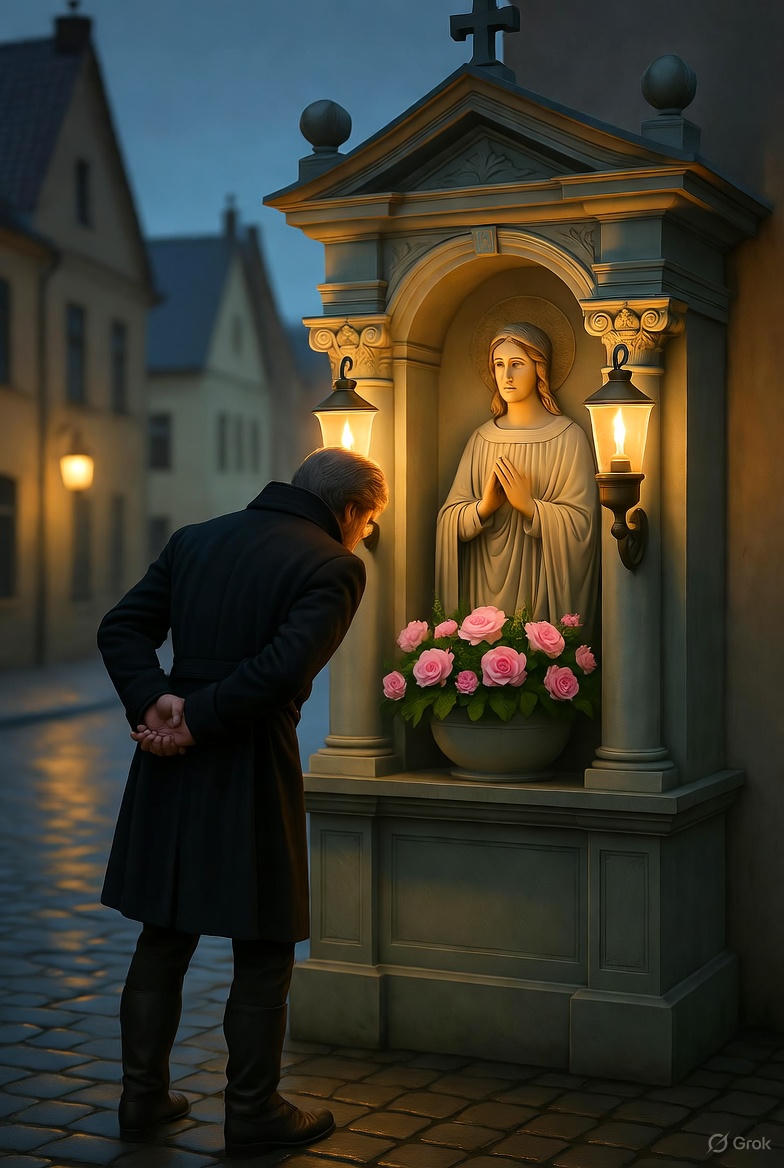
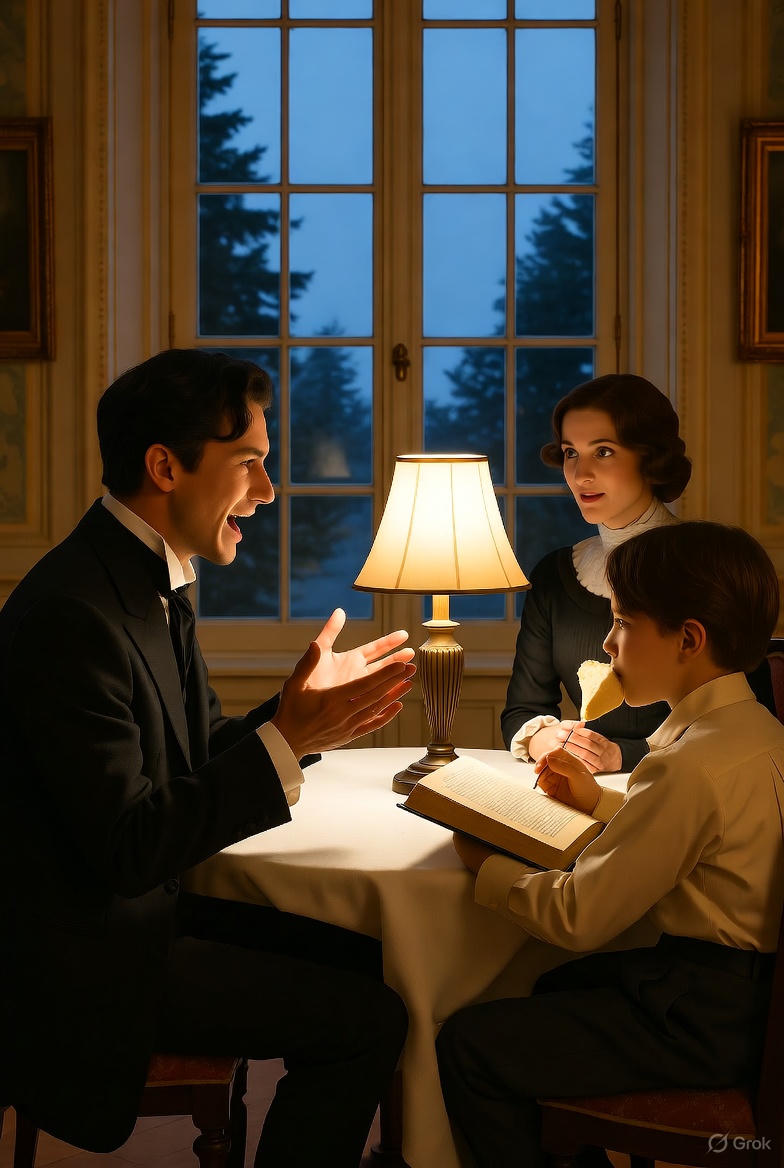

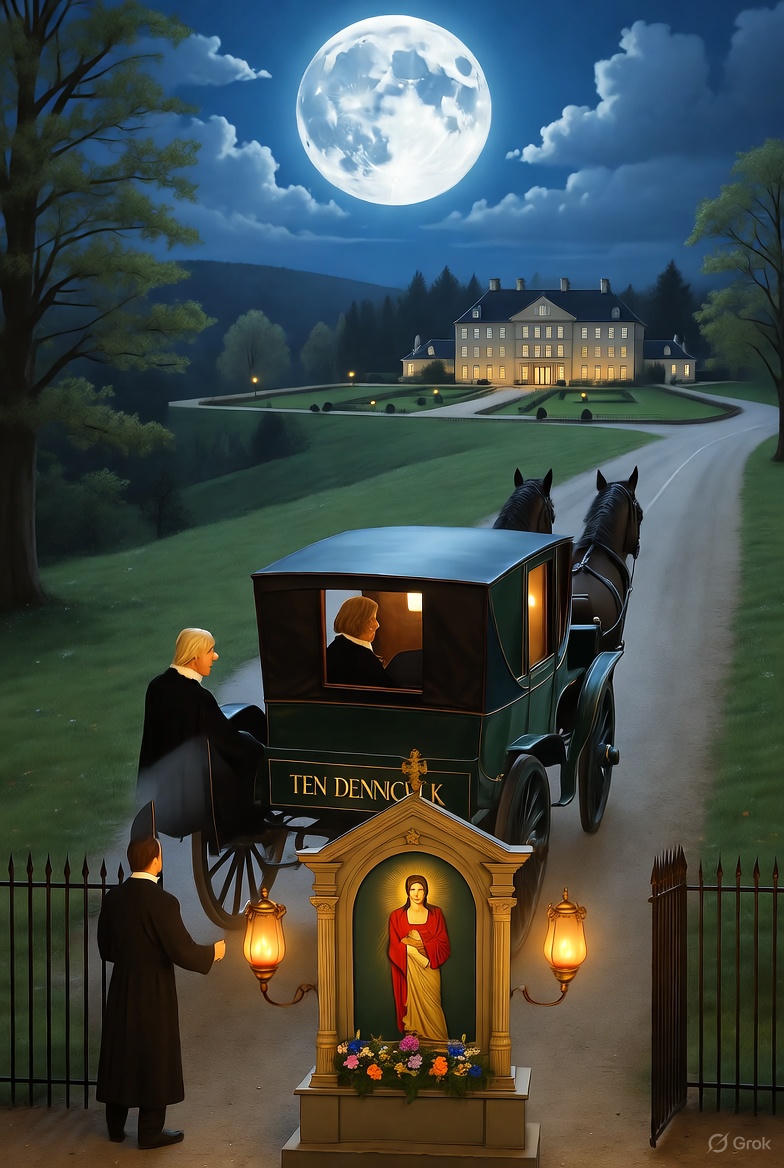


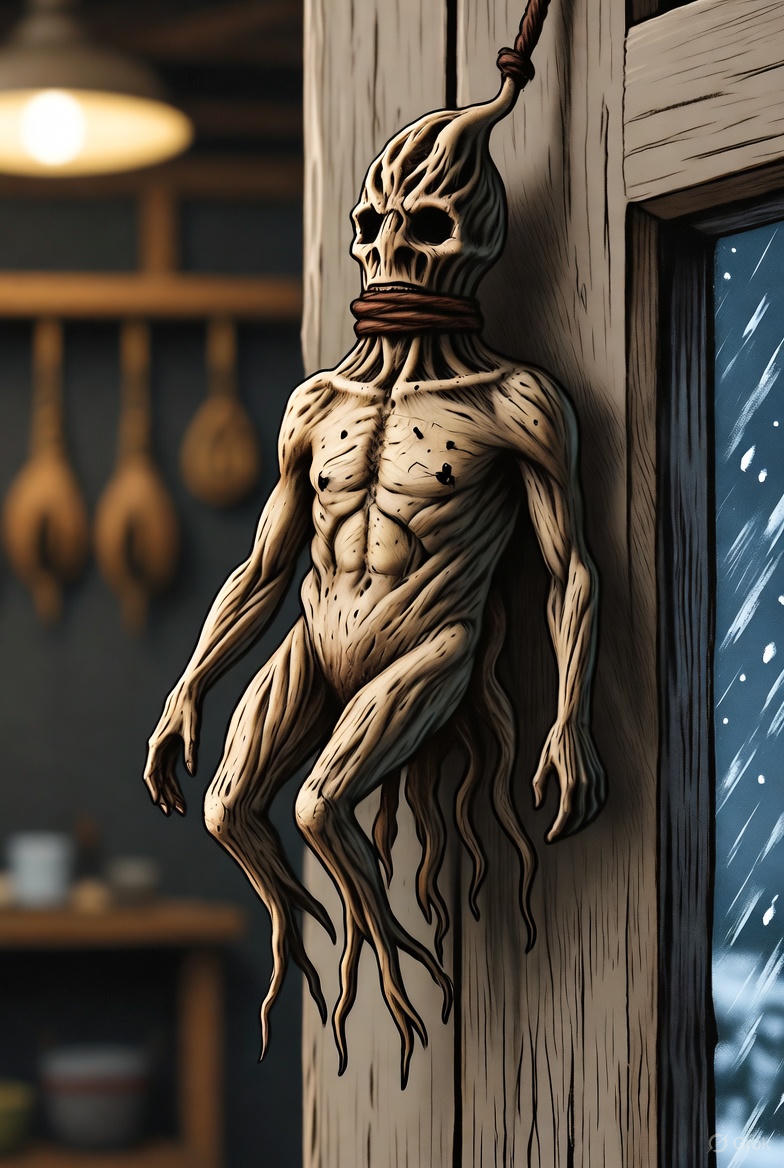


 Anarchistbanjo's World