Homo Sapiens by Stanislaw Przybyszewski and translated by Joe E Bandel
Yes, he must have exerted some kind of hypnosis over her. How else could it be that she ran away from home and followed him?
Unpleasant. He had never loved her, after all. He only wanted to observe how love develops in a girl. Yes, he wanted to write a biogenesis of love. Not a bad idea for an eighteen-year-old boy. Well, he had read Büchner and that “triste cochon” Bourget back then.
He ought to visit her sometime.
No, better not. If only she could forget him. Falk stood up and paced thoughtfully.
It’s shameful, really, to seduce her again and again and then, afterward, to take a superior stance and explain that love must be overcome, that it’s a rudimentary feeling, a kind of pathological rash in the spiritual life of modern man.
Yes, in that he was unmatched.
If only she could become a little happier.
He heard her voice, responding to his mocking explanations:
“I’d only wish one thing for you—that you fall in love yourself one day…” How naive she was. No—no…
Love?! Hmm… What was it, really?
That old gentleman in Königsberg, he saw through it. Love is surely a pathological expression… Yes, he must have known.
He lit a cigarette and stretched out on the sofa. What was Mikita painting now, he wondered?
There was an incredible strength in that man. To struggle through so laboriously and not deviate a single stroke from his path.
He could have become rich by now, if he’d done things like the others.
Those terrible university days. “Do you have ten pfennigs, Mikita?”
Mikita had nothing; he’d spent the whole morning turning everything upside down in a frantic search for the ten-pfennig coin that must have hidden itself somewhere.
“So we’ll go hungry.”
“Indeed.” Mikita didn’t let himself be distracted from his work. “By the way, money’s pretty cheap now. The Russian state has converted its debts.”
“Yes, yes—I know.”
“Well, then!” Mikita kept painting. And they went hungry. Horrible! Falk shuddered.
He’d gone half-mad. Strange that he didn’t lose it completely. How he once stood powerless on the street, nearly run over.
In the end, they had only one pair of trousers. Mikita had to paint in his underwear when Falk went to lectures.
Now Falk laughed out loud.
He remembered how his mother sent the estate manager with money to him. She had sold the forest. Then the three of them went to a tavern and stayed there from early morning until late at night. The manager crawled up the stairs on all fours. Mikita kept pulling him down by one leg until the manager, in his indignation, landed a hard blow with his heel right on the bridge of Mikita’s nose.
Oh God! How the manager tried to vomit and stuck his head through the windowpane because he couldn’t open the window…
And now Falk thought again of his hungry days and of his mother, who always helped.
A tender warmth came over him. Yes, yes, Mother, Mother…
Well, Mikita must have gone hungry in Paris. The poor pioneers!
He laughed scornfully.
But no! In defiance! Not yield a single line, better to starve. He reflected.
What was it, really? What kept him upright despite all the insults, all the failures?
He lay back down.
The great, the glorious art that seeks a new world, a world beyond appearances, beyond conscious thought, beyond every form of expression—a world so incomprehensibly delicate that its connections blur and flow into one another—a world in a glance, a gesture…
Glorious!
And the new symbols… Yes, yes—the new word, the new color, the new tone of mood…
“Everything’s been done before…”
“No, no, dear sir, not everything. Not the pain that transcends pain, not the joy that becomes pain, not the entire new realm of imagination where all senses merge into one… yes, yes… all those thousand shades of feeling that two, three, at most ten honest contemporaries can comprehend… That hasn’t been done before, or else the masses would already understand it, those who need a hundred years to chew through a morsel of thought.”
Well, in the end, it was good that not every hack journalist understood you, or you’d have to be ashamed of yourself…
He watched the wave of smoke that detached itself in a fine streak from the cigarette, winding upward in a strange curl.
He’d once seen a stream painted like that in a Chinese picture. Suddenly, it seemed he heard Mikita’s voice.
Yes, he remembered, he’d never again experienced that inexpressibly mystical mood. He was sick then, couldn’t open his eyes, his whole face swollen.
Mikita cared for him; oh, he knew how to handle him! Day and night, he watched over him. And when Falk couldn’t sleep, he read to him. Yes, he read Heine’s *Florentine Nights*.
And Falk heard a monotonous, soft singing—yes, singing… half like a prayer, fading more and more, like the last waves on the seashore when the sea calms—ever softer, ever more…
OD by Karl Hans Strobl and translated by Joe E Bandel
“It can’t go on like this,” says Reinhold, quite indignant. But then he startles and suddenly looks utterly helpless: “The father—”
“No, no,” Schuh reassures him, “he won’t find out.” And he adds with a sly wink: “We know how to keep quiet, Reinhold.”
Reinhold nods briefly to him and slips into the next booth alley, following his friends.
“They’ll keep trampling on Viennese good nature,” remarks Schuh, “until even that gets fed up with it.”
Shadows fall over the Christmas market. “We must go,” Hermine urges, “we must fetch Ottane. It’s getting dusky.”
It’s getting dusky, and Max Heiland lays down his brush.
“I must stop,” he says, “the colors and forms are blurring for me.”
Now Ottane can release the inner tension that is always in her while the master paints. A gentle weariness softens her, and a sweet anxiety comes over her. It’s sweet and unsettling; the blood sings; now things all draw closer and envelop her with their twilight folds.
“Where can Hermine and Schuh be staying so long?” Ottane says quietly, so as not to tear the delicate fabric. “They’ve never been away this long.”
“They have it good,” a bitterness sounds in Heiland’s voice, “they can go off together whenever and wherever they want. Tell me, Ottane, is Schuh courting your sister?”
Before this question, Ottane is startled. She has never thought about it—Hermine and Schuh, no, that seems unlikely to her; Hermine has other things on her mind, goodness knows, love stories don’t suit Hermine at all, not to mention the father. But actually, she hasn’t given it any thought at all.
“I don’t know,” she says anxiously. “I don’t think he’d have any luck.”
“It’s luck enough,” says Heiland harshly, “always being able to be with the woman one loves.”
He looks up, and Ottane thinks he will now light a lamp. But Heiland doesn’t light a lamp; he paces the room, stops suddenly with a jerk in front of Ottane, who sits on the Turkish divan, as if he wants to say something. He says nothing and wanders on silently, and this silence is oppressive. He bumps his foot against a breastplate lying in the way. With a kick, he sends it clattering aside, and a great two-handed sword leaning against the wall crashes down with a thud over it.
Ottane pulls a shawl shivering over her bare shoulders.
Perhaps Heiland noticed, for he takes a beech log, throws it into the flames of the open fireplace, and stokes the glow. Lights dance; Heiland stands dark against the fire, staring into it, one arm propped against the mantelpiece.
“Yes, I’m finished with your picture,” he says, “it can’t get any better now; I can only ruin it.”
Why does he say that so reproachfully, almost angrily? Whom is he accusing? Yes, now he is done with the picture, and Ottane can’t help it that a tender regret seeps into her soul. She must say something. “Are you satisfied with your work?” she asks.
Heiland spins around. “Satisfied? No, not at all. There’s something veiled in you, something unresolved, which I couldn’t capture. A—what shall I call it—a hidden treasure. I know of it, but it’s like with many treasure hunters. One reaches out, and it sinks back many fathoms deeper.”
He throws himself into an armchair and covers his face with his hands. Between his fingers, he peers sharply at Ottane, watching what she will do next. The flickering lights of the fireplace play on her features, and Heiland sees how tormented, uncertain, and unsettled Ottane is by his words. An uncontrollable hunger for this fresh, blooming girl is in him, a longing for her possession; Max Heiland almost believes he has never before been possessed by such a desire. But he also knows that the means he usually employs to win women must be used with the utmost caution here. Naturally, the surest way to success is to show passion to awaken passion. This time, however, it’s not enough with mere pretense; it’s not a matter of reaching a mutual agreement in the belief of passion to justify everything. He knows he must dig deeper within himself, draw more from himself; this time, his seductive arts must, so to speak, be in earnest.
He watches Ottane through his fingers and sees her rise and approach him.
“What’s wrong with you, Master?”
He gives no answer. Should he groan now? Yes, he groans softly.
“What’s wrong with you, Master?” Ottane asks again and places her hand on his shoulder.
Then he suddenly grabs that hand and pulls it to himself. “Don’t you know? Can’t you grasp it? Now your picture is finished, and now you won’t come here anymore. I won’t wait anymore to hear your step on the stairs; you won’t sit over there anymore, and I won’t be able to cast another glance at your face after every brushstroke.”
“Yes, the picture is finished…” stammers Ottane, confused by the fervor that rushes over her.
“It’s finished; they will come to fetch it and carry it to the exhibition, and then the emptiness will be complete. An icy emptiness, Ottane! Strange women will come again and want to be painted. And I won’t be able to turn them all away. They will come and sit where you sat, they will flirt and laugh and coquetry, and a hatred will rise in me because it’s not you sitting there. A hatred against this hypocrisy, because you are the truth; a hatred against this unnaturalness, because you are pure like nature. And despite all truth and openness, still a riddle I haven’t unraveled, while the others act mysteriously, yet with them, it’s all just surface.”
Everything wavers in Ottane; supports collapse; she is swept into a whirlpool, carried away by a wild torrent.
Can it be ventured now? Has it come so far that it can be ventured?
Max Heiland suddenly stands up. “Go,” he says through clenched teeth, “go!” And then he is suddenly at her feet, his arms around her knees, pressing his face into her skirts.
Ottane is beside herself. “I beg you… I beg you… I beg you…” She can say nothing else but this trembling, helpless “I beg you.”
No, not a word now, only no word, nothing but erupting, unrestrained feeling—hurricane, whirlpool, abyss, chaos. Only thus is it possible to cloud Ottane’s clarity, to switch off her resistances, to disarm her self-defense, to numb her vigilance, insofar as there is still something like vigilance in her subconscious. But seized by the well-considered fervor itself, Max Heiland truly flares up; the cool skill fizzles out; he puts on the spectacle of one completely overtaken by the divine intoxication of love; he groans, he burrows in, he clings to Ottane’s knees.
Ottane stands pale and trembling; her soul already lies defenseless in his arms. Max Heiland is a farmer’s son. He has made his way in the city with the tenacious stubbornness of his lineage; he exploits his powerful position at the top with peasant cunning—women perhaps love precisely this strange mix of earthiness and slyness. But Max Heiland also retains the sharpness of a nature-bound peasant’s senses.
And amid all the roaring and crackling of this fireworks art of passion, he does not overlook a light, fleeting step on the stairs.
He pulls himself up, hurriedly creates space between himself and Ottane—not a moment too soon, for now someone, after a brief hint of knocking, opens the door quickly and confidently.
“Ah,” says Therese Dommeyr, “I suppose I’ve come at an inconvenient time? I’m interrupting an intimate twilight hour.”
“You’re not disturbing us at all,” Max Heiland’s voice is very calm and controlled, “my eyes hurt from painting. But we can light a lamp now.”
He fumbles for light and a match, pretends not to find them, mutters irritably, knocks over a vase. It’s about giving Ottane time to compose herself.
Finally, the master can no longer delay.
“Wait, I know where the lamp is,” says Therese mockingly.
“I’ve got it,” and now it becomes light.
Max Heiland has given Ottane time to compose herself, but not enough. He himself shows not the slightest sign, but Ottane still glows and trembles a little. One wouldn’t even need Therese’s keen eye to see that a spring storm has passed over this young soul.
“It seems to me,” says Therese, “our new Paris already knows whom to give the apple to.” Behind the sharply curled mockery shines a threat of a storm.
Heiland ignores the mockery and the threat. “Yes, the picture was finished today.” A weather incantation, yes, the picture is finished, and with that, it’s probably over with the eye-sparkling, thread-weaving, twilight hours, and all that.
Incidentally, fortunately, Hermine and Schuh return from their walk just now. Both fresh and reddened by the cold, Hermine as quiet as ever, Karl Schuh a bit conspicuously noisy. Hermine feels a bit guilty; no, they don’t want to step far into the atelier; they have snow on their soles, and it’s gotten so late—oh, and the picture is finished, yes, a very beautiful picture, very lifelike, strikingly lifelike, but it’s late, one must hurry to get home; the father scolds if one stays out so long.
Homo Sapiens by Stansislaw Przybyszewski and translated by Joe E Bandel
Author’s Preface
Dedicated to the sculptor Gustav Vigeland
Due to various circumstances, I was compelled to tear apart what organically belongs together and to publish the three parts of *Homo Sapiens* separately. Thus, it came about that the first part appears last, but it is obvious that those who do not intend to misunderstand me from the outset will now read the *Homo Sapiens* novel series in its entirety and judge it as a whole, not as individual parts.
Chapter I.
Falk leapt up in a rage. What was it now?
He didn’t want to be disturbed in his work, especially now, when he had finally resolved to start working again.
Thank God! Not a friend. Just a postman.
He meant to toss the card aside. It could wait. But then, suddenly: Mikita! A flush of heat surged through him.
Mikita, my dear Mikita.
He skimmed the card: “Be at home tomorrow afternoon. I’m back from Paris.”
That was probably the most he’d written in ages, since that famous essay he’d indulged in years ago.
Falk burst into hearty laughter.
That marvelous essay! That he wasn’t expelled back then… New Year’s impressions, penned in the form of a New Year’s greeting in the most extravagant phrases; every sentence two pages long.
And then—no, wasn’t that glorious? Old Fränkel… how he ranted! Well, the affair was dicey…
Falk recalled how he’d persuaded Mikita to write an apology, in which a splendid pun ran as the underlying theme: What is permitted to a Schiller shouldn’t be permitted to a student?
And then, the next day. They wrote the apology through the entire night, went to sleep in the early morning, and sent an excuse letter to Fränkel.
Falk still couldn’t fathom how they got away with it. That splendid excuse: It was obvious that one couldn’t attend school after working all night on an apology.
Twenty pages long… Now, though, he had to work.
He sat back down, but the mood for work had vanished. He tried to force himself, fishing for thoughts, chewing on his pen, even scribbling a few lines that were utterly banal: no, it wouldn’t do.
Another time, he’d surely have fallen into one of those familiar funereal moods that he had to drown in alcohol. This time, he was glad.
He leaned back in his chair.
Vividly, he saw the dreadful garret where they’d both lived during their final year at the gymnasium. Three windows in one wall, never to be opened lest the panes fly out. Every wall covered top to bottom with mold. And cold, God have mercy.
How one early morning they awoke and looked around the room in astonishment:
“Remarkably fresh air in here,” said Mikita. “Yes, remarkable.”
And it was a wonder without bounds over this strange phenomenon.
Yes, it became clear later. It was so cold that birds froze and fell from the sky.
Falk stood up. Yes, those were his fondest memories.
And that lanky fellow who always lent them books—what was his name again?
He couldn’t recall the name for a long time. Then, at last: Longinus.
A peculiar man.
Falk thought back to how Mikita had secretly gained access to Longinus’s always-locked room and taken a book he wouldn’t lend.
Suddenly, one Sunday—yes, there must have been fresh air in the room again… He woke up. A strange scene: Mikita in his shirt, key in hand, Longinus utterly outraged, trembling with rage.
“Open the door!” Longinus hissed with theatrical pathos. “Put the book back, then I’ll open it for you.”
Longinus, in a heroic pose, pacing back and forth, back and forth, in great cothurnus strides.
“Open the door!” he roared hoarsely. “Put the book back!”
Longinus was foaming. Suddenly, he approached Falk.
“You’re a fine, educated man. You can’t tolerate my rights being infringed in any way.”
Yes, Longinus always spoke in very refined and well-composed phrases.
“Well, I’m sorry, Mikita has the key.”
Now Longinus solemnly advanced to Mikita’s bed: “I deny you any form of education.”
That was the gravest insult he’d ever uttered.
“Open the door! I’ve been violated and yield the book to you.” God, how they laughed! And it was Sunday. They were supposed to be in church. They always skipped church. They were far too committed atheists.
But it was risky. The fanatical religion teacher prowled about the church…
Ha, ha, ha.
Falk recalled how he once sat in church opposite his “flame”—yes, he sat on the catafalque, wanting to appear properly graceful and intriguing, and remained through the entire endless mass in a rather uncomfortable pose, one he’d seen in a depiction of Byron at Shelley’s grave.
What a scandal that caused!
Now he tried to muster himself for work again, but he couldn’t gather his thoughts. They all flitted and buzzed in his mind around that glorious time.
He chewed absently on his pen and repeated: What a glorious time!
How they’d suddenly discovered Ibsen, how *Brand* turned their heads.
All or nothing! Yes, that became their motto.
And they sought out the dives of the poor and gathered the proletarian children around them.
Again, Falk saw himself in the garret.
Five in the morning. A clatter of wooden clogs on the stairs, as if someone were dragging a cannon upstairs.
Then the door opened, and in marched, single file: a boy, a girl—two boys—two girls, the whole room full.
All around the stove, gathered at the large oak table. “Mikita, get up! I’m insanely tired.” Mikita cursed.
He couldn’t get up. He’d worked all night on a Latin essay.
With a jolt, they both sprang up, furious and full of hatred toward each other.
The chattering of teeth in that cold!
And now: he at the stove, puffing and cursing because the wood wouldn’t catch fire, Mikita at the large milk kettle, warming it with methylated spirits.
Gradually, they softened.
The children fell upon the milk and bread like young beasts of prey—Mikita, watching from the side, beaming, happy.
And then: Children, out!
Now they looked at each other amicably as usual. Falk felt a warmth around his heart.
He’d long forgotten that. There was, God knows, a great, beautiful meaning in it.
Then, usually, shame for catching themselves in sentimentality—no, they called it aesthetics—and, finally, a quarrel.
“The *Nibelungenlied* is really just empty, foolish drivel.” Mikita knew Falk’s weak spots well.
Of course, he wouldn’t admit that. He argued with incredible zeal and sliced the breakfast bread.
Mikita was cunning. He always entangled Falk in a dispute and let him cut the bread, because Falk, in his fervor, never noticed how tedious it was.
And suddenly: Good Lord, two minutes past time. Books snatched up and off to school in a frantic gallop. He in front, Mikita limping behind. Had he cured that bunion by now?
Now Falk usually noticed he was hungry—Mikita had eaten all the bread, the splendid fellow.
Then… Falk faltered.
*Brand* transposed onto the erotic. All or nothing… He faltered again.
He had, in truth, destroyed Janina’s entire future. Hmm, why couldn’t she just let go of him? And how he had tormented her with *Brand*’s demands and *Brand*’s harshness.
OD by Karl Hans Strobl and translated by Joe E Bandel
Chapter 9
Ottane’s picture, which is to become Max Heiland’s masterpiece, still stands on the easel.
A layman might perhaps say that it is finished, but the master still finds something to improve; it is to be his masterpiece, and that must not be given up so carelessly.
“Any random lady from society can be painted down as fast as the hands can manage. There sits the model, and there is the canvas. Stroke, stroke, stroke—one only needs to paint what one sees. That’s mass-produced goods, what one gets before the brush. With you, it’s different, Ottane! You are unique in the world, Ottane!”
And: “You mustn’t grow impatient with me, Ottane! You pose the greatest challenge to my art. With you, Ottane, I must also paint what one cannot see—the soul.”
When Max Heiland says “Ottane,” it’s always like music; it flatters the ear like an Italian aria. And one becomes just a little dizzy in the head from it, and the heart beats a bit stronger too.
It also beats stronger when one enters Heiland’s atelier. Not only because it lies so heavenward under a glass roof in Spiegelgasse and one must climb many stairs, but perhaps also because it has, so to speak, something exciting about it. All painters like to surround themselves with beautiful, rare, and gleaming things; all would gladly elevate their outward existence into the extraordinary—if only they had the means. But few have them. Max Heiland, of course, need deny himself nothing; the women crowd to him to be painted, money plays no role—perhaps because he despises it. His atelier, therefore, is no bare hole like that of a colleague who paints animal pieces or still lifes, bought by petty bourgeois and officials, or who sits with his easel outside before the landscape.
When one enters Max Heiland’s studio, it’s as if one steps into the splendid chamber of a Venetian noble. Persian carpets and animal pelts, Italian glassware, weapons, armors, embroideries on the walls, church vestments thrown over inlaid chairs and Turkish divans, carved cabinets and chests stand about. Vases of man-height, in which dry grasses, thistles, peacock feathers, and artificial flowers are united into bouquets. East and West seem to have poured their treasures over the master; the past and the new age have heaped their precious items here. And amid all this clutter, absorbed by him, sprayed over it, is the scent of women, of many women who were here, some of whom were shameless enough to offer their naked bodies to the painter. Art, they say, art is the justification for that, but Ottane couldn’t bring herself to do it, no, she would be incapable of it.
Now no other women come here except Ottane. Max Heiland says so at least; he has had a barrier put up at the entrance, he turns everyone away to concentrate all his energy on Ottane’s picture. Only Hermine comes with her to the sessions; she doesn’t pay, she is the chaperone, as Heiland calls her; she doesn’t disturb much, for most of the time Karl Schuh comes along. Then they stand by the window or sit in a corner, behind a brocade curtain, and speak quietly with each other.
And sometimes Therese Dommeyr also sweeps in. She certainly disturbs a bit more; she laughs a lot, peeks curiously into every corner, lifts all the cloths as if she is looking for someone hidden underneath, throws herself onto a divan, and drinks a sweet liqueur that Heiland pours for her from a cut-glass carafe. But she seems to have a kind of house right here, which she exercises without hesitation; there’s nothing to be done about it, even if it’s sometimes annoying. The master himself occasionally grows impatient when she behaves so unruly and expressive, as if to suggest that the others were merely tolerated by her and as if she were the main figure. He frowns, becomes taciturn, whistles between his teeth, and deliberately overlooks her.
But she pays little heed to that, continues to laugh, and finds it immensely entertaining to watch the master paint. Her quick little eyes dart between the model and the painting, she praises both, the original and the copy, but sometimes, when Ottane unexpectedly casts a glance at her, she has the impression that a hostile malice darkens in those eyes. And if only she would at least stop her often rather embarrassing jokes. What, for example, is the meaning of her saying one day: “So, Maxi, that would have been a fine embarrassment for you if you had to give one of us a golden apple as a new Paris. I think you’d know even less than he what to do with it.” Isn’t that really malicious, to ask such questions? The master looks very annoyed and clearly doesn’t know what to say.
It’s only a stroke of luck that Karl Schuh is there; he has such a bright, cheerful voice and calls from the window: “Well, we’ve had an Athena, but a Juno is still missing us, and for that we have Venus twice!” With that, he makes his cheekiest rogue face, winks with his eye, and dangles his legs like a street urchin while sitting on the windowsill. Then everyone laughs, and the mythological embarrassment is over.
Overall, though—aside from Therese Dommeyr, as mentioned—these are the most beautiful hours Ottane has ever lived. She has nothing to do but sit quietly and chat with Max Heiland. He questions her about everything—her youth in Blansko, Reinhold, her father—and then he holds up his own grand life against her small, confined one, telling stories from Rome, Paris, Naples, Venice. He has been everywhere; he truly knows the whole world; he mentions the names of crowned heads, prominent figures, as if they were as familiar to him as the grocer downstairs in the neighboring house.
But it’s most beautiful when they are completely alone, for Karl Schuh thinks it’s by no means necessary for Hermine and he to sit up here the whole time; they could just as well go for a walk in the meantime; he finds that Hermine’s face has a pallor from staying indoors; he finds that exercise could only be beneficial for her. Even today, he persuaded her after a bit of coaxing to leave Ottane and the master with his art alone and go out with him onto the street.
It is the week before Christmas; much snow has fallen in the last few days, and narrow paths have had to be shoveled, narrow paths between towering snow walls. If one doesn’t want to walk single file, one must press close together. The clear, calm cold colors Hermine’s face red, which only now reveals how pretty she really is with her beautifully arched brows and the wonder of her eyes beneath them.
Schuh also keeps talking nonstop; he has a lot to report. He has given up Daguerreotypy now—a good business, but in the long run boring, always bringing the faces of indifferent people onto the plate; besides, there are now quite a few people in Vienna doing the same and making a living from it. Now Schuh has turned to galvanoplasty, a new process that utilizes electricity to produce small metal art objects.
At the “Hof,” the Christmas market is set up. Booths are lined up into alleys, filled with apples and nuts, toys for children—jumping jacks, dolls, nutcrackers, balls—a world of colorful things. Heavily wrapped women sit in the booths and at the stalls, warming pans between their legs, red noses frozen under watchful little eyes.
“Look at the children,” says Schuh, “isn’t that adorable?”
Children swarm around in groups, led by their mothers, crowding before the mountains of fruit and toys; but there are also many among them who are alone with their longing and their pitiful, daring Christmas hope. A tiny tot in a thin little coat stands before a mountain of apples, a mix of red, golden yellow, and wine green, his gaze unable to move away—hungry, captive looks.
Karl Schuh buys a few apples, a handful of nuts, stuffs everything into the tot’s pocket: “There you go! Run!”
The tot stares, doesn’t understand, looks at the strange man, and then suddenly sets off at a trot—the strange man might change his mind.
“Don’t you love children?” asks Schuh. “I think it would be so nice to have children of my own. As a child, things didn’t go well for me; I always wished a strange man would come and stuff apples into my pocket. I thought, perhaps the dear God might once walk the market in disguise and stop by me, giving me a jumping jack or a sheep made of red sugar.” Oh yes, Hermine probably loved children too, but in her heart something is buried, something living is entombed there; it dares not emerge, it doesn’t even venture to stir, for fear of sinking even deeper.
Otherwise, though, Schuh is very absorbed with his galvanoplasty. He begins talking about it again and again, then interrupts himself, laughing, shows Hermine a group, a whole regiment of little Krampuses with small wooden ladders and hats made of black paper, and then returns to galvanoplasty.
As they are now pressed even closer together by the crowd, he gently slips his hand into Hermine’s muff, where it’s warm and cozy, and tries to grasp her hand. But then Hermine pulls her fingers away; she makes a small turn, taking the muff with her and depriving Schuh’s hand of its shelter.
Athena! thinks Schuh, disappointed, always only Pallas Athena—cool, chaste, devoted only to science—her soul locked, surrounded by thick walls through which no heartbeat from next door can be heard.
A group of young people pushes past, students; they force their way ruthlessly through the crowd; the bustle of the Christmas market is merely an obstacle on their path—no, they aren’t here for the children’s toys; their expressions are full of bitterness, their gestures speak of rebellion.
“Reinhold!” calls Hermine.
Yes, Reinhold is among them; he heard his sister, detaches himself from the group, and approaches the two hesitantly and embarrassedly.
“What’s wrong with them?” asks Schuh, looking after the students. “What’s gotten under their skin?”
Reinhold pulls them into a narrow side alley between the booths. “We want,” he whispers, “to go to Haidvogel’s inn in Schlossergäßchen. The police are said to have disbanded the Ludlamshöhle.”
“The Ludlamshöhle,” says Schuh, “that’s that society of writers and actors… what does it have to do with politics?”
“Nothing, not the slightest bit. That’s just it. But the police found a poster saying: ‘This time Saturday is on a Sunday!’ Because this time the meeting is on Sunday instead of Saturday.”
“Oh dear, and the police can’t figure that out,” laughs Schuh. “And so it’s suspicious.”
OD by Karl Hans Strobl and translated by Joe E Bandel
“Tell me,” the sick woman’s voice complained, “what is that over there? I’ve been seeing it all this time.”
“What do you see?” asked Reichenbach.
“It’s like a large five of cards, four spots arranged in a square and a fifth in the middle, all faintly glowing. What is that?”
Reichenbach looked around; his eyes tried to pierce the darkness; he saw no glowing five of cards, nowhere in the pitch blackness even a hint.
“Where do you see the glow?” Reichenbach took a few steps at random, bumped into something, changed direction, and groped further.
“How do you feel, gracious lady?” asked Eisenstein.
“It cools me,” said the sick woman quietly, “that feels good; the Baron is coming toward my bed.”
“Do you feel that?” And Reichenbach pressed on in the direction he had taken.
“No, please,” cried the Hofrätin in distress, “stop, stay where you are. Don’t go further. Now a warm breeze comes from you. I feel sick; I believe you are ill, Baron.”
“You’re mistaken there,” laughed Reichenbach, “I’m not the slightest bit unwell.”
“How do you perceive that?” asked Eisenstein.
“I don’t know, I can’t say. But I believe the Baron is sick or will become sick.”
“I can reassure you, Frau Hofrätin, you are certainly mistaken.”
One could hear that the sick woman moved restlessly in the bed. “I want to know what this five means. It frightens me when I don’t know.”
“One must bring light…” Eisenstein considered, “the Baron and I see nothing.”
“Let light come for a moment,” the Hofrätin groaned, “I want to know.”
Eisenstein, after some searching, found the door, opened it, and called for the maid. Although the anteroom was unlit, a faint twilight already penetrated the deep darkness. And after a while, the maid came with the lamp.
The Hofrätin lay pale, with wide eyes in the bed, staring at the opposite wall. “There… over there,” she said, and a faint hand rose.
“Where did you see the five?” Reichenbach asked again, for there was nothing but a wall with a small chest of drawers, a little bookcase, and then a double door leading to the next room. “Where… there? There?”
He pointed to the chest of drawers, the bookcase, to the pictures on the wall.
“No, much larger, as big as the door and right in the middle.”
It suddenly occurred to Reichenbach that there was the double door, and it had a hinge fitting on each side and the lock and handle in the middle—together five metal spots, a large five of cards.
“Were the spots that high?” asked Reichenbach, stretching toward the top edge of the door.
“Yes… they may have been there.”
“It’s the door,” Reichenbach turned to Eisenstein, “the fittings are brass.”
They were brass, fine, but did brass glow in the darkness? What peculiar ability did this woman possess that she saw metal glowing in the blackness?
“May I,” said Eisenstein quickly, “since we now have light, I would like to show the Baron Reichenbach something, gracious lady.” He pulled something from his pocket, a piece of iron, red-painted at one end—a magnet, a common bar magnet.
The sick woman turned restlessly; she wanted to be alone again at last, but the men were seized by the ruthless zeal of science. “We’ve already tried it. Please close your eyes.” And Eisenstein comes slowly toward the bed and places the red end of the magnet rod into the Hofrätin’s left hand.
She lies with closed eyes, and her fingers clasp the iron; her features smooth out a little. “Please, how do you feel the touch?”
“Cool.”
Eisenstein takes the magnet from her hand, turns it around, and places it back into her left hand.
“How do you feel that?”
The sick woman groans; her face expresses disgust: “Warm! Repulsive!”
Eisenstein looks up at the Freiherr, who stands there shaking his head. A silent question: What do you say now? The doctor removes the magnet, gives it back to the patient, now with one end, now with the other, then two, three, four times in a row with the same end, in random alternation; whenever the Hofrätin grasps the north pole, she feels the iron cool and soothing; when she has the south pole between her fingers, it feels warm and unpleasant. She obediently keeps her eyes closed, but her answers remain certain; she doesn’t err a single time.
“Is it for this reason that you spoke of a kinship with magnetism?” Reichenbach asks finally.
“Wait?” And now Eisenstein places the magnet in the patient’s right hand.
She twists her face and breathes in gasps. “How do you perceive that?”
“Warm and repulsive.”
It is the north pole that she now holds in her right hand. With with wide-open eyes, Reichenbach stares at the slender fingers trembling around the iron. Reversed? The opposite effect from the left? Yes, by God, exactly reversed—what was soothing on the left is tormenting on the right, what was painful on the left is pleasant on the right. Eisenstein continues his experiments—ten times, twelve times—checking the phenomenon on the left hand in between; no error blurs the picture.
Then the sick woman impatiently opens her eyes, gasping: “Leave me alone at last. I can’t anymore. I cannot tolerate the light any longer.”
“Yes, yes, gracious lady,” Eisenstein soothes, “we are finished. We’ll leave now. Drink the tea I prescribed, and try to sleep. I’ll see you again tomorrow.”
Then the men stand outside the door; Eisenstein’s looks ask clearly: Well, did I exaggerate? Did I call you here for nothing? Am I now also a man or not? A man like Schuh, eh?
Reichenbach’s eyes burn inwardly. “What interpretation do you have for that… for all these phenomena?”
Eisenstein has no interpretation; he shrugs his shoulders: “The key eludes me for now. But I believe this is a matter that concerns not only the physician but also the physicist, and that’s why I asked you to come.” Eisenstein has played a trump card; he feels it, he knows that Reichenbach is gripped by the problem. Eisenstein has become an important figure. He has unleashed the passion of thought in the Freiherr, his only passion; he has shown him something new, and forced his way into the fortified house and to Hermine; oh ho, what this Schuh can do, Eisenstein can do too—make himself indispensable—and now he will surely succeed in making up for the lead that Schuh has.
The men trudge wordlessly side by side through the dark streets in slushy snow. Under a streetlamp, Reichenbach stops, seized by a thought. “Perhaps they are rays… a kind of rays emanating from things…”
He breaks off, overwhelmed by his thoughts, and Eisenstein eagerly confirms: “It could also be, in a way, a kind of rays…”
He feels with satisfaction how furiously his companion’s mind is working. In this head, it’s now a wild tumult. It’s a volcano, a sea of flames, a tumbling chaos, a roaring, a battling, a hissing of blazing thoughts; the skull walls stand under a pressure as if they must burst; the Blansko furnace, all the blast furnaces of the world, are mere panting kettles compared to it; their glow is a pitiful little fire.
OD by Karl Hans Strobl and translated by Joe E Bandel
He projected images onto a light-sensitive plate with a lens; everyone was talking about it, everyone flocked to the young man; all of Vienna wanted to stand before his lens—it had become a lucrative business, Schuh had money in abundance. He had also made pictures of the entire Reichenbach family, each one individually and all together with the Freiherr in the middle—no doubt, it was living reality, so vivid and faithful as no painter could reproduce.
Thus, it was by no means the Freiherr’s intention to completely fall out with Schuh, and the neglect of Hermine’s botanical work wasn’t so serious either, since Schuh helped her with it too. When Reichenbach expressed his dissatisfaction, it was probably more because he had grown accustomed to occasionally picking at her to spur her on to higher achievements.
Reinhold also provided ample occasion for disapproving criticism. Although they now lived in the city, he sometimes stayed out in the evenings and excused himself with his studies, but then he was surely huddled with the other students in some back room, holding conversations about “freedom” and “people’s wishes.” Over this part of his life, he spread deliberate obscurity. How much he had been incited to defiance was shown by the fact that he dared to retort to his father that he was no schoolboy, that rascal, and that one had to rebuke him sternly to make him crumple and then stand at attention again.
Even with Ottane’s household management, Reichenbach had much to criticize. His reproaches brought forth tears.
“And how long are these sessions with this Herr Heiland supposed to last?”
“Heiland says my picture will be the best he’s ever painted.”
“Nonsense, this picture-painting! Look at Schuh, you step in front of his apparatus and in a few hours have a picture, more similar than any painter could ever make.”
“Heiland says that Daguerreotypy will never be able to replace painting. Daguerreotypy is mechanics, but painting is art.”
“Briefly,” the Freiherr cut off Ottane’s thread, “I want this matter to come to an end once and for all.”
Perhaps Reichenbach’s mood would have been considerably better if he had come to a more intimate understanding with Therese Dommeyr. The fame of the actress was still on the rise; her star shone over the Viennese theater sky; so many people took an interest in her art and her existence; ultimately, it was no wonder if little was left for the individual. She also came to Bäckergasse, fluttered through the rooms, had pastries and a glass of Spanish wine served, rang out with her bell-like laughter, told theater stories, rearranged the knick-knacks on the dressers and cabinets, moved the embroidered and crocheted covers from one place to another, and then vanished again.
As soon as she was gone, Ottane, who never showed herself during such visits, reappeared, sniffed with a wrinkled nose at the foreign scent, put the table runners and sofa covers back in their original places, and also returned the knick-knacks to their spots.
Sometimes Therese came laden with bile and on the verge of bursting. “I beg you, Baron, have you any idea? This rabble at the theater, such a bunch! By my soul, I’ll pull myself together and run away from them.” They had annoyed her; they didn’t appreciate her enough, things didn’t always go her way; the colleagues were full of envy and spun intrigues, the male colleagues were after her, but Therese didn’t care about them, let them go, and then they switched to the enemy side. She wept a little, she scolded like a magpie, she called down God’s judgment on the whole theater gang, she screamed and shook herself, and in all that commotion, she was as charming as ever.
“Yes, the theater is hot ground,” Reichenbach said cautiously, “ultimately, you’ll get tired of it and want to flee into a bourgeois existence.”
“Do you think so?” Therese let the handkerchief sink, which she had stuffed into her mouth to stifle her crying fit. “Oh,” and she made sorrowful innocent eyes, the expression of a deeply wronged child, “I think, after all, I’m lost for that. A bourgeois existence… and married, ultimately a comedienne?” And the look of those innocent eyes became so penetrating that it sent a shiver, hot and cold, down Reichenbach’s back.
Yes, she offered, so to speak, samples of her iridescent, light-hearted personality and left behind an increased appetite for more after every visit. But before any grasping or holding, she slipped away smoothly and agilely like a glittering little fish.
On a winter evening, Severin announced Doctor Eisenstein.
Reichenbach was just in his laboratory, engaged in investigations on magnetism, prompted by Schuh. Eisenstein? What reason had Eisenstein to seek him out? For if he thought that Reichenbach had changed his mind and now thought differently about his suit, he wanted to thoroughly dispel that misconception. Reichenbach stiffened, and as the doctor entered, he saw the Freiherr armored in icy inaccessibility before him.
“I come,” the doctor began at once, “to ask for your advice.”
“What is your pleasure?”
“You see me somewhat embarrassed… it is namely a case in which I’ve reached the end of my art. I have a patient.”
“I am no physician, Herr Doktor; turn to a colleague.”
Eisenstein shook his head: “That wouldn’t help me. The colleagues don’t think beyond the tips of their noses. I need a man who has an unprejudiced eye for the new, who looks beyond the obvious, who at the same time masters the entire field of physics—in short, a man like you.”
“Very flattering,” said Reichenbach, buttoned up to the top.
“It concerns, namely, phenomena that seem to have a certain similarity to magnetic facts.” Yes, Eisenstein paid no attention to Reichenbach’s mockingly dismissive tone; he seemed so filled with the matter that he had no ear for it. It might be animal magnetism, as Mesmer and his pupils had taught, and yet much was different again; one was compelled to consider purely magnetic phenomena in physics, and since the Freiherr was precisely in this field—Eisenstein cast a quick sidelong glance at the apparatus—possessed of experience like no other… One couldn’t very well go to someone else with these enigmatic matters. Reichenbach was no ossified scholar; he wasn’t bound by prejudices; he had even advocated for Semmelweis; he was equipped as a researcher with the superiority of a sage.
“Who is your patient?” asked Reichenbach.
“Frau Hofrätin Reißnagel.”
“Very well,” said the Freiherr after a moment’s reflection, “I will accompany you.”
They walked through the snow flurry the short distance to Kohlmarkt, where the Hofrätin lived. He didn’t want to prejudge the examination, said Eisenstein; the Freiherr might form his own judgment about the phenomena. Only with the case history must he familiarize him in outline. About two years ago, the Hofrätin had been seized by the illness that was, so to speak, fashionable back then. The Freiherr might perhaps recall—symptoms of a cold, sniffles, cough, headaches, high fever, nothing otherwise extraordinary; the distressing thing, however, were the consequences. After a duration of a few days of the cold subsiding, but then came the most unpleasant surprises. Lung inflammations, joint inflammations, leg inflammations, heart diseases, some of them with fatal outcomes. It seemed some kind of poison had remained in the body, which then chose an organ to lodge in and wreak havoc. In the case of Frau Hofrätin Reißnagel, it was as if the poison had struck the head, at least since then those strange states had set in, a lapse of consciousness for certain durations. It had occurred particularly often in recent times that she had undertaken things of which she later could not remember, she had left the house and stayed away without afterward being able to say where she had been. Her soul would occasionally fall, so to speak, into a twilight, from which she returned dazed and without memory of what had happened. Added to this, and alongside it, was that heightened sensitivity, of which the Freiherr would now be able to convince himself.
They had meanwhile arrived in front of the old house where the Hofrat lived, climbed the stairs, the old maid opened the door, and Eisenstein led the Freiherr, after he had taken off his coat, straight into the sick woman’s room.
Upon entering, Reichenbach found himself in such complete darkness that he dared not take a step. He stood still, but from the depths of the impenetrable blackness came a sound and then a faint voice: “Is that you, Baron Reichenbach?”
“It is I, gracious lady. Has Eisenstein told you—?”
“Eisenstein has told me nothing. I know it’s you; I felt you coming before the door.”
If Eisenstein had said nothing, how could the Hofrätin know who had stepped into the dark room, and what did it mean that she had felt him before the door?
“Why is it so dark here?” asked Reichenbach.
“I cannot tolerate the light,” came the faint reply.
“The windows are draped with cloths; opposite, a streetlamp is burning.”
“The Frau Hofrätin cannot sleep if the moon shines into the bedroom,” Eisenstein added from the darkness, with conscientious matter-of-factness. “Is this the bedroom?”
“Not really,” said Eisenstein, “it is the Frau Hofrätin’s room. But she sleeps here. She cannot tolerate the proximity of another; confinement is oppressive to her. You will recall that she became unwell at your place back then, and then she wanted to lie with her face to the wall, which she cannot do over there.”
Nerves, thought Reichenbach, what beyond nerves, as is so common with women, or could the Hofrätin perhaps even—? But Eisenstein should have known that.
OD by Karl Hans Strobl and translated by Joe E Bandel
“Now only the Schuh with his pictures remains for us,” the baron growls grimly, “a stroke of luck that we still have him.”
The Schuh leans over there against the wall, legs crossed, head propped against his arm, in a challengingly picturesque pose. He takes no notice of the glances …drawing attention to himself, and when the people ask: “Who is that?” then one or the other will say: “Don’t you know him? That’s the Schuh, the Karl Schuh, the one with the gas microscope and the camera obscura, who’s making such a sensation in Vienna now. He gave demonstrations in the university hall and in the Theresianum in the Society of Physicians and even before the Imperial Family in Schönbrunn. The Baron von Reichenbach met him through the late Baron Jacquin, and he knows why he invited him. Just wait and see what we’ll get to see.”
“I beg you, dear Herr Schuh,” says the baron, “are you ready now to present your pictures?”
Karl Schuh bows: “Certainly, Herr Baron. But you promised that your gracious Fräulein daughter would sing. Everyone is tense, everyone full of joyful anticipation for a refined artistic enjoyment.”
Reichenbach makes a contemptuous hand gesture. “Hermine’s singing master has fallen ill, and there’s no one to accompany her.”
“Is that all?” says Schuh, as a modest self-confidence swells his chest, “I dare to take on the accompaniment.”
“Are you musical too, you jack-of-all-trades?” Reichenbach marvels.
“A little. As I said, if the gracious Fräulein will do me the honor…”
“Come,” and the baron pulls the young man by the hand toward Hermine, who is still desperately rummaging through the sheet music and doesn’t know how she should manage it, to retreat without causing a stir. “Here is the rescuer in need,” says Reichenbach, “Herr Schuh will accompany you.”
Hermine glances shyly up at the young man; this stranger is to accompany her, the risk only grows greater thereby, and a ghastly catastrophe will be the inevitable end. But the young man nods to Hermine with a laugh; he has a merry, good-natured, confident face; he winks roguishly, is not in the least intimidated by the crowd of people in the garden hall, and says: “It’ll be fine. What do you have there?”
A quick glance through the sheet music; “ta-ta … ta-ta-ta-ta,” he hums and takes a few grips on an invisible keyboard: “Well then, if you want to venture it… that’s no witchcraft at all.”
Something of his nonchalance and daring flows invigoratingly over to Hermine. It is no small thing to sing, worn down by the conversation with Doctor Eisenstein and the scene with her father, and in the uncertainty of whether she will find accord with this strange man.
But after the first bars, it becomes lighter in Hermine, a timid glimmering of hope for a happy outcome. At first she had sung as if in a stupor, the notes dancing before her eyes, scarcely hearing herself, crushed by the consciousness of having to sacrifice herself to the Moloch who sat there with fifty heads and gawked at her. But her accompanist masters the piano; he commands it more freely, less pedantically than her teacher, and yields to her in all things. Now Hermine sees the notes again and hears herself and overcomes her uncertainty and sings songs by a half-forgotten Viennese musician named Franz Schubert, of whom the old Meisenbiegel thinks highly.
The Moloch applauds, naturally, how could it do otherwise when the daughter of the house sings? There is no enthusiasm in it, however; this music goes too little into the ear—who is this Franz Schubert, after all?
But then the arias come. From Norma, from The Sleepwalker, there the audience roars, and the applause rages so genuinely and persistently that Hermine must encore “The White Lady.” It is a great success, almost as great as that of Dommeyr, and everyone claps, and Dommeyr embraces the singer, kisses her on the forehead, and says: “It is a crime, my child, if you do not go on the stage.”
Hermine stands radiant, and there is an infinite gratitude in her for the young man who has helped her to this triumph. She would gladly say a good word for him, but he is already away from the piano, for now he comes to his true domain.
The Baron von Reichenbach announces that Herr Karl Schuh will demonstrate his gas microscope and his camera obscura.
“Naturally, in the house of the scholar, science cannot be absent,” remarks the great Liebig to his neighbor, the dermatologist Hebra.
It turns out, however, to be more entertaining than most guests expect. Some preparations are necessary; a white screen is stretched, Schuh sets up an apparatus, and then the candles are extinguished.
Max Heiland uses the opportunity to lean over Dommeyr, as if whispering something in her ear, and kisses her bare shoulder.
The limelight hisses on, and then a bright circle appears on the stretched screen. Into it, the young man now conjures all sorts of strange things: the dotted canals of the conifers, the spiral air vessels of insect larvae, the Purkinje sweat canals, the vascular branchings on the hair bulb, the structure of bones, the enamel substance of the tooth, even the blood corpuscles of the frog.
A thoroughly serious matter, but Karl Schuh handles it wittily and entertainingly. He says: “So that the esteemed ladies know what their enchanting alabaster teeth really look like.”
Or: “Not just with beets and radishes, but also with the most beautiful women’s hair, it depends on healthy roots.”
They are all otherwise invisible things, unveiled secrets of nature, a penetration into the realm of the smallest and most inconspicuous, into a world of overwhelming wonders that the researcher alone normally enters, but which is here brought before all eyes.
No one, however, is so captivated by all of this as Hermine. She sits, surrounded by darkness, all eyes, spellbound by the light circle on the screen. What she wrests from nature through laborious work at the microscope is here laid out before her with seemingly playful ease. Everything this young man tackles seems to yield to him, to submit to his will; one has to do with a person whom life offers no resistances. It is sunshine over him, while one oneself sits on the shady side, oppressed by the heaviness of the blood, incapable of the élan and speed of existence. But there are bridges, airy bridges of double commonality between her and him, not only music, but also science.
And now Karl Schuh is finished and explains only that he is striving with all zeal to further perfect his apparatus and that it is merely a matter of producing an even more light-strong objective, upon which quite different results would then be showable.
And then he too reaps the applause of his very stimulated and satisfied audience. The professors Schrötter, Hebra, and Unger draw near in conversation; Count Coronini and Señor Cevallos y León, attaché at the Spanish embassy, express themselves very approvingly; even the great Liebig honors him with a few words.
Suddenly a commotion arises in the middle of the hall, an unrest, a pressing toward a point; a clump of people balls itself together. It has the appearance as if someone is unwell; certainly someone has become ill; yes, Frau Hofratin Reißnagel has just fainted from her chair.
The attending doctors busy themselves about her, but the young Doctor Eisenstein takes command: “It is nothing… I know it… the Frau Hofratin often suffers under such attacks… it is the heat, the many people, the closed windows… I beg you, make way.”
The Frau Hofrätin is carried into the Chinese room, where it is airier; she is laid on the sofa and washed with ether from Reichenbach’s laboratory. While she slowly revives, the guests depart; they have really stayed too long, and the way back to the city is far, but it has been an exceedingly beautiful evening, successful in every respect, except for the little incident with the Hofrätin, but now it is time to go.
Reichenbach shakes hands, smiles, and lets no one notice that he has a disappointment to overcome, because no one has come forward to point out in a little speech that this festival actually had a special occasion underlying it. It would have been fitting to say something comparable, for example, that one had gathered for the first time today in the house of a Freiherr von Reichenbach or something like that. In any case, it is his wish that no fuss be made of it; but it is certainly not his wish that the painter Heiland takes the Dommeyr’s cloak from the servant’s hand and drapes it over her shoulders himself, and that they then go off together, as if they were glad of their escape.
Karl Schuh stands before him and bows: “Will you be so kind as to have my apparatus returned to me tomorrow?”
“May I keep it for two more days? I would like to examine it more closely. In general, dear friend, I have much to discuss with you. You are a bright mind and a skilled practitioner, from whom even I can still learn a thing or two. And your piano playing—my utmost respect!”
“Won’t you occasionally make music with Hermine here and there? With the old Meisenbiegel, it’s no longer the right thing. Come, you will always be welcome to the father and the daughter.”
“If I may?” Karl Schuh beams with obvious delight, “Nothing could please me more.”
Now everything is gone; even the Frau Hofrätin has been stowed in the carriage and driven home with her husband and Eisenstein. The servants begin to clear up; Reichenbach wanders with hands clasped behind his back, sullenly through the discomfort of the ruins that remain after a festival. In front of the buffet in the rose room, Reinhold siphons remnants from the destroyed bowls and heaps them on a plate.
“Where were you?” asks Reichenbach, “I didn’t see you the whole evening?”
Reinhold startles at the sudden address. He hadn’t heard his father coming and had thought Reichenbach had already withdrawn. One is never safe from the father; he ambushes one often from behind, as if he were always lying in wait. It is vexing to feel caught and to stand there like a schoolboy.
“I could only come late,” says Reinhold with rising defiance, “Schuh was just showing his pictures.”
“Where were you?” asks Reichenbach, “it is strange that you seem to place no value on participating in your father’s gatherings. It was downright embarrassingly noticeable that you were absent.”
Naturally, no one noticed, but for educational reasons it is always appropriate to bring the criminal’s sin to his consciousness. “And I ask you,” the Freiherr continues, “put down the plate when you speak to me. It is not fitting that you stand there with the plate in your hand when you speak to your father.”
Reinhold folds and quickly sets the plate down among the cleared bowls. Yes, the father knows how to deal with budding disobedience in the twinkling of an eye.
“I was in the city,” Reinhold stammers, “in the Chemical Society. We have…”
“I will tell you where you were. You were with your big-mouth heroes, those students whose second word is freedom, those people’s benefactors who only stoke discontent and want to turn everything upside down. Those people are no company for you; remember that, you must take care that you are the son of the Freiherr von Reichenbach. A son of the Freiherr von Reichenbach must not associate with revolutionaries. Understood!”
Reinhold stands at attention, and after Reichenbach has sent a long, stern, threatening gaze after his words, he lets the chastened one go, to look once more at his silkworms before going to sleep.
OD by Karl Hans Strobl and translated by Joe E Bandel
Chapter 6
The lord of Reisenberg Castle had been ennobled.
His king, the King of Württemberg, had lifted him from plain citizenry to the rank of baron. His youthful attempt to flee to Tahiti, for which he’d been imprisoned at Hohenasperg, was forgiven and forgotten. He’d been awarded the Royal Württemberg Crown Order, named an honorary citizen of Stuttgart, and now, back home, his contributions to science, especially its practical applications, were deemed so great that he could rightly be made Baron von Reichenbach.
The newly minted baron occasionally said it meant nothing to him, just something for others, but perhaps it was why he hosted this grand gathering today. This wasn’t openly declared or even hinted at, yet the guests likely thought as much when they arrived, one by one, and saw the new baronial crest carved in stone above the castle entrance.
Reisenberg Castle was originally a Jesuit country house, later acquired by Count Kobenzl, whose name gradually became tied to both hill and castle among the people. Now the old count’s crest above the entrance had been chipped away and in its place, the Reichenbach crest had been set.
“Is Reichenbach a Rosicrucian?” Professor Schrötter asks, pausing with Court Councillor Reißnagel before the door.
“Why?” the Councillor’s wife wonders.
“Don’t you see the cross with roses on the crossbars in his crest?”
“Rosicrucian—what’s that?” the Councillor’s wife asks, a slender, delicate lady with translucent pale cheeks and ever-dreamy, searching eyes.
“Rosicrucians?” her husband explains leisurely. “They’re an order, a society. They’re said to possess remarkable secrets.”
“If Reichenbach has a secret,” Professor Schrötter smiles, “it’s how to make money.”
Reißnagel chuckles. “Think so, my dear friend? It’s not that simple with the earning. He earns plenty, sure, but he’s got passions that devour money. And is the Ternitz ironworks really so profitable? You know, Reichenbach does me the honor of asking my advice now and then—on business matters, of course, not science…” He chuckles again. The Councillor’s wife hasn’t taken her eyes off the crest. “And the star in the bottom right, with arrows shooting out?”
“Those must be the meteorites, the shooting stars,” Professor Schrötter says after some thought, “that Reichenbach deals with.”
“Are the Hungarian ones included too?” Reißnagel chuckles. The councillor chuckles, and then the two men laugh in shared malicious glee.
“How’s it really going with that?” the councillor asks then, as they finally enter the garden hall and hand their coats to the servants. “What does science say about it?”
“Well, the matter has turned into a thorough embarrassment. Reichenbach has misfired once. The so-called meteorite fall in Hungary has become a fiasco for him. He calculated three hundred fifty thousand million little stones and claimed that our mountains, in part, so to speak, fell from the sky. To the Neptunian and Plutonian mountain formations, he added the Jovian ones, as he calls them. And it turned out that his Hungarian meteorites are ordinary bean ores, which have nothing to do with the sky and occur in masses on Earth. But against the opinion of the Court Mineral Cabinet, he sticks to his view. He has a thick skull.”
“Yes, he does,” the councillor confirms. “He’s a strange man altogether. A clear head, that you have to admit, but sometimes his imagination plays a trick on him. Imagination is something for poets and such folk, but not for officials, and certainly not for scholars.” And then, with a meaningful glance at his wife, he adds: “Too much imagination and enthusiasm is not for us ordinary mortals anyway.” Yes, imagination certainly holds no power over Councillor Reißnagel; his head looks like a well-ordered registry, everything filed by shelf numbers in compartments, and his rounded little belly guarantees the thoroughly earthly direction of his life philosophy.
“There are so many people here,” the Councillor’s wife says anxiously. “I should’ve stayed home.” She doesn’t handle such crowds of bodies well; a disagreeable feeling rises from the haze, a mix of human breath and various odors making her restless. She can’t quite express it, but it’s anything but comfortable.
Then the rising waves of social bustle separate them. There are indeed many people in the cheerful garden hall and adjoining rooms, and Schrötter spots Reichenbach’s famous guest, Professor Liebig—he must go greet him.
To Councillor Reißnagel and his wife joins their house doctor, the young Dr. Eisenstein. He kisses the gracious lady’s hand and inquires about her health. “That’s another of Reichenbach’s passions,” the councillor says. “Inviting so many people. He thinks he has to emulate Baron Jacquin, who for thirty or forty years gathered everyone in Vienna with name or reputation. But the heathen money that costs!” With that, he takes a plate from the servant appearing before him, scoops goose liver pâté from the silver dish, and secures a glass of wine on the nearby console table. “Who’s that young man over there talking to Ottane?”
Dr. Eisenstein can provide the answer. The young man with the laughing face, the lion’s mane, and the audacious tie is, of course, a painter, the painter Max Heiland, of whom so much is said nowadays, a genius, everyone wants to have themselves painted by him, a rat catcher after whom the women run, it is said that the noblest ladies are happy to be allowed to pose for him.
For geniuses, Councillor Reißnagel has only a contemptuous growl. “They may make money, but it’s all just hocus-pocus; geniuses are only a nuisance for a decent official, an unreliable element that one can’t trust. Genius and revolution, that somehow go together.” But then his small eyes sparkle with a cold, amused light: “Aha, the host! And of course with Therese Dommayer!” He wipes his mouth, swallows the Nussberger—by the way, a splendid Nussberger—and steers eagerly toward Reichenbach and the actress.
“You haven’t given me an answer yet, gracious lady!” says Dr. Eisenstein, leading the councillor’s wife apparently casually from the garden hall onto the terrace.
Beneath the terrace, the forest mountains slope in wonderful lines down to the plain, and below lies the city with its thousands of lights in the soft darkness of the summer evening. City and river and mountains, peacefully merging, an intimate clinging together of human existence and landscape. But the young doctor isn’t interested in the landscape; he has spotted Hermine’s light blue dress outside. Was it an unfavorable coincidence or deliberate evasion that Hermine has always slipped away from his approach until now?
“I had another attack yesterday,” the councillor’s wife complains. “I almost sent for you. It was the same as always—first raging headaches, everything becomes so loud and glaring and stupefying, smells, lights, pressing in on me from all sides, hostile and threatening, then a twilight where I lose consciousness. When I came to, I was sitting on the bench in the garden. I don’t know how I got there.”
“We should try the magnetic cure after all,” the doctor says distractedly, searching with his eyes for the light blue dress he had just seen over there next to the large iron dog from the Blansko foundry.
“Oh, my husband won’t hear of it,” sighs Frau Pauline. “He thinks nothing of magnetic cures and says my whole illness is nothing but imagination.”
Meanwhile, Reichenbach has led the plump, always cheerful Therese Dommayer to the buffet and piled a mountain of sweets on her plate. Although Therese Dommayer is a great tragedienne, the greatest since time immemorial, in everyday life she has a great fondness for sweets. She saves the grand tones for the stage; her daily life is closer to a bright laugh, a silvery chime—it would be nice if this bell-like laughter could be heard more often, as much as possible.
“It’s quite nice in your city house too, dear Baron,” she says, “but out here, you first realize what a poor dog one is if you’re always stuck in the city. How divine nature is! We theater folk—good heavens, sometimes one wishes the devil would take the whole thing. She blinked slyly up at Reichenbach and then made a wistfully swelling face. “Oh yes, you rich folks have it good.”
A scent rose from her bare shoulders, Reichenbach bent slightly embarrassed over her: “Aren’t you richer than anyone else? Rich in your art! Rich in the admiration of your contemporaries!”
She swatted at Reichenbach with her hand and replied, chewing with full cheeks: “Contemporaries, you’re right, dear Baron, contemporaries! That’s just it. How long does the whole glory last? A few years. Then it’s over, especially for a woman. And then it goes: the mime’s posterity weaves no wreaths. Sometimes one has a longing: to be away from the world-famous stages, married, have a good husband, have children.” She tilted her head in an inimitable, flowing melancholy.
Councillor Reißnagel arrived at that moment very uninvited, no, he was not welcome at all. He wore his oiliest smile on his face, and his belly broadly pushed the air before him. He had to express his most submissive congratulations orally to the host for his elevation to baronial rank and for this illustrious company today, which in no way fell short of that of the late Baron Jacquin, indeed, on the contrary, through the presence of an artist like the divine Dommayer, gave a consecration often missed at Jacquin’s.
Therese nodded and calmly shoved a piece of cake into her mouth.
One could not say otherwise, the councillor continued, than that a lucky star hovered over this house, a downright Napoleonic lucky star. And if now, moreover, this process—this somewhat protracted and certainly costly process with the Salm heirs—should also come to a satisfactory conclusion…
“You know, of course,” Reichenbach interrupted, “that I won the first lawsuit…”
OD by Karl Hans Strobl and translated by Joe E Bandel
Chapter 5
Silkworms are a tricky bunch. They need warmth, but not too much, fresh air but no drafts. They’re more delicate than you’d imagine, and above all, stubborn—they’ll only eat mulberry leaves. But mulberry trees don’t grow around Vienna like limes, birches, or chestnuts. You have to bring the leaves from afar, which raises costs, and the worms don’t seem to like leaves that aren’t freshly picked.
Even if you refresh the leaves with water, dry them, and do everything humanly possible, one day, for no clear reason, the silkworms stop eating. Something suddenly doesn’t suit them. They stop feeding and shrink into empty husks, or they swell, grow grotesquely fat, and burst, dissolving into mush. It happens alarmingly fast—in a few days, not a single worm is left alive.
Reichenbach has endured three such mass die-offs of his silkworms. But you can’t leave anything untried, so he starts a fourth time.
“You know,” Reichenbach said to his famous guest, the chemist Liebig, “you mustn’t shy away from personal sacrifices to launch an industry. Imagine if we succeed, if we can produce the silk we need—how much wealth that’d bring to the land.”
Liebig paused. “Maybe the critters don’t take to your Viennese climate. Maybe they’re just homesick. Your wine thrives better here, anyway. And frankly, you should stick to chemistry—that’s your field.”
Liebig was headed to the naturalists’ convention in Graz and had accepted Reichenbach’s invitation to be his guest, using his city apartment on Bäckergasse, his carriage, and one of his lackeys. Today, though, he’d come to Reisenberg for the feast Reichenbach was hosting. He arrived early that afternoon so his host could show him the estate. Count Kolowrat had wanted to appoint Liebig to the university, and Reichenbach hinted the idea was his, claiming he’d moved heaven and earth to secure the scholar to win for Vienna. The negotiations fell through, but the friendship forged then endured.
And because of this friendship, Liebig felt obliged to speak plainly about what struck him during the tour. “Look,” he said, “a man shouldn’t want too much at once. Or if he does, it should all stem from one center. But you’re scattering your strength—estates here and in Gutenbrunn, in Galicia, ironworks in Ternitz and Gaya, and now this silkworm business. Why not stick to your true field and build there? Why let others reap the fruits of your groundwork? Sell, who apprenticed with you, started tar distillation in Offenbach, and Hofmann found the tar base kyanol there. That’s a big deal you let slip away.”
“It’ll be no less big,” Reichenbach insisted, “if I succeed in founding a local silk industry. Once these trees grow and the worms get fresh leaves…”
They walked the road from Sievering to Reichenbach’s castle, known locally as Kobenzl, a road he’d lined with mulberry trees on both sides. But for now, the delicate fodder saplings were mere twigs, pitiful brooms, and if the worms had to get their food from elsewhere, countless generations might still perish.
Liebig saw that Reichenbach was one of those people who can’t pass a wall without wanting to bash through it, learning only from their own failures. But it was regrettable, deeply regrettable, to see him stray so far from his true calling.
Before the castle, Reichenbach excused himself, asking the baron to stroll in the garden or sit in the library until he’d changed.
But after leaving Liebig, he didn’t go straight to his dressing room. Instead, he wanted to quickly check the silkworm room. A double door sealed it from the hall to shield the delicate creatures from drafts. As he opened the first door, he heard someone weeping inside.
Indeed, there sat Friederike on the floor, sobbing bitterly.
It was a large, bright room with whitewashed walls, lined with wide wooden racks stacked with wire trays for the silkworms. And amid the racks, fifteen-year-old Friederike sat on the floor, crying wretchedly.
Lost in grief, she didn’t hear Reichenbach approach, wholly surrendered to her tears, as if she’d dissolve into a stream. She started when she heard his voice: “Now, now, little one, why such crying?”
When Reichenbach spoke to the child, he always slipped back into his native Swabian dialect, which he usually suppressed with great effort. But despite the kindness in his words, Friederike pressed her hands tighter to her face, tears flowing even more freely. The little Friederike, whom Frau Friederike Luise had once christened, had grown into a lanky, angular girl. Everything about her was sharp-edged, but her brown hair, in contrast to her otherwise plain frame, hung in two heavy braids down her back.
“Come now, little one! What’s so terrible?” Reichenbach asked again.
Finally, sobbing with heaving shoulders, she stammered, “They… won’t… eat… anymore!”
What, the silkworms wouldn’t eat again? Reichenbach stepped to one of the racks and saw that, indeed, the same thing that had happened before was starting again. The wretched, spoiled, delicate little beasts had stopped feeding. They lay still, no longer crawling, motionless on the wire mesh. Some had half-raised their bodies, as if rearing up in a desperate spasm before freezing in place. A nudge with his finger toppled them. A few showed faint signs of life, but most were already free of hunger’s cares. Just last evening, even this morning, they’d nibbled at the leaves, and now, inexplicably suddenness and for unfathomable reasons, the great dying had come over them again. The entire colony was clearly on the verge of collapse.
“Yes, yes,” Reichenbach said mournfully, “they won’t eat anymore.” But as the child sobbed harder, he steadied himself, giving his voice a brighter, comforting tone: “Nothing to be done. These critters just don’t like it here. No one’s to blame… least of all you.”
Little Friederike Ruf had begged to care for the silkworms, wanting to do something, especially something she knew Reichenbach cared about. She could be trusted with the task—no one had been more diligent, more attentive, kept the racks cleaner. If disaster had struck again, Friederike bore the least blame; she’d overlooked nothing and surely rejoiced more than anyone in their thriving.
Now she lifted her hands from her face and rose to her knees. A delicate, clever child’s face emerged. Tears still streamed from her eyes, her lips trembled, but she looked up at Reichenbach with gratitude and trust.
“You can’t let your spirits sink,” Reichenbach continued confidently. “One day we’ll succeed, figure out what’s wrong. Now, you must pick out the dead worms, and we’ll see if we can save the rest.”
He stroked the child’s wavy crown, and from the touch, joy flowed into her young, yearning soul. Yes, now she could laugh again and spring to her feet. Reichenbach wasn’t even out the door before she began clearing away the worms ravaged by the plague.
At the end of the hall, where the stairs rose to the upper floor, Reichenbach paused before a door and, after a brief hesitation, entered.
The corner room had two windows. One was draped with vine leaves over a curved iron grille; in the bright light of the other stood a long table with books and plant specimens.
Hermine was still bent over the microscope.
“It’s time to get dressed,” Reichenbach urged. “Our guests will arrive soon.”
“Yes, Father.”
“Maybe you could sing something today.”
“I think,” Hermine said timidly, “my voice isn’t quite right today.”
“Not right? What nonsense is that? Are you a theater princess? Theater princesses can afford to be ‘out of voice’—it always sounds interesting. You don’t need to make yourself interesting. If you sing poorly, people will say, ‘Well, she’s a botanist, it’s not her field, but for a woman devoted to science, she sings remarkably well.’ And if you sing well, they’ll say, ‘She’s a botanist too, and the late Baron Jacquin called her his most gifted student, and she’s already made a name for herself in the scientific world with her discoveries about plant anatomy. It’s remarkable that she sings so well too. Besides, you really do sing well—why else did I spend so much on your lessons if you’re suddenly not going to sing? So you’ll sing, and that’s that. I’ve already sent Severin with the carriage for Meisenbiegl.”
“Yes, Father!”
From the door, he added, “Oh—and one more thing. Dr. Eisenstein will be here today. He’s an ambitious young man, a capable doctor, you can’t deny him that. He’s got all sorts of unusual, new ideas; he’ll make something of himself. But he’s too eager for you and has hinted he’ll soon ask me a certain question. I don’t like it, and it shouldn’t suit you either. You have other plans, other goals—you’ve already turned down professors, councillors, barons, counts, and rich factory owners. So if he gets any ideas, make it clear his suit won’t find a warm welcome, not from you, not from me. Let him spare himself the trouble. I hope you understand.”
by Karl Hans Strobl and translated by Joe E Bandel
Reichenbach grabs his coat and goes. The chief accountant thinks, thank God he’s leaving—I’d have had to get harsh otherwise; that damned know-it-all attitude can go to the devil, thinking he knows everything better.
Outside, the carriage waits. Reichenbach climbs in, and Johann tries to mount the coachbox, a pitiful struggle for his brittle bones. One leg barely makes the step, but lifting the second won’t do. Stiff, stiff joints, trembling knees—Johann pushes off the ground, hopping, hopping, but it’s a wretched, futile effort.
“Wait,” Reichenbach says, jumping from the carriage. “Get in! I’ll drive.”
The old man’s bright eyes widen in disbelief, his weary head shaking—how could this be? Get in? Then old Johann would sit on the blue cloth cushions, and the Herr General Director would take the coachbox. You can’t upend the order of the world—no, that won’t do.
“Shut up!” Reichenbach growls. “No arguing! Get in, and that’s that!”
No one defies the Herr General Director. The unthinkable happens: old Johann must sit in the carriage like a lord, while Reichenbach climbs onto the coachbox, taking reins and whip as if he were the driver.
Johann feels uneasy, but Reichenbach revels in wild inner joy, chuckling like a gleeful child. Yes, now old Johann rides like a lord, and let them at the castle see it and stew in their green and blue annoyance.
Sure enough, as he swings the carriage into the castle courtyard, someone at the prince’s study window starts back, stung by the odd spectacle.
Reichenbach carries his mocking, delighted grin into the study, flashing it at the two young men awaiting him.
First, Reichenbach learns that the stranger young man is Herr Lawyer Dr. Josef Promintzer, Dr. Promintzer from Vienna, successor to the old, somewhat complacent princely syndic Dr. Gradwohl, now retired.
“I’ve summoned you,” the prince says after the men take seats around the large diplomatic desk, “to discuss the balance sheet.”
“In the presence of the syndic?” Reichenbach asks.
“Indeed,” the young prince replies measuredly, recovering from the jab. He understands what Reichenbach means—that this used to be a matter of trust between his late father and Reichenbach, needing no lawyer’s involvement.
The men sit around the diplomatic desk, where the balance sheet and books, fetched by the prince yesterday, lie. The prince is a young, well-built man, slightly gaunt and stooped, with a stern, guarded, haughty face, almost entirely his mother’s. The new lawyer, by contrast, is a plump man with a short neck and a piggish snout. He wears owl-like glasses, like those Frau Paleczek, God rest her soul, used for reading. His breathing whistles through his nose, and a thick watch chain across his blue vest sways with his belly’s rise and fall.
A judicial air fills the prince’s study, the books and papers on the desk like evidence of a crime.
“It’s about this matter,” Dr. Promintzer begins namely, that certain things aren’t clear to His Princely Grace.”
Aha, Reichenbach thinks, those dubious entries I fought the chief accountant over, and instantly he’s ready to defend the accountant tooth and nail to the bitter end.
“Namely…” the prince continues, “the sugar factory. There’s a contract with my late father, the deceased old count—”
“Unfortunately, one might say!” Dr. Promintzer interjects.
“Stating the sugar factory must source its beets exclusively from the princely estate office at a fixed price.”
“We’ve talked about this several times, I believe,” Reichenbach grumbles. “Why throw money elsewhere?”
“Well,” the prince says haltingly, brow furrowed as if recalling a poorly learned lesson, “in bad years, with a poor beet harvest, the estate office can’t supply enough…”
“I find that irrational,” Promintzer cuts in quickly. “In good years, the factory could get beets cheaper elsewhere, but the estate office sticks to its price.”
“So what?” Reichenbach retorts. “We’ve gone over this ten times. It all ends up in the same pocket. Factory or estate office—it’s six of one, half a dozen of the other.”
“The contract with my late father, the deceased old count—” the prince says.
“Hm,” Dr. Promintzer interrupts, his eyes vanishing behind the glint of his glasses. “You shouldn’t defend this irrational operation, Herr General Director, when you’re profiting forty percent from the estate office—a remarkably high share, one must say.”
Reichenbach turns dark red. The urge flashes through him to grab Dr. Promintzer by his watch chain and knock the glasses off his piggish snout with two slaps. But then he tells himself slaps are poor arguments, and you only strike a man so swiftly and directly if he’s meant to fall—or has already fallen.
“Well, well,” he says slowly, leaning back until his chair creaks. “So you think my share’s too high, do you?”
Promintzer shrugs, and the prince says, “In general…” laying his hand on a document, “the last contract with my late father, the deceased old count… before, you had twenty-five percent generally… in the last contract, your share rose to thirty-three percent… my late father, in his final days…” The prince tilts his head to his shoulder, his face deeply mournful.
“His Princely Grace,” the lawyer chimes in, “His Princely Grace believes the contract must be revised, and the general power of attorney needs amending as well.”
Business is business, and matters of honor shouldn’t mix with it. It’s wise to hear where this is going. They talk around it for a while, and it becomes ever clearer to Reichenbach that there’s a point where pride demands no further haggling over petty details. They want cuts, even now, to last year’s profits.
“You forget,” Reichenbach says, his chair creaking again as he leans back, “that this is largely my work.” He gestures at the papers on the desk, but his motion sweeps wider, encompassing forests and smoking chimneys, blast furnaces and ore mines, offices and laboratories.
Promintzer snorts sharply through his nose, seeing he has the man where he wants him. “All due respect,” he says deliberately, “your inventions and discoveries, Herr General Director! But, hand on heart, creosote, paraffin, and so forth—everyone knows it was really the chemist Mader—”
Reichenbach slams the armrests of his chair and half-rises. He keeps hold of the armrests—it’s better not to let go. “That, Herr Doctor,” he says, “is despicable, a low blow…”
He doesn’t look at the lawyer or the prince but at the suit of armor by the desk. It’s better to fix on the armor, where one of their warlike ancestors stood, perhaps that Niklas Salm who saved Vienna from the Turks.
Reichenbach could make a grand exit now. He could say, “I request my dismissal,” or “I’ll find my justice,” or “We’ll meet again at Philippi,” or something like that. But he says none of it. It’s enough that he made that grand gesture over the desk, sweeping toward the forests and smokestacks. He regrets it—enough is enough. So he simply says, “Good day!” and walks out.
“You’ll see, he’ll slap us with a lawsuit,” Promintzer smirks.
“Do you think so?” the prince asks, surprised and a bit unsatisfied with the outcome.
“I’m certain,” Promintzer says, his thick watch chain swaying on his gleefully heaving belly. Dr. Josef Promintzer is a lawyer, and lawyers, after all, thrive on people suing each other.
Reichenbach descends the stairs, thinking, the last time. Oddly, he doesn’t think of Dr. Promintzer or the young prince, but of the prince’s mother, that stiff-backed, angular, bony former convent lady who her son so resembles.
In the courtyard, Forester Ruf stands, also summoned for an audience. His hat’s sweep catches Reichenbach’s eye, slowing his step. “Do you know what just happened, Ruf?” he asks.
“What, Herr General Director?”
Reichenbach kicks the air. “No more General Director. I’ve fallen from grace.”
“Good heavens, Herr General Director!”
“No dramatic scenes, Ruf! I saw this coming a long time ago. Now I’m in otium cum dignitate—to put it so you understand, Ruf, I’m my own master now. At Reisenberg near Vienna. And if you ever get fed up here, Ruf, you know—I can always use capable people.”
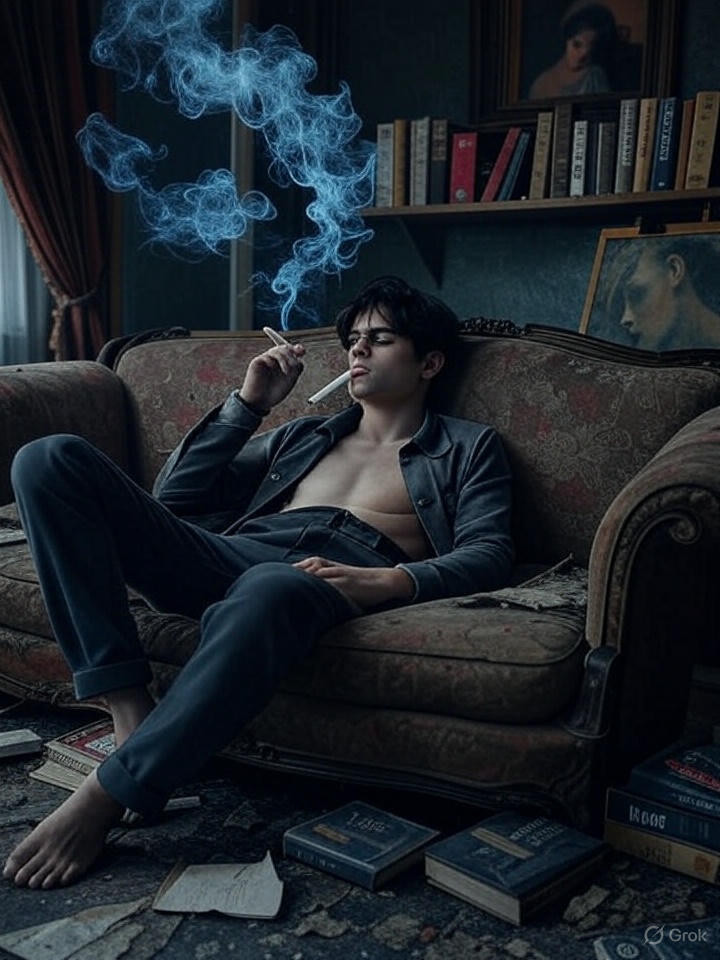

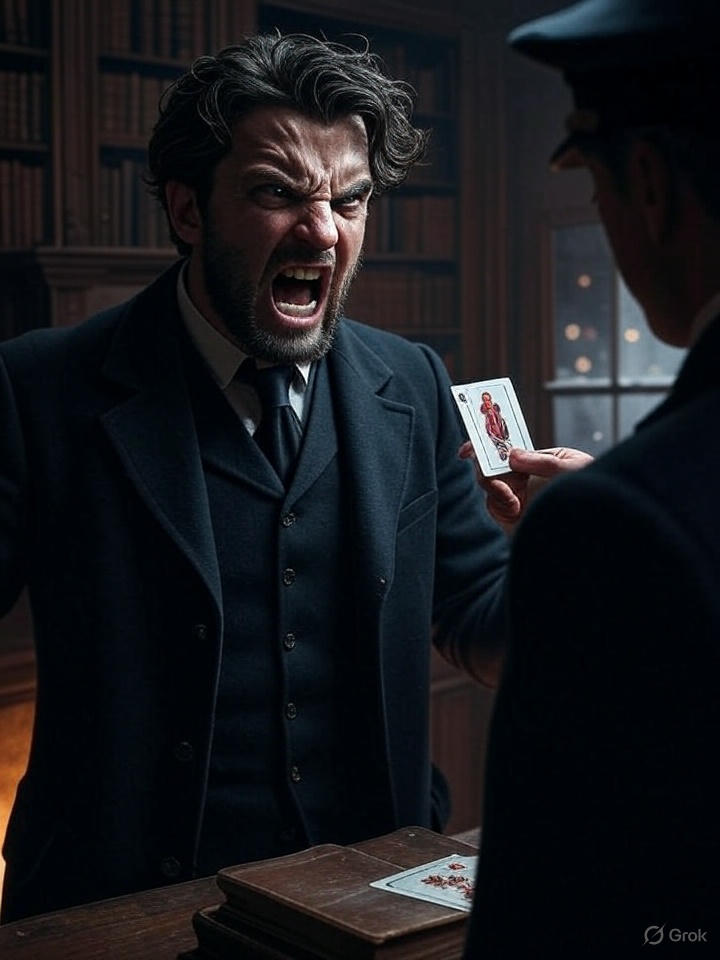
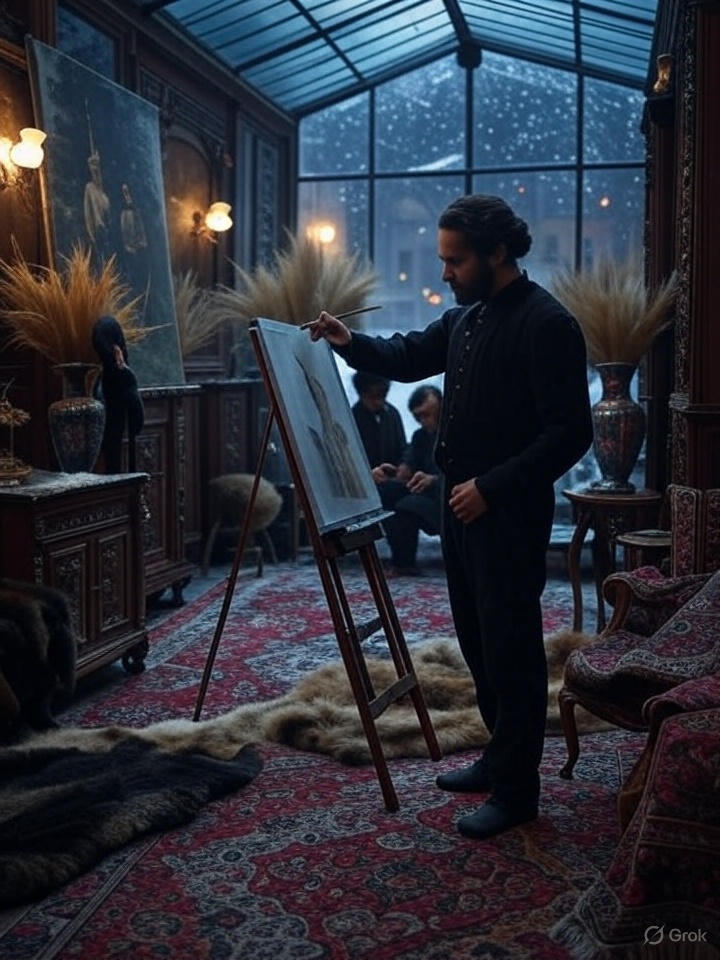


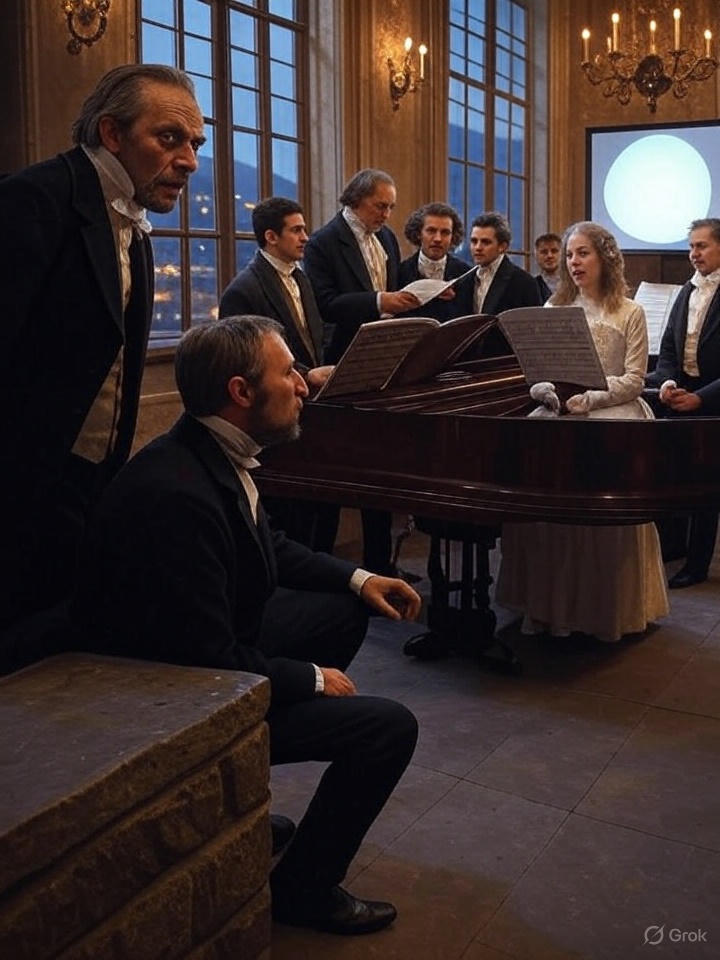
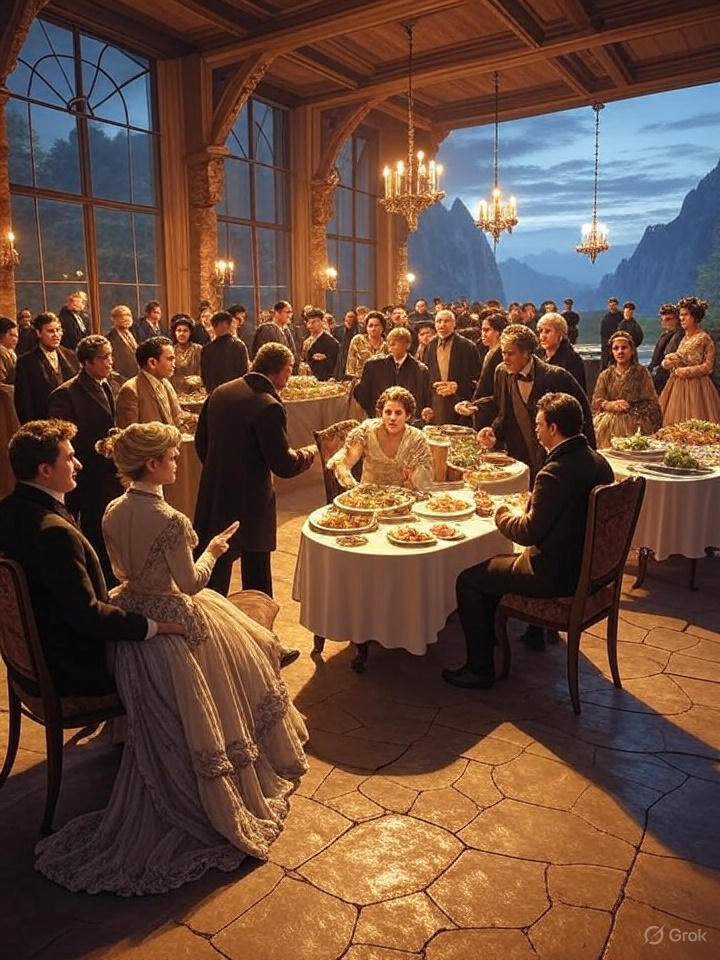
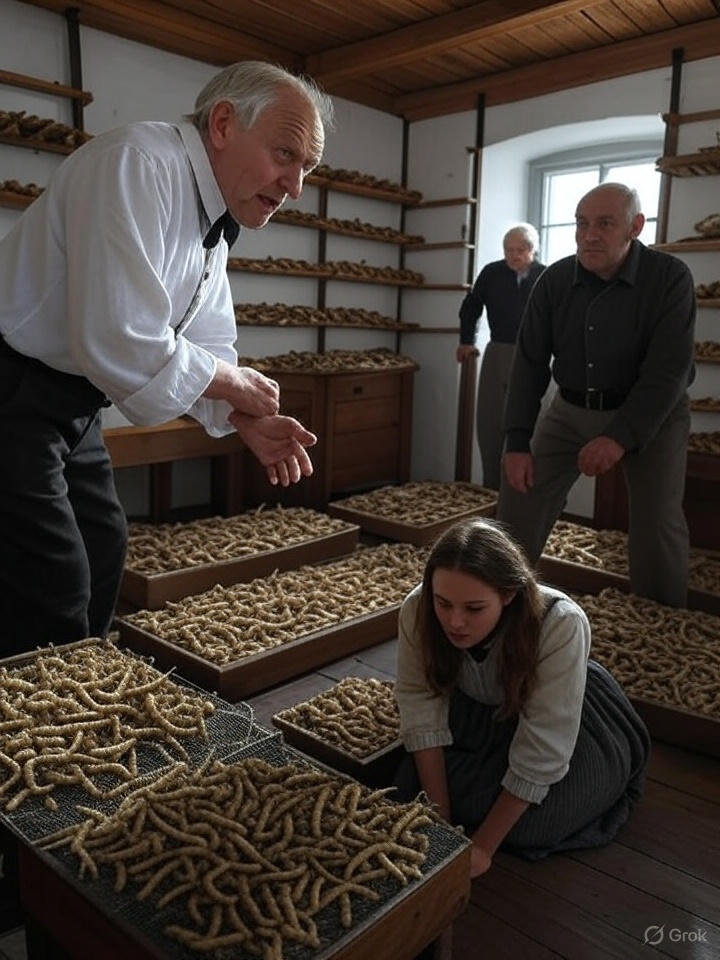


 Anarchistbanjo's World