Feeds:
Posts
Comments

Posts Tagged ‘family’

The Rebirth of Melchior Dronte by Paul Busson and translated by Joe E Bandel

I did not answer, but inside the rage ate at me.
Then Diana jumped at my hand and grabbed it playfully
with her teeth, as if she wanted to make up with me. She
always did that when I scolded her or was otherwise in a bad
mood.
Then a sudden anger seized me, and I bent down for a
large stone. The dog believed, she was now going to play the
beloved game of fetch and crouched, whimpering with joy,
ready to jump. With all my might I threw the heavy, angular
stone at her and hit her in the ribs with a dull sound.
The bitch fell, emitted a howling, high-pitched scream,
and then wailed in shrill tones, unable to rise, her pitiful,
horrified gaze fixed on me.
“Die, you bitch,” I screamed and lowered my hand.
Phoebus and Thilo, who were to blame for this,
immediately drew back from me.
“Your father’s best and perforce trained bird-dog -” said
Sassen, and the other added that crudeness against a noble
animal was unworthy of a Nobleman.
The bitch tried to get up, collapsed and came up again.
Hunched over and whimpering she crawled towards me, tried
to reach my hand with her red tongue to lick it.
“Come!” said Phoebus to Thilo, and walked with him,
walking away from me with obvious contempt.
Then I sat down between the vines and took the bitch’s
head in my lap. Blood flowed from her fine nose onto my light
robe. Her eyes were directed at me plaintively, begging for help.
Her body trembled, the little legs twitched as if in spasm.
Aglaja’s white hand had so often rested on the black silky
hair of the beautiful head.
“Diana!” I cried, “Diana!”
She pulled her lips from her white teeth. She laughed in
this way. Once again she tried to lick my hand. Then in her
eyes came a green, glassy glow, her body convulsed.
I stroked her in deathly agony, calling, coaxing — she no
longer moved. A blood bubble stood motionless in front of her
nose. No more breath came —
“This beast will bring her lament before God on the Last
Day, and God will also give her His justice, like any other
creature”, a deep voice spoke.
I looked around with veiled eyes.
The old tusker was standing next to me, and the sun
wove a terrible golden glow around his snow-white head.

My father had returned from the hunt and went with
ringing spurs up and down in the room. The floor creaked
under his riding boots. I looked steadfastly at his green coat
with the silver braid. When he turned around, I saw the tightly
twisted braid. This braid was merciless, black, stiff, insensitive,
a symbol of his nature.
“Lout, pray!” he thundered again. “You have dared, in
front of the street rabble, to hit Phöbus Merentheim in the face,
to the amusement of the scum of craftsmen and other fellows?
Hey?”
“He said that my mother, before her marriage, was bed
warmer to the Duke of Stoll-Wessenburg,” I blurted out and
looked my father in the eye.
“You don’t hear and listen to that kind of thing,” hissed
my father and became dark red in the face. “And remember: Do
not disgrace princely blood! You will ask the young Count
Merentheim for forgiveness, lad!”
I did not understand him. Was he serious?
“Answer me,” he cried.
“Never,” I said, “I will not.”
“Damn dog! Swine! So I’ve got problems again with
another of the duke’s huntsmen, and I can wipe my mouth. I
need the intercession of old Merentheim, you wretched knave.
Do you understand me now? Will you or will you not?”
“No.”
He raised his hand, but lowered it again. With a heavy
step he left the room. In the afternoon he sent for me. He sat in
the same chair in which grandfather had died, and next to him
on the table was a half-empty wine bottle. The room was blue
with tobacco smoke.
“Stand here,” he said, pointing in front of him.
“Tomorrow I’ll send you to high school, so you’ll be out of my
sight. And so that you know the truth, whether your mother
was once the mistress of the noble lord, I don’t know. But in
any case, she has given this property to me. Whether you come
from my loins or from those of Serenissimi or whether even
that windbag of court poets in one of the duke’s Venetian
overnight parties – that scribbler whom Heist later shot down in
a duel, only God knows. I almost want to believe the latter, for
from a true and right nobleman you have nothing in you of the
old bread and butter.
Now you know what Merentheim wanted to rub your
nose in. You may have that in you. Process as you wish. I have
nothing for sentiments. Everything is as it is, and nothing can
be dismissed. The Jew Lewi will give you the money for
school every month; there is nothing more, now or ever. If you
go to the dogs through partying and drunkenness, like many a
nobleman, I or Serenissimus or the hunted down court poet had
a son. You can save yourself the trouble of writing because I
don’t read letters and other written or printed stuff, although I
once learned to do so. If you come back to me as a real cavalier,
then I will assume that you are from my seed. And now troll
yourself away!”
I wanted to say something, but the words died on my lips.
Slowly I turned around.
A glass flew after me, smashing against the wall. Angrily,
my father shook his fist at me as I looked around once more,
and in his eyes there were bloody red veins.
Below, old Stephan stood and muttered:
“Don’t believe a word the Herr Junker says! Your mother
was a saint and is enthroned in God’s countenance!”
Then I fell around the neck of the faithful servant and
cried out for my mother as if I could call her from the grave.

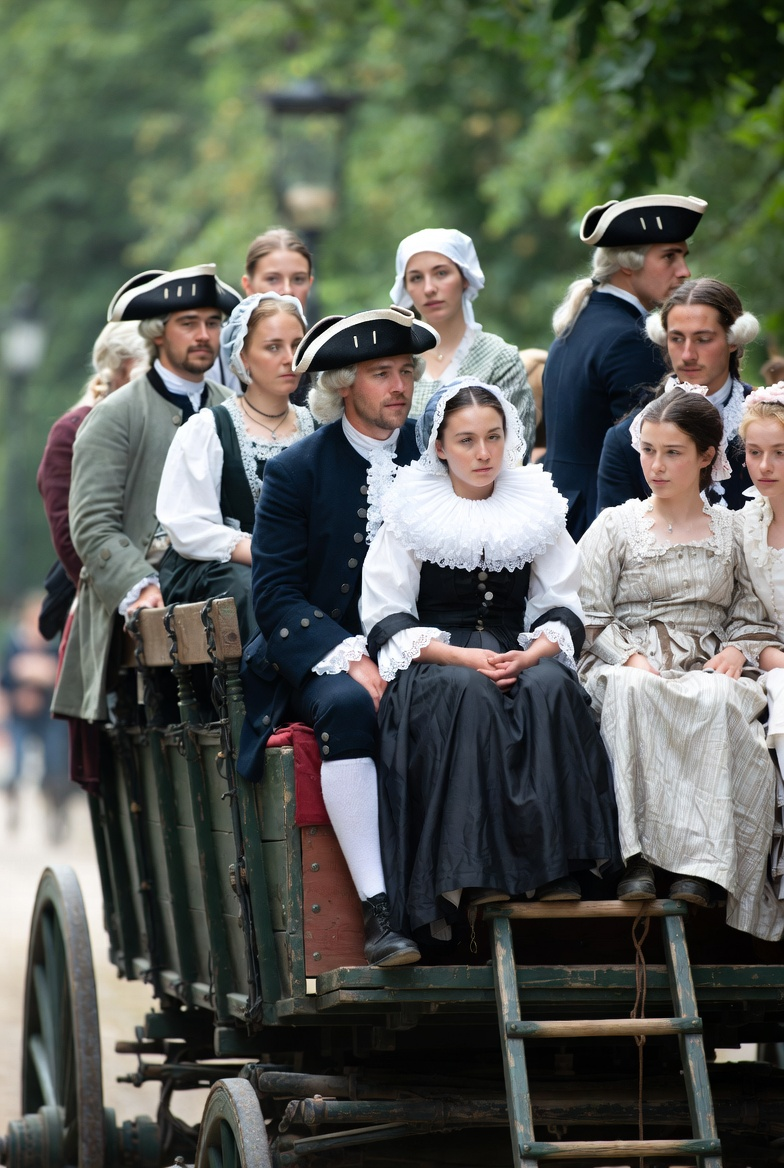
It was a tedious journey.
Every quarter of an hour we had to get off the stagecoach
at the behest of the driver and push and clean the wheels with a
mud knife. The horses trembled and snorted, and their flanks
were covered with foam. And once we had to chuck our
suitcases and travel bags and then lift them back onto the roof
and tie them up again.
With me rode one, who was from Austria, was called
Matthias Finch and seemed to be a cheerful man of good
manners. His clothes and linen pointed to a son from a decent
family. He was not a nobleman.
As we approached the city, the coach stopped in front of
an inn called “Zum Biersack”. We looked out the window on
both sides and noticed that the street was filled with chairs,
benches and a long table, at which sat a party of students,
looking wild and daring with greased boots, round spurs,
feathered hats, and swords. They sat quietly, smoking from
long lime pipes, spreading their legs and did not seem to be
willing to give way to the mail wagon on the army road.
A straggly half-grown thing with bobbing breasts under
the cloth ran between this table and the dirty inn, swapping the
empty pewter mugs for full ones and shrieking under the coarse
grips of the journeymen she had to pass.
The driver half turned with a grin and said:
“May it please the gentlemen to get off and allow
themselves to be welcomed?”
“Drive on!” urged Finch. “The road is clear!”
“What’s that stinkfox barking about?” rumbled a deep
bass voice from the table. The one who had shouted was as
bulky and thick as a six-bucket barrel, and his three fold
stubbly chin was resting on his badly smudged vest.
“Let it be, Montanus,” shouted a tree-tall man with
blonde hair and a sharp, crooked nose. “They’ll crawl out of the
burrow in time.”
Since we saw that nothing could be done with defiance
and pounding, and that the others were masters in such things,
we came out, but we had enough sense to order the driver to
take our travel belongings to the tanner Nunnemann, with
whom we had ordered lodging through the messenger.
We had hardly crawled out of the yellow box when they
also quickly moved the table to the side and told the driver to
put the steeds to the trot. He did not need to be told a second
time. But two of them took us under their arms and led us into
the interior of the house. There they pushed us up the stairs into
a long, low room. On a table covered with wet glass curls lay
an earthy, yellow skull, which looked as if they had just stolen
it from the charnel house, on two crossed swords. They
immediately lit two tallow candles in porcelain, placed us at
the narrow end of the table, themselves around the table with
their hats drawn, shook each other’s hands across the table and
sang in rough voices:
“The covenant is solemnly sealed
By the noble oath of allegiance,
Our hearts are unlocked
Strike only of true friendship.
This sword shall pierce
The one who leaves brothers in distress.
And, by this leg of the beast!
A thousand times he is threatened.”
When the song was over, Finch, who had looked at me
several times in amazement, spoke up and said:
“Gentlemen, forgive us if we would like to know in what
illustrious company we have unawares fallen into?”
“Insolent stink-fox,” belly-laughed the fat man again, the
one they had just called Montanus.
In the meantime they had put their hats back on, and I
saw that their plumes were carmine, yellow and blue, and the
blond one with the vulture nose had also put on a fox tail,
which gave him a wild appearance. At Finch’s speech, he
pulled his bat out of its scabbard and hit the table with it so
violently that it boomed and we were badly frightened.

Read Full Post »

The Rebirth of Melchior Dronte by Paul Busson and translated by Joe E Bandel

Then I screamed so loudly that my father let go of him.
“The toad can’t stand it, if I chastise the scoundrel,” he
said angrily, he will never be a right fellow in his day!”
Spurs clanking he went out. I was more afraid of this
clink than of anything else.
Then they gave me sweets and stroked me.
A young maid kissed my bare calves.
“Sweet boy!” she said.
In a mirror they showed me how a piece of glass had hit
me on the root of my nose and tore a small cut between my
eyebrows.
A scar remained from it.


I was playing in the garden with my little cousin Aglaja,
whom I loved very much. I had woven a wreath from black,
shiny ball berries, which I placed in her copper-colored hair,
which shone golden in the sun. She was the king’s daughter,
enchanted in thorny hedges, and I set out to save her. The
dragon that guarded her had to be played by black Diana. With
clever eyes the dog waited for the new game.
Then, accompanied by a maid, the barber came hurriedly
through the garden with a brass basin, and a servant appeared
at the door of the house, it was Stephan, who shouted at him to
hurry.
Aglaja threw her wreath of berries to the ground, and the
two of us both ran behind her to grandfather’s room,
which we were usually only allowed to enter with his special
permission. Such visits were always very solemn and only took
place on the big holidays of the year or on birthdays, when we
had to recite little poems and were given sweets in return.
It seemed to both of us a great dare, to go uninvited into
the room of the stern old man, but curiosity drove us forward.
Grandfather was sitting quietly in his sleeping chair. He
wore, as always, a gray-silk sleeve vest with embroidered
bouquets of roses, black pants, white stockings and shoes with
wide silver buckles. On his watch chain hung a bundle of
golden, colored and glittering things, cut things, cut gemstones,
corals and seals, which I had sometimes been allowed to play
with.
In front of him stood my father with bowed head and he
did not notice us children at all. When the gaunt barber, dressed
in a patched jacket stepped closer, he grabbed him by the arm,
his face turned red and he said half aloud:
“Next time run faster, damned Kujon, when you do him
the honor!”
The miserable barber stammered a little, and with his
hands flying grabbed his red bandages and switchblade, and
pushed grandfather’s sleeve up into the air, touched the eyelids
of the upturned eyes with his finger, then felt around on the
arm, while he held the basin under it. Thus he waited a while,
and then he said shyly:
“It is of no use, free- glorious graces – the blood will
never flow again!”
Then father turned around and stood with his face to the
wall. Stephan gently pushed Aglaja and me out the door and
whispered, “His Grace has gone to his fathers.”
And when we looked at him questioningly, since we
could not understand this, he said, “Your grandfather is dead.”
We went back into the garden and listened to the noise
that soon started in the house. To the right of the hallway was a
spacious room in which, as a very small child I remembered
seeing my mother being laid out between many candles. This
chamber, in which otherwise all sorts of equipment stood, they
now cleared out and dragged in large bales of black cloth,
which smelled nasty.
Grandfather had preferred Aglaja to me, and had given
her treats and candy more often than he had given to me. He
had kept these good things in a turtle box, which smelled of
cinnamon and nutmeg. She cried a little, Aglaja, because she
was thinking that it would all be over now, when grandfather
would go away. But then we both remembered the other box he
had, which we were only allowed to look at very rarely. That
was his golden snuff box, given to him by the Duke of
Brunswick. But on this beautiful, sparkling box, on its lid, there
was a second little lid and when this popped open, a very small
bird appeared, flashing with green, red and violet stones, which
bobbed with the wings and trilled like a nightingale. We could
hardly get enough of seeing and hearing it, but grandfather
slipped it into his pocket as soon as, after a short while, the lid
closed by itself, and told us to be satisfied.
I said to Aglaja that now we could look closely at the bird
and even feel it, since grandfather was dead. She was afraid to
go up, but I took her by the hand and pulled her behind me.
No one was in the corridor, and the room was empty.
Empty stood the wide armchair in which grandfather had spent
his last nights. On the little table next to it were still the bottles
with the long notes.
We knew that grandfather had always taken the can from
the middle drawer. This drawer was made of colored wood
decorated with ships, cities and warriors from the old times and
on the drawer, which we tried to open, there were two fat
Dutchmen who were smoking pipes and being served by
kneeling Moors. I pulled at the rings; but not until Aglaja
helped me, did we manage to open the drawer.
There lay Grandfather’s lace jabots and handkerchiefs, a
roll of gold ducats, a large pistol inlaid with gold, and many
letters in bundles, shoe buckles and razors, and also the box
with the bird.
I took it out, and we tried to make the lid jump. But we
did not succeed. But while we were working around, the big lid
came off, and a thin plate detached itself from it, which
concealed something. It was a small picture, which was painted
in fine enamel colors. A picture which made us forget the little
bird completely.
On a small sofa lay a lady with her skirts pushed up, and
right next to her was a gentleman with sword and wig, whose
clothes were also in strange disorder. They were doing
something that seemed to us as strange as it was weird. In
addition, the man was being attacked by a little spotted dog,
and the lady lying down seemed to laugh. We also laughed. But
then we argued very excitedly about what this was.
“They are married,” said Aglaja, blushing.
“How do you know?” I asked, my heart pounding hard.
“I think they are gods…” whispered Aglaja.
“I saw a picture, where the gods were like that. But they
didn’t have any clothes on.”
All of a sudden it was as if in the next room where our
dead grandfather lay, the floorboard creaked. We shrunk back,
and Aglaja cried out. Then I quickly threw the can into the
drawer, pushed it closed and pulled my cousin out of the room.
We slid into the garden.
“Aglaja…” I said, grabbing her hand. “Are we going to
get married like that…?”
She looked at me, startled, tore herself away and ran back
into the house. Confused and bewildered I went to Stephan,
who was cutting roses from the stalks and gathering them in a
basket.
“Yes, young Herr!” he said. “So it goes with all of us!”

Next to me sat Phöbus Merentheim and Thilo Sassen. We
three were the most distinguished. Behind us squatted Klaus
Jägerle, the whipping boy. He was allowed to study with us,
was given food, and if we didn’t know something, punishment
was carried out on him. His mother was a washerwoman and
his father wove baskets, although he only had one arm. The
other arm was cut by an enemy horseman, when he was
protecting Thilo’s severely wounded father with his body. In
return Klaus was allowed to study with us and to come to the
table at noon. Klaus was very industrious, shy and depressed,
and had to put up with everything that his classmates cooked
up when they were in an exuberant mood. He was almost
worse off than the hunchback son of the grocer Isaaksohn, they
had once put him at the door and spat in his face one after the
other, so that the disgusting juice, mixed with his tears, ran
down his new gentleman’s sport coat.
I was in great fear because I had learned nothing. For
before me stood the small, poisonous teacher of French in his
inky, tobacco-colored jacket with the bent lead buttons, the
goose quill behind his ear, talking through his Spaniol-filled
nose. His pale face was full of freckles and twitched incessantly.
In his left hand he held a book, and he waved the black-rimmed
knotted index finger of his right hand in front of my face.
He always did it that way. All of a sudden, after he had
studied our faces maliciously for a while, he would go after one
of the students like a vulture and always found the most
insecure out. It was his habit, to vocabulaire at the beginning of
the lesson, that is to say, he threw a few French words in the
victim’s face, which had to be translated immediately.
This time he had chosen me.
“Allons, monsieur-,” he hissed. “Emouchoir-. Tonte-
Mean. – At once! Quickly!”
I was startled and stammered:
“Emouchoir – the fly tonguing, tonte – the Sheep shearing – mean… mean, that is – that is -“
He neighed with delight.
“Ah – you don’t know, Cher Baron?”
“Mean -, that is –“
“Assez! Sit down!”
He bleated, and his little black eyes sparkled with
amusement. Slowly he took a pinch from his round horn can,
ran back and forth with two fingers under his pointed nose and
then poked the can at my neighbor.
“Herr Sassen! – Not either? – Merentheim? Also not? –
Jägerle, stand up and say it!”
Poor Klaus jumped up as if like a feather and said in a thin
voice:

Read Full Post »

Alraune by Hanns Heinz Ewers and translated by Joe E Bandel

Chapter Fourteen
Describes how Frank Braun played with fire and how Alraune
awoke.

THAT evening the Fräulein didn’t come to dinner, only
allowed Frieda Gontram to bring in a little tea and a few
cakes. Frank Braun waited awhile for her, hoping that
perhaps later she would come down. Then he went to the
library and reluctantly took up the documents from the writing desk.
But he couldn’t bring himself to read them, put them down again and
decided to drive into the city.
Before he left he took the last little mementos from out of the
desk drawer, the piece of silk curtain cord, the card and four-leaf
clover with the bullet holes through them and finally the alraune
manikin. He packed everything together, sealed the brown paper
package and had it sent up to the Fräulein. He attached no written
explanation to it–
Everything would be explained to her inside the leather bound
volume that bore her initials.
Then he rang for the chauffeur and drove into the city. As he
expected, he met Herr Manasse in the little wine pub on Cathedral
Square. Stanislaus Schacht was with him. He sat down with them and
began to chat.
He got into a deep discussion with the attorney about legal
questions, debating the pros and cons of this and that lawsuit. They
decided to turn a few of the doubtful cases over to the Legal
Councilor for him alone. He would bring them to some acceptable
compromise. Manasse believed that a victorious settlement could be
reached with the others.
In some of the cases Frank Braun calmly suggested they simply
acknowledge the claim, but Manasse refused.
“Never acknowledge–even if the opponent’s demands are as
clear as day and justified a hundred-fold!”
He was the straightest and most honest attorney in the county
courthouse, one that always told his clients the truth, right to their
face. In front of the bar he might remain completely quiet but he
would never lie–and yet he was way too much a lawyer not to have an
innate hatred of recognizing an opponent’s claim.
“It only costs us more,” Frank Braun objected.
“So what!” barked the attorney. “What does that have to do with
it?–I tell you, one never knows–there is always a chance…”
“A legal one–perhaps–” answered Frank Braun. “–but–”
He fell silent. There was no other way for the attorney. The
Court determined justice–what ever it said was just, even how it
decided. Today it would be just–and totally different after a couple of
months in the higher courts. Nevertheless, the Court gave the final
decision and it was sacred–not the parties involved.
To recognize a claim yourself, without such a decision, was
usurping the right of the Court. As an attorney Manasse was partial to
his own clients. He desired the judge to be impartial, so it was an
abomination to him to make such a decision for his own party.
Frank Braun smiled.
“As you wish,” he said.
He spoke with Stanislaus Schacht, listened as this friend of Dr.
Mohnen talked of all the others that had been there as students with
him.
“Yes, Joseph Theyssen has been a Government Advisor for some
time now and Klingel Hőffer is a professor at Halle–he will be the
new chair for Anatomy, and Fritz langen–and Bastian–and–”
Frank Braun listened, turned the pages of this living directory of
German nobility that knew everyone.
“Are you still enrolled?” he asked.
Stanislaus fell silent, a little offended.
But the attorney barked, “What! Didn’t you know? He passed his
doctoral exam–five years ago.”
“Really–five years ago!”
Frank Braun calculated backward, that must have been in his
forty-fifth, no, forty-sixth semester.
“Well,” he said.
He stood up and reached out his hand, which the other heartily
shook.
“Allow me to congratulate you, Herr Doctor!” he continued.
“But–tell me–what are you doing now?”
“Yes, if he only knew!” cried the attorney.
Then chaplain Schrőder came. Frank Braun stood up to greet
him–
“Back in the country again?” cried the black suited priest. “We
must celebrate!”
“I am the host,” declared Stanislaus Schacht. “He must drink to
my doctor’s degree.”
“And with me to my newly becoming a vicar,” laughed the
priest. “Let’s share the honor then, if it’s alright with you, Dr.
Schacht.”
They agreed and the white haired vicar ordered a 93
Scharzhofberger, which the wine pub had placed in stock on his
recommendation. He tested the wine, nodded with satisfaction and
toasted with Frank Braun.
“You have it good,” he said, “sticking your nose into every
unknown place on land and sea. Yes, we can read about them in the
newspapers–but we must sit at home and console ourselves with the
fact that the Mosel still always produces a good wine–You certainly
can’t get this label out there!”
“We can get the label,” he said, “but not the wine– Now Herr
Reverend, what have you been up to?”
“What should I be up to?” replied the priest. “One just gets
themselves angry. Our old Rhine is always becoming more Prussian.
But for relaxation one can write rotten pieces for the Tűnnes,
Bestavader, Schâl, Speumanes and the Marizzebill. I have already
plundered Plautus and Terence in their entirety for Peter
Millowwitsch’s puppet theater in Cologne–Now I’m doing it to
Holberg. And just think, that fellow–Herr Director, he calls himself
today–now pays me royalties–Another one of those Prussian
inventions.”
“Be happy about it!” growled Attorney Manasse. “By the way,
he’s also published on Iamblicos.”
He turned to Frank Braun, “And I tell you, it is a very
exceptional book.”
“Not worth talking about,” cried the old vicar.
“Only a little attempt–”
Stanislaus Schacht interrupted him.
“Go on!” he said. “Your work lays out the foundation of the very
essence of the Alexandrian school. Your hypothesis about the
Emanation Doctrine of the Neo-Platonists–”
He went on, lecturing like an argumentative Bishop at the high
council. Here and there he made of few considerations, gave his
opinion, that it wasn’t right the author based his entire work on the
three cosmic principles that had been previously established. Couldn’t
he have just as well successfully included the ‘Spirit’ of Pophyrs?”
Manasse joined in and finally the vicar as well. They argued as if
there was nothing more important in the entire world than this strange
monism of Alexander, which was based on nothing other than a
mystical annihilation of self, of the “I”, through ecstasy, asceticism
and theurgy.
Frank Braun listened silently.
“This is Germany,” he thought. “This is my country–”
It occurred to him that a year ago he had been sitting in a bar
somewhere in Melbourne or Sidney–with him had been a Justice of
the Supreme Court, a Bishop of the High Church and a famous doctor.
They had disputed and argued no less ardently than these three that
were now sitting with him–But it had been about whom was the better
boxer, Jimmy Walsh of Tasmania or slender Fred Costa, the
champion of New-South Wales.
But here sat a little attorney, who was still being passed over for
promotion to Legal Councilor, a priest that wrote foolish pieces for a
puppet theater, that had a few titles of his own, but never a parish, and
finally the eternal student Stanislaus Schacht, who after some fourteen
years was happy to have his doctor’s degree and now didn’t know
what to do with himself.
And these three little poor wretches spoke about the most
abstract, far-fetched things that had nothing at all to do with their
occupations. And they spoke so easily, with the same familiarity as
the gentlemen in Melbourne had conversed about a boxing match. Oh,
you could sift through all of America and Australia, even nine-tenths
of Europe–and you would not find such an abundance of knowledge–
only–it was dead.
He sighed, it was long dead and reeked of decay–really, the
gentlemen didn’t even notice!
He asked the vicar how it was going with his foster son, young
Gontram. Immediately Attorney Manasse interrupted himself.
“Yes, tell us Herr Reverend–that’s why I came here. What does
he write?”
Vicar Schröder unbuttoned his jacket, pulled out his wallet and
took a letter out of it.
“Here, read for yourself,” he said. “It doesn’t sound very
encouraging!”
He handed the envelope to the attorney. Frank Braun threw a
quick glance at the postmark.
“From Davos?” he asked. “Did he inherit his mother’s fate as
well?”
“Unfortunately,” sighed the old priest. “And he was such a fresh,
good boy, that Josef, absolutely not meant for the priesthood though.
God only knows what he would have studied, or I would have
allowed him to study if I didn’t wear the black robe. But I promised
his mother on her deathbed. By the way, he has already gone as far in
his studies as I have–I tell you–he passed his doctoral exam–summa
cum laude! I obtained a special dispensation for him through the
ArchBishop, who has always been very benevolent towards me
personally.
He helped me a lot with the work about Iamblichos–yes, he
could really become something! Only–unfortunately–”
He hesitated and slowly emptied his glass.
“Did it come so suddenly, Herr Reverend?” asked Frank Braun.
“You could say that,” answered the priest. “It first started with
the psychological shock of the sudden death of his brother, Wolf. You
should have seen him outside, at the cemetery. He never moved from
my side while I gave my sermon, stared at the enormous garland of
blood red roses that lay on the coffin. He held himself upright until
the ceremony was ended, but then he felt so weak that Schacht and I
had to downright carry him.
In the carriage he seemed better, but at home with me he once
more became entirely apathetic–The only thing I could get out of him
at all that entire evening was that now he was the last of the Gontram
boys and it was his turn next. This apathy would not yield and from
that hour he remained convinced that his days were numbered, even
though a very thorough medical examination gave me a lot of hope in
the beginning. But then it went rapidly. From day to day you could
see his decline–now we have sent him to Davos–but it appears that his
song will soon be over.”
He fell silent, fat tears stood in his eyes–
“His mother was tougher,” growled the attorney. “She laughed in
the Reaper’s face for six long years.”
“God grant her soul eternal peace,” said the vicar and he filled
the glasses. “We will drink a silent toast to her–in her memory.”
They raised the glasses and emptied them.
“The old Legal Councilor will soon be entirely alone,” observed
Dr. Schacht. “Only his daughter appears to be completely healthy–
She is the only one that will survive him.”
“The attorney grumbled, “Frieda?–No, I don’t believe it.”
“And why not?” asked Frank Braun.
“Because–because–” he began, “–well, why shouldn’t I say it?”
He looked straight at Frank Braun, cutting, enraged, as if he
wanted to take him by the throat.
“You want to know why Frieda Gontram will never grow old?–I
will tell you. Because she is now completely caught in the claws–of
that damned witch out there!–That’s why–Now you know!”
“Witch,” thought Frank Braun. “He calls her a witch, just like
Uncle Jakob did in his leather bound volume.”
“What do you mean by that, Herr Attorney?” he asked.
Manasse barked, “Exactly what I said. “Whoever gets to close to
the Fräulein ten Brinken–gets stuck, like a fly in syrup. And whoever
is once caught by her–stays there and no amount of struggling will do
any good!
Be careful, Herr Doctor, I’m warning you! It is thankless
enough–to give warnings like this. I have already done it once–
without any success–with Wölfchen–now it is you–flee while there is
still time. What do you still want here?–It seems to me exactly as if
you are already licking at the honey!”
Frank Braun laughed–but it sounded a little forced.
“Have no fear on my account, Herr Attorney,” he cried–But he
didn’t convince the other–and even less, himself.
They sat and drank, drank to Schacht’s doctoral degree and to the
Priest’s becoming a vicar. They drank as well to the health of Karl
Mohnen, of whom no one had heard since he had left the city.
“He is lost,” said Stanislaus Schacht.
Then he became sentimental and sang melancholy songs. Frank
Braun took his leave, went out on foot back to Lendenich–through the
fragrant trees of spring – like in the old times.
He came across the courtyard, then saw a light in the library. He
went in–Alraune sat on the divan.
“You here, little cousin?” he greeted.
She didn’t answer, waved to him to take a place. He sat across
from her, waiting. But she remained silent and he didn’t press her.
Finally she said, “I wanted to speak with you.”

Read Full Post »

Madame Bluebeard by Karl Hans Strobl and translated by Joe E Bandel

Schiereisen stood. His gaze caught a mark. At
head height, on the dust layer, was a tiny rust-red
splash—a crusted fleck of liquid-mixed dust, a sign
that erased all doubt.
“Who found the victim?” Schiereisen asked.
Ruprecht’s eyes now questioned too. His body began
to obey a will again. “We have an old woman in the
castle. She’s not quite right in the head. Early
mornings, she goes to church. On her way, she found
Jana.”
“He was already dead?”
“Yes.” Ruprecht’s gaze no longer dropped; it
searched intently.
“Who was second to him?”
“My valet, Lorenz.”
“Right—let’s go down,” Schiereisen said. Lorenz
and the overseer stood in the courtyard as Boschan
and his guest passed. They’d been discussing Jana.
The overseer pitied him: a quiet, gentle man who
bothered no one. Easy to like, despite being a
heathen. Village girls had chased him like mad.
Once, the overseer found him in the garden, staring
silently, tracing signs on a stone with brown fingers,
as if writing.
“I think he longed for his homeland,” Lorenz said.
“Poor fellow! Well, he’s found rest and peace now.”
They fell silent, straightening as the master
passed.
“Who’s that man?” the overseer asked.
“A scholar. Someone who wants to know
everything that’s none of his business.”
“A halfwit, then,” the overseer chuckled. Lorenz
found Schiereisen’s curiosity grating. Boschan and
the scholar entered the garden.
“Aha, he wants to see where Jana fell,” the
overseer said. Beneath the wooden gallery, between
tower and castle, a broad paved path led to a hidden
garden shed storing tools. Jana had fallen onto these
stones. Schiereisen gauged the height—not so great
that a fall should kill. The blood had been washed
away, but traces lingered in the stone joints. The
grass on either side was heavily trampled. Beyond,
primroses and crocuses bloomed, then dense rose
hedges hinted at early buds.
Schiereisen scanned it all with rapid, tense
glances. Then Ruprecht saw his expression shift—the
scholar looked horrified, grieved, wretched, like a
man facing the unbearable. “No,” he said, “it’s awful,
I can’t bear it… ghastly. Come away.” He tugged
Ruprecht’s arm, pulling him along.
Schiereisen had noticed a watcher. Lorenz stood at
the low wall separating garden from courtyard,
looking over. Now he turned slowly, crossing the
courtyard as if chance had brought him there. No,
Lorenz thought smugly, this man’s no iron—he’s an
old woman, like all scholars, like Dankwardt was.
At the main wing’s entrance, Ruprecht paused,
expecting Schiereisen to leave. But he re-entered,
leading Ruprecht to his study. Sitting opposite in the
Renaissance chair, Schiereisen resumed questioning.
“Tell me, Herr Baron, where are the… rotten
planks that broke with Jana?”
Ruprecht pondered before answering. His
alertness stirred, his body’s weakness overcome by a
forceful rally of will, refusing defeat. He decided to
respond, to see where Schiereisen’s questions led.
“The planks? They were cleared away… I think
Lorenz removed them. He was there soon after the
accident was found…”
“So the commission didn’t see those damaged
planks?”
“Likely not.”
“Don’t you think that hurt the investigation’s
thoroughness? How could the commission determine
how an accident occurred—or if it was an accident—
without all the evidence?”
Ruprecht said slowly, firmly, “No one doubted it
was an accident.”
“Well, I mean… in general. Another thing matters
here… didn’t any commission member ask what your
servant was doing on the gallery at night? You sent
him there, perhaps…?”
“No, I didn’t send him.”
“That’s odd, isn’t it? What was Jana doing up
there? His room was on the ground floor, like the
other servants. Doesn’t one ask what drew him there?
He dies at night on a gallery linking an empty wing to
a tower ruin. Other details were overlooked. Did Jana
have a light? Is it likely he went in the dark? If so,
why? To avoid being seen? Or, if he had a light,
where was it found?”
“I don’t know.”
“Finally: when did Jana die? On his way there or
back? Had he been in the tower, or was he going to
it?”
Ruprecht shrugged.
Schiereisen faced an impenetrable wall. Was
Ruprecht so utterly blind, so wholly innocent and
trusting, that he couldn’t grasp the suspicion
Schiereisen had brought so close? These were
questions anyone would notice. Or did he refuse to
know, to see, to suspect? What drove him, then?
He fell silent for a long time, and Ruprecht didn’t
break the quiet. His head drooped forward again.
Schiereisen saw the reddened patch on his crown, the
wilted, singed hairs.
“Listen, Herr Baron,” he said suddenly, “you’re
ill.”
Startled, Ruprecht lifted his head. Then he
managed a smile. “You’re mistaken… I’m not ill.”
Undeterred, Schiereisen pressed on. “You’re ill.
You just won’t admit it. Your whole mood, the
fatigue you can’t hide… this listlessness… You
should see a doctor…”
“I’m not ill. I don’t need a doctor.”
“Follow my advice, dear Baron, see a doctor. All
sick people are stubborn. They reject help.”
Schiereisen leaned forward, locking eyes with
Ruprecht, stressing each word. “Until—it’s—
sometimes—too—late.”
“I’m telling you, I won’t hear of a doctor.”
“Forgive me, but I must say: it’s not a sign of
refinement to fear a doctor. Children and peasants
flee at the word. What’s the harm? What’ll happen?
He’ll examine you. He’ll either find you healthy, or,
if you’re ill, tell you how to recover. Maybe just
prescribe a diet. A proper diet works wonders. Aren’t
you careful enough with your food?”
In that moment, a mysterious connection formed.
Their gazes merged. Ruprecht understood—this was
Schiereisen’s aim. Schiereisen felt he was finally
understood. For a second, their inner rhythms aligned
perfectly.
“Yes,” Ruprecht said after a pause, “I eat
whatever’s on the table… when I have an appetite.
The same as everyone else,” he added. “I don’t think
a special diet’s necessary.”
Ah—he was slipping away again. But Schiereisen
pursued relentlessly. “Yet your condition’s
concerning. Perhaps it’s a severe nervous disorder.
Your servant’s death has shaken you. A doctor might
suggest a short trip. That’d do you good. You used to
spend most of the year traveling. Now you’re stuck
here. Leave your duties as husband and farmer for a
bit. A few weeks away from Vorderschluder would
help.”
Ruprecht parried with a smile. “I’ve taken on
much here that I must see through. I can’t do half a
job.”
“But, my God, dear Baron, I know you’re very
nervous. You took a separate bedroom for that
reason.”
“Yes—that’s true. I didn’t want to disturb my
wife. But don’t draw conclusions about my health.
I’ll overcome it soon.”
Schiereisen propped his head on his hand. Beneath
his furrowed brow, shrewd eyes peered. “Tell me,
Baron, which room did you choose for sleeping?”
Puzzled, Ruprecht stared at the scholar. The
question’s purpose wasn’t clear at first. Hesitantly, he
answered, “A room on this floor. The last one in the
left corridor.”
Schiereisen nodded thoughtfully. “That’s good. A
quiet room. You won’t be disturbed there.”
“What do you mean?”
“Well… your castle’s full of hidden romance.
Vorderschluder’s a model of it. So many secret doors
and passages. But your bedroom has none of that. It’s
enclosed by four solid walls.”
Ruprecht’s astonishment broke through his calm.
“How do you know that?” he asked sharply.
“Simple. I found a book in your library describing
it all. A fascinating book, I tell you. I could sketch
the castle’s layout from memory. I know my way
around. For instance, I know one can reach the
wooden gallery where Jana died through hidden
routes from your valet Lorenz’s room.”
“You study such things too?”
“What can I say?” Schiereisen smiled. “One has
antiquarian quirks. Back to your bedroom, a veritable
fortress, it’s ideal for restful sleep, as I said. Still,
don’t neglect the small things. Every detail matters.
The bed should stand free in the room. It’s a bad
habit to push it against a wall. And the bed itself… it
must be flawless. I’d prefer if you’d let me inspect
your bedroom. I’m an expert in these matters. When
you need sleep as much as I do, you learn to mind
everything… you build practical wisdom…”
“Thank you,” Ruprecht replied, “but I won’t
trouble you. No, no, that’s too much… a Celt-chasing
scholar as a chambermaid! You forget I lived years in
wild places, always my own servant. I’m used to
checking carefully before I sleep.”
Schiereisen bowed and rose. “I won’t keep you,
Baron! But allow me to continue my studies in your
library.”
“I’m not sure I’d wish you to finish your studies
soon. That’d rob me of company I’ve come to value.”
As Schiereisen descended the stairs, Frau Helmina
approached, fresh from the tennis court by the paper
factory, where she’d played with the clerks. She
radiated the vigor of healthy exertion. Schiereisen
paused, doffing his hat. His face wore the shy
geniality of a scholar. He mumbled condolences for
the tragedy. Helmina looked startled, then said, “Oh,
yes, Jana…” offering her fingertips. A urge seized
him to crush those slender fingers, but he restrained
himself, looking sadder, shaking his head, and
walking off wordlessly. He was a detached scholar,
unaware a servant’s death isn’t a family mourning.
Between newly greened chestnut trees, he strode
down the castle hill, crossing the bridge with its
baroque saints to the graveyard, to view Jana’s body
in the mortuary.

Read Full Post »

Alraune by Hanns Heinz Ewers and translated by Joe E Bandel

Wölfchen stared at it, fat tears running down his cheeks. But he
lit another cigarette when the first one burned down, removed the stub
from the frog’s throat and with shaking fingers pushed the fresh one
back into its mouth. The frog swelled up monstrously, quivering in
agony, its eyes popping out of their sockets. It was a strong animal
and endured two and a half cigarettes before it exploded.
The youth screamed in misery as if his own pain were much
greater than that of the animal he had just tortured to death. He sprang
back as if he wanted to run away into the bushes, looked around and
then quickly ran back when he saw that the torn body of the frog was
still moving. Wild and despairing he crushed it to death with his heel
to free it from its misery.
The Privy Councilor took him by the ear and searched his
pockets. He found a few more cigarettes and the boy confessed to
taking them from the writing desk in the library. But he could not be
moved to tell how he had known that smoking frogs would inflate
themselves until they finally explode. No amount of urging worked
and the rich beating that the professor gave him through the garden
didn’t help either. He remained silent.
Alraune stubbornly denied everything as well even after one of
the maids declared she had seen the child taking the cigarettes.
Despite everything they both stuck to their stories; the boy, that he
had stolen the cigarettes and the girl, that she had not done anything.
Alraune stayed at the convent for one more year. Then in the
middle of the school year she was sent home and certainly this time
unjustly. Only the superstitious sisters believed that she was guilty
and just maybe the Privy Councilor suspected it a little as well. But no
reasonable person would have.
Once before illness had broken out at Sacré Couer, that time it
had been the measles and fifty-seven little girls lay sick in their beds.
Only a few like Alraune ran around healthy. But this time it was much
worse. It was a typhoid epidemic. Eight children and one nun died.
Almost all of the others became sick.
But Alraune ten Brinken had never been so healthy. During this
time she put on weight, positively blossomed and gaily ran around
through all the sick rooms. No one troubled themselves over her
during these weeks as she ran up and down the stairs, sat on all the
beds and told the children that they were going to die the next day and
go to hell. While she, Alraune would continue to live and go to
heaven.
She gave away all of her pictures of the saints telling the sick
girls that they could diligently pray to the Madonna and to the sacred
heart of Jesus–but it wouldn’t do them any good. They would still
heartily burn and roast–It was simply amazing how vividly she could
describe these torments. Sometimes when she was in a good mood
she would be generous. Then she would promise them only a hundred
thousand years in purgatory. That was bad enough for the minds of
the pious sick little girls.
The doctor finally unceremoniously threw Alraune out of the
rooms. The sisters were absolutely convinced that she had brought the
illness into the convent and sent her head over heels back home.
The professor was tickled and laughed over this report. He
became a little more serious when shortly after the child’s arrival two
of his maids contracted typhus and both soon died in the hospital.
He wrote an angry letter to the supervisor of the convent and
complained bitterly that under the existing circumstances they should
have never sent the little one back home. He refused to pay the tuition
payment for the last half of the year and energetically insisted that he
be reimbursed for the monies he had put out for his two sick maids–
From a sanitary point of view the sisters should not have been
permitted to act as they had done.
His Excellency ten Brinken did not handle things much
differently. While he was not exactly afraid of contagion, like all
doctors he would much rather observe illness in others than in his
own body. He let Alraune stay in Lendenich only until he found a
good finishing school in the city. By the fourth day he had already
sent her to Spa, to the illustrious Institute of Mlle. de Vynteelen.
Silent Aloys had to escort her. As far as the child was concerned
the trip went without incident but he did have two little incidents to
report. On the train trip there he had found a pocket book with several
pieces of silver and on the trip back home he had slammed his finger
in the compartment door of the car he was riding in. The Privy
Councilor nodded in satisfaction at Aloy’s report.
The Head Mistress was Fräulein Becker who had grown up in
the University City on the Rhine and always went back there on her
vacations. She had much to relate to the Privy Councilor over the
years that Alraune stayed with her.
Right from the first day that Alraune arrived in the ancient
building on Marteau Avenue her dominion began and it was not only
imposed on her schoolmates. It was also imposed on the instructors,
most especially over the Miss, who after only a few weeks had
become a plaything for the absurd moods of the little girl, without any
will of her own.
At breakfast on that very first day Alraune declared that she
didn’t like honey and marmalade and much more preferred butter.
Naturally Mlle. de Vynteelen didn’t give her any. It was only a few
days until several of the other girls began to crave butter as well.
Finally a large cry for butter went up throughout the entire Institute.
Even Miss Paterson, who had never in her life enjoyed anything
with her morning tea other than toast with jam suddenly felt an
uncontrollable desire for butter. So the principal had been obliged to
give in to the demand for butter but on that very same day Alraune
acquired a preference for orange marmalade.
In response to the Privy Councilor’s pointed question Fräulein
Becker declared that the torturing of animals never came up during
those years at the Vynteelen School. At least no incidents had ever
been discovered. On the other hand, Alraune had made the lives of the
other children miserable as well as those of all the instructors, both
male and female.
Especially the poor music instructor who always placed his
snuffbox on the mantel in the hall during class so he would not be
tempted to use it. From the moment of Alraune’s entrance into the
school the most remarkable things had been found in it. For example,
thick spider webs, wood lice, gunpowder, pepper, writing sand black
with ink and once even a chopped up millipede. Several girls were
caught doing it and punished–but never Alraune.
Yet she always showed a passive resistance toward the musician,
never practiced and during class laid her hands in her lap and never
raised them to play an instrument. But when the professor finally
complained in despair to the principal Alraune quietly declared that
the old man was lying. At that point Mlle. de Vynteelen personally
attended the next hour and saw that the little girl knew her lesson
exquisitely, could play better than any of the others and showed a
remarkable talent.
The Head Mistress reproached the music instructor heavily. He
stood there speechless and could say nothing other than, “But it is
incredible, incredible!”
From then on the little schoolgirls only called him “Monsieur
Incredible”. They called after him whenever they saw him and
pronounced the words like he did, as if they didn’t have any teeth in
their mouths either.
As for the Miss, she scarcely ever experienced a quiet day. New
stupid pranks were always being played on her. They sprinkled itch
powder in her bed and one time after a picnic placed a half dozen
fleas in it. Then the key to her wardrobe was missing, then the hooks
and eyelets were torn from the dress that she wanted to wear. Once as
she was going to bed she was almost frightened to death by an
effervescent powder reaction in her chamber pot. Another time so
many stinging insects flew through her open window that she
screamed out for help. Then the chair she sat on was smeared with
paint or with glue or she found a dead mouse or an old chicken head
in her pocket.
And so it merrily continued, the poor Miss could hardly enjoy an
hour of her life. Investigations took place and those girls found guilty
were always punished but it was never determined to be Alraune even
though everyone was convinced that she was the mastermind behind
all the pranks.
The only one that angrily rejected this suspicion was the English
woman herself. She swore the girl was innocent up until the day she
left the de Vynteelen Institute.
“This hell,” she said, “only shelters one sweet little angel.”
The Privy Councilor grinned as he noted in the leather volume,
“That sweet little angel is Alraune.”
As for herself, Fräulein Becker related to the Professor that she
had avoided coming into contact with the strange little creature from
the very start. That had been easy for her since she was mostly
occupied in working with the French and English students. She only
had to instruct Alraune in gymnastics and sewing. As for the latter
subject, she had quickly exempted her from it when she had seen that
not only did Alraune have no interest in sewing, she showed a
downright aversion to it.
But in calisthenics, which by the way Alraune always excelled
in, she always acted as if she never noticed the joking around the
child did. She only once had a little confrontation with her and that
was just after Alraune’s entrance into the school. She had to confess
that unfortunately Araune had gotten the better of her.
By chance she had overheard Alraune telling her schoolmates
about her stay in the convent. The boasting and cheeky bragging was
so abominable that she took it as her duty to intervene. On one hand
the little one told how splendid and magnificent the convent was and
on the other hand she told truly murderous stories about the various
misdeeds of the pious sisters.
She herself had been brought up in the Sacré Couer convent in
Nancy and knew very well how simple and plain it was and knew as
well that the nuns were the most harmless creatures in the world. So
she called Alraune into her office and reproached her for telling such
fraudulent stories. She also demanded that the girl immediately tell
her schoolmates that she had not been telling the truth. When Alraune
stubbornly refused, she declared that she would tell them herself.
At that Alraune rose up on her toes, looked straight at her and
quietly said, “If you tell them that, Fräulein, I will tell them that your
mother has a little cheese shop in her home.”
Fräulein Becker confessed that she had become weak and given
in to a false shame. She let the child have her way. There had been
something so deliberate and calculated in the soft voice of the child in
that moment that she had become afraid. She left Alraune standing
there and went to her room happy to avoid an outright quarrel with the
little creature.

Read Full Post »

Madame Bluebeard by Karl Hans Strobl and translated by Joe E Bandel

Seventh Chapter
When Ruprecht returned from Krems at noon,
Helmina informed him that Herr Anton Sykora had
visited—an old friend of her late husband. He’d
regretted missing Ruprecht, but business had forced
him to leave early that morning.
Ruprecht listened half-heartedly, murmuring, “Is
that so?” His mind was brimming with agricultural
matters. He’d thrown himself into work with fervor.
There was much to do. Herr Augenthaler soon
realized the new master held the reins tightly. The
golden age was over; the iron one began. Ruprecht
was everywhere, impossible to deceive. He lifted
every lid to see what lay beneath. Even in winter, he
tolerated no idleness. He’d found gaps in his
stewards’ theoretical knowledge, which he meant to
fill. From Krems, he brought a stack of farming
books and pamphlets, distributing them among his
staff.
Sighing, the manager lugged a pile of scholarship
across the courtyard. The assistant sat in the office,
rolling a cigarette, gazing at Helmina’s window row,
hoping she’d appear.
When the manager handed him his assigned
books, the assistant tossed them on the table and
slammed his fist down. “Ridiculous!” he shouted.
“To cram this into your head… as a grown man—I’m
no schoolboy!”
“Don’t yell,” the manager said. “What’s gotten
into you? And don’t speak so disrespectfully of our
master.” Secretly, though, he relished the assistant’s
outburst, echoing his own thoughts.
Helmina cared little for her husband’s efforts.
Such matters were alien to her. The land held no life
or meaning. Growth, decay, bloom, and fruit were
self-evident, unremarkable. When Ruprecht sat in his
study, she wandered from room to room, played with
the children, chatted with Miss Nelson, or sang in a
not-unpleasant but untrained voice. Deep down, she
was bored. She sometimes thought of Dankwardt,
who’d been no different—immersed in Indian
philosophy while Ruprecht tackled plant physiology,
agricultural chemistry, audited accounts, or drafted
estate plans. Occasionally, he retreated to the Indian
temple, a room Dankwardt had furnished with
mementos from an Indian journey. Between painted
lotus columns, a mural depicted palms and a distant
broad river. A small library held travelogues and
India’s literary treasures on fragrant cedar shelves.
Ornate lamps hung from the ceiling. In corners,
Buddha statues gazed at their navels. When the door
opened, a prayer wheel, tied to the handle by a cord,
clattered.
In that Indian temple, any difference between
Ruprecht and Dankwardt vanished. Helmina passed
the door, casting venomous glances. He’d better not
leave her to boredom. This man was no wiser than
the others. Sometimes, his gaze seemed to pierce her
depths, unearthing hidden truths, sending shivers
through her. Did he truly touch her secrets, strip away
her veils? After passionate nights, a strange urge
gripped her—to shed her mask, confess everything,
stand bare-souled before him. Let him prove if his
love could follow her into the realm of horrors. In
those moments, silence was heavy.
When Ruprecht returned to work, she
congratulated herself on her resolve. Her scornful
smile mocked her own fervor and him, dutifully
fulfilling his self-imposed tasks like an iron
necessity.
“It’s a need,” Ruprecht said, sensing her subtle
derision. “I can’t help it. I can’t lie idle on a bearskin.
I need motion, work. Before, I roamed the world,
busy with sights and vivid experiences, claiming all
there was. Now I’m rooted in one place. I must be all
the busier. It’s the law of energy conservation.”
Helmina delighted in breaching Ruprecht’s
fortified camp. She tore him from work, besieged
him, and triumphed when she toppled his idol, Duty.
Then she let out a wicked laugh. Ruprecht noticed,
calling it a mermaid’s laugh.
The Christmas holidays approached. Snow lay
thick on the mountains, fitting for the season. In the
valley, black wagon tracks ran beside the frozen
river, among groaning firs trembling before their
killers. Peasants trudged through forests, saws and
axes in thick mittens, shaking snow from firs and
pines. They sought Christmas trees. Finding a victim,
iron teeth bit through bark and frozen pith. Axes
struck the trunk, and its fall drew a fearful sigh from
the surrounding woods.
Ruprecht and Helmina skied over steep slopes. He
showed her tricks learned from Norwegian hunters,
teaching her to leap, delighted by her fearlessness.
She kept her legs tight and jumped, her short skirt
flapping around ankles and knees. When she fell, she
rose before he could help, laughing as she brushed
snow from her red jacket. In those moments, he
forgot her wicked smile, unmindful of danger.
From Amnisbühel, a splendid sledding run
descended. Ruprecht and Helmina zoomed down on a
two-seater, black firs blurring into a solid wall. Snow
sprayed, stinging their faces in wild sparks, trailing a
white cloud. The children had a small sled and were
allowed to ride. They tipped over, tumbling downhill,
68piling atop their sled. Squeals and laughter erupted.
Crashing was the best part of sledding.
Two days before Christmas, the children saw a
large sleigh piled with young firs and pines on the
road below. Its runners crunched over hard snow,
horse harnesses jingled, and the driver, in high boots
and short fur, strode alongside, puffing bright blue
smoke balls.
“Where are all those little trees going?” Nelly
asked.
“To the cities… maybe even Vienna, so the Christ
Child can decorate them for children. Every good
child gets a Christmas tree.”
Nelly looked down sadly, then said shyly, “The
Christ Child never decorated a tree for us.”
Ruprecht lifted the girl, kissing her. He knew the
children had never known true, bright Christmas
joy—the wonder of a tree, worth more than any gift.
Helmina hadn’t wanted it. “I’ve spoken to the Christ
Child,” he said. “This time, you’ll surely get one.”
That evening, he and Miss Nelson began
decorating the tree. He was bustling, childishly
gleeful, with the earnestness a proper game demands.
Glittering ornaments lined the branches.
Helmina sat at the room’s rear, watching idly with
cold eyes, a wicked smile curling her lips. Her brow
flickered with storm clouds. How Miss Nelson came
alive at work, shedding all stiffness and reserve. She
stretched to reach higher branches, bent for lower
ones, her slim body tracing graceful lines. She was all
zeal, neither she nor Ruprecht heeding Helmina,
acting as if no one else were present. They debated
earnestly where to place a chain or glass bell.
“Oh, how long since I’ve had a Christmas,”
Ruprecht said, “a true German Christmas. It’s unique.
No other people has its like. These past years, I was
always in the south. The longing was fierce. I’d have
given anything to peek through a window at a
glowing Christmas tree.”
Miss Nelson shared tales of English Christmases,
climbing a chair to fasten a porcelain angel with
tinsel wings high up.
My God, she’s speaking, Helmina thought. A
miracle. She speaks unprompted. Good. Let Ruprecht
try to betray me with her. At the first sign, he’s lost.
What holds him still? What do we share beyond those
fevered nights? Do I love him?
It always began this way for her—a sense of
superiority, as if she need only reach out to toy with a
man. Ah—how exquisite. Years ago, someone gave
her white mice. She’d cared for them well for weeks.
One twilight evening, she opened their cage and let
the yellow cat in.
Ruprecht turned, playfully tossing a chenille
monkey into Helmina’s lap. She disliked such jests.
Her face didn’t change; she said nothing. It was an
insult to offer her such harmlessness. Ruprecht met
her eyes sharply, probing. She returned the gaze.
Fine—let him at least suspect her thoughts. As he
turned back to the tree, she crushed the poor chenille
monkey between her fingers.
On Christmas Eve, the tree blazed in radiant
splendor—a winter fairy tale. Yet the children shone
brighter. They ignored their gifts, standing in shy
reverence. Four tiny Christmas trees sparkled in four
childish eyes. Four small fists clenched tight with
bliss.
Ruprecht, too, stood reverent before the tree,
bathed in light, feeling weightless, soaring, complete.
Meanwhile, Helmina drifted to her gift table.
Carelessly, she sifted through the items—every
fleeting wish fulfilled: the amethyst set, the Lalique
brooch, two Tiffany vases, all there. At the bottom
lay a heavy, angular package. She unwrapped it—a
book: Economic Studies in the Orient by Ruprecht
von Boschan. Its first page bore her name: “To my
beloved wife, Helmina!”
Ruprecht approached. “I know these things don’t
interest you. Still—it’s a memento of our
engagement. I finished it then, giving it your name as
a talisman, calling you my wife in advance. It came
out just in time for Christmas.”
“Thank you for everything,” Helmina said,
offering a cool hand. Oh, Ruprecht piled sentiment
upon sentiment—the Christmas tree, the dedication
from their betrothal! What next?
He’d said his book wouldn’t interest her, but
having written it, he’d joined the guild whose
compass swings toward praise or blame. When
Helmina, well into mid-January, hadn’t mentioned
his Economic Studies, Ruprecht grew impatient.
Dawn’s glow of fame crowned his head, yet Helmina
acted oblivious.
One day, in a measured tone, he said, “I got a
letter from Professor Zwicker today… from Vienna
University, economics. He finds my book
significant.”
“Oh?” Helmina replied indifferently. Let him
stew. Then she added, “I’m not sitting in this
wilderness all Carnival. We’ll go to Krems a few
times when something’s happening. And to Vienna—
at least once or twice. The Vienna City Ball… and
the Concordia Ball.”
“As you wish,” he said, irritated.
She scraped her fork across the plate, a squealing
screech she knew he loathed. “If it doesn’t suit you,
stay home.”

Read Full Post »

Alraune by Hanns Heinz Ewers and translated by Joe E Bandel

Frank Braun said, “Uncle, I’m going down. Do it–For the first
time in you life do it–what I ask of you–I know how it seems–and I
will never go against you again. What do you want me to do?–Should
I grovel even more before you?–Come, let this be enough–Give me
the money.”
Then the Privy Councilor spoke, “I will make you a proposition,
nephew. Do you promise to listen quietly? To not bluster and roar
again like you always do?”
He said firmly, “Yes, Uncle Jakob.”
“Then listen–You shall have the money that you need to get you
out of trouble. If you need more, we will have to talk a little about the
amount later. But I need you–need you here at home. I will have it
arranged for you to be placed there under house arrest for the duration
of your sentence–”
“Why not?” Frank Braun answered. “It doesn’t matter to me if I
am here or there. How long will you need me?”
“Around a year, not quite that long,” answered the professor.
“I agree,” said the attorney. “What do I need to do?”
“Oh not much,” replied the old man. “Just a little employment
that you are already accustomed to and very good at!
You see, my boy,” the Privy Councilor continued. “I need a little
help with this girl that you have arranged for me. You are entirely
correct. She will run away from us, will become unspeakably bored
during her pregnancy and certainly try to abort the child.
I want you to watch over her and protect our interests, prevent
her from doing any of these things. Naturally it is a lot easier to do in
a prison or workhouse where guards can continually watch. But
unfortunately we are not equipped for that. I can’t lock her up in the
terrarium with the frogs or in a cage like the monkeys or guinea pigs
can I?”
“Certainly not, uncle.” the attorney said. “You must find some
other way.”
The old man nodded, “I have found another way. We need
someone that will keep her contented right where she is. Now it
appears to me that Dr. Petersen is completely unsuitable to hold her
interest for a long time. He could scarcely satisfy her for one night.
But it needs to be a man. I was thinking about you–”
Frank Braun pressed the chair arms as if he would break them.
He breathed deeply.
“Of me–” he repeated.
“Yes, of you,” the Privy Councilor continued. “It is one of the
little things that I need you for. You can keep her from running away,
tell her some new nonsense. Put your fantasies to some useful purpose
and in the absence of her prince, she can fall in love with you. You
will be able to satisfy her sensual and sexual requirements. If you are
not enough for her, I’m sure you certainly have friends and
acquaintances enough that would be glad to spend a few hours with
such a beautiful creature.”
The attorney gasped, his voice rang hot. “Uncle,” he spoke. “Do
you know what you are asking? You want me to be the lover of this
prostitute while she is carrying the murderer’s child? I should
entertain her and find new lovers for her every day? Be her pimp–”
“Certainly,” the professor interrupted him quietly. “I know very
well what I’m doing. It appears to be the only thing in the world that
you are very good at, my boy.”
He didn’t answer, felt this stroke, felt his cheeks become bright
red, his temples glow hot. He felt the blows like long stripes from a
riding whip cutting across his face and he understood quite well that
his uncle was having his revenge.
The Privy Councilor knew it too, a satisfied grin spread across
his drooping features.
“You can be grateful boy,” he said slowly. “We don’t need to
deceive each other, you and I. We can say things the way they really
are. I will hire you as a pimp for this prostitute.”
Frank Braun felt as if he was lying on the floor helpless,
completely unarmed, miserably naked and could not move while the
old man stepped on him with his dirty feet and spit into his gaping
wounds with his poisonous spittle–He could not find a word to speak.
Somehow he staggered dizzily down the stairs and out into the street
where he stood staring into the bright morning sun.
He scarcely knew that he left, felt like he had been mugged,
dropped by a frightful blow to the head and left lying in the gutter. He
scarcely knew who he was any more, wandering through the streets
for what seemed like centuries until he stood in front of an
advertisement pillar. He read the words on the poster but only saw the
words without understanding them. Then he found himself at the train
station, went to the counter and asked for a ticket.
“To where?” the attendant asked.
“To where?–Yes–to where?”
He was amazed to hear his own voice say, “Coblenz.”
He searched in all his pockets for money. “Third Class,” he
cried.
He had enough for that. He climbed up the steps to the platform.
That was when he first realized that he was without a hat–He sat
down on a bench and waited.
Then he saw her carried in on a stretcher, saw Dr. Petersen come
in behind her. He didn’t move from his place, it felt as if it had
absolutely nothing at all to do with him. He saw the train arrive,
watched how the doctor opened a cabin in First Class and how the
bearers carefully placed their burden inside. Then in back, at the end
of the train, he climbed inside.
He clenched his jawbone as hysterical laugher convulsed him. It
is so appropriate–he thought. Third class– This is good enough for the
menial–for the pimp. Then he forgot again as he sat on the hard bench
pressed tightly into his corner and stared down at the floorboards.
The gloomy fog would not leave his head. He heard the names of
the stations called one after another and it seemed to him as if they
were like sparks flowing through a telegraph wire. At other times it
seemed like an eternity between one station and another.
In Cologne he had to get out and change trains. He needed to
wait for the one going to the Rhine. But it was no interruption; he
scarcely noticed the difference, whether he was sitting on a hard
bench there or in the train.
Then he was in Coblenz, climbed out and again wandered
through the streets. Night was falling when it finally occurred to him
that he needed to get back to the fortress. He went over the bridge,
climbed up the rocks in the dark and followed the narrow footpath of
the prisoners through the underbrush.
Suddenly he was up above, in the officer’s courtyard, then in his
room sitting on his bed. Someone came down the hall and stepped
into the room, candle in hand. It was the strong marine medic, Dr.
Klaverjahn.
“Well hello,” he cried in the doorway. “The Sergeant-major was
right. Back so soon brother? Then come on down the hall. The
cavalry captain has a game going.”
Frank Braun didn’t move, scarcely heard what the other was
saying. The doctor grabbed his shoulder and shook it heartily.
“Don’t just sit there like a log. Come on!”
Frank Braun sprang up swinging something else high as well. It
was the chair that he had grabbed.
He moved a step closer, “Get out.” he hissed, “Get out,
you scoundrel!”
Dr. Klaverjahn looked at him standing there in front of him. He
looked into the pale, distorted face, the intent threatening eyes. It
awoke the medical professional that was still in him and he
recognized the condition instantly.
“So that’s how it is,” he said quietly–“Please excuse me.”–
Then he left.
Frank Braun stood for awhile with the chair in his hand. A cold
laugh hung on his lips but he was thinking of nothing, nothing at all.
He heard a knock at the door, heard it like it was far off in the
distance. When he looked up–the little ensign was standing in front of
him.
“You are back again, what happened?” he asked and startled a bit
when the other didn’t answer.
Then he ran out and came back with a glass and a bottle of
Bordeaux.
“Drink, it will be good for you.”
Frank Braun drank. He felt how the wine made his pulse race,
felt how his legs trembled, threatening to buckle underneath him. He
let himself fall heavily onto the bed.
The ensign supported him.
“Drink,” he urged.
But Frank Braun waved him away. “No, no,” he whispered. “It
will make me drunk.”
He laughed weakly, “I don’t think I’ve had anything to eat
today–”
A noise rang out from down the hall, loud laughing and yelling.
“What’s going on?” he asked indifferently.
The ensign answered, “They are playing. Two new ones came in
yesterday.”
Then he reached into his pocket, “By the way, this came for you
this evening. It’s a money dispatch for a hundred Marks. Here.”
Frank Braun took the paper, but had to read it twice before he
finally understood what it said. His uncle had sent him a hundred
Marks and wrote along with it:
“Please consider this as an advance.”
He sprang up with a bound. The fog rose as a red mist in front of
his eyes–Advance! Advance? Oh, for that job the old man wanted him
for–for that!
The ensign held the money out to him, “Here’s the money.”
He took it and it burned the tips of his fingers and this pain that
he felt as a physical pain almost did him in completely. He shut his
eyes, letting the scorching fire in his fingers climb into his hands and
up into his arms. He felt this final insult burn deeply down into his
bones.
“Bring me–” he cried. “Bring me some wine!”
Then he drank and drank. It seemed to him that the dark wine
extinguished the sizzling fire.
“What are they playing?” he asked, “Baccarat?”
“No,” said the ensign. “They are playing dice, Lucky Seven.”
Frank Braun took his arm, “Come on. Let’s go.”
They stepped into the casino.
“Here I am!” he cried. “One hundred Marks on the eight” and he
threw his money on the table. The cavalry captain shook the cup. It
was a six–

Read Full Post »

Alraune by Hanns Heinz Ewers and translated by Joe E Bandel

She spread her arms out wide reaching into the air. “Soldiers–”
she screamed. “I want an entire regiment.”
“Shame on you,” said Dr. Petersen. “Is that any way for a
prince’s bride to act?”
But his gaze lingered greedily on her firm breasts.
She laughed. “It doesn’t matter–prince or no prince! Anyone that
wants me can have me! My children are whore’s children whether
they be from beggar or from a prince.”
Her body became aroused and her breasts extended towards the
men. Hot lust radiated from her white flesh, lascivious blood streamed
through her blue veins–and her gaze, her quivering lips, her
demanding arms, her inviting legs, her hips, and her breasts screamed
out with wild desire, “Take me. Take me!”
She was not a prostitute any more–The last veils had been
removed and she stood there free of all fetters, the pure female, the
prototype, the ideal, from top to bottom.
“Oh, she is the one!” Frank Braun whispered. “Mother Earth–she
is Mother Earth–”
A sudden trembling came over her as her skin shivered. Her feet
dragged heavily as she staggered over to the sofa.
“I don’t know what’s wrong with me,” she murmured.
“Everything is spinning!”
“You’re just a little tipsy,” said the attorney quickly. “Drink this
and then sleep it off.”
He put another full glass of cognac up to her mouth.
“Yes, I would like to sleep,” she stammered. “Will you sleep
with me, youngster?”
She threw herself down onto the sofa, stretched out both legs into
the air, laughed out lightly, then sobbed loudly and wept until she was
still. Then she turned onto her side and closed her eyes.
Frank Braun pushed a pillow under her head and covered her up.
He ordered coffee, went to the window and opened it wide but shut it
again a moment later as the early morning light broke in. He turned
around.
“Now gentlemen, are you satisfied with this object?”
Dr. Petersen looked at the prostitute with an admiring eye.
“I believe she will do very well,” he opinioned. “Look at her
hips, your Excellency, it’s like she is predestined for an impeccable
birth.”
The waiter came and brought coffee. Frank Braun commanded
him, “Telephone the nearest ambulance. We need a stretcher brought
in here for the lady. She has become very sick.”
The Privy Councilor looked at him in astonishment, “What was
that all about?”
“That is called–” laughed his nephew. “hitting the nail on the
head. It’s called that I am thinking for you and that I am more
intelligent than you are. Do you really think that when the girl is sober
again she would go one step with you? Even as long as I kept her
drunk with words and with wine I still needed to come up with
something new to keep her interest. She would run away from both of
you heroes at the nearest street corner in spite of all the money and all
the princes in the world!
That is why I had to take control. Dr. Petersen, when the
ambulance comes you will take the girl immediately to the train
station. If I’m not wrong the early train leaves at six o’clock, be on it.
You will take an entire cabin and put your patient into bed there. I
don’t think she will wake up, but if she does give her some more
cognac. You might add a couple drops of morphine as well. That way
you should be comfortably in Bonn by evening with your booty–
Telegraph ahead so the Privy Councilor’s carriage is waiting for you
at the train station. Put the girl inside and take her to your clinic–Once
she is there it will not be so easy for her to escape–You have your
ways of keeping her there I’m sure.”
“Forgive me, doctor.” The assistant doctor turned to him, “This
almost appears like a forcible kidnapping.”
“Yes it does,” nodded the attorney. “Salve your citizen’s
conscience with the knowledge that you have a contract!–Now don’t
talk about it, do it!–Do what you are told.”
Dr. Petersen turned to his chief, who was quiet and brooding in
the middle of the room and asked whether he could take first class,
which room at the clinic he should put the girl in, whether they
needed a special assistant and–
During all this Frank Braun stepped up to the sleeping prostitute.
“Beautiful girl,” he murmured. “Your locks creep like fiery
golden adders.”
He pulled a narrow golden ring from his finger, one with a little
pearl on it. Then he took her hand and placed it on her finger.
“Take this, Emmy Steenhop gave me this ring when I magically
poisoned her flowers. She was beautiful, strong, and like you, was a
remarkable prostitute!–Sleep child, dream of your prince and your
prince’s child!”
He bent over and kissed her lightly on the forehead–The
ambulance orderlies came with a stretcher. They took the sleeping
prostitute and carefully placed her on the stretcher, covered her with a
warm woolen blanket and carried her out. Like a corpse, thought
Frank Braun. Dr. Petersen excused himself and went after them.
Now the two of them were alone.
A few minutes went by and neither of them spoke. Then the
Privy Councilor spoke to his nephew.
“Thank you,” he said dryly.
“Don’t mention it,” replied his nephew. “I only did it because I
wanted to have a little fun and variety. I would be lying if I said I did
it for you.”
The Privy Councilor continued standing there right in front of
him, twiddling his thumbs.
“I thought as much. By the way, I will share something that you
might find interesting. As you were chatting about the prince’s child,
it occurred to me that when this child is born into the world I should
adopt it.”
He laughed, “You see, your story was not that far from the truth
and this little alraune creature already has the power to take things
from you even before it is conceived. I will name it as my heir. I’m
only telling you this now so you won’t have any illusions about
inheriting.”
Frank Braun felt the cut. He looked his uncle straight in the eye.
“That’s just as well Uncle Jakob,” he said quietly. “You would
have disinherited me sooner or later anyway, wouldn’t you?”
The Privy Councilor held his gaze and didn’t answer. Then the
attorney continued.
“Now perhaps it would be best if we use this time to settle things
with each other–I have often angered you and disgusted you–For that,
you have disinherited me. We are quit.
But I gave you this idea and you have me to thank that it is now
possible. For that you owe me a little gratitude. I have debts–”
The professor listened, a quick grin spread over his face.
“How much?” he asked.
Frank Braun answered, “–Now it depends–twenty thousand
ought to cover it.”
He waited, but the Privy Councilor calmly let him wait.
“Well?” he asked impatiently.
Then the old man said, “Why do you say ‘well’? Do you
seriously believe that I will pay your debts for you?”
Frank Braun stared at him. Hot blood shot through his temples,
but he restrained himself.
“Uncle Jakob,” he said, and his voice shook. “I wouldn’t ask if I
didn’t need to. One of my debts is urgent, very urgent. It is a
gambling debt, on my honor.”
The professor shrugged his shoulders; “You shouldn’t have been
gambling.”
“I know that,” answered his nephew, exerting all of his nerves to
control himself. “Certainly, I shouldn’t have done it. But I did–and
now I must pay. There is something else–I can’t go to mother with
these things. You know as well as I do that she already does more for
me than she should–She just a while ago put all my affairs in order for
me–Now, because of that she’s sick–In short, I can’t go to her and I
won’t.”
The Privy Councilor laughed bittersweet, “I am very sorry for
your poor mother but it will not make me change my mind.”
“Uncle Jakob,” he cried into the cold sneering mask, beside
himself with emotion. “Uncle Jakob, you don’t know what you are
saying. I owe some fellow prisoners at the fortress a thousand and I
must pay them back by the end of the week. I have a few other
pathetic little debts to people that have loaned me money on my good
face. I can’t cheat them. I also pumped money out of the commander
so that I could travel here–”
“Him too!” the professor interrupted.
“Yes, him too!” he replied. “I lied to him, told him that you were
on your death bed and that I had to be near you in your final hours.
That’s why he gave me leave.”
The Privy Councilor wagged his head back and forth, “You told
him that?–You are a veritable genie at borrowing and swindling–But
now that must finally come to an end.”
“Blessed Virgin,” screamed the nephew. “Be reasonable Uncle
Jakob! I must have the money–I am lost if you don’t help me.”
Then the Privy Councilor said, “The difference doesn’t seem to
be that much to me. You are lost anyway. You will never be a decent
person.”
Frank Braun grabbed his head with both hands. “You tell me
this, uncle? You?”
“Certainly,” declared the professor. “What do you throw your
money away on?–It’s always foolish things.”
“That might well be, uncle,” he threw back. “But I have never
stuck money into foolish things the way you have!”
He screamed, and it seemed to him that he was swinging a riding
whip right into the middle of the old man’s ugly face. He felt the sting
of his words–but also felt how quickly they cut through without
resistance–like through foam, like through sticky slime–
Quietly, almost friendly, the Privy Councilor replied. “I see that
you are still very stupid my boy. Allow your old uncle to give you
some good advice. Perhaps it will be useful sometime in your life.
When you want something from people you must go after their
little weaknesses. Remember that. I needed you today. For that I
tolerated all the insults you threw at me–But you see how it worked.
Now I have what I wanted from you–Now it is different and you
come pleading to me. You never once thought it would go any other
way–Not when you were so useful to me. Oh no! But perhaps there is
something else you can do. Then you might be thankful for this good
advice.”

Read Full Post »

Alraune by Hanns Heinz Ewers and translated by Joe E Bandel

He interrupted her, “It doesn’t matter where you live, come with
me.”
In the meantime back in the café the Privy Councilor offered the
women something to drink. They wanted sherry brandy and asked if
he could possibly pay their other tab, two beers, pancakes and a cup
of coffee. The Privy Councilor paid, then tried his luck. He had a
proposal to make and they might be interested he said. But only one
of them could accept his very profitable offer and they would have to
throw dice to see who got it.
Thin Jenny laid her arm on his shoulder. “We better roll those
dice quick old man, that’s for sure! The ladies and I–we want to know
what an old goat like you can teach us in bed that we don’t already
know!”
Elly, a petite doll headed blonde seconded her.
“What my friend means is don’t waste our time. Bring on the
money!”
She sprang up and got some dice. “Now children, let’s find out
who gets to accept the old man’s proposal.”
But fat Anna, the one they called “The Hen”, protested.
“I always lose at dice,” she said. “Won’t you pay some
consolation money, uncle, for the ones that don’t win?”
“Certainly,” said the Privy Councilor. “Five marks for each of
you.”
He laid three fat pieces of silver on the table.
“You are swell!” Jenny praised him and confirmed it by ordering
another round of Sherry-Brandy. She was also the winner. She took
the three pieces of money and handed them to the others.
“There, you have your consolation money. Now open up you old
rascal and tell me all of the shameful things that you want me to do. I
am prepared.”
“Then listen dear child,” began the Privy Councilor. “It concerns
some very unusual things–”
“You are a man, aren’t you?” the prostitute interrupted him. “I’m
not a virgin anymore and haven’t been one for a long time. Our dear
God has some strange beasts running around in his zoo and I’ve
picked up a few things along the way. It will be hard to show me
something new.”
“But you don’t understand me at all, dear Jenny,” said the
Professor. “I demand nothing like that of you at all. I want you to take
part in a scientific experiment.”
“I knew it,” Jenny blurted out. “I knew it–You are a Doctor
aren’t you old man?–I had a Doctor once that always began with
scientific experiments–He was the greatest pig of them all!–Now
Prosit, uncle. That’s fine with me. I will fulfill all of your delightful
fantasies.”
The Privy Councilor toasted and drank to her.
“We shall see soon enough how free from prejudice you really
are–To make it short, this concerns an experiment with artificial
insemination.”
“A what?” the girl started. “Artificial–insemination? What’s the
need for that?–The common way seems to work well enough!”
The dark haired Clara grinned.
“I think it would be better to have an experiment to prevent
pregnancy.”
Dr. Petersen came to his master’s aid.
“Will you permit me to try and explain to them?”
When the Privy Councilor nodded he gave a little lecture about
the basic concept, the results that had been obtained so far and the
possibilities for the future. He stressed sharply that the procedure was
completely painless and that all the animals they had worked with up
to now had remained completely healthy.
“What kind of animals?” Jenny asked.
The assistant doctor answered, “Up until now only rats, monkeys
and guinea-pigs – ”
That set her off, “Guinea-pigs!–I might be a pig–I’ve been called
an old sow! But no one has ever called me a Guinea pig! And you,
you fat headed old hedgehog, want me to allow you to treat me like a
Guinea pig?–Never, do you understand! That is something Jenny
Lehman will not do!”
The Privy Councilor tried to calm her down, gave her another
schnapps.
“You don’t understand dear child–” he began.
But she wouldn’t let him finish.
“I understand well enough,” she said. “I should give myself up to
some greasy beast–or be inoculated with some filthy serum–or germ–I
might even end up on your vivisection table.”
She was getting into it now, becoming overcome with anger and
passion.
“Or I should bring some monster into this world that you can
show at the circus! A child with two heads and a rat’s tail or one that
looks half Guinea pig–I know where they abort such monstrous
things–and you want to breed them. I should give myself up for that?
Let you artificially inseminate me?–Look out old pig–here is what I
think of your artificial insemination.”
She sprang up, bent over the table and spit into the Privy
Councilor’s face. Then she raised the little glass, quietly drank it,
turned quickly around and proudly walked away.
At the same moment Frank Braun appeared in the door and
waved for them to come outside.
“Come here Herr Doctor, come here quick!” Dr. Petersen called
out to him as he was trying to wipe the Privy Councilor clean.
“Now what’s going on?” the attorney asked as he stepped up to
the table.
The professor squinted at him. He appeared to be bitter and
angry. The three prostitutes were shouting in confusion as Dr.
Petersen explained what had happened.
“What should we do now?” he finished.
Frank Braun shrugged his shoulders, “Do? Nothing at all. Pay
and go–nothing else–By the way, I’ve found what we need.”
They went out. The red haired prostitute stood in front of the
door waving down a taxi with her parasol. Frank Braun pushed her
inside, then let the Privy Councilor and his assistant climb in. He
called out the address to the coachman and climbed in with the others.
“Permit me to make introductions,” he cried. “Miss Alma–his
Excellency Privy Councilor ten Brinken–and the good doctor Herr
Karl Petersen.”
“Are you crazy?” The professor began.
“Not at all Uncle Jakob,” said the attorney quietly. “Fräulein
Alma will learn your name anyway if she stays for a long time at your
home or your clinic whether you like it or not.”
He turned to the prostitute, “Excuse me, Fräulein Alma. My
uncle is a little old!”
He couldn’t see the Privy Councilor in the dark but he could
clearly hear how his uncle pressed his wide lips together in impotent
rage. It pleased him and he thought that his uncle would finally loose
it but he was wrong. The Privy Councilor remained calm.
“So have you already told the young lady what this is about?
Does she understand?”
Frank Braun laughed in his face. “She has no idea! I have not
spoken a word about it, have only been with Fräulein Alma scarcely a
hundred steps from across the street–I’ve scarcely spoken ten words
with her–but I have seen how she dances–”
“But Herr Doctor,” the assistant doctor interrupted him. After
what we have just experienced wouldn’t it be better to let her know?”
“Dear Petersen,” the attorney said arrogantly. “Calm down. I am
convinced that this is just the girl we need and I think that is enough.”
The coach stopped in front of a wine locale and they entered.
Frank Braun asked for a private room in the back and the waiter led
them to one. Then he looked at the wine selection and ordered two
bottles of Pommery and a bottle of cognac.
“Hurry up!” he cried.
The waiter brought the wine and left. Frank Braun closed the
door. Then he stepped up to the prostitute.
“Please Fräulein Alma, may I take your hat?”
She gave him her hat and her wild, unpinned hair cascaded down
and curled around her forehead and cheeks. Her face was clear with
just a few freckles and her green eyes shimmered. Small rows of
bright teeth shone out between thin pale lips and she was surrounded
by a consuming, almost unnatural sensuality.
“Take off your blouse,” he said.
She obeyed quietly. He loosened both buttons of her shift at the
shoulders and pulled it down to reveal two almost classically formed
breasts that were only a little too firm. Frank Braun glanced over at
his uncle.
“That will be enough,” he said. “The rest will look just as good.
Her hips certainly leave nothing more to desire.”
Then he turned back to the prostitute. “Thank you Alma. You
may get dressed again.”
The girl obeyed, took the cup that he offered and emptied it.
During that hour he made sure that her cup never stood empty for
more than a minute. Then he chatted with her. He talked about Paris,
spoke of beautiful women at the de la Galette in Moulin and at the
Elysée in Montmartre. He described exactly how they looked,
described their shoes, their hats and their dresses. Then he turned to
the prostitute.
“You know Alma, it is really a shame to see you running around
here. Please don’t think badly of me but haven’t I seen you before
somewhere else? Were you ever in the Union Bar or the Arcadia?”
No, she had never been in them or in the Amour Hall. Once she
had gone with a gentleman to the old Ballroom but when she went
back alone the next night she was turned away at the door because she
wasn’t dressed properly.
“Of course you need to be dressed properly,” Frank Braun
confirmed. “Do you think you will ever again stand all dressed up in
front of that ballroom door?”
The prostitute laughed, “It doesn’t really matter–a man is a
man!”
He paid no attention and told her fabulous stories of women that
had made their fortunes in the great ballrooms. He spoke of beautiful
pearl necklaces and large diamonds, carriages and teams of white
horses. Then suddenly he asked.
“Tell me, how long have you been running around here?”
She said quietly, “It’s been four years since I ran away from
home.”
He questioned her, pulled out of her bit by bit what he wanted to
know. He drank with her, filling her glass and pouring cognac into her
champagne without her noticing. She was almost twenty years old and
had come from Halberstadt. Her father was an honest Baker,
honorable and distinguished like her mother and like her six sisters.
She had first lain with a man a few days after her confirmation.
He was an associate of her father’s. Had she loved him? Not at all–
well only when–yes and then there was another and then another.
Both her father and her mother had beaten her but she would still run
off and stay out all night. It went on like that for a year – until one day
her parents threw her out. Then she pawned her watch and traveled to
Berlin. She had been here ever since–
Frank Braun said, “Yes, yes. That is quite a story.” Then he
continued, “But now, today is your lucky day!”
“Really,” she asked. “Why do you say that?”
Her voice rang hoarse like it was under a veil, “One day is just a
good as another to me–All I need is a man, nothing else!”
But he knew how to get her interest, “But Alma, you have to be
contented with any man that wants you! Wouldn’t you like it if it
were the other way around?–If you could have anyone that you
wanted?”
Her eyes lit up at that. “Oh yes, I would really like that!”
He laughed, “Well have you ever met anyone on the street that
you wanted and he wouldn’t give you the time of day? Wouldn’t it be
great if you could choose him instead?”
She laughed, “You, my boy. I would really like to–”
“Me as well,” he agreed. “Then and any time you wanted. But
you can only do that when you have money and that is why I said that
today is your lucky day because you can earn a lot of money today if
you want.”
“How much,” she asked.
He said, “Enough money to buy you all the dresses and jewelry
that will get you into the finest and most distinguished ballrooms.
How much?–Let’s say ten thousand–or make it twelve thousand
Marks.”
“What!” gasped the assistant doctor.
The professor, who had never even considered such a sum
snapped, “You seem to be somewhat free with other people’s
money.”
Frank Braun laughed in delight. “Do you hear that Alma, how
the Privy Councilor is beside himself over the sum that he should give
you? But I must tell you that it is not free. You will be helping him
and he should help you as well. Is fifteen thousand alright with you?”
She looked at him with enormous eyes.
“Yes, but what do I need to do for it?”
“That is the thing that is so funny,” he said. “You don’t need to
do anything right now, only wait a little bit. That’s all.”
She drank, “Wait?” She cried gaily, “I’m not very good at
waiting. But if I must for fifteen thousand Marks I will! Prosit boy!”
and she emptied her glass.
He quickly filled it up again.
“It is a splendid story,” he declared. “There is a gentleman, he is
a count–well, really a prince, a good looking fellow. You would really
like him. But unfortunately you can’t see him. They have him in
prison and he will be executed soon. The poor fellow, especially since
he is as innocent as you or I. He is just somewhat irascible and that’s
how the misfortune happened. While he was intoxicated he got into a
quarrel with his best friend and shot him. Now he must die.”
“What should I do?” She asked quickly. Her nostrils quivered.
Her interest in this curious prince was fully aroused.
“You,” he continued. “You can help him fulfil his last wish–”
“Yes,” she cried quickly. “Yes, yes!–He wants to be with a
woman one more time right? I will do it, do it gladly–and he will be
satisfied with me!”
“Well done, Alma,” said the attorney. “Well done. You are a
good girl– but things are not that simple. Pay attention so you
understand.
After he had stabbed–I mean shot his friend to death he ran to his
family. They should have protected him, hid him, helped him to
escape but they didn’t do that at all. They knew how immensely rich
he was and thought there was a good possibility that they would
inherit everything from him so they called the police instead.”
“The Devil!” Alma said with conviction.
“Yes, they did,” he continued. “It was frightfully mean of them.
So he was imprisoned and what do you think he wants now?”

Read Full Post »

Alraune by Hanns Heinz Ewers and translated by Joe E Bandel

“Around eleven o’clock?” The assistant doctor made a somewhat
dubious face. “Isn’t that a little late? His Excellency is in the habit of
going to bed around that time and after such a strenuous day.”
“His Excellency must exert himself a little bit longer today
doctor.” Frank Braun decided. “Deliver the message. The hour is
certainly not too late for our purpose. It’s almost too early–In fact, it
would be better if it were twelve o’clock instead–That way if poor
uncle is too tired he can rest a bit ahead of time. Goodbye Doctor–
until this evening.”
He stood up, nodded curtly and left. He bit his teeth together,
feeling at the same moment as his lips closed just how childish, how
much of a mad mess it all was. He was almost ashamed of how he had
treated the good doctor, how small he had been, how cheap his joke
was. All of his nerves and sinews screamed for action–and instead he
let his thistle headed brain scatter in a thousand directions–while he
played childish pranks!
Dr. Petersen watched him go.
“He is full of pride,” he said to himself. “Not once did he offer to
shake my hand.”
He ordered another coffee, added a little cream and deliberated
while smearing butter on another slice of bread.
Then with innermost conviction, “Pride goes before the fall!”
Very satisfied with this wholesome common wisdom he bit into
the white bread and raised the cup to his mouth.
It was closer to one o’clock that evening when Frank Braun
finally appeared.
“Excuse me uncle,” he said lightly.
“Now dear nephew,” replied the Privy Councilor. “We have been
waiting way too long!”
“I had something better to do uncle, and by the way you are not
waiting here because of me but only because of your purpose.”
The professor squinted over at him. “Youngster–” he began, but
he controlled himself. “No, let it go. I am grateful that you have come
here to help me nephew. Are you ready to go now?”
“No,” declared Frank Braun blinded in childish defiance. “I will
have a whiskey soda first. We have enough time.”
That was his nature now, driving everything to the limit,
sensitive and thin skinned to every little word, taking offence at even
the slightest provocation. He always said harsh things to others but
couldn’t endure the softest rebuke or criticism himself. He could feel
how the old gentleman was hurt by his actions but knew the real
reason his uncle was hurt was because he needed his stupid young
nephew, that is what really sickened and offended his uncle.
It almost felt like a put down that the Privy Councilor was so
completely oblivious, couldn’t see through the shabby surface
behavior, couldn’t understand the blonde defiance for what it really
was. While he on the other hand had to resist whether he wanted to or
not, be more of a pirate than he really was, pull the mask still tighter
and go his insolent way like he had discovered on the Montmartre,
shock the bourgeois.
He leisurely emptied his glass, then stood up negligently like a
bored, melancholy prince, “Whenever you gentlemen are ready.”
He looked down on his guests from above as if they were
infinitely beneath him.
“Innkeeper, a cab.”
They left. The Privy Councilor was quiet, his upper lip hung
down deeply, fat tear ducts drained over his cheeks. His mighty ears
stuck out on both sides and the glittering right eye shone green in the
dark.
“He looks like an owl,” thought Frank Braun. “Like an ugly old
owl searching for a mouse.”
Dr. Petersen sat open mouthed in the front seat. He couldn’t
comprehend the unbelievable behavior of the nephew towards his
uncle.
It wasn’t long before the young man once more found his
equilibrium–Why should he get angry at the old ass? In the end his
good side came out as he helped the Privy Councilor out of the cab.
“Here we are,” he cried. “Please step inside.”
“Café Stern” it said on the large sign illuminated with electric
lights. They went inside, down long rows of small marble tables and
through a crowd of noisy and yelling people. Finally they sat down.
This was a good place. Many women sat around all decked out with
enormous hats and colorful silk blouses, multitudes of flesh waiting
for customers. They were spread out lounging around like window
displays.
“Is this one of the better places?” the Privy Councilor asked.
The nephew shook his head. “No Uncle Jakob, not at all. We
wouldn’t find what we wanted there–This might even be too good.
We need the bottom dregs.”
In the back a man in a greasy tight fitting suit sat at a piano
continually playing one popular song after another. At times a few
drinkers bellowed out words to the songs until the bouncer came over
to quiet them down and tell them that this was a respectable place and
they couldn’t do that.
Little clerks ran around and a couple good citizens from the
province sat at a nearby table making advances and talking dirty to
the prostitutes. A waiter swung between the tables bringing an
unappetizing brown sauce in glasses and a yellow one in cups. It was
called bouillon and the other Melange. He also carried a full carafe of
schnapps with little striped shot glasses.
Two women came up to their table and asked for coffee. It was
no big deal; they just sat down and ordered.
“The blonde perhaps?” whispered Dr. Petersen.
But the attorney waved him away. “No, no not at all–She is only
flesh. Not much better than your monkeys.”
A short one in the back of the room caught his eye. She was dark
and her eyes seethed with eagerness. He stood up and waved to her.
She loosened herself from her companion and came over to him.
“Listen–” he began.
But she said, “Not tonight, I already have a gentleman–
Tomorrow if you want.”
“Get rid of him,” he urged. “Come with us. We are looking for
something special.”
That was tempting. “Tomorrow– can’t it wait until tomorrow
darling? I really can’t tonight. He’s an old customer. He paid twenty
Marks.”
Frank Braun gripped her arm, “I will pay much more, a lot more.
Do you understand? You will have it made. It’s not for me–It’s for the
old man over there. He wants something special.”
She stopped. Her gaze followed his eyes to the Privy Councilor.
“Him, over there?”
She sounded disappointed. “What would he be wanting?”
“Lucy,” screamed the man at her table.
“I’m coming,” she answered. “Not tonight. We can talk about it
tomorrow if you want. Come back here around this time.”
“Stupid woman,” he whispered.
“Don’t be angry. He will kill me if I don’t go with him tonight.
He’s always that way when he’s drunk. Come tomorrow–do you hear
me? And leave the old man–Come alone. You won’t need to pay if
you don’t like it.”
She left him standing and ran over to her table.
Frank Braun saw how the dark gentleman with the starched felt
hat bitterly reproached her. Oh yes, she had to remain true to him–for
tonight. He went through the hall slowly looking at the prostitutes but
couldn’t find any that looked corrupt enough. There was still a last
residue of self-respect, some instinctive certainty of belonging to
some other class of society.
No, there were none of the lowest of the low. The pert and saucy
ones that had their own way, that knew what they wanted to be,
whores. He could hardly define what it was that he was looking for. It
was a feeling. She must love what she does, he thought, and want no
other. She would not be like these others that through some chance
unfortunate coincidence had wound up here.
These upright little women would have been workers, waitresses,
secretaries or even telephone operators if their lives had only been just
a little bit different. They were only prostitutes because the coarse
greed of males made it that way.
No, the one he was looking for should be a prostitute. Not
because she couldn’t be anything else, but because every inch of her
body screamed for new embraces, because under the caresses of one
lover, her soul already longed for the kisses of another. She needed to
be a prostitute just like he–he hesitated. What was he? Tired and
resigned, he finished his thought, just like he needed to be a dreamer.
He returned back to the table, “Come uncle. She is not here. We
will go some other place.”
The Privy Councilor protested but his nephew wouldn’t listen.
“Come uncle,” he repeated. “I promised you that I would find
someone and I will find her.”
They stood up, paid, went across the street and then further to the
north.
“Where,” asked Dr. Petersen.
The attorney didn’t answer, just kept walking, and looking at the
big signs on the coffeehouses. Finally he stopped.
“Café–Drinks–Gentlemen,” he murmured. “That would be
right.”
These dirty rooms were furnished in every style imaginable. To
be sure, the little white marble tables stood here as well and plush red
sofas were stuck against the walls. The rooms were lit with the same
electric bulbs and the same flat-footed waiters shoved through the
crowd in sticky suit coats.
But there was no pretense. Everything appeared just as it really
was. The air was bad, smoky and stuffy, but when you breathed it in
you felt better and freer somehow. There was no constraint and
students sat at nearby tables drinking their beer and talking dirty with
the women. They were all confident, sure of themselves, as mighty
floods of filth flowed out of their lips. One of them, small and fat with
a face full of dueling scars appeared inexhaustible and the women
neighed and bent over writhing with resounding laughter.
Pimps sat around on the walls playing cards or sitting alone,
staring at the drunken musicians and whistling along while drinking
their schnapps. Once in awhile a prostitute would come in, go up to
one of them, speak a few hurried words and then disappear again.
“This will do!” Frank Braun said. He waved to the waiter,
ordered cherry water and told him to send a few women over to the
table. Four came but as they sat down he saw another going out the
door, a tall, strong woman in a white silk blouse with luxurious fiery
red hair springing out from under a little hat. He leaped up and rushed
out into the street after her.
She went up the road slowly, indolently, lightly rocking her hips.
She curved to the left and entered into a doorway. Glowing red letters
arched over it, “North Pole Dance Hall”. He stepped across the dirty
yard after her and entered into the smoky hall almost the same time
she did but she didn’t notice. She stood standing out in front looking
over the dancing crowd.
It was noisy with yells and shouts; men and women whirled
around moving their legs till the dust flew high as the harsh words of
the Rix Dorfer howled through the music. It was rough, crude and
wild as the dancers pushed through each other and the crowd was
certainly growing.
He liked the Croquette and the Likette that they danced over on
the Montmartre and in the Latin Quarter on the other side of the Seine
and fell into them easily. They were lighter, more grand and full of
charm. There was none of that in this shoving, seething mass, not the
slightest twinge of what the French girls called “focus”.
But a hot blood screamed out of the Rix Dorfer, a wild passion
was driving the dancers crazy throughout the dance hall. The music
stopped and the dance master collected money in his dirty sweaty
hands from the women, not from the men. Then he bowed to the
audience and gestured grandly for the band in the gallery to start a
new dance.
But the crowd didn’t want the Rhinelander. They screamed at the
conductor, yelling at him to stop but the orchestra played on battling
against the will of the dance hall, secure high above and behind their
balustrade.
Then the Maitre pressed out onto the floor. He knew his women
and his fellows, held them solidly in his hand and would not be
intimidated by drunken yells or threatening raised fists. But he also
knew when he had to give in.
“Play the Emil,” he called up. “Play the Emil!”
A fat female in a huge hat wound her arm around the dance
master’s dusty suit coat.
“Bravo, Justav. That was well done!”
His influence spread like oil over the raging crowd. They
laughed, pressed onto the dance floor, cried “Bravo”, and slapped him
whole heartedly on the back or playfully punched him in the belly.
Then, as the waltz began he broke out in song, screaming and hoarse:
“Emil, you are a plant,
You climb all over me!
Are always quick to kiss
And that’s why I love you!”
“Alma,” cried out someone in the middle of the room. “There’s
Alma!”
He left his partner standing, sprang up and grabbed the red haired
prostitute by the arm. He was a short dark fellow with smooth hair
curling tight against his forehead and bright piercing eyes.
“Come,” he cried, grabbing her tightly around the waist.
The prostitute danced. More daring than the others, she pranced
the waltz letting her partner whirl her quickly around. After a few
beats she was completely into the dance, throwing her hips around,
bending forward and backward, pressing her body up against her
partner in constant contact. It was shameless, vulgar and brutally
sensual.
Frank Braun heard a voice near him, saw the dance master
watching the prostitute with keen appreciation.
“Damn, that whore can swing her ass!”
Oh yes, she could swing her ass! She swung it high and cheeky
like a flag, like a storm filled banner of naked lust, like the Baroness
Gudel de Gudelfeld swung hers for the applause of the Crown Prince.
She doesn’t need any ornaments thought Frank Braun as his eyes
followed her down the hall and back. He quickly stepped up to her as
the music stopped and laid his hand on her arm.
“Pay first,” the dark haired man laughed at him.
He gave the man a coin. The prostitute looked him over with a
quick look, examining him from top to bottom.
“I live nearby,” she said. “Scarcely three minutes in the–”

Read Full Post »

Older Posts »