Feeds:
Posts
Comments

Posts Tagged ‘books’

Homo Sapiens: Under Way by Stanislaw Przybyszewski and translated by Joe E Bandel

VII.

Marit’s whole face lit up with joy when she spotted Falk among the district commissioner’s guests. 

But Falk had no hurry to greet her. He stood with the young doctor, deep in conversation. 

And yet he had seen her; she had noticed his probing gaze. 

Only later did he greet her coldly and stiffly in passing. 

“Good God, where have you been hiding so long?” Herr Kauer shook Falk’s hand heartily. “I would so have liked to speak with you before my departure.” 

“Departure?” 

“Yes, I must go to my wife tonight by night train and entrust Marit to your protection.” 

The young doctor joined the conversation; he absolutely wanted to know how far research in nerve anatomy had actually progressed. Herr Falk was surely a specialist in it. 

“Yes, he hadn’t occupied himself with that for a long time; now he was a literary man and wrote novels. But he could give him some clarifications.” 

“No direct contacts? Good God, how does the nerve current propagate then? No, that’s a revolution!” 

Marit sat nearby; she listened tensely, while giving the councilor’s wife, who asked about Mama’s well-being, indifferent, distracted answers. 

Words, foreign, learned words—Golgi… Ramón y Cajal… Kölliker… granular substance… arborisation terminale—flew over to her. 

No, she understood not a word of it. Erik knew everything. 

How small the clever doctor seemed to her, who also wanted to know everything and constantly boasted with his knowledge. Like a schoolboy he stood there. 

A joyful pride filled her with hot jubilation. 

They sat down to table. 

The conversation gradually became more general; they came to important questions of the day. 

Marit sat across from Falk; she sought to catch his gaze, but he always evaded it. 

Didn’t he want to see her? And yet she had never longed so much for his gaze. 

They spoke about the latest publication of the Settlement Commission in the Province of Posen. 

“Well, he simply couldn’t understand it,” Falk spoke quickly and incisively. “They mustn’t accuse him of flirting with the Poles; absolutely not; but he simply didn’t understand it. They should make the contradiction clear to him. On the one hand, Prussia felt itself the mightiest nation in Europe, right? Yes, that was emphasized in every official speech, and in official circles they talked a lot! How did that rhyme with the Prussians so enormously fearing the ridiculous three to four million Poles? Yes, fearing! They banned the Polish language in schools; suppressed the Polish element wherever possible; deliberately made a large part of their own subjects into idiots and cretins, for he knew from personal observation that the children forgot Polish and adopted a ghastly idiom that wasn’t a language at all. They bought up estates, parceled and fragmented them, settled poor and mostly lazy German colonists everywhere, who could never replace the proverbial strength of the Polish peasant. The colonists finally fell completely into poverty, although they were given the greatest possible facilitations. Racial hatred was awakened. Why do all that? Is it really fear?” 

“No, that demands the interest of the empire, the security of the country; the Poles were like worms that crawled everywhere and corroded the strong Germanic element,” interjected the district commissioner, who was a member of the commission. 

“Good, fine; then they should abandon the stupid phrase about the power and strength of Prussian state consciousness and the like 

and simply say: We are a weak state, we are no state, a bunch of Poles would suffice to polonize us and finally make a glorious Polish empire out of the polonized Prussia, and therefore we are compelled to exterminate the Poles.” 

Falk grew excited. 

“Good, I understand that: we are no nation, we want to become one, and this end sanctifies history. Then they should say: Whether moral or not, that’s indifferent to us, history knows no morality. Yes, that’s what we should say, gentlemen, quite brazenly, and then we should draw the résumé coldly smiling: We are a nation drummed together in three wars, we are a nation pieced together from war booty, that means no nation.” 

“The résumé is completely wrong,” interrupted the district physician—he seemed very agitated—”completely, completely wrong. The Prussians only had to deal with a very restless and dissatisfied element. In Poland, new unrest could break out any day; the whole of Germany, the whole imperial unity could then come into question, for the Social Democrats were just waiting for a favorable opportunity.” 

“No, what you’re saying, Herr District Physician! Do you want to set up an arms depot for the Poles? Or do you think that the imperial supplier Herr Isidor Löwe will accept orders from the Poles? Well, he has offered himself to the French too; but the Poles are not creditworthy, that’s where the dog is buried. And I ask you: three Prussian cannons would suffice to blow the Polish army armed with pitchforks, scythes, and hunting rifles off the face of the earth in five minutes.” 

“This whole policy, precisely this petty, hypocritical fear policy, is psychologically completely crude, by the way. Just look at Galicia. There the Poles have their schools, yes even universities with Polish as the language of instruction, quite wonderful, pope-loyal universities, guided by the maxim that science is the Church’s most devoted handmaid. That’s certainly beautiful, and a beautiful sight it is when the professors go to church in quite wonderful official garb. They have also allowed the Poles to attend the Polish Diet in beautiful, oh, very beautiful national costume. Never have I seen more beautiful and better-dressed people than at the Diet in Lemberg. 

The consequence, gentlemen: The Poles are excellent Austrian subjects. Patient, flexible, gentle, the true lambs of God. Have you ever heard of unrest instigated by Poles in Galicia? No, on the contrary: wherever heads need to be chopped off a Reich hydra, they preferably use Poles, and they are always ‘fresh,’ as Schiller says, ‘at hand.'” 

“Has Falk learned nothing at all from Czech policy?” asked the district court counselor excitedly, who was also a member of the Settlement Commission. 

“Yes, he had learned a great deal and therefore knew that this policy was completely different and had nothing to do with the one just discussed. The whole Czech policy was namely a policy of economic interests. That the Germans in Austria had so much trouble with the Czechs came from the fact that Czech industry was in a wonderful boom. It sought the widest possible sales area, accordingly had to displace the Germans everywhere, for it was clear: Czech producers, Czech consumers! The Germans also went to German producers.” 

“Then,” Herr Kauer interjected, “the story would present itself that the Prussians are pursuing Czech policy. The Prussians can have, alongside the patriotic, primarily an economic interest in suppressing the Poles.” 

“Bien, good, very good! Then the whole—I’ll now assume—interest policy is even much stupider than the fear policy. 

I ask you: The German industry wants to create a sales area for itself in the Province of Posen. Now comes the Settlement Commission, buys up the estates, the estate owners naturally scatter to all winds, and the actual purchasing power is paralyzed. The estates are fragmented and occupied with poor colonists who can’t consume anything at all, for what they need, they produce themselves. Who is supposed to consume now? 

The Polish industry, which is none, because it is completely destroyed by depriving it of the actual consumers, lies fallow; the German industry has not the slightest benefit; what remains, gentlemen? Stupidity remains, an unheard-of stupidity. Don’t be outraged, ladies and gentlemen; but isn’t it utterly stupid to use all one’s strength to ensure that a large piece of land, one’s own land, becomes impoverished?!” 

Falk grew even more excited. His gaze grazed Marit’s glowing face, which seemed to devour every one of his words. 

“Yes, the whole policy,” Falk nervously broke a piece of bread into crumbs and mechanically arranged them in rows—”this whole Prussian policy, ladies and gentlemen, is for me, for psychological and social-political reasons, completely incomprehensible. Or, well, it might be comprehensible perhaps like I can comprehend a stupid and therefore failed stock market speculation. But one Polish policy I really find completely incomprehensible—completely, ladies and gentlemen: the Vatican one!” 

Again, his eye briefly grazed Marit’s face. 

“Please, Reverend Father, no concern! You will completely agree with me. No really, please: it doesn’t occur to me in my wildest dreams to touch any religious topic, not a single question in which a pope is infallible. I will speak solely of politics, and in politics, Pope Leo is surely not infallible either. Right, no? So no. 

I have seen Pope Leo, Leo XIII, in Rome. He is the most beautiful old gentleman I can imagine. He has an incredibly fine, aristocratic face and very fine white hands, he also writes good poems. Oh yes: they are composed in genuine Ciceronian Latin. Certain turns tasting of Ambrosian kitchen Latin should by no means detract from their value; at least that’s what the philologists told me.  Now Pope Leo has the certainly very beautiful quality of feeling himself the born protector of all the oppressed. The Poles stand closest to his heart; for they are the most oppressed.
Read Full Post »

OD by Karl Hans Strobl and translated by Joe E Bandel

Chapter 24

With Professor Semmelweis, things had finally reached a point where serious measures were needed.

In recent years, he had been somewhat unpredictable, torn by striking mood swings, often losing control. When speaking to his audience about how his doctrine was disregarded and sidelined, his eyes would suddenly fill with tears, he’d begin sobbing, unable to stop, and finally a fit of weeping forced him to end the lecture.

When he thought a student hadn’t grasped his doctrine’s spirit during an exam, he flew into a frenzy, raging and lashing out, barely restrained from attacking the unfortunate examinee with his fists.

Yet he could have been satisfied. His doctrine gained followers, prevailing against skeptics as science’s big names voiced approval. But Semmelweis grew indifferent to recognition, hypersensitive to doubt or attack. He heard only his enemies, enraged by criticism, deaf to praise, endlessly seeking reports of maternity ward conditions, as if relishing death’s march through hospital halls. He saw death smear poison on doctors’ and nurses’ hands, marking their doomed victims.

His Pest friends initially thought a cold-water cure in Gräfenberg would restore his nerves. But then came oddities suggesting more than mere nervous breakdown.

Semmelweis accosted strangers on the street, ranting about his foes. He ran naked through his apartment, singing and dancing, then hurling glasses and plates at invisible threats. He visited patients only at night—a cunning tactic, he thought, as his enemies slept, unable to sabotage his orders. His once-healthy appetite turned voracious. Did they begrudge him satisfying his hunger and thirst? He eyed his wife, host, and guests suspiciously, then propped his feet on the table among plates and glasses, playing a comb wrapped in tissue paper.

Now in Vienna, en route to Gräfenberg, for a brief stay, Hebra wouldn’t let him go on without seeing his new sanatorium.

The next morning, Semmelweis was gone. He’d left the house, likely roaming Vienna, causing who-knows-what mischief. Hebra and Bathory searched everywhere he might be—nowhere. At home, his wife wept in fear, helpless; they had to call the police.

But by evening, Semmelweis returned. His whistling echoed on the stairs, cheerful and content. He’d seen Vienna—that’s why he was here. A fine city, but why mark every third cobblestone with a black cross? No need to be reminded of death at every step.

“I know, I know,” he soothed Hebra, who tried to dissuade him, “I’m a sick man. But you’ll make me well. You’re the only one I trust.”

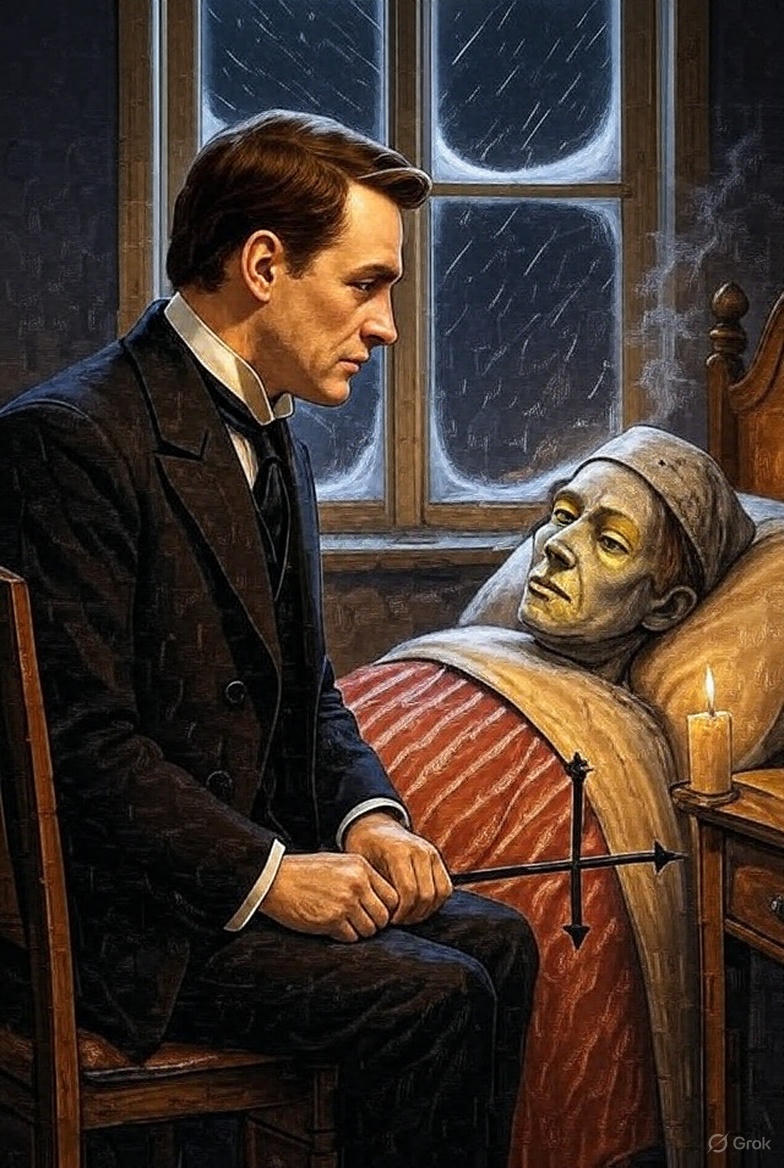
How painful that Semmelweis voiced such trust in Hebra. It was a patient’s trust, and Hebra, now the doctor, was fated to be cruel and unrelenting. “Perhaps it’s best you stay a few days in my sanatorium,” Hebra said. “If it suits you and does you good, we may not need Gräfenberg.” He took Semmelweis’s hand and noticed a painful flinch.

“What’s wrong with your finger?” he asked. Semmelweis’s middle finger on his left hand was red and swollen.

Semmelweis studied his hand thoughtfully: “I don’t know… I think… two days ago in Pest, I operated on a woman… I might have cut myself a little.” He shook his hand as if to fling off the pain, then bent down and opened his arms. His two-year-old daughter Antonie ran to him; he lifted her high, dancing around the room: “My little mouse! My sweet treasure! Papa’s going to the sanatorium and will come back all well.” He swung the child, her legs twirling, then stumbled dizzily toward Hebra’s wife. “Whoops!” he cried. “Remember, dear lady, when your boy came into the world, and I shouted, ‘It’s a boy!’?”

Fearfully, Frau Marie took the child from her husband as Hebra leaned out the window, calling back, “The carriage is here!”

“Today already?” Semmelweis asked, surprised.

“Why not? I think you should try sleeping in my sanatorium tonight.”

“Come, Herr Professor,” Bathory urged. “We’ve already sent your night things over.”

It’s all quite harmless and natural—why shouldn’t Semmelweis try sleeping in the sanatorium tonight? Surely Hebra has set up something exemplary; everything he does is impeccable. The women casually accompany the three men to the carriage, chatting about Hungarian national dishes, recipes for Frau Marie, the splendid cook, to add to the Hebra household.

“Aren’t you coming?” Semmelweis asks his wife as he boards. Frau Marie leans against the doorframe, child in hand, trembling, unable to answer.

“What’s she supposed to do in your dull sanatorium?” Frau Hebra replies for her. “She’ll stay with me and the girl.”

The carriage rolls through the streets, and the men continue discussing the differences between Viennese and Hungarian cuisine, weighing their merits. “You know,” Semmelweis says, “I won’t let myself be starved on a diet in your sanatorium.”

It’s Lazarettgasse where the vehicle stops before a massive, iron-bound gate topped with spikes. “Your sanatorium looks like a knight’s castle,” Semmelweis laughs.

A tall, elegantly dressed gentleman receives the visitors.

“My director!” Hebra introduces, and they begin the tour at once. Everything is new and clean, the corridors carpeted to muffle steps. Sturdy orderlies stand about.

“You have only men here?” Semmelweis asks.

“In the men’s ward, we have only male orderlies,” the director explains courteously. “In the women’s ward, only nurses.”

The residents seem quite content; a distant burst of loud laughter is so contagious that Semmelweis joins in.

“Here’s the room we’ve set aside for you,” Hebra says.

Quite nice, new and clean like everything here, the bed bolted to the floor, table, bench, and cabinet fixed to the wall. The windows overlook a large garden.

“Why are the windows so heavily barred?” Semmelweis wonders.

“For safety,” the director replies smoothly.

“Ah, I see. Well, I’ll give it a try. If I can’t stand it, I’ll move out.” Semmelweis claps Hebra’s shoulder to affirm his decision.

“Shall we go to the garden?” the director suggests. Though it’s grown dark, the summer night is so mild it’s pleasant to stroll under the large trees. Semmelweis and the director lead, while Hebra and Bathory lag behind. Before Semmelweis realizes, he’s drawn into a discussion about septic processes, prompted by the director’s knowledgeable questions. When Semmelweis talks science, the outside world fades; he doesn’t hear the shrill screams from the neighboring wing or the monotonous muttering of someone at a barred window, perhaps praying or reciting memorized lines.

After a while, the director suggests they return.

“Where are Hebra and Bathory?”

Hebra and Bathory are gone, lost in the darkness.

“They must have grown impatient,” the director supposes. “They’ll come back tomorrow.”

The light in Semmelweis’s room, a dim glow high on the ceiling, is already on. His nightclothes are spread on the bed; he sheds his street clothes, slipping into underwear, nightshirt, and slippers. Time to check on his patients—they must be waiting impatiently.

But as he steps from his room to the corridor, two men block the door—sturdy fellows barring his way.

“Where to, Herr Professor?”

Another grabs his right wrist with a vile, paralyzing grip.

“What do you want? I must make my rounds.” It’s outrageous to seize him and hinder his profession. Semmelweis breaks free, but they grab him again, each from one side.

“Stay calm at home,” one says casually. “No time for visits now.”

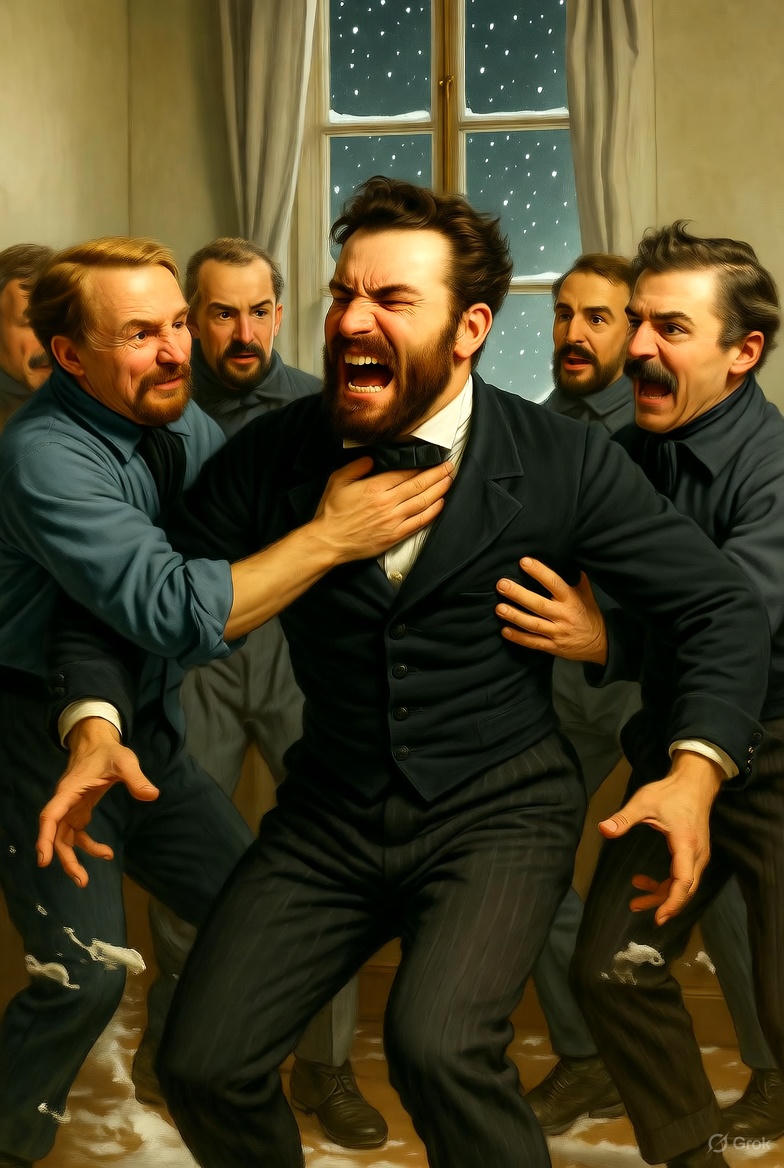
Why not? Why not indeed? Suddenly, Semmelweis realizes what’s happening. His enemies have hired these men to eliminate him; they’ve trapped him. As strong as the two orderlies are, Semmelweis’s rage is stronger, despite the searing pain in his hand. He pulls them toward him, smashes their heads together so their skulls crack, and hurls them against the walls. Then he runs. But he doesn’t get far—before reaching the stairs, two more men leap from a hiding spot, the first two already on his heels. Suddenly, one is on his back. The weight drags him down; they roll on the floor. Semmelweis bites wildly, sinking teeth through a sleeve into an arm, tearing cloth and flesh. They pin his arms behind him, nearly wrenching them from their sockets, almost breaking bones, stuffing a cloth in his mouth. Six men finally overpower him, throw a straitjacket over him, and shove him into a black hole—a padded room with no up or down, no front or back, only stifled, silent raging and roaring.

Read Full Post »

Chapter 15: The Cave

The morning mist clung to the clearing as Tobal lingered after the meditation, the Hel vision of his parents chained in a cave still burning in his mind. Sarah, Lila, and Jared had dispersed, their solos approved, while Fiona and Becca were off to Sanctuary. The lake’s call pulsed through him, a command he couldn’t ignore. He changed out of his robe, the fabric rustling as he packed dried meat and nuts into his bag, pausing to check his med-alert bracelet with a flicker of unease from the vision. Memories of last night’s circle flickered—Fiona and Becca’s gaily chatting during the initiations had left him feeling out of place, their friendship deepening while his mood soured, driving him to solitude. Misty had led as High Priestess, with Ellen in the background and Angel’s red Master robes surprising him, a testament to her recovery since that leg injury in Sanctuary.

Before leaving, he sought Rafe near the clearing’s edge, his steps quick with purpose. “This is my last chance before winter to check the lake,” Tobal said, the med-alert concern nagging him. Rafe leaned in, voice low. “I’ve been thinking about this. I’m not supposed to share Journeyman stuff, but it shouldn’t matter. We fight in a large cave where med-alert signals don’t reach—medics are always there for injuries. I tried something like this once, nearly got caught—trust your gut.”
“You can’t remove the bracelet—it’d mark you as dead, and without one, you restart training. Avoid that,” Rafe continued. Tobal nodded. “What should I do?”
“Hide in small caves or under ledges by day—air sleds can’t detect you within rock. Travel fast at night. The bracelet will seem active, and the cold will keep medics grounded. You’re not breaking rules—no one’s banned you yet, though they might once caught. Aim for midnight under the full moon, three hours max, then bolt. Should be interesting when they catch up.”
“That sounds good,” Tobal replied. “I’ll do it.” They discussed the trip briefly, Rafe’s grin lingering, before Tobal set out, his mind set on the journey ahead.

Tobal set out from the clearing, the morning sun breaking through the mist as he headed toward the lake, his pack slung tight. The rocky terrain between his path and the abandoned gathering spot loomed ahead, a maze of caves and outcroppings he’d noted before. He planned to travel by night, hiding by day as Rafe advised, the full moon’s promise guiding him. The air grew colder as he moved, his breath fogging in the chill, the moon casting jagged shadows on the rocks that made him pause, listening for rustles in the dark.

He made cold camps during the day, nestled under ledges, the furs from his pack shielding him from the biting wind. Sleep came fitfully, troubled by nightmarish images that intensified with each step closer to the waterfall—shadowy figures, chains clinking, a hum that echoed the Hel vision. By the third day, a shiver unrelated to the cold crept up his spine, a sense of being watched prickling his neck, though no air sleds appeared.

On the fourth night, midnight found him standing before the cairn in the haunted gathering spot, the moonlight bathing the stones in silver. Ghosts seemed to whisper around him, a chill settling deep. He searched the cairn without a torch, his fingers brushing offerings—trinkets, faded cloth—but found no answers. Frustration gnawed at him; the camp looked cleansed, yet an inner prompting screamed to leave. A faint hum from the stones, too low to place, teased at his mind, hinting at secrets buried deeper.

He hated the dark descent down the cliff face, but the urgency drove him. The rock chimney eased his drop, toes finding holds until he stood on the patio by the pool, an hour gone, two hours left. The air thrummed with an unnatural pulse, urging him forward.

Tobal stripped off his clothes, tucking them behind rocks on the patio, the icy air biting his skin. He kept his knife strapped to his leg and the magnesium fire starter around his neck, the weight a comfort as he braced for the pool. The waterfall’s thundering roar vibrated through the ground, a deep pulse that seemed to guide him. Stepping into the freezing water, his foot found the first step, then three more until he was waist-deep, facing the cascade. An unseen hand seemed to pull him forward.

He plunged in, swimming strongly toward the waterfall, and dove deep, fingers tracing the rock face. Three feet down, he found an opening, slipping under as the current tugged him. The rock sloped upward, and he surfaced in a silent pool, gasping, the swim frightening but manageable. Shivering, he hauled himself onto a rocky ledge, the darkness pressing in. His fingers fumbled across a pack and torch, tearing it open to find a heavy woolen robe. He slipped it on, pounding his arms to restore warmth, the fabric rough against his chilled skin.

With tinder from a pouch, he lit the torch, its flicker casting eerie shadows. The pool, just six feet across, was his only exit, and his heart raced—he had two hours to explore this lake’s secret. A low hum emanated from the walls, too faint to place, stirring memories of the Hel vision. He felt safe within the cavern, the med-alert’s signal blocked by the rock—a force field, he’d later learn, that shielded this place from the Federation and Reptilians.

Barefoot, he ventured deeper, the waterfall’s muted thunder vibrating the cave. The floor sloped sharply downward for twenty feet, then leveled into a chamber. An opening turned right, but his gaze fixed on a rough stone altar ahead, flanked by unlit torches. The emblem painted behind it—a man and woman holding hands within a circle—mirrored his parents’ medallion, stealing his breath. He lit the altar torches, their glow revealing a circle of cushions, each with personal belongings.

On impulse, he lifted a clay bowl from a cushion, spilling dust-covered items. Two plastic hospital bracelets emerged—wiping one, he read “Rachel Kane”; the other, grimy, revealed “Tobal Kane” and his birth date. Tears stung his eyes; these were his mother’s, his own from infancy. His fingers brushed a jade and amber necklace, its static crackle sending a wave of love and peace through him. He slipped it on, and the air shimmered. Two figures materialized—the Lord and Lady, their forms translucent yet solid as he reached out, his hands trembling. He embraced them, their warmth seeping into him with a faint glow, even though he could see through them.

“Mom? Dad?” he choked, his voice breaking, clinging to them as if they might vanish.
Rachel’s eyes, soft and wet, met his, her voice trembling with love. “Oh, Tobal, my sweet boy—we love you so much. We ache to have been there, to see you grow, to hold you through every tear.”
Ron’s voice cracked, thick with emotion as he gripped Tobal’s shoulder. “You’re our pride, son. We wanted to watch you become this strong, but Harry stole that from us. Free us, please—we’re fading.”
Tobal’s tears fell, his voice raw. “How? Why you? I need you here!”
Rachel’s hand, faint yet warm, brushed his cheek. “Your uncle Harry betrayed us—handed us to the Federation. They’re using us to power their time device, with Reptilian tech. It’s killing us slowly, draining our life.”
Ron’s gaze hardened, urgent. “The cave’s force field hides you from them and those lizard kin—they can’t penetrate it, so they hunt. We were training to be Time Knights, but they caught us first. There’s a plan to save us, but it’s not time yet—other pieces must align.”
Tobal’s heart pounded. “The Nexus? Where is it? How do I save you?”
Rachel’s voice softened, breaking. “Commune with us at circle, in meditation—we’ll guide you. You’ll feel when it’s right. But beware—Harry and the Federation want you for their experiments.”
They faded, leaving him trembling, the hum intensifying.

Time pressed, and he searched for his father’s pile, moving to the altar’s far side. A ceremonial dagger with “R.K.” burned into the sheath caught his eye—he swapped it for his knife, strapping it hastily. Exploring further, he found a corridor to the left, stooping to enter. Turning a corner, he gasped at a vast cavern filled with artifacts—burnished armor, bronze weapons, and an alien section with unfamiliar objects. His torchlight caught a slender silver rod on the floor; he picked it up, its wrist cord secure. Pressing the first button, a comfortable light glowed; the second unleashed a heat beam on the wall, glowing red until he stopped it, heart pounding. The beam triggered a hum, and a holographic figure shimmered—Arthur, a sentient AI.

“Hold on, Tobal,” Arthur’s warm voice broke through, his image flickering with concern. “I’ve tracked you since the altar. I’m Arthur—your guide. Call me telepathically anytime, just think my name, and I’ll appear. You’re in deep trouble.”
Tobal’s breath hitched, clutching the rod. “Trouble? Who’s after me? What’s this thing?”
Arthur’s hologram softened, urgent. “Your uncle Harry and the Federation, with their Reptilian allies. This cave’s force field blocks them, but they’re hunting you. They can’t find it, so they want you for experiments, like your parents. That rod’s tied to their tech—use it, but stay sharp.”
Before Tobal could press further, two figures teleported in—Lucas and Carla, their future-worn gear glinting. Lucas’s eyes locked on him, voice thick with worry. “Tobal, you’ve stirred the nest. That rod’s ancient—let me wake it.” Carla raised a device, and a ripple coursed through the cavern, the hum steadying. “We’ve turned back time an hour,” she said, her tone warm yet pressed. “We need to talk—your parents’ life depends on it.”

Tobal’s voice shook, stepping closer. “Who are you? Why are my parents in that device?”
Lucas’s face softened, heavy with care. “We’re Time Knights, Tobal. Your folks, Ron and Rachel, were training to join us, but they weren’t full Knights yet. Harry—your uncle—betrayed them, selling them to the Federation. The Reptilians gave them mechanical time tech, clunky and forced, while ours is organic, natural. They’re powering the device, alive but dying slow.”
Carla’s eyes glistened, urgent. “We’ve watched you through the medallion. This cave’s force field hides you from the Federation and Reptilians—they can’t penetrate it, so they hunt. There’s a plan to free Ron and Rachel, but it’s not time yet—other pieces must align first. The rod will help.”
Tobal’s throat tightened, gripping the rod. “How do I save them? Where’s the Nexus? What about Harry?”
Lucas sighed, running a hand through his hair. “The Nexus is deeper in—search when you can. Arthur will guide you, and we’ll check in. Harry’s leading the hunt with the Federation; they want your blood for their experiments. The Reptilians are pushing their tech, but it’s unstable—be careful.”
Carla squeezed his arm, voice breaking. “Commune with your parents at circle or meditation—they’ll reach you. You’ll feel when it’s time to act. Keep that rod safe—it’s your link to us.”
Arthur cut in, warm but firm. “I’ll watch you. Think my name, and I’ll show up. The Reptilians’ tech is close—get out soon. Harry’s agents are relentless.”
Tobal’s chest heaved, love and fear warring. “Thank you,” he whispered, looping the cord around his wrist. Lucas and Carla vanished, leaving him with three hours. He retraced his steps, snuffing the altar torches, and prepared a new torch and tinder by the pool. Shedding the robe, he clenched the bracelets in his mouth, dove into the black pool, and emerged outside to climb the stairs, the extra time nearly spent.

Tobal emerged from the pool, water streaming off him as he climbed the stairs, the three hours ticking down. He wasted no time sliding into his tunic and furs. He was still wet as he hastily donned his boots and grabbed his pack and equipment. He put the wand into his pack and the hospital bracelets in a leather pouch on his waist for safekeeping. He guessed it was about 3:00 a.m. and the air sleds would be looking for him anytime. A faint hum from the gold medallion pulsed, and Arthur’s voice whispered telepathically, “Tobal, they’re tracking your med-alert bracelet. Move fast.”

He headed at a dogtrot through the maze of rock and toward the edge of the lake. He hurried toward his burned out campsite planning to stop there and rest. He was halfway around the lake in the predawn light and walking normally when the first air sled appeared. He was not surprised to see the air sled drop to the ground on the beach in front of him and a medic step toward him. To his relief it was Ellen in her red medic’s tunic.

“Are you alright?” she asked sharply.
“I’m fine,” he said. “Why?”
“You’ve been appearing and disappearing from our monitors the last several days. Can I check your med-alert bracelet please?”
The way she was holding her hand out told Tobal that she was telling him and not asking. Wordlessly he took off the med-alert bracelet and handed it to her.
Immediately an alarm sounded at the air-sled and she went over to shut it off. She was on the radio a few minutes and then started to do some tests on the med-alert bracelet. It seemed to test out ok and she finally handed it back to him.
“What were you doing over by the waterfall?”
“When I soloed I came out here,” he told her, “and decided to make my base camp on the lake over there.”
He pointed to the area where his burned out camp had been.
“I spent a lot of time and work building things up,” he continued. “Then I was training Fiona and brought her out here with me. We found my entire camp destroyed and burned by rogues. I was only able to find one food cache left intact. We didn’t want to meet any more rogues and felt it was not safe to stay in the area.”
“What does that have to do with the waterfall?” Ellen interrupted.
“Everything,” said Tobal.” We headed around the lake and saw the waterfall. We decided to try finding a way up the stream and explore in that direction while I was training Fiona.”
“Did you know there is an abandoned gathering spot there?” He interrupted excitedly. “It has a huge pile of stones in the center of it too!”
He was watching carefully to see what effect the news of the cairn had upon her. He was disappointed since she didn’t seem to care either way about it.
“Anyway,” he continued, “we went up the stream and then cut cross country to where my base camp is. That’s how I originally found my base camp. That was last summer but I always wondered what really happened to my first base camp and wanted to come back here before snowfall and see if I could find anything of value the rogues might have missed. I was worried about Fiona before and didn’t want to endanger her. I thought I could come down here and check my old base camp real quick and be back in plenty of time for circle.”
“I never heard your camp had been burned out,” she said. “Did you tell anyone else?”
“I talked with Rafe about it quite a bit. He was pretty upset too and told me the lake wasn’t a good place for a base camp.”
“Rafe was right,” she said grimly. “It’s not a good place to hang around anytime, especially by the waterfall. As medics we are given explicit instructions to keep a very close eye on anyone in this area because this is where most of the rogue attacks happen. Get on and we’ll go look at your old camp.”
Hardly believing his luck, he carefully climbed on the back of her air sled and directed her to what was left of his burned out camp. Together they poked around and he showed her the remains of his teepee, smoke rack and sweat lodge. They did find a stone axe. He looked at it and recognized it as the first stone ax he had ever made. He told Ellen and she grinned. She seemed more relaxed now that his story had proven true.
“There have been other people whose camps have been destroyed,” she said. “These attacks seem to be coming more frequently and I don’t know what we are going to do about them. They are centered around this area but we have been told the rogues live in a settlement about two hundred miles west of us. That doesn’t make sense to me somehow.”
“A settlement to the west?” Tobal asked.
Ellen nodded, “It’s a village made up of people that decided to drop out of training and not be citizens. You may have heard rumors about it but only we medics know where it is. I’ve actually checked it out and there are children and old people in it. None of them wear med-alert bracelets and we don’t really know anything about them. If these raids continue I’ve heard rumors that the city might attack the village and close it down.”
“Is that what happened to the gathering spot by the waterfall?” Tobal asked, fishing for information.
“You must never mention that place to anyone,” she said sharply. “It is a forbidden area and we have been told to keep people away from it.”
“Why is it a forbidden area?” Tobal said belligerently. “I should be able to go anywhere I want. This is a wide open wilderness and no one has ever told me that certain places are off limits.”
“Well they are,” she said matter of factly. “We don’t tell people about them unless they stumble into them like you have. I don’t really know why myself,” she said. “I think is has something to do with the rogues and keeping clansmen safe from them. There are some other areas that are “off limits” because they are dangerous for people on foot.”
It was mid afternoon and Ellen said she needed to get back on patrol. She was sorry to hear Tobal had been burnt out and was going to make a note of it in her report. She advised him not to stay in the area as it might be dangerous and she recommended he get another med-alert bracelet the next time he was in sanctuary.
Tobal was in agreement and headed straight for sanctuary. He knew the route and more importantly knew a small cave where he could shelter for the night. It would give him a location where his med-alert bracelet would not give him away as he slept. Somehow that felt very important right now. He didn’t know whom he could trust. He had been very lucky Ellen had been the medic that found him.
It was dark when he turned sharply to the left and stepped along a ridge he remembered having a small cave in it. Cautiously he poked his walking stick into the opening making sure no one else was using it before crawling inside. He wrapped himself in warm furs and fell into a sleep of exhaustion with eerie dreams of his father and mother in a cave doing some type of ritual.
Before dawn the next morning he was back on the trail toward sanctuary. He was prompted by a sense of urgency and a sixth sense that told him he was being followed. It was only a half-hour later when an air sled circled and waved. He waved back and continued on. This time at a dogtrot that ate up the miles. That day two more air sleds circled overhead making certain of his destination, but none stopped him.
That night he again crawled into a small cave and slept without a fire of any kind, munching on cold jerky and rinsing it down with water from his canteen. He was making good time and with any luck at all should be at sanctuary the next evening.
The sense of being pursued stayed with him that night and all of the next day. Again he was up before dawn on the trail and again an air sled appeared, this time only fifteen minutes after he had gotten under way. They had obviously been out looking for him and wondering what was wrong with his med-alert bracelet.
Well he at least felt better with the air sleds since they were medics and not rogues. But he still didn’t waste any time getting to sanctuary. It was twilight when he finally got to the edge of the wooded area that opened onto the meadow leading to sanctuary itself. He took a few minutes to hide the things from his parents before going into sanctuary with the rest of his supplies and pack.
No one was there and he wasted no time setting his pack and clothing under one cot and stepping into the medical center as Ellen had suggested. He felt relief as the door slid shut behind him and locked. He took off his med-alert bracelet, dropped it on the floor and pounded it with the heavy hilt of the knife he had brought with him. Under the heavy pounding it broke into three pieces and he left it there. He knew the medics would be alerted when he had taken it off and then would be even more alerted when it suddenly stopped broadcasting. He was hoping one of them would be there when he came out the other end in a few hours.
Three hours later he had a new med-alert bracelet and fresh clothing and equipment. As the door slid open he cautiously stepped out into the gloom and stood still waiting for his eyes to adjust in the dark. His knife was in his hand and he knew he was not the only one in the room. He stood silently waiting for someone to make the first move.
“Tobal, is that you?” He heard Ellen’s voice coming from near one of the cots. Relief spilled through him, “Yes, is it safe?”
“For now,” she said. “Come, we’ve got some talking to do.”
He shouldered his new equipment and carried it over to the cot where he had stored the rest of his stuff. He searched under the cot and found he had been right. His things had been searched and gone through carefully while he had been in the medical chamber. He laid everything on the bed and tried to determine in the dim light if he was missing anything. Everything seemed to be there. Ellen stood silently by and watched as he sorted and repacked things. Tobal saw two other very serious Masters standing guard at the entrance.
“What’s going on?” She demanded. “We were monitoring your signal and then the alarm went off as if you were dead. Then the signal stopped completely and we came immediately to see what was wrong. The first one here saw three rogues dressed in black running out of the sanctuary building and into the woods. It was dark and they didn’t show up on the air sled monitors so we lost them. We don’t know where they are now.”
“We went inside and saw that your pack had been searched but you were not here. Then your signal showed up once more on the monitors and we figured you must be in the medical chamber so we waited for you to come out.”
“They followed me from the lake,” Tobal said. “I knew they were following me. I could feel it and hid at night. I came here as fast as I could just like you said to.”
“How could they follow you from the lake?” Ellen frowned. “They don’t have monitors like we do on our air sleds.”
“They must have some way of tracking me,” he repeated. “They would have gotten me if you hadn’t shown up when you did. It’s not safe out here anymore!”
“We’re going to take you back to the gathering spot where you and I are going to have a little chat,” Ellen whispered. “You are holding something back and I want to know what it is.”
They walked toward Ellen’s air sled and Tobal suddenly remembered his package in the woods.
“Wait here,” he shouted “I’ll be right back” and he ran into the woods to retrieve the rest of his things.
Ellen was on the air sled waiting when he ran back up and climbed on behind her. The three air sleds sped into the night toward the gathering spot.

Read Full Post »

OD by Karl Hans Strobl and translated by Joe E Bandel

Are those tears in Semmelweis’s eyes? Reichenbach thought madmen couldn’t cry, and in what Semmelweis just said, there’s nothing incoherent.

Suddenly, Semmelweis wheels around, fear and rage twisting his pained face back into a grimace. “They’re coming!” he shrieks. He leaps over the bench, falls, scrambles up, and hurls himself into the bushes. He races down the hill; for a while, you hear the crack and snap of branches, then he’s gone like a wild, hunted dream figure.

If Severin weren’t standing there, bent forward, leaning on his stick with narrowed eyes, Reichenbach might believe it was all just a dream. But Severin, who witnessed it, testifies to its reality. Rubble and ruins everywhere you look, and old men stand there, unable to clear the debris and start anew, as would be needed.

Then Reichenbach recalls something is required of him. Even when you want to let your hands drop and extinguish your will, life demands something. “Severin,” he says, “Rosina has fallen ill. Would you care for me and nurse Rosina for now?”

Severin nods. Yes, he’ll care for the Freiherr and nurse Rosina. He’ll do it. And perhaps that’s what Severin has been waiting for all along, sitting on his bench before the castle.


The doctor has been and given his instructions.

Severin escorts him out and returns to the sickbed.

“Yes, that’s a nasty illness,” he says, pulling a chair to the bed and sitting at a measured distance—not too close, God forbid! He acts as if the doctor confided in him specially and filled him in.

Frau Rosina lies in bed, the red-and-white striped blanket pulled to her chin, only her grayish-yellow face visible under a grimy nightcap.

“A nasty illness,” Severin repeats with relish, “very nasty. Could drag on for months. I wouldn’t want to be sick that long. When my time comes, I’ll lie down and die quick.”

“I won’t stay in bed for months,” Rosina vows grimly. She’s not supposed to move much, but she’s boiling with rage, the nightcap’s edges trembling.

“Oh, you could get up right now,” Severin says with deep satisfaction, “but then it’s over for you. My respects, obedient servant! With an illness like that, you collapse and die sudden-like. You can count on it, that’s how it is.”

“Now I’ve had enough,” Rosina snaps across, “shut your mouth for once.”

Oh, Severin has no intention of staying quiet. He finally has the floor and won’t let himself be stopped from making full use of it. Frau Rosina Knall is rendered harmless, lying in bed with her legs propped up, wrapped in thick compresses, unable to move and forced to listen to what’s said. Severin sits at a safe distance, pulls out his pipe, carefully packs it, lights it, and blows three leisurely blue smoke clouds. The old Severin is no longer a salty, shaky old man; he’s lively and sharp, puffing away like a freshly stoked locomotive.

The sound of puffing and the smell jerk Frau Rosina, who had turned her face to the wall, around: “Stop it,” she rants, “away with that pipe. You’ll stink up the whole room. The Herr Baron can’t stand pipes—he can’t stand smoking at all.”

Three new giant clouds billow into the room; thin, blue wisps of pungent smoke drift over Rosina’s bed and sink into the corners. Severin maintains his calm cheer: “I know,” he says, “when the Herr Baron comes, I’ll put the pipe away.”

“I can’t stand it either,” Rosina hisses.

Shaking his head, Severin observes the patient. Is it true you can provoke toads until they burst with bile and venom? Frau Rosina also reminds him of a simmering pot, its contents rattling the sides and lifting the lid. “Strange,” he muses, “some folks can’t stand smoking. I’m mighty fond of it. Nothing better than a pipe. Oh—what I meant to say. Things’ll change now; the Herr Baron will see people again. You can’t leave him so alone. I already mentioned that Frau Hermine came by with her husband and child recently. And we’ll need a chambermaid and a cook. I’m not one of the youngest anymore, and when you’re allowed up, you’ll need to take it easy for a long while.”

Everything Rosina built crumbles to shards. It slips through her fingers. This old fool sits by her bed puffing his pipe, and Frau Rosina lies powerless, nearly choking with rage.

“Sister’s child,” Severin returns to his main theme, “had it too. Got up too soon, and the illness came back. And she was a young, spry thing—with old women, it’s always twice as bad—”

Despite his geniality, Severin keeps a sharp eye. He notices a suspicious movement: one of the patient’s arms slides out from under the blanket, her yellow hand reaching for the nightstand where the medicine bottles stand. It’s astonishing how quickly old Severin can leap from his chair and dart out of the room. The large medicine bottle shatters with a crash against the already-closed door.

He giggles gleefully, in high spirits, as he potters through the kitchen and down the hall, lighting the lamp in the entryway. The door to Freiherr von Reichenbach’s quarters now stands open again, a lamp illuminating the path; people should know the dragon guarding him has been chained. And indeed, someone is already in the entryway, someone who lingered in the dark, not daring to venture further. It’s a shabbily dressed, gaunt woman; Severin doesn’t know who she is, a tattered bonnet shadowing her face, but he’s full of goodwill and courtesy even to such a poorly clad woman. He’s set on letting life reach the Freiherr again and sees no need to discriminate.

“Here to see the Herr Baron?” he asks kindly. “Come with me.” Without waiting for a reply, he strides ahead, knocks firmly on the study door, and when the stranger hesitates at the last moment, as if having second thoughts, he gently takes her arm and ushers her in. “Herr Baron, someone wishes to speak with you.”

Reichenbach looks up from his work, surprised by the late, odd visitor Severin has brought. But then he shoves his chair back and rises.

“Is it you?”

So it has come to pass, what Friederike saw as a distant glow in anguished, sleepless nights, amid the depths of her disgrace. There is Reichenbach’s study, the lit desk strewn with papers, and the Freiherr himself, an old man with a bald head and furrowed face, tufts of yellowish-white hair at his temples.

And Friederike is back, haggard, in tattered clothes, one might say ragged, fallen low, a shadow of her former self.

“Where have you come from?” the Freiherr asks softly.

Friederike glances nervously behind her: “From hell.”

And then the miracle happens. Reichenbach opens his arms, and Friederike may rest her head on his chest. My God, is this real—not a delusion? Is this living human closeness, refuge, and salvation? Will they not drive her from this threshold?

“You’ll stay with me now?” Reichenbach asks.

He asks if Friederike will stay. Does he not know she’s come to leave it to him whether she’s cursed and cast out or blessed and redeemed, whether she must turn to the final darkness or receive life? She clings to him, sinking, and Reichenbach must support her and lead her to the sofa. He tosses a stack of books to the floor, making room for Friederike, who sits with her hands folded in her lap—thin, wasted hands nestling together like disheveled, scattered birds.

Read Full Post »

OD by Karl Hans Strobl and translated by Joe E Bandel

Severin seemed far from sharp-witted; no, he was no longer the old Severin—brisk, dutiful, self-assured. Something had stripped his former grandeur; he no longer looked down on things as before, or he might have shown more surprise or joy at Hermine’s arrival or paid some attention to little Karl. He took it oddly lightly. “Yes,” he laughed, “take you to the Herr Baron… that’s for Frau Rosina now… or not, as she pleases. She never does, really—no one gets to the Herr Baron.”

“And you put up with that?”

“I… I’m no longer in the Herr Baron’s service. He sent me away. I live down in Grinzing now, but I climb up every day and sit on that bench.”

“Who is this woman?”

Severin winked slyly: “She’s everything now… she’s the only one with the Herr Baron. Frau Rosina Knall, used to be a nurse at the maternity clinic, then housekeeper for Hofrat Reißnagel. She came up with messages from the Hofrat, and maybe she liked it here so much she stayed with the Herr Baron.”

“We want to see Father!” said Hermine.

But that seemed a plan requiring no help from Severin. He was entirely sidelined, a nobody here. Frau Rosina Knall stood guard with her midwife and housekeeper fists; there was no getting past her. Oh, Frau Rosina Knall knew her craft. She’d bitten everyone away, claimed everything for herself. No one could reach the Herr Baron. No one managed it like she did. Severin spun his hand in a half-circle, as if brushing something aside, and winked cheerfully. She couldn’t use anyone, couldn’t stand spectators.

Yes, that’s how it was, but Severin came up from Grinzing daily and sat on that bench—she couldn’t drive him off. She tried once, but he raised his stick, and she backed off, leaving him alone since. It was pleasant sitting on that bench in the sun.


Then one day, Frau Rosina Knall tries to get up in the morning and falls back into bed with a cry. For days, she’d felt a sharp pain in her legs, dragging herself through the house. Today, her legs are swollen to twice their size—something serious is wrong; she can’t force herself to stand. She manages only to crawl on all fours to the kitchen, pull the large iron pot from the cupboard, retrieve the stuffed old stocking from it, and crawl back to bed with it.

By noon, the Freiherr notices he hasn’t had breakfast and that it’s unusually quiet. He goes to his housekeeper’s room and finds Frau Rosina moaning, unable to move, in bed.

He thinks a doctor and a nurse are needed; Frau Rosina’s legs look like they have phlebitis.

No, no, no doctor, no nurse, she shrieks and rants—it’ll get better, she’ll surely be up by afternoon, tomorrow at the latest, if the Herr Baron could manage alone until then.

But the Baron insists a doctor must come and isn’t swayed by the raging torrent of words. Frau Rosina remains helpless in bed, her heart full of curses and hateful glares at the door—a venomous, bloated spider forced to watch a fly tear through her web.

The Freiherr goes to the dairy and asks the stable hand Franz, still there from his time, to send a boy to fetch a doctor and perhaps inquire who might take on Frau Rosina’s care.

Franz is happy to send the boy, but as for a nurse for Frau Rosina, he’d like to oblige the Herr Baron, but he fears no one would be willing, even for a whole gulden a day.

Is that so, Reichenbach muses, and why not?

Franz hesitates to explain, so the Freiherr leaves without an answer. He doesn’t return to the castle immediately; he needs some air, a sudden longing for the forest stirring within him. How long since he was last in the forest? Is he really as ill as Frau Rosina always claims? His hearing is a bit weak, but otherwise, he has no complaints. A tired heart, true, and occasional dizzy spells—that’s all. My God, he’s no longer a youth. No reason to keep him indoors, forcing teas and compresses on him. It’s as if a thick wall has collapsed, and he can escape over the rubble into the open. Now he can think again about pursuing his travel plans. With Fechner, the renowned psychophysicist and philosopher in Leipzig, he’s developed a long chain of correspondence about Od; it’s urgent to complement these written exchanges with a personal discussion. Reichenbach has no sensitive with such convincing abilities to offer irrefutable proof. Perhaps one could be found in Leipzig—he needn’t let Frau Rosina’s objections hold him back.

He can still do as he pleases. Despite his loyal housekeeper’s undeniable merits and maternal concern for his rest and health, he should be able to pursue his intentions. Much has come crashing down on him, but he’s far from finished. On the contrary, his thoughts reach further than ever; he now knows Od is the carrier of life force itself, the bearer of the soul in all nature, opening new, bolder insights into the universe’s mysteries.

Yes, everything looks different in the forest than at home in rooms smelling of tea, where Frau Rosina shuffles about in felt slippers. The forest has waited long for Reichenbach. But the forest is patient, unlike a person; it holds no grudges, standing there waiting, and when you finally come, it is kind and generous, exuding more calm than all Frau Rosina’s teas.


When Reichenbach returns to the castle, an old man sits on a terrace bench, and another stands before him, preaching. With a booming voice, as if addressing a vast crowd, he declares: “And so, to end the slaughter, I’ve resolved unyieldingly to confront anyone who dares spread errors about childbed fever. If you believe there’s a puerperal miasma in your sense, that’s criminal nonsense. My doctrine exists to be spread by medical teachers, so the medical staff, down to the last village surgeon and midwife, acts on it. My doctrine is meant to banish the horror from maternity wards, to preserve the wife for the husband, the mother for the child.”

There’s no doubt the preacher is none other than Semmelweis, though Reichenbach might not have recognized him otherwise—so bloated is his body, so swollen his pale face with heavy bags under his eyes, so erratic his large, fleshy hands.

Surely, the listener, good old Severin, never claimed there was a distinct puerperal miasma.

Reichenbach approaches the professor: “Dear Semmelweis, I’m delighted—”

“Silence!” Semmelweis snaps furiously, “I’ll have you arrested!” He climbs onto the bench, pulls out a bell like one tied to goats, and rings it shrilly, persistently. Then he turns to Reichenbach: “It’s a fact that corpses on dissection tables often enter a state of decomposition that transfers to the blood in a living body. The slightest cut with a scalpel used for dissection causes a life-threatening condition.”

“My dear Semmelweis,” Reichenbach says as gently as possible, “you don’t need to convince me. And the medical world is now, in fact, coming around to your views.”

“Who are you?” Semmelweis thunders.

“I’m Freiherr von Reichenbach!”

“Freiherr von Reichenbach? Oh, yes.” Semmelweis shields his eyes as if dazzled by light. “I know you! And you really believe my doctrine has prevailed?”

“I wish I were as far with my Od as you are. You’ve achieved success. Even Virchow recently declared you’re right.”

A mad gleam dances in Semmelweis’s eyes again. “I’ll ruthlessly expose those scoundrels. Now pay attention—I’ll read you the midwives’ oath.”

He drops the bell and fumbles for a sheet of paper in his inner coat pocket, trying to unfold it.

But Reichenbach grabs his hand and pulls it down, drawing the man off the bench. “Calm down. I already know the formula and follow it. Come into the castle with me. You sought me out.”

Semmelweis nods and mutters, “Yes, you’re Freiherr von Reichenbach. That’s good, very good. I came to Vienna; Hebra invited me to see his new sanatorium.” Suddenly, he tears free, stoops for the bell under the bench, and begins ringing it furiously again.

“Why do you keep ringing that bell?” Reichenbach asks.

The sly look on Semmelweis’s face is more heart-wrenching than his contortions of rage: “Here in Austria,” he says loftily, climbing back onto the bench, “in Austria, don’t you think we must hang everything on the big bell, my dear sir?”

“And why climb the bench?”

Semmelweis’s face gleams with cunning: “So you hear me better! The endometritis, metritis, and puerperal thrombophlebitis…”

“I already know all that,” Reichenbach soothes, “come inside with me now.” He makes a quick decision. It’s necessary to get Semmelweis into the castle and, through Severin—who has backed away from the disturbed man’s proximity and watches from a few steps away—to urgently notify one of his friends.

“You’re Freiherr von Reichenbach, aren’t you?” Semmelweis asks. “You know everything, but perhaps you don’t know that your own daughter Ottane died of childbed fever.”

No blow could strike Reichenbach’s core more cruelly, but Semmelweis likely knows nothing of pity or responsibility. “Ottane,” the Freiherr says bravely, “Ottane died in Venice of typhus.”

“No, you can be certain she died of childbed fever. The child was stillborn, but the mother needn’t have been lost. Those Italian ignoramuses who want nothing to do with me killed Ottane. They called in Doctor Sattler, my student, but it was too late. He told me everything.”

Is this horror believable? Does the madman speak from his obsession fixed on one point? Or is he telling the truth? It seems his mind is now clear and ordered, as if a lucid moment has broken through his derangement.

Semmelweis steps deliberately down from the bench and lays one of his large hands on Reichenbach’s shoulder. Perhaps he senses the terrible uncertainty he’s brought upon his friend. “Don’t think,” he says sadly, “that I’m lying to you! Something’s wrong with my head, that’s true. I must go to Gräfenberg for the cold-water cure. My wife and little Antonie are with me in Vienna, and tomorrow we travel on to Gräfenberg. My assistant, Doctor Bathory, is also with us. But as for poor Ottane, dear friend… she’s among the victims, that’s the truth.”

Read Full Post »

Homo Sapiens: Under Way by Stanislaw Przybyszewski and translated by Joe E Bandel

IV.

Falk sprang up. He had fallen asleep on the sofa, fully dressed. The daylight, filtered through the garden’s tree shadows, gnawed at his sleep-deprived face, giving it the expression of great, quiet sadness. 

His mother stood before him, trying to slide a pillow under his head. 

“God, what a terrible dream I had!” 

“But, dear child, you’re completely ruining yourself if you stay up all night.” 

“No, on the contrary, Mama, I slept very well. I was just so tired that I fell asleep right where I sat. Certain natures can do that excellently. I heard of a mailman who slept while walking and lived to 90. By the way, Mama; I’ll be traveling in a few days; it’s of great importance that I get to Paris as quickly as possible.” 

His mother couldn’t understand. Why had he come at all? This long journey just to stay a few days?! His wife could surely live a few weeks without him. Couldn’t he grant his old mother the joy and stay at least two more weeks? 

Yes, he’d love to; Mama knew exactly how much he loved her, but he couldn’t possibly stay longer, he… 

At that moment, there was a knock at the door. Marit entered, confused. 

She greeted his mother by kissing her arm. Falk extended his hand with a ceremonial bow. 

Marit grew even more confused. 

“Mrs. Falk mustn’t mind her disturbing so early, but she had come to early Mass with Papa, and Papa had something to do in town.” 

Mrs. Falk apologized ten times that nothing was cleared away yet, but Erik, the lazybones, had slept until now. 

“Imagine,” Mrs. Falk continued, “he fell asleep right here in the dining room instead of properly going to bed. By the way, it’s very good you’ve come, Marit; you must help me keep Erik here. He absolutely wants to leave.” 

Marit looked up, horrified. 

“What? You’re leaving already?” 

“Yes, he absolutely had to. He had to start working a bit; he couldn’t do anything here.” 

Marit sat as if frozen, looking at Falk with wide, frightened eyes. “Besides, there was no point in him sitting around idle; life here was so narrow, so unbearably narrow… Yes, Mama, dear Mama, you mustn’t take it badly, but I’m used to the vastness, greatness, freedom of the big city. I can’t stand people here staring at me and gawking. And then this narrowness, this narrowness.” 

Marit sat thoughtfully; it seemed as if she heard nothing. 

“Yes, yes, she had to go now; Herr Falk would surely come for a farewell visit.” 

But she couldn’t go: Mrs. Falk set the table and brought coffee. 

Falk and Marit sat across from each other. Mrs. Falk let her wise gray eyes shift from her son to the girl. 

Falk brooded. Suddenly, he fixed his eyes on Marit and examined her closely. 

“It’s strange, you have such a remarkable resemblance to a girl I met in Kristiania.” 

Falk spoke completely dryly, in a reporting tone. 

“She was terribly sweet, and around her forehead was a flood of red-blonde hair; it looked like the Nordic spring sun.” 

“By the way, you look quite worn out, Fräulein Marit. It’s strange that you can’t be happy at all; it’s probably your religion that considers joy a sin?” 

Falk emphasized “your” mockingly. 

“No, no: Mama needn’t be so outraged, he only said it in passing.” 

Silence fell again. 

Mrs. Falk spoke of her late husband, tears coming to her eyes. 

Marit stood up. 

“She had to go now. She couldn’t wait for Papa; with him, five minutes always lasted an eternity, and now that Mama was at the spa, she had a lot to do.” 

Falk stood up too. 

“Would he be allowed to accompany her? A walk would do him good, and it was indifferent whether he went toward Johannisthal or with Marit to Elbsfeld.” 

“Yes, if it pleased him…” 

They walked silently side by side for a long time. 

Falk had pulled his hat low over his eyes, kept his hands carelessly in his pockets, and seemed deep in thought about something. 

And again, Marit looked up at him again and again, but he seemed determined not to see it. 

“Is it really true that you want to leave?” 

Falk looked at her as if he hadn’t understood, with a cold, tired gaze. 

“Oh! Leave? Of course, yes, absolutely. What am I supposed to do here? Don’t think it’s a pleasure to torment myself near you; I’ve had enough of that. Yes, I want to leave; maybe today. Besides, everything’s indifferent; and I’ll probably do whatever comes to mind.” 

Two large tears ran down Marit’s cheeks. 

“He mustn’t do that. Everything he said to her about love was a lie. A person who loves couldn’t do that.” 

“But for heaven’s sake, tell me, what do you want from me? Yes, just tell me: you know very well that you could give me the greatest happiness if I could just kiss you; you won’t allow that. I want to talk to you about something stirring in me; I can’t do that either. So what—what?” 

Marit cried. 

“You said I mustn’t love you, that you can’t give me anything! Didn’t you say you couldn’t possibly take love from me?” 

“God, I explained to you why I said that. Besides, even if there were obstacles, don’t you understand the infinite happiness of the moment?” 

Marit looked at him, astonished. 

“What do you want—what do you want from me? Speak completely openly.” “What do I want? What do I want? Well! Do I know?” 

“Yes, you want to ruin me! You want to plunge me into unhappiness, then leave—isn’t that right?” 

“Ruin? Unhappiness? The English want happiness… Ridiculous, disgusting, this satiated happiness of Müller and Schulze! Can’t you understand that the highest happiness lies in a second? That it’s disgusting to wallow in eternal happiness? What do I want from you? Two, three hours of happiness, then away, far away! Happiness is shy; you dishonor it, make it indecent if you enjoy it too long.” 

“God, don’t torment me so terribly. I can’t bear it. Do you want me to be destroyed?” 

“No, I don’t want that. Let’s not talk about it anymore. It’s madness that I have to circle around this one thought; I don’t want that anymore. I don’t want to say anything more. I want to be good to you, completely good. You just mustn’t cry. No, you mustn’t.” 

Falk was completely desperate; deep pity choked him. 

“Yes, yes, don’t cry; I’ll be good and reasonable and very cheerful. Shall I tell you something very beautiful?” 

“Yes, he should; she loved to hear him.” A while passed. 

“Well; I had a strange dream today. You know, when my father was still alive, we had a small estate right on the Russian border; right behind our barn stood the Russian border guard. So it happened that a farmhand had stolen grain. My father was a wild, strict man. He beat me mercilessly. I didn’t really get better from it; on the contrary, I hated him as only a child’s soul can hate. 

But my father had discovered the theft and the thief. All the farmhands were called from the village and the guilty one stood before my father. 

‘Did you steal?’ 

‘Yes,’ answered the farmhand defiantly. 

‘Do you want to go to prison or receive thirty lashes?’ 

Without a sound, the farmhand lay on the ground, and the execution began. 

‘Hit hard, or you’ll be whipped yourself,’ my father shouted to the coachman. 

And the coachman struck with the strong, oxhide whip as hard as he could. 

‘Now you strike!’ he called to an idiotic farmhand, whose broad face contorted into a contented grin. 

A blow so powerful, so terribly powerful… but my God, don’t be so terribly outraged, my Fräulein; so far, everything’s in order… 

So a terrible blow whistled onto the body of the unfortunate man. He jumped up, bared his teeth, and lay down again. 

The surrounding farmhands burst into loud laughter, in bright joy: The farmhand did well! Yes, he has the strength of a Goliath! 

Another blow, then two, three, four, five… 

I screamed, I raged in my hiding place. I scratched the ground with my fingers. I stuffed my ears full of dirt so I wouldn’t hear. Yes, yes, as a child, you’re so foolishly compassionate. 

The execution was over. The farmhand rose and fell again; he couldn’t walk. Around him, the human cattle broke into bright laughter. 

But the farmhand had incredible willpower; he rose anyway and dragged himself out of the yard. 

My father was satisfied and sat down to breakfast. I remember, he ate a lot and well. I wanted to jump on him like a wildcat, tear him apart. But understandably, I didn’t. 

That night, our farm burned at all four corners. I jumped out of bed and rejoiced over it as I never rejoiced in my life. Now my father was punished! 

The stable doors were torn open, the cattle were brought out… 

At that moment, my mother entered the room, and the dream ended.” 

Marit was completely shaken. 

“Did that really happen like that, or was it all just a dream?” 

“Well, that’s irrelevant. The interesting thing is only the work of the sleeping individual consciousness. In the moment when my mother opened the door, the non-sleeping consciousness unrolled the whole memory with incredible speed. There’s nothing remarkable about that, by the way. Hippolyte Taine tells of a man who, during a faint that lasted only two seconds, lived through a life of fifty years.” 

Marit couldn’t understand that. 

“It’s not necessary for you to understand it either. *Rassurez-vous*: I don’t understand it either… Now other impressions joined the original memory, and all that wove itself into a dream.” 

Marit wasn’t satisfied; Falk should explain it more closely. 

“No, Fräulein Marit, you won’t get any wiser from it. You just have to admit that the soul is something entirely different from what it reflected in the crude, uneducated brains of the Church Fathers. Just listen further. 

Yes, for example, the fact that the farmhand’s body writhed and jerked in my dream probably came from another impression. You know I studied natural sciences? Yes, back then I worked in the physiological laboratory and vivisected a ton of frogs and rabbits. I had to do it, and I always anesthetized the animals. But once I took a live frog, nailed it to a board, and opened the chest and abdominal cavity. The frog jerked so violently that it slid up the nails to the nail heads. Then I cut out its heart—” 

“You don’t want to hear that? Well, let’s talk about something else. Am I cruel? No, absolutely not. But it would be foolish to project human pain consciousness onto an animal psyche, or to measure my feelings with the pain scale of crude farmhands who watched the inhuman execution of one of their brothers with heartfelt joy.” 

Now both were silent. 

They came to a small grove that sloped down to the lake. 

It was hot, and across in the forest, noon shimmered and quivered. Everything blurred in the sucking heat. The lake lay limp and still; a oppressive calm lay over the whole area. 

“Wouldn’t she like to sit down a bit? He absolutely wouldn’t bother her. He’d sit at a respectable distance.” 

He lay long in the moss; she sat three steps away on a stone, nervously playing with her parasol. 

Suddenly, he sat up. 

“Why do you actually go to church? Don’t you have enough pride not to go where all the rabble goes, where it smells bad and the lust for happiness reveals itself so openly and shamelessly in prayers to the Almighty Lord?” 

Marit thought of how once she had fainted from the bad smell and sweat of all those people, how they carried her to the sacristy and a disgusting man ripped open her corset there so she could come to—oh, how abominable that was! But she stayed silent. 

“Don’t you understand that there’s something deeply coarsening in that?” 

“No, she didn’t understand that, and didn’t want to. Religion was her only happiness, her only refuge.” 

“Oh so…” Falk drawled… “Very good, very good.” 

Falk seemed terribly tired. He lay back down long in the moss and closed his eyes. 

Shadows of the bushes played on his face; there was a line of strange suffering. 

Marit thought. 

He was a terrible man. The image of the sweat-smelling church grew stronger and stronger in her. A disgust overcame her that grew and grew. She didn’t understand. Was he right? Yes, and then the eternal mumbling of prayers! She didn’t dare think further. God, God, what would he make of her! 

The line of suffering on Falk’s face grew clearer and clearer. Now she wanted to throw herself on his heart and smooth the horrible fold of suffering with her hand. 

How she wanted to see him happy, so happy, so happy… Tears trembled in Marit’s eyes. 

“My God, Falk!…” but she got no further. Falk sat up, astonished. 

She looked ashamed at the ground and struggled with her tears; one rolled down after another. 

Falk moved closer to her. 

She seemed about to stand up suddenly. 

“No, for God’s sake, she needn’t be afraid of him; absolutely not. If he wanted something, it had to be given to him voluntarily and with joy. No, he took nothing himself. No, no, he had not the slightest intention of touching her. She could be completely calm.” 

He stared at the lake and the shimmering noon heat across in the forest. Marit tried to resume the conversation. 

“Why had he actually been so mean to her yesterday?” “Mean? No, what was she saying…” 

Falk yawned. 

“Mean? Absolutely not; only sad was he. He loved her. He wanted her to live in his spirit, become a part of him. But on the contrary: everything he despised, what he considered low and stupid, that she revered. Everything he wanted to tell her, she couldn’t hear. He, the free one, the master, could of course not calmly watch the woman he loved so unspeakably live in such wretched, lowly slavery. He, who was God and supreme law to himself, would get completely sick if he saw every one of her actions predetermined by some formula… 

Yes, that spoils, destroys you for me,” he said excitedly. “You detach yourself completely from my mind. Give alms, and I know without further ado, you do it because it stands in your law book: ‘Be merciful, so that you may enter the kingdom of heaven.’ Visit a sick person, I know again that some formula promises you something beautiful for it. You’re compensated for everything, paid for everything. Don’t you feel the lowness, the meanness of this way of acting? Everything only for the sake of reward; everything for the sake of the ridiculous, imagined joys you expect in the kingdom of heaven. Disgusting!” 

Marit grew completely pale. Falk flew into a rage. 

“Do something because you must, not because you should! Throw away what doesn’t please you! Be yourself, only you, you, the splendid, wonderful Marit… Yes, yes, yes! Forever yes! You say you love me, and a stupid formula is enough to break your most splendid, mightiest instincts. And afterward, you pray ten rosaries to the Virgin Mary that she saved your soul from the claws of evil. That should be love? That? That love that can be broken by a stupid formula?” 

Falk laughed with wild scorn. 

Marit sat mute, trembling in all her limbs. 

“Yes, answer me then! That should be love? Answer then, what you understand by love!” 

Marit was silent. 

“Marit, answer me! I don’t want to torment you, no. I love you to madness. I’m sick for you! Yes, I know you love me, yes. I know it; nothing do I know more surely…” 

Falk moved quite close to her; he embraced her. 

“No, for God’s sake! Falk, Erik, no. Don’t torment me so terribly!” 

“Ah pardon! A thousand pardons. Yes, yes, I forgot myself again. God yes, it’s indifferent anyway. It shall never happen again… Shall we go?” 

Falk yawned affectedly. 

Marit walked at his side, torn by pain. She struggled in vain to master it. 

“Yes, yes; everything is completely indifferent,” she repeated in her thoughts. 

“Now goodbye!” Falk extended his hand. They had reached the garden gate. 

Marit flinched. 

He mustn’t leave, it screamed in her; for heaven’s sake, not leave! She grabbed his hand. 

“You’re not leaving, Falk? No? You mustn’t leave! Do what you want, but don’t leave.” 

Her lips trembled; she could no longer control herself. “Don’t leave! You’ll make me unhappy otherwise!” Her voice broke. 

Falk looked at her coldly and harshly. 

“Yes, I don’t know that. That depends on circumstances. In any case, you’ll hear from me before I leave.” 

He said a short goodbye and went.

Read Full Post »

OD by Karl Hans Strobl and translated by Joe E Bandel

Chapter 23

When little Karl Schuh was two years old and already a very independent gentleman, Frau Hermine decided it was finally time to introduce him to his grandfather.

He marched stoutly through all the rooms on his chubby legs, and if someone tried to take his hand on the street, he’d swat it away and say, “All by myself!” He climbed onto every chair and recently pulled the crocheted cover off the dresser, along with vases, clocks, glass eggs, porcelain lambs, and other knickknacks, then tried to excuse himself for the mess. He dipped his finger in stove soot, smearing the walls with wild drawings, and held hour-long conversations with himself—in short, he was such a wonder that his mother could no longer justify withholding him from his grandfather.

She had planned a visit to Kobenzl soon after settling the ugly lawsuit business, where the father now lived permanently after selling his Vienna house. But with a small child, it was a cumbersome affair, and when they might have managed, the Freiherr was traveling abroad.

It was said he had conducted experiments on sensitivity and Od in London at Lord Cowper’s house, Palmerston’s stepson, then traveled to Berlin for an extended stay. The university there had even provided him two rooms, but the Berlin scholars had been utterly dismissive, impossible to convince. They either didn’t attend his demonstrations or, when they did, sniffed, nitpicked, and criticized so much that nothing fruitful came of it.

Karl Schuh sometimes brought home newspapers with mentions of Freiherr von Reichenbach. They recalled the Freiherr who, years ago, made waves claiming to discover a new natural force called Od, asserting the boldest claims about it. He had locked his unfortunate victims in a darkroom until their eyes began to glimmer in the gloom. Science had long moved past this quirk of an otherwise distinguished man, but the Freiherr kept the learned world on edge with his fierce attacks. The fiery old gentleman lashed out like a berserker, and his polemics, flooding the public, were as notable for their lack of logic as for their excessive tone. Yet all this couldn’t gain recognition for his Od, and recently the Berlin scholars had unequivocally rejected Herr von Reichenbach and his supposed force.

Schuh brought the papers to Hermine but didn’t comment further. “Whatever may be said of the Od,” Hermine remarked, “I think it’s unnecessary to mock such honest endeavor!”

Karl Schuh shrugged.

“There might be a force, invisible rays, so to speak, carriers of the soul’s faculties in people.”

Hermine received no response to this either.

“And I find it petty and mean when they hint here that Father lost his fortune and now owns nothing but the Kobenzl castle. I’ll finally visit him in the next few days. You don’t mind, do you?”

No, Schuh had no objections. Hermine could go and take the boy. He himself would hold back; he couldn’t be expected to make the first move, having been so gravely insulted. The Freiherr would have to come first.

The Freiherr had long since returned and was hurling invectives against his adversaries from his study. Hermine planned week after week to visit her father, but something always intervened—bad weather, little Karl’s cold, a big laundry day. As a housewife and mother, she couldn’t just leave at will.

Then came that letter from Italy, from Venice. Such letters from Venice didn’t arrive often but came at intervals, so Hermine was never too long in the dark about Ottane’s fate. She now knew Ottane’s story but hadn’t initially dared to share the truth with her husband.

Schuh, when he finally learned, showed much understanding and heart. He stood on a higher plane, with a broad view of the world; his notions of morality weren’t so narrow. They had arranged things—fine, he wasn’t appointed Ottane’s judge. He only asked once, “Why don’t they marry?”

Hermine passed the question to Venice and received a reply after some weeks. Ottane felt she should no longer conceal how things stood with Max Heiland. He was at risk of going blind—or perhaps, it wasn’t clear from her letter—he was already blind, and he resisted binding Ottane to him with an indissoluble bond. As long as her heart urged her to stay with him, he accepted it as heaven’s grace, but he didn’t want her free sacrifice turned into a rigid duty.

“He’s actually a damned decent fellow,” Schuh said after reflection. “I wouldn’t have expected that from him.”

The envelope of today’s letter from Venice bore not Ottane’s handwriting but that of a stranger. An unknown wrote on behalf of Herr Max Heiland, prevented by his eye condition from writing himself. He wrote that he regrettably had a deeply sorrowful message to convey, which he received with resignation to God’s will. Fräulein Ottane von Reichenbach had died after brief, severe suffering, comforted by religion’s rites, from typhus. Unfortunately, the undersigned, a German doctor, had been called too late, after the Italian colleagues declared themselves unable to save her. A few lines were enclosed for comfort, and it was noted that notices had also gone to Freiherr von Reichenbach and Professor Semmelweis in Pest, the undersigned’s esteemed teacher, whom the dying woman had wished notified.

“So these wretched papists botched the poor thing,” Schuh said angrily. He channeled his grief into furious rage, railing against Italy, its doctors, the climate, and life there—but at bottom, he raged against fate for inflicting such incomprehensible cruelty on the person, after Hermine and his boy, he loved most.

Hermine battled her pain for two days, while little Karl cowered under the table, uncomprehending why his mother wept ceaselessly and his father cursed.

Then Hermine said, “Tomorrow I’ll go to Kobenzl to see Father. I imagined my first visit with him differently, bringing the child. But perhaps the boy will be some consolation and joy to him.”

When she and the child prepared to leave the next day, Schuh opened his wardrobe and began dressing too.

“Not going to the factory?” Hermine asked.

“No, I’m coming with you,” Schuh grumbled. He had the right to use the factory carriage but rarely did. Today, however, he’d ordered it; it waited outside, and they drove off together into the blissful summer day, full of sun and colors. For little Karl, the ride was a journey to fairyland—wonders followed one after another; he crowed endlessly with delight. Over his blond head, the parents exchanged glances; they understood each other, full of confidence. However sadly and incomprehensibly cruel some decrees were, there were consolations bringing light even to the darkest soul.

The access roads to Reisenberg were far from good, torn up by deep ruts where the carriage jolted forward, sometimes throwing their heads together with a sudden lurch. The mulberry trees the Freiherr had planted stood wild along the roadsides. There were now enough leaves for armies of silkworms to gorge themselves, but where were the silkworms, where was the careful husbandry of the estate’s model days? It was clear Reichenbach had sold the estate, and the creditor to whom it was transferred cared little for it, thinking only of further sales.

The castle itself showed Reichenbach’s neglect. It wasn’t just the subtle signs of decay but an indefinable air of cold, surly rejection that made Hermine uneasy. It no longer gazed freely and cheerfully into the landscape; it lay closed off, ill-tempered, like a sullen fortress. And the great cast-iron dog on the terrace, the Molossus from Blansko’s foundry, with its grim face, seemed now the true emblem of the house. Little Karl was transfixed by the iron beast, standing before it as if waiting for it to suddenly bark.

Meanwhile, Schuh pulled the bell at the entrance by the garden hall, now boarded up with weathered planks in the middle of summer. It took a long time before anyone came, and even then, the door opened only a narrow crack, as far as an iron chain inside allowed. One might think the woman whose head appeared in the gap had modeled her expression on the cast-iron Molossus.

“The Herr Baron isn’t home!” she grumbled with blunt certainty, without waiting for an explanation.

“Just announce us to the Herr Baron,” said Schuh, irritated by this broad face with coarse cheekbones and thick lips.

“You’ve heard he’s not home,” the woman snapped.

“Tell him his daughter Hermine is here with her husband and child.”

The woman pulled a brazen, mocking grimace that Schuh would have loved to smash with his fist. “Even if the Emperor of China were here, he’d have to turn back. The Herr Baron wants to see no one… and you least of all, got it?”

Schuh’s patience ran out. He shoved the woman in the chest and tried to wedge his foot in the door to force entry. But the chain held, and the woman, a broad, solid, heavy figure, threw herself against the intruder, pushed him back, and slammed the door shut.

There stood Schuh and Hermine, staring at each other, at a loss for words. What kind of gatekeeper had the father hired? The house was indeed a fortress, guarded by a woman with the devil in her.

“Aren’t we going to Grandfather’s?” asked little Karl, finally tearing himself from the dog.

“No, not today,” Hermine said in a choked voice. “Grandfather isn’t home.”

They went to the carriage waiting on the road. On a terrace bench overlooking the city sat an old man.

“That’s Severin,” said Hermine. Yes, Severin—he would lead them to her father, he’d muzzle that Cerberus.

Severin nodded with an enigmatic smile and rose slowly, leaning on a stick beside him.

“What kind of fury do you have at the door?” Schuh asked, still furious.

“Oh,” Severin chuckled, “she’s got hair on her teeth!”

“Take us to Father,” Hermine pleaded.

Read Full Post »

Homo Sapiens: Under Way by Stanislaw Przybyszewski and translated by Joe E Bandel

Hmm… 

But he was a refined man. He was the finest cream of European society. Yes, he, Herr Erik Falk, the blonde beast. His sexuality was delicate and brittle; it was too entwined with his mind, it needed soul, and from the soul it had to be born. 

Yes, and? 

Yes, that means I desire Marit, I want her, I must have her: for that is my will. 

Falk was feverish; he felt an insane longing for Marit. 

Now she lay there in her bed: her hands chastely folded over the blanket, perhaps the brass cross he had so often seen her with in her hands. 

To possess a saint! That would be a remarkable thing. Of course, he would do it; he had to do it. 

This unbearable longing gnawed at him like an ulcer; it destroyed his peace, made him so nervous and torn that he couldn’t even work. 

He had to do it, and he had every right to. 

So, please, gentlemen: isn’t that so? Right or wrong don’t exist. They’re just empty concepts that regulate the behavior of Müller and Schulze toward each other. Well, you can read the rest in Nietzsche or Stirner. But if we want to talk about right, and we must, by the way, to calm the stupid conscience, that old heirloom that fits so poorly with modern furnishings, then I say: 

I am, in any case, a man of far higher and greater significance in life than a child. 

That’s what I say for those who believe in significance and the seriousness of life. 

I am a man who can enjoy life far more refinedly, far more powerfully than a girl who will later only bear children and raise poultry. 

That’s what I say, gentlemen, for the philosophers. 

I am a man who is directly ruined by this girl—that’s for the doctors—and consequently is in a kind of self-defense—that’s for the lawyers. 

Therefore, I am right! 

Then comes Herr X and will say: You are an immoral man. 

I will answer him, very charmingly, with the most engaging demeanor: Why, Herr X? 

“Because you seduced a girl.” 

“Just that? Nothing more? Well, listen: I didn’t seduce her; she gave herself to me. Do you know the passage in the Napoleonic Code about natural children? You don’t? Then you’re an uneducated man, and Napoleon was at least as great as Moses. But listen further: the holiest purpose of nature is to produce life, and for that, sexual intercourse is necessary. So: I wanted to fulfill this purpose, and accordingly, I acted entirely, yes, highly morally in the sense of nature.” 

Now comes Herr Y. 

“But—*mais* is the French for that, I’ll roar at him—go to the devil, understand? I am me, and that’s that!” 

Falk grew more and more irritated. A wild anger built up in his brain, confusing his thoughts. 

Outside, the dawn began; the world flowed in the blue wonder of morning light, and the birds started to chirp. 

Falk drank cognac, lit a cigarette, and grew calmer. 

Marit, the good, dear child! And those eyes that looked at him alternately frightened, anxious, and again with that tender love and pleading… 

Marit! No, what a beautiful name. Yes, in Kristiania, he had seen girls named Marit. Yes, yes, he remembered, she had told him: her father had been in Norway and brought back the name for the newborn girl. 

Sweet, splendid Marit! 

He felt her hand on his forehead; he heard her voice loving him so warmly, so passionately: My Erik, my Erik… 

He felt her sitting on his lap, her arms around his neck, her boyish chest pressed against his shoulders. 

Falk drank and grew more sentimental. Suddenly, he stood up, irritated again. 

I know this lying beast of a brain; now it suddenly wants to cloak its desire with the mantle of sentimental rapture. I absolutely won’t have that, I thank it very much. *Mille graces, monsieur Cerveau*, for your services; I don’t need them. 

What I do, I do with absolute consciousness. I love only my wife, and if I want to possess Marit, I don’t betray my wife; on the contrary, I give myself to her again, entirely. 

The sky threw flames of light into the room; the lamp’s light gradually shrank. 

Falk looked in the mirror. 

His narrow face had something eerie in this twilight. His eyes burned as if in a feverish glow. 

He sat on the sofa; he was very tired. 

Ridiculous how that foolish girl suddenly became indifferent to him. That was truly strange. Not the slightest trace of desire anymore. 

Yes, yes: tomorrow it will come back. But it’s madness to stay longer in this atmosphere, constantly rubbing against her presence. 

No! 

Falk tore himself up. 

He would go to his wife today or tomorrow, back to Paris. 

He saw himself in the train compartment. 

Cologne! Good God, another day’s journey! He felt a hot unrest; it took an eternity. He’d rather get off and run, run as fast as he could, run without stopping… Three hours from Paris—two hours—he held the watch in his hand, following the second hand minute by minute. Half an hour left; his breath grew heavy and hot, his heart pounded like a hammer in his chest. Now the train slowly pulls into the station hall. His eyes scan the crowd. There—there: in the yellow coat—he recognized her—she stands searching, seeking, agitated. And now: they take each other’s hands, fleetingly, as if afraid of a stronger grip. Now he takes her arm, trembling with joy, and she presses against him in silent bliss. 

Falk woke up. 

He had to do it; he had to telegraph her immediately that he was coming at once. 

Suddenly, a nervous fear seized him; it felt as if he no longer had the strength for such a journey. He sat down and let his arms hang. 

No, he surely wouldn’t have the strength. Paris seemed to him somewhere in China, two years away; it kept moving further from him. 

Strange that he couldn’t recall his wife’s face—the face… yes, good God: Fräulein… Fräulein… what had he called her? 

He began to fidget with his fingers. He paced around; but he couldn’t remember. 

A new fear gripped him, as if he were going to the scaffold. He had heard the name somewhere before, read it, or something; yes, somewhere in *Le Figaro*, in the proceedings of the French Chamber. 

Well, finally! 

He breathed deeply. 

Fräulein Perier, Perier… Perier. 

He felt almost joy; it became very light for him. 

Then he grew restless again, very dissatisfied with himself. 

No, this idiotic comedy! If you lie, you should at least not get caught in lies. Now he had betrayed himself: Marit must think him a liar. 

Maybe not? No, impossible. Marit would sooner cut off her head than think him a liar. 

Impossible. She thinks I was drunk; she’s used to that from her father. 

The room grew completely bright. 

Now he had to lie down. He was very tired. And how his head burned! His fingers all hot. 

Something cooling! Yes, now her hands on his forehead! Whose hands? 

He laughed scornfully at himself. 

Marit’s hands, of course, Marit’s hands he would like to feel on his forehead now. 

Marit’s… hands… 

Outside, he heard the loud chirping of birds; he tore open the window. 

A cool wave of air hit the room; that felt good. 

He saw the thin mist fade from the meadows; the meadow lay all green—no, violet-green. Falk delighted in the expression. And above, soft, light, sun-soaked clouds of mist. 

Below in the gardens bordering the meadow, he saw tree after tree in white blooming splendor, a great, billowing sea of white, and on the meadow, whole oases of yellow buttercup flowers.

Read Full Post »

OD by Karl Hans Strobl and translated by Joe E Bandel

Chapter 22

Friederike was gone, and no one could say where she had gone. A beggar had been at the dairy—a ragged fellow, a vagrant. The stable hand Franz said if it had been up to him, he’d have chased him off so fast he’d lose the soles of his clubfoot. But Friederike had given him food and let him sleep in the hay; Franz couldn’t understand it—the man seemed suspicious to him.

One of the maids said she saw Friederike bent over the stove and the fellow making strange signs behind her back—circles and crosses with his hand. Another noted how Friederike had a fixed, staring look when she fetched milk from the milk room.

Reichenbach had been away for a few days; he’d had to go straight to Ternitz from Vienna. He had confirmed the extent of the collapse—yes, only ruins were left to salvage; he could thank Hofrat Reißnagel for his fine advice. But on the journey home, above all the sorrow and frustration, the comforting thought prevailed that he had someone at home to console him. Just having Friederike near was a comfort; he would tell her everything, and she would offer kind words and a confident smile. And Reichenbach would resume his research with renewed zeal, pursuing the strange phenomena that seemed to lead ever deeper into nature’s secrets, and perhaps Friederike, with her remarkable powers, might know some viable way out.

Reichenbach returned full of longing for Friederike’s gaze and the touch of her hand, and now Friederike was gone.

From Severin, he learned that Friederike had come to the castle the evening before her disappearance, asking for him. Severin said she looked distraught, barely able to stand upright when she learned the Herr Baron wasn’t home.

Reichenbach searched the steward’s quarters for a note, something to indicate why Friederike had left and where she had gone. He still believed he’d find a letter, a scrap, or at least a clue about what had happened.

But then the stable hand Franz brought the farmhand who had seen Friederike with the stranger in the forest. What had they said? They likely hadn’t spoken—the man went ahead, and Friederike followed… as if, well, almost as if she were being pulled by a rope.

Yes… as if pulled by a rope?

The Freiherr was still lost in the bleakest confusion of his thoughts, not yet finding a fixed point to focus his gaze, when Severin came to the dairy to report that Doctor Promintzer was at the castle, requesting to speak with the Herr Baron.

Who was that? Doctor Promintzer, the opposing lawyer in the tangled web of lawsuits he was fighting. Reichenbach rose from the garden bench under the elm where he’d last sat and trudged heavily, with dragging steps, to the castle.

Under other circumstances, Reichenbach would have sent Schuh’s and Hermine’s lawyer packing without hearing him out, but today he resigned himself to the visit. Everything was trivial, even indifferent now; whatever happened, Reichenbach was a broken man, following the path of least resistance, with no strength to waste.

Doctor Promintzer had expected either to be turned away outright or, if he reached Reichenbach, to be promptly shown the door. He had armed himself with all his tenacity and eloquence. He thought he was entering a lion’s den, but found the dreaded man softened and docile to the point of unrecognizability. Something was amiss—surely the Freiherr would soon bare claws and teeth and pounce with a roar.

That had to be prevented, and Doctor Promintzer hurried to get to the point: “I didn’t want what I have to say to reach you through your lawyer. Why the detour? One lawyer is enough, hehe… I believe it’s easier to talk person to person, don’t you?”

Reichenbach nods. He thinks, I must find a starting point somewhere; once I have a starting point, it will be easier to unravel the rest.

“Yes,” says Doctor Promintzer, “one must distinguish between head and heart. The head sometimes wants one thing, the heart another. The head is hard, and people who mean nothing to each other may clash with hard heads… but people bound by ties of blood should let the heart speak. Herr Baron, your children…” Doctor Promintzer instinctively pauses and braces himself, for if he knows anything about human nature, the lion’s nature will now erupt.

But nothing of the sort happens. Reichenbach looks at Promintzer, thinking, no doubt this stranger somehow gained power over Friederike, and I can’t entirely absolve myself of guilt.

“They are, after all, your children, Herr Baron,” Promintzer continues, somewhat encouraged but still uncertain. “And you are Hermine’s father, and I assure you, Herr Schuh respects you more than you realize. It grieves your children greatly to live in enmity with you and to offer the public an unedifying spectacle. They believe this should end…”

Nothing happens still—no claws, no teeth, no lion’s roar. I am to blame, thinks Reichenbach, I must have been the one who discovered Friederike’s disposition and nurtured her sensitivity, and I should have guarded her better. In her sleep, she confessed she loves me—me, the old man. Perhaps I shouldn’t have suppressed that feeling; I should have let it flow freely. Maybe then her resilience would have been stronger, and that man would have had a harder time. Perhaps I hold one end of the thread?

Promintzer eyes the Freiherr suspiciously; the man seems not to be listening properly. But the matter must be brought to a conclusion, one way or another. Promintzer steels himself and delivers the decisive blow: “For all these reasons, especially matters of the heart, I’ve been tasked with proposing a reconciliation. Your children wish to withdraw their lawsuits against you. And they ask you to do the same in return. These disputes should be put to rest.”

Something about lawsuits reaches Reichenbach. Lawsuits? Oh yes, with Schuh and Hermine. What do these lawsuits matter to Reichenbach—what could be more irrelevant? “Yes, yes,” he says, “I’m willing to do that.”

Promintzer is stunned. He hadn’t imagined it would be this easy; he counts himself lucky to have caught the Freiherr in such a yielding mood—an enigma, an extraordinary stroke of fortune, also in another regard. For Doctor Promintzer’s own leniency is not unconnected to the fact that, in a certain sense, he has butter on his head.

“May I then, on behalf of my clients, withdraw the lawsuits tomorrow?” he asks, and when the Freiherr nods, he adds hesitantly, “I might also take care of another matter right away. There’s something else… and I must ask for forgiveness in this regard, though the fault is only minimally mine.”

The Freiherr makes no effort to help him along; his expression remains as dull as before, his mind already chasing the thread whose end he believes he’s found.

“You know,” Promintzer continues, “that after the death of old Doctor Gradwohl, the Prince of Salm’s syndic, I took over his practice. An Augean stable—God rest old Gradwohl’s soul, but his practice was a mess. The old man had grown very forgetful, couldn’t see well anymore, yet insisted on handling everything himself, leaving behind an indescribable chaos. We sorted through his files back then, but of course, you can’t turn every page—that was impossible. You’ll understand. And now I’ve started sorting out the old, obsolete files from the Salm days to discard them. And imagine… in one such old, unimportant case file, my people found, by chance, a letter addressed to you that was never delivered.”

“A letter to me?” asks Reichenbach indifferently.

“Yes, to you, and I believe it’s from the late Count Hugo. God knows how it ended up in that case file. Old Doctor Gradwohl must have completely forgotten it, and now it’s come to light. It’s embarrassing, terribly embarrassing, but you’ll agree my own office bears little fault…”

The Freiherr raises no objections; he holds the letter Doctor Promintzer took from his briefcase—a yellowed, old letter with brittle edges and crumbling seals, the handwriting still familiar across the long span of years, that of Count Hugo. Promintzer could leave. He had handled everything remarkably well, better than he ever thought possible; there wasn’t even an outburst over the belated delivery of the letter. He talked a bit more and then left, having managed splendidly, though he had found the Freiherr in an inexplicably amenable mood.

When he was gone, Reichenbach still held the yellowed letter with fragile edges and worn seals. Yes, indeed, it was the handwriting of his dead friend, a greeting from beyond the grave, from a grave where the Od light had long since faded. He went to his study, lit the lamp, and broke the seal. The Count wrote:

“Dearest Friend! I call you that perhaps for the last time and thank you one final time for all you’ve given and been to me. My condition is such that I can only smile at my doctors’ attempts to reassure me. It will soon be over for me. Business matters between us have already been arranged. This letter is meant for you alone, addressing a matter of the heart I can entrust to no one but you. I needn’t describe the nature of my marriage—you knew my wife and will understand that I had to be devoted with all my soul’s fervor to a woman who was in every way unlike her. You’ll also testify that I knew how to control myself. I lack both the courage and the time to describe my feelings to you; I want to finish this letter before it’s too late. I count on your understanding. But you won’t immediately understand that one can love a woman with one’s whole soul and yet, momentarily, fall to another with one’s senses. Longing, the pain of renunciation, unfulfilled desires undermine the better conscience, weaken the will; favorable circumstances arise. My own wife cold as ice, the only beloved one unattainably distant, sacredly removed—then one meets a third, blazing like a flame, giving herself so recklessly that she silences all reservations and sweeps one into her fire. To be brief, you should know that the youngest child of my forester Ruf, whom your wife stood godmother to, is my child.”

The hand holding the dead man’s letter sank heavily against the desk’s edge. Later, as he heard a clock strike somewhere, Reichenbach read the final lines. The writing was shaky and uneven; the writer kept it brief, clearly having little time left, saving this letter for last. He wrote that he could make no provisions for the child that might draw attention or prompt guesses about their reasons. He entrusted the girl entirely to the care of his proven friend. And he wished to set aside a sum under some inconspicuous title for Reichenbach to cover her education and eventual marriage.

That hadn’t happened; the Count hadn’t found the time. But that was likely irrelevant. Friederike was the Count’s child, and Friederike was gone.

Read Full Post »

Homo Sapiens: Under Way by Stanislaw Przybyszewski and translated by Joe E Bandel

“No, she wouldn’t want that either. In the end, he was right too; but the mother…” 

“Yes, yes… the mother; it’s beautiful to have a mother.” Falk kissed both her hands. 

“By the way, Mama, do you have some cognac?” 

“Yes, she has it. But why does he want to drink so much? It’s terrible to get used to it. Doesn’t he remember the shepherd’s wife who got delirium?” 

Falk laughed. 

“No, he doesn’t want to get used to it; he just has a bit of a fever and wants to lower the temperature a little.” 

The mother fetched cognac. Falk thought meanwhile. Suddenly, he stood up; a decision flashed through his mind. 

“Yes, Mama; I want to tell you something. I’ve kept it from you so long, but it’s started to torment me. You must promise to listen calmly and not cry.” 

Falk drank a glass of cognac. His mother looked at him, anxious and surprised. 

“Yes, she promises him that.” 

“Well, Mama; I’m married.” 

The old woman sat perfectly still for a moment; a flash of fear sparked in her large, wise eyes. 

“You, Erik, you mustn’t play such nonsense with me.” 

“It’s as certain as I’m sitting here. I got married because I loved the girl, no, she’s a lady from a noble family—and so we went to the registry office and made a marriage contract.” 

“Without a church?!” 

“Yes, of course; why did we need a church? You know my views, Mama, I’ve never hidden them; besides, my wife is a Lutheran.” 

“Lutheran!” The old woman clapped her hands together, and large tears welled in her eyes. 

But Falk took the old woman’s hands, kissed them, and spoke of his happiness and his wife’s beauty and kindness. He spoke quickly, haltingly; in the end, he didn’t know himself what he was saying, but the old woman gradually calmed down. 

“Why didn’t he tell her earlier?” 

“Why bother? Marriage has no religious meaning for him; it’s only the meaning of a business contract to secure the woman’s economic position, and, well, to satisfy the police.” 

“Does he live with his—” the word wouldn’t pass her lips—“his so-called wife?” 

“So-called?!” 

Falk grew very irritated… 

Of course. His mother must get used to respecting state institutions just as much as church ones. Besides, he earnestly begged her to tell no one, absolutely no one, about it; he absolutely didn’t want that. He didn’t want any interference in his private affairs; he’d take it very badly from Mama. 

“Yes, she promises him that for sure; for her own sake, she wouldn’t. What would people say! She wouldn’t dare show her face on the street… a Lutheran!” 

“Yes, yes, people! Now Mama must go to bed; I’ll be as careful with the lamp as a hypochondriac. Good night, Mama.” 

“Good night, my child.” 

Now Falk began to think again. He sat down. His mind worked with unusual vivacity. 

What drove him with such terrible force to Marit? Was it just sexual desire? 

But then there were a thousand more beautiful women. He himself had seen far more beautiful women; many who should’ve stirred his sexual sphere far more than this pure, sexless child. 

Yes, sexless; that was the right term. 

Was it really love? A love like he felt for his wife, like he first learned through his wife? 

That was impossible. 

Falk stood up and paced the room. He had to finally make this clear. 

He tried to think very, very cleanly. 

My God; he had gone through this train of thought so often. Always anew, always with new arguments, new psychological subtleties. 

Yes, well! First… 

He laughed heartily. He had to think of a schoolmate who, no matter what you asked him, always started with “First,” but could never get beyond it. 

No, nonsense! 

Yes, yes, that first time he saw Marit. How strange was that hallucination of rose scent and something immensely mystical. 

With frantic speed, a memory unrolled in his mind back then, one he’d never thought of before. He saw a room, a coffin in the center, candles, large yellow candles around the coffin, and the whole room full of white roses, emitting a stupefying scent. 

Then he saw a funeral procession moving to the church on a beautiful summer evening. Everyone carried candles, flickering restlessly… Yes, he saw it: his neighbor’s candle was blown out by the wind. Then the coffin was laid out on a large black catafalque, eight priests in white robes, black vestments, and black dalmatics stood around, and everywhere the strong, mystical rose scent followed him. 

He heard Marit speak back then, she came and went, but he couldn’t shake the hallucination. 

Finally, he realized: Marit had white roses in her hair. Falk mused. His thoughts circled around this one experience. 

Was it the white roses? Was it the memory they triggered? Why had Marit made such a strong impression on him from the start? 

How was sexual feeling intertwined with this memory? 

What did one have to do with the other? 

The second he understood much better. There was a sexual impression from the start, somewhere in the depths of his slumbering subconscious, and it was stirred by Marit’s appearance. 

Yes, yes, quite by chance; or perhaps not… Not by chance? 

So were there a thousand connecting impressions between the first conscious impression and the second that he wasn’t aware of? 

Hmm, hmm; but that’s irrelevant, it’s only about the conscious. 

Their hands had met: he had the impression of something naked, the feeling of a completely naked girl’s body pressing against his chest: a feeling that flowed over his whole body with a faint, tingling pleasure. 

He could pinpoint exactly where it came from: he was barely twelve and swam with a girl. 

That’s what all the children did here in his homeland. 

The esteemed public, to whom he might one day tell this, mustn’t think there was anything indecent in it. 

No, absolutely not; you don’t have to sniff out indecency everywhere. 

Falk grew quite angry. 

What does Hamlet say? The leper itches… Who’s the leper now? Me or the public? Obviously them—quos ego: 

Now he laughed heartily: Why had he gotten so angry? Well… The girl fell into the hole. 

Unconsciously, he thought of the many holes and whirlpools in the local lake. 

His thoughts grew more and more fleeting. He noticed it suddenly and tried to focus them on one point. 

He grabbed the girl and carried her, tightly pressed, out of the water. 

Again, he felt that hot trembling in him: that’s when his sexuality was born. 

Falk thought with strange tenderness of the girl who had awakened the man in him. 

Strange! Yes, yes. But how was it that with Marit—yes, really, with Marit—for the first time in many, many years, he felt this sensation? Why not with other women? Why not with his own wife? 

He couldn’t understand it; there was probably nothing to understand. 

Yes, right, that was very interesting: They talked a lot together, she had just come from the convent and spoke a lot about religion and asceticism. Yes, about asceticism and the instruments for flagellation that could be bought at the market. 

With what devotion he had listened to her voice, constantly thinking of a wonderfully soft, inexplicable organ tone in the local church. The tone was produced when the organist pulled two stops; he had often pulled them, he loved them. What were they called? 

Falk couldn’t recall, no matter how much he thought. 

His heart grew very soft. He clearly heard that one combined tone, which eventually became something flowing. Yes: a silky, flowing mass. 

He distinctly felt the sensation of silky-soft hair in which he buried both hands. He saw Marit before him. 

No, no! He had to finish thinking. This was the case, the important, interesting case. 

So, from three foolish impressions that he could have received from a thousand other women, his love was born?! 

He couldn’t understand that. Impossible. The reason must lie deeper. 

Marit must have something about her that reached into his innermost being, into something where the whole riddle and mystery of his nature lay. 

Suddenly, he knew it. Absolutely. It was his homeland… Yes, for sure. 

Marit had something of his homeland; something expansive in the shape of her forehead. Yes, there was something in those forms of the austere flatland he loved so infinitely. 

This ridiculous homeland that an idiot could sketch with a few strokes! 

Why did his finest, purest feelings pour into these forms? Why did he love her so, this forehead with the blonde, rich hair, parted so simply, so un-Europeanly simply? 

What was happening in him? Was it really love? 

No, nonsense! He loved only one woman: his wife, his splendid, wonderful wife, who had become a part of him: soul of his soul, spirit of his spirit. 

So was it just sexuality? 

Yes, my God, then that idiotic sexuality could have turned to a thousand other women; there were hundreds of thousands of that commodity in Paris alone. 

Read Full Post »

« Newer Posts - Older Posts »