Alraune by Hanns Heinz Ewers and translated by Joe E Bandel
She excused herself primly; it had only been a thought of her
mother’s. There was no need for the Fräulein to trouble herself over
it. She only hoped that the unpleasant incident hadn’t brought any
stormy clouds into their friendship–She chatted on without stopping
to think, senseless and pointless. She didn’t catch the severe glance of
her friend and crouched warmly under the green glowing eyes of
Fräulein ten Brinken, like a wild forest rabbit in a cabbage patch.
Frieda Gontram became restless. At first she was angered at the
immense stupidity of her friend, then found her manner tasteless and
laughable.
“No fly,” she thought, “ever flew so clumsily to the poisoned
sugar.”
But finally, the more Olga chatted under Alraune’s gaze, the
more quickly her own sulking feelings awoke under their normal
covering of snow and she tried very hard to repress them. Her gaze
wandered across, fastened itself passionately on the slender body of
Prince Orlowski.
Alraune noticed it.
“I thank you, dear Countess,” she said. “What you’ve told me
relieves me very much.”
She turned toward Frieda Gontram, “The Legal Councilor has
told me such horror stories about the certain ruin of the princess!”
Frieda searched for a last reserve and gave herself a violent
shake.
“My father is right,” she declared bluntly. “Naturally the collapse
is unavoidable–The princess will have to sell her little castle–”
“Oh, that doesn’t matter,” declared the countess. “We are never
there anyway!”
“Be quiet,” cried Frieda. Her eyes clouded, she felt that she was
entirely, without a doubt, fighting for a lost cause.
“The princess will have to rent out rooms in her household, will
have difficulty adjusting to her new life style. It is doubtful if she will
be able to keep her car, most likely not.”
“What a shame!” piped the black prince.
“She will also have to sell her horses and carriages,” Frieda
continued. “Most of the servants will have to be let go–”
Alraune interrupted her, “What will you do Fräulein Gontram?
Will you stay with the princess?”
She hesitated at the question, it was totally unexpected.
“I,” she stammered, “I–but most certainly–”
At that Fräulein ten Brinken piped up, “Of course it would make
me very happy if I were permitted to invite you to my house. I am so
alone. I need company–come to me.”
Frieda fought, wavered a moment.
“To you–Fräulein–?”
But Olga stepped between them, “No, no! She must stay with
us!–She is not allowed to leave my mother now.”
“I was never at your mother’s,” declared Frieda Gontram. “I was
with you.”
“That doesn’t matter!” cried the countess. “With me or with her–
I don’t want you to stay here!”
“Oh, pardon me,” mocked Alraune. “I believed the Fräulein had
a will of her own!”
Countess Olga stood up, all of the blood drained from her face.
“No,” she screamed. “No, no!”
“I take no one that doesn’t come of their own free will,” laughed
the prince. “That is my mark. I will not even urge–Stay with the
princess if you really want to Fräulein Gontram.”
She stepped up closer to her, grasped both of her hands.
“Your brother was my good friend,” she said slowly, “and my
playmate–I often kissed him–”
She saw how this woman, almost twice her age, dropped her
eyes under her gaze, felt how her hands became moist under the
lightest touch of her fingers. She drank in this victory. It was
priceless.
“Will you stay here?” she whispered.
Frieda Gontram breathed heavily. Without looking up she
stepped over to the countess.
“Forgive me Olga,” she said. “I must stay.”
At that her friend threw herself onto the sofa, buried her face in
the pillows. Her body was wracked with hysterical sobbing.
“No,” she lamented. “No, no!”
She stood up, raised her hand as if to strike her friend, then burst
out into shrill laughter. She ran down the stairs into the garden,
without a hat, without a parasol, across the courtyard and out into the
street.
“Olga,” her friend cried after her. “Olga!–Listen to me! Olga!”
But Fräulein ten Brinken said, “Let her be. She will calm down
soon enough.”
Her haughty voice rang–
Frank Braun breakfasted outside in the garden under the elder
tree. Frieda Gontram gave him his tea.
“It is certainly good for this house,” he said, “that you are here.
One never sees you doing anything, but everything runs like
clockwork. The servants have a strange dislike of my cousin and have
fallen into a passive resistance. The people have no idea of class
warfare, but they have already reached a point of sabotage. An open
revolution would have broken out long ago if they didn’t have a bit of
love for me. Now you are in the house–and suddenly everything runs
by itself–I give you my compliments Frieda!”
“Thank you,” she replied. “I am happy that I can do something
for Alraune.”
“Only,” he continued, “you are missed all the more over there.
Everything has gone topsy-turvy since the bank has stopped
payments. Here, read my mail!”
He pushed a few letters over to her. But Frieda Gontram shook
her head.
“No– excuse me–I don’t want to read, don’t want to know
anything about it.”
He insisted, “You must know, Frieda. If you don’t want to read
the letters, I will give you the short version. Your friend has been
found–”
“Is she alive,” whispered Frieda.
“Yes, she’s alive!” he declared. “When she ran away from here
she got lost and wandered around through the entire night and the
next day. At first she must have gone inland toward the mountains,
then curved back to the Rhine.
People on a ferryboat saw her not far from Remagen. They
watched her and stayed nearby. Her behavior seemed suspicious and
when she jumped from the cliff they steered over to her and fished her
out of the river after a few minutes. That was about noon, four days
ago. They brought her struggling and fighting to the local jail.”
Frieda Gontram held her head in both arms.
“To jail?” she asked softly.
“Certainly,” he answered. “Where else could they have taken
her? It was obvious that she would immediately try to commit suicide
again if they let her go free–So she was taken into custody.
She refused to give any information and remained stubbornly
silent. She had long since thrown away her watch, purse and even her
handkerchief–No one could make any sense out of the crown and the
initials in her linen undergarments. It was only when your father
reported her missing to the authorities that they were able to figure it
out and establish her identity for certain.”
“Where is she?” asked Frieda.
“In the city,” he replied. “The Legal Councilor picked her up
from Remagen and brought her to Professor Dalberg’s private insane
asylum. Here is his report–I fear that Countess Olga will need to stay
there for a very long time. The princess arrived yesterday evening–
Frieda, you should visit your poor friend soon. The professor says that
she is quiet and calm.”
Frieda Gontram stood up.
“No, no.” she cried. “I can’t.”
She went slowly down the gravel path under the fragrant lilacs.
Frank Braun watched her go. Her face was like a marble mask, like
fate had chiseled it out of hard stone. Then suddenly a smile fell on
that cold mask, like a ray of sunshine reaching deep into the shadows.
Her eyelids raised, her eyes searched through the red beech lined
avenue that led up to the mansion–Then he heard Alraune’s clear
laughter.
“Her power is strange,” he thought. “Uncle Jakob really had it
right in his leather bound volume of musings.”
He thought about it. Oh yes, it was difficult for Frieda to be away
from her. No one knew what is was, and yet they all still flew into her
hot burning flame–What about him? Him as well?
There was something that attracted him, that was certain. He
didn’t understand how it worked, on his senses, on his blood or
perhaps on his brain–But it did work, he knew that very well. It was
not true that he was still here because of the lawsuits and settlements
alone. Now that the case of the Mühlheim bank had been decided, he
could easily finish everything up with the help of the attorney–
without personally being here.
And yet he was here–still here. He was pretending, lying to
himself, skillfully creating new reasons, protracting the lengthy
negotiations as much as possible, in order to put off his departure.
And it seemed that his cousin noticed it as well. Yes, even as if her
quiet influence made him act that way.
“I will go back home tomorrow,” he thought.
Then the thought sprang out from the nape of his neck, “Why
should he? Was he afraid of something? Did he fear this delicate
child? Was he infected by the foolishness that his uncle had written
down in his leather bound volume? What could happen? In the worst
case a little adventure! Certainly not his first–and scarcely his last!
Was he not an equal opponent, perhaps even superior? Didn’t bodies
lie along the life’s path that his feet had trod as well? Why should he
flee?
He created her once, he, Frank Braun. It had been his idea and
his uncle had only been the instrument. She was his creation–much
more than she was that of his Excellency. He had been young at the
time, foaming like new wine, full of bizarre dreams, full of heaven
storming fantasies. He had played catch with the stars and from them
had captured this strange fruit from out of the dark, wild primeval
forest of the inscrutable where his steps had led him.
He had found a good gardener that he had given the fruit to. The
gardener had planted the seed into the earth, watered it, looked after
the seedling and tended the young little tree. Now he was back and
there shone his blossoming tree.
Certainly, it was poisonous; whoever rested under it encountered
its toxic breath. Many died of it–many that strolled in its sweet
fragrance–the clever gardener that cared for it as well.
But he was not the gardener that loved this strange blossoming
little tree more than anything else, not one of the unknowing people
that wandered into the garden by chance. He was the one that had first
plucked the fruit that contained the seed from which it grew.
Since then he had ridden many days through the savage forest of
the inscrutable, waded deeply through the sweltering, fever infested
swamp of the incomprehensible. His soul had breathed many hot
poisons there, been touched by pestilence and the smoke of many
cruel burning sins.
Oh yes, it had hurt a lot, tormented him and ripped open puss
filled ulcers–But it didn’t throw him. He always rode away healthy
under heaven’s protection–Now he was safe, as if wearing armor of
blue steel.
Oh, certainly he was immune–There would be no battle, now it
appeared to him more like a game. But then–if it was only a game–he
should go–wasn’t that true? If she was only a doll that was dangerous
for all the others, but a harmless plaything in his own strong hands–
Then the adventure would be too cheap. Only–if it really were a
battle, one with equally powerful weapons–only then would it be
worth the effort.
Fraud! He thought again. Who was he really kidding about his
heroic deeds? Hadn’t his victories often enough been easy and
certain?–More like episodes? No, this was not any different than it
always was. Could you ever know the real strength of your opponent?
Wasn’t the sting of the poisonous little wasp far more dangerous than
the crocodile like jaws of the caiman that goes up against the certainty
of his Winchester rifle?
He found no way out, ran around in circles, getting himself
confused as well. But he always came back to the same point, stay!
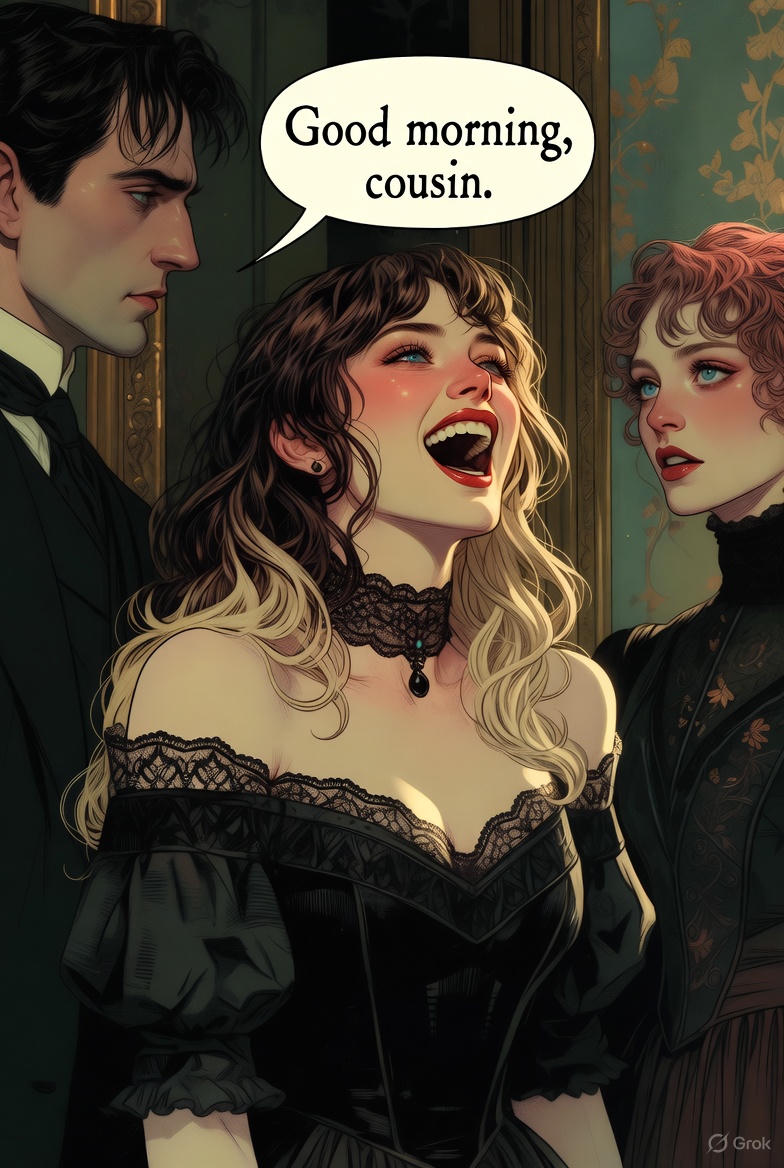
“Good morning, cousin,” laughed Alraune ten Brinken.
She stood right in front of him, next to Frieda Gontram.
“Good morning,” he answered curtly. “Read these letters here–It
won’t do you any harm to think about what you have been the cause
of–It’s time to stop this foolishness, do something sensible, something
worth the effort.”




 Anarchistbanjo's World