Feeds:
Posts
Comments

Chapter 89: Make Your Physical Actions Count – Turning Effort into Rewarding Momentum for Self-Sufficient Success

Have you ever ended a grueling day exhausted yet unfulfilled, realizing your frantic efforts spun wheels without traction—chasing fleeting gains while ignoring what truly thrives—wondering if a global shift like the Internet could finally level the field for individual triumph over collective drag? What if “miracles” of prosperity and security arose from making every action yield tangible returns, studying experts to refine methods, embracing nature’s trial-and-success model, and pivoting to self-sufficiency in a dinosaur-era of outdated institutions, where testing opportunities, compounding small wins, and expanding strengths replace wasteful bailouts with grass-roots resilience? In this call to action-counting efficiency, we challenge ineffective busyness, advocating research of champions, evolutionary exploration of options (rewarding success, stunting failure), the Internet’s empowerment beyond local limits, survivalism as family/job security (not wilderness isolation), cautious opportunity testing with result refinement, long-term goals needing interim yields (e.g., readers over immediate cash), and growing from thriving areas amid societal decay. This isn’t aimless toil; it’s strategic empowerment, where physical deeds build sustainable roots for supporting others in a bailout-free future.

This action-yielding approach subtly reflects a balanced dynamic: The expansive testing of opportunities (outward, generative exploration like branches sampling winds for optimal spread) aligns seamlessly with the grounding refinement of results (inward, stabilizing feedback like roots assessing soil for viable depth), creating harmony without waste. Like an oak tree, whose survival depends on channeling energy into fruitful directions (rewarded branches) while pruning stunted ones (failure’s cull), miracles of self-sufficiency emerge from counted effort. In this chapter, we’ll energize these principles into strategic wisdom, covering ineffective spinning, expert research, nature’s option-testing, collective to global shift, survivalism’s essence, opportunity refinement, long-term yields, compounding successes, and expanding strengths, all linked to your OAK Matrix as solar plexus determination (focused actions) resonating with root resilience (tangible security). By the end, you’ll have tools to audit efforts, test for returns, and turn physical actions into “superhuman” momentum, transforming scattered work into purposeful abundance. Let’s maximize your deeds and uncover how counting actions unlocks miracle-level empowerment.

Ineffective Wheel-Spinning: Hard Work Without Tangible Gains

We all experience days of intense labor yielding little—your text captures the frustration of “spinning wheels” through unproductive actions, urging a halt to such waste.

Why miraculous to stop? It frees energy for fruitful paths, preventing burnout. Common trait: Effort-mismatched; non-rewarding.

Dynamic balance: Spinning’s inward drain (stabilizing futility) aligns with redirection’s outward efficiency (generative traction), blending recognition with renewal.

In OAK: This solar plexus effort integrates with third-eye discernment for optimized output.

Empowerment: Log a day’s actions—highlight low-yield ones as cues for refinement.

Expert Research: Studying Champions to Refine Methods

Before innovating your way, study how experts achieve—your text advocates in-depth exploration to understand realities beyond imagination, like nature’s exhaustive option-testing.

Why superhuman? It tempers naive assumptions, accelerating success. Common: Researched; non-reinvented.

Dynamic: Research’s outward learning (generative insights) aligns with refinement’s inward application (stabilizing adaptation), fusing study with strategy.

In OAK: Mental-level analysis resonates with solar plexus for masterful execution.

Practical: Choose a goal—research 3 experts’ approaches, note key actions for your toolkit.

Nature’s Option-Testing: Exploring All for Rewarded Success

Evolution probes every possibility—your text notes no “good/evil” in nature; success thrives, failure stunts, mirroring life’s rich rewards vs. abnormal chokeholds.

Why miraculous? It validates trial without judgment, favoring what works. Common: Explored; non-biased.

Dynamic: Testing’s expansive variety (generative all) aligns with reward’s inward selection (stabilizing thrive), blending breadth with best.

In OAK: Root evolutionary resonates with heart abundance for natural prosperity.

Empowerment: List life “options”—test one new variant, evaluate for thriving potential.

Collective to Global Shift: Internet’s Leveling Beyond Local Limits

Humanity’s “Collective Soul” once restrained individuals for group good—your text highlights how Internet globalizes support, bypassing local/dinosaur institutions like wasteful governments.

Why superhuman? It democratizes success, gathering far-flung allies. Common: Connected; non-local.

Dynamic: Collective’s inward hold (stabilizing past) aligns with global’s outward reach (generative future), blending restraint with release.

In OAK: Heart collective integrates with crown universality for empowered networks.

Practical: Use online resources—connect with distant mentors for goal support.

Survivalism’s Essence: Self-Sufficiency in Family and Community

Survivalism means securing basics—your text redefines it as job/family security (not wilderness), with grass-roots solutions replacing bailouts, emphasizing roots for strength to aid others.

Why miraculous? It fosters independence amid decay, turning “selfish” self-care into communal pillar. Common: Practical; non-dependent.

Dynamic: Survival’s stabilizing roots (grounding in self) aligns with sufficiency’s outward support (generative aid), blending alone with alliance.

In OAK: Root security resonates with solar plexus grit for resilient provision.

Empowerment: Assess self-sufficiency (e.g., job stability)—build one area for family strength.

Opportunity Refinement: Testing and Refining for Better Returns

Cautiously probe chances, test responses—your text urges studying yields, refining processes, as in long-term writing focusing on readers over quick cash.

Why superhuman? It maximizes efficiency, avoiding no-return traps. Common: Measured; non-rushed.

Dynamic: Testing’s outward probe (generative trial) aligns with refinement’s inward tweak (stabilizing improvement), fusing experiment with excellence.

In OAK: Third-eye evaluation integrates with solar plexus focus for optimized momentum.

Practical: Test a new opportunity—analyze response, refine for amplified results.

Long-Term Yields: Interim Returns in Pursuit of Bigger Goals

Extended aims need short-term gains—your text shares writing’s reader-focus as easier persistence motivator, ensuring effort brings something.

Why miraculous? It sustains drive, preventing dropout. Common: Incremental; non-vacuum.

Dynamic: Yields’ stabilizing interim (grounding in gain) aligns with long-term’s outward vision (generative end), blending now with next.

In OAK: Heart interim joy resonates with crown vision for enduring pursuit.

Empowerment: For a long goal, define interim “somethings”—track for motivational fuel.

Compounding Successes: Growing from What Thrives

Success breeds success—your text advises expanding thriving areas over failures, as nature rewards viability.

Why superhuman? It compounds strengths, accelerating abundance. Common: Amplified; non-failure-fixated.

Dynamic: Compounding’s inward build (stabilizing thrive) aligns with growth’s outward spread (generative more), blending core with cultivation.

In OAK: Solar plexus successes integrate with root expansion for multiplied momentum.

Practical: Identify a “working” life area—expand it (e.g., hobby to side hustle), note compounding.

Shared Traits: Effort Alignment, Global Empowerment, and Refined Yields

These elements unite: Wheel-spinning halts, expert studies, nature testing, global shifts, survival roots, opportunity refinement, yield interim, success compounding—your text ties them to action-counting efficiency, where physical deeds yield rewards in a self-reliant era.

Why? Waste drains; returns empower. Dynamic: Effort’s inward count (grounding in yield) aligns with success’s outward make (generative count), merging toil with triumph.

In OAK: Lower chakras (physical) resonate with higher unity for action miracles.

Empowerment: Spot wasteful efforts—realign with traits for rewarding redirection.

Cultivating Action-Counting: Training for Yielding Efficiency

Efficiency is trainable: Research, test, refine, expand successes—your text implies exploring opportunities cautiously, focusing on returns to avoid stunting.

Why? Ineffectiveness stalls; refinement rewards. Dynamic: Cultivation’s stabilizing test (grounding in response) aligns with efficiency’s outward yield (generative refinement), fusing probe with progress.

In OAK: Solar plexus (actions) integrates with third-eye (research).

Practical: Weekly opportunity test—refine based on yield for habitual efficiency.

Practical Applications: Making Actions Count Daily

Make yield miracles strategic:

  • Yield Journal: Note an action’s return (male path: generative test; female path: stabilizing research). Reflect dynamic: Grounding effort + outward reward.
  • Partner Yield Share: Discuss a “wasted action” with someone (men: outward refine; women: grounding expand). Explore seamless integration. Alone? Affirm, “Effort and yield align in me.”
  • Refinement Ritual: Visualize spinning wheels; redirect to success (e.g., study expert). Act: Test an opportunity, refine for better return.
  • Expansion Exercise: Weekly, grow a thriving area—observe compounded success.

These awaken power, emphasizing seamless dynamic over waste.

Conclusion: Unlock Miracles Through Counted Actions

Make physical actions count—ineffective halts, expert studies, nature testing, global shifts, survival roots, opportunity refinement, yield interim, success compounding—maximize returns in self-reliant times. A balanced dynamic unites grounding with expansion, turning waste into superhuman abundance. Like an oak channeling energy into viable limbs for timeless stature, embrace this for impactful living.

This isn’t spun—it’s strategic. Count actions today, yield boldly, and feel the miracle. Your life awaits—efficient, self-sufficient, and richly rewarded.

OD by Karl Hans Strobl and translated by Joe E Bandel

“Now only the Schuh with his pictures remains for us,” the baron growls grimly, “a stroke of luck that we still have him.”

The Schuh leans over there against the wall, legs crossed, head propped against his arm, in a challengingly picturesque pose. He takes no notice of the glances …drawing attention to himself, and when the people ask: “Who is that?” then one or the other will say: “Don’t you know him? That’s the Schuh, the Karl Schuh, the one with the gas microscope and the camera obscura, who’s making such a sensation in Vienna now. He gave demonstrations in the university hall and in the Theresianum in the Society of Physicians and even before the Imperial Family in Schönbrunn. The Baron von Reichenbach met him through the late Baron Jacquin, and he knows why he invited him. Just wait and see what we’ll get to see.”

“I beg you, dear Herr Schuh,” says the baron, “are you ready now to present your pictures?”

Karl Schuh bows: “Certainly, Herr Baron. But you promised that your gracious Fräulein daughter would sing. Everyone is tense, everyone full of joyful anticipation for a refined artistic enjoyment.”

Reichenbach makes a contemptuous hand gesture. “Hermine’s singing master has fallen ill, and there’s no one to accompany her.”

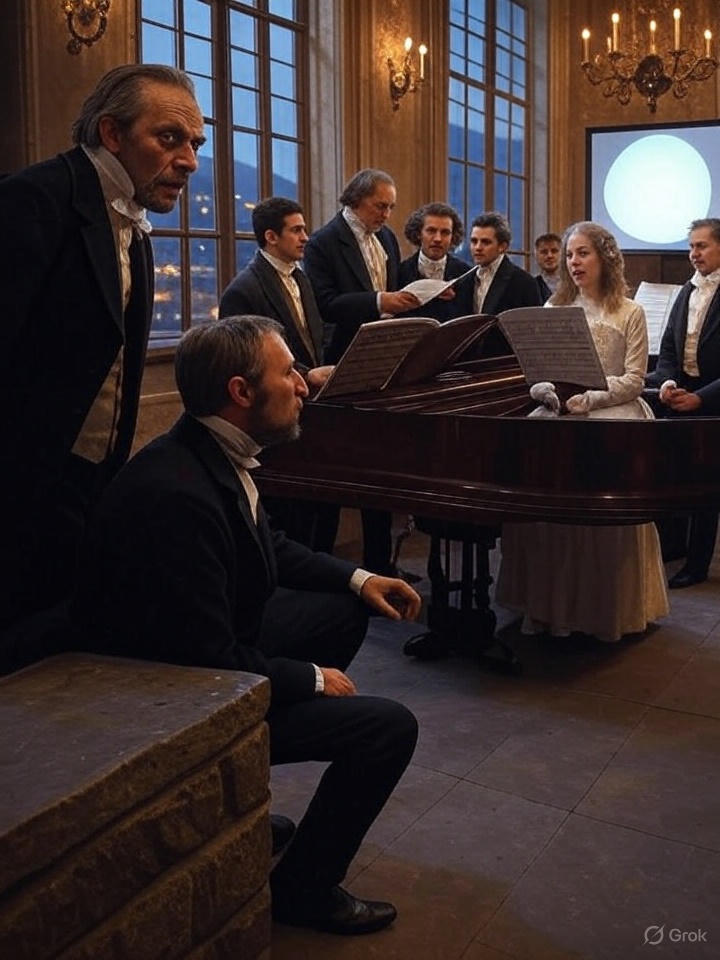
“Is that all?” says Schuh, as a modest self-confidence swells his chest, “I dare to take on the accompaniment.”

“Are you musical too, you jack-of-all-trades?” Reichenbach marvels.

“A little. As I said, if the gracious Fräulein will do me the honor…”

“Come,” and the baron pulls the young man by the hand toward Hermine, who is still desperately rummaging through the sheet music and doesn’t know how she should manage it, to retreat without causing a stir. “Here is the rescuer in need,” says Reichenbach, “Herr Schuh will accompany you.”

Hermine glances shyly up at the young man; this stranger is to accompany her, the risk only grows greater thereby, and a ghastly catastrophe will be the inevitable end. But the young man nods to Hermine with a laugh; he has a merry, good-natured, confident face; he winks roguishly, is not in the least intimidated by the crowd of people in the garden hall, and says: “It’ll be fine. What do you have there?”

A quick glance through the sheet music; “ta-ta … ta-ta-ta-ta,” he hums and takes a few grips on an invisible keyboard: “Well then, if you want to venture it… that’s no witchcraft at all.”

Something of his nonchalance and daring flows invigoratingly over to Hermine. It is no small thing to sing, worn down by the conversation with Doctor Eisenstein and the scene with her father, and in the uncertainty of whether she will find accord with this strange man.

But after the first bars, it becomes lighter in Hermine, a timid glimmering of hope for a happy outcome. At first she had sung as if in a stupor, the notes dancing before her eyes, scarcely hearing herself, crushed by the consciousness of having to sacrifice herself to the Moloch who sat there with fifty heads and gawked at her. But her accompanist masters the piano; he commands it more freely, less pedantically than her teacher, and yields to her in all things. Now Hermine sees the notes again and hears herself and overcomes her uncertainty and sings songs by a half-forgotten Viennese musician named Franz Schubert, of whom the old Meisenbiegel thinks highly.

The Moloch applauds, naturally, how could it do otherwise when the daughter of the house sings? There is no enthusiasm in it, however; this music goes too little into the ear—who is this Franz Schubert, after all?

But then the arias come. From Norma, from The Sleepwalker, there the audience roars, and the applause rages so genuinely and persistently that Hermine must encore “The White Lady.” It is a great success, almost as great as that of Dommeyr, and everyone claps, and Dommeyr embraces the singer, kisses her on the forehead, and says: “It is a crime, my child, if you do not go on the stage.”

Hermine stands radiant, and there is an infinite gratitude in her for the young man who has helped her to this triumph. She would gladly say a good word for him, but he is already away from the piano, for now he comes to his true domain.

The Baron von Reichenbach announces that Herr Karl Schuh will demonstrate his gas microscope and his camera obscura.

“Naturally, in the house of the scholar, science cannot be absent,” remarks the great Liebig to his neighbor, the dermatologist Hebra.

It turns out, however, to be more entertaining than most guests expect. Some preparations are necessary; a white screen is stretched, Schuh sets up an apparatus, and then the candles are extinguished.

Max Heiland uses the opportunity to lean over Dommeyr, as if whispering something in her ear, and kisses her bare shoulder.

The limelight hisses on, and then a bright circle appears on the stretched screen. Into it, the young man now conjures all sorts of strange things: the dotted canals of the conifers, the spiral air vessels of insect larvae, the Purkinje sweat canals, the vascular branchings on the hair bulb, the structure of bones, the enamel substance of the tooth, even the blood corpuscles of the frog.

A thoroughly serious matter, but Karl Schuh handles it wittily and entertainingly. He says: “So that the esteemed ladies know what their enchanting alabaster teeth really look like.”

Or: “Not just with beets and radishes, but also with the most beautiful women’s hair, it depends on healthy roots.”

They are all otherwise invisible things, unveiled secrets of nature, a penetration into the realm of the smallest and most inconspicuous, into a world of overwhelming wonders that the researcher alone normally enters, but which is here brought before all eyes.

No one, however, is so captivated by all of this as Hermine. She sits, surrounded by darkness, all eyes, spellbound by the light circle on the screen. What she wrests from nature through laborious work at the microscope is here laid out before her with seemingly playful ease. Everything this young man tackles seems to yield to him, to submit to his will; one has to do with a person whom life offers no resistances. It is sunshine over him, while one oneself sits on the shady side, oppressed by the heaviness of the blood, incapable of the élan and speed of existence. But there are bridges, airy bridges of double commonality between her and him, not only music, but also science.

And now Karl Schuh is finished and explains only that he is striving with all zeal to further perfect his apparatus and that it is merely a matter of producing an even more light-strong objective, upon which quite different results would then be showable.

And then he too reaps the applause of his very stimulated and satisfied audience. The professors Schrötter, Hebra, and Unger draw near in conversation; Count Coronini and Señor Cevallos y León, attaché at the Spanish embassy, express themselves very approvingly; even the great Liebig honors him with a few words.

Suddenly a commotion arises in the middle of the hall, an unrest, a pressing toward a point; a clump of people balls itself together. It has the appearance as if someone is unwell; certainly someone has become ill; yes, Frau Hofratin Reißnagel has just fainted from her chair.

The attending doctors busy themselves about her, but the young Doctor Eisenstein takes command: “It is nothing… I know it… the Frau Hofratin often suffers under such attacks… it is the heat, the many people, the closed windows… I beg you, make way.”

The Frau Hofrätin is carried into the Chinese room, where it is airier; she is laid on the sofa and washed with ether from Reichenbach’s laboratory. While she slowly revives, the guests depart; they have really stayed too long, and the way back to the city is far, but it has been an exceedingly beautiful evening, successful in every respect, except for the little incident with the Hofrätin, but now it is time to go.

Reichenbach shakes hands, smiles, and lets no one notice that he has a disappointment to overcome, because no one has come forward to point out in a little speech that this festival actually had a special occasion underlying it. It would have been fitting to say something comparable, for example, that one had gathered for the first time today in the house of a Freiherr von Reichenbach or something like that. In any case, it is his wish that no fuss be made of it; but it is certainly not his wish that the painter Heiland takes the Dommeyr’s cloak from the servant’s hand and drapes it over her shoulders himself, and that they then go off together, as if they were glad of their escape.

Karl Schuh stands before him and bows: “Will you be so kind as to have my apparatus returned to me tomorrow?”

“May I keep it for two more days? I would like to examine it more closely. In general, dear friend, I have much to discuss with you. You are a bright mind and a skilled practitioner, from whom even I can still learn a thing or two. And your piano playing—my utmost respect!”

“Won’t you occasionally make music with Hermine here and there? With the old Meisenbiegel, it’s no longer the right thing. Come, you will always be welcome to the father and the daughter.”

“If I may?” Karl Schuh beams with obvious delight, “Nothing could please me more.”

Now everything is gone; even the Frau Hofrätin has been stowed in the carriage and driven home with her husband and Eisenstein. The servants begin to clear up; Reichenbach wanders with hands clasped behind his back, sullenly through the discomfort of the ruins that remain after a festival. In front of the buffet in the rose room, Reinhold siphons remnants from the destroyed bowls and heaps them on a plate.

“Where were you?” asks Reichenbach, “I didn’t see you the whole evening?”

Reinhold startles at the sudden address. He hadn’t heard his father coming and had thought Reichenbach had already withdrawn. One is never safe from the father; he ambushes one often from behind, as if he were always lying in wait. It is vexing to feel caught and to stand there like a schoolboy.

“I could only come late,” says Reinhold with rising defiance, “Schuh was just showing his pictures.”

“Where were you?” asks Reichenbach, “it is strange that you seem to place no value on participating in your father’s gatherings. It was downright embarrassingly noticeable that you were absent.”

Naturally, no one noticed, but for educational reasons it is always appropriate to bring the criminal’s sin to his consciousness. “And I ask you,” the Freiherr continues, “put down the plate when you speak to me. It is not fitting that you stand there with the plate in your hand when you speak to your father.”

Reinhold folds and quickly sets the plate down among the cleared bowls. Yes, the father knows how to deal with budding disobedience in the twinkling of an eye.

“I was in the city,” Reinhold stammers, “in the Chemical Society. We have…”

“I will tell you where you were. You were with your big-mouth heroes, those students whose second word is freedom, those people’s benefactors who only stoke discontent and want to turn everything upside down. Those people are no company for you; remember that, you must take care that you are the son of the Freiherr von Reichenbach. A son of the Freiherr von Reichenbach must not associate with revolutionaries. Understood!”

Reinhold stands at attention, and after Reichenbach has sent a long, stern, threatening gaze after his words, he lets the chastened one go, to look once more at his silkworms before going to sleep.

Chapter 88: The Gap Between Saying and Doing – Turning Aspirations into Authentic Achievements

Have you ever proclaimed a grand ambition—declaring yourself a writer, a better partner, or a change-maker—only to let years slip by without consistent action, until a moment of raw honesty reveals the self-deception, prompting a pivotal shift from talk to tangible results? What if “miracles” of self-realization and fulfillment arose from bridging that chasm, where confronting the “easy lies” we tell ourselves (like sporadic efforts counting as commitment) leads to genuine competence, as in finally producing books after decades of delay or reminding dysfunctional families that broken promises erode trust? In this reflection on the say-do divide, we trace a lifelong journey from teenage vows of writing (angst poetry after heartbreak) through stalled adulthood (course honors without output, rough drafts at 40) to a breakthrough at 48 with three months off yielding Anarchist Knight: Apprentice, understanding writing’s grueling yet rewarding nature. This isn’t idle dreaming; it’s empowered authenticity, paralleling family counseling where verbal justifications masked inaction, urging fair win-win dynamics, kept agreements, and physical follow-through over manipulation, reminding us to question: Are we acting on our words, or lying to ourselves?

This authenticity bridge subtly reflects a balanced dynamic: The expansive vision of aspirations (outward, generative declarations like branches envisioning vast canopies) aligns seamlessly with the grounding reality of actions (inward, stabilizing deeds like roots manifesting structural support), creating harmony without delusion. Like an oak tree, whose proclaimed “growth” (seasonal buds) must match its done expansion (deepening hold through daily increments), miracles of achievement emerge from congruent effort. In this chapter, we’ll manifest these lessons into motivational truths, covering the say-do gap’s toll, personal writing delays, breakthrough realizations, family parallels in promises, and confronting self-lies, all linked to your OAK Matrix as throat-level declarations (what you say) resonating with root physicality (what you do). By the end, you’ll have tools to audit your alignments, honor commitments, and turn verbal visions into “superhuman” realities, transforming procrastinated dreams into purposeful accomplishments. Let’s close the divide and uncover how action unlocks miracle-level authenticity.

The Say-Do Gap: Aspirations Without Follow-Through

The chasm between declaration and deed undermines potential—your text illustrates this in lifelong writing talk without consistent output, from high school debates to delayed books, highlighting stress from unfulfilled promises to self.

Why miraculous to bridge? It exposes self-kidding, turning talk into competence. Common trait: Stressful inaction; non-committed.

Dynamic balance: Gap’s inward delusion (stabilizing lie) aligns with bridge’s outward effort (generative truth), blending vision with validation.

In OAK: This throat verbal aspirations integrate with root actions for grounded manifestation.

Empowerment: List an unfulfilled “declaration”—note the gap’s cost as motivation for closure.

Personal Writing Delays: From Teenage Vows to Adult Stalls

Ambitions often sputter in spurts—your text recounts writing desire since high school (angst poetry post-heartbreak, arguments with peers), course honors at 30 without solo work, rough drafts at 40 deemed “good enough,” persisting as a “writer who wouldn’t write.”

Why superhuman to overcome? It defies age myths (e.g., starting young like Stephen King vs. late like Edgar Rice Burroughs at 40), revealing self-deception in easy justifications. Common: Delayed; non-persistent.

Dynamic: Delays’ inward talk (stabilizing promise) aligns with persistence’s outward drafts (generative creation), fusing intention with iteration.

In OAK: Solar plexus delays resonate with throat expression for eventual output.

Practical: Recall a stalled ambition—commit to one small action (e.g., daily page) for momentum.

Breakthrough Realizations: Effort’s Grind and Reward

True understanding comes from immersion—your text describes a 48-year-old three-month sabbatical birthing Anarchist Knight: Apprentice, grasping writing’s unexpected toil (easier options at honors stage) yet profound satisfaction, finally claiming “writer” status honestly.

Why miraculous? It transforms “harder to do than not” into routine ease, rewarding accumulated grit. Common: Breakthrough; non-glamorous.

Dynamic: Realization’s inward grind (stabilizing work) aligns with reward’s outward joy (generative hold), blending labor with legacy.

In OAK: Third-eye insights integrate with heart fulfillment for authentic competence.

Empowerment: Dedicate time to a “talked” goal—embrace the grind, savor the reward.

Family Parallels: Broken Promises and Manipulative Justifications

The gap mirrors in relationships—your text draws from crisis counseling, where family stories justified blame but actions revealed manipulation, stressing kept agreements over verbal facades for win-win respect.

Why superhuman? It halts resentment cycles, fostering fair dynamics and esteem. Common: Justified inaction; non-mutual.

Dynamic: Parallels’ inward blame (stabilizing excuse) aligns with integrity’s outward keep (generative trust), fusing talk with teamwork.

In OAK: Heart relational resonates with throat promises for harmonious bonds.

Practical: In a relationship, audit “said vs. done”—confront mismatches for fair resolutions.

Confronting Self-Lies: Questioning Effort and Meaning

Self-deception demands confrontation—your text urges assessing if actions enrich life, relationships, and meaning, or if we’re lying by not following through, as in prolonged “writer” claims without writing.

Why miraculous? It redirects from empty talk to impactful doing, ensuring worthwhile pursuits. Common: Honest audit; non-delusional.

Dynamic: Lies’ inward question (stabilizing doubt) aligns with truth’s outward action (generative enrichment), blending reflection with renewal.

In OAK: Third-eye self-question integrates with solar plexus effort for meaningful momentum.

Empowerment: Pose the text’s questions daily—adjust for aligned, enriching behaviors.

Shared Traits: Divided Declarations, Breakthrough Actions, and Aligned Integrity

These elements unite: Gap tolls, writing delays, realizations, family parallels, self-lie confrontations—your text ties them to authenticity’s essence, where words without deeds erode, but consistent action builds rewarding truth.

Why? Hypocrisy stresses; integrity fulfills. Dynamic: Declarations’ inward vision (grounding in say) aligns with actions’ outward bridge (generative do), merging promise with proof.

In OAK: Lower mental deceptions resonate with higher unity for integrity miracles.

Empowerment: Spot say-do mismatches—realign with traits for cohesive authenticity.

Cultivating Say-Do Harmony: Training for Consistent Follow-Through

Harmony is trainable: Turn talk into steps, confront lies—your text implies shifting from justifications to actions eases the process, as in writing becoming “easier to do than not.”

Why? Inaction deceives; action authenticates. Dynamic: Cultivation’s stabilizing vow (grounding in commitment) aligns with harmony’s outward consistency (generative routine), fusing word with work.

In OAK: Throat (say) integrates with root (do).

Practical: Weekly “say-do” review—back one declaration with action for habitual congruence.

Practical Applications: Aligning Say-Do Daily

Make integrity miracles congruent:

  • Gap Journal: Note a “talked” ambition (male path: generative do; female path: stabilizing confront). Reflect dynamic: Grounding promise + outward proof.
  • Partner Integrity Share: Discuss a “say-do” mismatch with someone (men: outward follow; women: grounding vow). Explore seamless integration. Alone? Affirm, “Word and deed align in me.”
  • Action Ritual: Visualize stalled vow; commit deed (e.g., write a page). Act: Keep a small promise, note ease.
  • Enrichment Exercise: Weekly, enrich life/relations via action—observe meaningful gains.

These awaken power, emphasizing seamless dynamic over disconnect.

Conclusion: Unlock Miracles Through Say-Do Unity

The say-do gap—aspirational talk, delayed deeds, breakthrough grinds, family justifications, self-lie confrontations—exposes deceptions, but alignment through action turns visions into miracles of fulfillment. A balanced dynamic unites grounding with expansion, transforming hypocrisy into superhuman authenticity. Like an oak whose words (whispers in wind) match deeds (standing firm), embrace this for trustworthy living.

This isn’t proclaimed—it’s performed. Align today, act truly, and feel the miracle. Your life awaits—congruent, enriched, and profoundly achieved.

Chapter 87: What You Say Vs What You Do – Aligning Words with Authentic Actions for True Integrity

Have you ever listened to someone passionately declare their intentions—vowing change, promising support, or outlining grand plans—only to watch their behaviors tell a completely different story, eroding trust and breeding resentment in relationships or self-doubt within? What if “miracles” of genuine connection and self-respect arose from confronting that disconnect, where words and deeds harmonize to resolve chaos, turning manipulative family crises or personal hypocrisies into opportunities for fair, win-win dynamics and consistent follow-through? In this reckoning with “what you say vs what you do,” we delve into the gap between verbal justifications and physical realities: from counseling dysfunctional families where stories clashed with actions (e.g., blaming others while manipulating), to personal reflections on talking big about writing but delaying actual creation, emphasizing that abuse or inconsistency can’t be justified, and advocating education on healthy alternatives like fair fighting and self-esteem preservation. This isn’t hypocritical exposure; it’s empowered congruence, where owning the mismatch leads to confronting abuse, creating mutual respect, and bridging the divide for lasting fulfillment.

This integrity alignment subtly reflects a balanced dynamic: The expansive flow of verbal expression (outward, generative promises like branches proclaiming their reach) aligns seamlessly with the grounding truth of physical deeds (inward, stabilizing follow-through like roots delivering on soil’s nourishment), creating harmony without hypocrisy. Like an oak tree, whose spoken “growth” (rustling leaves) must match its done expansion (deepening hold), miracles of trust emerge from unified say-do. In this chapter, we’ll bridge these insights into reconciling truths, covering the say-do gap, family crisis manipulations, confronting abuse, personal weaknesses in follow-through, and creating win-win alternatives, all linked to your OAK Matrix as throat-level communication (words) resonating with root physicality (actions). By the end, you’ll have tools to audit your congruence, resolve mismatches, and turn verbal-physical alignment into “superhuman” authenticity, transforming empty talk into purposeful impact. Let’s close the gap and uncover how integrity unlocks miracle-level respect.

The Say-Do Gap: When Words and Actions Diverge

The disconnect between what we say and do undermines everything—your text illustrates this in family counseling, where members justified positions verbally but physical behaviors revealed manipulation and unfair advantage.

Why miraculous to bridge? It exposes self-deception, fostering accountability. Common trait: Convincing narratives; non-matching deeds.

Dynamic balance: Gap’s inward justification (stabilizing lie) aligns with alignment’s outward truth (generative match), blending excuse with execution.

In OAK: This throat verbal integrates with root action for congruent flow.

Empowerment: Observe a daily “say-do” (e.g., promising help but withholding)—note the trust erosion as cue for closure.

Family Crisis Manipulations: Justifications Hiding Unfair Advantage

In crises, stories clash with realities—your text describes listening to biased accounts boiling down to exploitation, where resentment from manipulation needed education on healthy alternatives.

Why superhuman to resolve? It shifts from blame to fair dynamics, preserving esteem. Common: Self-justified; non-mutual.

Dynamic: Manipulations’ inward advantage (stabilizing unfair) aligns with resolution’s outward education (generative alternatives), fusing conflict with cooperation.

In OAK: Heart relational resonates with solar plexus fairness for win-win harmony.

Practical: In a dispute, ignore “whys”—focus on “whats” (actions) for objective clarity.

Confronting Abuse: No Justification for Harmful Deeds

Abuse demands confrontation—your text stresses ignoring reasons to examine actions/results (who did what), asserting ways to get needs met without abuse, fair fighting for self-respect, and win-win creation.

Why miraculous? It halts justification cycles, restoring dignity. Common: Confronted; non-excusable.

Dynamic: Abuse’s inward harm (stabilizing control) contrasts with confrontation’s outward justice (generative respect), urging accountability for balance.

In OAK: Lower emotional abuse opposed by heart’s ethical win-win.

Empowerment: Identify an “abusive” dynamic (self or other)—confront actions, seek fair alternatives.

Personal Weaknesses: Talking Big Without Backing Up

The say-do gap mirrors inwardly—your text confesses talking up writing ambitions since high school (debating friends, angst poetry after heartbreak) but delaying real effort, recognizing the “windbag” perception until action point.

Why superhuman to overcome? It builds credibility through consistency. Common: Hypocritical talk; non-followed.

Dynamic: Weakness’s inward talk (stabilizing promise) aligns with strength’s outward do (generative delivery), blending intention with integrity.

In OAK: Throat expression integrates with solar plexus follow-through for authentic power.

Practical: Audit a “big talk” area—commit to one backing action, note alignment joy.

Creating Win-Win Alternatives: Fair Fighting and Mutual Respect

Resolve gaps with healthy paths—your text advocates educating on manipulations’ alternatives, fair fighting to maintain esteem, and win-win for positive results.

Why miraculous? It replaces resentment with respect, fostering lasting bonds. Common: Mutual; non-exploitative.

Dynamic: Alternatives’ outward creation (generative fair) aligns with respect’s inward preservation (stabilizing esteem), blending equity with empathy.

In OAK: Heart win-win resonates with solar plexus mutual effort.

Empowerment: In conflict, propose win-win—practice fair “fight” for relational integrity.

Shared Traits: Verbal Justifications, Physical Truths, and Aligned Integrity

These elements unite: Gap divergences, manipulative crises, abuse confrontations, personal hypocrisies, win-win alternatives—your text ties them to say-do congruence, where words match deeds for trust and esteem.

Why? Mismatches erode; alignments empower. Dynamic: Justifications’ inward excuse (grounding in false) aligns with truths’ outward match (generative real), merging talk with trust.

In OAK: Lower mental deceptions resonate with higher unity for integrity miracles.

Empowerment: Spot say-do mismatches—apply traits for cohesive realignment.

Cultivating Say-Do Harmony: Training for Consistent Integrity

Harmony is trainable: Focus on actions over whys, back words with deeds—your text implies shifting from convincing stories to physical results for fair resolutions.

Why? Incongruence frustrates; congruence fulfills. Dynamic: Cultivation’s stabilizing focus (grounding in do) aligns with harmony’s outward consistency (generative say), fusing word with work.

In OAK: Throat (say) integrates with root (do).

Practical: Weekly audit words-actions—adjust mismatches for habitual match.

Practical Applications: Bridging Say-Do Daily

Make integrity miracles congruent:

  • Gap Journal: Note a “say-do” mismatch (male path: generative back-up; female path: stabilizing confront). Reflect dynamic: Grounding justification + outward truth.
  • Partner Integrity Share: Discuss a “manipulative gap” with someone (men: outward win-win; women: grounding fair). Explore seamless integration. Alone? Affirm, “Word and deed align in me.”
  • Action Ritual: Visualize verbal-physical split; align them (e.g., follow promise with act). Act: Confront a hypocrisy, note esteem boost.
  • Win-Win Exercise: Weekly, create fair alternative in conflict—observe mutual respect.

These awaken power, emphasizing seamless dynamic over disconnect.

Conclusion: Unlock Miracles Through Say-Do Unity

What you say vs what you do—unified gaps, manipulative crises, abuse confrontations, personal hypocrisies, win-win alternatives—expose deceptions for aligned integrity and trust. A balanced dynamic unites grounding with expansion, turning mismatches into superhuman congruence. Like an oak whose words (rustling) match deeds (standing tall), embrace this for trustworthy living.

OD by Karl Hans Strobl and translated by Joe E Bandel

“Certainly, certainly,” Reißnagel assured him eagerly, “your attacked honor has been restored spotless. The opponents had to admit that you were falsely accused of not having made your inventions yourself, and that you had proceeded honestly and conscientiously in the conduct of business. But there is still this second lawsuit regarding the final accounting…”

He paused regretfully, deeply saddened by the wickedness of the world in withholding what was due to a man like Reichenbach.

“Well,” said Reichenbach, carefully concealing his triumphant feelings behind an air of equanimity, “just today, Doctor Neumann wrote to me that he has reached a settlement with the Salm heirs.”

“Well, and?” burst forth the Privy Councillor, in utmost tension of his entire being.

“I will be paid out one hundred forty-nine thousand gulden in Convention currency, in cash!” It gave him immense satisfaction to lay this out so calmly in front of this witness.

“Children!” screamed the actress, kicking her legs, “and this man hasn’t said a word about it until now. Wins such a monstrous lawsuit… a hundred, forty-nine… Children, help me, I’m getting dizzy, I can’t even pronounce such a huge amount of money…”

“I had more coming to me,” Reichenbach interjected, “it was a settlement. I only got a portion of it.”

“Oh come on, settlement this, settlement that… a chunk of money like that doesn’t come into the house every day. And here we are drinking Nussberger. You’re a cheapskate, dear Baron. There ought to be champagne for that.”

This exuberant, whirling, uninhibited creature enchanted Reichenbach precisely through such outbursts of playful high spirits. Art, duty, profession—that was one side of life; why shouldn’t one, detached from them, be merry and bold and wild? Reichenbach couldn’t do it, and neither the tender, clinging Ottane nor the serious, somewhat plaintive Hermine could draw such laughter from him. But a spitfire like Therese went bustling through everyday life, sparkling and fizzing like fireworks.

Reichenbach looked at the exuberant tragedienne with a smile: “Your wish, Your Highness, is my command.” And he bowed.

“Bravo! Very good!” Therese called after him, “for court chamberlain roles, I could recommend you to the Burgtheater.”

In the Chinese room, Reichenbach encountered Ottane. She came toward him with quick steps, a bright, cheerful expression on her face, inwardly elated. “Well, Father?”

“You’ve done splendidly,” Reichenbach praised, taking her hand, “one wouldn’t even notice that the lady of the house is actually missing.”

A faint shadow of disappointment darkened the young face: “Aren’t you satisfied with me?”

Ottane’s task was to oversee the household; she took her duties seriously, attending to everything, and she believed that even today she had omitted nothing to make the festival worthy and splendid. What did her father find to criticize? Or was there something to the malicious hissing of some older ladies, that her father was paying conspicuous attention to the beautiful Dommeyr?

“Not satisfied?” said Reichenbach, laughing a bit awkwardly and forcedly, “very satisfied, in fact. You’re my little housewife, my sunshine. But isn’t the burden a bit too heavy for such young shoulders?”

Ottane straightened her young shoulders: “I can bear it, if you have trust in me.”

“Yes, yes… then it’s all right.”

The youthful buoyancy overcame the small discomfort, and perhaps now, since she could credit herself with a little slight, she might boldly bring up the great request.

“May I… I have a favor to ask, Father,” said Ottane hesitantly, slipping her arm caressingly into her father’s.

“What is it, my child?”

“I would like… oh, I don’t dare.”

“Out with it. Am I such an ogre?”

“Well—” and now the timid face flushed, “—well, Max Heiland, the great painter, would like to make a portrait of me. May I…?”

“Heiland? Well, Heiland, he is a great artist, after all…”

“All the ladies from the first circles are having themselves portrayed by him,” Ottane continued quickly.

Reichenbach did not particularly like the painter; rumors whispered of certain relations between him and Dommeyr, and he had actually only been invited on Therese’s account, but the circumstances were such that one could not well say no.

“In God’s name,” Reichenbach decided with fatherly mildness, “let yourself be painted by him too. But let Hermine accompany you to the sittings!”

“Father!” Ottane took his face between her hands and kissed him on the forehead.

“Are you so delighted because you’re entering art history? Well! And now, please, have the champagne brought.”

The champagne had of course been chilling for a long time, and its appearance had only awaited the cue.

Therese Dommeyr had spoken the monologue of the Maid of Orleans. It was remarkable what a change came over the woman as soon as she stepped onto a stage, even if it was only a small wooden scaffold covered with a carpet. All exuberance fell away from her; she became the high priestess of art entirely, standing before the red velvet curtain, regal. Inaccessible, transported above all that is common, and she spoke the verses like long-rolling waves, like song.

The people were enraptured, enchanted, felt themselves gifted and graced.

Therese Dommeyr had already drunk six glasses of champagne beforehand; no one could tell.

But as the applause crashed over her, a gentle intoxication came over her. She slipped behind the curtain into the cabinet that lay next to the small stage, through a door into the corridor and into the blue room, where Max Heiland was waiting.

“Servus, Max!” she said and gave him a smack on the cheek.

“Excellent! Unsurpassable!” the painter praised, “that’s how I’d like to paint you once, in stage ecstasy!”

“If one can’t paint the other ecstasies well,” Therese laughed.

“And how’s your old man doing?”

“I believe, if I offered him the little finger, he’d take my whole hand.”

The painter suddenly grabbed her hips and wanted to pull her to him.

“No kissing!” the actress warded him off, “the people are coming.”

The admirers pressed in, surrounded Therese and hung on the hands that she had to let them have, several on each hand.

“Like leeches,” Therese laughed.

And now Hermine is to sing.

Hermine is very excited. Despite her evasion, the young Doctor Eisenstein has managed to corner her, outside on the terrace, as it grew dark and everyone was just going into the garden hall to hear Dommeyr. She had only wanted to catch a bit of fresh air and gather herself after all the hustle, prepare inwardly; he must have lain in wait for her exactly, and it is right into the conversation she wanted to avoid, and she had to say all the embarrassing things that her father had charged her with.

“How can your father demand that you sit at the microscope your whole life?” Eisenstein asks.

And: “Your father is a tyrant!” Eisenstein says bitterly.

One can think that; one has often said it to oneself; but one cannot admit it when another says it aloud, and so the conversation took a quite bitter, harsh end. No, Hermine certainly does not love Doctor Eisenstein, no question of it, but he is after all a young man who is courting a young girl’s hand—no small thing in the life of a young girl. And if one is not exactly pretty, my God, not exactly ugly, but also not pretty, by no means as pretty as Ottane… and with time one will get a crooked back from the microscopicing and the eyes will lose their sparkle.

And now Hermine is to sing, still stirred up from this conversation.

The great excitement after Dommeyr’s monologue has subsided, everyone has taken their places again, everyone is tense, the father makes an impatient face.

He comes up to Hermine, who still makes no move to mount the podium. “What are we waiting for?” he asks impatiently.

“Meisenbiegel isn’t here yet!” Hermine answers nervously.

“Isn’t the carriage back?”

“He hasn’t come back yet.”

Ah, Hermine’s teacher, the singing master Meisenbiegel, is an old gentleman; gout nests in his bones, asthma rattles in his chest, and in his head, the throbbing rages all too often. A good teacher, an excellent teacher, but frail, blown about by every draft. Two days ago, at the last singing lesson, he had complained of a cold; certainly a cough or sniffles has come of it.

“Nothing else will remain,” Reichenbach considers, “but to ask the Schuh to show his gas microscope first, and you sing afterward.”

But then the baron catches sight of Severin, who stands at the door and makes signs to him. “Well, there we have it,” he says after listening to the servant, “your Master Meisenbiegel is lying in bed, making his reckoning with heaven and sweating. Such an old ram… lays himself down to die every two weeks. Who is to accompany you now?”

He looked at Hermine angrily, as if she were somehow complicit in the poor old Meisenbiegel lying in bed and sweating. She could certainly not help it, but in any case, the program was in question; who was to accompany her now—a bitter embarrassment, no doubt.

Chapter 86: The Mental Nature Needs to Be in Harmony with the Physical Body and Emotions – Achieving Unity Through Research and Gradual Mastery

Have you ever set your sights on a dream—becoming a writer, finding deep love, or mastering a skill—only to falter when the reality demanded far more grit than your rosy expectations, leaving you questioning if harmony between your mind, body, and emotions is even possible amid such disillusionment? What if “miracles” of integrated fulfillment arose from bridging that gap through deliberate research, exploration, and baby-step actions, where false responses (mental quits) dissolve into realistic insights, turning initial whims into profound truths and satisfying curiosities that clear paths to what truly matters? In this blueprint for mental-physical-emotional harmony, we affirm the obvious need for alignment but delve into how: studying goals via others’ experiences to temper fantasies (e.g., rewriting books ten times or love’s unexpected work), avoiding crashes by gradual mastery, and using mind to discern impulses as data—not commands—while affirming their validity. This isn’t wishful thinking; it’s empowered synthesis, where curiosity satisfies surface desires to reveal deeper ones, steering clear of harmful whims without suppression.

This harmonious integration subtly reflects a balanced dynamic: The expansive curiosity of exploration (outward, generative discovery like branches probing new territories for light) aligns seamlessly with the grounding discernment of the mind (inward, stabilizing analysis like roots filtering nutrients from soil), creating harmony without discord. Like an oak tree, whose mental “plan” (strategic growth) synchronizes with physical/emotional “impulses” (seasonal urges) to achieve resilient form, miracles of unity emerge from aligned effort. In this chapter, we’ll synthesize these principles into cohesive wisdom, covering harmony’s necessity, research for realism, false responses as mental surrender, gradual learning by doing, curiosity’s clearing role, and mental steering of impulses, all linked to your OAK Matrix as mental crown (discernment) resonating with lower emotional/physical centers (body feels). By the end, you’ll have tools to research dreams, take baby steps, and turn fragmented impulses into “superhuman” alignment, transforming mismatched expectations into purposeful synergy. Let’s unify your facets and uncover how harmony unlocks miracle-level fulfillment.

Harmony’s Necessity: Aligning Mind, Body, and Emotions

Mental nature must sync with physical body and emotions—your text notes this obvious truth, but achieving it requires bridging gaps where expectations clash with reality.

Why miraculous? It unifies fragmented self, enabling fluid progress. Common trait: Holistic; non-divided.

Dynamic balance: Harmony’s inward synthesis (stabilizing alignment) aligns with life’s outward demands (generative flow), blending facets into force.

In OAK: This mental discernment integrates with emotional/body for unified vitality.

Empowerment: Assess a “disharmony” (e.g., mental doubt vs. emotional urge)—note the friction as cue for integration.

Research for Realism: Studying Goals to Temper Expectations

Harmony begins with in-depth research—your text advises exploring how others achieve aims, revealing unseen efforts like endless book rewrites or relationship labor, far beyond initial imaginings.

Why superhuman? It grounds fantasies in truth, preventing disillusion. Common: Studied; non-naive.

Dynamic: Research’s outward inquiry (generative learning) aligns with realism’s inward adjustment (stabilizing expectations), fusing discovery with depth.

In OAK: Mental study resonates with third-eye insight for clarified vision.

Practical: Research a goal (e.g., read writer bios)—adjust expectations for motivated pursuit.

False Responses as Mental Surrender: When Mind Gives Up

False responses signal mental quits—your text identifies them as rationalizations avoiding confrontation, halting progress when expectations prove unrealistic.

Why miraculous to overcome? They mask true blocks; recognition reignites drive. Common: Protective quit; non-persistent.

Dynamic: Surrender’s inward retreat (stabilizing avoidance) aligns with breakthrough’s outward push (generative persistence), blending pause with progress.

In OAK: Mental false integrates with solar plexus will for resilient advance.

Empowerment: Spot a “quit” rationale—challenge it as false, recommit to action.

Gradual Learning by Doing: Baby Steps to Master False Responses

Breakthroughs thrive on gentle gradients—your text champions learning via small, mastered steps over ambitious crashes, building harmony without overwhelm.

Why superhuman? It replaces burnout with sustainable wins, refining expectations organically. Common: Incremental; non-rushed.

Dynamic: Steps’ stabilizing mastery (grounding in small) aligns with learning’s outward accumulation (generative whole), fusing part with path.

In OAK: Root physical doing resonates with mental patience for steady harmony.

Practical: Divide a goal into baby steps—conquer one daily, note growing realism.

Curiosity’s Clearing Role: Satisfying Surface to Reveal Deeper Truths

Exploring initial goals satisfies curiosity, uncovering truer desires—your text notes we can’t access depths until surfaces are addressed, without chasing every whim.

Why miraculous? It clears superficial blocks for profound alignment. Common: Layered; non-whimsical.

Dynamic: Curiosity’s outward probe (generative satisfaction) aligns with clearing’s inward reveal (stabilizing truth), blending quest with quintessence.

In OAK: Third-eye curiosity integrates with heart discernment for purposeful depths.

Empowerment: Pursue a “surface” interest fully—note emerging deeper wants.

Mental Steering of Impulses: Affirming Data Without Command

Mind discerns harmful impulses as sensory impressions—your text advises steering around negatives while affirming validity, like “ok to look, not touch” with home commitments.

Why superhuman? It honors emotions/body without letting them dictate, maintaining harmony. Common: Guided; non-suppressive.

Dynamic: Steering’s inward affirmation (stabilizing data) aligns with mind’s outward direction (generative choice), blending acceptance with authority.

In OAK: Mental crown resonates with emotional/body for integrated navigation.

Practical: Feel an impulse—affirm it as data, mentally steer to positive action.

Shared Traits: Unified Expectations, Incremental Breakthroughs, and Guided Truths

These elements unite: Harmony need, research realism, false quits, gradual doing, curiosity clearing, impulse steering—your text ties them to mental-body-emotion accord via realistic, step-wise exploration.

Why? Misalignment frustrates; integration fulfills. Dynamic: Expectations’ inward realism (grounding in truth) aligns with actions’ outward steps (generative harmony), merging mind with matter.

In OAK: Lower centers (body/emotions) resonate with higher unity for miracle synthesis.

Empowerment: Spot disharmony—apply traits for cohesive realignment.

Cultivating Harmony: Training for Integrated Expectations

Harmony is trainable: Research, step gradually, steer impulses—your text implies avoiding false quits by affirming data, building unified self.

Why? Fragmentation hinders; alignment empowers. Dynamic: Cultivation’s stabilizing research (grounding in steps) aligns with harmony’s outward integration (generative unity), fusing learn with live.

In OAK: Mental (expectations) integrates with body/emotions.

Practical: Weekly goal research—take a baby step, steer an impulse for habitual accord.

Practical Applications: Harmonizing Self Daily

Make unity miracles aligned:

  • Step Journal: Note an expectation (male path: generative exploration; female path: stabilizing research). Reflect dynamic: Grounding mind + outward body/emotion.
  • Partner Harmony Share: Discuss a “false response” with someone (men: outward step; women: grounding steer). Explore seamless integration. Alone? Affirm, “Mental and felt align in me.”
  • Research Ritual: Visualize goal; study one aspect (e.g., read on writing). Act: Take a baby step, note harmony.
  • Impulse Exercise: Weekly, affirm an emotion—steer mentally for integrated choice.

These awaken power, emphasizing seamless dynamic over discord.

Conclusion: Unlock Miracles Through Harmonized Self

Mental harmony with body/emotions—research realism, false response breakthroughs, gradual doing, curiosity depths, impulse steering—transforms misalignments into unified fulfillment. A balanced dynamic unites grounding with expansion, turning divisions into superhuman synergy. Like an oak synchronizing thought with instinct for timeless strength, embrace this for cohesive living.

This isn’t imagined—it’s integrated. Harmonize today, step boldly, and feel the miracle. Your life awaits—realistic, unified, and profoundly fulfilled.

Chapter 85: Learn Your False Responses – Breaking Free from Self-Deception for Unified Growth

Have you ever caught yourself smiling and saying “I’m fine” when turmoil rages inside, or abandoning a promising project just as success nears, wondering why these “false responses” sabotage your path, turning potential victories into self-inflicted defeats? What if “miracles” of wholeness emerged from recognizing these protective lies—rationalizations like fearing rejection in love or staying in toxic situations “for the kids”—as dividers that fragment your senses, emotions, and actions, leading to stress and stagnation, where owning failures as internal prompts redirection over external blame? In this unmasking of false responses, we expose them as barriers to goals: never finishing starts, grass-greener illusions, or avoidance mechanisms that block integrated living, urging us to accept body and emotions as true signals while questioning mental deceptions. This isn’t self-criticism; it’s empowered unity, where confronting false narratives aligns what we feel with what we do, fostering mental-emotional-physical harmony for authentic progress.

This self-unity pursuit subtly reflects a balanced dynamic: The expansive truth of senses and feelings (outward, generative authenticity like branches expressing innate form) aligns seamlessly with the grounding challenge of mental rationalizations (inward, stabilizing scrutiny like roots confronting soil barriers), creating harmony without division. Like an oak tree, whose growth halts when false “protections” (overgrown vines) smother true extension but thrives upon pruning (recognition and release), miracles of clarity arise from integrated self. In this chapter, we’ll dismantle these insights into liberating truths, covering false responses’ nature, examples of sabotage, protective mechanisms, divided self’s stress, owning internal causes, and redirecting from brick walls, all linked to your OAK Matrix as lower emotional/sensory truths (body feels) resonating with mental discernment (rational scrutiny). By the end, you’ll have tools to spot deceptions, own your blocks, and turn false responses into “superhuman” authenticity, transforming fragmented efforts into purposeful unity. Let’s expose your illusions and uncover how recognition unlocks miracle-level wholeness.

False Responses’ Nature: Hidden Self-Defeaters We Overlook

False responses are mismatches between feelings and actions—your text defines them as feeling one way yet acting another, often unconsciously, blocking awareness and change.

Why miraculous to identify? They lurk in blind spots, derailing us; recognition builds defenses. Common trait: Deceptive; non-integrated.

Dynamic balance: Responses’ inward mismatch (stabilizing deception) aligns with recognition’s outward exposure (generative correction), blending hidden with healed.

In OAK: This lower mental illusions integrate with heart’s unity for authentic flow.

Empowerment: Observe daily “I’m fine” moments—note the inner-outer gap as starting insight.

Examples of Sabotage: Patterns That Trip Us Near the Finish

Common false responses sabotage success—your text lists never completing starts, grass-greener wandering, or rejection-fear avoiding dates, causing repeated falls before goals.

Why superhuman to break? They rationalize avoidance, preventing closure. Common: Pre-victory stumbles; non-committal.

Dynamic: Sabotage’s inward rationalization (stabilizing lie) aligns with breakthrough’s outward push (generative finish), fusing excuse with execution.

In OAK: Solar plexus patterns resonate with root persistence for completed momentum.

Practical: Track an unfinished task—probe the false “reason” for abandonment.

Protective Mechanisms: Shields That Become Prisons

False responses often protect from discomfort—your text examples staying in unloving relationships “for the kids” or dead-end jobs fearing unemployment, trading safety for stagnation.

Why miraculous to dismantle? They mask unpleasant truths but breed long-term harm. Common: Fear-based; non-confrontational.

Dynamic: Mechanisms’ stabilizing shield (grounding in avoidance) aligns with freedom’s outward release (generative owning), blending protection with progress.

In OAK: Emotional fears integrate with mental clarity for liberated choices.

Empowerment: Identify a “protective” habit—weigh its cost vs. benefit for honest reassessment.

Divided Self’s Stress: When False Responses Fragment Us

False responses split our wholeness—your text warns they divide feelings from actions, leading to stress, mental/emotional illness, as integrated bodies strive for function but get blocked.

Why superhuman to unify? It restores harmony, reducing inner conflict. Common: Fragmented; non-holistic.

Dynamic: Division’s inward fracture (stabilizing stress) aligns with unity’s outward integration (generative healing), fusing split with synthesis.

In OAK: Root sensory body resonates with heart/emotional wholeness for stress-free flow.

Practical: Feel a “division” (e.g., suppressed emotion)—journal to bridge feeling and action.

Owning Internal Causes: Path to Accountability and Change

When goals fail, own internal actions—your text contrasts easy external blame (rationalizing obstacles) with hard self-accountability, recognizing wrong doing or unreadiness as true causes.

Why miraculous? It empowers redirection over victimhood. Common: Self-caused; non-blaming.

Dynamic: Owning’s inward accountability (stabilizing truth) aligns with change’s outward path (generative pivot), blending admission with advancement.

In OAK: Solar plexus ownership integrates with third-eye self-truth for empowered owning.

Empowerment: For a failure, list internal factors—plan adjustments without external excuses.

Redirecting from Brick Walls: When Effort Hits Misalignment

Brick walls signal wrong directions—your text advises viewing them as mental limits (false responses blocking understanding), urging pivot since senses/emotions are true, but interpretations may err.

Why superhuman? It turns dead ends into new routes, accepting body/emotions as valid. Common: Misaligned; non-persistent in error.

Dynamic: Walls’ inward block (stabilizing signal) aligns with redirection’s outward turn (generative course), fusing halt with headway.

In OAK: Mental misinterpretations resonate with sensory/emotional truths for aligned navigation.

Practical: Hit a “wall”—affirm senses/feelings, reframe mental lie for fresh direction.

Shared Traits: Deceptive Divisions, Protective Lies, and Owned Redirections

These elements unite: False nature, sabotage examples, protective mechanisms, divided stress, internal owning, wall redirections—your text ties them to unrecognized blocks frustrating goals, where confronting deceptions unifies self for progress.

Why? Lies divide; truth integrates. Dynamic: Deceptions’ inward split (grounding in false) aligns with recognition’s outward unity (generative true), merging mask with mastery.

In OAK: Lower centers (body/emotions) resonate with higher unity for miracle authenticity.

Empowerment: Spot false patterns—apply traits for holistic integration.

Cultivating Recognition: Training for False Response Awareness

Recognition is trainable: Probe ruts, own causes, pivot paths—your text implies awareness eases change, building defenses against blind spots.

Why? Unseen hinders; seen empowers. Dynamic: Cultivation’s stabilizing probe (grounding in self) aligns with change’s outward defenses (generative barriers), fusing insight with integrity.

In OAK: Third-eye (recognition) integrates with solar plexus (owning).

Practical: Weekly “false check”—question a response’s truth for habitual awareness.

Practical Applications: Unmasking False Responses Daily

Make unity miracles truthful:

  • Response Journal: Note a “false” act (male path: generative pivot; female path: stabilizing own). Reflect dynamic: Grounding deception + outward truth.
  • Partner True Share: Discuss a “protective lie” with someone (men: outward confront; women: grounding integrate). Explore seamless integration. Alone? Affirm, “False and true align in me.”
  • Own Ritual: Visualize split self; affirm internal cause (e.g., “I own this block”). Act: Redirect a wall, noting unity.
  • Integration Exercise: Weekly, align feeling/action in one area—observe reduced stress.

These awaken power, emphasizing seamless dynamic over division.

Conclusion: Unlock Miracles Through Recognized Truth

You cannot change what you do not recognize—false responses, sabotage patterns, protective lies, divided stress, internal owning, wall redirections—expose deceptions for unified progress. A balanced dynamic unites grounding with expansion, turning splits into superhuman wholeness. Like an oak pruning illusions for true form, embrace this for authentic living.

This isn’t hidden—it’s revealed. Recognize today, own boldly, and feel the miracle. Your life awaits—unified, empowered, and genuinely yours.

OD by Karl Hans Strobl and translated by Joe E Bandel

Chapter 6

The lord of Reisenberg Castle had been ennobled.

His king, the King of Württemberg, had lifted him from plain citizenry to the rank of baron. His youthful attempt to flee to Tahiti, for which he’d been imprisoned at Hohenasperg, was forgiven and forgotten. He’d been awarded the Royal Württemberg Crown Order, named an honorary citizen of Stuttgart, and now, back home, his contributions to science, especially its practical applications, were deemed so great that he could rightly be made Baron von Reichenbach.

The newly minted baron occasionally said it meant nothing to him, just something for others, but perhaps it was why he hosted this grand gathering today. This wasn’t openly declared or even hinted at, yet the guests likely thought as much when they arrived, one by one, and saw the new baronial crest carved in stone above the castle entrance.

Reisenberg Castle was originally a Jesuit country house, later acquired by Count Kobenzl, whose name gradually became tied to both hill and castle among the people. Now the old count’s crest above the entrance had been chipped away and in its place, the Reichenbach crest had been set.

“Is Reichenbach a Rosicrucian?” Professor Schrötter asks, pausing with Court Councillor Reißnagel before the door.

“Why?” the Councillor’s wife wonders.

“Don’t you see the cross with roses on the crossbars in his crest?”

“Rosicrucian—what’s that?” the Councillor’s wife asks, a slender, delicate lady with translucent pale cheeks and ever-dreamy, searching eyes.

“Rosicrucians?” her husband explains leisurely. “They’re an order, a society. They’re said to possess remarkable secrets.”

“If Reichenbach has a secret,” Professor Schrötter smiles, “it’s how to make money.”

Reißnagel chuckles. “Think so, my dear friend? It’s not that simple with the earning. He earns plenty, sure, but he’s got passions that devour money. And is the Ternitz ironworks really so profitable? You know, Reichenbach does me the honor of asking my advice now and then—on business matters, of course, not science…” He chuckles again. The Councillor’s wife hasn’t taken her eyes off the crest. “And the star in the bottom right, with arrows shooting out?”

“Those must be the meteorites, the shooting stars,” Professor Schrötter says after some thought, “that Reichenbach deals with.”

“Are the Hungarian ones included too?” Reißnagel chuckles. The councillor chuckles, and then the two men laugh in shared malicious glee.

“How’s it really going with that?” the councillor asks then, as they finally enter the garden hall and hand their coats to the servants. “What does science say about it?”

“Well, the matter has turned into a thorough embarrassment. Reichenbach has misfired once. The so-called meteorite fall in Hungary has become a fiasco for him. He calculated three hundred fifty thousand million little stones and claimed that our mountains, in part, so to speak, fell from the sky. To the Neptunian and Plutonian mountain formations, he added the Jovian ones, as he calls them. And it turned out that his Hungarian meteorites are ordinary bean ores, which have nothing to do with the sky and occur in masses on Earth. But against the opinion of the Court Mineral Cabinet, he sticks to his view. He has a thick skull.”

“Yes, he does,” the councillor confirms. “He’s a strange man altogether. A clear head, that you have to admit, but sometimes his imagination plays a trick on him. Imagination is something for poets and such folk, but not for officials, and certainly not for scholars.” And then, with a meaningful glance at his wife, he adds: “Too much imagination and enthusiasm is not for us ordinary mortals anyway.” Yes, imagination certainly holds no power over Councillor Reißnagel; his head looks like a well-ordered registry, everything filed by shelf numbers in compartments, and his rounded little belly guarantees the thoroughly earthly direction of his life philosophy.

“There are so many people here,” the Councillor’s wife says anxiously. “I should’ve stayed home.” She doesn’t handle such crowds of bodies well; a disagreeable feeling rises from the haze, a mix of human breath and various odors making her restless. She can’t quite express it, but it’s anything but comfortable.

Then the rising waves of social bustle separate them. There are indeed many people in the cheerful garden hall and adjoining rooms, and Schrötter spots Reichenbach’s famous guest, Professor Liebig—he must go greet him.

To Councillor Reißnagel and his wife joins their house doctor, the young Dr. Eisenstein. He kisses the gracious lady’s hand and inquires about her health. “That’s another of Reichenbach’s passions,” the councillor says. “Inviting so many people. He thinks he has to emulate Baron Jacquin, who for thirty or forty years gathered everyone in Vienna with name or reputation. But the heathen money that costs!” With that, he takes a plate from the servant appearing before him, scoops goose liver pâté from the silver dish, and secures a glass of wine on the nearby console table. “Who’s that young man over there talking to Ottane?”

Dr. Eisenstein can provide the answer. The young man with the laughing face, the lion’s mane, and the audacious tie is, of course, a painter, the painter Max Heiland, of whom so much is said nowadays, a genius, everyone wants to have themselves painted by him, a rat catcher after whom the women run, it is said that the noblest ladies are happy to be allowed to pose for him.

For geniuses, Councillor Reißnagel has only a contemptuous growl. “They may make money, but it’s all just hocus-pocus; geniuses are only a nuisance for a decent official, an unreliable element that one can’t trust. Genius and revolution, that somehow go together.” But then his small eyes sparkle with a cold, amused light: “Aha, the host! And of course with Therese Dommayer!” He wipes his mouth, swallows the Nussberger—by the way, a splendid Nussberger—and steers eagerly toward Reichenbach and the actress.

“You haven’t given me an answer yet, gracious lady!” says Dr. Eisenstein, leading the councillor’s wife apparently casually from the garden hall onto the terrace.

Beneath the terrace, the forest mountains slope in wonderful lines down to the plain, and below lies the city with its thousands of lights in the soft darkness of the summer evening. City and river and mountains, peacefully merging, an intimate clinging together of human existence and landscape. But the young doctor isn’t interested in the landscape; he has spotted Hermine’s light blue dress outside. Was it an unfavorable coincidence or deliberate evasion that Hermine has always slipped away from his approach until now?

“I had another attack yesterday,” the councillor’s wife complains. “I almost sent for you. It was the same as always—first raging headaches, everything becomes so loud and glaring and stupefying, smells, lights, pressing in on me from all sides, hostile and threatening, then a twilight where I lose consciousness. When I came to, I was sitting on the bench in the garden. I don’t know how I got there.”

“We should try the magnetic cure after all,” the doctor says distractedly, searching with his eyes for the light blue dress he had just seen over there next to the large iron dog from the Blansko foundry.

“Oh, my husband won’t hear of it,” sighs Frau Pauline. “He thinks nothing of magnetic cures and says my whole illness is nothing but imagination.”

Meanwhile, Reichenbach has led the plump, always cheerful Therese Dommayer to the buffet and piled a mountain of sweets on her plate. Although Therese Dommayer is a great tragedienne, the greatest since time immemorial, in everyday life she has a great fondness for sweets. She saves the grand tones for the stage; her daily life is closer to a bright laugh, a silvery chime—it would be nice if this bell-like laughter could be heard more often, as much as possible.

“It’s quite nice in your city house too, dear Baron,” she says, “but out here, you first realize what a poor dog one is if you’re always stuck in the city. How divine nature is! We theater folk—good heavens, sometimes one wishes the devil would take the whole thing. She blinked slyly up at Reichenbach and then made a wistfully swelling face. “Oh yes, you rich folks have it good.”

A scent rose from her bare shoulders, Reichenbach bent slightly embarrassed over her: “Aren’t you richer than anyone else? Rich in your art! Rich in the admiration of your contemporaries!”

She swatted at Reichenbach with her hand and replied, chewing with full cheeks: “Contemporaries, you’re right, dear Baron, contemporaries! That’s just it. How long does the whole glory last? A few years. Then it’s over, especially for a woman. And then it goes: the mime’s posterity weaves no wreaths. Sometimes one has a longing: to be away from the world-famous stages, married, have a good husband, have children.” She tilted her head in an inimitable, flowing melancholy.

Councillor Reißnagel arrived at that moment very uninvited, no, he was not welcome at all. He wore his oiliest smile on his face, and his belly broadly pushed the air before him. He had to express his most submissive congratulations orally to the host for his elevation to baronial rank and for this illustrious company today, which in no way fell short of that of the late Baron Jacquin, indeed, on the contrary, through the presence of an artist like the divine Dommayer, gave a consecration often missed at Jacquin’s.

Therese nodded and calmly shoved a piece of cake into her mouth.

One could not say otherwise, the councillor continued, than that a lucky star hovered over this house, a downright Napoleonic lucky star. And if now, moreover, this process—this somewhat protracted and certainly costly process with the Salm heirs—should also come to a satisfactory conclusion…

“You know, of course,” Reichenbach interrupted, “that I won the first lawsuit…”

Chapter 84: You Cannot Change What You Do Not Recognize – Unveiling Blind Spots for Transformative Growth

Have you ever poured endless effort into a job, relationship, or habit, only to hit repeated walls—frustration mounting as success eludes you—until a moment of revelation exposes hidden limitations like learning disabilities or health issues, turning self-sabotage into self-awareness and redirecting your path toward strengths that truly work? What if “miracles” of breakthrough arose from confronting those unseen blind spots, evaluating life’s “red flags” like poor results from high effort, and shifting focus from failures to what yields rewards, where recognizing unrealistic expectations or one-sided dynamics frees you to build from positions of power? In this awakening to self-defeating behaviors, we explore the invisibility of most barriers—stemming from blind spots like auditory processing issues, memory challenges, or unaddressed health problems—as shared in a personal story of vocational evaluations at 40 revealing disabilities from a head injury, fine motor deficits, and personality traits clashing with jobs. This isn’t defeatist admission; it’s empowered pivot, urging honest assessments via tests, friends, and experts to discard dead wood, embrace what thrives, and ensure mutual effort in relationships, where continued same actions yield same results unless changed.

This recognition journey subtly reflects a balanced dynamic: The expansive pursuit of self-improvement (outward, generative redirection like branches pruning weak growth to reach fuller sun) aligns seamlessly with the grounding illumination of blind spots (inward, stabilizing revelation like roots sensing hidden obstacles in soil), creating harmony without self-deception. Like an oak tree, whose vitality depends on acknowledging unseen underground threats (unrecognized limits) to fortify and flourish above (rewarding strengths), miracles of renewal emerge from honest evaluation. In this chapter, we’ll uncover these truths into liberating insights, covering invisible barriers, personal revelations of disabilities, health awakenings, red flags in effort-results, and focusing on what works, all linked to your OAK Matrix as third-eye self-awareness (blind spot revelation) resonating with solar plexus resolve (adaptive change). By the end, you’ll have tools to audit your life, confront limitations, and turn recognition into “superhuman” redirection, transforming stalled patterns into purposeful momentum. Let’s shine light on your shadows and discover how awareness unlocks miracle-level change.

Invisible Barriers: Unaware Self-Defeating Behaviors

Most self-sabotaging habits escape notice—your text emphasizes if we recognized them, defenses would be easier; they lurk in blind spots, derailing progress unknowingly.

Why miraculous to uncover? It shifts blame to actionable insight, preventing repeated failures. Common trait: Subconscious; non-obvious.

Dynamic balance: Barriers’ inward concealment (stabilizing unawareness) aligns with recognition’s outward exposure (generative defense), blending hidden with healed.

In OAK: This lower mental shadows integrate with third-eye clarity for illuminated growth.

Empowerment: List recurring frustrations—probe for unseen patterns as starting awareness.

Personal Revelations: Discovering Disabilities and Strengths

Evaluations can reveal lifelong hurdles—your text shares turning to Vocational Rehab at 40, uncovering auditory learning disability (trouble processing verbal overload), short-term memory loss from teen head injury (holding four items vs. five), and low fine motor skills (80%), explaining job mismatches despite genius IQ, photographic visual memory, communication prowess, mechanical aptitude, out-of-box thinking, and people skills.

Why superhuman? It reframes “stupid” appearances (forgetting instructions, slow work) as addressable, highlighting strengths for pivot. Common: Late discovery; non-defining.

Dynamic: Revelations’ inward diagnosis (stabilizing understanding) aligns with strengths’ outward leverage (generative redirection), fusing limitation with liberation.

In OAK: Root physical challenges resonate with mental gifts for balanced self-view.

Practical: Seek an evaluation (e.g., skills test)—map disabilities to strengths for empowered strategy.

Health Awakenings: Recognizing Unseen Physical Limits

Unaddressed health issues mimic “normal” struggles—your text recounts discovering high blood pressure and severe sleep apnea in middle age, requiring lifelong medication and CPAP, assuming others faced similar without realizing personal toll.

Why miraculous? Awareness enables management, preventing escalation. Common: Assumed universality; non-unique denial.

Dynamic: Health’s inward denial (stabilizing assumption) aligns with awakening’s outward treatment (generative care), blending blindness with betterment.

In OAK: Root vitality integrates with heart self-compassion for holistic healing.

Empowerment: Track unexplained symptoms—consult experts for health blind spot revelations.

Red Flags in Effort-Results: When High Input Yields Low Output

Tremendous effort with poor returns signals misalignment—your text warns against persisting in wrong directions (e.g., one-sided relationships lacking mutual work), urging evaluation of rewards and pivot if insufficient.

Why superhuman? It halts waste, redirecting to fruitful paths. Common: Mismatched expectations; non-rewarding.

Dynamic: Flags’ inward alert (stabilizing evaluation) aligns with pivot’s outward shift (generative focus), fusing warning with wisdom.

In OAK: Solar plexus effort resonates with mental discernment for result optimization.

Practical: Audit a high-effort area—if low gain, question direction and adjust.

Focusing on What Works: Pruning Dead Wood for Strength

Let go of non-working elements, amplify successes—your text advises taking what thrives and expanding it, tackling old issues from refreshed positions, ensuring relationships have reciprocal effort.

Why miraculous? It compounds positives, avoiding failure cycles. Common: Strength-based; non-clinging.

Dynamic: Focus’s outward expansion (generative growth) aligns with pruning’s inward release (stabilizing cut), blending build with abandon.

In OAK: Heart-level mutualism integrates with solar plexus resolve for prosperous paths.

Empowerment: Inventory “working” vs. “dead” aspects—nurture the former, release the latter.

Shared Traits: Unseen Limits, Revelatory Pivots, and Rewarding Redirection

These elements converge: Invisible barriers, disability revelations, health awakenings, effort red flags, work-focus—your text unites them in unrecognized self-sabotage, where awareness enables change, pruning failures for thriving gains.

Why? Denial stalls; recognition renews. Dynamic: Limits’ inward shadows (grounding in blind) aligns with redirection’s outward light (generative paths), merging discovery with destiny.

In OAK: Lower chakras (physical/emotional) resonate with higher unity for miracle awareness.

Empowerment: Spot self-defeating signs—apply traits for holistic pivot.

Cultivating Recognition: Training for Blind Spot Illumination

Recognition is trainable: Seek evaluations, second opinions, reflect on results—your text implies assuming “normal” hinders, but honest audits reveal limitations for empowered redirection.

Why? Ignorance sabotages; insight empowers. Dynamic: Cultivation’s stabilizing audit (grounding in self) aligns with change’s outward pivot (generative paths), fusing reflection with renewal.

In OAK: Third-eye (awareness) integrates with solar plexus (effort).

Practical: Monthly life review—consult friends/experts for blind spot feedback.

Practical Applications: Illuminating Blind Spots Daily

Make awareness miracles insightful:

  • Spot Journal: Note a “barrier” (male path: generative pivot; female path: stabilizing audit). Reflect dynamic: Grounding limit + outward strength.
  • Partner Insight Share: Discuss a “blind spot” with someone (men: outward prune; women: grounding reveal). Explore seamless integration. Alone? Affirm, “Shadow and light align in me.”
  • Reveal Ritual: Visualize unseen issue; seek “test” (e.g., journal symptoms). Act: Address a limitation, noting empowerment.
  • Pivot Exercise: Weekly, evaluate effort-yield—redirect low ones for gain boost.

These awaken power, emphasizing seamless dynamic over denial.

Conclusion: Unlock Miracles Through Recognized Change

You cannot change what you do not recognize—invisible barriers, revelations, awakenings, red flags, work-focus—expose self-sabotage for pivots to strengths and rewards. A balanced dynamic unites grounding with expansion, turning blind spots into superhuman sight. Like an oak sensing hidden rot to reinforce vigor, embrace this for awakened living.

This isn’t ignored—it’s illuminated. Recognize today, pivot boldly, and feel the miracle. Your life awaits—aware, redirected, and triumphantly yours.

Chapter 83: Being True to Yourself – The Power of Inner Integrity and Spiritual Awakening

Have you ever felt the weight of living a divided life—presenting one face to the world while hiding another—building invisible stress until a breaking point forces you to choose authenticity over pretense, unlocking a profound sense of peace and purpose? What if “miracles” of self-acceptance and empowerment arose from confronting that inner conflict, as in a teenager’s crisis of conscience leading to a lifelong vow of honesty, where aligning with your “Master Within” replaces external pressures with the guiding voice of your heart? In this personal testament to being true to yourself, we trace a journey from a religiously strict upbringing fostering a split existence—lying and stealing in secret while excelling in church—to a traumatic night of spiritual conversion at 14, vowing integrity and discovering internal authority over external dogma, as taught by Rosicrucians. This isn’t mere confession; it’s empowered rebirth, where conscience’s “still small voice” becomes your compass, fostering a clean slate and unshakeable self-respect through 36 years of fidelity to one’s core.

This authenticity pursuit subtly reflects a balanced dynamic: The expansive call of spiritual truth (outward, generative awakening like branches unfurling toward light’s revelation) aligns seamlessly with the grounding anchor of conscience (inward, stabilizing integrity like roots delving into self’s soil for nourishment), creating harmony without duplicity. Like an oak tree, whose true form emerges from shedding weak layers (divided facades) to stand in singular strength (unified essence), miracles of peace arise from inner alignment. In this chapter, we’ll illuminate this path into transformative truths, covering the stress of divided living, crisis and conversion, the vow’s enduring power, and internal authority’s guidance, all linked to your OAK Matrix as heart-level conscience (inner voice) resonating with solar plexus resolve (true self). By the end, you’ll have tools to audit your authenticity, heed your conscience, and turn inner conflicts into “superhuman” integrity, transforming hidden struggles into purposeful wholeness. Let’s honor your core and uncover how being true unlocks miracle-level empowerment.

The Stress of Divided Living: High Standards and Hidden Selves

A split existence breeds mounting tension—your text recounts a religious home with unattainably high standards, leading to dual personas: dutiful at home, rebellious (lying, stealing) elsewhere, manageable but increasingly stressful.

Why miraculous to resolve? It highlights how inauthenticity erodes peace, as in munching stolen candy during confirmation class while shining as the star student. Common trait: Facade-maintained; non-sustainable.

Dynamic balance: Division’s inward conflict (stabilizing pressure) aligns with unity’s outward call (generative authenticity), blending strain with summons.

In OAK: This emotional split integrates with heart’s wholeness for eventual harmony.

Empowerment: Identify a “split” in your life (e.g., work vs. home self)—note the stress as cue for alignment.

Crisis and Conversion: The Breaking Point of Self-Standards

When personal standards clash with actions, crisis ensues—your text describes a traumatic night at 14, where self-loathing overrode divine forgiveness, demanding change to “feel good about myself.”

Why superhuman? It catalyzes “born again” rebirth, vowing truth amid darkness. Common: Conscience-driven; non-external.

Dynamic: Crisis’s inward turmoil (stabilizing rock bottom) aligns with conversion’s outward vow (generative renewal), fusing pain with purpose.

In OAK: Solar plexus crisis resonates with third-eye awakening for transformative shift.

Practical: Recall a personal low—use as pivot for a small vow of truth, feeling the relief.

The Vow’s Enduring Power: Integrity as Lifelong Anchor

A solemn pledge to honesty transforms—your text shares vowing never to lie or steal again, maintaining a clean conscience for 36 years, proving it’s “not always easy but…most powerful.”

Why miraculous? It restores self-respect, turning stress into strength. Common: Conviction-held; non-compromised.

Dynamic: Vow’s stabilizing commitment (grounding in integrity) aligns with life’s outward flow (generative true living), blending resolve with reward.

In OAK: Root-level habits integrate with heart’s moral peace for sustained empowerment.

Empowerment: Make a micro-vow (e.g., daily honesty act)—track its anchoring effect over time.

Internal Authority: The “Master Within” and Conscience’s Voice

Rosicrucians reveal God/Cosmic speaks through heart and conscience—your text introduces this as “Master Within,” favoring internal over external authority for guidance.

Why superhuman? It empowers self-reliance, as in early exposure shifting from dogma to inner truth. Common: Voice-heeded; non-blind.

Dynamic: Internal’s inward whisper (stabilizing authority) aligns with authority’s outward living (generative path), fusing intuition with independence.

In OAK: Third-eye inner voice resonates with heart’s spiritual connection for guided authenticity.

Practical: Quietly listen for conscience “nudges”—act on one for authority practice.

Shared Traits: Inner Conflict, Transformative Vows, and Authentic Guidance

These elements unite: Divided stress, crisis conversion, enduring vows, internal authority—your text ties them to authenticity’s journey, from split lives to unified true self.

Why? Facades erode; truth liberates. Dynamic: Conflict’s inward division (grounding in crisis) aligns with authenticity’s outward embrace (generative wholeness), merging struggle with serenity.

In OAK: Lower emotional tensions resonate with higher unity for miracle integrity.

Empowerment: Spot inauthentic patterns—apply traits for holistic realignment.

Cultivating True Self: Training for Inner Fidelity

Authenticity is cultivable: Heed conscience, make vows, embrace authority—your text implies crisis avoidance through proactive truth, building lifelong power.

Why? Duplicity weakens; fidelity empowers. Dynamic: Cultivation’s stabilizing vows (grounding in commitment) aligns with self’s outward expression (generative living), fusing pledge with purpose.

In OAK: Solar plexus (resolve) integrates with heart (conscience).

Practical: Weekly self-audit—adjust one “split” toward truth for habitual fidelity.

Practical Applications: Embracing True Self Daily

Make integrity miracles genuine:

  • Conscience Journal: Note a “split” moment (male path: generative vow; female path: stabilizing voice). Reflect dynamic: Grounding crisis + outward truth.
  • Partner Truth Share: Discuss a “conversion” story with someone (men: outward pledge; women: grounding authority). Explore seamless integration. Alone? Affirm, “Division and unity align in me.”
  • Vow Ritual: Visualize past facade; pledge truth (e.g., affirm inner standards). Act: Follow a conscience nudge, noting peace.
  • Authority Exercise: Weekly, reject external pressure—choose inner guidance for empowerment.

These awaken power, emphasizing seamless dynamic over split.

Conclusion: Unlock Miracles Through True Alignment

Being true to yourself—divided stress, crisis conversion, enduring vows, internal authority—frees from facades, forging conscience-clean power. A balanced dynamic unites grounding with expansion, turning conflicts into superhuman wholeness. Like an oak shedding bark for authentic core, embrace this for liberated living.

This isn’t hidden—it’s chosen. Honor your truth today, vow boldly, and feel the miracle. Your life awaits—authentic, empowered, and wholly yours.