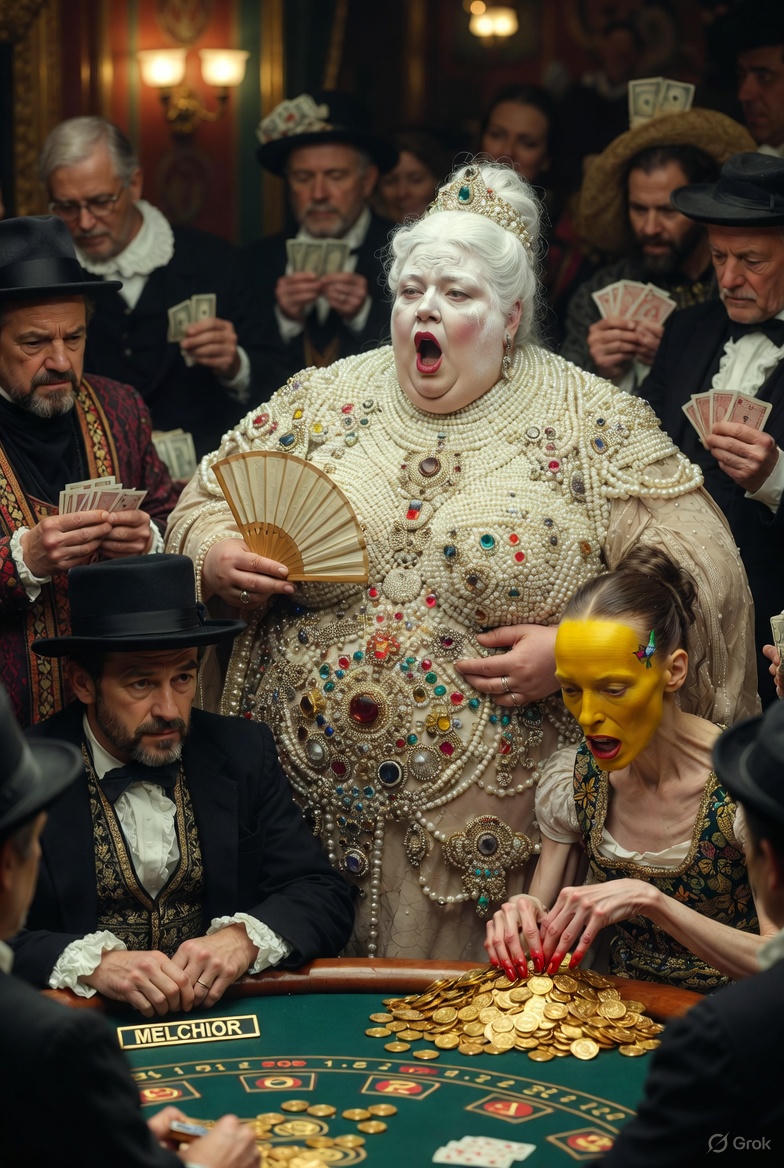
Alraune by Hanns Heinz Ewers and translated by Joe E Bandel
She excused herself primly; it had only been a thought of her mother’s. There was no need for the Fräulein to trouble herself over it. She only hoped that the unpleasant incident hadn’t brought any stormy clouds into their friendship–She chatted on without stopping to think, senseless and pointless. She didn’t catch the severe glance of her friend and crouched warmly under the green glowing eyes of Fräulein ten Brinken, like a wild forest rabbit in a cabbage patch. Frieda Gontram became restless. At first she was angered at the immense stupidity of her friend, then found her manner tasteless and laughable. “No fly,” she thought, “ever flew so clumsily to the poisoned sugar.” But finally, the more Olga chatted under Alraune’s gaze, the more quickly her own sulking feelings awoke under their normal covering of snow and she tried very hard to repress them. Her gaze wandered across, fastened itself passionately on the slender body of Prince Orlowski. Alraune noticed it. “I thank you, dear Countess,” she said. “What you’ve told me relieves me very much.” She turned toward Frieda Gontram, “The Legal Councilor has told me such horror stories about the certain ruin of the princess!” Frieda searched for a last reserve and gave herself a violent shake. “My father is right,” she declared bluntly. “Naturally the collapse is unavoidable–The princess will have to sell her little castle–” “Oh, that doesn’t matter,” declared the countess. “We are never there anyway!” “Be quiet,” cried Frieda. Her eyes clouded, she felt that she was entirely, without a doubt, fighting for a lost cause. “The princess will have to rent out rooms in her household, will have difficulty adjusting to her new life style. It is doubtful if she will be able to keep her car, most likely not.” “What a shame!” piped the black prince. “She will also have to sell her horses and carriages,” Frieda continued. “Most of the servants will have to be let go–” Alraune interrupted her, “What will you do Fräulein Gontram? Will you stay with the princess?” She hesitated at the question, it was totally unexpected. “I,” she stammered, “I–but most certainly–” At that Fräulein ten Brinken piped up, “Of course it would make me very happy if I were permitted to invite you to my house. I am so alone. I need company–come to me.” Frieda fought, wavered a moment. “To you–Fräulein–?” But Olga stepped between them, “No, no! She must stay with us!–She is not allowed to leave my mother now.” “I was never at your mother’s,” declared Frieda Gontram. “I was with you.” “That doesn’t matter!” cried the countess. “With me or with her– I don’t want you to stay here!” “Oh, pardon me,” mocked Alraune. “I believed the Fräulein had a will of her own!” Countess Olga stood up, all of the blood drained from her face. “No,” she screamed. “No, no!” “I take no one that doesn’t come of their own free will,” laughed the prince. “That is my mark. I will not even urge–Stay with the princess if you really want to Fräulein Gontram.” She stepped up closer to her, grasped both of her hands. “Your brother was my good friend,” she said slowly, “and my playmate–I often kissed him–” She saw how this woman, almost twice her age, dropped her eyes under her gaze, felt how her hands became moist under the lightest touch of her fingers. She drank in this victory. It was priceless. “Will you stay here?” she whispered. Frieda Gontram breathed heavily. Without looking up she stepped over to the countess. “Forgive me Olga,” she said. “I must stay.” At that her friend threw herself onto the sofa, buried her face in the pillows. Her body was wracked with hysterical sobbing. “No,” she lamented. “No, no!” She stood up, raised her hand as if to strike her friend, then burst out into shrill laughter. She ran down the stairs into the garden, without a hat, without a parasol, across the courtyard and out into the street. “Olga,” her friend cried after her. “Olga!–Listen to me! Olga!” But Fräulein ten Brinken said, “Let her be. She will calm down soon enough.” Her haughty voice rang– Frank Braun breakfasted outside in the garden under the elder tree. Frieda Gontram gave him his tea. “It is certainly good for this house,” he said, “that you are here. One never sees you doing anything, but everything runs like clockwork. The servants have a strange dislike of my cousin and have fallen into a passive resistance. The people have no idea of class warfare, but they have already reached a point of sabotage. An open revolution would have broken out long ago if they didn’t have a bit of love for me. Now you are in the house–and suddenly everything runs by itself–I give you my compliments Frieda!” “Thank you,” she replied. “I am happy that I can do something for Alraune.” “Only,” he continued, “you are missed all the more over there. Everything has gone topsy-turvy since the bank has stopped payments. Here, read my mail!” He pushed a few letters over to her. But Frieda Gontram shook her head. “No– excuse me–I don’t want to read, don’t want to know anything about it.” He insisted, “You must know, Frieda. If you don’t want to read the letters, I will give you the short version. Your friend has been found–” “Is she alive,” whispered Frieda. “Yes, she’s alive!” he declared. “When she ran away from here she got lost and wandered around through the entire night and the next day. At first she must have gone inland toward the mountains, then curved back to the Rhine. People on a ferryboat saw her not far from Remagen. They watched her and stayed nearby. Her behavior seemed suspicious and when she jumped from the cliff they steered over to her and fished her out of the river after a few minutes. That was about noon, four days ago. They brought her struggling and fighting to the local jail.” Frieda Gontram held her head in both arms. “To jail?” she asked softly. “Certainly,” he answered. “Where else could they have taken her? It was obvious that she would immediately try to commit suicide again if they let her go free–So she was taken into custody. She refused to give any information and remained stubbornly silent. She had long since thrown away her watch, purse and even her handkerchief–No one could make any sense out of the crown and the initials in her linen undergarments. It was only when your father reported her missing to the authorities that they were able to figure it out and establish her identity for certain.” “Where is she?” asked Frieda. “In the city,” he replied. “The Legal Councilor picked her up from Remagen and brought her to Professor Dalberg’s private insane asylum. Here is his report–I fear that Countess Olga will need to stay there for a very long time. The princess arrived yesterday evening– Frieda, you should visit your poor friend soon. The professor says that she is quiet and calm.” Frieda Gontram stood up. “No, no.” she cried. “I can’t.” She went slowly down the gravel path under the fragrant lilacs. Frank Braun watched her go. Her face was like a marble mask, like fate had chiseled it out of hard stone. Then suddenly a smile fell on that cold mask, like a ray of sunshine reaching deep into the shadows. Her eyelids raised, her eyes searched through the red beech lined avenue that led up to the mansion–Then he heard Alraune’s clear laughter. “Her power is strange,” he thought. “Uncle Jakob really had it right in his leather bound volume of musings.” He thought about it. Oh yes, it was difficult for Frieda to be away from her. No one knew what is was, and yet they all still flew into her hot burning flame–What about him? Him as well? There was something that attracted him, that was certain. He didn’t understand how it worked, on his senses, on his blood or perhaps on his brain–But it did work, he knew that very well. It was not true that he was still here because of the lawsuits and settlements alone. Now that the case of the Mühlheim bank had been decided, he could easily finish everything up with the help of the attorney– without personally being here. And yet he was here–still here. He was pretending, lying to himself, skillfully creating new reasons, protracting the lengthy negotiations as much as possible, in order to put off his departure. And it seemed that his cousin noticed it as well. Yes, even as if her quiet influence made him act that way. “I will go back home tomorrow,” he thought. Then the thought sprang out from the nape of his neck, “Why should he? Was he afraid of something? Did he fear this delicate child? Was he infected by the foolishness that his uncle had written down in his leather bound volume? What could happen? In the worst case a little adventure! Certainly not his first–and scarcely his last! Was he not an equal opponent, perhaps even superior? Didn’t bodies lie along the life’s path that his feet had trod as well? Why should he flee? He created her once, he, Frank Braun. It had been his idea and his uncle had only been the instrument. She was his creation–much more than she was that of his Excellency. He had been young at the time, foaming like new wine, full of bizarre dreams, full of heaven storming fantasies. He had played catch with the stars and from them had captured this strange fruit from out of the dark, wild primeval forest of the inscrutable where his steps had led him. He had found a good gardener that he had given the fruit to. The gardener had planted the seed into the earth, watered it, looked after the seedling and tended the young little tree. Now he was back and there shone his blossoming tree. Certainly, it was poisonous; whoever rested under it encountered its toxic breath. Many died of it–many that strolled in its sweet fragrance–the clever gardener that cared for it as well. But he was not the gardener that loved this strange blossoming little tree more than anything else, not one of the unknowing people that wandered into the garden by chance. He was the one that had first plucked the fruit that contained the seed from which it grew. Since then he had ridden many days through the savage forest of the inscrutable, waded deeply through the sweltering, fever infested swamp of the incomprehensible. His soul had breathed many hot poisons there, been touched by pestilence and the smoke of many cruel burning sins. Oh yes, it had hurt a lot, tormented him and ripped open puss filled ulcers–But it didn’t throw him. He always rode away healthy under heaven’s protection–Now he was safe, as if wearing armor of blue steel. Oh, certainly he was immune–There would be no battle, now it appeared to him more like a game. But then–if it was only a game–he should go–wasn’t that true? If she was only a doll that was dangerous for all the others, but a harmless plaything in his own strong hands– Then the adventure would be too cheap. Only–if it really were a battle, one with equally powerful weapons–only then would it be worth the effort. Fraud! He thought again. Who was he really kidding about his heroic deeds? Hadn’t his victories often enough been easy and certain?–More like episodes? No, this was not any different than it always was. Could you ever know the real strength of your opponent? Wasn’t the sting of the poisonous little wasp far more dangerous than the crocodile like jaws of the caiman that goes up against the certainty of his Winchester rifle? He found no way out, ran around in circles, getting himself confused as well. But he always came back to the same point, stay! “Good morning, cousin,” laughed Alraune ten Brinken. She stood right in front of him, next to Frieda Gontram. “Good morning,” he answered curtly. “Read these letters here–It won’t do you any harm to think about what you have been the cause of–It’s time to stop this foolishness, do something sensible, something worth the effort.”
Somehow Tobal didn’t feel that optimistic about the planned expedition but didn’t have any right or authority to stop them. Perhaps Crow was right. Perhaps the village did need some form of protection. He was feeling moody as he walked away from the group. Becca came with him.
“I’m not very good company right now,” he warned.
“I’ll risk it,” she said.
Neither one said much as they watched the preparations for the three newbies that were going to be initiated that evening and got something to eat. It was so cold windbreaks had been set up around the fires to bounce the heat back. Most people seemed to either stay inside or near the fire pits used for cooking. They ate by one of the cooking pits.
“May I ask something?” He finally said.
“Sure,” Becca answered through a mouthful of tasty stew.
“Why last month?” He asked. “Why did you come to me like that?”
“Was it wrong?” She asked wiping her mouth clean with her hand and looking up at him with those green eyes.
“No,” he whispered. “It was exactly right. I just don’t know if I could have ever come to you that way. I was too messed up or afraid or something.”
“I was afraid too,” she said thoughtfully. “Then when we kissed it was so good and later you gave me that present. Look,” she said. “I’m still wearing it. She pulled the carved owl out from where it had been hiding within her parka. It was Anne that really helped. She read my palm that day and told me I would loose the one I loved unless I acted immediately to keep him from leaving.”
“Really?” He asked curiously. “Where would I have gone?”
“To Fiona,” was her simple reply. “This has been kind of hard on her cause she really likes you too.”
Tobal flushed, “You and Fiona talk about this stuff?”
She put her bowl down and came over to him, pinning him back against a windbreak. She laughed.
“We women talk about everything.”
“Everything?”
“Everything!”
“Well then, I’m going to keep my mouth shut around all of you.”
She set his bowl down and kissed him. “It won’t do any good. We’ll just tell stories then.”
“What kind of stories,” he undid some of the buttons on her parka and reached inside. She gasped in pleasure and their embrace was much longer than the last one. No thought of continuing the conversation. They were lost in the moment and in each other.
“Hey, some of us are trying to eat around here.” Nikki and Fiona had brought their own bowls of stew to eat by the fire.
“Becca, are you saving any for us?” Nikki quipped.
Tobal flushed.
Becca just nuzzled closer, “No, you’ve got to get your own.”
Together all four cleaned the dishes and moved toward the circle where the initiations were about to begin. It was cold and they took up positions next to a windbreak that shielded one of the signal fires. As long as they stayed out of the wind it was all right.
Misty was High Priestess that night and both she and the High Priest wore furs. The circle seemed much smaller than usual. There was a strong wind with drifting snow even in the sheltered valley and no one seemed anxious to dance around the fire clothed or not.
Tobal felt sorry for the new initiates that had to stand blindfolded in such a wind with shortened tunics even if they were right next to the bon fire. To his relief they were wrapped in blankets to prevent over exposure to the bitter cold. In all things safety was the over riding concern of the medics and Masters. Living in harsh conditions made one strong. Being foolish killed you.
They watched together as Nikki’s, Fiona’s, and Becca’s newbies were initiated. Afterward Tobal was introduced to Cheryl, Loki, and Bran, the new initiates.
“If you are not careful we will catch up to you,” Fiona warned. “Cheryl, Loki and Bran make three newbies apiece for each of us. You have only trained one more than us.”
“I know.” Tobal frowned. “Why rub it in?”
The girls laughed and hugged him. “We’re just teasing. Don’t be so serious all the time.”
Tobal had gotten his fourth chevron that morning and was eager to get training. He had tried working on the meditations and exercises Crow had taught him but it had been hard to focus and concentrate alone. His mind drifted to the cave’s glowing altar, where Ron and Rachel’s voices had urged him onward, a stark contrast to the solitude that muddled his focus. Much of the time his thoughts had kept going back to Becca and their growing involvement with each other. Somehow it seemed to push everything else away. He didn’t know what had happened to his self-discipline.
Immediately after circle things were moved inside one of the permanent shelters and continued out of the bad weather. This had happened a few other times during heavy rain but was unusual. Clansmen believed in having circle outside rain or shine, hell or high water. They spent so much time in the elements it didn’t bother them much and they were dressed for it.
They found a warm corner and started to gather. By the time Ellen got there ten people were sitting around waiting to hear what she had learned. Needless to say, Ellen was not happy with everyone knowing about the rogues or about Crow taking an entire group to the village for a visit.
Finally she gave in and sat with them and talked about what she had found out in her research.
“I was able to tap into the city’s data base and look into the historical archives and records.” She began. ” Ron and Rachel Kane were scientists that lived in the city and developed the sanctuary training system.” She looked around the group. “Those are Tobal’s parents, for those of you that don’t already know.”
The look of surprise on a few faces told Tobal that at least a few hadn’t known.
Ellen continued her story. “The sanctuary program was originally a social experiment designed to create a utopian community of specially trained and competent individuals. It was a personality-modifying program to create physically, emotionally and mentally healthy individuals with strong will power and high creative ability. It was highly successful in creating individuals that seemed to be more highly motivated and competent than the norm found within the Federation itself. The graduates showed scores that were mentally, emotionally and physically superior to non-graduates and it was no surprise when the military got involved and the project became classified. Heliopolis became a natural recruiting ground for highly competent leaders and soldiers. It was a city-state devoted to the development of the Ubermench or super human and the main recruiting ground for Federation Special Forces.
As time went on the graduates gained political power within Heliopolis itself and voted for political changes that challenged the values and life styles of the older citizens that had not participated or agreed with the social experiment. The citizenry split along lines that supported the social experiment and those that were against it.”
Here Ellen stopped and said thoughtfully, “There is a saying that old timers never change their minds, they just die off and the younger generation outlives them. That was not the case in Heliopolis. The changes were so fast and radical there was not enough time for mediation. The hostilities and tensions became so great it resulted in a massacre of several students and families living at the main Apprentice gathering spot and the deaths of Ron and Rachel Kane whose bodies were found floating in the lake nearby.”
Ellen broke off from her story to look around at the group. “It seems not only Tobal lost his parents then but Crow lost both parents and Sarah lost her mother. This was not in the official report but in what I have learned personally.”
Sarah was white faced and her fists were tightened. There were murmurs within the group until Crow stopped them.
“Let her finish.”
“These multiple murders created a military emergency and the entire city fell under martial law directed by the Federation and Tobal’s Uncle Harry Kane who was the commander in charge at the time. It was under his command that any of those connected with the murders were eliminated or deported and Heliopolis became a secret classified program controlled by Federation military.”
Tobal started. His uncle had said he was in charge of security, not that he had been Commander in charge of the entire project. There was obviously a lot his uncle had known about and not shared with him.
Ellen continued, “The military created a new program that allowed no children or elderly unless they were physically fit enough to make it through the three degree system. It was simply a system designed to create recruits for the Federation military. The thought was that it created better soldiers.
The city of Heliopolis became a city of the elite ruled by the military, a city of supermen and superwomen if you will. The graduates were still human but something about the training eliminated dysfunctional areas and built strong healthy individuals that could out compete the average person in all areas.
This continued several years until enough data was available to compare the graduates of the sanctuary program with special military forces. It was here that they showed radical differences. The graduates of the sanctuary program did not do well in the normal military. Studies confirmed that military training suppressed the individual and forced conformance to a rigid authoritarian structure that was simply not endurable to the average graduate. The graduates of the sanctuary program were individuals and not team players.
It was at this point the Federation lost much of its interest in the project and turned it back to civilian control. The Federation continued to recruit graduates for field operative positions and kept a mountain complex manned with military personnel for special training. They also agreed to share medical resources with the medics as they needed them.
Ellen stopped and looked around, “That was when the city was granted the right of self government. But only those that had completed the restructured Sanctuary training were considered citizens with the right to vote. They voted to adopt the military’s program in favor of the earlier program run by Ron and Rachel Kane. The earlier program had consisted of the creation of a village with children and old people as an important part of the social research that was going on. There was no more interest in the creation of another ‘village’ in the wilderness. It was felt there were too many ‘Safety’ concerns.
The Citizens of Heliopolis maximized individual qualities under a loose structure of cooperative effort. The city itself gained in political power and influence even as it remained closed to normal trade and commerce. Its citizenry were active in the outer world owning companies and making directives that influenced world politics. They formed an elite pool of superior resources that fought for its own place in world politics. It was whispered that government research continued at the nearby secret mountain complex where Special Ops field agents were trained.”
“The rest was classified and I couldn’t get into it,” Ellen said. She hesitated as if with an internal struggle.
“Our Medic base is part of the secret mountain complex. We are only allowed to use the emergency room and some nearby areas. It is under high security with lots of armed guards. There are field operatives that come and go from the complex all the time. I shouldn’t be telling you this so please keep it to yourselves.”
“Wow,” you’ve certainly given us something to think about,” Rafe shook his head. “This doesn’t sound good to me. There is something wrong, especially if the rogues are really field operatives. Why would field operatives attack us?”
“And attack the Village,” Crow spoke up. “There have been several incidences of villagers being attacked by rogues and we always believed it was clansmen that attacked us. It is beginning to sound like someone wants the clansmen and the villagers to hate each other. Perhaps someone is trying to provoke conflict between us. We need to go to the village and prove we are not attacking them. Too many people have died already.”
“Yeah, and my parents were right in the middle of it,” Tobal said bitterly. “It killed them and it might kill us if we are not careful. He turned to Crow who had been listening intently to Ellen’s story.
“What can you tell us about any of this? It sounds like your grandfather, Howling Wolf was as much in the middle of this as my parents and he is the only one still alive that I know of except Sarah’s father.”
“This is all new to me,” he said. But I will talk with him about it. I will return with any information I feel is important. More than ever I feel there is danger to my village and they need to be warned.”
Tobal was thankful Crow never mentioned the special training on bi-location and the secret meeting place under the waterfall. He was certain that Ellen was too.
“I’m concerned about Apprentices leaving the area and visiting the village.” Ellen told them. “We will be ordered to stop you from going there even though there are no specific guidelines preventing it. Crow seems to have found a loophole in the system only because he is from the village himself and because it is within our area of coverage. Our orders don’t contemplate such unlikely scenarios. You need to travel as fast as you can.”
She continued, “As long as the air sleds continue to monitor your med-alert bracelets you should be alright.” She paused, “That does mean we will need to patrol further to the west then we have in the past,” she looked straight at Crow. “They are going to try to stop you from reaching the village you know.”
“I know,” he said. “It will be alright. Grandfather is expecting us.”
They left things at that and the conversation moved on. The group gradually broke up and began talking about other things. Tobal and Becca stayed together holding hands as they wandered around the group chatting with other clansmen. They slowly made their way to the beer keg where Rafe had rejoined Dirk.
Rafe and Dirk were both still on the beer task force and grumbling because they had twice the beer to brew since the reserves had been consumed at the Yule party last month. Still they were good-natured about it and said they were trying a new recipe that should be quite interesting. It was just as well there was only a small group that month though. They wouldn’t be drinking that much.
Becca hadn’t heard about the special brew Dirk and Rafe were cooking up and didn’t know what to think.
“When will this new beer be ready to drink?” She asked doubtfully.
“Sometime this April probably,” said Dirk chuckling. “Rafe and I both plan on being medics by then. We can administer first aid to anyone that needs it. Pump their stomach or something.”
Tobal snorted and blew beer all over.
“Hey, watch it,” Rafe complained. “It’s not that funny.”
Tobal turned to Dirk, “How did that sure thing match go?”
Dirk turned red, “Not so well.”
“He got his ass kicked.” Rafe chuckled and proudly displayed his own fifth chevron. “Some people actually win once in a while.”
Rafe ducked a playful fist that Dirk threw at him. “Now we get to see who the best man is. We’ve got a bet going on who is going to get their sixth chevron first.”
“You still fighting the girls,” Becca kidded, “or have you gotten to the big boys yet?”
Dirk got a little red but Rafe took it in stride. “I don’t have to worry about it. Everyone is still challenging me. I haven’t gotten to challenge anyone yet.” He grinned at Becca, “I would challenge you if you hurry up and train some more newbies.”
She grinned back. “Perhaps we can always arrange something unofficial.”
This was a side to Becca that Tobal hadn’t really seen before, it interested him and disturbed him at the same time. They filled their mugs and rejoined the crowd. There was a drum circle forming and the sound was deafening in the small building.
Tobal and Becca slept together that night. They cuddled for a long time and shared stories about things that they had done and things they wanted to do. The energy between them was different and when Tobal asked about having sex Becca murmured “not tonight. All I really want to do is just hold you and sleep with you.” Her voice trembled slightly, a hint of vulnerability he hadn’t noticed before, as if the weight of their connection pressed on her too.
With that cryptic answer circling in his brain they kissed, embraced and fell asleep entwined in each other.
The next morning was bright and cold and there were sundogs circling the sun promising even colder weather. They joined their friends for breakfast and soon Becca was on her way to base camp to continue training with Loki, her third newbie and Tobal set out on the trail toward Sanctuary.
As he snow-shoed toward Sanctuary and pulled his sled he wondered at the strangeness of how things had been with him and Becca last night. He had certainly not been prepared for it and didn’t really understand it. It seemed things had been all right, but then again it seemed there had been something wrong.
He hoped she hadn’t changed her mind. Perhaps she was sleeping with Loki, the newbie. He instantly crushed that thought. He knew it was not true, but he just didn’t understand and because he didn’t understand he felt a little hurt. He had been expecting something like last month and it had not happened.
As he neared Sanctuary his thoughts turned to the subject at hand. He now had four chevrons with only two more before he was eligible for the Journeyman degree. As he headed toward sanctuary he felt kind of strange because Sarah had really been the last person he had trained and that had been in September and October.
He didn’t really count Crow since Crow had taught him much more than he had taught Crow. That meant he hadn’t been doing much training in four months and he was determined to get going on it again. He wanted to get this training over with and be partnered with Becca more permanently if she was still interested.
He thought of the ways he had changed in the past years and the things he had done. He had gained a reputation as a very good trainer. None of his students had any trouble soloing and their students didn’t seem to have much trouble either. At gathering and circle people came to him with questions on the best way to do things. His opinion was respected. He was also gaining a reputation as someone that kept to himself and was hard to get to know. His closest friends continued to be Rafe, Crow, Ellen, Sarah, Melanie and now of course Becca. People liked him, his friends liked him, he was companionable but in a quiet sort of way. He didn’t have anything to prove and he didn’t show off. He was just comfortable and at ease with the situation, any situation. People respected that.
Tyrone was Tobal’s fifth trainee and the month of late January and early February went by fairly fast and uneventfully. Tyrone was a tall, wiry farm boy from the Appalachian Mountains of all places, a real honest to God hillbilly complete with a Southern accent and an engaging smile that would drive the girls wild at circle. His drawl carried the scent of pine and coal smoke as he unpacked a worn satchel, a grin breaking through like sunlight on frost. The training came easy to him since he was already an accomplished hunter and trapper.
The nights were long and Tyrone spent many evenings carving a fiddle and later practicing with it. He had learned the skill from his grandfather back home and Tobal watched in fascination at the precision with which the fiddle was created piece by piece and then lashed together and sealed with pitch. He had never seen anything like it and was appalled at the terrible noise it made, at least until he got used to it.
He used to laugh when Tyrone would pull out the fiddle and start to play because the wolves would start howling to keep company. All in all Tyrone was good company and the month went rapidly. Tyrone was a natural storyteller, knew how to make people laugh and Tobal laughed often. Tyrone was like the brother Tobal had always wanted.
Once Tobal asked him how he had heard of “Heliopolis” way in hillbilly country and Tye had thrown back his head and laughed and laughed. He stretched his long legs and shrugged.
“I never heard of it before,” he admitted. “I was trying for a city named Minneapolis and got my ticket wrong. My head never was that good with names. I knew it was cold there and didn’t give it much thought until we had to start hunting our own meat and making our own clothes. It was so much like back home that I figured something was wrong but thought I’d study on it for awhile.”
Tobal had been drinking tea and it exploded from his mouth and nose as he doubled up in laughter.
“Stop, You’re killing me,” he waved weakly at Tyrone who was doubled over laughing too.
There were melancholy times when Tobal thought back over the past year and how much he had changed. He was more resourceful and inclined to do things by himself or on his own. He didn’t care much about what other people thought. He had learned to judge people not by their appearances, but by what they did and even as important by what they didn’t do.
Almost in spite of himself he found his feelings about Becca were deepening. She down played what she did and seemed to have a quiet competence that went un-remarked. She had just a hint of melancholy that matched his own. There was an emotion in his heart that stirred and sang when he was around her. As spring drew closer he found himself thinking about her more and knew he was in love.
Late February came around as Tobal and Tyrone snowshoed their way to the gathering spot. He dropped Tyrone off with the guards to be prepared for his initiation. There were going to be three initiations that night.
Nikki had proclaimed her newbie, Bran, as ready to solo and he, along with Loki and Cheryl had been examined and approved to solo by the elders. Nikki was ecstatic because the winter training had gone pretty well. She was looking forward to training her next newbie.
“Hey Tobal,” she asked, “Think I can get my six trained by mid summer? This winter training isn’t really that bad.”
“That might be cutting it kind of close,” he considered, “but go for it. I’m hoping to get mine done by May if I can.”
“By May?”
“Yeah, when the weather gets warmer I can speed the training up a bit. Or at least I hope I can. Next month will be one year for me. Rafe was finished in one year. I thought I could too, but I don’t think I will be able to.”
“It’s more important to do a good job and teach properly than get done quickly,” she said.
He nodded, “I did need to spend some extra time before winter with Fiona and Sarah. I will just see how the last one goes.”
“See you later at circle?”
“Sure,” I’ll probably be with Becca if I can find her.”
He waved and headed for the food area. A quick lunch seemed in order and then helping out with some of the shelters. There were a lot more people this month and the weather was milder even though the snow was deeper.
There were some minor frostbite cases for the medics to treat but not as many as last month. It seemed people were learning they had to be careful. On the down side one of the clansmen had fallen through the ice on one of the creeks. He had managed to get out but not been able to get a fire going. He had frozen to death before the medics got to him. Angel had found him and been unable to help. It was already too late. Angel’s tear-streaked face lingered in Tobal’s mind, a silent echo of the Wild’s harsh lessons, stirring a quiet resolve to honor the fallen.
The incident served to remind everyone just how fragile and dangerous it really was in the wilderness even with all the safeguards that were in place. The death put a damper on things and people were quiet. Tobal’s thoughts flickered to Ellen’s words about the mountain complex, wondering if the rogues’ shadow stretched even here, a chill beyond the frost.
Homo Sapiens: In the Maelstrom by Stanislaw Przybyszewski and translated by Joe E Bandel
XV.
Falk pressed himself even tighter against the wall. He sat on the sofa. The room was completely dark. Fear seized him: he heard voices in the corridor. He listened.
“The gracious lady left with the boy today. The gentleman has been sitting in his room all day. He is probably sick. He wants nothing to eat, and does not answer.”
He heard knocking again.
He did not move. But then he saw the door being opened, a broad strip of light fell into the room, then it became dark again. The door closed.
“Falk!” he heard Olga call. “Pst—quiet, quiet!”
“Where are you?” “Here.”
She groped her way to him.
“What are you doing?” she asked frightened. “Someone died.”
“Who?”
“She, she… Just sit here… here…” “What do you have in your hand?” she asked.
“A letter from her. She is gone. Never coming back. So she is dead.”
They sat very long and held each other’s hands.
The mysterious silence, the darkness confused her head. “Are you mad?” she asked anxiously and softly.
“Now it is over, but I was.” They were silent again very long.
“It is good that you came. I would have gone mad today.” He breathed relieved.
“And now what?”
He did not answer. She did not dare to ask further.
After a long time she wanted to ask him again, then she noticed that he was sleeping.
She did not dare to move, for fear of waking him. Even in sleep he held her hand tight.
So an endless time passed. Suddenly he sat up.
“I will perhaps go to Czerski. Will you come with?” “Yes.”
“Vive l’humanité,” he giggled softly and cheerfully.
Alraune by Hanns Heinz Ewers and translated by Joe E Bandel
Chapter Thirteen Mentions how Princess Wolkonski told Alraune the truth. LEGAL Councilor Gontram wrote the princess, who was in Naulhiem undergoing medical treatment. He described the situation to her. It took some time until she finally understood what it was really all about. Frieda Gontram, herself, took great pains to make sure the princess comprehended everything. At first she only laughed, then she became thoughtful, and toward the end she lamented and screamed. When her daughter entered the room she threw her arms around her neck wailing. “Poor child,” she howled. “We are beggars. We will be living on the streets!” Then she poured heaps of caustic Eastern wrath over his dead Excellency, sparing no obscene swear words. “It’s not entirely that bad,” Frieda objected. “You will still have your villa in Bonn and your little castle on the Rhine, also the proceeds from your Hungarian vineyards. Then Olga will have her Russian pension and–” “One can’t live on that!” the old princess interrupted. “We will starve to death!” “We must try to change the Fräulein’s mind,” Frieda said, “like father advises us!” “He is an ass,” she cried. “An old scoundrel! He is in league with the Privy Councilor, who has stolen from us! It was only through him that I ever met that ugly swindler.” She thought that all men were imposters, cheats and scoundrels. She had still never met one that was any different. Take Olga’s husband for example, that clean cut Count Abrantes–Hadn’t he carried on the entire time with dirty music hall women, taking all of her money that he could? Now he was living with a circus bareback rider because the Privy Councilor had put his thumb down and refused to give him any more– “In that, his Excellency did do some good!” said the countess. “Good!” screamed her mother–as if it didn’t matter who had stolen the money! “They are swine, the one just as much as the other.” But she did see that they had to make an attempt. She wanted to go herself, yet the other two talked her out of it. If she went there she would certainly not achieve much more than the gentlemen from the bank. They had to proceed very diplomatically, declared Frieda, take into consideration the moods and caprices of the Fräulein. She would go by herself, that would be best. Olga thought it would be even better if she went. The old princess objected, but Frieda declared it would certainly not be very good if she interrupted her medical treatments and got too excited. She could see that. So both friends agreed and traveled together. The princess stayed at the spa, but was not idle. She went to the priest, ordered a hundred masses for the poor soul of the Privy Councilor. “That is the Christian thing to do,” she thought and since her deceased husband was Russian Orthodox, she went to the Russian chapel and paid that priest for a hundred masses as well. That calmed her very much. At one point she thought it would scarcely be of any use because his Excellency had been protestant and a free thinker as well. But then it would count as an especially good work in her favor. “Bless them that curse you.” “Love your enemies.” “Do unto others as you would have them do unto you.” Oh, they must surely recognize such things up there, and twice a day in her prayers, she spoke a special plea for his Excellency–with very intense fervor. In this way she bribed the love of God. Frank Braun received the two ladies at Lendenich, led them up to the terrace and chatted with them about old times. “Try your luck, children,” he said. “My talking was of no use!” “What did she say to you?” asked Frieda Gontram. “Not much,” he laughed. “She didn’t even listen to all of it. She made a deep curtsy and declared with a devilish grin that she completely treasured the high honor of my guardianship and would not even consider ending it for the sake of the princess. She added that she did not wish to speak of it again. Then she curtsied again, even more deeply, even more respectfully–and she disappeared!” “Haven’t you made a second attempt?” asked the countess. “No, Olga,” he said. “I must now leave that to you–her look as she left was so determined that I am solidly convinced all my persuasive skills would be just as unfruitful as that of the other gentlemen.” He stood up, rang for the servant to bring some tea. “By the way, you ladies just might have a chance,” he continued. “A half hour after the Legal Councilor called giving notice of your arrival I told my cousin that you would be coming and why. I was afraid she would not receive you at all and in any case wanted you to have a chance. But I was wrong. She declared that you were both very welcome, that for months now she has been in very active correspondence with both of you–that is why–” Frieda Gontram interrupted him. “You wrote to her?” she cried sharply. Countess Olga stammered, “I–I–have written her a couple of times–to offer my condolences–and–and–” “You lie!” Frieda cried. The countess sprang up at that, “What about you? Don’t you write her? I knew that you were doing it, every two days you write to her. That’s why you are always alone in your room for so long.” “You’ve had the chambermaid spy on me!” Frieda accused. The glares of the two friends crossed each other, throwing a burning hate that was sharper than words. They understood each other completely. For the first time the countess felt that she was not going to do what her friend requested and Frieda Gontram sensed this first resistance against her authority. But they were bound through long years of their lives, through so many common memories–that it couldn’t be extinguished in an instant. Frank Braun noticed right away. “I’m disturbing you,” he said. “By the way, Alraune will be coming soon. She just wanted to get ready.” He went to the garden stairs, then gave his regards. “I will see you ladies again later.” The friends said nothing. Olga sat in a cane easy chair. Frieda paced up and down with large strides. Then she stopped and stood right in front of her friend. “Listen Olga,” she said softly. “I have always helped you, when we were serious and when we were playing, through all of your adventures and love affairs. Isn’t that true?” The countess nodded, “Yes, but I have done exactly the same thing for you, not any less.” “As well as you could,” spoke Frieda Gontram. “I will gladly admit it–we want to remain friends then?” “Certainly!” cried Countess Olga. “Only–only–I’m not asking that much!” “What are you asking?” inquired the other. She answered, “Don’t put any obstacles in my way!” “Obstacles?” Frieda returned. “Obstacles to what? Each of us should try our luck–like I already told you at the Candlemas ball!” “No,” insisted the countess. “I don’t want to compete any more. I’ve competed with you so often–and always drawn the short straw. It is unequal–for that reason you will withdraw this time, if you love me.” “Why is it unequal?” cried Frieda Gontram. “It’s even in your favor–you are more beautiful!” “Yes,” her friend replied. “But that is nothing. You are more clever and I have often learned through experience how that is worth more–in these things.” Frieda Gontram took her hand. “Come Olga, she said, flattering her. “Be reasonable. We are not here just because of our feelings–listen to me. If I can succeed in getting the little Fräulein to change her mind, if I can save those millions for you and your mother–will you then give me a free hand?– Go into the garden, leave me alone with her.” Large tears marched out of the eyes of the countess. “I can’t,” she whispered. “Let me speak with her. I will gladly give you the money–this is only a sudden whim of yours.” Frieda sighed out loud, threw herself into the chaise lounge, sank her slender fingers deeply into the silk cushions. “A whim?–Do you believe I would make such a fuss over a whim?–With me, I’m afraid, it appears to be not much different than it is with you!” Her features appeared rigid; her clear eyes stared out into emptiness. Olga looked at her, sprang up, knelt down in front of her friend, who bowed her head down low over her. Their hands found each other and they tightly pressed themselves against each other, their tears quietly mingled together. “What should we do?” asked the Countess. “Withdraw!” said Frieda Gontram sharply. “Withdraw–both of us–let what happens, happen!” Countess Olga nodded, pressing herself tightly against her friend. “Stand up,” whispered the other. “Here she comes. Quick, dry your tears–here, take my handkerchief.” Olga obeyed, went across to the other side. But Alraune ten Brinken saw very clearly what had just happened. She stood in the large doorway, in black tights like the merry prince from “The Fledermaus”. She gave a short bow, greeted them and kissed the hands of the ladies. “Don’t cry, it makes your beautiful little eyes cloudy.” She clapped her hands together, called for the servant to bring some champagne. She, herself, filled the goblets, handed them to the ladies and urged them to drink. “It is the custom here,” she trilled. “Each to their own taste.” She led Countess Olga to a chaise lounge and caressed her entire arm. Then she sat down next to Frieda and gave her a slow, smiling glance. She stayed in her role, offered cakes and petit fours, poured drops of Peáu d’Espagne out of her golden vial onto the ladies handkerchiefs. Then she began, “Yes, it’s true. It is very sad that I can’t help you. I’m so sorry.” Frieda Gontram straightened up, opened her lips with great difficulty. “And why not?” she asked. “I have no reason at all,” answered Alraune. “Really none at all!–I simply don’t want to–that is all.” She turned to the Countess, “Do you believe your Mama will suffer very much because of that?” She stressed the “very”–and in doing so, her voice twittered sweet and cruel at the same time like a swallow on the hunt. The countess trembled under her gaze. “Oh, no!” she said. “Not that much. And she repeated Frieda’s words– “She will still have her villa in Bonn and the little castle on the Rhine. Then there were the proceeds from the Hungarian vineyards. I also have my Russian pension and–” She stopped, didn’t know any more. She had no concept of her financial standing, scarcely knew what money was, only that you could go into beautiful shops and buy things with it, hats and other pretty things. There would be more than enough to do that.
Madame Bluebeard by Karl Hans Strobl and translated by Joe E Bandel
Seventeenth Chapter Ruprecht crossed to the dining room. He tried to order his thoughts. After a few steps, he succeeded. The act of walking steadied him. A temptation had been overcome. Good, very good! What next? What could Schiereisen achieve without him? Nothing. His chain of deductions was worthless—mere circumstantial evidence, gaining weight only through Ruprecht’s testimony. What would he do now? Yet despite this firm resolve, despite all defenses, a pull tugged at him: You should have spoken. You’d be on the path to freedom. The horror would be gone, and you’d have severed ties to the tower’s dreadful secret. Lissy and Nelly ran into his arms in the corridor. “We had to eat without you, Papa,” Lissy cried. “Where were you so long? Mama grumbled that you let that boring professor keep you.” Oh, Ruprecht thought, Mama wouldn’t find the professor boring if she knew what I know. Lissy grabbed both his hands, spinning with him in a circle. The corridor walls bore old Morenos— grim Spanish lords in black robes and rigid ruffs. The one above this scene was the grimmest, but seeing the children’s exuberance below, even he couldn’t help smiling. Sunlight no longer slid impotently off his pale cheeks but gathered in hollows, radiating over his high brow like living skin. “Papa, Papa,” Lissy called, “don’t you notice anything?” “What, little one?” “My new hairstyle!” “Sapperment.” Indeed, two large blonde spirals clung to Lissy’s ears. Her braids were tightly twisted, coiled snail-like on both sides of her head—a motif of prehistoric fibulae, sweet and alive in the present. Ruprecht gaped. “How do you like it, Papa?” Lissy pressed impatiently. “Very good! Splendid! You wild imp!” Lissy triumphed. “See, Nelly! See! Papa likes it. A lot, right? Papa likes it a lot! Nelly says she doesn’t, but she’s just saying that.” A faint envy crossed Nelly’s face. “Oh, no! Keep your hairstyle. I don’t care. I’m too big for that. It’s for little kids. And—and Aunt Hedwig said she’ll do my hair tomorrow, a different one… even prettier.” “So Aunt Hedwig did your hair?” “Yes… we were with her this morning. She sends her greetings and says she’ll come this afternoon.” A slender black figure appeared at the corridor’s end. Miss Nelson approached, passing the stern Morenos, and took the children away. At once, the old Spaniard on the wall ceased smiling. Ruprecht watched them go. No shadow should fall on their bloom; no storm should ravage their joyful gardens. Not by his fault or aid. He’d do all in his power to prevent the worst, a catastrophe. But what to do eluded him. Around five, a light rain began. It gurgled in the gutters and pattered across the courtyard. The chestnut treetops on the castle path rustled softly, their leaves twisting in the rain. Ruprecht sent the carriage to the village. It returned with the guests. Hedwig was quiet, blissful. Fritz Gegely flaunted his centrality. Major Zichovic arrived too, full of soldierly grandeur, as the gathering had a semi- official air. “My very best wishes, naturally,” Helmina said, approaching Hedwig and leaning over her, lightly touching her shoulders to suggest an embrace. “I wish you all your dreams fulfilled—at your husband’s side.” Ruprecht stood by. He wanted to tear Helmina away, shield those touches. She shouldn’t dare approach the saintly. Helmina asked about the court secretary. He’d traveled, the Major reported; his leave was ending. Eight days remained, and he wanted to spend them here, so he’d visited his elderly mother in Linz first, as briefly as possible, to return soon. They sat in the balcony room, conversing through various topics. The Major, too, saw his leave’s sad end nearing. Softened, he later rallied with several jokes. They laughed politely. Only Fritz Gegely didn’t crack a smile. “You’re so serious today,” the Major said. “What’s wrong? You can stay as long as you like. Who waits for you? No one commands you. You shouldn’t be so glum.” “I can’t laugh at jokes,” the poet replied coolly. “Forgive me, Herr Major! Anecdotes and such are like money. It’s good to have, as it holds value and pleases company. But it’s dirty, passed through many hands. I’m fastidious in such matters.” The Major was inwardly stung. “Not everyone can be a poet like you, Herr Gegely, crafting their own witty remarks. We poor folk take what comes our way.” But Gegely wasn’t in the mood for a duel with the Major. He raised his drawbridge and fell silent. Soon, the Major asked Ruprecht’s permission to inspect the castle’s old door fittings and cabinet locks. Helmina and Gegely went to the music room. She wanted to sing for him. Thus, Hedwig and Ruprecht were left alone. He wheeled her chair onto the balcony, where she gazed silently into the gentle rain, an early dusk descending. Something approached from afar, drifting closer, softly encircling them. Madonna, Ruprecht thought. He longed to kneel before Hedwig. All heaviness and pain vanished; doubt and turmoil lay far below. He stood as if on a radiant peak above storm clouds. “Thank you so much,” Hedwig said. “You’ve given me great joy. Roses and pearls. There’s a wistful glow in them, just right for me.” “Here’s your dear friend who betrayed you.” He handed her the little calendar. Hedwig looked up, smiling, her eyes joyful. “You’re so kind!” she said. “Now I’ll show you something… but it’s our secret, just for us two… give me your arm.” He spread his arms, a scaffold to carry her through the world. Hedwig gripped them firmly, braced herself, and rose—slowly rose from her wheelchair, by her own strength, nearly to her full, slender height. She stood a moment, trembling slightly, laughing happily, her gaze locked in Ruprecht’s. She barely touched his arm. Then she leaned harder, lowered herself slowly, sank back into her chair, exhausted but radiant, with a soft glow like the pearls Ruprecht had sent. Ruprecht could no longer restrain himself. He dropped to his knees beside her chair, seizing her hand. Her fingers pressed against his; his kisses stormed over the pale smoothness of her hand, reddening the fingertips behind opalescent nails. Meanwhile, her other hand tenderly stroked his hair. There was a spot on his crown where the hair was thin, sparse, gray, and wilted. Her hand lingered there with gentle pressure, a strange feeling washing over her, as if this spot bore the mark of a sorrow somehow tied to her. He felt he must tell her everything, that now was the moment to pour out all—the painful, the sweet— to unburden himself of all terror and secure a bright certainty for his future. Where to begin, where to begin? he stammered inwardly. He could only say that once-invented name: “Silvia.” She bent her head over him, smiling. “Silvia.” The Major returned. His brisk, soldierly steps sounded in the next room. Ruprecht felt pushed aside, tore himself away, and stumbled into confusion. The Major brought a load of questions and remarks, soon enveloping Hedwig and Ruprecht in superfluous, indifferent words, allowing them to regain composure. Later, they sat at a festive meal, Lissy to Hedwig’s left, Nelly to her right, Ruprecht opposite, able to gaze at her. He was elated, full of gratitude. He offered a toast but didn’t know what he said. They drank several bottles of champagne; even Hedwig sipped twice from her glass. The Major slipped into a harmless, boisterous wine-fueled mood, telling Bosnian tales. Gegely drank heartily but stayed silent on his lofty perch, not descending to the lowlands. Hedwig sensed he was bolstering his superior calm, masking a faint unease. Helmina sat, glancing from one to another, her lips never losing a mocking smile all evening. At eleven, they parted. As the guests left and Ruprecht prepared to retire, Helmina approached him. “You had a happy day, didn’t you? You’re still in a trance… it seems Dankwardt’s Indian room infected you: pity’s now the great axis. Well—that’s not my taste! I can’t stand sick people.”
Part III: Concerning the Laws and Vital Conditions of the Hermetic Experiment
Chapter 4: Mental Requisites and Impediments, Part 4
Introduction: The Hermetic art demands a disciplined mind, suitable tools, and a pure heart to unlock divine wisdom. This section explores the practical and spiritual preparation needed, from choosing the right instruments to cultivating charity, to transform the soul into a radiant vessel of truth.
The Philosophic Vessel
The Hermetic art requires a suitable “vessel” to manifest its divine work, as Norton advises: “Ordeyne Instrumente according to the werke.” Vessels vary—small for separation, broad for circulation, narrow for correction—made of lead, clay, or glass, each chosen to harmonize with nature’s processes. Glass, especially the “morning stuff” vitrified from ashes, is prized for containing spiritual essences without leakage, as Vaughan notes: “The glass is one, simple, and easily carried.”
The adept must guide the crafting of these vessels, ensuring they align with the work’s intent. Norton humorously recounts the need for skilled assistance, as careless servants disrupt the delicate process. A faithful, diligent helper, as Solomon suggests, is “like thine own hearte,” essential for success.
The Ideal Environment
The Hermetic work thrives in specific environments, as Norton explains: “Places convenable” vary—dry and windless for some operations, bright or moist for others. Secrecy is crucial, shielding the work from disruptive influences like strong winds or corrupt impressions, which Agrippa warns can pollute the spiritual ether. The adept must choose locations that resonate with the art’s subtle energies, much like Virgil’s serene settings for his bees.
Vaughan emphasizes that the true furnace, or “Athanor,” is simple, requiring minimal effort, yet it holds the secrets of corruption and generation. The right environment ensures the “Central fire” of the work burns harmoniously, avoiding chaos.
The Heart of Charity
Success demands a “charitable seraphic mind,” as Vaughan instructs, rooted in faith and piety. The adept must avoid destructive passions, which disrupt the “sweet spirit of Peace” and cause division in the chaos. A heart aligned with divine love, as Agrippa advises, ascends in piety and descends in charity, uniting with the divine to open the “Door of Nature.” Without this, the work fails, as Zeno’s wisdom reminds: “Hear much, speak little.”
Closing: This chapter unveils the practical and spiritual requisites—vessels, environments, and charity—for mastering the Hermetic art. The journey into its operational secrets deepens in our next post, unveiling further wonders of this sacred pursuit.
Homo Sapiens: In the Maelstrom by Stanislaw Przybyszewski and translated by Joe E Bandel
Suddenly he heard her cry and sob, tired, soft, heart-rending like a child.
“How could you do that, how could you only,” she wailed. Falk sank before her. He grasped her hands, held them convulsively to his lips, she felt tears flow over her hands… “How could you do that…”
He spoke no word, but pressed her hands even more convulsively to his lips.
“Stand up! Stand up! Don’t torment me…” she begged pleadingly!
He stood up. He seemed suddenly calm. Only his body twitched. “Don’t go from me,” he stammered suddenly, “I… I loved you too much.”
Then he stopped. No! He must not say that to her, but it came involuntarily over his lips.
“I lost my mind. The man always stood before my eyes. He always stood between us…”
She stared at him frightened, seemed to understand nothing. “What?” “Who?”
“Who?” asked Falk mechanically and recollected himself again.
“No, nothing…” He stepped back a few steps… “Did I say something? No, no! You should not go… You can do with me what you want… Only don’t go!”
His voice failed.
“Nothing helps any more.” She spoke tired and as if absent. “You are a stranger to me. What I loved in you is destroyed. Now you are as ridiculous to me as the others. You are ridiculous to me with your animal desires. You are also only an animal, a beast, like the other men. And I believed… But don’t torment me, go now. I despise you. I have disgust, boundless disgust for you all… Let me go,” she begged, “let me…” she turned to the door.
Falk blocked her way. He got another rage attack.
“You must not go. You must stay with me! You must! I command it of you, I will smash you, crush you if you go.”
He went toward her. She stepped back.
He wanted to seize her. She tore herself loose, she ran around the table in terrible fear.
“Are you mad?” she cried shrilly.
Finally he seized her and pressed her in mad passion to him. She defended herself with all her strength, but he pressed her arms tight; his passion grew beyond his brain, a sick greed, a bestial lust to possess the woman came over him.
“Let me go!” she cried almost unconscious.
But he no longer had control of himself. He dragged her, pressed tight to him…
Then she succeeded in freeing one hand, she arched far back and struck him with her fist in the face.
He let her go. In a moment he felt his interior freeze to ice.
He did not see her. He just stared at something that yawned like a black abyss before his eyes.
When he came to himself, he saw her face and her eyes. He looked at her attentively.
She stood as if petrified, only in her eyes a devouring disgust. She doesn’t love me any more. Now he understood it.
“You don’t love me any more?”
He said it with an icy smile. Actually it was not necessary to ask at all.
“No!” she said cold and determined.
He smiled without knowing it, went to the door, pushed the broken wood pieces aside with his feet and wanted to go out.
Isa suddenly shot up in wild hate.
“And that girl,” she cried after him… He stopped and started.
“That girl,” she began to laugh convulsively… “That little girl who drowned herself… Ha, ha, ha… By chance while bathing… By chance, was that not the official bulletin? —Ah, how pale you are, how you tremble… You did that!”
“You!” she cried suddenly… “One year after our wedding! Ha, ha, ha… what other heroic deeds did you perform, you proud, monogamous man? Do you have a few more girls there? Ha, ha, ha…” She walked around, held her head with both hands and spoke confused to herself.
“Oh, these lies, these lies… Well yes—” she started up… “It is now over. Go, go. It will be good if you take care of the girl a little. She is very miserable, and very thin… Adieu, mon mari… Je n’ai plus rien à te dire… Adieu…”
Falk heard nothing more. He felt nothing either. Only sit somewhere, quite still for himself incessantly still sit…
It rang.
Falk went mechanically to the corridor door and opened it. He looked at the messenger thoughtlessly and waited.
“Are you Herr Falk?” “Yes.”
“A letter for you.”
He took the letter, went into his room, laid the letter on the desk, sat down and looked at it long and thoughtlessly. Finally he stood up and opened it mechanically. It took a long time until he forced himself to understand the content.
It was from Geißler. He wrote him that he would pick him up in the morning at six o’clock. Otherwise everything was in best order.
Falk sat down again and so he sat motionless the whole night. He had lost the consciousness of time. He was also not sleepy. Only now and then, when he felt desire to smoke, he got a cigarette and wondered that he could not think at all; he was chemically purified of thoughts, chemically purified he repeated senselessly.
When Geißler came at the appointed time, he looked at him astonished. “Is it already time?”
“Naturally. But didn’t you sleep?” “No,” said Falk apathetically.
He took his old felt hat.
“But you must take the top hat, it cannot go so formlessly…”
“So, so… For my part I can take the top hat.” Geißler looked at him uneasily.
Falk became furious.
“Why do you look at me so mistrustfully? Do you believe that I am afraid?”
But he fell immediately into his former apathy.
When they arrived, Kunicki was already waiting with his second and a third gentleman.
“The third is probably the doctor,” thought Falk profoundly. All formalities were quickly settled.
Falk looked with a dull calm as Kunicki aimed at his head. Kunicki has the superiority of a person for whom the thing is a kind of sport, it shot through his head. Strange sport… But how does this fit together? Kunicki is after all a social democrat. That is against all principles. Ha, ha… un citoyen cosmopolitique, citoyen du monde entier.
This citoyen du monde fixed itself in his brain, accompanied by a strange cheerfulness.
In this moment he heard the cock click, saw smoke, but the bullet flew past him.
He was now completely possessed by one single, fixed idea: the citoyen cosmopolitique with the limping principles should himself limp… Falk laughed to himself, he had trouble controlling his cheerfulness. At the same time he aimed very calmly and shot: a formal laughing cramp choked him in the throat.
The shot hit Kunicki in the kneecap. He flew up and fell.
“Thunder! give me a cigarette!” he cried furiously.
“Will he limp?” Falk asked Geißler when they came into the city. The idea had taken total possession of his soul.
“Don’t know.”
“Citoyen cosmopolitique with the limping principles… Ha, ha, ha… God’s finger… Now he will limp himself…”
Geißler became very unpleasantly touched. But Falk suddenly fell back into his apathy.
“The satisfaction one gets thereby is after all damned minimal,” said Geißler to break the painful silence.
Falk looked at him.
“We were good friends… He is a sharp head,” he said musingly. “He refuted Rodbertus…”
They were silent again.
“Has Isa already left?” asked Geißler. “Was she supposed to leave?”
“Well, I believed.” Geißler rose uneasily. “You want to go?” asked Falk anxiously.
“I must now.”
Falk suddenly looked up at him and smiled good-naturedly.
“You are uneasy… He, he, he. Just go, go. I will now lie down to sleep.”
Madame Bluebeard by Karl Hans Strobl and translated by Joe E Bandel
Ruprecht’s agitation drove him from his seat. “And…?” “The photo I showed was of Herr Anton Sykora… You follow my reasoning. It may not have been Sykora himself, but certainly someone very like him. All confirmed he was a giant, broad-shouldered, bull- necked. You recently met Anton Sykora. Didn’t you notice a resemblance… to someone…?” Ruprecht stared into Schiereisen’s steel-blue eyes. “To Lorenz…” he said. “Yes, certainly—to Lorenz. Only now…” Schiereisen nodded, pleased. “It often happens we see connections only afterward, when someone points them out. So, Hellpach’s companion was either Sykora—or more likely—Lorenz. Either way, let’s note Frau Helmina was a widow and heiress. Soon after Hellpach’s death, Sykora appears in Vienna with ample funds, buys two houses, and sets up his matchmaking agency. Here at Vorderschluder Castle, Frau Helmina takes on a new servant: our Lorenz.” Before Ruprecht’s eyes, events flickered like a cinematograph film. “The following winter, Frau Helmina spends in Vienna, making new acquaintances, much courted. Finally, Herr Hickel, a wealthy Hungarian landowner, emerges as victor and her second husband. She persuades him to sell his estates and dabble in stock ventures under her guidance. His luck is even briefer. I learned little about this marriage— short and stormy. After a fierce quarrel with Helmina, Lorenz found her husband dead in his room, struck by a stroke.” “Do you see a crime here too?” Schiereisen shrugged. “I told you, I found nothing certain. Old Johann joined the castle with Helmina’s third husband. Before that marriage, she was a widow for two years.” Ruprecht exhaled. “Helmina’s ties to Sykora never broke. He visited the castle during Dankwardt’s time as his acquaintance. Meanwhile, Sykora worked to find a new husband for his protégé. Three serious suitors were considered.” “How do you know all this?” “I recently used Sykora’s services myself, indulging in some indiscretions. I obtained copies of his lists from that critical period. A small, unnoticed theft, a night of frantic work—by morning, the lists were back. You can imagine I was thorough. I investigated each candidate, tracing many mundane life stories. Three end in mystery for me.” “You’re not saying it’s possible… we’re surrounded by… I don’t know why I’m listening? Your deductions are wrong.” “Have a little more patience. I’m nearly done. You mean it’s impossible in our orderly states for people to vanish. Oh, it’s not so hard. Suppose someone is entangled in a vital matter requiring absolute silence. They must travel for it, sworn to use a false name, forbidden to tell even their circle where they’re going. The three candidates on Sykora’s list whose trails fade are foreigners—a Frenchman and two North Germans. All wealthy, older men who didn’t need a matchmaking agency. But Sykora’s a shrewd businessman. I admire him. He sought clients on his travels. Imagine he has a charming woman among his prospects, sparking an older man’s passion. But she’s refined, not to be compromised. Her acquaintance requires utmost caution. Then, one must prove financial means, for this beauty is accustomed to spending… she wants assurance of no lack.” “You see, I’m calm. Tell me your remaining hypotheses.” Schiereisen fell silent, heavy-hearted. He hesitated to conclude. The joy of building his bridges was gone. But it had to be. “I traced those three candidates from their starting points. Knowing their destination, I followed them. Their paths lead to Vorderschluder, and here they vanish.” Ruprecht remained calm and cold. In moments of great danger, his nerves sang like thin steel. “So you lost their trail here?” “I didn’t lose it. It ends here. Three people vanished at your castle, Herr Baron. Precisely those from Herr Anton Sykora’s list destined for Frau Helmina. Funds were withdrawn for them days after their departure… when they must already have been dead. On checks in their handwriting, perfectly executed. That’s the secret of your castle, Herr Baron.” Schiereisen rose and walked past Ruprecht to the Buddha in the corner. With his back to Ruprecht, he said softly, stroking the bronze figure’s skin, “We’ve now reached the same point from another angle, where we left our inquiry earlier. The secret we touch here is the same one that cost Jana his life. They eliminated a dangerous snoop. My path is complete, the connection made. I leave the final conclusions to you.” The stifled air of the Indian temple felt hard to breathe, laced with a malignant, greenish-gleaming gas. Ruprecht opened a window between two painted palm trunks. Noon had long passed. The shadow of the sundial’s pointer on the gate tower climbed the dial again. A light wind drove gray cloud clumps across the sky. When a shadow passed over the castle, the thin black rod among Roman numerals faded into nothingness. A bright, faint sound drifted from the summer meadows—scythes sharpened with a whetstone. Haymaking! The world’s wedding jubilee! Fragrant unfolding! Drinking with every pore! Ruprecht thought nothing, drew no conclusions. He sank into these summer sounds and colors, as if in a bright liquid. He felt a hand on his shoulder. Schiereisen stood there. “Don’t take it so hard, dear Baron. I hesitated long before speaking. After meeting you, I briefly regretted taking this task. Then I was glad again… Another might…” “Why tell me at all?” “To wake you from a heavy dream. I’m certain you’ve tormented yourself with thoughts about the strange coincidences that struck you. This can’t go on. I hear someone moaning in their sleep beside me. I shake their shoulder. That’s it. When you’ve composed yourself, I expect you to fulfill my duty. I expect your support.” “In what way?” “Only to answer one question. We haven’t spoken of Herr Dankwardt, your immediate predecessor. From Johann’s descriptions, I’ve pictured his death. He died with symptoms exactly like the illness that afflicted you some time ago. Tell me what kind…” Ruprecht leaned back on the windowsill, meeting Schiereisen’s gaze calmly. “I trust you’ll find it natural that I refuse to answer.” Schiereisen nodded. “I expected as much.” “No law can force me. I feel no obligation within me. That’s more important than legal compulsion! And besides—I… I don’t believe your suspicions. Your conclusions are shaky. Your deductions are flawed. You offer no certainties.” That would’ve stung Schiereisen, had he not known it was a hastily raised defense. He admired this man’s resilience, the bold courage withstanding these revelations. Another would’ve collapsed; Ruprecht stood tall. He had the strength to say: I don’t believe you. “I understand,” Schiereisen replied after a pause. “You love your wife. But I wanted to free you from such a dangerous, painful passion.” In that moment, a storm seemed to shake Ruprecht’s composure. The word free hit like a blow. Something shattered within him; he glimpsed a bright landscape, as if a wall had fallen in a dark room. Shock, a lock breaking, light—pushing, urging him. Here was the turning point, the decision. If he spoke now, he’d be free. But he clutched at his own flesh with both hands. He recoiled, fearing surrender unless he did something drastic. His headshake told Schiereisen he’d find no ally in Ruprecht. “So it must be,” the detective said. “You… can’t do otherwise, being the man I admire. I was foolish enough to hope for a moment. Forgive me if I see it through. I must fulfill my duty. I’ve laid myself bare, shown all my cards. Act as you see fit. I’ll have to accept the added burden on my further inquiries.” He hesitantly offered his hand. Ruprecht clasped it firmly, meeting Schiereisen’s eyes. Then he turned away, and the detective left the Indian room.
Alraune by Hanns Heinz Ewers and translated by Joe E Bandel
She turned and laughed at him, her bright teeth gleaming. “Does she mean I should play her kitten?” he thought. Her face became a little more serious, and her soft lowered voice rang with a mocking, veiled threat. He did not touch it with his paws And ron, ron and small patapon He did not touch it with his paws He ate it with his jaws Ron, ron, he ate it with his jaws The shepherdess got angry And ron, ron and small patapon The shepherdess got angry She killed the kitten Ron, ron, she killed the kitten “Very pretty,” he said. “Where did you learn that little nursery rhyme?” “In the convent,” she answered. “The sisters sang it.” He laughed, “Imagine that–in a convent! I would have never expected it–please finish it, little cousin.” She sprang up from the piano stool, “I am finished. The kitten is dead–that is how it ends!” “Not entirely,” he declared. “But your pious nuns feared the punishment–so they let the pretty shepherd girl go unpunished for her evil sin! Play again. I will tell you what happened to the shepherd girl after that.” She went back to the piano, played the melody. Then he sang: She went to confession And ron, ron and small patapon She went to confession To get forgiveness Ron, ron, to get forgiveness I confess, my Father And ron, ron, and small patapon I confess, my Father To killing my kitten Ron, ron, to killing my kitten My daughter, for penance And ron, ron and small patapon My daughter, for penance We will embrace Ron, ron, we will embrace Penance is sweet And ron, ron, and small patapon Penance is sweet We will begin Ron, ron, we will do it again “Finished,” she asked. “Oh yes, very much so,” he laughed. “How do you like the moral, Alraune?” It was the first time he had called her by her given name–that astounded her so much she didn’t pay attention to his question. “Good,” she replied indifferently. “Isn’t it though,” he cried. “A pretty moral that teaches little girls they will not be permitted to kill their kittens and go unpunished!” He stood right in front of her and towered over her by at least two heads. She had to look up at him to catch his eye. She thought, “How much difference a stupid thirty centimeters makes.” She wished she were dressed in men’s clothing as well. Already her skirts gave her a disadvantage. Then immediately it occurred to her that she had never experienced these feelings with others. But she stretched herself up, tossed her head lightly: “Not all shepherdesses have to serve such penance,” she twittered. He parried, “And not all Father Confessors will let them off so lightly.” She searched for a reply and found none. That made her angry. She dearly wanted to pay him back–in his own way. But this skill was new to her–it was like an uncommon language that she could understand completely, but couldn’t speak correctly herself. “Good night, Herr Guardian,” she said quickly. “I’m going to bed.” “Good night, little cousin,” he smiled. “Sweet dreams!” She climbed up the stairs, didn’t run up them as usual, went slowly and thoughtfully. She didn’t like him, her cousin, not at all. But he attracted her, stimulated her, and goaded her into responding. “We will be done with him soon enough,” she thought. And as the lady’s maid loosened her bodice and handed her the long nightgown she said, “It’s good that he’s here, Katie. It breaks up the monotony.” It almost made her happy that she had lost this advance skirmish. Frank Braun had long conferences with Legal Councilor Gontram and Attorney Manasse. He consulted with the Chancery Judge about his guardianship and with the probate Judge. He was given the run around and became thoroughly vexed. With the death of his uncle the criminal accusations were finally cut off, but the civil complaints had swollen to a high flood. All the little businessmen that had trembled at a squinting look from his Excellency now came forward with new demands and claims, seeking compensation for damages that were often quite dubious in nature. “The District Attorney’s office has made peace with us,” said the old Legal Councilor, “and the police won’t bother us either. But despite all that, we still have the county court tightly packed with our cases alone–the second court room will be the private institute of the late Privy Councilor for the next six months.” “His Deceasedness would enjoy it, if he could look out of his hellish cauldron,” the lawyer remarked. “He only enjoyed such suits a dozen at a time.” He laughed as well, when Frank Braun handed him the Burberger mining shares that were his inheritance. “The old man would have loved to be here now,” he said, “to see your face in half an hour! Just you wait, you’ve got a little surprise coming.” He took the shares, counted them, “A hundred eighty thousand Marks.” He reviewed them, “One hundred thousand for your mother–the rest for you! Now pay attention!” He picked up the telephone receiver, asked to be connected to the Shaffhausen Trust Company and requested to speak with one of the directors. “Hello,” he barked. “Is that you, Friedberg?–A little favor, I have a few Burberger shares here–what can I get for them?” A loud laughter rang out of the telephone and Herr Manasse joined in loudly. “I thought so–” he cried out. “So they are absolutely worthless? What? They expect new funding next year–the best thing is to throw the entire lot away–well naturally!–A fraudulent investment that will certainly sooner or later loose everything? Thank you, Herr Director, excuse me for disturbing you!” He hung up the phone and turned grimly to Frank Braun. “So now you know. And now you are wearing exactly that stupid face that your kindly uncle expected–excuse me for telling the truth! But leave the shares with me–it is possible that one of the other mining companies will take some interest in them and offer you a couple hundred Marks. Then we can buy a few bottles of wine with it and celebrate.” Before Frank Braun had come back the greatest difficulty had constituted the almost daily negotiations with the large Mülheim Credit Bank. The bank had dragged on from week to week with exceptional effort, remembering the Privy Councilor’s solemn promise of assistance, always in the hope of receiving some small portion of help from his heiress. With heroic courage the Directors, the Gentlemen from the Board of Directors, and the auditors managed to keep the leaky ship above water, always aware that the slightest new impact might cause it to capsize. With the help of the bank, his Excellency had successfully concluded many very risky speculations. To him the bank had been a bright fountain of gold. But the bank’s own undertakings, which it had taken at the Privy Councilor’s suggestion, were all failing–Really his own fortune was no longer in danger, but that of the Princess Wolkonski was, along with those of several other wealthy investors. This included the savings of a great number of little people as well, penny speculators that had followed the star of his Excellency. The legal executors of the Privy Councilor’s estate had promised their help, as much as it was in their power to do. But the hands of Legal Councilor Gontram, as provisional guardian, were tied by law– through the Chancery court–Money held in trust was sacred–all of it! Really, there had been only one possibility, Manasse had found it. They could declare the Fräulein ten Brinken of age. Then she would be free to fulfill her father’s moral obligations. For that purpose all of the parties worked together, pulling every last penny out of their own pockets. Already, with the last of their strength they had successfully survived a run on the bank that had lasted fourteen days–The decision had to be made now. Until then the Fräulein had shook her head. Now she listened quietly to what the gentlemen were proposing, smiled, and said, “No.” “Why should I become of age?” she asked. “I like the way it is right now–and why should I give money away to save a bank that is absolutely of no concern to me at all?” The Chancery Judge gave her a long speech about preserving the honor of her father. Everyone knew that he alone was the cause of their present difficulties–it was her duty as his child to clear his good name. Alraune laughed in his face, “His good name?” She turned around to Attorney Manasse: “Tell me, what do you think of it?” Manasse didn’t answer, curled up in his chair, spat and hissed like a stepped on Tomcat. “Not much more than I do, it appears!” said the Fräulein. “And I won’t give a penny for it.” Commercial Councilor Lützman, chairman of the Board of Directors, proposed that she should have some consideration for the old princess, who for so long had been an intimate friend of the house of Brinken. What about all of the little people that would lose all of their hard-earned money? “Why did they speculate?” she replied calmly. “Why did they put their money into such a dubious bank? If I wanted to give to charity I know of better ways.” Her logic was clear and cruel, like a sharp knife. She knew her father, she said, and whoever invested in the same things he did was certainly not very much better. But it was not about charity, the Director returned. It was almost certain that the bank would hold together with her help, if it could only get over this current crisis she would get her money back, every penny of it and with interest. She turned to the Chancery Judge. “Your Honor,” she asked, “is there a risk involved?” Naturally unforeseen circumstances could always come up. He had the professional duty to tell her–but as a human being he could only add his urgent plea to that of the other gentlemen. She would be doing a great and good work, saving the livelihoods of multitudes and the possibility of loss in his opinion was ever so slight. She stood up, interrupted him quickly. “Well then, gentlemen. There is a risk,” she cried mockingly, “and I don’t want to take any risk. I don’t want to save any livelihoods and have no desire to do great and good works.” She nodded lightly to the gentlemen, left, leaving them sitting with fat, red little heads. But still the bank continued, still battled on. Hope formed anew when the Legal Councilor informed them that Frank Braun; the true Guardian had arrived. The gentlemen immediately got in contact with him, arranged a conference for the next day. Frank Braun saw very well that he would not be able to leave as quickly as he had believed. So he wrote his mother. The old Frau read his letter, folded it carefully, and laid it in the large black trunk that contained all of his letters. She opened them on long winter evenings when she was completely alone. Then she read to her brown little hound what he had written to her. She went out onto the balcony, looked down at the high chestnut trees that carried glowing candles in their mighty arms, looked down on the white blooming trees of the monastery under which brown monks quietly wandered. “When will he come, my dear boy?” she thought.
Part III: Concerning the Laws and Vital Conditions of the Hermetic Experiment
Chapter 4: Mental Requisites and Impediments, Part 3
Introduction: The Hermetic art requires a disciplined mind and fervent prayer to unlock divine wisdom. This section explores the vital role of prayer, study, and moral purity in overcoming obstacles, guiding the adept to transform the soul’s essence into radiant light.
The Power of Prayer
Prayer is the cornerstone of the Hermetic art, as Iamblichus describes, divided into three stages: gathering the mind’s powers, forging spiritual bonds, and sealing divine union. This sacred practice, as Kirchringius notes, “nourishes the intellect, opens the soul to divine light, and expels mortal dregs.” Through prayer, the adept aligns with the divine will, receiving revelations that solve the art’s enigmas, as the Psalmist declares: “I called upon God, and the Spirit of Wisdom came to me.”
Geber and Norton emphasize that divine grace, sought through prayer, is essential for success. Without it, obstacles arise, or the work ends in failure. Prayer, paired with persistent effort, transforms the soul into a vessel for the “Divine Fire,” uniting it with eternal truth.
The Necessity of Disciplined Study
Success in the Hermetic art demands rigorous study, as Ricardus advises: “Examine the philosophers’ writings, for a sluggish mind cannot master the work.” Arnold and Lully stress subtlety of mind, manual skill, and divine favor, cultivated through books that sharpen the intellect. The adept must persevere, as Zachary urges, reading with patience to uncover the “vermilion path” of truth, ensuring the mind is prepared for the sacred labor.
This study, grounded in reason and faith, dispels ignorance and fortifies the soul, aligning it with the divine purpose. Without it, as Sendivogius warns, “God gives understanding, but you must work to use it.”
The Path of Moral Purity
The Hermetic art rejects impure motives, as Pierce the Black Monk declares: “Covetous men find it never.” The adept must embody meekness, mercy, and charity, living simply and prayerfully. This moral purity, as Job warns, avoids the pitfalls of greed and pride, ensuring the soul remains open to divine grace. Only through such virtue can the adept wield the art’s power without corrupting its sanctity.
Closing: This chapter unveils the power of prayer, study, and moral purity in mastering the Hermetic art. The journey into its practical secrets deepens in our next post, unveiling further wonders of this sacred pursuit.