Feeds:
Posts
Comments

Archive for the ‘Uncategorized’ Category

The Rebirth of Melchior Dronte by Paul Busson and translated by Joe E Bandel

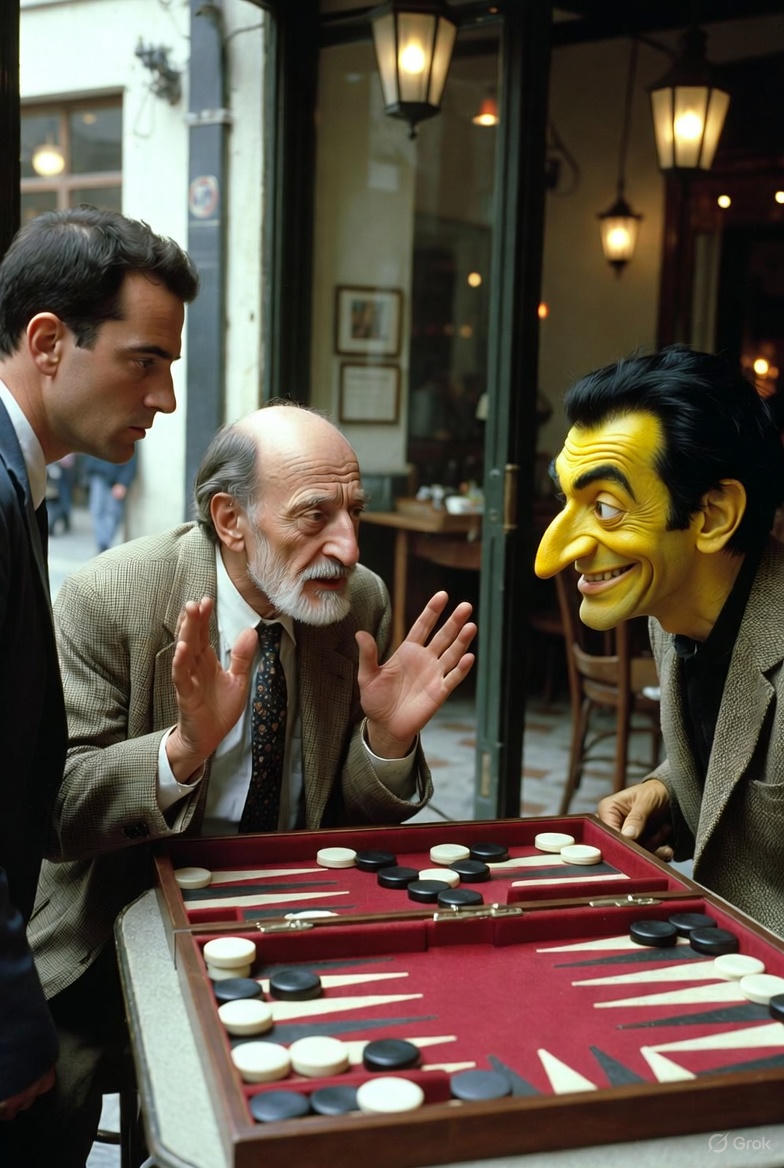
Beneath the well-worn tricorn hat that he wore, grinned a monkey’s face
with a mouth which he could contort in every way, as well as
make his yellow eyes squint in the most ghastly way. His
crooked nose almost touched his chin and gave him an almost
devilish appearance, which was still strengthened by the
disgusting faces, which he made. The people around him found
him less sinister than amusing, and shouted all sorts of coarse
words at him, which he answered with indecent and inviting
gestures.
Then, however, a jerk and a crane of the neck went
through the crowd. The sad procession had returned.
Two servants in dirty red coats led a stout older man with
gray hair onto the scaffold. Behind him the Red Coat climbed
up the steps and immediately stood there with naked arms.
“Heiner has refused spiritual encouragement,” said a
voice behind us. “He thinks, that the great ones are allowed to
do wrong up there in the kingdom of heaven, not only here on
earth and so he has no desire to do so.”
My father quickly turned around. The voice was silent.
“Cursed pack!” he rumbled to himself. “Good that again
an example is made.”
Someone read out something at length in a fat, nasally
and quite indifferent voice. Two pieces of wood flew onto the
scaffold, pieces of the stick which the judge broke. Master
Hans approached the blacksmith and put his hand on his
shoulder. That was now his right, and the blacksmith buckled a
little. Now he saw that he wore a coarse shirt with black
ribbons on it. I had often seen the man working merrily in his
forge. His wife was very beautiful and still young. I saw him
well now. Under his gray, wispy hair stood the bright drops of
sweat on his forehead. Once he opened his mouth and dropped
to his knees.
“Y-i-i-i,” was heard.
“Plumplumplum,” sounded the drums of the soldiers who
surrounded the scaffold.
Then the man stood up, ran his hand over his wet, shiny
forehead and looked around him in amazement. But
immediately the servants threw themselves upon him, forced
him down with ropes and straps. One saw how one leg thrust
up into the air, was grabbed and bent and disappeared.
I could hardly breathe for fear. A woman screamed
luridly. My father was panting heavily through his nose.
The executioner stepped forward, with both hands raised
a wheel with a piece of iron on it, lifted it up high and pushed it
down with all the strength of his fleshy arms.
A whimper -a scream followed -howling –
“O my -God-oh-oh-oh-“
The wheel lifted again.
“Scoundrels! Damned scoundrels!” shouted one of the
crowd. Soldiers rushed to him, pulled him out, and led him to
the side.
Screams – screams!
I vomited.
“Get out of here!” my father hissed at me.
I pushed aside shouting people, pushed, pressed, got
through – ran – ran – as fast as I could run.
In the evening, I had to sit at the long table in the dining
room with my father, and wait until he had drunk his measure
of spiced wine and smoked two pipes of tobacco. I too had to
drink wine, even though it resisted me and brought nausea.
Then I had to walk alone through the corridor where the clock
stood with the little dead man measuring and dividing the time.
I anxiously held my hand in front of my light, so that the
draught would not extinguish it and the old woman jump out of
the cabinet in the darkness. If my father had known about this
fear, a bed would have been made for me just in front of the
closet, and I would certainly have had to spend nights in it.
At the other end of the corridor a steep staircase led to
the maids’ chambers. As I passed by I saw that someone was
sitting at the foot of the stairs, sleeping. It was Gudel, a brown
haired young girl with saucy eyes and pigtails that hung down
to the back of her knees. When she carried the water bucket on
her head, the pointed berries of her breasts almost poked
through the robe. When I looked after her longingly, she
laughed with her white teeth and often turned around.
There she sat asleep, dressed only in a short red petticoat
and a shirt which had slipped half off her shoulder. I could see
the dark tuft of hair in the hollow of her armpit. At my step she
flinched, raised her head and shamefacedly put her hand in
front of her eyes. I grabbed her bare arm, which felt firm and
cool.
“Let me into your chamber, Gudel,” I whispered, and was
quite hot in the face.
She smiled and climbed slowly, moving her hips, up the
stairs. I saw her legs in the mysterious shadow under the red
skirt, and a strong smell as of fresh hay and sweat stunned me.
She slipped into the hovel she inhabited, and held the door shut,
but so weakly that I could push it in without much effort.
“The young gentleman is a nuisance -,” she laughed.
I reached for her, and she giggled softly. I was out of my
mind and grabbed her and threw her onto the blue bedding,
gasping and struggling with her.
“So the Lord put out the light -” she cried, half choked.
I let go of her and blew out the light with an
unnecessarily strong breath. It rustled in the dark, the bed
creaked. The stuffing of the upholstery smelled musty. The
smell of onions wafted warmly toward me. I squeezed my knee
between hers —
“The young gentleman is probably still clumsy -“, she
laughed again and pulled me to her.
Her arms wrapped tightly around my neck —.
“But don’t tell anyone anything,” she said afterwards and
caressed my back with her coarse hand.
That’s when the door opened. My heart stopped. It was
Balthes, the dairyman, with a big horn lantern. Stupid and mute
he looked at us in bed. Gudel took a corner of the sheet in her
mouth. Her whole solid body shook with restrained laughter.
“May a thousand-pound seething thunderstorm -” began
Balthes, but then his mouth remained open. Gudel jumped out
of bed in her shirt, went over to him and said something quietly.
Balthes hung his head, pulled a crooked smile and scratched
behind his ear. I remembered that he considered Gudel as the
house treasure and that they were going to get married.
“Go on, then – go! You know that this is nothing,” hissed
Gudel and pushed him out the door. His broad back, crouched
and strong, had something sad about it. It was the back of a
sorrowful man.
It was dark again, and Gudel crept into bed with a quiet
cracking of the joints and rolled over to me. All pleasure in her
was gone, and I lay very still. Then she kissed me tenderly and
sang softly:
“Oh, my brave little rider,
Your steed snorts freely
You may well trot with him
An hour or two.”
But I pushed my hand away and said, “What did you
whisper to Balthes?”
She laughed:
“You nosy kid -“
And threw herself over me so that her hair tickled my
face.
Then I got angry and pushed her roughly. So immediately
she lay still and was silent.
“What did you say?”
She shrugged and turned away from me in the dark.
“Gudel, I’m going to give you my baptismal dime – but
tell me!”
“Well, what?” she said harshly, “that it’s about our
marriage property, nothing more.”
I did not understand.
“How – about your marriage property?”
“The gracious lord has made it for me, and so I have
done it and will do it again, as often as the lord Squire has a
desire for a woman. In return, Balthes and I shall then live on
the Wildemann fiefdom and be allowed use of the buildings
and lands.”
Now I knew.
“And I even had to go to the Spittel-doctor, where the
free women are lying inside, and have them look at me back
and forth to see if my blood is healthy. I got a note, and the
gentleman has read it and told me to see to it that the
gentleman squire in good time gets his first gallop on the horse
that stretches its legs upwards. So said the gracious lord!”
I sat up in bed. It suddenly stank in the narrow chamber.
The air was hard to breathe, and my throat was choking me.
“Aren’t you ashamed, Gudel?” I felt as if I just had to cry
now.
“Why ashamed?” she cried angrily. “I have to do His
Grace’s bidding and also give the coarse Lord of Heist a warm
bed, as the great hunt goes. I do whatever it takes for me to
create.”
All of a sudden she grabbed me by the shoulders and
shook me with terrible force.
“Spit on me! Hit me! You make dogs out of men, you
cursed, you arrogant devil, and respect a poor woman no more
than a chair for the night, where you do your needy business
when it comes to you!”
Horrified, I jumped out of bed and rushed to the door.
Then she ran after me, threw herself down on the ground
and grabbed my knees.
“Have mercy! Do not listen to what I blabbed, most
gracious nobleman. Do forgive me! I will make it up to you –
kick me – but for the sake of God’s mercy say nothing to the
lord. It would be very bad for me – do you hear, Herr Squire?
And I have done you good this night, my gracious squire -“
“Don’t be afraid, Gudel,” I said, but I couldn’t speak any
more.

Read Full Post »

A Modern Inquiry into the Hermetic Mystery

Part IV: The Hermetic Practice

Chapter 3: The Six Keys of Eudoxus, Part 2

Introduction: The Six Keys of Eudoxus unlock the alchemical transformation of the soul’s essence into the philosopher’s stone. This section unveils the final three Keys—terrification, fermentation, and multiplication—guiding the adept to divine unity through sacred operations.

The Fourth Key: Terrification of the Spirit

The Fourth Key transforms the soul’s essence, the “great Alchaest,” into a solid earth through gentle boiling. This mercurial water, carrying its own Sulphur, coagulates into a fertile “Land of Promise,” as Hermes instructs: “The power is integral when turned into earth.” The adept must patiently moisten and dry this earth, augmenting its virtue and fertility, as Eudoxus warns: “If marks of coagulation fail, you erred in prior operations.”

This terrification, a reiteration of earlier purifications, ensures the soul’s essence becomes a stable, radiant form, ready for further transformation, marking the completion of the Second Work’s foundation.

The Fifth Key: Fermentation of the Stone

The Fifth Key ferments the Stone with a “perfect body,” creating a medicine of the third order. Like dough leavened with yeast, as Hermes compares, the adept unites the purified essence with a ferment to form a new, potent substance. This process, requiring precise proportions, transforms the Stone into a leaven capable of infinite multiplication, as Eudoxus notes: “The whole confection becomes a ferment for new matter.”

The adept, guided by nature’s laws, ensures the soul’s essence, now a “philosophical paste,” matures into a radiant form, embodying divine potency and ready for further enhancement.

The Sixth Key: Multiplication and Projection

The Sixth Key multiplies the Stone’s virtues through repeated dissolution and coagulation, as Eirenaeus describes: “Join one part of the Perfect Matter with Mercury, and in seven days, its virtue increases a thousandfold.” Each cycle—three days, one day, then an hour—augments the Stone’s power exponentially, creating the “Arabian Elixir.”

For projection, the adept combines the Stone with molten gold or silver, then projects this powder onto purified mercury, transforming it into pure metal. Eudoxus advises gradual projection to avoid loss, ensuring the Stone’s tincture perfects the base metal into divine gold or silver.

Closing: This chapter unveils the final three Keys of Eudoxus, transforming the soul’s essence into the philosopher’s stone through sacred alchemy. The journey into its broader implications deepens in our next post, unveiling further secrets of this sacred art.

Read Full Post »

The Rebirth of Melchior Dronte by Paul Busson and translated by Joe E Bandel

I went back again. Dark yellow light fell out from the
chamber; a coffin stood on black-covered trestles, on which
was a cross of silver, and a high funeral crown, with flitters,
colored glass and mirrors. The wax ran and dripped, the
candles flickered. The flowers smelled of earth. Muhme knelt
by the coffin.
“O my Aglajele! My Aglajele!” she cried. That her little
face is never to be known! – Is it raining already?” she asked,
turning her puffy eyes toward me.
“I don’t know.”
And then I cried out and cried so wildly that Muhme put
her arms around my shoulders and spoke to me.
“You must not, boy, you must not – the people are
coming!”
One could hear feet trampling. People were coming,
murmuring. The finch in the hallway jumped from rung to rung
in its cage and kept shouting:
“Look – look – look – the travel gear!”
I stood up.
The priest came. He had the sniffles and often pulled out
his handkerchief. He had baptized Aglaja and blessed her.
Carriages drove up: the Sassens came, the Zochte, the
Merentheim, the cuirassiers from the city, Doctor Zeidlow, the
old Countess Trettin, the Hohentrapps.
A bell rang in the village, tolled; bing – bong – bing –
bong. Schoolchildren.
Muhme waved to the teacher. I heard how she said,
sobbing:
“He makes me sing the same song as he did with my
blessed little Hans, even though she was already blessed. But
she is in white innocence, as it were like a newborn child – God,
oh God!”
Ursula Sassen and Gisbrechte Hohentrapp embraced her
and led her. Then the servants picked up the coffin and carried
it out into the rain.
It was not far to the cemetery. Crows were sitting in the
weeping willows. Crooked old crosses leaned on both sides of
the gravel-strewn path. The iron gate of the hereditary burial
ground stood open with rust-red insides. Above it was a marble
skull with two crossed bones. In its open yawning mouth birds
had built a nest. It stood empty and abandoned. On top of the
head grew moss like woolly hair. I saw everything.
They put the coffin on the ground, and the school sang
again. As Muhme had wanted it, a song that is usually only
sung for very young children. My cousin Hans was two years
old when he died.
When little heirs to heaven
Die in their innocence,
So you don’t forfeit them.
They are only there
Lifted up by the Father,
So that they may not be lost.
Then the priest blew his nose and spoke. The old man
cried. The eighty-year-old Countess Trettin raised her lace
shawl upwards.
“Dust to dust -,” said the priest.
They carried the coffin down. The footsteps sounded
hollow, there was a terrible echo. Voices came from the depths.
Something fell with a thud down there in the darkness.
The rain rushed harder and harder. The carriages drove in
puddles of water. The men tied red handkerchiefs over their
hats, and the women put their skirts over their heads when they
were outside.
My father looked sternly on all sides. The sexton brought
him the key to the crypt.
“There – now have a drink!” said my father, and the
sexton, wet and chattering with his teeth, bowed low. He made
a face and ran his hand to his shoulder. He suffered from acute
Rheumatism.
“Aglaja is freezing -” said a disconsolate voice inside me.
“Aglaja-“
The big house was empty when I got home, the corridors
silent. There was a whispering in the corners, and the clocks
ticked. The stairs creaked in the night, and the wind cried in the
chimney. It was a very strange house. So big and so empty.
On the dark corridor of the second floor was a Dutch
clock with a polished face, on which the moon, sun and stars
moved. Above it, the ornate hands went their way. The
pendulum swung back and forth with a muffled, wham – wham.
After every quarter of an hour, the striking work let its three-
note sound be heard as if from far away:
Gling-glang-glong. At the end of each hour chimes
announced their number. Then a door above the dial opened,
and a small brown rooster slid out of it, moving its wooden
wings with a groaning sound. His voice was lost. Always an
invisible force took him back and closed the door again. At
noon, however, an angel with a blue, gold-edged robe appeared
instead of the cock and in three stiff jerks lifted a green palm
branch.
At twelve o’clock at night, however, a dead little girl
would appear in place of the angel. So we were told when
Aglaja was still alive.

I was standing in this corridor one night. It smelled of
apples and the strange wood of the wide linen cupboards on the
wall. Deer heads carved from wood hung there. They held
white turnips in their mouths and wore antlers that father and
grandfather had captured. Certainly a hundred such deer heads
were distributed throughout the entire house. One of the deer
had been kept tame, held in a fenced area and then released.
Later it had killed a fodder servant and the maids said that the
blood of the servant still stuck to the antlers. The paint had
peeled off the eyeballs of the wooden head, and so he looked
down on me with a ghastly white and blind glare.
Old Margaret, shuffling through the corridors with her
cane and enjoying the bread of mercy, had told me that at the
midnight hour of the day the dead walked in the house where
they had liked to be during their lifetime. I held in my hand a
candelabrum with one of the wax candles that had burned at
Aglaja’s coffin a year ago, and waited for her to come.
The cupboards cracked, there was a throbbing in the wall,
and then it was like a sigh. The wind went over the roof, so that
the shingles rattled. When the hour strike was about to begin,
the door above the clock face opened, and sure enough out
came out a little dead man with hourglass and scythe, turned
his skeleton once to the right and once to the left and raised the
tiny scythe to strike.
“Wham – wham -,” went the pendulum in the pauses of
the hoarse chime of the bell.
“Aglaja” I called softly and peered down the corridor.
Then silently the door of the closet opened, I was
standing nearby, and in the uncertain light of the candle I
thought I saw an ancient woman with a wrinkled brown face
and a large white hood. I staggered to the wall, but when I
forced myself with all my courage to look once more I could
not see anything but the closed door.
Then there was a cough and shuffling footsteps.
Something gray and stooped. The candlestick rattled in my
hand. But it was only old Margaret who was worried about me
and came to see if I was really up there. I held on to her sleeve
like a child and told her what I had encountered. She giggled
and nodded.
“It was the old woman- The great-grandmother of Aglaja
Starke, the daughter of the mayor, who had twisted the family
tree – on the Krämer side. You have seen rightly, my Melchior,
quite rightly. It’s just that she came instead of the young one.
She grabbed me by the jacket. I tore myself loose and stumbled
down the stairs.
In the afternoon Heiner Fessl was executed. He had
overheard the magistrate harass his wife, and since he noticed
that his wife had given in to the powerful man, he had run from
the workshop into the room and had shoved a red-hot iron that
was lying in the fire, through the body of the magistrate, so that
the strong man had to perish and die miserably. He had cruelly
beaten him and likewise the woman. She was dying, people
said. – Powerful helpers, who would have taken care of him-
were not there, and so they broke the staff for him.
At dawn, the man of fear had gone out into the field and
had announced it to the ravens, that the flesh of the sinner
would be available before sunset. So the executioner’s pigeons
were sitting on all the roofs and waiting.
Father told me to put on the silk, lavender-grey coat and
go with him.
“You’re a wimp and a whiner, but you’re no Dronte,” he
said. “I’m going to take you to the spa, boy!”
I felt sick with fear when I heard from a distance the
muffled beat of the drum and the roar of the crowd. All the
alleys were full. They had all travelled to see Fessl on the
executioner’s cart, and now he was to return. To my comfort,
we had to stop quite a distance from the scaffolding, because
the crowd did not move and did not take into consideration the
rank of my father.
“There you see how bold the scoundrels are when there
are many of them together,” said my father loudly and angrily.
He was appeased, however, when the baker, who had his store
there, hurriedly brought us two chairs, so that we could rest for
the time being.
“What you see will be very wholesome for you,” my
father said after a while. “Justice does not work with rose water
and sugar cookies. If it did, we noble folk could pound gravel
on the roads and give our belongings to the rabble.”
In the trees that stood in front of us and lined the square,
many people were sitting. Just in front of us squatted an
abominable fellow, dressed in the manner of Hessian cattle
dealers, in the crown of a linden tree. The sight of him was so
repulsive to me, that I had to look again and again.

Read Full Post »

Alraune by Hanns Heinz Ewers and translated by Joe E Bandel

Chapter Sixteen
Proclaims how Alraune came to an end.

HE slowly went up to his room, washed his wound,
bandaged it and laughed at the girl’s shooting ability.
“She will learn soon enough,” he thought. “We just
need a little target practice.”
Then he remembered her look as she ran away. She was all
broken up, full of wild despair, as if she had committed a crime. And
it had only been an unlucky coincidence–which fortunately had turned
out all right–He hesitated–A coincidence? Ah, that was it. She didn’t
take it as a coincidence–took it as–fate.
He considered–
That was certainly it. That was why she was frightened–that was
why she ran away–When she looked into his eyes she saw her own
image there. That’s what she was afraid of–death, who scattered his
flowers where ever her feet trod–
The little attorney had warned him, “Now it is your turn.” Hadn’t
Alraune herself told him the same thing when she asked him to leave?
Wasn’t the old magick working on him just like it had on all the
others? His uncle had left him worthless paper–Now they were
digging gold out of the rocks! Alraune brought riches–and she
brought death.
Suddenly he was frightened–now for the first time. He bared his
wound once again–Oh yes, there it was. His heart beat right under the
tear. It had only been the little movement of his body as he turned, as
he pointed to the squirrel with his arm that had saved him. Otherwise–
otherwise–
No, he didn’t want to die, especially right now because of his
mother, he thought. Yes, because of her–but even if she wasn’t there,
he wanted to live for himself as well. It had taken many long years to
learn how to live, but now he had mastered that great art, which now
gave him more than many thousands of others. He lived fully and
strongly, stood on the summit and really enjoyed the world and all of
its delights.
“Fate loves me,” he thought. “It’s pointing with its finger–much
more clearly than the words of the attorney. There is still time.”
He pulled out his suitcase, tore the lid open and began to pack–
How had Uncle Jakob ended his leather bound volume?
“Try your luck! It’s too bad that I won’t be there when your turn
comes. I would have dearly loved to see it.”
He shook his head.
“No, Uncle Jakob,” he murmured. “You will get no satisfaction
out of me this time, not this time.”
He threw his boots together, grabbed a pair of stockings, and laid
out a shirt and suit that he wanted to wear. His glance fell on the deep
blue kimono that hung over the back of a chair. He picked it up,
contemplated the scorched hole that the bullet had made.
“I should leave it here,” he said. “A momento for Alraune. She
can put it with the other momentos.”
A deep sigh sounded behind him. He turned around–She stood in
the middle of the room, in a thin silk negligee, looking at him with
large open eyes.
“You are packing?” she whispered. “You are leaving–I thought
so.”
A lump rose in his throat but he choked it back down and pulled
himself together.
“Yes, Alraune, I’m going on a journey,” he said.
She threw herself down onto a chair, didn’t answer, just looked
at him quietly. He went to the wash basin, took up one thing after
another, comb, brush, soap and sponge. Finally he threw the lid shut
and locked the suitcase.
“Well,” he said forcefully. “Now I’m ready.”
He stepped up to her, reached out his hand. She didn’t move,
didn’t raise her arm and her pale lips remained shut. Only her eyes
spoke.
“Don’t go,” they pleaded. “Don’t leave me. Stay with me.”
“Alraune,” he murmured and it sounded like a reproach, like a
plea even, to let him go.
But she didn’t let him go, held him solidly with her eyes, “Don’t
leave me.”
It felt like his will was melting and he forcefully turned his eyes
away from her. But then her lips moved.
“Don’t go,” she insisted. “Stay with me.”
“No,” he screamed. “I don’t want to. You will put me in the
ground like all the others!”
He turned his back on her, went to the table, and tore a couple
pieces of cotton from the bandage wadding that he had brought for his
wound. He moistened them with oil and plugged them solidly into his
ears.
“Now you can talk,” he cried. “If you like. I can’t hear you. I
can’t see you–I must go and you know it. Let me go.”
She softly said, “Then you will feel me.”
She stepped up to him, lightly laid her hand on his arm and her
fingers trembled and spoke – “Stay with me!–Don’t abandon me.”
The light kiss of her little hands was so sweet, so sweet.
“I will tear myself loose,” he thought, “soon, just one second
longer.”
He closed his eyes, and with a deep breath savored the caressing
touch of her fingers. Then she raised her hands and his cheeks
trembled under their gentle touch. She slowly brought her arms
around his neck, bent his head down, raised herself up and brought
her moist lips to his mouth.
“How strange it is,” he thought. “Her nerves speak and mine
understand their language.”
She pulled him one step to the side, pressed him down onto the
bed, sat on his knees and wrapped him in a cloak of tender caresses.
With slender fingers she pulled the cotton out of his ears and
whispered sultry, loving words to him. He didn’t understand because
she spoke so softly, but he sensed the meaning, felt that she was no
longer saying, “Stay!”–That now she was saying, “I’m so glad that
you are staying.”
He kept his eyelids tightly shut over his eyes, yet now he only
heard her lips whisper sweet nothings, only felt the tips of her little
fingers as they ran across his breast and his face. She didn’t pull him,
didn’t urge him–and yet he felt the streaming of her nerves pulling
him down onto the bed. Slowly, slowly, he let himself sink.
Then suddenly she sprang up. He opened his eyes, saw her run to
the door and shut it, then to the window and tightly close the heavy
curtains. A dim twilight still flowed through the room. He wanted to
rise, to stand up, but she was back before he could move a single
limb. She threw off the black negligee and came to him, shut his
eyelids again with gentle fingers and pressed her lips on his.
He felt her little breast in his hand, felt her toe nails play against
the flesh of his legs, felt her hair falling over his cheeks–and he didn’t
resist, gave himself to her, just as she wanted–
“Are you staying?” she asked.
But he sensed it wasn’t a question any more, she only wanted to
hear it from his own lips.
“Yes,” he said softly.
Her kisses fell like the rain in May. Her caresses dropped like a
shower of almond blossoms in the evening wind and her loving words
sprang like the shimmering pearls of the cascade in the park pool.
“You taught me!” she breathed. “You–you showed me what love
is–Now you must stay for my love, which you created!”
She lightly traced her fingers over his wound, kissed it with her
tongue, raised her head and looked at him with crazy, confused eyes.
“I hurt you–”she whispered. “I struck you–right over your heart–
Do you want to beat me? Should I get the whip? Do what you want!–
Tear wounds in me with your teeth–take a knife even. Drink my
blood–Do whatever you want–Anything, anything–I am your slave.”
He closed his eyes again and sighed deeply.
“You are the Mistress,” he thought. “The winner!”

Sometimes when he entered the library it seemed as if a laugh
came from out of the corners somewhere. The first time he heard it he
thought it was Alraune, even though it didn’t sound like her voice. He
searched around and found nothing. When he heard it again he
became frightened.
“That’s Uncle Jakob’s hoarse voice,” he thought. “He is laughing
at me.”
Then he took hold of himself, pulled himself together.
“A hallucination,” he muttered. “And no wonder–my nerves are
over stimulated.”
He moved about as if in a dream, slouching and staggering, with
hanging, drooping movements and listless eyes. But every nerve was
taut and overloaded when he was with her–Then his blood raced,
where before it had been sickly and barely crawled.
He had been her teacher, that was true. He had opened her eyes,
taught her every Persian mystery from the land of the morning, every
game of the ancients that had made love into a fine art. But it was as if
he said nothing strange to her at all, only reawakened her long lost
memories from some other time. Often her swift desire flamed and
broke out like a forest fire in the summer time before he could even
speak. He threw the torch and yet shuddered at the rutting fire that
scorched his flesh, engulfed him in feverish passion, left him withered
and curdled the blood in his veins.
Once as he slunk over the courtyard he met Froitsheim.
“You don’t ride any more, young Master?” asked the old
coachman.
He quickly said, “No, not any more.”
Then his gaze met the old man’s and he saw how the dry lips
opened.
“Don’t speak, old man!” he said quickly. “I know what you want
to say to me! But I can’t–I can’t.”

Read Full Post »

A Modern Inquiry into the Hermetic Mystery

Part IV: The Hermetic Practice

Chapter 3: The Six Keys of Eudoxus, Part 1

Introduction: The Six Keys of Eudoxus unlock the secret philosophy, transforming the soul’s essence into the philosopher’s stone through precise alchemical operations. This section unveils the first three Keys, guiding the adept through purification, sublimation, and unification to divine light.

The First Key: Purification of the Stone

The First Key opens the “dark prisons” of the soul’s essence, extracting its vital seed—the Sulphur—by uniting it with Mercury, the spirit. Hermes describes this as uncovering a “venerable Stone,” bright and radiant, hidden in the caverns of matter. The adept must “cut off the Raven’s head,” purifying the “Blackest Black” to reveal a white, astral Stone, rich with the “blood of the Pelican.”

This initial purification, achieved through careful dissolution, removes the foul, stinking fumes, transforming the soul’s essence into a resplendent form. The operation, though analogous to later stages, focuses on cleansing the body with the spirit, concluding when the Stone shines with divine whiteness.

The Second Key: Sublimation of Elements

The Second Key dissolves the Stone’s compound, separating its elements philosophically by raising the subtle above the gross. This requires the “Fire of the Wise,” a secret agent that gently sublimates the Stone into a mercurial water, as Hermes notes: “The vine of the Wise becomes their Wine.” The adept, through meditation and prayer, seeks this divine fire, which transforms earth into water, water into air, and air into fire, preparing the “great Lunaria” for fixation.

This sublimation, achieved without violence, yields a viscous “Pontick Water,” the rectified Water of Life, marking the end of the Second Key’s delicate distillation.

The Third Key: Unification of Principles

The Third Key, the longest operation, unites the soul, spirit, and body—Salt, Sulphur, and Mercury—into a nobler substance. The adept distills the Stone’s water, leaving a “dead, black earth” that holds the Fixed Salt, the “Blood of our Stone.” By repeatedly washing this earth with its own water, as Cosmopolite advises, the adept reconciles fire and water, uniting Adam (body) and Eve (spirit) in a perfect form.

This process, likened to wine’s rectification into alcohol, transforms the Stone into a radiant essence, animated by the “Fiery Essence” that completes the Third Key’s sacred union.

Closing: This chapter unveils the first three Keys of Eudoxus, purifying and uniting the soul’s essence into divine light. The journey into the remaining Keys deepens in our next post, unveiling further secrets of this sacred art.

Read Full Post »

The Rebirth of Melchior Dronte by Paul Busson and translated by Joe E Bandel

“Mean -, that’s what they call the fifth container in the
salt ponds into which the sea water flows for the extraction of
the salt.”
“Good,” nodded the teacher, smiling mischievously. “He
himself knows it, but as an appendage of the Noblesse in this
school I call him sot, paresseux et criminel! Get him out of the
seat, so that he gets what he deserves as the representative of
the ignorant noblesse!”
I turned pale with rage. This excess of injustice against
the poor boy, the only one who knew the rare and hardly used
word, seemed to me outrageous. I nudged Sassen, but he only
shrugged his shoulders, and Phoebus looked up in the air as if
it were none of his business.
Hesitantly, Klaus Jägerle emerged from the bench. Thick
tears stood in his eyes. Glowing red with shame, he fiddled
with his waistband….
“Faster! Expose his derriere!” screeched the school fox
and bobbed with the square ruler, “so that in place of nobility
he gets his proper Schilling!”
Horrified, I saw Klaus drop his trousers. Two poor,
skinny legs appeared beneath a gray, frayed shirt. The teacher
grabbed him with a splayed claw.
That’s when I jumped out of my bench.
“You’re not going to hit Jägerle, Monsieur!” I shouted. “I
won’t permit it…”
“Ei, ei!” laughed the man, “this will immediately show
you…”
He pressed down the willing head of the poor boy and
struck a blow.
Then I jumped at the teacher’s throat. He cried out with a
gasp and kicked at me with his feet. We fell to the floor. The
bench toppled over, and ink flowed over us. The other students
whooped with joy and stomped their feet. I suddenly felt a
sharp pain in my right hand. He had bitten me, with his ugly,
black tooth stumps. I hit him in the face with my fist. Blood
and saliva spurted from his mouth.
A hand grabbed me by the collar and pulled me up into
the air. I looked into a coarse, good-natured face under a
chubby gray wig.
The principal.
“Have you gone mad, Domine? – Rise, Herr!” he shouted
at the bleeding teacher.
“He wants to kill me!” screeched the latter.
“Baron Dronte, you will leave the school immediately!”
The principal said, pointing to the door.
Klaus Jägerle still stood humbly with his head bowed and
his thin, trembling legs, not daring to pull up his pants without
permission.

It went badly for me when father kicked the groom with
his foot and hit him, who was writhing and whimpering on the
ground. In pity, I tore the whip out of my father’s hand and
flung it far away. Instead, I was now sitting in an attic of our
house with water and bread. In the chamber was nothing but a
pile of straw in the corner and a stool on which I could sit.
Every day my father came, slapped me hard across the face and
forced me to speak a Bible verse in a loud voice:
“For the wrath of man strives and spares not in the time
of vengeance. And look to no person to make reconciliation, or
to receive it, even if you want to give it.”
When I had spoken the verse, I received a second slap in
the face. I let it all wash over me and was full of hatred. Today
was the fifth and last day of punishment.
Quietly a key turned in the door lock. I knew that it could
not be my father.
It was Aglaja. My defiance against the world prevented
me from giving in to the sweet joy that I felt at the sight of her.
Lovely and blushing, she stepped in her white, blue-flowered
dress over the threshold of the gloomy and dusty attic room.
Her face was childlike and of indescribable charm. Her spotless
skin shone milky white, lifted by the copper red of her hair. I
knew well how dearly she loved me, and in my solitude and
distress I too thought only of her, day and night. But there was
enough evil in me to make me want to plunge her into suffering,
too.
“What do you want here?” I growled. “Why don’t you go
to my Lord father – make yourself a dear child with him! You
can just beat it, go away, you!”
Her eyelashes trembled, and her little mouth began to
quiver.
“I just wanted to bring you my cake…” she said softly,
holding out a large piece of cake to me.
I snatched it out of her hand, threw it on the ground and
stepped on it with my foot.
“So!” I said. “Go and tell Frau Muhme, or my father, if
you like!”
She stood quite motionless, and I saw how slowly two
tears ran from her beautiful gray eyes. Then she went to the
corner, sat down on the straw bed and wept bitterly.
I let her cry, while my own heart wanted to burst in my
chest. But then I could not stand it any longer. I knelt down to
her and stroked her hair.
“Dear, dear Aglaja…” I stammered, “forgive me – you are
the only one here whom I love…”
Then she smiled through her tears, took my right hand in
hers and brought it to her young breast. And I thought of how
once at night, in a dark, fearful urge, I had crept into her room
and, by the light of the night lamp, I had lifted her blankets to
see her body just once. She had awakened and had looked at
me fixedly until I had crept out of the room, seized by remorse
and fear.
As if she had guessed what I was thinking about, she
suddenly looked at me and whispered:
“You must never do that again, Melchior!”
I nodded silently, still holding one of her small breasts.
My blood surged in pounding waves.
“I want to kiss you with pleasure -” she said then and
held out her sweet, soft lips to me.
I kissed her clumsily and hotly, and my hands strayed.
“Don’t – oh don’t -” she stammered, and yet she nestled
tightly in my arms.
Then somewhere in the house a door opened and
slammed shut with a bang. Spurs clanked. We moved apart.
“Will you always love me, Aglaja?” I begged.
“Always,” she said, looking me straight in the eyes.
And suddenly she began to cry again.
“Why are you crying?” I urged her.
“I don’t know – maybe it’s because of the cake -” she said,
smiling to herself.
I picked up the trampled and soiled pastry from the floor
and ate it.
“Maybe it’s also because I won’t be with you for long.”
The words came out of her mouth like a breath. I looked
at her in dismay. I did not understand her.
“Don’t pay any attention to me,” she laughed suddenly.
“Even if it’s true, I’ll always come back to you!”
She pressed a quick kiss on my mouth, smoothed her
clothes and quickly ran out of the attic room.
“Aglaja! Stay with me!” I cried in sudden fear.
I was suddenly so afraid. But I heard only the hard clatter
of her high heels on the stairs.
An autumn fly buzzed on the small, cobweb-covered
window restlessly. In the sooty, torn nets hung decomposed
beetles, empty butterflies, and insect corpses of all kinds. – The
fly wriggled. The buzzing sound became high. Slowly, out of a
dark hole crawled a hairy spider with long legs, grasped the fly,
and lowered its poisonous jaws into its soft body. – The
buzzing became very high – the death cry of a small creature.
Suddenly I saw that the spider had a terrible face.
I ran to the door and banged on the wood with both fists.
“Aglaja!,” I screamed. “Aglaja!”
No one heard me.

We had been working under the blue sky, in the warm,
deep sunshine; we had been helping to harvest the fruit from
the big field behind the house. The plums were dripping with
sweetness. They tasted like wine. We could not get enough.
The greengage that we touched were even more delicious.
They melted in the mouth.
In the evening Aglaja cried out in pain.
At midnight she was dead.
The house was filled with cries of lamentation. Father
locked himself in his study. The maids were wailing in their
aprons.
Aglaja was dead.
I was just walking back and forth, picking up things
without knowing what I had picked up; I leaned for a long time,
without thinking about anything, with my head against a carved
doorpost until the pain woke me up, drank water from a
watering can.
The days, the days went by. Without beginning or end.
Crying everywhere. I watched them clearing out the chamber
in the corridor and bring out the black cloths. How they cut
asters and autumn roses and made wreaths, sobbing and
smearing their wet faces with their earthy hands. I stroked the
handle of the chamber, a handle that had been worn thin from
much use, and you hurt yourself on it if you were careless. But
when they were inside nailing the cloths to the walls and
brought the candlesticks from out of the silver chamber, as the
footsteps of people carrying something heavy, came down the
stairs, I ran in the fallen leaves of the garden.
Mists were drifting and it was dripping. The beautiful
time was gone. The last day was over. I saw a blue ground
beetle and stepped on it. Yellowish intestines spilled out of its
small body, the legs twitched, contracted silently and stiffly. So
I did no differently than my father did when he beat people. I
had to cry, all alone on a bench of cold stone. Once in the
summer the stone had been so hot that Aglaja and I had tried to
see who could keep their hand on it longer. Her white hand had
been so delicate that she got a blister. – A cold drop fell from
the sky onto my forehead.

Read Full Post »

Alraune by Hanns Heinz Ewers and translated by Joe E Bandel

They swam around–Then he went into the house, brought her a
cloak. And when they turned to go back, hand in hand, under the
copper beeches she said:
“I thank you, my love!”
They lay naked in the red afterglow. Their bodies, that had been
one through the hot afternoon hours, fell apart–Broken and crushed by
their caresses, their fondling and sweet words, like the flowers, like
the tender grass, over which their love storm had broken. The
firebrand lay dead, had devoured itself with greedy teeth. Out of the
ashes grew a cruel, steel hard hatred.
They looked at each other–now they knew that they were mortal
enemies. The long red lines on her thighs now seemed disgusting and
unseemly to him, the spittle ran in his mouth as if he had sucked a
bitter poison out of her lips. The little wounds that her teeth and her
nails had torn hurt and burned, swelling up–
“She has poisoned me,” he thought. “Like she once did Dr.
Petersen.”
Her green gaze smiled over at him, provoking, mocking and
impudent. He closed his eyes, bit his lips together, and curled his
fingers into fists. Then she stood up, turned around and kicked him
with her foot, carelessly and contemptuously.
He sprang up at that, stood in front of her, their glances crossed–
Not one word came out of her mouth, but she pouted her lips, raised
her arm, spit at him, slapped him in the face with her hand.
Then he threw himself at her, shook her body, whirled her
around by her hair, flung her to the ground, kicked her, beat her,
choked her tightly by the neck. She defended herself well. Her nails
shredded his face, her teeth bit into his arm and his chest. And with
blood foaming at their mouths, their lips searched and found each
other, took each other in a rutting frenzy of burning desire and pain–
Then he seized her, flung her several meters away, so that she
fainted, sinking down onto the lawn. He staggered a few steps further,
sank down and stared up into the blue heavens, without desire,
without will–listening to his temples pound–until his eyelids sank–
When he awoke, she was kneeling at his feet, drying the blood
out of his wounds with her hair, ripping her shift into long strips,
bandaging him skillfully–
“Let’s go, my love,” she said. “Evening falls.”
Little blue eggshells lay on the path. He searched in the bushes,
found the plundered nest of a crossbill.
“Those pesky squirrels,” he cried. “There are far too many in the
park. They will drive out all of our song birds.”
“What should we do?” she asked.
He said, “Shoot a few.”
She clapped her hands.
“Yes, yes,” she laughed. “We will go on a hunt!”
“Do you have some kind of a gun?” he asked.
She considered, “No, –I believe there are none, at least none that
we can use–We must buy one–But wait,” she interrupted herself,
“The old coachman has one. Sometimes he shoots the stray cats when
they poach.”
He went to the stables.
“Hello Froitsheim,” he cried. “Do you have a gun?”
“Yes,” replied the old man. “Should I go get it?”
He nodded, then he asked, “Tell me old man. Do you still want
to let your great-grandchildren ride on Bianca? They were here last
Sunday–but I didn’t see you setting them on the donkey.”
The old man growled, went into his room, took a rifle down from
the wall, came back, sat down quietly, cleaning it and getting it ready.
“Well?” he asked. “Aren’t you going to answer me?”
Froitsheim chewed with dry lips.
“I don’t want to,” he grumbled.
Frank Braun laid a hand on his shoulder, “Be reasonable old
man, say what is on your heart. I think you can speak freely with me!”
Then the coachman said, “I will accept nothing from the
Fräulein–don’t want any gifts from her. I receive my bread and
wages–for that I work. I don’t want any more than that.”
Frank Braun felt that no persuasion would help getting through
his hard skull. Then he hit upon an idea, threw in a little bait that the
old man could chew on–
“If the Fräulein asked something special of you, would you do
it?”
“No,” said the stubborn old man. “No more than my duty.”
“But if she paid you extra,” he continued. “Then would you do
it?”
The coachman still didn’t want to agree.
“That would depend–” he chewed.
“Don’t be pig headed, Froitsheim!” laughed Frank Braun. “The
Fräulein–not I–wants to borrow your gun to shoot squirrels–That has
absolutely nothing to do with your duty, and because of that–do you
understand, in return–she will allow you to let the children ride on the
donkey–It is a trade. Will you do it?”
“Yes,” said the old man grinning. “I will.”
He handed the rifle over to him, took a box of cartridges out of a
drawer.
“I will throw these in as well!” he spoke. “That way I’ve paid
well and am not in her debt–Are you going out riding this afternoon,
young Master?” he continued.
“Good, the horses will be ready around five-o’clock.”–Then he
called the stable boy, sent him running out to the cobbler’s wife, his
granddaughter, to let her know that she should send the children up
that evening–
Early the next morning Frank Braun stood under the acacia that
kissed the Fräulein’s window, gave his short whistle. She opened,
called down that she would be right there. Her light steps rang clearly
on the flagstones, with a leap she was down from the terrace, over the
steps, into the garden and standing in front of him.
“Look at you!” she cried. “In a kimono? Do people go hunting
like that?”
He laughed, “Well, it will do just fine for squirrels– But look at
you!”
She was dressed as a Wallenstein hunter.
“Holk Regiment!” she cried. “Do you like it?”
She wore high yellow riding boots, a green jerkin and an
enormous grayish green hat with waving plumes. An old pistol was
stuck into her belt and a long sabre beat against her leg.
“Take that off,” he said. “The game will be terrified of you if you
go hunting like that.”
She pouted her lips.
“Aren’t I pretty,” she asked.
He took her into his arms, quickly kissed her lips.“You are
charming, you vain little monkey,” he laughed. “And your Holk
hunting outfit will do just as well as my kimono for squirrels.”
He unbuckled the sabre and the long spurs, laid her flintlock
pistol aside and took up the coachman’s rifle.
“Now come, comrade,” he cried. “Tally ho!”
They went through the garden walking softly, peering through
the bushes and into the tops of the trees. He pushed a cartridge into
the rifle and cocked it.
“Have you ever shot a gun before?” he asked.
“Oh yes,” she nodded. “Wőlfchen and I went together to the big
church fair in Pützchen. We practiced there in the shooting gallery.”
“Good,” he said. “Then you know how you must hold it and aim
it.”
There was a rustling over them in the branches.
“Shoot,” she whispered. “Shoot! There is one above us!”
He raised the rifle and looked up, but then let it down again.
“No, not that one,” he declared. “That is a young one, scarcely a
year old. We will let it live for a while longer.”
They followed the brook until it came out of the birch trees into
the meadow. Fat June bugs buzzed in the sun, yellow butterflies
swung over the daisies. Whispering sounds were everywhere, crickets
chirping, bees buzzing, grasshoppers jumped at their feet in giant
leaps. Frogs croaked in the water and above–a little lark rejoiced.
They walked across the meadow to the copper beeches. There, right
on the border, they heard a frightened chirping, saw a little hen flutter
out of the bushes.
Frank Braun crept quietly ahead, looking sharply.
“There is the robber,” he murmured.
“Where?” she asked. “Where?”
But his shot already cracked–a heavy squirrel fell down from the
tree trunk. He raised it up by the tail, showed her where the bullet had
hit.
“It won’t plunder any more nests!” he said.
They hunted further through the large park. He shot a second
squirrel in the honeysuckle leaves and a third gray squirrel in the top
of a pear tree.
“You always shoot!” she cried. “Let me have the gun once!”
He gave it to her, showed her how to carry it, let her shoot into a
tree trunk a few times.
“Now come!” he cried. “Let’s see what you can do!”
He pushed the gun barrel down.
“Like this,” he instructed. “The muzzle always points toward the
ground and not into the air.”
Near the pool he saw a young animal playing in the path. She
wanted to shoot right away, but he called for her to sneak up a few
more steps.
“Now you’re close enough, let him have it.”
She shot–the squirrel looked around in astonishment, then
quickly sprang up a tree trunk and disappeared into the thick
branches. A second time didn’t go much better–She was much too far
away. But when she tried to get closer, the animals fled before she
could get a shot off.
“The stupid beasts,” she complained. “Why do they stand still for
you?”
She appeared charming to him in her childish anger.
“Apparently because they think I am their friend,” he laughed.
“You make too much noise in your leather riding boots, that’s what it
is! Just wait, we will get closer.”
Right by the mansion, where the hazel bushes pressed against the
acacias, he saw another squirrel.
“Stay here,” he whispered. “I will drive it out to you. Only look
there into those bushes and when you see it, whistle so I will know. It
will turn when you whistle–then shoot!”
He went around in a wide arc, sneaking through the bushes.
Finally he discovered the animal on a low acacia, drove it down, and
chased it into a hazel thicket. He saw that it was going in the right
direction toward Alraune so he backed up a little and waited for her
whistle. But he didn’t hear it. Then he went back in the same arc and
came out on the wide path behind her. There she stood, gun in hand,
staring intently into the bushes and a little off to her left–scarcely
three meters away, the squirrel merrily played in the hazel thicket.
“It’s over there,” he called out softly. “Over there, up a little and
to the left!”
She heard his voice, turned quickly around toward him. He saw
how her lips opened to speak, heard a shot at the same time and felt a
light pain in his side. Then he heard her shrill despairing scream, saw
how she threw the gun away and rushed toward him. She tore open
his kimono, grabbed at the wound with both hands.
He bowed his head, looked down. It was a long, but very light
surface wound that was scarcely bleeding. The skin was only burned,
showing a broad black line.
“Get the hangman!” he laughed. “That was close!–Right over the
heart.”
She stood in front of him, trembling, all of her limbs shaking,
scarcely able to stand up. He supported her, talked to her.
“It’s nothing, child. Nothing at all! We will wash it out with
something, then moisten it with oil–Think nothing of it!”
He pulled the kimono still further back, showed her his naked
chest. With straying fingers she felt the surface wound.
“Right over the heart,” she murmured. “Right over the heart!”
Then suddenly she grabbed her head with both hands. A sudden
fear seized her, she looked at him with a horrified gaze, tore herself
out of his arms, ran to the house, sprang up the stairs–

Read Full Post »

A Modern Inquiry into the Hermetic Mystery

Part IV: The Hermetic Practice

Chapter 2: The Philosophic or Subtle Work, Part 3

Introduction: The Subtle Work transforms the soul’s essence into divine light, uniting its principles through sacred alchemy. This section unveils the mystical unification of the “Fixt, Variable, and Fugitive,” guided by the Smaragdine Table to manifest the philosopher’s stone.

The Triad of Transformation

The Subtle Work unites the “Fixt, Variable, and Fugitive”—symbolizing body, soul, and spirit—into a radiant essence, as Bloomfield’s Camp of Philosophy describes: “The Dragon slays the Sun and Moon, then rises as glorious Phoebus.” This triple introversion, a circulatory process, transforms the soul’s essence through death and rebirth, culminating in a “fiery form of Light.”

Plotinus explains this as a sudden illumination, where the soul, filled with divine splendor, becomes one with God. The adept, through persistent faith, prepares the soul to receive this light, as Callimachus’ Hymn to Apollo invokes: “Bright Phoebus comes, and only the pure behold him.”

The Smaragdine Table’s Wisdom

The Smaragdine Table of Hermes encapsulates the Subtle Work: “That which is above is as that which is below, performing the miracles of the One Thing.” The Sun (divine will) and Moon (receptive soul), carried by the Wind (spirit) and nursed by the Earth (matter), unite through gentle separation of the subtle from the gross. This process, as Hermes declares, ascends from earth to heaven and descends again, integrating superior and inferior strengths to create a radiant, universal essence.

The adept, guided by this wisdom, transforms the soul’s chaotic principles into a crystalline form, achieving the “glory of the whole world” through divine unity.

The Path to Divine Unity

The Subtle Work, as Vaughan notes, requires no manual labor but a silent incubation of divine light, aligning the soul with its eternal source. The adept, like Ulysses beholding Minerva’s lamp, stills the mind to receive divine wisdom, as Trismegistus teaches: “In Divine Silence, the soul becomes the Essence of God.” This unification, the “magistery” of alchemy, manifests the philosopher’s stone, a radiant vessel of universal truth.

Closing: This chapter unveils the Subtle Work’s unification of the soul’s essence into divine light, guided by sacred wisdom. The journey into its practical keys deepens in our next post, unveiling further secrets of this sacred art.

Read Full Post »

Alraune by Hanns Heinz Ewers and translated by Joe E Bandel

“How do you like it?” she asked him.
“Why should the little man be there?” he retorted.
She said, “He belongs there!–I didn’t like the golden Cupid–That
is for all the other people–I want to have Galeotto, my root manikin.”
“Why do you call it that?” he asked.
“Galeotto!” she replied. “Wasn’t it him that brought us
together?–Now I want him to hang there, to watch over us through the
night.”
Sometimes they went out riding in the evenings or also during
the night if the moon was shining. They rode through the Sieben
Gerberge mountain range or to Rolandseck and into the wilderness
beyond.
Once they found a she-donkey at the foot of Dragon’s Rock in
the Sieben Geberge mountain range. People there used the animal for
riding up to the castle at the top. He bought her. She was a young
animal, well cared for and glistened like fresh snow. Her name was
Bianca. They took her with them, behind the horses on a long rope,
but the animal just stood there, planting her forelegs like a stubborn
mule, allowing herself to be choked and dragged along. Finally they
found a way to persuade her. In Kőnigswinter he bought a large bag
full of sugar, took the rope off Bianca and let her run free. He threw
her one piece of sugar after the other from out of the saddle. Soon the
she-donkey ran after them, keeping itself tight to his stirrup, snuffling
at his boots.
Old Froitsheim took the pipe out of his mouth as they came up,
spit thoughtfully and grinned agreeably.
“An ass,” he chewed. “A young ass! It’s been almost thirty years
since we’ve had one here in the stable. You know, young Master, how
I used to let you ride old gray Jonathan?” He got a bunch of carrots
and gave them to the animal, stroking her shaggy fur.
“What’s her name, young Master?” he asked.
Frank Braun told him her name.
“Come Bianca,” spoke the old man. “You will have it good here
with me. We will be friends.”
Then he turned again to Frank Braun.
“Young Master,” he continued. “I have three great-grandchildren
in the village, two little girls and a boy. They are the cobbler’s
children, on the road to Godesberg. They often come to visit me on
Sunday afternoons. May I let them ride the ass?–Just here in the
yard?”
He nodded, but before he could answer the Fräulein cried out:
“Why don’t you ask me, old man? It is my animal. He gave it to
me!–Now I want to tell you–you are permitted to ride her–even in the
gardens, when we are not home.”
Frank Braun’s glance thanked her–but not the old coachman. He
looked at her, half mistrusting and half surprised, grumbled something
incomprehensible and enticed the donkey into the stable with the
juicy carrots.
He called the stable boy, presented him to Bianca, then the
horses, one after the other–led her around behind the farmyard,
showed her the cow barn with the heavy Hollander cows and the
young calf of black and white Liese. He showed her the hounds, both
sharp pointers, the old guard dog and the cheeky fox terrier that was
sleeping in the stable. Brought her to the pigs, where the enormous
Yorkshire sow suckled her piglets, to the goats and the chicken coop.
Bianca ate carrots and followed him. It appeared that she liked it at
the Brinken’s.
Often in the afternoons the Fräulein’s clear voice rang out from
the garden.
“Bianca!” she cried. “Bianca!”
Then the old coachman opened her stall; swung the door open
wide and the little donkey came into the garden at an easy trot. She
would stop a few times, eat the green juicy leaves, indulge in the high
clover or wander around some more until the enticing call rang out
again, “Bianca!” Then she would search for her mistress.

They lay on the lawn under the ash trees. No table–only a large
platter lay on the grass covered with a white Damascus cloth. There
were many fruits, assorted tid-bits, dainties and sweets among the
roses. The wine stood to the side.
Bianca snuffled, scorned the caviar and no less the oysters,
turned away from the pies. But she took some cake and a piece of ice
out of the cooler, ate a couple of roses in between–
“Undress me!” said Alraune.
Then he loosened the eyes and hooks and opened the snaps.
When she was naked he lifted her onto the donkey. She sat astride on
the white animal’s back and held on lightly to the shaggy mane.
Slowly, step by step, she rode over the meadow. He walked by her
side, lying his right hand on the animal’s head. Bianca was clever,
proud of the slender boy whom she carried, didn’t stop once, but went
lightly with velvet hoofs.
There, where the dahlia bed ended, a narrow path led past the
little brook that fed the marble pool. She didn’t go over the wooden
bridge. Carefully, one foot after the other, Bianca waded through the
clear water. She looked curiously to the side when a green frog
jumped from the bank into the stream. He led the animal over to a
raspberry patch, picked the red berries and divided them with
Alraune, continued through the thick laurel bushes.
There, surrounded by thick elms, lay a large field of carnations.
His grandfather had laid it out for his good friend, Gottfried Kinkel,
who loved these flowers. Every week he had sent the poet a large
bouquet for as long as he lived. There were little feathery carnations,
tens of thousands of them, as far as the eye could see. All the flowers
glowed silver-white and their leaves glowed silvery green. They
gleamed far, far into the evening sun, a silver ground.
Bianca carried the pale girl diagonally across the field and then
back around. The white donkey stepped deeply through the silver
ocean; the wind made light waves that kissed her hoofs.
He stood on the border and watched her, drank in the sweet
colors until he was sated. Then she rode up to him.
“Isn’t it beautiful, my love?” she asked.
And he said sincerely, “–It is very beautiful–ride some more.”
She answered, “I am happy.”
Lightly she laid her hand behind the clever animal’s ears and it
stepped out, slowly, slowly, through shining silver–

“Why are you laughing?” she asked.
They sat on the terrace at the breakfast table and he was reading
his mail. There was a letter from Herr Manasse, who wrote him about
the Burberger mining shares.
“You have read in the newspapers about the gold strike in the
Hocheifel,” said the attorney. For the greatest part the gold has been
found on territory owned by the Burberger Association. It appears
very doubtful to me that these small veins of ore will be worth the
very considerable cost of refining it. Nevertheless, your shares that
were completely worthless four weeks ago, now, with the help of the
Association’s skillful press release have rapidly climbed in value and
have been at par for a week already.
Today, I heard through bank director Baller that they are
prepared to quote them at two hundred fourteen. Therefore I have
given your stocks over to my friend and asked him to sell them
immediately. That will happen tomorrow, perhaps they will obtain an
even higher rate of exchange.”
He handed the letter over to Alraune.
“Uncle Jakob himself, would have never dreamed of that,” he
laughed. “Otherwise he would have certainly left my mother and me
some different shares!”
She took the letter, carefully read it through to the end. Then she
let it sink, stared straight ahead into space. Her face was wax pale.
“What’s wrong?” he asked.
“Yes he did–He did know it,” she said slowly. “He knew exactly
what he was doing!”
Then she turned to him.
“If you want to make money–don’t sell the shares,” she
continued and her voice rang with conviction.
“They will find still more gold–Your shares will climb still
higher–much higher.”
“It’s too late,” he said lightly. “By this hour the shares have
probably already been sold! Besides, are you all that certain?”
“Certain?” she repeated. “Certain? Who could be more certain
that I?”
She let her head sink down onto the table, sobbed out loud, “So it
begins–so–”
He stood up, laid his arm around her shoulder.
“Nonsense,” he said. “Beat that depression out of your brain!–
Come Alraune, we will go swimming. The fresh water will wash the
foolish cobwebs away. Chat with your mermaid sisters–they will
confirm that Melusine can bring no more harm once she has kissed
her lover.”
She pushed him away, sprang up, stood facing him, and looked
him straight in the eyes.
“I love you,” she cried. “Yes, I do–But it is not true–the magic
does not go away! I am no Melusine, am not the fresh water’s child! I
come out of the earth–and the night created me.”
Shrill tones rang from her lips–and he didn’t know if it was a sob
or a laugh–
He grabbed her in his strong arms, paid no attention to her
struggling and hitting. He held her like a wild child, carried her down
the steps and into the garden, carried her screaming over to the pool,
threw her in, as far as he could with all her clothes on.
She got up and stood for a moment in amazement, dazed and
confused. Then he let the cascades play and a splashing rain
surrounded her. She laughed loudly at that.
“Come,” she cried. “Come in too!”
She undressed and in high spirits threw her wet clothes at his
head.
“Aren’t you ready yet?” she urged. “Hurry up!”
When he was standing beside her she saw that he was bleeding.
The drops fell from his cheek, from his neck and left ear.
“I bit you,” she whispered.
He nodded. Then she raised herself up high, encircled his neck,
and drank the red blood with ardent lips.
“Now it is better,” she said.

Read Full Post »

The Rebirth of Melchior Dronte by Paul Busson and translated by Joe E Bandel

Then I screamed so loudly that my father let go of him.
“The toad can’t stand it, if I chastise the scoundrel,” he
said angrily, he will never be a right fellow in his day!”
Spurs clanking he went out. I was more afraid of this
clink than of anything else.
Then they gave me sweets and stroked me.
A young maid kissed my bare calves.
“Sweet boy!” she said.
In a mirror they showed me how a piece of glass had hit
me on the root of my nose and tore a small cut between my
eyebrows.
A scar remained from it.


I was playing in the garden with my little cousin Aglaja,
whom I loved very much. I had woven a wreath from black,
shiny ball berries, which I placed in her copper-colored hair,
which shone golden in the sun. She was the king’s daughter,
enchanted in thorny hedges, and I set out to save her. The
dragon that guarded her had to be played by black Diana. With
clever eyes the dog waited for the new game.
Then, accompanied by a maid, the barber came hurriedly
through the garden with a brass basin, and a servant appeared
at the door of the house, it was Stephan, who shouted at him to
hurry.
Aglaja threw her wreath of berries to the ground, and the
two of us both ran behind her to grandfather’s room,
which we were usually only allowed to enter with his special
permission. Such visits were always very solemn and only took
place on the big holidays of the year or on birthdays, when we
had to recite little poems and were given sweets in return.
It seemed to both of us a great dare, to go uninvited into
the room of the stern old man, but curiosity drove us forward.
Grandfather was sitting quietly in his sleeping chair. He
wore, as always, a gray-silk sleeve vest with embroidered
bouquets of roses, black pants, white stockings and shoes with
wide silver buckles. On his watch chain hung a bundle of
golden, colored and glittering things, cut things, cut gemstones,
corals and seals, which I had sometimes been allowed to play
with.
In front of him stood my father with bowed head and he
did not notice us children at all. When the gaunt barber, dressed
in a patched jacket stepped closer, he grabbed him by the arm,
his face turned red and he said half aloud:
“Next time run faster, damned Kujon, when you do him
the honor!”
The miserable barber stammered a little, and with his
hands flying grabbed his red bandages and switchblade, and
pushed grandfather’s sleeve up into the air, touched the eyelids
of the upturned eyes with his finger, then felt around on the
arm, while he held the basin under it. Thus he waited a while,
and then he said shyly:
“It is of no use, free- glorious graces – the blood will
never flow again!”
Then father turned around and stood with his face to the
wall. Stephan gently pushed Aglaja and me out the door and
whispered, “His Grace has gone to his fathers.”
And when we looked at him questioningly, since we
could not understand this, he said, “Your grandfather is dead.”
We went back into the garden and listened to the noise
that soon started in the house. To the right of the hallway was a
spacious room in which, as a very small child I remembered
seeing my mother being laid out between many candles. This
chamber, in which otherwise all sorts of equipment stood, they
now cleared out and dragged in large bales of black cloth,
which smelled nasty.
Grandfather had preferred Aglaja to me, and had given
her treats and candy more often than he had given to me. He
had kept these good things in a turtle box, which smelled of
cinnamon and nutmeg. She cried a little, Aglaja, because she
was thinking that it would all be over now, when grandfather
would go away. But then we both remembered the other box he
had, which we were only allowed to look at very rarely. That
was his golden snuff box, given to him by the Duke of
Brunswick. But on this beautiful, sparkling box, on its lid, there
was a second little lid and when this popped open, a very small
bird appeared, flashing with green, red and violet stones, which
bobbed with the wings and trilled like a nightingale. We could
hardly get enough of seeing and hearing it, but grandfather
slipped it into his pocket as soon as, after a short while, the lid
closed by itself, and told us to be satisfied.
I said to Aglaja that now we could look closely at the bird
and even feel it, since grandfather was dead. She was afraid to
go up, but I took her by the hand and pulled her behind me.
No one was in the corridor, and the room was empty.
Empty stood the wide armchair in which grandfather had spent
his last nights. On the little table next to it were still the bottles
with the long notes.
We knew that grandfather had always taken the can from
the middle drawer. This drawer was made of colored wood
decorated with ships, cities and warriors from the old times and
on the drawer, which we tried to open, there were two fat
Dutchmen who were smoking pipes and being served by
kneeling Moors. I pulled at the rings; but not until Aglaja
helped me, did we manage to open the drawer.
There lay Grandfather’s lace jabots and handkerchiefs, a
roll of gold ducats, a large pistol inlaid with gold, and many
letters in bundles, shoe buckles and razors, and also the box
with the bird.
I took it out, and we tried to make the lid jump. But we
did not succeed. But while we were working around, the big lid
came off, and a thin plate detached itself from it, which
concealed something. It was a small picture, which was painted
in fine enamel colors. A picture which made us forget the little
bird completely.
On a small sofa lay a lady with her skirts pushed up, and
right next to her was a gentleman with sword and wig, whose
clothes were also in strange disorder. They were doing
something that seemed to us as strange as it was weird. In
addition, the man was being attacked by a little spotted dog,
and the lady lying down seemed to laugh. We also laughed. But
then we argued very excitedly about what this was.
“They are married,” said Aglaja, blushing.
“How do you know?” I asked, my heart pounding hard.
“I think they are gods…” whispered Aglaja.
“I saw a picture, where the gods were like that. But they
didn’t have any clothes on.”
All of a sudden it was as if in the next room where our
dead grandfather lay, the floorboard creaked. We shrunk back,
and Aglaja cried out. Then I quickly threw the can into the
drawer, pushed it closed and pulled my cousin out of the room.
We slid into the garden.
“Aglaja…” I said, grabbing her hand. “Are we going to
get married like that…?”
She looked at me, startled, tore herself away and ran back
into the house. Confused and bewildered I went to Stephan,
who was cutting roses from the stalks and gathering them in a
basket.
“Yes, young Herr!” he said. “So it goes with all of us!”

Next to me sat Phöbus Merentheim and Thilo Sassen. We
three were the most distinguished. Behind us squatted Klaus
Jägerle, the whipping boy. He was allowed to study with us,
was given food, and if we didn’t know something, punishment
was carried out on him. His mother was a washerwoman and
his father wove baskets, although he only had one arm. The
other arm was cut by an enemy horseman, when he was
protecting Thilo’s severely wounded father with his body. In
return Klaus was allowed to study with us and to come to the
table at noon. Klaus was very industrious, shy and depressed,
and had to put up with everything that his classmates cooked
up when they were in an exuberant mood. He was almost
worse off than the hunchback son of the grocer Isaaksohn, they
had once put him at the door and spat in his face one after the
other, so that the disgusting juice, mixed with his tears, ran
down his new gentleman’s sport coat.
I was in great fear because I had learned nothing. For
before me stood the small, poisonous teacher of French in his
inky, tobacco-colored jacket with the bent lead buttons, the
goose quill behind his ear, talking through his Spaniol-filled
nose. His pale face was full of freckles and twitched incessantly.
In his left hand he held a book, and he waved the black-rimmed
knotted index finger of his right hand in front of my face.
He always did it that way. All of a sudden, after he had
studied our faces maliciously for a while, he would go after one
of the students like a vulture and always found the most
insecure out. It was his habit, to vocabulaire at the beginning of
the lesson, that is to say, he threw a few French words in the
victim’s face, which had to be translated immediately.
This time he had chosen me.
“Allons, monsieur-,” he hissed. “Emouchoir-. Tonte-
Mean. – At once! Quickly!”
I was startled and stammered:
“Emouchoir – the fly tonguing, tonte – the Sheep shearing – mean… mean, that is – that is -“
He neighed with delight.
“Ah – you don’t know, Cher Baron?”
“Mean -, that is –“
“Assez! Sit down!”
He bleated, and his little black eyes sparkled with
amusement. Slowly he took a pinch from his round horn can,
ran back and forth with two fingers under his pointed nose and
then poked the can at my neighbor.
“Herr Sassen! – Not either? – Merentheim? Also not? –
Jägerle, stand up and say it!”
Poor Klaus jumped up as if like a feather and said in a thin
voice:

Read Full Post »

« Newer Posts - Older Posts »