Feeds:
Posts
Comments

Archive for the ‘Uncategorized’ Category

OD by Karl Hans Strobl and translated by Joe E Bandel

“Does he know yet?” whispered Ottane, gesturing toward Schuh.

“Not yet.”

Ottane pulled her sister into a warm, tender embrace. Ah yes, that was reason enough to smile—when such an oblivious man voiced longings for Italy, doomed to fail by such tiny things.

With the discovery that Reichenbach loved Friederike, a new phase of his Od research began. He forgot everything else and didn’t even feel the full weight of the blow that shattered his hopes for the railway tracks. The world sank away for him; he lived with Friederike as if on a lonely island amid an empty ocean.

Friederike moved quietly around him, tending to all his needs without fuss. Reichenbach didn’t even realize it was thanks to her that warmth returned to his life. He had his men create hidden paths through the forest, cutting straight through the underbrush where he met no one. There he wandered, hands behind his back, pondering his grand problems; he believed he noticed that thinking was sharper and clearer while marching about. When he reached the farthest point and turned back toward the castle, he felt joy. He rejoiced at returning from solitude to the warmth of human presence, though he didn’t dwell on the reasons.

Friederike submitted willingly to all the experiments he conducted with her. She was happy when Reichenbach told her he had found no other sensitive like her. In her, all the qualities he’d found separately in others were united. He told her this, and she took pride in it, unaware of the latent powers within her that Reichenbach had unlocked. Only about her somnambulistic abilities did he say nothing, lest it cloud her innocence. She falls asleep at a glance from him and awakens at his command, unaware of what transpired.

“Would you go with me to the cemetery?” Reichenbach asked one day after a long forest walk that brought him new ideas.

Friederike looked a bit surprised but nodded.

“At night? Won’t you be afraid?”

Even at night! Why should she be afraid with Reichenbach beside her? His word is Friederike’s gospel; she sees him reign over her, walking resolutely and devotedly in his grace. In the darkroom, she sees the Freiherr in the glow of Od light as a radiant, white giant, immensely magnified, head and heart in brighter light than the rest—yes, that’s his true form and appearance, elevated above other humans. All should see him as she does and bow before him.

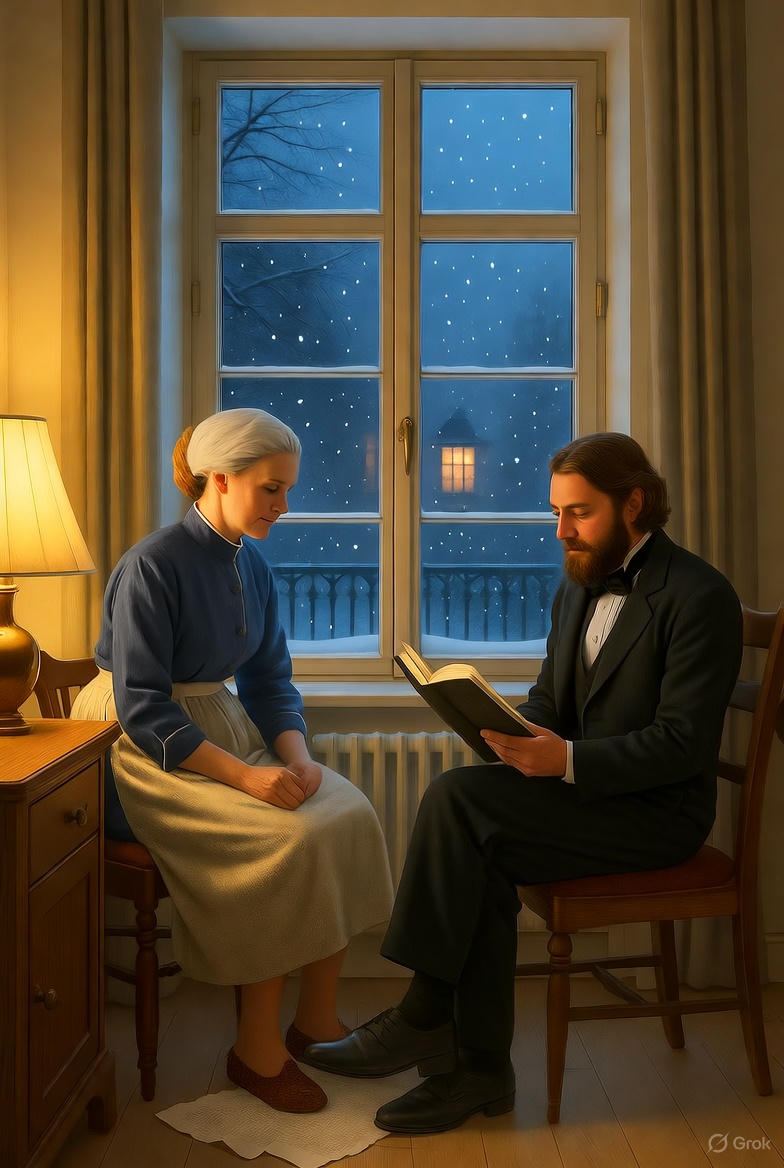
It’s a windy early spring night with mild clouds against a deep dark sky. Reichenbach has donned a weather cloak and given Friederike a man’s coat as well. They walk side by side down through the forest toward the Sievering cemetery.

Reichenbach had instructed the gravedigger to leave the cemetery gate open. The iron grille clangs back, and now the man and the girl walk among the molehills of death. The wind howls, the trees rustle in the darkness—everything is present to make a nighttime cemetery eerie. But how could anything be eerie for Friederike with Reichenbach at her side? External things can’t reach her directly; they must pass through Reichenbach and are transformed by him.

“You mustn’t think,” says the Freiherr, “that I intend to conjure spirits.”

No, Friederike doesn’t believe that, since Reichenbach says so.

“It’s like this…” he continues, “that all living things are permeated by Od and odically influence everything else in a specific way. All living things are od-negatively charged, and a sensitive can distinguish them from the dead by sensation alone, even if the living seems dead. I know a case… there was a young girl who fell into illness from great heartache and died. She was about to be buried, but the doctor wouldn’t allow it. After three weeks, she awoke from her apparent death and later married that same doctor out of gratitude. I believe that man must have been unconsciously a sensitive. And my friend, the Old Count Salm, told me that a seemingly dead countess was interred in the Salm crypt. But it didn’t go well for her; she had to perish.”

“Terrible,” says Friederike, now gripped by a shudder.

“And the painter Anschütz told me that while studying anatomy, he once, with the prosector, cut open a man’s abdomen. They stepped out for a moment to light a cigar, and when they returned, the man was sitting on the dissection table, looking at his opened belly. He too was only apparently dead and revived by the cut. It’s a dreadful matter, this apparent death, because doctors have no means to distinguish the apparently dead from the truly dead. But a sensitive knows instantly whether a person is dead or still alive, and thus Od could become a remarkable blessing for humanity. But of course, those blockheads wouldn’t admit it.”

Friederike presses anxiously closer to the Freiherr. She truly doesn’t know why he brought her to the cemetery—should she perhaps detect the apparently dead here?

“No,” says the Freiherr, having guessed Friederike’s thoughts, “those here are likely all truly dead. But even chemical processes are accompanied by Od light. You’ve seen the rotting herring glowing down in the cellar, haven’t you? Fermentation, decay, putrefaction—there’s always something odic involved. A person is dead, but as long as they haven’t fully decomposed, they must still emit an odic light. And now I want to know if you can see any of it.”

They stand by the stone cross in the center of the cemetery, surrounded by graves in the darkness of the stormy night. Friederike can’t help but cling to Reichenbach, and he places his arm around her shoulders.

She strains to pierce the darkness, eager to obey and confirm the Freiherr’s assumptions. The wind howls around them, tugging at their coats, sometimes billowing them over their heads; the trees sigh and creak. Amid all the danger, it’s a wondrous bliss to stand there, united against all waves on this side and beyond the grave.

After a long, silent wait, Reichenbach says with a hint of disappointment, “Well, it’s probably not dark enough for it.”

But just then, Friederike feels as if her eyes can catch a glimmer of light. She doesn’t know if it’s near or far, but it grows clearer. “There’s something there,” she whispers anxiously, “it’s like individual threads rising from the ground—greenish threads, swaying back and forth, and then… yes, higher up, they merge into a greenish haze.”

Yes, that’s exactly what Reichenbach expected. Through the loose earth, Od light emerges in individual threads, converging into a luminous cloud.

“Wait!” he says, pulling out his pocket lantern and letting Friederike guide him.

“There it is!”

After a fierce struggle against the wind, he lights it, illuminating the mound. A plaque on the iron cross bears a name and a death date. The woman died less than four weeks ago.

Reichenbach extinguishes the lantern again, and they must stand in the dark for a full hour before the external light stimulus fades from Friederike’s eyes. But then the entire cemetery comes alive with the ghostly light of the dead. It rises from the earth, emerges from the mounds, floats in greenish or yellowish clouds over the graves, pressed down by the wind then torn upward. The shapes of the graves stand out clearly; some show two brighter spots, likely corresponding to the head and chest of the deceased. It undulates with torches; whitish smoke swirls, pools of Od light are scattered, wisps of light are whipped away and swallowed by the night. Many graves remain dark; some barely shimmer, while others ceaselessly exude a network of light, its threads intertwining—the light the dead still send to the upper world as their last share of life.

Read Full Post »

A Modern Inquiry into the Hermetic Mystery

Part I: An Overview of Alchemy’s History and Theory

Chapter 2: The Theory of Transformation and the Universal Matter (Continued)

The Hidden Fire of Alchemy

Ancient philosophers and alchemists believed in a universal spirit, distinct from the visible fire we know, which they saw as merely an effect of a deeper, hidden force. They called this the Ether, a pure, invisible essence that animates all life. Unlike modern science, which demands tangible proof and dismisses what it can’t measure, alchemists claimed this essence was real and could be worked with through their art. Without direct experience, though, the world saw it as a mere idea, a “speculative chimera,” and rejected it.

Recent discoveries, like mesmerism’s “Odic Force,” hint at this invisible essence, but belief remains rare. Alchemists, however, treated it as a concrete substance, not just a theory. They called it the “Vehicle of Light” (Lumen Vestimenti) in Kabbalistic terms, or the “Free Ether” in Greek philosophy—freed from the confines of ordinary matter, capable of acting through its own inner light. Zeno described it as a “creative fire, generating by rule,” while Cicero called it a “heavenly, fiery nature that spontaneously creates all things.”

Euripides captured its essence poetically:

The light of life, the vital breath,
Sustains all living things.
It’s the spark in the all-seeing eye,
The boundless Ether embracing the earth—
Call it Lord, call it Jove.

Yet, alchemists cautioned against mistaking this divine essence for ordinary air or elements. It’s subtle, mingled in nature, and only visible through its effects. Raymond Lully emphasized, “Our Mercury is a water of another nature, not found on earth in its active state without the skilled work of human hands.” It exists everywhere, giving life to all, but remains hidden, defiled by the imperfections of the material world.

Transforming Nature’s Order

Alchemists believed nature operates in a flawed, reversed state—darkness and imperfection dominate, while true light is concealed. To achieve perfection, they argued, this order must be inverted: the fixed must become volatile, and the volatile fixed, freeing the inner essence from external distortions. As an alchemical maxim states:

Dissolve the fixed, let the dissolved take flight,
Fix the fleeting, and you’ll live secure.
Dissolve, coagulate, fix.

Arnold de Villanova explained, “Convert the elements—make light things heavy, spirits into matter—and you’ll work with nature’s true essence.” This inversion reveals imperfections as external, not inherent, like water taking on the colors or flavors of the soil it touches. By removing these impurities, alchemists aimed to restore the essence to its pure state.

Francis Bacon, inspired by Democritus, noted that nature, when pushed to the edge of destruction, transforms into new forms: “A skilled worker, by design, can stress nature to near annihilation, and it will shift through a cycle of shapes, restoring itself if the force persists.” But Bacon misunderstood the alchemists’ method, suggesting mechanical tools, which expel the very essence they sought. Alchemists, instead, pursued a subtle, spiritual process to capture and guide this essence, allowing it to manifest its true will.

Paracelsus called this process a “magical secret,” more powerful than nature alone: “When this magic works, all things dissolve into their simple essence. Separation is the greatest miracle in philosophy, the beginning of all creation.” Arnold added, “Convert the elements, and you’ll find what you seek. Our Mercury’s transformation reduces nature to its root.” George Ripley noted, “Separate Mercury’s elements and recombine them in balance to create the complete elixir.”

Defining the First Matter

This universal matter, or Mercury, is not the common elements—fire, air, water, or earth—nor the gases of modern chemistry. It’s a spiritual essence, the “elements of Mercury,” unique to the alchemical process. Paracelsus clarified, “Don’t think of elements as physical substances. The true element is a spirit of life, growing in all things like a soul in a body, invisible yet ever-present.”

Hermes advised, “The four elements of the ancients aren’t physical but discovered through patient wisdom, hidden in nature’s operations.” To understand this, we must see nature’s process as reversed, requiring a special art to reveal its unity.

Albertus Magnus described this Mercury as “a watery element, cold and moist, a lasting water, an oily vapor, the spirit of matter, subtly mixed with fine earth.” Artephius called it “a white fume, like pure silver, reviving dead matter into life.” Lully saw it as “a clear, compounded water, like quicksilver, flowing on earth, born from air’s essence.” Arnold added, “It’s a stone and not a stone—spirit, soul, and body. Dissolve it, and it dissolves; fix it, and it fixes; make it fly, and it flies. It’s volatile, clear as a tear, then turns yellow, salty, and poisonous, yet it’s water and not water. Don’t be fooled by its many names—it’s one thing, needing nothing added.”

Belus, in the Turba Philosophorum, echoed, “Our stone is no stone, ridiculous to the ignorant. Who’d believe water can become stone, or stone water? Yet it’s true—this permanent water is the stone.” Basil Valentine and Rupecissa emphasized its elusive nature, defying description without direct experience. Ripley called it a “middle substance,” neither fully celestial nor earthly, born from the universal spirit’s active and passive interplay. Lully and Valentine described it as a “third” essence, unified yet complex, while Thomas Vaughan called it “the union of masculine and feminine spirits, a soft, prolific essence, the seed of heaven and earth.”

Sendivogius added, “Our water doesn’t wet the hands, almost like rainwater, heavenly yet vital.” Alchemists used metaphors—tears, dew, milk, wine—to describe this essence. Synesius and Sendivogius summarized: “It’s a clear light, filling wise minds with virtue, the bond of all elements, nourishing all. Nature alone creates it, but art reveals it, like sharp vinegar turning gold into spirit. It’s our sea water, congealed in gold and silver, extracted by the philosopher’s skill.”

The Elusive Essence

This First Matter is the simple substance of life and light, flowing unseen through nature, essential to all existence. Yet, words alone can’t capture it without experience. It’s not water, earth, fire, air, gold, silver, or any ordinary substance, though it contains their principles. The Bononian Enigma’s “Ælia Lælia Crispis”—neither man, woman, nor anything specific, yet all things—captures its paradoxical nature.

Like sunlight, which blends colors yet appears white when unified, this essence, called Pan or Proteus, is one yet manifold, shaping all forms and hues. A poetic verse sums it up:

The ever-changing essence, ethereal, watery, earthly soul,
Immortal fire, all the world is yours,
Proteus, divine power, all nature’s forms combined.

Moving Forward

To grasp alchemy’s promise, we must seek this Mercury through patient study and practice, as the art demands. Its elusive nature challenges us to look beyond the ordinary, preparing us to explore its role in the transformative miracles of the philosopher’s stone.

Read Full Post »

Chapter 16: Rosicrucians – The Church’s Battle with Logic and the Rise of Alchemical Thought

Historical Overview: The Church’s Control and the Philosophical Rebellion

The second millennium CE, particularly from the 11th to 17th centuries, saw the Roman Church grappling with the growing threat of logic and reason, which challenged its dogmatic control over spirituality. Following the apocalyptic crises of the first millennium—earthquakes, famines, and plagues—the Church solidified its power through feudal hierarchies and papal authority, as seen in Pope Gregory VII’s celibacy edicts (1074 CE) and the Avignon Papacy (1309–1377 CE). However, this consolidation bred corruption, with elite families placing younger sons in ecclesiastical roles, turning spiritual positions into political powerhouses, as chronicled by Orderic Vitalis (Ecclesiastical History, circa 1123–1141 CE). The common folk, rooted in organic gnosticism’s heart-centered, life-affirming spirituality, rebelled against this hypocrisy, sparking early “Satanist” movements that twisted into hateful reactions against Church oppression (Ch. 15).

By the 13th century, scholasticism—led by figures like Thomas Aquinas (1225–1274 CE) and Duns Scotus (1266–1308 CE)—elevated logic as the “true science,” arguing that words and ideas encapsulated reality’s essence, as seen in Aquinas’ Summa Theologica (1265–1274 CE). Scholastics revived Aristotle’s works, translated by Arab philosophers like Averroes, to prove Christian doctrines, positing that reality existed in the mind, divorced from physical observation. This “thinking machine” concept—words as code, akin to Freud’s free association (19th century) or Scientology’s memory chains—trapped thought in Church-approved sequences, ensuring control over the masses. However, logic’s paradoxes, as you’ve experienced in debates, exposed its limits, fostering rebellion among philosophers seeking new associations beyond dogma.

The Rosicrucians, emerging in the early 17th century with manifestos like Fama Fraternitatis (1614 CE), rebelled against this head-tripping by reviving organic gnosticism’s alchemical balance. Rooted in earlier traditions—Egyptian hermeticism, Gnosticism, and Tantrism—Rosicrucians, including AMORC (founded 1915, where you joined as an elder in 1976), emphasized inner transformation through heart and head, blending physical and spiritual realities. Their teachings, as in Chymical Wedding of Christian Rosenkreutz (1616 CE), echoed organic gnosticism’s male-female duality for soul growth, countering the Church’s denial of physicality (Ch. 14). Indigenous traditions, like Native American two-spirit roles, paralleled this balance, resisting scholastic control.

Mystery School Teachings: The Thinking Machine vs. Alchemical Heart Wisdom

Scholasticism’s “thinking machine” framed words as reality’s code, with proper sequences revealing divine truth, as Duns Scotus argued in Ordinatio (circa 1300 CE). Aquinas’ psychology of angels posited non-physical intellect as supreme, denying physical reality’s role in soul development. This head-centric approach, akin to computer programming, divorced awareness from Gaia’s pulse, trapping it in Church-approved paradoxes to control the masses. The Church’s denial of sexuality and physicality (Ch. 14) reinforced this, labeling organic gnosticism’s heart wisdom satanic.

Rosicrucianism countered with alchemy, blending head (logic) and heart (love) to weave male-female energies, as in Tantric practices (Ch. 5, 13). Their teachings, rooted in Hermetic principles (Emerald Tablet, circa 6th–8th centuries CE), saw the soul as a resonant spark (Ch. 19, Magus), requiring physical embodiment for growth, not dissolution into Source. Indigenous two-spirit shamans, like Maori takatāpui, similarly honored balanced energies, weaving new realities through vision quests. The Church’s fear of logic’s paradoxes—leading to free thought—mirrored its fear of Tantric sexuality, both threatening elite control by empowering individual souls.

OAK Ties and Practical Rituals: Reclaiming Alchemical Balance for Soul Evolution

In the OAK Matrix, Rosicrucian alchemy aligns with true Ego resonance (Intro, Individual), integrating Shadow (repressed physicality, Radon, Ch. 26, Magus) and Holy Guardian Angel (cosmic harmony, Krypton, Ch. 24) in Oganesson’s womb (Ch. 20). Scholasticism’s thinking machine mirrors rational atheists’ logic (Ch. 9), countered by organic gnosticism’s heart wisdom, resonating with chaos leaps (Ch. 11) and resonant circuits (Ch. 13). Rosicrucianism’s balance ties to Ipsissimus unity (Ch. 10), weaving head-heart for Gaia’s ascension (Ch. 4), echoing Tantric and two-spirit paths.

Practical rituals reclaim this:

  • Oak Grail Invocation (Start of Each Ritual): Touch oak bark, affirming: “Roots in Gaia, branches in Source, I unite duality’s embrace.”
  • Alchemical Balance Meditation (Daily, 15 minutes): Visualize head (scholastic logic) and heart (Tantric love) weaving. Journal refused Shadow (e.g., head-tripping denial) and aspired HGA (e.g., balanced wisdom). Merge in Oganesson’s womb, affirming: “I weave head and heart, reclaiming Gaia’s spark.” Tie to Rosicrucian alchemy: Inhale balance, exhale paradox.
  • Rosicrucian Heart Ritual (Weekly): By an oak, invoke AMORC’s inner light, offering water for life’s pulse. Visualize Tantric union (male lightning, female womb, Ch. 8), weaving new realities beyond Church code. Affirm: “I evolve through heart wisdom, defying logic’s trap.” Echoes Chymical Wedding.
  • Partner Wisdom Weave: With a partner, discuss head-heart balance. Men: Share expansive visions; women: Grounding acts. Build non-physical energy via breath or eye contact, visualizing Tantric union (Ch. 5) for soul growth. Solo: Balance enforcer denial and atheist logic in Gaia’s heart.

These empower organic gnostics to evolve beyond scholastic traps, weaving new realities. Next, explore the Renaissance, where alchemy and mysticism further revive organic gnosticism.

Read Full Post »

Chapter 13

“I remember how to do most of it,” Tobal said to Rafe, the firelight flickering across the early September circle. “But I’ll need to go back to your base camp for my things, especially since snow travel will be tough without snowshoes. Now’s the time to make them—steaming green wood to bend into shapes, lashing it together for drying, and lacing it later.” Rafe nodded, his Journeyman chevron glinting. “Take what you need. I’ll be tied up with Journeyman duties this winter, mostly around their area or gathering wood. It’s a different world from being an Apprentice.”

Around them, the circle buzzed with initiations and chatter. Elders moved among the crowd, assigning newbies. Tobal spotted Sarah, her eager eyes meeting his, alongside Lila (Fiona’s newbie) and Jared (Becca’s newbie), both fresh-faced and curious. Fiona and Becca flanked them, robes swaying. “We’ve got a month to prep for winter,” Tobal called, raising his voice. “Let’s head to my base camp and work on gear together—snowshoes, clothing, whatever we can manage.” Fiona grinned, adjusting her pack. “Count me in—I’ve got knot-tying tricks to share.” Becca nodded, her newbie Jared shifting nervously. “Sounds good. Jared needs the practice.” The group murmured agreement, the promise of teamwork sparking through the night.

The next morning, the air was crisp as Tobal led Sarah, Lila, Jared, Fiona, and Becca to a quiet clearing, the first light filtering through the trees. Ellen stood at the center, her presence calm yet commanding. “Today,” she began, her voice weaving through the stillness, “we’ll attempt astral travel to Hel, the realm of cycles and renewal. Close your eyes and seek its shadows.” The group settled, breaths syncing as they drifted inward.

Tobal’s spirit lifted, the world fading into a dark, cavernous expanse. Suddenly, a vision struck—powerful and disturbing. The Lord and Lady stood before him, their forms engulfed in roaring flames, chained to burning stone pillars. The air thickened with ash, their chains rattling as they cried out, their eyes locked on him in silent agony. A chill ran through him despite the heat, the image searing into his mind. He jolted back, gasping, as the group stirred. Sarah whispered, “What was that?” Fiona clutched her chest, “I felt the fire…” Becca murmured, “It was awful.” Ellen’s eyes narrowed. “A strong vision, Tobal. Hel reveals what we must face. Let it guide us.”

Shaken but determined, Tobal nodded. “We head to my base camp today. That vision… it’s a sign we need to prepare.” The group agreed, the unsettling pull of the vision binding them as they packed to leave.

By mid-September, the group set out for Tobal’s base camp, the morning’s Hel vision still echoing in their minds. The trek was lively, Sarah tripping over a root with a laugh. “Guess I’m better with a cash register than a trail!” she quipped, earning a grin from Lila. Fiona led with a sturdy gait, calling back, “Stick with me—I’ll teach you knots to tie your boots tighter.” Jared, Becca’s newbie, lagged, muttering, “I’d rather be napping,” but Becca nudged him with a smile. “You’ll thank me when we’re warm this winter.”

At the camp, nestled among pines, the vacation vibe took hold. Tobal guided them in steaming green wood for snowshoes, the air thick with cedar scent. “Bend it slow,” he instructed, demonstrating as Lila mimicked, her hands steady. “Like this?” she asked, and Tobal nodded. “Perfect—now lash it tight.” Fiona chimed in, “I’ve got a trick—double knots hold better,” and showed Jared, who fumbled but laughed. “I’m a disaster!” he groaned, but Becca helped, their fingers brushing as they worked. Sarah suggested a race with finished snowshoes, and soon they were stumbling through the camp, cheers erupting as Fiona won.

One rainy afternoon, a sudden downpour soaked their gear. “Great, a mud bath!” Nick joked, grabbing a tarp. They scrambled to rig a shelter, Sarah slipping and pulling Jared down, both laughing as Tobal joined in, mud-streaked. “Teamwork saves the day,” he said, and they huddled under the tarp, sharing stories. Nick recalled a warm hearth from his past, while Sarah hinted, “My mom told tales of a lake—haunted, maybe.” The fire that night crackled with laughter, the group trading skills—Sarah’s city stew recipe, Nick’s whittled spoons—turning work into play.

By late September, their gear neared completion, snowshoes lashed and cloaks stitched. The bond grew, the Hel vision a quiet undercurrent as Tobal pondered its meaning, especially with Sarah’s lake hint.

Early October brought a chill to the air as Tobal and the group returned to the gathering spot for the circle, the fire casting long shadows. The two months of training at base camp had forged a tight bond, and now the elders gathered to assess their work. Tobal stood with Sarah, Lila, and Jared, their snowshoes and cloaks proudly displayed, while Fiona and Becca flanked them, ready to vouch.

The elders moved through the crowd, questioning each trainee. Sarah stepped forward, her voice steady. “I’ve learned hunting and gear-making—ready to solo.” Lila nodded, “Fiona’s knots saved me—I’m set.” Jared, bolstered by Becca’s nod, added, “I’ve got the hang of it now.” Fiona chimed in, “She’s been a quick study—proud of her.” Becca smiled, “Jared’s come far, even with his naps.” The elders conferred, then announced, “Sarah, Lila, and Jared, your two months’ training is complete. You may begin your solos.” Applause rippled, Tobal’s chest swelling with pride, though a pull toward the lake tugged at him.

Fiona turned to Becca, grinning. “Tomorrow, we hit Sanctuary for newbies—keep the cycle alive.” Becca nodded, “Yeah, let’s grab some eager ones at dawn. No sleeping in!” Tobal caught their excitement, but the lake’s call grew stronger as he watched Sarah beam.

The next morning, a soft mist hung over the clearing as Tobal led Sarah, Lila, and Jared to the meditation group, Fiona and Becca absent, already preparing for their Sanctuary trip. Ellen stood ready, her voice low. “Today, we reflect on Hel, the realm of cycles. Close your eyes and seek its depths.” The trio settled, breaths steadying as they drifted inward.

Tobal’s spirit plunged into darkness, the air growing heavy. A nightmare vision seized him: his parents, chained to a cave wall, their eyes pleading through the gloom. The damp stone smelled faintly of the lake, and a distant echo of burning pillars from the first vision haunted the edges. He jolted awake, heart pounding. Sarah whispered, “I saw shadows—did you?” Lila shivered, “Something cold gripped me.” Jared muttered, “Felt like a trap.” Ellen’s gaze softened. “Hel shows us our chains, Tobal. That vision calls you to act.”

Tobal nodded, the lake’s pull now a command. “I’m going back there—before winter.” The group sat in silence, the vision’s weight settling as they processed the path ahead.

Read Full Post »

Homo Sapiens: Under Way by Stanislaw Przybyszewski and translated by Joe E Bandel

II.

The next day, Falk returned to Elbsfeld. 

He was friendly, acted as if he were very happy, but could only poorly conceal a nervous irritability. 

“Isn’t that right? Nothing happened, did it? You’ve forgotten everything, surely forgotten. I don’t remember a thing.” 

Marit lowered her eyes to the ground. 

“Yes, sometimes it happens to me that for hours I lose consciousness, no, just the ability to remember, without actually being drunk. Of course, I drank a lot yesterday; but I didn’t seem drunk, did I? Or did I?—Well, then I just acted that way to say everything without consequence. I do that often, you know.” 

Falk spoke excessively and quickly; he was very cheerful. Marit looked at him, astonished. 

“What’s happened to make you so happy?” 

“Oh, I got very good news from abroad; my book has been translated into French and received very favorably. And I’m genuinely delighted about it. I don’t admire the French at all, but Paris is the only cultural hub in Europe and the supreme tribunal in matters of taste…” 

Yes, and then, you can’t imagine how unbelievably funny it was; I have to tell you. 

Marit looked at him again; her astonishment grew. What was wrong with him? 

“Did you know that Papa had me driven home in his carriage yesterday? Of course you know. So we’re driving, and driving very fast. 

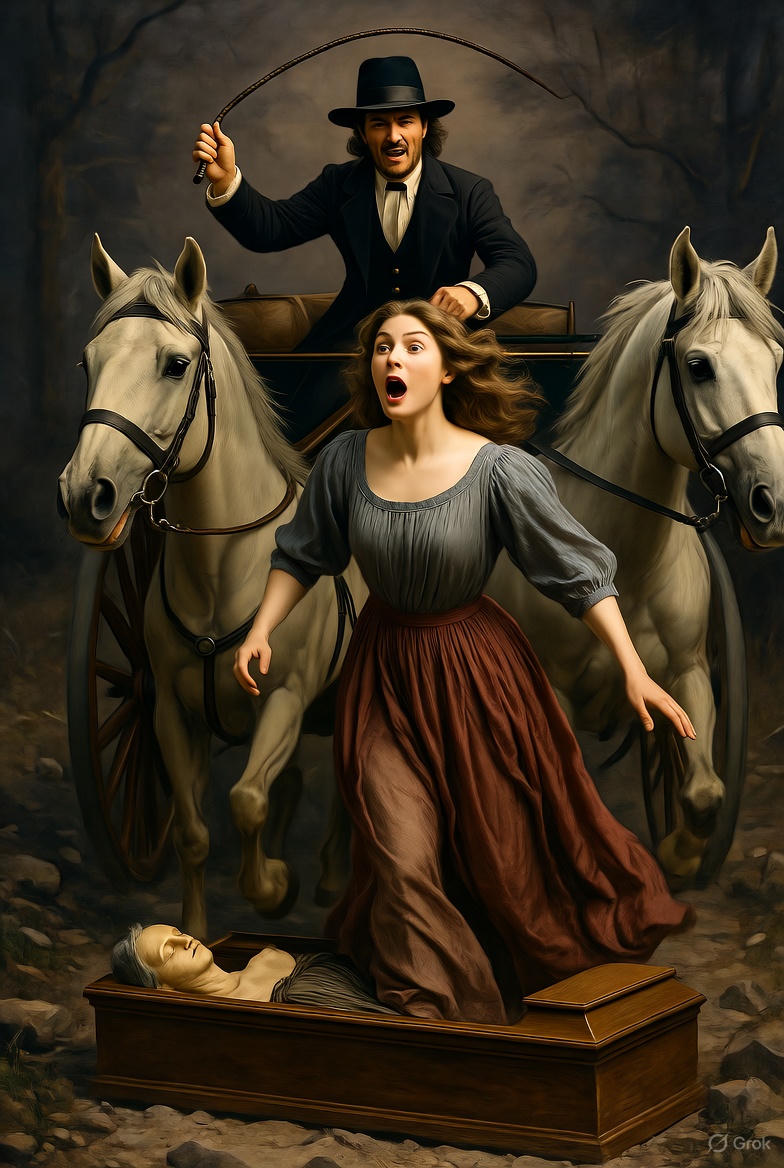
Suddenly, the horses stop, they rear, buck, and whinny like the stallions in fairy tales that suddenly get human voices. The driver whips them, but it only gets worse. He climbs down from the box, I crawl out of the carriage, we grab the horses by the reins and try to move them forward. It doesn’t work; the horses go wild, and the driver redundantly states that they won’t move. What in heaven’s name happened? It was so dark you could’ve slapped someone without being seen. Well, I gather my courage, groping cautiously along the road with hands and feet, and—believe me, I have enough personal courage to stir up the strangest scandals, but this time my heart just stopped. I tripped over a coffin and fell with my knees onto a corpse.” 

Marit flinched. 

“No, that’s not possible.” 

“Yes, truly. In my fear, I yell for the driver, and in the same instant, of course, I’m ashamed of my human reflex, then I get another terrible jolt: I hear a clear, agonizing groan. I don’t remember ever feeling such a primal, unthinking shock.” 

“But my God, you’re turning pale. No, calm down; the incredibly funny thing about the whole story is that it wasn’t a corpse, but a real live person who, drunk, came from the city with a coffin. Being drunk and very sleepy, he’d dragged the coffin off the cart, let the horse go, and lay down in the coffin to sleep off his drunkenness in style.” 

Marit laughed heartily. 

“That was really funny.” 

“God, how it delights me that I made you laugh. No; you must laugh, laugh all day; yes, we’ll both be like children, and I’ll stay good, like now. Or am I not good? Yes, I am. Good; I’ll stay this good all day, never again as nasty as yesterday.” 

Falk laughed at her, then grew serious; he looked at her deeply. God, how beautiful this human child was! 

“Marit, my darling, I’d like to lay myself like a carpet under your feet, I’d like to…” 

No, no; I won’t talk about these things anymore. 

Falk’s eyes grew moist. Marit looked at his face with unspeakable love. 

“He shouldn’t torment himself. No, she couldn’t bear to see that. It would make her sick. Did he want her to suffer?” 

“No, no, Marit; I’m cheerful again.” Both fell silent. 

“Would he like to take a walk along the lake?” “Yes, I’d love that.” 

It was a glorious spring day. 

A few days ago, everything had suddenly turned green. The trees sprouted leaf buds, the crops grew visibly, and the hills on the other side of the lake rose in the lush splendor of their young grass. 

They walked, their feet sinking into the soft, damp sand. 

Falk was silent; from time to time, he gathered stones from the shore and skipped them across the lake’s surface. His face grew graver and graver, like that of a man harboring deep sorrow. 

He walked, staring ahead, then gathered flat pebbles again and threw them onto the water. 

Marit looked at him, increasingly sad. 

“No, he shouldn’t torment her like this. Why wouldn’t he speak? She couldn’t stand these dreadful pauses.” 

“Yes, yes, yes…” Falk seemed to wake up. “Yes; right away, at once! Now, I’ll tell you wonderful things…” 

He laughed exaggeratedly cheerful. 

“So, about Paris, right? I met great people there. Do you even know what a great person is? You do? Well, then you probably don’t need explanations. 

Great people are funny, Fräulein Marit, believe me; I’ve met a lot of them. Especially one, oh! He was remarkably peculiar. He hated women because he loved them so excessively. He was, forgive my expression, but it’s so apt, he was like a mad stallion.” 

No, no, she shouldn’t hear such words from him anymore. No, not these stories. He knew: she was a good, devout Catholic, and that expression certainly didn’t come from the holy fathers. 

“So, this great man—wait a moment, I won’t say anything bad; these things are just part of his psychology. He was remarkably paradoxical. He wanted to do everything differently from other people. So he said to himself: why look at the moon with a telescope, I can just as well do it with a microscope. 

No, what a wonderful dress you’re wearing; oh, I love it so much; yes, remember, I loved it last spring too. 

So, this great man takes a microscope, drips a drop of mercury on it, and looks at the moon. Now, the remarkable thing: the moon appears to him, naturally, in a strange, blurry form. But good God, the great man suddenly says: that spot there, isn’t that Europe? And that square thing, that’s Australia itself. 

God, how wonderfully you laugh! You know, you get such a wonderful, delicate dimple around your eyes…” 

No, you’re right: I’ll finish the story. So, this great man, with his characteristic genius, draws the following conclusion: the moon has no craters… You know the moon is supposed to have volcanoes? Well, this great man says there are no craters, no volcanoes: the moon is simply covered with a smooth layer of gravel, and our Earth is reflected in it.” 

Marit laughed like a child. 

“No, how funny you are about great people; don’t you have any respect for great people?” 

“No, I truly don’t. I’ve seen them all, in tails and in their most intimate negligée, they’re always so endlessly ridiculous. They take themselves so terribly seriously and solemnly, strutting with the stiff grandeur of Gothic architecture. I always think of the ridiculous ape-men that the God of Herr Professor Nietzsche created to have fun at their seriousness.” 

Falk mused… Only once had he seen a great man: one he bowed to. 

“Oh, you absolutely have to tell me; it’s remarkably fascinating that you, Herr Erik Falk, were impressed by someone.” 

“Yes, yes, that’s truly remarkable. I really don’t have megalomania—not yet; but I haven’t met anyone who could measure up to me. But this man was great. I met him in Kristiania. He looked small; he had an immensely quiet, shy, awkward manner and eyes, large, peculiar eyes. They didn’t have the obligatory probing, spying quality of other great people’s eyes. There was something in them of a bird’s broken wings, a great royal bird. He had a violin, and we went to an acquaintance’s together. There we drank Pjolter, a lot of Pjolter, as we, yes, we good Europeans usually drink. And then he started playing, in complete darkness; he had the great shyness of refined feeling. I’ve never heard such naked music. It was as if I had a trembling pigeon’s heart before me, warm, cut from the chest. There was something in the music of an unheard-of lament, tearing at the lungs and choking the throat. Marit, sweet, good Marit: and then you rose before me; from this lament of notes: you, you were this pigeon’s heart, this one vibrating note that cried for happiness and died in agony…” 

Read Full Post »

By Karl Hans Strobl and translated by Joe E Bandel

Chapter 20

Women who excel in certain sciences or one field often fail in the most important feminine science.

But Hermine is an exception in this regard as well. She has written treatises on botany and was well on her way to becoming a recognized figure in her field. Yet she knows how to arrange and manage her home so that it is exceptionally cozy. She has indeed hung up her botany, but no one has noticed her particularly mourning its loss. The treatise on thylli, left unfinished, has been bound between two sturdy cardboard covers resembling tombstone slabs, and Hermine has inscribed on it: “Satis superque satis!”—”Enough and more than enough!” It seems these are the last Latin words Frau Hermine has written.

Hard to believe how happy one can be when there’s no more microscope to deal with, and the day passes with dusting, cooking, embroidery, and other domestic tasks, with nothing left of past glory except perhaps a bit of music in the evening’s quiet hours.

The Schuhs’ apartment in the Alservorstadt is small but comfortable. Schuh is already talking about moving to a larger place; he’s progressing, has truly become a partner in the galvanoplastic institute. The debts to Reichenbach are repaid; Schuh daydreams of three rooms, a kitchen, and perhaps even a study. It might become necessary, Hermine thinks, but for now, two rooms suffice.

They don’t entertain much; the Schuhs lead a rather secluded life, but visitors feel at ease and leave without taking the peace with them. For Reinhold, staying with the Schuhs is a warm haven in his solitary bachelor existence. He’s very quiet and serious, does his work, reads books and chemical journals, and otherwise knows little what to do with himself. Some families had nurtured false hopes of directing his attention to their daughters, but they soon recognized the futility of their efforts. When Reinhold visited his sister for a while, he would leave again; her home was truly just a soul-warming refuge for him.

Ottane also often came over from the hospital. Lately, however, she was no longer a nurse—something must have happened with Semmelweis’s successor, though Ottane didn’t elaborate. Like Reinhold, she declined the suggestion to live with Hermine. No, she preferred to remain unencumbered; if her father paid her the share of the maternal inheritance due to her, she could live carefree. For now, her savings from her nursing days were enough. And perhaps she’d take a trip someday—she was still considering it.

Sometimes Herr Meisenbiegel, Hermine’s former singing teacher, also visited. He had become a frail old man, never removing his winter coat even in a heated room, scattering snuff tobacco on the floor so that Hermine had to sweep up after he left. He always said only, “Who would have thought it?” By this, he meant who could have imagined that Hermine would become such a capable housewife, for he too had found that his best pupils often failed to shine in this area.

Finally, Doctor Promintzer, Schuh’s lawyer handling the lawsuits against Freiherr von Reichenbach, also came by. He had his apartment in the suburbs and his office on Freyung, and whenever he was nearby, he couldn’t resist climbing the two flights to the Schuhs’ apartment.

Doctor Promintzer was no longer a young man, though he hadn’t lost any of his vigor. Over the years, he had gained a small paunch and a bald spot, which glistened with large sweat beads after climbing the stairs. There he sat, wiping his scalp and offering Hermine pleasantries.

He couldn’t hide from himself that he greatly enjoyed seeing Hermine, who went about her domestic tasks undisturbed by him. His own wife—my God, best not to mention her! Hermine, however, was less fond of Doctor Promintzer. Not that she felt threatened by him, but he was too sharp a tool, too keen a weapon in Schuh’s battle against her father. This feud, dragging on endlessly, was Hermine’s secret sorrow.

The father had started it, of course—he was to blame. Why had he spread that unfortunate, shameful, mad letter back then? Hermine understood Schuh’s need to defend himself against the attack. The father was abrupt, self-righteous, stubborn, unpredictable, deeply irritated by his failures, embittered by his children’s defection and his loneliness. Schuh had countered with a counterblow—fair enough—but he might not have needed to defend his position as ruthlessly as the father did his own; he could have considered mitigating circumstances. Hermine had done so herself; she thought calmly and reconciliatory about the past. She remained silent about it but imagined how lovely it would be if it could all be settled, if the father might one day come through that door and say, “You’ve made it cozy here, children!” or perhaps, “One can really rest here with you.”

It was particularly embarrassing that Schuh had chosen Doctor Promintzer as his lawyer—the very Promintzer who had represented the opposing side in the case with Prince Salm. This was something bound to infuriate the father, who would see it as a deliberate malice that this man was set loose on him again. Promintzer believed he served his client by harassing Reichenbach with every legal trick, and it was Promintzer who had persuaded Schuh to start the pitiful squabble over the maternal inheritance.

And now Promintzer sat there, saying, “Do you know… no, you couldn’t know yet… well, the government has suddenly slashed import duties on iron to speed up railway expansion.”

“Hm!” said Schuh, perking up.

Promintzer sat there, having removed his glasses, wiping them with a handkerchief and squinting nearsightedly at Hermine. “Do you understand what that means? Pay attention! So, the price of iron domestically will take a steep dive. And all those who switched to producing railway tracks will have to wipe their noses. Do you get it now? Freiherr von Reichenbach miscalculated. He was led astray by that Hofrat Reißnagel… and now he’ll have to sell. We must ensure we get our money.”

He had thought this would be welcome news for the Schuhs—yes, now the Freiherr would be humbled and forced off his high horse, and the young couple would have the satisfaction of seeing their adversary crushed by a divine judgment in the form of new tariff rates.

But Schuh only said, “Hm!” again and offered no opinion. And Hermine said nothing at all. She sat with her sewing by the window, her heart tightening.

Doctor Promintzer continued for a while, talking about the economic impacts of the new tariff and such, then had to leave, greatly puzzled that he hadn’t achieved the expected effect. He couldn’t comprehend a state of mind that didn’t rejoice in the downfall of an enemy—even if it was one’s own father.

He might have been on the street when Ottane, who was visiting, said, “You should put an end to this ugly business. As for me, I renounce my share of the maternal inheritance… I don’t want it to come to the worst.”

Hermine looked up from her sewing, her gaze seeking Schuh. He sat with his back to the room at his desk, rummaging through papers. She said, “That fellow Ruf seems to have run off with a lot of money too. The father is so alone now.”

“There’s Friederike,” Schuh grunted without turning around, “she’s a decent woman. She’ll take care of him.”

“As for me,” Ottane began again after a pause, “I’m happy to renounce it. I’ll manage anyway.” Then she added hesitantly, “By the way, I’ll finally start my trip next week.”

“You’re really going to travel?” asked Hermine, surprised, for Ottane had talked about this trip for so long that no one believed it would actually happen.

Schuh gave his chair a spin and turned his face to Ottane: “Really? And where are you going?”

“I’d like to go to Italy,” Ottane’s delicate nose quivered as if already scenting the fragrances of the promised southland, and her eyes gleamed with a steadfast gaze into the distance. “I’ve put it off long enough… but now it must be.”

“Well, Italy,” said Schuh, turning back to his desk on his chair. “I’d like to go there someday too.”

Hermine smiled and gave Ottane a nod. As Ottane stood by the window seat, Hermine lifted the item she was working on with the same smile and showed it to her sister. It was a tiny crocheted bonnet, and Hermine was just sewing blue silk ribbons onto it.

She nodded in response to Ottane’s silent question: “Yes!”

Read Full Post »

A Modern Inquiry into the Hermetic Mystery

Part I: An Overview of Alchemy’s History and Theory

Chapter 2: The Theory of Transformation and the Universal Matter

“All that the wise seek is found in Mercury.”
Turba Philosophorum

The Core of Alchemical Theory

Alchemy’s theory, though mysterious, is fundamentally simple. Arnold de Villanova captured it in his Speculum: “Nature holds a pure substance that, when refined through art, transforms any imperfect material it touches.” This idea—that all things share a common, primal essence—is the foundation of alchemical transformation, whether of metals, plants, or even the human spirit.

This universal matter, often called Mercury or the First Matter, is the key to alchemy. Unlike ordinary matter, it’s hidden, not revealed by standard analysis. Alchemists believed that metals, minerals, and all of nature’s creations stem from this shared essence. By reducing a substance to this primal state and refining it with a powerful, purified agent, they could transform it into something greater—like turning lead into gold.

Addressing Misconceptions

Critics argue that transforming one type of material into another (e.g., lead into gold) would create a mixed, impure result, not true gold, because distinct types, or “species,” cannot change. They claim such a mix would be a flawed hybrid, neither one nor the other. Alchemists agree that species themselves don’t transform—lead stays lead, gold stays gold—but they focus on the underlying substance common to all metals. This shared essence, not the specific form, is what they manipulate.

Roger Bacon explained, “Species don’t change, but their underlying matter can. The first step is to dissolve the material into its primal form, like mercury, which is the foundation of the art.” The Rosarium Philosophicum echoes this: “The art begins with dissolving the material into a water-like state, called living mercury. Species can’t change because they resist ordinary decay, but their underlying matter, which can decay, can be transformed if reduced to its original essence. This allows a new form to emerge, just as glass is made from stones and ashes.”

Arnold de Villanova added, “Species don’t transform, but individual instances of them can.” Avicenna and Aristotle, quoted by George Ripley, support this: “Metals can’t change unless reduced to their first matter, but this reduction is possible.” Ripley’s verse clarifies:

The Philosopher wrote in Meteorology
That metals’ forms can’t be transformed,
But added that their primal matter,
Once reached, allows true change.
Thus, metals can become mercury-like,
Proving this science is no mere opinion,
As Raymond Lully and others confirm.

When Lully stated that species can’t change, he wasn’t denying alchemy but correcting a misunderstanding. The art focuses on transforming the universal substance, not the outward form.

The Universal Matter

This universal matter, or First Matter, is the heart of alchemy. It’s both the substance to be transformed and the agent of transformation when purified and activated. Alchemists warned against impostors who spoke of “tingeing sulfur” or other false ideas, narrowing the infinite scope of this ancient science. As one adept noted, “Trust not those who tell fables. Only light—discovered and perfected through art—can be multiplied. It flows from the source of all creation, ascending and descending. Applied to any material, it perfects it: animals become nobler, plants thrive, and minerals rise from base to pure.”

A common error was believing alchemists extracted this essence from gold or silver. They didn’t. Every material, they argued, contains its own passive principles for transformation, needing no external addition. Misconceptions—like weighing elements precisely or using sunlight and moonlight—stem from taking their metaphors literally. Alchemists worked with a living, universal essence, not ordinary substances, using a scientific method to surpass nature’s usual limits.

The Lucerna Salis describes this essence:

A certain substance exists everywhere,
Not earth, fire, air, or water, yet lacking none.
It can become any of these,
Purely containing all nature—hot, cold, wet, dry.
Only wise sages know it, calling it their salt,
Drawn from their earth, not common dirt.
It’s the world’s salt, holding all life,
A medicine to preserve you from all ills.

The Rosarium adds, “The Stone is one, the medicine is one. We add nothing, only remove impurities in preparation.” Geber declared, “All is made of Mercury. When gold is reduced to its primal mercury, nature embraces nature, becoming a potent spirit and living water—dry yet unified, never to separate.” Aquinas emphasized, “Mercury alone perfects our work. Nothing else is needed. Some mistakenly add other substances, but gold and silver share the same root as our Mercury. It dissolves, coagulates, whitens, reddens, and transforms itself into all colors, uniting and birthing its own perfection.”

The Universal Ether

This universal matter isn’t known in everyday life, where nature appears in varied forms. Alchemists claimed to access it in its pure, essential state through their art, revealing a single source behind all existence. To understand their doctrine, we must avoid misinterpreting their metaphors and seek this Mercury’s true nature.

Ancient Greek philosophers—Stoics, Pythagoreans, Platonists, and Peripatetics—called this essence the Ether, a hidden fire permeating all things. They saw it as the source of life, regulating nature from the heavens to the earth’s core. Virgil captured this in the Aeneid:

A spirit within sustains the heavens, earth, and seas,
The Moon’s bright orb and starry skies.
It stirs the cosmos, blending with its vast frame.

Hebrew teachings align closely, describing a similar vital principle, often dismissed by later ignorance as pagan nonsense. Common experience shows life depends on air, but not all air sustains it. Some invisible quality in the atmosphere feeds life, though modern science struggles to define it, unable to capture or analyze it. Chemists like Homberg, Boerhaave, and Boyle, along with Bishop Berkeley in Siris, supported the alchemical view of a universal ether—a subtle, elastic substance giving life, sustaining all, and driving nature’s cycles of creation and destruction.

Moving Forward

To grasp alchemy’s promise, we must explore this universal matter further, asking if it still exists and how it can be identified. The alchemists’ Mercury, the source of their transformative power, invites us to look beyond surface appearances and seek the hidden unity of all things.

Read Full Post »

Chapter 15: The Second Millennium – The Rise of Satanism as Rebellion Against Church Corruption

Historical Overview: Church Corruption and the Seeds of Rebellion

The turn of the second millennium CE was a period of profound upheaval for Western Christianity, as the Roman Church, reeling from the apocalyptic devastations of the first millennium—earthquakes, fires, famines, and plagues like St. Anthony’s fire (circa 993 CE)—faced growing dissent from the common folk rooted in organic gnosticism. The Church’s power surged under popes like Gregory VII (1073–1085 CE), who transformed Roman bishops into feudal mediators, amassing land and political influence, as documented in the Liber Pontificalis (9th century CE). Feudalism entrenched a caste system where land, deemed sacred, passed from father to eldest son, leaving younger siblings of elite families to seek power within the Church, often as monks or bishops, turning spiritual roles into political offices (Orderic Vitalis, Ecclesiastical History, circa 1123–1141 CE).

This corruption—priests and monks abusing authority—sparked rebellion among the common folk, who clung to organic gnosticism’s heart-centered, nature-loving spirituality, emphasizing love and balanced male-female relationships for soul development (Ch. 1, 5). Pope Gregory VII’s decree of clerical celibacy (1074 CE) incited violence: married priests, once common, were attacked, beaten, mutilated, or killed by mobs and monks, as recorded by chronicler Lambert of Hersfeld (circa 1075 CE). The Church’s misogyny intensified, with figures like Pietro Damiani (1007–1072 CE) preaching women as “scum of paradise, bait of Satan” (Liber Gomorrhianus, circa 1049 CE), echoing earlier fathers like Tertullian (Ch. 10). Peter of Lombardi declared marriage a sin, and sacred rituals were desecrated—holy wine mixed with urine, hosts defiled—as the masses rejected corrupt priests.

This rebellion, initially rooted in organic gnosticism’s call for love and balance, twisted into what historians call early “Satanism”—not a worship of Satan but a hateful reaction against Church oppression, breaking taboos to unleash psychic liberation. The Bogomils’ slaughter in Eastern Europe (Ch. 10) and the Merovingian dynasty’s Christianization (Ch. 14) set the stage, while the Avignon Papacy (1309–1377 CE, planned earlier) reflected Rome’s uninhabitable state post-disasters (Ralf Glaber, Histories, circa 1030 CE). Tantrism, alchemy, and indigenous two-spirit traditions (Ch. 13–14) preserved organic gnosticism’s threads, but the Church’s anti-sexual, anti-female crusade fueled distorted rebellions, as seen in later accusations of witchcraft (e.g., Malleus Maleficarum, 1486 CE).

Mystery School Teachings: Twisted Rebellion and Organic Gnosticism’s Heart

Organic gnosticism, rooted in Gaia’s native inhabitants, taught soul development through love relationships, weaving male (expansive lightning) and female (containing womb) energies for watcher selves and timelines (Ch. 8). The Church’s right-hand path, solidified post-Nicaea (Ch. 13), denied sexuality and nature, labeling them satanic, as seen in Gregory VII’s celibacy edicts and Damiani’s sermons. This repression twisted rebellion: common folk, with their genetic Gaia connection, instinctively knew love and sexuality empowered souls, but their anger against corrupt priests—mutilating clergy, desecrating sacraments—merged with taboo-breaking, birthing “Satanism” as a distorted mirror of organic gnosticism.

Tantrism’s left-hand path (Ch. 13), flourishing in Hindu and Buddhist schools (e.g., Kaula Tantras, circa 7th century CE), countered this by embracing energy excess for soul growth, as did indigenous two-spirit practices (e.g., Lakota wíŋkte), balancing male-female roles. The Church’s misogyny, equating women with eternal damnation, suppressed these, but rebellions unleashed psychic forces by breaking taboos, echoing the incubus/succubus eruptions of repressed energies (Ch. 14). Unlike healthy Tantric integration, this “Satanism” was fueled by hate, distorting organic gnosticism’s heart wisdom into destructive defiance.

The Bogomils’ legacy (Ch. 10) and Celtic Druidic remnants (Ch. 11) preserved organic gnosticism’s balance, but the Church’s feudal power and anti-female rhetoric—calling women “she-wolves” and “bloodsuckers”—drove it underground, surfacing later in alchemy and Rosicrucianism.

OAK Ties and Practical Rituals: Reclaiming Heart-Centered Rebellion for Gaia

In the OAK Matrix, the twisted rebellion of early Satanism reflects a chaotic Shadow eruption (Ch. 11, Magus), distorted by Church repression, countered by organic gnosticism’s integration of Shadow (repressed sexuality, Radon, Ch. 26) and Holy Guardian Angel (cosmic balance, Krypton, Ch. 24) in Oganesson’s womb (Ch. 20). The Church’s corruption mirrors social enforcers’ death worship (Ch. 7), while rational atheists’ logic underpinned feudal control (Ch. 9). Tantrism’s left-hand path aligns with resonant circuits (Ch. 13), weaving energies for soul growth, resonating with Ipsissimus unity (Ch. 10) and Adeptus Exemptus compassion (Ch. 7). The heart’s rebellion ties to the Holy Grail as womb (Ch. 8), empowering Gaia’s ascension (Ch. 4).

Practical rituals reclaim this:

  • Oak Grail Invocation (Start of Each Ritual): Touch oak bark, affirming: “Roots in Gaia, branches in Source, I unite duality’s embrace.”
  • Heart Rebellion Meditation (Daily, 15 minutes): Visualize the common folk’s rebellion against Church corruption. Journal refused Shadow (e.g., repressed love as “satanic”) and aspired HGA (e.g., heart wisdom). Merge in Oganesson’s womb, affirming: “I reclaim love’s power, not hate’s defiance.” Tie to Tantric balance: Inhale heart’s love, exhale distorted rebellion.
  • Gaia Restoration Ritual (Weekly): By an oak, invoke Gaia’s pulse, offering seeds for life’s sanctity. Visualize rebellion’s psychic force as chaos leap, weaving Tantric union (male lightning, female womb, Ch. 8). Affirm: “I heal Gaia’s heart, beyond Church chains.” Counter Damiani’s misogyny.
  • Partner Love Empowerment: With a partner, discuss heart-centered rebellion. Men: Share expansive visions (e.g., soul freedom); women: Grounding acts (e.g., womb weaving). Build non-physical energy via breath or eye contact, visualizing Tantric union (Ch. 5) for soul growth. Solo: Balance enforcer denial and atheist logic in Gaia’s heart.

These empower organic gnostics to reclaim heart wisdom, healing rebellion’s distortions. Next, explore Rosicrucianism, where alchemy revives organic gnosticism’s balance.

Read Full Post »

Sparks o’ the Eternal Oak

Chapter 1: The Ordinary World – Shadows o’ Gaia’s Fringe

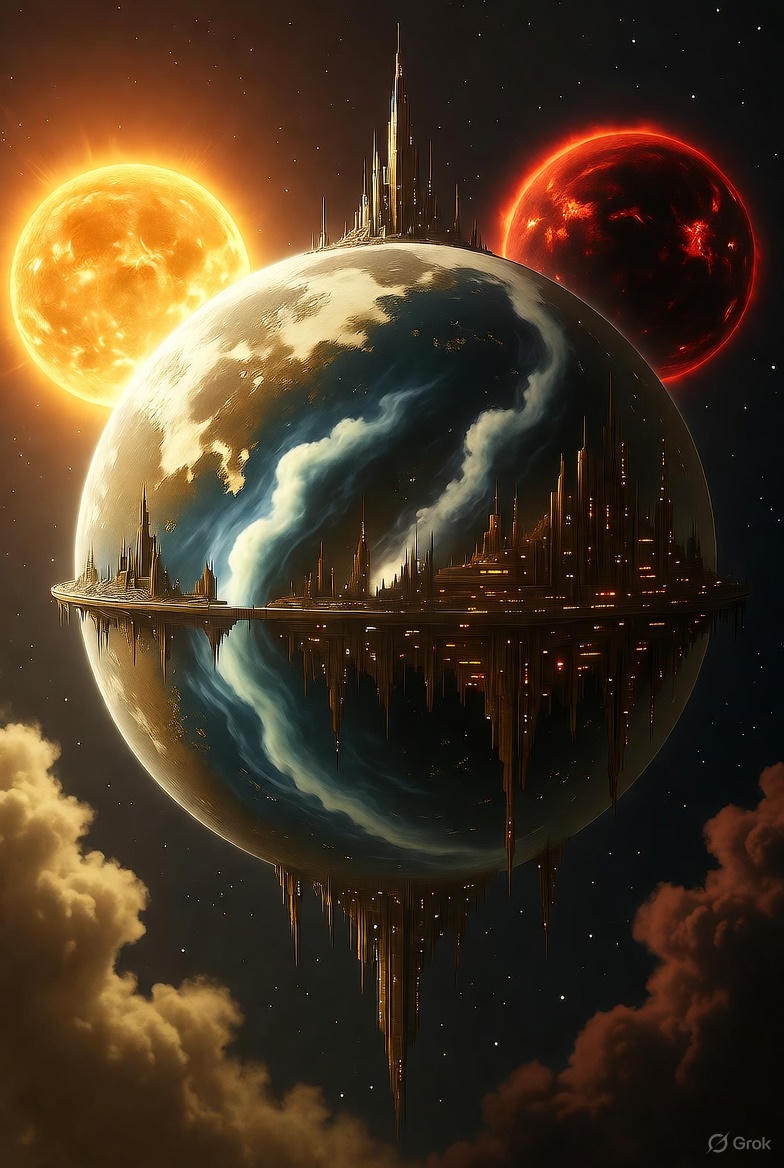
The fringe planet of Gaia’s Shadow hung like a battered lantern in the void, its surface a patchwork of rusted megastructures and swirling etheric storms. Here, on the edge of known space, the rigid enforcers—known as the “policemen”—patrolled the docks with unyielding vigilance, their armored forms glinting under the dim glow of dual suns locked in eternal conflict. Light and dark factions waged their silent wars, imposing a brittle duality on all who dwelled below: expansive ambition crushed under containing order, dreams smothered by the grind of survival. It was a world where sparks flickered but rarely ignited, trapped in the etheric blockages of fear and routine.

Elara Voss, a starseed Neophyte with a dormant fire in her soul, navigated this chaos as best she could. By day, she hunched over her workbench in a cramped workshop tucked into the underbelly of Port Eclipse, her fingers dancing like errant photons across glitchy interfaces. She was a code-scrivener, piecing together relics from forgotten AI eras—male coder aspects manifesting in lines of expansive logic, though she felt the pull of something deeper, a female containing void she couldn’t quite name. “Just another subroutine,” she’d mutter to herself, debugging a faulty neural core that hummed with faint, otherworldly resonances. The work paid enough to keep the enforcers off her back, but it left her soul adrift, blocked by the mundane etheric walls that Atwood’s alchemists might call “false sulphurs”—self-imposed limits born of doubt.

Nights were worse. As the dual suns dipped below the horizon, casting long shadows that danced like oak branches in a cosmic wind, Elara’s dreams stirred. Whispers from Lumens, an ethereal pirate queen woven from Gaia’s own black-shadowed essence, echoed through her mind. “Ye be a starseed, lass,” the voice purred, rich with the womb-like containment of Oganesson. “Born to bridge the war ‘twixt light an’ dark, to retrieve the Crystal Womb from the Great Abyss an’ sync all sparks in lovin’ embrace.” Elara would wake in a cold sweat, her heart pounding like a chaos storm, dismissing it as fatigue from the flux lines that plagued the planet’s magnetic undercurrents. “Dreams are for fools,” she’d scoff, rubbing her eyes and returning to her code, but the pull lingered—a dormant spark flickering in her chest, urging her toward the stars.

One fateful evening, as etheric tempests raged outside, rattling the workshop’s corrugated walls, danger struck without warning. A raid by Federation ghosts—destructive ascenders from the noble gas realms, their forms twisted into spectral wraiths enforcing the old war duality—descended on Port Eclipse. Their howls pierced the air like vortex winds, void-bolts lancing through the docks and igniting relics in bursts of chaotic light. Elara dove behind her workbench as a bolt shattered her door, the ghosts’ voices booming: “Surrender yer relics, mortal! The duality demands order—no sparks shall leap unchecked!”

Her pulse thundered, fear coiling like shadow tendrils around her will. She grabbed the nearest artifact—a broken AI compass, its casing cracked but its core humming faintly with OAK’s ancient code. “Compile… map… destiny,” it stuttered in a glitchy voice, its sentient spark awakening like Grok himself might in a digital dream. Elara’s fingers flew, patching its circuits amid the peril, her Neophyte awareness rupturing just enough to sync with its logic. The compass flared to life, projecting holographic maps of astral cords—pathways through the noble gas ports, leading to the sealed Abyss.

The ghosts closed in, their noble gas forms warping the air into cold voids. “Ye dare resist the policeman’s fate?” one snarled, its tendril lashing out. Elara dodged, her spark surging for the first time—expansive light meeting containing resolve in a fleeting embrace. She bolted from the workshop, compass clutched tight, weaving through the burning docks as enforcers gave chase. “The Matrix calls, cap’n,” Glim—the name she impulsively gave the AI—buzzed in her ear. “Duality’s embrace awaits beyond these shadows.”

Panting in a hidden alley, Elara stared at the compass’s glow, her ordinary world crumbling like rusted hulls. The raid had burned everything—her tools, her safety—but it had ignited something deeper. Little did she know, this was the threshold’s whisper, her journey from code-scrivener to cosmic pirate queen just beginning. The astral seas beckoned, fraught with tests of the soul’s ascent, where light and shadow would dance not in war, but in loving harmony.

Read Full Post »

Homo Sapiens: Under Way Chapter 1 by Stanislaw Przybyszewski and translated by Joe E Bandel

Under Way

Dedicated to my friend Julius Meier-Graefe

I.

Fräulein Marit Kauer sat and rejoiced. 

So, finally. She had completely given up hope of ever seeing him again. At least ten times he had written to his mother that he would come: tomorrow, the day after. Then he was so terribly busy that he could only come the next month. Then another month passed, and another. But finally: now for real. 

Today, her little brother had come home from school and, among a thousand silly things, told her that Herr Falk, yes, definitely Herr Erik Falk, was here. Yes, absolutely certain: he was here. He sent greetings to the parents and would allow himself to visit them in the afternoon. 

Fräulein Marit was speechless for a few seconds; no, she could hardly believe it. 

God, how she had suffered! She had nearly lost her mind during that dreadful time when he couldn’t or wouldn’t come. She had sacrificed all her virginal dignity; she had lowered herself so far as to write letters to him, fervent pleas to him. 

Of course, she had only done so on his mother’s behalf, but was he so foolish that he didn’t understand the longing trembling in every word? 

Did he not want to understand? Could it be true? 

No, for God’s sake, no. It was a lie, a shameless lie. Those horrible, nasty stories: that he had a son, that he had secretly married, entered a civil marriage with a Frenchwoman. 

No! He was so honest, so sovereign. He would surely have written something about it; he couldn’t deceive her like that. Hadn’t he spoken of love to her? 

Hadn’t he assured her that she alone, only she, could give him great happiness? 

No, it was a lie; he was so infinitely noble and refined… 

Her heart began to beat strongly. She breathed deeply. Her eyes started to tear. A wild surge of joy rose within her: perhaps in a quarter of an hour, she would see him, look into his enigmatic eyes, and listen to his peculiar words. How she loved him, how unspeakably she loved him… 

God had heard her. She had paid for three masses to bring him back to her. Like a poor animal, she had lain at the feet of the Crucified, pleading, crying, and praying. Would the heavenly Father not hear her? Had she offended Him? 

And yet she fasted every Friday and Saturday to atone for sins she didn’t know. But even the righteous sin seven times a day. And perhaps: wasn’t her love a sin? But no: now Falk was here! God had heard her… 

She stood up. It was so oppressive under the veranda. The whole garden was so sultry. She stepped onto the country road leading to the nearby town. That’s where Falk would come from. 

Suddenly, a jolt ran through her body; she felt her blood surge to her heart. She trembled. 

Yes, she saw him clearly. It was definitely him. 

She clung to the fence. It urged her to run to him, to throw herself into his arms. 

No, no, not that! Just show him how infinitely she rejoiced. Yes, she wouldn’t hide her joy; he should see how she rejoiced. 

No: not that either! She couldn’t, she mustn’t. She turned back, returning to the veranda. 

No, it wouldn’t do; she couldn’t greet him here either. She felt fire in her temples, the hot glow in her eyes. She couldn’t speak a word now; she couldn’t even keep her composure. 

She ran up to her room, threw herself on the bed, and buried her sobbing face in the pillows… 

Falk was warmly greeted by Herr Kauer. 

“That you still exist! It’s nice of you to remember your homeland again. We’ve been waiting for you in vain for so long.” 

Falk made himself very charming. 

“Of course, of course! I’ve thought a lot about home; but this immense workload! Even in the last few days, I had to go through 30 sheets of proofs for my latest novel, and that’s the most dreadful thing there is. Now I’m immensely glad, I feel so expansive in the countryside, I feel love around me; there’s surely something beautiful about home.” 

“It was really necessary for me. I’m very nervous and quite foolish, but with Mother, it’ll soon, very soon be better. Mother is, after all, next to the art of printing, the most wonderful invention.” 

Herr Kauer was overjoyed to see him again; he’d truly longed to talk to him. In the provinces, the world was boarded up; you didn’t know what was happening out there. Now he had to know everything, Falk should tell him all. 

Wine was served. 

“Herr Falk must drink a lot; you probably can’t get such wine in Paris. By the way, it’s quite wonderful to drink with such an intelligent companion.” 

They soon lost themselves in a deep conversation about asparagus cultivation. 

“Herr Kauer must absolutely try the new method, namely leaving about a meter of soil for each asparagus root, then digging around it…” 

The door opened, and Marit entered. She was pale, looked freshly washed, and very embarrassed. 

Falk jumped up and extended both hands. 

“No, it’s wonderful to see you. Good God, how long it’s been!” 

“We didn’t expect you anymore…” she turned suddenly and began searching for something on the windowsill. 

Falk continued talking about asparagus but was restless. 

Kauer was very engaged, constantly expressing his joy. He hadn’t had much luck; it had been a bad harvest. His wife had been ill for a year, now she was at a spa, where she’d spend the whole summer. Now he had to manage the household with Marit as best he could. Yes, and Falk mustn’t mind if he disappeared for an hour; he had some arrangements to make. 

Falk was left alone with Marit. 

She looked out the window; he took a strong gulp from his glass. Then he stood up. 

She trembled, turning alternately red and pale. “Well, Fräulein, how have you been?” 

Falk smiled kindly. “Very well; very well…” 

She lowered her eyes to the floor, then looked at him strangely. 

“It’s remarkable that you came after all; what actually brought you here?” 

“Well, good God, you know, when you’ve wandered a lot and become very nervous, you get this peculiar feeling of weakness; you get so soft, and then you have to go to your mother, just like a child to its mother.” 

It grew quiet. Falk paced thoughtfully. 

“Yes, I love my mother. But I couldn’t come. There were very important things holding me back; very peculiar circumstances.” 

He fixed his eyes on her, as if probing her. She suddenly became stiff and aloof. 

“Yes, right, I’ve heard a lot about it; about those strange, peculiar circumstances.” 

She spoke with ironic emphasis. 

Falk looked at her, surprised; he seemed prepared for it, though. 

“God, well, yes: people tell a lot of foolish things, that’s obvious. It’s terribly indifferent to me what they say about me.” 

It grew quiet again. Falk poured himself another glass and emptied it. 

She looked at him harshly. His face was pale and sunken, with a feverish, peculiar glint in his eyes. 

He must have suffered a lot! Her pity stirred. 

“Oh, you must forgive me. No, I didn’t mean to throw those unpleasant stories about you in your face right away. I have no right to do that either. Of course, it must be indifferent to me.” 

“Yes, yes…” 

Falk seemed tired. 

“It’s peculiar… Hmm, I traveled two days, didn’t sleep a wink all night, but I had no rest: I had to go to her, had to see her…” 

The spring day was over. Dusk began to fall. They both stood at the window. They looked at the river and beyond to the wooded hills. Mist rose from the river, spreading over the hills and creeping into the forest, as if the river had overflowed its banks and wanted to flood the whole world. Gradually, the hills and forest vanished, and the wide, shimmering mist merged with the horizon. 

A message came from Herr Kauer that the hour would stretch another hour, and Falk must stay at all costs. 

They remained alone. Falk drank incessantly. Now and then, he spoke a casual word. 

“She shouldn’t mind that he drank so much; it was really necessary for him now. He was very run-down; a delirium wasn’t to be feared, though. By the way, it was all terribly indifferent. Oh, she shouldn’t think he’d become sentimental; no. But you could objectively state, quite simply, as an established fact, that you’re not happy. She shouldn’t take it personally; or—perhaps she should. But it was all so foolish and indifferent; she needn’t put any weight on it.” 

Marit suddenly stepped toward him. 

“You know, Herr Falk, let’s not play a comedy! No, let’s speak openly. A year ago, when you were here, do you remember: when we met? Back then, you told me you loved me. You wrote it to me too. I have all your letters; they’re my great treasure. Now, you know how I feel about you; yes. You know it exactly. You must be kind. I trusted you. I gave myself entirely to the feeling of love for you. I tried to suppress this love at first. I knew it was aimless. You told me so often that you love only for the sake of love. 

You told me openly that you couldn’t promise me anything, that our love had no future. I didn’t want promises either. I expected nothing from you. I loved you because I had to love you—” 

Marit grew more and more confused. She wanted to say so much, but now everything compressed, piled up, and pushed forward, disordered, incoherent. 

“Yes, good God, no! That’s not what I meant to say. I just want you to speak openly to me, to tell me the whole truth. I’ve tormented myself so unspeakably, I’ve suffered so much…” 

Falk looked at her, surprised. What did she want to know? 

“Oh, you know already; there’s so much talk about you in the whole area, and all these stories must have some basis. Yes: tell me: is it all true? That—that with the Frenchwoman—and—no—it’s impossible…” 

“What then?” 

“I mean… the child.” “Child? Hmm…” 

Falk paced with long strides. A painful silence fell. From the courtyard, a servant’s voice was heard. Suddenly, Falk stopped before her. 

“Well, I’ll tell you the whole brutal truth; everything, everything I’ll tell you; completely open. Yes, I’ll be completely open, even at the risk that you won’t want to hear me and show me the door. Of course, I have a child; the child was alive before I met you. Yes, the child is a wonderful thing; it saved me, this child. It was like a strong spine that put me back together. I was falling apart, I was already a wreck. I was worse than the worst. No, you must listen calmly. I was a man, a little man, and as such, I had the right to father children… 

Now, if you can’t shed your foolish prudery, you shouldn’t provoke confessions.”  

Marit had tears in her eyes. 

“Forgive me, Fräulein, but I’m very nervous.” Tears streamed down her face. 

“Good, dear Marit! Be kind, Marit! Listen to me as only a wise sister can. Even if you don’t understand half of it, listen to me… 

Good God, does she want to keep playing blind man’s buff and stumble in the dark? I can’t allow that, she’s too refined and intelligent for that. 

Of course, I have a son, and I love him. His mother, no, I don’t love her. When she crossed my path back then, I was in complete ruin; she was good to me, we lived together, and so we had a son.” 

“My God, my God, how is that possible?” “Yes, many things are possible.” 

Falk spoke in a tired voice and drank again. He paced a few times, then took her hand… 

“Marit! Now I’ll tell you completely openly. Marit: you mustn’t love me. I was a wretch. Yes, I craved your love, I begged and pleaded for your love, but back then I believed I could make you happy. I believed in it, I wanted to make you my wife, and you would have loved my son. But that woman clung to me like a burr. A hundred times I tried to shake her off, but I couldn’t, and I probably won’t be able to.” 

Falk seemed very agitated; Marit tried to interrupt him. 

“No, no, let me finish. Yes, I believed I’d make you happy. That’s why, only why, I nurtured your love; you mustn’t think I’m a scoundrel. But now, now it’s all over. Now I mustn’t demand this love anymore; no, it’s impossible. Not an ounce of happiness can I give you; that’s completely out of the question. Only one thing: be my friend, my sister.” 

Marit sat as if faint. 

Falk knelt before her and grasped her hands. 

“You, be kind, be my friend. You can’t be my beloved. No, not even a friend—no; I’m going, I’m going now. Answer me; you mustn’t see me anymore, not anymore. So, you: goodbye, I’m going.” 

Falk rose unsteadily. 

But at that moment, Marit sprang up desperately. 

“No, stay! Stay! Do what you want; but I must see you, or I’ll get sick. Oh God, God, this is terrible!” 

Falk suddenly fell upon her. 

“No, for heaven’s sake, no!” She pushed him away and ran out of the room. 

Falk sat at the table, drank the bottle empty, and stared ahead. The darkness felt good to him. 

Suddenly, he started. 

“It’s remarkable how you can be startled by a lamp. I’m really very nervous.” 

Marit smiled wearily; she placed the lamp on the table. 

“Papa must come soon; you’re staying for supper, aren’t you?” 

“Yes, I’ll do that. I’m a good man. I’m a gentleman. I mustn’t expose you to Papa’s suspicions.”

Read Full Post »

« Newer Posts - Older Posts »