The Rebirth of Melchior Dronte by Paul Busson and translated by Joe E Bandel
I went near one of the windows, unfolded the paper and
read:
“My heart weeps for the best and noblest of men; yet I
bow before a heroism that respects death less than the betrayal
of itself. My now impotent gratitude will forever honor your
memory. May there be a reunion that gives you new goals.”
It was the well-known handwriting of the magister.
In the dim morning light we could see through the
windows, which were high up but clean and bright, that a fine
rain was falling outside. Drops hung sparkling on the iron bars
of the lattice.
This dungeon, admittedly the last one in which we were
housed, was in every respect friendlier than the gloomy coal
mine where we had awaited our sentencing. A bow-legged
jailer with a good-natured face and a natural gift for joking
words, brought us washing water in wooden cans and lent us
clean, coarse cloths to dry our faces and hands. For those
prisoners who still had money on them, he provided chocolate
for breakfast and pieces of cake. The others were given a soup
of burnt rye flour and a large slice of bread.
Since everything seemed trivial to me that was still
connected with the needs of the body, I was content with a few
spoonfuls of soup. Also in these last hours of my life, I
sometimes felt as if I were completely outside the events and
saw from afar, like an observer, me and my fellow sufferers.
Nevertheless, this observing being, which was my ego, was
connected by a guiding thread with my body, and felt the
morning chill, hunger and that dull, constricting feeling in the
stomach area, which precedes bad events. This strange out-of-
myself sensation was so strong that my own hands seemed like
something foreign, for I looked at them closely and with a
strange feeling as if I were seeing something familiar again
after a long time. In all these ambivalent feelings was mixed
with a kind of regret over the ingratitude, with which the soul
calmly left forever, the house in which it had been for so long
and through whose senses it had taken in the image of its
changing surroundings. I could not, try as I might, find
anything great or decisive in the imminent departure from the
accustomed form of earthly life. It was as if the body, although
its sensations continued, no longer participated in those of the
soul.
Even the scenes that took place around me could not
move me violently, as much as I was aware of their sadness.
Something constantly stirred in me, as if I had to speak to the
poor people and tell them that all this was only of secondary
importance and that it did not really have to mean much. But it
was also completely clear to me that they would not have
understood me at all, and so I kept silent and out of the way.
Many things happened around me. Women wept bitterly
and their hot tears, with which they said goodbye to life,
dripped into the soup bowls from which they ate. The Marquis
de Carmignac sat in a corner and had his beard shaved and his
hair arranged. A withered, weary smiling old man read to a
small crowd of listeners from the “Consolations of Philosophy”
by Boethius. A handsome young man in a riding suit leaned
against a pillar with rapt eyes and hummed a little song over
and over again, which was obviously dear to him as a memory.
He stopped only when an Abbe, who was whispering prayers
with several older and younger ladies, approached him and
politely asked him not to disturb the religious gathering of the
dying. Several sat dully, despairingly and completely absorbed
in themselves on the straw mattresses of the beds that were set
up here.
After some time, a young, pale-looking barber’s assistant
entered with the jailer, waved to his comrade, who was taking
the marquis’ tip with many bows and with a trembling voice
asked the people present to sit down in turn on a bench placed
in the middle of the room, to have their hair cut. This request
caused loud sobs and a fit of fainting, but the toilet, as the
procedure was called for short, proceeded swiftly. The long
tresses of the ladies, which were carefully cut off and placed in
a small basket, he very politely requested them to be
considered useful for his business, and presented each woman
who gave her consent, a small vial of smelling salts as a return
gift.
The frosty, rattling and moving of the scissor also
touched my neck, and their blades cut through my hair. Coldly
I felt the lack.
All around, the praying grew louder and more fervent. At
eight o’clock a booming drum rattled and the door opened. In
front of a crowd of soldiers, a commissar with a sash appeared
and read off name after name from a list. All those named rose
immediately and lined up to the left of the door.
“Citizen Melchior Dronte!”
I bowed briefly to those who obviously remained behind,
and stood next to a tall, strong man who, with a contemptuous
expression, derisively pushed his chin forward. By his braids
and lapels and the uniform, I recognized him as a major of the
Broglie regiment.
“Skunks – riffraff from the gutter!” he growled and spat
out so violently that a small, hungry-looking soldier jumped to
the side, startled.
A somewhat lopsided, gray-clad man with a mocking
face, who was one of those called up, laughed softly to himself.
“This carnival play will soon be over. And it wasn’t even
very funny.”
We were now; about twenty in number, led out of the
cellar, went up the stairs and came to a courtyard that was
completely surrounded by soldiers. It was still trickling thinly
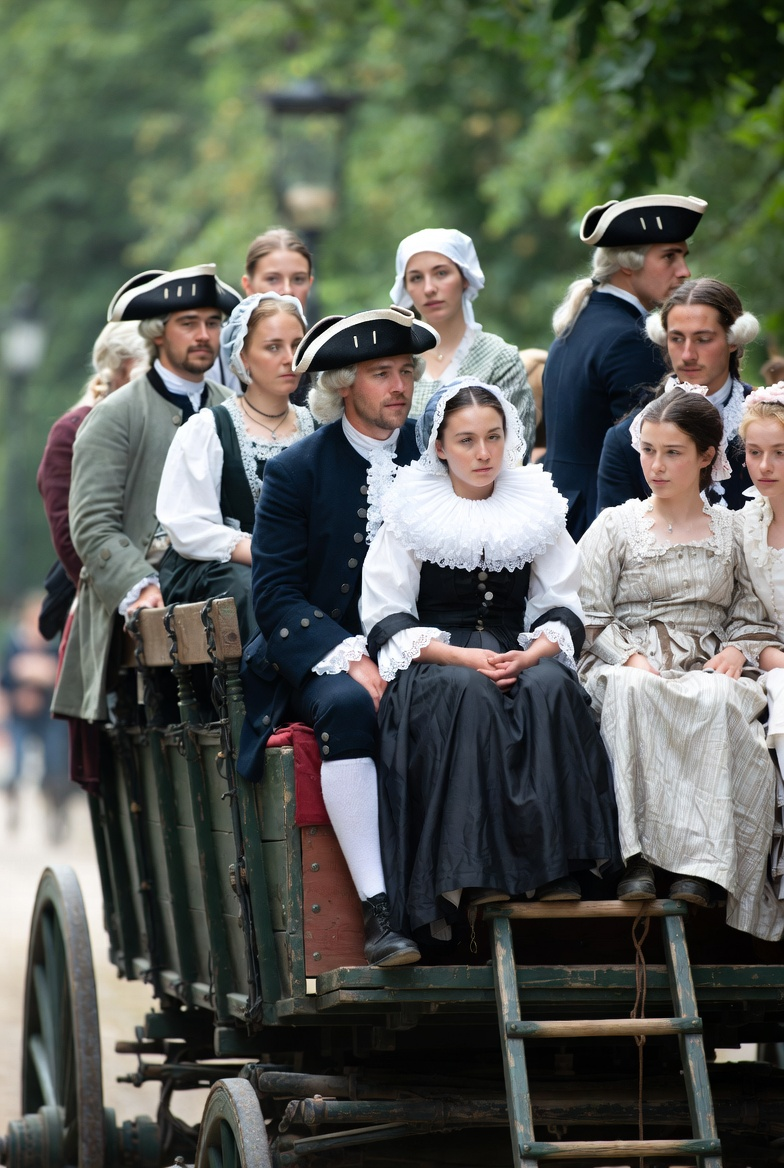
from the cloudy sky. Some ladder wagons were standing there,
and we were ordered to sit on the boards nailed across. A boy
of about fifteen years old climbed up behind us and tied our
hands behind our backs with strong vine cords, supervised by a
mounted sergeant. I saw that the young lad whispered
something in the ear of each person whom he bound. And when
it came to my turn, I heard from behind, half-breathed, while
the warm breath hit my shivering neck, the words:
“Forgive me!”
I felt how restless and hot the hands were that bound my
arms.
Amidst much shouting, running to and fro, and up and
down trotting of the cavalry escort the wagons were finally
loaded with their human cargo. Next to the coachman, a soldier
swung himself onto the bench and the big door of the courtyard
opened with a loud creak. Incalculable masses of people filled
the street outside and formed two rows, between which our
carts now slowly began to roll.
Quietly, I looked around me. In front of me, stiffly erect
and looking over the people, sat the Marquis de Carmignac,
next to him the major of the Broglie regiment, who, with his
furiously lowered red head reminded of an irritated bull.
Crouched on the bench next to me was an obviously deranged
man, about sixty years old, with white beard stubble, a
wrinkled face and rolling eyes, who was intoning incessant
incantations to himself.
“O Astaroth, O Typhon, O ye seven fiery dragons, you, O
keeper of the seals, hasten to help me! Let flames fall upon
them, let the earth open up and take them to the lowest hell, but
carry me to the garden of the white Ariel Arizoth Araman
Arihel Adonai.”
The words became unintelligible, and at last he burst into
a triumphant giggle and became calm, obviously firmly
convinced of the sure effect of his spirit invocation.
I turned my head with difficulty to the back bench and
caught sight of an aging girl with brick-red spots on her
cheekbones, who was dressed in a black robe, with her eyes
turned to Heaven, praying without ceasing. Beside this nun,
who with glowing eyes, was preparing for martyrdom,
trembled like a jelly, a white-flour covered baker, whose
swollen, puffy eyes gazed out of a hot face in which mortal fear
gaped. His huge belly, which almost burst the buttons of the
trousers, wobbled back and forth with every step of the horses.
I saw excessively clearly, and not the slightest detail
escaped me. I noticed a hanging silver button on the jacket of
the marquis. On the neck of the major an inflamed pustule. On
the vest of the man sitting next to me the remains of an egg
dish, and the medals on the nun’s rosary sometimes clinked
against a board of the cart.
My poor body, which was now to change, was doing
everything in its power to keep the calm serenity of the spirit
that was preparing to leave busy with unimportant worries on
its way into eternity. A natural need, for the satisfaction of
which there was no time left to satisfy, arose with annoying
agony. An old cold pain which had not tormented me for a long
time, had shot into my right hip during the night and caused me
great agony with the shocks of the cart. And to all this was
added the fear of death that the body felt. It manifested itself in
strong stomach pains and finally brought it to the point that
cold drops ran down my face. It was cold sweat, death sweat…
But I stood above or beside these sensations which, in
spite of their strength, could no longer really penetrate to the
consciousness. A sharp and irrevocable divorce between body
and soul had occurred, and the soul realized with joy that no
earthly feeling would accompany it on its way.
From the crowd a song burst forth in full chords, into
which thousands of voices fell. The truly entrancing melody,
the words of which I could not understand, except for
“Fatherland”, “tyranny” and the like, had a strong and moving
effect on me. It was a genuine and noble-born, fiery child of
the time, and it was as if this rapturous singing carried
something hot in it.
Everywhere people were looking out of the windows of
the suburban houses, joining in the song with bright,
enthusiastic voices and waving their scarves. The horses in
front of our wagon, a chestnut and a summer black, neighed
and began to prance and nod their heads in time with the
mighty tune, which was glowing and storming up to the sky.
Even the driver, a scowling man, and the young soldier next to
him sang the hymn, for such it was, with a loud voice.


 Anarchistbanjo's World
Leave a comment