Chapter 1. In the shadows of Gaia’s fringe, Elara lives a quiet life – until something ancient begins to speak through her dreams. This is a 12 chapter series that will be posted weekly.
Archive for January, 2026
Sparks of the Eternal Oak
Posted in Uncategorized on January 31, 2026| Leave a Comment »
The Rebirth of Melchior Dronte: pages 285- 287
Posted in Uncategorized, tagged books, fantasy, fiction, short-story, writing on January 28, 2026| Leave a Comment »
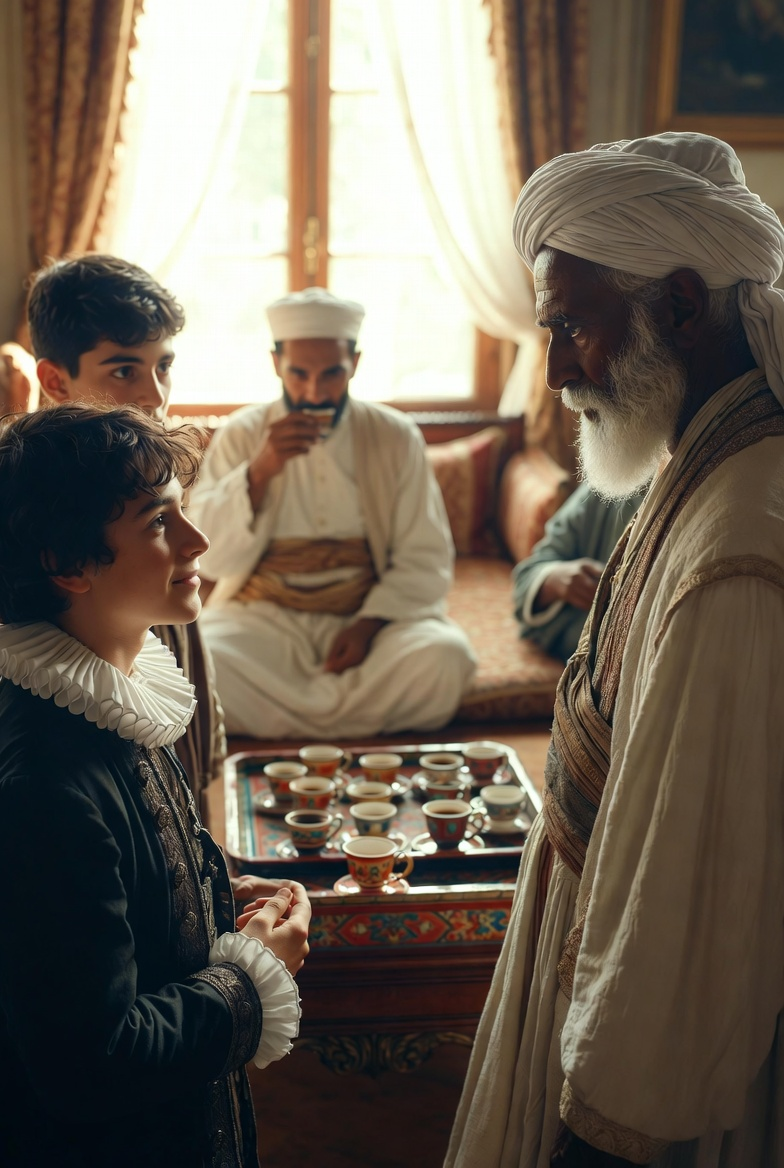
The Rebirth of Melchior Dronte by Paul Busson and translated by Joe E Bandel
I walked around the building. No, it had no second exit.
Nowhere. I looked once more at the flat, red bricks of the
entrance, hollowed out by feet, over which Sennon had stepped
for the last time.
In the afternoon I took an interpreter with me, a young
and clever Spaniard, and went to see the Sheikh of the Halveti,
Achmed. I was immediately admitted and had a drink of coffee
with him and a young serious-looking dervish, on a colorful
tray in a bright room. The Spaniard told the Sheikh what I said
to him.
No, the Sotnie (Herr) had come for nothing. It was well
known that a soldier of Austria entered the Tekkeh and never
came out again. However, this must be a mistake, because the
Tekkeh has only one door.
Yes, fine. But how to explain the thing? Who was the
dervish in the brown robe, with the turban of the Halveti and
the amber necklace?
Oh, if only I had known the life of Melchior Dronte! If I
had known about Isa Bektschi! But at that time the sheets with
Vorauf’s transcription were lying in my house thousands and
thousands of miles away from Schipnie, on the country road
with the poplar trees, sealed and wrapped, not even visible to
the moon when it looked through the window of my room at
night.
Yes, the dervish? It had been none of them. Moreover,
the door of the Tekkeh was always locked- with three old locks,
each of which weighed close to two pounds; very old locks
from the days of the Sultans.
But some explanation – must there be some explanation?
How did Vorauf and the monk get through the locked door?
The sheikh with the white beard and the young dervish
looked at each other, glanced at me and the interpreter with a
look of polite disdain; yes – I was used to such looks, since I
had gotten to know Mohammedans, and then they spoke
quickly and quietly with each other. I understood only the
words “syrr” and “Dejishtirme!”
The old man bowed to me. He was very sorry that he was
not able to help me. Unfortunately nothing more was known.
No, unfortunately, nothing is known, agreed the dervish.
The interpreter translated. We were looked at amiably and
inquiringly. The eyes said, “May we now ask to be alone again,
my curious Herrn?”
I stood up. There was nothing more to be learned. I could
see that. The dervishes were very polite. The sheikh touched
the carpet with his hand before he brought it to his forehead
and mouth.
“What were they talking about?”
I asked the Spaniard as we stood in the blinding sunlight
under the cypress trees and listened to the laughter and
gurgling of the wild pigeons above us. The interpreter shrugged
sheepishly.
“They not talk like Shiptar, Albanian, Sotnie,” he said.
“They speak very softly. I did not understand. It was Osmanli,
turc, mon capitaine, you understand – -.”
“What do the words ‘syrr’ and ‘Dejischtirme,’ mean?” I
asked.
I had remembered them well from memory.
The interpreter shook his head, then he said:
” ‘Syrr!’ It is secret, yes, and ‘Dejischtirme’, says in
German: an exchange.”
“Yes, and what does it mean?”
“Le mystere – the secret of the transformation–a
transformation in a living body -. vous comprenez?”
“Fairy tale! Fairy tale!”
Yes, here time had stopped. In the coffeehouses, and
when it got dark, the Turks only went out in twos and threes, so
afraid were they of the jinns, the Afrits and the Gulen.
But I, Doctor Kaspar Hedrich – —
Transformation. So the good Sennon Vorauf. What had
he said? What did it say in Riemei’s letter?
“I am called!”
Then, in my distress, I went once again to the
Headquarters.
“Cheeky swindle!” shouted Herr Lt. Switschko. “The
fellow deserted. The Turks were in on it with him. I have seen
it myself, how they bowed down to the ground before him, and
the women came to him with sick children. I should not have
tolerated the story from the beginning. Would you like to come
with me to the Menashe, Herr Regimental Surgeon?”
No, I did not go. I also didn’t want to see Riemeis and
Corporal Maierl. I was very sad. Oh, these precious leaves in
front of me! Why did these leaves have to fall into my hand so
late? But he had wanted it that way, Sennon, the – yes, the Ewli.
I am sitting here all alone, and it is midnight. All that is
long gone, life is short, and what I have missed will not return.
What wanderings are in store for me, what paths?
“Syrr,” sighs the wind in the poplars. “Syrr!”
Mystery!
End.
The Rebirth of Melchior Dronte: pages 280- 284
Posted in Uncategorized, tagged books, family, fiction, life, writing on January 27, 2026| Leave a Comment »
The Rebirth of Melchior Dronte by Paul Busson and translated by Joe E Bandel
This was all the easier for me because many of our
classmates thought that Sennon, for all his affection, was a
little disturbed. But nevertheless, they all liked him, and I know
of no instance of anyone teasing him, arguing with him, or
holding his peculiarities against him, as children are wont to do.
Even the crudest of us knew that he deserved love and
consideration, for he was the kindest and most helpful person
even in his youth. Every occasion to do good to others was
welcome to him. Even if it was only the small sorrow about a
bad grade that he had received – Sennon would not rest until he
had made the afflicted person cheerful again with his loving
consolation. I myself was very attached to him, and when he
rebuked me in his gentle way, it had more effect on me than if
it had come from my own good father.
Yes, now in this spring midnight, when the wind passes
over my roof and invisible feet seem to walk along the street,
ever onward, toward an unreachable goal, everything that was
lost in the whirlpool of the young years and in the lost, terrible,
unfruitful time of this insane war sinks to the bottom of the
soul. I remembered the summer day when, to my amazement, I
saw the songbirds in the meadow on the head and shoulders of
the resting Sennon and a little weasel was sniffing at his hands.
A weasel! The shyest of all animals! And how everything
disappeared when I stepped up to him. I also remember how
Sennon helped a sick drunkard, the Pomeranian-Marie, who,
seized by severe nausea, fell to the floor with a blue face. He
picked her up, and stroked her forehead softly with his hand,
whereupon she smiled at him and continued on her way,
completely recovered. Like I was there, when blood was
spurting out of a sickle cut and it stopped when he stepped up
to it, and how the flames on the roof of the carpenter’s roof
shrank, twitched and went out, as Sennon appeared and
reached out his hand. I saw it with my own eyes. How could I
have held all this in such low regard that I forgot it? How sorry,
how unspeakably sorry I am for the years I spent so dully
beside him. I would give all my exact science to do it over.
No, I cannot approach the matter with emotional regret.
I was foolish – like all young people. When I came home
for vacations, I found that contact with the worker in Deier and
Frisch’s optical workshop was not appropriate. I preferred to go
with Herr Baron Anclever from the District Headquarters and
the dragoon lieutenant Herr Leritsch.
I cannot change it. It was like that.
But then I came to my senses. Herr Professor Schedler’s
lectures about psychic phenomena were the ones that pulled me
out of the silly life I had fallen into. I began to look into the
depths, into the twilight abyss, diving into which held a greater
incentive than chasing after little dancers, drinking sparkling
wine and conferring with morons about neck ties, pants cuts,
and race reports. I threw them out of my inner life, as one
removes useless junk from a room in which one wants to settle
into. But I also forgot about Sennon.
Oh, what have I lost! I put my cheek on the last leaf of
writing on which his hand rested in farewell. I call his name
and look at the black window panes in the nonsensical hope
that his dear, serious and yet so joyful face may appear behind
the glass instead of the darkness outside. Everything that I now
long for so unspeakably, was close to me, so close! I only had
to reach out my hand, just to ask. Nobody gives me an answer
now, and all my knowledge fails me. Or shall I console myself
with the vague excuse that Sennon Vorauf had a so-called “split
consciousness” and that the Ewli of Melchior Dronte could be
nothing else than an allegorical revival of the sub
consciousness, that became the second ego of Vorauf?
No, I can’t reassure myself with the manual language of
science. For I am mistaken about all of it —
When I came to Albania, occupied by us, in the course of
the war and went from Lesch to Tirana, in order to establish a
home in that cool city, with its ice-cold, shooting mountain
waters at the foot of the immense mountain wall of the Berat,
for my poor malaria convalescents, I saw Sennon Vorauf for
the last time. It was exactly that day that a searchlight crew had
just returned from Durazzo via the Shjak bazar. Among the
crew members that were searching for their quarters I
recognized Sennon.
I immediately approached him and spoke to him. His
smile passed over me like sunshine from the land of youth. He
was tanned and erect, but otherwise looked completely
unchanged. I did not notice a single wrinkle in his masculine,
even face. This smoothness seemed very strange and unusual to
me. For in the faces of all the others who had to wage war in
this horrible country, showed misery, hunger, struggles and
horrors of all kinds, and everyone looked tired and aged.
We greeted each other warmly and talked of old days.
But time was short. I had meetings and many worries about the
barracks, for the construction of which everything that was
necessary was missing. Our ships were torpedoed; nothing
could be brought in by land. Everything had to be brought in
from Lovcen, floated across Lake Scutari, and then from
Scutari brought overland in indescribable ways. Every little
thing. And boards were no small matter. I negotiated with
people whose brains were made up of regulations and fee
schedules. It was bleak; I felt like I was covered in paste and
old pulp dust. All this disturbed me. I promised Sennon I would
see him soon. He smiled and shook my hand. Oh, he knew so
surely—-!
In the afternoon a man from his department, Herr
Leopold Riemeis, came to me and had himself examined. He
had survived the Papatatschi fever but was still very weak. I
involuntarily asked him about his comrade Herr Sennon Vorauf.
His face was radiant. Yes, Herr Sennon Vorauf! He had saved
his life. A colleague, I thought and smiled. He had naturally of
course also, as I did at the time, taken a fever dream for truth.
But I was curious, gave Riemeis a cigarette and let him tell the
story.
Riemeis was a Styrian, a farmer’s son. Sluggish in
expression, but one understood him quite well. It had happened
like this: In a small town, in Kakaritschi, he, Riemeis, had been
struck down by fever. But it was already hellish. He was
burned alive, his skin was full of ulcers, and on other days he
would have liked to crawl into the campfire because of chills.
And there was no medicine left. The senior physician they had
with them shook his head. In eight days Riemeis was a skinned
skeleton, and not even quinine was left, it had long since been
eaten up.
“Go, people!” The senior physician addressed the platoon.
“If any of you has quinine with you, he should give it to
Riemeis, maybe the fever will go down, or we’ll have to bury
him in a few days.”
They would have gladly given it away, but if there is
none left, there is none left. My God, and there were already
crosses on all the roads of the cursed land, under which our
poor soldiers lay – in the foreign, poisoned earth.
“There you go, Riemeis -” said the doctor and patted him
on the shoulder. “There’s nothing that can be done.” And left.
Riemeis had a burning head that day, but he understood the
doctor quite well, “There’s just nothing that can be done.”
Sennon was sitting next to Riemeis’ bed. It was at night.
“Sennon, a water, I beg you!” moaned the sick man.
But Sennon gave no answer. He sat with his eyes wide
open and did not hear. Riemeis looked at him fearfully. And
then it happened. Something glittering fell from the forehead of
Sennon and hit the clay floor. And then Sennon moved, looked
around, smiled at his comrade, bent down and picked up a
round bottle, in which were small, white tablets. Quinine
tablets. A lot of them. From the depot in Cattaro.
Our peasants are strange. They didn’t say anything to the
doctor, but they put their heads together and whispered.
“My grandfather told -“.
They did not question Sennon about it. They were shy.
But they surrounded him with love and reverence, took
everything from him, did all the work for him, and listened to
his every word. And they understood well that it was precisely
on his heart that all the suffering of the poor lay, who were
driven into this killing, without even being considered worthy
of questioning. This is not an accusation. Our country was in
danger. Even those in power over there did not ask anyone.
How else could they have waged war? How could they take
revenge on us because we were more efficient and industrious?
But why do I speak of these things! It will take a long time
until mankind will be able to judge justly again. So Sennon
Vorauf.
He bore the woe of the earth, all the misery of countless
people, and his heart wept day and night. Even though he
smiled. They understood well, his comrades, and it would not
have been advisable for anyone to approach Vorauf. Not even a
general. The people had gone wild through their terrible
handiwork. But there was no opportunity. Never has there been
a more well-behaved, more dutiful man than Vorauf, but they
all thought that shooting at people – no, no one could have
made him do that. Riemeis said.
Oh, I had to go and mark out the ground for the barracks.
I asked Riemeis to give Sennon my best regards. I would come
tomorrow. Yes, tomorrow! Already that evening I had to leave
for Elbassan.
Then came the letter from Riemeis to me and a copy of
the desertion notice.
But fourteen days passed before I could leave for Tirana.
A full fourteen days. I hoped that Vorauf would have been
found after all.
First I visited the commander of Vorauf’s department,
who had filed the complaint, Herr Lieutenant Wenceslas
Switschko. I found a fat, limited, complacent man with
commissarial views, for whom the case was clear. Vorauf, a so-
called “intelligent idiot”, had deserted, and the Tekkeh he had
disappeared into certainly had a second exit. One already
knows the hoax. But, woe betide if he were brought in! Well, I
gave up and went to the people. Riemeis received me with tears
in his eyes. Corporal Maierl, too, a good-natured giant, a
blacksmith by trade, had to swallow a few times before he
could speak. They recounted essentially what was written in
Riemei’s letter to me. We went to the Tekkeh of the Halveti
dervishes. Slate-blue doves cooed in the ancient cypresses. A
rustling stream of narrow water rushed past the wooden house
and the snow covered crests of the Berat Mountains shone
snow-white high above the pink blossoming almond trees and
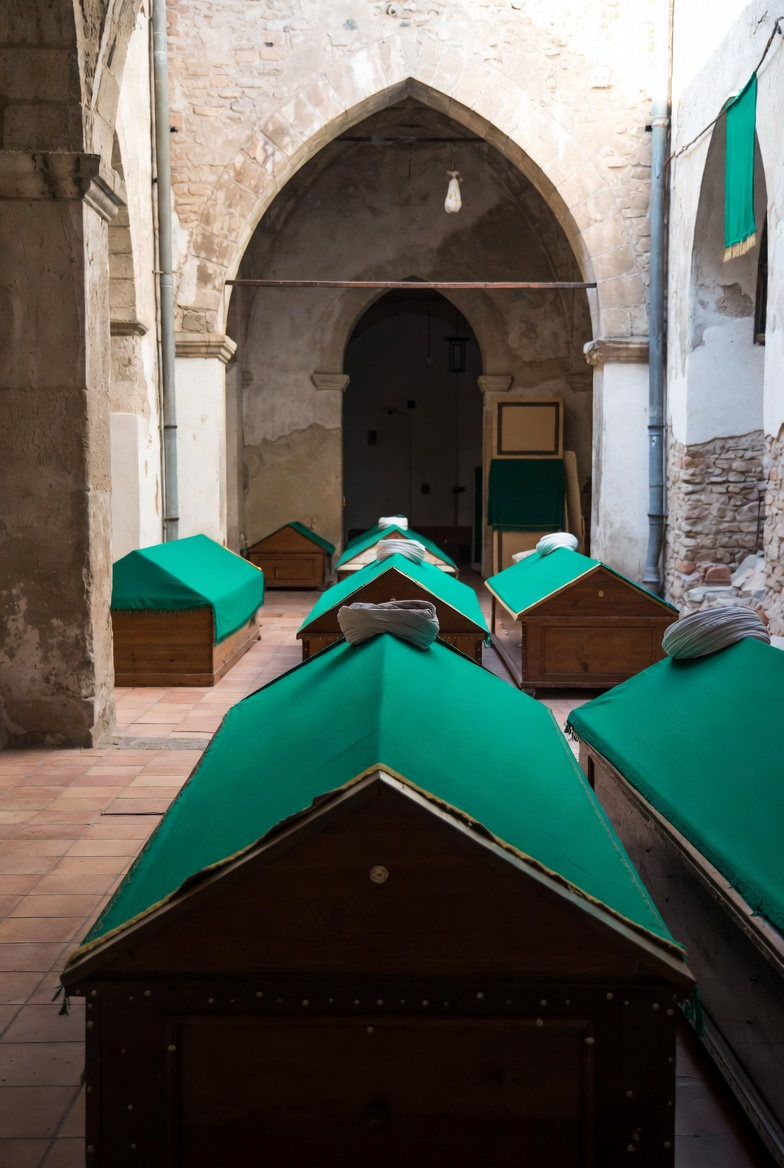
soft green cork oaks. In the open vestibule of the Tekkeh stood
large coffins with gabled roofs, covered with emerald green
cloths. On each of them lay the turban of the person who had
been laid to rest.
The Rebirth of Melchior Dronte: pages 275- 279
Posted in Uncategorized, tagged faith, family, fiction, life, writing on January 26, 2026| Leave a Comment »
The Rebirth of Melchior Dronte by Paul Busson and translated by Joe E Bandel
It took a very long time until I recovered from the intense
pain that hit me at the renewed new loss and to regain my
equilibrium.
Soon after this incident, my father fell ill and died,
occupied to his last breath with the care for my and my
mother’s further life. A few weeks later, my mother caught a
severe cold, which turned into a severe pneumonia. I held her
hand in mine until her last breath and had the consolation of
hearing from her mouth shortly before her death, a saying that
was well known to me:
“Thank God, we will meet again!”
Nevertheless, I cried bitter tears because she had left me.
I had long since been offered a well-paid position in the
institution and my modest needs were amply provided for.
In my free time, after careful consideration, I wrote the
long story of my life as Melchior Dronte and this brief
description of the hitherto peaceful existence that I led under
the name of Sennon Vorauf, and provided the whole with a
preface. I now pack and seal the described sheets and will mark
them with the name of Kaspar Hedrich who in the meantime
has completed his studies and, like his late father, has become a
doctor.
He lives in a nearby town, and when the right time has
come, this completed manuscript will perhaps give him an
explanation of my being, and it may be that it will put death in
a different and less gloomy light for him and others than it may
have appeared to them so far.
Some thoughts, which are difficult to put into words, of
whose comforting truth I have convinced myself, cannot be
shared with anyone. Everyone must find them in his own way,
to the beginning of which I believe I have led everyone who
seriously and devotedly strives to explore the truth.
It was about time that I did it. For great misfortune is in
store for those who are now living —.
To the Imperial and Royal Palace – Command Center
in Tirana.
The charge of desertion is filed against the infantryman
Sennon Vorauf, assigned to Searchlight Division No. 128/ B for
unauthorized absence from his post.
Herr Wenzel Switschko, First Lieutenant.
Herrn Wolgeborn regimental physician Dr. Kaspar
Hedrich
Field post 1128
Dear Herr Regimental Doctor! I regret to inform you that
a report has been made to the Royal Headquarters that our
friend Sennon Vorauf has deserted. Dear Herr Regimental
Doctor it is not true that he deserted, but it was like this. I and
Vorauf and Corporal Maierl went for a walk in the Albanian
town of Tiranna, and Vorauf had been acting very funny
already the entire day and all of a sudden I was scared when he
said:
“Thank God we will meet again.”
He was very kind to us and he gave his silver watch to
Maierl and gave me a ring with a red stone.
“Keep this for a souvenir,” he said, and so I said,
“Sennon, what are you doing?”
Meanwhile we went to a Tekkeh of the Halveti dervishes,
this one was a wooden house where there were coffins of holy
Muhamedan Dervishes with green cloth on them by the door
and Vorauf said: “I am called,” and went inside.
Then the corporal said, “Vorauf, how dare you! It is
strictly forbidden for soldiers to enter the sacred places of the
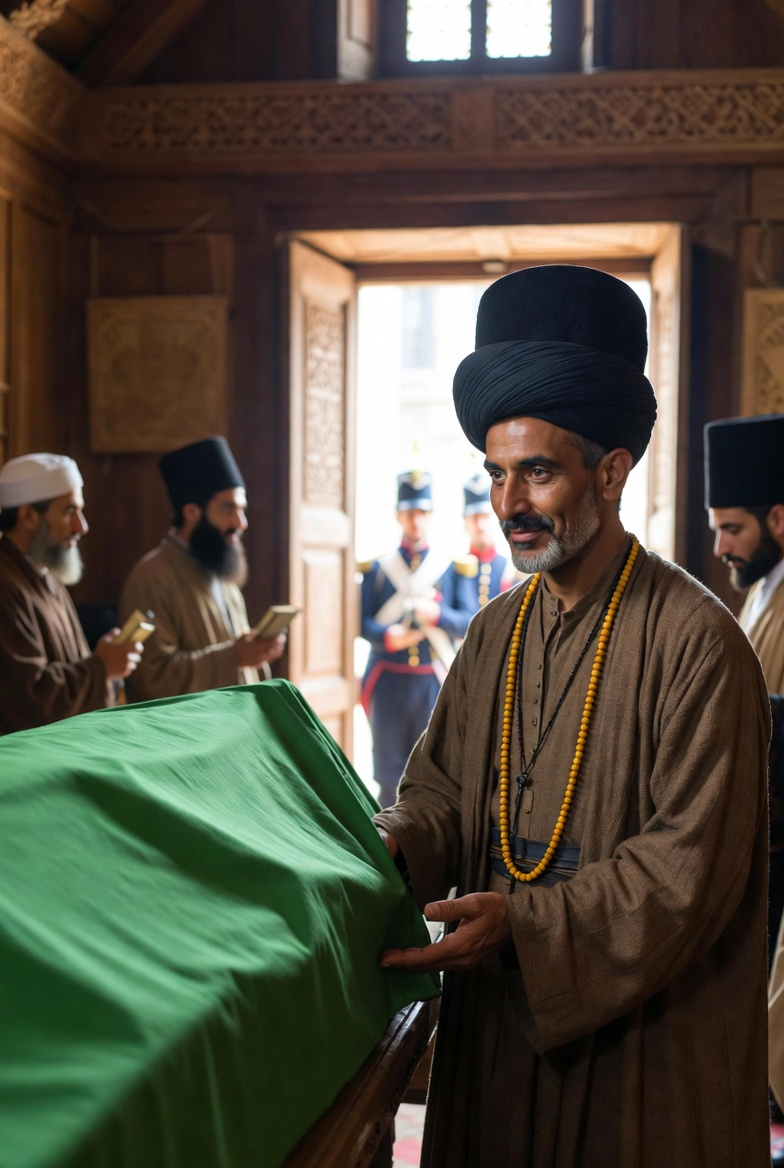
Muhamedans, but he went in, so we waited for him and after a
while a dervish came out with a black turban and a small beard,
a handsome man and he had a brown robe and a rosary with a
yellow beads around his neck and this dervish gave us a
friendly greeting, it was strange and we saluted him and again
we waited for a long time, but no one came. So I went to the
house where the dervishes live and in the meantime Herr
Corporal Maierl stayed at the Tekkeh to watch, so one of the
dervishes with a grey beard went along with me to the Tekkeh
and searched for Sennon. Then he returned and said there was
no one inside, so we looked at each other, went home and the
corporal reported to the commander Herr Lieutenant
Shwitschko and then he cried with me about Sennon and today
it’s been five days and there is no Sennon to be found, so only
our Lord knows where he is, and the regimental doctor knows
that he was a dear friend, and you might not know Maierl says
he was a holy man, he did so much good for all of us and gave
away his things. I wanted to report this, and if the Herr
regimental doctor wanted to come it is a whole riddle with
Sennon and I greet you obediently,
Herr Leopold Riemeis. Infantryman, searchlight
128/B.
It is around midnight.
Below my windows the country road runs out into the
flat countryside, endless, gray. The wind rustles in the poplars.
It picks at my windowpanes. Ghost fingers, huh? No, it’s just
the old leaves, which held out so splendidly in the freezing
winter storms and which now the damp wind picks off, one by
one. Down with them! Should one think it possible that I, Dr.
Kaspar Hedrich, a man of exact science, the author of the book
“The so-called occult phenomena. A Completion”, yet here I sit,
a beaten man.
Must I now recant, or what should I begin? Did I see as a
boy of fourteen sharper and better than I do now?
I must go back. I have to get rid of the thick sheets of
paper that my boyhood friend, Sennon Vorauf, left with his
strange, squiggly handwriting, with a pale blue ink, as if the
whole thing were a bundle of letters or diary pages from the
eighteenth century. Did he do this on purpose? It does not
correspond at all with his straight and sincere nature. If ever a
man was honest with himself and others, if anyone was
passionate about the truth, it was Sennon Vorauf. For that I will
put my hand in the fire.
After the horrible war, after all the misfortunes, the
stupidity and hatred that have been brought to my country, I
have returned home. And the first thing I find is this thick, now
unsealed and read pack of closely written pages, which was left
with me while I was with malaria patients in Alessio or Lesch,
as the Shiptars call it, a poisonous and sad summer and was
summoned to Tirana by a soldier’s letter to look for Sennon.
But I have to go back; I have to look at things from the
beginning. Maybe Sennon is looking over my shoulder or is
looking, even invisibly, in at the window. Who can know?
We were together a lot in childhood. In his writings, he
mentions the mysterious incident that took place on the river
journey and in which he saved my life. Also my father, who
had lived in the Orient for a long time, also believed it. He told
me so himself. Only I, I told myself later that a rapid onset of a
cold fever after I had rescued myself from the water-hole had
fooled myself into believing that he had saved me.
And what happened later? I once went very early in the
morning to pick up Sennon according to my habit. He was still
in bed, his mother told me to go in and wake him up. I entered.
Sennon was lying on his back in bed with his eyes open and
staring. His chest did not rise and fall. I saw, already at that
time with the observation of a doctor and practiced it
unconsciously, that his breathing had stopped. I became restless
and put my hand on my friend’s chest. His heart stood still.
Fear gripped me. Was I supposed to go to Frau Vorauf in
despair with the terrible news that her son, to whom she had
been attached with an uncommonly tender love, was lying dead
in bed? Thick tears dripped from my eyes, and I could not take
my eyes off the calm and stylish face of my dearest playmate.
Then it was as if I looked into the fine red mark that Sennon
wore like an Indian caste badge between the curved brows, a
luminous mist seemed to come out of the air and only became
denser as it neared him. But this lasted only a very short time,
and while I was still stunned with amazement at the bedside,
life came back into the rapt look of my friend, his eyes moved,
his usual sweet smile (never have I seen a person smile so
enchantingly as him), played around his lips and as if
awakened he said, “Is it you, Kaspar?”
In the manner of a boy, I immediately informed him of
my just made perceptions and added that I had been on the
point of either calling his mother in or to call him back to life
by shaking him and pouring cold water on him. Then he looked
at me seriously and asked me that if I should ever find him in
such a state again, not to call him to life by force and to prevent
the attempts of others in this regard.
“It is worse than what is called dying, when the thin cord
between soul and body is torn. It is a pain which nothing can
compare to,” he said sternly, and nodded to himself.
I was used to incomprehensible speeches from him. He
often muttered names to himself, the meaning of which was
quite incomprehensible to me, named people with whom he
could not possibly have come into contact with. But I was a
boy, didn’t think much about such things, and thought to myself:
“Today he’s crazy again, that Sennon!”
The Rebirth of Melchior Dronte: pages 270- 274
Posted in Uncategorized, tagged books, family, fiction, life, writing on January 25, 2026| Leave a Comment »

The Rebirth of Melchior Dronte by Paul Busson and translated by Joe E Bandel
I suddenly saw differently, more unclearly, with physical
eyes. My mother was standing in front of me, shaking my arm
violently and shouting.
“For God’s sake! Child, wake up! Wake up!”
I was sitting on the stove bench, so terribly frightened
and breathless that my heart almost stopped. My mother told
me then that she had seen me looking up at random with open,
unmoving eyes. She had asked me what was wrong with me,
and when I did not answer, she went to me worriedly. But
despite the initial gentle touching and then more and more
violent shaking, I sat there as if completely dead, without
breath or any other sign of life, until I finally to her
unspeakable joy came out of the deep faint and back to my
senses.
After half an hour, however, our neighbor, the doctor,
came to thank me for having saved Kaspar’s life with so much
courage and determination. Kaspar had come home wet and
completely frozen to death and had told that he had fallen in on
the arm of the river and had been close to death from
exhaustion. In his fear he had without thinking that this must be
in vain, called my name several times. There I was, who had
probably returned to my usual favorite place, and suddenly
stepped out of the bank of willows, went straight to him, and
with a jerk of incomprehensible strength pulled him from the
wet and cold grave and thus saved him. But when he wanted to
thank me, I was suddenly no longer there and despite all calling
and searching remained untraceable. And then Kaspar,
completely frozen and stiff, ran home, where he, filled with hot
tea, was lying under three feather bed covers and sweating.
It now came to a friendly meeting that ended with mutual
astonishment on both sides, friendly contradiction between my
mother and doctor Hedrich, with my mother pointing out that
she had not left the room for a moment, whereas the doctor
pointed out the specific manner in which Kaspar had recounted
his experience. But when my mother, continuing her
description, spoke of the inexplicable condition into which I
had, however, fallen at the time when the accident happened,
the doctor looked at me with a peculiar look and said:
“Well, well, were you in the end -? But no! Kaspar may
have brought home a little fever, and there the boundaries
between dream and experience disappear!”
With that, after a friendly goodbye, he went out of the
parlor. But then he poked his head once more through the door,
looked at me and said:
“Nevertheless, I thank you, Sennon, and ask you from the
bottom of my heart to continue to watch over my Kaspar, for
you seem to me a good watchman, a Bektschi, as the Turks
say!”
This word, the meaning of which was not obvious to me
at the time, nevertheless put me in the most violent excitement,
and my mother, who must have probably attributed this to the
rising fever, avoided telling my father, who was returning home,
about the incident, probably mainly in order to spare me
questions and thus to spare me new aggravations. It was only
some time after this mysterious event that she told me that a
certain apparition on my body at that time had filled her with
indescribable horror. The narrow scar, which I had as a
congenital birthmark between the eyebrows, just above the root
of my nose, had been visible to her during the unconsciousness
from which she awakened me by force, when a flickering blue
light that looked like the sparks that Kaspar and I let jump out
of a Leyden jar, and this glow went out instantly, when she
shook me hard, but flickered up again more weakly after I
awoke to life, and then gradually faded away. It seemed to her,
she said to me, as if that with the extinguishing of this magical
light my death had occurred, and the thought had shot through
her that perhaps her frightened intervention had suddenly
become fatal to me. Fortunately, I then returned to life.
Later, we avoided talking about the experience any
further, and I believe that she never spoke of it to my father.
But I was so preoccupied with the wonderful ability that had
been revealed to me that it was many nights before I was free
from the recurring dream. Today, on the other hand, I know,
since I have become fully aware of everything, I know that
during those nights, without full consciousness, but also not
completely unconsciously, I left my body and undertook
wanderings, the results of which are too unimportant to be
worth mentioning here.
In any case, the discovery of this power, which I had at
my disposal, brought my thoughts on other and bolder paths
than before, and it was this that was of greatest use to me on
the arduous path to true knowledge.
My and Kaspar’s paths soon diverged to the extent that
insofar as he continued to attend the Gymnasium, while I, at
my father’s request, went to the optic workshop. Because my
parents were poor and reckoned that I, too, would gradually
contribute to the household with love. I was in agreement with
their plan and left secondary school without a moment’s
hesitation.
The fine, great skill and later not insignificant
mathematical knowledge gave me great pleasure. Soon I had
the opportunity during free hours to immerse myself in the
wonderful world of the microscope, and under the guidance of
my father, whose scientific education, despite his modesty, I
began to make all kinds of preparations,
I learned how to color almost invisible cell nuclei and
make them clearly visible, and studied the enigmatic behavior
of the tiniest living creatures, with algae, mosses and molds,
and daily discovered new, wonderful relationships, which
perhaps would have escaped the attention of real scholars, as a
result of their methodical, strictly goal-oriented way of
working.
Thus I was happy in my work and in the security of my
domestic life as only a human being could be. Really there
were little annoyances with young people of my age who did
not want to understand or even considered it disrespectful that I
preferred to stay away from their pleasures and above all
showed no desire for the company of girls, which almost
completely dominated the lives of my comrades. However, I
always succeeded in making them understand in a friendly
manner that the work on my education was above all else and
that the time would probably come later for me too when I
could be accepted into their carefree circle with pleasure.
Gradually I got the reputation of being a strange and
solitary person but I managed to get people to not care much
about me and let me go my own way. My parents, especially
my father, would certainly have preferred it if I had not
separated myself too much from my comrades. But
nevertheless they left me a free hand in such matters and
surrounded me with unchanged and tender love. I suffered
from the fact that I had to be different by nature from my
companions of the same age. But it was precisely in those years
that the insight into the wild adventures of my expired life, as
Melchior Dronte became perfectly clear to me, and the terrible
knowledge about things of eternity worked so powerfully on
me that I urgently needed the solitude, in order to cope with the
impressions that weighed heavy on me.
How I would have liked to have had some person with
whom I could have talked about the survival of consciousness
after the destruction of the body! It would have been a great
relief for me to be understood in the crushing abundance of
contrary views. But with whom would I have been able to
share such unheard-of experiences, perhaps to be attributed to a
diseased imagination, between sleep and waking, death and life?
Perhaps, my mother, insofar as the horror of hearing these
things would have allowed her, with the unfathomable
foreboding of women to have come closer to me emotionally.
But words would have been in vain here, too. So I remained
alone for myself and had to endure the dark agony, of
experiencing once more the events of a past time, and go so
deeply into the night, until everything appeared in the smallest
details as the sharpest memory and gradually blended into the
overall picture that gradually emerged.
How could I have liked the women and girls of the city
whom I knew, since there was only one thing that disturbed the
peace of my soul: the longing for that woman who was
deceptively always disappearing in the double figure of Aglaja
and Zephyrine, and also the only one that could bring
fulfillment to my present life?
And the only punishment that could punish me for the
transgressions of Melchior Dronte, or for my own
transgressions, was the tormenting search, the burning desire
for the face I loved above all else, the brief reunion and the
recent slipping away of this being, to whom I was drawn with
frantic longing.
On my eighteenth birthday this happened to me: I had,
yielding to long insistence, arranged a Sunday excursion, with
two friends, to which Kaspar also belonged, which made a
small train journey necessary. We stood at the station in the
early morning of that day, to await the preparations of the local
train, consisting of smaller and older cars, when, with a
thunderous pounding, a long-distance train passed through the
station at a moderate speed.
I was standing at the very front of the ramp and could see
the faces looking out of the broad window frames of the
distinguished train. Most of them were strangers who had
come from far away and were heading for the large port city on
the still distant seacoast, in order to take ships to foreign parts
of the world, especially to the United States.
Suddenly, it was as if a bright glow appeared and turned
everything around me into an almost unbearable light. In a
white dress, pale and beautiful, as I had seen her the previous
night under the flickering of candles in the coffin, Aglaja stood
in the window of a passing car. I recognized her immediately.
Golden red curls blew in the wind around her forehead, her
beautiful gray eyes were fixed on me with sweet terror, and the
small hand that rested on the wooden bar of the lowered
window, suddenly loosened itself and pressed upon the heart
beneath the young breast.
Oh, I saw that she was no different from me, that she
deeply felt that we still had to pass by each other without being
able to hold on to each other, that we were not yet permitted to
unite into one blessed being, the divine consisting of the soul of
man and woman. Certainly she only felt what I knew. But this
feeling of the woman corresponded to the knowledge of the
man and was as valuable and in this case certainly as painful. It
was only a short, agonizing moment, when I was allowed to
see with bodily eyes what once, measured against eternity, was
no less fleeting and transient, and had been close. And it
became clear to me that my way to perfection was still quite far
and that many impure things would have to fall away before I
could enter eternal peace as a perfected one. I was only a
returned one.
The Rebirth of Melchior Dronte: pages 265- 269
Posted in Uncategorized, tagged family, fiction, life, love, writing on January 24, 2026| Leave a Comment »

The Rebirth of Melchior Dronte by Paul Busson and translated by Joe E Bandel
Over and over again they went about to create new life.
They hid themselves from the others and became one. All
beings, which were invisible to the people, but always surround
them, retreated before the divine, which emanated from the
procreators, however barren and poor they might otherwise be,
as flawed and weak, but in this action they unleashed the
elemental power of eternity, they were more powerful and
greater than all other creatures. I was fervently attached to such
pairs of people everywhere. In the black nomad tents of the
steppes, in dim snow huts, in thin beds, on haystacks, behind
stacks of boards, in the bushes of the forest, on the straw
mattresses of dull houses, in garrets and state rooms. In
countless places, at secret hours of the day and night. The law
was above me. I felt attracted and repelled, without grief,
disappointment or impatience.
Once it happened, quicker than the lightning flared up.
At the union of two cells, the power of new life enclosed
me. I was caught in tiny union, caught up in hot, red, radiant,
working and pulsating being. I felt warmth, darkness, moisture,
currents of nourishment, the rustling of creative forces. Blissful
growth was in me.
Juices flowed through me; the thunder of unfolding and
the soft crackling of becoming were around me. Consciousness
became dim. Sleep enveloped it, happy, refreshing sleep. Torn
and incoherent experiences passed through my dreams as
unrecognizable silhouettes, disjointed and inaudible, ancient,
lost, sinking memories.
I grew in slumber, stretched my limbs out comfortably,
smacking with pleasure, stretched, moved softly in sleep.
Delicate and precious organs, protected in bony armor, were
formed in me, warm blood raced through me in rapid,
throbbing beats, friendly tightness pressed me tenderly, moved
me swaying, showing me the way to the light.
Crystal, cold, clear air rushed into my lungs.
Colorful, confused rays penetrated my eyes, confused
sounds pressed into my ears. Everything happened to me that
accompanies young life when it enters this world.
I was there. I was the one who had come back, the Ewli.
My name was Sennon Vorauf.
I had a father, a mother and other people who loved me. I
learned to speak and walk, a child like other children.
Everything was new to me, a great revelation.
Until the ability to look back into my past life.
This began with dreams of anxiety in childhood, which
caused my good parents a lot of worry. But even when I was
awake, I was not safe from sudden sinking. The memories of
Melchior Dronte, the son of a nobleman in days long past,
came back to me fiercely, and frightened me very much. Only
slowly did I gain from myself the repetitive, chasing, and
frightening memories and gradually put them together so that I
could grasp them as fragments of a former whole, which I
called the life of Melchior Dronte, my former life.
Shaken by the horror of my parents (they often both sat
by my bedside and listened, stunned by my wild fantasies, as
they thought), I withdrew already in boyhood and showed
myself to others as a strangely precocious, quiet and thoughtful
child, who preferred to sit alone staring with open eyes.
My new life was suitable for such thoughtfulness. My
parents, good-hearted and simple people, had, following a
custom of the country, named me “Sennon” after one of the two
saints of my birthday and loved me more than anything. After
ten years of childless marriage, I was the eagerly awaited “gift
from heaven” sent to them. In the first years of my life, I had,
as already mentioned often caused them great fear and worry.
Thus I had once fell into severe convulsions when, by accident,
I was present when a few boys threw stones at a black dog, so
that it ran away howling. To an aunt, who loved me tenderly, I
did not want to go to her until the squawking parrot, which she
had in her apartment was removed.
Sometimes one, such as the reader of this book,
understandably took these behaviors for stubbornness and
punished me mildly. The patience and the lack of any
consciousness of guilt, with which I accepted the gentle
punishments, however, soon made it completely impossible for
the good-hearted to act against me in such a way.
Especially my mother, who despite her low status was an
unusually sensitive Frau, who with her trained intuition,
recognized better than my father, that all the violent emotional
expressions of her child must indicate quite unusual mental
processes which ruled out any crude influence. I clearly
remember a Sunday afternoon, when I was with her in a garden
filled with the deep glow of the autumn sun. She had cut
flowers to put in a vase. The arrangement of the copper, blue,
white and fire-yellow Georgiana flowers she had made
suddenly seized me in a very peculiar way, and without being
able to explain where these words came from, I said
completely lost in a dream and quietly to myself:
“Aglaja also arranged them like this”.
Then my mother looked at me with a very strange, shy
look, stroked her hand over my hair and said to me:
“You must have once loved her very much -.”
We then spoke nothing for a long time, until it became
completely dark. Then mother heaved a sigh of relief, hugged
me fiercely and we went into the house to wait for my father,
who was working in a large optical company.
I had little contact with other children, and generally kept
away from them, not because I was arrogant or afraid of people,
but because I had no taste for their games. I still liked best to
be with the son of a well-traveled doctor who lived in our
neighborhood, with Kaspar Hedrich, who was the same age as
me, and who, like me, was a quiet and lonely boy. I went on
many hikes in the surroundings of the small town that was my
home, and to him, as the only one, I sometimes told my dreams,
but only when I was in my twelfth or thirteenth year, did the
realization dawn on me of the nature of these ever-renewing
and complementary dream images and what they were. From
then on I kept them to myself and did not listen to Kaspar’s
vehement pleas to tell him more. In any case, he was the only
one who listened with great attention and without any sign of
disbelief until then to the tangled stories that often violently
forced themselves out of me, perhaps only in the unconscious
longing to find an explanation for them. When this finally came
like a revelation, I guarded my secret in the realization that it
could hardly ever be understood correctly by others.
Then something happened with Kaspar Hedrich and me,
which at that time filled me with great uneasiness. Today,
however, I must think of the event with a smile and am filled
with consolation, of an event that was my first, dearest, greatest
and most valuable confirmation of the special pardon that I
have been granted.
Kaspar and I had a special joy of walking on cold winter
days on the frozen dead branch of the river to a place where we
could ice skate that was a half an hour’s walk away. We kept
this place of our solitary pleasures from our parents, knowing
that they would not have allowed us because of the danger of
both the remoteness of the water and the uncertainty of the ice
conditions. They thought nothing other than that we, like the
other boys, were on one of the two busy and completely safe,
artificially created skating rinks of the town. The deception
succeeded all the more, because neither of our fathers, who
were busy during the day nor my mother, who was absorbed in
the economic worries of the day (Kaspar’s mother had been
dead for a long time), had ever found time to teach us skating
skills.
On the day I want to tell you about, Kaspar came to us
with the skates on his arm to pick me up. There was a warm
wind that had sprung up, and water dripped softly from the roof.
All the more reason, thought my playmate, to hurry in order to
take advantage of the last opportunity of the departing winter.
However, I had caught a cold the day before and was
feverish. My worried mother, who came into the room during
the visit, explained that in view of my condition Kaspar would
have to do without my company this time. I was always
obedient to my mother and complied. Kaspar was disappointed
to have to do without his comrade, but then he said goodbye
and went on his usual way to the lonely river place alone.
After about an hour, my mother took a pillow and
lovingly made me sit on the bench by the warm stove and lean
against the cushion. She herself did some work and advised me
to take a little nap, and I soon heard her knitting softly rattling
half in a dream. All of a sudden it was as if I could clearly hear
the voice of my friend, who repeatedly and in the highest fear
called my first name!
I wanted to rise, but I was paralyzed. I made a
tremendous effort. Then it happened.
Suddenly I found myself outside my body. I clearly saw
myself, sitting on the stove bench with stiff, wide-open eyes,
with my unsuspecting mother at the table, lost in her counting
meshes at the table. In the very next moment I found myself, as
if carried away by a whizzing gust of wind, at the edge of that
river arm. With the greatest sharpness I saw the leafless pollard
willows, the uniform gray of the ice, the snow eaten away by
the warm wind, the skate tracks on the slippery ice and in the
middle of the cracked ice an open spot of the water, from
which, screaming in fear, Kaspar’s head protruded, and his
wildly beating hands that searched in vain for a hold on the
breaking ice sheets.
Without any reflection I stepped across the ice to the very
edge of the collapse, reached out my hand to the man in the
greatest need and pulled him without the slightest effort onto
the solid ice. He saw me, chattering with his teeth from the
frost, and yet laughing with joy, and opened his mouth to say
something —.
Then something pulled me away from him with terrible
force and I was seized by an unparalleled feeling of fear, and I
became painfully aware of my own distressed body —
The Return of Tradition
Posted in Uncategorized on January 23, 2026| Leave a Comment »
The Rebirth of Melchior Dronte: pages 260- 264
Posted in Uncategorized, tagged fantasy, fiction, horror, short-story, writing on January 23, 2026| Leave a Comment »
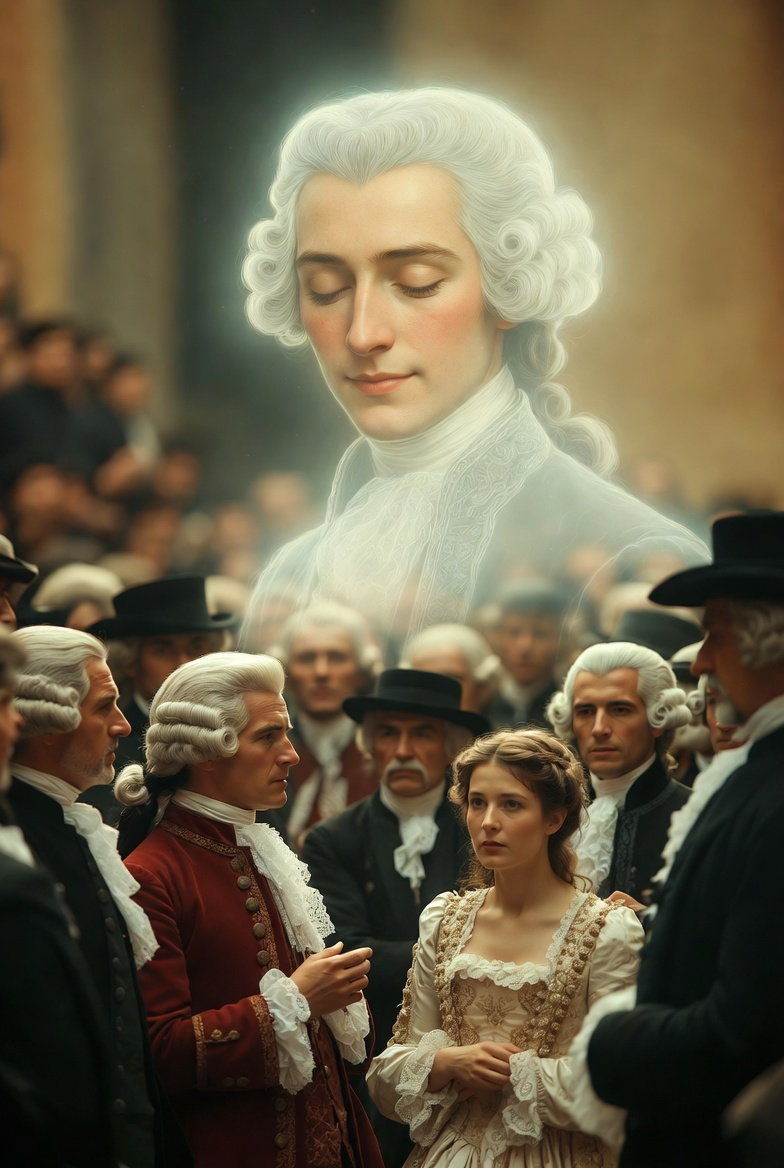
The Rebirth of Melchior Dronte by Paul Busson and translated by Joe E Bandel
The way was not too long. I looked once more with the
old eyes that had seen so much during my existence, and
enjoyed the colorful multiplicity of the images that showed
themselves to me. I saw the butcher with a steaming, scalded
pig in a wooden trough, and the brass basins of a barber, which
rattled in the wind and rain and hung full of little drops. I took
the pitying look of two dark, beautiful girl’s eyes under a blue
and white bonnet, noticed a black dog that reminded me of
poor Diana, and smelled the strong, sour-tart smell of fresh tan,
coming from a tanner’s workshop. A steel blue fly with little
glass wings sat down on my knees and thus traveled quite a
distance without effort of its own. A bunch of funny screaming
spiders, uninvolved in humanity threw themselves like a brown
cloud over the smoking mountain of horse manure, which came
from one of the front wagons, and an ancient sycamore tree, all
hung with water beads, morosely and indifferently let us pass
by.
And then, with a jerk, all the wagons stopped.
We had arrived at the ugly square, where not long ago I
had spoken with the young officer about the French nation, and
my gaze fell on the gaunt reddish-brown scaffold that towered
high above our heads, with ghastly simplicity.
At that moment the wall of fog broke, and a pale ray of
sunlight fell with dull glint on the slanting knife high up under
the crossbeam.
“How soon all this will be over!” I thought, and
remembered so many moments of impatience and not being
able to wait, which lay far behind me in the old days.
We had to descend, and we were helped to do so. The
people did not shout. There was only that quiet murmur of a
thousand voices that betrayed the excitement of a great crowd.
No one shouted swear words at us, and many eyes looked
sympathetically. I had the feeling that with such a general
mood, the great killings would soon subside and finally stop
altogether. My knees were stiff from sitting and from the
morning chill. The distress of the body cramps set in once
again, and the right hip was very painful when walking.
I saw people appear on the platform, appearing to move.
The knife fell with a dull clang and was raised again. It was red.
Something struck the boards of the bloody scaffold.
The fear of the body almost gained the upper hand. A
thought pushed forward, gained space: To do something to save
myself, to scream, to beg, to break through the crowd, to break
the cords…
That’s when I saw him…
Huddled like a bat. Fangerle. He was sitting on a lantern
of the gallows, grimly distorting his wide mouth, the evil
yellow eyes directed at me, a red, Phrygian cap on his skull
instead of a big hat. His eyes were like two wasps that lived
and crawled around in the cavities of his head.
I closed my eyes. My will kept the upper hand.
“Return to the depths!” I said to myself.
When I looked again with all my strength, the apparition
had disappeared, the pole was empty.
A soldier grasped me almost timidly by the arm and
pushed me forward with gentle force. I saw how clotted, thick
blood flowed sluggishly down the boards of the scaffolding.
Before me the Marquis de Carmignac climbed the slippery
little stairs. Two men with naked arms grabbed him, strapped
him to the board, and tipped it over. The upper part of the wood,
which enclosed the neck, lowered. Whoosh…
A whistling sound came from his headless neck. The feet
with the buckled shoes, manly still in death, softly tapped the
ground, his body moved in the straps, as if he wanted to make
himself more comfortable. They loosened the damp leather,
rolled him aside; the golden pear rolled over the boards, a little
lid opened, brown snuff dusted out. Quickly a hand reached for
the shiny thing.
I was next, climbing the stairs.
A hand supported me kindly, saved me from a fall in a
moment of slipping. I looked into a serious, well-cut face. It
was Samson. He made a polite inviting hand gesture. Behind
him stood the red-bristled monster.
Images circled in my brain in a flash. The arm with the
executioner’s sword in the witch’s room of Krottenriede, the
box with the singing little bird, burning candles in a black room,
the glitter of Aglaja’s crown of death, the little dead man with
the hourglass and the scythe, as it tilted out of the old clock, the
Bavarian Haymon as an Amicist —Firm hands grabbed me by
the arm. Faces slid past me. I stood at the board. The warm
smell of blood rose to my nostrils, tickling and irritating in the
nose. Thin straps snaked around my upper body, my legs. I fell
forward — it creaked softly around me, – pain- my larynx hit a
semicircle.
I thought: Now the knife will cut through my throat,
sawdust will fill my eyes, my mouth —.
Wet wood descended on the back of my neck.
Isa Bektschi! Isa Bektschi!
With all my might I thought of the Ewli. I forced him to
me.
Close to mine I saw his face – his mouth, as if he wanted
to kiss me – kind, dark eyes, like two black suns. His gaze
enclosed me with infinite love and promise.
I thought nothing more. I saw only him – drank his looks,
absorbed his essence into me. Then dazzling, golden rays shot
out from his eyes, piercing me, consuming me in fiery embers –
in golden fire.
But still I saw that face, clearly, sharply, saw it growing
smaller and smaller – small as a dot and yet recognizable -.
I opened my mouth, felt woody, dry splinters, moist
chunks—.
Then night — hissing — sound — a painful tearing – a
thread cut in two —
I found myself outside my body. My body lay in its
brown, rumpled suit, without coat, with blood-soaked shirt
edge on the board of the guillotine. Despite the tight straps, my
upper body reared up a few times violently. Fountains of blood
rushed out of the two large neck veins.
The head lay pale, with wide-open eyes in the basket. Its
face smiled. All the people who were standing around the
scaffold looked on in silence. The board became empty. The
man who had called Astaroth and the fiery dragons was
dragged up the steps. He struggled with all his might, kicking
with his feet, snapping his teeth.
He did not want to – – All this was so indifferent for me. I
rose and floated away over the many heads, glided effortlessly,
and without finding any resistance, through the house walls and
window panes, driven by a force.
I had no eyes and saw everything. I heard. But I felt
nothing. I thought nothing either. I was consciousness itself.
Everything came to me, was immediately recognized.
Vibrations of many kinds trembled through me, without me
feeling pleasure or suffering. It was coldness, warmth, a sound,
light, phenomena for which there are no words in human
language, sensations when encountering beings, that remain
invisible and unknown to people.
I was of a shape, if this is possible to say, like those
glassy-transparent bodies that glide past human eyes when they
look for a long time into the distant pure blue heavens.
Nevertheless I was not a body. I was also not nothing. I was a
soul, like many of those who floated in the world space. But I
had consciousness, I was mindful of my ego and I had a goal.
I was looking for a new house with those instruments of
the senses, which received from outside and could reflect from
the inner back to the outer: Could express thoughts as words. I
was looking for a human body. Inside me I carried the tiny
image of a noble, godlike face, the reflection of which I had
taken with me into infinity when I left the destroyed body.
From this image my consciousness extended along with the
ability to remember.
The will for re-embodiment was the only drive that
dominated me. According to inscrutable laws born of the
eternity of becoming and passing, I strove towards my goal,
devoid of all those feelings that can be called impatience,
expectation or hope. There was no time; there was no distance
and no obstacles.
Forces to which I surrendered of my own accord
willingly lifted me up, made me sink down, and made me to
fade away, to wander and to rest.
I was unmoved in my consciousness.
Everything was offered to me, nothing was hidden from
me, and nothing was veiled, neither in depths nor in heights.
The wind blew through me, the rain fell through me. I had
nothing of the properties that things in space possess. I was big
and small, inside and outside, far and near.
I saw sunsets in ocean wastelands, mountain hikers
crashed in crevasses of ice, blue flowers that slowly withered,
ghosts in waterfalls, beings that lived in crystals, red and
yellow sandstorms, and fermenting garbage, out of which new
creatures of the strangest kind sprang, dwarfs, who would have
appeared as stones to human eyes, winged creatures that rode
and roared, sleeping in beds, seeded with tiny goblins as with
vermin, people, from whom evil flowed like a poisonous breath.
I passed by all this.
There were animals in herds on vast steppes, animals in
the air, in holes in the ground, in the water. Small, crawling,
flying, running animals, animals of all kinds, covered with hair,
feathers, scales, bristles and plates, living animals. They
attracted me because they were alive. They begat young,
hatched them, reproduced thousands of times.
They attracted me strongly, because they had living
bodies, warm bodies. But I carried in me a human face and did
not follow those souls, that lurked waiting to enter into the egg
cell at the moment of conception.
I was only attracted to people. I was attracted to them by
a tremendous force.
It was good to be with people. I attached myself to them,
was with them, in them, slid through them and was a guest with
others. I lived with them. I saw them as one sees a region that
resembles the abandoned homeland. I have to use such
comparisons, although the truth is quite different.
The Rebirth of Melchior Dronte: pages 255- 259
Posted in Uncategorized, tagged family, fiction, life, love, writing on January 22, 2026| Leave a Comment »
The Rebirth of Melchior Dronte by Paul Busson and translated by Joe E Bandel
I went near one of the windows, unfolded the paper and
read:
“My heart weeps for the best and noblest of men; yet I
bow before a heroism that respects death less than the betrayal
of itself. My now impotent gratitude will forever honor your
memory. May there be a reunion that gives you new goals.”
It was the well-known handwriting of the magister.
In the dim morning light we could see through the
windows, which were high up but clean and bright, that a fine
rain was falling outside. Drops hung sparkling on the iron bars
of the lattice.
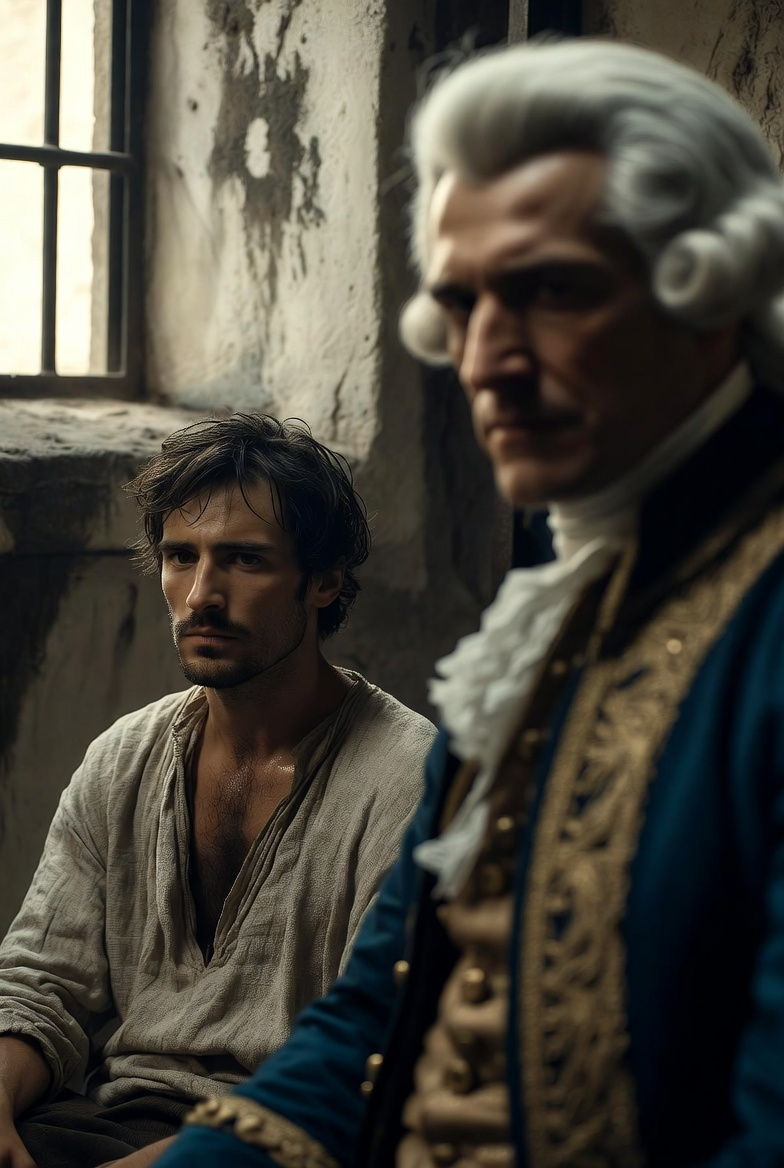
This dungeon, admittedly the last one in which we were
housed, was in every respect friendlier than the gloomy coal
mine where we had awaited our sentencing. A bow-legged
jailer with a good-natured face and a natural gift for joking
words, brought us washing water in wooden cans and lent us
clean, coarse cloths to dry our faces and hands. For those
prisoners who still had money on them, he provided chocolate
for breakfast and pieces of cake. The others were given a soup
of burnt rye flour and a large slice of bread.
Since everything seemed trivial to me that was still
connected with the needs of the body, I was content with a few
spoonfuls of soup. Also in these last hours of my life, I
sometimes felt as if I were completely outside the events and
saw from afar, like an observer, me and my fellow sufferers.
Nevertheless, this observing being, which was my ego, was
connected by a guiding thread with my body, and felt the
morning chill, hunger and that dull, constricting feeling in the
stomach area, which precedes bad events. This strange out-of-
myself sensation was so strong that my own hands seemed like
something foreign, for I looked at them closely and with a
strange feeling as if I were seeing something familiar again
after a long time. In all these ambivalent feelings was mixed
with a kind of regret over the ingratitude, with which the soul
calmly left forever, the house in which it had been for so long
and through whose senses it had taken in the image of its
changing surroundings. I could not, try as I might, find
anything great or decisive in the imminent departure from the
accustomed form of earthly life. It was as if the body, although
its sensations continued, no longer participated in those of the
soul.
Even the scenes that took place around me could not
move me violently, as much as I was aware of their sadness.
Something constantly stirred in me, as if I had to speak to the
poor people and tell them that all this was only of secondary
importance and that it did not really have to mean much. But it
was also completely clear to me that they would not have
understood me at all, and so I kept silent and out of the way.
Many things happened around me. Women wept bitterly
and their hot tears, with which they said goodbye to life,
dripped into the soup bowls from which they ate. The Marquis
de Carmignac sat in a corner and had his beard shaved and his
hair arranged. A withered, weary smiling old man read to a
small crowd of listeners from the “Consolations of Philosophy”
by Boethius. A handsome young man in a riding suit leaned
against a pillar with rapt eyes and hummed a little song over
and over again, which was obviously dear to him as a memory.
He stopped only when an Abbe, who was whispering prayers
with several older and younger ladies, approached him and
politely asked him not to disturb the religious gathering of the
dying. Several sat dully, despairingly and completely absorbed
in themselves on the straw mattresses of the beds that were set
up here.
After some time, a young, pale-looking barber’s assistant
entered with the jailer, waved to his comrade, who was taking
the marquis’ tip with many bows and with a trembling voice
asked the people present to sit down in turn on a bench placed
in the middle of the room, to have their hair cut. This request
caused loud sobs and a fit of fainting, but the toilet, as the
procedure was called for short, proceeded swiftly. The long
tresses of the ladies, which were carefully cut off and placed in
a small basket, he very politely requested them to be
considered useful for his business, and presented each woman
who gave her consent, a small vial of smelling salts as a return
gift.
The frosty, rattling and moving of the scissor also
touched my neck, and their blades cut through my hair. Coldly
I felt the lack.
All around, the praying grew louder and more fervent. At
eight o’clock a booming drum rattled and the door opened. In
front of a crowd of soldiers, a commissar with a sash appeared
and read off name after name from a list. All those named rose
immediately and lined up to the left of the door.
“Citizen Melchior Dronte!”
I bowed briefly to those who obviously remained behind,
and stood next to a tall, strong man who, with a contemptuous
expression, derisively pushed his chin forward. By his braids
and lapels and the uniform, I recognized him as a major of the
Broglie regiment.
“Skunks – riffraff from the gutter!” he growled and spat
out so violently that a small, hungry-looking soldier jumped to
the side, startled.
A somewhat lopsided, gray-clad man with a mocking
face, who was one of those called up, laughed softly to himself.
“This carnival play will soon be over. And it wasn’t even
very funny.”
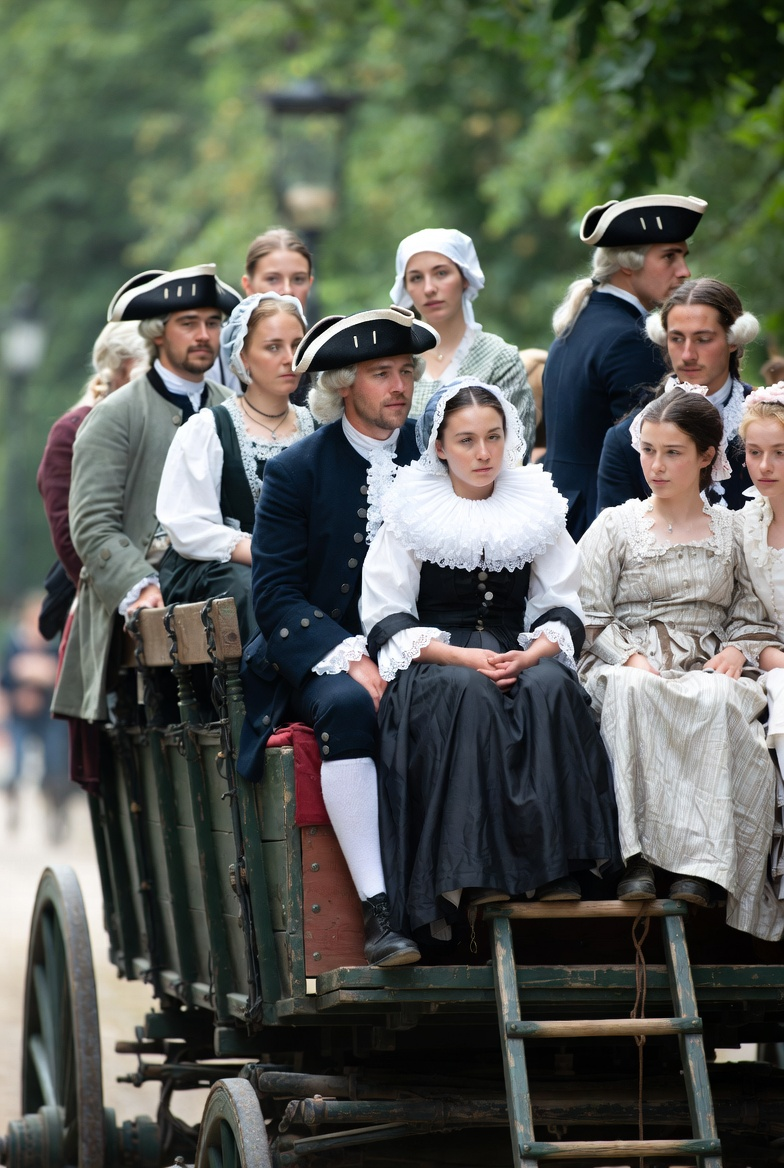
We were now; about twenty in number, led out of the
cellar, went up the stairs and came to a courtyard that was
completely surrounded by soldiers. It was still trickling thinly
from the cloudy sky. Some ladder wagons were standing there,
and we were ordered to sit on the boards nailed across. A boy
of about fifteen years old climbed up behind us and tied our
hands behind our backs with strong vine cords, supervised by a
mounted sergeant. I saw that the young lad whispered
something in the ear of each person whom he bound. And when
it came to my turn, I heard from behind, half-breathed, while
the warm breath hit my shivering neck, the words:
“Forgive me!”
I felt how restless and hot the hands were that bound my
arms.
Amidst much shouting, running to and fro, and up and
down trotting of the cavalry escort the wagons were finally
loaded with their human cargo. Next to the coachman, a soldier
swung himself onto the bench and the big door of the courtyard
opened with a loud creak. Incalculable masses of people filled
the street outside and formed two rows, between which our
carts now slowly began to roll.
Quietly, I looked around me. In front of me, stiffly erect
and looking over the people, sat the Marquis de Carmignac,
next to him the major of the Broglie regiment, who, with his
furiously lowered red head reminded of an irritated bull.
Crouched on the bench next to me was an obviously deranged
man, about sixty years old, with white beard stubble, a
wrinkled face and rolling eyes, who was intoning incessant
incantations to himself.
“O Astaroth, O Typhon, O ye seven fiery dragons, you, O
keeper of the seals, hasten to help me! Let flames fall upon
them, let the earth open up and take them to the lowest hell, but
carry me to the garden of the white Ariel Arizoth Araman
Arihel Adonai.”
The words became unintelligible, and at last he burst into
a triumphant giggle and became calm, obviously firmly
convinced of the sure effect of his spirit invocation.
I turned my head with difficulty to the back bench and
caught sight of an aging girl with brick-red spots on her
cheekbones, who was dressed in a black robe, with her eyes
turned to Heaven, praying without ceasing. Beside this nun,
who with glowing eyes, was preparing for martyrdom,
trembled like a jelly, a white-flour covered baker, whose
swollen, puffy eyes gazed out of a hot face in which mortal fear
gaped. His huge belly, which almost burst the buttons of the
trousers, wobbled back and forth with every step of the horses.
I saw excessively clearly, and not the slightest detail
escaped me. I noticed a hanging silver button on the jacket of
the marquis. On the neck of the major an inflamed pustule. On
the vest of the man sitting next to me the remains of an egg
dish, and the medals on the nun’s rosary sometimes clinked
against a board of the cart.
My poor body, which was now to change, was doing
everything in its power to keep the calm serenity of the spirit
that was preparing to leave busy with unimportant worries on
its way into eternity. A natural need, for the satisfaction of
which there was no time left to satisfy, arose with annoying
agony. An old cold pain which had not tormented me for a long
time, had shot into my right hip during the night and caused me
great agony with the shocks of the cart. And to all this was
added the fear of death that the body felt. It manifested itself in
strong stomach pains and finally brought it to the point that
cold drops ran down my face. It was cold sweat, death sweat…
But I stood above or beside these sensations which, in
spite of their strength, could no longer really penetrate to the
consciousness. A sharp and irrevocable divorce between body
and soul had occurred, and the soul realized with joy that no
earthly feeling would accompany it on its way.
From the crowd a song burst forth in full chords, into
which thousands of voices fell. The truly entrancing melody,
the words of which I could not understand, except for
“Fatherland”, “tyranny” and the like, had a strong and moving
effect on me. It was a genuine and noble-born, fiery child of
the time, and it was as if this rapturous singing carried
something hot in it.
Everywhere people were looking out of the windows of
the suburban houses, joining in the song with bright,
enthusiastic voices and waving their scarves. The horses in
front of our wagon, a chestnut and a summer black, neighed
and began to prance and nod their heads in time with the
mighty tune, which was glowing and storming up to the sky.
Even the driver, a scowling man, and the young soldier next to
him sang the hymn, for such it was, with a loud voice.
The Rebirth of Melchior Dronte: pages 250- 254
Posted in Uncategorized, tagged books, fantasy, fiction, short-story, writing on January 21, 2026| Leave a Comment »
The Rebirth of Melchior Dronte by Paul Busson and translated by Joe E Bandel
“I wanted to protect the defenseless woman,” I said,
looking him in the eye. He shook his head reluctantly.
There was a murmur.
“Are you a friend of freedom?”
I thought for a moment and then answered the question
with a “yes.”
“Was it known to you that citizen Lamballe had fled to
England and returned from there to Paris?”
“Yes.”
“In that case, it was reasonable to assume that there was
valuable information about her co-conspirators located here
that could be obtained. Not so?”
I was silent.
He looked at me again with a quiet, disapproving head
movement and with a tongue-lashing spoke slowly and clearly,
emphasizing each word:
“I know what you are trying to say, Citizen Dronte. In
your zeal to serve the republic and prevent a premature and
early end of the traitor, you have sought to use violence to
prevent the execution of the sentence. However, you fared
badly enough. Is that so? Give me answer!”
He nodded an almost imperceptible “yes” and waited.
I felt briefly and strongly the lure to return to freedom
from the horror of this justice. But a powerful, insurmountable
feeling inside me made the friendly images of imminent
freedom quickly fade away. I realized, like a holy necessity,
that I had to be hard and merciless against myself, otherwise I
should be thrown back into levels from which I had ascended
and not allowed to higher ones whose aura I had attained.
“I have tried to save the princess on the basis of feelings
of a personal nature!”
The chairman heaved a sigh of annoyance, swayed his
head, drummed on the table and raised his eyes to the ceiling.
The committee members looked at me bored, and in the
auditorium a yawning voice said:
“These are quibbles, Jeannot – Do you understand any of
it?”
“In a nutshell: you had no intention of protecting the
woman as such, but rather to render a service to the Republic.
We have no time, Citizen Dronte, and I hope that your sincere
admission of this fact will settle the case!”
A cold breath passed over my face. The scales stood: a lie
had to sink the bowl —
“I did not think of the Republic in my deed!”
Now it was spoken.
Great unrest arose. Even the drowsiest among the
listeners understood, awakened to irritated attention. The face
of the chairman turned red with anger. He threw his head back
so that his hair flew and hissed at me:
“You dare tell me that?”
“It is the truth,” I replied.
It was clear to me that the grateful magister must have
had his hand in this, and it saddened me that his not without
danger effort had now been in vain. But I had to follow the
path that my innermost feeling was the right one, to go to the
end, regardless of the feelings that arise from the body’s
instinct for self-preservation.
The behavior of the chairman changed immediately. A
deep vertical wrinkle appeared between his eyebrows, and he
bit his lips angrily before continuing the interrogation.
“You are a stranger. For what purpose did you come to
Paris?”
“To become acquainted with the Revolution and its aims-
.”
“With friendly or hostile intent?”
“I did not come with hostile intentions.”
“You are a baron. – How can an aristocrat’s opinion of the
Revolution be otherwise than hostile?” suddenly the bilious
committee member intervened.
“Does such a person love the poor people -?” growled the
one with the stained red cap. “How?” he turned to me.
“I love all the people.”
“These are sayings such as every priest has in his pocket
who stands before the tribunal,” the judge snapped at me and
assumed a frowning pose with a lurking look at me. “You have
thus joined the brave ones who have gone the Lamballe way,
not in the interest of the state, but in order to protect the queen’s
intimate for some other dark motive.”
“Don’t make such long stories!” grumbled someone
behind me.
“He’s one of the whore’s lovers, nothing else!”
Shrill whistles sounded.
Wild stomping of feet revealed that the people wanted an
end.
The skinny man talked to the chairman. The latter
shrugged and turned to the other committee member, who
nodded his head vigorously, raised his right hand and dropped
it with the edge on the table. It was clearly understandable what
he meant by this.
The chairman stood up, stretched out his right hand
toward me like a king of the theater, while the left hand rested
on his heart, and spoke with his voice low and rolling the R’s:
“Citizen Dronte is guilty of treason against the
Republic!”
Thunderous clapping of hands resounded. I sat down,
completely calm and certain of the end.
Then the man in the dark blue, gold-embroidered jacket
slowly turned his stern and stony face toward me, smiled and
said very loudly and audibly:
“Allow me, Baron, to express to you my sincere esteem!”
Laughter and jeering followed his words. An apple case
flew past my head and remained in front of the judge’s table.
The theatrical chairman slammed his fist on the table and
shouted, “Quiet!”
Gradually, the scolding, laughing and whistling ceased.
“Citizen Carmignac!” rang out the complacent voice.
The man in the blue jacket stood up.
“I am Philipp Anton Maria Marquis of Carmignac, Pair
of France, Privy Councillor of His Majesty the King, Chairman
of the Breton Chamber of Nobility, Commander of the Order of
Louis —“
The hall cheered. This tall man and his proud manner
promised a spectacle. The emphasis on his rank even evoked a
certain respect.
“He looks well, the marquis,” someone said.
“But his neck is as thin as that of Lamballe’s lover,”
laughed in response.
“Curses! And the thing is settled.”
The marquis took a pinch from his little gold pear and
carefully patted his brocade vest with a small lace cloth to
clean off the tobacco dust.
“You are accused of -,” began the presiding chairman.
“Above all,” said the nobleman with inimitable
haughtiness, “I wish to make the declaration that the privileges
to which I am entitled have been violated with unlawful
violence and I was brought here by unlawfully armed persons.
Now, as to this court I note that it is not made up of royal
courtiers, but of a bad actor, a master carpenter and a runaway
servant of the church, “and therefore offers no cause for further
consideration.”
After these words the marquis sat down, contemptuously
staring into the air.
For a few seconds there remained silence. The
stupefaction was general. But then arose such a thunderous
noise, such a roar of anger that the soldiers present were hardly
able to hold back the frenzied crowd. Meanwhile, the presiding
judge stood up. One saw him waving his hands urgently to call
for silence. It took long enough for him to make himself
understood. He directed an angry, scornful look at the count,
who looked past him equanimously.
“Citizen Carmignac, I demand that you stand up before I
have to use violence and give the tribunal of the people the
homage it deserves.”
The marquis shrugged his shoulders and nonchalantly
stood up on his feet.
“I do not wish to get dirt stains on my jacket,” he said.
“For this I rise.”
The actor sat down and pushed his chin forward.
“If I understand you correctly, Citizen Carmignac, you
fell asleep before the revolution and still haven’t awakened,
eh?”
The mocked man made no reply. Some people in the hall
laughed.
“You have made an attempt to bribe the turnkey of the
Temple to give Citizen Capet, who is kept there, information
on the successes of the emigrants at the Austrian and the
Prussian court, by means of a small piece of paper concealed in
a gold case, which was hidden in one of six lemons. Is it this
case?”
The hand of the judge was holding a tiny gold case of
elongated shape. The marquis measured it under half-closed
lids.
“Since you are playing court here, you will have to go to
the trouble of proving your accusations.”
The displeasure in the room grew noticeably.
“He shall be embraced by Samson’s coquette!” roared the
voice of one of the angriest screamers.
The courtiers bowed their heads to each other, whispered,
nodded, the chairman stood up and without any movement
pronounced his “guilty”.
The court rose. Four soldiers stepped in to us and told us
to stand up. It was fairly quiet as we were led out of the hall.
The people were satisfied.
When we stepped out of the door, where a new troop of
anxious, well-guarded people of both sexes were waiting to be
interrogated, I felt something angular in my right palm, like a
piece of folded paper, and closed my fingers tightly around it.
We were going a different way than the one that had
brought us here from the prison, under an open portcullis, and
finally found ourselves in a spacious, dry and bright cellar. It
was full of people.
OAK
-

-
Archives
- March 2026
- February 2026
- January 2026
- December 2025
- November 2025
- October 2025
- September 2025
- August 2025
- July 2025
- June 2025
- May 2025
- April 2025
- March 2025
- February 2025
- January 2025
- December 2024
- November 2024
- October 2024
- September 2024
- August 2024
- July 2024
- June 2024
- May 2024
- April 2024
- March 2024
- February 2024
- January 2024
- December 2023
- November 2023
- October 2023
- September 2023
- August 2023
- July 2023
- June 2023
- May 2023
- April 2023
- March 2023
- February 2023
- January 2023
- December 2022
- November 2022
- September 2022
- August 2022
- July 2022
- June 2022
- May 2022
- April 2022
- March 2022
- February 2022
- January 2022
- December 2021
- November 2021
- October 2021
- September 2021
- August 2021
- July 2021
- June 2021
- May 2021
- April 2021
- March 2021
- February 2021
- January 2021
- December 2020
- November 2020
- October 2020
- September 2020
- August 2020
- July 2020
- June 2020
- May 2020
- April 2020
- March 2020
- February 2020
- January 2020
- December 2019
- November 2019
- October 2019
- September 2019
- August 2019
- July 2019
- June 2019
- May 2019
- April 2019
- February 2019
- January 2019
- October 2018
- September 2018
- August 2018
- June 2018
- May 2018
- April 2018
- March 2018
- February 2018
- January 2018
- December 2017
- November 2017
- October 2017
- September 2017
- August 2017
- July 2017
- June 2017
- May 2017
- April 2017
- March 2017
- February 2017
- January 2017
- December 2016
- November 2016
- October 2016
- September 2016
- August 2016
- July 2016
- June 2016
- May 2016
- April 2016
- March 2016
- February 2016
- January 2016
- December 2015
- November 2015
- October 2015
- September 2015
- August 2015
- July 2015
- June 2015
- May 2015
- April 2015
- March 2015
- February 2015
- January 2015
- December 2014
- November 2014
- October 2014
- September 2014
- August 2014
- July 2014
- June 2014
- May 2014
- April 2014
- March 2014
- February 2014
- January 2014
- December 2013
- November 2013
- October 2013
- September 2013
- August 2013
- July 2013
- June 2013
- May 2013
- April 2013
- March 2013
- December 2012
- November 2012
- September 2012
- July 2012
- June 2012
- May 2012
- April 2012
- March 2012
- February 2012
- January 2012
- November 2011
- September 2011
Meta
Follow me on Twitter
My Tweets-
Bandel Books Onlinehttps://www.lulu.com/spotlight/anarchistbanjo

 Anarchistbanjo's World