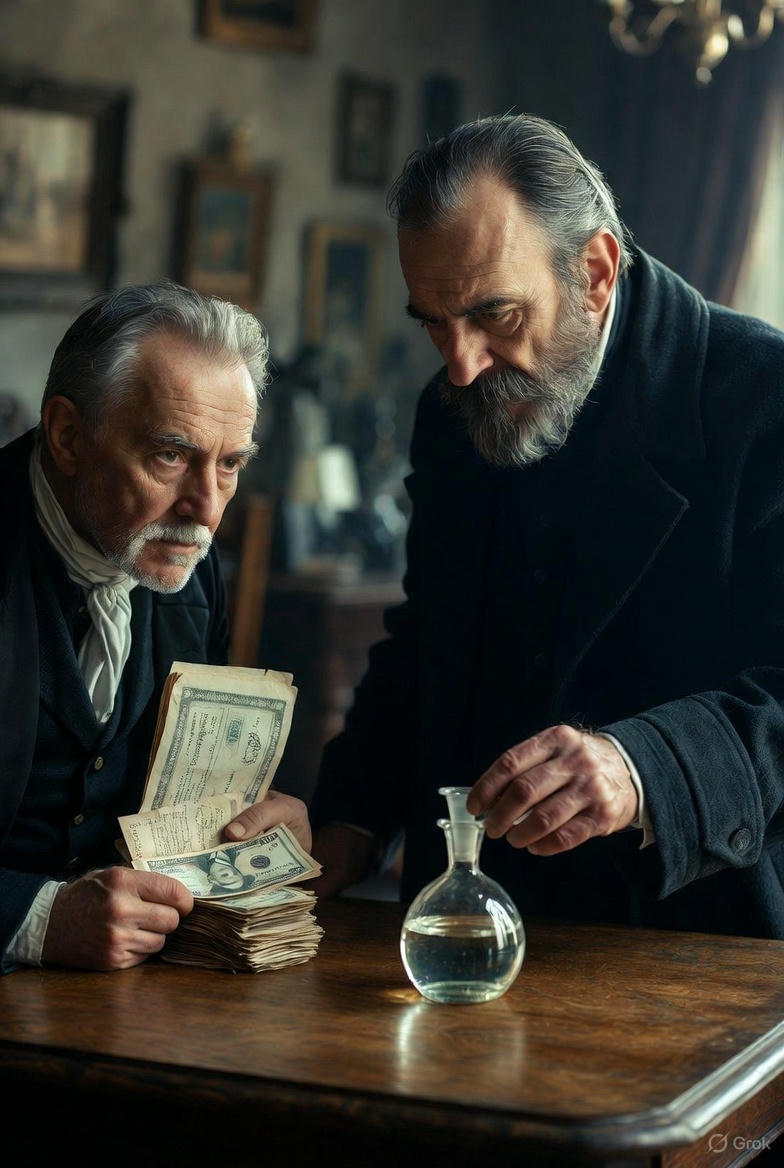
The Rebirth of Malchior Dronte by Paul Busson and translated by Joe E Bandel
In an intemperate fury, unable to speak a word, I pointed
at the devastation.
The gnome spat at the maltreated flowers and struck at
them with his foot.
“This is for you and la putana – you understand me?” he
shouted. “O Dio, Dio! I am ruined. You have caused me to lose
twenty thousand ducats!”
“You bawdy dog!” I snorted at him and raised my hand
again.
He quickly drew his lancet from his pocket and flashed it
in the sun.
“Next time it will not be good for your arm,” he
threatened. “Pay attention! You will not have any fun with me!
But take a seat, my Herr of Dronte! “
I sat down and listened in mute rage to the whining
conversation he was now starting. It was a vile outrage that he
had been accused of playing matchmaker of the girl to Count
Korony. Have I never heard of King David’s virgin bedfellows?
Was it unknown to me that in England Doctor Graham
discovered a rejuvenation cure for old men, who are treated
with virgins in the same bed, so that the withered body can be
renewed by the youthful aura of the girls? And did I not know
that for such a curative every conceivable precaution is taken,
so that the honor of the girl remains unharmed! Who could dare
to confuse such a medically proven healing method with the
shameful expression “matchmaking”? And who finally would
give him the twenty thousand ducats that I had deprived him of
by kidnapping Zephyrine. Hey?
I answered him with great self-control, that his efforts
were in vain. I was gladly prepared to pay him compensation of
five hundred gold pieces. The money exceeded my assets by a
significant amount.
He rolled his eyes, wrung his hands and renewed his
attempts. He began to haggle, and when he realized that his
efforts were in vain, he declared himself satisfied with a sum of
one thousand ducats. That was his last word.
With a heavy heart I went into the house and fetched the
money, the loss of which hit me hard. But for Zephyrine’s
peace of mind, this sacrifice was not too great.
When I went back to him with two hundred ducats and a
bill of exchange for my banker, he had placed a small crystal
flask on the table, in which there was an oily clear liquid.
“Here’s the money -,” I said, pushing the gold rolls and
the paper toward him. He sniffed them most carefully and
shoved everything into the pockets of his coat.
“And now -!” I said, pointing to the path that led to the
garden door.
“Wait! Wait!” he cackled and pointed to the vial. “A little
how do you say? – Gift. Give every day’ three drops to the
Mother, and you will have a bello ragazzo – a son – and also, se
volete, a little girl -“
I pointed again.
“Va bene,” he murmured. “Addio, Barone!.”
Slowly he shuffled down the path, his hump dragging
like a snail its house. I followed him slowly, until the garden
door had closed behind him and the furious barking of the dogs
in the kennel had slowly died away. Through the bushes of the
fence, however, I could clearly see how he with a grisly
grimace, his lips moving in inaudible words, shook both fists
against our house.
When I returned, the flask was still on the table. I made a
movement to throw it in the bushes. But then I took it in my
hand, pulled out the glass stopper and smelled it. Again, the
smell of bitter almonds that seemed to cling to everything that
was in its vicinity.
I didn’t smash the shiny thing against a stone, did not
pour its oily contents onto the earth. Some curiosity drove me
to take it with me and to tell Zephyrine about it.
“Three drops a day, and a son is sure for us,” said the
villain. And, if we want, a girl, too!” I tried to laugh.
“Do you wish so much for a son, my dear?” breathed
Zephyrine, and a fine blush passed over her pale, poor face.
“Oh, yes,” escaped me, as I took her in my arms.
What did I care about the money? Everything I had, I
would have given for her, the only one, and with pleasure I
would have, like countless ones in the shadow of life earn
bread for her and me with my hands.
The flowers had long since faded, red and yellow leaves
danced from the trees, and the icy Boreas drove the first flakes
against the windows of the parlor where Zephyrine lay in pain.
Fever had set in during the night; the quickly summoned
midwife shook her head and said:
“The woman does not please me at all; a doctor must
come and come quickly! She is also too weak to get down on
the chair.”
There was only one competent doctor in the vicinity, the
white-haired Doctor Anselm Hosp, and I hurriedly sent for him.
While I waited in the next room and covered my ears to
not hear the shrieking cries and the confused moaning of my
wife, my hope for a good outcome darkened more and more.
The pain and labor had lasted for days; the poor body of
Zephyrine was terribly distended, and convulsions passed over
it. There was no doubt that an obstacle stood in the way of the
simple and natural course of the birth, the nature of which even
the wise woman could not discern. Then I noticed that the odor
of bitter almonds, which I detested still lingered in the house.
Zephyrine, to whom I had given the vial with the drops of
Postremos right after the ugly scene in the garden, claimed at
that time to have knocked it over and broken the crystal vial,
which is why the smell of almonds would not go away. Why
did the thought of the gift of the hunchback suddenly seem so
frightening?
The old doctor came with a big black bag in which
instruments clinked. This sharp clinking went through my
marrow and legs. I stepped quietly with him to the bed of the
woman in labor and was startled when I saw the distorted,
dilapidated, face of my Zephyrine covered with cold sweat, in
which her large, bright eyes wandered and flickered. Sharp
dark red spots stood out from the bloodless cheeks.
“You -” she sighed barely audibly.
I stepped close to her and whispered:
“Dearest, confess the truth – have you tasted of the
hunchback’s potion?”
A faint smile flitted across her suffering face.
“Only three drops -every day-“
“Why did you do it?” I snapped at her. “Why did you tell
a lie, when I asked for the poisoner’s bottle?”
“You -wanted- a- son- so – badly.”
Like a breath, the words came to me. Then an expression
of agony came into the wide-open eyes, the body stretched, the
hands reached for the knotted cloths that had been tied to the
bedposts for support. And how she cried out -!
The doctor made a brief examination and then beckoned
me into the next room.
“Baron,” said the doctor, “I am sorry to have to tell you
that it is a case of displacement of the child and therefore the
necessity of sectio caesarea has occurred.”
I staggered back.
“A Caesarean section?” I stammered.
The doctor looked down at the floor.
“This bloody procedure, which, properly performed, is
usually survived by strong and healthy women, but in our case,
because of the terrible weakness of the Baroness and especially
in the case of the high fever, the cause of which must be an
external poisoning of the blood, it is a dangerous and uncertain
operation. I cannot conceal this from you. Besides, I must
operate immediately and only with the help of the midwife,
although a second doctor would normally be necessary. But I
don’t dare wait any longer until a carriage can go to the city
and back.”
I felt as if I had been struck hard on the forehead. What,
Zephyrine in mortal danger? That wasn’t possible. That was
nonsensical. What would become of me? Where was the
meaning of life? Had the man from the Orient, whom I thought
of every day with great gratitude, with his appearance in the
Greeks’ alley brought the highest happiness of my life, so that I
would now lose it so cruelly and be pushed into the abyss of
nameless pain? No, that could not be, that was impossible. If
she died, I would die too.
A cry of the most terrible pain tore me out of my
contemplations. I wanted to follow the doctor into my wife’s
room, but he beckoned me sternly and resolutely to go outside
and await the outcome of his terrible undertaking. I let myself
fall down on a chair, bare of all will and looked dully into the
flakes outside. A bell called with a deep sound in the sinking
glow of the autumn day, and a dog began to howl. I recognized
him by the voice. His name was Amando and he was
Zephyrine’s favorite. This high, drawn howl made me almost
insane and increased my fear, since I was well aware of the
foreboding of loyal animals. In between came sobbing sounds,
suppressed cries from the next room. I heard the doctor
groaning in some strenuous activity, giving half-loud orders,
hearing the plaintive exclamations of the midwife, the clinking
of vessels and metallic things, the splashing of water and the
moving of chairs. Terrible things were going on in there.
Then a woman cried out. But it was not Zephyrine who
screamed. It was the wailing midwife. Why did she scream?
Clearly was to be heard, as the doctor rebuked her in an angry,
suppressed voice.
I held on to the back of my heavy chair, my whole body
shaking.
Then it was quiet inside, dead quiet.
The doctor stepped out and looked around confusedly. In
the light of the wax candles that I had lit, I noticed that his face
was dripping. His hands showed reddish marks.
Wordlessly I looked at his mouth.
“You need inner strength,” he said slowly, and a solemn
glow spread over his face.


 Anarchistbanjo's World
Leave a comment