The Rebirth of Melchior Dronte by Paul Busson and translated by Joe E Bandel
The magician: “O Sheikh, I am going to the other world;
procure for me a right in the hereafter!”
The Sheikh: “I can give you one piece of advice; If you
follow it, it will be for your salvation.”
Turkish legend
“When the angel of death touches your heart, the soul
leaves its narrow house, faster than lightning. If it can take its
memory along with it, it remains aware of its sins. This is the
path to purity and that of the entrance to God.”
Secret Doctrine of the Beklashi
What I am writing down here, hoping that it will fall into
the right hands according to the will of God I, Sennon Vorauf,
have experienced in that physical existence which preceded my
present life. These memories have come to me by a special
grace beyond that transformation which is called death.
Before I realized this, I suffered from them and thought
they were inexplicable, agonizing kinds of dreams. Besides,
however, I also had to go through all kinds of shocks of an
unusual kind. It happened, for example, that the striking of an
old clock, the sight of a landscape, a fragrance, the melodies of
a song, or even a mere association of words would assail me
most violently with the thought, that I would have quite
certainly already once heard, seen, breathed in, or somehow
experienced it before. I was in this or that place, which I saw in
my present life for the first time, and already had once been
there. Yes, often enough, in conversation with new
acquaintances, I was struck by the idea that I had already been
in very special relations with them. Since it was impossible for
me to understand before the onset of this realization, it was also
impossible for me to provide explanations for the indescribably
exciting movements of my mind and emotions, much to the
grief of my parents, which often led into hours of brooding, the
unknown cause of which disturbed them not a little. But
through frequent repetition and the ever sharper imagery of the
story I became aware, even as a boy, that they were nothing
more than reflections of fates which my soul had suffered in
another body, namely before the birth of my present body;
moreover, these “Dreams” represented experiences that were
completely alien to my current circle of experiences and
frighteningly distant from my present circle of thoughts. I had
never heard of such things or even read about them somewhere
or otherwise experienced them. I began to record these
“dreams” of my own accord and thereby achieved that from
then on in certain favorable moments I had the so-called
wakefulness to remember such memories with extraordinary
accuracy.
More and more clearly and coherently from these “lucid
dreams” (as I called them in my case) the overall picture of a
life emerged that I had lived before this under the name of a
German nobleman (I will call him here Baron Melchior von
Dronte), had lived and ended, when his body fell to the
transformation of death and then became free to be my soul as
Sennon Vorauf.
In the peaceful and blessed life filled with inner peace,
which I lead, the retrospective view of the wild and
adventurous existence of Melchior von Dronte broke through in
a disturbing, confusing and frightening way. What he was
guilty of was my guilt and if he atoned, he atoned for the soul
that came back, for his and therefore my soul.
I am fully aware that many people will read this book
with incredulous smiles, and perhaps in some places at times
with disgust and revulsion. But at the same time I hope that the
number of people of deeper feeling will be large enough not to
let this writing perish. To those who are able to remember
details from previous forms of existence, who are conscious of
a previous life, I would like to dedicate this book to them; I
would like to make this book their own.
Just as I have replaced the real name I had with “Dronte”,
I have replaced those of various persons, whose descendants
are still alive, with invented names. Moreover I touch here the
fact that I have called people “Dronte” in this life, whom I
knew from the time before my death. Most of them were not at
all aware of a previous existence. Nevertheless, there were
moments and occasions with them, in which clearly
recognizable flashes of memory flared up in them in a flash of
recognition, without them having succeeded in determining the
source of such disturbing feelings or having the ability to hold
on to them. I am certainly not saying anything new to those
who, like me, have brought parts of an earlier consciousness
into the new life.
The raw, crude and often coarse nature of the following
biography of a life, I could not in truth love, as unpleasant and
hurtful some of it may seem. I was not to embellish and smooth
out the terrible clarity with which the memories surfaced in me,
and thus to write a pleasantly readable book. Everything had to
remain the way it was as it formed from a time whose spirit
was different from ours.
However, from the deepest, most personal feeling this
book should speak to the immortality of the soul, and this
confession is to possibly awaken this confession in others.
Above all, I am inspired by the hope that those who believe in
the wandering of the soul after the death of the body will not be
given completely worthless indications in this book. Others
who have not yet progressed on the path that I have walked,
may still at least read it for the sake of its colorful content.
I remember very clearly an incident from my fifth year of
life.
I had been undressed, as always, and lay in my pink
lacquered, shell-shaped child’s bed. The warm summer evening
wind carried the chirping of many insects into the room, and
the wax candle in a silver candelabra flickered. It stood on a
low cabinet next to the glass lintel, under which the “Man from
the East”, or the “Ewli”, as he was also called, was located.
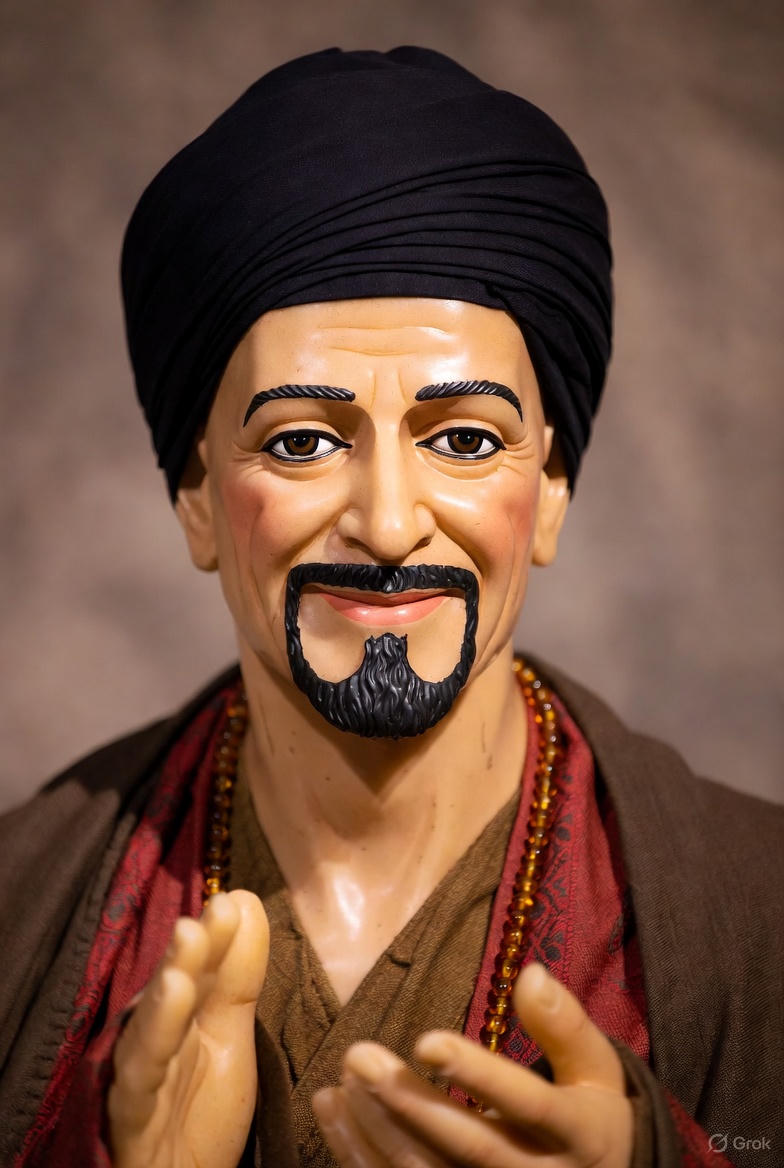
This was a span-high, very beautifully formed figure,
which a relative, who was in the service of a Venetian, had
brought from there as a gift from the nobility.
It was the figure in wax of a Mohammedan monk or
dervish, as an old servant often told me. The face had the
sweetest expression for me. It was completely wrinkle-free,
light brownish and with gentle features. Two beautiful dark
eyes shone under a jet-black turban, and around the softly
curved lips a small black beard could be seen. The body was in
a brown-red robe with long sleeves, and around the neck the
dervish wore a necklace of tiny amber beads. The two fine wax
hands were on arms hanging down with the palms turned
forward, equal-ready to receive and welcome anyone who
should approach. This immensely delicate and artistically
executed piece in wax and fabrics was highly valued in my
family, and for that reason alone, it had been placed under a
glass dome to protect it from dust and unskilled hands.
I often sat for hours in front of this expensive figurine for
unknown reasons, and more than once I had the feeling as if
the dark eyes were animated by being alone with me, as if there
was a faint trace of a gentle, kind smile around its lips.
That evening I could not fall asleep. From the fountain in
the courtyard came the sound of water splashing and the
laughter of the maids washing and splashing each other and
with similar shenanigans teasing each other. Also the cicadas
and crickets in the meadows surrounding the mansion were
making noise. Between all that sounded the muffled sounds of
a French horn, on which one of the forest boys was practicing a
call.
I climbed out of bed and walked around the room. But
then I began to be afraid of the moment when old Margaret
came into my room every night to put out the light in case I fell
asleep with it on, and I went back to my bed. Just as I was
about to climb over the edge of the bed shell with my bare legs,
it was as if a voice softly called my name. I looked around
frightened. My eyes fell on the man from the Orient. I saw very
clearly how he raised one arm under the glass bell and
beckoned to me.
I began to cry with fright, looking steadfastly at the little
figure.
Then I saw it very clearly for the second time: he waved
his hand at me very hastily and commandingly.
Trembling with fear, I obeyed; in the process tears
streamed unstoppably down my face.
I would have loved to scream out loud. But I didn’t dare,
for fear of frightening the little man, who was now very much
alive and waving more and more fiercely, in anger, such as my
father, whose short one-time wave was not only for me, but for
all the inhabitants of the house, an order that had to be obeyed.
So I went, crying silently, towards the cabinet on which
the waving dervish stood. I had almost reached him, despite my
anxious hesitant steps, when something terrible happened. With
a horrible roar and in a cloud of dust, debris and splinters, the
ceiling of the room collapsed over my shell bed.
I fell to the floor and screamed. Something flew whizzing
through the air and smashed the glass dome and the waving
man made of wax into a thousand shards and pieces. A brick
that had flown over me.
I screamed at the top of my lungs. But there was
screaming all over the house, outside at the well and
everywhere, and the dogs in the kennel howled.
Arms grabbed me, pulled me up from the earth. Blood
was running into my eyes, and I felt a cloth being pressed
against my forehead. I heard the scolding, agitated voice of my
father, the wailing of old Margaret and the moaning of a
servant. My father hit him with a with a stick and shouted:
“You donkey, why didn’t you report that there were
cracks in the ceiling? I’ll beat you crooked and lame…!”


 Anarchistbanjo's World
Leave a comment