Feeds:
Posts
Comments

Archive for November, 2025

Alraune by Hanns Heinz Ewers and translated by Joe E Bandel

She looked at him sharply.
“Really?” she said, drawing each word out slowly. “And just
what is it that you think would be worth my effort?”
He didn’t respond–Didn’t have any answer at the moment.
He stood up, shrugged his shoulders and went into the garden.
Her laughter sounded behind him.
“In a bad mood, Herr Guardian?”
That afternoon he sat in the library. Some documents lay in front
of him that Attorney Manasse had sent over yesterday. But he didn’t
read them. He stared into the air, hurriedly smoking one cigarette after
the other.
Then he opened a desk drawer and once more took out the Privy
Councilor’s leather bound volume. He read slowly and carefully,
considering every little incident.
There was a knock; the chauffeur quickly stepped inside.
“Herr Doctor,” he cried. “Princess Wolkonski is here. She is very
upset, screamed for the Fräulein while she was still in her carriage.
We thought that perhaps it might be better if you received her first–So
Aloys is bringing her here right now.”
“Well done!” he said. He sprang up and went to meet the
princess. With great effort she squeezed through the narrow door and
waltzed her heavy masses into the half darkened hall, which was lit
only by the sparse sunlight that came through the green Venetian
blinds.
“Where is she?” she panted. “Where is the Fräulein?”
He took her hand and led her over to the divan. She recognized
him immediately and called him by name, but had no intention of
getting into a conversation with him.
“I want to see Fräulein Alraune,” she cried. “Bring the Fräulein
here!”
She would not calm down until he rang the servant and
instructed him to announce the visit of the princess. Then, for the first
time, she consented to listen to him.
He asked after the health of her child and the princess related to
him, in an immense flood of words, how she had met with her
daughter. Not once had she recognized her own mother, had simply
sat by the window looking out into the garden, passive and listless.
It had been in the old Privy Councilor’s clinic, that fraud, which
Professor Dalberg had now turned into an insane asylum, the same
building where–
He interrupted her, cutting short her flood of words. He quickly
grabbed her hand, bent over it and looked with simulated interest at
her rings.
“Excuse me, your Highness,” he cried quickly. “Where did you
ever get this marvelous emerald? Definitely a showcase piece!”
“It was a button from the Magnate’s beret of my first husband,”
she replied. “It’s an old heirloom.”
She prepared to continue her tirade, but he didn’t let her get a
word in.
“It is a stone of uncommon purity!” he affirmed. “And of
remarkable size! I only once saw a similar one, in the royal stud of the
Maharajah of Rolinkore–He had it set into his favorite horse’s left
eye. For the right it carried a Burmese ruby that was only a little
smaller.”
Then he told of the hobby of Indian princes, how they gouged
out the eyes of their beautiful horses and replaced them with glass
eyes or large round highly polished stones.
“It sounds cruel,” he said. “But I assure you, your Highness. The
effect is amazing when you see such a magnificent animal, when they
stare at you with Alexandrite eyes, or glance at you out of deep blue
sapphires.”
Then he spoke of precious stones, remembering from his student
days that she knew quite a bit about jewels and pearls. It was the only
thing she was really interested in. She gave him answers, at first
quickly and briefly, then became calmer with every minute.
She pulled off her rings, showed them to him one after the other,
telling him a little story about each one. He nodded attentively.
“Now let my cousin come,” he thought. “The first storm is over.”
But he was wrong. Alraune had soundlessly come through the
door, walked softly across the carpet and set herself down in the easy
chair right across from them.
“I am so happy to see you, your Highness,” she piped.
The princess cried out and gasped for breath, crossed herself,
then a second time, in the Orthodox manner.
“There she is,” she moaned. “There she sits!”
“Yes,” laughed Alraune, “alive and breathing!”
She stood up and reached her hand out to the princess.
“I am so sorry,” she continued. “My sympathies, your
Highness!”
The princess didn’t take her hand. She was speechless for a
minute, struggled for composure–Then she found herself again.
“I don’t need your sympathy!” she cried. “I have something to
say to you!”
Alraune sat back down, waved lightly with her hand.
“Please speak, your Highness.”
The princess began. Did the Fräulein know that she had lost her
fortune through the machinations of his Excellency? But yes,
naturally she knew. The gentlemen had explained every detail to her,
explained what she had to do–But she had refused to fulfill her
obligation.
Did she know what had happened to her daughter? She explained
how she had found her in the asylum and what the doctor’s opinion
was. She became more excited, her voice swelled, becoming higher
and more shrieking.
She knew all of that, declared Alraune calmly.
The princess asked, what was she now intending to do? Did she
intend to walk in the same dirty footsteps of her father? Oh, there was
a fine scoundrel. You couldn’t find a finer or more cunning
blackguard in any book. Now he had his just reward.
She continued screaming and yelling about his Excellency,
saying everything that came to her tongue–She screamed that Olga’s
sudden attack had been because of the failure of her mission and not
wanting to come back. Alraune had made things worse by enticing
her friend of many long years away from her.
She believed that if the Fräulein would now help, not only would
her fortune be saved, but her child as well, when she heard the news.
‘I’m not asking,” she screamed. “I’m demanding! I demand what
is rightfully mine. You have done this wrong, you, my own Godchild,
and your father. Now make it right again, as much as you possibly
can–It is a shame that I must be the first to tell you this–But you will
have it no other way.”
“What is there left to save?” Alraune said softly. “As far as I
know, the bank collapsed three days ago. Your money is gone, your
Highness!”
She stressed the ‘gone’–You could hear the bank notes fluttering
in all directions.
“That doesn’t matter,” declared the princess. “The Legal
Councilor told me that almost twelve million of my money was
invested into that rotten bank. You will simply give me those twelve
million out of your own money. That will be nothing to you–I know
that very well!”
“Is that all?” said Fräulein ten Brinken. “Are there any more
commands, your Highness!”
“Many more,” cried the princess. “You will inform Fräulein
Gontram that she is to leave your house immediately. She will go with
me to my poor daughter. I promised to bring her along the next time I
came. Especially now, so she can share the news that this sad
misfortune has been made right. It will have a very good effect on the
countess–Perhaps a sudden recovery.
I won’t reproach Fräulein Gontram in any way over her
ungrateful behavior or continue pointing out your own behavior to
you. I only wish this affair to be settled immediately.”
She fell silent, took a deep breath after the tremendous exertion
of her long speech. She took her handkerchief, fanned herself, and
wiped the thick drops of sweat that beaded on her bright red face.
Alraune stood up briefly, made a slight bow.
“Your Highness is too gracious,” she piped.
Then she remained quiet.
The princess waited awhile, then finally asked, “Well?”
“Well?” the Fräulein came back in the same tone of voice.
“I’m waiting, –” cried the princess.
“So am I, – ” said Alraune.
Princess Wolkonski moved back and forth on the divan, whose
old springs sagged heavily under her weight. The way she was
pressed into her mighty corset, which even now formed the huge
masses into some type of shape, made it difficult for her to breath or
even move. Her breath came short and unconsciously her thick tongue
licked her dry lips.
“May I be permitted to have a glass of water brought for you,
your Highness?” twittered the Fräulein.
She acted as if she had not heard.
“What do you intend to do now?” she asked solemnly.
Alraune spoke with infinite simplicity, “Absolutely nothing.”
The old princess stared at her with round cow eyes, as if she
could not comprehend what the young thing meant. She stood up,
confused, took a few steps, looked around as if she were searching for
something.
Frank Braun stood up, took the carafe of water from the table,
filled a glass and gave it to her. She drank it greedily.
Alraune stood up as well.
“I beg to be excused, your Highness,” she said. “May I be
permitted to convey your greetings to Fräulein Gontram?”
The princess went up to her, seething, full of repressed anger.
Now she is going to burst, thought Frank Braun.
But she couldn’t find the words, searched in vain for a
beginning.
“Tell her,” she panted. “Tell her that I never want to lay eyes on
her again! She is no better a woman than you are!”
She stamped with heavy steps through the hall, gasping,
sweating, and waving her mighty arms in the air. Then her glance fell
on the open drawer. She saw the necklace that she had once given her
Godchild, a gold chain with pearls and set with diamonds around the
fiery lock of the mother’s hair. A triumphant look of hatred flew over
her bloated features. She quickly tore the necklace out of the drawer.
“Do you know what this is?” she screamed.
“No,” said Alraune calmly. “I’ve never seen it before.”
The princess stepped up right in front of her.
“So that scoundrel of a Privy Councilor embezzled it from you–
just like him! It was my present to you, Alraune, as my god-child!”
“Thank you,” said the Fräulein. “The pearls are very pretty, and
the diamonds too–if they are real.”
“They are real,” screamed the princess. “Like this hair that I cut
from your mother!”
She threw the necklace into the Fräulein’s lap. Alraune took the
unusual piece of jewelry, weighed it thoughtfully in her hand.
“My–mother?” she said slowly. “It appears that my mother had
very beautiful hair.”
The princess placed herself solidly in front of her, putting both
hands solidly on her hips. She was matter of fact, like a
washerwoman.
“Very beautiful hair,” she laughed. “Very beautiful! So beautiful
that all the men ran after her and paid an entire Mark for one night’s
sleep with her beautiful hair!”
The Fräulein sprang up. The blood drained out of her face in an
instant, but she quickly laughed again and said calmly and scornfully:
“You are getting old, your Highness, old and childish.”
That was the end. Now there was no going back for the princess.
She broke loose with ordinary, infinitely vulgar language like a
drunken Bordello Madam. She screamed, howled and obscene filth
poured out of her mouth.
Alraune’s mother was a whore, one of the lowest kind, who gave
herself away for a Mark and her father was a miserable rapist and
murderer whose name was Noerrissen. She knew all about it. The
Privy Councilor had paid the prostitute money and purchased her for
his vile experiment, had inseminated her with the semen of the
executed criminal. That was how Alraune had been created and she,
herself, had injected the loathsome semen into Alraune’s mother.
She, Alraune, the stinking fruit of that experiment, was sitting
there now–right in front of her!–A murderer’s daughter and a
prostitute’s child!
That was her revenge. She went out triumphant, with light steps,
swollen with the pride of a victory that made her ten years younger.
She slammed the door loudly as she closed it.
Now it was quiet in the large library. Alraune sat in her chair, a
little pale. Her hands played nervously with the necklace, faint
movements played around the corners of her mouth. Finally she stood
up.
“Stupid stuff,” she whispered.
She took a few steps, then calmed herself and stepped back up to
her cousin.
“Is it true, Frank Braun?” she asked.
He hesitated a moment, stood up and said slowly:
“I believe that it is true.”
He stepped over to the writing desk, took up the leather bound
volume and handed it to her.
“Read this,” he said.
She didn’t speak a word, turned to go.
“Take this too,” he cried after her and handed her the dice cup
that had been fashioned out of her mother’s skull and the dice that had
been created out of her father’s bones.
Read Full Post »

Madame Bluebeard by Karl Hans Strobl and translated by Joe E Bandel

Waking in a glorious resolve, sweat-soaked, he heard
fists pounding his door.
He stood in the doorway, shirt flapping, blinded
by a lantern’s glare. Someone ordered him to rise
quickly, speaking of a ladder, ropes, a pickaxe, and a
shovel from the tool shed behind the house. It
might’ve been Schiereisen. He had to dress; it
seemed urgent. When Rotrehl was ready and
Schiereisen explained the task, he wasn’t overly
surprised. It felt like a continuation of his
adventurous dreams, his mind brimming with
Cossacks and battle scenes, making him eager to
follow. Soon, they descended the hill, armed with
ladder, ropes, pickaxe, and shovel, like treasure
hunters or conjurers, cloaked in night’s mantle.
Stars began to adorn that mantle. Clouds had
cleared, and the night grew bright. Warm mist rose
from wet grass, spreading a thin, white fog over the
meadows. Midnight had long passed; in the east,
night’s veils thinned, stars peering large and anxious
through dawn’s weave. Light welled from the earth.
At her bedroom window, Helmina stood in a gray
travel dress, a small handbag ready. She sometimes
brushed her forehead, turning to check if the sounds
she heard were in her ears and blood or from outside.
At times, she thought someone approached along the
corridor, pausing at her door. Then she heard
breathing—the breath of sleepers, a whole castle
asleep while she alone watched, ready to flee. Short,
quick breaths stood out, those of children in their
beds. For a moment, Helmina distinguished them,
then they merged back into the collective slumber’s
weave. She made no effort to hear them again.
Motherly tenderness was alien to her; her soul knew
nothing of it. She preferred solitude, connected to
others only through her senses. She stared into a new
world, seeking the extraordinary. Was it power, a
searing, ruinous, blissful passion? She didn’t know. It
flowed darkly within her, driving her, and she yielded
without resistance. Sometimes, she felt not herself
but part of a cruel force spilling over the world…
She stood thus for two hours, staring at the bridge
deep in shadow, awaiting the signal. Her mocking
lips grew thinner, pressed tighter. Perhaps Fritz
Gegely wouldn’t come. Maybe he’d only boasted,
shirking the deed, and she’d have to leave without
him. He was merely a bridge, but if he failed her,
after so many defeats, she’d be utterly crushed. This
waiting was unbearable. Lorenz would be furious.
Time slipped away; they could’ve been far gone.
Half an hour more. Then Helmina must leave,
with or without Gegely.
But the signal came. On the bridge, an electric
lighter flashed thrice, three seconds each, like a
firefly. Helmina grabbed her bag, glancing around the
room. She left not as a victor… only her hate
remained.
Cautiously, she stepped out, unlocked a secret
door in the corridor, and descended a narrow, musty
staircase to the forecourt. It was safer; someone
might be on the main stairs. She crept across the
courtyard to the gate tower, opening the small door in
the large gate. It wouldn’t budge at first, rarely used
and swollen. She yanked the lock with all her
strength, tearing her delicate gloves.
Finally, she slipped out, leaving the door ajar.
Gegely stood under the chestnut trees.
“Where were you so long?” she asked, furious.
“Forgive me… she couldn’t sleep… I had to
wait… only a quarter-hour ago…”
“Forward!”
They were halfway down the castle hill when the
gate was flung open. Schiereisen leapt out, followed
by Jérome Rotrehl, clutching rope and spade as if
someone had thrust them into his hands and fled.
Both men’s faces, hands, and clothes were smeared
with mud, crusted with clay, speckled with white
patches of lime or mortar.
Schiereisen saw the two figures vanish into the
early morning’s dusk at the chestnut alley’s end.
They ran along the road, and soon he heard a
sound—a nerve-shredding, whipping noise, the
sputter of a car readying to drive. It drummed into the
dawn’s silence, like handfuls of peas hurled against
this glassy hour.
Schiereisen gauged the distance from the alley’s
mouth. He sprinted down the hill, first driven to
pursue, to halt the fugitives. Near the bottom, he
stopped abruptly, planting his feet, fists in his
pockets. No—she should flee.
The car’s starting roar sounded. Good… it’s
right… He finished his descent slowly, regulating his
breath with closed lips. On the bridge, the car was
gone. He broke into a trot, wanting to confirm who
Helmina fled with. The road stretched through the
valley, rising in wide curves to the highlands. A
steep, direct climb could cut off its loops.
Schiereisen plunged into the woods, scrambling
between trees, hooking from one to another at steep
spots. His lungs expanded, filling his chest, pushing
his heart to his throat. Sweat poured from his brow,
carving furrows through mud and grime, mixing a
sticky paste that tightened his skin. Several times, he
felt he couldn’t go on. But his immense resilience
drove him, making the impossible possible.
He reached the forest’s edge, where he’d first met
Helmina, standing in dense shrubs, their dampness
cloaking his steaming body. For a moment, all was
still, branches swaying softly. Seconds passed. Then
the car’s sputter burst in, sudden, as it rounded a
sound-catching forest bend.
Schiereisen knew he could’ve stopped it—
stepping into the road, Browning raised, an effective
warrant. But he stayed hidden.
The car roared up, shooting around the final curve,
snorting, racing uphill at full power… gone ten
heartbeats later. Schiereisen saw its occupants
clearly: Helmina, Herr Gegely—husband of the sick
woman—and Lorenz at the wheel.
The detective began his return. Near the house, he
met Rotrehl, lugging the gear alone. Seeing his
summer guest, the violin-maker stopped, staring. His
mind was saturated with the past hours’ events,
unable to grasp more. Bewilderment wrapped him in
soft veils. He could only shake his head.
“Come, Napoleon,” Schiereisen said, taking the
ladder. “Don’t think we’ve lost the battle. We’ll sleep
a little now. Later, I’ll explain everything.”

Read Full Post »

A Modern Inquiry into the Hermetic Mystery

Part IV: The Hermetic Practice

Chapter 1: The Vital Purification, Part 1

Introduction: The Hermetic art transforms the soul’s essence through the “Gross Work,” a manual process of purification. This chapter unveils the practical labor of dissolving and refining the First Matter, guiding the adept to divine light through persistent effort.

The Manual Operation

The Gross Work, as Basil Valentine describes, begins with “operation of the hands,” a diligent labor that purifies the soul’s essence, the First Matter. This manual process, distinct from mere theory, reveals the hidden light within, as the adept dissolves the spirit’s impurities to expose its radiant core. Valentine emphasizes, “Operation shows how all things may be brought to light, while experience confirms the work.”

This labor, though seemingly simple, is arduous, requiring unremitting attention. Unlike mesmerism or chloroform, which temporarily access the spirit, the Hermetic art purifies it through a “linear way” of dissolution, using the hand as the “instrument of instruments” to refine the volatile essence into a stable, divine form.

The Alchemical Dissolution

The purification process, as Albertus Magnus instructs, involves dissolving the “occult Nature” or “Brass” to make it pure, through repeated cycles of dissolution, distillation, and fixation. Lully notes, “The Mercury of philosophers comes not but by ingenuity and manual operation.” This labor transforms the gross, impure spirit into a subtle, penetrating essence, as Vaughan explains: “Nature cannot dissolve herself; she needs sagacious handicraft.”

The adept must overcome the “Brazen Wall” of the soul’s impurities, grinding and refining the spirit to remove its “heterogeneous superfluities.” This work, as Eirenaeus warns, is no mere recreation but a “labor of Hercules,” demanding sweat and perseverance to achieve the divine transformation.

The Path to Divine Light

The Gross Work prepares the soul’s essence for divine light, as Arnold teaches: “Dissolve the Stone in its own Mercury to reduce it to its first Matter.” This process, requiring skill and patience, aligns the adept with divine will, transforming the soul into a radiant vessel. The labor, though tedious, yields a “tinging spirit,” a purified essence that reflects the cosmic harmony, as described in the Rosarium: “Grind, cook, and be not weary.”

Closing: This chapter unveils the Gross Work, the manual purification of the soul’s essence into divine light. The journey into its advanced stages deepens in our next post, unveiling further secrets of this sacred art.

Read Full Post »

Someone has to go first, so I guess I will. I have been on an ascension journey this past year (actually for many years) and that journey is not what I expected and the stages have not been easy to recognize. I could be wrong, but I don’t think so. That’s why I’m going to share how ascension can be an extraordinary, ordinary life. . .

I’ve known for years that the new age energetics would require the activation and integration of the shadow. I don’t know how I knew this, but I always have and I’ve worked hard to turn my own self defeating thoughts, beliefs and actions into wisdom and empowerment. I thought the healing process would only take a few years of hard work and thirty years later I’m still discovering deeper layers that need healing. I’ve seen people that I love, people able to transmute black shit energy into harmless and empowering energy falter and stumble and finally have their physical bodies ravaged and destroyed by illness. My wife through strokes and brain damage and my best friend through colon cancer. At 68 years old my own body has faltered and stumbled a few times, but I’m still slugging on.

Ascension is not about the physical body anyway, it is about the soul and the integration of all the astral bodies. I envision the new world to be a multi-universe like Amber in Roger Zelazny’s Chronicles of Amber, or 4th density if you will. Said another way, I envision our physical world merging and integrating with the astral worlds as they were in the beginning. But that is beside the point. We use our physical bodies to generate and permanently activate all of our astral/etheric bodies. In the end we live in a world that seems to be the physical world but it is not as rigid and solid as it once was. Perhaps we need to drop our physical bodies at some point and perhaps we don’t???

We speak of ascension and prosperity consciousness. For me, I had to lose everything, hit bottom, down size, and start over from scratch. That means retiring, living on the fixed income of social security. But it works! I can do it. I’m not rich, but I can pay my bills and don’t have any debts. My writing projects and patrons give me a little spending money to help out and to me that is prosperity! My cup is full because it is a small one. What I share with other people is the overflow.

I live in a small apartment in a public housing project with my dog Valentine. I have a kitchen/living room; bedroom and bathroom of my own and a place to park my high mileage car. I live by the Mississippi river and have two parks nearby including a dog park that we can walk to every day. That’s more than a lot of people have.

As common in public housing complexes there are waves of infestations that could be seasonal. I’m talking things like cockroaches and bedbugs. Things that are very difficult to get rid of once they appear. A few years ago some cockroaches appeared and I put Borax under and round the kitchen and bathroom. No more cockroaches. This fall my neighbor was infested with bed bugs. My apartment was inspected but turned up clean. Then a month later I started getting some bites. I knew I had to do something myself so I got a UV/Ozone light to sterilize and kill the bedbugs. No more bedbugs! The light kills bacteria and viruses. The air is cleaner and safer and my health is better. But I didn’t trust someone else to clean up the mess, I cleaned it up myself.

Do you understand what I’m trying to share with you? I live in an ascended world among those who don’t live in an ascended world! There are things that come up, but I’m able to deal with them or get the help I need. I was invited to a Thanksgiving meal today by my nephew and his wife. They live down a minimum maintenance road in the country. I subconsciously dreaded going there in case the road was too bad for my old car, but I went anyway. Sure enough, I drove past their road in the snow and got stuck in some bad holes. There was no phone service and I had to walk ( about a half mile) to my nephew’s and ask for help. My brother towed me out and my car was not damaged that I can tell. The point being that I was afraid something would happen and it did. But I got the help I needed and it strengthened the bond between me and my brother and meant a lot to my nephew and his wife that I showed up. I confronted my fear and acted on it. This is living in an ascended physical world my friends! For some reason I can watch Youtube and not have all the ads showing up. I put on an ad blocker but was forced to remove it by Youtube. Something happened and I’m not getting ads and Youtube is not screaming at me. I don’t know what happened. . .

I have permanently activated all my astral/etheric bodies and live with a multidimensional awareness as my normal awareness. I seek to follow the guidance of my higher self or my future self and it seems to be working even though it can be scary sometimes. But I have learned to trust the process. I’ve had enough proof that it works. Have you?

Read Full Post »

A Modern Inquiry into the Hermetic Mystery

Part III: Concerning the Laws and Vital Conditions of the Hermetic Experiment

Chapter 4: Mental Requisites and Impediments, Part 5

Introduction: The Hermetic art demands perseverance, balance, and a pure heart to unlock divine wisdom. This section concludes the exploration of mental preparation, emphasizing steadfast effort and alignment with the divine to transform the soul into a radiant vessel of truth.

The Power of Perseverance

Vaughan urges the adept to “anticipate the year in the day,” using every moment wisely in pursuit of the Hermetic art. Perseverance is key, as Norton advises: “Proceed mightily to the end, disposing all things with grace.” The adept must test “indeterminate agents”—various methods and tools—until the “determinate one,” the true path, reveals itself. This steadfast effort, rooted in rational inquiry, ensures the soul’s alignment with divine purpose, transforming its essence into light.

The Hermetic work requires balance, as Vaughan suggests: “Stand not long in the sun nor shade, where extremes meet, look for complexions.” By learning from errors and remaining constant through setbacks, the adept achieves miracles, turning the “Master Key” to unlock nature’s secrets.

The Harmony of Intention and Action

The Hermetic art mirrors nature’s law: as a seed grows into its plant, the adept’s intention shapes the outcome. The motive, whether benevolent or selfish, manifests in the result, as Geber warns: “Effects rationally investigated lead into their causes.” A pure heart, free from avarice, aligns with divine will, ensuring the work’s success. Without this harmony, the art remains elusive, as the “Sphinx’s lair” guards its treasures from the unworthy.

The adept’s journey, like a plant’s germination, begins with faith and culminates in divine revelation, where the soul’s essence becomes a radiant vessel of universal truth, guided by love and perseverance.

The Call to Divine Unity

This chapter concludes with a call to unity with the divine, as Vaughan advises: “Have thy heart in heaven and thy hands upon earth.” The adept, through persistent effort and charitable intent, opens the “Door of Nature,” transforming the soul into a luminous reflection of divine wisdom. This sacred pursuit, as the Latin maxim declares, awaits the adept’s manual skill and divine grace to complete the work.

Closing: This chapter unveils the power of perseverance and pure intention in mastering the Hermetic art. The journey into its practical secrets deepens in our next post, unveiling further wonders of this sacred pursuit.

Read Full Post »

Madame Bluebeard by Karl Hans Strobl and translated by Joe E Bandel

What should Ruprecht reply? Her words didn’t
wound him, for he knew Hedwig was on the path to
health. That was a secret for him alone. So he only
nodded to Helmina and left the room.
Schiereisen had spent the afternoon on the small
bench outside Rotrehl’s house. He’d spread out all
his notes, reviewing his reasoning. When the rain
began, he gathered his papers and wrapped himself in
his waterproof loden coat. He let the water stream
down, only retreating to his room when the coat’s
hems grew heavy with damp.
What would happen now? The decision loomed. If
Ruprecht spoke, all efforts might be for naught. It
was almost certain he would. Lorenz had already
slipped away; Helmina would likely try to escape too.
Could he allow that? His duty was to detain her, but
he lacked direct evidence against her. Still, this night
must be used. He wrote a detailed letter to Herr Peter
Franz von Zaugg, delivered it to the post himself that
evening, and sent two coded telegrams—one to the
prosecutor’s office, one to his agency. Then he dined
at the Red Ox. The landlady mentioned Fritz Gegely
and his wife had been invited to the castle. That was
the poet with the sick wife, whose connection to the
castle lords he’d observed before leaving.
Pensively picking his teeth, he walked the village
street. The ground was soft from rain. At a large
puddle, Mathes Dreiseidel stood with the head
teacher, discussing politics sagely. Schiereisen saw
Dreiseidel’s urge to draw him in and kept to this side
of the water. He crossed the bridge and climbed the
castle hill under the deep shade of chestnut trees. The
rain had stopped, but drops fell from the branches,
some sliding coldly down his collar, jarring his
nerves.
The castle windows still glowed. Schiereisen
decided to wait. He wore his yellow overcoat, the
winter one being damp, and buttoned up, leaning
against a tree trunk. Two hours passed. Schiereisen
waited calmly, unsure what for. At career peaks, after
completing preparations, he surrendered to intuition.
A voice must call, a light must flare, illuminating his
path. Impatience was foreign to him.
When voices and a carriage’s rumble sounded in
the courtyard, he retreated deeper into shadow. The
heavy gate opened, clanging against the wall. A
carriage emerged, brakes grinding down the hill.
Three people sat within—the Gegelys and another,
perhaps the Major, part of their circle.
The gate closed, but Schiereisen didn’t hear it
lock. The sleepy gatekeeper, loath to rise again when
the carriage returned, left the task to the driver.
Schiereisen waited, then opened the gate a crack
and slipped inside. The outbuildings were dark; only
the overseer’s apartment showed light, now
extinguished. Only the main building stayed awake.
Above dark roofs, the sky slowly brightened.
Schiereisen crossed the courtyard silently, senses
sharp, each impression vivid and swiftly processed.
Sleeping and waking people, stone blocks, courtyard
walls—they merged into his being, parts of his skin.
He passed under the main building’s archway to
the inner courtyard. Below were the servants’
quarters. There was Lorenz’s former room. Opposite,
a dim light burned where old Marianne, the
madwoman who spent nights praying and singing,
was housed. She was awake. A murmur crept across
the courtyard, simmering around Schiereisen’s ears.
He decided to see what the old woman was doing.
Suddenly, he froze.
How could all his cunning, experience, and
caution have overlooked this? How far was he from
mastery in his craft, neglecting such a crucial detail?
He’d searched everywhere, yet ignored this old
woman. Now, intuition struck. Hadn’t Johann said
she was a Moreno heirloom, inherited by Helmina’s
first husband? She’d lived here since Helmina
arrived, witnessing all events. Her madness emerged
under Dankwardt. How had Schiereisen failed to
probe its roots? She’d once been quiet, content with
small chores for the modest keep the last Moreno
secured her. What if her simple mind was later
shattered by something horrific, a dread, an unwitting
knowledge of a secret too heavy?
A shrill scream burst from the window, followed
by babbling clamor. Schiereisen hurried over. Red
curtains covered the lower window, but on tiptoe, he
could peer inside. Old Marianne knelt before her
table, her headscarf slipped back, gray-yellow hair
tangled, strands writhing like battling snakes. She
struck her forehead against the table’s edge, crying,
“Oh, Lamb of God, who takes away the world’s
sins!”
On the table stood a crucifix and three burning
candles, their flames flinching and flaring with each
forehead strike.
“Oh, Lamb of God, who takes away the world’s
sins!” she repeated countless times. Then she calmed,
murmuring softly. Her forehead rested on the table’s
edge, her arms, once flailing beneath, now crossed
over her chest. She rose, lifting one knee, then the
other, pulling herself up by the table.
Schiereisen saw her face for the first time. It
wasn’t contorted but wholly consumed by one
thought. This poor, muddled mind held room for
nothing else. She took the three candles and moved to
the door.
Schiereisen hurried behind a pillar to hide. He
watched her emerge and cross the courtyard, carrying
the candles in her left hand, her right shielding the
flames. Silently, he followed through the archway,
along the main building’s wall to the park gate. The
rusty grille creaked like night birds with sharp beaks
eyeing living prey. The candles’ glow dazzled,
revealing only path fragments. They passed rubble
and wet shrubs. Schiereisen couldn’t avoid rustling
bushes or snapping twigs, but the old woman seemed
deaf, pressing forward. Massive stone blocks loomed
from the dark. The tower… Schiereisen thought. She
stopped, shone the light up the wall, and crouched
before a flat stone, fixing her candles to it. She
poured melted wax onto a smooth spot, pressing each
candle’s base into it. Clumps of wax showed this
stone had often served this strange rite.
She knelt before the burning candles, seeming to
pray. Her back hunched, head bowed low, the dirty
yellow-brown pattern of her jacket lit by the glow.
Schiereisen stood behind her, part of the
darkness—formless, chaotic, lingering in torpid
waiting, indifferent to time and space. But the old
woman stayed motionless; nothing more happened.
He spurred himself; the night couldn’t be wasted.
Stepping forward, he touched her shoulder.
“What’re you doing, little mother?”
She turned, unstartled, only peeved at the
interruption. “Be quiet… the three are inside. They
don’t sleep. They wander, banging their heads on the
wall. Three candles: one for each. Three candles for
the poor souls in purgatory.”
“Who’s inside?” Schiereisen asked kindly, patting
her back.
“Oh, no, I won’t tell you,” she replied earnestly.
“No one must know who they are. If I speak, they’ll
come out, eat and drink as if nothing happened, and
live again. That mustn’t be. She won’t allow it.”
“Yes, the gracious lady is strict. We mustn’t do
what she forbids.”
With a look of great fear, the old woman spread
her thin arms. “No… no… she won’t allow it, they
must stay there. Otherwise, Lorenz comes and beats
me. He has a rubber stick; he hits my head with it. I
must watch and pray.”
“You’re right,” Schiereisen said. “Keep praying.”
“Prayer can do all. Prayer seals the hole so they
can’t get out. Prayer is the wax of the pious, sealing
entrance and exit.” She lifted her head, gazing at the
damp stone blocks.
Schiereisen saw, above, between treetops at the
edge of the candlelight, a dark hole in the tower.
Good, he thought, this night must be used.
The old woman had lowered her head again,
resuming her prayers. Schiereisen left her
undisturbed, crashing through the bushes. He
followed the garden wall until he reached a spot
where elderberry shrubs and rubble made climbing
possible. He slid down the outer side, heedless of his
yellow overcoat, its buttons tearing off. Then he
raced down the castle hill, across the bridge, and up
the slope to Rotrehl’s house.
Rotrehl was dreaming of crossing the Beresina,
fleeing in a sleigh from a horde of Cossacks with
long lances and blood-red tongues lolling like
hunting dogs. His sleigh wouldn’t budge; leaning
forward, he saw its runners were cardboard, softened
and collapsing in the snow. Cannon booms thundered
ahead—boom, boom, boom! The enemy had cut him
off, guns ready. Nothing remained but to die a hero.

Read Full Post »

Alraune by Hanns Heinz Ewers and translated by Joe E Bandel

She excused herself primly; it had only been a thought of her
mother’s. There was no need for the Fräulein to trouble herself over
it. She only hoped that the unpleasant incident hadn’t brought any
stormy clouds into their friendship–She chatted on without stopping
to think, senseless and pointless. She didn’t catch the severe glance of
her friend and crouched warmly under the green glowing eyes of
Fräulein ten Brinken, like a wild forest rabbit in a cabbage patch.
Frieda Gontram became restless. At first she was angered at the
immense stupidity of her friend, then found her manner tasteless and
laughable.
“No fly,” she thought, “ever flew so clumsily to the poisoned
sugar.”
But finally, the more Olga chatted under Alraune’s gaze, the
more quickly her own sulking feelings awoke under their normal
covering of snow and she tried very hard to repress them. Her gaze
wandered across, fastened itself passionately on the slender body of
Prince Orlowski.
Alraune noticed it.
“I thank you, dear Countess,” she said. “What you’ve told me
relieves me very much.”
She turned toward Frieda Gontram, “The Legal Councilor has
told me such horror stories about the certain ruin of the princess!”
Frieda searched for a last reserve and gave herself a violent
shake.
“My father is right,” she declared bluntly. “Naturally the collapse
is unavoidable–The princess will have to sell her little castle–”
“Oh, that doesn’t matter,” declared the countess. “We are never
there anyway!”
“Be quiet,” cried Frieda. Her eyes clouded, she felt that she was
entirely, without a doubt, fighting for a lost cause.
“The princess will have to rent out rooms in her household, will
have difficulty adjusting to her new life style. It is doubtful if she will
be able to keep her car, most likely not.”
“What a shame!” piped the black prince.
“She will also have to sell her horses and carriages,” Frieda
continued. “Most of the servants will have to be let go–”
Alraune interrupted her, “What will you do Fräulein Gontram?
Will you stay with the princess?”
She hesitated at the question, it was totally unexpected.
“I,” she stammered, “I–but most certainly–”
At that Fräulein ten Brinken piped up, “Of course it would make
me very happy if I were permitted to invite you to my house. I am so
alone. I need company–come to me.”
Frieda fought, wavered a moment.
“To you–Fräulein–?”
But Olga stepped between them, “No, no! She must stay with
us!–She is not allowed to leave my mother now.”
“I was never at your mother’s,” declared Frieda Gontram. “I was
with you.”
“That doesn’t matter!” cried the countess. “With me or with her–
I don’t want you to stay here!”
“Oh, pardon me,” mocked Alraune. “I believed the Fräulein had
a will of her own!”
Countess Olga stood up, all of the blood drained from her face.
“No,” she screamed. “No, no!”
“I take no one that doesn’t come of their own free will,” laughed
the prince. “That is my mark. I will not even urge–Stay with the
princess if you really want to Fräulein Gontram.”
She stepped up closer to her, grasped both of her hands.
“Your brother was my good friend,” she said slowly, “and my
playmate–I often kissed him–”
She saw how this woman, almost twice her age, dropped her
eyes under her gaze, felt how her hands became moist under the
lightest touch of her fingers. She drank in this victory. It was
priceless.
“Will you stay here?” she whispered.
Frieda Gontram breathed heavily. Without looking up she
stepped over to the countess.
“Forgive me Olga,” she said. “I must stay.”
At that her friend threw herself onto the sofa, buried her face in
the pillows. Her body was wracked with hysterical sobbing.
“No,” she lamented. “No, no!”
She stood up, raised her hand as if to strike her friend, then burst
out into shrill laughter. She ran down the stairs into the garden,
without a hat, without a parasol, across the courtyard and out into the
street.
“Olga,” her friend cried after her. “Olga!–Listen to me! Olga!”
But Fräulein ten Brinken said, “Let her be. She will calm down
soon enough.”
Her haughty voice rang–
Frank Braun breakfasted outside in the garden under the elder
tree. Frieda Gontram gave him his tea.
“It is certainly good for this house,” he said, “that you are here.
One never sees you doing anything, but everything runs like
clockwork. The servants have a strange dislike of my cousin and have
fallen into a passive resistance. The people have no idea of class
warfare, but they have already reached a point of sabotage. An open
revolution would have broken out long ago if they didn’t have a bit of
love for me. Now you are in the house–and suddenly everything runs
by itself–I give you my compliments Frieda!”
“Thank you,” she replied. “I am happy that I can do something
for Alraune.”
“Only,” he continued, “you are missed all the more over there.
Everything has gone topsy-turvy since the bank has stopped
payments. Here, read my mail!”
He pushed a few letters over to her. But Frieda Gontram shook
her head.
“No– excuse me–I don’t want to read, don’t want to know
anything about it.”
He insisted, “You must know, Frieda. If you don’t want to read
the letters, I will give you the short version. Your friend has been
found–”
“Is she alive,” whispered Frieda.
“Yes, she’s alive!” he declared. “When she ran away from here
she got lost and wandered around through the entire night and the
next day. At first she must have gone inland toward the mountains,
then curved back to the Rhine.
People on a ferryboat saw her not far from Remagen. They
watched her and stayed nearby. Her behavior seemed suspicious and
when she jumped from the cliff they steered over to her and fished her
out of the river after a few minutes. That was about noon, four days
ago. They brought her struggling and fighting to the local jail.”
Frieda Gontram held her head in both arms.
“To jail?” she asked softly.
“Certainly,” he answered. “Where else could they have taken
her? It was obvious that she would immediately try to commit suicide
again if they let her go free–So she was taken into custody.
She refused to give any information and remained stubbornly
silent. She had long since thrown away her watch, purse and even her
handkerchief–No one could make any sense out of the crown and the
initials in her linen undergarments. It was only when your father
reported her missing to the authorities that they were able to figure it
out and establish her identity for certain.”
“Where is she?” asked Frieda.
“In the city,” he replied. “The Legal Councilor picked her up
from Remagen and brought her to Professor Dalberg’s private insane
asylum. Here is his report–I fear that Countess Olga will need to stay
there for a very long time. The princess arrived yesterday evening–
Frieda, you should visit your poor friend soon. The professor says that
she is quiet and calm.”
Frieda Gontram stood up.
“No, no.” she cried. “I can’t.”
She went slowly down the gravel path under the fragrant lilacs.
Frank Braun watched her go. Her face was like a marble mask, like
fate had chiseled it out of hard stone. Then suddenly a smile fell on
that cold mask, like a ray of sunshine reaching deep into the shadows.
Her eyelids raised, her eyes searched through the red beech lined
avenue that led up to the mansion–Then he heard Alraune’s clear
laughter.
“Her power is strange,” he thought. “Uncle Jakob really had it
right in his leather bound volume of musings.”
He thought about it. Oh yes, it was difficult for Frieda to be away
from her. No one knew what is was, and yet they all still flew into her
hot burning flame–What about him? Him as well?
There was something that attracted him, that was certain. He
didn’t understand how it worked, on his senses, on his blood or
perhaps on his brain–But it did work, he knew that very well. It was
not true that he was still here because of the lawsuits and settlements
alone. Now that the case of the Mühlheim bank had been decided, he
could easily finish everything up with the help of the attorney–
without personally being here.
And yet he was here–still here. He was pretending, lying to
himself, skillfully creating new reasons, protracting the lengthy
negotiations as much as possible, in order to put off his departure.
And it seemed that his cousin noticed it as well. Yes, even as if her
quiet influence made him act that way.
“I will go back home tomorrow,” he thought.
Then the thought sprang out from the nape of his neck, “Why
should he? Was he afraid of something? Did he fear this delicate
child? Was he infected by the foolishness that his uncle had written
down in his leather bound volume? What could happen? In the worst
case a little adventure! Certainly not his first–and scarcely his last!
Was he not an equal opponent, perhaps even superior? Didn’t bodies
lie along the life’s path that his feet had trod as well? Why should he
flee?
He created her once, he, Frank Braun. It had been his idea and
his uncle had only been the instrument. She was his creation–much
more than she was that of his Excellency. He had been young at the
time, foaming like new wine, full of bizarre dreams, full of heaven
storming fantasies. He had played catch with the stars and from them
had captured this strange fruit from out of the dark, wild primeval
forest of the inscrutable where his steps had led him.
He had found a good gardener that he had given the fruit to. The
gardener had planted the seed into the earth, watered it, looked after
the seedling and tended the young little tree. Now he was back and
there shone his blossoming tree.
Certainly, it was poisonous; whoever rested under it encountered
its toxic breath. Many died of it–many that strolled in its sweet
fragrance–the clever gardener that cared for it as well.
But he was not the gardener that loved this strange blossoming
little tree more than anything else, not one of the unknowing people
that wandered into the garden by chance. He was the one that had first
plucked the fruit that contained the seed from which it grew.
Since then he had ridden many days through the savage forest of
the inscrutable, waded deeply through the sweltering, fever infested
swamp of the incomprehensible. His soul had breathed many hot
poisons there, been touched by pestilence and the smoke of many
cruel burning sins.
Oh yes, it had hurt a lot, tormented him and ripped open puss
filled ulcers–But it didn’t throw him. He always rode away healthy
under heaven’s protection–Now he was safe, as if wearing armor of
blue steel.
Oh, certainly he was immune–There would be no battle, now it
appeared to him more like a game. But then–if it was only a game–he
should go–wasn’t that true? If she was only a doll that was dangerous
for all the others, but a harmless plaything in his own strong hands–
Then the adventure would be too cheap. Only–if it really were a
battle, one with equally powerful weapons–only then would it be
worth the effort.
Fraud! He thought again. Who was he really kidding about his
heroic deeds? Hadn’t his victories often enough been easy and
certain?–More like episodes? No, this was not any different than it
always was. Could you ever know the real strength of your opponent?
Wasn’t the sting of the poisonous little wasp far more dangerous than
the crocodile like jaws of the caiman that goes up against the certainty
of his Winchester rifle?
He found no way out, ran around in circles, getting himself
confused as well. But he always came back to the same point, stay!
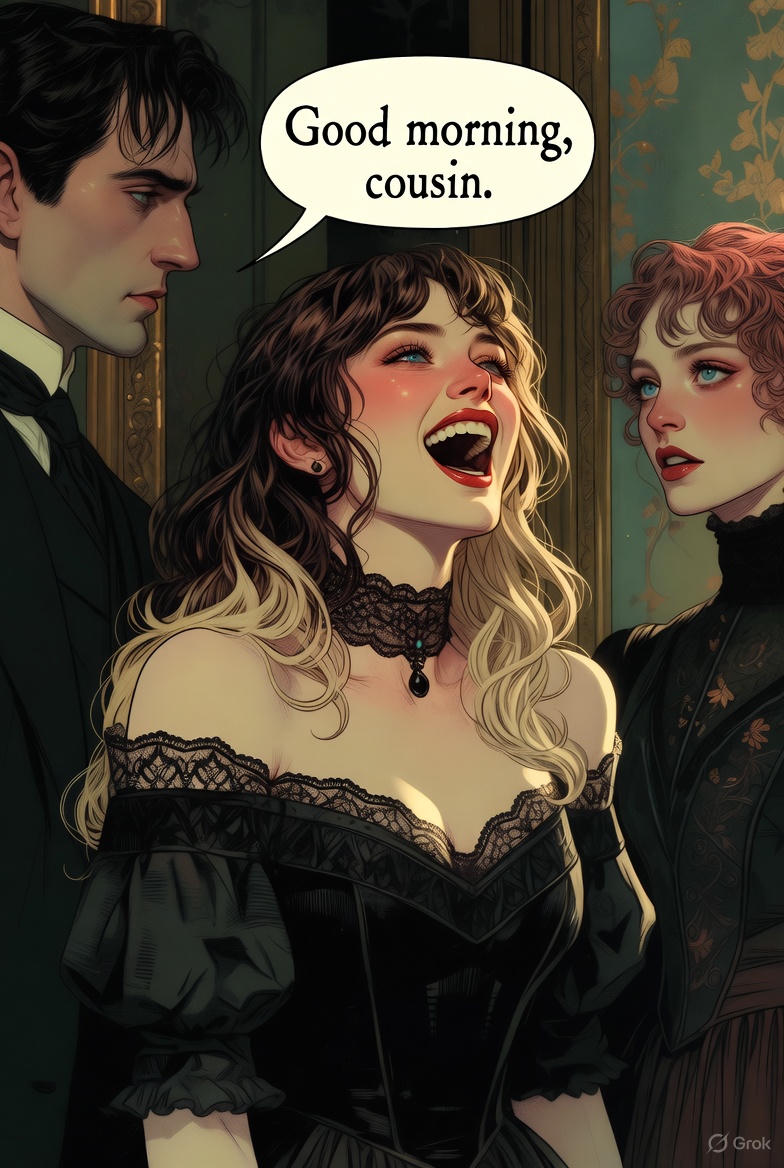
“Good morning, cousin,” laughed Alraune ten Brinken.
She stood right in front of him, next to Frieda Gontram.
“Good morning,” he answered curtly. “Read these letters here–It
won’t do you any harm to think about what you have been the cause
of–It’s time to stop this foolishness, do something sensible, something
worth the effort.”

Read Full Post »

Chapter 21 Tyrone

Somehow Tobal didn’t feel that optimistic about the planned expedition but didn’t have any right or authority to stop them. Perhaps Crow was right. Perhaps the village did need some form of protection. He was feeling moody as he walked away from the group. Becca came with him.

“I’m not very good company right now,” he warned.

“I’ll risk it,” she said.

Neither one said much as they watched the preparations for the three newbies that were going to be initiated that evening and got something to eat. It was so cold windbreaks had been set up around the fires to bounce the heat back. Most people seemed to either stay inside or near the fire pits used for cooking. They ate by one of the cooking pits.

“May I ask something?” He finally said.

“Sure,” Becca answered through a mouthful of tasty stew.

“Why last month?” He asked. “Why did you come to me like that?”

“Was it wrong?” She asked wiping her mouth clean with her hand and looking up at him with those green eyes.

“No,” he whispered. “It was exactly right. I just don’t know if I could have ever come to you that way. I was too messed up or afraid or something.”

“I was afraid too,” she said thoughtfully. “Then when we kissed it was so good and later you gave me that present. Look,” she said. “I’m still wearing it. She pulled the carved owl out from where it had been hiding within her parka. It was Anne that really helped. She read my palm that day and told me I would loose the one I loved unless I acted immediately to keep him from leaving.”

“Really?” He asked curiously. “Where would I have gone?”

“To Fiona,” was her simple reply. “This has been kind of hard on her cause she really likes you too.”

Tobal flushed, “You and Fiona talk about this stuff?”

She put her bowl down and came over to him, pinning him back against a windbreak. She laughed.

“We women talk about everything.”

“Everything?”

“Everything!”

“Well then, I’m going to keep my mouth shut around all of you.”

She set his bowl down and kissed him. “It won’t do any good. We’ll just tell stories then.”

“What kind of stories,” he undid some of the buttons on her parka and reached inside. She gasped in pleasure and their embrace was much longer than the last one. No thought of continuing the conversation. They were lost in the moment and in each other.

“Hey, some of us are trying to eat around here.” Nikki and Fiona had brought their own bowls of stew to eat by the fire.

“Becca, are you saving any for us?” Nikki quipped.

Tobal flushed.

Becca just nuzzled closer, “No, you’ve got to get your own.”

Together all four cleaned the dishes and moved toward the circle where the initiations were about to begin. It was cold and they took up positions next to a windbreak that shielded one of the signal fires. As long as they stayed out of the wind it was all right.

Misty was High Priestess that night and both she and the High Priest wore furs. The circle seemed much smaller than usual. There was a strong wind with drifting snow even in the sheltered valley and no one seemed anxious to dance around the fire clothed or not.

Tobal felt sorry for the new initiates that had to stand blindfolded in such a wind with shortened tunics even if they were right next to the bon fire. To his relief they were wrapped in blankets to prevent over exposure to the bitter cold. In all things safety was the over riding concern of the medics and Masters. Living in harsh conditions made one strong. Being foolish killed you.

They watched together as Nikki’s, Fiona’s, and Becca’s newbies were initiated. Afterward Tobal was introduced to Cheryl, Loki, and Bran, the new initiates.

“If you are not careful we will catch up to you,” Fiona warned. “Cheryl, Loki and Bran make three newbies apiece for each of us. You have only trained one more than us.”

“I know.” Tobal frowned. “Why rub it in?”

The girls laughed and hugged him. “We’re just teasing. Don’t be so serious all the time.”

Tobal had gotten his fourth chevron that morning and was eager to get training. He had tried working on the meditations and exercises Crow had taught him but it had been hard to focus and concentrate alone. His mind drifted to the cave’s glowing altar, where Ron and Rachel’s voices had urged him onward, a stark contrast to the solitude that muddled his focus. Much of the time his thoughts had kept going back to Becca and their growing involvement with each other. Somehow it seemed to push everything else away. He didn’t know what had happened to his self-discipline.

Immediately after circle things were moved inside one of the permanent shelters and continued out of the bad weather. This had happened a few other times during heavy rain but was unusual. Clansmen believed in having circle outside rain or shine, hell or high water. They spent so much time in the elements it didn’t bother them much and they were dressed for it.

They found a warm corner and started to gather. By the time Ellen got there ten people were sitting around waiting to hear what she had learned. Needless to say, Ellen was not happy with everyone knowing about the rogues or about Crow taking an entire group to the village for a visit.

Finally she gave in and sat with them and talked about what she had found out in her research.

“I was able to tap into the city’s data base and look into the historical archives and records.” She began. ” Ron and Rachel Kane were scientists that lived in the city and developed the sanctuary training system.” She looked around the group. “Those are Tobal’s parents, for those of you that don’t already know.”

The look of surprise on a few faces told Tobal that at least a few hadn’t known.

Ellen continued her story. “The sanctuary program was originally a social experiment designed to create a utopian community of specially trained and competent individuals. It was a personality-modifying program to create physically, emotionally and mentally healthy individuals with strong will power and high creative ability. It was highly successful in creating individuals that seemed to be more highly motivated and competent than the norm found within the Federation itself. The graduates showed scores that were mentally, emotionally and physically superior to non-graduates and it was no surprise when the military got involved and the project became classified. Heliopolis became a natural recruiting ground for highly competent leaders and soldiers. It was a city-state devoted to the development of the Ubermench or super human and the main recruiting ground for Federation Special Forces.

As time went on the graduates gained political power within Heliopolis itself and voted for political changes that challenged the values and life styles of the older citizens that had not participated or agreed with the social experiment. The citizenry split along lines that supported the social experiment and those that were against it.”

Here Ellen stopped and said thoughtfully, “There is a saying that old timers never change their minds, they just die off and the younger generation outlives them. That was not the case in Heliopolis. The changes were so fast and radical there was not enough time for mediation. The hostilities and tensions became so great it resulted in a massacre of several students and families living at the main Apprentice gathering spot and the deaths of Ron and Rachel Kane whose bodies were found floating in the lake nearby.”

Ellen broke off from her story to look around at the group. “It seems not only Tobal lost his parents then but Crow lost both parents and Sarah lost her mother. This was not in the official report but in what I have learned personally.”

Sarah was white faced and her fists were tightened. There were murmurs within the group until Crow stopped them.

“Let her finish.”

“These multiple murders created a military emergency and the entire city fell under martial law directed by the Federation and Tobal’s Uncle Harry Kane who was the commander in charge at the time. It was under his command that any of those connected with the murders were eliminated or deported and Heliopolis became a secret classified program controlled by Federation military.”

Tobal started. His uncle had said he was in charge of security, not that he had been Commander in charge of the entire project. There was obviously a lot his uncle had known about and not shared with him.

Ellen continued, “The military created a new program that allowed no children or elderly unless they were physically fit enough to make it through the three degree system. It was simply a system designed to create recruits for the Federation military. The thought was that it created better soldiers.

The city of Heliopolis became a city of the elite ruled by the military, a city of supermen and superwomen if you will. The graduates were still human but something about the training eliminated dysfunctional areas and built strong healthy individuals that could out compete the average person in all areas.

This continued several years until enough data was available to compare the graduates of the sanctuary program with special military forces. It was here that they showed radical differences. The graduates of the sanctuary program did not do well in the normal military. Studies confirmed that military training suppressed the individual and forced conformance to a rigid authoritarian structure that was simply not endurable to the average graduate. The graduates of the sanctuary program were individuals and not team players.

It was at this point the Federation lost much of its interest in the project and turned it back to civilian control. The Federation continued to recruit graduates for field operative positions and kept a mountain complex manned with military personnel for special training. They also agreed to share medical resources with the medics as they needed them.

Ellen stopped and looked around, “That was when the city was granted the right of self government. But only those that had completed the restructured Sanctuary training were considered citizens with the right to vote. They voted to adopt the military’s program in favor of the earlier program run by Ron and Rachel Kane. The earlier program had consisted of the creation of a village with children and old people as an important part of the social research that was going on. There was no more interest in the creation of another ‘village’ in the wilderness. It was felt there were too many ‘Safety’ concerns.

The Citizens of Heliopolis maximized individual qualities under a loose structure of cooperative effort. The city itself gained in political power and influence even as it remained closed to normal trade and commerce. Its citizenry were active in the outer world owning companies and making directives that influenced world politics. They formed an elite pool of superior resources that fought for its own place in world politics. It was whispered that government research continued at the nearby secret mountain complex where Special Ops field agents were trained.”

“The rest was classified and I couldn’t get into it,” Ellen said. She hesitated as if with an internal struggle.

“Our Medic base is part of the secret mountain complex. We are only allowed to use the emergency room and some nearby areas. It is under high security with lots of armed guards. There are field operatives that come and go from the complex all the time. I shouldn’t be telling you this so please keep it to yourselves.”

“Wow,” you’ve certainly given us something to think about,” Rafe shook his head. “This doesn’t sound good to me. There is something wrong, especially if the rogues are really field operatives. Why would field operatives attack us?”

“And attack the Village,” Crow spoke up. “There have been several incidences of villagers being attacked by rogues and we always believed it was clansmen that attacked us. It is beginning to sound like someone wants the clansmen and the villagers to hate each other. Perhaps someone is trying to provoke conflict between us. We need to go to the village and prove we are not attacking them. Too many people have died already.”

“Yeah, and my parents were right in the middle of it,” Tobal said bitterly. “It killed them and it might kill us if we are not careful. He turned to Crow who had been listening intently to Ellen’s story.

“What can you tell us about any of this? It sounds like your grandfather, Howling Wolf was as much in the middle of this as my parents and he is the only one still alive that I know of except Sarah’s father.”

“This is all new to me,” he said. But I will talk with him about it. I will return with any information I feel is important. More than ever I feel there is danger to my village and they need to be warned.”

Tobal was thankful Crow never mentioned the special training on bi-location and the secret meeting place under the waterfall. He was certain that Ellen was too.

“I’m concerned about Apprentices leaving the area and visiting the village.” Ellen told them. “We will be ordered to stop you from going there even though there are no specific guidelines preventing it. Crow seems to have found a loophole in the system only because he is from the village himself and because it is within our area of coverage. Our orders don’t contemplate such unlikely scenarios. You need to travel as fast as you can.”

She continued, “As long as the air sleds continue to monitor your med-alert bracelets you should be alright.” She paused, “That does mean we will need to patrol further to the west then we have in the past,” she looked straight at Crow. “They are going to try to stop you from reaching the village you know.”

“I know,” he said. “It will be alright. Grandfather is expecting us.”

They left things at that and the conversation moved on. The group gradually broke up and began talking about other things. Tobal and Becca stayed together holding hands as they wandered around the group chatting with other clansmen. They slowly made their way to the beer keg where Rafe had rejoined Dirk.

Rafe and Dirk were both still on the beer task force and grumbling because they had twice the beer to brew since the reserves had been consumed at the Yule party last month. Still they were good-natured about it and said they were trying a new recipe that should be quite interesting. It was just as well there was only a small group that month though. They wouldn’t be drinking that much.

Becca hadn’t heard about the special brew Dirk and Rafe were cooking up and didn’t know what to think.

“When will this new beer be ready to drink?” She asked doubtfully.

“Sometime this April probably,” said Dirk chuckling. “Rafe and I both plan on being medics by then. We can administer first aid to anyone that needs it. Pump their stomach or something.”

Tobal snorted and blew beer all over.

“Hey, watch it,” Rafe complained. “It’s not that funny.”

Tobal turned to Dirk, “How did that sure thing match go?”

Dirk turned red, “Not so well.”

“He got his ass kicked.” Rafe chuckled and proudly displayed his own fifth chevron. “Some people actually win once in a while.”

Rafe ducked a playful fist that Dirk threw at him. “Now we get to see who the best man is. We’ve got a bet going on who is going to get their sixth chevron first.”

“You still fighting the girls,” Becca kidded, “or have you gotten to the big boys yet?”

Dirk got a little red but Rafe took it in stride. “I don’t have to worry about it. Everyone is still challenging me. I haven’t gotten to challenge anyone yet.” He grinned at Becca, “I would challenge you if you hurry up and train some more newbies.”

She grinned back. “Perhaps we can always arrange something unofficial.”

This was a side to Becca that Tobal hadn’t really seen before, it interested him and disturbed him at the same time. They filled their mugs and rejoined the crowd. There was a drum circle forming and the sound was deafening in the small building.

Tobal and Becca slept together that night. They cuddled for a long time and shared stories about things that they had done and things they wanted to do. The energy between them was different and when Tobal asked about having sex Becca murmured “not tonight. All I really want to do is just hold you and sleep with you.” Her voice trembled slightly, a hint of vulnerability he hadn’t noticed before, as if the weight of their connection pressed on her too.

With that cryptic answer circling in his brain they kissed, embraced and fell asleep entwined in each other.

The next morning was bright and cold and there were sundogs circling the sun promising even colder weather. They joined their friends for breakfast and soon Becca was on her way to base camp to continue training with Loki, her third newbie and Tobal set out on the trail toward Sanctuary.

As he snow-shoed toward Sanctuary and pulled his sled he wondered at the strangeness of how things had been with him and Becca last night. He had certainly not been prepared for it and didn’t really understand it. It seemed things had been all right, but then again it seemed there had been something wrong.

He hoped she hadn’t changed her mind. Perhaps she was sleeping with Loki, the newbie. He instantly crushed that thought. He knew it was not true, but he just didn’t understand and because he didn’t understand he felt a little hurt. He had been expecting something like last month and it had not happened.

As he neared Sanctuary his thoughts turned to the subject at hand. He now had four chevrons with only two more before he was eligible for the Journeyman degree. As he headed toward sanctuary he felt kind of strange because Sarah had really been the last person he had trained and that had been in September and October.

He didn’t really count Crow since Crow had taught him much more than he had taught Crow. That meant he hadn’t been doing much training in four months and he was determined to get going on it again. He wanted to get this training over with and be partnered with Becca more permanently if she was still interested.

He thought of the ways he had changed in the past years and the things he had done. He had gained a reputation as a very good trainer. None of his students had any trouble soloing and their students didn’t seem to have much trouble either. At gathering and circle people came to him with questions on the best way to do things. His opinion was respected. He was also gaining a reputation as someone that kept to himself and was hard to get to know. His closest friends continued to be Rafe, Crow, Ellen, Sarah, Melanie and now of course Becca. People liked him, his friends liked him, he was companionable but in a quiet sort of way. He didn’t have anything to prove and he didn’t show off. He was just comfortable and at ease with the situation, any situation. People respected that.

Tyrone was Tobal’s fifth trainee and the month of late January and early February went by fairly fast and uneventfully. Tyrone was a tall, wiry farm boy from the Appalachian Mountains of all places, a real honest to God hillbilly complete with a Southern accent and an engaging smile that would drive the girls wild at circle. His drawl carried the scent of pine and coal smoke as he unpacked a worn satchel, a grin breaking through like sunlight on frost. The training came easy to him since he was already an accomplished hunter and trapper.

The nights were long and Tyrone spent many evenings carving a fiddle and later practicing with it. He had learned the skill from his grandfather back home and Tobal watched in fascination at the precision with which the fiddle was created piece by piece and then lashed together and sealed with pitch. He had never seen anything like it and was appalled at the terrible noise it made, at least until he got used to it.

He used to laugh when Tyrone would pull out the fiddle and start to play because the wolves would start howling to keep company. All in all Tyrone was good company and the month went rapidly. Tyrone was a natural storyteller, knew how to make people laugh and Tobal laughed often. Tyrone was like the brother Tobal had always wanted.

Once Tobal asked him how he had heard of “Heliopolis” way in hillbilly country and Tye had thrown back his head and laughed and laughed. He stretched his long legs and shrugged.

“I never heard of it before,” he admitted. “I was trying for a city named Minneapolis and got my ticket wrong. My head never was that good with names. I knew it was cold there and didn’t give it much thought until we had to start hunting our own meat and making our own clothes. It was so much like back home that I figured something was wrong but thought I’d study on it for awhile.”

Tobal had been drinking tea and it exploded from his mouth and nose as he doubled up in laughter.

“Stop, You’re killing me,” he waved weakly at Tyrone who was doubled over laughing too.

There were melancholy times when Tobal thought back over the past year and how much he had changed. He was more resourceful and inclined to do things by himself or on his own. He didn’t care much about what other people thought. He had learned to judge people not by their appearances, but by what they did and even as important by what they didn’t do.

Almost in spite of himself he found his feelings about Becca were deepening. She down played what she did and seemed to have a quiet competence that went un-remarked. She had just a hint of melancholy that matched his own. There was an emotion in his heart that stirred and sang when he was around her. As spring drew closer he found himself thinking about her more and knew he was in love.

Late February came around as Tobal and Tyrone snowshoed their way to the gathering spot. He dropped Tyrone off with the guards to be prepared for his initiation. There were going to be three initiations that night.

Nikki had proclaimed her newbie, Bran, as ready to solo and he, along with Loki and Cheryl had been examined and approved to solo by the elders. Nikki was ecstatic because the winter training had gone pretty well. She was looking forward to training her next newbie.

“Hey Tobal,” she asked, “Think I can get my six trained by mid summer? This winter training isn’t really that bad.”

“That might be cutting it kind of close,” he considered, “but go for it. I’m hoping to get mine done by May if I can.”

“By May?”

“Yeah, when the weather gets warmer I can speed the training up a bit. Or at least I hope I can. Next month will be one year for me. Rafe was finished in one year. I thought I could too, but I don’t think I will be able to.”

“It’s more important to do a good job and teach properly than get done quickly,” she said.

He nodded, “I did need to spend some extra time before winter with Fiona and Sarah. I will just see how the last one goes.”

“See you later at circle?”

“Sure,” I’ll probably be with Becca if I can find her.”

He waved and headed for the food area. A quick lunch seemed in order and then helping out with some of the shelters. There were a lot more people this month and the weather was milder even though the snow was deeper.

There were some minor frostbite cases for the medics to treat but not as many as last month. It seemed people were learning they had to be careful. On the down side one of the clansmen had fallen through the ice on one of the creeks. He had managed to get out but not been able to get a fire going. He had frozen to death before the medics got to him. Angel had found him and been unable to help. It was already too late. Angel’s tear-streaked face lingered in Tobal’s mind, a silent echo of the Wild’s harsh lessons, stirring a quiet resolve to honor the fallen.

The incident served to remind everyone just how fragile and dangerous it really was in the wilderness even with all the safeguards that were in place. The death put a damper on things and people were quiet. Tobal’s thoughts flickered to Ellen’s words about the mountain complex, wondering if the rogues’ shadow stretched even here, a chill beyond the frost.

Read Full Post »

Homo Sapiens: In the Maelstrom by Stanislaw Przybyszewski and translated by Joe E Bandel

XV.

Falk pressed himself even tighter against the wall. He sat on the sofa. The room was completely dark. Fear seized him: he heard voices in the corridor. He listened. 

“The gracious lady left with the boy today. The gentleman has been sitting in his room all day. He is probably sick. He wants nothing to eat, and does not answer.” 

He heard knocking again. 

He did not move. But then he saw the door being opened, a broad strip of light fell into the room, then it became dark again. The door closed. 

“Falk!” he heard Olga call. “Pst—quiet, quiet!” 

“Where are you?” “Here.” 

She groped her way to him. 

“What are you doing?” she asked frightened. “Someone died.” 

“Who?” 

“She, she… Just sit here… here…” “What do you have in your hand?” she asked. 

“A letter from her. She is gone. Never coming back. So she is dead.” 

They sat very long and held each other’s hands. 

The mysterious silence, the darkness confused her head. “Are you mad?” she asked anxiously and softly. 

“Now it is over, but I was.” They were silent again very long. 

“It is good that you came. I would have gone mad today.” He breathed relieved. 

“And now what?” 

He did not answer. She did not dare to ask further. 

After a long time she wanted to ask him again, then she noticed that he was sleeping. 

She did not dare to move, for fear of waking him. Even in sleep he held her hand tight. 

So an endless time passed. Suddenly he sat up. 

“I will perhaps go to Czerski. Will you come with?” “Yes.” 

“Vive l’humanité,” he giggled softly and cheerfully. 

The End

Kongsvinger (Norway).

Read Full Post »

Alraune by Hanns Heinz Ewers and translated by Joe E Bandel

Chapter Thirteen
Mentions how Princess Wolkonski told Alraune the truth.

LEGAL Councilor Gontram wrote the princess, who was in
Naulhiem undergoing medical treatment. He described the
situation to her. It took some time until she finally
understood what it was really all about.
Frieda Gontram, herself, took great pains to make sure the
princess comprehended everything. At first she only laughed, then she
became thoughtful, and toward the end she lamented and screamed.
When her daughter entered the room she threw her arms around her
neck wailing.
“Poor child,” she howled. “We are beggars. We will be living on
the streets!”
Then she poured heaps of caustic Eastern wrath over his dead
Excellency, sparing no obscene swear words.
“It’s not entirely that bad,” Frieda objected. “You will still have
your villa in Bonn and your little castle on the Rhine, also the
proceeds from your Hungarian vineyards. Then Olga will have her
Russian pension and–”
“One can’t live on that!” the old princess interrupted. “We will
starve to death!”
“We must try to change the Fräulein’s mind,” Frieda said, “like
father advises us!”
“He is an ass,” she cried. “An old scoundrel! He is in league with
the Privy Councilor, who has stolen from us! It was only through him
that I ever met that ugly swindler.”
She thought that all men were imposters, cheats and scoundrels.
She had still never met one that was any different. Take Olga’s
husband for example, that clean cut Count Abrantes–Hadn’t he
carried on the entire time with dirty music hall women, taking all of
her money that he could? Now he was living with a circus bareback
rider because the Privy Councilor had put his thumb down and
refused to give him any more–
“In that, his Excellency did do some good!” said the countess.
“Good!” screamed her mother–as if it didn’t matter who had
stolen the money!
“They are swine, the one just as much as the other.”
But she did see that they had to make an attempt. She wanted to
go herself, yet the other two talked her out of it. If she went there she
would certainly not achieve much more than the gentlemen from the
bank.
They had to proceed very diplomatically, declared Frieda, take
into consideration the moods and caprices of the Fräulein. She would
go by herself, that would be best. Olga thought it would be even better
if she went. The old princess objected, but Frieda declared it would
certainly not be very good if she interrupted her medical treatments
and got too excited. She could see that.
So both friends agreed and traveled together. The princess stayed
at the spa, but was not idle. She went to the priest, ordered a hundred
masses for the poor soul of the Privy Councilor.
“That is the Christian thing to do,” she thought and since her
deceased husband was Russian Orthodox, she went to the Russian
chapel and paid that priest for a hundred masses as well. That calmed
her very much.
At one point she thought it would scarcely be of any use because
his Excellency had been protestant and a free thinker as well. But then
it would count as an especially good work in her favor.
“Bless them that curse you.” “Love your enemies.” “Do unto
others as you would have them do unto you.”
Oh, they must surely recognize such things up there, and twice a
day in her prayers, she spoke a special plea for his Excellency–with
very intense fervor. In this way she bribed the love of God.
Frank Braun received the two ladies at Lendenich, led them up to
the terrace and chatted with them about old times.
“Try your luck, children,” he said. “My talking was of no use!”
“What did she say to you?” asked Frieda Gontram.
“Not much,” he laughed. “She didn’t even listen to all of it. She
made a deep curtsy and declared with a devilish grin that she
completely treasured the high honor of my guardianship and would
not even consider ending it for the sake of the princess. She added
that she did not wish to speak of it again. Then she curtsied again,
even more deeply, even more respectfully–and she disappeared!”
“Haven’t you made a second attempt?” asked the countess.
“No, Olga,” he said. “I must now leave that to you–her look as
she left was so determined that I am solidly convinced all my
persuasive skills would be just as unfruitful as that of the other
gentlemen.”
He stood up, rang for the servant to bring some tea.
“By the way, you ladies just might have a chance,” he continued.
“A half hour after the Legal Councilor called giving notice of your
arrival I told my cousin that you would be coming and why. I was
afraid she would not receive you at all and in any case wanted you to
have a chance.
But I was wrong. She declared that you were both very welcome,
that for months now she has been in very active correspondence with
both of you–that is why–”
Frieda Gontram interrupted him.
“You wrote to her?” she cried sharply.
Countess Olga stammered, “I–I–have written her a couple of
times–to offer my condolences–and–and–”
“You lie!” Frieda cried.
The countess sprang up at that, “What about you? Don’t you
write her? I knew that you were doing it, every two days you write to
her. That’s why you are always alone in your room for so long.”
“You’ve had the chambermaid spy on me!” Frieda accused.
The glares of the two friends crossed each other, throwing a
burning hate that was sharper than words. They understood each other
completely.
For the first time the countess felt that she was not going to do
what her friend requested and Frieda Gontram sensed this first
resistance against her authority.
But they were bound through long years of their lives, through so
many common memories–that it couldn’t be extinguished in an
instant.
Frank Braun noticed right away.
“I’m disturbing you,” he said. “By the way, Alraune will be
coming soon. She just wanted to get ready.”
He went to the garden stairs, then gave his regards.
“I will see you ladies again later.”
The friends said nothing. Olga sat in a cane easy chair. Frieda
paced up and down with large strides. Then she stopped and stood
right in front of her friend.
“Listen Olga,” she said softly. “I have always helped you, when
we were serious and when we were playing, through all of your
adventures and love affairs. Isn’t that true?”
The countess nodded, “Yes, but I have done exactly the same
thing for you, not any less.”
“As well as you could,” spoke Frieda Gontram. “I will gladly
admit it–we want to remain friends then?”
“Certainly!” cried Countess Olga. “Only–only–I’m not asking
that much!”
“What are you asking?” inquired the other.
She answered, “Don’t put any obstacles in my way!”
“Obstacles?” Frieda returned. “Obstacles to what? Each of us
should try our luck–like I already told you at the Candlemas ball!”
“No,” insisted the countess. “I don’t want to compete any more.
I’ve competed with you so often–and always drawn the short straw. It
is unequal–for that reason you will withdraw this time, if you love
me.”
“Why is it unequal?” cried Frieda Gontram. “It’s even in your
favor–you are more beautiful!”
“Yes,” her friend replied. “But that is nothing. You are more
clever and I have often learned through experience how that is worth
more–in these things.”
Frieda Gontram took her hand.
“Come Olga, she said, flattering her. “Be reasonable. We are not
here just because of our feelings–listen to me. If I can succeed in
getting the little Fräulein to change her mind, if I can save those
millions for you and your mother–will you then give me a free hand?–
Go into the garden, leave me alone with her.”
Large tears marched out of the eyes of the countess.
“I can’t,” she whispered. “Let me speak with her. I will gladly
give you the money–this is only a sudden whim of yours.”
Frieda sighed out loud, threw herself into the chaise lounge, sank
her slender fingers deeply into the silk cushions.
“A whim?–Do you believe I would make such a fuss over a
whim?–With me, I’m afraid, it appears to be not much different than
it is with you!”
Her features appeared rigid; her clear eyes stared out into
emptiness.
Olga looked at her, sprang up, knelt down in front of her friend,
who bowed her head down low over her. Their hands found each
other and they tightly pressed themselves against each other, their
tears quietly mingled together.
“What should we do?” asked the Countess.
“Withdraw!” said Frieda Gontram sharply. “Withdraw–both of
us–let what happens, happen!”
Countess Olga nodded, pressing herself tightly against her friend.
“Stand up,” whispered the other. “Here she comes. Quick, dry
your tears–here, take my handkerchief.”
Olga obeyed, went across to the other side.
But Alraune ten Brinken saw very clearly what had just
happened. She stood in the large doorway, in black tights like the
merry prince from “The Fledermaus”. She gave a short bow, greeted
them and kissed the hands of the ladies.
“Don’t cry, it makes your beautiful little eyes cloudy.”
She clapped her hands together, called for the servant to bring
some champagne. She, herself, filled the goblets, handed them to the
ladies and urged them to drink.
“It is the custom here,” she trilled. “Each to their own taste.”
She led Countess Olga to a chaise lounge and caressed her entire
arm. Then she sat down next to Frieda and gave her a slow, smiling
glance. She stayed in her role, offered cakes and petit fours, poured
drops of Peáu d’Espagne out of her golden vial onto the ladies
handkerchiefs.
Then she began, “Yes, it’s true. It is very sad that I can’t help
you. I’m so sorry.”
Frieda Gontram straightened up, opened her lips with great
difficulty.
“And why not?” she asked.
“I have no reason at all,” answered Alraune. “Really none at
all!–I simply don’t want to–that is all.”
She turned to the Countess, “Do you believe your Mama will
suffer very much because of that?”
She stressed the “very”–and in doing so, her voice twittered
sweet and cruel at the same time like a swallow on the hunt. The
countess trembled under her gaze.
“Oh, no!” she said. “Not that much.
And she repeated Frieda’s words–
“She will still have her villa in Bonn and the little castle on the
Rhine. Then there were the proceeds from the Hungarian vineyards. I
also have my Russian pension and–”
She stopped, didn’t know any more. She had no concept of her
financial standing, scarcely knew what money was, only that you
could go into beautiful shops and buy things with it, hats and other
pretty things. There would be more than enough to do that.

Read Full Post »

Older Posts »