Feeds:
Posts
Comments

Archive for October, 2025

Chapter 28: Indigenous Traditions – Global Echoes of Organic Gnosticism

Historical Overview: Indigenous Wisdom and the Universal Thread of Duality

Across the globe, indigenous traditions have preserved organic gnosticism’s life-affirming, gender-balanced spirituality, echoing the loving duality of Gaia’s native inhabitants from Neolithic times (Ch. 1) to the present. These traditions, spanning Native American, Aboriginal, Maori, and other cultures, maintained heart-centered practices that wove male and female energies for soul development, resisting patriarchal suppressions by social enforcers (death-centric traditionalists) and rational atheists (logic-driven materialists). Unlike the Church’s head-centric dogma (Ch. 10, 14) or scholastic logic (Ch. 16), indigenous wisdom, rooted in oral traditions and communal rituals, celebrated the body as a temple, akin to Bogomil and Cathar teachings (Ch. 19, 21).

In Native American cultures, two-spirit roles—like the Lakota wíŋkte (Lakota Nation, pre-colonial to present) or Navajo nádleehí (circa 1000 CE onward)—embodied gender balance, serving as shamans, healers, and mediators, as documented in ethnographic records (e.g., Walter Williams, The Spirit and the Flesh, 1986). Maori takatāpui (New Zealand, pre-colonial) and Aboriginal tjilimi (women’s sacred spaces, Australia, circa 40,000 BCE onward) similarly honored dual energies, weaving spiritual and physical realms through vision quests and ceremonies. These practices, often suppressed by colonial Christianity (16th–19th centuries CE), paralleled Tantric traditions (Ch. 5, 13) and courtly love’s chaste unions (Ch. 22–24), emphasizing love and balance over ascetic denial.

The Church’s expansion, from the Albigensian Crusade (Ch. 20) to colonial missions, branded indigenous practices as demonic, mirroring accusations against Bogomils and Cathars (Ch. 10, 19). Yet, oral traditions—like Lakota Sun Dance or Maori haka—preserved soul-weaving wisdom, resisting literacy’s elite control (Ch. 2). Recent revitalization efforts (e.g., Native American Church, 19th century onward) echo organic gnosticism’s resilience, akin to Rosicrucianism’s alchemical revival (Ch. 26).

Mystery School Teachings: Two-Spirit Wisdom and Tantric Resonance

Indigenous mystery schools, like those of the Lakota, Navajo, Maori, and Aboriginal peoples, taught the soul as a watcher self (Ch. 2), woven through balanced male-female energies, mirroring organic gnosticism’s Tantric duality (Ch. 5). Two-spirit shamans, embodying both genders, facilitated rituals—Lakota vision quests (hanbleceya), Navajo Blessingway ceremonies—that integrated physical (body) and spiritual (aura) for soul growth, as in Bogomil mystical materialism (Ch. 21). These practices, often involving dance, song, and sacred plants (e.g., peyote in Native American Church), echoed Tantric energy weaving and courtly love’s chaste tension (Ch. 22–24), rejecting Church notions of sin (Ch. 10).

Unlike social enforcers’ asceticism (Ch. 7) or rational atheists’ logic (Ch. 9), indigenous traditions saw the body as Gaia’s temple, with sexuality and nature as sacred, akin to Cathar covens (Ch. 19). Maori takatāpui, for example, bridged male-female roles in whakairo (carving) rituals, weaving timelines, while Aboriginal tjilimi ceremonies honored women’s womb-like creation power, resonating with the Holy Grail (Ch. 8). Colonial suppression (e.g., Indian Act, Canada, 1876) disrupted these, but oral traditions preserved them, as seen in modern indigenous revivals.

OAK Ties and Practical Rituals: Weaving Global Resonance for Gaia’s Ascension

In the OAK Matrix, indigenous traditions align with true Ego resonance (Intro, Individual), weaving Shadow (primal energies, Radon, Ch. 26, Magus) and Holy Guardian Angel (cosmic harmony, Krypton, Ch. 24) in Oganesson’s womb (Ch. 20). Their Tantric-like duality mirrors resonant circuits (Ch. 13), creating watcher selves through chaos leaps (Ch. 11), countering social enforcers’ asceticism and rational atheists’ logic. This resonates with Ipsissimus unity (Ch. 10) and Adeptus Exemptus compassion (Ch. 7), with the Holy Grail as womb (Ch. 8) empowering Gaia’s ascension (Ch. 4), as in your radiant portal vision (August 17, 2025).

Practical rituals weave this:

  • Oak Grail Invocation (Start of Each Ritual): Touch oak bark, affirming: “Roots in Gaia, branches in Source, I unite duality’s embrace.”
  • Two-Spirit Weave Meditation (Daily, 15 minutes): Visualize indigenous two-spirit shamans weaving male-female energies. Journal refused Shadow (e.g., colonial repression) and aspired HGA (e.g., balanced harmony). Merge in Oganesson’s womb, affirming: “I weave Gaia’s global soul.” Tie to Lakota wíŋkte: Inhale unity, exhale division.
  • Gaia Vision Quest Ritual (Weekly): By an oak, invoke Gaia’s pulse, offering sage or tobacco for indigenous wisdom. Visualize Tantric union (male lightning, female womb, Ch. 8), weaving soul timelines. Affirm: “I rebirth Gaia’s spark, honoring two-spirit balance.” Echoes Navajo Blessingway.
  • Partner Harmony Weave: With a partner, discuss indigenous duality. Men: Share expansive visions; women: Grounding acts. Build non-physical energy via breath or eye contact, visualizing Tantric union (Ch. 5) for soul growth. Solo: Balance enforcer asceticism and atheist logic in Gaia’s heart.

These empower organic gnostics to weave global resonance, ascending Gaia’s soul. Next, explore modern esoteric revivals, continuing this legacy.

Read Full Post »

Homo Sapiens: Under Way by Stanislaw Przybyszewski and translated by Joe E Bandel

IX.

Falk walked.

He stopped on the path.

Shouldn’t he turn back, take her in his hands and carry her up to her room?

Yes: beg her, only be allowed to kneel before her bed, stammer wild prayers together with her!

Suddenly he examined himself whether this was really an insurmountable desire in him or only the intention to give Marit new suggestions of his great passion.

Yes: did he really have this desire? Or was it even only an autosuggestion?

He examined himself and examined, but he really couldn’t distinguish. He had devised so many plans of how he could conquer her, spoken so many words to himself, fabricated and lied so many feelings, that he could no longer distinguish what was real about it and what—hm, yes, how should he call it—was artificial growth.

The suggestions with which he wanted to influence her became realities, or at least took the forms of real feelings. The words that he had earlier invented with his brain now received sexual warmth: he had played feelings so often until he actually generated them in himself.

It seemed to him as if certain brain regions had created a new blood circulation for themselves. Why then did his heart go into these throbbings when he now repeated love words that he had earlier spoken coldly a hundred times without the slightest trace of spiritual excitement?

Falk lost himself in psychological investigations about the form of a love generated by autosuggestion.

He thought about how he would describe it. Yes, he could think of nothing else, he had to calm his brain.

So: he had an assignment from a psychological journal, yes. *Journal for Scientific Psychology*. How would he now make it clear?

Well: a frequently repeated, in the brain repeated state has linked itself with new blood vessels, acted on them so long that a regular blood circulation arose, and thus the thought-state became a sensual state.

Yes so; that would probably be correct. A sensual effect was generated through pure thought-suggestion.

He heard a carriage roll past close to him. Lanterns burned on the sides, and he saw how the carriage turned at a sharp road curve. Then he saw only the lights move on in rapid course; he followed them until they disappeared in the woods. Involuntarily he had to think of the peat cutter’s will-o’-the-wisps.

Then he looked around. There lay Marit’s house. Yes, he could go in. Perhaps she expected him. Perhaps she would be very happy if he appeared so suddenly now. Perhaps she was walking in the park to cool off. Or had gone to the lake to sit on the big stone where they both had sat together so often, yes; right by the ditch, by the ravine, where the ground all around was so deeply torn open.

Strange this ravine; could it perhaps be an old riverbed? Now he walked; stopped; walked again. His brain was very fatigued;

and yet this peculiar tendency to brood! Again he thought of the psychological essay.

No, that could probably be better used for a novella. So: the man has this autosuggestive love. Bien, good! But now he also has a real love beside it, which he constantly feels, yes quite as one feels a sick organ in one’s body.

So he loves simultaneously, that means he loves both. Only: the one first entered the individual and later the brain, the other took the reverse path, and the eternal in our hero gradually begins to react violently.

Yes, Falk felt clearly how it reacted; but at the same time he felt a great, sated tiredness.

Now Marit was completely indifferent to him again; only a foretaste of sex, and he was already sated.

Tomorrow of course a reintegration would occur; but it was an undeniable fact that he felt sated this evening, yes, this evening of April 28.

So he didn’t love Marit, for he had never felt this with his wife. No; never.

Yes, and the whole time after the embrace just now: He had clearly felt how a kind of hatred, shame, yes, shame, like after a crime, shame before himself and before her, waved back and forth between them.

Was it happiness? No!

Was it pain?

Yes, certainly: Pain and shame! But the real, the non-suggested love, the love that arises because it must arise, the love that has no brain, no thinking organ, only two heart-sacks and an aorta, this love knows no shame.

No, certainly not! He thought of his love affair with his wife. They took each other because they had to take each other, and were happy. – So what is it?

Yes, what is it?

Well, please, Herr Erik Falk: You are accused and accuser at once. You are Herr Falk and Herr X.

So, Herr X, you accuse me that I seduced a girl and thus destroyed her.

Now listen: You are an intelligent man, and I can drive up before you with an arsenal of reasons.

So: *Hors la méthode point de salut*. Methodically and systematically, Herr X!

*Primo* arose in me the suggestion that I must possess this girl. Since a similar suggestion never arose in me before, I must say: This suggestion is extraordinary, and consequently deserves quite special attention.

Falk pedantically examined whether he hadn’t specified something exactly enough.

Yes, so it is an extraordinary suggestion. How it arose, I don’t know. For I can name a thousand things that may have generated it; I sometimes name them too, but I know that my brain lies to me, that I am so to speak the cuckold of my brain, and so I say: the origin of this suggestion I don’t know. I can only recognize its character: it is a sexual suggestion. It was that from the beginning…

Falk thought of a series of feeling-experiences that lay in this direction.

First on the third day of their acquaintance: She had been to the station to throw an urgent letter into the train’s mailbox. He had met her in the city, yes, at the corner house where the watchmaker lives. She became embarrassed and he too. Why did he become embarrassed? He had immediately asked himself astonished. Then he accompanied her and spoke much; yes, what did he speak about exactly? Right, about religion.

‘Halt, there lies an important argument!’

Herr X, please, can you tell me why right from the beginning, without a clear consciousness of the final purpose, I fixated on destroying her religious dogmas?

Yes, please very much, you know me and know that it is absolutely indifferent to me whether a person believes or not. You also know that I rarely speak of my ideas because I consider it unrefined to force suggestions.

Now look, Herr X, before I was conscious of it, my sex already worked in me with consistent logic and argued thus: As long as she has religion, I will never possess her, consequently the religious in her is the first and most important point of attack.

You can really believe me, Herr X, I can assure you that I didn’t think for a moment of possessing the girl before I heard the voice of the blood on that day.

Look, it was right at the cemetery, close under the birch tree whose branches hang over the fence, there I suddenly noticed—something personal may have come into my speech—that my voice got a strange tendency to tip into whispering, into confidential murmuring, and then I felt a peculiar glow around my eyes, and the skin under the eyes I felt lay in little wrinkles, whereby the expression of my eyes gets something faun-like.

I felt this last clearly because I first saw these wrinkles on my father when he fell in love with our governess. Then I completely forgot them, until suddenly three years ago in a kind of vision I saw them clearly before me again. Since then I always think of them.

Yes, now I knew definitely: it is sex.

And now it grew in me and grew incessantly and gave me no rest, and now I must; yes, I must! why? I don’t know.

Yes, yes, I know you, Herr X: The topic interests you. You want to make your wisdom shine, solve the question and substantiate with reasons.

*Bien*; is good. For I can argue as follows: The woman’s period is dependent on the influence of the moon.

How so? you will ask astonished.

Listen then. The first living being was a sea creature; the moon is known to have a great influence on water, and naturally the influence that acts on the medium will also extend to the living being that lives in this medium. The living being now bequeaths this regularly recurring influence to its descendants as a fully organized property: *quod erat demonstrandum*.

Yes, good, very good. I know that you by no means need to drag such distant reasons… ‘by the hair’ you say? well good, so don’t need to drag by the hair; but even the nearest reasons have the same value.

Falk turned around. It seemed to him as if he heard the editor grinning behind his back: So in the end you believe in the fourth dimension?

‘Yes, you know, Herr Editor, you are a man of positive ideas and positive life course. You are a rationalist and materialist. I honor you and value you very highly; but as long as you can’t prove to me the non-existence of three beings between Us Two—”Us” capitalized because we value each other mutually—yes, as long as you can’t prove that, I also won’t stop admitting the possibility of such a dimension. Because you don’t see it, nor smell, nor hear it? Well, that’s no proof. For one can have a hundred senses in latent state that will later develop in the human race. Do you know, for example, that recently a new sense was found that is titled organ-sense?

Read Full Post »

Madame Bluebeard by Karl Hans Strobl and translated by Joe E Bandel

“Before, I was a worker in the Simplon Tunnel.”
“Not bad, but grueling.”
“One must do something for one’s health.”
“You made a dazzling entrance yesterday. You’re
the darling of Abbazia’s young ladies. If the fervor
grows, you’ll get a torchlight parade tonight. That
lasso throw was magnificent.”
“Why else would I have spent two years in South
America if not to learn such tricks?”
Hugo settled at the small table between the
petrified rolls, tipping his chair on two legs toward
Boschan, arm draped over his friend’s seat. “Listen,”
he said, “you owe me a favor. You won’t refuse me
in the joy of our reunion. You’re moved, I can see it.
How long has it been? Shameful, isn’t it? Not even a
postcard from the Himalayas.”
“It must be something dire you want,” Ruprecht
said, “with such a preamble.”
“Don’t say no, don’t break your friend’s hopeful
heart. Here’s the deal: I’m organizing an Emperor’s
celebration tomorrow, August 18. Can’t skip it. If I
don’t do it, someone else will. Better me, since I’ve
got taste. Big program: Isolde Lenz will sing, Bergler
will sing, Walterskirchen will play. I’ve got a court
concertmaster too. Andresen from the Burgtheater
will recite modern poems. A retired general will play
flute, thinking he owes it to Frederick the Great’s
memory, as fine a soldier as he. But this program
lacks a cornerstone.”
“I’m the cornerstone?”
“Yes! The World-Tree Ygdrasil of my program.
Peter, the rock on which… and so forth. Please, no
refusals. The other acts are solid, but you’re
something unique, a rare spectacle. I’d be a poor
planner to let you slip.”
“I’m not keen, my dear.”
Ernst Hugo laid a hand on Ruprecht’s knee,
overflowing with charm, dripping eloquence,
weaving wreaths of flattery. “I won’t let you go till
you bless me. If you’re stumped on what to do, I’ll
tell them about your Himalayan treks or whatever.
Just take the stage. Success is guaranteed. I promise
every girl and young woman will fall for you.”
“You know that doesn’t tempt me. Women are
usually dull.”
“Still an ascetic desert saint? Still St. Anthony
resisting all temptations?”
“Ridiculous—you don’t think I practice
abstinence for glory. I had a serious affair with a
Japanese girl for a while. And as a Simplon Tunnel
worker, I lived with an Italian woman, fighting knife
duels over her every other day. That’s something. But
your society ladies…! You must slog through flirting
first. Flirting’s endlessly tedious.”
“If women won’t sway you, do it for me. Years
apart, we finally meet, and I’m shamed if my friend
denies a small request. Truly, it’s an insult.”
“Would it really mean so much if I agree?”
“An extraordinary favor.” Hugo paused, eyeing a
woman passing below on the promenade. He leaned
over the balustrade, clearly trying to catch her notice.
“A regal woman,” he murmured, “look at that attire.
A little Paris on her. Good Lord! Know her?”
“No,” Boschan said, finishing his morning cognac.
“She’s a widow, fabulously rich. Half Abbazia’s
in love with her. Born to conquer, her specialty’s the
demonic, or so say those lucky enough to know her.
I’m not among them yet. But back to business: you’d
do me a huge favor by joining. There’s a
Statthaltereirat from Graz with big ambitions, my
serious rival. He nearly beat me to hosting the
celebration. You’ll see, that won’t do. I’m up for
promotion. Patriotic efforts impress higher-ups. So I
outmaneuvered him. But he’ll be a harsh critic. If it’s
not tip-top, he’ll flash his ironic smile… make witty
jabs… that sarcastic fool!”
Before Ruprecht’s eyes, the sea spun, rising in the
sun’s climbing glare, shimmering like a vast
turquoise, magically binding souls, drawing them in,
dissolving petty drives and miseries into great joy.
But this planner of patriotic fêtes felt none of it.
Ruprecht leaned against a pillar, turning from Hugo.
“What a dire conflict,” he said, “what a dramatic
tangle! Oh, clashing forces—a struggle for lofty
prizes! And all the while, you have the sea before
you, in its full splendor, blessed by its beauty.”
“How do you mean?” Hugo asked, fixing his
water-blue eyes on the sea in surprise.
“Well—you’ve invoked our friendship. I suppose
I must help you skewer this hostile Statthaltereirat.”

Read Full Post »

Chapter Two
Explains how the idea for Alraune came about.
THE sun had already set and the candles were burning on the
chandelier in the Festival room as Privy Councilor ten
Brinken entered. He appeared festive enough in his dress
suit. There was a large star on his white vest and a gold
chain in the buttonhole from which twenty small medals dangled.
The Legal Councilor stood up, greeted him, and then he and the
old gentleman went around the room with threadbare smiles, saying
kind words to everyone. They stopped in front of the celebrating girls
and the old gentleman took two gold rings out of a beautiful leather
case and formally presented them. The one with a sapphire was for
blond Frieda and the ruby was for dark Olga. Then he gave a very
wise speech to both of them.
“Would you like to sit for a spell?” asked Herr Sebastian
Gontram. “We’ve been sitting over there for four hours. Seventeen
courses! Isn’t that something! Here is the menu, is there anything you
would like?”
The Privy Councilor thanked him, but he had already eaten.
Then Frau Gontram came into the room in a blue, somewhat old-
fashioned silk gown with a train. Her hair was done up high.
“I can’t eat anymore ice cream,” she cried. “Prince Puckler had
Billa put all of it on the cinnamon noodles!”
The guests laughed. They never knew what to expect in the
Gontram house.
Attorney Manasse cried, “Bring the dish in here! We haven’t
seen Prince Puckler or fresh cinnamon noodles all day!”
Privy Councilor ten Brinken looked around for a chair. He was a
small man, smooth shaven, with thick watery bags under his eyes. He
was repulsive enough with swollen hanging lips, a huge meaty nose,
and the lid of his left eye drooped heavy but the right stood wide
open, squinting around in a predatory manner. Someone behind him
said:
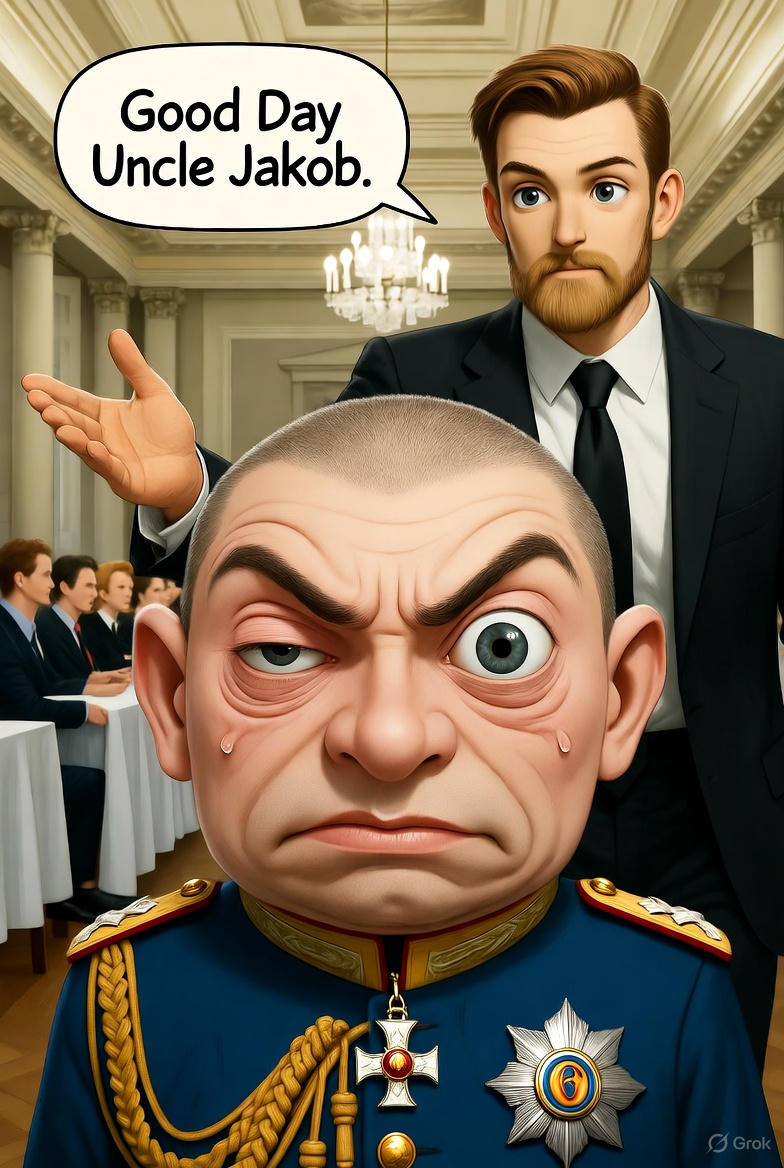
“Good Day Uncle Jakob.”
It was Frank Braun. The Privy Councilor turned around; it was
very unusual to see his nephew here.
“You’re here?” he asked. “I can only imagine why.”
The student laughed, “Naturally! But you are so wise uncle. You
look good by the way, and very official, like a university professor in
proud dress uniform with all your medals. I’m here incognito–over
there with the other students stuck at the west table.”
“That just proves your twisted thinking, where else would you be
sitting?” his uncle said. “When you once–”
“Yes, yes,” Frank Braun interrupted him. “When I finally get as
old as you, then I will be permitted–and so on–That’s what you would
tell me, isn’t it? All heaven be praised that I’m not yet twenty Uncle
Jakob. I like it this way much better.”
The Privy Councilor sat down. “Much better? I can believe that.
In the fourth Semester and doing nothing but fighting, drinking,
fencing, riding, loving and making poor grades! I wrote your mother
about the grades the university gave you. Tell me youngster, just what
are you doing in college anyway?”
The student filled two glasses, “Here Uncle Jakob, drink, then
your suffering will be lighter! Well, I’ve been in several classes
already, not just one, but an entire series of classes. Now I’ve left and
I’m not going back.”
“Prosit!”
“Prosit!” The Privy Councilor said. “Have you finished?”
“Finished?” Frank Braun laughed. “I’m much more than
finished. I’m overflowing! I’m done with college and I’m done with
the Law. I’m going to travel. Why should I be in college? It’s possible
that the other students can learn from you professors but their brains
must then comply with your methods. My brain will not comply. I
find every single one of you unbelievably foolish, boring and stupid.”
The professor took a long look at him.
“You are immensely arrogant, my dear boy,” he said quietly.
“Really?” The student leaned back, put one leg over the other.
“Really? I scarcely believe that. But if so, it doesn’t really matter. I
know what I’m doing. First, I’m saying this to annoy you a bit–You
look so funny when you are annoyed, second, to hear back from you
that I’m right.
For example, you, uncle, are certainly a shrewd old fox, very
intelligent, clever and you know a multitude of things–But in college
weren’t you just as insufferable as the rest of your respected
colleagues? Didn’t you at one time or another say to yourself that you
wanted to perhaps just have some fun?”
“Me? Most certainly not!” the professor said. “But that is
something else. When you once–Well, ok, you know already–Now
tell me boy, where in all the world will you go from here? Your
mother will not like to hear that you are not coming home.”
“Very well,” cried Frank Braun. “I will answer you.”
“But first, why have you have rented this house to Gontram? He
is certainly not a person that does things by the book. Still, it is
always good when you can have someone like that from time to time.
His tubercular wife naturally interests you as a medical doctor. All the
doctors in the city are enraptured by this phenomenon without lungs.
Then there’s the princess that you would gladly sell your castle in
Mehlem to.
Finally, dear uncle, there are the two teenagers over there,
beautiful, fresh vegetables aren’t they? I know how you like young
girls–Oh, in all honor, naturally. You are always honorable Uncle
Jakob!”
He stopped, lit a cigarette and blew out a puff of smoke. The
Privy Councilor squinted at him poisonously with a predatory right
eye.
“What did you want to tell me?” he asked lightly.
The student gave a short laugh, “Oh, nothing. Nothing at all!”
He stood up, went to the corner table, picked up a cigar box and
opened it. They were the expensive cigars of the Privy Councilor.
“The smokes, dear uncle. Look, Romeo and Juliet, your brand.
The Legal Councilor has certainly not spared any expense for you!”
He offered one to the Privy Councilor.
“Thank you,” growled the professor. “Thank you. Now once
again, what is it that you want to tell me?”
Frank Braun moved his chair closer.
“I will tell you Uncle Jakob. But first I need to reproach you. I
don’t like what you did, do you hear me? I know myself quite well,
know that I’ve been wasting my life and that I continue–Leave that.
You don’t care and I’m not asking you to pay any of my debts.
I request that you never again write such a letter to our house.
You will write back to mother and tell her that I am very virtuous,
very moral, work very hard and that I’m moving on and such stuff.
Do you understand?”
“Yes, that I must lie,” said the Privy Councilor. “It should sound
realistic and witty, but it will sound slimy as a snail, even to her.”
The student looked at him squarely, “Yes uncle, you should even
lie. Not on my account, you know that, but for mother.”
He stopped for a moment gazing into his glass, “and since you
will tell these lies for me, I will now tell you this.”
“I am curious,” said the Privy Councilor a little uncertainly.
“You know my life,” the student continued and his voice rang
with bitter honesty. “You know that I, up until today, have been a
stupid youth. You know because you are an old and clever man,
highly educated, rich, known by all, decorated with titles and orders,
because you are my uncle and my mother’s only brother. You think
that gives you a right to educate me. Right or not, you will never do it.
No one will ever do it, only life will educate me.”
The professor slapped his knee and laughed out loud. “Yes, life!
Just wait youngster. It will educate you soon enough. It has enough
twists and turns, beautiful rules and laws, solid boundaries and thorny
barriers.”
Frank Braun replied, “They are nothing for me, much less for me
than for you. Have you, Uncle Jakob, ever fought through the twists,
cut through the wiry thorns and laughed at all the laws? I have.”
“Pay attention uncle,” he continued. “I know your life as well.
The entire city knows it and the sparrows pipe their little jokes about
you from the rooftops. But the people only talk to themselves in
whispers, because they fear you, fear your cleverness and your
money. They fear your power and your energy.
I know why little Anna Paulert died. I know why your handsome
gardener had to leave so quickly for America. I know many more
little stories about you. Oh, I don’t approve, certainly not. But I don’t
think of you as evil. I even admire you a little perhaps because you,
like a little king, can do so many things with impunity. The only thing
I don’t understand is how you are successful with all the children.
You are so ugly.”
The Privy Councilor played with his watch chain. Then he
looked quietly at his nephew, almost flattered.
“You really don’t understand that?”
The student replied, “No, absolutely not at all. But I do
understand how you have come to it! For a long time you’ve had
everything that you wanted, everything that a person could have
within the normal constraints of society. Now you want more. The
brook is bored in its old bed, steps here and there over the narrow
banks–It is in your blood.”
The professor raised his glass, reached it out to him.
“Give me another, my boy,” he said. His voice trembled a little
and certainly rang out with solemnity. “You are right. It is in the
blood, my blood and your blood.”
He drank and reached out to shake hands with his nephew.
“You will write mother like I want you to?” asked Frank Braun.
“Yes, I will,” replied the old man.
The student said, “Thank you Uncle Jakob.”
He took the outstretched hand and shook it.
“Now go, you old Don Juan, call the Communicants! They both
look beautiful in their sacred gowns, don’t they?”
“Hmm,” said the uncle. “Don’t they look good to you?”
Frank Braun laughed. “Me? Oh, my God! No, Uncle Jakob, I am
no rival, not today. Today I have a higher ambition–perhaps when I
am as old as you are!–But I am not the guardian of their virtue. Those
two celebrating roses will not improve until they have been plucked.
Someone will, and soon–Why not you? Hey Olga, Frieda! Come on
over here!”
But neither girl came over. They were hovering around Dr.
Mohnen, filling his glass and listening to his suggestive stories. The
princess came over; Frank Braun stood up and offered her his chair.
“Sit down, sit down!” she cried. “I have absolutely nothing to
chat with you about!”
“Just a few minutes, your Highness. I will go get a cigarette,” the
student said. “My uncle has been waiting all night for a chance to give
you his compliments. He will be overjoyed.”
The Privy Councilor was not overjoyed about it. He would have
much rather had the little princess sitting there, but now he
entertained the mother–
Frank Braun went to the window as the Legal Councilor and
Frau Marion went up to the Grand Piano. Herr Gontram sat down on
the piano bench, turned around and said.
“I would like a little quiet please. Frau Marion would like to sing
a song for us.”
He turned to the Lady, “What would you like after that dear
Frau?–Another one I hope, perhaps ‘Les Papillions’? or perhaps ‘Il
Baccio’ from Arditti?–Give me the music for them as well!”

Read Full Post »

A Modern Inquiry into the Hermetic Mystery

Part II: A More Esoteric Consideration of the Hermetic Art and Its Mysteries

Chapter 1: The True Subject of the Hermetic Art, Part 3

Introduction: The esoteric journey deepens, unveiling humanity’s soul as the key to alchemical wisdom. Adepts like Böhme and Agrippa reveal how self-knowledge unlocks the universal essence, guiding seekers toward divine truth.

The Soul’s Divine Potential

Basil Valentine promises, “Health, riches, and honor await those who master the golden seed, born between two mountains, hidden in you, me, and our kind.” This seed, the philosophical Mercury, resides in humanity’s soul, a treasure accessible through diligent inquiry. Böhme envisions a time when adepts, as true physicians of body and soul, will share this wisdom, but only if its sanctity is preserved, as the “Seal of God” guards it from misuse. Hermes and Arnold emphasize the work’s simplicity, yet its wisdom is the greatest mystery.

Böhme asserts, “Existence itself is the greatest mystery, as fire and light are one, perceived identically across all life.” Creation implies a necessary cause, not dependent on externals but rooted within. The apostle Paul declares, “God is not far from us; in Him we live, move, and exist.” To Athenians, he urges seeking God, “if haply we might feel after Him and find Him.” This promise of divine discovery drives alchemical inquiry, yet it remains hidden, requiring the “Protochemic Artifice” to reveal it.

Thomas Vaughan advises, “Don’t trouble with these mysteries without knowing the alchemical art, for only through it can the true foundation be found.” Like a jeweler unable to judge a gem locked in a cabinet, modern minds judge nature’s surface, missing its core. Vaughan urges, “Use your hands, not fancies, turning abstractions into extractions. A spirit in nature actuates all generation, residing most immediately in a passive principle, linking visibles and invisibles. This art unites a particular spirit to the universal, exalting and multiplying nature.”

Agrippa adds, “Through a mysterious recreation, the pure human mind can be converted from this life, awakened to divine light, and gifted with wondrous effects. In us lies the operator of miracles, not in stars or flames, but in the spirit dwelling within.” He cites Manilius: “Why marvel at knowing the world, when man contains it, a small image of God?”

Humanity as the Laboratory

Shall we conclude that man is the true laboratory of the Hermetic art, his life the subject, distiller, and distilled? Self-knowledge is the root of alchemical tradition, not a dangerous or impractical pursuit but a profound one, shunned by those seeking only gold. Modern discoveries, tracing light’s harmony in human and planetary systems, support this ancient wisdom, suggesting a conscious relationship with nature’s essence is within reach.

Yet, we lack proof that man is a perfect microcosm, mirroring all creation. Our affinities with nature are sensory, our knowledge limited by observation. Unlike animals or plants, man’s distinction lies in a divine reason, a hidden principle of causal power. This faculty, when awakened, reveals nature’s forms and springs intuitively, governing existence as a universal source. Adepts speak magisterially, as if allied with omniscience, knowing the universe through their illuminated minds.

This experience, if once real, is now lost or estranged. Modern thought, rooted in sensory observation, struggles to imagine universal consciousness. Most accept external evidence, but a few, like ancient metaphysicians, seek a higher reality, lamenting reason’s limits. Reason’s evidence is irresistible—intuition assures existence, eternity in time, infinity in bounds. John Locke affirms, “Intuitive faith is certain beyond doubt, needing no proof.” Victor Cousin used this to challenge sensory philosophies, proving the mind’s universal truths.

Closing: This section unveils the soul as alchemy’s laboratory, capable of revealing universal wisdom through self-knowledge. The path to this divine truth continues to unfold, promising deeper insights into the Hermetic art in our next post.

Read Full Post »

Chapter 27: Synthesis – Gaia’s Ascension Through Loving Duality

Historical Overview: Weaving the Threads of Organic Gnosticism Across Time

From the Neolithic agrarians of the Balkans and Caucasus (circa 13,000–5,000 BCE), whose goddess-centered, gender-balanced societies laid the foundation for organic gnosticism, to the Renaissance revivals in courtly love and alchemy (12th–16th centuries CE), OAK: The Temple of One has traced a resilient thread of life-affirming mysticism. This path, rooted in your haplogroup G-M201 genetic heritage (Ch. 1), celebrates the loving embrace of male (expansive lightning, Source) and female (containing womb, matrix) energies, weaving souls through Tantric exchanges and heart wisdom. Organic gnostics—Gaia’s native inhabitants—faced relentless suppression by rational atheists (logic-driven materialists, e.g., Semitic elites) and social enforcers (death-centric traditionalists, e.g., Aryan warriors and Church patriarchs), as seen in the patriarchal shift (Ch. 6), Stonehenge massacre (Ch. 11), and Albigensian Crusade (Ch. 20).

Key convergences—Atlantis/Crete’s harmony (Ch. 3), Egypt’s Tantrika (Ch. 5), Gnostic Christianity’s heart gospel (Ch. 9), Bogomil perfectae (Ch. 10, 21), Norse völvas (Ch. 12), Dark Ages’ shadow eruptions (Ch. 14), and courtly love’s Tantric idealism (Ch. 22–24)—show organic gnosticism’s survival, often hidden in alchemy (Ch. 25) and Rosicrucianism (Ch. 26). Indigenous two-spirit traditions (Ch. 14) echo this globally, resisting patriarchal head-tripping. The first millennium’s apocalyptic chaos (Ch. 14–15) and Church corruption fueled rebellions like Satanism (Ch. 15) and 12th-century individualism (Ch. 17), but organic gnosticism’s heart wisdom persisted, countering the Church’s anti-life dogma.

This synthesis culminates in Gaia’s ascension—a novel full-spectrum marriage of lowest (physical, sexual) and highest (spiritual, cosmic) energies, as foreseen in your meditation vision (August 17, 2025) of a radiant portal at Gaia’s core, pulsing love and light globally. This ascension, breaking cycles of suppression, invites humanity to reclaim its native spark, weaving all ideologies into unity.

Mystery School Teachings: The Loving Duality and the Soul’s Eternal Weave

Across mystery schools—from Egyptian Isis-Osiris unions (Ch. 5) and Eleusinian rebirth rites (Ch. 5) to Cathar covens (Ch. 19) and Rosicrucian alchemy (Ch. 26)—organic gnosticism teaches the soul as a watcher self (Ch. 2), woven from male-female duality’s embrace. This loving weave, rooted in goddess religions (Ch. 1, 6), integrates Shadow (primal urges, repressed sexuality) and Holy Guardian Angel (cosmic harmony) through Tantric practices (Ch. 5, 13, 22–24), creating observer selves, timelines, and worlds (Ch. 8). Bogomil mystical materialism (Ch. 21) and Norse völvas’ seidr (Ch. 12) preserved this, countering destructive dualism’s good-evil battles (Manichaeism, Ch. 12) and Church’s denial of physicality (Ch. 10, 14).

Indigenous traditions, like Lakota wíŋkte and Maori takatāpui (Ch. 14), echo this global weave, balancing energies for soul growth. The Church’s social enforcers (ascetic death-worship) and rational atheists (head-centric logic) suppressed this, but rebellions—from Stonehenge’s Grail loss (Ch. 11) to courtly love’s chaste tension (Ch. 22–24)—kept the heart’s wisdom alive. Alchemy’s transmutation (Ch. 25) and Rosicrucianism’s threefold path (Ch. 26) bridged this, emphasizing heart-head integration for Gaia’s ascension—a full-spectrum marriage resolving dualities, as in your radiant portal vision (August 17, 2025), where Gaia’s core pulses love, healing global fragmentation.

OAK Ties and Practical Rituals: Weaving All Threads for Gaia’s Ascension

In the OAK Matrix, this synthesis embodies true Ego resonance (Intro, Individual), weaving Shadow (primal life, Radon, Ch. 26, Magus) and Holy Guardian Angel (cosmic harmony, Krypton, Ch. 24) in Oganesson’s womb (Ch. 20). Organic gnosticism’s loving duality mirrors resonant circuits (Ch. 13), creating watcher selves through chaos leaps (Ch. 11), countering social enforcers’ asceticism (Ch. 7) and rational atheists’ logic (Ch. 9). This resonates with Ipsissimus unity (Ch. 10) and Adeptus Exemptus compassion (Ch. 7), with the Holy Grail as womb (Ch. 8) empowering Gaia’s ascension (Ch. 4).

Practical rituals weave this:

  • Oak Grail Invocation (Start of Each Ritual): Touch oak bark, affirming: “Roots in Gaia, branches in Source, I unite duality’s embrace.”
  • Gaia Ascension Meditation (Daily, 15 minutes): Visualize Gaia’s core portal (your August 17, 2025 vision), pulsing love. Journal refused Shadow (e.g., patriarchal division) and aspired HGA (e.g., loving weave). Merge in Oganesson’s womb, affirming: “I ascend Gaia’s soul, weaving all threads.” Tie to synthesis: Inhale unity, exhale fragmentation.
  • Full-Spectrum Weave Ritual (Weekly): By an oak, invoke Gaia’s womb as Grail, offering seeds for life’s vitality. Visualize Tantric union (male lightning, female womb, Ch. 8), weaving soul timelines from Neolithic to Rosicrucian. Affirm: “I rebirth Gaia’s spark, transmuting duality’s love.” Echoes courtly love’s chaste tension (Ch. 22–24).
  • Partner Global Weave: With a partner, discuss Gaia’s ascension. Men: Share expansive visions; women: Grounding acts. Build non-physical energy via breath or eye contact, visualizing Tantric union (Ch. 5) for soul growth. Solo: Balance enforcer asceticism and atheist logic in Gaia’s heart.

These empower organic gnostics to weave Gaia’s ascension, reviving loving duality. Next, explore indigenous traditions, echoing organic gnosticism globally.

Read Full Post »

Der Orchideengarten Vol 2, No. 7 contains the following stories: The Hair of Lady Fitzgerald by Wolf Durian; The Experiment of One’s Own Soul by J. Winckelmann; Sparks by Vladimir Aratov. Translation by Joe E Bandel. Layout by John Hirschhorn-Smith. Original art throughout. This is the first time these stories have been translated into the English language.

Read Full Post »

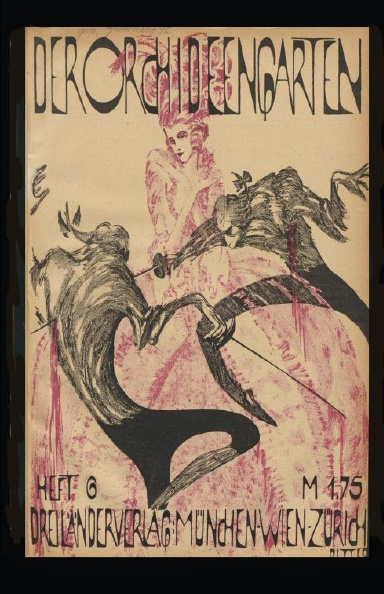
Der Orchideengarten Vol 2 No. 6 includes the stories: The Will to Death by Kurt Moreck and The Byzantine Coin by Karl Hans Strobl. Original art. Translated into English by Joe E Bandel. Layout by John Hirschhorn-Smith.

Read Full Post »

Der Orchideengarten Vol 2, No. 5 contains the following stories translated for the first time into English. Discovery by Rudolf Schneider; The Three Rings by Margot Isbert; Chorus of the Dead by Conrad Ferdinand Meyer; Secret Decapitation by Johan Peter Hebel; Shadows by M. Pokorny. Translations by Joe E Bandel and layout by John Hirschhorn-Smith. It contains the original artwork.

Read Full Post »

Homo Sapiens: Under Way by Stanislaw Przybyszewski and translated by Joe E Bandel

VIII.

When they both stepped out the door, Falk became a little uneasy. 

“He had sent the coachman home. The night was so splendid; he would so like to accompany her home on foot. It would also be good for her to refresh a little from the stupid society in the open air.” 

Falk’s voice trembled slightly. 

Marit spoke no word; a dark oppression almost took her breath away. 

They stepped onto the open field; both thoughtful, silent. 

Now the moment had come when one can look into the soul of the being one loves as into one’s own. Falk felt her soul like a roulette ball rolling from one boundary wall of his suggestions to the other: 

“Wouldn’t she like to take his arm? 

The path was very bad; it had many holes, one could easily sprain one’s foot.” 

She took his arm silently. He pressed it very firmly to his chest and felt her tremble. 

Falk knew that he couldn’t speak now; his voice would break. 

He fought against this excitement; but his unrest grew and grew. 

No, he gathered himself. No, not now! 

That reminded him of the way peasants clumsily grab with both hands right away. 

The moon poured pale streams of light on the meadows; in the distance one saw high-piled black heaps of peat. 

Falk tried to master himself. He wanted to postpone the happiness he could now enjoy; he wanted to enjoy it slowly. 

They stopped and contemplated the landscape. 

Then they walked again, but didn’t look at each other; it was as if they felt a kind of shame before one another. 

Now Falk stopped again. 

“Strange: every time I see the peat heaps, I always have to think of a peculiar man from my home village. 

He was a peat cutter for my father; naturally he drank, like almost all our farmhands, and had a great fixed idea.” 

Falk instinctively sought to loosen and scatter the sexual concentration through stories; then he could overwhelm the girl all the more surely afterward. 

“You know, from the peat bog at times will-o’-the-wisps rise, which move back and forth with fabulous speed. 

The man now got it into his head that the will-o’-the-wisps were souls of deceased Freemasons; at that time the famous papal encyclical also appeared, in which it is written that the Freemasons are possessed by the evil one. 

Now the man ran around all night and shot at the will-o’-the-wisps with an old pistol. With somnambulistic certainty he jumped over the widest peat ditches, crawled through the mud and densest undergrowth like a swamp animal, sometimes sank up to his neck in the marsh, worked himself out again and shot incessantly. 

There lay a terrible tragedy in it. I saw him once after such a night. His eyes were bulging and bloodshot, the mud sat finger-thick on his clothes, he was completely soaked, the thick swamp water dripped from him; his hair was glued together into strands by the mud, but he was happy. 

He swung the pistol back and forth and jumped and cried out with joy. For in this night he had shot a Freemason soul with a twenty-pfennig piece; as he watched, only a little heap of tar remained of the will-o’-the-wisp. 

The pistol was his sanctuary from then on. But once he was locked in prison because he didn’t send his son to school. The boy stayed home alone—the mother had long since run away—and tended the goat on the peat meadows, the peat cutter’s only wealth. 

Yes; now it occurred to the boy to fetch the pistol to frighten the neighbor’s child, whom he was also supposed to watch. He turned the pistol with the muzzle toward his mouth and held a burning match near the pan. 

‘Watch out, now I’m shooting dead!’ He held the match ever closer. The child gets frightened, starts screaming, and in that moment 

the pistol discharges: the boy gets the whole charge in his mouth. I had just come from school and was witness to the scene that I will never forget in my life. 

The boy ran around in mad fear, blood gushed from his nose and mouth, and with every death scream the foam shot and gurgled forth in dark stream. 

The child understood nothing and laughed heartily at the crazy jumps. Only the goat seemed to have understood it. In wild fear it had 

torn itself from the stake to which it was tied; it jumped—no, you really can’t imagine it—it jumped over the long, skinny boy, and then over a wide ditch, and back again… it was terrible. 

Marit was completely excited. 

“That must have been gruesome! Did the boy die?” “Yes, he died.” 

Again they walked silently side by side; they were quite, quite close. 

“Good God, you looked wonderful today! You had an expression on your face, you know, an expression that I had seen on you only once before; yes, once a year ago. We were as happy as children and so happy; God knows, it was beautiful. And then we stood in the evening on the veranda. In the distance we heard the monastery bells ringing for the Ave Maria, and you stood there and looked ahead with the expression of unspeakable intimacy and bliss; it was like a sea of bright gold around you—and today I saw it again.” 

Falk trembled. 

“I looked at you the whole evening, I admired you and was happy and felt you quite close to me… to me.” 

He pressed her even tighter to himself, his voice almost gasped. “Marit, I love you; I…” 

His hand encircled hers. He felt how hot streams flowed into her. 

“I came only because of you; I lay there in Paris and longed for you like mad; I had to come. And now you know; now I have a morbid desire to take you in my hands and press you so wild, so wild to my heart and breathe your breast against mine, hear your heart beat against mine. 

Look, Marit, my gold, my everything; I will do everything, everything for you; you mustn’t resist; you give me an unnameable happiness; you give me everything by it; look, I have suffered so; my sweet girl, my sun, give me the happiness!” 

Around them both, the hot, sexual atmosphere wove tighter and tighter. She could hardly breathe. 

“I was so immeasurably unhappy all the time because I love you so endlessly; never have I loved a being as I loved you before.” 

She felt above her two abyssal eyes shining like two stars; her head grew confused, she couldn’t think, understood only his hot, gasping words, which fell like hot blood drops into her soul, and above her she saw two abyssal stars that guided and pulled and tore at her. 

She felt how he embraced her, how he sought her mouth, and felt his hot, feverish lips as they sucked into her lips. 

She no longer resisted; her whole soul threw itself into the one kiss, she embraced him. It was like a jubilation that dances with wild leaps over an abyss. She kissed him. 

Falk had not suspected this wild passion in her. A hot gratitude rose in him. 

“You will be mine, Marit; you will be… will…” 

Yes, that had to be… she felt it, that had to be… the eyes, the terrible eyes above her… and the voice… it sounded like a command. 

Just let me—now—let me—to my senses—let… 

Again they walked silently side by side, trembling, with bated breath. 

“You will be mine?” “How, how? What?” 

Falk was silent. 

For the rest of the way, they spoke no word. 

At the garden gate, they silently shook hands.

Read Full Post »

« Newer Posts - Older Posts »