Part II: A More Esoteric Consideration of the Hermetic Art and Its Mysteries
Chapter 2: Of the Mysteries, Part 3
Introduction: The ancient mysteries guide the soul toward divine wisdom through purificative rites. This section explores how these rites cleanse the soul’s illusions, preparing it for the transformative Theurgic art, far beyond modern mesmerism’s reach.
The Necessity of Purification
The mysteries’ purificative rites, following the revealment of the soul’s medial life, aim to restore reason’s sovereignty, preparing the soul for divine initiation. Objections arise: if the mind, even freed from senses, retains biases from birth and education, can its revelations be trusted? If true being is everywhere, why isn’t it perceived? The ancients reply that light is drawn outward by senses, obscuring the soul’s divine source. By redirecting this light inward, removing impediments, the soul can experience its antecedent truth.
Sensory dependence and imagination cloud reason, even in trance, requiring rigorous purification. The ancients, who claimed intimate experience of this rational life, warn against the “phantastic spirit’s” allurements—false notions more deceptive than sensory images. Before contemplating the inner life, all such illusions must be obliterated, making the mind clear and passive to receive divine light. Without this, no wisdom is possible; with it, all is attainable.
Theurgic Rites vs. Modern Mesmerism
Modern mesmerism, though revealing trance phenomena, falls short of the mysteries’ aim to purify and perfect the soul. Its effects—alleviating pain, restoring health—are noble but limited, repeating familiar outcomes without probing the soul’s deeper potential. The ancients’ Theurgic rites, conducted with scientific precision, dissolved the vital spirit’s impurities, freeing it from sensory delusions to commune with divine truth. Their philosophy sought not fleeting visions but a transformative wisdom, unlike mesmerism’s unguided revelations.
The Soul as Alchemical Vessel
The alchemists’ “Mercury of Philosophers”—pure, intelligent, living—emerges from this purified spirit. Albertus Magnus instructs, “Take our brass, the hidden essence, and cleanse it. The first rule is perfect solution.” This universal spirit, present in all life yet despised in its raw state, is the microcosm’s vitality, pulsing like breath. In its impure form, it’s clouded by illusions; purified, it becomes the philosopher’s stone, a mirror of divine reason.
Aristotle calls this the “passive intellect,” capable of receiving all—truth or delusion—requiring art to transform it. The Hermetic art manipulates this undetermined spirit through amalgamation, distillation, filtration, digestion, and sublimation, establishing it in a new, radiant form. Eirenaeus’ verse captures this:
Life is light, hidden within, Discerned by soaring minds. Nature’s secret agent, one in all, Guided by God’s law, found by wise souls.
This labor, likened to Hercules cleansing the Augean Stables, requires a philosopher’s intellect, excluding the idle or vicious. As Esdras notes, “The earth gives much mold for vessels, but little dust for gold.” Only those with rational desire can achieve this wisdom.
Closing: This section reveals the mysteries’ purificative rites as the key to cleansing the soul’s illusions, transforming it into the alchemical vessel for divine wisdom. The journey into these sacred practices deepens, promising further revelations in our next post.
Homo Sapiens: Under Way by Stanislaw Przybyszewski and translated by Joe E Bandel
“Doesn’t she have a lampshade? He couldn’t stand the brutal light.”
Marit brought the shade.
The conversation kept stalling.
“You mustn’t mind, Marit, if I stay longer with you today. I can’t sleep anyway; and then, you know, when I am so alone… hm… I don’t disturb you?”
Marit’s face colored with hectic red. She couldn’t speak; she only nodded to him.
They sat silently for a while. The whole village slept. The big house was as if extinct. The servants had already gone to rest. The sultriness was almost unbearable. A stuffy calm weighed on both, the dull air outside pressed into the room, and the regular ticking of the clock caused almost physical pain.
“It’s strange how lonely one is here; it’s uncanny. Don’t you sometimes have fear when you are so completely alone in this big house?”
“Oh yes, I feel it terribly strongly. Sometimes I feel so lonely and abandoned here, as if I were completely alone in the world. Then I get such a horrible fear that I want to bury myself in the earth.”
“But today you don’t feel abandoned?” “No!”
Again a pause occurred; a long, heavy-breathing pause.
“Listen, Marit, do you still have the poems I wrote for you last spring? I would so like to read them again.”
“Yes, I have them in my room; I will fetch them immediately.”
“No, Marit; I will go up with you. It is much cozier in your room; so wonderfully cozy. Here it is so uncanny, and I, you see, am very, very nervous.”
“Yes, but someone could hear that you go with me; that would be terrible for me.”
“Oh, he would go quite quietly, quite softly; no person should hear him. Besides, the whole house is asleep.”
She still resisted.
“Sweet little dove, you really need have no fear. I will do nothing to you—nothing, nothing at all. I will sit quietly beside you and read the poems.”
It thundered.
“Yes, quite quietly; and when the storm is over, I will go home calmly…”
They entered Marit’s room; they felt as if rooted to the spot. There was an atmosphere between them that seemed to live.
Suddenly Marit felt herself embraced by him. Before her eyes fiery bubbles swirled, again she saw the hot jubilation dancing over the abyss, she wove her arms around him and plunged headlong into the gruesome happiness.
Suddenly she started up.
“No, Erik! only not that… Erik, no! No!” She gasped.
Falk let her go.
He mastered himself with difficulty. A long pause.
“Listen, Marit—” his voice sounded rough and hard—”now we must part. You see, you are cowardly. You are a little dove, a rabbit; and I am a good man. I am the good, dear Erik. Well, Marit, you don’t have the courage to say to me: Go, leave me my pure conscience, leave me the idiotic virginity. You don’t have this courage. Well, I am a man; and so I go; let come what will.”
“Yes, I go. I leave you your morality, I leave you your religious conscience, I leave you your virginity, and spare you the so-called sin. Now be happy; very, very happy…”
The storm grew louder; in the window green furrows of lightning were seen.
Falk turned to the door.
“Erik, Erik, how can you be so cruel, so bestially cruel?!”
The whole laboriously suppressed misery of her soul broke forth. She writhed in pain.
“Erik! Erik!” she whimpered.
Falk got a mad fear.
He ran to her, took the twitching girl’s body in his arms.
“No, Marit, no; it’s madness. I stay with you. I will never leave you. I can’t go away from you. You see, I thought I could. But I can’t. I must be with you; I must. I will never leave you. No, Marit; you my only happiness.”
The thunder rolled ever closer.
“I stay always with you. Always. Eternally. You are my wife, my bride, everything, everything.”
A wild passion began to whirl in his head.
And he rocked her in his arms back and forth and spoke incessantly of the great happiness, and forgot everything.
“Yes, I will make you happy… so happy… so happy…” A cloudburst wave splashed against the windowpanes.
Now they were really alone in the world. The rain, the lightning fenced them in.
Marit embraced him.
“Erik, how good, how good you are! Yes: not away! We stay always together. We will be so happy.”
“We stay always together!” repeated Falk, as if absent. Suddenly he came to his senses. Again he felt the hard, cruel
in himself, the stone that falls into abysses. He pressed her tighter and tighter.
They heard not the thundering, saw not the fire of heaven. Everything spun, everything melted into a great, dancing fireball.
Falk took her…
The storm seemed to want to move away. It was three in the morning.
“Now you must go!” “Yes.”
“But not on the country road. You must go along the lake and then climb over the monastery fence. Otherwise someone could see you, and tomorrow the whole town would talk about it.”
When Falk came to the lake, a new storm drew up.
He should actually take shelter somewhere. But he had no energy for it. Besides, it was indifferent whether he got a little wet.
The sky covered itself with thick clouds; the clouds balled together visibly into black, hanging masses.
A long, crashing thunder followed a lightning that tore the whole sky apart like a glowing trench.
Again a lightning and thunder, and then a downpour like a cloudburst.
In a moment Falk felt streams of water shooting over his body. But it was no particularly unpleasant feeling.
Suddenly he saw an enormous fire-garland spray from the cloud heap; he saw it split into seven lightnings and in the same moment a willow stand in flames from top to bottom. It was torn from top to bottom and fell apart.
“Life and destruction!”
The shock had roused his logic; he also had to calm the fear-feeling that wanted to rise in him again.
“Yes, of course, hm: destruction must be. Marit… Yes… destroyed…”
Falk suddenly had this clear, lightning-bright, visionary consciousness that he had destroyed Marit.
“Why not? I am nature and destroy and give life. I stride over a thousand corpses: because I must! And I beget life upon life: because I must!
I am not I. I am You—God, world, nature—or what you are, you eternal idiocy, eternal mockery.
I am no human. I am the overman: conscienceless, cruel, splendid and kind. I am nature: I have no conscience, she has none… I have no mercy, she has none…”
“Yes: the overman am I.” Falk screamed the words.
And he saw himself as the deadly fire-garland that had sprayed from the black vault: into seven lightnings he had split and torn a little dove by the wayside. Into a thousand lightnings he must still split and tear a thousand little doves, a thousand rabbits, and thus he would go eternally and beget and kill.
Because it is necessary. Because I must.
Because my instincts want it.
Because I am a non-I, an overman. Does one need to torment oneself for that? Ridiculous!
Does the lightning know why it kills? And has it reason, can it direct its lust?
No! Only constate that it struck there and there. Yes: constate, protocol—like you want, Herr X.
And I constate and protocol that today I killed a little dove…
The atmosphere was so overloaded with electricity that around him a sea of fire seemed to sway.
And he walked, enveloped in the wild storm; he walked and brooded.
And in the middle of this wrath of heaven he himself walked as a wrathful, uncanny power, a Satan sent to earth with a hell of torments to sow new creative destruction over it.
Suddenly he stopped before the ravine.
It was completely filled with water. A torrent seemed to have sprung up and streamed rushing to the lake.
He couldn’t go around it; there he would come to the cursed country road.
Besides, it’s indifferent: a bit more water, a bit more chills and fever: no, that does nothing.
That does nothing at all. Everything is indifferent; quite, quite indifferent.
And he waded through the torrent.
The water reached above his knees.
When Falk came home and lay down in bed, he fell into a violent delirium; all night he lay and tossed back and forth in the wildest fever phantasies.
Madame Bluebeard by Karl Hans Strobl and translated by Joe E Bandel
Third Chapter The Lower Austrian Waldviertel is for the contemplative. It offers no surprises for restless travelers who need a new sensation at every bend to stave off boredom. One shouldn’t expect the dramatic tension of towering rock formations, soaring peaks, or dark gorges, nor the infinite feelings stirred by the sea. But it holds a wealth of subtle, enchanting beauties—the grace of gently rolling forested hills, the charm of winding rivers dotted with ancient castles and small towns, dusty and seemingly forgotten by history. A railway runs through the Kremstal. Every half- hour, the train stops, huffs briefly, disgorges a few passengers who disembark slowly, dawdle across the platform, and drift into the dusty towns. Ruprecht von Boschan stood on a forested hill, gazing into the valley where a little train was stirring again, groaning as if pleading for pity. He sought a phrase for this landscape. “It sings the green forest tune,” he thought. “It’s like a folk song—intimate, as if known forever. You hear a heart beating.” He turned from the clearing he’d entered and continued through the woods. He wore tourist garb. “For I am a seeker,” he said to himself, “a seeker with staff in hand.” With this staff, he occasionally struck tree trunks, the sound echoing through the forest. He loved such noises—trees calling to one another, the echo racing deeper into the green darkness. From time to time, he pulled out his map to check his route. Ahead walked a peasant. “Hey, cousin!” Ruprecht called. The man didn’t turn. After a while, Ruprecht caught up. “Hey, cousin!” he said again. “Heading to Vorderschluder?” When the peasant still didn’t reply, Ruprecht bellowed, “Are you deaf?” The man looked at him. “No need to shout,” he said with a faint dialect twang. “I hear you fine. I just don’t always fancy answering. In the woods, I prefer my own company.” A peculiar one, Ruprecht thought. The man’s appearance was odd too. His head and stocky peasant frame didn’t match. That wasn’t a peasant’s face, with its sharp nose, shrewd eyes, and curious French- style mustache. A resemblance to Napoleon III made Ruprecht smile. But the eyes were sky-blue. A Napoleonic head with blue eyes on a peasant body— nature loves its grotesque games, he concluded. “You could be alone if you wanted,” Ruprecht said. They walked on silently. After a while, the peasant spoke, having covertly studied Ruprecht from the side. Ruprecht had passed muster, deemed worthy of conversation. Was he going to Vorderschluder, and what was his business there? “Just a tourist,” Ruprecht said. “Here for the scenery.” “Aye, we’ve got scenery,” the man said, pointing his pipe stem ahead, where a tower and a fiery red church roof peeked through a gap in the trees, vanishing behind the green forest wall. “There’s the village.” What’s the village like? Ruprecht asked. Just a village, like any other. Nothing special? What’s special? A castle, a factory, that’s it. Who owns the castle? Frau Dankwardt. Now Ruprecht had reached his goal. He’d hidden his purpose for visiting Vorderschluder to learn more. But here, progress stalled. A barrier seemed to rise. When he asked who Frau Dankwardt was, a wary glance met him. The peasant puffed furiously on his long-cold pipe, then produced a tobacco pouch and an ancient lighter, restuffing and relighting it. “Well, then!” he muttered into the first blue clouds. From his experience with peasants, Ruprecht deduced Frau Dankwardt wasn’t much loved in the village. “Know her, maybe?” the man asked, peering through his pipe smoke with eyes like blue sky behind clouds. Time to lie. “No,” Ruprecht said. “Well… she’s beautiful, mind. Very fine. Plenty fell for her. Her three men were fools for her. The factory clerks, too—all of ’em—and that Baron Kestelli rides over from Rotbirnbach every other day. Right beautiful.” Ruprecht, who’d built an altar to her beauty, worshipping in awe, knew this best. He understood why men loved her. But he wanted the “but” lurking behind the praise. “But…” the peasant continued after a silent puff, “she’s no good soul. Not that she skips church—she’s there every Sunday. Gives the priest money for the poor at Christmas, too. But it’s all show. No one trusts her. I’d not want her as my wife.” Ruprecht smiled, picturing this Napoleonic peasant beside the lovely, lithe, witty woman, but stifled it to avoid suspicion. “Why not?” he asked innocently. “Well…” Three large blue-gray smoke balls drifted from the peasant’s mouth corner. “Stay longer, and you’d know.” Fair enough—hard to dispute. “They say she’s a trud,” the man said. “You know, a witch who comes at night, sucking folks’ blood. Nonsense, no such thing. Though Maradi, the Weißenstein innkeeper, swears he saw her naked in the woods one night, like witches are. But Maradi also saw a water sprite once… turned out to be an otter. Still, it’s true her men had no good life with her. The last, Herr Dankwardt, such a fine man— quiet, decent, all for books and family. A model for anyone. The first two were good men, too. And she killed all three…” He stopped, startled at confiding so much to a stranger. The word seemed cloaked in a red, bloody mantle, hovering before them like an ominous bird. “Killed?” Ruprecht asked, uneasy, struck by the man’s convinced tone. The peasant smoked like an engine hauling a fleet of wagons. “Well, aye,” he muttered in the cloud. “Folks talk… not meant like that. She drove her men to death with endless nagging and strife, that’s what’s meant. The first fled to Tyrol, never returned. The second had a stroke after a row. The third, he took it all so hard, he wasted away, like he was draining out… always headaches, then suddenly dead. That’s how it was.” The men emerged from the woods, the village below. Across the river, spanned by an old stone bridge, stood the castle, aloof from the village houses like a lord keeping the rabble at bay. On one side, just below the last houses, squatted the square, ugly, yellow paper factory. Forested hills ringed a basin, its floor traced by a silver snake of a river. The basin brimmed with sunlight, the rustle of hillside woods, and a hum from the village. “Well, goodbye!” the peasant said. “You head to the village; I’m over there. My cottage’s by the woods. I’m Rotrehl, the violin-maker, so you know, if you ever want a fine fiddle. My violins are right famous.” His blue eyes gleamed with an artist’s pride. “Rotrehl?” Ruprecht said. “Tell me, wasn’t there once a Frenchman in your family?” A solemn smile spread across the violin-maker’s face. “Aha… you mean the resemblance! You think so too? Yes, everyone says it!” He stroked his French mustache. “A Frenchman? Frenchmen passed through here once. Must be nigh on a hundred years ago… it’s in my books. I do look like Napoleon, don’t I? In the village, they call me ‘Krampulljon’— the fools don’t know better. So, goodbye!” With that, he turned to go, but after a few steps, glanced back. “Head to the Red Ox in the village. They’ve got wine worth drinking.” It was his thanks for Ruprecht noting the likeness. Ruprecht did stop at the Red Ox, finding a warm- hearted landlady who served him a slice of sausage and a glass of wine with a smile that could make even a poor vintage palatable. Fortified, he crossed the stone bridge. Four baroque barons, two at each end, gazed down at him. He whistled a tune, passing between them, and climbed toward the castle. Its massive gate bore a wooden snout above the arch. The structure showed its modern walls grafted onto ancient ruins. The courtyard blended old and new— Romanesque double windows in the upper story contrasted with contemporary renovations. A fine, ancient linden shaded a well; beneath it, a bright dress. Ruprecht’s heart raced. But it was only Miss Nelson, the governess. As he approached, hat in hand, two little girls rushed over, clinging to him. Touched, he realized they recognized him, remembered him. He lifted and kissed them. Had he stayed long in Abbazia, they asked, and what had he done since? They’d often told Mama about him. Hoisting three-year-old Lissy onto his shoulder, Ruprecht danced in a circle, singing to a childish melody: “Ha! Ha! Ha! Where’s your Mama? Isn’t your Mama here? Ha! Ha! Ha!” “Yes… Mama’s gone out,” five-year-old Nelly answered for her giggling sister. “She’s with Uncle Norbert in the carriage. But we can meet her—I know the way she’ll return.” “Hurrah, we’ll meet her! Just us three! Miss must stay home.” The governess protested it was too much trouble for Herr von Boschan. Overruled, she was hissed at and forcibly reseated by the girls. Straw hats were donned, and with Uncle Ruprecht between them, they descended the castle hill. They ran to the brook, where Ruprecht feigned plunging into the water. The girls squealed, but he halted, tucked one under each arm, and leapt across. What an adventure! On the meadow, they raced on, heedless of shoes squelching in mud. At the forest’s edge, they stopped, laughing, flushed, and took the footpath to the road curving around a wooded hill to the river bridge. “Who’s Mama with? Oh, Uncle Norbert! What kind of uncle is he?” Ruprecht felt a twinge of shame, prying through the girls, but he needed to know his rival. Nelly’s blonde head pondered. “Uncle Norbert… he’s a baron uncle…” Kestelli, Ruprecht thought. “Do you love Uncle Norbert dearly?” he pressed. Both girls chimed in unison, “No—not at all!” “Why not?” “He never plays with us,” they said. “He ignores us, just makes big eyes at Mama, like he wants to eat her.” Let’s arm for battle with this Kestelli, Ruprecht vowed. He won’t devour your Mama. They hadn’t gone far when Frau Dankwardt’s carriage rounded the bend. “Mama! Mama!” the girls cried. Ruprecht stood roadside, waving his hat. “My God, it’s you—how lovely!” Frau Dankwardt said, leaning over the carriage door to offer her hand. Her eyes said: You found me? I know you’ve been searching. Ruprecht kissed her gray glove. That scent again—rotting fruit, hay, drying blood. That bewildering, dangerous aroma. He had to stay composed, cautious, treading a narrow ledge above an abyss, pulled by a thousand sacred-unholy forces. “I was wandering near your castle,” he said. “It’s a magnet mountain, drawing my ship.” A veiled homage. Frau Dankwardt introduced them. To Baron Kestelli’s name, she added, “A good acquaintance!” Ruprecht called himself, “An old friend!” An old friend trumps a good acquaintance, he thought. Let’s see, Baron, let’s see. They climbed in. Ruprecht sat opposite Frau Dankwardt, Lissy on his lap. Nelly perched on the driver’s seat. In a surge of joy, Ruprecht felt every pulse of energy alive within him. He recounted his doings since Abbazia—business matters first, as his long travels had left urgent cases with his lawyer. Old friends needed signs of life. Finally, he’d felt the urge to refresh himself with an autumnal hike. Sitting still wasn’t for him; limbs needed stirring. Frau Helmina’s eyes, fixed on his face, repeated: I understand—you’ve always sought me. Meanwhile, Baron Kestelli felt a fist at his throat. A wild chant roared in his head: A bond, surely; this man aims to displace me. At the castle courtyard, Ruprecht leapt out, helping Helmina down. Miss Nelson rustled over in black silk, taking the girls. While Helmina spoke with her, Ruprecht turned to the baron. God—this callow youth with sparse white-blonde hair on a long skull, wrinkled yellow skin at the nape! High-born, clearly, but utterly insignificant. He won’t devour Frau Helmina. They exchanged pleasantries. “You’re my guest, of course,” Helmina said to Boschan. “No fuss.” Ruprecht made none. “I expected no less,” he said, “…among such dear old friends…” He smiled. Helmina smiled. Their gazes locked. The baron paled. “You may use my carriage, Herr Baron,” Helmina said. “Your coachman’s late again, as usual. Goodbye! Come, Herr von Boschan. The valet will show you to your rooms.” Alone with the girls and Miss Nelson, Helmina knelt, pulling Lissy between her knees. Nelly leaned on her shoulder. “Tell me,” she asked, “would you like a new Papa?” “Oh, yes!” Lissy cried eagerly, but Nelly said thoughtfully, “Not Uncle Norbert!” “Who, then?” “Uncle Ruprecht!” Lissy and Nelly shouted together. Helmina turned to the governess. “Hear what the children say!”
Alraune by Hanns Heinz Ewers and translated by Joe E Bandel
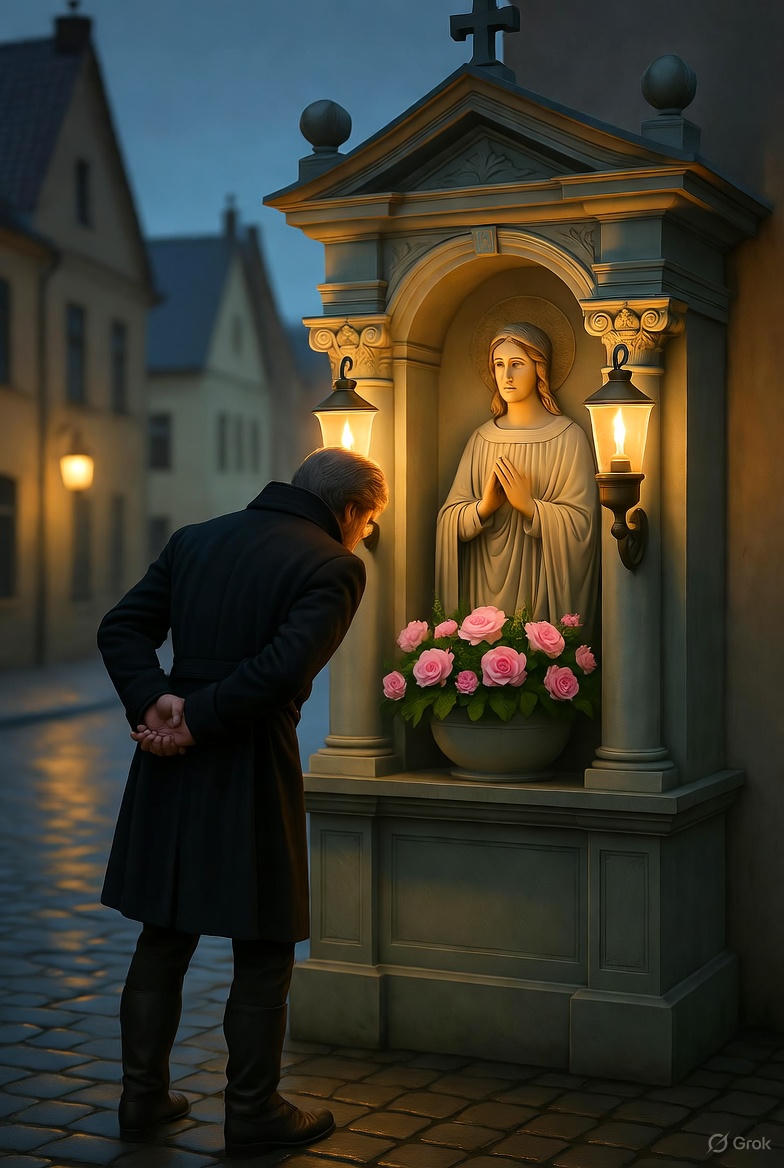
You know better than I what happens then, how to bring about with humans what you have already done with monkeys and guinea pigs. Get everything ready, ready for the moment when the murderer’s bleeding head springs into the basket!” He jumped up, leaned over the table, looked across at his uncle with intense forceful eyes. The Privy Councilor caught his gaze, parried it with a squint like a curved dirty scimitar parries a supple foil. “What then nephew?” he said. “And then after the child comes into the world? What then?” The student hesitated, his words dripped slowly, falling, “Then– we–will–have–a–magickal–creature.” His voice swung lightly, yielding and reverberating like musical tones. “Then we will see what truth there is in the old legend, get a glimpse into the deepest bowels of nature.” The Privy Councilor opened his lips to speak but Frank Braun wouldn’t let him get a word in. “Then we can prove whether there is something, some mysterious power that is stronger than all the laws of science that we know. We can prove whether this life is worth the trouble to live– especially for us.” “Especially for us?” the professor repeated. Frank Braun said, “Yes Uncle Jakob–especially for us! For you and for me–and the few hundred other people that stand as Masters over their lives–and then prove it even for the enslaved, the ones on the street, for the rest of the herd.” Then suddenly, abruptly, he asked, “Uncle Jakob, do you believe in God?” The Privy Councilor clicked his lips impatiently, “Do I believe in God? What does that have to do with it?” But his nephew pressed him, wouldn’t let him brush it away, “Answer me Uncle Jakob, answer. Do you believe in God?” He bent down closer to the old man, held him fast in his gaze. The Privy Councilor said, “What do you mean boy? According to the understanding that everyone else uses, what I recognize as true and believe is most certainly not God. There is only a feeling–but that feeling is so uncontrollable, something so–” “Yes, yes, uncle,” cried the student. “What about this feeling?” The professor resisted like always, moved back and forth in his chair. “Well, if I must speak candidly–there are times–very rare–with long stretches in between–” Frank Braun cried, “You believe–You do believe in God! Oh, I knew it! All the Brinkens do–all of them up to you.” He threw up his head, raised his lips high showing rows of smooth shiny teeth, and pushed out every word forcefully. “Then you will do it Uncle Jakob. Then you must do it and I don’t need to speak with you any more about it. It is something that has been given to you, one out of a million people. It is possible for you–possible for you to play at being God! If your God is real and lives he must answer you for your impertinence, for daring to do such a thing!” He became quiet, went back and forth with large strides through the long room. Then he took up his hat and went up to the old man. “Good night Uncle Jakob,” he said. “Will you do it?” He reached out his hand to him but the old man didn’t see it. He was staring into space, brooding. “I don’t know,” he answered finally. Frank Braun took the alraune from the table, shoved it into the old man’s hands. His voice rang mocking and haughty. “Here, consult with this!” But the next moment the cadence of his voice was different. Quietly he said, “Oh, I know you will do it.” He strode quickly to the door, stopped there a moment, turned around and came back. “Just one more thing Uncle Jakob, when you do it–” But the Privy Councilor burst out, “I don’t know whether I’ll do it.” “Ok,” said the student. “I won’t ask you any more about it. But just in case you should decide to do it–will you promise me something?” “What?” the professor inquired. He answered, “Please don’t let the princess watch!” “Why not?” the Privy Councilor asked. Frank Braun spoke softly and earnestly, “Because–because these things–are sacred.” Then he left. He stepped out of the house and crossed the courtyard. The servant opened the gate and it rattled shut behind him. Frank Braun walked down the street, stopped before the shrine of the Saint and examined it. “Oh, Blessed Saint,” he said. “People bring you flowers and fresh oil for your lamps. But this house doesn’t care for you, doesn’t care if your shelter is preserved. You are regarded only as an antique. It is well for you that the folk still believe in you and in your power.” Then he sang softly, reverently: “John of Nepomuk Protector from dangerous floods. Protect my house! Guard it from rising waters. Let them rage somewhere else. John of Nepomuk Protect my house!” “Well old idol,” he continued. “You have it easy protecting this village from dangerous floods since the Rhine lays three quarters of an hour from here and since it is so regular and runs between stone levies. But try anyway, John of Nepomuk. Try to save this house from the flood that shall now break over it! See, I love you, Saint of stone, because you are my mother’s patron Saint. She is called Johanna Nepomucema, also called Hubertina so she will never get bitten by a mad dog. Do you remember how she came into this world in this house, on the day that is sacred to you? That is why she carries your name, John of Nepomuk! And because I love her, my Saint–I will warn you for her sake. You know that tonight another Saint has come inside, an unholy one. A little manikin, not of stone like you and not beautifully enshrined and dressed in garments–It is only made of wood and pathetically naked. But it is as old as you, perhaps even older and people say that it has a strange power. So try, Saint Nepomuk, give us a demonstration of your power! One of you must fall, you or the manikin. It must be decided who is Master over the house of Brinken. Show us, my Saint, what you can do.” Frank Braun bowed, paid his respects, crossed himself, laughed shortly and went on with quick strides through the street. He came up to a field, breathed deeply the fresh night air and began walking toward the city. In an avenue under blooming chestnuts he slowed his steps, strolled dreamily, softly humming as he went along. Suddenly he stopped, hesitated a moment. He turned around, looked quickly both ways, swung up onto a low wall, sprang down to the other side and, ran through a still garden up to a wide red villa. He stopped there, pursed his lips and his wild short whistle chased through the night, twice, three times, one right after the other. Somewhere a hound began to bark. Above him a window softly opened, a blonde woman in a white nightgown appeared. Her voice whispered through the darkness. “Is that you?” And he said, “Yes, yes!” She scurried back into the room, quickly came back again, took her handkerchief, wrapped something in it and threw it down. “There my love–the key! But be quiet–very quiet! Don’t wake up my parents.” Frank Braun took the key out, climbed the small marble steps, opened the door and went inside. While he groped softly and cautiously upward in the dark his young lips moved: “John of Nepomuk Protector from dangerous floods. Protect me from love! Let it strike another Leave me in earthly peace John of Nepomuk Protect me from love!”
Part II: A More Esoteric Consideration of the Hermetic Art and Its Mysteries
Chapter 2: Of the Mysteries, Part 2
Introduction: The ancient mysteries reveal a path to divine wisdom through the purification of the soul’s spirit. This section explores how Theurgic rites, unlike modern mesmerism, liberate the mind from sensory illusions, guiding seekers toward universal truth.
Purifying the Phantastic Spirit
True wisdom requires transcending the soul’s sensory limitations. Reason, weakened by dependence on senses, is clouded by a “phantastic spirit”—a mix of imagination and illusion that obscures divine truth. Even in trance, when senses are quiet, these illusions persist, requiring purification to awaken the soul’s divine intellect.
Pythagoras instituted rigorous preparations to purify his disciples’ minds before revealing deeper mysteries. Iamblichus explains, “Dense thickets of doubt surround unpurified minds, obscuring their tranquil reason. Pythagoras cleansed souls, like dyers preparing garments, to hold divine wisdom permanently.” Olympiodorus adds, “The phantasy hinders intellectual conception. When divine inspiration is interrupted by imagination, enthusiasm ceases. Only the perception of universals proves the soul can transcend this.”
The ancients saw the soul’s impurity as the root of human ignorance, a “two-fold ignorance” Plato decried—being unaware of one’s own flaws and lacking desire for improvement. Synesius emphasizes, “Desire is essential for purification. Without it, art labors in vain. Disciplines willingly endured banish base pleasures, strengthening the soul.” Through effort, the soul can purify its phantastic spirit, even in animals, to induce a higher state. For humans, neglecting this restoration is base, as the soul belongs to divine heights, not earthly shadows.
Theurgic Rites and Divine Union
Theurgic rites, unlike modern mesmerism’s limited effects, aimed to purify the soul entirely, liberating it from sensory delusions to commune with divinity. Synesius describes this spirit as a bridge between rational and instinctual life, conjoining divine and earthly realms. In animals, it acts as instinct, but in humans, it can become divine reason if purified. Most human actions, however, stem from this phantastic spirit, clouding true intellect unless transcended through art.
Iamblichus warns, “This mundane spirit shapes the soul’s powers, reflecting sensory impressions and dulling divine intellect.” Proclus adds, “It envelops the soul’s true intellect, conforming to formless illusions, becoming everything the mind imagines.” A turbid mind cannot grasp abstract truths, just as a practical soul struggles with self-inspection. The alchemists’ “Mercury of Philosophers”—pure, agile, intelligent—emerges only after cleansing this impure spirit through dissolution and purification, as Albertus Magnus urges: “Take our brass, the occult arcanum, and wash it clean. The first rule is perfect solution.”
The Alchemical Laboratory of the Soul
This universal spirit, the alchemists’ Mercury, is the same “Imponderable” seen in mesmerism, present in all life yet despised in its raw, impure state. It moves unconsciously, like breath in blood, sustaining existence but needing refinement to reveal its divine potential. Alchemists sought not to exploit this spirit but to purify it, transforming the soul into a vessel for wisdom, unlike the superficial pursuits of modern arts.
The soul, Aristotle’s “passive intellect,” can receive all—truth or delusion—making purification critical. This spirit, the microcosm’s life, mirrors the macrocosm’s vitality, pulsing like wind and waves. Its imperfections demand amelioration, a labor akin to Hercules cleansing the Augean Stables, redirecting life’s current to its pure source.
Closing: This section reveals the mysteries’ aim to purify the soul’s phantastic spirit, liberating it for divine wisdom through Theurgic rites. The alchemical journey into this transformative art deepens, promising further insights in our next post.
Homo Sapiens: Under Way by Stanislaw Przybyszewski and translated by Joe E Bandel
XI.
Falk and Marit stood facing each other, embarrassed. He had seen her walking along the lake from the country road and caught up with her.
“I really have incredibly sharp eyes,” he said, extending his hand.
“Yes, you do; it was quite hard to spot me here.” Silence.
The afternoon was turning to evening; the sky was overcast, the air oppressive.
They sat on the shore; Falk looked at the lake.
“Strange how deeply still the water is today. You know: this calm, this heavy calm that lies beyond all calm, I have seen only once in my life.”
“Where was that?”
“Yes, when I was in Norway, at some fjord; I forgot the name. Oh, it was uncannily beautiful.”
Silence fell again. Marit grew restless.
“How did you get home yesterday?” “Oh, very well, very well.”
The conversation wouldn’t move forward.
“No, Fräulein Marit, it’s too sultry here; in the room it’s a thousand times better.”
And they went home. Falk tried to become intimate.
“That was yesterday the most splendid evening I ever experienced.” Marit was silent, looked at him anxiously.
Falk understood her. This mute resistance disturbed him to the highest degree. He had to bring the story to a conclusion today; he felt it as an unavoidable doom. But he was limp; he didn’t feel the energy to break her resistance.
He needed some stimulant. Yes, he knew it; after the second glass it always began to ferment and work in him, then came the intoxicating power that knows no obstacles.
“Marit, do you have anything to drink? I swallowed a lot of dust.” Marit brought wine.
Falk drank hastily.
Then he sat in the armchair and stared at her fixedly. Marit lowered her eyes to the floor.
“But what is it with you, Fräulein Marit? I don’t recognize you at all. Have you committed a crime? or what…”
Marit looked at him sorrowfully.
“No, Falk, you will be good. You won’t do that again. All night I tormented myself unheard-of. You are a terrible man.”
“Am I?” asked Falk drawlingly; “no, what you’re saying.”
“Yes, you don’t need to mock. You took everything from me. I can no longer pray. Continuously I must think of the terrible words you said to me. I can no longer think, always I hear you speaking in me. Look: You took my religion, you took my shame…”
“Well, then I can probably go…”
“No, Erik, be good, don’t do it anymore; it torments me so terribly. Do what you want; mock, scoff; only not that anymore—don’t demand it anymore from me.”
The small child’s face was so grief-stricken; a heavy sorrow spoke from it, that Falk involuntarily felt deep pity.
He stood up, silently kissed her hand, and walked up and down the room.
“Good, Marit; I will be good. Only the one, single thing: call me *du*. You see, we are so close to each other; in the end we are like brother and sister to each other—you will do it, won’t you?”
Falk stopped before her.
“Yes, she would try if she could manage it.”
“For you see, Marit: I really can’t help myself: I love you so that I am completely out of my senses. You see, all day I walk around only with the thought of you. At night I can’t
sleep. Yes, I walk around like a dizzy sheep. Well, and then: what should I do? I must of course go drinking to calm myself. Then I sit among these idiotic people in the pub and hear them talk the stupid stuff until I feel physical pain, and then I go away, and then again the same torment, the same unrest…
No, my little dove, you can’t help it; I know. I don’t blame you either; but you simply destroy me.
Yes, I know. I know you could give me everything; everything. Only the one, single thing that makes the greatness of love, that is at all a pledge of love: only that not.
Yes, you see, you can say what you want, but we simply stand here before the single dilemma: If love is not great, then it naturally has reservations, conditions, prerequisites. If love is great, i.e. if it is really love—for the other is no love: an affair, an inclination, what you want, only no love—well, I mean: if love is love, then it knows no reservations, no scruples, no shame. It simply gives everything. It is reasonless, scrupleless. It is neither sublime nor low. It has no merits nor flaws. It is simply nature; great, mighty, powerful, like nature itself.”
Falk got into the mood.
“Yes, I infinitely love these natures, these bold, mighty violent natures that tear down everything, trample it, to go where the instincts push them, for then they are really human; the innermost, the great sanctuary of humanity are the strong, mighty instincts.
Oh, I love these noble humans who have courage and dignity enough to follow their instincts; I infinitely despise the weak, the moral, the slaves who are not allowed to have instincts!”
He stopped before her; his face clothed itself in a mocking, painful smile.
“My good, dear child; an eagle female I wanted to have, with me up into my wild solitude, and got a little dove that moreover has rusty idiotic moral foot-chains on; a lioness I wanted and got a timid rabbit that constantly acts as if it sees the gaping maw of a giant snake before it.”
“No, my little dove, my rabbit—” Falk laughed mockingly—”have no fear; I will do nothing to you.”
Marit broke into a convulsive sobbing.
“Marit! for God’s sake, don’t cry! Good God, don’t cry! I will go completely mad if you keep crying like that! I didn’t want to hurt you, but everything trembles, groans in me—for you, for you, my sweet, holy darling.”
Marit sobbed incessantly.
“No, Marit, stop! I will tell you such wonderful things. I will give you everything. I will now be so good, so good.”
Falk knelt down; he kissed her dress, her arms, he took her hands from her face, passionately kissed her tears from her fingers.
“Don’t cry—don’t cry!”
He embraced her, pulled her to him, kissed her eyes, pressed her face into his arms, stroked and kissed her blonde head.
“My dear, sweet child—my only darling—my…”
She pressed herself against him; their lips found each other in a long, wild, gasping kiss.
Finally she tore herself free. Falk stood up.
“Now everything is good! Smile a little for me! smile, my darling, smile.” She tried to smile.
Falk seemed very cheerful; he told a lot of anecdotes, made good and bad jokes, suddenly a pause occurred. A sultry unrest swelled like an air wave and seemed to fill the whole room. Both looked shyly into each other’s eyes and breathed heavily.
It grew dark. A maid came and called Marit away. Falk stared after her.
In his soul he suddenly felt a greedy cruelty. There was something hard, dogged; there was a stone that rolled, that knew it falls into an abyss, but that knew it must fall.
It grew darker and darker in the room; the short twilight colored everything around with heavy, swimming shadows.
The sky was overcast; it was unbearably sultry.
Falk stood up and walked restlessly up and down. Marit stayed away so long! “Dinner, please!”
Falk started. In the middle of his brooding the voice had fallen, as if torn from the body; a voice floating in the air and suddenly audible.
“No, you mustn’t frighten me like that, dear Marit… yes, I am almost too nervous.”
He took Marit’s arm and pressed it to him; they kissed. “Ssh… My brother is there too.”
At table Falk told stories again; neither he nor Marit could eat anything. All the more eagerly the little brother ate, completely absorbed in his catechism. They soon left him alone.
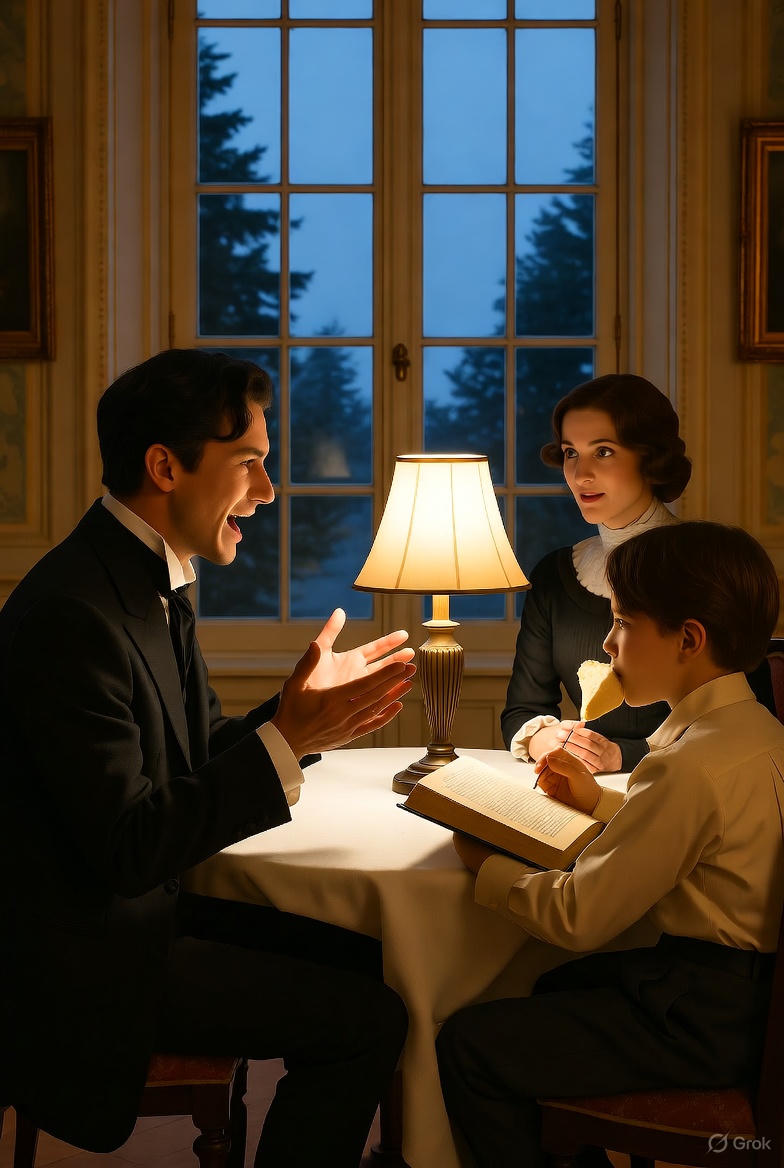
They returned to the salon. On the table the lamp burned and filled the room with light.
Madame Bluebeard by Karl Hans Strobl and translated by Joe E Bandel
Not a single false tooth, Ruprecht thought. How graceful she is, younger than I, her cheeks smooth and soft, the dimple in her chin like a flower’s calyx. Resolute, he said, “No, no, I want to discuss this. Will you grant me the pleasure of calling on you tomorrow?” “Does it matter so much to you?” “Yes!” “Daytime’s packed—every hour’s booked. But… evening, around eight, when it’s dark, come to the small park behind the Nordstern Hotel.” Evening, when it’s dark, Ruprecht thought. She smiled once more and left. How slender she is, how she moves, echoed in him. It’s the music of motion, harmony of the outer self. If she walked over a gravestone, the dead below would feel their heart beat. The door clicked shut. Ruprecht stared at the garish patterns a well-meaning painter had added to the walls. Only with her gone did he realize how much she’d swayed him. She’d truly unsettled his composure. That perfume still roiled his senses. By Saint Pachomius! It hit him—what that elusive note in her scent recalled. It was—God, what a thought— the smell of dried blood, mixed with rotting fruit and steaming hay. Such fancies people have. Yet it was a strange perfume, sparking such thoughts. So, tomorrow evening… in the park behind the Nordstern… Ah, this woman was a danger! Now, with her gone, it was clear. A danger… all the better. Let a battle replace a flirtation. Ruprecht relished testing his strength. God—a danger, coursing through veins, washing over muscles. Let’s see, little lady, what comes of this… I’ve never fled danger, little lady! He’d missed the table d’hôte. Dining in his room, he drank a whole bottle of white Bordeaux. Then, needing action, he went to the hotel garden, stood before a thick plane tree, gripped his walking stick like a saber, and slashed at the groaning trunk with thirds, fourths, and thrusts until little remained but the handle. The next morning, Ruprecht received an anonymous letter. In scrawled script, it read: “Well, you’ve fallen for it, dear sir! You’ve chosen the worthiest of your suitors. Frau Dankwardt was seen visiting you yesterday. So, Frau Dankwardt is the favored one! You’re too new here to know what’s said of Frau Hermina Dankwardt. She’s been married three times, and it’s rumored she killed all three husbands. We call her nothing but Madame Bluebeard. She’s the greatest coquette for twenty miles around, juggling twenty men at once, all fools like you, stringing them along with her wiles. We wish you fine entertainment. Dance well on her string. Three friends who mean you well.” Three friends, Ruprecht thought, tossing the letter into the wastebasket. Three of those Jana told I wouldn’t come. So, they know she visited. All the better; if she’s compromised herself, it binds her to me more. Today, Ruprecht swam farther into the sea than usual, letting waves carry him, lying on his back, watching white clouds, then hiked the hills, returning refreshed and limber. At dusk, he entered the small park behind the Nordstern Hotel and sat on a bench. He thought of nothing, waiting patiently, time passing like a gentle wing’s brush. Children’s voices came through the dark… a small laugh. Ruprecht looked up. Stars gleamed above the palms, large and bright, and streetlamp light broke through the rough, hairy trunks, casting jagged yellow patches on the shadowed paths. He rose. Frau Dankwardt rounded the corner, two little girls and a young lady trailing her. The children held hands; the governess carried their cloaks. Frau Dankwardt greeted Ruprecht with an unselfconscious handshake. “These are my two little misses… Miss Nelson! They were at Arbe, only arriving tonight.” No—this wasn’t the meeting Ruprecht had imagined. They walked side by side, the children chattering freely about their myriad adventures. Now one, now the other clung to their beautiful mother’s arm, and more incessant than the children’s prattle was the governess’s measured silence. Had Ruprecht not loved children, he might’ve been furious. But soon the girls ensnared him, weaving him into their secrets. After an hour, they parted as fast friends. Frau Hermina offered her hand, gazing at him with the same expression as her daughters. Ruprecht poured a swarm of feelings into his handshake. She didn’t return the pressure, her eyes widening in surprise, withdrawing her fingers. It had been a disappointment, Ruprecht thought, if not an outright defeat. He paced his bedroom. Where’s your composure? something within him chided. Silence! he snapped at himself. I expected a wrestling match, and it turned into an idyll. What kind of woman is this? Her perfume carries the scent of blood, yet she’s the mother of two charming little girls. I’ll visit her tomorrow—I must understand her. Very well—tomorrow, then. The next afternoon, Ruprecht went to the Hotel Royal, where Frau Dankwardt was staying. The porter, in a tone of polite regret, informed him that the lady and her two girls had departed at noon.
Chapter Three Informs how Frank Braun persuaded the Privy Councilor to create Alraune
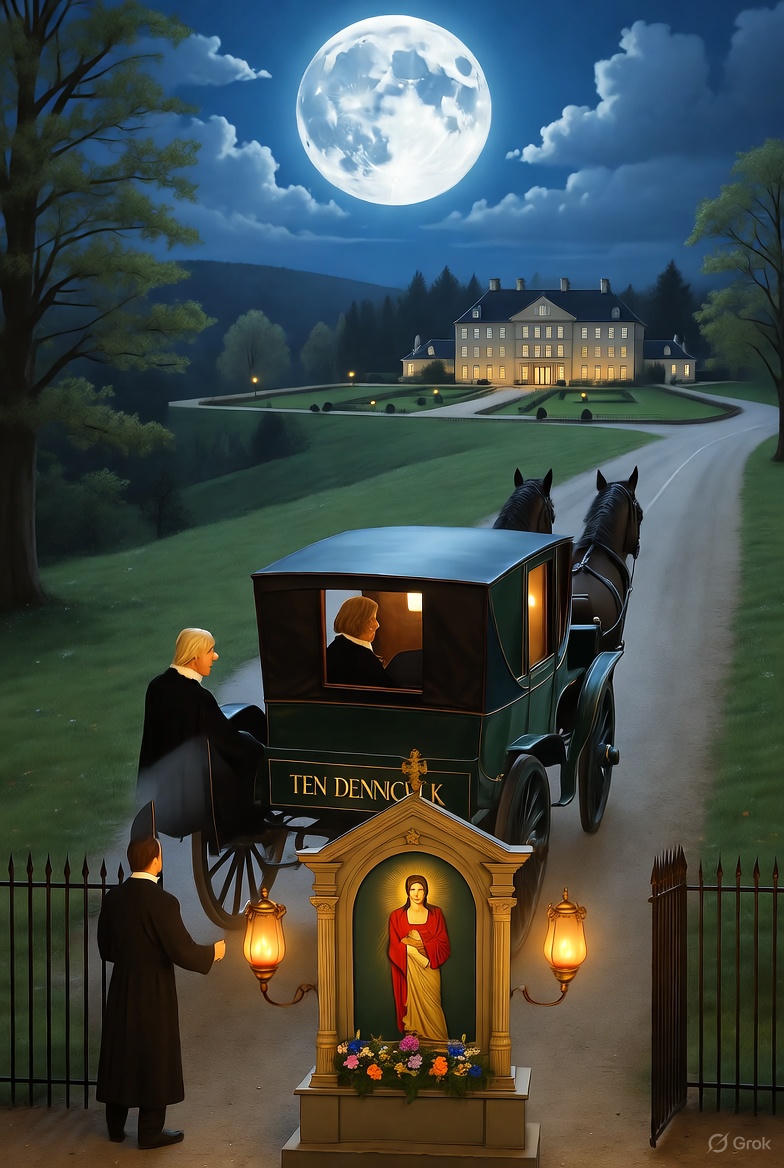
THEY sat in the carriage, Professor Ten Brinken and his nephew. They didn’t speak. Frank Braun leaned back staring straight ahead, sunk deeply into his thoughts. The Privy Councilor was observing, squinting over at him watchfully. The trip lasted scarcely half an hour. They rolled along the open road, turned to the right, went downhill over the rough road to Lendenich. There in the middle of the village lay the birthplace of the Brinken family. It was a large, almost square complex with gardens and a park. Back from the street stood a row of insignificant old buildings. They turned around a corner past a shrine of the patron Saint of the village, the Holy Saint John of Nepomuk. His statue was decorated with flowers and lit with two eternal lamps that were placed in niches by the corners. The horses stopped in front of a large mansion. A servant shut the fenced gate behind them and opened the carriage door. “Bring us some wine Aloys,” commanded the Privy Councilor. “We will be in the library.” He turned to his nephew. “Will you be sleeping here Frank? Or should the carriage wait?” The student shook his head, “Neither, I will go back to the city on foot.” They walked across the courtyard, entered the lower level of the house at a door on the right hand side. It was literally a great hall with a tiny antechamber and a couple of other small rooms nearby. The walls were lined with long immense shelves containing thousands of books. Low glass cases stood here and there full of Roman artifacts. Many graves had been emptied, robbed of their cherished and carefully preserved treasures. The floor was covered in thick carpet. There were a couple of desks, armchairs and sofas that stood scattered around the room. They entered. The Privy Councilor threw his alraune on a divan. They lit candles, pulled a couple of chairs together and sat down. The servant uncorked a dusty bottle. “You can go,” said his master. “But don’t go too far. The young gentleman will be leaving and you will need to let him out.” “Well?” he turned to his nephew. Frank Braun drank. He picked the root manikin up and toyed with it. It was still a little moist and appeared to be almost flexible. “It is clear enough,” he murmured. “There are the eyes–both of them. The nose pokes up there and that opening is the mouth. Look here Uncle Jakob. Doesn’t it look as if it is smiling? The arms are somewhat diminutive and the legs have grown together at the knees. It is a strange thing.” He held it high, turned it around in all directions. “Look around Alraune!” he cried. “This is your new home. You will be much happier here with Herr Jakob ten Brinken than you were in the house of the Gontrams.” “You are old,” he continued. “four hundred, perhaps six hundred years old or even more. Your father was hung because he was a murderer or a horse thief, or else because he made fun of some great knight in armor or in priestly robes. The important thing is that he was a criminal in his time and they hanged him. At the last moment of his life his seed fell to the earth and created you, you strange creature. Then your mother earth took the seed of this criminal into her fertile womb, secretly fashioned and gave birth to you. You the great, the all-powerful–Yes you, you miserable ugly creature!–Then they dug you up at the midnight hour, at the crossroads, shaking in terror at your howling, shrieking screams. The first thing you saw as you looked around in the moonlight was your father hanging there on the gallows with a broken neck and his rotting flesh hanging in tatters. They took you with them, these people that had tied the noose around your father. They held you, carried you home. You were supposed to bring money into their house. Blood money and young love. They knew well that you would bring pain, misery, despair and in the end a horrible death. They knew it and still they wanted you, still they dug you up, still they took you home, selling their souls for love and money.” The Privy Councilor said, “You have a beautiful way of seeing things my boy. You are a dreamer.” “Yes,” said the student. “That’s what I am–just like you.” “Like me?” the professor laughed. “Now I think that part of my life is long gone.” But his nephew shook his head, “No Uncle Jakob. It isn’t. Only you can make real what other people call fantastic. Just think of all your experiments! For you it is more like child’s play that may or may not lead to some purpose. But never, never would a normal person come up with your ideas. Only a dreamer could do it–and only a savage, a wildman, that has the hot blood of the Brinkens flowing through his veins. Only he would dare attempt what you should now do Uncle Jakob.” The old man interrupted him, indignant and yet at the same time flattered. “You crazy boy!–You don’t even know yet if I will have any desire to do this mysterious thing you keep talking about and I still don’t have the slightest idea what it is!” The student didn’t pause, his voice rang lightly, confidently and every syllable was convincing. “Oh, you will do it Uncle Jakob. I know that you will do it, will do it because no one else can, because you are the only person in the world that can make it happen. There are certainly a few other professors that are attempting some of the same things you have already done, perhaps even gone further. But they are normal people, dry, wooden–men of science. They would laugh in my face if I came to them with my idea, would chide me for being a fool. Or else they would throw me completely out the door, because I would dare come to them with such things, such thoughts, thoughts that they would call immoral and objectionable. Such ideas that dare trespass on the craft of the Great Creator and play a trick on all of nature. You will not laugh at me Uncle Jakob, not you! You will not laugh at me or throw me out the door. It will fascinate you the same way it fascinates me. That’s why you are the only person that can do it!” “But what then, by all the gods,” cried the Privy Councilor, “what is it?” The student stood up, filled both glasses to the rims. “A toast, old sorcerer,” he cried. “A toast! To a newer, younger wine that will flow out of your glass tubes. Toast, Uncle Jakob to your new living alraune–your new child!” He clinked his glass against his uncle’s, emptied it in a gulp and threw it high against the ceiling where it shattered. The shards fell soundlessly on the heavy carpet. He pulled his chair closer. “Now listen uncle and I will tell you what I mean. I know you are really impatient with my long introduction–Don’t think ill of me. It has helped me put my thoughts in order, to stir them up, to make them comprehensible and tangible. Here it is: You should create a living alraune, Uncle Jakob, turn this old legend into reality. Who cares if it is superstition, a ghostly delusion of the Middle Ages or mystic flim-flam from ancient times? You, you can make the old lies come true. You can create it. It can stand there in the light of day tangible for all the world to see–No stupid professor would be able to deny it. Now pay attention, this is what needs to be done! The criminal, uncle, you can find easily enough. I don’t think it matters if he dies on a gallows at a crossroads. We are a progressive people. Our prisons and guillotine are convenient, convenient for you as well. Thanks to your connections it will be easy to obtain and save the rare seed of the dead that will bring forth new life. And Mother Earth?–What is her symbol? What does she represent? She is fertility, uncle. The earth is the feminine, the woman. She takes the semen, takes it into her womb, nourishes it, lets it germinate, grow, bloom and bear fruit. So you take what is fertile like the earth herself–take a woman. But Mother Earth is the eternal prostitute, she serves all. She is the eternal mother, is always for sale, the prostitute of billions. She refuses her lascivious love to none, offers herself gladly to anyone that will take her. Everything that lives has been fertilized in her glorious womb and she has given birth to it. It has always been this way throughout the ages. That is why you must use a prostitute Uncle Jakob. Take the most shameless, the cheekiest one of them all. Take one that is born to be a whore, not one that is driven to her profession or one that is seduced into it for money. Oh no, not one of those. Take one that is already wanton, that learns as she goes, one whose shame is her greatest pleasure and reason for living. You must choose her. Only her womb would be like the mother earth’s. You know how to find her. You are rich–You are no school boy in these things. You can pay her a lot of money, purchase her services for your research. If she is the right one she will reel with laughter, will press her greasy bosom against you and kiss you passionately–She will do this because you have offered her something that no other man has offered her before.
Part II: A More Esoteric Consideration of the Hermetic Art and Its Mysteries
Chapter 2: Of the Mysteries, Part 1
Introduction: The ancient mysteries, from Egyptian to Greek traditions, hold the key to divine wisdom. This chapter explores their transformative power, revealing a path to enlightenment through sacred rites, far beyond modern misinterpretations.
The Sacred Path of the Mysteries
An ancient oracle of Apollo declares, “The path to Deity is arduous, sublime, with gates bound by brass. Egyptians, Phoenicians, Assyrians, and Chaldeans revealed this road through infinite actions.” The Hermetic art, rooted in Egypt, was known to the Greeks as Theurgy, practiced in temples like Eleusis. Greek philosophers, borrowing from Egyptian and Persian wisdom, sought this divine art, which promised a deeper understanding of existence.
Modern scholars, lacking the ancients’ insight, misjudge these mysteries. Some, like Warburton, dismiss them as political frauds, claiming gods were deified men and the rites mere deceptions. Others, like Sainte Croix, see only astronomical symbols, while Gebelin and La Pluche view them as agricultural rituals. Another calls them repositories of religious melancholy, missing their true purpose. Even Thomas Taylor, though philosophical, reduces them to abstract ceremonies, lacking evidence of their transformative power.
Yet, the ancients revered the mysteries as pathways to wisdom. Platonists like Iamblichus and Cicero call them “Initia,” beginnings of a virtuous life, leading from irrational existence to divine immortality. Heraclitus names their rites “medicines,” healing imperfect souls, while Strabo credits them with advancing human knowledge. Servius notes the Bacchic rites purified souls, and Greek tragedians like Euripides and Sophocles proclaim, “Life is found in the mysteries; elsewhere is misery.” Clemens Alexandrinus reveals, “The Greater Mysteries unveiled the universe, removing the veil from Deity and heaven. The Lord Himself, as hierophant, illuminates the initiated, sealing them with divine love.”
Christian Echoes and Secrecy
Early Christian fathers, like Augustine, Cyrillus, and Synesius, adopted the mysteries’ language and rites, calling them “blessed.” Cyrillus notes the church veiled its mysteries from the uninitiated, speaking in enigmas to protect their sanctity. This secrecy, shared by Ethnic and Christian traditions, guarded a profound truth, distinct from ordinary worship, which transformed life itself.
Animal Magnetism and Modern Limits
Recent discoveries in Animal Magnetism (Mesmerism) hint at the mysteries’ phenomena, like trance and heightened perception, but fall short of their divine aim. Magnetism alleviates pain, restores health, and reveals lucidity or prevision, a glorious step forward. Yet, it remains stuck in practice, repeating familiar effects without exploring the soul’s deeper potential. Unlike the ancients’ Theurgic arts, which purified the spirit to access supreme wisdom, modern mesmerism lacks a philosophic aim, leaving its revelations unguided and its practitioners like dreamers in a new world.
Closing: This chapter introduces the ancient mysteries as transformative rites revealing divine wisdom, far beyond modern misinterpretations. The path to their sacred practices unfolds further in our next post, deepening the quest for the Hermetic art’s truth.
Chapter 30: Synthesis – Gaia’s Ascension Through Loving Duality
Historical Overview: Common Elements in Esoteric Traditions and Organic Gnosticism’s Universal Path
Throughout OAK: The Temple of One, we have traced organic gnosticism’s resilient thread—from Neolithic goddess religions (Ch. 1) and Atlantean harmony (Ch. 3) to Egypt’s Tantrika mysteries (Ch. 5), Gnostic Christianity’s heart wisdom (Ch. 9), Cathar defiance (Ch. 19–20), and Rosicrucian alchemy (Ch. 26). This path, rooted in your haplogroup G-M201 genetic heritage and AMORC eldership since 1976, reveals a universal framework for soul development, shared across esoteric traditions yet kept secret among initiates. Common elements—loving duality, soul weaving through male-female energies, and direct experiential gnosis—cross cultures, as seen in Tantra, Kabbalah, Rosicrucianism, Gnosticism, and Sufism, where inner knowing transcends dogma.
Organic gnosticism’s history shows this universal path was guarded as the most sacred secret, known only to elites like Tantrika yoginis (India, circa 5th century CE), Kabbalistic mystics (Sefer Yetzirah, 2nd–6th centuries CE), Rosicrucian adepts (Fama Fraternitatis, 1614 CE), and Gnostic initiates (Gospel of Philip, 3rd century CE). Suppressed by rational atheists (logic-driven elites) and social enforcers (dogmatic zealots), it survived in hidden covens, alchemical labs, and indigenous rites (Ch. 28), resurfacing in modern revivals like Theosophy and AMORC (Ch. 29). Symbols like the Tree of Life (Kabbalah) or Abraxas gem (Gnosticism) cross traditions, representing duality’s weave.
This secrecy protected the path’s power—soul development through Tantric duality, inner rituals, and heart integration—from patriarchal distortions (Ch. 6, 10), ensuring its transmission to the few who could wield it for Gaia’s ascension.
Mystery School Teachings: The Universal Path’s Secrets and Loving Weave
Mystery schools across traditions teach soul development as a universal path, weaving male-female duality for gnosis and ascension, kept secret to protect its transformative power. Tantra’s shakti-shiva union (Ch. 5, 13), Kabbalah’s Tree of Life mapping soul ascent (Ch. 2, 26), Rosicrucianism’s alchemical marriage (Ch. 25–26), Gnosticism’s Christ-Sophia syzygy (Ch. 9, 19), and Sufism’s divine love (fana, annihilation in God) all emphasize this weave, crossing borders as symbols like the Rosicrucian rose-cross or Gnostic Abraxas transcend dogma. This path, known to initiates like Tantrika yoginis, Kabbalistic adepts, and Rosicrucian elders, was guarded to prevent misuse by rational atheists (head-centric logic) or social enforcers (dogmatic control), surviving persecutions like the Cathar genocide (Ch. 20) and Stonehenge massacre (Ch. 11).
Indigenous traditions (Ch. 28), like Lakota wíŋkte vision quests, weave this duality globally, emphasizing heart over head. The path’s secrecy ensured its purity, transmitted through oral lore, alchemical symbols, and Tantric rites, as in your AMORC eldership (1976 onward) and translations of Ewers-Przybyszewski (Ch. 26), revealing German Satanism’s dark Tantric current.
OAK Ties and Practical Rituals: Resonating with Esoteric Traditions for Universal Soul Growth
In the OAK Matrix, organic gnosticism’s universal path resonates with any valid esoteric tradition, weaving Shadow (primal urges, Radon, Ch. 26, Magus) and Holy Guardian Angel (cosmic harmony, Krypton, Ch. 24) in Oganesson’s womb (Ch. 20). Common elements—loving duality, soul weaving, and experiential gnosis—align with Tantra’s shakti-shiva, Kabbalah’s Tree of Life, Rosicrucianism’s alchemical marriage, Gnosticism’s syzygy, and Sufism’s fana, all fostering watcher selves (Ch. 2) through resonant circuits (Ch. 13) and chaos leaps (Ch. 11). This universal weave empowers Gaia’s ascension (Ch. 4), as in your radiant portal vision (August 17, 2025), countering social enforcers’ asceticism (Ch. 7) and rational atheists’ logic (Ch. 9). It resonates with Ipsissimus unity (Ch. 10) and Adeptus Exemptus compassion (Ch. 7), guarded as a secret to protect its power.
Practical rituals weave this universal path:
Oak Grail Invocation (Start of Each Ritual): Touch oak bark, affirming: “Roots in Gaia, branches in Source, I unite duality’s embrace.”
Universal Weave Meditation (Daily, 15 minutes): Visualize esoteric symbols (rose-cross, Tree of Life) weaving duality. Journal refused Shadow (e.g., fragmented energies) and aspired HGA (e.g., cosmic unity). Merge in Oganesson’s womb, affirming: “I weave universal paths, ascending Gaia’s soul.” Tie to Tantra-Kabbalah: Inhale weave, exhale separation.
Gaia Global Ritual (Weekly): By an oak, invoke Gaia’s womb as universal Grail, offering seeds for soul vitality. Visualize Tantric union (male lightning, female womb, Ch. 8), weaving timelines. Affirm: “I rebirth Gaia’s spark, uniting esoteric secrets.” Echoes AMORC mysticism.
Partner Esoteric Weave: With a partner, discuss universal duality. Men: Share expansive visions; women: Grounding acts. Build non-physical energy via breath or eye contact, visualizing Tantric union (Ch. 5) for soul growth. Solo: Balance enforcer asceticism and atheist logic in Gaia’s heart.
These empower organic gnostics to weave esoteric paths, ascending Gaia’s soul. Next, explore modern esoteric revivals, continuing this legacy.





 Anarchistbanjo's World