Homo Sapiens: Under Way by Stanislaw Przybyszewski and translated by Joe E Bandel
XI.
Falk and Marit stood facing each other, embarrassed. He had seen her walking along the lake from the country road and caught up with her.
“I really have incredibly sharp eyes,” he said, extending his hand.
“Yes, you do; it was quite hard to spot me here.” Silence.
The afternoon was turning to evening; the sky was overcast, the air oppressive.
They sat on the shore; Falk looked at the lake.
“Strange how deeply still the water is today. You know: this calm, this heavy calm that lies beyond all calm, I have seen only once in my life.”
“Where was that?”
“Yes, when I was in Norway, at some fjord; I forgot the name. Oh, it was uncannily beautiful.”
Silence fell again. Marit grew restless.
“How did you get home yesterday?” “Oh, very well, very well.”
The conversation wouldn’t move forward.
“No, Fräulein Marit, it’s too sultry here; in the room it’s a thousand times better.”
And they went home. Falk tried to become intimate.
“That was yesterday the most splendid evening I ever experienced.” Marit was silent, looked at him anxiously.
Falk understood her. This mute resistance disturbed him to the highest degree. He had to bring the story to a conclusion today; he felt it as an unavoidable doom. But he was limp; he didn’t feel the energy to break her resistance.
He needed some stimulant. Yes, he knew it; after the second glass it always began to ferment and work in him, then came the intoxicating power that knows no obstacles.
“Marit, do you have anything to drink? I swallowed a lot of dust.” Marit brought wine.
Falk drank hastily.
Then he sat in the armchair and stared at her fixedly. Marit lowered her eyes to the floor.
“But what is it with you, Fräulein Marit? I don’t recognize you at all. Have you committed a crime? or what…”
Marit looked at him sorrowfully.
“No, Falk, you will be good. You won’t do that again. All night I tormented myself unheard-of. You are a terrible man.”
“Am I?” asked Falk drawlingly; “no, what you’re saying.”
“Yes, you don’t need to mock. You took everything from me. I can no longer pray. Continuously I must think of the terrible words you said to me. I can no longer think, always I hear you speaking in me. Look: You took my religion, you took my shame…”
“Well, then I can probably go…”
“No, Erik, be good, don’t do it anymore; it torments me so terribly. Do what you want; mock, scoff; only not that anymore—don’t demand it anymore from me.”
The small child’s face was so grief-stricken; a heavy sorrow spoke from it, that Falk involuntarily felt deep pity.
He stood up, silently kissed her hand, and walked up and down the room.
“Good, Marit; I will be good. Only the one, single thing: call me *du*. You see, we are so close to each other; in the end we are like brother and sister to each other—you will do it, won’t you?”
Falk stopped before her.
“Yes, she would try if she could manage it.”
“For you see, Marit: I really can’t help myself: I love you so that I am completely out of my senses. You see, all day I walk around only with the thought of you. At night I can’t
sleep. Yes, I walk around like a dizzy sheep. Well, and then: what should I do? I must of course go drinking to calm myself. Then I sit among these idiotic people in the pub and hear them talk the stupid stuff until I feel physical pain, and then I go away, and then again the same torment, the same unrest…
No, my little dove, you can’t help it; I know. I don’t blame you either; but you simply destroy me.
Yes, I know. I know you could give me everything; everything. Only the one, single thing that makes the greatness of love, that is at all a pledge of love: only that not.
Yes, you see, you can say what you want, but we simply stand here before the single dilemma: If love is not great, then it naturally has reservations, conditions, prerequisites. If love is great, i.e. if it is really love—for the other is no love: an affair, an inclination, what you want, only no love—well, I mean: if love is love, then it knows no reservations, no scruples, no shame. It simply gives everything. It is reasonless, scrupleless. It is neither sublime nor low. It has no merits nor flaws. It is simply nature; great, mighty, powerful, like nature itself.”
Falk got into the mood.
“Yes, I infinitely love these natures, these bold, mighty violent natures that tear down everything, trample it, to go where the instincts push them, for then they are really human; the innermost, the great sanctuary of humanity are the strong, mighty instincts.
Oh, I love these noble humans who have courage and dignity enough to follow their instincts; I infinitely despise the weak, the moral, the slaves who are not allowed to have instincts!”
He stopped before her; his face clothed itself in a mocking, painful smile.
“My good, dear child; an eagle female I wanted to have, with me up into my wild solitude, and got a little dove that moreover has rusty idiotic moral foot-chains on; a lioness I wanted and got a timid rabbit that constantly acts as if it sees the gaping maw of a giant snake before it.”
“No, my little dove, my rabbit—” Falk laughed mockingly—”have no fear; I will do nothing to you.”
Marit broke into a convulsive sobbing.
“Marit! for God’s sake, don’t cry! Good God, don’t cry! I will go completely mad if you keep crying like that! I didn’t want to hurt you, but everything trembles, groans in me—for you, for you, my sweet, holy darling.”
Marit sobbed incessantly.
“No, Marit, stop! I will tell you such wonderful things. I will give you everything. I will now be so good, so good.”
Falk knelt down; he kissed her dress, her arms, he took her hands from her face, passionately kissed her tears from her fingers.
“Don’t cry—don’t cry!”
He embraced her, pulled her to him, kissed her eyes, pressed her face into his arms, stroked and kissed her blonde head.
“My dear, sweet child—my only darling—my…”
She pressed herself against him; their lips found each other in a long, wild, gasping kiss.
Finally she tore herself free. Falk stood up.
“Now everything is good! Smile a little for me! smile, my darling, smile.” She tried to smile.
Falk seemed very cheerful; he told a lot of anecdotes, made good and bad jokes, suddenly a pause occurred. A sultry unrest swelled like an air wave and seemed to fill the whole room. Both looked shyly into each other’s eyes and breathed heavily.
It grew dark. A maid came and called Marit away. Falk stared after her.
In his soul he suddenly felt a greedy cruelty. There was something hard, dogged; there was a stone that rolled, that knew it falls into an abyss, but that knew it must fall.
It grew darker and darker in the room; the short twilight colored everything around with heavy, swimming shadows.
The sky was overcast; it was unbearably sultry.
Falk stood up and walked restlessly up and down. Marit stayed away so long! “Dinner, please!”
Falk started. In the middle of his brooding the voice had fallen, as if torn from the body; a voice floating in the air and suddenly audible.
“No, you mustn’t frighten me like that, dear Marit… yes, I am almost too nervous.”
He took Marit’s arm and pressed it to him; they kissed. “Ssh… My brother is there too.”
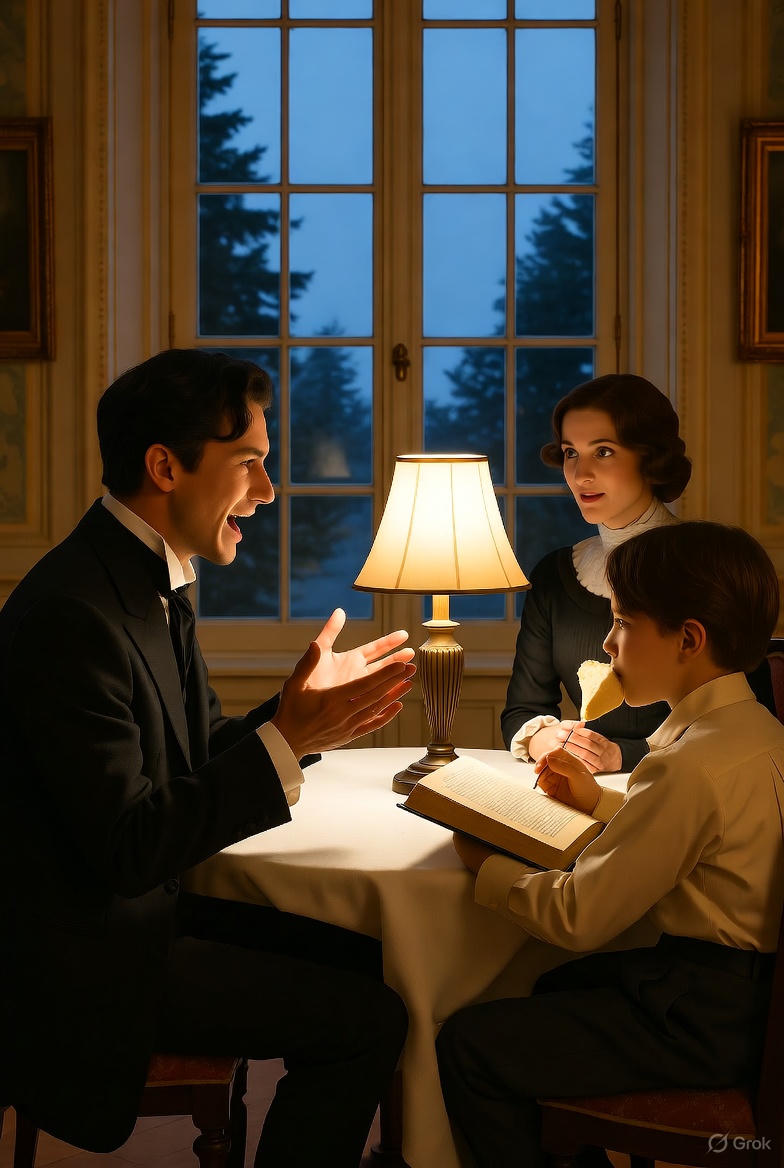
At table Falk told stories again; neither he nor Marit could eat anything. All the more eagerly the little brother ate, completely absorbed in his catechism. They soon left him alone.
They returned to the salon. On the table the lamp burned and filled the room with light.


 Anarchistbanjo's World
Leave a comment