Homo Sapiens: Under Way by Stanislaw Przybyszewski and translated by Joe E Bandel
III.
Erik Falk didn’t go into the city.
He turned off the country road and walked along the lake. Across the water, the forest faded into deep darkness, and the lake lay clear and soft, filled with the calm reflections of the evening glow.
Falk stopped.
How could he have forgotten so quickly what he said yesterday; the whole story had become a ridiculous comedy; yes, a foolish, boyish, clumsy comedy.
But Marit, hmm, trusted him blindly; no, she hadn’t noticed anything, she believed everything he said: No, she wouldn’t suspect the slightest deliberate intent.
Falk calmed down again. He lay down by the shore and gazed thoughtlessly at the lake.
In his mind, a dark mass of thoughts fermented; only now and then did single associations, images, or fragmented slogans flash up in him.
And again, he began to walk, slowly, laboriously; he wanted to recall something, he had to rouse himself to think about something, yes, to make something perfectly clear.
It grew dark. Tiny lights shimmered from the nearby villages. Now and then, he heard the clatter of a cart on the country road, then he listened to the chirping of crickets and the croaking of frogs in the ponds.
Yes, what did he actually want?
He wasn’t a professional seducer. He had never sought the ridiculous fame of seducing a woman just to possess her. No, that wasn’t it.
His thoughts refused to move further; he sat down on the grass and looked across to the black forest edge.
Something dawned in his soul, and gradually an image rose within him, the image of a woman, with her grace, the refined grace of dying noble families; it was as if she extended her slender, long hand to him and looked at him so lovingly, so kindly with her eyes.
Yes, that was his wife. Fräulein Perier. Falk smiled, but immediately grew serious again.
He loved her. She had the great masculine intelligence that understood everything, that even understood him. She had the great, refined beauty he had searched for so long, so long.
There she stood. Falk recalled her movement: that first time, the room in dim red twilight—God, how beautiful she was! He had understood at once that he had to love her, and he loved her.
Yes, absolutely. Now he longed for her. Now he wanted to sit in the big armchair at his desk, hold her on his lap, and feel her arms around his neck.
How was it that he could never forget Marit?
In the wildest bliss of love, he suddenly saw his wife’s face transform into another, into a small, narrow child’s face; he saw it gradually change until he suddenly recognized it. That was Marit.
And then he could stare endlessly at that little face, feeling his hands go limp, his thoughts drifting back to the past, to the time he spent with Marit when he had come home just a year ago and met her for the first time.
And again, he clearly felt the slackening in his limbs, and again he felt that strange longing for this love that could only bring pain, this unbearable torment of desiring a woman and not possessing her.
How happy he had been with his wife before he saw Marit. And now she stood between them, making him sad and angry because he always had to overcome her, kill her in himself anew to reach his wife.
Why had he come back here?
What did he want from Marit? Why did he lie to her, why did he torment her, why did he play this whole comedy?
Yes, if only he could understand that!
He did want something. He must have a purpose. Somewhere behind all consciousness, behind all logic, there must lie the hidden purpose, set out for his will in the unconscious.
Was it sexuality, lurking in secret for a new victim? No, that was impossible. No! It would be an outrageous villainy to destroy a child, to defile this pure dove’s soul. No, he would never do that.
Yes: doubly, a thousand times impossible. In two weeks, he would return to his wife; otherwise, he’d fall into the most hideous conflicts with his conscience.
Yes, that wretched conscience. To sit in Paris and constantly think: now she lies prostrate on the floor, writhing and begging God for mercy. No, he wouldn’t have a minute’s peace. No, that would be too terrible: a whole life with this one image, this one thought, this eternal unrest of a tormenting conscience.
He stood up and walked slowly on.
It had grown dark meanwhile, and glowing mists rose over the meadows like mighty smoke clouds, steaming and billowing upward.
Falk stopped, looked into this sea that flooded everything, and mused over something he couldn’t recall; he felt paralyzed in his mind.
He couldn’t get past the one question: what did he actually want?
Suddenly, he saw Marit before him. Yes, she looked splendid, sitting there on the stone with the marvelous red glow from the brim of her large summer hat. So slender, so delicate…
A hot trembling began in his soul: he heard the faint stammering of sexuality.
No: the conscience! My God—Falk had to smile: The great Übermensch, the strong, mighty one without conscience! No, Herr Professor had forgotten culture, the thousand centuries that labored to produce it. With reason, of course, you could argue anything away; with reason, logically speaking, you should be able to overcome everything, even conscience. But you couldn’t.
What good was all his reason; behind every logic lurked the terribly illogical, which ultimately triumphed.
And again, Falk thought of Marit and his love for her. Yes, in the end, that was all that interested him: this case of his. This case of double love was truly fascinating.
It was clear to him: he loved both. Yes, undoubtedly. He wrote the most passionate love letters to his wife and didn’t lie to her, and two hours later he told Marit he loved her, and, God knows, he didn’t lie to her either.
Now Falk began to laugh.
But behind the laughter, he felt a biting pain, a strangely venomous anger.
Of course, he had the right to love Marit; why not, who forbade him? Who had the right to forbid him anything? Should moral laws, made by crude people from stupid, unpsychological perspectives, be more binding than the power of his feelings?
Why shouldn’t he seduce her if he desired her? Why shouldn’t he possess her if he loved her and she loved him?
Yes, she did love him. So what forbade his will? Morality? Good heavens, what is morality?
He knew no morality except that of his feelings; and in those feelings, there wasn’t a single law meant to govern the will of others.
He started. A dog barked from a nearby farm, louder and fiercer.
Stupid, idiotic beast!
Falk turned onto a meadow path that passed by the cemetery.
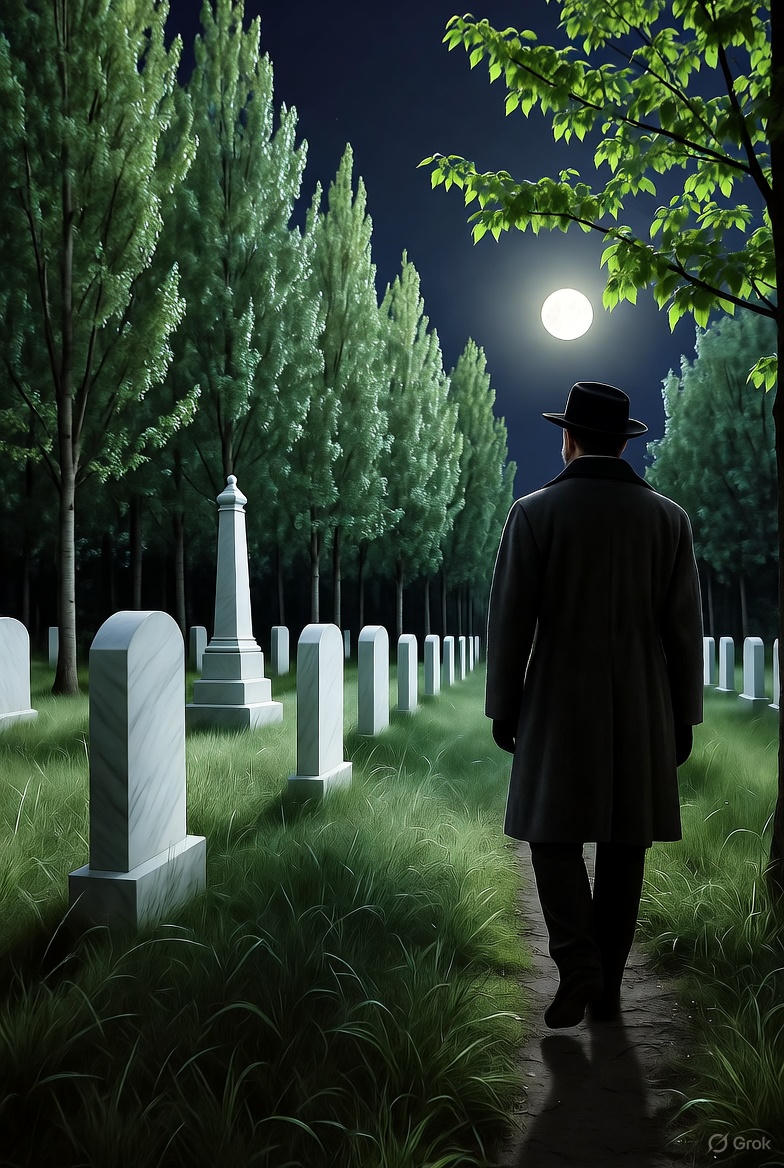
In the cemetery, the leaves of the silver poplars rustled with their eerie solemnity. White marble tombstones stood out from the darkness like ghosts. It was so terribly solemn, this eerie rustling of the trees. There was a sound that reminded him of the rattling of skeletons. He felt very uneasy.
Ridiculous that these idiotic folk tales about the lives of the dead could still affect his mind. Yes—well, he was so nervous.
His thoughts grew more and more confused. No, he was too tired. He couldn’t follow a single thought logically to its end; why bother?
Yes, why this foolish logic? What was active in his soul, what lay behind all consciousness and what he didn’t know, that had its own logic, so fundamentally different from this stupid conscious logic, and it overthrew it.
The white walls of the monastery now loomed before him; he stopped and stared at them. There was a strange poetry in there; he thought of the gruesome stories he’d been told as a child about the Cistercians who once owned the monastery.
Yes, last year she came from a convent too; that’s where she was raised. Raised! Ha, ha, ha…
Falk grew angry.
The convent women destroyed her! Yes: Destroyed! Now she walks around in iron swaddling bands! Now her soul is tangled in the umbilical cord of Catholicism, strangling itself, the poor, misbegotten child.
Why didn’t she have the will: look here, I love you! Take me! Yes, yes, yes; again the foolish logic of reason.
And yet: he would be stronger than all her religion. He would root out this poisonous weed of Christian morality from her imagination. He would force her; she must obey him. He would make her free, yes, free; and himself too.
Wasn’t he a slave? Yes, a foolish slave to his wife, his conscience, stupid old prejudices that now crawled out of their holes like earthworms in spring, tormenting him…
Oh, she would see who was mightier: him or the crucified Rabbi!
Falk felt an immense energy swelling in his brain. He quickened his steps. Eventually, he was almost running.
Drenched in sweat, he arrived home. His mother was still waiting for him.
“But good, dear, precious Mother, why are you still up?”
“Yes, she’s always so afraid when he puts out the lamp. So many accidents happen with it. She’d rather do it herself.”
“But you can’t possibly come to Paris every evening to put out my lamps.”


 Anarchistbanjo's World
Leave a comment