Chapter 5: Into the Unknown
Adam Gardner was very effective in making travel arrangements, and as Tobal recalled the old man’s warm hug and the Time Knights’ promise of his parents’ survival, he found himself a few hours later with a full stomach, refreshed, and once more on an airbus heading toward what he fervently hoped was his final destination. A Wild whisper brushed his mind—“The medallion’s echo calls”—as he fingered the weight around his neck, its calm power steadying him.
It was mid-April, and the sun shone brightly as the airbus flew east toward the Cascade Mountains. Patches of snow grew the farther they flew until it covered everything in an unbroken blanket. From the air, he could see deer sheltered in valleys, herded together for protection against natural predators such as the timber wolf and mountain lion. Hardwood trees looked like skeletal ghosts as they raised leafless arms to the heavens. There were patches scattered like occasional cemeteries hidden within the deep pine forests. The airbus flew low enough that Tobal could make out an occasional fox or wolf. Flying over the wilderness made him realize how far from civilization and the Federation he was going. The pines were dark green, and the boughs weighed heavily with snow, blocking all efforts to see the ground beneath.
It was almost an hour before he caught his first glimpse of Heliopolis. From the air, the city-state looked huge and modern. He saw one huge complex that must be the living quarters, a large open agricultural area, and a wooded park. They were all within tall, imposing walls that encircled the city itself. To Tobal, it didn’t look much different from any other modern city-state he had visited. As the airbus descended, he was surprised the pilot was not taking him into the city but dropping him outside it into a snow-covered courtyard.
“There you go, son,” the airbus driver told him cheerfully. “Take care of yourself; they’re a bit strange here. Don’t really see much of anybody. Haven’t been here that much, and I don’t want to either.” The driver opened the door, and Tobal stepped outside into the cold winter landscape. It was one o’clock in the afternoon on April 13. The airbus took off, leaving Tobal standing in a cloud of snow just outside the high walls. A shadow flitted near the wall, gone before he could focus, stirring a flicker of unease.
Tobal began looking for some way into the city. Not finding any, he spied a small building near the edge of the woods about 100 yards away from the wall. He waded through knee-high snow toward the windowless, dome-like structure. There was an arched doorway with a faded, snow-covered sign. The snow was so bright it hurt his eyes, and he had to squint against it. As he came nearer, he made out the word “Sanctuary”. He recalled the letter from his parents had mentioned claiming sanctuary. Somewhat reassured, he entered the portal that opened silently at his approach and stepped inside. It was dim, and his eyes took time adjusting to the faint light. He kicked the snow off his boots onto the gleaming tiled floor. To the left, he saw a computer terminal. A light on the console was flashing urgently.
He walked over to examine the terminal more closely. As he neared it, a disembodied voice came from somewhere near the terminal base. “Welcome, Welcome.” “Do you seek Sanctuary in Heliopolis, the city of the sun?” The same words scrolled across the screen. “Do you seek Sanctuary in Heliopolis, the city of the sun?” A prompt flashed on the screen, “Say Yes or No.” “Yes,” Tobal said. “I claim sanctuary.” “Then enter here,” an oval door slid open to reveal a small interior lighted room. The door slid closed behind him as soon as he stepped completely into the room.
“What is your name?” The voice intoned, now coming from somewhere ahead of him. What followed was a grueling 70-minute question-and-answer session in which the computer questioned Tobal about every area of his past and present. There was no place to sit, and it was uncomfortable, but he was committed at this point. There were questions he could not answer, but that did not bother the computer. Finally, the computer turned silent as it processed the information. After a short time, it spoke again. “You must go through processing before you can enter sanctuary. Processing will include detailed medical and psychological examinations. These will be automated. The purpose of these examinations is to ensure the current state of your health. In addition, the information will allow us to better understand your needs and abilities. This will aid us in determining how you will best fit into our society. These examinations will take place within this building and last approximately two days.”
One wall of the small room slid open, and a voice prompted him to enter and begin the medical examination. The wall slid closed behind him, and he found himself in a small hallway. Another wall section slid open to the right, and he stepped into another small room. A drawer slid out from the wall as the voice continued. “Please place your clothing and personal items into the drawer. You cannot take any items into the examinations. Place your items here for safekeeping. They will be returned to you after you have entered Heliopolis.” Tobal stripped and began placing his clothing and boots into the drawer. He hesitated with the medallion in hand, but an intuitive flash of warning—his parents’ voices urging him to hold fast—stopped him. Clutching it tightly, he pushed the drawer shut, a faint pulse from the medallion reassuring him.
“You may proceed with the medical examination now. We will be starting with a shower.” A small shower nozzle emerged from the ceiling and began spraying him with tepid soapy water that left his eyes stinging and his lungs gasping for breath. This was followed by a rinse of cold water as distinctly unpleasant as the jets of air that dried him off.
Realizing the futility of further resistance and wiping back an angry tear, Tobal finally gave up and concentrated on what lay ahead. He moved from cubicle to cubicle and was given an exhaustive physical exam that lasted several hours. As he shifted between cubicles, a vision flashed—himself alone under a snow-capped peak, the medallion glowing as he built a shelter—then faded, leaving him shaken. Then he was given a small silver bracelet and instructed to wear it at all times. It was a med-alert bracelet that monitored his physical health and acted as a locating device so he could be found in an emergency.
After the physical examination, he began a series of mental and psychological tests that seemed to last forever. Small breaks were given with food and water appearing out of the wall just like the drawer had. Twice he slept on a cot that slid out of the wall. The first things he learned were the controls to activate the food and water. The bathroom and shower were the next. He lost all sense of time, and for two days, he was moved from one cubicle to another, problem-solving, analyzing, and doing test questions on a computer screen or taking objects apart and putting them back together again in demonstrations of physical dexterity.
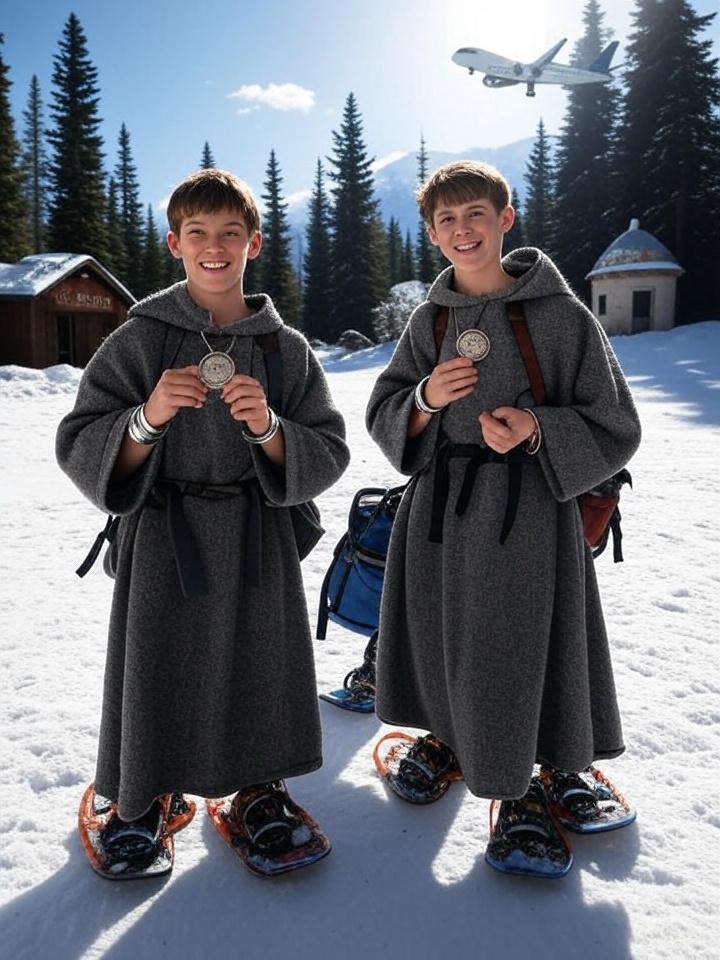
After two days of wearing nothing but a silver bracelet, Tobal was relieved when a drawer opened containing clothing. There was a gray woolen robe that reached to the floor, folded gray blankets of the same material, a pack, a sleeping bag, and a pair of hiking boots with several pairs of socks. He was busy tying his new boots when a final door opened with a cold draft, and the computer voice said, “Welcome to Sanctuary.” As the door closed behind him, Tobal found himself in dim light standing between rows of sleeping cots. It was a dormitory of some sort. His legs started trembling, and he sat down on one of the cots. It was hard and uncomfortable like molded plastic or ceramic. Still shaken by his experience of the past two days, he wondered what he should do now. Sanctuary was not what he had expected, and he had not seen another living soul. He was nervous but relieved the medallion still hung against his chest.
His eyes slowly adjusted to the gloom, and he heard a noise in the corner to his right. Moving closer, he saw two of the cots were occupied by sleeping figures. Against the wall, he saw another food and water dispenser. To the right was the restroom and shower area. He walked around, exploring each area in the dim light. He didn’t see any exits, and it smelled like a locker room.
Moving over to the food and water dispenser, he tried some of the food and nearly gagged. The machine dispensed soft chewy bars, the consistency of glued-together oatmeal. It was cold and distinctly unpleasant with a wicked aftertaste that stayed long after the food was gone. He grabbed a paper cup filled with water, trying to get the taste out of his mouth. The water had a strong plastic taste and odor that made it just as unpleasant as the food bar. While it was wet, it was not at all satisfying. Again, he sat down on the nearest cot and tried to think. So this was sanctuary. Just what was Sanctuary? What had he gotten himself into?
There had to be a way out. He walked slowly around the room, brushing his hand against the wall, and in the darkest corner noticed something he had missed before. He entered the darkness and turned a corner that was barely visible. A light was glowing weakly, and he moved cautiously toward it in the gloom. The light seemed to be flashing and oddly familiar. As he came closer, he recognized it as the terminal he had first encountered on entering the building. At his approach, it sprang to life and asked, “Do you seek sanctuary in Heliopolis, the city of the sun?” “Hey, what’s the matter?” “Everything ok?” Tobal heard someone come up behind him and start shaking him on the shoulder. He looked up, and there was a smaller, tow-haired boy with a shock of yellow hair grinning impishly. His face was full of mischief.
“What’s wrong?” Tobal replied, his voice steadying. “I almost lost my medallion—my parents’ gift—but kept it.” Rafe’s eyes sparkled. “Smart move. That medallion’s got old tales—might guide you yet. You’ll get your other stuff back after citizenship.” “Become a citizen?” Tobal asked. “Yeah, first you claim sanctuary, then after training, you’re granted citizenship.” “You mean I can’t get into the city right away?” Tobal asked anxiously. Rafe laughed, “Hey, that’s a good one! Didn’t your parents tell you anything?” “My parents are dead.” “Oh,” the smile vanished a minute from Rafe’s face, then returned. “There’s preliminary training before citizenship. Claiming sanctuary means applying; you prove yourself with three degrees of training.” “What are they?” Tobal asked. “The Apprentice degree is basic survival training,” Rafe said, “You survive in the woods alone for one month.” “I can’t survive in the woods for a month!” Tobal exclaimed helplessly. “How do I learn? How do I live with no food or shelter? I’ll die!” “That’s right,” Rafe grinned. “That’s why I’m here. You need a teacher. The solo comes after training—I’ll teach you survival skills. I’m Rafe,” he said, extending his hand in welcome. Tobal shook hands.
He pointed at the chevrons sewn on his jacket. “Each chevron’s for someone I’ve trained who soloed. You’re my sixth and last. After you solo, I move to Journeyman.” “Then I have to train people?” Tobal muttered. “Yes, that’s how you prove mastery and leadership.” “That will take forever!” “No, it depends on your effort,” Rafe said cheerfully. “I’ve done this in a year with six. Some take six years.” He winked, “I was sleeping—waiting for you.” “Waiting for me?” “Well, someone. My food’s nearly gone; I can’t eat that brown crap.” He grinned, “Tried it?” Tobal nodded, grinning back, “Couldn’t either.” Rafe chuckled, “That’s the point—uncomfortable beds and bad food push you to the woods.” “What about her?” Tobal pointed at the other cot. “Oh, Angel, a journeyman injured in the mountains. Medics reset her leg; she’s grumpy, so let her sleep,” Rafe warned, finger to lips. The figure stirred and groaned.
“Now, check your pack,” Rafe said. Tobal’s things lay on a cot. Rafe spread them out: eleven sock pairs, hiking boots, compass, canteens, sheath knife, belt, fire starter, map, first aid kit, sewing kit, toothbrush, comb, pencils, and paper. Rafe pointed to the silver bracelet. “That’s a med-alert—wear it always. It tracks health and location for emergencies.” He handed Tobal the knife and belt. “This keeps your robe shut—drafty otherwise.” Tobal noted, “Good boots.” Rafe snorted, “Worn out in two months—rugged out here.”
The robe reminded Tobal of monks—scratchy, woolen, hooded. “No underwear?” Rafe laughed, “Make your own. I did.” Rafe wore a tailored tunic and trousers, Ren Fair-style. “Winter gear here,” Rafe added, fetching a fur robe, boots, hat, mittens, and snowshoes, helping Tobal don them. “Fill canteens first,” Rafe said. They filled them and stepped outside. Tobal practiced snowshoes, improving quickly.
“See that peak?” Rafe pointed east to Old Baldy. “We’re heading that way, using it as a landmark. Don’t get lost—use maps and landmarks.” “Check your compass, turn north, align with Old Baldy—east-northeast,” Rafe instructed, showing Tobal the lensatic compass. He handed him a cord. “Tie this around your neck, leave ends free. A mile’s 5280 feet, or 1760 yards. Take three-foot steps, count, tie a knot every 880 paces—half a mile. Get your map.”
Tobal pulled out the map. “Lay it north-up, use the compass,” Rafe said. Tobal did, weighting it with stones. “Find landmarks—mountains, lakes. Spot Old Baldy.” “How do I know which?” “Look for unique traits—isolated, tall. Find Hermit’s Peak south, alone, low.” Tobal struggled, then pointed. Rafe laid a string north-south across it. “We’re north of it. Now find Old Baldy, east-northeast.” Tobal traced contours, spotting it. Rafe crossed with another string. Heliopolis marked their intersection. “Easy,” Tobal said. Rafe smiled, “Sometimes. We’re going four miles toward Old Baldy. One inch equals one mile—measure four inches.” Tobal marked it—a creek nearby. “Our camp,” Rafe said. “How do we know four miles?” “Eight knots,” Tobal answered. “Great! Let’s go,” Rafe laughed.


 Anarchistbanjo's World