Feeds:
Posts
Comments

Posts Tagged ‘short-story’

Homo Sapiens: In the Maelstrom by Stanislaw Przybyszewski and translated by Joe E Bandel

VI.

Falk listened to Olga with nervous unrest. 

She told him dryly, almost businesslike, of her visit to Czerski. 

“Czerski is a fantasist,” he finally said. “Everything whirls confused in his head. I believe he even wants to build Fourierist phalansteries… He, he, he… Bakunin has completely turned his head…” “I don’t believe he is a utopian,” Olga spoke dryly and coldly. 

“His train of thought is a bit confused, but original, and, as I think, not without prospect of success.” 

Falk looked at her from the side. 

“So, so… Do you really believe that? For all I care… It is extraordinarily sympathetic to me that he collides with the bourgeois code of law… But tell me, what is between him and Kunicki?” 

“Kunicki shot a Russian in a duel in Zurich two years ago.” 

“In a duel?” 

“Yes. Strange enough. Then Czerski slapped him in a meeting.” 

“Why then?” 

“Czerski said he slapped not Kunicki, but his violation of the supreme principle of the party.” 

Falk laughed scornfully. 

“Wonderful! And what did Kunicki say?” 

“What should he do? He couldn’t murder Czerski after all.” 

“Strange fanatic! But now he wants nothing more to do with the party?”  

“No.” 

Falk pondered long. 

“My act is my being—isn’t that what he said? Hm, hm…” Olga looked at him searchingly. 

“You, Falk, tell me, is it really serious with you about our cause?” 

“Why do you ask that?” “Because I want to know.” 

Olga seemed unusually irritated and excited. 

“Because you want to know? Well, for all I care. I mean nothing with your cause. What do I have to do with a cause? Humanity?! Who is humanity, what is humanity? I only know who you are and my wife, and my friend, and one more, but humanity, humanity: I don’t know that. I have never had anything to do with that.” 

“What do you mean by that you yourself wrote almost all the proclamations and leaflets, that you give your money for agitation, that you…” 

He interrupted her violently. 

“But I don’t do that for humanity’s sake. Oh, how naive you are… Don’t you understand that it gives me a mad pleasure to open the eyes of the people down there a little? Isn’t it an unheard-of pleasure to observe how the poor wage slave suddenly becomes seeing?… Well, I don’t need to enumerate to you what all the poor slave down there gets to know… He, he, he… Isn’t it glorious to see how such a slave develops under the influence of so much light? And this divine spectacle, how the rulers scream to heaven for revenge out of rage and fear and make anti-subversion laws!… Ha, ha, ha… Look here—here I have a wonderful list of the enormous losses the mines had in the last strike. I ruined my whole fortune, or better, my wife’s fortune in this strike, but for that this unheard-of satisfaction! The Theodosius mine went bankrupt, the Etruria can hardly hold on anymore… I know him, the owner, he has gone quite gray with worries, this disgusting labor-power usurer… He, he… Never have I had such an intense feeling of satisfaction as when I saw him sitting there… I ruined him, not because he concerns me or because I believe in your cause, only, merely only out of personal interest in this grandiose spectacle… He, he, the poor fellow screamed for military, he wanted to have all workers shot down like dogs, he threatened to overthrow the government, oh, that was infinitely grand to see. And for this to see, should I not give the last penny?” 

He became quite hoarse with excitement. 

Olga looked at him long, long and smiled painfully. 

“How you deceive yourself! But you don’t want to deceive me, do you?” 

He stopped astonished, suddenly laughed, but remained very serious in a moment. 

“So you believe in nobler motives in me?” She did not answer. 

“Do you believe that?” he asked violently. But she was silent. 

“You must tell me!” He stamped his foot, but controlled himself instantly. 

“No, I don’t believe,” she finally said calmly, “that you should find satisfaction in such petty, malicious revenge. You lie completely pointlessly. I know very well that you gave the money for the strike because the consortium paid out twenty-five percent dividend and at the same time typhus had broken out among the mine workers.” 

“Those were secondary reasons.” 

“No, no, that is not true. You have found a pleasure for some time in slandering and making yourself bad: Czerski said very well that you would go to prison with joy if you could only find atonement for your sins in it.” 

“Ha, ha, ha… You are quite unusually sharp psychologists.” He laughed with a forced ugly laugh. 

“So you believe in high-minded motives in me? Ha, ha, ha… Do you know why I sent Czerski the money?” 

He suddenly stopped. 

She looked at him pale and confused. “You lie!” 

“Do you know why?” 

She became unusually excited and jumped up. “Say that you lie!” 

Falk sat down and stared at her. “Is it true?” she asked hoarsely. 

She bent down over him and looked at him fixedly with wide-open eyes. 

“Did you really want to get rid of him?” 

“No!” he suddenly cried out. “You are not cowardly.” 

“No!” 

She breathed deeply and sat down again. They were silent long. 

“What do you want to do now with Janina?” 

Falk became very pale and looked at her startled. “Did Czerski tell you that too?” 

“Yes.” 

He let his head sink and stared at the floor. 

“I will adopt the child,” he said after a long pause. 

“It is terrible what a demon you have in you. Why must you make yourself and others unhappy? Why? You are a very unhappy person, Falk.” 

“Do you think so?” 

He threw it out distractedly, walked back and forth a few times and stopped before her. 

“Did you not believe for a second that I wanted to get rid of Czerski out of cowardice?” 

“No!” 

He took her hand and kissed it. “I thank you,” he said dryly. 

He began to walk up and down again. A long pause arose. “When will Czerski leave?” 

“Tonight.” 

He stopped before her. 

“I believe in your love,” he said slowly. “I love your love. You are the only being in whose presence I am good…” 

She stood up confused. 

“Don’t speak of it, why speak of it?… Terrible things are before you now… If you need me…” 

“Yes, yes, I will come to you when the storm is over.” “Come when nothing else remains for you.” 

“Yes.” 

She went. 

Suddenly Falk ran after her. 

“Where does Czerski live?” She gave him the address. 

“Do you want to go to him?” “Yes.”

Read Full Post »

Madame Bluebeard by Karl Hans Strobl and translated by Joe E Bandel

Ruprecht stood pensively in the dark, then climbed
the stairs, where Jana waited at the top. Sleep was
impossible. First, another glass of wine to calm
himself. The news had shaken him. So much had
surfaced—radiant youth, a blonde girl’s face… it
gleamed like treasure unearthed from a barrow. One
more glass…
“You can go, Jana,” he said.
But Jana stood in the room’s center, staring at his
master.
“What is it?”
“Master… you must come to the cellar. I need to
show you something.”
“Another secret? I’m exhausted. But fine, if you
insist.”
“Not by the stairs,” Jana said. “Better no one
knows you went with me. Over there…”
Beside the heavy cabinet with armored men was a
hidden panel door, so well-concealed Ruprecht had
only found it after careful search. Even Helmina
claimed ignorance. “This old castle may hold more
such secrets,” she’d said. Indeed, Ruprecht had found
similar features in other rooms—secret doors,
pivoting paintings, hollow walls, the full medieval
romantic apparatus spared by the imaginative Count
Erwin Moreno during renovations. It was the era of
Grillparzer’s The Ancestress. Such things were a
point of pride. “I find it almost eerie,” Helmina had
remarked. “Eerie? No!” Ruprecht smiled. “Feudal,
high feudal! Pity we don’t have a white lady
heralding the owners’ deaths.” At the flash in
Helmina’s eyes, he’d added, “It’s odd no one’s
noticed… shows how little we heed our
surroundings.”
The castle was a fox’s den, but these secrets were
harmless. Dark stairways led to passages, doors to
hidden chambers, pivoting paintings to empty niches.
If they once held purpose, they were now mere
mood-setters.
Behind the study’s panel door, a narrow spiral
staircase descended past a lightless chamber to a
ground-floor corridor, ending behind old oak
paneling near a garden glass door.
Jana led with a lamp. The steps creaked under
their tread. From the staircase’s end, it was a short
walk to the cellar entrance. Jana hadn’t locked the
rusty iron door, opening it silently, plunging ahead
into the damp dark.
The cellar held many rooms. The first were
stocked with provisions, then wood and coal stores.
At the back, behind a wooden gate, lay the wine,
entrusted to Lorenz’s care. Each barrel bore a neat
label noting vintage and origin. In the rear, bottled
wines nestled in sand, dusty bottles aligned in orderly
groups, their patina-covered labels facing up.
A faint trickling guided Ruprecht through the
bottle rows to the cellar’s end.
Jana raised the lamp, pointing to a dark patch on
the wall. Water had broken through, spurting between
stones, carving a path in the sand. Bottles here were
jumbled, half-submerged in sodden ground. At the far
end, a dark opening gaped. Clearly, water had cleared
a blocked hole in the wall, now cascading in small
falls, widening it as it carried soft muck away. “Have
you been down there?” Ruprecht asked.
“No, Master, but I think we should see where it
leads.” Without hesitation, Jana knelt and crawled
into the hole, lamp in hand. Ruprecht lit his way, arm
extended. He wanted to smile at his servant’s
suspicion and this adventurous probe into the castle’s
depths, but he was strangely tense. As Jana slid
halfway down, he found footing, taking the lamp.
Ruprecht followed swiftly.
They entered a lower, empty cellar, its walls
arching close overhead. Water stood ankle-deep, with
no drain. Ruprecht felt dampness seep through his
shoes.
Jana shone the light around. Nothing. Opposite
was another low doorway, steps leading up.
“Onward,” Ruprecht said, seized by explorer’s
zeal.
The next room was empty too, its air stifling, the
lamp dim. They searched the vault, squeezing
through a narrow gap into another chamber.
More vaults followed—some up, some down, a
passage, then more rooms.
Finally, they descended slick steps deep below.
Ruprecht tested the walls. “We must be near the
tower. These stones are giant-laid.”
Jana stood by a small wall opening, too narrow to
crawl through. He thrust his arm with the lamp into
the dark, casting wary glances like harpoons.
“Nothing,” Ruprecht said. “Let’s turn back. I’m
soaked.”
Jana turned, horror in his gaze. “Master,” he said,
“look here.”
Ruprecht approached, craning past Jana’s
outstretched arm. The lamp’s light didn’t reach far.
Nothing was visible in its glow. Beyond the lit circle,
something seemed to emerge—a yellowish shape,
like a rotting pumpkin… a human face, grimacing in
distortion.
Ruprecht recoiled. “Jana,” he said, gripping the
Malay’s arm, “there’s a corpse.”
“I see three dead men,” Jana nodded.
“Jana—Jana!” Ruprecht leaned against the wall,
staring into the Malay’s face.
“Yes… Master!”
Only their breathing and the lamp’s faint, anxious
hum broke the deep silence.
“It could be from long ago…” Ruprecht said
finally. “Castles like this didn’t coddle prisoners.
Bodies can preserve for centuries in cellar air. I’ve
seen it often.”
Jana peered through the opening again. “Master,”
he said, “their clothes are like yours. The people in
the yellow hall’s paintings wear different ones.”
“We can’t get in,” Ruprecht said, eyeing the
massive, unyielding stones. “Impossible without
tools.”
“Leave the dead in peace, Master! It’s enough you
know three corpses lie under this thick tower. You
should leave this castle.”
“It’s Helmina’s castle, Jana! Helmina’s castle! I
see you think she knows.”
“Yes! She’ll kill you, Master! Come away. Return
to India.”
“No, Jana, I can’t. I must see if you’re right. This
adventure must be faced.”
“You’ll be careless… you’ll betray yourself…
then you’re lost.”
Ruprecht straightened. “Haven’t I proven I can
keep silent? You’ll see! It’s good I know this… Let’s
go back. Take my wet suit, erase all traces, Jana…
No one must know we were here tonight… Besides, I
can’t believe you’re right. Helmina knows nothing of
this… it’s nonsense. People don’t just vanish
nowadays.”
Jana met his master’s gaze. Horror gave way to
iron resolve. Ruprecht’s face was taut but calm, as
Jana knew from Indian jungle hunts.

Read Full Post »

Alraune by Hanns Heinz Ewers and translated by Joe E Bandel

The professor laughed and said, “She brings money into the
house.”
He knew very well that these things happened in a natural way,
that it was only the result of his intense occupation with these things
of the earth. But still there was some connection with the little
creature and he played with the thought.
He took a very risky speculation and bought enormous properties
along the broad path of Villen Street. He had the earth dug up and
every handful of dirt searched. He did business taking great calculated
risks, putting a mortgage bank back on a sound financial basis when
everyone else thought it would go bankrupt in a very short time. The
bank held together. Whatever he touched went the right way.
Then through a coincidence he found a mineral water spring on
one of his properties in the mountains. He had it barreled and hauled
away. That is how he came into the mineral water line buying up
whatever was available in the Rhineland until he almost had a
monopoly in that industry. He formed a little company, hung a
nationalistic cloak around it, declaring that a person had to make a
stand against the foreigners, the English that owned Apollonaris.
The little owners flocked around this new leader, swore by “His
Excellency”, and when he formed a joint company gladly allowed
him to reserve the controlling shares for himself. It was a good thing
they did, the Privy Councilor doubled their dividends and dealt
sharply with the outsiders that had not wanted to go along.
He pursued a multitude of things one right after the other–they
had only one thing in common–they all had something to do with the
earth. It was just a whim of his, this thought that Alraune drew gold
out of the earth and so he stayed with those things that had something
to do with the earth. He didn’t really believe it for a second, but he
still entered into even the wildest speculation with the certain
confidence that it would succeed as long as it dealt with the earth.
He refused to deal with anything else without even looking into
it, even highly profitable stock market opportunities that appeared
with scarcely the slightest risk. Instead he bought huge quantities of
extremely rotten mining concerns, buying into ore as well as coal,
then trading them in a series of shady deals. He always came out–
“Alraune does it,” he said laughing.
Then the day came when this thought became more than a joke
to him. Wölfchen was digging in the garden, behind the stables under
the large mulberry tree. That was where Alraune wanted to have her
subterranean palace. He dug day after day and once in awhile one of
the gardener’s boys would help.
The child sat close by; she didn’t speak, didn’t laugh, just sat
there quietly and watched. Then one evening the boy’s shovel gave a
loud clang. The gardener’s boy helped and they carefully dug the
brown earth out from between the roots with their bare hands. They
brought the professor a sword belt, a buckle and a handful of coins.
Then he had the place thoroughly dug up and found a small treasure –
genuine Gaelic pieces, rare and valuable. It was not really
supernatural. Farmers all around sooner or later found something,
why shouldn’t there be something hidden in his garden as well?
But that was the point. He asked the boy why he had dug in that
particular spot under the mulberry tree and Wölfchen said the little
one wanted him to dig there and nowhere else. Then he asked Alraune
but she remained silent.
The Privy Councilor thought she was a divining rod, that she
could feel where the earth held its treasure. He laughed about it. Yes,
he still laughed. Sometimes he took her along out to the Rhine along
Villen Street and over to the ground where his men were digging.
Then he would ask dryly enough,” Where should they dig?”
He observed her carefully as she went over the field to see if her
sensitive body would give some sign, some indication, anything that
might suggest–
But she remained quiet and her little body said nothing, later
when she understood what he wanted she would remain standing on
one spot and say, “Dig.”
They would dig and find nothing. Then she would laugh lightly.
The professor thought, “She’s making fools of us.” But he always dug
again where she commanded. Once or twice they found something, a
Roman grave, then a large urn filled with ancient silver coins.
Now the Privy Councilor said, “It is coincidence.”
But he thought, “It could also be coincidence.”
One afternoon as the Privy Councilor stepped out of the library
he saw the boy standing under the pump. He was half-naked with his
body bent forward. The old coachman pumped, letting the cold stream
pour over his head and neck, over his back and both arms. His skin
was blazing red and covered with small blisters.
“What did you do Wölfchen?” He asked.
The boy remained quiet, biting his teeth together, but his dark
eyes were full of tears.
The coachman said, “It’s stinging nettles. The little girl beat him
with stinging nettles.”
Then the boy defended himself, “No, no. She didn’t beat me. I
did it myself. I threw myself into them.”
The Privy Councilor questioned him carefully yet only with the
help of the coachman was he able to get the truth out of the boy. It
went like this:
He had undressed himself down to his hips, thrown himself into
the nettles and rolled around in them, but–at the wish of his little
sister. She had noticed how his hand burned when he accidentally
touched the weed, had seen how it became red and blistered. Then she
had persuaded him to touch them with his other hand and finally to
roll around in them with his naked breast.
“Crazy fool!” The Privy Councilor scolded him. Then he asked if
Alraune had also touched the stinging nettles.
“Yes,” answered the boy, but she didn’t get burned.
The professor went out into the garden, searched and finally
found his foster-child. She was in the back by a huge wall tearing up
huge bunches of stinging nettles. She carried them in her naked arms
across the way to the wisteria arbor where she laid them out on the
ground. She was making a bed.
“Who is that for?” he asked.
The little girl looked at him and said earnestly, “For Wölfchen!”
He took her hands, examined her thin arms. There was not the
slightest sign of any rash.
“Come with me,” he said.
He led her into a greenhouse where Japanese primroses grew in
long rows.
“Pick some flowers,” he cried.
Alraune picked one flower after another. She had to stretch high
to reach them and her arms were in constant contact with the
poisonous leaves. But there was no sign of a burning rash.
“She must be immune,” murmured the professor and wrote a
concise thesis in the brown leather volume about the appearance of
skin rashes through contact with stinging nettles and poison primrose.
He proposed that the reaction was purely a chemical one, that the
little hairs on the stems and leaves wounded the skin by secreting an
acid, which set up a local reaction at the place of contact.
He attempted to discover a connection as to whether and to what
extent the scarcely found immunity against these primroses and
stinging nettles had to do with the known insensibility of witches and
those possessed. He also wanted to know whether the cause of both
phenomenon and this immunity could be explained on an auto-
suggestive or hysterical basis.
Now that he had once seen something strange in the little girl he
searched methodically for things that would validate this thought. It
was mentioned at this spot as an addendum that Dr. Petersen thought
it was completely trivial and disregarded the fact in his report that the
actual birth of the child took place at the midnight hour.
“Alraune, was thus brought into this life in the time honored
manner,” concluded the Privy Councilor.
Old Brambach had come down from the hills; it had taken four
hours to come from beyond the hamlet of Filip. He was a semi-invalid
that went through the hamlets in the hill country selling church raffle
tickets, pictures of saints and cheap rosaries. He limped into the
courtyard and informed the Privy Councilor that he had brought some
Roman artifacts with him that a farmer had found in his field.
The professor had the servants tell him that he was busy and to
wait, so old Brambach waited there sitting on a stone bench in the
yard smoking his pipe. After two hours the Privy Councilor had him
called in. He always had people wait even when he had nothing else
to do. Nothing lowered the price like letting people wait, he always
said.
But this time he really had been busy. The director of the
Germanic museum in Nuremburg was there and was purchasing items
for a beautiful exhibit called “Gaelic finds in the Rhineland”.
The Privy Councilor did not let Brambach into the library but
met with him in the little front room instead.
“Now, you old crippled rascal, let’s see what you have!” he
cried.
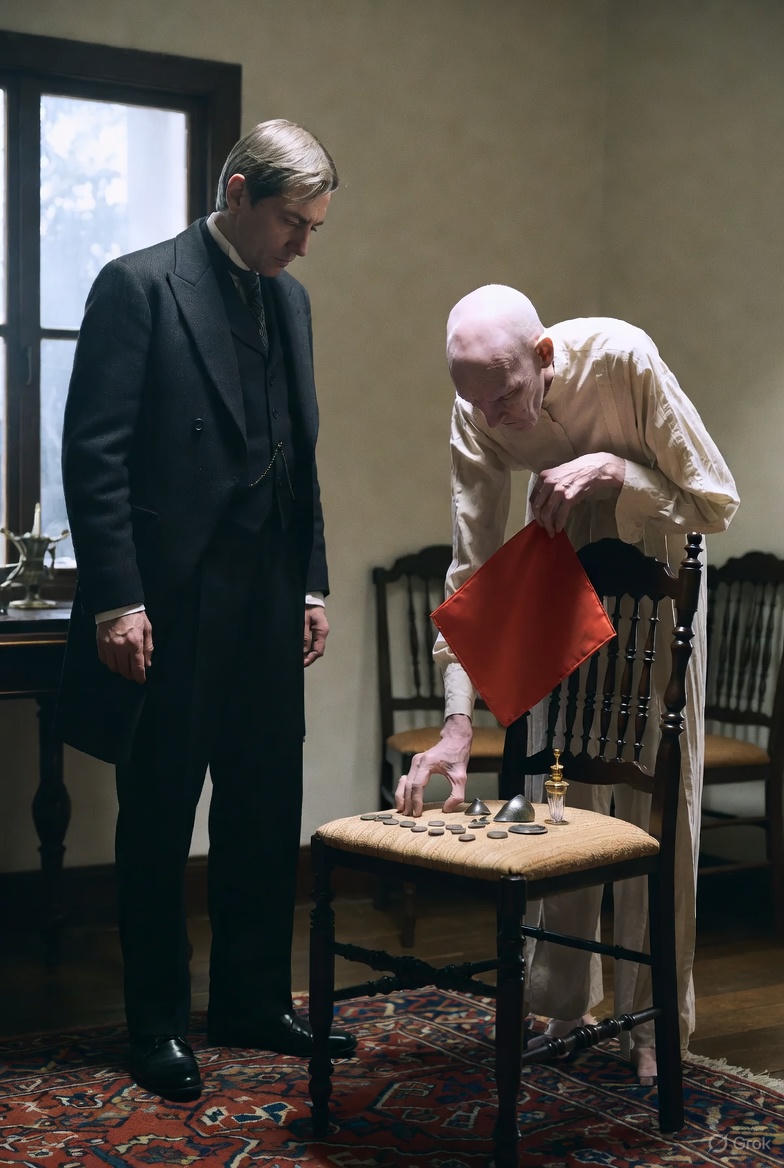
The invalid untied a large red handkerchief and carefully laid out
the contents on a fragile cane chair. There were many coins, a couple
of helmet shards, a shield pommel and an exquisite tear vial. The
Privy Councilor scarcely turned to give a quick squinting glance at the
tear vial.
“Is this all, Brambach?” he asked reproachfully and when the old
man nodded he began to heartily upbraid him. He was so old now and
still as stupid as a snotty nosed youngster! It had taken him four hours
to get here and would take him four hours to go back. Then he had to
wait a couple hours as well. He had frittered the entire day away on
that trash there! The rubbish wasn’t worth anything. He could pack it
back up and take it with him. He wouldn’t give a penny for the lot!
How often did he have to tell people again and again, “Don’t run
to Lendenich with every bit of trash?”
It was stupid! It was better to wait until they had a nice
collection and then bring everything in at one time! Or maybe he
enjoyed the walk in the hot sun all the way here and back from Filip?
He should be ashamed of himself.
The invalid scratched behind his ear and then turned his brown
cap in his fingers very ill at ease. He wanted to say something to the
professor, most of the time he was very good at haggling a higher
price for his wares. But he couldn’t think of a single thing, only the
four miles that he had just come–exactly what the professor was now
berating him for. He was completely contrite and comprehended
thoroughly just how stupid he had been so he made no response at all.
He requested only that he be allowed to leave the artifacts there so he
wouldn’t have to haul them back. The Privy Councilor nodded and
then gave him half a Mark.

Read Full Post »

Alraune by Hanns Heinz Ewers and translated by Joe E Bandel

Chapter Six
Deals with how the child Alraune grew up.

THE acquisition of the dice cup is mentioned by the Privy
Councilor in the leather bound book. From that point on it
was no longer written in the distinct and clear hand of Dr.
Petersen but in his own thin, hesitating and barely legible
script.
But there are several other short entries in the book that are of
interest to this story. The first refers to the operation taken to correct
the child’s Atresia Vaginalis performed by Dr. Petersen and the cause
of his untimely demise.
The Privy Councilor mentions that in consideration of the
savings he had made through the death of the mother and the good
help of his assistant doctor through the entire affair he granted a three
month summer trip vacation with all expenses paid and promised a
special bonus of a thousand Marks as well. Dr. Petersen was
extremely overjoyed about this trip. It was the first big vacation he
had ever taken in his life. But he insisted upon performing the simple
operation beforehand even though it could have easily been put off for
a much longer time without any special concern.
He performed the operation a couple days before his scheduled
departure with excellent results for the child. Unfortunately he,
himself, developed a severe case of blood poisoning–What was so
astonishing was that despite his almost exaggerated daily care for
cleanliness–it was scarcely forty-eight hours later that he died after
very intense suffering.
The direct cause of the blood poisoning could not be determined
with certainty. There was a small wound on his left upper arm that
was barely perceptible with the naked eye. A light scratch from his
little patient might have inflicted it.
The professor remarked how already twice in this matter he had
been spared a great sum of money but did not elaborate any further.
It was then reported how the baby was kept for the time being in
the clinic under the care of the head nurse. She was an unusually quiet
and sensitive child that cried only once and that was at the time of her
holy baptism performed in the cathedral by Chaplain Ignaz Schröder.
Indeed, she howled so fearfully that the entire little
congregation–the nurse that carried her, Princess Wolkonski and
Legal Councilor Sebastian Gontram as the godparents, the Priest, the
sexton and the Privy Councilor himself–couldn’t even begin to do
anything with her. She began crying from the moment she left the
clinic and did not stop until she was brought back home again from
the church.
In the cathedral her screams became so unbearable that his
Reverence took every opportunity to rush through the sacred
ceremony so he and those present could escape from the ghastly
music. Everyone gave a sigh of relief when it was all over and the
nurse had climbed into the carriage with the child.
It appears that nothing significant happened during the first year
in the life of this little girl whom the professor named “Alraune” out
of an understandable whim. At least nothing noteworthy was written
in the leather bound volume.
It was mentioned that the professor remained true to his word
and even before the child was born had taken measures to adopt the
girl and composed a certified will making her his sole heir to the
complete exclusion of all his other relatives.
It was also mentioned that the princess, as godmother, gave the
child an extraordinarily expensive and equally tasteless necklace
composed of gold chain and two strands of beautiful pearls set with
diamonds. At the center surrounded by more pearls was a hank of
fiery red hair that the Princess had cut from the head of the
unconscious mother at the time of her conception.
The child stayed in the clinic for over four years up until the time
the Privy Councilor gave up the Institute as well as the attached
experimental laboratories that he had been neglecting more and more.
Then he took her to his estate in Lendenich.
There the child got a playmate that was really almost four years
older than she was. It was Wölfchen Gontram, the youngest son of the
Legal Councilor. Privy Councilor ten Brinken relates very little of the
collapse of the Gontram household. In short sentences he describes
how death finally grew tired of the game he was playing in the white
house on the Rhine and in one year wiped away the mother and three
of her sons.
The fourth boy, Joseph, at the wish of his mother had been taken
by Reverend Chaplain Schröder to become a priest. Frieda, the
daughter, lived with her friend, Olga Wolkonski, who in the meantime
had married a somewhat dubious Spanish Count and moved to his
house in Rome. Following these events was the financial collapse of
the Legal Councilor despite the splendid fee he had been paid for
winning the divorce settlement for the princess.
The Privy Councilor puts down that he took the boy in as an act
of charity–but doesn’t forget to mention in the book that Wölfchen
inherited some vineyards with small farm houses from an aunt on his
mother’s side so his future was secure. He remarks as well that he
didn’t want the boy to feel he had been taken into a stranger’s house
and brought up out of charity and compassion so he used the income
from the vineyards to defray the upkeep of his young foster-child. It is
to be understood that the Privy Councilor did not come up short on
this arrangement.
Taking all of the entries that the Privy Councilor ten Brinken
made in the leather bound volume during this time one could
conclude that Wölfchen Gontram certainly earned the bread and
butter that he ate in Lendenich. He was a good playmate for his
foster-sister, was more than that, was her only toy and her nursemaid
as well.
The love he shared with his wild brothers for living and
frantically running around transferred in an instant to the delicate little
creature that ran around alone in the wide garden, in the stables, in the
green houses and all the out buildings. The great deaths in his parent’s
house, the sudden collapse of his entire world made a strong
impression on him–in spite of the Gontram indolence.
The small handsome lad with his mother’s large black dreamy
eyes became quiet and withdrawn. Thousands of boyish thoughts that
had been so suddenly extinguished now snaked out like weak tendrils
and wrapped themselves solidly like roots around the little creature,
Alraune. Whatever he carried in his young breast he gave to his new
little sister, gave it with the great unbounded generosity that he had
inherited from his sunny good-natured parents.
He went to school in the city where he always sat in the last row.
At noon when he came back home he ran straight past the kitchen
even though he was hungry. He searched around in the garden until he
found Alraune. The servants often had to drag him away by force to
give him his meals.
No one troubled themselves much over the two children but
while they always had a strange mistrust of the little girl, they took a
liking to Wölfchen. In their own way they bestowed on him the
somewhat coarse love of the servants that had once been given to
Frank Braun, the Master’s nephew, so many years before when he had
spent his school vacations there as a boy.
Just like him, the old coachman, Froitsheim, now tolerated
Wölfchen around the horses, lifted him up onto them, let him sit on a
wool saddle blanket and ride around the courtyard and through the
gardens. The gardener showed him the best fruit in the orchards; cut
him the most flexible switches and the maids kept his food warm,
making sure that he never went without.
They thought of him as an equal but the girl, little as she was,
had a way of creating a broad chasm between them. She never chatted
with any of them and when she did speak it was to express some wish
that almost sounded like a command. That was exactly what these
people from the Rhine in their deepest souls could not bear–not from
the Master–and now most certainly not from this strange child.
They never struck her. The Privy Councilor had strongly
forbidden that, but in every other way they acted as if the child was
not even there. She ran around–fine–they let her run, cared for her
food, her little bed, her underwear and her clothes–but just like they
cared for the old biting watchdog, brought it food, cleaned its
doghouse and unchained it for the night.
The Privy Councilor in no way troubled himself over the
children and let them completely go their own way. Since the time he
had closed the clinic he had also given up his professorship, keeping
occupied with various real estate and mortgage affairs and even more
with his old love, archeology.
He managed things as a clever and intelligent merchant so that
museums around the world paid high prices for his skillfully arranged
collections. The grounds all around the Brinken estate from the Rhine
to the city on one side, extending out to the Eifel promontory on the
other were filled with things that first the Romans and then all their
followers had brought with them.
The Brinkens had been collectors for a long time and for ten
miles in all directions any time a farmer struck something with his
plowshare they would carefully dig up the treasure and take it to the
old house in Lendenich that was consecrated to John of Nepomuck.
The professor took everything, entire pots of coins, rusted
weapons, yellowed bones, urns, buckles and tear vials. He paid
pennies, ten at the most. But the farmer was always certain to get a
good schnapps in the kitchen and if needed money for sowing, at a
high interest of course–but without the security demanded by the
banks.
One thing was certain. The earth never spewed forth more than
in those years when Alraune lived in the house.

Read Full Post »

Madame Bluebeard by Karl Hans Strobl and translated by Joe E Bandel

They discussed the year’s events. Hugo extracted
Helmina’s promise to attend every festivity.
The afternoon passed. They took a short drive.
The weather had cleared, the thinning clouds hinting
at the sun. Hugo wished to prolong the day, but
evening approached, they returned to the castle,
dined, and his departure loomed.
“I feel so at ease here, madam,” Hugo sighed.
“You may return if you enjoyed it,” Helmina
smiled. Then she excused herself. The fresh air had
tired her, she had a headache, and wished to retire.
The men adjourned to Ruprecht’s study. “A cigar,
a glass of wine, eh?” Ruprecht suggested, ringing the
bell. The Malay appeared at the door.
“Tell Lorenz to fetch a bottle of 1882
Schönberger,” Ruprecht said.
“Lorenz isn’t here.”
“Oh, right—he’s on leave. Linz, or somewhere.
Get the keys and fetch it yourself. You’ll find it. It’s
at the back of the cellar, red-sealed.”
Meanwhile, Hugo surveyed the study’s
furnishings. At the café’s regular table, they had an
arts-and-crafts enthusiast skilled in style
comparisons, giving Hugo a rough sense of Gothic,
Renaissance, and Rococo to prove his cultured
credentials. Here were charming relics: a heavy
cabinet with carved columns and armored men on its
doors; a desk with dainty, curved legs and an oddly
uncomfortable top, fit only for brief love notes, not
serious work. For that, Ruprecht used a cozy
Biedermeier desk, its genial polish beside a sleek
black filing cabinet with lapis lazuli and marble-lined
drawers, supported by two gilded, snarling griffins.
“Ancestral heirlooms,” Hugo said. “The castle’s
full of them.”
“Yes… some are exquisite. Next visit, I’ll show
you a Wenzel Jamnitzer goblet. Dankwardt even
started a medal and seal collection. I know too little
about it.”
“These pieces likely came with the castle from
earlier owners?”
“Not many. The Counts of Moreno, from whom
Helmina’s first husband bought it, stripped it bare.
Later owners were collectors, gradually bringing
things back.”
“Fine pieces… truly! They hold their own. The
whole castle…”
“Yes, the castle’s worth seeing.”
“You’re a lucky man… and your wife…” Hugo
stretched in his seventeenth-century armchair. “You
have a delightful wife.”
Ruprecht glanced at him briefly, saying lightly,
“You haven’t fallen for her, have you?”
A reassuring laugh should’ve followed, but it
sounded forced. “It’d be no wonder,” Hugo said, then
continued, “Tell me, aren’t you ever jealous of your
wife’s past? You’re her fourth husband.”
“It’s not my way. I find that kind of jealousy
absurd.”
“But in this castle… everything must remind you
of your predecessors.”
“It wasn’t entirely pleasant at first. Life’s a
ceaseless flow, washing away past impressions
quickly. The past clings more to dead things. These
furnishings and rooms reflect my predecessors far
clearer. In Helmina, they’re dissolved, swept away by
life.”
“Haven’t you thought of building a new home?
One where… only you exist?”
“Helmina’s attached to these walls… oddly so.
She craves city lights, glamour, noise—she had a
wild Carnival. But this castle holds her. She always
returns. She’d never agree to live elsewhere. And… I
find this grim house intriguing. It has charm… it’s,
how to say… an adventure, a romantic danger…”
Ruprecht’s nonchalance emboldened Hugo,
tempting him to play with fire. “And the present… I
mean, Helmina’s present?”
“I don’t follow.”
“Aren’t you jealous of that?”
“Oh, I’m pleased when people pay Helmina
tribute. Besides, I’m certain of her.”
He’s insufferable, Hugo thought, fuming, and it’s
maddening that he’s right.
Jana returned with bottles, fetched glasses from
the armored-men cabinet, and poured. Ruprecht took
a cigar box from a filing cabinet drawer. Hugo
glimpsed a revolver inside.
“You’re armed,” he said. “Even here?”
“Old habit,” Ruprecht smiled. “In Alaska, I
worked months with a rifle beside me…”
As Ruprecht raised his glass to toast Hugo, he
noticed dirty smudges, like wet earth, on Jana’s white
turban.
“Bumped your head, Jana?” he asked.
“I fell, Master,” the Malay replied. “Water’s
seeped into the cellar, washing it out a bit…”
“Hope the bottles don’t float away.”
Hugo hadn’t heard, spreading the subscription
sheet before Ruprecht, who signed.
“Enough?” the castle lord asked.
“Oh, you’re an angel. Thank you. Truly, I name
you chief patron, top of all sponsors… I’ll honor you
somehow, just need to think how.” Hugo launched
into his anthology, its hopes, its prospects for
recognition from high places. His wine-fueled
imagination bloomed like a Jericho rose. This
anthology would be an event. All notable authors
would contribute. Bystritzky had connections, even
inviting Gegely, though that awkward incident…
“Ah, Gegely,” Ruprecht said, suddenly animated
after listening politely. “I’ve heard nothing of him
lately. I don’t read papers—waste of time. What’s
our famous poet up to?”
Hugo slapped the chair’s smooth arms. “You
really don’t know? Nothing about Gegely… my God,
it was a European scandal…”
“I swear, I know nothing…”
“Well, Gegely… it’s unthinkable… psychologists
are baffled. Our great Gegely, our hope, our pride,
poet of Marie Antoinette… what do you think? He…
he took a manuscript from Heidelberg’s university
library… let’s say, accidentally.”
Oh, the thrill of breaking such news first, asserting
one’s importance. It was a hearty delight, a bold
affirmation of self.
How it shook his friend. Ruprecht paled, his brow
damp. “Is it possible…” he stammered, “he stole…?”
“Well—stole? Legally: yes. Psychologically: a
momentary lapse.”
What bliss to cause such a stir. Gegely, another
carefree glutton for wealth, ignorant of the grind of
being rank-bound, salary-tied.
“How could it happen?” Ruprecht asked, still
reeling.
“No idea what possessed him. He could’ve bought
such scraps by the dozen at an antiquarian’s. It
kicked up a storm… a European scandal, as I said.
They tried to save him, of course… spun theories
about the phenomenon… and finally draped a nice
veil over it…”
“What happened to him?”
“He was put in a sanatorium… a ‘U’ became an
‘X,’ as such cases go. You’ll see… Bystritzky invited
him to contribute to the anthology before this
happened. It’s awkward now. If he sends something,
can we accept it?”
“Poor woman,” Ruprecht said thoughtfully,
swirling his wine.
“Frau Hedwig… yes, terrible for her!” A sudden,
delicious thrill hit Hugo. A memory surged. “Frau
Hedwig, the blonde… say, didn’t you once…?” He
squinted gleefully. “It hurt you deeply, didn’t it,
when Gegely took her from you? You were smitten.
Still think of her?”
“Oh, come now!” Ruprecht said softly, stiffening
in resistance. “A youthful acquaintance. It was long
ago… I pity her… having to endure that.” He stood,
pulling out his watch. “If you want to catch your
train, it’s high time to leave.”
Hugo regretted leaving his scene of triumph. He’d
have savored it longer. Ruprecht escorted him to the
courtyard. They lingered, shivering, in the renewed
rain. The carriage emerged from the stable, its dim
lights casting trembling patches at their feet. The
horses snorted, restless, loath to leave the warm
stable. The courtyard felt like a pit’s bottom,
darkness rising in steep walls around them.
“Well, thanks for everything,” Hugo said,
climbing in. “Hand-kiss to your wife. So… our
anthology? What do you think…” He poked his
pinky through his overcoat’s buttonhole. “How’d this
suit me?”
“Splendidly!” Ruprecht replied evenly. “You were
born for a medal…”
“Here’s hoping!” Hugo laughed, closing the
carriage door. The carriage arced around Ruprecht
and out the gate.

Read Full Post »

Madame Bluebeard by Karl Hans Strobl and translated by Joe E Bandel

Ninth Chapter
Court Secretary Ernst Hugo was brewing a grand
scheme. He felt it was time to step forward, to draw
the world’s gaze upon him. People should speak of
Ernst Hugo. It needed to be something colossal, like
that Abbazia festival, but on a vastly grander scale.
Something monumental—striding like Behemoth,
towering like the Colossus of Rhodes, roaring like the
Minotaur, forcing all to turn and look. Hugo
rummaged through his historical and biblical
knowledge, pulling open every drawer of his learning
for comparisons. It had to be surprising, distinctive,
unprecedented.
The Emperor’s jubilee year had arrived.
Here was a chance to shine, to catch his superiors’
eyes. He’d shown his Hofrat newspaper clippings of
the Abbazia event, earning a nod of approval. Now,
he aimed for something no mere nod could dismiss.
Ernst Hugo just didn’t know what…
That was the only hitch. He racked his brain until
his skull seemed to crack. A grand procession was
being planned, festive performances, jubilee
foundations—tributes of all kinds. He needed
something extraordinary to stand out.
At the artists’ café where he was a regular, Hugo
finally shared his woes with friends. A gaggle of
young men and two actresses shouted ideas. A
sculptor, hoping to fame with a complex lovers’
statue titled Ardor, suggested a monument. A painter
proposed a vast circular painting of the Battle of
Custoza. A young baron, included for his recent
inheritance, thought living tableaux would do.
Bystritzky, the poet, stirred his black coffee,
fishing out a half-dissolved sugar cube to pop on his
tongue. “You aristocrats,” he said, “always the
same… when asked, it’s ever: living tableaux. Fits
every occasion. Weddings: Gretchen at the spinning
wheel… christenings: Gretchen at the spinning
wheel… imperial honors: Gretchen at the spinning
wheel…”
“We could do something else,” the baron
countered. “Like: Austria blessing her children…”
“Sure, so the children start brawling. I’ve a better
idea. We compile an anthology… an anthology of
Austrian poets, got it? We all pitch in: I’ll edit, Franzl
does the book design and illustrations, Prandstetter
handles newspaper ads and writes reviews, the ladies
can recite from it at every chance. And Secretary
Hugo signs as publisher, raising the funds.”
Hugo pondered. An anthology wasn’t special, not
unique. Bystritzky dispelled his doubts: it would be
an exceptional, singular anthology, its presentation
the pinnacle of book artistry. Each copy a jewel of
unparalleled allure. The others backed Bystritzky’s
plan, except the sculptor, excluded from it.
Hugo was finally persuaded. “When the festival’s
waves have ebbed,” he declared with flourish, “and
nothing remains of the celebrations but
cinematographic reels, this book will endure… it will
permeate cultured circles, a living testament to
Austria’s spirit in this momentous year.”
“Bravo!” cried the painter. Prandstetter seized
Hugo’s hand, murmuring approval, as one does with
ministers promising much.
Hugo had the waiter bring a sheet of blank paper
and, using a new volume of Bystritzky’s poetry, drew
the fateful grid of subscription lines. The baron was
made to sign first, opening the dance.
With this dagger, Hugo prowled through Carnival.
He brandished it at every chance, against all comers.
Mid-lively chat, he’d produce it with a few words. A
paralyzing hush of enthusiasm followed. One by one,
they took the offered gold fountain pen, glancing
covertly at prior entries, and wrote the sum they
could muster.
Hugo noted most lived by proverbs. “A scoundrel
gives more than he has,” said every third. “Little, but
heartfelt,” was common too. Latinists, to the pen’s
scratch, intoned, “Bis dat, qui cito dat.” Charming
and frequent was, “Mr. Would-Be plans, but Mr.
Can’t delivers.” It was like a cornerstone laying, each
feeling obliged to say something apt with the
hammer’s strike.
This Carnival was Hugo’s busiest yet. For his
lofty goal, he couldn’t miss a social event. The sheet
filled with signatures and figures, but the insatiable
Bystritzky insisted it wasn’t enough.
At the Vienna City Ball, amid the throng of
dancers, Hugo spotted Frau Helmina. He trailed her
through the crowd, pouncing the moment her partner
moved to escort her to her seat. It was a waltz on soft
clouds. Helmina lay pliant in his arms. Hugo burned.
He felt the lit hall, swirling music, gallery carpets,
flower nooks, and bronze statues were all for him.
“I had no idea you were here,” he said, leading her
to a side room where Ruprecht von Boschan sat with
Major Zivkovic and two other officers.
Helmina laughed. “Oh—I must recover from
Krems. I danced there last Saturday.” She gave a
lively account of the ball, her laughter like the
delicate chime of champagne glasses raised in merry
toast.
Ruprecht was as exuberant as Helmina. His robust
joy was evident, his footing sure. His eyes held a
bold, calm gaze. Every word sang with zest for life. It
was an extraordinarily cheerful evening. They danced
eagerly at first. By morning, the conversation grew so
light, refined, and sparkling that the dusty, stuffy
ballroom lost its draw. The sense of floating persisted
here. They spoke refined nonsense, bacchic wit
bubbling from Helmina’s lips…
As Hugo stood in dawn’s gray light before his
door, fumbling with an aluminum key in the lock’s
innards, he realized he’d forgotten to wield his
dagger. “Oh, I won’t let you off,” he muttered. “I’ll
get you. It’s a chance… a splendid chance… Always
leave a bridge…”
The next Sunday, he traveled to Vorderschluder.
He could hardly wait to see Gars’s long ruinous
castle front. It wasn’t far then. After some effort, he
found a carriage. From the rising road, the Kamp
valley’s forests stretched below. Thaw had set in,
mist rising like smoke from the heavy black woods.
On the rolling high plain, Wolfshofen’s scattered
farmsteads shimmered through thin blue veils.
Vorderschluder’s towers rose from a ridge. The road
dipped back to the Kamp, bypassing its curve.
Hugo found Frau Helmina alone.
“I’m intruding, madam,” he said, kissing her hand.
“What must you think… I should’ve announced
myself, no?”
“Oh, I’m fond of pleasant surprises,” Helmina said
graciously. “My husband’s out, of course… You’re
just in time to keep me company.”
“I’m at your service.” Hugo was slightly flustered.
“Tell me about Vienna, then.”
“It’s still where you left it, but a bit forlorn. You
should always be there, madam. The city dims
without you. It’s mere memories now.”
“You think I could boost tourism?”
“You can do anything you wish.”
Hugo reveled in his boldness, swept away by
fervor. His tributes grew warmer. Her smiling
attention seemed more than courtesy—it was
encouragement. The demonic air Abbazia attributed
to Helmina was merely a woman’s curiosity, testing
how far a man would dare. She’d see he was no
coward. Lost in this, Hugo faltered, and when the
little Empire clock on the mantel chimed twelve
silver notes and Helmina said, “Ruprecht will be here
soon,” he fell to his knees, showering her hand with
kisses.
“Stand up, Herr Secretary,” Helmina said with
gentle firmness. “What do you think of me?”
“I think nothing—I only know I love you.”
“No, no, please… stand up, I insist.” She pushed
him back. “What are you doing? Ruprecht’s your
friend. Shouldn’t we… remain friends?”
“Of course!” Hugo looked up at her calm face,
unmarred by surprise.
“If I’m to trust you, end this scene.”
Hugo obeyed, rising.
“That’s right. See, if I ever need a friend, I’ll turn
to you. I’m sure you’d help me. Now, let’s chat.”
She’d barely begun when Ruprecht arrived. He
greeted the court secretary with warm cordiality.
Hugo froze, thinking of his recklessness. How easily
he could’ve been caught. Helmina’s demonic
gentleness had made him forget all danger.
During the meal, he regained his composure.
“You don’t even know why I came?” he asked.
“I’m glad you did,” Ruprecht replied politely.
“You might be less thrilled to hear I’m here to tap
you. You’ve been generous before—dangerous
move. Now I’m back… I need money…” Hugo
unveiled his plan, displaying his subscription list,
touting the project and the notable contributors
already secured.
Ruprecht, naturally, agreed to contribute.

Read Full Post »

Homo Sapiens: In the Maelstrom by Stanislaw Przybyszewski and translated by Joe E Bandel

Oh no, where do you think, Herr Czerski. For that Certain is much too knowing. Ha, ha… 

Yes, I misunderstood you. You as philanthropist naturally ask why he wanted to do that. 

Why? He doesn’t know that. 

That would all be incredibly ridiculous if it weren’t so fatal. The small tiny gap widens with rapid speed. It is like a growth with long processes that crawl into every pore of his soul, force themselves into every opening with growing rage and spread the terrible poison into the whole organism… Ha, ha, ha… 

Why do I laugh so ugly? To thunder, man! isn’t that to laugh at?! 

But so it goes on. The fantasy is once set in motion. It suddenly becomes as lush as a jungle, sharp and poisonous as an Indian arrow, inventive as Edison, brooding and enduring in thinking like Socrates, who is known to have stood the whole night before his tent without noticing that a foot-deep snow had fallen. Don’t you think the old gentleman posed a little?… Well, Certain’s fantasy activity is also very interesting. 

He tries to imagine the two. They sat in the room. He had carefully locked it. She had slowly let down her hair, then unbuttoned her waist, he stood there meanwhile, hot, trembling and devoured her with greedy glances… 

Cute pictures, what? 

Or, let’s pass to another side… He looks at his child. It suddenly shoots through his head by what miracle it was prevented that she didn’t get a child with the other earlier. This question, and the possibility that she actually should have got it, makes him quite mad. 

Or: he reads an indifferent story of two lovers… He, he… Why was he not the first? And this question makes him quite raging with despair. 

Or: he gets to see one of her youth photographs. Was it before or after? Yes, naturally before. He looks at the photograph, he makes a painful science of it, he loves her there, loves her with a painful torment, he worships her in an agony of rage and despair. Why? Why? Why did she not keep herself so, so pure, so unknowing for him? 

From everything I cited here you will probably have gotten the sufficient impression of the psychic state of our Certain. 

He loses balance. He still tries to tear out the proliferating weed, to cut off the roots of the poisonous evil, but it is too late. He no longer gets rid of the visions. In his soul rage boils, hate takes away his reason, he cannot touch her without thinking of the other, he cannot look at her without being reminded of him. His soul gets wrinkles and gray hair. And yet he drags himself after his wife like a sick dog. He cannot do without her, he loves her a thousand times more than before in this frenzy, this boiling rage and this hate. Can you understand that? 

Falk screamed. 

Can you understand that? That is madness! That is no pain, that is… that is… 

He suddenly got fear of himself and a wild fit of rage seized him against the person who forced him to live through all this again, to tear open the old scabs. 

He walked searching around the room with clenched fists, he was completely out of his senses. 

Why do I scream? Because I have heart cramp, I have colic, stitches all around in the whole chest… Oh if I had you here, you cursed Satan with your demand for truth, your marriage proposals… Ha, ha, ha… me marry Janina! 

His strength left him. He sat at the window. He dried the sweat from his forehead, and suddenly became calm. He fell into heavy brooding. Now he will probably understand how one comes to seduce a girl. Naturally he will understand. He sat and sat, repeated incessantly in his thoughts that Czerski must now finally understand, and woke again. 

He had probably fallen asleep. 

And again he looked at the sky, at the dark, sick melancholy of the sky and then felt how the spaces widened and began to flee with the impetuosity of a wild debris. 

He listened tensely. 

It seemed to him as if the abysses of eternities coiled into still deeper depths, as if calm formed into an infinite funnel that swallowed everything and time and sound and the melancholy light of the stars—it seemed to him as if he were enveloped in dark, dull distances: everything had disappeared, only one remained: the wide, sick sky above him. 

And this sky he had begotten with his eyes, with his arms he had thrown its vault over the earthly all… 

He jumped up. 

It seemed to him as if the door had opened and someone had come in. 

No! It only seemed so to him. And again he walked up and down. 

Terrible, terrible that something like that can destroy one’s soul. Why? He became raging. Am I there to solve all riddles? Haven’t I rummaged enough in my soul? Haven’t I searched every corner of my soul with the greatest meticulousness? But can I grasp what lies under my consciousness, what plays out beyond the ridiculous brain life? Can I? Hey? Don’t you understand, you stupid man, that under certain circumstances one can come to betray one’s wife? Don’t you understand that there are moments when one can hate a woman so intensely, so unheard-of that one must soil her through intercourse with another woman out of rage, out of pain, out of frenzy, out of a sick need for revenge? Falk shook with laughter. Out of revenge because the poor woman five years earlier, yes, before she met me, didn’t sense me! 

Falk ran around. The unrest grew so that he thought his head must burst. 

And now, just now, when the torment subsided, when the wound began to scar, now Isa will be torn from him. 

She will naturally go. 

He tried to imagine it to himself. 

No, impossible! He was bound to her. She was everything to him. He could not live without her. He had grown together with her, he rooted in her… 

One thing became clear to him: He had to get rid of Czerski. But how, how? 

A feeling of desperate powerlessness seized him. He became limp and resigned. What could he do? Now everything had to break over him. 

Then suddenly a thought shot through his head. 

Olga had to arrange the whole thing. That was the only way out. He became glad. 

That he hadn’t thought of that earlier! 

With feverish haste he wrote a long letter, put paper money in, sealed the envelope, leaned back in the chair and stared thoughtlessly ahead. 

Suddenly he started. Now he hated her again. 

Yes, she was to blame that he became so torn, so miserable, that he had lost all faith, that he saw no goal and no purpose in life. 

She, she was to blame that in his brain he had only the one great, sick idea, the one rage, the one raving hate, that he was not the first… 

Isa, Isa, if that hadn’t happened!… He, he, he… Yes, naturally, Herr Czerski… Naturally? Did I say: naturally!? Nothing is natural, everything is a riddle, everything is an abyss and everything a torment and a nonsense… 

It was after all better that now everything came to an end. 

And the torment laid itself on his heart and constricted it tightly and bit into it with fine, long, pointed teeth… 

The night was so sultry and so wide and so dark. He sank into himself. 

The world is going under! The world is going under…

Read Full Post »

Madame Bluebeard by Karl Hans Strobl and translated by Joe E Bandel

Eighth Chapter
On Saturday, Frau Helmina had business in
Vienna. A ball gown needed discussion with the
seamstress—a poem of silk, tulle, and lace, a riot of
color and light. In Krems, women’s eyes would pop
with envy. In Vienna, Helmina would hold her own
among the most beautiful and elegant.
Ruprecht couldn’t join her. He’d scheduled an
afternoon meeting with his stewards, who no longer
dared resist. He noted with satisfaction that he’d
trained them to obey, acknowledging his insight and
expertise. He’d reined them in, swiftly dismissing
two or three defiant outliers on distant tenant farms
who’d acted like petty vassal lords.
He was the master, not merely his wife’s husband.
They’d realized he was a selfless steward,
unswayed by personal gain, his work a necessity, an
essential expression of robust vitality.
That evening, after the children were abed, he sat
with a half-bottle of wine from Helmina’s vineyard
and a book on Indian philosophy. Jana crouched in a
corner by a bronze Buddha, as still as the statue,
gazing unblinkingly at his master. Ruprecht had
allowed the Malay to linger in the Indian room
sometimes, understanding the homesickness that
drove his request. Jana could sit motionless for hours,
undisturbed by Ruprecht.
Near eleven, Ruprecht rose to sleep. The Vedanta
philosophy yielded to fatigue.
Jana stood too. “Master,” he said, “will you not
sail again to the lands of the rising sun?”
“I don’t know, Jana,” Ruprecht replied, yawning
heartily. “You long for home.”
“It is not good here!”
“Homesick, Jana?”
“It is not good for you here, either.”
Too tired to dwell on Jana’s words, Ruprecht
glanced at him briefly. The Malay stood bronze-like,
unmoving in the lamp’s glow.
With heavy steps, Ruprecht entered the bedroom,
Jana trailing to the threshold, where Lorenz took
over. The room was warm, cozy. The old-fashioned
stove in the corner glowed. Seeing the heavy snow
blanketing the courtyard and roofs, one could be
content with the warmth.
Lorenz lit the electric lamp on the nightstand—a
relic of Dankwardt’s time, powered by the paper
factory’s current. From all accounts, Dankwardt must
have been a man of deep knowledge and goodwill.
Why hadn’t Helmina gotten along with him? She was
difficult, prone to rebellion, true, but a bridge could
always be found.
Ruprecht began undressing, dismissing Lorenz.
Too weary to read in bed, as was his habit, he
glanced at the silent bed to his left. Helmina won’t
return until morning. She wasn’t finished and must
stay in Vienna. Predictable. The first night she
wouldn’t sleep beside him.
He switched off the light and lay on his right side,
seeing a few large stars against the deep black sky.
A wildness and cruelty lurk deep within her, he
thought. She’s a beautiful, dangerous beast, and I
love her. I miss her… I feel it. What do I truly know
of her? I barely know her at all. I doubt she’s shown
me all she is and can be. Well, I have time to learn
her thoroughly…
Sleep came.
There’s a sleep that grows ever deeper, heavier,
feeling like a blanket, a stone, a tomb. You sense its
danger, struggle to break free, but it holds fast.
Rock walls loomed, down which he slid. At first,
it was like snowshoeing, then a fall—plunging into
dark, bottomless depths. Something waited below.
Horror crouched in the gloom—a polyp with a
hundred slimy tentacles, thick blue snakes, red
suckers swelling. Two glowing eyes stared. He fell
through endless chasms… a buzzing, humming in his
head, a roaring, howling… a tempest tore through his
brain, raging fiercer. His skull swelled, ready to
burst… faces flew upward on the rock walls—
Hanuman, the monkey king, a throng of bayadères in
fluttering robes, a tiger’s head with Helmina’s eyes…
a long blue snake slithered, tonguing upward… one
of the polyp’s tentacles, lurking below… his head
thundered, stormed…
Ruprecht kept falling… the wall’s grimaces
blurred, a gray veil sweeping over them.
A jolt, a painful wrench, halted the fall…
something cold draped his head… his arms—yes, he
had arms, forgotten—were pulled forward, thrust
back. Something cool pierced his chest… a thing
pounded, rapid and fierce, like a shaken clock…
Ruprecht opened his eyes.
The light burned on the marble nightstand. Jana
was there. A wet cloth lay on his head; Jana tugged
his arms, pulling and pushing. All windows were
open, cold snowy air flooding the room—but a foul
smell lingered… like…
His head buzzed as if hammered, like that Andean
fall years ago.
He tried to speak. His tongue was leaden. Jana
offered a glass of water. Now he could stammer,
“What… is… it?”
“Master, you were over there,” Jana said gravely.
“I didn’t think you’d return.”
“Over there?” In India, Jana’s home? No… he’d
gone to bed here. This bed! Helmina was in Vienna.
That strange smell… like… coal… carbon…
monoxide…
Ruprecht spelled the word mentally, his right
forefinger tracing the “y”’s flourish on the blanket.
He looked at Jana. “Jana… I was over there?”
“Yes, Master,” the Malay nodded.
“So… so…” His head throbbed, a lorry rumbling
over a bridge. “Yes… well, good! Fetch the aspirin
tube from the cabinet… bottom right. And… how did
you know? That I was… on my way over there?”
Ruprecht took the glass and aspirin from Jana’s
trembling hand—his head a machine shop of
whirring flywheels—and swallowed.
Jana leaned close, whispering in Ruprecht’s ear. “I
saw the other one enter your bedroom, Master! He
moved softly, unseen. What’s Lorenz doing in your
bedroom at night?”
“He might’ve forgotten something, Jana.”
“I thought so too, Master, and went to bed. But it
nagged me. We split into parts, Master. My body lay
in bed; my spirit stayed here, searching. It urged me
to check. I found the room full of smoke and evil
smell. The stove breathed poison. I flung the
windows open…”
“The stove’s damper was closed?”
“Yes, Master, the stove full of embers, exhaling
death.”
“You long to leave here, Jana?”
“Yes, Master!” Jana’s gaze was a dog’s, awaiting
his master’s verdict. “You see, it’s no good place.”
Ruprecht thought, propping his head on his arm.
“You mustn’t tell a soul you saw Lorenz.”
“It is done, Master.”
“Pour me a cognac, then you can go, Jana.”
A faint glass clink sounded above Ruprecht’s
head. Soft steps approached. Cognac’s rich amber
gleamed from brown fingers. “I’ll watch over you
tonight, Master.”
“What’s gotten into you, Jana!” Ruprecht tried to
laugh, but it hurt his head. His stomach churned, too.
This cognac might settle it. “Go back to sleep…
leave the windows open. I won’t freeze after escaping
suffocation.”
“Master, lock your door.”
“Nonsense… no such coincidence twice in one
night… go on…”
Jana left but crouched outside the door on the cold
corridor tiles, head on his drawn-up knees, keeping
vigil until morning.
Ruprecht slept late. Awakening near noon, he
stood, swaying. He paced the room unsteadily; his
head and stomach still ached. The poison’s effects
lingered.
Lorenz appeared, face etched with sorrow and
humility. “I don’t know how it happened, gracious
sir.”
“You must be more careful, Lorenz, or I’ll have to
dismiss you,” Ruprecht said calmly.
The matter was settled. Lorenz turned. In the
mirror, where Ruprecht watched, his contrite
expression didn’t shift. He truly looked like a servant
wracked with self-reproach.
My most intriguing adventure, Ruprecht thought.
Let’s see where it leads.
When Helmina arrived around midday, Lorenz,
taking her fur coat in the hall, whispered the night’s
events in her ear. Then, loudly, for all to hear, he
added, “Last night, a great misfortune nearly struck.
The gracious master almost suffocated in coal
fumes.”
Helmina rushed upstairs. Ruprecht sat with the
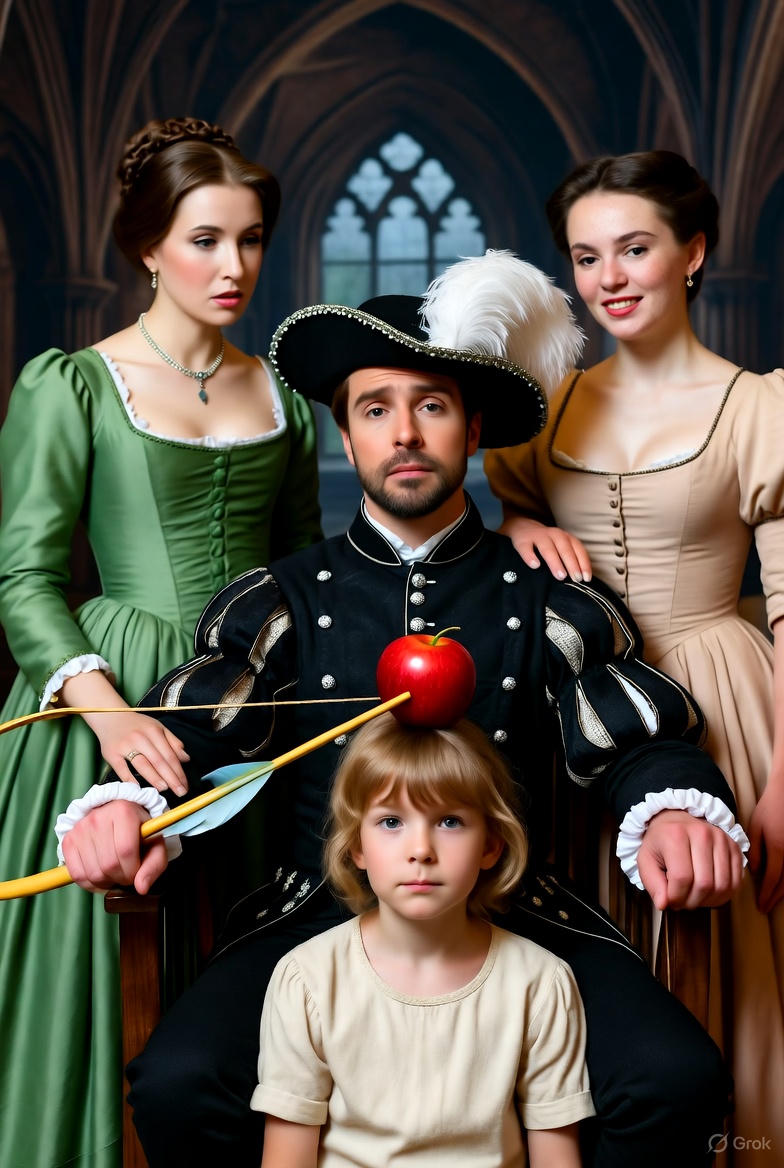
children in the bay room, playing Wilhelm Tell. The
valiant archer was shooting the apple from his son’s
head. The paper Gessler looked so fearsome that
Nelly couldn’t bear to watch. Her affection went to
beautiful Bertha in her green riding dress and kindly
young Ulrich. Papa had promised to keep them safe.
“How could this happen?” Helmina cried. “How
did it occur? Is it true? I might’ve found you dead?”
Ruprecht looked up. Helmina seemed distraught.
No surprise—a wife learning her husband nearly
suffocated would be. Yet was there a touch too
much—a slight excess beyond her usual cold control?
“Oh, it’s nothing,” he said, smiling. “That’s the
main thing. I’m glad I didn’t have to leave you so
soon after our marriage.”
“How could such a thing happen?” Helmina
repeated, agitated. “How do you feel now?”
“You see—well enough to play Wilhelm Tell with
Nelly and Lissy. I’ve hung up work for today…”
“As long as you’re unharmed,” Helmina said,
breathing calmer. Ruprecht recounted how Jana,
passing the bedroom by chance, smelled the carbon
monoxide and saved him. Helmina listened intently,
studying him. His face was gaunt, pale, his eyes wide
with dilated pupils, as if dosed with atropine. It
must’ve cut close to his life’s core. A bit deeper,
closer—
She stopped herself, feeling his gaze probe her
thoughts. The children sat timidly, grasping little but
enough to know they’d nearly lost Papa. Nelly
climbed onto Ruprecht’s knee, wrapping her arms
around his neck.
Ruprecht swiftly shifted to Helmina’s Vienna trip
and gown matters. His gesture dismissed the accident
as trivial, signaling a change of topic.
He truly knows no fear, Helmina thought. He’s the
first to match me. I should have time to wrestle with
him.

Read Full Post »

Alraune by Hanns Heinz Ewers and translated by Joe E Bandel

A slight shock flew through her limbs. She sat up, drunk with
sleep.
“What do you want?” she stammered.
Then she recognized the professor. “Leave me alone.”
“Come on Alma, don’t be foolish,” the Privy Councilor
admonished her. “It is finally time. Be sensible and don’t give us any
trouble.”
With a quick jerk he pulled the sheets away throwing her onto
the floor.
The eyes of the princess widened, “Very good! The girl is very
well endowed–that is convenient.”
But the prostitute pulled her nightshirt down and covered herself
as well as possible with a pillow.
“Go away!” She screamed. “I won’t do it!”
The Privy Councilor waved to the assistant doctor.
“Go,” he commanded. “Hurry, we don’t have any time to lose.”
Dr. Petersen quickly left the room. The princess came up and sat
on the bed, talked to the girl.
“Don’t be silly, little one. It won’t do any good.”
She attempted to caress her, massaging her with fat be-ringed
fingers over throat and neck, down to her breasts.
Alma pushed her away, “What do you want?–Who are you?–Go
away, away–I won’t do it!”
The princess would not be rebuffed, “I only want what’s best for
you child–I’ll give you a pretty ring and a new dress–”
“I don’t want a ring,” screamed the prostitute. “I don’t need a
new dress. I want to go from here. Why won’t they leave me in
peace?”
The Privy Councilor opened the glass tube in smiling tranquility.
“Later you will be left in peace–and later you can go. Meanwhile
you have an obligation to fulfill that you agreed to at the very
beginning–Ah, there you are doctor.”
He turned to the assistant doctor who had just entered with a
chloroform mask in his hand.
“Come here quickly.”
The prostitute stared at him with terrified, wide protruding eyes.
“No,” she lamented. “No! No!”
She made as if to spring out of the bed and pushed the assistant
doctor so hard with both hands on his chest as he tried to restrain her
that he staggered back and almost fell down. Then the princess threw
herself onto the girl with wide stretched arms, pressing her back into
the bed with her mighty weight. Her fingers with their many rings
clawed into the luminous flesh as she gripped a long strand of red hair
in her teeth.
The prostitute struggled, kicking her legs into the air, unable to
free her arms or move her body under this mighty burden. She saw as
the doctor placed the mask over her face, heard him lightly counting
“one, two, three–”
She screamed and tried to turn her head to the side away from
the mask, “No! No! I won’t! I won’t! Oh, I can’t breathe–”
Then her screams died away, turned into a pitiful weak whimper,
“Mother–oh–mother.”
Twelve days later the prostitute Alma Raune was delivered to
Criminal Court for imprisonment pending an investigation. The
warrant was issued because she was accused of theft and without any
home of record considered at risk to flee. The charges were brought
by his Excellency Privy Councilor ten Brinken.
Already in the first days the professor had repeatedly asked the
assistant doctor if he had not seen this or that thing that was missing.
The Privy Councilor was missing an old signet ring that he had set to
one side while washing and then left it. He was missing a little money
purse that he had left in his overcoat as well as he could remember.
He asked Dr. Petersen to unobtrusively keep a sharp eye on all
the employees. Then the assistant doctor’s gold watch disappeared
from a room in the clinic where he kept it in a locked drawer in his
writing desk. The drawer had been forcibly opened. A thorough
search of the clinic and all the employees was immediately declared
but nothing was found.
“It must be one of the patients,” the Privy Councilor concluded
and ordered a search of all the rooms as well. This was led by Dr.
Petersen, but again without success.
“Have you forgotten any rooms?” his chief questioned.
“None, your Excellency!” answered the assistant doctor. “Except
Alma’s room.”
“Why haven’t you checked there?” asked the Privy Councilor
again.
“But your Excellency!” Dr. Petersen replied. “That is completely
out of the question. The girl is watched night and day. She has not
once been out of her room and now since she knows that we have
been successful has become completely out of hand. She howls and
screams the entire day and threatens to drive us all crazy. She only
thinks about how she can escape and other ways to frustrate our goal–
To put it straight, your Excellency, it seems impossible to me for us to
keep the girl here the entire time.”
“So,” the Privy Councilor laughed. “Petersen, go and search
room seventeen at once. It does not appear to me that we can count on
the innocence of the prostitute.”
A quarter of an hour later Dr. Petersen came back with a knotted
handkerchief.
“Here are the missing items,” he said. “I found them in the
bottom of the girl’s laundry sack.”
“I thought so!” nodded the Privy Councilor. “Now go and
telephone the police right away.”
The assistant doctor hesitated, “Excuse me, your Excellency, if I
may be permitted to object. The girl is certainly not guilty even if the
evidence seems to speak against her. Your Excellency should have
seen her as I searched the room with the old nurse and finally found
the things. She was completely apathetic, wasn’t concerned at all. She
certainly didn’t have anything to do with the theft. One of the staff
must have taken the items and when threatened by discovery, hid
them in her room.”
The professor grinned, “You are very chivalrous Petersen–But
all the same–telephone the police!”
“Your Excellency,” the assistant doctor pleaded. “Can’t we wait
a little. Perhaps we can question the staff one more time–”
“Listen Petersen,” said the Privy Councilor. “You should think
this through a little more. It doesn’t matter at all if the prostitute has
stolen these things. The important thing is that we will be rid of her
and she will be safe until her hour is come. Isn’t that true? In prison
she will be kept safe for us, much safer than here. You know how
well we are paying her and I am willing to pay her even more for this
little inconvenience–after it is all over.
It won’t be any worse for her in prison than here–Her room will
be a little smaller, her bed a little harder and the food won’t be as
good. But she will have companions–and that will be worth a lot in
her condition.”
Dr. Petersen looked at him, still not entirely convinced. “Quite
true, your Excellency, but–won’t she talk there? It could be very
uncomfortable if–”
The Privy Councilor smiled, “How so? Let her talk, as much as
she wants. Hysteria- mendax–you know that she is hysterical and that
hysterical people are known to lie! No one will believe her, especially
since she’s a hysterical pregnant woman. What would she say
anyway? The story of the prince, that my nephew swindled her with
so neatly?
Do you believe that the judge, the attorney, the prison director,
the pastor or any other reasonable person would even listen to such
obstruse nonsense?–Besides, I will speak to the prison doctor myself–
who is he anyway?”
“My colleague, Dr. Perscheidt,” said the assistant doctor.
“Ah, your friend, little Perscheidt,” the professor confirmed. “I
know him as well. I will ask him to keep an especially watchful eye
on our patient. I will tell him that she had an affair with an
acquaintance of mine that sent her to my clinic and that this
gentleman is prepared to take full care of the child in every way. I will
also tell him about the extraordinary lies I have observed in the
patient and even what stories she is likely to tell him.
Even more, we will retain Legal Councilor Gontram for her
defense at our own cost and explain the case to him so that he will not
believe anything she says either– Are you still afraid Petersen?”
The assistant doctor looked at his chief in admiration.
“No, your Excellency,” he said. “Your Excellency has thought of
everything. Whatever is in my power to do, I am at your service,
Excellency.”
The Privy Councilor sighed loudly, then reached out his hand.
“Thank you dear Petersen. You will not believe how difficult
these little lies have been for me. But what is a person to do? Science
has always demanded such sacrifices. Our brave predecessors, the
doctors of the late Middle Ages, were forced to steal bodies from
cemeteries so they could learn anatomy. They risked being criminally
charged with violation of a corpse and similar nonsense. We can’t
complain, must take such little deceptions into the bargain, for the
sake of our sacred science.
Now go Petersen. Telephone the police!”
The assistant doctor left. In his heart was a great and honest
admiration for his chief.
Alma Raune was sentenced for burglary. Her stubborn denial and
prior conviction worked against her. Despite that, she was given a
light sentence, apparently because she was really very beautiful and
also because Legal Councilor Gontram was defending her. She only
received one year and six months imprisonment and the time she had
already served applied to it as well.
This was further reduced at the request of his Excellency ten
Brinken even though her conduct while in prison could in no way be
considered model behavior. In his gracious request for a pardon he
concluded that her bad behavior was due to her morbidly hysterical
condition and also stressed that she would soon become a mother.
In the early morning at the first signs of labor she was released
and taken to the ten Brinken clinic. There she was placed in her old
white room, No. seventeen, at the end of the corridor. The labor pains
had already begun during transport and Dr. Petersen tried to calm her
by saying it would soon be over. But he was wrong.
The labor lasted that entire day, that night and the following day.
They let up for a little while and then returned even more strongly.
The girl screamed and whimpered, writhing in pain and misery.
The third short paragraph in the leather bound book A. T. B. is in
the hand of the assistant doctor and deals with this remarkable birth.
He performed, with the assistance of the prison doctor, the very
difficult delivery that lasted for three days and ended with the death of
the mother. The Privy Councilor himself was not present.
In this account Dr. Petersen stressed the strong constitution and
the excellent build of the mother, which should have allowed a very
easy delivery. Only the exceptionally rare presentation of the baby
caused the complications to take place that in the end made it
impossible to save both mother and child.
It was further mentioned that the child, a girl, while being pulled
out of the mother’s body began an extraordinary shrieking that was so
shrill and penetrating that neither gentlemen nor the midwife had ever
experienced anything like it before in other births. The screams
sounded almost as if the child were experiencing unbelievable pain at
being so violently separated from the mother’s womb.
The screams became so penetrating and dreadful that they could
scarcely bear the horror of it. His colleague, Dr. Perscheidt, broke into
a cold sweat and had to sit down. After the birth the infant
immediately became quiet and didn’t even whimper.
The midwife while bathing the delicate and thin child
immediately noticed an unusually developed atresia Vaginalis where
the legs halfway down to the knees had grown together. After further
investigation it was found to be only the external skin that was
binding the legs together and could be corrected later through a quick
operation.
As for the mother, she had certainly endured heavy pain and
suffering without any chloroform, local anesthesia–or even as much
as a Scopolamine-morphine injection. She was hemorrhaging so badly
they could not risk further stress to her heart. She screamed the entire
time for all those long hours and only during the moment of birth
itself did the dreadful shrieks of the infant drown out the screams of
the mother.
Her moans became weaker, some two and a half-hours later she
lost consciousness and died. The direct cause of death was a torn
uterus and the resulting hemorrhage.
The body of the prostitute, Alma Raune, was assigned for
dissection since her relatives in Halberstadt raised no claims and
refused to pay the cost of burial when they were notified. The
Anatomy professor Holzberger used it in his lectures and assigned
parts of it to each of his students to study. These certainly contributed
vastly to their education except for the head, which had been given to
senior medical student Fassman of the Hansea fraternity. He was
supposed to prepare it as a finished skull but forgot it over vacation.
He decided that he already had enough skulls and no longer needed to
clean it. Instead he fashioned a beautiful dice cup out of the top of the
skull. He already had five dice that had been made from the vertebrae
of the executed murderer Noerrissen and now needed a suitable dice
cup.
Senior medical student Fassman was not superstitious, but he
maintained that his dice cup served him extremely well when playing
for his morning half-pint. He sang such high praise for his skull dice
cup and bone dice that they gradually acquired a certain reputation,
first with his own friends, then within his fraternity and finally over
the entire student body.
Senior medical student Fassman loved his dice cup and almost
saw it as blackmail when his Excellency Privy Councilor ten Brinken
asked him to give up his famous dice cup and dice at the time of his
exam. It so happened that he was very weak in gynecology and the
professor had a reputation for giving very strict and difficult exams.
The result was that he passed his exam with flying colors. For as long
as he owned it, the dice cup brought him good luck.
There is one other curious thing that remains in the story of these
two people that without ever seeing each other became Alraune’s
father and mother, how they were brought together in a strange
manner even after their death. The Anatomy Building janitor,
Knoblauch, threw out the remaining bones and tatters of flesh into a
common shallow grave in the gardens of the Anatomy Building. It
was behind the wall where the white roses climb and grow so
abundantly–

Read Full Post »

Homo Sapiens: In the Maelstrom by Stanislaw Przybyszewski and translated by Joe E Bandel

“Have you ever thought about this terrible riddle, about the human? No, of course not. You are an anarchist, so strictly speaking an heir of the free-thinking brain that produced materialism and eudaimonistic ethics, yes you are the heir of a world view that… But do you know this one wonderful passage from the *Confessions* of Saint Augustine? 

Just listen: ‘There people go and admire high mountains and wide sea floods and powerfully roaring rivers and the ocean and the course of the stars, but forget themselves beside it.’ 

Yes, you see: the bourgeois brain has forgotten the human. He must now be discovered anew! But to discover him, one must first unlearn the ridiculous overestimation of the idiotic macrocosm, the astonishing achievements of the natural sciences, one must regain the childish sense that can see the terrible and mysterious, the depth and the abyss, not only see, but marvel, feel fear and horror and despair before all of it…”  

“Ha, ha, I idiot… Yes, you are right to put on this superior smile. Yes, of course. You, you—what are you actually? Followers of the materialistic world view, you have naturally solved all riddles… Well, no offense, I understand very well that your world-embracing ideals of humanity leave you no time to ‘lovingly immerse’ yourself in such a trifle as the human—the expression comes from the *Berliner Tageblatt*, ‘your thorough action’—the expression is from the same source—does not allow you to waste your time uselessly. Ha, ha, ha…” 

“Do you really not want to drink? Pity, great pity, I actually cannot stand people who don’t drink. 

But you seem curious. You would probably like to learn something personal about the mysterious Herr Falk who sent you money for social agitation, pamphlets and proclamations to incite one class against the other. Ha, ha, ha… Incitement! isn’t that what it’s called officially… But I don’t want to speak of myself at all, I want to speak only of objective questions… Ha, ha, ha… 

You see: that is for example very interesting, how a person can change under the influence of a trifle. Trifle, I tell you. Ridiculous little thing. I was with Iltis yesterday, I study him namely. He got married. His wife is the most wonderful woman under the sun. Quite extraordinary woman. Now, you see: she could hardly have sensed earlier that she would become his wife in two years say. Isn’t that so? One cannot sense such a thing over the distance of large time spans. Yes, so back then, when she could not yet sense Iltis, she fell in love. Yes, of course. Why shouldn’t she fall in love? She also gave herself to the man she loved. That is natural. You don’t blame her for not waiting for the state concession first. But I don’t want to judge logically, for otherwise I would only find it beautiful. But since the woman always exists in relation to the last man, and the last man does not like to find such earlier encroachments on his priority rights beautiful, so—yes, for all I care I say that it was not beautiful of Iltis’ wife to act so prematurely. 

So: Iltis—no, I don’t know exactly if it is Iltis, no, my head is a bit confused, it is probably someone else. Let’s call him Certain. That even sounds very nice. I am quite delighted with this marvelous idea. Just think: Certain! So this Certain falls in love with the woman who has already eaten the paradise apples forbidden to chaste virgins, and marries her. Naturally she confessed everything to him. But he! Good God, over such trifles he as a modern person and former head of the wildest bohemia will not get upset. Interesting, isn’t it? But afterwards he recollects himself. In his soul a small tiny gap opens that emits a strange feeling of discomfort. Certain sits down, or no! he lies on his resting sofa, crosses his arms under his head and broods. There was already one there who possessed the woman. That is strange! The same flattering names she says to him she has already whispered in another’s ear, she has already lain around another’s neck, another has already pressed this body to himself… But to thunder, what is that? Certain jumps up quite startled. It seems to him as if the small gap is actually a small wound that has become inflamed and now causes unheard-of torment. But ridiculous! Certain is quite furious that he can get upset over such natural, yes, sanctified by the secret purpose of nature self-evidentness… Yes, he explains the thing to himself crystal clear and forgets it. He is even very glad that he so energetically rejected these posthumous demands of his sexual organism. He stretches, trills a shepherd song, ah, how idyllic—but with the evil powers—well, you know your Schiller. Certain becomes restless anew. A certain tormenting curiosity overcomes him. He goes to his wife, is incredibly amiable, kisses her hands, flirts with her, talks about this and that, then suddenly asks, so en passant, with the most innocent, most indifferent expression in the world: You, what was your first man actually, blond or black haired? The word “man” he pronounces without knowing with a strange emphasis. It is hate, rage, curiosity, everything you want. 

Yes, he was black, but had strangely blue eyes. 

Certain twitches involuntarily, he is so irritated that he cannot talk further about it. He is completely beside himself, he cannot understand at all what is happening… 

Ha, ha, ha, poor Certain; I will admit that he is incredibly ridiculous, but that’s how the stupid fellow is made. He also doesn’t want to think further about it. No, he doesn’t like to. He has forgotten the whole thing for a few days. But then suddenly it comes again, only more violently, more painfully. It is almost like pleasure to torment oneself, to have the wound torn open quite brutally… I leave open the question in what physical and psychic causes this self-tormenting curiosity may be grounded, but it is there. He must interrogate his wife, naturally with the necessary psychological tact, only so as not to let on that anything matters to him. 

So he asks, so casually, only for psychological interest, about the closer circumstances. He gets to know them, naturally, why not? He has spoken so beautifully and so enthusiastically to her about free love relationships. He, he—they are both so-called modern people who have long gone beyond such ridiculous prejudices. 

Whether she had loved him? She thinks a little. Oh yes, she loved him, very much. Certain trembles and tries to control himself. The closer circumstances? My God, they are always the same! and she laughs. He naturally laughs too. But she should tell him in detail, it is so extremely interesting, and she comes so close to him thereby if he knows her life in the smallest secret corner exactly. She resists, but finally gives in… The black haired one had asked her to prove her love to him… just note, Herr Czerski, how I will now paraphrase everything… she herself had also understood that this—do you understand this mysterious “this”?—was the only proof of love. 

From the throat of poor Certain suddenly comes a strange whistle that he eagerly undoes with subsequent coughing. 

So he had asked her for this “this”—she should just think it over well—just think what an exemplar of wise magnanimity this black haired gentleman must have been! 

“You naturally during the whole time in which you should think over this decisive ‘this’ didn’t think about it once?” Certain is namely a psychologist. 

“No, I only felt that it had to come, I could, I didn’t need to think about it: it was necessary.” 

“For you or for him?” Certain namely rages with malicious fury. He has a fabulous desire to roar so that his lungs burst. Why, he doesn’t know. 

She didn’t quite understand what he meant with his cynical question and looks at him with big eyes. You know: with eyes that are actually only a burning, suspicious, a little contemptuous question mark. 

Certain immediately comes to himself. He almost awakened her mistrust. He now becomes very cautious. 

Now he asks further with a certain nonchalant bonhomie and learns gradually pretty much everything worth knowing. The dynamic mechanics of love is almost always the same, there are certain unbreakable moments… He, he, he… 

But now it overflows in the stupid Certain. He cannot hear further. He has a maniacal, unconquerable desire to throw the woman to the ground and beat her dead with his fists. 

Does he do it? 

Read Full Post »

« Newer Posts - Older Posts »