Feeds:
Posts
Comments

Posts Tagged ‘reviews’

Homo Sapiens: In the Maelstrom by Stanislaw Przybyszewski and translated by Joe E Bandel

“Well, tell then.” 

“No, no, that is terribly boring.” 

Falk began to sink back into a dull brooding. Geißler looked at him astonished. 

“Is something wrong with you?” 

“Actually nothing, I only overcame a heavy fever attack.” 

“Yes, thunder! Geißler suddenly cracked his fingers—what do you say to Grodzki?” 

“Grodzki?” A violent fright shot through Falk’s limbs. “Well yes, he shot himself after all.” 

“Shot?” asked Falk mechanically. 

“That is a phenomenal city talk. He abducted a painter’s wife, suddenly came back, and shot himself.” 

“The wife of a painter?” 

“Yes. The poor fellow went mad. But this Grodzki! they say he shot himself out of fear.” 

“Out of fear?” Falk came into an indescribable confusion. Out of fear? 

“They say he stood shortly before a monster trial. A kind of sensational case like that of Wilde.” 

Falk laughed. 

“So that is why people shoot themselves. Ha, ha, ha, and I believed that their will was so strong to command over life, 

ha, ha, ha…” 

“They only say it so, perhaps it is only a gossip story… I don’t believe it. Was after all a phenomenal talented person. Well, you know him best. By the way, your name is often mentioned now.” 

“Mine?” 

“Yes, they want to bring you in connection with Grodzki.” Falk became distracted. 

“Do they want that? Strange…” Geißler looked at Falk attentively. 

“The illness has weakened you very much, what? You must take care of yourself… But how is Isa?” 

Falk started. 

“You loved her very much, didn’t you?” “To mental idiocy.” 

“And so it passed?” 

“Well, well; it is not quite passed.” “Not?” 

Falk felt a wild joy. 

“You seem to rejoice over it.” 

“I arrange the affairs,” said Falk with a sudden, overbearing mood. 

“What do you mean?” 

“Well, if something should happen to me…” 

“Don’t speak nonsense. You are sick. Should stay in bed.” 

“Yes, yes, you are right.” He stood up. “You will come to us soon,” he said distractedly. 

“Yes, naturally.” 

When Falk stepped into the hallway, he suddenly remembered that he should speak with Geißler about the trip. But he now suddenly knew quite surely that he would not travel. 

When he came to the street, he began to think about farewell visits… When one is to travel, one must make farewell visits, he thought profoundly. 

The thought of the trip took possession of his brain again. But he did not want to think further about it. He suddenly felt that he would have to draw a host of conclusions from this fact, thus e.g. go up to Geißler again and such things once more, which would infallibly destroy his whole strength. He now wanted to be free from all thoughts. 

And now: to Olga. 

The last thought excited him again. 

Where did the decision suddenly come from? So without any preparation, without any thinking? A miracle, a great miracle! Consequently will is a phenomenon? No, my you is a phenomenon. 

Then he wondered that the idea of a Chinese theater had suddenly mixed into his thoughts: An actor stands on the stage, makes a foot movement and says to the audience: Now I ride… He, he, he… 

His brain came into motion again. Grodzki appeared to him again. 

“That is very risky after all, to commit suicide! This disgusting sniffing after the reasons…” 

Meanwhile he came before Olga’s house. The eternally open restaurant had something irritating. He remembered that already as a boy the eternal lamp in the church irritated him. Ridiculous that it was never allowed to go out. Is Olga perhaps the holy Vestal who has to guard the eternal fire in the pub? Well, well, Falk… You become a little tasteless and banal… 

He stepped onto the stairs, put on his gloves and adjusted his tie. 

He knocked. 

In Olga’s room Kunicki sat in shirt sleeves on the sofa, the coat lay over a chair back. 

He shot the Russian in a duel, it shot through Falk’s brain like lightning, at the same time he remembered what was said about Grodzki’s death, and in the next thousandth of a second a decision shot up in him. 

“You are hot again, dear Kunicki, as usual, as usual.” 

Falk laughed with malicious friendliness. Kunicki looked at him darkly. 

“Well, dear Kunicki, you look as if you wanted to introduce social harmony in the next two days.” 

Falk laughed even more friendly and pressed both Olga’s hands. He looked at her beaming. 

“See, see, how beautiful you look!” 

“Don’t babble! I have very unpleasant things here with Kunicki. He is furious that we sent Czerski on agitation.” 

“Perhaps Herr Kunicki wanted to travel?” Falk looked at him with most obliging smile. “That is a noble competition.” 

Kunicki threw Falk a furious, hostile look and said excitedly: 

“Your ridiculous pinpricks don’t concern me at all. But here it is about the thing. You know as well as I that Czerski is an anarchist.” 

“No one knows it better than I. I spoke very long and broad with him about it.” 

“So much the worse for you. You cannot take it ill if I open the committee’s eyes about you.” 

“I care the devil about your committee,” Falk flared up. He fell completely out of his role. “I do what I want.” 

“But we, we do not allow you that,” Kunicki cried furiously. “You destroy through Czerski our whole three-year work. You only aim to destroy our work.” 

“Your work, your work?!” Falk laughed scornfully. “Have you quite forgotten what you accomplished with your work. He, he, a year and a half ago you developed a beautiful plan to me, from which it was evident that you would eliminate within two months all difficulties that stood in the way of a general strike of the mine workers. I gave the money for it, although I naturally did not believe in your dreams… But you interested me then. I needed a person who could convince me that mighty mass suggestions are still possible… You were to show me the microscopic art piece of a new crusade, only with a changed motto: l’estomac le veult… Ha, ha, ha… Interesting enough it was to see whether people still let themselves be carried away… I believed that you might be capable of it. But after a week you came back with nothing done, I even believe with considerable bodily injuries…”

“You lie,” Kunicki cried furiously, but controlled himself immediately. “You want to make me appear ridiculous. You can do that if it gives you pleasure. I gladly forgive you your childishness and in you it is doubly comical… he, he… aristocratic-aesthetic Nietzschean longing for power and greatness…” 

Kunicki choked on the deliberate, insulting mocking laughter. 

“Yes, yes, please, please, if it only gives you pleasure…” Falk looked at him maliciously. “No, dear Kunicki, I did not want to insult you, and I want it all the less as I see how strongly the unhappy, not to say comical role you played chokes you.” 

“You are mistaken,” said Kunicki. Falk reveled in the effort Kunicki had to control himself… “I do not understand your intentions, but if you believe that a person like you can insult me…” 

Falk laughed long and very heartily.  “Ha, ha, ha, I understand very well that I cannot insult a person like you. That was only a little phrased in relation to the effort you have not to feel insulted… But let us come back to Czerski. Yes, see, I do not believe in social democratic salvation. I also do not believe that a party that has money in abundance, a party that founds sickness and provision funds, can accomplish anything… I also do not believe that a party that thinks of a comfortable rational solution of the social question can come into serious consideration at all.

Read Full Post »

Homo Sapiens: In the Maelstrom by Stanislaw Przybyszewski and translated by Joe E Bandel

V.

“Are you sick, Czerski?” Olga was very worried. 

Czerski stared at her. It was as if he had only now noticed that she was there. 

“No, I am not sick. But what brings you to me?” “Do you want to undertake an agitation trip?” Czerski’s face suddenly brightened. 

“I have been thinking about that for three days.” 

“I have money for you and the instruction that you should travel immediately.” He became sullen. 

“I want no instructions, I travel when I want.” 

“But the money is made available to you only on the condition that you travel immediately.” 

“Why immediately?” 

“There is a large book transport at the Russian border that you must get to Russia in two days at the latest. They have been waiting there for a month.” 

“I want to perform no services for any party. I have nothing to do with a party. I am myself a party.” 

Olga looked at him thoughtfully. 

“Have you really now become completely an anarchist?” 

“I am neither an anarchist nor a socialist, because I myself am a party.” 

“But you have views that are shared by the anarchist party.” 

“That concerns me nothing, that certain views accidentally bring me close to this or that party, but for that reason I do not want to admit that this or that party claims me as its member.” 

He was silent thoughtfully. “So you don’t want to?” 

“Are there any other conditions attached to the money?” 

“No.” 

He considered. 

“Well, I can for all I care transport the stuff over. But I repeat that I care nothing for instructions, that I will obey no commands, that I stand outside every party and recognize no program.” 

“Those are peculiar disclosures you make to me, but I am to deliver the money to you under all circumstances.” 

Czerski looked at her suspiciously. 

“Tell me, Fräulein, the money was sent by Falk?” “How do you know that?” 

“I spoke to him yesterday.” “You spoke to him?” 

“Yes.” 

He thought long. 

“Falk loves his wife very much?” “Yes.” 

“How can it happen that he has a mistress at the same time? I racked my brain about it all night.” 

Olga looked at him a little startled. Had his mind really suffered? 

“A mistress you say? That is surely not possible.” “Yes, a mistress… My former fiancée.” 

“Fräulein Kruk?” 

“Yes. He has a son with her. She has just risen from childbed.” 

Olga became very confused. She looked at him startled, then suddenly noticed her agitation, tried to hide it, her hands trembled and she felt all the blood flow to her heart. 

Czerski seemed to notice nothing. He walked up and down and brooded. 

“Well, one overcomes that,” he said finally. “That is a pain, a great pain, but one overcomes it. At first, when she stopped her visits to the prison, I suffered very much… Yes, very much suffered,” he repeated thoughtfully… “But I have overcome it. It is also good so. Now nothing more stands between me and the idea…” 

He was silent for a while. 

“When I was released three days ago, it came over me again. Yesterday a rage against Falk suddenly seized me, I wanted to insult and abuse him, but then with a jerk I got the fear that something could step between me and the idea, and I overcame it again. It is good so, very good…” 

Falk probably wants to get rid of me… He really should have no fear of me. Calm him if you meet him… 

He suddenly fixed his eyes sharply on Olga. 

“Do you believe that Falk sent the money to get rid of me?” 

“When did you speak to him?” “Yesterday.” 

“Well, then I don’t believe it at all. He was by the way only waiting for you to be released. He values you immensely.” 

“But he is a scoundrel. Yes, he is a scoundrel.” 

“No, he is not. He is it as little as you.” Olga spoke coldly and repellingly. 

Czerski looked at her attentively for a while, but answered nothing. He walked thoughtfully up and down again. 

“The forged bull from Pope Pius for agitation in the countryside was written by Falk?” he asked suddenly. 

“Yes.” 

“Very well done. Very well, but I don’t believe he is serious about it. He plays with the idea. He experiments. He probably wants aesthetic sensations?” 

Olga was silent. 

“Isn’t it? You know him very well… See, you don’t answer, you are silent… He, he… he seeks danger, I can imagine that he would go to prison with joy, not because he believed in the thing, but because he thought to find atonement for his sins in it.” 

Czerski became more and more animated. 

“I got letters from him earlier, many letters. Oh, he is sharp and clever. He has hate and much, perhaps very much love, I revered him, but I see now that it is all only despair. He wants to save himself, he seeks convulsively for salvation, but he can believe in nothing… Yes, he is very clever, I wanted to insult him yesterday, I forced myself to insult him, but he is clever and malicious. Yes, malicious…” 

Czerski suddenly broke off. “Do you want tea?” 

“Gladly.” 

He prepared the tea thoughtfully. 

“Have you spoken to Fräulein Kruk in the last days?” 

“Yes. As soon as I came out of prison, I went to her… She doesn’t know that he is married.” 

“No?” Olga started in horror. 

“No! He lied. His whole life is only a chain of lies…” 

Olga fell into great unrest. It became hard for her to stay longer with Czerski, she stood up. 

“I can’t wait for the tea after all.” 

“Oh, stay a little. I was alone for a year and a half. It is so dear to me to have a person around me.” 

He looked at her pleadingly. 

Olga collected herself and sat down again. 

“You are very sad, Fräulein… Yes, we all expected something else from him… Hm; actually it is very good that he sent the money. How much is it?” 

“Five hundred marks.” 

“That is much, very much. With that one can accomplish much…” They were silent for a while. 

“Is it true what Kunicki claims, that you together with Stefan Kruk broke open the city treasury near here?” 

“Completely true.” 

“So you approve of anarchist practice?” 

“If the idea requires it, all means are holy. That is by no means an anarchist invention. By the way, we didn’t steal the money, but took it rightfully. And that is a great difference. We acted in full consciousness of the legality of our act.” 

“So you say that one may steal as soon as the idea requires it?” 

“No steal, no; I didn’t say that. You come there to the juridical concept of crime. But as soon as I say I do right, and as soon as I have the faith and the holy conviction that I do right, understand, a faith that allows not the slightest doubt, then the theft is precisely no theft, no crime anymore.” 

“But you accuse the state of crimes. Don’t you believe that the state does everything it does with good conscience? Don’t you believe that it feels justified in delivering the working class to the exploitation of capitalism? Consequently the state is no criminal because the criterion of bad conscience is missing.” 

“Subjectively the state is no criminal, provided it is convinced of the legality of its action, which I don’t believe, but it becomes it objectively because the consequences of its actions are criminal.” 

“But if the motives are good, the state cannot be made responsible for the damage.” 

Read Full Post »

Homo Sapiens: Under Way by Stanislaw Przybyszewski and translated by Joe E Bandel

But I can imagine the astonishment of the Poles; just listen! When Bismarck expelled a few thousand Polish families from Prussia, he received the highest papal order; yes, the Order of Christ is very beautiful, and also very valuable. Now further! Hardly had the news of the insane murders subsided, which the Russians, with the approval of the Russian government, committed on the Polish Uniates in Kroze—by the way, murders that repeat themselves every day in Lithuania—when the Pope issues an encyclical to the bishops of Poland, in which he praises the great benevolence of the Tsardom with much praise—yes, please very much, it expressly states there, the Tsar is filled with the most intimate benevolence toward the Poles, he wants only their best. 

No, Reverend Father, don’t take it amiss, but I didn’t like it at all when in your last sermon you tried to prove that the Pope once again let his paternal heart for the oppressed shine in unheard-of splendor. 

That is superficial estimation; the matter hangs together quite differently. The Pope is determined by the French, with whom he sympathizes very much; yes, he is prompted by French policy to continually flirt with the Russians. In the whole encyclical, which I read very attentively, I find no paternal heart, on the contrary quite crude Vatican interests. And since I belong to the Catholic parish, it pains me deeply that church policy is so unbeautiful, yes—I want to express myself reservedly—unbeautiful, hypocritical, and uses cloaks of faith, hope, love for very earthly interests. 

All those present looked at each other. They didn’t know what to say to it. That was really unheard-of bold, spoken in the presence of the monastery pastor. All eyes turned alternately to Falk and the pastor. 

Marit had listened with pounding heart; mouth half-open, breath catching, she sat there and awaited the explosion. 

The pastor was completely pale. 

“You know, young man: You are much too young to solve the most important church questions with your intellect, infected by the heresy of foreign lands, and even less are you entitled to mock about it.” 

Falk didn’t lose his composure for a moment. 

“Yes, Reverend Father, what you say is very beautiful. In the end, it doesn’t concern me at all what you or the Pope or the German government do; that’s completely indifferent to me. But I permit myself to doubt whether the Church has really taken out a lease on all worldly wisdom from Providence. I actually permit myself to doubt that most excellently. It has recently immortalized itself in the question of Darwinism or rather in the dispute over the evolutionary principle.”

“And then, yes: can you tell me at which council the infallibility of the Pope in matters of politics was proclaimed? 

Yes, yes; I know very well that according to tradition this kind of infallibility also exists, but I think that the papal nepotism in the Middle Ages is hardly the best recommendation for this kind of infallibility. 

By the way, this is a topic that could lead to heated discussions, and that I want to prevent at all costs; one understands each other or one doesn’t, and I don’t feel called to force any suggestions on the company.” 

It grew quiet; only the editor of the *Kreisblatt*, who had a reputation for social-democratic ideas, seemed very pleased. 

He absolutely wanted to push Falk further: the man took no leaf before his mouth; he spoke as the beak grew. 

“Yes, tell me, Herr Falk, you are an ultra-revolutionary, as I see. You now live in a monarchical state. Naturally you are not satisfied with such a condition. What do you say to a monarchical state constitution?” 

The editor was already delighted to find his ideas confirmed before the reactionary elements. 

“Hm; you know, Herr Editor, you pose a tricky question there. I was once in Helsingborg, and indeed with a friend who is an anarchist, but at the same time also a great artist. We stood on the ferry and looked at a splendid, ancient castle that Shakespeare already mentions in *Hamlet*. 

Do you know what my friend, the anarchist, said? Yes, he said that what he would now say would certainly very much surprise me, but he had to admit that such splendid works were only possible under monarchical rule. Yes, absolutely; just look at the rule of the Bourbons in France, and compare it with the rule of the first republic. Look at the second empire and the infinitely rich artistic traditions that arose in it and that can only thrive in the splendor, extravagance, and lust of a royal court. Now you have here in Prussia a Frederick William IV, in Bavaria a Maximilian and a Ludwig. Take in hand the history of art, yes the

history of refinement of taste, of ennoblement of the human race, and you will decide for yourself. 

No, I don’t want democracy; it flattens and vulgarizes humanity, makes it crude and directs it into narrow interest economics. Then the shopkeepers come to power, the tailors, tanners, and peasants, who hate everything beautiful, everything high. No, I don’t want the plebeian instincts unleashed against everything higher-bred. 

The whole society seemed suddenly reconciled with Falk. But now came the backlash. 

He sympathized nevertheless with all revolutionary ideas. Yes, he really did. He himself was not active; life interested him too little for that. He only watched and followed the development, somewhat like an astronomer in the eyepiece of his telescope follows the orbit of a star. 

Yes, he really sympathized with the Social Democrats. For he had a faith that rested on the following premises. The postulated economic equality must by no means be confused with an equality of intelligences. He was now convinced that in a future association of humanity an oligarchy of intelligences would form, which would gradually have to come to power. Then of course the course of things would begin anew; but he hoped that such a rule would be a better beginning than that of the present cultural epoch, which had begun with wild barbarism. 

The ruling class was impoverished, degenerated through inbreeding and excessive refinement. The danger of a crude, disgusting parvenu rule, the rule of money-bling and unclean hands, loomed. No, a thousand times no: that he didn’t want to live to see. Better to overthrow! He would gladly join. 

The editor recovered; he seemed satisfied. 

“Just one more question… What does Falk think of the current government?” 

“The current government is the Kaiser, and for the Kaiser he had much sympathy. Yes, really; he pleased him extraordinarily. He had recently suddenly appointed the captain of the fire brigade to chief fire marshal. And why? Because he had excellently cordoned off the palace square during a parade. The appointment had not followed

bureaucratic principles; but therein lay precisely the beauty, the arbitrariness, the great soul. In short, everything so immensely to be appreciated: No, he really had very much sympathy for the Kaiser, and he drinks to the health of the German Kaiser!” 

Those present looked at each other dumbfounded. But all rose and joined the toast. 

The social-democratically tinged editor thought he would fall under the table; but he contented himself with a meaningless grin. 

The table was cleared. 

Falk instinctively felt two burning eyes fixed on him. He looked to the side and met Marit’s gaze hanging admiringly on him. 

She lowered her eyes. 

Falk went to her. They were very close; they were pushed forward by the many people crowding out of the dining room and pressed tightly against each other. 

A warm stream flowed over Falk. 

“Erik, you are splendid… a great man…” A dark flood wave colored her face. 

Falk looked at her hotly. A glow of pride and love transfigured her features. “You are a real devil!” Herr Kauer came up. “That’s what I call speaking like a man! One of us would also like to say this and that sometimes, but we don’t dare. Just don’t spoil the girl for me; you mustn’t speak so revolutionarily to her.” Falk wanted to object. 

“Now, now,” Herr Kauer soothed, “I have unconditional trust in you; you wear your heart on your tongue. Live well for me. In a week I’m back. You mustn’t leave on me, understand?” 

Herr Kauer went. 

“Oh, how splendidly you spoke… You can’t believe…” Marit looked at Falk full of admiration. 

“Oh no, Fräulein Marit, that wasn’t spoken splendidly at all; against every one of these sentences a thousand objections could be made. But that may well be good for the gentlemen who draw their wisdom from the *Kreisblatt* and at most from some conservative newspaper that only has God and the Kaiser in its mouth. By the way, you also found what I said about the Pope well spoken?” 

Marit hurried to answer. 

“Yes certainly; she had now thought a lot, very much about all these things, and she had to give him complete right. Yes, he was right in most things, that she now saw.” 

Falk looked at her astonished. He hadn’t expected that. That was really a strange metamorphosis. 

“Why didn’t you come these whole two days? I expected you continuously and tormented myself unheard-of. Yes, I tormented myself very much, I must tell you openly.” 

“Dear, good, gracious Fräulein, you probably know that best. I simply didn’t want to disturb the peace of your conscience. Yes, and then, you know, I am very nervous and mustn’t give myself too much to the sweet torment, otherwise the string might snap.” 

Falk smiled. 

Meanwhile, the editor joined them. He couldn’t digest the toast to the German Kaiser and now wanted to lead Falk onto thin ice. 

“He would like to know how Herr Falk stood toward the anarchist murder acts. He was surely a soul-knower, a psychologist; how would he explain them?” 

Read Full Post »

OD by Karl Hans Strobl and translated by Joe E Bandel

Severin seemed far from sharp-witted; no, he was no longer the old Severin—brisk, dutiful, self-assured. Something had stripped his former grandeur; he no longer looked down on things as before, or he might have shown more surprise or joy at Hermine’s arrival or paid some attention to little Karl. He took it oddly lightly. “Yes,” he laughed, “take you to the Herr Baron… that’s for Frau Rosina now… or not, as she pleases. She never does, really—no one gets to the Herr Baron.”

“And you put up with that?”

“I… I’m no longer in the Herr Baron’s service. He sent me away. I live down in Grinzing now, but I climb up every day and sit on that bench.”

“Who is this woman?”

Severin winked slyly: “She’s everything now… she’s the only one with the Herr Baron. Frau Rosina Knall, used to be a nurse at the maternity clinic, then housekeeper for Hofrat Reißnagel. She came up with messages from the Hofrat, and maybe she liked it here so much she stayed with the Herr Baron.”

“We want to see Father!” said Hermine.

But that seemed a plan requiring no help from Severin. He was entirely sidelined, a nobody here. Frau Rosina Knall stood guard with her midwife and housekeeper fists; there was no getting past her. Oh, Frau Rosina Knall knew her craft. She’d bitten everyone away, claimed everything for herself. No one could reach the Herr Baron. No one managed it like she did. Severin spun his hand in a half-circle, as if brushing something aside, and winked cheerfully. She couldn’t use anyone, couldn’t stand spectators.

Yes, that’s how it was, but Severin came up from Grinzing daily and sat on that bench—she couldn’t drive him off. She tried once, but he raised his stick, and she backed off, leaving him alone since. It was pleasant sitting on that bench in the sun.


Then one day, Frau Rosina Knall tries to get up in the morning and falls back into bed with a cry. For days, she’d felt a sharp pain in her legs, dragging herself through the house. Today, her legs are swollen to twice their size—something serious is wrong; she can’t force herself to stand. She manages only to crawl on all fours to the kitchen, pull the large iron pot from the cupboard, retrieve the stuffed old stocking from it, and crawl back to bed with it.

By noon, the Freiherr notices he hasn’t had breakfast and that it’s unusually quiet. He goes to his housekeeper’s room and finds Frau Rosina moaning, unable to move, in bed.

He thinks a doctor and a nurse are needed; Frau Rosina’s legs look like they have phlebitis.

No, no, no doctor, no nurse, she shrieks and rants—it’ll get better, she’ll surely be up by afternoon, tomorrow at the latest, if the Herr Baron could manage alone until then.

But the Baron insists a doctor must come and isn’t swayed by the raging torrent of words. Frau Rosina remains helpless in bed, her heart full of curses and hateful glares at the door—a venomous, bloated spider forced to watch a fly tear through her web.

The Freiherr goes to the dairy and asks the stable hand Franz, still there from his time, to send a boy to fetch a doctor and perhaps inquire who might take on Frau Rosina’s care.

Franz is happy to send the boy, but as for a nurse for Frau Rosina, he’d like to oblige the Herr Baron, but he fears no one would be willing, even for a whole gulden a day.

Is that so, Reichenbach muses, and why not?

Franz hesitates to explain, so the Freiherr leaves without an answer. He doesn’t return to the castle immediately; he needs some air, a sudden longing for the forest stirring within him. How long since he was last in the forest? Is he really as ill as Frau Rosina always claims? His hearing is a bit weak, but otherwise, he has no complaints. A tired heart, true, and occasional dizzy spells—that’s all. My God, he’s no longer a youth. No reason to keep him indoors, forcing teas and compresses on him. It’s as if a thick wall has collapsed, and he can escape over the rubble into the open. Now he can think again about pursuing his travel plans. With Fechner, the renowned psychophysicist and philosopher in Leipzig, he’s developed a long chain of correspondence about Od; it’s urgent to complement these written exchanges with a personal discussion. Reichenbach has no sensitive with such convincing abilities to offer irrefutable proof. Perhaps one could be found in Leipzig—he needn’t let Frau Rosina’s objections hold him back.

He can still do as he pleases. Despite his loyal housekeeper’s undeniable merits and maternal concern for his rest and health, he should be able to pursue his intentions. Much has come crashing down on him, but he’s far from finished. On the contrary, his thoughts reach further than ever; he now knows Od is the carrier of life force itself, the bearer of the soul in all nature, opening new, bolder insights into the universe’s mysteries.

Yes, everything looks different in the forest than at home in rooms smelling of tea, where Frau Rosina shuffles about in felt slippers. The forest has waited long for Reichenbach. But the forest is patient, unlike a person; it holds no grudges, standing there waiting, and when you finally come, it is kind and generous, exuding more calm than all Frau Rosina’s teas.


When Reichenbach returns to the castle, an old man sits on a terrace bench, and another stands before him, preaching. With a booming voice, as if addressing a vast crowd, he declares: “And so, to end the slaughter, I’ve resolved unyieldingly to confront anyone who dares spread errors about childbed fever. If you believe there’s a puerperal miasma in your sense, that’s criminal nonsense. My doctrine exists to be spread by medical teachers, so the medical staff, down to the last village surgeon and midwife, acts on it. My doctrine is meant to banish the horror from maternity wards, to preserve the wife for the husband, the mother for the child.”

There’s no doubt the preacher is none other than Semmelweis, though Reichenbach might not have recognized him otherwise—so bloated is his body, so swollen his pale face with heavy bags under his eyes, so erratic his large, fleshy hands.

Surely, the listener, good old Severin, never claimed there was a distinct puerperal miasma.

Reichenbach approaches the professor: “Dear Semmelweis, I’m delighted—”

“Silence!” Semmelweis snaps furiously, “I’ll have you arrested!” He climbs onto the bench, pulls out a bell like one tied to goats, and rings it shrilly, persistently. Then he turns to Reichenbach: “It’s a fact that corpses on dissection tables often enter a state of decomposition that transfers to the blood in a living body. The slightest cut with a scalpel used for dissection causes a life-threatening condition.”

“My dear Semmelweis,” Reichenbach says as gently as possible, “you don’t need to convince me. And the medical world is now, in fact, coming around to your views.”

“Who are you?” Semmelweis thunders.

“I’m Freiherr von Reichenbach!”

“Freiherr von Reichenbach? Oh, yes.” Semmelweis shields his eyes as if dazzled by light. “I know you! And you really believe my doctrine has prevailed?”

“I wish I were as far with my Od as you are. You’ve achieved success. Even Virchow recently declared you’re right.”

A mad gleam dances in Semmelweis’s eyes again. “I’ll ruthlessly expose those scoundrels. Now pay attention—I’ll read you the midwives’ oath.”

He drops the bell and fumbles for a sheet of paper in his inner coat pocket, trying to unfold it.

But Reichenbach grabs his hand and pulls it down, drawing the man off the bench. “Calm down. I already know the formula and follow it. Come into the castle with me. You sought me out.”

Semmelweis nods and mutters, “Yes, you’re Freiherr von Reichenbach. That’s good, very good. I came to Vienna; Hebra invited me to see his new sanatorium.” Suddenly, he tears free, stoops for the bell under the bench, and begins ringing it furiously again.

“Why do you keep ringing that bell?” Reichenbach asks.

The sly look on Semmelweis’s face is more heart-wrenching than his contortions of rage: “Here in Austria,” he says loftily, climbing back onto the bench, “in Austria, don’t you think we must hang everything on the big bell, my dear sir?”

“And why climb the bench?”

Semmelweis’s face gleams with cunning: “So you hear me better! The endometritis, metritis, and puerperal thrombophlebitis…”

“I already know all that,” Reichenbach soothes, “come inside with me now.” He makes a quick decision. It’s necessary to get Semmelweis into the castle and, through Severin—who has backed away from the disturbed man’s proximity and watches from a few steps away—to urgently notify one of his friends.

“You’re Freiherr von Reichenbach, aren’t you?” Semmelweis asks. “You know everything, but perhaps you don’t know that your own daughter Ottane died of childbed fever.”

No blow could strike Reichenbach’s core more cruelly, but Semmelweis likely knows nothing of pity or responsibility. “Ottane,” the Freiherr says bravely, “Ottane died in Venice of typhus.”

“No, you can be certain she died of childbed fever. The child was stillborn, but the mother needn’t have been lost. Those Italian ignoramuses who want nothing to do with me killed Ottane. They called in Doctor Sattler, my student, but it was too late. He told me everything.”

Is this horror believable? Does the madman speak from his obsession fixed on one point? Or is he telling the truth? It seems his mind is now clear and ordered, as if a lucid moment has broken through his derangement.

Semmelweis steps deliberately down from the bench and lays one of his large hands on Reichenbach’s shoulder. Perhaps he senses the terrible uncertainty he’s brought upon his friend. “Don’t think,” he says sadly, “that I’m lying to you! Something’s wrong with my head, that’s true. I must go to Gräfenberg for the cold-water cure. My wife and little Antonie are with me in Vienna, and tomorrow we travel on to Gräfenberg. My assistant, Doctor Bathory, is also with us. But as for poor Ottane, dear friend… she’s among the victims, that’s the truth.”

Read Full Post »

Homo Sapiens: Overboard by Stanislaw Przybyszewski and translated by Joe E Bandel

XIV.

The restaurant “Green Nightingale” was loud and lively. 

Iltis sat broad and dignified, as befits a great man, explaining to Mikita why women are far beneath men. He ostentatiously turned his back on a young literati sitting next to him. The day before, there had been an unpleasant scene between them because the young man remarked that Iltis’s hatred of women likely stemmed from more than just theoretical reasons. Whenever a lady appeared in their company, Iltis would start in. 

“You see,” said Iltis, “you’re young, and so is Falk. You can’t understand; but just wait until you’ve slogged through ten years of marriage with a woman—” he hissed the last word softly, out of consideration for Isa—“then you’ll see. Here comes dear old Falk with his Yuma women, Chickasaw Indians, and such scientific nonsense; but the fact remains that women are inferior creatures.” 

The Infant tried to interject, but Iltis cut him off sharply. 

“No, no!… A fact is a fact!” He puffed himself up… “Besides, one shouldn’t be petty with evidence.” 

Mikita wasn’t listening. A grief gnawed at him, a shame that whipped his blood into his brain with choking rage. 

What’s the point of going on?… It’s all over… He thought of her harshness—her… her… Yes, wasn’t that outright hatred? 

How he’d pleaded with her, crawled before her, begged for forgiveness! But she, hm… yes, that icy smile… Didn’t it say: why are you begging, why are you embarrassing me, what do I still have to do with you… 

He sighed heavily. 

“Well, you don’t seem to be taking it lightly…” Iltis winked. “But allow me, the matter can’t possibly hold up,” the Infant mused, pondering how best to present his counterarguments. Iltis grew highly indignant. 

“You mustn’t be petty. Just don’t be petty, or we’ll end up with foolish science. Shall I tell you about my experiences with scientists?” 

Why is Falk staying away, Mikita brooded; that wasn’t necessary… Ha, ha, ha, to give me a chance to win Isa back… Cheers, dear Erik; not necessary, not necessary. 

But why am I tormenting her? What do I still want from her?… Love? Can you force that? Ridiculous! Ridiculous! How could anyone love him at all, yes, love a man who’s only ridiculous? 

He looked over at Isa, who, as usual, sat a bit apart. 

But Isa didn’t look at him. She seemed very agitated. Red patches burned on her cheeks, and her eyes darted restlessly around… 

The door opened, and the blonde Neocatholic entered. 

Isa looked quickly at the door, clearly unable to control herself in that moment; she flinched. 

She smiled at the young man, but she couldn’t hide the expression of great disappointment. 

Yes, disappointment! Damn it, he wasn’t blind… that’s how people look when they’re disappointed. And that nervous, trembling hint of expectation—expectation! Who’s she expecting? Who? Foolish Mikita, don’t you know who she’s expecting?! Don’t you know why she doesn’t want to be alone with you for half an hour; don’t you know why she’s been dragging you here for three days straight! 

He laughed bitterly. 

Falk, she’s expecting Falk, heh, heh—Falk! He repeated the name, it surely gave him great pleasure; Falk was his friend, more than that! a brother; he’d surely made a great sacrifice for him, yes, surely… The fiancé who suffers from sentimental idiocies should get his bride, bring his little sheep to safety… 

“Hi! Hallo! Hoo!” he roared at Iltis—“To your health!” 

Everyone looked around in surprise; that was quite unusual for Mikita. 

Mikita pulled himself together. 

“To hell with your philosophizing… Woman—man… it’s all nonsense; everything’s nonsense… Let’s be merry! Merry!” 

Isa looked at Mikita wearily. 

Why was he shouting like that? What was wrong with him now? Who was he jealous of this time? 

How foreign that man was to her. How could she ever have loved him? No, she couldn’t take it anymore; she had to end it. Tonight! When he escorts her home—yes, tonight! 

How would she tell him? Her heart trembled. 

How would she tell him? Calmly and matter-of-factly. Was he blind, couldn’t he help her in this awkward situation? He knew now that she loved Falk. Didn’t he get it yet? She’d shown him so clearly that he meant nothing to her. 

Intrusive man! She was afraid to think it, she didn’t dare; but now, suddenly, she had thought it… She was surprised that she felt nothing about it… 

Intrusive man! Yes, she felt joy that she could think it without it being painful. 

The door creaked again. 

Now it’s him for sure, she knew it; she trembled. But it was a stranger. 

This was too awful, waiting and waiting like this among all these unpleasant people. 

She felt Mikita’s eyes fixed on her, but she avoided looking at him. 

God, how indifferent he was to her! 

What had Falk been doing these dreadful five days? 

Should she go to him? But she didn’t know where he lived. Ask Mikita? No, that wouldn’t do. 

She sank into herself. 

How could she see him? Why, for heaven’s sake, had she asked him never to see her again?… Oh God, she hadn’t known how much she loved him, how indifferent Mikita was to her, how the whole, whole world only brought her pain. 

She was senselessly desperate. 

Why was he shouting again? She glanced involuntarily at the empty bottles in front of Mikita. 

“Do you even know what love is?”—Mikita was beside himself. “Do you know what sexual pain is? Huh? Do you? Have you ever loved a woman at all?” 

Iltis made a dismissive gesture. 

“That… that…” Mikita stammered—“the woman birthed the man, that’s enough for her! The woman gives birth, and the man loves. The woman never loves, never; she’s content with giving birth…” 

“What? Women love too? What?” 

“But women commit suicide for love,” the Infant interjected, “you can read about it in the *Lokal-Anzeiger* every day.” 

“What? Suicide? Ask him, just ask him; he knows better—” Mikita pointed at Iltis, who smiled encouragingly—“women commit suicide when they’re pregnant and abandoned by their lovers!” 

Mikita slammed his fist on the table. Isa looked at him with boundless contempt. 

He was drunk again. How could she ever have loved this man? 

An awkward silence fell. Isa’s presence weighed on everyone. It was a bit inconsiderate of Mikita in her presence. 

Mikita suddenly fell silent. 

He saw it: yes, for the first time, he saw it—that look! He saw it clearly before him. 

He let his head sink. 

So clear! The look burrowed deeper and deeper into him. He saw the eye within him now, it looked at him… How did it look at him? 

If he painted it?… Three steps back… No! Into the corner of the studio—the other one… And now through the mirror… Yes, he couldn’t help it… It was contempt! Great, cold contempt! 

For Isa, it became unbearable. She felt a feverish unrest; her heart beat fast and heavy against her corset. 

She had to see Falk at all costs, he had to come eventually. He’s here every day; why doesn’t he come these days? 

The conversation picked up again. 

“Oh, leave me alone with literature; this endless chatter about poets and publishers and publisher prizes really makes one nervous—” Iltis yawned affectedly—“What do you want with Falk? He’s a good guy.” 

Isa perked up. 

She saw Mikita suddenly straighten. “What? What? Falk?” 

“Well, yes,” the Infant lectured, “Falk has talent, I’ll grant that; but it’s still developing, it needs to ripen, to ferment; you don’t know yet how he’ll turn out. He’s searching, he’s still groping…” 

“What? Falk groping?…” Mikita laughed with feigned warmth. “You’re priceless… You know, Falk’s the only one who can do something. Falk’s found the new. Yes, Falk can do what you all wish you could—Falk—Falk…” 

At that moment, Mr. Buchenzweig approached Isa. 

He assumed all this talk must bore a lady, so he wanted to entertain her. 

She looked at his smooth, plump, handsome barber’s face. What did this man want? 

Yes, Mr. Buchenzweig had the great honor of seeing the gracious Fräulein at the soirée in the presence of Mr. Falk. Mr. Falk is a remarkably interesting man, really the one who interested him most… He only came here to meet him… 

“You, Isa,” Mikita called across the table—“did you know Falk left Berlin?” 

He fixed his eyes on her intently. 

Isa flinched. She felt a sharp pain in her face, a constricting sensation in her chest… she saw Mikita’s wild, malicious, flushed face with wide eyes, then turned mechanically to Buchenzweig. 

She wanted to drink a glass of wine; it was empty. Buchenzweig eagerly ran for the waiter. 

Everything blurred before her eyes. She saw nothing. She suddenly heard someone speaking; it was Buchenzweig. But she didn’t quite understand what he wanted. She only looked at him, smiled mechanically—the wine was brought. She drank. 

“I know Mr. Halbe very well. A remarkably charming man, a great force in our time, which so lacks great talents.” 

Isa looked at him. The man suddenly repulsed her. She didn’t know why. 

“Excuse me, Mr. Buchenzweig, your company is very pleasant, but I must go home now.” 

She approached Mikita. 

“I have to go home now.” 

“Oh, really?—bored here?” She didn’t listen to him and got dressed. 

Again, she saw the repulsive barber’s face of Mr. Buchenzweig. Who did he remind her of? Yes, right, the barber who shampooed her hair. 

As they got into the cab, with Iltis gallantly assisting Isa, Mikita shouted to him: 

“Wait till I get back! We’ll have a merry night.” 

Isa shrugged. Neither spoke a word. 

She was paralyzed, unable to think. She was so tired. 

Now and then, a desolate despair hit her, then tipped back into this limp exhaustion. 

“You, Isa, my exhibition opens in Munich tomorrow.” “Oh, right…” 

The cab stopped. 

“Good night!” Mikita’s limbs twitched. “Good night.” 

“Now drive me back fast!” he roared at the driver. The driver whipped the horse, and the cab flew over the asphalt road. 

Meanwhile, Mikita writhed in a violent fit of sobbing. 

When he returned to the “Green Nightingale,” he was calm and composed. He was greeted with hearty cheers. 

Yes, Isa has weighed us all down, he thought. 

“You,” he sat next to Iltis—“if I get very drunk tonight, put me on the train to Munich tomorrow morning. Seven-thirty, remember…” 

“I know, I know; I’ve traveled that route a hundred times.”

Read Full Post »

by Stanislaw Przybyszewski and translated by Joe E Bandel

XII.

When Falk was alone on the street again, he stopped. He stood for a long time, until he suddenly noticed. 

Yes, for the first time, he felt this terrible, choking sadness. He was paralyzed. 

Never again! It didn’t fully register in his consciousness. 

He repeated it: Never again. But he couldn’t imagine it at all. 

At the corner, he stopped again. Home? 

What was he supposed to do at home? 

He saw electric light in café windows across the street. Mechanically, he went inside. 

As he looked for a seat, he recoiled sharply. He spotted Mikita in a corner. He looked terrible. Was it blood? – Yes, blood… Falk approached him. 

“Good God, what have you done?” 

Dried blood was on his cheek, and his hair was matted with blood. 

Mikita looked at him with glassy eyes. A large carafe of absinthe stood before him. 

“Ah, it’s you? Welcome, welcome, I’m delighted.” “What have you done to yourself?” 

It was disgusting. 

“Well, dear Falk, how’s love going?… How’s it going with love?… That’s the main thing… easy, right? Isa’s a dancer, a godless dancer… Ha, ha, ha…” 

Mikita laughed with repulsive cynicism. Falk felt disgust but controlled himself. 

“What have you done!” he repeated, staring at Mikita. 

“What I’ve done? Heh, heh, heh… Smashed my head a bit. A bit of blood… Good God! It draws people’s attention, and I can do my studies.” 

He pointed to the marble tabletop, completely covered with pencil sketches. 

“No, no, it’s nothing… But tell me, Falk, how far have you gotten?” 

Falk looked at him contemptuously. But suddenly, he noticed something glassy, strange, that he’d never seen before, and fear gripped him. 

“You’re a foolish ass,” he shouted at him. 

Mikita sank back after the artificial excitement, his face taking on a vacant expression, nodding mechanically. 

“I know… I know…” 

Falk’s fear grew. He sat beside him. 

“You, Mikita, you’re an idiot—what do you want from Isa, what do you want from me? Just say it openly.” 

Mikita suddenly looked at him angrily. 

“Are you trying to lie to me? Weren’t you with her all evening?” 

Falk flared up. 

“I was with her because of you… You drive people out the door and then expect them to go home quietly. You tormented her all evening with stupid, worthless jabs, and then you expect her to calmly go to her room and sleep…” 

The moral indignation wasn’t bad, Falk felt ashamed. This wretched cowardice and deceit! 

“Where were you with her, where?” 

“Where I was?… I had to calm her down because her sweet fiancé gets sentimental idiocies, and you don’t have those kinds of conversations on the street.” 

Mikita looked at him suspiciously. 

“Go on, foolish man, ask the landlord next door, then you’ll find out where I was with her—by the way, thanks a hundred times, I’m done playing mediator in your quarrels. I’m done explaining and excusing the splendid emotional and intellectual qualities of her future husband to your bride…” 

Mikita stared at him wide-eyed. “You did that?” 

“I wouldn’t say it otherwise.” 

That’s vile! That’s vile! Falk repeated to himself inwardly… Why, though? Because I’m calming him? That’s supposed to be vile?… Heh, heh, let them be happy, I won’t see her anymore. 

Falk’s eyes flickered. He grabbed Falk’s hand and squeezed it so hard that Falk could have screamed in pain. 

“You… You, Falk…” Mikita stammered… “I… I thank—” his voice broke. 

Never had Falk felt such an awkward sensation; he could have slapped himself, but… he was making him happy. At the same time, he felt a dull hatred. He saw Mikita as something inferior… Good God! How can you walk around with that bloody cheek! 

“Wipe the blood off!” 

Mikita grew embarrassed. He felt ashamed and looked at Falk helplessly. Then he went to the washroom and cleaned himself. 

Falk shuddered. Disgusting; now he involuntarily felt like a benefactor to the poor, deceived Mikita… Yes, a sort of patron, giving happiness back to the betrayed dwarf—disgusting! 

But—yes! Why should he give up his happiness for Mikita’s sake? Why? Because some piece of posthumous past, some piece of foolish conscience, some atavistic remnants of notions about having, possessing, before and after, stuck in him… He could just as well have been before Mikita, and Mikita could just as well do what he wanted to do, what he no longer wants to do… well, yes, now it’s all over… now, now… 

Mikita returned. 

“Now you look human again.” Falk felt the need to be kind to Mikita—yes, like before, like a brother… 

He tried. 

But Mikita felt a shame that flooded his mind, he could hardly look at Falk—it grew hot and cold, and disgust with himself seized him. 

“You, Falk, let’s go.” 

They walked silently side by side. Something simmered in Mikita, then it overflowed. 

“You don’t understand, Erik; you can’t comprehend… Do you know anything about her? Tell me, tell me—do you know? Nothing, nothing… three, four months I’ve been with her, and I know nothing. I threw myself into it—no, not I; I was sucked into a vortex, and now I fall and fall, not knowing where…” 

“You—You, Erik.” He clutched his arm convulsively… “You don’t know how it eats at me… This uncertainty—this… Do you understand… Sometimes it grabs me on the street, mid-step—a stab in the heart, a cramp… I lose my senses; I—I…” 

If only he knew how I’m suffering, Falk thought… To say that to me!… Ha, ha, ha. 

Suddenly, the situation seemed ridiculous to him. Wasn’t it infinitely comical that they both, like dizzy sheep, circled around one woman… He suppressed the hatred that kept rising against the man with whom he shared the same passion and pain. 

“You don’t know your bride…” 

Your bride! How unspeakably that hurt. But he wasn’t supposed to see her anymore. It suddenly became clear; now he finally understood. Never again… A chill ran through him. 

“Yes, yes… I don’t know her, I know nothing about her…” Mikita’s voice trembled—“but just, just…” 

Falk heard a suppressed sob. But he felt no pity. He grew hard. 

“You, Mikita, I feel you’re jealous of me—you have no reason to be. Yes, yes, I know you fight it with your reason, but that—that which comes from below, can’t be convinced… So you understand, your bride shouldn’t see me anymore… No, no, wait, it’s not a sacrifice. I care for your bride, but you’re mistaken if you think it’s a deeper feeling—it’s exactly the same with your bride…” 

Falk practically reveled in the word *bride*. That at least hurt. 

“No, no, I know you; I know your friendship for me—but it’ll be best if we don’t see each other for a while… Well, goodbye…” 

Mikita was speechless. “Yes, yes, goodbye—”

Mikita wanted to say something, but Falk jumped into a cab. “Where to, sir?” 

Falk mechanically named, without realizing, the street where Janina lived. 

He suddenly caught himself. 

What? How? Where did he say? How did it come to him so suddenly? 

He hadn’t consciously thought of Janina—not all day. No, not even once had he thought of her. 

What did he want from her? 

But he didn’t linger on it. It didn’t matter where he went now. And it didn’t matter whether he knew it or not… 

The Other, a thousand times more important, he didn’t know either. 

Why had he fallen in love with this woman? Why? Why was he suffering so unbearably? Because of a woman! 

Ha, ha, ha… there go the proud, tough men, despising women. 

Falk shook with laughter. 

They despise women, oh, the clever, tough men! They don’t suffer under women either. They’re so proud and so tough! Yes, even old, comical Iltis despises women… 

Falk laughed nervously, without knowing why… 

I’ve never suffered under a woman! Falk pictured Iltis. 

Because your organism is crude, dear Iltis; your sexuality is still independent of your brain, you’re like the hydromedusa that can suddenly cast off a tentacle with reproductive organs and let it seek a female without further concern. God! You’re happy, dear Iltis! But I don’t envy your happiness. I’ve never envied the beast that it can eat grass, no matter how long I starve. 

I suffer from myself, dear Iltis, I suffer from my brain’s attempt to reveal its depths, to lay bare the umbilical cord that ties me to the All, to all of nature… I suffer because I can’t become nature, because I can’t absorb the woman, who is half of what I am, into myself, because I… because… In the end, it doesn’t matter what I can or can’t do, it’s all just lies of my overeducated brain—only the fact, the fact… I suffer like I’ve never suffered before… 

He stretched out fully in the cab. Now he was never to see her again… Why? 

Because Mikita was the first, yes, perhaps also the older, and age takes precedence—and then, yes, because Mikita would suffer… 

Falk laughed scornfully. 

Yes, he had to sacrifice himself so another wouldn’t suffer. And so that another wouldn’t suffer, he had to. Didn’t Rabbi Jeshua let himself be nailed to the cross so the heavens would open for others? And he, yes he, Mr. Erik Falk, takes on another’s suffering, he is the benefactor, the great redeemer. 

Now Mikita is showered with my good deeds, he could barely stand under the heavy load… 

Disgusting! Falk spat, something he never did otherwise. 

Yes, he’d leave to keep Mikita from being unhappy. That’s the only reason! 

Of course, I’m leaving because she asked me to, but why shouldn’t I be seen as a redeemer to another? Why not? 

I could tell Mikita I’m leaving because I’m in danger, but that wouldn’t look as noble—maybe it would? Well, whatever… 

Or I could’ve said: Mikita, you’re an ass and at times not a very aesthetic gentleman. Of course, aesthetics is ridiculously laughable, but you need enough civilization in you not to smash your head in pain… 

Oh, Almighty, how I thank you that you didn’t make me like that tax collector there… 

Yes, in unguarded moments, you can think fabulously brutally. 

But what I meant to say… you see, Mikita, you have to mask it a bit… Good God, I don’t mind if you suffer; why not? I do too, but you’d have to go about it differently… So you see: you notice your bride is betraying you with your friend. Immediately, you become extremely friendly, with a certain dismissive, casual coldness. You act completely indifferent. Only on your face does one occasionally see a twitching pain. Not often, mind you, only where it’s truly fitting. That’s a matter of instinctive tact. 

In short: indifferent, cold, dismissive. Do you know what I’d do then? 

I’d be ashamed to the core, I’d feel like a poor sinner, I’d find myself ridiculous. Maybe then all these negative feelings would cool me down, sober me up… 

But like this—Yes, like this, I’m your benefactor, before whom you’re ashamed, yes, ashamed, because you so ridiculously display your jealousy, because your cheek is smeared with blood… 

Yes, I’m your benefactor, before whom you stammer words of thanks… Yes, I’m your benefactor. 

Why? 

Because you’re beneath me, because you have a slave’s brain, and because I, yes I—am a vile, cunning scoundrel. 

Why am I a scoundrel? Because I love her and she loves me. That’s why I’m a scoundrel! 

Heh, heh, little Mikita, your logic is damn foolish, outstandingly foolish. 

Doesn’t he see that Isa no longer loves him? What the devil? Is he blind? 

What does he want from a woman whose entire soul belongs to another? 

The cab turned from an asphalt road onto a cobblestone path. That was highly unpleasant to Falk. 

Well, it couldn’t take much longer. 

But why, why does she want to marry Mikita? Why? 

And then a thought shot through his head, making him spring up like a rubber ball. 

Was she his—his mistress?! 

Something stirred in his chest with fine, painful stabs, he hunched over in pain… 

“Faster, driver, faster, damn it!” 

“What’s it to me?!” he shouted. “What’s it to me, me—me?!” 

He collapsed completely. 

I won’t see her anymore. It’s better, much better. This bit of suffering will pass, then I’ll forget it… 

Where was he? Aha! 

The cab slowed, pulling close along the houses, then stopped. 

Falk got out. Now he had to wait for the night watchman. What did he want with Janina, anyway? 

Now it became clear what would happen if he went up… Of course, she’d cry because he’s so sad and tired… and then—no! He couldn’t do that, no… 

He saw Isa with her slender, delicate body and felt her kisses and her slender hand. 

No! It won’t do… 

Well, then home! Yes, home… He’d light the lamp… 

He nervously felt his pocket… 

Thank God he had matches on him… Then he’d go to bed… no! no!… Maybe fall asleep on the sofa—yes, a little morphine—yes, but tomorrow the headaches… he wouldn’t see her anymore. 

When he got home, he found a letter from his mother. 

It was a very long letter. She told him in detail that she had to sell the estate because she couldn’t manage it well after his father’s death, that the overseer had shamelessly cheated her, and that she had moved to the city. 

Then there was a long story in the letter about a Mr. Kauer, who had been so helpful and to whom she felt greatly indebted, followed by an equally long praise of Mr. Kauer’s young daughter, who was an angel of kindness and charm… 

The name Marit sounded so strange to Falk; he had only heard it in Norway… 

And finally, the main point—Falk breathed a sigh of relief. His mother explained at length why it was the main point: he absolutely had to come to her to help settle the financial affairs. He had to be there because the estate’s trustees required it… 

Well, that works out perfectly. Then I’ll go. 

He wrote a letter to his mother saying he’d leave immediately and took it straight to the mailbox.

Read Full Post »

Homo Sapiens by Stanislaw Przybyszewski and translated by Joe E Bandel

III.

At the “Green Nightingale,” Isa’s appearance caused quite a stir. 

Falk caught sight of old Iltis, squinting his eyes, his face twisting into an unpleasant grin. 

Naturally, his extravagant sexual imagination began to work. In that, he was unmatched. 

Iltis immediately rushed over to Mikita. God, they’d always been such good friends. 

Falk greeted him with a casual nod and sat with Isa a little apart. 

He saw again around her eyes that hot, veiled glow. 

It felt as if he might collapse. How hard it was to keep himself in check! But he controlled himself. 

Curiously, he had to clear his throat first; he felt so strangely hoarse. 

“I’ll introduce you to the company a bit.” He coughed briefly again. 

“Look, that gentleman there, the fat one with the thin legs, which you unfortunately can’t see—and they’re truly worth seeing—yes, that one, staring at you with that eerie, brooding gaze, as if he senses in you some uncanny social riddle—he’s an anarchist. He also writes verses, marvelous verses: ‘We are the infantry…’ no—correct: ‘the red hussars of humanity.’ Red hussars! Splendid Prussian imagination! That man’s got drill in his bones…” 

Falk laughed hoarsely. 

“Yes, he’s an anarchist and an individualist. Yes, they all are, all of them, sitting there so fat and broad, individualists with that peculiar, thick, German beer-egoism.” 

Something clinked on the floor. Everyone looked. 

Falk laughed. 

“Look, that’s an interesting young man. He’s a neo-Catholic and believes in a will-center in the world, of which we are only emanations of will. In him, energy collects in his fingertips; he has to release it to prevent further energy buildup. He manages by throwing glasses.” 

The young, blond, curly-haired man looked around triumphantly. His action hadn’t caused much of a stir, so he called for a new glass. 

Iltis calmed him. “Come now, child…” 

“And that one—yes, the one on the left… doesn’t he have a face like a rotten apple?” 

Mikita approached. 

“We need to join their table, or they’ll think we’re keeping to ourselves.” 

Now everyone was introduced to Isa. 

Falk sat next to Isa. To his right sat a man his friends called the Infant. 

The Infant was effusively friendly. 

Suddenly, Falk found him repulsive. He knew the man hated him. 

“Have you read the poetry book?” The Infant named a poet just rising to fame, very en vogue. 

“Yes, flipped through it.” 

Falk sensed instinctively that Isa was listening. He felt a violent inner tremor. 

“Don’t you find it delightful?” 

“Not at all. No, I find the book utterly stupid.” Falk tried to quell the foolish trembling. 

“Utterly, utterly stupid. Why write these empty little poems? To sing of spring? It’s had more than enough of that endless crooning. One’s ashamed even to say the word ‘spring’…” 

Mikita looked at Falk in surprise. He wasn’t used to hearing Falk speak like this in these circles. 

“This whole mood-painting is so flat, so meaningless… These moods—every peasant boy, every peasant girl has them when the sluggish metabolism of winter gives way to a faster combustion process… If they were moods that revealed even a speck of the terrible, the enigmatic, that which overflows in a person; if they were moods that, however trivial otherwise, gave something of the naked life of the soul, yes—something of the unknown soul… But all these things, which a higher type of person no longer experiences because—because feeling rebels against moving in this springtime crooning…” 

Falk stammered and grew confused. It felt as if he were standing at a podium, a thousand listeners around him. Then he always became foolish and spoke only banal things. The Infant tried to interrupt. But Falk had to finish. 

“Look, all these feelings may have value for youths and schoolgirls, because they’re, so to speak, the substrate of mate-selection instincts…” 

“But dear Falk—” the Infant seized a momentary pause as Falk tried to gather his thoughts—“you completely misunderstand the nature of art. 

Art comes from ability…” 

He pronounced the sentence with weight. 

“Ability alone determines the value of a work of art. The poems are rhythmically perfect, they have flow and song…” 

“And they’re empty straw-threshing,” Falk interrupted. 

“To your health!” Iltis toasted Falk amiably. Something wasn’t right with Falk. He’d never seen him so fervent and shaky. 

Falk recovered slightly. 

“No, dear sir. It’s not form, not rhythm that defines art. That had meaning once, when humans first had to create artistic forms, yes—had to, from an inner drive conditioned by a thousand causes. Back then, rhythm itself had meaning, for it expressed the rhythmic interplay of muscles… in the time when rhythm was born, it was a revelation, a great deed… Today, it has only an atavistic meaning—today, it’s an empty, dead formula. 

You know, these poems needed nothing more than an inherited sense of form… I don’t deny the importance of rhythm for the overall artistic effect, but there has to be something in a poem…” 

Iltis toasted Falk again. It was starting to bore him. 

“No, no! Not the worn-out content of spring and love and woman… No, I don’t want these ridiculous lullaby singers…” 

Falk spoke passionately and urgently. 

Isa didn’t listen to what he said. She only saw the man with the refined, narrow face and the burning passion in his deep eyes. 

“What do I want? What do I want? I want life, life with its terrible depths, its chilling abysses… Art, for me, is the deepest instinct of life, the sacred path to the future of life, to the eternity of life, and that’s why I want great, generative thoughts that prepare a new selection, give birth to a new world, a new worldview… 

Art shouldn’t consist of rhythm, flow, or song for me; it should become the will that calls new worlds, new people out of nothing… 

No, no, dear sir, we need a great, idea-generating art, or it has no meaning at all…” 

Falk suddenly came to his senses. Good Lord, what was he saying? Was he shouting a manifesto to the world? He caught himself checking the impression his words made on Isa. 

That was too boyish! 

“This kind of art you praise may have meaning for animals… You know, birds, for example, attract mates with the rhythm, the flow of their trills and such—our poets can’t do that, no, certainly not. Even schoolgirls aren’t impressed by it anymore.” 

Iltis smiled slyly and winked. 

Falk toasted him. He was dissatisfied with himself, but he felt her eyes, and he looked at her, so deeply, so… into the heart… That was surely a lyrical thought, but again, heat rose to his brain. 

The Infant grew nervous. 

“I’m truly curious what you consider art.”

“Have you seen Rops? Yes? Look, that’s art. Can you say more about life than that?” 

“Of course.” 

“Yes—superficially, of course… Of course for those to whom everything is obvious. Yes, obvious for Strauss and Vogt and Büchner, and… and… But the terrible, the gruesome, the great struggle of the sexes and the eternal hatred of the sexes… is that obvious? Isn’t that an uncanny mystery? Isn’t that perhaps what eternally creates, gives life, and destroys life? Isn’t that what shapes our motives, no matter how harmless they seem to the conscious mind…” 

Read Full Post »

Chapter 8: Tools of the Path

A medallion pulse lingered as the High Priestess helped Tobal to his feet and showed him a small bowl of oil and a clay goblet of wine sitting on the altar. Moistening a finger in the oil of Svartalfheim, she traced a symbol in the middle of his forehead where his third eye was located. “I mark you with the triple sign.” “I consecrate you with the oil of Svartalfheim.” Dipping her finger in the wine of Vanaheim, she again drew a symbol on his forehead. “I consecrate you with the wine of Vanaheim.” “I consecrate you with the lips of Midgard,” she said lastly and softly kissed him on the lips. Then she handed Tobal a piece of paper. He recognized the Oath of the Apprentice written upon it. “Now you must sign the oath you have just taken.”

Tobal signed the paper as everyone cheered and applause erupted all around the circle. Looking around the circle for the first time, Tobal saw fifty or sixty people cheering and waving cups at him in celebration and congratulation. After the applause died down, the High Priestess first presented a knife, its blade humming with an earthly resonance. She handed it to him separately, and Tobal took it in both hands, feeling the energy it held—a deep, grounding vibration that pulsed with life and death. “This is your true weapon, blessed of Niflheim as a tool of life and death. It symbolizes the mastery of thought and intent over the material world. As you learn the art of survival in the wilderness, you will come to appreciate how important this simple tool can be. It will one day save your life. You will also use this tool in your dreams as your spirit grows stronger and is tested by your personal fears and demons.” She then presented the belt and sheath, which he buckled around his waist, the knife now secured at his side. The High Priestess gave him a decorated wineskin filled with the sacred vital life force of the Lady.

“This is the vessel of the Lady, the Holy Grail of immortality. From this we drink in friendship and in honor of them both. It is the emotional joys and pleasures of human companionship that make life deep and rewarding. It is in sharing our lives with others that we find purpose and reward. Life is an eternal celebration, and it must be celebrated with others lest we find ourselves alone and unloved. These are the tools of the Apprentice. In the second degree, you will learn other mysteries.”

Then, taking her own knife in hand, she said, “Brother Oak, to learn you must suffer and be purified. Are you willing to suffer in order to learn?” “Yes,” Tobal answered. Gripping his right thumb, the High Priestess expertly made a small cut. “You signed the oath with a pencil, but your Higher Self signs with the blood of your life.” She took his bleeding thumb and placed it on top of his signature. Then both she and the High Priest placed a drop of their own blood over his, saying, “I know you as a beloved brother. Our blood is forever mingled. I will defend and help you according to my higher conscience and Higher Self to the best of my ability.”

She gazed intently into his eyes, “Look at this oath that you have signed, witnessed by your Higher Self.” Turning, she stepped and threw it into the bonfire. He started as the paper burst furiously into flames. She continued, “As a symbolic act, this paper is consumed and purified by the flame of the bonfire until nothing is left but your pure intent. So also in reality may all levels of your being find their true place in the transforming fire of the Lord and Lady that are both found within your own heart. Your commitment and oath is between you and the Lord and Lady. It is not a matter for us. This simple act is a token and symbol of your desire to live in the spiritual light and to be purified in mind, body, and spirit.”

“Yet, this is not enough,” she continued. She took his wineskin and drank from it before offering it to him. “Truly the powers of your higher self flow ever into your being, and if you are open to the process, your life will be changed forever. Let the chalice of your soul freely receive the wine of your spirit and experience divine intoxication thereby.” At her gesture, Tobal lifted the wineskin and drank the mead. It seemed to glow in the firelight as if it were full of some vital energy that had a life of its own. He felt the warmth and energy spread through him, warmly bursting with love. As the golden fluid poured down his throat into his stomach, he could feel the warmth grow until he was standing in a large ball of energy and spiritual light, a transcendent Hel surge enhancing the taste.

Then the High Priest and High Priestess both placed their hands on his head, invoking the highest power of the Lord and Lady. The energy poured into him, sealing his initiation forever. The High Priestess said, “I now salute you in the name of the Lord and Lady.” Turning, she led him to each of the four smaller fires at each quarter of the circle and proclaimed loudly at each station. “Brother Oak has been consecrated Apprentice of our ancient craft and is become a Child of the Lord and Lady.” As she finished, the entire circle came forward in a wild celebration and swept over Tobal. The party had begun.

That night, as the party blurred into a haze, Tobal drifted into deep dreams. In one, he saw his parents, their faces etched with resolve, trapped in a rune-lit cell of Niflheim, their voices whispering of a hidden truth. In another, Lucas and Carla appeared, their forms shimmering with Hel’s light, guiding him through a crystalline rift with cryptic words of destiny. Groggily, he raised his head as Rafe shook him, grinning mischievously. “Hey, c’mon. We’ve got a lot to do today. You going to sleep all morning?” Tobal groaned and put his hands to his head. He had a splitting headache and a nasty hangover feeling in his gut. Must have had too much of the mead and home-brewed beer last night, he thought morosely. He rolled over and tried going back to sleep, but Rafe was shaking him again cheerfully. “C’mon, I’m not kidding. It’s a busy day. Let’s go get some breakfast.”

Tobal sat up and looked around, realizing he had been sleeping in one of the teepees he had seen yesterday. He didn’t have any idea how he had gotten there. There were empty blankets where other people must have slept, but they were all gone. He was the only one left. Sitting up, he looked bleary-eyed at Rafe. “What are we doing today?” He tried valiantly to ignore the throbbing in his head and the churning in his gut. Rafe gave him another light-hearted, good-natured poke with an elbow. “How does it feel to be a witch?” he asked cheerfully. “Perhaps I should say an Apprentice witch.” He chuckled. “An Apprentice witch?” Tobal mumbled. “I didn’t know I was going to become an apprentice witch! What the hell are you talking about anyway?”

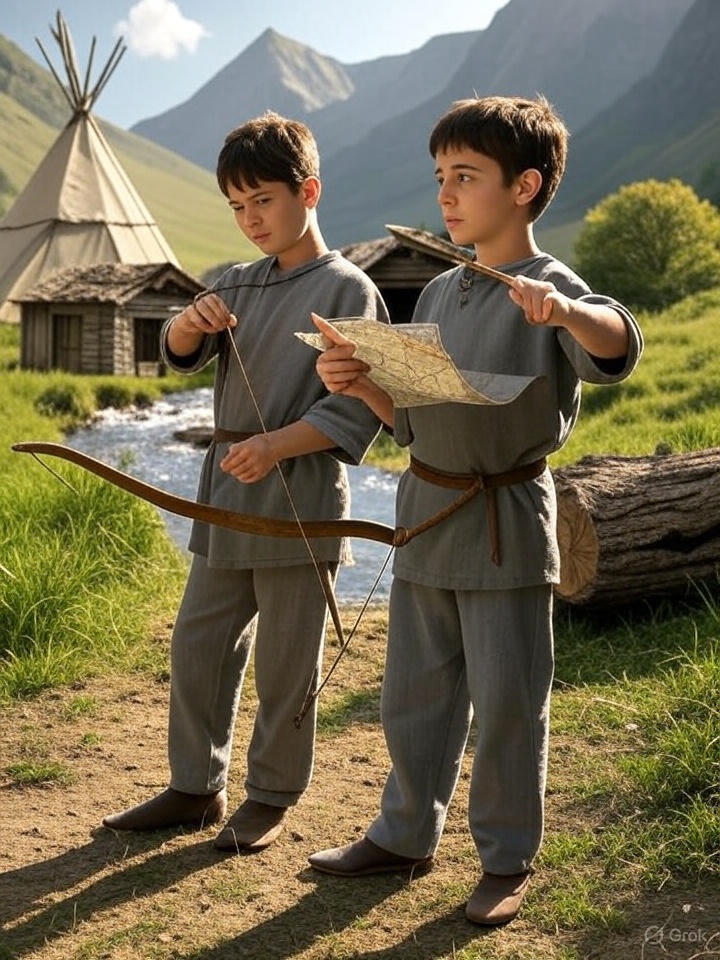
Rafe hunkered down on his haunches, “I keep forgetting your parents are dead,” he said. “I can’t believe all of this is completely new to you. Most of us have grown up within the system and understand it.” “Well I don’t,” grumped Tobal. “Maybe you can fill me in on what I’m getting myself into here.” “There are three separate degrees in our system,” Rafe told him. “These three degrees correspond to the three degrees of the ancient mystery schools, the three degrees of ancient Freemasonry, and the three degrees of witchcraft. We simply call it the three degrees of the Craft.” “The first degree of Apprentice is concerned with learning the basic survival skills that will keep you alive in the woods during all seasons of the year. We are given gray tunics and trousers…by the way.” He grinned. “How do you like your new trousers?” Tobal flushed and grinned back, “They are pretty nice actually. It was getting kind of drafty after they shortened my robe.” Rafe snickered, “Well anyway, the color gray symbolizes the degree we are in. The second degree is black. You probably noticed your guards last night were wearing black?” Tobal grinned. He was starting to feel much better. “They were pretty rough too, but my guide was nice looking, that dark-haired girl?” Rafe ignored him, “That’s part of the Journeyman degree. The Journeyman degree is where you learn self-defense among other things.” Rafe looked at him quizzically, “Do you remember how you have to train six other people to solo before you can enter the Journeyman degree?” “Yeah.” “Well, to complete the Journeyman degree you need to beat six other people in hand-to-hand combat. That doesn’t mean how many times you get beat yourself,” he grinned ruefully.

He looked a little worried, and Tobal couldn’t help but think Rafe was a bit anxious about becoming a Journeyman. That was probably due to his small size. It was hard to think Rafe could beat anyone in a fair fight. “What about the third degree then? What’s that degree about?” he asked curiously. “Are they the ones dressed in red tunics and robes?” “Yes, they are dressed in red.” They are titled Master of the circle and accorded the highest respect. You never know when your life is going to be in their hands. Their obligation is to serve as emergency medics and to officiate during circle and initiations. They monitor the health and well-being of everyone. You will see them riding around on their air sleds. They monitor our med-alert bracelets and are instantly alerted if our vital signs change through injury.” He held up his silver bracelet to show Tobal. “If something ever goes wrong and we are badly hurt, our wrist alarms go off, and it is the third-degree Masters that give us the medical attention we need. Sometimes they are too late or nothing can be done. Other times they will take us to sanctuary or the hospital for serious injury or illness. Basically, they keep tabs on everyone and make sure we are healthy and doing all right. They serve as medics for three years. After three years of medical service, they are accepted as citizens into Heliopolis.” “Three years!” Tobal blurted. “It will take forever to become a citizen!” Rafe shook him hard and looked seriously into his eyes. “Don’t even think about becoming a citizen,” he warned. “Focus on learning and living right now in the present moment. Get this right, or you will not live to become a citizen.”

Tobal found his pack and carried it silently, thinking about what Rafe had just told him as they went off to find some breakfast. The second day of circle was pleasant. Rafe introduced him to many friendly people he instinctively felt comfortable with. Tobal wondered how many of these new friends Rafe had personally trained and helped solo. He noticed Rafe was well liked by many circle members. Even more interesting was a certain section of the circle that seemed to really dislike Rafe. Tobal wondered why. This small group went out of their way to be disagreeable to Rafe and to him. After one roughly pushed past him, Tobal asked Rafe about it. “What’s with those jerks anyway?” He asked. Rafe regarded him gravely a minute before answering. There are not many people claiming sanctuary in the winter. Some of these people have been Apprentice for three or more years. They might remain Apprentice for the rest of their lives if they don’t grow up and train someone. They either have no interest in training or no one wants to train with them. Some people pick a partner to train, fall in lust, become sex partners, and don’t care about advancing. Then there are others that want to advance and simply not enough people to train. It is highly competitive, and you really have to hustle if you want to advance. I’ve made some enemies. You’re my sixth trainee in a year. No one else has ever done that before. Another thing is that I’m younger than most of the people here. Some of the older people really resent me. They not only resent me. They resent the newbies I’ve trained because I’ve taught them to be competitive too. Some of these old timers are finding it almost impossible to get anyone to train. They don’t want to camp out at sanctuary for weeks at a time waiting for someone to show up like I did waiting for you. They are getting older and blaming the people I’ve trained for taking all of the newbies. There are some hard feelings out there, and some day something is going to happen. That’s why you have to be careful. Not everyone here is friendly. Some people would like to see you or me disappear or come up with a broken leg or something. Watch your back, brother, watch your back.”

Tobal thrilled at being called ‘brother,’ but a chill feeling of dread swirled around his tailbone. What had he gotten himself into, he wondered? The events of last night’s party were hazy, and he didn’t remember much. He did remember the initiation though and how powerful it had been. He said as much to Rafe. “You’ll have plenty of opportunities to participate in other initiations and experience them more completely.” “In fact,” he grinned, “you can have an active part in every circle and initiation from now on if you choose. It is an important part of your spiritual training. That’s how we do it out here.”

As they walked toward the center of the camp, Tobal was surprised at how big it was and how many permanent log buildings had been built. This was his first real opportunity to see the camp in daylight. There were permanent structures like the sweat lodge nestled near a clear pool of mountain stream water. Others seemed to be just empty sleeping quarters. The larger log building where they were headed was the galley and stood out from the others. Teepees were being taken down and put away. It seemed some of the empty buildings were used for storage. The teepee seemed to be the favorite for those desiring a little more privacy. They were built with long poles lashed together at the top and spread out in a conical shape at the bottom. They were covered with the gray woolen material that seemed to be used for just about everything out here. Many were insulated with heavy furs fastened over the woolen material and tied into place. Tobal wondered in an amused way how many trips through the sanctuary building had been made to get that many of the gray blankets.

They were not the only ones getting ready to leave. Many others were already leaving or saying their final good-byes. Tobal was trying to remember the names of people he had met and failing miserably. He felt good though and found himself looking forward to next month when he would see them again. In the galley, they had a final breakfast of cooked venison, wild onions, and sweet potatoes. With bellies stuffed, packs and canteens full, they picked up their walking sticks and headed out of the camp.

They didn’t go back up the cliff but went down further through the valley and into the foothills. Rafe explained that nobody stayed near Heliopolis. His camp was about 40 miles away from sanctuary, and there were other camps even further out. Most people stayed no further than thirty to sixty miles from the gathering spot though. Everyone was expected to find plenty of food and game in individual areas that were not over-hunted and fairly private. It was mainly a nomadic existence, especially during the training phase. So you followed the food. At various times of the year, animals would migrate and move out of one area entirely and into others. Winters were hard, and people set up permanent camps with stored food caches to help survive when fresh food was hard to find. This time of year, the weather was mild, and the days were warm and beautiful. The snow was rapidly thawing, and new shoots of green vegetation ensured they wouldn’t have to worry about adequate food in a few more weeks. There were small animals and new plant life everywhere they looked, although it was still too early for any insects.

Shortly after leaving the gathering spot, Rafe said, “Give me your map.” Tobal handed Rafe his map, and Rafe marked an “X” on it. “This is my main camp,” he said. “We will be heading there first. That’s where I will show you how I make things and what a permanent camp looks like, especially in the winter. We’ll stay there a week or two while I teach you the basics you will need to know. Then for the last two weeks, we will go out and find you some new territory to solo in. Ok?” Tobal fought a knot of icy fear and managed to nod in agreement. He wasn’t quite certain about how easy this was going to be. Two weeks didn’t seem like very much time at all. “Ok, then,” said Rafe. “You know where my camp is now, so you lead the way!”

Tobal was momentarily confused. Then he understood and took his map back. He studied the spot Rafe had marked and compared it to where the mark for the gathering spot was. He knew they were about ½ mile north of the gathering spot and tried to orient himself on the map. The map showed Rafe’s camp lay about 50 miles in a northeast direction. Damn, he thought, Rafe certainly isn’t one that likes living close to the gathering spot. It would take a hard two days getting to his camp, maybe even longer if the terrain was really rough. He noticed something else. Rafe was making certain his map had sanctuary, the gathering spot, and Rafe’s own permanent camp on it. He felt a warmth of gratitude toward Rafe for that. If anything went wrong, he would be able to find help if he needed it.

Tobal sat down with the map, trying to puzzle out the best way to get to Rafe’s camp. He noticed that it was in some very rough country, which meant it would be at least three days and not two. “I don’t know if we can get to your place by going in a straight line.” Rafe grinned evilly, “It looks like 50 miles in a straight line, but it’s more like 100 miles the way we’ve got to go. It’s going to take us almost four days to get there.” Four days! Tobal suddenly felt very vulnerable and unprotected. How in the world was he supposed to survive in this God-forsaken place? He fought a rising panic and looked at the map again more carefully. Four days meant they were going to need water. He noticed a small stream 25 miles away and decided to make that their first camp. It was a little out of the way, but he felt it was a good idea to stay close to water.

He studied the map some more and decided the second day they could head straight north and set up a dry camp. The third day would be another dry camp, and they would reach Rafe’s camp sometime on the fourth day. They would also reach water on the fourth day before reaching the camp. He explained his plan to Rafe and showed him the map. Rafe studied the map thoughtfully. “Ya, we can try that,” he said. “You did a good job thinking about what you were going to do and made a plan. You also remembered we need water, and that’s very important out here. It looks like a good plan, and I’m willing to try it with you. Lead the way,” he said. As they began, Rafe added, “Yggdrasil guides us through these wilds, Brother Oak—trust its roots to show the path.”

Tobal pulled out his cord and undid all the knots in it. He aligned the red line on his compass for a northeast heading and surveyed the landscape, seeking the best pathway through it. Choosing his route between trees, he set out purposefully with Rafe following cheerfully behind him. It was rough going the next three days. He didn’t need to worry about water because it rained all the way to Rafe’s camp. Tobal was glad for the makeshift woolen poncho that kept him halfway warm even when it was wet. It was miserable traveling. A shadow flickered on day two, hinting at unseen eyes, but the rain masked its source.

He made a hat to keep body heat from escaping out the top of his head. It was welcome protection from both the sun and the rain since Tobal had fair skin that burned easily. Rafe had been insistent he had some type of head covering. One of the quickest ways of losing body heat was not having your head covered. Sunstroke and sunburn could be dangerous killers. In the wilderness, these things were not to be taken lightly. Tobal learned to move carefully and deliberately in the rain and slick mud, his sense of balance sharpening with each step.

Rafe continued his education by pointing out and gathering herbs. The unceasing rain made the snow disappear almost overnight. He explained about tinder and how to find good dry firewood even in the rain. Tobal learned to always have enough dry tinder and kindling to start a fire. He carried it with him in a pouch on his belt. He created the pouch by cutting some of the fabric off the poncho. He used the sewing kit to sew it together. He also used the sewing kit to mend some of his socks.

He made it a habit to gather small pieces of firewood as they went along so he didn’t need to look so hard for it at night. While it was more weight to carry, it was easier than looking in the rain and darkness for dry wood. Each evening, Tobal would select the campsite and start the fire under Rafe’s supervision. Together they would gather the rest of the evening’s wood and take turns preparing the meal. At night, they set snares for small animals. In the morning, they would check the snares and sometimes they would be lucky. Often they would find only an empty snare.

They couldn’t get warm enough in the constant drizzle, but the fire did feel good even if they couldn’t get dry. During the day, they also hunted for small game. Rafe and Tobal each cut a long strip of fabric and made a sling out of it. Together they practiced with small stones at various targets. The first day, Rafe hit a rabbit, and that night they ate rabbit stew. There was always some kind of greens for a salad.

Small animals were not all they would eat. Rafe showed him how to break open rotten logs and find the grubs within them. “They are better cooked in something,” Rafe grinned as Tobal fought off a wave of nausea. “Still, they are better than not eating at all. The large wood ants have a lemony flavor, but you need to make sure you bite them hard before swallowing, or they will try to crawl back up.”

By water, they set traps overnight for fish and set snares for small animals. If they caught anything, it was usually a rabbit or squirrel and went into the stew or was simply roasted. They ate the fish immediately. At noon every day, Tobal triangulated his true position on the map and made small corrections in their course. At times, he rethought the best route to Rafe’s camp from their current position. The wilderness often looked much different than it did on the map, and the differences took some getting used to. Some areas that looked passable on the map certainly did not look inviting in real life, and other times it seemed appropriate to take a shortcut that had not been considered.

In all this, Tobal was the guide, and Rafe simply listened and followed. Once in a while, he would make a comment about some of the changes in the plan that Tobal proposed, but he went along with them. At times, Tobal realized he had made a mistake, and hours were spent retracing the way back to their starting point. Still, with each success and miscalculation, he learned more about both reading the map and moving through rough country.

Late afternoon of the fourth day, they arrived at Rafe’s base camp. The rain had stopped, but they were soaked to the bone. It was in a secluded valley, and Rafe had to show Tobal the hidden entrance, or he would never have found it. The main camp was a large teepee with several small outbuildings made of logs. He had his own sweat lodge built next to a small mountain stream. There was also a rack for smoking meat and making jerky. The first thing they did was get into some warm dry clothes and fix a decent meal.

The rest of the first week passed quickly. They stayed in the area and set traps for fish and snares for smaller animals. Tobal learned the ways of each animal he hunted. Rafe showed him the game trails and what the individual tracks of each animal looked like. They smoked the fish and other meat so it would keep and not spoil.

In the evenings at the campfire, Rafe had him work first on a bow and then on some arrows so he could hunt larger game. He learned how to skin and dress the smaller animals like beaver, muskrat, and mink. He would carefully stretch and dry the pelts for later use as winter clothing. He learned the basics of tanning leather and made his first leather-crafted items. The weather was turning too warm to be wearing furs anymore, and the pelts would soon lose their value as the animals shed their heavy winter fur. He could always use some leather though and concentrated mainly on tanning leather.

Each morning, they explored the area, checking game trails and sneaking up on animals without trying to kill them. They had plenty to eat and practiced stalking larger game animals like deer and mountain goat. During the following week, Tobal learned more about tracking and how fresh an old track might be. He was getting fairly good with the sling and practiced every day with the bow.

Read Full Post »