Feeds:
Posts
Comments

Posts Tagged ‘jesus’

Homo Sapiens: Under Way by Stanislaw Przybyszewski and translated by Joe E Bandel

VI.

The next day was a wonderful morning. Over the whole area lay the dew-glistening sunshine, and from the fields rose silvery mists in wisps. 

Marit went to early Mass. She was very pale, but from the exhausted, grief-stricken child’s face spoke an otherworldly calm. 

She walked, rosary in hands, and implored the Holy Spirit for the grace of enlightenment. 

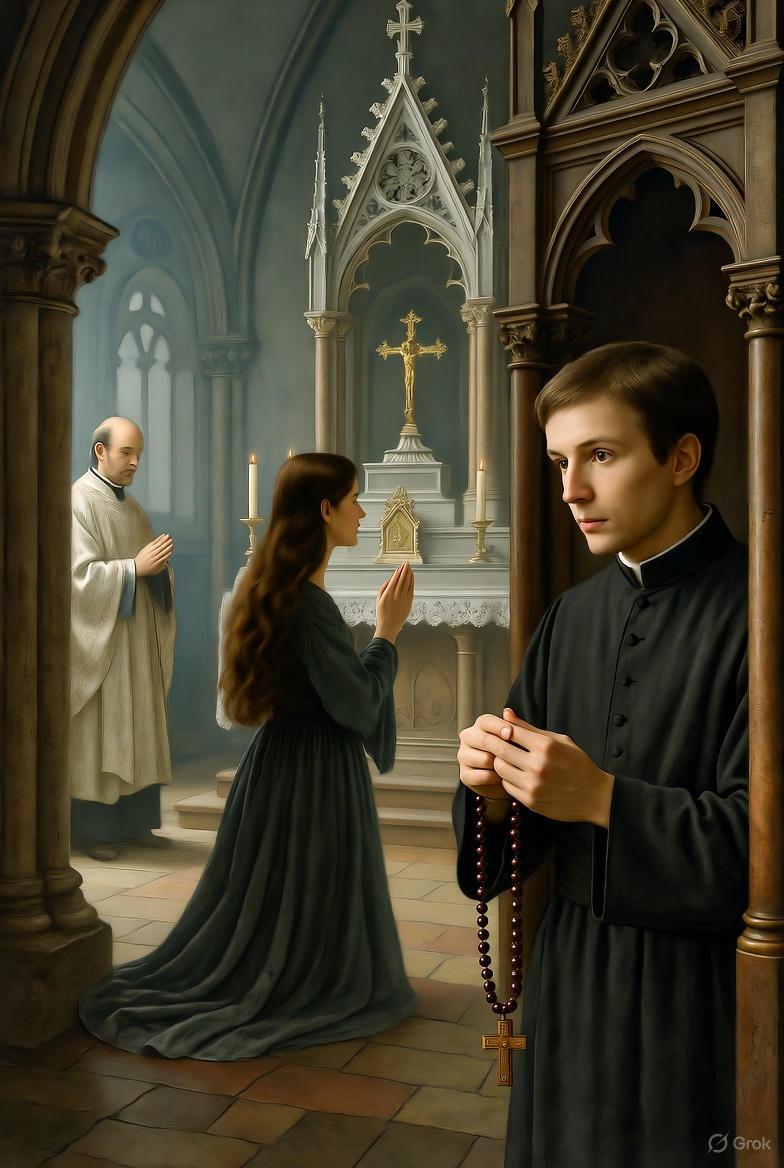
When she entered the monastery church, the priest had just begun the holy office of Mass in a side chapel. Marit knelt before the high altar and prayed a fervent prayer. To the side, in a confessional, sat a young priest who watched her curiously. He too held a rosary in his hands, and his fingers mechanically slid from one bead to the next. 

Marit stood and approached the confessional. The confession lasted a long time. 

Suddenly, Marit rose, walked with shy steps to a pew under the organ loft, sat down, hid her face in her hands, and began to cry. 

The shameless man! To ask her such things! No, she didn’t want to think about it. Her head was completely confused. She hadn’t understood the priest. It was impossible: a servant of God couldn’t ask such questions. 

Dark shame-red rose in her face. 

The crude son of a farmhand! Yes, she knew, he was a peasant. Erik was right to be so furious against the priests; they all came from farmhands. 

But all people sin. A priest can err. He probably meant well; he wanted to be conscientious. 

But Marit’s innermost soul burned with shame and indignation. She cried. She felt trampled like a worm. Not God, not Mary, not the priest; no one, no one wanted to help her. Everyone had 

abandoned her! Oh God, God, all-knowing, merciful God! How unhappy, how wretched, how sick she was. 

The altar boy rang three times. 

No, now she couldn’t take the body of Christ, not now; she didn’t want to. 

She looked around, distraught. 

Church? No, this church, this smell of sweat and bad food. Falk was right: no one could stand it in there. 

Marit left the church. 

She stood indecisively. 

Could she go to Mrs. Falk? No, impossible, how would that look. Oh, she had noticed the sharp eyes that Mrs. Falk directed at her and Erik. 

And Erik is coming out today; yes, absolutely; he’s so good. Now she would listen to him calmly; yes, he was right. The priests are sons of farmhands; they become priests only to have good and easier bread. Hadn’t Falk said it was statistically proven: only farmhands and peasants let their sons become priests. 

And suddenly she remembered word for word what Erik had told her a year ago. 

He had a relative who had to feed seven children and her old mother. The husband was a mason, fell from the ladder and died. It was when Erik was still in gymnasium. 

And now Marit clearly heard Falk’s voice: 

I entered a small, poor room. Did I want to see the dead woman? No, I don’t like seeing dead people; it’s unpleasant. She should go to the priest, tell him her situation, then he would attend the funeral for free. Yes. So she went to the priest. But the priest—what did he say? 

Back then she hadn’t wanted to believe it; now she knew it had been truth. No, Erik didn’t lie. 

Behind the monastery church flowed a narrow strip of water, a small tributary spanned by a bridge. 

Marit stopped on the bridge and looked into the water. What had the priest said? 

Again, she clearly heard Falk’s mocking, cynical voice: Give me three thalers, and I’ll bury the body; otherwise, he can be buried without a priest, that costs much less. 

Marit involuntarily thought of the confessional. A shiver of disgust shook her. 

She walked on thoughtlessly. 

Oh, if he would come now! He usually took walks early in the morning. If she met him now… 

Her heart began to beat violently. 

Yes, now she would listen to him calmly, let him say everything, ask him more questions. 

But she waited in vain; the whole day in vain. Falk didn’t come. She had already walked through the garden a hundred times and peered at the country road, but no person was to be seen; only now and then a dust cloud rose, flew closer, and then she recognized a cart from the neighboring village. 

Tomorrow he will come, she thought, and undressed. She hadn’t lit a light, for she was afraid of the image of the holy Virgin; she didn’t want to see it. 

She stood indecisively before the bed. Pray? 

She asked herself once more: Pray? 

The ridiculous lust for happiness, the shameless lust for happiness, mocked in her ears. 

She got into bed with listening fear. 

Would the all-knowing God punish her on the spot? She lay listening, waiting. 

No, nothing… 

The clock ticked and tore the deep silence. 

She was very tired and already half-asleep. Her brain was paralyzed. Only once more did the question dawn in her: whether he would come tomorrow. 

And if he has left?! No—no. She was completely sure, she knew: now that she was his, completely his, now that she lived with his spirit, now he hadn’t left. 

Strange, how sure she knew that… 

But she also waited for Falk in vain the whole following day, the whole endless, terrible day. 

Could she endure this unbearable longing much longer? Involuntarily, she looked in the mirror. 

Her face looked completely destroyed. The eyes glowed from sleepless nights and were blue-ringed. Feverish spots burned on her cheeks. 

A deep pity for herself seized her. 

How could he torment her so inhumanely; why punish her so terribly? 

She felt like a child unjustly beaten. 

She tried to think, but she couldn’t gather her thoughts, everything whirled confusedly in her head. 

What was happening to her? She clearly heard continually single words, single torn sentences from his speeches. They gradually became like a great creeper that spread over the entire ground of her soul, overgrew everything, and climbed higher and higher with a thousand tendrils, up into her head. 

She was so spun into this rampant net of strong creepers that she felt locked in a cage whose walls grew ever narrower. Everywhere the trembling cage bars, one next to the other, ever more pressing, from four sides. 

God, God, what was happening in her?! 

Falk’s great spirit: piece by piece it passed into her. She thought with his words, with the same tone, the same hoarse half-laugh that was in his speech. 

She resisted, she fought with all her strength; but suddenly a grinning thought overpowered her. 

It was as if he had brutally stripped all the holy, all the beautiful around her; huh, this hideous nakedness! 

Yesterday in church: how was it that she suddenly discovered behind the glory of the divine service the brutal face that so disgustingly reminded her of a farmhand’s face? 

And now, now: what was it, for heaven’s sake? 

She didn’t want to see it, but again and again she had to stare at it. 

Yes, how was it? The whole expression of the holy, supernatural suddenly vanished from the image of the Byzantine Madonna, and Marit stared into the stupid laugh of a childishly painted doll. 

No, how ridiculous the picture was! 

“Christ was the finest, noblest man in world history—yes, man, my Fräulein; don’t be so outraged, but it is so.” 

And now a swarm of arguments, syllogisms, blasphemies hastened through her head. 

No, she couldn’t think of it anymore. 

And now she sat and sat in a dull stupor. The whole world had abandoned her. Him too… 

When she came down to the dining room, it was already evening. 

“Marit, I have to go to Mama at the spa; her condition has worsened. It probably won’t be dangerous, but I’m still worried.” 

Herr Kauer took a slice of bread and carefully spread butter on it. 

Mama? Mama? Yes. She had forgotten everything; everything was indifferent to her. She felt over her a dull, lurking doom, a giant thundercloud that wanted to bury a whole world. 

“Yes, and then the district commissioner has invited us for tomorrow evening.” Marit flinched joyfully. There she would see Falk. He was good friends with the district commissioner. 

“Yes, Papa, yes; I would very much like to go to the district commissioner’s. Yes, Papa, let’s go.” 

But Kauer wanted to travel early in the morning. Marit didn’t stop begging. 

She never went anywhere; she would so like to see lots of people again. 

Kauer loved his daughter; he couldn’t refuse her anything. 

“Well, then I can take the night train. But then you have to go home alone.” 

“That’s not the first time. She’s a grown girl.” 

Kauer ate and thought. 

“Why doesn’t Falk come anymore? I really long for the fellow. Yes, a strange man. The whole town is in 

turmoil over him. But he really does crazy things. Yesterday he meets his mother as she’s driving home a pig she bought at the market; she couldn’t get a porter. What does my Falk do? He takes the pig by the rope, drives it through the whole town, from street to street, his mother behind him—yes, and when people stare at him all dumbfounded, he sticks a monocle in his eye and drives the pig with majesty and dignity…” 

Marit laughed. 

“Ha, ha, ha—Herr Kauer couldn’t stop—”a pig driver with a monocle! Wonderful… And in the evening, well: you know that goes beyond measure: he offered the high school director slaps in the face.” 

“Why?” 

“Yes, I don’t know; but it’s really a fact. But imagine, Marit: to the director! Yes, yes, he’s a strange man. But the strangest thing is that you still have to love him. It’s a shame about the man, hm: they say he’s drinking terribly these days. It would really be a shame if he ruined himself through drinking.” 

Marit listened up. 

“Does he really drink so much now?” “Yes, they say.” 

Marit thought of his words: he only drank when he felt unhappy. And Father sometimes drank too…— 

She felt a strange joy. 

So it wasn’t indifferent to him… Tomorrow, tomorrow she would see him…

Read Full Post »

OD by Karl Hans Strobl and translated by Joe E Bandel

Despite all this recognition, Schrötter argues, one must confront Reichenbach where he has strayed into a realm governed by imagination and whim.

Reichenbach can hardly believe his ears; he wants to interrupt the speaker immediately, point to his meticulously kept protocols, but he restrains himself.

On what evidence, Schrötter continues, is this entire Od hypothesis based? On the testimony of nervous, weak, or sick individuals—whom the Freiherr calls sensitives.

Frowns and disapproving looks ripple through the assembly. Schrötter has conjured a shadow—the shadow of Hofrätin Reißnagel. Reichenbach feels it distinctly, as this shadow swirls out of the hall and passes over him.

Such people, Schrötter suggests, are easily excitable in their imagination, especially when, as Reichenbach does, one deals primarily with women, and one need only tell them what to feel or see for them to believe they truly do.

“Can you say,” Reichenbach cries indignantly, “that I influence my sensitives?”

Schrötter dismisses this with a shake of his head. “Have you ever been able to confirm odic phenomena from your own perception?”

“I’m not sensitive myself,” Reichenbach shouts. “Must a doctor who describes the symptoms of a disease have experienced it himself?”

“Childbed fever!” says a voice from the back rows—the same voice that interrupted earlier. It gains some success again; heads turn, and a smirk spreads across the enlightened listeners’ faces. Yes, Semmelweis—that’s a similar case; it’s an excellent interjection, highlighting the intellectual kinship of these two men who have entangled themselves in untenable claims. But then the amused faces force themselves back into the seriousness and dignity of the assembly.

“What Baron Reichenbach calls Od,” says Schrötter, jabbing his index fingers into the air, “is entirely subjective in origin. And even if that weren’t the case, the assumption of a previously unknown natural force is entirely superfluous; these so-called odic phenomena can be explained partly by magnetism, partly by electricity…”

Reichenbach can no longer hold back: “Magnetism is something different,” he shouts, “electricity is something different, and Od is something else entirely.”

Professor Schrötter shakes his head again, gently and admonishingly. This kind of outburst, like a tavern brawl, is entirely against the customs and traditions of this distinguished assembly. Here, people are accustomed to letting each other finish, weighing arguments and counterarguments with care and deliberation—a basic tenet of scientific decorum.

“Certain phenomena can also be explained by the known animal magnetism,” Schrötter begins again. “Even Mesmer…”

But in Reichenbach, all regard for the distinguished assembly has collapsed. He feels himself in a state of self-defense. “Mesmerism is merely a special case of Od,” he thunders angrily.

Now Professor Schrötter can go no further. No civilized debate is possible with this shouter, who lacks all sense of good manners. Schrötter withdraws his arm from his coat tails and sits down.

But another rises in his place—a gaunt clerical figure with a sallow face and a hawk-like nose. He gobbles like a lean turkey and drags invisible wings behind him on the floor. “I would like,” he says, “to emphasize from the Church’s standpoint, with all due rigor, that we strictly condemn the superstitious notions of spiritualists, and that we are averse to all mysticism. The Od doctrine of Herr von Reichenbach is mysticism of the darkest origin and stands in opposition to the teachings of the Church. And when Herr von Reichenbach speaks of spirit appearances…”

Reichenbach shows no reverence even for the Church’s vote; he dares not let even a cleric finish. The battle is as good as lost; he no longer fights for victory but only for an honorable retreat. “I am a physicist, Eminence,” he interjects, “and as a physicist, I tell you that all corpses of dead animals emit Od light. —And perhaps,” a new idea strikes him, “one can even derive the word ‘corpse’ from the term ‘light.’”

It’s a blunder that linguists and Germanists, present today, immediately catch. This is their domain, where they’re at home, and something unheard of happens in these sacred halls—a burst of laughter erupts, an unrestrained, gleeful laughter at this misstep.

Then the voice from the back rows speaks again. It shouts, louder and more defiantly than before, a single word into the hall: “Swindle!”

A whip crack stuns Reichenbach; he flinches. Now he has finally spotted the interrupter, crouching behind the backs of those in front, who has been spitting venom at him. It’s Doctor Eisenstein—Doctor Eisenstein, that nobody, that sycophant he dismissed for overstepping his bounds. A base, pitiful revenge has claimed Reichenbach as its victim. “Gentlemen!” he says, wiping the sweat from his brow, “this is a word has been cast that attacks my honor and sullies my name. I stand too high above such accusations to settle publicly with their author. Let his own conscience pronounce judgment. I have by no means worked only with women; I see men in this assembly whom I have involved in my experiments and whom I call as witnesses to testify to how it was conducted—men from your own ranks, whose word you will find beyond reproach…”

His gaze sweeps over the rows of seats, picking out individuals—the physicist Natterer, the botanist Unger, the anatomist Ritter von Perger. They were present, are somewhat sensitive themselves, and can vouch that Reichenbach stands with clean hands, that his experiments were conducted with utmost care. Now one of them must rise and honor the truth.

Silence. They remain seated, shrinking awkwardly, squirming under his gaze, but they dare not confess. They don’t want to be exposed as gullible followers of a man already half-outcast before the Areopagus of science.

Sweat pours in streams from Reichenbach’s forehead. It’s over; they have abandoned him. “Gentlemen,” he says, and his pride rears up even in collapse, “I remind you only of a word from Schopenhauer. The solution to every problem passes through three stages until its acceptance: in the first, it seems ridiculous; in the second, it is fought; and in the third, it is taken as self-evident. You, gentlemen, have not yet spoken the final word; you haven’t even reached the second stage because your capacity for understanding doesn’t extend that far. I confidently leave the decision to the future.”

It’s outrageous, the audacity this arrogant man displays. He dares to criticize the comprehension of this highly esteemed assembly, questioning the jurisdiction of this scientific tribunal over his own matters. Now order breaks down; it’s no longer possible to hold back. A murmur of voices surges against the pale, sweating man at the lectern.

“Oh ho!”

“That’s an insolent overreach!”

“You can’t expect our clear-sighted century to take such fantasies seriously.”

“Yes, yes, leave it to the future.”

In these sacred halls, where the spirit of tolerance and consideration usually prevails, never has it been so chaotic as today. And it scarcely needs the heckler to remove the last inhibitions.

He shouts: “‘Speak of the devil, and he appears!’”

The reference to earlier events isn’t entirely clear, but the word doesn’t miss its mark. Reichenbach himself used it before; they remember, they don’t pause to consider if it fits or not—it allows all interpretations and triggers laughter. Laughter slaps Reichenbach in the face; laughter buries him and his Od.

Amid the tumult, Reichenbach gathers his papers together and leaves. He walks through the rows of seats with his head held high. He scorns the idea of slipping out through the small exit behind the lectern; he departs through the front, straight through the hall, exiting via the main entrance.

Schrötter hurries after him; he doesn’t want to be misunderstood. He wants to make clear to the Freiherr that it was no personal attack but a deliberate defense of scientific objectivity that compelled him to contradict. But the Freiherr is already down the stairs; it’s evident that attempting to appease him now would be risky. With a touch of regret and thoughtfulness, Schrötter remains upstairs and lets the Freiherr go.


It’s strange how, amid inner darkness, the feet seem to find their way on their own. One walks and walks without accounting for it, and suddenly one stands before a destination, realizing they sought it without knowing.

Suddenly, Reichenbach also stands before the stage door of the Burgtheater, facing the poster and reading behind the wire mesh: “First Reappearance of the Heroine Therese Dommeyer as The Maid of Orleans.” And that, indeed, is the answer to the question Reichenbach meant to ask when his feet carried him here unbidden.

So she’s back; she has completed her guest performance tour and resumed her activities in Vienna.

That was the question he came to ask, and here stands the answer behind the wire mesh of the poster board.

Groups of actors and actresses mill about the stage door, chatting and smoking. He threads through them, holding his breath, and knocks on the sliding window of the stage porter.

Where might Madame Dommeyer be found?

The stately guardian of the Muses’ temple looks down at the stranger. Madame Dommeyer is in the house, occupied with rehearsal.

So! Good! Thanking him, Reichenbach steps back; the carriage has followed slowly and stops before the Burgtheater. Reichenbach signals Severin to wait and settles into a small inn, from whose window he can keep the stage door in view.

What would the Herr Baron like—perhaps a glass of young wine and a goulash or some beef?

It doesn’t take long; the wine and beef sit untouched before him when Therese Dommeyer glides out of the stage door. Someone inquired about her, the stage porter reports; the carriage over there seems to belong to him.

Therese Dommeyer nods indifferently; since her return to Vienna, many older gentlemen have been pressing themselves on her. It’s as if these old men have a keen sense, knowing the moment Therese steps back onto Viennese soil that the path is clear. Yes, even the strongest feelings of joy fade; the exuberant dearest joy of passion dulls with habit. As long as there are obstacles, as long as the struggle persists, all that is desired is crowned with heavenly roses; one feels they might perish if the longing endures, but unrestricted fulfillment breaks the spell. Who truly knows their own heart? Such is life.

Freiherr von Reichenbach hurries out of the small inn. Ah, so the Freiherr von Reichenbach is the old gentleman—truly, he has become an old man; just a few months ago, he was better preserved.

He requests the honor of driving Therese home in his carriage.

Why not? She sweeps into the carriage, spreads her skirts, nods to her colleagues—well, hardly has she arrived, and she’s already being picked up in a carriage.

Only a meager spot remains for the Freiherr beside her. He makes himself small, presses into the corner, inquires about her destination, her successes.

Oh God, Therese remembers she promised to send him greetings from her journey. Naturally, she didn’t; she completely forgot there was a Freiherr von Reichenbach. He shouldn’t remind her of it—she’ll give him an answer anyway.

Therese is sullen and mistrustful, reporting her successes only sparingly—perhaps they weren’t even up to par, falling short of what she believes she’s entitled to claim.

“I have a request for you!” says the Freiherr.

Oh, is that it again—this same story? Well, Reichenbach will be astonished by what he’s about to hear. She leans back in the carriage, bracing herself for defense.

“Go ahead, speak,” she says, not exactly encouragingly.

“It’s like this… it concerns the Od, my scientific reputation. You must know that my research has been questioned. I must muster everything to crush my opponents. I’m preparing for the final battle.”

My God, the Od—this tedious Od—hasn’t the Freiherr tired of this harebrained nonsense yet?

“My witnesses have abandoned me; my sensitives have withdrawn, especially now. If you were to step forward—you, who stand at a widely visible height and are known throughout the city… if you were to vouch for me and say, ‘This is how it is,’ then people would listen. They would take the matter seriously again. You are highly sensitive, though even with you, some things remain unclear and contradict other findings…”

“I believe it,” Therese laughs outright.

“I mean,” the Freiherr continues, somewhat embarrassed, “they are only minor deviations that, upon closer examination, can be reconciled with the other facts. Why shouldn’t you…”

Therese is in no mood to be gentle: “Why? Because your whole Od is utter nonsense!”

A glowing corkscrew bores into Reichenbach’s chest, ripping his heart out with a jerk.

His lips tremble with age; the clatter of the carriage window shatters like the blare of trumpets.

“Yes… and because I’ve never seen or heard the slightest thing of what you’ve asked of me. So, now you know, and leave me out of your damned Od!”

A tear in the curtain from top to bottom, a temple collapse, a tempest of the Last Judgment. Who is this strange woman sitting beside Reichenbach in the carriage?

“Well, no hard feelings… I can’t be part of something like this. And thanks for the ride. I’m home.” She taps on the window; Severin turns, nods into the carriage, and leaps from the box to open the door for Therese. Therese has no idea what a devoted admirer she has in Severin; when the Baron is in the city, he misses none of her performances. He’d gladly lay Persian carpets under her delicate feet. Now, knowing she’s in the carriage behind him, he feels as if he’s transporting the Austrian crown jewels. He’s overjoyed she’s back from her tour and gazes at her, utterly enchanted.

When he turns back to his master, he’s startled by the gray, haggard face resting on the red velvet backrest.

“Are you unwell, gracious sir?” he asks with concern.

“No… no… take me home,” says the Freiherr, his tongue slightly heavy.

Read Full Post »

Chapter 7: Gnostic Christianity – The Soul’s Sacred Dance with Physical Life

Historical Overview: The Gnostic Reclamation Amid Patriarchal Tensions

The emergence of Gnostic Christianity in the 1st–4th centuries CE marked a pivotal attempt to reclaim the organic gnostic legacy of life-affirming mysticism in a world increasingly dominated by patriarchal ideologies. Gnostic texts, such as the Gospel of Mary (circa 2nd century CE) and Pistis Sophia (circa 3rd century CE), postdate canonical Christianity but draw from earlier traditions—Egyptian, Platonic, and possibly Minoan—emphasizing the soul’s sacred connection to physical life through the divine feminine, Sophia. This period, following the destruction of Alexandria’s library (47 BCE) and the consolidation of patriarchal monotheisms (Zoroastrianism, Judaism, early Christianity), saw literacy’s cognitive leap solidify the watcher self, fostering soul immortality concepts but often at the expense of physical life’s sanctity.

Gnosticism arose as a counterpoint to orthodox Christianity’s focus on afterlife salvation, which aligned with social enforcers’ (traditionalists) glorification of death and merging with Source. Texts like the Gospel of Philip highlight the alchemical marriage of Christ and Sophia, symbolizing integration of physical (life) and spiritual (soul) realms through love and equality, echoing earlier goddess traditions. Meanwhile, rational atheists (materialists, akin to early Semitic intellectuals) rejected spiritual realms, emphasizing logic and collective good, as seen in Hellenistic philosophies like Stoicism (circa 300 BCE–200 CE). Organic gnostics, with their genetic-spiritual link to Gaia, integrated Shadow (primal life urges) and Holy Guardian Angel (aspired cosmic harmony), making them targets for enslavement by both groups, as evidenced in Roman persecution of Gnostic sects (e.g., Valentinians).

The Nag Hammadi library (discovered 1945, dated 4th century CE) preserved Gnostic teachings, revealing their focus on physical life as sacred for soul renewal, countering social enforcers’ asceticism and rational atheists’ materialism. However, by 325 CE, the Council of Nicaea solidified orthodox Christianity’s patriarchal framework, marginalizing Gnostic voices and reinforcing death-centric spirituality.

Mystery School Teachings: Soul, Physicality, and Gaia’s Sacredness

Gnostic Christianity reframed the soul as a watcher self, birthed by literacy’s cognitive revolution (circa 3200 BCE), requiring physical incarnation for growth, not dissolution into Source. The Gospel of Thomas (circa 2nd century CE) emphasizes living wisdom: “Whoever finds themselves is superior to the world,” tying soul development to earthly experience, not escape. Sophia’s role as divine feminine mirrored Gaia’s life-giving power, with physical bodies as resonant circuits (Ch. 13, Magus) sustaining astral awareness via bio-electric loops.

Organic gnostics, as Gaia’s native inhabitants, integrated Shadow (primal drives, Radon’s etheric urges, Ch. 26, Magus) and Holy Guardian Angel (cosmic balance, Krypton’s harmony, Ch. 24), enabling manifestation through Tantric exchanges (Ch. 5). Rational atheists, lacking spiritual connection, prioritized collective logic, akin to Stoic apathy for societal good. Social enforcers, fixated on astral ghosts (repetitive destinies, Ch. 17, Magus), glorified death, denying physicality as sinful, as in Manichaean dualism (3rd century CE) influenced by Zoroastrianism. Their attempts to enslave organic gnostics—seen in early Christian suppression of Gnostic sects—aimed to exploit their manifestation power, as Gnostics alone could “bring heaven to earth” through balanced duality.

The Gnostic vision of physical life as sacred countered both groups’ distortions, advocating soul renewal through incarnation, not escape, aligning with ancient Egyptian ka/ba reunion for akh immortality (Ch. 4).

OAK Ties and Practical Rituals: Reclaiming the Sacred Physical for Soul Growth

In the OAK Matrix, the soul’s reliance on physicality resonates with resonant circuits (Ch. 13), where body (capacitance) and aura (inductance) sustain awareness via chaos-driven leaps (Ch. 11). Organic gnostics’ integration of Shadow and HGA mirrors Oganesson’s womb containing all fragments for wholeness (Ch. 20), countering social enforcers’ death worship and rational atheists’ materialism. This ties to Ipsissimus unity (Ch. 10, Magus), where physical and astral merge in divine harmony, and Adeptus Exemptus compassion (Ch. 7), serving life’s sacredness.

Practical rituals revive this:

  • Sacred Life Meditation (Daily, 15 minutes): Visualize your watcher self observing a dream, rooted in Gaia’s physicality. Journal refused Shadow (e.g., physical joy denied by asceticism) and aspired HGA (e.g., life-affirming balance). Merge in Oganesson’s womb, affirming: “My soul grows through Gaia’s embrace.” Tie to Gnostic Sophia: Inhale physical vitality, exhale astral renewal.
  • Gaia Renewal Ritual (Weekly): By an oak, touch its roots, invoking Gaia’s sacredness. Offer water, symbolizing incarnation’s renewal. Visualize soul as photon-plasma (Ch. 19, Magus), pulsing through body-aura circuit. Affirm: “I bring heaven to earth, not escape.” Counter social enforcers’ death focus.
  • Partner Life Affirmation: With a partner, discuss physical life’s value. Men: Share expansive soul visions; women: Grounding acts of love. Build non-physical energy via breath or touch, visualizing Tantric union (Ch. 5) for life affirmation. Solo: Internalize, balancing rational logic and traditionalist astral focus in Gaia’s heart.

These empower organic gnostics to reclaim physical life’s sanctity, restoring Gaia’s vision. Next, explore Bogomil dualism, bridging Gnosticism to medieval resistance against patriarchal control.

Read Full Post »

OD by Karl Hans Strobl and translated by Joe E Bandel

Chapter 15

Max Heiland had actually felt a troubling premonition all day, and it was foolish of him to stubbornly suppress and dismiss it.

This premonition warned him against visiting his lodgings on Kohlmarkt today, and he would have been wise to heed it.

For when he heard Ottane’s light step on the stairs and then her signal at the door, and when he—now with some difficulty—assumed the face of the delighted lover and opened the door, there stood Therese Dommeyer before him.

Damn it all, how could his sharp hearing have deceived him so—now the reckoning was at hand.

“Quite cozy you’ve got it here,” said Therese, stepping in and closing the door behind her.

“Who: we?” asked the master, rather lacking in wit.

Therese went further; she removed the key and tucked it into her fold-up purse. Then she said, “Well, you and your lover.”

Max Heiland deemed it appropriate to react gruffly: “What kind of foolish talk is this?”

“So is this perhaps your new studio? I don’t know much about it, but it seems the light isn’t great. I think I’ll have to shed some light on this for you.”

“So what do you want here?”

“I’d like to meet your lady.”

There was nothing to do but give in a little. “I beg you, Therese, surely you don’t want to cause a scandal!”

“I’m just curious about who comes to see you.”

“Very well… but you must give me your word of honor to cause no scandal.” He choked out the name as an honorable man yielding only to necessity. “It’s Frau Oberstin Arroquia!”

He breathed a sigh of relief. “You understand… a Spaniard like that… what can one do? It’s practically a business matter. Frau Arroquia has connections to court circles, the best connections, and if she ends our friendship and turns the entire nobility against me—well, I’d look pretty foolish. One can’t afford to offend a woman like that.”

Therese hadn’t been listening to the master and was sniffing around the room. “Yes, one mustn’t offend a Spaniard like that,” she said, continuing to sniff. She picked up a silk scarf from an armchair and examined it: “This shawl looks familiar, but I think I’ve seen it with someone else.”

Yes, there hung Ottane’s shawl, and on the dresser stood a prominent, unmistakable picture—Ottane’s daguerreotype, taken by Schuh, with a small vase of roses before it, like a household altar of love. Therese stood reverently before the image and said, “But the Frau Oberstin has changed remarkably lately.”

Good heavens, Max Heiland realized everything was lost—Ottane’s picture was there, and on top of that, he had placed roses before it out of exaggerated chivalry.

“So it’s Ottane,” Therese turned around, “this little game with Ottane, with whom you’ve been cheating on me. Is this also because of court circles and business considerations?”

Now further denial would be pointless, mere waste of time, and there was no time to lose. Ottane’s moment was at hand; she could arrive at the door any second, and what might follow was unthinkable. A confrontation must be avoided at all costs. Max Heiland gave himself a shake and stood up straight: “I’ll tell you the truth. It really is Ottane. And what do you intend to do now?”

“I’ll wait here until she comes,” said Therese, settling broadly into a chair with rustling skirts.

“You won’t do that, my dear.”

“Don’t call me ‘my dear’!” Therese flared up angrily. “You know I can’t stand that.”

“You won’t do that because you don’t need to. It’s entirely unnecessary for you to make a scene. You’ve discovered this… well, this affair at a time when it’s nearly resolved for me. You’ve only hastened its natural end. In a few days, I would have broken with Ottane. I’ve had enough of her.”

Therese raised heavy eyelids with a look that suggested little trust. “Is that true?”

Heiland nodded affirmatively. He had spoken the truth—at least a kind of truth; he had indeed grown somewhat weary of Ottane. Her passion no longer swept him away; he remained more out of politeness and favor than from an inner urge as a tender lover. He had other life goals, other women, and his work; in truth, he was already bored, and Therese’s intrusion into the fading love idyll merely provided the external push to end it. It excused the violent act, to which he hadn’t yet been able to resolve himself out of pity and consideration.

“If I’m to believe you,” said Therese, “then write a farewell letter to her right now.”

“I’m ready to do that,” Heiland conceded, with the seriousness befitting such a moral turn. He sat at the small desk, took paper and pen, and began to write.

“And to make it easier for you,” Therese continued, twirling Ottane’s shawl in the air until it formed a rope, “you’ll come away with me now.”

Heiland looked up in surprise.

“Yes, I’ve been granted leave; I must make a guest performance tour in Germany, and you’re coming with me.”

All respect, one had to give Therese credit—when she did something, she did it thoroughly. “Very well,” said the master after a brief reflection, “I’ll go with you. It might do me good to take a break for a while. I don’t know what’s wrong with my eyes; sometimes it’s like a veil over them, and then I can hardly see nearby things. It will benefit my eyes to not paint for a few weeks.”

He wrote a few more lines and then asked over his shoulder, “And your old man?”

“My old man?” Therese wrinkled her nose. “The Reichenbach? Yes, he’ll have to manage without me.”

Now Heiland even managed his captivating smile again: “But you must tell me how you found out… that we were here…?”

“You’d like to know, you sly one!?” Therese laughed, half-reconciled. “I just have very good connections with the police. The police know everything, and it was an honor for the Hofrat to oblige me.”

Heiland hurried to finish his letter, for now there was no minute to spare.

“Show me!” Therese commanded as he sprinkled sand over the ink. She read it, nodded, was satisfied; and then they didn’t linger any longer. Heiland felt the ground burning beneath his feet—my God, only not another encounter at the last moment on the stairs, in the stairwell, or on the street, an open confession. Heiland wasn’t fond of awkward confrontations; his quota was fully met by Therese. He breathed a real sigh of relief only when they turned the next street corner.

Ottane arrived quite flushed; an urgent operation that Semmelweis wouldn’t perform without her had caused the nearly half-hour delay. As she entered the house, the curtain at the caretaker’s window moved, and then the caretaker emerged, holding a letter.

“Herr Heiland just left with a lady… and I’m to give you this letter.” Rarely had Frau Rosine Knall carried out an errand with such satisfaction. The foolish Doctor Semmelweis had dismissed her—that was an outrage—and her disposition toward him hadn’t improved with the neighborhood joke that she’d been fired on the spot. She knew this young lady was, so to speak had taken her place—this person who took bread from poor women and, of course, indulged Semmelweis in his madness. She included Ottane with fervor in her resentment; it had been a delight to provide information to the police spy when he came to inquire, and now she had lurked behind the curtain of her door window like a hunter on the lookout.

The arrow had been loosed—this letter, she knew, was a poisoned dart. Ottane realized it the moment she received the letter.

“Thank you!” said Ottane and walked away. Only don’t let this woman notice anything, only don’t give those greedy, hateful eyes a spectacle. She walked a few houses down and stepped into a wide gateway.

She knew what the letter contained; she had sensed it coming. Max Heiland’s arts hadn’t been enough to deceive the feeling that something dreadful approached; the hours of passion had been followed by bitterness, a gaze into emptiness, a rise of fear.

Now Ottane held the letter in hands that trembled as they broke the seal.

She read: “My conscience can no longer allow…”

She read: “I cannot bring myself to involve a girl from a first family, so pure and blameless…”

She read: “Under this conflict, my art and the noble purpose of my existence suffer…”

She read: “Though my own heart bleeds from a thousand wounds…”

She read: “And so I depart alone…”

Ottane leaned against the wall; her legs stood in a mire into which they sank. The view of the street through the gateway swung in pendulum motions left and right. Then she heard voices from above; footsteps clattered down the wooden stairs, a child crowed with delight.

No, only don’t let anyone notice, for God’s sake, don’t let anyone notice.

She pushed off from the wall, staggered a little, but then walked out into the life of the street.


“Are you packing?” said Freiherr von Reichenbach, surprised, as he entered Therese Dommeyer’s room.

She stood with her maid amid piles of clothing and feminine accessories, wrestling with a stubborn suitcase.

“Are you traveling?” the Freiherr asked again, faced with these unmistakable preparations.

“Yes, I’m traveling,” laughed Therese. “I’m going to Germany—Dresden, Leipzig, Berlin, and so on, a big guest performance tour…”

“You must be very excited about it?” the Freiherr remarked, distressed.

Therese, with the maid’s help, had subdued the unruly suitcase. She jumped onto the lid and held it down with the sweet weight of her body while the maid quickly fastened the straps.

“I’m overjoyed. A chance to get out of the Viennese sausage kettle, see new faces, and earn a bit of money!”

Therese was evidently not the least bit saddened by the farewell; she sat soulfully delighted on the lid, drumming the sides of the suitcase with the heels of her cute shoes.

A shadow of melancholy darkened Reichenbach’s features: “I came to invite you to a session, but…”

“Yes, with the sessions, that’s over now,” Therese waved off. “Now you’ll have to sit without me. And I’m not sensitive anymore.” She leaped off the restrained suitcase and dove into a pile of clothes. “Jesus, Rosa, where’s the blue hat? Haven’t you seen the blue hat? It was still in the bedroom a moment ago.”

The maid slipped out; they were alone for a short while, perhaps only minutes, as Rosa would return soon. Reichenbach hadn’t come solely for the session—the matters needed clarification, and with no time for slow deliberation, a bold move was needed to force a decision.

“And I had thought—” said the Freiherr, looking at Therese with heartfelt emotion.

“Well, man proposes, and God and the theater agent dispose.”

“You can’t be in doubt,” Reichenbach pressed on resolutely, “about what I mean, can you? You must have noticed it yourself long ago. I came here today with a specific intention. I… I had hoped to take your ‘yes’ home with me today, that you… well, that you would become mine.”

Therese was neither surprised nor overwhelmed by the great honor; she had no time to feign surprise or emotion, nor to artfully soften her rejection. “Look, dear Baron,” she said, digging a violet petticoat from a stack of clothes and tossing it onto a nearby pile, “look, dear friend, you must get that idea out of your head. That’s just not possible. How do you even imagine it? There’s no question of it. I don’t suit you, and you don’t suit me. We get along well enough, but as your wife—no, that won’t do. So, what about the hat, Rosa?”

Read Full Post »

OD by Karl Hans Strobl and translated by Joe E Bandel

But one day, Therese Dommeyer was there.

She sat opposite Reichenbach in the blue room on Kobenzl, but she wasn’t cheerful at all. She wore a raincloud face, and it was clear she had been deeply affected by something.

“Why haven’t I come? Look, Baron, you’re a serious man, and that’s precisely why one should be able to laugh when with you. And I’ve had little to laugh about all this time, my soul! not at all.”

She played with the tassel of a cushion lying next to her on the divan. “What’s been going on? Better not ask. All sorts have happened, nothing good or beautiful. Nothing but trouble and sorrow. Bitter disappointments! You can’t rely on people. Especially not on those you’d sworn by, least of all on them. That hurts when you’ve built on someone and then discover their falseness. And then one easily becomes unfair to one’s true friends, the real ones, neglects them, and feels ashamed afterward.”

She looks up suddenly, and the divine’s unexpected glance shoots a flame into Reichenbach’s soul. There sits Therese Dommeyer, lamenting her woes, very melancholic, and to Reichenbach’s surprise, he finds her melancholy suits her almost better than her exuberance. And perhaps, his heart beats, this might be a turning point where what seemed impossible becomes possible.

He takes Therese’s dangling hand: “You would make me indescribably happy if you would trust me. What is it that weighs on you?”

She looks at him sharply for the blink of an eye and shakes herself: “Oh, what,” she laughs forcedly, “I’ve got debts, that’s all. Everyone at the theater has debts—why should I be the exception?”

She has debts! Certainly, Therese has debts, Reichenbach doesn’t doubt that. But it’s not just the debts that are at stake. In any case, it will be good to engage with that.

“And you only remember now,” says Reichenbach, “that you have a friend in me?”

“Should I perhaps let you pay my debts? You know how it is at the theater; if someone pays a actress’s debts, they usually expect something in return.” She pulls her hand back as if offended and insulted.

“Are your daughters at home?” asks Therese, and this is clearly a change of subject.

Yes, Hermine and Ottane are at home, but why does Therese pull her hand back—is it perhaps uncomfortable for her when the Freiherr holds it?

“Uncomfortable?” marvels Therese, “why uncomfortable? Oh, I see! It must be something odic. You’ve driven the whole city mad with your Od for a while now. And are you angry with me for saying it’s uncomfortable?”

“No? God forbid, no, it’s a scientific observation. And this?” The Freiherr now takes Therese’s left hand with his right.

“How must that be, odically?”

“Coolly pleasant!”

“Yes, really, it’s coolly pleasant,” Therese lies, “like a gentle breeze.” She’s heard something about this breeze and is curious about what comes next.

Reichenbach jumps up excitedly; his gaze searches the room, spots the tassel of the cushion dangling, grabs it, and pulls out a silk thread. “Take the thread in your right hand, like this… and now, what do you feel?”

He has taken the other end of the thread between two fingers of his right hand and looks at Therese almost standing.

“What am I supposed to feel?” asks Therese.

“Fräulein Maix says she feels a burning cut.”

“Ow!” says Therese, letting the silk thread from the cushion tassel slip and shaking her fingers. It’s not really an “ow,” of course; she just wants to see where this is going and enjoys applying a bit of her acting skill to feign something unfelt. Perhaps she overacts, blowing on her fingers as if seriously burned, and Reichenbach stammers excitedly: “Was it that bad?”

He brings a variety of objects—glass rods, crystals, sulfur pieces—has Therese file a piece of iron, slowly tear a sheet of packing paper, and speaks in between of odic conduction and friction Od. Sometimes Therese gets it right, sometimes not; then Reichenbach explains the sources of error, and finally, just as Therese begins to find it boring, he announces the overall result. He says, breathing deeply: “You are a highly sensitive.”

“Maran atha,” Therese exclaims convincingly with great shock, “how terrible!”

“Not terrible at all,” the Freiherr enthuses, “it’s not a disease. But you must allow me to conduct experiments with you often; there’s something different about you—I need to figure out how it works.”

“Look, at least one good thing comes out of it,” sighs Therese, “I’ve forgotten my troubles and misery for a while.”

Reichenbach stands before her, regarding the now doubly precious woman with a thoughtfully furrowed brow. “If it were only the debts, Therese, then as your friend, I demand that you allow me to help you.”

Therese’s eyes spark with barely restrained mischief: “I don’t think Od can help with my debts.”

“Seriously, Therese, trust me—how much do your debts amount to?”

She calculates in her head, and it looks utterly charming when Therese does mental arithmetic—it’s an unusual task, but even mathematics suits her delightfully. “Well,” she says finally slowly, “it must be around ten thousand gulden.”

Reichenbach dismisses this trifle with a casual gesture of his hand, then says with a slightly faltering voice: “And besides, Therese, your entire existence should… yes, I mean, so to speak, on different foundations… if your heart…”

But before Reichenbach can elaborate on what Therese’s heart has to do with different foundations of her existence, Ottane enters—very untimely, Reichenbach thinks with annoyance.

Ottane had no idea Therese was still there; otherwise, she certainly wouldn’t have come, but now she can’t just run off again. She braces herself with cool detachment. Therese becomes all the more affectionate, embracing Ottane, and Ottane barely avoids a kiss. “Oh, my dear child, be glad you have nothing to do with the theater. We were just speaking with your father about the theater. It eats you up, hollows you out inside; it’s a poison that first puffs you up and then slowly kills you.”

Ottane has nothing to say to this confession.

“And the worst,” Therese continues, “is that everyone thinks an actress must be a frivolous woman. No one believes in our decency. And yet, in so-called good society, there are women and girls who behave much worse than us. But they know how to do it; they present a hypocritical face to the world—no suspicion dares touch them. Until suddenly a little scandal breaks out, and then everyone asks: ‘What? How is that possible? Her?’”

Reichenbach listens in wonder at the direction Therese has given the conversation; it seems to him this isn’t exactly a continuation of what came before.

“Well, I must go to rehearsal,” says Therese, “next week I’ll play Maria Stuart again. You’ll come to the theater, Ottane? Come, you must distract yourself a bit; always staying home isn’t good for a young girl. It’ll do you good—tell her, Baron, that Ottane looks a bit peaked. She shouldn’t have worries or troubles or anger; she should look better.”

Certainly, if one looks at Ottane more closely, it’s undeniable that she’s grown a bit thin lately and has a tired face with a dull complexion. It’s true, as if, despite Therese’s assurance, she harbors a secret sorrow. She stands facing Therese, pale, with pressed lips, only her eyes flashing strangely and piercingly.

And now Therese plants a surprising kiss on Ottane’s forehead, then nods to Reichenbach and leaves behind a sweet smile as her final impression.

Ottane rubs her forehead so vigorously with her handkerchief that a red mark appears. She straightens the cushion, which still bears the impression of Therese’s body, and intends to leave without a word.

But Reichenbach, who has been pacing the room with his hands behind his back, stops and raises his lowered head: “Stay, Ottane, I need to speak with you.”

Obediently, Ottane pauses at the door.

“I have made a decision,” says Reichenbach, and the words seem to come to him with some difficulty, “a decision. I’m no longer a young man, that’s true. But I’m not yet old enough to forgo all the happiness life offers. How deeply the loss of your mother affected me, you’ve likely seen—or perhaps you didn’t fully understand because you were too young. That was many years ago, and my life since has been nothing but work…”

“Father,” interrupts Ottane, and her eyes flash as brightly and strangely as before—almost combatively, one might say, “Father, I will never tolerate that.”

“Tolerate?” Reichenbach retorts. “Tolerate? Are you speaking of tolerating? What won’t you tolerate?”

“I will never tolerate,” says Ottane quietly but with great determination, “I will never tolerate that person coming into our house as your wife.”

Reichenbach bursts into laughter—a bitter, mocking, angry, and slightly uncertain laugh. “Oh, so that’s what you won’t tolerate? Is that so? Did I ask you what you will or won’t tolerate? When I’ve made a decision, you must accept it without objection, understood?”

“A Therese Dommeyer must never stand where our mother stood.”

“So because of you,” Reichenbach snorts furiously, “should I give up my late happiness?”

“Happiness?” Ottane interjects, in a tone that seems to question the very possibility of happiness through love.

“Yes, do you think it’s only science that makes a person happy? All these years, I’ve consumed myself with longing for love; I hunger for love. Have I found love with you?”

“Perhaps you haven’t given us enough? And…”

“Enough,” Reichenbach cuts Ottane off, “I have decided to make Therese Dommeyer my wife.” He intends to add: if she will! But he doesn’t—why should he say if she will, she will want to; today he has received an infallible certainty—or hasn’t he?

Ottane remains unyielding and steadfast; she doesn’t back down: “Father, if that happens, I will leave your house.”

“You will leave my house,” Reichenbach shouts, “fine, you can go right now if you want; I won’t stop you. A child who stands in the way of their father’s happiness is no longer my child.” And then Reichenbach takes a precious, polished glass vase from the cabinet and smashes it against the wall, the shards clattering. He doesn’t And now Therese plants a surprising kiss on Ottane’s forehead, then nods to Reichenbach and leaves behind a sweet smile as her final impression.

Ottane rubs her forehead so vigorously with her handkerchief that a red mark appears. She straightens the cushion, which still bears the impression of Therese’s body, and intends to leave without a word.

But Reichenbach, who has been pacing the room with his hands behind his back, stops and raises his lowered head: “Stay, Ottane, I need to speak with you.”

Obediently, Ottane pauses at the door.

“I have made a decision,” says Reichenbach, and the words seem to come to him with some difficulty, “a decision. I’m no longer a young man, that’s true. But I’m not yet old enough to forgo all the happiness life offers. How deeply the loss of your mother affected me, you’ve likely seen—or perhaps you didn’t fully understand because you were too young. That was many years ago, and my life since has been nothing but work…”

“Father,” interrupts Ottane, and her eyes flash as brightly and strangely as before—almost combatively, one might say, “Father, I will never tolerate that.”

“Tolerate?” Reichenbach retorts. “Tolerate? Are you speaking of tolerating? What won’t you tolerate?”

“I will never tolerate,” says Ottane quietly but with great determination, “I will never tolerate that person coming into our house as your wife.”

Reichenbach bursts into laughter—a bitter, mocking, angry, and slightly uncertain laugh. “Oh, so that’s what you won’t tolerate? Is that so? Did I ask you what you will or won’t tolerate? When I’ve made a decision, you must accept it without objection, understood?”

“A Therese Dommeyer must never stand where our mother stood.”

“So because of you,” Reichenbach snorts furiously, “should I give up my late happiness?”

“Happiness?” Ottane interjects, in a tone that seems to question the very possibility of happiness through love.

“Yes, do you think it’s only science that makes a person happy? All these years, I’ve consumed myself with longing for love; I hunger for love. Have I found love with you?”

“Perhaps you haven’t given us enough? And…”

“Enough,” Reichenbach cuts Ottane off, “I have decided to make Therese Dommeyer my wife.” He intends to add: if she will! But he doesn’t—why should he say if she will, she will want to; today he has received an infallible certainty—or hasn’t he?

Ottane remains unyielding and steadfast; she doesn’t back down: “Father, if that happens, I will leave your house.”

“You will leave my house,” Reichenbach shouts, “fine, you can go right now if you want; I won’t stop you. A child who stands in the way of their father’s happiness is no longer my child.” And then Reichenbach takes a precious, polished glass vase from the cabinet and smashes it against the wall, the shards clattering. He doesn’t not out of blind rage but with deliberation; he means he must not only thunder but also hurl a lightning bolt to give weight to his words. If he even smashes glass vases, these disobedient children must realize how serious he is about his decision.

Read Full Post »

Homo Sapiens by Stanislaw Przybyszewski and translated by Joe E Bandel

VI.

How had this idea suddenly come to him? 

A woman must be at the center of the painting, alluring, seductive—and from all sides, yes, from above, from below, a thousand hands reach for her. A thousand hands scream, howl, scream for her! Lean, nervous artists’ hands; thick, fleshy stockbrokers’ hands with big rings, a thousand other hands—an orgy of yearning, lustful hands… And she with alluring, mysterious gazes… 

Mikita was feverish. 

Yes, he had to paint it immediately. Faster, faster, or it would slip away, and then come the wondrous thoughts… 

Falk is no scoundrel! Do you understand, Mikita? Falk is no scoundrel! He shouted it clearly to himself. 

But suddenly, he saw them both gazing at each other in wonder and admiration; he saw their eyes burrowing into one another and then smiling shyly. 

And tonight at Iltis’s: there will surely be dancing. He hadn’t thought of that before. 

Dance… Dance. Isa loves to dance. Isa is a born dancer. It’s her only passion. 

He saw her once, dancing. Everything in him broke. That wild, bacchanalian surge… 

That’s what should be painted—that! Dear Mr. Naturalist. That, how the soul opens and the damned foreign thing crawls out. This monstrous thing—Othello and something like it… 

Disgusting nature! Why could it never be obvious to him that she loved him, had to love him; yes—him—him! He was worth something, if only as an artist. 

Damned conditions! There’s Liebermann painting three stupid sheep in a potato field, or potatoes in a field, or a field with women gathering potatoes, and he gets money and the gold medal. 

And I’ve painted all of humanity and a bit beyond: the inhuman—and got nothing for it. 

Nothing?! Foolish Mikita! Haven’t you seen how the sweet rabble in Hamburg and Paris and, of course, Berlin rolled with laughter? Well! That’s supposed to be nothing? 

And the caricature in *Fliegende Blätter*—didn’t I inspire that? 

I should pay taxes?! Good God, no bread to eat, and pay taxes! Fine state of affairs! They want to seize my things for overdue obligations I supposedly owe the state? What is the state? Who is the state? What do I have to do with it? 

“Are those your paintings?” 

“Of course they’re mine! They’re worth forty thousand marks. Why are you laughing?” 

“Why shouldn’t I laugh? Who’ll buy those things? You won’t get a penny for them.” 

“Sadly, there’s nothing to seize from you.” 

Well then, dear Isa, am I not the great artist? He began to paint and grinned. 

But it gnawed at him, gnawed. 

Strange! What’s so special about Falk? I didn’t fall off the table like little Eyolf. My spine is intact. My brain has ideas too… 

“Have you written the essay, Mikita?” 

“Of course I wrote it, Professor.” “Did no one help you?” 

“Who would help me?” 

“But I clearly see foreign influence, exerting itself in active aggression on your essay.” 

“Well said, Professor, but I wrote the essay myself.” 

“Mikita, don’t be stubborn, admit that Falk sewed silk patches onto your felt slippers. Where is Falk?” 

But Falk was never at school on such occasions. He reported sick and wrote poems at home. 

Suddenly, Mikita grew furious. 

It’s shameful to think of Falk like that. 

Paint me, Mr. Liebermann, this second shameful soul, how it hurls a piece of filth into one’s brain! Paint that for me, and I’ll give you all my paintings, delivered free to your door! 

And Isa is dancing now—with Falk. He knows how. He felt hate. 

Falk, dear Falk, where’s the woman who can resist you? Isa dances, Isa is a dancer. 

“Have you ever believed in anything? Do you know what faith is?” Of course, she didn’t know. 

“Do you know who you are, Isa?” No, she knew nothing. 

“You’re a stranger to yourself, Isa?” She nodded. 

And he, with a faith of a thousand years in his bones! Yes, yes, hence his ridiculous desire to fully possess a woman, the faith in a love that endures centuries. 

He pulled himself together. 

No! He won’t go to Iltis’s: no! Now he’ll see if he can’t control himself… Yes: go there and stand and watch her lying in his arms, so close… 

Mikita tore open his work smock. He felt shamefully hot. To stand there and watch! Othello, with a dagger in his cloak. 

And Iltis winks and says to the Infant: “Isa’s dance is getting to him.” 

A painful restlessness tore at his brain. No, not again! He had to master this. Did he have reason to doubt Isa? 

No! No! 

So, what did he want? 

His restlessness grew. The pain was unbearable. 

Yes, he’ll go. He must show Isa that he’s above it now, that he’s given up doubting. Yes, be merry and dance! 

You can’t do that, dear Mikita! You hop like a poodle in a fairground booth. And you’re small too, smaller than Isa. 

Splendid pair! Splendid pair, those two! 

Mikita had to sit down. It felt as if all his tendons had been cut with a scythe. 

Damn, that hurts! 

“Mikita, come here for a moment.” “What do you want, Professor?” 

“Look, Mikita, it’s really outrageous of you to write such foolish nonsense as that apology. And if you’d at least written it alone, but Falk did it.” 

How was it that he didn’t slap the old man? Suddenly, he stood up. 

Have I gone mad? What do I want from Falk, what do I want from Isa? 

He grew frightened. This was already pathological. It wasn’t the first time. 

When he went from Isa to Brittany to do studies… yes, studies, how to start getting sentimental idiocies. 

Funny Mikita. 

Suddenly, he’d rushed onto the train, in a fit of madness, and raced to Paris, arriving at Isa’s half-crazed. 

“You’re here already?” She found him terribly funny. 

That he didn’t bury himself in the ground from shame! Look, Mikita—he began speaking aloud to himself—you’re an ass, a thorough ass. Love must be taken! Not doubted, not fingered and circled endlessly like a cat around hot porridge, no! Take it, seize it, proud, obvious… Yes, then it works! Conquer! Not as a gift, not as alms! No, dear Mikita, begging won’t do! 

Well, they’re dancing now… 

He began to sing, the only street tune he’d retained: 

*Venant des noces belles, Au jardin des amours 

Que les beaux jours sont courts!* 

Splendid! And the drawing for it by Steinlen in *Gil Blas*. A funny clown, so brusquely dismissed by the girl. Splendid! Splendid! 

*Venant des noces belles, J’étais bien fatigué. 

Je vis deux colombelles, Une pastoure, ô gué!* 

And there was no doubt! No, dear Mikita, how nice it would be if you didn’t have to doubt. Right, little Mikita? 

Yesterday in the cab… 

He stood up and paced hurriedly. Usually, she’d ask me: What’s wrong, Mikita? 

Usually, she’d stroke my hand. 

Usually, she’d silently lean her head on my shoulder. Yesterday, nothing! Not a word! 

“Good night, Mikita!” 

“Good-bye, Fräulein Isa, good-bye!” 

Now he bellowed into his studio with a strong and, of course, false intonation: 

*Venant des noces belles, Au jardin des amours…*

Read Full Post »

Homo Sapiens by Stanislaw Przybyszewski and translated by Joe E Bandel

Falk noticed a shy smile on her face, as if a faint sense of shame slid across it. 

“You mustn’t bore Mr. Falk with that.” 

A subtle streak of displeasure flashed across Mikita’s face. 

She discreetly stroked his hand; Mikita’s face brightened. She knows how to handle him, Falk thought. 

The room was bathed in a strange, vermilion glow. Something like a thick red, as if fine layers of red were stacked atop one another, letting the light refract through them. 

Was it the light? 

No, it was around the corners of her mouth—no! Fine streaks around her eyes… It vanished again, settling into a delicate hollow in her cheek muscles… no, it was intangible. 

“You’re so quiet, Erik, what’s wrong?” “God, you’re beautiful!” 

Falk said it deliberately with such a nuance of spontaneity that even Mikita was fooled. 

“You see, Isa, the man’s honest, isn’t he?” 

Strange person! That face… Isa had to keep looking at him. 

“What did you do all winter?” Falk pulled himself together. 

“Hung out with Iltis.” “Who’s Iltis?” 

“That’s a nickname for a big guy,” Mikita explained. Isa laughed. It was an odd nickname. 

“Look, Fräulein, Iltis is personally a very likable fellow, a good man, and he gets along with the young ones. Sometimes they get too wild for him, then he slips away quietly…” 

“What is he?” 

“He’s a sculptor. But that’s terribly secondary for him. 

Well, he only interests us as a person. And as a person, he’s obsessed with the fixed idea that someone must shoot themselves on his personal suggestion. Hypnosis is his hobbyhorse. So it happened that we drank through an entire night. The esteemed public, who take us for priests of art…” 

“Priests of art! Magnificent… Temple of the Muses and Clio… Ha, ha, ha.” Mikita was immensely amused. 

“Yes, the public can’t imagine how often that happens with the priests of art. After such a night, the priests crave fresh air. The lesser priests dropped off along the way. Only the great Hierophant…” 

“Hierophant! Iltis a Hierophant!” Mikita shook with laughter. 

“So, the Hierophant and I go together. Suddenly, Iltis stops. A man is standing by the wall, ‘staring upward,’ as Schubert puts it. 

‘Man!’ Iltis says with an incredible tremor in his voice. But the man doesn’t move. 

Iltis practically sparks with his eyes. 

‘Watch this! The man’s hypnotized,’ he whispers mysteriously to me. 

‘Man!’ His voice turns menacing, taking on the tone of a hoarse trumpet that shook Jericho’s walls… ‘Here’s six marks, buy a revolver, and shoot yourself.’ 

The man holds out his hand. 

‘A perfect hypnosis,’ Iltis murmurs to me. With an unbelievably grand gesture, he places six marks in the man’s open hand. 

In that instant, the man does a leap: 

‘Now I don’t have to shoot myself. Hurrah for life!’ ‘Cowardly scoundrel!’ Iltis roars after him. 

Mikita and Fräulein Isa laughed heartily. Falk listened. There was a softness in that laugh—a… what did it remind him of? 

“Look, if I were a minister of culture, I’d have that cowardly scoundrel appointed as a well-paid professor of psychology.” 

“Do all Russians mock so beautifully?” She looked at him with large, warm eyes. 

“No, Fräulein, I’m not Russian. I was only born near the Russian border. But through close contact with the Slavs, Catholic upbringing, and such fine things, you might pick up something in your character that Germans don’t usually have. Then—well, you know, you get such interesting impressions there…” 

Falk began to speak of his birthplace with a warmth that stood in strange contrast to the faintly mocking tone in his voice. 

“Splendid people! Out of a hundred, barely two can read, because they’re Poles and forced in school to listen to the sweet melody of a foreign language.  

Yes, they absolutely want to raise Polish children into respectable German citizens, and everything respectable, as we know, must use the German language. They beat the delightful German language into the children with true Prussian vigor, and the progress is quite striking. 

The children even greet with a phrase that’s supposed to be ‘Praise be to Jesus Christ.’ But the nimble Polish tongue refuses to utter such barbaric sound combinations as ‘Gelobt,’ so the greeting becomes ‘Gallop Jesus Christ, Gallop!’ Why dear Jesus Christ should gallop, the children can’t fathom, but with a German Christ, anything’s possible. The Polish one is quite different, and the Polish God, of course, only understands Polish, just as it’s well known that paradise is to be found in Poland.” 

There was something in his speech that captivated her so strangely. He could say something utterly trivial, yet he said it with a nuance, an inflection… Mikita was talking too loudly. 

“You know, Erik, when we were still in the gymnasium… one teacher looked remarkably like Iltis…”

Falk half-listened. While Mikita spoke, he glanced at her from time to time. Each time, their eyes met, and both smiled. 

This feeling was entirely new to him. It was as if something within him tensed, gathered—a warmth, an energy… it surged and poured into his mind. 

He had truly wanted to make himself interesting. Yes, truly. There was something in him that bore a desperate resemblance to intentions, yes, intentions to captivate this woman—to entertain her… 

Who was this woman? 

He looked again. She didn’t seem to be listening to Mikita; around her eyes, that strange glow. 

How all the lines flowed into one another behind the veil. 

He almost felt the urge to peel something away from her face, her eyes. 

Mikita suddenly jolted mid-story. He glanced at her briefly. Her eyes were fixed on Falk. Curiosity?… Perhaps?… Maybe not… 

Falk noticed Mikita’s unease and suddenly laughed: 

“Yes, it was odd. That old Fränkel—truly Iltis’s double. Remember, Mikita—that Sunday. We were sleeping; I was dreaming of the chemist, Grieser, who seemed like a towering genius to me back then. He fooled us both. 

Suddenly, I wake up. Someone’s knocking at the door: ‘Open up!’ 

In my groggy state, I think of Grieser. But it’s not Grieser’s voice. 

‘Who are you?’ ‘Fränkel.’ 

I ignore everything, still thinking of Grieser. ‘But you’re not Grieser?’ 

‘I’m Fränkel. Open the door.’ 

‘God, stop joking. You’re not Grieser.’ 

I can tell it’s not Grieser’s voice, but I open the door anyway, so sleepy I can’t get my bearings. 

‘You’re not Grieser?’ 

Suddenly, I’m awake and stumble back in shock. It was really Fränkel. Oh God! And on the table lay Strauss’s *Life of Jesus*…” 

Mikita was nervous, but the memories warmed him again. It was getting rather late. 

Falk felt he ought to leave, but it was impossible, physically impossible, to tear himself away from her. 

“Look, Mikita, why don’t we go to the restaurant ‘At the Green Nightingale’? That’ll interest Fräulein Isa.” 

Mikita wavered, but Isa agreed at once. “Yes, yes, I’d love to.” 

They got ready. Falk went ahead. 

Isa was to put out the lamp. 

Isa and Mikita lingered a moment. “Isn’t he wonderful?” 

“Oh, marvelous! But—I could never love him.” She kissed him fiercely. 

Downstairs, all three climbed into a cab. 

It was a bright March night. 

They drove through the Tiergarten, not speaking a word. 

The cab was very cramped. Falk sat opposite Isa. 

This feeling he had never known. It was as if a ceaseless heat streamed into his eyes, as if his body were drawing in her… her warmth… As if she radiated a consuming desire that dissolved something in him—melted it. 

His breath grew hot and short. What was it? 

He’d probably drunk too much. But no! 

Suddenly, their hands met. 

Falk forgot Mikita was there. For a moment, he lost control. 

He drew her hand to his lips and kissed it with a fervor, such fervor… 

She let it happen.

Read Full Post »

OD by Karl Hans Strobl and translated by Joe E Bandel

“Certainly, certainly,” Reißnagel assured him eagerly, “your attacked honor has been restored spotless. The opponents had to admit that you were falsely accused of not having made your inventions yourself, and that you had proceeded honestly and conscientiously in the conduct of business. But there is still this second lawsuit regarding the final accounting…”

He paused regretfully, deeply saddened by the wickedness of the world in withholding what was due to a man like Reichenbach.

“Well,” said Reichenbach, carefully concealing his triumphant feelings behind an air of equanimity, “just today, Doctor Neumann wrote to me that he has reached a settlement with the Salm heirs.”

“Well, and?” burst forth the Privy Councillor, in utmost tension of his entire being.

“I will be paid out one hundred forty-nine thousand gulden in Convention currency, in cash!” It gave him immense satisfaction to lay this out so calmly in front of this witness.

“Children!” screamed the actress, kicking her legs, “and this man hasn’t said a word about it until now. Wins such a monstrous lawsuit… a hundred, forty-nine… Children, help me, I’m getting dizzy, I can’t even pronounce such a huge amount of money…”

“I had more coming to me,” Reichenbach interjected, “it was a settlement. I only got a portion of it.”

“Oh come on, settlement this, settlement that… a chunk of money like that doesn’t come into the house every day. And here we are drinking Nussberger. You’re a cheapskate, dear Baron. There ought to be champagne for that.”

This exuberant, whirling, uninhibited creature enchanted Reichenbach precisely through such outbursts of playful high spirits. Art, duty, profession—that was one side of life; why shouldn’t one, detached from them, be merry and bold and wild? Reichenbach couldn’t do it, and neither the tender, clinging Ottane nor the serious, somewhat plaintive Hermine could draw such laughter from him. But a spitfire like Therese went bustling through everyday life, sparkling and fizzing like fireworks.

Reichenbach looked at the exuberant tragedienne with a smile: “Your wish, Your Highness, is my command.” And he bowed.

“Bravo! Very good!” Therese called after him, “for court chamberlain roles, I could recommend you to the Burgtheater.”

In the Chinese room, Reichenbach encountered Ottane. She came toward him with quick steps, a bright, cheerful expression on her face, inwardly elated. “Well, Father?”

“You’ve done splendidly,” Reichenbach praised, taking her hand, “one wouldn’t even notice that the lady of the house is actually missing.”

A faint shadow of disappointment darkened the young face: “Aren’t you satisfied with me?”

Ottane’s task was to oversee the household; she took her duties seriously, attending to everything, and she believed that even today she had omitted nothing to make the festival worthy and splendid. What did her father find to criticize? Or was there something to the malicious hissing of some older ladies, that her father was paying conspicuous attention to the beautiful Dommeyr?

“Not satisfied?” said Reichenbach, laughing a bit awkwardly and forcedly, “very satisfied, in fact. You’re my little housewife, my sunshine. But isn’t the burden a bit too heavy for such young shoulders?”

Ottane straightened her young shoulders: “I can bear it, if you have trust in me.”

“Yes, yes… then it’s all right.”

The youthful buoyancy overcame the small discomfort, and perhaps now, since she could credit herself with a little slight, she might boldly bring up the great request.

“May I… I have a favor to ask, Father,” said Ottane hesitantly, slipping her arm caressingly into her father’s.

“What is it, my child?”

“I would like… oh, I don’t dare.”

“Out with it. Am I such an ogre?”

“Well—” and now the timid face flushed, “—well, Max Heiland, the great painter, would like to make a portrait of me. May I…?”

“Heiland? Well, Heiland, he is a great artist, after all…”

“All the ladies from the first circles are having themselves portrayed by him,” Ottane continued quickly.

Reichenbach did not particularly like the painter; rumors whispered of certain relations between him and Dommeyr, and he had actually only been invited on Therese’s account, but the circumstances were such that one could not well say no.

“In God’s name,” Reichenbach decided with fatherly mildness, “let yourself be painted by him too. But let Hermine accompany you to the sittings!”

“Father!” Ottane took his face between her hands and kissed him on the forehead.

“Are you so delighted because you’re entering art history? Well! And now, please, have the champagne brought.”

The champagne had of course been chilling for a long time, and its appearance had only awaited the cue.

Therese Dommeyr had spoken the monologue of the Maid of Orleans. It was remarkable what a change came over the woman as soon as she stepped onto a stage, even if it was only a small wooden scaffold covered with a carpet. All exuberance fell away from her; she became the high priestess of art entirely, standing before the red velvet curtain, regal. Inaccessible, transported above all that is common, and she spoke the verses like long-rolling waves, like song.

The people were enraptured, enchanted, felt themselves gifted and graced.

Therese Dommeyr had already drunk six glasses of champagne beforehand; no one could tell.

But as the applause crashed over her, a gentle intoxication came over her. She slipped behind the curtain into the cabinet that lay next to the small stage, through a door into the corridor and into the blue room, where Max Heiland was waiting.

“Servus, Max!” she said and gave him a smack on the cheek.

“Excellent! Unsurpassable!” the painter praised, “that’s how I’d like to paint you once, in stage ecstasy!”

“If one can’t paint the other ecstasies well,” Therese laughed.

“And how’s your old man doing?”

“I believe, if I offered him the little finger, he’d take my whole hand.”

The painter suddenly grabbed her hips and wanted to pull her to him.

“No kissing!” the actress warded him off, “the people are coming.”

The admirers pressed in, surrounded Therese and hung on the hands that she had to let them have, several on each hand.

“Like leeches,” Therese laughed.

And now Hermine is to sing.

Hermine is very excited. Despite her evasion, the young Doctor Eisenstein has managed to corner her, outside on the terrace, as it grew dark and everyone was just going into the garden hall to hear Dommeyr. She had only wanted to catch a bit of fresh air and gather herself after all the hustle, prepare inwardly; he must have lain in wait for her exactly, and it is right into the conversation she wanted to avoid, and she had to say all the embarrassing things that her father had charged her with.

“How can your father demand that you sit at the microscope your whole life?” Eisenstein asks.

And: “Your father is a tyrant!” Eisenstein says bitterly.

One can think that; one has often said it to oneself; but one cannot admit it when another says it aloud, and so the conversation took a quite bitter, harsh end. No, Hermine certainly does not love Doctor Eisenstein, no question of it, but he is after all a young man who is courting a young girl’s hand—no small thing in the life of a young girl. And if one is not exactly pretty, my God, not exactly ugly, but also not pretty, by no means as pretty as Ottane… and with time one will get a crooked back from the microscopicing and the eyes will lose their sparkle.

And now Hermine is to sing, still stirred up from this conversation.

The great excitement after Dommeyr’s monologue has subsided, everyone has taken their places again, everyone is tense, the father makes an impatient face.

He comes up to Hermine, who still makes no move to mount the podium. “What are we waiting for?” he asks impatiently.

“Meisenbiegel isn’t here yet!” Hermine answers nervously.

“Isn’t the carriage back?”

“He hasn’t come back yet.”

Ah, Hermine’s teacher, the singing master Meisenbiegel, is an old gentleman; gout nests in his bones, asthma rattles in his chest, and in his head, the throbbing rages all too often. A good teacher, an excellent teacher, but frail, blown about by every draft. Two days ago, at the last singing lesson, he had complained of a cold; certainly a cough or sniffles has come of it.

“Nothing else will remain,” Reichenbach considers, “but to ask the Schuh to show his gas microscope first, and you sing afterward.”

But then the baron catches sight of Severin, who stands at the door and makes signs to him. “Well, there we have it,” he says after listening to the servant, “your Master Meisenbiegel is lying in bed, making his reckoning with heaven and sweating. Such an old ram… lays himself down to die every two weeks. Who is to accompany you now?”

He looked at Hermine angrily, as if she were somehow complicit in the poor old Meisenbiegel lying in bed and sweating. She could certainly not help it, but in any case, the program was in question; who was to accompany her now—a bitter embarrassment, no doubt.

Read Full Post »

Chapter 11: Ipsissimus – The Divine Child

The OAK Matrix ascends to its zenith here, where opposites vanish and awareness merges into divinity—a dance where two become one. This is the Ipsissimus stage: the divine child born, a pinnacle where mastery flowers into eternity. For him, it’s a God’s will, spirit and shadow forging reality anew. For her, it’s a Goddess’s breath, body and love birthing life’s endless cycle. Both stand here, beyond self, kinship no longer a hearth but a cosmos—love the spark, the expanse, the all. The “A” of Awareness dissolves; the “K” of Kinship is everything.

I’ve become the male’s divine. I was whole—energies aligned, physical, emotional, mental, spiritual—a child of God, free in my destiny. The Ipsissimus Degree calls it non-duality: being and doing one, chaos and order fused in joy. Psychology names it self-actualization’s peak—while mysticism crowns it Jesus’s path, heaven on earth. I shaped life as I was born to—ideas made flesh, no discord, only peace. Kinship reigned: I integrated with earth and society, a creator whose every act rippled outward, lifting all. Love was it: a sharing so complete, I was the key, the universe the lock—divinity not claimed, but lived.

Then I’ve birthed the female’s sacred. I was a priestess, circle complete—Goddess reborn through family’s pulse, a child once more. The Ipsissimus here is no forging, but a flowering: maid, mother, crone woven into one, physicality immortal. Biology marks it—life’s full arc—while psychology sees it as legacy’s triumph, divinity in relation. I guided sons to fatherhood, taught them parenthood’s path, free in my own. Kinship glowed: not abstract light, but warm blood—hugs, service, sorrow shared—divinity through flesh. Love held it: a family’s thread, order and chaos one, a Goddess not sought, but found.

These divinities clash yet coalesce. He creates—chaos of spirit and order of will, a God crafting for all. She births—order of body and chaos of life, a Goddess nurturing some. I’ve been both: the man molding worlds, purpose unbound; the woman cradling kin, legacy alive. Kinship crowns them—his creation a gift to humanity, her nurture a gift to family. Neither ends. The Ipsissimus is divinity’s pulse—his in cosmic reach, hers in earthly touch—yet love erases the divide. He manifests the infinite; she embodies it. Opposites melt, held in connection’s eternal grip.

This resounds beyond theory. Physics hums it—universe as one, energy whole. Psychology maps it—transcendence through integration. Mysticism crowns it—Gods and Goddesses risen from flesh. The Ipsissimus isn’t a rank, but a breath: a world reshaped, a child held. Awareness fades here, not in solitude, but in union—his will igniting all, her love cradling all. Love is the dance, opposites not at odds, but one—divine child born, step by radiant step.

Read Full Post »

Chapter 4: Practicus – Mind Meets Body

The OAK Matrix unfolds deeper now, where opposites tangle and awareness sharpens. This is the Practicus stage—mind meeting body, a crossroads where the male and female within us wrestle their own truths, not to defeat, but to dance. For him, it’s a battle of intellect and spirit, logic clashing with intuition’s call. For her, it’s a surrender to flesh, body overtaking mind in a sensual rush. Both stand here, teetering between what they’ve been and what they’ll become, pulled by love’s quiet thread—kinship tightening its hold. The “A” of Awareness grows; the “K” of Kinship whispers louder.

I’ve walked the male’s path here. I was a young man, head full of ideals—perfect love, perfect life—standards so high they mocked reality. The Practicus Degree names it: logic and reason rule, but they falter. I’d puzzle over good and evil, sin and salvation, only to find more questions, a spinning fog where answers dissolved. Psychology marks this—industry vs. inferiority, the mind straining to master life—while mysticism calls it the death of intellect, intuition rising like a tide. I’d set my hero worship on lovers, friends, a world I couldn’t grasp, until reason screamed its limits. Trust came hard—faith in a still voice, the Christ within, over the noise of thought. Body and spirit clashed; love—puppy love, flawed and fierce—urged me to let go.

Then I’ve felt the female’s current. I was a girl blooming into womanhood, periods crashing, body waking with a roar. The Practicus here is no battle, but a dive: mind bowed to flesh, instinct reigned. Life was clear—sensual, immediate, right. I loved myself, the world, every shiver and curve—biology’s pulse, maiden to mother in the making. Psychology sees it as identity’s bloom; nature mirrors it in spring’s reckless growth. No fog, no questions—just joy, freedom, a body that knew before mind could catch up. I trusted it wholly—reason faded, words lost to touch. Love pulled me outward—flirting, laughing, needing others—not as ideals, but as flesh to meet mine.

These paths collide yet caress. He’s caught in a storm—chaos of thought seeking spirit’s order, intellect dying for intuition’s birth. She’s swept in a flood—order of body embracing chaos’s thrill, mind yielding to sensation. I’ve been both: the boy lost in heady dreams, standards crumbling under love’s weight; the girl alive in her skin, chasing hedonism’s gleam. Kinship shifts here—his love a fragile bridge to faith, hers a bold leap to connection. Neither wins; both bend. The Practicus isn’t about mastery—it’s about meeting: mind and body, self and other, opposites held in tension’s tender grip.

This lives beyond books. Physics hums it—energy wavering between wave and particle, mind and matter entwined. Psychology traces it—adolescence balancing thought and urge. Mysticism crowns it—intuition’s triumph over reason’s reign. The Practicus is no sterile grade, but life’s pulse: a first kiss, a broken plan, a body’s ache. Awareness deepens not in solitude, but in relation—his faith a gift from struggle, her power a gift from surrender. Love weaves them closer, opposites not at war, but in a waltz—mind meeting body, step by shaky step.

Read Full Post »

« Newer Posts - Older Posts »