Feeds:
Posts
Comments

Posts Tagged ‘jesus’

The Rebirth of Melchior Dronte by Paul Busson and translated by Joe E Bandel

Ronde came.
Kregel had been missing for a week, and no one knew
more than that he had received a letter from home, about which
he was visibly offended and upset. He was one of the
abandoned Germans who lived in the stolen land of the area of
Kolmar.
One day a royal forester came to the Colonel and
reported that children had found a soldier hanging in a tree.
They had however, immediately ran away in fright and now no
longer knew where the place was. And so he thought one or
two companies should search the forest so that the dead man
could be buried in the ground.
So we went in search of Kregel and roamed through the
large pine forest. As we slipped through the thickets and sticks
it happened to me that I got completely lost from the others and
when I shouted for the others as commanded in such cases
received no answer.
When I was so alone with myself, I had to think about
Kregel, who was now freed from all torture and torment. How,
was it not most clever, to put this dog’s life behind him? I
thought how yesterday an eighteen-year-old boy, the Squire
von Denwitz, had stabbed me with a rapier, the tip of which
had lead embedded in it, because there was a chalk stain on my
coat from cleaning the white stuff; how the corporals beat us to
their hearts’ content, how miserable the food was that was served
to us like sows in large tin buckets; how the bread crunched
with sand when it was cut. All this would have been bearable.
But that no hope showed itself, how and when it could ever get
better, that one day after another was filled with curses and
sorrow, to allow another, just as gruesome, to rise, that was the
bad thing. For man must have some hope, if he is not to wither
and wilt.
In this hard school, which God’s hand had thrust me into,
I learned to force myself. I didn’t make a face when my breast
ached from burning pity for the unjustly mistreated, and I kept
silent about the most severe insults which I received by anyone
who was elevated by a braid or finer cloth. Perhaps it was a
punishment that had come to me. But then it could also be an
eternal justice, but how was that possible when far worse than I
could live in joy and glory until the end of their lives. So why
did this burden of suffering fall on me? What purpose could
higher powers, if there were any, have pursued with me by
placing on me burdens of my own and other people’s torment,
to endow me with the finest sensibility for every injustice that
happened to others and gave me more sensitive feelings than
probably all my comrades? They cracked their jokes even when
the worst and most unbearable of arbitrariness had happened to
them, and found full consolation with a glass of schnapps and
in the arms of their soldier’s wives.
I was mad at everything that had hitherto been upright
and consoling of my being and I could not believe what was
happening in front of me day in and day out, I could not
believe in a divine meaning of all these events. What does a
person do who lives in a chamber with hostile, crude, violent,
bad, cowardly, false, and evil people and sees no one in the
whole circle, who wants to create order and justice and has the
ability to do so? One leaves such a chamber. He closes the door
behind him and rejoices, to have escaped the abominable
existence in such a room.
So I now thought to act. Kregel, the poor lad from Alsace,
had shown me the way. And there were enough trees all around;
I wanted to attach my trouser belt to some branch.
I prepared to walk across the small sunlit clearing to
finish my last deed in the deciduous wood when I had to stop,
because in the middle of the open space sat someone, and I was
not alone.
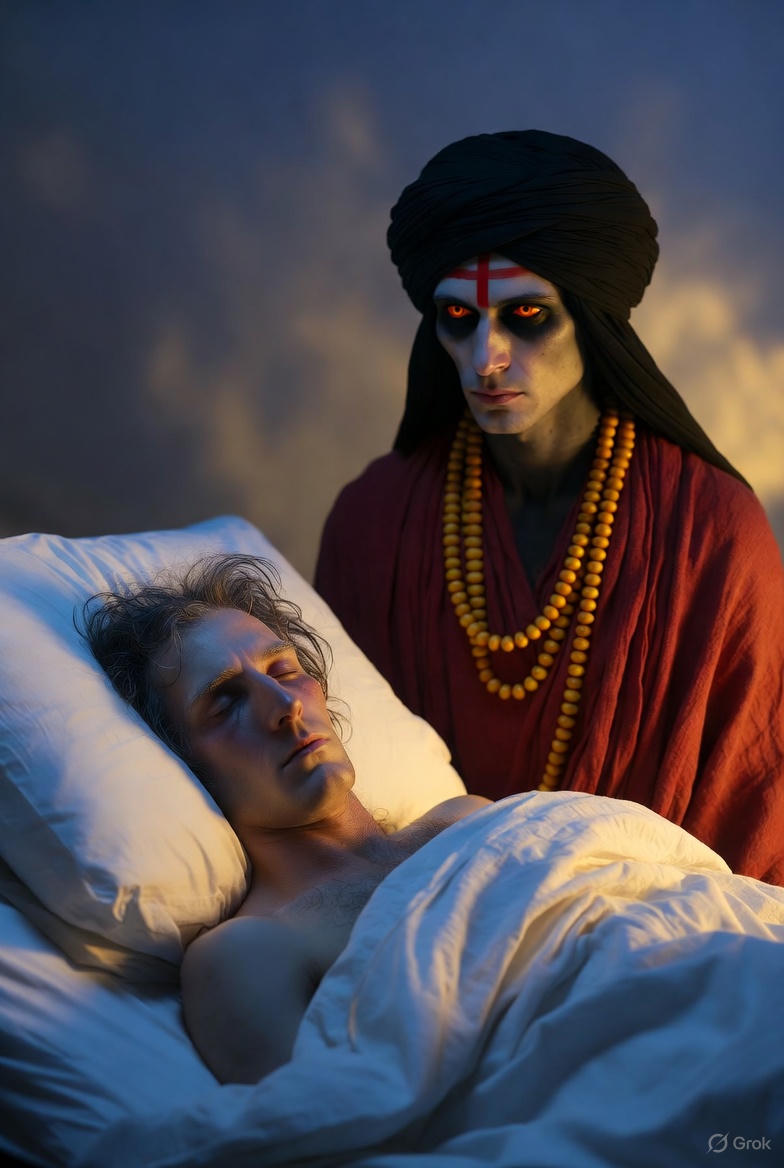
It was the man in the robe with the black turban. He was
resting on a tree stump and his walking stick lay beside him in
the forest moss. His noble hands held the string with amber
beads. It was Ewli.
Once again the strange man, whose small image was
under the high glass dome in my children’s room, stepped in
my path in an intangible way. How did the stranger in his
unusual dress get everywhere? Unmolested, and not even
noticed by the children, he had been sitting at the wayside
shrine, when the Prussian recruiters came for me and my
companions of fate, until the recruiters took me and my
comrades away on their wagon.
At that time I could not connect him with myself any
more than I could about his mysterious interest with my person
in the prayer-filled church. And just as I did not find him in
front of the church anymore, he had disappeared from my view
at the lime trees of Distelsbruck. This time, however, he was to
speak to me before I started the work of self-destruction.
Nevertheless, I could not put one foot in front of the other.
Because the man from the Orient was not alone. In front of him
stood a deer, which rubbed its narrow head flatteringly against
Ewli’s knees. In his hand, which held a birdcage, perched a jay
with a pinkish-grey head and blue wing feathers, and in the
bramble bush to his right chirped uncounted colorful balls of
feathers. Two squirrels, chasing each other, a reddish-brown
one and a black one, went up onto his body, hiding themselves
in the folds of his robe, rolling and chattering, and to my horror
the reddish brown one suddenly disappeared into his robe, as if
it had melted into the same color of the coarse fabric, while the
second one crawled onto the black turban, lost its outline and
did not appear again. I looked at the face of Ewli, overcome by
the radiance of his eyes. Was he looking at me? Were the dark
stars directed into the far distance? I did not know, I just felt
how warm, divine love enveloped me.
Slowly, however, he stood up, walked across the clearing
and disappeared between the tall trees.
Then I came to and was able to move. I ran. Where were
the animals? Not a bird, not a deer was to be seen. Where was
Ewli? I ran into the middle of the high wood and suddenly
stood among my comrades. They had just found Kregel and cut
him down. Horrible to look at, black-blue and green spots on
his face, the swollen ink-colored tongue stretched out, with
open, complaining eyes, he lay on the ground, the rope in the
furrow of his neck. Nobody paid any attention to me.
They had spades with them and dug in the deep, soft
forest soil, where the mouse tunnels ran crisscross and root
snakes crawled.
It was late when we were finished.
In the evening-red sky an endless train of crows flew
silently.
“That means war!” said Wetzlaff and looked at me.

How long had we been in the field? Nobody reckoned
anymore, nobody knew.
I was camped with four comrades in bitter winter. We
had found makeshift quarters in a burned-down farmhouse. All
we had were two piles of rotten, damp straw and a blanket
singed by campfires. And this miserable property we had to
protect and guard, so that not even more miserable ones stole it.
The rifles had to be constantly cleaned without stopping.
After a day they were red again with rust. Zulkov had frozen
the toes of both feet. They were black and stank like the plague.
I had to treat Repke with gun powder and a residue of brandy
to wash out a graze on his back because no one else would do it,
and he screamed so loudly that I took pity on him. Wetzlaff had
gotten severe diarrhea and every five minutes he walked on
wobbly legs in front of the house. Where he had squatted the
snow was bloody all around from his stool. In the night he
moaned so much, that no one could sleep. And although we all
endured, they threw everything at him in the dark that they
could grab with their hands. Then he limped out again to
relieve himself with convulsions. The quietest of us all, a
gloomy person named Kühlemiek, read in a small, tattered
hymnal next to the fire and sometimes murmured:
“O Lord, have mercy on me a sinner!”
Repke was happy when I had bandaged his back again
with old rags, and put dry nut leaves in his pipe.
“The king has said -” he wanted to begin.
But Wetzlaff interrupted him snorting:
“He has said! He has said! If the King lets one go, you
miserable wretches are blissful with doglike awe. Oh, you
starving ribs, you cannon fodder! What is it then that makes
such a king so great?”
“Fridericus Rex is the greatest war hero of all time, you
poisonous toad!” roared Zulkov. “Dare not to insult His
Majesty!”
“Dear brothers in Christ,” pleaded Kühlemiek, “turn your
thoughts to the One who has entrusted all of our lives in His
grace-giving hands!”
“Shut up, old pietist!” Repke shouted at him, “Let
Wetzlaff speak!”
“Oooh!” he groaned, and hurriedly ran out again. We
heard the sound of his discharges and his groaning all the way
into the house. Then he came back again, white as lime, and let
himself fall on the straw.
“As I say, a man must edify and revive himself in the
Lord and King,” Zulkov said after a while. “But there are some
who forget the oath…”
“Do you mean me?” asked Wetzlaff, straightening up
with difficulty. “Refresh yourself, as much as you can with that
cold fire that you have on your hind claws. Yes, you sheep’s
head, so that Friederich can be a great war hero, you must keep
your toes in your shoes, my intestines have to bleed out, a
thousand have to be shoveled into the pits. I ask one, when all
around, with the Austrians over there and us over there, if there
were such guys as me, there would be no more king and
empress, but also no war and no people-beating. But you are in
general too stupid to understand such things. And from this
stupidity of yours all kings and generals, princes and counts
and barons down to our squire with the ass face live equally in
glory and joy and sit enthroned like peacocks in all majesty,
while we are kept as cattle and are driven to the slaughter with
the trilling of pipes and the beating of drums. O you damned,
thick-skinned fool, you horse-apple brains…”

Read Full Post »

Alraune by Hanns Heinz Ewers and translated by Joe E Bandel

Finale
It is late in the summer, the hollyhocks now raise their heads
away from the stalks. The mallows scatter their dull tones in tired
colors, pale yellow, lilac and soft pink. When you knocked my love,
the spring was young. When you entered through the narrow gate into
my dream garden the swift little swallows were singing their welcome
to the daffodils and the yellow primrose.
Your eyes were blue and kind and your days were like heavy
clusters of light blue wisteria dropping down to form a soft carpet. My
feet walked lightly there through the sun glistening pathways of your
arbor–Then the shadows fell and in the night eternal sin climbed out
of the ocean, coming here from the south, created out of the glowing
fires of the desert sands.
She spewed forth her pestilent breath in my garden strewing her
rutting passion beneath her veil of beauty. Wild sister, that’s when
your hot soul awoke, shameless, full of every poison. You drank my
blood, exulted and screamed out from painful tortures and from
passionate kisses.
Your marvelous sweet nails that your little maid, Fanny,
manicured grew into wild claws. Your smooth teeth, glowing like
milky opals, grew into mighty fangs. Your sweet childish breasts, little
snow-white kittens, turned into the rigid tits of a murderous whore.
Your golden curls hissed like impassioned vipers and the lightning
that unleashed all madness reposed in your soft jeweled eyes which
caught the light like the glowing sapphire in the forehead of my
golden Buddha.
But gold lotus grew in the pool of my soul, extended themselves
with broad leaves upon the vast shallows and covered the deep
horrors of the whirling maelstrom. The silver tears that the clouds
wept lay like large pearls upon their green leaves, shining through the
afternoons like polished moonstones.
Where the acacia’s pale snow once lay the laburnum now throws
its poisonous yellows–There, little sister, I found the great beauty of
your chaste sins and I understood the pleasures of the saints.
I sat in front of the mirror, my love, drank out of it the over
abundance of your sins while you slept on summer afternoons, in your
thin silk shift on white linen. You were a different person, my dear,
when the sun laughed in the splendor of my garden–sweet little sister
of my dream filled days. You were an entirely different person, my
dear, when it sank into the sea, when the horrors of darkness softly
crept out of the bushes–wild, sinful sister of my passionate nights–But
I could see by the light of day all the sins of the night in your naked
beauty.
Understanding came to me from out of the mirror, the ancient
gold framed mirror, which saw so many games of love in that wide
turret room in the castle of San Costanzo. The truth, which I had only
glimpsed in the pages of the leather bound volume, came to me from
out of that mirror. Sweetest of all are the chaste sins of the innocent.
That there are creatures–not animal–strange creatures, that
originate out of villainous desires and absurd thoughts–that you will
not deny, my love, not you.
Good is the law; good are all the strict rules. Good is the God
that created them and good is the man that carefully observes them.
But there is the child of Satan who with arrogant hands brazenly
rips the eternal laws from their appointed place. The Evil One, who is
a mighty Lord, helps him–that he might create out of his own proud
will–against all nature.
His work towers into the heavens– and yet falls apart and in its
collapse buries the arrogant fool that conceived it–
Now I write this for you, sister, this book–I ripped open old, long
forgotten scars, mixed their dark blood with the bright and fresh
blood of my latest torments. Beautiful flowers grow out of such soil,
fertilized by blood.
All that I have told you, my love, is very true–yet I take it from
the mirror, drink out of its glass the realizations of my latest
experiences and apply them to earlier memories and original events.
Take this book sister. Take it from a wild adventurer who was an
arrogant fool–and a quiet dreamer as well–Take if from one, little
sister, that has run closely alongside such a life–

Miramar–Lesina–Brion
April–October 1911

Read Full Post »

A Modern Inquiry into the Hermetic Mystery

Part III: Concerning the Laws and Vital Conditions of the Hermetic Experiment

Chapter 4: Mental Requisites and Impediments, Part 4

Introduction: The Hermetic art demands a disciplined mind, suitable tools, and a pure heart to unlock divine wisdom. This section explores the practical and spiritual preparation needed, from choosing the right instruments to cultivating charity, to transform the soul into a radiant vessel of truth.

The Philosophic Vessel

The Hermetic art requires a suitable “vessel” to manifest its divine work, as Norton advises: “Ordeyne Instrumente according to the werke.” Vessels vary—small for separation, broad for circulation, narrow for correction—made of lead, clay, or glass, each chosen to harmonize with nature’s processes. Glass, especially the “morning stuff” vitrified from ashes, is prized for containing spiritual essences without leakage, as Vaughan notes: “The glass is one, simple, and easily carried.”

The adept must guide the crafting of these vessels, ensuring they align with the work’s intent. Norton humorously recounts the need for skilled assistance, as careless servants disrupt the delicate process. A faithful, diligent helper, as Solomon suggests, is “like thine own hearte,” essential for success.

The Ideal Environment

The Hermetic work thrives in specific environments, as Norton explains: “Places convenable” vary—dry and windless for some operations, bright or moist for others. Secrecy is crucial, shielding the work from disruptive influences like strong winds or corrupt impressions, which Agrippa warns can pollute the spiritual ether. The adept must choose locations that resonate with the art’s subtle energies, much like Virgil’s serene settings for his bees.

Vaughan emphasizes that the true furnace, or “Athanor,” is simple, requiring minimal effort, yet it holds the secrets of corruption and generation. The right environment ensures the “Central fire” of the work burns harmoniously, avoiding chaos.

The Heart of Charity

Success demands a “charitable seraphic mind,” as Vaughan instructs, rooted in faith and piety. The adept must avoid destructive passions, which disrupt the “sweet spirit of Peace” and cause division in the chaos. A heart aligned with divine love, as Agrippa advises, ascends in piety and descends in charity, uniting with the divine to open the “Door of Nature.” Without this, the work fails, as Zeno’s wisdom reminds: “Hear much, speak little.”

Closing: This chapter unveils the practical and spiritual requisites—vessels, environments, and charity—for mastering the Hermetic art. The journey into its operational secrets deepens in our next post, unveiling further wonders of this sacred pursuit.

Read Full Post »

Homo Sapiens: In the Maelstrom by Stanislaw Przybyszewski and translated by Joe E Bandel

XII.

“Now you must go to Geißler and arrange everything with him, then we can leave the day after tomorrow.” 

Falk stood thoughtfully for a while. “Yes, yes… we will leave soon.” He smiled distractedly. 

“You love him very much, didn’t you?” he asked suddenly. “Who?” 

“Well, Geißler of course. If something should happen to me, you could marry him, couldn’t you?” 

He looked at her smiling. 

“Die first, then we will see,” Isa joked. “Well, then goodbye.” 

“But don’t come back so late again. I have such fear for you now. Think of me: I will go mad with unrest if you stay out long again today.” 

“No, no, I will come soon.” He stepped onto the street. 

It was just quitting time, the workers streamed in large crowds from the factories. 

Anxiously he turned into a side alley. It was generally strange what everything now became fear for him; his heart was in constant fever activity. 

If he heard a noise at the door, he started and could not calm down for a long time; he heard little Janek cry and started in highest fear: he could not remember for a long time that he had a son, no, now he even had two: little Janek and little Erik, two sweet, wonderful children… 

Oh, this splendid father idyll! If only it were not so infinitely comical. 

He walked thoughtfully along the empty street. 

The events of the last days whirred through his head and blurred into a feeling of an unspeakable sadness. It seemed to him as if he must suffocate: he breathed deep and heavy. 

What would it help if he fled? Not travel, only flee, flee, so that his lies would not be discovered? He could no longer live with all the disgusting lies, now he could no longer look Isa calmly in the eyes: her trust, her faith tormented him, humiliated him, he felt disgust for himself, tormenting shame, that he would most like to have spat at himself. 

Strange woman, this Isa. Her faith has hypnotized her. She walks like a sleepwalker. She sees nothing, she hardly suspects that he suffers. The awakening will be horrible. It cannot go on: her faith will now be broken sooner or later anyway. 

“So I am a double criminal. I broke the marriage and its condition, faith. Actually I am only a criminal against myself, for I cut the roots of my existence. I cannot live without Isa after all. However I think and consider: it does not go. And because I am I, because I am thus God, for God is everyone who makes everything around him his thing—and everything around me is my thing—, so I have sinned against God, thus committed a sacrilege.” 

He spoke it half-aloud with deep reflection to himself, suddenly noticed it and stopped. 

That could not be his seriousness, he knew no crime after all. No, whatever he might think about his heroic deeds, the concept of crime could not be constructed. Crime postulates a state of mind that is precisely no coziness… He, he, he, coziness!—I actually wanted to say heartlessness. Well, the devil knows, I am anything rather than heartless. I have more pity in me than our whole time together. So I am no criminal. 

He lost himself in the subtlest investigations. 

“But perhaps a state of feeling is now forming that did not exist before, and for which something counts as crime that was by no means crime before. A feeling of offense against civilizational developments, e.g. against monogamy.” 

But his brain was so exhausted that he could not pursue the thought further: it was also indifferent; the brain with all its lawyer tricks was quite powerless against the feeling. Why brood further then? 

He suddenly got the sure, immediate certainty that now everything would be in vain, whatever he did, that the terrible would now surely, unavoidably, with iron necessity break over him. 

He shuddered and his knees became weak. He looked around: no bench nearby. 

With difficulty and despair he dragged himself further. 

His brain now became quite distracted, he could no longer concentrate it. Instead he saw with uncanny clarity the slightest details. So he saw that a letter hung crooked on a sign, that a bar was bent outward on a grating, that a passer-by had the characteristic gait of a person whose boots fit badly. 

His brain exhausted itself in these trifles. Suddenly he cried out softly. 

The thought that he had heard working all day in the lowest depth, and that he had tried so hard to stifle, broke through. 

He had to follow Grodzki! 

He had so often considered suicide theoretically, but this time it was like a huge compulsion suggestion: he felt that he could not resist it. It did not come from outside, no, it came from the unknown: a domineering will stifling every contradiction. 

He trembled, staggered, stopped and supported himself against a house. 

He had to do it! Just as Grodzki had done it. Train the brain will for it, force it to obey the instinct will. 

Suddenly he felt a peculiar numb calm. He forced himself to think, but he could not, he went further and further thoughtlessly, sunk in this numb, inner death silence. 

He stumbled and almost fell. That shook him up. No! it was not hard, why should he torment himself longer. 

He thought what would not be torment, but he could find nothing. Then he thought what would not be lie, but there was nothing that it was not, at most a fact, but what is a fact, said Pilate and washed his hands. No! Pilate said: what is truth? and only then did he wash his hands. 

He began to babble. 

But when he came to the house where Geißler had to live, he became very restless. 

He had completely forgotten the house. But here he had to live. He read all the signs, among them especially attentively: Walter Geißler, lawyer and notary, but he could not orient himself. 

He went into the hallway, stepped out onto the street again, read the signs again, came to his senses and became half unconscious with fear. 

Should he go mad? That was after all a momentary confusion of senses. Oh God, oh God, only that not! 

He collected himself with difficulty, a morbid shyness to show no one what was going on in him began to dominate him. 

He directed the greatest attention to his face, made the strangest grimaces to find out the expression of indifferent everydayness, finally felt satisfied and went up. 

“One moment!” 

Geißler wrote as if his life depended on it. Finally he jumped up. 

“I namely have insanely much to do. I now want to hang my law practice finally on the nail and devote myself entirely to literature. That is after all a charming occupation, and I work now to unconsciousness…” 

“But first you will arrange my affairs?” Geißler laughed heartily. 

“There is nothing more to arrange. You also have not a glimmer of your circumstances. Your whole fortune is at most three thousand marks.” 

“Well. Then I will come to you tomorrow; you can give me the money tomorrow, can’t you?” 

“I will see.” 

Falk suddenly thought. 

“You actually need to give me only five hundred, the rest you will send monthly in hundred mark installments to this address.” 

He wrote Janina’s address. “Who is that?” asked Geißler. 

“Oh, an innocent victim of a villainy.” 

“So, so… You probably want to go into the desert now and fast?” “Perhaps.” 

Falk smiled. He suddenly remembered his role and began to laugh with exaggerated cordiality. 

“Just think, I asked very eagerly for you.” “Where then?” 

“In a completely strange house. I wanted to mislead a spy and so I asked very loudly and with great emphasis for you on the second floor… But that is not interesting at all.” 

Read Full Post »

Homo Sapiens by Stanislaw Przybyszewski and translated by Joe E Bandel

“Strange, strange… the doctor said you should lie at least three days, and I have seen this expression of strength and energy in your face for a long time. You are different from all people.” 

“Yes, yes, that is the new strength. Drink, drink with me… I was so little with you… Drink the whole glass out.” 

They drank out and Falk filled the glasses anew. 

He sat down beside her, took her both hands and kissed them. “We have not spoken together for a long time,” he said. 

“Now everything is good, isn’t it?” she asked tenderly. 

“It will become good. We will travel away from here… What do you think of Iceland?” 

“Are you serious?” “You make so many new plans…” 

“This time I am serious, because it is namely no plan. It occurred to me today, yesterday, I actually don’t know when, but I must away from here.” 

Isa beamed. She did not want to tell him, but she found it unbearable in this boring city. 

“Think, such a small fisherman’s house by the sea. Isn’t it? Wonderful! And the autumn nights when the waves play this terrible eternal music on the beach. But you will not be bored?” 

“Did I ever get bored with you? I need no person, nothing, I need absolutely nothing if I only have you.” 

“But I will often be away from you, very often. I will go out with the fishermen for entire nights, I will go into the mountains. And when we are together, we will lie in the grass and stare at the sky… But drink, drink then… Oh, you can no longer drink as before.” 

“See then!” She drank the glass empty. 

“And in this twosomeness: you and I, and you a piece of me, and we both a revelation of the immanent substance in us…” He stood up. “Isa! we will seek the God we lost.” 

She was as if hypnotized. 

“The God we lost,” she repeated half unconsciously. “You don’t believe in God?” he asked suddenly. 

“No,” she said thoughtfully. 

“You don’t believe one can find him?” “No, if one does not have him in oneself.” 

“But that is what I mean: to find God, that means to feel God, to feel him in every pore of one’s soul, to have the immediate certainty that he is there, to possess the wild supernatural power that the God-feeling gives.” 

“Do you want to seek another God, a God outside? What do you want this God for? I don’t want him. I don’t need him. I have the immediate certainty of the God-feeling, I feel him as long as you are there. I need nothing higher… And I will not tolerate such a feeling in you either. Then I will not go with.” 

He looked at her long. 

“How beautiful you have become now. As if a light had suddenly bloomed in you…” 

Suddenly he lost balance and came into a strange rapture. 

“Yes, yes, I mean the God who is you and I. I mean the holy, great My-You! Do you know what my you, my dark you is? That is Jahveh, that is Oum, that is Tabu. My you, that is the soul that never prostituted itself in the brain. My you, that is the holy soul that rarely comes over me, perhaps once, as the Holy Spirit came only once over the apostles. My you, that is my love and my doom and my criminal will! And to find my God, that means: to explore this you, to know its ways, to understand its intentions, so as not to do the small, the low, the disgusting anymore.” 

Isa was carried away. They grasped each other violently by the hands. 

“And you want to teach me to find and explore it in me?” “Yes, yes…” He looked at her as if he had never seen her before. 

“And you will be in me?” 

“Yes, yes…” 

“I am yours, your thing and your you… Am I it?” “Yes, yes…” He began to become distracted. 

“We are poor, Isa,” he said after a while, “I lost the whole fortune.” 

“Throw the rest away too,” she cried laughing to him and threw herself on his breast. 

Fear suddenly rose in him. 

“You, you—if it is over tomorrow? I have such mistrust of myself.” 

“Then I will pull you with.” 

“But is it perhaps not only an over-fatigue, an over-excited mood that whips us into this ecstasy?” 

He started. 

“I lie, I lie,” he said suddenly hoarsely, “I have lied too much… Now…” 

He broke off. The thought to tell her now everything, to tell everything in detail, shot through his head and grew into a great, maniacal idea. 

“Isa!” He looked at her as if he wanted to bore into the ground of her soul… “Isa!” he repeated, “I have something to tell you.” 

She started frightened. 

“Can you forgive me everything, everything I did evil?” 

The confession forced itself with irresistible power over his lips. Now he could no longer hold it back. He grasped her hands. 

“Everything? Everything?!” “Yes, everything, everything!” 

“And if I had really done the one thing?” “What?” She recoiled horrified. 

“This… with a strange woman.” 

She stared at him, then cried out with an unnatural voice: “Don’t torment me!” 

Falk came to his senses instantly. He felt sweat run over his whole body. 

She jumped toward him and stammered trembling: “What? What?” 

He smiled peculiarly with a superior calm. 

In the same moment Isa noticed that he became deathly pale, and that his face twitched. 

“You are sick!” 

“Yes, I am sick, I overestimated my strength.” 

He sank together on the sofa and in a wild maelstrom the experiences of the last days shot through his head. He saw Grodzki: 

“One must be able to do it with will!”

Read Full Post »

Homo Sapiens: In the Maelstrom by Stanislaw Przybyszewski and translated by Joe E Bandel

XI.

He woke up. Yes, really? He clearly heard a melody: deep, mystical bass melody and like a distant echo a tone and again a tone, isolated, whining in the treble. His whole soul threw itself into this holy melody and clung to it and wound itself up on it, curled together and widened with new strength: it felt so infinitely good. It seemed to him as if everything heavy, everything dull and terrible in his soul had dissolved, slowly dissolved and would now become the essence, the mad, soft longing of these tones… Never had he felt such a soft, blessed longing. 

It was probably night. He did not dare open his eyes, it was so infinitely good to feel this longing. It was night, and he had a blessed, joyful longing for tomorrow, the hot, short, color-frenzied autumn day. It was probably raining outside too, but tomorrow, tomorrow the sun comes and will breathe the rain and gnaw further on the leaves: oh, this glorious sick purple-yellow… 

Was he awake, was he really? 

He still heard the melody, softer and softer, sadder and sadder, and he lay there, dissolved in this longing, dissolved in this pain that was actually no pain—no: a flowing back, a receding memory, a mad yearning for foreign, wide lands, for a great, orgiastic nature in which every flower grows into a giant tree, every mountain hides in the clouds and every river foams and rages without banks… 

Then his heart began to beat violently. He grasped it with both hands… Yes, here, here between the fifth and sixth rib he felt the heart shock—he felt the heart tip first strike against the flat hand, then against two fingers, finally he pressed his index finger firmly against the spot… How it works! Did Grodzki perhaps first palpate his heart in this way? 

He sat up in bed and supported his head in both hands. 

Grodzki shot himself… That was what he knew for sure. He shot himself because he wanted to die. He died with will, he died of disgust, he no longer wanted to see the young day and the sick purple-yellow. 

But why should he think about it? Should he destroy this blessed harmony in his soul again? But what did the strange man say? Falk, Falk, you do not know this harmony: it goes beyond all calm, beyond all holiness, beyond all bliss… But the man was mad. 

Falk shuddered, he clearly saw the mad eyes of the stranger. He dug convulsively with his fingers into the blanket. Fear seized him anew, but in the next moment he became calm. 

There was no doubt that he had finally come to consciousness: 

He had namely fainted in the armchair when the stranger stole away from his room, now he was in bed, so he must have been carried to bed. Yes, and the button? The golden, blinking button was really on the desk… So he was awake and in full consciousness. 

He felt a quite immediate, animal joy. 

Then he fell back into the pillows and lay for a long time as if in a faint. 

When he began to think again, he had risen from the bed and began to dress. But he was very weak. Half-dressed he lay down on the bed again and stared thoughtlessly at the ceiling. 

Ridiculous how sloppily the ceiling was painted! The hook for the hanging lamp should actually be in the middle. Well. The ceiling is a parallelogram. Now I draw the diagonals. 

He became quite furious. 

Ridiculous! That was by no means the intersection point. The whole room was repugnant to him. He was locked in this narrow space with his dull torment, and outside the world was so wide… 

Again he felt the hot longing, only far, far away—to the Pacific Ocean. 

Yes, the Pacific Ocean! That was redemption. That was redemption to eternal calm, to eternal harmony without torment, without joy, without passions… 

How his young heart trembled then! His limbs became so weak from the constant fear. Around the church on the lawn he saw people, many people, lying on their knees and begging God for mercy, he looked at them, his heart beat more and more violently, his unrest grew, sin burned on his heart like a fire mark. Now he was to confess, tell a strange person the shameful abomination… And in his desperate soul fear he took the prayer book and read five, six times with trembling fervor the litany to the Holy Spirit. And a peace returned to his heart, a holy, transfigured rapture, his soul became pure and wide like the hot noon around him. Now he had to go into the church. Then fear seized him. Had one not seen a black rider on a black stallion tumbling in the church at noon?… He crept cautiously to the sacristy door… He listened, then slowly opened the heavy door and staggered back in animal fright: before him stood the stranger. You destroyed his soul! he said solemnly… 

“I dream! I dream!” cried Falk, woke up and jumped out of bed. 

Isa started. 

“It is me, Erik, it is me, don’t you know me?” Falk stared at her for a while, then breathed deeply. “Thank God it is you!” 

“Tell, tell, Erik, what is wrong with you? Do you feel very sick? Are you better? I had such terrible fear for you.” 

Falk collected himself with all strength. 

To thunder! Should he not overcome the bit of illness, should he not finally once forget his small, ridiculous pains? it shot through his head. 

“I am no longer sick at all,” he said almost cheerfully. “I only had a little fever, that remained from then,—he, he, I got the fever in the homeland, nothing more.” 

His head suddenly became unusually clear. 

You are sick, Erik, you are. Your body glows. Lie down, I beg, lie down. This morning you lay on the floor. The doctor said you should lie a few days… 

He became a little impatient. 

“But just let me… I have not been so clear and so light for a long time as right now. The doctors are idiots, what do they know of me? He, he,—of me…” 

He pulled her to him. His heart suddenly overflowed with an overflowing cordiality and love for her. 

“We will have a wonderful evening today, you bring wine, then we sit down and tell each other the whole night… Do you remember, just like then in San Remo on our honeymoon.” 

She looked at him. 

“I have never seen a person who is as strong as you. That is strange, how strong you are…” 

“So I lay on the floor?” 

“You cannot imagine what an uproar it was in the house…” “Well, just go now, afterwards you will tell me everything…” 

“But was there not a strange person here?” asked Isa. “A stranger? No!” 

“Then I probably dreamed.” “Surely.” 

She went. 

Falk dressed. 

Of course you dreamed, dear Isa, you have strange dreams anyway. 

He smiled satisfied. 

He considered whether he should take tailcoat and white tie. It was after all the great feast of peace, the feast of calm, of eternal harmony. 

He was in a state of triumphant rapture. 

Now finally I have found myself, Myself, Me—God. 

Was he still sick? His thoughts were heated. The inner excitement foamed trembling up… 

Was it perhaps only a moment of a physical reaction after all this torment and fear? 

What did that concern him? He had now forgotten everything. His body stretched in the feeling of a long unknown bliss and energy.  

“Ah, Isa, are you already here?” 

“You are doing strange gymnastics there.” 

“I drive away the illness. But something to eat…” “Yes, just come to the dining room.” 

He ate something, but without special appetite. 

“I am as if newborn, Isa, quite as newborn. So rejuvenated. I suffered much. No, no, understand me correctly, I had no personal suffering, only the whole misery out there weighed on me and made me so miserable…” 

She looked at him jubilantly. 

Read Full Post »

Homo Sapiens: In the Maelstrom by Stanislaw Przybyszewski and translated by Joe E Bandel

“But you are fighting windmills. Do you believe that Napoleon is a great person for me? He is only that for you because he showed you with what ruthlessness and brutality one may proceed when it comes to satisfying one’s greed…” 

Falk stared at him with feverish tension. But he did not grasp what the other said. And suddenly he saw Czerski’s face as if he had never seen it before! 

“Strange, strange,” he murmured, staring incessantly at Czerski. He moved quite close to Czerski and spoke quite softly. 

“See, you will commit crimes, no, no! don’t get upset. Understand me correctly, I mean what our society calls crimes. I know it. I suddenly saw it now. I believed you were sick or ate opium, now I know it. How? Suddenly. All at once. All political criminals get the same expression. I saw Padlewski in Paris, you know, he murdered the Russian ambassador… I saw him three hours before… 

Falk sat down again. For a moment everything went dark before his eyes. But it passed immediately. 

When you murder, you naturally have motives for it. Yes, I know, you have great love and great pity. And in what do the roots of your great pity stick? Only in the greed to realize the purpose you have before your eyes. In what does your greed differ from mine? Ha, ha, you don’t even listen to what I say, your 

gaze is a thousand miles from here… Ha, ha, you don’t need to listen to it at all, but just tell me, in what will your crime then differ from mine? In that my crime remains unpunished, and you are punished with death. But I have the torment, and you have the happiness of sacrifice, yes—of sacrifice, Falk cried out. 

Czerski started. 

“What did you say now?” 

“You have the happiness of sacrifice! And I have the torment.” Falk fell exhausted back into the chair. 

“Naturally you will say I got all that from Nietzsche. But that is not true. What Nietzsche says is as old as the bad conscience is old…” 

He straightened up again, his state bordered on ecstasy. 

“You said you spit on all this. Didn’t you say so? Well, approximately so. And I agree with you! This with the overman… Ha, ha, ha… Nietzsche teaches that there is no good and no evil. But why should the overman suddenly be better than the last human? Ha, ha, ha… Why is the criminal more beautiful than the martyr who perishes out of pity? Where does the valuation between beautiful and ugly suddenly come from? Why? Oh, I love great suffering beauty, I love ascetic beauty… Ha, ha; I perhaps loved Janina because she is so extraordinarily thin… What do I know? Everything is nonsense! I spit on all that, I spit on the overman and on Napoleon, I spit on myself and the whole life…” 

He looked around confused and suddenly became very serious, but then he began to speak again, quickly, hastily; he tumbled over himself, it seemed to him as if he could not say enough. 

“I have told no one what I tell you. I admire you, I love you. Do you know why? You are the only one who has ceased to be himself… Yes, you and Olga—you both. I love you both for the sake of your love. And I love great love. That is the only feeling I love and admire. Don’t you hear how my heart beats, don’t you feel how my temples throb… But to love, one must have your faith, yes, the faith that has no purpose, only love, love, love is!.. He, he, he… I love, I admire, I crawl on my knees before this love that is the great faith. It is 

so strange that precisely you, you levellers, you compassionate ones are the overmen! Faith, love makes you so mighty and so strong. I am the human on the extinction list. I am the last human. See: in the Polynesian archipelago there is a wonderful human race that will no longer exist in thirty, fifty years. It is dying out from physical consumption. My race is dying from physical phthisis. The lung of the brain, faith is rotted, eaten away… 

Falk suddenly began to laugh. 

“Ha, ha, ha… I had a friend. He was also such an overman as I. He was not as strong as I, and so he died from the debaucheries. When he was dead, I went to a café to think about death and to make clear to myself that he was really dead. I met there a fat and greasy medic who had muddled with us. I said to him: Gronski is dead. He thought a little. Then he said: I could imagine that. Why? I said. One must have principles, was the answer. One must have principles. If one has principles, one does not perish. But to have principles, one must believe, believe… 

He suddenly straightened up and stood long almost unconscious. “It is my despair that speaks through me,” he finally said… 

You are right, Czerski—the whole life, this disgusting life of the worm that eats in the flour, the life of small love… You are the first I have seen who has thrown that away, who has forgotten that… For you there are not these commandments for whose sake I suffer, because you are too great for that… 

Falk suddenly seized his hand and kissed it. Czerski jerked violently and tore his hand away. 

Falk looked at him long without saying a word, then sat down again. It seemed to him as if the fever had suddenly left him. He also didn’t quite know exactly what he had said or done. 

Czerski was unusually pale. “Why did you come here?” 

His voice trembled. 

Falk looked at him calmly. They looked into each other’s eyes for probably a minute. 

“I swear to you,” he finally said, “that I came for no small motives.” 

“Is it true?” 

“Yes, it is true.” 

Czerski walked uncertainly back and forth a few times. 

“I retract everything unpleasant I said to you—his voice was very soft, he seemed to have great difficulty fighting down his excitement. You are no scoundrel, Falk. Forgive me that I wanted to insult you.” 

He went to the window. 

A long pause ensued. Suddenly Czerski turned around. 

“I didn’t know you,” he said harshly, “I believed you were unscrupulous… I wrote everything to Janina’s brother because I had promised him to watch over her. And now I have something else to think about.” 

“You wrote to Stefan Kruk?” “Yes.” 

Falk looked at him indifferently. 

“Hm, perhaps you did well… But now farewell Czerski. I am glad that we do not part as enemies.” 

He went down mechanically.

Read Full Post »

Homo Sapiens: In the Maelstrom by Stanislaw Przybyszewski and translated by Joe E Bandel

Sacrifice was ridiculed because it is so infinitely hard to sacrifice oneself, because it costs so much struggle and despair. You say: I! But what is your I? Is it not perhaps an antidote against a bad conscience? Your I is only there so that you can transgress the small law that regulates your small desires… You, you, Falk, you are despite your self-glorifying individualism a small person. In what has your life exhausted itself if not in debauchery and sexual desire… Well, I do you wrong, you have done much, but was it not because you found a kind of atonement in it, tell me Falk, was it not to calm your bad conscience? 

He stood almost threateningly before him, but sat down again immediately. “Why I you concerned about me?. I have nothing to do with you. I sit here ten hours and think that I have nothing more to do with you all. I have nothing personal about me anymore. My soul has widened, infinitely widened… You naturally don’t know what humanity is, because your lying brain, this flexible instrument in the service of your digestion, has made a concept of humanity, yes a concept, to be able to conveniently dissect, unravel and dispute it away. I don’t know this concept, but I know humanity as the root of my soul, I feel it with every beat of my heart, as the basic feeling that the sacrifice I bring to millions from my self is something else than the crawling and sweating and running after a woman. But now go Falk, I want to be alone before my departure. Just think that you are a small person, and you should have been one of the greatest. You, yes, you; you should have become one.” 

Falk felt deeply shaken. But in the same moment a cynical shame overcame him that he let himself be shaken, it seemed to him as if his brain grinned at his helplessness. 

“Do you eat opium?” he asked half unconsciously. Czerski looked at him seriously. 

“Your brain is shameless,” he said slowly and almost solemnly. “Shameless!” Falk ducked under this look and these words. He stared at Czerski ashamed, he clearly felt two souls stretching up against each other. 

“Yes, my brain is shameless.” 

But immediately he regained his superiority. The cynical soul triumphed. He adjusted himself, smiled scornfully and said: 

“It is very beautiful what you said there. Your criticism of our society was very good, although you did not go beyond what Nietzsche says in his *Zarathustra*, yes, the Nietzsche you so despise.” 

He was silent for a moment to see how that would affect Czerski. 

But Czerski seemed not to listen to him at all. He turned his back to him and looked out the window. 

Falk was not surprised at all about it, he even brooded that he was not upset about it. He suddenly became sad and serious. 

When he began to speak again, it was only to hear himself speak. 

“You are right, my brain is shameless because it cannot grasp that your feeling ‘humanity’ has no causes, no causes that are not grounded in some experience. But that is how my brain is, it takes your soul state under the magnifying glass and analyzes it. You sat in prison. The woman you loved treacherously forgot you. Your loneliness, your bitterness, your pain and your despair finally produced this selfless surrender. So is your humanity not a lie, a great lie to save yourself from despair, is that not a lie to break the pain that caused these terrible torments, a lie of your physique in need of rest and recovery? You are now happy with your great lie and I am unhappy because my lie is small. But what does great mean? What small? My God, the concepts are lost to me, I usually don’t judge from a logical standpoint either. I know very well that the soul does not follow logical principles… But what did I want to say?… Yes, right… 

Czerski suddenly turned around. “Do you want tea?” 

“Yes, give tea, much tea… Yes! You condemn me, you called me a scoundrel. Isn’t that so, you did it? Why did you call me that? Because in my destructions sex was a motive. I speak destructions because the case with Janina is not the first. No… 

He drank the tea hastily. The fever began to dominate him. 

“Sex was the motive. Good! But—” again he lost the thread of thought; he thought long, then suddenly started triumphantly. 

“Look at Napoleon. He is a classic example for all such cases.” 

His face shone. 

“You smile! No, I don’t want to compare myself with Napoleon at all. I only weigh motives against each other. What were his motives?… He, he: some say he was like the thunderstorm that cleans the air. But it is a ridiculous comparison. That the thunderstorm cleans is only accidental, if it weren’t, we would have to assume a providence, a pre-established harmony. He, he… those are only false conclusions. Give me another glass of tea. 

Napoleon had to have motives though. Well: ambition for example. But what is ambition? You don’t believe that ambition is a fact… but—does that interest you? 

“Speak only, that seems to calm you.” 

“Yes, you have a splendid psychological eye. It actually calms me. So ambition is something enormously composite. A thousandfold parallelogram of forces, if you want. It is no basic drive like hunger and sex are. It is something that has developed from the basic drives. All these motives have the common root in the basic drives. They are only derivations, development and differentiation phenomena… 

Falk laughs nervously. 

“So see, see: all emotional motives have biologically and psychologically the same value because they come from the same root. He, he… those are special theories, they don’t have to be correct at all. I only wanted to prove to you that my action motives do not lag behind Napoleon’s in value at all. 

In most cases, however, the motives are unknown, one doesn’t know why one does this or that… Well yes… 

Falk had great difficulty concentrating. He literally suffered from thought flight. 

Yes, so, the motives from which Napoleon destroyed can also only be derived sex drives… Isn’t that so? We can assume that as probable. But then you will say there is a great difference, to conquer a world and to make a girl unhappy… He, he, he… So you reproach me that I am too small a criminal? For to conquer a world one must destroy a world, and I have only destroyed a few girls. Now you will naturally say: Napoleon made a world happy. But in his thoughts, God knows, there was no intention to make a world happy. He did everything because he had to do it. In the psychic fact there is no purpose of consciousness at all. The brain only lies that in afterwards… 

Read Full Post »

Homo Sapiens: In the Maelstrom by Stanislaw Przybyszewski and translated by Joe E Bandel

“That’s why it must be eliminated, just as one eliminates madmen who commit crimes without knowing it.” 

“So only the harmful consequences decide about crime?” “Yes.” 

“But suppose you blow up a factory for the sake of the idea and thereby plunge hundreds of families into misery, then you commit a crime because the consequences are criminal.” 

“No! For thereby I bring my idea closer to realization and I bring millions happiness. When Christ spread his teaching, he knew very well that thousands of his followers would be sacrificed, so he delivered them to certain ruin to bring millions salvation.” 

“You believe in God?” Olga asked absentmindedly. Czerski suddenly fell into great excitement. 

“I believe in Jesus Christ, the God-man… But don’t interrupt me. I have the right to it, nature taught it to me. What decides about the pleasantness of a feeling? Not that it is pleasant in itself. 

The habituation to opium is very painful at first, only in length becomes pleasure. So only the duration of the same decides about the final nature of the feeling. It is self-evident that the first consequences of a factory explosion are unpleasant, but…” 

“So you will shrink from no crime?” 

“No, no crime,” he interrupted her eagerly, “I will shrink from no action that guarantees my idea victory.” 

“And if your idea is false?” 

“It is not false, for it is built on the only truth we have: love.” 

“But if your means are false?” 

“They cannot be false, for their motives are love. By the way, I don’t want to resort to these means at all, even if I should hold it necessary. I have no program like the anarchists. I want to commit no act of violence so as not to be counted to a party that has violence in its program.” 

“Out of vanity?” 

“No; out of caution, only out of caution, so that the anarchists, thus a party, do not believe they have the right to regard my act as the consequence of their program.” 

“You are ambitious.” 

“No! But I am only in my act. I have only one right, and that is: to be. And my being is my act. Yes, I have an ambition if you want to call it so: to be, to be through my act. I am not as soon as I execute foreign commands.” 

“Those are old thoughts, dear Czerski.” 

“I don’t know if they are old, I got them in prison and so they are my own. I thought them out with great effort. I was not used to thinking as long as I was in the party. Now I have detached myself from everything to be alone and determine my act with my own thoughts.” 

“And if you hadn’t got the money from Falk, would you have taken it?” 

“Yes.” 

“And what do you want to do now?” 

“I want to teach people to sacrifice themselves.” 

Olga looked at him questioningly.  

“To be able to sacrifice oneself: that is the first condition of every act. I will teach the enthusiasm of sacrifice.” 

“But to sacrifice oneself, one must first believe in the purpose of sacrifice.” 

“No! The sacrifice does not spring from faith, but from enthusiasm. That is it precisely. See, all previous parties have faith but no enthusiasm. No, they have no faith, they have only dogmas. Social democracy has died in dogmatic faith. Social democracy is what every religious community is: it is faithful without enthusiasm. Is there a person who would go into the fire for his God? No! Is there a social democrat who would plunge into ruin without reservation, without hesitation, for his idea? No! They all have the calm, comfortable certainty of faith; their dogmas are iron truths for whose sake one, God knows, need not get excited. But I want to create the fiery, glowing faith, a faith that is no longer faith because it has no purpose, a faith that has dissolved in the enthusiasm of sacrifice.” 

He suddenly fell into an ecstatic state. His eyes shone and his face transfigured itself peculiarly. 

“So you speculate on the fanaticism of hate in the masses.” 

“Fanaticism of love,” he said radiantly, “fanaticism of love for the infinity of the human race, love for the eternity of life, love for the thought that I and humanity are one, inseparably one…” 

He varied the thought in the most diverse expressions. 

“I will not say: Sacrifice yourselves so that you and your children become happy, I will teach anew the happiness of sacrifice in itself. Humanity has an inexhaustible capacity to sacrifice itself, but the fat church and fat socialism destroyed that. Humanity has forgotten the happiness of sacrifice in the fat, disgusting dogmatic faith. The last time it tasted it in the great revolutions, in the Commune—purposeless, only out of love for sacrifice, to enjoy once more the infinite happiness of purposeless selflessness… And I will bring this happiness back to memory through my act…” 

He suddenly stopped and looked at Olga suspiciously. 

“You probably believe I am a mad fantasist?” 

“It is beautiful, very beautiful what you said there—I understand you,” she said thoughtfully. 

He was silent long. 

“Yes, you are right that those are old thoughts,” he said suddenly. “They touch in many ways what Falk expressed at the congress in Paris. I would have liked to kiss his hand then…” 

He suddenly became very restless. 

“But it did not become a life matter for him. His brain figured it out. His heart caught no fire… No, no—how is it possible to have such thoughts and not perish with shame that one can say all that cold and calm… See, that is the shamelessness of his brain, that it cannot shudder at it. His brain is shameless… He is a—an evil person. He is not pure enough for his ideas. One must be Christ, yes, Jesus Christ, the God of humans, the holy source of willingness to sacrifice.” 

“You have changed very much, Czerski. By the way, I didn’t know you. Kunicki slandered you. I will think much about what you said…” 

Olga stood up and looked at him shyly. 

Over his face lay a transfigured glow. She had never seen anything like it. 

“Take care of yourself, Czerski. You look very sick.” “No, I am not sick. I am happy.” 

He thought long. 

“Yes, yes,” he said suddenly, “yesterday I was still a small person. But now it is over, it is past…”

Read Full Post »

Alraune by Hanns Heinz Ewers and translated by Joe E Bandel

You know better than I what happens then, how to bring about
with humans what you have already done with monkeys and guinea
pigs. Get everything ready, ready for the moment when the
murderer’s bleeding head springs into the basket!”
He jumped up, leaned over the table, looked across at his uncle
with intense forceful eyes. The Privy Councilor caught his gaze,
parried it with a squint like a curved dirty scimitar parries a supple
foil.
“What then nephew?” he said. “And then after the child comes
into the world? What then?”
The student hesitated, his words dripped slowly, falling, “Then–
we–will–have–a–magickal–creature.”
His voice swung lightly, yielding and reverberating like musical
tones.
“Then we will see what truth there is in the old legend, get a
glimpse into the deepest bowels of nature.”
The Privy Councilor opened his lips to speak but Frank Braun
wouldn’t let him get a word in.
“Then we can prove whether there is something, some
mysterious power that is stronger than all the laws of science that we
know. We can prove whether this life is worth the trouble to live–
especially for us.”
“Especially for us?” the professor repeated.
Frank Braun said, “Yes Uncle Jakob–especially for us! For you
and for me–and the few hundred other people that stand as Masters
over their lives–and then prove it even for the enslaved, the ones on
the street, for the rest of the herd.”
Then suddenly, abruptly, he asked, “Uncle Jakob, do you believe
in God?”
The Privy Councilor clicked his lips impatiently, “Do I believe in
God? What does that have to do with it?”
But his nephew pressed him, wouldn’t let him brush it away,
“Answer me Uncle Jakob, answer. Do you believe in God?”
He bent down closer to the old man, held him fast in his gaze.
The Privy Councilor said, “What do you mean boy? According
to the understanding that everyone else uses, what I recognize as true
and believe is most certainly not God. There is only a feeling–but that
feeling is so uncontrollable, something so–”
“Yes, yes, uncle,” cried the student. “What about this feeling?”
The professor resisted like always, moved back and forth in his
chair.
“Well, if I must speak candidly–there are times–very rare–with
long stretches in between–”
Frank Braun cried, “You believe–You do believe in God! Oh, I
knew it! All the Brinkens do–all of them up to you.”
He threw up his head, raised his lips high showing rows of
smooth shiny teeth, and pushed out every word forcefully.
“Then you will do it Uncle Jakob. Then you must do it and I
don’t need to speak with you any more about it. It is something that
has been given to you, one out of a million people. It is possible for
you–possible for you to play at being God!
If your God is real and lives he must answer you for your
impertinence, for daring to do such a thing!”
He became quiet, went back and forth with large strides through
the long room. Then he took up his hat and went up to the old man.
“Good night Uncle Jakob,” he said. “Will you do it?”
He reached out his hand to him but the old man didn’t see it. He
was staring into space, brooding.
“I don’t know,” he answered finally.
Frank Braun took the alraune from the table, shoved it into the
old man’s hands. His voice rang mocking and haughty.
“Here, consult with this!”
But the next moment the cadence of his voice was different.
Quietly he said, “Oh, I know you will do it.”
He strode quickly to the door, stopped there a moment, turned
around and came back.
“Just one more thing Uncle Jakob, when you do it–”
But the Privy Councilor burst out, “I don’t know whether I’ll do
it.”
“Ok,” said the student. “I won’t ask you any more about it. But
just in case you should decide to do it–will you promise me
something?”
“What?” the professor inquired.
He answered, “Please don’t let the princess watch!”
“Why not?” the Privy Councilor asked.
Frank Braun spoke softly and earnestly, “Because–because these
things–are sacred.”
Then he left. He stepped out of the house and crossed the
courtyard. The servant opened the gate and it rattled shut behind him.
Frank Braun walked down the street, stopped before the shrine of
the Saint and examined it.
“Oh, Blessed Saint,” he said. “People bring you flowers and
fresh oil for your lamps. But this house doesn’t care for you, doesn’t
care if your shelter is preserved. You are regarded only as an antique.
It is well for you that the folk still believe in you and in your power.”
Then he sang softly, reverently:
“John of Nepomuk
Protector from dangerous floods.
Protect my house!
Guard it from rising waters.
Let them rage somewhere else.
John of Nepomuk
Protect my house!”
“Well old idol,” he continued. “You have it easy protecting this
village from dangerous floods since the Rhine lays three quarters of
an hour from here and since it is so regular and runs between stone
levies.
But try anyway, John of Nepomuk. Try to save this house from
the flood that shall now break over it! See, I love you, Saint of stone,
because you are my mother’s patron Saint.
She is called Johanna Nepomucema, also called Hubertina so she
will never get bitten by a mad dog. Do you remember how she came
into this world in this house, on the day that is sacred to you? That is
why she carries your name, John of Nepomuk! And because I love
her, my Saint–I will warn you for her sake.
You know that tonight another Saint has come inside, an unholy
one. A little manikin, not of stone like you and not beautifully
enshrined and dressed in garments–It is only made of wood and
pathetically naked. But it is as old as you, perhaps even older and
people say that it has a strange power. So try, Saint Nepomuk, give us
a demonstration of your power!
One of you must fall, you or the manikin. It must be decided who
is Master over the house of Brinken. Show us, my Saint, what you can
do.”
Frank Braun bowed, paid his respects, crossed himself, laughed
shortly and went on with quick strides through the street. He came up
to a field, breathed deeply the fresh night air and began walking
toward the city. In an avenue under blooming chestnuts he slowed his
steps, strolled dreamily, softly humming as he went along.
Suddenly he stopped, hesitated a moment. He turned around,
looked quickly both ways, swung up onto a low wall, sprang down to
the other side and, ran through a still garden up to a wide red villa.
He stopped there, pursed his lips and his wild short whistle
chased through the night, twice, three times, one right after the other.
Somewhere a hound began to bark. Above him a window softly
opened, a blonde woman in a white nightgown appeared. Her voice
whispered through the darkness.
“Is that you?”
And he said, “Yes, yes!”
She scurried back into the room, quickly came back again, took
her handkerchief, wrapped something in it and threw it down.
“There my love–the key! But be quiet–very quiet! Don’t wake up
my parents.”
Frank Braun took the key out, climbed the small marble steps,
opened the door and went inside. While he groped softly and
cautiously upward in the dark his young lips moved:
“John of Nepomuk
Protector from dangerous floods.
Protect me from love!
Let it strike another
Leave me in earthly peace
John of Nepomuk
Protect me from love!”

Read Full Post »

Older Posts »