Homo Sapiens: Under Way by Stanislaw Przybyszewski and translated by Joe E Bandel
II.
The next day, Falk returned to Elbsfeld.
He was friendly, acted as if he were very happy, but could only poorly conceal a nervous irritability.
“Isn’t that right? Nothing happened, did it? You’ve forgotten everything, surely forgotten. I don’t remember a thing.”
Marit lowered her eyes to the ground.
“Yes, sometimes it happens to me that for hours I lose consciousness, no, just the ability to remember, without actually being drunk. Of course, I drank a lot yesterday; but I didn’t seem drunk, did I? Or did I?—Well, then I just acted that way to say everything without consequence. I do that often, you know.”
Falk spoke excessively and quickly; he was very cheerful. Marit looked at him, astonished.
“What’s happened to make you so happy?”
“Oh, I got very good news from abroad; my book has been translated into French and received very favorably. And I’m genuinely delighted about it. I don’t admire the French at all, but Paris is the only cultural hub in Europe and the supreme tribunal in matters of taste…”
Yes, and then, you can’t imagine how unbelievably funny it was; I have to tell you.
Marit looked at him again; her astonishment grew. What was wrong with him?
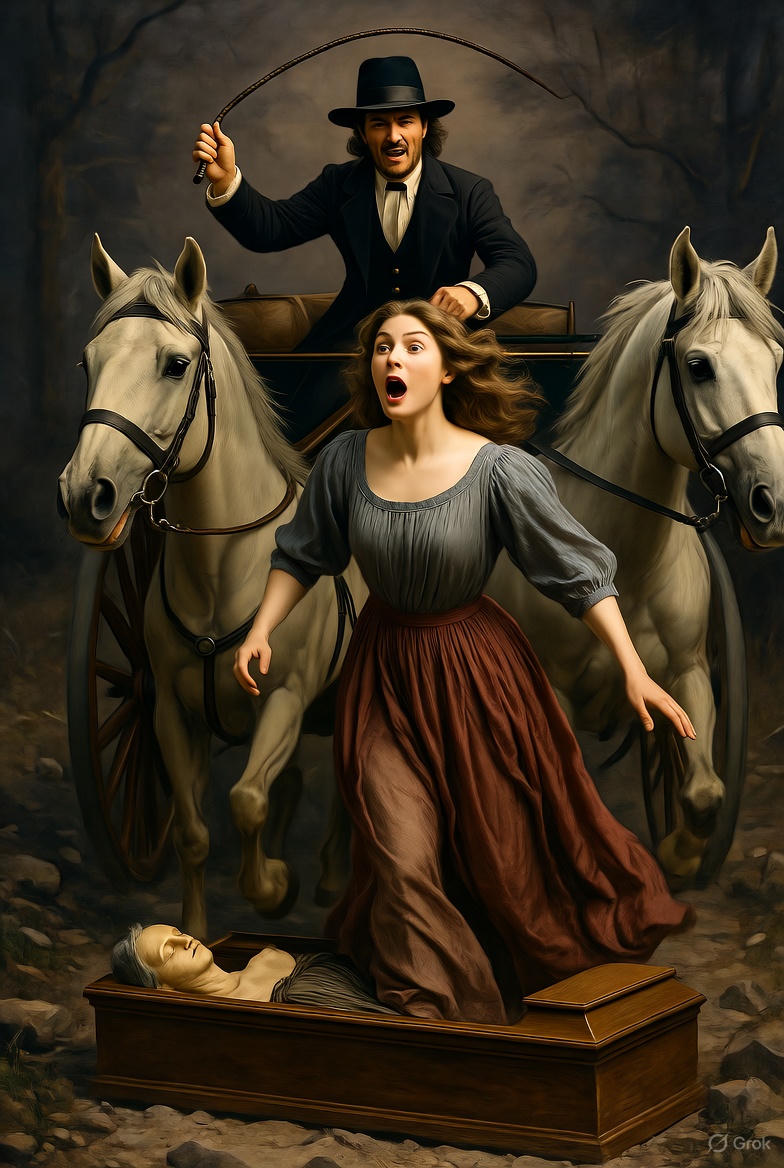
“Did you know that Papa had me driven home in his carriage yesterday? Of course you know. So we’re driving, and driving very fast.
Suddenly, the horses stop, they rear, buck, and whinny like the stallions in fairy tales that suddenly get human voices. The driver whips them, but it only gets worse. He climbs down from the box, I crawl out of the carriage, we grab the horses by the reins and try to move them forward. It doesn’t work; the horses go wild, and the driver redundantly states that they won’t move. What in heaven’s name happened? It was so dark you could’ve slapped someone without being seen. Well, I gather my courage, groping cautiously along the road with hands and feet, and—believe me, I have enough personal courage to stir up the strangest scandals, but this time my heart just stopped. I tripped over a coffin and fell with my knees onto a corpse.”
Marit flinched.
“No, that’s not possible.”
“Yes, truly. In my fear, I yell for the driver, and in the same instant, of course, I’m ashamed of my human reflex, then I get another terrible jolt: I hear a clear, agonizing groan. I don’t remember ever feeling such a primal, unthinking shock.”
“But my God, you’re turning pale. No, calm down; the incredibly funny thing about the whole story is that it wasn’t a corpse, but a real live person who, drunk, came from the city with a coffin. Being drunk and very sleepy, he’d dragged the coffin off the cart, let the horse go, and lay down in the coffin to sleep off his drunkenness in style.”
Marit laughed heartily.
“That was really funny.”
“God, how it delights me that I made you laugh. No; you must laugh, laugh all day; yes, we’ll both be like children, and I’ll stay good, like now. Or am I not good? Yes, I am. Good; I’ll stay this good all day, never again as nasty as yesterday.”
Falk laughed at her, then grew serious; he looked at her deeply. God, how beautiful this human child was!
“Marit, my darling, I’d like to lay myself like a carpet under your feet, I’d like to…”
No, no; I won’t talk about these things anymore.
Falk’s eyes grew moist. Marit looked at his face with unspeakable love.
“He shouldn’t torment himself. No, she couldn’t bear to see that. It would make her sick. Did he want her to suffer?”
“No, no, Marit; I’m cheerful again.” Both fell silent.
“Would he like to take a walk along the lake?” “Yes, I’d love that.”
It was a glorious spring day.
A few days ago, everything had suddenly turned green. The trees sprouted leaf buds, the crops grew visibly, and the hills on the other side of the lake rose in the lush splendor of their young grass.
They walked, their feet sinking into the soft, damp sand.
Falk was silent; from time to time, he gathered stones from the shore and skipped them across the lake’s surface. His face grew graver and graver, like that of a man harboring deep sorrow.
He walked, staring ahead, then gathered flat pebbles again and threw them onto the water.
Marit looked at him, increasingly sad.
“No, he shouldn’t torment her like this. Why wouldn’t he speak? She couldn’t stand these dreadful pauses.”
“Yes, yes, yes…” Falk seemed to wake up. “Yes; right away, at once! Now, I’ll tell you wonderful things…”
He laughed exaggeratedly cheerful.
“So, about Paris, right? I met great people there. Do you even know what a great person is? You do? Well, then you probably don’t need explanations.
Great people are funny, Fräulein Marit, believe me; I’ve met a lot of them. Especially one, oh! He was remarkably peculiar. He hated women because he loved them so excessively. He was, forgive my expression, but it’s so apt, he was like a mad stallion.”
No, no, she shouldn’t hear such words from him anymore. No, not these stories. He knew: she was a good, devout Catholic, and that expression certainly didn’t come from the holy fathers.
“So, this great man—wait a moment, I won’t say anything bad; these things are just part of his psychology. He was remarkably paradoxical. He wanted to do everything differently from other people. So he said to himself: why look at the moon with a telescope, I can just as well do it with a microscope.
No, what a wonderful dress you’re wearing; oh, I love it so much; yes, remember, I loved it last spring too.
So, this great man takes a microscope, drips a drop of mercury on it, and looks at the moon. Now, the remarkable thing: the moon appears to him, naturally, in a strange, blurry form. But good God, the great man suddenly says: that spot there, isn’t that Europe? And that square thing, that’s Australia itself.
God, how wonderfully you laugh! You know, you get such a wonderful, delicate dimple around your eyes…”
No, you’re right: I’ll finish the story. So, this great man, with his characteristic genius, draws the following conclusion: the moon has no craters… You know the moon is supposed to have volcanoes? Well, this great man says there are no craters, no volcanoes: the moon is simply covered with a smooth layer of gravel, and our Earth is reflected in it.”
Marit laughed like a child.
“No, how funny you are about great people; don’t you have any respect for great people?”
“No, I truly don’t. I’ve seen them all, in tails and in their most intimate negligée, they’re always so endlessly ridiculous. They take themselves so terribly seriously and solemnly, strutting with the stiff grandeur of Gothic architecture. I always think of the ridiculous ape-men that the God of Herr Professor Nietzsche created to have fun at their seriousness.”
Falk mused… Only once had he seen a great man: one he bowed to.
“Oh, you absolutely have to tell me; it’s remarkably fascinating that you, Herr Erik Falk, were impressed by someone.”
“Yes, yes, that’s truly remarkable. I really don’t have megalomania—not yet; but I haven’t met anyone who could measure up to me. But this man was great. I met him in Kristiania. He looked small; he had an immensely quiet, shy, awkward manner and eyes, large, peculiar eyes. They didn’t have the obligatory probing, spying quality of other great people’s eyes. There was something in them of a bird’s broken wings, a great royal bird. He had a violin, and we went to an acquaintance’s together. There we drank Pjolter, a lot of Pjolter, as we, yes, we good Europeans usually drink. And then he started playing, in complete darkness; he had the great shyness of refined feeling. I’ve never heard such naked music. It was as if I had a trembling pigeon’s heart before me, warm, cut from the chest. There was something in the music of an unheard-of lament, tearing at the lungs and choking the throat. Marit, sweet, good Marit: and then you rose before me; from this lament of notes: you, you were this pigeon’s heart, this one vibrating note that cried for happiness and died in agony…”


 Anarchistbanjo's World