Feeds:
Posts
Comments

Posts Tagged ‘horror’

The Rebirth of Melchior Dronte by Paul Busson and translated by Joe E Bandel

“Hell! Hell!” groaned Hmmetschnur and ran his hands
through his wild hair. “If only I could get away from here!”
I said good night to him and went to my room.
By the light of the burning candle, I searched for the lady
of hell’s little pot and cut with the knife around the rock-hard,
dried-up bladder. Inside was a crisscrossed, cracked greenish-
brown substance. This may have been an ointment, but the
excessively long time had made it firm and brittle. I thought
that perhaps the candle flames might warm it up enough for it
to take on more or less its old consistency, and so I held the
blue jar over my candlestick. The melting stuff stank
disgustingly of old fat and pungent herbs, but I gradually
managed to soften the sediment, so that I could investigate the
ointment and test its magical nature.
In the glow of my five wax candles I saw again the gray
eyes of the Lady of Weinschrötter, who appeared to smile in
amusement at my cheeky beginning.
“Shall I not?” I addressed the painting. But neither an
answer nor a sign came from the now lifeless painting, which
yesterday had greeted me with a now vanished resemblance
that had frightened me to my very soul.
Was it the heat of the candles or the vaporous fat and
poisonous herbs that made me behave in this way: a flying heat,
which I had already felt in the afternoon during the walk, came
over me, and when I undressed, I felt how leaden my limbs
were. My blood pulsed in rapid throbbing as if a fever were
near.
Nevertheless, I remained stubbornly determined or
forced by something to stick to my plan to try the ointment. I
took off my shirt, spread the stuff on my chest, belly, hands,
feet and forehead, as I had learned from the horror stories, that
old Margaret had told me in childhood, and still remembered
the witch’s spell:
“Out the top and nowhere on!” laughed at myself for my
silliness, blew out the candles, and lay down in the creaking
four-poster bed.
The blood rang in my ears, a tingling sensation ran
through my limbs. I saw the half moon in the window, which I
had forgotten to close.
And then I slowly sat up in bed, slipped out from under
the low canopy and floated between the ceiling and the floor,
without me finding this strange. I had often flown like this in
my dreams, with casual movements of the arms or some
footsteps to steer the flight. But I now saw myself lying in bed,
illuminated by the blue moonlight. Open-mouthed with two
sharp wrinkles in my face, that went from my nostrils to my
chin as the result of some evil experience. I saw the
extinguished candles with the long scrolls, the bare cleaning
scissors, and my robe on an upholstered chair, the open hair
bag. I was amazed at nothing, nor was I startled when Lady
Heva Weinschrötte- cautiously climbed out of the picture frame
and floated out through the open window. I kicked the air with
a feeling of well-being, like a swimmer treads the water that
carries him. All of them followed after Heva. An old Jew with a
caftan, another one, whose white, scabby skull peered out of
the raised trapdoor, a hunchbacked woman with a snuffy nose
and eternally smacking mouth, and with a black tomcat that sat
on the hump and a white, lame little dog that was running after
her, another ugly, goggle-eyed woman, who sneaked to my bed,
hissed at the resting body and with crooked fingers reached for
the little pot to quickly lubricate her yellow, wrinkled skin. And
then in infinite well-being I turned to the open window and
flew in an instant over the bent and wind-shredded poplars, full
of joy at the regained skill of flying.
At will, I ascended with a very light hand and foot
stirring up and down, shooting light as a feather upwards or
slowly downwards, turned immediately, let the air carry me
horizontally or sank like a rock, just as I liked. Nevertheless, it
continued like that without me being frightened, and I drifted
like a flying feather before the wind. Even if I remained
motionless, I saw beneath me tree tops, reflecting water,
meadow surfaces and lonely little houses gliding past. But this
did not worry me at all; rather I surrendered with full pleasure
to the bliss, liberated from the weight of the body and floated
through the silvery moon light like a cloud. Also I made no
steering movements any more, but gave myself completely to
such bliss of an earth-liberated state.
Then, however, I saw closer and more distant figures in
the milky air, on the same path as me, gently drifting and
hovering like old wives’ summer. Young women with white
and golden brown limbs, with loose hair and willingly naked,
their eyes closed as if in sleep, their arms spread out; but in
between also bony and shapeless hags, then again fat ones with
sagging and flabby fullness, scrawny old women, disgustingly
hairy and coarse male figures, slim-limbed girls with weakly
curved breasts, beautiful boys and skinny, miserable bodies of
gaunt old men. However, as soon as I made an effort to focus
more sharply on a face, it became a vague round egg of
whirling mist and dissolved. But even that did not put me in
fear or astonishment. Rather, everything had long been familiar
and quite right, as if I had experienced and seen this many
times. And effortlessly, I was blown, through the will-less,
delicious detachment of my own limbs and the lightness of my
body, by the air between clouds, moon, stars which drew me
toward the friendly tugging of the earth deep below.
I sank. The figures gathered more densely around me.
I went down into the depths, gently sinking. A pale glow
dazzled. Lights bounced beneath me, bluish and yellow lights.
Faces with slanting eyes and flaring scoops of fire. And there
was fire everywhere.
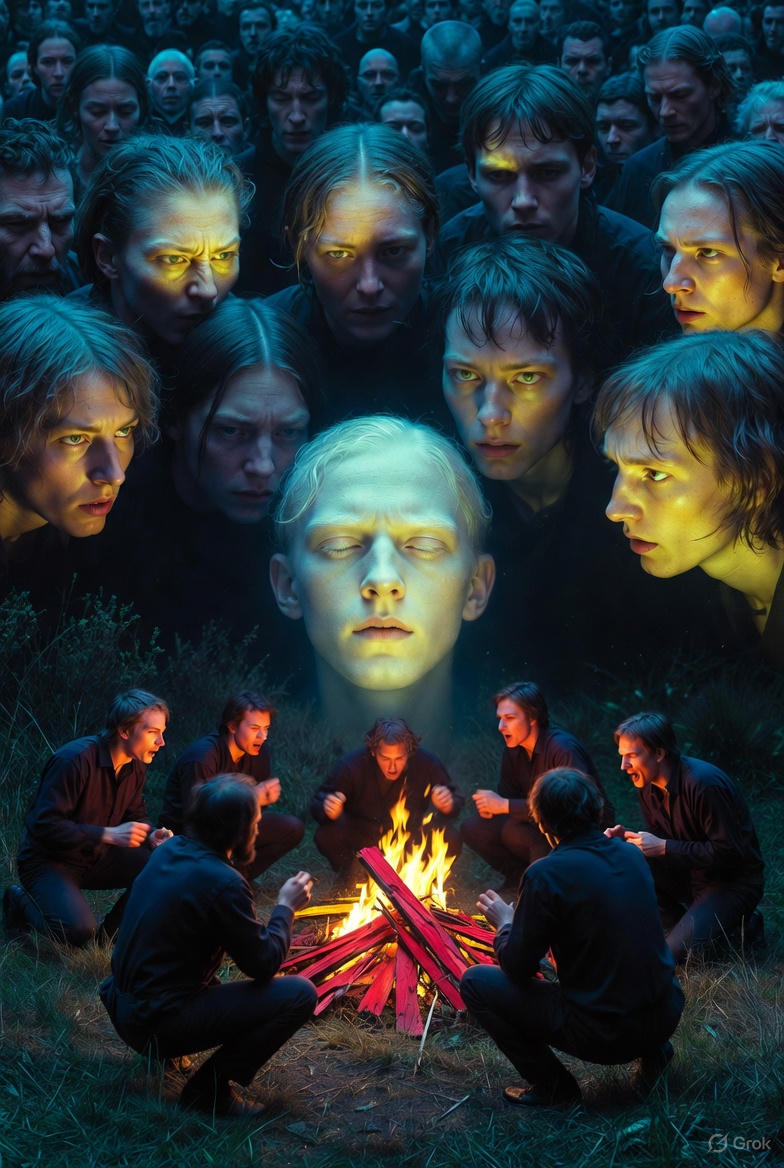
Between bushes and grass there was a swarming and
jumping, a twisting and turning of innumerable figures that
surrounded me. Some squatted in rigid clusters around red-
yellow brushwood flames, murmuring in swelling, nasal song
from books, keeping the beat with their hands. A brown boy
with pointed ears, handsome and cheeky, round-hipped like a
woman, was chasing a black, bearded shaggy goat with wild
heel kicks through the midst of couples, who were twisting in
spasmodic entwinement as they rolled in the leaves. Gray
wolves whose dark sweat dripped from their muzzles crept
with glowing red eyes between beautiful, naked women. A
crippled man without legs pushed with agile monkey arms the
rest of his body through the tumult in a wheelchair and looked
out of long distended eyes like those of a crab. One, whose skin
stretched like parchment over the fleshless bones, blew
squawking on a hollow leg bone, while glow worms crawled
around in his eye sockets. A dwarf’s body consisted of a
bagpipe, and the purring and humming pipes protruded from
the back of his trousers, while the trunk-mouth blew into the air
tube and the twisted fingers of his hands wandered over the
indecent flutes. A row of gray-toothed women with dangling
tits danced hand in hand in circles around these musicians.
“Are you here too? Hussah!” There was a bellow next to
me, and when I looked, Montanus had just passed by, and his
belly was hanging red like glowing iron from the inflated
trousers. More and more new dance groups formed. I saw legs
from which the skin was hanging in shreds and laughing
mouths, out of which white and yellow worms crawled.
Dissolute children with disgustingly twisted eyes were writhing
in the arms of hermaphrodite creatures, women cried out
ruthlessly and dragged giggling, skinny boys to their steaming
wombs, from goat udders fat milk ran into the toothless mouths
of old men. One with broken, buckling limbs led another, who,
leaden-grey faced, had a rope around his neck and displaying a
monstrous manhood stumbled forward to a black-haired
woman who was shrieking and twitching and rolling. Flames
danced and shot pointedly out of the earth, and from out of a
bush in front of me rose the deathly sad, pale face of the
Bavarian Haymon with the crushed red nose, and his mouth
whispered:
“Take some advice and see that you will come again,
Mahomet!”
There arose a tremendous shouting, whooping and wild
singing. They waved with their hands, their legs flailing and
jerking against a high black stone block, on which, in the
wavering, uncertain light, a figure was crouched, his knees
drawn up to his chin, angular and silent.
I stared at it and recognized with raging horror Fangerle.
As if fused to the rock, he squatted there, his evil,
pinched face under the big peasant hat glowed like rotting
wood, and his long-hunters coat glowed in all its buttonholes,
as if blue fire was hidden under them. The piercing goat eyes
were directed straight at me, full of indescribable malice. And
then he uttered the horrible scream that Heiner had in front of
the wheel.
“I-i-i-ilih!”
A thousand arms, fingers, claws and nails stretched out
towards me. I wanted to rise quickly into the free kingdom of
the air, but they hung on to my feet, pulled me down.
“Catch him! Stop him!” shrieked Satan on the block.
Desperately, I kicked my feet and flailed around. But
new ones came, arms of women wrapped heavy and soft
around my neck, hot lips pressed sucking against my face,
claws tore at my hair; heavy masses clung to me, squeezing out
my breath. I could no longer get up, saw in deathly fear the
yellow goat eyes stare, the saw teeth bared, paralysis was like
tough dough around my limbs, my heart was hammering, close
to bursting, my breath caught, choking my throat.
“Lord, my God!” I cried out in deathly peril.
Then the hand of Fangerle grabbed me and flung me high
into the air. Scornful laughter rang out behind me, neighing.
The fires went out in the deep night, shadows flitted. Whirled,
it whistled in the air, cried, screamed, howled —.
I lay in my shirt in the middle of a wet meadow.

Read Full Post »

The Rebirth of Melchior Dronte by Paul Busson and translated by Joe E Bandel

“I won’t leave you — again,” I affirmed, drunk with
happiness.
“I knew you would come,” she whispered softly.
She clung to my shoulders with her small hands and
repeated the words that she had scribbled in a flying hurry on
the piece of paper I had taken from the gambling house.
“Save me! Save me! Take me with you!”
This unexpected and scarcely hoped for turn of my
adventure filled me with the deepest delight. I was immediately
ready to do anything she might ask.
“So you are in danger?” I asked.
She quickly nodded her head several times and once
again nestled her tender body against me again pleadingly. For
a short moment I thought of the severe punishments with which
the Empress’ courts used to deal with kidnappers. It had been
said that a nobleman who had kidnapped the wife of a
distinguished courtier and special favorite and fled with her to
his estate, was seized and taken to the dungeons of Spielberg,
where he was forced to stand with up to half of his body in
liquid filth, with an iron pear filled with pepper in his mouth,
gnawed on by rats, and had perished in the most horrible way.
But the sweetness of a happiness, which already stunned
me in the mere expectation, stifled any fear, indeed any
deliberation in me.
After a credible excuse, which the girl told to the old
gray woman, and after my assurance, supported by a new
shower of gold, that it was only a short walk, the woman, who
did not seem to be at all inclined toward the doctor, let us go
out the door, and we climbed down the stairs, both of us
worried about an unpleasant encounter. We strode swiftly,
Zephyrine under the cover of a cloak and a thick veil, down the
street and unnoticed by my housemates, reached the quarters in
Himmelpfort Street.
There I learned everything I needed to know about the
poor child. She was a four-year-old orphan, when Postremo
took her in under the pretext of charity. During her childhood
she was treated well and even received a very careful education.
But this was not out of philanthropy, as had recently come out.
A few months ago, when Zephyrine had reached the age of
sixteen, Postremo told her that now the time had come for her
to prove her gratitude to him and at the same time to establish
her own happiness.
That mummy-like Count Johann Nepomuk Korony,
whom I had seen at the gaming table at that time had agreed to
pay his, Postremos, considerable debts, if Zephyrine would be
his mistress in return, so that his almost completed life might
once more be renewed. Moreover, the monster hoped that the
untouched girl would, through her devotion be exposed to a
certain genteel disease from him without being seized by it
herself. Postremo had explained all this to the unfortunate child
with cynical sincerity, and her tears and entreaties had only
succeeded in doing one thing, that he once again made the
attempt to improve his situation at the Pharaoh’s table. On that
gruesome and for me nevertheless so happy evening, this last
hope of the completely ruined gambler collapsed and now he
was holding the girl more than ever under seclusion, probably
because he trusted that she would do everything to save herself.
My appearance had taken place at the most extreme hour. For
that suspicious person with whom I had seen him in the Greek
coffee house was none other than the valet of Count Korony,
and there was no doubt that the miserable Postremo was
making the final preparations for his and the count’s crime. The
poor child was in the greatest fear, for she was well aware that
the doctor was a master in the preparation of anesthetic
medicines, which were able to eliminate all free will.
For days, she had eaten only the most meager food, so as
not to fall victim to the demonic arts of her jailer, but still she
saw the horrible moment inexorably approaching, which would
put her in the grip of the spider-fingered lecherous old man.
While she told me, almost crying, of the agonies of the
last days and of her almost collapsing hope for my help, I sent
my servant to fetch a meal, to get him out of the house. For I
knew that this child was my own and that only death could
separate us. Every moment of happiness that lay ahead of me
was too precious to miss.
It was clear to both of us without many words that we
had always been destined for each other, and it cost the lovely
and pure girl neither bridal tears nor difficult resolutions, to
become completely mine. A holy and irresistible desire drove
us to become one body and one soul, and neither of us could
think of binding the eternity of our love by vows. We felt no
shame in front of each other. Everything was as it had to be and
fulfilled according to eternal laws. When I held the young,
naked body in my arms for the first time and guarded the sleep
of the dearest of all creatures, I was suddenly seized by an
inexplicable sensation which carried me away: first I was
overcome by great fear, as if we were threatened by lambent
flames. Then I heard a clock strike in the infinite distance. The
smell of apples and foreign wood was around me, and as if by
themselves my lips formed the word: Aglaja!
Everything had turned out perfectly. With money I had
managed to get the most necessary papers, and in a small
village not far from the capital our wedding ceremony had
taken place, so that I no longer had anything to fear from the
spies of the morals commission and probably also from
Postremo. I had soon acknowledged my lodging, given the
servant some money and dismissed him and for a little money I
purchased a little house in Grinzing, hidden in the bushes and
trees, which I furnished with the help of skilled and
understanding craftsmen. Unclouded sunny days passed over
us, and that unhappy time that soon follows the excess of
happiness and is well known to all married couples, was spared
us. It was as if each day brought us closer and more ardently
together.
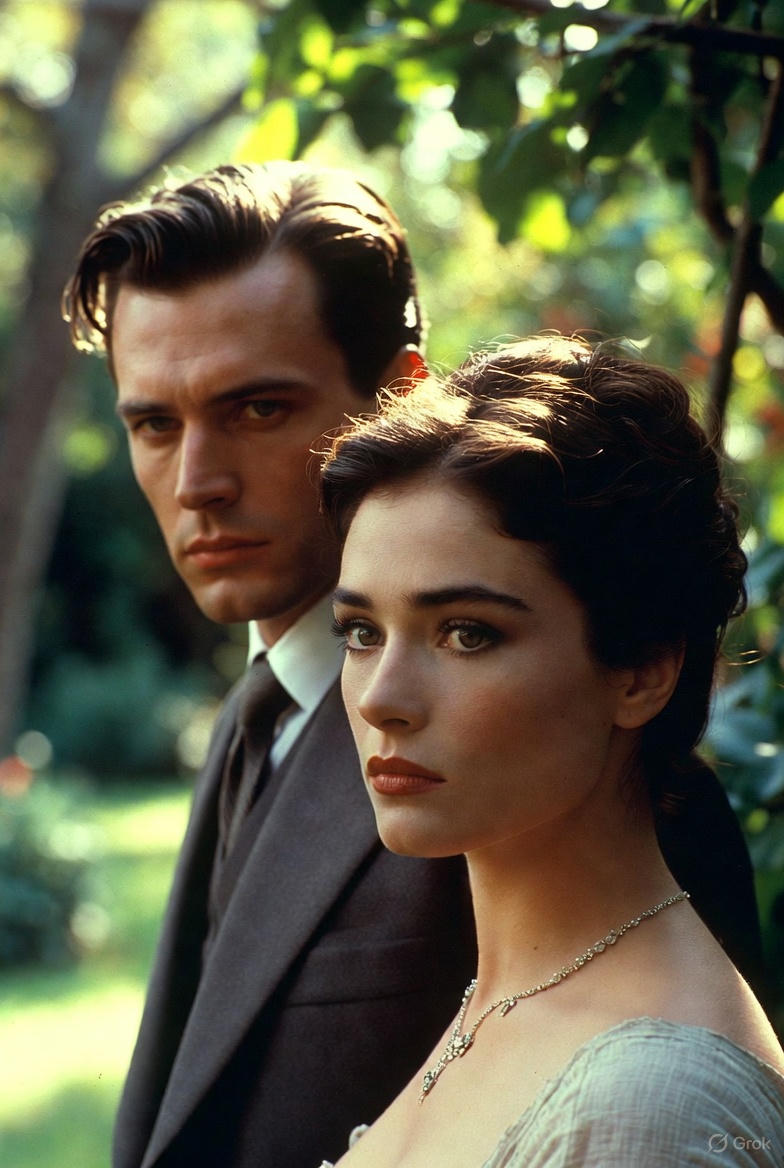
Often it happened to me that I called Zephyrine “Aglaja”
in times of the highest emotion. But this peculiarity seemed to
neither hurt nor astonish her, although I often told her of my
dead, beloved cousin and of her resemblance to the girl who
had been taken from me so early. Once she said:
“I am yours under all the names you want to give me.”
She also shared with Aglaja a great love of flowers and
animals. We had the garden full of rose bushes in all colors, the
glowing scent of the red, the tartness of the white and the
delicate yellow blossoms. On all the flower beds a riot of
colors, and a sea of flowers balmy fragrances wafted over us.
Young animals played around us, dogs and cats, birds
twittered in the branches, and nimble lizards glided over the
gravel of the paths.
Very soon after the completed establishment of the house
Zephyrine felt like a mother.
Heavy-bodied and pale, she sat in our favorite place
between dense, flower-bearing bushes.
“It will be a boy with dark hair like his Father,” I joked.
“No, I carry a little vixen of the female gender under my
heart,” she smiled back. “And she shall be called Aglaja.”
I kissed her and looked into her gray, gold-spotted eyes,
at the bottom of which there was still hidden something fearful.
Carefully I moved the pillow in the back of the delicate woman
and thought to myself how happy I would be when she had her
difficult hour behind her.
Then I saw a namelessly horrified expression on her face,
and her gaze was fixed on something behind me. The dogs
thrashed furiously in the kennel.
I turned around immediately. Behind me stood the
hunchbacked doctor with the thick black eyebrows and the
upturned nose. An unpleasant pungent smell of bitter almonds
suddenly overpowered the scent of flowers.
With a grasp I seized the shapeless figure at the chest and
shook it back and forth.
“Scoundrel!” I gritted between my teeth. “Have I got you
now? You can’t escape me alive-“
The hunchback turned blue-red and gasped something I
did not understand.
The woman let out a loud scream, and when I looked
around, she was in a deep swoon. At that moment I felt a
burning sting on my right wrist. My hand, which still held the
coat of the hunchback, was suddenly paralyzed, the fingers
came loose, and the whole arm sank down dead at my side, dull
and heavy. Horrified, I saw how the man indifferently wiped
away a drop of blood from the flashing lancet with which he
had stabbed me and put it back in the pocket of his coat.
“Oh it doesn’t matter!” he laughed. “Unapiccola para-
lisi! Doesn’t last long – five minutes! You don’t attack me, I
won’t attack you!”
He pulled a small can out of his vest and held it under the
nose of his daughter. Zephyrine sneezed violently and
immediately regained consciousness.
“Grandfather -,” she said, as a shudder came over her.
“Si, si, lo zio!” he feigned. “Il padre, if you will,
Zephyrine! Haven’t you expected me, Signore?” he addressed
me. “O cattivo, cattivo! What have you done? Eh?”
“I did not expect you here!” I told him. “For the time
being, I’ll keep my wife away from the sight of you and bring
her to the house, and then I am at your disposal.”
He sat down on one of the chairs with a mischievous
laugh. My stunned arm had already recovered from the effect
of the poisonous sting, so that I could support the wavering
woman and bring her into the house. In front of the front door
she was overcome by violent vomiting, and only after a while
was I was able to put her to bed in our bedroom. Sobbing, she
begged me not to expose myself to any more danger. Despite
his crippled body Postremo was one of the most dangerous and
determined people. I reassured her as well as I could, and went
to my room where I picked up a pistol with a live round, and
then determined, went to the garden.
When I arrived at our favorite spot in the rose bushes,
which was no longer an undiscovered refuge, the ugly monkey
was sitting there and bared his yellow teeth. A lot of the
beautiful roses lay torn off, torn apart and trampled on the
ground.

Read Full Post »

Homo Sapiens: In the Maelstrom by Stanislaw Przybyszewski and translated by Joe E Bandel

Suddenly he heard her cry and sob, tired, soft, heart-rending like a child. 

“How could you do that, how could you only,” she wailed. Falk sank before her. He grasped her hands, held them convulsively to his lips, she felt tears flow over her hands… “How could you do that…” 

He spoke no word, but pressed her hands even more convulsively to his lips. 

“Stand up! Stand up! Don’t torment me…” she begged pleadingly! 

He stood up. He seemed suddenly calm. Only his body twitched. “Don’t go from me,” he stammered suddenly, “I… I loved you too much.” 

Then he stopped. No! He must not say that to her, but it came involuntarily over his lips. 

“I lost my mind. The man always stood before my eyes. He always stood between us…” 

She stared at him frightened, seemed to understand nothing. “What?” “Who?” 

“Who?” asked Falk mechanically and recollected himself again. 

“No, nothing…” He stepped back a few steps… “Did I say something? No, no! You should not go… You can do with me what you want… Only don’t go!” 

His voice failed. 

“Nothing helps any more.” She spoke tired and as if absent. “You are a stranger to me. What I loved in you is destroyed. Now you are as ridiculous to me as the others. You are ridiculous to me with your animal desires. You are also only an animal, a beast, like the other men. And I believed… But don’t torment me, go now. I despise you. I have disgust, boundless disgust for you all… Let me go,” she begged, “let me…” she turned to the door. 

Falk blocked her way. He got another rage attack. 

“You must not go. You must stay with me! You must! I command it of you, I will smash you, crush you if you go.” 

He went toward her. She stepped back. 

He wanted to seize her. She tore herself loose, she ran around the table in terrible fear. 

“Are you mad?” she cried shrilly. 

Finally he seized her and pressed her in mad passion to him. She defended herself with all her strength, but he pressed her arms tight; his passion grew beyond his brain, a sick greed, a bestial lust to possess the woman came over him. 

“Let me go!” she cried almost unconscious. 

But he no longer had control of himself. He dragged her, pressed tight to him… 

Then she succeeded in freeing one hand, she arched far back and struck him with her fist in the face. 

He let her go. In a moment he felt his interior freeze to ice. 

He did not see her. He just stared at something that yawned like a black abyss before his eyes. 

When he came to himself, he saw her face and her eyes. He looked at her attentively. 

She stood as if petrified, only in her eyes a devouring disgust. She doesn’t love me any more. Now he understood it. 

“You don’t love me any more?” 

He said it with an icy smile. Actually it was not necessary to ask at all. 

“No!” she said cold and determined. 

He smiled without knowing it, went to the door, pushed the broken wood pieces aside with his feet and wanted to go out. 

Isa suddenly shot up in wild hate. 

“And that girl,” she cried after him… He stopped and started. 

“That girl,” she began to laugh convulsively… “That little girl who drowned herself… Ha, ha, ha… By chance while bathing… By chance, was that not the official bulletin? —Ah, how pale you are, how you tremble… You did that!” 

“You!” she cried suddenly… “One year after our wedding! Ha, ha, ha… what other heroic deeds did you perform, you proud, monogamous man? Do you have a few more girls there? Ha, ha, ha…” She walked around, held her head with both hands and spoke confused to herself. 

“Oh, these lies, these lies… Well yes—” she started up… “It is now over. Go, go. It will be good if you take care of the girl a little. She is very miserable, and very thin… Adieu, mon mari… Je n’ai plus rien à te dire… Adieu…” 

Falk heard nothing more. He felt nothing either. Only sit somewhere, quite still for himself incessantly still sit… 

It rang. 

Falk went mechanically to the corridor door and opened it. He looked at the messenger thoughtlessly and waited. 

“Are you Herr Falk?” “Yes.” 

“A letter for you.” 

He took the letter, went into his room, laid the letter on the desk, sat down and looked at it long and thoughtlessly. Finally he stood up and opened it mechanically. It took a long time until he forced himself to understand the content. 

It was from Geißler. He wrote him that he would pick him up in the morning at six o’clock. Otherwise everything was in best order. 

Falk sat down again and so he sat motionless the whole night. He had lost the consciousness of time. He was also not sleepy. Only now and then, when he felt desire to smoke, he got a cigarette and wondered that he could not think at all; he was chemically purified of thoughts, chemically purified he repeated senselessly. 

When Geißler came at the appointed time, he looked at him astonished. “Is it already time?” 

“Naturally. But didn’t you sleep?” “No,” said Falk apathetically. 

He took his old felt hat. 

“But you must take the top hat, it cannot go so formlessly…” 

“So, so… For my part I can take the top hat.” Geißler looked at him uneasily. 

Falk became furious. 

“Why do you look at me so mistrustfully? Do you believe that I am afraid?” 

But he fell immediately into his former apathy. 

When they arrived, Kunicki was already waiting with his second and a third gentleman. 

“The third is probably the doctor,” thought Falk profoundly. All formalities were quickly settled. 

Falk looked with a dull calm as Kunicki aimed at his head. Kunicki has the superiority of a person for whom the thing is a kind of sport, it shot through his head. Strange sport… But how does this fit together? Kunicki is after all a social democrat. That is against all principles. Ha, ha… un citoyen cosmopolitique, citoyen du monde entier. 

This citoyen du monde fixed itself in his brain, accompanied by a strange cheerfulness. 

In this moment he heard the cock click, saw smoke, but the bullet flew past him. 

He was now completely possessed by one single, fixed idea: the citoyen cosmopolitique with the limping principles should himself limp… Falk laughed to himself, he had trouble controlling his cheerfulness. At the same time he aimed very calmly and shot: a formal laughing cramp choked him in the throat. 

The shot hit Kunicki in the kneecap. He flew up and fell. 

“Thunder! give me a cigarette!” he cried furiously. 

“Will he limp?” Falk asked Geißler when they came into the city. The idea had taken total possession of his soul. 

“Don’t know.” 

“Citoyen cosmopolitique with the limping principles… Ha, ha, ha… God’s finger… Now he will limp himself…” 

Geißler became very unpleasantly touched. But Falk suddenly fell back into his apathy. 

“The satisfaction one gets thereby is after all damned minimal,” said Geißler to break the painful silence. 

Falk looked at him. 

“We were good friends… He is a sharp head,” he said musingly. “He refuted Rodbertus…” 

They were silent again. 

“Has Isa already left?” asked Geißler. “Was she supposed to leave?” 

“Well, I believed.” Geißler rose uneasily. “You want to go?” asked Falk anxiously. 

“I must now.” 

Falk suddenly looked up at him and smiled good-naturedly. 

“You are uneasy… He, he, he. Just go, go. I will now lie down to sleep.”

Read Full Post »

Madame Bluebeard by Karl Hans Strobl and translated by Joe E Bandel

Ruprecht’s agitation drove him from his seat.
“And…?”
“The photo I showed was of Herr Anton Sykora…
You follow my reasoning. It may not have been
Sykora himself, but certainly someone very like him.
All confirmed he was a giant, broad-shouldered, bull-
necked. You recently met Anton Sykora. Didn’t you
notice a resemblance… to someone…?”
Ruprecht stared into Schiereisen’s steel-blue eyes.
“To Lorenz…” he said. “Yes, certainly—to Lorenz.
Only now…”
Schiereisen nodded, pleased. “It often happens we
see connections only afterward, when someone points
them out. So, Hellpach’s companion was either
Sykora—or more likely—Lorenz. Either way, let’s
note Frau Helmina was a widow and heiress. Soon
after Hellpach’s death, Sykora appears in Vienna
with ample funds, buys two houses, and sets up his
matchmaking agency. Here at Vorderschluder Castle,
Frau Helmina takes on a new servant: our Lorenz.”
Before Ruprecht’s eyes, events flickered like a
cinematograph film.
“The following winter, Frau Helmina spends in
Vienna, making new acquaintances, much courted.
Finally, Herr Hickel, a wealthy Hungarian
landowner, emerges as victor and her second
husband. She persuades him to sell his estates and
dabble in stock ventures under her guidance. His luck
is even briefer. I learned little about this marriage—
short and stormy. After a fierce quarrel with
Helmina, Lorenz found her husband dead in his
room, struck by a stroke.”
“Do you see a crime here too?”
Schiereisen shrugged. “I told you, I found nothing
certain. Old Johann joined the castle with Helmina’s
third husband. Before that marriage, she was a widow
for two years.”
Ruprecht exhaled.
“Helmina’s ties to Sykora never broke. He visited
the castle during Dankwardt’s time as his
acquaintance. Meanwhile, Sykora worked to find a
new husband for his protégé. Three serious suitors
were considered.”
“How do you know all this?”
“I recently used Sykora’s services myself,
indulging in some indiscretions. I obtained copies of
his lists from that critical period. A small, unnoticed
theft, a night of frantic work—by morning, the lists
were back. You can imagine I was thorough. I
investigated each candidate, tracing many mundane
life stories. Three end in mystery for me.”
“You’re not saying it’s possible… we’re
surrounded by… I don’t know why I’m listening?
Your deductions are wrong.”
“Have a little more patience. I’m nearly done. You
mean it’s impossible in our orderly states for people
to vanish. Oh, it’s not so hard. Suppose someone is
entangled in a vital matter requiring absolute silence.
They must travel for it, sworn to use a false name,
forbidden to tell even their circle where they’re
going. The three candidates on Sykora’s list whose
trails fade are foreigners—a Frenchman and two
North Germans. All wealthy, older men who didn’t
need a matchmaking agency. But Sykora’s a shrewd
businessman. I admire him. He sought clients on his
travels. Imagine he has a charming woman among his
prospects, sparking an older man’s passion. But she’s
refined, not to be compromised. Her acquaintance
requires utmost caution. Then, one must prove
financial means, for this beauty is accustomed to
spending… she wants assurance of no lack.”
“You see, I’m calm. Tell me your remaining
hypotheses.”
Schiereisen fell silent, heavy-hearted. He hesitated
to conclude. The joy of building his bridges was
gone. But it had to be. “I traced those three
candidates from their starting points. Knowing their
destination, I followed them. Their paths lead to
Vorderschluder, and here they vanish.”
Ruprecht remained calm and cold. In moments of
great danger, his nerves sang like thin steel. “So you
lost their trail here?”
“I didn’t lose it. It ends here. Three people
vanished at your castle, Herr Baron. Precisely those
from Herr Anton Sykora’s list destined for Frau
Helmina. Funds were withdrawn for them days after
their departure… when they must already have been
dead. On checks in their handwriting, perfectly
executed. That’s the secret of your castle, Herr
Baron.”
Schiereisen rose and walked past Ruprecht to the
Buddha in the corner. With his back to Ruprecht, he
said softly, stroking the bronze figure’s skin, “We’ve
now reached the same point from another angle,
where we left our inquiry earlier. The secret we touch
here is the same one that cost Jana his life. They
eliminated a dangerous snoop. My path is complete,
the connection made. I leave the final conclusions to
you.”
The stifled air of the Indian temple felt hard to
breathe, laced with a malignant, greenish-gleaming
gas. Ruprecht opened a window between two painted
palm trunks. Noon had long passed. The shadow of
the sundial’s pointer on the gate tower climbed the
dial again. A light wind drove gray cloud clumps
across the sky. When a shadow passed over the
castle, the thin black rod among Roman numerals
faded into nothingness. A bright, faint sound drifted
from the summer meadows—scythes sharpened with
a whetstone. Haymaking! The world’s wedding
jubilee! Fragrant unfolding! Drinking with every
pore!
Ruprecht thought nothing, drew no conclusions.
He sank into these summer sounds and colors, as if in
a bright liquid.
He felt a hand on his shoulder.
Schiereisen stood there. “Don’t take it so hard,
dear Baron. I hesitated long before speaking. After
meeting you, I briefly regretted taking this task. Then
I was glad again… Another might…”
“Why tell me at all?”
“To wake you from a heavy dream. I’m certain
you’ve tormented yourself with thoughts about the
strange coincidences that struck you. This can’t go
on. I hear someone moaning in their sleep beside me.
I shake their shoulder. That’s it. When you’ve
composed yourself, I expect you to fulfill my duty. I
expect your support.”
“In what way?”
“Only to answer one question. We haven’t spoken
of Herr Dankwardt, your immediate predecessor.
From Johann’s descriptions, I’ve pictured his death.
He died with symptoms exactly like the illness that
afflicted you some time ago. Tell me what kind…”
Ruprecht leaned back on the windowsill, meeting
Schiereisen’s gaze calmly. “I trust you’ll find it
natural that I refuse to answer.”
Schiereisen nodded. “I expected as much.”
“No law can force me. I feel no obligation within
me. That’s more important than legal compulsion!
And besides—I… I don’t believe your suspicions.
Your conclusions are shaky. Your deductions are
flawed. You offer no certainties.”
That would’ve stung Schiereisen, had he not
known it was a hastily raised defense. He admired
this man’s resilience, the bold courage withstanding
these revelations. Another would’ve collapsed;
Ruprecht stood tall. He had the strength to say: I
don’t believe you.
“I understand,” Schiereisen replied after a pause.
“You love your wife. But I wanted to free you from
such a dangerous, painful passion.”
In that moment, a storm seemed to shake
Ruprecht’s composure. The word free hit like a blow.
Something shattered within him; he glimpsed a bright
landscape, as if a wall had fallen in a dark room.
Shock, a lock breaking, light—pushing, urging him.
Here was the turning point, the decision. If he spoke
now, he’d be free.
But he clutched at his own flesh with both hands.
He recoiled, fearing surrender unless he did
something drastic. His headshake told Schiereisen
he’d find no ally in Ruprecht.
“So it must be,” the detective said. “You… can’t
do otherwise, being the man I admire. I was foolish
enough to hope for a moment. Forgive me if I see it
through. I must fulfill my duty. I’ve laid myself bare,
shown all my cards. Act as you see fit. I’ll have to
accept the added burden on my further inquiries.”
He hesitantly offered his hand.
Ruprecht clasped it firmly, meeting Schiereisen’s
eyes. Then he turned away, and the detective left the
Indian room.

Read Full Post »

Madame Bluebeard by Karl Hans Strobl and translated by Joe E Bandel

Sixteenth Chapter
A kind chance had led Ruprecht to a charming
secret. A chance, playful and teasing like a putto, to
which he could’ve blown kisses. Ruprecht had driven
a stretch along the Kamp valley toward the
Schaumburg ruin. They’d stopped by a weathered
forest bench, where Hedwig rummaged through her
purse for small necessities—handkerchief, mirror,
and the like. Later that day, Ruprecht returned alone
to the bench. Something urged him: Go back! As he
strolled closer, he spotted a tiny, slim book lying
there. It was a forgotten calendar, and Ruprecht
opened it joyfully to see if Hedwig’s days were
marked with the same ordinary numbers and names
as others’. He felt her calendar must be extraordinary,
with unique saints marching through her year. He
found a page highlighting days to do kind things for
friends. Ruprecht’s name topped the list by March 7.

At the end was a date, noted: “Oh dear—twenty-
eight! Getting old!” That date was just three days
away.
Ruprecht pocketed the calendar, keeping the secret
to himself.
Those three days, he wore a constant smile. Only
with Helmina did his joy fade. He withdrew,
avoiding her touch. Her mocking face went
unheeded. Seeing her, he recalled a nocturnal trek
through forgotten vaults and a glimpse through a
tower wall. A shudder gripped him.
On the morning of the festive day, he hurried to
the garden at dawn, plucking the loveliest roses—
pale yellow, pure white, lilac-tinged—and bound
them together. Hesitantly, he added a single deep
purple rose to the center.
In his study, he wrote a letter.
Dear, dear gracious lady! Who told me it’s your
birthday today? Suppose it was a kind summer
breeze, a white cloud in the blue sky, or the Kamp,
my close confidant. I won’t betray the good friend
who shared it. I even know your age. But I’ll strive to
forget it, if you wish. On such days, one feels
generous, especially someone as good as you. Grant
me two requests: kindly accept these roses and the
small box accompanying them. Second: come this
afternoon with your husband to our castle. Let’s
celebrate your birthday a little, better at home than in
a village inn, even one as fine as the Red Ox. You’ll
come, won’t you? I want to tell you today how
grateful I am. You’ve reshaped my life on new
foundations. Through you, I’ve discovered a new
world. A great error has fallen away. From the
tangled snare of senses, I’ve climbed to clearer
heights. Until now, I saw life’s essence in asserting
the self—standing victorious, foes crushed beneath,
forcing the defiant to my will, smiling amid dangers.
That was my greatest prize. But through you, I’ve
learned: not this endless struggle is life’s highest joy,
not this constant hostility, but surrender, giving
oneself… I owe that to you. Today, I must say it. The
fight and tension are over… Oh, you’ll come, won’t
you?
Your Ruprecht.
Finishing the letter, he called old Johann to deliver
it with the roses and a small box containing a pearl
necklace. But as Johann reached the door, Ruprecht
called him back. Hedwig shouldn’t receive this letter.
It was too candid—a confession and an accusation. A
venomous vapor rose from it. No, Ruprecht wouldn’t
cloud these summer days or disturb Hedwig’s serene
joy. He imagined her leaving Vorderschluder—
everything gray, icy. He wanted to savor each present
day, not summon dark questions or fears. She knew,
without words, his gratitude. Hadn’t her eyes, the day
after Rosenburg’s miracle, pleaded: No more of that?
He tore the letter to bits and wrote another, light
and jesting to the end. Opening the box, he admired
the pearls again—large, softly gleaming, perfectly
round on lilac silk. He’d bartered them from Indian
divers, deeming them worthy of Hedwig.
At breakfast, he told Helmina he’d invited the
Gegelys for the afternoon. She laughed scornfully,
learning it was Hedwig’s birthday. Ruprecht barely
restrained himself from lashing out before the
children and Miss Nelson. A thought, restless in the
shadows lately, flared into harsh light. Helmina was
in his power. One clenched fist, and she’d be
destroyed. A fierce revulsion surged… he rose and
left, almost ashamed, as if his face betrayed his
wretchedness.
Near noon, crossing the courtyard, he heard his
name called. Turning, he saw Schiereisen hurrying
after him, buttoned tightly in a black frock coat as
he’d once been in his yellow overcoat. He looked
rosy and cheerful, moved by the joy of reunion.
It struck Ruprecht he hadn’t seen Schiereisen in
ages. “An eternity, dear Baron,” the scholar said,
looping his arm through Ruprecht’s with clumsy
familiarity, his guileless blue eyes beaming.
“Where I’ve been?” he chattered loudly, climbing
the stairs beside Ruprecht. “Following my old Celts,
tracking a lead. My work’s nearly done—I’ve found
splendid new material. I think they’ll be pleased with
me.”
They sat in the Indian room. The prayer wheel
caught Schiereisen’s eye. He took it from the wall,
letting it clatter on his lap. His delight wasn’t wholly
feigned; he was genuinely fond of Ruprecht.
“You look splendid,” he said, “healthy, strong. I
must say, last time I was here, you worried me. But
you’ve recovered remarkably… Yes! I’ve been in
Germany, a bit in France too. Now I have all I need.”
“You make me curious about your work. When
will it appear?”
Schiereisen studied the prayer wheel, reading its
Buddhist mantra: Om mani padme hum… “My work!
When will it appear? That depends solely on you
now.” He spoke with sudden gravity.
Ruprecht knew the reckoning had come. “On me?
I don’t understand! I can’t assist you in any way.”
Schiereisen ignored the deflection. “Oh, but I’m
counting on you. You can’t deny me your help. I can
call on you in the name of truth and justice.”
“Is it necessary to invoke such weighty terms?”
Ruprecht asked, still attempting a smile.
“I’d rather reach my goal with you than without.”
“You must see I can’t help. What do I know of
ancient Celts?”
“Let’s drop the Celts. I needn’t tell you this isn’t
about them.”
Ruprecht fell silent. Continuing to evade was
absurd. He asked, hard and firm, “What do you want
from me?”
“I hear your valet Lorenz is gone.”
“Yes, he resigned and left a few days ago for a
new post.”
“And you don’t know where he is now?”
“No… I didn’t ask. I let my people go when they
wish, without troubling them.”
“Haven’t you wondered why Lorenz left?”
“No!” Trying one last time to steer the talk,
Ruprecht asked, “Do you really find a servant’s
departure so significant?”
“Yes,” Schiereisen said. “This man’s exit is very
meaningful. I suspect a surprise awaits us.”
“What kind?”
“I don’t know. It’s a pity we no longer have him
here. It’s almost unsettling to know he’s out there,
behind me. Did he sense suspicion and slip away in
time? I’d rather have him under my eye, where I
could watch him.”
“You speak like a tamer of a vicious beast.”
“Dear Baron, let’s be frank. I believe you trust me.
Must I prove my credentials? You know as well as I
that Lorenz murdered your servant Jana. If I didn’t
neutralize him then, it was only because I had a
greater task. I didn’t want to spoil it.”
“What led you to believe Lorenz committed a
murder?”
Schiereisen had anticipated that by speaking
plainly and revealing himself, he’d find Ruprecht
equally open and trusting. Now he felt like someone
who walks a long way to meet another, only to find
them unmoved from their spot. He began to regret
not keeping his mask. Irritated, he said, “Please
follow me closely for a moment. You’ll agree my
suspicions are well-founded, my conclusions sound.
Your servant Jana dies under odd circumstances. The
judicial commission investigates and finds nothing
remarkable. Jana fell through a wooden bridge in a
remote part of the castle at night. A young, agile man,
surely with enough presence of mind in such a
moment to attempt self-preservation, to grab
something at the last second. That’s strange, isn’t it?
Shouldn’t there have been a cry, the scream of a
falling man…? I examined that ill-fated bridge. You
were there and must have noticed what struck me.
There was a trace of sawdust—a child could deduce
the accident was staged. The already decayed planks
were sawed through. But that’s not all. I found a spot
on the old wood, cleared of dust and recently washed
with water. For what purpose, if not to erase a trace?
A tiny clue showed what that trace was: a small
blood splash, overlooked on the dark wood. Your
experience as a hunter and traveler is my ally. You
can’t pretend not to understand. How does blood
appear at the fall site in such an accident, unless a
struggle, a murder, preceded it? Wouldn’t the blood
otherwise be only on the stones below? Taken
together, one can only conclude Jana was killed and
thrown from the bridge to feign an accident. Now,
who’s the culprit? Why was the Malay murdered? He
was devoted to you. His virtues, as you once told me,
were loyalty and discretion. He existed not as an
individual but as your tool—a projection of your will,
an extension of your arm. A strike against him was a
direct blow at you. Someone aimed to hit you by
stopping him from carrying out your order.”
“Stop!” Ruprecht said. “That conclusion’s
wrong!” Swept by the marvelously precise, steel-
braced reasoning, Ruprecht felt only the thrill of a
vigorous nature in a perilous game. He forgot his
deep involvement, seeing himself as an object among
others.
Schiereisen smiled, satisfied that he’d captivated
Ruprecht. By objecting here, the Baron admitted the
rest was correct. “Good!” Schiereisen continued. “So
he wasn’t acting on your orders. That’s not decisive.
But he surely undertook his nocturnal errand in your
interest, whether you knew it or not. What interest
could you have had in Jana prowling the castle’s
remotest part at night? He was utterly honest, so no
shady motives fit. Nor was it a love affair. I know he
spurned the castle and village girls, who were quite
fond of him. So, as I said, he went somewhere for
you. Why at night, in secret? We don’t know—it’s a
mystery. Let’s call it a big X for now. May I have a
glass of wine?”

    Read Full Post »

    Homo Sapiens: In the Maelstrom by Stanislaw Przybyszewski and translated by Joe E Bandel

    XIII.

    In the early morning Falk was awakened. 

    A gentleman was waiting in the salon on a very important matter. “Aha!” said Falk and dressed quickly. 

    When he entered the salon, he saw a person who bowed stiffly and extremely ceremoniously. 

    “From Kunicki? Isn’t that so? Well?” 

    He listened impatiently and distractedly to the other’s well-set speech. 

    “Severe demand? Yes, naturally. Just give your address, I will send my second to you. Only for God’s sake no stiffnesses, no ceremonies. Otherwise the conditions are quite indifferent to me. Naturally shoot to unconsciousness. Only no ceremonies…” 

    The stranger looked at Falk strangely, bowed and went. 

    “That is splendid, splendid.” Falk rubbed his hands cheerfully. Then he began to walk slowly up and down in the salon. 

    Suddenly a hot longing for Isa seized him. To tell her everything, to take her on his hands, to press her to him, so that they would become one in the raging elan of love. 

    But in the next moment a picture that hung over the piano chained him. 

    The sky: a row of broad, glaring stripes that lay unbalanced next to each other. Broad, brutal stripes; the whole like a wild cry of despair… And a beach with a long pier. Two people on the pier: she in a white dress. One actually saw only this white dress, and this white spot in the middle of the despair orgy of the sky looked like something horribly mysterious, something that made the nerves sick with curiosity and mad horror. He sucked himself with his whole soul into this white dress: That is she, the doom, the white lightning, the dancing world in chaos. 

    He looked away and examined with most tense attention a wilted orchid. 

    So he had to find a second now—naturally Geißler. He had no other. He no longer had a single person. 

    He searched long for his hat, went to Isa’s bedroom, listened, went quietly around again… 

    Now he had to go, otherwise he would no longer find Geißler at home. 

    Scarcely had he gone when Isa entered his room. She had fever in the night and nightmare. She wanted to speak with him, to calm herself… 

    She was very astonished when she no longer found him. She stood sadly, then sat down and looked around the room. 

    The room suddenly seemed so strange and so uncomfortable to her. She believed she clearly felt the sick, feverish atmosphere of this room… Everything lay confused together, on the desk she saw a large, colorfully scribbled sheet of paper. 

    She held the sheet in her hands and looked as if sunk before her. The sheet was written from bottom to top only with one word in the most varied typefaces: Ananke. 

    An indefinite torment constricted her heart. It became so sultry to her. She felt a deep sadness. It seemed to her as if her whole happiness had suddenly passed. 

    She actually did not understand where all this depression came from? She began to distract herself with all possible thoughts, but she could not get rid of the irritating unrest. 

    She collected herself, went into her bedroom and dressed slowly. 

    Suddenly the maid came in. 

    “A gentleman wishes to speak with you.” She handed Isa a card: Stefan Kruk. 

    Isa read and read the card. But that is impossible. Hadn’t Kruk fled from Germany? He is after all sentenced to several years in prison… A growing unrest began to hunt in her head. A confusion of thoughts shot through her brain. The feeling of something unusual filled her with sudden fright. She hurried and was hardly able to finish her toilet. 

    When she entered the salon, she saw Kruk quite unusually pale with wild, red eyes. 

    Isa stopped frightened. 

    “What is it? What is it?” she asked stammering.

    “Where is your husband?” 

    She heard his hoarse voice tremble violently. 

    “He went away. But how do you come here, how could you expose yourself to this danger?” 

    Kruk looked at her as if he did not know where he was, as if he had forgotten himself. 

    Isa recoiled frightened. 

    “Your husband is a scoundrel,” he cried raging. “He dishonored my sister…” 

    Isa heard a few more words: mistress, bastard, seducer, then she understood nothing more. 

    Kruk came to his senses. He saw how all blood had left her face, how her lips became blue… She swayed, he caught her. 

    She came to quickly. 

    “My husband has a child now, now… a few weeks ago with your sister? Your… sister?! Child?” 

    She looked at him absently and stammered incessantly the word child… then she jumped toward him.  

    “That is impossible! Impossible…” 

    She grasped her head and walked a few steps. “A child!…” 

    She suddenly started. 

    “I must see it, I must see it… It is impossible. No, no…” She ran around. 

    “Why don’t you say a word? Say then that it is impossible… Oh God, oh God… So look for my hat, quick, my hat… How is that only possible… Ha, ha, ha, he asked me what I would say to it… Grand Dieu, c’est impossible… How pale you are, how dark… Just come quick, quick…” 

    She no longer knew what she did and what she said. 

    Only down in the cab did she come to her senses. They spoke no word with each other. 

    She had the feeling of a black, cool shadow over her brain, she laughed convulsively, sank together and again a desire to laugh suddenly overcame her. 

    She looked at Kruk almost roguishly. 

    “I recognized you immediately—I saw you twice in Paris… Oh, how you have changed, and how boundlessly pale you are… Mais c’est terrible, c’est terrible!” 

    She looked with mad glances out the window. 

    Suddenly she heard the rolling of another cab behind her back, the noise deafened her, she saw nothing more and heard nothing, repeated only quite mechanically: c’est terrible! 

    Finally the cab stopped, and immediately behind it another cab stopped. Kruk suddenly came into an unspeakable unrest… 

    In the moment when Isa had stepped out of the cab, she saw two men throw themselves on Kruk. 

    “In the name of the law…” 

    Kruk drew the revolver lightning fast, but in a moment he was thrown to the ground from behind… 

    A crowd formed. Isa stepped hastily into the hallway. 

    She supported herself against the wall so as not to fall. A dizziness raged in her. She sought convulsively to fight against it. Then she looked fixedly up the shining stair rail, heard a shouting on the street and saw a few children run past. 

    She looked around confused. 

    What did she want here?… Visit Erik’s mistress? Ha, ha… Great God! Erik’s mistress… 

    She collected herself and stepped into the courtyard. She stopped as if spellbound. 

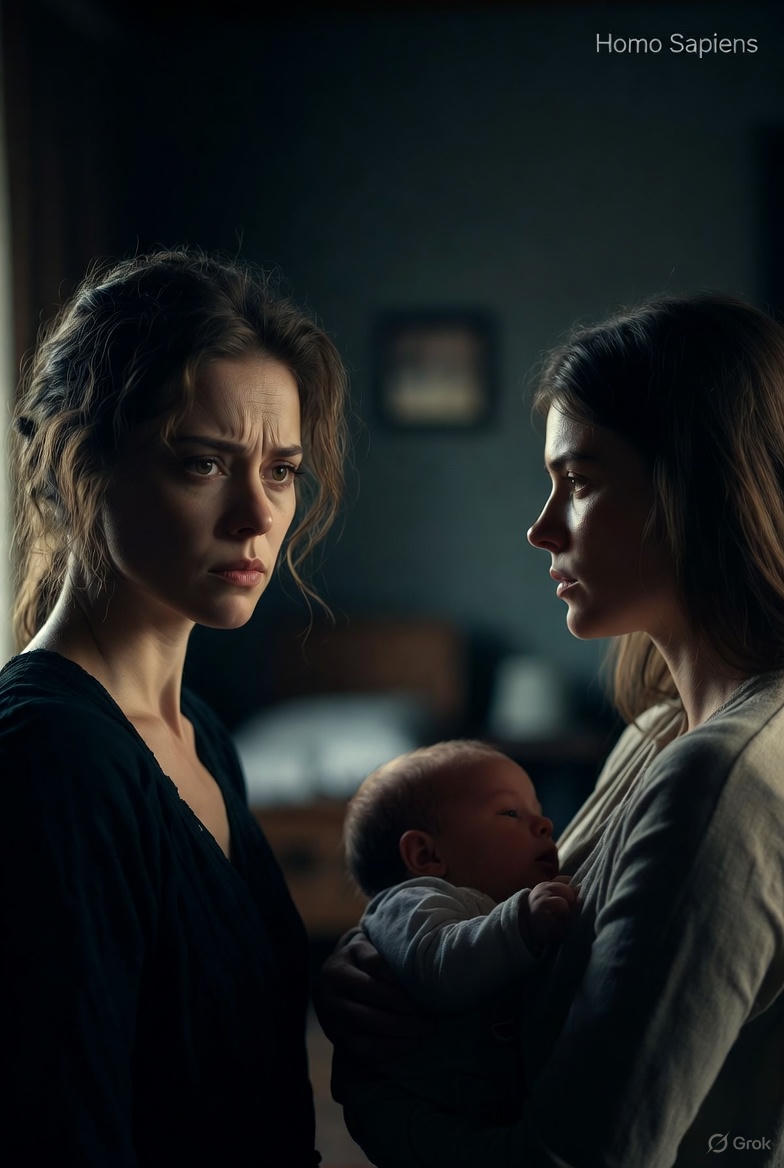
    In a window of the courtyard ground floor she saw a pale, desperate face. The girl carried a child on her arm. 

    The two women stared at each other. 

    C’est elle! Isa said to herself half-aloud. She saw how the other recoiled in highest fright. 

    Isa went in. She knocked. 

    The door was opened fearfully and only half. 

    “But let me in…” she almost violently pushed Janina back… “I want to do nothing to you, only the child…” 

    She entered Janina’s room. 

    “But don’t tremble so, I really want to do nothing to you…” She laughed nervously… “Mais, c’est drôle… this little girl: Erik’s mistress, ha, ha, ha… Sit down then, you are pale, you will fall… God, how thin, how miserable you are. He sucked all your blood… And the little one there is your child, Falk’s child…” 

    Read Full Post »

    Madame Bluebeard by Karl Hans Strobl and translated by Joe E Bandel

    Schiereisen stood. His gaze caught a mark. At
    head height, on the dust layer, was a tiny rust-red
    splash—a crusted fleck of liquid-mixed dust, a sign
    that erased all doubt.
    “Who found the victim?” Schiereisen asked.
    Ruprecht’s eyes now questioned too. His body began
    to obey a will again. “We have an old woman in the
    castle. She’s not quite right in the head. Early
    mornings, she goes to church. On her way, she found
    Jana.”
    “He was already dead?”
    “Yes.” Ruprecht’s gaze no longer dropped; it
    searched intently.
    “Who was second to him?”
    “My valet, Lorenz.”
    “Right—let’s go down,” Schiereisen said. Lorenz
    and the overseer stood in the courtyard as Boschan
    and his guest passed. They’d been discussing Jana.
    The overseer pitied him: a quiet, gentle man who
    bothered no one. Easy to like, despite being a
    heathen. Village girls had chased him like mad.
    Once, the overseer found him in the garden, staring
    silently, tracing signs on a stone with brown fingers,
    as if writing.
    “I think he longed for his homeland,” Lorenz said.
    “Poor fellow! Well, he’s found rest and peace now.”
    They fell silent, straightening as the master
    passed.
    “Who’s that man?” the overseer asked.
    “A scholar. Someone who wants to know
    everything that’s none of his business.”
    “A halfwit, then,” the overseer chuckled. Lorenz
    found Schiereisen’s curiosity grating. Boschan and
    the scholar entered the garden.
    “Aha, he wants to see where Jana fell,” the
    overseer said. Beneath the wooden gallery, between
    tower and castle, a broad paved path led to a hidden
    garden shed storing tools. Jana had fallen onto these
    stones. Schiereisen gauged the height—not so great
    that a fall should kill. The blood had been washed
    away, but traces lingered in the stone joints. The
    grass on either side was heavily trampled. Beyond,
    primroses and crocuses bloomed, then dense rose
    hedges hinted at early buds.
    Schiereisen scanned it all with rapid, tense
    glances. Then Ruprecht saw his expression shift—the
    scholar looked horrified, grieved, wretched, like a
    man facing the unbearable. “No,” he said, “it’s awful,
    I can’t bear it… ghastly. Come away.” He tugged
    Ruprecht’s arm, pulling him along.
    Schiereisen had noticed a watcher. Lorenz stood at
    the low wall separating garden from courtyard,
    looking over. Now he turned slowly, crossing the
    courtyard as if chance had brought him there. No,
    Lorenz thought smugly, this man’s no iron—he’s an
    old woman, like all scholars, like Dankwardt was.
    At the main wing’s entrance, Ruprecht paused,
    expecting Schiereisen to leave. But he re-entered,
    leading Ruprecht to his study. Sitting opposite in the
    Renaissance chair, Schiereisen resumed questioning.
    “Tell me, Herr Baron, where are the… rotten
    planks that broke with Jana?”
    Ruprecht pondered before answering. His
    alertness stirred, his body’s weakness overcome by a
    forceful rally of will, refusing defeat. He decided to
    respond, to see where Schiereisen’s questions led.
    “The planks? They were cleared away… I think
    Lorenz removed them. He was there soon after the
    accident was found…”
    “So the commission didn’t see those damaged
    planks?”
    “Likely not.”
    “Don’t you think that hurt the investigation’s
    thoroughness? How could the commission determine
    how an accident occurred—or if it was an accident—
    without all the evidence?”
    Ruprecht said slowly, firmly, “No one doubted it
    was an accident.”
    “Well, I mean… in general. Another thing matters
    here… didn’t any commission member ask what your
    servant was doing on the gallery at night? You sent
    him there, perhaps…?”
    “No, I didn’t send him.”
    “That’s odd, isn’t it? What was Jana doing up
    there? His room was on the ground floor, like the
    other servants. Doesn’t one ask what drew him there?
    He dies at night on a gallery linking an empty wing to
    a tower ruin. Other details were overlooked. Did Jana
    have a light? Is it likely he went in the dark? If so,
    why? To avoid being seen? Or, if he had a light,
    where was it found?”
    “I don’t know.”
    “Finally: when did Jana die? On his way there or
    back? Had he been in the tower, or was he going to
    it?”
    Ruprecht shrugged.
    Schiereisen faced an impenetrable wall. Was
    Ruprecht so utterly blind, so wholly innocent and
    trusting, that he couldn’t grasp the suspicion
    Schiereisen had brought so close? These were
    questions anyone would notice. Or did he refuse to
    know, to see, to suspect? What drove him, then?
    He fell silent for a long time, and Ruprecht didn’t
    break the quiet. His head drooped forward again.
    Schiereisen saw the reddened patch on his crown, the
    wilted, singed hairs.
    “Listen, Herr Baron,” he said suddenly, “you’re
    ill.”
    Startled, Ruprecht lifted his head. Then he
    managed a smile. “You’re mistaken… I’m not ill.”
    Undeterred, Schiereisen pressed on. “You’re ill.
    You just won’t admit it. Your whole mood, the
    fatigue you can’t hide… this listlessness… You
    should see a doctor…”
    “I’m not ill. I don’t need a doctor.”
    “Follow my advice, dear Baron, see a doctor. All
    sick people are stubborn. They reject help.”
    Schiereisen leaned forward, locking eyes with
    Ruprecht, stressing each word. “Until—it’s—
    sometimes—too—late.”
    “I’m telling you, I won’t hear of a doctor.”
    “Forgive me, but I must say: it’s not a sign of
    refinement to fear a doctor. Children and peasants
    flee at the word. What’s the harm? What’ll happen?
    He’ll examine you. He’ll either find you healthy, or,
    if you’re ill, tell you how to recover. Maybe just
    prescribe a diet. A proper diet works wonders. Aren’t
    you careful enough with your food?”
    In that moment, a mysterious connection formed.
    Their gazes merged. Ruprecht understood—this was
    Schiereisen’s aim. Schiereisen felt he was finally
    understood. For a second, their inner rhythms aligned
    perfectly.
    “Yes,” Ruprecht said after a pause, “I eat
    whatever’s on the table… when I have an appetite.
    The same as everyone else,” he added. “I don’t think
    a special diet’s necessary.”
    Ah—he was slipping away again. But Schiereisen
    pursued relentlessly. “Yet your condition’s
    concerning. Perhaps it’s a severe nervous disorder.
    Your servant’s death has shaken you. A doctor might
    suggest a short trip. That’d do you good. You used to
    spend most of the year traveling. Now you’re stuck
    here. Leave your duties as husband and farmer for a
    bit. A few weeks away from Vorderschluder would
    help.”
    Ruprecht parried with a smile. “I’ve taken on
    much here that I must see through. I can’t do half a
    job.”
    “But, my God, dear Baron, I know you’re very
    nervous. You took a separate bedroom for that
    reason.”
    “Yes—that’s true. I didn’t want to disturb my
    wife. But don’t draw conclusions about my health.
    I’ll overcome it soon.”
    Schiereisen propped his head on his hand. Beneath
    his furrowed brow, shrewd eyes peered. “Tell me,
    Baron, which room did you choose for sleeping?”
    Puzzled, Ruprecht stared at the scholar. The
    question’s purpose wasn’t clear at first. Hesitantly, he
    answered, “A room on this floor. The last one in the
    left corridor.”
    Schiereisen nodded thoughtfully. “That’s good. A
    quiet room. You won’t be disturbed there.”
    “What do you mean?”
    “Well… your castle’s full of hidden romance.
    Vorderschluder’s a model of it. So many secret doors
    and passages. But your bedroom has none of that. It’s
    enclosed by four solid walls.”
    Ruprecht’s astonishment broke through his calm.
    “How do you know that?” he asked sharply.
    “Simple. I found a book in your library describing
    it all. A fascinating book, I tell you. I could sketch
    the castle’s layout from memory. I know my way
    around. For instance, I know one can reach the
    wooden gallery where Jana died through hidden
    routes from your valet Lorenz’s room.”
    “You study such things too?”
    “What can I say?” Schiereisen smiled. “One has
    antiquarian quirks. Back to your bedroom, a veritable
    fortress, it’s ideal for restful sleep, as I said. Still,
    don’t neglect the small things. Every detail matters.
    The bed should stand free in the room. It’s a bad
    habit to push it against a wall. And the bed itself… it
    must be flawless. I’d prefer if you’d let me inspect
    your bedroom. I’m an expert in these matters. When
    you need sleep as much as I do, you learn to mind
    everything… you build practical wisdom…”
    “Thank you,” Ruprecht replied, “but I won’t
    trouble you. No, no, that’s too much… a Celt-chasing
    scholar as a chambermaid! You forget I lived years in
    wild places, always my own servant. I’m used to
    checking carefully before I sleep.”
    Schiereisen bowed and rose. “I won’t keep you,
    Baron! But allow me to continue my studies in your
    library.”
    “I’m not sure I’d wish you to finish your studies
    soon. That’d rob me of company I’ve come to value.”
    As Schiereisen descended the stairs, Frau Helmina
    approached, fresh from the tennis court by the paper
    factory, where she’d played with the clerks. She
    radiated the vigor of healthy exertion. Schiereisen
    paused, doffing his hat. His face wore the shy
    geniality of a scholar. He mumbled condolences for
    the tragedy. Helmina looked startled, then said, “Oh,
    yes, Jana…” offering her fingertips. A urge seized
    him to crush those slender fingers, but he restrained
    himself, looking sadder, shaking his head, and
    walking off wordlessly. He was a detached scholar,
    unaware a servant’s death isn’t a family mourning.
    Between newly greened chestnut trees, he strode
    down the castle hill, crossing the bridge with its
    baroque saints to the graveyard, to view Jana’s body
    in the mortuary.

    Read Full Post »

    Madame Bluebeard by Karl Hans Strobl and translated by Joe E Bandel

    Rotrehl sat by, marveling at the professor’s
    insatiable curiosity. Like all city folk, he pried into
    things that weren’t his business. After Johann left,
    Rotrehl muttered toward the window, “The air’s bad
    at that castle. I told him, Herr von Boschan, I told
    him.” Outside, the castle glowed in the evening sun, a
    thin blood-red cloud drifting over the old tower.
    Beyond, an apple-green, silken sky shimmered, alive
    with spring’s voices.
    When Rotrehl tried to steer conversation to skull
    measurements and facial features after such visits, he
    had little luck. Schiereisen gave distracted replies and
    soon retreated upstairs. Annoyed, Rotrehl locked his
    door and read late into the night in his French
    cookbook under Napoleon’s stern, commanding gaze.
    A week had passed since Schiereisen’s first
    encounter with Ruprecht. He hadn’t yet visited the
    castle, forging hooks and sharpening arrows, waiting
    to fill his quiver.
    Herr von Boschan, returning from a tenant farm,
    rode slowly through the woods. Spring stormed the
    world, unstoppable. All was steeped in blissful
    yearning. The sky kissed the earth, and the wide earth
    pressed toward it, longing.
    Ruprecht’s horse was tamed earth-force. He felt
    one with the land through it, clasping this young,
    vibrant world between his thighs. He was lord and
    victor, a wild zest for life singing in his heart.
    This battle with a demon was glorious. Compared
    to past exploits, what matched this drama he was part
    of? To be with a woman who—if Jana was right—
    sought his life, and to conquer her repeatedly. A
    woman who—if Jana was right—was a criminal, as
    mysterious as the castle hiding corpses in its tower.
    Life triumphing over horror and danger. Strength
    enthroned, towering, fate-mastering. The wondrous
    thrill of daily victory. Ruprecht wouldn’t follow Jana
    or dwell on his reasons. He’d only heeded him by
    taking a separate bedroom, feigning a nervousness he
    didn’t feel.
    Lately, though, his joyous victories sometimes
    yielded to deep despondency. A lethargy crept into
    his limbs, settling in. It slunk from the dark, ugly,
    like a premonition of grave illness. A vile unease
    stole his confidence. His head throbbed with heavy
    drilling, as if his skull had softened, a thumb pressing
    at its crown. His scalp tightened, like over a swelling.
    At the crown, he felt twitching, burning, as if the skin
    might peel away, hair and all.
    Mornings, he felt especially weak and listless.
    These were bodily states, but he refused to yield. His
    will broke free, and by day’s end, he banished the
    gloom. He wouldn’t let his triumph dim. He grew
    free and strong again.
    Today’s forest ride had restored his freedom.
    Bending under the last trees’ branches at the wood’s
    edge, he saw Rotrehl’s house to his right. That’s
    where the yellow-overcoat man lived. He hadn’t
    come to the castle. Perhaps the forest invitation
    seemed too casual—scholars could be oddly formal
    at the wrong times, clueless when etiquette mattered.
    Maybe Herr Schiereisen from Vienna awaited a
    renewed offer. Fine, he’d get one now.
    Ruprecht rode along the forest edge to Rotrehl’s
    house, dismounted, and tied his horse to the garden
    fence. He passed through budding blooms. Smiling,
    he read above the door: “Jérome Rotrehl, Violin-
    Maker.” It was like a blessing, a creed one entered
    under. On the ground-floor door, he read “Jérome
    Rotrehl” again. The host was determined to impress
    his identity on visitors. Voices came from within.
    Perhaps his tenant was there. Ruprecht knocked. It
    wasn’t Schiereisen inside, but Rauß, the village
    ruffian everyone feared.
    “What do you want, Herr von Boschan?” Rotrehl
    asked with measured courtesy. He disliked recalling
    how he’d once spoken too freely about Frau Helmina
    Dankwardt to Ruprecht, unaware he was her suitor or
    would be. It felt like a trick played on him, proof of
    human deceit.
    “Doesn’t Herr Schiereisen from Vienna live
    here?” Ruprecht asked.
    Rauß sat by the window, puffing a Sunday cigar,
    its end splayed like a broom. He glared at the baron,
    sullen and hostile, sprawling wider to show he
    wouldn’t rise for him.
    With grave demeanor, Rotrehl extended an arm
    upward, a gesture fit for commanding an army.
    “Upstairs,” he said, “first floor… you’ll find him
    home.”
    Ruprecht climbed the creaking, worn stairs into
    deep gloom. A door opened above, light spilling
    down.
    “My God, it’s you, Herr von Boschan?”
    Schiereisen said, bowing. “I looked out… saw a
    horse tied below… wondered who—then you!”
    Ruprecht reached the top, shaking the scholar’s
    hand. “I was passing by today and thought I’d check
    if you got home safe that night…”
    Schiereisen grabbed Ruprecht’s arm, pulling him
    into the front room. “This way, please,” he said. “I
    sleep in there—it’s a mess… The maid hasn’t been
    yet; Sundays, she’s late… Can’t mind too much,
    right? Come in. It’s nicer here, with your castle in
    full… splendor.”
    Schiereisen’s excitement was clear. He darted
    about, searching for his coat—he was in
    shirtsleeves—missing it, though it lay on a chair in
    plain sight, flung there when he saw Ruprecht.
    “Pardon me,” he said, “I was just dressing. I’m so
    surprised… an honor…”
    Ruprecht stood at the window, looking out. “It’s
    charming up here. If this house edged closer, I’d
    worry you could peek into our rooms.”
    Schiereisen snatched his coat, hurrying into it. His
    fluster eased, feeling he’d regained propriety’s shore.
    A worldly man isn’t fazed by a bit of informality,
    Ruprecht thought, amused. Schiereisen wasn’t
    worldly. “Yes, I’m quite content,” the scholar said.
    “I’ll likely stay all summer. My host’s a fine fellow.”
    “Jérome Rotrehl, Vorderschluder’s Krampulljon!
    You know he’s an old acquaintance? He was my first
    guide to local affairs, laid the foundation for my
    knowledge here.”
    “We get on well. He’s open… heartfelt… But
    please, pardon, Herr von Boschan, won’t you sit?”
    With a sweep, Schiereisen pulled two chairs forward.
    One had a wobbly back; the other’s straw seat gaped,
    sprouting prickly spikes. New dismay followed.
    “Well…” he said, with a horrified smile, “it’s a bit…
    rustic here…”
    “Let it be, Herr Schiereisen… tell me, why
    haven’t you visited the castle yet?”
    Schiereisen tucked his cuffs into his coat sleeves,
    adjusting them. “My God,” he said hesitantly, “I
    don’t know… I reproached myself afterward. I was
    too forward. One can’t just… It was kind of you to
    invite me. But when you’re practically ambushed…
    in the woods, at night, by a total stranger… I didn’t
    want to seem pushy.”
    “I figured as much. So, I’m here to renew my
    invitation.”
    A halo of delight shone around Schiereisen’s head.
    “Oh, Herr von Boschan, you’re too gracious. I shan’t
    fail to take advantage of your kindness…”
    “Your studies intrigue me,” Ruprecht said. “I’d
    love to learn from you. This region… I’ve grown
    fond of it. I’ve traveled widely, but here, one can find
    a home. It reminds me of Upper Austria, where I
    spent my youth. Then I left. Now I’ve rooted here
    again. Everything’s so open, heartfelt, like a face
    hiding no thoughts. Every stone’s dear to me. I’m
    wooing this land, wanting to know it deeply. So far,
    I’ve been consumed with my new role as a farmer,
    catching up on what I forgot since my student days.
    You can imagine, traveling far, each mile costs a bit
    of learning. Now, I’d like to explore this land’s past.
    It’s like with a beloved woman—you want to know
    her roots, her ties.”
    Schiereisen shot Ruprecht a quick, sharp glance.
    Wasn’t this comparison striking? What did it mean?
    Was he mistaken, or did a shadow cross Ruprecht’s
    face—a cloud of disappointment, hidden pain?
    Warmth rose in Schiereisen. He was glad he’d
    already cleared this man in his mind. This splendid,
    upright man had won his affection. If tormented by
    suspicions, they hadn’t yet surfaced into conscious
    light. But now wasn’t the time for reflection—the
    scholar had work to do.
    “Of course!” he said calmly. “It’ll be an honor to
    serve you. I’ve had some successes. This area has
    geographic names undeniably Celtic. The Kamp, for
    one… farther north, there’s the enigmatic Thaya.
    Near Rosenburg, a stream joins the Kamp, called
    Taffa! What does that mean? Then there’s Gars,
    another such name…”
    “You know what?” Ruprecht cut in. “Tell me at
    my place… Come now. Have a spoonful of soup…
    then rummage in Herr Dankwardt’s library as much
    as you like…”

    Read Full Post »

    Alraune by Hanns Heinz Ewers and translated by Joe E Bandel

    A slight shock flew through her limbs. She sat up, drunk with
    sleep.
    “What do you want?” she stammered.
    Then she recognized the professor. “Leave me alone.”
    “Come on Alma, don’t be foolish,” the Privy Councilor
    admonished her. “It is finally time. Be sensible and don’t give us any
    trouble.”
    With a quick jerk he pulled the sheets away throwing her onto
    the floor.
    The eyes of the princess widened, “Very good! The girl is very
    well endowed–that is convenient.”
    But the prostitute pulled her nightshirt down and covered herself
    as well as possible with a pillow.
    “Go away!” She screamed. “I won’t do it!”
    The Privy Councilor waved to the assistant doctor.
    “Go,” he commanded. “Hurry, we don’t have any time to lose.”
    Dr. Petersen quickly left the room. The princess came up and sat
    on the bed, talked to the girl.
    “Don’t be silly, little one. It won’t do any good.”
    She attempted to caress her, massaging her with fat be-ringed
    fingers over throat and neck, down to her breasts.
    Alma pushed her away, “What do you want?–Who are you?–Go
    away, away–I won’t do it!”
    The princess would not be rebuffed, “I only want what’s best for
    you child–I’ll give you a pretty ring and a new dress–”
    “I don’t want a ring,” screamed the prostitute. “I don’t need a
    new dress. I want to go from here. Why won’t they leave me in
    peace?”
    The Privy Councilor opened the glass tube in smiling tranquility.
    “Later you will be left in peace–and later you can go. Meanwhile
    you have an obligation to fulfill that you agreed to at the very
    beginning–Ah, there you are doctor.”
    He turned to the assistant doctor who had just entered with a
    chloroform mask in his hand.
    “Come here quickly.”
    The prostitute stared at him with terrified, wide protruding eyes.
    “No,” she lamented. “No! No!”
    She made as if to spring out of the bed and pushed the assistant
    doctor so hard with both hands on his chest as he tried to restrain her
    that he staggered back and almost fell down. Then the princess threw
    herself onto the girl with wide stretched arms, pressing her back into
    the bed with her mighty weight. Her fingers with their many rings
    clawed into the luminous flesh as she gripped a long strand of red hair
    in her teeth.
    The prostitute struggled, kicking her legs into the air, unable to
    free her arms or move her body under this mighty burden. She saw as
    the doctor placed the mask over her face, heard him lightly counting
    “one, two, three–”
    She screamed and tried to turn her head to the side away from
    the mask, “No! No! I won’t! I won’t! Oh, I can’t breathe–”
    Then her screams died away, turned into a pitiful weak whimper,
    “Mother–oh–mother.”
    Twelve days later the prostitute Alma Raune was delivered to
    Criminal Court for imprisonment pending an investigation. The
    warrant was issued because she was accused of theft and without any
    home of record considered at risk to flee. The charges were brought
    by his Excellency Privy Councilor ten Brinken.
    Already in the first days the professor had repeatedly asked the
    assistant doctor if he had not seen this or that thing that was missing.
    The Privy Councilor was missing an old signet ring that he had set to
    one side while washing and then left it. He was missing a little money
    purse that he had left in his overcoat as well as he could remember.
    He asked Dr. Petersen to unobtrusively keep a sharp eye on all
    the employees. Then the assistant doctor’s gold watch disappeared
    from a room in the clinic where he kept it in a locked drawer in his
    writing desk. The drawer had been forcibly opened. A thorough
    search of the clinic and all the employees was immediately declared
    but nothing was found.
    “It must be one of the patients,” the Privy Councilor concluded
    and ordered a search of all the rooms as well. This was led by Dr.
    Petersen, but again without success.
    “Have you forgotten any rooms?” his chief questioned.
    “None, your Excellency!” answered the assistant doctor. “Except
    Alma’s room.”
    “Why haven’t you checked there?” asked the Privy Councilor
    again.
    “But your Excellency!” Dr. Petersen replied. “That is completely
    out of the question. The girl is watched night and day. She has not
    once been out of her room and now since she knows that we have
    been successful has become completely out of hand. She howls and
    screams the entire day and threatens to drive us all crazy. She only
    thinks about how she can escape and other ways to frustrate our goal–
    To put it straight, your Excellency, it seems impossible to me for us to
    keep the girl here the entire time.”
    “So,” the Privy Councilor laughed. “Petersen, go and search
    room seventeen at once. It does not appear to me that we can count on
    the innocence of the prostitute.”
    A quarter of an hour later Dr. Petersen came back with a knotted
    handkerchief.
    “Here are the missing items,” he said. “I found them in the
    bottom of the girl’s laundry sack.”
    “I thought so!” nodded the Privy Councilor. “Now go and
    telephone the police right away.”
    The assistant doctor hesitated, “Excuse me, your Excellency, if I
    may be permitted to object. The girl is certainly not guilty even if the
    evidence seems to speak against her. Your Excellency should have
    seen her as I searched the room with the old nurse and finally found
    the things. She was completely apathetic, wasn’t concerned at all. She
    certainly didn’t have anything to do with the theft. One of the staff
    must have taken the items and when threatened by discovery, hid
    them in her room.”
    The professor grinned, “You are very chivalrous Petersen–But
    all the same–telephone the police!”
    “Your Excellency,” the assistant doctor pleaded. “Can’t we wait
    a little. Perhaps we can question the staff one more time–”
    “Listen Petersen,” said the Privy Councilor. “You should think
    this through a little more. It doesn’t matter at all if the prostitute has
    stolen these things. The important thing is that we will be rid of her
    and she will be safe until her hour is come. Isn’t that true? In prison
    she will be kept safe for us, much safer than here. You know how
    well we are paying her and I am willing to pay her even more for this
    little inconvenience–after it is all over.
    It won’t be any worse for her in prison than here–Her room will
    be a little smaller, her bed a little harder and the food won’t be as
    good. But she will have companions–and that will be worth a lot in
    her condition.”
    Dr. Petersen looked at him, still not entirely convinced. “Quite
    true, your Excellency, but–won’t she talk there? It could be very
    uncomfortable if–”
    The Privy Councilor smiled, “How so? Let her talk, as much as
    she wants. Hysteria- mendax–you know that she is hysterical and that
    hysterical people are known to lie! No one will believe her, especially
    since she’s a hysterical pregnant woman. What would she say
    anyway? The story of the prince, that my nephew swindled her with
    so neatly?
    Do you believe that the judge, the attorney, the prison director,
    the pastor or any other reasonable person would even listen to such
    obstruse nonsense?–Besides, I will speak to the prison doctor myself–
    who is he anyway?”
    “My colleague, Dr. Perscheidt,” said the assistant doctor.
    “Ah, your friend, little Perscheidt,” the professor confirmed. “I
    know him as well. I will ask him to keep an especially watchful eye
    on our patient. I will tell him that she had an affair with an
    acquaintance of mine that sent her to my clinic and that this
    gentleman is prepared to take full care of the child in every way. I will
    also tell him about the extraordinary lies I have observed in the
    patient and even what stories she is likely to tell him.
    Even more, we will retain Legal Councilor Gontram for her
    defense at our own cost and explain the case to him so that he will not
    believe anything she says either– Are you still afraid Petersen?”
    The assistant doctor looked at his chief in admiration.
    “No, your Excellency,” he said. “Your Excellency has thought of
    everything. Whatever is in my power to do, I am at your service,
    Excellency.”
    The Privy Councilor sighed loudly, then reached out his hand.
    “Thank you dear Petersen. You will not believe how difficult
    these little lies have been for me. But what is a person to do? Science
    has always demanded such sacrifices. Our brave predecessors, the
    doctors of the late Middle Ages, were forced to steal bodies from
    cemeteries so they could learn anatomy. They risked being criminally
    charged with violation of a corpse and similar nonsense. We can’t
    complain, must take such little deceptions into the bargain, for the
    sake of our sacred science.
    Now go Petersen. Telephone the police!”
    The assistant doctor left. In his heart was a great and honest
    admiration for his chief.
    Alma Raune was sentenced for burglary. Her stubborn denial and
    prior conviction worked against her. Despite that, she was given a
    light sentence, apparently because she was really very beautiful and
    also because Legal Councilor Gontram was defending her. She only
    received one year and six months imprisonment and the time she had
    already served applied to it as well.
    This was further reduced at the request of his Excellency ten
    Brinken even though her conduct while in prison could in no way be
    considered model behavior. In his gracious request for a pardon he
    concluded that her bad behavior was due to her morbidly hysterical
    condition and also stressed that she would soon become a mother.
    In the early morning at the first signs of labor she was released
    and taken to the ten Brinken clinic. There she was placed in her old
    white room, No. seventeen, at the end of the corridor. The labor pains
    had already begun during transport and Dr. Petersen tried to calm her
    by saying it would soon be over. But he was wrong.
    The labor lasted that entire day, that night and the following day.
    They let up for a little while and then returned even more strongly.
    The girl screamed and whimpered, writhing in pain and misery.
    The third short paragraph in the leather bound book A. T. B. is in
    the hand of the assistant doctor and deals with this remarkable birth.
    He performed, with the assistance of the prison doctor, the very
    difficult delivery that lasted for three days and ended with the death of
    the mother. The Privy Councilor himself was not present.
    In this account Dr. Petersen stressed the strong constitution and
    the excellent build of the mother, which should have allowed a very
    easy delivery. Only the exceptionally rare presentation of the baby
    caused the complications to take place that in the end made it
    impossible to save both mother and child.
    It was further mentioned that the child, a girl, while being pulled
    out of the mother’s body began an extraordinary shrieking that was so
    shrill and penetrating that neither gentlemen nor the midwife had ever
    experienced anything like it before in other births. The screams
    sounded almost as if the child were experiencing unbelievable pain at
    being so violently separated from the mother’s womb.
    The screams became so penetrating and dreadful that they could
    scarcely bear the horror of it. His colleague, Dr. Perscheidt, broke into
    a cold sweat and had to sit down. After the birth the infant
    immediately became quiet and didn’t even whimper.
    The midwife while bathing the delicate and thin child
    immediately noticed an unusually developed atresia Vaginalis where
    the legs halfway down to the knees had grown together. After further
    investigation it was found to be only the external skin that was
    binding the legs together and could be corrected later through a quick
    operation.
    As for the mother, she had certainly endured heavy pain and
    suffering without any chloroform, local anesthesia–or even as much
    as a Scopolamine-morphine injection. She was hemorrhaging so badly
    they could not risk further stress to her heart. She screamed the entire
    time for all those long hours and only during the moment of birth
    itself did the dreadful shrieks of the infant drown out the screams of
    the mother.
    Her moans became weaker, some two and a half-hours later she
    lost consciousness and died. The direct cause of death was a torn
    uterus and the resulting hemorrhage.
    The body of the prostitute, Alma Raune, was assigned for
    dissection since her relatives in Halberstadt raised no claims and
    refused to pay the cost of burial when they were notified. The
    Anatomy professor Holzberger used it in his lectures and assigned
    parts of it to each of his students to study. These certainly contributed
    vastly to their education except for the head, which had been given to
    senior medical student Fassman of the Hansea fraternity. He was
    supposed to prepare it as a finished skull but forgot it over vacation.
    He decided that he already had enough skulls and no longer needed to
    clean it. Instead he fashioned a beautiful dice cup out of the top of the
    skull. He already had five dice that had been made from the vertebrae
    of the executed murderer Noerrissen and now needed a suitable dice
    cup.
    Senior medical student Fassman was not superstitious, but he
    maintained that his dice cup served him extremely well when playing
    for his morning half-pint. He sang such high praise for his skull dice
    cup and bone dice that they gradually acquired a certain reputation,
    first with his own friends, then within his fraternity and finally over
    the entire student body.
    Senior medical student Fassman loved his dice cup and almost
    saw it as blackmail when his Excellency Privy Councilor ten Brinken
    asked him to give up his famous dice cup and dice at the time of his
    exam. It so happened that he was very weak in gynecology and the
    professor had a reputation for giving very strict and difficult exams.
    The result was that he passed his exam with flying colors. For as long
    as he owned it, the dice cup brought him good luck.
    There is one other curious thing that remains in the story of these
    two people that without ever seeing each other became Alraune’s
    father and mother, how they were brought together in a strange
    manner even after their death. The Anatomy Building janitor,
    Knoblauch, threw out the remaining bones and tatters of flesh into a
    common shallow grave in the gardens of the Anatomy Building. It
    was behind the wall where the white roses climb and grow so
    abundantly–

    Read Full Post »

    Homo Sapiens: In the Maelstrom by Stanislaw Przybyszewski and translated by Joe E Bandel

    “Have you ever thought about this terrible riddle, about the human? No, of course not. You are an anarchist, so strictly speaking an heir of the free-thinking brain that produced materialism and eudaimonistic ethics, yes you are the heir of a world view that… But do you know this one wonderful passage from the *Confessions* of Saint Augustine? 

    Just listen: ‘There people go and admire high mountains and wide sea floods and powerfully roaring rivers and the ocean and the course of the stars, but forget themselves beside it.’ 

    Yes, you see: the bourgeois brain has forgotten the human. He must now be discovered anew! But to discover him, one must first unlearn the ridiculous overestimation of the idiotic macrocosm, the astonishing achievements of the natural sciences, one must regain the childish sense that can see the terrible and mysterious, the depth and the abyss, not only see, but marvel, feel fear and horror and despair before all of it…”  

    “Ha, ha, I idiot… Yes, you are right to put on this superior smile. Yes, of course. You, you—what are you actually? Followers of the materialistic world view, you have naturally solved all riddles… Well, no offense, I understand very well that your world-embracing ideals of humanity leave you no time to ‘lovingly immerse’ yourself in such a trifle as the human—the expression comes from the *Berliner Tageblatt*, ‘your thorough action’—the expression is from the same source—does not allow you to waste your time uselessly. Ha, ha, ha…” 

    “Do you really not want to drink? Pity, great pity, I actually cannot stand people who don’t drink. 

    But you seem curious. You would probably like to learn something personal about the mysterious Herr Falk who sent you money for social agitation, pamphlets and proclamations to incite one class against the other. Ha, ha, ha… Incitement! isn’t that what it’s called officially… But I don’t want to speak of myself at all, I want to speak only of objective questions… Ha, ha, ha… 

    You see: that is for example very interesting, how a person can change under the influence of a trifle. Trifle, I tell you. Ridiculous little thing. I was with Iltis yesterday, I study him namely. He got married. His wife is the most wonderful woman under the sun. Quite extraordinary woman. Now, you see: she could hardly have sensed earlier that she would become his wife in two years say. Isn’t that so? One cannot sense such a thing over the distance of large time spans. Yes, so back then, when she could not yet sense Iltis, she fell in love. Yes, of course. Why shouldn’t she fall in love? She also gave herself to the man she loved. That is natural. You don’t blame her for not waiting for the state concession first. But I don’t want to judge logically, for otherwise I would only find it beautiful. But since the woman always exists in relation to the last man, and the last man does not like to find such earlier encroachments on his priority rights beautiful, so—yes, for all I care I say that it was not beautiful of Iltis’ wife to act so prematurely. 

    So: Iltis—no, I don’t know exactly if it is Iltis, no, my head is a bit confused, it is probably someone else. Let’s call him Certain. That even sounds very nice. I am quite delighted with this marvelous idea. Just think: Certain! So this Certain falls in love with the woman who has already eaten the paradise apples forbidden to chaste virgins, and marries her. Naturally she confessed everything to him. But he! Good God, over such trifles he as a modern person and former head of the wildest bohemia will not get upset. Interesting, isn’t it? But afterwards he recollects himself. In his soul a small tiny gap opens that emits a strange feeling of discomfort. Certain sits down, or no! he lies on his resting sofa, crosses his arms under his head and broods. There was already one there who possessed the woman. That is strange! The same flattering names she says to him she has already whispered in another’s ear, she has already lain around another’s neck, another has already pressed this body to himself… But to thunder, what is that? Certain jumps up quite startled. It seems to him as if the small gap is actually a small wound that has become inflamed and now causes unheard-of torment. But ridiculous! Certain is quite furious that he can get upset over such natural, yes, sanctified by the secret purpose of nature self-evidentness… Yes, he explains the thing to himself crystal clear and forgets it. He is even very glad that he so energetically rejected these posthumous demands of his sexual organism. He stretches, trills a shepherd song, ah, how idyllic—but with the evil powers—well, you know your Schiller. Certain becomes restless anew. A certain tormenting curiosity overcomes him. He goes to his wife, is incredibly amiable, kisses her hands, flirts with her, talks about this and that, then suddenly asks, so en passant, with the most innocent, most indifferent expression in the world: You, what was your first man actually, blond or black haired? The word “man” he pronounces without knowing with a strange emphasis. It is hate, rage, curiosity, everything you want. 

    Yes, he was black, but had strangely blue eyes. 

    Certain twitches involuntarily, he is so irritated that he cannot talk further about it. He is completely beside himself, he cannot understand at all what is happening… 

    Ha, ha, ha, poor Certain; I will admit that he is incredibly ridiculous, but that’s how the stupid fellow is made. He also doesn’t want to think further about it. No, he doesn’t like to. He has forgotten the whole thing for a few days. But then suddenly it comes again, only more violently, more painfully. It is almost like pleasure to torment oneself, to have the wound torn open quite brutally… I leave open the question in what physical and psychic causes this self-tormenting curiosity may be grounded, but it is there. He must interrogate his wife, naturally with the necessary psychological tact, only so as not to let on that anything matters to him. 

    So he asks, so casually, only for psychological interest, about the closer circumstances. He gets to know them, naturally, why not? He has spoken so beautifully and so enthusiastically to her about free love relationships. He, he—they are both so-called modern people who have long gone beyond such ridiculous prejudices. 

    Whether she had loved him? She thinks a little. Oh yes, she loved him, very much. Certain trembles and tries to control himself. The closer circumstances? My God, they are always the same! and she laughs. He naturally laughs too. But she should tell him in detail, it is so extremely interesting, and she comes so close to him thereby if he knows her life in the smallest secret corner exactly. She resists, but finally gives in… The black haired one had asked her to prove her love to him… just note, Herr Czerski, how I will now paraphrase everything… she herself had also understood that this—do you understand this mysterious “this”?—was the only proof of love. 

    From the throat of poor Certain suddenly comes a strange whistle that he eagerly undoes with subsequent coughing. 

    So he had asked her for this “this”—she should just think it over well—just think what an exemplar of wise magnanimity this black haired gentleman must have been! 

    “You naturally during the whole time in which you should think over this decisive ‘this’ didn’t think about it once?” Certain is namely a psychologist. 

    “No, I only felt that it had to come, I could, I didn’t need to think about it: it was necessary.” 

    “For you or for him?” Certain namely rages with malicious fury. He has a fabulous desire to roar so that his lungs burst. Why, he doesn’t know. 

    She didn’t quite understand what he meant with his cynical question and looks at him with big eyes. You know: with eyes that are actually only a burning, suspicious, a little contemptuous question mark. 

    Certain immediately comes to himself. He almost awakened her mistrust. He now becomes very cautious. 

    Now he asks further with a certain nonchalant bonhomie and learns gradually pretty much everything worth knowing. The dynamic mechanics of love is almost always the same, there are certain unbreakable moments… He, he, he… 

    But now it overflows in the stupid Certain. He cannot hear further. He has a maniacal, unconquerable desire to throw the woman to the ground and beat her dead with his fists. 

    Does he do it? 

    Read Full Post »

    Older Posts »