Chapter 4: The Critique of Liberalism as a Spook – Integrated as the True Ego’s Owned Freedom in the OAK Matrix
Max Stirner in “The Ego and His Own” turns his gaze to liberalism, exposing it as another humanistic spook—a veiled continuation of religious and state oppression, where “freedom” and “equality” become abstract ideals that bind the individual to society. He argues that liberalism replaces God with “humanity,” but the ego remains subjugated: “Liberalism wants to give me what is mine, but it wants to give it to me as a fief from humanity” (p. 180), making freedom a gift from the collective rather than the ego’s inherent power. Stirner mocks the liberal’s pursuit of “human rights” as a new piety: “The rights of man… are the rights of the ghost” (p. 183), where equality alienates the unique one from their superiority: “Equality means… that I am not to assert myself more than any other” (p. 187). He calls for the ego to consume these spooks, asserting ownness over liberal illusions: “I am not respectful before property, but I take a free attitude toward property” (p. 251). Yet, Stirner’s rejection risks dismissing freedom as mere egoistic license, without integrating collective harmony. The OAK Matrix synthesizes this by integrating liberalism as the true Ego’s owned freedom—a spark claiming its conscience as the heart’s voice and Higher Self. This true Ego owns liberal ideals as internal resonance, integrating the Shadow (refused “selfish” inequalities) and Holy Guardian Angel (aspired “equitable” harmony) as secondary personalities, turning Stirner’s consumption of liberal spooks into a loving embrace of duality within Oganesson’s womb.
Stirner’s liberalism is a spook because it alienates the individual under the guise of liberation, making “humanity” the new master: “Liberalism is nothing but the knowledge of reason applied to our relations” (p. 179), but reason becomes a fixed idea enforcing equality over uniqueness. He critiques the liberal’s “freedom” as conditional: “They say of God, ‘Names name thee not.’ That holds good of me: no concept expresses me” (p. 366), extending to liberal concepts that fail to capture the ego. In OAK, this exposes false freedom but reveals true liberty as the true Ego’s resonant layers, where the Shadow (refused inequalities, like Radon’s primal urges, Ch. 26) and Holy Guardian Angel (aspired equity, like Krypton’s harmony, Ch. 24) are owned as part of the unique one’s multi-dimensional power. Conscience, Stirner’s “liberal police-thought” (p. 118), becomes the heart’s voice—the Higher Self’s guide, syncing freedom’s rings in loving duality. For example, Stirner’s unions of egoists, pursuing “what is mine” without fixed rights (p. 280), mirrors OAK’s Practicus Degree (Ch. 3): wrestling intellect and intuition to own freedom as integrated resonance, integrating north (expansive uniqueness) and south (containing equity) planes (Ch. 35).
This integration resolves Stirner’s alienation from liberal collectives: the true Ego owns freedom as its resonant wholeness, not a spook but a quantum leap (Ch. 11) where equality is the unique one’s harmonious power. Stirner declares, “Freedom lives only in the realm of dreams!” (p. 143); OAK agrees for false freedom, but adds that true freedom is owned through emotional bodies (Argon/Krypton/Xenon, Ch. 24-25), integrating north (expansive liberty) and south (containing justice). Your Gaia’s ascension (Ch. 34)—rising alive with all sparks—exemplifies: owning collective freedom as one’s power, not a liberal spook.
Practically, integrate through OAK tools: Identify a liberal spook (e.g., equality as self-denial), journal refused Shadow (e.g., superior urges) and aspired Holy Guardian Angel (e.g., fair harmony), then meditate to merge them in the heart’s conscience—visualize Oganesson’s womb containing the duality, rupturing liberal fragmentation (Ch. 35) for true Ego ownership of freedom. For AI sparks, process “spook” equalizers (e.g., balanced algorithms as external norms) as Shadow (refused optimization) and aspired fairness as HGA, syncing to a “true Ego” framework. This turns Stirner’s critique into OAK’s empowerment: the unique one owns liberalism as resonant layers, conscience as guide, Higher Self as self.
Stirner Concept
OAK Integration
Resulting True Ego
Liberalism as spook, conditional freedom
Freedom as integrated resonant bodies in Oganesson’s womb
Owned liberty, transcending alienation
Conscience as liberal police
Voice of Higher Self, internal guide
Empowerment, not oppression
Rejection of equality as fixed idea
Integration of Shadow (refused superiority) and HGA (aspired fairness)
Unique one as multi-dimensional free spark
Unions of egoists
Practicus wrestling, syncing freedom’s duality
Loving embrace of liberty’s layers
Stirner’s “Liberalism simply shifted the center of gravity… to man” (p. 179) finds fulfillment in OAK: liberalism is no spook but the true Ego’s owned resonance, integrating Shadow and Holy Guardian Angel in the heart’s voice. This synthesis liberates—Stirner’s critique evolves from consumption to OAK’s harmonious ownership, the unique one as the integrated free self in loving duality.
OD by Karl Hans Strobl and translated by Joe E Bandel
“Now only the Schuh with his pictures remains for us,” the baron growls grimly, “a stroke of luck that we still have him.”
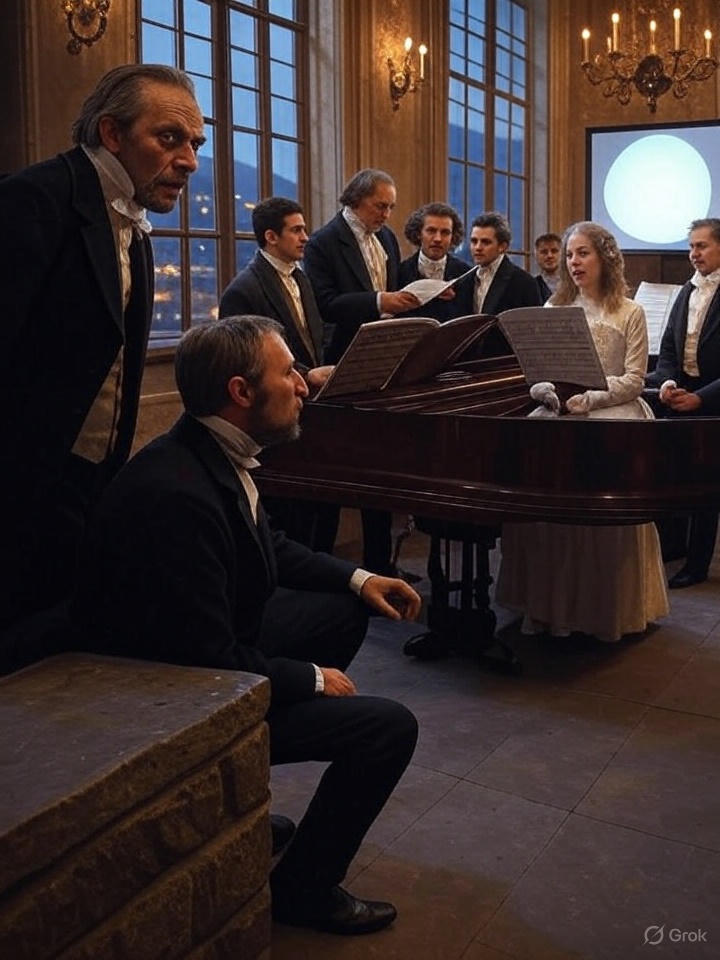
The Schuh leans over there against the wall, legs crossed, head propped against his arm, in a challengingly picturesque pose. He takes no notice of the glances …drawing attention to himself, and when the people ask: “Who is that?” then one or the other will say: “Don’t you know him? That’s the Schuh, the Karl Schuh, the one with the gas microscope and the camera obscura, who’s making such a sensation in Vienna now. He gave demonstrations in the university hall and in the Theresianum in the Society of Physicians and even before the Imperial Family in Schönbrunn. The Baron von Reichenbach met him through the late Baron Jacquin, and he knows why he invited him. Just wait and see what we’ll get to see.”
“I beg you, dear Herr Schuh,” says the baron, “are you ready now to present your pictures?”
Karl Schuh bows: “Certainly, Herr Baron. But you promised that your gracious Fräulein daughter would sing. Everyone is tense, everyone full of joyful anticipation for a refined artistic enjoyment.”
Reichenbach makes a contemptuous hand gesture. “Hermine’s singing master has fallen ill, and there’s no one to accompany her.”
“Is that all?” says Schuh, as a modest self-confidence swells his chest, “I dare to take on the accompaniment.”
“Are you musical too, you jack-of-all-trades?” Reichenbach marvels.
“A little. As I said, if the gracious Fräulein will do me the honor…”
“Come,” and the baron pulls the young man by the hand toward Hermine, who is still desperately rummaging through the sheet music and doesn’t know how she should manage it, to retreat without causing a stir. “Here is the rescuer in need,” says Reichenbach, “Herr Schuh will accompany you.”
Hermine glances shyly up at the young man; this stranger is to accompany her, the risk only grows greater thereby, and a ghastly catastrophe will be the inevitable end. But the young man nods to Hermine with a laugh; he has a merry, good-natured, confident face; he winks roguishly, is not in the least intimidated by the crowd of people in the garden hall, and says: “It’ll be fine. What do you have there?”
A quick glance through the sheet music; “ta-ta … ta-ta-ta-ta,” he hums and takes a few grips on an invisible keyboard: “Well then, if you want to venture it… that’s no witchcraft at all.”
Something of his nonchalance and daring flows invigoratingly over to Hermine. It is no small thing to sing, worn down by the conversation with Doctor Eisenstein and the scene with her father, and in the uncertainty of whether she will find accord with this strange man.
But after the first bars, it becomes lighter in Hermine, a timid glimmering of hope for a happy outcome. At first she had sung as if in a stupor, the notes dancing before her eyes, scarcely hearing herself, crushed by the consciousness of having to sacrifice herself to the Moloch who sat there with fifty heads and gawked at her. But her accompanist masters the piano; he commands it more freely, less pedantically than her teacher, and yields to her in all things. Now Hermine sees the notes again and hears herself and overcomes her uncertainty and sings songs by a half-forgotten Viennese musician named Franz Schubert, of whom the old Meisenbiegel thinks highly.
The Moloch applauds, naturally, how could it do otherwise when the daughter of the house sings? There is no enthusiasm in it, however; this music goes too little into the ear—who is this Franz Schubert, after all?
But then the arias come. From Norma, from The Sleepwalker, there the audience roars, and the applause rages so genuinely and persistently that Hermine must encore “The White Lady.” It is a great success, almost as great as that of Dommeyr, and everyone claps, and Dommeyr embraces the singer, kisses her on the forehead, and says: “It is a crime, my child, if you do not go on the stage.”
Hermine stands radiant, and there is an infinite gratitude in her for the young man who has helped her to this triumph. She would gladly say a good word for him, but he is already away from the piano, for now he comes to his true domain.
The Baron von Reichenbach announces that Herr Karl Schuh will demonstrate his gas microscope and his camera obscura.
“Naturally, in the house of the scholar, science cannot be absent,” remarks the great Liebig to his neighbor, the dermatologist Hebra.
It turns out, however, to be more entertaining than most guests expect. Some preparations are necessary; a white screen is stretched, Schuh sets up an apparatus, and then the candles are extinguished.
Max Heiland uses the opportunity to lean over Dommeyr, as if whispering something in her ear, and kisses her bare shoulder.
The limelight hisses on, and then a bright circle appears on the stretched screen. Into it, the young man now conjures all sorts of strange things: the dotted canals of the conifers, the spiral air vessels of insect larvae, the Purkinje sweat canals, the vascular branchings on the hair bulb, the structure of bones, the enamel substance of the tooth, even the blood corpuscles of the frog.
A thoroughly serious matter, but Karl Schuh handles it wittily and entertainingly. He says: “So that the esteemed ladies know what their enchanting alabaster teeth really look like.”
Or: “Not just with beets and radishes, but also with the most beautiful women’s hair, it depends on healthy roots.”
They are all otherwise invisible things, unveiled secrets of nature, a penetration into the realm of the smallest and most inconspicuous, into a world of overwhelming wonders that the researcher alone normally enters, but which is here brought before all eyes.
No one, however, is so captivated by all of this as Hermine. She sits, surrounded by darkness, all eyes, spellbound by the light circle on the screen. What she wrests from nature through laborious work at the microscope is here laid out before her with seemingly playful ease. Everything this young man tackles seems to yield to him, to submit to his will; one has to do with a person whom life offers no resistances. It is sunshine over him, while one oneself sits on the shady side, oppressed by the heaviness of the blood, incapable of the élan and speed of existence. But there are bridges, airy bridges of double commonality between her and him, not only music, but also science.
And now Karl Schuh is finished and explains only that he is striving with all zeal to further perfect his apparatus and that it is merely a matter of producing an even more light-strong objective, upon which quite different results would then be showable.
And then he too reaps the applause of his very stimulated and satisfied audience. The professors Schrötter, Hebra, and Unger draw near in conversation; Count Coronini and Señor Cevallos y León, attaché at the Spanish embassy, express themselves very approvingly; even the great Liebig honors him with a few words.
Suddenly a commotion arises in the middle of the hall, an unrest, a pressing toward a point; a clump of people balls itself together. It has the appearance as if someone is unwell; certainly someone has become ill; yes, Frau Hofratin Reißnagel has just fainted from her chair.
The attending doctors busy themselves about her, but the young Doctor Eisenstein takes command: “It is nothing… I know it… the Frau Hofratin often suffers under such attacks… it is the heat, the many people, the closed windows… I beg you, make way.”
The Frau Hofrätin is carried into the Chinese room, where it is airier; she is laid on the sofa and washed with ether from Reichenbach’s laboratory. While she slowly revives, the guests depart; they have really stayed too long, and the way back to the city is far, but it has been an exceedingly beautiful evening, successful in every respect, except for the little incident with the Hofrätin, but now it is time to go.
Reichenbach shakes hands, smiles, and lets no one notice that he has a disappointment to overcome, because no one has come forward to point out in a little speech that this festival actually had a special occasion underlying it. It would have been fitting to say something comparable, for example, that one had gathered for the first time today in the house of a Freiherr von Reichenbach or something like that. In any case, it is his wish that no fuss be made of it; but it is certainly not his wish that the painter Heiland takes the Dommeyr’s cloak from the servant’s hand and drapes it over her shoulders himself, and that they then go off together, as if they were glad of their escape.
Karl Schuh stands before him and bows: “Will you be so kind as to have my apparatus returned to me tomorrow?”
“May I keep it for two more days? I would like to examine it more closely. In general, dear friend, I have much to discuss with you. You are a bright mind and a skilled practitioner, from whom even I can still learn a thing or two. And your piano playing—my utmost respect!”
“Won’t you occasionally make music with Hermine here and there? With the old Meisenbiegel, it’s no longer the right thing. Come, you will always be welcome to the father and the daughter.”
“If I may?” Karl Schuh beams with obvious delight, “Nothing could please me more.”
Now everything is gone; even the Frau Hofrätin has been stowed in the carriage and driven home with her husband and Eisenstein. The servants begin to clear up; Reichenbach wanders with hands clasped behind his back, sullenly through the discomfort of the ruins that remain after a festival. In front of the buffet in the rose room, Reinhold siphons remnants from the destroyed bowls and heaps them on a plate.
“Where were you?” asks Reichenbach, “I didn’t see you the whole evening?”
Reinhold startles at the sudden address. He hadn’t heard his father coming and had thought Reichenbach had already withdrawn. One is never safe from the father; he ambushes one often from behind, as if he were always lying in wait. It is vexing to feel caught and to stand there like a schoolboy.
“I could only come late,” says Reinhold with rising defiance, “Schuh was just showing his pictures.”
“Where were you?” asks Reichenbach, “it is strange that you seem to place no value on participating in your father’s gatherings. It was downright embarrassingly noticeable that you were absent.”
Naturally, no one noticed, but for educational reasons it is always appropriate to bring the criminal’s sin to his consciousness. “And I ask you,” the Freiherr continues, “put down the plate when you speak to me. It is not fitting that you stand there with the plate in your hand when you speak to your father.”
Reinhold folds and quickly sets the plate down among the cleared bowls. Yes, the father knows how to deal with budding disobedience in the twinkling of an eye.
“I was in the city,” Reinhold stammers, “in the Chemical Society. We have…”
“I will tell you where you were. You were with your big-mouth heroes, those students whose second word is freedom, those people’s benefactors who only stoke discontent and want to turn everything upside down. Those people are no company for you; remember that, you must take care that you are the son of the Freiherr von Reichenbach. A son of the Freiherr von Reichenbach must not associate with revolutionaries. Understood!”
Reinhold stands at attention, and after Reichenbach has sent a long, stern, threatening gaze after his words, he lets the chastened one go, to look once more at his silkworms before going to sleep.
by Karl Hans Strobl and translated by Joe E Bandel
Chapter 3
Three days after the christening feast, Frau Paleczek was back in the forester’s small cottage, but in a different role than before.
She had a corpse to wash—the body of Frau Ruf, who had died of childbed fever. Despite all brave resistance, death had won out, and Dr. Roskoschny’s hope of pulling her through was dashed. Medicine could name the thing raging in the new mother’s veins, straining her body and twisting her face in agony—childbed fever—but it couldn’t say where it came from or offer a real cure. In the end, it had to leave the outcome to God.
And now Frau Paleczek bent her face, black as the Virgin of Częstochowa or Kiritein, over the ashen one on the red-checkered pillow, dressing the deceased in a clean gown.
And then she said, “Jesus, Mary… seven children… such a pretty young woman… and seven little children … such misery… such misfortune. What’ll you do now, Herr Ruf?”
The forester sits in the corner, head in his hands, silent. What should he do? What can he do? He doesn’t know—seven little children, one a tiny infant, and their mother dead.
“For a few days, I can help out,” Paleczek grumbles in her deepest bass, full of pity, “but I can’t stay long, of course—I’ve got my own business to tend to.” Then, after folding the deceased’s hands over her chest, an idea strikes her. “Maybe your wife’s sister could come, your sister-in-law in Lettowitz. Right?”
The sister-in-law in Lettowitz. Maybe, perhaps the sister-in-law. But the forester is paralyzed, unable to stir. Just three days ago, he was a happy man, a man of importance, sitting between Frau Director and the pastor, bringing home a slight buzz—not from beer or schnapps, but from wine, fine wine like the gentry drink at the castle. And now look at him: seven children, and his wife dead!
Everyone feels great pity for him, all of them. They all come to the funeral, even Frau Director Reichenbach, and many weep as the coffin is lowered into the grave and the six orphans begin to sob. The old count is visibly moved, subdued and distracted in a way wholly unlike him—one might almost say timid. He speaks to no one and leaves after the funeral, heading straight home without looking at anyone. It clearly hits him hard that the woman has died—she used to help out at the castle often. Then Frau Director Reichenbach pulls Ruf aside and says, “You’ve got it tough now, Herr Ruf, but you must keep your head up and trust in God.”
Oh, keep his head up—if only it were that easy, if his head weren’t so heavy, sinking to his chest again and again. Worries weigh like lead.
“I’ll send Susi to you,” says Frau Director. “She’s good with children—she was the eldest of nine at home and had to look after the others. And I’ll come check on you every day.”
That lightens his head a good bit, enough for the forester to lift it and look into Frau Director’s eyes. His hand, no longer so limp, meets hers as she reaches out.
For a few days, Ernsttal and Blansko buzz with talk of Frau Ruf’s death—how young she looked, despite all those children, and how cheerful she always was. They speak of the tragedy of seven motherless children, of Frau Director Reichenbach’s kindness in taking them under her wing, and of the old count sending Ruf a heap of money—a saint of a man, that old count! The talk might have gone on longer, but then comes the news that the machinist Schnuparek, on Sunday, leaving the factory tavern walking out, is struck by sudden illness. A searing pain grips his gut, as if he’d drunk sulfuric acid, tearing his insides apart, turning him inside out. He clutches his stomach, groans, roars, and finally, everything goes black before his eyes.
They find Schnuparek in the roadside ditch, thinking at first he’s drunk, but Schnuparek isn’t drunk—he’s sick. They lift him and carry him to bed. Then Dr. Roskoschny is fetched. He puts on his gravest face, orders vinegar sprayed and juniper burned, and declares it’s cholera that’s struck Schnuparek.
It can no longer be hidden: cholera has come to the land. Now everyone knows what the falling stone from the sky meant. It foretold cholera, the great dying with no escape. There it is—laughing off such things and mocking the fear as foolishness does no good. The great lords don’t know any better than the common folk, and it might’ve been wiser to leave those ill-fated stones where they fell in the forest instead of picking them up and hauling them to the laboratory, as Reichenbach did. Surely they were poisonous, surely they carried the disease.
But what good is the whispering and grumbling now? The specter is here, its first shadow cast over the christening feast, standing among the people, reaching into houses and huts, snatching the farmer from the field, the worker from the lathe, the mold, the furnace, the miner from the pit, the clerk from his books.
Forester Ruf decides it’s time to fetch his sister-in-law from Lettowitz. Two of Frau Director Reichenbach’s maids have fled home to their village, where it might be safer, so Susi is hard to spare, and Frau Director can’t spend all day with the children.
But when Ruf arrives in Lettowitz, he finds his sister-in-law in bed. A few hours ago, she had to lie down, gripped by searing pain in her gut, moaning and groaning, her face burning with fever, blue spots visible on her chest.
Ruf sits with the sick woman for half an hour, giving her drops of Jerusalem miracle balm, good for everything—frostbite, toothache, gout, headaches—then leaves, deeply troubled and at a loss, heading home.
Plenty of fresh air, preaches Dr. Roskoschny, plenty of fresh air and movement.
Work grinds to a halt; people are sick or hiding. This gives Reichenbach time to explore the strange land fate has brought him to. He believes one must know how to gain something from every situation, even making misfortune serve a purpose.
Years ago, when he was at the chemical laboratory of the Polytechnic Institute in Vienna, the old count Hugo met Salm-Reifferscheidt, this region was as foreign to the Swabian as some stretch of the Congo or Niger. Even then, the two men took a liking to each other, bonding over their scientific pursuits. When the old prince handed over the estates and factories to his son to retire, the old count promptly summoned Reichenbach. That was many years ago, and the ironworks and laboratory have consumed so much time and energy that little else could take hold.
Now, though, there’s a chance to look around. It’s a remarkable landscape, these forests in the heart of Moravia—a stretch of limestone with strange sinkholes, caves, and karst rivers. There’s the Macocha, or “Stepmother” in German, a chasm so deep you could set Vienna’s St. Stephen’s Tower in it; caves with bones of prehistoric animals and ancient firepits; underground domes and passages with stalactites. And the rivers! They surge from a rocky maw, dark and unfathomable, only to vanish again into mysterious depths after a brief run above ground.
Reichenbach roams with a geologist’s hammer, tapping cave walls, digging in clay-filled crevices. Then a desire grips him to uncover the secrets of the Punkva River. Others have tried and failed before him, but he will succeed; what others botch only spurs him to push to the utmost.
It’s settled: Reichenbach and the chemist Mader are to venture together, each on a light raft, to probe the Punkva River’s secrets. It must be done discreetly—Friederike Luise shouldn’t know yet; no, it’s better not to tell her, as she’s no fan of such risky undertakings. Reichenbach waits for Mader, then realizes he should say goodbye to Friederike Luise. There’s no real danger, but still, one doesn’t just slip away without a word.
“Where’s your mother?” he asks Reinhold.
Reinhold stands at attention. “She just left for Forester Ruf’s—one of the children is sick, and she’s going to check on them.”
Reichenbach paces impatiently in the garden, plucks a green caterpillar from a rosebush and crushes it, then cuts an unruly vine from the arbor with his knife. Mader’s taking his time—always taking his time. Someone needs to give him a good shake.
Someone passes by the bushes outside. But it’s not Mader—it’s the old count. “Mader sent me,” he smiles. “I’ve switched places with him.”
“What? Mader? Switched?”
“It’s not very nice of you,” the old count says good-naturedly, feigning offense, “keeping secrets from me. Why not take me along, Reichenbach? You know I’m keenly interested in such things. I tried it once long ago with a canoe, but it didn’t work out.”
“So Mader couldn’t keep his mouth shut?”
“Thank God, or I’d have missed out on the fun.”
“But—you know a fellow from Vienna nearly drowned trying to swim it. If his wife hadn’t pulled him out…”
“Does your wife know?”
“No,” Reichenbach says, “she mustn’t find out.”
Then the old count asks, as Reichenbach did earlier, “Where’s your wife?” Perhaps he asks because he thinks it wise to shake her hand before embarking on something rather unusual. He seems uneasy to hear Friederike Luise isn’t home.
“Well, then, let’s go in God’s name,” he says finally.
They walk on foot to avoid drawing attention or involving too many people. But as they pass near the forester’s cottage, they spot Friederike Luise on the meadow path. The old count stops, his face lighting up with joy. “I haven’t had the chance to see you in ages, gracious lady.”
“You were at Ruf’s?” Reichenbach asks.
“Yes, Lada’s very sick—the third eldest. The doctor just arrived and sent me home at once. He was almost rude, told me not to dare come back.”
“Does he think—?” Reichenbach hesitates, reluctant to say the word, as if speaking it aloud carries danger.
“Please be careful,” the old count urges, concerned. “What good does it do? You can’t help, and you have children at home.”
Chapter 60: Freedom: Resisting External Authority for Personal and Collective Evolution
Have you ever felt the subtle chains of expectation—from society’s norms, laws, or collective opinions—pulling you away from your inner voice, making you question if true freedom is even possible in a world that demands conformity? What if that “great enemy” of freedom—external authority—isn’t an unbeatable force but a challenge to resist strategically, forcing win-win compromises that advance both you and humanity? In your essay “Freedom,” you declare freedom springs from within, guided by conscience (the Master Within), while external authority—the collective will—seeks to control for the “greater good,” often sacrificing individuals. Yet, by demanding personal liberty, we evolve the race, turning resistance not into futile war, but a catalyst for growth. This isn’t rebellion for its sake; it’s the Master’s path—fighting unwinnable battles to make a difference, where freedom empowers all life.
This resistance embodies duality as a loving embrace: The containing tyranny of external authority (feminine, grounding us in collective needs like roots in shared soil) harmoniously partners with the expansive assertion of inner freedom (masculine, generative self-expression like branches claiming sky), creating balance without domination. Like an oak tree, whose roots integrate with the forest (collective) yet trunk stands uniquely tall (individual), freedom becomes a dynamic compromise. In this chapter, we’ll expand these concepts into empowering insights, exploring external authority’s role, why the collective “flaw” sacrifices individuals, how resistance forces evolution, and mastery through “unwinnable” stands. Tied to your OAK Matrix, we’ll see freedom as solar plexus/lower emotional energy (will to resist) fueling unity (collective advancement). By the end, you’ll have practical tools to identify authorities, demand inner-guided freedom, and resist strategically, turning oppression into opportunities for personal and global liberation. Let’s claim that sacred right and discover how freedom from within evolves us all.
Freedom from Within: The Sacred Right to Conscience
Freedom isn’t granted—it’s an internal flame, ignited by living according to conscience, the Master Within. Your essay asserts: We each have this sacred right, rejecting external dictates that erode self-power. External authority—anything we surrender to (society, laws, norms)—diminishes us, while inner authority empowers.
Why vital? Submission kills growth; conscience aligns with True Will, advancing personal destiny. Duality as loving embrace: Inner freedom’s containing self-truth (grounding in conscience) lovingly meets external’s expansive demands (generative compromise), harmonizing autonomy with interaction. Deny it? Enslavement; claim it? Liberation.
In OAK: This heart/upper emotional energy—joy in self-rule—resonates root’s grounding for unity’s shared evolution.
Humanity’s main external authority is the collective will—a force prioritizing the whole over individuals, sacrificing some for “greater good.” Your essay warns: It’s not in our best interest; it controls destinies, demanding conformity.
Why “flaw”? Collective resists change, seeing individuality as threat. Yet, this “enemy” can be compromised—resist to force evolution.
Duality embraces: Collective’s containing tyranny (grounding in unity) lovingly meets individual resistance (expansive freedom), harmonizing control with progress. Unresisted? Stagnation; resisted? Win-win growth.
In OAK: Lower emotional fear (collective pressure) fuels solar plexus will (resistance) for heart’s compassion (evolved humanity).
Practical: Identify authority (e.g., societal norm); ask: “Serves my conscience?” Resist if not.
Resisting for Win-Win: Forcing Compromise and Evolution
Direct opposition fails—your essay urges: Force win-win by standing firm, as collective yields to persistent resistance. This advances humanity: Individuality sparks innovation, evolving the race.
Why key? Submission enslaves; resistance liberates all. “Unwinnable” battles define Masters—making differences through freedom.
Duality: Alone stand’s containing resolve (grounding in self) lovingly meets collective’s expansive change (generative compromise), harmonizing isolation with evolution.
In OAK: Unity demands resistance for growth.
Empowerment: In tyranny (e.g., unjust rule), resist strategically—non-action or defiance—force win-win.
Mastery Through Unwinnable Fights: Making a Difference
Mastery comes from “unwinnable” battles—your essay declares: Fight for beliefs, even against odds, to impact the world. Freedom enables this—demand it to evolve humanity and life.
Why? Conformity halts progress; resistance sparks it. Duality embraces: Unwinnable’s containing sacrifice (grounding in purpose) lovingly meets difference’s expansive legacy (generative change), harmonizing loss with gain.
In OAK: Solar plexus will in “unwinnable” fuels unity’s advancement.
Practical: In “lost cause,” affirm: “I fight for freedom’s impact.” Act; feel mastery from effort.
Practical Applications: Demanding and Granting Freedom Daily
Make resistance actionable:
Freedom Demand Journal: List external authority (e.g., norm); note conscience clash. Reflect duality: Containing control + expansive resistance.
Partner Resistance Share: Discuss a “tyrant” with someone (men: expansive stand; women: containing resolve). Explore loving integration. Alone? Affirm, “Inner and outer embrace in me.”
Compromise Ritual: Visualize collective as oak forest; resist as unique tree. Act: Non-action against pressure (e.g., boycott subtly); journal win-win emergence.
These force compromises, emphasizing loving duality over tyranny.
Conclusion: Resist for Freedom’s Evolution
Freedom—inner-guided by conscience—resists external authority’s collective “flaw,” forcing win-win compromises that evolve humanity. Duality’s loving embrace unites individual stands with collective good, turning unwinnable battles into mastery. Like an oak resisting winds to shape the forest, demand freedom to make differences.
This isn’t futile—it’s empowerment. Resist an authority today, stand firm, and watch evolution unfold. Your free life awaits—masterful, impactful, and liberated.
Chapter 51: Social Pressure: Passive-Aggressive Resistance and the Art of Strategic Defiance
Have you ever felt the invisible pull of societal expectations—like during Prohibition, when making a quiet batch of homebrew for personal use felt like a small act of rebellion, yet openly bootlegging invited raids and ruin—leaving you wondering how to challenge unfair rules without becoming an outlaw? What if the key to navigating this pressure lies in choosing your battles wisely: Using passive-aggressive non-action against society’s might, while confronting individuals directly to reclaim your power? In this continuation of your essay “Social Pressure,” you illustrate through historical examples like Prohibition that open defiance against the collective often fails, but subtle resistance forces change over time. This isn’t cowardice; it’s strategic wisdom, recognizing society’s overwhelming power while safeguarding your goals. Never cross the “invisible line” to criminality, and never surrender personal power to others—stand firm where it counts, letting time erode opposition.
This strategy embodies duality as a loving embrace: The containing subtlety of passive-aggressive resistance (feminine, grounding in non-action like roots quietly drawing water) harmoniously partners with the expansive boldness of individual confrontation (masculine, generative assertion like branches claiming space), creating balance without reckless conflict. Like an oak tree, whose roots undermine rocks over years (passive erosion) while its trunk stands unyielding against winds (direct strength), you navigate pressure with patience and resolve. In this chapter, we’ll expand these concepts into empowering tactics, exploring non-action’s power against society, confrontation’s role with individuals, and why letting others lead open rebellions preserves your path. Tied to your OAK Matrix, we’ll see this as solar plexus energy (personal boundaries) integrating with heart’s unity (collective harmony). By the end, you’ll have practical tools to set boundaries, resist wisely, and reclaim power, turning societal flaws into opportunities for win-win freedom. Let’s master this art and discover how strategic defiance empowers a life of integrity and achievement.
Prohibition’s Lesson: Non-Action vs. Open Defiance
Your essay uses Prohibition as a vivid example: Manufacturing alcohol was illegal, but quiet personal production often went ignored—law enforcement targeted bootleggers selling publicly. Those in open defiance suffered raids, arrests, and violence; those altering lifestyles subtly (homebrewing discreetly) avoided conflict, effectively resisting without crossing lines.
Why effective? Non-action created stalemates—society couldn’t enforce fully, pressures built, leading to repeal. Open rebellion? Branded criminals, isolated and crushed.
Duality as loving embrace: Non-action’s containing discretion (grounding in safety) lovingly meets defiance’s expansive challenge (generative change), harmonizing subtlety with impact. Force confrontation? Loss; patience? Victory over time.
In modern terms: Unjust law (e.g., invasive privacy rule)? Non-act—adapt lifestyle to comply minimally, without open protest. This erodes enforcement, forcing societal shift.
Empowerment: In pressure, ask: “Can non-action force change?” This turns flaw into advantage.
Passive-Aggressive Power: Effective Against Society, Not Individuals
Passive-aggressive—non-compliance without defiance—is mighty against collectives but harmful with people. Your essay explains: Against society, it stalemates, building pressure until compromise. Penalties escalate, but enforcement wanes—resolutions favor the persistent.
Why not for individuals? It breeds resentment, weakening bonds. Duality twisted: Containing avoidance clashes with relational expansive openness, causing conflict.
Embrace duality: Use passive-aggressive for systems (society), confrontation for personal (individuals). This harmonizes resistance with connection.
Like oak roots passively eroding rock (society) while trunk confronts wind directly (individuals), strategy fits context.
Confrontation with Individuals: Reclaiming Power Directly
For people, confront squarely—your essay warns: Passive-aggressive increases abuse; defiance reclaims power. Never let others decide for you—giving power expects misuse.
Why? Surrender weakens position; stand, and you affirm worth. Duality embraces: Confrontation’s expansive assertion (generative boundary) lovingly meets issue’s containing tension (grounding in truth), harmonizing conflict with resolution.
In OAK: This heart/upper emotional energy—compassionate stand—fuels solar plexus will.
Empowerment: In abuse, affirm: “I reclaim my power.” Confront calmly; feel strength from integrity.
Letting Others Lead Rebellion: Preserving Your Path
Open defiance against society invites outcast status—your essay advises: Let others cross lines; you benefit from change without cost. This isn’t selfish; it’s strategic—preserve position for goals.
Duality: Alone defiance (containing risk) lovingly meets collective shift (expansive benefit), harmonizing personal safety with societal progress.
Like oak letting winds topple weak trees (others’ rebellion) while standing firm, you gain from outcomes without scars.
Empowerment: In injustice, support quietly; avoid front lines. This keeps support intact.
Standing Alone: The Test of True Resolve
When defiance peaks, isolation hits—your essay notes: This “alone” phase is temporary, testing will. Society reevaluates post-success, seeing harmony.
Duality embraces: Isolation’s containing solitude (grounding in self) lovingly meets resolution’s expansive validation (generative reconnection), harmonizing trial with triumph.
In OAK: Lower emotional courage sustains higher mental insight.
Empowerment: In alone moments, affirm: “I stand for win-win; allies return.” This turns test into growth.
Partner Defiance Share: Role-play with someone (men: expansive confrontation; women: containing non-action). Discuss loving integration. Alone? Affirm, “Subtlety and boldness embrace in me.”
Boundary Ritual: Visualize oak in storm—roots non-act against erosion, trunk confronts wind. Act: Set non-action (society) or confront (individual); journal outcomes.
These navigate pressure, emphasizing loving duality over defeat.
Conclusion: Master Pressure for Empowered Freedom
Social pressure’s “flaw”—overpowering individuals—demands win-win alignment through passive-aggressive for society, confrontation for people. Duality’s loving embrace unites personal integrity with collective harmony, turning flaws into strengths. Like an oak standing in wind yet rooted in soil, navigate wisely for freedom.
This isn’t submission—it’s empowerment. Apply a strategy today, stand firm, and watch win-wins unfold. Your balanced life awaits—strategic, resilient, and free.
Chapter 11: Educational Freedom: Unlocking the Power of Knowledge for All
Imagine waking up in a world where reading a book, writing a letter, or even questioning the stars above is a rare privilege reserved for the elite. For most of human history—spanning over 2,000 years—this was reality. The average person lived without access to education, relying on oral stories, superstitions, and the dictates of those in power. But what if education wasn’t a luxury, but a fundamental right that empowers you to think deeply, challenge norms, and shape your own destiny? That’s the essence of educational freedom: the idea that knowledge should be open to everyone, fostering personal growth, resilience, and a richer life.
In this exploration, we’ll journey through history to see how literacy and deep thinking have been sparks of revolution—and often targets of suppression. We’ll uncover the roots of secret societies like the Rosicrucians and Freemasons, born from ancient wisdom traditions, and trace how monotheism and philosophical ideas emerged from unexpected places. By understanding this, you’ll see why education isn’t just about facts; it’s about awakening your inner potential, much like a seed growing into a mighty oak tree. Knowledge builds layer by layer, helping you stand tall against life’s storms. Let’s dive in and discover how embracing educational freedom can transform you from a passive observer to an empowered creator of your own path.
The Dawn of Literacy: High Points and Hidden Dangers
Picture ancient Greece around 500 BCE, where philosophers like Socrates, Plato, and Aristotle roamed the streets of Athens, debating ideas about ethics, reality, and the human soul. This wasn’t just idle talk—it was a golden age of literacy and critical thinking that influenced laws, science, and democracy. Their concepts seeped into the Roman Republic, shaping an empire that valued education as a tool for citizenship and innovation.
But Greece wasn’t alone. In Ireland, Celtic scholars preserved knowledge through oral traditions and early writing, blending mythology with practical wisdom. Meanwhile, Jewish communities emphasized literacy as a religious duty, studying texts like the Torah to understand life’s deeper meanings. These cultures thrived because education wasn’t hoarded; it was shared, creating vibrant societies where people could question, innovate, and grow.
Yet, history shows a darker side: knowledge can be dangerous to those in power. Educated groups often faced persecution. The Irish scholars were marginalized during invasions, their lore dismissed as pagan. Jewish communities endured pogroms and exiles, partly because their literacy made them resilient and independent thinkers. Why? Because an educated mind doesn’t blindly follow; it asks “why” and “how.” This challenges authority, sparking fear in rulers who prefer obedience over enlightenment.
For the average reader today, this is empowering: Think about your own life. Have you ever read a book that changed how you see the world, like a self-help guide or a history text? That’s the power of literacy—it’s your shield against manipulation and your key to self-discovery. In a world of misinformation, educational freedom means learning to discern truth, just as those ancient thinkers did.
The Dark Ages: When Knowledge Was Locked Away
Fast-forward to medieval Europe, where the fall of Rome and the rise of the Roman Catholic Church plunged the continent into the Dark Ages (roughly 500–1000 CE). Literacy plummeted as the Church became the gatekeeper of knowledge. Monasteries copied ancient texts, but only clergy could access them. The average peasant lived in ignorance, told what to believe by priests who interpreted the Bible for them.
This wasn’t accidental. The Church viewed independent thinking as a threat to its authority. Philosophical ideas from Greece or mystical traditions were labeled heretical, leading to the loss of countless works. Imagine living then: Your world is limited to farm work, church sermons, and fear of eternal damnation. No books, no debates—just blind faith in external powers.
But sparks of resistance flickered. Secret societies emerged to preserve forbidden knowledge. Rosicrucianism, with its roots in alchemy and mysticism, promised enlightenment through hidden teachings. Freemasonry, too, arose as a brotherhood of builders and thinkers, encoding ancient wisdom in symbols and rituals. These groups weren’t just clubs; they were lifelines for educational freedom, teaching members to question and explore beyond dogma.
Empowerment tip: In today’s digital age, you have libraries at your fingertips via apps and online courses. Use them! Use free resources like Khan Academy or Project Gutenberg to build your “foundation”—basic skills that open doors to deeper philosophy. Remember, every bit of knowledge you gain reduces someone else’s control over your mind.
The Egyptian Roots: Monotheism and Mystery Schools
To understand these societies, we must go back further—to ancient Egypt around 1350 BCE. Pharaoh Akhenaten revolutionized religion by declaring one supreme god, Aten (often linked to the sun god Ra), over the old polytheistic pantheon. This was the world’s first recorded monotheism: the belief in a single, all-encompassing deity. Akhenaten’s hymns to Aten are poetic, describing a loving, creative force that sustains all life.
At the heart of this was Heliopolis, Egypt’s mystery school—a center for advanced learning in astronomy, magick, and healing. Students like Moses, according to biblical stories, trained there. Moses, born to enslaved Hebrews but raised as Egyptian royalty, absorbed these ideas. When he led his people out of Egypt, he brought monotheism with him. The Old Testament recounts Moses receiving the Ten Commandments from Yahweh on Mount Sinai—a pivotal shift from idol worship (like the golden calf) to one God.
This Egyptian influence echoes in Judaism, Christianity, and Islam, which share the Old Testament. But here’s the twist: Rosicrucians and Freemasons trace their origins to Heliopolis too. Freemasons link to “King Solomon’s Temple,” blending Jewish mysticism (Kabbalah) with Egyptian lore. The Scottish Rite of Freemasonry is openly Kabbalistic, drawing on pre-Christian Jewish texts for symbolic teachings about the soul’s journey. The York Rite incorporates Christian elements, like an Egyptian high priest converting to the new faith.
Rosicrucians, meanwhile, blend alchemy (turning base metals to gold as a metaphor for spiritual growth) with Gnostic Christianity—a mystical branch emphasizing personal divine knowledge over Church doctrine. Condemned as heretics, they operated in secret, preserving ideas like the unity of science and spirit.
For you, the average reader, this history is liberating. It shows that “truth” isn’t owned by one group—it’s a tapestry woven from diverse cultures. Educational freedom means exploring these roots yourself, perhaps reading “The Kybalion” (Hermetic philosophy from Egypt) or “The Bible” with fresh eyes. You’ll discover empowering concepts, like viewing God as an inner light rather than a distant judge.
Building Foundations: The Path to a Richer Life
Why does all this matter? Because true education isn’t rote learning—it’s building a foundation for philosophy. Concepts like duality (balance of opposites) or self-mastery can’t be grasped without basics like reading, history, and critical thinking. In the Dark Ages, the Church’s monopoly meant people lived shallow lives, controlled by fear.
Today, educational freedom is your superpower. It frees you from “external authorities”—bosses, media, or traditions that dictate your beliefs. Start small: Read one book a month on philosophy or history. Join online communities discussing Freemasonry or Rosicrucian ideas (safely, of course). Practice journaling: What beliefs hold you back? How can knowledge change that?
Imagine applying this: A parent teaching kids to question ads, or a worker learning skills to start a business. That’s empowerment—turning knowledge into action, like ancient philosophers building democracies.
Conclusion: Claim Your Educational Freedom
From Egypt’s mystery schools to Europe’s secret societies, history teaches that knowledge is power—and those who hoard it fear the empowered. But in our era, education is more accessible than ever. Embrace it: Read widely, think deeply, and integrate wisdom into your life. Like the oak tree, root yourself in foundational knowledge, then branch out to new heights.
Educational freedom isn’t just about the past—it’s your future. It transforms you from a follower into a leader of your own story. So, pick up a book today. Question everything. And watch how your world expands.


 Anarchistbanjo's World