Feeds:
Posts
Comments

Posts Tagged ‘history’

A Modern Inquiry into the Hermetic Mystery

Part III: Concerning the Laws and Vital Conditions of the Hermetic Experiment

Chapter 4: Mental Requisites and Impediments, Part 1

Introduction: The Hermetic art demands a pure and disciplined mind to transform the soul’s essence into divine light. This chapter explores the mental qualities and obstacles for those pursuing this sacred science, emphasizing wisdom, faith, and moral integrity.

The Qualities of the Adept

Geber, in his Sum of Perfection, outlines the mental requisites for mastering the Hermetic art. Success requires a sharp, searching intellect, capable of probing nature’s deepest principles with subtlety and reason. The adept must possess natural sagacity, free from fantasy or impulsiveness, to discern truth from illusion. A stable mind, grounded in rational inquiry, is essential to navigate the complexities of this sacred science.

Geber stresses that the art is not for those with weak or corrupted faculties—whether physical or mental. A soul swayed by fleeting opinions, clouded by imagination, or lacking discernment cannot achieve the divine transformation. Only those with clarity and perseverance can uncover the “true Radix,” the root of alchemical wisdom.

The Impediments of the Mind

Many obstacles hinder the pursuit of Hermetic science. Geber identifies those with “stiff necks”—lacking ingenuity or curiosity—who fail to explore nature’s depths. Others, driven by fantasy, mistake illusion for truth, their minds clouded by “fumosities.” Some are fickle, shifting beliefs without reason, unable to sustain the disciplined focus required. Worst are those who deny the art’s validity or seek it for greed, fearing to sacrifice personal gain for divine truth.

The greatest danger, as the Book of Enoch warns, lies in misusing alchemical knowledge for selfish ends. Such minds, led by “Mammon,” defile the divine light, turning sacred wisdom into sorcery. True adepts, guided by piety, reject these profane motives, ensuring the art remains a holy pursuit.

The Path of Purity and Faith

The Hermetic art demands a heart free from avarice, pride, or deceit, as Job declares: “If I have made gold my hope, I have denied the God above.” Only through faith, humility, and moral integrity can the adept align with divine wisdom. This science, as Norton’s Ordinal emphasizes, is a “singular grace” bestowed on those proven worthy, taught “mouth to mouth” with a sacred oath to protect its sanctity.

Closing: This chapter unveils the mental requisites and impediments for mastering the Hermetic art, emphasizing purity and faith. The journey into its practical secrets deepens in our next post, unveiling further wonders of this sacred pursuit.

Read Full Post »

Madame Bluebeard by Karl Hans Strobl and translated by Joe E Bandel

Eleventh Chapter
Rotrehl’s small house at the forest’s edge offered
summer guests lodging in its upper floor each year.
There were two cozy rooms: one faced forward,
overlooking the Kamp valley, with Vorderschluder’s
castle and scattered cottages visible below. The
other’s window gazed directly into the woods, where
a great beech stood so close that, on windy nights, its
branches tapped the panes.
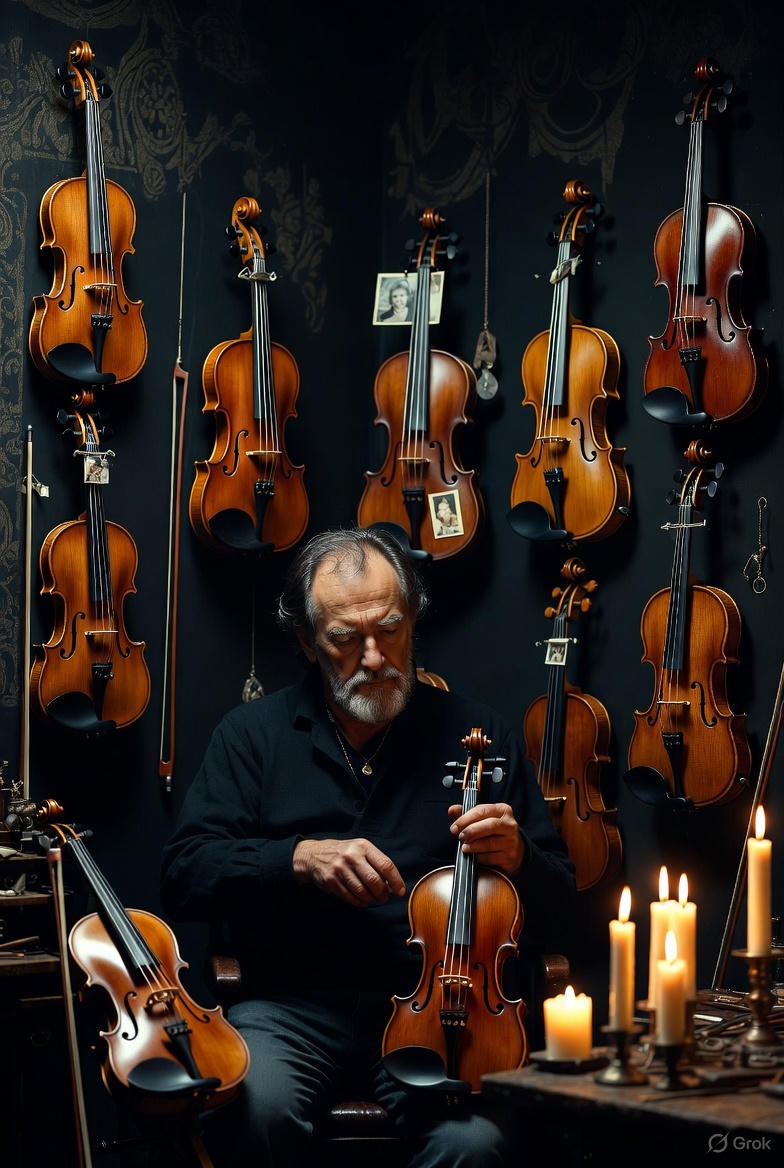
On the ground floor lived the violin-maker. At the
back was a gloomy kitchen; in front, a large, bright
room served as Rotrehl’s living, sleeping, and
workspace. Here, he crafted fine violins, some of
which traveled to the city with summer guests each
autumn. On the wall by his workbench hung five
violins, coveted by many buyers but never sold. They
hung in a row, each with a name painted in clumsy,
crooked black letters beneath: Jean – François –
Antoine – Madeleine – Marie. Below each name, a
cross and date marked the memorials to his wife and
four children. He’d kept his wife’s German name but
honored the French blood in his children. These
memorial violins had a soft, sweet, mournful tone.
On long winter evenings, after setting work aside,
Rotrehl would take one down and play simple,
melancholic tunes—songs heard nowhere else, alive
only in his heart. He played until sadness lifted. On
All Saints’ Day, the feast of the dead, he took all five
from the wall, lighting five candles on his
workbench. He played each violin in turn,
extinguishing a candle as he set each aside, until he
sat in darkness. But he was no longer alone—his wife
and children surrounded him, the room filled with
kind words, growing ever brighter.
Across from the bed, a large lithograph of
Napoleon hung beside a mirror. In it, Rotrehl sought
resemblances between his features and the great
conqueror’s, rewarding Napoleon with a fresh oak
sprig or garden flowers when confirmed. In a corner,
a bookshelf held a modest library: a Bible, a German
school association calendar, and several French
books. Rotrehl knew no French, but on heroic days,
feeling his French blood, he’d take one down and
read, tracing lines with his finger, straining eyes and
mind. He was certain enlightenment would come
before his death, revealing all. A summer guest fluent
in French once caught him at it, laughing
uproariously at the violin-maker poring over a French
cookbook. Since then, Rotrehl locked the door when
reading French.
Summer guests were often a nuisance, prying into
everything, but their money was vital for the lean
winter. This year’s early guest, however, pleased
Rotrehl. Herr Schiereisen wasn’t as intrusive. He
roamed the countryside daily, quizzing farmers,
borrowing old church records from priests and village
protocols from aldermen to study river and place
names. He chatted with locals about this and that,
occasionally asking about Herr von Boschan and his
young wife, as one does when thoroughly researching
a region.
Winning Rotrehl’s trust with his reserve,
Schiereisen drew the violin-maker’s interest in his
peculiar studies.
“What’s it all for, Herr Professor?” Rotrehl asked
one evening as Schiereisen sorted notes on a rickety
garden table. It was a warm, spring-like evening. A
gentle, fragrant south wind had blown for days,
filling the Kamp valley with scent. Sitting outdoors
was pleasant.
“Well,” Schiereisen said, fixing an earnest gaze on
Rotrehl, “long before Germans settled here, there was
another people. Nearly all traces of them are lost—
we don’t even know their language precisely. Yet
science has uncovered some things. Place and river
names sometimes trace back to the Celts. So, we
study how these names were spoken and written.
Then there’s skull measurements and facial features,
which also prove ancient blood mixtures…”
Rotrehl eyed the scholar thoughtfully. “Yes…
facial features, right? They’re proof? Surer than
papers. Papers can be lost… but not faces.”
Schiereisen placed a stone on his notes to keep the
spring breeze from stealing them. “Our methods
should interest you especially. Your case is strikingly
clear. You’ve good reason to hang Napoleon over
your bed. Tracing your lineage would be
rewarding… you differ markedly from this region’s
typical peasant type.”
This struck a chord with Rotrehl. The words
flowed into him like fiery, aged wine. He savored the
moment in silence, then said in a low, mournful voice
that it was a pity his line had dwindled—all dead,
swept away, only he remained.
Schiereisen murmured about fate’s tragedy, the
fall of noble blood, and the triumph of the inferior,
veering into theories of long and short skulls.
Rotrehl felt his personal fate gain weight, merging
with history’s grand stream. He grew in his own eyes,
grateful to Schiereisen for this elevation. This city
man could be trusted with anything. So Rotrehl spoke
of his time in Vienna, gaining higher learning, of his
children’s deaths, and the violins he’d crafted in their
memory, bearing their names.
They often discussed matters Rotrehl otherwise
kept private. With Schiereisen, usual cautions
weren’t needed. He could even share his thoughts on
the castle folk.
Sometimes, Rotrehl’s friend, old Johann from the
castle, visited. Before him, Rotrehl held back
opinions about Frau Helmina, as Johann brooked no
criticism of her. One might think him smitten. Saying
“the gracious lady” warmed his heart; whispering
“Helmina” with trembling daring lit his face like
sunrise. Yes, she’d been willful and moody, and Herr
Dankwardt had sighed often, but he should’ve been
happy.
Schiereisen enjoyed chatting with the old servant,
asking about countless trifles—the former masters’
lifestyles, their quarrels with Helmina, their finances,
their deaths. Johann answered tirelessly, relishing any
chance to speak of his mistress.
“How did Herr von Boschan meet Frau Helmina?”
Schiereisen asked.
“I don’t know. Must’ve been in Abbazia. The
gracious lady was there last year.”
“So Herr von Boschan was never at the castle
before?”
“Never.”
“Absolutely certain? Never during Herr
Dankwardt’s time? Think carefully.”
Johann didn’t hesitate. “I’m sure,” he said. “Herr
von Boschan first came last autumn. The very first
time…”
“Do you know if Frau Helmina knew him
earlier?”
“I don’t. But… no. She likely didn’t, as he was
traveling for years. He brought a servant, an Indian,
they say at the castle—God knows where he’s been.”
A suspicion began to fade, a trail dissolving.
“How does Frau Helmina get along with her
current husband?” Schiereisen pressed. “No disputes,
like before…?”
Johann shook his head. “I’ve noticed nothing.
He’s the first to handle her right, knows her worth. I
think,” he smiled, “he loves her dearly. Though…”
he paused.
Schiereisen seized the opening. “Have you noticed
something? A rift, any estrangement…?”
“No… it’s just… the gracious sir’s been a bit
nervous lately. For some time, they’ve had separate
bedrooms.”
“Oh? You mean, due to his nervousness, or…?”
The thrill of the hunt made Schiereisen’s questions
rapid and pressing, though only Rotrehl noticed. Old
Johann found it natural that anyone would take a
keen interest in everything concerning his mistress.
“Yes… he’s a bit nervous… says he can’t sleep in
a shared room. His nerves won’t allow it… he gets
anxious… often wanders half the night, unable to
sleep. That disturbed the gracious lady, of course. It
was sensible of him to take a separate room until it
passes…”
“And before, he wasn’t like this? He was—
healthy?” Schiereisen grew calmer, his focus
sharpening as he followed a thread.
“He’s quite healthy now,” Johann said. “I think
the gracious lady has no cause for complaint. You’d
notice no nervousness otherwise. Just these nighttime
episodes… when alone, he’s spared them. It’s surely
from that time he nearly suffocated. No wonder it left
a mark.”
This was new. Schiereisen maneuvered his
questions like chess pieces, keeping his strategy clear
in mind.

Read Full Post »

A Modern Inquiry into the Hermetic Mystery

Part II: A More Esoteric Consideration of the Hermetic Art and Its Mysteries

Chapter 3: The Mysteries Continued, Part 1

Introduction: The ancient mysteries guide the soul through purificative rites to uncover its divine essence. This chapter explores the transformative process of dissolving sensory bonds, revealing a profound wisdom beyond modern mesmerism’s reach.

The Lesser Mysteries and Initial Revelation

The Lesser Mysteries, open to all, introduced aspirants to the soul’s inner life, a fertile field of contemplation where imagination roamed freely without discipline. Like modern mesmerism, which reveals trance phenomena such as insensibility, healing, and mental exaltation, these rites offered a glimpse of another life but effected little change. Mesmerism, working with the same vital spirit, shows the soul’s intrinsic intelligence—its ability to perceive hidden truths—but its revelations, like those of the Lesser Mysteries, remain superficial, satisfying only the curious.

The ancients, seeking deeper truth, passed beyond these initial phenomena to investigate the soul itself. Roger Bacon declares, “I wish to dissolve the philosophers’ egg and explore the parts of the philosophical man, for this is the beginning of greater things.” Theurgists aimed to concentrate the soul’s vitality, purify its essence, and know it in unity, not merely to roam its sphere but to penetrate its divine source through disciplined art.

The Art of Dissolution

Theurgic rites dissolved the soul’s sensory bonds, unlike mesmerism’s temporary trances. Alchemists described this as a “perfect solution,” where the dense, earthy spirit of sense is rarified into a passive, flowing essence. Albertus Magnus explains, “The work begins with dissolution, making the fixed volatile and the volatile fixed, perfecting the solar and lunar forms through repetition.” This process, akin to dissolving alkali with acid, transforms the soul’s animal nature into a receptive, spiritual state.

Modern theories of mesmerism suggest the sensible medium is overcome or drawn away, but alchemists insisted it must be dissolved, freeing the spirit from its dark dominion. This dissolution, veiled from the uninitiated, prepared aspirants for deeper mysteries, requiring rigorous ordeals to ensure only the worthy proceeded.

The Descent to the Infernal Regions

The Greater Mysteries involved a perilous descent into the soul’s chaotic depths, depicted as Hades or Avernus. Virgil’s Aeneid describes this as a dark, vast cave surrounded by “deep forests and impenetrable night,” with Cocytus’ sable waves. This is no physical realm but a vital submersion, a state of consciousness drawn to the soul’s primal chaos, the “Black Saturn” of adepts—corrupt, fetid, yet the origin of transformation. Sendivogius calls it “Urinus Saturni,” watering the soul’s lunar and solar aspects, while others name it a “mineral tree,” bearing blessed waters to nurture new life.

The descent is easy, as Virgil’s Sybil warns: “The gates of Dis stand open night and day. But to retrace your steps to the upper air—that is the labor.” Only those favored by divine virtue or Jupiter’s love succeed. The soul, purified of sensory illusions, must wield a rational will to resist the dark sphere’s temptations, guided by the “golden bough”—a symbol of divine intellect, flexible and radiant, penetrating the murky ether to reach the soul’s true essence.

Closing: This chapter unveils the mysteries’ purificative rites, dissolving sensory bonds to prepare the soul for its perilous descent into divine truth. The transformative journey deepens, promising further revelations of the Theurgic art in our next post.

Read Full Post »

Alraune by Hanns Heinz Ewers and translated by Joe E Bandel

Chapter Four
Gives the particulars of how they found Alraune’s mother

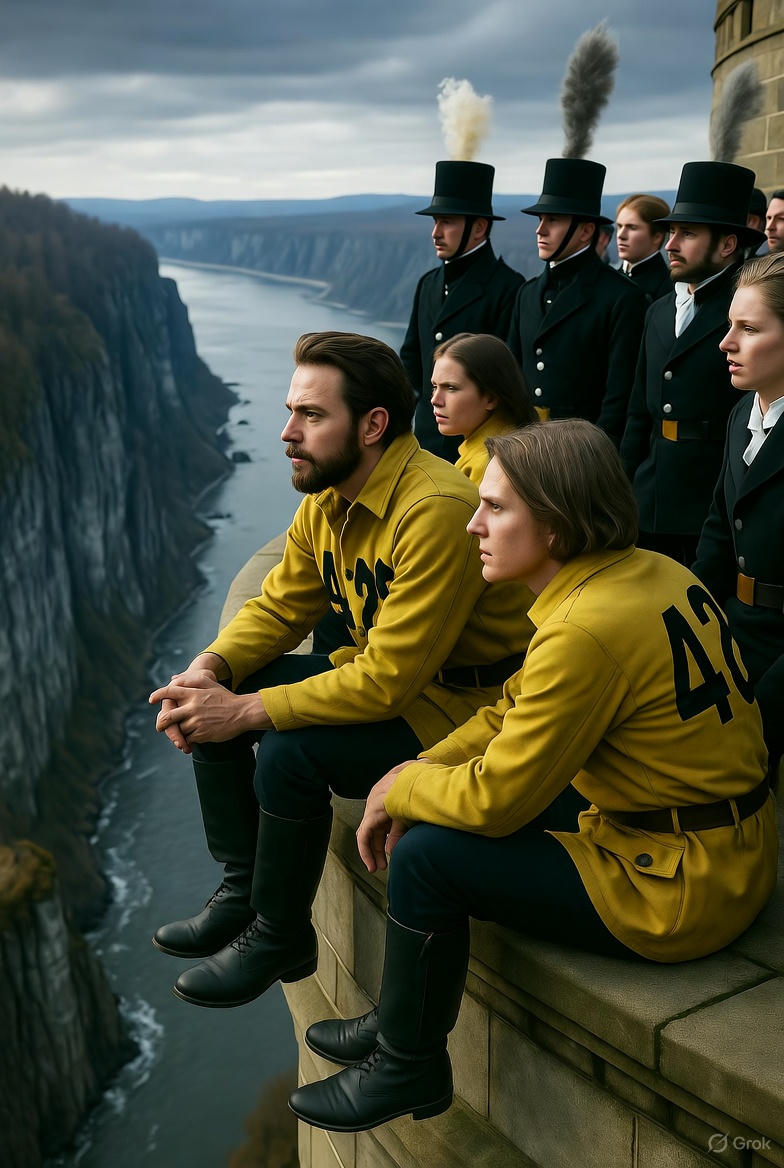
FRANK Braun sat above on the ramparts of Festung
Ehrenbreitstein, a fortified castle overlooking Koblentz. He
had sat there for two months already and still had three
more to sit, through the entire summer. Just because he had
shot a hole through the air, and through his opponent as well.
He was bored. He sat up high on the parapet of the tower, legs
dangling over the edge looking at the wide broad view of the Rhine
from the steep cliffs. He looked into the blue expanse and yawned,
exactly like his three comrades that sat next to him. No one spoke a
word.
They wore yellow canvas jackets that the soldiers had given
them. Their attendants had painted large black numbers on the backs
of their jackets to signify their cells. No.’s two, fourteen and six sat
there; Frank Braun wore the number seven.
Then a troop of foreigners came up into the tower, Englishmen
and Englishwomen led by the sergeant of the watch. He showed them
the poor prisoners with the large numbers sitting there so forlorn.
They were moved with sympathy and with “oohs” and “ahs” asked
the sergeant if they could give the miserable wretches anything.
“That is expressly forbidden,” he said. “I better not see any of
you doing it.”
But he had a big heart and turned his back as he explained the
region around them to the gentlemen.
“There is Koblenz,” he said, “and over there behind it is
Neuwied. Down there is the Rhine–”
Meanwhile the ladies had come up. The poor prisoner stretched
out his hands behind him, held them open right under his number.
Gold pieces, cigarettes and tobacco were dropped into them,
sometimes even a business card with an address.
That was the game Frank Braun had contrived and introduced up
here.
“That is a real disgrace,” said No. fourteen. It was the cavalry
captain, Baron Flechtheim.
“You are an idiot,” said Frank Braun. “What is disgraceful is that
we fancy ourselves so refined that we give everything to the petty
officers and don’t keep anything for ourselves. If only the damned
English cigarettes weren’t so perfumed.”
He inspected the loot.
“There! Another pound piece! The Sergeant will be very happy–
God, I made out well today!”
“How much did you lose yesterday?” asked No. two.
Frank Braun laughed, “Pah, everything I made the day before
plus a couple of blue notes. Fetch the executioner his block!”
No. six was a very young ensign, a young pasty faced boy that
looked like milk and blood. He sighed deeply.
“I too have lost everything.”
“So, do you think we did any better?” No. fourteen snarled at
him, “And to think those three scoundrels are now in Paris amusing
themselves with our money! How long do you think they will stay?”
Dr. Klaverjahn, marine doctor, fortress prisoner No. two said, “I
estimate three days. They can’t stay away any longer than that
without someone noticing. Besides, their money won’t last that long!”
They were speaking of No.’s four, five and twelve who had
heartily won last night, had early this morning climbed down the hill
and caught the early train to Paris–“R and R”–a little rest and
relaxation, is what they called it in the fortress.
“What will we do this afternoon?” No. fourteen asked.
“Will you just once think for yourself!” Frank Braun cried to the
cavalry captain.
He sprang down from the wall, went through the barracks into
the officer’s garden. He felt grumpy, whistled to get inside. Not
grumpy because he had lost the game, that happened to him often and
didn’t bother him at all. It was this deplorable sojourn up here, this
unbearable monotony.
Certainly the fortress confinement was light enough and none of
the gentlemen prisoners were ever injured or tormented. They even
had their own casino up here with a piano and a harmonium. There
were two dozen newspapers. Everyone had their own attendant and all
the cells were large rooms, almost halls, for which they paid the
government rent of a penny a day. They had meals sent up from the
best guesthouses in the city and their wine cellar was in excellent
condition.
If there was anything to find fault with, it was that you couldn’t
lock your room from the inside. That was the single point the
commander was very serious about. Once a suicide had occurred and
ever since any attempt to bring a bolt in brought severe punishment.
“It was idiotic thought,” Frank Braun, “as if you couldn’t commit
suicide without bolts on your door!”
The missing bolt pained him every day and ruined all the joy in it
by making it impossible to be alone in the fortress. He had shut his
door with rope and chain, put his bed and all the other furniture in
front of it. But it had been useless. After a war that lasted for hours
everything in his room was demolished and battered to pieces. The
entire company stood triumphant in the middle of his room.
Oh what a company! Every single one of them was a harmless,
kind and good-natured fellow. Every single one–to a man, could chat
by themselves for half an hour–But together, together they were
insufferable. Mostly, it was their comments, that they were all
depressed. This wild mixture of officers and students forgot their high
stations and always talked of the foolish happenings at the fortress.
They sang, they drank, they played. One day, one night, like all the
rest. In between were a few girls that they dragged up here and a few
outings down to the town below. Those were their heroic deeds and
they didn’t talk about anything else!
The ones that had been here the longest were the worst, entirely
depraved and caught up in this perpetual cycle. Dr. Burmüller had
shot his brother-in-law dead and had sat up here for two years now.
His neighbor, the Dragoon lieutenant, Baron von Vallendar had been
enjoying the good air up here for a half year longer than that. And the
new ones that came in, scarcely a week went by without them trying
to prove who was the crudest and wildest–They were held in highest
regard.
Frank Braun was held in high regard. He had locked up the piano
on the second day because he didn’t want to listen any more to the
horrible “Song of Spring” the cavalry captain kept playing. He put the
key in his pocket, went outside and then threw it over the fortress
wall. He had also brought his dueling pistols with him and shot them
all day long. He could guzzle and escape as well as anyone up here.
Really, he had enjoyed these summer months at the fortress. He
had dragged in a pile of books, a new writing quill and sheets of
writing paper, believing he could work here, looking forward to the
constraint of the solitude. But he hadn’t been able to open a book, had
not written one letter.
Instead he had been pulled into this wild childish whirlpool that
he loathed and went along with it day after day. He hated his
comrades–every single one of them–
His attendant came into the garden, saluted:
“Herr Doctor, A letter for you.”
A letter? On Sunday afternoon? He took it out of the soldier’s
hand. It was a special express letter that had been forwarded to him up
here. He recognized the thin scrawl of his uncle’s handwriting. From
him? What did his uncle suddenly want of him? He weighed the letter
in his hand.
Oh, he was tempted to send the letter back, “delivery refused”.
What was going on with the old professor anyway? Yes, the last time
he had seen him was when he had traveled back to Lendenich with
him after the celebration at the Gontrams. That was when he had tried
to persuade his uncle to create an alraune creature. That was two years
ago.
Ah, now it was all coming back to him! He had gone to a
different university, had passed his exams. Then he had sat in a hole
in Lorraine–busy as a junior attorney–Busy? Bah, he had set out in
life thinking he would travel when he got out of college. He was
popular with the women, and with those that loved a loose life and
wild ways. His superior viewed him very unfavorably.
Oh yes, he worked, a bit here and there–for himself. But it was
always what his superior called public nuisance cases. He sneaked
away when he could, traveled to Paris. It was better at the house on
Butte Sacrée than in court. He didn’t know for sure where it would all
lead. It was certain that he would never be a jurist, attorney, judge or
other public servant. But then, what should he do? He lived there, got
into more debt every day–
Now he held this letter in his hand and felt torn between ripping
it open and sending it back like it was as a late answer to a different
letter his uncle had written him two years ago.
It had been shortly after that night. He had ridden through the
village at midnight with five other students, back from an outing into
the seven mountains. On a sudden impulse he had invited them all to
a late midnight meal at the ten Brinken house.
They tore at the bell, yelled loudly and hammered against the
wrought iron door making such a noise that the entire village came
running out to see what was happening. The Privy Councilor was
away on a journey but the servant let them in on the nephew’s
command. The horses were taken to the stable and Frank Braun woke
the household, ordered them to prepare a great feast. Frank Braun
went into his uncle’s cellar and brought out the finest wines.
They feasted, drank and sang, roared through the house and
garden, made noises, howled and smashed things with their fists.
Early the next morning they rode home, bawling and screaming,
hanging on to their nags like wild cowboys, one or two flopping like
old meal sacks.
“The young gentlemen behaved like pigs,” reported Aloys to the
Privy Councilor. Yet, that wasn’t it. That wasn’t what had made his
uncle so angry. He didn’t say anything about it.
On the buffet there had been some rare apples, dew fresh
nectarines, pears and peaches out of his greenhouse. These precious
fruits had been picked with unspeakable care, wrapped in cotton and
laid on golden plates to ripen. But the students had no reverence at all
for the professor’s loves, were not respectful of anything that had
been there. They had bitten into these fruits, then because they were
not ripe, had put them back down on the plates. That was what he was
angry about.
He wrote his nephew an embittered letter requesting him to never
again set foot in his house. Frank Braun was just as deeply hurt over
the reason for the letter, which he perceived as pathetically petty.
Ah yes, if he had gotten this letter, the one he was now holding,
while living in Metz or even in Montmartre–he wouldn’t have
hesitated a second before giving it back to the messenger. But he was
here–here in this horrible boredom of the fortress.
He decided.
“It will be a diversion in any case,” he murmured as he opened
the letter.
His uncle shared with him that after careful consideration he was
willing to follow the suggestions his nephew had given him to the last
letter. He already had a suitable candidate for the father. The stay of
execution for the murderer Raul Noerrissen had been denied and he
had no further appeals possible. Now his uncle was looking for a
mother.
He had already made an attempt without success. Unfortunately
it was not easy to find just the right one but time pressed and he was
now asking for assistance in this matter from his nephew.
Frank Braun looked at his valet, “Is the letter courier still here?”
he asked.
“At your command Herr Doctor, ” the soldier informed him.
“Tell him to wait. Here give him some drink money.”
He searched in his pockets and found a Mark piece. Then he
hurried back to the prisoner’s quarters letter in hand. He had scarcely
arrived at the barracks courtyard when the wife of the Sergeant-major
came towards him with a dispatch.
“A telegram for you!” she cried.
It was from Dr. Petersen, the Privy Councilor’s assistant. It read:
“His Excellency has been at the Hotel de Rome in Berlin since
the day before yesterday. Await reply if you can meet. With heartfelt
greetings.”
His Excellency? So his uncle was now “ His Excellency” and
that was why he was in Berlin–In Berlin–that was too bad. He would
have much rather traveled to Paris. It would have been much easier to
find someone there and someone better as well. All the same, Berlin it
was. At least it would be an interruption of this wilderness.
He considered for a moment. He needed to leave this evening but
didn’t have a penny to his name and his comrades didn’t either. He
looked at the woman.
“Frau Sergeant-major–” he began. But no, that wouldn’t work.
He finished, “Buy the man a drink and put it on my tab.”
He went to his room, packed his suitcase and commanded the
boy to take it straight to the train station and wait for him there. Then
he went down. The Sergeant-major, the overseer of the prison house,
was standing in the door wringing his hands and almost broken up.
“You are about to leave, Herr Doctor,” he lamented, “and the
other three gentlemen are already gone to Paris, not even in this
country! Dear God, no good can come out of this. It will fall on me
alone–I carry all the responsibility.”
“It’s not that bad,” answered Frank Braun. “I’m only going to be
gone for a few days and the other gentlemen will be back soon.”
The Sergeant-major continued to complain, “It’s not my fault,
most certainly not! But the others are so jealous of me and today
Sergeant Bekker has the watch. He–”
“He will keep his mouth shut,” Frank Braun replied. “He just got
over thirty Marks from us–charitable donations from the English–By
the way, I’m going to the commander in Coblenz to ask for a leave of
absence–Are you satisfied now?”

Read Full Post »

A Modern Inquiry into the Hermetic Mystery

Part II: A More Esoteric Consideration of the Hermetic Art and Its Mysteries

Chapter 2: Of the Mysteries, Part 3

Introduction: The ancient mysteries guide the soul toward divine wisdom through purificative rites. This section explores how these rites cleanse the soul’s illusions, preparing it for the transformative Theurgic art, far beyond modern mesmerism’s reach.

The Necessity of Purification

The mysteries’ purificative rites, following the revealment of the soul’s medial life, aim to restore reason’s sovereignty, preparing the soul for divine initiation. Objections arise: if the mind, even freed from senses, retains biases from birth and education, can its revelations be trusted? If true being is everywhere, why isn’t it perceived? The ancients reply that light is drawn outward by senses, obscuring the soul’s divine source. By redirecting this light inward, removing impediments, the soul can experience its antecedent truth.

Sensory dependence and imagination cloud reason, even in trance, requiring rigorous purification. The ancients, who claimed intimate experience of this rational life, warn against the “phantastic spirit’s” allurements—false notions more deceptive than sensory images. Before contemplating the inner life, all such illusions must be obliterated, making the mind clear and passive to receive divine light. Without this, no wisdom is possible; with it, all is attainable.

Theurgic Rites vs. Modern Mesmerism

Modern mesmerism, though revealing trance phenomena, falls short of the mysteries’ aim to purify and perfect the soul. Its effects—alleviating pain, restoring health—are noble but limited, repeating familiar outcomes without probing the soul’s deeper potential. The ancients’ Theurgic rites, conducted with scientific precision, dissolved the vital spirit’s impurities, freeing it from sensory delusions to commune with divine truth. Their philosophy sought not fleeting visions but a transformative wisdom, unlike mesmerism’s unguided revelations.

The Soul as Alchemical Vessel

The alchemists’ “Mercury of Philosophers”—pure, intelligent, living—emerges from this purified spirit. Albertus Magnus instructs, “Take our brass, the hidden essence, and cleanse it. The first rule is perfect solution.” This universal spirit, present in all life yet despised in its raw state, is the microcosm’s vitality, pulsing like breath. In its impure form, it’s clouded by illusions; purified, it becomes the philosopher’s stone, a mirror of divine reason.

Aristotle calls this the “passive intellect,” capable of receiving all—truth or delusion—requiring art to transform it. The Hermetic art manipulates this undetermined spirit through amalgamation, distillation, filtration, digestion, and sublimation, establishing it in a new, radiant form. Eirenaeus’ verse captures this:

Life is light, hidden within,
Discerned by soaring minds.
Nature’s secret agent, one in all,
Guided by God’s law, found by wise souls.

This labor, likened to Hercules cleansing the Augean Stables, requires a philosopher’s intellect, excluding the idle or vicious. As Esdras notes, “The earth gives much mold for vessels, but little dust for gold.” Only those with rational desire can achieve this wisdom.

Closing: This section reveals the mysteries’ purificative rites as the key to cleansing the soul’s illusions, transforming it into the alchemical vessel for divine wisdom. The journey into these sacred practices deepens, promising further revelations in our next post.

Read Full Post »

A Modern Inquiry into the Hermetic Mystery

Part II: A More Esoteric Consideration of the Hermetic Art and Its Mysteries

Chapter 2: Of the Mysteries, Part 1

Introduction: The ancient mysteries, from Egyptian to Greek traditions, hold the key to divine wisdom. This chapter explores their transformative power, revealing a path to enlightenment through sacred rites, far beyond modern misinterpretations.

The Sacred Path of the Mysteries

An ancient oracle of Apollo declares, “The path to Deity is arduous, sublime, with gates bound by brass. Egyptians, Phoenicians, Assyrians, and Chaldeans revealed this road through infinite actions.” The Hermetic art, rooted in Egypt, was known to the Greeks as Theurgy, practiced in temples like Eleusis. Greek philosophers, borrowing from Egyptian and Persian wisdom, sought this divine art, which promised a deeper understanding of existence.

Modern scholars, lacking the ancients’ insight, misjudge these mysteries. Some, like Warburton, dismiss them as political frauds, claiming gods were deified men and the rites mere deceptions. Others, like Sainte Croix, see only astronomical symbols, while Gebelin and La Pluche view them as agricultural rituals. Another calls them repositories of religious melancholy, missing their true purpose. Even Thomas Taylor, though philosophical, reduces them to abstract ceremonies, lacking evidence of their transformative power.

Yet, the ancients revered the mysteries as pathways to wisdom. Platonists like Iamblichus and Cicero call them “Initia,” beginnings of a virtuous life, leading from irrational existence to divine immortality. Heraclitus names their rites “medicines,” healing imperfect souls, while Strabo credits them with advancing human knowledge. Servius notes the Bacchic rites purified souls, and Greek tragedians like Euripides and Sophocles proclaim, “Life is found in the mysteries; elsewhere is misery.” Clemens Alexandrinus reveals, “The Greater Mysteries unveiled the universe, removing the veil from Deity and heaven. The Lord Himself, as hierophant, illuminates the initiated, sealing them with divine love.”

Christian Echoes and Secrecy

Early Christian fathers, like Augustine, Cyrillus, and Synesius, adopted the mysteries’ language and rites, calling them “blessed.” Cyrillus notes the church veiled its mysteries from the uninitiated, speaking in enigmas to protect their sanctity. This secrecy, shared by Ethnic and Christian traditions, guarded a profound truth, distinct from ordinary worship, which transformed life itself.

Animal Magnetism and Modern Limits

Recent discoveries in Animal Magnetism (Mesmerism) hint at the mysteries’ phenomena, like trance and heightened perception, but fall short of their divine aim. Magnetism alleviates pain, restores health, and reveals lucidity or prevision, a glorious step forward. Yet, it remains stuck in practice, repeating familiar effects without exploring the soul’s deeper potential. Unlike the ancients’ Theurgic arts, which purified the spirit to access supreme wisdom, modern mesmerism lacks a philosophic aim, leaving its revelations unguided and its practitioners like dreamers in a new world.

Closing: This chapter introduces the ancient mysteries as transformative rites revealing divine wisdom, far beyond modern misinterpretations. The path to their sacred practices unfolds further in our next post, deepening the quest for the Hermetic art’s truth.

Read Full Post »

Homo Sapiens: Under Way by Stanislaw Przybyszewski and translated by Joe E Bandel

VII.

Marit’s whole face lit up with joy when she spotted Falk among the district commissioner’s guests. 

But Falk had no hurry to greet her. He stood with the young doctor, deep in conversation. 

And yet he had seen her; she had noticed his probing gaze. 

Only later did he greet her coldly and stiffly in passing. 

“Good God, where have you been hiding so long?” Herr Kauer shook Falk’s hand heartily. “I would so have liked to speak with you before my departure.” 

“Departure?” 

“Yes, I must go to my wife tonight by night train and entrust Marit to your protection.” 

The young doctor joined the conversation; he absolutely wanted to know how far research in nerve anatomy had actually progressed. Herr Falk was surely a specialist in it. 

“Yes, he hadn’t occupied himself with that for a long time; now he was a literary man and wrote novels. But he could give him some clarifications.” 

“No direct contacts? Good God, how does the nerve current propagate then? No, that’s a revolution!” 

Marit sat nearby; she listened tensely, while giving the councilor’s wife, who asked about Mama’s well-being, indifferent, distracted answers. 

Words, foreign, learned words—Golgi… Ramón y Cajal… Kölliker… granular substance… arborisation terminale—flew over to her. 

No, she understood not a word of it. Erik knew everything. 

How small the clever doctor seemed to her, who also wanted to know everything and constantly boasted with his knowledge. Like a schoolboy he stood there. 

A joyful pride filled her with hot jubilation. 

They sat down to table. 

The conversation gradually became more general; they came to important questions of the day. 

Marit sat across from Falk; she sought to catch his gaze, but he always evaded it. 

Didn’t he want to see her? And yet she had never longed so much for his gaze. 

They spoke about the latest publication of the Settlement Commission in the Province of Posen. 

“Well, he simply couldn’t understand it,” Falk spoke quickly and incisively. “They mustn’t accuse him of flirting with the Poles; absolutely not; but he simply didn’t understand it. They should make the contradiction clear to him. On the one hand, Prussia felt itself the mightiest nation in Europe, right? Yes, that was emphasized in every official speech, and in official circles they talked a lot! How did that rhyme with the Prussians so enormously fearing the ridiculous three to four million Poles? Yes, fearing! They banned the Polish language in schools; suppressed the Polish element wherever possible; deliberately made a large part of their own subjects into idiots and cretins, for he knew from personal observation that the children forgot Polish and adopted a ghastly idiom that wasn’t a language at all. They bought up estates, parceled and fragmented them, settled poor and mostly lazy German colonists everywhere, who could never replace the proverbial strength of the Polish peasant. The colonists finally fell completely into poverty, although they were given the greatest possible facilitations. Racial hatred was awakened. Why do all that? Is it really fear?” 

“No, that demands the interest of the empire, the security of the country; the Poles were like worms that crawled everywhere and corroded the strong Germanic element,” interjected the district commissioner, who was a member of the commission. 

“Good, fine; then they should abandon the stupid phrase about the power and strength of Prussian state consciousness and the like 

and simply say: We are a weak state, we are no state, a bunch of Poles would suffice to polonize us and finally make a glorious Polish empire out of the polonized Prussia, and therefore we are compelled to exterminate the Poles.” 

Falk grew excited. 

“Good, I understand that: we are no nation, we want to become one, and this end sanctifies history. Then they should say: Whether moral or not, that’s indifferent to us, history knows no morality. Yes, that’s what we should say, gentlemen, quite brazenly, and then we should draw the résumé coldly smiling: We are a nation drummed together in three wars, we are a nation pieced together from war booty, that means no nation.” 

“The résumé is completely wrong,” interrupted the district physician—he seemed very agitated—”completely, completely wrong. The Prussians only had to deal with a very restless and dissatisfied element. In Poland, new unrest could break out any day; the whole of Germany, the whole imperial unity could then come into question, for the Social Democrats were just waiting for a favorable opportunity.” 

“No, what you’re saying, Herr District Physician! Do you want to set up an arms depot for the Poles? Or do you think that the imperial supplier Herr Isidor Löwe will accept orders from the Poles? Well, he has offered himself to the French too; but the Poles are not creditworthy, that’s where the dog is buried. And I ask you: three Prussian cannons would suffice to blow the Polish army armed with pitchforks, scythes, and hunting rifles off the face of the earth in five minutes.” 

“This whole policy, precisely this petty, hypocritical fear policy, is psychologically completely crude, by the way. Just look at Galicia. There the Poles have their schools, yes even universities with Polish as the language of instruction, quite wonderful, pope-loyal universities, guided by the maxim that science is the Church’s most devoted handmaid. That’s certainly beautiful, and a beautiful sight it is when the professors go to church in quite wonderful official garb. They have also allowed the Poles to attend the Polish Diet in beautiful, oh, very beautiful national costume. Never have I seen more beautiful and better-dressed people than at the Diet in Lemberg. 

The consequence, gentlemen: The Poles are excellent Austrian subjects. Patient, flexible, gentle, the true lambs of God. Have you ever heard of unrest instigated by Poles in Galicia? No, on the contrary: wherever heads need to be chopped off a Reich hydra, they preferably use Poles, and they are always ‘fresh,’ as Schiller says, ‘at hand.'” 

“Has Falk learned nothing at all from Czech policy?” asked the district court counselor excitedly, who was also a member of the Settlement Commission. 

“Yes, he had learned a great deal and therefore knew that this policy was completely different and had nothing to do with the one just discussed. The whole Czech policy was namely a policy of economic interests. That the Germans in Austria had so much trouble with the Czechs came from the fact that Czech industry was in a wonderful boom. It sought the widest possible sales area, accordingly had to displace the Germans everywhere, for it was clear: Czech producers, Czech consumers! The Germans also went to German producers.” 

“Then,” Herr Kauer interjected, “the story would present itself that the Prussians are pursuing Czech policy. The Prussians can have, alongside the patriotic, primarily an economic interest in suppressing the Poles.” 

“Bien, good, very good! Then the whole—I’ll now assume—interest policy is even much stupider than the fear policy. 

I ask you: The German industry wants to create a sales area for itself in the Province of Posen. Now comes the Settlement Commission, buys up the estates, the estate owners naturally scatter to all winds, and the actual purchasing power is paralyzed. The estates are fragmented and occupied with poor colonists who can’t consume anything at all, for what they need, they produce themselves. Who is supposed to consume now? 

The Polish industry, which is none, because it is completely destroyed by depriving it of the actual consumers, lies fallow; the German industry has not the slightest benefit; what remains, gentlemen? Stupidity remains, an unheard-of stupidity. Don’t be outraged, ladies and gentlemen; but isn’t it utterly stupid to use all one’s strength to ensure that a large piece of land, one’s own land, becomes impoverished?!” 

Falk grew even more excited. His gaze grazed Marit’s glowing face, which seemed to devour every one of his words. 

“Yes, the whole policy,” Falk nervously broke a piece of bread into crumbs and mechanically arranged them in rows—”this whole Prussian policy, ladies and gentlemen, is for me, for psychological and social-political reasons, completely incomprehensible. Or, well, it might be comprehensible perhaps like I can comprehend a stupid and therefore failed stock market speculation. But one Polish policy I really find completely incomprehensible—completely, ladies and gentlemen: the Vatican one!” 

Again, his eye briefly grazed Marit’s face. 

“Please, Reverend Father, no concern! You will completely agree with me. No really, please: it doesn’t occur to me in my wildest dreams to touch any religious topic, not a single question in which a pope is infallible. I will speak solely of politics, and in politics, Pope Leo is surely not infallible either. Right, no? So no. 

I have seen Pope Leo, Leo XIII, in Rome. He is the most beautiful old gentleman I can imagine. He has an incredibly fine, aristocratic face and very fine white hands, he also writes good poems. Oh yes: they are composed in genuine Ciceronian Latin. Certain turns tasting of Ambrosian kitchen Latin should by no means detract from their value; at least that’s what the philologists told me.  Now Pope Leo has the certainly very beautiful quality of feeling himself the born protector of all the oppressed. The Poles stand closest to his heart; for they are the most oppressed.

Read Full Post »

A Modern Inquiry into the Hermetic Mystery

Part I: An Overview of Alchemy’s History and Theory

Chapter 2: The Theory of Transformation and the Universal Matter

“All that the wise seek is found in Mercury.”
Turba Philosophorum

The Core of Alchemical Theory

Alchemy’s theory, though mysterious, is fundamentally simple. Arnold de Villanova captured it in his Speculum: “Nature holds a pure substance that, when refined through art, transforms any imperfect material it touches.” This idea—that all things share a common, primal essence—is the foundation of alchemical transformation, whether of metals, plants, or even the human spirit.

This universal matter, often called Mercury or the First Matter, is the key to alchemy. Unlike ordinary matter, it’s hidden, not revealed by standard analysis. Alchemists believed that metals, minerals, and all of nature’s creations stem from this shared essence. By reducing a substance to this primal state and refining it with a powerful, purified agent, they could transform it into something greater—like turning lead into gold.

Addressing Misconceptions

Critics argue that transforming one type of material into another (e.g., lead into gold) would create a mixed, impure result, not true gold, because distinct types, or “species,” cannot change. They claim such a mix would be a flawed hybrid, neither one nor the other. Alchemists agree that species themselves don’t transform—lead stays lead, gold stays gold—but they focus on the underlying substance common to all metals. This shared essence, not the specific form, is what they manipulate.

Roger Bacon explained, “Species don’t change, but their underlying matter can. The first step is to dissolve the material into its primal form, like mercury, which is the foundation of the art.” The Rosarium Philosophicum echoes this: “The art begins with dissolving the material into a water-like state, called living mercury. Species can’t change because they resist ordinary decay, but their underlying matter, which can decay, can be transformed if reduced to its original essence. This allows a new form to emerge, just as glass is made from stones and ashes.”

Arnold de Villanova added, “Species don’t transform, but individual instances of them can.” Avicenna and Aristotle, quoted by George Ripley, support this: “Metals can’t change unless reduced to their first matter, but this reduction is possible.” Ripley’s verse clarifies:

The Philosopher wrote in Meteorology
That metals’ forms can’t be transformed,
But added that their primal matter,
Once reached, allows true change.
Thus, metals can become mercury-like,
Proving this science is no mere opinion,
As Raymond Lully and others confirm.

When Lully stated that species can’t change, he wasn’t denying alchemy but correcting a misunderstanding. The art focuses on transforming the universal substance, not the outward form.

The Universal Matter

This universal matter, or First Matter, is the heart of alchemy. It’s both the substance to be transformed and the agent of transformation when purified and activated. Alchemists warned against impostors who spoke of “tingeing sulfur” or other false ideas, narrowing the infinite scope of this ancient science. As one adept noted, “Trust not those who tell fables. Only light—discovered and perfected through art—can be multiplied. It flows from the source of all creation, ascending and descending. Applied to any material, it perfects it: animals become nobler, plants thrive, and minerals rise from base to pure.”

A common error was believing alchemists extracted this essence from gold or silver. They didn’t. Every material, they argued, contains its own passive principles for transformation, needing no external addition. Misconceptions—like weighing elements precisely or using sunlight and moonlight—stem from taking their metaphors literally. Alchemists worked with a living, universal essence, not ordinary substances, using a scientific method to surpass nature’s usual limits.

The Lucerna Salis describes this essence:

A certain substance exists everywhere,
Not earth, fire, air, or water, yet lacking none.
It can become any of these,
Purely containing all nature—hot, cold, wet, dry.
Only wise sages know it, calling it their salt,
Drawn from their earth, not common dirt.
It’s the world’s salt, holding all life,
A medicine to preserve you from all ills.

The Rosarium adds, “The Stone is one, the medicine is one. We add nothing, only remove impurities in preparation.” Geber declared, “All is made of Mercury. When gold is reduced to its primal mercury, nature embraces nature, becoming a potent spirit and living water—dry yet unified, never to separate.” Aquinas emphasized, “Mercury alone perfects our work. Nothing else is needed. Some mistakenly add other substances, but gold and silver share the same root as our Mercury. It dissolves, coagulates, whitens, reddens, and transforms itself into all colors, uniting and birthing its own perfection.”

The Universal Ether

This universal matter isn’t known in everyday life, where nature appears in varied forms. Alchemists claimed to access it in its pure, essential state through their art, revealing a single source behind all existence. To understand their doctrine, we must avoid misinterpreting their metaphors and seek this Mercury’s true nature.

Ancient Greek philosophers—Stoics, Pythagoreans, Platonists, and Peripatetics—called this essence the Ether, a hidden fire permeating all things. They saw it as the source of life, regulating nature from the heavens to the earth’s core. Virgil captured this in the Aeneid:

A spirit within sustains the heavens, earth, and seas,
The Moon’s bright orb and starry skies.
It stirs the cosmos, blending with its vast frame.

Hebrew teachings align closely, describing a similar vital principle, often dismissed by later ignorance as pagan nonsense. Common experience shows life depends on air, but not all air sustains it. Some invisible quality in the atmosphere feeds life, though modern science struggles to define it, unable to capture or analyze it. Chemists like Homberg, Boerhaave, and Boyle, along with Bishop Berkeley in Siris, supported the alchemical view of a universal ether—a subtle, elastic substance giving life, sustaining all, and driving nature’s cycles of creation and destruction.

Moving Forward

To grasp alchemy’s promise, we must explore this universal matter further, asking if it still exists and how it can be identified. The alchemists’ Mercury, the source of their transformative power, invites us to look beyond surface appearances and seek the hidden unity of all things.

Read Full Post »

A Modern Inquiry into the Hermetic Mystery

Part I: An Overview of Alchemy’s History and Theory

Chapter 1: Introduction to Hermetic Philosophy (Continued)

Thomas Vaughan and the Mystical Tradition

Thomas Vaughan, under the pseudonym Eugenius Philalethes, stands out among English alchemists for his clear and profound writings. His works, including Magia Adamica, Anthroposophia Theomagica, Anima Magia Abscondita, Euphrates, and Lumen de Lumine, explore the spiritual essence of alchemy. These texts delve into the universal spirit of nature, its cycles of ascent and descent, and the hidden fountain of life that flows from fire. Vaughan’s allegorical style reveals the “first matter” of alchemy, guiding readers toward deep understanding without focusing on gold-making. His death, reportedly from an overdose of the elixir, echoes tales of figures like Virgil or Alexander the Great, suggesting the elixir’s potent spiritual power could overwhelm the unprepared.

The Cryptic Nature of Alchemical Writings

Alchemy’s literature is vast, with some estimating up to 4,000 works, though scholars like Olaus Borrichius count around 2,500, and L’Englet Dufresnoy fewer, often dismissing covert treatises. Libraries like the Bodleian, Vatican, and Escurial hold extensive collections, preserving this ancient art in manuscripts and rare books. Today, calling someone an alchemist might label them as eccentric or delusional, as the subject lies far outside mainstream thought—viewed as devilish, absurd, or a relic of folly.

Yet, alchemy’s history is remarkable, whether seen as a monument to greed and deceit or as the pinnacle of wisdom. If the former, it suggests revered philosophers were dupes or liars; if the latter, it demands we reconsider their sincerity. Figures like Van Helmont, who claimed to transmute quicksilver into gold with a tiny grain of powder, or Paracelsus, describing a ruby-red, liquid-like tincture, spoke with conviction. Roger Bacon, Raymond Lully, and Pico della Mirandola also testified to seeing and handling the philosopher’s stone, asserting its tangible reality. Their accounts, like Geber’s, emphasize direct experience: “We have seen with our eyes and handled with our hands the completed work.”

These claims weren’t abstract but testable, as shown by public transmutations, such as one before Gustavus Adolphus in 1620, minted into medals, or another in Berlin in 1710. Such evidence suggests deliberate deception would be unlikely for pious, learned figures who sacrificed wealth and status for truth. Ripley, for instance, offered to show King Edward IV the stone’s workings, promising secrecy: “I’ll reveal it only to you, for God’s pleasure, not for profit, lest I betray His secret treasure.”

Why Alchemy Was Guarded

True alchemists veiled their knowledge to protect it from misuse. Norton warned:

Each master revealed only a part,
Their works disordered to guard the art.
Without the key, you’ll fail to align them.

Artephius added, “Our art is cabalistic, full of mysteries. Fools who take our words literally lose Ariadne’s thread, wandering in a labyrinth.” Sendivogius urged readers to seek nature’s possibilities, not surface meanings: “This art is for the wise, not scoffers or greedy deceivers who defame it.” Roger Bacon advised, “Leave experiments until you grasp wisdom’s foundation. Operate by understanding, not blind action.”

Despite these warnings, many seekers misread texts like Geber’s or Basil Valentine’s, chasing lifeless materials like salt or sulfur instead of the living spirit of nature. Their failures, born of misunderstanding or fraud, fueled alchemy’s decline. False alchemists, far outnumbering true adepts, flooded the field with deceptive books, leading to public disillusionment. Laws banned the art, yet its allure persisted, driving both philosophers and rogues to experiment in secret.

Alchemy’s Legacy and Challenge

The world, weary of deceit, rejected alchemy, but this dismissal doesn’t disprove its truth. The genuine doctrine, obscured by impostors, remains as unknown to modern skeptics as to the frauds they condemned. Adepts like Khunrath, who claimed to have seen and used the “Universal Mercury,” insisted on rigorous study before practice. Their unified call for thoughtful inquiry challenges us to explore alchemy’s foundations, not judge it hastily.

Modern science can’t replicate the powers alchemists claimed, from transforming metals to mastering nature. Yet, figures like Francis Bacon, Isaac Newton, and Leibniz respected the tradition, pursuing the philosopher’s stone without success but never denying its possibility. Their open-mindedness contrasts with the public’s tendency to reject what’s unfamiliar or hard to grasp, especially without clear methods.

Alchemy’s literature, with its metaphors and enigmas, seems designed to confound rather than enlighten. Adepts used allegories, contradictions, and disordered texts to protect their secrets, guiding only those with wisdom while deterring the unworthy. This deliberate obscurity, though frustrating, preserved the art’s sanctity, inviting us to investigate its theoretical and practical basis before dismissing its promises.

Read Full Post »

A Modern Inquiry into the Hermetic Mystery

Part I: An Overview of Alchemy’s History and Theory

Chapter 1: Introduction to Hermetic Philosophy (Continued)

Nicholas Flammel’s Enduring Legacy

Nicholas Flammel’s story, partly drawn from his Hieroglyphics and Testament, is one of alchemy’s most enduring tales. As late as 1740, evidence of his charitable works—hospitals, chapels, and churches—remained visible in Paris, with alchemical symbols adorning sites like the Cemetery of the Holy Innocents and St. Genevieve’s portal. His writings, including Le Sommaire Philosophique (a French verse with notes in the Theatrum Chemicum), Le Desir Désiré, and Le Grand Eclaircissement, are highly valued, though rare, for their insights into the art.

Other Notable Adepts

The Isaacs, Dutch father and son, were successful alchemists, praised by scientist Herman Boerhaave, who respected their pursuit of occult principles. Basil Valentine, a 15th-century Benedictine hermit shrouded in mystery, is celebrated for simplifying the process of creating the Red Elixir, a significant advancement. Thomas Norton noted the rarity of this achievement:

Many wise men found the White Stone with effort,
But few, scarcely one in fifteen kingdoms,
Achieved the Red Stone,
Requiring the White Medicine first.
Even Albertus Magnus and Roger Bacon
Lacked full mastery of its multiplication.

Valentine’s works, best preserved in the Hamburg edition, include The Triumphal Chariot of Antimony and Twelve Keys, translated with insightful commentary by Kirchringius. His contributions earned high esteem among alchemists.

Elias Ashmole, a 17th-century English scholar and lover of occult science, compiled the Theatrum Chemicum Britannicum, a collection of English alchemical poetry. His preface and notes reveal his deep understanding, though he humbly admitted, “I know enough to stay silent, but not enough to speak.” He marveled at the art’s “miraculous fruits” but avoided reckless disclosure, wary of adding to the world’s confusion, as he referenced Norton’s critique of those who “prate of Robin Hood’s bow without shooting it.” The collection includes Norton’s Ordinal (1477), a clear guide despite its veiled preliminaries, and works like Pierce the Black Monk and Bloomfield’s Blossoms. George Ripley’s Twelve Gates, however, is criticized for its disorder and deliberate misguidance, though Eirenaeus Philalethes’ commentary, Ripley Revived, clarifies much for the initiated.

Marsilio Ficino, a Renaissance scholar who translated Plato and Hermetic texts, and Pico della Mirandola, who linked alchemy to metaphysics, also contributed to the tradition. Cornelius Agrippa, mentored by Abbot Trithemius, explored alchemy in his Occult Philosophy but later reflected on its dangers in The Vanity of the Sciences. Far from a recantation, this work celebrated universal truth over lesser sciences, though his monastic critics misrepresented it as such. Agrippa wrote, “I could reveal much about this art, but ancient philosophers swore silence. The philosopher’s stone is a sacred mystery, and speaking rashly would be sacrilege.”

The Decline and Persecution of Alchemy

By the 16th century, alchemy’s popularity waned as fraud and greed tarnished its reputation. False alchemists published deceptive books, promoting useless substances like salts or plants, while corrupted editions of masters’ works spread confusion. Social consequences were dire, with wealthy individuals losing fortunes to charlatans. As Norton lamented, “A monk’s false book of a thousand recipes brought ruin and turned honest men false.” Laws, like England’s parliamentary acts and papal bulls, banned transmutation under penalty of death, though figures like Pope John XXII reportedly practiced it secretly.

True adepts suffered alongside impostors. Alexander Sethon, in his Open Entrance, described fleeing persecution across Europe, hiding his knowledge to avoid exploitation: “I possess all things but enjoy none, save truth. The greedy think they’d do wonders with this art, but I’ve learned caution through danger.” Michael Sendivogius faced imprisonment, and others like Khunrath and Von Welling endured hardship, forcing adepts to conceal their identities and work in secret. Some joined the Rosicrucians, a secretive fraternity founded by a German adept trained in Arabian mysteries, as detailed in Thomas Vaughan’s translation of their Fame and Confession.

Later Figures and Legacy

In Elizabethan England, John Dee and Edward Kelly gained notoriety. Kelly, though sometimes reckless, reportedly found a large quantity of transmuting powder in Glastonbury Abbey’s ruins, capable of turning vast amounts of metal into gold. Dee’s diary records Kelly transmuting mercury into gold with a tiny grain, and Ashmole recounts a warming-pan’s copper piece turning to silver without melting. Queen Elizabeth, intrigued, summoned them, but Kelly’s imprisonment by Emperor Rudolph and Dee’s poverty-stricken end in Mortlake cast a shadow over their achievements.

Jakob Böhme, a 17th-century theosophist, offered profound insights in works like Aurora and Mysterium Magnum, clearly explaining the philosopher’s stone’s basis. A manuscript eulogy praises him:

What the Magi sought, Orpheus sang, or Hermes taught,
What Confucius or Zoroaster inspired,
Böhme’s pages reveal anew,
A sacred fire for every age.

Other German adepts, like Ambrose Müller, Herman Fichtuld, and J. Crollius, continued the tradition, as did Michael Maier, whose symbolic works like Symbola Aureae Mensae remain highly valued. Michael Sendivogius’ Novum Lumen Chemicum, translated as The New Light of Alchemy, is a clear yet complex work, requiring study to grasp its deeper meaning.

Eirenaeus Philalethes, an anonymous 17th-century English adept, stands out for his mastery, with works like An Open Entrance and Ripley Revived. Described by his servant Starkey as a learned gentleman, he possessed vast quantities of the White and Red Elixirs but faced persecution, keeping his identity hidden. Thomas Vaughan, under the pseudonym Eugenius Philalethes, wrote luminous treatises like Magia Adamica, focusing on the art’s spiritual essence.

Conclusion

Alchemy’s history reflects a tension between wisdom and greed. True adepts, driven by piety and truth, contrasted with charlatans who fueled skepticism. As Dufresnoy noted, English alchemists like Norton and Philalethes wrote with depth and clarity, earning respect despite foreign skepticism. This chapter sets the stage for exploring alchemy’s deeper principles, distinguishing its sacred science from the distortions of impostors.

Read Full Post »

Older Posts »