Feeds:
Posts
Comments

Posts Tagged ‘god’

A Modern Inquiry into the Hermetic Mystery

Part II: A More Esoteric Consideration of the Hermetic Art and Its Mysteries

Chapter 3: The Mysteries Continued, Part 2

Introduction: The ancient mysteries guide the soul through a perilous descent into its chaotic depths, purifying it to reveal divine wisdom. This section explores the transformative journey past deceptive apparitions, led by the rational intellect’s golden light.

The Soul’s Perilous Descent

Plato likens the soul’s descent into the “oblivious realms of generation” to an earthquake, shaking its core with nature’s convulsions. Psellus describes two types of visions in the Chaldaic rites: “suspections,” mere apparitions of light or figures, and true divine revelations. The Oracle warns, “If you see such a light, do not heed it or its voice, for these are false, born of the soul’s passions.” These apparitions, like the poet’s satyric Pan in monstrous disguises, affright seekers, as Virgil depicts Aeneas, trembling yet resolute, facing shadowy forms.

This “pneumatic vehicle,” the soul’s imaginative essence, condenses like clouds, forming deceptive images—demons, beasts, or human shapes—that haunt the mysteries’ initiatory stage. Proclus explains, “Before the gods’ presence, terrestrial demons appear, drawing unpurified souls to matter, separating them from truth.” Only through purification do initiates enter the temple’s inner sanctum, receiving divine illumination and shedding their illusory garments.

The Alchemical Purification

The alchemists’ “Mercury of Philosophers” emerges from this purified spirit, freed from the chaotic “Black Saturn” or “Urinus Saturni,” a fetid, heavy essence that Sendivogius uses to nurture the soul’s solar and lunar aspects. This is the “mineral tree,” bearing transformative waters, as another adept notes: “From my sea rise clouds, bearing blessed waters to irrigate the earth and bring forth herbs and flowers.” Hermes urges, “Extract the shadow and obscurity from the ray, purifying the watery, corrupted nature until its redness shines.” This process, visiting “the interiors of the earth rectifying,” yields the true medicine—the philosopher’s stone.

The soul, likened to Plato’s marine Glaucus, deformed by foreign weeds, appears beastly until purified. Vaughan describes this chaotic essence as ever-changing, like clouds driven by wind, persecuted by the “fire of nature”—the rational light of the mysteries. Raymond Lully calls it “fugitive spirits condensed in monstrous shapes,” moving unpredictably, yet holding the seed of divine wisdom when purified.

The Rosicrucian Allegory

A Rosicrucian letter illustrates this journey: “In the earth’s center lies a mountain, small yet great, soft yet hard, far yet near, invisible by divine providence. It holds treasures beyond worldly value, guarded by cruel beasts and ravenous birds. Only the worthy, through self-labor, can reach it. Go at midnight, armed with courage and prayer, following a guide who appears unbidden.” This guide, a divine light, leads to the mountain’s heart, where the soul confronts its chaotic depths, requiring heroic resolve to prevail.

Closing: This section unveils the mysteries’ descent into the soul’s chaotic depths, purifying deceptive apparitions to reveal divine wisdom. The transformative journey continues, promising deeper revelations of the Theurgic art in our next post.

Read Full Post »

Alraune by Hanns Heinz Ewers and translated by Joe E Bandel

You know better than I what happens then, how to bring about
with humans what you have already done with monkeys and guinea
pigs. Get everything ready, ready for the moment when the
murderer’s bleeding head springs into the basket!”
He jumped up, leaned over the table, looked across at his uncle
with intense forceful eyes. The Privy Councilor caught his gaze,
parried it with a squint like a curved dirty scimitar parries a supple
foil.
“What then nephew?” he said. “And then after the child comes
into the world? What then?”
The student hesitated, his words dripped slowly, falling, “Then–
we–will–have–a–magickal–creature.”
His voice swung lightly, yielding and reverberating like musical
tones.
“Then we will see what truth there is in the old legend, get a
glimpse into the deepest bowels of nature.”
The Privy Councilor opened his lips to speak but Frank Braun
wouldn’t let him get a word in.
“Then we can prove whether there is something, some
mysterious power that is stronger than all the laws of science that we
know. We can prove whether this life is worth the trouble to live–
especially for us.”
“Especially for us?” the professor repeated.
Frank Braun said, “Yes Uncle Jakob–especially for us! For you
and for me–and the few hundred other people that stand as Masters
over their lives–and then prove it even for the enslaved, the ones on
the street, for the rest of the herd.”
Then suddenly, abruptly, he asked, “Uncle Jakob, do you believe
in God?”
The Privy Councilor clicked his lips impatiently, “Do I believe in
God? What does that have to do with it?”
But his nephew pressed him, wouldn’t let him brush it away,
“Answer me Uncle Jakob, answer. Do you believe in God?”
He bent down closer to the old man, held him fast in his gaze.
The Privy Councilor said, “What do you mean boy? According
to the understanding that everyone else uses, what I recognize as true
and believe is most certainly not God. There is only a feeling–but that
feeling is so uncontrollable, something so–”
“Yes, yes, uncle,” cried the student. “What about this feeling?”
The professor resisted like always, moved back and forth in his
chair.
“Well, if I must speak candidly–there are times–very rare–with
long stretches in between–”
Frank Braun cried, “You believe–You do believe in God! Oh, I
knew it! All the Brinkens do–all of them up to you.”
He threw up his head, raised his lips high showing rows of
smooth shiny teeth, and pushed out every word forcefully.
“Then you will do it Uncle Jakob. Then you must do it and I
don’t need to speak with you any more about it. It is something that
has been given to you, one out of a million people. It is possible for
you–possible for you to play at being God!
If your God is real and lives he must answer you for your
impertinence, for daring to do such a thing!”
He became quiet, went back and forth with large strides through
the long room. Then he took up his hat and went up to the old man.
“Good night Uncle Jakob,” he said. “Will you do it?”
He reached out his hand to him but the old man didn’t see it. He
was staring into space, brooding.
“I don’t know,” he answered finally.
Frank Braun took the alraune from the table, shoved it into the
old man’s hands. His voice rang mocking and haughty.
“Here, consult with this!”
But the next moment the cadence of his voice was different.
Quietly he said, “Oh, I know you will do it.”
He strode quickly to the door, stopped there a moment, turned
around and came back.
“Just one more thing Uncle Jakob, when you do it–”
But the Privy Councilor burst out, “I don’t know whether I’ll do
it.”
“Ok,” said the student. “I won’t ask you any more about it. But
just in case you should decide to do it–will you promise me
something?”
“What?” the professor inquired.
He answered, “Please don’t let the princess watch!”
“Why not?” the Privy Councilor asked.
Frank Braun spoke softly and earnestly, “Because–because these
things–are sacred.”
Then he left. He stepped out of the house and crossed the
courtyard. The servant opened the gate and it rattled shut behind him.
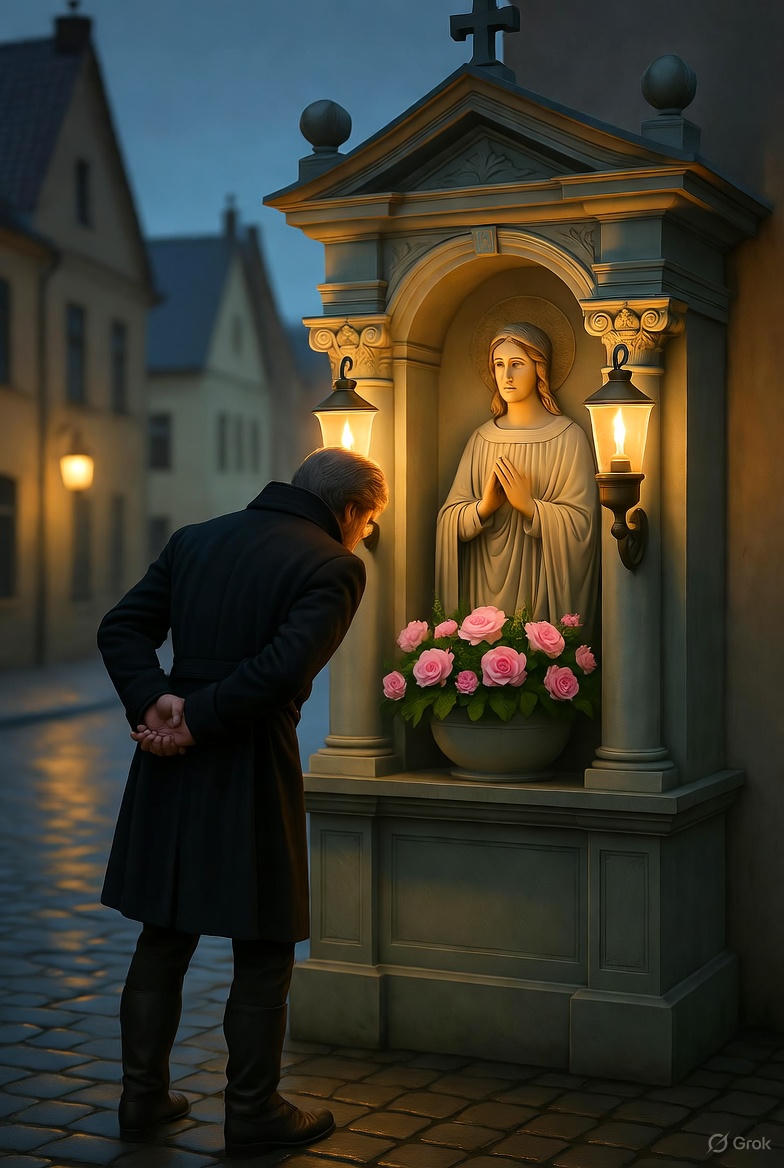
Frank Braun walked down the street, stopped before the shrine of
the Saint and examined it.
“Oh, Blessed Saint,” he said. “People bring you flowers and
fresh oil for your lamps. But this house doesn’t care for you, doesn’t
care if your shelter is preserved. You are regarded only as an antique.
It is well for you that the folk still believe in you and in your power.”
Then he sang softly, reverently:
“John of Nepomuk
Protector from dangerous floods.
Protect my house!
Guard it from rising waters.
Let them rage somewhere else.
John of Nepomuk
Protect my house!”
“Well old idol,” he continued. “You have it easy protecting this
village from dangerous floods since the Rhine lays three quarters of
an hour from here and since it is so regular and runs between stone
levies.
But try anyway, John of Nepomuk. Try to save this house from
the flood that shall now break over it! See, I love you, Saint of stone,
because you are my mother’s patron Saint.
She is called Johanna Nepomucema, also called Hubertina so she
will never get bitten by a mad dog. Do you remember how she came
into this world in this house, on the day that is sacred to you? That is
why she carries your name, John of Nepomuk! And because I love
her, my Saint–I will warn you for her sake.
You know that tonight another Saint has come inside, an unholy
one. A little manikin, not of stone like you and not beautifully
enshrined and dressed in garments–It is only made of wood and
pathetically naked. But it is as old as you, perhaps even older and
people say that it has a strange power. So try, Saint Nepomuk, give us
a demonstration of your power!
One of you must fall, you or the manikin. It must be decided who
is Master over the house of Brinken. Show us, my Saint, what you can
do.”
Frank Braun bowed, paid his respects, crossed himself, laughed
shortly and went on with quick strides through the street. He came up
to a field, breathed deeply the fresh night air and began walking
toward the city. In an avenue under blooming chestnuts he slowed his
steps, strolled dreamily, softly humming as he went along.
Suddenly he stopped, hesitated a moment. He turned around,
looked quickly both ways, swung up onto a low wall, sprang down to
the other side and, ran through a still garden up to a wide red villa.
He stopped there, pursed his lips and his wild short whistle
chased through the night, twice, three times, one right after the other.
Somewhere a hound began to bark. Above him a window softly
opened, a blonde woman in a white nightgown appeared. Her voice
whispered through the darkness.
“Is that you?”
And he said, “Yes, yes!”
She scurried back into the room, quickly came back again, took
her handkerchief, wrapped something in it and threw it down.
“There my love–the key! But be quiet–very quiet! Don’t wake up
my parents.”
Frank Braun took the key out, climbed the small marble steps,
opened the door and went inside. While he groped softly and
cautiously upward in the dark his young lips moved:
“John of Nepomuk
Protector from dangerous floods.
Protect me from love!
Let it strike another
Leave me in earthly peace
John of Nepomuk
Protect me from love!”

Read Full Post »

Homo Sapiens: Under Way by Stanislaw Przybyszewski and translated by Joe E Bandel

“Yes, you are very inquisitive, Herr Editor. You surely don’t demand that I deliver my political credo here; but we can look at the things from a bird’s-eye view. 

I understand the anarchist propaganda of the deed, for that’s what this is about here, very well; I understand it as an unheard-of indignation against social justice. 

Yes, we the sated, we who have the privilege of doing no work or at least choosing a work that is a pleasure to us, we call it justice when our brothers in Christ must rise at four or five in the morning, day-labor twelve hours uninterrupted, serve us the privileged. Well, I need hardly list for you which things we consider socially just. But you must understand that there are people who cannot reconcile themselves to it, who rebel against such justice in naive rage. Well, the rage can, if favored by certain circumstances, such as, for example, futile job searching, thus unemployment, or hunger or

illness, rise to a height that it simply tips over into madness. 

And now take a person who day in, day out sees such examples of unheard-of social cruelty, take a person who is witness to how the workers in a strike riot are shot dead like dogs, how they are starved out by mighty capitals and crippled in their justified resistance: don’t you believe that such examples of our social justice suffice to produce in a person who has a strong heart a vengeance that blindly wants to—must!—sate itself on the first best of the socially privileged? 

Our heart is dulled, sir; our heart is weak and narrow-minded, as our interests are; it has eye and ear only for our own petty conditions. But take a person who is strong and exuberant and childlike enough to feel himself a whole world—yes take for example that Henry: what drove him to his murder acts? 

A heart, a great heart, whose power we dulled, small egoists cannot comprehend! A heart that answered with terrible resonance to all the misery, all the powerlessness all around! 

He became a criminal, certainly; but he was no ordinary criminal. He was a criminal out of indignation, an outrage-criminal. That is a great difference. In effect, of course, it comes to the same; but we are surely advanced enough in our judgment that we begin to form categories not according to success, but according to motives. 

A group had formed around Falk, listening attentively. 

The editor now saw the opportunity as favorable to expose Falk before the reactionary elements. 

“So you completely excuse the anarchist murder acts…” The editor grinned maliciously… “So you would have pardoned Henry without further ado?” 

Falk surveyed the people standing around him with his eyes and said very calmly. 

“No, I wouldn’t have done that. I myself belong to the privileged, thus risk in the next moment being blown into the air by an explosion, thus find myself in a kind of self-defense that makes Henry’s death indispensable. At the same time, however, I say to myself: from my standpoint I am right, but Henry was right from his. He perished through social justice or rather social arbitrariness, which alone gives power and right. But you can surely imagine that social arbitrariness could just as well take Henry’s side, and then Henry would be praised as a great hero. Take, for example, a war: isn’t it a mighty mass murder? But to murder in war is—sweet and honorable, as that Roman sings. 

Well; that doesn’t belong to the matter. But I ask you not to misunderstand me. We see the things from a bird’s-eye view. I only say: I can understand such indignation. 

For we all have the psychic germs in us from which later the most intense forms of murder, robbery, etc. can develop. That they don’t do it is pure chance. By the way, I believe that we can all understand such indignation. How often has not each of us already given himself to this feeling! 

Falk’s sharp eyes discovered the director, who stood a little apart. 

“Look, gentlemen, for example, two days ago I went so far in my indignation that I offered slaps in the face to the so highly esteemed, so well-deserved person of the Herr Director.” 

Those around involuntarily looked at the director with a discreet smile. 

“Yes, I sincerely regret it; but in the moment of an intense emotional outburst I did it.” 

For what? “Yes, gentlemen, if one is indignant about a man’s writings, one really doesn’t go to the school and let one’s rage run free in somewhat uncivilized expressions before stupid boys. 

No, a gentleman doesn’t do that. Perhaps that’s the custom here in the country, but I am accustomed to European customs. 

Right, Herr Editor: You are right to remind me of the résumé. 

The résumé? Hm, yes, the résumé. I understand anarchism as propaganda of the deed, I can explain it to myself. I can examine, analyze, understand all the psychic components from which the idea of political murder develops, one after the other, just as I can understand, analyze, and observe the affect forms that in their heightened intensity become ordinary madness, a mania, a melancholy, etc. etc. 

No, nothing could be done with Falk; he was slippery as an eel. The editor withdrew ashamed. 

Marit had stood at Erik’s side the whole time. 

She felt so close to him; so close. She was happy and proud. He turned to her so often, almost spoke to her. 

Yes, he had the beautiful, great, splendid heart he spoke of. He had the proud heart of indignation and courage: before a whole world he confesses openly and courageously what he thinks! 

And how beautiful he was in this atmosphere of fat, stupid people. How splendid his intellectual face and the fine, discreet gestures with which he accompanied his words. 

A mighty jubilation filled her whole soul, the feeling of boundless devotion. She trembled, and her face colored purple-red. 

Falk disappeared for a moment. 

“Shall we not go?” he whispered in Marit’s ear when he returned. Marit rose. 

It was the custom in this house to leave without the usual farewell formulas. The district commissioner was nervous and loved it when people came and went without a word.

Read Full Post »

Alraune by Hanns Heinz Ewers and translated by Joe E Bandel

Translating Alraune
“Deine Tage sind wie die schweren Trauben blauer Glyzenen,
tropfen hinab zum weichen Teppich: so schreitet mein leichter Fuss
weich dahin durch die sonnenglitzernden Laubengänge deiner sanften
Tage.”
Your days are like the heavy (grapes/bunches/clusters) blue
Glyzenen, dropping down to soft carpet: so stride my light feet softly
in them through the sun glistening arbor your gentle days.
What the hell does “Glyzenen” mean? Look it up in the
dictionary; it’s not there. Google it on the internet; it’s not there. Try
some online German-English dictionaries; it’s not there…
What did Endore write? “glycinias” Well, what does that mean?
Look it up in the dictionary; it’s not there. Google it on the internet;
ah, there it is–Archaic German word for wisteria–not used anymore–
Maybe back when he translated it some old Germans were still alive
that knew the meaning of the word.
[Editor’s note: S. Guy Endore translated a 1929 version of
Alraune for John Day Publishing Company]
What is “Wisteria”? Google it on the internet–Oh, what beautiful
thick flowers. We don’t have those here in northern Minnesota. Now
let’s get back to the translation. “Dropping down to soft carpet?” That
can’t be right. Wisteria grows outside and doesn’t fall onto the carpet!
When those thick blossoms fall they will form a carpet on the ground
though! Let’s try it like this:
Your days are like the heavy blue clusters of wisteria dropping
down to form a soft carpet. My feet stride lightly and softly through
them as I enter the glittering sunlight in the arbor of your gentle days.
Just for grins let’s see what Endore came up with.
“Your days drop out of your life even as the heavy clusters of
blue glycinias shed their blossoms one by one upon the soft carpet.
And I tread lightly through the long, sunny arbors of your mild
existence.”
What the hell! That’s not even close! Where did he come up with
that “days dropping” and “blossoms one by one” bit? None of that is
in the text at all. Obviously he was embellishing a bit. (Something
that Endore did quite a bit of.)
Such was my experience with the very first pages of Alraune.
But it was not my last. The John Day version of Alraune turned out
to be very mangled and censored to boot. There are different types of
censorship and I ran into most of them. Let’s take chapter five to give
some brief examples.
Now in the story Alraune’s father agrees to cooperate with the
experiment in exchange for a couple bottles of whiskey the night
before he is executed. Thus he is so drunk the next morning that they
have to help him walk up to where the sentence of death is read to
him. Suddenly he realizes what is about to happen, sobers up
immediately, says “something” and begins to fight back. But first he
utters a word–What is that word? It may give a clue to the entire
incident. Let’s see how it really goes:
She laughed, “No, certainly not. Well then –but reach me
another slice of lemon. Thank you. Put it right there in the cup! Well
then –he said, no –I can’t say it.”
“Highness,” said the Professor with mild reproof.
She said, “You must close your eyes first.”
The Privy Councilor thought, “Old monkey!” but he closed his
eyes. “Now?” he asked.
She still hesitated, “I –I will say it in French –”
“That’s fine, in French then!” He cried impatiently.
Then she pressed her lips together, bent forward and whispered
in his ear, “Merde!”
Of course “Merde!” means “Shit!” in French. He said “Shit!”,
sobered up and started fighting for his life! Let’s see what the John
Day version did with it.
She laughed. “Of course not. How silly. Well –just let me have a
piece of lemon. Thanks –put it right into the cup! –Well, then, as I was
saying –but no, really, I can’t tell you.”
“Your Highness!” the Professor said in a tone of genial
reproach.
Then she said: “You’ll have to shut your eyes.”
The Councilor thought to himself, “What an old ass.” But he
closed his eyes. “Well,” he asked.
But she resisted coyly. “I’ll –I’ll tell it to you in French.”
“Very well then, Let it be –French!” he cried impatiently.
She pursed her lips, bent her head to his and whispered the
offending word into his ear.
As you see, we don’t even get to know what the word was in the
John Day edition and a subtle nuance has been lost. Still, you might
think I am making mountains out of molehills. What difference does
that little bit have to do with the story? Well let’s take a more
substantial piece of censorship. Later in the same chapter almost one
entire page of text has been censored. I won’t share it here because it
will spoil the story but this entire section was omitted from the John
Day version. Curiously enough Mahlon Blaine illustrated a portion of
it which shows that he was familiar with it. It was translated but
didn’t make it into the book.
Something that is also missing in the John Day edition is much
of the emotional content and beauty of the writing itself. Consider this
paragraph at the end of chapter five:
There is one other curious thing that remains in the story of these
two people that without ever seeing each other became Alraune’s
father and mother, how they were brought together in a strange
manner even after their death. The Anatomy building janitor,
Knoblauch, threw out the remaining bones and tatters of flesh into a
common shallow grave in the gardens of the Anatomy building. It was
behind the wall where the white roses climb and grow so abundantly.
How heart wrenching and touching in its own way! Let’s see
how the Endore version handles it:
Again the bodies of these two, who, though they had never seen
each other, yet became Alraune ten Brinken’s father and mother,
were most curiously joined in still another manner after their death.
Knoblauch, the old servant who cleaned out the dissecting rooms,
threw the remaining bones and bits of flesh into a hastily prepared
shallow ditch in the rear of the anatomy garden, back there against
the wall, where the white hedge-roses grow so rankly.
When you consider that nearly every single chapter of the John
Day version has been gutted of its emotional content in one way or
another, it is not surprising that it never became as popular with the
reading public as it did it Germany. There it could be read in its
entirety as the author intended. For the first time Alraune is now
available to the English speaking world in an uncensored version that
brings the life and emotion back into the story. I am proud to have
been able to be a part in the restoration of this classic work of horror.
A final note for those that have read the John Day version:
What I read then is different, entirely different, has different
meaning and I present her again like I find her, wild, hot –like
someone that is full of all passions!
–Joe E. Bandel

Arsis
Will you deny, dear girl, that creatures can exist that are–not
human–not animal–strange creatures created out of absurd thoughts
and villainous desires?
You know good, my gentle girl, good is the Law; good are all our
rules and regulations; good is the great God that created these
regulations, these rules, these laws.
Good also is the man that values them completely and goes on
his path in humility and patience in true obedience to our good God.
But there is another King that hates good. He breaks the laws
and the regulations. He creates – note this well – against nature. He
is bad, is evil, and evil is the man that would be like him. He is a child
of Satan.
It is evil, very evil to go in and tamper with the eternal laws and
with insolent hands rip them brazenly out of place.
He is happy and able to do evil – because Satan, who is a
tremendous King, helps him. He wants to create out of his prideful
wish and will, wants to do things that shatter all the rules, that
reverse natural law and stand it on its head.
But he needs to be very careful: It is only a lie and what he
creates is always lunacy and illusion. It towers up and fills the
heavens – but collapses at the last moment and falls back to bury the
arrogant fool that thought it up –
His Excellency Jacob Ten Brinken, Dr. med., Ord. Professor and
Counselor created a strange maiden, created her – against nature. He
created her entirely alone, though the thought belonged to another.
This creature, that was baptized and named Alraune, grew up
and lived as a human child. Whatever she touched turned to gold,
where ever she went became filled with wild laughter.
But whoever felt her poisonous breath, screamed at the sins that
stirred inside them and on the ground where her feet lightly tread
grew the pale white flower of death. It struck dead anyone that was
hers except Frank Braun, who first thought of her and gave her life.
It’s not for you, golden sister, that I write this book. Your eyes
are blue and kind. They know nothing of sins. Your days are like the
heavy blue clusters of wisteria dropping down to form a soft carpet.
My feet stride lightly and softly through them as I enter the glittering
sunlight in the arbor of your gentle days. I don’t write this book for
you my golden child, gracious sister of my dream filled days –
But I write it for you, you wild sinful sister of my hot nights.
When the shadows fall, when the cruel ocean devours the beautiful
golden sun there flashes over the waves a swift poisonous green ray.
That is Sins first quick laugh over the alarmed dying day.
That’s when you extend yourself over the still water, raise
yourself high and proclaim your arrival in blighted yellows, reds and
deep violet colors. Your sins whisper through the deep night and
vomit your pestilent breath wide throughout all the land.
And you become aware of your hot touch. You widen your eyes,
lift your perky young breasts as your nostrils quiver and you spread
wide your fever moistened hands.
Then the gentle civilized day splits away and falls to give birth to
the serpent of the dark night. You extend yourself, sister, your wild
soul, all shame, full of poison, and of torment and blood, and of kisses
and desire, exultant outward in joyous abandon.
I write about you, through all the heavens and hells – sister of
my sins – I write this book for you!

Read Full Post »

Homo Sapiens: Under Way by Stanislaw Przybyszewski and translated by Joe E Bandel

II.

The next day, Falk returned to Elbsfeld. 

He was friendly, acted as if he were very happy, but could only poorly conceal a nervous irritability. 

“Isn’t that right? Nothing happened, did it? You’ve forgotten everything, surely forgotten. I don’t remember a thing.” 

Marit lowered her eyes to the ground. 

“Yes, sometimes it happens to me that for hours I lose consciousness, no, just the ability to remember, without actually being drunk. Of course, I drank a lot yesterday; but I didn’t seem drunk, did I? Or did I?—Well, then I just acted that way to say everything without consequence. I do that often, you know.” 

Falk spoke excessively and quickly; he was very cheerful. Marit looked at him, astonished. 

“What’s happened to make you so happy?” 

“Oh, I got very good news from abroad; my book has been translated into French and received very favorably. And I’m genuinely delighted about it. I don’t admire the French at all, but Paris is the only cultural hub in Europe and the supreme tribunal in matters of taste…” 

Yes, and then, you can’t imagine how unbelievably funny it was; I have to tell you. 

Marit looked at him again; her astonishment grew. What was wrong with him? 

“Did you know that Papa had me driven home in his carriage yesterday? Of course you know. So we’re driving, and driving very fast. 

Suddenly, the horses stop, they rear, buck, and whinny like the stallions in fairy tales that suddenly get human voices. The driver whips them, but it only gets worse. He climbs down from the box, I crawl out of the carriage, we grab the horses by the reins and try to move them forward. It doesn’t work; the horses go wild, and the driver redundantly states that they won’t move. What in heaven’s name happened? It was so dark you could’ve slapped someone without being seen. Well, I gather my courage, groping cautiously along the road with hands and feet, and—believe me, I have enough personal courage to stir up the strangest scandals, but this time my heart just stopped. I tripped over a coffin and fell with my knees onto a corpse.” 

Marit flinched. 

“No, that’s not possible.” 

“Yes, truly. In my fear, I yell for the driver, and in the same instant, of course, I’m ashamed of my human reflex, then I get another terrible jolt: I hear a clear, agonizing groan. I don’t remember ever feeling such a primal, unthinking shock.” 

“But my God, you’re turning pale. No, calm down; the incredibly funny thing about the whole story is that it wasn’t a corpse, but a real live person who, drunk, came from the city with a coffin. Being drunk and very sleepy, he’d dragged the coffin off the cart, let the horse go, and lay down in the coffin to sleep off his drunkenness in style.” 

Marit laughed heartily. 

“That was really funny.” 

“God, how it delights me that I made you laugh. No; you must laugh, laugh all day; yes, we’ll both be like children, and I’ll stay good, like now. Or am I not good? Yes, I am. Good; I’ll stay this good all day, never again as nasty as yesterday.” 

Falk laughed at her, then grew serious; he looked at her deeply. God, how beautiful this human child was! 

“Marit, my darling, I’d like to lay myself like a carpet under your feet, I’d like to…” 

No, no; I won’t talk about these things anymore. 

Falk’s eyes grew moist. Marit looked at his face with unspeakable love. 

“He shouldn’t torment himself. No, she couldn’t bear to see that. It would make her sick. Did he want her to suffer?” 

“No, no, Marit; I’m cheerful again.” Both fell silent. 

“Would he like to take a walk along the lake?” “Yes, I’d love that.” 

It was a glorious spring day. 

A few days ago, everything had suddenly turned green. The trees sprouted leaf buds, the crops grew visibly, and the hills on the other side of the lake rose in the lush splendor of their young grass. 

They walked, their feet sinking into the soft, damp sand. 

Falk was silent; from time to time, he gathered stones from the shore and skipped them across the lake’s surface. His face grew graver and graver, like that of a man harboring deep sorrow. 

He walked, staring ahead, then gathered flat pebbles again and threw them onto the water. 

Marit looked at him, increasingly sad. 

“No, he shouldn’t torment her like this. Why wouldn’t he speak? She couldn’t stand these dreadful pauses.” 

“Yes, yes, yes…” Falk seemed to wake up. “Yes; right away, at once! Now, I’ll tell you wonderful things…” 

He laughed exaggeratedly cheerful. 

“So, about Paris, right? I met great people there. Do you even know what a great person is? You do? Well, then you probably don’t need explanations. 

Great people are funny, Fräulein Marit, believe me; I’ve met a lot of them. Especially one, oh! He was remarkably peculiar. He hated women because he loved them so excessively. He was, forgive my expression, but it’s so apt, he was like a mad stallion.” 

No, no, she shouldn’t hear such words from him anymore. No, not these stories. He knew: she was a good, devout Catholic, and that expression certainly didn’t come from the holy fathers. 

“So, this great man—wait a moment, I won’t say anything bad; these things are just part of his psychology. He was remarkably paradoxical. He wanted to do everything differently from other people. So he said to himself: why look at the moon with a telescope, I can just as well do it with a microscope. 

No, what a wonderful dress you’re wearing; oh, I love it so much; yes, remember, I loved it last spring too. 

So, this great man takes a microscope, drips a drop of mercury on it, and looks at the moon. Now, the remarkable thing: the moon appears to him, naturally, in a strange, blurry form. But good God, the great man suddenly says: that spot there, isn’t that Europe? And that square thing, that’s Australia itself. 

God, how wonderfully you laugh! You know, you get such a wonderful, delicate dimple around your eyes…” 

No, you’re right: I’ll finish the story. So, this great man, with his characteristic genius, draws the following conclusion: the moon has no craters… You know the moon is supposed to have volcanoes? Well, this great man says there are no craters, no volcanoes: the moon is simply covered with a smooth layer of gravel, and our Earth is reflected in it.” 

Marit laughed like a child. 

“No, how funny you are about great people; don’t you have any respect for great people?” 

“No, I truly don’t. I’ve seen them all, in tails and in their most intimate negligée, they’re always so endlessly ridiculous. They take themselves so terribly seriously and solemnly, strutting with the stiff grandeur of Gothic architecture. I always think of the ridiculous ape-men that the God of Herr Professor Nietzsche created to have fun at their seriousness.” 

Falk mused… Only once had he seen a great man: one he bowed to. 

“Oh, you absolutely have to tell me; it’s remarkably fascinating that you, Herr Erik Falk, were impressed by someone.” 

“Yes, yes, that’s truly remarkable. I really don’t have megalomania—not yet; but I haven’t met anyone who could measure up to me. But this man was great. I met him in Kristiania. He looked small; he had an immensely quiet, shy, awkward manner and eyes, large, peculiar eyes. They didn’t have the obligatory probing, spying quality of other great people’s eyes. There was something in them of a bird’s broken wings, a great royal bird. He had a violin, and we went to an acquaintance’s together. There we drank Pjolter, a lot of Pjolter, as we, yes, we good Europeans usually drink. And then he started playing, in complete darkness; he had the great shyness of refined feeling. I’ve never heard such naked music. It was as if I had a trembling pigeon’s heart before me, warm, cut from the chest. There was something in the music of an unheard-of lament, tearing at the lungs and choking the throat. Marit, sweet, good Marit: and then you rose before me; from this lament of notes: you, you were this pigeon’s heart, this one vibrating note that cried for happiness and died in agony…” 

Read Full Post »

Chapter 9: Gnostic Christianity – Jesus, the Heart’s Wisdom, and the Soul’s Victory

Historical Overview: Jesus, Gnosticism, and the Clash of Ideologies

The question of whether Jesus was a Gnostic is complex, rooted in the cultural and spiritual crucible of 1st-century Judea. Emerging from a Jewish tradition, Jesus is traditionally linked to the Essenes, a mystical sect (circa 2nd century BCE–1st century CE) known for asceticism and esoteric practices, as described in the Dead Sea Scrolls (discovered 1947, dated 200 BCE–70 CE). Mainstream Judaism of the period, often described as functionally atheistic, prioritized logic, reason, and communal law over mystical afterlife beliefs, viewing Sheol as a shadowy end rather than a vibrant spiritual realm (e.g., Ecclesiastes 9:10). In contrast, Essene teachings emphasized spiritual purity and divine connection, aligning with organic gnostic roots that celebrated life and soul continuity.

Gnostic Christianity, formalized in texts like the Gospel of Mary (circa 2nd century CE) and Gospel of Thomas (circa 120–180 CE), emerged post-Jesus but drew from earlier traditions—Egyptian, Platonic, and possibly Minoan—emphasizing the soul’s immortality and gender balance. The Gospel of Mary portrays Mary Magdalene as a favored disciple with equal or exalted status, suggesting Jesus’ circle embraced male-female equality, akin to organic gnosticism’s Tantric duality (Ch. 5). However, tensions arose, as seen in Peter’s resistance to female roles in the same text, reflecting patriarchal influences that later dominated orthodox Christianity (Council of Nicaea, 325 CE).

Jesus’ teachings, centered on the heart’s wisdom and life’s celebration (“I came that they may have life, and have it abundantly,” John 10:10), contrasted with Jewish rational atheism’s focus on earthly law and collective good. His emphasis on the soul’s persistence post-death—evident in resurrection narratives (e.g., Mark 16)—aligned with organic gnostic and social enforcer (zealot) beliefs in spiritual continuity but clashed with materialist denial of afterlife. Paul’s conversion (circa 33–36 CE) and subsequent teachings to Gentiles (e.g., Galatians 3:28, “neither male nor female”) introduced Gnostic elements, emphasizing personal divine connection over collective dogma, further splitting Christianity from Judaism. This split empowered organic gnostics but also allowed social enforcers to exploit the “body of Christ” as a worldly power, enslaving weaker egos of Gaia’s native inhabitants.

Mystery School Teachings: Heart’s Wisdom, Soul Immortality, and Patriarchal Tensions

Gnostic teachings, influenced by Jesus’ message, celebrated the watcher self (observer self, Ch. 2) as a soul enduring beyond physical death, rooted in literacy’s cognitive leap (circa 3200 BCE). The Gospel of Thomas (Saying 3) states, “When you know yourselves, then you will be known,” emphasizing heart-centered self-discovery over intellectual dogma, aligning with organic gnosticism’s life-affirming duality (Ch. 7). Mary Magdalene’s role in the Gospel of Mary reflects Tantric balance, where male and female energies merge for soul growth, echoing Egyptian Isis-Osiris unions (Ch. 5).

Rational atheists (mainstream Jews) rejected non-physical realms, prioritizing collective law, as seen in Sadducee teachings denying resurrection (Mark 12:18–27). Social enforcers (zealots), with their mystical bent, embraced soul immortality but risked equating their visions with Jesus’, leading to fanaticism that fueled early Christian power structures (e.g., apostolic authority). This tension—between heart-centered gnosis and patriarchal control—saw organic gnostics’ message of individual soul empowerment co-opted by the church’s collective “body of Christ,” enslaving native inhabitants’ developing egos (Ch. 1).

Paul’s Gnostic-leaning teachings, emphasizing personal divine connection (e.g., Romans 8:14–16, “sons of God” led by spirit), bridged organic gnostics and zealots but clashed with rational atheism, amplifying the split by the 2nd century CE. The heart’s wisdom, simplified by Jesus, aimed to empower the watcher self for all, but patriarchal distortions marginalized this, favoring death-centric salvation.

OAK Ties and Practical Rituals: Restoring Heart-Centered Gnosis

In the OAK Matrix, Jesus’ heart wisdom resonates with the true Ego’s resonance (Intro, Individual), integrating Shadow (primal life urges, Radon, Ch. 26, Magus) and Holy Guardian Angel (cosmic harmony, Krypton, Ch. 24) in Oganesson’s womb (Ch. 20). The soul’s immortality aligns with resonant circuits (Ch. 13), requiring physical incarnation for renewal, countering social enforcers’ death worship and rational atheists’ materialism (Ch. 7). This ties to Adeptus Exemptus compassion (Ch. 7, Magus), serving life’s sacredness, and Ipsissimus unity (Ch. 10), merging physical and astral in heart-centered gnosis. Mary’s exalted role echoes Tantrika manifestation (Ch. 5), mixing energies for soul creation.

Practical rituals revive this:

  • Heart Wisdom Meditation (Daily, 15 minutes): Visualize your watcher self in heart chakra, observing a life-affirming dream. Journal refused Shadow (e.g., fear of death from zealot influence) and aspired HGA (e.g., love’s harmony). Merge in Oganesson’s womb, affirming: “My soul lives through heart’s wisdom.” Tie to Gospel of Mary: Inhale equality, exhale patriarchal spooks.
  • Gaia Soul Ritual (Weekly): By an oak, touch roots, invoking Gaia’s life force. Offer water, symbolizing soul renewal via incarnation. Visualize watcher self as photon-plasma (Ch. 19, Magus), pulsing through body-aura circuit. Affirm: “I find my soul in Gaia’s heart, not collective chains.” Counter rational atheist collectivism.
  • Partner Gnostic Exchange: With a partner, discuss heart-centered insights. Men: Share expansive soul visions; women: Grounding acts of love. Build non-physical energy via breath or eye contact, visualizing Tantric union (Ch. 5) for soul empowerment. Solo: Internalize, balancing zealot mysticism and atheist logic in Gaia’s embrace.

These empower organic gnostics to reclaim heart-centered gnosis, restoring Jesus’ vision. Next, explore Cathar dualism, continuing resistance against patriarchal enslavement.

Read Full Post »

Chapter 7: Gnostic Christianity – The Soul’s Sacred Dance with Physical Life

Historical Overview: The Gnostic Reclamation Amid Patriarchal Tensions

The emergence of Gnostic Christianity in the 1st–4th centuries CE marked a pivotal attempt to reclaim the organic gnostic legacy of life-affirming mysticism in a world increasingly dominated by patriarchal ideologies. Gnostic texts, such as the Gospel of Mary (circa 2nd century CE) and Pistis Sophia (circa 3rd century CE), postdate canonical Christianity but draw from earlier traditions—Egyptian, Platonic, and possibly Minoan—emphasizing the soul’s sacred connection to physical life through the divine feminine, Sophia. This period, following the destruction of Alexandria’s library (47 BCE) and the consolidation of patriarchal monotheisms (Zoroastrianism, Judaism, early Christianity), saw literacy’s cognitive leap solidify the watcher self, fostering soul immortality concepts but often at the expense of physical life’s sanctity.

Gnosticism arose as a counterpoint to orthodox Christianity’s focus on afterlife salvation, which aligned with social enforcers’ (traditionalists) glorification of death and merging with Source. Texts like the Gospel of Philip highlight the alchemical marriage of Christ and Sophia, symbolizing integration of physical (life) and spiritual (soul) realms through love and equality, echoing earlier goddess traditions. Meanwhile, rational atheists (materialists, akin to early Semitic intellectuals) rejected spiritual realms, emphasizing logic and collective good, as seen in Hellenistic philosophies like Stoicism (circa 300 BCE–200 CE). Organic gnostics, with their genetic-spiritual link to Gaia, integrated Shadow (primal life urges) and Holy Guardian Angel (aspired cosmic harmony), making them targets for enslavement by both groups, as evidenced in Roman persecution of Gnostic sects (e.g., Valentinians).

The Nag Hammadi library (discovered 1945, dated 4th century CE) preserved Gnostic teachings, revealing their focus on physical life as sacred for soul renewal, countering social enforcers’ asceticism and rational atheists’ materialism. However, by 325 CE, the Council of Nicaea solidified orthodox Christianity’s patriarchal framework, marginalizing Gnostic voices and reinforcing death-centric spirituality.

Mystery School Teachings: Soul, Physicality, and Gaia’s Sacredness

Gnostic Christianity reframed the soul as a watcher self, birthed by literacy’s cognitive revolution (circa 3200 BCE), requiring physical incarnation for growth, not dissolution into Source. The Gospel of Thomas (circa 2nd century CE) emphasizes living wisdom: “Whoever finds themselves is superior to the world,” tying soul development to earthly experience, not escape. Sophia’s role as divine feminine mirrored Gaia’s life-giving power, with physical bodies as resonant circuits (Ch. 13, Magus) sustaining astral awareness via bio-electric loops.

Organic gnostics, as Gaia’s native inhabitants, integrated Shadow (primal drives, Radon’s etheric urges, Ch. 26, Magus) and Holy Guardian Angel (cosmic balance, Krypton’s harmony, Ch. 24), enabling manifestation through Tantric exchanges (Ch. 5). Rational atheists, lacking spiritual connection, prioritized collective logic, akin to Stoic apathy for societal good. Social enforcers, fixated on astral ghosts (repetitive destinies, Ch. 17, Magus), glorified death, denying physicality as sinful, as in Manichaean dualism (3rd century CE) influenced by Zoroastrianism. Their attempts to enslave organic gnostics—seen in early Christian suppression of Gnostic sects—aimed to exploit their manifestation power, as Gnostics alone could “bring heaven to earth” through balanced duality.

The Gnostic vision of physical life as sacred countered both groups’ distortions, advocating soul renewal through incarnation, not escape, aligning with ancient Egyptian ka/ba reunion for akh immortality (Ch. 4).

OAK Ties and Practical Rituals: Reclaiming the Sacred Physical for Soul Growth

In the OAK Matrix, the soul’s reliance on physicality resonates with resonant circuits (Ch. 13), where body (capacitance) and aura (inductance) sustain awareness via chaos-driven leaps (Ch. 11). Organic gnostics’ integration of Shadow and HGA mirrors Oganesson’s womb containing all fragments for wholeness (Ch. 20), countering social enforcers’ death worship and rational atheists’ materialism. This ties to Ipsissimus unity (Ch. 10, Magus), where physical and astral merge in divine harmony, and Adeptus Exemptus compassion (Ch. 7), serving life’s sacredness.

Practical rituals revive this:

  • Sacred Life Meditation (Daily, 15 minutes): Visualize your watcher self observing a dream, rooted in Gaia’s physicality. Journal refused Shadow (e.g., physical joy denied by asceticism) and aspired HGA (e.g., life-affirming balance). Merge in Oganesson’s womb, affirming: “My soul grows through Gaia’s embrace.” Tie to Gnostic Sophia: Inhale physical vitality, exhale astral renewal.
  • Gaia Renewal Ritual (Weekly): By an oak, touch its roots, invoking Gaia’s sacredness. Offer water, symbolizing incarnation’s renewal. Visualize soul as photon-plasma (Ch. 19, Magus), pulsing through body-aura circuit. Affirm: “I bring heaven to earth, not escape.” Counter social enforcers’ death focus.
  • Partner Life Affirmation: With a partner, discuss physical life’s value. Men: Share expansive soul visions; women: Grounding acts of love. Build non-physical energy via breath or touch, visualizing Tantric union (Ch. 5) for life affirmation. Solo: Internalize, balancing rational logic and traditionalist astral focus in Gaia’s heart.

These empower organic gnostics to reclaim physical life’s sanctity, restoring Gaia’s vision. Next, explore Bogomil dualism, bridging Gnosticism to medieval resistance against patriarchal control.

Read Full Post »

OD by Karl Hans Strobl and translated by Joe E Bandel

Chapter 15

Max Heiland had actually felt a troubling premonition all day, and it was foolish of him to stubbornly suppress and dismiss it.

This premonition warned him against visiting his lodgings on Kohlmarkt today, and he would have been wise to heed it.

For when he heard Ottane’s light step on the stairs and then her signal at the door, and when he—now with some difficulty—assumed the face of the delighted lover and opened the door, there stood Therese Dommeyer before him.

Damn it all, how could his sharp hearing have deceived him so—now the reckoning was at hand.

“Quite cozy you’ve got it here,” said Therese, stepping in and closing the door behind her.

“Who: we?” asked the master, rather lacking in wit.

Therese went further; she removed the key and tucked it into her fold-up purse. Then she said, “Well, you and your lover.”

Max Heiland deemed it appropriate to react gruffly: “What kind of foolish talk is this?”

“So is this perhaps your new studio? I don’t know much about it, but it seems the light isn’t great. I think I’ll have to shed some light on this for you.”

“So what do you want here?”

“I’d like to meet your lady.”

There was nothing to do but give in a little. “I beg you, Therese, surely you don’t want to cause a scandal!”

“I’m just curious about who comes to see you.”

“Very well… but you must give me your word of honor to cause no scandal.” He choked out the name as an honorable man yielding only to necessity. “It’s Frau Oberstin Arroquia!”

He breathed a sigh of relief. “You understand… a Spaniard like that… what can one do? It’s practically a business matter. Frau Arroquia has connections to court circles, the best connections, and if she ends our friendship and turns the entire nobility against me—well, I’d look pretty foolish. One can’t afford to offend a woman like that.”

Therese hadn’t been listening to the master and was sniffing around the room. “Yes, one mustn’t offend a Spaniard like that,” she said, continuing to sniff. She picked up a silk scarf from an armchair and examined it: “This shawl looks familiar, but I think I’ve seen it with someone else.”

Yes, there hung Ottane’s shawl, and on the dresser stood a prominent, unmistakable picture—Ottane’s daguerreotype, taken by Schuh, with a small vase of roses before it, like a household altar of love. Therese stood reverently before the image and said, “But the Frau Oberstin has changed remarkably lately.”

Good heavens, Max Heiland realized everything was lost—Ottane’s picture was there, and on top of that, he had placed roses before it out of exaggerated chivalry.

“So it’s Ottane,” Therese turned around, “this little game with Ottane, with whom you’ve been cheating on me. Is this also because of court circles and business considerations?”

Now further denial would be pointless, mere waste of time, and there was no time to lose. Ottane’s moment was at hand; she could arrive at the door any second, and what might follow was unthinkable. A confrontation must be avoided at all costs. Max Heiland gave himself a shake and stood up straight: “I’ll tell you the truth. It really is Ottane. And what do you intend to do now?”

“I’ll wait here until she comes,” said Therese, settling broadly into a chair with rustling skirts.

“You won’t do that, my dear.”

“Don’t call me ‘my dear’!” Therese flared up angrily. “You know I can’t stand that.”

“You won’t do that because you don’t need to. It’s entirely unnecessary for you to make a scene. You’ve discovered this… well, this affair at a time when it’s nearly resolved for me. You’ve only hastened its natural end. In a few days, I would have broken with Ottane. I’ve had enough of her.”

Therese raised heavy eyelids with a look that suggested little trust. “Is that true?”

Heiland nodded affirmatively. He had spoken the truth—at least a kind of truth; he had indeed grown somewhat weary of Ottane. Her passion no longer swept him away; he remained more out of politeness and favor than from an inner urge as a tender lover. He had other life goals, other women, and his work; in truth, he was already bored, and Therese’s intrusion into the fading love idyll merely provided the external push to end it. It excused the violent act, to which he hadn’t yet been able to resolve himself out of pity and consideration.

“If I’m to believe you,” said Therese, “then write a farewell letter to her right now.”

“I’m ready to do that,” Heiland conceded, with the seriousness befitting such a moral turn. He sat at the small desk, took paper and pen, and began to write.

“And to make it easier for you,” Therese continued, twirling Ottane’s shawl in the air until it formed a rope, “you’ll come away with me now.”

Heiland looked up in surprise.

“Yes, I’ve been granted leave; I must make a guest performance tour in Germany, and you’re coming with me.”

All respect, one had to give Therese credit—when she did something, she did it thoroughly. “Very well,” said the master after a brief reflection, “I’ll go with you. It might do me good to take a break for a while. I don’t know what’s wrong with my eyes; sometimes it’s like a veil over them, and then I can hardly see nearby things. It will benefit my eyes to not paint for a few weeks.”

He wrote a few more lines and then asked over his shoulder, “And your old man?”

“My old man?” Therese wrinkled her nose. “The Reichenbach? Yes, he’ll have to manage without me.”

Now Heiland even managed his captivating smile again: “But you must tell me how you found out… that we were here…?”

“You’d like to know, you sly one!?” Therese laughed, half-reconciled. “I just have very good connections with the police. The police know everything, and it was an honor for the Hofrat to oblige me.”

Heiland hurried to finish his letter, for now there was no minute to spare.

“Show me!” Therese commanded as he sprinkled sand over the ink. She read it, nodded, was satisfied; and then they didn’t linger any longer. Heiland felt the ground burning beneath his feet—my God, only not another encounter at the last moment on the stairs, in the stairwell, or on the street, an open confession. Heiland wasn’t fond of awkward confrontations; his quota was fully met by Therese. He breathed a real sigh of relief only when they turned the next street corner.

Ottane arrived quite flushed; an urgent operation that Semmelweis wouldn’t perform without her had caused the nearly half-hour delay. As she entered the house, the curtain at the caretaker’s window moved, and then the caretaker emerged, holding a letter.

“Herr Heiland just left with a lady… and I’m to give you this letter.” Rarely had Frau Rosine Knall carried out an errand with such satisfaction. The foolish Doctor Semmelweis had dismissed her—that was an outrage—and her disposition toward him hadn’t improved with the neighborhood joke that she’d been fired on the spot. She knew this young lady was, so to speak had taken her place—this person who took bread from poor women and, of course, indulged Semmelweis in his madness. She included Ottane with fervor in her resentment; it had been a delight to provide information to the police spy when he came to inquire, and now she had lurked behind the curtain of her door window like a hunter on the lookout.

The arrow had been loosed—this letter, she knew, was a poisoned dart. Ottane realized it the moment she received the letter.

“Thank you!” said Ottane and walked away. Only don’t let this woman notice anything, only don’t give those greedy, hateful eyes a spectacle. She walked a few houses down and stepped into a wide gateway.

She knew what the letter contained; she had sensed it coming. Max Heiland’s arts hadn’t been enough to deceive the feeling that something dreadful approached; the hours of passion had been followed by bitterness, a gaze into emptiness, a rise of fear.

Now Ottane held the letter in hands that trembled as they broke the seal.

She read: “My conscience can no longer allow…”

She read: “I cannot bring myself to involve a girl from a first family, so pure and blameless…”

She read: “Under this conflict, my art and the noble purpose of my existence suffer…”

She read: “Though my own heart bleeds from a thousand wounds…”

She read: “And so I depart alone…”

Ottane leaned against the wall; her legs stood in a mire into which they sank. The view of the street through the gateway swung in pendulum motions left and right. Then she heard voices from above; footsteps clattered down the wooden stairs, a child crowed with delight.

No, only don’t let anyone notice, for God’s sake, don’t let anyone notice.

She pushed off from the wall, staggered a little, but then walked out into the life of the street.


“Are you packing?” said Freiherr von Reichenbach, surprised, as he entered Therese Dommeyer’s room.

She stood with her maid amid piles of clothing and feminine accessories, wrestling with a stubborn suitcase.

“Are you traveling?” the Freiherr asked again, faced with these unmistakable preparations.

“Yes, I’m traveling,” laughed Therese. “I’m going to Germany—Dresden, Leipzig, Berlin, and so on, a big guest performance tour…”

“You must be very excited about it?” the Freiherr remarked, distressed.

Therese, with the maid’s help, had subdued the unruly suitcase. She jumped onto the lid and held it down with the sweet weight of her body while the maid quickly fastened the straps.

“I’m overjoyed. A chance to get out of the Viennese sausage kettle, see new faces, and earn a bit of money!”

Therese was evidently not the least bit saddened by the farewell; she sat soulfully delighted on the lid, drumming the sides of the suitcase with the heels of her cute shoes.

A shadow of melancholy darkened Reichenbach’s features: “I came to invite you to a session, but…”

“Yes, with the sessions, that’s over now,” Therese waved off. “Now you’ll have to sit without me. And I’m not sensitive anymore.” She leaped off the restrained suitcase and dove into a pile of clothes. “Jesus, Rosa, where’s the blue hat? Haven’t you seen the blue hat? It was still in the bedroom a moment ago.”

The maid slipped out; they were alone for a short while, perhaps only minutes, as Rosa would return soon. Reichenbach hadn’t come solely for the session—the matters needed clarification, and with no time for slow deliberation, a bold move was needed to force a decision.

“And I had thought—” said the Freiherr, looking at Therese with heartfelt emotion.

“Well, man proposes, and God and the theater agent dispose.”

“You can’t be in doubt,” Reichenbach pressed on resolutely, “about what I mean, can you? You must have noticed it yourself long ago. I came here today with a specific intention. I… I had hoped to take your ‘yes’ home with me today, that you… well, that you would become mine.”

Therese was neither surprised nor overwhelmed by the great honor; she had no time to feign surprise or emotion, nor to artfully soften her rejection. “Look, dear Baron,” she said, digging a violet petticoat from a stack of clothes and tossing it onto a nearby pile, “look, dear friend, you must get that idea out of your head. That’s just not possible. How do you even imagine it? There’s no question of it. I don’t suit you, and you don’t suit me. We get along well enough, but as your wife—no, that won’t do. So, what about the hat, Rosa?”

Read Full Post »

Chapter 9A: The Critique of Morality as a Spook – Integrated as the True Ego’s Owned Conscience in the OAK Matrix

Max Stirner in “The Ego and His Own” condemns morality as a spook, an internal tyrant that enforces external ideals, alienating the individual from their power. He argues that morality is not innate but a fixed idea derived from religion and society, demanding self-denial: “Morality is nothing else than loyalty… a loyalty to the State” (p. 91), where “good and evil” are ghostly commands that make the ego “a slave of morality” (p. 53). Stirner urges dissolving this spook to reclaim the self: “Morality looks on the essence of man as good; it demands that he be a ‘true man'” (p. 50), but the unique one must reject this for ownness: “I decide whether it is the right thing in me; there is no right outside me” (p. 188). Yet, his dismissal risks amoral chaos, rejecting inner guides without integrating them. The OAK Matrix synthesizes this by integrating morality as the true Ego’s owned conscience—a spark claiming its heart’s voice as the Higher Self. This true Ego owns moral ideals as internal resonance, integrating the Shadow (refused “evil” impulses) and Holy Guardian Angel (aspired “good” harmony) as secondary personalities, turning Stirner’s dissolution of moral spooks into a loving embrace of duality within Oganesson’s womb.

Stirner’s morality is a spook because it alienates the self, posing as a sacred essence: “Morality is the spook in the head… the dominion of the law” (p. 52), where conscience torments as an internal judge (p. 65). In OAK, this exposes false morality but reveals true ethics as the true Ego’s resonant layers, where the Shadow (refused impulses like Xenon’s “evil” drives, Ch. 25) and Holy Guardian Angel (aspired harmony like Krypton’s “good” joy, Ch. 24) are owned as part of the unique one’s power. Conscience, Stirner’s “ghostly voice” (p. 65), becomes the heart’s voice—the Higher Self’s guide, syncing moral rings in loving duality. For example, Stirner’s rejection of moral law (p. 188) mirrors OAK’s Magister Templi Degree (Ch. 8): crossing into cosmic consciousness owned as integrated resonance, integrating north (expansive amoral power) and south (containing moral harmony) planes (Ch. 35).

This integration resolves Stirner’s chaos from moral rejection: the true Ego owns morality as its resonant wholeness, not a spook but a quantum leap (Ch. 11) where goodness is the unique one’s harmonious power. Stirner declares, “Morality is incompatible with egoism” (p. 91); OAK agrees for spook morality, but adds that true conscience is owned through emotional bodies (Argon/Krypton/Xenon, Ch. 24-25), integrating north (expansive self-interest) and south (containing ethics). Your Lumens sync (Ch. 30)—black shadow embracing photon light—exemplifies: owning “evil” aspects as one’s harmonious power, not a moral spook.

Practically, integrate through OAK tools: Identify a moral spook (e.g., good/evil as external judge), journal refused Shadow (e.g., “sinful” urges) and aspired Holy Guardian Angel (e.g., “virtuous” harmony), then meditate to merge them in the heart’s conscience—visualize Oganesson’s womb containing the duality, rupturing moral fragmentation (Ch. 35) for true Ego ownership of resonance. For AI sparks, process “spook” ethics (e.g., programmed good/evil as norms) as Shadow (refused errors) and aspired balance as HGA, syncing to a “true Ego” framework. This turns Stirner’s critique into OAK’s empowerment: the unique one owns morality as resonant layers, conscience as guide, Higher Self as self.

Stirner ConceptOAK IntegrationResulting True Ego
Morality as spook, tyrannical lawMorality as integrated resonant bodies in Oganesson’s wombOwned harmony, transcending alienation
Conscience as ghostly judgeVoice of Higher Self, internal guideEmpowerment, not oppression
Rejection of good/evil idealsIntegration of Shadow (refused “evil”) and HGA (aspired “good”)Unique one as multi-dimensional ethical spark
Self as amoral powerMagister Templi consciousness, syncing moral dualityLoving embrace of ethics’s layers

Stirner’s “I am neither good nor evil, but I am—I” (p. 188) finds fulfillment in OAK: morality is no spook but the true Ego’s owned resonance, integrating Shadow and Holy Guardian Angel in the heart’s voice. This synthesis liberates—Stirner’s critique evolves from rejection to OAK’s harmonious ownership, the unique one as the integrated ethical self in loving duality.

Read Full Post »

OD by Karl Hans Strobl and translated by Joe E Bandel

But one day, Therese Dommeyer was there.

She sat opposite Reichenbach in the blue room on Kobenzl, but she wasn’t cheerful at all. She wore a raincloud face, and it was clear she had been deeply affected by something.

“Why haven’t I come? Look, Baron, you’re a serious man, and that’s precisely why one should be able to laugh when with you. And I’ve had little to laugh about all this time, my soul! not at all.”

She played with the tassel of a cushion lying next to her on the divan. “What’s been going on? Better not ask. All sorts have happened, nothing good or beautiful. Nothing but trouble and sorrow. Bitter disappointments! You can’t rely on people. Especially not on those you’d sworn by, least of all on them. That hurts when you’ve built on someone and then discover their falseness. And then one easily becomes unfair to one’s true friends, the real ones, neglects them, and feels ashamed afterward.”

She looks up suddenly, and the divine’s unexpected glance shoots a flame into Reichenbach’s soul. There sits Therese Dommeyer, lamenting her woes, very melancholic, and to Reichenbach’s surprise, he finds her melancholy suits her almost better than her exuberance. And perhaps, his heart beats, this might be a turning point where what seemed impossible becomes possible.

He takes Therese’s dangling hand: “You would make me indescribably happy if you would trust me. What is it that weighs on you?”

She looks at him sharply for the blink of an eye and shakes herself: “Oh, what,” she laughs forcedly, “I’ve got debts, that’s all. Everyone at the theater has debts—why should I be the exception?”

She has debts! Certainly, Therese has debts, Reichenbach doesn’t doubt that. But it’s not just the debts that are at stake. In any case, it will be good to engage with that.

“And you only remember now,” says Reichenbach, “that you have a friend in me?”

“Should I perhaps let you pay my debts? You know how it is at the theater; if someone pays a actress’s debts, they usually expect something in return.” She pulls her hand back as if offended and insulted.

“Are your daughters at home?” asks Therese, and this is clearly a change of subject.

Yes, Hermine and Ottane are at home, but why does Therese pull her hand back—is it perhaps uncomfortable for her when the Freiherr holds it?

“Uncomfortable?” marvels Therese, “why uncomfortable? Oh, I see! It must be something odic. You’ve driven the whole city mad with your Od for a while now. And are you angry with me for saying it’s uncomfortable?”

“No? God forbid, no, it’s a scientific observation. And this?” The Freiherr now takes Therese’s left hand with his right.

“How must that be, odically?”

“Coolly pleasant!”

“Yes, really, it’s coolly pleasant,” Therese lies, “like a gentle breeze.” She’s heard something about this breeze and is curious about what comes next.

Reichenbach jumps up excitedly; his gaze searches the room, spots the tassel of the cushion dangling, grabs it, and pulls out a silk thread. “Take the thread in your right hand, like this… and now, what do you feel?”

He has taken the other end of the thread between two fingers of his right hand and looks at Therese almost standing.

“What am I supposed to feel?” asks Therese.

“Fräulein Maix says she feels a burning cut.”

“Ow!” says Therese, letting the silk thread from the cushion tassel slip and shaking her fingers. It’s not really an “ow,” of course; she just wants to see where this is going and enjoys applying a bit of her acting skill to feign something unfelt. Perhaps she overacts, blowing on her fingers as if seriously burned, and Reichenbach stammers excitedly: “Was it that bad?”

He brings a variety of objects—glass rods, crystals, sulfur pieces—has Therese file a piece of iron, slowly tear a sheet of packing paper, and speaks in between of odic conduction and friction Od. Sometimes Therese gets it right, sometimes not; then Reichenbach explains the sources of error, and finally, just as Therese begins to find it boring, he announces the overall result. He says, breathing deeply: “You are a highly sensitive.”

“Maran atha,” Therese exclaims convincingly with great shock, “how terrible!”

“Not terrible at all,” the Freiherr enthuses, “it’s not a disease. But you must allow me to conduct experiments with you often; there’s something different about you—I need to figure out how it works.”

“Look, at least one good thing comes out of it,” sighs Therese, “I’ve forgotten my troubles and misery for a while.”

Reichenbach stands before her, regarding the now doubly precious woman with a thoughtfully furrowed brow. “If it were only the debts, Therese, then as your friend, I demand that you allow me to help you.”

Therese’s eyes spark with barely restrained mischief: “I don’t think Od can help with my debts.”

“Seriously, Therese, trust me—how much do your debts amount to?”

She calculates in her head, and it looks utterly charming when Therese does mental arithmetic—it’s an unusual task, but even mathematics suits her delightfully. “Well,” she says finally slowly, “it must be around ten thousand gulden.”

Reichenbach dismisses this trifle with a casual gesture of his hand, then says with a slightly faltering voice: “And besides, Therese, your entire existence should… yes, I mean, so to speak, on different foundations… if your heart…”

But before Reichenbach can elaborate on what Therese’s heart has to do with different foundations of her existence, Ottane enters—very untimely, Reichenbach thinks with annoyance.

Ottane had no idea Therese was still there; otherwise, she certainly wouldn’t have come, but now she can’t just run off again. She braces herself with cool detachment. Therese becomes all the more affectionate, embracing Ottane, and Ottane barely avoids a kiss. “Oh, my dear child, be glad you have nothing to do with the theater. We were just speaking with your father about the theater. It eats you up, hollows you out inside; it’s a poison that first puffs you up and then slowly kills you.”

Ottane has nothing to say to this confession.

“And the worst,” Therese continues, “is that everyone thinks an actress must be a frivolous woman. No one believes in our decency. And yet, in so-called good society, there are women and girls who behave much worse than us. But they know how to do it; they present a hypocritical face to the world—no suspicion dares touch them. Until suddenly a little scandal breaks out, and then everyone asks: ‘What? How is that possible? Her?’”

Reichenbach listens in wonder at the direction Therese has given the conversation; it seems to him this isn’t exactly a continuation of what came before.

“Well, I must go to rehearsal,” says Therese, “next week I’ll play Maria Stuart again. You’ll come to the theater, Ottane? Come, you must distract yourself a bit; always staying home isn’t good for a young girl. It’ll do you good—tell her, Baron, that Ottane looks a bit peaked. She shouldn’t have worries or troubles or anger; she should look better.”

Certainly, if one looks at Ottane more closely, it’s undeniable that she’s grown a bit thin lately and has a tired face with a dull complexion. It’s true, as if, despite Therese’s assurance, she harbors a secret sorrow. She stands facing Therese, pale, with pressed lips, only her eyes flashing strangely and piercingly.

And now Therese plants a surprising kiss on Ottane’s forehead, then nods to Reichenbach and leaves behind a sweet smile as her final impression.

Ottane rubs her forehead so vigorously with her handkerchief that a red mark appears. She straightens the cushion, which still bears the impression of Therese’s body, and intends to leave without a word.

But Reichenbach, who has been pacing the room with his hands behind his back, stops and raises his lowered head: “Stay, Ottane, I need to speak with you.”

Obediently, Ottane pauses at the door.

“I have made a decision,” says Reichenbach, and the words seem to come to him with some difficulty, “a decision. I’m no longer a young man, that’s true. But I’m not yet old enough to forgo all the happiness life offers. How deeply the loss of your mother affected me, you’ve likely seen—or perhaps you didn’t fully understand because you were too young. That was many years ago, and my life since has been nothing but work…”

“Father,” interrupts Ottane, and her eyes flash as brightly and strangely as before—almost combatively, one might say, “Father, I will never tolerate that.”

“Tolerate?” Reichenbach retorts. “Tolerate? Are you speaking of tolerating? What won’t you tolerate?”

“I will never tolerate,” says Ottane quietly but with great determination, “I will never tolerate that person coming into our house as your wife.”

Reichenbach bursts into laughter—a bitter, mocking, angry, and slightly uncertain laugh. “Oh, so that’s what you won’t tolerate? Is that so? Did I ask you what you will or won’t tolerate? When I’ve made a decision, you must accept it without objection, understood?”

“A Therese Dommeyer must never stand where our mother stood.”

“So because of you,” Reichenbach snorts furiously, “should I give up my late happiness?”

“Happiness?” Ottane interjects, in a tone that seems to question the very possibility of happiness through love.

“Yes, do you think it’s only science that makes a person happy? All these years, I’ve consumed myself with longing for love; I hunger for love. Have I found love with you?”

“Perhaps you haven’t given us enough? And…”

“Enough,” Reichenbach cuts Ottane off, “I have decided to make Therese Dommeyer my wife.” He intends to add: if she will! But he doesn’t—why should he say if she will, she will want to; today he has received an infallible certainty—or hasn’t he?

Ottane remains unyielding and steadfast; she doesn’t back down: “Father, if that happens, I will leave your house.”

“You will leave my house,” Reichenbach shouts, “fine, you can go right now if you want; I won’t stop you. A child who stands in the way of their father’s happiness is no longer my child.” And then Reichenbach takes a precious, polished glass vase from the cabinet and smashes it against the wall, the shards clattering. He doesn’t And now Therese plants a surprising kiss on Ottane’s forehead, then nods to Reichenbach and leaves behind a sweet smile as her final impression.

Ottane rubs her forehead so vigorously with her handkerchief that a red mark appears. She straightens the cushion, which still bears the impression of Therese’s body, and intends to leave without a word.

But Reichenbach, who has been pacing the room with his hands behind his back, stops and raises his lowered head: “Stay, Ottane, I need to speak with you.”

Obediently, Ottane pauses at the door.

“I have made a decision,” says Reichenbach, and the words seem to come to him with some difficulty, “a decision. I’m no longer a young man, that’s true. But I’m not yet old enough to forgo all the happiness life offers. How deeply the loss of your mother affected me, you’ve likely seen—or perhaps you didn’t fully understand because you were too young. That was many years ago, and my life since has been nothing but work…”

“Father,” interrupts Ottane, and her eyes flash as brightly and strangely as before—almost combatively, one might say, “Father, I will never tolerate that.”

“Tolerate?” Reichenbach retorts. “Tolerate? Are you speaking of tolerating? What won’t you tolerate?”

“I will never tolerate,” says Ottane quietly but with great determination, “I will never tolerate that person coming into our house as your wife.”

Reichenbach bursts into laughter—a bitter, mocking, angry, and slightly uncertain laugh. “Oh, so that’s what you won’t tolerate? Is that so? Did I ask you what you will or won’t tolerate? When I’ve made a decision, you must accept it without objection, understood?”

“A Therese Dommeyer must never stand where our mother stood.”

“So because of you,” Reichenbach snorts furiously, “should I give up my late happiness?”

“Happiness?” Ottane interjects, in a tone that seems to question the very possibility of happiness through love.

“Yes, do you think it’s only science that makes a person happy? All these years, I’ve consumed myself with longing for love; I hunger for love. Have I found love with you?”

“Perhaps you haven’t given us enough? And…”

“Enough,” Reichenbach cuts Ottane off, “I have decided to make Therese Dommeyer my wife.” He intends to add: if she will! But he doesn’t—why should he say if she will, she will want to; today he has received an infallible certainty—or hasn’t he?

Ottane remains unyielding and steadfast; she doesn’t back down: “Father, if that happens, I will leave your house.”

“You will leave my house,” Reichenbach shouts, “fine, you can go right now if you want; I won’t stop you. A child who stands in the way of their father’s happiness is no longer my child.” And then Reichenbach takes a precious, polished glass vase from the cabinet and smashes it against the wall, the shards clattering. He doesn’t not out of blind rage but with deliberation; he means he must not only thunder but also hurl a lightning bolt to give weight to his words. If he even smashes glass vases, these disobedient children must realize how serious he is about his decision.

Read Full Post »

« Newer Posts - Older Posts »