Feeds:
Posts
Comments

Posts Tagged ‘fiction’

Madame Bluebeard by Karl Hans Strobl and translated by Joe E Bandel

Ninth Chapter
Court Secretary Ernst Hugo was brewing a grand
scheme. He felt it was time to step forward, to draw
the world’s gaze upon him. People should speak of
Ernst Hugo. It needed to be something colossal, like
that Abbazia festival, but on a vastly grander scale.
Something monumental—striding like Behemoth,
towering like the Colossus of Rhodes, roaring like the
Minotaur, forcing all to turn and look. Hugo
rummaged through his historical and biblical
knowledge, pulling open every drawer of his learning
for comparisons. It had to be surprising, distinctive,
unprecedented.
The Emperor’s jubilee year had arrived.
Here was a chance to shine, to catch his superiors’
eyes. He’d shown his Hofrat newspaper clippings of
the Abbazia event, earning a nod of approval. Now,
he aimed for something no mere nod could dismiss.
Ernst Hugo just didn’t know what…
That was the only hitch. He racked his brain until
his skull seemed to crack. A grand procession was
being planned, festive performances, jubilee
foundations—tributes of all kinds. He needed
something extraordinary to stand out.
At the artists’ café where he was a regular, Hugo
finally shared his woes with friends. A gaggle of
young men and two actresses shouted ideas. A
sculptor, hoping to fame with a complex lovers’
statue titled Ardor, suggested a monument. A painter
proposed a vast circular painting of the Battle of
Custoza. A young baron, included for his recent
inheritance, thought living tableaux would do.
Bystritzky, the poet, stirred his black coffee,
fishing out a half-dissolved sugar cube to pop on his
tongue. “You aristocrats,” he said, “always the
same… when asked, it’s ever: living tableaux. Fits
every occasion. Weddings: Gretchen at the spinning
wheel… christenings: Gretchen at the spinning
wheel… imperial honors: Gretchen at the spinning
wheel…”
“We could do something else,” the baron
countered. “Like: Austria blessing her children…”
“Sure, so the children start brawling. I’ve a better
idea. We compile an anthology… an anthology of
Austrian poets, got it? We all pitch in: I’ll edit, Franzl
does the book design and illustrations, Prandstetter
handles newspaper ads and writes reviews, the ladies
can recite from it at every chance. And Secretary
Hugo signs as publisher, raising the funds.”
Hugo pondered. An anthology wasn’t special, not
unique. Bystritzky dispelled his doubts: it would be
an exceptional, singular anthology, its presentation
the pinnacle of book artistry. Each copy a jewel of
unparalleled allure. The others backed Bystritzky’s
plan, except the sculptor, excluded from it.
Hugo was finally persuaded. “When the festival’s
waves have ebbed,” he declared with flourish, “and
nothing remains of the celebrations but
cinematographic reels, this book will endure… it will
permeate cultured circles, a living testament to
Austria’s spirit in this momentous year.”
“Bravo!” cried the painter. Prandstetter seized
Hugo’s hand, murmuring approval, as one does with
ministers promising much.
Hugo had the waiter bring a sheet of blank paper
and, using a new volume of Bystritzky’s poetry, drew
the fateful grid of subscription lines. The baron was
made to sign first, opening the dance.
With this dagger, Hugo prowled through Carnival.
He brandished it at every chance, against all comers.
Mid-lively chat, he’d produce it with a few words. A
paralyzing hush of enthusiasm followed. One by one,
they took the offered gold fountain pen, glancing
covertly at prior entries, and wrote the sum they
could muster.
Hugo noted most lived by proverbs. “A scoundrel
gives more than he has,” said every third. “Little, but
heartfelt,” was common too. Latinists, to the pen’s
scratch, intoned, “Bis dat, qui cito dat.” Charming
and frequent was, “Mr. Would-Be plans, but Mr.
Can’t delivers.” It was like a cornerstone laying, each
feeling obliged to say something apt with the
hammer’s strike.
This Carnival was Hugo’s busiest yet. For his
lofty goal, he couldn’t miss a social event. The sheet
filled with signatures and figures, but the insatiable
Bystritzky insisted it wasn’t enough.
At the Vienna City Ball, amid the throng of
dancers, Hugo spotted Frau Helmina. He trailed her
through the crowd, pouncing the moment her partner
moved to escort her to her seat. It was a waltz on soft
clouds. Helmina lay pliant in his arms. Hugo burned.
He felt the lit hall, swirling music, gallery carpets,
flower nooks, and bronze statues were all for him.
“I had no idea you were here,” he said, leading her
to a side room where Ruprecht von Boschan sat with
Major Zivkovic and two other officers.
Helmina laughed. “Oh—I must recover from
Krems. I danced there last Saturday.” She gave a
lively account of the ball, her laughter like the
delicate chime of champagne glasses raised in merry
toast.
Ruprecht was as exuberant as Helmina. His robust
joy was evident, his footing sure. His eyes held a
bold, calm gaze. Every word sang with zest for life. It
was an extraordinarily cheerful evening. They danced
eagerly at first. By morning, the conversation grew so
light, refined, and sparkling that the dusty, stuffy
ballroom lost its draw. The sense of floating persisted
here. They spoke refined nonsense, bacchic wit
bubbling from Helmina’s lips…
As Hugo stood in dawn’s gray light before his
door, fumbling with an aluminum key in the lock’s
innards, he realized he’d forgotten to wield his
dagger. “Oh, I won’t let you off,” he muttered. “I’ll
get you. It’s a chance… a splendid chance… Always
leave a bridge…”
The next Sunday, he traveled to Vorderschluder.
He could hardly wait to see Gars’s long ruinous
castle front. It wasn’t far then. After some effort, he
found a carriage. From the rising road, the Kamp
valley’s forests stretched below. Thaw had set in,
mist rising like smoke from the heavy black woods.
On the rolling high plain, Wolfshofen’s scattered
farmsteads shimmered through thin blue veils.
Vorderschluder’s towers rose from a ridge. The road
dipped back to the Kamp, bypassing its curve.
Hugo found Frau Helmina alone.
“I’m intruding, madam,” he said, kissing her hand.
“What must you think… I should’ve announced
myself, no?”
“Oh, I’m fond of pleasant surprises,” Helmina said
graciously. “My husband’s out, of course… You’re
just in time to keep me company.”
“I’m at your service.” Hugo was slightly flustered.
“Tell me about Vienna, then.”
“It’s still where you left it, but a bit forlorn. You
should always be there, madam. The city dims
without you. It’s mere memories now.”
“You think I could boost tourism?”
“You can do anything you wish.”
Hugo reveled in his boldness, swept away by
fervor. His tributes grew warmer. Her smiling
attention seemed more than courtesy—it was
encouragement. The demonic air Abbazia attributed
to Helmina was merely a woman’s curiosity, testing
how far a man would dare. She’d see he was no
coward. Lost in this, Hugo faltered, and when the
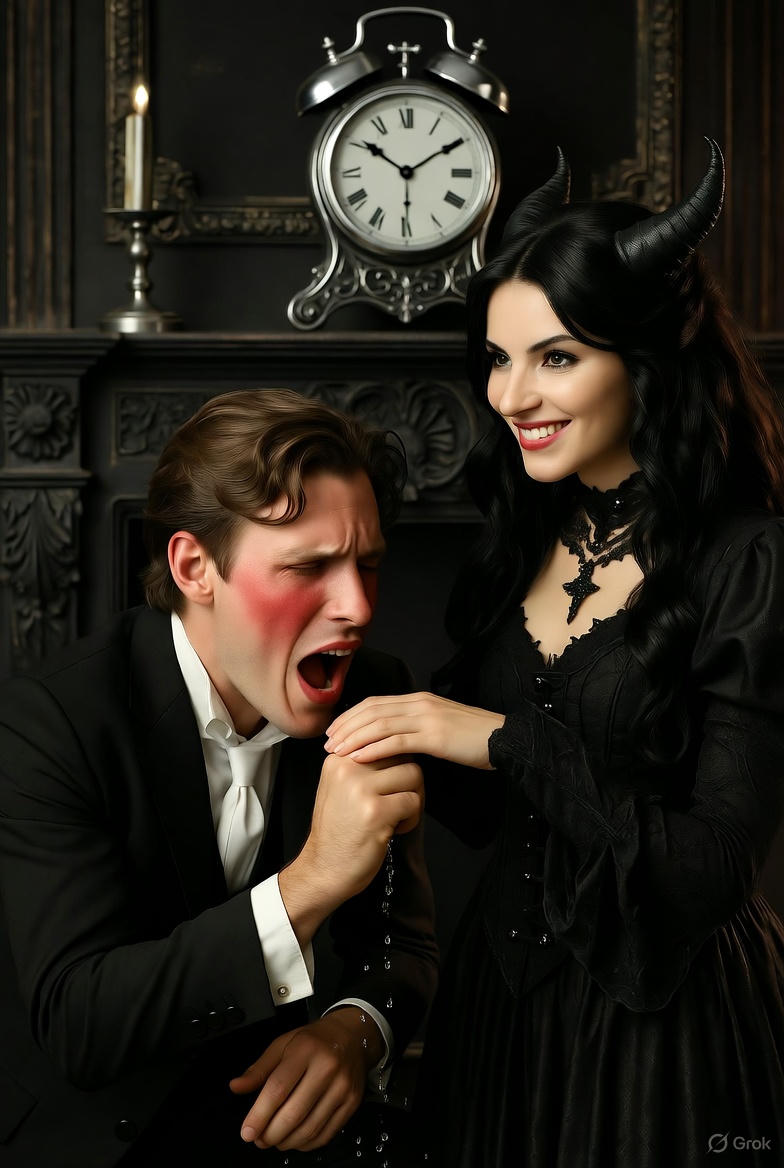
little Empire clock on the mantel chimed twelve
silver notes and Helmina said, “Ruprecht will be here
soon,” he fell to his knees, showering her hand with
kisses.
“Stand up, Herr Secretary,” Helmina said with
gentle firmness. “What do you think of me?”
“I think nothing—I only know I love you.”
“No, no, please… stand up, I insist.” She pushed
him back. “What are you doing? Ruprecht’s your
friend. Shouldn’t we… remain friends?”
“Of course!” Hugo looked up at her calm face,
unmarred by surprise.
“If I’m to trust you, end this scene.”
Hugo obeyed, rising.
“That’s right. See, if I ever need a friend, I’ll turn
to you. I’m sure you’d help me. Now, let’s chat.”
She’d barely begun when Ruprecht arrived. He
greeted the court secretary with warm cordiality.
Hugo froze, thinking of his recklessness. How easily
he could’ve been caught. Helmina’s demonic
gentleness had made him forget all danger.
During the meal, he regained his composure.
“You don’t even know why I came?” he asked.
“I’m glad you did,” Ruprecht replied politely.
“You might be less thrilled to hear I’m here to tap
you. You’ve been generous before—dangerous
move. Now I’m back… I need money…” Hugo
unveiled his plan, displaying his subscription list,
touting the project and the notable contributors
already secured.
Ruprecht, naturally, agreed to contribute.

Read Full Post »

Alraune by Hanns Heinz Ewers and translated by Joe E Bandel

Intermezzo
All sins, my dear girl, are brought here by the hot south wind
from out of the desert. Where the sun burns through endless centuries
there hovers over the sleeping sands a thin white haze that forms itself
into soft white clouds and floats around until the desert whirlwinds
roll them and form them into strange round eggs that contain the
sun’s blazing heat.
There the basilisk slinks around through the pale night. In a
strange manner the moon, the eternally infertile moon, fathered it. Yet
its mother, the desert sand, is just as infertile as the other is. It is the
secret of the desert. Many say it is an animal but that is not true. It is
a thought that has grown where there is no soil or no seed. It sprang
out of the eternally infertile and took on a chaotic form that life can
not recognize. That is why no one can describe this creature. It is
fashioned out of nothingness itself.
But what the people say is true. It is very poisonous. When it eats
the blazing eggs of the sun that the whirlwinds create in the desert
sands purple flames shoot out of its eyes and its breath becomes hot
and heavy with horrible fumes.
But the basilisk, pale child of the moon, does not eat all of the
vapory eggs. When it is sated and completely filled with hot poison it
spits green saliva over the eggs still lying there in the sand and
scratches them with sharp claws so the vile slime can penetrate
through their soft skin.
As the early morning winds arise a strange heaving like moist
violet and green colored lungfish can be seen growing under the thin
shells.
Throughout the land at noon eggs burst as the blazing sun
hatches crocodile eggs, toad eggs, snake eggs and eggs of all the
repulsive lizards and amphibians. These poisonous eggs of the desert
also burst with a soft pop. There is no seed inside, no lizard or snake,
only a strange vapory shape that contains all colors like the veil of the
dancer in the flame dance. It contains all odors like the pale sanga
flowers of Lahore, contains all sounds like the musical heart of the
angel Israfael and it contains all poisons as well like the basilisk’s
own loathsome body.
Then the south wind of mid-day blows in, creeping out of the
swamps of the hot jungles and dances over the desert sands. It takes
up the fiery creatures of the sun’s eggs and carries them far across
the blue ocean. They move with the south wind like soft vapory
clouds, like the loose filmy night garments of a priestess.
That is how all delightful, poisonous plagues fly to our fair
north–
Our quiet days are cool, sister, like the northland. Your eyes are
blue and know nothing of hot desire. The hours of your days are like
the heavy blue clusters of wisteria dropping down to form a soft
carpet. My feet stride lightly through them in the glinting sunlight of
your arbor.
But when the shadows fall, fair sister, there creeps a burning
over your youthful skin as the haze flies in from the south. Your soul
breathes it in eagerly and your lips offer all the red-hot poisons of the
desert in your bloody kisses–
Then it may not be to you that I turn, fair sister, sleeping child of
my dreamy days–When the mist lightly ripples the blue waves, when
the sweet voices of the birds sing out from the tops of my oleander,
then I may turn to the pages in the heavy leather bound volume of
Herr Jakob ten Brinken.
Like the sea, my blood flows slowly through my veins as I read
the story of Alraune through your quiet eyes in unending tranquility. I
present her like I find her, plain, simple, like one that is free of all
passions–
But then I drink the blood that flows out of your wounds in the
night and it mixes with my own red blood, your blood that has been
poisoned by the sinful poisons of the hot desert. That is when my
brain fevers from your kisses so that I ache and am tormented by your
desires–
Then it might well be that I tear myself loose from your arms,
wild sister– it might be that I sit there heavily dreaming at my window
that looks out over the ocean while the hot southerly wind throws its
fire. It might be that I again take up the leather bound volume of the
Privy Councilor, that I might once more read Alraune’s story–
through your poison hot eyes. Then the ocean screams through the
immovable rocks– just like the blood screams through my veins.
What I read then is different, entirely different, has different
meaning and I present her again like I find her, wild, hot–like
someone that is full of all passions!

Read Full Post »

Homo Sapiens: In the Maelstrom by Stanislaw Przybyszewski and translated by Joe E Bandel

Oh no, where do you think, Herr Czerski. For that Certain is much too knowing. Ha, ha… 

Yes, I misunderstood you. You as philanthropist naturally ask why he wanted to do that. 

Why? He doesn’t know that. 

That would all be incredibly ridiculous if it weren’t so fatal. The small tiny gap widens with rapid speed. It is like a growth with long processes that crawl into every pore of his soul, force themselves into every opening with growing rage and spread the terrible poison into the whole organism… Ha, ha, ha… 

Why do I laugh so ugly? To thunder, man! isn’t that to laugh at?! 

But so it goes on. The fantasy is once set in motion. It suddenly becomes as lush as a jungle, sharp and poisonous as an Indian arrow, inventive as Edison, brooding and enduring in thinking like Socrates, who is known to have stood the whole night before his tent without noticing that a foot-deep snow had fallen. Don’t you think the old gentleman posed a little?… Well, Certain’s fantasy activity is also very interesting. 

He tries to imagine the two. They sat in the room. He had carefully locked it. She had slowly let down her hair, then unbuttoned her waist, he stood there meanwhile, hot, trembling and devoured her with greedy glances… 

Cute pictures, what? 

Or, let’s pass to another side… He looks at his child. It suddenly shoots through his head by what miracle it was prevented that she didn’t get a child with the other earlier. This question, and the possibility that she actually should have got it, makes him quite mad. 

Or: he reads an indifferent story of two lovers… He, he… Why was he not the first? And this question makes him quite raging with despair. 

Or: he gets to see one of her youth photographs. Was it before or after? Yes, naturally before. He looks at the photograph, he makes a painful science of it, he loves her there, loves her with a painful torment, he worships her in an agony of rage and despair. Why? Why? Why did she not keep herself so, so pure, so unknowing for him? 

From everything I cited here you will probably have gotten the sufficient impression of the psychic state of our Certain. 

He loses balance. He still tries to tear out the proliferating weed, to cut off the roots of the poisonous evil, but it is too late. He no longer gets rid of the visions. In his soul rage boils, hate takes away his reason, he cannot touch her without thinking of the other, he cannot look at her without being reminded of him. His soul gets wrinkles and gray hair. And yet he drags himself after his wife like a sick dog. He cannot do without her, he loves her a thousand times more than before in this frenzy, this boiling rage and this hate. Can you understand that? 

Falk screamed. 

Can you understand that? That is madness! That is no pain, that is… that is… 

He suddenly got fear of himself and a wild fit of rage seized him against the person who forced him to live through all this again, to tear open the old scabs. 

He walked searching around the room with clenched fists, he was completely out of his senses. 

Why do I scream? Because I have heart cramp, I have colic, stitches all around in the whole chest… Oh if I had you here, you cursed Satan with your demand for truth, your marriage proposals… Ha, ha, ha… me marry Janina! 

His strength left him. He sat at the window. He dried the sweat from his forehead, and suddenly became calm. He fell into heavy brooding. Now he will probably understand how one comes to seduce a girl. Naturally he will understand. He sat and sat, repeated incessantly in his thoughts that Czerski must now finally understand, and woke again. 

He had probably fallen asleep. 

And again he looked at the sky, at the dark, sick melancholy of the sky and then felt how the spaces widened and began to flee with the impetuosity of a wild debris. 

He listened tensely. 

It seemed to him as if the abysses of eternities coiled into still deeper depths, as if calm formed into an infinite funnel that swallowed everything and time and sound and the melancholy light of the stars—it seemed to him as if he were enveloped in dark, dull distances: everything had disappeared, only one remained: the wide, sick sky above him. 

And this sky he had begotten with his eyes, with his arms he had thrown its vault over the earthly all… 

He jumped up. 

It seemed to him as if the door had opened and someone had come in. 

No! It only seemed so to him. And again he walked up and down. 

Terrible, terrible that something like that can destroy one’s soul. Why? He became raging. Am I there to solve all riddles? Haven’t I rummaged enough in my soul? Haven’t I searched every corner of my soul with the greatest meticulousness? But can I grasp what lies under my consciousness, what plays out beyond the ridiculous brain life? Can I? Hey? Don’t you understand, you stupid man, that under certain circumstances one can come to betray one’s wife? Don’t you understand that there are moments when one can hate a woman so intensely, so unheard-of that one must soil her through intercourse with another woman out of rage, out of pain, out of frenzy, out of a sick need for revenge? Falk shook with laughter. Out of revenge because the poor woman five years earlier, yes, before she met me, didn’t sense me! 

Falk ran around. The unrest grew so that he thought his head must burst. 

And now, just now, when the torment subsided, when the wound began to scar, now Isa will be torn from him. 

She will naturally go. 

He tried to imagine it to himself. 

No, impossible! He was bound to her. She was everything to him. He could not live without her. He had grown together with her, he rooted in her… 

One thing became clear to him: He had to get rid of Czerski. But how, how? 

A feeling of desperate powerlessness seized him. He became limp and resigned. What could he do? Now everything had to break over him. 

Then suddenly a thought shot through his head. 

Olga had to arrange the whole thing. That was the only way out. He became glad. 

That he hadn’t thought of that earlier! 

With feverish haste he wrote a long letter, put paper money in, sealed the envelope, leaned back in the chair and stared thoughtlessly ahead. 

Suddenly he started. Now he hated her again. 

Yes, she was to blame that he became so torn, so miserable, that he had lost all faith, that he saw no goal and no purpose in life. 

She, she was to blame that in his brain he had only the one great, sick idea, the one rage, the one raving hate, that he was not the first… 

Isa, Isa, if that hadn’t happened!… He, he, he… Yes, naturally, Herr Czerski… Naturally? Did I say: naturally!? Nothing is natural, everything is a riddle, everything is an abyss and everything a torment and a nonsense… 

It was after all better that now everything came to an end. 

And the torment laid itself on his heart and constricted it tightly and bit into it with fine, long, pointed teeth… 

The night was so sultry and so wide and so dark. He sank into himself. 

The world is going under! The world is going under…

Read Full Post »

Madame Bluebeard by Karl Hans Strobl and translated by Joe E Bandel

Eighth Chapter
On Saturday, Frau Helmina had business in
Vienna. A ball gown needed discussion with the
seamstress—a poem of silk, tulle, and lace, a riot of
color and light. In Krems, women’s eyes would pop
with envy. In Vienna, Helmina would hold her own
among the most beautiful and elegant.
Ruprecht couldn’t join her. He’d scheduled an
afternoon meeting with his stewards, who no longer
dared resist. He noted with satisfaction that he’d
trained them to obey, acknowledging his insight and
expertise. He’d reined them in, swiftly dismissing
two or three defiant outliers on distant tenant farms
who’d acted like petty vassal lords.
He was the master, not merely his wife’s husband.
They’d realized he was a selfless steward,
unswayed by personal gain, his work a necessity, an
essential expression of robust vitality.
That evening, after the children were abed, he sat
with a half-bottle of wine from Helmina’s vineyard
and a book on Indian philosophy. Jana crouched in a
corner by a bronze Buddha, as still as the statue,
gazing unblinkingly at his master. Ruprecht had
allowed the Malay to linger in the Indian room
sometimes, understanding the homesickness that
drove his request. Jana could sit motionless for hours,
undisturbed by Ruprecht.
Near eleven, Ruprecht rose to sleep. The Vedanta
philosophy yielded to fatigue.
Jana stood too. “Master,” he said, “will you not
sail again to the lands of the rising sun?”
“I don’t know, Jana,” Ruprecht replied, yawning
heartily. “You long for home.”
“It is not good here!”
“Homesick, Jana?”
“It is not good for you here, either.”
Too tired to dwell on Jana’s words, Ruprecht
glanced at him briefly. The Malay stood bronze-like,
unmoving in the lamp’s glow.
With heavy steps, Ruprecht entered the bedroom,
Jana trailing to the threshold, where Lorenz took
over. The room was warm, cozy. The old-fashioned
stove in the corner glowed. Seeing the heavy snow
blanketing the courtyard and roofs, one could be
content with the warmth.
Lorenz lit the electric lamp on the nightstand—a
relic of Dankwardt’s time, powered by the paper
factory’s current. From all accounts, Dankwardt must
have been a man of deep knowledge and goodwill.
Why hadn’t Helmina gotten along with him? She was
difficult, prone to rebellion, true, but a bridge could
always be found.
Ruprecht began undressing, dismissing Lorenz.
Too weary to read in bed, as was his habit, he
glanced at the silent bed to his left. Helmina won’t
return until morning. She wasn’t finished and must
stay in Vienna. Predictable. The first night she
wouldn’t sleep beside him.
He switched off the light and lay on his right side,
seeing a few large stars against the deep black sky.
A wildness and cruelty lurk deep within her, he
thought. She’s a beautiful, dangerous beast, and I
love her. I miss her… I feel it. What do I truly know
of her? I barely know her at all. I doubt she’s shown
me all she is and can be. Well, I have time to learn
her thoroughly…
Sleep came.
There’s a sleep that grows ever deeper, heavier,
feeling like a blanket, a stone, a tomb. You sense its
danger, struggle to break free, but it holds fast.
Rock walls loomed, down which he slid. At first,
it was like snowshoeing, then a fall—plunging into
dark, bottomless depths. Something waited below.
Horror crouched in the gloom—a polyp with a
hundred slimy tentacles, thick blue snakes, red
suckers swelling. Two glowing eyes stared. He fell
through endless chasms… a buzzing, humming in his
head, a roaring, howling… a tempest tore through his
brain, raging fiercer. His skull swelled, ready to
burst… faces flew upward on the rock walls—
Hanuman, the monkey king, a throng of bayadères in
fluttering robes, a tiger’s head with Helmina’s eyes…
a long blue snake slithered, tonguing upward… one
of the polyp’s tentacles, lurking below… his head
thundered, stormed…
Ruprecht kept falling… the wall’s grimaces
blurred, a gray veil sweeping over them.
A jolt, a painful wrench, halted the fall…
something cold draped his head… his arms—yes, he
had arms, forgotten—were pulled forward, thrust
back. Something cool pierced his chest… a thing
pounded, rapid and fierce, like a shaken clock…
Ruprecht opened his eyes.
The light burned on the marble nightstand. Jana
was there. A wet cloth lay on his head; Jana tugged
his arms, pulling and pushing. All windows were
open, cold snowy air flooding the room—but a foul
smell lingered… like…
His head buzzed as if hammered, like that Andean
fall years ago.
He tried to speak. His tongue was leaden. Jana
offered a glass of water. Now he could stammer,
“What… is… it?”
“Master, you were over there,” Jana said gravely.
“I didn’t think you’d return.”
“Over there?” In India, Jana’s home? No… he’d
gone to bed here. This bed! Helmina was in Vienna.
That strange smell… like… coal… carbon…
monoxide…
Ruprecht spelled the word mentally, his right
forefinger tracing the “y”’s flourish on the blanket.
He looked at Jana. “Jana… I was over there?”
“Yes, Master,” the Malay nodded.
“So… so…” His head throbbed, a lorry rumbling
over a bridge. “Yes… well, good! Fetch the aspirin
tube from the cabinet… bottom right. And… how did
you know? That I was… on my way over there?”
Ruprecht took the glass and aspirin from Jana’s
trembling hand—his head a machine shop of
whirring flywheels—and swallowed.
Jana leaned close, whispering in Ruprecht’s ear. “I
saw the other one enter your bedroom, Master! He
moved softly, unseen. What’s Lorenz doing in your
bedroom at night?”
“He might’ve forgotten something, Jana.”
“I thought so too, Master, and went to bed. But it
nagged me. We split into parts, Master. My body lay
in bed; my spirit stayed here, searching. It urged me
to check. I found the room full of smoke and evil
smell. The stove breathed poison. I flung the
windows open…”
“The stove’s damper was closed?”
“Yes, Master, the stove full of embers, exhaling
death.”
“You long to leave here, Jana?”
“Yes, Master!” Jana’s gaze was a dog’s, awaiting
his master’s verdict. “You see, it’s no good place.”
Ruprecht thought, propping his head on his arm.
“You mustn’t tell a soul you saw Lorenz.”
“It is done, Master.”
“Pour me a cognac, then you can go, Jana.”
A faint glass clink sounded above Ruprecht’s
head. Soft steps approached. Cognac’s rich amber
gleamed from brown fingers. “I’ll watch over you
tonight, Master.”
“What’s gotten into you, Jana!” Ruprecht tried to
laugh, but it hurt his head. His stomach churned, too.
This cognac might settle it. “Go back to sleep…
leave the windows open. I won’t freeze after escaping
suffocation.”
“Master, lock your door.”
“Nonsense… no such coincidence twice in one
night… go on…”
Jana left but crouched outside the door on the cold
corridor tiles, head on his drawn-up knees, keeping
vigil until morning.
Ruprecht slept late. Awakening near noon, he
stood, swaying. He paced the room unsteadily; his
head and stomach still ached. The poison’s effects
lingered.
Lorenz appeared, face etched with sorrow and
humility. “I don’t know how it happened, gracious
sir.”
“You must be more careful, Lorenz, or I’ll have to
dismiss you,” Ruprecht said calmly.
The matter was settled. Lorenz turned. In the
mirror, where Ruprecht watched, his contrite
expression didn’t shift. He truly looked like a servant
wracked with self-reproach.
My most intriguing adventure, Ruprecht thought.
Let’s see where it leads.
When Helmina arrived around midday, Lorenz,
taking her fur coat in the hall, whispered the night’s
events in her ear. Then, loudly, for all to hear, he
added, “Last night, a great misfortune nearly struck.
The gracious master almost suffocated in coal
fumes.”
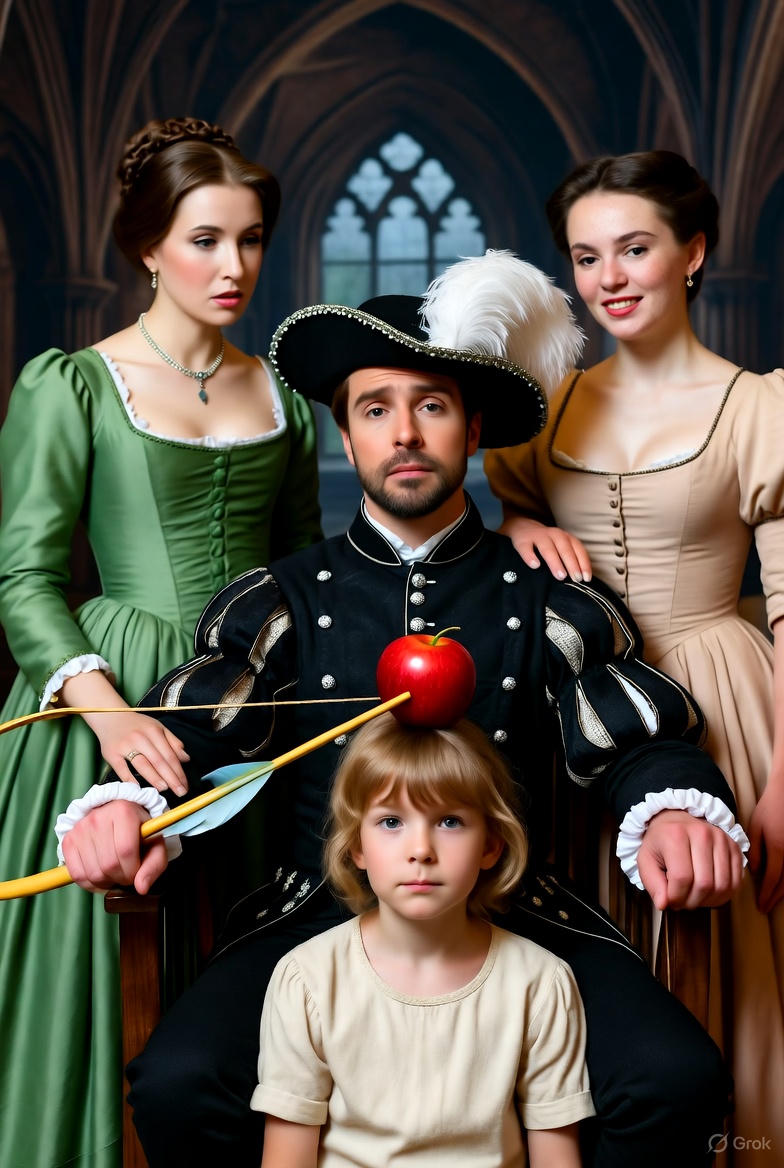
Helmina rushed upstairs. Ruprecht sat with the
children in the bay room, playing Wilhelm Tell. The
valiant archer was shooting the apple from his son’s
head. The paper Gessler looked so fearsome that
Nelly couldn’t bear to watch. Her affection went to
beautiful Bertha in her green riding dress and kindly
young Ulrich. Papa had promised to keep them safe.
“How could this happen?” Helmina cried. “How
did it occur? Is it true? I might’ve found you dead?”
Ruprecht looked up. Helmina seemed distraught.
No surprise—a wife learning her husband nearly
suffocated would be. Yet was there a touch too
much—a slight excess beyond her usual cold control?
“Oh, it’s nothing,” he said, smiling. “That’s the
main thing. I’m glad I didn’t have to leave you so
soon after our marriage.”
“How could such a thing happen?” Helmina
repeated, agitated. “How do you feel now?”
“You see—well enough to play Wilhelm Tell with
Nelly and Lissy. I’ve hung up work for today…”
“As long as you’re unharmed,” Helmina said,
breathing calmer. Ruprecht recounted how Jana,
passing the bedroom by chance, smelled the carbon
monoxide and saved him. Helmina listened intently,
studying him. His face was gaunt, pale, his eyes wide
with dilated pupils, as if dosed with atropine. It
must’ve cut close to his life’s core. A bit deeper,
closer—
She stopped herself, feeling his gaze probe her
thoughts. The children sat timidly, grasping little but
enough to know they’d nearly lost Papa. Nelly
climbed onto Ruprecht’s knee, wrapping her arms
around his neck.
Ruprecht swiftly shifted to Helmina’s Vienna trip
and gown matters. His gesture dismissed the accident
as trivial, signaling a change of topic.
He truly knows no fear, Helmina thought. He’s the
first to match me. I should have time to wrestle with
him.

Read Full Post »

Alraune by Hanns Heinz Ewers and translated by Joe E Bandel

A slight shock flew through her limbs. She sat up, drunk with
sleep.
“What do you want?” she stammered.
Then she recognized the professor. “Leave me alone.”
“Come on Alma, don’t be foolish,” the Privy Councilor
admonished her. “It is finally time. Be sensible and don’t give us any
trouble.”
With a quick jerk he pulled the sheets away throwing her onto
the floor.
The eyes of the princess widened, “Very good! The girl is very
well endowed–that is convenient.”
But the prostitute pulled her nightshirt down and covered herself
as well as possible with a pillow.
“Go away!” She screamed. “I won’t do it!”
The Privy Councilor waved to the assistant doctor.
“Go,” he commanded. “Hurry, we don’t have any time to lose.”
Dr. Petersen quickly left the room. The princess came up and sat
on the bed, talked to the girl.
“Don’t be silly, little one. It won’t do any good.”
She attempted to caress her, massaging her with fat be-ringed
fingers over throat and neck, down to her breasts.
Alma pushed her away, “What do you want?–Who are you?–Go
away, away–I won’t do it!”
The princess would not be rebuffed, “I only want what’s best for
you child–I’ll give you a pretty ring and a new dress–”
“I don’t want a ring,” screamed the prostitute. “I don’t need a
new dress. I want to go from here. Why won’t they leave me in
peace?”
The Privy Councilor opened the glass tube in smiling tranquility.
“Later you will be left in peace–and later you can go. Meanwhile
you have an obligation to fulfill that you agreed to at the very
beginning–Ah, there you are doctor.”
He turned to the assistant doctor who had just entered with a
chloroform mask in his hand.
“Come here quickly.”
The prostitute stared at him with terrified, wide protruding eyes.
“No,” she lamented. “No! No!”
She made as if to spring out of the bed and pushed the assistant
doctor so hard with both hands on his chest as he tried to restrain her
that he staggered back and almost fell down. Then the princess threw
herself onto the girl with wide stretched arms, pressing her back into
the bed with her mighty weight. Her fingers with their many rings
clawed into the luminous flesh as she gripped a long strand of red hair
in her teeth.
The prostitute struggled, kicking her legs into the air, unable to
free her arms or move her body under this mighty burden. She saw as
the doctor placed the mask over her face, heard him lightly counting
“one, two, three–”
She screamed and tried to turn her head to the side away from
the mask, “No! No! I won’t! I won’t! Oh, I can’t breathe–”
Then her screams died away, turned into a pitiful weak whimper,
“Mother–oh–mother.”
Twelve days later the prostitute Alma Raune was delivered to
Criminal Court for imprisonment pending an investigation. The
warrant was issued because she was accused of theft and without any
home of record considered at risk to flee. The charges were brought
by his Excellency Privy Councilor ten Brinken.
Already in the first days the professor had repeatedly asked the
assistant doctor if he had not seen this or that thing that was missing.
The Privy Councilor was missing an old signet ring that he had set to
one side while washing and then left it. He was missing a little money
purse that he had left in his overcoat as well as he could remember.
He asked Dr. Petersen to unobtrusively keep a sharp eye on all
the employees. Then the assistant doctor’s gold watch disappeared
from a room in the clinic where he kept it in a locked drawer in his
writing desk. The drawer had been forcibly opened. A thorough
search of the clinic and all the employees was immediately declared
but nothing was found.
“It must be one of the patients,” the Privy Councilor concluded
and ordered a search of all the rooms as well. This was led by Dr.
Petersen, but again without success.
“Have you forgotten any rooms?” his chief questioned.
“None, your Excellency!” answered the assistant doctor. “Except
Alma’s room.”
“Why haven’t you checked there?” asked the Privy Councilor
again.
“But your Excellency!” Dr. Petersen replied. “That is completely
out of the question. The girl is watched night and day. She has not
once been out of her room and now since she knows that we have
been successful has become completely out of hand. She howls and
screams the entire day and threatens to drive us all crazy. She only
thinks about how she can escape and other ways to frustrate our goal–
To put it straight, your Excellency, it seems impossible to me for us to
keep the girl here the entire time.”
“So,” the Privy Councilor laughed. “Petersen, go and search
room seventeen at once. It does not appear to me that we can count on
the innocence of the prostitute.”
A quarter of an hour later Dr. Petersen came back with a knotted
handkerchief.
“Here are the missing items,” he said. “I found them in the
bottom of the girl’s laundry sack.”
“I thought so!” nodded the Privy Councilor. “Now go and
telephone the police right away.”
The assistant doctor hesitated, “Excuse me, your Excellency, if I
may be permitted to object. The girl is certainly not guilty even if the
evidence seems to speak against her. Your Excellency should have
seen her as I searched the room with the old nurse and finally found
the things. She was completely apathetic, wasn’t concerned at all. She
certainly didn’t have anything to do with the theft. One of the staff
must have taken the items and when threatened by discovery, hid
them in her room.”
The professor grinned, “You are very chivalrous Petersen–But
all the same–telephone the police!”
“Your Excellency,” the assistant doctor pleaded. “Can’t we wait
a little. Perhaps we can question the staff one more time–”
“Listen Petersen,” said the Privy Councilor. “You should think
this through a little more. It doesn’t matter at all if the prostitute has
stolen these things. The important thing is that we will be rid of her
and she will be safe until her hour is come. Isn’t that true? In prison
she will be kept safe for us, much safer than here. You know how
well we are paying her and I am willing to pay her even more for this
little inconvenience–after it is all over.
It won’t be any worse for her in prison than here–Her room will
be a little smaller, her bed a little harder and the food won’t be as
good. But she will have companions–and that will be worth a lot in
her condition.”
Dr. Petersen looked at him, still not entirely convinced. “Quite
true, your Excellency, but–won’t she talk there? It could be very
uncomfortable if–”
The Privy Councilor smiled, “How so? Let her talk, as much as
she wants. Hysteria- mendax–you know that she is hysterical and that
hysterical people are known to lie! No one will believe her, especially
since she’s a hysterical pregnant woman. What would she say
anyway? The story of the prince, that my nephew swindled her with
so neatly?
Do you believe that the judge, the attorney, the prison director,
the pastor or any other reasonable person would even listen to such
obstruse nonsense?–Besides, I will speak to the prison doctor myself–
who is he anyway?”
“My colleague, Dr. Perscheidt,” said the assistant doctor.
“Ah, your friend, little Perscheidt,” the professor confirmed. “I
know him as well. I will ask him to keep an especially watchful eye
on our patient. I will tell him that she had an affair with an
acquaintance of mine that sent her to my clinic and that this
gentleman is prepared to take full care of the child in every way. I will
also tell him about the extraordinary lies I have observed in the
patient and even what stories she is likely to tell him.
Even more, we will retain Legal Councilor Gontram for her
defense at our own cost and explain the case to him so that he will not
believe anything she says either– Are you still afraid Petersen?”
The assistant doctor looked at his chief in admiration.
“No, your Excellency,” he said. “Your Excellency has thought of
everything. Whatever is in my power to do, I am at your service,
Excellency.”
The Privy Councilor sighed loudly, then reached out his hand.
“Thank you dear Petersen. You will not believe how difficult
these little lies have been for me. But what is a person to do? Science
has always demanded such sacrifices. Our brave predecessors, the
doctors of the late Middle Ages, were forced to steal bodies from
cemeteries so they could learn anatomy. They risked being criminally
charged with violation of a corpse and similar nonsense. We can’t
complain, must take such little deceptions into the bargain, for the
sake of our sacred science.
Now go Petersen. Telephone the police!”
The assistant doctor left. In his heart was a great and honest
admiration for his chief.
Alma Raune was sentenced for burglary. Her stubborn denial and
prior conviction worked against her. Despite that, she was given a
light sentence, apparently because she was really very beautiful and
also because Legal Councilor Gontram was defending her. She only
received one year and six months imprisonment and the time she had
already served applied to it as well.
This was further reduced at the request of his Excellency ten
Brinken even though her conduct while in prison could in no way be
considered model behavior. In his gracious request for a pardon he
concluded that her bad behavior was due to her morbidly hysterical
condition and also stressed that she would soon become a mother.
In the early morning at the first signs of labor she was released
and taken to the ten Brinken clinic. There she was placed in her old
white room, No. seventeen, at the end of the corridor. The labor pains
had already begun during transport and Dr. Petersen tried to calm her
by saying it would soon be over. But he was wrong.
The labor lasted that entire day, that night and the following day.
They let up for a little while and then returned even more strongly.
The girl screamed and whimpered, writhing in pain and misery.
The third short paragraph in the leather bound book A. T. B. is in
the hand of the assistant doctor and deals with this remarkable birth.
He performed, with the assistance of the prison doctor, the very
difficult delivery that lasted for three days and ended with the death of
the mother. The Privy Councilor himself was not present.
In this account Dr. Petersen stressed the strong constitution and
the excellent build of the mother, which should have allowed a very
easy delivery. Only the exceptionally rare presentation of the baby
caused the complications to take place that in the end made it
impossible to save both mother and child.
It was further mentioned that the child, a girl, while being pulled
out of the mother’s body began an extraordinary shrieking that was so
shrill and penetrating that neither gentlemen nor the midwife had ever
experienced anything like it before in other births. The screams
sounded almost as if the child were experiencing unbelievable pain at
being so violently separated from the mother’s womb.
The screams became so penetrating and dreadful that they could
scarcely bear the horror of it. His colleague, Dr. Perscheidt, broke into
a cold sweat and had to sit down. After the birth the infant
immediately became quiet and didn’t even whimper.
The midwife while bathing the delicate and thin child
immediately noticed an unusually developed atresia Vaginalis where
the legs halfway down to the knees had grown together. After further
investigation it was found to be only the external skin that was
binding the legs together and could be corrected later through a quick
operation.
As for the mother, she had certainly endured heavy pain and
suffering without any chloroform, local anesthesia–or even as much
as a Scopolamine-morphine injection. She was hemorrhaging so badly
they could not risk further stress to her heart. She screamed the entire
time for all those long hours and only during the moment of birth
itself did the dreadful shrieks of the infant drown out the screams of
the mother.
Her moans became weaker, some two and a half-hours later she
lost consciousness and died. The direct cause of death was a torn
uterus and the resulting hemorrhage.
The body of the prostitute, Alma Raune, was assigned for
dissection since her relatives in Halberstadt raised no claims and
refused to pay the cost of burial when they were notified. The
Anatomy professor Holzberger used it in his lectures and assigned
parts of it to each of his students to study. These certainly contributed
vastly to their education except for the head, which had been given to
senior medical student Fassman of the Hansea fraternity. He was
supposed to prepare it as a finished skull but forgot it over vacation.
He decided that he already had enough skulls and no longer needed to
clean it. Instead he fashioned a beautiful dice cup out of the top of the
skull. He already had five dice that had been made from the vertebrae
of the executed murderer Noerrissen and now needed a suitable dice
cup.
Senior medical student Fassman was not superstitious, but he
maintained that his dice cup served him extremely well when playing
for his morning half-pint. He sang such high praise for his skull dice
cup and bone dice that they gradually acquired a certain reputation,
first with his own friends, then within his fraternity and finally over
the entire student body.
Senior medical student Fassman loved his dice cup and almost
saw it as blackmail when his Excellency Privy Councilor ten Brinken
asked him to give up his famous dice cup and dice at the time of his
exam. It so happened that he was very weak in gynecology and the
professor had a reputation for giving very strict and difficult exams.
The result was that he passed his exam with flying colors. For as long
as he owned it, the dice cup brought him good luck.
There is one other curious thing that remains in the story of these
two people that without ever seeing each other became Alraune’s
father and mother, how they were brought together in a strange
manner even after their death. The Anatomy Building janitor,
Knoblauch, threw out the remaining bones and tatters of flesh into a
common shallow grave in the gardens of the Anatomy Building. It
was behind the wall where the white roses climb and grow so
abundantly–

Read Full Post »

Homo Sapiens: In the Maelstrom by Stanislaw Przybyszewski and translated by Joe E Bandel

“Have you ever thought about this terrible riddle, about the human? No, of course not. You are an anarchist, so strictly speaking an heir of the free-thinking brain that produced materialism and eudaimonistic ethics, yes you are the heir of a world view that… But do you know this one wonderful passage from the *Confessions* of Saint Augustine? 

Just listen: ‘There people go and admire high mountains and wide sea floods and powerfully roaring rivers and the ocean and the course of the stars, but forget themselves beside it.’ 

Yes, you see: the bourgeois brain has forgotten the human. He must now be discovered anew! But to discover him, one must first unlearn the ridiculous overestimation of the idiotic macrocosm, the astonishing achievements of the natural sciences, one must regain the childish sense that can see the terrible and mysterious, the depth and the abyss, not only see, but marvel, feel fear and horror and despair before all of it…”  

“Ha, ha, I idiot… Yes, you are right to put on this superior smile. Yes, of course. You, you—what are you actually? Followers of the materialistic world view, you have naturally solved all riddles… Well, no offense, I understand very well that your world-embracing ideals of humanity leave you no time to ‘lovingly immerse’ yourself in such a trifle as the human—the expression comes from the *Berliner Tageblatt*, ‘your thorough action’—the expression is from the same source—does not allow you to waste your time uselessly. Ha, ha, ha…” 

“Do you really not want to drink? Pity, great pity, I actually cannot stand people who don’t drink. 

But you seem curious. You would probably like to learn something personal about the mysterious Herr Falk who sent you money for social agitation, pamphlets and proclamations to incite one class against the other. Ha, ha, ha… Incitement! isn’t that what it’s called officially… But I don’t want to speak of myself at all, I want to speak only of objective questions… Ha, ha, ha… 

You see: that is for example very interesting, how a person can change under the influence of a trifle. Trifle, I tell you. Ridiculous little thing. I was with Iltis yesterday, I study him namely. He got married. His wife is the most wonderful woman under the sun. Quite extraordinary woman. Now, you see: she could hardly have sensed earlier that she would become his wife in two years say. Isn’t that so? One cannot sense such a thing over the distance of large time spans. Yes, so back then, when she could not yet sense Iltis, she fell in love. Yes, of course. Why shouldn’t she fall in love? She also gave herself to the man she loved. That is natural. You don’t blame her for not waiting for the state concession first. But I don’t want to judge logically, for otherwise I would only find it beautiful. But since the woman always exists in relation to the last man, and the last man does not like to find such earlier encroachments on his priority rights beautiful, so—yes, for all I care I say that it was not beautiful of Iltis’ wife to act so prematurely. 

So: Iltis—no, I don’t know exactly if it is Iltis, no, my head is a bit confused, it is probably someone else. Let’s call him Certain. That even sounds very nice. I am quite delighted with this marvelous idea. Just think: Certain! So this Certain falls in love with the woman who has already eaten the paradise apples forbidden to chaste virgins, and marries her. Naturally she confessed everything to him. But he! Good God, over such trifles he as a modern person and former head of the wildest bohemia will not get upset. Interesting, isn’t it? But afterwards he recollects himself. In his soul a small tiny gap opens that emits a strange feeling of discomfort. Certain sits down, or no! he lies on his resting sofa, crosses his arms under his head and broods. There was already one there who possessed the woman. That is strange! The same flattering names she says to him she has already whispered in another’s ear, she has already lain around another’s neck, another has already pressed this body to himself… But to thunder, what is that? Certain jumps up quite startled. It seems to him as if the small gap is actually a small wound that has become inflamed and now causes unheard-of torment. But ridiculous! Certain is quite furious that he can get upset over such natural, yes, sanctified by the secret purpose of nature self-evidentness… Yes, he explains the thing to himself crystal clear and forgets it. He is even very glad that he so energetically rejected these posthumous demands of his sexual organism. He stretches, trills a shepherd song, ah, how idyllic—but with the evil powers—well, you know your Schiller. Certain becomes restless anew. A certain tormenting curiosity overcomes him. He goes to his wife, is incredibly amiable, kisses her hands, flirts with her, talks about this and that, then suddenly asks, so en passant, with the most innocent, most indifferent expression in the world: You, what was your first man actually, blond or black haired? The word “man” he pronounces without knowing with a strange emphasis. It is hate, rage, curiosity, everything you want. 

Yes, he was black, but had strangely blue eyes. 

Certain twitches involuntarily, he is so irritated that he cannot talk further about it. He is completely beside himself, he cannot understand at all what is happening… 

Ha, ha, ha, poor Certain; I will admit that he is incredibly ridiculous, but that’s how the stupid fellow is made. He also doesn’t want to think further about it. No, he doesn’t like to. He has forgotten the whole thing for a few days. But then suddenly it comes again, only more violently, more painfully. It is almost like pleasure to torment oneself, to have the wound torn open quite brutally… I leave open the question in what physical and psychic causes this self-tormenting curiosity may be grounded, but it is there. He must interrogate his wife, naturally with the necessary psychological tact, only so as not to let on that anything matters to him. 

So he asks, so casually, only for psychological interest, about the closer circumstances. He gets to know them, naturally, why not? He has spoken so beautifully and so enthusiastically to her about free love relationships. He, he—they are both so-called modern people who have long gone beyond such ridiculous prejudices. 

Whether she had loved him? She thinks a little. Oh yes, she loved him, very much. Certain trembles and tries to control himself. The closer circumstances? My God, they are always the same! and she laughs. He naturally laughs too. But she should tell him in detail, it is so extremely interesting, and she comes so close to him thereby if he knows her life in the smallest secret corner exactly. She resists, but finally gives in… The black haired one had asked her to prove her love to him… just note, Herr Czerski, how I will now paraphrase everything… she herself had also understood that this—do you understand this mysterious “this”?—was the only proof of love. 

From the throat of poor Certain suddenly comes a strange whistle that he eagerly undoes with subsequent coughing. 

So he had asked her for this “this”—she should just think it over well—just think what an exemplar of wise magnanimity this black haired gentleman must have been! 

“You naturally during the whole time in which you should think over this decisive ‘this’ didn’t think about it once?” Certain is namely a psychologist. 

“No, I only felt that it had to come, I could, I didn’t need to think about it: it was necessary.” 

“For you or for him?” Certain namely rages with malicious fury. He has a fabulous desire to roar so that his lungs burst. Why, he doesn’t know. 

She didn’t quite understand what he meant with his cynical question and looks at him with big eyes. You know: with eyes that are actually only a burning, suspicious, a little contemptuous question mark. 

Certain immediately comes to himself. He almost awakened her mistrust. He now becomes very cautious. 

Now he asks further with a certain nonchalant bonhomie and learns gradually pretty much everything worth knowing. The dynamic mechanics of love is almost always the same, there are certain unbreakable moments… He, he, he… 

But now it overflows in the stupid Certain. He cannot hear further. He has a maniacal, unconquerable desire to throw the woman to the ground and beat her dead with his fists. 

Does he do it? 

Read Full Post »

Alraune by Hanns Heinz Ewers and translated by Joe E Bandel

Chapter Five
Informs about her father and how Death stood as Godfather
when Alraune came to life.

DR. Karl Petersen brought the Privy Councilor a large
beautifully bound book that he had prepared especially for
this project. The old ten Brinken family crest showed on
the upper left corner of the red leather volume. In the
middle glowed the large golden letters ATB.
The first page had been left blank. The professor had reserved it
to write some early history himself. The next page began with a
paragraph in Dr. Petersen’s hand. He wrote of the short and simple
life history of the mother and of her character and demeanor.
He had asked the prostitute to tell her life story and then quickly
wrote it down. Even her previous convictions were mentioned. Alma
had been sentenced twice for vagrancy; five or six times due to
violations of police regulations concerning her profession and once
because of theft–Yet, she maintained that she was innocent of the
theft–the gentleman had given her the diamond pin.
Further down in the second paragraph Dr. Petersen had written
down things about the presumptive father, the unemployed miner,
Peter Weinland Noerissen, who had been condemned by a court and
jury and sentenced to death in the name of the King.
The public prosecutor had presented the facts in an amiable,
charming fashion. It appeared that P. Noerissen had been predestined
to such a fate from infancy. His mother had been a notorious drinker.
His father, an occasional worker, had been previously convicted
because of frequent crude misdemeanors. One of his brothers was
even now serving ten years in prison on similar grounds.
Peter Weinland Noerissen had become apprenticed to a
blacksmith after he finished school. This had played an important part
in the proceedings because of the skill and strength that had been
displayed in the murder. Many witnesses gave evidence of his
displays of unusual strength. He had a history of pushing himself on
females even when they said they were not interested.
He had been released from military service because of a
congenital defect. He was missing two fingers on his left hand. He
worked in several diverse factories before finally coming to the
Phoenix mine in the Ruhr industrial district. He was not a member of
any trade union, not the old socialist union, the Christian or the
mysterious Elks.
He was fired from the mine when he pulled a knife on an
overseer. This was a serious violation and he received his first
sentence of a year in jail. He was released after his counsel for the
defense argued during appeal that the conviction was only based upon
the word of the overseer with no real evidence that it was attempted
manslaughter.
After that he was on the road, had crossed over the Alps twice
and fought his way from Naples to Amsterdam. While he did work
occasionally, he spent most of his time as a vagabond or hobo and
was further convicted of a few other petty crimes. It was enough for
the public prosecutor to assume that in the course of seven or eight
years he had become a hardened criminal with no conscience.
The crime that he was now condemned for was not that clear
either. It was still not entirely certain if it had been a robbery gone
wrong or an intentional sex murder. The defense tried to portray it as
if the accused had only intended to rape the well dressed and well
endowed nineteen year old daughter of the home owner, Anna Sibilla
Trautwein, when he encountered her in the Ellinger Rhine meadow
that fateful evening.
That when he tried to rape the strong and vigorous girl she
started screaming and he pulled his knife only to threaten her into
silence. It didn’t work and she fought back more vigorously and in the
struggle was stabbed. He only finished her off out of the fear of
discovery. It was then only natural that he take her petty tip money
and jewelry to help him make good his escape.
This account did not match the condition of the corpse itself. It
was established that the terrible dismemberment of the victim’s vitals
was most skillfully done and the cut almost workman like. The public
prosecutor ended with a plea that the appeal to the Imperial court be
refused, that there was no need for further reprieve and that the
execution take place early in the morning on the following day at six
o’clock.
In conclusion the book stated that the delinquent did agree to Dr.
Petersen’s request on the condition that he be brought two bottles of
whiskey that evening around eight o’clock.
The Privy Councilor finished reading and then gave the book
back.
“The father is cheaper than the mother!” he laughed.
“You will attend the execution as well. Don’t forget to bring the
common salt solution and other things you will need. Hurry back as
soon as possible. Every minute counts, especially in a situation like
we have here. There will scarcely be enough time. I will expect you at
the clinic early in the morning. Don’t bother finding an attendant. The
princess will assist us.”
“Princess Wolkonski, Your Excellency?” Dr. Petersen asked.
“Certainly,” nodded the professor. “I have my reasons for
bringing her into this little operation–Besides, she is very interested in
such things. By the way–how is our patient today?”
The assistant doctor said, “Ah, your Excellency. It is the same
old story, always the same now for the two weeks that she has been
here. She cries, screams and raves–In short, she wants out. Today she
smashed a couple of wash basins to pieces.”
“Have you seriously tried to talk with her again?” asked the
professor.
“I tried, but she scarcely let me get a word out,” answered Dr.
Petersen. “It is fortunate that tomorrow is finally almost here–How we
can ever keep her here until the child comes into the world is a puzzle
to me.”
“That won’t be your problem Petersen,” the Privy Councilor
clapped him benevolently on the shoulder. “We will find a way–Just
do your duty.”
The assistant doctor said, “Your Excellency can count on me for
that.”
The early morning sun kissed the honeysuckle leaves in the arbor
and clean gardens where the Privy Councilor’s white women’s clinic
lay. It lightly fondled the many colored dahlias in their dew fresh beds
and caressed the large deep blue clematis on the wall.
Many colored finches and large thrushes ran across the smooth
path, scurried through the evenly mown lawn and quickly flew off as
eight iron hoofs struck sparks as they lightly hit the cobblestones of
the street.
The princess climbed out of the carriage and came with quick
strides through the garden. Her cheeks glowed, her strong bosom
breathed heavily as she climbed the high steps up to the house. The
Privy Councilor came up and opened the door for her.
“Come in, I’ve just had some tea made for you.”
She said–in a panting and hurried voice–“I just came from–there.
I saw it. It–it was fabulous–exciting.”
He led her into the room. “Where have you just come from, your
Highness? From the– execution?”
“Yes,” she said. “Dr. Petersen will be here soon–I received a
ticket–just last night. It was intense–very intense.”
The Privy Councilor offered her a chair. “May I pour for you?”
She nodded, “Please, your Excellency. Very kind of you! A pity
that you missed it! He was a splendid fellow–tall–strong.”
“Who?” He asked, “The delinquent?”
She drank her tea, “Yes, certainly, him! The murderer! Muscular
and strapping–a powerful chest–like a boxer. He wore some kind of
blue sweater–it was open at the neck. No fat, only muscle and sinews.
Like a bull.”
“Could your Highness see the execution clearly?” asked the
Privy Councilor.
“Perfectly, your Excellency!” she cried. “I stood at the window
in the hall. The guillotine was right in front of me. He swayed a bit as
he stepped up. They had to support him.”
“Please, another piece of sugar, your Excellency.”
The Privy Councilor served her. “Did he say anything?”
“Yes,” said the princess. “Twice, but each time only one word.
The first time as the attorney read the sentence. That’s when he cried
out half-loud–but I can’t really repeat it–”
“But your Highness!” The Privy Councilor grinned and patted
her lightly on the hand. “You certainly don’t need to get embarrassed
in front of me.”
She laughed, “No, certainly not. Well then–but reach me another
slice of lemon. Thank you. Put it right there in the cup! Well then–he
said, no–I can’t say it.”
“Highness,” said the professor with mild reproof.
She said, “You must close your eyes first.”
The Privy Councilor thought, “Old monkey!” but he closed his
eyes. “Now?” he asked.
She still hesitated, “I–I will say it in French–”
“That’s fine–in French then!” he cried impatiently.
Then she pressed her lips together, bent forward and whispered
in his ear, “Merde!”
The professor bent backward, the princess’s strong perfume
bothered him. “So that’s what he said?”
“Yes,” she nodded. And he said it as if he was indifferent to it
all. I found it very attractive, almost gentleman like.”
“Certainly,” confirmed the Privy Councilor. “Only a pity that he
didn’t say it in French as well. What was the other word he said?”
“Oh, that was bad,” the princess sipped her tea, nibbled at a
cookie. It completely ruined the good impression he had made on me!
Just think, your Excellency, just as the executioner’s assistants seized
him, he suddenly began to scream and cry like a little child.”
“Well,” said the professor. “Another cup, your Highness?–And
what did he scream?”
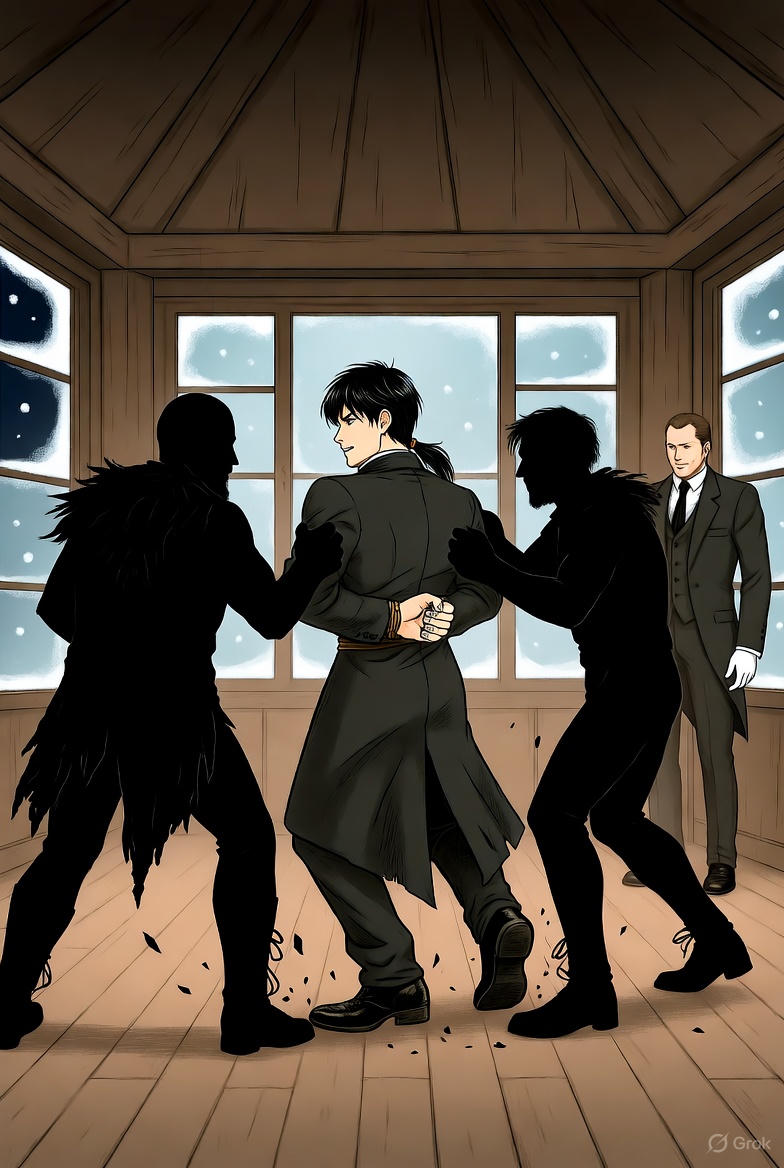
“First he defended himself,” she explained. “The best he could,
silent and powerfully even though both hands were tightly tied behind
his back. There were three assistants and they threw themselves on
him while the executioner stood there watching quietly in his dress
suit and white gloves. At first it pleased me, how the murderer threw
off the three butchers, how they tore at him and pushed without
bringing him one step closer. Oh, it was terribly exciting, your
Excellency.”
“I can only imagine, your Highness,” he blurted out.
“But then,” she continued. “Then it all changed. One grabbed his
leg while another pushed his bound arms high and he stumbled
forward. At that moment he must have felt his resistance was useless,
that he was lost. Perhaps–Perhaps he had been a little drunk–and was
now suddenly very sober –Pfui–That’s when he screamed.”
The Privy Councilor smiled, “What did he scream? Must I close
my eyes again?”
“No,” she cried. “You can leave them open, your Excellency–He
became a coward, a pathetic coward, full of fear. He screamed,
‘Mama!–Mama!–Mama!’ dozens of times while they had him on his
knees, dragged him to the guillotine and pushed his head into the
circular opening of the board.”
“Was he still crying for his mama at the last moment?” asked the
Privy Councilor.
“No,” she answered. “Not at the very last. After the hard board
was locked firmly around his neck with his head sticking out the other
side he became very quiet. Something seemed to be going on inside of
him.”
The professor became very attentive, “Could you see his face,
your Highness? Could you guess at what was going on inside him?”
The princess said, “I could see him just as clearly as I see you
right now sitting in front of me–What was going on inside him–I
don’t really know–there was just an instant–After the executioner
looked around one last time to see that everything was ready–when
his hand pressed the button that released the blade. I saw the eyes of
the murderer, they stood wide open, with insane passion, saw his
mouth panting and his features contorted with desire–”
She stopped.
“Was that all?” inquired the Privy Councilor.
She finished, “Yes, then the guillotine fell and his head sprang
into the sack that one of the assistants held open- Please, reach me the
marmalade, your Excellency.”
There was a knock at the door. It opened and Dr. Petersen
stepped inside. In his hand swung a long glass tube, tightly corked
and wrapped in wadding.
“Good morning, your Highness,” he said. “Good morning, your
Excellency–Here–here it is.”
The princess sprang up, “Let me see–”
But the Privy Councilor held her back. “Slow down, your
Highness. You will see it soon enough. If it is all right with you, we
will get right to work.”
He turned to the assistant doctor, “I don’t know if it will be
important, but just in case it would be a good idea if you–”
His voice sunk as he put his lips to the ear of the doctor.
He nodded, “Very well, your Excellency. I will give the orders
immediately.”
They went through the white corridors and stopped just in front
of No. seventeen.
“Here she is,” said the Privy Councilor as he carefully opened
the door.
The room was entirely white, radiant with sunlight. The girl lay
deeply asleep in bed. A bright ray scurried in from the tightly barred
windows, trembled on the floor, clambered up a golden ladder, darted
across the sheets and nestled lovingly on her sweet cheek, plunging
her red hair into glowing flames. Her lips were moving–half-open–as
if she were lightly whispering words of love.
“She’s dreaming of her prince,” said the Privy Councilor.
Then he laid his cold, moist hand on her shoulder and shook it.
“Wake up Alma.”

Read Full Post »

Madame Bluebeard by Karl Hans Strobl and translated by Joe E Bandel

“I’ll come,” he said. “You don’t think I’m above
such things. A warm, bright ballroom, festive
women, soft music—there’s much life and splendor
in that.”
He only wished she’d broached it another time.
Helmina watched, knowing his thoughts. It was like
preparing for a wrestling match. They faced off,
probing for weaknesses, ready to seize any opening
with a firm grip. But when evening fell, when will’s
weariness set in and night loomed, their senses
stirred. The urge of their bodies surged, forging peace
to wage battle on another field.
One evening in late January, when Lorenz was
briefly alone with Helmina, he said, “Brother writes.
He won’t wait longer. You must act.”
Helmina paused. “Fine—tomorrow!” she said
decisively. The next morning brought a glorious
winter day. As she sat with the children at breakfast,
she heard snowshoes clatter in the antechamber.
Ruprecht entered, early from outdoors, brimming
with youthful vigor, master of the world’s riches.
“Coming along later?” he asked. “Perfect ski weather
today.”
Helmina agreed, changed quickly after breakfast,
and plunged with Ruprecht into winter’s wonders.
Fresh snow had fallen, its surface crusted by swift
frost. They glided with a bird’s speed, transcending
flaws, reveling in the joyous outpour of strength, the
rushing motion.
Ruprecht let Helmina lead. Her red knitted jacket
sang against the white snow. She leapt down a slope,
legs tight, knees bent, and sped on below. They
climbed a gentle hill. At the forest’s edge, blue
shapes jutted from the snow. “Soldiers,” Ruprecht
said, his eyes honed on South America’s vast
pampas. Indeed, soldiers—four men and a volunteer,
72freezing on outpost duty. All five gaped as Helmina
zoomed past. The volunteer’s awe crystallized into a
cry: “Sapperment!”
But the pair was already gone, vanishing among
the trees.
“Must be a winter maneuver,” Ruprecht guessed.
In the valley furrow beyond the forest, they met
another outpost. Footprints led up the far slopes.
Helmina followed them. Atop the high plain, a
village lay at the end of a rutted, brownish hollow
way. Huddled against the cold, its cottages seemed
baked together for warmth, buried to their windows
in snow. On either side of the hollow way, a blue-
black swarm stirred—an ant-like frenzy. Ruprecht
and Helmina glided along the path’s edge, where
snow was less trampled. Below, troops marched.
They passed countless upturned faces, a river of
gazes. Then came a wide, empty gap, followed by a
knot, a jam. The hollow way was clogged with
soldiers, murmuring, pressing forward. Something
had happened.
Soldiers lined the path’s rims, peering in, making
it hard to pass. Something had happened. At a gentler
slope, Helmina pushed down into the hollow.
Soldiers glanced back, startled. A sharp revolver
crack burst from the dense crowd ahead. Helmina
shoved soldiers aside, thrusting forward with her ski
pole, wading through the throng. A fierce craving
drove her, blazing on her face.
She nearly collided with a tall major. He stared,
surprised, at the lady emerging among the rabble,
then recognized her, saluting with utmost courtesy.
Helmina knew him too—Major Zivkovic, from her
Abbazia entourage.
“What’s happened?” she asked urgently. The
major positioned himself to block her view. “Nothing
for ladies! No—please, don’t look. It’s not pretty…
you might have nightmares.”
A wild glee lit Helmina’s face. “An accident?”
“Yes—a regrettable mishap… no, really, madam,
please don’t look… I couldn’t take responsibility…”
Helmina laughed. “Who do you take me for, dear
Major? Think I’ll faint… or have fits?”
“You’d need strong nerves, madam.”
“I believe you know from Abbazia I’m not
nervous. Let me through…”
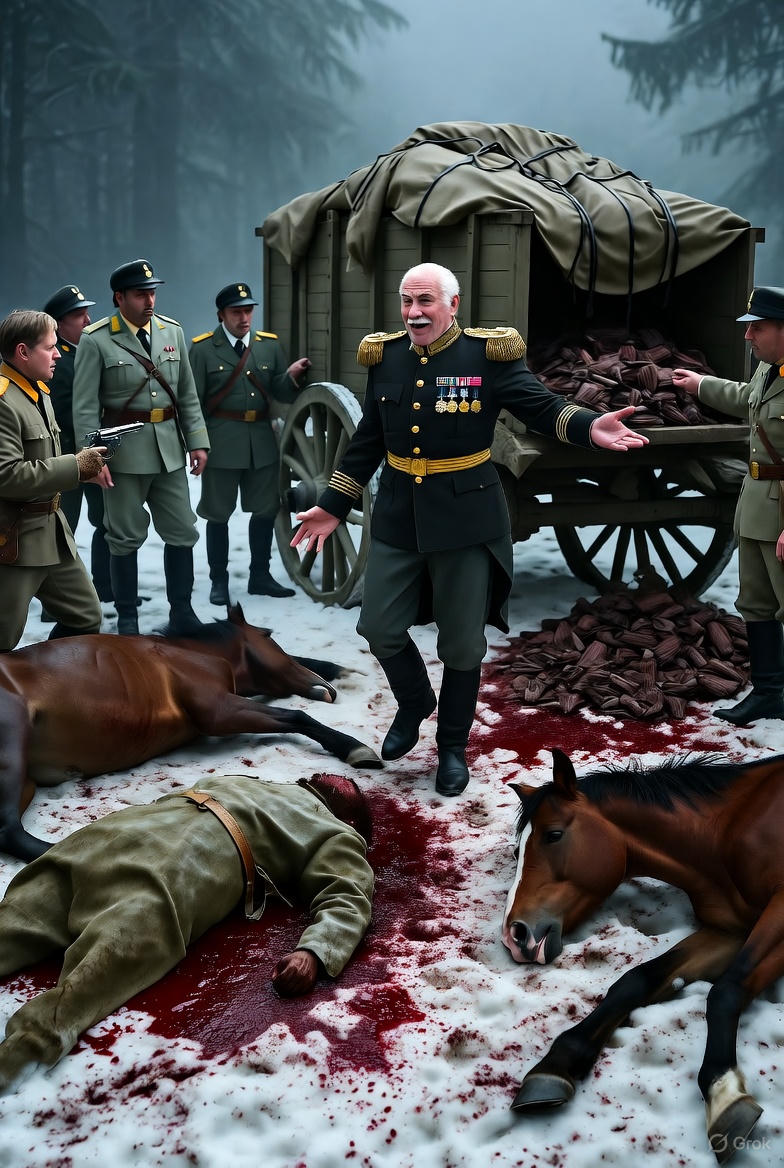
Shrugging, the major stepped aside. Amid the
soldiers lay an overturned, heavily laden supply
wagon, shattered. The surrounding snow was
trampled, mixed with mud, streaked red in places.
Nearby, under coarse wagon tarps, two bodies lay in
a blood pool. The three horses were horribly
mangled, legs broken. Two were dead; one still lived,
thrashing so wildly no mercy shot could be fired. A
lieutenant stood by with a revolver, vainly seeking a
clear moment.
The major explained the wagon had been driven
carelessly, too close to the path’s edge, and plunged.
The drivers were crushed instantly, the horses lost.
Helmina unstrapped her skis and approached the
lieutenant. “Give me the revolver,” she commanded.
Ruprecht saw relentless cruelty on her face, a raging
urge to kill. A barbaric instinct erupted from her core.
Stunned, the lieutenant resisted. “But madam
surely doesn’t…”
“Give me the revolver,” she ordered again. The
beardless young man dared no further objection,
handing her the weapon. Horror crept into his eyes.
Helmina gripped the revolver, stood tall, and stepped
smiling toward the horse. That smile was terrifying.
She stood, staring sharply at the animal. Slowly, she
raised the weapon, aimed calmly, and fired the
moment the horse jerked its head toward her, straight
between its eyes. It twitched, convulsed, then
stretched out, dead.
“Thank you, Lieutenant,” Helmina said, smiling as
she returned the weapon.
“You’re a daring Amazon, madam,” the major
said, paling, his voice dry. He cleared his throat, a
pun surfacing to save the moment. “Truly valiant…
ha… ha!” He was known as an aging wit.
“Christian duty, dear Major,” Helmina replied.
“One can’t let the creature suffer so long.”
“Unlike a man,” the major added, with a gallant
flourish he prided himself on. Helmina introduced
Ruprecht—her retort.
“So you’ve been merciful to at least one man,” the
major said, then inquired with utmost charm about
Ruprecht’s health. Ruprecht smiled. This tall man,
with his habitual gallantries and incorrigible knightly
minstrelsy, harmless as a child, amused him. He
invited him to visit Schloss Vorderschluder.
Helmina strapped on her snowshoes, bid the
officers farewell, and skied ahead of Ruprecht up the
slope they’d descended. The blue swarm of soldiers
soon fell behind. Across the Kamp, the pilgrimage
church of Dreieichen gleamed in the sunlight.
Neither spoke.
Only the soft scrape of snowshoes and the caw of
a large crow, startled from a furrow, broke the
silence. After a while, Helmina stopped, bent, and
scooped a handful of snow. She hadn’t yet replaced
the sturdy ski glove she’d removed. A faint blood
spatter marked her left hand. She rubbed it with
snow, tinging the soft white mass a pale red.
Ruprecht recalled the day Helmina stood by Baron
Kestelli’s corpse, her fingers also stained with blood.
“Oh, yes!” Helmina said, drying her hand with a
handkerchief. “It just occurred to me—I’ve been
meaning to discuss a business matter with you. It’s
rather urgent. You should join a venture I’m
planning. I’m certain Galician petroleum can make a
fortune. The issue is capital. Those oil and naphtha
wells are exploited primitively. A smarter hand could
turn it around. You could double your wealth
overnight.”
“I must tell you, I’ve no entrepreneurial spirit.
You know I prefer safe investments.”
“You’re such a coward in this. To win, you must
risk. I’ve enough enterprise for both of us. You can
trust me when I say it’s a good deal.” Helmina laid
out details, displaying such understanding and
expertise one might think she’d studied for years. She
grew animated, persuading, coaxing, enticing.
The talk clashed with the landscape. Dreieichen’s
tower shimmered across the valley. Below, the Kamp
traced a silver arabesque through blue-black forests.
And Helmina spoke of Galician petroleum.
Ruprecht admired her. She was wholly herself in
all she did—a multifaceted gem, each facet blazing
with different fire. He might’ve been swayed, but
then he recalled her demanding the revolver from the
lieutenant, standing cold-blooded and smiling by the
writhing horse.
“No,” he said calmly, “I’d rather not invest.”
“Oh! You’re not the least bit gallant.”
“Gallantry in money matters, dearest? No! Must I
remind you of our agreement? We’re to keep our
independence, even in this.”
Helmina shrugged. “Your loss if you don’t.”
Ruprecht tried to meet her gaze, but she was
skiing down a slope, ahead of him.
“By the way,” he said, catching up, “I’ll at least
ask Siegl—to show my good faith.”
Siegl, however, had no intention of encouraging
the venture. Reading the banker’s letter, Ruprecht
saw him vividly—the paper’s watermark, firm
letterhead, and florid signature conjured a dancing
pince-nez on a thick nose, a rippling belly in a white
vest, the elegant curve of bowed legs. Siegl wrote:
“Keep your hands off such things. What’s Galician
petroleum to you? How do you get such outlandish
ideas? It’s not for you.” The letter wasn’t typed but
penned by Siegl’s own hand, private and intimate, as
if he spoke with thumbs in his waistcoat pockets.
“You see, Helmina,” Ruprecht said after reading
her the letter, “Siegl’s against it. He’s my oracle. I
must heed him.”
“Then I’ll invest alone,” Helmina replied. “I won’t
let such a chance slip. I’ve had a very attractive
offer.”
“I wish you every success. I won’t envy your
fortune.”
After dinner, when the children were taken away
and Ruprecht had stepped out briefly, Lorenz, serving
tea, whispered, “What did he say?”
“He won’t.”
“Then he’s got to go.”
“I’m just worried it’ll cause a stir this time. We
should wait…”
“We don’t have time.”
“Then at least three days…” Helmina interjected.
“You mean three nights,” Lorenz murmured. “I
said you’re in love.”

Read Full Post »

Madame Bluebeard by Karl Hans Strobl and translated by Joe E Bandel

Seventh Chapter
When Ruprecht returned from Krems at noon,
Helmina informed him that Herr Anton Sykora had
visited—an old friend of her late husband. He’d
regretted missing Ruprecht, but business had forced
him to leave early that morning.
Ruprecht listened half-heartedly, murmuring, “Is
that so?” His mind was brimming with agricultural
matters. He’d thrown himself into work with fervor.
There was much to do. Herr Augenthaler soon
realized the new master held the reins tightly. The
golden age was over; the iron one began. Ruprecht
was everywhere, impossible to deceive. He lifted
every lid to see what lay beneath. Even in winter, he
tolerated no idleness. He’d found gaps in his
stewards’ theoretical knowledge, which he meant to
fill. From Krems, he brought a stack of farming
books and pamphlets, distributing them among his
staff.
Sighing, the manager lugged a pile of scholarship
across the courtyard. The assistant sat in the office,
rolling a cigarette, gazing at Helmina’s window row,
hoping she’d appear.
When the manager handed him his assigned
books, the assistant tossed them on the table and
slammed his fist down. “Ridiculous!” he shouted.
“To cram this into your head… as a grown man—I’m
no schoolboy!”
“Don’t yell,” the manager said. “What’s gotten
into you? And don’t speak so disrespectfully of our
master.” Secretly, though, he relished the assistant’s
outburst, echoing his own thoughts.
Helmina cared little for her husband’s efforts.
Such matters were alien to her. The land held no life
or meaning. Growth, decay, bloom, and fruit were
self-evident, unremarkable. When Ruprecht sat in his
study, she wandered from room to room, played with
the children, chatted with Miss Nelson, or sang in a
not-unpleasant but untrained voice. Deep down, she
was bored. She sometimes thought of Dankwardt,
who’d been no different—immersed in Indian
philosophy while Ruprecht tackled plant physiology,
agricultural chemistry, audited accounts, or drafted
estate plans. Occasionally, he retreated to the Indian
temple, a room Dankwardt had furnished with
mementos from an Indian journey. Between painted
lotus columns, a mural depicted palms and a distant
broad river. A small library held travelogues and
India’s literary treasures on fragrant cedar shelves.
Ornate lamps hung from the ceiling. In corners,
Buddha statues gazed at their navels. When the door
opened, a prayer wheel, tied to the handle by a cord,
clattered.
In that Indian temple, any difference between
Ruprecht and Dankwardt vanished. Helmina passed
the door, casting venomous glances. He’d better not
leave her to boredom. This man was no wiser than
the others. Sometimes, his gaze seemed to pierce her
depths, unearthing hidden truths, sending shivers
through her. Did he truly touch her secrets, strip away
her veils? After passionate nights, a strange urge
gripped her—to shed her mask, confess everything,
stand bare-souled before him. Let him prove if his
love could follow her into the realm of horrors. In
those moments, silence was heavy.
When Ruprecht returned to work, she
congratulated herself on her resolve. Her scornful
smile mocked her own fervor and him, dutifully
fulfilling his self-imposed tasks like an iron
necessity.
“It’s a need,” Ruprecht said, sensing her subtle
derision. “I can’t help it. I can’t lie idle on a bearskin.
I need motion, work. Before, I roamed the world,
busy with sights and vivid experiences, claiming all
there was. Now I’m rooted in one place. I must be all
the busier. It’s the law of energy conservation.”
Helmina delighted in breaching Ruprecht’s
fortified camp. She tore him from work, besieged
him, and triumphed when she toppled his idol, Duty.
Then she let out a wicked laugh. Ruprecht noticed,
calling it a mermaid’s laugh.
The Christmas holidays approached. Snow lay
thick on the mountains, fitting for the season. In the
valley, black wagon tracks ran beside the frozen
river, among groaning firs trembling before their
killers. Peasants trudged through forests, saws and
axes in thick mittens, shaking snow from firs and
pines. They sought Christmas trees. Finding a victim,
iron teeth bit through bark and frozen pith. Axes
struck the trunk, and its fall drew a fearful sigh from
the surrounding woods.
Ruprecht and Helmina skied over steep slopes. He
showed her tricks learned from Norwegian hunters,
teaching her to leap, delighted by her fearlessness.
She kept her legs tight and jumped, her short skirt
flapping around ankles and knees. When she fell, she
rose before he could help, laughing as she brushed
snow from her red jacket. In those moments, he
forgot her wicked smile, unmindful of danger.
From Amnisbühel, a splendid sledding run
descended. Ruprecht and Helmina zoomed down on a
two-seater, black firs blurring into a solid wall. Snow
sprayed, stinging their faces in wild sparks, trailing a
white cloud. The children had a small sled and were
allowed to ride. They tipped over, tumbling downhill,
68piling atop their sled. Squeals and laughter erupted.
Crashing was the best part of sledding.
Two days before Christmas, the children saw a
large sleigh piled with young firs and pines on the
road below. Its runners crunched over hard snow,
horse harnesses jingled, and the driver, in high boots
and short fur, strode alongside, puffing bright blue
smoke balls.
“Where are all those little trees going?” Nelly
asked.
“To the cities… maybe even Vienna, so the Christ
Child can decorate them for children. Every good
child gets a Christmas tree.”
Nelly looked down sadly, then said shyly, “The
Christ Child never decorated a tree for us.”
Ruprecht lifted the girl, kissing her. He knew the
children had never known true, bright Christmas
joy—the wonder of a tree, worth more than any gift.
Helmina hadn’t wanted it. “I’ve spoken to the Christ
Child,” he said. “This time, you’ll surely get one.”
That evening, he and Miss Nelson began
decorating the tree. He was bustling, childishly
gleeful, with the earnestness a proper game demands.
Glittering ornaments lined the branches.
Helmina sat at the room’s rear, watching idly with
cold eyes, a wicked smile curling her lips. Her brow
flickered with storm clouds. How Miss Nelson came
alive at work, shedding all stiffness and reserve. She
stretched to reach higher branches, bent for lower
ones, her slim body tracing graceful lines. She was all
zeal, neither she nor Ruprecht heeding Helmina,
acting as if no one else were present. They debated
earnestly where to place a chain or glass bell.
“Oh, how long since I’ve had a Christmas,”
Ruprecht said, “a true German Christmas. It’s unique.
No other people has its like. These past years, I was
always in the south. The longing was fierce. I’d have
given anything to peek through a window at a
glowing Christmas tree.”
Miss Nelson shared tales of English Christmases,
climbing a chair to fasten a porcelain angel with
tinsel wings high up.
My God, she’s speaking, Helmina thought. A
miracle. She speaks unprompted. Good. Let Ruprecht
try to betray me with her. At the first sign, he’s lost.
What holds him still? What do we share beyond those
fevered nights? Do I love him?
It always began this way for her—a sense of
superiority, as if she need only reach out to toy with a
man. Ah—how exquisite. Years ago, someone gave
her white mice. She’d cared for them well for weeks.
One twilight evening, she opened their cage and let
the yellow cat in.
Ruprecht turned, playfully tossing a chenille
monkey into Helmina’s lap. She disliked such jests.
Her face didn’t change; she said nothing. It was an
insult to offer her such harmlessness. Ruprecht met
her eyes sharply, probing. She returned the gaze.
Fine—let him at least suspect her thoughts. As he
turned back to the tree, she crushed the poor chenille
monkey between her fingers.
On Christmas Eve, the tree blazed in radiant
splendor—a winter fairy tale. Yet the children shone
brighter. They ignored their gifts, standing in shy
reverence. Four tiny Christmas trees sparkled in four
childish eyes. Four small fists clenched tight with
bliss.
Ruprecht, too, stood reverent before the tree,
bathed in light, feeling weightless, soaring, complete.
Meanwhile, Helmina drifted to her gift table.
Carelessly, she sifted through the items—every
fleeting wish fulfilled: the amethyst set, the Lalique
brooch, two Tiffany vases, all there. At the bottom
lay a heavy, angular package. She unwrapped it—a
book: Economic Studies in the Orient by Ruprecht
von Boschan. Its first page bore her name: “To my
beloved wife, Helmina!”
Ruprecht approached. “I know these things don’t
interest you. Still—it’s a memento of our
engagement. I finished it then, giving it your name as
a talisman, calling you my wife in advance. It came
out just in time for Christmas.”
“Thank you for everything,” Helmina said,
offering a cool hand. Oh, Ruprecht piled sentiment
upon sentiment—the Christmas tree, the dedication
from their betrothal! What next?
He’d said his book wouldn’t interest her, but
having written it, he’d joined the guild whose
compass swings toward praise or blame. When
Helmina, well into mid-January, hadn’t mentioned
his Economic Studies, Ruprecht grew impatient.
Dawn’s glow of fame crowned his head, yet Helmina
acted oblivious.
One day, in a measured tone, he said, “I got a
letter from Professor Zwicker today… from Vienna
University, economics. He finds my book
significant.”
“Oh?” Helmina replied indifferently. Let him
stew. Then she added, “I’m not sitting in this
wilderness all Carnival. We’ll go to Krems a few
times when something’s happening. And to Vienna—
at least once or twice. The Vienna City Ball… and
the Concordia Ball.”
“As you wish,” he said, irritated.
She scraped her fork across the plate, a squealing
screech she knew he loathed. “If it doesn’t suit you,
stay home.”

Read Full Post »

Alraune by Hanns Heinz Ewers and translated by Joe E Bandel

Frank Braun said, “Uncle, I’m going down. Do it–For the first
time in you life do it–what I ask of you–I know how it seems–and I
will never go against you again. What do you want me to do?–Should
I grovel even more before you?–Come, let this be enough–Give me
the money.”
Then the Privy Councilor spoke, “I will make you a proposition,
nephew. Do you promise to listen quietly? To not bluster and roar
again like you always do?”
He said firmly, “Yes, Uncle Jakob.”
“Then listen–You shall have the money that you need to get you
out of trouble. If you need more, we will have to talk a little about the
amount later. But I need you–need you here at home. I will have it
arranged for you to be placed there under house arrest for the duration
of your sentence–”
“Why not?” Frank Braun answered. “It doesn’t matter to me if I
am here or there. How long will you need me?”
“Around a year, not quite that long,” answered the professor.
“I agree,” said the attorney. “What do I need to do?”
“Oh not much,” replied the old man. “Just a little employment
that you are already accustomed to and very good at!
You see, my boy,” the Privy Councilor continued. “I need a little
help with this girl that you have arranged for me. You are entirely
correct. She will run away from us, will become unspeakably bored
during her pregnancy and certainly try to abort the child.
I want you to watch over her and protect our interests, prevent
her from doing any of these things. Naturally it is a lot easier to do in
a prison or workhouse where guards can continually watch. But
unfortunately we are not equipped for that. I can’t lock her up in the
terrarium with the frogs or in a cage like the monkeys or guinea pigs
can I?”
“Certainly not, uncle.” the attorney said. “You must find some
other way.”
The old man nodded, “I have found another way. We need
someone that will keep her contented right where she is. Now it
appears to me that Dr. Petersen is completely unsuitable to hold her
interest for a long time. He could scarcely satisfy her for one night.
But it needs to be a man. I was thinking about you–”
Frank Braun pressed the chair arms as if he would break them.
He breathed deeply.
“Of me–” he repeated.
“Yes, of you,” the Privy Councilor continued. “It is one of the
little things that I need you for. You can keep her from running away,
tell her some new nonsense. Put your fantasies to some useful purpose
and in the absence of her prince, she can fall in love with you. You
will be able to satisfy her sensual and sexual requirements. If you are
not enough for her, I’m sure you certainly have friends and
acquaintances enough that would be glad to spend a few hours with
such a beautiful creature.”
The attorney gasped, his voice rang hot. “Uncle,” he spoke. “Do
you know what you are asking? You want me to be the lover of this
prostitute while she is carrying the murderer’s child? I should
entertain her and find new lovers for her every day? Be her pimp–”
“Certainly,” the professor interrupted him quietly. “I know very
well what I’m doing. It appears to be the only thing in the world that
you are very good at, my boy.”
He didn’t answer, felt this stroke, felt his cheeks become bright
red, his temples glow hot. He felt the blows like long stripes from a
riding whip cutting across his face and he understood quite well that
his uncle was having his revenge.
The Privy Councilor knew it too, a satisfied grin spread across
his drooping features.
“You can be grateful boy,” he said slowly. “We don’t need to
deceive each other, you and I. We can say things the way they really
are. I will hire you as a pimp for this prostitute.”
Frank Braun felt as if he was lying on the floor helpless,
completely unarmed, miserably naked and could not move while the
old man stepped on him with his dirty feet and spit into his gaping
wounds with his poisonous spittle–He could not find a word to speak.
Somehow he staggered dizzily down the stairs and out into the street
where he stood staring into the bright morning sun.
He scarcely knew that he left, felt like he had been mugged,
dropped by a frightful blow to the head and left lying in the gutter. He
scarcely knew who he was any more, wandering through the streets
for what seemed like centuries until he stood in front of an
advertisement pillar. He read the words on the poster but only saw the
words without understanding them. Then he found himself at the train
station, went to the counter and asked for a ticket.
“To where?” the attendant asked.
“To where?–Yes–to where?”
He was amazed to hear his own voice say, “Coblenz.”
He searched in all his pockets for money. “Third Class,” he
cried.
He had enough for that. He climbed up the steps to the platform.
That was when he first realized that he was without a hat–He sat
down on a bench and waited.
Then he saw her carried in on a stretcher, saw Dr. Petersen come
in behind her. He didn’t move from his place, it felt as if it had
absolutely nothing at all to do with him. He saw the train arrive,
watched how the doctor opened a cabin in First Class and how the
bearers carefully placed their burden inside. Then in back, at the end
of the train, he climbed inside.
He clenched his jawbone as hysterical laugher convulsed him. It
is so appropriate–he thought. Third class– This is good enough for the
menial–for the pimp. Then he forgot again as he sat on the hard bench
pressed tightly into his corner and stared down at the floorboards.
The gloomy fog would not leave his head. He heard the names of
the stations called one after another and it seemed to him as if they
were like sparks flowing through a telegraph wire. At other times it
seemed like an eternity between one station and another.
In Cologne he had to get out and change trains. He needed to
wait for the one going to the Rhine. But it was no interruption; he
scarcely noticed the difference, whether he was sitting on a hard
bench there or in the train.
Then he was in Coblenz, climbed out and again wandered
through the streets. Night was falling when it finally occurred to him
that he needed to get back to the fortress. He went over the bridge,
climbed up the rocks in the dark and followed the narrow footpath of
the prisoners through the underbrush.
Suddenly he was up above, in the officer’s courtyard, then in his
room sitting on his bed. Someone came down the hall and stepped
into the room, candle in hand. It was the strong marine medic, Dr.
Klaverjahn.
“Well hello,” he cried in the doorway. “The Sergeant-major was
right. Back so soon brother? Then come on down the hall. The
cavalry captain has a game going.”
Frank Braun didn’t move, scarcely heard what the other was
saying. The doctor grabbed his shoulder and shook it heartily.
“Don’t just sit there like a log. Come on!”
Frank Braun sprang up swinging something else high as well. It
was the chair that he had grabbed.
He moved a step closer, “Get out.” he hissed, “Get out,
you scoundrel!”
Dr. Klaverjahn looked at him standing there in front of him. He
looked into the pale, distorted face, the intent threatening eyes. It
awoke the medical professional that was still in him and he
recognized the condition instantly.
“So that’s how it is,” he said quietly–“Please excuse me.”–
Then he left.
Frank Braun stood for awhile with the chair in his hand. A cold
laugh hung on his lips but he was thinking of nothing, nothing at all.
He heard a knock at the door, heard it like it was far off in the
distance. When he looked up–the little ensign was standing in front of
him.
“You are back again, what happened?” he asked and startled a bit
when the other didn’t answer.
Then he ran out and came back with a glass and a bottle of
Bordeaux.
“Drink, it will be good for you.”
Frank Braun drank. He felt how the wine made his pulse race,
felt how his legs trembled, threatening to buckle underneath him. He
let himself fall heavily onto the bed.
The ensign supported him.
“Drink,” he urged.
But Frank Braun waved him away. “No, no,” he whispered. “It
will make me drunk.”
He laughed weakly, “I don’t think I’ve had anything to eat
today–”
A noise rang out from down the hall, loud laughing and yelling.
“What’s going on?” he asked indifferently.
The ensign answered, “They are playing. Two new ones came in
yesterday.”
Then he reached into his pocket, “By the way, this came for you
this evening. It’s a money dispatch for a hundred Marks. Here.”
Frank Braun took the paper, but had to read it twice before he
finally understood what it said. His uncle had sent him a hundred
Marks and wrote along with it:
“Please consider this as an advance.”
He sprang up with a bound. The fog rose as a red mist in front of
his eyes–Advance! Advance? Oh, for that job the old man wanted him
for–for that!
The ensign held the money out to him, “Here’s the money.”
He took it and it burned the tips of his fingers and this pain that
he felt as a physical pain almost did him in completely. He shut his
eyes, letting the scorching fire in his fingers climb into his hands and
up into his arms. He felt this final insult burn deeply down into his
bones.
“Bring me–” he cried. “Bring me some wine!”
Then he drank and drank. It seemed to him that the dark wine
extinguished the sizzling fire.
“What are they playing?” he asked, “Baccarat?”
“No,” said the ensign. “They are playing dice, Lucky Seven.”
Frank Braun took his arm, “Come on. Let’s go.”
They stepped into the casino.
“Here I am!” he cried. “One hundred Marks on the eight” and he
threw his money on the table. The cavalry captain shook the cup. It
was a six–

Read Full Post »

« Newer Posts - Older Posts »