Feeds:
Posts
Comments

Posts Tagged ‘fantasy’

Madame Bluebeard by Karl Hans Strobl and translated by Joe E Bandel

Eighteenth Chapter
Ruprecht woke with uneasy feelings. The joyful
uplift of yesterday’s afternoon and evening had given
way to deep despondency. A heavy weight pressed
on him again. His talk with Schiereisen had rolled
boulders over his soul, blocking light and air. He saw
it was impossible to live alongside Helmina any
longer. Something must be done… but the worst was
not knowing what. Should he warn Helmina about
Schiereisen? That would make him complicit in her
crimes. Could he let Schiereisen continue his probe
and catch her unawares…? Should he let events
unfold, taking their outcome as divine judgment?
Tormented and drained, he went to breakfast.
Only the children and Miss Nelson were there. Sitting
across from the Englishwoman, he had a strange
sensation. As she sat—black, slender, composed,
ever equable—she seemed the axis of all events in
the castle. A link between poles, unmoving yet the
spine of all motion around her. With a surge, he
resolved to regain his composure.
He pushed back his chair and left to speak with
Helmina. The chambermaid said the mistress hadn’t
called for her. It was nearly eight; she should be up.
His knocks went unanswered. The door was locked.
Suddenly, as he stood with his ear to the wood, a
wedge drove into his mind. Ah… she played me, saw
through Schiereisen, knew of my talk with the
detective yesterday—she’s fled! He stood motionless
a moment, then called old Johann, ordering a
crowbar, pickaxe, or similar tool.
Until the servant returned, Ruprecht stood like a
sentinel before the door. His composure returned; his
nerves relayed clear sensations, his thoughts focused
on the immediate.
Johann brought a pickaxe. Ruprecht wedged its
blade into the door’s lower gap, pressed it firm, and
with one heave, tore the door from its hinges,
crashing it into the room. Johann followed, horrified.
Helmina was gone. Her bed untouched. The
window open, morning sunlight on white pillows and
blue silk coverlet. Ruprecht searched the room… no
letter, no explanation.
Behind him stood an old man, broken, swaying,
crushed by a temple’s sudden collapse.
Schiereisen entered. Ruprecht turned, and one
glance at the detective’s face grasped the event’s
meaning. “You can go, Johann,” he said. “Tell the
staff the mistress has left.”
When Johann was gone, Ruprecht approached
Schiereisen. “You already know what’s happened?”
The detective nodded. “Yes… I know. I was
present at your wife’s departure. Uninvited, of
course.”
“You saw Helmina? You were there? I don’t
understand… and you didn’t arrest her? Why didn’t
you stop her? You suspect her gravely…”
“Yes… you see, Herr Baron, I could’ve detained
her. Perhaps! Certainly! I was about to… but I didn’t.
Why? I’m proud to be your friend, Herr Baron.”
“For my sake?”
“Yes… it wasn’t entirely dutiful… but perhaps
aligns with my duty. I’m here on behalf of Herr Peter
Franz von Zaugg, the late Herr Dankwardt’s brother-
in-law. His main concern is proving Frau Helmina
seized the deceased’s assets through a crime, to
renew certain inheritance claims. I’ve fulfilled that
commission as far as possible. But I also have a duty
to the public—to neutralize dangerous criminals like
your wife and Lorenz. I’ll fulfill that too. But for you,
I delayed it.”
“Delayed? You’ll still pursue Helmina?”
“Yes. I’ve given her a head start. By ten, two of
my agency’s men arrive. At ten, I’ll take up Frau
Helmina’s trail. Chance, luck, or my skill will decide.
I’ll do everything to apprehend her then.
Relentlessly! But I had to give her that head start… I
owed it to our friendship… I know you love this
woman.”
“You’re mistaken,” Ruprecht said calmly. “I no
longer love her. But I couldn’t betray her. You’ll
agree…”
Schiereisen studied Ruprecht’s face. “So,” he said
slowly, “you don’t love Helmina anymore… well,
then…”
“Did you know of her escape plan?”
“No… it was an intuition. I hear a noise in the
night, like someone rattling a door. My senses are
sharp in such hours. I hear it, leap to the garden
door… I see someone tampering with the small tower
gate… my instinct was to seize them. I creep along
the walls, but before I reach it, the door opens…
someone slips out. I rush forward… it’s Helmina.”
“You were in the castle last night?”
“Yes… I was in the castle.”
Before Ruprecht’s eyes flickered a
cinematograph’s chase again. He steadied himself,
adjusted a lever, and focused. “You searched?”
“And found,” Schiereisen replied calmly.
Ruprecht flinched.
“Yes… I got to the secret’s core,” Schiereisen
continued. “I finally did the obvious, what I
should’ve done long ago. The simplest, most
necessary things come last. Last night, I entered the
old tower, where all events pointed.”
Ruprecht gripped the bedpost’s knob with an iron
fist, silent.
“I see you know what I found,” Schiereisen said.
“It wasn’t easy. Jérome Rotrehl helped mightily. You
may know there’s an opening high in the tower. We
climbed in. It was fascinating. The tower’s filled with
rubble, always risking being crushed. Recently, many
obstacles were added. We crawled under a stone slab
balanced on its edge. A fingertip’s touch, and it falls.
A perfect mousetrap. But we pressed deeper. Finally,
we reached a vault far below. Nothing there. I wasn’t
fooled. We searched on, finding the hiding place—
carefully crafted, like Egyptian kings’ tomb
chambers… Yes, there were bodies to hide. Three.
You understand. Caustic lime was used, recently…
well, let’s leave it. We know why Jana ‘met with
misfortune,’ don’t we? I’d reached my goal. Then…
discovering Helmina’s flight… was a bonus.”
“And you let her escape… what can I say…” The
bedpost creaked in Ruprecht’s grip.
Schiereisen placed a hand on his shoulder, his
gaze kind and concerned. “You know,” he said with a
half-smile, “at first I thought… well, I wouldn’t have
been surprised if you’d warned Helmina.”
“I said nothing of our talk.”
Schiereisen nodded. “I know. It was clear the
moment I reached the gate. You told her nothing! Her
flight was long planned. A stranger waited for her
outside.”
“Lorenz!”
“No! Lorenz was below, with a car. It was
another.”
Ruprecht stood firm, his gaze steady. He asked
sharply, demandingly.
“I hope you’re not mistaken, that you no longer
love Helmina,” Schiereisen said. “If that’s true, it’s
good for you. The man who waited was Fritz Gegely.
He fled with her—”
“Fritz Gegely!” Ruprecht said. The connection
eluded him at first, then one thought pushed through
the chaos… “I must go to her… he’s gone… I must
go to her…” He ran off, grabbed his hat, and raced
down the stairs.
Schiereisen kept pace. Ruprecht’s sudden
unraveling, his composure shattered, made the
detective feel he couldn’t leave him alone. He had no
explanation.
Halfway, on the bridge, a messenger met
Ruprecht, summoning him to Hedwig. The Red Ox
chambermaid was distraught, stammering her
message. Her outrage matched her pity for the
abandoned woman, knotting within her. Men were
such vile scum, and Schorsch would hear it today.
Hedwig lay pale in her wheelchair by the open
window, bathed in morning sunlight, her hands
covering a paper. She turned toward the door, a halo
around her light hair.
Ruprecht seized her hand. “Hedwig!” he said,
voice trembling from deep within.
“Yes!” she replied, no further words needed
between them. She handed him the letter Fritz Gegely
had left.
Ruprecht read: “I may bring grief and pain upon
you, my Hedwig, yes, I know, but I cannot do
otherwise. Don’t judge me; try to understand. A new
love has entered my life, a new sun has risen, I must
chart a new course. I must… it’s more compelling
than death. I find it unworthy of an honest man to
hide what the brutality of events makes all too clear: I
could no longer bear life with you. I loved you, you
know that. But now life tears me from you. Life and
my great duty to myself. I am an upright man, great
strength is in me, but by your side, I couldn’t stay
upright, my flight couldn’t soar. I feel my creative
force fading. My Marie Antoinette would’ve been my
only work. I can’t endure that. Your presence is a
constant reminder of humiliation. I must find another
world, free of these reminders. I must fly again. I’ve
been told you’ve rekindled an old friendship. That
eases my parting. I know you have solace. Farewell.”
Ruprecht placed the letter back on the blanket over
Hedwig’s knees. She looked up at him, resigned to
her fate, more bewildered than outraged or sad.
Schiereisen quietly left the room. He knew enough
now; a great relief washed over him. The plump
landlady stopped him outside with indignant
questions and exclamations. Word had spread that
Helmina had vanished, and wild speculations raced.
A carriage rolled down the village street, stopping at
the Red Ox. Two strangers alighted and greeted
Schiereisen. “You’re punctual, thank you,” the
detective said. “We’ll begin at once.”
Ernst Hugo had rushed through his visit to his
elderly mother in Linz. She found little joy in her son
this time. He was restless, irritable, his thoughts
elsewhere.
Her small concerns—Linzer
acquaintances, relatives—were mere annoyances, and
he struggled to feign interest in her tales of
engagements, financial losses, and wayward sons.
What was happening in Vorderschluder? He’d left
the field to another for forty-eight hours. A few
vacation days remained, then duty’s jaws would
swallow him. He couldn’t imagine how he’d cope,
already losing his mind after two days away. He and
Helmina must reach a decision before he returned to
Vienna. Fritz Gegely was an intruder on prior claims,
shifting love’s boundaries. He had to be neutralized.
Ernst Hugo resolved to cast aside decorum and
expose the Heidelberg theft.

Read Full Post »

Alraune by Hanns Heinz Ewers and translated by Joe E Bandel

She looked at him sharply.
“Really?” she said, drawing each word out slowly. “And just
what is it that you think would be worth my effort?”
He didn’t respond–Didn’t have any answer at the moment.
He stood up, shrugged his shoulders and went into the garden.
Her laughter sounded behind him.
“In a bad mood, Herr Guardian?”
That afternoon he sat in the library. Some documents lay in front
of him that Attorney Manasse had sent over yesterday. But he didn’t
read them. He stared into the air, hurriedly smoking one cigarette after
the other.
Then he opened a desk drawer and once more took out the Privy
Councilor’s leather bound volume. He read slowly and carefully,
considering every little incident.
There was a knock; the chauffeur quickly stepped inside.
“Herr Doctor,” he cried. “Princess Wolkonski is here. She is very
upset, screamed for the Fräulein while she was still in her carriage.
We thought that perhaps it might be better if you received her first–So
Aloys is bringing her here right now.”
“Well done!” he said. He sprang up and went to meet the
princess. With great effort she squeezed through the narrow door and
waltzed her heavy masses into the half darkened hall, which was lit
only by the sparse sunlight that came through the green Venetian
blinds.
“Where is she?” she panted. “Where is the Fräulein?”
He took her hand and led her over to the divan. She recognized
him immediately and called him by name, but had no intention of
getting into a conversation with him.
“I want to see Fräulein Alraune,” she cried. “Bring the Fräulein
here!”
She would not calm down until he rang the servant and
instructed him to announce the visit of the princess. Then, for the first
time, she consented to listen to him.
He asked after the health of her child and the princess related to
him, in an immense flood of words, how she had met with her
daughter. Not once had she recognized her own mother, had simply
sat by the window looking out into the garden, passive and listless.
It had been in the old Privy Councilor’s clinic, that fraud, which
Professor Dalberg had now turned into an insane asylum, the same
building where–
He interrupted her, cutting short her flood of words. He quickly
grabbed her hand, bent over it and looked with simulated interest at
her rings.
“Excuse me, your Highness,” he cried quickly. “Where did you
ever get this marvelous emerald? Definitely a showcase piece!”
“It was a button from the Magnate’s beret of my first husband,”
she replied. “It’s an old heirloom.”
She prepared to continue her tirade, but he didn’t let her get a
word in.
“It is a stone of uncommon purity!” he affirmed. “And of
remarkable size! I only once saw a similar one, in the royal stud of the
Maharajah of Rolinkore–He had it set into his favorite horse’s left
eye. For the right it carried a Burmese ruby that was only a little
smaller.”
Then he told of the hobby of Indian princes, how they gouged
out the eyes of their beautiful horses and replaced them with glass
eyes or large round highly polished stones.
“It sounds cruel,” he said. “But I assure you, your Highness. The
effect is amazing when you see such a magnificent animal, when they
stare at you with Alexandrite eyes, or glance at you out of deep blue
sapphires.”
Then he spoke of precious stones, remembering from his student
days that she knew quite a bit about jewels and pearls. It was the only
thing she was really interested in. She gave him answers, at first
quickly and briefly, then became calmer with every minute.
She pulled off her rings, showed them to him one after the other,
telling him a little story about each one. He nodded attentively.
“Now let my cousin come,” he thought. “The first storm is over.”
But he was wrong. Alraune had soundlessly come through the
door, walked softly across the carpet and set herself down in the easy
chair right across from them.
“I am so happy to see you, your Highness,” she piped.
The princess cried out and gasped for breath, crossed herself,
then a second time, in the Orthodox manner.
“There she is,” she moaned. “There she sits!”
“Yes,” laughed Alraune, “alive and breathing!”
She stood up and reached her hand out to the princess.
“I am so sorry,” she continued. “My sympathies, your
Highness!”
The princess didn’t take her hand. She was speechless for a
minute, struggled for composure–Then she found herself again.
“I don’t need your sympathy!” she cried. “I have something to
say to you!”
Alraune sat back down, waved lightly with her hand.
“Please speak, your Highness.”
The princess began. Did the Fräulein know that she had lost her
fortune through the machinations of his Excellency? But yes,
naturally she knew. The gentlemen had explained every detail to her,
explained what she had to do–But she had refused to fulfill her
obligation.
Did she know what had happened to her daughter? She explained
how she had found her in the asylum and what the doctor’s opinion
was. She became more excited, her voice swelled, becoming higher
and more shrieking.
She knew all of that, declared Alraune calmly.
The princess asked, what was she now intending to do? Did she
intend to walk in the same dirty footsteps of her father? Oh, there was
a fine scoundrel. You couldn’t find a finer or more cunning
blackguard in any book. Now he had his just reward.
She continued screaming and yelling about his Excellency,
saying everything that came to her tongue–She screamed that Olga’s
sudden attack had been because of the failure of her mission and not
wanting to come back. Alraune had made things worse by enticing
her friend of many long years away from her.
She believed that if the Fräulein would now help, not only would
her fortune be saved, but her child as well, when she heard the news.
‘I’m not asking,” she screamed. “I’m demanding! I demand what
is rightfully mine. You have done this wrong, you, my own Godchild,
and your father. Now make it right again, as much as you possibly
can–It is a shame that I must be the first to tell you this–But you will
have it no other way.”
“What is there left to save?” Alraune said softly. “As far as I
know, the bank collapsed three days ago. Your money is gone, your
Highness!”
She stressed the ‘gone’–You could hear the bank notes fluttering
in all directions.
“That doesn’t matter,” declared the princess. “The Legal
Councilor told me that almost twelve million of my money was
invested into that rotten bank. You will simply give me those twelve
million out of your own money. That will be nothing to you–I know
that very well!”
“Is that all?” said Fräulein ten Brinken. “Are there any more
commands, your Highness!”
“Many more,” cried the princess. “You will inform Fräulein
Gontram that she is to leave your house immediately. She will go with
me to my poor daughter. I promised to bring her along the next time I
came. Especially now, so she can share the news that this sad
misfortune has been made right. It will have a very good effect on the
countess–Perhaps a sudden recovery.
I won’t reproach Fräulein Gontram in any way over her
ungrateful behavior or continue pointing out your own behavior to
you. I only wish this affair to be settled immediately.”
She fell silent, took a deep breath after the tremendous exertion
of her long speech. She took her handkerchief, fanned herself, and
wiped the thick drops of sweat that beaded on her bright red face.
Alraune stood up briefly, made a slight bow.
“Your Highness is too gracious,” she piped.
Then she remained quiet.
The princess waited awhile, then finally asked, “Well?”
“Well?” the Fräulein came back in the same tone of voice.
“I’m waiting, –” cried the princess.
“So am I, – ” said Alraune.
Princess Wolkonski moved back and forth on the divan, whose
old springs sagged heavily under her weight. The way she was
pressed into her mighty corset, which even now formed the huge
masses into some type of shape, made it difficult for her to breath or
even move. Her breath came short and unconsciously her thick tongue
licked her dry lips.
“May I be permitted to have a glass of water brought for you,
your Highness?” twittered the Fräulein.
She acted as if she had not heard.
“What do you intend to do now?” she asked solemnly.
Alraune spoke with infinite simplicity, “Absolutely nothing.”
The old princess stared at her with round cow eyes, as if she
could not comprehend what the young thing meant. She stood up,
confused, took a few steps, looked around as if she were searching for
something.
Frank Braun stood up, took the carafe of water from the table,
filled a glass and gave it to her. She drank it greedily.
Alraune stood up as well.
“I beg to be excused, your Highness,” she said. “May I be
permitted to convey your greetings to Fräulein Gontram?”
The princess went up to her, seething, full of repressed anger.
Now she is going to burst, thought Frank Braun.
But she couldn’t find the words, searched in vain for a
beginning.
“Tell her,” she panted. “Tell her that I never want to lay eyes on
her again! She is no better a woman than you are!”
She stamped with heavy steps through the hall, gasping,
sweating, and waving her mighty arms in the air. Then her glance fell
on the open drawer. She saw the necklace that she had once given her
Godchild, a gold chain with pearls and set with diamonds around the
fiery lock of the mother’s hair. A triumphant look of hatred flew over
her bloated features. She quickly tore the necklace out of the drawer.
“Do you know what this is?” she screamed.
“No,” said Alraune calmly. “I’ve never seen it before.”
The princess stepped up right in front of her.
“So that scoundrel of a Privy Councilor embezzled it from you–
just like him! It was my present to you, Alraune, as my god-child!”
“Thank you,” said the Fräulein. “The pearls are very pretty, and
the diamonds too–if they are real.”
“They are real,” screamed the princess. “Like this hair that I cut
from your mother!”
She threw the necklace into the Fräulein’s lap. Alraune took the
unusual piece of jewelry, weighed it thoughtfully in her hand.
“My–mother?” she said slowly. “It appears that my mother had
very beautiful hair.”
The princess placed herself solidly in front of her, putting both
hands solidly on her hips. She was matter of fact, like a
washerwoman.
“Very beautiful hair,” she laughed. “Very beautiful! So beautiful
that all the men ran after her and paid an entire Mark for one night’s
sleep with her beautiful hair!”
The Fräulein sprang up. The blood drained out of her face in an
instant, but she quickly laughed again and said calmly and scornfully:
“You are getting old, your Highness, old and childish.”
That was the end. Now there was no going back for the princess.
She broke loose with ordinary, infinitely vulgar language like a
drunken Bordello Madam. She screamed, howled and obscene filth
poured out of her mouth.
Alraune’s mother was a whore, one of the lowest kind, who gave
herself away for a Mark and her father was a miserable rapist and
murderer whose name was Noerrissen. She knew all about it. The
Privy Councilor had paid the prostitute money and purchased her for
his vile experiment, had inseminated her with the semen of the
executed criminal. That was how Alraune had been created and she,
herself, had injected the loathsome semen into Alraune’s mother.
She, Alraune, the stinking fruit of that experiment, was sitting
there now–right in front of her!–A murderer’s daughter and a
prostitute’s child!
That was her revenge. She went out triumphant, with light steps,
swollen with the pride of a victory that made her ten years younger.
She slammed the door loudly as she closed it.
Now it was quiet in the large library. Alraune sat in her chair, a
little pale. Her hands played nervously with the necklace, faint
movements played around the corners of her mouth. Finally she stood
up.
“Stupid stuff,” she whispered.
She took a few steps, then calmed herself and stepped back up to
her cousin.
“Is it true, Frank Braun?” she asked.
He hesitated a moment, stood up and said slowly:
“I believe that it is true.”
He stepped over to the writing desk, took up the leather bound
volume and handed it to her.
“Read this,” he said.
She didn’t speak a word, turned to go.
“Take this too,” he cried after her and handed her the dice cup
that had been fashioned out of her mother’s skull and the dice that had
been created out of her father’s bones.

Read Full Post »

Madame Bluebeard by Karl Hans Strobl and translated by Joe E Bandel

Waking in a glorious resolve, sweat-soaked, he heard
fists pounding his door.
He stood in the doorway, shirt flapping, blinded
by a lantern’s glare. Someone ordered him to rise
quickly, speaking of a ladder, ropes, a pickaxe, and a
shovel from the tool shed behind the house. It
might’ve been Schiereisen. He had to dress; it
seemed urgent. When Rotrehl was ready and
Schiereisen explained the task, he wasn’t overly
surprised. It felt like a continuation of his
adventurous dreams, his mind brimming with
Cossacks and battle scenes, making him eager to
follow. Soon, they descended the hill, armed with
ladder, ropes, pickaxe, and shovel, like treasure
hunters or conjurers, cloaked in night’s mantle.
Stars began to adorn that mantle. Clouds had
cleared, and the night grew bright. Warm mist rose
from wet grass, spreading a thin, white fog over the
meadows. Midnight had long passed; in the east,
night’s veils thinned, stars peering large and anxious
through dawn’s weave. Light welled from the earth.
At her bedroom window, Helmina stood in a gray
travel dress, a small handbag ready. She sometimes
brushed her forehead, turning to check if the sounds
she heard were in her ears and blood or from outside.
At times, she thought someone approached along the
corridor, pausing at her door. Then she heard
breathing—the breath of sleepers, a whole castle
asleep while she alone watched, ready to flee. Short,
quick breaths stood out, those of children in their
beds. For a moment, Helmina distinguished them,
then they merged back into the collective slumber’s
weave. She made no effort to hear them again.
Motherly tenderness was alien to her; her soul knew
nothing of it. She preferred solitude, connected to
others only through her senses. She stared into a new
world, seeking the extraordinary. Was it power, a
searing, ruinous, blissful passion? She didn’t know. It
flowed darkly within her, driving her, and she yielded
without resistance. Sometimes, she felt not herself
but part of a cruel force spilling over the world…
She stood thus for two hours, staring at the bridge
deep in shadow, awaiting the signal. Her mocking
lips grew thinner, pressed tighter. Perhaps Fritz
Gegely wouldn’t come. Maybe he’d only boasted,
shirking the deed, and she’d have to leave without
him. He was merely a bridge, but if he failed her,
after so many defeats, she’d be utterly crushed. This
waiting was unbearable. Lorenz would be furious.
Time slipped away; they could’ve been far gone.
Half an hour more. Then Helmina must leave,
with or without Gegely.
But the signal came. On the bridge, an electric
lighter flashed thrice, three seconds each, like a
firefly. Helmina grabbed her bag, glancing around the
room. She left not as a victor… only her hate
remained.
Cautiously, she stepped out, unlocked a secret
door in the corridor, and descended a narrow, musty
staircase to the forecourt. It was safer; someone
might be on the main stairs. She crept across the
courtyard to the gate tower, opening the small door in
the large gate. It wouldn’t budge at first, rarely used
and swollen. She yanked the lock with all her
strength, tearing her delicate gloves.
Finally, she slipped out, leaving the door ajar.
Gegely stood under the chestnut trees.
“Where were you so long?” she asked, furious.
“Forgive me… she couldn’t sleep… I had to
wait… only a quarter-hour ago…”
“Forward!”
They were halfway down the castle hill when the
gate was flung open. Schiereisen leapt out, followed
by Jérome Rotrehl, clutching rope and spade as if
someone had thrust them into his hands and fled.
Both men’s faces, hands, and clothes were smeared
with mud, crusted with clay, speckled with white
patches of lime or mortar.
Schiereisen saw the two figures vanish into the
early morning’s dusk at the chestnut alley’s end.
They ran along the road, and soon he heard a
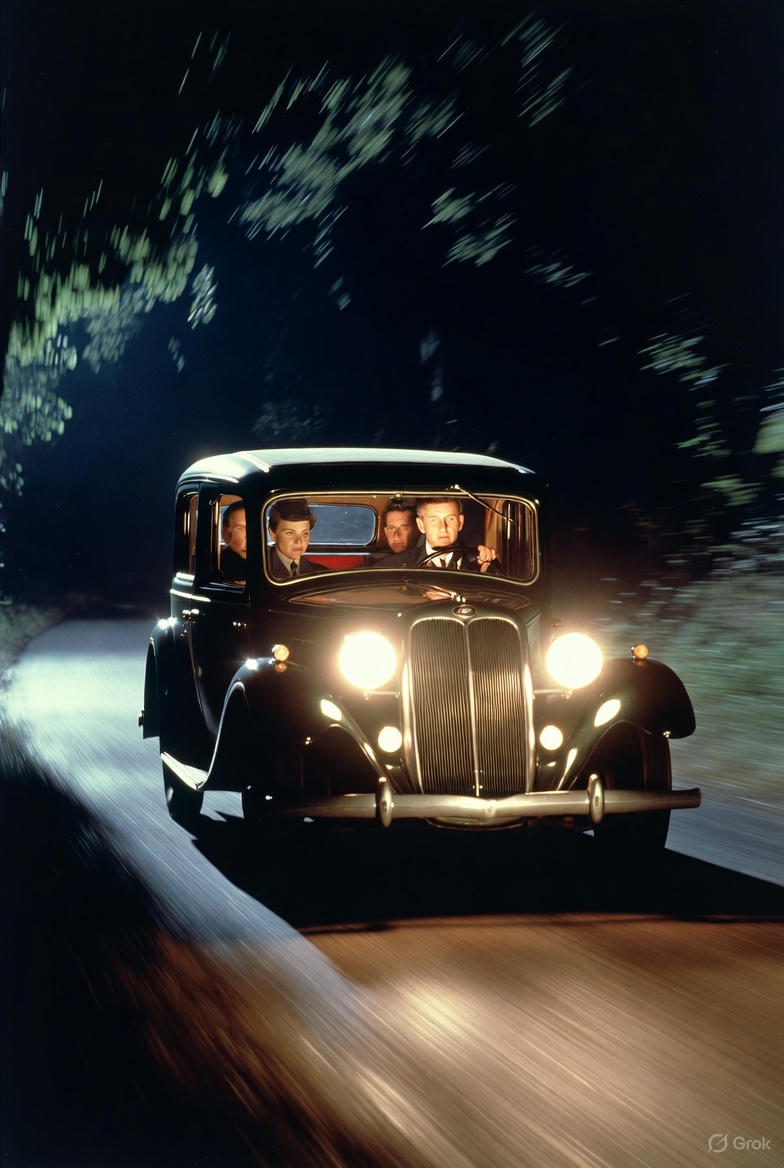
sound—a nerve-shredding, whipping noise, the
sputter of a car readying to drive. It drummed into the
dawn’s silence, like handfuls of peas hurled against
this glassy hour.
Schiereisen gauged the distance from the alley’s
mouth. He sprinted down the hill, first driven to
pursue, to halt the fugitives. Near the bottom, he
stopped abruptly, planting his feet, fists in his
pockets. No—she should flee.
The car’s starting roar sounded. Good… it’s
right… He finished his descent slowly, regulating his
breath with closed lips. On the bridge, the car was
gone. He broke into a trot, wanting to confirm who
Helmina fled with. The road stretched through the
valley, rising in wide curves to the highlands. A
steep, direct climb could cut off its loops.
Schiereisen plunged into the woods, scrambling
between trees, hooking from one to another at steep
spots. His lungs expanded, filling his chest, pushing
his heart to his throat. Sweat poured from his brow,
carving furrows through mud and grime, mixing a
sticky paste that tightened his skin. Several times, he
felt he couldn’t go on. But his immense resilience
drove him, making the impossible possible.
He reached the forest’s edge, where he’d first met
Helmina, standing in dense shrubs, their dampness
cloaking his steaming body. For a moment, all was
still, branches swaying softly. Seconds passed. Then
the car’s sputter burst in, sudden, as it rounded a
sound-catching forest bend.
Schiereisen knew he could’ve stopped it—
stepping into the road, Browning raised, an effective
warrant. But he stayed hidden.
The car roared up, shooting around the final curve,
snorting, racing uphill at full power… gone ten
heartbeats later. Schiereisen saw its occupants
clearly: Helmina, Herr Gegely—husband of the sick
woman—and Lorenz at the wheel.
The detective began his return. Near the house, he
met Rotrehl, lugging the gear alone. Seeing his
summer guest, the violin-maker stopped, staring. His
mind was saturated with the past hours’ events,
unable to grasp more. Bewilderment wrapped him in
soft veils. He could only shake his head.
“Come, Napoleon,” Schiereisen said, taking the
ladder. “Don’t think we’ve lost the battle. We’ll sleep
a little now. Later, I’ll explain everything.”

Read Full Post »

Madame Bluebeard by Karl Hans Strobl and translated by Joe E Bandel

What should Ruprecht reply? Her words didn’t
wound him, for he knew Hedwig was on the path to
health. That was a secret for him alone. So he only
nodded to Helmina and left the room.
Schiereisen had spent the afternoon on the small
bench outside Rotrehl’s house. He’d spread out all
his notes, reviewing his reasoning. When the rain
began, he gathered his papers and wrapped himself in
his waterproof loden coat. He let the water stream
down, only retreating to his room when the coat’s
hems grew heavy with damp.
What would happen now? The decision loomed. If
Ruprecht spoke, all efforts might be for naught. It
was almost certain he would. Lorenz had already
slipped away; Helmina would likely try to escape too.
Could he allow that? His duty was to detain her, but
he lacked direct evidence against her. Still, this night
must be used. He wrote a detailed letter to Herr Peter
Franz von Zaugg, delivered it to the post himself that
evening, and sent two coded telegrams—one to the
prosecutor’s office, one to his agency. Then he dined
at the Red Ox. The landlady mentioned Fritz Gegely
and his wife had been invited to the castle. That was
the poet with the sick wife, whose connection to the
castle lords he’d observed before leaving.
Pensively picking his teeth, he walked the village
street. The ground was soft from rain. At a large
puddle, Mathes Dreiseidel stood with the head
teacher, discussing politics sagely. Schiereisen saw
Dreiseidel’s urge to draw him in and kept to this side
of the water. He crossed the bridge and climbed the
castle hill under the deep shade of chestnut trees. The
rain had stopped, but drops fell from the branches,
some sliding coldly down his collar, jarring his
nerves.
The castle windows still glowed. Schiereisen
decided to wait. He wore his yellow overcoat, the
winter one being damp, and buttoned up, leaning
against a tree trunk. Two hours passed. Schiereisen
waited calmly, unsure what for. At career peaks, after
completing preparations, he surrendered to intuition.
A voice must call, a light must flare, illuminating his
path. Impatience was foreign to him.
When voices and a carriage’s rumble sounded in
the courtyard, he retreated deeper into shadow. The
heavy gate opened, clanging against the wall. A
carriage emerged, brakes grinding down the hill.
Three people sat within—the Gegelys and another,
perhaps the Major, part of their circle.
The gate closed, but Schiereisen didn’t hear it
lock. The sleepy gatekeeper, loath to rise again when
the carriage returned, left the task to the driver.
Schiereisen waited, then opened the gate a crack
and slipped inside. The outbuildings were dark; only
the overseer’s apartment showed light, now
extinguished. Only the main building stayed awake.
Above dark roofs, the sky slowly brightened.
Schiereisen crossed the courtyard silently, senses
sharp, each impression vivid and swiftly processed.
Sleeping and waking people, stone blocks, courtyard
walls—they merged into his being, parts of his skin.
He passed under the main building’s archway to
the inner courtyard. Below were the servants’
quarters. There was Lorenz’s former room. Opposite,
a dim light burned where old Marianne, the
madwoman who spent nights praying and singing,
was housed. She was awake. A murmur crept across
the courtyard, simmering around Schiereisen’s ears.
He decided to see what the old woman was doing.
Suddenly, he froze.
How could all his cunning, experience, and
caution have overlooked this? How far was he from
mastery in his craft, neglecting such a crucial detail?
He’d searched everywhere, yet ignored this old
woman. Now, intuition struck. Hadn’t Johann said
she was a Moreno heirloom, inherited by Helmina’s
first husband? She’d lived here since Helmina
arrived, witnessing all events. Her madness emerged
under Dankwardt. How had Schiereisen failed to
probe its roots? She’d once been quiet, content with
small chores for the modest keep the last Moreno
secured her. What if her simple mind was later
shattered by something horrific, a dread, an unwitting
knowledge of a secret too heavy?
A shrill scream burst from the window, followed
by babbling clamor. Schiereisen hurried over. Red
curtains covered the lower window, but on tiptoe, he
could peer inside. Old Marianne knelt before her
table, her headscarf slipped back, gray-yellow hair
tangled, strands writhing like battling snakes. She
struck her forehead against the table’s edge, crying,
“Oh, Lamb of God, who takes away the world’s
sins!”
On the table stood a crucifix and three burning
candles, their flames flinching and flaring with each
forehead strike.
“Oh, Lamb of God, who takes away the world’s
sins!” she repeated countless times. Then she calmed,
murmuring softly. Her forehead rested on the table’s
edge, her arms, once flailing beneath, now crossed
over her chest. She rose, lifting one knee, then the
other, pulling herself up by the table.
Schiereisen saw her face for the first time. It
wasn’t contorted but wholly consumed by one
thought. This poor, muddled mind held room for
nothing else. She took the three candles and moved to
the door.
Schiereisen hurried behind a pillar to hide. He
watched her emerge and cross the courtyard, carrying
the candles in her left hand, her right shielding the
flames. Silently, he followed through the archway,
along the main building’s wall to the park gate. The
rusty grille creaked like night birds with sharp beaks
eyeing living prey. The candles’ glow dazzled,
revealing only path fragments. They passed rubble
and wet shrubs. Schiereisen couldn’t avoid rustling
bushes or snapping twigs, but the old woman seemed
deaf, pressing forward. Massive stone blocks loomed
from the dark. The tower… Schiereisen thought. She
stopped, shone the light up the wall, and crouched
before a flat stone, fixing her candles to it. She
poured melted wax onto a smooth spot, pressing each
candle’s base into it. Clumps of wax showed this
stone had often served this strange rite.
She knelt before the burning candles, seeming to
pray. Her back hunched, head bowed low, the dirty
yellow-brown pattern of her jacket lit by the glow.
Schiereisen stood behind her, part of the
darkness—formless, chaotic, lingering in torpid
waiting, indifferent to time and space. But the old
woman stayed motionless; nothing more happened.
He spurred himself; the night couldn’t be wasted.
Stepping forward, he touched her shoulder.
“What’re you doing, little mother?”
She turned, unstartled, only peeved at the
interruption. “Be quiet… the three are inside. They
don’t sleep. They wander, banging their heads on the
wall. Three candles: one for each. Three candles for
the poor souls in purgatory.”
“Who’s inside?” Schiereisen asked kindly, patting
her back.
“Oh, no, I won’t tell you,” she replied earnestly.
“No one must know who they are. If I speak, they’ll
come out, eat and drink as if nothing happened, and
live again. That mustn’t be. She won’t allow it.”
“Yes, the gracious lady is strict. We mustn’t do
what she forbids.”
With a look of great fear, the old woman spread
her thin arms. “No… no… she won’t allow it, they
must stay there. Otherwise, Lorenz comes and beats
me. He has a rubber stick; he hits my head with it. I
must watch and pray.”
“You’re right,” Schiereisen said. “Keep praying.”
“Prayer can do all. Prayer seals the hole so they
can’t get out. Prayer is the wax of the pious, sealing
entrance and exit.” She lifted her head, gazing at the
damp stone blocks.
Schiereisen saw, above, between treetops at the
edge of the candlelight, a dark hole in the tower.
Good, he thought, this night must be used.
The old woman had lowered her head again,
resuming her prayers. Schiereisen left her
undisturbed, crashing through the bushes. He
followed the garden wall until he reached a spot
where elderberry shrubs and rubble made climbing
possible. He slid down the outer side, heedless of his
yellow overcoat, its buttons tearing off. Then he
raced down the castle hill, across the bridge, and up
the slope to Rotrehl’s house.
Rotrehl was dreaming of crossing the Beresina,
fleeing in a sleigh from a horde of Cossacks with
long lances and blood-red tongues lolling like
hunting dogs. His sleigh wouldn’t budge; leaning
forward, he saw its runners were cardboard, softened
and collapsing in the snow. Cannon booms thundered
ahead—boom, boom, boom! The enemy had cut him
off, guns ready. Nothing remained but to die a hero.

Read Full Post »

Homo Sapiens: In the Maelstrom by Stanislaw Przybyszewski and translated by Joe E Bandel

XV.

Falk pressed himself even tighter against the wall. He sat on the sofa. The room was completely dark. Fear seized him: he heard voices in the corridor. He listened. 

“The gracious lady left with the boy today. The gentleman has been sitting in his room all day. He is probably sick. He wants nothing to eat, and does not answer.” 

He heard knocking again. 

He did not move. But then he saw the door being opened, a broad strip of light fell into the room, then it became dark again. The door closed. 

“Falk!” he heard Olga call. “Pst—quiet, quiet!” 

“Where are you?” “Here.” 

She groped her way to him. 

“What are you doing?” she asked frightened. “Someone died.” 

“Who?” 

“She, she… Just sit here… here…” “What do you have in your hand?” she asked. 

“A letter from her. She is gone. Never coming back. So she is dead.” 

They sat very long and held each other’s hands. 

The mysterious silence, the darkness confused her head. “Are you mad?” she asked anxiously and softly. 

“Now it is over, but I was.” They were silent again very long. 

“It is good that you came. I would have gone mad today.” He breathed relieved. 

“And now what?” 

He did not answer. She did not dare to ask further. 

After a long time she wanted to ask him again, then she noticed that he was sleeping. 

She did not dare to move, for fear of waking him. Even in sleep he held her hand tight. 

So an endless time passed. Suddenly he sat up. 

“I will perhaps go to Czerski. Will you come with?” “Yes.” 

“Vive l’humanité,” he giggled softly and cheerfully. 

The End

Kongsvinger (Norway).

Read Full Post »

Alraune by Hanns Heinz Ewers and translated by Joe E Bandel

Chapter Thirteen
Mentions how Princess Wolkonski told Alraune the truth.

LEGAL Councilor Gontram wrote the princess, who was in
Naulhiem undergoing medical treatment. He described the
situation to her. It took some time until she finally
understood what it was really all about.
Frieda Gontram, herself, took great pains to make sure the
princess comprehended everything. At first she only laughed, then she
became thoughtful, and toward the end she lamented and screamed.
When her daughter entered the room she threw her arms around her
neck wailing.
“Poor child,” she howled. “We are beggars. We will be living on
the streets!”
Then she poured heaps of caustic Eastern wrath over his dead
Excellency, sparing no obscene swear words.
“It’s not entirely that bad,” Frieda objected. “You will still have
your villa in Bonn and your little castle on the Rhine, also the
proceeds from your Hungarian vineyards. Then Olga will have her
Russian pension and–”
“One can’t live on that!” the old princess interrupted. “We will
starve to death!”
“We must try to change the Fräulein’s mind,” Frieda said, “like
father advises us!”
“He is an ass,” she cried. “An old scoundrel! He is in league with
the Privy Councilor, who has stolen from us! It was only through him
that I ever met that ugly swindler.”
She thought that all men were imposters, cheats and scoundrels.
She had still never met one that was any different. Take Olga’s
husband for example, that clean cut Count Abrantes–Hadn’t he
carried on the entire time with dirty music hall women, taking all of
her money that he could? Now he was living with a circus bareback
rider because the Privy Councilor had put his thumb down and
refused to give him any more–
“In that, his Excellency did do some good!” said the countess.
“Good!” screamed her mother–as if it didn’t matter who had
stolen the money!
“They are swine, the one just as much as the other.”
But she did see that they had to make an attempt. She wanted to
go herself, yet the other two talked her out of it. If she went there she
would certainly not achieve much more than the gentlemen from the
bank.
They had to proceed very diplomatically, declared Frieda, take
into consideration the moods and caprices of the Fräulein. She would
go by herself, that would be best. Olga thought it would be even better
if she went. The old princess objected, but Frieda declared it would
certainly not be very good if she interrupted her medical treatments
and got too excited. She could see that.
So both friends agreed and traveled together. The princess stayed
at the spa, but was not idle. She went to the priest, ordered a hundred
masses for the poor soul of the Privy Councilor.
“That is the Christian thing to do,” she thought and since her
deceased husband was Russian Orthodox, she went to the Russian
chapel and paid that priest for a hundred masses as well. That calmed
her very much.
At one point she thought it would scarcely be of any use because
his Excellency had been protestant and a free thinker as well. But then
it would count as an especially good work in her favor.
“Bless them that curse you.” “Love your enemies.” “Do unto
others as you would have them do unto you.”
Oh, they must surely recognize such things up there, and twice a
day in her prayers, she spoke a special plea for his Excellency–with
very intense fervor. In this way she bribed the love of God.
Frank Braun received the two ladies at Lendenich, led them up to
the terrace and chatted with them about old times.
“Try your luck, children,” he said. “My talking was of no use!”
“What did she say to you?” asked Frieda Gontram.
“Not much,” he laughed. “She didn’t even listen to all of it. She
made a deep curtsy and declared with a devilish grin that she
completely treasured the high honor of my guardianship and would
not even consider ending it for the sake of the princess. She added
that she did not wish to speak of it again. Then she curtsied again,
even more deeply, even more respectfully–and she disappeared!”
“Haven’t you made a second attempt?” asked the countess.
“No, Olga,” he said. “I must now leave that to you–her look as
she left was so determined that I am solidly convinced all my
persuasive skills would be just as unfruitful as that of the other
gentlemen.”
He stood up, rang for the servant to bring some tea.
“By the way, you ladies just might have a chance,” he continued.
“A half hour after the Legal Councilor called giving notice of your
arrival I told my cousin that you would be coming and why. I was
afraid she would not receive you at all and in any case wanted you to
have a chance.
But I was wrong. She declared that you were both very welcome,
that for months now she has been in very active correspondence with
both of you–that is why–”
Frieda Gontram interrupted him.
“You wrote to her?” she cried sharply.
Countess Olga stammered, “I–I–have written her a couple of
times–to offer my condolences–and–and–”
“You lie!” Frieda cried.
The countess sprang up at that, “What about you? Don’t you
write her? I knew that you were doing it, every two days you write to
her. That’s why you are always alone in your room for so long.”
“You’ve had the chambermaid spy on me!” Frieda accused.
The glares of the two friends crossed each other, throwing a
burning hate that was sharper than words. They understood each other
completely.
For the first time the countess felt that she was not going to do
what her friend requested and Frieda Gontram sensed this first
resistance against her authority.
But they were bound through long years of their lives, through so
many common memories–that it couldn’t be extinguished in an
instant.
Frank Braun noticed right away.
“I’m disturbing you,” he said. “By the way, Alraune will be
coming soon. She just wanted to get ready.”
He went to the garden stairs, then gave his regards.
“I will see you ladies again later.”
The friends said nothing. Olga sat in a cane easy chair. Frieda
paced up and down with large strides. Then she stopped and stood
right in front of her friend.
“Listen Olga,” she said softly. “I have always helped you, when
we were serious and when we were playing, through all of your
adventures and love affairs. Isn’t that true?”
The countess nodded, “Yes, but I have done exactly the same
thing for you, not any less.”
“As well as you could,” spoke Frieda Gontram. “I will gladly
admit it–we want to remain friends then?”
“Certainly!” cried Countess Olga. “Only–only–I’m not asking
that much!”
“What are you asking?” inquired the other.
She answered, “Don’t put any obstacles in my way!”
“Obstacles?” Frieda returned. “Obstacles to what? Each of us
should try our luck–like I already told you at the Candlemas ball!”
“No,” insisted the countess. “I don’t want to compete any more.
I’ve competed with you so often–and always drawn the short straw. It
is unequal–for that reason you will withdraw this time, if you love
me.”
“Why is it unequal?” cried Frieda Gontram. “It’s even in your
favor–you are more beautiful!”
“Yes,” her friend replied. “But that is nothing. You are more
clever and I have often learned through experience how that is worth
more–in these things.”
Frieda Gontram took her hand.
“Come Olga, she said, flattering her. “Be reasonable. We are not
here just because of our feelings–listen to me. If I can succeed in
getting the little Fräulein to change her mind, if I can save those
millions for you and your mother–will you then give me a free hand?–
Go into the garden, leave me alone with her.”
Large tears marched out of the eyes of the countess.
“I can’t,” she whispered. “Let me speak with her. I will gladly
give you the money–this is only a sudden whim of yours.”
Frieda sighed out loud, threw herself into the chaise lounge, sank
her slender fingers deeply into the silk cushions.
“A whim?–Do you believe I would make such a fuss over a
whim?–With me, I’m afraid, it appears to be not much different than
it is with you!”
Her features appeared rigid; her clear eyes stared out into
emptiness.
Olga looked at her, sprang up, knelt down in front of her friend,
who bowed her head down low over her. Their hands found each
other and they tightly pressed themselves against each other, their
tears quietly mingled together.
“What should we do?” asked the Countess.
“Withdraw!” said Frieda Gontram sharply. “Withdraw–both of
us–let what happens, happen!”
Countess Olga nodded, pressing herself tightly against her friend.
“Stand up,” whispered the other. “Here she comes. Quick, dry
your tears–here, take my handkerchief.”
Olga obeyed, went across to the other side.
But Alraune ten Brinken saw very clearly what had just
happened. She stood in the large doorway, in black tights like the
merry prince from “The Fledermaus”. She gave a short bow, greeted
them and kissed the hands of the ladies.
“Don’t cry, it makes your beautiful little eyes cloudy.”
She clapped her hands together, called for the servant to bring
some champagne. She, herself, filled the goblets, handed them to the
ladies and urged them to drink.
“It is the custom here,” she trilled. “Each to their own taste.”
She led Countess Olga to a chaise lounge and caressed her entire
arm. Then she sat down next to Frieda and gave her a slow, smiling
glance. She stayed in her role, offered cakes and petit fours, poured
drops of Peáu d’Espagne out of her golden vial onto the ladies
handkerchiefs.
Then she began, “Yes, it’s true. It is very sad that I can’t help
you. I’m so sorry.”
Frieda Gontram straightened up, opened her lips with great
difficulty.
“And why not?” she asked.
“I have no reason at all,” answered Alraune. “Really none at
all!–I simply don’t want to–that is all.”
She turned to the Countess, “Do you believe your Mama will
suffer very much because of that?”
She stressed the “very”–and in doing so, her voice twittered
sweet and cruel at the same time like a swallow on the hunt. The
countess trembled under her gaze.
“Oh, no!” she said. “Not that much.
And she repeated Frieda’s words–
“She will still have her villa in Bonn and the little castle on the
Rhine. Then there were the proceeds from the Hungarian vineyards. I
also have my Russian pension and–”
She stopped, didn’t know any more. She had no concept of her
financial standing, scarcely knew what money was, only that you
could go into beautiful shops and buy things with it, hats and other
pretty things. There would be more than enough to do that.

Read Full Post »

Alraune by Hanns Heinz Ewers and translated by Joe E Bandel

She turned and laughed at him, her bright teeth gleaming.
“Does she mean I should play her kitten?” he thought.
Her face became a little more serious, and her soft lowered voice
rang with a mocking, veiled threat.
He did not touch it with his paws
And ron, ron and small patapon
He did not touch it with his paws
He ate it with his jaws
Ron, ron, he ate it with his jaws
The shepherdess got angry
And ron, ron and small patapon
The shepherdess got angry
She killed the kitten
Ron, ron, she killed the kitten
“Very pretty,” he said. “Where did you learn that little nursery
rhyme?”
“In the convent,” she answered. “The sisters sang it.”
He laughed, “Imagine that–in a convent! I would have never
expected it–please finish it, little cousin.”
She sprang up from the piano stool, “I am finished. The kitten is
dead–that is how it ends!”
“Not entirely,” he declared. “But your pious nuns feared the
punishment–so they let the pretty shepherd girl go unpunished for her
evil sin! Play again. I will tell you what happened to the shepherd girl
after that.”
She went back to the piano, played the melody.
Then he sang:
She went to confession
And ron, ron and small patapon
She went to confession
To get forgiveness
Ron, ron, to get forgiveness
I confess, my Father
And ron, ron, and small patapon
I confess, my Father
To killing my kitten
Ron, ron, to killing my kitten
My daughter, for penance
And ron, ron and small patapon
My daughter, for penance
We will embrace
Ron, ron, we will embrace
Penance is sweet
And ron, ron, and small patapon
Penance is sweet
We will begin
Ron, ron, we will do it again
“Finished,” she asked.
“Oh yes, very much so,” he laughed. “How do you like the
moral, Alraune?”
It was the first time he had called her by her given name–that
astounded her so much she didn’t pay attention to his question.
“Good,” she replied indifferently.
“Isn’t it though,” he cried. “A pretty moral that teaches little girls
they will not be permitted to kill their kittens and go unpunished!”
He stood right in front of her and towered over her by at least
two heads. She had to look up at him to catch his eye.
She thought, “How much difference a stupid thirty centimeters
makes.”
She wished she were dressed in men’s clothing as well. Already
her skirts gave her a disadvantage. Then immediately it occurred to
her that she had never experienced these feelings with others. But she
stretched herself up, tossed her head lightly:
“Not all shepherdesses have to serve such penance,” she
twittered.
He parried, “And not all Father Confessors will let them off so
lightly.”
She searched for a reply and found none. That made her angry.
She dearly wanted to pay him back–in his own way. But this skill was
new to her–it was like an uncommon language that she could
understand completely, but couldn’t speak correctly herself.
“Good night, Herr Guardian,” she said quickly. “I’m going to
bed.”
“Good night, little cousin,” he smiled. “Sweet dreams!”
She climbed up the stairs, didn’t run up them as usual, went
slowly and thoughtfully. She didn’t like him, her cousin, not at all.
But he attracted her, stimulated her, and goaded her into responding.
“We will be done with him soon enough,” she thought.
And as the lady’s maid loosened her bodice and handed her the
long nightgown she said, “It’s good that he’s here, Katie. It breaks up
the monotony.”
It almost made her happy that she had lost this advance skirmish.
Frank Braun had long conferences with Legal Councilor
Gontram and Attorney Manasse. He consulted with the Chancery
Judge about his guardianship and with the probate Judge. He was
given the run around and became thoroughly vexed.
With the death of his uncle the criminal accusations were finally
cut off, but the civil complaints had swollen to a high flood. All the
little businessmen that had trembled at a squinting look from his
Excellency now came forward with new demands and claims, seeking
compensation for damages that were often quite dubious in nature.
“The District Attorney’s office has made peace with us,” said the
old Legal Councilor, “and the police won’t bother us either. But
despite all that, we still have the county court tightly packed with our
cases alone–the second court room will be the private institute of the
late Privy Councilor for the next six months.”
“His Deceasedness would enjoy it, if he could look out of his
hellish cauldron,” the lawyer remarked. “He only enjoyed such suits a
dozen at a time.”
He laughed as well, when Frank Braun handed him the
Burberger mining shares that were his inheritance.
“The old man would have loved to be here now,” he said, “to see
your face in half an hour! Just you wait, you’ve got a little surprise
coming.”
He took the shares, counted them, “A hundred eighty thousand
Marks.”
He reviewed them, “One hundred thousand for your mother–the
rest for you! Now pay attention!”
He picked up the telephone receiver, asked to be connected to the
Shaffhausen Trust Company and requested to speak with one of the
directors.
“Hello,” he barked. “Is that you, Friedberg?–A little favor, I have
a few Burberger shares here–what can I get for them?”
A loud laughter rang out of the telephone and Herr Manasse
joined in loudly.
“I thought so–” he cried out. “So they are absolutely worthless?
What? They expect new funding next year–the best thing is to throw
the entire lot away–well naturally!–A fraudulent investment that will
certainly sooner or later loose everything? Thank you, Herr Director,
excuse me for disturbing you!”
He hung up the phone and turned grimly to Frank Braun. “So
now you know. And now you are wearing exactly that stupid face that
your kindly uncle expected–excuse me for telling the truth! But leave
the shares with me–it is possible that one of the other mining
companies will take some interest in them and offer you a couple
hundred Marks. Then we can buy a few bottles of wine with it and
celebrate.”
Before Frank Braun had come back the greatest difficulty had
constituted the almost daily negotiations with the large Mülheim
Credit Bank. The bank had dragged on from week to week with
exceptional effort, remembering the Privy Councilor’s solemn
promise of assistance, always in the hope of receiving some small
portion of help from his heiress.
With heroic courage the Directors, the Gentlemen from the
Board of Directors, and the auditors managed to keep the leaky ship
above water, always aware that the slightest new impact might cause
it to capsize.
With the help of the bank, his Excellency had successfully
concluded many very risky speculations. To him the bank had been a
bright fountain of gold. But the bank’s own undertakings, which it
had taken at the Privy Councilor’s suggestion, were all failing–Really
his own fortune was no longer in danger, but that of the Princess
Wolkonski was, along with those of several other wealthy investors.
This included the savings of a great number of little people as
well, penny speculators that had followed the star of his Excellency.
The legal executors of the Privy Councilor’s estate had promised their
help, as much as it was in their power to do. But the hands of Legal
Councilor Gontram, as provisional guardian, were tied by law–
through the Chancery court–Money held in trust was sacred–all of it!
Really, there had been only one possibility, Manasse had found
it. They could declare the Fräulein ten Brinken of age. Then she
would be free to fulfill her father’s moral obligations. For that
purpose all of the parties worked together, pulling every last penny
out of their own pockets. Already, with the last of their strength they
had successfully survived a run on the bank that had lasted fourteen
days–The decision had to be made now.
Until then the Fräulein had shook her head. Now she listened
quietly to what the gentlemen were proposing, smiled, and said, “No.”
“Why should I become of age?” she asked. “I like the way it is
right now–and why should I give money away to save a bank that is
absolutely of no concern to me at all?”
The Chancery Judge gave her a long speech about preserving the
honor of her father. Everyone knew that he alone was the cause of
their present difficulties–it was her duty as his child to clear his good
name.
Alraune laughed in his face, “His good name?”
She turned around to Attorney Manasse: “Tell me, what do you
think of it?”
Manasse didn’t answer, curled up in his chair, spat and hissed
like a stepped on Tomcat.
“Not much more than I do, it appears!” said the Fräulein. “And I
won’t give a penny for it.”
Commercial Councilor Lützman, chairman of the Board of
Directors, proposed that she should have some consideration for the
old princess, who for so long had been an intimate friend of the house
of Brinken. What about all of the little people that would lose all of
their hard-earned money?
“Why did they speculate?” she replied calmly. “Why did they
put their money into such a dubious bank? If I wanted to give to
charity I know of better ways.”
Her logic was clear and cruel, like a sharp knife. She knew her
father, she said, and whoever invested in the same things he did was
certainly not very much better.
But it was not about charity, the Director returned. It was almost
certain that the bank would hold together with her help, if it could
only get over this current crisis she would get her money back, every
penny of it and with interest.
She turned to the Chancery Judge.
“Your Honor,” she asked, “is there a risk involved?”
Naturally unforeseen circumstances could always come up. He
had the professional duty to tell her–but as a human being he could
only add his urgent plea to that of the other gentlemen. She would be
doing a great and good work, saving the livelihoods of multitudes and
the possibility of loss in his opinion was ever so slight.
She stood up, interrupted him quickly.
“Well then, gentlemen. There is a risk,” she cried mockingly,
“and I don’t want to take any risk. I don’t want to save any
livelihoods and have no desire to do great and good works.”
She nodded lightly to the gentlemen, left, leaving them sitting
with fat, red little heads.
But still the bank continued, still battled on. Hope formed anew
when the Legal Councilor informed them that Frank Braun; the true
Guardian had arrived. The gentlemen immediately got in contact with
him, arranged a conference for the next day.
Frank Braun saw very well that he would not be able to leave as
quickly as he had believed. So he wrote his mother.
The old Frau read his letter, folded it carefully, and laid it in the
large black trunk that contained all of his letters. She opened them on
long winter evenings when she was completely alone. Then she read
to her brown little hound what he had written to her.
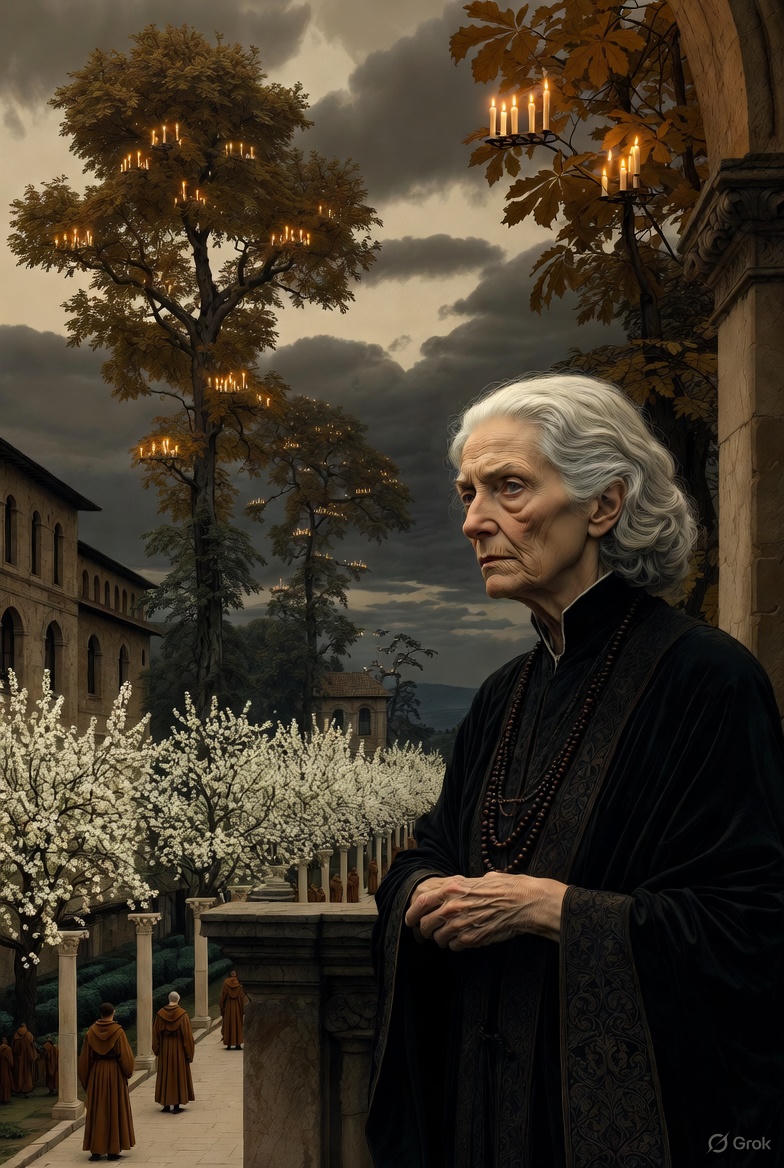
She went out onto the balcony, looked down at the high chestnut
trees that carried glowing candles in their mighty arms, looked down
on the white blooming trees of the monastery under which brown
monks quietly wandered.
“When will he come, my dear boy?” she thought.

Read Full Post »

Homo Sapiens: In the Maelstrom by Stanislaw Przybyszewski and translated by Joe E Bandel

XIV.

Falk wandered restlessly through the city all day. 

He finally sat in a café and spent several hours there. He was so tired that he could find no strength to get up and get the newspapers. Ask a waiter? No, it hurt just to open his mouth. 

Yet he felt a bit of joy, how beautifully everything arranged itself… and Kunicki is after all a famous shot. Tomorrow everything is over. Good so. 

He actually wondered that the whole thing was so indifferent to him, and it was after all about life… life! He giggled cheerfully. Life! 

Finally he collected himself. When he came home, he felt so exhausted that he lay down on the bed immediately; he was about to fall asleep. 

Then he sat up abruptly. 

He had to speak with Isa after all. Who knows if he would return tomorrow. He had to inform her in any case, without arousing her suspicion, about the most important affairs. 

But he could also do that in writing. And again he lay down. Otherwise she could get bad thoughts. No! Better to write a letter. 

Suddenly he became strangely awake. His brain was shaken and came into operation. 

It now became finally clear to him that tomorrow his death march awaited him. A slight shiver ran through his limbs. It was something like fear… Quite surely fear and unrest, although revolver heroes otherwise do not have fear… 

The whole process became alive in him with such disgustingly intrusive clarity. 

He will have to stand calmly, before his eyes the pistol muzzle will flicker like a black point, then he will clearly hear the cock click, quite clearly, yes, perhaps even as a strong noise. 

Cold sweat broke out on his forehead. With difficulty he pushed everything back into himself. 

He yawned. But his yawning seemed affected to himself. 

He had to go to Isa and play piquet with her, that would calm him. Afterwards he could consider the whole story… 

But fear crept up in him and his heart beat terribly. Kunicki after all shot the poor Russian down immediately… 

And leave all this behind: Isa and the whole future… He stopped. 

Where did the self-lie of the future suddenly creep from now? That was a ridiculous lie. Ha, ha, ha… How one can unconsciously lie to oneself… Strange… Naturally it wanted to argue further in me: everything is not so bad as it looks… Everything could still become good. 

And suddenly he shot up like mad. 

Kruk cannot come back to Germany after all. He is sentenced to five years. 

He ran around like possessed. 

Then Isa can never find out. He always opened the letters himself. 

A moment of such immediate, animal feeling of happiness he had never felt before. 

He came completely out of his senses with joy, a terrible life frenzy rose in him. He thought of nothing, only one single, fixed idea roared and whirled in his brain. Only now quickly away! 

Kunicki? Kunicki? What does Kunicki concern me, what does honor concern me, what does shame concern me. Now quickly away, away. 

His brain clung with the last despair strength to this straw. 

Then he suddenly began to laugh in rage and fury. 

Ha, ha, ha… Now I begin to play comedy before myself. As if that could help me over the disgust and the lie! Ha, ha, ha: everything could still become good. 

He suddenly thought of the comical, little Jew from whom he once wanted to borrow money. The Jew naturally had no money, but Falk should console himself, everything would still become good. 

And then a heartfelt cheerfulness came over him that he had not felt for a long time. 

Yes, so he could now go to Isa, he was really cheerful and happy. When he entered the salon, his glance fell by chance on the picture and this mad despair orgy of the sky… But he was cheerful and happy. 

In the dining room he listened. From Isa’s room came sobbing and moaning… 

It shot through him like lightning, he staggered back. His heart stopped. 

He stepped to the door and knocked timidly. No answer. Only a sudden violent cry. He now knocked violently and rattled the door. Isa! Isa! he cried desperately. 

A deep moaning was the answer. 

He became possessed in a moment. An unheard-of rage took possession of him. 

Open! he cried. Again no answer. 

Then an animal fury seized him. His senses left him. He suddenly threw himself with his whole strength against the door, broke it open and fell staggering into the room. 

Isa jumped from the sofa, wild and distraught. 

“What do you want here? Go then! Go then to your mistress,” she cried raging. 

Falk stood and trembled so violently that he had to hold onto the table. “Go then! Go then!” cried Isa and ran desperately back and forth, as if she feared he would seize her. 

“Isa!” he finally managed to bring out. 

“Leave me! Leave!” she cried senselessly and stopped her ears with her fingers. “I want to hear nothing. Go then! I cannot see you! I have disgust for you!” 

Falk stood there and stared at her madly. He heard only this hoarse, screaming voice in which a hysterical laughter and crying fought each other. It occurred to him that he had never heard Isa scream before. 

Isa came into rage. She stamped with her feet, cried a few inarticulate sounds, then ran around the table to the door. 

Falk came to his senses. He held her by the arms. She struggled desperately with him, but he held her tighter and tighter, bit himself as it were with his fingers into her arms. 

“Let me go!” she cried with an unnatural voice. He let her go and stood before the door. 

“I will go, but first you shall hear me,” he flared up furiously. 

“I want to hear nothing. I hate you! I beg you! I have disgust for you. You soil me! Go then to your mistress.” 

Suddenly she fell backwards onto the sofa in a wild crying cramp. In senseless fear Falk jumped toward her. 

The slender, frail body twitched and writhed in his arms as if kneaded by a foreign power. From the throat of the tormented woman came spasmodic cries and sobs that were unnatural, as if an animal had uttered them.  

Falk carried her to the balcony, grasped a carafe of water, moistened her forehead and temple, but suddenly she rose again and pushed him back furiously. 

In the next moment she sank together, she threw herself on the sofa, breathed heavily; the strength seemed to leave her, for she crawled more and more together. 

Then she threw herself up again with sudden jerk and stood proud and cold before Falk. 

“What do you want then still?” 

“Nothing, nothing more.” He stammered and looked at her with mad, glazed eyes. 

“Nothing, nothing,” he repeated softly. 

“You must make clear to yourself that between us everything is over, that I will not remain one hour longer with you under one roof… I do not want,” she cried raging… “Let me go then.” 

She threw herself at him and tried to push him out the door. 

It became quite dark before his eyes, he was no longer master of his animal rage attack, he seized her and threw her with full strength onto the sofa. 

She jumped up, wanted to flee, her hair had loosened, he grasped her by the hair, tore half mad at it and dragged her back again. 

“I will kill you, I will kill you,” he grinned in a second of complete confusion of senses. 

She no longer resisted, everything broke in her—she became still for a moment. 

Falk shot up in horrible fear. 

Read Full Post »

Alraune by Hanns Heinz Ewers and translated by Joe E Bandel

His mother observed him–she knew his smallest gesture, the
slightest movement of his smooth, sun tanned features. She read in the
slight twitch at the corner of his mouth that it was something
important.
“What is it?” she asked, and her voice trembled.
“Nothing big,” he answered easily. “You know of course that
Uncle Jakob is dead.”
“Yes, I know that,” she said. “It was sad enough.”
“Well then,” he nodded, “the Legal Councilor has sent me a copy
of the will. I am the executor and to become the girl’s guardian as
well. To do that I must go to Lendenich.”
“When will you leave?” she asked quickly.
“Well,” he said. “I think–this evening.”
“Don’t go,” she begged. “Don’t go! You’ve only been back with
me for three days and now you want to leave again.”
“But mother,” he turned to face her. “It’s only for a few days,
just to put things in order.”
She said, “That’s what you always say, only a few days–and then
you stay away for years.”
“You must be able to see it, dear mother!” he insisted. “Here is
the will. Uncle has left you a right decent sum of money and me as
well–Something I certainly was not expecting from him. We could
certainly use it, both of us.”
She shook her head, “What should I do with the money if you are
not with me, my boy?”
He stood up and kissed her gray hair.
“Mother dear, by the end of the week I will be back here with
you. It is scarcely two hours by train.”
She sighed deeply, stroked his hands, “Two hours–or two
hundred hours, what is the difference?–You are gone either way!”
“Adieu, dear mother,” he said, went upstairs, packed only a small
suitcase and came back out to the balcony.
“There, you see! Scarcely enough for two days–Auf
Wiedersehen!”
“Auf Wiedersehen, dear boy,” she said quietly.
She heard how he bounded down the stairs, heard the latch click
as the door shut. She laid her hand on the intelligent head of her little
hound that looked at her with faithful trusting eyes.
“Dear animal,” she spoke. “Now we are alone again–Oh, only to
go again, does he come here–when will we see him again?”
Heavy tears fell from her gentle eyes, rolled over the wrinkles on
her cheeks, fell down onto the long brown ears of the little hound. He
licked at them with his red tongue.
Then down below she heard the bell, heard voices and steps
coming up the stairs. She quickly wiped the tears out of her eyes,
pushed her black lace scarf into place and straightened out her hair.
She stood up, leaned over the railing and called down into the
courtyard for the cook to prepare fresh tea for the guests that had
come.
Oh, it was good that so many came to visit her, Ladies and
Gentlemen–today and always. She could chat with them, tell them
about her boy.
Legal Councilor Gontram, whom he had wired about his arrival,
awaited him at the train station, took him with to the garden terraces
of the Royal Court, where he explained everything to him that was
important. He begged him to go at once out to Lendenich, speak with
the Fräulein and then early the next morning come back into the
office.
He couldn’t really say the Fräulein would make trouble for him,
but he had a strange, uncomfortable feeling about her that made every
meeting with her intolerable. It was funny in a way, he had worked
with so many criminals–murderers, assassins, burglars, abortionists,
and once he really got to know them he always found that they were
really pretty decent people–with the exception of their crimes.
But with the Fräulein, whom you could not reproach for
anything, he always had the same feeling that other people had toward
the criminals he worked with. It must lie completely in him–
Frank Braun requested that he telephone ahead and announce his
arrival to the Fräulein. Then he excused himself, strolled through the
park until he hit the road to Lendenich.
He walked through the old village, past the statue of St.
Nepomuk and nodded to him, stood in front of the Iron Gate and rang,
looking into the courtyard. There was a large gas candelabra burning
in the entrance where once a paltry little lantern had glowed. That was
the only change that he saw.
Above, from her window the Fräulein looked down, searched the
features of the stranger, and tried to recognize him in the flickering
light. She saw how Aloys sped up, how he put the key in the lock
more quickly than usual.
“Good evening young Master!” cried the servant and the stranger
shook hands with him, called him by name, as if he had just come
back to his own house after a little trip.
“How goes it, Aloys?”
Then the old coachman hobbled over the stones as quickly as his
crippled leg would carry him.
“Young Master,” he crowed. “Young Master! Welcome to
Brinken!”
Frank Braun exclaimed, “Froitsheim! Still here? Glad to see you
again!”
He shook both hands vigorously. Then the cook came and the
wide hipped house keeper. With them came Paul, the valet. The entire
servant’s quarters emptied itself into the courtyard. Two old maids
pressed to the front, stretching their hands out to him, but first,
carefully wiping their hands on their aprons.
“Jesus Christ be praised!” the gardener greeted him and he
laughed.
“To eternity, Amen!”
“The young Master is here!” cried the gray haired cook and gave
Frank Braun’s suitcase to the valet.
Everyone stood around him, everyone demanded a personal
greeting, a handshake, a friendly word, and the younger ones, those
that didn’t know him, stood nearby, staring at him with open eyes and
awkward smiles, off to the side stood the chauffeur, smoking his short
pipe. Even his indolent features showed a friendly smile.
Fräulein ten Brinken snapped her fingers.
“My guardian appears well liked here,” she said half out loud
and she called down:
“Bring the Gentleman’s things up to his room–and you, Aloys,
show him the way.”
Some frost fell on the fresh spring of his welcome. They let their
heads drop, didn’t speak any more. Only Froitsheim shook his hand
one last time, walked with him to the master staircase.
“It is good you are here, young Master.”
Frank Braun went up to his room, washed himself, and then
followed the butler who announced that dinner was served. He
stepped into the dining room and was left alone for a moment. He
looked around, there, like always, stood the giant buffet, ostentatious
as ever with the heavy golden plates that bore the crest of the
Brinkens.
But no fruit lay on them today.
“It is still too early in the season,” he murmured, “or perhaps my
cousin has no interest in the first fruits.”
Then the Fräulein came in from the other side, adorned in a black
silk gown, richly set with lace down to her feet. She stood in the door
a moment, then stepped in and greeted him.
“Good evening, Herr Cousin.”
She reached out her hand to him, but only the two fingertips. He
pretended not to notice, taking her entire hand and shaking it
vigorously. With a gesture she invited him to take his place and sat
down across from him.
“May we be informal with each other?” she began.
“Certainly,” he nodded. “That has long been the custom with the
Brinkens.”
He raised his glass, “To your health, little cousin.”
“Little cousin,” she thought. “He calls me little cousin, thinks of
me as a doll.”
But she replied, “Prosit, big cousin.”
She emptied her glass, waved for the servant to refill it and drank
once more, “To your health, Herr Guardian!”
That made him laugh, Guardian–guardian? It sounded so
dignified–”Am I really that old?” he thought.
He answered, “And to you, little ward.”
She got angry–little ward, again; little?–Oh, it would soon be
shown which of them was the superior.
“How is you mother?” she asked.
“Thank you,” he nodded. “Very well, thank you–haven’t you met
her yet?–You could have visited her at least once.”
“She never visited us either,” she retorted.
Then when she saw his smile, she quickly added, “Really cousin,
we never thought of it.”
“I can just imagine,” he said dryly.
“Papa scarcely spoke of her and not of you at all.”
She spoke a little too quickly, rushing herself. “I was really
surprised, you know, when he made you–”
“Me too!” he interrupted her, “and he certainly had some reason
for doing it.”
“A reason?” she asked. “What reason?”
He shrugged his shoulders, “I don’t know yet–but it will soon
come out.”
The conversation never faltered. It was like a ball game; the short
sentences flew back and forth. They remained polite, amiable and
obliging, but they watched each other, were completely on their
guards, and never came together. A taut net stretched itself between
them.
After dinner she led him into the music room.
“Would you like some tea?” she asked.
But he requested whiskey and soda. They sat down, chatted some
more. Then she stood up, went to the Grand piano.
“Should I sing something?” she asked.
“Please,” he said politely.
She raised the lid, sat down, then she turned around and asked:
“Any special request cousin?”
“No,” he replied. “I don’t know your repertoire, little cousin.”
She pressed her lips together. That is becoming a habit, she
thought.
She struck a couple of notes, sang half a stanza, broke off, began
another song, and broke that off as well. Then she sang a couple of
measures of Offenbach, then a line from Grieg.
“You don’t appear to be in the right mood,” he observed calmly.
She laid her hands on her lap, remained quiet awhile, drummed
nervously on her knees. Then she raised her hands, sank them quickly
onto the keys and began:
There once was a shepherdess
And ron, ron and small patapon
There once was a shepherdess
Who kept her sheep
Ron, ron who kept her sheep
She turned toward him, pouting. Oh, yes, that little face
surrounded by short curls could very well belong to a graceful
shepherdess–
She made a cheese
And ron, ron and small patapon
She made a cheese
While milking her sheep
Ron, ron, while milking her sheep
Pretty shepherdess, he thought, and poor–little sheep. She moved
her head, stretched her left foot sideways, tapped out a beat on the
floor with a dainty shoe.
The naughty cat watched
And ron, ron and small patapon
The naughty cat watched
From a small distance away
Ron, ron, from a small distance away
If you touch it with your paws
And ron, ron, and small patapon
If you touch it with your paws
I will hit you with a stick
Ron, ron, I will hit you with a stick!

Read Full Post »

Homo Sapiens: In the Maelstrom by Stanislaw Przybyszewski and translated by Joe E Bandel

She laughed hysterically and then looked at Janina with wild hate, but only a moment… 

“You naturally did not know that he was married… How he lies, ha, ha, ha, how he lies…” 

Suddenly Janina’s strength left her. She threw herself on the bed and sobbed. 

Isa became very serious; she stood up. 

“Did I insult you?” she asked coldly. 

But she expected no answer, she went to the bed end where the little one lay, looked at him attentively and then stood in the middle of the room. 

“But don’t cry. I did not want to insult you… How beautiful the child is! And you have no guilt… You are only a small, weak girl.” 

And again she began to laugh. 

Strange that you have a child… How old are you actually? Eighteen? Nineteen? Well, farewell and don’t cry. He will come back, he will come, she raged… I will drive him back to you, immediately—immediately… 

“Don’t torment me!” Janina suddenly cried out. 

“Torment? Torment? Ha, ha, ha… I will send him here immediately… tout de suite, tout de suite…” 

On the street she stood for a long time. 

A few street boys went past her, laughed impudently at her and threw obscene words at her. 

She looked around timidly and began to go, quick, senselessly quick… “Only not back, only not back, only not back to the liar,” 

she murmured softly to herself. 

“But my God! what disgusting people live here! Why do you harass me, why do you push me then? What did I do to you?” 

She gnashed her teeth in impotent rage. 

Suddenly she felt a violent pain. A fellow had run into her and brutally pushed her aside so that she almost fell. 

The pain brought her to consciousness. 

She began to go slowly, kept close to the wall, she became anxious like a small child, a crying cramp worked its way up in her with all strength, she choked it down with difficulty, but could not prevent the tears from running unstoppably over her cheeks.  

Then she came to an empty square, sat down on a bench and calmed herself. And only now everything flew through her brain with visionary clarity and a wild pain began to rage in her. She lost her senses. 

And in the moment she collected herself. Geißler will give money. Only away, far, far away from him, Geißler will give money, Geißler, Geißler she repeated incessantly. 

She got into a cab and gave Geißler’s address. 

The pain raged ever wilder… As if a hell had been unleashed in her… Ha, ha, ha… Mais non, pas du tout; je suis au contraire tres enchantée… très enchantée… These big letters: Isak Isaksohn… No, how comical! Isak Isaksohn… Ha, ha, ha… Falk is a genius. He must improve the race, it is his duty, his duty… Here I can buy fabrics—Friedrichstraße 183, and yes, what was his name? Isak Isaksohn and Friedrichstraße 183… 

Then she suddenly felt an unspeakable disgust. The person took her, with the same hands he embraced her as the girl there—with the same mouth he kissed her… 

She shook herself. A morbid rage overcame her, it became unbearably tight to her, she would have liked to tear her clothes apart. The disgust choked her ever more violently. 

Why did he not drag the woman into my bed?! Ha, ha, ha… He should have done it before my eyes… 

She could no longer control herself. She cramped and crawled into herself and stretched up again, she felt an unbearable pain in the breast, in the head, everywhere, everywhere… 

Oh que j’ai mal, que j’ai mal… Mon Dieu, que jai mal! 

When she entered Geißler’s room, she was seized by a sudden cheerfulness. 

“How well you look at me! You are like a small, shy boy… Ha, ha, ha… And you have such a beautiful, soft coat… Well, don’t look at me as if I fell from heaven… I am after all Erik Falk’s legally, legally you understand? on the Mairie of the fifteenth arrondissement in Paris legally married wife…” 

She laughed heartily. 

Geißler looked at her astonished. But since she laughed so heartily, he laughed with. 

“Just think, Walther, we haven’t even greeted each other…” She kept his hand in hers. 

“How big and good your hand is! And so warm, so warm.” 

“You didn’t meet Erik downstairs?” asked Geißler a little uneasily. “Erik Falk? My husband?” She choked with laughter. “No, no! 

My husband, ha, ha, mon mari! quelle drôle idée plus philosophique qu’originale, n’est-ce pas?” 

She looked around and sat down. Geißler looked at her helplessly. 

“Why do you look at me so sadly? Ah,—ah…” she stood up again… “He was here, he told you everything…” 

Geißler turned around and busied himself with the papers. 

“Did he tell you about his little son, and about his little mistress? Ha, ha, ha… did he want to lighten his heart with you?” 

“Well, you know, Isa, you don’t need to take that so to heart. You are after all a woman, and a man is organized quite differently…” 

She had sat down again in the meantime, but suddenly she felt a great fatigue, she was near fainting. 

“Give water!” 

She drank greedily a large glass. 

“Ha, ha… I have not seen my husband, no, no, je ne l’ai pas vu depuis cinq jours… Strange preference for my mother tongue. I have almost forgotten it… I was in a hideous, German boarding school… At five o’clock we had to get up… O! brr! But how strong you are and your hand so big and so good.” 

She suddenly looked at him fixedly. 

“You don’t need to look so mournful. I want no pity. I want money. Give me money,” she said harshly. 

He looked at her frightened. “What do you need it for?” 

“You are a nice gentleman! Ha, ha, ha. You ask a lady what she needs money for! Just give me money, I have a very bad affair…” 

“Isa, be serious for a moment. You don’t want to do stupid things?” 

“What do you think?” 

“Well listen, Isa. You know very well what you are to me… very bad things are going on with you now… And there you know to whom you should turn… I mean, well—you will not misunderstand me… You know me… But… pas de sentiments, n’est-ce pas? How much do you need?” 

“Three, four hundred…” 

“I will give you five hundred.” 

She did not understand him, stared only at him with growing rapture. Her senses began to confuse. 

“How splendid you are!… And give me your big, warm hand… Yes, so, hold me tight, hold me tight… O que j’ai mal, que j’ai mal…” 

She fell into a hysterical crying cramp.

Read Full Post »

« Newer Posts - Older Posts »