Feeds:
Posts
Comments

Posts Tagged ‘fantasy’

The old count spoke without undue solemnity, yet Reichenbach sensed something weighty behind it, an inner shift toward something new.

“And what’ll happen here without you?” Reichenbach asked.

“It’s a blessing I have you, Reichenbach,” the old count replied, a wistful smile in his voice. “You don’t need me. It’s as good as if I were here. No task is too much.” Perhaps he truly smiled now, but it wasn’t visible.

“And tomorrow I’ll come by the factory again,” the old count added, then left.

Frau Paleczek appeared with a light and set the table, but as she brought the plates, she suddenly wailed and ran out. After a while, Susi brought the supper instead.

“Where’s Paleczek?” Reichenbach asked.

“She’s sitting in the kitchen crying,” Susi said, but then her composure broke too. She swallowed hard, abruptly sobbing, pulled her apron over her face, and ran out.

After poking at his food, Reichenbach rose and went to the children’s room. It had been fumigated with sulfur and juniper and sprayed with vinegar, still smelling sharp. The children lay in freshly made beds but weren’t asleep yet.

“Have you done your assignments for tomorrow?” Reichenbach asked, standing by Reinhold’s bed.

“Herr Futterknecht said,” Reinhold admitted hesitantly, “we don’t need to do assignments for tomorrow.”

“So!” Reichenbach said, nothing more. Then: “Good night! Sleep now.” He shook Reinhold’s hand, stroked Hermine’s forehead, and bent to kiss Ottane’s cheek.

The child flung her arms up, wrapped them around his neck, and pulled him close. “Papa,” she whispered, “I’ll always be good and love you so much.”

The painfully sweet tenderness of such clinging melted the stiffness in his limbs, and Reichenbach held Ottane close.

“I promised Mutti,” the child whispered, “and she’ll always come to me and tell me what the sky-sheep sing.”

“When did you promise Mutti?” Reichenbach asked, just as softly.

“Tonight—when she was with me.”

Tonight? Tonight? What could that mean, tonight? A sudden stab of dread seared his heart. Troubled, shaken to his core, Reichenbach tucked the blanket over Ottane and went to the next room, where the drawings for the new furnace still lay on the desk.

The furnace was built to Reichenbach’s plans and exceeded all expectations. It roared, spat, and glowed, producing nearly as much charcoal as the wood fed into it, and most importantly, showed no tendency for unexpected mischief.

Once it was running smoothly, Reichenbach decided it was time to restart the abandoned Doubrowitzer hammer mill. So he put it back into operation. Then he thought it was time to build a drilling rig. He built one, installing a drilling machine—naturally, the largest in Austria,and could bore cylinders over twelve feet in diameter.

Then Reichenbach turned to agriculture, starting, as agreed with the old count, to grow sugar beets, which naturally required a sugar factory. Since farming was foreign to him, with no innate knowledge of it, nothing became more important than beets and sugar. Some things succeeded, others failed, and years passed. Looking back on New Year’s Eve, it felt like each year had only begun the day before yesterday.

Meanwhile, the old count traveled the world, writing long letters to Reichenbach about his findings.

The old count wrote that he and Lord Rumford conducted experiments on gas expansion, especially gunpowder, nearly blowing themselves up once.

He wrote that he’d heard of Jenner’s vaccination discovery, calling it a magnificent invention, and was now vaccinating himself. He sent vaccine and needles to Reichenbach for free distribution, later adding a self-written treatise on cowpox.

Reichenbach replied that it was indeed a great invention, but the people wanted no part of it. Meanwhile, the workshop was now producing hydraulic presses, water-lifting, and conveyor machines.

The old count wrote that he was now studying the Loserdorre cattle breed disease, to be fought with iron-containing hydrochloric acid, and he sent a self-written pamphlet on it. He was also on the trail of a remedy for rabies, likely in a cyanide compound. But against cholera, no cure could be found.

Reichenbach replied that the Brno censor was a fool for banning the old count’s pamphlet. As for rabies, he begged him, for God’s sake, to be careful with sick animals. Meanwhile, he was shipping barrel hoops to Singapore, cookware to Haiti, iron stoves to Turkey, and creosote to America and Egypt. He said nothing about cholera or its treatment.

Sometimes the old count came home. His eyes had a restless glint; he laughed loudly, sat in Reichenbach’s sofa corner, smoked like a chimney, and drank heavy wine. He looked over the books, made a few tweaks to the machines, then vanished again for days. During one such visit, Forester Ruf came and said, “Can you believe, Herr Director, the old count stopped by my place today?”

“So what?” Reichenbach asked. Why shouldn’t the old count visit Ruf? He roamed the valley, dropping in on folks, asking how they were, urging them and their children to get vaccinated against smallpox. Sometimes he liked to wander the woods in shabby, tattered clothes, like a traveling journeyman, chatting with old peasant women to beg from those who didn’t know him, only to richly reward them afterward if they gave him something. Why shouldn’t he have visited Forester Ruf?

“Well, but,” Ruf said hesitantly, “you won’t believe it. He sent Schnuparek’s widow, who’s watching the child, away, and when I came in, he was crawling under the table with the girl on all fours, barking like a dog, fooling around. He brought her a big new doll, too, and when he left, I saw money tucked in the mirror frame.”

“Why shouldn’t he give you money, Ruf?” Reichenbach said. “He probably remembered being at your girl’s christening and how different things were then.”

“But I don’t know if I can keep it,” Ruf stammered, flushed with embarrassment. “It’s a whole hundred gulden. The old count must’ve made a mistake.”

“Keep it!” Reichenbach urged. Yes, great lords sometimes had such generous whims, and perhaps the old count, with his incognito wandering and gift-giving, took after a caliph who’d done similar things. But Ruf shouldn’t thank him—the old count didn’t like being reminded of his kindnesses.

The old count never stayed home long. He’d look around briefly, bring gifts for Reichenbach’s children, praise their growth, looks, and progress, discuss business and new scientific plans with Reichenbach. But Friederike Luise was never mentioned.

Then the old count went on his way again.

He wrote: He had been admitted to the Société Harmonique in Strasbourg, where new and remarkable insights into human nature were to be gained. He was increasingly convinced that hidden forces lay in the human soul—a mysterious agent, a magnetic fluid, stretching into the incomprehensible. Mesmerism was merely a casual name for it. The laws of this natural force were still little explored, and he urged Reichenbach to study it, believing his skill and persistence could greatly advance science.

Reichenbach, grappling with sugar beets and tenants, thought something irreverent. Mesmerism, he felt, was for people with too much time, and it could slide down his back. A few months later, a letter arrived: the old count had become politically suspect in Strasbourg, likely because the French government had once seized his ancestral castle in the Ardennes. Facing arrest, he chose to slip away, continuing his studies in Vienna.

Then no further news came until a thick letter arrived, addressed in a stranger’s hand with black seals. It stated that the old count Hugo zu Salm-Reifferscheidt had unexpectedly died in Vienna of a heart ailment, leaving his heirs, his father the old prince, the widow, and his son, the young count, instructed before his death to renew the general power of attorney for Herr Karl Reichenbach. The enclosed power of attorney was signed in accordance with the deceased’s wishes.

This was written not by the old prince, the widow, or the young count, but by the old princely lawyer, Dr. Gradwohl.

In the midst of a heated argument with the chief accountant over booking certain items, the door opens, and old Johann enters.

He had knocked, of course, but with the shouting as the general director defended his view, no one heard it. Old Johann hasn’t grown younger since that glorious night of the meteor fall—a parchment-stretched skeleton, cheekbones nearly piercing his skin, nose crooked over a sunken mouth, but his eyes hold a strange brightness, as if seeing things clearer than younger eyes, perhaps through them. He had accompanied the late old count on his travels, not always a restful job, judging by what Johann occasionally lets slip. At any rate, he returned to the Rajzter castle quite aged and worn, and for a while, he was allowed to rest and do nothing. But then they pulled him out again, and the young count said Johann was far from too old to do nothing but smoke his pipe and whistle to his starling. The young count, barely made prince after his grandfather’s death, brought a sharper edge to everything, tightening all that was loose.

And the young prince thought old Johann far from frail enough to eat his bread for free, still capable of sitting on the coachbox, so long as it wasn’t the wild Lipizzaners hitched up. He could still save them a second coachman.

Now old Johann announces that the carriage waits outside and that His Princely Grace requests General Director Reichenbach to Rajtzer Castle. He says “requests,” though His Princely Grace simply said: Reichenbach should come.
Read Full Post »

Chapter 9: Into the Wild Solo

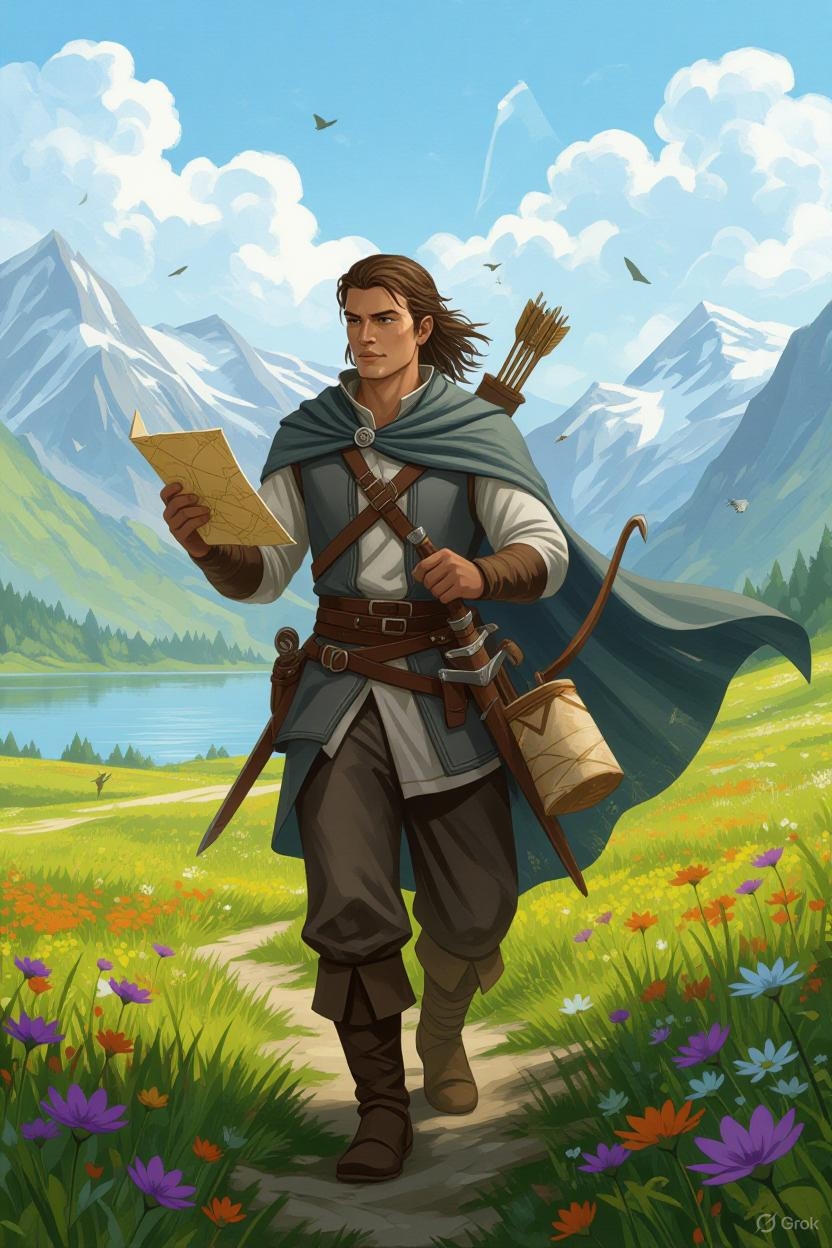
A veil rift shimmered as Tobal left Rafe’s valley, a faint tremor in the air marking his departure. Rafe explained the best way to survive in the winter was to hunt the larger animals like the deer. Each kill would provide enough food for a week or more, and in the winter, it was very important to have some food set aside for emergencies and for when the weather really got bad. Winter was also the best time for trapping animals for their fur. He would need some winter clothing before it got really cold, and this was as good a time to learn as any. He could make some things now while the furs were prime and keep them at Rafe’s camp until he needed them.

In the meantime, it was spring, and life was abundant. Flowers bloomed in the meadows, and insects flew and crawled all over. Tobal learned to make containers and drinking cups out of the green bark of birch trees, the rough texture soothing under his fingers, and boiled water in them. He used them to make teas and ointments that kept the deerflies and ticks away, the bitter taste lingering on his tongue. His skin became tanned, and his muscles hardened from constant exposure and work. He could stay outside in any weather and walk the entire day without being exhausted. By the end of the second week, Tobal was living completely on his own food. He was not only finding food but was providing food for Rafe to eat. He still had trouble cooking though—nothing he cooked tasted as good as the mouthwatering victuals Rafe provided, the salted jerky soup a savory highlight. Still, Rafe never complained. Tobal learned the importance of keeping his knife razor sharp, the edge biting into his calloused hands, both of them—keeping the one from his initiation on his belt and his old knife strapped to his right leg above his ankle just as Rafe did.

By the end of the second week, he was getting bored with the monotony of the daily grind and the constant need to keep busy. He was looking forward to something new. They moved out from Rafe’s small valley and traveled in different directions, meeting up at designated spots on the map every other day. Tobal became proficient with the map and with triangulating where he was at any given time, his intuition pulling him toward uncharted paths. He spent some evenings alone and others with Rafe. The evenings he spent with Rafe were spent creating different kinds of shelters and sleeping in them. He was amazed at how many things could be used for shelter. But they all had the bed made of soft fragrant pine boughs, and he followed the first rule of never sleeping on the ground if it could be avoided.

Leaning trees that had fallen provided shelter when combined with the gray poncho material. Two trees and his walking stick lashed between them became an impromptu tent. Lean-to shelters were easily made, and he also made a small teepee using the gray blanket material. The need for water was always present, and he never strayed too far from a good supply of it. He learned where to look for fresh water springs and waterholes. He also learned to collect rainwater with his poncho or blanket and fill his canteens and other containers. Rainwater was fresh and didn’t need to be boiled. Water from stagnant pools needed to be boiled before drinking.

He practiced continuously with the sling and his bow. He got his first deer at the end of the third week. He was really excited, even though there was too much meat. They spent two days slicing and smoking it into jerky that could be stored away to eat later. It made his pack much heavier, and he cached some carefully in a tree, marking the spot on his map so he could return to it later. Once in a while, they would see an air sled in the distance with a medic on it. They would wave, and sometimes the medic would wave back. Medics were not allowed to interfere with the Apprentice degrees unless there was an emergency, but they did keep an eye on things.

It was during the fourth and final week that Rafe asked Tobal to look at the map and decide where he was going to solo. He should also start thinking about where he was going to be training people. He recommended Tobal stay roughly within 60 miles of the gathering spot. “Where are the others?” he asked Rafe curiously. “We don’t move around too much unless we are training someone,” Rafe answered. “The Journeymen usually find a permanent spot, and no one bothers them. Many of the older Apprentices do too. That’s why we haven’t seen anyone. Still, a lot of the nicer spots have been taken, and it’s getting harder to find an area that someone has not at least passed through. We encourage the newbies to stay within 30 miles of the gathering spot so we can keep an eye on them. Since there are normally not more than seven or eight training at any given time, there is lots of space, and it’s easy to stay out of each other’s way.”

Tobal enjoyed the rugged outdoor lifestyle and the solitude. He felt a quiet confidence in his growing ability to survive and was looking forward to his own solo that was rapidly approaching. The fourth week was different than the first three. It was travel, travel, and more travel. Rafe knew where several people lived, and they set out to visit them. A shadow flickered among the trees one day—a rogue, perhaps—hinting at unseen danger. The meaning was clear: Rafe wanted Tobal to be able to go for help and find someone if it was needed. He also wanted Tobal to know who his friends were. Once, when they were going through the woods, Rafe stopped him and motioned him to be silent. He pointed at three figures in black that were going through the woods at a fast dogtrot.

“There are some people, particularly in the Journeyman degree,” Rafe said later, “that have gone off the deep end and gone rogue. These Journeymen will ambush a person, destroy his or her belongings, take their supplies, and leave them helpless. It is a real danger that must always be kept in mind. Fortunately, the rogues do not stay close to the gathering spot. They are not very good woodsmen and can barely survive on their own during the winter. That’s probably why they prey on others. Usually, they prey on other Journeymen that have set up permanent camps and take their winter supplies. It always pays to be careful. If possible, know whom you are visiting; some might make you welcome, and some camps might be dangerous. I don’t think there is any danger of being killed,” Rafe said, “but there is always the possibility of being injured and put in the hospital or something. The medics might not be able to get there in time. If you ever run across something that is not yours, leave it alone. There is no need to get anyone pissed off because you messed with their stuff.”

With that final warning, they headed back toward the gathering spot and the monthly circle celebration. Circle was different this time around, and Tobal whistled merrily as he traveled the path into camp. He didn’t see anyone on the trail, and no one tried to stop him or Rafe. Rafe seemed amused at Tobal’s whistling but didn’t say anything about it. He only whistled a few short bars at two sharp turns in the trail, and that was it. People were setting up teepees and gathering wood for the fires. There was a lot of work to do, and Tobal joined in with enthusiasm. He helped dig the roasting pits where the bigger animals were being prepared. It felt good to work alongside other clansmen and joke with them. He was grateful to contribute, and as evening came closer, he wondered what the night would bring.

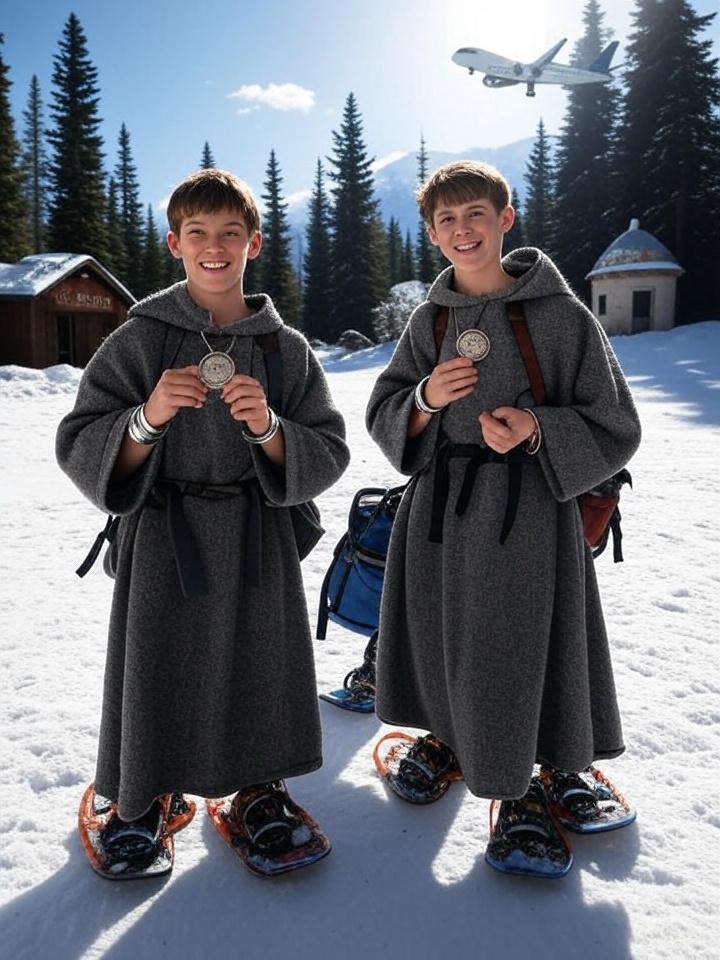
Everyone was changing into robes. All clan members at circle wore robes that they kept in one of the storage buildings. A black-robed guard was handing them out. There was no reason to haul robes around all month when they were only used here. Tobal was given a long gray robe similar to the one he had gotten at sanctuary. “Just bring it back tomorrow when you’re done with it,” was all the guard told him. It turned out only four newbies were being initiated that night. Tobal made some new friends and was hanging out with them. They were all Apprentices. Zee was a raven-haired girl with shoulder-length hair and a good sense of humor. She had been one of Rafe’s students and was training her first newbie. Nicky, the newbie, had just arrived at sanctuary two weeks ago and was being initiated as Apprentice that night but would be waiting till next month before starting her solo.

Wayne was a stocky, good-natured fellow with sandy hair. He had been an Apprentice for two years and wasn’t in any hurry to make it to Journeyman. He didn’t have any student and hadn’t been training anyone for the past few months. He was more interested in being with his girlfriend, who was also an Apprentice. His girlfriend, Char, had curly brown hair and a ready smile. They were always seen together at circle. Tobal remembered both of them from last circle. It was easy to tell they were in love. A tall, lanky, sandy-haired kid was soloing the same time he was. They hit it off right away during last month’s initiation. In fact, all six that had been initiated last month were soloing this month. Kevin was more nervous about his solo than Tobal was. It made Tobal realize Rafe was a very uncommon teacher and extremely good at teaching others what they needed to know. Most soloists didn’t have the quality of training or the experience Rafe had given him. Kevin kept thinking about bad things that might happen in the woods, things that hadn’t occurred to Tobal since his first weeks of training. Many clansmen were excited about the six of them soloing, and they were given lots of support and encouragement.

Nicky kept staring at Tobal’s face; finally, she blurted out, “What happened to your face anyway?” Tobal was caught by surprise and off guard. “I was attacked by a wild animal that knocked me down. I fought it off and was really lucky,” he lied. “I almost lost the sight in this eye,” and he fingered the long scar around his right eye. Nicky said, “It makes you look kind of sexy and dangerous,” and it was her turn to blush. Rising to her feet, she crossed over to where Tobal was sitting and crouched down in front of him, putting her arms around his neck. “Very sexy,” she whispered and kissed him deeply and passionately on the lips, pulling his hand against the top of her breasts where her robe lay casually open at the top. Then she stood back up and walked toward the kitchen to refill her mug of beer. Tobal was stunned, then pleased. In this camp, there were many scars and tattoos, and each one had a story. In fact, the more scars or tattoos a person had, the more stories that went with them. Wayne was planning on getting matching tattoos with Char. They were debating what tattoos would look right and the best places to have them.

There was an awkward silence, but it passed, and everyone started talking again about the coming solo. After a while, one of the red-cloaked figures came toward their group. She was a medic named Ellen. Tobal recognized her as the High Priestess who initiated him. She asked if everyone was ready for circle. A few hours later, Tobal and the others were at the circle entrance, waiting and watching as it was cast and purified. The older members were gathered around. The central bonfire was piled high, and the smaller fires at each of the quarters burned merrily. The High Priestess and High Priest cast the circle, and Tobal watched with interest as they worked closely together.

They stood together before the stone altar that was set on the northern side of the central fire. The High Priestess handed the High Priest a bowl of water. As he held it, she put the tip of her knife into it. “I purify you spirit of water, banishing all impurities and illusion. May you be charged with the power, strength, and love of the Lord and Lady. Blessed be!” Then the High Priest put the bowl of water back on the altar and picked up a bowl of rock salt, handing it to the High Priestess. She held the bowl as he put the tip of his knife into it. “I purify you spirit of salt, banishing all impurities and evil. May you be charged with the power, strength, and love of the Lord and Lady. Blessed Be!” Then he took the bowl of consecrated salt from the High Priestess as she picked up the bowl of consecrated water. They faced each other, and he poured the salt slowly into the bowl of water and set his empty bowl down on the altar. He stayed there as the High Priestess set her bowl on the altar and began casting the circle with her knife. She started in the northwest corner of the circle directly where Tobal and the others were standing and moved deosil, walking the perimeter of the circle, saying, “May this circle be a meeting place of love, joy, and truth. Shield us against evil, protect us, and direct the power we shall raise tonight. In the name of the Lord and Lady, So mote it be.”

The High Priest joined her as they both came back to the circle entrance. With her knife, she opened a pathway for them to enter the circle. Then she and the High Priest began to admit members into the circle with a hug and kiss, spinning them clockwise into the circle. The High Priestess greeted the males, and the High Priestess greeted the females into the circle until everyone was within the circle and seated. The entry was sealed, and the High Priest took the bowl of water and started at the North signal fire behind the altar, sprinkling it with the water and salt mixture. He continued around the circle, stopping at each quarter, sprinkling the water and salt mixture, intoning, “I purify you with water.” Coming once more to the North, he continued around the circle, sprinkling each member with water and blessing him or her.

As he was doing this, a different Master in a red cloak took up a smoking smudge of sage and stopped at each quarter, waving the smoking smudge, saying, “I purify you with air.” She continued around the circle, blessing and purifying each circle member. Another Master took a flaming torch from the central bonfire and purified the circle and members with fire. Only the High Priestess and High Priest had their hoods down. The other red-cloaked figures had large hoods that covered their faces and hid their identities. Tobal only recognized Ellen as the High Priestess. A Yggdrasil root pulse trembled beneath the fire, a faint hum grounding the energy.

The High Priestess went to the East of the circle and drew an invoking pentagram of air with her knife. “Watchtowers of the East, powers of air. I call upon you to be with us tonight.” Moving along the edge of the circle to the South Quarter, she traced a matching invoking pentagram of fire in the air in front of the signal fire. “Watchtowers of the South, powers of fire. I call upon you to be with us tonight.” Moving to the west, she traced an invoking pentagram of water in front of that signal fire. “Watchtowers of the west, powers of water. I call upon you to be with us tonight.” Moving to the North, she traced an invoking pentagram of earth in front of that signal fire. “Watchtowers of the North, powers of Earth. I call upon you to be with us tonight.” Tobal suddenly felt an electrical tension that filled the circle. It was a powerful energy but also quiet and balanced. He sensed each of the four energies and wondered at their uses, a psychic flicker brushing his mind with a distant fear.

Returning to the altar in the North, the High Priestess made the sign of the cross and turned with her back facing the altar. Her robe slipped to the ground, displaying her naked body in the firelight. The High Priest with his right forefinger touched her right breast, left breast, womb, and back up to her right breast, making a downward-pointing triangle. “I invoke and call upon the eternal Lady that is deep within you and has always been within you from the birth of your physical body and from the birth of your eternal soul. Join us in peace and love within our circle and give us your blessings.” The High Priest stepped back and waited silently. The High Priestess opened her eyes, and Tobal could swear it was not the same person. Her eyes and voice took on a power and authority that filled the entire circle, a transcendent Hel surge warming his intuition.

“Let there be Love.” Slowly they traded places, and the High Priest stood with his back to the altar, and his robe slid to the ground, exposing his hard and muscled figure. The High Priestess with power and authority touched him first on the center of the forehead, then the left shoulder, the right shoulder, and back to the forehead once more, making an upward-pointing triangle. “I invoke and call upon the eternal Lord that is deep within you and has always been within you since the birth of your physical body and the birth of your immortal soul. Join us in energy and light within our circle and give us your blessings.” Then she stood back and waited. The High Priest opened his eyes and responded, spreading his arms wide in blessing.

“Let there be Light!” Tobal could feel energy filling the circle. It was charged with a type of static electricity, and he was feeling hot and stuffy, almost a little uncomfortable. He also felt the presence of the Lord and Lady within the High Priest and High Priestess and wondered at it, their Hel energy pulsing through him.

The High Priestess and the High Priest then stood side by side, facing the East, holding hands as she intoned the charge of the Lord and Lady as he first heard it during his initiation. He felt deeply stirred at the memory, and suddenly he could see and feel both the Lord and Lady leaving the High Priest and High Priestess and taking their place above the central fire. He sensed them in his mind, looking down in blessing and filling the circle with love, peace, and healing. It seemed they looked directly toward him and smiled in welcome.

Then the drums began, and members began to dance deosil around the circle. Tobal joined reluctantly at first and then with growing passion. They danced slowly and then more wildly as the energy level rose. The drums beat more rapidly, and the dancers became crazed, throwing off robes and dancing naked in the firelight. They leapt and sang in ecstasy, moving around the fire alone and as partners, losing themselves to the beat and rhythm of the drums. Tobal gave himself to the pounding rhythm and to the Lord and Lady. He was dancing for them. The drums beat faster and faster until the dancers were sweat-streaked but showed no sign of stopping. A sudden signal from the High Priestess brought complete and abrupt silence to the entire circle as everyone turned and looked at her. The tension and energy in the circle were overpowering. “Lord and Lady,” she shouted, “We ask you to send your blessings and our blessings out to those in special need this night. We especially ask you to bless and assist those that are about to solo. Be with them and guide their steps so they may return successfully to us in a month’s time. So mote it be!” “So mote it be,” the entire circle replied, and Tobal felt such a wave of energy and love wash over him that he was swept out of his body and up once more into the arms of the Lady, this time as a baby. She gazed lovingly into his eyes as his consciousness faded away.

Tobal woke as someone helped him back to the edge of the circle where his robe was lying. That wasn’t the end, though, because Nicky’s initiation began. Again, he experienced the buildup of energy, only this time it was directed at Nicky. Again, in his mind’s eye, he saw the Lord and Lady taking their place above the central fire. Later, there were people standing in relaxed bunches around fires, drinking and eating. Instinctively, he knew the circle had done some powerful magick that night, and that his solo would be blessed. As the gathering wound down, Ellen, the High Priestess, approached him. “I noticed you faint when the Lord and Lady blessed you,” she said gently. “You might be sensitive to them and want to know more. I’m holding a special meditation group tomorrow morning for those interested in studying their mysteries and shifting to other realms. You’re welcome to join if you’d like—not everyone does.” Tobal nodded, intrigued.

This was quite different from the wild party he had experienced last month. There was a feeling of joy, friendship, and goodwill as people joked and talked with each other, helping themselves to enormous quantities of food and drink. They gradually moved into small groups to quietly sit together and talk far into the night. He made a special point of welcoming Nicky into the clan. He spent time chatting with Zee and noticed Angel was back from sanctuary. She was limping slightly but otherwise seemed to be doing well. He met another Apprentice named Tara. He had noticed her dancing and made a special point to meet her. Wayne and Char were both there, laughing at some of the stories Rafe was telling. It was a good party, and he felt warm and happy when he finally made his way to bed.

That night, after the party, Tobal drifted into a Niflheim dream—his parents trapped in a rune-lit cell, whispering, “Find the shard to break the veil.” Groggily, he woke, the vision lingering. The next morning, with the fresh magical energy lingering from the previous night’s blowout, Tobal attended the meditation, joining a small group in a quiet clearing. As they closed their eyes, a powerful vision enveloped him—the Lord and Lady stood before a shimmering lake, their voices urging, “Go south, to the lake, where a fragment awaits.” The vision faded, leaving him with a clear pull toward that destination, and he set out directly on his solo adventure.

Tobal’s solo wasn’t the way he envisioned it. He left circle on the 2nd morning when everyone else was leaving. He had decided to explore some country he hadn’t visited before, seeking a place with adequate water and a potential base camp. Guided by his vision of the Lord and Lady that morning, he felt compelled to head south. His map showed a small lake about a hundred miles south, a spot he’d noticed before but now felt drawn to explore. Though it was beyond the recommended 30-mile radius, no strict rules confined him. The circle’s energy had shifted his plans, pulling him toward the lake, and it felt right. He headed east until he found a small stream feeding into it, whistling lightly as he started out. The day was bright and warm, and he kept an eye out for food, setting up a leisurely camp by the stream. Late May brought a chill to the evenings but pleasant days.

After building a shelter and gathering firewood, he roasted a rabbit caught with his sling. As it cooked, he fetched the last wood and set fish traps for morning. Earlier, he’d retrieved smoked jerky from a cache. Mixing it with greens, he made a hearty soup to pair with the rabbit—a satisfying meal enhanced by the salt he’d gotten at circle. With survival routine now second nature thanks to Rafe’s training, his mind turned to the terrain ahead. Settling under blankets, he listened to the fire’s crackle and felt its light on his face. The Lord and Lady’s protective presence filled his mind, a Hel surge warming his intuition, and he drifted into a peaceful sleep, waking only to stoke the embers.

Read Full Post »

OD by Karl Hans Strobl and translated by Joe E Bandel

Chapter 3, pages 33-38

“Where are the gentlemen headed?” Friederike Luise asks, brushing past the reproach.

Reichenbach mumbles something about inspecting the forest, then they shake hands and go their separate ways. The old count is silent for a moment, then says, “She has such a beautiful confidence. Maybe she’s right—how could something like that touch her? Wouldn’t it make you despair of God? But you shouldn’t let her.”

Reichenbach grumbles about allowing or not allowing and not letting anyone interfere, and how stubborn she can be, but deep down, he’s glad he saw Friederike Luise and held her warm, firm hand in his for a moment.

They stride out briskly now, and Reichenbach shifts the conversation to the damned furnace, still burning, which must be extinguished before they can build a new one. It’s the same path they took that moonlit night of the meteor fall, passing the hunting lodge and entering the Od Valley, always upstream along the Punkva, which they plan to tackle today. They reach the spot where the Punkva emerges from the rock a second time, and then it grows quiet beside them; the living water now flows within dead stone. And now they’re at the place where the little river vanishes into the cliff, and the narrow valley feels livelier again, with that voice of the water beside them. At last, they reach the spot where the Punkva first emerges from the rock, out of a wide, dark cave, its stone vault dipping low to the water’s surface.

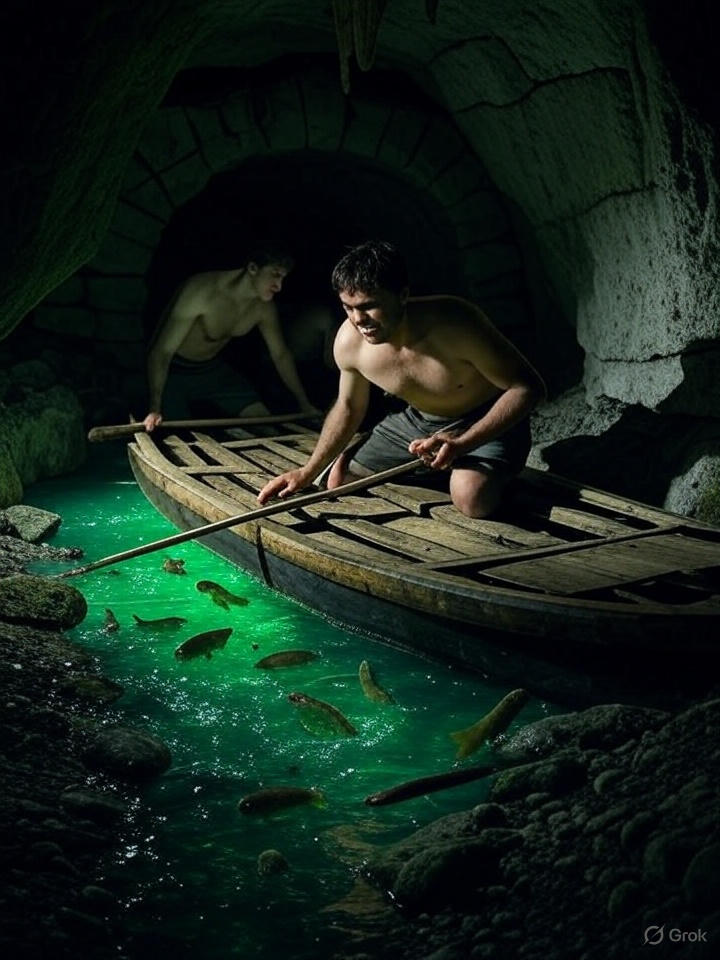
The miners Franta and Hadraba are already waiting with two rafts, ropes, lamps, and all the gear for a journey into the underworld. The rafts are simple—each made of two planks, cross-latticed, with two more planks on top, just wide and long enough for a man to lie on and use his hands as paddles.

“Has the water level dropped?” Reichenbach asks.

“About a foot and a half, please, sir!” Franta replies.

Franta and Hadraba, the two miners from Willimowit, had to clear stones and boulders from the outlet on Reichenbach’s orders. They also dug a deep channel in the streambed to speed the water’s flow. And now the water has indeed dropped—perfectly, by about a foot and a half. Last week, when Reichenbach tried alone, the water in the first cave was too high to go further.

Reichenbach and the old count exchange a glance, reading readiness in each other’s eyes. They shed their clothes, tie ropes around their waists, and, in shirts and underdrawers, carefully slide onto the wobbly planks, still held at the shore by the helpers. At the front of each raft, a small oil lamp smokes in a glass tulip on a short stem, A waterproof pouch with tinder is nailed to the planks.

Reichenbach turns his head. Beside him lies the old count, arms spread, hands dangling in the water, smiling at him.

“Go!” Reichenbach commands. Franta and Hadraba give the rafts a push, and hands paddle on either side of the planks. Man and craft become flat fish with two short fins and a murky red, smoldering, stalked light organ at the head.

Dark, eerily quiet, the waterway emerges from under the stone arch, leading into the earth’s belly. The countercurrent is barely felt; the wooden fish paddle forward. It grows dim, the anxious red light pushing against rock that sinks, dipping into the flood. The water path turns left, daylight fades behind them, rock and water nearly touch.

“At this spot,” Reichenbach says, “last week I had to push the raft under the water. Not needed today. Just keep paddling behind me.” His voice rings painfully loud, as if through a megaphone. He shouldn’t speak, the old count thinks—no, the human voice shouldn’t sound so bold here, where something might sleep that’s better left undisturbed. Here, one should only whisper.

Cautiously, the men inch forward, one behind the other, through the low entrance, the lamp’s glass tulip nearly scraping the ceiling. But then the stone canopy above their heads recedes, the light breathes freely, stretching toward the ceiling of a cave polished smooth by spring floods and thunderstorms.

Dark openings in the walls lead onward. Reichenbach paddles toward the largest, his compass before him. “We’re heading straight for the Macocha. Maybe this is the same water as at its bottom,” he says.

He’s talking again, the old count thinks, feeling they should be silent here, like fish.

They glide into a second, roomier cave. Stalactites hang from the ceiling, large and small, snowy white. At the tip of each clings a tiny water droplet. For the first time, human eyes behold this marvel of millennia. A cold droplet falls on the old count’s shirt, stinging like a needle between his shoulder blades.

The vault sinks toward the water again. “Will we make it through?” Reichenbach asks before the narrow gap. “We’ve got to try.” He pushes the raft to the wall, wedges it under the rock, arches his back, presses against the ceiling, forcing himself and the frail planks underwater, keeping only the light—the searching, forward-probing eye—above, unextinguished.

How long is this perilous passage? Will their breath hold? A gamble with little chance of turning back. For the old count, left behind, it’s a painful wait, an almost unbearable strain on his soul. Fear? Hardly, but a sudden realization of the reckless audacity of their venture grips him. Something unknown glares from the darkness and solitude. He pushes away troubling thoughts, silences his conscience to stay strong. All reproaches must fall silent now; he thinks only of Friederike Luise, her eyes, the pressure of her hand that sent a spark through his veins, like dwelling on the eyes and hands of a sacred icon.

Then a voice comes from the crevice, a strained sound: “Keep going. It’s alright!”

Without hesitation, the old count pushes his raft underwater, feels the icy flow envelop him, shoves with his back, paddles with his hands, holds his breath tight in his compressed chest. Just when he thinks he can’t bear it any longer, the raft surfaces, air rushing back.

The two rafts float in a hall, its vault soaring beyond the reach of their light, lost in darkness above their heads.

“This is as far as we go!” Reichenbach says. They paddle along the walls, encrusted and coated with limestone, sloping into the water everywhere except the entry point. A white curtain of rippling folds hangs from the darkness to the water’s surface. As Reichenbach passes, he raps his knuckle against the stalactite. It rings like a bronze bell—music of the underworld.

“We’d need a very dry year,” Reichenbach says. “Maybe then it’d work. Today, we turn back.”

They squeeze through the passage into the second cave, where stalactites hang. Take one, the old count thinks, for Friederike Luise—a trophy from the underworld.

He kneels on the raft, eyes searching for the finest, largest stalactite, reaching out, but the planks slip from under him. He stumbles, grasps for support, and plunges thrashing into the water. A spray shoots up, falls back, dousing both lamps. Reichenbach clings to his rocking raft, seeing a struggling body in glassy green, wild, frantic, aimless movements stirring air bubbles. This isn’t the steady confidence of a swimmer at ease in water—it’s a desperate fight against death. A moment’s hesitation, then he tears the rope from his waist, ties a loop, and as the sinking man’s flailing brings him briefly to the surface, throws the line over his head and arms.

“Calm! Stay calm!” Reichenbach urges, pulling the old count close and paddling with one hand to the drifting raft. “Try to climb up now!”

Obediently, the old count grabs the planks, slides them under himself, rolls his body onto them, and scrambles aboard. Then he lies still, exhausted, surrendering to the reclaimed sense of life.

“You can’t even swim, can you?” Reichenbach asks reproachfully.

“I can swim,” the old count gasps, “swim well, just as I can ride, shoot, and fence. But I don’t know what happened. A paralysis… like a stone around my body… I was pulled down…” He adds, “If it weren’t for you…”

Reichenbach doesn’t reply, his attention now wholly captured by something else. He only now realizes why, despite the lamps going out, they aren’t in darkness. Light radiates from the depths, the water glowing in emerald green, like liquid bottle glass flecked with gold, so clear you can see the rocky bottom, every stone, and the trout standing still or flashing their white bellies in swift turns—green stars, meteors of the deep.

The walls, ceiling, and stalactites shimmer in this green reflection, drawn under the rocks. Waves stirred by paddling hands cast their glimmer onto the stone, bringing it to life. When you scoop water and pour it out, a spray of sparkling gems falls back. It’s daylight’s light, the green forest light of trees, absorbed by the water and carried beneath the rocks—a fairy-tale harmony of elements: water, stone, and light.

The feeble human wit of the lamps had hidden this wonder; now, with them extinguished, it shines in unveiled splendor. They need no further light, finding their way through this green enchanted realm back through the cave’s mouth to the miners Franta and Hadraba, who are a bit worried, and to old Johann, who has arrived with the carriage as the old count ordered.

Soaking wet, the two men lie in the grass to dry off a bit before diving into the basket old Johann brought. As they clink their first glasses, the old count furrows his brow, turning serious: “Do you think thoughts can weigh like stones, stopping you from swimming?” For a moment, it seems he wants to say more, but seeing Reichenbach’s skeptical face, he suppresses the urge and forces his old smile. “And now, on top of everything, you’re my lifesaver! Cheers!”

“Oh, don’t talk about it,” Reichenbach grumbles. But deep down, it’s not unpleasant to be his master’s lifesaver, all else aside. There are still a few things he’d like to see settled his way.

After a pause, the old count adds, “You know what I thought when I suddenly couldn’t swim?”

Read Full Post »

Chapter 2

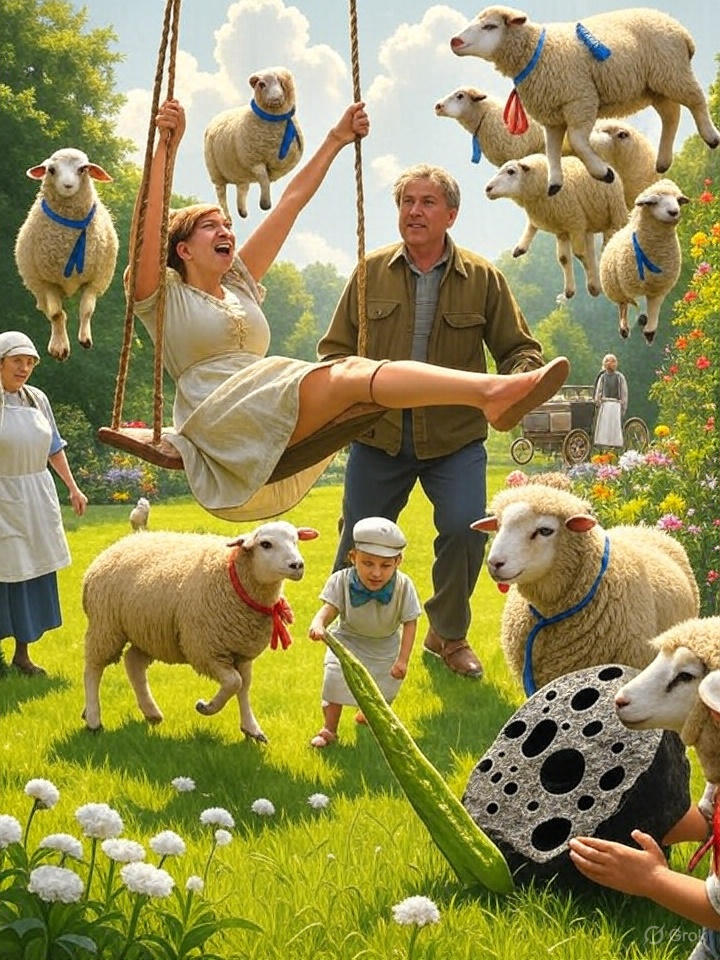
On the swing sat little Ottane, with Reinhold keeping it in motion.

“Higher!” Ottane squealed, kicking her thin legs. Her brother strained, stretching himself so that he could just barely touch the swing’s seat at its highest point with his fingertips.

“Now I’m flying!” Ottane crowed. “Now I’m flying into the sky, right through the clouds!”

“What do you see up there?” her brother asked, panting.

“I see lots of sheep on a green meadow. Nothing but—”white sheep. They have blue ribbons around their necks. No, some have red ones too. And they sing…”

“Sheep can’t sing,” Reinhold corrected.

“Oh, yes, the heavenly sheep can sing.” Ottane was indignant that Reinhold wouldn’t believe her sky-sheep could sing.

“If you talk such nonsense, you’ll have to get down,” said her brother, stopping the swing. “It’s Hermine’s turn now. Hermine!”

Hermine was kneeling in the grass by the flowerbed, holding a thick green seedpod in her hand. “Never mind,” she said, “I don’t want to.” She had other things to do; with a sharp little knife, she was already dissecting the elongated pod, carefully studying the arrangement of the snow-white, soft seeds in their tiny cradles.

Ottane obediently climbed off the now-still swing and walked slowly, a bit sadly, to her sister. “Is that why you don’t want to swing?” she asked. “There’s nothing better than flying like that.”

“Look!” Hermine held up the sliced pod to her sister. “See how beautifully the seeds lie side by side.” She pursued the life and growth of the plant world with passionate zeal, dissecting stems, flowers, and roots; her neatly kept herbarium had reached a tally of about five hundred specimens.

“No,” Ottane disagreed, “the whole thing is much nicer.” With a faint pang of regret, Ottane watched for a while as Hermine’s knife continued its work of destruction. Then she put her arm around her sister’s neck: “There’s a huge cake with a seven on it, and Friederike. And whole mountains of gingerbread, sooo high, and candied calamus and preserved nuts—”

“Father’s coming,” Reinhold said, standing by the girls, his voice carrying a note of warning. The children looked up, a ripple of tension and composure running through their bodies.

Reichenbach came through the garden, bringing with him the gravity of life, judicial sternness, responsibility, duty, and a faint unease about the incomprehensible. Only Ottane ran to her father, wrapping her arms around his knees. The other two stood stiff and alert, an unyielding will casting a shadow over them.

“Have you done your lessons?” Reichenbach asked, and the children nodded, Reinhold with a slightly guilty conscience, for two of his six math problems remained unsolved.

“Is Mother back from church yet?” he asked further. No, the christening party hadn’t returned yet; but the old countess had sent a ham and Linzer cookies, Ottane reported, and Frau Paleczek had arrived, putting on a large white apron and a white cap, looking so funny with her dark face, like a fly in buttermilk, Ottane thought.

Reichenbach stroked Ottane’s blond head, listening for a moment to the clatter of plates in the large room on the first floor, where the christening feast was being prepared, and to the booming voice of Frau Paleczek, who had taken command over the maids.

“She sent us out to the garden,” Ottane confessed,— “She doesn’t need us; we’re just in her way.”

Now Reichenbach noticed the sliced seedpod in Hermine’s hands. “Well done!” he praised. “What’s the plant called? Iris germanica. Repeat!”

“Iris germanica,” Hermine recited obediently.

“You’ll write down what you found while dissecting it. The work will be on my desk by noon tomorrow.”

“Father, what’s that?” Ottane asked, tapping the small linen sack Reichenbach held in his hand.

“Well, that’s something special.” Reichenbach lowered the heavy sack to the ground, reached in, and pulled out a black stone. It looked like a dark-brown coal with a host of strange bumps and hollows, as if it were made of a dark, molten glass fused into a lump. At the fracture, it was blue-gray, speckled with iron-gray and yellow flecks.

“What is it?” Reinhold asked eagerly.

“It’s a stone that fell from the sky,” Reichenbach said. When he spoke to the children, his Swabian dialect was scarcely noticeable. “And when it hit the Earth’s air, it shattered. That was a few days ago, at night, but you were all asleep, of course, and didn’t hear a thing. The foolish people say it’s a sign and means trouble. But it was just a stone—granted, a stone from the sky. And we’ve been searching for the pieces, hundreds of them, scattered in an elliptical— pattern, like a strewn field. The smaller pieces fall almost straight down, while the larger ones continue their slanted path. Remember that, Reinhold—you’ll work on a problem about it, and it’ll be on my desk by noon tomorrow. What you see on the outside here is a fusion crust. That comes from the tremendous speed and heat. And what’s inside the stone? I’ve already examined some of the pieces in the laboratory and found various minerals—nickel, labradorite, hornblende, chromite. Reinhold, what is chromite made of?”

Reinhold stared at the stone, a heavy unease sealing his lips. Chromite, my God, chromite—what’s it made of? He stayed silent.

“You don’t know,” said his father, his eyes hardening. “You don’t know. You’ll know it tomorrow and write it out a hundred times on my desk. It’s remarkable that these stones contain iron compounds not found in nature, but which we produce artificially in metallurgy.”

Reichenbach didn’t get a chance to expound further on these curious iron compounds, for now the sound of wheels rolling on the road was heard, and then the decorated carriages came into view, bringing the christening party back from the church.

Frau Paleczek poked her dark face, framed by the white cap, out of the open window and shouted, “Jesus, they’re already here!”

The children felt stones lift from their hearts, far larger and heavier than the ones that fell from the sky. They breathed a sigh of relief and ran to meet the guests. But Hermine still found time to give Reinhold a poke in the ribs. “Write it out a hundred times, ugh!” And Reinhold returned the poke with interest.

Ottane trailed behind slowly, lost in thought. A small tumult had erupted in her mind. Who was throwing these stones from the sky? On her green heavenly meadow with the singing sheep, there were no such black, ugly stones.

The christening feast was loud and merry. That Frau Friederike Luise Reichenbach had taken on the role of godmother for the seventh Ruf child turned the modest forester’s family event into a matter of significance, granting the father honors that dazed and delighted him long before the wine, provided by the old count from his cellar, took effect.

The pastor Mandrial was there, along with Dr. Roskoschny, the chemist Mader, and a dozen other senior officials from the Salm works, and, of course, the old count himself. He sat to the right of the hostess, and to her left, between him and the pastor, the proud father of today’s christened child swelled with a sense of boundless bliss and importance. He was clearly at a pinnacle of his existence, taking great care to match the refined manners and skill of the distinguished company around him. In doing so, he completely forgot the worries about his wife, who had been lying in high fever since the birth of the child, and the ominous head-shaking with which Dr. Roskoschny had stood at the sick woman’s bedside.

Reichenbach had taken his place between the chemist Mader and Dr. Roskoschny, who was Meineke’s successor as the doctor in Lettowitz. They were a welcome audience for his current obsession with meteors—their origins, orbits, and composition—especially since, alongside the already-convinced Mader, the doctor was a skeptic who still needed persuading.

At the lower end of the table sat the children next to their tutor, a poor, peasant-looking philosophy student named Futterknecht, whose name seemed to prophetically chart his life’s course. They were perfectly well-behaved and modest, but their eyes lingered with growing longing on the dish of the old count’s Linzer Kränzerln nearby, waiting for the moment it would be served.

But Frau Paleczek, midwife, corpse-washer, and indispensable fixture at every festive feast far and wide, kept bringing out new platters of roasted and baked poultry from the kitchen. Her quick eyes darted over the table and guests, and her face—blackened since time immemorial by some ailment—gave no hint of when she would finally allow them to move on to the long-prepared pastries.

“That’s how it is,” Reichenbach said, clapping the doctor on the shoulder. “You can believe me, and once I’ve thoroughly studied the material, I’ll write a major treatise on meteors that’ll push science forward a bit.”

The doctor shook his head, unable to accept what Reichenbach was explaining. “Couldn’t it have been an optical illusion?” he asked cautiously, with the tenacity of his old-school training, reluctant to abandon an opinion without proof.

“Optical illusion, please, Doctor,” Reichenbach snapped. “The old count saw it, and I saw it, and we were only on the second bottle of Forster Hofstück—where’s the illusion supposed to come from?”

The doctor stared gravely ahead. “For now, it looks like the common folk with their superstitions might be right.”

“Please, don’t talk like that as a man of science!”

“Haven’t you read about the epidemic in Hamburg?”

“What’s Hamburg got to do with us?”

“And last week it started in Prague. And since yesterday, I’ve had a case in Lettowitz that seems highly suspicious to me.”

Reichenbach paused. “What exactly do you mean?”

The doctor hesitated to say the word, glanced around, and then said very quietly, “Cholera! But please,” he added quickly, “keep it to yourself. The symptoms aren’t entirely clear yet. We don’t want to cause alarm among the people prematurely.”

A gray shadow fell over the table and the guests, a hollow-eyed specter in a blood-flecked shroud grinned palely through the loud, carefree merriment.

But Reichenbach wouldn’t let himself be daunted. “Oh, come off it,” he said brusquely, “with your cholera! In summer, it’s just stomachache season—people gobble cherries and currants and unripe apples, then gulp down raw milk, and there’s your cholera. Besides, if medicine was worth anything, it would’ve found a cure for it by now.”

“The best remedy for cholera is not catching it,” the doctor admitted. “Careful eating, plenty of fresh air, and staying away from the sick.”

“That’s not much wisdom to boast about,” Reichenbach scoffed. “And the best remedy for childbed fever is not having children!” Then he added, “How’s our Frau Ruf doing?”

“I hope we’ll pull her through,” Roskoschny said curtly.

A gesture from the hostess drew Reichenbach away from further attacks on medicine. It reminded him of his duties. With a sharp tap of his knife against his glass, Reichenbach called for attention and stood to toast the christened child and her proud father. After tossing in a few more jocular remarks about Ruf’s remarkable vigor and the blessings of his marriage, he urged those present to raise their glasses to the father and little Friederike.

Read Full Post »

OD by Karl Hans Strobl and translated by Joe E Bandel

Chapter 1

Today, great things are underway at the Princely Salm Ironworks in Blansko—decisive, momentous things.

The new gigantic wood carbonization furnace has been burning for the third day now. It is a Leviathan of a furnace; it can devour eighty cords of wood at once, and when it’s really going strong, its voice becomes a prolonged roar that echoes through the valley. It recalls the exodus of the Jews from Egypt; its signs are a gigantic smoke cloud by day and a pillar of fire by night. The smoke cloud spirals out of the chimney like a yellow-and-brown mottled Nicene serpent, then gathers itself and rolls as a sluggish monster up the valley slopes, slowly disappearing into the forests amid shivering, tormented treetops. The pillar of fire is so bright that one can still read small print quite well from a thousand paces away.

Now the second machinist, Schnuparek, stands on the threshold of the chemical laboratory. Streams of sweat have carved bright furrows into his blackened face; he looks like a Negro with a skin disease, the whites of his eyes framing a frightened gaze. He twists his cap: “Your Grace… the acid has started to flow… but the gas…!”

The old count, who has been watching a tar distillation with Director Reichenbach and the chemist Mader, turns around: “That’s fine, Schnuparek, we’re coming. Just open both valves in the meantime.”

The old count and Reichenbach leave the chemist Mader alone with the tar distillation; they walk through the carpentry shop and then through the room where the artistic cast-iron pieces are displayed—statues after the antique, all sorts of Christian items, animals and large vases, the she-wolf from the Capitol, the Florentine Molosser hound, all cast in iron, very much to the buyers’ taste and cheap, cheap. The iron comes from the ground, and the wood grows in the immeasurable princely forests.

Between a Christ on the cross and the Capitoline she-wolf, they step out into the courtyard. The ground trembles, the windows of the long building in front of them rattle, the furnace hisses and roars. From the chimney, a hellish torch glows yellow and red into the encroaching twilight.

Black and helpless, people swarm before the wrath-trembling monster; the furnace doors glow, the pungent smell of wood acid forces the breath back and bores into the lungs. At the other end, at the valves of the distillation kettle, stands the first machinist Wostahlo, a small, stout creature of the underworld. In streams, the acid gushes from the pipes into the vats.

“Excellent,” praises the old count, “what’s the matter, then? It’s going splendidly.”

“I don’t know,” hesitates the machinist, “it seems to me it’s getting weaker.”

“Already now?” says Reichenbach. “Why, though?”

The furnace raises its voice to the roar of a prehistoric beast. “Like an old saurian,” laughs the old count.

“Exactly! Because it has to give up acid!” Reichenbach can’t help but say. But he walks around the furnace, places his hand on the wall of the cooling vessel where the pipes are supposed to release their heat. He pulls it back with a cry: “The water’s boiling!”

Schnuparek comes running: “Your Grace, please—the gas…!”

“Open all registers!” Reichenbach bellows back. “Let out the gas and hydrogen!”

It’s too late; a dull bang shakes the furnace. A giant fist lifts the thick walls, supported by heavy pillars—the entire armored vault—and slams it back down onto the ground.

And now there can be no doubt any longer: the stream of acid dries up, becomes thinner, just a thread, a trickle. It must have found another way out, pouring into the interior of the furnace. Boiling steam hisses out from the joints of the cooling system; the explosions follow one another more rapidly, the masonry sways.

“To the devil!” roars Reichenbach. “To the scoop wheel! Do we all want to blow up?”

The men have lost their heads, but Reichenbach’s roar brings them back to their senses. They run, illuminated by a firelight that bursts from the shattered heating system. The explosive gas inside the furnace hurls itself against the walls, hammering with destructive fists against its prison; the demons of fire exult and jeer. God knows what the acid is doing.

“Look,” says the old count, “now the thing’s starting to glow.”

Indeed, the iron plates of the cooling system take on a red glow, slowly from the inside out; the rivets expand with a sigh. The water has evaporated; fresh air comes through the burst furnace doors, fanning the blaze ever more. A mad screeching pierces from the trembling structure.

“Water!” Reichenbach’s voice cuts through the tumult. “Quickly! Fresh water!”

A worker comes running: “Jesus Christ, sir, the scoop wheel’s done for!”

“Done for?” Reichenbach thunders at him.

“Done for! It’s not working! Someone’s messed it up.”

Now we’re really all going to blow up, thinks Reichenbach. And he grabs the old count by the arm, pulling and pushing, trying to tear him away from the hissing, howling demon that has rebelled against human control, slipped from the command of their will—away, just away from here. His mortal fear is not for his own safety but for that of his friend.

But the stocky old count has the muscle of a wrestler and the sturdiness of a bear. At Legnano, he held off the French long enough for his corps, threatened with annihilation, to cross the Etsch.

For he will not budge, and no one can move him from the spot. He braces himself against them; if Reichenbach and he were to flee, everyone would run, and the furnace would burst into pieces.

The scoop wheel is ruined; they rush with water buckets, pouring against the tide. But on the glowing walls, the water hisses into boiling steam, atomizing into scalding clouds that no one can approach. And greedily, the cracked furnace mouth sucks in air, mixing it with the flames and the gas that rattles the structure.

“Pickaxes here!” shouts the old count. “Pickaxes and wet clay!”

The heat singes hair and skin; embers from above add to the blaze. Blue flames flicker over the shingles and the roof’s timber; sticky pitch falls in burning, bubbling clumps that sear into human flesh. The chimney has shattered; tar and pitch have caught fire, setting the roof ablaze.

The old count has thrown off his coat. In shirtsleeves, he grabs a pickaxe and shows his men what he wants. He has, after all, often worked alongside them in shirtsleeves before, with apron and trowel, demonstrating tricks and techniques in molding and casting. The tool thunders heavily against the glowing boiler walls, tearing open gaps; steam surges out, the sharp point bites in all directions, and the red serpents within become visible. From the modeling workshop, they drag in troughs of wet clay. They’ve grasped what the old count intends: through the torn-open walls, shovel after shovel of heavy, damp earth is thrust, clinging to the— coils of the pipes, enveloping them layer by layer. All hands shovel, sealing the cracks and fissures of the furnace, cutting off the air supply, throttling the breath of the fire.

Hours of struggle follow, and then the danger is averted. The flames rage on, devouring wood and coal, intoxicated by gas, but they are tamed within the furnace’s interior; the broken chains are thrown over them once more.

“I think we’ve done it,” says the old count. “Now we just have to wait until the fire burns itself out.”

“It’ll take a good while yet,” says Reichenbach.

The old count washes his face and hands in a wooden tub of water and puts his coat back on. “You believe that, Reichenbach,” he smiles contentedly, “let’s head to cooler territory for a bit. And we’ve earned a glass of wine, too.”

*

They rode in a light carriage to the hunting lodge up in the valley. Midnight hung over the peaks, crowned with gleaming constellations, edged with a pale shimmer of moonlight.

“It’ll be done differently next time,” said Reichenbach after a long silence, as they passed the sawmill. “Now I’ve figured it out. The furnace needs shut-off valves and heating tubes so the fire can’t get to the wood so easily, and the gas duct should be extended thirty cords long and cooled with flowing water. This mustn’t happen again. I was a real fool. The gentlemen are always smarter coming out of a meeting than when they go in.”

“Please, Reichenbach,” replied the old count, encouraging the horse with a click of his tongue, “don’t make such a fuss about it. Everyone makes mistakes; you learn from mistakes, and trying trumps studying. It’ll all work out. The main thing is that no greater misfortune happened. How easily could someone have lost their sight in an explosion—better red-hot than blind.”

Of all the misfortunes in the world, blindness seemed to the old count the cruelest. He had come close to it himself, back when, after returning from French captivity, he was struck by an eye affliction brought on by the hardships and toils of the campaign. He knew what it meant to see a gray veil fall over the world and to have to grope along the nearest objects with a stick.

In Reichenbach’s mind, a defiant thought flared: Now more than ever! “As long as you don’t give up, it’ll be fine. I won’t let go. But it’s still a blunder. And when bad luck piles onto stupidity—”

“What do you want?” comforted the old count. “You’ve got nothing to complain about! Haven’t you built up the entire operation? The ironworks, the rolling mill, the artistic castings, the steam engines we build—the first in Austria—the enameled goods that go as far as Haiti and Singapore, all that bears the name Reichenbach. What—”would it be just a small-time operation without you? And the creosote and paraffin, the picamar, the pittacal, the eupion, and all those things you’ve teased out of the tar. That’s all nothing?”

Read Full Post »

Chapter 7: The Path of Light

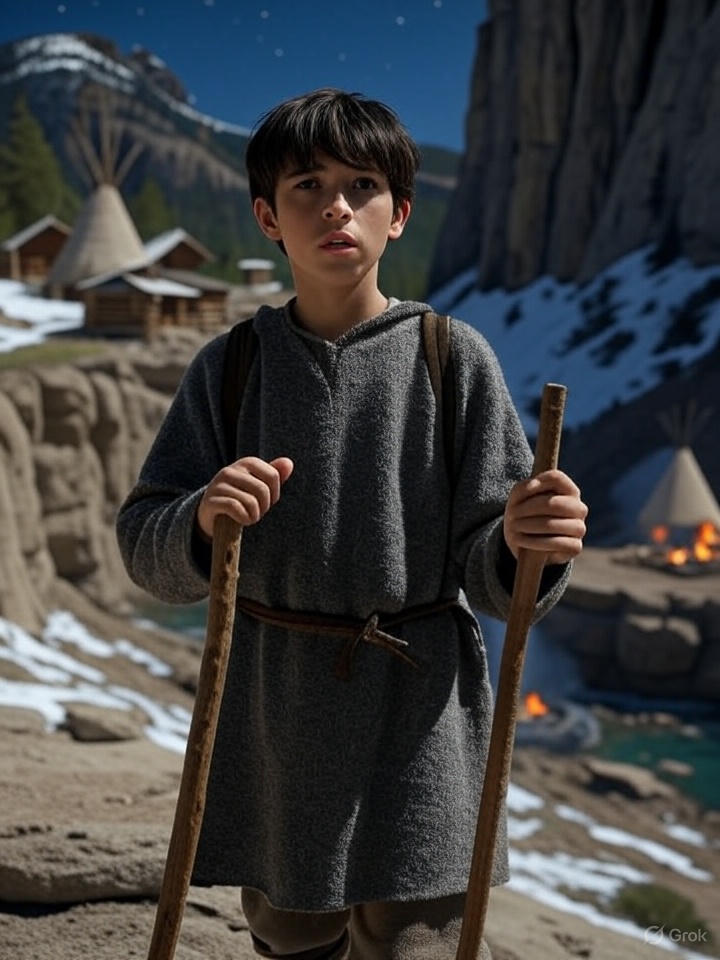
Tobal stood on a flat rock at the cliff’s edge, looking down into the valley. The main camp was being set up below—log cabins, teepee-like structures, and a smoking fire pit at its center. The people looked like ants from this distance. He wondered how they’d make it down into that guarded valley, seeing no clear path. His sense of balance steadied him against the height.

Rafe said, “Don’t worry about it. I told you I know the way down. Just follow me.” Tobal re-shouldered his pack and took a last drink from his nearly empty canteen. Turning, he limped after Rafe. His left heel was raw and blistered from loosely tied boots—Rafe had really chewed him out and treated him from the first aid kit, warning that any open wound in the wilderness was very serious and could get infected easily if not cared for immediately. There was limited help available, and he had to take better care of himself.

The trail, a faint two-foot-wide path, sloped steeply downward. Tobal clung nervously to the rock face, his balance tested, as Rafe scampered ahead. The sun’s heat had melted most of the snow off the trail; they carried the snowshoes in their backpacks. Rafe sprinkled sand on some of the slippery spots, and Tobal used his walking stick to pound away the ice from stubborn areas. The ledge widened for comfortable passage with boulders to climb, hairpin turns, and stomach-lurching drops before narrowing again, hugging the cliff face so tightly that Tobal needed to move sideways along it. There were no handholds or supports, and it was slow going, made even slower by his extreme nervousness. He had never liked heights.

He half-slid, half-fell, but managed to stay on his feet. More than once, the sturdy support of his walking stick helped him keep his balance. Rafe had long since disappeared down the trail, and Tobal felt alone and abandoned. He went around a large boulder where the trail widened, and he heard a scraping sound on the rock above him. Looking up, he saw a large gray blanket being thrown over his head as he was roughly grabbed and thrown to the ground.

Tobal was bound and hoodwinked, his hands tied securely behind his back, and then roughly shoved by at least two people who led him further down the path for almost thirty minutes. His foot hurt badly, and he almost tripped and fell several times, but rough hands caught and held him steady as he staggered blindly along.

He was abruptly pulled to a stop and heard a loud knocking three times that echoed and hurt his ears. “Who is there?” a voice challenged. “A prisoner, Master.” “Where is he from?” “Master, he is from Neo-Rome and comes by way of Old Seattle.” “What is he doing here?” “He is claiming sanctuary at Heliopolis, city of the sun.” “What does he want from us?” “He cannot survive in the wilderness without our aid; he wishes for peace and seeks wisdom.” “Let him confirm his intentions with an oath. If your intentions are truly honorable you will be set free and received as a brother into our clan. Is this your wish?”

Tobal nodded his head under the hoodwink. “I can’t hear you,” the voice bellowed harshly. “You need to say ‘yes, you do’ or ‘no, you don’t’.” Tobal stammered in a muffled voice, “Yes, I do wish to become a member of your clan.” “That’s better,” the voice continued. “Repeat your name and say after me: I, Tobal Kane, am a helpless prisoner in your power. I am a native of Neo-Rome and claim sanctuary at Heliopolis, the City of the Sun where I seek citizenship, light and truth. I come in peace. I further demand by right of blood full participation in the mysteries of the Lord and Lady. I swear to hold these mysteries sacred and secret. If I break this oath.”

The hoodwink was roughly lifted, and a large chunk of rough bread covered with rock salt was shoved in his mouth. He started to gag, but a fierce voice whispered in his ear, “Eat it.” As he struggled to swallow, the deep voice continued, “If I betray the bread and salt may my body be mutilated and thrown to the wolves.” Panicking, he stammered his reply and felt the sharp pain of a knifepoint near his groin. Someone was cutting away the fabric of his robe, and the bottom half fell to the ground around his knees. He felt very exposed and vulnerable.

“Release the prisoner!” His arms were unbound, and the hoodwink was taken off. He blinked in the fierce sunlight and shivered in the cold as the wind swirled around his bare legs. He was standing in front of a teepee. The Master was standing in front of him, dressed in a red robe with a welcoming smile. “Tobal Kane,” he said, “welcome to our clan.” The fiery figure stepped forward and embraced him in a crushing bear hug. “Come in, sit down! We greet you as a brother and a seeker after the hidden wisdom of Heliopolis.” They entered the warm teepee, and Tobal sat on some warm furs next to the cheerful fire in the center of the circular structure.

The Master clapped his hands together loudly. “Proclaim the arrival of Tobal Kane to our entire camp!” “Yes Master,” a black-robed guard replied. Bowing stiffly, he backed three steps before turning and leaving the teepee. Tobal heard the guard shouting loudly, “Welcome Tobal Kane, the newest member of our clan!” Then he heard sounds of scattered applause, whoops, and yells of welcome.

The Master turned toward Tobal. “You will need the sign and password of our clan to enter our camp in the future. The password for the present month is…” and he whistled a tune that Rafe had been whistling from time to time. “Before you leave, I will give you the first of our teachings. Remember this and dwell upon it in the days to come. Those that wish to be free must submit to some form of discipline and organization. Tonight you will be initiated as an Apprentice and expected to complete the duties of an Apprentice. If you do not have the self-discipline, you will find your time among us very hard. Our goal is the development of self-discipline and personal freedom. If you learn your skills well, you will discover personal freedom and self-empowerment that you have never dreamed of. The rules of our clan are as strict as the rules of nature. A ‘Circle of Elders’ guides us in all things. Respect them and go to them for advice and counsel when you need to. Don’t worry about the apparent restrictions your obligations will place upon you. They are designed to free you and assist in the personal discovery of your own ‘True will’. In finding your own internal authority, you will no longer need our external authority. That is when you can follow your true destiny in life. It is our wish you find your own internal Master and allow him to guide you in all things. We have no way of knowing what your true destiny might be. You have the right to discover and follow your true path, and none of us shall ever stop you. We will place power and knowledge in your hands. Remember you have made a solemn oath to us of your good will and intention.”

“Now,” the Master clapped his hands and smiled, “You need to be prepared for your Apprentice initiation.” The Master and four black-robed guards led him to another teepee that had a fire burning within it. Tobal was introduced to five others who were also going to be initiated that night. He was left there to share a light meal with his new comrades. Several hours later, the Master and guards reappeared and addressed each of them. “Do you wish to take the Apprentice Initiation?” “It is my wish,” said Tobal solemnly along with the others. “Then you need to be properly prepared. Guard!” The Master indicated toward Tobal and the others. The guard silently took the small group to a sweat lodge and told them to purify themselves first by the steam and then by diving into the pool of icy spring water that was close by. Tobal dropped his clothing with the others and walked naked into the sweat lodge. There were three girls and three boys, but no one seemed to notice anything unusual about it.

Tobal sat in silence and meditation with the others for thirty minutes in the steam until the sweat was pouring off him. He had been instructed to choose a magickal name for himself. During this time, he had also been instructed to think about why he wanted to become an Apprentice. His thoughts naturally turned toward his parents and how they had somehow wanted this for him. The sweat poured off as his stiff muscles slowly loosened and relaxed. He felt clean and refreshed. He was also getting excited about the coming initiation. Two of the others had already left the sweat lodge, but he still hadn’t decided upon a proper magickal name for himself. Suddenly, it seemed his mother was whispering to him, “Brother Oak, you will be strong like an oak tree and help your brothers and sisters.” After another five minutes in the steam, he ran out and dived into the shallow pool of icy water, gasping as the shock took his breath away. He staggered gasping out of the pool and ran into the main teepee where he grabbed a blanket and began rubbing his body furiously, trying to bring the circulation back. He felt a bit strange and silly as he picked up his mutilated robe and put it back on. It was no longer a robe but more like a tunic that came down just barely below his waist. The cool air and a slight draft made him keenly aware of his lack of underwear. He made a mental note to make some as soon as possible. The unaccustomed draft made him feel vulnerable and uncomfortable.

He laughed and moved nearer to the fire, joining those already there. They joked about the coldness of the icy water and the draftiness of the shortened robes as they made room for him at the fire. That broke the ice, and they chatted as one by one they were taken to their initiations. Finally, Tobal was left alone in the teepee. He was warm by then and even opened the door flap and sat in the opening, looking out as he waited.

No one came for him as he sat meditating and watching the moonrise. He guessed it must be around midnight, and the moon was full and bright. The sky was very clear, and the stars were brilliant. Then he saw a black robe coming toward him in the moonlight with a torch. As the figure neared, Tobal saw it was a dark-haired girl. Feeling a little self-conscious, he scrambled to his feet and steadied himself.

She stopped in front of him, holding the burning torch in his face. “You are a lost and lonely soul wandering in the darkness and searching for light. Without wisdom, you are wandering blindly and doing harm to yourself. If you wish, I will act as your guide. Do you seek the light and wisdom of our clan?” Tobal answered, “Yes, I do.” “There are two passwords you must remember, or you will not be allowed into our sacred circle.” She slowly whispered, “Perfect Love” and “Perfect Trust” into his ear. “Can you remember these two passwords?” Tobal nodded in silence. “You must speak, Yes or No,” she demanded, shoving the torch at him fiercely. “Yes, I can remember them,” he stammered, backing away from the fire. “Come with me, but first I must blindfold you.” She took a strip of gray cloth and bound it tightly across his eyes so he couldn’t see anything.

She led him stumbling in the darkness toward the central fire he had seen in the distance. As they neared, he could feel its heat and hear the flames crackle. He could also hear the muffled stirrings of other people as they hushed to watch and listen. Another female voice spoke loudly from the center of the circle. “In the presence of Yggdrasil, the Great Tree of Life and the Lord and Lady, listen to our words. Whenever you need something, call upon us, the guiding spirits of the human race, male and female. We shall answer you and assist you in all things. You are meant to be free, to dance, to sing, to feast and to make love. Do these things all with our blessings, for the ‘Blessings’ of physical life and the ‘Blessings’ of spiritual life are as one within each human heart. Embrace your dreams and desires as you strive to make them real. Let nothing stop you or turn you aside. Accept our blessings and help because life is meant to be a joy of the heart. We, male and female, can be found within the dust of the earth and the light of the stars. Our awareness encircles the universe and binds it to our wills. In our union is the beauty of the green earth and the white moon among the stars, the mystery of the waters and the desires of the heart of man. We call upon your soul to join us in the creation of nature and the expansion of the life force into the universe. From the union of male and female, all things must come, and all things must return. Rejoice therefore in the duality of life and let your worship be acts of love and pleasure, beauty and strength, power and compassion, honor and humility, mirth and reverence. Know that we are within you, male and female, and if you cannot find our union within yourself, you will never find it within another person. We will be with you at your death even as we were with you at the moment of your birth.” In the pause that followed, Tobal’s guide stepped forward and said loudly, “A seeker is among us. Tobal Kane has claimed sanctuary. He wishes to join with us and follow the ways of the ancient craft.”

The High Priestess called out, “This is not a matter to be taken lightly. Your immortal soul will be deeply committed to the path of the Lord and Lady if you continue. Do you wish to join the path of the Lord and Lady?” Tobal spoke out firmly, “I do.” The High Priestess came up to him and placed her hands on his shoulders, “Know well that love and trust must be freely given so they may be freely received. Consider carefully your own words because your life’s blood may someday be required. Do you still desire this?” “Yes, I do.” “Very well, in following the way that stretches beyond life and death, will you serve the Lady and reverence the Lord? Will you keep secret from the untrustworthy those things we will show you?” “Yes, I will.” “Have you chosen a name by which you will be known within the circle?” “I have chosen ‘Brother Oak’ as my magickal name.” “So be it, Brother Oak, enter the path of light.”

Tobal was pulled forward into the circle, but his guide sharply pulled him back. “Brother Oak, you can’t enter our sacred circle unpurified.” Tobal waited, wondering what was going on. He felt water being sprinkled over him. “I purify you with water.” He suddenly smelled incense very strongly. “I purify you with fire.” The High Priestess continued, “Know this, you will not be asked to go against the inner voice of your conscience or against your higher soul by taking the oath of our sacred circle.” He felt the sharp point of a knife blade pressing painfully into his chest. “Better to rush upon this blade than continue with fear in your heart. What are the passwords?” Tobal whispered, “Perfect Love” and “Perfect Trust.” The High Priestess smiled, “These are most welcome within our circle. I give you another.” She embraced Tobal and kissed him, her body pressed tightly against his. With her body, she turned him around and pushed him into the circle. Then she led him stumbling clockwise around the fire, coming to a sudden stop.

“Powers of the East. Brother Oak is properly prepared for initiation as Apprentice into our ancient craft.” He was led further and stopped again at another point. “Powers of the South. Brother Oak is properly prepared for initiation as Apprentice into our ancient craft.” This was repeated two more times, once at the West and once at the North. Then she led him back near the center of the circle, where he felt the heat from the bonfire against the front of his body. “You are about to be recognized as an Apprentice of our clan and circle. As an Apprentice, you are expected to gain the skills to survive on your own in the wilderness. You are expected to take care of your own belongings and eventually set up your own household. You are expected to solo for one month to prove your mastery of survival skills. Following that,” she continued, “you are expected to train six others even as you will be trained. You must do these things before you are allowed to progress into the 2nd degree of our ancient and holy craft. Do you understand this? Do you agree to do these things to the best of your ability?” “I do,” said Tobal. “In agreeing to these obligations, you have passed the test required and may now take the Oath of our circle. Are you ready to continue?” “Yes, I am.” “Will you always help, defend, and protect brothers and sisters of our clan from harm?” “I will.” “Then repeat after me, I, Brother Oak, in the presence of Yggdrasil, the Great Tree of Life and the Lord and Lady, most solemnly swear I will keep the secrets of our clan. I will never refuse to share these secrets with a brother or sister if they have been initiated as I was. I further swear I will not lose control of my thoughts, words, or actions. I will not use my powers for evil purposes, and I will proceed with firmness and courage to the conclusion of this initiation. I will let my inner conscience and higher self guide me in all ways. I further swear by my hopes of a future life, mindful that my measure will be taken. May my weapons be turned against me if I break this solemn oath. So help me, Lord and Lady, and my own Higher Soul.”

“Now we are going to take your measure.” Tobal felt the High Priestess and someone else stretch a cord from the top of his head to the ground and heard them cut it. Then the string was placed around his forehead, and a knot was tied as the measure was taken. Next, he was asked to raise his arms, and the string was placed around his heart, where another measurement was taken, and another knot was tied in the cord. Lastly, he felt the cord around his hips and genital area, where a final measurement was taken.

The High Priestess wound up the string and placed it on an altar that stood near the fire. “Before you are sworn, are you willing to pass the ordeal?” “I am willing,” Tobal answered. A drum began to sound, and he could hear the outer circle come alive as members began to dance and move around the circle. They gently pushed and nudged Tobal as they passed, turning him until he was giddy and completely disoriented. This seemed to go on forever as a feeling of stuffiness, energy, and heat within the circle became overpowering until the cone of power was raised. Tobal felt like he was about to faint. Abruptly, the High Priestess called a halt and turned Tobal back to face the bonfire. “If you seek the light, you shall find it!” she shouted, snatching the blindfold from his eyes. He was momentarily blinded and couldn’t see. “This bonfire is the symbol of the triumph of truth and wisdom. The light it gives is symbolic of the greater spiritual light you now seek.” Placing her hand on his head, she intoned, “In the name of the Lord and Lady, I transmit this blessing of love and light to stir your higher self and bring you into the light.” A tingling and pouring of light and energy flowed through Tobal. It was so powerful that he felt dizzy and happy at the same time. The High Priest came up next, placing his hand on Tobal’s head. “In the name of the Lord and Lady, I transmit this blessing of love and light to stir your higher self and bring you into the light.” Again, Tobal felt the tingling as a wave of energy swept through him. It was a different type of energy but just as powerful as the first. They felt different but somehow also felt like they belonged together. He felt himself being torn from his body and pulled into a vortex of energy that swirled him upward to be embraced in the arms of a man and woman of radiant light. An Alfheim glow sharpened his sight, a transcendent Hel surge warmed his inner warmth, and Tobal sensed an etheric warmth that reminded him of his parents’ presence. This must be the Lord and Lady, he remembered thinking before he collapsed.

Read Full Post »

Chapter 5: Into the Unknown

Adam Gardner was very effective in making travel arrangements, and as Tobal recalled the old man’s warm hug and the Time Knights’ promise of his parents’ survival, he found himself a few hours later with a full stomach, refreshed, and once more on an airbus heading toward what he fervently hoped was his final destination. A Wild whisper brushed his mind—“The medallion’s echo calls”—as he fingered the weight around his neck, its calm power steadying him.

It was mid-April, and the sun shone brightly as the airbus flew east toward the Cascade Mountains. Patches of snow grew the farther they flew until it covered everything in an unbroken blanket. From the air, he could see deer sheltered in valleys, herded together for protection against natural predators such as the timber wolf and mountain lion. Hardwood trees looked like skeletal ghosts as they raised leafless arms to the heavens. There were patches scattered like occasional cemeteries hidden within the deep pine forests. The airbus flew low enough that Tobal could make out an occasional fox or wolf. Flying over the wilderness made him realize how far from civilization and the Federation he was going. The pines were dark green, and the boughs weighed heavily with snow, blocking all efforts to see the ground beneath.

It was almost an hour before he caught his first glimpse of Heliopolis. From the air, the city-state looked huge and modern. He saw one huge complex that must be the living quarters, a large open agricultural area, and a wooded park. They were all within tall, imposing walls that encircled the city itself. To Tobal, it didn’t look much different from any other modern city-state he had visited. As the airbus descended, he was surprised the pilot was not taking him into the city but dropping him outside it into a snow-covered courtyard.

“There you go, son,” the airbus driver told him cheerfully. “Take care of yourself; they’re a bit strange here. Don’t really see much of anybody. Haven’t been here that much, and I don’t want to either.” The driver opened the door, and Tobal stepped outside into the cold winter landscape. It was one o’clock in the afternoon on April 13. The airbus took off, leaving Tobal standing in a cloud of snow just outside the high walls. A shadow flitted near the wall, gone before he could focus, stirring a flicker of unease.

Tobal began looking for some way into the city. Not finding any, he spied a small building near the edge of the woods about 100 yards away from the wall. He waded through knee-high snow toward the windowless, dome-like structure. There was an arched doorway with a faded, snow-covered sign. The snow was so bright it hurt his eyes, and he had to squint against it. As he came nearer, he made out the word “Sanctuary”. He recalled the letter from his parents had mentioned claiming sanctuary. Somewhat reassured, he entered the portal that opened silently at his approach and stepped inside. It was dim, and his eyes took time adjusting to the faint light. He kicked the snow off his boots onto the gleaming tiled floor. To the left, he saw a computer terminal. A light on the console was flashing urgently.

He walked over to examine the terminal more closely. As he neared it, a disembodied voice came from somewhere near the terminal base. “Welcome, Welcome.” “Do you seek Sanctuary in Heliopolis, the city of the sun?” The same words scrolled across the screen. “Do you seek Sanctuary in Heliopolis, the city of the sun?” A prompt flashed on the screen, “Say Yes or No.” “Yes,” Tobal said. “I claim sanctuary.” “Then enter here,” an oval door slid open to reveal a small interior lighted room. The door slid closed behind him as soon as he stepped completely into the room.

“What is your name?” The voice intoned, now coming from somewhere ahead of him. What followed was a grueling 70-minute question-and-answer session in which the computer questioned Tobal about every area of his past and present. There was no place to sit, and it was uncomfortable, but he was committed at this point. There were questions he could not answer, but that did not bother the computer. Finally, the computer turned silent as it processed the information. After a short time, it spoke again. “You must go through processing before you can enter sanctuary. Processing will include detailed medical and psychological examinations. These will be automated. The purpose of these examinations is to ensure the current state of your health. In addition, the information will allow us to better understand your needs and abilities. This will aid us in determining how you will best fit into our society. These examinations will take place within this building and last approximately two days.”

One wall of the small room slid open, and a voice prompted him to enter and begin the medical examination. The wall slid closed behind him, and he found himself in a small hallway. Another wall section slid open to the right, and he stepped into another small room. A drawer slid out from the wall as the voice continued. “Please place your clothing and personal items into the drawer. You cannot take any items into the examinations. Place your items here for safekeeping. They will be returned to you after you have entered Heliopolis.” Tobal stripped and began placing his clothing and boots into the drawer. He hesitated with the medallion in hand, but an intuitive flash of warning—his parents’ voices urging him to hold fast—stopped him. Clutching it tightly, he pushed the drawer shut, a faint pulse from the medallion reassuring him.

“You may proceed with the medical examination now. We will be starting with a shower.” A small shower nozzle emerged from the ceiling and began spraying him with tepid soapy water that left his eyes stinging and his lungs gasping for breath. This was followed by a rinse of cold water as distinctly unpleasant as the jets of air that dried him off.

Realizing the futility of further resistance and wiping back an angry tear, Tobal finally gave up and concentrated on what lay ahead. He moved from cubicle to cubicle and was given an exhaustive physical exam that lasted several hours. As he shifted between cubicles, a vision flashed—himself alone under a snow-capped peak, the medallion glowing as he built a shelter—then faded, leaving him shaken. Then he was given a small silver bracelet and instructed to wear it at all times. It was a med-alert bracelet that monitored his physical health and acted as a locating device so he could be found in an emergency.

After the physical examination, he began a series of mental and psychological tests that seemed to last forever. Small breaks were given with food and water appearing out of the wall just like the drawer had. Twice he slept on a cot that slid out of the wall. The first things he learned were the controls to activate the food and water. The bathroom and shower were the next. He lost all sense of time, and for two days, he was moved from one cubicle to another, problem-solving, analyzing, and doing test questions on a computer screen or taking objects apart and putting them back together again in demonstrations of physical dexterity.

After two days of wearing nothing but a silver bracelet, Tobal was relieved when a drawer opened containing clothing. There was a gray woolen robe that reached to the floor, folded gray blankets of the same material, a pack, a sleeping bag, and a pair of hiking boots with several pairs of socks. He was busy tying his new boots when a final door opened with a cold draft, and the computer voice said, “Welcome to Sanctuary.” As the door closed behind him, Tobal found himself in dim light standing between rows of sleeping cots. It was a dormitory of some sort. His legs started trembling, and he sat down on one of the cots. It was hard and uncomfortable like molded plastic or ceramic. Still shaken by his experience of the past two days, he wondered what he should do now. Sanctuary was not what he had expected, and he had not seen another living soul. He was nervous but relieved the medallion still hung against his chest.

His eyes slowly adjusted to the gloom, and he heard a noise in the corner to his right. Moving closer, he saw two of the cots were occupied by sleeping figures. Against the wall, he saw another food and water dispenser. To the right was the restroom and shower area. He walked around, exploring each area in the dim light. He didn’t see any exits, and it smelled like a locker room.

Moving over to the food and water dispenser, he tried some of the food and nearly gagged. The machine dispensed soft chewy bars, the consistency of glued-together oatmeal. It was cold and distinctly unpleasant with a wicked aftertaste that stayed long after the food was gone. He grabbed a paper cup filled with water, trying to get the taste out of his mouth. The water had a strong plastic taste and odor that made it just as unpleasant as the food bar. While it was wet, it was not at all satisfying. Again, he sat down on the nearest cot and tried to think. So this was sanctuary. Just what was Sanctuary? What had he gotten himself into?

There had to be a way out. He walked slowly around the room, brushing his hand against the wall, and in the darkest corner noticed something he had missed before. He entered the darkness and turned a corner that was barely visible. A light was glowing weakly, and he moved cautiously toward it in the gloom. The light seemed to be flashing and oddly familiar. As he came closer, he recognized it as the terminal he had first encountered on entering the building. At his approach, it sprang to life and asked, “Do you seek sanctuary in Heliopolis, the city of the sun?” “Hey, what’s the matter?” “Everything ok?” Tobal heard someone come up behind him and start shaking him on the shoulder. He looked up, and there was a smaller, tow-haired boy with a shock of yellow hair grinning impishly. His face was full of mischief.

“What’s wrong?” Tobal replied, his voice steadying. “I almost lost my medallion—my parents’ gift—but kept it.” Rafe’s eyes sparkled. “Smart move. That medallion’s got old tales—might guide you yet. You’ll get your other stuff back after citizenship.” “Become a citizen?” Tobal asked. “Yeah, first you claim sanctuary, then after training, you’re granted citizenship.” “You mean I can’t get into the city right away?” Tobal asked anxiously. Rafe laughed, “Hey, that’s a good one! Didn’t your parents tell you anything?” “My parents are dead.” “Oh,” the smile vanished a minute from Rafe’s face, then returned. “There’s preliminary training before citizenship. Claiming sanctuary means applying; you prove yourself with three degrees of training.” “What are they?” Tobal asked. “The Apprentice degree is basic survival training,” Rafe said, “You survive in the woods alone for one month.” “I can’t survive in the woods for a month!” Tobal exclaimed helplessly. “How do I learn? How do I live with no food or shelter? I’ll die!” “That’s right,” Rafe grinned. “That’s why I’m here. You need a teacher. The solo comes after training—I’ll teach you survival skills. I’m Rafe,” he said, extending his hand in welcome. Tobal shook hands.

He pointed at the chevrons sewn on his jacket. “Each chevron’s for someone I’ve trained who soloed. You’re my sixth and last. After you solo, I move to Journeyman.” “Then I have to train people?” Tobal muttered. “Yes, that’s how you prove mastery and leadership.” “That will take forever!” “No, it depends on your effort,” Rafe said cheerfully. “I’ve done this in a year with six. Some take six years.” He winked, “I was sleeping—waiting for you.” “Waiting for me?” “Well, someone. My food’s nearly gone; I can’t eat that brown crap.” He grinned, “Tried it?” Tobal nodded, grinning back, “Couldn’t either.” Rafe chuckled, “That’s the point—uncomfortable beds and bad food push you to the woods.” “What about her?” Tobal pointed at the other cot. “Oh, Angel, a journeyman injured in the mountains. Medics reset her leg; she’s grumpy, so let her sleep,” Rafe warned, finger to lips. The figure stirred and groaned.

“Now, check your pack,” Rafe said. Tobal’s things lay on a cot. Rafe spread them out: eleven sock pairs, hiking boots, compass, canteens, sheath knife, belt, fire starter, map, first aid kit, sewing kit, toothbrush, comb, pencils, and paper. Rafe pointed to the silver bracelet. “That’s a med-alert—wear it always. It tracks health and location for emergencies.” He handed Tobal the knife and belt. “This keeps your robe shut—drafty otherwise.” Tobal noted, “Good boots.” Rafe snorted, “Worn out in two months—rugged out here.”

The robe reminded Tobal of monks—scratchy, woolen, hooded. “No underwear?” Rafe laughed, “Make your own. I did.” Rafe wore a tailored tunic and trousers, Ren Fair-style. “Winter gear here,” Rafe added, fetching a fur robe, boots, hat, mittens, and snowshoes, helping Tobal don them. “Fill canteens first,” Rafe said. They filled them and stepped outside. Tobal practiced snowshoes, improving quickly.

“See that peak?” Rafe pointed east to Old Baldy. “We’re heading that way, using it as a landmark. Don’t get lost—use maps and landmarks.” “Check your compass, turn north, align with Old Baldy—east-northeast,” Rafe instructed, showing Tobal the lensatic compass. He handed him a cord. “Tie this around your neck, leave ends free. A mile’s 5280 feet, or 1760 yards. Take three-foot steps, count, tie a knot every 880 paces—half a mile. Get your map.”

Tobal pulled out the map. “Lay it north-up, use the compass,” Rafe said. Tobal did, weighting it with stones. “Find landmarks—mountains, lakes. Spot Old Baldy.” “How do I know which?” “Look for unique traits—isolated, tall. Find Hermit’s Peak south, alone, low.” Tobal struggled, then pointed. Rafe laid a string north-south across it. “We’re north of it. Now find Old Baldy, east-northeast.” Tobal traced contours, spotting it. Rafe crossed with another string. Heliopolis marked their intersection. “Easy,” Tobal said. Rafe smiled, “Sometimes. We’re going four miles toward Old Baldy. One inch equals one mile—measure four inches.” Tobal marked it—a creek nearby. “Our camp,” Rafe said. “How do we know four miles?” “Eight knots,” Tobal answered. “Great! Let’s go,” Rafe laughed.

Read Full Post »

Chapter 2: Shadows of the Lake

Tobal lay in the dimness of his bedroom, the air thick with the musty scent of old wood and the faint tang of whiskey drifting from the den below. The colonial uniform lay crumpled on the floor, the silver sword leaning against the wall where it had been thrown in frustration after the ball’s chaos. His face bore the dull ache of newly healed scars, a stark reminder of Becca’s fury. The hospital’s sterile silence still echoed, Fiona’s tearful departure a weight he couldn’t shake. He pulled the hoodie over his head, brown eyes staring at the ceiling, the dance replaying—Fiona’s fire in his arms, her kiss a spark, her whisper of something strange. The incident had plunged him into a deep disturbance, a refusal to return to Tavistock High, to face the whispers or the polished masks. School twisted his stomach, a prison he longed to flee.

In the restless hours before dawn, sleep tugged him into a dream. The oak box sat in the corner of his room, its carved glyph—a man and woman holding hands within a circled serpent, edges glowing faintly—casting a shadow of a memory he couldn’t grasp—his mother’s laugh, his father’s murmur, lost when he was 2. Its weight pulled at him, a mystery tied to Harry’s cryptic “Time broke that day,” a thread to a past shrouded in smoke and steel. The Wild called, soft and distant, a shiver pulling him half-out of body. Outpost steel flashed, yellow eyes glinted in the haze, then faded into a fleeting image of Harry laughing in cold water, a woman’s—Lilly’s—joyful laugh echoing before it dissolved. He jolted awake, heart pounding, the Wild whispering louder, a spark igniting his resolve to run.

Morning broke gray and cold, the Oregon sky pressing against the windows as Tobal slipped out of bed, his scarred face a stranger’s mask. The thought of school—of facing the aftermath—clawed at him, a prison he couldn’t endure. With a duffel bag slung over his shoulder, he crept downstairs, dodging the fifth step, the air heavy with polish and Harry’s silence. He grabbed a coat, the front door clicking shut behind him, and headed into the biting wind toward the frozen lake north of the estate. The snow crunched under his boots, his breath fogging in the chill, the Wild whispering through the pines—a call to escape the life Harry demanded.

Hours later, he stood at the lake’s edge, its icy surface gleaming under a weak sun, sundogs flickering on either side. Exhaustion weighed him down, the scars itching faintly, his resolve faltering. Then he saw him—an old man, stooped and weathered, fishing through a hole in the ice. His gray beard caught the light, eyes sharp beneath a tattered hat, a presence that felt ancient yet alive. Tobal approached, wary. “Who are you?” he asked, voice rough.

“Name’s Joe,” the old man rasped, reeling in an empty line. “Lost your way, lad?” His voice carried a knowing edge, a hint of something Tobal couldn’t place.

“I… I can’t go back,” Tobal muttered, the weight of his scars pressing down. “School, my uncle—they don’t get me.”

Joe nodded, eyes glinting like the ice. “The Wild’s got a hold on you, boy. Run if you must, but home’s where you’ll find your first step.” He offered a gnarled hand, and Tobal hesitated, then shook it—a grip that felt like time itself, a shiver running through him. Joe pointed toward the estate. “Head back. Something waits there—something you’ll need.”

Confused but drawn by the old man’s certainty, Tobal turned back, the lake fading behind him. The walk home stretched endlessly, the cold biting deeper, his mind a storm of doubt and determination. He slipped inside as dusk fell, Harry’s snores rumbling from the den. The house felt emptier, the attic hum louder, but he collapsed into bed, the runaway attempt a fleeting rebellion, a seed planted by Joe’s words.

In the days that followed, with his face largely healed as much as it would—scars now a permanent mask—Tobal found solace outdoors with Shadow. The estate’s grounds stretched wild beyond the manicured lawns, a sanctuary of pine and frost. He saddled Shadow, the black gelding’s sleek coat warm against the chill, and rode into the forest, hooves crunching snow. The wind carried a raw, earthy scent, and a deer paused, its eyes meeting his with a quiet understanding. Tobal dismounted, kneeling by a frozen stream, the ice glinting like glass. He traced its edge, feeling a pulse in the earth, a connection to the Wild stirring within. A fox darted past, its red fur a flash against the white, and Shadow nickered softly, nuzzling his hand. This bond with nature and animals grew, a refuge from the chaos, a whisper of something ancient awakening.

One afternoon, the house trembled with Harry’s rage. Tobal found him in the den, wheelchair jammed against the desk, papers scattered, a Federation summons crumpled in his fist. “They’re recalling me to the Outpost near Heliopolis,” Harry snarled, his voice a bitter growl, eyes blazing with resentment. “After all I’ve given—Lilly’s death, my legs—those bastards think I can still serve. I’m done!” He slammed the summons down, the scar on his knuckles whitening. Tobal stood silent, the air thick with Harry’s fury, a hint of his past unraveling.

Later that evening, at dinner, Harry’s bitterness spilled over. “I don’t understand what the Federation wants with a cripple,” he spat, shoving his plate aside, coffee sloshing. “Reopening that damn research—your parents’ work—after I shut it down. They’re dragging me back to oversee it, and I hate every second of it.” His hands trembled, gripping the chair’s arms, a mix of anger and guilt, the Outpost’s shadow looming. Tobal nodded, sensing a fracture in Harry’s control, a thread to the mystery of his parents.

One evening, Harry wheeled into Tobal’s room, the oak box balanced on his lap, its carved glyph—a man and woman holding hands within a circled serpent—catching the light. “It’s time,” Harry said, voice low, haunted eyes meeting Tobal’s. His hands gripped the chair tightly, shifting uncomfortably as a flicker of unease crossed his face. The box’s weight settled on the bed, a promise and a curse, and Tobal lifted the lid with trembling fingers. Inside, a yellowed envelope bore his name, sealed with red wax embossed with the same glyph, and nestled in dark green velvet, a large gold medallion with a heavy chain, mirroring the carving. He slipped it over his head, its weight pressing against his chest, a calm power radiating through him. Tears welled in his eyes, a shock of connection to the parents he barely remembered, his breath catching as he traced the glyph’s curves.

He broke the wax seal with a letter opener, hands shaking, and unfolded the letter, reading his parents’ exact words:

“Dearest son, Tobal, if you are reading this, we are dead. We wish we could have been there to watch you grow and share our love as you were growing up. Events happened to make this impossible. We promised to do one last mission that is very dangerous and are writing this letter in case we don’t come back. You are in good hands with your Uncle Harry and Aunt Lilly. They love you and will take care of you. We asked them to keep this letter and give it to you when you come of age.
You have the right to claim ‘sanctuary’ in the City of the Sun and find your true destiny, just as we have. It is our wish and dream that you be trained in the values and beliefs we hold dear. While we can not control the choices you make in life, we would like you to know what we believe; the things we feel are worth living and dying for. You may never know us, but you can know the things we love and care about. Perhaps someday you will learn what we died for.
Take this medallion and letter to the Antiquities Shop on 2424 Oak St., Old Seattle, Washington, and show them to the proprietor. He will know what they are and what needs to be done. Your Uncle Harry will give you an airbus ticket. We would like to tell you more but there is no time left. Give our love to Howling Wolf. He can tell you what you need to know.
Your loving parents,
Lord and Lady of the Sun, Ron and Rachel Kane.
Dated this day 25 January,
113th year of the New Eon,
sun in Aquarius, moon in Scorpio.”

Tears streamed down his face as Harry spoke, his voice heavy with a past he’d buried. “Your parents were research scientists in Heliopolis, a closed city-state on the West Coast,” Harry began, his tone guarded. “Their work was classified—something about energy and time, tied to the OAK Matrix. They believed it could reshape the Federation, but it was dangerous. An air sled accident over a lake took them when you were 2—no formal investigation, just a Federation cover-up. I found their bodies, floating, no marks, but something felt wrong. I tried continuing their research, but an explosion killed Lilly and left me paralyzed. The Federation shut it down, called it too risky. Some say it was sabotage—my orders pushed them too far.” His voice broke, a flicker of guilt crossing his face. “I’ve kept it secret, fearing the Federation’s reach. Now they’re reopening it, and you’re tangled in it. You’re going to Sanctuary directly.”

Tobal gripped the letter, defiance flaring. “But the letter tells me to go to Old Seattle,” he said, confusion and stubbornness in his voice. “I’m supposed to take the medallion and letter to someone my parents knew. That’s what I need to do first. They will know what I need to do next. That’s what the letter says.” He looked stubbornly at his uncle.

“There is no one to meet at Old Seattle,” Harry barked. “They are all dead! All of your parent’s friends are dead. They have been dead for fifteen years! I am buying you an airbus ticket for Heliopolis and that is where you are going. That is where the sanctuary program is. Do you understand me?”

“Yes sir,” Tobal replied meekly, shaken by his uncle’s outburst. Inside, he seethed, planning to exchange his ticket for Old Seattle—that’s where his parents had told him to go, and that’s where he would go.

Harry wheeled out, the door clicking shut, leaving Tobal alone with the box. Hours later, as midnight deepened, he sat on his bed, the medallion’s weight a silent vow. The air shimmered, and two figures materialized: Lucas, tall and stern with a warrior’s bearing, and Carla, her eyes alight with a spinner’s grace, timelines weaving faintly in her gaze. Time Knights from the future, they stood as echoes of the Wild. “We’re Lucas and Carla,” Lucas said, voice resonant. “Time Knights protecting the realms. We worked with your father and mother, Ron and Rachel, to set up a time portal on Gaia. They disappeared during the project, held prisoner still, alive but out of reach.”

Carla’s fingers traced the air, a temporal ripple shimmering. “The alignment isn’t right yet—nothing more can be done now. You’ll find help to rescue them, but you must trust the unfolding events. The medallion holds their legacy—your path begins here.”

They faded, leaving Tobal’s heart pounding, the Wild whispering louder, a spark igniting his resolve. That night, he packed a bag and slipped out to the airbus terminal, the estate shrinking behind him under a moonlit sky, Joe’s image and the Time Knights’ words lingering in his mind, a thread pulling him toward Old Seattle.

Read Full Post »

Chapter 1: Tavistock Shadows

By Joe Bandel

The morning air hung heavy with the scent of polished wood and stale coffee as Tobal Kane, now 18, sat at the breakfast table in Uncle Harry’s sprawling mansion, its high ceilings swallowing the faint creak of Harry’s wheelchair. Outside, the gray Oregon sky pressed against the tall windows, casting Tavistock Township—a rich enclave near the golf course—into a muted light where manicured lawns clashed with the jagged pines clawing the horizon. Tobal was tall and lean, his brown eyes catching more than he let on beneath a mop of dark hair that flirted with Tavistock High’s strict uniform code. The blazer itched at his shoulders, a constant reminder of the polished cliques he drifted through like a ghost, a life shaped since he was 2, when his parents, Ron and Rachel, died in a mysterious air sled accident over a lake. Only a fleeting memory remained—a woman’s laugh, soft and warm, cut by a man’s low murmur, slipping away before the Federation’s silence took hold.

Harry wheeled closer, the squeak of rubber on hardwood grating against Tobal’s nerves like an old wound scraped raw. Once a broad-shouldered Federation commander, Harry now slumped, his gray hair wild and legs limp—twisted relics of the outpost blast that stole Tobal’s parents and Harry’s wife, Lilly, when Tobal was just 2. Harry had taken him in then, raising him amid secrets. His right hand, gripping the table, revealed a faded scar across the knuckles, a silent testament to a past he never spoke of. “You’ve got to make something of yourself, boy,” Harry growled, his voice rough as gravel, gripping the table until his knuckles whitened, coffee trembling in its chipped mug. “No son of my brother’s gonna waste what I can’t—what I’d kill to have back.” Tobal nodded, his lips parting just enough to mutter a quiet “Yeah” before shoveling down the last spoonful of oatmeal, its bland warmth sticking in his throat. Harry didn’t know him—not really. Sixteen years of raising him had built a wall of duty, not understanding.

The memory clung as he cleared his plate, the clink of ceramic against the sink barely audible over the hum of the house’s forced heat. Harry’s wheelchair squeaked toward the den, where whiskey and grudges awaited, leaving Tobal to climb the stairs—two steps at a time, dodging the fifth step’s creak he’d memorized over the years. His room was a cluttered refuge—books piled on the desk, a jacket slung over the chair, muddy boots staining the rug—but it was his, a corner Harry’s wheels couldn’t invade. He dropped his bag, fingers flexing with an itch that pulled him beyond the walls, past the garage where the stable waited under the pines’ shadow.

There, Shadow stood—his black gelding, sleek coat glinting, mane catching the wind, bright eyes mirroring a wild spirit Tobal felt deep in his chest. He loved that horse more than anything—more than Tavistock’s sterile halls, more than Harry’s barked orders. Harry had bought Shadow cheap off a broke rancher when Tobal was 16—“Something to keep you busy,” he’d muttered—but it was freedom. The stable’s earthy smell cleared his head as he saddled up, hands steady, Shadow’s warmth seeping through worn leather. He swung onto the gelding’s back, feeling the familiar jolt, and nudged him out, the trail opening ahead, pines clawing the sky.

They rode hard, hooves pounding the dirt, wind biting Tobal’s face as the wilderness blurred into streaks of green and brown. Up a ridge, the ground sloped sharp beneath them; down a gully, the earth softened, trees thickening—hours melted away, the sun dipping low, painting the pines in gold and shadow. A rustling in the pines caught his attention, a strange shiver running through him as if the Wild stirred. The air thickened, a dancer’s face rose briefly in his mind, gone as quick as it came. He reined in at a clearing, breath fogging in the chill, Shadow tossing his mane with a snort. He patted the gelding’s neck, brown eyes scanning the trees, the quiet settling like a blanket woven from the forest’s breath. Out here, he wasn’t Harry’s ward or Tavistock’s misfit—just Tobal, Shadow’s steady heartbeat grounding him.

Back home, dusk deepened as he stabled Shadow, brushing him down with slow strokes, hay dust clinging to his hands, the horse’s warmth a balm against the chill creeping in. Harry’s voice barked from the porch—“Riding won’t fix anything, boy!”—but Tobal lingered, reluctant to trade this peace for the house’s silence. In his room, he adjusted the colonial American Revolutionary War-style uniform, the blue jacket and white pantaloons stiff and unfamiliar, the long silver sword at his side awkward and dangerous, its weight clanking against his leg—a two-week struggle to master without injury. His brown eyes stared back in the mirror, shadowed with dread and a flicker of something else—tonight’s ball at Tavistock High, a gaudy circus Harry insisted he attend. The house fell silent as he descended the stairs, dodging the fifth step, the air heavy with polish and a trace of whiskey drifting from the den.

School had loomed that day, two weeks ago—calculus with Mr. Henshaw’s drone, equations blurring into a haze Tobal scratched into his notebook margins alongside rough sketches of Shadow’s ears. During a break between classes, he spotted Fiona by the lockers, her red hair swinging under fluorescent lights, green eyes catching his. Nervously, he approached, the blazer itching. “Hey, Fiona… uh, want to go to the ball with me in two weeks?” he asked, voice low. She paused, then smiled softly. “Sure, why not?” she said, her acceptance a quiet anchor, and he nodded, a spark igniting despite the crowd’s buzz.

That evening, Fiona waited outside her place, red hair glowing under the streetlamp, green eyes sharp against her stunning dress—not quite period-perfect for the colonial theme, its flowing design accentuating her figure in a way that stole his breath. She nodded, no smile, her presence a quiet anchor as Tobal approached, the uniform’s sword clanking awkwardly. “You look stiff,” she said, voice soft but firm, a faint tease threading through, and Tobal shifted the sword. “Feel it,” he muttered, her laugh hitting him like that fleeting memory—his mother’s, soft and warm, gone before he could hold it. They walked to the gym, her steps light beside his heavy shuffle, the air cool with a hint of pine drifting from beyond town. Her arm brushed his, a spark jolting through—a touch he didn’t expect, a hum stirring deep, the Wild whispered to him.

The dance hall was dimly lit, colored fog and mists swirling through the air, Tavistock’s rich kids swirling in uniforms and ball gowns like peacocks. Tobal shifted, the uniform’s starched edges and sword’s weight digging into his side, brown eyes darting for an exit drowned in the haze. Fiona stayed close, her fire quieter now, green eyes scanning with a steadiness that tethered him. “They’re all fakes,” she whispered, leaning in, her breath warm against his ear, and he nodded, her strength a flicker against the chaos—a glimpse of the Wild he didn’t know yet. She tugged him to the dance floor—“Come on, don’t just stand there”—her voice a challenge, hands guiding his through clumsy steps, the sword clanking as he moved, her stunning dress swaying with a grace he envied. The hall faded—noise, figures lost in mist—and it was just them, her touch sparking. He buried his face in her tangled hair, breathing in her violet perfume eagerly, nibbling her ear as his hands slid up, feeling the softness of her breast beneath the silk, her nipple hardening under his thumb. She caught her breath, snuggling closer, whispering, “I feel something strange too”—a secret that deepened their bond, its future unknown. Their bodies pressed, teasing each other with slow, intimate movements that quickened into a wild spin. The Wild whispered to him, a fire he could not yet name, as they weaved through the fog and mists, laughing and shouting at other dancers in the gloom, the swirling haze making their path treacherous.

As they spun, the air thickened, a strange pulse rippling through. Anubis’s statue shifted, its dog head turning, yellow eyes glinting briefly before stilling—a vision that jolted Tobal. Fiona laughed, unaware, and they weaved faster, lost in the dance. Suddenly, a violent collision with Becca threw him off balance, the fog and mists obscuring their path. He let go of Fiona, the sword snagging her dress and clattering to the side, turning to see Becca, her emerald gown torn, hanging around her waist, exposing small white breasts with rosy pink nipples. His gaze locked helplessly as she spun, fury flashing in her eyes.

“You bastard!” she screamed, knocking him to the floor.

“No! It was an accident!” he cried, feeling her nails tear into his face. Pain exploded, and darkness swallowed him.

He awoke in a hospital room, groggy and aching, bandages covering his face. Panic surged as he reached up, an alarm blaring. Uncle Harry’s firm hand pushed him down. “Take it easy, son,” Harry said, voice dry. “You’ve been through hell.”

“What happened?” Tobal rasped.

“Some girl nearly gouged your eye out,” Harry chuckled. “Scratched your face raw. Doc says scars are coming. How’d you piss her off?”

“I bumped her… her dress tore,” Tobal whispered, heat flushing his bandaged face. “Then she clawed me.”

“I can’t see!” he panicked, clawing at the gauze.

“It’s the bandages,” Harry soothed, pulling his hands away. “Something on her nails peeled your skin—messing with healing. Your eye’s safe, but rest.” A nurse injected his IV, dizziness sweeping him into sleep. Fiona’s hand lingered on the bed’s edge, a gentle touch he felt even in his daze, a connection he’d regret pushing away.

He awoke to violet perfume, Fiona’s voice cutting through. “It’s about time you woke up,” she said, concern in her tone. She touched his arm; he pulled away, bitter. “I don’t know,” he mumbled. “Leave me alone.”

Her eyes teared up. “Can I come back?” she pleaded.

“Maybe after Christmas break,” he lied, watching her leave, her hand brushing the bed one last time, regret hitting too late. He never saw her again—yet.

Days later, Christmas Eve arrived, the house silent under a heavy snow. Tobal fretted, fingering the bandages, itching to tear them off. The doctor had instructed him to wait one final week, and today was the day. With trembling fingers, he entered the bathroom, grabbed surgical scissors, and began cutting the layers of gauze. It stuck to his skin, pain flaring as he lifted the last piece off his right eye. Bright light stabbed into him, sharp pain flashing through his head.

He closed his eyes, waiting for it to fade, then touched the newly healed skin. Opening his eyes, he faced the mirror.

“No!” he screamed in horror.

Four angry scars ran diagonally across his face, about an eighth of an inch wide. One stretched from his right temple across his eye, slashing his nose and jaw—the worst, nearly costing his sight. A smaller scar swept from his forehead to his left eyebrow, two more across his cheek and jaw. Swollen, discolored, and raw, they marked him forever.

With a curse, his fist smashed the mirror. As it shattered, he screamed, clutching his bleeding hand, sobbing as blood flowed into the sink and onto the floor.

“No! Goddess No!” he sobbed.

Blood spattered the shards, erasing his reflection as he slumped, holding his ruined face. His life would never be the same.

I am also posting this book on Royal Road at http://www.royalroad.com

Read Full Post »

Being True to Yourself – Forge Your Soul’s Steel

Truth to self is your blade—sharp, unyielding—cutting through life’s murk. The OAK Matrix fuels it: opposites (split/whole) grind, awareness (your fierce core) wakes, kinship (shared stand) binds. Crack an orb with a gym grind or gut vow? Hell yes—own it. This is survivalism’s root—here’s how to carve it fierce and free.

What’s This About?

Fourteen, split—church saint, school rogue—stress piled, lies flowed, theft fed wants—conscience slept. Bible bored, candy stole—goodwill cash, class munch—star kid, hollow core. Pressure cracked—two lives tore—night hit, soul screamed—couldn’t face me, not God. Vowed truth—no lies, no steals—thirty-six years clean, stress gone.

Rosicrucians named it—“Master Within”—heart’s whisper, conscience’s roar—inner rule over outer chains. Crisis forged it—born anew—not easy, but power’s peak—living true, no split, just steel.

Why It Matters

It’s your warrior’s forge. Opposites clash—false bends, true holds—and awareness wakes: you’re not a mask, you’re real. Kinship hums—your stand steadies others, mirrors their fight. I’ve felt it: gym grind, breath deep—second wind cracked an orb, faced my split—lived whole, fierce. Fakery kills—truth’s your steel, unbent.

That second wind—lifting, vowing—splits the astral. That’s your soul’s forge.

How to Forge It

No drift—here’s your steel:

  • Flood the Truth: Gym—lift ‘til second wind cracks—breathe deep, flood sexual/bio-electric energy—charge your grit. Face it—gut screams, align fast—stack will. If an orb cracks—a surge—ride it; you’re forging steel.
  • Crack the Split: Lies creep? Cut ‘em—gym grind or life shove—same forge, conscience snaps—truth holds, stress flops. Inner voice calls—heed it, act—core grows.
  • Track the Stand: Log dreams—fake turns real, you rule. Flat or split? Up the grind—your truth lags. Whole dreams mean you’re live—self hums.
  • Radiate Core: Live it—true fierce, will loud. Your charm’s a steel roar—others feel it, they rise. Stand authentic—you lead.
  • Cycle Tie: Lunar full moon? Flood it—truth peaks. Solar summer? Forge high—win big. Daily noon? Grind fierce—own the now.

My Take

I’ve split—lied, stole—‘til night broke me—gym grind, vowed true—cracked orbs, lived clean—thirty-six years fierce, free. You’ve got this—flood it, forge it, rule it. This ain’t soft—it’s fierce steel, survival’s core. Be bold, warrior-true.

Read Full Post »

« Newer Posts - Older Posts »