By Karl Hans Strobl and translated by Joe E Bandel
Chapter 20
Women who excel in certain sciences or one field often fail in the most important feminine science.
But Hermine is an exception in this regard as well. She has written treatises on botany and was well on her way to becoming a recognized figure in her field. Yet she knows how to arrange and manage her home so that it is exceptionally cozy. She has indeed hung up her botany, but no one has noticed her particularly mourning its loss. The treatise on thylli, left unfinished, has been bound between two sturdy cardboard covers resembling tombstone slabs, and Hermine has inscribed on it: “Satis superque satis!”—”Enough and more than enough!” It seems these are the last Latin words Frau Hermine has written.
Hard to believe how happy one can be when there’s no more microscope to deal with, and the day passes with dusting, cooking, embroidery, and other domestic tasks, with nothing left of past glory except perhaps a bit of music in the evening’s quiet hours.
The Schuhs’ apartment in the Alservorstadt is small but comfortable. Schuh is already talking about moving to a larger place; he’s progressing, has truly become a partner in the galvanoplastic institute. The debts to Reichenbach are repaid; Schuh daydreams of three rooms, a kitchen, and perhaps even a study. It might become necessary, Hermine thinks, but for now, two rooms suffice.
They don’t entertain much; the Schuhs lead a rather secluded life, but visitors feel at ease and leave without taking the peace with them. For Reinhold, staying with the Schuhs is a warm haven in his solitary bachelor existence. He’s very quiet and serious, does his work, reads books and chemical journals, and otherwise knows little what to do with himself. Some families had nurtured false hopes of directing his attention to their daughters, but they soon recognized the futility of their efforts. When Reinhold visited his sister for a while, he would leave again; her home was truly just a soul-warming refuge for him.
Ottane also often came over from the hospital. Lately, however, she was no longer a nurse—something must have happened with Semmelweis’s successor, though Ottane didn’t elaborate. Like Reinhold, she declined the suggestion to live with Hermine. No, she preferred to remain unencumbered; if her father paid her the share of the maternal inheritance due to her, she could live carefree. For now, her savings from her nursing days were enough. And perhaps she’d take a trip someday—she was still considering it.
Sometimes Herr Meisenbiegel, Hermine’s former singing teacher, also visited. He had become a frail old man, never removing his winter coat even in a heated room, scattering snuff tobacco on the floor so that Hermine had to sweep up after he left. He always said only, “Who would have thought it?” By this, he meant who could have imagined that Hermine would become such a capable housewife, for he too had found that his best pupils often failed to shine in this area.
Finally, Doctor Promintzer, Schuh’s lawyer handling the lawsuits against Freiherr von Reichenbach, also came by. He had his apartment in the suburbs and his office on Freyung, and whenever he was nearby, he couldn’t resist climbing the two flights to the Schuhs’ apartment.
Doctor Promintzer was no longer a young man, though he hadn’t lost any of his vigor. Over the years, he had gained a small paunch and a bald spot, which glistened with large sweat beads after climbing the stairs. There he sat, wiping his scalp and offering Hermine pleasantries.
He couldn’t hide from himself that he greatly enjoyed seeing Hermine, who went about her domestic tasks undisturbed by him. His own wife—my God, best not to mention her! Hermine, however, was less fond of Doctor Promintzer. Not that she felt threatened by him, but he was too sharp a tool, too keen a weapon in Schuh’s battle against her father. This feud, dragging on endlessly, was Hermine’s secret sorrow.
The father had started it, of course—he was to blame. Why had he spread that unfortunate, shameful, mad letter back then? Hermine understood Schuh’s need to defend himself against the attack. The father was abrupt, self-righteous, stubborn, unpredictable, deeply irritated by his failures, embittered by his children’s defection and his loneliness. Schuh had countered with a counterblow—fair enough—but he might not have needed to defend his position as ruthlessly as the father did his own; he could have considered mitigating circumstances. Hermine had done so herself; she thought calmly and reconciliatory about the past. She remained silent about it but imagined how lovely it would be if it could all be settled, if the father might one day come through that door and say, “You’ve made it cozy here, children!” or perhaps, “One can really rest here with you.”
It was particularly embarrassing that Schuh had chosen Doctor Promintzer as his lawyer—the very Promintzer who had represented the opposing side in the case with Prince Salm. This was something bound to infuriate the father, who would see it as a deliberate malice that this man was set loose on him again. Promintzer believed he served his client by harassing Reichenbach with every legal trick, and it was Promintzer who had persuaded Schuh to start the pitiful squabble over the maternal inheritance.
And now Promintzer sat there, saying, “Do you know… no, you couldn’t know yet… well, the government has suddenly slashed import duties on iron to speed up railway expansion.”
“Hm!” said Schuh, perking up.
Promintzer sat there, having removed his glasses, wiping them with a handkerchief and squinting nearsightedly at Hermine. “Do you understand what that means? Pay attention! So, the price of iron domestically will take a steep dive. And all those who switched to producing railway tracks will have to wipe their noses. Do you get it now? Freiherr von Reichenbach miscalculated. He was led astray by that Hofrat Reißnagel… and now he’ll have to sell. We must ensure we get our money.”
He had thought this would be welcome news for the Schuhs—yes, now the Freiherr would be humbled and forced off his high horse, and the young couple would have the satisfaction of seeing their adversary crushed by a divine judgment in the form of new tariff rates.
But Schuh only said, “Hm!” again and offered no opinion. And Hermine said nothing at all. She sat with her sewing by the window, her heart tightening.
Doctor Promintzer continued for a while, talking about the economic impacts of the new tariff and such, then had to leave, greatly puzzled that he hadn’t achieved the expected effect. He couldn’t comprehend a state of mind that didn’t rejoice in the downfall of an enemy—even if it was one’s own father.
He might have been on the street when Ottane, who was visiting, said, “You should put an end to this ugly business. As for me, I renounce my share of the maternal inheritance… I don’t want it to come to the worst.”
Hermine looked up from her sewing, her gaze seeking Schuh. He sat with his back to the room at his desk, rummaging through papers. She said, “That fellow Ruf seems to have run off with a lot of money too. The father is so alone now.”
“There’s Friederike,” Schuh grunted without turning around, “she’s a decent woman. She’ll take care of him.”
“As for me,” Ottane began again after a pause, “I’m happy to renounce it. I’ll manage anyway.” Then she added hesitantly, “By the way, I’ll finally start my trip next week.”
“You’re really going to travel?” asked Hermine, surprised, for Ottane had talked about this trip for so long that no one believed it would actually happen.
Schuh gave his chair a spin and turned his face to Ottane: “Really? And where are you going?”
“I’d like to go to Italy,” Ottane’s delicate nose quivered as if already scenting the fragrances of the promised southland, and her eyes gleamed with a steadfast gaze into the distance. “I’ve put it off long enough… but now it must be.”
“Well, Italy,” said Schuh, turning back to his desk on his chair. “I’d like to go there someday too.”
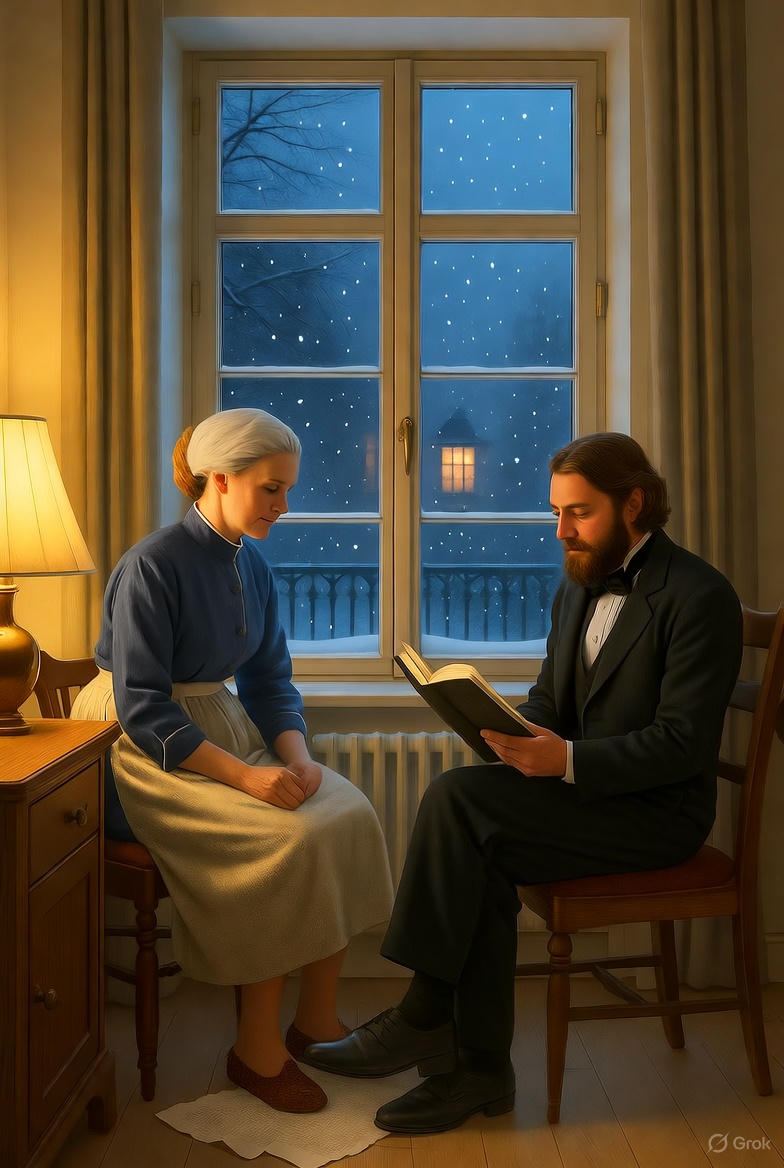
Hermine smiled and gave Ottane a nod. As Ottane stood by the window seat, Hermine lifted the item she was working on with the same smile and showed it to her sister. It was a tiny crocheted bonnet, and Hermine was just sewing blue silk ribbons onto it.
She nodded in response to Ottane’s silent question: “Yes!”








 Anarchistbanjo's World