Feeds:
Posts
Comments

Posts Tagged ‘fantasy’

Madame Bluebeard by Karl Hans Strobl and translated by Joe E Bandel

They discussed the year’s events. Hugo extracted
Helmina’s promise to attend every festivity.
The afternoon passed. They took a short drive.
The weather had cleared, the thinning clouds hinting
at the sun. Hugo wished to prolong the day, but
evening approached, they returned to the castle,
dined, and his departure loomed.
“I feel so at ease here, madam,” Hugo sighed.
“You may return if you enjoyed it,” Helmina
smiled. Then she excused herself. The fresh air had
tired her, she had a headache, and wished to retire.
The men adjourned to Ruprecht’s study. “A cigar,
a glass of wine, eh?” Ruprecht suggested, ringing the
bell. The Malay appeared at the door.
“Tell Lorenz to fetch a bottle of 1882
Schönberger,” Ruprecht said.
“Lorenz isn’t here.”
“Oh, right—he’s on leave. Linz, or somewhere.
Get the keys and fetch it yourself. You’ll find it. It’s
at the back of the cellar, red-sealed.”
Meanwhile, Hugo surveyed the study’s
furnishings. At the café’s regular table, they had an
arts-and-crafts enthusiast skilled in style
comparisons, giving Hugo a rough sense of Gothic,
Renaissance, and Rococo to prove his cultured
credentials. Here were charming relics: a heavy
cabinet with carved columns and armored men on its
doors; a desk with dainty, curved legs and an oddly
uncomfortable top, fit only for brief love notes, not
serious work. For that, Ruprecht used a cozy
Biedermeier desk, its genial polish beside a sleek
black filing cabinet with lapis lazuli and marble-lined
drawers, supported by two gilded, snarling griffins.
“Ancestral heirlooms,” Hugo said. “The castle’s
full of them.”
“Yes… some are exquisite. Next visit, I’ll show
you a Wenzel Jamnitzer goblet. Dankwardt even
started a medal and seal collection. I know too little
about it.”
“These pieces likely came with the castle from
earlier owners?”
“Not many. The Counts of Moreno, from whom
Helmina’s first husband bought it, stripped it bare.
Later owners were collectors, gradually bringing
things back.”
“Fine pieces… truly! They hold their own. The
whole castle…”
“Yes, the castle’s worth seeing.”
“You’re a lucky man… and your wife…” Hugo
stretched in his seventeenth-century armchair. “You
have a delightful wife.”
Ruprecht glanced at him briefly, saying lightly,
“You haven’t fallen for her, have you?”
A reassuring laugh should’ve followed, but it
sounded forced. “It’d be no wonder,” Hugo said, then
continued, “Tell me, aren’t you ever jealous of your
wife’s past? You’re her fourth husband.”
“It’s not my way. I find that kind of jealousy
absurd.”
“But in this castle… everything must remind you
of your predecessors.”
“It wasn’t entirely pleasant at first. Life’s a
ceaseless flow, washing away past impressions
quickly. The past clings more to dead things. These
furnishings and rooms reflect my predecessors far
clearer. In Helmina, they’re dissolved, swept away by
life.”
“Haven’t you thought of building a new home?
One where… only you exist?”
“Helmina’s attached to these walls… oddly so.
She craves city lights, glamour, noise—she had a
wild Carnival. But this castle holds her. She always
returns. She’d never agree to live elsewhere. And… I
find this grim house intriguing. It has charm… it’s,
how to say… an adventure, a romantic danger…”
Ruprecht’s nonchalance emboldened Hugo,
tempting him to play with fire. “And the present… I
mean, Helmina’s present?”
“I don’t follow.”
“Aren’t you jealous of that?”
“Oh, I’m pleased when people pay Helmina
tribute. Besides, I’m certain of her.”
He’s insufferable, Hugo thought, fuming, and it’s
maddening that he’s right.
Jana returned with bottles, fetched glasses from
the armored-men cabinet, and poured. Ruprecht took
a cigar box from a filing cabinet drawer. Hugo
glimpsed a revolver inside.
“You’re armed,” he said. “Even here?”
“Old habit,” Ruprecht smiled. “In Alaska, I
worked months with a rifle beside me…”
As Ruprecht raised his glass to toast Hugo, he
noticed dirty smudges, like wet earth, on Jana’s white
turban.
“Bumped your head, Jana?” he asked.
“I fell, Master,” the Malay replied. “Water’s
seeped into the cellar, washing it out a bit…”
“Hope the bottles don’t float away.”
Hugo hadn’t heard, spreading the subscription
sheet before Ruprecht, who signed.
“Enough?” the castle lord asked.
“Oh, you’re an angel. Thank you. Truly, I name
you chief patron, top of all sponsors… I’ll honor you
somehow, just need to think how.” Hugo launched
into his anthology, its hopes, its prospects for
recognition from high places. His wine-fueled
imagination bloomed like a Jericho rose. This
anthology would be an event. All notable authors
would contribute. Bystritzky had connections, even
inviting Gegely, though that awkward incident…
“Ah, Gegely,” Ruprecht said, suddenly animated
after listening politely. “I’ve heard nothing of him
lately. I don’t read papers—waste of time. What’s
our famous poet up to?”
Hugo slapped the chair’s smooth arms. “You
really don’t know? Nothing about Gegely… my God,
it was a European scandal…”
“I swear, I know nothing…”
“Well, Gegely… it’s unthinkable… psychologists
are baffled. Our great Gegely, our hope, our pride,
poet of Marie Antoinette… what do you think? He…
he took a manuscript from Heidelberg’s university
library… let’s say, accidentally.”
Oh, the thrill of breaking such news first, asserting
one’s importance. It was a hearty delight, a bold
affirmation of self.
How it shook his friend. Ruprecht paled, his brow
damp. “Is it possible…” he stammered, “he stole…?”
“Well—stole? Legally: yes. Psychologically: a
momentary lapse.”
What bliss to cause such a stir. Gegely, another
carefree glutton for wealth, ignorant of the grind of
being rank-bound, salary-tied.
“How could it happen?” Ruprecht asked, still
reeling.
“No idea what possessed him. He could’ve bought
such scraps by the dozen at an antiquarian’s. It
kicked up a storm… a European scandal, as I said.
They tried to save him, of course… spun theories
about the phenomenon… and finally draped a nice
veil over it…”
“What happened to him?”
“He was put in a sanatorium… a ‘U’ became an
‘X,’ as such cases go. You’ll see… Bystritzky invited
him to contribute to the anthology before this
happened. It’s awkward now. If he sends something,
can we accept it?”
“Poor woman,” Ruprecht said thoughtfully,
swirling his wine.
“Frau Hedwig… yes, terrible for her!” A sudden,
delicious thrill hit Hugo. A memory surged. “Frau
Hedwig, the blonde… say, didn’t you once…?” He
squinted gleefully. “It hurt you deeply, didn’t it,
when Gegely took her from you? You were smitten.
Still think of her?”
“Oh, come now!” Ruprecht said softly, stiffening
in resistance. “A youthful acquaintance. It was long
ago… I pity her… having to endure that.” He stood,
pulling out his watch. “If you want to catch your
train, it’s high time to leave.”
Hugo regretted leaving his scene of triumph. He’d
have savored it longer. Ruprecht escorted him to the
courtyard. They lingered, shivering, in the renewed
rain. The carriage emerged from the stable, its dim
lights casting trembling patches at their feet. The
horses snorted, restless, loath to leave the warm
stable. The courtyard felt like a pit’s bottom,
darkness rising in steep walls around them.
“Well, thanks for everything,” Hugo said,
climbing in. “Hand-kiss to your wife. So… our
anthology? What do you think…” He poked his
pinky through his overcoat’s buttonhole. “How’d this
suit me?”
“Splendidly!” Ruprecht replied evenly. “You were
born for a medal…”
“Here’s hoping!” Hugo laughed, closing the
carriage door. The carriage arced around Ruprecht
and out the gate.

Read Full Post »

Alraune by Hanns Heinz Ewers and translated by Joe E Bandel

Intermezzo
All sins, my dear girl, are brought here by the hot south wind
from out of the desert. Where the sun burns through endless centuries
there hovers over the sleeping sands a thin white haze that forms itself
into soft white clouds and floats around until the desert whirlwinds
roll them and form them into strange round eggs that contain the
sun’s blazing heat.
There the basilisk slinks around through the pale night. In a
strange manner the moon, the eternally infertile moon, fathered it. Yet
its mother, the desert sand, is just as infertile as the other is. It is the
secret of the desert. Many say it is an animal but that is not true. It is
a thought that has grown where there is no soil or no seed. It sprang
out of the eternally infertile and took on a chaotic form that life can
not recognize. That is why no one can describe this creature. It is
fashioned out of nothingness itself.
But what the people say is true. It is very poisonous. When it eats
the blazing eggs of the sun that the whirlwinds create in the desert
sands purple flames shoot out of its eyes and its breath becomes hot
and heavy with horrible fumes.
But the basilisk, pale child of the moon, does not eat all of the
vapory eggs. When it is sated and completely filled with hot poison it
spits green saliva over the eggs still lying there in the sand and
scratches them with sharp claws so the vile slime can penetrate
through their soft skin.
As the early morning winds arise a strange heaving like moist
violet and green colored lungfish can be seen growing under the thin
shells.
Throughout the land at noon eggs burst as the blazing sun
hatches crocodile eggs, toad eggs, snake eggs and eggs of all the
repulsive lizards and amphibians. These poisonous eggs of the desert
also burst with a soft pop. There is no seed inside, no lizard or snake,
only a strange vapory shape that contains all colors like the veil of the
dancer in the flame dance. It contains all odors like the pale sanga
flowers of Lahore, contains all sounds like the musical heart of the
angel Israfael and it contains all poisons as well like the basilisk’s
own loathsome body.
Then the south wind of mid-day blows in, creeping out of the
swamps of the hot jungles and dances over the desert sands. It takes
up the fiery creatures of the sun’s eggs and carries them far across
the blue ocean. They move with the south wind like soft vapory
clouds, like the loose filmy night garments of a priestess.
That is how all delightful, poisonous plagues fly to our fair
north–
Our quiet days are cool, sister, like the northland. Your eyes are
blue and know nothing of hot desire. The hours of your days are like
the heavy blue clusters of wisteria dropping down to form a soft
carpet. My feet stride lightly through them in the glinting sunlight of
your arbor.
But when the shadows fall, fair sister, there creeps a burning
over your youthful skin as the haze flies in from the south. Your soul
breathes it in eagerly and your lips offer all the red-hot poisons of the
desert in your bloody kisses–
Then it may not be to you that I turn, fair sister, sleeping child of
my dreamy days–When the mist lightly ripples the blue waves, when
the sweet voices of the birds sing out from the tops of my oleander,
then I may turn to the pages in the heavy leather bound volume of
Herr Jakob ten Brinken.
Like the sea, my blood flows slowly through my veins as I read
the story of Alraune through your quiet eyes in unending tranquility. I
present her like I find her, plain, simple, like one that is free of all
passions–
But then I drink the blood that flows out of your wounds in the
night and it mixes with my own red blood, your blood that has been
poisoned by the sinful poisons of the hot desert. That is when my
brain fevers from your kisses so that I ache and am tormented by your
desires–
Then it might well be that I tear myself loose from your arms,
wild sister– it might be that I sit there heavily dreaming at my window
that looks out over the ocean while the hot southerly wind throws its
fire. It might be that I again take up the leather bound volume of the
Privy Councilor, that I might once more read Alraune’s story–
through your poison hot eyes. Then the ocean screams through the
immovable rocks– just like the blood screams through my veins.
What I read then is different, entirely different, has different
meaning and I present her again like I find her, wild, hot–like
someone that is full of all passions!

Read Full Post »

Homo Sapiens: In the Maelstrom by Stanislaw Przybyszewski and translated by Joe E Bandel

Oh no, where do you think, Herr Czerski. For that Certain is much too knowing. Ha, ha… 

Yes, I misunderstood you. You as philanthropist naturally ask why he wanted to do that. 

Why? He doesn’t know that. 

That would all be incredibly ridiculous if it weren’t so fatal. The small tiny gap widens with rapid speed. It is like a growth with long processes that crawl into every pore of his soul, force themselves into every opening with growing rage and spread the terrible poison into the whole organism… Ha, ha, ha… 

Why do I laugh so ugly? To thunder, man! isn’t that to laugh at?! 

But so it goes on. The fantasy is once set in motion. It suddenly becomes as lush as a jungle, sharp and poisonous as an Indian arrow, inventive as Edison, brooding and enduring in thinking like Socrates, who is known to have stood the whole night before his tent without noticing that a foot-deep snow had fallen. Don’t you think the old gentleman posed a little?… Well, Certain’s fantasy activity is also very interesting. 

He tries to imagine the two. They sat in the room. He had carefully locked it. She had slowly let down her hair, then unbuttoned her waist, he stood there meanwhile, hot, trembling and devoured her with greedy glances… 

Cute pictures, what? 

Or, let’s pass to another side… He looks at his child. It suddenly shoots through his head by what miracle it was prevented that she didn’t get a child with the other earlier. This question, and the possibility that she actually should have got it, makes him quite mad. 

Or: he reads an indifferent story of two lovers… He, he… Why was he not the first? And this question makes him quite raging with despair. 

Or: he gets to see one of her youth photographs. Was it before or after? Yes, naturally before. He looks at the photograph, he makes a painful science of it, he loves her there, loves her with a painful torment, he worships her in an agony of rage and despair. Why? Why? Why did she not keep herself so, so pure, so unknowing for him? 

From everything I cited here you will probably have gotten the sufficient impression of the psychic state of our Certain. 

He loses balance. He still tries to tear out the proliferating weed, to cut off the roots of the poisonous evil, but it is too late. He no longer gets rid of the visions. In his soul rage boils, hate takes away his reason, he cannot touch her without thinking of the other, he cannot look at her without being reminded of him. His soul gets wrinkles and gray hair. And yet he drags himself after his wife like a sick dog. He cannot do without her, he loves her a thousand times more than before in this frenzy, this boiling rage and this hate. Can you understand that? 

Falk screamed. 

Can you understand that? That is madness! That is no pain, that is… that is… 

He suddenly got fear of himself and a wild fit of rage seized him against the person who forced him to live through all this again, to tear open the old scabs. 

He walked searching around the room with clenched fists, he was completely out of his senses. 

Why do I scream? Because I have heart cramp, I have colic, stitches all around in the whole chest… Oh if I had you here, you cursed Satan with your demand for truth, your marriage proposals… Ha, ha, ha… me marry Janina! 

His strength left him. He sat at the window. He dried the sweat from his forehead, and suddenly became calm. He fell into heavy brooding. Now he will probably understand how one comes to seduce a girl. Naturally he will understand. He sat and sat, repeated incessantly in his thoughts that Czerski must now finally understand, and woke again. 

He had probably fallen asleep. 

And again he looked at the sky, at the dark, sick melancholy of the sky and then felt how the spaces widened and began to flee with the impetuosity of a wild debris. 

He listened tensely. 

It seemed to him as if the abysses of eternities coiled into still deeper depths, as if calm formed into an infinite funnel that swallowed everything and time and sound and the melancholy light of the stars—it seemed to him as if he were enveloped in dark, dull distances: everything had disappeared, only one remained: the wide, sick sky above him. 

And this sky he had begotten with his eyes, with his arms he had thrown its vault over the earthly all… 

He jumped up. 

It seemed to him as if the door had opened and someone had come in. 

No! It only seemed so to him. And again he walked up and down. 

Terrible, terrible that something like that can destroy one’s soul. Why? He became raging. Am I there to solve all riddles? Haven’t I rummaged enough in my soul? Haven’t I searched every corner of my soul with the greatest meticulousness? But can I grasp what lies under my consciousness, what plays out beyond the ridiculous brain life? Can I? Hey? Don’t you understand, you stupid man, that under certain circumstances one can come to betray one’s wife? Don’t you understand that there are moments when one can hate a woman so intensely, so unheard-of that one must soil her through intercourse with another woman out of rage, out of pain, out of frenzy, out of a sick need for revenge? Falk shook with laughter. Out of revenge because the poor woman five years earlier, yes, before she met me, didn’t sense me! 

Falk ran around. The unrest grew so that he thought his head must burst. 

And now, just now, when the torment subsided, when the wound began to scar, now Isa will be torn from him. 

She will naturally go. 

He tried to imagine it to himself. 

No, impossible! He was bound to her. She was everything to him. He could not live without her. He had grown together with her, he rooted in her… 

One thing became clear to him: He had to get rid of Czerski. But how, how? 

A feeling of desperate powerlessness seized him. He became limp and resigned. What could he do? Now everything had to break over him. 

Then suddenly a thought shot through his head. 

Olga had to arrange the whole thing. That was the only way out. He became glad. 

That he hadn’t thought of that earlier! 

With feverish haste he wrote a long letter, put paper money in, sealed the envelope, leaned back in the chair and stared thoughtlessly ahead. 

Suddenly he started. Now he hated her again. 

Yes, she was to blame that he became so torn, so miserable, that he had lost all faith, that he saw no goal and no purpose in life. 

She, she was to blame that in his brain he had only the one great, sick idea, the one rage, the one raving hate, that he was not the first… 

Isa, Isa, if that hadn’t happened!… He, he, he… Yes, naturally, Herr Czerski… Naturally? Did I say: naturally!? Nothing is natural, everything is a riddle, everything is an abyss and everything a torment and a nonsense… 

It was after all better that now everything came to an end. 

And the torment laid itself on his heart and constricted it tightly and bit into it with fine, long, pointed teeth… 

The night was so sultry and so wide and so dark. He sank into himself. 

The world is going under! The world is going under…

Read Full Post »

Madame Bluebeard by Karl Hans Strobl and translated by Joe E Bandel

Eighth Chapter
On Saturday, Frau Helmina had business in
Vienna. A ball gown needed discussion with the
seamstress—a poem of silk, tulle, and lace, a riot of
color and light. In Krems, women’s eyes would pop
with envy. In Vienna, Helmina would hold her own
among the most beautiful and elegant.
Ruprecht couldn’t join her. He’d scheduled an
afternoon meeting with his stewards, who no longer
dared resist. He noted with satisfaction that he’d
trained them to obey, acknowledging his insight and
expertise. He’d reined them in, swiftly dismissing
two or three defiant outliers on distant tenant farms
who’d acted like petty vassal lords.
He was the master, not merely his wife’s husband.
They’d realized he was a selfless steward,
unswayed by personal gain, his work a necessity, an
essential expression of robust vitality.
That evening, after the children were abed, he sat
with a half-bottle of wine from Helmina’s vineyard
and a book on Indian philosophy. Jana crouched in a
corner by a bronze Buddha, as still as the statue,
gazing unblinkingly at his master. Ruprecht had
allowed the Malay to linger in the Indian room
sometimes, understanding the homesickness that
drove his request. Jana could sit motionless for hours,
undisturbed by Ruprecht.
Near eleven, Ruprecht rose to sleep. The Vedanta
philosophy yielded to fatigue.
Jana stood too. “Master,” he said, “will you not
sail again to the lands of the rising sun?”
“I don’t know, Jana,” Ruprecht replied, yawning
heartily. “You long for home.”
“It is not good here!”
“Homesick, Jana?”
“It is not good for you here, either.”
Too tired to dwell on Jana’s words, Ruprecht
glanced at him briefly. The Malay stood bronze-like,
unmoving in the lamp’s glow.
With heavy steps, Ruprecht entered the bedroom,
Jana trailing to the threshold, where Lorenz took
over. The room was warm, cozy. The old-fashioned
stove in the corner glowed. Seeing the heavy snow
blanketing the courtyard and roofs, one could be
content with the warmth.
Lorenz lit the electric lamp on the nightstand—a
relic of Dankwardt’s time, powered by the paper
factory’s current. From all accounts, Dankwardt must
have been a man of deep knowledge and goodwill.
Why hadn’t Helmina gotten along with him? She was
difficult, prone to rebellion, true, but a bridge could
always be found.
Ruprecht began undressing, dismissing Lorenz.
Too weary to read in bed, as was his habit, he
glanced at the silent bed to his left. Helmina won’t
return until morning. She wasn’t finished and must
stay in Vienna. Predictable. The first night she
wouldn’t sleep beside him.
He switched off the light and lay on his right side,
seeing a few large stars against the deep black sky.
A wildness and cruelty lurk deep within her, he
thought. She’s a beautiful, dangerous beast, and I
love her. I miss her… I feel it. What do I truly know
of her? I barely know her at all. I doubt she’s shown
me all she is and can be. Well, I have time to learn
her thoroughly…
Sleep came.
There’s a sleep that grows ever deeper, heavier,
feeling like a blanket, a stone, a tomb. You sense its
danger, struggle to break free, but it holds fast.
Rock walls loomed, down which he slid. At first,
it was like snowshoeing, then a fall—plunging into
dark, bottomless depths. Something waited below.
Horror crouched in the gloom—a polyp with a
hundred slimy tentacles, thick blue snakes, red
suckers swelling. Two glowing eyes stared. He fell
through endless chasms… a buzzing, humming in his
head, a roaring, howling… a tempest tore through his
brain, raging fiercer. His skull swelled, ready to
burst… faces flew upward on the rock walls—
Hanuman, the monkey king, a throng of bayadères in
fluttering robes, a tiger’s head with Helmina’s eyes…
a long blue snake slithered, tonguing upward… one
of the polyp’s tentacles, lurking below… his head
thundered, stormed…
Ruprecht kept falling… the wall’s grimaces
blurred, a gray veil sweeping over them.
A jolt, a painful wrench, halted the fall…
something cold draped his head… his arms—yes, he
had arms, forgotten—were pulled forward, thrust
back. Something cool pierced his chest… a thing
pounded, rapid and fierce, like a shaken clock…
Ruprecht opened his eyes.
The light burned on the marble nightstand. Jana
was there. A wet cloth lay on his head; Jana tugged
his arms, pulling and pushing. All windows were
open, cold snowy air flooding the room—but a foul
smell lingered… like…
His head buzzed as if hammered, like that Andean
fall years ago.
He tried to speak. His tongue was leaden. Jana
offered a glass of water. Now he could stammer,
“What… is… it?”
“Master, you were over there,” Jana said gravely.
“I didn’t think you’d return.”
“Over there?” In India, Jana’s home? No… he’d
gone to bed here. This bed! Helmina was in Vienna.
That strange smell… like… coal… carbon…
monoxide…
Ruprecht spelled the word mentally, his right
forefinger tracing the “y”’s flourish on the blanket.
He looked at Jana. “Jana… I was over there?”
“Yes, Master,” the Malay nodded.
“So… so…” His head throbbed, a lorry rumbling
over a bridge. “Yes… well, good! Fetch the aspirin
tube from the cabinet… bottom right. And… how did
you know? That I was… on my way over there?”
Ruprecht took the glass and aspirin from Jana’s
trembling hand—his head a machine shop of
whirring flywheels—and swallowed.
Jana leaned close, whispering in Ruprecht’s ear. “I
saw the other one enter your bedroom, Master! He
moved softly, unseen. What’s Lorenz doing in your
bedroom at night?”
“He might’ve forgotten something, Jana.”
“I thought so too, Master, and went to bed. But it
nagged me. We split into parts, Master. My body lay
in bed; my spirit stayed here, searching. It urged me
to check. I found the room full of smoke and evil
smell. The stove breathed poison. I flung the
windows open…”
“The stove’s damper was closed?”
“Yes, Master, the stove full of embers, exhaling
death.”
“You long to leave here, Jana?”
“Yes, Master!” Jana’s gaze was a dog’s, awaiting
his master’s verdict. “You see, it’s no good place.”
Ruprecht thought, propping his head on his arm.
“You mustn’t tell a soul you saw Lorenz.”
“It is done, Master.”
“Pour me a cognac, then you can go, Jana.”
A faint glass clink sounded above Ruprecht’s
head. Soft steps approached. Cognac’s rich amber
gleamed from brown fingers. “I’ll watch over you
tonight, Master.”
“What’s gotten into you, Jana!” Ruprecht tried to
laugh, but it hurt his head. His stomach churned, too.
This cognac might settle it. “Go back to sleep…
leave the windows open. I won’t freeze after escaping
suffocation.”
“Master, lock your door.”
“Nonsense… no such coincidence twice in one
night… go on…”
Jana left but crouched outside the door on the cold
corridor tiles, head on his drawn-up knees, keeping
vigil until morning.
Ruprecht slept late. Awakening near noon, he
stood, swaying. He paced the room unsteadily; his
head and stomach still ached. The poison’s effects
lingered.
Lorenz appeared, face etched with sorrow and
humility. “I don’t know how it happened, gracious
sir.”
“You must be more careful, Lorenz, or I’ll have to
dismiss you,” Ruprecht said calmly.
The matter was settled. Lorenz turned. In the
mirror, where Ruprecht watched, his contrite
expression didn’t shift. He truly looked like a servant
wracked with self-reproach.
My most intriguing adventure, Ruprecht thought.
Let’s see where it leads.
When Helmina arrived around midday, Lorenz,
taking her fur coat in the hall, whispered the night’s
events in her ear. Then, loudly, for all to hear, he
added, “Last night, a great misfortune nearly struck.
The gracious master almost suffocated in coal
fumes.”
Helmina rushed upstairs. Ruprecht sat with the
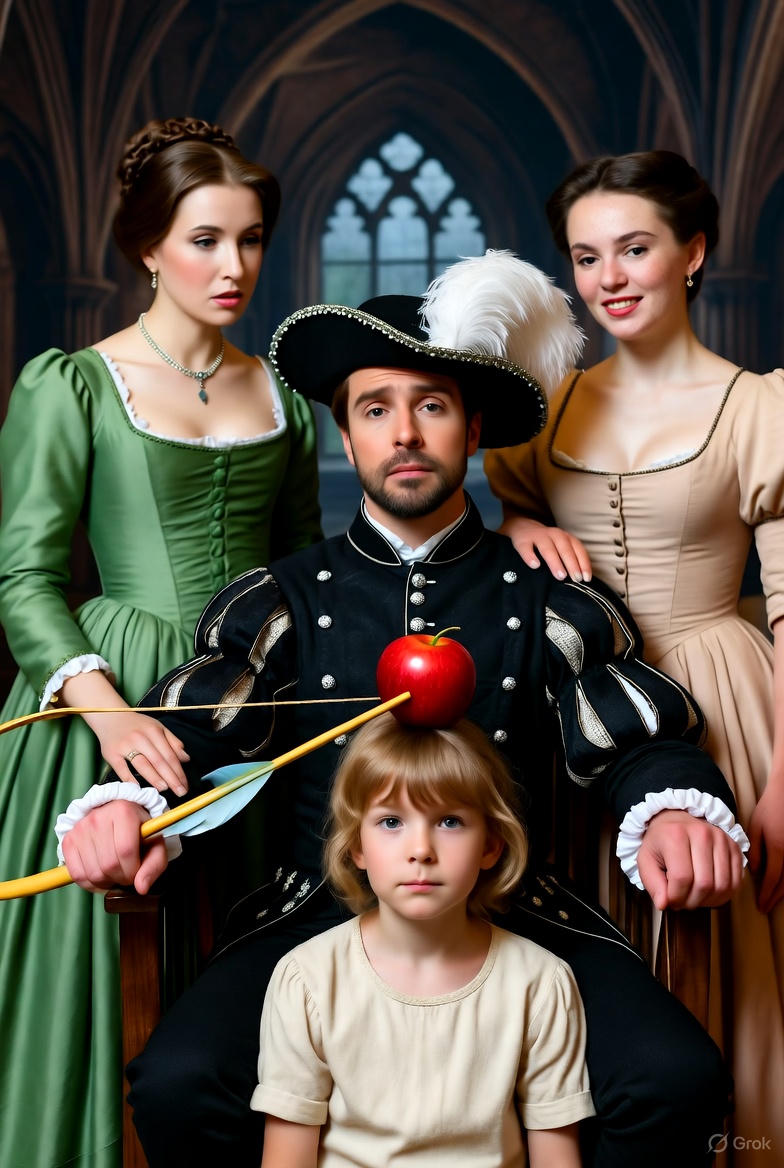
children in the bay room, playing Wilhelm Tell. The
valiant archer was shooting the apple from his son’s
head. The paper Gessler looked so fearsome that
Nelly couldn’t bear to watch. Her affection went to
beautiful Bertha in her green riding dress and kindly
young Ulrich. Papa had promised to keep them safe.
“How could this happen?” Helmina cried. “How
did it occur? Is it true? I might’ve found you dead?”
Ruprecht looked up. Helmina seemed distraught.
No surprise—a wife learning her husband nearly
suffocated would be. Yet was there a touch too
much—a slight excess beyond her usual cold control?
“Oh, it’s nothing,” he said, smiling. “That’s the
main thing. I’m glad I didn’t have to leave you so
soon after our marriage.”
“How could such a thing happen?” Helmina
repeated, agitated. “How do you feel now?”
“You see—well enough to play Wilhelm Tell with
Nelly and Lissy. I’ve hung up work for today…”
“As long as you’re unharmed,” Helmina said,
breathing calmer. Ruprecht recounted how Jana,
passing the bedroom by chance, smelled the carbon
monoxide and saved him. Helmina listened intently,
studying him. His face was gaunt, pale, his eyes wide
with dilated pupils, as if dosed with atropine. It
must’ve cut close to his life’s core. A bit deeper,
closer—
She stopped herself, feeling his gaze probe her
thoughts. The children sat timidly, grasping little but
enough to know they’d nearly lost Papa. Nelly
climbed onto Ruprecht’s knee, wrapping her arms
around his neck.
Ruprecht swiftly shifted to Helmina’s Vienna trip
and gown matters. His gesture dismissed the accident
as trivial, signaling a change of topic.
He truly knows no fear, Helmina thought. He’s the
first to match me. I should have time to wrestle with
him.

Read Full Post »

Alraune by Hanns Heinz Ewers and translated by Joe E Bandel

Chapter Five
Informs about her father and how Death stood as Godfather
when Alraune came to life.

DR. Karl Petersen brought the Privy Councilor a large
beautifully bound book that he had prepared especially for
this project. The old ten Brinken family crest showed on
the upper left corner of the red leather volume. In the
middle glowed the large golden letters ATB.
The first page had been left blank. The professor had reserved it
to write some early history himself. The next page began with a
paragraph in Dr. Petersen’s hand. He wrote of the short and simple
life history of the mother and of her character and demeanor.
He had asked the prostitute to tell her life story and then quickly
wrote it down. Even her previous convictions were mentioned. Alma
had been sentenced twice for vagrancy; five or six times due to
violations of police regulations concerning her profession and once
because of theft–Yet, she maintained that she was innocent of the
theft–the gentleman had given her the diamond pin.
Further down in the second paragraph Dr. Petersen had written
down things about the presumptive father, the unemployed miner,
Peter Weinland Noerissen, who had been condemned by a court and
jury and sentenced to death in the name of the King.
The public prosecutor had presented the facts in an amiable,
charming fashion. It appeared that P. Noerissen had been predestined
to such a fate from infancy. His mother had been a notorious drinker.
His father, an occasional worker, had been previously convicted
because of frequent crude misdemeanors. One of his brothers was
even now serving ten years in prison on similar grounds.
Peter Weinland Noerissen had become apprenticed to a
blacksmith after he finished school. This had played an important part
in the proceedings because of the skill and strength that had been
displayed in the murder. Many witnesses gave evidence of his
displays of unusual strength. He had a history of pushing himself on
females even when they said they were not interested.
He had been released from military service because of a
congenital defect. He was missing two fingers on his left hand. He
worked in several diverse factories before finally coming to the
Phoenix mine in the Ruhr industrial district. He was not a member of
any trade union, not the old socialist union, the Christian or the
mysterious Elks.
He was fired from the mine when he pulled a knife on an
overseer. This was a serious violation and he received his first
sentence of a year in jail. He was released after his counsel for the
defense argued during appeal that the conviction was only based upon
the word of the overseer with no real evidence that it was attempted
manslaughter.
After that he was on the road, had crossed over the Alps twice
and fought his way from Naples to Amsterdam. While he did work
occasionally, he spent most of his time as a vagabond or hobo and
was further convicted of a few other petty crimes. It was enough for
the public prosecutor to assume that in the course of seven or eight
years he had become a hardened criminal with no conscience.
The crime that he was now condemned for was not that clear
either. It was still not entirely certain if it had been a robbery gone
wrong or an intentional sex murder. The defense tried to portray it as
if the accused had only intended to rape the well dressed and well
endowed nineteen year old daughter of the home owner, Anna Sibilla
Trautwein, when he encountered her in the Ellinger Rhine meadow
that fateful evening.
That when he tried to rape the strong and vigorous girl she
started screaming and he pulled his knife only to threaten her into
silence. It didn’t work and she fought back more vigorously and in the
struggle was stabbed. He only finished her off out of the fear of
discovery. It was then only natural that he take her petty tip money
and jewelry to help him make good his escape.
This account did not match the condition of the corpse itself. It
was established that the terrible dismemberment of the victim’s vitals
was most skillfully done and the cut almost workman like. The public
prosecutor ended with a plea that the appeal to the Imperial court be
refused, that there was no need for further reprieve and that the
execution take place early in the morning on the following day at six
o’clock.
In conclusion the book stated that the delinquent did agree to Dr.
Petersen’s request on the condition that he be brought two bottles of
whiskey that evening around eight o’clock.
The Privy Councilor finished reading and then gave the book
back.
“The father is cheaper than the mother!” he laughed.
“You will attend the execution as well. Don’t forget to bring the
common salt solution and other things you will need. Hurry back as
soon as possible. Every minute counts, especially in a situation like
we have here. There will scarcely be enough time. I will expect you at
the clinic early in the morning. Don’t bother finding an attendant. The
princess will assist us.”
“Princess Wolkonski, Your Excellency?” Dr. Petersen asked.
“Certainly,” nodded the professor. “I have my reasons for
bringing her into this little operation–Besides, she is very interested in
such things. By the way–how is our patient today?”
The assistant doctor said, “Ah, your Excellency. It is the same
old story, always the same now for the two weeks that she has been
here. She cries, screams and raves–In short, she wants out. Today she
smashed a couple of wash basins to pieces.”
“Have you seriously tried to talk with her again?” asked the
professor.
“I tried, but she scarcely let me get a word out,” answered Dr.
Petersen. “It is fortunate that tomorrow is finally almost here–How we
can ever keep her here until the child comes into the world is a puzzle
to me.”
“That won’t be your problem Petersen,” the Privy Councilor
clapped him benevolently on the shoulder. “We will find a way–Just
do your duty.”
The assistant doctor said, “Your Excellency can count on me for
that.”
The early morning sun kissed the honeysuckle leaves in the arbor
and clean gardens where the Privy Councilor’s white women’s clinic
lay. It lightly fondled the many colored dahlias in their dew fresh beds
and caressed the large deep blue clematis on the wall.
Many colored finches and large thrushes ran across the smooth
path, scurried through the evenly mown lawn and quickly flew off as
eight iron hoofs struck sparks as they lightly hit the cobblestones of
the street.
The princess climbed out of the carriage and came with quick
strides through the garden. Her cheeks glowed, her strong bosom
breathed heavily as she climbed the high steps up to the house. The
Privy Councilor came up and opened the door for her.
“Come in, I’ve just had some tea made for you.”
She said–in a panting and hurried voice–“I just came from–there.
I saw it. It–it was fabulous–exciting.”
He led her into the room. “Where have you just come from, your
Highness? From the– execution?”
“Yes,” she said. “Dr. Petersen will be here soon–I received a
ticket–just last night. It was intense–very intense.”
The Privy Councilor offered her a chair. “May I pour for you?”
She nodded, “Please, your Excellency. Very kind of you! A pity
that you missed it! He was a splendid fellow–tall–strong.”
“Who?” He asked, “The delinquent?”
She drank her tea, “Yes, certainly, him! The murderer! Muscular
and strapping–a powerful chest–like a boxer. He wore some kind of
blue sweater–it was open at the neck. No fat, only muscle and sinews.
Like a bull.”
“Could your Highness see the execution clearly?” asked the
Privy Councilor.
“Perfectly, your Excellency!” she cried. “I stood at the window
in the hall. The guillotine was right in front of me. He swayed a bit as
he stepped up. They had to support him.”
“Please, another piece of sugar, your Excellency.”
The Privy Councilor served her. “Did he say anything?”
“Yes,” said the princess. “Twice, but each time only one word.
The first time as the attorney read the sentence. That’s when he cried
out half-loud–but I can’t really repeat it–”
“But your Highness!” The Privy Councilor grinned and patted
her lightly on the hand. “You certainly don’t need to get embarrassed
in front of me.”
She laughed, “No, certainly not. Well then–but reach me another
slice of lemon. Thank you. Put it right there in the cup! Well then–he
said, no–I can’t say it.”
“Highness,” said the professor with mild reproof.
She said, “You must close your eyes first.”
The Privy Councilor thought, “Old monkey!” but he closed his
eyes. “Now?” he asked.
She still hesitated, “I–I will say it in French–”
“That’s fine–in French then!” he cried impatiently.
Then she pressed her lips together, bent forward and whispered
in his ear, “Merde!”
The professor bent backward, the princess’s strong perfume
bothered him. “So that’s what he said?”
“Yes,” she nodded. And he said it as if he was indifferent to it
all. I found it very attractive, almost gentleman like.”
“Certainly,” confirmed the Privy Councilor. “Only a pity that he
didn’t say it in French as well. What was the other word he said?”
“Oh, that was bad,” the princess sipped her tea, nibbled at a
cookie. It completely ruined the good impression he had made on me!
Just think, your Excellency, just as the executioner’s assistants seized
him, he suddenly began to scream and cry like a little child.”
“Well,” said the professor. “Another cup, your Highness?–And
what did he scream?”
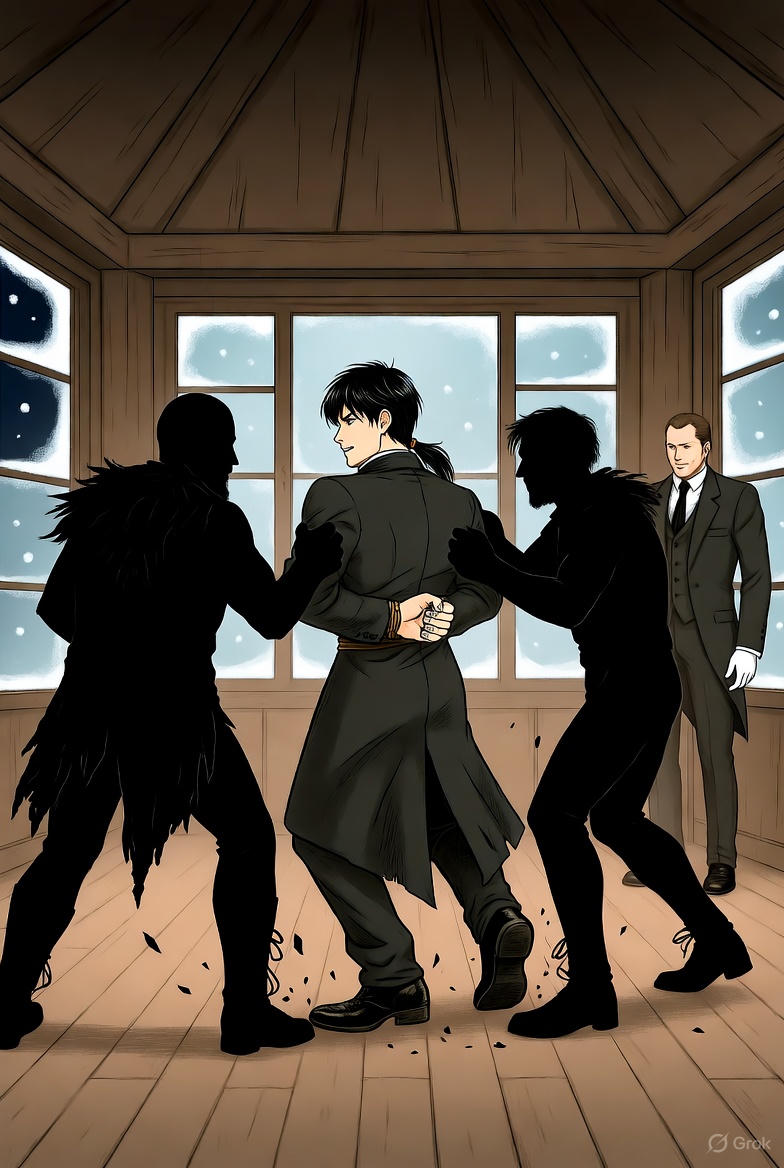
“First he defended himself,” she explained. “The best he could,
silent and powerfully even though both hands were tightly tied behind
his back. There were three assistants and they threw themselves on
him while the executioner stood there watching quietly in his dress
suit and white gloves. At first it pleased me, how the murderer threw
off the three butchers, how they tore at him and pushed without
bringing him one step closer. Oh, it was terribly exciting, your
Excellency.”
“I can only imagine, your Highness,” he blurted out.
“But then,” she continued. “Then it all changed. One grabbed his
leg while another pushed his bound arms high and he stumbled
forward. At that moment he must have felt his resistance was useless,
that he was lost. Perhaps–Perhaps he had been a little drunk–and was
now suddenly very sober –Pfui–That’s when he screamed.”
The Privy Councilor smiled, “What did he scream? Must I close
my eyes again?”
“No,” she cried. “You can leave them open, your Excellency–He
became a coward, a pathetic coward, full of fear. He screamed,
‘Mama!–Mama!–Mama!’ dozens of times while they had him on his
knees, dragged him to the guillotine and pushed his head into the
circular opening of the board.”
“Was he still crying for his mama at the last moment?” asked the
Privy Councilor.
“No,” she answered. “Not at the very last. After the hard board
was locked firmly around his neck with his head sticking out the other
side he became very quiet. Something seemed to be going on inside of
him.”
The professor became very attentive, “Could you see his face,
your Highness? Could you guess at what was going on inside him?”
The princess said, “I could see him just as clearly as I see you
right now sitting in front of me–What was going on inside him–I
don’t really know–there was just an instant–After the executioner
looked around one last time to see that everything was ready–when
his hand pressed the button that released the blade. I saw the eyes of
the murderer, they stood wide open, with insane passion, saw his
mouth panting and his features contorted with desire–”
She stopped.
“Was that all?” inquired the Privy Councilor.
She finished, “Yes, then the guillotine fell and his head sprang
into the sack that one of the assistants held open- Please, reach me the
marmalade, your Excellency.”
There was a knock at the door. It opened and Dr. Petersen
stepped inside. In his hand swung a long glass tube, tightly corked
and wrapped in wadding.
“Good morning, your Highness,” he said. “Good morning, your
Excellency–Here–here it is.”
The princess sprang up, “Let me see–”
But the Privy Councilor held her back. “Slow down, your
Highness. You will see it soon enough. If it is all right with you, we
will get right to work.”
He turned to the assistant doctor, “I don’t know if it will be
important, but just in case it would be a good idea if you–”
His voice sunk as he put his lips to the ear of the doctor.
He nodded, “Very well, your Excellency. I will give the orders
immediately.”
They went through the white corridors and stopped just in front
of No. seventeen.
“Here she is,” said the Privy Councilor as he carefully opened
the door.
The room was entirely white, radiant with sunlight. The girl lay
deeply asleep in bed. A bright ray scurried in from the tightly barred
windows, trembled on the floor, clambered up a golden ladder, darted
across the sheets and nestled lovingly on her sweet cheek, plunging
her red hair into glowing flames. Her lips were moving–half-open–as
if she were lightly whispering words of love.
“She’s dreaming of her prince,” said the Privy Councilor.
Then he laid his cold, moist hand on her shoulder and shook it.
“Wake up Alma.”

Read Full Post »

Madame Bluebeard by Karl Hans Strobl and translated by Joe E Bandel

“I’ll come,” he said. “You don’t think I’m above
such things. A warm, bright ballroom, festive
women, soft music—there’s much life and splendor
in that.”
He only wished she’d broached it another time.
Helmina watched, knowing his thoughts. It was like
preparing for a wrestling match. They faced off,
probing for weaknesses, ready to seize any opening
with a firm grip. But when evening fell, when will’s
weariness set in and night loomed, their senses
stirred. The urge of their bodies surged, forging peace
to wage battle on another field.
One evening in late January, when Lorenz was
briefly alone with Helmina, he said, “Brother writes.
He won’t wait longer. You must act.”
Helmina paused. “Fine—tomorrow!” she said
decisively. The next morning brought a glorious
winter day. As she sat with the children at breakfast,
she heard snowshoes clatter in the antechamber.
Ruprecht entered, early from outdoors, brimming
with youthful vigor, master of the world’s riches.
“Coming along later?” he asked. “Perfect ski weather
today.”
Helmina agreed, changed quickly after breakfast,
and plunged with Ruprecht into winter’s wonders.
Fresh snow had fallen, its surface crusted by swift
frost. They glided with a bird’s speed, transcending
flaws, reveling in the joyous outpour of strength, the
rushing motion.
Ruprecht let Helmina lead. Her red knitted jacket
sang against the white snow. She leapt down a slope,
legs tight, knees bent, and sped on below. They
climbed a gentle hill. At the forest’s edge, blue
shapes jutted from the snow. “Soldiers,” Ruprecht
said, his eyes honed on South America’s vast
pampas. Indeed, soldiers—four men and a volunteer,
72freezing on outpost duty. All five gaped as Helmina
zoomed past. The volunteer’s awe crystallized into a
cry: “Sapperment!”
But the pair was already gone, vanishing among
the trees.
“Must be a winter maneuver,” Ruprecht guessed.
In the valley furrow beyond the forest, they met
another outpost. Footprints led up the far slopes.
Helmina followed them. Atop the high plain, a
village lay at the end of a rutted, brownish hollow
way. Huddled against the cold, its cottages seemed
baked together for warmth, buried to their windows
in snow. On either side of the hollow way, a blue-
black swarm stirred—an ant-like frenzy. Ruprecht
and Helmina glided along the path’s edge, where
snow was less trampled. Below, troops marched.
They passed countless upturned faces, a river of
gazes. Then came a wide, empty gap, followed by a
knot, a jam. The hollow way was clogged with
soldiers, murmuring, pressing forward. Something
had happened.
Soldiers lined the path’s rims, peering in, making
it hard to pass. Something had happened. At a gentler
slope, Helmina pushed down into the hollow.
Soldiers glanced back, startled. A sharp revolver
crack burst from the dense crowd ahead. Helmina
shoved soldiers aside, thrusting forward with her ski
pole, wading through the throng. A fierce craving
drove her, blazing on her face.
She nearly collided with a tall major. He stared,
surprised, at the lady emerging among the rabble,
then recognized her, saluting with utmost courtesy.
Helmina knew him too—Major Zivkovic, from her
Abbazia entourage.
“What’s happened?” she asked urgently. The
major positioned himself to block her view. “Nothing
for ladies! No—please, don’t look. It’s not pretty…
you might have nightmares.”
A wild glee lit Helmina’s face. “An accident?”
“Yes—a regrettable mishap… no, really, madam,
please don’t look… I couldn’t take responsibility…”
Helmina laughed. “Who do you take me for, dear
Major? Think I’ll faint… or have fits?”
“You’d need strong nerves, madam.”
“I believe you know from Abbazia I’m not
nervous. Let me through…”
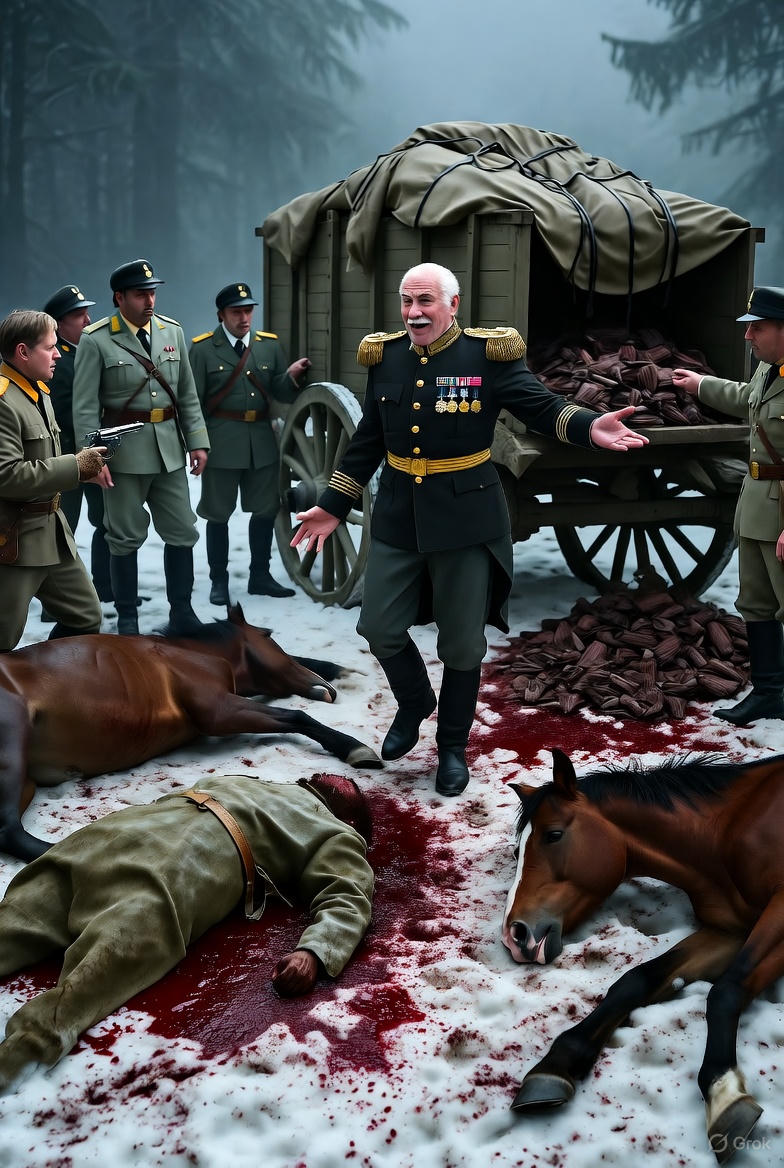
Shrugging, the major stepped aside. Amid the
soldiers lay an overturned, heavily laden supply
wagon, shattered. The surrounding snow was
trampled, mixed with mud, streaked red in places.
Nearby, under coarse wagon tarps, two bodies lay in
a blood pool. The three horses were horribly
mangled, legs broken. Two were dead; one still lived,
thrashing so wildly no mercy shot could be fired. A
lieutenant stood by with a revolver, vainly seeking a
clear moment.
The major explained the wagon had been driven
carelessly, too close to the path’s edge, and plunged.
The drivers were crushed instantly, the horses lost.
Helmina unstrapped her skis and approached the
lieutenant. “Give me the revolver,” she commanded.
Ruprecht saw relentless cruelty on her face, a raging
urge to kill. A barbaric instinct erupted from her core.
Stunned, the lieutenant resisted. “But madam
surely doesn’t…”
“Give me the revolver,” she ordered again. The
beardless young man dared no further objection,
handing her the weapon. Horror crept into his eyes.
Helmina gripped the revolver, stood tall, and stepped
smiling toward the horse. That smile was terrifying.
She stood, staring sharply at the animal. Slowly, she
raised the weapon, aimed calmly, and fired the
moment the horse jerked its head toward her, straight
between its eyes. It twitched, convulsed, then
stretched out, dead.
“Thank you, Lieutenant,” Helmina said, smiling as
she returned the weapon.
“You’re a daring Amazon, madam,” the major
said, paling, his voice dry. He cleared his throat, a
pun surfacing to save the moment. “Truly valiant…
ha… ha!” He was known as an aging wit.
“Christian duty, dear Major,” Helmina replied.
“One can’t let the creature suffer so long.”
“Unlike a man,” the major added, with a gallant
flourish he prided himself on. Helmina introduced
Ruprecht—her retort.
“So you’ve been merciful to at least one man,” the
major said, then inquired with utmost charm about
Ruprecht’s health. Ruprecht smiled. This tall man,
with his habitual gallantries and incorrigible knightly
minstrelsy, harmless as a child, amused him. He
invited him to visit Schloss Vorderschluder.
Helmina strapped on her snowshoes, bid the
officers farewell, and skied ahead of Ruprecht up the
slope they’d descended. The blue swarm of soldiers
soon fell behind. Across the Kamp, the pilgrimage
church of Dreieichen gleamed in the sunlight.
Neither spoke.
Only the soft scrape of snowshoes and the caw of
a large crow, startled from a furrow, broke the
silence. After a while, Helmina stopped, bent, and
scooped a handful of snow. She hadn’t yet replaced
the sturdy ski glove she’d removed. A faint blood
spatter marked her left hand. She rubbed it with
snow, tinging the soft white mass a pale red.
Ruprecht recalled the day Helmina stood by Baron
Kestelli’s corpse, her fingers also stained with blood.
“Oh, yes!” Helmina said, drying her hand with a
handkerchief. “It just occurred to me—I’ve been
meaning to discuss a business matter with you. It’s
rather urgent. You should join a venture I’m
planning. I’m certain Galician petroleum can make a
fortune. The issue is capital. Those oil and naphtha
wells are exploited primitively. A smarter hand could
turn it around. You could double your wealth
overnight.”
“I must tell you, I’ve no entrepreneurial spirit.
You know I prefer safe investments.”
“You’re such a coward in this. To win, you must
risk. I’ve enough enterprise for both of us. You can
trust me when I say it’s a good deal.” Helmina laid
out details, displaying such understanding and
expertise one might think she’d studied for years. She
grew animated, persuading, coaxing, enticing.
The talk clashed with the landscape. Dreieichen’s
tower shimmered across the valley. Below, the Kamp
traced a silver arabesque through blue-black forests.
And Helmina spoke of Galician petroleum.
Ruprecht admired her. She was wholly herself in
all she did—a multifaceted gem, each facet blazing
with different fire. He might’ve been swayed, but
then he recalled her demanding the revolver from the
lieutenant, standing cold-blooded and smiling by the
writhing horse.
“No,” he said calmly, “I’d rather not invest.”
“Oh! You’re not the least bit gallant.”
“Gallantry in money matters, dearest? No! Must I
remind you of our agreement? We’re to keep our
independence, even in this.”
Helmina shrugged. “Your loss if you don’t.”
Ruprecht tried to meet her gaze, but she was
skiing down a slope, ahead of him.
“By the way,” he said, catching up, “I’ll at least
ask Siegl—to show my good faith.”
Siegl, however, had no intention of encouraging
the venture. Reading the banker’s letter, Ruprecht
saw him vividly—the paper’s watermark, firm
letterhead, and florid signature conjured a dancing
pince-nez on a thick nose, a rippling belly in a white
vest, the elegant curve of bowed legs. Siegl wrote:
“Keep your hands off such things. What’s Galician
petroleum to you? How do you get such outlandish
ideas? It’s not for you.” The letter wasn’t typed but
penned by Siegl’s own hand, private and intimate, as
if he spoke with thumbs in his waistcoat pockets.
“You see, Helmina,” Ruprecht said after reading
her the letter, “Siegl’s against it. He’s my oracle. I
must heed him.”
“Then I’ll invest alone,” Helmina replied. “I won’t
let such a chance slip. I’ve had a very attractive
offer.”
“I wish you every success. I won’t envy your
fortune.”
After dinner, when the children were taken away
and Ruprecht had stepped out briefly, Lorenz, serving
tea, whispered, “What did he say?”
“He won’t.”
“Then he’s got to go.”
“I’m just worried it’ll cause a stir this time. We
should wait…”
“We don’t have time.”
“Then at least three days…” Helmina interjected.
“You mean three nights,” Lorenz murmured. “I
said you’re in love.”

Read Full Post »

Madame Bluebeard by Karl Hans Strobl and translated by Joe E Bandel

No one knows about it. We’ve a
cracking tip. You take a 33⅓ percent stake.”
Helmina had returned to her tabouret, sitting
higher than the men, sunk in soft cushions. She
looked down at them. “I’ve no money. How am I to
invest?” she said mockingly.
“What’s your divine husband for?”
“You know, Anton, we agreed on separate assets.
He covers the household, gives me a monthly sum for
clothes and trifles. But otherwise, we each do as we
please. There’s no joint purse.”
“You’ll bring him around.”
“You think it’s easier than it is. He’s stubborn. He
took it badly, for instance, that I’m fighting for
Kestelli’s inheritance.”
“Idiot!” Sykora muttered into his cognac.
A white cuff flashed as he swirled the cognac with
a connoisseur’s steadiness.
“Ruprecht’s a peculiar man. Catching him was
hard. He’s not as dumb as the others. I wrote him in
Abbazia, invited him to a rendezvous. He sent his
servant to say he wouldn’t come. I realized I had to
approach him differently.”
“You got him in the end.”
“Yes… but it was tough. Not a cookie-cutter job. I
had to get psychological.”
Sykora roared with laughter. “Oh… that
psychology… it’s simple… all nature’s built on it…”
He downed a cognac, shaking. “By the way, this
cognac’s truly excellent—yes!”
He rose, lumbering across the Afghan rug, arms
dangling. “Well—if he won’t give in willingly…
we’ve got the mutual inheritance clause, thank
goodness.” The stove drew him. He pushed aside the
screen, yawned, and warmed his back.
Helmina stared ahead. “He’s the fourth,” she said.
“Yes, yes!” Sykora smiled genially. “The fourth,
not counting the others—the ones no one knows
about.”
Lorenz removed the Havana from his teeth, half-
opening his eyes. “Helmi’s in love with him.”
Helmina snapped at him. “That’s not true. It’s
absurd. I wouldn’t dream of falling for a man.” Her
green eyes flashed.
“Now, now,” Sykora soothed. “You like him,
that’s plain. But we’ve given you enough time. You
might be tired of this new wedded bliss. You didn’t
make such a fuss before when we asked you to finish
things. I repeat, we need money. And another thing—
I’ve got a hunch. I’m worried the ground’s getting
too hot here. That Dr. Edelstein acts like he knows
something. He supplied some of your candidates
back then. Must’ve noticed they vanished, never
resurfaced. Now he’s getting nosy.”
Lorenz opened his eyes fully. “Then it’s time to
move on. Diamant’s useful, but not trustworthy. The
Galician petroleum deal must be our last here. We
agreed, in that case, we’d go to America. You’re only
getting lovelier, Helmi; your best years are ahead. In
America, we can run the game on a grander scale.
They don’t pry into your business or homes there.”
As Lorenz spoke, Sykora nodded approvingly,
beaming with paternal pride. He swept his broad
hand through the air, as if drawing a thick line under
a ledger. “Quite right,” he said. “You must decide,
Helmi. Time’s short. Herr von Boschan’s hurt
himself with that marriage contract. His caution’s his
worst enemy. Why give us such a golden opportunity
upon his death? The others had it better, especially
Dankwardt, who prolonged his life, as if he knew his
will was his death sentence… Well, am I getting no
food today?”
“I’m going,” Lorenz said, pulling in his legs,
slapping his knees, and rising. “Let’s see what’s
cooking.” With a self-assured lackey’s poise, he left.
Sykora watched with a fond, amused smile. “Hear
that, Helmi: ‘Let’s see what’s cooking’… like the
German chancellor… sapperment… the lad’s come
into his own… a real joy. He knows what he wants
and can do it… ‘Let’s see’… that’s a tone that says
you’re dealing with someone. A fine fellow. You two
show what upbringing can do. He was such a frail
child… a breeze could’ve toppled him. Now he’s a
bear. I reckon he’s almost as strong as I was. His
sailor years did him good, the weak little brother.”
Sykora rambled on, praising Lorenz like a smitten
lover—his courage, resolve, demeanor, wit. Helmina,
meanwhile, toyed with the gold-embroidered cloth’s
fringes on a fauteuil’s armrest, silent.
He paused, chewed his massive jaws, snorted, and
asked, “So, Helmi, when do we start with the
Galician petroleum?”
Helmina shrugged.
“It’s up to you. You must get us the money. Don’t
forget, I made you what you are. You’d have rotted
in the gutter if I hadn’t found you. I think I can count
on gratitude. You’re a landowner now, a ‘von.’ Who
knows what awaits across the ocean?”
A bell shrilled. Helmina rose. “No need to remind
me. I know we’re bound for life and death. It’ll be
done as you wish. But I’ll try first to persuade him to
part with the money willingly. How much do you
need?”
“Half a million.”
“A tidy start. I’ll try. But you must give me time.”
“Not too long… please. Let’s go. My stomach’s
rebelling.”
Before the castle’s lady and her guest, Lorenz slid
open the dining room door, standing in haughty
deference as a flawless lackey until they passed.
Neither glanced at him. He closed the door and
joined Johann to serve. The leisurely table talk,
dominated by Sykora, first touched on Helmina’s late
husband. Herr Dankwardt had been Sykora’s friend.
With deep emotion, the survivor recounted his
nobility, warmth, and philosophical calm.
Mentioning a line from Dankwardt’s last letter, his
voice broke, unable to continue.
Old Johann’s tears streamed down his cheeks,
dripping into the mayonnaise he served. He longed
for a handkerchief, a need growing urgent.
The conversation then turned elsewhere. The Karl
Borromaeus Society in Vorderschluder planned to
dedicate a new church banner. Collection lists
circulated through the countryside; donation baskets
jingled at doorsteps. One had to contribute to the
good cause. Frau Helmina recounted how resistance
had arisen in Vorderschluder itself. The paper factory
workers, stirred by a rebellious spirit, had been
roused by Social Democratic agitators. They’d
organized, aiming to push through a socialist rag’s
editor at the next provincial election. Meanwhile,
they took pleasure in railing against those rallying
around the Karl Borromaeus Society. Anton Sykora
pledged to bolster their efforts from Vienna.
After the third glass of Gumpoldskirchner, as his
cigar burned low, the guest rose, kissed the hostess’s
hand, and took his leave with heartfelt thanks.
Lorenz led the way with a candlestick.
On the second-floor corridor, a brown-skinned
man passed them. A white turban and belt gleamed
briefly before a door clicked shut.
“Who’s that?” the Fortuna chief asked.
“A Malay servant of Herr von Boschan.”
“Dangerous?”
“I doubt it. He can be handled.”
Entering his bedroom, Sykora paused, listening. A
howling chant rose from the courtyard, like the voice
of a darkness filled with terrors, a voice from the
depths. “That old hag still alive?” he asked, irritated.
Lorenz set down the candlestick, drawing back the
tulle curtain from the guest bed. “Helmi says she’s
harmless,” he replied.
“And what do you think of her—of Helmi?”
“I said it already… she’s in love. Won’t last long,
I hope.”
“We don’t have much time. You’ll need to nudge
things along.”
“Once he becomes a nuisance, he’s done for. But
you can’t push her too hard.”
“Working with women…” Sykora grumbled,
“always a risky business. Go now, Lorenz—people
will wonder why you’re lingering. Good night.”
The two giants shook hands, the floor trembling
faintly. Sykora undressed slowly, sat pensively on a
chair, and, feeling the chill, climbed into bed. He
extinguished the light, chewed contentedly, and fell
asleep.

Read Full Post »

Madame Bluebeard by Karl Hans Strobl and translated by Joe E Bandel

Sixth Chapter
In one of the few Viennese alleys that hasn’t yet
surrendered all its past to the present, stands the
house of the marriage bureau “Fortuna.” A narrow
building, no wider than two windows. Above the
dark entrance, in a small niche, is a Mother of God
with the infant Jesus. The little Madonna wears a silk
dress, changed twice yearly. The Jesus child, perched
on her right arm, reaches eagerly for the orb of the
world, which his mother playfully holds out. Before
the glass shielding the figures from street dust, a
flame burns year-round in a red chalice. Passing
under the Madonna’s blessing, one enters the house,
climbs a dim staircase, and may knock at the first-
floor door bearing a tin sign inscribed “Fortuna.”
Here, the Madonna yields to the pagan goddess of
luck.
The “Come in!” answering the knock booms like a
shotgun blast. Entering, one finds Herr Anton
Sykora, and the shotgun makes sense. Clearly,
Sykora was once an athlete. His shoulders could still
bear a piano with two players; his neck is a bulging
ridge; his arms, swollen with muscle, strain his black
frock coat. Clean-shaven, he peers cheerfully through
gold-rimmed glasses, chewing constantly. His lips
are lush—the upper starts near his nose, the lower
curls toward a massive, blunt chin. When Sykora
moves, chewing, jutting his jaw, arms dangling, he
resembles a great ape. Such giants are always good-
natured. Kindness and joviality are the first traits a
stranger notices in him. But these don’t hinder his
business acumen. On the contrary, he’s highly skilled
in his trade. He boasts a fine clientele, with
connections across all social strata. His stock is well-
assorted. Through “Fortuna,” one can enter any
marriage—dowries of any size, various ranks, titles,
even the best-preserved characters in rich variety.
The bureau’s chief is convinced of his profession’s
importance. He often says, “Matchmaking is one of modern life’s most
ingenious institutions. Marriages are no longer made
in heaven but through the classifieds. This has
practical and moral advantages. The practical are
obvious—you know where you stand, no time
wasted. The moral are equally clear. How degrading
for parents to parade their daughters through balls
and socials for years. It’s against human dignity,
leaving moral scars. Self-esteem springs a leak. It’s
different with us. We’re true benefactors of
humanity.”
In his long dealings with all classes, Sykora has
gained great eloquence and a wealth of terms and
phrases, deployed with full effect. He can speak for
hours, adorning his speech or punctuating it with
quips.
Sykora is immensely popular with the tax
authority. He submits to assessments without protest,
never appealing. He greets his district’s tax
administrator with a hat swept to the ground.
Among the pious of his neighborhood, Sykora
enjoys great esteem. He doesn’t hoard what the pagan
Fortuna brings. He gives to churches, charitable
foundations, youth groups, and the poor. No plea for
a worthy cause goes unanswered.
On a December day, shortly before Christmas, he
received a telegram from Vorderschluder: “Buy
Südbahn shares immediately per H’s order.”
Sykora smoothed the telegram with a bone folder,
correcting the “n” in “Südbahn” that looked like a
“u” with his pencil—he valued order and couldn’t
abide postal sloppiness—then rose from his swivel
chair. The ring-shaped rubber cushion sighed back
into shape. He tapped the adjacent glass partition.
Behind it sat Herr Moritz Diamant, Sykora’s
secretary, the bureau’s second-in-command.
Diamant, once a medical student, abandoned his
studies upon realizing most human ailments stem
from the wallet’s state and are best cured there. He’d
become an expert diagnostician in this field, his
therapies highly effective. In good spirits, he’d say,
“A marriage bureau is the best sanatorium.” A small,
wiry man with a bushy mop of hair falling in two
tufts to his temples, he looked like David beside
Sykora’s Goliath. He had to look up to his boss,
always with a mischievous twinkle, as if saying,
“Comrade, we know each other.”
Diamant emerged from his cubicle, gazing
absently at Sykora. “Listen, Edelstein,” the chief said,
“I’m traveling this afternoon.”
Diamant’s distraction vanished. He was all
attention. “Aha! Vorderschluder!”
“Don’t be cheeky, Doctor; it’s none of your
business.”
Diamant twinkled at him. “Comrade, we know
each other!”
“Fine, I’m off this afternoon. Everything’s in
order, right? Have you written to young Kanitz,
Früchtel, about Margarete Schweigel?”
“It’s being typed.”
“And the Statthaltereirat from Graz?”
“That… what’s her name? The Prague
manufacturer’s daughter won’t have him. Too old.”
“For a miss with her fifty thousand, we’ll find
something special. What these women fancy! Send
him another selection. Anything else?”
“No—that is, I’d like another small advance.”
Sykora clapped a paw on Diamant’s shoulder.
Diamant stood firm, unflinching. “Let me tell you,
Jewel, you’re asking for advances a bit too often!”
“Well—given the Vorderschluder deal…”
“You, Crown Jewel, the Vorderschluder deal’s
mine alone. Besides, what deal’s there? You
know…”
David twinkled up at Goliath. “Comrade, we
know each other.” Goliath withdrew his paw,
grumbling, “We’ll talk when I’m back.”
Sykora donned his winter coat, raised the fur
collar, and stepped into a light snowfall turning
Vienna’s streets to coffee-brown slush. He visited his
lawyer for a meeting with the owner of the
“Misericordia” funeral parlor, discussing a
partnership stake. Then he attended a board meeting
of the League of Christian Progress Friends, recently
elected its honorary chairman. After lunch at his
regular tavern with a bank clerk, two tax officials,
and a prosecutor’s deputy, he headed to the station.
Soon after dusk, the carriage sent to meet him
rolled into Vorderschluder’s castle courtyard. Snow
fell thicker here than in the city, blanketing the yard
an inch deep. Between the stables and servants’ wing,
a groom swept a path, his broom flinging powder left
and right. Across the yard, the overseer stood in his
open doorway, warm yellow-red light behind his
shoulders, curious about the station visitor.
In the vestibule, Lorenz awaited, taking Sykora’s
fur with the haughty deference of a lackey. They
ascended the stairs, Sykora leading, Lorenz trailing
with the coat. Cozy warmth enveloped them; below,
logs crackled in the hall’s fireplace.
On the first floor, Lorenz opened the door to the
mistress’s rooms, ushering the guest in. They entered
58an octagonal, blue-papered chamber. “Servus!”
Sykora said.
“Servus!” Lorenz replied.
They laughed, shaking hands. Matched in size and
strength, they shared similar noses and foreheads,
their faces strikingly alike. But Lorenz’s expression
leaned toward guarded vigor, Sykora’s toward genial
affability.
“Well, then,” the Fortuna chief said, rubbing his
hands, “here we are again. Where’s Helmina?”
“She’s waiting—come!”
Frau Helmina sat in her boudoir on a tabouret
inlaid with mother-of-pearl and ivory, a gift from
Herr Dankwardt’s oriental travels. She turned,
offering Sykora her hand.
“God greet you, Helma,” he said. “How’s it going,
what’re you up to? Sapperment, it always smells
divine here.” He thrust his short nose forward, lips
parting, inhaling deeply. “Nowhere smells as good as
your place. You’ve got a knack, I’ll give you that. So,
the loving husband’s away?”
“Yes, he’s in Krems. There’s a stallion show
tomorrow. He wants to buy something…”
“Bravo, tending to the estate. He’s capable. Happy
with him? Doing his duty at home and hearth?”
Sykora shook with good-natured laughter.
Helmina rose, standing between the two burly
men, slender and supple, like a fine steel blade
between two wooden clubs.
“Well, then, got nothing for me?” Sykora said, his
laughter subsiding into a chuckle. “A decent cognac
or something? That trip here’s a fair haul. Got a weak
spot in my stomach from it. The lord husband’s got
something in the house, I hope. No matter—Lorenz’ll
fetch it. Grab a cigar too, Lorenz. Right… now let’s
settle for a cozy chat.”
Lorenz nodded and left. As Helmina crossed the
black Afghan rug to lock the antechamber door,
Sykora sank with a contented sigh into a wide
cushioned chair behind a small, round Indian brass
table. His hand covered a quarter of its surface.
“You kept me waiting long for news, Helmina,”
he said, chewing with his massive jaws, puffing.
Helmina stood before him. “What was there to
write? Nothing important happened.”
“How’s the inheritance from the baron going?”
Helmina glared, annoyed. “What? Well… I don’t
know. We’re litigating. The relatives won’t yield,
claiming he was incompetent. They’re a vile lot. I
don’t know how it’ll end.”
“It’d be nice to have Rotbirnbach. But if it falls
through, it won’t kill us. We’ve got other irons in the
fire.”
Lorenz returned from the bedroom with a cognac
bottle, two glasses, and a cigar box. He poured a
glass, drank it, and nodded to Sykora, as if
confirming the cognac’s quality. Refilling both
glasses, he sat beside the guest on a low divan,
stretched his legs, and closed his eyes.
“Here’s the thing,” Sykora said after a sip, “we
need money. A lot of it.”
“I can’t give you anything,” Helmina said firmly.
“I’ve had bad luck lately. Struck out three times.”
“Yes, yes… it happens. Our bicycle and car
factories aren’t doing as well as they should either.
Lorenz must’ve mentioned, right?”
Lorenz nodded, eyes shut, a long, thin Havana
dangling from his teeth.
“But now we’ve got something new… something
splendid. I’ll say just this: Galician petroleum.
Galicia’s our European America. There’s still a
fortune to be made.

Read Full Post »

Alraune by Hanns Heinz Ewers and translated by Joe E Bandel

“Revenge,” she replied promptly.
He clapped her approvingly on the shoulder.
“That’s right Alma. I see you have read all the right books. So he
is determined to get revenge on his treacherous family and the only
way to do it was to cut them off from his inheritance. You understand
everything so far don’t you?”
“Naturally I understand,” she declared. “It would serve them
right.”
“But how to do it,” he continued. “That was the question. After
long deliberation he found the only possible way. The only way he
could prevent his millions to be taken was if he had a child of his
own!”
“Does the prince have one?” she asked.
“No,” he answered. “Unfortunately he has none. But he still
lives. There is still time–”
Her breath flew and her breasts heaved quickly, “I understand,”
she cried. “I can have the prince’s child.”
“That’s right,” he said. “Will you?”
And she screamed, “Yes I will.”
She threw herself back in the lounge chair, spread out her legs
and opened her arms wide. A heavy lock of red hair fell down onto
her neck. Then she sprang up, emptied her glass again.
“It’s hot in here,” she said. “–Very hot!”
She tore her blouse off and fanned herself with a handkerchief.
He held her glass out to her. “Would you like some more? Come,
we will drink to the prince!”
Their glasses clinked together.
“A nice robber story you tell there,” hissed the Privy Councilor
to his nephew. “I am curious how it comes out.”
“Have no fear, Uncle Jakob,” he came back. “There is still
another chapter.”
Then he turned again to the red haired prostitute.
“Well then, that is what it’s all about Alma. That’s how you can
help us. But there is still a problem that I must explain to you. As you
know, the baron–”
“She interrupted him, “The baron? I thought he was a prince?”
“Naturally he is a prince,” confirmed Frank Braun. “But when he
is incognito he calls himself baron– That’s the way it is with princes.
Now then, his Highness, the prince–”
“His Highness?” she whispered.
“Certainly,” he cried. “Highness like King or Kaiser! But you
must swear that you will not talk about it–not to any one–So then, the
prince is in disgrace now in a dungeon and heavily guarded at all
times. No one is permitted to see him except his attorney. It is highly
unlikely that he will be able to be with a woman before his last hour.”
“Oh,” she sighed.
Her interest in the unlucky prince was visibly less but Frank
Braun paid no attention.
“There,”–he declaimed totally unperturbed in a voice ringing
with pathos–, “deep in his heart, in his terrible need, in his dreadful
despair and unquenchable thirst for revenge he suddenly thought
about the strange experiments of his Excellency, the genuine Privy
Councilor, Professor, Doctor, ten Brinken, the shining light of
science.
The young handsome prince, now in the spring of his life, still
remembered well his golden boyhood and the good old gentleman
that looked after him when he had whooping cough and that sent him
bon-bons when he was sick–There he sits, Alma. Look at him, the
instrument of the unlucky prince’s revenge!”
He waved with grand gestures toward his uncle.
“That worthy Gentleman there,” he continued, “has in his time
advanced medical knowledge many miles. You know how children
come into the world Alma, and you also know how they are created.
But you don’t know the secret mysteries of life that this benefactor of
humanity has discovered! He knows how to create children without
the mother and father ever seeing each other! The noble prince would
be at peace in his dungeon or at rest in his fresh grave knowing that
you, dear girl, with the good help of this old gentleman and under the
expert care of this good Doctor Petersen will become the mother of
his child.”
Alma looked across over at the Privy Councilor. She didn’t like
this sudden shift, this weird transformation of turning a handsome
134ALRAUNE—the story of a living creature
wellborn prince into an old and very ugly professor. It didn’t appeal to
her at all.
Frank Braun noticed as well and began a new line of persuasion,
trying to get her to think of something else.
“Naturally the prince’s child, Anna, your child, must remain
hidden after it comes into this world. He must remain hidden until he
is fully-grown to protect him from the persecution and intrigue of his
evil family–Naturally he would be a prince, just like his father.”
“My child would be a prince?” she whispered.
“Yes, of course,” he confirmed. “Or maybe a princess. That is
something we can not know. It will inherit the castle, the grounds and
several millions in money. But you will not be permitted to force
yourself on him and compromise everything.”
That did it. Fat tears ran down her cheeks. She was already in her
role, feeling the grief and sorrow of having to give up her beloved
child. She was a prostitute, but her child would be a prince! She
couldn’t be in his life. She would have to remain quiet, suffer and
endure everything–for her child. It would never know who its mother
was.
A heavy sob seized her, shook her entire body. She threw herself
over the table, buried her head in her arms and wept bitterly.
Tenderly, almost lovingly he laid his hand on her neck softly
stroking her wild loose hair. He could taste the sugar water in the
lemonade that he had mixed as well and took her very seriously in this
moment.
“Magdalena,” he whispered to her. “Magdalena–”
She righted herself, stuck her hand out to him.
“I promise you that I will never press myself on him. He will
never hear me or see me, but–but–”
“What is it girl?” he asked softly.
She grabbed his arm, fell onto her knees in front of him and
buried her head in his lap.
“Only once–only once!” she cried. “Can’t I see him just one
time? From a distance–perhaps out of a window?”
“Will you finish this trashy comedy,” the Privy Councilor threw
at him.
Frank Braun looked wildly at him–and knew his uncle was right
but something in his blood rebelled and he hissed back:
“Quiet you old fool! Don’t you see how beautiful this is?”
He bent back down over the prostitute, “Yes, girl. You shall see
him, your young prince. I will take you along when he leads his
soldiers for the first time, or to the theater when he is sitting above in
the box–You can see him then–”
She didn’t answer, but she squeezed his hand and tears mixed in
with her kisses. Then he slowly straightened her up, carefully set her
back in the chair and gave her some more to drink. It was a large glass
half full of cognac.
“Will you do it?” he asked.
“Yes,” she said softly. “I will–What should I do?”
He reflected a moment, “First–first–we will draw up a little
contract.”
He turned to the assistant doctor.
“Do you have some paper, doctor? And a quill? Good! Then you
can write. Write everything twice, if you please.”
He dictated, said that the undersigned of her own free will would
agree to be at the disposal of his Excellency ten Brinken for the
purpose of this experiment. She would solemnly promise to faithfully
obey all the orders of this gentleman. And further, that after the birth
of the child she would completely renounce all claim to it.
In return his Excellency would immediately place fifteen
thousand Marks into a savings account in the name of the undersigned
and turn this account over to her upon the delivery of the child. He
would further provide for her maintenance and support up to that time
and carry all costs as well as giving her a monthly allowance of one
hundred Marks to use as she pleased.
He took the paper and read it out loud one time.
“It doesn’t say anything about the prince!” she said.
“Naturally it doesn’t,” he declared. “That must remain highly
secret.”
She could see that, but there was still something that bothered
her.
“Why–” she asked. “Why did you pick me? Any woman would
gladly do what she could for the poor prince.”
He hesitated. This question was a little unexpected but he found
an answer.
“Well, you know,” he began. “it is like this–The prince’s
childhood sweetheart was a very beautiful duchess. He loved her with
all his heart as only a real prince can love and she loved the handsome
young noble just as much. But she died.”
“How did she die?” Alma asked.
“She died of–of the measles. The prince’s beloved had golden
red hair just like yours. She looked exactly like you. The prince’s last
wish is that the mother of his child look like the beloved of his youth.
He gave us her picture and described her to us exactly. We searched
all over Europe and never found the right one–until tonight when we
saw you.”
She was flattered and laughed. “Do I really look like the
beautiful duchess?”
He cried, “You could have been sisters!–By the way, can we take
your photograph? It would make the prince very happy to see your
picture!”
He handed the writing quill over to her, “Now sign, child!”
She took the paper and wrote “Al–” Then she stopped.
“There is a fat hair in the quill.”
She took a napkin and cleaned the quill with it.
“Damn–” murmured Frank Braun. “It occurs to me that she is not
yet an adult. Legally we must also have her father’s signature–Oh
well, this will do for the contract. Just write!–By the way, what is
your father’s name?”
She said, “My father is Master Baker Raune in Halberstadt.”
Then she wrote her father’s name in clumsy slanting letters.
Frank Braun took the paper out of her hand and looked at it. He let it
fall and picked it up again staring at it.
“By all that’s Holy,” he cried out loud. “That–that is–”
“What’s the matter now, Herr Doctor?” asked the assistant
doctor.
He handed the contract over to him, “There–there–look at the
signature.”
Dr. Petersen looked at the sheet of paper.
“So,” he asked puzzled. “I don’t see anything remarkable about
it.”
“No, no, naturally not, you wouldn’t,” cried Frank Braun. “Give
the contract to the Privy Councilor. Now read that, Uncle Jakob!”
The professor examined the signature. The girl had forgotten to
finish writing her first name. “Al Raune” was written on the paper.
“Of all things–A remarkable coincidence,” said the professor.
He folded both sheets carefully together and stuck them in his
breast pocket.
But his nephew cried, “A coincidence?–Well it might be a
coincidence–Everything that is remarkable and mysterious is just a
coincidence to you!”
He rang for the waiter.
“Wine, wine,” he cried. “Give me something to drink– Alma
Raune–Al Raune, if you will.”
He sat down at the table and leaned over toward the Privy
Councilor.
“Uncle Jakob, do you remember old Councilor to the Chamber
of Commerce Brunner from Cologne and his son whom he named
Marco? We had classes together in school even though he was a
couple of years older than I was.
He father named him Marco as a joke and now the boy goes
through life as Marco Brunner! Now here is the coincidence. The old
Councilor to the Chamber of Commerce is the most sober man in the
world and so is his wife. So are all of their children. I believe the only
thing they drank in their house at Neumarkt was water, milk, tea and
coffee.
But Marco drank. He drank a lot even as an upper level student.
We often brought him home drunk. Then he became an ensign and
then a lieutenant–that was it. He drank more and more. He did stupid
things and was put away. Three times his father had him placed into
treatment centers and three times he came out. Within a few weeks he
was drinking more than ever.
Now comes the coincidence. He, Marco Brunner, drank–
Marcobrunner! That was his obsession. He went into all the wine
houses in the city searching for his label. He traveled around on the
Rhine drinking up all that he could find of his wine. He drank up the
sizable fortune that he had received from his grandmother.
‘Hey everyone,’ he screamed in his delirium. ‘Why does Marco
Brunner polish off Marcobrunner? Because Marcobrunner polishes
off Marco Brunner!’
The people laughed over his joke–It was all a joke – all a
coincidence; just like all of life is a joke and a coincidence.
But I know that the old Councilor for the Chamber of Commerce
would have given many hundreds of thousands if he had never made
that joke–I also know that he has never forgiven himself for naming
his poor son Marco and not Hans or Peter.
In spite of all that it is still a coincidence–a very foolish,
grotesque coincidence like this scribbling of the prince’s bride.”
The girl was standing up drunkenly, steadying herself with her
hand on the chair.
“The prince’s bride–” she babbled. “Get me the prince in bed!”
She took the bottle of cognac, poured her glass completely full.
“I want the prince, do you hear me? I want all of him, the sugar
sweet prince!”
“Unfortunately he is not here,” said Dr. Petersen.
“Not here?” She laughed. “Not here? Then it must be someone
else! You–or you–or even you old man–It doesn’t matter as long as
it’s a man!”
She ripped her blouse off, removed her skirt, loosened her bodice
and threw it crashing against the mirror.
“I want a man–I’ll take all three of you! Bring someone in from
the street if you want.”
Her shift slid down and she stood naked in front of the mirror
lifting up her breasts with both hands.
“Who wants me?” she cried loudly. “Let’s play–all together! It
doesn’t cost anything today–because it’s a celebration to help the
children and the soldiers.”

Read Full Post »

Homo Sapiens: In the Maelstrom by Stanislaw Przybyszewski and translated by Joe E Bandel

II.

Hardly had he reached the street when he saw Czerski coming toward him. Both stopped and stared at each other. 

“You probably don’t know me?” Czerski finally said. 

“I think you are Czerski. Very nice, very nice, what do you want from me?” 

“You will soon find out.” 

“So, so… the night is very beautiful, we can walk together, although I would much rather walk alone.” 

They walked long beside each other without saying a word. Falk was very restless and struggled for composure. 

“So finally tell me what you want from me.” 

“What I want from you? Well, you see, you naturally know that I was engaged to Janina?” 

“No, I don’t know that at all. I learned today that you were practically engaged, but not engaged.” 

“Yes, for all I care practically engaged. But that doesn’t matter at all. Janina had the right to choose, and she chose.” 

“Yes, of course. That was her affair.” 

“Yes, yes, that was her affair,” Czerski repeated absently and was silent. “But just tell me, Herr Falk, you are married?” 

Falk started and stopped. “What business is that of yours?” 

“It is actually none of my business, or yes, it is very much my business. I don’t want to talk about you destroying my happiness, no, I don’t come into question at all, but you have dishonored the girl I loved, yes dishonored, that’s how our social conditions are. How do you come to seduce and dishonor this poor girl, you as a married man?” 

Falk laughed cynically. 

“How one comes to it? Good God, what a naive man you are! The question you put to me is as old as the world. He, he, how one comes to it? I have asked myself the question at least a thousand times…” Czerski looked at him darkly. 

“You are a filthy man, a scoundrel you are.” Falk laughed friendly. 

“But aren’t we all? Aren’t you a scoundrel too? By the way, you are a strangely insolent man. I would very much like to give you a slap in the face if I weren’t too limp for it. Go to the devil and leave me in peace.” 

“Leave your chivalrous impulses aside. Otherwise it could go very badly for you. But I have a moral obligation to Janina, and so I must know what you now intend to do. No, it is none of my business what you want to do, you must act as I want.” 

Falk stopped, looked at Czerski with the utmost astonishment and then began to laugh loudly. 

“Listen, Czerski, did you lose your mind in prison? I wouldn’t be surprised at all, I would find it very understandable… He, he, one must get strange fixed ideas in this hideous solitude. You had a cell to yourself? I must do what you want! Ha, ha, ha…” 

“Yes, you must do what I command you.” 

“So, so, you are starting to get cozy. Bien! So, what do you command?” 

“You must marry Janina.” 

“But you know that I am married. There is a law that punishes bigamy, don’t you know it? Did you forget all bourgeois institutions in prison?” 

“You must separate from your wife and marry Janina.” Falk stopped speechless and fell into rage. 

“Have you gone mad?” He could bring out nothing more. 

“No, I haven’t gone mad, but no matter how much I thought about it, I find no other way out. You must do it, I will force you to it. Your wife will make no difficulties for you. I don’t believe she wants to live with you further if she learns that you have a mistress.” 

Falk trembled inwardly so violently that he had trouble continuing to walk. His knees grew weak, he stopped and stared speechlessly at Czerski. Then he walked slowly on. 

“Why do you want to do that?” Falk coughed and collected himself with difficulty. “Because it is the only way out.” 

“You are mistaken, Czerski, I will not do what you want. You cannot force me to it either…” 

Falk spoke very seriously and calmly. 

“All you achieve with your plan is to destroy me and my wife. Your whole plan is built on my wife leaving me, and that is correct. I don’t doubt it for a moment. But the conclusion you draw from it is completely wrong. I will never marry Janina…” 

“Why?” 

“Because you shall not have the satisfaction that I acted under your pressure. Do what you want, it is naturally free to you, but I repeat, yes I assure you on my word of honor, that I will never marry Janina. You achieve nothing by it, on the contrary: I will naturally take revenge on you. The means are completely indifferent to me. For I hold very much to the word of God: Eye for eye, tooth for tooth. You see, you belong to the social-democratic party. But they don’t trust you, you actually count as an anarchist. And you know that for the social democrats every anarchist is a police spy. That you were in prison? Oh God, that means nothing. The social democrats don’t care about the logical consequences of such a trifle.” 

Czerski looked at him tensely. Falk laughed maliciously, but inwardly it boiled in him with fury and unrest. 

“You know that I am the chairman of the central committee. You also know that they have unlimited trust in me. But they know very little about you. You even have a powerful enemy in the party who slanders and suspects you… yes, it is Kunicki, you know it, you were so imprudent to demand his expulsion from the party because of the duel story… Now listen…” Falk stopped… “He, he… you seem very tense. Yes, I understand it. So I could say a word if asked about you, only a word,

actually no word. I would only need to raise my eyebrows, shrug my shoulders, shake my head thoughtfully… You know that such a thing has colossal significance in party life…” 

“That would be villainy,” Czerski shouted in utmost rage. 

“Why then?” Falk looked at him coldly. “I don’t know you. I did send you money for agitation often. But even in that the appearance speaks against you. Everything failed for you. You wanted to lead the book transport over the Russian border, the books were seized, you were also so imprudent as to incite the workers to violence once, which otherwise only an agent provocateur does…” 

Czerski seemed about to throw himself at Falk. Falk smiled. 

“Leave that, dear Czerski. I have unconditional trust in you. I know no person I trust more. I only want to make clear to you that I would take revenge in any case.” 

“You are a scoundrel,” Czerski shouted hoarsely. 

“Yes, you already said that once, and I answered you that I bestow this title of honor on you too. By the way, don’t get excited, otherwise you will draw the short straw. I was for a time so stunned that I thought I would sink to my knees, now I am quite calm and superior. You are also imprudent with words. You spoke of commands and forcing… That was too high-flown. You knew very well that I cannot be forced… Don’t go, we can speak very calmly, for me the story is at least as important as for you. I can just as well accompany you a piece, he, he…” 

“I want nothing to do with you,” Czerski said darkly, but stopped. 

They stood close under a lantern. Falk became very serious. 

“Listen, Czerski, you owe it to me to hear me now.” “I already told you what I want to do.” 

“But don’t you understand that it is madness? You look quite sick by the way. I saw you two years ago at the congress. Don’t you understand that it is madness? You achieve nothing by it. Nothing at all. You force me to a crime. Ha, ha, ha… No, Czerski,

you are a bad psychologist… You are actually a bit biased toward me, we had too much to do with each other… Just don’t believe that I want to beg you. Just don’t let yourself be deterred in your decisions. You are by the way a stupid man.” 

Now he began to laugh maliciously and placed himself quite broadly before Czerski, who stared at him with peculiarly absent eyes. 

“You got excited there over a quite clumsy story. Clumsy, unheard-of clumsy! Do you really believe that I would be capable of denouncing you as an unreliable man?” 

He became serious again and suddenly very limp. 

“By the way, I am not the central committee at all. Your whole party is as indifferent to me as you with your boyish intentions…” 

Czerski suddenly started. 

“So you don’t love Janina at all?” Falk looked at him in astonishment. 

“No.” 

“Listen, Falk, you acted villainously, I would never have believed it of you. I had boundless respect for you… You were the only person besides Janina’s brother…” He broke off and brooded further. 

Falk became very excited. 

“It pains me infinitely that I had to intervene in your life in this way…” 

Czerski suddenly interrupted him. 

“And you want to continue living with this lie? Want to continue deceiving your wife?” 

Falk looked at him in astonishment. 

“Dear Czerski, you now suddenly want to raise yourself to judge over me. That is quite ridiculous. I owe no person account for what I do, least of all you… By the way, we have spoken enough. Do what you want… You are a good man, and perhaps no scoundrel, it delights me immensely to have seen a non-scoundrel… But now good night…” He suddenly became raging. “Go to sleep, Czerski!” He was completely beside himself with rage. 

“Go to sleep, I tell you!” Czerski looked at him contemptuously. 

A police patrol passed and examined them attentively. 

“Go to sleep!” Falk shouted to him once more and walked slowly along the street. He was as if paralyzed. The artificial composure suddenly disappeared and the unrest grew so strong that his heart contracted as in a cramp and cold sweat broke out on his forehead. 

Then he walked faster and faster until he became completely exhausted. 

“Now it comes. Yes, now it comes for sure. The wheel has started rolling and it will roll on incessantly… Yes, naturally. This truth-fanatic will not let himself be deterred.” 

Falk wanted to think over the danger, but his brain was tired, only the idea of ruin, of being destroyed dominated him with unspeakable torment. 

A woman hurried past, and behind her ran two drunken students. 

“The dogs! No, how everything is disgusting, how disgusting! No, to thunder! That is unheard-of idiotic, to stake one’s whole life for a few seconds of animal pleasure. The whole life?” He laughed scornfully. “No, to the devil, one stakes only a few seconds for a few new seconds… Ha, ha, ha… One woman replaces the other… Long live the queen…” 

He stopped on a bridge and stared ahead. He had become as if blind, but gradually he saw an enormous black mass grow heavily and majestically over the whole sky, and gradually he recognized the mighty forms of the train station. Now and then he heard a shrill whistle of the locomotive maneuvering under the bridge. He went to the other side of the bridge. Before him stretched the wide terrain of the station grounds. He saw the enormous number of lights along the tracks, he saw the variously colored signal lanterns, he stared until all the lights flowed together into a great, trembling rainbow, no, a great thousand-colored light-sun…

Read Full Post »

« Newer Posts - Older Posts »