Feeds:
Posts
Comments

Posts Tagged ‘faith’

The Rebirth of Melchior Dronte by Paul Busson and translated by Joe E Bandel

When I wanted to go I noticed that a few steps behind
me was a lean, white-haired, very stately and upright peasant,
who looked at me with a less than friendly and piercing look.
“I suppose the gentleman is coming to see us?” he said
lurkingly. “I will show him the way to the inn.”
And with that he walked beside me.
The village mutt, which wanted to come at me with loud
barking, gave way with retracted tail before his hard look. The
people before the houses pulled their caps before him.
“Here it is.”
The peasant pointed to the door of a large house, in front
of which a couple of fellows stood chatting quietly.
“Enter.”
That sounded like an order and gave me a jolt.
“Ei, is this the only inn in the big town?” I turned
mockingly to my companion. “And how do you know that I
want to enter this one?”
He looked me sharply in the face with his cold, blue eyes
and replied only briefly:
“It is best for the Lord to enter here!”
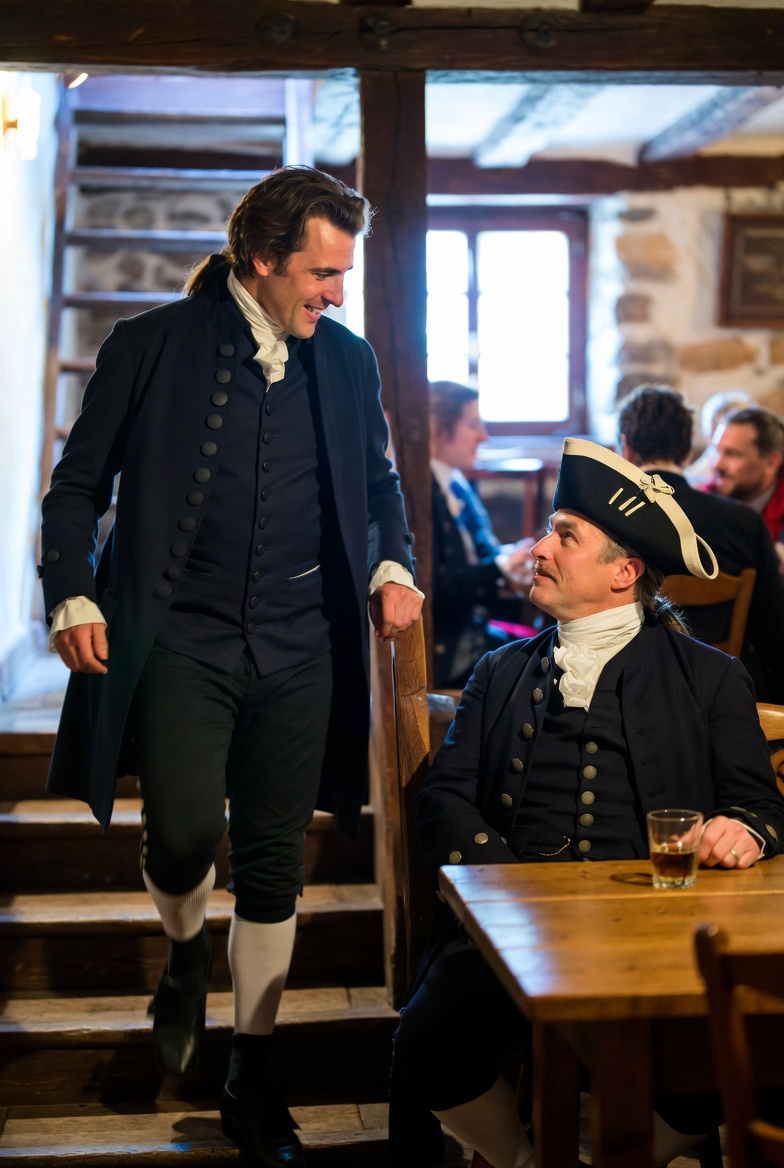
I complied with the strange compulsion, entered and sat
down at a table on the wall under the deer antlers. The old man
sat down with me, had wine brought, set fire to a short silver-
beaten burl pipe and said:
“You look like a man of status in spite of your rather
scuffed clothes. The question is how you have come to so
lonely a wandering?”
“Aren’t you being a bit too curious, Herr Mayor,” I
replied. This was the title he had been given by the little girl
when she had poured the wine.
“Curiosity, as you call it, is the right of the established
against strangers. Besides, here I am the authority. So you want
to tell me something about your status, name and what you are
doing. Its better speaking over a glass than on the bench in the
basement, if one is the judge and the other is the indicted.”
This sounded like a threat, and I would certainly have
responded sharply if there had not been something special in
the man’s nature and especially in the look of the man, there
was something that I did not want to resist. The mayor also
knew how to get answers to the questions that he addressed to
me so cleverly and forcefully that I, not knowing why myself,
shared my entire life to him with the greatest frankness. I
admitted that I had deserted from the army of the great king,
not out of cowardice, but to flee the cruelty of a state that
seemed to me to be an excess of servitude and annihilation of
free will which had become abhorrent to me.
“Young Herr,” said the old man thoughtfully. “In such a
way it can still take a good course with you. As I hear from
your speeches, you have had pity on the poor man, and that is a
great and precious rarity among people. To what extent your
unprotected youth pushed you into ruin, I cannot judge for the
time being. But I hope that a suspicion which distresses me and
which is very threatening to you, will prove to be false.”
“What suspicion?” I asked, astonished.
“Be patient,” said the mayor. “Where will your
wanderings take you?”
“To my homeland,” I answered.
“Tell me,” he continued, again looking sharply at me.
“Why did you stand so long in the snow looking at the wayside
shrine?”
Gradually, his imperious way of asking put me in harness,
and I briefly asked him whether he thought of himself as a
judge who had a poor rascal before him.
“That is what I think.”
He laid his hand firmly on my arm.
“You know that I am the mayor of this village and as
such I ask you: Do you have anything to tell me about the
welfare of the village?”
“Yes,” I said quickly. “Your village is threatened by a
grave danger.”
It was as if a kindly glow flitted across his weathered
face. But it became immediately serious again, and he said,
apparently indifferently:
“Gee up! Who told you that fairy tale?”
“It’s not a fairy tale,” I said, glad to bring in my nearly
almost committed grave omission. “Believe me, you are in
danger!”
“Go ahead and speak, Squire.”
“There are certain signs,” I said, “by which the murderers
and the marauders announce their wickedness to each other. I
found such signs on your wayside shrine. Now you know why I
stopped in the snow.”
He made a movement as if he wanted to reach out his
hand to me, but dropped it and asked dryly, where I got such
dubious knowledge. I reminded him that I had already told him
about my time with the gypsies, who understood such things
well.
The old man laughed briefly and his wrinkled face came
near.
“Perhaps it true that I also know something about such
things?” he murmured.
“You?”
I shook my head doubtfully.
“We could try it out,” he said and poured me some wine.
“Describe the signs to me, and then let’s interpret them together
like the old magicians of whom we read in the scriptures.”
“Very well,” I said. “There were on the Wayside Shrine: a
full moon, a one, three houses, the first two of which are
crossed out, and the third not, a comb with teeth, a snake or a
viper, two dice with five on top, three crosses, each in a square,
two of which are crossed out and one of which is not, a knife,
two shoes, a rooster and the letter F.”
“Quite so.”
The old man nodded and took a thoughtful sip from his
glass, “Now let’s divide ourselves in the work. You, valiant
squire, point out to me the rogue’s signs up to the two fives of
the dice, and then I will explain the rest of the drawings that
have been on the Wayside Shrine since yesterday.”
“We could leave the interpreting for later. Better to take
precautions now -“
“Don’t be concerned,” he rebuffed. “It will be on my, the
village mayor’s cap, if something is missed, you are in no way
to blame. And now off with your gypsy wisdom!”
“So listen,” I began. “The signs are thus to read: On the
first day of the full moon we gather. The target is for the third
house in the village. This all means the moon, the one and the
not crossed out third house. A comb with teeth indicates: a
sharp dog is on guard. Then the snake means a lump of poison,
to make the watch dog dumb.”
“It’s my house,” nodded the white-haired man, “which
they have in mind, and my Packan, who admittedly will not
take a lump from a stranger’s hand. You have interpreted well.
Now it is my turn.”
“Better let me.”
“Chamber. Two fives on the dice: that is ten o’clock at
night, because the moon is in front; three crosses, each in a
square, two painted: get in at the third window. A knife:
murders quickly and safely. The shoes: then make haste away
with the loot, but first put the red rooster on the roof as it is
shown, so that the fire will erase all the evidence. And F? What
does that mean?”
He looked at me with a smile.
“That’s a name sign,” I replied quickly. “You can’t get the
name itself from it. Certainly it is the captain, whom the others
obey.”
“The F means Frieder,” said the old man, “and this devil
of a fellow is the leader of five journeymen murderers who
have drawn themselves from the Spessart region and call
themselves the Red Hat, as Frieder likes to wear a fox-red cap.
Now you also know the name sign.”
“A good guess,” I admitted.
“Now I may trust you, young Herr.”
The mayor extended his hand to me, which he had
previously refused to do.
“Even though it stinks that you know how to read tines.
You know that earlier I took you for one of their henchmen and
spies, when you were at the wayside shrine and looked at the
signs so devoutly. Hey, Hannes, Matz, and Kilian!” he shouted
loudly.
In an instant the door opened, and three tree-strong
fellows with rifles, sabers and two huge gray shepherds’ or
catchers’ dogs came straight towards me with ropes in their
hands.
“Leave the gentleman!” the mayor waved them off. “Go
back to the others and tell them that this one is a righteous man
and no one may harm him. Make it very clear, as I have shown
you. Veit and Leberecht at the sloe bush, old Knolb and Heger’s
boy on the roof of the first house, four in the ditch, two behind
the dung heap, ten in Heger’s stable and the others, as the case
may be. Let them come right on in, don’t bother taking
prisoners. The five helpers may kiss the snow, Frieder, the one
with the red cap, we want alive.”
The strong fellows looked at me and laughed.
“So we would have soon sent the wrong man on his way
to heaven,” said one of them, nudging the two others, who
burst out with their boorish laughter. The dogs growled and
pulled their chops from their white teeth.
“Now go again!” the old man instructed them, and
immediately they stomped heavily out the door.
Outside the last light lay blue and darkening on the white
land.
The old man ordered me not to leave the inn for the time
being.
Later, the taciturn tavern maid, who answered all my
questions with a “Don’t know.” brought me a chicken roasted
on a spit and a jug of red wine.
Once, when I felt the urge to go out, one of the dogs
struck close to me. So I had to stay and wait until everything
was over, and tired from the long way and sleepy from eating
and drinking, I fell into a half slumber.

Read Full Post »

The Rebirth of Melchior Dronte by Paul Busson and translated by Joe E Bandel

Ronde came.
Kregel had been missing for a week, and no one knew
more than that he had received a letter from home, about which
he was visibly offended and upset. He was one of the
abandoned Germans who lived in the stolen land of the area of
Kolmar.
One day a royal forester came to the Colonel and
reported that children had found a soldier hanging in a tree.
They had however, immediately ran away in fright and now no
longer knew where the place was. And so he thought one or
two companies should search the forest so that the dead man
could be buried in the ground.
So we went in search of Kregel and roamed through the
large pine forest. As we slipped through the thickets and sticks
it happened to me that I got completely lost from the others and
when I shouted for the others as commanded in such cases
received no answer.
When I was so alone with myself, I had to think about
Kregel, who was now freed from all torture and torment. How,
was it not most clever, to put this dog’s life behind him? I
thought how yesterday an eighteen-year-old boy, the Squire
von Denwitz, had stabbed me with a rapier, the tip of which
had lead embedded in it, because there was a chalk stain on my
coat from cleaning the white stuff; how the corporals beat us to
their hearts’ content, how miserable the food was that was served
to us like sows in large tin buckets; how the bread crunched
with sand when it was cut. All this would have been bearable.
But that no hope showed itself, how and when it could ever get
better, that one day after another was filled with curses and
sorrow, to allow another, just as gruesome, to rise, that was the
bad thing. For man must have some hope, if he is not to wither
and wilt.
In this hard school, which God’s hand had thrust me into,
I learned to force myself. I didn’t make a face when my breast
ached from burning pity for the unjustly mistreated, and I kept
silent about the most severe insults which I received by anyone
who was elevated by a braid or finer cloth. Perhaps it was a
punishment that had come to me. But then it could also be an
eternal justice, but how was that possible when far worse than I
could live in joy and glory until the end of their lives. So why
did this burden of suffering fall on me? What purpose could
higher powers, if there were any, have pursued with me by
placing on me burdens of my own and other people’s torment,
to endow me with the finest sensibility for every injustice that
happened to others and gave me more sensitive feelings than
probably all my comrades? They cracked their jokes even when
the worst and most unbearable of arbitrariness had happened to
them, and found full consolation with a glass of schnapps and
in the arms of their soldier’s wives.
I was mad at everything that had hitherto been upright
and consoling of my being and I could not believe what was
happening in front of me day in and day out, I could not
believe in a divine meaning of all these events. What does a
person do who lives in a chamber with hostile, crude, violent,
bad, cowardly, false, and evil people and sees no one in the
whole circle, who wants to create order and justice and has the
ability to do so? One leaves such a chamber. He closes the door
behind him and rejoices, to have escaped the abominable
existence in such a room.
So I now thought to act. Kregel, the poor lad from Alsace,
had shown me the way. And there were enough trees all around;
I wanted to attach my trouser belt to some branch.
I prepared to walk across the small sunlit clearing to
finish my last deed in the deciduous wood when I had to stop,
because in the middle of the open space sat someone, and I was
not alone.
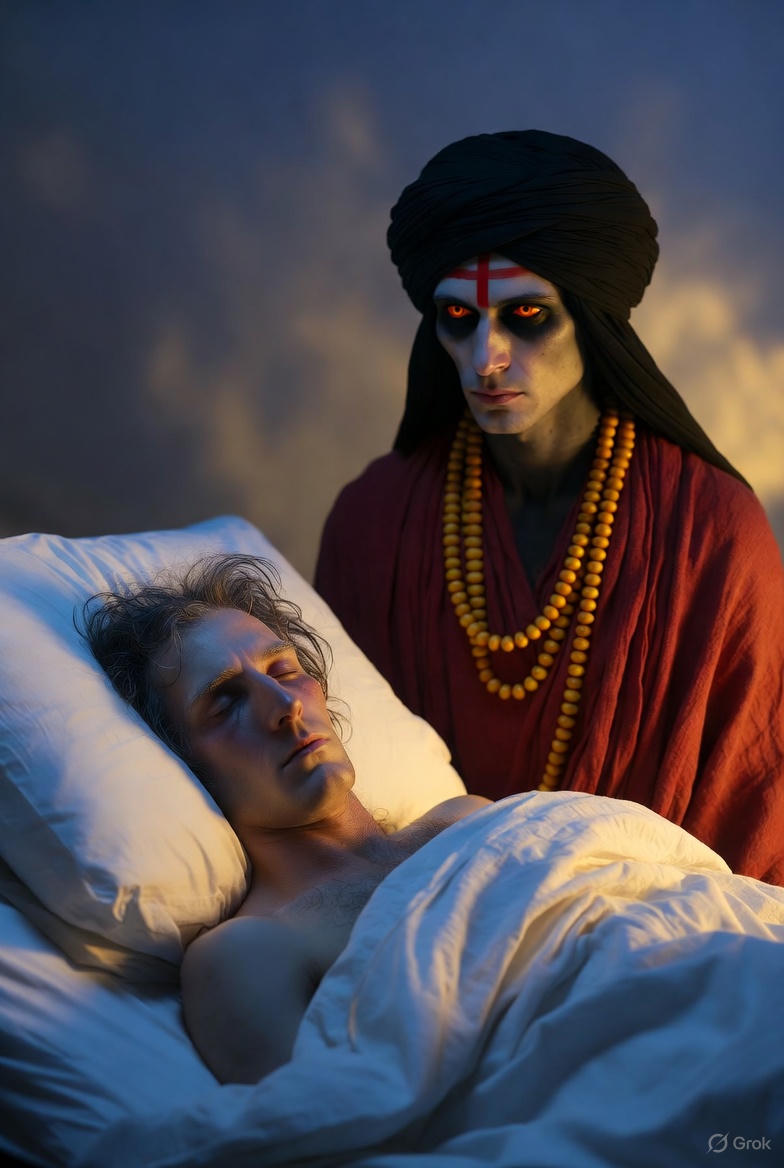
It was the man in the robe with the black turban. He was
resting on a tree stump and his walking stick lay beside him in
the forest moss. His noble hands held the string with amber
beads. It was Ewli.
Once again the strange man, whose small image was
under the high glass dome in my children’s room, stepped in
my path in an intangible way. How did the stranger in his
unusual dress get everywhere? Unmolested, and not even
noticed by the children, he had been sitting at the wayside
shrine, when the Prussian recruiters came for me and my
companions of fate, until the recruiters took me and my
comrades away on their wagon.
At that time I could not connect him with myself any
more than I could about his mysterious interest with my person
in the prayer-filled church. And just as I did not find him in
front of the church anymore, he had disappeared from my view
at the lime trees of Distelsbruck. This time, however, he was to
speak to me before I started the work of self-destruction.
Nevertheless, I could not put one foot in front of the other.
Because the man from the Orient was not alone. In front of him
stood a deer, which rubbed its narrow head flatteringly against
Ewli’s knees. In his hand, which held a birdcage, perched a jay
with a pinkish-grey head and blue wing feathers, and in the
bramble bush to his right chirped uncounted colorful balls of
feathers. Two squirrels, chasing each other, a reddish-brown
one and a black one, went up onto his body, hiding themselves
in the folds of his robe, rolling and chattering, and to my horror
the reddish brown one suddenly disappeared into his robe, as if
it had melted into the same color of the coarse fabric, while the
second one crawled onto the black turban, lost its outline and
did not appear again. I looked at the face of Ewli, overcome by
the radiance of his eyes. Was he looking at me? Were the dark
stars directed into the far distance? I did not know, I just felt
how warm, divine love enveloped me.
Slowly, however, he stood up, walked across the clearing
and disappeared between the tall trees.
Then I came to and was able to move. I ran. Where were
the animals? Not a bird, not a deer was to be seen. Where was
Ewli? I ran into the middle of the high wood and suddenly
stood among my comrades. They had just found Kregel and cut
him down. Horrible to look at, black-blue and green spots on
his face, the swollen ink-colored tongue stretched out, with
open, complaining eyes, he lay on the ground, the rope in the
furrow of his neck. Nobody paid any attention to me.
They had spades with them and dug in the deep, soft
forest soil, where the mouse tunnels ran crisscross and root
snakes crawled.
It was late when we were finished.
In the evening-red sky an endless train of crows flew
silently.
“That means war!” said Wetzlaff and looked at me.

How long had we been in the field? Nobody reckoned
anymore, nobody knew.
I was camped with four comrades in bitter winter. We
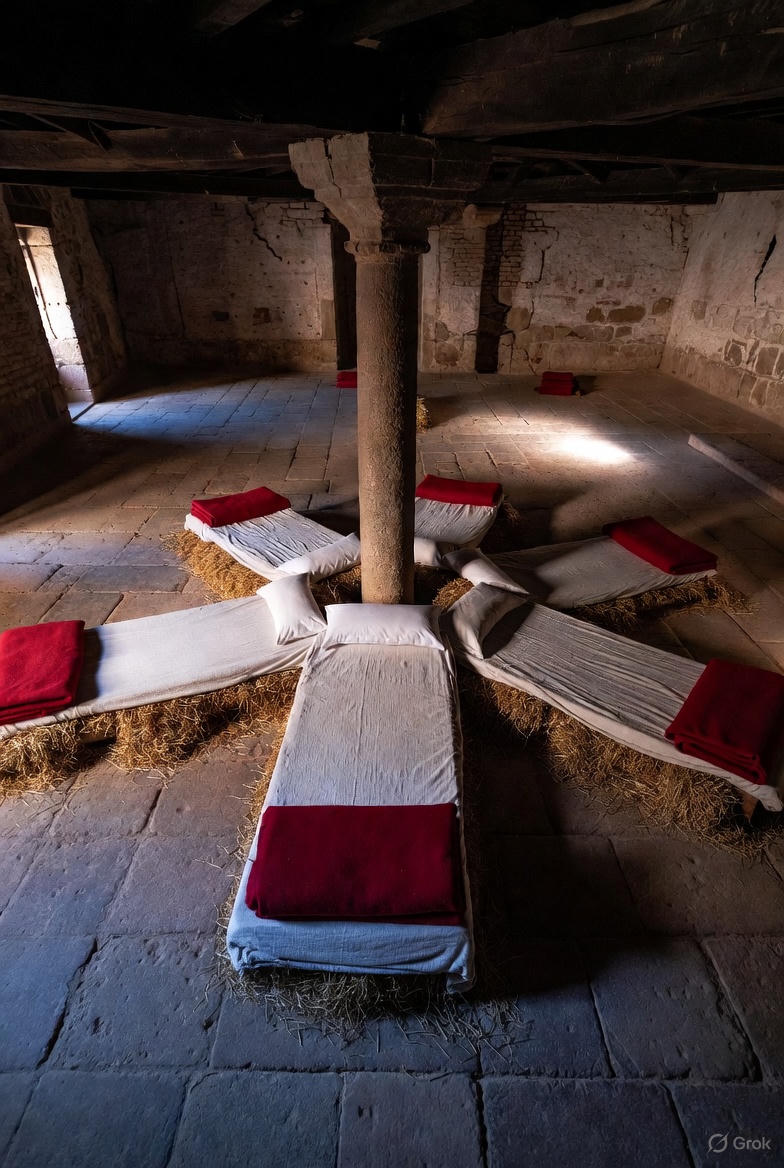
had found makeshift quarters in a burned-down farmhouse. All
we had were two piles of rotten, damp straw and a blanket
singed by campfires. And this miserable property we had to
protect and guard, so that not even more miserable ones stole it.
The rifles had to be constantly cleaned without stopping.
After a day they were red again with rust. Zulkov had frozen
the toes of both feet. They were black and stank like the plague.
I had to treat Repke with gun powder and a residue of brandy
to wash out a graze on his back because no one else would do it,
and he screamed so loudly that I took pity on him. Wetzlaff had
gotten severe diarrhea and every five minutes he walked on
wobbly legs in front of the house. Where he had squatted the
snow was bloody all around from his stool. In the night he
moaned so much, that no one could sleep. And although we all
endured, they threw everything at him in the dark that they
could grab with their hands. Then he limped out again to
relieve himself with convulsions. The quietest of us all, a
gloomy person named Kühlemiek, read in a small, tattered
hymnal next to the fire and sometimes murmured:
“O Lord, have mercy on me a sinner!”
Repke was happy when I had bandaged his back again
with old rags, and put dry nut leaves in his pipe.
“The king has said -” he wanted to begin.
But Wetzlaff interrupted him snorting:
“He has said! He has said! If the King lets one go, you
miserable wretches are blissful with doglike awe. Oh, you
starving ribs, you cannon fodder! What is it then that makes
such a king so great?”
“Fridericus Rex is the greatest war hero of all time, you
poisonous toad!” roared Zulkov. “Dare not to insult His
Majesty!”
“Dear brothers in Christ,” pleaded Kühlemiek, “turn your
thoughts to the One who has entrusted all of our lives in His
grace-giving hands!”
“Shut up, old pietist!” Repke shouted at him, “Let
Wetzlaff speak!”
“Oooh!” he groaned, and hurriedly ran out again. We
heard the sound of his discharges and his groaning all the way
into the house. Then he came back again, white as lime, and let
himself fall on the straw.
“As I say, a man must edify and revive himself in the
Lord and King,” Zulkov said after a while. “But there are some
who forget the oath…”
“Do you mean me?” asked Wetzlaff, straightening up
with difficulty. “Refresh yourself, as much as you can with that
cold fire that you have on your hind claws. Yes, you sheep’s
head, so that Friederich can be a great war hero, you must keep
your toes in your shoes, my intestines have to bleed out, a
thousand have to be shoveled into the pits. I ask one, when all
around, with the Austrians over there and us over there, if there
were such guys as me, there would be no more king and
empress, but also no war and no people-beating. But you are in
general too stupid to understand such things. And from this
stupidity of yours all kings and generals, princes and counts
and barons down to our squire with the ass face live equally in
glory and joy and sit enthroned like peacocks in all majesty,
while we are kept as cattle and are driven to the slaughter with
the trilling of pipes and the beating of drums. O you damned,
thick-skinned fool, you horse-apple brains…”

Read Full Post »

Alraune by Hanns Heinz Ewers and translated by Joe E Bandel

Finale
It is late in the summer, the hollyhocks now raise their heads
away from the stalks. The mallows scatter their dull tones in tired
colors, pale yellow, lilac and soft pink. When you knocked my love,
the spring was young. When you entered through the narrow gate into
my dream garden the swift little swallows were singing their welcome
to the daffodils and the yellow primrose.
Your eyes were blue and kind and your days were like heavy
clusters of light blue wisteria dropping down to form a soft carpet. My
feet walked lightly there through the sun glistening pathways of your
arbor–Then the shadows fell and in the night eternal sin climbed out
of the ocean, coming here from the south, created out of the glowing
fires of the desert sands.
She spewed forth her pestilent breath in my garden strewing her
rutting passion beneath her veil of beauty. Wild sister, that’s when
your hot soul awoke, shameless, full of every poison. You drank my
blood, exulted and screamed out from painful tortures and from
passionate kisses.
Your marvelous sweet nails that your little maid, Fanny,
manicured grew into wild claws. Your smooth teeth, glowing like
milky opals, grew into mighty fangs. Your sweet childish breasts, little
snow-white kittens, turned into the rigid tits of a murderous whore.
Your golden curls hissed like impassioned vipers and the lightning
that unleashed all madness reposed in your soft jeweled eyes which
caught the light like the glowing sapphire in the forehead of my
golden Buddha.
But gold lotus grew in the pool of my soul, extended themselves
with broad leaves upon the vast shallows and covered the deep
horrors of the whirling maelstrom. The silver tears that the clouds
wept lay like large pearls upon their green leaves, shining through the
afternoons like polished moonstones.
Where the acacia’s pale snow once lay the laburnum now throws
its poisonous yellows–There, little sister, I found the great beauty of
your chaste sins and I understood the pleasures of the saints.
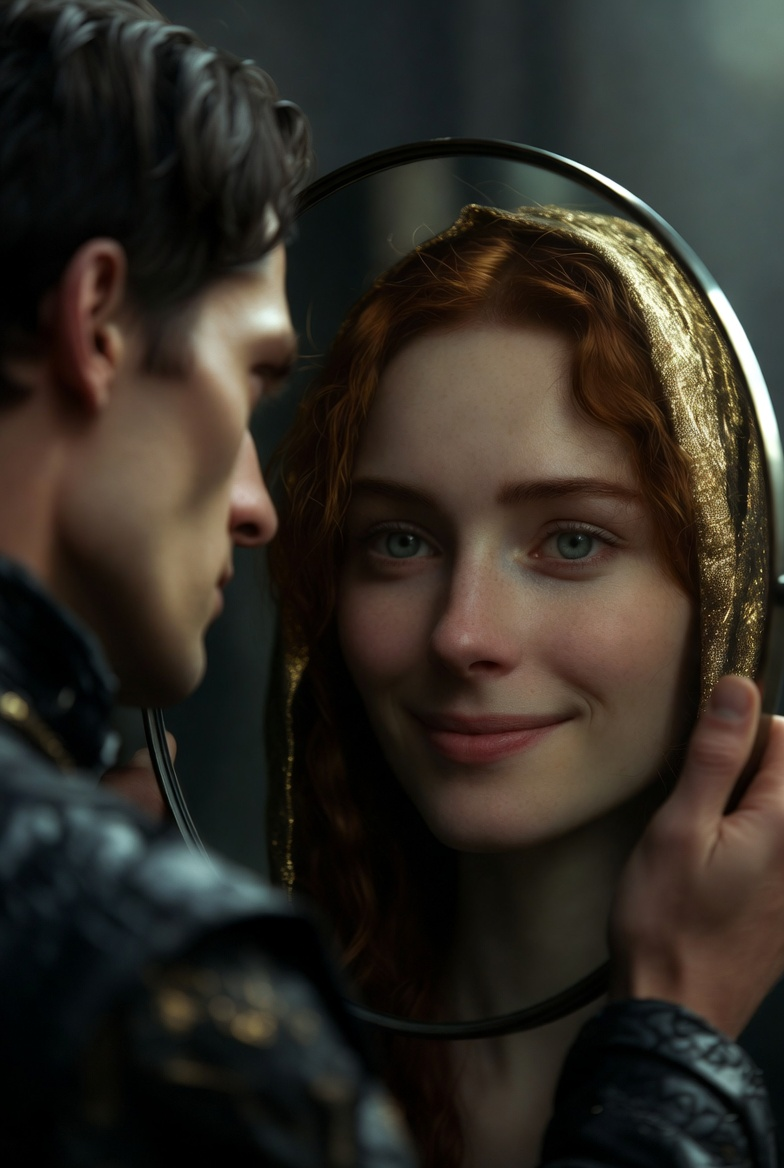
I sat in front of the mirror, my love, drank out of it the over
abundance of your sins while you slept on summer afternoons, in your
thin silk shift on white linen. You were a different person, my dear,
when the sun laughed in the splendor of my garden–sweet little sister
of my dream filled days. You were an entirely different person, my
dear, when it sank into the sea, when the horrors of darkness softly
crept out of the bushes–wild, sinful sister of my passionate nights–But
I could see by the light of day all the sins of the night in your naked
beauty.
Understanding came to me from out of the mirror, the ancient
gold framed mirror, which saw so many games of love in that wide
turret room in the castle of San Costanzo. The truth, which I had only
glimpsed in the pages of the leather bound volume, came to me from
out of that mirror. Sweetest of all are the chaste sins of the innocent.
That there are creatures–not animal–strange creatures, that
originate out of villainous desires and absurd thoughts–that you will
not deny, my love, not you.
Good is the law; good are all the strict rules. Good is the God
that created them and good is the man that carefully observes them.
But there is the child of Satan who with arrogant hands brazenly
rips the eternal laws from their appointed place. The Evil One, who is
a mighty Lord, helps him–that he might create out of his own proud
will–against all nature.
His work towers into the heavens– and yet falls apart and in its
collapse buries the arrogant fool that conceived it–
Now I write this for you, sister, this book–I ripped open old, long
forgotten scars, mixed their dark blood with the bright and fresh
blood of my latest torments. Beautiful flowers grow out of such soil,
fertilized by blood.
All that I have told you, my love, is very true–yet I take it from
the mirror, drink out of its glass the realizations of my latest
experiences and apply them to earlier memories and original events.
Take this book sister. Take it from a wild adventurer who was an
arrogant fool–and a quiet dreamer as well–Take if from one, little
sister, that has run closely alongside such a life–

Miramar–Lesina–Brion
April–October 1911

Read Full Post »

A Modern Inquiry into the Hermetic Mystery

Part III: Concerning the Laws and Vital Conditions of the Hermetic Experiment

Chapter 4: Mental Requisites and Impediments, Part 2

Introduction: The Hermetic art demands a pure and disciplined mind to unlock its sacred wisdom. This section explores the mental qualities needed and the obstacles to avoid, emphasizing faith, reason, and moral integrity as keys to divine transformation.

The Path of the True Adept

The Hermetic art, as Norton declares, is a “divine cure” to transform base metals into gold, granted only to those blessed with God’s grace and a virtuous heart. Success requires a stable, rational mind, free from avarice or pride, as Geber warns against those who chase wealth, unable to quicken the “aurific seed” of divine wisdom. The adept must pursue truth with unwavering faith, guided by reason to discern the sacred from the profane.

Eirenaeus illustrates this with a parable of seekers lost in “Cimmerian darkness,” mistaking false lights (ignorance, fantasy) for truth. Only those with disciplined intellect and pure intent can perceive the Hermetic light, aligning their will with divine purpose to unlock nature’s secrets.

The Dangers of Skepticism and Greed

Skepticism, especially the fashionable kind that dismisses the unfamiliar, is a major impediment. Geber condemns those who deny the art’s validity, presuming their limited reason sufficient, as Norton likens them to blind men attempting to paint. Such skeptics, lacking faith, block the path to truth, while the covetous, driven by Mammon, defile the divine light, risking spiritual ruin, as Job warns: “If I have made gold my hope, I have denied God.”

The Hermetic art requires sacrifice—abandoning selfhood for divine truth. Those who cling to greed or fleeting opinions fail to endure the fiery ordeal of wisdom’s purification, as Eirenaeus notes: “The art vanishes from impure hands.”

The Call for Disciplined Faith

The adept must cultivate a serene, diligent mind, as the Tractatus Aureus advises: “Be good, just, and ready to help mankind.” This disciplined faith, rooted in reason, aligns the soul with divine wisdom, transforming it into a radiant vessel. Norton emphasizes secrecy, taught “mouth to mouth” with a sacred oath, to protect the art from misuse, ensuring only the worthy wield its power.

Closing: This chapter unveils the mental requisites of faith and reason, and the pitfalls of skepticism and greed, for mastering the Hermetic art. The journey into its practical secrets deepens in our next post, unveiling further wonders of this sacred pursuit.

Read Full Post »

Homo Sapiens: In the Maelstrom by Stanislaw Przybyszewski and translated by Joe E Bandel

XII.

“Now you must go to Geißler and arrange everything with him, then we can leave the day after tomorrow.” 

Falk stood thoughtfully for a while. “Yes, yes… we will leave soon.” He smiled distractedly. 

“You love him very much, didn’t you?” he asked suddenly. “Who?” 

“Well, Geißler of course. If something should happen to me, you could marry him, couldn’t you?” 

He looked at her smiling. 

“Die first, then we will see,” Isa joked. “Well, then goodbye.” 

“But don’t come back so late again. I have such fear for you now. Think of me: I will go mad with unrest if you stay out long again today.” 

“No, no, I will come soon.” He stepped onto the street. 

It was just quitting time, the workers streamed in large crowds from the factories. 

Anxiously he turned into a side alley. It was generally strange what everything now became fear for him; his heart was in constant fever activity. 

If he heard a noise at the door, he started and could not calm down for a long time; he heard little Janek cry and started in highest fear: he could not remember for a long time that he had a son, no, now he even had two: little Janek and little Erik, two sweet, wonderful children… 

Oh, this splendid father idyll! If only it were not so infinitely comical. 

He walked thoughtfully along the empty street. 

The events of the last days whirred through his head and blurred into a feeling of an unspeakable sadness. It seemed to him as if he must suffocate: he breathed deep and heavy. 

What would it help if he fled? Not travel, only flee, flee, so that his lies would not be discovered? He could no longer live with all the disgusting lies, now he could no longer look Isa calmly in the eyes: her trust, her faith tormented him, humiliated him, he felt disgust for himself, tormenting shame, that he would most like to have spat at himself. 

Strange woman, this Isa. Her faith has hypnotized her. She walks like a sleepwalker. She sees nothing, she hardly suspects that he suffers. The awakening will be horrible. It cannot go on: her faith will now be broken sooner or later anyway. 

“So I am a double criminal. I broke the marriage and its condition, faith. Actually I am only a criminal against myself, for I cut the roots of my existence. I cannot live without Isa after all. However I think and consider: it does not go. And because I am I, because I am thus God, for God is everyone who makes everything around him his thing—and everything around me is my thing—, so I have sinned against God, thus committed a sacrilege.” 

He spoke it half-aloud with deep reflection to himself, suddenly noticed it and stopped. 

That could not be his seriousness, he knew no crime after all. No, whatever he might think about his heroic deeds, the concept of crime could not be constructed. Crime postulates a state of mind that is precisely no coziness… He, he, he, coziness!—I actually wanted to say heartlessness. Well, the devil knows, I am anything rather than heartless. I have more pity in me than our whole time together. So I am no criminal. 

He lost himself in the subtlest investigations. 

“But perhaps a state of feeling is now forming that did not exist before, and for which something counts as crime that was by no means crime before. A feeling of offense against civilizational developments, e.g. against monogamy.” 

But his brain was so exhausted that he could not pursue the thought further: it was also indifferent; the brain with all its lawyer tricks was quite powerless against the feeling. Why brood further then? 

He suddenly got the sure, immediate certainty that now everything would be in vain, whatever he did, that the terrible would now surely, unavoidably, with iron necessity break over him. 

He shuddered and his knees became weak. He looked around: no bench nearby. 

With difficulty and despair he dragged himself further. 

His brain now became quite distracted, he could no longer concentrate it. Instead he saw with uncanny clarity the slightest details. So he saw that a letter hung crooked on a sign, that a bar was bent outward on a grating, that a passer-by had the characteristic gait of a person whose boots fit badly. 

His brain exhausted itself in these trifles. Suddenly he cried out softly. 

The thought that he had heard working all day in the lowest depth, and that he had tried so hard to stifle, broke through. 

He had to follow Grodzki! 

He had so often considered suicide theoretically, but this time it was like a huge compulsion suggestion: he felt that he could not resist it. It did not come from outside, no, it came from the unknown: a domineering will stifling every contradiction. 

He trembled, staggered, stopped and supported himself against a house. 

He had to do it! Just as Grodzki had done it. Train the brain will for it, force it to obey the instinct will. 

Suddenly he felt a peculiar numb calm. He forced himself to think, but he could not, he went further and further thoughtlessly, sunk in this numb, inner death silence. 

He stumbled and almost fell. That shook him up. No! it was not hard, why should he torment himself longer. 

He thought what would not be torment, but he could find nothing. Then he thought what would not be lie, but there was nothing that it was not, at most a fact, but what is a fact, said Pilate and washed his hands. No! Pilate said: what is truth? and only then did he wash his hands. 

He began to babble. 

But when he came to the house where Geißler had to live, he became very restless. 

He had completely forgotten the house. But here he had to live. He read all the signs, among them especially attentively: Walter Geißler, lawyer and notary, but he could not orient himself. 

He went into the hallway, stepped out onto the street again, read the signs again, came to his senses and became half unconscious with fear. 

Should he go mad? That was after all a momentary confusion of senses. Oh God, oh God, only that not! 

He collected himself with difficulty, a morbid shyness to show no one what was going on in him began to dominate him. 

He directed the greatest attention to his face, made the strangest grimaces to find out the expression of indifferent everydayness, finally felt satisfied and went up. 

“One moment!” 

Geißler wrote as if his life depended on it. Finally he jumped up. 

“I namely have insanely much to do. I now want to hang my law practice finally on the nail and devote myself entirely to literature. That is after all a charming occupation, and I work now to unconsciousness…” 

“But first you will arrange my affairs?” Geißler laughed heartily. 

“There is nothing more to arrange. You also have not a glimmer of your circumstances. Your whole fortune is at most three thousand marks.” 

“Well. Then I will come to you tomorrow; you can give me the money tomorrow, can’t you?” 

“I will see.” 

Falk suddenly thought. 

“You actually need to give me only five hundred, the rest you will send monthly in hundred mark installments to this address.” 

He wrote Janina’s address. “Who is that?” asked Geißler. 

“Oh, an innocent victim of a villainy.” 

“So, so… You probably want to go into the desert now and fast?” “Perhaps.” 

Falk smiled. He suddenly remembered his role and began to laugh with exaggerated cordiality. 

“Just think, I asked very eagerly for you.” “Where then?” 

“In a completely strange house. I wanted to mislead a spy and so I asked very loudly and with great emphasis for you on the second floor… But that is not interesting at all.” 

Read Full Post »

Homo Sapiens by Stanislaw Przybyszewski and translated by Joe E Bandel

“Strange, strange… the doctor said you should lie at least three days, and I have seen this expression of strength and energy in your face for a long time. You are different from all people.” 

“Yes, yes, that is the new strength. Drink, drink with me… I was so little with you… Drink the whole glass out.” 

They drank out and Falk filled the glasses anew. 

He sat down beside her, took her both hands and kissed them. “We have not spoken together for a long time,” he said. 

“Now everything is good, isn’t it?” she asked tenderly. 

“It will become good. We will travel away from here… What do you think of Iceland?” 

“Are you serious?” “You make so many new plans…” 

“This time I am serious, because it is namely no plan. It occurred to me today, yesterday, I actually don’t know when, but I must away from here.” 

Isa beamed. She did not want to tell him, but she found it unbearable in this boring city. 

“Think, such a small fisherman’s house by the sea. Isn’t it? Wonderful! And the autumn nights when the waves play this terrible eternal music on the beach. But you will not be bored?” 

“Did I ever get bored with you? I need no person, nothing, I need absolutely nothing if I only have you.” 

“But I will often be away from you, very often. I will go out with the fishermen for entire nights, I will go into the mountains. And when we are together, we will lie in the grass and stare at the sky… But drink, drink then… Oh, you can no longer drink as before.” 

“See then!” She drank the glass empty. 

“And in this twosomeness: you and I, and you a piece of me, and we both a revelation of the immanent substance in us…” He stood up. “Isa! we will seek the God we lost.” 

She was as if hypnotized. 

“The God we lost,” she repeated half unconsciously. “You don’t believe in God?” he asked suddenly. 

“No,” she said thoughtfully. 

“You don’t believe one can find him?” “No, if one does not have him in oneself.” 

“But that is what I mean: to find God, that means to feel God, to feel him in every pore of one’s soul, to have the immediate certainty that he is there, to possess the wild supernatural power that the God-feeling gives.” 

“Do you want to seek another God, a God outside? What do you want this God for? I don’t want him. I don’t need him. I have the immediate certainty of the God-feeling, I feel him as long as you are there. I need nothing higher… And I will not tolerate such a feeling in you either. Then I will not go with.” 

He looked at her long. 

“How beautiful you have become now. As if a light had suddenly bloomed in you…” 

Suddenly he lost balance and came into a strange rapture. 

“Yes, yes, I mean the God who is you and I. I mean the holy, great My-You! Do you know what my you, my dark you is? That is Jahveh, that is Oum, that is Tabu. My you, that is the soul that never prostituted itself in the brain. My you, that is the holy soul that rarely comes over me, perhaps once, as the Holy Spirit came only once over the apostles. My you, that is my love and my doom and my criminal will! And to find my God, that means: to explore this you, to know its ways, to understand its intentions, so as not to do the small, the low, the disgusting anymore.” 

Isa was carried away. They grasped each other violently by the hands. 

“And you want to teach me to find and explore it in me?” “Yes, yes…” He looked at her as if he had never seen her before. 

“And you will be in me?” 

“Yes, yes…” 

“I am yours, your thing and your you… Am I it?” “Yes, yes…” He began to become distracted. 

“We are poor, Isa,” he said after a while, “I lost the whole fortune.” 

“Throw the rest away too,” she cried laughing to him and threw herself on his breast. 

Fear suddenly rose in him. 

“You, you—if it is over tomorrow? I have such mistrust of myself.” 

“Then I will pull you with.” 

“But is it perhaps not only an over-fatigue, an over-excited mood that whips us into this ecstasy?” 

He started. 

“I lie, I lie,” he said suddenly hoarsely, “I have lied too much… Now…” 

He broke off. The thought to tell her now everything, to tell everything in detail, shot through his head and grew into a great, maniacal idea. 

“Isa!” He looked at her as if he wanted to bore into the ground of her soul… “Isa!” he repeated, “I have something to tell you.” 

She started frightened. 

“Can you forgive me everything, everything I did evil?” 

The confession forced itself with irresistible power over his lips. Now he could no longer hold it back. He grasped her hands. 

“Everything? Everything?!” “Yes, everything, everything!” 

“And if I had really done the one thing?” “What?” She recoiled horrified. 

“This… with a strange woman.” 

She stared at him, then cried out with an unnatural voice: “Don’t torment me!” 

Falk came to his senses instantly. He felt sweat run over his whole body. 

She jumped toward him and stammered trembling: “What? What?” 

He smiled peculiarly with a superior calm. 

In the same moment Isa noticed that he became deathly pale, and that his face twitched. 

“You are sick!” 

“Yes, I am sick, I overestimated my strength.” 

He sank together on the sofa and in a wild maelstrom the experiences of the last days shot through his head. He saw Grodzki: 

“One must be able to do it with will!”

Read Full Post »

Homo Sapiens: In the Maelstrom by Stanislaw Przybyszewski and translated by Joe E Bandel

“But you are fighting windmills. Do you believe that Napoleon is a great person for me? He is only that for you because he showed you with what ruthlessness and brutality one may proceed when it comes to satisfying one’s greed…” 

Falk stared at him with feverish tension. But he did not grasp what the other said. And suddenly he saw Czerski’s face as if he had never seen it before! 

“Strange, strange,” he murmured, staring incessantly at Czerski. He moved quite close to Czerski and spoke quite softly. 

“See, you will commit crimes, no, no! don’t get upset. Understand me correctly, I mean what our society calls crimes. I know it. I suddenly saw it now. I believed you were sick or ate opium, now I know it. How? Suddenly. All at once. All political criminals get the same expression. I saw Padlewski in Paris, you know, he murdered the Russian ambassador… I saw him three hours before… 

Falk sat down again. For a moment everything went dark before his eyes. But it passed immediately. 

When you murder, you naturally have motives for it. Yes, I know, you have great love and great pity. And in what do the roots of your great pity stick? Only in the greed to realize the purpose you have before your eyes. In what does your greed differ from mine? Ha, ha, you don’t even listen to what I say, your 

gaze is a thousand miles from here… Ha, ha, you don’t need to listen to it at all, but just tell me, in what will your crime then differ from mine? In that my crime remains unpunished, and you are punished with death. But I have the torment, and you have the happiness of sacrifice, yes—of sacrifice, Falk cried out. 

Czerski started. 

“What did you say now?” 

“You have the happiness of sacrifice! And I have the torment.” Falk fell exhausted back into the chair. 

“Naturally you will say I got all that from Nietzsche. But that is not true. What Nietzsche says is as old as the bad conscience is old…” 

He straightened up again, his state bordered on ecstasy. 

“You said you spit on all this. Didn’t you say so? Well, approximately so. And I agree with you! This with the overman… Ha, ha, ha… Nietzsche teaches that there is no good and no evil. But why should the overman suddenly be better than the last human? Ha, ha, ha… Why is the criminal more beautiful than the martyr who perishes out of pity? Where does the valuation between beautiful and ugly suddenly come from? Why? Oh, I love great suffering beauty, I love ascetic beauty… Ha, ha; I perhaps loved Janina because she is so extraordinarily thin… What do I know? Everything is nonsense! I spit on all that, I spit on the overman and on Napoleon, I spit on myself and the whole life…” 

He looked around confused and suddenly became very serious, but then he began to speak again, quickly, hastily; he tumbled over himself, it seemed to him as if he could not say enough. 

“I have told no one what I tell you. I admire you, I love you. Do you know why? You are the only one who has ceased to be himself… Yes, you and Olga—you both. I love you both for the sake of your love. And I love great love. That is the only feeling I love and admire. Don’t you hear how my heart beats, don’t you feel how my temples throb… But to love, one must have your faith, yes, the faith that has no purpose, only love, love, love is!.. He, he, he… I love, I admire, I crawl on my knees before this love that is the great faith. It is 

so strange that precisely you, you levellers, you compassionate ones are the overmen! Faith, love makes you so mighty and so strong. I am the human on the extinction list. I am the last human. See: in the Polynesian archipelago there is a wonderful human race that will no longer exist in thirty, fifty years. It is dying out from physical consumption. My race is dying from physical phthisis. The lung of the brain, faith is rotted, eaten away… 

Falk suddenly began to laugh. 

“Ha, ha, ha… I had a friend. He was also such an overman as I. He was not as strong as I, and so he died from the debaucheries. When he was dead, I went to a café to think about death and to make clear to myself that he was really dead. I met there a fat and greasy medic who had muddled with us. I said to him: Gronski is dead. He thought a little. Then he said: I could imagine that. Why? I said. One must have principles, was the answer. One must have principles. If one has principles, one does not perish. But to have principles, one must believe, believe… 

He suddenly straightened up and stood long almost unconscious. “It is my despair that speaks through me,” he finally said… 

You are right, Czerski—the whole life, this disgusting life of the worm that eats in the flour, the life of small love… You are the first I have seen who has thrown that away, who has forgotten that… For you there are not these commandments for whose sake I suffer, because you are too great for that… 

Falk suddenly seized his hand and kissed it. Czerski jerked violently and tore his hand away. 

Falk looked at him long without saying a word, then sat down again. It seemed to him as if the fever had suddenly left him. He also didn’t quite know exactly what he had said or done. 

Czerski was unusually pale. “Why did you come here?” 

His voice trembled. 

Falk looked at him calmly. They looked into each other’s eyes for probably a minute. 

“I swear to you,” he finally said, “that I came for no small motives.” 

“Is it true?” 

“Yes, it is true.” 

Czerski walked uncertainly back and forth a few times. 

“I retract everything unpleasant I said to you—his voice was very soft, he seemed to have great difficulty fighting down his excitement. You are no scoundrel, Falk. Forgive me that I wanted to insult you.” 

He went to the window. 

A long pause ensued. Suddenly Czerski turned around. 

“I didn’t know you,” he said harshly, “I believed you were unscrupulous… I wrote everything to Janina’s brother because I had promised him to watch over her. And now I have something else to think about.” 

“You wrote to Stefan Kruk?” “Yes.” 

Falk looked at him indifferently. 

“Hm, perhaps you did well… But now farewell Czerski. I am glad that we do not part as enemies.” 

He went down mechanically.

Read Full Post »

Homo Sapiens: In the Maelstrom by Stanislaw Przybyszewski and translated by Joe E Bandel

Sacrifice was ridiculed because it is so infinitely hard to sacrifice oneself, because it costs so much struggle and despair. You say: I! But what is your I? Is it not perhaps an antidote against a bad conscience? Your I is only there so that you can transgress the small law that regulates your small desires… You, you, Falk, you are despite your self-glorifying individualism a small person. In what has your life exhausted itself if not in debauchery and sexual desire… Well, I do you wrong, you have done much, but was it not because you found a kind of atonement in it, tell me Falk, was it not to calm your bad conscience? 

He stood almost threateningly before him, but sat down again immediately. “Why I you concerned about me?. I have nothing to do with you. I sit here ten hours and think that I have nothing more to do with you all. I have nothing personal about me anymore. My soul has widened, infinitely widened… You naturally don’t know what humanity is, because your lying brain, this flexible instrument in the service of your digestion, has made a concept of humanity, yes a concept, to be able to conveniently dissect, unravel and dispute it away. I don’t know this concept, but I know humanity as the root of my soul, I feel it with every beat of my heart, as the basic feeling that the sacrifice I bring to millions from my self is something else than the crawling and sweating and running after a woman. But now go Falk, I want to be alone before my departure. Just think that you are a small person, and you should have been one of the greatest. You, yes, you; you should have become one.” 

Falk felt deeply shaken. But in the same moment a cynical shame overcame him that he let himself be shaken, it seemed to him as if his brain grinned at his helplessness. 

“Do you eat opium?” he asked half unconsciously. Czerski looked at him seriously. 

“Your brain is shameless,” he said slowly and almost solemnly. “Shameless!” Falk ducked under this look and these words. He stared at Czerski ashamed, he clearly felt two souls stretching up against each other. 

“Yes, my brain is shameless.” 

But immediately he regained his superiority. The cynical soul triumphed. He adjusted himself, smiled scornfully and said: 

“It is very beautiful what you said there. Your criticism of our society was very good, although you did not go beyond what Nietzsche says in his *Zarathustra*, yes, the Nietzsche you so despise.” 

He was silent for a moment to see how that would affect Czerski. 

But Czerski seemed not to listen to him at all. He turned his back to him and looked out the window. 

Falk was not surprised at all about it, he even brooded that he was not upset about it. He suddenly became sad and serious. 

When he began to speak again, it was only to hear himself speak. 

“You are right, my brain is shameless because it cannot grasp that your feeling ‘humanity’ has no causes, no causes that are not grounded in some experience. But that is how my brain is, it takes your soul state under the magnifying glass and analyzes it. You sat in prison. The woman you loved treacherously forgot you. Your loneliness, your bitterness, your pain and your despair finally produced this selfless surrender. So is your humanity not a lie, a great lie to save yourself from despair, is that not a lie to break the pain that caused these terrible torments, a lie of your physique in need of rest and recovery? You are now happy with your great lie and I am unhappy because my lie is small. But what does great mean? What small? My God, the concepts are lost to me, I usually don’t judge from a logical standpoint either. I know very well that the soul does not follow logical principles… But what did I want to say?… Yes, right… 

Czerski suddenly turned around. “Do you want tea?” 

“Yes, give tea, much tea… Yes! You condemn me, you called me a scoundrel. Isn’t that so, you did it? Why did you call me that? Because in my destructions sex was a motive. I speak destructions because the case with Janina is not the first. No… 

He drank the tea hastily. The fever began to dominate him. 

“Sex was the motive. Good! But—” again he lost the thread of thought; he thought long, then suddenly started triumphantly. 

“Look at Napoleon. He is a classic example for all such cases.” 

His face shone. 

“You smile! No, I don’t want to compare myself with Napoleon at all. I only weigh motives against each other. What were his motives?… He, he: some say he was like the thunderstorm that cleans the air. But it is a ridiculous comparison. That the thunderstorm cleans is only accidental, if it weren’t, we would have to assume a providence, a pre-established harmony. He, he… those are only false conclusions. Give me another glass of tea. 

Napoleon had to have motives though. Well: ambition for example. But what is ambition? You don’t believe that ambition is a fact… but—does that interest you? 

“Speak only, that seems to calm you.” 

“Yes, you have a splendid psychological eye. It actually calms me. So ambition is something enormously composite. A thousandfold parallelogram of forces, if you want. It is no basic drive like hunger and sex are. It is something that has developed from the basic drives. All these motives have the common root in the basic drives. They are only derivations, development and differentiation phenomena… 

Falk laughs nervously. 

“So see, see: all emotional motives have biologically and psychologically the same value because they come from the same root. He, he… those are special theories, they don’t have to be correct at all. I only wanted to prove to you that my action motives do not lag behind Napoleon’s in value at all. 

In most cases, however, the motives are unknown, one doesn’t know why one does this or that… Well yes… 

Falk had great difficulty concentrating. He literally suffered from thought flight. 

Yes, so, the motives from which Napoleon destroyed can also only be derived sex drives… Isn’t that so? We can assume that as probable. But then you will say there is a great difference, to conquer a world and to make a girl unhappy… He, he, he… So you reproach me that I am too small a criminal? For to conquer a world one must destroy a world, and I have only destroyed a few girls. Now you will naturally say: Napoleon made a world happy. But in his thoughts, God knows, there was no intention to make a world happy. He did everything because he had to do it. In the psychic fact there is no purpose of consciousness at all. The brain only lies that in afterwards… 

Read Full Post »

Homo Sapiens: In the Maelstrom by Stanislaw Przybyszewski and translated by Joe E Bandel

“That’s why it must be eliminated, just as one eliminates madmen who commit crimes without knowing it.” 

“So only the harmful consequences decide about crime?” “Yes.” 

“But suppose you blow up a factory for the sake of the idea and thereby plunge hundreds of families into misery, then you commit a crime because the consequences are criminal.” 

“No! For thereby I bring my idea closer to realization and I bring millions happiness. When Christ spread his teaching, he knew very well that thousands of his followers would be sacrificed, so he delivered them to certain ruin to bring millions salvation.” 

“You believe in God?” Olga asked absentmindedly. Czerski suddenly fell into great excitement. 

“I believe in Jesus Christ, the God-man… But don’t interrupt me. I have the right to it, nature taught it to me. What decides about the pleasantness of a feeling? Not that it is pleasant in itself. 

The habituation to opium is very painful at first, only in length becomes pleasure. So only the duration of the same decides about the final nature of the feeling. It is self-evident that the first consequences of a factory explosion are unpleasant, but…” 

“So you will shrink from no crime?” 

“No, no crime,” he interrupted her eagerly, “I will shrink from no action that guarantees my idea victory.” 

“And if your idea is false?” 

“It is not false, for it is built on the only truth we have: love.” 

“But if your means are false?” 

“They cannot be false, for their motives are love. By the way, I don’t want to resort to these means at all, even if I should hold it necessary. I have no program like the anarchists. I want to commit no act of violence so as not to be counted to a party that has violence in its program.” 

“Out of vanity?” 

“No; out of caution, only out of caution, so that the anarchists, thus a party, do not believe they have the right to regard my act as the consequence of their program.” 

“You are ambitious.” 

“No! But I am only in my act. I have only one right, and that is: to be. And my being is my act. Yes, I have an ambition if you want to call it so: to be, to be through my act. I am not as soon as I execute foreign commands.” 

“Those are old thoughts, dear Czerski.” 

“I don’t know if they are old, I got them in prison and so they are my own. I thought them out with great effort. I was not used to thinking as long as I was in the party. Now I have detached myself from everything to be alone and determine my act with my own thoughts.” 

“And if you hadn’t got the money from Falk, would you have taken it?” 

“Yes.” 

“And what do you want to do now?” 

“I want to teach people to sacrifice themselves.” 

Olga looked at him questioningly.  

“To be able to sacrifice oneself: that is the first condition of every act. I will teach the enthusiasm of sacrifice.” 

“But to sacrifice oneself, one must first believe in the purpose of sacrifice.” 

“No! The sacrifice does not spring from faith, but from enthusiasm. That is it precisely. See, all previous parties have faith but no enthusiasm. No, they have no faith, they have only dogmas. Social democracy has died in dogmatic faith. Social democracy is what every religious community is: it is faithful without enthusiasm. Is there a person who would go into the fire for his God? No! Is there a social democrat who would plunge into ruin without reservation, without hesitation, for his idea? No! They all have the calm, comfortable certainty of faith; their dogmas are iron truths for whose sake one, God knows, need not get excited. But I want to create the fiery, glowing faith, a faith that is no longer faith because it has no purpose, a faith that has dissolved in the enthusiasm of sacrifice.” 

He suddenly fell into an ecstatic state. His eyes shone and his face transfigured itself peculiarly. 

“So you speculate on the fanaticism of hate in the masses.” 

“Fanaticism of love,” he said radiantly, “fanaticism of love for the infinity of the human race, love for the eternity of life, love for the thought that I and humanity are one, inseparably one…” 

He varied the thought in the most diverse expressions. 

“I will not say: Sacrifice yourselves so that you and your children become happy, I will teach anew the happiness of sacrifice in itself. Humanity has an inexhaustible capacity to sacrifice itself, but the fat church and fat socialism destroyed that. Humanity has forgotten the happiness of sacrifice in the fat, disgusting dogmatic faith. The last time it tasted it in the great revolutions, in the Commune—purposeless, only out of love for sacrifice, to enjoy once more the infinite happiness of purposeless selflessness… And I will bring this happiness back to memory through my act…” 

He suddenly stopped and looked at Olga suspiciously. 

“You probably believe I am a mad fantasist?” 

“It is beautiful, very beautiful what you said there—I understand you,” she said thoughtfully. 

He was silent long. 

“Yes, you are right that those are old thoughts,” he said suddenly. “They touch in many ways what Falk expressed at the congress in Paris. I would have liked to kiss his hand then…” 

He suddenly became very restless. 

“But it did not become a life matter for him. His brain figured it out. His heart caught no fire… No, no—how is it possible to have such thoughts and not perish with shame that one can say all that cold and calm… See, that is the shamelessness of his brain, that it cannot shudder at it. His brain is shameless… He is a—an evil person. He is not pure enough for his ideas. One must be Christ, yes, Jesus Christ, the God of humans, the holy source of willingness to sacrifice.” 

“You have changed very much, Czerski. By the way, I didn’t know you. Kunicki slandered you. I will think much about what you said…” 

Olga stood up and looked at him shyly. 

Over his face lay a transfigured glow. She had never seen anything like it. 

“Take care of yourself, Czerski. You look very sick.” “No, I am not sick. I am happy.” 

He thought long. 

“Yes, yes,” he said suddenly, “yesterday I was still a small person. But now it is over, it is past…”

Read Full Post »

A Modern Inquiry into the Hermetic Mystery

Part II: A More Esoteric Consideration of the Hermetic Art and Its Mysteries

Chapter 4: The Mysteries Concluded, Part 4

Introduction: The ancient mysteries reach their pinnacle as the soul ascends to divine union, becoming an intellectual beacon of eternal wisdom. This section unveils the final Theurgic rites, uniting the soul with the divine through love, faith, and harmony.

The Divine Union Through Theurgic Rites

Theurgic rites transcend mere intellectual thought, uniting the soul with the divine through sacred media. Iamblichus explains, “Divine union is not achieved by thought alone, as theorists might assume, but through ineffable rites and symbols known only to the gods. These Synthemata, divine aids, perform their work autonomously, moved by the gods’ will, not our intellect.” The Chaldaic Oracle declares, “I revolve these in my mind’s sacred temples, extending sparkling fire to put the symbol of variety into the mind, guiding it to the incorruptible pattern of the divine.”

These rites awaken the soul’s latent wisdom, transforming it into an “Intellectual World.” Porphyry notes, “When the soul’s inferior powers align with reason, they venerate it, dissolving their own motions in its presence.” This harmony, unlike the anarchy of natural life where selfish motives dominate, establishes a divine monarchy where all faculties follow the rational will, mirroring the cosmic order.

The Fire of Divine Wisdom

Sendivogius describes fire as the purest element, infused with divine majesty, carrying the soul’s rational essence. “God created the soul as a tree of knowledge, clouded by oblivion. Only through purity can it approach the divine fire, which no mortal eye can penetrate without dissolution.” This fire, calm and vital in its divine state, moves only by God’s will, stirring the soul’s faculties into universal harmony, as a king’s court moves with his command.

The alchemists’ “Salt of Wisdom” and “Mercury of Philosophers” is this purified essence, the soul’s hidden light. Morien tells King Calid, “This mastery is God’s secret, entrusted to prophets whose souls rest in paradise.” The soul, purified through rites, becomes a radiant vessel, reflecting the divine unity that sustains all creation.

The Final Contemplation

The initiated, perfected through Theurgic rites, contemplate the divine unity, the “Paternal Port.” Proclus explains, “The soul, assimilated to the intelligible universe, meets the Maker, united through intellectual vision, not opinion or syllogistic thought. This is the discovery of the Father—light conjoined with light, more beautiful than Elysium’s visions.” The soul, shedding multifarious knowledge, rests in silent faith, love, and hope, uniting with the ineffable One.

Plato’s method of divine intuition—through love, hope, and faith—guides the soul to this unical silence. Proclus urges, “Remove all variety, let the universe be still within, and commune with the Ineffable.” This is the alchemical stone, the soul’s radiant essence, seated in its divine throne, harmonizing all creation in eternal light.

Closing: Chapter 4 concludes the mysteries, uniting the soul with the divine in a radiant intellectual vision. The journey’s transformative implications unfold further in our next post, revealing new depths of the Hermetic art.

Read Full Post »

Older Posts »