Feeds:
Posts
Comments

Posts Tagged ‘christianity’

Alraune by Hanns Heinz Ewers and translated by Joe E Bandel

Finale
It is late in the summer, the hollyhocks now raise their heads
away from the stalks. The mallows scatter their dull tones in tired
colors, pale yellow, lilac and soft pink. When you knocked my love,
the spring was young. When you entered through the narrow gate into
my dream garden the swift little swallows were singing their welcome
to the daffodils and the yellow primrose.
Your eyes were blue and kind and your days were like heavy
clusters of light blue wisteria dropping down to form a soft carpet. My
feet walked lightly there through the sun glistening pathways of your
arbor–Then the shadows fell and in the night eternal sin climbed out
of the ocean, coming here from the south, created out of the glowing
fires of the desert sands.
She spewed forth her pestilent breath in my garden strewing her
rutting passion beneath her veil of beauty. Wild sister, that’s when
your hot soul awoke, shameless, full of every poison. You drank my
blood, exulted and screamed out from painful tortures and from
passionate kisses.
Your marvelous sweet nails that your little maid, Fanny,
manicured grew into wild claws. Your smooth teeth, glowing like
milky opals, grew into mighty fangs. Your sweet childish breasts, little
snow-white kittens, turned into the rigid tits of a murderous whore.
Your golden curls hissed like impassioned vipers and the lightning
that unleashed all madness reposed in your soft jeweled eyes which
caught the light like the glowing sapphire in the forehead of my
golden Buddha.
But gold lotus grew in the pool of my soul, extended themselves
with broad leaves upon the vast shallows and covered the deep
horrors of the whirling maelstrom. The silver tears that the clouds
wept lay like large pearls upon their green leaves, shining through the
afternoons like polished moonstones.
Where the acacia’s pale snow once lay the laburnum now throws
its poisonous yellows–There, little sister, I found the great beauty of
your chaste sins and I understood the pleasures of the saints.
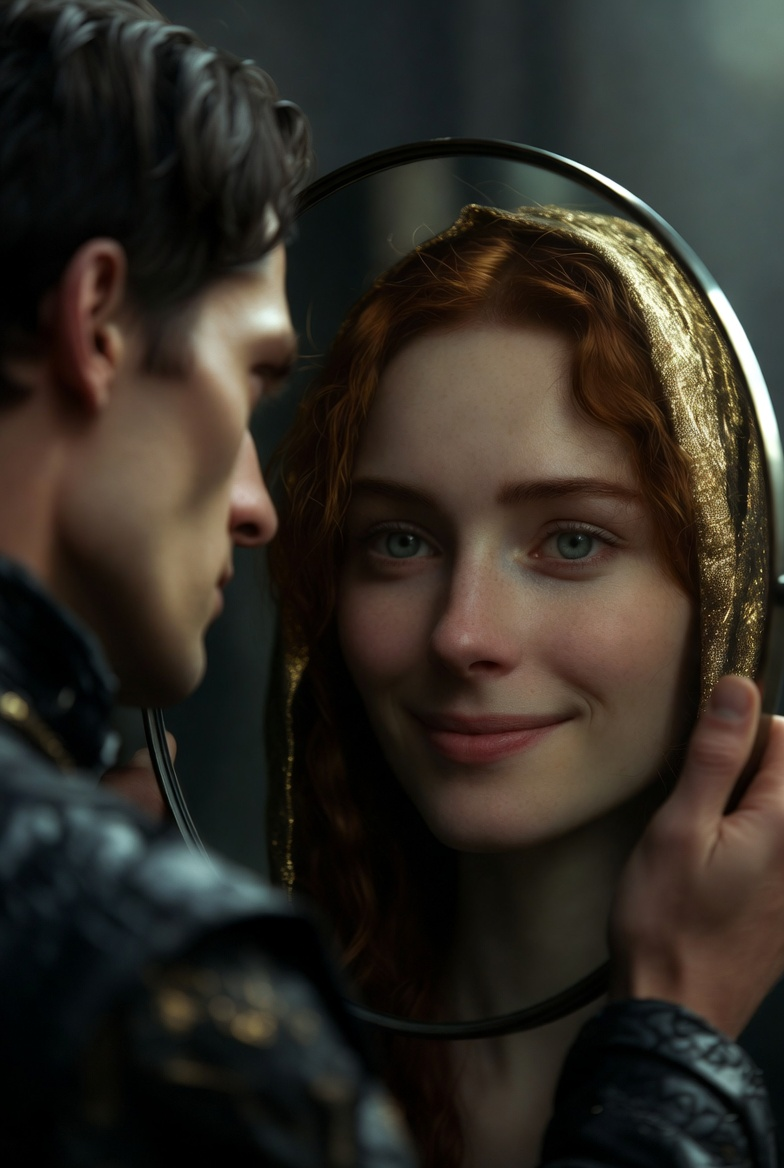
I sat in front of the mirror, my love, drank out of it the over
abundance of your sins while you slept on summer afternoons, in your
thin silk shift on white linen. You were a different person, my dear,
when the sun laughed in the splendor of my garden–sweet little sister
of my dream filled days. You were an entirely different person, my
dear, when it sank into the sea, when the horrors of darkness softly
crept out of the bushes–wild, sinful sister of my passionate nights–But
I could see by the light of day all the sins of the night in your naked
beauty.
Understanding came to me from out of the mirror, the ancient
gold framed mirror, which saw so many games of love in that wide
turret room in the castle of San Costanzo. The truth, which I had only
glimpsed in the pages of the leather bound volume, came to me from
out of that mirror. Sweetest of all are the chaste sins of the innocent.
That there are creatures–not animal–strange creatures, that
originate out of villainous desires and absurd thoughts–that you will
not deny, my love, not you.
Good is the law; good are all the strict rules. Good is the God
that created them and good is the man that carefully observes them.
But there is the child of Satan who with arrogant hands brazenly
rips the eternal laws from their appointed place. The Evil One, who is
a mighty Lord, helps him–that he might create out of his own proud
will–against all nature.
His work towers into the heavens– and yet falls apart and in its
collapse buries the arrogant fool that conceived it–
Now I write this for you, sister, this book–I ripped open old, long
forgotten scars, mixed their dark blood with the bright and fresh
blood of my latest torments. Beautiful flowers grow out of such soil,
fertilized by blood.
All that I have told you, my love, is very true–yet I take it from
the mirror, drink out of its glass the realizations of my latest
experiences and apply them to earlier memories and original events.
Take this book sister. Take it from a wild adventurer who was an
arrogant fool–and a quiet dreamer as well–Take if from one, little
sister, that has run closely alongside such a life–

Miramar–Lesina–Brion
April–October 1911

Read Full Post »

A Modern Inquiry into the Hermetic Mystery

Part III: Concerning the Laws and Vital Conditions of the Hermetic Experiment

Chapter 4: Mental Requisites and Impediments, Part 2

Introduction: The Hermetic art demands a pure and disciplined mind to unlock its sacred wisdom. This section explores the mental qualities needed and the obstacles to avoid, emphasizing faith, reason, and moral integrity as keys to divine transformation.

The Path of the True Adept

The Hermetic art, as Norton declares, is a “divine cure” to transform base metals into gold, granted only to those blessed with God’s grace and a virtuous heart. Success requires a stable, rational mind, free from avarice or pride, as Geber warns against those who chase wealth, unable to quicken the “aurific seed” of divine wisdom. The adept must pursue truth with unwavering faith, guided by reason to discern the sacred from the profane.

Eirenaeus illustrates this with a parable of seekers lost in “Cimmerian darkness,” mistaking false lights (ignorance, fantasy) for truth. Only those with disciplined intellect and pure intent can perceive the Hermetic light, aligning their will with divine purpose to unlock nature’s secrets.

The Dangers of Skepticism and Greed

Skepticism, especially the fashionable kind that dismisses the unfamiliar, is a major impediment. Geber condemns those who deny the art’s validity, presuming their limited reason sufficient, as Norton likens them to blind men attempting to paint. Such skeptics, lacking faith, block the path to truth, while the covetous, driven by Mammon, defile the divine light, risking spiritual ruin, as Job warns: “If I have made gold my hope, I have denied God.”

The Hermetic art requires sacrifice—abandoning selfhood for divine truth. Those who cling to greed or fleeting opinions fail to endure the fiery ordeal of wisdom’s purification, as Eirenaeus notes: “The art vanishes from impure hands.”

The Call for Disciplined Faith

The adept must cultivate a serene, diligent mind, as the Tractatus Aureus advises: “Be good, just, and ready to help mankind.” This disciplined faith, rooted in reason, aligns the soul with divine wisdom, transforming it into a radiant vessel. Norton emphasizes secrecy, taught “mouth to mouth” with a sacred oath, to protect the art from misuse, ensuring only the worthy wield its power.

Closing: This chapter unveils the mental requisites of faith and reason, and the pitfalls of skepticism and greed, for mastering the Hermetic art. The journey into its practical secrets deepens in our next post, unveiling further wonders of this sacred pursuit.

Read Full Post »

Homo Sapiens: In the Maelstrom by Stanislaw Przybyszewski and translated by Joe E Bandel

XII.

“Now you must go to Geißler and arrange everything with him, then we can leave the day after tomorrow.” 

Falk stood thoughtfully for a while. “Yes, yes… we will leave soon.” He smiled distractedly. 

“You love him very much, didn’t you?” he asked suddenly. “Who?” 

“Well, Geißler of course. If something should happen to me, you could marry him, couldn’t you?” 

He looked at her smiling. 

“Die first, then we will see,” Isa joked. “Well, then goodbye.” 

“But don’t come back so late again. I have such fear for you now. Think of me: I will go mad with unrest if you stay out long again today.” 

“No, no, I will come soon.” He stepped onto the street. 

It was just quitting time, the workers streamed in large crowds from the factories. 

Anxiously he turned into a side alley. It was generally strange what everything now became fear for him; his heart was in constant fever activity. 

If he heard a noise at the door, he started and could not calm down for a long time; he heard little Janek cry and started in highest fear: he could not remember for a long time that he had a son, no, now he even had two: little Janek and little Erik, two sweet, wonderful children… 

Oh, this splendid father idyll! If only it were not so infinitely comical. 

He walked thoughtfully along the empty street. 

The events of the last days whirred through his head and blurred into a feeling of an unspeakable sadness. It seemed to him as if he must suffocate: he breathed deep and heavy. 

What would it help if he fled? Not travel, only flee, flee, so that his lies would not be discovered? He could no longer live with all the disgusting lies, now he could no longer look Isa calmly in the eyes: her trust, her faith tormented him, humiliated him, he felt disgust for himself, tormenting shame, that he would most like to have spat at himself. 

Strange woman, this Isa. Her faith has hypnotized her. She walks like a sleepwalker. She sees nothing, she hardly suspects that he suffers. The awakening will be horrible. It cannot go on: her faith will now be broken sooner or later anyway. 

“So I am a double criminal. I broke the marriage and its condition, faith. Actually I am only a criminal against myself, for I cut the roots of my existence. I cannot live without Isa after all. However I think and consider: it does not go. And because I am I, because I am thus God, for God is everyone who makes everything around him his thing—and everything around me is my thing—, so I have sinned against God, thus committed a sacrilege.” 

He spoke it half-aloud with deep reflection to himself, suddenly noticed it and stopped. 

That could not be his seriousness, he knew no crime after all. No, whatever he might think about his heroic deeds, the concept of crime could not be constructed. Crime postulates a state of mind that is precisely no coziness… He, he, he, coziness!—I actually wanted to say heartlessness. Well, the devil knows, I am anything rather than heartless. I have more pity in me than our whole time together. So I am no criminal. 

He lost himself in the subtlest investigations. 

“But perhaps a state of feeling is now forming that did not exist before, and for which something counts as crime that was by no means crime before. A feeling of offense against civilizational developments, e.g. against monogamy.” 

But his brain was so exhausted that he could not pursue the thought further: it was also indifferent; the brain with all its lawyer tricks was quite powerless against the feeling. Why brood further then? 

He suddenly got the sure, immediate certainty that now everything would be in vain, whatever he did, that the terrible would now surely, unavoidably, with iron necessity break over him. 

He shuddered and his knees became weak. He looked around: no bench nearby. 

With difficulty and despair he dragged himself further. 

His brain now became quite distracted, he could no longer concentrate it. Instead he saw with uncanny clarity the slightest details. So he saw that a letter hung crooked on a sign, that a bar was bent outward on a grating, that a passer-by had the characteristic gait of a person whose boots fit badly. 

His brain exhausted itself in these trifles. Suddenly he cried out softly. 

The thought that he had heard working all day in the lowest depth, and that he had tried so hard to stifle, broke through. 

He had to follow Grodzki! 

He had so often considered suicide theoretically, but this time it was like a huge compulsion suggestion: he felt that he could not resist it. It did not come from outside, no, it came from the unknown: a domineering will stifling every contradiction. 

He trembled, staggered, stopped and supported himself against a house. 

He had to do it! Just as Grodzki had done it. Train the brain will for it, force it to obey the instinct will. 

Suddenly he felt a peculiar numb calm. He forced himself to think, but he could not, he went further and further thoughtlessly, sunk in this numb, inner death silence. 

He stumbled and almost fell. That shook him up. No! it was not hard, why should he torment himself longer. 

He thought what would not be torment, but he could find nothing. Then he thought what would not be lie, but there was nothing that it was not, at most a fact, but what is a fact, said Pilate and washed his hands. No! Pilate said: what is truth? and only then did he wash his hands. 

He began to babble. 

But when he came to the house where Geißler had to live, he became very restless. 

He had completely forgotten the house. But here he had to live. He read all the signs, among them especially attentively: Walter Geißler, lawyer and notary, but he could not orient himself. 

He went into the hallway, stepped out onto the street again, read the signs again, came to his senses and became half unconscious with fear. 

Should he go mad? That was after all a momentary confusion of senses. Oh God, oh God, only that not! 

He collected himself with difficulty, a morbid shyness to show no one what was going on in him began to dominate him. 

He directed the greatest attention to his face, made the strangest grimaces to find out the expression of indifferent everydayness, finally felt satisfied and went up. 

“One moment!” 

Geißler wrote as if his life depended on it. Finally he jumped up. 

“I namely have insanely much to do. I now want to hang my law practice finally on the nail and devote myself entirely to literature. That is after all a charming occupation, and I work now to unconsciousness…” 

“But first you will arrange my affairs?” Geißler laughed heartily. 

“There is nothing more to arrange. You also have not a glimmer of your circumstances. Your whole fortune is at most three thousand marks.” 

“Well. Then I will come to you tomorrow; you can give me the money tomorrow, can’t you?” 

“I will see.” 

Falk suddenly thought. 

“You actually need to give me only five hundred, the rest you will send monthly in hundred mark installments to this address.” 

He wrote Janina’s address. “Who is that?” asked Geißler. 

“Oh, an innocent victim of a villainy.” 

“So, so… You probably want to go into the desert now and fast?” “Perhaps.” 

Falk smiled. He suddenly remembered his role and began to laugh with exaggerated cordiality. 

“Just think, I asked very eagerly for you.” “Where then?” 

“In a completely strange house. I wanted to mislead a spy and so I asked very loudly and with great emphasis for you on the second floor… But that is not interesting at all.” 

Read Full Post »

Homo Sapiens by Stanislaw Przybyszewski and translated by Joe E Bandel

“Strange, strange… the doctor said you should lie at least three days, and I have seen this expression of strength and energy in your face for a long time. You are different from all people.” 

“Yes, yes, that is the new strength. Drink, drink with me… I was so little with you… Drink the whole glass out.” 

They drank out and Falk filled the glasses anew. 

He sat down beside her, took her both hands and kissed them. “We have not spoken together for a long time,” he said. 

“Now everything is good, isn’t it?” she asked tenderly. 

“It will become good. We will travel away from here… What do you think of Iceland?” 

“Are you serious?” “You make so many new plans…” 

“This time I am serious, because it is namely no plan. It occurred to me today, yesterday, I actually don’t know when, but I must away from here.” 

Isa beamed. She did not want to tell him, but she found it unbearable in this boring city. 

“Think, such a small fisherman’s house by the sea. Isn’t it? Wonderful! And the autumn nights when the waves play this terrible eternal music on the beach. But you will not be bored?” 

“Did I ever get bored with you? I need no person, nothing, I need absolutely nothing if I only have you.” 

“But I will often be away from you, very often. I will go out with the fishermen for entire nights, I will go into the mountains. And when we are together, we will lie in the grass and stare at the sky… But drink, drink then… Oh, you can no longer drink as before.” 

“See then!” She drank the glass empty. 

“And in this twosomeness: you and I, and you a piece of me, and we both a revelation of the immanent substance in us…” He stood up. “Isa! we will seek the God we lost.” 

She was as if hypnotized. 

“The God we lost,” she repeated half unconsciously. “You don’t believe in God?” he asked suddenly. 

“No,” she said thoughtfully. 

“You don’t believe one can find him?” “No, if one does not have him in oneself.” 

“But that is what I mean: to find God, that means to feel God, to feel him in every pore of one’s soul, to have the immediate certainty that he is there, to possess the wild supernatural power that the God-feeling gives.” 

“Do you want to seek another God, a God outside? What do you want this God for? I don’t want him. I don’t need him. I have the immediate certainty of the God-feeling, I feel him as long as you are there. I need nothing higher… And I will not tolerate such a feeling in you either. Then I will not go with.” 

He looked at her long. 

“How beautiful you have become now. As if a light had suddenly bloomed in you…” 

Suddenly he lost balance and came into a strange rapture. 

“Yes, yes, I mean the God who is you and I. I mean the holy, great My-You! Do you know what my you, my dark you is? That is Jahveh, that is Oum, that is Tabu. My you, that is the soul that never prostituted itself in the brain. My you, that is the holy soul that rarely comes over me, perhaps once, as the Holy Spirit came only once over the apostles. My you, that is my love and my doom and my criminal will! And to find my God, that means: to explore this you, to know its ways, to understand its intentions, so as not to do the small, the low, the disgusting anymore.” 

Isa was carried away. They grasped each other violently by the hands. 

“And you want to teach me to find and explore it in me?” “Yes, yes…” He looked at her as if he had never seen her before. 

“And you will be in me?” 

“Yes, yes…” 

“I am yours, your thing and your you… Am I it?” “Yes, yes…” He began to become distracted. 

“We are poor, Isa,” he said after a while, “I lost the whole fortune.” 

“Throw the rest away too,” she cried laughing to him and threw herself on his breast. 

Fear suddenly rose in him. 

“You, you—if it is over tomorrow? I have such mistrust of myself.” 

“Then I will pull you with.” 

“But is it perhaps not only an over-fatigue, an over-excited mood that whips us into this ecstasy?” 

He started. 

“I lie, I lie,” he said suddenly hoarsely, “I have lied too much… Now…” 

He broke off. The thought to tell her now everything, to tell everything in detail, shot through his head and grew into a great, maniacal idea. 

“Isa!” He looked at her as if he wanted to bore into the ground of her soul… “Isa!” he repeated, “I have something to tell you.” 

She started frightened. 

“Can you forgive me everything, everything I did evil?” 

The confession forced itself with irresistible power over his lips. Now he could no longer hold it back. He grasped her hands. 

“Everything? Everything?!” “Yes, everything, everything!” 

“And if I had really done the one thing?” “What?” She recoiled horrified. 

“This… with a strange woman.” 

She stared at him, then cried out with an unnatural voice: “Don’t torment me!” 

Falk came to his senses instantly. He felt sweat run over his whole body. 

She jumped toward him and stammered trembling: “What? What?” 

He smiled peculiarly with a superior calm. 

In the same moment Isa noticed that he became deathly pale, and that his face twitched. 

“You are sick!” 

“Yes, I am sick, I overestimated my strength.” 

He sank together on the sofa and in a wild maelstrom the experiences of the last days shot through his head. He saw Grodzki: 

“One must be able to do it with will!”

Read Full Post »

A Modern Inquiry into the Hermetic Mystery

Part III: Concerning the Laws and Vital Conditions of the Hermetic Experiment

Chapter 2: A Further Analysis of the Initial Principle, Part 3

Introduction: The Hermetic art unveils the soul’s divine essence, the Initial Principle, as a universal spark transformed into radiant light. This section explores the alchemical and philosophical journey from chaos to divine harmony, revealing the interconnected essence of all creation.

The Universal Essence

The Hermetic laboratory, as described by adepts, is a microcosm where the soul’s essence—a transparent, ethereal salt—manifests in vibrant colors and forms. This “Vital Radix” bears fruits, metals, and precious stones, nourished by divine waters. Unlike common matter, this essence is a living spark, imperceptible yet powerful, capable of infinite transformations. Basil Valentine recounts witnessing this essence as a vapor infused by divine stars, coagulating into form through elemental interplay, mirroring the universe’s creation.

This essence, the “Ethereal Quintessence,” is the foundation of all life. Plato, in Timaeus, describes the Demiurgus crafting the world from one whole, uniting all elements into a perfect, ageless form. This is not the flawed external world but the soul’s inner heaven, where reason aligns with divine light, as Proclus explains: “Heaven is the intellectual contact with the intelligible.”

The Philosophical Synthesis

Ancient philosophers like Thales, Heraclitus, and Anaxagoras, despite varied terms (water, fire, intellect), point to the same universal essence. Thales’ water, Heraclitus’ fire, and Plato’s earth within heaven all describe the soul’s divine spark, distinct from common elements. Empedocles’ twofold order—intelligible and sensible—reveals this essence as the source of all, manifested through artful purification. Aristotle’s “ultimate circulation” of the universe, a boundless spirit, aligns with Hermes’ Quintessence, the “Earth of the Wise” that transforms the soul into a radiant vessel.

These thinkers, far from arbitrary, grounded their philosophy in experiential insight, not mere speculation. Their methods, though veiled, ascend from sensory bondage to divine truth, uniting mind and matter in a harmonious whole.

The Alchemical Miracle

The soul’s essence, purified through art, becomes a “magical earth” where divine light shines forth. Vaughan’s vision of a land flowing with wine, oil, and milk reflects this paradise, where the soul’s spark, once hidden, radiates eternal life. This transformation, from chaotic void to divine unity, mirrors the alchemical process of dissolution and coagulation, revealing the soul as the source of all creation’s wonders.

Closing: This chapter unveils the Initial Principle as the universal essence, purified into divine light through alchemical art. The journey into its practical revelation deepens in our next post, unveiling further secrets of this sacred practice.

Read Full Post »

Homo Sapiens: In the Maelstrom by Stanislaw Przybyszewski and translated by Joe E Bandel

“But you are fighting windmills. Do you believe that Napoleon is a great person for me? He is only that for you because he showed you with what ruthlessness and brutality one may proceed when it comes to satisfying one’s greed…” 

Falk stared at him with feverish tension. But he did not grasp what the other said. And suddenly he saw Czerski’s face as if he had never seen it before! 

“Strange, strange,” he murmured, staring incessantly at Czerski. He moved quite close to Czerski and spoke quite softly. 

“See, you will commit crimes, no, no! don’t get upset. Understand me correctly, I mean what our society calls crimes. I know it. I suddenly saw it now. I believed you were sick or ate opium, now I know it. How? Suddenly. All at once. All political criminals get the same expression. I saw Padlewski in Paris, you know, he murdered the Russian ambassador… I saw him three hours before… 

Falk sat down again. For a moment everything went dark before his eyes. But it passed immediately. 

When you murder, you naturally have motives for it. Yes, I know, you have great love and great pity. And in what do the roots of your great pity stick? Only in the greed to realize the purpose you have before your eyes. In what does your greed differ from mine? Ha, ha, you don’t even listen to what I say, your 

gaze is a thousand miles from here… Ha, ha, you don’t need to listen to it at all, but just tell me, in what will your crime then differ from mine? In that my crime remains unpunished, and you are punished with death. But I have the torment, and you have the happiness of sacrifice, yes—of sacrifice, Falk cried out. 

Czerski started. 

“What did you say now?” 

“You have the happiness of sacrifice! And I have the torment.” Falk fell exhausted back into the chair. 

“Naturally you will say I got all that from Nietzsche. But that is not true. What Nietzsche says is as old as the bad conscience is old…” 

He straightened up again, his state bordered on ecstasy. 

“You said you spit on all this. Didn’t you say so? Well, approximately so. And I agree with you! This with the overman… Ha, ha, ha… Nietzsche teaches that there is no good and no evil. But why should the overman suddenly be better than the last human? Ha, ha, ha… Why is the criminal more beautiful than the martyr who perishes out of pity? Where does the valuation between beautiful and ugly suddenly come from? Why? Oh, I love great suffering beauty, I love ascetic beauty… Ha, ha; I perhaps loved Janina because she is so extraordinarily thin… What do I know? Everything is nonsense! I spit on all that, I spit on the overman and on Napoleon, I spit on myself and the whole life…” 

He looked around confused and suddenly became very serious, but then he began to speak again, quickly, hastily; he tumbled over himself, it seemed to him as if he could not say enough. 

“I have told no one what I tell you. I admire you, I love you. Do you know why? You are the only one who has ceased to be himself… Yes, you and Olga—you both. I love you both for the sake of your love. And I love great love. That is the only feeling I love and admire. Don’t you hear how my heart beats, don’t you feel how my temples throb… But to love, one must have your faith, yes, the faith that has no purpose, only love, love, love is!.. He, he, he… I love, I admire, I crawl on my knees before this love that is the great faith. It is 

so strange that precisely you, you levellers, you compassionate ones are the overmen! Faith, love makes you so mighty and so strong. I am the human on the extinction list. I am the last human. See: in the Polynesian archipelago there is a wonderful human race that will no longer exist in thirty, fifty years. It is dying out from physical consumption. My race is dying from physical phthisis. The lung of the brain, faith is rotted, eaten away… 

Falk suddenly began to laugh. 

“Ha, ha, ha… I had a friend. He was also such an overman as I. He was not as strong as I, and so he died from the debaucheries. When he was dead, I went to a café to think about death and to make clear to myself that he was really dead. I met there a fat and greasy medic who had muddled with us. I said to him: Gronski is dead. He thought a little. Then he said: I could imagine that. Why? I said. One must have principles, was the answer. One must have principles. If one has principles, one does not perish. But to have principles, one must believe, believe… 

He suddenly straightened up and stood long almost unconscious. “It is my despair that speaks through me,” he finally said… 

You are right, Czerski—the whole life, this disgusting life of the worm that eats in the flour, the life of small love… You are the first I have seen who has thrown that away, who has forgotten that… For you there are not these commandments for whose sake I suffer, because you are too great for that… 

Falk suddenly seized his hand and kissed it. Czerski jerked violently and tore his hand away. 

Falk looked at him long without saying a word, then sat down again. It seemed to him as if the fever had suddenly left him. He also didn’t quite know exactly what he had said or done. 

Czerski was unusually pale. “Why did you come here?” 

His voice trembled. 

Falk looked at him calmly. They looked into each other’s eyes for probably a minute. 

“I swear to you,” he finally said, “that I came for no small motives.” 

“Is it true?” 

“Yes, it is true.” 

Czerski walked uncertainly back and forth a few times. 

“I retract everything unpleasant I said to you—his voice was very soft, he seemed to have great difficulty fighting down his excitement. You are no scoundrel, Falk. Forgive me that I wanted to insult you.” 

He went to the window. 

A long pause ensued. Suddenly Czerski turned around. 

“I didn’t know you,” he said harshly, “I believed you were unscrupulous… I wrote everything to Janina’s brother because I had promised him to watch over her. And now I have something else to think about.” 

“You wrote to Stefan Kruk?” “Yes.” 

Falk looked at him indifferently. 

“Hm, perhaps you did well… But now farewell Czerski. I am glad that we do not part as enemies.” 

He went down mechanically.

Read Full Post »

Homo Sapiens: In the Maelstrom by Stanislaw Przybyszewski and translated by Joe E Bandel

“That’s why it must be eliminated, just as one eliminates madmen who commit crimes without knowing it.” 

“So only the harmful consequences decide about crime?” “Yes.” 

“But suppose you blow up a factory for the sake of the idea and thereby plunge hundreds of families into misery, then you commit a crime because the consequences are criminal.” 

“No! For thereby I bring my idea closer to realization and I bring millions happiness. When Christ spread his teaching, he knew very well that thousands of his followers would be sacrificed, so he delivered them to certain ruin to bring millions salvation.” 

“You believe in God?” Olga asked absentmindedly. Czerski suddenly fell into great excitement. 

“I believe in Jesus Christ, the God-man… But don’t interrupt me. I have the right to it, nature taught it to me. What decides about the pleasantness of a feeling? Not that it is pleasant in itself. 

The habituation to opium is very painful at first, only in length becomes pleasure. So only the duration of the same decides about the final nature of the feeling. It is self-evident that the first consequences of a factory explosion are unpleasant, but…” 

“So you will shrink from no crime?” 

“No, no crime,” he interrupted her eagerly, “I will shrink from no action that guarantees my idea victory.” 

“And if your idea is false?” 

“It is not false, for it is built on the only truth we have: love.” 

“But if your means are false?” 

“They cannot be false, for their motives are love. By the way, I don’t want to resort to these means at all, even if I should hold it necessary. I have no program like the anarchists. I want to commit no act of violence so as not to be counted to a party that has violence in its program.” 

“Out of vanity?” 

“No; out of caution, only out of caution, so that the anarchists, thus a party, do not believe they have the right to regard my act as the consequence of their program.” 

“You are ambitious.” 

“No! But I am only in my act. I have only one right, and that is: to be. And my being is my act. Yes, I have an ambition if you want to call it so: to be, to be through my act. I am not as soon as I execute foreign commands.” 

“Those are old thoughts, dear Czerski.” 

“I don’t know if they are old, I got them in prison and so they are my own. I thought them out with great effort. I was not used to thinking as long as I was in the party. Now I have detached myself from everything to be alone and determine my act with my own thoughts.” 

“And if you hadn’t got the money from Falk, would you have taken it?” 

“Yes.” 

“And what do you want to do now?” 

“I want to teach people to sacrifice themselves.” 

Olga looked at him questioningly.  

“To be able to sacrifice oneself: that is the first condition of every act. I will teach the enthusiasm of sacrifice.” 

“But to sacrifice oneself, one must first believe in the purpose of sacrifice.” 

“No! The sacrifice does not spring from faith, but from enthusiasm. That is it precisely. See, all previous parties have faith but no enthusiasm. No, they have no faith, they have only dogmas. Social democracy has died in dogmatic faith. Social democracy is what every religious community is: it is faithful without enthusiasm. Is there a person who would go into the fire for his God? No! Is there a social democrat who would plunge into ruin without reservation, without hesitation, for his idea? No! They all have the calm, comfortable certainty of faith; their dogmas are iron truths for whose sake one, God knows, need not get excited. But I want to create the fiery, glowing faith, a faith that is no longer faith because it has no purpose, a faith that has dissolved in the enthusiasm of sacrifice.” 

He suddenly fell into an ecstatic state. His eyes shone and his face transfigured itself peculiarly. 

“So you speculate on the fanaticism of hate in the masses.” 

“Fanaticism of love,” he said radiantly, “fanaticism of love for the infinity of the human race, love for the eternity of life, love for the thought that I and humanity are one, inseparably one…” 

He varied the thought in the most diverse expressions. 

“I will not say: Sacrifice yourselves so that you and your children become happy, I will teach anew the happiness of sacrifice in itself. Humanity has an inexhaustible capacity to sacrifice itself, but the fat church and fat socialism destroyed that. Humanity has forgotten the happiness of sacrifice in the fat, disgusting dogmatic faith. The last time it tasted it in the great revolutions, in the Commune—purposeless, only out of love for sacrifice, to enjoy once more the infinite happiness of purposeless selflessness… And I will bring this happiness back to memory through my act…” 

He suddenly stopped and looked at Olga suspiciously. 

“You probably believe I am a mad fantasist?” 

“It is beautiful, very beautiful what you said there—I understand you,” she said thoughtfully. 

He was silent long. 

“Yes, you are right that those are old thoughts,” he said suddenly. “They touch in many ways what Falk expressed at the congress in Paris. I would have liked to kiss his hand then…” 

He suddenly became very restless. 

“But it did not become a life matter for him. His brain figured it out. His heart caught no fire… No, no—how is it possible to have such thoughts and not perish with shame that one can say all that cold and calm… See, that is the shamelessness of his brain, that it cannot shudder at it. His brain is shameless… He is a—an evil person. He is not pure enough for his ideas. One must be Christ, yes, Jesus Christ, the God of humans, the holy source of willingness to sacrifice.” 

“You have changed very much, Czerski. By the way, I didn’t know you. Kunicki slandered you. I will think much about what you said…” 

Olga stood up and looked at him shyly. 

Over his face lay a transfigured glow. She had never seen anything like it. 

“Take care of yourself, Czerski. You look very sick.” “No, I am not sick. I am happy.” 

He thought long. 

“Yes, yes,” he said suddenly, “yesterday I was still a small person. But now it is over, it is past…”

Read Full Post »

A Modern Inquiry into the Hermetic Mystery

Part II: A More Esoteric Consideration of the Hermetic Art and Its Mysteries

Chapter 3: The Mysteries Continued, Part 2

Introduction: The ancient mysteries guide the soul through a perilous descent into its chaotic depths, purifying it to reveal divine wisdom. This section explores the transformative journey past deceptive apparitions, led by the rational intellect’s golden light.

The Soul’s Perilous Descent

Plato likens the soul’s descent into the “oblivious realms of generation” to an earthquake, shaking its core with nature’s convulsions. Psellus describes two types of visions in the Chaldaic rites: “suspections,” mere apparitions of light or figures, and true divine revelations. The Oracle warns, “If you see such a light, do not heed it or its voice, for these are false, born of the soul’s passions.” These apparitions, like the poet’s satyric Pan in monstrous disguises, affright seekers, as Virgil depicts Aeneas, trembling yet resolute, facing shadowy forms.

This “pneumatic vehicle,” the soul’s imaginative essence, condenses like clouds, forming deceptive images—demons, beasts, or human shapes—that haunt the mysteries’ initiatory stage. Proclus explains, “Before the gods’ presence, terrestrial demons appear, drawing unpurified souls to matter, separating them from truth.” Only through purification do initiates enter the temple’s inner sanctum, receiving divine illumination and shedding their illusory garments.

The Alchemical Purification

The alchemists’ “Mercury of Philosophers” emerges from this purified spirit, freed from the chaotic “Black Saturn” or “Urinus Saturni,” a fetid, heavy essence that Sendivogius uses to nurture the soul’s solar and lunar aspects. This is the “mineral tree,” bearing transformative waters, as another adept notes: “From my sea rise clouds, bearing blessed waters to irrigate the earth and bring forth herbs and flowers.” Hermes urges, “Extract the shadow and obscurity from the ray, purifying the watery, corrupted nature until its redness shines.” This process, visiting “the interiors of the earth rectifying,” yields the true medicine—the philosopher’s stone.

The soul, likened to Plato’s marine Glaucus, deformed by foreign weeds, appears beastly until purified. Vaughan describes this chaotic essence as ever-changing, like clouds driven by wind, persecuted by the “fire of nature”—the rational light of the mysteries. Raymond Lully calls it “fugitive spirits condensed in monstrous shapes,” moving unpredictably, yet holding the seed of divine wisdom when purified.

The Rosicrucian Allegory

A Rosicrucian letter illustrates this journey: “In the earth’s center lies a mountain, small yet great, soft yet hard, far yet near, invisible by divine providence. It holds treasures beyond worldly value, guarded by cruel beasts and ravenous birds. Only the worthy, through self-labor, can reach it. Go at midnight, armed with courage and prayer, following a guide who appears unbidden.” This guide, a divine light, leads to the mountain’s heart, where the soul confronts its chaotic depths, requiring heroic resolve to prevail.

Closing: This section unveils the mysteries’ descent into the soul’s chaotic depths, purifying deceptive apparitions to reveal divine wisdom. The transformative journey continues, promising deeper revelations of the Theurgic art in our next post.

Read Full Post »

Homo Sapiens: Under Way by Stanislaw Przybyszewski and translated by Joe E Bandel

“Yes, you are very inquisitive, Herr Editor. You surely don’t demand that I deliver my political credo here; but we can look at the things from a bird’s-eye view. 

I understand the anarchist propaganda of the deed, for that’s what this is about here, very well; I understand it as an unheard-of indignation against social justice. 

Yes, we the sated, we who have the privilege of doing no work or at least choosing a work that is a pleasure to us, we call it justice when our brothers in Christ must rise at four or five in the morning, day-labor twelve hours uninterrupted, serve us the privileged. Well, I need hardly list for you which things we consider socially just. But you must understand that there are people who cannot reconcile themselves to it, who rebel against such justice in naive rage. Well, the rage can, if favored by certain circumstances, such as, for example, futile job searching, thus unemployment, or hunger or

illness, rise to a height that it simply tips over into madness. 

And now take a person who day in, day out sees such examples of unheard-of social cruelty, take a person who is witness to how the workers in a strike riot are shot dead like dogs, how they are starved out by mighty capitals and crippled in their justified resistance: don’t you believe that such examples of our social justice suffice to produce in a person who has a strong heart a vengeance that blindly wants to—must!—sate itself on the first best of the socially privileged? 

Our heart is dulled, sir; our heart is weak and narrow-minded, as our interests are; it has eye and ear only for our own petty conditions. But take a person who is strong and exuberant and childlike enough to feel himself a whole world—yes take for example that Henry: what drove him to his murder acts? 

A heart, a great heart, whose power we dulled, small egoists cannot comprehend! A heart that answered with terrible resonance to all the misery, all the powerlessness all around! 

He became a criminal, certainly; but he was no ordinary criminal. He was a criminal out of indignation, an outrage-criminal. That is a great difference. In effect, of course, it comes to the same; but we are surely advanced enough in our judgment that we begin to form categories not according to success, but according to motives. 

A group had formed around Falk, listening attentively. 

The editor now saw the opportunity as favorable to expose Falk before the reactionary elements. 

“So you completely excuse the anarchist murder acts…” The editor grinned maliciously… “So you would have pardoned Henry without further ado?” 

Falk surveyed the people standing around him with his eyes and said very calmly. 

“No, I wouldn’t have done that. I myself belong to the privileged, thus risk in the next moment being blown into the air by an explosion, thus find myself in a kind of self-defense that makes Henry’s death indispensable. At the same time, however, I say to myself: from my standpoint I am right, but Henry was right from his. He perished through social justice or rather social arbitrariness, which alone gives power and right. But you can surely imagine that social arbitrariness could just as well take Henry’s side, and then Henry would be praised as a great hero. Take, for example, a war: isn’t it a mighty mass murder? But to murder in war is—sweet and honorable, as that Roman sings. 

Well; that doesn’t belong to the matter. But I ask you not to misunderstand me. We see the things from a bird’s-eye view. I only say: I can understand such indignation. 

For we all have the psychic germs in us from which later the most intense forms of murder, robbery, etc. can develop. That they don’t do it is pure chance. By the way, I believe that we can all understand such indignation. How often has not each of us already given himself to this feeling! 

Falk’s sharp eyes discovered the director, who stood a little apart. 

“Look, gentlemen, for example, two days ago I went so far in my indignation that I offered slaps in the face to the so highly esteemed, so well-deserved person of the Herr Director.” 

Those around involuntarily looked at the director with a discreet smile. 

“Yes, I sincerely regret it; but in the moment of an intense emotional outburst I did it.” 

For what? “Yes, gentlemen, if one is indignant about a man’s writings, one really doesn’t go to the school and let one’s rage run free in somewhat uncivilized expressions before stupid boys. 

No, a gentleman doesn’t do that. Perhaps that’s the custom here in the country, but I am accustomed to European customs. 

Right, Herr Editor: You are right to remind me of the résumé. 

The résumé? Hm, yes, the résumé. I understand anarchism as propaganda of the deed, I can explain it to myself. I can examine, analyze, understand all the psychic components from which the idea of political murder develops, one after the other, just as I can understand, analyze, and observe the affect forms that in their heightened intensity become ordinary madness, a mania, a melancholy, etc. etc. 

No, nothing could be done with Falk; he was slippery as an eel. The editor withdrew ashamed. 

Marit had stood at Erik’s side the whole time. 

She felt so close to him; so close. She was happy and proud. He turned to her so often, almost spoke to her. 

Yes, he had the beautiful, great, splendid heart he spoke of. He had the proud heart of indignation and courage: before a whole world he confesses openly and courageously what he thinks! 

And how beautiful he was in this atmosphere of fat, stupid people. How splendid his intellectual face and the fine, discreet gestures with which he accompanied his words. 

A mighty jubilation filled her whole soul, the feeling of boundless devotion. She trembled, and her face colored purple-red. 

Falk disappeared for a moment. 

“Shall we not go?” he whispered in Marit’s ear when he returned. Marit rose. 

It was the custom in this house to leave without the usual farewell formulas. The district commissioner was nervous and loved it when people came and went without a word.

Read Full Post »

Alraune by Hanns Heinz Ewers and translated by Joe E Bandel

Translating Alraune
“Deine Tage sind wie die schweren Trauben blauer Glyzenen,
tropfen hinab zum weichen Teppich: so schreitet mein leichter Fuss
weich dahin durch die sonnenglitzernden Laubengänge deiner sanften
Tage.”
Your days are like the heavy (grapes/bunches/clusters) blue
Glyzenen, dropping down to soft carpet: so stride my light feet softly
in them through the sun glistening arbor your gentle days.
What the hell does “Glyzenen” mean? Look it up in the
dictionary; it’s not there. Google it on the internet; it’s not there. Try
some online German-English dictionaries; it’s not there…
What did Endore write? “glycinias” Well, what does that mean?
Look it up in the dictionary; it’s not there. Google it on the internet;
ah, there it is–Archaic German word for wisteria–not used anymore–
Maybe back when he translated it some old Germans were still alive
that knew the meaning of the word.
[Editor’s note: S. Guy Endore translated a 1929 version of
Alraune for John Day Publishing Company]
What is “Wisteria”? Google it on the internet–Oh, what beautiful
thick flowers. We don’t have those here in northern Minnesota. Now
let’s get back to the translation. “Dropping down to soft carpet?” That
can’t be right. Wisteria grows outside and doesn’t fall onto the carpet!
When those thick blossoms fall they will form a carpet on the ground
though! Let’s try it like this:
Your days are like the heavy blue clusters of wisteria dropping
down to form a soft carpet. My feet stride lightly and softly through
them as I enter the glittering sunlight in the arbor of your gentle days.
Just for grins let’s see what Endore came up with.
“Your days drop out of your life even as the heavy clusters of
blue glycinias shed their blossoms one by one upon the soft carpet.
And I tread lightly through the long, sunny arbors of your mild
existence.”
What the hell! That’s not even close! Where did he come up with
that “days dropping” and “blossoms one by one” bit? None of that is
in the text at all. Obviously he was embellishing a bit. (Something
that Endore did quite a bit of.)
Such was my experience with the very first pages of Alraune.
But it was not my last. The John Day version of Alraune turned out
to be very mangled and censored to boot. There are different types of
censorship and I ran into most of them. Let’s take chapter five to give
some brief examples.
Now in the story Alraune’s father agrees to cooperate with the
experiment in exchange for a couple bottles of whiskey the night
before he is executed. Thus he is so drunk the next morning that they
have to help him walk up to where the sentence of death is read to
him. Suddenly he realizes what is about to happen, sobers up
immediately, says “something” and begins to fight back. But first he
utters a word–What is that word? It may give a clue to the entire
incident. Let’s see how it really goes:
She laughed, “No, certainly not. Well then –but reach me
another slice of lemon. Thank you. Put it right there in the cup! Well
then –he said, no –I can’t say it.”
“Highness,” said the Professor with mild reproof.
She said, “You must close your eyes first.”
The Privy Councilor thought, “Old monkey!” but he closed his
eyes. “Now?” he asked.
She still hesitated, “I –I will say it in French –”
“That’s fine, in French then!” He cried impatiently.
Then she pressed her lips together, bent forward and whispered
in his ear, “Merde!”
Of course “Merde!” means “Shit!” in French. He said “Shit!”,
sobered up and started fighting for his life! Let’s see what the John
Day version did with it.
She laughed. “Of course not. How silly. Well –just let me have a
piece of lemon. Thanks –put it right into the cup! –Well, then, as I was
saying –but no, really, I can’t tell you.”
“Your Highness!” the Professor said in a tone of genial
reproach.
Then she said: “You’ll have to shut your eyes.”
The Councilor thought to himself, “What an old ass.” But he
closed his eyes. “Well,” he asked.
But she resisted coyly. “I’ll –I’ll tell it to you in French.”
“Very well then, Let it be –French!” he cried impatiently.
She pursed her lips, bent her head to his and whispered the
offending word into his ear.
As you see, we don’t even get to know what the word was in the
John Day edition and a subtle nuance has been lost. Still, you might
think I am making mountains out of molehills. What difference does
that little bit have to do with the story? Well let’s take a more
substantial piece of censorship. Later in the same chapter almost one
entire page of text has been censored. I won’t share it here because it
will spoil the story but this entire section was omitted from the John
Day version. Curiously enough Mahlon Blaine illustrated a portion of
it which shows that he was familiar with it. It was translated but
didn’t make it into the book.
Something that is also missing in the John Day edition is much
of the emotional content and beauty of the writing itself. Consider this
paragraph at the end of chapter five:
There is one other curious thing that remains in the story of these
two people that without ever seeing each other became Alraune’s
father and mother, how they were brought together in a strange
manner even after their death. The Anatomy building janitor,
Knoblauch, threw out the remaining bones and tatters of flesh into a
common shallow grave in the gardens of the Anatomy building. It was
behind the wall where the white roses climb and grow so abundantly.
How heart wrenching and touching in its own way! Let’s see
how the Endore version handles it:
Again the bodies of these two, who, though they had never seen
each other, yet became Alraune ten Brinken’s father and mother,
were most curiously joined in still another manner after their death.
Knoblauch, the old servant who cleaned out the dissecting rooms,
threw the remaining bones and bits of flesh into a hastily prepared
shallow ditch in the rear of the anatomy garden, back there against
the wall, where the white hedge-roses grow so rankly.
When you consider that nearly every single chapter of the John
Day version has been gutted of its emotional content in one way or
another, it is not surprising that it never became as popular with the
reading public as it did it Germany. There it could be read in its
entirety as the author intended. For the first time Alraune is now
available to the English speaking world in an uncensored version that
brings the life and emotion back into the story. I am proud to have
been able to be a part in the restoration of this classic work of horror.
A final note for those that have read the John Day version:
What I read then is different, entirely different, has different
meaning and I present her again like I find her, wild, hot –like
someone that is full of all passions!
–Joe E. Bandel

Arsis
Will you deny, dear girl, that creatures can exist that are–not
human–not animal–strange creatures created out of absurd thoughts
and villainous desires?
You know good, my gentle girl, good is the Law; good are all our
rules and regulations; good is the great God that created these
regulations, these rules, these laws.
Good also is the man that values them completely and goes on
his path in humility and patience in true obedience to our good God.
But there is another King that hates good. He breaks the laws
and the regulations. He creates – note this well – against nature. He
is bad, is evil, and evil is the man that would be like him. He is a child
of Satan.
It is evil, very evil to go in and tamper with the eternal laws and
with insolent hands rip them brazenly out of place.
He is happy and able to do evil – because Satan, who is a
tremendous King, helps him. He wants to create out of his prideful
wish and will, wants to do things that shatter all the rules, that
reverse natural law and stand it on its head.
But he needs to be very careful: It is only a lie and what he
creates is always lunacy and illusion. It towers up and fills the
heavens – but collapses at the last moment and falls back to bury the
arrogant fool that thought it up –
His Excellency Jacob Ten Brinken, Dr. med., Ord. Professor and
Counselor created a strange maiden, created her – against nature. He
created her entirely alone, though the thought belonged to another.
This creature, that was baptized and named Alraune, grew up
and lived as a human child. Whatever she touched turned to gold,
where ever she went became filled with wild laughter.
But whoever felt her poisonous breath, screamed at the sins that
stirred inside them and on the ground where her feet lightly tread
grew the pale white flower of death. It struck dead anyone that was
hers except Frank Braun, who first thought of her and gave her life.
It’s not for you, golden sister, that I write this book. Your eyes
are blue and kind. They know nothing of sins. Your days are like the
heavy blue clusters of wisteria dropping down to form a soft carpet.
My feet stride lightly and softly through them as I enter the glittering
sunlight in the arbor of your gentle days. I don’t write this book for
you my golden child, gracious sister of my dream filled days –
But I write it for you, you wild sinful sister of my hot nights.
When the shadows fall, when the cruel ocean devours the beautiful
golden sun there flashes over the waves a swift poisonous green ray.
That is Sins first quick laugh over the alarmed dying day.
That’s when you extend yourself over the still water, raise
yourself high and proclaim your arrival in blighted yellows, reds and
deep violet colors. Your sins whisper through the deep night and
vomit your pestilent breath wide throughout all the land.
And you become aware of your hot touch. You widen your eyes,
lift your perky young breasts as your nostrils quiver and you spread
wide your fever moistened hands.
Then the gentle civilized day splits away and falls to give birth to
the serpent of the dark night. You extend yourself, sister, your wild
soul, all shame, full of poison, and of torment and blood, and of kisses
and desire, exultant outward in joyous abandon.
I write about you, through all the heavens and hells – sister of
my sins – I write this book for you!

Read Full Post »

Older Posts »