Feeds:
Posts
Comments

Posts Tagged ‘books’

Chapter 10: Shadows of Sanctuary

The next day continued at a luxurious pace, the soft rustle of leaves and distant bird calls weaving a tranquil rhythm. For the first time, there was no hurry or pressing matter. He indulged in curiosity and took exploratory hikes away from the stream, the cool earth beneath his boots and the faint scent of wildflowers drawing him to interesting and promising areas that from time to time caught his attention.

There was plenty of small game, and he was always able to knock down some bird or animal for a quick meal, the crackle of its cooking flesh a comforting sound. He never thought about using his bow. He had no need for that much meat and didn’t want to waste the time curing and drying it into jerky.

As long as he was following the stream, he didn’t have to worry about getting lost or even using the map and compass. All he had to do was keep going downstream, the water’s gentle murmur guiding him. There were actually a few times when it was raining, the patter on his shelter a soothing lullaby, that he would set up camp for a few days in the same spot and just sit out the bad weather. It was so peaceful and beautiful, with golden sunlight filtering through the trees, that one day led to the next. There was no pressure to perform and no Rafe to challenge him or push him harder.

He loved setting his own pace and being his own boss, the freedom swelling in his chest. He moved as the spirit moved him, and his solo was more like a vacation than actual work.

When he arrived at the lake, he made one spot a semi-permanent base and spent two weeks there, just fishing, exploring, and working on his clothing and equipment. The lake was good-sized and fed by several mountain streams, its surface reflecting the fiery hues of colorful sunsets that painted the evening sky. But nights were not restful. His dreams turned horrifying—vivid scenes of people being slaughtered, their screams echoing, and ghostly figures drifting among mass graves, their hollow eyes pleading. The Lord and Lady never came to him; it seemed the dead walked in his dreams instead of the living, a chilling weight settling on his soul. One night, a low hum from a Federation drone sliced through the silence, its cold metallic glint passing overhead, startling him awake, heart pounding, as it vanished into the dark.

Game was plentiful, and he started a permanent camp similar to Rafe’s. No one seemed to be at this particular location, but he did run across the remains of old campfires and a few shelters. There was nothing recent. He saw many deer with young, and the bear had come out of hibernation. He saw one mother bear with cubs and gave it a wide berth, the musky scent of her fur lingering in the air. Spring was the natural time for most wild species to give birth and nourish their young. Many of them at one time or another came down to the lake for water, usually in the early morning or late evenings just before sunset. One morning, he even saw a cougar or mountain lion on the opposite shore of the lake, its stealthy grace sending a shiver down his spine.

It seemed like birds were everywhere, and he learned to listen to the forest and what it was telling him—their songs a lively chorus at times, or an eerie quiet that raised the hairs on his neck. At night, the trees would creak and sway in the wind, and he would hear night creatures prowl around the camp in the darkness, their rustling footsteps a stark contrast to Rafe’s reassuring voice. Being alone in the woods was a lot different than being with someone, and he thought that maybe his dark dreams and that drone’s intrusion were getting to him.

Tobal thought about the time that he would need to teach six other people to solo just like Rafe had done. He didn’t know if he wanted to teach anyone yet. It would be much more fun to explore and develop a permanent camp. Perhaps he would take his newbies down into this area. With that in mind, Tobal began building his own teepee-shaped structure. He could get the blanket material from Sanctuary later after the framework was completed.

He began setting up things he had seen at Rafe’s—a smokehouse, a rack for drying jerky, a sweat lodge, and several traps for fish and for quail. These were spares for later in the winter months since he didn’t need them right now. It didn’t take him long to realize that he needed more cord and string. He also wished he had something heavier than a knife to cut wood with. A good axe would come in handy. He remembered the one he had seen at the store in Old Seattle and tried making one like it. It turned out better than he had expected, and he used it to chop smaller trees for his shelters.

The days passed, and once or twice he reflected it was strange he wasn’t missing human companionship. He wasn’t even feeling lonely, just surrounded by a deep peaceful feeling, the warmth of the sun on his face a balm—at least during the daytime. Before he knew it, the month was almost up, and it was time to head for the gathering spot once more. It was almost full moon. The clan would be having circle, and they would be expecting him back.

He gathered enough smoked fish, rabbit, and venison jerky to last several weeks. He could supplement that with anything fresh he found along the trail. He hated to leave the lake, the gentle quacking of ducks and the splash of beavers tugging at his heart. He loved to watch the ducks, geese, beaver, muskrats, and all the other animals that visited the lake and called it home. He even toyed with the idea of staying, but it was time to go, and he knew he would be back.

As Tobal neared the gathering spot, he saw others heading toward the circle. When they waved, he felt like he was indeed coming home, a surge of belonging warming his chest. Nobody else whistled as they approached the camp, and they laughed at him. He asked why and was told there were no guards except on the trail that led from Sanctuary. Newbies were only to come into camp from that path. After they had joined the clan, there was no need for a guard. It was just part of the initiation. Tobal felt silly and wondered why Rafe had never told him that part of it. He remembered Rafe laughing at him the last time they had come to circle when he had been constantly whistling. It was so like Rafe to let him figure things out for himself.

He was in high spirits as he helped set up the structures and gather firewood for the bonfire, the crackle of logs and chatter of clansmen lifting his mood. He was enjoying being treated as an equal and kept busy throughout the day. He was feeling good when his friends showed up, congratulating him on his solo. He talked with Nikki; she had completed her training with Zee, and the Elders approved her for soloing this month. She was excited about it. Tobal made sure to give her a kiss for good luck. Nikki was a stocky, well-built brunette with an infectious sense of humor and an impulsiveness that got her into trouble at times, but she always managed to get out of it just as quickly.

“Hey, don’t I get one too?” Zee asked, pouting and tossing her braided raven hair back over her shoulder, her voice a playful challenge that hung in the air, a moment heavy with the promise of their shared journey.

Tobal moved over and gave her a big hug and a kiss. “How have you been?” he teased, his grin widening.

“I’ve been doing quite well, thank you,” she laughed, her eyes sparkling. “I’m heading out for Sanctuary in the morning. You want to come along? It’s always more fun traveling together than alone.” Her smile was warm, carrying a hint of anticipation that lingered, a decision point that would shape their next steps.

“That sounds like a good idea,” he said, considering the journey ahead. “How early are you planning to start out?”

“The sooner the better,” she replied, her tone firm yet inviting. “How about sunrise?”

“I’ll see if I can get up that early,” he griped, and they both smiled, the moment sealing their plan with a shared lightness.

He walked over and found out Kevin was going to try for a newbie and hoped there would be enough newbies for everyone. They congratulated each other on their solos and told stories about how it had gone. Kevin was pretty excited.

When Rafe showed up, it was kind of odd because he was alone and didn’t have anyone with him. After a warm hug, Rafe explained he’d been visiting others and taking it easy since his last training stint. He mentioned earning his sixth chevron at the upcoming awards and his initiation as a Journeyman in two weeks, a mix of nerves and excitement in his voice as he looked forward to the ceremony.

Later at the afternoon assembly, introductions were made for Tobal, Kevin, and the four other newly soloed Apprentices. They were brought out in front of the circle to the sound of cheering, good-natured applause, and joking.

The next to be brought forward was Rafe. Alongside Kevin’s teacher, Rafe was eligible for the Journeyman degree. They were called to the front as the sixth chevron was sewn onto their sleeves amidst joking and laughter. The Journeyman degree initiation was set for the new moon in two weeks at a secret location, marked on their maps but unknown to Apprentices.

He chatted with Wayne and Char for a bit before sunset. They were building a permanent base camp and planned on spending the winter together. That got Tobal thinking about the coming cold weather and how he needed to get prepared, resolving to pick up his winter gear cached at Rafe’s on the way back to circle next month. He figured he’d be okay for this month since the furs weren’t prime yet.

He visited with Tara for a while. She was concentrating on building a base camp and getting ready for the coming winter, hoping to find someone to share it with. She was disappointed when Tobal said he was planning to train during the winter.

The bonfire was lit, and word came around that there would be several Apprentice initiations. Ellen wanted to start early, reminding Tobal about the small meditation group the next morning to explore the Lord and Lady’s mysteries—a detail he barely registered in the moment. He almost forgot about it until he heard one of the guards boom out, “Becca Morgan is welcomed into our clan as a new member.” Along with the others, he was caught up in the shouting, applause, and craning his neck to get his first view of this new member of the clan.

As the High Priestess and High Priest began the initiation ceremony, Tobal found himself remembering parts, though some things seemed reversed. Then he realized the High Priest was doing the initiating, not the High Priestess, because Becca was female. It seemed the High Priestess only initiated male candidates, and the High Priest initiated female ones.

Tobal was admitted into the circle by the High Priestess with a hug and a kiss and found a place to sit on the northern side of the circle. He sat with others as the circle was purified and made ready for the candidate.

Everyone sat back in anticipation as Becca was led out, hoodwinked with both hands tied behind her back. Her guide was the same dark-haired girl that had been his guide, and he still didn’t know her name. He was going to have to ask someone. As Becca was initiated, Tobal found himself staring at her. Her tunic had been cut so short he could almost see where her slender white legs joined together beneath the cloth, and he found them incredibly attractive. The air buzzed with a rising energy, a warm current that pulsed through him, stirring a mix of awe and anticipation as the Lord and Lady’s presence began to form above the central fire.

He was watching the candidate—or rather, watching her legs—as the charge was read, reliving his own initiation in his mind. The energy built, a tingling wave that coursed through his body, heightening his senses with a vibrant hum. When the drums started and it was time to move around the circle and build the cone of power, he found himself dancing clockwise with the others. As he touched her shoulder and gently turned her, a spark raced up his arm and down his spine, a surge of electric thrill mingling with discomfort. What was going on? He was obviously aroused and attracted by this unknown girl, and he could even feel how she must feel as the focus of all this energy, her presence amplifying the circle’s power.

His elation turned to shock and horror as the Priest took the hoodwink off Becca, and her face was exposed to the firelight of the circle. As she blinked, he saw it was the girl who almost clawed his eyes out a year ago. An energy backlash hit him, a sharp jolt that twisted his stomach and sent a cold shiver through his frame, as if the circle’s power turned against him. She was being initiated into his clan and his circle as a sister. The realization unleashed a powerful emotional reaction—rage, betrayal, and fear crashing over him, his breath catching as his hands clenched, the weight of her presence unbearable.

Stunned and hurt, he got through the rest of the ceremony by retreating so deeply into his own thoughts and inner anguish that he hardly realized what was going on within the circle. He sat through three other initiations in a stupor, the meditation group forgotten in his turmoil. Later, when the party started, Tobal made a pretense of having a good time but soon slipped away, and nobody seemed to notice he was gone.

Tobal didn’t know if anyone had missed him. Overwhelmed, he left that evening and struggled his way up the cliff leading back to Sanctuary, forgoing safety precautions in his haste. He was well on his way along the narrow cliff ledge as the sun came up and shed its light into the valley, but the terrain was treacherous, and his mind was elsewhere. His gut churned with a mixture of raw emotions—anger at Becca, confusion about the circle, and a desperate need to escape.

It wasn’t fair. This was his clan, his circle, his people, and his friends. For Goddess’ sake, he was in the middle of the wilderness attempting to become a citizen of a Forbidden City. What was the likelihood she would be doing the same thing? The world simply wasn’t that small.

He was in a numbed state as he made his way toward Sanctuary for the first time. The trip was a blur, and he didn’t remember much. He ate from his own food supplies and didn’t bother hunting for anything but water for his two canteens, his focus shattered.

The cheerful, easy peace of mind he had experienced during his solo was gone, and he stumbled blindly along. The connection he had formed with nature was temporarily forgotten as the sun beat mercilessly down on him during the day, and he slept on the hard, unforgiving ground during the night. The next two days, it rained mercilessly, and he narrowly avoided a flash flood that swept his camp away, losing most of his supplies. The roaring water nearly took him too, a close brush with death that left him shaken. Nature’s unforgiving power was a stark lesson.

Luckily, he still had his map and compass in a pouch around his neck and was able to triangulate his position. He was wet, cold, tired, and hungry as he trudged across a muddy terrain made slick in spots by red clay that clung to his shoes, making every step a grueling challenge. The water had filled his shoes and sloshed between his toes, and he could feel blisters beginning to form on his heels from the chafing, each step a painful reminder of his recklessness.

When he arrived at Sanctuary—the processing building for the Sanctuary Program, overseen by Heliopolis with an unknown connection to the local Federation outpost—nobody was there. He was disappointed but also very humbled that he had lost most of his supplies in the flash flood, including his jerky. As he chewed down some of the nasty-tasting stuff from the machine, he resolved to wait right there until someone did show up. There were usually several new people each month that somehow arrived at Sanctuary from wherever they came from. Remembering Rafe’s advice, he stripped completely, leaving his gear in a corner, and went through the medical exam again, getting a new set of robes, pack, and med-kit, and most importantly, fresh socks and a new pair of hiking boots.

Tobal thought about using the new robe as a raincoat or slicker and grabbed several blankets to take back to the lake as a covering for his teepee. He went through the contents of the new pack and med-kit, finding another knife, razor, and toothbrush to replace those he had lost in the flood. He looked at his old wet hiking boots, wondering whether he should keep them or not. Besides being soaked, they were almost worn out from the rugged lifestyle of the past two months. He decided to hang onto them anyway. Boots were hard to come by in the wilderness, and homemade ones just didn’t have the comfort of these heavy-duty hiking boots.

He was feeling satisfied with his pack and starting to feel better in general when he heard footsteps entering the building and a timid “Hello.”

He froze in the darkness, waiting. There was a short silence, and the footsteps continued until he heard the familiar mechanical voice saying, “Do you seek sanctuary in the city of the sun?”

A timid female voice answered weakly, “Yes, I do.”

Tobal moved silently to the edge of the dark archway and looked into the other room. He saw a slight figure with her back toward him. She was entering the sliding door into the exam area.

Yesterday, he had gone through the exam wearing his med-alert bracelet, and it had been nothing like the two-day processing he had gone through the first time. It had only taken about 3 hours before he emerged with his new clothing and gear. He knew it would be two days for this newbie to finish processing, so he settled down to wait.

The pouring rain continued, and he assumed Zee and Kevin had decided not to travel in the storm and would be coming later after the weather had cleared.

It was around noon on the second day that a sure-footed hulk came through the door dressed in the gray tunic of an Apprentice. It was a boy Tobal had seen at circle briefly but hadn’t talked to. He felt this hulking boy had been hostile toward both him and Rafe. Tobal remembered the boy’s name was Victor, but most people called him Ox, probably because he was so slow and big. Ox stopped and grinned when he saw Tobal.

“Anyone come in yet?” he asked.

“Yeah, someone’s processing right now,” Tobal replied.

Ox padded over to him, his bulk towering over Tobal in a menacing way. He could see the five chevrons on Ox’s sleeve and knew Ox intended to claim this newbie for himself.

“You’d better run along little boy,” Ox told him. “I’ll take care of this one.”

An icy feeling settled into Tobal’s gut. He felt sick and powerless to stop what was happening. Ox was too big for him to take in a fight. He sat back on one of the cots without saying anything. A small flicker of triumph gleamed in Ox’s eyes as he turned and went outside for his pack.

Moments later, Tobal heard a door slide open, and the girl, now dressed in a gray robe and carrying a bundle, stepped into the darker room where he sat waiting. As if on cue, Ox came stomping in and walked up to her. He roughly grabbed her arm.

“Come on, I’m your new teacher,” he growled. “Let’s get going.”

She shrank back, obviously terrified, and Tobal instinctively stood up without thinking.

“Wait a minute, Ox,” he said. “I’ve been waiting here three days, and I think you’re rushing things a little bit. She might prefer to go with me than with you.”

His challenge stopped Ox in his tracks.

“You still here, scarface?” he asked. “You’d better run back to Rafe before I mess you up.”

“Why don’t we just explain the situation to the newbie,” said Tobal reasonably. “We can both talk to her, and she can make her own decision about who she wants as a teacher.”

Ox didn’t even wait. He spun and lurched over to where Tobal was standing, grabbed him by the tunic, and threw him down on the floor. In disbelief, Tobal narrowly missed being kicked in the face by a huge boot. This guy was really trying to hurt him! He rolled hastily to his feet and watched Ox with fear in his eyes. There had been no real warning. Tobal was caught completely off guard by the viciousness of the attack and had no idea what to expect next. Ox was obviously used to getting his own way and was coming around the end of the cot to close with him and give him a real pounding that could involve serious injury.

Instinctively, Tobal’s hand went to his knife, and he held it in front of him protectively with the edge upward. Ox halted, shock registering on his face. He was obviously not used to being threatened with knives and didn’t know what to do about it.

Sensing an advantage, Tobal took a quick step toward Ox, waving the knife slightly.

“I said let’s talk to her. Let’s explain things to her, and then let her decide.”

Ox stood still, not moving, a nervous tick showed on his left cheek, and his eyes were bulging. Like most bullies, Ox was a coward at heart. He was clearly unprepared for any of this and didn’t know what to do. The silence built until his nerve broke, unwilling to challenge Tobal any further; he spun away with a dangerous glint in his eye.

“I’ll remember this,” he said and stalked heavily out of the room.

Tobal turned toward Fiona, who was shrinking from him in fear. Then it occurred to him that he was still brandishing the knife in a threatening way. He put the knife away, blushing.

“Sorry about that,” he said in an embarrassed way. He felt a red flush creeping up his face, making the muscles go tight and pulling the scar tissue, making it stand out in the dim light. He was uncomfortably aware of how he must appear to this frightened girl.

“Sorry,” he said again weakly and sat down on the edge of a cot.

As Fiona stepped into the room, Tobal’s eyes widened in recognition. “Fiona!” he exclaimed, a rush of relief and surprise breaking through his exhaustion. She froze, her dark brown eyes meeting his, then softened into a faint, tearful smile as her blonde hair caught the dim light. “Tobal, I found you!” she whispered, clutching her bundle. “They stole all my things!”

She burst into tears, unable to take more, and Tobal’s heart softened, a chuckle escaping at the irony. He lay back on the uncomfortable cot, looking her over with a mix of concern and nostalgia. She was taller than he’d first thought in Chapter 1, reaching his shoulder, her blonde hair now stringy from the journey, her thin, long face marked by a black eye and yellowing bruise. Her shoulders shook, an ordeal etched into her frame.

“Why did you come here?” he asked gently, leaning forward.

Gradually, her story spilled out. She had missed him back home, asking around until she heard about Sanctuary—the processing building for the Sanctuary Program, overseen by Heliopolis with an unknown connection to the local Federation outpost. Wild stories of time travel, witches’ circles, and magick had reached her, but she hadn’t really believed them. Determined to find him, she’d run from an abusive home, only to arrive scared and lost, the reality far from her expectations.

“It’s not at all like I thought it would be,” she confessed tearfully.

“You ran away from home?” Tobal asked, noting her blush and the bruises.

She nodded, her face reddening to her roots, and Tobal shuddered, imagining her with Ox. Her sanctuary was a refuge from violence, unlike his search for parental clues.

Not quite knowing how to begin, “This is kind of complicated,” he said at last. “Sanctuary isn’t that easy, and becoming a citizen takes a long time.” He began lamely. “You see, they don’t just let people into Heliopolis….”

She started to clench up and quiver, fighting back tears, and he motioned her to keep quiet and let him finish. He tried a kindly smile, seeing her flinch.

“Heliopolis only grants citizenship to those who’ve proven themselves worthy. Claiming sanctuary means you’re applying and willing to prove your worthiness.”

He stopped, realizing she didn’t understand, and tried again.

“You just had a medical exam, right?” She nodded. “You’ve also taken tests and been given a pack with clothing and a sleeping bag, right?” She nodded again.

“What you’re expected to do is prove you can live off the land alone for a month.”

She looked at him in shocked disbelief, her eyes widening in horror.

“You mean there’s no sanctuary here?” she asked.

His face relaxed into a grin as he sat up. “There is safety and sanctuary in a way. A group of us live outside the city in the wilderness. We’ve all claimed sanctuary, even Ox, whom you met. We’re proving ourselves worthy of Heliopolis citizenship. It requires three degrees of work and study. The Apprentice degree is learning to survive alone for a month, or 28 days—the moon cycle—without help. Once you solo, you train six others. Mastering that earns you the Journeyman degree, which we can discuss later.”

“Ox has trained five, but I haven’t yet. I just finished my solo three days ago and came hoping to find someone to teach.”

She grew curious, attentive.

“Ox came for the same, and we clashed, as you saw,” he grinned ruefully. “I’m alive, though! He’s too rough for me.” He looked at her solemnly. “I’d be glad to teach you survival skills for the Apprentice degree if you’d like.”

She smiled lightly, humor glinting. “I’d like that very much, Tobal.”

“Tobal,” he said.

“Tobal,” she said, “I like your style.”

They laughed, the sound carrying a weight of their shared history—Fiona, having tracked Tobal here, rekindled their bond with a knowing glance.

Read Full Post »

OD by Karl Hans Strobl and translated by Joe E Bandel

And I myself,” Semmelweis clutched both hands around Reichenbach’s right arm, his face contorted in pain, “I myself, imagine it, I myself for years as an assistant dissected corpses every morning before visiting the clinic. For years. How many women might I have brought death to? Unknowingly! Isn’t that terrible? One washes one’s hands before the examination, of course, with soap and water one washes. But one can’t get rid of the corpse smell. One must wash the hands with chlorinated water to kill the germs.”

He fell silent, exhausted, and the Freiherr said: “That is truly a great matter.”

Semmelweis laughed: “A great matter! You say that. But our wise gentlemen think otherwise.”

Severin brings the coffee in, and since there’s no other place, he pushes a stack of books and notebooks aside on the desk and sets down the tray. Reichenbach pours the steaming black and white into a light brown mixture and makes an inviting gesture. But Semmelweis doesn’t sit; standing, he takes a cup and brings it to his mouth; the coffee is scalding hot, he spurts it out again over the books and notebooks. And while he pulls out his handkerchief and dabs at the coffee stains, he says grimly: “Yes, our noble professors, these old fogeys… There’s Professor Klein. His predecessor was the great Boer. Emperor Joseph II knew what kind of man he was. But precisely for that reason, he was a thorn in the side of his successors, the priests, and Metternich. They deposed him and gave Klein the position as his successor. Why? Because Boer expressly said that Klein was the dumbest among his students. Just to annoy Boer one last time. We are in Austria, understood! Skoda wrote a textbook on percussion and auscultation. They got upset that he was only burdening the patients with all that tapping and listening, and they sent him to the insane asylum. Yes, we are in Austria.”

He pauses and stirs his coffee cup angrily with the spoon.

“One would think,” says Reichenbach, “such a simple matter…”

“Exactly, simple matters,” nods Semmelweis eagerly, “one just washes one’s hands with chlorinated water, that’s it! And the result is immediate—the mortality rate almost drops to zero. But the gentlemen have their theories. They insist that childbed fever is an epidemic; they believe in a genius epidemicus, they talk of an accumulation of impure humors in the blood and of erysipelas-like inflammation of the intestines… they close their eyes to avoid seeing what admits no doubt. Are those criminals or not?”

“You should write about it in detail,” says Reichenbach, “publish your discovery for the whole world.”

Semmelweis starts, like a sleepwalker who has heard the cry that brings a fall. One notices that it was a soliloquy he had been conducting, perhaps he wouldn’t have spoken so openly about Austria and Metternich and the professors otherwise. Now he stands dazed and intimidated. “Write,” he sighs, “oh, if only I could write. I went to a school in Pest, German and Hungarian, and now I can’t write either German or Hungarian properly. But don’t you believe that the truth must prevail even so?”

“One must also help the most obvious truths to their feet,” Reichenbach remarks, “few can walk on their own.” Reichenbach is quite stirred by what he has heard, but he still doesn’t know what to do with it. “I am unfortunately not a physician—”

Semmelweis wipes his damp forehead with the back of his hand, sinks back into the chair at the desk, and draws the coffee cup toward himself with a trembling hand. Yes, now one can finally drink; he sips the coffee in small gulps. “Forgive me,” he says. “You still don’t know why I’ve come to you! It’s not for my sake, but the many women I may have killed in my ignorance demand it of me… I’d rather leave Vienna, but I must try; I’d like to apply for a privatdozent position. Skoda, Hebra, even Klein’s own son-in-law Chiari are for me, but Klein and the other fogeys and the ministry… You have connections with the ministry…”

“Do not overestimate my influence,” says Reichenbach, nonetheless flattered by a trust that seeks to make him an ally in an important matter, “in Liebig’s case, I couldn’t enforce anything either.”

A sincere look pleads for his assent: “If you believe in me, then you must at least try.”

“Very well,” says Reichenbach, won over by the complete devotion of this man to his one radiant thought, “I will see what I can do.”

Chapter 8

The days have grown short; rain and autumn wind sweep the forests around Kobenzl bare. It is time to move back to the city; the crates stand around in the garden hall and are being loaded onto the wagon by Severin and the old servants.

The Freiherr goes through the castle once more to check if anything has been left behind that might be needed in the city. He also casts a glance into the silkworm room, though there is nothing to see there. But there is something to see; someone stands at the window and is crying.

“Must you cry again, Friederike?” asks Reichenbach. It is unmistakable that her eyes are moist, but she pulls herself together, for she knows the Freiherr does not like such letting go.

“It will be so sad in the castle now,” she says, “when everyone is gone.”

The care for the silkworms has come to an end since the last animals perished and Reichenbach has for the time being given up dealing with the ungrateful creatures. Friederike is a good child; she always wants to make herself useful somehow and bring the Freiherr some joy.

“You must take good care of the father,” Reichenbach says soothingly. Oh God, certainly that would be the next thing, to take care of the father, but Friederike would much rather be truly useful to the Freiherr. She pities him, quite indescribably so, and yet she couldn’t say why. The father goes to the tavern, is grumpy because there’s never enough money in the house, and when he’s really drunk, he sometimes even strikes Friederike!—but she says nothing of this to Reichenbach, or he would surely give the father a stern talking-to. The Freiherr, however, has always been good to her; her entire childhood was one of looking up to him, and it seems to her as if things aren’t quite going for him as he deserves.

“So keep a good watch on the little castle,” Reichenbach jokes, “and if robbers come, you shoot them dead for me.”

Then he goes out in front of the castle; the carriage is already ready, the Freiherr climbs in, and Friederike waves with her handkerchief, and then she can cry to her heart’s content, since no one sees her anymore.

Friederike, yes, Friederike, thought Reichenbach as his carriage drove toward the city, she had something so loving and attractive in her nature that she was never overlooked when she happened to cross a guest’s path at Kobenzl. Everyone turned to look at her and asked: “Who is she, then?” She looked so delicate and refined that, dressed in fine clothes, she could quite well have denied her origins from the Blansko forest lodge. From her father, she had certainly inherited nothing—not the somewhat bulbous nose, nor the receding chin, nor the watery-blue eyes. She must owe most of it to her mother, but Reichenbach could no longer quite recall her; he only remembered that people had said she was an exceptionally beautiful woman, despite the many children. That was probably also the reason why the Altgräfin later no longer allowed her to come to the castle, after she had been called in as a helper for several years.

Things might also have turned out somewhat differently for the girl if her mother had remained alive. But she had to die because back then no one had any inkling of the causes of childbed fever, because every doctor was a murderer, unwittingly and guiltlessly, yet still an assistant to the strangling angel of mothers.

There the Freiherr was again with the thoughts that had occupied him incessantly in these last weeks. Chemistry and geology and metallurgy and astronomy and all the rest—those were certainly respectable sciences! Ironworks and sugar factories and—if only those treacherous silkworms hadn’t been so sensitive—silk mills, all very fine, profitable, and incidentally honorable. One could even become a Freiherr that way. But what was all that compared to the science of man? There were hours when Reichenbach wrestled with the fact that it had not destined him for the career of a physician. To heal sick people! To prevent diseases! Jenner had invented the cowpox vaccination; this German-Hungarian Semmelweis, who couldn’t even write properly, would undoubtedly become the savior of countless mothers. How would it have turned out if, say, a Reichenbach had mastered cholera? Was there a more enticing riddle, a more alluring mystery than the still-unrevealed nature of man?

Stoked by these thoughts, Reichenbach’s discontent grew, and even the move to the city did nothing to change it. It was hard to please him. Hermine neglected her scientific work, and why? She suddenly developed such a zeal for singing and music that everything else fell short.

“You do value it,” Hermine objected, “you yourself invited Schuh.”

“But it’s not necessary for him to come daily.”

“He doesn’t come daily,” Hermine resisted with gentleness, “he comes once or twice a week.” “So not daily, but still too often. He’s drawing you away from science.” Still, Reichenbach didn’t want to issue an outright ban; this Schuh was a useful fellow, one could talk with him about all sorts of things; now he was occupied with Daguerre’s process.

Read Full Post »

OD by Karl Hans Strobl and translated by Joe E Bandel

Chapter 7

The carriage stopped, and Reichenbach ordered the coachman to drive up the road to Kobenzl; he himself took to the forest paths.

He had been with Liebig at the naturalists’ convention in Graz, had accompanied the famous friend to Munich, had been able to convince himself everywhere that his reputation held not only among specialist colleagues but had also penetrated into the consciousness of the other contemporaries, insofar as they concerned themselves with science at all. One could have spoken of a height of life; the sum of what had been achieved was great. One was a Freiherr, people looked up to one, intellectual Vienna streamed to Reichenbach’s evenings, everyone considered himself fortunate to be invited, one had really become something like the successor to Baron Jacquin, that ambitious wish too had been fulfilled; one had one’s hands in a dozen enterprises, one scattered inspirations in abundance, the working power was equal to the unheard-of demands on capacity, resistances were crushed with unrelenting force.

The Freiherr climbed the forest path upward, the foot sank into autumn leaves, the October day rejoiced in colorfulness; gold-gilded, the unfolded landscape stretched out to the one looking back.

He had made the journey from Linz by steamboat, the carriage had waited in Nussdorf, and now Reichenbach walked through his forest, after which he had longed and which now denied him the longed-for.

Yes, yes, yes, yes, one could be satisfied; one ruled fate, people were subjects, and another might have been content to know his barns were full. But Reichenbach was incapable of stopping, of basking, of resting; an insatiable urge drove him forward; it all lay so plainly, on the plain of ordinariness; emptiness yawned at him. He feared this feeling of desolation and loneliness amid the tumult of work. A friend was lacking, as the late Altgraf had been one. A woman might still have been found, not a Friederike Luise to be sure, but something living, something sparkling with mood, that would have brought a different movement into the monotony of his existence, other than the rise and fall of burden and relief.

Blows resounded through the forest, then came the cracking of branches and a crash that shook the ground. Somewhere trees were being felled; Reichenbach followed the sound, broke through a thicket, and came to a clearing. Trunks lay crisscross; the woodcutters were at work, and on a beech sat the steward Ruf, smoking his pipe. It was a new, silver-mounted pipe; Ruf went to great expense with pipes—he might have about fifty, by rough estimate, which Friederike had to clean and maintain.

He had soon after Reichenbach’s departure given up his position in the Salm service and followed Reichenbach to his estate Reisenberg. Moved by his devotion, Reichenbach had made him steward. That was a different sphere of influence than in Blansko, where the The young prince counted the trees and went after the old women if they gathered kindling in the forest. Here one could act with great liberality and had a free hand in everything. They had done Reichenbach a favor; he made no secret of his pleasure at being able to employ a deserter from the enemy’s camp. He would gladly have taken the old Johann too, but he was probably long since driving some heavenly cloud chariot.

When the steward Ruf saw the Freiherr climbing over the tree trunks, he tucked the pipe into his pocket, stood up, and took a few steps toward him: “The Herr Baron…” he said, “the Herr Baron is back already?”

His eyes glittered moistly in somewhat swollen lids; a faint, sweetish smell hung about the man. And on top of that, he smelled of pipe, and Reichenbach detested the dirty and vulgar habit of smoking.

“You yourself sent the carriage to Nussdorf, Ruf! I came on foot through the forest.”

“Certainly, Herr Baron!” said Ruf, showing an uncertain smile.

“Are the trees here already ripe for felling?” The Freiherr did not recall having heard that felling was to take place here. He gave his steward free rein, but he wanted to know what was going on in his forest.

“Ripe for felling,” said the steward, striking one of the trunks with his stick; indeed, they were ripe for felling—not all, but most of them; the forest was, in this spot, namely too dense, much too dense; it was necessary to thin it.

“And who buys the wood then?”

Well, the wood is bought by Morris Hirschel, a timber merchant; the Herr Baron had surely heard of him—he had trees felled all over the Vienna Woods, even in the state forests, but he paid decent prices.

Reichenbach walked on. This position had clearly gone to Ruf’s head; he perhaps led a somewhat too lively life, he had little friends with whom he played cards through the nights; recently, Reichenbach had seen him down in Grinzing, a woman on the left, a woman on the right, and in an advanced tipsy mood. This Vienna—how had that always grumpy Grillparzer called it! Capua of the spirits. The best principles wavered, and if one didn’t keep a firm hand on the purse, the money slipped away. Was it really for this reason that the girl, Friederike, sometimes had tearful eyes? But apart from that, Ruf was still a capable fellow and knew his business.

On the terrace, Ottane and Hermine were waiting and greeted their father, and then Ottane said that the father should go straight to his study, where Doctor Semmelweis was sitting. She had told him that the father wouldn’t be long.

“The Semmelweis? What does he want?”

Ottane didn’t know, but he had been there twice already, and she hadn’t wanted to send him away again today.

Doctor Semmelweis had taken a book from the cupboard and was leafing through it. When Reichenbach entered, he pushed it back and said: “Your treatise in the last Yearbook for Chemistry and Physics is excellent! If only I could write like that!”

Reichenbach acknowledged the praise with a dismissive hand gesture; oh, such things were really of no importance, one wrote them down in a few hours when the material was ready in one’s head. And wouldn’t the doctor like to have a cup of coffee with him? Perhaps over there with the children.

“Forgive me… I forgot, you’re coming from a journey. No, not over there… rather here, if it suits you. I’m troubling you… but it’s an urgent matter.”

Reichenbach pulled the embroidered cord of the bell and ordered coffee from Severin.

Semmelweis had thrown himself into a chair so forcefully that it rolled back a piece and bumped against a table, on which a rack of reagent vials teetered with a clinking sway. He noticed none of it; his gaze went out the window, his fingers drumming a stormy general march on the armrest.

“The scoundrels won’t let me get ahead,” he muttered to himself.

At the time when Reichenbach had met Doctor Semmelweis in the salon of Baron Jacquin, the young physician had been a self-satisfied, balanced man. Now he was consumed by bitterness and sorrow, like by a malignant ulcer; his soul was filled with .the leprosy of bitterness had struck, and the wrinkles of misanthropy were etched into his face.

“Tell me yourself,” Semmelweis continued, “aren’t those criminals who resist saving people? Doctors who would rather let thousands of women die than admit that Doctor Semmelweis is right. Blockheads, fools who refuse to see the proof that lies plain before them!”

Reichenbach knew something of the battle that Doctor Semmelweis was waging, but not enough to take any definite stance on it. It was some kind of feud among the doctors at the university and the clinics; this German-Hungarian Semmelweis had caused an uproar, and Hebra had hinted at something about it.

Cautiously probing, Reichenbach said: “One always has the closed majority against oneself when one dares something new. I know that well—they came down on me when I dealt with the meteorite fall in Hungary—”

Flushing red with anger up to his thinning hair, Semmelweis interrupted the Freiherr: “Oh, come off it. Meteorites… that squabbling could go on for ten years; here it’s about living people, about putting an end to a crime against poor women!”

Reichenbach grew somewhat stiff and aloof; after all, the cosmic origin of meteorites was not such a completely trivial matter. Somewhat coolly, he watched as his agitated visitor sprang from the chair and paced between the tables and apparatus. There wasn’t much space for it, and there was a danger that he might knock something over.

“There the women,” Semmelweis continued, “are being carried off like flies by childbed fever on our obstetric clinics. Sometimes the mortality is terrifying; entire rows of beds next to each other empty out within a few days. And do you know what the cause of childbed fever is?”

Now Reichenbach recalled that this was the discovery about which Hebra had spoken as a great matter. It suddenly occurred to him that the poor Frau Ruf had also lost her life to this disease back then. He gave no answer, but he looked at Semmelweis intently; yes, if he had really figured out how to protect the young mothers from it!

Semmelweis stopped in front of Reichenbach and fixed his gaze on him threateningly. “Do you know what the cause is? Corpse poison! The cadaver particles sticking to the hands of the doctors. But also filth from living organisms. Why is the mortality so high at the first obstetric clinic and so low at the second? Because at the first, the women are examined by young doctors who come from the dissection rooms and other patients, and at the second only by midwife trainees who have nothing to do with corpses. And why do even the women who are surprised by labor on the street or in house entrances come through happily? They come through happily if they are taken home, and they die on us at the clinic.”

“Yes, if it is so,” Reichenbach said hesitantly. “It is so, you can rely on it. It’s as clear as day. I had a friend, a professor of state medicine; a doctor cut him with a scalpel during a dissection, and my friend died of corpse poisoning. And it’s the same finding as with childbed fever. Why? Because the cause is the same.

Read Full Post »

OD by Karl Hans Strobl and translated by Joe E Bandel

“Now only the Schuh with his pictures remains for us,” the baron growls grimly, “a stroke of luck that we still have him.”

The Schuh leans over there against the wall, legs crossed, head propped against his arm, in a challengingly picturesque pose. He takes no notice of the glances …drawing attention to himself, and when the people ask: “Who is that?” then one or the other will say: “Don’t you know him? That’s the Schuh, the Karl Schuh, the one with the gas microscope and the camera obscura, who’s making such a sensation in Vienna now. He gave demonstrations in the university hall and in the Theresianum in the Society of Physicians and even before the Imperial Family in Schönbrunn. The Baron von Reichenbach met him through the late Baron Jacquin, and he knows why he invited him. Just wait and see what we’ll get to see.”

“I beg you, dear Herr Schuh,” says the baron, “are you ready now to present your pictures?”

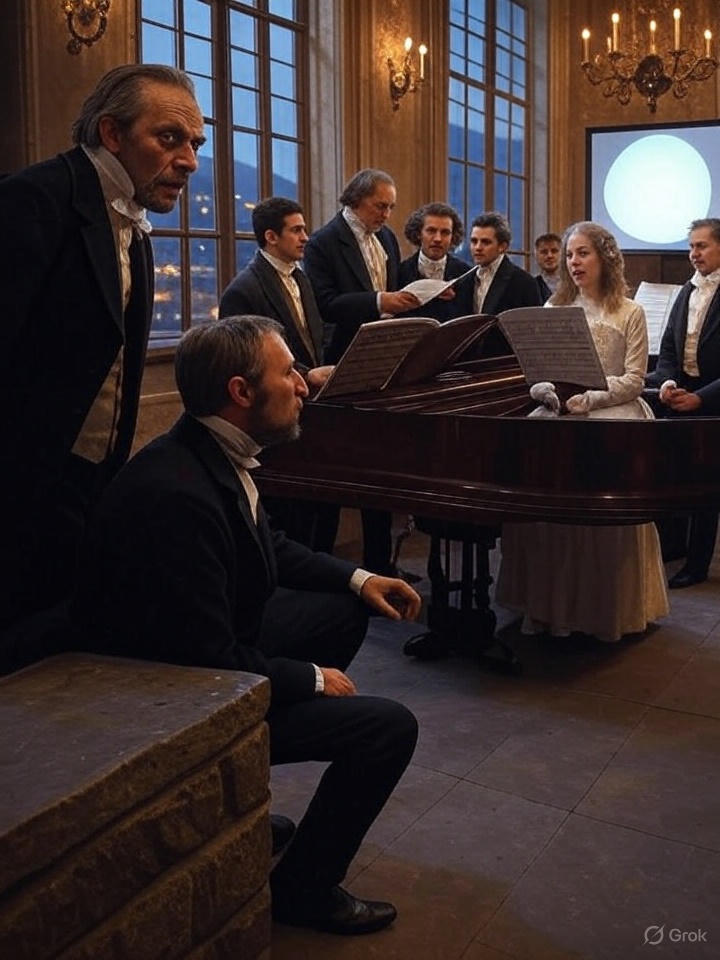
Karl Schuh bows: “Certainly, Herr Baron. But you promised that your gracious Fräulein daughter would sing. Everyone is tense, everyone full of joyful anticipation for a refined artistic enjoyment.”

Reichenbach makes a contemptuous hand gesture. “Hermine’s singing master has fallen ill, and there’s no one to accompany her.”

“Is that all?” says Schuh, as a modest self-confidence swells his chest, “I dare to take on the accompaniment.”

“Are you musical too, you jack-of-all-trades?” Reichenbach marvels.

“A little. As I said, if the gracious Fräulein will do me the honor…”

“Come,” and the baron pulls the young man by the hand toward Hermine, who is still desperately rummaging through the sheet music and doesn’t know how she should manage it, to retreat without causing a stir. “Here is the rescuer in need,” says Reichenbach, “Herr Schuh will accompany you.”

Hermine glances shyly up at the young man; this stranger is to accompany her, the risk only grows greater thereby, and a ghastly catastrophe will be the inevitable end. But the young man nods to Hermine with a laugh; he has a merry, good-natured, confident face; he winks roguishly, is not in the least intimidated by the crowd of people in the garden hall, and says: “It’ll be fine. What do you have there?”

A quick glance through the sheet music; “ta-ta … ta-ta-ta-ta,” he hums and takes a few grips on an invisible keyboard: “Well then, if you want to venture it… that’s no witchcraft at all.”

Something of his nonchalance and daring flows invigoratingly over to Hermine. It is no small thing to sing, worn down by the conversation with Doctor Eisenstein and the scene with her father, and in the uncertainty of whether she will find accord with this strange man.

But after the first bars, it becomes lighter in Hermine, a timid glimmering of hope for a happy outcome. At first she had sung as if in a stupor, the notes dancing before her eyes, scarcely hearing herself, crushed by the consciousness of having to sacrifice herself to the Moloch who sat there with fifty heads and gawked at her. But her accompanist masters the piano; he commands it more freely, less pedantically than her teacher, and yields to her in all things. Now Hermine sees the notes again and hears herself and overcomes her uncertainty and sings songs by a half-forgotten Viennese musician named Franz Schubert, of whom the old Meisenbiegel thinks highly.

The Moloch applauds, naturally, how could it do otherwise when the daughter of the house sings? There is no enthusiasm in it, however; this music goes too little into the ear—who is this Franz Schubert, after all?

But then the arias come. From Norma, from The Sleepwalker, there the audience roars, and the applause rages so genuinely and persistently that Hermine must encore “The White Lady.” It is a great success, almost as great as that of Dommeyr, and everyone claps, and Dommeyr embraces the singer, kisses her on the forehead, and says: “It is a crime, my child, if you do not go on the stage.”

Hermine stands radiant, and there is an infinite gratitude in her for the young man who has helped her to this triumph. She would gladly say a good word for him, but he is already away from the piano, for now he comes to his true domain.

The Baron von Reichenbach announces that Herr Karl Schuh will demonstrate his gas microscope and his camera obscura.

“Naturally, in the house of the scholar, science cannot be absent,” remarks the great Liebig to his neighbor, the dermatologist Hebra.

It turns out, however, to be more entertaining than most guests expect. Some preparations are necessary; a white screen is stretched, Schuh sets up an apparatus, and then the candles are extinguished.

Max Heiland uses the opportunity to lean over Dommeyr, as if whispering something in her ear, and kisses her bare shoulder.

The limelight hisses on, and then a bright circle appears on the stretched screen. Into it, the young man now conjures all sorts of strange things: the dotted canals of the conifers, the spiral air vessels of insect larvae, the Purkinje sweat canals, the vascular branchings on the hair bulb, the structure of bones, the enamel substance of the tooth, even the blood corpuscles of the frog.

A thoroughly serious matter, but Karl Schuh handles it wittily and entertainingly. He says: “So that the esteemed ladies know what their enchanting alabaster teeth really look like.”

Or: “Not just with beets and radishes, but also with the most beautiful women’s hair, it depends on healthy roots.”

They are all otherwise invisible things, unveiled secrets of nature, a penetration into the realm of the smallest and most inconspicuous, into a world of overwhelming wonders that the researcher alone normally enters, but which is here brought before all eyes.

No one, however, is so captivated by all of this as Hermine. She sits, surrounded by darkness, all eyes, spellbound by the light circle on the screen. What she wrests from nature through laborious work at the microscope is here laid out before her with seemingly playful ease. Everything this young man tackles seems to yield to him, to submit to his will; one has to do with a person whom life offers no resistances. It is sunshine over him, while one oneself sits on the shady side, oppressed by the heaviness of the blood, incapable of the élan and speed of existence. But there are bridges, airy bridges of double commonality between her and him, not only music, but also science.

And now Karl Schuh is finished and explains only that he is striving with all zeal to further perfect his apparatus and that it is merely a matter of producing an even more light-strong objective, upon which quite different results would then be showable.

And then he too reaps the applause of his very stimulated and satisfied audience. The professors Schrötter, Hebra, and Unger draw near in conversation; Count Coronini and Señor Cevallos y León, attaché at the Spanish embassy, express themselves very approvingly; even the great Liebig honors him with a few words.

Suddenly a commotion arises in the middle of the hall, an unrest, a pressing toward a point; a clump of people balls itself together. It has the appearance as if someone is unwell; certainly someone has become ill; yes, Frau Hofratin Reißnagel has just fainted from her chair.

The attending doctors busy themselves about her, but the young Doctor Eisenstein takes command: “It is nothing… I know it… the Frau Hofratin often suffers under such attacks… it is the heat, the many people, the closed windows… I beg you, make way.”

The Frau Hofrätin is carried into the Chinese room, where it is airier; she is laid on the sofa and washed with ether from Reichenbach’s laboratory. While she slowly revives, the guests depart; they have really stayed too long, and the way back to the city is far, but it has been an exceedingly beautiful evening, successful in every respect, except for the little incident with the Hofrätin, but now it is time to go.

Reichenbach shakes hands, smiles, and lets no one notice that he has a disappointment to overcome, because no one has come forward to point out in a little speech that this festival actually had a special occasion underlying it. It would have been fitting to say something comparable, for example, that one had gathered for the first time today in the house of a Freiherr von Reichenbach or something like that. In any case, it is his wish that no fuss be made of it; but it is certainly not his wish that the painter Heiland takes the Dommeyr’s cloak from the servant’s hand and drapes it over her shoulders himself, and that they then go off together, as if they were glad of their escape.

Karl Schuh stands before him and bows: “Will you be so kind as to have my apparatus returned to me tomorrow?”

“May I keep it for two more days? I would like to examine it more closely. In general, dear friend, I have much to discuss with you. You are a bright mind and a skilled practitioner, from whom even I can still learn a thing or two. And your piano playing—my utmost respect!”

“Won’t you occasionally make music with Hermine here and there? With the old Meisenbiegel, it’s no longer the right thing. Come, you will always be welcome to the father and the daughter.”

“If I may?” Karl Schuh beams with obvious delight, “Nothing could please me more.”

Now everything is gone; even the Frau Hofrätin has been stowed in the carriage and driven home with her husband and Eisenstein. The servants begin to clear up; Reichenbach wanders with hands clasped behind his back, sullenly through the discomfort of the ruins that remain after a festival. In front of the buffet in the rose room, Reinhold siphons remnants from the destroyed bowls and heaps them on a plate.

“Where were you?” asks Reichenbach, “I didn’t see you the whole evening?”

Reinhold startles at the sudden address. He hadn’t heard his father coming and had thought Reichenbach had already withdrawn. One is never safe from the father; he ambushes one often from behind, as if he were always lying in wait. It is vexing to feel caught and to stand there like a schoolboy.

“I could only come late,” says Reinhold with rising defiance, “Schuh was just showing his pictures.”

“Where were you?” asks Reichenbach, “it is strange that you seem to place no value on participating in your father’s gatherings. It was downright embarrassingly noticeable that you were absent.”

Naturally, no one noticed, but for educational reasons it is always appropriate to bring the criminal’s sin to his consciousness. “And I ask you,” the Freiherr continues, “put down the plate when you speak to me. It is not fitting that you stand there with the plate in your hand when you speak to your father.”

Reinhold folds and quickly sets the plate down among the cleared bowls. Yes, the father knows how to deal with budding disobedience in the twinkling of an eye.

“I was in the city,” Reinhold stammers, “in the Chemical Society. We have…”

“I will tell you where you were. You were with your big-mouth heroes, those students whose second word is freedom, those people’s benefactors who only stoke discontent and want to turn everything upside down. Those people are no company for you; remember that, you must take care that you are the son of the Freiherr von Reichenbach. A son of the Freiherr von Reichenbach must not associate with revolutionaries. Understood!”

Reinhold stands at attention, and after Reichenbach has sent a long, stern, threatening gaze after his words, he lets the chastened one go, to look once more at his silkworms before going to sleep.

Read Full Post »

OD by Karl Hans Strobl and translated by Joe E Bandel

“Certainly, certainly,” Reißnagel assured him eagerly, “your attacked honor has been restored spotless. The opponents had to admit that you were falsely accused of not having made your inventions yourself, and that you had proceeded honestly and conscientiously in the conduct of business. But there is still this second lawsuit regarding the final accounting…”

He paused regretfully, deeply saddened by the wickedness of the world in withholding what was due to a man like Reichenbach.

“Well,” said Reichenbach, carefully concealing his triumphant feelings behind an air of equanimity, “just today, Doctor Neumann wrote to me that he has reached a settlement with the Salm heirs.”

“Well, and?” burst forth the Privy Councillor, in utmost tension of his entire being.

“I will be paid out one hundred forty-nine thousand gulden in Convention currency, in cash!” It gave him immense satisfaction to lay this out so calmly in front of this witness.

“Children!” screamed the actress, kicking her legs, “and this man hasn’t said a word about it until now. Wins such a monstrous lawsuit… a hundred, forty-nine… Children, help me, I’m getting dizzy, I can’t even pronounce such a huge amount of money…”

“I had more coming to me,” Reichenbach interjected, “it was a settlement. I only got a portion of it.”

“Oh come on, settlement this, settlement that… a chunk of money like that doesn’t come into the house every day. And here we are drinking Nussberger. You’re a cheapskate, dear Baron. There ought to be champagne for that.”

This exuberant, whirling, uninhibited creature enchanted Reichenbach precisely through such outbursts of playful high spirits. Art, duty, profession—that was one side of life; why shouldn’t one, detached from them, be merry and bold and wild? Reichenbach couldn’t do it, and neither the tender, clinging Ottane nor the serious, somewhat plaintive Hermine could draw such laughter from him. But a spitfire like Therese went bustling through everyday life, sparkling and fizzing like fireworks.

Reichenbach looked at the exuberant tragedienne with a smile: “Your wish, Your Highness, is my command.” And he bowed.

“Bravo! Very good!” Therese called after him, “for court chamberlain roles, I could recommend you to the Burgtheater.”

In the Chinese room, Reichenbach encountered Ottane. She came toward him with quick steps, a bright, cheerful expression on her face, inwardly elated. “Well, Father?”

“You’ve done splendidly,” Reichenbach praised, taking her hand, “one wouldn’t even notice that the lady of the house is actually missing.”

A faint shadow of disappointment darkened the young face: “Aren’t you satisfied with me?”

Ottane’s task was to oversee the household; she took her duties seriously, attending to everything, and she believed that even today she had omitted nothing to make the festival worthy and splendid. What did her father find to criticize? Or was there something to the malicious hissing of some older ladies, that her father was paying conspicuous attention to the beautiful Dommeyr?

“Not satisfied?” said Reichenbach, laughing a bit awkwardly and forcedly, “very satisfied, in fact. You’re my little housewife, my sunshine. But isn’t the burden a bit too heavy for such young shoulders?”

Ottane straightened her young shoulders: “I can bear it, if you have trust in me.”

“Yes, yes… then it’s all right.”

The youthful buoyancy overcame the small discomfort, and perhaps now, since she could credit herself with a little slight, she might boldly bring up the great request.

“May I… I have a favor to ask, Father,” said Ottane hesitantly, slipping her arm caressingly into her father’s.

“What is it, my child?”

“I would like… oh, I don’t dare.”

“Out with it. Am I such an ogre?”

“Well—” and now the timid face flushed, “—well, Max Heiland, the great painter, would like to make a portrait of me. May I…?”

“Heiland? Well, Heiland, he is a great artist, after all…”

“All the ladies from the first circles are having themselves portrayed by him,” Ottane continued quickly.

Reichenbach did not particularly like the painter; rumors whispered of certain relations between him and Dommeyr, and he had actually only been invited on Therese’s account, but the circumstances were such that one could not well say no.

“In God’s name,” Reichenbach decided with fatherly mildness, “let yourself be painted by him too. But let Hermine accompany you to the sittings!”

“Father!” Ottane took his face between her hands and kissed him on the forehead.

“Are you so delighted because you’re entering art history? Well! And now, please, have the champagne brought.”

The champagne had of course been chilling for a long time, and its appearance had only awaited the cue.

Therese Dommeyr had spoken the monologue of the Maid of Orleans. It was remarkable what a change came over the woman as soon as she stepped onto a stage, even if it was only a small wooden scaffold covered with a carpet. All exuberance fell away from her; she became the high priestess of art entirely, standing before the red velvet curtain, regal. Inaccessible, transported above all that is common, and she spoke the verses like long-rolling waves, like song.

The people were enraptured, enchanted, felt themselves gifted and graced.

Therese Dommeyr had already drunk six glasses of champagne beforehand; no one could tell.

But as the applause crashed over her, a gentle intoxication came over her. She slipped behind the curtain into the cabinet that lay next to the small stage, through a door into the corridor and into the blue room, where Max Heiland was waiting.

“Servus, Max!” she said and gave him a smack on the cheek.

“Excellent! Unsurpassable!” the painter praised, “that’s how I’d like to paint you once, in stage ecstasy!”

“If one can’t paint the other ecstasies well,” Therese laughed.

“And how’s your old man doing?”

“I believe, if I offered him the little finger, he’d take my whole hand.”

The painter suddenly grabbed her hips and wanted to pull her to him.

“No kissing!” the actress warded him off, “the people are coming.”

The admirers pressed in, surrounded Therese and hung on the hands that she had to let them have, several on each hand.

“Like leeches,” Therese laughed.

And now Hermine is to sing.

Hermine is very excited. Despite her evasion, the young Doctor Eisenstein has managed to corner her, outside on the terrace, as it grew dark and everyone was just going into the garden hall to hear Dommeyr. She had only wanted to catch a bit of fresh air and gather herself after all the hustle, prepare inwardly; he must have lain in wait for her exactly, and it is right into the conversation she wanted to avoid, and she had to say all the embarrassing things that her father had charged her with.

“How can your father demand that you sit at the microscope your whole life?” Eisenstein asks.

And: “Your father is a tyrant!” Eisenstein says bitterly.

One can think that; one has often said it to oneself; but one cannot admit it when another says it aloud, and so the conversation took a quite bitter, harsh end. No, Hermine certainly does not love Doctor Eisenstein, no question of it, but he is after all a young man who is courting a young girl’s hand—no small thing in the life of a young girl. And if one is not exactly pretty, my God, not exactly ugly, but also not pretty, by no means as pretty as Ottane… and with time one will get a crooked back from the microscopicing and the eyes will lose their sparkle.

And now Hermine is to sing, still stirred up from this conversation.

The great excitement after Dommeyr’s monologue has subsided, everyone has taken their places again, everyone is tense, the father makes an impatient face.

He comes up to Hermine, who still makes no move to mount the podium. “What are we waiting for?” he asks impatiently.

“Meisenbiegel isn’t here yet!” Hermine answers nervously.

“Isn’t the carriage back?”

“He hasn’t come back yet.”

Ah, Hermine’s teacher, the singing master Meisenbiegel, is an old gentleman; gout nests in his bones, asthma rattles in his chest, and in his head, the throbbing rages all too often. A good teacher, an excellent teacher, but frail, blown about by every draft. Two days ago, at the last singing lesson, he had complained of a cold; certainly a cough or sniffles has come of it.

“Nothing else will remain,” Reichenbach considers, “but to ask the Schuh to show his gas microscope first, and you sing afterward.”

But then the baron catches sight of Severin, who stands at the door and makes signs to him. “Well, there we have it,” he says after listening to the servant, “your Master Meisenbiegel is lying in bed, making his reckoning with heaven and sweating. Such an old ram… lays himself down to die every two weeks. Who is to accompany you now?”

He looked at Hermine angrily, as if she were somehow complicit in the poor old Meisenbiegel lying in bed and sweating. She could certainly not help it, but in any case, the program was in question; who was to accompany her now—a bitter embarrassment, no doubt.

Read Full Post »

OD by Karl Hans Strobl and translated by Joe E Bandel

Chapter 6

The lord of Reisenberg Castle had been ennobled.

His king, the King of Württemberg, had lifted him from plain citizenry to the rank of baron. His youthful attempt to flee to Tahiti, for which he’d been imprisoned at Hohenasperg, was forgiven and forgotten. He’d been awarded the Royal Württemberg Crown Order, named an honorary citizen of Stuttgart, and now, back home, his contributions to science, especially its practical applications, were deemed so great that he could rightly be made Baron von Reichenbach.

The newly minted baron occasionally said it meant nothing to him, just something for others, but perhaps it was why he hosted this grand gathering today. This wasn’t openly declared or even hinted at, yet the guests likely thought as much when they arrived, one by one, and saw the new baronial crest carved in stone above the castle entrance.

Reisenberg Castle was originally a Jesuit country house, later acquired by Count Kobenzl, whose name gradually became tied to both hill and castle among the people. Now the old count’s crest above the entrance had been chipped away and in its place, the Reichenbach crest had been set.

“Is Reichenbach a Rosicrucian?” Professor Schrötter asks, pausing with Court Councillor Reißnagel before the door.

“Why?” the Councillor’s wife wonders.

“Don’t you see the cross with roses on the crossbars in his crest?”

“Rosicrucian—what’s that?” the Councillor’s wife asks, a slender, delicate lady with translucent pale cheeks and ever-dreamy, searching eyes.

“Rosicrucians?” her husband explains leisurely. “They’re an order, a society. They’re said to possess remarkable secrets.”

“If Reichenbach has a secret,” Professor Schrötter smiles, “it’s how to make money.”

Reißnagel chuckles. “Think so, my dear friend? It’s not that simple with the earning. He earns plenty, sure, but he’s got passions that devour money. And is the Ternitz ironworks really so profitable? You know, Reichenbach does me the honor of asking my advice now and then—on business matters, of course, not science…” He chuckles again. The Councillor’s wife hasn’t taken her eyes off the crest. “And the star in the bottom right, with arrows shooting out?”

“Those must be the meteorites, the shooting stars,” Professor Schrötter says after some thought, “that Reichenbach deals with.”

“Are the Hungarian ones included too?” Reißnagel chuckles. The councillor chuckles, and then the two men laugh in shared malicious glee.

“How’s it really going with that?” the councillor asks then, as they finally enter the garden hall and hand their coats to the servants. “What does science say about it?”

“Well, the matter has turned into a thorough embarrassment. Reichenbach has misfired once. The so-called meteorite fall in Hungary has become a fiasco for him. He calculated three hundred fifty thousand million little stones and claimed that our mountains, in part, so to speak, fell from the sky. To the Neptunian and Plutonian mountain formations, he added the Jovian ones, as he calls them. And it turned out that his Hungarian meteorites are ordinary bean ores, which have nothing to do with the sky and occur in masses on Earth. But against the opinion of the Court Mineral Cabinet, he sticks to his view. He has a thick skull.”

“Yes, he does,” the councillor confirms. “He’s a strange man altogether. A clear head, that you have to admit, but sometimes his imagination plays a trick on him. Imagination is something for poets and such folk, but not for officials, and certainly not for scholars.” And then, with a meaningful glance at his wife, he adds: “Too much imagination and enthusiasm is not for us ordinary mortals anyway.” Yes, imagination certainly holds no power over Councillor Reißnagel; his head looks like a well-ordered registry, everything filed by shelf numbers in compartments, and his rounded little belly guarantees the thoroughly earthly direction of his life philosophy.

“There are so many people here,” the Councillor’s wife says anxiously. “I should’ve stayed home.” She doesn’t handle such crowds of bodies well; a disagreeable feeling rises from the haze, a mix of human breath and various odors making her restless. She can’t quite express it, but it’s anything but comfortable.

Then the rising waves of social bustle separate them. There are indeed many people in the cheerful garden hall and adjoining rooms, and Schrötter spots Reichenbach’s famous guest, Professor Liebig—he must go greet him.

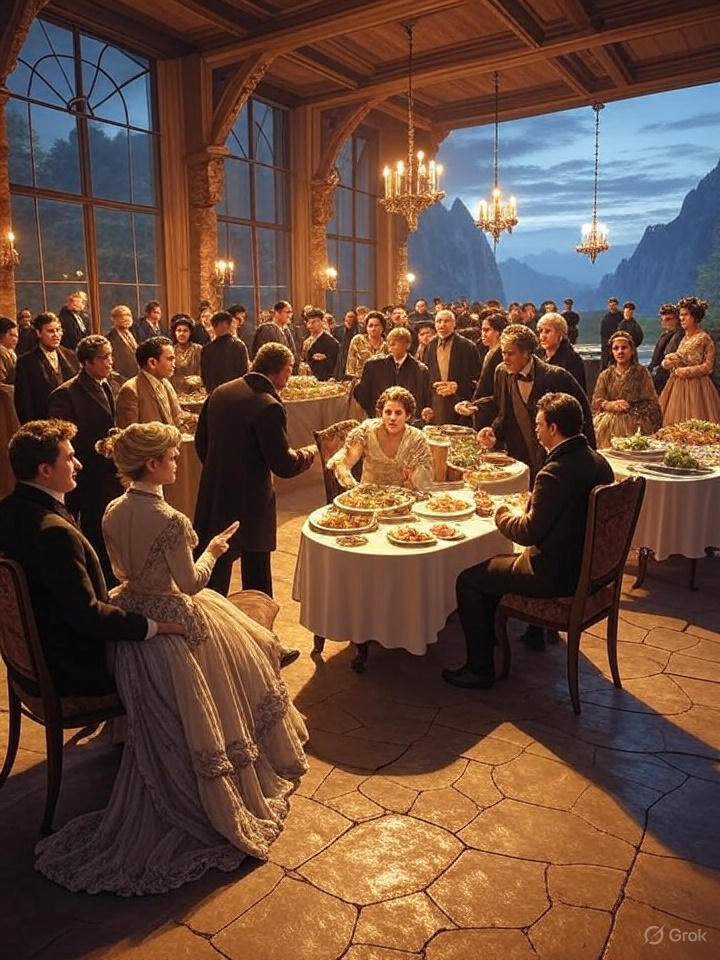
To Councillor Reißnagel and his wife joins their house doctor, the young Dr. Eisenstein. He kisses the gracious lady’s hand and inquires about her health. “That’s another of Reichenbach’s passions,” the councillor says. “Inviting so many people. He thinks he has to emulate Baron Jacquin, who for thirty or forty years gathered everyone in Vienna with name or reputation. But the heathen money that costs!” With that, he takes a plate from the servant appearing before him, scoops goose liver pâté from the silver dish, and secures a glass of wine on the nearby console table. “Who’s that young man over there talking to Ottane?”

Dr. Eisenstein can provide the answer. The young man with the laughing face, the lion’s mane, and the audacious tie is, of course, a painter, the painter Max Heiland, of whom so much is said nowadays, a genius, everyone wants to have themselves painted by him, a rat catcher after whom the women run, it is said that the noblest ladies are happy to be allowed to pose for him.

For geniuses, Councillor Reißnagel has only a contemptuous growl. “They may make money, but it’s all just hocus-pocus; geniuses are only a nuisance for a decent official, an unreliable element that one can’t trust. Genius and revolution, that somehow go together.” But then his small eyes sparkle with a cold, amused light: “Aha, the host! And of course with Therese Dommayer!” He wipes his mouth, swallows the Nussberger—by the way, a splendid Nussberger—and steers eagerly toward Reichenbach and the actress.

“You haven’t given me an answer yet, gracious lady!” says Dr. Eisenstein, leading the councillor’s wife apparently casually from the garden hall onto the terrace.

Beneath the terrace, the forest mountains slope in wonderful lines down to the plain, and below lies the city with its thousands of lights in the soft darkness of the summer evening. City and river and mountains, peacefully merging, an intimate clinging together of human existence and landscape. But the young doctor isn’t interested in the landscape; he has spotted Hermine’s light blue dress outside. Was it an unfavorable coincidence or deliberate evasion that Hermine has always slipped away from his approach until now?

“I had another attack yesterday,” the councillor’s wife complains. “I almost sent for you. It was the same as always—first raging headaches, everything becomes so loud and glaring and stupefying, smells, lights, pressing in on me from all sides, hostile and threatening, then a twilight where I lose consciousness. When I came to, I was sitting on the bench in the garden. I don’t know how I got there.”

“We should try the magnetic cure after all,” the doctor says distractedly, searching with his eyes for the light blue dress he had just seen over there next to the large iron dog from the Blansko foundry.

“Oh, my husband won’t hear of it,” sighs Frau Pauline. “He thinks nothing of magnetic cures and says my whole illness is nothing but imagination.”

Meanwhile, Reichenbach has led the plump, always cheerful Therese Dommayer to the buffet and piled a mountain of sweets on her plate. Although Therese Dommayer is a great tragedienne, the greatest since time immemorial, in everyday life she has a great fondness for sweets. She saves the grand tones for the stage; her daily life is closer to a bright laugh, a silvery chime—it would be nice if this bell-like laughter could be heard more often, as much as possible.

“It’s quite nice in your city house too, dear Baron,” she says, “but out here, you first realize what a poor dog one is if you’re always stuck in the city. How divine nature is! We theater folk—good heavens, sometimes one wishes the devil would take the whole thing. She blinked slyly up at Reichenbach and then made a wistfully swelling face. “Oh yes, you rich folks have it good.”

A scent rose from her bare shoulders, Reichenbach bent slightly embarrassed over her: “Aren’t you richer than anyone else? Rich in your art! Rich in the admiration of your contemporaries!”

She swatted at Reichenbach with her hand and replied, chewing with full cheeks: “Contemporaries, you’re right, dear Baron, contemporaries! That’s just it. How long does the whole glory last? A few years. Then it’s over, especially for a woman. And then it goes: the mime’s posterity weaves no wreaths. Sometimes one has a longing: to be away from the world-famous stages, married, have a good husband, have children.” She tilted her head in an inimitable, flowing melancholy.

Councillor Reißnagel arrived at that moment very uninvited, no, he was not welcome at all. He wore his oiliest smile on his face, and his belly broadly pushed the air before him. He had to express his most submissive congratulations orally to the host for his elevation to baronial rank and for this illustrious company today, which in no way fell short of that of the late Baron Jacquin, indeed, on the contrary, through the presence of an artist like the divine Dommayer, gave a consecration often missed at Jacquin’s.

Therese nodded and calmly shoved a piece of cake into her mouth.

One could not say otherwise, the councillor continued, than that a lucky star hovered over this house, a downright Napoleonic lucky star. And if now, moreover, this process—this somewhat protracted and certainly costly process with the Salm heirs—should also come to a satisfactory conclusion…

“You know, of course,” Reichenbach interrupted, “that I won the first lawsuit…”

Read Full Post »

by Karl Hans Strobl and translated by Joe E Bandel

Reichenbach grabs his coat and goes. The chief accountant thinks, thank God he’s leaving—I’d have had to get harsh otherwise; that damned know-it-all attitude can go to the devil, thinking he knows everything better.

Outside, the carriage waits. Reichenbach climbs in, and Johann tries to mount the coachbox, a pitiful struggle for his brittle bones. One leg barely makes the step, but lifting the second won’t do. Stiff, stiff joints, trembling knees—Johann pushes off the ground, hopping, hopping, but it’s a wretched, futile effort.

“Wait,” Reichenbach says, jumping from the carriage. “Get in! I’ll drive.”

The old man’s bright eyes widen in disbelief, his weary head shaking—how could this be? Get in? Then old Johann would sit on the blue cloth cushions, and the Herr General Director would take the coachbox. You can’t upend the order of the world—no, that won’t do.

“Shut up!” Reichenbach growls. “No arguing! Get in, and that’s that!”

No one defies the Herr General Director. The unthinkable happens: old Johann must sit in the carriage like a lord, while Reichenbach climbs onto the coachbox, taking reins and whip as if he were the driver.

Johann feels uneasy, but Reichenbach revels in wild inner joy, chuckling like a gleeful child. Yes, now old Johann rides like a lord, and let them at the castle see it and stew in their green and blue annoyance.

Sure enough, as he swings the carriage into the castle courtyard, someone at the prince’s study window starts back, stung by the odd spectacle.

Reichenbach carries his mocking, delighted grin into the study, flashing it at the two young men awaiting him.

First, Reichenbach learns that the stranger young man is Herr Lawyer Dr. Josef Promintzer, Dr. Promintzer from Vienna, successor to the old, somewhat complacent princely syndic Dr. Gradwohl, now retired.

“I’ve summoned you,” the prince says after the men take seats around the large diplomatic desk, “to discuss the balance sheet.”

“In the presence of the syndic?” Reichenbach asks.

“Indeed,” the young prince replies measuredly, recovering from the jab. He understands what Reichenbach means—that this used to be a matter of trust between his late father and Reichenbach, needing no lawyer’s involvement.

The men sit around the diplomatic desk, where the balance sheet and books, fetched by the prince yesterday, lie. The prince is a young, well-built man, slightly gaunt and stooped, with a stern, guarded, haughty face, almost entirely his mother’s. The new lawyer, by contrast, is a plump man with a short neck and a piggish snout. He wears owl-like glasses, like those Frau Paleczek, God rest her soul, used for reading. His breathing whistles through his nose, and a thick watch chain across his blue vest sways with his belly’s rise and fall.

A judicial air fills the prince’s study, the books and papers on the desk like evidence of a crime.

“It’s about this matter,” Dr. Promintzer begins namely, that certain things aren’t clear to His Princely Grace.”

Aha, Reichenbach thinks, those dubious entries I fought the chief accountant over, and instantly he’s ready to defend the accountant tooth and nail to the bitter end.

“Namely…” the prince continues, “the sugar factory. There’s a contract with my late father, the deceased old count—”

“Unfortunately, one might say!” Dr. Promintzer interjects.

“Stating the sugar factory must source its beets exclusively from the princely estate office at a fixed price.”

“We’ve talked about this several times, I believe,” Reichenbach grumbles. “Why throw money elsewhere?”

“Well,” the prince says haltingly, brow furrowed as if recalling a poorly learned lesson, “in bad years, with a poor beet harvest, the estate office can’t supply enough…”

“I find that irrational,” Promintzer cuts in quickly. “In good years, the factory could get beets cheaper elsewhere, but the estate office sticks to its price.”

“So what?” Reichenbach retorts. “We’ve gone over this ten times. It all ends up in the same pocket. Factory or estate office—it’s six of one, half a dozen of the other.”

“The contract with my late father, the deceased old count—” the prince says.

“Hm,” Dr. Promintzer interrupts, his eyes vanishing behind the glint of his glasses. “You shouldn’t defend this irrational operation, Herr General Director, when you’re profiting forty percent from the estate office—a remarkably high share, one must say.”

Reichenbach turns dark red. The urge flashes through him to grab Dr. Promintzer by his watch chain and knock the glasses off his piggish snout with two slaps. But then he tells himself slaps are poor arguments, and you only strike a man so swiftly and directly if he’s meant to fall—or has already fallen.

“Well, well,” he says slowly, leaning back until his chair creaks. “So you think my share’s too high, do you?”

Promintzer shrugs, and the prince says, “In general…” laying his hand on a document, “the last contract with my late father, the deceased old count… before, you had twenty-five percent generally… in the last contract, your share rose to thirty-three percent… my late father, in his final days…” The prince tilts his head to his shoulder, his face deeply mournful.

“His Princely Grace,” the lawyer chimes in, “His Princely Grace believes the contract must be revised, and the general power of attorney needs amending as well.”

Business is business, and matters of honor shouldn’t mix with it. It’s wise to hear where this is going. They talk around it for a while, and it becomes ever clearer to Reichenbach that there’s a point where pride demands no further haggling over petty details. They want cuts, even now, to last year’s profits.

“You forget,” Reichenbach says, his chair creaking again as he leans back, “that this is largely my work.” He gestures at the papers on the desk, but his motion sweeps wider, encompassing forests and smoking chimneys, blast furnaces and ore mines, offices and laboratories.

Promintzer snorts sharply through his nose, seeing he has the man where he wants him. “All due respect,” he says deliberately, “your inventions and discoveries, Herr General Director! But, hand on heart, creosote, paraffin, and so forth—everyone knows it was really the chemist Mader—”

Reichenbach slams the armrests of his chair and half-rises. He keeps hold of the armrests—it’s better not to let go. “That, Herr Doctor,” he says, “is despicable, a low blow…”

He doesn’t look at the lawyer or the prince but at the suit of armor by the desk. It’s better to fix on the armor, where one of their warlike ancestors stood, perhaps that Niklas Salm who saved Vienna from the Turks.

“Strong words!” Promintzer smirks. “Strong words!”

Reichenbach could make a grand exit now. He could say, “I request my dismissal,” or “I’ll find my justice,” or “We’ll meet again at Philippi,” or something like that. But he says none of it. It’s enough that he made that grand gesture over the desk, sweeping toward the forests and smokestacks. He regrets it—enough is enough. So he simply says, “Good day!” and walks out.

“You’ll see, he’ll slap us with a lawsuit,” Promintzer smirks.

“Do you think so?” the prince asks, surprised and a bit unsatisfied with the outcome.

“I’m certain,” Promintzer says, his thick watch chain swaying on his gleefully heaving belly. Dr. Josef Promintzer is a lawyer, and lawyers, after all, thrive on people suing each other.

Reichenbach descends the stairs, thinking, the last time. Oddly, he doesn’t think of Dr. Promintzer or the young prince, but of the prince’s mother, that stiff-backed, angular, bony former convent lady who her son so resembles.

In the courtyard, Forester Ruf stands, also summoned for an audience. His hat’s sweep catches Reichenbach’s eye, slowing his step. “Do you know what just happened, Ruf?” he asks.

“What, Herr General Director?”

Reichenbach kicks the air. “No more General Director. I’ve fallen from grace.”

“Good heavens, Herr General Director!”

“No dramatic scenes, Ruf! I saw this coming a long time ago. Now I’m in otium cum dignitate—to put it so you understand, Ruf, I’m my own master now. At Reisenberg near Vienna. And if you ever get fed up here, Ruf, you know—I can always use capable people.”

Read Full Post »

The old count spoke without undue solemnity, yet Reichenbach sensed something weighty behind it, an inner shift toward something new.

“And what’ll happen here without you?” Reichenbach asked.

“It’s a blessing I have you, Reichenbach,” the old count replied, a wistful smile in his voice. “You don’t need me. It’s as good as if I were here. No task is too much.” Perhaps he truly smiled now, but it wasn’t visible.

“And tomorrow I’ll come by the factory again,” the old count added, then left.

Frau Paleczek appeared with a light and set the table, but as she brought the plates, she suddenly wailed and ran out. After a while, Susi brought the supper instead.

“Where’s Paleczek?” Reichenbach asked.

“She’s sitting in the kitchen crying,” Susi said, but then her composure broke too. She swallowed hard, abruptly sobbing, pulled her apron over her face, and ran out.

After poking at his food, Reichenbach rose and went to the children’s room. It had been fumigated with sulfur and juniper and sprayed with vinegar, still smelling sharp. The children lay in freshly made beds but weren’t asleep yet.

“Have you done your assignments for tomorrow?” Reichenbach asked, standing by Reinhold’s bed.

“Herr Futterknecht said,” Reinhold admitted hesitantly, “we don’t need to do assignments for tomorrow.”

“So!” Reichenbach said, nothing more. Then: “Good night! Sleep now.” He shook Reinhold’s hand, stroked Hermine’s forehead, and bent to kiss Ottane’s cheek.

The child flung her arms up, wrapped them around his neck, and pulled him close. “Papa,” she whispered, “I’ll always be good and love you so much.”

The painfully sweet tenderness of such clinging melted the stiffness in his limbs, and Reichenbach held Ottane close.

“I promised Mutti,” the child whispered, “and she’ll always come to me and tell me what the sky-sheep sing.”

“When did you promise Mutti?” Reichenbach asked, just as softly.

“Tonight—when she was with me.”

Tonight? Tonight? What could that mean, tonight? A sudden stab of dread seared his heart. Troubled, shaken to his core, Reichenbach tucked the blanket over Ottane and went to the next room, where the drawings for the new furnace still lay on the desk.

The furnace was built to Reichenbach’s plans and exceeded all expectations. It roared, spat, and glowed, producing nearly as much charcoal as the wood fed into it, and most importantly, showed no tendency for unexpected mischief.

Once it was running smoothly, Reichenbach decided it was time to restart the abandoned Doubrowitzer hammer mill. So he put it back into operation. Then he thought it was time to build a drilling rig. He built one, installing a drilling machine—naturally, the largest in Austria,and could bore cylinders over twelve feet in diameter.

Then Reichenbach turned to agriculture, starting, as agreed with the old count, to grow sugar beets, which naturally required a sugar factory. Since farming was foreign to him, with no innate knowledge of it, nothing became more important than beets and sugar. Some things succeeded, others failed, and years passed. Looking back on New Year’s Eve, it felt like each year had only begun the day before yesterday.

Meanwhile, the old count traveled the world, writing long letters to Reichenbach about his findings.

The old count wrote that he and Lord Rumford conducted experiments on gas expansion, especially gunpowder, nearly blowing themselves up once.

He wrote that he’d heard of Jenner’s vaccination discovery, calling it a magnificent invention, and was now vaccinating himself. He sent vaccine and needles to Reichenbach for free distribution, later adding a self-written treatise on cowpox.

Reichenbach replied that it was indeed a great invention, but the people wanted no part of it. Meanwhile, the workshop was now producing hydraulic presses, water-lifting, and conveyor machines.

The old count wrote that he was now studying the Loserdorre cattle breed disease, to be fought with iron-containing hydrochloric acid, and he sent a self-written pamphlet on it. He was also on the trail of a remedy for rabies, likely in a cyanide compound. But against cholera, no cure could be found.

Reichenbach replied that the Brno censor was a fool for banning the old count’s pamphlet. As for rabies, he begged him, for God’s sake, to be careful with sick animals. Meanwhile, he was shipping barrel hoops to Singapore, cookware to Haiti, iron stoves to Turkey, and creosote to America and Egypt. He said nothing about cholera or its treatment.

Sometimes the old count came home. His eyes had a restless glint; he laughed loudly, sat in Reichenbach’s sofa corner, smoked like a chimney, and drank heavy wine. He looked over the books, made a few tweaks to the machines, then vanished again for days. During one such visit, Forester Ruf came and said, “Can you believe, Herr Director, the old count stopped by my place today?”

“So what?” Reichenbach asked. Why shouldn’t the old count visit Ruf? He roamed the valley, dropping in on folks, asking how they were, urging them and their children to get vaccinated against smallpox. Sometimes he liked to wander the woods in shabby, tattered clothes, like a traveling journeyman, chatting with old peasant women to beg from those who didn’t know him, only to richly reward them afterward if they gave him something. Why shouldn’t he have visited Forester Ruf?

“Well, but,” Ruf said hesitantly, “you won’t believe it. He sent Schnuparek’s widow, who’s watching the child, away, and when I came in, he was crawling under the table with the girl on all fours, barking like a dog, fooling around. He brought her a big new doll, too, and when he left, I saw money tucked in the mirror frame.”

“Why shouldn’t he give you money, Ruf?” Reichenbach said. “He probably remembered being at your girl’s christening and how different things were then.”

“But I don’t know if I can keep it,” Ruf stammered, flushed with embarrassment. “It’s a whole hundred gulden. The old count must’ve made a mistake.”

“Keep it!” Reichenbach urged. Yes, great lords sometimes had such generous whims, and perhaps the old count, with his incognito wandering and gift-giving, took after a caliph who’d done similar things. But Ruf shouldn’t thank him—the old count didn’t like being reminded of his kindnesses.

The old count never stayed home long. He’d look around briefly, bring gifts for Reichenbach’s children, praise their growth, looks, and progress, discuss business and new scientific plans with Reichenbach. But Friederike Luise was never mentioned.

Then the old count went on his way again.

He wrote: He had been admitted to the Société Harmonique in Strasbourg, where new and remarkable insights into human nature were to be gained. He was increasingly convinced that hidden forces lay in the human soul—a mysterious agent, a magnetic fluid, stretching into the incomprehensible. Mesmerism was merely a casual name for it. The laws of this natural force were still little explored, and he urged Reichenbach to study it, believing his skill and persistence could greatly advance science.

Reichenbach, grappling with sugar beets and tenants, thought something irreverent. Mesmerism, he felt, was for people with too much time, and it could slide down his back. A few months later, a letter arrived: the old count had become politically suspect in Strasbourg, likely because the French government had once seized his ancestral castle in the Ardennes. Facing arrest, he chose to slip away, continuing his studies in Vienna.

Then no further news came until a thick letter arrived, addressed in a stranger’s hand with black seals. It stated that the old count Hugo zu Salm-Reifferscheidt had unexpectedly died in Vienna of a heart ailment, leaving his heirs, his father the old prince, the widow, and his son, the young count, instructed before his death to renew the general power of attorney for Herr Karl Reichenbach. The enclosed power of attorney was signed in accordance with the deceased’s wishes.

This was written not by the old prince, the widow, or the young count, but by the old princely lawyer, Dr. Gradwohl.

In the midst of a heated argument with the chief accountant over booking certain items, the door opens, and old Johann enters.

He had knocked, of course, but with the shouting as the general director defended his view, no one heard it. Old Johann hasn’t grown younger since that glorious night of the meteor fall—a parchment-stretched skeleton, cheekbones nearly piercing his skin, nose crooked over a sunken mouth, but his eyes hold a strange brightness, as if seeing things clearer than younger eyes, perhaps through them. He had accompanied the late old count on his travels, not always a restful job, judging by what Johann occasionally lets slip. At any rate, he returned to the Rajzter castle quite aged and worn, and for a while, he was allowed to rest and do nothing. But then they pulled him out again, and the young count said Johann was far from too old to do nothing but smoke his pipe and whistle to his starling. The young count, barely made prince after his grandfather’s death, brought a sharper edge to everything, tightening all that was loose.

And the young prince thought old Johann far from frail enough to eat his bread for free, still capable of sitting on the coachbox, so long as it wasn’t the wild Lipizzaners hitched up. He could still save them a second coachman.

Now old Johann announces that the carriage waits outside and that His Princely Grace requests General Director Reichenbach to Rajtzer Castle. He says “requests,” though His Princely Grace simply said: Reichenbach should come.

Read Full Post »

OD by Karl Hans Strobl and translated by Joe E Bandel

“I’d like to know—what the Viennese would say,” Reichenbach quips.

“I thought,” the old count continues, ignoring the jest, “if this turns out alright for me, nothing will happen to your wife.”

“What’s supposed to happen to my wife?” Reichenbach asks.

“I’m worried about her. Her good heart puts her in danger. Don’t let your wife go to the sick. She can’t help them anyway.”

Reichenbach promises a husbandly command, and after the next glass of wine, they part. As Reichenbach climbs down from the carriage at his house, the old count calls after him: “And tell your wife I fell in the water for her sake. But next time, I’ll definitely bring back a stalactite. She’ll have to be patient till then.”

Reichenbach steps into the house, finding Reinhold loitering in the hall with a frightened face, clearly idle.

“Where’s your mother?” Reichenbach asks, eager to share his tale. He’ll ask Friederike Luise, Guess where I’ve been? She’ll be a bit shocked, scold him, but end up happy seeing his joy at their success. Then he’ll tease her that the old count is head over heels for her.

“Where’s your mother?” he asks again, three steps up the stairs, as Reinhold hasn’t answered.

Reinhold stands rigid, eyes fixed on his father’s face, wide with fear—his mother’s eyes. “Mother’s sick. She’s in bed.”

“In bed…?”

“And Peter’s gone to fetch the doctor…”

Reichenbach races up the stairs, taking three at a time.

Chapter 4

The night before Friederike Luise’s light went out, Reichenbach sat in his study, plans for the new wood-carbonization furnace spread before him, complete with changes and improvements born of past failures. One couldn’t endlessly stare into fate’s empty eye sockets; he had to force himself to turn his mind elsewhere. Sitting by the sickbed, waiting, was unbearable. Waiting for what? The inevitable, signaled clearly enough by Dr. Roskoschny’s averted gaze and head-shaking? For a man used to mastering life, gripping it with both fists, kneading his will into things, this was intolerable. Sitting at the edge of grief and despair, powerless to help, was beyond his strength.

There were the drawings and sketches—shut-off valves, serpentine heating tubes, exhaust ducts, condensers, bellows—but even as Reichenbach pulled himself together and spurred his focus, he could draw and calculate for an hour. In the second hour, his attention waned, and it rose around him like water, dissolving his limbs.

It was a green, glowing flood, like the water in the Punkva cave, and he drifted on a raft over it. He saw stones on the bottom, the play of fish, and then a face swam just below the surface—his own, of course. He had never seen himself so closely, every feature sharper than in any mirror. Yet there was something strange in the familiar, something mysterious, unsettling, fearsome. Yes, that’s how it must be, Reichenbach thought, when the veils are stripped away. Veils? he wondered immediately. Why that word?

He jolted, somehow pulled away from his blueprints by the question, feeling as if someone in the next room had spoken the word aloud.

Reichenbach listened intently, but all was silent. His head swam from the sharp odors of the fumigated house.

Next door was the children’s bedroom. The children were gone; they couldn’t stay with their sick mother—the doctor forbade it, and the old count insisted they be taken to his castle. Beyond the empty children’s room was the room where Friederike Luise fought her hopeless battle for life, the marital bedroom now overshadowed by death. Frau Paleczek was with the sick woman. She wouldn’t be kept from keeping vigil, as all the maids except Susi had fled, and even Susi couldn’t be persuaded to approach the bed. Strangely, Frau Paleczek’s heavy steps had softened, her bass voice now gentle.

Perhaps Friederike Luise had spoken in her fever, or Paleczek had said something, or someone had called for Reichenbach. He stood and went to the children’s room, Distant lightning flared silently through the night, a faint glow from the lantern above the front door creeping through the windows, just bright enough to reveal the three empty children’s beds.

Then Reichenbach saw a figure standing among the beds, a mere shadow, tall, fleeting, indistinct—but surely, yes, none other than Friederike Luise.

“How did you get here? What are you doing?” Reichenbach asked, astonished.

“I was with the children,” Friederike Luise’s voice answered softly, sadly. With the children, Reichenbach wanted to ask, but the shadow was suddenly gone. The empty beds stood there, and lightning flickered over the valley. No door had creaked, but somehow Friederike Luise must have slipped out, and if he hurried, he might catch her climbing back into her bed. A wild hope of a sudden turn for the better surged through him.

But when Reichenbach opened the door, his wife lay in her pillows, face turned to the wall, so faintly nestled he could hardly believe she’d stood before him moments ago. Frau Paleczek sat beside her, her dark face bent over a worn prayer book.

“Was my wife up?” Reichenbach asked.

Paleczek stared at him through owl-round reading glasses. “Up? Oh, Jesus, Mary, the gracious lady hasn’t stirred for two hours. I think she’s sleeping. That’s good.”

“But I saw her—” Reichenbach wanted to say. He held back, realizing exhaustion, inner brokenness, and hopeless longing had clouded his senses.

When Frau Paleczek thought the sick woman’s sleep was a good, healing one, she was mistaken. It opened a dark gate for the patient, who passed through at dawn without regaining consciousness—a rare mercy, Dr. Roskoschny said, almost a gift from heaven.

Frau Paleczek set to washing the body, though washing cholera victims was forbidden. She refused to let the body be covered with quicklime, as regulations required, and Dr. Roskoschny turned a blind eye, feeling Friederike Luise shouldn’t be lumped with the mass of other victims.

Remarkably, news of her death spread quickly among the people. Though she was buried on her death day with no pomp, her simple coffin drew an unusually large following. Usually, only a few close relatives trailed behind, hasty and timid, some even seeming relieved when the earth thudded into the grave. But people couldn’t seem to tear themselves away from Friederike Luise’s coffin. The sobbing wrapped around the coffin like a web, cloaking it in a blanket woven from the heart’s emotion. Everyone found it fitting that, after the pastor’s blessing, the old count stepped to the grave to speak.

He didn’t get far. “We’ve come to say farewell, Friederike Luise—” he began, but his voice broke, tears streamed down, he shook his head, and stepped back. Then people approached Reichenbach, shaking his hand; some gently touched the heads of the children standing meekly nearby. Most did so silently, though a few felt compelled to offer words of comfort. Reichenbach had held himself together with composure, never losing control for a moment. Everything had been strangely vivid, but now, as it was essentially over and faces kept appearing and turning away in an endless stream, a veil fell over his clarity. Many faces he didn’t recognize; others he named only after long thought. There was Mandrial, the pastor; the broad cheekbones likely belonged to the chemist Mader; the timid dog-like eyes to the tutor Futterknecht; and that wretched expression to Forester Ruf, who said something about six children…

Yes, yes, Reichenbach had heard something about it. He recalled now, in the days when Friederike Luise fought against death, something about his seven children. Six had died, and only little Friederike, the deceased’s godchild, was still alive.

Friederike Luise had likely caught the germ of the disease from Ruf’s children. Yes, that’s how things were connected—everything somehow intertwined, however incomprehensible it seemed.

Then Reichenbach climbed the stairs in his house, and someone walked beside him—the old count Hugo zu Salm, personally baptized by Maria Theresa. A little later, Reichenbach sat on the sofa in the living room, the old count beside him, the house otherwise eerily empty. There were likely three children somewhere in the house, but with Futterknecht, who ensured they stayed quiet.

The day was dreary and cool. Reichenbach shivered, saying, “Autumn’s not far now, and the doctor thinks the cholera will stop then.” It could stop now, having taken its toll.

Then a voice came, as if from deep darkness: “It was a sin… a sinful thought… you cast such things into the world, and there are indeed evil spirits around us, waiting for such thoughts. They seize them and turn them into weapons. It’s my fault.”

Reichenbach perked up, realizing the voice had been speaking for a while. “What’s your fault?” he asked.

“I shouldn’t have linked my life with hers. I shouldn’t have done it, back when I fell in the water. That thought: if I escape, nothing will happen to her. It was as if they let me go to take her instead. I’m to blame for her death. It just sprang up in me so suddenly.”

“How can you talk like that?” Reichenbach protested. “Ask the doctor—she caught it from Ruf’s children.”

“Yes, yes… but that doesn’t get to the root of it. It’s the life force that decides in the end. And I want to get to the bottom of things.” As darkness fell, the old count rose. “You’ll have to work without me for a while. Lord Rumford has invited me to England for some experiments he wants my help with. And Richter in Berlin wants to conduct a few trials together. Then I’ll study English wool-spinning. And in Strasbourg, there’s a Société Harmonique exploring Mesmerism—I’d like to look into that too. I’ve been planning it for a long time.”

Read Full Post »

by Karl Hans Strobl and translated by Joe E Bandel

Chapter 3

Three days after the christening feast, Frau Paleczek was back in the forester’s small cottage, but in a different role than before.

She had a corpse to wash—the body of Frau Ruf, who had died of childbed fever. Despite all brave resistance, death had won out, and Dr. Roskoschny’s hope of pulling her through was dashed. Medicine could name the thing raging in the new mother’s veins, straining her body and twisting her face in agony—childbed fever—but it couldn’t say where it came from or offer a real cure. In the end, it had to leave the outcome to God.

And now Frau Paleczek bent her face, black as the Virgin of Częstochowa or Kiritein, over the ashen one on the red-checkered pillow, dressing the deceased in a clean gown.

And then she said, “Jesus, Mary… seven children… such a pretty young woman… and seven little children … such misery… such misfortune. What’ll you do now, Herr Ruf?”

The forester sits in the corner, head in his hands, silent. What should he do? What can he do? He doesn’t know—seven little children, one a tiny infant, and their mother dead.

“For a few days, I can help out,” Paleczek grumbles in her deepest bass, full of pity, “but I can’t stay long, of course—I’ve got my own business to tend to.” Then, after folding the deceased’s hands over her chest, an idea strikes her. “Maybe your wife’s sister could come, your sister-in-law in Lettowitz. Right?”

The sister-in-law in Lettowitz. Maybe, perhaps the sister-in-law. But the forester is paralyzed, unable to stir. Just three days ago, he was a happy man, a man of importance, sitting between Frau Director and the pastor, bringing home a slight buzz—not from beer or schnapps, but from wine, fine wine like the gentry drink at the castle. And now look at him: seven children, and his wife dead!

Everyone feels great pity for him, all of them. They all come to the funeral, even Frau Director Reichenbach, and many weep as the coffin is lowered into the grave and the six orphans begin to sob. The old count is visibly moved, subdued and distracted in a way wholly unlike him—one might almost say timid. He speaks to no one and leaves after the funeral, heading straight home without looking at anyone. It clearly hits him hard that the woman has died—she used to help out at the castle often. Then Frau Director Reichenbach pulls Ruf aside and says, “You’ve got it tough now, Herr Ruf, but you must keep your head up and trust in God.”

Oh, keep his head up—if only it were that easy, if his head weren’t so heavy, sinking to his chest again and again. Worries weigh like lead.

“I’ll send Susi to you,” says Frau Director. “She’s good with children—she was the eldest of nine at home and had to look after the others. And I’ll come check on you every day.”

That lightens his head a good bit, enough for the forester to lift it and look into Frau Director’s eyes. His hand, no longer so limp, meets hers as she reaches out.

For a few days, Ernsttal and Blansko buzz with talk of Frau Ruf’s death—how young she looked, despite all those children, and how cheerful she always was. They speak of the tragedy of seven motherless children, of Frau Director Reichenbach’s kindness in taking them under her wing, and of the old count sending Ruf a heap of money—a saint of a man, that old count! The talk might have gone on longer, but then comes the news that the machinist Schnuparek, on Sunday, leaving the factory tavern walking out, is struck by sudden illness. A searing pain grips his gut, as if he’d drunk sulfuric acid, tearing his insides apart, turning him inside out. He clutches his stomach, groans, roars, and finally, everything goes black before his eyes.

They find Schnuparek in the roadside ditch, thinking at first he’s drunk, but Schnuparek isn’t drunk—he’s sick. They lift him and carry him to bed. Then Dr. Roskoschny is fetched. He puts on his gravest face, orders vinegar sprayed and juniper burned, and declares it’s cholera that’s struck Schnuparek.

It can no longer be hidden: cholera has come to the land. Now everyone knows what the falling stone from the sky meant. It foretold cholera, the great dying with no escape. There it is—laughing off such things and mocking the fear as foolishness does no good. The great lords don’t know any better than the common folk, and it might’ve been wiser to leave those ill-fated stones where they fell in the forest instead of picking them up and hauling them to the laboratory, as Reichenbach did. Surely they were poisonous, surely they carried the disease.

But what good is the whispering and grumbling now? The specter is here, its first shadow cast over the christening feast, standing among the people, reaching into houses and huts, snatching the farmer from the field, the worker from the lathe, the mold, the furnace, the miner from the pit, the clerk from his books.

Forester Ruf decides it’s time to fetch his sister-in-law from Lettowitz. Two of Frau Director Reichenbach’s maids have fled home to their village, where it might be safer, so Susi is hard to spare, and Frau Director can’t spend all day with the children.

But when Ruf arrives in Lettowitz, he finds his sister-in-law in bed. A few hours ago, she had to lie down, gripped by searing pain in her gut, moaning and groaning, her face burning with fever, blue spots visible on her chest.

Ruf sits with the sick woman for half an hour, giving her drops of Jerusalem miracle balm, good for everything—frostbite, toothache, gout, headaches—then leaves, deeply troubled and at a loss, heading home.

Plenty of fresh air, preaches Dr. Roskoschny, plenty of fresh air and movement.

Work grinds to a halt; people are sick or hiding. This gives Reichenbach time to explore the strange land fate has brought him to. He believes one must know how to gain something from every situation, even making misfortune serve a purpose.

Years ago, when he was at the chemical laboratory of the Polytechnic Institute in Vienna, the old count Hugo met Salm-Reifferscheidt, this region was as foreign to the Swabian as some stretch of the Congo or Niger. Even then, the two men took a liking to each other, bonding over their scientific pursuits. When the old prince handed over the estates and factories to his son to retire, the old count promptly summoned Reichenbach. That was many years ago, and the ironworks and laboratory have consumed so much time and energy that little else could take hold.

Now, though, there’s a chance to look around. It’s a remarkable landscape, these forests in the heart of Moravia—a stretch of limestone with strange sinkholes, caves, and karst rivers. There’s the Macocha, or “Stepmother” in German, a chasm so deep you could set Vienna’s St. Stephen’s Tower in it; caves with bones of prehistoric animals and ancient firepits; underground domes and passages with stalactites. And the rivers! They surge from a rocky maw, dark and unfathomable, only to vanish again into mysterious depths after a brief run above ground.

Reichenbach roams with a geologist’s hammer, tapping cave walls, digging in clay-filled crevices. Then a desire grips him to uncover the secrets of the Punkva River. Others have tried and failed before him, but he will succeed; what others botch only spurs him to push to the utmost.

It’s settled: Reichenbach and the chemist Mader are to venture together, each on a light raft, to probe the Punkva River’s secrets. It must be done discreetly—Friederike Luise shouldn’t know yet; no, it’s better not to tell her, as she’s no fan of such risky undertakings. Reichenbach waits for Mader, then realizes he should say goodbye to Friederike Luise. There’s no real danger, but still, one doesn’t just slip away without a word.

“Where’s your mother?” he asks Reinhold.

Reinhold stands at attention. “She just left for Forester Ruf’s—one of the children is sick, and she’s going to check on them.”

Reichenbach paces impatiently in the garden, plucks a green caterpillar from a rosebush and crushes it, then cuts an unruly vine from the arbor with his knife. Mader’s taking his time—always taking his time. Someone needs to give him a good shake.

Someone passes by the bushes outside. But it’s not Mader—it’s the old count. “Mader sent me,” he smiles. “I’ve switched places with him.”

“What? Mader? Switched?”

“It’s not very nice of you,” the old count says good-naturedly, feigning offense, “keeping secrets from me. Why not take me along, Reichenbach? You know I’m keenly interested in such things. I tried it once long ago with a canoe, but it didn’t work out.”

“So Mader couldn’t keep his mouth shut?”

“Thank God, or I’d have missed out on the fun.”

“But—you know a fellow from Vienna nearly drowned trying to swim it. If his wife hadn’t pulled him out…”

“Does your wife know?”

“No,” Reichenbach says, “she mustn’t find out.”

Then the old count asks, as Reichenbach did earlier, “Where’s your wife?” Perhaps he asks because he thinks it wise to shake her hand before embarking on something rather unusual. He seems uneasy to hear Friederike Luise isn’t home.

“Well, then, let’s go in God’s name,” he says finally.

They walk on foot to avoid drawing attention or involving too many people. But as they pass near the forester’s cottage, they spot Friederike Luise on the meadow path. The old count stops, his face lighting up with joy. “I haven’t had the chance to see you in ages, gracious lady.”

“You were at Ruf’s?” Reichenbach asks.

“Yes, Lada’s very sick—the third eldest. The doctor just arrived and sent me home at once. He was almost rude, told me not to dare come back.”

“Does he think—?” Reichenbach hesitates, reluctant to say the word, as if speaking it aloud carries danger.

“Please be careful,” the old count urges, concerned. “What good does it do? You can’t help, and you have children at home.”

Read Full Post »

« Newer Posts - Older Posts »