Feeds:
Posts
Comments

Posts Tagged ‘books’

Homo Sapiens: Under Way by Stanislaw Przybyszewski and translated by Joe E Bandel

X.

The restaurant was not closed despite the advanced hour; Flaum still had guests, and so they went in. The editor ordered wine.

“I’m very glad,” he said, “that we met again. It was terribly interesting how you performed at the district commissioner’s today. But—forgive me—you judge a bit too much in bulk and wholesale.”

“Yes indeed I did that. I often do. That’s self-evident. Every thing really has very many different sides, which—understand—not lie next to each other for convenient overview. No, sir, on the contrary. There are the most various illuminations. A thing is like a hectogon; only one surface gets full light there. And now look: the whole human judging rests on the fact that only this one surface is considered and perhaps still three or four that lie closest.”

Falk emptied the glass.

For his intellect there was no judging at all. He could say nothing certain about any thing. If he judged at all, it happened merely because he somehow had to communicate with people, and then he judged just like all other people, i.e. he proceeded from certain premises of which he knew that they counted as “given,” and drew the conclusions.

But for himself there were no premises and therefore also nothing “given”; he therefore asked the Herr Editor not to take his opinions as absolute.

The editor seemed not to understand that and drank to Falk for lack of an answer.

The young doctor listened curiously and drank very eagerly. Suddenly he got the desire to annoy the editor: Falk joked so excellently.

“What do you think, but in all seriousness, of a social future state?”

The editor winked his eyes; he noticed the malicious intent.

“What do I think of that?” said Falk. “Yes, I already developed at the district commissioner’s my opinion, which rests on ‘given’ valuations.”

“By the way, this whole state interests me only insofar as it—admittedly again only if the premises are correct, Herr Doctor—yes, only insofar as it can bring certain reforms in the field in which I am active.”

“Look, then for example the state will also create the social living conditions for artists, and then you can be convinced that many people who now à faute de mieux became artists because it is nowadays the easiest bread, will then rather become supervisory officials in some warehouse or otherwise make themselves somehow useful with four- to six-hour work time and social equality. Artists will be only those who must.”

The editor, who now scented joke behind every word of Falk’s, threw in irritably:

“You seem to hold artists in low esteem too?”

“No, really not, and precisely because there are almost no artists, or if there are any, they botch themselves immediately as soon as they have to bring their wares to market.”

“For me only he is an artist who is not otherwise able to create than under the unheard-of compulsion of a so-to-speak volcanic eruption of the soul; only he in whom everything that arises in the brain was previously glowing prepared and long, long collected in the warm depths of the unconscious—let us call it—that doesn’t write a word, not a syllable that is not like a twitching, soul-torn-out organ, filled with blood, streaming to the whole, hot, deep and uncanny, like life itself.”

“Well, such artists he probably never met?”

“Oh yes, yes! but only among the despised, the unknown, the hated and ridiculed, whom the mob declares idiots.”

Falk drank hastily.

“Yes indeed; and one of the greatest I saw go to ruin and perish. There was one, my schoolmate; he was the most beautiful

man I ever met. He was brutal and tender, fine and hard, he was granite and ebony, and always beautiful. Yes, he had the great, cruel love and the great contempt.”

Falk pondered.

“Yes, he was very strange. You know, that characterizes him: we once got the essay topic: how heroes are honored after death.

Do you know what he wrote? what would probably be the greatest honor for a hero?

“Well?”

“Yes, he wrote: the most beautiful honor he could imagine for a hero would be if a shepherd accidentally dug up the bones of the hero in question, then made a flute from the hollow bones and blew his praise on it.

Another time he wrote on the topic what benefit wars bring, that wars are a great boon for farmers, that they namely excellently manure the soil with the corpses of the fallen warriors; corpse manure is much better than superphosphate.

Yes, allow me, that is brutal; but brutal like nature itself. That is mockery; but the terrible mockery with which nature plays with us. Yes, sir: that is the sublime mocking seriousness of nature itself.”

The editor was silent, offended.

“Does Herr Falk want to joke with him? that really isn’t nice.”

“No, he doesn’t want that at all, he never joked with any person, least of all with the Herr Editor.”

“Yes, then they are only personal opinions that can apply only to one person.”

Falk felt a strange irritability that he couldn’t comprehend; but he controlled himself.

“Yes indeed; my opinions apply only to me. I am I and thus my own world.”

“Well, Herr Falk seems to have strangely high opinions of himself.”

“Yes, I have, and every person should have them. You know, there is a man in Dresden who calls himself Heinrich Pudor. In

general one holds him for a charlatan and he indeed makes himself talked about through strange quirks. For example, recently he demanded of the state attorneys that they prohibit the playing of Chopin’s music because it is arousing and sensual. But despite all the quirks there sticks in him yet a strange power.

Recently he held an exhibition of his own paintings in Munich. The paintings are supposed to be ridiculous and childish; I don’t know, I haven’t seen them. But for the exhibition he wrote a catalog in which it says: I am Heinrich Pudor! I am I! I am neither an artist nor a non-artist! I have no other attributes than only that I am I!

Look, that is well said.

No, you are mistaken, Herr Doctor: that is no excessively demanding significance. For as soon as I am human, I am precisely a significant, uncannily significant piece of nature. If I now say: Here are my paintings! however ridiculous they may be, but they are a piece of me! and presupposed that they are really generated from innermost compulsion: then they characterize me better than all good deeds I have done and will still do.

Here is a piece of my individuality; whoever is interested may look. I am I, and nothing is in me of which I need to be ashamed.”

“But that is absolute megalomania,” the doctor threw in.

“Absolutely not absolute and absolutely not relative! You as doctor should know that the so-called megalomania goes hand in hand with the loss of individuality. Only when the consciousness of my ownness is lost do I hold myself for Napoleon, Caesar etc. But even the strongest consciousness of my own I and its significance has nothing maniacal.

No, on the contrary: it educates humanity, it produces the great individuals of which our time so terribly lacks, it gives power and might and the holy criminal courage that until now has created everything mighty.

Yes, he certainly has that, Herr Editor! Only the ‘megalomaniac’ consciousness has the great energy and cruelty, the courage to destroy, without which nothing new and splendid comes about.

By the way, hm, it is indifferent whether one has it; the main thing is that one *must* have it! yes, *must*…

Again the unrest and fear rose high in Falk.

“No, it is really terribly idiotic to waste our time with stupid conversations; this empty threshing of straw. No, to the devil, let’s be merry, let’s drink! The riddles of life… hey! Herr Host! another bottle!”

And they drank. Falk was very nervous. His mood communicated itself to the others. They drank very hastily.

Soon the editor had drunk beyond measure.

“Yes, he loved Falk above all; he would consider himself happy to have him as a collaborator.”

Falk had definitely promised him to send regular reports from Paris to his *Kreisblatt*.

The doctor giggled.

“*Elbsfelder Weekly*: two columns ads, regular reports from Paris! Ha-ha-hah, where is the village Paris?”

The editor felt mortally insulted. Falk listened into himself.

An infinite longing for his wife dissolved in him. Yes! her bodily warmth, her hands and arms!

Strange how Marit had completely left him; no trace of desire. He broke up.

When he came home, it was already day. He cooled his eyes in the washbasin and opened the window. Then he wrote the following letter:

My dear, above all beloved wife!

I am drunk with my love. I am sick and wretched with longing for you. Nothing concerns me in this world except you, you, you!

You love me; tell me how you love me, you my, my everything!

And when I am with you, how will I find you, how will you be to me? Am I still to you your great, beautiful man? Why was your last letter so sad?

How everything in me groans for you! How I long for you! Tell me! am I to you what you are to me?! – The light, the life, the air: everything, everything in which alone I can live? For you see: now, now I know

sure: never have I known anything more surely: I cannot live without you! no, really not.

Only love me! Love me beyond your power; no, as much as you can. You can very, very much! Only love me, love me.

I will write a whole literature for you, just so you have something to read. I will be your clown so you have something to laugh at. I will crawl under your feet, like a slave I will serve you, the whole world I will force to its knees before you: only love me as you loved me, as you perhaps still love me. I will with absolute certainty leave here in two days… Your husband…

But when Falk had slept it off, he made five days out of the two—after which he took the letter to the post.


Read Full Post »

Homo Sapiens: Under Way by Stanislaw Przybyszewski and translated by Joe E Bandel

Well, soon more new senses will be found, such as for example a individual-sense that smells and hears what you yourself cannot smell or hear.

You don’t believe that?

Yes, then explain the following fact to me. I dream, the door is ripped open, a man steps in. I jump frightened from the bed: no person in the room. Only after about three minutes does my acquaintance really come. Now consider: the house I lived in then was 100 meters away from the next house.

In front of my house was a meadow that made all steps almost inaudible. And yet something in me heard my acquaintance’s steps at a distance of three minutes; therefore, sir, a distance at which a person in waking state can absolutely impossibly even vaguely hear anything.

So something hears in me that *I* do not hear. Right?

Yes, but the non-existence—please, please; I am quite impatient. Look, that you cannot prove to me; but comfort yourself, you are still a great man, you can calmly serve our dear Lord God as a shovel with which he shovels understanding into people’s heads.

Falk grew tired; in his brain everything began to confuse. He only repeated himself, repeated his own words and sentences.

Suddenly he saw the monastery before him.

Strange that he hadn’t seen the cemetery before. Marit! – Marit…

Good God, how did he now come to think of Marit?

He became nervous. Why did he suddenly remember Marit!

He thought, stopped, walked in a circle; noticed it, walked again, became angry; became more eager in thinking, sweat broke out on his forehead, suddenly he had it.

He was completely happy.

‘Look, Herr Editor, you all-knower, you third eye of our dear Lord God, just look at this case. I ask you, in what relation does Marit stand to this monastery?’

Yes, of course, she was raised in a monastery; I thought of that earlier, not today. But tell me, how did the relation now come into my soul?

You don’t know; well, I’ll tell you.

Look, I have a great rage against monasteries in general because a monastery botched my Marit for me. And now I only need to see a monastery, and immediately I think of Marit. And if I saw a hundred thousand monasteries, I would always and every time think of Marit.

There in that amazing wonder-sense an indissoluble connection was immediately formed. Understand?

And then I walked, as I thought about it, completely unconsciously in a circle here on the path, until I noticed it. Do you know why?

Because I am accustomed to walk around in the room when thinking, and I almost always think in the room.

Look, sir, go to the physiological laboratory and pay attention. I take a rat here, now I remove whole brain parts from it up to the bridge; naturally you don’t know again what bridge in the brain means. Yes, that must a person know who claims education. Now look, the rat is completely dumb; it feels nothing, hears nothing; it perceives nothing; it is simply mentally dead. Now you shall see a miracle. I take a cat and beat it: the cat meows. Look, look: how the rat becomes restless, how it wants to run away!

Now do you know what the amazing wonder-sense, the individual-sense, is?

By the way, you are the most indifferent person in the world to me, understand? That is, you are an ass!

But Falk could speak what he wanted, think what he wanted, to distract and intentionally scatter himself: through everything shimmered a hot undercurrent: Marit – Marit…

Suddenly he felt a violent jerk: Does a normal person think like that? He walked in fever shudders. Fear rose in him. It seemed to him as if he rolled

into a barren abyss and everything would be swept away from the world. Now thinking stopped, and only the terrible feverish fear-feeling became ever wilder. – Everything black, barren, desolate. Then light came again into his head; the life that now should come, with this unrest, this eternal torment and longing, unrolled before his eyes.

Yes, why then? why?

Why all that. Why do I torment myself. Why all this effort, this whole running back and forth, only to satisfy the ridiculous lust of sex?! He laughed scornfully.

Isn’t it idiotic?

But again he felt the fear, an unheard-of, mad fear such as he had never felt before, and with staring, wide-open eyes he gasped out:

Why? Why?

He jumped over the ditch with a sudden jerk, and came to his senses. It seemed to him as if he were hunted by beasts.

Now he had to think, quite rationally and logically think; that would calm him.

But always the terrible “Why?” grabbed through all his thinking.

He tried to imagine it to himself.

So he was an instrument in the hand of a thing that he didn’t know, that was active in him, that did what it wanted, and his brain was only a quite ordinary handyman.

If he now seduced Marit, it wouldn’t be his fault. No, absolutely not. He had to do it; it was his fixed idea.

Right, Herr Falk? There is a quite firmly ring by ring chained chain, to which always new rings necessarily attach.

Some psychic spiral spring, a psychic clockwork was wound up, wound up by a thousand external circumstances, and now the rings and wheels of my action must simply turn!

Good: I resist, I fight against it. But even this resistance is predetermined from the beginning. And since I succumb, I simply succumb. I must.

Yes: he was actor and spectator at once, was at once on the stage and sat in the orchestra. No: he sat above himself and noted with a kind of super-brain that something was happening in his ordinary brain.

A terrible sadness overcame Falk. No, why did he torment himself?

He couldn’t fight anyway, he had to fold his hands in his lap, he had to let everything go as it wanted, no, as it *must*.

Yes, *must*, *must*…

Falk was very exhausted.

Like a rainbow after a thunderstorm suddenly appeared to him the face of a boy. A feeling of longing overwhelmed him, a choking pity for himself, a longing for people.

So he came to the city. He had to pass the district commissioner’s house. Just then the editor and the young doctor stepped out the door.

“Where did you disappear to so suddenly?” Falk became a little confused.

“He had accompanied Fräulein Kauer home; for the coachman had namely been senselessly drunk, and so it wouldn’t have been advisable to entrust the young girl to him.”

“Wouldn’t he like to take a nightcap punch at Flaum’s?”

Falk considered. Again he felt the lurking fear. Only not be alone; no, for God’s sake not.

“Yes, I would very much like to.”

Read Full Post »

Alraune by Hanns Heinz Ewers and translated by Joe E Bandel

The student looked across, she always looked good, this old,
well-formed lady. He believed she really had all the adventures that
she related. At one time she had been the fiery Diva of Europe. Now
she lived in this city that was still stuck back in the fourth century in
her little villa. She took long walks through her gardens every
evening, put flowers on the graves of her dead hounds and cried for a
half-hour.
Now she sang. She had lost her magnificent voice years ago, but
there was still a rare magic in her performance, out of the old school.
The smile of the conqueror lay on her rouged lips and the thick face
paint attempted to capture the former sweetness of her features. Her
thick sweaty hands played with her ivory fan and her eyes searched
the room as if trying to scratch and pull the applause out of the
audience.
Oh yes, she certainly fit in here, Madame Marion Vère de Vère,
fit in this house, like all the others that were guests. Frank Braun
looked around. There sat his dear uncle with the princess and behind
them leaning against the door stood Attorney Manasse and Chaplain
Schöder. The long, gaunt, dark chaplain was the best wine
connoisseur on the Mosel and the Saar. It was nearly impossible to
find a wine cellar that he had not gone into and sampled. Schröder
had written a never-ending clever book about the abstruse philosophy
of Plotinus and at the same time had written the skits for the Puppet
Theater in Cologne. He was particularly enthusiastic about the first
Napoleon. He hated the Prussians and anyone that spoke of the
Kaiser. Every year on the fifth of May he traveled back to Cologne
and the Minority Church where he celebrated a High Mass for the
tormented dead of the “Grand Army”.
There sat large, gold spectacled, Stanislaus Schacht, candidate
for a degree in Philosophy, in his sixteenth semester, too fat, too lazy
to get off his chair. For years he had lived as a lodger at the widow of
Professor Dr. von Dollinger’s house. For a long time now he had been
installed as the new master of the house. She was that little, ugly, over
thin woman sitting beside him, always filling his glass and loading his
plate with heaping portions of food. She didn’t eat anything–but she
drank as much as he did and with every new glass her ardor grew. She
laughingly caressed his huge meaty arm with her bony finger.
Near her stood Karl Mohnen, Dr. jur and Dr. phil. He was a
schoolmate and chess player. It was through chess that they had met
and become great friends. By now he had studied almost as long as
Stanislaus, only he was always taking exams, always changing his
major. At the moment it was Philosophy and he was studying for his
third exam. He looked like a clerk in a department store, quick,
hurried and always moving.
Frank Braun always thought that he should go into business as a
merchant. He would certainly be happy running a confectionery
where he would have women to serve him. He was always looking for
a rich party–on the street–large window promenades too. He had an
aptitude for meeting new people and making new friends, especially
traveling English women. He clutched onto them gladly–but sadly
they had no money.
There was still another person there, the small Hussar lieutenant
with the little black mustache that was chatting with the girls. He, the
young Count Geroldingen, could always be found back stage in every
theater performance. He painted the sets, was talented with the violin
and the best horse racer in the regiment. He was now telling Olga and
Frieda something about Beethoven that was horribly boring. They
were only listening because he was such a handsome little lieutenant.
Oh yes, they all belonged here without exception. They all had a
little gypsy blood–despite titles and orders, despite tonsures and
uniforms, despite diamonds and golden spectacles, despite all the
civilized posturing. Some were devouring food; others were making
small detours away from the path of civilized decency.
A roar resounded and merged with Frau Marion’s singing. It was
the Gontram rascals fighting on the stairs. Their mother went up to
quiet them down. Then Wölfchen screamed in the next room and the
girls had to carry the child up into the attic. They took Cyclops along,
putting both to bed in the narrow child’s wagon.
Frau Marion began her second song, “The Dance of Shadows”
from the opera “Dinorah”.
The princess asked the Privy Councilor about his latest
endeavors and if she could come once more to see the remarkable
frogs, amphibians and cute monkeys. Yes, she could certainly come.
There was a new species of rose that she should really see. It was at
his Mehlemer castle. He also had large white camellias that his
gardener had planted; she would be interested in them as well.
But the princess was more interested in the frogs and monkeys
than the roses and camellias so he related his endeavors to transfer
eggs from one frog to another and artificially inseminate them. He
told her that he had already produced a beautiful female frog with two
heads and another with fourteen eyes on its back.
He would dissect one and remove the eggs from it and fertilize
them before transferring the little tadpoles to another frog and just like
that, the cells would merrily divide and develop into new life with
heads and tails, eyes and legs.
Then he told her about his efforts with monkeys, relating that he
had two young long tailed monkeys that were being suckled by their
virgin mother–She had never even seen a male monkey!
That interested the princess the most and she asked for all the
details. She had read something about it but didn’t understand all the
Greek and Latin words. Maybe he could explain it to her in perfect
German so she could understand?
The obscene cliches and behaviors dripped out of the Privy
Councilor as he explained in anatomical detail just what he did.
Spittle drooled down from the corners of his mouth and ran down his
heavy, hanging lower lip.
He enjoyed this game, this obscene chatter, watching her
voluptuously slurp up every shameful word. Then when he was close
to saying an especially repulsive word, he would throw in “Your
Highness” and savor with delight the titillation of the delicious
contrast.
And how she listened to him! Her face was becoming flushed,
excited, almost trembling, sucking this Bordello atmosphere in with
all of her pores, as he unveiled what really went on behind the thin
scientific banner.
“Do you only inseminate monkeys, Herr Privy Councilor?” she
asked breathlessly.
“No,” he said, “also rats and Guinea pigs. Would you like to
watch, Your Highness, when I–”
He lowered his voice, almost whispered.
She cried, “Yes, yes! I must see it! Gladly, very gladly! When?”
Then she added with a slow, almost evil dignity. “Did you know,
Herr Privy Councilor, that nothing interests me more than the study of
medicine. I believe I would have been a very talented doctor.”
He looked at her and grinned widely, “No doubt, Your
Highness.”
And he thought, that she certainly would have been a much
better Bordello Mother. But he was satisfied; he had his little fish
hooked safely on his line.
Then he continued again about his new breed of rose and the
camellias at his castle on the Rhine. It was so troublesome for him,
and he had only taken possession of it as a favor. The location was
such an excellent one and the view–Perhaps when her Highness
finally decided to buy a place she might–
Princess Wolkonski decided herself, without any hesitation at all.
“Yes, certainly Herr Privy Councillor, yes, certainly, naturally I
will take your castle!”
She saw Frank Braun going past and called out to him, “Hey,
Herr Studious! Herr Studious! Come over here! Your uncle has
promised that I can observe one of his experiments. Isn’t that
delightfully charming? Have you already seen what he does?”
“No,” said Frank Braun. “I’m not at all interested.”
He turned to go away but she grabbed him by the arm and
stopped him.
“Give me a cigarette! Oh, and, yes, a glass of champagne
please.”
She shivered in hot desire, beads of sweat crept over her massive
flesh. Her crude senses had been whipped to a frenzy from her
shameless talk with the old man. Her passion needed a goal, a target,
and it broke over the young fellow like a huge wave.
“Tell me, Herr Studious,” her breath panted, her mighty breasts
threatened to leap out of her dress. “Tell me, do you believe that–
that–Herr Privy Councilor–his science–his experiments with artificial
insemination–does he do it with people as well?”
She knew very well that he didn’t, but she needed to say it before
she could get to what she really wanted with this young, fresh and
handsome student.
Frank Braun laughed, instinctively understanding what she had
in mind.
“But of course, Your Highness,” he said lightly. “Most certainly!
Uncle is already working on it, has discovered a new procedure so
refined that the poor woman in question is not even aware of it. Not at
all–until she wakes up one beautiful day and discovers that she is
pregnant, probably in the fourth or fifth month!
Be very careful Your Highness, keep a watchful eye on Herr
Privy Councilor. Who knows, you might already be–”
“Heaven Forbid!” screamed the princess.
“Yes, it could happen,” he cried. “Wouldn’t it be very
unpleasant? When you have done absolutely nothing to make it
happen!”
Crash! Something fell off the wall, fell on Sophia, hitting the
housemaid right on the head. The maid screamed out loud and in her
fright dropped the silver tray she had been serving coffee on.
“A shame about the beautiful silver service,” said Frau Gontram
calmly. “What happened?”
Dr. Mohnen immediately took a quick look at the crying
housemaid, cut a strand of hair away, washed the gaping edges of the
wound and stopped the bleeding with a yellow Iron Chloride wad. He
didn’t forget to pat the beautiful girl on the cheeks and furtively
squeeze one of her firm breasts. Then he gave her some wine to drink,
spoke to her, lightly in her ear.
The Hussar lieutenant stooped, picked up the thing that had
caused the damage, raised it high and looked at it from all sides.
There were all kinds of remarkable things hanging on the wall.
There was a Kaneka Idol, half male and half female, colorfully
painted with yellow and red stripes. Two old heavy and deformed
riding boots hung there complete with impressive Spanish spurs.
There were all sorts of rusty weapons as well.
On the gray wall was also pressed the Doctorate Diploma of
some old Gontram from a Jesuit College in Seville. Near it hung a
wonderful ivory crucifix inlaid with gold. On the other side was a
large heavy Buddhist cross with a rose in the center carved out of
green Jade. Right above that you could see the large tear in the
wallpaper where a nail had torn its way out of the brittle plaster.

Read Full Post »

Madame Bluebeard by Karl Hans Strobl and translated by Joe E Bandel

“Before, I was a worker in the Simplon Tunnel.”
“Not bad, but grueling.”
“One must do something for one’s health.”
“You made a dazzling entrance yesterday. You’re
the darling of Abbazia’s young ladies. If the fervor
grows, you’ll get a torchlight parade tonight. That
lasso throw was magnificent.”
“Why else would I have spent two years in South
America if not to learn such tricks?”
Hugo settled at the small table between the
petrified rolls, tipping his chair on two legs toward
Boschan, arm draped over his friend’s seat. “Listen,”
he said, “you owe me a favor. You won’t refuse me
in the joy of our reunion. You’re moved, I can see it.
How long has it been? Shameful, isn’t it? Not even a
postcard from the Himalayas.”
“It must be something dire you want,” Ruprecht
said, “with such a preamble.”
“Don’t say no, don’t break your friend’s hopeful
heart. Here’s the deal: I’m organizing an Emperor’s
celebration tomorrow, August 18. Can’t skip it. If I
don’t do it, someone else will. Better me, since I’ve
got taste. Big program: Isolde Lenz will sing, Bergler
will sing, Walterskirchen will play. I’ve got a court
concertmaster too. Andresen from the Burgtheater
will recite modern poems. A retired general will play
flute, thinking he owes it to Frederick the Great’s
memory, as fine a soldier as he. But this program
lacks a cornerstone.”
“I’m the cornerstone?”
“Yes! The World-Tree Ygdrasil of my program.
Peter, the rock on which… and so forth. Please, no
refusals. The other acts are solid, but you’re
something unique, a rare spectacle. I’d be a poor
planner to let you slip.”
“I’m not keen, my dear.”
Ernst Hugo laid a hand on Ruprecht’s knee,
overflowing with charm, dripping eloquence,
weaving wreaths of flattery. “I won’t let you go till
you bless me. If you’re stumped on what to do, I’ll
tell them about your Himalayan treks or whatever.
Just take the stage. Success is guaranteed. I promise
every girl and young woman will fall for you.”
“You know that doesn’t tempt me. Women are
usually dull.”
“Still an ascetic desert saint? Still St. Anthony
resisting all temptations?”
“Ridiculous—you don’t think I practice
abstinence for glory. I had a serious affair with a
Japanese girl for a while. And as a Simplon Tunnel
worker, I lived with an Italian woman, fighting knife
duels over her every other day. That’s something. But
your society ladies…! You must slog through flirting
first. Flirting’s endlessly tedious.”
“If women won’t sway you, do it for me. Years
apart, we finally meet, and I’m shamed if my friend
denies a small request. Truly, it’s an insult.”
“Would it really mean so much if I agree?”
“An extraordinary favor.” Hugo paused, eyeing a
woman passing below on the promenade. He leaned
over the balustrade, clearly trying to catch her notice.
“A regal woman,” he murmured, “look at that attire.
A little Paris on her. Good Lord! Know her?”
“No,” Boschan said, finishing his morning cognac.
“She’s a widow, fabulously rich. Half Abbazia’s
in love with her. Born to conquer, her specialty’s the
demonic, or so say those lucky enough to know her.
I’m not among them yet. But back to business: you’d
do me a huge favor by joining. There’s a
Statthaltereirat from Graz with big ambitions, my
serious rival. He nearly beat me to hosting the
celebration. You’ll see, that won’t do. I’m up for
promotion. Patriotic efforts impress higher-ups. So I
outmaneuvered him. But he’ll be a harsh critic. If it’s
not tip-top, he’ll flash his ironic smile… make witty
jabs… that sarcastic fool!”
Before Ruprecht’s eyes, the sea spun, rising in the
sun’s climbing glare, shimmering like a vast
turquoise, magically binding souls, drawing them in,
dissolving petty drives and miseries into great joy.
But this planner of patriotic fêtes felt none of it.
Ruprecht leaned against a pillar, turning from Hugo.
“What a dire conflict,” he said, “what a dramatic
tangle! Oh, clashing forces—a struggle for lofty
prizes! And all the while, you have the sea before
you, in its full splendor, blessed by its beauty.”
“How do you mean?” Hugo asked, fixing his
water-blue eyes on the sea in surprise.
“Well—you’ve invoked our friendship. I suppose
I must help you skewer this hostile Statthaltereirat.”

Read Full Post »

Homo Sapiens: Under Way by Stanislaw Przybyszewski and translated by Joe E Bandel

VIII.

When they both stepped out the door, Falk became a little uneasy. 

“He had sent the coachman home. The night was so splendid; he would so like to accompany her home on foot. It would also be good for her to refresh a little from the stupid society in the open air.” 

Falk’s voice trembled slightly. 

Marit spoke no word; a dark oppression almost took her breath away. 

They stepped onto the open field; both thoughtful, silent. 

Now the moment had come when one can look into the soul of the being one loves as into one’s own. Falk felt her soul like a roulette ball rolling from one boundary wall of his suggestions to the other: 

“Wouldn’t she like to take his arm? 

The path was very bad; it had many holes, one could easily sprain one’s foot.” 

She took his arm silently. He pressed it very firmly to his chest and felt her tremble. 

Falk knew that he couldn’t speak now; his voice would break. 

He fought against this excitement; but his unrest grew and grew. 

No, he gathered himself. No, not now! 

That reminded him of the way peasants clumsily grab with both hands right away. 

The moon poured pale streams of light on the meadows; in the distance one saw high-piled black heaps of peat. 

Falk tried to master himself. He wanted to postpone the happiness he could now enjoy; he wanted to enjoy it slowly. 

They stopped and contemplated the landscape. 

Then they walked again, but didn’t look at each other; it was as if they felt a kind of shame before one another. 

Now Falk stopped again. 

“Strange: every time I see the peat heaps, I always have to think of a peculiar man from my home village. 

He was a peat cutter for my father; naturally he drank, like almost all our farmhands, and had a great fixed idea.” 

Falk instinctively sought to loosen and scatter the sexual concentration through stories; then he could overwhelm the girl all the more surely afterward. 

“You know, from the peat bog at times will-o’-the-wisps rise, which move back and forth with fabulous speed. 

The man now got it into his head that the will-o’-the-wisps were souls of deceased Freemasons; at that time the famous papal encyclical also appeared, in which it is written that the Freemasons are possessed by the evil one. 

Now the man ran around all night and shot at the will-o’-the-wisps with an old pistol. With somnambulistic certainty he jumped over the widest peat ditches, crawled through the mud and densest undergrowth like a swamp animal, sometimes sank up to his neck in the marsh, worked himself out again and shot incessantly. 

There lay a terrible tragedy in it. I saw him once after such a night. His eyes were bulging and bloodshot, the mud sat finger-thick on his clothes, he was completely soaked, the thick swamp water dripped from him; his hair was glued together into strands by the mud, but he was happy. 

He swung the pistol back and forth and jumped and cried out with joy. For in this night he had shot a Freemason soul with a twenty-pfennig piece; as he watched, only a little heap of tar remained of the will-o’-the-wisp. 

The pistol was his sanctuary from then on. But once he was locked in prison because he didn’t send his son to school. The boy stayed home alone—the mother had long since run away—and tended the goat on the peat meadows, the peat cutter’s only wealth. 

Yes; now it occurred to the boy to fetch the pistol to frighten the neighbor’s child, whom he was also supposed to watch. He turned the pistol with the muzzle toward his mouth and held a burning match near the pan. 

‘Watch out, now I’m shooting dead!’ He held the match ever closer. The child gets frightened, starts screaming, and in that moment 

the pistol discharges: the boy gets the whole charge in his mouth. I had just come from school and was witness to the scene that I will never forget in my life. 

The boy ran around in mad fear, blood gushed from his nose and mouth, and with every death scream the foam shot and gurgled forth in dark stream. 

The child understood nothing and laughed heartily at the crazy jumps. Only the goat seemed to have understood it. In wild fear it had 

torn itself from the stake to which it was tied; it jumped—no, you really can’t imagine it—it jumped over the long, skinny boy, and then over a wide ditch, and back again… it was terrible. 

Marit was completely excited. 

“That must have been gruesome! Did the boy die?” “Yes, he died.” 

Again they walked silently side by side; they were quite, quite close. 

“Good God, you looked wonderful today! You had an expression on your face, you know, an expression that I had seen on you only once before; yes, once a year ago. We were as happy as children and so happy; God knows, it was beautiful. And then we stood in the evening on the veranda. In the distance we heard the monastery bells ringing for the Ave Maria, and you stood there and looked ahead with the expression of unspeakable intimacy and bliss; it was like a sea of bright gold around you—and today I saw it again.” 

Falk trembled. 

“I looked at you the whole evening, I admired you and was happy and felt you quite close to me… to me.” 

He pressed her even tighter to himself, his voice almost gasped. “Marit, I love you; I…” 

His hand encircled hers. He felt how hot streams flowed into her. 

“I came only because of you; I lay there in Paris and longed for you like mad; I had to come. And now you know; now I have a morbid desire to take you in my hands and press you so wild, so wild to my heart and breathe your breast against mine, hear your heart beat against mine. 

Look, Marit, my gold, my everything; I will do everything, everything for you; you mustn’t resist; you give me an unnameable happiness; you give me everything by it; look, I have suffered so; my sweet girl, my sun, give me the happiness!” 

Around them both, the hot, sexual atmosphere wove tighter and tighter. She could hardly breathe. 

“I was so immeasurably unhappy all the time because I love you so endlessly; never have I loved a being as I loved you before.” 

She felt above her two abyssal eyes shining like two stars; her head grew confused, she couldn’t think, understood only his hot, gasping words, which fell like hot blood drops into her soul, and above her she saw two abyssal stars that guided and pulled and tore at her. 

She felt how he embraced her, how he sought her mouth, and felt his hot, feverish lips as they sucked into her lips. 

She no longer resisted; her whole soul threw itself into the one kiss, she embraced him. It was like a jubilation that dances with wild leaps over an abyss. She kissed him. 

Falk had not suspected this wild passion in her. A hot gratitude rose in him. 

“You will be mine, Marit; you will be… will…” 

Yes, that had to be… she felt it, that had to be… the eyes, the terrible eyes above her… and the voice… it sounded like a command. 

Just let me—now—let me—to my senses—let… 

Again they walked silently side by side, trembling, with bated breath. 

“You will be mine?” “How, how? What?” 

Falk was silent. 

For the rest of the way, they spoke no word. 

At the garden gate, they silently shook hands.

Read Full Post »

Alraune by Hanns Heinz Ewers and translated by Joe E Bandel

Then she takes the child, washes him, changes him, and tucks
him into bed. Wülfche never stirs, lies quiet, still and contented. Then
he falls asleep, beaming blissfully, the ghastly black cigar stub always
in his lips.
Oh yes, she was right, this tall woman. She understands children,
at least Gontram children.
During the dinner and into the evening they eat and the Legal
Councilor talks. They drink a light wine from the Ruwer. Frau
Gontram finishes first and brings the spiced wine.
Her husband sniffs critically.
“I want champagne,” he says.
She sets the spiced wine on the table anyway. “We don’t have
any more champagne. All that’s left in the cellar is a bottle of
Pommery.”
He looks intently at her over his spectacles, shakes his head
dubiously.
“Now you know you are a housewife! We have no champagne
and you don’t say a word about it? What? No, champagne in the
house! Fetch the bottle of Pommery– Spiced wine is not good
enough.”
He shakes his head back and forth, “No champagne. Imagine
that!” He repeats. “We must procure some right away. Come woman;
bring my quill and paper. I must write the princess.”
But when the paper is set in front of him, he pushes it away
again. He sighs.
“I’ve been working all day long. You write woman, I’ll dictate to
you.”
Frau Gontram doesn’t move. Write? She’s a complete failure at
writing!
“I can’t,” she says.
The Legal Councilor looks over at Manasse.
“See how it is, Colleague? Can’t she do this for me? I am so
exhausted–”
The little Attorney looks straight at him.
“Exhausted?” He mocks, “From what? Telling stories? I would
like to know why your fingers always have ink on them, Legal
Councilor. I know it’s not from writing!”
Frau Gontram laughs. “Oh Manasse, that’s from last Christmas
when he had to sign as witness to the children’s bad behavior!–
Anyway, why quarrel? Let Frieda write.”
She cries out the window to Frieda. Frieda comes into the room
and Olga Wolkonski comes with her.
“So nice to have you here,” the Legal Councilor greets her.
“Have you already eaten this evening?”
Both girls have eaten down in the kitchen.
“Sit here Frieda,” bids her father. “Right here.”
Frieda obeys.
“Now, take the quill and write what I tell you.”
But Frieda is a true Gontram child. She hates to write. Instantly
she springs up out of the chair.
“No, no,” she cries. “Olga should write, she is so much better
than I am.”
The princess stays on the sofa. She doesn’t want to do it either.
But her friend has a means to make her submit.
“If you don’t write,” she whispers. “I won’t lend you any sins for
the day after tomorrow.”
That did it. The day after tomorrow is Confession and her
confession slip is looking very insufficient. Sins are not permitted
during this time of First Communion but you still need to confess.
You must rigorously investigate, consider and seek to see if you can’t
somehow find yet another sin. That is something the princess
absolutely can’t understand.
But Frieda is splendid at it. Her confession slip is the envy of the
entire class. Thought sins are especially easy for her. She can discover
dozens of magnificent sins easily at a time. She gets this from Papa.
Once she really gets started she can attend the Father Confessor with
such heaps of sins that he never really learns anything.
“Write Olga,” she whispers. “Then I’ll lend you eight fat sins.”
“Ten,” counters the princess.
Frieda Gontram nods. It doesn’t matter to her. She will give
away twenty sins so she doesn’t have to write.
Olga sits at the table, picks up the quill and looks questioningly.
“Now write,” says the Legal Councilor.
“Honorable Princess–”
“Is this for Mama?” the princess asks.
“Naturally, who else would it be for? Write!”
“Honorable Princess–”
The princess doesn’t write. “If it’s for Mama, I can only write,
‘Dear Mama’.”
The Legal Councilor is impatient.
“Write what you want child, just write!”
She writes, “Dear Mama!”
Then the Legal Councilor dictates:
“Unfortunately I must inform you that there is a problem. There
are so many things that I must consider and you can’t consider things
when you have nothing to drink. We don’t have a drop of champagne
in the house. In the interests of your case please send us a basket of
spiced champagne, a basket of Pommery and six bottles of–”
“St. Marceaux!” cries the little attorney.
“St. Marceaux,” continues the Legal Councilor. That is namely
the favorite of my colleague, Manasse, who so often helps.
With best Greetings,
Your–”
“Now see, Colleague!” he says. “You need to correct me! I
didn’t dictate this letter alone but I will sign it single handedly, and he
puts his name on it.
Frieda turns away from the window, “Are you finished? Yes?
Well, I can only say that you didn’t need to write the letter. Olga’s
Mama is coming and she’s in the garden now!”
She had seen the princess a long time ago but had kept quiet and
not interrupted. If Olga wanted to get ten beautiful sins she should at
least work for them!
All the Gontrams were like that, father, mother and children.
They are very, very unwilling to work but are very willing to let
others do it.
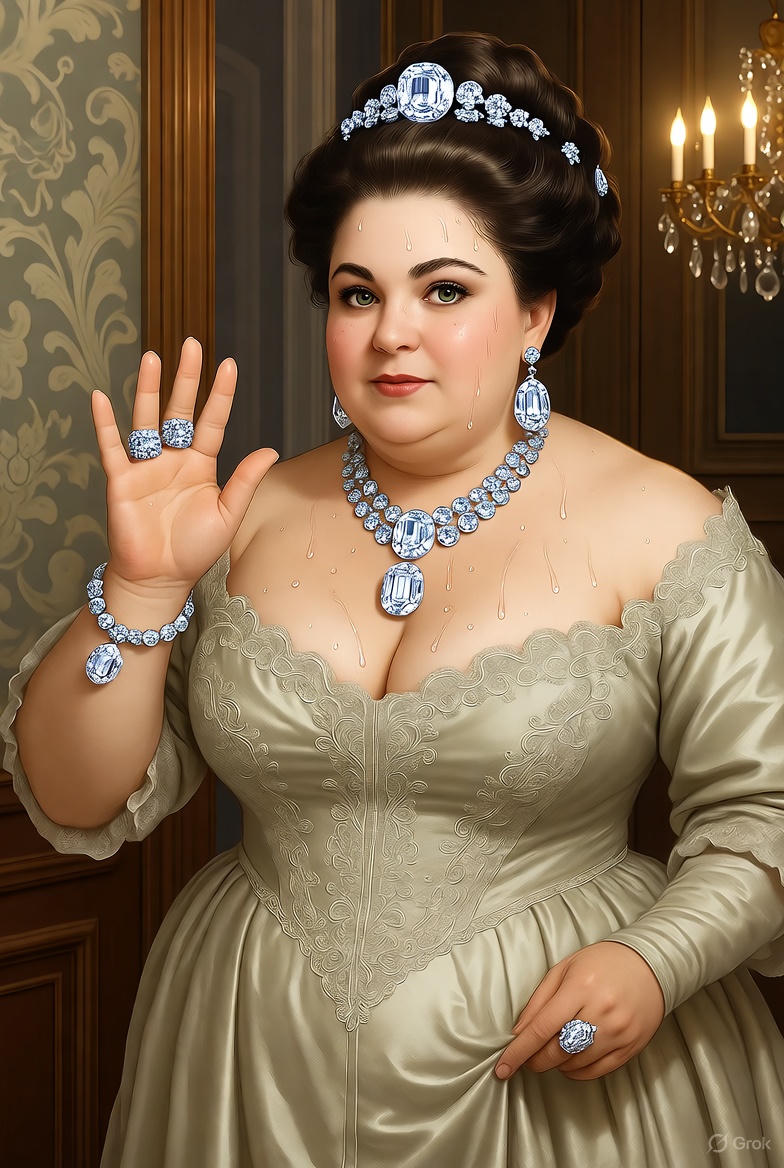
The princess enters, obese and sweaty, large diamonds on her
fingers, in her ears, around her neck and in her hair in a vulgar display
of extravagance.
She is a Hungarian countess or baroness. She met the prince
somewhere in the Orient. A marriage was arranged, that was certain,
but also certain, was that right from the beginning it was a fraud on
both sides.
She wanted the marriage to make her impossible pregnancy
legal. The prince wanted the same marriage to prevent an
international scandal and hide his small mistake. It was a net of lies
and impudent fraud, a legal feast for Herr Sebastian Gontram,
everything was in motion, and nothing was solid. Every smallest
assertion would prompt legal opposition from the other side. Every
shadow would be extinguished through a court ruling.
Only one thing stayed the same, the little princess. Both the
prince and the princess proclaimed themselves as father and mother
and claimed her as their own. This product of their strange marriage is
heir to many millions of dollars. The mother has the advantage, has
custody.
“Have a seat, princess!”
The Legal Councilor would sooner bite his tongue than call this
woman, ‘Highness’. She is his client and he doesn’t treat her a hair
better than a peasant woman.
“Take your coat off!” but he doesn’t help her with it.
“We have just written you a letter,” he continues and reads the
beautiful letter to her.
“But of course,” cries the princess. “I will take care of it first
thing tomorrow morning!”
She opens her purse and pulls out a heavy envelope.
“Look at this, Honorable Legal Councilor. I came straight here
with it. It is a letter from Lord, Count Ormes of Greater-
Becskerekgyartelep, you know him.”
Herr Gontram furrows his brow. This isn’t good. The King
himself would not be permitted to demand him to conduct any
business while at home. He stands up and takes the letter.
“That’s very good,” he says. “Very good. We will clear this up
in the morning at the office.”
She defends herself, “But it’s very urgent! It’s very important!”
The Legal Councilor interrupts her, “Urgent? Important? Let me
tell you what is urgent and important, absolutely nothing. Only in the
office can a person judge what is urgent and important.”
He reproaches her, “Princess, you are an educated woman! You
know all about proper manners and enjoy them all the time. You must
know that you don’t bring business home at night.”
She persists, “But I can never catch you at the office Honorable
Legal Councilor. During this week alone I was–”
Now he is almost angry. “Then come next week! Do you think
that all I do is work on your stuff alone? Do you really believe that is
all I do? Do you know what my time alone costs for the murderer
Houten? And it’s on my head to handle your millions as well.”
Then he begins to tell a funny story, incessantly relating an
unending imaginary story of a strange crime lord and the heroic
attorney that brings him to justice for all the horrible sex murders that
he has committed.
The princess sighs, but she listens to him. She laughs once in
awhile, always in the wrong places. She is the only one of all his
listeners that never knows when he lies and also the only one that
doesn’t understand his jokes.
“Nice story for the children!” barks Attorney Manasse.
Both girls are listening eagerly, staring at the Legal Councilor
with wide-open eyes and mouths. But he doesn’t allow himself to be
interrupted. It is never too early to get accustomed to such things. He
talks as if sex murderers were common, that they happen all the time
in life and you can encounter dozens of them every day.
He finally finishes, looks at the hour, “Ten already! You children
must go to bed! Drink your spiced wine quickly.”
The girls drink, but the princess declares that she will under no
circumstances go back to her house. She is too afraid and can’t sleep
by herself, perhaps there is a disguised sex murderer in the house. She
wants to stay with her friend. She doesn’t ask her Mama. She asks
only Frieda and her mother.
“You can as far as I’m concerned,” says Frau Gontram. “But
don’t you oversleep! You need to be in church on time.”
The girls curtsey and go out, arm in arm, inseparable.
“Are you afraid too?” asks the princess.
Frieda says, “What Papa was saying is all lies.”
But she is still afraid anyway and at the same time strangely
longing for these things. Not to experience them, oh no, not to know
that. But she is thinking how she wants to be able to tell stories like
that! Yes, that is another sin for confession! She sighs.
Above, they finish the spiced wine. Frau Gontram smokes one
last cigar. Herr Manasse stands up to leave the room and the Legal
Councilor is telling the princess a new story. She hides her yawn
behind her fan, attempts again to get a word in.
“Oh, yes, dear Legal Councilor,” she says quickly. “I almost
forgot! May I pick your wife up at noon tomorrow in the carriage? I’d
like to take her with me into Rolandseck for a bit.”
“Certainly,” he answers. “Certainly, if she wants to.”
But Frau Gontram says, “I can’t go out.”
“And why not?” the princess asks. “It would do you some good
to get out and breathe some fresh spring air.”
Frau Gontram slowly takes the cigar out from between her teeth.
“I can’t go out. I don’t have a decent hat to wear–”
The Princess laughs as if it is a good joke. She will also send the
Milliner over in the morning with the newest spring fashions.
“Then I’ll go,” says Frau Gontram. “But send Becker from
Quirinusjass, they have the best.”
“And now I must go to sleep–good night!”
“Oh, yes, it is time I must get going too!” the princess cries
hastily.
Legal Councilor escorts her out, through the garden and into the
street. He helps her up into her carriage and then deliberately shuts the
garden gate.
As he comes back, his wife is standing in the house door, a
burning candle in her hand.
“I can’t go to bed yet,” she says quietly.
“What,” he asks. “Why not?”
She replies, “I can’t go to bed yet because Manasse is lying in
it!”
They climb up the stairs to the second floor and go into the
bedroom. In the giant marriage bed lies the little attorney pretty as can
be and fast asleep. His clothing is hung carefully over the chair, his
boots standing nearby. He has taken a clean nightgown out of the
wardrobe and put it on. Near him lies his Cyclops like a crumpled
young hedgehog.
Legal Councilor Gontram takes the candle from the nightstand
and lights it.
“And the man insults me, says that I’m lazy!” he says shaking
his head in wonderment.
“–And he is too lazy to go home!”
“Shh!” Frau Gontram says. “You’ll wake everyone up.”
She takes bedding and linen out of the wardrobe and goes very
quietly downstairs and makes up two beds on the sofas. They sleep
there.
Everyone is sleeping in the white house. Downstairs by the
kitchen the strong cook, Billa, sleeps, the three hounds next to her. In
the next room the four wild rascals sleep, Philipp, Paulche, Emilche
and Josefche. Upstairs in Frieda’s large balcony room the two friends
are sleeping. Wülfche sleeps nearby with his black tobacco stub. In
the living room sleep Herr Sebastian Gontram and his wife. Up the
hall Herr Manasse and Cyclops contentedly snore and way up in the
attic sleeps Sophia, the housemaid. She has come back from the dance
hall and lightly sneaked up the stairs.
Everyone is sleeping, twelve people and four sharp hounds. But
something is not sleeping. It shuffles slowly around the white house–
Outside by the garden flows the Rhine, rising and breasting its
embankments. It appears in the sleeping village, presses itself against
the old toll office.
Cats and Tomcats are pushing through the bushes, hissing,
biting, striking each other, their round hot glittering eyes possessed
with aching, agonizing and denied lust–
In the distance at the edge of the city you hear the drunken songs
of the wild students–
Something creeps all around the white house on the Rhine,
sneaks through the garden, past a broken embankment and overturned
benches. It looks in pleasure at the Sunday antics of the love hungry
cats and climbs up to the house. It scratches with hard nails on the
wall making a loose piece of plaster fall, pokes softly at the door so
that it rattles lightly like the wind.
Then it’s in the house shuffling up the stairs, creeping cautiously
through all the rooms and stops, looks around, smiles.
Heavy silver stands on the mahogany buffet, rich treasures from
the time of the Kaiser. But the windowpanes are warped and patched
with paper. Dutchmen hang on the wall. They are all good paintings
from Koekoek, Verboekhuoeven, Verwee and Jan Stobbaerts, but
they have holes and the old golden frames are black with spider webs.
These magnificent beauties came from the ArchBishop’s old hall. But
the broken crystal is sticky with flyspecks.
Something haunts the still house and each time it comes it breaks
something, almost nothing, an infinite smallness, a crack. But again
and again, each time it comes, the crack grows in the night. There is a
small noise, a light creaking in the hall, a nail loosens and the old
furniture gives way. There is a rattle at the swollen shutters and a
strange clanking between the windowpanes.
Everyone sleeps in this big house on the Rhine but something
slowly shuffles around.

Read Full Post »

Madame Bluebeard by Karl Hans Strobl and translated by Joe E Bandel

First Chapter
Police Commissioner Mirko Bovacs was at a loss.
No, he wasn’t merely at a loss—he was utterly
despairing. In all his years of service, nothing like
this had ever happened. With an extraordinary—
charitably, one might say superhuman—keenness of
mind, he had identified, among Abbazia’s
international crowd, the long-sought Innesvar bank
robber in an unassuming Mr. Müller. And now, Mr.
Müller refused to be arrested, perched instead on the
roof of his small house, firing wildly with two
Brownings.
This defied all precedent. Once discovered, a
criminal was supposed to concede defeat and submit.
That, at least, was what any respectable crook was
expected to do. No serious trouble was to be caused
for the police; one simply vowed to play more
cautiously next time.
Initially, news of the bank robber’s unmasking
spread fear and horror among the spa guests. To think
they were exposed to such dangers! Patrons of the
Hotel Royal, where Mr. Müller had dined several
times, were beside themselves with agitation. “You
really don’t know who you’re sitting with anymore,”
said Hofrätin Kundersdorf. The young poet
Bystritzky, who consorted only with elderly ladies
and spared young girls not a glance, added dutifully,
“This Müller… a man of the world… who’d have
thought!”
But when word got out that the bank robber was
defending his stone cottage up in the vineyards,
refusing to let any policeman near, the mood shifted
to amusement. Soon, the beach and promenade lay
deserted. The public had flocked to the vineyards as
if to a fair, keeping a safe distance, of course, and
seeking cover behind walls and houses. It was
5immensely entertaining to watch the police and
gendarmes at a loss, and to see Mirko Bovacs darting
about behind a gamekeeper’s hut, wringing his hands.
Whenever a policeman or gendarme peeked to
check if Mr. Müller was still on the roof, a shot rang
out. The head ducked back faster than a seal’s. “What
am I to do? What am I to do?” wailed the
commissioner. “I’m becoming a laughingstock. This
rogue is humiliating me before all of Europe. Damn
him… he must come down. I’m ruined if we don’t
get him. What crook will respect me then? Every
lousy Italian pickpocket will laugh in my face.
They’ll spit on my boots.” He roared at his men:
“You scoundrels, you cowards, go hide behind your
wives’ skirts, you bastards, you toads! You’re truly
made of clay God forgot to fire. Get moving… it’s
your duty… I’ll report you all!”
But Constable Kristic, unshaken by anything,
replied, “Commissioner, it’s our lives at stake. What
do you expect? Duty’s duty. But where’s it written
we must let ourselves be killed when we can just wait
until hunger drives him down?”
“So, you’d starve him out?” the commissioner
shouted. “We could wait forever. Do you know if
he’s got supplies for a year? Or two? We might all be
dead—or pensioned—by then. If we could at least
reach the neighboring house, fifteen paces away…”
“Sir, what good’s that?” Kristic countered. “If we
show ourselves, he shoots. He’s capable of picking us
off. He’s already hit one gendarme in the foot. And
Schusterschic got two holes in his cap for not
ducking fast enough.”
The commissioner peered cautiously around the
corner. “What’s he doing? What’s he doing?” he
stammered. “He’s mocking us. He’s pulled out a ham
sandwich and is eating calmly. I’ll have a stroke,
6Kristic… has anyone seen such a thing? He’s eating a
sandwich right in front of us.”
Mr. Müller’s composure won the spa guests’
admiration. Even Hofrätin Kundersdorf couldn’t
withhold praise for his cool-headedness, and
Bystritzky chimed in with aphorisms on masculinity
and the grandeur of criminal characters.
As the day passed without change, bets were
placed on how long Mr. Müller would hold out. The
English dove into the wagering with zeal. Lord
Stanhope bet a hundred pounds that the splendid
bank robber wouldn’t be brought down for three
days. No one took the bet, knowing Stanhope’s
uncanny luck.
“You can safely take the wager,” said an elegant
man of about thirty-five to the hesitant group. “Go
on, dare it. This Mr. Müller will be in police hands by
tonight.”
Lord Stanhope eyed the stranger calmly. “How
can you claim that?” he asked slowly. “And if you’re
so sure, why not bet yourself?”
“I don’t bet,” the stranger replied, “when I know
the outcome for certain.”
“How can you know the outcome?”
“How? Because I’ll bring that man down myself.”
With a polite, curt bow, he descended toward the
beach.
Half an hour later, the stranger approached
Commissioner Mirko Bovacs with a greeting. “Sir,
what do you want here?” Bovacs shouted. “There’s
shooting. Don’t cause trouble.”
“I’m here to end the shooting,” the elegant
stranger replied.
Bovacs’s jaw dropped. His mind stalled. Clinging
to the one remaining faculty—that a commissioner
7must never lose composure—he rubbed his hands
together. But they felt like someone else’s hands.
“Sir…” he said, “how will you…”
“That’s my concern, once you permit me to
assist.”
“I warn you, don’t rely on the night. We saw that
scoundrel has a barrel of pitch on the roof. He’ll
likely light it when it’s dark.”
“I won’t wait that long. In twenty minutes, it’s
over. Be ready to seize him when I have him.”
Shaking his head, Bovacs watched the stranger
step from the gamekeeper’s hut. A shot rang out from
the roof, but the man was already behind a garden
wall. Bovacs marveled at the transformation. The
polished gentleman, master of decorum, became an
Indian. His body stretched like a lithe animal’s, limbs
propelling him in an almost impossible crouch, half-
lying, always concealed by stones, moving swiftly
and surely once he found his path.
After minutes, he vanished into a pile of rocks
above. For Bovacs, an agonizing wait began. It galled
him to owe a volunteer, but it beat prolonging the
siege. “A blessed candle for Saint Joseph in Fiume,”
he vowed silently, “if this works.” Kneeling, he
watched the enemy. Beyond the two houses, a green
evening sky spread, bottle-glass clear, sharpening
every outline. Mr. Müller sat at the roof’s edge,
smoking. A tiny light gleamed, a blue-pink cloud
around his head.
Suddenly, a figure shot from the neighboring
house’s horizon—like a devil in a puppet show.
Müller flinched, raising his Browning, but a thin
snake whipped across, coiling around him, biting
fast. No shot fired…
Bovacs saw Müller leap up, but the snake
tightened. Bovacs sprang, dancing, shouting, drawing
8his saber, striking stones. The rooftop struggle
thrilled him, maddening, a beauty like a falcon’s
flight or a heron’s strike. But the puppet play against
the glass-green sky ended. Müller staggered, arms
pinned, and vanished.
“Go, go!” Bovacs roared, charging up the hill with
his men. Below his stronghold, Müller lay, bound in
tough coils, immobile, face blue-red. The lasso’s end
was in the stranger’s hand, peering over the roof’s
edge.
The policemen and gendarmes pounced on the
criminal, hauling him from the ground, eager to
display their zeal. Mirko Bovacs approached the
stranger as he descended from the roof. “Sir,” he
panted, exhilarated, “ask anything of me. I’m entirely
at your service.”
“Then, please, give me a light,” the stranger
replied. He’s not as young as he looks, Bovacs
thought, as the match flared near the man’s face. The
stranger took two puffs on his cigarette, coiled his
lasso, tucked it into his pocket, and slipped sideways
into the darkness of the now-fallen night, nodding a
brief farewell to the commissioner.
That same evening, news of these events swept
through Abbazia. Those who hadn’t witnessed the
spectacle borrowed their friends’ eyes to catch a
fleeting glimpse. The authorities were irredeemably
ridiculous, Mr. Müller earned sympathies, and a halo
crowned the stranger. To Bystritzky’s chagrin,
Hofrätin Kundersdorf declared him a most interesting
young man. Bystritzky bristled when his elderly
ladies found other young men intriguing.
At ten o’clock, Court Secretary Ernst Hugo
returned from a sailing trip in the Quarnero,
ravenous. As he devoured his beefsteak, Franz,
standing respectfully behind his guest’s chair,
9recounted the day’s events. Suddenly, Hugo stopped
eating. He raised his napkin as if to wipe his mouth,
let it fall, brushed his mustache with the back of his
hand, and turned to Franz. His eyes were wide.
“Good Lord!” he muttered, “that’s none other than
my friend Ruprecht. It can only be Ruprecht.”
It was indeed Ruprecht von Boschan, confirmed
the next morning when Hugo arrived for breakfast at
the Hotel Kaiser von Österreich. The hero of the
previous evening sat on the terrace between two stout
pillars resembling petrified prehistoric rolls. He
stirred his coffee with a silver spoon, a Times before
him, but he didn’t read, gazing instead at the sea, blue
and silver-embroidered, swelling beyond the terrace.
“Ruprecht!” Hugo cried, striking his famous embrace
pose, Roman One, capital A. He performed it twice—
first with the right arm, then the left atop—looking
like a two-winged windmill, his massive hands
poised to spin.
“You’re still a mad hen,” Boschan murmured,
yielding to the hearty embrace.
“Where’ve you come from?” Hugo asked.
“From down there,” Ruprecht replied, gesturing at
the blue sea.
“From the water? Are you Venus Anadyomene?
Or posing as a sea god?”
“I’ve been testing a submarine.”
“Dangerous?”
“Eh—manageable. Not much to it. It wasn’t a
French submarine.”
“And before?”
“Before, I did some high-altitude climbs in the
Himalayas.”
“Sapperment! How high?”
“Between seven and eight thousand…”
“And before?”

Read Full Post »

Alraune by Hanns Heinz Ewers and translated by Joe E Bandel

Chapter 1
Describes the house on the Rhine before the thought of
Alraune came into the world.

THE white house in which Alraune was thought into
existence existed long before she was born–long before she
was even conceived. This house lay on the Rhine a little out
of the city on the large Villa Street leading out to the old
Archbishop’s Palace where the university is today. That is where it
lies and Legal Councilor Sebastian Gontram and his family once lived
there.
You walk in from the street, through the long ugly garden that
has never seen a gardener. You come to the house, from which stucco
is falling, search for a bell and find none. You call and scream and no
one comes. Finally you push the door open and go inside, climb up
the dirty, never washed stair and suddenly a huge cat springs through
the darkness…
Or even better–
The large garden is alive with a thousand monkeys. They are the
Gontram children: Frieda, Philipp, Paulche, Emilche, Josefehe, and
Wülfche. They are everywhere, in the boughs of trees, creeping
through the earth in the mine pits. Then there are the hounds, two
cheeky spitzes and a Bastard Fox terrier. In addition there is a dwarf
pinscher that belongs to Attorney Manasse. He is quite the thing, like
a brown quince sausage, round as a barrel , scarcely larger than a hand
and called Cyclops.
The yard is filled with noises and screams. Wülfche, scarcely a
year old, lies in a child’s wagon and screams high obstinate screams
for hours. Only Cyclops can beat this record and he yelps, hoarse and
broken, incessantly. Wülfche never moves from his place, only
screams, only howls.
The Gontram rogues are resting in the bushes late in the
afternoon. Frieda, the oldest, should be looking out for them, taking
care that her brothers are behaving. But she thinks they are behaving
and sits under the decaying Lilac leaves with her friend, the little
Princess Wolkonski.
The two chatter and argue, thinking that they soon will become
fourteen years old and can get married, or at least have a lover. Right
now they are both forbidden from all this and need to wait a little
longer. It is still fourteen days until their first Holy Communion. Then
they get long dresses, and then they will be grown up. Then they can
have a lover.
She decides to become very virtuous and start going to the May
devotions at church immediately. She needs to gather herself together
in these days, be serious and sensible.
“–and perhaps also because Schmitz will be there,” says Frieda.
The little Princess turns up her nose, “Bah–Schmitz!”
Frieda pinches her under the arm, “–and the Bavarian, the one
with the blue cap!”
Olga Wolkonski laughs, “Him? He is–all air! Frieda, you know
the good boys don’t go to church.”
That is true, the good ones don’t do that. Frieda sighs. She
swiftly gets up and shoves the wagon with the screaming Wülfche to
the side, and steps on Cyclops who is trying to bite her ankles. No, no,
the princess is right. Church is not the answer.
“Let’s stay here!” she decides. The two girls creep back under
the Lilac leaves.
All the Gontram children have an infinite passion for living.
They can’t say how they know but deep inside, they feel in their
blood that they will die young, die fresh. They only have a small
amount of time compared to what others are given and they take this
time in triple, making noise, rushing, eating and drinking until they
are saturated on life.
Wülfche screams in his wagon, screaming for himself alone as
well as for three other babies. His brothers fly through the garden
making themselves numerous, as if they were four dozen and not just
four. They are dirty, red nosed and ragged, always bloody from a cut
on the finger, a scraped knee or some other good scratch.
When the sun sets the Gontram rascals quietly sweep back into
the house, going into the kitchen for heaping sandwiches of buttered
bread laid thick with ham and sausage. The maid gives them water to
drink colored lightly with red wine.
Then the maid washes them. She pulls their clothes off and sticks
them in wooden tubs, takes the black soap, the hard brush and scrubs
them. She scrubs them like a pair of boots and still can’t get them
clean. Then she sticks the wild young ones back in the tubs crying
and raving and scrubs them again.
Dead tired they fall into their beds like sacks of potatoes,
forgetting to be quiet. They also forget to cover up. The maid takes
care of that.
Around this time Attorney Manasse comes into the house, climbs
up the stairs, knocks with his cane on a few doors and receiving no
answer finally moves on.
Frau Gontram moves toward him. She is tall, almost twice the
size of Herr Manasse. He is a dwarf, round as a barrel and looks
exactly like his ugly dog, Cyclops. Short stubble stands out all over
him, out of his cheeks, chin and lips. His nose appears in the middle,
small and round like a radish. When he speaks, he barks as if he is
always snapping.
“Good evening Frau Gontram,” he says. “Is my colleague home
yet?”
“Good evening attorney,” says the tall woman. “Make yourself
comfortable.”
“Why isn’t my colleague home yet?–and shut that kid up! I can’t
understand a single word you are saying.”
“What?” Frau Gontram asks. Then she takes the earplugs out of
her ears. “Oh yes,” she continues. “That Wülfche! You should buy a
pair of these things Attorney. Then you won’t hear him.”
She goes to the door and screams, “Billa, Billa–or Frieda! Can’t
you hear? Make Wülfche quiet!”
She is still in apricot colored pajamas. Her enormous chestnut
brown hair is half-pinned up and half-fallen down. Her black eyes
appear infinitely large, wide, wide, filled with sharp cunning and
scorching unholy fires. But her skeletal face curves in at the temples,
her narrow nose droops and her pale cheeks spread themselves tightly
over her bones. Huge patches burn lividly on–
“Do you have a good cigar Attorney?” she asks.
He takes his case out angrily, almost furiously.
“How many have you already smoked today Frau Gontram?”
“Only twenty,” she laughs. “But you know the filthy things are
four pennies apiece and I could use a good one for a change. Give me
the thick one there! – and you take the dark, almost black Mexican.”
Herr Manasse sighs, “Now how are you doing? How long do you
have?”
“Bah,” she made a rude sound. “Don’t wet yourself. How long?
The other day the doctor figured about six months. But you know how
precise they are in that place. He could just as well have meant two
years. I’m thinking it’s not going at a gallop. It’s going at a pretty trot
along with the galloping consumption.”
“You shouldn’t smoke so much!” The little attorney barks.
She looks at him, her thin blue lips pulling high over gleaming
teeth.
“What? What Manasse? No more smoking? Now stop with the
friendly airs! What am I supposed to do? Bear children all year long?
The brats in this house already drive me crazy. That’s why it’s
galloping–and I’m not supposed to smoke?”
She blows a thick cloud of smoke into his face and makes him
cough.
He looks at her, half-poisoned, half-living, and admires her. He
doesn’t take anything from anyone. When he stands before the bar he
never tells a joke or minces words. He barks, snaps, bites without
respect or the smallest fear.–But here, before this dried up woman
whose body is a skeleton, whose head grins like a death’s head, who
for a year and a day has stood three quarters in the grave and laughed
at herself the last quarter, here he feels afraid.
Her unrestrained shimmering locks are always growing, always
thicker, always fuller as if pulling nourishment from her decaying
body. Her perfect gleaming teeth clamp around a cigar; her eyes are
enormous, without hope, without desire, almost without awareness
but burning with fire–These leave him silent. They leave him feeling
smaller than he really is, almost as small as his hound.
Oh, he is very educated, Attorney Manasse is. She calls him a
veritable conversational encyclopedia. It doesn’t matter what the topic
of conversation, he can give the information in the blink of an eye.
Now he’s thinking, has she given up on finding a cure? Is she in
denial? Does she think that if she ignores death he will not come?
Does she think death is not in this house? That when he does come,
only then will she go?
But he, Manasse, sees very well that death is here even though
she still lives. He has been here all along hiding throughout the house,
playing blind cow with this woman that wears his face, letting her
abandon her numerous children to cry and race in the garden.
Death doesn’t gallop. He goes at a pretty trot. She has that right.
But only out of humor, only because he wants to make a joke, to play
with this woman and her life hungry children like a cat plays with the
fish in a fish bowl.
Only this woman, Frau Gontram, thinks he is not even here. She
lies on the lounge all day long smoking big dark cigars, reading
never-ending books and wearing earplugs so she can’t hear the noise
her children make–He is not here at all?–Not here?
Death grins and laughs out of her withered mask, puffs thick
smoke into his face. Little Manasse sees him perfectly enough. He
stares at him, considers for a long time which great artist has painted
this death. Is it Durer? Or Bocklin? Or some other wild harlequin
death from Bosch, Breughel or a different insane, inexcusable death
from Hogarth, from Goya, from Rowlandson, Rops or Callot?
It is from none of these. Sitting before him is a real death, a death
you can willingly go with. It is a good, proper and therefore romantic
Rhinelander’s death. It is one you can talk with, that sees the comedy
in life, that smokes, drinks wine and laughs. It is good that he smokes
thought Manasse, so very good, then you can’t smell him–
Then Legal Councilor Gontram comes into the room.
“Good evening colleague,” he says. “Here already? That’s
good.”
He begins a long story about all that has happened during the day
at the office and before the court. Purely remarkable things that only
happen to lawyers once in a lifetime happen to Herr Gontram every
day. These strange and often lusty occurrences are sometimes comic,
often bloody and highly tragic.
Not a word is true. The Legal Councilor has an incurable shyness
of telling the truth. Before his morning bath, yes, even before he
washes his face in the basin, from the moment his mouth first opens
wide he lies. When he sleeps, he dreams up new lies. Everyone knows
that he lies, but his stories are so lusty and interesting they want to
hear them anyway. Even when they aren’t that good they are still
entertaining.
He is in his late forties with a short, very sparse beard and
thinning hair. A gold pince-nez with a long black cord always hangs
crookedly over his nose and helps his blue shortsighted eyes see to
read.
He is untidy, disorderly, unwashed, and always has ink spots on
his fingers. He is a bad jurist and very much against doing any work,
always supervising his junior lawyers but not doing anything himself.
On this basis he oversees the office managers and clerks and is often
not seen for weeks at a time. When he is there, he sleeps. If he is
awake, once in awhile he writes a short sentence that reads, “Denied”
and stamps the words “Legal Councilor” underneath.
Nevertheless he has a very good practice, much better than the
knowledgeable and shrewd Manasse. He understands the language of
the people and can chat with them. He is popular with all the judges
and lawyers because he never makes any problems and all his clients
walk. For the accused and for the jury he is worth the gold he is paid,
you can believe that.
Once a Public Prosecutor said, “I ask the accused be denied
extenuating circumstances, Legal Councilor Gontram is defending
him.”
Extenuating circumstances, his clients always get them, but
Manasse seldom receives them despite his scholarly ways and sharp
speeches.
There is still more, Legal Councilor Gontram had a couple of
big, important and provocative cases that created sensations
throughout the land. In both cases he fought through the entire year
and finally won. These cases suddenly awoke in him a strange energy
that up until then had lain sleeping inside of him.
The first was so full of tangles, a six times loser, nearly
impossible case that went from lawyer to lawyer, a case with
complicated international questions that he had no suspicion of when
he took it. He just thought it was interesting and liked it.
The Koschen brothers out of Lennep had been condemned to
death three times. In a fourth resumption he continued on and won
their freedom despite hair splitting circumstantial evidence.
The other was a big million-dollar dispute over Galmeiberg Mfg.
from Neutral-Moresnet that every jurist in three countries knew about.
Certainly Gontram at the least had fought through to the very end and
obtained a victorious verdict.
Since then for three years he handles all the legal casework for
Princess Wolkonski. Remarkably, this man never says a word about
it, about what he really does. Instead he fills the ears of those he
meets with lies, cheeky inventions of his legal heroics. Not a single
syllable comes over his lips of the real events of his day. This makes
it seem like he detests all truth.
Frau Gontram says, “Dinner is just about ready and I’ve already
set out a bowl of fresh Woodruff salad. Should I go get dressed?”
“Stay the way you are woman,” the Legal Councilor decides.
“Manasse won’t mind–” he interrupts himself, “Dear God, how that
child screams! Can’t you hold him?”
She goes past him with long, slow strides, opens the door to the
antechamber where the maid has pushed the child’s wagon. She takes
Wülfche, carries him in and sits him in a highchair.
“No wonder he screams,” she says. He’s completely wet.”
But she does nothing about it, leaving him to dry out by himself.
“Be still, you little devil,” she continues. “Can’t you see I have
company?”
But Wülfche is determined to disturb the entire visit. Manasse
stands up, pats him, strokes his chubby back, and brings him a Jack-
in-the-box to play with. The child pushes the Jack-in-the-box away,
bellows and screams incessantly. Cyclops accompanies him from
under the table.
Then Mama says, “Now wait, sugar drop. I have something for
you.”
She takes the chewed black cigar stub from out between her teeth
and shoves it into the baby’s mouth.
“There Wülfche, how do you like that? Well?”
The child becomes still in the blink of an eye, sucking, pulling
and beams, overjoyed, out of huge laughing eyes.
“Now attorney, you see how you must deal with children?” says
the tall woman. She speaks confidently and quietly, completely
earnest.
“But you men don’t understand anything at all about children.”
The maid comes and announces that dinner is ready. While the
others are going into the dining room she goes with unsteady steps up
to the child.
“Bah,” she says and rips the cigar stub out of his mouth.
Immediately Wülfche starts to howl again. She takes him up, rocks
him back and forth and sings him a melancholy lullaby from her
Wolloonian homeland in Belgium.
She doesn’t have any more luck than Herr Manasse. The child
just screams and screams. She takes the cigar stub again, spits on it
and rubs it against her dirty apron to make sure the fire is completely
out and puts it back in Wülfche’s red mouth.

Read Full Post »

OD by Karl Hans Strobl and translated by Joe E Bandel

“Nothing!” said Fechner. He knew he was passing judgment, but what could he do? It was about science; no allowances could be made. Under other circumstances, he might have been relieved that the experiments failed, sparing him from taking a stand for Reichenbach. But one look at the Freiherr told him how merciless he’d had to be in the name of science. He said “Nothing” softly, but despite his hearing loss, Reichenbach caught the word.

“I can’t explain it,” Reichenbach murmured to himself. “Friederike has done far greater things. It may be… the long journey from Vienna to Leipzig, always along the telegraph wires. That must have had an odically adverse effect. The telegraph wires had an unfavorable odic influence.”

That was an explanation one couldn’t accept. But Reichenbach likely didn’t expect a response from Fechner; he raised his gaze like a sick beggar: “Now you’ll probably think me a fool or a fraud?”

“Certainly not,” Fechner hastened to assure him. He had to be cruel for science’s sake. Humanly, it was different. “We can try again later, perhaps. Or with another sensitive.”

“Yes, yes, with another sensitive,” Reichenbach said, and just then the door opened slightly, and the Professor’s wife poked her head in. It had taken long enough; the gentlemen should be done, and perhaps now a cup of coffee—

No, thank you, no coffee, much obliged, but it’s really time to go.

Reichenbach craves fresh air; sunshine is odically negative, he needs revitalization, a surge of life’s source. He pauses between the columns of the Roman House where Fechner lives, on the steps leading to the park. Hat off, Reichenbach wipes his damp forehead.

A hand reaches for his; he gently pushes it back. Yes, Friederike failed, utterly failed. Telegraph wires? Nonsense! Physics at all? Perhaps all physics is a night-view against the day-view. It was a grace, a grace of her purity. And that grace has been taken from Friederike.


About two weeks later, Friederike goes to Reichenbach’s room to bring him coffee, but he doesn’t answer her knock. They’re staying with the widow of a royal court porter from Dresden, who, after her husband’s death, rents rooms in her native Leipzig, taking in long-term guests with full care. Reichenbach’s and Friederike’s rooms are adjacent, so she’s always at hand. She insists on tending to the Freiherr, bringing his meals, and when she comes with coffee, he’s usually already working. He writes dozens of letters daily—to old friends, scientists, former sensitives. Though he doesn’t say so, Friederike believes he’s marshaling everything for a final battle to defeat the skeptics, summoning witnesses, perhaps urging sensitives to come to Leipzig for new experiments.

No replies have come yet. The only letter for the Freiherr was from Vienna.

“From Hermine,” Reichenbach said. “She writes that she regrets not seeing me before I left. And she asks if I’d allow her to come to Leipzig.”

Friederike expected this letter; she had written to Hermine, suggesting she come. Perhaps Reinhold could be persuaded too—not that Reichenbach is in danger, but it might help to distract him from his relentless brooding and surround him with love.

Now Reichenbach doesn’t answer Friederike’s knock, and when she enters, he lies in bed, staring at her with horrified eyes. His left hand hangs motionless over the bed’s edge; the right moves slightly, gesturing toward his mouth. Friederike realizes his speech is gone.

She doesn’t lose her composure, sending the porter’s widow for a doctor while staying with the patient. No, it’s surely not serious, she reassures his silent questions—a passing episode, a nervous collapse; in a few days, all will be well.

The doctor examines, asks questions, and declares it a minor stroke, temporary, insignificant—a few days’ rest, and all will be fine. Friederike had no doubts; there were signs already—his hearing loss, blurred vision, likely precursors.

Despite the doctor’s assurances, it’s a pitiful sight to see this man, who couldn’t seize enough life and sent his mind on endless conquests, now languishing, unable to help him.

But a few days later, as Friederike unfolds the newspaper to read to Reichenbach, he suddenly says, “Friederike.”

The words are thick, labored, but he speaks again; the silence has lifted. Friederike drops the paper, grasps his hands, and kisses them. Unable to restrain herself, she weeps.

“Friederike,” says the Freiherr, “how did it happen? How did you come back?” Has he been pondering this all along? He never asked until now. Should Friederike tell how it happened? She doesn’t know—perhaps a poison, paralyzing her soul. She can’t speak of the journey; it’s too horrific to recall. Only the end she remembers. She fled a dozen times, forced back, until a forester found and hid her in the woods. The poison must have lost its power then.

That’s how it was. And why did she return? She can’t say—it was all that remained in the world. Should she confess she’s loved Reichenbach since she could think, that he’s been her life’s center? No, she can’t speak it; it’s impossible—she’d sooner die than say it in dry words.

Reichenbach hasn’t taken his eyes off her as she speaks. Now he says, “I fear I’m to blame. Yes, yes… it could have been different.”

Then he turns his head toward a chair near the bed. Someone sits there, who must have entered during Friederike’s halting confession. “Final insights,” the Freiherr says, as if speaking to someone in the chair, “that may be true. I swore by physics and chemistry my whole life, but where are the boundaries, the transitions?”

He tilts his head, as if listening to a reply, then nods: “Indeed! Proofs—what do they mean? What’s subject to external proof ceases to be spirit. Truth can only be received and explained with the power of a believing heart. Faith is the same as love. Only love believes, and faith is the pinnacle of love.”

Friederike marvels at this dialogue with an empty chair. She doesn’t know it’s her father, Count Hugo, with whom Reichenbach speaks. But Reichenbach sees him in the chair; woods rustle around them, a faint light flickers, a bottle of wine stands on the table—likely Förster Hofstück’s.

“Yes,” Reichenbach smiles, “you’re right; the visible always flows into the invisible, the tangible into the incomprehensible, the sensory into the transcendent. Perhaps Od shapes our body, a radiant body that detaches and seeks those it loves. But even Od isn’t the final truth. When graves cease to glow odically, there’s still no end… no end…”

Reichenbach’s eyes close; he seems to have fallen asleep. But the sleep isn’t deep; he blinks occasionally and moves his lips.

After a quarter-hour, the alert gaze returns, strikingly bright: “Did you see my wife go out?” he asks.

Friederike isn’t afraid, not in the least, but she doesn’t know how to reply.

Reichenbach doesn’t wait for an answer: “She told me,” he continues, “that Hermine and Reinhold will come to me tomorrow.”

That’s possible; Friederike sent an urgent call to Vienna. They might arrive tomorrow if they hurry. Then Reichenbach drifts off again, through the evening into the night. His hand remains in Friederike’s, and she knows he’s overcome his disappointment, no longer holding her failure against her, nor the loss of the grace within her.

Around two in the morning, the Freiherr stirs again, as if Friederike’s thoughts have reached him, as if her thoughts crossed an odic bridge into him: “It’s not so important anymore… let those after me rack their brains… the great things must be found more than once.”

At noon the next day, Hermine, Schuh, and even Reinhold arrived. They couldn’t bring the child; the journey was too far. But there was a child, yes, a delightful little boy, and the grandfather had never seen him. They had brought him once, stood before the grandfather’s door, and had to leave without success. Then other things intervened—this trip to Leipzig, you see, always something came up; it must have been meant to be. But they wouldn’t let bitterness linger; now all obstacles were cleared, even Reinhold was here. Did the father know yet that he was now engaged and would soon marry? Yes, they’d arrange things differently henceforth, once the father was back on his feet and home.

Reichenbach’s eyes wandered from one to another but always returned to Friederike, who stayed modestly in the background. She wasn’t family; she didn’t want to take any love from those who came to give and receive it. But as Reichenbach’s gaze kept finding her, she felt boundless wonder and delight at how deeply connected they were again. She knew his thoughts without words; his looks said, “Go on, girl, we’ll stick together!” Yes, he spoke Swabian to her again, happy to see his kin, but with her, he spoke Swabian.

Toward evening, the court porter’s widow knocked and announced another visitor. The candles were already burning; Hermine knelt sobbing by the bed, and the two men sat silently across from each other at the table.

Professor Fechner was there; Professor Fechner wished to speak with the Herr Baron.

Professor Fechner had felt it his duty to come in person to report to the Freiherr. He had repeated the pendulum experiment with his wife as the subject, and it showed a clear deflection, then with a magnetic needle that was diverted—remarkable results, prompting him to reconsider his stance.

But when he saw the burning candles and Friederike about to open the window, he was startled and said awkwardly, “I’m sorry, I meant to bring good news.”

What remained of Freiherr von Reichenbach was beyond good or bad news. But a thought lingered, nourished by the blood of a living being, now set free, living on its own. It could rise above imperfection, return to its origins, and wait for its time to settle in other minds. That’s the superiority of thoughts over people: thoughts have time.

Read Full Post »

OD by Karl Hans Strobl and translated by Joe E Bandel

Chapter 25

“Shall I take the coffee set with the rose pattern?” Frau Professor Fechner asked, opening the door to her husband’s study, where he seemed to shiver in a woolen vest and fur cap despite the sun-warmed room.

“Yes, take the rose pattern!” her husband replied softly over his shoulder. The door closed, but it opened again, and the professor’s wife asked once more, “Or perhaps the forget-me-not one?”

“You can take the forget-me-nots too,” Fechner answered.

The door closed, but Fechner had only time to let out a small sigh of resignation before it opened again: “But the rose pattern is prettier!”

“That’s what happens,” the Professor smiled patiently, “when you have two coffee sets. By the way, Freiherr von Reichenbach is coming from Vienna, where they have the best coffee in the world, but he’s not coming to drink our Leipzig flower coffee, but for his Od.”

“What does he want from you?”

“What does he want?” Fechner pushed the green-tinted glasses he wore for his eye condition up onto his forehead. “He’s coming to me because I’m his last hope. The others have all abandoned him. Now he clings to me, hoping I’ll save him.”

“He wants to hitch his wagon to your reputation.”

The Professor’s wife was a diligent and ambitious housewife, yet she sometimes had a sharp understanding of her husband’s standing and influence. Her words carried a hint of concern for Fechner’s scientific reputation.

“Exactly,” Fechner confirmed. “It’s a questionable matter, this Od. Dangerous to get involved and oppose the general disbelief. But if it’s the truth, I’ll have to bear witness to it. And then they’ll call me as much a fantasist as this Reichenbach.”

“Very unpleasant!” said the Professor’s wife. She had little taste for scientific martyrdom; she preferred successes. Why should her husband risk his achievements for such a dubious cause? “He’s bombarded me with letters,” Fechner continued, “he’s berated me because I found a flaw in his research in my Moon Book. But since I’m the only one among his opponents who leaves room for understanding, he’s latched onto me. I declined his visit, was rude to the point of coarseness. But he’s unstoppable; he’s coming anyway.”

“I’ll take the forget-me-not pattern after all,” the Professor’s wife decided after a moment’s thought, and with that, she had settled the matter of Od as far as she was concerned.

But even the forget-me-not pattern wasn’t used. The Freiherr declined coffee, claiming he’d just had some, but the real reason was his agitation, too great to waste time on trivialities. He was eager to get to the heart of the matter and learn whether Fechner could be convinced. Everything seemed to hinge on this man; the fate of his entire doctrine rested on him. Never had the Freiherr been so wrought up. Fechner, this quiet man with a wise, refined face etched with patiently borne suffering, stood before him as the appointed judge, more authoritative than all the pompous, self-important scholars before who dispensed superior science.

“I turned to you,” he said, gripping Fechner’s hand tightly, unwittingly digging into his palm with trembling fingers, “because you defend the day-view of universal ensoulment against the night-view of soullessness that dominates science.”

“Yes, yes,” Fechner deflected, “it’s the idea that matters, but it can’t wander the world without proof. Even fully provable ideas require the strength to push them through. Think of poor Semmelweis…”

“What?” Reichenbach asked, cupping his ear.

Fechner realized he needed to speak louder and raised his voice. “Semmelweis! Lucky he didn’t have to endure the full misery of the asylum. Strange that he died of blood poisoning. It’s as if the demon he fought his whole life took revenge. The doctor who sought to stop infection in maternity wards cuts his finger during an operation and dies from it.” He had intended to bring up Semmelweis, not without the purpose of a cautionary comparison.

“Indeed,” said Reichenbach, “but the finest part of your letters is where you say you’re as cautious in belief as in disbelief. That’s the true impartiality of an honest and upright man of science. But most colleagues—”

“I would have liked,” Fechner interrupted, “to assemble a commission, but the colleagues refused to engage with a matter considered settled.”

“It’s already in my book: The Sensitive Human and Its Relation to Od,” Reichenbach said, speaking almost past Fechner. “Much depends on the sensitives. I’ve brought my best sensitive—my housekeeper, Fräulein Ruf, the daughter of a dear friend.”

Only now did Fechner turn his attention to the woman who had entered with Reichenbach and lingered by the door. She gave a shy, beaten impression, as if emphasizing her subservient role before the two men through her humble demeanor, though Reichenbach’s words were like outstretched hands, striving to draw her forward and place her as an equal beside him.

Yes, the Freiherr had showered Friederike with kindness and radiant warmth at home. He granted her days of rest and recovery, refraining from urging her to travel to Leipzig immediately, though he was eager to make the trip and force a decision. He spared her experiments—not a single one—knowing her gift wasn’t a skill to be trained like physical strength but a talent always present, ready for use. She should rest, gather herself, regain her self-assurance. Reichenbach could imagine the horrors she’d endured, ghastly, helplessly subjected to that monstrous will. His compassionate understanding was so great that he didn’t even ask—not even how she was ultimately saved. He respected her silence. Once, he said his eyes had only now opened to the vile old hag who held power over him, as if offering his own humiliation as comfort for hers. That he did, and he took her to the city to outfit her anew, as befitted the daughter of his dearest friend.

Yes, he had revealed this strange truth to her, perhaps to shock her back to herself, to help her regain a sense of her own worth.

All that had happened, but it couldn’t change that she still felt crushed, defiled, and unworthy of any love or kindness. At times, she suddenly couldn’t comprehend why she had returned to the Freiherr; she hadn’t accounted for it, and now it sometimes felt as if she should run away. Perhaps it would have been better to stay on the road—in a hayloft, a ditch, perishing somewhere in the dark.

So empty was she, drained, incapable of higher feeling, filled only with a bottomless fear of what was to come.

Professor Fechner understood the warm introduction from Reichenbach; he had before him a young lady, not a mere servant, and kindly invited her to sit. But then he thought it time to get to the point.

“We’ve corresponded about the basic experiments to start with,” he said. “We can move to others later. First, the simple facts. Everything is prepared as agreed. Here’s the horseshoe magnet, on the table with only the poles exposed, the rest covered with a cloth. The poles are unmarked, save for a small, invisible mark I’ve made for myself on one arm. You’re to use your left hand to distinguish the cooler North Pole from the other.”

He asked the Freiherr to stand farther away by the window—not out of mistrust, of course, just a precaution to rule out unintentional influence. “When you’re ready, we’ll begin.”

Friederike stood before the magnet. She raised her left hand and brought it near the two ends. There was no sensation in her hand—neither cool nor warm; just a piece of iron, with no living currents flowing into her. She lowered her hand and fixed a pleading gaze on Reichenbach. His face was tense and agitated; she had never seen the Freiherr like this. She knew everything for him now hung in the balance. Almost dazed, she raised her hand and pointed at one pole at random.

Fechner lifted the cloth, checked, and without comment, noted something in his notebook. Then he turned the magnet several times, placed it back, and covered it again. Friederike had tried to peek over his shoulder; no mark was visible. She was so confused she would have been ready to cheat.

“Please,” said Fechner.

He repeated the experiment seven times, then reviewed his notes and said with an awkward cough, “I’m sorry I can’t report a better result. Out of seven tries, the Fräulein identified the North Pole correctly only three times. By the principles of probability, that’s insufficient for proof.”

Reichenbach stood gray in the window’s light. He pulled a chair close and leaned on its back.

“Perhaps today I’m…” Friederike smiled desperately.

“Shall we move to the second experiment?” Reichenbach said after a pause.

A sulfur plate and a zinc plate lay on the table, both covered with paper, and Friederike was to determine, by holding her hand over them, which was sulfur and which was zinc.

Her hands felt dead. No sensation at all; she wanted to throw herself to the floor and scream. “I don’t know,” she said with a smile that strangely moved Fechner.

“It’s incomprehensible…” came a hoarse voice from the window. “Let’s try the pendulum experiment.”

“Perhaps it’s best we leave it for another time,” Fechner suggested. He pitied the woman, seeing her gesture—correctly interpreting it as a fleeting impulse to flee. But she knew how much was at stake for Reichenbach. He was here, refusing to back down, an old man with fading hearing and weakened sight. He had been unspeakably kind to her, asking only one thing in return: proof of his doctrine.

“Here’s the pendulum you sent me,” Fechner said, placing a bottle on the table, a small lead weight hanging from a thread inside its neck. It was agonizing waiting until the lead weight hung still; no one tried to break the oppressive silence.

Then Friederike raised her lifeless hand. She strained now, rattling the locked gates of her inner self, trying to force the currents that might make the pendulum swing. The pendulum didn’t budge; it hung rigid inside the bottle.

Read Full Post »

« Newer Posts - Older Posts »