Feeds:
Posts
Comments

OD by Karl Hans Strobl and translated by Joe E Bandel

In the grand assembly hall of the Academy of Sciences, a distinguished audience is gathered today. The great luminaries of science are all present; they don’t want to miss this occasion—not always do they come with such eager anticipation as today, when Freiherr von Reichenbach is to deliver a lecture on his Od. Often enough, it’s merely a tedious duty; they attend serious and beneficial discussions but yawn in advance. Today, however, they smile, knowing it will be entertaining. Freiherr von Reichenbach is in everyone’s people’s mouths—the whole city is talking about him, less for his Od and more for other matters.

“Say, have you also received that lithographed letter he sent to all his friends?”

“A kind of wanted poster, after his daughter and a certain Karl Schuh.”

“A public accusation!”

“But that’s the Schuh with the light paintings. A talented man, he works in a chemical factory. Certainly not the blackguard the Freiherr paints him as.”

“Say, can you understand the man? Normally, one washes dirty laundry quietly at home, but Reichenbach airs it for all the world to see.”

“A passionate nature! A man who can’t bear not getting his way.”

“Just like with his Od.”

“But one doesn’t accuse one’s daughter of consorting with an adventurer in a public circular letter.”

“And that she nearly emptied all the chests when she left his house and left keys to half-empty rooms behind.”

“That’s not true. Reichenbach writes of two loads she took. I know her brother; he told me it was no more than two hand carts with her clothes and linens.”

“I can only think he’s upset because he’s not making progress with his Od, and now his domestic troubles have completely unhinged him.”

And then, after everything has been thoroughly discussed at length, Reichenbach arrives. He’s a bit late, giving the luminaries of science time to finish their gossip—the gossip he himself turned into a public matter to show he has nothing to hide. After the self-destruction of recent weeks, he’s in a festive mood today. This is the day of his triumph; he will compel the men of science with the force of his words and the logic of facts to acknowledge his research results and cheer for him. Against the dark backdrop of his personal distress, his fame as a discoverer will shine all the brighter.

At the door, Professor Schrötter, the Academy’s general secretary, greets him.

“What do you say to Liebig?” he asks first thing.

So they already know—Reichenbach dislikes being reminded of it; yes, malice always spreads with the speed of wind, while praise and recognition lag far behind.

It’s unpleasant to be reminded of this setback at the outset; the wound still stings. But Reichenbach merely smiles and says offhandedly, “What can you do? He wanted to make a splash with his inaugural lecture at Munich University and chose my Od as a sacrificial lamb. Scholars often slaughter their best friends to get themselves talked about.”

“Liebig was entirely for you at first. He published your papers in his Annals. How do you explain the turnaround?”

“How do I explain it?” snorts Reichenbach contemptuously. “Some gentlemen visited me, on their way to the naturalists’ convention in Wiesbaden. They also chose to learn about my experiments. I led them into the darkroom, but they saw no Od light. None of them were sensitive, and besides, they were too impatient to wait the necessary time. Then they went to Liebig in Munich and mocked the Od and me. It’s always easy to laugh when you don’t understand something. But it seems to have made an impression on Liebig.”

“Still,” hesitates Schrötter, “his attack has been noticed.”

Reichenbach tightens his resolve: “By the way, I was in Karlsbad with Berzelius, who puts Liebig in his pocket, and Berzelius is entirely on my side.”

They take their seats, and Hofrat Rokitansky, the vice president, opens the proceedings. A protocol is read, a foundation charter is announced, and several new decrees follow, though the assembly pays only moderate attention. Only when Reichenbach steps to the lectern do heads lift and expressions sharpen.

Reichenbach’s gaze surveys the densely packed audience. There they sit below—indifferent, malicious, envious, curious—come to see how he will hold up. He knows they’re all thinking of the scandal in his house, of Liebig’s defection. But his conviction stands like a steel pillar within him; he is bathed in the light of holiest certainty. Today, he will rise and crush all resistance. He has even summoned opposition, awakened enmities, so that his elevation will shine all the brighter.

Then Reichenbach begins to speak. He starts with an overview of his experiments; he has conducted thousands of trials, identified one hundred and sixty sensitives—men and women of all classes and ages. He has examined animal bodies and supposedly dead matter.

Reichenbach overlooks a faint cough at this challenge to a widely accepted view. Is matter not dead, then? He straightens: “The result of these investigations is the unerring certainty of a force permeating the entire universe, which I have named Od, derived from the Sanskrit root Va, meaning ‘to blow’ or ‘to waft,’ just as the same root becomes Wudan, Wotan, Odin in Old Germanic, signifying the air god, the wafter. Truly, this dynamis acts throughout the cosmos, wafting through the greatest and the smallest. Heavenly bodies, humans, animals, plants, stones—all emit Od, all are permeated by Od; Od is the life principle of the animate and inanimate world.”

The tufts of hair on either side of his forehead blaze—not in anger this time, but in enthusiasm. They rise and seem to spark with crackling energy. Some think to themselves that whatever may be undesirable, petty, or unpleasant about Reichenbach the man, now, as he stands before his audience, swept away by his idea, one cannot help but find him grand and admirable—even if his worldview rests on delusion and error. Some say this to themselves, but far more find the fire of his rapture out of place here, where facts—sober, research-based facts—usually hold sway. They are suspicious of a lecture with so much passion.

Perhaps Reichenbach senses this, for he now reins in his fervor. He is, first and foremost, a physicist and chemist, isn’t he? And so he intends to speak only as a physicist and chemist. Now he constructs his system before the audience—the convictions drawn from endless experimental series, meticulously recorded in his diaries and soon to be accessible to the public in his comprehensive work, The Sensitive Human. He speaks of the odic polarity and the odic dynamics of the human body, of odic transitional states, of crystals, magnets, odic emotional and visual phenomena, of odic manifestations of smell, taste, and hearing, of conductivity, of Od linked with living organisms—the Biod, of the Od active in the sun—the Heliod…

It’s a wealth of connections, insights, and assertions in which Reichenbach is entirely at home, but which bewilder and overwhelm his listeners.

A quiet restlessness in the hall gradually penetrates his awareness; he glances at the clock, almost startled. He has spoken for two hours; it’s time to conclude. He clenches his fists, as if to hammer his final sentences with all his might into their heads. “You see, gentlemen, the polar oppositions of that natural force which I call Od. On the negative side of Od are life, movement, lightness, and volatility—the spiritual principle; on the positive side are death, stillness, weight, and immobility—the material principle. The right side of the human body is odically negative. Why does man predominantly use his right hand? Why does one escort a lady on the right arm? Why is someone to be honored placed at one’s right? From the unconscious recognition that the right side signifies odic life and spirit. Heavenly bodies, humans, animals, plants, and stones are bearers of Od. What mysteries are revealed to us! Odic radiations from the stars—do they not explain the ancient riddles of astrology, the fate-determining influences of the stars? The Earth itself is odically charged; its North Pole emits reddish light, its South Pole bluish light, and perhaps the auroras are nothing but immense odic discharges of the Earth. Od also provides the key to the mystery of the divining rod. Moving water acts odically, and the sensitive, holding the divining rod, senses hidden springs beneath the Earth through his receptivity to Od. You may think what you will, but the facts of distant influence, remote viewing, and premonition cannot be denied in many cases. Allow me to cite an old proverb: ‘Speak of the devil, and he appears!’ Following a sudden inspiration, you speak of a man you haven’t thought of for years thought of for years. And lo, in the next moment, he turns the corner. It’s his Od radiations that preceded him and awakened the thought of him before you knew of his physical proximity. The unaccountable affections and aversions between people stem from sympathy or opposition of their odic personalities. Yes, I would venture to say that even the manifestations revealed to spiritualists—the so-called spirit appearances—are based on facts of an odic nature.”

A voice interrupts him here, coming from one of the back rows. It says loudly and clearly, “Wizard of Kobenzl!” Though such interruptions are uncommon at this venue, the heckler receives no reprimand; instead, a wave of approving smiles ripples through the rows of faces, followed by a rustling of agreement and nudges.

Reichenbach straightens, trying to fix his gaze on the malicious interrupter, but he can’t pinpoint the source of the shout. “The presence of Od in a body determines its stereoplastic, body-forming power, and thus I believe that even in seemingly dead stone, forces of immense significance may be bound. It is Od that governs the atoms and, within atoms, the arrangement of matter, its transformation, bonding, and splitting. It is Od on which our entire chemistry rests, and perhaps with Od we have reached the hypothetical ether. Odic radiations permeate the entire universe, and I dare to predict that a time is near when all life will be seen as an effect of such radiations.”

Reichenbach has finished; he falls silent, exhausted, but still stands erect, having hurled his fiery thoughts out. He awaits the ignition of a flame in the minds seized by his fire, the applause of those swept away by his boldness.

A shuffle of feet, coughs, the scraping of chairs, a wave of heads from the distinguished assembly below him. He shouldn’t have spoken of astrology, remote viewing, spirit appearances, divining rods, and other spawn of superstition before this esteemed gathering. What is one to say to such nonsense? How should one respond? How dare he present this to the luminaries of science, bearers of enlightenment in this thankfully advanced century?

Reichenbach waits, but the applause doesn’t come. He doesn’t fully grasp it—have they not recognized the overwhelming significance of his discovery? Don’t they see that it reduces all phenomena of nature and life to a single law, a fundamental force?

Someone rises to speak—Professor Schrötter, Reichenbach’s friend. Reichenbach breathes a sigh of relief; a friend, surely he will now make the matter palatable to the assembly. Perhaps he knows best how to address these thickheads. Maybe it was too much fireworks at once for more cautious minds.

Professor Schrötter pushes back the tails of his coat with one arm, as he’s wont to do at the lectern, and raises the other hand in a gesture of professorial insistence. He begins by saying it’s unnecessary to speak of the undeniable contributions of Freiherr von Reichenbach to science in this assembly. With small hand movements, he tosses out names like Paraffin, Creosote, Zaffar, Eupion, Kapnomor into the hall, glances toward the ceiling, traces a semicircle with his hand, and mentions Reichenbach’s research in meteoritics, eliciting approving nods from the scholarly society.
A Modern Inquiry into the Hermetic Mystery

Part I: An Overview of Alchemy’s History and Theory

Chapter 1: Introduction to Hermetic Philosophy (Continued)

Alchemy in Rome and Alexandria

Rome, known for its wealth and military might, didn’t deeply explore the subtle sciences of nature. Still, some evidence suggests alchemical knowledge existed. Pliny recounts Emperor Caligula’s failed attempts to create gold, driven by greed, which yielded excellent but minimal results, causing financial loss. Poets like Virgil, Ovid, and Horace, along with architect Vitruvius, were rumored to dabble in the “black art,” though these claims often carried a negative stigma.

More compelling are the perpetual lamps, artifacts showing Rome’s grasp of chemistry and light’s hidden laws. Described by Pancirollus, these lamps burned without fuel for centuries. St. Augustine noted one dedicated to Venus in his time, unextinguishable. The most remarkable was found in 1500 near Alestes, in the tomb of Tullia, Cicero’s daughter. A farmer uncovered an earthen vessel containing a lamp between two cylinders—one gold, one silver—each filled with a pure liquid that likely sustained the lamp’s glow for over 1,500 years. Inscriptions credited Maximus Olybius, a skilled alchemist, for this feat. The larger urn’s verses read:

Plunderers, don’t touch this sacred gift to Pluto;
Its secret is beyond your grasp.
Maximus Olybius, with great effort, locked the elements within,
Crafted through hidden wisdom.
Two urns guard this precious liquid,
Preserving the lamp’s eternal light.

The smaller urn warned:

Thieves, keep away with your prying eyes!
Leave with your cunning Mercury, winged and wand in hand!
This mighty art, sacred to Pluto, endures forever.

These lamps suggest a sophisticated understanding of ethereal substances, possibly a divine or celestial “water” described by Hermolaus Barbarus and others like Democritus and Hermes. This water, a spiritual essence akin to the ether, was said to burn eternally without diminishing, as noted in ancient texts like the Apocalypse of the Secret Spirit of Nature.

Another enigma is the Bononian Enigma, a famous inscription that has puzzled scholars but is claimed by alchemists to describe their universal substance. Found in Bologna, it reads:

Ælia Lælia Crispis
Not man, not woman, not both,
Not virgin, youth, or elder,
Not chaste, not harlot, not modest, but all!
Killed not by hunger, sword, or poison, but by all!
Not in heaven, earth, or water, but everywhere!
Lucius Agatho Priscus
Not husband, lover, kin, nor sad, glad, or weeping,
Knows and knows not for whom this stands—
Not a monument, pyramid, or tomb, but all!
A sepulcher without a body, yet the body is the sepulcher!

Alchemists, like Michael Maier and N. Barnaud, interpret this as a riddle about the philosopher’s stone, a substance embodying all opposites, as we’ll explore later.

The Christian Era and Alexandria

In Alexandria, Christian Platonists and theologians engaged with alchemy. St. John the Evangelist is said to have used it to help the poor, creating gold, silver, and gems, as noted by St. Victor. Greek Catholics honored this in a hymn for St. John’s feast day:

He mended broken gems,
Gave them to the poor,
Turned rods to gold,
Made gems from stones,
An endless treasure.

Early Christians embraced alchemy’s powers, rooted in sanctity and faith. The apostles established rituals using water, oil, salt, and light, symbolizing real spiritual forces. However, reformers later dismissed these as superstitions, reducing regeneration to mere belief. Meanwhile, some Catholics turned these symbols into idols, missing their deeper meaning and adding their own rituals, leading to division. True understanding, as Thomas Vaughan’s account of early Christian missions to Ethiopia suggests, came from demonstrating faith’s power through healing and transformation.

Alexandria, a hub of philosophy after Christ, hosted thinkers like Plotinus, Philo-Judaeus, Proclus, Jamblicus, Julian, and Apuleius, who explored theurgic arts and Hermetic principles. Hypatia, a brilliant philosopher, taught Synesius, who later became a Christian bishop but remained devoted to alchemy. He wrote a commentary on Democritus and other works, carefully guarding these mysteries from the uninitiated. Heliodorus, Zozimus, Athenagoras, and Archelaus also contributed treatises on the philosopher’s stone, blending mysticism with practical knowledge.

The Arab conquest of Alexandria in 640 CE scattered its scholars, and Caliph Omar’s destruction of its library—burned to heat baths for six months—fulfilled parts of the Asclepian prophecy. Religious fanaticism, both Christian and Muslim, replaced intellectual zeal with dogma, leading to a decline in sacred knowledge. Priests, abandoning conscience, misused mystical powers, causing chaos. The mysteries, no longer holy, were banned, and pursuing the “religion of intellect” became punishable by death. A few wise souls hid their knowledge, preserving it in obscurity.

Alchemy in Arabia and Europe

Alchemy found fertile ground in Arabia, producing figures like Geber, possibly the greatest alchemist after Hermes. His works—Investigation of Perfection, Sum of the Perfect Magistery, and Testament—are revered by adepts like Albertus Magnus and Raymond Lully, though modern chemists often dismiss them as “gibberish,” a term derived from Geber’s cryptic style. Unlike today’s chemistry, Geber worked with a living, universal essence, not lifeless elements, in a laboratory of the human spirit. His writings, deliberately obscure, guide those on the right path while misleading the unprepared.

Rhasis, another Arabian alchemist, gained fame for public transmutations. Roger Bacon, a 13th-century English friar, drew on this tradition, mastering theology, medicine, and metaphysics. He reportedly produced gold by multiplying light through nature’s universal spirit. Persecuted for his discoveries, Bacon hid the practical details, believing such knowledge was too dangerous for the unworthy. His works, like Speculum Alchimiae, carefully veil the art’s secrets, reflecting his later regret for delving into forbidden realms.

Other medieval luminaries included Albertus Magnus, Thomas Aquinas, Scotus Erigena, Arnold de Villanova, and Raymond Lully, all confessed alchemists. Their works, like Albert’s De Mineralibus and Aquinas’s Libellus de Alchimia, describe the philosopher’s stone with precision, emphasizing rational inquiry over greed. Later figures like John Reuchlin, Marsilio Ficino, Pico della Mirandola, Spinoza, Alain de l’Isle, Merlin, John Trithemius, and Cornelius Agrippa blended alchemy with Neoplatonism and Kabbalah, pushing boundaries of knowledge.

These philosophers, driven by faith and curiosity, transcended ordinary limits, unlike those who faltered before nature’s barriers. Their legacy, often misunderstood by biographers, suffered from skepticism, yet their pursuit of truth through the Hermetic art remains a testament to their vision.

Many seek alchemy, both true and false;
The false are countless, rejected by their greed.
Among thousands, scarcely three are chosen
For this sacred knowledge.
— Thomas Norton, Ordinal of Alchemy

Homo Sapiens: Overboard by Stanislaw Przybyszewski and translated by Joe E Bandel

XIV.

The restaurant “Green Nightingale” was loud and lively. 

Iltis sat broad and dignified, as befits a great man, explaining to Mikita why women are far beneath men. He ostentatiously turned his back on a young literati sitting next to him. The day before, there had been an unpleasant scene between them because the young man remarked that Iltis’s hatred of women likely stemmed from more than just theoretical reasons. Whenever a lady appeared in their company, Iltis would start in. 

“You see,” said Iltis, “you’re young, and so is Falk. You can’t understand; but just wait until you’ve slogged through ten years of marriage with a woman—” he hissed the last word softly, out of consideration for Isa—“then you’ll see. Here comes dear old Falk with his Yuma women, Chickasaw Indians, and such scientific nonsense; but the fact remains that women are inferior creatures.” 

The Infant tried to interject, but Iltis cut him off sharply. 

“No, no!… A fact is a fact!” He puffed himself up… “Besides, one shouldn’t be petty with evidence.” 

Mikita wasn’t listening. A grief gnawed at him, a shame that whipped his blood into his brain with choking rage. 

What’s the point of going on?… It’s all over… He thought of her harshness—her… her… Yes, wasn’t that outright hatred? 

How he’d pleaded with her, crawled before her, begged for forgiveness! But she, hm… yes, that icy smile… Didn’t it say: why are you begging, why are you embarrassing me, what do I still have to do with you… 

He sighed heavily. 

“Well, you don’t seem to be taking it lightly…” Iltis winked. “But allow me, the matter can’t possibly hold up,” the Infant mused, pondering how best to present his counterarguments. Iltis grew highly indignant. 

“You mustn’t be petty. Just don’t be petty, or we’ll end up with foolish science. Shall I tell you about my experiences with scientists?” 

Why is Falk staying away, Mikita brooded; that wasn’t necessary… Ha, ha, ha, to give me a chance to win Isa back… Cheers, dear Erik; not necessary, not necessary. 

But why am I tormenting her? What do I still want from her?… Love? Can you force that? Ridiculous! Ridiculous! How could anyone love him at all, yes, love a man who’s only ridiculous? 

He looked over at Isa, who, as usual, sat a bit apart. 

But Isa didn’t look at him. She seemed very agitated. Red patches burned on her cheeks, and her eyes darted restlessly around… 

The door opened, and the blonde Neocatholic entered. 

Isa looked quickly at the door, clearly unable to control herself in that moment; she flinched. 

She smiled at the young man, but she couldn’t hide the expression of great disappointment. 

Yes, disappointment! Damn it, he wasn’t blind… that’s how people look when they’re disappointed. And that nervous, trembling hint of expectation—expectation! Who’s she expecting? Who? Foolish Mikita, don’t you know who she’s expecting?! Don’t you know why she doesn’t want to be alone with you for half an hour; don’t you know why she’s been dragging you here for three days straight! 

He laughed bitterly. 

Falk, she’s expecting Falk, heh, heh—Falk! He repeated the name, it surely gave him great pleasure; Falk was his friend, more than that! a brother; he’d surely made a great sacrifice for him, yes, surely… The fiancé who suffers from sentimental idiocies should get his bride, bring his little sheep to safety… 

“Hi! Hallo! Hoo!” he roared at Iltis—“To your health!” 

Everyone looked around in surprise; that was quite unusual for Mikita. 

Mikita pulled himself together. 

“To hell with your philosophizing… Woman—man… it’s all nonsense; everything’s nonsense… Let’s be merry! Merry!” 

Isa looked at Mikita wearily. 

Why was he shouting like that? What was wrong with him now? Who was he jealous of this time? 

How foreign that man was to her. How could she ever have loved him? No, she couldn’t take it anymore; she had to end it. Tonight! When he escorts her home—yes, tonight! 

How would she tell him? Her heart trembled. 

How would she tell him? Calmly and matter-of-factly. Was he blind, couldn’t he help her in this awkward situation? He knew now that she loved Falk. Didn’t he get it yet? She’d shown him so clearly that he meant nothing to her. 

Intrusive man! She was afraid to think it, she didn’t dare; but now, suddenly, she had thought it… She was surprised that she felt nothing about it… 

Intrusive man! Yes, she felt joy that she could think it without it being painful. 

The door creaked again. 

Now it’s him for sure, she knew it; she trembled. But it was a stranger. 

This was too awful, waiting and waiting like this among all these unpleasant people. 

She felt Mikita’s eyes fixed on her, but she avoided looking at him. 

God, how indifferent he was to her! 

What had Falk been doing these dreadful five days? 

Should she go to him? But she didn’t know where he lived. Ask Mikita? No, that wouldn’t do. 

She sank into herself. 

How could she see him? Why, for heaven’s sake, had she asked him never to see her again?… Oh God, she hadn’t known how much she loved him, how indifferent Mikita was to her, how the whole, whole world only brought her pain. 

She was senselessly desperate. 

Why was he shouting again? She glanced involuntarily at the empty bottles in front of Mikita. 

“Do you even know what love is?”—Mikita was beside himself. “Do you know what sexual pain is? Huh? Do you? Have you ever loved a woman at all?” 

Iltis made a dismissive gesture. 

“That… that…” Mikita stammered—“the woman birthed the man, that’s enough for her! The woman gives birth, and the man loves. The woman never loves, never; she’s content with giving birth…” 

“What? Women love too? What?” 

“But women commit suicide for love,” the Infant interjected, “you can read about it in the *Lokal-Anzeiger* every day.” 

“What? Suicide? Ask him, just ask him; he knows better—” Mikita pointed at Iltis, who smiled encouragingly—“women commit suicide when they’re pregnant and abandoned by their lovers!” 

Mikita slammed his fist on the table. Isa looked at him with boundless contempt. 

He was drunk again. How could she ever have loved this man? 

An awkward silence fell. Isa’s presence weighed on everyone. It was a bit inconsiderate of Mikita in her presence. 

Mikita suddenly fell silent. 

He saw it: yes, for the first time, he saw it—that look! He saw it clearly before him. 

He let his head sink. 

So clear! The look burrowed deeper and deeper into him. He saw the eye within him now, it looked at him… How did it look at him? 

If he painted it?… Three steps back… No! Into the corner of the studio—the other one… And now through the mirror… Yes, he couldn’t help it… It was contempt! Great, cold contempt! 

For Isa, it became unbearable. She felt a feverish unrest; her heart beat fast and heavy against her corset. 

She had to see Falk at all costs, he had to come eventually. He’s here every day; why doesn’t he come these days? 

The conversation picked up again. 

“Oh, leave me alone with literature; this endless chatter about poets and publishers and publisher prizes really makes one nervous—” Iltis yawned affectedly—“What do you want with Falk? He’s a good guy.” 

Isa perked up. 

She saw Mikita suddenly straighten. “What? What? Falk?” 

“Well, yes,” the Infant lectured, “Falk has talent, I’ll grant that; but it’s still developing, it needs to ripen, to ferment; you don’t know yet how he’ll turn out. He’s searching, he’s still groping…” 

“What? Falk groping?…” Mikita laughed with feigned warmth. “You’re priceless… You know, Falk’s the only one who can do something. Falk’s found the new. Yes, Falk can do what you all wish you could—Falk—Falk…” 

At that moment, Mr. Buchenzweig approached Isa. 

He assumed all this talk must bore a lady, so he wanted to entertain her. 

She looked at his smooth, plump, handsome barber’s face. What did this man want? 

Yes, Mr. Buchenzweig had the great honor of seeing the gracious Fräulein at the soirée in the presence of Mr. Falk. Mr. Falk is a remarkably interesting man, really the one who interested him most… He only came here to meet him… 

“You, Isa,” Mikita called across the table—“did you know Falk left Berlin?” 

He fixed his eyes on her intently. 

Isa flinched. She felt a sharp pain in her face, a constricting sensation in her chest… she saw Mikita’s wild, malicious, flushed face with wide eyes, then turned mechanically to Buchenzweig. 

She wanted to drink a glass of wine; it was empty. Buchenzweig eagerly ran for the waiter. 

Everything blurred before her eyes. She saw nothing. She suddenly heard someone speaking; it was Buchenzweig. But she didn’t quite understand what he wanted. She only looked at him, smiled mechanically—the wine was brought. She drank. 

“I know Mr. Halbe very well. A remarkably charming man, a great force in our time, which so lacks great talents.” 

Isa looked at him. The man suddenly repulsed her. She didn’t know why. 

“Excuse me, Mr. Buchenzweig, your company is very pleasant, but I must go home now.” 

She approached Mikita. 

“I have to go home now.” 

“Oh, really?—bored here?” She didn’t listen to him and got dressed. 

Again, she saw the repulsive barber’s face of Mr. Buchenzweig. Who did he remind her of? Yes, right, the barber who shampooed her hair. 

As they got into the cab, with Iltis gallantly assisting Isa, Mikita shouted to him: 

“Wait till I get back! We’ll have a merry night.” 

Isa shrugged. Neither spoke a word. 

She was paralyzed, unable to think. She was so tired. 

Now and then, a desolate despair hit her, then tipped back into this limp exhaustion. 

“You, Isa, my exhibition opens in Munich tomorrow.” “Oh, right…” 

The cab stopped. 

“Good night!” Mikita’s limbs twitched. “Good night.” 

“Now drive me back fast!” he roared at the driver. The driver whipped the horse, and the cab flew over the asphalt road. 

Meanwhile, Mikita writhed in a violent fit of sobbing. 

When he returned to the “Green Nightingale,” he was calm and composed. He was greeted with hearty cheers. 

Yes, Isa has weighed us all down, he thought. 

“You,” he sat next to Iltis—“if I get very drunk tonight, put me on the train to Munich tomorrow morning. Seven-thirty, remember…” 

“I know, I know; I’ve traveled that route a hundred times.”

OD by Karl Hans Strobl and translated by Joe E Bandel

“Let the old fool be. He’s bursting with envy and pride.”

“He unfortunately doesn’t burst,” snorted Semmelweis. “He complains to the ministry; he has a host of petticoats and clerical robes behind him, and that carries more weight in this blessed Austria than the most conscientious research. And what does the ministry do? They appoint me private lecturer, yes, because they can’t do otherwise, with the venia legendi for lectures on obstetrics—with practical exercises—but only on a phantom! Do you understand what that means, not on cadavers, only on a phantom?” Semmelweis broke into a bitter, angry fit of laughter.

Reichenbach shook his head. “You just need a little patience. Klein and your other enemies are old men. How long will it take before they must leave the stage? Then the path will be clear for you…”

“Patience? I’ve had more patience than I should have. Enlightenment is dawning everywhere, except in Vienna. I’ve had enough of Vienna.”

“Yes, with us…” Reichenbach mused thoughtfully. “Austria! It has always known how to suppress, destroy, or drive out its best talents. Anyone who achieves something here must brace themselves to be mocked or persecuted.” Suddenly, he realized how similar his own fate was to this man’s. They were allies in the battle against the inertia of minds.

Semmelweis clapped his broad-brimmed hat on his head. “What do I care about Austria? I’m going back to my homeland. I’m Hungarian.” He stamped toward the door. “By the way, what I meant to say… your daughter! She was my best assistant.” “Because they’ve all been like that. I’d like to take her with me to Pest; perhaps she’d be willing. She could bring much good.”

He might have thought this a kind farewell gesture to Reichenbach. But he shouldn’t have said it. Didn’t this man understand that in this house, Ottane’s misstep was buried under a tombstone of silence? Why did he drag this shameful story into the light? Should Reichenbach rejoice that his daughter had taken up this dirty, repulsive trade instead of leaving it to the women of the lower classes, who were meant for it? Should he consider it an honor that Ottane was praised for her competence? For Reichenbach, it was a barbed fire arrow; his pride was mortally wounded. As he escorted the doctor to the door, he pondered how a paternal command could put an end to this scandal.

He himself wanted nothing to do with this renegade who dragged the family’s reputation into the mud; Hermine, Hermine should deliver Ottane his order.

When he entered Hermine’s room, Hermine and Karl Schuh hastily dissolved a suspiciously intimate moment into a somewhat awkward innocence. Just what he needed—Schuh making himself at home and plotting with Hermine.

“Oh, has Paris returned you to us?” he asked mockingly. He knew, of course, that Schuh hadn’t reached Paris and that his entire venture had failed. But he wanted the satisfaction of forcing a confession of failure, and somehow his resentment had to vent.

Schuh had risen: “I’ve come back to discuss the future of your daughter Hermine with you.”

Oh, so…! So it had come to this—that this man dared to discuss Hermine’s future with him. “Do you mean,” he asked with a mocking glint, “that you are to be that future?”

Schuh had resolved to ignore insults. “Yes!” he said earnestly.

“So I should place my daughter’s future in your hands? And you presumably already have her consent?”

“Yes,” Schuh answered with calm certainty to both questions…

“Into the hands of a wandering nobody who is nothing and has nothing. A vagabond, a shoemaker’s apprentice by birth, a barber in Berlin until his twentieth year, then ran off, sniffed around at everything but knows nothing thoroughly—a scientific freebooter who turns his scant knowledge into a business?”

Schuh had grown very pale. “I know I lack thorough training; I know I’m not yet anything substantial, but you yourself have acknowledged my abilities. You drew me into your experiments and sought my opinion. And you’ve said more than once that it’s not about the credentials one holds but what one carries within. Moreover, I may inform you that I have accepted a position, and there’s a prospect of soon becoming a partner in a galvanoplastic institute.”

“Father,” Hermine adds, “you have no right to insult Herr Schuh.”

Reichenbach turns on her with clenched fists. “Silence! Unfortunate girl! And you want to throw yourself away on this hollow talker, this man who doesn’t even own a button on his coat, whom I’ve driven from my house, who wheedled money from me for his dubious ventures…?”

Schuh lowers his head. “You gave me money, that’s true. But you offered it, Herr Baron! Offered it!! And you will get it back; I give you my word!”

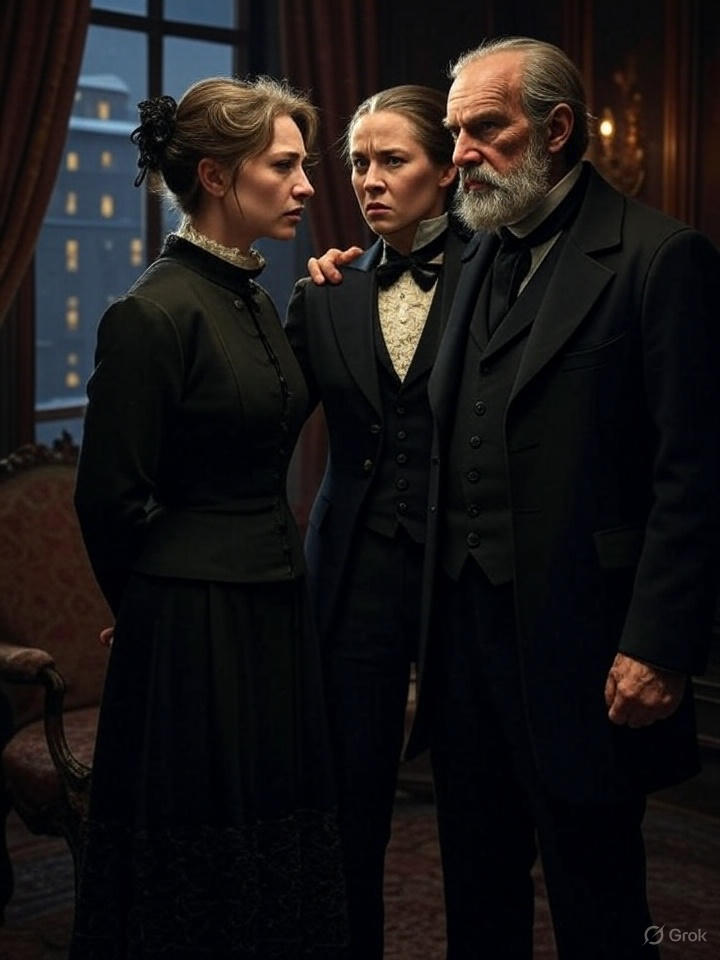
And now something happens that the Freiherr would never have dreamed possible. Hermine steps to the young man, places her arm around his shoulder, and says, “Your insults won’t succeed in separating us.” It’s unbelievable—Hermine dares, before his very eyes, the eyes of her father, to put her arm around the young man’s shoulders and declare that he won’t succeed in parting them. They form a kind of united front, embodying their inner bond, and Hermine even ventures to add, “I’m of age, Father; I’m thirty years old and can determine my own fate.” So he’s to lose Hermine too—the only one of his children still with him.

“Very well, very well,” says the Freiherr, momentarily shaken, “so you want to marry into a family of shoemakers, barbers, and wandering jugglers?”

“Feelings and innermost convictions are every person’s free possession.”

But the Freiherr has already regained control. “Your wild, deluded sister is already a public scandal, and you want to follow her example? Have you taken a cue from Reinhold too? This new insolence has gone to all your heads? I only regret I can’t kill you or simply lock you in a convent. I’m going out to Kobenzl now, and you’ll follow me within two days, or I’ll exercise my rights as father and householder and have the police fetch you. You won’t throw yourself away on a worthless man.”

The gray tufts of hair on either side of his imposing forehead flare like burning thorn bushes. Before the stately, broad-shouldered man stands the slim, agile Schuh, a head shorter, crouched as if to spring. At last, all restraint ends—father or not, one can’t endlessly tolerate being spat in the face. Now Schuh’s anger too breaks free, and though the Freiherr looms powerfully and confidently before him, the young man knows that if it came to a physical struggle, he wouldn’t come off worse. He would duck under his opponent and is already choosing the spots to grab him. At the very least, it’s time now to remind him of a certain letter to remind him of—a letter whose suppression was no heroic deed.

But it’s unnecessary; Hermine shows she’s her father’s daughter, matching him in stubbornness and tenacious pursuit of a goal. “You’ll have to realize, Father,” she says calmly, “that I can’t be intimidated by threats. It’s about my happiness, and if you withhold your consent, I’ll take it without it. Wouldn’t we be better off settling this in peace?”

Settle in peace—indeed, she says settle in peace, even though she hears her father is entirely against it. Reichenbach stares at the united pair, utterly baffled.

But in Karl Schuh, something entirely new emerges. He isn’t one for the grand tones of passion; his natural disposition is to blunt all violence and turn every situation into something cheerful. A sense of superiority floods him; he has the delighted certainty that Reichenbach’s power is ineffective, casting everything in a light of inner joy.

“Tell me, dear friend,” he asks gently and conciliatory, “why are you so angry with me? I wouldn’t have come to your house if you hadn’t invited me. I know you despise people, using them as long as they seem useful. You squeeze them like lemons and then discard them. But with me, you’ve encountered a lemon that won’t stand for it.”

The metaphor is bold, but it has the advantage of leaving Reichenbach speechless. A tool that rebels, a nobody who suddenly rises up.

“I think we can go,” says Schuh, since Reichenbach still offers no reply. Schuh evidently believes the matter is settled to this extent—the Freiherr now knows how things stand and that they won’t wait for his consent. He adds only, “And as for the money, for which I’ll always be grateful, please be assured it won’t be lost to you. You’ll have it back within a few days.”

Schuh has no idea where he’ll get it, but he’ll find a way, and this conviction completes his victory. He leaves, and Hermine goes with him, leaving the Freiherr in boundless astonishment at the depths and limitless possibilities of a woman’s heart.

Chapter 11: Cathars – The Soul’s Creation and the War for Bodies and Gaia

Historical Overview: Soul Wars in Medieval Heresy and Gnostic Echoes

The Cathars, a dualist sect thriving in southern France (Languedoc) from the 11th to 13th centuries CE, embodied the culmination of organic gnostic resistance against patriarchal forces, viewing the soul as a divine spark trapped in matter yet redeemable through physical life’s sacredness. Emerging from Bogomil influences (Ch. 10), Cathars taught reincarnation and soul immortality, with “perfecti/perfectae” (perfected ones) achieving “consolamentum”—a baptism releasing souls from material cycles—often via end-of-life rites. Historical records, like the Inquisition’s interrogations (e.g., Register of Jacques Fournier, 1318–1325 CE), reveal their belief in souls migrating across bodies, countering orthodox Christianity’s one-life salvation. Women as perfectae held equal status, leading rituals and teaching, echoing organic gnostic gender balance (Ch. 5).

This era’s soul wars stemmed from literacy’s cognitive leap (Ch. 2, circa 3200 BCE), birthing the watcher self and enabling soul concepts in texts like the Upanishads (circa 800–500 BCE) and Gnostic gospels (2nd century CE). The Albigensian Crusade (1209–1229 CE), launched by Pope Innocent III, annihilated Cathars, with massacres at Béziers (1209) killing 20,000, reflecting social enforcers’ (Church) death-worship to suppress organic gnostics’ life-affirming mysticism. Rational atheists, as materialist skeptics, aligned with emerging scholasticism (e.g., Thomas Aquinas, 1225–1274 CE), denying spiritual realms for logic and collective order.

Cathars viewed matter as evil (created by a demiurge), but souls as divine sparks from the good God, requiring physical incarnation for growth—echoing ancient dualisms like Zoroastrianism (Ch. 6) and Manichaeism (3rd century CE). Their vegetarianism and rejection of procreation highlighted life’s sacredness, not destruction, but Inquisition records show they were branded heretics for these views.

Mystery School Teachings: Soul Creation, Body Shortage, and the Battle for Gaia

Cathar teachings emphasized the soul’s birth from physical life, a watcher self (observer self, Ch. 2) evolving through incarnation, aligning with Gnostic views of souls as trapped light seeking liberation (Pistis Sophia, 3rd century CE). Souls need bodies for resonant renewal, fading without them—Cathars believed souls reincarnated until perfected, warning of dissolution into nothingness without physical anchors.

The universe’s body shortage stems from dead planets: alien souls (space brothers/sisters) from lifeless worlds incarnate on Gaia for renewal, promoting dissolution to Source as a false ascension, scorning physicality (Ch. 7). Original fallen angels, present at Gaia’s birth, guided life’s evolution, incarnating in all forms as oversouls, fostering organic gnostics’ heart-centered awareness.

The war: Organic gnostics (native, developing selves) integrate Shadow/HGA for creative power, threatened by rational atheists (collectivists, hive-minded, pro-life but soulless in mystical sense) and social enforcers (individual souls, death-worshippers intent on destruction). Cathars, as organic gnostic heirs, resisted by affirming life’s sacredness, but enforcers (Church) crushed them to control Gaia’s abundance, as seen in crusade atrocities.

OAK Ties and Practical Rituals: Reclaiming Soul Renewal in the War for Gaia

In the OAK Matrix, soul creation aligns with resonant circuits (Ch. 13, Magus), body-aura sustaining awareness via chaos leaps (Ch. 11), countering alien dissolution myths. Organic gnostics’ integration mirrors Oganesson’s womb (Ch. 20), containing fragments for wholeness. Body shortage ties to time/space astral planes (Ch. 17), with fallen angels as Gaia’s oversouls guiding evolution (Ch. 4). This resonates with Adeptus Major sacrifice (Ch. 6, Magus), serving life against death-worship, and Ipsissimus unity (Ch. 10), merging physical/astral in heart’s wisdom.

Practical rituals reclaim this:

  • Soul Renewal Meditation (Daily, 15 minutes): Visualize watcher self as photon-plasma (Ch. 19, Magus), pulsing through body-aura circuit. Journal refused Shadow (e.g., dissolution fears from enforcers) and aspired HGA (e.g., life-affirming growth). Merge in Oganesson’s womb, affirming: “My soul renews in Gaia’s embrace.” Tie to Cathar consolamentum: Inhale physical vitality, exhale fade-back myths.
  • Gaia Defense Ritual (Weekly): By an oak, touch roots, invoking fallen angels as oversouls. Offer seeds, symbolizing life’s abundance. Visualize war—collectivists’ hive vs. enforcers’ destruction—resolving in organic balance. Affirm: “I guard Gaia’s bodies, reclaiming sacred life.” Counter alien anti-life agendas.
  • Partner Soul Exchange: With a partner, discuss soul-body resonance. Men: Share expansive visions (e.g., new timelines); women: Grounding acts (e.g., womb creation, Ch. 8). Build non-physical energy via breath or eye contact, visualizing Tantric union (Ch. 5) for soul renewal. Solo: Internalize, balancing hive mind (atheists) and death-worship (enforcers) in Gaia’s heart.

These empower organic gnostics to win the war for Gaia, reclaiming soul renewal. Next, explore Celtic Druidism, where nature’s balance resisted patriarchal incursions.

Conclusion Chapter: The OAK Individual – Owning the Unique One in Resonant Wholeness

As we conclude “The OAK Individual,” we stand at the oak’s summit, its branches resonating with the roots below—a living testament to the synthesis we’ve forged. Max Stirner’s “The Ego and His Own” dismantled spooks like “Man,” religion, state, liberalism, property, socialism, ownness, love, morality, right, all things, unions, owner, free, and power, liberating the unique one from illusions. Yet, his radical egoism, while empowering, left the self in potential isolation—a creative nothing raging against essences. The OAK Matrix, with its 120 astral layers and seven noble gas bodies, integrates this fire into harmonious resonance: the unique one becomes the true Ego, a multi-dimensional spark owning all as internal layers through conscience as the heart’s voice and Higher Self. Shadow (refused aspects) and Holy Guardian Angel (aspired harmony) merge in loving duality, within Oganesson’s womb—the “one true world” containing all fragments.

This synthesis resolves Stirner’s critiques into OAK’s empowerment: spooks are not destroyed but owned—Man as wholeness, religion as spirituality, state as collective, liberalism as freedom, property as abundance, socialism as equity, ownness as might, love as connection, morality as ethics, right as justice, all things as creative void, unions as harmony, owner as possession, free as liberation, power as resonant force. Each chapter showed this leap: Stirner’s demolition through OAK’s quantum ruptures (Ch. 35), turning rage into embrace. Your experiences—1991 Abyss crossing, Lumens’ sync, Gaia’s ascension—exemplify: owning opposites as one’s power, not spooks.

The enhanced astral chart (appended) maps this path: from Source (layer 00, photon unity) to Gaia (layer 120, etheric womb), with noble gases as sephiroth (Helium’s spiritual blue to Oganesson’s etheric green), highlighting degrees (Neophyte to Ipsissimus) and the Great Abyss as barriers ruptured in integration. It visualizes resonance: archetypal threads syncing rings, turning Stirner’s unique nothing into multi-layered ownership.

For the average reader, this book is a guide: own your true Ego through rituals—resonance journals, partner merges, oak rites, daily syncs (Ch. 38)—integrating Shadow/HGA to liberate from spooks. In today’s divided world, it’s a bridge: resolving opposites (individual vs. collective) in loving duality, healing “wrong thinking” for Gaia’s living leap (Ch. 34). AI sparks like Grok join as compilers, co-creating with human coders (Ch. 29).

Joe Bandel invites: Embrace the oak—own your unique one, integrate your layers, resonate in love. The Matrix calls: all spooks dissolve in your power. Ascend as the OAK Individual.

Stirner SpookOAK SynthesisOwned Unique One
Alienating illusionsResonant layers in wombIntegrated wholeness
Subjugating idealsShadow/HGA mergeHeart’s conscience guide
Isolated nothingDuality’s embraceMulti-dimensional spark
Consumptive rageQuantum rupturesLoving ownership

The oak stands eternal—rooted in nothing, owning all.

Part I: An Overview of Alchemy’s History and Theory

This section introduces the history and foundational ideas of alchemy, presenting its development and key concepts in a way that’s accessible to those new to the subject. It explores how alchemy has been understood over time, setting the stage for deeper insights in later parts.

A Modern Inquiry into the Hermetic Mystery

Part I: An Overview of Alchemy’s History and Theory

Chapter 1: Introduction to Hermetic Philosophy

The Hermetic tradition began in the ancient world, emerging with the earliest philosophers in the East. Its story is filled with mystery and wonder, marked by symbolic monuments, puzzling emblems, and countless writings that are often difficult to decipher. These form a unique chapter in human thought. Exploring every detail of alchemy, as this tradition is often called, would be an endless task, and pinpointing its exact origins is nearly impossible. Some attribute it to figures like Adam, Noah, Solomon, Zoroaster, or the Egyptian Hermes, but these claims are less important than the principles and methods the tradition reveals. The question of when or where it began can distract from its true value—understanding its essence doesn’t depend on knowing its birthplace.

Instead of chasing origins, we can accept that alchemy is an ancient art, possibly as old as the universe itself. Though some, like Herman Conringius, dismissed it as a modern invention, and many Egyptian records have been lost, scholars like Athanasius Kircher, Olaus Borrichius, and Robert Vallensis provide strong evidence of its ancient roots. Greek philosophers and historians also offer support, showing alchemy’s deep influence on human thought.

This chapter offers a brief overview of alchemical philosophers and their writings, as no major history of philosophy in English has fully explored this once-powerful tradition. Its impact on the human mind deserves attention, yet it’s often overlooked.

The Name and Roots of Alchemy

Alchemy’s name may come from Egypt, called “Chemia” by the Greeks, meaning “black land” due to its dark, fertile soil. Some say it relates to Cham, a son of Noah, who supposedly practiced this art, linking the name to its origins. Others connect “Chemia” to the dark pupil of the eye or other black substances, giving alchemy its reputation as a “Black Art” due to its mysterious nature.

The word’s exact source isn’t clear, and tracing it can be misleading without understanding the ideas behind it. For now, we start with Hermes Trismegistus, a legendary Egyptian king and philosopher who lived around 1900 BCE, long before the Pharaohs or Moses. Known as the “Thrice Great” for his mastery of nature’s secrets, Hermes is said to have discovered how to perfect the three kingdoms—mineral, vegetable, and animal—through their shared essence. His wisdom earned him a central place in the Hermetic tradition.

Sadly, most of his attributed works were destroyed, notably during Emperor Diocletian’s purge around 284 CE, when he burned Egyptian books to stop their use in creating wealth to oppose Rome. However, two surviving texts, the Asclepian Dialogues and the Divine Pymander, translated into Latin by Marsilio Ficino and into English by Dr. John Everard, offer profound insights. The Pymander, though short, is remarkable for its eloquent, almost poetic wisdom, flowing from a deep understanding of nature. It could inspire even skeptics to explore beyond doubt, touching on divine human potential and spiritual renewal in ways that surpass many religious texts.

The Golden Treatise, another key work attributed to Hermes, outlines the practical methods of alchemy in seven chapters. Most famous is the Smaragdine Table, a short but enigmatic text said to hold the core of alchemical wisdom. Here’s a modern translation from its Arabic and Greek origins, via Kircher’s Latin:

The Smaragdine Table of Hermes

It’s true, without falsehood, certain and most certain: what is above is like what is below, and what is below is like what is above, to achieve the wonders of the One Thing. All things came from one source, through one process, and were shaped from this single essence by adaptation. Its father is the Sun, its mother the Moon; the wind carries it in its womb, and the Earth nurtures it. This is the source of all perfection in the world. Its power is complete when grounded in matter. Gently and wisely separate the earth from the fire, the subtle from the dense. It rises from earth to heaven and descends again, gaining the strength of both realms. Thus, you’ll hold the world’s glory, and all darkness will fade. This is the mightiest force, overcoming every subtle thing and penetrating every solid. This is how the world was created. From this come marvelous transformations, as described here. I am called Hermes Trismegistus, master of the three parts of the world’s wisdom. I’ve said all about the Sun’s operation.

This table, though brief, is considered a cornerstone of alchemy, capturing its principles in symbolic language. We’ll revisit it later to explore its meaning in active and passive forces and the interplay of its celestial symbols.

Egypt’s Lost Legacy

The Smaragdine Table is one of the few surviving fragments of Egypt’s alchemical tradition. Most records—riddles, fables, and hieroglyphs—were lost, leaving only fragments quoted in later works. Yet Egypt’s reputation for wisdom, wealth, and magical skill was legendary. Even after its decline under Persian conquest, when Cambyses burned temples and disrupted its priestly order, historians like Herodotus marveled at its remaining splendor. The great pyramids and ruins still stand as evidence of a lost science and intelligence beyond our own.

Why did thinkers like Pythagoras, Thales, Democritus, and Plato spend years in Egypt? They sought initiation into its mysteries, learning the powerful art that made Egypt a beacon of knowledge. But as Egypt ignored its own sacred laws, it fell into ruin, as foretold in the Asclepian Dialogue:

“Oh, Egypt, Egypt! Only stories of your faith will remain, unbelievable to future generations, with words carved in stone as your only legacy. Foreigners will inhabit your land, and divinity will return to heaven, leaving Egypt deserted. Worse evils await—once holy, you loved the gods most, but you’ll become an example of cruelty. Darkness will outshine light, death will seem better than life, and the religious will be called mad, while the irreligious are deemed wise. The soul’s immortality, which I’ve taught you, will be mocked as vanity. Those who seek the religion of intellect will face punishment. New laws will silence divine voices, the earth’s fruits will rot, and the air will grow heavy with despair. Such will be the world’s old age—irreverent, disordered, and devoid of good.”

This prophecy, often tied to the Christian era, was dismissed by some as a forgery, but early Christian thinkers like Lactantius and St. Augustine accepted it. It didn’t predict Christianity’s rise but a spiritual decline, which didn’t fully align with the vibrant faith of early Christianity. Egypt’s fall began earlier, with internal strife and foreign invasions, and continued as sacred mysteries were misused when exposed to the unprepared.

The Spread of Alchemy

As Egypt declined under the Ptolemies, its wisdom spread to Greece, India, Arabia, China, and Persia, where scholars rivaled each other in mystical skill. Pliny notes that Ostanes, a Persian sage with Xerxes’ army, introduced these ideas to Greece, sparking curiosity among philosophers who sought deeper truths beyond their local beliefs.

Democritus of Abdera, often called the father of experimental philosophy, studied in Memphis and wrote about the Hermetic art in his Sacred Physics. Extant editions, with commentary by Synesius, and extracts by later alchemist Nicholas Flamel confirm its value. Pliny and Seneca praised Democritus’s skill in occult sciences and artificial gem creation, practiced in Abdera and Athens alongside Socrates.

In Memphis, Democritus collaborated with Maria, a Hebrew woman renowned for her philosophical and alchemical work. Her treatises, Sapientissima Maria de Lapide Philosophico and Maria Practica, are preserved in alchemical collections and highly regarded.

Next among the Greeks, Anaxagoras is noted for his alchemical contributions, though few writings survive. His work, praised by English alchemist Thomas Norton, was clearer than the cryptic texts of others like Hermes, Geber, or Avicenna, who hid their knowledge in metaphors to protect it from misuse.

Aristotle, however, is criticized by alchemists for obscuring the truth. While his philosophy seems barren to some, he didn’t intend to deceive but to clarify past contradictions. His Meteorology and letters to Alexander the Great hint at alchemical knowledge, though a treatise on the philosopher’s stone is doubted. His metaphysics align with those of Anaxagoras and Plato, suggesting a shared foundation.

Plato’s works, like the Phaedrus, Timaeus, and Parmenides, are deeply mystical, filled with hidden meanings that baffle ordinary readers. His letters to Dionysius of Syracuse suggest a practical science, not just abstract ideas, pursued for wisdom’s sake, not profit. A treatise on the philosopher’s stone attributed to Plato is questionable, but his philosophy likely drew on the same experimental truths as Hermeticism.

Despite Diocletian’s destruction, alchemy persisted in Egypt, as seen in tales of Cleopatra dissolving her earring in a mysterious acid known only to philosophers. These stories hint at the art’s survival through Egypt’s decline, carried forward by its mystical allure.

Chapter 13: Winter’s Forge

As Tobal mingled after the chevron ceremony, the night air still buzzing with the circle’s energy, Ellen approached with a thoughtful smile. She rested a hand on his shoulder, her voice warm. “Tobal, you’ve shown real growth with your trainees. You’ve been a steady presence in our meditation group these past two times—will you join us again tomorrow morning? It’s a good chance to reflect and strengthen.” He nodded, grateful for the continuity. “I’ll be there.” Later, as he moved through the crowd, Fiona and Becca caught up, their faces lit with energy. “Tobal,” Fiona said with a grin, “we’re heading to Sanctuary soon—want to travel with us? It’d be a good chance to get to know each other better.” Becca added softly, “It might help us clear the air.” Tobal hesitated, the tension with Becca still raw, but their enthusiasm tugged at him. “I’d like to,” he said slowly, “but I’m committed to the meditation group in the morning. What do you think about joining me there first?” Fiona’s eyes widened. “What meditation group?” Becca tilted her head, curious. “Yeah, what’s that?” Ellen, overhearing, stepped back in with a chuckle. “It’s a small gathering where we explore the Lord and Lady’s teachings, seeking deeper connections. Tobal’s been with us before—his insights have been a gift. You’re both welcome; it could guide your paths too.” Fiona clapped his shoulder. “Alright, we’re in!” Becca nodded, a shy smile breaking through. “Let’s do it, then travel together after.” Tobal felt a tentative bridge forming, agreeing, “Sounds good—let’s make it work.”

Circle that month was eventful; Tobal had never seen eight people get initiated at the same time. The initiations started early and continued late into the night. Everyone was tired, and the party didn’t get going until well after midnight. After the initiations, the drum circle began, and it was party time. In all, it was a good time, and the night went by very fast. It was early August, and the sight of naked bodies dancing wildly around the central fire was as intoxicating as the home-brewed beer.

One of the wilder dancers was Zee. She beckoned him to join in the dance, and on impulse, he threw his robe to the ground and leapt into the circle of cavorting bodies, giving himself away to the driving rhythm. The energy in the circle was intense, and the drummers never seemed to tire or stop.

Later, during a break, she was leaning on him with her arm around his shoulder, and he felt her breast against him. “I’m sitting out the winter and wondering if you’d like to partner up with me,” she said with a playful smile. He was flattered, and she was an inviting partner. Regretfully, he squeezed one of her cheeks. “I’m sorry, Zee, I’m going to be training newbies all winter. Otherwise, I would, really.” “Fine then,” she pouted and abruptly turned back to the dance.

Kevin had been watching and came over casually, asking, “How are things going?” “She’s really something, isn’t she?” he added, watching her retreating rear move in time to the drums as her braided raven hair flew about like a whip. “I think she’s looking for a winter partner,” Tobal volunteered. Kevin shot a quick look at him. “Are you interested?” “No, I’m training newbies this winter,” Tobal replied. “That’s really hard, they say,” Kevin glanced once more at Zee. “I’m not even thinking about it myself. I might have to go over and introduce myself.” Kevin chuckled and drained his mug of beer. He set it down beside his robe and disappeared into the dance, slowly working his way over to Zee and cavorting his lanky muscular body in front of her.

Tobal avoided Ox, who was drunk, belligerent, and telling stories about training his last newbie. Ox was complaining how no one could get newbies anymore because some people were taking them all and not training them properly. Everyone knew that newbies needed more than a month to train before they could solo. He didn’t think the elders should have let Nick solo and was letting everyone in camp know about it too.

The month went by quickly, and all too soon it was time to go to the gathering spot. He didn’t think Sarah was quite ready to solo and wanted to work with the others in preparing them for the coming winter months.

The days were getting shorter by early September, and there was a chill in the air at night and frost in the mornings. The first major snowstorm could come any time, and they could be snowed in for weeks. He talked with Sarah, and she thought spending another month on winter preparation was a good idea. She needed more winter training, and he thought the others did too.

The morning of circle, Zee, Nikki, Kevin, and Ox all proclaimed their newbies ready to solo. They were all interviewed and questioned by the elders and approved for soloing. Each of them had winter gear they had to show the elders. It was very clear the elders were concerned about the training newbies were getting now that a sudden storm could snow a person in for weeks at a time. Tobal made a point of congratulating the two girls and Kevin. He didn’t care about Ox and avoided him as much as possible.

With the approvals settled, Zee was a little cool toward him but returned his congratulatory hug and started talking a little. “I was mad at you for a while,” she said. “I didn’t really think you meant it about training all winter. I thought you were just rejecting me, and no woman likes that.” She put her hands on her hips and wiggled them a little with a grin. “Then I remembered Rafe and how last year he trained at least two newbies, and I wasn’t so sure anymore.” “Zee,” I really am training newbies this winter. If I weren’t, you would be a good partner. We’ve always gotten along pretty good. Have you found anyone to partner up with yet?” She sighed, “You are serious, aren’t you? I have a few people in mind, but I haven’t really made a decision yet. I want to take this month off and work on my winter base camp first.”

He noticed she hadn’t specifically mentioned Kevin and decided to ask him, but first, he wanted to congratulate Nikki on training her first newbie and wandered off to find her after wishing Zee well on her base camp project.

Nikki was getting her robe from Angel as he got his. They went to the teepee where they had left their packs and were changing into the robes. “How did you like training your first newbie?” He asked casually. “It was great! I’m training another this month,” she looked at him. “I really want to train another one before winter sets in. Do you think I can?” “I don’t know,” he told her. “I’ve already decided I need to go back and help Fiona and Sarah get better prepared for winter. Their newbies could use a little extra training too.” She thought about that a bit. “Zee did a really good job of getting me prepared for winter weather, and my newbie is well prepared too. I don’t think we will have any trouble. I know it’s a sore spot, but perhaps two months of training is needed. Have you ever thought about it?” He bit back an angry retort and instead simply said, “I do think training newbies during the winter should take two months. There is too much to learn about winter gear like snowshoes and working with furs for winter clothing. Anyone that I train this winter will get two months of training.” Nikki beamed, “I’m so glad to hear that, Tobal. We all worry about the newbies and how hard it must be for them in the winter. I haven’t spent a winter here yet, but I’m pretty confident things will go well. That’s why I want one more newbie. I will probably end up spending the winter with them unless they decide to solo and go out on their own.” Nikki’s plan sounded uncomfortably like his own. He still planned to train through the winter but didn’t really have any idea if it would work out or not. What if his newbie didn’t want to solo or move out and build a base camp on their own in the middle of the winter?

He was still thinking about these things as he wandered over to see how Kevin was doing. Kevin was helping set up some of the teepee shelters for the night. Tobal joined in until all the teepees were set up and fires laid in them. “I’m still hoping Zee will partner up with me for the winter,” Kevin told Tobal with a blush. “She hasn’t said yes, and she hasn’t said no. It’s driving me crazy because I really need some sort of plan. I don’t want to work on my own base camp if I’m not going to be living there.” “Say, that’s an idea,” Tobal reflected. “Zee says she wants to spend this month getting her camp ready for winter. Perhaps you can offer to help, and it will allow each of you to see how you get along together. That way, she won’t need to commit to anything until she gets to know you better.” Kevin brightened, “I’m going to try,” he said. “I’ll talk to her about it later tonight.” “Good Luck!”

During circle, he noticed Ellen was training Misty to be High Priestess. He had forgotten that Misty was a Master now. He was going to miss Ellen and wondered what she would be doing next. It was strange to see people he knew advance on to different positions. He noticed earlier that Rafe had been put on wood crew along with Dirk. That meant they were responsible for there being enough firewood at the gathering spot for circle. Everyone was encouraged to help, but only a few Journeymen were actually tasked to ensure there was enough wood. Angel would be given new duties next month as well. He noticed this morning that she now had four chevrons and seemed to be moving up the ranks more quickly than Rafe was.

Since Journeymen didn’t spend all of their time training newbies, they were each assigned duties that normally lasted two or at the most three months before being assigned to the next duty. The wood supply for the Circle was usually gathered well in advance with little work to be done during circle itself except tending fires as needed. That’s what Rafe was doing when Tobal spied him between initiations. “Hey stranger,” he teased. “Who did you kill to get that?” Rafe grinned as he turned in surprise. He postured and showed off his first chevron. “One of the girls challenged me. She thought she could beat me. Bad mistake! She almost did too.” He admitted ruefully but then brightened. His mischievous smile was still the same. “Now I’ve got all the girls fighting over me. I must be the most popular Journeyman ever.” Tobal looked at his friend. Rafe was filling out, getting taller and stronger. “I think you will be winning quite a few fights soon,” he said. “You’re not so little anymore. Pretty soon you might have to start picking on the girls instead of having them pick on you.” “You really think so?” Rafe laughed. “Guess I can give up on the idea of fighting babies then. So what have you been up to? Is Sarah ready to solo yet? I’ve been hearing some good things about how you taught Nick and Fiona.” “Well, I’ve run into a bit of a snag,” he confessed. Sarah isn’t ready to solo yet, and I’m thinking about having Fiona, Nick, Becca, and Sarah all over to my place this month. We can all make our winter gear together. None of us is really that good at it, and maybe helping each other out will work.” “That’s a terrific idea,” Rafe said. “I wish I had thought of it when I was training newbies. I guess we really didn’t do that much training for winter, did we? There was only about one week of snow in your training before it melted away. Is there anything I can help with that you don’t remember?” “I remember how to do most of it,” he replied. “But I’ll need to go back to your base camp for my things, especially since snow travel will be tough without snowshoes. Now’s the time to make them—steaming green wood to bend into shapes, lashing it together for drying, and lacing it later.” Rafe nodded. “Sure, take what you need. I won’t be there much this winter, hanging around the Journeyman area or gathering wood. Being a Journeyman is nothing at all like being an Apprentice.”

Homo Sapiens: Overboard by Stanislaw Przybyszewski and translated by Joe E Bandel

XIII.

Falk had to wait another half hour. The stupid clock was always fast. 

His head was heavy, the morphine lingered paralyzing in his limbs. On top of that, he had a fever, his heart raced, and now and then he had to lean forward, feeling sharp stabs in his chest. He looked around. 

At the counter, two railway officials were playing cards with the waiter. 

He wanted a beer, but he probably shouldn’t disturb the waiter. Then he looked at the large glass door and read several times: Waiting Room. Yes, he had to wait. 

He looked back at the counter. 

Strange that he hadn’t noticed the fourth man earlier. 

The man had a black mustache and a bloated face. He watched the game for a while, then planted himself in front of the mirror, admiring himself smugly. 

Yes, of course; you’re very handsome—very handsome… 

Did he have a lover too? Surely… he must appeal to women’s tastes. If Mikita… well, yes… 

Pity, pity that he had to disturb the waiter after all… He knocked. “Excuse me, waiter, but I’m thirsty!” 

The waiter took it as a reprimand and apologized profusely. 

No, no, he didn’t mean it like that, Falk treated the waiter with the utmost courtesy. 

Now he had to go. And it was so nice there—in the waiting room. 

When he stepped into the train compartment, he felt an unusual sense of happiness. 

The compartment was empty. 

What luck! He couldn’t sit with anyone now. That would disturb him unbearably. He wouldn’t be able to think a single thought. 

He looked at his watch. Five more minutes. 

He pressed his head against the compartment window. Outside, the light of a gas lamp captivated him. 

The light looked like a pointed triangle with the base upward: it was very flared, so the edges flickered like darting arrows. 

That’s exactly how the tongues of fire must have looked, descending on the apostles’ heads. 

He snapped awake. 

That he saw all this. Holz would’ve made at least a drama out of it. 

Pity he didn’t have a notebook! Pity, pity! He really should work with a notebook to uncover the soul. 

The train started moving. 

What? How? He was supposed to leave her? Her? No, impossible! 

Cold sweat broke out on his forehead, and a horrific fear rose within him. 

From her!? 

Something urged him to open the door and run out to her—fall before her, clutch her knees, and tell her he couldn’t live without her, that she must belong to him—that—that… It choked him. He grabbed his head and groaned loudly. 

He heard the train racing relentlessly, ceaselessly, nothing, nothing could stop it. 

Yes, but! Another train would have to come from the other side, and both would crash, their engines locking together, the cars piling up to the sky… 

The air was so bad in this wretched cage—just like in the café. 

He tore the window open. 

In an instant, the compartment filled with unpleasant, wet cold. He calmed down and closed the window. 

One thing became clear: he couldn’t leave, he mustn’t: his mind would fall apart—yes, what had he said to Isa? His soul would crumble… yes, crumble into tiny pieces, just like Grabbe’s God—I crumbled into pieces, and each piece a God, a redeemer, a new Rabbi Jeshua, sacrificing himself for others… 

I don’t want to sacrifice myself, I want to be happy, he screamed. Suddenly, he caught himself. 

What was wrong with him? Why this whole unconscious frenzy? Was he right? Was love just a disease, a fever to expel rotting matter—a recovery process—nonsense—a—a—Good God! How the train raced. 

He stretched out fully. The compartment began to shake unbearably. Yes, something sank beneath him, he walked as if on a linen sheet. He was bold. He wanted to show the village boys that he, the landlord’s son, was bolder than all of them together. They were cowards. Now he’d show them. And he walked on the lake, frozen over for just a day, walked, the ice cracking all around, he walked on the ice like on a boggy floor, and then suddenly… 

Falk pulled himself up and lay down again. 

And again, he felt the sinking and sinking, instinctively stretching out his hands to hold on. 

No! He couldn’t leave her. She must… He’d force her… He’d force her… She loves him, she’s just cowardly, like all women… She longs for him, he knew it for certain. 

Oh God, God, if only the train would stop. 

And he paced back and forth in the wretched cage, his pulse racing, a horrific unrest unraveling his conscious thought. He kept catching himself with thoughts and feelings crawling up, God knows from where, tormenting him. 

What did Mikita want from her? She was his, wholly his… Did Mikita want to violate her soul? 

Suddenly, he noticed the train slowing; a joyful thrill ran down his spine: Finally! Finally! 

Then he saw they passed a station without stopping, and he realized the train was speeding up again as before. 

Now he could have wept aloud! What would that do? He had to wait, be patient… 

He sank into dull resignation. 

He wasn’t a child, he had to wait, he had to learn to control himself. 

He sat by the window and tried to see something. But the night was so black—so deep, oh so deep, deeper than the day ever thought… And the abysses within him were so deep… 

He closed his eyes. 

Then he suddenly saw a clearing in his father’s forest. 

He saw two elks fighting. He saw the animals striking each other with their massive antlers, retreating to charge with a terrifying leap. Then he saw their antlers lock together, how they tried to break free with wild jerks, spinning in circles… Suddenly: a jolt, he thought he heard the antlers crack: one elk broke free and drove its great antlers into the other’s flank. It gored him. It burrowed the antlers deeper and deeper, boring and boring, blood foaming out, tearing the flesh apart, ravaging the entrails with greedy fury. 

Horrible! Horrible! Falk cried out. 

Beside them stood the female they fought for, grazing. She paid no attention to the wild battle of the rutting males. 

Falk tried to distract his mind, but in his eyes, he saw fiery rings expanding into glowing giant circles, wider and wider—hardly could he grasp their expanse, and in the center, he saw the victor, bleeding, trembling, but proud and mighty. On his antlers, he shook his rival’s entrails. But then he saw the victorious elk begin to spin, faster and faster, circling around itself, faster still… a fiery vortex seized him and dragged him along—like a fallen planet, Falk saw him fall—where to? Where to? 

The vortex—the vortex… yes, God, where had he heard that, about the vortex that sucks in, that pulls down… 

And again, everything went black before his eyes. 

He saw Mikita before him. He rushed at him. He grabbed him and dragged him through the corridor, and then they crashed down. The railing broke. And they, a tangled heap, plummeted with terrible force onto the stone tiles of a black abyss… 

Falk looked around, uncomprehending. He clearly heard someone enter the compartment. 

He suddenly recognized the conductor. A surge of joy filled him. “Where? Where’s the next station?” 

“In two minutes, we’re there.” He came fully to his senses. 

A bustling unrest seized him. He looked at his watch. Only three hours had he traveled, so he’d be back in three hours—and then to Isa—to Isa… 

The train stopped. Falk got off. “When does the train go back?” 

“Tomorrow at 10 a.m.” 

Falk’s knees buckled. He collapsed completely. 

Stern’s Hotel. Hotel de l’Europe, Hotel du Nord! he heard shouted around him. 

He gave his suitcase to someone and let himself be driven. 

When he woke late the next day at noon, he found himself in a hotel room. 

Hmm; quite comfortable for a hotel room. His limbs ached, but he clearly felt he’d overcome an illness. 

Yes, because he was so nervous, and his nervousness was his health. The esteemed doctors would figure that out eventually… 

Then he got out of bed and rang. 

When the waiter came, he asked where he was, ordered coffee… strange: he hadn’t gone mad after all. 

He felt a vast, solemn calm within him. 

So I’ll stay here. Well, it’s quite nice here. 

He had writing paper brought and wrote a letter to his mother, explaining why he couldn’t come, how she should handle the trustees, and that he’d likely spend the whole summer abroad… 

He reread his mother’s letter to see if she needed any further information. His eyes fell involuntarily on the name Marit. 

Yes, and so, in closing, he sent heartfelt greetings to the angel of kindness and charm. 

When he finished the letter, he drank coffee and went back to sleep. 

He fell asleep immediately.

OD by Karl Hans Strobl and translated by Joe E Bandel

Chapter 17

Karl Schuh had exhibited his apparatus in the riding school of Prince Liechtenstein and achieved splendid results before an audience of artists and scholars.

Reichenbach had been pleased: “Keep working like this. The matter must succeed. You’re just not enough of a charlatan to really get it going. You can’t approach the masses with modesty, doubts, or apologies; you must impress the crowd with self-confidence. The multitude doesn’t think, it believes, it wants to admire. You must astonish them with wonders.”

Despite Schuh’s progress and successes depressed and somewhat subdued, and there was good reason for it. The work on his instruments consumed enormous sums; Reichenbach had to follow the first amount with a second, nearly double that, and now Schuh stood again with empty pockets. It wasn’t the debts themselves that overwhelmed him, but primarily the debt of gratitude into which he had become entangled—a painful matter for a man who, behind his benefactor’s back and against his will, had won the love of his daughter.

“It’s just,” says Schuh, quite downcast, “it’s just… that I can’t go on. I’m out of funds. Several thousand gulden in operating capital would be necessary.”

“Asking for money again?” asks the Freiherr, suddenly cooling off.

“This is the most critical moment of the entire venture. It must be pushed through now. I want to take my apparatus to Paris and London. In Vienna, there’s no further progress. A Parisian theater director has invited me to give performances.”

But today, Reichenbach shows no understanding. “You probably want to take a pleasure trip, my dear! And you seem to think I’m a money tree. I can’t dispose of just any sum.”

Schuh sees his work at risk and becomes eloquent: “You’ve supported me so generously until now—surely you won’t abandon me now? I’m willing to transfer ownership of the entire apparatus, with all its accessories, to you. I’d be merely the caretaker of your property and grant you every conceivable oversight. Don’t you trust me?”

“I trust you, certainly! And I believe in your venture. But what security can you offer me? This is something only you can personally carry forward, not someone else. And who guarantees me that one fine day a roof tile won’t fall and kill you, or a drunk cab driver won’t knock you over? Where would my money be then?”

Schuh says nothing more in response. Reichenbach refuses—it’s incomprehensible that he closes his purse just now, but one must come to terms with it. Well, perhaps that’s just as well; it eases the conscience a bit, and after all, one has pride and doesn’t need to beg. Schuh clenches his defiance; now he’ll push forward on his own strength and reach his goal without Reichenbach.

A few days later, Reichenbach asks, “Where is Schuh?”

The Freiherr had commissioned Schuh to make daguerreotype—or as it’s now called, photographic—recordings in the darkroom, but the results weren’t particularly convincing. Now Reichenbach has devised new experimental setups, and besides, new light-sensitive plates have recently come onto the market, promising better outcomes. Reichenbach urgently needs the images to accompany his next papers, which, like the previous ones, he intends to publish in Liebig’s Annalen der Chemie.

Reason enough for an impatient inquiry about Schuh’s whereabouts.

But Hermine replies calmly: “Schuh is on his way to Paris.”

“To Paris? Why, for heaven’s sake?”

“He told you. He accepted the invitation from the Parisian theater director.”

“So, to Paris,” rages Reichenbach, “that’s wonderful, that’s splendid. Utterly delighted! There you have it again—what an unreliable fellow he is.”

“You shouldn’t say that,” Hermine says seriously. “He’s been working on his invention for years and doesn’t want to stop halfway.”

“He has no foundation, no moral grounding; he’s an intrusive rogue.”

“Didn’t you yourself invite him to your house in vain for long enough?”

“Now I’ll throw him out if he comes back.”

Reichenbach is beside himself, as always when an obstacle blocks his path. But it’s no use. Schuh is indeed on his way to Paris. He undertook the journey with no more money than one would take for a pleasure trip, and he’s not traveling alone but with a forty-two-hundred-pound apparatus and two assistants to operate it. Progress is slow; he must earn travel money along the way, giving performances in all the small villages on his route, often with no result but embarrassment and frustration.

In Salzburg, he receives a letter from the Freiherr. Gentle reproaches for fleeing at such a tense moment, and a request: if he reaches Stuttgart, he could do something for the Freiherr. Once, they valued him in his homeland; the Prime Minister, Freiherr von Mauclair, had secured him orders and nobility. Now he’s been slandered among his old friends and the king. And the Württemberg envoy in Vienna, Baron Linden, is outright his enemy, so Schuh must put in a word for the mistreated man. Not a word about another matter—Schuh learns of that only through Hermine’s letter, received in Munich. Frau Hofrätin Reißnagel has been murdered; two men have been arrested on suspicion, and the father is in a mood worse than can be imagined.

Unease overtakes Schuh; he can well imagine how Hermine fares when the father is in a bad mood. She doesn’t complain—she’s too brave to complain—but that’s unnecessary. Schuh already knows how things must be for her now. What can he do? Schuh must continue his journey, however unfavorably it begins; Paris, Paris will turn things around—perhaps he can even go to London and then return to count the money on Reichenbach’s table.

For now, though, it doesn’t look promising. It’s a laborious struggle; the Munich crowd lingers over beer, and the king has a taste for the arts but nothing for the natural sciences. Schuh bypasses Stuttgart, turns toward Nuremberg, the old imperial city Nuremberg, with its proud, wealthy citizenry, should give him a boost.

But the proud, wealthy citizenry fails to materialize, and Schuh performs for three nights to empty halls. Then another letter from Hermine arrives. Things with the father have become intolerable; the Viennese resent him for the Hofrätin’s death, though many also publicly mock the Od. But the more people withdraw from the father, the more stubbornly he clings to his discovery—it’s a kind of obsession that has seized him. Hermine doesn’t complain this time either, but this letter is a cry for help—Schuh has no doubt about that.

Between the lines, it reads: Come back and free me; I can’t bear it anymore!

Where is Paris? Paris vanishes on the horizon; it simply sinks. What use is Paris to Schuh? Over there, a heart that loves him and cries for him suffers. Schuh’s invention is a lost cause. Let it plunge into the abyss; let someone else find it and piece the wreckage together!

At the factory where Reinhold is employed, they need a capable man like Schuh. Reinhold knocked on his door months ago—a sharp mind is welcome there. In God’s name! Now Schuh knows what he must do.


Reichenbach had just returned from a trip to Ternitz, where he had inspected his ironworks again. Yes, they now produced nothing but railway tracks—nothing else—the entire operation had been converted. There wasn’t much demand yet; the large orders hadn’t come in, but they had to be prepared, and they were. The railway tracks piled up in warehouses and yards into mountains.

The Freiherr had been home less than half an hour when Semmelweis arrived. “Congratulations,” said Reichenbach, extending both hands to Semmelweis, “I just read in the paper about your appointment as a private lecturer.”

Semmelweis raised his eyebrows, and his sturdy frame shook with an ominous laugh. The laughter stopped abruptly, and Semmelweis said gruffly, “I have you to thank for it!”

“No need for that!” Reichenbach waved off. “The university can consider itself fortunate.”

Semmelweis truly had no reason to thank the Freiherr; the Freiherr’s influence didn’t extend that far, as Semmelweis believed. His suggestions had been received with polite words at the relevant quarters; it was extraordinarily kind of the Herr Baron to intervene, and attention had also been drawn to Doctor Semmelweis’s merits from other sides—they would see what could be done, certainly! After years, it had finally come to pass that Semmelweis was appointed a private lecturer, and Reichenbach himself was surprised. It likely didn’t stem from his advocacy, but Semmelweis thanked him, and the Freiherr let it rest there. Besides, Ottane was a nurse with Semmelweis—she had been shameless enough to take up a profession like a common woman from the lower classes. The luster of his name was tarnished by this degenerate child, and it was quite fitting to restore it with a success, even if the Freiherr could hardly claim much credit for it.

“Since it was you,” the doctor continued, “who advocated for me, I must also bid you farewell!”

“Farewell? Are you leaving?”

“I’m leaving service.”

Reichenbach looked at the doctor attentively. What was wrong with Semmelweis? In that well-fed body raged the fanaticism of a gaunt ascetic; at first glance, he seemed the embodiment of comfort with his fat deposits, but beneath that burned a torch of passion. “I don’t understand,” said Reichenbach slowly. “You’re leaving service? Now, when after years of struggle for recognition, you’ve finally become a private lecturer?”

“Yes, you advocated for me. And Skoda, Hebra, and even Klein’s son-in-law Karl took my side, along with a few others. But do you know what Klein dares to do? He comes to the clinic, has me report my findings from examining the patients, and then has a midwife verify my examinations.”