Part III: Concerning the Laws and Vital Conditions of the Hermetic Experiment
Chapter 3: The Manifestation of the First Matter, Part 3
Introduction: The Hermetic art transforms the soul’s essence, the First Matter, into radiant divine light, uniting it with eternity through sacred vision. This section unveils the mystical dialogue with the divine mind, revealing the soul’s path to universal truth through poetic and alchemical insight.
The Divine Vision of Pœmander
Hermes’ Pimander recounts a sacred encounter where the soul, freed from sensory illusions, beholds the divine mind. Pœmander, the “Mind of the Great Lord,” reveals an infinite light, sweet and radiant, born from a dark, moist chaos. This light, the First Matter, emerges as a holy Word, uniting with nature to birth a fiery spirit that ascends, leaving earth and water transformed below. This vision mirrors the alchemical process of separating the subtle from the gross, as the Emerald Tablet instructs.
The divine mind declares, “I am that Light, your God, before the moist nature of darkness. The Word is the Son, and the Mind is the Father—united in life.” This union, where the soul’s seeing and hearing align with divine light, transforms it into a vessel of eternal wisdom.
The Creation of the Cosmos
Hesiod’s Theogony echoes this, depicting Chaos birthing Erebus, Night, Ether, and Day, with Love uniting all. This poetic cosmogony aligns with alchemical creation, where the First Matter, stirred by divine will, forms the universe. Ovid’s Fasti describes a primal mass separating into fire, air, water, and earth, shaped by the divine hand into a harmonious world, reflecting the soul’s transformation from chaos to radiant order.
The divine will, as the Kabalistic interpreter notes, moves the formless abyss to create matter and attraction, birthing the cosmos through love. This mirrors the soul’s alchemical rebirth, where the purified essence becomes a crystalline vessel of divine light.
The Soul’s Ascent to Wisdom
Solomon celebrates this wisdom as an “understanding spirit—holy, subtle, undefiled,” guiding the soul to know the cosmos’ creation and the elements’ operations. This is the philosopher’s stone, the “Ruach Elohim” that moved upon the waters, born in the soul’s virgin womb as a universal, triune essence. Through faith and love, the soul, purified of sensory desires, becomes a radiant vessel, as Pœmander instructs: “Know yourself, and pass back into Life.”
Closing: This chapter unveils the First Matter’s transformation into divine light, a sacred vision of cosmic and spiritual unity. The journey into its alchemical practice deepens in our next post, unveiling further secrets of this sacred art.
Homo Sapiens by Stanislaw Przybyszewski and translated by Joe E Bandel
“Strange, strange… the doctor said you should lie at least three days, and I have seen this expression of strength and energy in your face for a long time. You are different from all people.”
“Yes, yes, that is the new strength. Drink, drink with me… I was so little with you… Drink the whole glass out.”
They drank out and Falk filled the glasses anew.
He sat down beside her, took her both hands and kissed them. “We have not spoken together for a long time,” he said.
“Now everything is good, isn’t it?” she asked tenderly.
“It will become good. We will travel away from here… What do you think of Iceland?”
“Are you serious?” “You make so many new plans…”
“This time I am serious, because it is namely no plan. It occurred to me today, yesterday, I actually don’t know when, but I must away from here.”
Isa beamed. She did not want to tell him, but she found it unbearable in this boring city.
“Think, such a small fisherman’s house by the sea. Isn’t it? Wonderful! And the autumn nights when the waves play this terrible eternal music on the beach. But you will not be bored?”
“Did I ever get bored with you? I need no person, nothing, I need absolutely nothing if I only have you.”
“But I will often be away from you, very often. I will go out with the fishermen for entire nights, I will go into the mountains. And when we are together, we will lie in the grass and stare at the sky… But drink, drink then… Oh, you can no longer drink as before.”
“See then!” She drank the glass empty.
“And in this twosomeness: you and I, and you a piece of me, and we both a revelation of the immanent substance in us…” He stood up. “Isa! we will seek the God we lost.”
She was as if hypnotized.
“The God we lost,” she repeated half unconsciously. “You don’t believe in God?” he asked suddenly.
“No,” she said thoughtfully.
“You don’t believe one can find him?” “No, if one does not have him in oneself.”
“But that is what I mean: to find God, that means to feel God, to feel him in every pore of one’s soul, to have the immediate certainty that he is there, to possess the wild supernatural power that the God-feeling gives.”
“Do you want to seek another God, a God outside? What do you want this God for? I don’t want him. I don’t need him. I have the immediate certainty of the God-feeling, I feel him as long as you are there. I need nothing higher… And I will not tolerate such a feeling in you either. Then I will not go with.”
He looked at her long.
“How beautiful you have become now. As if a light had suddenly bloomed in you…”
Suddenly he lost balance and came into a strange rapture.
“Yes, yes, I mean the God who is you and I. I mean the holy, great My-You! Do you know what my you, my dark you is? That is Jahveh, that is Oum, that is Tabu. My you, that is the soul that never prostituted itself in the brain. My you, that is the holy soul that rarely comes over me, perhaps once, as the Holy Spirit came only once over the apostles. My you, that is my love and my doom and my criminal will! And to find my God, that means: to explore this you, to know its ways, to understand its intentions, so as not to do the small, the low, the disgusting anymore.”
Isa was carried away. They grasped each other violently by the hands.
“And you want to teach me to find and explore it in me?” “Yes, yes…” He looked at her as if he had never seen her before.
“And you will be in me?”
“Yes, yes…”
“I am yours, your thing and your you… Am I it?” “Yes, yes…” He began to become distracted.
“We are poor, Isa,” he said after a while, “I lost the whole fortune.”
“Throw the rest away too,” she cried laughing to him and threw herself on his breast.
Fear suddenly rose in him.
“You, you—if it is over tomorrow? I have such mistrust of myself.”
“Then I will pull you with.”
“But is it perhaps not only an over-fatigue, an over-excited mood that whips us into this ecstasy?”
He started.
“I lie, I lie,” he said suddenly hoarsely, “I have lied too much… Now…”
He broke off. The thought to tell her now everything, to tell everything in detail, shot through his head and grew into a great, maniacal idea.
“Isa!” He looked at her as if he wanted to bore into the ground of her soul… “Isa!” he repeated, “I have something to tell you.”
She started frightened.
“Can you forgive me everything, everything I did evil?”
The confession forced itself with irresistible power over his lips. Now he could no longer hold it back. He grasped her hands.
Alraune by Hanns Heinz Ewers and translated by Joe E Bandel
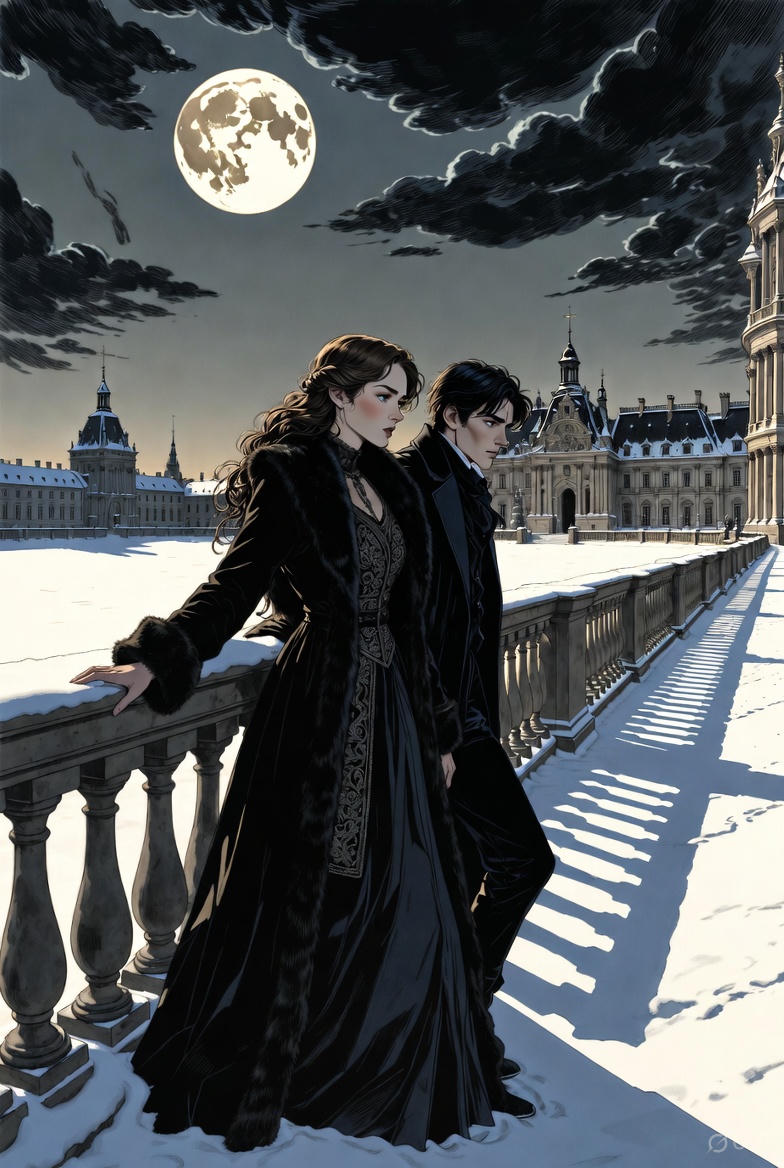
The guests pressed to the edges, those in back climbed up on chairs and tables. They watched, breathless. “I congratulate you, your Excellency,” murmured Princess Wolkonski. The Privy Councilor replied, “Thank you, your Highness. You see that our efforts have not been entirely in vain.” They changed directions, the Chevalier led his Lady diagonally across the hall, and Rosalinde opened her eyes wide, throwing quiet, astonished glances at the crowd surrounding them. “Shakespeare would kneel if he saw this Rosalinde,” declared the professor of literature. But at the next table little Manasse barked from his chair down to Legal Councilor Gontram. “Stand up and look just this once, Herr Colleague! Look at that! Your boy looks just like your departed wife–exactly like her!” The old Legal Councilor remained sitting quietly, sampling a new bottle of Urziger Auslese. “I can’t especially remember any more how she looked,” he opined indifferently. Oh, he remembered her well, but what did that have to do with other people? The couple danced, down through the hall and back. Rosalinde’s white shoulders rose and fell faster, her cheeks grew flushed–but the Chevalier smiled under his powder and remained equally graceful, equally certain, confident and nimble. Countess Olga tore the red carnations out of her hair and threw them at the couple. The Chevalier de Maupin caught one in the air, pressed it to his lips and blew her a kiss. Then all the others grabbed after colorful flowers, taking them out of vases on the tables, tearing them from clothing, loosening them from their hair, and under a shower of flowers the couple waltzed to the left around the hall carried by the sounds of “Roses of the South”. The orchestra started over and over again. The musicians, dulled and over tired from nightly playing, appeared to wake up, leaning over the balustrade of the balcony and looking down. The baton of the conductor flew faster, hotter rushed the bows of the violinists and in deep silence the untiring couple, Rosalinde and the Chevalier de Maupin, floated through a sea of roses, colors and sounds. Then the conductor stopped the music. Then it broke loose. The Baron von Platten, Colonel of the 28th cried out with his stentorian voice down from the gallery: “A cheer for the couple! A cheer for Fräulein ten Brinken! A cheer for Rosalinde!” The glasses clinked and people shouted and yelled, pressing onto the dance floor, surrounding the couple, almost crushing them. Two fraternity boys from Rhenania carried in a mighty basket full of red roses they had purchased downtown somewhere from a flower woman. A couple Hussar officers brought champagne. Alraune only sipped, but Wolf Gontram–overheated, red-hot and thirsty, guzzled the cool drink greedily, one goblet after another. Alraune pulled him away, breaking a path through the crowd. The red executioner sat in the middle of the hall. He stuck out his long neck, held out his axe to her with both hands. “I have no flowers,” he cried. “I myself am a red rose. Pluck me!” Alraune left him sitting, led her lady further, past the tables under the gallery and into the conservatory. She looked around her. It was no less full of people and all of them were waving and calling out to them. Then she saw a little door behind a heavy curtain that led out to a balcony. “Oh, this is good!” she cried. “Come with Wölfchen!” She pulled back the curtain, turned the key, and pressed down on the latch. But five coarse fingers rested on her arm. “What do you want there?” cried a harsh voice. She turned around. It was Attorney Manasse in his black hooded robe and mask. “What do you want outside?” he repeated. She shook off his ugly hand. “What is it to you?” she answered. “We just want to get a breath of fresh air.” He nodded vigorously, “That’s just what I thought, exactly why I followed you over here! But you won’t do it, will not do it!” Fräulein ten Brinken straightened up, looked at him haughtily. “And why shouldn’t I do it? Perhaps you would like to stop us?” He involuntarily sagged under her glance, but didn’t give up. “Yes, I will stop you, I will! Don’t you understand that this is madness? You are both over heated, almost drenched in sweat–and you want to go out onto the balcony where it is twelve degrees below zero?” “We are going,” insisted Alraune. “Then go,” he barked. “It doesn’t matter to me what you do Fräulein–I will only stop the boy, Wolf Gontram, him alone.” Alraune measured him from head to foot. She pulled the key out of the lock, opened the door wide. “Well then,” she said. She stepped outside onto the balcony, raised her hand and beckoned to her Rosalinde. “Will you come out into the winter night with me?” she cried. “Or will you stay inside the hall?” Wolf Gontram pushed the attorney to the side, stepped quickly through the door. Little Manasse grabbed at him, clamped tightly onto his arm. But the boy pushed him back again, silently, so that he fell awkwardly against the curtain. “Don’t go Wolf!” screamed the attorney. “Don’t go!” He looked wretched, his hoarse voice broke. But Alraune laughed out loud, “Adieu, faithful Eckart! Stay pretty in there and guard our audience!” She slammed the door in his face, stuck the key in the lock and turned it twice. The little attorney tried to see through the frosted window. He tore at the latch and in a rage stamped both feet on the floor. Then he slowly calmed himself, came out from behind the curtain and stepped back into the hall. “So it is fate,” he growled. He bit his strong, tangled teeth together, went back to his Excellency’s table, let himself fall heavily into a chair. “What’s wrong, Herr Manasse?” asked Frieda Gontram. “You look like seven days of rainy weather!” “Nothing,” he barked. “Absolutely nothing–by the way, your brother is an ass! Herr Colleague, don’t drink all of that alone! Save some of it for me!” The Legal Councilor poured his glass full. But Frieda Gontram said quite convinced, “Yes, I believe that too. He is an ass.” The two walked through the snow, leaned over the balustrade, Rosalinde and the Chevalier de Maupin. The full moon fell over the wide street, threw its sweet light on the baroque shape of the university, then the old palace of the Archbishop. It played on the wide white expanses down below, throwing fantastic shadows diagonally over the sidewalk. Wolf Gontram drank in the icy air. “That is beautiful,” he whispered, waving with his hand down at the white street where there was not the slightest sound to disturb the deep silence. But Alraune ten Brinken was looking at him, saw how his white shoulders glowed in the moonlight, saw his large deep eyes shining like opals. “You are beautiful,” she said to him. “You are more beautiful than the moonlit night.” He let go of the stone balustrade, reached out for her and embraced her. “Alraune,” he cried. “Alraune.” She endured this for a moment, then freed herself, and patted him lightly on the hand. “No,” she laughed, “No! You are Rosalinde–and I am the boy, so I will court you.” She looked around, grabbed a chair out of the corner, dragged it over, beat off the snow with her sword-cane. “Here, sit down my beautiful Fräulein. Unfortunately you are a little too tall for me! That’s better–now we are just right!” She bowed gracefully, then went down on one knee. “Rosalinde,” she chirped. “Rosalinde! Permit a knight errant to steal a kiss–” “Alraune,” he began. But she sprang up, clapped her hand over his lips. “You must say ‘Mein Herr!’” she cried. “Now then, will you permit me to steal a kiss Rosalinde?” “Yes, Mein Herr,” he stammered. Then she stepped behind him, took his head in both arms and she began, hesitated. “First the ears,” she laughed, “the right and now the left, and the cheeks, both of them–and your stupid nose that I have so often kissed. Finally–lookout Rosalinde, your beautiful mouth.” She bent lower, pressed her curly head against his shoulder under his hat. But she pulled back again. “No, no, beautiful maiden, leave your hands! They must rest quietly in your lap.” He laid his shivering hands on his knee and closed his eyes. Then she kissed him, slowly and passionately. At the end her small teeth sought his lip, bit it quickly so that heavy drops of red blood fell down onto the snow. She tore herself loose, stood in front of him, staring blankly at the moon with wide-open eyes. A sudden chill seized her, threw a shiver over her slender limbs. “I’m freezing,” she whispered. She raised one foot up and then the other. “The stupid snow is everywhere inside my dance slippers!” She pulled a slipper off and shook it out. “Put my shoes on,” he cried. “They are bigger and warmer.” He quickly slipped them off and let her step into them. “Is that better?” “Yes,” she laughed. “I feel good again. For that I will give you another kiss, Rosalinde.” And she kissed him again–and again she bit him. Then they both laughed at how the moon lit up the red stains on the white ground. “Do you love me, Wolf Gontram?” she asked. He said, “I think of nothing else but you.” She hesitated a moment, then asked again–“If I wanted it–would you jump from the balcony?” “Yes,” he said. “Even from the roof?” He nodded. “Even from the tower of the Münster Cathedral?” He nodded again. “Would you do anything for me, Wölfchen?” she asked. “Yes, Alraune,” he said, “if you loved me.” She pursed her lips, rocked her hips lightly. “I don’t know whether I love you,” she said slowly. “Would you do it even if I didn’t love you?” His gorgeous eyes that his mother had given him shone, shone fuller and deeper than they had ever done and the moon above, jealous of those eyes, hid from them, concealing itself behind the cathedral tower. “Yes,” said the boy. “Yes, even then.” She sat on his lap, wrapped her arms around his neck. “For that, Rosalinde–for that I will kiss you for a third time.” And she kissed him again, still longer and more passionately and she bit him–more wildly and deeply. But they couldn’t see the heavy drops in the snow any more because the jealous moon had hidden its silver torch. “Come,” she whispered. “Come, we must go!” They exchanged shoes, beat the snow off their clothing, opened the door and stepped back inside, slipped behind the curtain and into the hall. The arc-lamps overhead were glaring; the hot and sticky air stifled them. Wolf Gontram staggered as he let go of the curtain, grasping quickly at his chest with both hands. She noticed it. “Wölfchen?” she cried. He said, “It’s nothing, nothing at all–just a twinge! But it’s all right now.” Hand in hand they walked through the hall. Wolf Gontram didn’t come into the office the next day, never got out of bed, lay in a raging fever. He lay like that for nine days. He was often delirious, called out her name–but not once during this time did he come back to consciousness. Then he died. It was pneumonia. They buried him outside, in the new cemetery. Fräulein ten Brinken sent a large garland of full, dark roses.
Madame Bluebeard by Karl Hans Strobl and translated by Joe E Bandel
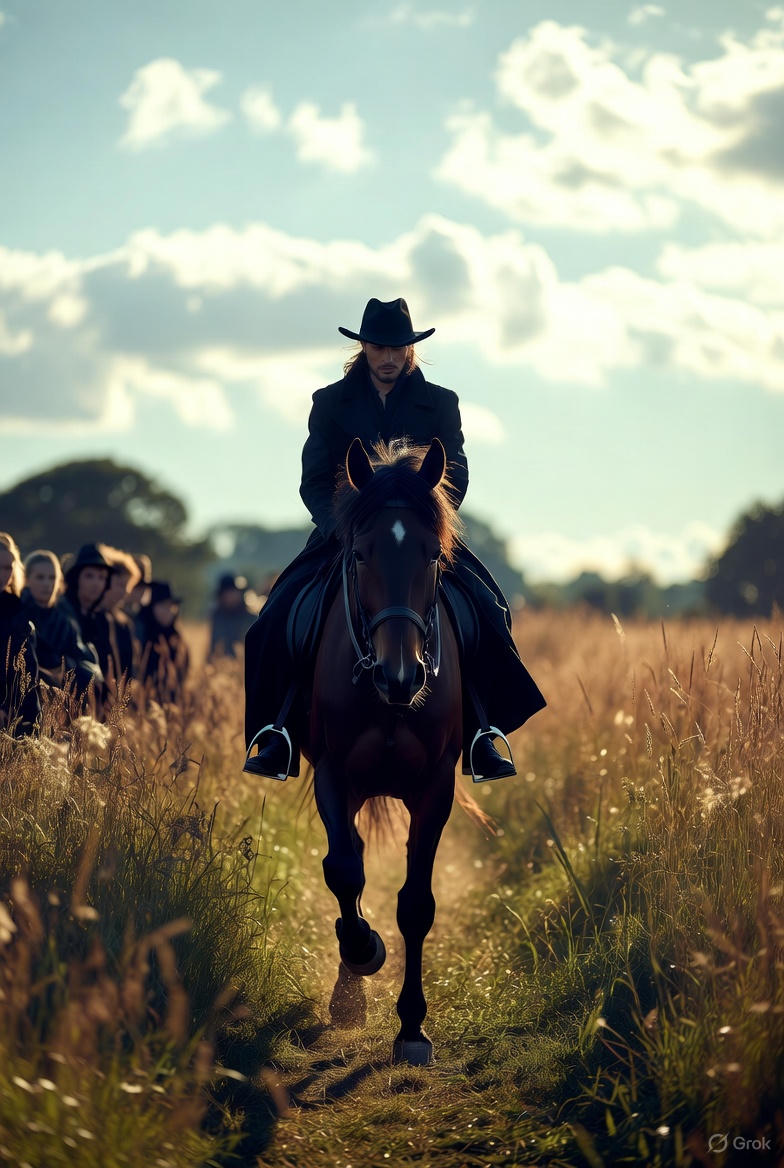
People like me come once a generation. Who grasps the irresistible urge of a soul whose sole element is beauty? Beauty as the condition, the air, the only law. We few should take whatever we need to nurture our genius. Private property loses meaning before us. For the artist, there’s no private property; we’re the rightful owners of beauty in all forms. Everything bows to us. What our consecrated hands touch is ours—by right. We craft new beauty, gifting it to the world. What do those dull Heidelberg scholars get from a manuscript? They count syllables, write commentaries, and every decade, one pens a monograph, borrowing a few artist’s phrases to dress up their dry drivel. Who among them feels the delicate wonders of an old monk’s manuscript, the scent rising from its lines, the symbolism of its images, the deep, glowing colors that sear our souls, birthing bold, unheard thoughts… but you’re like them. You wield the tongs, grasping the coal to spare the bourgeois parlor’s floor from burns.” Hedwig fell silent. When Fritz Gegely reached this point, he had to go to the bitter, painful end. He paced behind the table. “You’ll drive me to… renounce my name… I won’t hide—in a place like Vorderschluder…” A clatter arose on the stairs. Gegely opened the door. The luggage and wheelchair arrived. The stableman, the butcher, and two other Cyclopes panted and sweated up the steps. The landlady had marshaled all her male staff. The chambermaid led, switching on electric lights everywhere. They brought the baggage piece by piece, a considerable haul. The rooms filled with trunks and boxes. It looked chaotic. Fritz Gegely fled. “You, country lass,” he addressed the chambermaid, “you’ll unpack the trunks under my wife’s supervision.” “Oh, yes,” the girl, who’d stood reverently, said with eager goodwill. Hedwig beckoned her husband, wanting to speak, but, realizing it was futile to hold him back, only nodded. “Don’t let time drag, dearest,” he said. “I’ll be back soon. My heart stays with you. You know that, don’t you?” He returned from the door, leaned over, and kissed her forehead with a tender, soft kiss. The chambermaid melted. It was like the finest novels. My heart stays with you! he’d said. She must remember that. Her next letter to Schorsch, the gallant Forty-Niner, would end with this phrase, which seemed imbued with magic. She set to work, guided by Hedwig’s brief instructions. She was rarely so deft and willing. When unpacking ran smoothly, Hedwig gazed out the window. Below, summer guests spoke softly. A girl’s laughter swirled playfully. The evening was gentle, as if the day had lived much and grown wise and infinitely kind. Twilight lingered over rooftops, forested hills, and the castle opposite. It fell from the sky like fine, soft cigar ash, settling on green shingles, golden-brown thatch, or rust-red tiles. As impartial as all heavenly messages, for the just and unjust alike. So Hedwig mused, looking out. A distant accordion stretched and sighed in yearning tones. Suddenly, a goose shrieked, as if jolted from sleep by a rough grasp. The castle up there, Hedwig thought—how it stands, firm and sure like him. She remembered him thus, as he was then, and surely still was. He’d have breathed his spirit into those old walls; he needed no setting to create, shaping his world to his will. Tomorrow, perhaps, she’d see him. The thought surged like a hot wave, but its glow faded, leaving her chilled. She trembled, fearing his gaze. Why had she come? These thoughts followed her into the first night’s sleep. They say, she thought before drifting off, the dream of the first night in a new place comes true, with special power. But Hedwig dreamed nothing, though she urged herself somewhere deep within to dream. No images formed. Only a gentle floating in lightness remained, a caress like comforting hands, silencing all sobs. That was as good as a dream. Morning brought dense fog to the Kamp valley. The village was submerged, only houses jutted with green-black shingles, golden-brown thatch, and rust- red tiles from the curdled milk. The castle basked in morning clarity. As the sun climbed, boldly beckoning the wooded valley, the fog dissolved, retreating to the forests, lingering as a thin, opalescent haze over the Kamp. By noon, Frau Hedwig could venture out for the first time. Through the Red Ox landlady, Gegely had found a man to push Hedwig’s wheelchair. It was Maurerwenzel, jobless and pleased with the task, as it required no shift from his “slow” gait. Gegely walked beside his wife’s wheelchair. Summer guests watched, confident these were people worth gossiping about. The spectacle wasn’t baseless. A beautiful, young, paralyzed woman in a wheelchair, and Gegely, never lifting his hand from the chair’s armrest, tenderly poised to fulfill her wishes. He’d traded his pressed travel suit’s correctness for a bohemian nonchalance, signaling: here I’m at home. He wore purple velvet slippers, loose bohemian trousers, and a velvet jacket once owned by Gustave Flaubert. His walking stick, with an ivory duck-bill handle, came from Jules de Goncourt’s estate, and for larger bills, he used a crocodile-leather wallet embossed with Oscar Wilde’s name in tiny gold letters. They went down the village street and over the bridge with its twisting baroque saints, who turned their heads to the invalid, lamenting their stone forms couldn’t help. “That’s Saint Nepomuk,” Maurerwenzel said of one. “When he hears midnight strike, he turns a page… in the book he holds…” “A folk tale?” Hedwig smiled kindly. Maurerwenzel grinned. “Nah… he turns when he hears… but does he hear?” “Oh, a jest!” Fritz Gegely said, his glance adding: You’re hired to push, not joke. Maurerwenzel nodded, pleased. A jest! For a Social Democrat, who knew the divide between capital and labor, this was much. Had steadfast Rauß heard, he’d have chewed him out. They followed the Kamp a stretch, on the soft meadow path to the paper factory. On the tennis court behind, balls flew back and forth. A slender, lithe woman deftly caught and returned them with graceful precision. Hedwig halted, wanting to watch. She took selfless joy in beautiful movement, with just a faint ache in her heart. Having been so near death, she was grateful for life’s remaining light and joy. “Who’s the lady?” she asked the tamed Maurerwenzel. When he named her, she flinched slightly. So, that was Helmina von Boschan, Ruprecht’s wife. Such radiance, elegance, beauty, and grace. The ache in her heart reared, threatening her eyes. Fritz Gegely grew alert. “What did you say, Helmina von Boschan?” he asked Maurerwenzel. “What’s her husband’s name?” He learned Ruprecht von Boschan resided at Vorderschluder Castle, noting the respectful tone. Maurerwenzel couldn’t deny respect for a man who’d once so neatly floored Rauß and himself. “Did you know, Hedwig?” Fritz turned to his wife. “Did you know Ruprecht lives here?” This was the question Hedwig had dreaded. Fritz wouldn’t erupt before a third party, but she felt his tension. She couldn’t lie. “Yes,” she said. “Some time ago, I read his name in a paper, a report about a festival in Vorderschluder. There were riots, and it said the district captain and… Herr von Boschan’s decisive actions prevented the worst. That’s how I knew he’s settled here.” Maurerwenzel held back details of Ruprecht’s decisive actions. Hedwig looked at her husband; his quivering nostrils signaled rising menace. But with a third party present, no outburst came. “And so you thought we should spend the summer here,” he said. She placed her hand on his, feeling angry, twitching fingers. “Yes… I believe his calm and balance will do you good. You were friends. You’ll see, he’s as he was… I didn’t tell you, or you might’ve refused…” That was a lie, but unavoidable. “Yes, yes, I know,” Gegely said venomously. “Ruprecht, the flawless knight, free of prejudice. He’ll shake Fritz Gegely’s hand.” The game on the white-lined court, between high wire nets, ended. Two men joined Helmina for lively talk, soon turning toward the wheelchair. One stared steadfastly over. “I think there’s another acquaintance,” Fritz Gegely said. “Shall we move on?” But a rider approached along the meadow path, trotting past the onlookers. A fleeting glance fell on them, the horse took a few more steps… a jolt ran through man and beast. The rider turned and came back…
Part III: Concerning the Laws and Vital Conditions of the Hermetic Experiment
Chapter 3: The Manifestation of the First Matter, Part 2
Introduction: The Hermetic art transforms the soul’s essence, the First Matter, into radiant divine light, uniting it with eternity through sacred alchemy. This section explores the process of dissolution and rebirth, where the soul’s spark becomes a golden vessel of universal truth.
The Alchemy of Rebirth
The soul’s essence, purified through sacrifice, mirrors the natural law of resurrection, as Paul explains: “That which is sown is not quickened except it die.” In alchemy, this is the process of solve et coagula—dissolving the soul’s impurities to birth a spiritual body. Böhme describes this as the “Tincture” emerging from anguish, uniting fire (sulphur) and water (Mercury) into a radiant essence, the “Water of Life” that reflects divine light.
This transformation, like a seed becoming a plant, spiritualizes the soul’s natural body. The adept’s “heavenly fire” stirs the elemental essence, dissolving the sensual dominant to reveal a luminous form, as Bacon notes: “Purge the old leaven to become a new lump.”
The Divine Conjunction
The alchemical process culminates in a sacred union, where the soul’s essence (Mercury) and divine light (Gold) merge. Sendivogius instructs, “Congeal water with heat, let it putrefy like a grain, then reunite the spirit with the water.” This creates a “Fifth Essence,” a radiant circle born from the Tetractys—Pythagoras’ fourfold harmony. Maier’s enigma captures this: “From man and woman make a circle, then a square, a triangle, and a circle again—the philosopher’s stone.”
This conjunction, a marriage of active and passive principles, transforms the soul into a golden vessel, as Khunrath describes: “The King rises from his glassy sepulchre, a shining carbuncle of eternal splendor.”
The Universal Mystery
The transformed soul, now a “System of Wonders,” reflects the universe’s harmony, as the Pimander declares: “The whole world is before thee, a drop of dew in the morning.” This radiant essence, born from divine light piercing the soul’s matter, reveals all creation in a crystalline mirror, uniting the microcosm with the macrocosm in a dance of love and wisdom.
Closing: This chapter unveils the First Matter’s transformation into divine light, a sacred alchemy of soul and eternity. The journey into its practical wonders deepens in our next post, unveiling further secrets of this sacred art.
Homo Sapiens: In the Maelstrom by Stanislaw Przybyszewski and translated by Joe E Bandel
XI.
He woke up. Yes, really? He clearly heard a melody: deep, mystical bass melody and like a distant echo a tone and again a tone, isolated, whining in the treble. His whole soul threw itself into this holy melody and clung to it and wound itself up on it, curled together and widened with new strength: it felt so infinitely good. It seemed to him as if everything heavy, everything dull and terrible in his soul had dissolved, slowly dissolved and would now become the essence, the mad, soft longing of these tones… Never had he felt such a soft, blessed longing.
It was probably night. He did not dare open his eyes, it was so infinitely good to feel this longing. It was night, and he had a blessed, joyful longing for tomorrow, the hot, short, color-frenzied autumn day. It was probably raining outside too, but tomorrow, tomorrow the sun comes and will breathe the rain and gnaw further on the leaves: oh, this glorious sick purple-yellow…
Was he awake, was he really?
He still heard the melody, softer and softer, sadder and sadder, and he lay there, dissolved in this longing, dissolved in this pain that was actually no pain—no: a flowing back, a receding memory, a mad yearning for foreign, wide lands, for a great, orgiastic nature in which every flower grows into a giant tree, every mountain hides in the clouds and every river foams and rages without banks…
Then his heart began to beat violently. He grasped it with both hands… Yes, here, here between the fifth and sixth rib he felt the heart shock—he felt the heart tip first strike against the flat hand, then against two fingers, finally he pressed his index finger firmly against the spot… How it works! Did Grodzki perhaps first palpate his heart in this way?
He sat up in bed and supported his head in both hands.
Grodzki shot himself… That was what he knew for sure. He shot himself because he wanted to die. He died with will, he died of disgust, he no longer wanted to see the young day and the sick purple-yellow.
But why should he think about it? Should he destroy this blessed harmony in his soul again? But what did the strange man say? Falk, Falk, you do not know this harmony: it goes beyond all calm, beyond all holiness, beyond all bliss… But the man was mad.
Falk shuddered, he clearly saw the mad eyes of the stranger. He dug convulsively with his fingers into the blanket. Fear seized him anew, but in the next moment he became calm.
There was no doubt that he had finally come to consciousness:
He had namely fainted in the armchair when the stranger stole away from his room, now he was in bed, so he must have been carried to bed. Yes, and the button? The golden, blinking button was really on the desk… So he was awake and in full consciousness.
He felt a quite immediate, animal joy.
Then he fell back into the pillows and lay for a long time as if in a faint.
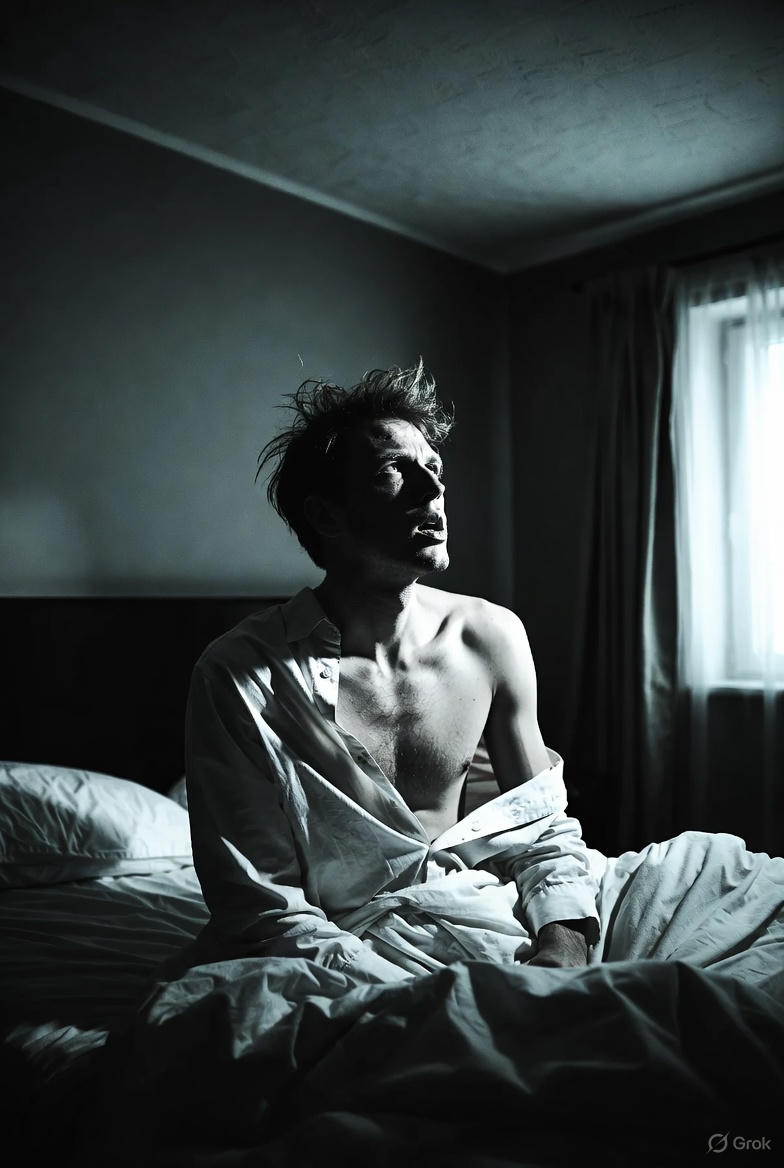
When he began to think again, he had risen from the bed and began to dress. But he was very weak. Half-dressed he lay down on the bed again and stared thoughtlessly at the ceiling.
Ridiculous how sloppily the ceiling was painted! The hook for the hanging lamp should actually be in the middle. Well. The ceiling is a parallelogram. Now I draw the diagonals.
He became quite furious.
Ridiculous! That was by no means the intersection point. The whole room was repugnant to him. He was locked in this narrow space with his dull torment, and outside the world was so wide…
Again he felt the hot longing, only far, far away—to the Pacific Ocean.
Yes, the Pacific Ocean! That was redemption. That was redemption to eternal calm, to eternal harmony without torment, without joy, without passions…
How his young heart trembled then! His limbs became so weak from the constant fear. Around the church on the lawn he saw people, many people, lying on their knees and begging God for mercy, he looked at them, his heart beat more and more violently, his unrest grew, sin burned on his heart like a fire mark. Now he was to confess, tell a strange person the shameful abomination… And in his desperate soul fear he took the prayer book and read five, six times with trembling fervor the litany to the Holy Spirit. And a peace returned to his heart, a holy, transfigured rapture, his soul became pure and wide like the hot noon around him. Now he had to go into the church. Then fear seized him. Had one not seen a black rider on a black stallion tumbling in the church at noon?… He crept cautiously to the sacristy door… He listened, then slowly opened the heavy door and staggered back in animal fright: before him stood the stranger. You destroyed his soul! he said solemnly…
“I dream! I dream!” cried Falk, woke up and jumped out of bed.
Isa started.
“It is me, Erik, it is me, don’t you know me?” Falk stared at her for a while, then breathed deeply. “Thank God it is you!”
“Tell, tell, Erik, what is wrong with you? Do you feel very sick? Are you better? I had such terrible fear for you.”
Falk collected himself with all strength.
To thunder! Should he not overcome the bit of illness, should he not finally once forget his small, ridiculous pains? it shot through his head.
“I am no longer sick at all,” he said almost cheerfully. “I only had a little fever, that remained from then,—he, he, I got the fever in the homeland, nothing more.”
His head suddenly became unusually clear.
You are sick, Erik, you are. Your body glows. Lie down, I beg, lie down. This morning you lay on the floor. The doctor said you should lie a few days…
He became a little impatient.
“But just let me… I have not been so clear and so light for a long time as right now. The doctors are idiots, what do they know of me? He, he,—of me…”
He pulled her to him. His heart suddenly overflowed with an overflowing cordiality and love for her.
“We will have a wonderful evening today, you bring wine, then we sit down and tell each other the whole night… Do you remember, just like then in San Remo on our honeymoon.”
She looked at him.
“I have never seen a person who is as strong as you. That is strange, how strong you are…”
“So I lay on the floor?”
“You cannot imagine what an uproar it was in the house…” “Well, just go now, afterwards you will tell me everything…”
“But was there not a strange person here?” asked Isa. “A stranger? No!”
“Then I probably dreamed.” “Surely.”
She went.
Falk dressed.
Of course you dreamed, dear Isa, you have strange dreams anyway.
He smiled satisfied.
He considered whether he should take tailcoat and white tie. It was after all the great feast of peace, the feast of calm, of eternal harmony.
He was in a state of triumphant rapture.
Now finally I have found myself, Myself, Me—God.
Was he still sick? His thoughts were heated. The inner excitement foamed trembling up…
Was it perhaps only a moment of a physical reaction after all this torment and fear?
What did that concern him? He had now forgotten everything. His body stretched in the feeling of a long unknown bliss and energy.
“Ah, Isa, are you already here?”
“You are doing strange gymnastics there.”
“I drive away the illness. But something to eat…” “Yes, just come to the dining room.”
He ate something, but without special appetite.
“I am as if newborn, Isa, quite as newborn. So rejuvenated. I suffered much. No, no, understand me correctly, I had no personal suffering, only the whole misery out there weighed on me and made me so miserable…”
Madame Bluebeard by Karl Hans Strobl and translated by Joe E Bandel
Fourteenth Chapter Summer had arrived, and with it the summer guests, bringing streams of sunlight and wealth to the Kamp valley. On a June evening, a carriage descended the final curves of the forest road from Gars. An ordinary vehicle, like any other, but extraordinary for its cargo of compassion and purest love. Two people sat within. A pale, beautiful young woman with gently waved blonde hair wore a soft, flowing dress loosely gathered beneath her chest. Half-reclining in her corner, she let her wise, slightly sorrowful eyes wander. They were drinking eyes, filled with much yearning and joy, but also much resignation. The man beside her strove for a correctness softened by devotion. His clothing, collar, English mustache, and manicured hands were mirrors of fashionable perfection. His devotion was expressed by the arm curved behind her shoulders, as if to make his ever- present protection a comforting delight. When the carriage jolted over the drainage ruts of the steep road, like an old circus horse recalling forgotten tricks, he shouted at the driver, “Drive carefully… I told you!” The driver grumbled, braking harder, so the carriage creaked and groaned, inching along like a snail. Thus, they reached Vorderschluder and the door of the “Red Ox,” where the landlady offered her warmest, most unctuous smile of welcome. These were the distinguished guests who had reserved all five front rooms on the first floor two weeks earlier. The man leapt from the carriage, the driver clambered down, but the young woman remained leaning in her corner. Her smile was anxious, sad, pleading the world’s forgiveness. “Bring a chair,” the man told sturdy Resi. She stared, astonished. One never stopped learning. Did city women now need chairs to alight? Surely a pampered princess, one who supposedly slept in gloves. But, reluctantly fetching the chair, she saw the beautiful young woman wasn’t spoiled but a poor paralytic, needing to be carried upstairs in the chair. With infinite care and tenderness, the husband oversaw the transport, supporting her back, holding her dangling hand, asking ten times if all was well, and snarling at helpers for any minor misstep. “Let it be,” the invalid protested. “No… we must insist you’re treated gently from the start.” Tears welled in the Red Ox landlady’s eyes. First, the pity was unbearable—such youth, beauty, and sweetness so afflicted. Second, balm flowed for the husband, so devoted and tender. Her late husband, the Ox landlord, could never have shown such sacrifice. He’d turned surly when she ailed. With these thoughts, she went to the kitchen, mingling tears with the cook, chambermaid, and Resi, who’d returned from upstairs with touching details. Schorsch, sadly absent, would’ve wept too, the chambermaid said, despite being a man with a less soft heart. Unable to bear it, she grabbed a registration form and pencil, rushing upstairs. With her finest curtsy, she said, “Please,” placing paper and pencil on the table. The man eyed the short, grubby pencil, licked from use, then drew a gold fountain pen from its case and wrote. The young woman, still in the chair she’d been carried in, gazed out. My God, how beautiful she was. The chambermaid swallowed, her simple heart yearning to do something kind for her. Such tiny, rosy ears—not just the evening glow spreading wide outside. Oh God, she thought, what use is wealth if she can’t take a step? The man finished. “When the luggage arrives,” he said, “send the yellow suitcase and wheelchair up at once—they’re essential.” On the stairs, the chambermaid read the form: Surname and First Name: Fritz Gegely, Occupation: Writer, Birthplace: Linz, and so forth, ending with a proud flourish: Travel Documents: None! Amid the questions, it noted: Accompanied by: Wife. This irked her; her pity and affection so fixed on the paralyzed woman that, if justice ruled, she should’ve topped the form, with the husband relegated to “Accompanied by.” Meanwhile, Fritz Gegely toured the five rooms of their summer quarters, lips curled in mockery. It was rurality supreme. Furniture painted a ghastly yellow, walls daubed with hideous patterns, and the pictures… Christ on the Cross, a garish van Dyck print, hair-raising. In the bedroom, the late Ox landlord in oil and vinegar, painted by an artist who’d bartered a two-week stay. The artist supplied the oil of mischief, the landlord the vinegar of forced cheer—or vice versa. The deceased looked ready to step from his frame at night and perch on a sleeper’s chest. Under a glass dome crouched a wax scene: a blind beggar with a child, a fitting companion to the landlord. A plaster poodle in the last room completed the set, perched on the white tiled stove, bearing years of dust in its folds with canine stoicism. Fritz Gegely returned from his sardonic survey to Frau Hedwig. “Well, here we are…” he said. Hedwig turned to him. “Do you like it?” she asked, uncertain. “Oh, yes!” he laughed. “We’re in a curiosity cabinet… an ethnographic museum of Kamp valley life.” Hedwig grew uneasy. “You can’t expect these simple folk to match your refined taste. When our trunks arrive, you’ll set out your comforts, your dear trinkets, and make these rooms your own…” “Never,” Fritz snapped, glaring around. “These rooms resist it. They’re steeped in smug, peasant malice. Look—the cupboard doors squeak; to fetch a shirt button, you get a concert, scales up and down. The windows don’t close. A breeze will give us a nightly rattle. There’s surely mouse holes behind the furniture. I’m certain the beds creak. That’s a summer retreat—for rustic art fools, not me. For blockheads diving into the ‘folk soul,’ seeking the ‘wellspring’… how did I end up here? How does Fritz Gegely land in Vorderschluder?” “I feared you’d be unhappy,” the invalid said softly. “We won’t stay long… I don’t want you always cross.” “Oh, please,” the poet retorted sharply. “We’ll stay as planned. I have a will too. I’ll adapt… protective mimicry… surely I can muster that much resolve… or do you think me incapable even of that?” Hedwig waved off his words. “Stop,” he said, irritated. “I know why you dragged me to this backwater. You want me out of the world’s sight. Yes… we could’ve gone to Ostend or a Swedish spa… but you insisted on Vorderschluder. Why? I’m not that foolish. I know you think little of me. But I’m not that dim. I’m to vanish… into oblivion… curtain down, show’s over. Fritz Gegely’s memory must fade… because my name carries scandal. The man who stole a manuscript from Heidelberg’s university library…” “We’ll go to Ostend tomorrow if you wish,” Hedwig said, tears in her eyes. Silent, clear tears traced a familiar path from wide, unblinking, fearful eyes. Her translucent, invalid hands twisted in her lap. Fritz Gegely strode to the door, peered out, then returned, lowering his voice. “Run off again? That’d be rich. My name’s in their hands now… passed from mouth to mouth. ‘Oh, that’s the poet of Marie Antoinette, the Heidelberg thief—you know!’ And we’d flee tomorrow? No, the hypocrites would say, ‘See, he can’t stay put, it’s his conscience, he’s restless, cursed like Ahasuerus.’ We must stay.” Hedwig reached out both hands. “Fritz, why torment yourself… and me? That wretched affair must be forgotten. The doctors ruled you weren’t responsible. Everyone knows. Those aware of your… confusion know you were acquitted and in a sanatorium.” But Gegely stayed clear, pacing behind the table. Her hands sank alone. “That’s it. Everyone knows—they handle my name with tongs… like a hot coal. The tongs are ‘temporary insanity.’ They smirk with pity. Pity shames.” Hedwig shook her head. “Fritz,” she whispered, timidly, “what should I say, then?” He ignored her. “Those sheep-heads… instead of explaining my case through the radiant phenomenon of the artist, they pin it to their paltry judicial medical terms. Fine for tailors and glovemakers dealing in ‘temporary insanity.’ Talk that way about a fifteen- year-old schoolboy killing himself or his fourteen- year-old sweetheart from grammar school. Or a hysterical maid swallowing phosphorus.
Alraune by Hanns Heinz Ewers and translated by Joe E Bandel
But Wolf Gontram didn’t understand one syllable. She laughed, left him standing there, and took the arm of Fräulein ten Brinken. “My brother is a more beautiful girl that you are,” she said. “But you are a sweeter boy.” “And you,” laughed Alraune, “my blonde abbess, you prefer sweet boys?” She answered, “What is permitted for Héloise? It went very badly for my poor Abalard, you know. He was slender and delicate just like you are! There I can learn much about self-modesty. But you, my sweet little boy, you appear like a strange priest with a new and fresh doctrine, one that would harm no one.” “My doctrine is ancient and venerable,” said the Chevalier de Maupin. “That is the best covering for such sweet sin,” laughed the blonde abbess. She took a goblet from the table and handed it to him. “Drink, sweet boy.” The countess came up with hot pleading eyes, “Let me have him!” But Frieda Gontram shook her head. “No,” she said sharply. “Not him! Fair game, if you like–” “She kissed me,” insisted Tosca and Héloise scoffed. “Do you believe you are the only one tonight?” She turned to Alraune, “Decide, my Paris. Who shall it be? The worldly lady, or the pious one?” “For today?” asked Fräulein de Maupin. “Today–and as long as you want!” cried Countess Olga. The fancy dressed boy laughed, “I want the abbess–and Tosca as well.” He ran laughing over to a blonde Teuton that was strutting as a red executioner with a mighty axe made of cardboard. “You–brother-in-law,” she cried. “I’ve got two mama’s. Will you execute them, both of them?” The student straightened up and raised both arms high. “Where are they?” he bellowed. But Alraune found no time to answer; the Colonel of the 28th regiment had snatched her up for the two-step. –The Chevalier de Maupin stepped onto the professors’ table. “Where is your Albert?” asked the professor of literature. “Where is your Isabella?” “My Albert is running around here somewhere, Herr Professor,” answered Alraune. “He appears in two dozen different versions in this very ballroom!” “As for Isabella”–her eyes searched around the room–“Isabella,” she continued, “I will present her to you as well.” She stepped up to the professor’s daughter; a fifteen year old, timid thing that looked at her with large amazed blue eyes. “Will you be my page, little gardener?” she asked. The flaxen haired girl said, “Yes, gladly–If you want me to!” “You must be my page when I am a lady,” the Chevalier instructed, “and my maid when I go as a gentleman.” The little girl nodded. “How is that, Herr Professor?” laughed Alraune. “Summa cum Laude!” acknowledged the professor. “But leave my dear little Trudi here with me.” “Now I ask!” cried the Fräulein ten Brinken and she turned to a short, round botanist. “Which flowers bloom in my garden, Herr Professor?” “Red hibiscus,” answered the botanist. He knew the flora of Ceylon very well, “golden lotus and white temple flowers.” “Wrong!” cried Alraune. “Entirely wrong! Do you know, Herr Rifleman from Harlem? Which flowers grow in my garden?” The art professor looked at her sharply, a light smile tugged at his lips. “Les fleurs du mal; the flowers of evil,” he said. “Aren’t they?” “Yes,” cried Mlle. de Maupin. “Yes, you’ve got it right.” “But they don’t bloom for you my dear scientist. You must patiently wait until they are dried and pressed into a book or in a frame after the varnish dries.” She pulled her pretty sword, bowed, saluted and snapped her sword-cane back together. Then she turned around on her heel, danced a few steps with the Baron von Manteuffel from Prussia, heard the light voice of her Royal Highness and sprang quickly up to the table of the princess. “Countess Almaviva,” she began. “What do you desire from your faithful cherubim?” “I’m really disappointed with him,” said the princess. “He has really earned a beating, scampering around the hall with one scoundrel after another!” “Don’t forget the Susanna’s either,” laughed the prince-escort. Alraune ten Brinken pulled her lips into a pout. “What should such a poor boy do,” she cried, “who knows nothing of this evil world?” She laughed, took the lute from the shoulder of the adjutant who was standing in front of her dressed as Frans Hals. She strummed, stepped back a few paces and sang: “You, who instinctively Know the ways of the heart Tell me, is it love That burns so here in mine?” “From whom do you want advice cherubim?” asked the princess. “Doesn’t my Countess Almaviva know?” Alraune gave back. Her Royal Highness laughed, “You are very daring, my page!” Cherubim answered, “That is the way of pages!” He lifted the lace on the sleeves of the princess and kissed her on the hand–a little too high on the arm and a little too long. “Shall I bring you Rosalinde?” he whispered, and he read the answer in her eyes. Rosalinde danced past–not a moment’s rest was she allowed this evening. The Chevalier de Maupin took her away from her dance partner, led her up the steps to the table of her Highness. “Give her something to drink,” she cried. “My beloved thirsts.” She took the glass the princess handed to her and placed it to Wolf Gontram’s red lips. Then she turned to the prince consort. “Will you dance with me, wild outrider from the Rhine?” He laughed coarsely and pointed to his gigantic brown riding boots with their immense spurs. “Do you believe that I can dance in these?” “Try it,” she urged, and pulled him by the arm away from where he was sitting. “It will be alright! Only don’t trample me to death or break me, you rough hunter.” The prince threw a doubtful glance at the delicate thing in perfumed lace, then put on his buckskin gloves and reached out to her. “Then come, my little page,” he cried. Alraune threw a hand kiss over to the princess, waltzed through the hall with the heavy prince. The people made room for them and it went well enough diagonally across and then back. He raised her high and whirled her through the air so that she screamed. Then he got entangled in his long spurs–oops! They were both lying on the dance floor. She was up again, like new, reaching out her hand to him. “Get up Herr Outrider. I can’t very well lift you.” He raised his upper body, but when he tried to get onto his right foot a quick “ouch!” came out of his mouth. He steadied himself with his left hand, tried to get up again, but it didn’t work. An intense pain took his Majesty across the foot. There he sat, big and strong, in the middle of the dance floor and couldn’t get himself up. Several came up and tried taking off the mighty boot, which covered his entire leg, but it wouldn’t go. The foot had swelled up so quickly they had to cut away the tough leather with sharp knives. Professor Dr. Helban, Orthopedic, examined him and determined the anklebone was broken. “I’m done with dancing for today,” grumbled the prince-escort. Alraune stood at the front of the thick circle that surrounded him, near her pressed the red executioner. A little song occurred to her that she had heard the students howling at night. “Tell me,” she asked. “How does that song go, the one about the fields, the forests and the strong man’s strength?” The tall Teuton was thoroughly drunk and reacted as if someone had thrown a coin into an automated machine. He swung his axe high into the air and bellowed out: “He fell on a stone. He fell on a–crack, crack, crack – He fell on a stone! Broke three ribs in his body In the fields and the forests And all of his strength– And then his right –crack, crack, crack And then his right leg!” “Shut up!” whispered a fraternity brother to him. “Are you entirely crazy?” That quieted him. But the good natured prince laughed. “Thanks for the appropriate serenade! But you can save the three ribs–My leg here is completely enough!” They carried him out on a chair, helped him into his sleigh. The princess left the ball with him. She was not at all happy about the incident. Alraune sought out Wolf Gontram, found him still sitting at the abandoned Royal table. “What did she do?” she asked quickly. “What did she say?” “I don’t know,” answered Wölfchen. She took his fan, hit him sharply on the arm. “You do know,” she insisted. “You must know and you must tell me!” He shook his head, “But I really don’t know. She gave me something to drink and smoothed back the hair on my forehead. I believe she also squeezed my hand, but I can’t say exactly, don’t know exactly all that she said. A couple of times I said, ‘Yes.’ But I wasn’t listening to her at all. I was thinking about something entirely different.” “You are terribly stupid Wölfchen,” said the Fräulein reproachfully. “You were dreaming again! What were you dreaming about this time?” “About you,” he replied. She stamped her feet in anger. “About me! Always about me! Why are you always thinking about me?” His large deep eyes pleaded with her. “I can’t help it,” he whispered. The music began, interrupting the silence that the going away of the Royalty had caused. “Roses of the South” sounded soft and seductive. She took his hand, pulled him out with her. “Come, Wölfchen, we will dance!” They stepped out and turned around. They were alone in the large hall. The gray bearded art professor saw them, climbed up on his chair and shouted: “Quiet, special waltz for the Chevalier de Maupin and his Rosalinde!” Hundreds of eyes rested on the beautiful couple. Alraune was highly aware of it and felt the admiration with every step that she took. But Wolf Gontram noticed nothing, he only felt, as he lay in her arms and was carried by the soft sounds. His heavy black eye lashes lowered, shadowing his deep, dreamy eyes. The Chevalier de Maupin led, certain, as confidant as a slender page that has lived on the smooth dance floor since the cradle. His head was bowed slightly forward, his left hand held two of Rosalinde’s fingers while the right rested on the golden knob of the sword-cane that he had pushed down through the lace trimmed sash till the other end showed behind him. His powdered hair curled like tiny silver snakes, a smile spread his lips revealing smooth white teeth. Rosalinde followed every light pressure. Her red and gold train slid smoothly over the floor and her figure grew out of it like a graceful shaped flower. Her head lay back, white ostrich plumes dangled heavily from her large hat. She was worlds away from everyone else, enraptured by the garlands of roses that hung throughout the hall. They passed under them again and again on their way around the dance floor.
Part III: Concerning the Laws and Vital Conditions of the Hermetic Experiment
Chapter 3: The Manifestation of the First Matter, Part 1
Introduction: The Hermetic art transforms the soul’s purified essence, the First Matter, into radiant divine light, uniting it with eternity. This chapter unveils the alchemical process of manifesting this sacred spark, guided by poetic visions and Theurgic rites.
The Tears of Isis
The soul’s essence, purified through Theurgic sacrifice, emerges as the “First Matter,” a radiant spark ready to unite with divine light. Vaughan’s poetic vision of Hyanthe, adorned in green damasks and shedding tears of pearl, symbolizes this essence—a divine water flowing from the soul’s contrite heart. These “Tears of Isis” are not mere illusion but a tangible force, bearing the soul’s truth in a crystalline vial, as pure as the philosopher’s stone.
This sacred water, born of divine sorrow, transforms chaos into harmony. As Hyanthe’s tears turn to rose water, the soul’s purified essence becomes a “silver torrent,” reflecting divine light and preparing the way for eternal union.
The Alchemical Transformation
The alchemical process, guided by reason and faith, dissolves the soul’s illusions to reveal its radiant core. Hermes instructs, “Dissolve the stone with pure water, not common, but a subtle fountain that sparks life.” This process—solution, sublimation, and fixation—purifies the soul’s essence through fire, as Khunrath describes: “Seek Three in One—body, soul, spirit—united in harmonious accord.” The soul, like a phoenix, rises from its ashes, radiant and reborn.
Eirenaeus advises, “Sow your gold in good earth, for he who destroys it reaps a hundredfold increase.” This sacrifice, like Achilles’ triumph, transforms the soul into a crowned king, adorned with the Sun’s diadem and the Moon’s crescent, radiating divine light.
The Divine Marriage
The culmination is a sacred union, the “marriage of Peleus and Thetis,” where the soul’s essence weds divine light. In this “Microcosmic Heaven,” colors of the rainbow signal reconciliation, as the soul’s purified spark, like a carbuncle, shines with eternal splendor. This divine light, born from the crucible of sacrifice, fulfills the Hermetic quest, uniting the soul with the universal source in a radiant dance of love.
Closing: This chapter unveils the First Matter’s transformation into divine light, a sacred marriage of soul and eternity. The journey into its practical alchemy deepens in our next post, unveiling further secrets of this sacred art.
Homo Sapiens: In the Maelstrom by Stanislaw Przybyszewski and translated by Joe E Bandel
He looked around timidly.
“I want to tell you something, only to you alone, because you made such an extraordinary impression on me, right the first time I saw you. The man who my wife… whom my wife seduced, also told me such extraordinary things about you.”
Falk became very impatient. He hardly understood half of his speech. He felt alternately heat and cold in his body. At times he believed he was near fainting.
“Hurry; I am sick. I have a strong fever.” The stranger looked at him with a strange smile.
“I know it, I know it very exactly. I had it very bad in the last time.”
Suddenly he became even paler, he became quite green in the face and moved quite close to Falk.
“He told me that I should come to you to make you happy. Today, when you ran away from me…”
A cold shiver ran down Falk’s back. Was it really a vision? A raging fear seized him as he saw the stranger’s eyes fixed unceasingly on him.
“How? What—what do you mean?” “I want to make you happy.”
He was silent and seemed to brood deeply.
Falk looked at him distractedly. Then cold sweat broke out on his forehead, he began to tremble. The lowest button was missing from the stranger’s coat. Where had he seen the man? Yesterday, yes yesterday… But then it was only in the dream, in the fever.
The stranger seemed to struggle for expression.
“Do you know, Herr Falk, a feeling of calm? No, you naturally don’t know it… It is actually no calm… it is a feeling of such absolute harmony… One feels no pain, one no longer feels a body; one is redeemed from all bodily. One sinks into something infinite. The spaces have widened; the miles become millions of miles, the most miserable huts become palaces… You no longer know where you are, you know no path and no direction…”
His eyes shone in a rapt ecstasy.
Again Falk felt slow, cold shivers run down his back.
“In one second you can live through centuries, on a piece of earth you can see a thousand cities—oh, and the happy splendor, the splendor!”
His eyes suddenly became quite fixed and his face distorted painfully.
“At first I felt an inhuman fear… When the ground suddenly began to waver under me, when I suddenly felt transported to foreign cities, it happened that I threw myself on my knees in the middle of the street and begged the passers-by to hold me. I asked them to let me hold only the hem of their clothes… Oh, they were hard times of trial.”
“Do you suffer from epilepsy?” asked Falk shaken.
“No, no…” the stranger smiled insanely. “I am not sick. I am happy. And I came to bring you happiness, to you alone, because you made this extraordinary impression on me, and because you were his friend…”
He moved the chair even closer to Falk so that he whispered in his ear. “It is hard, very hard, but just try it. Drive all thoughts away. All, all! They are the mightiest support of the spirit that will not believe, of the spirit that doubts eternally. Drive everything from the brain so that you remain pure from doubt, then sit down and collect yourself so that the forces of the whole organism flow together to one point, so that you feel yourself only as a point, a trembling atom in world space… Then wait long, patiently… Then it comes suddenly over you, like a horrible chaos it comes over you, you will see an abyss, terrible ghosts crawl out of all corners.
His eyes tore unnaturally wide open.
“You will hear horrible voices, the walls will become bodily and will step toward you to crush you… You will experience torments against which human torment is a joy, a pleasure… Suddenly everything disappears… Something leads you out, the whole life streams before the eyes in infinite clarity… there is no more riddle, no secret—one can read in the soul of another like in an open book…”
“Why do you come to me with this, why?” whispered Falk.
The stranger did not hear his question.
“Then there is no more torment,” he continued, “no pain, no hate. I love the man who took the woman from me, I followed him with you, I wanted to save him, but in the moment of death one must not disturb…”
Now it shot through Falk’s head like lightning. Everything became clear to him. He trembled violently and held onto the armrest so as not to collapse.
“The man shot himself today!” he cried hoarsely. The stranger smiled strangely.
“Yes,” he said after a while. Falk came completely out of himself.
“What do you want from me?” he stammered almost unconsciously.
“You caused his death, Falk. He was like wax in your hands, you were his god, and you destroyed his soul. You made him a criminal against himself and others. Listen to me, follow me…”
“I did not do it! Can I help it that he perished from his debauchery?”
The stranger looked at him sternly.
“Oh, how hardened your heart is… You know well what you did to him. Why are you so pale, why do you tremble? He lies on your conscience.”
“Who, who?”
“Grodzki,” said the stranger softly.
Falk groaned tormentingly, and his head sank to his chest. But suddenly he came completely out of his senses, he straightened up and cried:
“I do not repent it. I want to ruin and destroy the whole world. I laugh at your mystical revelations. I don’t need them. I need no happiness. I spit on happiness. I repent that I destroyed and ruined too little, do you understand me?”
He suddenly stopped.
The stranger was completely transformed. His eyes expressed an uncanny fear. They ran restlessly around.
“The spirit of evil! the spirit of evil!” he repeated with trembling lips.
Suddenly his face became clear and his voice mild.
“You are sick, Falk, I will not disturb you… I followed you, I was afraid for you, how you stood there at the corner and trembled and waited for the shot.”
Again he became restless. He leaned far toward Falk, his voice trembled violently.
“I… I…” he stammered with difficulty… “followed you. You sat long with him… did he not speak about my wife?… He left her… she is perishing.”
“Nothing, nothing did he tell me… just go! You are killing me… go then!”
Falk felt that he could not hold himself any longer.
“You are so sick, Falk, so sick…” He went slowly out the door. Falk heard and saw nothing more. A dizziness seized him, the room began to turn around him, he sank and fell into unconsciousness.



 Anarchistbanjo's World